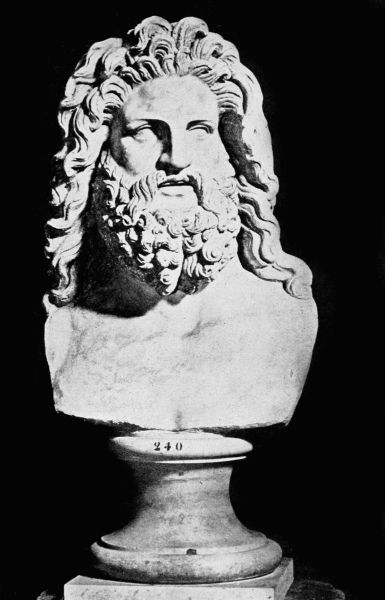
The only powers that dared oppose the will of
Jupiter were the Fates and Destiny, who issued
their irrevocable decrees without regard to the wishes
of the ruler of Olympus. Jupiter's sovereignty is
thus described by Homer:—
"He whose all-conscious eyes the world behold,
The eternal Thunderer sat, enthroned in gold,
High heaven the footstool of his feet he makes,
And wide beneath him all Olympus shakes.
* * * * *
He spoke, and awful bends his sable brows,
Shakes his ambrosial curls, and gives the nod,
The stamp of fate and sanction of the god;
High heaven with trembling the dread signal took,
And all Olympus to the center shook."
—Pope's Translation.
The principal temples of Jupiter were the Capitol
at Rome, and the Temple of Jupiter Ammon in
Libya. At Dodona was the oracle of Jupiter, called
the "Speaking Oak," where the responses were given
by the trees whose rustling branches made sounds
that were interpreted by the priests. The oracle
was said to have been established at Dodona in the
following manner: two black doves took their flight
from Thebes in Egypt. One flew to Dodona in
Epirus; and alighting in a grove of oaks, it proclaimed,
in human language, to the people of that
region, that they must establish there an oracle of
Jupiter. The other dove flew to the temple of
Jupiter Ammon, and delivered a similar command
there. Another account says that two priestesses
were carried off from Thebes in Egypt by the
Phœnicians, and set up oracles at Dodona and the
Libyan Oasis.
A magnificent temple at Olympia was dedicated
to Jupiter, and here, every fifth year, the Greeks
assembled to celebrate games. These festivals lasted
five days, and were known as the Olympic Games.
Vast numbers of spectators flocked to them from
every part of Greece and from Asia, Africa, and
Sicily. The Greeks usually reckoned time by
Olympiads or five-year periods,—the space of time
between the celebrations. The first Olympiad was
about 776 B.C.
Inside the temple at Olympia stood a wonderful
statue of Jupiter made of ivory and gold. The
parts representing flesh were of ivory laid on a framework
of wood, while the drapery and ornaments were
of gold. It was the work of Phidias, and was considered
the highest achievement of Grecian sculpture.
The height of the figure was forty feet, and the
pedestal was twelve feet. The god was represented
as seated on his throne, with his brows crowned
with a wreath of olive and in his hand a scepter.
The statue was considered one of the Seven Wonders
of the world, but our knowledge of it is confined
to literary descriptions and to copies on coins.
Poems:—
| Prometheus Bound |
Æschylus |
| Prometheus Unbound |
Percy B. Shelley |
| Prometheus |
Henry W. Longfellow |
| Prometheus |
James R Lowell |
The following are Byron's lines:—
"Titan! to whose immortal eyes
The sufferings of mortality,
Seen in their sad reality,
Were not as things that gods despise;
What was thy pity's recompense?
A silent suffering, and intense;
The rock, the vulture, and the chain;
All that the proud can feel of pain;
The agony they do not show;
The suffocating sense of woe."
There is a full account of the story of Pandora
in Hawthorne's "Wonder Book."
Poems:—
| Pandora |
Dante G. Rossetti |
| Masque of Pandora |
Henry W. Longfellow |
Other mythologists than Ovid, in treating the
story of the flood, state that Deucalion and Pyrrha
took refuge in an ark, which, after sailing about for
many days, was stranded on the top of Mount
Parnassus. This version was far less popular with
the Greeks, though it shows more plainly the common
source from which all these myths are derived.
"Who does not see in drowned Deucalion's name,
When Earth her men, and Sea had lost her shore,
Old Noah!"
—Fletcher.
The city of Delphi, containing the famous oracle
of Apollo, was built on the slopes of Mount Parnassus
in Phocis. It had been observed at a very early
period that the goats feeding on Parnassus were
thrown into convulsions when they approached a
certain deep cleft in the side of the mountain.
When a goatherd ventured near the spot, he found
a peculiar vapor arising from the cavern, and as he
inhaled it, he was affected in the same way as the
animals had been. The inhabitants of the country,
unable to explain the goatherd's convulsive ravings,
imputed his utterings to divine inspiration. A
temple was therefore erected on the spot, and the
prophetic influence was attributed to various gods, but
was finally assigned only to Apollo. A priestess was
appointed who was named the Pythia, and her office
was to sit upon a tripod placed over the chasm
from which the divine afflatus proceeded. The
priestess and the tripod were both adorned with
laurel; and as she inhaled the hallowed air, her
words—believed to be inspired by Apollo—were
interpreted by the priests.
The Pythian Games were celebrated at Delphi
every three years, and were instituted by Apollo
in commemoration of his conquest of the Python.
At these games were chariot racing, running, leaping,
wrestling, throwing quoits, hurling javelins, and
boxing. Besides the exercises in bodily strength,
there were contests in music, poetry, and oratory.
These occasions gave the poets and musicians an
opportunity to show their productions to the public.
There was in Troy a celebrated statue of Minerva
called the Palladium. It was said to have fallen from
heaven, and the Trojans believed that the city could
not be taken so long as this statue remained within
it. Ulysses and Diomede entered the city in disguise,
and succeeded in obtaining the Palladium,
which they carried off to the Grecian camp.
The finest and most celebrated of the statues of
Minerva was the one by Phidias in the Parthenon
at Athens. This was forty feet in height, and was
covered with ivory and gold. It represented the
goddess as standing with a spear in one hand, and in
the other a statue of victory. Her helmet, highly
decorated, was surmounted by a sphinx. The
Parthenon itself was constructed under the supervision
of the famous sculptor; and many of the reliefs
which enriched the exterior were by the hand
of Phidias himself. The statue of Minerva is not
in existence, but parts of the frieze of the Parthenon
are in the British Museum and are known as the
Elgin Marbles.
The hero Theseus instituted at Athens the festival
of Panathenæa in honor of Minerva. The chief
feature of the festival was a solemn procession in
which the Peplus, or sacred robe of Minerva, was
carried to the Parthenon, and left on or before the
statue of the goddess. The Peplus was covered with
embroidery worked by virgins of the noblest families
in Athens. The festival was peculiar to the
Athenians, but among them persons of all ages and
both sexes took part in the celebrations. In the
procession the old men carried olive branches and
the young men bore arms. The women carried
baskets on their heads containing the sacred utensils
and cakes necessary for the sacrifices.
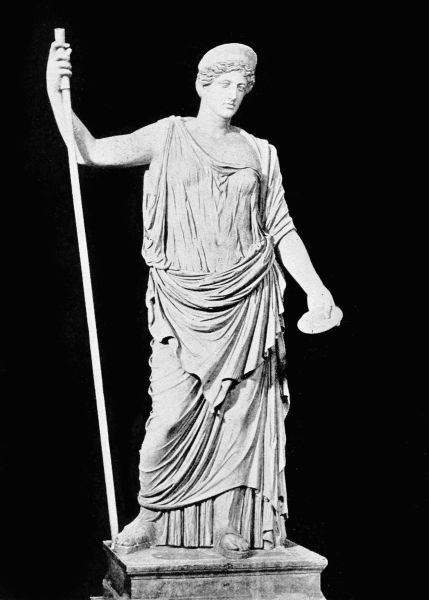
The most famous representations of Juno are the
torso in Vienna from Ephesus, the Barberini in the
Vatican at Rome, the bronze statuette in the Cabinet
of Coins and Antiquities in Vienna, and the Farnese
bust in the National Museum at Naples.
Juno's festivals, the Matronalia, in Rome, were
always celebrated with great pomp. Less important
feasts were held in each city where a temple was
dedicated to her. On one of these occasions, an old
priestess was very anxious to go to Juno's temple
at Argos, in which she had served the goddess many
years in her maiden days, and which she had left only
to be married. The way was long and difficult, and
the old priestess could not attempt to walk such a distance;
so she bade her sons Cleobis and Biton harness
her white heifers to her car. The youths were
anxious to do her bidding; but they could not find
the heifers, however diligently they searched. As
they did not wish to disappoint their mother who
had set her heart on attending the services, they
harnessed themselves to the car, and thus conveyed
her to the temple. The mother, touched by their
filial devotion, then prayed to Juno to bestow on
her sons the greatest gift in her power; and when
the old priestess went in search of the youths, after
the services were over, she found them dead in the
portico of the temple where they had lain down to
rest. Juno had taken them, while they slept, to the
Elysian Fields to enjoy an eternity of bliss as a
reward for their devotion.
There is another version of the story of how
Hercules brought Alcestis back from Hades. This
is in the Alcestis of Euripides, and Browning has
related it in his "Balaustion's Adventure." In this
account the wife of Admetus is not surrendered
willingly by Pluto, but the great hero Hercules
wrestles with Death for the body and life of Alcestis,
and by winning the victory over this dread adversary,
restores Admetus's wife to his arms.
Other poems:—
| The Love of Alcestis |
William Morris |
| Alcestis |
Francis T. Palgrave |
| Shepherd of King Admetus |
James R. Lowell |
The combat between a hero and a dragon is a
favorite theme in mythology and folklore. Besides
the myth of Apollo's slaying of the Python are the
well-known stories of Siegfried's killing of Fafnir,
St. George and the Dragon, Perseus and the Sea
Serpent, Cadmus and the Serpent, and Hercules and
the Hydra.
The principal temples dedicated to the worship
of Apollo were at Delos, his birthplace, and at
Delphi.
One of the Seven Wonders of the ancient world,
the famous Colossus of Rhodes, was a statue of
Apollo. His head was encircled with a halo of
bright sunbeams, and his legs were set wide apart to
allow vessels to pass in and out of the harbor with
all their sails spread.
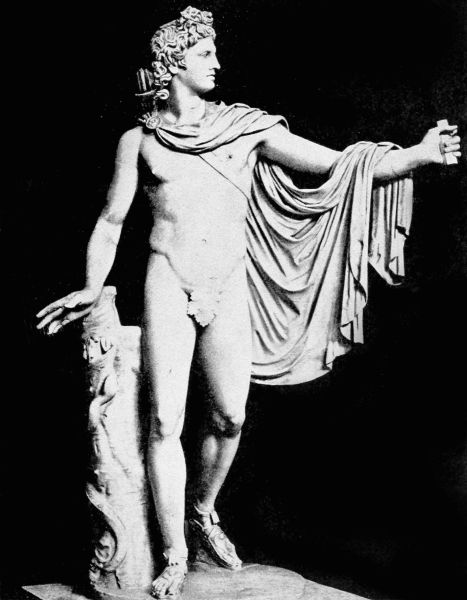
Among the many remains of ancient sculpture,
none is better known—unless it be the Venus of
Milo—than the statue of Apollo called the Belvedere,
from the name of the apartment of the pope's
palace at Rome in which it is placed. The artist is
unknown, but the work is supposed to be of the
first century of our era, and is modeled on the type
of Greek sculpture of the Hellenistic period. It is
restored to represent the god at the moment when
he has shot the arrow that slays the Python.
Poems:—
| Apollo in "The Epic of Hades" |
Lewis Morris |
| Hymn to Apollo |
John Keats |
| Hymn to Apollo |
Percy B. Shelley |
The story of Clytie is frequently alluded to in
poetry, and the sunflower is often used as an emblem
of constancy. Moore's lines are well known:—
"The heart that has truly loved never forgets,
But as truly loves on to the close;
As the sunflower turns on her god when he sets
The same look that she turned when he rose."
The sisters of Phaëton, the Heliades, spent their
days by the Eridanus River shedding tears, wringing
their white hands, and wailing over the loss
of their brother, until the gods, in pity for their
grief, turned them into poplar trees. Their tears,
which continued to flow, became amber as they
dropped into the stream.
The Diana of the Ephesians, referred to by St.
Paul in Acts xix: 28, was not the chaste moon-goddess
of the Greeks, though a world-renowned
sanctuary was dedicated to Diana at Ephesus.
Poems:—
| Praise of Artemis |
Edmund Gosse |
| Hymn to Diana |
Ben Jonson |
| Artemis in "Epic of Hades" |
Lewis Morris |
| Niobe |
Walter S. Landor |
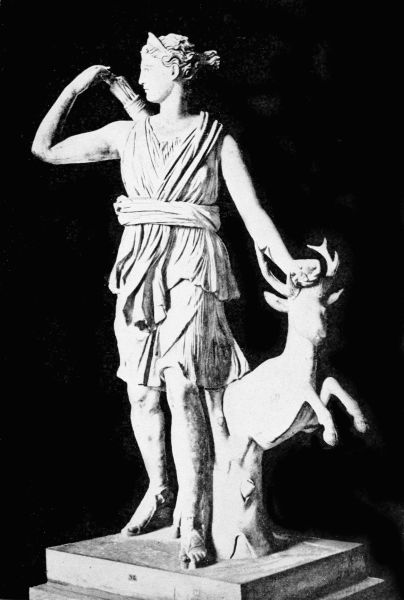
The most beautiful statue of Diana is the Diana
of Versailles, in the Louvre, Paris (also called the
Diana of the Hind).
Before Orion was slain by an arrow from Diana's
bow he loved Merope, daughter of Œnopion, king
of Chios, who consented to the union on condition
that the lover should win his bride by some heroic
deed. But instead of meeting this requirement,
Orion attempted to elope with Merope. The plan
was frustrated, however, by the king; and the bold
youth was punished by the loss of his bride and also
of his eyesight. Then Orion wandered about, blind
and helpless, and finally reached the Cyclops' cave,
where one of them took pity on him and led him to
the sun, from whose radiance his sight was restored.
The story of Endymion is a favorite theme in
poetry. The best-known poem on this subject is
the Endymion of Keats. Other poems are by
James R. Lowell, Henry W. Longfellow, Arthur H.
Clough, Elizabeth L. Landon, and Lewis Morris.
In the story of Hyacinthus, as told by the poet
Ovid in the "Metamorphoses" (Book 10, line 16,
etc.) the account says: "Behold the blood that had
flowed on the ground and stained the herbage
ceased to be blood; but a flower of hue more beautiful
than the Tyrian sprang up resembling the lily,
except that this is purple and that silvery white."
It is evident that the flower here described is not our
modern hyacinth, but some species of iris or larkspur.
Another unfortunate ending to one of the friendships
of Apollo was the death of Cyparissus, a clever
young hunter, whose companionship the sun-god often
sought. Cyparissus accidentally killed Apollo's pet
stag, and he grieved so sorely over this mischance
that he pined away and died. Apollo then changed
his body into a Cyprus tree, which the god declared
should henceforth be used to shade the graves of
those who, when living, were greatly beloved.
There were many oracles of Æsculapius, but the
most celebrated one was at Epidaurus. Here the
sick consulted the oracle and sought the recovery of
their health by sleeping in the temple. The treatment
of the sick was probably nothing like that of modern
therapeutics, but resembled what is now called animal
magnetism or mesmerism.
Serpents were sacred to Æsculapius, probably because
of the superstition that those animals have a
faculty of renewing their youth by a change of skin.
The worship of Æsculapius was introduced into
Rome in a time of great sickness, and an embassy
was sent to the temple at Epidaurus to implore the
help of the god. Æsculapius was so favorably inclined
to the petitioners that he accompanied the
returning ship in the form of a serpent. When
they reached the river Tiber, the serpent glided
from the vessel, and took possession of an island in
the river. Here a temple was later erected in honor
of Æsculapius.
According to the more ancient Greek conception,
Venus was the daughter of Jupiter and Dione,
goddess of moisture; but Hesiod says that she came
from the foam of the sea, and was therefore called
by the Greeks Aphrodite—the foam-born. She
was generally represented as a beautiful nude figure,
or wearing her wonderful girdle, the Cestus—in
which lay "love and desire and loving converse that
steals the wits even of the wise." The most famous
statue of Venus is the one that was found on the
island of Melos (Milo), and is now in the Louvre,
in Paris. It is probably the work of some sculptor
of about the third century B.C. He followed an
original of the age of Praxiteles, probably in bronze,
which represented the goddess, partly draped, gazing
at her reflection in an uplifted shield. A masterpiece
of Praxiteles was the Venus of Cnidos, based upon
which are the Venus of the Capitoline in Rome, the
Venus de Medici in Florence, and the Venus of the
Vatican, which is much superior to the other two.
Poems:—
| Chorus to Aphrodite in "Atalanta in Calydon" |
Algernon C. Swinburne |
| Aphrodite in "Epic of Hades" |
Lewis Morris |
| Venus of Milo |
Edward R. Sill |
| Venus and Adonis |
William Shakespeare |
| Adonis in "Epic of Hades" |
Lewis Morris |
| Death of Adonis trans. by |
Theocritus, Andrew Lang |
| Laus Veneris |
Algernon C. Swinburne |
The "Lament for Adonis" by Bion has been
translated by Andrew Lang, Edwin Arnold, and
Mrs. Browning.
The following stanza is from Tennyson:—
"Idalian Aphrodite beautiful,
Fresh as the foam, new-bathed in Paphian wells,
With rosy slender fingers backward drew
From her warm brows and bosom her deep hair
Ambrosial, golden round her lucid throat
And shoulder; from the violets her light foot
Shone rosy-white, and o'er her rounded form
Between the shadows of the vine bunches
Floated the glowing sunlights, as she moved."
The worship of Aphrodite was probably of Semitic
origin, but was early introduced into Greece. The
Aphrodite of Homer and Hesiod displays both
Oriental and Grecian characteristics. Among the
Phœnicians Venus is known as Astarte, among the
Assyrians as Istar. There were temples and groves
dedicated to Venus in many places, and in some
of them—Paphos for instance—gorgeous annual
festivals were held. The festival of Venus that was
celebrated in Rome in April was called the Veneralia.
Sapho calls Aphrodite the "star-throned, incorruptible,
wile-weaving child of Zeus."
One of the many myths connected with Venus
was that of Berenice who, fearing for her husband's
life, prayed to the goddess to protect him as he set
out to battle. She vowed to give her beautiful hair
as a sacrifice to Venus if he returned home in
safety. The prayer was granted, and Berenice's
luxuriant tresses were laid on the goddess's shrine,
whence they soon mysteriously disappeared. When
an astrologer was consulted in regard to the supposed
theft, he pointed to a comet in the sky, and
declared that the gods had placed Berenice's hair
among the stars to shine forever in memory of her
wifely sacrifice.
References and allusions to Cupid abound in
poetry. A few of the best-known poems are:—
| Eros |
Edmund Gosse |
| Ode to Psyche |
John Keats |
| The Lost Eros |
Thomas Ashe |
| The Unknown Eros |
Coventry Patmore |
| Story of Cupid and Psyche |
William Morris |
| Hue and Cry After Cupid |
Ben Jonson |
The following is a charming little poem by John
Lyly:—
"Cupid and my Campaspe play'd
At cards for kisses, Cupid pay'd.
He stakes his quiver, bow and arrows,
His mother's doves, and teeme of sparrows,
Looses them too; then downe he throwes
The coerall of his lippe, the rose
Growing on's cheek (but none knows how),
With these, the crystal of his brow,
And then the dimple of his chin;
All these did my Campaspe winne;
At last hee set her both his eyes;
She won, and Cupid blind did rise.
O love! has she done this to thee?
What shall (alas) become of mee?"
There is a very old story of a woman's love for her
husband and her efforts to win him back from Death
which is known in every part of India. On a certain
night in the year millions of Hindu women celebrate
a rite in honor of Savitri. The story is told in the
Mahabharata, an ancient epic of India.
Walter Pater, in "Marius the Epicurean," gives
the story of Cupid and Psyche as contained in
Apuleius. Many of the incidents of the story will
be found in modern fairy tales and romances such
as "Beauty and the Beast"; Grimm's "Twelve
Brothers"; the Gaelic stories: "The Three Daughters
of King O'Hara," "Fair, Brown and Trembling,"
"The Daughter of the Skies"; and the Norse
tale, "East of the Sun and West of the Moon."
The most amusing use made of the story of
Pyramus and Thisbe is in Shakespeare's "Midsummer-Night's
Dream," Act III, Sc. 2, and Act
V, Sc. 1, which is a burlesque of what was, in the
original story in Ovid, a tragedy.
Poems on "Hero and Leander" have been
written by Chistopher Marlowe, Leigh Hunt,
Thomas Hood, and Thomas Moore. Keats wrote
a sonnet, "On a Picture of Leander."
Byron attempted Leander's feat of swimming
across the Hellespont, a thing that was considered
impossible until the English poet proved its feasibility
by performing it himself. The distance in
the narrowest part is almost a mile, and there is a
constant current setting out from the Sea of Marmora.
Since Byron's time the swimming of the
Hellespont has been achieved by others; but it
still remains a test of strength and skill.
Various modern stories have been based upon the
myth of Pygmalion. One of the best known is
"The Venus of Ille," by Prosper Mérimée.
Poems:—
| The New Pygmalion |
Andrew Lang |
| Pygmalion and the Image |
William Morris |
| Pygmalion the Sculptor |
Robert Buchanan |
Amphion had a twin brother named Zethus who,
however, had none of the musician's artistic ability.
The brothers heard that their mother Antiope had
been put aside by her second husband Lycus, in
order that he might marry another wife; so Amphion
and Zethus hastened to Thebes, where they found
things worse than they had imagined, for Antiope
was thrust into prison and subjected to very cruel
treatment. The brothers besieged the city; and,
after taking possession of it, put Lycus to death.
Then they tied Dirce, who had been the cause of
their mother's suffering, to the tail of a wild bull,
and let it drag her over the stones until she was
dead. This punishment of Dirce is the subject of
a famous piece of sculpture called the "Farnese
Bull" (as it once belonged to the Farnese family),
now in the National Museum at Naples.
Poem:—
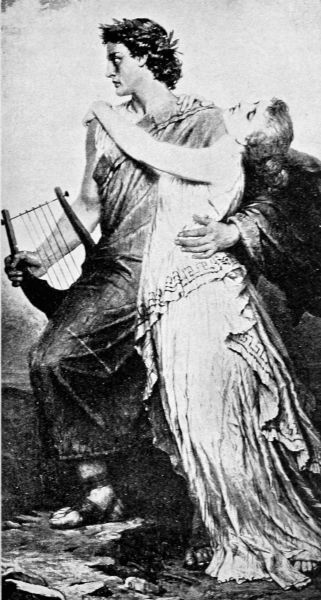
Orpheus's lute was placed in the heavens as the
bright constellation Lyra.
The story of Orpheus and Eurydice is often
alluded to in poetry. Pope has used it to illustrate
the power of music in his "Ode for St. Cecilia's
Day," and the wonderful beauty of the nightingale's
song over the grave of Orpheus is alluded to by
Southey in his "Thalaba."
The song of the nightingale seemed to the ancients
so plaintive that, wishing to account for its sadness,
they invented the story of Philomela. King Tereus,
having wearied of his wife Procne, tore out her
tongue by the roots and then married her sister
Philomela, pretending that his wife was dead.
Procne informed her sister of the horrible truth by
means of a web into which she wove her story.
To revenge themselves upon the king, the sisters
killed the boy Itylus (son of Tereus and Procne)
and served him up as food to his father. To punish
them for this wickedness the gods changed
Procne into a swallow, and Philomela into a nightingale,
which forever bemoans the murdered Itylus.
The king, Tereus, they transformed into a hawk.
Poems:—
| The Power of Music |
William Wordsworth |
| Eurydice and Orpheus |
Robert Browning |
| Orpheus and Eurydice |
Lewis Morris |
| Eurydice |
James R. Lowell |
| Eurydice |
Edward Dowden |
| Waking of Eurydice |
Edmund Gosse |
The Muses were the daughters of Jupiter and
Mnemosyne, goddess of memory. Although they
sometimes united in one grand song, they had
separate duties and powers. Apollo as leader of the
choir of Muses was called Musagetes.
Clio, the Muse of history, recorded the great
deeds of heroes, and was usually represented with
a laurel wreath, and a book and stylus.
Euterpe, the Muse of lyric poetry, was represented
with a flute and garlands of flowers.
Thalia, the Muse of comedy, was also the patroness
of pastoral poetry, and so was often represented
with a shepherd's crook as well as a mask.
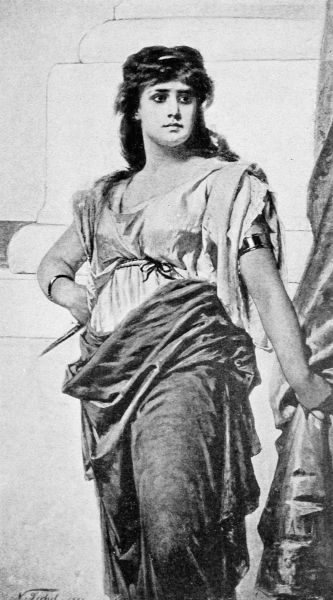
Melpomene, the Muse of tragedy, wore a crown
of gold, and wielded a dagger and a scepter.
Terpsichore, the Muse of choral dance and song,
was usually portrayed in the act of dancing.
Erato, the Muse of love poetry, held a lyre.
Polyhymnia, the Muse of sacred poetry, also
presided over rhetoric.
Calliope, the Muse of epic and heroic poetry,
wore a laurel crown.
Urania, the Muse of astronomy, held mathematical
instruments.
Mars's attendants, or some say his children, were
Eris (Discord), Phobos (Alarm), Metus (Fear),
Demios (Dread), and Pallor (Terror).
As founder of Rome, Romulus was its first king,
and ruled over the people so tyrannically that the
senators determined to get rid of him. So one day
when an eclipse plunged the city into sudden darkness,
the senators killed Romulus, cut his body into
pieces, and hid them under their wide togas. When
daylight returned, and the people looked about for
their king,—for all the citizens had assembled on
the Forum,—the senators informed them that
Romulus had been carried off by the immortal gods
and would never return. After this Romulus was
worshiped as a god under the name of Quirinus,
and a temple was built on one of the seven hills
of Rome, which has since been known as Mount
Quirinal. Yearly festivals in honor of Romulus
were held in Rome under the name of Quirinalia.
Homer gives two versions of the story of Vulcan's
lameness,—one, that Jupiter threw him out of
heaven for helping his mother against Jupiter's
will; and the other, that he was born deformed, and
that Juno, ashamed of his ugliness, cast him out of
heaven.
(1) "Yea once ere this, when I was fain to save thee (Juno),
he caught me by my foot and hurled me from the heavenly threshold.
All day I flew, and at the set of sun I fell in Lemnos, and little
life was in me."
(2) "She (Thetis) delivered me when pain came upon me
from my great fall through the ill-will of my shameless mother who
would fain have hid me away for that I was lame."
He spake and from the anvil rose limping, a huge bulk, but under
him his slender legs moved nimbly. The bellows he set away from
the fire, and gathered all his gear wherewith he worked into a silver
chest; and with a sponge he wiped his face and hands and sturdy
neck and shaggy breast, and did on his doublet and took a stout
staff and went forth limping.—Iliad, Book I and Book XVIII.
Vulcan's children were mostly monsters; but he
is also the reputed father of Servius Tullius, sixth
king of Rome, by a slave Ocrisia whom he visited
in the form of a bright flame, which played harmlessly
about her.
Vulcan was worshiped by all blacksmiths and
artisans; and great festivals, called the Vulcanalia
and the Hephæstia, were celebrated in his honor.
There were many versions of the creation of the
world among the Greeks and Romans, but the most
popular was the following: At first there was nothing
but a confused mass in which land, sea, and air
were all merged in one substance. Over this shapeless
mass reigned a careless deity named Chaos who
shared his throne with his wife Nyx (or Nox) the
goddess of Night. They were dethroned by their
son Erebus (Darkness) who ruled over the universe
with his children Æther (Light) and Hemera (Day).
These two then succeeded to the throne, and by
their combined efforts, together with the help of
their own child Eros (Amor or Love) created
Pontus (the Sea) and Gæa (the Earth), also called
Ge, Tellus, Terra. The earth was divided into two
equal parts by Pontus, and around it flowed the
great river Oceanus. Soon Gæa created Uranus
(Heaven), and these two powerful deities took possession
of all the universe, and became the parents of
twelve gigantic children, the Titans, whose strength
was so great that their father Uranus grew much
afraid of them. To prevent their ever uniting against
him he hurled them, soon after their birth, into the
dark abyss called Tartarus, which was situated far
under the earth. Here he chained his six sons,
Oceanus, Cœus, Crius, Hyperion, Iapetus, and Saturn
(Cronos or Time) and his six daughters (also called
the Titanides), Ilia, Rhea, Themis, Thetis, Mnemosyne,
and Phœbe. Later on, Uranus thrust into
Tartarus his other children, the Cyclops, who made
the darkness hideous with their incessant clamor.
Gæa was not pleased at this treatment of her children,
so she descended into Tartarus to urge the
Titans to conspire against their father. But they
were all too fearful of the great Uranus and none
dared defy him except Saturn, who, having been
released from his chains by his mother, went out of
Tartarus armed with a scythe that Gæa had given
him. He came upon Uranus unawares, bound him
fast, and took possession of the throne. Then he
released his sisters and brothers, and the Titans, glad
to escape from their dreadful bondage, agreed to
accept Saturn as their ruler. He chose his sister
Rhea (Cybele) for his wife, and gave his brothers
and sisters different parts of the universe to govern.
Meanwhile old Uranus had told Saturn, when the
latter wrested from him his throne, that he himself
would one day be dethroned by his children. So
when Rhea bore her first son, Saturn determined to
defy the prophecy and promptly swallowed him.
One child after another was thus disposed of; and
at last Rhea resolved to save her youngest son by
stratagem. As soon as Jupiter was born, his mother
concealed him, and was able to persuade Saturn into
swallowing a large stone which she had wrapped in
swaddling clothes. Then Rhea intrusted her child
to the care of the Melian nymphs, who bore him
off to a cave on Mount Ida. Here a goat (Amalthea)
was procured as nurse, and it fulfilled its duties so
well that it was later placed in the heavens as a constellation.
When Rhea considered her son strong enough to
cope with his powerful father, she urged him to attack
Saturn, who, surprised at the sudden appearance of
a son of whose existence he was unaware, was defeated
and forced to resign his power to Jupiter. Then by
means of a nauseous drink prepared by Metis, a
daughter of Oceanus, Saturn was made to disgorge
the unfortunate children he had swallowed: Neptune,
Pluto, Vesta, Ceres, and Juno.
Poems:—
| Demeter and Persephone |
Alfred Tennyson |
| Hymns to Proserpine |
Algernon C. Swinburne |
| Demeter |
Helen H. Jackson |
| The Search after Proserpine |
Aubrey de Vere |
| Proserpine |
Dante G. Rossetti |
| Persephone in "Epic of Hades" |
Lewis Morris |
| Persephone |
Jean Ingelow |
| Song of Proserpina |
Percy B. Shelley |
| The Search for Persephone |
Richard H. Stoddard |
The following stanza is from Shelley's "Arethusa:"—
"Arethusa arose
From her couch of snows
In the Acroceraunian mountains,—
From cloud and from crag,
With many a jag,
Shepherding her bright fountains.
She leapt down the rocks,
With her rainbow locks
Streaming among the streams;—
Her steps paved with green
The downward ravine
Which slopes to the western gleams:
And gliding and springing
She went ever singing,
In murmurs as soft as sleep;
The earth seemed to love her,
And Heaven smiled above her,
As she lingered toward the deep."
The river Alpheus does, in fact, disappear underground
in part of its course, finding its way through
subterranean channels until it again appears on the
surface. It was said that the Sicilian fountain
Arethusa was the same stream that, after passing
under the sea, came up again in Sicily. Hence the
story arose that a cup thrown into the Alpheus
appeared again in Arethusa.
It is this fable of the underground course of the
Alpheus that Coleridge alludes to in his poem of
Kubla Khan:—
"In Xanadu did Kubla Khan
A stately pleasure dome decree,
Where Alph, the sacred river, ran
Through caverns measureless to man,
Down to a sunless sea."
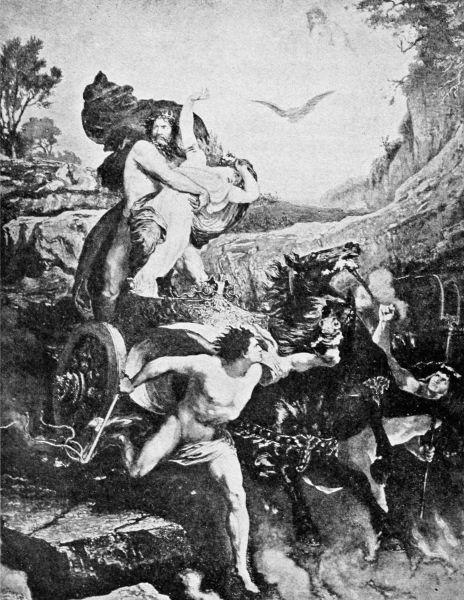
Many beautiful temples were dedicated to Ceres
and Proserpina, both in Greece and Italy; and their
yearly festivals, the Cerealia and Thesmophoria, were
celebrated with great pomp.
To commemorate her long search for her daughter,
Ceres instituted at Eleusis the Eleusinian Festivals
and Mysteries. The Festivals were held in
February and September. The lesser festival, in
February, represented the restoration of Proserpina
to her mother; the greater, held in September, lasted
nine days and represented the abduction of Proserpina.
All classes might participate in these festivals.
The Mysteries of Eleusis were witnessed only by
the initiated, and were surrounded with a veil of
secrecy that has never been fully withdrawn. The
initiates passed through certain symbolic ceremonies
from one degree of mystic enlightenment to another
till the highest was attained. The Mysteries apparently
resembled the ceremonies of the modern
masonic orders.
The following stanzas are from Swinburne's
"Garden of Proserpine":—
"We are not sure of sorrow,
And joy was never sure;
To-day will die to-morrow;
Time stoops to no man's lure;
And love, grown faint and fretful,
With lips but half regretful,
Sighs, and with eyes forgetful
Weeps that no loves endure.
"From too much love of living,
From hope and fear set free,
We thank with brief thanksgiving
Whatever gods may be,
That no life lives forever;
That dead men rise up never;
That even the weariest river
Winds somewhere safe to sea."
Besides Pluto, god of the Infernal Regions, the
Greeks also worshiped Plutus, a son of Ceres and
Jason, who was known exclusively as a god of
wealth. Abandoned in infancy, he was reared by
Pax, goddess of peace, who is often represented as
holding him in her lap. Because Plutus would bestow
his favors only upon good and worthy mortals,
Jupiter deprived him of his sight; and he then distributed
his wealth indiscriminately.
Virgil thus describes the crowd of spirits that wait
to be ferried by Charon across the river:—
"The shivering army stands,
And press for passage with extended hands,
Now these, now those, the surly boatman bore;
The rest he drove to distance from the shore."
The Furies visited the earth to punish filial disobedience,
irreverence to old age, perjury, murder,
treachery to guests, and even unkindness toward
beggars. They avenged the ghosts of those who
died by a violent death and had no one to avenge
them. Therefore they persecuted Orestes, who
killed his mother, and brought to punishment the
murderers of Ibycus. This poet, beloved by Apollo,
was journeying to the musical contest at Corinth,
and was attacked by two robbers. As he lay dying
he called upon a flock of cranes, that were passing
overhead, to take up his cause and avenge his
death. When his body was found, there was
great lamentation among the Greeks, and every
effort was made to discover the murderers, but without
success. Later on, when a vast assemblage was
witnessing a play in which the Chorus personated
the Furies, the people sat terrified and still as death
when the Choristers, clad in black, appeared bearing
in their fleshless hands torches blazing with a pitchy
flame. As they advanced with measured step, the
company could see their bloodless cheeks and the
writhing serpents that curled—in place of hair—around
their brows. Then they began to sing:
"Woe, woe to him who has done the deed of secret
murder. We, the fearful brood of night, fasten ourselves
upon him, flesh and soul. Unwearied we
pursue him; no pity checks our course; still on to
the end of life, we give no peace, no rest." As the
Furies finished their weird chant a number of dark
objects came sailing across the sky, and in the solemn
stillness that had fallen over the assembly a terrified
cry arose from one of the benches, "Look, comrade,
the cranes of Ibycus!" Having informed thus far
against themselves, it was not long before the
murderers were seized, and, having confessed their
crime, were put to death.
The effect upon the audience of this appearance
of the Furies (as related in the story of Ibycus) is
not exaggerated, for it is recorded that Æschylus,
the tragic poet, having on one occasion represented
the Furies in a chorus of fifty performers, the terror
of the spectators was such that many fainted and were
thrown into convulsions, and the magistrates forbade
a like representation for the future.
Poem:—
| Cranes of Ibycus |
Schiller |
The story of the true and false Dreams and the
horn and ivory gates rests on a double play of
words: ἐλέφας (elephas), ivory, and ἐλεφαιρομαι
(elephairomai), to cheat with false hope; κερας
(keras), horn, and κραίνειν (krainein), to fulfill.
Poem:—
| The Ivory Gate |
Mortimer Collins |
Dreams were sometimes sent through the gates
of horn to prepare mortals for misfortunes, as was
the case of Halcyone. Ceÿx, king of Thessaly,
once left his beloved wife, Halcyone, to go on a
journey to the oracle of Delphi. On the outgoing
voyage, a tempest struck the ship on which
the king was sailing, and he with all his crew perished
in the waves. Every day the queen went
down to the seashore to watch for the returning
vessel, and every night she prayed to the gods to
bring her husband safely back to her. Juno, knowing
that these prayers were in vain, pitied the faithful
Halcyone, and wished to prepare her for the
great sorrow that must soon come with the news of
Ceÿx's death. So she sent Iris to the cave of sleep,
and the rainbow goddess bade one of the Dreams
go forth from the gate of horn to visit the sleeping
queen. The Dream glided to Halcyone's bedside,
and, assuming the form of Ceÿx, appeared before her
pale, like a dead man, and dripping with the salt sea.
He told his wife that the storm had sunk his ship,
and that he himself was dead. Terrified at this
vision, Halcyone sprang from her couch and hastened
to the beach, where she found the body of her
husband washed up by the waves. In pity for her
grief, the gods changed both Halcyone and Ceÿx
into birds that ever afterward lived on the waters,
and were known as the Halcyon birds. These
birds uttered shrill cries of warning to all seamen
whenever a storm threatened, but were themselves
so fearless of the sea that they built their nests and
hatched their young on the ever-tossing waves.
The Nereides trained Arion, the wonderful
winged steed that had the power of speech, to draw
his father's chariot over the waves. He was said to
be the first and the fleetest of horses, and passed
successively into the hands of Cepreus (Pelops' son),
Hercules, and Adrastus—the last of whom won all
the chariot races, thanks to the fleetness of Arion.
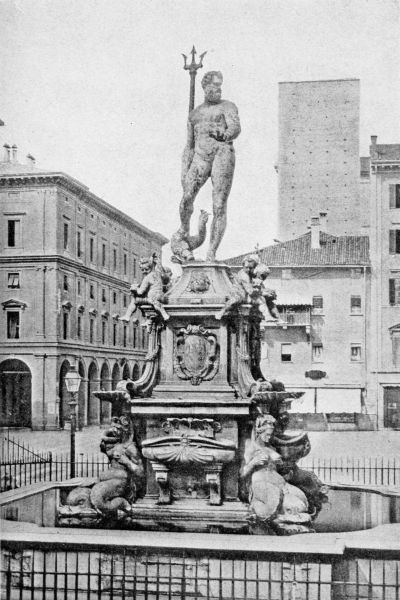
Neptune was a patron of horse trainers, and was
himself especially devoted to horses.
The Cyclops are described differently by different
authors. Homer speaks of them as a gigantic and
lawless race of shepherds who dwelt in Sicily. Each
of them had a single eye in the center of his forehead.
The chief of the Cyclops was Polyphemus who fell
in love with the Nereid Galatea. He took great
care of his appearance, harrowed his coarse hair with
a currycomb and mowed his beard with a sickle.
When he looked into the sea, he smiled complacently
and said: "Beautiful seems my beard, beautiful also
my one eye—as I count beauty—and the sea reflects
the gleam of my teeth whiter than Parian
Stone" (Theocritus, Idyll VI.) Galatea did not
return the Cyclops's affection, however, for she loved
the river god Acis. Polyphemus came upon the
lovers one day in the woods, and was so enraged at
the sight of them that he killed his rival with a rock.
As the blood of Acis crept in a stream from under
the rock it grew paler and paler until it turned into
water. Soon it became a river which still bears the
name of the unfortunate Acis.
Milton alludes to the ocean deities in the song at
the conclusion of "Comus."
"Sabrina fair ...
Listen and appear to us,
In name of great Oceanus,
By the earth-shaking Neptune's mace,
And Tethy's grave majestic pace;
By hoary Nereus' wrinkled look,
And the Carpathian wizard's hook,
By scaly Triton's winding shell,
And old soothsaying Glaucus' spell,
By Leucothea's lovely hands,
And her son that rules the strands;
By Thetis' tinsel-slippered feet,
And the song of Sirens sweet;" etc.
Proteus is called the Carpathian wizard because
his cave was on the island of Pharos, or Carpathos.
Wordsworth's sympathy with the classical conception
of nature is shown in the following sonnet:—
"The world is too much with us; late and soon,
Getting and spending, we lay waste our powers;
Little we see in Nature that is ours;
We have given our hearts away, a sordid boon!
This sea that bares her bosom to the moon;
The winds that will be howling at all hours,
And are upgathered now like sleeping flowers;
For this, for everything, we are out of tune;
It moves us not. Great God! I'd rather be
A Pagan suckled in a creed outworn;
So might I, standing on this pleasant lea,
Have glimpses that would make me less forlorn,
Have sight of Proteus rising from the sea;
Or hear old Triton blow his wreathed horn."
Palæmon was usually represented riding on a dolphin.
He was called Portumnus by the Romans,
and was believed to have jurisdiction over the ports
and shores. Some authorities state that the Isthmian
Games held on the isthmus of Corinth were
in honor of Neptune instead of Palæmon.
The divinities of the lakes, rivers, fountains, etc.,
were hoary river gods, slender youths, beautiful
maidens, and sometimes children. The famous
statue called "Father Nile" is in the Vatican at
Rome.
Bacchus was worshiped very widely throughout
the ancient world, and many festivals were held in
his honor. The most noted were the Greater and
Lesser Dionysia, the Liberalia, and the Bacchanalia.
Bacchus is generally represented as crowned with
ivy or grape leaves and bearing an ivy-circled wand
(the thyrsus). He rides in a chariot drawn by
panthers or leopards.
Poems:—
| Semele |
Edward R. Sill |
| Alexander's Feast |
John Dryden |
| The Praise of Dionysus |
Edmund Gosse |
| Triumph of Bacchus |
Roden Noël |
| Sophron's Hymn to Bacchus |
Walter S. Landor |
| Prelude to Songs before Sunrise |
Algernon C. Swinburne |
As the ass was reverenced in Phrygia, the acquisition
of ass's ears may not have been such a disgrace
as we imagine.
Ovid thus describes Midas' golden touch:—
"Whose powerful hands the bread no sooner hold,
Than all its substance is transformed to gold;
Up to his mouth he lifts the savory meat,
Which turns to gold as he attempts to eat:
His patron's noble juice of purple hue,
Touch'd by his lips, a gilded cordial grew,
Unfit for drink; and, wonderous to behold,
It trickles from his jaws a fluid gold.
The rich poor fool, confounded with surprise,
Starving in all his various plenty lies."
(Croxall's trans.)
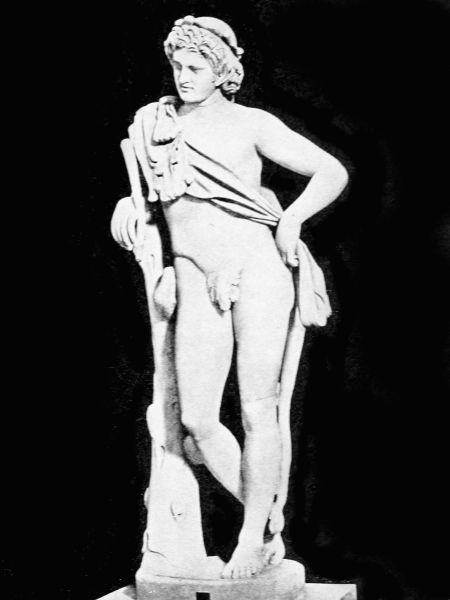
Fauns and satyrs have been favorite subjects in
art and especially in sculpture. The most famous
are the Faun of Praxiteles (Vatican, copy); the
Dancing Faun (Lateran, Rome); Dancing Faun,
Sleeping Faun, Drunken Faun, and Faun and
Bacchus (National Museum, Naples); Sleeping
Satyr, or the Barberini Faun (Glyptotek, Munich).
The use of the Faun in literature is best known
in Hawthorne's "The Marble Faun."
Reference is made to fauns and naiads in Milton's
"Lycidas." Robert Buchanan has two poems entitled
"The Satyr" and "The Naiad."
Poems:—
| Hymn to Pan |
John Keats |
| The Dead Pan |
Elizabeth B. Browning |
| Hymn of Pan |
Percy B. Shelley |
| Cupid and Pan |
Walter S. Landor |
| Pan |
Robert Buchanan |
| Pan and Luna |
Robert Browning |
| Song of the Priest of Pan and Song of Pan in "The Faithful Shepherdess" |
Fletcher |
Keats in "Endymion" alludes to Dryope thus:—
"She took a lute from which there pulsing came
A lively prelude, fashioning the way
In which her voice should wander. 'Twas a lay
More subtle-cadenced, more forest-wild
Than Dryope's lone lulling of her child."
Poem:—
James R. Lowell has taken the story of Rhœcus
as the subject of one of his finest poems.
"Hear now this fairy legend of old Greece,
As full of freedom, youth and beauty still,
As the immortal freshness of that grace
Carved for all ages on some Attic frieze."
Poem:—
| The Hamadryad |
Walter S. Landor |
Janus is not the only one among the Greek and
Latin deities whose name has been given to a part
of the week or year. In Latin, the names of the
days are—dies Solis (Sunday); dies Lunæ (Moon
day); dies Martis (Mars' day); dies Mercurii
(Mercury's day); dies Jovis (Jove's day); dies
Veneris (Venus's day); dies Saturni (Saturn's day).
Austin Dobson has a poem "The Death of
Procris."
Moore, in his Legendary Ballads, devotes one
ballad to "Cephalus and Procris."
The finest poetic treatment of the sadness of
Tithonus over his immortal old age is in Tennyson's
"Tithonus." The following are a few lines from
this poem, which should be read in its entirety:—
"Let me go; take back thy gift;
Why should a man desire in any way
To vary from the kindly race of men,
Or pass beyond the goal of ordinance
Where all should pause, as is most meet for all?
* * * * *
"Coldly thy rosy shadows bathe me, cold
Are all thy lights, and cold my wrinkled feet
Upon thy glimmering thresholds, when the steam
Floats up from those dim fields about the homes
Of happy men that have the power to die."
The story of Hercules's accepting Arete (Virtue)
as his guide—the "Choice of Hercules"—may be
found in The Tatler, No. 97.
The Nemean games instituted by Hercules in
honor of Jupiter were celebrated at Nemea, a city
of Argolis.
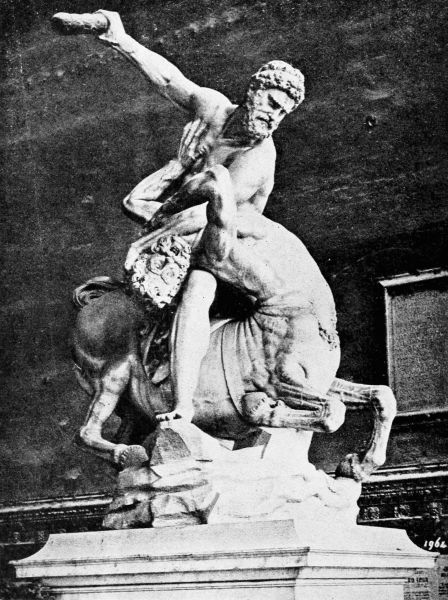
The most famous statue of Hercules is the Farnese
Hercules in the National Museum at Naples.
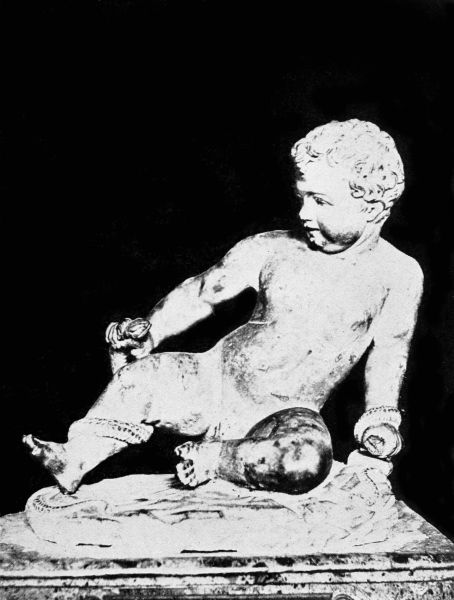
Another well-known piece of sculpture is The Infant
Hercules Strangling a Serpent, in the Uffizi at
Florence.
Quite worth the student's consideration are the
poems "Deïaneira" and "Herakles" in the classical
but too-little-read "Epic of Hades" by Lewis
Morris. The following is an extract from the description
of the Centaur Nessus:—
"Take
This white robe. It is costly. See, my blood
Has stained it but a little. I did wrong;
I know it, and repent me. If there come
A time when he grows cold—for all the race
Of heroes wander, nor can any love
Fix theirs for long—take it and wrap him in it,
And he shall love again."
Poem:—
| The Fortunate Isles |
Andrew Lang |
The following is from Pindar:—
"The Isles of the Blest, they say,
The Isles of the Blest,
Are peaceful and happy, by night and by day,
Far away in the glorious west.
They need not the moon in that land of delight
They need not the pale, pale star;
The sun is bright, by day and night,
Where the souls of the blessed are.
They till not the ground, they plow not the wave,
They labor not, never! oh, never!
Not a tear do they shed, not a sigh do they heave,
They are happy forever and ever!"
The chosen device of Charles V. of Germany represented
the Pillars of Hercules entwined by a scroll
that bore his motto "Plus Ultra." This device,
represented on the German dollar, has been adopted
as the sign of the American dollar ($).
The Pygmies were a nation of dwarfs, so called
from a Greek word meaning the cubit or measure
of about thirteen inches, which was said to be the
height of these people. They lived near the sources
of the Nile, or, according to others, in India.
Homer tells us that the cranes used to migrate every
winter to the Pygmies' country, where they occasioned
a fierce warfare. H. M. Stanley, in his last African
expedition, discovered a race of diminutive men
that correspond very well in appearance to those
mentioned by Homer.
Terra is the same goddess as Gæa (the Earth).
Poem:—
| Battle of Pygmies and Cranes |
James Beattie |
The Apples of the Hesperides may have been
suggested by the oranges of Spain.
See the poem "The Golden Apples," in William
Morris's "Earthly Paradise."
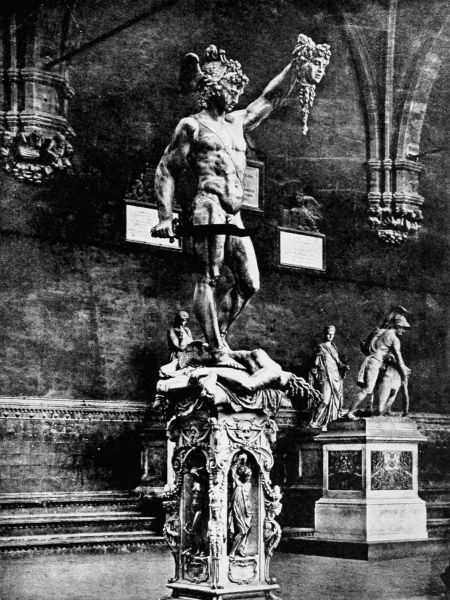
Two poems on the Medusa which are well worth
reading are "The Doom of King Acrisius" in William
Morris's "Earthly Paradise," and Shelley's lines
"On the Medusa of Leonardo Da Vinci in the
Florentine Gallery."
There are translations of Simonides's "Lament of
Danaë" by William C. Bryant and John H. Frere.
Tennyson has a singular use of the proper noun
in the "Princess" when he says:—
"Now lies the Earth all Danaë to the stars,
And all thy heart lies open unto me."
Cassiopeia was said to have been an Ethiopian;
and was, therefore, in spite of her boasted beauty
black. Milton alludes to her in "Il Penseroso"
as:
"that starred Ethiop queen that strove
To set her beauty's praise above
The Sea-Nymphs, and their powers offended."
Though Cassiopeia attained the honor of being
set among the stars, she was placed—through the
efforts of the sea-nymphs—in a part of the heavens
near the pole, where she is half the time held with
her head downward, to teach her humility.
For a Gaelic Andromeda and Perseus, see "The
Thirteenth Son of the King of Erin" in Curtin's
"Myths of Ireland."
Poem:—
| Andromeda |
Charles Kingsley |
From the incident of Bellerophon's bearing to
Iobates the letters that contained his own death-warrant,
came the expression "Bellerophontic letters."
This is used to describe any written message
that a person may deliver, unknowingly, and that is
prejudicial to himself.
On Mount Helicon, the home of the Muses and
Pegasus, was the fountain Hippocrene, which was
opened by a kick from the hoof of Pegasus.
Poems:—
| Pegasus in Pound |
Henry W. Longfellow |
| Bellerophon in Argos and in Lycia |
William Morris |
| Pegasus in Harness |
Schiller |
The most famous soothsayer was Melampus, who
was also the first mortal endowed with prophetic
powers. The story is told that before his house
stood an oak tree containing a nest of serpents.
The old serpents were killed by some servants, but
Melampus took care of the young ones, and fed
them carefully. One day when he was sleeping
under the oak tree, the serpents licked his ears with
their tongues; and when he awoke he was surprised
to find that he now understood the languages of
birds and creeping things. In this way he was able
to foretell future events, and he became a celebrated
soothsayer. Once Melampus was taken captive and
put into prison; but he overheard the woodworms
saying that the timbers of the prison were so nearly
eaten through that the roof would soon fall in. He
told this to his captors, who immediately took advantage
of the warning and left the building; but not
before they rewarded Melampus by setting him free.
The best description of Hercules's lament for
Hylas is in Lang's translation of the thirteenth
Idyl of Theocritus.
Poem:—
The naming of Jason's ship may have been after
its builder, or from the city of Argos, or from the
word "Argo," meaning swift or white.
The story of the Symplegades may be a reference
to the rolling and clashing of icebergs. The dove
incident occurs in many ancient stories, from that
of Noah down.
Poems:—
| Talking Oak |
Alfred Tennyson |
| Life and Death of Jason |
William Morris |
| Æson and King Athamas |
Frederick Tennyson |
Medea's preparations for her magic potion are
like the incantations of the witches in Macbeth, Act
IV, Sc. I.
"Round about the caldron go;
In the poison'd entrails throw.
* * * * *
Fillet of a fenny snake,
In the caldron boil and bake;
Eye of newt and toe of frog,
Wool of bat and tongue of dog,
Adder's fork and blind-worm's sting,
Lizard's leg and howlet's wing:
* * * * *
Witches' mummy; maw and gulf
Of the ravin'd salt-sea shark,
Root of hemlock digg'd i' the dark," etc.
Medea's sorceries were assisted by the prayers
that she addressed to Hecate, a mysterious divinity
who embodied the terrors of the darkness. She
haunted cross roads and graveyards; and, being
goddess of sorcery and witchcraft, wandered only
by night and was seen only by dogs, whose barking
told of her approach.
Translations of the Medea of Euripides are by
Augusta Webster, William C. Lawton, and Wodhull.
Poems on Atalanta:—
| Atalanta's Race in "The Earthly Paradise" |
William Morris |
| Atalanta in Calydon |
Algernon C. Swinburne |
| Hippomenes and Atalanta |
Walter S. Landor |
Dædalus shared with Æolus the honor of inventing
sails for the ships hitherto propelled by oars.
Dædalus could never bear the idea of a rival;
and when his nephew Perdix was apprenticed to
him, the lad gave such promise of excelling his
teacher in mechanical arts that Dædalus grew to
hate him. One day when Perdix was walking on
the seashore he picked up the spine of a fish, and
later on he imitated it in iron, thus inventing the
saw. He also invented a pair of compasses. Then
Dædalus, envious of his nephew's skill, pushed him
off a tower and killed him; but Minerva, pitying
the boy, changed him into a partridge, which bears
his name.
Castor and Pollux were deities of boxing, wrestling,
and all equestrian exercises. They were generally
seen mounted on snow-white horses, and their
appearance on the battle-field was a good omen for
the army among whom they came. The Romans
believed that they fought at the head of their legions
at the famous battle of Lake Regillus.
Poems:—
| Theseus and Hippolyta |
Walter S. Landor |
| Ariadne |
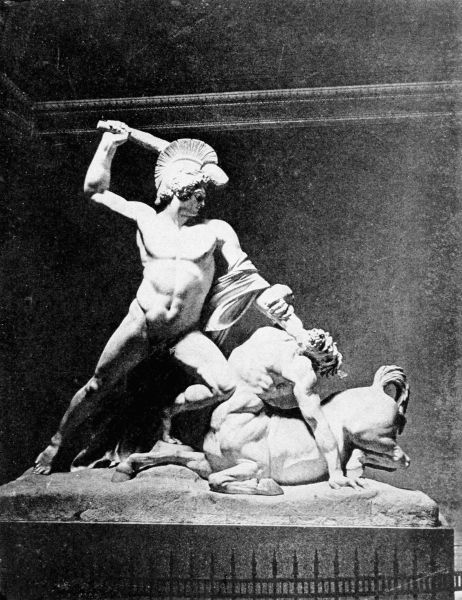
Frederick Tennyson |
| Hippolytus of Euripides |
| Phædra |
Algernon C. Swinburne |
| Phædra in "The Epic of Hades" |
Lewis Morris |
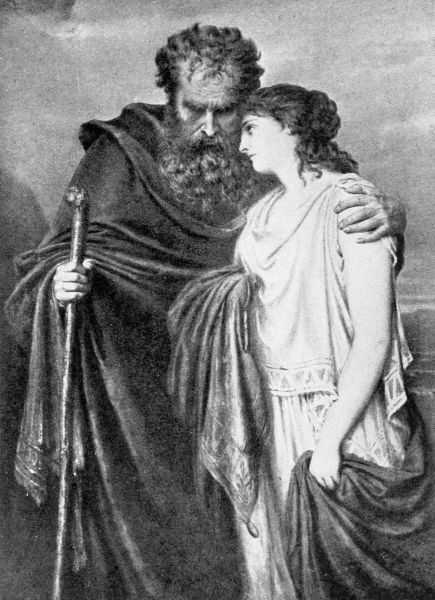
The story of Œdipus is taken from the "Œdipus
Rex," "Œdipus Coloneus," and "Antigone" of
Sophocles (trans. of Plumptre or of Lewis Campbell).
Other poems:—
| Swell-foot the Tyrant |
Percy B. Shelley |
| The Downfall and Death of King Œdipus |
Edward Fitzgerald |
| Antigone |
Aubrey de Vere |
| The Sphinx |
Ralph W. Emerson |
| Fragment of an Antigone |
Matthew Arnold |
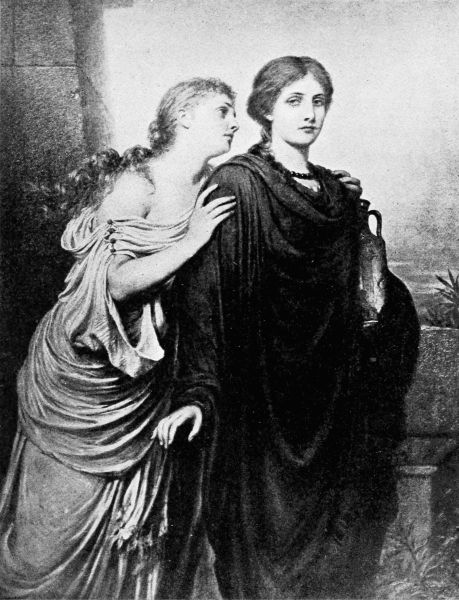
In her "Characteristics of Women," Mrs. Jameson
has compared the character of Antigone with
that of Cordelia in Shakespeare's "King Lear." The
scene of Œdipus going alone into the forest at
Colonus is similar in pathos and tragedy to Lear's
defiance of the midnight tempest on the lonely
heath.
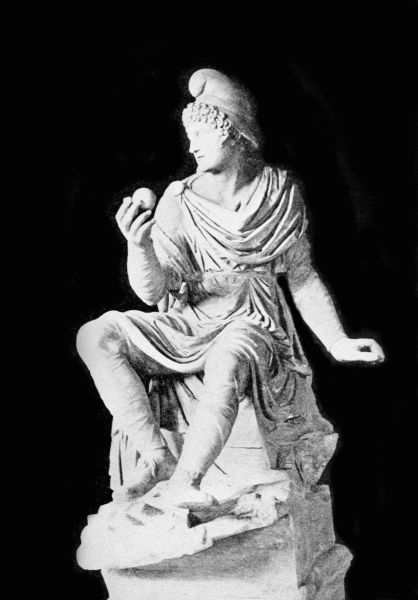
For references in poetry to the judgment of Paris:
| Judgment of Paris |
James Beattie |
| Judgment of Paris |
John Stuart Blackie |
| Œnone |
Alfred Tennyson |
Other minor deities not mentioned in the text are:
Victoria (Nike), goddess of victory.
Phosphor, the morning star.
Hesperus, the evening star, god of the west.
Hygeia, a daughter of Æsculapius, watched over
the health of man.
The Graces, daughters of Jove, presided over
banquets, dances, and also social pleasures and polite
accomplishments. They were three in number—Euphrosyne,
Aglaia, and Thalia. They are also
called Gratiæ.
Momus was the god of laughter.
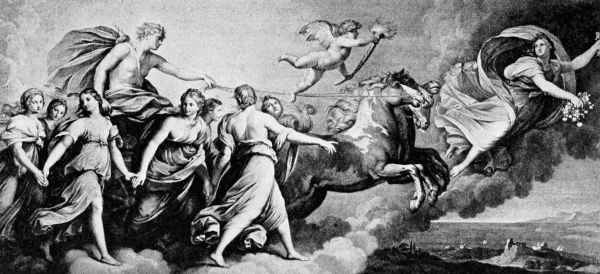
The Seasons were the four daughters of Jupiter
and Themis. Their collective name was Horæ (the
Hours). As the Hours they attended the sun-car
of Apollo.
Fama, goddess of Fame.
Faunus, god of fields and shepherds. He was also
gifted with prophetic powers.
Fauna, the sister wife or daughter of Faunus. She
was also called the Bona Dea.
Pales, a deity who presided over cattle and pastures.
Manes, the souls of the departed who had become
deified.