Now when Turnus saw that Æneas had departed
from the battle he called for his chariot.
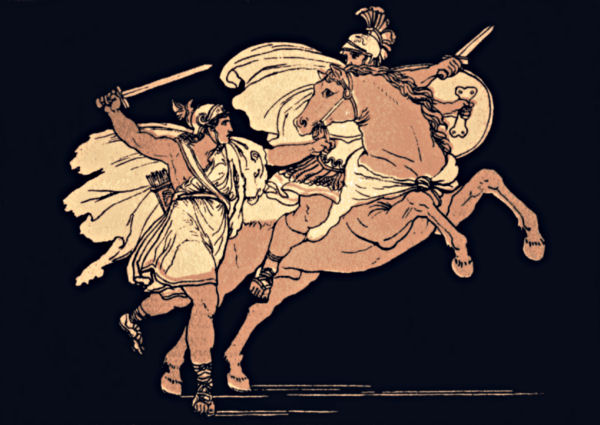
And when he had mounted thereon he drave
it through the host of the enemy, slaying many
valiant heroes, as Sthenelus and Pholus, and the
two sons of Imbrasus the Lycian, Glaucus and
Lades. Then he saw Eumedes, son of that
Dolon who would have spied out the camp of
the Greeks, asking as his reward the horses of
Achilles (but Diomed slew him). Him Turnus
smote with a javelin from afar, and, when he
fell, came near and put his foot upon him,
and taking his sword drave it into his neck,
saying, “Lo! now thou hast the land which
thou soughtest. Lie there, and measure out
Italy for thyself.” Many others he slew, for
the army fled before him. Yet did one man,
Phegeus by name, stand against him, and would
254]
have stayed the chariot, catching the bridles of
the horses in his hand. But as he clung to the
yoke and was dragged along, Turnus broke
his cuirass with his spear, and wounded him.
And when the man set his shield before him,
and made at Turnus with his sword, the wheels
dashed him to the ground, and Turnus struck
him between the helmet and the breast-plate,
and smote off his head.
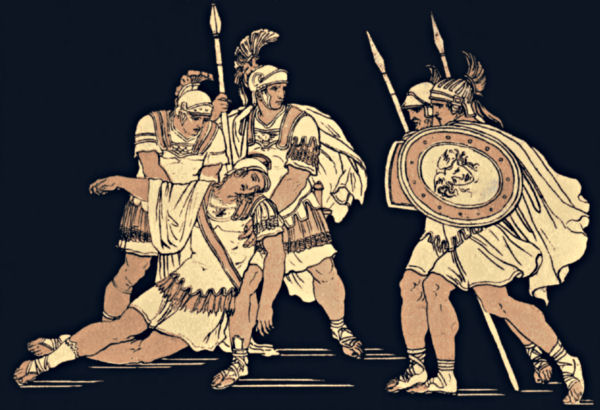
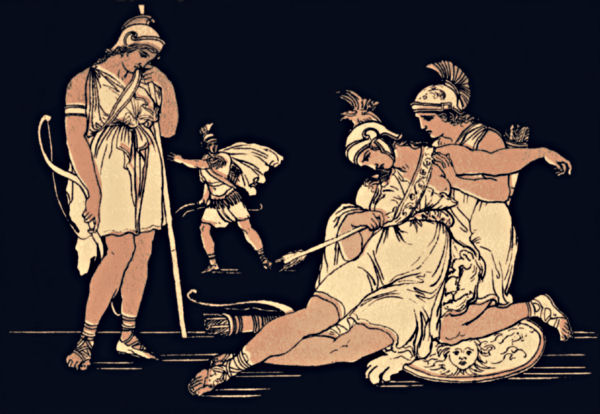
But in the meanwhile Mnestheus and Achates
and Iülus led Æneas to the camp, leaning on
his spear. Very wrath was he, and strove to
draw forth the arrow. And when he could not,
he commanded that they should open the wound
with the knife, and so send him back to the
battle. Iapis also, the physician, ministered to
him. Now this Iapis was dearer than all other
men to Apollo, and when the god would have
given him all his arts, even prophecy and music
and archery, he chose rather to know the virtues
of herbs and the art of healing, that so he might
prolong the life of his father, who was even
ready to die. This Iapis, then, having his garments
girt about him in healer’s fashion, would
have drawn forth the arrow with the pincers,
255]
but could not. And while he strove, the battle
came nearer, and the sky was hidden by clouds
of dust, and javelins fell thick into the camp.
But when Venus saw how grievously her son was
troubled, she brought from Ida, which is a mountain
of Crete, the herb dittany. A hairy stalk it
hath and a purple flower. The wild goats know
it well if so be that they have been wounded
by arrows. This, then, Venus, having hidden
her face, brought and dipped into the water,
and sprinkled there with ambrosia and sweet-smelling
panacea.
And Iapis, unawares, applied the water that
had been healed; and lo! the pain was stayed
and the blood was staunched, and the arrow
came forth, though no man drew it, and Æneas’s
strength came back to him as before. Then
said Iapis, “Art of mine hath not healed thee,
my son. The Gods call thee to thy work.”
Then did Æneas arm himself again, and when
he had kissed Iülus and bidden him farewell,
he went forth to the battle. And all the chiefs
went with him, and the men of Troy took
courage and drave back the Latins. Then
befell a great slaughter, for Gyas slew Ufens,
256]
who was the leader of the Æquians; also
Tolumnius, the great augur, was slain, who
had first broken the covenant, slaying a man
with his spear. But Æneas deigned not to
turn his hand against any man, seeking only
for Turnus, that he might fight with him. But
when the nymph Juturna perceived this she
was sore afraid. Therefore she came near to
the chariot of her brother, and thrust out Metiscus,
his charioteer, where he held the reins,
and herself stood in his room, having made herself
like to him in shape and voice. Then as a
swallow flies through the halls and arcades of
some rich man’s house, seeking food for its
young, so Juturna drave the chariot of her
brother hither and thither. And ever Æneas
followed behind, and called to him that he
should stay; but whenever he espied the man,
and would have overtaken him by running,
then again did Juturna turn the horses about
and flee. And as he sped Messapus cast a spear
at him. But Æneas saw it coming, and put
his shield over him, resting on his knee. Yet
did the spear smite him on the helmet-top and
shear off the crest. Then indeed was his wrath
257]
kindled, and he rushed into the army of the
enemy, slaying many as he went.
Then was there a great slaughter made on
this side and on that. But after a while Venus
put it into the heart of Æneas that he should
lead his army against the city. Therefore he
called together the chiefs, and, standing in
the midst of them on a mound, spake, saying,
“Hearken now to my words, and delay not
to fulfil them, for of a truth Jupiter is on our
side. I am purposed this day to lay this
city of Latinus even with the ground, if they
still refuse to obey. For why should I wait
for Turnus till it please him to meet me in
battle?”
Then did the whole array make for the walls
of the city. And some carried firebrands, and
some scaling-ladders, and some slew the warders
at the gates, and cast javelins at them who
stood on the walls. And then there arose a
great strife in the city, for some would have
opened the gates that the men of Troy might
enter, and others made haste to defend the walls.
Hither and thither did they run with much
tumult, even as bees in a hive in a rock which
258]
a shepherd hath filled with smoke, having first
shut all the doors thereof.
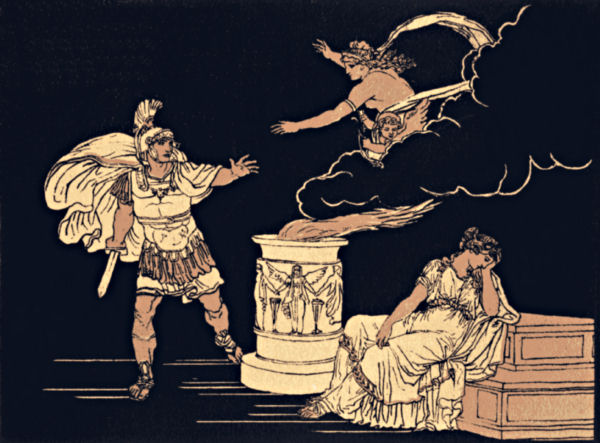
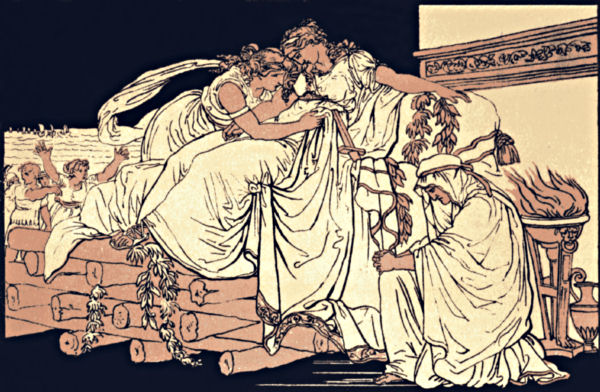
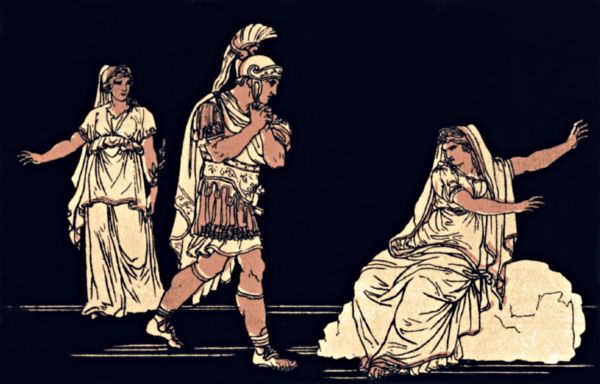
Then also did other ill fortune befall the
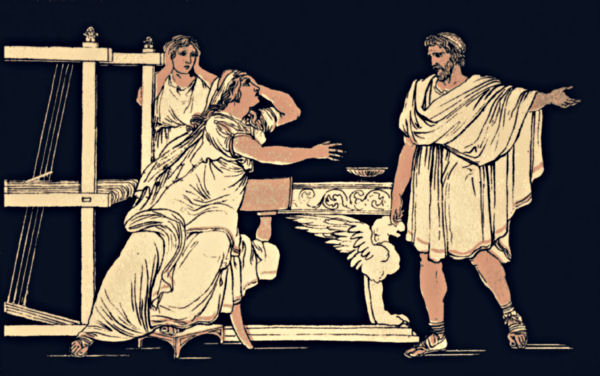
Latins, for when Queen Amata saw from the
roof of the palace that the enemy were come near
to the walls, and saw not anywhere the army of
the Latins, she supposed Turnus to have fallen
in the battle. Whereupon, crying out that she
was the cause of all these woes, she made a
noose of the purple garment wherewith she was
clad, and hanged herself from a beam of the roof.
Then did lamentation go through the city, for
the women wailed and tore their hair, and King
Latinus rent his clothes and threw dust upon
his head.
But the cry that went up from the city came
to the ears of Turnus where he fought in
the furthest part of the plain. And he caught
the reins and said, “What meaneth this sound
of trouble and wailing that I hear?” And the
false Metiscus, who was in truth his sister, made
answer, “Let us fight, O Turnus, here where
the Gods give us victory. There are enough to
defend the city.” But Turnus spake, saying,
“Nay, my sister, for who thou art I have known
259]
even from the beginning, it must not be so.
Why camest thou down from heaven? Was it
to see thy brother die? And now what shall I
do? Have I not seen Murranus die and Ufens
the Æquian? And shall I suffer this city to
be destroyed? Shall this land see Turnus flee
before his enemies? Be ye kind to me, O Gods
of the dead, seeing that the Gods of heaven hate
me. I come down to you a righteous spirit, and
not unworthy of my fathers.”
And even as he spake came Saces, riding on
a horse that was covered with foam, and on his
face was the wound of an arrow. And he
cried, “O Turnus, our last hopes are in thee.
For Æneas is about to destroy the city, and
the firebrands are cast upon the roofs. And
King Latinus is sore tried with doubt, and the
Queen hath laid hands upon herself and is dead.
And now only Messapus and Atinas maintain
the battle, and the fight grows fierce around
them, while thou drivest thy chariot about these
empty fields.”
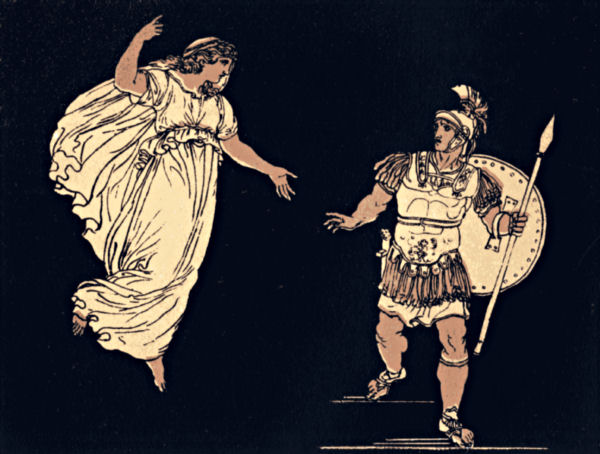
Then for a while Turnus stood speechless,
and shame and grief and madness were in his
soul; and he looked to the city, and lo! the
260]
fire went up even to the top of the tower which
he himself had builded upon the walls to be a
defence against the enemy. And when he saw
it, he cried, “It is enough, my sister; I go
whither the Gods call me. I will meet with
Æneas face to face, and endure my doom.”
And as he spake he leapt down from his
chariot, and ran across the plain till he came
near to the city, even where the blood was deepest
upon the earth and the arrows were thickest in
the air. And he beckoned with the hand and
called to the Italians, saying, “Stay now your
arrows. I am come to fight this battle for you
all.” And when they heard it they left a space
in the midst. Æneas also, when he heard the
name of Turnus, left attacking the city, and
came to meet him, mighty as Athos, or Eryx,
or Father Apenninus, that raiseth his snowy
head to the heavens. And the men of Troy
and the Latins and King Latinus marvelled to
see them meet, so mighty they were.
First they cast their spears at each other, and
then ran together, and their shields struck one
against the other with a crash that went up
to the sky. And Jupiter held the balance in
261]
heaven, weighing their doom. Then Turnus,
rising to the stroke, smote fiercely with his
sword. And the men of Troy and the Latins
cried out when they saw him strike. But the
treacherous sword brake in the blow. And
when he saw the empty hilt in his hand he
turned to flee. They say that when he mounted
his chariot that day to enter the battle, not heeding
the matter in his haste, he left his father’s
sword behind him, and took the sword of
Metiscus, which, indeed, served him well while
the men of Troy fled before him, but brake,
even as ice breaks, when it came to the shield
which Vulcan had made. Thereupon Turnus
fled, and Æneas, though the wound which the
arrow had made hindered him, pursued. Even
as a hound follows a stag that is penned within
some narrow space, for the beast flees hither
and thither, and the staunch Umbrian hound
follows close upon him, and almost holds
him, and snaps his teeth, yet bites him not, so
did Æneas follow hard on Turnus. And still
Turnus cried out that some one should give
him his sword, and Æneas threatened that he
would destroy the city if any should help him.
262]
Five times about the space they ran; not for
some prize they strove, but for the life of
Turnus. Now there stood in the plain the
stump of a wild olive-tree. The tree was
sacred to Faunus, but the men of Troy had cut
it, and the stump only was left. Herein the
spear of Æneas was fixed, and now he would
have drawn it forth that he might slay Turnus
therewith, seeing that he could not overtake
him by running. Which when Turnus perceived,
he cried to Faunus, saying, “O Faunus,
if I have kept holy for thee that which the men
of Troy have profaned, hold fast this spear.”
And the god heard him; nor could Æneas
draw it forth. But while he strove, Juturna,
taking again the form of Metiscus, ran and gave
to Turnus his sword. And Venus, perceiving
it, wrenched forth the spear from the stump.
So the two stood again face to face.
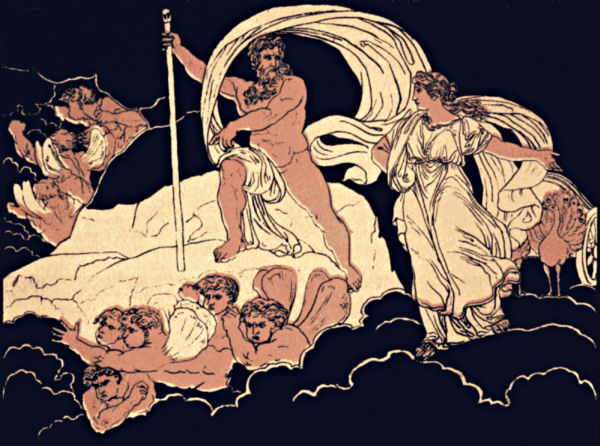
Then spake Jupiter to Juno, where she sat
in a cloud watching the battle, “How long wilt
thou fight against fate? What purpose hast
thou now in thy heart? Was it well that
Juturna—for what could she avail without thy
help?—should give back to Turnus his sword?
263]
Thou hast driven the men of Troy over land
and sea, and kindled a dreadful war, and mingled
the song of marriage with mourning. Further
thou mayest not go.”
And Juno humbly made answer, “This is thy
will, great Father; else had I not sat here, but
stood in the battle smiting the men of Troy.
And indeed I spake to Juturna that she should
help her brother; but aught else I know not.
And now I yield. Yet grant me this. Suffer
not that the Latins should be called after the
name of Troy, nor change their speech nor their
garb. Let Rome rule the world, but let Troy
perish for ever.”
Then spake with a smile the Maker of all
things, “Truly thou art a daughter of Saturn,
so fierce is the wrath of thy soul! And now
what thou prayest I give. The Italians shall not
change name, nor speech, nor garb. The men of
Troy shall mingle with them, and I will give
them a new worship, and call them all Latins.
Nor shall any race pay thee more honour than
they.”
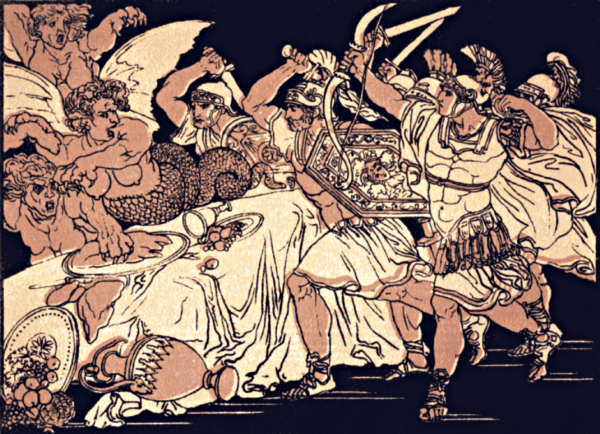
Then Jupiter sent a Fury from the pit. And
she took the form of a bird, even of an owl
264]
that sitteth by night on the roof of a desolate
house, and flew before the face of Turnus and
flapped her wings against his shield. Then was
Turnus stricken with great fear, so that his hair
stood up and his tongue clave to the roof of his
mouth. And when Juturna knew the sound of
the false bird what it was, she cried aloud for
fear, and left her brother and fled, hiding herself
in the river of Tiber.
But Æneas came on, shaking his spear that
was like unto a tree, and said, “Why delayest
thou, O Turnus? Why drawest thou back?
Fly now if thou canst through the air, or hide
thyself in the earth.” And Turnus made answer,
“I fear not thy threats, but the Gods and Jupiter,
that are against me this day.” And as he spake
he saw a great stone which lay hard by, the
landmark of a field. Scarce could twelve chosen
men, such as men are now, lift it on their
shoulders. This he caught from the earth and
cast it at his enemy, running forward as he cast.
But he knew not, so troubled was he in his soul,
that he ran or that he cast, for his knees tottered
beneath him and his blood grew cold with fear.
And the stone fell short, nor reached the mark.
265]
Even as in a dream, when dull sleep is on the
eyes of a man, he would fain run but cannot, for
his strength faileth him, neither cometh there
any voice when he would speak; so it fared
with Turnus. For he looked to the Latins and
to the city, and saw the dreadful spear approach,
nor knew how he might fly, neither how he
might fight, and could not spy anywhere his
chariot or his sister. And all the while Æneas
shook his spear and waited that his aim should
be sure. And at the last he threw it with all his
might. Even as a whirlwind it flew, and brake
through the seven folds of the shield and pierced
the thigh. And Turnus dropped with his knee
bent to the ground. And all the Latins groaned
aloud to see him fall. Then he entreated Æneas,
saying, “I have deserved my fate. Take thou
that which thou hast won. Yet perchance thou
mayest have pity on the old man, my father,
even Daunus, for such an one was thy father
Anchises, and give me back to my own people,
if it be but my body that thou givest. Yet hast
thou conquered, and the Latins have seen me
beg my life of thee, and Lavinia is thine. Therefore,
I pray thee, stay now thy wrath.”
266]
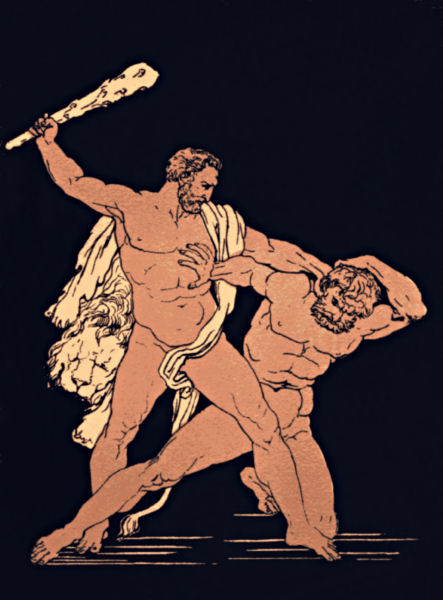
Then for awhile Æneas stood doubting; aye,
and might have spared the man, when lo! he
spied upon his shoulders the belt of Pallas, whom
he had slain. And his wrath was greatly kindled,
and he cried with a dreadful voice, “Shalt thou
who art clothed with the spoils of my friends
escape me? ’Tis Pallas slays thee with this
wound, and takes vengeance on thy accursed
blood.” And as he spake he drave the steel
into his breast. And with a groan the wrathful
spirit passed into darkness.
THE END.
UNWIN BROTHERS, THE GRESHAM PRESS, CHILWORTH AND LONDON.
Seventh Thousand, Crown 8vo, price 5s. cloth.
STORIES FROM HOMER.
BY THE
REV. ALFRED J. CHURCH, M.A.,
Head Master of King Edward’s School, Retford;
Author of “Stories from Virgil.”
THE ILIAD.
I. The Quarrel of the Chiefs.
II. The Broken Covenant.
III. The Battle in the Plain.
IV. Hector and Andromaché.
V. The Duel of Hector and Ajax.
VI. The Adventure of Ulysses and Diomed.
VII. The Wounding of the Chiefs.
VIII. The Battle at the Wall.
IX. The Battle at the Ships.
X. The Battle at the Ships (continued).
XI. The Deeds and Death of Patroclus.
XII. The Rousing of Achilles.
XIII. The Battle at the River.
XIV. The Death of Hector.
XV. The Ransoming of Hector.
THE ODYSSEY.
I. The Cyclops.
II. The Island of Æolus—the Læstrygons—Circé.
III. The Regions of the Dead—Scylla—the Oxen of the Sun—Calypso.
IV. Telemachus and Penelopé.
V. Nestor and Menelaüs.
VI. Ulysses on his Raft.
VII. Nausicaa and Alcinoüs.
VIII. Ulysses and the Swineherd.
IX. The Return of Telemachus.
X. Ulysses in his Home.
XI. The Trial of the Bow.
XII. The Slaying of the Suitors.
WITH TWENTY-FOUR TINTED ILLUSTRATIONS, FROM
FLAXMAN’S DESIGNS.
“A book which ought to become an English classic. It is full of the pure Homeric
flavour, and we think we may predict that it will retain its place in our literature.”—Spectator.
“All Mr. Church’s stories are told with rare grace and fidelity.”—Times.
“We can give Mr. Church no higher praise than that he has succeeded in his
undertaking. We doubt whether the first and greatest of story-tellers has ever before
been so appropriately rendered for children.”—Academy.
“Mr. Church has long since proved himself a ripe and good scholar, though he
had not given evidence of the special Homeric insight which this charming volume
displays.”—Saturday Review.
SEELEY, JACKSON, AND HALLIDAY,
Fleet Street, London.
SERIES OF CHEAP SCHOOL BOOKS.
Conducted by the Rev. A. J. CHURCH, M.A., Head
Master of Retford Grammar School.
The Saturday Review says:—“We cannot too warmly hail this
series. If all the schoolmasters in England were to adopt it they would
have fewer occasions to complain of boys not having read their notes,
and fewer grumblings on the part of patresfamilias at the heavy items
of the book bill.”
Each volume of Selections contains sufficient matter for the work of
a Term, with Notes by a Competent Editor.
LATIN.
First Latin Dictionary. E. S. Morgan, M.A. 2s. 6d.
First Latin Grammar. Rev. T. White, LL.D. 1s.
Latin Exercise Book. Part I. Rev. A. J. Church, M.A. 8d.
Latin Exercise Book. Part II. Rev. A. J. Church, M.A. 8d.
Latin Delectus. C. Oakley, M.A. 8d.
Easy Latin Reading Book. Rev. H. M. Stephenson, M.A. 8d.
Ovid—Elegiac Verse. Rev. A. J. Church, M.A. 8d.
Ovid—Metamorphoses. Rev. North Pinder, M.A. 8d.
Horace—Select Odes. Rev. W. J. Brodribb, M.A. 8d.
Virgil—Æneid, Book VI. Rev. A. J. Church, M.A. 8d.
Cæsar—British Expeditions. Rev. F. B. Butler, M.A. 8d.
Cicero—Select Passages. Rev. W. J. Brodribb, M.A. 10d.
Livy—Select Passages. Rev. E. H. Merriott, M.A. 8d.
Phædrus—Select Fables. E. Walford, M.A. 8d.
Cornelius Nepos—Select Lives. E. Walford, M.A. 8d.
Latin Prose through English Idiom. Rev. E. A. Abbott, D.D. 2s. 6d.
ENGLISH.
Milton—Minor Poems. Rev. H. S. Huckin, D.D. 8d.
Milton—Samson. Rev. A. J. Church, M.A. 1s.
Cowper—Task. Two Books. J. Hales, M.A. 8d.
Goldsmith—Poems. Rev. A. R. Vardy, M.A. 8d.
English Verse for Repetition. Rev. W. B. Stanford, M.A. 1s.
Selections for Practice in Spelling. R. Lomas. 1s.
MATHEMATICS.
Algebra, to Quadratic Equations. R. Proude Smith, M.A. 1s.
Euclid. L. B. Seeley, M.A. 1s.
FRENCH.
French Verse. H. Tarver. 1s. 6d.
First French Grammar. H. Tarver. 1s. 6d.
GREEK.
Xenophon—Anabasis, Book IV. Rev. North Pinder, M.A. 1s.
SEELEY, JACKSON, & HALLIDAY 54, Fleet St., London.

Transcriber's Note
Archaic and variable spelling is preserved as printed. This includes
variation in spelling of proper nouns where both forms appear valid,
e.g. Lybia and Libya; Halesus and Halæsus; Alethes and Aletes.
Minor punctuation errors and inconsistencies in hyphenation and accent
usage have been repaired.
Page 60 contains a line beginning, "To whom Æneas, “I have not seen nor
heard ...”." There may be a word omitted following 'Æneas', perhaps 'spake'
or 'said' or similar. This occurs in all editions the transcriber was
able to access, and, as it is impossible to be certain whether it was
deliberate or an error, it is preserved as printed.
Page 87 contains the line, "Was he moved at all my tears?" The transcriber
has amended 'my' to 'by' for sense—"Was he moved at all by tears?"
Page 119 contains the text, "for thou hast a mighty people and a fierce
in Latium with whom to do battle." There may be a word missing following
'fierce'—perhaps 'one'—but as it is impossible to be certain, the text
is preserved as printed.
The frontispiece has been moved to follow the front matter. Other
illustrations have been moved where necessary so that they do not fall in
the middle of a paragraph.