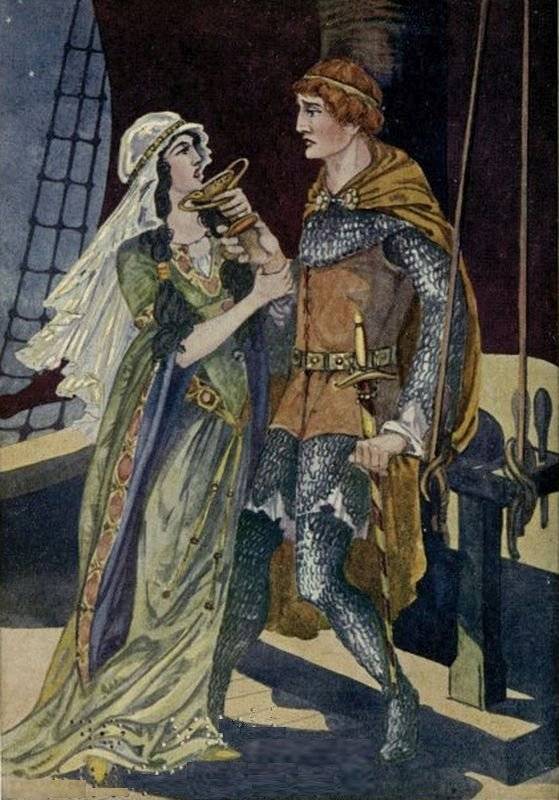
ISOLDA SNATCHED THE CUP FROM HIS TREMBLING HAND, & DRANK.
STORIES FROM THE OPERAS
BY
GLADYS DAVIDSON
Author of "Two Hundred Opera Plots,"
"The Old Testament Story"
PHILADELPHIA J. B. Lippincott Company Printed in Great Britain
PREFACE
Owing to the appreciation which has been
accorded to my three series of "Stories from
the Operas," it has been decided to re-issue
the collection in one volume, and to include
in this additional stories of new and popular
operas recently produced in England.
The plan of the work, as before, is to
present all the incidents of each libretto in
the clear, readable form of a short story; and
it is hoped that the combined volume will
continue to prove of interest, not only to
opera-goers but to all lovers of dramatic
tales. The three volumes have been entirely
reset and re-collated in a manner which it is
hoped will make them easier for reference.
AUTHOR'S ACKNOWLEDGMENTS
I wish to express my best thanks to the following Publishing
Houses and holders of copyrights for their kind permission to
include in this volume the stories of the various operas selected,
and for the helpful information they have given me regarding
libretti, etc.:—
Covent Garden Opera House Management. (For
courteous assistance.)
Herr Adolph Fürstner, Berlin, W.10, and Herr S. Fischer
Verlag, Berlin, W.57. (For Strauss's Elektra and Rosenkavalier.)
(The story of Elektra is published by authorization of Herr Adolph
Fürstner, Berlin, W.10, and Herr S. Fischer Verlag, Berlin, W.57.
Copyright, 1908, by Adolph Fürstner, Berlin.)
(The story of Rosenkavalier is published by authorization of Herr
Adolph Fürstner, Berlin, W.10. Copyright, 1909, by Adolph
Fürstner, Berlin, W.10.)
Messrs. Frederick Harris, London. (For Verdi's Il
Trovatore.)
Messrs. Heugel et Cie, Paris. (For Thomas's Mignon.)
Mr. Charles Manners and the Moody-Manners Opera
Company. (For Tschaikovsky's Eugene Onegin.)
Messrs. Novello & Co., Ltd., London. (For Beethoven's
Fidelio, Bellini's La Sonnambula, Meyerbeer's Star of the
North, Verdi's La Traviata and Rigoletto, and Wagner's
The Flying Dutchman and Tannhäuser.)
Messrs. Rendle & Co., Ltd., London. (For Bizet's Carmen
and Gounod's Philemon and Baucis.)
Messrs. G. Ricordi & Co., London. (For Puccini's La
Bohème, Madam Butterfly and Manon Lescaut.)
Messrs. Schott & Co., Ltd., London. (For Wagner's The
Mastersingers, The Nibelung's Ring and Parsifal.)
Herr Josef Weinberger, Vienna. (For Wolf-Ferrari's
The Jewels of the Madonna.)
One bright Easter Eve, early in the nineteenth
century, a lively group of carbineers were gathered
together in the inn of Terracina near Naples, drinking
success to the enterprise they were engaged
upon; for they were just about to attack a horde
of brigands supposed to be in that neighbourhood,
and were expecting to meet with many exciting
adventures.
The captain of the outlaw band, Fra Diavolo, was
the most celebrated bandit in Italy, and fully justified
his sinister name, for his daring raids and impudent
roguery had made him a terror to the country-side,
and the mere mention of his name caused peaceful
travellers to tremble in their shoes.
All previous attempts to capture the cunning outlaw
had proved ineffectual; so when at last a troop
of carbineers was sent out from Naples to lie in
wait for the whole band, joy was felt in every village
round about, and the peasants hoped to be freed
from their dreaded enemy at last.
The soldiers had been awaiting news at the inn
of Terracina, but on learning that Fra Diavolo and
his rogues had been seen in the neighbourhood, they
at once received orders to start off in pursuit. In
merry haste, they drank the stirrup-cups poured out
for them by old Matteo, the inn-keeper, and his
pretty daughter, Zerlina; for a price had been set
upon the head of Fra Diavolo, and they were eager
to win the reward.
But the captain of this gay troop, a handsome
young brigadier named Lorenzo, sat alone at a side
table, full of gloom; and when the inn-keeper
presently invited all the company to attend the wedding
of his daughter with a neighbouring farmer
on the morrow, the look of sadness on his face
deepened still more.
For Lorenzo, on arriving at the inn, had quickly
fallen in love with the pretty Zerlina himself, and
when he had declared his passion for her, the maiden
had gladly responded with an answering love as
deep and tender as his own. But Matteo, the inn-keeper,
would not hear of his daughter wedding a
poor brigadier who had naught but his wretched
pay to live upon, and to settle the matter he hastily
arranged a marriage for her with Francesco, a well-to-do
young farmer who came forward as a suitor
just at this time. Negotiations were quickly made,
and the ceremony fixed to take place on Easter Morn;
and now, on the evening before, Zerlina, compelled
to obey her parent's will, was bidden to say farewell
to her portionless lover.
Whilst the two were whispering together in a sad
undertone, a loud noise of excited voices was suddenly
heard without, and next moment a lady and gentleman
rushed wildly into the inn, both dishevelled,
and showing signs of great alarm. They declared
in agitated tones that they had just been set upon
by a band of fierce brigands, who had robbed them
of all their jewels and available property, and they
added that it was only by leaving the robbers in
undisputed possession of their travelling carriage
that they had been able to escape with their
lives.
Whilst Zerlina ran to attend to the exhausted lady,
the gentleman, who was extremely fussy in manner,
introduced himself as Lord Allcash, an English peer
of great wealth touring through Italy with his newly-wedded
wife, explaining that it was scarcely a mile
away that their postillion had been stopped by the
bandits.
On hearing this, Lorenzo exclaimed that it must
have been the very band of outlaws he had been
sent to capture—that of the famous Fra Diavolo—and
calling his men together, he bade them march
forth to the hillside at once. Full of joy, the carbineers
sprang to their feet and hurried from the inn,
eager for their expected prey; and with a last sad
farewell to the now weeping Zerlina, Lorenzo quickly
followed.
Lord Allcash immediately sat down to write out
a notice, offering a reward for the recovery of his
stolen property; and his wife, having noticed the
tender parting between Zerlina and her lover, drew
the girl aside and asked the cause of her trouble.
Having learnt that it was only a matter of dowry
that kept these two loving hearts apart, the lady,
being of a sentimental disposition, persuaded her
husband to make the reward a thousand ducats,
hoping that the prize would be gained by the handsome
Lorenzo, who would thus become an eligible
suitor for the inn-keeper's daughter.
But her husband uttered an angry exclamation,
for, being somewhat dull and stupid himself, he was
already jealous of his coquettish wife's brilliant
admirer; and seizing her by the hand, he led her into
an inner chamber, very much against her will.
The gay newcomer, who gave his name as the
Marquis of San Carlo, entered the inn and ordered
a repast, announcing that he meant to remain the
night; and old Matteo bustled his servants about in
high good-humour, blessing the good fortune that
had brought two great lords to his hostelry on
the same day.
He informed the Marquis, with many humble apologies,
that he himself would be absent from the
inn until morning, since he intended to spend the
night with his future son-in-law, Francesco, who
was to be married to his daughter on the morrow;
but he assured him that every possible attention
would be accorded to him during his absence.
So far from expressing annoyance at this announcement,
the Marquis showed signs of pleasure, and
as he sat down to the supper that had been quickly
spread before him, he asked the landlord for the
news of the neighbourhood. Matteo informed him
that the talk of the country-side at that time was all
of the daring bandit, Fra Diavolo, whose lawless band
had only a few hours ago set upon and robbed the
rich English lord and lady whom he had seen on
entering the inn; and seeing that the Marquis was
inclined to scoff at the notion of brigands, he bade
his daughter sing to their guest a ballad well known
to the peasants round about, in which the wild deeds
of the famous robber were set forth in glowing
colours.
Just as the song came to an end, two rough,
swarthy men, wrapped in dark, ragged cloaks,
entered the inn, and asked for shelter for the night;
and when Matteo, suspicious of their rascally looks,
declared that he did not harbour vagabonds, the
Marquis good-naturedly begged him to grant their
request, saying that he would gladly pay for their
board and lodging. Matteo, though somewhat surprised
at the great lord's generous offer, made no
more objection, but ordered one of the servants to
provide the tramps with food, and afterwards to
lodge them in the barn; and then, bidding his noble
guest farewell for the night, he set off to the farm of
Francesco, calling to Zerlina to accompany him part
of the way.
No sooner had the inn-keeper and his daughter
departed, than the two vagabonds, casting hasty
glances around, approached the Marquis and began
to talk familiarly with him; for, though old Matteo
little imagined it, the dashing guest he had served
so obsequiously was in reality none other than the
famous Fra Diavolo himself, now engaged on one
of his most desperate enterprises! Having heard
that a rich English lord and his lady were travelling
through Italy, the daring brigand had determined to
relieve them of all their available belongings, and
to this end, being of gentlemanly aspect and
manners, he had provided himself with fashionable
attire, and made their acquaintance under the name
of the Marquis of San Carlo. The coquettish Lady
Allcash had quickly fallen under the fascinating spell
of the brilliant Marquis, who, regardless of the fussy
husband's black looks, had flirted desperately with
her from the beginning; and, following in their wake
from hotel to hotel, he had discovered under the
pretence of friendly interest, the exact amount of
all the valuables the wealthy pair had brought with
them from England.
Having learnt that Lord Allcash intended to bank
the sum of twenty thousand gold pieces at Leghorn,
the disguised brigand had given orders to his band
to waylay the travellers on their journey thither, and
to possess themselves, not only of the gold, but also
of the lady's handsome jewels; and he had also bidden
two of the gang to follow him to the inn of Terracina,
to give him an account of their raid.
These two rogues, whose names were Beppo and
Giacomo, now told their daring leader that they
had stopped the English travellers at the spot agreed
upon; but though they had easily secured the
diamonds and other jewels, they declared they had
been unable to find the gold. On hearing this, Fra
Diavolo was disappointed and perplexed, but declaring
that he would quickly discover the whereabouts
of the money, he bade the bandits retire to
the barn to await his further orders.
As the two rascals departed, Lady Allcash entered
the parlour, announcing carelessly that her husband
was resting, and, being somewhat dull, she had
come to indulge in a little conversation with the
charming Marquis; and the disguised bandit, determined
to make the most of this fortunate circumstance,
plunged at once into another amiable flirtation
with the frivolous lady. They were, however, quickly
interrupted by the angry husband, who had no
intention of being supplanted by a mere stranger;
but the pretended Marquis, with careless ease, refused
to quarrel, and cleverly inveigled the duped
one into friendly conversation.
With great cunning he expressed sympathy with
Lord Allcash in the loss of his valuables, enquiring
casually if he had managed to save the large sum
of gold he had been conveying to Leghorn; and
with conceited pride, the Englishman replied that
his own wits had served him in this matter. Having
heard that bandits were in the neighbourhood, he
had changed all the gold into bank-bills, which
he had caused to be sewn up in the coat he was
wearing, and also in the large sleeves of his lady's
gown, and by this simple ruse he had managed
to cheat the robbers.
Whilst they were talking together, and Fra
Diavolo was inwardly rejoicing at the information
he had gleaned, approaching footsteps were heard
outside, and next moment, Lorenzo and his carbineers
hurried into the inn, exclaiming that they had gained
a victory. Having cut off the brigands' retreat, they
had caught the whole band in an ambush, and, attacking
them unawares, had quickly killed twenty
of their number, after which the remainder had fled
away in a panic.
Zerlina, who had also returned, quickly hastened
to the side of her lover, rejoicing to see him again
so soon; but Lorenzo declared that they must set
off again immediately, for they had not yet captured
the leader of the band, and could not rest until that
deed was accomplished. He had, however, good news
for Lord Allcash, whose lost valuables he had himself
recovered from one of the bandits; and to the
great delight of the travellers, he placed their jewels
before them once more.
Lady Allcash now announced that Lorenzo was entitled
to the reward offered for the recovery of the
jewels, and demanding her husband's pocket-book,
which he had already replenished from his hidden
store of bank-bills, she took therefrom a note for a
thousand ducats, and handed it to the young brigadier.
Overjoyed at the good fortune that had so suddenly
made him even richer than his rival Francesco,
Lorenzo clasped Zerlina in his arms with delight,
knowing now that there was nothing to keep them
apart; and declaring that he should return on the
morrow to wed her, in spite of the farmer, he hurried
off with his men to search for the brigand chief.
All this time the disguised Fra Diavolo had been
gnashing his teeth with rage, inwardly furious at
the defeat of his band, and vowing vengeance for
the death of his brave rogues, yet outwardly compelled
to preserve the unconcerned demeanour of the gay
Marquis; but as soon as an opportunity occurred,
he slipped from the inn and made his way to the
barn where Beppo and Giacomo had been lodged
for the night.
He quickly arranged a scheme for again robbing
the English travellers of their jewels, and also of the
bank-bills hidden in their clothing; and having bidden
the bandits to join him a short time later, he
returned to the inn parlour to gather further information
for the perfecting of his plans.
It was now getting late into the night, and at last
Zerlina led Lord and Lady Allcash to their sleeping-chamber,
which lay beyond her own; and in answer
to the lady's request, she remained a little while to
assist her in disrobing.
Whilst the maiden was thus absent, her own
chamber was entered by the supposed Marquis, who
had discovered that this was the only means by which
the English lord's apartment could be reached; and
creeping on tip-toe to the window, he opened it to
admit Beppo and Giacomo, who were now waiting
outside. Informing them in a whisper that they
would have to wait until the girl had also retired to
rest before they could accomplish their purpose, the
bandit captain led them towards a large lumber-cupboard,
with glass doors, at one end of the room;
and here the three concealed themselves just as
Zerlina returned.
Having already ascertained that all in the house
had retired to rest, Zerlina at once prepared for bed;
and as she undressed, she sang softly to herself, for
joy was in her heart. She knew that her father
would no longer refuse her in marriage to her beloved
Lorenzo, since the brigadier had now a fortune even
larger than Francesco's, and she felt that the young
farmer could soon be persuaded to resign a bride
who would never have loved him.
Catching sight of her pretty figure in the mirror
on her dressing-table, she was suddenly struck with
her own good looks, and with a thrill of innocent
pleasure she uttered aloud a few words of admiration
for the charming reflection before her, to the
great amusement of the hidden bandits, who kept
indulging in sly peeps through the glass doors of
the cupboard, and could hear every word uttered in
the room beyond. Several times they nearly betrayed
their presence; but Zerlina was too much
occupied with her own pleasant thoughts to think of
any lurking danger. She was soon ready for rest;
and having uttered a prayer for protection during
the night, she put out the light and retired to
bed.
Having waited until the maiden's regular breathing
assured them that she was asleep, Fra Diavolo
and his two rascals crept forth from their hiding-place
and made their way towards the door of Lord
Allcash's apartment; but on passing the bed, Beppo
suggested in a whisper that they ran a great risk in
leaving Zerlina free to rouse the household, should
she be awakened by any noise they might make. Fra
Diavolo replied that if he had any such fear, he
had better silence the maiden once and for all; and
seizing his dagger, Beppo crept to the bedside.
But just as he raised his arm to strike, Zerlina
murmured softly in her sleep, repeating the sweet
childish words of her simple prayer, and the brigand,
conscience-stricken, let his arm fall limply to his
side again.
At that moment a loud knocking was heard outside
at the inn door, and the voice of Lorenzo
shouted eagerly for admission; and finding that their
enterprise must now be delayed a little longer, Fra
Diavolo and his companions quickly withdrew to
the cupboard once more, just as Zerlina, awakened
by the noise, sprang out of bed.
Hastily dressing herself, the girl ran to open the
window, and discovering to her joy that Lorenzo
and his carbineers were waiting below, she threw
a key down to her lover, bidding him let the men
into the kitchen. She then finished dressing, and
was just about to go below, when Lorenzo, impatient
to greet her, entered the room; and almost
at the same time Lord Allcash issued forth in hasty
attire from the chamber beyond, indignantly demanding
the cause of the disturbance.
Lorenzo explained that he and his men had hopes
of soon securing Fra Diavolo, for after pursuing
him in a wrong direction on the hillsides for some
time, they had casually learnt from a peasant that
their quarry had been seen on the Terracina road.
They had consequently retraced their steps, but
deeming it necessary for his men to have a few
hours' rest, having been long on the march, he had
called in at Matteo's hostelry for that purpose. Zerlina
quickly ran off to provide the carbineers with
food, but Lord Allcash detained the brigadier a few
minutes longer to listen to a pompous tirade against
a country where peaceful travellers were set upon
by brigands in the day-time, and roused thus rudely
from their slumbers at night. Suddenly they were
startled by a loud noise within the cupboard, for
Beppo, by an awkward movement, had accidentally
overturned some heavy object he had not noticed
in the darkness. Fra Diavolo, however, was instantly
ready with a subtle scheme to save the
situation, and as Lorenzo and Lord Allcash crossed
to the cupboard to discover the cause of the noise,
he stepped forth, coolly smiling and bowing with the
easy grace of the brilliant Marquis.
In answer to the indignant questions poured upon
him, he blandly declared that he had concealed himself
in the cupboard to keep a tender assignation;
and by the aid of his clever wit, he led the Englishman
to suppose that his intended meeting was to
have been with Lady Allcash, whilst Lorenzo
imagined that Zerlina was the expected fair one.
The young brigadier, filled with grief at this seeming
proof of Zerlina's defection, instantly challenged
the man he supposed to be her lover to a mortal
duel, a challenge which was gaily accepted by the
pretended Marquis, who arranged to meet him at
seven o'clock next morning in a rocky pass near by.
Lady Allcash, attracted by the angry voices, now
appeared on the scene, only to be met by indignant
upbraidings from her outraged husband; and when
Zerlina presently returned to announce that food was
ready below, Lorenzo turned coldly aside and refused
even to speak to her.
All was now confusion and dismay; and in the
midst of the general disturbance, Fra Diavolo and
his companions managed to escape unobserved from
the inn.
Bidding Beppo and Giacomo return to the barn,
and there await his further instructions, which he
would convey to them next morning in a note concealed
in a hollow tree near the inn, the bandit
captain hastened to his familiar haunts on the
mountain-side, and there, with the remnant of his
scattered band, he arranged a third plot for the capture
of the English travellers' wealth. It was decided
that when Lorenzo came to keep his appointment
for the duel in the rocky pass, he should be instantly
surrounded and killed by a few ambushed rascals,
and that when all the party from the inn had departed
to the village church for Zerlina's wedding,
and the carbineers had started on their march, the
captain and remainder of the band should make a
quiet raid on the hostelry and possess themselves
of the treasure they had so long desired. Having
completed his plans, Fra Diavolo wrote them down
on a note for Beppo and Giacomo, bidding them to
give him notice directly the inn was deserted by
ringing the bell of a little hermitage on the hillside;
and this message he slipped into the hollow tree
agreed upon.
Just before seven o'clock next morning Matteo
arrived at the inn with the young farmer, Francesco,
and the rest of the wedding party, and poor Zerlina,
who had vainly tried to learn the cause of Lorenzo's
sudden coldness to her, was filled with despair. Seeing
that the young brigadier was just about to depart
with his carbineers in search of the brigand chief,
and was making no attempt to prevent her marriage
with Francesco, she ran to him once again, imploring
him to say in what way she had offended him;
and Lorenzo, still believing her to be false, at last
declared in tones of suppressed anger that she had
betrayed him by concealing another lover in her
chamber the night before. He then hastened away
to place himself at the head of the troop, remembering
his appointment with the Marquis at seven
o'clock; and his distracted sweetheart was left more
mystified than ever.
At that moment, however, her attention was attracted
by the two vagabonds, Beppo and Giacomo,
who were drinking together at a little side-table close
beside her; for having secured the captain's note,
they were now awaiting the opportunity to carry out
his instructions. Seeing Zerlina approach, Beppo
nudged his companion, reminding him that this was
the same pretty maid they had watched at her toilet
the previous evening, and carried away by the
amusing recollection, he repeated in a loud whisper
the words of admiration she had uttered when
standing before the mirror.
Every word of this careless whisper was heard by
Zerlina, who was filled with amazement, and feeling
sure that some mysterious plot was on foot, she
called aloud to the carbineers to seize the two tramps,
declaring they had just repeated certain words she
remembered to have uttered when she believed herself
alone in her chamber the night before.
Instantly the two rogues were seized, in spite of
their struggles to escape, and as the carbineers
searched them for proof of their guilt, they found
the note containing the whole of Fra Diavolo's cunning
plot.
Lorenzo, determined that the famous robber
should not escape his hands this time, quickly decided
to catch him in his own trap; and bidding
the wedding guests retire within the inn, he
ordered the carbineers to conceal themselves on the
hillside down which Fra Diavolo intended to come.
He next dispatched Beppo to toll the hermitage bell,
with two soldiers hidden close by, covering him with
their carbines; and then, concealing himself behind
some bushes with Zerlina and Lord and Lady Allcash,
he waited to see the result of his ruse.
The wretched Beppo, not daring to disobey the
command given him, began to toll the hermitage
bell, and almost immediately afterwards Fra
Diavolo appeared on the hilltop. Although now
attired in the gorgeous garb of a brigand chief, the
hidden watchers instantly recognised him as the gay
Marquis who had successfully deceived them all,
and, amazed at the discovery, Lorenzo's contrite
eyes sought Zerlina's in a silent appeal for forgiveness,
whilst Lord and Lady Allcash joined hands in
token of renewed good-fellowship.
Seeing that Beppo still tolled the bell undisturbed,
Fra Diavolo concluded that all was well, and gaily
descended the hillside with confidence; but at a sign
from Lorenzo, the carbineers sprang suddenly from
their ambush, and seized him ere he had time to
realise his danger. In another moment his arms
were tightly bound and shackled, and as he was
led away between two files of carbineers, a loud cry
of triumph arose from the spectators now assembled
below, who all rejoiced together at the capture of
the dreaded bandit.
A few hours later, Zerlina's wedding was celebrated
in the little village church, and the happy
bridegroom who joined hands with her that day
was not Francesco the farmer, but Lorenzo, the
proud vanquisher of the famous Fra Diavolo.
THE BOHEMIAN GIRL
One bright summer day, towards the end of the
eighteenth century, high revels were being held in
the little city of Presburg, on the Danube; for a merry
troupe of Austrian soldiers had just returned from
the wars, flushed with success, and elated by their
victorious invasion of the fair, but unhappy land of
Poland.
The gayest scene of all took place in the beautiful
grounds before the castle of Count Arnheim, their
leader, for here preparations were being made for a
great hunt, and the retainers and peasants on the
estate were merry-making in honour of their lord's
return.
Count Arnheim, accompanied by a number of
neighbouring nobles whom he had invited to join
in the chase, presently came forth from the castle,
and as soon as he appeared, a loud shout of welcome
arose from the whole party of holiday-makers.
Amongst these brilliant newcomers was the Count's
nephew, Florestein, a conceited, foppish young man,
whose gorgeous appearance was only surpassed by
his foolish conversation; and in and out amongst
the guests tripped little Arline, the heiress of Arnheim—a
lovely child, who was the joy of her
widowed father's heart.
The Count gravely acknowledged the hearty welcome
accorded to him with a sad smile, for since
the death of his beautiful young wife a deep melancholy
had settled upon him, and the only joy he
now knew was his love for his only child, Arline,
who alone could comfort him. He did not care to
join in the chase, but having seen that his noble
guests had all they needed for their sport, he tenderly
caressed his beloved child once more, and returned
to the castle.
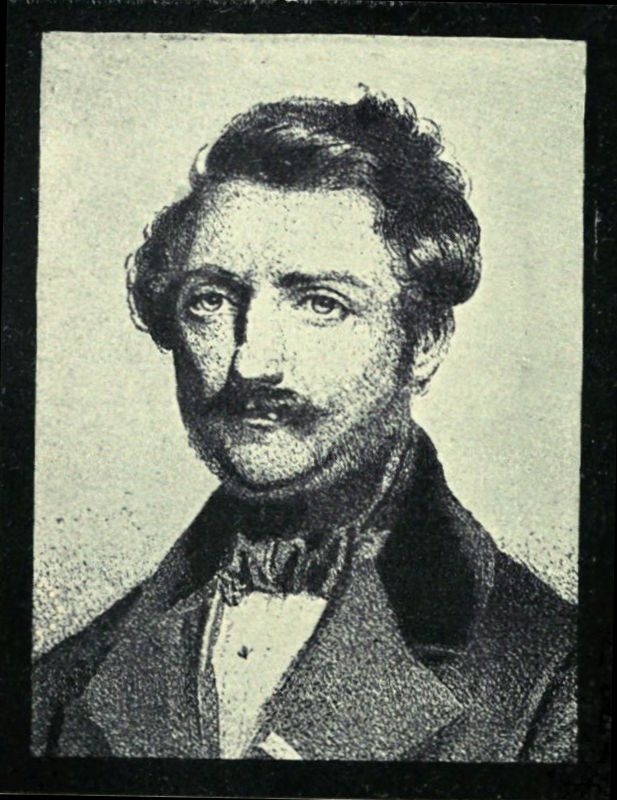
BALFE
The huntsmen now sounded their lively bugle
calls, and when all were ready, the brilliant cavalcade
moved off, climbing the hillsides, and
disappearing behind the rocks and trees. The little
Arline, after much coaxing, at length persuaded her
attendant maid, Buda, to allow her to follow the
hunters a short distance; and since all the retainers
and peasants had also rushed off to watch the sport,
the castle grounds were left quite deserted for a
time.
Presently, a handsome young stranger, dressed
in the garb of a Polish officer, ran into the gardens
in a breathless and exhausted state, seeking a hiding-place;
for a band of Austrian soldiers, whose
vigilance the proscribed exile could no longer elude,
were now close upon his track, and every moment
he expected them to come in sight.
Poor Thaddeus of Poland! A scion of a noble
family, he had bravely fought and bled for the freedom
of his country, as a true patriot; but now,
defeated and pursued, he wandered forth homeless,
without friends or fortune, and his only hope to
find some place of present shelter.
A statue of the Austrian emperor before the entrance
to the castle warned the unhappy exile that
he was on the very threshold of his enemies, and that
this was no safe haven for him; and, full of despair,
he was just about to make his escape, when a band
of wild-looking gipsies suddenly swarmed into the
grounds from the woodland glade, and quickly surrounded
him.
The sight of these merry gipsies brought a sudden
hope of safety to the wretched Thaddeus, and turning
to their leader, a light-hearted, clever rogue
rejoicing in the name of Devilshoof, he cried out
eagerly: "Let me join your ranks! I am a homeless
wanderer, without country, friends, or fortune,
but I have youth, strength, and courage, which I will
expend in your service if you will save me from my
enemies, who are even now upon me!"
Devilshoof and his gipsy companions were so
pleased with the boldness of the hapless young
stranger that they were glad enough to let him join
their ranks; and as his pursuers could already be
seen approaching, they quickly stripped off his
soldier's garb and dressed him in gay gipsy clothes.
Whilst this quick change was being made, a roll
of parchment with a seal attached fell to the ground,
and Thaddeus, as he hastily snatched it up and hid
it within his bosom, explained that it was his commission,
from which he would never be parted, since
it was the sole proof of his noble birth.
He had only just time to mingle with the other
gipsies when the Austrian soldiers, who had pursued
him so long, entered the grounds, and demanded
news of the fugitive; but upon the wily Devilshoof
carelessly announcing that a young Polish officer
had passed up the hillside only a few minutes ago,
they dashed off in that direction at once.
As they vanished out of sight, the triumphant
Devilshoof seized the hand of Thaddeus in token of
comradeship, swearing to befriend him all his life;
and then he gaily led him off to watch the chase,
followed by the rest of the gipsy band.
Meanwhile, the great hunt was going forward
with much spirit, lively bugle calls sounding in
every direction; but suddenly loud cries of alarm
came from the woods, and a crowd of peasants
rushed into the grounds, all talking at once, and
seemingly full of distress. Upon the heels of this
crowd came Thaddeus in his gipsy dress, and seeing
that the people seemed distraught, he demanded
what was wrong.
Learning from their excited cries that the little
child, Arline—whom he had already seen and admired
in the woods—had been set upon by an
infuriated stag, he was filled with dismay, and
snatching up a rifle that lay on a seat near by, he
hurried off to her aid. He quickly reached the
spot, and killed the maddened animal, and then he
returned to the grounds with the rescued child and
her terrified attendant.
The wild cries of the peasants quickly brought
Count Arnheim upon the scene, and on learning
of the danger his precious child had been in, he
clasped her in his arms with great relief. Seeing,
however, that her arm had been wounded by the
stag's horns, he bade the nurse carry her within
doors, and attend to her hurts; and then, turning
to Thaddeus, he seized his hand, and poured forth
words of gratitude upon him for saving the life of
his beloved child, who was the one joy of his lonely
heart.
On being next invited by the Count to partake
of refreshment and join in the festivities, Thaddeus
at first proudly refused, remembering that these
were the enemies of his country; but the merry
guests would not accept his refusal, and good-naturedly
dragged him off to the refreshment tables
that had been laid out near the castle steps. Here
the company seated themselves, whilst a troupe of
dancers went through a mazy figure before them;
and presently the little Arline, with her wounded
arm now bound up, appeared at an upper window
with her nurse, to watch the revels.
When the wine-glasses had all been filled, the
Count rose from his seat and invited his guests to
drink the health of their Emperor; but, though everyone
else rose to do honour to the pledge, Thaddeus
remained seated, and did not touch his glass. The
young fop, Florestein, soon noticed his attitude, and
pointed it out to his uncle, and Count Arnheim immediately
filled up another goblet and handed it to
Thaddeus, challenging him to drink loyally to the
health of the Emperor.
But the heart of Thaddeus was full of rage against
the invader of his beloved Poland, and in answer to
the Count's challenge, he seized the glass and dashed
it to pieces at the foot of the Emperor's statue.
Instantly there arose a chorus of indignation, and the
guests leaped upon Thaddeus with drawn swords;
and at the same moment, Devilshoof, the gipsy
leader, who had been watching the scene for some
time, sprang forward to protect his new comrade.
The enraged guests instantly attacked Thaddeus
and Devilshoof, with intent to kill them both, but
at a word from Count Arnheim, the huntsmen and
retainers dragged the two gipsies apart, and
marched them off in different directions. Thaddeus
was led away towards the woods, where, however,
he soon broke from his captors, and escaped to his
gipsy friends; but Devilshoof was taken into the
castle and locked in an upper room.
After this the guests settled down to their festivities
once more, and the dancing and games continued
with great merriment.
The waiting-maid, Buda, left her little charge for
a short time, and went out into the grounds to
assure the Count that his child was now recovering
from her fright; and whilst she was away, the gipsy,
Devilshoof, took his revenge for capture.
Having escaped from his prison chamber during
the absence of the guards, and reached the castle
roof, he gently lowered himself down to the open
window of Arline's room, and stepping on to the
sill, he entered, and shut the window behind him.
He then snatched up the little child, and hurried
from the room with her, and making his way along
the deserted passages, escaped through a side door
with his prize.
None of the revellers had noticed the gipsy's daring
climb from the roof, and when Buda presently
returned to Arline's chamber and found it empty,
she was filled with amazement. Wildly she searched
in every room, and then, uttering loud cries of
alarm, she rushed outside, declaring that the child
had been stolen. Quickly the nobles rushed into
the castle, and finding that the captive gipsy had
also vanished, they knew well enough that he had
carried off the child in revenge.
When the Count heard the terrible news, he
uttered a cry of despair, and at that moment, Devilshoof
appeared on the hillside carrying Arline in his
arms, and stifling her cries as he sprang from rock
to rock. With a shout of rage, Count Arnheim and
the nobles sprang after the spoiler, but Devilshoof
ran to a deep gorge between two rocky cliffs, and
having crossed over the tree-trunk that served as a
bridge, he kicked it down into the gulf below, so
that none might follow him further.
His baffled pursuers then took up their rifles, but
the cunning gipsy held the little Arline in front of
him, and they dared not fire. Count Arnheim, in
a frenzy of despair, was about to fling himself into
the gorge, but his guests seized his arms, and whilst
they carried him back senseless to the castle, Devilshoof,
still holding the child as a shield, made his
escape, and vanished into the depths of the forest.
Twelve years had passed away, and the gipsy
tribe, after many wanderings, were again encamped
in the city of Presburg. On the open side of a
quiet street the tent of the gipsy queen was pitched;
and here, one moonlit summer night, Arline lay
sleeping, whilst Thaddeus watched beside her.
All was quiet and peaceful, for it was growing
late, and only one inn kept its lights burning; but
presently a party of gipsies, wrapped in dark cloaks,
entered the street, headed by the bold Devilshoof,
who had brought them there to rob the late revellers
as they left the inn. Quietly they crouched in the
shadows and dark corners to await their prey; and
in a short time their patience was rewarded, for a
gorgeously-clad figure soon issued from the inn, and
staggered down the street with uneven steps. This
was Florestein, the foppish nephew of Count Arnheim,
who, regarding himself as the heir of his
wealthy uncle since the kidnapping of his little
cousin Arline, squandered his own fortune recklessly,
and spent all his time in feastings and revellings.
Seeing in this foolish roysterer an easy and
profitable victim, Devilshoof accosted him at once,
calling his companions about him at the same time;
and in a few minutes they had stripped him of
every valuable he had carried, for Florestein, being
a coward as well as a fop, was too terrified even to
cry out.
Having possessed himself of a rich jewelled
medallion and chain, Devilshoof made his escape,
leaving his companions to finish what he had begun;
but whilst the exulting gipsies were eagerly
dividing their spoils, another cloaked figure suddenly
appeared in their midst. Full of surprise and
dismay, they started back, for the cloaked figure was
that of their own gipsy queen, and they could
read anger in her mien.
With a haughty gesture she bade them instantly
restore all they had stolen from their victim, and
not daring to disobey her command, the gipsies
sullenly handed back the rings, chains, and other
jewels they had been so eager to secure.
"Is that all?" demanded the queen, and
Florestein, in a voice trembling with fright, replied
that he yet lacked a handsome gold medallion, set
with diamonds, worth all the rest. The gipsies
explained that Devilshoof had gone off with this
jewel as his prize; and then the queen led Florestein
away, saying she would protect him, to a place
of safety, and beckoning to the gipsies to follow
her.
When the street was quiet once more, Arline, who
had been awakened by the noise, arose and came
forth from the tent into the moonlight, followed by
Thaddeus. These two had grown to be lovers during
the years that had passed, and they only awaited the
gipsy queen's pleasure to join their hands in
marriage.
Arline had no knowledge of her noble birth,
though she had always felt herself to be different
from the careless gipsies with whom she lived, and
to-night, as she stood in the moonlight, she told
Thaddeus of a dream she had just awakened from,
which seemed to bear a message for her. She had
dreamt that she dwelt in marble halls, amidst great
riches and splendour, bearing a high ancestral name;
that countless suitors sought her hand; and yet,
which charmed her most of all, that Thaddeus still
loved her just the same.
When her story came to an end she begged her
lover to tell her the secret of her birth, for she felt
that he knew it, since he had already told her that
a certain scar upon her arm had been caused by the
charge of a wild stag, from which danger he had
saved her years ago; but for answer Thaddeus only
showered kisses upon her, for he knew full well
that if he disclosed her true birth they must be
parted.
Whilst they were thus folded in each other's arms,
the gipsy queen—who also loved Thaddeus—suddenly
returned, and, advancing towards Arline,
angrily demanded how she thus dared to aspire to
the love of one who was the chosen lover of her
queen. But Arline was not afraid of her rival's
anger; and standing aside, she said that Thaddeus
should choose between them. Instantly Thaddeus
folded her in his arms again, and then Arline, with
a triumphant smile, turned towards the other gipsies
who had now gathered round, and declared that it
was their desire to be wed. Then Devilshoof, whose
delight it was to make mischief and stir up jealousy,
reminded the queen that it was her duty and right
as a ruler of the tribe to join the hands of those of
her subjects who desired to be united; and the queen,
afraid of losing her authority should she refuse,
came slowly forward, and haughtily placed the hand
of Arline in that of Thaddeus, according to the
gipsy custom of betrothal.
But she was full of inward disappointment and
rage, and when Arline and Thaddeus presently wandered
off in the moonlight, she turned upon
Devilshoof, and passionately accused him of having
brought this evil hour upon her, declaring she would
only pardon him on condition that he yielded up to
her the jewelled medallion he had stolen that night.
Devilshoof, though he feared naught else, dared
not disobey the queen of his tribe, so he delivered
up the medallion, but muttered vengeance as he
strode away. The gipsy queen also thought of revenge;
and as she hid the jewel in her dress, she
laid a cunning plan for bringing trouble upon her
rival by means of it.
Next day a great fair was held in Presburg, and
all the gipsy tribe went to join in the revels. Arline
and the other Bohemian maids took their tambourines,
and sang and danced for the amusement
of the holiday-makers; and many of the gay youths
of the town sought to obtain favours from the pretty
strangers.
Amongst these revellers was the fop, Florestein,
decked in all his bravest attire, who was greatly
struck with the beauty and grace of Arline; and
seeing her standing alone one time, he swaggered
up and made flattering remarks to her. Finding
that his foolish speeches were not listened to, he
next tried to snatch a kiss, but to his surprise and
dismay, Arline turned sharply round upon him and
boxed his ears!
As he turned away, angry and discomfited, the
gipsy queen, who had been watching the scene,
recognised him as the roysterer whom she had
protected the night before, and running after
Arline, she fastened the jewelled medallion round
her neck, saying that it was a reward for her pretty
conduct, but knowing full well that Florestein would
soon see it, and accuse the girl of theft.
Having thus carried out the evil plan she had laid,
the queen left the fair ground, and soon afterwards
the rest of the tribe departed also. But just as
Thaddeus and Arline were moving away, Florestein
caught sight of his medallion hanging round the
maiden's neck; and hurrying forward, he loudly
accused her of having stolen it from him, rejoicing
to thus bring trouble upon one who had repulsed
his advances. Arline indignantly defended herself,
but at the command of Florestein, she was quickly
surrounded by the city guards, who seized and bore
her off in triumph to the Hall of Justice.
Here Count Arnheim sat, waiting to do justice on
those offenders who should be brought before him
that day; for his high position had made him the
Chief Judge of the district. The twelve years that
had gone by had aged him very much, for all his
efforts to trace his stolen daughter had been in vain;
but never for a moment had he altogether given up
hope, and never did he cease to think of the sweet
little maid who had been the only comfort of his
lonely heart.
He was thinking of her now as he sat in the Hall
of Justice on the day of the fair; but presently his
sad thoughts were rudely interrupted by the entrance
of the city guards, with Arline in their midst, and
Florestein bringing up the rear.
With swaggering, self-satisfied demeanour, Florestein
approached his uncle, and in angry, excited
tones, accused Arline of having stolen his diamond
medallion; but Count Arnheim, greatly struck with
the beauty and innocent looks of the young girl,
who reminded him strangely of his own lost child,
begged her to defend herself.
Then Arline explained in clear, sweet tones that
the jewel had been but a short time ago bestowed
upon her by the gipsy queen, who, she now saw,
had intended to bring trouble upon her by this very
gift; and she proudly declared that, rather than be
accused of such baseness as common theft, she
would take her own life. She drew a dagger as
she spoke, but ere she had raised her arm, Count
Arnheim, whose chords of memory had again been
touched by the maiden's sweet voice, sprang forward
and snatched the weapon from her hand.
His action was so sudden that Arline's loose sleeve
slipped back from her elbow, disclosing the rough
scar upon her white arm, and as the Count's gaze
fell upon this wound mark, he turned suddenly pale,
and in trembling accents demanded eagerly how
she came by it. Full of surprise at his tone, Arline
repeated the story of the maddened stag that
Thaddeus had told to her, and Count Arnheim,
knowing now beyond a doubt that this beautiful
Bohemian maiden was indeed his long-lost child,
clasped her in his arms with frantic joy, declaring
to all that she was his beloved daughter.
And now Arline was quickly restored to the high
position she had been born to; and as soon as the
young girl had recovered from the strangeness of
her new life, the proud and happy Count sent out
invitations for a magnificent fête and ball, that he
might introduce his lovely daughter to his friends
in fitting style.
But on the night of the ball, Arline, dressed in
richest garments, sat alone in one of the splendid
salons of the castle, with a sad look upon her face;
for she was thinking of her faithful lover, Thaddeus,
and felt that she could never enjoy her new prosperity
unless he shared it with her. The Count and
his foppish nephew had just left her, at her own
request; and as they went off to receive the first
guests, she knew that Florestein, whom she greatly
despised, was already petitioning her hand in
marriage.
With a heavy sigh, her thoughts turned quickly
to the free and happy past; and at that moment, the
low window of the salon was suddenly opened, and
Devilshoof entered from the grounds beyond. He
begged her not to be alarmed, since he had but
brought a message from his tribe, asking her to
return to her old friends; and as he spoke, the
window was opened again, and Thaddeus entered
the room.
With a cry of joy, Arline rushed into her lover's
arms, and when Thaddeus besought her to remember
him sometimes, even amidst wealth and splendour,
she declared that she cared naught for wealth and
splendour unless he would love her still. As they
stood there, folded in each other's arms, Count
Arnheim's voice was heard as he conducted his
guests towards the room; and Arline, fully aware
that this was not the time to present her gipsy lover
to her father, hastily thrust Thaddeus into a curtained
recess, whilst Devilshoof escaped through the
window.
In another moment Count Arnheim entered the
salon with the early guests, and with a proud smile,
took Arline by the hand, and introduced her to
his noble friends.
Now, whilst Arline and Thaddeus had been rejoicing
together, the gipsy queen had watched them
without the window, with bitter rage and jealousy
in her heart; for she still loved Thaddeus, and
followed him wherever he went. She saw Arline
hide him within the recess, and as the gaily-dressed
guests afterwards trooped in, she quickly thought
out a plan for revenging herself upon her rival.
Opening the window, she softly entered the salon,
and making her way to Count Arnheim, threw
off her cloak, and declared that she had a message
for him.
Greatly surprised at the appearance of this strange
figure, the Count bade her speak on; and with a
triumphant glance towards the now pale and trembling
Arline, the gipsy queen cried: "The daughter
you prize so fondly is deceiving you! She loves a
gipsy of my tribe, and he is even now hidden in this
room!"
She pointed to the recess as she spoke, and Count
Arnheim, stepping forward, drew aside the curtain,
and Thaddeus appeared before the eyes of the
astonished guests.
Full of indignation and disappointment, the proud
Count poured forth bitter reproaches upon the
daughter he now felt to be unworthy of his love;
and drawing his sword, he passionately bade
Thaddeus depart ere he took his life.
The gipsy queen seized Thaddeus by the hand,
and triumphantly tried to drag him away with her;
but Arline ran to her lover's side, and turning towards
the bewildered guests, begged them to leave
her alone with her father. When the guests had
all retired to the salon beyond, and only her father
and lover remained, she fell on her knees and
implored the Count to consent to her marriage with
Thaddeus, whom she loved so dearly, declaring that
she would rather die than live without him; but the
Count only exclaimed the more against the disgrace
to his name should his daughter wed an outcast
gipsy.
On hearing this, the ancestral pride of Thaddeus
could no longer be restrained, and caring naught
for the danger it might bring, he haughtily declared
that he was of as equally pure and noble birth as
the Count himself, even though he wore the garb
of a gipsy. He then told the whole story of his
exile from Poland, and his reason for joining the
gipsy tribe, and drawing forth his commission, from
which he had never departed, he handed it to the
Count as the proof of what he said.
Count Arnheim was greatly moved at the sad
story told by the exile, and when he had glanced at
the commission and read there that Thaddeus was
indeed of noble birth, he took him by the hand,
saying that the feuds of their countries should be
forgotten, and that they should be friends. He then
placed Arline's hand in that of Thaddeus, and the
lovers embraced with great joy.
Meanwhile, the queen of the gipsies, who had left
the salon when the guests retired, had gone in search
of a young gipsy whom she knew to be devoted to
her service, and bidding him bring his musket and
follow her, she once more crept round to the open
window of the salon. With gleaming eyes she
watched the three figures within, and then, when
she saw the lovers folded in each other's arms, she
turned to the gipsy at her side, and, in a transport
of jealous rage, bade him shoot Thaddeus instantly.
But Devilshoof had also followed closely upon her
track, suspecting her evil design, and just as the
musket was raised, by a dexterous movement he
diverted the young gipsy's aim, and turned the
muzzle upon the queen. There was a loud
report, and a shriek, and the queen of the gipsies
fell to the ground, slain by the shot she had intended
for her lover.
FIDELIO
One bright summer day, during the seventeenth
century, in the courtyard of a certain prison castle
in Spain, the jailer's daughter, a pretty girl, named
Marcellina, stood ironing linen in the doorway of
her father's lodge; and though not in reality pressed
for time, it pleased her to make a great pretence of
being very busy, in order to avoid the attentions of
Jacquino, the porter of the prison, who was constantly
passing to and fro, and engaging in
conversation with her.
It was quite in vain, however, that the amorous
porter tried to get the maiden interested in his pretty
speeches, for pert Miss Marcellina would have none of
him to-day, and was even cruel enough to hint that
her thoughts were with some more favoured suitor
elsewhere; and Jacquino felt himself very badly
used. For until lately, he alone had been the
favoured swain of this rustic coquette; but since the
recent advent of a new assistant, a handsome youth
rejoicing in the name of Fidelio, the jailer's pretty
daughter had looked coldly upon her old sweetheart,
and bestowed all her most bewitching smiles upon
the newcomer.
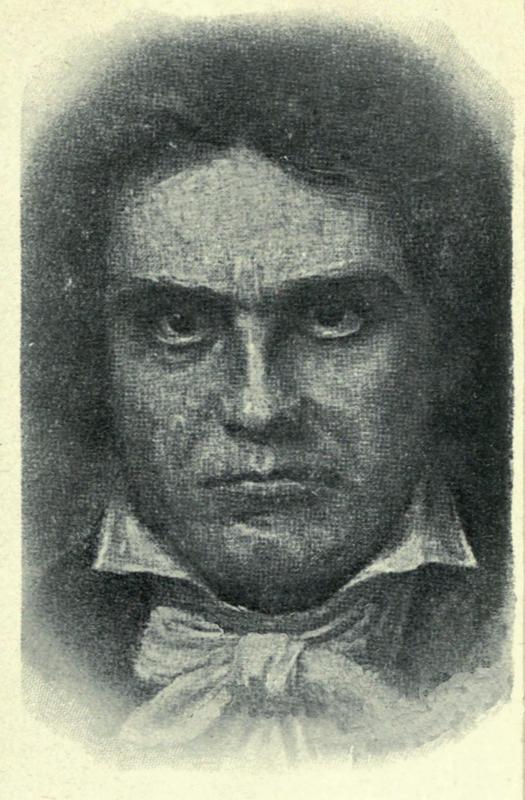
BEETHOVEN
It was of Fidelio she was thinking now, knowing
that the youth would shortly be returning from an
errand upon which he had been sent some hours
before; and so, when a loud knock was presently
heard at the outer gate, she was filled with joyful
anticipation, and eagerly bade Jacquino unfasten the
bolts at once, which the porter did very reluctantly
and with much grumbling at such untimely interruption
to his own suit. He was somewhat grimly
pleased, therefore, when, on opening the gate, he
admitted Rocco, the jailer, instead of the new
assistant; but even this small satisfaction was short-lived,
for almost immediately afterwards, his rival,
Fidelio, appeared, and so laden with packages and
baskets, that Marcellina ran to relieve him of them
at once, commiserating tenderly with him on being
thus heavily laden on so hot a day.
Now, in reality, though none suspected it, Fidelio
was not the person he represented himself to be, but
instead a lady of high degree, who had thus taken
on the disguise of a youth from a very noble motive.
Within this prison castle there were a number of
political prisoners, who, though innocent, were the
victims of despotic power, and pined in captivity,
because some private enemy refused to speak the
word that would have set them at liberty.
Amongst these prisoners was a certain Don Florestan,
a nobleman, who, having had the misfortune to
offend Don Pizarro, the governor of the fortress, had
been by him accused of some slight political misdemeanour,
and thrust into a deep dungeon of the
prison. Having thus got his hated enemy into his
power, the crafty Governor gave out clearly afterwards
that he had died, so that he should not be
released when his short time of imprisonment was
over; and thus, by keeping him closely chained in
the deepest dungeon, and slowly starving him, he
hoped that the wretched man would really die, and
his own private vengeance be thus satisfied without
resort to actual violence.
However, his plans were to be frustrated from
quite an unexpected source; for Don Florestan had a
beautiful young wife, the Lady Leonora, who loved
her husband so devotedly that, refusing to believe
the report of his death, she determined to learn the
truth at all costs, and, if he still lived, to rescue him
from the hands of his unscrupulous enemy, Pizarro,
who she knew would not hesitate to murder him so
soon as he could do so without fear of discovery.
Being of a brave and heroic disposition, Leonora
was not afraid to risk her life for the sake of the
man she loved; and so, having donned masculine
attire, she boldly made her way to the fortress where
her husband pined in captivity, and, giving her
name as Fidelio, humbly requested the jailer to engage
her as his assistant, hoping that in this way she
would at last discover how Don Florestan was
faring, and perhaps be able to plan some means of
escape for him. Rocco, the jailer, being greatly
struck with the pleasant looks and manners of the
supposed youth, very willingly took her into his
service; and, since the new assistant was neat-handed,
useful and obliging, he quickly became a
favourite with all within the castle, to the great
chagrin of Jacquino, who, being clumsy and somewhat
dull, now found himself quite out of favour.
Poor Jacquino felt more aggrieved still when saucy
Mistress Marcellina also showed preference for the
newcomer whose handsome face and air of melancholy
attracted her fancy and caused her to treat
her old sweetheart with disdain; and when discovering
in addition that his master, Rocco, favoured his
daughter's new choice, he felt justly jealous of the
unknown stranger who had so coolly supplanted
him.
So to-day, as Marcellina and her father ran to
relieve the supposed Fidelio of his burdens, Jacquino
kept sulkily in the background; and presently he
departed to perform some duties within the castle,
determined to press his own suit at some more
favourable time.
Rocco now began to praise his new assistant for
the clever manner in which he had carried out his
instructions that day; and to show his approval of
this and of his conduct in general, he announced
that he was quite willing to welcome such a likely
youth as a son-in-law, since Marcellina seemed to
regard him also with evident favour, and he even
hinted at a very early date for the wedding-day.
Marcellina was delighted to hear this, and to know
that her father favoured her fancy for her dear
Fidelio; but Leonora was greatly embarrassed, not
knowing how she could get safely out of this new
difficulty, for though she had tried to ingratiate herself
with the jailer's daughter for her own purposes,
she did not wish to pain the maiden in any way.
However, she succeeded in hiding her embarrassment
for the time being, and presently managed to
direct the conversation into a safer channel, by begging
Rocco to allow her to accompany him in his
daily visits to the prisoners in the lower dungeons,
and to assist him with this work, which the jailer
had hitherto performed alone; for, in this way, she
knew she would be able to discover if her beloved husband
still lived, since she had not seen him amongst
the more favoured prisoners, whom she was permitted
to wait upon.
At first Rocco refused this plea, declaring that
Fidelio was too young to witness such dreadful sights
as these wretched chained captives, and to emphasize
his refusal, described the miserable state of one of
these, who was nearly at the point of death through
close confinement and starvation; but when Leonora,
on hearing this, redoubled her entreaties, feeling
sure from the description that this unhappy prisoner
must be her own dear husband, he at length consented,
feeling better pleased than ever with the
youth's evident desire to assist him even in such disagreeable
duties as visiting the dungeon captives.
At this moment Don Pizarro, the cruel Governor
of the prison, entered the courtyard with some of
the guard; and, after giving orders to the captain,
he proceeded to read the despatches brought from
the town by Fidelio, and now handed to him by
Rocco.
Amongst these despatches, Pizarro found a missive
warning him that the Prime Minister intended
to pay a surprise visit to the prison that evening,
having been informed that certain victims of despotic
power were still unjustly held captives there; and,
suddenly filled with fear at the thought of how he
should account for the presence of Don Florestan,
so long believed to be dead, he began to form a plan
to avoid this new danger to himself, and soon decided
to kill his hated enemy within the next few
hours. However, he did not mean to do this dreadful
deed himself, if possible; and so, when the guard
had presently gone on duty, he detained Rocco, intending
to make him his instrument of vengeance.
Carelessly handing the jailer a purse of gold, he
hinted darkly that he desired the death of this wretched
prisoner in the lowest dungeon; but Rocco, recoiling
from the thought of such cold-blooded murder,
refused to do the deed, although, being afraid of
offending his unscrupulous superior, he tremblingly
agreed to dig the victim's grave, if Pizarro himself
would strike the fatal blow. With this the Governor
was fain to be content; and the two departed separate
ways, having first laid their plans and arranged that
the grave should be dug beneath an old ruined cistern
at the side of the dungeon.
Now it happened that Leonora, having suspected
from the dark looks of Pizarro that he intended ill
to someone, had crept back to the courtyard, where
she had remained hidden in such a position that
she could overhear the conversation between the
Governor and Rocco; and filled with horror at
the thought of the violent death now destined for the
unhappy prisoner, whom she felt sure was her own
beloved husband, she determined to rescue him that
evening if possible, and hurried after Rocco, in order
to be with him wherever he should go, and so learn
all his plans.
Later on, she returned with the jailer to the courtyard,
where she discovered Marcellina and Jacquino
engaged in a lively dispute; and, finding that the
squabble was about herself as the supposed Fidelio,
whom Jacquino regarded as a rival and Marcellina
desired as a new sweetheart, she hastily changed this
embarrassing subject by entreating Rocco to allow
the more privileged prisoners to walk for a short
time in the courtyard to enjoy a breath of fresh air,
a request he had several times promised to grant
when a suitable opportunity should occur. As Marcellina
also added her entreaties to this kindly request,
hoping to please her dear Fidelio by so doing,
Rocco agreed, promising to keep Pizarro engaged
for a short time on business at the other end of the
fortress; and so, when he had departed, Jacquino
and Leonora unlocked the cells, and invited the
wretched inmates to walk outside for a while.
Full of gratitude for this unexpected pleasure, the
prisoners poured forth into the courtyard, walking
about with slow painful steps, but uttering cries
of delight at the sight of the brilliant sunshine, and
inhaling the fresh summer air with deep thankfulness.
Presently, Rocco returned, and informed the new
assistant that Pizarro had consented to his helping
him in the duties of attending upon the dungeon
captives, and that he should begin that day by helping
to dig the grave for the victim who was to die
so soon as it was ready; and Leonora was filled with
conflicting emotions, joyful at the thought of meeting
her beloved one again, should the captive indeed
prove to be her husband, but terrified by the prospect
of her dreadful task.
Whilst they were still talking together, Pizarro
unexpectedly appeared on the scene; and, enraged at
the sight of the captives walking in the courtyard,
he poured forth angry abuse upon Rocco for daring
to permit such a thing. The jailer, however, stopped
this outburst by reminding Pizarro of the dark deed
he was presently to assist him with; and, anxious to
keep on good terms with one who knew his wicked
plans, the Governor ceased to bluster, but gave
orders for the prisoners to be once more locked up.
When the wretched captives had returned reluctantly
to their cells, uttering deep sighs of regret as
they quitted the bright sunshine for the gloomy
darkness of the prison, Rocco called the supposed
Fidelio to one side; and, laden with spades and pickaxes,
they made their way to the deepest dungeon to
commence their gruesome task.
Little dreaming that the one person in all the world
he most longed to see, his beloved wife, was even
now approaching, Don Florestan lay suffering upon
the floor of his horrible cell, with despair in his
heart; for he had now been so long without food, and
was so terribly exhausted, that he knew death could
not be far off. All hope of escape had long since
deserted him, and he had quite resigned himself to
his fate, looking forward to death as the end of his
sufferings; but even now the image of his beautiful
Leonora shone brightly in his heart, and every now
and again he would breathe her name tenderly, and
stretch forth his arms with a loving gesture, as though
about to embrace her visionary form, or call a
passionate greeting to her, thinking in his wandering
delirium that she indeed stood before him.
Just as he sank back exhausted after one of these
flights of feverish fancy, Rocco the jailer entered
the dungeon, followed by the trembling Leonora,
who shivered as she felt the chill, damp air of the
subterranean cell, and glanced apprehensively at the
huddled form on the ground, fearing, yet hoping,
that it would prove to be her husband.
Rocco at once proceeded to the ruined cistern situated
at one side of the dungeon, and, taking his
spade and pickaxe, began to dig the grave, calling
to his assistant to do likewise, speaking in gruff but
not unkindly tones, thinking that the youth's evident
reluctance to commence the horrid task was due
to the softness natural to his tender years, rather
than to any deeper feeling.
At length, however, Leonora, in order to keep up
her disguise, took her spade and began to assist in
the work; but every now and again, she turned her
eyes upon the crouching form of the poor prisoner,
who appeared to be sleeping.
Presently, however, Don Florestan raised his head,
and addressed the jailer; and Leonora, seeing now
that he was indeed her own beloved husband, was
so overcome that she sank back in a swoon. Rocco,
not noticing the agitation of his assistant, approached
the prisoner, who demanded, as he had already done
many times before, the name of the tyrant whose
cruelty thus doomed him to a living death. Rocco,
knowing that the poor man was to die within the
next hour, felt that there could now be no harm in
granting this request; so he told Florestan that his
enemy was Don Pizarro, the Governor of the
prison.
The name of Pizarro recalled Leonora's wandering
senses; and still keeping her face hidden from Florestan,
she tried to persuade Rocco to permit her to give
the captive some bread she had brought with her
for this purpose. Though the jailer at first refused,
his own pity for the wretched prisoner at length
got the better of him, and he gave his consent, even
making him drink a little wine from a small flagon
he had himself brought.
No sooner had Florestan eagerly partaken of the
welcome food, which quickly brought back some little
strength to his weary frame, than the dreaded Pizarro
entered the dungeon, his first words being to bid
Rocco send his youthful assistant away. Leonora,
however, though she pretended to obey, only retired
into the shadows of the dungeon; and then Pizarro,
flinging open his cloak, and drawing his dagger,
strode towards the prisoner, and in cruel, triumphant
tones bade him prepare to die, hoping to see him fall
on his knees and beg for mercy.
But Florestan, who had now risen to his feet,
bravely drew himself up to his full height with quiet
dignity; and his look of calm contempt so exasperated
the wicked Pizarro, that he sprang forward immediately,
intending to stab him to the heart. Ere he
could strike, however, Leonora flung herself upon
him, and bade him desist; and as Pizarro, taken by
surprise, drew back, she now boldly declared herself
to be the wife of his intended victim.
Florestan, seeing the face of the supposed youth
for the first time, was amazed to recognise his beloved
Leonora; and full of joy, even in this awful moment
of danger, the long separated husband and wife embraced
tenderly.
Pizarro, enraged at this untimely interruption of
his evil plans, and knowing that he had little time
to lose, since his superior officer would arrive very
shortly, sprang forward again, intending to stab
them both; but Leonora, in a flash, drew forth a
loaded pistol she had concealed in her garments, and,
covering him with it, declared she would fire if he
moved a step further.
Chagrined, and completely nonplussed at this
sudden turning of the tables upon him, Pizarro stood
helpless, glaring furiously upon the brave Leonora;
and as they stood thus, the sound of a trumpet was
heard, and Jacquino, accompanied by several officers
of the castle, appeared in the doorway, announcing
that Don Fernando, the Minister, had just arrived,
and demanded an immediate interview with the
Governor of the prison.
Pizarro, baulked of his prey, and feeling that
disaster was about to fall on him, yet not daring to
disobey the command of his superior, turned angrily
on his heel, and left the cell.
When their enemy had departed, Florestan and
Leonora again fell into each other's arms, and
rejoiced together, full of gladness at meeting once
more, and hopeful that their troubles would now
shortly come to an end; and then as soon as the
exhausted Count had sufficiently recovered, Rocco
escorted them both to the large court of the castle,
where the Minister, Don Fernando, surrounded by
soldiers and officers, was receiving the thanks of the
grateful captives, whom he had just ordered to be
set free, knowing that they had unjustly been kept
in bonds.
The jailer, eager to bring his cruel master into
disgrace, led Florestan and Leonora forward at once,
and appealed to the Minister for justice; and Don
Fernando, astonished at thus beholding the young
Count, whom all had believed to be dead, received
him with great kindness, and gave him a hearty
welcome. Then, when he was told the whole story
of Pizarro's infamous plot, and how it was frustrated
by the intended victim's brave wife, he declared that
Florestan was free from that moment, and that
Leonora herself should have the joy of removing the
chains that had been put so unjustly upon him.
When this pleasant task had been performed by
the now happy Leonora, the whole assemblage were
free to rejoice together, for all were glad at the
downfall of the tyrant Pizarro. The released captives
were glad because they were at liberty once
more; Jacquino was glad because the dangerous Fidelio
could no longer be a rival to his claim upon the
pretty Marcellina, who was even now ready to smile
on him again; and Florestan and his faithful Leonora
were the most joyful of all, since they were restored
to each other and a life of perfect peace and happiness.
LA SONNAMBULA
In a certain pretty village in Italy, the light-hearted
peasants were gathered together one summer evening
on the shady green, talking in groups as they
waited to witness the betrothal of Elvino, a prosperous
young farmer, and his fair sweetheart, Amina,
whose nuptials were to be celebrated on the morrow.
The wreaths and garlands of flowers for the wedding
decorations were being merrily set up by willing
hands, and the village already wore a gala air; for
all were looking forward eagerly to the coming festivities,
with the exception of one person, who alone
refused to be joyful.
This was Lisa, the pretty young hostess of the
village inn, who having once received attentions herself
from the handsome Elvino, had felt slighted
when he fixed his affections upon Amina, whose
beauty and sweet winning ways had made her the
belle of the village; and now, as she mingled with
the merry throng on the green, she was filled with
envy for the happy fate of the bride-elect, and could
do nothing but make spiteful remarks about her
rival, declaring her to be a mere nobody, and not
worthy of so great a piece of fortune.
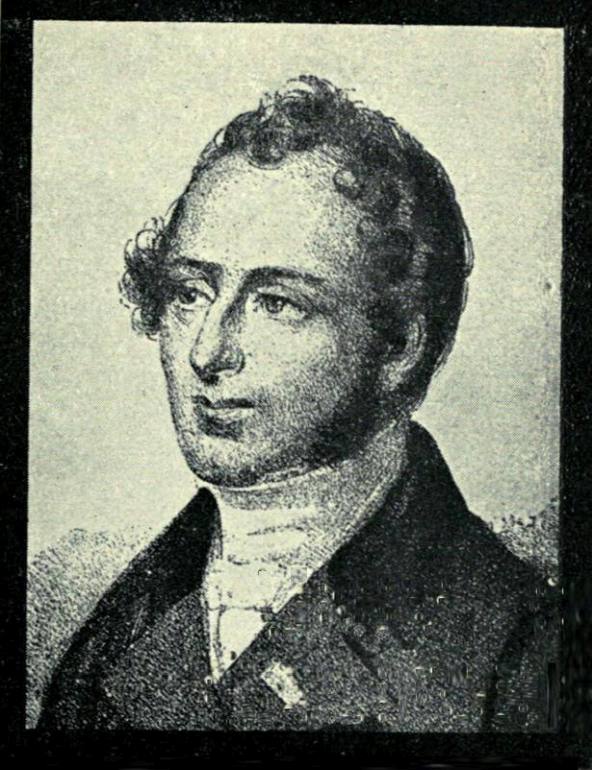
BELLINI
For Amina was but a poor orphan, who had been
brought up by Dame Teresa of the Mill, a worthy
woman who had loved and cared for her as though
she were her own child; but in spite of her unknown
birth and dependent position, Amina was beloved by
all the villagers, whose hearts she had won by her
many deeds of kindness. But Lisa's jealousy would
not allow her to see any perfection in the gentle
Amina; and so full of envy and disappointment did
she feel just now that to all the remarks made to her
by her devoted admirer, Alessio, she only returned
snappish replies, which, however, disconcerted her
swain but little. For Alessio was a merry, lively
fellow, full of fun, and not easily discouraged; and
having conceived a great admiration for the pretty
but sharp-tongued Lisa, he was for ever coaxing her
to marry him, and in spite of her many snubs,
still felt confident of success in the end.
As they walked about the green this evening, he
said again; "Come, Lisa, let us also sign our marriage
contract whilst the Notary is here, and save
him the trouble of coming again!"
But to this cool suggestion, however, Mistress Lisa
merely tossed her head, and turned impatiently away;
and Alessio, nothing daunted, began to join heartily
in the merry wedding song he had himself composed
in honour of the day, which the villagers had just
raised as the pretty Amina appeared on the green,
accompanied by Dame Teresa.
When the song came to an end Amina thanked her
friends in a gentle voice for their kindly wishes; and
then, turning to Alessio and Lisa, she mischievously
suggested that they should follow her example and
plight their troth with her that night.
"'Tis just what I have been saying!" cried the
irrepressible Alessio, gleefully. "Come, Lisa, say
that you will, for I feel I must get married to-day,
and if you won't have me, I'll have to marry Dame
Teresa!"
All laughed merrily at this; but Lisa sulkily refused
to join in the fun, for Elvino had now arrived,
and the sight of his devoted attentions to Amina
caused her jealousy and disappointment to smart
afresh. The Notary having also now arrived with
the marriage contract, the guests gathered around
a table which had been placed beneath the trees outside
Dame Teresa's house; and Elvino and Amina,
having signed their names to the paper, their
betrothal was thus formally concluded.
Just as the happy pair were receiving the congratulations
of their friends, a strange cavalier—whose
gay attire, aristocratic bearing, and deferential
attendants proclaimed him to be a person of
rank—approached the inn, and inquired of the bystanders
if the landlord's château was near at hand;
and on being informed that it was some little distance
away, he announced his intention of passing the night
at the inn.
On hearing this, Lisa, mindful of her duties as
hostess, hurried forward officiously, and offered her
best accommodation to the stranger; and then, having
received some gallant compliments from her
guest, who had an appreciative eye for a pretty face,
she hastened within doors to make all ready, beaming
with pleasure.
The stranger was, however, more greatly struck
with the beauty of Amina, to whom he next addressed
himself, declaring that she reminded him of
someone whom he had long since loved and lost;
and so intense was his gaze, that after he had departed
within the inn, Elvino, seized with a sudden
pang of jealousy, reproached the maiden for having
thus spoken with the newcomer. But Amina tenderly
reassured her anxious lover, declaring that she
loved but him alone; and the little cloud that had
threatened to gather, now quickly vanished.
As they moved away happily together, Alessio presently
came running out to announce that he had
discovered the stranger to be none other than the
Count Rodolpho, their own Lord of the Soil, whose
château overlooked the village, and who had not
visited his native place since he was a child; and
upon hearing this interesting news, the villagers
were all filled with great excitement, and, as they
trooped away to their homes arranged to proceed
to the inn at break of day to sing a song of welcome
to their Seigneur, and to show their joy at his
arrival.
Some hours later, Count Rodolpho was conducted
to the finest chamber which the old-fashioned inn
afforded, and which, though it had the reputation of
being haunted, he had laughingly insisted upon
occupying, finding it quaint and comfortable; and
before retiring for the night, though it was already
late, Lisa appeared at the door, to ask if all his wishes
had been attended to, and also to offer her respects
to him as her Seigneur.
The Count, being a gay cavalier, and accustomed
to making conquests wherever he went, invited her
to enter, thinking that a flirtation with his pretty
hostess would pass the time pleasantly; and Lisa, nothing
loath, but delighted at the impression she imagined
she had made on her guest, was willing enough to
accept his attentions. The Count's pretty speeches
pleased her very well, nor did she object when he
snatched a kiss or two; but, not daring to remain
longer, since the night was advancing, she was just
about to depart, when a strange interruption came.
Just at that moment, a slight female figure, clad in a
long white robe, softly entered the room, and walked
slowly across the floor, speaking aloud, as though
holding a conversation with some unseen person; and
to the great amazement of the Count and Lisa, they
saw that this mysterious nocturnal visitor was Amina,
who, although her eyes were wide open, saw them
not, since she was walking in her sleep. For, though
unknown to anyone, and still less to herself, Amina
was a somnambulist, and had quite unconsciously
walked from her own home and entered through the
unfastened door of the inn; and as Count Rodolpho
now gazed in astonishment upon the maiden, whose
lovely face had so interested him earlier in the evening,
he was filled with a strange, deep emotion, and
listened eagerly to the words she said, from which he
gathered that she imagined herself speaking to Elvino,
since she spoke reproachfully of his having for a
moment doubted her faithful heart.
But Lisa, though at first alarmed, quickly saw in
this unforeseen circumstance, a means for satisfying
her petty spite against the orphan she despised; and,
quickly making her escape from the room, she determined
to seek out Elvino, and prove to him that his
betrothed was base and unfaithful to him, since she
had found her in the chamber of the Count Rodolpho.
Meanwhile, Amina continued to speak in tender
accents of her love for Elvino; and, unconsciously
taking the Count's hand in hers, she softly caressed
it, repeatedly avowing her passion.
Count Rodolpho watched the sleeping maiden with
increasing emotion, feeling the charm of her ethereal
beauty creeping over him like a spell; and at last,
fearful of awakening her, and not daring to trust
himself longer in her sweet presence, since, though
her helplessness appealed to his chivalry, he felt drawn
towards her by a strange attraction, he hastily left
the room, and, leaving the inn at once, made his
way to his own château.
After he had gone, Amina ceased to speak; and,
presently sinking upon a couch, remained there in
peaceful slumber.
It was now day-break; and the peasants, in accordance
with the arrangement of the evening before,
assembled in the inn, and, making their way to the
Count's chamber, began to sing a joyous song of
welcome, which they hoped would presently arouse
him from his slumbers. Soon afterwards, Lisa entered
the room with Elvino, whom she had brought
to behold for himself his betrothed slumbering in
the chamber of the stranger, cruelly and unjustly
keeping from him the fact that Amina had walked
there in her sleep.
Elvino, who had indignantly refused to believe her
story, now uttered an exclamation of grief and despair
on beholding what appeared to him the proof
of Lisa's statement; and at that moment Amina,
awakened by the singing, opened her eyes, and was
quickly filled with amazement on beholding her unaccustomed
surroundings. As she rose from the
couch in bewilderment, Elvino burst forth into angry
reproaches, declaring her to be faithless and base;
and in spite of poor Amina's piteous assurances of
innocence, since she could not explain how she came
to be found in such a compromising situation, he
spurned her with scorn, and, thrusting aside her
clinging arms, departed in anger.
Amina, overcome with grief and despair, sank sobbing
into the arms of Dame Teresa, who, though not
understanding the mystery, yet believed her to be
innocent, and led her away with great tenderness;
and the peasants then sadly dispersed, loath to think
ill of the pretty maiden they loved so well, yet compelled
to admit the evidence of their own eyes. But
they were not satisfied; and later on in the day they
set off to seek out Count Rodolpho in his château,
and to learn what he knew of this strange matter,
and if he had indeed enticed the poor girl to her
ruin.
Meanwhile, Lisa was triumphant; and, having thus
succeeded in bringing disgrace and ignominy upon
her rival, she sought out Elvino, who had wandered
into the woods near the château, and tenderly offered
words of comfort to him, and by encouraging his
rage against Amina, led him artfully to think of
renewing his vows to herself; and then wisely refraining
from becoming too importunate, she left
him to his own reflections again, and wandered alone
down another glade. Here she was joined by the
lively Alessio, who, after first bewailing the sad fate
of Amina, made the brilliant suggestion that Lisa
should marry him at once, so that the wedding decorations
should not be wasted, a suggestion, however,
which was again disdainfully flouted by the
captious Lisa, who informed him that she already
felt assured of eventually securing the more prosperous
Elvino as a husband. Alessio, well used to
such rebuffs, and not the least disconcerted by this
surprising announcement, still pressed his own
claims; and then seeing that the peasants were approaching
from the château, the wrangling pair set
off to join them.
Meanwhile, Amina, accompanied by the sympathetic
Dame Teresa, had also sought solace for her woe in
the woods; and presently coming face to face with
the unhappy Elvino, she once more besought him to
believe in her innocence. Elvino, though filled with
emotion at beholding the maiden whom he believed
had wronged him, still refused, however, to listen
to her pleadings, and again turning from her with
scorn and anger, hurried quickly away; and as Dame
Teresa vainly endeavoured to comfort the now heart-broken
girl, the peasants came in sight, headed by
Count Rodolpho, who, having heard from them of
Amina's sad plight, had now come to prove her innocence.
Full of compassion, he approached the half-fainting
girl; and, seeing that she was utterly exhausted
by the strain that had been put upon her, he bade
Dame Teresa to take her into a neighbouring mill,
and make her rest for a while, promising that in the
meantime, he would seek out Elvino and try to
convince him of the innocence of his betrothed.
When Dame Teresa had led the weary Amina into
the mill, the peasants went to seek Elvino; and when
they had at length found and persuaded him to return
with them, the Count bade him be of good
comfort and cease to mourn, since Amina was still
worthy of his love. He then described to him that
the maiden had entered his room the night before in
her sleep, explaining that she was a somnambulist,
and, as such, utterly unconscious of her actions at
the time; but Elvino and the simple peasants, never
before having heard of this strange phenomenon,
were scarcely yet convinced, finding it difficult to
realize such a curious circumstance, which had not
come within their experience before.
But whilst they were still wondering at the story
that had been told to them, they saw Amina softly
approaching from the mill, passing them with wide-open,
unseeing eyes, and uttering Elvino's name in
loving accents; and, seeing that the maiden was again
walking in her sleep, the Count explained this fact
to the peasants, and bade them remain quiet until
she should awaken.
Elvino, overjoyed at this final proof of his beloved
one's innocence, could scarcely restrain his happy
feelings, watching the lovely maiden's movements
with eager interest; and when she presently awakened
to full consciousness, he clasped her in his arms
with joy, beseeching her to forgive him for doubting
her faith.
Amina, full of happiness at thus learning that
Elvino still loved her, and no longer believed her to
be false, was soon restored to her accustomed gaiety;
and so the reunited pair were wedded that same
day ere the sun went down, amidst the great rejoicings
of the villagers, who were filled with delight
that the fair maiden they loved so well was now
cleared from all reproach.
I PURITANI
During the great Civil War between the royal House
of Stuart and the Parliament, at the time when
Charles the Second was a fugitive, the fortress of
Plymouth was held by the Parliamentary Army; and
here the commander of the fortress, Lord Walton, a
Puritan sternly devoted to the side he had espoused,
had brought his lovely young daughter, Elvira, that
she might be safe from the many dangers of that
troublous time.
The sweetness and grace of Elvira quickly gained
her many admirers; for even the sombre Puritans
were not proof against the enthralling charms of
youth and beauty.
Amongst these admirers was Sir Richard Forth, a
colonel in the Parliamentary forces; and being of
good family and excellent repute amongst the
Puritans, he met with a very favourable reception
when he brought his suit to Lord Walton, who readily
accepted him as his future son-in-law.
Elvira, however, had already, unknown to her
father, given her heart to a Cavalier officer, Lord
Arthur Talbot, who held a high position in the
Royalist Army; and when she was told that the
Puritan officer had been accepted as her suitor, she
was filled with dismay, knowing such a loveless
marriage could bring nothing but misery, yet believing
that her father would never consent to her union
with her Cavalier lover.
In this dilemma, she confided her troubles to her
uncle, Lord George Walton, who, though a retired
Puritan officer, yet remained in the fortress to assist
his brother in the command; and this gentleman,
who loved Elvira as his own child, was so deeply
moved by her passionate appeal for his aid that he
promised to use every endeavour in his power to
bring about her union with the man she loved.
At first, Lord George was not successful in his
interview with his brother on Elvira's behalf; for
the stern Puritan officer had no desire to connect
himself with a Cavalier family, and declared that he
had already promised his daughter to Sir Richard
Forth, who was in every way a suitable husband for
her.
When, however, his brother, who cared less for
political and religious distinctions, declared that
Elvira's highly-strung system and loving nature
could never bear the tragedy of a loveless marriage,
and that it would certainly break her heart should
it be forced upon her, Lord Walton was no longer
proof against such an appeal as this; for he was
a devoted father, and loved his daughter with very
tender affection. He therefore agreed that the
undesired betrothal with Sir Richard Forth should
be set aside at once; and he also signified his consent
to Elvira's marriage with Lord Arthur Talbot,
giving instructions for the young Cavalier to be
admitted into the fortress on the morrow, that the
nuptials might be celebrated there without further
delay.
Elvira was filled with the utmost joy when her
uncle brought her these glad tidings; and preparations
for the wedding ceremony were commenced
forthwith, so that a merry bustle was quickly set up
in the sombre castle.
The young Cavalier was also overjoyed at this
happy turn of events; and he needed no second
bidding to prepare for his wedding with the
beautiful maiden he loved so well.
On his arrival at the fortress next morning, Lord
Arthur received a joyous welcome from all; for his
many deeds of bravery and chivalry had won him
universal renown, so that even the Puritan followers
of Lord Walton had words of praise and admiration
for this noble young Cavalier, who was to be wedded
to their leader's daughter that day.
A glad meeting took place between Elvira and her
lover; and then, whilst the happy maiden retired to
don her bridal robes, Arthur remained in the courtyard
of the castle, where his tender thoughts were
unexpectedly diverted into another channel.
As he waited there, a captive lady, closely guarded,
was brought out from the fortress into the courtyard,
where she was informed by Lord Walton that
she was about to be escorted to the Parliamentary
tribunal, there to receive her sentence.
The despairing looks of the captive lady moved
Arthur to deep pity; and on learning from Lord
George that she had been imprisoned several months
in the fortress as one strongly suspected of favouring
the Stuart cause and of having acted as their spy, and
that she would certainly be condemned to the
scaffold, the young Cavalier, as a fellow-adherent of
the Royalists, determined to seek speech with her.
Therefore, whilst the attention of the officers and
guards was turned in another direction for a short
time, he managed to get sufficiently near the lady
to enter into a low-toned conversation with her;
and then, to his utter horror and dismay, he discovered
that the captive was none other than the
widow of the unfortunate Charles the First, Queen
Henrietta, who, whilst engaged in disguise on a secret
enterprise on behalf of her fugitive son, had been
captured by her enemies and thrust by them into
Plymouth fortress, where, though still preserving
her incognito, she knew herself to be in the utmost
danger.
Arthur, ever faithful to the Stuart cause, now felt
it to be his sacred duty to rescue the unfortunate
Queen from her desperate situation; and he told the
unhappy Henrietta that he would do all in his power
to save her.
At this moment, the bride and her maidens returned
to the courtyard; and Elvira, whose tender
heart could not bear that another should be in
trouble when she herself was so full of joy, at once
approached the captive lady, for whose sad fate she
had many times grieved, and tried to cheer her with
words of comfort. She even playfully removed her
long bridal veil, and drooped it over Henrietta's dark
locks, clapping her hands merrily at the effect, and
declaring she would make a beautiful bride; and the
Queen, forgetting her sadness for the moment, was
so charmed with the youthful grace and sweet innocence
of Elvira, that she indulgently suffered her
artless playfulness.
The time for the ceremony was now almost due;
and Elvira was hurried away by her uncle to the
chapel so quickly that she had not time to don her
veil again, but gaily called to Henrietta to follow her
with it, forgetting in her eager excitement that the
poor lady was a captive.
As the bridal party trooped into the chapel,
Arthur slipped back to the courtyard, blessing the
happy chance which had left Henrietta in possession
of the bridal veil; and bidding the Queen to wrap
it closely about her face and form, he hurried her
to the gates of the courtyard, hoping that she might
now be mistaken for Elvira, and be thus permitted
to pass through.
In spite of his anguish at being compelled to
leave his beloved Elvira at the very moment of their
union, Arthur was too loyal a Royalist to forsake
his Queen in her extremity; and crushing down the
strong temptation to return to his waiting bride, he
steadfastly conducted his royal charge to the fortress
gates.
Here, to his dismay, he found Sir Richard Forth
on guard; and the Puritan officer, severely smarting
from the sudden cancellation of his betrothal with
Elvira, and believing the veiled lady to be the bride,
refused to let them pass, and challenged his successful
rival to mortal combat. When, however, Henrietta
lifted her veil, and in terrified accents bade
the pair sheathe their swords, the Puritan saw that
he had made a mistake; and he at once gave his
permission for them to pass through the gates,
hoping that by reporting the secret departure of
Arthur with the captive lady, he would prove to
Elvira the faithlessness of her Cavalier lover, and thus
further his own suit once more.
Arthur and the Queen thus escaped safely from
the fortress; and as soon as the news became known,
the greatest consternation prevailed. A number of
Parliamentary soldiers were quickly sent out to
search for the fugitives, but Lord Arthur cleverly
succeeded in eluding them, until he had placed the
Queen on board a ship, in which she was safely
conveyed to France.
Meanwhile, Elvira had received a terrible shock
on learning of the desertion of her lover at the very
moment of their marriage; and being led by the
story of Sir Richard Forth to believe him faithless,
her grief was so frantic that she completely lost her
reason. The poor girl would wander out alone into
the woods every day, now prattling childishly of
happy days gone by, and anon imagining herself
in the company of her beloved Arthur; and all the
inmates of the fortress were filled with sorrow at
the terrible change which had taken place in her.
Lord Arthur Talbot was now proscribed and condemned
to death by the Parliamentary Government
for having effected the escape of a political prisoner;
but Sir Richard Forth, who had special influence
with his party, was at length persuaded by Elvira's
uncle to plead for the young Cavalier's life to be
spared, should he be captured, for the kindly old
Puritan hoped that if his distraught niece could be
brought face to face with her lover once more, her
reason might be restored.
At last, Arthur, having succeeded in eluding his
enemies for several months, managed to return to
Plymouth, intending to enter the fortress once more,
in spite of danger, and to claim his bride; and as
he hurried cautiously through the neighbouring
wood, he happened to meet Elvira herself, who was
aimlessly wandering there as usual, singing wild and
plaintive ditties with the unmistakable air of one
bereft of reason.
Terribly grieved and shocked at beholding his
beloved one in such a condition, Arthur approached,
and gently folded her in his arms, uttering tender
words of greeting. As Lord George had foretold,
the reappearance of Arthur did indeed restore Elvira's
mental balance; and with great delight, she returned
his embraces, and listened gladly to the story of his
adventures, and his explanation as to the true identity
of the captive lady whom he had thought it his
duty to save from the scaffold.
Even as the restored lovers thus talked happily together,
the Puritan search-party arrived on the scene,
having learnt of Arthur's return to the neighbourhood,
and now tracked him to the wood; and
dragging the young Cavalier from the arms of
Elvira, they bade him prepare for instant death.
At this distressing moment, however, another
party, headed by Lord George Walton and Sir
Richard Forth, came galloping up, and ordered
the immediate release of the prisoner; and as the
search-party drew back in surprise, they were
triumphantly informed that news had just arrived
that the Parliamentary forces had finally conquered
the Royalists, and that in celebration of the event,
all political prisoners were pardoned.
All was now peace and rejoicing; and Elvira, the
Puritan maiden, completely restored to reason once
more by the return of her lover, was united to the
young Cavalier without further delay.
THE LILY OF KILLARNEY
One summer evening, a gay company of merry-makers
were gathered together in the brilliantly
lighted hall at Torc Cregan, an ancient Irish mansion
beautifully situated in the romantic district of
Killarney; for Hardress Cregan, the handsome young
owner of the estates, was entertaining his friends
with all the generous prodigality and light-hearted
carelessness of his race.
The old hall rang with laughter and the sound of
boisterous songs; and the merry guests now rejoiced
with their host for his bachelor state and freedom
from care, and anon rated him for not taking on
himself the sweet bonds of matrimony.
All were bent on enjoyment and ready for any
mad frolic; and when a moonlight steeplechase was
suggested in order to try the disputed merits of two
of the guests' steeds, it was hailed with zest, and
the whole party trooped out into the open air to
watch the sport.
But Mrs. Cregan, the widowed mother of Hardress,
remained behind in the deserted hall; and upon a
servant, a few moments later, announcing a newcomer,
"Mr. Corrigan," her gaiety quickly
vanished, and a careworn, hunted look came into
her eyes. For Corrigan was an agent, or "middleman,"
a low-bred, officious fellow who held a
mortgage on the Cregan estates; and being ambitious
and eager to make a position for himself in Kerry,
he did not hesitate to dictate insolent terms to the
aristocratic family he thus had in his power.
Knowing that the Cregans were considerably embarrassed
for money, and feeling that his chance
for early payment was small, he had requested Mrs.
Cregan to persuade her son to seek marriage with
Miss Anne Chute, the richest heiress in Kerry, with
whose wealth the matter of the mortgage could be
comfortably settled; and it was his practice to intrude
occasionally to learn how Hardress's suit was
progressing.
To-night, however, he had a new suggestion to
make; for being impressed by the still youthful looks
and charms of Mrs. Cregan, he had the assurance
to remark that, should Hardress not succeed in
securing the heiress, he would himself be willing to
accept the hand of the handsome widow in lieu of
payment. To this suggestion Mrs. Cregan, who
loathed and despised the man, gave a proud refusal;
but her indignant demeanour was quickly changed
to dismay when Corrigan, angered by her scorn,
declared that if she intended Hardress to settle the
debt by marrying the heiress, she must keep a strict
watch upon him, since he was indulging in a secret
amour with an unknown peasant girl, whom he
kept hidden in a cottage on the opposite shore of
the neighbouring lake.
Mrs. Cregan incredulously repudiated his statement;
but her angry speech was interrupted by the
sound of a song sung by a lake boatman, whom
Corrigan triumphantly declared to be Danny Mann,
the devoted, though humble, follower of Hardress,
for whom he was evidently now waiting, in order to
convey him to his mysterious sweetheart on the
opposite shore.
To convince Mrs. Cregan of the truth of his
statement, Corrigan drew her behind a curtain, from
whence, unseen, she could watch the result of the
boatman's signal. A few moments later, Hardress,
having made his escape from his friends on hearing
the boatman's song, entered the room, and spoke
with Danny Mann through the open window; and
then, taking up a lighted candle, he exposed it and
shaded it three times, finally extinguishing it altogether,
upon which a similar light in a cottage
window on the opposite shore of the lake likewise
flashed and vanished.
After this unmistakable signal had been made,
Hardress hurried down to the water, and was rowed
across the lake in Danny Mann's boat; and Mrs.
Cregan, now only too well convinced of her son's
intrigue, was filled with dismay. But Corrigan left
the house in triumph, knowing that the startled
widow would now hurry forward her son's suit with
the heiress, since her pride of birth would not suffer
her to contemplate the young man's present love
affair with serenity; and he chuckled as he thought
how remorselessly he would insist upon the second
mode of paying the debt, should the first one fail.
Meanwhile, in the cottage on the other side of
the lake, Eily O'Connor, the Lily of Killarney, a
lovely young Irish girl, whose silky raven locks had
won for her the name of the Colleen Bawn, eagerly
awaited the arrival of Hardress Cregan, who was
indeed not only her lover, but her lawful husband
also; for Hardress had fallen so passionately in love
with this beautiful peasant maiden that, fearful lest
he might lose her through the opposition of his own
people, he had persuaded her to enter into a secret
marriage with him. He had, however, bound her
by a solemn promise not to reveal their true relation
to each other, knowing that the thought of his probable
union with Miss Anne Chute was the only safe
means he had of keeping Corrigan from pressing
for immediate settlement of his debt; and Eily, who
loved her aristocratic admirer with the whole-hearted
devotion of a true and trusting nature, readily consented,
and at his bidding kept herself hidden in
the little cottage on the shore of the lake. Here she
was watched over and guarded by a good priest,
known as Father Tom; and here also she was
frequently visited by a peasant lover, a smuggler
outlaw named Myles-na-Coppaleen, who, though
knowing her to be the wife of Hardress Cregan, still
showed his devotion to her by keeping close at hand,
in order to serve her should the occasion arise.
To-night, as he was conveying a keg of smuggled
whisky to his friend, Father Tom, to whom, as a
good Catholic, he always gave a tenth of his possessions,
Myles had met with the agent, Corrigan, who,
knowing him to be in the confidence of Hardress
Cregan, had endeavoured to draw information from
him as to the identity of the mysterious hidden
maiden in the lake-shore cottage; but his fair words
and promised bribes made little headway with the
staunch Myles, whose lively Irish wit made him more
than a match for the prying agent.
When Corrigan had departed, Myles made his
way to the Colleen Bawn's cottage, where he found
the inmates somewhat upset; for Father Tom, jealous
of the good name of the pretty maiden over whom he
exercised guardianship, had been pressing Eily to
persuade Hardress Cregan to acknowledge their marriage,
declaring it to be unjust to her that he should
continue to visit her by stealth. Nor was the good
father satisfied when Eily declared that Hardress
doubtless felt ashamed to introduce a peasant wife
to his fine relations, and that he might even leave
her altogether should he be pressed to do so; but
when he again sternly insisted upon her securing
her rights, she agreed to do so.
On the entrance of Myles, however, gaiety once
more reigned in the cottage; for the merry outlaw
insisted on brewing a big bowl of punch, to the
accompaniment of a lively Irish song.
As the song came to an end, Hardress Cregan appeared;
and Eily soon noticed that he was anxious
and upset, since her strong Irish brogue irritated
him more than usual, so that he scolded her for
mispronouncing her words. Presently she learnt
from him of the difficulty he was in with regard to
the mortgage on his estate; and he eagerly desired
her to give up her marriage certificate, that he might
be free to make the union his mother desired,
declaring that otherwise he would visit her no
more.
Eily's love for Hardress was so great that she was
even willing to make the monstrous sacrifice he
required, in order to save him from ruin; but Myles-na-Coppaleen
indignantly interposed to prevent such
a selfish design from being carried out, whilst Father
Tom sternly compelled Hardress to give into his own
keeping the certificate which the trusting Eily had
yielded up.
Young Cregan, angry at being thus foiled, and
equally ashamed at the base part he had felt compelled
to play for the sake of his mother's welfare,
left the cottage in a passion, declaring that he would
never visit it again, and bidding the Colleen Bawn
farewell for ever; and poor Eily, overcome by this
distressing scene, fell senseless to the floor, heedless
of the words of comfort uttered by her two faithful
friends.
Hardress, though soon filled with deep remorse
for his recent heartless conduct, now began to pay
his addresses to Anne Chute with such earnestness
and success that their engagement and early marriage
was presently announced; but the young man's
thoughts constantly reverted to the deserted Eily,
whom he still loved dearly, and whose gentle image
he could not drive from his mind.
Soon, his troubled thoughts and embarrassing
situation became known to Danny Mann; and the
wily boatman, whose devotion and love for young
Cregan was intense, suggested a desperate means for
securing his freedom. He hinted that he would
himself willingly resort to violence in order to remove
the Colleen Bawn from his master's path; and
even when Hardress refused with horror and indignation
to consider such a scheme, he still declared that
he was ready to do the deed at any time, if Cregan
would send him his glove as a token that he desired
Eily O'Connor to vanish.
Shortly after this, Mrs. Cregan received another
visit from Corrigan, the agent, who, still doubting
whether Hardress would ever marry the heiress, began
to press his hateful alternative upon her; but
his undesired attempts at love-making were summarily
stopped by the entrance of young Cregan,
who, grasping the situation at a glance, forcibly
ejected the agent, pouring fiery words of indignation
upon him, to which Corrigan replied with sulky
threats of an early triumph.
It happened that Danny Mann, the boatman, who
was waiting without, overheard the whole of this
conversation; and after cautiously watching Corrigan
and Hardress to a safe distance, he came forward
to speak with Mrs. Cregan, declaring that the only
way to make a break between her son and his
sweetheart, the Colleen Bawn, was to pack the girl
off to America, slyly undertaking to arrange the matter
himself with Eily, who he knew would consent,
if he could show to her Hardress's glove as a token
that it was his desire that she should go.
Mrs. Cregan, unaware that the pair were married,
and equally unsuspicious that Danny had any darker
scheme in his mind, went at once in search of the
required symbol, feeling that if only Eily could be
got away from the district, Hardress would think no
more about her, and thus his marriage with Anne
Chute could be hurried forward; and soon she returned
with one of Hardress's gloves, which was
joyfully seized by the boatman, who eagerly set about
carrying out his base design, by which he intended
to force the Colleen Bawn, by threats of murder, to
give up her marriage certificate, knowing that if
once this could be destroyed, she had no legal claim
on Hardress Cregan, since the priest who had
wedded them, and all other witnesses of the
marriage, were dead.
With stealthy haste, Danny Mann got out his boat;
and, making his way to the cottage of the Colleen
Bawn, he informed her that Hardress had sent him
to fetch her away at once. The unsuspicious Eily
was filled with joy on hearing this, for she had seen
and heard nothing of Hardress since the night he
had left her in anger; and she eagerly stepped into
Danny Mann's boat, believing that her beloved one
had forgiven her, and was about to acknowledge her
as his wife. The fact that Danny appeared to have
been drinking somewhat heavily did not cause her
any alarm for her safety; for it never entered into
her trusting heart that the old boatman, who had
always loved her, could ever do her harm, much
less that he had deliberately bolstered his courage
with drink for this very purpose.
Too soon, however, her fears were awakened; for
Danny Mann, instead of taking her to the opposite
shore as she had expected, hastily rowed her to a
dark and lonely water cave, where he roughly bade
her step out on a rock. Then he commanded her
to either deliver up to him the marriage certificate
which he knew she now always carried in her bosom,
or be thrown by him into the lake to drown; and
poor Eily, at last full of fear, implored him to have
pity upon her, since she had sworn to the priest,
Father Tom, that she would never part with her
marriage lines.
But Danny Mann was too devoted to Hardress Cregan
to be kept from his resolve by even the tearful
entreaties of the fair Lily of Killarney; and still believing
that he was acting in the real interests of
his beloved young master, he fiercely demanded the
marriage certificate, and upon Eily again firmly
refusing to part with it, he pushed her remorselessly
into the water.
At this moment a shot was fired, and Danny Mann,
mortally wounded by his unseen assailant, fell also
into the water.
The person who had fired this shot was none other
than Myles-na-Coppaleen, the Colleen Bawn's peasant
lover, who used this solitary water cave as a hiding-place
for the kegs of whisky and other contraband
goods which he smuggled from time to time; and
swinging himself by means of a long rope into his
secret domain at the moment of Eily's fall into the
water, and seeing a moving form on the rock, he
mistook it in the darkness for an otter, took aim,
and fired.
He was just chuckling over the excellent shot he
had made, when he noticed something white floating
in the water; and soon, to his horror, recognising
this as the form of his beloved Eily, he instantly
dived in to her rescue. After some little difficulty
he reappeared with the now unconscious girl in his
arms; and placing her tenderly in his boat, he
hastily rowed her away from the cave, and conveyed
her to his own cabin.
Here, with great tenderness, he restored her to
consciousness once more; but on learning from her
that it was Danny Mann who had thrust her into the
water, and whom he had himself shot in the cave
in mistake for an otter, he suspected foul play, and
determined to keep the girl hidden for the present,
believing the old boatman to be dead.
But Danny Mann, although mortally wounded, did
not die immediately; and after a long and painful
effort, he managed to crawl from the cave and reach
a place of safety, where aid was forthcoming. He
begged his rescuers to send for Father Tom, that he
might confess to him before he died; and on the
arrival of the priest he told him of the whole plot,
and that he had drowned Eily O'Connor in the hope
of being of service to Hardress Cregan.
The unaccountable disappearance of the Colleen
Bawn confirmed his story, which quickly spread;
and this information coming to the ears of Corrigan,
the agent, he at once went before the
magistrates, and accused Hardress Cregan of
complicity in the crime. An order was accordingly
made out for the arrest of Hardress; and Corrigan
set off with the officers of justice and soldiers for this
purpose, maliciously triumphing in the revenge he
could now take upon the Cregans for their contempt
of him.
He led his men to the mansion of Anne Chute,
where a gay company of guests had already assembled
for the wedding festivities, which were even
now being held; but even as the soldiers surrounded
the house, Hardress Cregan, unable to keep up the
deception any longer, drew the heiress away from
her guests, and confessed all to her, telling her of
his secret marriage with the Colleen Bawn, for whom
he now deeply mourned, believing her to be dead.
Anne Chute possessed a gentle and kindly nature;
and instead of spurning him, as he had expected,
she had only sympathy for his sorrow, and willingly
expressed her forgiveness for his conduct to herself.
It was at this moment that Corrigan entered with
the officers of justice to arrest the now despairing
young man for his supposed complicity in the murder
of Eily O'Connor; and a scene of the wildest
consternation followed. Anne Chute and all her guests
declared stoutly that Hardress could not be guilty of
such a horrible crime; but Corrigan triumphantly
produced the glove which Danny Mann had obtained,
declaring this to be the token agreed upon between
the old boatman and his master that the unfortunate
girl should disappear.
Hardress indignantly denied that he had ever sent
such a token, declaring that though Danny Mann
had indeed made the dark suggestion to him, he
had instantly repelled it with horror; and Mrs.
Cregan, who had been half-dazed by the shock of
her son's danger, now rushed forward, and related
how the old boatman had enticed her to give him
the glove, thus proving beyond doubt that Hardress
was entirely innocent in the matter.
Then, to the utter surprise and relief of all, there
came a sudden and welcome interruption to this
distressing scene; for Eily O'Connor herself entered
the room, accompanied by Myles-na-Coppaleen,
who, hearing of the dangerous position of Hardress
Cregan, had judged this to be the right moment in
which to produce the girl whose life he had saved.
With deep joy and thankfulness, Hardress clasped
his beloved Eily in his arms, and introduced her to
the astonished company as his lawful wife; and seeing
the turn affairs had taken, Corrigan, the agent,
slunk quietly out of the room.
Nor had he again the power to annoy or persecute
the Cregans; for, with splendid generosity, Anne
Chute insisted upon settling the matter of the mortgage
as her wedding gift to Hardress and his lovely
Colleen Bawn.
CARMEN
One noon-tide, during the early years of the nineteenth
century, a group of light-hearted soldiers
were standing together outside the guard-house in the
great public square of Seville waiting for the change
of guard; and as they stood there, idly watching the
ever-moving crowd, they whiled away the time by
making merry remarks on the passers-by.
It was a bright and lively scene, for at this time
of the day the square was filled with youths and
maidens just freed from morning work, who, seeking
relaxation, were glad enough to sing and dance,
and indulged in gay badinage one with another.
One of the soldiers without the guard-house, a
brigadier named Morales, found endless amusement
in watching the living panorama before him; and
presently he noticed a pretty young girl, who, by
her timid glances and innocent, hesitating manner,
he guessed at once to be a stranger from the
country.
Just as the guard was changed, the bell of a large
cigarette factory at one end of the square clanged forth
its noon-day chimes, and a few minutes later a noisy
troop of girls employed as cigarette-makers came
pouring forth from the building, laughing and
chattering gaily as they mingled with the idlers in
the square.
Amongst this merry throng of newcomers was a
beautiful young girl of gipsy birth, named Carmen,
whose dark, flashing eyes and scornful lips spoke
of passionate emotions and reckless daring, and
whose saucy, sparkling glances proclaimed the born
coquette; and no sooner did she appear than a court
of admiring youths instantly crowded around her,
clamouring for her smiles and favours.
Presently, however, he was aroused from his
reverie by loud cries and angry expostulations from
amongst the cigarette-girls, and seeing that a
squabble was taking place, he hurried forward with
the Captain of the Guard to restore order. The
reckless Carmen, ever ripe for mischief, had picked
a quarrel with one of the other cigarette-makers, and
her hot blood being roused by the taunts of her
companion, she had quickly drawn a stiletto, and
aimed a blow at her.
The young brigadier was now completely bewitched
by the enticing words of the beautiful
coquette, who thus tempted him to forget his duty;
and full of the intoxication of sudden love, he whispered
passionately that he would help her to escape,
and meet her at the border inn, if she would promise
to love him in return.
Full of exultation at thus gaining her freedom and
a new lover into the bargain, Carmen gave the
promise, and then the two quickly arranged a plan
of escape.
Meanwhile Carmen had made her way to the border
inn, the landlord of which was one of a successful
band of smugglers; and here, falling into gipsy ways
once more, she gave her assistance to the illicit
traffic, the dangers and risks of which strongly
appealed to her daring spirit and love of adventure.
When the Toreador, soldiers, and other customers
had departed, the landlord brought in his smuggler
friends to talk over a new enterprise, with which
they desired the gipsy girls to help. To their
astonishment, Carmen flatly refused to join them
that night, declaring that she meant to wait within
the inn for her lover; and in spite of her companions'
expostulations and entreaties, she still clung to this
resolution. Then the smugglers, knowing that
threats were in vain with the fearless gipsy,
suggested that she should persuade her lover also
to join their expedition; and Carmen gladly agreed
to this, bidding them wait for her in an adjoining
room.
Employing her most practised arts of coquetry,
she tempted him to give up all and fly with her and
her smuggler friends to the mountains, to live the
rover's life of excitement and danger, declaring that,
otherwise, she would never see him again; and the
poor young brigadier was nearly distracted, for,
though enthralled by love, yet he could not bear to
think of deserting his regiment.
Escamillo rushed instantly to the side of Carmen,
greeting her with rapture, and rejoicing to find that
his advances were now received with answering
pleasure; and then, as the smugglers refused
to allow him to remain in their midst, he bade them
farewell, but invited them all ere he departed to
attend the great bull-fight to be held that week in
Seville, at which he expected to achieve another
triumph.
He then went off with Micaela; and the fickle
Carmen, now thinking only of Escamillo, whom she
already loved, returned next day to Seville with her
gipsy friends, who had by this time finished their
enterprise and were eager to attend the bull-fight
to which they had been invited. The gay Toreador
soon found himself an accepted lover; and Carmen,
now loving at last with the whole of her passionate
nature, was radiantly happy with Escamillo.
As the beautiful Carmen sank lifeless to the
ground, loud shouts of applause arose from the
arena announcing the popular Toreador's victory,
and next moment, accompanied by a cheering
crowd of admirers, Escamillo came forth from the
enclosure glowing with triumph, and eager for the
praises and greetings of the woman he loved.
But those praises and greetings were never
spoken, for the woman he loved lay dead at his feet.
DONIZETTI
LUCREZIA BORGIA
One summer day, at the beginning of the sixteenth
century, a splendid fête was being held in the gardens
of the Barberigo Palace in Venice; and amongst
the gay company of guests thronging the fairy-like
grounds were many bearers of the proudest and most
ancient names in Italy.
One of the chief guests was the brilliant young
Duke Orsini, around whom there quickly gathered
a group of lively friends, all of whom, with one
exception, could boast of noble birth. Nor, strange
to say, was this one guest of unknown ancestry
despised by his companions; but, on the other hand,
he was fêted and admired above all others present.
For young Gennaro, who knew nothing of his
parentage and was not ashamed to reveal the fact
that his early years had been spent under the guardianship
of an old fisherman, had, on entering the
Venetian army, quickly made a name for himself
by his remarkable prowess in the recent warfare;
and his heroic deeds, coupled with his handsome
looks and charming disposition, had won for him
great popularity and many friends, amongst whom
even the aristocratic Orsini was proud to be numbered.
The principal subject of conversation amongst the
guests was, as usual, the most recent atrocity
committed by some member of the mighty Borgia
family, who at that time held the chief power in
Italy, and were universally feared and detested for
their unscrupulous conduct and deeds of cold-blooded
cruelty; and as the Orsini were amongst
their most hated enemies, the young Duke did not
hesitate to represent them in the worst possible light
to his companions.
To-day, he dwelt on the many heartlessly cruel
achievements of the Lady Lucrezia Borgia, who,
although one of the most lovely and fascinating
women of her time, had inherited her family's pride
and love of power, and, like her brother Cæsar, did
not scruple to use violent means to satisfy her
passions or ambitions. A thrust in the dark or a
poisoned draught rewarded those who presumed to
interfere with the schemes of the powerful Borgias;
and their victims were of all ranks, from the lowest
to the highest.
The young Gennaro, fresh from deeds of honour
and chivalry, soon sickened at the recital of deeds
of treachery; and being overcome by the excessive
heat, he presently stretched himself on the ground
in a shady spot near the water, and fell asleep. When
he had thus left the group, Orsini, proud of his
young friend, began to relate to his companions the
stirring story of Gennaro's heroic conduct in the
recent battle of Rimini; and shortly afterwards, they
wandered away to another part of the grounds.
Presently, a gondola glided silently past the festive
grounds; and a lady who sat within, noticing the
sleeping form of Gennaro on the bank near the
water's edge, and being greatly struck with his
exceeding beauty, landed and stepped lightly to
his side.
This lady was none other than the notorious
Lucrezia Borgia herself, who, though come on a
secret mission to Venice, did not hesitate to enter
boldly into the midst of her enemies, merely for the
sake of gratifying an impulse of the moment.
As she silently bent over the handsome sleeping
youth, a feeling of great tenderness for him suddenly
welled up within Lucrezia's heart, for she now
recognised him as her own son, the child born of
a secret amour of her first early youth; and trembling
with the excitement of her newly-awakened
maternal love, and her delight in the beauty of her
offspring, she raised his hand and kissed it softly.
At her salute, the young man awakened, greatly
confused at finding himself thus alone with such a
dazzling stranger; for Lucrezia was still young and
beautiful, and her wonderful fascination was quickly
felt by Gennaro, who made friends with her at once,
and was soon engaged in pleasant conversation with
her. He told her his story with all the trusting
confidence of early youth; describing to her how he
had been left as an infant with the old fisherman
who had brought him up, and how, after joining
the Venetian army, he had seemed to lead a charmed
existence, modestly refraining from dwelling upon
his more recent exploits.
So delighted was the youth with the sympathy and
kindness of the lady, that he begged her to reveal
her name to him; but this Lucrezia refused to do,
for she did not wish to destroy his evident respect
for her by disclosing her identity, nor did she dare
to acknowledge her true relationship to him, having
kept his birth a secret all these years.
But as she turned to leave him, Orsini and his
companions returned to seek their friend; and instantly
recognising the lady, whose face was well
known to all of them, they denounced her to Gennaro
as the detested Lucrezia Borgia, whose hateful deeds
they had so recently described to him.
But, though Gennaro was shocked at this announcement,
he had already so completely fallen under the
fascination of Lucrezia that he took every opportunity
of seeing her that arose; and his friendship
with her was strengthened by frequent meetings.
Their evident affection for each other was ere long
noticed by Lucrezia's husband, the Duke Alphonso
of Ferrara, in whose breast jealousy was quickly
roused to such a pitch that he vowed vengeance
upon the pair, and eagerly watched for an opportunity
of satisfying his wrath.
The young Duke Orsini and his companions were
also greatly disturbed by their young friend's
infatuation for one of the hated Borgia family; and
they did all in their power, by means of scoldings
and taunts, to draw him away from Lucrezia's wiles,
knowing only too well that such an intimacy would
certainly end disastrously for the young man.
But Gennaro, who felt himself attracted by some
mighty force towards the beautiful woman who
showed such tender affection for him, although
unable to define the feeling he had for her, continued
his new intimacy in spite of the warnings of his
friends; yet at times their taunts stung him bitterly,
for he knew well the evil character which Lucrezia
had earned for herself, and he would then despise
himself for allowing her to exercise such a strange
fascination over him.
On one such occasion as this, having met with his
friends in the public square in front of the Borgia
Palace at Ferrara, and being taunted by them more
bitterly than usual, he gave vent to a passionate outburst
of anger against Lucrezia; and, heedless of
consequences, he dashed up to the palace door, and
recklessly struck off the first letter of her name with
the short dagger he wore.
This rash deed was observed by the Duke of
Ferrara himself, who at once ordered his attendants
to make the young man a prisoner and hold him in
the palace. He then caused the defacing of the
family name to be made known to Lucrezia, who,
unaware that the deed had been committed by
Gennaro, and only feeling rage at the insult, demanded
that the culprit should be seized and put
to death; and the Duke, gloating over the chance
that had at last put his supposed rival in his power,
declared that her wish should be immediately
carried out, and ordered the prisoner to be brought
into the room for sentence.
Then, when Lucrezia saw that it was her own
beloved son whom she had thus so carelessly condemned
to death, she was filled with dismay and
horror, and at once began to plead with her husband
for his life.
But the Duke remained obdurate, and furiously
denounced Gennaro as her lover, who should now die
in her presence; and, in spite of the frantic woman's
entreaties and passionate tirades, the most he would
grant was that she should choose the mode of his
death.
Lucrezia was for the moment filled with despair,
not daring to vindicate herself by revealing her true
relationship to Gennaro; but, suddenly, her quick wit
devising a way out of the difficulty, she declared that
she was willing for the prisoner to die by drinking a
draught of the famous poisoned wine of the Borgias.
The Duke, well pleased that his own strong will
should have, as he supposed, conquered the proud
spirit of his wife, triumphantly produced a cup of
poisoned wine, which he handed to the unfortunate
Gennaro, compelling him to drain it to the last drop;
and then, with a mocking laugh, he left the pair to
take a last farewell of each other. But he had forgotten
for the moment that the Borgias had the power
to cure as well as to kill with the subtle poisons they
used; and when he had departed, Lucrezia hastily
produced an antidote to the fatal draught which
Gennaro had just taken, so that the young man, by
swallowing this, was thus saved from an untimely end.
Having seen that the antidote was taking good
effect, Lucrezia hurried the still half-dazed Gennaro
out of the palace through an unfrequented passage;
and bidding him betake himself to Venice, she hoped
he was safe from further harm.
Being no longer occupied with the engrossing
pleasure of her newly-found son's society, and freed
from the softening influence which he had exercised
over her, Lucrezia became once more involved in her
political schemes and personal intrigues; and having
vowed vengeance upon the young Duke Orsini and
his four companions for their denunciation of her to
Gennaro, she proceeded to take her revenge upon
them at a splendid banquet to be held at the palace
of the Princess Negroni, a lady whose entertainments
were always attended by the victims she had marked
out.
When the night of the banquet arrived, the cunning
Borgia managed to poison a flagon of rich wine,
which she caused to be served out to the five nobles
whose deaths she desired; and then she concealed herself,
to await the consummation of her plan.
As the revels waxed more boisterous, Orsini,
exhilarated by the rare wine he had been served with,
entertained the company by singing a gay drinking
song; and amidst the applause which followed his
performance, Lucrezia made her appearance, and
revealing herself to Orsini and his companions,
announced with cruel triumph that they had all
partaken of poisoned wine and that in a few minutes
they would be dead. At her command, the attendants
showed the five victims the coffins in which
they would shortly lie; but at this moment, when
her vengeance was just consummated, she was
suddenly prostrated with horror. For Gennaro, who,
neglectful of her bidding, had remained in Ferrara,
now suddenly appeared before her; and, announcing
that he also, as a guest at the banquet, had partaken
of the poisoned wine, sternly desired her to provide
a sixth coffin for his remains when he should
presently breathe his last.
The revellers, overcome by this tragic interruption
to their mirth, left the banqueting hall one by one,
with pale faces and trembling steps; and the mother
and son were left alone.
Lucrezia was filled with the utmost horror on thus
discovering that she had once again caused her beloved
son to be poisoned; and quickly producing the
antidote, with tears and entreaties she begged him to
swallow it instantly, her anxiety at his extreme danger
being so great that, unable to control her feelings,
she now revealed herself to him as his mother.
But Gennaro refused to accept the antidote; for he
was stunned by the announcement that this terrible
woman, whose cold-blooded murder of his friends
repelled him with horror, was his mother. It was
in vain that Lucrezia, seeing that the poison was
already taking deadly effect upon her gasping son,
entreated him passionately to take the antidote which
she offered to him, and which alone could save his
life; for Gennaro was determined not to live since
his friends were doomed to die, and, regardless
of his mother's despair, he thrust the antidote aside,
and a few moments later fell back in her arms,
dead.
At this moment, the Duke Alphonso entered the
room; and Lucrezia, in a paroxysm of grief and wild
despair, revealed to him the true relationship in
which she had stood to Gennaro.
The Duke had scarcely time to grasp the meaning
of her distracted words, when the wretched
Lucrezia herself fell gasping to the floor; for the shock
of having unwittingly murdered her own son was
greater than she had strength to bear, and with a
last despairing cry of woe and remorse, she fell dead
beside the still form of her beloved Gennaro.
LUCIA DI LAMMERMOOR
During the turbulent times of the seventeenth-century
revolution, many of the noble families of Scotland
were plunged into poverty and ruin; and under the
lax and uncertain rule of changing parties, many
occasions arose for unjust oppression by the ambitious
holders of powerful offices, and for the pursuit
of private feuds and motives of revenge.
Thus it came about that the Barons of Ravenswood,
an ancient family who had dwelt for many centuries
in the south-east of Scotland amidst the wild hills of
Lammermoor, became gradually poor, and lost the
power they had enjoyed so long; and the young
Lord Edgar, the surviving Master of Ravenswood,
found himself forced to struggle against overwhelming
difficulties.
The young Edgar, enthusiastic and full of spirit,
did not grudge the sharing of his country's troubles;
but when most of his lands and possessions fell into
the hands of the Ashtons, the long hated foes of his
race, and a less noble family than his own, his heart
was indeed filled with bitterness.
By ingratiating themselves with the most powerful
party then in office, the Ashtons had gained considerable
influence in the southern provinces; and
they did not fail to use their power by taunting and
annoying the family of Ravenswood, whose hatred
they returned with equal zest.
But whilst Edgar of Ravenswood still managed to
dwell securely in his crumbling old castle, though
shorn of his wealth, his foes, in their ambitious
flights and grasping pride, eventually overreached
themselves; and at last, Sir Henry Ashton, on coming
into the estates, found himself faced with ruin. He
had become entangled in a Government conspiracy;
and suspicion having quickly fallen upon him, he
knew himself to be in the utmost danger.
In this desperate situation, one person alone could
save him from the traitor's awful doom—his fair
young sister, Lucy. For Lucy Ashton's exquisite
beauty and gentle nature had gained her the admiration
of Sir Arthur Bucklaw, a gay young nobleman,
who held high offices, and whose great influence was
sufficient to remove the danger which threatened the
involved Henry.
This influence Sir Arthur was willing to exert if
Lucy's hand were bestowed on him in marriage; and
as Henry Ashton spoke of this matter one day with
his henchman, Norman, and his chaplain, Bide-the-Bent,
he anxiously sought to allay his fears
thus.
Bide-the-Bent, who had been Lucy's tutor, and
loved her dearly, knowing that she had no affection
for Sir Arthur, begged his master not to harass the
maiden, since she was still too young to think of
such matters; but Norman, the henchman, laughed
derisively on hearing this, and declared that, so far
from being too young to think of love, Lucy already
had a devoted lover, to whom she granted secret
interviews in the grounds.
Henry, angry at hearing such news, demanded
further information; and Norman declared that Lucy,
when walking one day in the park, having been
rescued from the furious attack of a wild bull by a
handsome young stranger, had straightway fallen in
love with him, and was now in the habit of meeting
him frequently.
"And what is the name of this bold stranger who
thus dares to woo my sister in secret?" cried Henry,
pale with wrath; and Norman answered: "Edgar of
Ravenswood!"
On hearing that Lucy's lover was none other than
his own hated foe, Ravenswood, Henry Ashton
became furious, and passionately vowed vengeance
on the pair; and, full of angry, uneasy thoughts, he
determined to hasten the alliance of his sister with
Sir Arthur Bucklaw, after which he hoped to soon
find means for vanquishing the disappointed lover.
Meanwhile, knowing her brother to be engaged
with his followers, Lucy, attended by her maid,
Alice, had crept down to the secret trysting-place
in the park, to await the coming of her lover, whom
she expected that day; for the henchman, Norman,
had spoken the truth, and a deep love had indeed
sprung up between Edgar of Ravenswood and the
fair daughter of his enemies. As the young girl and
her attendant drew near to an ancient fountain,
around which a legend had grown up to the effect
that a dead-and-gone Ravenswood had there slain a
maiden who loved him, and that her spirit still
haunted the spot, Lucy declared that she had herself
recently beheld this wraith, which had made strange
signs, as though warning her against some unseen
danger; and Alice begged her young mistress to no
longer continue her secret love passages, since such
a solemn warning evidently meant that trouble was
in store for her.
But Lucy heeded her not; and seeing Edgar
approach, she ran to greet him with great joy.
Soon, however, when the first happy moments were
passed, she noticed that her lover was anxious and
somewhat preoccupied; and on asking the cause, she
was quickly filled with sorrow when Edgar
announced that in a few hours he would be compelled
to leave the country on a secret mission to
France, a mission which had been entrusted to his
care by the political party to which he belonged.
The young man also declared that he would now
boldly seek an interview with Sir Henry Ashton, in
order to secure his consent to their union; but Lucy,
fearing her brother's anger, and knowing well that
he would never consent to bestow her upon one for
whom he bore such intense hatred, begged him to
keep their love a precious secret until his return, lest
evil should fall upon her during his absence.
Edgar's reply was a passionate tirade against the
man who had so ruthlessly persecuted his race and
brought ruin upon him; but quickly melted by
the tears and entreaties of the gentle Lucy, he
granted her request, and comforted her with great
tenderness.
The lovers now exchanged rings, as their solemn
pledge of faithfulness to each other; and with many
loving embraces, they at length bade each other farewell,
and parted with heavy hearts.
A sad and harassing time was now in store for
Lucy; for Sir Henry Ashton, beset on all sides with
dangers and difficulties, was determined to save himself
from utter disaster by wedding his lovely sister
to Sir Arthur Bucklaw, who alone had the necessary
influence to extricate him from the compromising
political sea of trouble in which he had become
immersed.
It was in vain that Lucy refused to agree
to the marriage, even summoning courage to declare
her plighted troth to Edgar of Ravenswood;
her brother absolutely declined to consider her
wishes in the matter, and ruthlessly resolved to
sacrifice her happiness to his own selfish ends. He
therefore made all the arrangements for her marriage
with Sir Arthur Bucklaw to be carried out; and he
proceeded to invite all their relations and friends to
attend the ceremony of signing the marriage contract
and the wedding of the pair.
Lucy, finding herself helpless in the matter, could
only hope that her beloved Edgar would return in
time to claim her as his plighted bride, and thus free
her from her terrible position; but to her sorrow, she
received no replies to the letters she sent to her
lover, and was soon plunged in despair. The fact
of the matter was that Sir Henry's henchman,
Norman, intercepted all the letters sent by the absent
Edgar, and took them to his master; and, between
them, they also concocted a forged letter, in which
the Master of Ravenswood was made to announce
that his affection for Lucy had waned, and that he
had taken another lady to be his wife.
This letter Henry Ashton kept as his last argument;
and on the day on which the bridal guests
were expected, he had a final interview with his
sister, bidding her to be of more cheerful demeanour,
since she must sign her marriage contract with Sir
Arthur Bucklaw that day.
Again the unhappy girl begged for mercy, declaring
that she could not marry Bucklaw since she
had plighted herself to Edgar of Ravenswood, and
refusing to heed her brother when he insisted that
a vow made without the consent of her guardians
was not binding upon her; and then, still finding
her obdurate, Sir Henry produced the forged letter
and bade her read it.
The hapless Lucy, believing the writing to be that
of her lover, whom she was thus compelled to acknowledge
as faithless, was now plunged into the
deepest grief; and her brother, taking advantage of
her dazed and helpless condition, besought her
eagerly to turn her thoughts from such an unworthy
object, and to sign the contract of the brilliant
marriage which had been arranged for her, declaring
that he himself would certainly forfeit his life
unless she would consent to wed Sir Arthur Bucklaw,
who alone had the power to save him, and was
willing to do so on this one condition.
Lucy, thus basely deceived, felt that life had no
further joy for her; and feeling now that it was her
duty to save her brother from ruin, she fell into a
state of wretched apathy, and finally consented to
the marriage, caring naught for what might befall
her.
The wedding guests now arrived; and Lucy, quite
dull, and heedless of Sir Arthur Bucklaw's eager
greeting, at the whispered stern bidding of her
brother, signed the marriage contract with a trembling
hand.
No sooner had she done the deed, than a cloaked
stranger dashed into the room; and, to the surprise
and consternation of all, the intruder proved to be
none other than Edgar of Ravenswood himself, who,
having just returned from France, had come to claim
his plighted bride.
For answer, Henry Ashton triumphantly showed
him the signed marriage contract; and Edgar, thus
seeing that Lucy had broken her troth, fell into a
passion of rage and grief, and, scorning all explanations
from the distracted girl, snatched her ring
from his finger and returned it to her, passionately
demanding his own back again.
Half-dazed with the shock of his sudden appearance,
the unhappy Lucy, as in a dream, slowly and
almost unwittingly drew the ring from her finger;
and Edgar, after passionately trampling the love
pledge beneath his foot, rushed from the room,
uttering wild curses on the family of Ashton.
Hurrying to his crumbling and dismantled castle,
the unhappy Master of Ravenswood remained plunged
in the deepest grief; and here he was some hours
later visited by the triumphant Henry Ashton, who
came to announce that his sister's marriage with Sir
Arthur Bucklaw had duly taken place. Passionate
words passed between the two men, who had been
implacable foes from childhood; and after proudly
agreeing to settle their differences by a duel next
morning, Henry Ashton returned to his mansion to
join in the wedding festivities.
But woe was quickly to succeed to this forced
merriment; for, shortly after the bride and bridegroom
had been escorted to their chamber, wild
shrieks were heard, and the chaplain, Bide-the-Bent,
rushed into the presence of the alarmed guests with
a fearful story on his lips. Lucy Ashton, tortured
and racked with the anxiety and sorrow of the last
few weeks, and utterly stunned and prostrated by
the final shock of Edgar's return and passionate reproaches,
had lost her reason; and in a paroxysm
of frenzy, she had slain her newly-made husband.
Overwhelmed with horror, Henry Ashton and his
guests hurried to the scene of this awful tragedy; but
though they endeavoured to calm and restore the
distraught girl, their efforts were in vain, and Lucy,
worn out in body as well as in mind, died a few
hours later.
Bide-the-Bent and some other retainers of the
family, quickly brought the sad news to Edgar
of Ravenswood, who, unable to rest, was passing the
night in wretchedness amidst the tombs of his
ancestors in a wild and craggy spot; and when the
unhappy lover thus heard of his beloved one's tragic
death, and understood that he had wronged her, since
she had been cruelly deceived, his woe was so great
that, determined not to live without her, he stabbed
himself to the heart, and fell dead at the feet of the
horrified attendants.
THE DAUGHTER OF THE REGIMENT ( La Figlia del Reggimento )
During the occupation of the Swiss Tyrol by the
French, the soldiers of the Eleventh Regiment of the
Grand Army of Napoleon had many special opportunities
for distinguishing themselves; and, having
one day, after a short period of rest, once again
received orders to march against the enemy, the
news was hailed with joy, and the camp was soon
full of the bustle of departure.
But this particular day was destined to bring forth
much trouble to the Eleventh Regiment, and to mark
an event which caused deep disturbance in their
happy camp life; and all this woe arose from their
chance meeting with a party of travellers early in the
morning.
It happened that a rich lady, the Marchioness of
Berkenfeld, was driving through the Tyrol on a return
journey to her château; and on passing the
camp of the Eleventh Regiment, she was filled with
dismay when her carriage was suddenly stopped by
the soldiers. Her fears, however, were soon set at
rest by the Sergeant in charge, an elderly man named
Sulpizio, who, on learning her name and destination,
politely declared that no harm was intended
her; and on being invited to rest awhile in the camp,
she very gladly alighted from her carriage, and
retired to the tent indicated.
As the Marchioness retired, the soldiers raised a
loud shout of welcome at the appearance of a pretty
young girl, dressed in the garments of a vivandière,
whom they all greeted eagerly as their beloved Marie,
the Daughter of the Regiment; and as the maiden
tripped merrily amidst the men, Sulpizio sighed
deeply, for the unexpected coming of the Marchioness
of Berkenfeld now reminded him of a certain duty in
connection with this fair child.
The story of Marie's life was a strange one. When
quite an infant, she had been discovered by Sergeant
Sulpizio on the battlefield; and since no one
came to lay claim to her, the Regiment had unanimously
decided that she should be adopted by them,
and brought up in their camp. She was given the
name of Marie; and as the years went on, she quickly
won the hearts of all by her winning ways, so that
she was tenderly cherished by her numerous adopted
fathers, and entitled by them the Daughter of the
Regiment.
Marie had a loving and loyal heart, and returned
the affection lavished on her with interest; and as she
grew up to womanhood, she determined to repay her
friends' kindness by serving them in the capacity of
a vivandière. Nor was there ever a merrier or more
light-hearted maiden than Marie, the vivandière; and
she was toasted everywhere as the truest comrade,
the gentlest nurse, and the tenderest of comforters
in time of woe.
When Marie had been first discovered on the battlefield
by Sulpizio, he found pinned to her clothing a
letter, evidently written by her father, and addressed
to the Marchioness of Berkenfeld; but not having the
means of delivering this letter at that time, the
Sergeant had carefully hidden it away amongst his
own possessions. Now, however, as this same Marchioness
had at last so strangely and unexpectedly
come into his life, he felt it to be his duty to give
the document into her hands.
As this thought began to trouble him, he glanced
tenderly towards the pretty Marie; and noticing that
she looked somewhat sad, and remembering that she
had appeared less lively of late, he questioned her as
to the reason. Marie, who loved Sulpizio with the
most filial affection, soon made a full confession to
him; and the Sergeant was astonished to learn that
she had not only fallen in love, as he had rather
suspected, but that the object of her affection was
one whom she ought to have regarded as an enemy.
The girl related that one day quite recently she
had been saved from a great danger by a young Swiss
named Tonio, to whom she had very quickly lost
her heart; and that her love was as ardently returned
was proved by the fact that this young man had
followed the Eleventh Regiment in all its movements
ever since, in spite of the risk he thus ran by
haunting the neighbourhood of his country's
enemies.
Even as the fair vivandière spoke, there came the
sound of a commotion, and a party of soldiers
dragged into the camp a young man, whom they
had just captured and apprehended as a spy; and,
to her surprise and joy, Marie recognised in the
prisoner her beloved Tonio.
To the astonishment of all she ran to embrace him;
and when she had presently related the story of the
service he had rendered her a short time ago, the
men released him and welcomed him as a friend.
Tonio now boldly declared his love for Marie,
and asked her hand in marriage; and when the elders
of the Regiment saw that their beloved Daughter's
happiness was bound up in this youth, they
gave their consent, declaring, however, that Tonio
must join their ranks and serve Napoleon in future.
Tonio willingly agreed to this condition, and thus
became a soldier of the Grand Army; but he was not
yet destined to enjoy the happiness he thought he
had secured.
As he entered into sweet converse with his beloved
sweetheart, the Marchioness of Berkenfeld came
out from the tent where she had been resting; and
Sulpizio, unable to stifle the calls of his conscience,
now entered into conversation with her on the subject
of Marie, and handed to her the letter which he
had found pinned to the child's clothing.
When the Marchioness had read this letter, she
became much agitated; and hurrying forward, she
clasped Marie in her arms, declaring that the document
proved the vivandière to be her own lost
niece, and the daughter of her sister, who had contracted
a secret marriage with a young French
captain.
As the soldiers listened to this declaration with
dismay, the Marchioness next calmly announced
that Marie must now return with her to her château,
that she might be properly educated to fill the high
position of her birth; and though the poor girl,
horrified at the thought of leaving her beloved
friends, entreated to be left with them, declaring that
she had no desire to be a fine lady, her new relation
was adamant in her resolve to remove her niece
from such surroundings.
The elders of the Eleventh Regiment were also
compelled to admit that they had no right to keep
the weeping girl from her own family; and, though
they were heart-broken at being thus compelled to
part with their darling, they gently persuaded her
that she must leave them.
The Marchioness, afraid that further opposition
might arise with delay, declared it was necessary for
her to continue her journey at once, and that she
must certainly take her niece with her; and at last,
Marie, on the advice of her friends, agreed to go.
So the weeping vivandière took a tender farewell of
her lifelong friends, and kissed them all for the
last time. When she came to Tonio, she embraced
him passionately, declaring that in spite of her
altered position, she should always remain faithful
to him; and as the sorrowful young man watched his
sweetheart drive away with her aristocratic relation,
he vowed that he would do great deeds, and win
for himself such an honourable name and position
that he might be worthy to claim her yet.
On reaching the Château Berkenfeld, the Marchioness
engaged masters and teachers to instruct
her niece in dancing, music, foreign languages, and
all the accomplishments she considered necessary
for the education of a young lady of high rank; and
Marie, though finding such a life very cramping and
irksome after the unrestrained freedom of the camp,
endeavoured to please her aunt to the best of her
ability.
But the girl's heart was with her military friends;
and every now and again she would break out into
enthusiastic reminiscences of her childhood, and
indulge in snatches of the merry regimental songs,
to the horrified dismay of the decorous Marchioness,
who was much shocked at such unladylike
proceedings.
At the end of a year, Marie was declared by her
masters to be vastly improved in her social demeanour;
and the Marchioness, eager to establish her
niece more firmly in her aristocratic circle, now
arranged a marriage for her with the son of a
Duchess. However, Marie could not forget her
soldier sweetheart, Tonio, whom she still loved as
dearly as ever; but in spite of her declarations that
she could never wed with another, the Marchioness
still continued her negotiations with the ducal
suitor, and even arranged the day on which the
marriage contract was to be signed.
It was about this time that Sergeant Sulpizio was
wounded in an engagement not many miles distant
from the Château Berkenfeld, and was sent to the
Marchioness to crave her hospitality for awhile until
he should be better. The Marchioness received the
Sergeant with much kindness, bestowing the utmost
attention upon him; and when he had recovered
somewhat from his wounds, she even permitted him
free intercourse with Marie, and told him of her
plans with regard to the grand marriage she had
arranged for her.
Sulpizio at first could scarcely recognise the merry
little Daughter of the Regiment in the richly-gowned
and elegant young lady whom he was now
bidden by his hostess to admire; but when Marie,
forgetful of her recent lessons in deportment, rushed
enthusiastically into his arms, and hugged him with
the most unmistakable joy, he knew that her faithful
heart had not changed amidst her new surroundings.
The Marchioness was eager to show off her niece's
accomplishments to the Sergeant, and desired her
to sing to him a sentimental French ballad she had
just received from Paris; but she was greatly scandalised
when Marie, half-way through the ballad,
suddenly broke out into the old rollicking song she
had always loved so well, and roguishly went
through a number of military evolutions as accompaniment.
But though Marie was cheered for a while by the
arrival of the Sergeant, she soon grew unhappy
again; for she could not prevent her aunt from
carrying out the scheme of the grand marriage.
At last the day arrived upon which the marriage
contract was to be signed; and Marie went out into
the grounds of the château early in the morning
with despair in her heart, feeling that she would
certainly be forced to carry out her aunt's wish.
However, as she stood there with the sympathetic
Sulpizio, she suddenly heard the sound of distant
drums and fifes; and as the merry "rataplan" drew
nearer, she recognised with joy that it was the
marching tune of her brave soldier friends.
It was indeed the Eleventh Regiment on their way
from the war; and as they had to pass the Château
Berkenfeld, they made a halt there in order to greet
their adopted Daughter.
Marie was delighted at this happy meeting with
her old comrades; but her crowning joy was the
moment when she was clasped in the strong arms
of her beloved Tonio, who was now the commanding
officer of the Regiment, having been thus
rapidly promoted for his gallantry on the battlefield.
Tonio soon boldly announced that his military
rank now rendered him a fit suitor for Marie; and
he at once asked her hand in marriage of the
Marchioness, a request in which he was loyally
supported by the whole Regiment, who were eager
that their darling should wed the man she loved,
and not be forced into a marriage she detested.
But the Marchioness haughtily refused to give her
consent, being bent upon her niece wedding into an
aristocratic family; and since the notary had already
arrived (although the prospective bridegroom had
been detained at Court), she declared that Marie
must sign the marriage contract without further
delay.
She therefore now claimed parental authority over
her daughter; and Marie, feeling that she could not
refuse to obey her own mother, consented to sign
the marriage contract, declaring, however, that it
would break her heart to part from her beloved
Tonio.
The gentle submission of the despairing girl,
however, at last overcame the hard resolve of her
mother; and the sight of Marie's deep affection for
her humbly-born lover brought back to the proud
Marchioness the remembrance of happy days when
she herself had loved. With tear-dimmed eyes and
softened heart, she now called the lovers to her side;
and placing Marie's hand in that of Tonio, she gave
her consent to their union.
The contract with the son of the Duchess was thus
promptly broken off; and whilst Marie and her lover
rejoiced together, the delighted soldiers raised
mighty cheers for the happiness of their beloved
Daughter of the Regiment.
MARTHA
The Lady Henrietta was dull. She sat one summer
morning in the gilded boudoir of her fine house at
Richmond and heaved sigh upon sigh, for although
Maid-of-Honour to Queen Anne, and the loveliest
and most fascinating of all the Court beauties, she
found no satisfaction in life. She was wearied to
death of balls and routs, of the ceaseless flatteries of
her many admirers, and of the tiresome monotony
of Court life; and, satiated with pleasure, she had
retired to her own home for a few days' respite, to
indulge in vapours to her heart's content.
Her merry little waiting-maid, Nancy, sat watching
her mistress with anxious eyes, not knowing
what to make of this new mood; and at last she said:
"Surely, my lady, you are to be envied, with your
high position, your dazzling beauty and social success!
Why, then, mope, when such joys are still
to be had?"
"But I am weary of just those very joys, Nancy!"
answered the pleasure-sated Court lady, pettishly.
"And unless I can find some new interest or
excitement soon, I shall die of dulness!"
Just then a footman announced "Lord Tristan
Mickleford!" and a stout, middle-aged gentleman of
foppish manners, dressed in the extreme of the fashion,
entered the room. He was a cousin and would-be
admirer of the handsome Maid-of-Honour; and bowing
elaborately before her, he began to make courtly
speeches in exaggerated language, putting himself
at her service for the day, and offering to escort her
to any amusement she wished to indulge in. But
the spoilt beauty turned away impatiently, declaring
heartlessly that his society only bored her; and then,
hearing sounds of merriment coming from without,
she ran to the open window to see what was going
on.
A group of gay country maidens and youths were
passing by on their way to the statute fair at
Richmond, where they would stand in ranks to be
hired as servants for the ensuing year, according to
a local custom; and the sight of these merry rustics
suddenly suggested a daring frolic to the bored
Henrietta, who sprang to her feet and exclaimed:
"No more dulness to-day! We will dress ourselves
in peasant garb, Nancy, and go to the fair as country
wenches seeking a master! 'Twill amuse us vastly,
and perhaps someone will hire us as servants. Oh,
what a frolic! And you shall come too, my good
Tristan, as our protecting brother."
The foppish Lord Tristan was shocked and dismayed
at the scheme, protesting pompously that it
was quite beneath his rank and dignity to mingle
in the motley crew of a fair; but upon Henrietta
declaring she would never speak to him again unless
he obeyed her sovereign will in this matter, he gave
a feeble consent, and grumblingly allowed himself
to be garbed as a country bumpkin. By the time he
was ready, his mischievous cousin joined him again
with Nancy, both of them attired in homespun, with
short bright skirts, neat bodices, and quaint head-dresses,
certainly the prettiest and smartest peasant
maidens ever seen in those parts; and full of gaiety
and eager excitement, the two girls dragged off their
unwilling swain to the fair.
When they arrived upon the scene, the business
of the day was at its height; and quickly noting the
long row of country wenches standing at one side
waiting to be hired as domestic servants, Henrietta
determined to join their ranks. She adroitly invented
an excuse for getting rid of the disgusted
Lord Tristan for a short time, and then, bubbling
over with mirth, the two saucy girls took up their
stand amidst the serving-maids.
Amongst the busy crowd were two handsome well-to-do
young farmers, by name Plunket and Lionel,
who owned a joint-farm; and being in need of
domestic help, they had come to the statute fair in
order to hire a couple of wenches. These two,
though loving each other as such, were not brothers,
but had lived together since early childhood.
Neither could recollect much of their first acquaintance,
knowing little beyond the fact that Plunket's
parents had rescued Lionel's father, a stranger and
fugitive, from danger and destruction, and that the
mysterious stranger, before dying, had bequeathed
a ring to his orphan son, with the injunction that
should he ever be in distress, to send it to the Queen,
when his whole fate might be changed. Not being
able to discover anything further about the birth or
rank of the orphan left to their charge, the honest
farmer and his wife brought him up with their own
son; and when the farm at length came into the hands
of the young Plunket, he made Lionel share his inheritance
with him.
As the young farmers passed down the rows of
country wenches, they presently caught sight of
Lady Henrietta and Nancy; and being greatly struck
with their good looks and smart appearance, they
went up to the two girls at once, and began to bargain
with them, offering considerably higher wages
than they had ever paid before. Henrietta, enjoying
the frolic more and more, and delighted to see that
the handsome Lionel was struck with her beauty,
threw him a roguish glance, and recklessly accepted
his offer, giving her name as Martha; and the merry
Nancy, willing enough to follow where her lively
mistress led, gave her word also.
The young farmers, pleased at having secured two
such attractive serving-maids, at once paid over the
earnest-money, by which they were bound to them
for a whole year's service, and then, having no
further business at the fair, they desired the girls to
follow them to the farm, that they might begin their
duties at once.
Then Henrietta and Nancy, more amused than
ever, broke out into peals of laughter, declaring that
they had only given their word in a joking manner,
and never intended to hire themselves out at all;
but their merriment soon ended when the two young
farmers, indignant at such conduct, calmly informed
them that, having taken earnest-money, they were
bound by law to render service for a whole year,
according to the custom of the district. The local
sheriff who presided over the statute-hiring ratified
what they said, and ordered the girls to follow their
new masters at once; and then Henrietta, seeing that
she had carried her escapade too far, was in great
distress, not daring to disclose her true name and
rank for fear of the scandal coming to the ears of
the Queen.
Lord Tristan returned at this juncture, and full
of wrath at what had happened, tried to withdraw
the frightened girls from the fair; but the country
folks, indignant at the statute rule being broken,
set upon him at once, and quickly dragged him to
the other end of the field.
Meanwhile the two young farmers bore their
newly-hired servants off to the farm without more
ado; for Henrietta now thought it best for the present
to submit quietly to the indignity she had brought
on herself, hoping to escape later on.
On arriving at the farm, the triumphant masters
soon discovered that they had made a very bad bargain
as to the working capabilities of their new
maids; for neither of the girls could do a stroke of
domestic work, and were extremely indignant on
being bidden to perform the smallest service.
Nancy, indeed, went further still, being bent on mischief,
for she soon developed a destructive tendency;
and Plunket, who had undertaken to instruct her
in her duties, had his hands full in preventing
her from breaking all his domestic goods and
chattels.
Whilst these two were squabbling in the kitchen,
Henrietta condescended to receive a lesson in
spinning from the handsome Lionel, whose gentle
manners and naturally aristocratic bearing had impressed
her pleasantly from the first; and Lionel,
whose enthusiastic admiration for the supposed
"Martha" was developing into love at a most alarming
rate, found the task a very pleasant one. The
touch of the soft white hand thrilled him as he
guided it through the intricacies of the spinning-wheel;
and the beautiful girl made such a charming
picture as she sat there, playing at work, that he
was filled with delight.
Elated at having made such an easy conquest of
the young farmer, whose ardent glances soon
betrayed the state of his susceptible heart, Henrietta
quickly recovered her good spirits; and later on she
was even persuaded to sing by the indulgent master,
who was already recklessly encouraging his new
handmaid in idleness.
So the bewitching Martha sang "The Last Rose
of Summer," in a voice so soft and sweet that Lionel
was enthralled; and when the song came to an end,
he flung himself impetuously at her feet, intoxicated
with delight, declaring passionately that he loved
her, and that, so far from being his servant, he
now desired to make her his wife. Lady Henrietta,
astonished and dismayed at the quick development
of the passion she had so carelessly excited, took refuge
in laughter, and poor Lionel, seeing his raptures
thus treated with lightness, was plunged into
wretchedness.
Plunket now returned with the saucy Nancy,
whose outrageous behaviour had by this time nearly
driven him frantic, though her tantalizing charms
had already won his heart; and ordering the two
unsatisfactory servants to bed, he declared to Lionel
he feared they had made a bad bargain.
When Lady Henrietta and Nancy found themselves
alone in their chamber they had no intention of
going to rest, and as soon as they made sure that
the two young farmers had also retired for the night,
they began to think of some way of escape. Just
as they were laying their plans, they heard a voice
calling to them from outside, and quickly throwing
up the window, beheld with much relief the portly
form of Lord Tristan Mickleford standing below. He
hastily explained in a nervous whisper that he had
a carriage waiting for them beyond the farmyard;
and eagerly clambering down from the low windowsill,
Henrietta soon made her way to the welcome
vehicle. Nancy quickly followed, and the movements
of the fugitives were so silent that it was not
until the carriage was driving off that the defrauded
masters were aroused.
Then, when they found that their pretty maids
had flown, the two young farmers were full of indignation;
and next day they searched the whole
country-side for news of the runaways. Their
efforts, were however, in vain, for by this time,
Henrietta had returned gladly to her Court life. But
a strange sadness now frequently came over her
spirits, for her heart had been more deeply touched
by the honest affection of the manly Lionel than she
was willing to admit, and she longed to see him
again, even though she knew the difference in their
rank forbade her to give him hope.
Lionel was now filled with despair, the loss of his
beautiful Martha only increasing his passion; and he
still continued to make inquiries for her, accompanied
in his search by the faithful Plunket, who
also desired to find Mistress Nancy, whose mischievous
glances had bewitched him.
Then, at last, the two lovers met their charmers
once again.
One day a grand royal hunt took place in Richmond
forest, and Lady Henrietta, as one of the
Maids-of-Honour, joined the ranks of the huntresses,
together with her maid, Nancy. Soon after the
hunt had commenced, however, Henrietta withdrew
a little apart from the gay company, and wandering
down a lonely glade, soon gave herself up to the
melancholy thoughts that had lately taken possession
of her.
But Nancy, merry and lively as ever, went on with
the rest of the party; and presently, to her surprise
and utter consternation, she came suddenly face to
face with the young farmer, Plunket, who happened
to be strolling through Richmond forest that day,
on his way from the village.
No sooner did Plunket set eyes on Nancy than he
recognised her instantly as his runaway maid; and
accosting her without ceremony, he ordered her to
return to his service at once. At first Nancy tried to
put him off by laughing and pretending not to know
him; but when Plunket seized her arm gently, but
firmly, insisting that she should follow him, the
girl was alarmed for her mistress's sake, and turning
to the surprised ladies and gentlemen, she
called on them to come to her rescue.
Immediately the indignant party closed about
Plunket, buffeting and belabouring him with their
hunting-crops, and the unfortunate farmer was
obliged to beat a retreat as best he could.
Meanwhile Lionel, who was also walking in the
forest not far away, had wandered unconsciously
into the very same glade that Henrietta had selected
for her lonely ramble, and presently approaching
a lady of quality garbed in the rich habit of a
fashionable huntress, he recognised, to his utter
astonishment, the beautiful features of his beloved
Martha. In great delight, he hurried forward with
outstretched arms to greet her, and at first, Henrietta,
overjoyed in spite of herself, uttered an
exclamation of pleasure. Then, recollecting that she
would be disgraced should the knowledge of her
escapade become known at Court, and seeing that
her companions in the chase were already approaching
her, she suddenly turned cold, and haughtily
denied the young farmer's acquaintance.
But Lionel, his passion enhanced at again
beholding the object of his affection, determined to
assert his rights as a master, and commanded her
eagerly to return to his employ; and then Henrietta,
afraid of what might follow, called out to her companions
for help, declaring that Lionel was a
madman.
Instantly the rest of the hunting party crowded
around, and when Lionel heard Henrietta addressed
on all sides as "My Lady," he saw in a flash that a
trick had been played upon him at the statute fair,
and that this fine Court beauty had only been amusing
herself at his expense. Knowing now that his
love could never hope to be requited, he was filled
with disappointment and despair, and he began to
pour forth such scornful, passionate reproaches, that
the huntsmen, thinking him mad indeed, closed
around and attempted to drive him away.
At this moment Plunket appeared on the scene
once more, and quickly joining in the fray, he at
length managed to drag his friend away, and
returned with him to the farm.
Here poor Lionel, overcome by grief and refusing
to be comforted, feeling that his beloved one was
now lost to him for ever, quickly fell into a delirious
state bordering on frenzy, and Plunket, fearing for
his friend's life, at length sent a message to Lady
Henrietta (whose true rank and name he had quickly
discovered), entreating her to visit the farm at least
once again. With this message he also sent the ring
that had been bequeathed to Lionel by his
mysterious father, requesting the Maid-of-Honour to
place it in the hands of the Queen; for he felt that this
was a fitting time for the token to be presented, since
his poor friend could not well be in greater distress,
nor in more urgent need of help.
When Lady Henrietta received the message, she
was conscience-stricken and filled with grief, for she
had instantly regretted her cruel treatment of Lionel
in the forest, and could no longer hide from herself
the fact that she loved him with her whole heart.
She determined to go to the farm at once, and
humbly accept the love of this honest, faithful wooer;
but before starting she sought an interview with her
royal mistress, into whose hands she delivered the
ring that Plunket had sent.
A wonderful surprise was now in store for all; for
the carefully-hoarded ring brought back a long-forgotten
incident to the Queen, and proved to her
that the young farmer, Lionel, was in reality the
only son of the unfortunate Earl of Derby, who,
wrongfully accused of treason, had been forced to
flight, and had died in exile.
The royal lady determined to heal the wrongs inflicted
on the father by restoring the son to his
rightful rank and possessions; and the joyful tidings
of this happy change in his fortunes was carried to
Lionel by the fair Henrietta herself.
The young Earl was duly reinstated to the proper
rank, wealth, and Court favour to which he was
entitled; but, to the utter grief of Henrietta, the
sufferings to which her thoughtless conduct had
subjected him had unhinged her lover's mind, and
rendered his memory of all the incidents connected
with her a blank.
Henrietta was in despair, for by this time Plunket
and the merry Nancy had already made up their
minds to marry, and she longed to follow their
example. At length a gleam of hope came to her,
for having read that when a sudden shock unhinges
a person's reason the mind can sometimes be restored
to its proper balance by repeating the incidents
that first caused the calamity, she determined to try
the experiment with Lionel.
Easily prevailing upon her friends to help her in
the scheme, she caused an impromptu fair to be
held in her own gardens, setting up stalls and booths
in exact imitation of the Richmond statutes, with a
rank of serving-maids waiting to be hired; and when
all was ready, she dressed herself in peasant garb
once more, and took up her stand with Nancy
amongst the country girls.
Then Plunket led Lionel through the show and
down the ranks of pretty maids as he had done on
the actual day of the fair; and, as all had hoped, the
light of memory gradually brought back the wandering
reason of the young Earl, and restored his mind
to its normal state.
The moment he beheld Henrietta in her dainty
peasant dress, he recognised the beautiful Martha
whose charms had won his heart; and a clear
recollection of all the events succeeding the statute
fair coming suddenly upon him, he hurried forward
and clasped her in his arms with great joy, knowing
now that there was no further obstacle to their
union.
So the mock fair had served its purpose, and a
short time afterwards the young Earl of Derby,
restored to reason and happiness, was married to
Lady Henrietta, whom he had learned to love so dearly
as Martha the serving-maid.
GOUNOD
FAUST
In a certain city of Germany, during the early years
of the sixteenth century, a lonely student sat in his
laboratory late one night, musing on the vanity of
all human knowledge, and railing at the powerlessness
of man to unravel the secret mysteries of
Nature.
He was an old man who had spent the whole of
his life in the quest of learning; and not without
considerable success, for Faust the Alchemist, the
laborious student of magic and mystery, the seeker-out
of hidden wonders, had gained much repute
amongst his fellows, and was even looked upon
with awe.
But the accumulation of knowledge had brought
no satisfaction to his soul, for the magic powers
he sought were still withheld from him; and now, as
the old man sat in his silent chamber, lonely and
unloved, he felt that his ceaseless toil had been in
vain, since in the pursuit of learning he had let the
joys and beauties of life pass him by, and nothing
but disappointment remained. Of what use, he
thought despairingly, was all his vaunted knowledge,
when it could not bring back to him his lost youth,
with its faith, its enthusiastic glow, its raptures, its
ambitions, and its fond dreams of hope and
happiness?
Filled with sudden rage at the impotency of the
vain learning he had sacrificed his precious youth
to attain, the old man seized a goblet containing a
poisonous draught, and, determined to live no longer,
he was just about to drain its contents, when the
song of a band of merry peasants on their way to the
fields—for the day was now dawning—arrested him
in the fatal act.
Faust put down the goblet with a shaking hand
and listened to the fresh young voices of the peasants,
which unconsciously brought back to him the
desire to live; but finding that their song was all of
love, hope, and prayer, he fell into another paroxysm
of rage, and called wildly on the powers of evil to
come to his aid.
Instantly there was a flash of unearthly light, and
a terrific crash of thunder, and the Prince of Evil
himself stood before him!
Affrighted at this sudden answer to his rash invocation,
Faust shrank back in horror; but the
Demon, who, clad in brilliant red garments, with a
flashing sword at his side, had taken on the form
of a gallant of the period, under the name of
Mephistopheles, approached his intended victim, and
demanded of him in mocking tones what he desired.
Did he want gold? Or glory? Or a kingdom?
The old man shook his head, for none of these
things had any charm for him, and he still feared
his awful visitor; but at last, tempted by the one
fierce desire still left to him, he could restrain himself
no longer, and passionately implored the Demon to
bring back to him his lost youth, with all its entrancing
delights and capacities for sweet enjoyment.
Mephistopheles replied that he had power to grant
his wish, and could instantly restore him to a
glorious youth; but for one price only would he do
this thing—the price of Faust's own soul! As he
spoke, the Demon drew forth a parchment, and requested
the old man to sign it, that it might be an
agreement between them; but Faust hastily drew
back, hesitating to enter into such a dreadful
compact.
Then Mephistopheles, seeing that further temptation
was needed before he could gain his ends, caused
by his supernatural power a wonderful vision to
appear; and it seemed to Faust that the walls of his
chamber suddenly melted away, and that in their
place he beheld, as in a picture, a beautiful village
maiden, who sat spinning beside a cottage door.
The angelic looks of this lovely maiden filled the
heart of Faust with a passionate desire to possess
her, and upon the Demon assuring him that this
wish should also be gratified if he would agree to his
terms, the old man seized his pen and recklessly
signed the parchment.
The vision slowly faded away, and then the Demon,
taking from the table the discarded poison goblet—the
contents of which he hastily changed into a
magic potion—bade his now secured prey to swallow
the draught.
Faust eagerly did so, and immediately he was
transformed from an old man into a handsome youth
of noble appearance, with quick young blood flowing
through his veins, and a heart throbbing with
impulsive feeling and enjoyment of life. He found
himself splendidly clad in the rich garments of a
noble, and plentifully supplied with gold; and,
determined to make the most of the pleasures now
brought once again within his grasp, the rejuvenated
Faust sallied forth with his evil companion. For
Mephistopheles had no intention of leaving his victim
until the time came to claim him for his own;
and upon Faust impatiently desiring to make the
acquaintance of the lovely maiden shown to him in
the vision, the cunning Demon, eager to lead him
further astray in the paths of evil, took him at once
to the picturesque old city of Nuremburg, where the
fair object of his passion dwelt in innocence and
peace.
As the two strangers made their way into
Nuremburg, they found that a fair was being held
there, and in the fair ground at the entrance to the
town a very lively scene was taking place. Gay
students, pretty maidens, old men, and prim
matrons, all clad in holiday attire, were laughing,
chattering, and bargaining on every side; and a
group of soldiers, just about to depart for the wars,
were standing under the trees outside a quaint
old inn, drinking a gay farewell to their citizen
friends.
Amongst these soldiers was a young man named
Valentine, who alone appeared grave amongst the
merry throng; and on being rallied by his careless
companions for his dull spirits, he told them that
his heart was heavy at the thought of leaving behind
him his orphan sister, Margarita, a beautiful and
virtuous young maiden, who, though placed in the
charge of a worthy woman, would be left many
months without a brother's loving care. Upon hearing
this, a fair youth named Siebel, who, though scarcely
more than a boy, had already the dauntless spirit of
a man, came forward and declared enthusiastically
that he would guard and watch over Margarita as a
brother, in his stead; and Valentine, somewhat comforted
by this assurance, pressed his young friend's
hand gratefully, and joined in the parting merriment
of his companions.
Whilst the soldiers were thus singing songs
together and drinking their farewell bumpers,
Mephistopheles suddenly joined the group, and declared
that he would sing them a song also; and
though the revellers shrank back instinctively from
the evil-looking stranger, they felt themselves powerless
to resist his mocking tone of command.
When the song came to an end, Mephistopheles
began to foretell certain events in the lives of those
present, and seeing a look of scorn and horror in
the eyes of young Siebel, who unconsciously felt the
dark stranger to be an enemy, he seized the youth's
hand, and pronounced that every flower he touched
henceforth should instantly wither and die.
Then, declaring that the wine offered to him was
not worthy of the name, he struck with his sword
a little cask surmounted by an effigy of Bacchus,
which served as a sign to the inn, and instantly
there gushed forth a stream of rich wine, with which
the revellers quickly filled their cups.
But no sooner had they swallowed the strange
fluid than they felt it coursing through their veins
and mounting to their brain like liquid fire, and
Mephistopheles, laughing sardonically at their amazement
and discomfiture, filled a goblet himself, and
drank it off to the health of "Fair Margarita!"
Enraged at hearing the name of his pure young
sister thus lightly uttered by the sinister, fortune-telling
stranger, Valentine resentfully drew his
sword and rushed upon him, followed by Siebel and
the other gallants standing about; but Mephistopheles
quickly drew a circle around him with the point of
his weapon, and his assailants then found themselves
powerless, since their swords instantly snapped in
half when thrust within the magic circle. Seeing
that infernal powers were being used against them,
the gallants held up aloft the hilts of their swords;
and before the Sign of the Cross, the Demon cringed
abjectly, and was compelled to retire.
The soldiers now made their final farewells, and
went off to join the departing regiment; and soon
after they had gone, Mephistopheles again appeared
with Faust, who was by this time all eagerness to
see the fair object of his vision. In answer to his
oft-repeated impatient demand, Mephistopheles at
last pointed to a fair-haired maiden now approaching
them with a slow step and downcast eyes—a maiden
of exquisite beauty, with all the charms of guileless
innocence and perfect faith.
It was Margarita, the beloved sister of Valentine;
and as Faust gazed upon her, he recognised with
rapture the form and features of the lovely maiden
shown to him by the Demon in his laboratory.
Hurrying forward with delight, he bowed gracefully,
and begged to be allowed to escort her to her home;
but Margarita was accustomed to treat the advances
of gallants with coldness, and so, though her heart
throbbed with sudden joy as she met the ardent
gaze of the handsome stranger, she replied modestly
that she was but a humble maiden who needed no
such escort. She then passed quietly on her way;
and the discomfited Faust gazed after her with eyes
of passionate admiration and tender longing, for an
uncontrollable love for the sweet maiden was already
surging in his heart.
Mephistopheles determined to foster and encourage
this passion, hoping to secure by means of it a
second victim in the unconscious Margarita, whose
innocent soul he longed to destroy; and late that
evening, when darkening shadows were beginning
to fall, he led the willing Faust to the humble cottage
where the fair maiden dwelt.
As they approached the flower-laden garden, the
young Siebel came forth and passed down the street;
for this enthusiastic youth also loved Margarita, and
came to leave flowers for her every evening. On
this particular evening, however, he had had a
strange experience, for each flower he plucked had
withered in his hand, and remembering the words
of the mysterious stranger he had met that afternoon,
he had been filled with dismay. But suddenly
he bethought himself to dip his fingers in a little
bowl of holy water that was placed within the
porch of Margarita's cottage; and then, to his joy,
he found that the curse was powerless, and that the
blossoms he gathered after this act remained fresh.
So laying his offering as usual upon a seat outside
the porch, he came away; and immediately afterwards
Faust and Mephistopheles entered the garden.
Noticing Siebel's flowers upon the rustic seat,
Mephistopheles produced a casket of valuable jewels
and placed it beside them; and then he withdrew
with Faust, into the shadows, to watch the result.
Presently the lovely Margarita came forth into the
garden with a pensive air; for she was thinking of
the handsome young cavalier who had accosted her
in the afternoon, and whose passionate glances of
admiration had thrilled her through and through,
and set her maiden heart throbbing so wildly. She
soon noticed poor Siebel's flowers, and tenderly laid
them aside with an indulgent smile; and then seeing
the strange casket, she took it up wonderingly and
opened it.
An exclamation of childish delight escaped her
on beholding the dazzling jewels within, and unable
to resist the temptation of adorning herself with
them, she tremblingly clasped the pretty baubles
about her snowy neck and arms. A little mirror had
been artfully laid within the casket, and as she
gazed at the reflection of herself thus loaded with
glittering gems and ropes of priceless pearls, she
wondered what her noble gallant would think if he
could behold her now, adorned as a princess.
Just then Dame Martha, the worthy, but not very
vigilant, guardian in whose charge Margarita had
been left during her brother's absence at the wars,
came forth from the cottage; and admiring the sparkling
jewels—which Margarita, now ashamed of her
momentary vanity, endeavoured to remove—she declared
that they must have been sent by some noble
adorer.
At this moment Faust and Mephistopheles came
forth from the shadows to which they had retreated,
and the latter, declaring to Martha that he had
important news for her, soon enticed the dame, with
many flattering phrases, to leave her precious
charge and wander with him to one side.
Left alone with Margarita, Faust approached the
beautiful maiden eagerly, and, unable to control his
feelings any longer, passionately declared his love
for her; and Margarita, though she resisted his
advances for some time, at length gave way to the
answering love in her own heart, and resigned herself
to the tender embraces of the handsome cavalier.
After this the enraptured lovers frequently met;
for the fiendish Mephistopheles continually encouraged
and aided Faust in his passionate but
lawless pursuit of Margarita, never once relaxing his
demoniacal temptations until the ruin of the poor
girl was assured, and her innocence destroyed.
The joys of a rapturous love were not long
permitted to the betrayed Margarita, for as the
months went on, and her dishonour became
known, she had to submit to the scorn and
sneers of her old companions, who showed little
pity for the frailty of one whose virtue had always
been held up to them as a pattern; and all avoided
her, except the faithful Siebel, who still sought to
bring comfort to the gentle maiden whom a true
and tender love had led astray.
Full of grief and remorse, Margarita sought refuge
in prayer and repentance; but even in the church,
the mocking Demon, whose cruel temptation she
had been unable to resist, would find her out, and
fill her heart with fear and despair.
It was whilst Margarita was praying one evening
in the church near her humble cottage home that
the soldiers returned from the wars; and the brave
Valentine—who had covered himself with glory in
the campaign—upon arriving in the town, at once
set off to receive the praises and greetings of his
beloved sister.
At the door of the cottage, however, he was met
by the unhappy Siebel, from whose agitated words
he quickly learnt of what had happened during his
absence; and full of grief and anger, he rushed
within, to pour forth reproaches upon the erring
sister who had thus brought a stain upon his name.
Siebel ran to the church to acquaint Margarita
with her brother's return; and no sooner had he
gone than Mephistopheles appeared with Faust, who
was still unable to keep away from the fair maiden
he had betrayed.
He was, however, sad and remorseful, and it was
his evil companion who, to entice Margarita from
her chamber, struck a guitar and sang a light
serenade beneath the window.
When the song came to an end, Valentine rushed
out from the cottage, sword in hand, and knowing
that the betrayer of his sister stood before him, he
challenged Faust to combat. Instantly their blades
clashed together, and Faust, aided by the diabolical
intervention of Mephistopheles, quickly overcame
his opponent, and Valentine fell to the ground
mortally wounded.
At this moment, Siebel and Margarita came forth
from the church; and seeing what had happened,
the wretched maiden, with a loud cry of woe, flung
herself upon the prostrate body of her brother,
beseeching him to have mercy, and pardon her.
But Valentine roughly flung her from him,
declaring that her sin had slain him; and with
his last breath he cursed her passionately as he fell
back lifeless.
Horror-stricken at this awful calamity, of which
she was the cause, the unhappy Margarita was filled
with unutterable grief and despair; and her already
harassed mind giving way under the weight of woe
now fallen upon it, in a sudden fit of mad frenzy
she took the life of the poor babe who was soon
afterwards born to her. For this terrible, though
unconscious act, she was immediately flung into
prison and condemned to death; but even as she lay
in the gloomy cell awaiting her execution, her weary
soul, worn out with suffering and grief, was already
preparing to leave its earthly abode.
Faust was now filled with remorse and despair for
the sad fate the gratification of his selfish passion
had brought upon the beautiful maiden who had
loved him so tenderly; and on the night before the
execution, aided by Mephistopheles, he gained access
to her cell, and eagerly besought her to fly with him.
But at first, Margarita, whose mind was still wandering,
scarcely heeded what was said to her; and
then, as her thoughts grew clearer, and her gaze
suddenly fell on the sinister form of Mephistopheles,
who looked upon her exultingly with eyes like coals
of fire, she realised the danger of this new temptation
to return to a life of sin, and spurned her lover's
offer.
Before the return of Valentine she had begun to
place her reliance in prayer and repentance, and now
these holier feelings once more gained the ascendancy
over her, and she fell upon her knees to pray.
It was in vain that the despairing Faust implored
her to escape with him, and the exulting Demon
tempted her to yield; and at last, with a final prayer
for pardon and mercy, she fell back upon her
wretched couch, and expired at their feet.
Mephistopheles uttered a cry of fiendish triumph;
but at that moment a chorus of angelic voices was
heard proclaiming forgiveness for the repentant
sinner, whose faithful prayers had reached the
Mercy-Seat on High.
Faust, awed and overcome with sorrow, sank to
his knees in prayer, and as the Evil Spirit, thus
balked of his expected prey, shrank back defeated,
the prison walls opened, and the released and ransomed
soul of Margarita was borne upwards to its
celestial home.
PHILEMON AND BAUCIS
One stormy evening, long ago, in the mythical days
of the gods and heroes of the Ancients, a poor peasant
named Philemon and his wife, Baucis, were resting
peacefully in their humble cottage, where they had
lived together for many years of happy wedded life.
They were now growing old; but although the
shadows of life's eventide were fast deepening
around them, they did not waste their remaining
days in uttering vain regrets after departed youth,
because the love in their hearts was as fresh and
green as ever, and happiness was still theirs, in
spite of poverty and old age.
As they sat together in the twilight this evening,
whilst the sound of the gathering storm without
came every now and again to their ears, they were
rejoicing with each other because of the joy that yet
remained to them. Though they could no longer
join in the merry dances and wild pleasures of the
gay young folks around them, that fact did not
trouble them at all, since contentment was theirs;
and they declared to one another that even in the
days of their youth they were not happier than now
in their old age, for, as the years went on, the love
in their faithful hearts grew deeper and stronger
than ever. Since they enjoyed such perfect love and
harmony, they did not envy the careless youths and
maidens, but resigned themselves cheerfully to old
age, knowing well that life would be sweet to the
very end whilst love remained to them.
Thus did the contented old couple talk happily
together until darkness fell; and not even a band of
merry Bacchantes who presently danced past the
cottage door, on wildest revels bent, could draw
from either a sigh of regret for the lost pleasures of
youth.
When, however, the song of the Bacchantes had
died away in the distance, Baucis declared that it
was now time for the evening meal, and went into
an inner room to prepare the humble food that was
sweeter to them than the luxuries of the rich, since
it was procured by their own honest labour, and
seasoned with love.
When she had gone, Philemon busied himself by
making the fire burn more brightly; and whilst engaged
in this homely task, he was interrupted by
an imperative knock at the cottage door. By this
time the storm was raging with great violence; and
when, upon opening the door, he was accosted by
two strangers who craved shelter from the wind and
rain, Philemon at once invited them to enter, being
distressed that travellers should be out on such a
wild night.
Now, though the poor peasant little guessed it,
these two strangers were in reality Jupiter, the
Father of the Gods, and Vulcan, the God of Fire
and master of the workers in metal, who were
visiting the earth thus disguised in order to
bring punishment upon certain disobedient mortals
who had offended them. Having, however, been
overtaken by this terrible storm, brought about by
Jupiter's own commands as his means of punishment,
they had sought refuge at the first homestead
they came to, hoping that the owner might grant
them shelter, and thus prove himself to be more
worthy than his neighbours, upon whom the angry
god's vengeance was now about to fall.
Their hopes were realised; for Philemon received
them with great kindness and hospitality, leading
them to the warm hearthstone, where he proceeded
to divest them of their wet cloaks, declaring it was
a delight to him to welcome guests whom the gods
must surely have sent.
Jupiter was very well pleased at this reception; but
Vulcan, being in an exceeding ill-humour, and
still smarting from the recent intrigues of his beautiful
wife Venus with the gods Mars and Mercury,
only grumbled and growled at having been dragged
from his accustomed work against his will, and even
called down curses upon the gods who were the
cause of his domestic woes and of his present plight.
Upon hearing this, Philemon, being a devout upholder
of the honour of the gods whom he served so
faithfully, sternly reproved the stranger for thus
speaking irreverently of the great Immortals; but
Jupiter laughingly bade the peasant not to heed the
ill-humour of his companion, who was in a strange
mood that night.
Philemon, having thus extended a hearty welcome
to his unexpected guests, retired to the inner room
to help his wife prepare a repast for them; and when
he had departed on this hospitable errand, Jupiter
began to rally Vulcan on his gloomy looks and sulky
temper. But the cross-grained, deformed god was
not to be pacified, and declared that he preferred to
be left working with his faithful Cyclops in his subterranean
forges, where no one dared to poke fun at
him for his ill-humours and ugly appearance, and
where he was not plagued by the sight of his faithless
wife bestowing her bewitching smiles on other
admirers.
Whilst Jupiter was laughing over his companion's
complaints, and gaily bidding him not to care for
aught done by one so fair and fickle, Baucis entered
the room, bearing a jug full of goat's milk, which
she placed before the visitors, saying that Philemon
would shortly follow with ripe fruits, which he was
even now gathering in the garden. Being even
better pleased with the cheerful, kindly looks of
Baucis, Jupiter entered into conversation with her;
and when, on questioning her as to the reason of her
evident contentment and happiness, she replied that
this was due to the all-absorbing love that she and
her husband had for each other, which made them
count poverty and old age as nothing, he was filled
with amazement.
"What!" he exclaimed. "You can still talk of
love, even now that you are growing old?"
"Oh, yes," answered Baucis, with a smile of pure
joy. "For love has been the guiding star of our
simple lives; and now that our days are drawing to a
close, our only regret is that we cannot start over
again, and tread the same sweet path side by side a
second time!"
At this moment, Philemon returned with a basket
of fine ripe fruit from the garden, and a vessel of
sparkling water from the spring; and placing these
on the table beside the goat's milk, he invited his
guests to draw near and partake of the humble food,
which was, nevertheless, the best that his poor home
could offer.
Jupiter, delighted at the gracious hospitality of
the good old couple, gladly accepted the invitation;
and having drained the vessel of water to satisfy his
own thirst, he bade Baucis to fill out yet another
cupful from the now empty flagon, for Vulcan.
Baucis was greatly surprised at the strange bidding;
but on receiving the command from Jupiter a second
time, she inclined the empty vessel, and to her utter
astonishment a stream of rich red wine immediately
flowed into the goblet!
The poor peasants now knew that their strange
guests were not ordinary mortals, and were in some
fear as to who they might really be; but Jupiter,
though still retaining his incognito, quickly reassured
them, saying that he and his companion had been
sent by the gods to bring dire punishment on the
disobedient mortals in that neighbourhood who had
offended them. He then bade them listen to the
terrific thunderstorm which was now raging, and
which would certainly destroy those on whom the
gods' vengeance was to fall; but when the old couple
began to tremble for their own safety, he told them
to be of good comfort, since they should be spared,
because of the hospitality and kindness they had
shown to two travellers in distress. He then bade
the wondering pair to lie down in peace, and rest
securely until the morning, when they should awaken
to reap the reward of their good deed.
Philemon and Baucis, now feeling a delicious
drowsiness creeping over their senses, obeyed the
god's authoritative command, and gladly laid themselves
down to sleep; and then, as they sank into a
peaceful slumber, Jupiter cast a magic spell over
them, by means of which their beautiful youth was
completely restored to them, and their humble cottage
at the same moment transformed into a noble
palace.
When morning dawned, the gods retired for
awhile, that the rejuvenated pair might make their
wonderful discovery alone. Baucis was the first to
awaken; and, surprised at an unusual exhilaration of
spirits, and at feeling the blood coursing merrily
through her veins as in the days of her youth, she
sprang to her feet and exclaimed as she now beheld
the new grandeur around her, "I must be dreaming!"
Then, on approaching her still sleeping
husband, she was amazed to find him young and
handsome as in the days of yore, when he had first
won her love; and running to the mirror, her joy
was complete when its reflection showed her that she
also was now restored to beautiful youth, and was
even fairer still than in the early flush of maidenhood
long years ago!
"Philemon! Philemon! awake, my love, and rejoice!"
she cried in delight; and when Philemon
arose immediately at the sound of her sweet young
voice, he also was astonished to find himself within a
palatial mansion, and was utterly bewildered at the
sight of the lovely maiden before him.
"Who art thou, fair one?" he asked in awestruck
tones. "Thou art beautiful as my beloved Baucis
was in the days of her youth!"
But Baucis held the mirror up before his eyes, and
bade him look at his own reflection; and when Philemon
saw that he also had regained his handsome
youth, his joy was unbounded.
The happy pair now knew that this marvellous
transformation must have been brought about by
the influence of the gods, whose messengers they had
entertained the previous evening; and overcome with
gratitude and joy that the passion and delight of
their youthful love was thus restored to them, they
fell into each other's arms and rapturously embraced.
The wondrous love of these two faithful hearts,
though it had clung to them even in old age, had of
necessity run in a calmer stream with advancing
years; but now with youth and beauty once more
before them, it flooded their hearts afresh with renewed
life, and the all-absorbing desires and sweet
joys of old again held them under magic sway.
For long the happy lovers rejoiced together in
perfect bliss, regardless of time and heedless of the
whole world; and then Baucis, growing suddenly
timid and shy, broke coquettishly away from the
embrace of Philemon, and ran laughing out into the
open air, to hide in the groves beyond.
As Philemon turned to follow her, the god Vulcan
appeared in the doorway of the palace; and on beholding
one whom he felt to be his benefactor, the
grateful peasant fell on his knees before him and
tendered his grateful thanks. Vulcan, however,
was still sulky and ill-tempered, and so gruffly bade
him keep his thanks to himself, since the sight of
one so happy in his love filled him with envy; nor
was he any better pleased when Philemon innocently
expressed the desire that a faithful loving wife might
also fall to his benefactor's share, for the alluring
glances of his fickle Venus were more frequently
bestowed on other lovers than on himself! Philemon
soon left the taciturn god to his own devices,
and ran off in pursuit of Baucis; and shortly afterwards
Jupiter appeared, and questioned his companion
as to whether the peasants were satisfied with
their changed lot.
Vulcan replied in an aggrieved tone that they
seemed to be very much in love with one another;
and presently catching sight of Baucis hiding amidst
the bushes, he bade Jupiter to look on his own
handiwork. Now, when Jupiter beheld the lovely
maiden as she mischievously sped from tree to tree
to avoid her fond pursuer, he was so enthralled with
her sweet fresh beauty, that he suddenly desired to
possess her for himself; and, god-like, he at once
sought the means of gratifying his desire.
After giving vent to an extravagant outburst of
admiration for this new object of his fickle fancy, he
began to persuade Vulcan to keep Philemon engaged
for awhile; and presently the God of Iron departed
on this thankless mission, leaving Jupiter free to go
in search of Baucis.
In a very short time, Jupiter came face to face
with the lovely maiden, and began to address her in
tones of admiration, at the same time giving her to
understand his high estate; and when Baucis knew
that it was the great god Jupiter to whom she was
indebted for her restored youth, and who now graciously
condescended to speak with her, she was so
overcome that she sank humbly to her knees, trembling
with fear. But Jupiter gently raised her from
the ground, reassuring her in tender accents; and
more and more enthralled by the maiden's exquisite
loveliness, he began to pour forth passionate protestations
of love, even imploring her to accept his
overtures.
At first, Baucis repulsed him, shrinking back with
frightened mien; but at length her timidity was overcome,
and with a feeling of pardonable pride that
her beauty was sufficient to cause even the Master of
the Gods himself to plead for her love, she began to
enjoy the situation, and even to coquette with her
exalted admirer. So, when Jupiter, pleased with
this first success, went further still, and next boldly
demanded the kiss that had been promised to Philemon,
the maiden, having gone thus far, dared not refuse,
for fear of offending the great god; but just at this
moment, Philemon himself appeared on the scene,
and was filled with amazement and indignation at
beholding his beautiful wife in the arms of the
stranger he had entertained the night before.
Baucis, quickly brought back to her senses by this
timely interruption, instantly ran to her husband's
side, begging him to curb his wrath until she could
explain the matter to him; but Philemon's anger was
not to be restrained, and he broke forth into
passionate reproaches. Jupiter, though furious that
Vulcan's carelessness should have caused this unwelcome
interruption to his enjoyment, thought it
prudent to retire for awhile; and when he had departed,
Philemon's torrent of reproaches fell faster
than ever. Even when Baucis explained that it was
the Immortal Jupiter who had thus honoured her
with his admiration, and whom he himself had
addressed so roughly, the angry young peasant was
not pacified, though he felt he was certainly doomed
to destruction for crossing the pleasure of the mighty
god; and he still continued to pour forth such scornful
words, that Baucis also grew angry, and began
to return his reproaches with equal passion.
Into the midst of this quarrel came Vulcan, who
tried to make peace between them, grimly bidding
Philemon to be of good cheer, since a matter of this
sort was considered a mere trifle up in Olympus,
where faithlessness in love was rather the rule than
the exception; and he added that the fair daughters
of earth were not likely to excel where goddesses
failed.
But Philemon was not to be satisfied with any such
doubtful comfort as this; and at last, in a paroxysm
of anger, he overturned the household gods, which,
in the form of statuettes, adorned his new abode,
and then rushed wildly forth into the open air.
Baucis now began to weep bitterly, full of remorse
that she should have so carelessly grieved the heart
of her faithful Philemon; for, though a natural
passing feeling of vanity in her re-born beauty had
led her to be pleased with the admiration of the great
god, yet her love for her husband had never for a
moment wavered, and she was filled with despair at
the thought that she might have forfeited his regard,
which was her dearest possession.
After vainly trying to comfort the poor girl,
Vulcan went off in search of Philemon, intending to
act the part of peacemaker; and no sooner had he
gone on this difficult errand, than Jupiter again
appeared in the entrance. On beholding Baucis in
tears, the amorous god hurried to her side, tenderly
entreating her not to grieve, but rather to accept
his tender caresses instead; but Baucis, determined
not to let such alluring flatteries again overcome
her nobler instincts, quickly withdrew herself from
his embrace, and, falling on her knees before him,
passionately besought him to take her fatal beauty
away and make her old and wrinkled once more,
that she might thus atone for the wrong she had done
her faithful husband in listening even for a moment
to words of love from other lips than his.
Jupiter was astounded at this request, thinking
that the lovely maiden had taken leave of her senses;
but Baucis exclaimed again:
"Nay, my lord, give me back my old age again,
when calm and peaceful days were mine, and pure
and perfect love for my faithful Philemon was happiness
enough for me! What care I for beauty that
but enthrals the hearts of others? I only want my
husband's love, and that was mine when old!
Therefore, make me old again, my lord!"
As Baucis was pleading with Jupiter, Philemon
approached with Vulcan; and on thus learning from
her impassioned words that his wife still loved him,
he ran forward with great gladness, and clasped her
in his arms. Baucis, full of thankfulness that her
fault was forgiven, returned his caresses with great
joy; and Jupiter, though at first furious that a mere
mortal should be preferred before himself, the
Master of the Gods, yet could not withhold his admiration
at the sight of such perfect love as this.
Gradually, his anger melted away, and though he
might still have gratified his passing fancy by force,
had he wished to do so, it pleased him instead to be
magnanimous; and presently he graciously announced
to the faithful pair that they should still
retain their youth and beauty, and that he would no
longer come between their affection, but pour
blessings upon them instead.
Having thus restored harmony to the earthly home
they had deigned to visit, the two gods returned to
Olympus; and Philemon and Baucis were left in
peace to rejoice in their renewed youth and the
perfect love that should again guide them surely
along the path of happiness and contentment to their
lives' end!
ROMEO AND JULIET
In the city of Verona, a fierce private feud had existed
for many years between the two noble families of
Capulet and Montague; and to such a degree was
this hatred carried that it was even shared by the
servants, followers, and friends of the two rival
houses, with the result that if a Capulet partisan
met a Montague partisan, they invariably came to
blows, and did not hesitate to shed each other's
blood.
One evening it happened that a grand supper and
masked ball was held at the palace of Lord Capulet;
and to this festival all the chief lords and ladies
of Verona were invited, with the exception, of
course, of any members of the hated Montague
family.
However, the son of Lord Montague, whose name
was Romeo, and who was a handsome and daring
young man of a romantic disposition, boldly announced
his intention of attending, uninvited, the
revels at the house of his family foe; and, disguised
in the dress of a pilgrim, and masked, he
proceeded thither, accompanied by his bosom friends,
Benvolio and Mercutio.
They were admitted, unquestioned, into the house,
and mingled with the guests; and for awhile no one
suspected that a Montague was taking part in the
revels.
Amongst the merry throng of dancers, Romeo
very quickly noticed a beautiful young girl, whose
wonderful grace and charm strangely fascinated him;
and drawing the attention of his friends to this
maiden, he exclaimed enthusiastically:
"O, she doth teach the torches to burn bright!
Her beauty hangs upon the cheek of night
As a rich jewel in an Ethiop's ear;
Beauty too rich for use, for earth too dear!
So shows a snowy dove trooping with crows
As yonder lady o'er her fellows shows.
The measure done, I'll watch her place of stand,
And touching hers, make blessed my rude hand.
Did my heart love till now? forswear it, sight!
For I ne'er saw true beauty till this night!"
This speech was overheard by a kinsman of the
Capulets, a fiery youth named Tybalt, who immediately
recognised the voice as that of one of his detested
foemen; and, furious that a Montague should
have thus dared to enter the house of Capulet, he
challenged Romeo, and would have slain him then
and there, had not old Lord Capulet himself interfered,
and commanded him to sheathe his weapon,
declaring that his enemy's son should remain for that
night, since he was a young man spoken of in the
city with honour and respect.
So peace was temporarily restored; and presently
Romeo secured an opportunity of speaking with the
lovely maiden whose fair looks had so quickly enslaved
his heart. He found that the lady's
disposition was as sweet and gentle as her looks; and
to his joy she evinced great pleasure in his conversation,
and returned his advances with many signs
of favour.
Presently, the maiden was called away, and when
she had departed, Romeo learnt that she was the
daughter of Lord Capulet, and that her name was
Juliet.
Although filled with dismay that he had thus fallen
in love with his enemy's daughter, and knowing that
he would put himself in great danger should he
venture to make further advances to her, Romeo
was quite determined to see the lovely maiden again;
and with this object in view, when the revels came
to an end, he made his way into Lord Capulet's
garden, thinking of this new joy which had already
filled his heart so completely.
To his delight, Juliet presently stepped out on to
the balcony outside her chamber window; for she
also was thinking of the strange, sweet love which
had so suddenly filled her whole being at the ardent
gaze of the handsome young pilgrim who had conversed
with her at the ball, and wished to breathe
her happy thoughts into the moonlit night.
But Juliet had also learnt that this noble youth,
whose eager words had so quickly and unresistingly
won her heart, was the son of Lord Montague, and
that she ought to hate, rather than love him; and as
she thought of this troublesome difficulty in the path
of her happiness, she murmured softly:
"O Romeo, Romeo! wherefore art thou Romeo?
Deny thy father, and refuse thy name;
Or if thou wilt not, be but sworn my love,
And I'll no longer be a Capulet.
'Tis but thy name that is my enemy:
Thou art thyself, though not a Montague;
What's Montague? it is nor hand, nor foot,
Nor arm, nor face, nor any other part
Belonging to a man. O, be some other name!
What's in a name? that which we call a rose,
By any other name would smell as sweet;
So Romeo would, were he not Romeo called,
Retain that dear perfection which he owes,
Without that title: Romeo, doff thy name;
And for thy name, which is no part of thee,
Take all myself!"
On hearing these words, which proved to him that
Juliet returned his love, Romeo crept softly forward
and made his presence known to her, replying to
her spoken thought thus:
"I take thee at thy word! Call me but love, and I'll be new baptiz'd; Henceforth I never will be Romeo!"
Juliet was filled with joy at thus beholding the
object of her sweet reflections, giving him a tender
greeting; and in answer to her question as to how
he had effected his entrance into the garden without
the knowledge of her kinsmen, Romeo replied:
"With love's light wings did I o'er-perch these walls;
For stony limits cannot hold love out:
And what love can do, that dares love attempt;
Therefore thy kinsmen are no stop to me!"
For a long while the lovers talked happily together;
and in spite of the fact that Juliet had
already been promised by her parents to a young
man of noble family named Paris, she now gladly
listened to Romeo's passionate declaration of love,
and vowed that she would wed none other than
he.
Several times their sweet converse was interrupted
by Juliet's old nurse calling to her charge from
within the chamber; and at last the maiden was obliged
to tear herself away from the presence of her
adoring lover, and retire to rest.
But Romeo did not return to his home immediately;
and as dawn was already breaking, he made his
way to a neighbouring monastery, in order to seek
the help of a good old monk named Friar Laurence.
The old Friar, who had a deep affection for the
youth, listened indulgently to his rapturous recital
of the love he had conceived for the beautiful Juliet;
but when Romeo eagerly besought him to unite them
in marriage that very day, he was at first horrified
at such a wild suggestion. However, when Romeo
again begged him to comply with his request, the
good father at last consented; for it now occurred
to him that good might come of such a deed, since
this union possibly would lead to the healing of the
ancient feud between the two rival houses.
A little later in the day a message was secretly
conveyed to Juliet, who, with the aid of her old
nurse, in whom she had confided, found means to
make her way to Friar Laurence's cell, where Romeo
was awaiting her; and there the old monk performed
the rite of marriage for the loving pair, and
made them man and wife. Juliet then hurried back
to her home with speed, fearing lest her absence
should be remarked, for she did not dare to breathe
a word of what had passed; and Romeo, after declaring
that he would see her again in the garden
after nightfall, went to join his friends, Benvolio and
Mercutio, whom he had arranged to meet in a
certain street.
To his dismay, he found them engaged in a hot
dispute with the fiery-tempered young Capulet,
Tybalt, who, having met them in the street, had
quickly sought a quarrel in order to vent his suppressed
rage at their temerity of the night before;
and in spite of Romeo's efforts to make peace between
them, being now desirous of establishing more
friendly relations with his beloved Juliet's kinsfolk,
Mercutio and Tybalt drew their swords, and engaged
in a deadly fight, which ended in Mercutio receiving
a mortal wound.
On seeing his friend fall in an expiring condition,
Romeo, full of grief and indignation, at once made
a furious onslaught upon Tybalt; and in the struggle
which followed he killed the Capulet noble.
By this time, the news of the encounter had spread
in the city, and soon members of both the Capulet
and Montague families hurried to the spot, together
with the Prince of Verona himself, who had been
summoned by the watch.
Lady Capulet was overcome with grief at the death
of Tybalt, who was her nephew, and with tearful
entreaties insisted on Romeo's summary punishment;
and Lady Montague as earnestly defended her son's
action in avenging the death of his friend Mercutio.
The matter ended in the Duke declaring sentence of
immediate banishment upon Romeo; and, full of
despair, the young man concealed himself until
night-time in Friar Laurence's cell, being determined
to see Juliet again before leaving the city.
When darkness fell, Romeo made his way once
more to the Capulet's garden, and, scaling the balcony,
bade a long and passionate farewell to the
weeping Juliet. With the first signs of dawn, he
was compelled to depart, with a last fond embrace,
and then, with a heavy heart, and reluctant steps,
he made his way to Mantua, from whence his messengers
and friends could keep him acquainted with
all news concerning the fair young bride from whom
he had been thus so cruelly parted.
Very soon after the departure of Romeo, Juliet
found herself in a position of the utmost difficulty;
for her parents determined that her marriage with
the brilliant young Count Paris should take place
without further delay, and the nuptials were announced
to be celebrated a few days hence.
It was in vain that the dismayed Juliet, not daring
to reveal the fact of her secret marriage with the
banished Romeo, pleaded her extreme youth, her
indifference to Paris, and the family mourning for
their kinsman, Tybalt; for her parents were indignant
at her unwillingness and disobedience to their
wishes, and declared that they would cast her off
for ever should she fail to accept Paris as her
husband on the Thursday appointed.
Poor Juliet, full of woe and dismay, sighed
distractedly:
"Is there no pity sitting in the clouds
That sees into the bottom of my grief?"
Then, suddenly, she bethought her of the kind old
monk who had wedded her to Romeo; and leaving
the house with the utmost secrecy, she made her
way to the cell of Friar Laurence, to whom she
poured forth her tale of woe, and besought him to
counsel her in this terrible dilemma.
It happened that the old Friar had studied the
properties of many valuable drugs; and presently
he declared that he could provide Juliet with a
certain potion which, if she drank it just before the
approaching wedding festivities began, would cause
her to fall into a trance, so that her friends, thinking
her to be dead, would place her in the family vault,
from whence, on waking after forty-two hours had
elapsed, she could be rescued by Romeo, and secretly
conveyed to Mantua, where they could dwell happily
together.
The Friar then asked the maiden if she had the
courage to go through this ordeal; and Juliet, overjoyed
at the thought of being thus preserved for
her beloved Romeo, answered eagerly:
"Give me, give me! O tell not me of fear!
Love, give me strength! and strength shall help afford!"
So the old Friar gave her a phial containing the
potion, and promised to send messengers to Romeo,
that he might come secretly at night to the vault to
rescue her on her awakening; and Juliet departed
to her home much comforted.
She now no longer refused to wed Count Paris; and
when the bridal day arrived, she moved quite calmly
amongst the throng of merry guests. But she had
not forgotten the old Friar's potion; and in spite of
the horror she felt at the thought of awakening in
the gloomy family vault, in which her cousin
Tybalt was already lying, she had bravely conquered
her fears, and secretly swallowed the contents of the
phial with these words:
"Romeo, Romeo, Romeo! I drink to thee!"
Her parents and their guests were therefore horror-struck
when, soon after the festivities had begun,
the lovely Juliet fell to the ground, apparently dead;
and the revels ended in the greatest confusion and
dismay.
Lord and Lady Capulet were overcome with grief
at what they supposed to be the sudden death of
their fair young daughter; and with heart-rending
tears and cries of woe, the still, cold form of Juliet
was laid to rest on a bier in the family vault.
Friar Laurence, after waiting to hear how his plot
had succeeded, despatched a messenger to Mantua
to inform Romeo of all that had happened, and to
bid him come secretly to rescue his bride on her
awakening; but, unhappily, before the good father's
messenger arrived in Mantua, Romeo had already
heard from another source the terrible news of
Juliet's supposed death.
Thus knowing nothing of the old monk's plan,
and believing his beloved one to be dead, Romeo
was distracted with grief; but, determined to at least
look once more upon the sweet face of Juliet, even
though in death, he instantly mounted a horse, and
galloped at a furious pace to Verona.
He reached the city at midnight of the second day
since Juliet had been reported dead; and making his
way at once to the churchyard, he secured a torch
and mattock, and began fiercely to break open the
tomb of the Capulets. He was just about to enter
the vault when he was interrupted by a newcomer,
who cried to him sternly:
"Stop thy unhallowed toil, vile Montague!"
These words were spoken by Count Paris, who
had also come to weep beside the remains of his lost
bride; and on seeing Romeo there before him, he
believed him to have come for some evil purpose.
Romeo was now half frantic with his grief; and
refusing to be delayed in his quest, he drew his
sword upon Paris. The two fought furiously in the
dark, until at last Paris fell mortally wounded; and
when Romeo took up the torch to look upon the face
of his fallen antagonist, and recognised the features
of Paris, his sorrow was increased, and he said:
"O, give me thy hand, One writ with me in sour misfortune's book! I'll bury thee in a triumphant grave!"
He therefore lifted the dead youth tenderly, and
laid him within the vault, that he might at least
share the resting-place of the maiden he had loved;
and then, placing the torch against the wall, he
knelt, overwhelmed with despair, beside the bier of
Juliet.
So fair and lovely did she still appear that at first
he could scarcely believe her to be dead; but when
he felt her still, cold form, he could doubt it no
longer. He had already determined that he could
not bear to live on without Juliet; and with this
object he had broken his journey once in order to
procure from an apothecary some deadly poison
which would act instantaneously. He now bent
down to bid his beloved one farewell, and to kiss
her cold lips for the last time; and then, drawing
forth the phial, he swallowed the poison, saying:
"Here's to my love!... ... Thus with a kiss I die!"
The poison took effect immediately; and with a
sigh, Romeo fell dead beside the bier of his bride.
It happened that this was the hour at which Juliet
was to awaken from her trance; and Friar Laurence
therefore now appeared at the opening of the vault,
fearing that his messenger had been delayed, since
he had seen nothing yet of the banished Montague;
and when he entered the cell and beheld the dead
bodies of Paris and Romeo, he guessed at the terrible
catastrophe that had occurred, and uttered loud cries
of woe.
At this moment, Juliet awakened from her death-like
sleep, and looked around her in wondering
horror; and the old Friar besought her earnestly to
leave the vault.
But Juliet's eyes had already fallen upon the dead
body of her beloved Romeo, and from the empty
phial in his hand, she at once gathered that he had
poisoned himself upon believing her to be dead; and
in an agony of grief, she came down from her bier
to clasp her lover's limp form in her arms, whilst
the Friar fled in alarm at the sound of approaching
steps, for the disturbance at the tomb had by this
time attracted the notice of the watch, who were
now hastily bringing both Capulets and Montagues
to the churchyard.
Juliet also heard the approaching sounds, and
knew she must act quickly; for she was determined
to live no longer, since her lover was dead. As she
clasped Romeo in her arms, she kissed him passionately,
hoping to imbibe some of the poison from his
silent lips; but finding this unavailing, she drew
forth the dagger which he wore, and with it stabbed
herself to the heart with these last words:
"O, happy dagger! This is thy sheath; there rust, and let me die!"
The kinsfolk of the two unfortunate lovers now
rushed into the vault, accompanied by Friar Laurence,
who had returned to relate the sad story; and
as the bereaved parents wept together over the dead
bodies of their beloved children, and understood
that their tragic fate had entirely arisen from the
old selfish family feud, they humbly joined hands in
token of mutual forgiveness and renewed friendship.
A statue of the purest gold was raised to the
memory of Juliet by the Capulet family, whilst the
same honour was vouchsafed to Romeo by the sorrowing
Montagues; and all who gazed upon these
monuments of affection shed tears of sympathy for
the hapless fate of the faithful lovers:
"For never was a story of more woe
Than this of Juliet and her Romeo!"
HALÃVY
THE JEWESS ( La Juive )
Towards the end of the fourteenth century, Monseigneur
de Brogni, Chief Magistrate of Rome,
issued an Edict which decreed that all Jews were to
be banished from the sacred city; and the persecuted
people, knowing too well that delay meant torture
and death, were compelled to submit to their
enforced exodus, and to seek refuge in other
lands.
Before all had departed, however, the Neapolitans,
who were at that time waging war with the Roman
Government, laid siege to the city, and having forced
an entry, commenced ruthlessly to pillage and burn.
During the absence of Monseigneur de Brogni, his
splendid palace was sacked, and set ablaze; and when
his arduous duties at length permitted the Chief
Magistrate to return, he found his home destroyed,
and was informed, to his horror, that his beloved
wife and infant daughter had been left to perish in
the flames.
But this was not in reality the truth, since, though
the mother had indeed been burned, the babe had
been rescued by a Jew, named Eleazar, who, having
thus saved the child by a sudden impulse, immediately
carried her away with him to share his own
fortunes, rather than restore her to the hated enemy
of his race.
De Brogni, frantic at the loss of his beloved ones,
sought solace by joining the Church; and having
attained to the rank of a Cardinal, he quickly rose
to great eminence and power in the service of Sigismund,
Emperor of the West.
Meanwhile, Eleazar, the Jew, had journeyed with
many of his brethren to the city of Constance, then
under the sway of the Pope; and, settling here, he
engaged in the occupation of a dealer in gems, and
by his industry soon became very wealthy. The
little girl he had rescued was given the name of
Rachel, and brought up as his own daughter, and
in his own religion.
As time went on, Rachel grew up to be a very
beautiful maiden; and as she had been always taught
to regard Eleazar as her father, she rendered him
due reverence and obedience as such, and proved
herself to be a loving and devoted daughter. So the
years passed peacefully enough for Eleazar and
Rachel; but at last a change came, and terrible trouble
fell upon them.
One day, in the year 1414, the city of Constance
put on its gayest appearance, and the people prepared
to celebrate a solemn festival in honour of
recent brilliant victories gained by their young
Prince, Leopold, over certain hated enemies, and as
the Emperor Sigismund was to make a triumphal
entry into the city during the day, all work was
suspended, and the citizens prepared to receive their
ruler with loyal rejoicings.
A solemn thanksgiving service was first held in
the chief church of the city, which was situated in
a great square, at one end of which was the jewel
shop and dwelling of Eleazar the Jew; and presently,
noticing signs of work going on within the Hebrew's
abode, contrary to the decree gone forth that the
day was to be observed as a sacred festival, the people
in the crowded square gathered in angry groups
before the gem shop, and indignantly shouted commands
for the work to be stopped instantly.
Eleazar, having scorned to recognise the Christian
Festival as applying to himself, had decided to carry
on his work as usual; and now, hearing the menacing
cries of the outraged populace, he appeared
fearlessly at the door of his shop, accompanied by
his daughter, and a handsome young man, whom
he had recently taken into his service as an artist,
though a complete stranger to him.
This stranger was in reality none other than the
young Prince Leopold, who, having on a former
visit to the city seen the jeweller's lovely daughter,
had straightway fallen in love with her; and knowing
that he would never be permitted to wed with a
Jewess, he had resorted to a disguise in order to
satisfy the longings of his heart, and enjoy intercourse
with the object of his affections. For this
purpose, he had left the Court a few weeks before
the Emperor's entry into Constance, giving out that
he would join the royal party when the day of rejoicing
arrived, since great honours were to be
showered upon him on that occasion; and then,
disguising himself in the humble dress of an artist,
he journeyed to Constance, and introduced himself
as a Jew, named Samuel, to Eleazar, who willingly
took him into his service, since he had great natural
abilities. Here he quickly won the affections of
Rachel; but, still remembering that he could never
marry the beautiful Jewess, he persuaded her to
keep their love for awhile from the knowledge of
Eleazar, as he could not bear the thought of parting
from her so soon.
As the three now appeared at the shop door, the
indignant mob dragged them roughly outside, declaring
that they deserved to die by torture for their
sacrilege of a solemn Festival Day; and, in spite of
Rachel's piteous plea for mercy, she and her father
would have been quickly borne away to their death,
had not an interruption occurred by the entry of the
Cardinal de Brogni, who was at the time passing on
his way to join the Emperor. Seeing that a disturbance
was taking place, de Brogni stopped to
inquire the reason for it; and this being explained
to him, he gave orders for the persecuted pair to
be released, recognising Eleazar as one of the prominent
Hebrews he had known in Rome, although
quite unconscious that the fair Rachel was in reality
his own daughter, whose loss he had never ceased
to mourn. Compelled to obey the command of the
powerful Cardinal, the crowd drew back sullenly;
and Eleazar and Rachel returned in safety to their
home.
That evening, being the Jewish Feast of the Passover,
a number of Hebrews met together to celebrate
the solemn service at the house of Eleazar, who was
a leader amongst his brethren of the faith; and
amongst the company was the disguised Prince Leopold,
who, though pretending to join in the ceremony,
yet did not commit himself, for when the
consecrated bread was handed to him, he surreptitiously
flung it aside when he thought himself
unobserved.
As the ceremony came to an end, a loud clamour
was heard at the entrance, and upon the door being
opened, to the astonishment of all, guards and
attendants in the royal livery were seen without,
escorting a richly-dressed lady, who entered the
house alone, and announced herself to be the
Princess Eudossia, niece of the Emperor. As she
entered, Leopold quickly retired into the background,
and kept himself concealed from view; for
he was affianced to this same fair princess, and knew
that ruin awaited him should he be discovered by
her in the Jewish household.
The Princess, however, addressed herself to
Eleazar, stating that she had come to purchase from
him a handsome jewelled chain, which she wished
to present to her betrothed, Prince Leopold, when
he appeared at her uncle's Court on the morrow;
and having chosen the most magnificent ornament
of the kind which Eleazar possessed, she bade him
bring it to the Palace next day, and then withdrew.
The Jewish brethren having also by this time all
departed, Leopold and Rachel found themselves
alone; and the beautiful Jewess, observing her lover's
pale face and agitated looks, entreated him to tell her
the reason of this. Then the young Prince, having
been awakened by Eudossia's visit to a sense of the
wrong he was doing Rachel by thus seeking to win
her love by deception, and filled with remorse, confessed
to the Jewish maiden that he was a Christian,
though still not revealing his true rank; and Rachel,
overcome with grief at this revelation, reproached
him bitterly for having thus led her into the crime
of having loved and sacrificed her honour to a
Christian. But when her father, hearing their
voices, suddenly entered the room, and hearing of
the stranger's deception, was about to stab him in
his wrath, her mood instantly changed; and, flinging
herself upon her knees between them, she implored
Eleazar to have pity on them both, and to permit
them to marry.
"My father! Be not angry, but grant my wish!"
she cried passionately, "for I love Samuel, and he is
all the world to me!"
Eleazar, who loved his adopted daughter with great
tenderness, gently raised her from the ground, and
in tones from which the anger had all vanished, he
said that he would consent to the marriage, since
her happiness depended upon it. But Leopold,
knowing that he, a royal prince, could never enter
into such a marriage, now felt himself compelled to
repudiate the bride offered to him, madly though
he still loved and longed to possess her; and, declaring
cruelly that he could never wed with a Jewess,
he rushed hastily from the house, despising himself
for his own base conduct, and followed by the furious
curses of Eleazar.
Next day, the Jew and his daughter made their
way to the royal Court, taking with them the splendid
jewelled chain which the Princess Eudossia had
purchased the evening before; and upon arriving
at the Palace, they were at once ushered into the
presence chamber. Here the Court was assembled
with great magnificence, and Prince Leopold, seated
on a throne beside his betrothed, was receiving the
congratulations and praises of the courtiers upon his
success in the recent war.
When Rachel beheld the young Prince, in spite of
his resplendent attire, she at once recognised him as
her false lover, Samuel; and as the Princess Eudossia
was about to present her gift, determined to be revenged
for her cruel treatment, she sprang forward,
and, snatching the chain away, passionately denounced
Leopold before the whole company, declaring
that he had committed the sacrilegious crime of
having betrayed a Jewess.
"I, Rachel, am the maiden he has sacrificed to his
unlawful passion!" she added, in a voice that
trembled with emotion. "And, since I, too, have
shared in his guilt, I am prepared to suffer for my
sin!"
Upon hearing Rachel's denunciation a wave of
horror swept over the whole assemblage, for the deed
of which she accused the young Prince was regarded
at that time as a terrible crime, and was punishable
by death; and since Leopold did not attempt to deny
the accusation, but bent his head in acknowledgment
of guilt, they knew that he had indeed
committed this act of sacrilege against his religion.
The Cardinal de Brogni, who was also present,
seeing that this was so, now rose in righteous indignation
at this outrage which had been offered to the
Christian Church, and declared that, in accordance
with the existing law, Leopold and Rachel must both
suffer death for their crime, and that Eleazar should
also share their fate as an accomplice; and then, followed
by the curses of the whole Court, the
condemned three were led away to prison.
The Princess Eudossia was overwhelmed with grief
at this terrible conclusion to all her dearest hopes;
but, in spite of Leopold's faithlessness, she still
passionately loved him, and determined to make an
effort to save him from death.
Having obtained permission to visit Rachel in
prison, she repaired to the fortress without delay,
and when the young Jewess was brought before her,
she besought her to save Leopold's life by declaring
to the judges that he was not guilty of the crime
of which she had accused him.
Rachel, however, at first indignantly refused to
help one who had so basely betrayed and repudiated
her; but when Eudossia fell on her knees, and passionately
pleaded with her again and again to save
the man they both loved, she relented, unable to
struggle longer against the natural promptings of
her own heart, in which her false lover's image was
for ever enshrined. She therefore promised Eudossia
to obey her wish; and when brought before the
judges a short time later, she declared to them that
Leopold was not guilty of the crime she had
attributed to him. The Cardinal de Brogni, rejoicing
at this news, now declared Leopold to be
innocent, and gave orders for his instant release;
but Eleazar and Rachel, being now accused of having
fabricated the whole story to entrap the royal Prince,
were condemned for such high treason to the
terrible death of being flung into a cauldron of boiling
oil.
The Cardinal, however, feeling pity for the dreadful
fate about to fall upon the lovely Jewish maiden,
gave Eleazar the opportunity of saving his daughter
by abjuring his faith and becoming a Christian, but
this suggestion the staunch Jew scornfully repudiated,
declaring that he preferred to die in his own
faith rather than live to join the ranks of the Christians,
whom he hated. Then, having suddenly
bethought him of a means of revenging himself upon
the Cardinal for thus condemning him to so terrible
a death, he related to him the story of how his infant
daughter had been rescued from the fire years ago,
saying that her preserver was a friend of his own,
and that she was still living; and the Cardinal, who
had never ceased to mourn for his lost child, implored
him to say where the maiden was to be
found, that he might cherish her once again.
But Eleazar refused to reveal the secret, having
determined not to give de Brogni the information
until Rachel was no more, that he might thus bring
everlasting grief upon him for having condemned his
own child to such an agonising death; and though
the Cardinal even humbled himself by kneeling in
supplication before the Jew he despised, the longing
of his heart remained unsatisfied.
However, when the day of execution arrived, and
Rachel and himself were brought out to meet their
fate, and were left together for a few moments near
the scaffold from which they were to be flung into
the boiling oil, the old Jew's resolution broke down,
and, feeling horror at the thought of sacrificing the
beautiful maiden he had loved as his own daughter,
to satisfy his private vengeance, he besought her
with all his heart to become a Christian, since by
that means she could save herself from the awful
death that awaited her.
But Rachel declared nobly that she would never
forsake the faith in which she had been brought up,
and had learned to love; and thus firmly resolved to
wear the martyr's crown, she heroically sprang upon
the scaffold, and with a cry of exultation, leapt into
the seething cauldron.
Eleazar's moment of revenge had now arrived,
although he had sought to avert it; and as his beloved
Rachel vanished from sight, he turned to de
Brogni, and cried in a frenzied voice in which
triumph and anguish struggled for the mastery,
"Behold, your daughter, proud Cardinal, now lost
to you for ever!"
DIE KÃNIGSKINDER ( The Kingly Children )
In the midst of the dense Hella Woods, at the back
of which towered the great mountain known as
the Hellagebirge, a small clearing had been made in
one of the sunny glades; and here, many miles
away from human habitation, a mysterious old witch
had made her abode. A rough, tumble-down hut
served her for shelter, winter and summer alike; and
for companion she had a little maiden whom she
had kidnapped when but a tiny toddler, and whom
she had brought up to look upon her as her grandmother,
to mind her geese for her and to assist in the
brewing of her magic potions.
The little goose-girl, since babyhood, had never
beheld any other human being, and was never permitted
to wander beyond sight of the hut; but she
knew that other people existed, since she had heard
the old dame speak of the folk she had seen in her
own journeyings to and fro, and whom she often
cursed when muttering her evil spells.
In vain did the captured child ask for news of
the bright world beyond the forest depths, and express
her longings for beautiful things, for fair
companions, and for the love and joy that her youth
demanded; for, in reply, she only gained cruel beatings
and harder tasks than ever, and she learned to
hide her longings and to find pleasure in her secret
thoughts.
When she was good and obedient, she was set to
mind the geese and prevent them from straying
far into the woodland depths; and this was a task
she loved, for then she could sit outside in the sunshine,
or gaze at the reflection of her own pretty
face in the sparkling streamlet, and even deck herself
with flowers when the old witch was not looking.
The geese all loved her, since she was gentle with
them and regarded them as her friends, as well as
the other birds and timid wild creatures that dwelt
in the woods; and one fair dove that nested in a
neighbouring linden-tree, she loved above them all,
for its soft cooing often brought her comfort when
she was sad at heart.
One sunny day, the little goose-girl lay stretched
on a hillock beneath the linden-tree, whilst the geese
snapped and plucked at the grass around her, or
splashed in the pond close by; and as she lay there,
she pulled at the daisies and hummed softly to herself,
whilst her feathered friend, the gentle dove,
cooed softly on a branch above.
Though still clad in a short, ragged gown, she was
now in the first flush of fair young maidenhood, and
possessed marvellous beauty, with the natural grace
and noble bearing of a Princess; and in spite of the
red kerchief which so tightly swathed her head, a
few stray golden locks escaped to betray the hidden
wealth of her woman's crowning glory.
She lay thus sweetly day-dreaming in full sight
of the hut, on the roof of which hopped a tame raven
cawing to a big yellow tom-cat on the ground below;
but, presently, she was interrupted by the old witch,
who popped her head out of the window and began
to scold the girl for letting the geese stray too far.
The goose-girl sprang up and collected the geese
together once more; and then, hearing the witch
still calling to her, she entered the little garden,
where she stopped again to gaze at a lovely golden-yellow
lily-bud growing there, sighing because it
refused to open to the light of day.
The old dame, however, soon dragged her away
with a cuff, and, putting a kettle into her hands,
bade her draw water from the trough near by; and
when the girl stooped again to smile at her fair reflection
in the water, she scolded her more than ever,
and set her to knead a magic cake.
The goose-girl made the cake, kneading into it
various strange powders and herbs given her for the
purpose by the witch; and when it was done, she
held it high above her head, declaring that he who
ate of it should see his sweetheart quickly. The old
witch, however, snatched it from her and declared
instead that it would bring death to those who ate
of it.
The girl, full of horror, ran off to rest beneath the
linden-tree and seek comfort from her pet dove;
and presently, the old witch departed into the forest
depths beyond, to gather simples and loathsome
things for her potions, first telling the young captive
that it was useless for her to try to wander away,
since she had cast a spell over the bushes and briars,
and that they would thus hold her back.
As soon as the dame had departed, the little
goose-girl's spirits rose at once, so that she began to
sing and dance in the sunshine; and then, snatching
up a wreath of wild-flowers she had made earlier in
the day and hidden in a bush, she set it on her head,
and ran to gaze at her reflection in the water
trough.
The charming picture she saw there delighted her,
and she called to the geese to come and admire her
also; but whilst she laughed at their quacking and
rejoiced in her own fair looks, she was suddenly
addressed by a stranger, and, turning in haste, found
herself face to face with a handsome youth, who,
though clad in garments torn and travel-stained,
yet had the proud and kingly air of one of royal
birth.
Though at first terrified, the goose-girl gazed in
amazement at the stranger, her fear quickly vanishing
in wonder, admiration, and delight; and when
the youth laughed at her surprise and begged her
to give him greeting, she asked in awestruck tones:—"Are
you a man?"
The stranger laughingly assured her that he was,
keeping his own eyes fixed upon her face, for, though
he had beheld many fair maidens before, he had
never yet been confronted with one of such dazzling
loveliness as this ragged child.
He told her that he was a king's son, but that, dissatisfied
with the emptiness of his life, he had wandered
forth from his royal home to seek adventures
in the wide world and to gain renown alone and
unaided, but that his sword had gained him little
glory yet, and that his wanderings had reduced him
to the point of beggary; and then he asked her if he
might quench his thirst at the trough, begging her
also to drink with him.
The goose-girl gladly agreed to his request; and
afterwards she led him to her favourite nook beneath
the linden-tree, where the pair sat together and
gazed into each other's eyes, still entranced by their
mutual beauty.
The King's Son could scarce believe his companion
to be aught but a fairy, so fresh and fair were her
looks; and his eyes grew more and more tender as,
in answer to her wondering questions, he told her
the uses of his flashing sword, of his father's kingship,
of his own yearnings and dissatisfaction, and
of his wanderings and adventures, in which he had
learned to brave dangers, to despise wounds, and to
take a proud delight in freedom and the joy of
living.
The little goose-girl listened, enthralled and
spellbound, to his every word; and when, at the end
of his recital, the King's Son asked her if she had
ever heard of anyone so foolish before, she put her
hands in his and said earnestly:—"Nay; with thee
I'd go, for thou hast grown so dear to me!"
For answer, the King's Son clasped the maiden in
his arms in a tender embrace, telling her that she
should indeed wander forth with him, since she was
his love and he was hers; and after a long passionate
kiss, the lovers remained silent for a while, too
happy for words and lost to their surroundings.
Suddenly, however, a gust of wind blew off the
goose-girl's wreath; and springing up in dismay,
she ran after it. But the King's Son picked it up
first, and thrusting it into the bosom of his tunic,
declared he should keep it as a love token; and
though his companion wept and entreated him to
restore it to her, since it was precious in her sight
as the symbol of her maidenhood, he refused to give
it up.
Then, seeing that she still grieved for it, the King's
Son unfastened a small bundle he had with him,
and drawing from it a golden crown, he made as
though he would place it upon her head in place of
the one she had lost. But the goose-girl was
afraid, and refused to allow him to place the crown
on her head, declaring that she liked her own pretty
flower wreath better, since she cared nothing for gold
and jewels, but only wanted love and peacefulness;
and the King's Son flung the golden crown into the
grass, and putting his arms around the maiden,
offered her his love once more and the protection of
his good sword, if she would go forth with him.
The goose-girl said that his love was the only thing
she valued, and that she would now gladly go with
him; and, hand in hand, the happy pair ran to the
edge of the wood. There, another strong gust of
wind nearly took their breath away, and the straying
geese came flocking around the goose-girl, who now
stood stock-still and terrified, as she remembered the
witch's parting words; and when the King's Son impatiently
asked her what was wrong, she cried out
wildly that she dared not leave the place, since a
magic spell had been cast over the bushes and that
they were holding her back.
The King's Son, not understanding her terror,
but thinking that she cared more for her geese than
for his love, was offended and declared that he would
leave her if this was the case; and when the goose-girl,
once more failing to free herself from the spell
of magic she felt was cast around her, and fearful of
the consequences of her disobedience to the witch,
sank sobbing to the ground, the royal youth, beside
himself with wrath and disappointment, poured
forth angry reproaches upon the poor girl, declaring
that a beggar-maid such as she was not fit to mate
with kings, and that she would never behold him again
unless a miracle should happen—until a star of light
should fall from the heavens above into the opened
heart of her closed lily-bud.
With these words the King's Son rushed away into
the depths of the forest, and was quickly lost to
sight; and the goose-girl, overcome with despair,
flung herself face downwards on the grass, weeping
and wailing because she had not been born a kingly
child and the equal of her royal lover, whom she
believed would not then have deserted her, forgetting
that, if she had but conquered her fears, she would
not have lost him.
She was quickly roused from her grief, however,
by hearing the approaching steps of the witch; and
hastily picking up the golden crown which still lay
in the grass beside her, she slipped it over the head
of her favourite goose and drove the bird behind a
neighbouring bush just as the old dame appeared.
The witch, nevertheless, quickly guessed that a
stranger had been with the girl, whom she forced to
tell her the whole story of the visit of the King's
Son; and then, hearing approaching sounds of music
played upon a fiddle, together with men's voices, she
cuffed the weeping maiden and bundled her into the
hut, slamming the door just as three more strangers
issued forth from the wood.
These were a fiddler, a woodcutter, and a broom-maker,
who had all come thither to consult the
witch, having been sent with an important message
to her from the councillors and inhabitants of the
town of Hellabrunn; but the two latter were a couple
of cowards—though they had boasted of their great
courage before setting out—and now that they had at
last reached their goal, they trembled with fright,
and would gladly have returned without delivering
their message, in spite of the reward they had been
promised.
The fiddler, however, was a seer, or wise man,
who, having a brave and pure heart, had no fear of
evil influences; and boldly marching up to the hut,
he knocked long and loudly at the door, which was
instantly opened by the witch, who angrily bade
the three strangers begone if they valued their
lives.
The woodcutter and the broom-maker shivered in
their shoes on hearing these words, being mortally
afraid of the dealer in magic; but the fiddler, after
merrily paying a number of flowery compliments to
the old hag, whose sour visage he pretended to admire,
bade the quaking pair state their business.
In fear and trembling, the two cowards began to
mumble out their message; but the fiddler soon
pushed them to one side and told the tale himself.
He stated that the good people of Hellabrunn had
recently lost their beloved old King, who had died
without leaving an heir to succeed him; and since
they longed for a new and glorious ruler to place upon
the empty throne, the present ambassadors had been
sent to the wise witch-woman to ask if, by means
of her magic, she could tell them where they could
quickest find the ruler they sought, who might be
either a prince or a princess, but who must be of
royal birth and of the kingly kind.
Even as he spoke, the fiddler caught sight of the
little goose-girl peeping out of the window; and
recognising at once by her noble air that she must
be of royal birth, he was filled with joy, and knew
that here he should find a queen, at least.
He said nothing of what he had seen, however, but
made a sign to the maiden to keep in hiding for the
moment; and in reply to the petition, the old witch,
eager to be rid of her unwelcome visitor, and
remembering that the King's Son had departed towards
the town, told the ambassadors that they might ring
the joy-bells in Hellabrunn next day, since he who was
of royal birth and worthy to be their King, even
though he might come without pomp and poorly
clad, would be the first person to enter their town
at noon on the morrow—adding, moreover, that the
townsfolk were all fools, and through their own
stupidity would as likely as not lose the good King
they sought; with which parting shaft, she retired
into the hut and slammed the door once more.
The broom-maker and the woodcutter chuckled as
they realised that by bringing this good news, they
would certainly gain the fine reward which had been
offered by the councillors and greybeards of the
town; and the fiddler, disgusted with their mercenary
natures, drove them away from the place, and then
returned alone to the hut, determined to free the
captive maiden, whom he felt sure was of royal birth.
He soon forced the old witch to bring forth the
goose-girl; and when he had heard the old dame's
story of how she had come by the child, he proved
by a corresponding story he now remembered that
the maiden was indeed of royal birth, and declared
that she should come away with him to reign as
Queen in Hellabrunn, since she was worthy to be
the bride of the King's Son, who was to enter the
town as its ruler on the morrow.
Full of joy on thus learning that she was a kingly
child, the goose-girl quickly fetched out the hidden
golden crown she had refused to wear that morning;
and shaking down her long golden hair, which fell
like a dazzling mantle around her, she placed the
crown upon her head.
Twilight had now fallen; and the goose-girl, longing
for a sign that she should indeed behold her
royal lover once again, fell upon her knees and
prayed for a token to be given to her; and, to her
joy, a star of light fell from the heavens above into
the heart of her beautiful golden lily-bud, which
opened at that moment to receive it.
And now, full of exultation as she remembered the
words of the King's Son, the goose-girl, no longer
afraid of the old witch, whose power over her was
thus broken, ran quickly out into the dark woodlands,
closely followed by the happy fiddler, who
sang merrily to the cheerful music of his fiddle;
and the angry old hag was left alone, deprived
of her captive, to curse and grind her teeth with
rage.
Early next morning the worthy folk of Hellabrunn
turned out in good time, in order to decorate their
town and make preparations to receive their promised
King; for the woodcutter and the broom-maker
had returned the evening before with the news that
the first person to enter the city gates at noon next
day would be the royal ruler they desired—and, inflated
with their own importance and eager to gain
additional praises from the people, they gave out
that the new ruler would come in a golden car, be
clad in dazzling garments, and be surrounded by a
splendour of great glory.
The consequence was that when the eventful day
dawned, the expected royal stranger was already in
their midst, unknown to anyone; for the King's Son,
footsore, ragged, and travel-stained, had entered the
town the evening before, passing through the gates
unnoticed, being merely regarded by the gate-keepers
as a poor beggar.
But the royal youth, though faint with hunger
and weariness, was too proud to beg; and finding a
sheltered spot behind the swine-pen adjoining an inn
which stood at the entrance to the town, he passed
the night there.
He slept until late in the morning, and then arose
wearily; and knowing nothing of the excitement that
prevailed in the town, he wandered into the yard of
the inn. Here he was greeted by the inn-keeper's
daughter, who had seated herself thus close to the
town gates in the hope of being the first person to
welcome the expected King; and being possessed of
handsome looks, he greatly attracted the coquettish
maiden who was eager for a new sweetheart, and
always ready for a flirtation.
She ordered a maid to bring out for the hungry
stranger some food, which, however, was so coarse
that the King's Son could not touch it, though he
gladly drank a little of the sour wine that accompanied
it; and then the inn-keeper's daughter drew
him aside and made him sit down with her upon a
bench, brazenly inviting him to kiss her. But the
King's Son refused to do so; and when he presently
drew forth the little goose-girl's wreath of flowers
from the bosom of his tunic, and pressed it tenderly
to his lips instead, the bold hussy, furious at the rebuff,
boxed his ears and rushed away into the inn in
a pet.
The King's Son, heedless of the girl's tantrum, put
the wreath back into his tunic, longing for the time
when he should see his beloved one again; for he had
long since regretted his hasty words to her of the
day before, and knew now that she was his love for
ever.
To such straits had he been reduced by his wanderings,
however, that, since he was too proud to
beg for food, he determined to work for it; so when
the inn-keeper presently appeared in the courtyard,
he asked him for employment, and gladly accepted
the lowly work of a swineherd which was all the
busy landlord had to offer him.
By this time a bustling crowd of townsfolk in
gala attire had gathered together in the square before
the closed city gates; and the worthy
councillors and elders seated themselves on a
decorated daïs, ready to receive the expected King,
all chattering at once, every now and again stopping
to listen eagerly to the exaggerated tales of their
previous day's adventures told by the woodcutter
and the broom-maker. The latter had brought his
fifteen children with him, one of whom, a pretty little
flaxen-haired girl of ten summers, immediately
noticed the King's Son, and hastened to make friends
with him; and the royal youth gladly played with
the fair child, grateful for her welcome.
The King's Son next inquired the reason for the
gay assemblage; and on learning that the people
were actually in need of a king, and were, in fact,
even now expecting a stranger of royal birth
presently to appear in their midst, whom they were
prepared to acclaim as their ruler, he for the moment,
rejoiced, feeling that he, himself, must be the
King prophesied for them. Too soon, however, he
realised that they were not worthy to be the people
of a great king, for when he described to them the
kingly qualities of true nobility they should hope to
find in their coming ruler, they all laughed him to
scorn, declaring that they only looked for one who
would do as their smug councillors bade him.
Then, seeing also that they expected their new
King to appear before them in dazzling garments,
he asked them if, supposing the stranger came before
them clad in ragged or travel-stained apparel instead,
they would still have sufficient wisdom and discernment
to recognise him as of royal birth by his
kingly bearing and nobility of heart; and when, in
reply, they ridiculed the idea that royalty could be
recognised by any other means than by obviously
royal garments, the King's Son felt such contempt
for their small-minded vulgar conception of kingship
that his dark eyes flashed with scorn, and he passionately
denounced them as unworthy to be the subjects
of a real king.
A hubbub quickly ensued, since the dull, self-satisfied
townsfolk were offended at hearing such
home-truths from a ragged stranger; and when the
inn-keeper's daughter now came forward and
maliciously declared that she had supplied food to
him for which he had not paid, the people accused
him of being a thief, and rushed upon him with
sticks, declaring that they would beat the life out of
him.
At this moment, however, their hands were stayed
by the clanging of the noon-tide bells, which suddenly
rang out; and all the people drew back as the town
gates were flung wide open, since this was the hour
at which they expected the royal stranger to appear.
To their amazement and disappointment, however,
no gorgeous king stood before them; but through
the open gates there passed the fair young goose-girl,
still clad in her short ragged gown, but with a
golden crown upon her long, flowing locks. She
was attended by her flock of faithful geese, and
closely followed by the fiddler; and all the people
stared in astonishment as she addressed the King's
Son, holding out her arms to him and telling him
that she was now worthy to wear his crown, since
her love had cast out all her fears, and she would
evermore be true and faithful to him.
The King's Son, full of joy, rushed forward to clasp
the beautiful maiden in his arms, pouring forth
sweet tender words of love and devotion, and addressing
her as his queen.
On hearing the poorly-clad strangers thus addressing
each other as king and queen, the crowd burst
forth into peals of derisive laughter; and though
the fiddler eagerly declared that the loving pair were
indeed of royal birth and entreated his neighbours
to receive them as their rulers, bidding all to observe
that they possessed the noble bearing that only belonged
to kingly children, the stupid people of
Hellabrunn would have none of them, but drove out
the King's Son and the beautiful royal goose-girl with
contumely from their town, and closed the gates
upon them.
Only one amongst them all believed the words of
the fiddler; and this was the broom-maker's little
flaxen-haired daughter, who flung herself weeping
upon the ground, crying out aloud that they had
driven forth from their midst the noble and gracious
kingly children who had been sent to rule over
them.
But no one paid any heed to the weeping little
child, for all were too busy hustling the poor fiddler
off to the town gaol, where they kept him for many
months as a captive, because he had asked them
to accept a couple of ragged strangers as their
rulers.
Not satisfied with this, they also sent a party of
stalwart men to seize the old witch, since they considered
that she had deceived them, whereas, for once
in her life, the old dame had told them the truth;
and they burnt her at the stake as a dealer in magic
which was of no avail.
When at last the fiddler was released from prison,
it was winter-time; and he would certainly have
starved had not the broom-maker's little flaxen-haired
daughter brought him food, and helped him
to reach the witch's deserted hut, for he was still
lame from the broken leg he had received when
dragged off to prison. He gladly made friends with
the little maid, and was filled with great gladness
when she told him that she had persuaded all the
other children in the town into the belief that the
luckless pair of strangers whom their parents and
elders had so stupidly driven from their midst were
indeed the expected King and Queen whose coming
had been prophesied—the kingly children who were
worthy to be their rulers; and one day, all the children
came trooping out through the snow-clad woods
to entreat him to go forth with them to seek the
royal lovers whom they believed were still wandering
in the forest.
At first the fiddler, wishing to spare them from
exposure to the cold, asked them to wait until the
spring should appear; but when they told him that by
that time the kingly children might have perished,
he agreed to go with them and guide them in their
search.
That same day, whilst they thus talked together,
the broom-maker and the woodcutter appeared with
the news that the fiddler had now been forgiven
by the townsfolk, who desired him to return to them,
and cheer them with his merry music once more;
but the fiddler indignantly refused to dwell with
people who were too stupid and mean-spirited to
understand the true meaning of noble kingship, and
who had not the discernment to recognise a king,
even though he came before them in humble garments.
He turned aside, therefore, and led the
children away into the woods to begin their search;
and the broom-maker and the woodcutter took
shelter for awhile in the hut, shutting the window
and door to keep out the cold.
The Hellabrunn children were right in their belief
that the royal wanderers were still in the forest; for,
a little later in the day, the King's Son struggled out
into the snow-clad glade, bearing in his arms the
beautiful goose-girl, who was too exhausted and
numbed with cold to walk another step. During
the months that had passed they had found many
sheltered spots in which to rest and partake of the
scanty food which the woodlands had yielded to
them; but now, at last, they had come to the end
of all their resources and were dying for want of
food and from exposure to the cold.
Seeing that the hut was occupied, the King's Son
knocked at the door, and when it was opened, entreated
for some food for his companion; but the
stingy pair within refused to part with anything
without payment.
The King's Son was in despair, for he had no money
left; then taking the golden crown which he had always
managed to preserve until now, he broke it and
offered half in payment for the ancient cake which
the woodcutter had found in a cupboard, and which
had been left there by the old witch. The greedy
woodcutter, however, demanded both the pieces of
gold; and the King's Son, now thinking only of his
beloved one's dire necessity, eagerly flung the entire
crown to him, receiving in return the precious stale
cake.
The goose-girl revived somewhat for the moment
after swallowing some of the cake, and insisted upon
her companion taking some of it too; and then the
pair talked happily together for awhile in their weak
low voices, recalling the bright days of the autumn-time
when they had sat together in the sunshine and
decked one another with flowers.
But the cake they had partaken of was a poisoned
one, and the King's Son and the goose-girl soon felt
that they were dying; and as another storm began
to blow and the snowflakes quickly covered the royal
lovers as they lay in each other's arms, they kissed
one another tenderly for the last time, and softly
sank into the sleep of death.
And there they were found at last by the fiddler and
the children of Hellabrunn, who all fell on their knees
and wept for the sad fate of the royal pair who had
come to a people who knew them not—a people who,
in their folly and stupidity, had driven forth their
promised king and queen to perish in the forest,
thus shutting out from their midst the light of a
great glory that might have been theirs, because they
lacked discernment to recognise the fact that inward
nobility of heart and mind makes for true kingship,
and not the outward pomp of fine raiment and gorgeous surroundings!
It was the Feast of the Assumption, and the light-hearted
inhabitants of a pretty village in Calabria
had turned out in full force to make the most of the
last day of a successful fair that had been held in
their midst. The fair ground was crowded with
holiday-makers, all bent on amusement, and a brisk
business was carried on at the various shows and
booths from morning till night.
A company of strolling players had been one of
the chief attractions of the fair; and when during
the afternoon, Canio, the master of the troupe,
mounted the steps of his portable theatre, and, beating
a noisy drum, invited the holiday-makers to
attend the last performance to be given that evening,
the announcement was hailed with great delight.
The merry youths and maidens all signified their intention
of witnessing the play, and then Canio,
assured of a good audience, went to spend the intervening
time at the village tavern, together with
his friend Beppo, the Harlequin of the company.
The travelling theatre had been set up close beside
a high wall that separated the fair ground from the
country road; and no sooner had Canio departed,
than his pretty young actress wife, Nedda, came out
from the booth, and began to stroll towards this
wall, as though expecting to see someone appear
above it.
At the same moment, a hunchback named Tonio,
who was clown to the troupe, quickly approached
and addressed her in endearing terms; for, though
distorted in mind as well as in body, the poor buffoon
had yet fallen a victim to the charms of his master's
wife, and had long awaited this opportunity to
declare his love. But the pretty Nedda, who hated and
despised the hunchback, only laughed in derision at
his protestations; and when the eager Tonio, rendered
reckless by his passion, attempted boldly to
seize her in his arms, she angrily snatched up a
whip that was lying near, and began to belabour him
with it. The wretched hunchback was now obliged
to beat a hasty retreat; but, full of rage at her
scornful treatment of him, he determined to revenge
himself upon her, and slunk off with evil in his
heart.
As Nedda heaved a sigh of relief after watching
Tonio vanish in the crowd, she heard her own name
softly uttered in tender accents; and, seeing the form
of a handsome young man appearing above the wall,
she hurried forward with delight, this second intruder
on her solitude being as welcome as the first
had been distasteful. For the pretty young actress
had already wearied of her husband, whose coarser
nature, and rough, almost savage love, repelled her;
and so, when Silvio, a rich young farmer in the
district who had fallen in love with her at the theatre,
found an opportunity to declare his passion, she
had quickly returned his love, finding relief and
pleasure in his gentler manners and softer moods.
The lovers met in secret every day; for Nedda,
though constantly afraid of her husband's anger
should he discover the intrigue, was yet daring
enough to seek happiness at the risk of danger; and
now Silvio had come for a last interview, knowing
that the troupe were to depart on the morrow, since
this was the final day of the fair.
The rustic youth quickly scaled the wall; and,
clasping his sweetheart in his arms, he besought her
to fly with him that night, and leave a husband who
was no better than a tyrant, and a life that was
distasteful to her. For a short time, Nedda tried to
resist Silvio's pleading, begging him not to tempt
her; but at length, overcome by his passionate
entreaties, she yielded, and promised to meet him that
night after the last performance was over at the
theatre, that they might escape away together.
Whilst the lovers were thus engrossed, Tonio
returned, and watched this pretty scene for a few
moments unobserved; and then suddenly seeing in this
incident a means of revenging himself upon Nedda
for her disdainful treatment of himself, he crept
softly away, and departed to the village tavern to
disclose to Canio the story of his wife's faithlessness.
On hearing the hunchback's tale, Canio was overwhelmed
with rage and jealousy, and instantly
returned with him to the theatre; and he arrived on
the scene just in time to see Silvio disappearing over
the wall and waving a tender farewell to Nedda,
who answered him lovingly from below, repeating
her promise to meet him after dark.
Enraged at this proof of his beautiful wife's infidelity,
the injured husband ran forward to intercept
the departing lover; but Silvio was already on the
other side of the wall, and beyond his reach. Canio
then turned furiously upon the trembling Nedda; and
roughly seizing her by the arm, he demanded the
name of her lover. But Nedda, though terrified by
her husband's angry words and threatening aspect,
boldly refused to betray the man she loved; and
Canio, maddened by her refusal, impetuously drew
his dagger from its sheath, declaring that he would
kill her.
At this moment, Beppo appeared, having followed
his friend from the tavern, fearing that something
was wrong; and, hearing Canio's threat, he sprang
forward, at once, and snatching the weapon from
his hand, begged him to calm himself and prepare
for the evening's performance at the theatre, since
the holiday-makers were already clamouring for
admission.
After much trouble, Canio was at length persuaded
to remember the duties of his profession, and to
release Nedda, who quickly escaped to the theatre;
and having thus pacified his friend for the time
being, Beppo began to make preparations for the
approaching entertainment. The hunchback, too,
seeing now that he must wait a little longer before
carrying out his plan of vengeance, begged his
master to dress for the play, cunningly suggesting that
Nedda's lover would probably attend the theatre that
night, and thus give them an opportunity of
attacking him; and at last, Canio, full of grief and
despair (for he loved his wife passionately in his
rough, savage way), was persuaded to take part in
the comedy, although a tragedy was in his heart.
A lively audience of village lads and maidens now
quickly filled the benches that had been placed
before the open stage; and those who could not get
seats, stood on the rising ground at the back, all
chattering together and eager for the play to
begin.
Amongst those who managed to get a place near
the front was the handsome Silvio, who, as Tonio
had predicted, had not been able to resist the temptation
of watching his sweetheart from afar; and
when Nedda, now clad in her stage dress as
Columbine (which part she took in the play)
presently appeared amongst the audience to collect
the entrance money, he whispered in her ear a tender
reminder of their meeting later on.
As it happened, the play chosen for performance
that night, by a strange coincidence, proved to be a
burlesque of the very incidents the actors themselves
had just experienced, and the unsuspecting audience,
though they little guessed it, were to be regaled with
a page from real life, a repetition of the events that
had occurred unobserved by them outside the theatre
that afternoon—a comedy that was to end in a
tragedy!
When the curtain went up Columbine (personated
by Nedda) was discovered waiting for her lover,
Harlequin (played by Beppo), whom she was about
to entertain to supper during the absence of her
husband, Punchinello. An idiot-servant, Taddeo
(played by Tonio), entered after the opening speech,
carrying food for the supper; and after placing the
viands on the table, he began to make a grotesque
declaration of love to Columbine, causing much
laughter amongst the audience. Columbine, however,
scornfully rejected his addresses, and bade him
begone, and Harlequin, who entered through the
window at that moment, soon drove off the
importunate servant, and sent him to keep watch
below. Harlequin and Columbine next went through
an exaggerated love-scene, the faithless wife yielding
to her lover's request to fly with him that night;
and then, just as they settled down to enjoy the feast
together, Taddeo ran into the room again, announcing
in dramatic tones to Columbine that her husband
had just returned home unexpectedly, and was
already vowing vengeance on her for entertaining
a stranger during his absence. With a parting
injunction, Harlequin very ungallantly disappeared
through the window, following the example of
Taddeo, who had already decamped in another
direction; and just as Columbine called out a tender
farewell to her departing lover, Punchinello (personated
by Canio) dashed into the room.
Until now, the play had been a most amusing
burlesque, and the audience had been kept in a state
of constant laughter at the many ridiculous situations;
but with the entrance of Punchinello, they quickly
saw that more serious work was to follow. Now,
it happened that Nedda, as Columbine, in her farewell
speech to Harlequin, had unconsciously made
use of the very same words she had addressed to her
real lover in the afternoon; and Canio, remembering
only too well the speech that had brought such
despair to his heart, gave vent to his jealous rage
once more, and, forgetting the words of the play,
he seized his wife by the arm, and again demanded
the name of her lover. Nedda, surprised and alarmed
by this unrehearsed incident of the play, went on
with her Columbine speeches, and for a short time
Canio returned to his part of Punchinello, and the
play proceeded. Columbine explained to her
enraged spouse that it was only the foolish servant
Taddeo who had been her guest at supper, and
Taddeo, being discovered hiding in a cupboard, made
a ludicrous speech, beseeching Punchinello not to
doubt the fidelity of his wife, declaring in
exaggerated terms that she would never deceive him.
These words caused Canio's suppressed passion to
break out once more, and, forgetting all but his own
wrongs, he once more ordered Nedda to reveal the
name of her lover, declaring passionately that he was
Punchinello no longer, but the husband she had
deceived.
The audience had at first been delighted at what
they considered the fine acting of the injured Punchinello,
frequently giving vent to enthusiastic rounds
of applause; but now they began to grow restless,
feeling uncomfortably that such an intensity of passion
could hardly be assumed. It was in vain that
Nedda endeavoured to go on with the words of the
play; and, seeing that her maddened husband was
in deadly earnest, she only sought to defend herself.
In spite of his threats, she utterly refused to declare
the name of her lover; and at last, driven to madness
by her refusal, Canio, in a frenzy of jealousy, drew
his dagger and plunged it into her heart.
The audience, no longer deceived, but now seeing
that a real tragedy was going on before their eyes,
uttered loud shrieks of dismay; and Silvio, full of
horror and despair, sprang upon the stage at a bound,
and, lifting his dead love in his arms, implored her
in grief-stricken accents to speak to him once again.
But Canio leapt upon him instantly, knowing now
that the handsome young farmer was his rival and
the cause of his woe; and with a second stroke of
his dagger, he laid the bereaved lover dead beside
his stricken mistress.
For a few moments, the frenzied Canio stood dazed
and stupefied, gazing upon his dreadful handiwork;
and then, as the spectators sprang forward to seize
him, he yielded himself quietly into their hands,
muttering as they led him away: "The comedy is
finished!"
MASCAGNI
CAVALLERIA RUSTICANA ( Rustic Chivalry )
It was Easter morning, and the inhabitants of a
certain pretty little village in the island of Sicily
were wending their way towards the church to join
in the customary special service of praise and thanksgiving
in honour of the festival. They were light-hearted,
peaceful peasants, who worked hard for
their living, and so were glad to rejoice and be merry
on feast days; and though shut off from the outside
world, like other island folk, they had considerable
pride, and jealously guarded the honour of their
native village. As they approached the church this
bright Easter morning, their simple hearts were
filled with joy and gratitude for the life of peaceful
calm allotted to them; and yet, though they knew it
not, a tragedy was even now being enacted in their
midst.
Turiddu, one of the handsomest youths in the
village, had become a soldier, and before going off
to the wars, had obtained the promise of his
sweetheart, Lola, to remain faithful to him, that
they might be wed on his return.
But the pretty Lola found the waiting time long
and wearisome; and, at last, tiring of an ever-absent
lover, she accepted the advances of Alfio, the prosperous
village carrier, who had a comfortable home
to offer and loved her dearly.
So when Turiddu at length returned from his military
service, he found his faithless sweetheart the
wife of the happy Alfio; but though filled with disappointment
and grief, he determined in his pride
not to let Lola see that he cared aught for his loss.
To this end, knowing that he was looked upon with
favour by another fair village maiden, named Santuzza,
he began to pay his addresses to her with much
ardour; and he pursued his false wooing with such
success that in a very short time he had not only
stolen this poor girl's heart, but her honour, also.
Now, when Lola saw that Turiddu had taken a new
sweetheart in her place, she was filled with unreasonable
resentment; and all her old love returning with
the sting of jealousy, she sought to draw him back
to her side once more, regardless of her wifely vows
to Alfio. Nor did she find her task a difficult one;
for Turiddu's passion for her had never altered,
although he had found comfort for a time in the
smile of Santuzza, and he gladly accepted her
invitation to resume their old sweet intercourse.
Every day the lovers met in secret, being careful
to keep all their movements concealed from the unsuspecting
Alfio; and for a little while they were able
to rejoice in their lawless love.
But the secret did not long remain hidden from
the betrayed and deserted Santuzza, who still passionately
loved Turiddu; and when she discovered that
he had returned to his old love she was filled with
grief and jealousy. For a while, she kept the secret
to herself, hoping to persuade the man she loved to
come back to her, and give up his dangerous intercourse
with Lola; but when after many weeks had
passed, and still Turiddu came not, she determined
to go and seek him out.
Having learnt from a neighbour that her false
lover had been seen lingering near the abode of Alfio
on the previous evening, she made her way, full
of misery, to the abode of Turiddu's mother,
Lucia, a cottage situated near the church
in an open square. Here she waited until Lucia
came out from the cottage, ready for church; and
then, hurrying towards the good dame, she asked
her where Turiddu was to be found.
Lucia replied that her son had gone a few days
ago into the neighbouring town of Francoflute to
fetch wine, and had not yet returned; but Santuzza
declared this could not be true, since he had been
seen in the village only the evening before. On
hearing this, Lucia was surprised and troubled; for,
although she knew nothing of Turiddu's secret love,
his movements had been mysterious to her of late,
and she had felt that all was not right with him.
Just then, Alfio, the carrier, entered the square
with his team, singing a merry song as he drove by.
He stopped at the cottage to ask for a cup of wine,
and upon the name of Turiddu being mentioned, he
told Lucia, with a sudden frown, that her son had
been lurking near his own cottage that very
morning, and had been seen there several other times
of late. Lucia was about to say more on the subject,
when Santuzza, not wishing to betray her faithless
lover, made a sign to her to desist; and a few
moments later Alfio went off with his team, but with
a troubled look on his face, for a suspicion as to
Turiddu's object in haunting his wife's abode now
flashed across his mind for the first time.
When he had gone, Santuzza, unable to bear her
grief in silence any longer, determined to take
Lucia into her confidence; and, in despairing tones,
she now poured out the whole wretched story to the
dame—how Turiddu, in pique, had won her love
and betrayed her, deserting her in order to return
to his former sweetheart, Lola.
Lucia listened to this sad story with grief in her
heart for the sin of her son, and pity for the unhappy
girl he had wronged; and when it came to an end,
she folded Santuzza in her arms, and said that she
would offer prayers for her comfort even now. She
then went into the church, which was already filled
with worshippers singing their Easter anthem; but
Santuzza remained weeping by the cottage door.
Presently, she saw Turiddu enter the square, and,
hurrying forward eagerly, she greeted him with
reproaches, passionately imploring him to return to
her love once more. But Turiddu, who had come to
look for Lola on her way to church, was in no mood
to hear the reproaches of Santuzza; and he declared
that her pleadings were in vain to move him, for she
was nothing to him, and Lola's love was all he wanted.
At this moment Lola herself came by, singing on
her way to church, and seeing Santuzza and Turiddu
together, a momentary wave of jealousy seized her.
She began to mock at them both for choosing the
public square for their love-making; and when
Turiddu tried to draw her away with him, she shook
herself free, and scornfully bade him stay with his
beloved Santuzza. She then turned away with a
careless laugh, and went into the church, and
Turiddu, rendered furious at her mocking words,
which had been incited by the presence of her rival,
turned angrily away from Santuzza, and bade her
leave him.
The wretched Santuzza, however, refused to be
dismissed; and again she implored him to have pity
and return to her loving heart once more. But
Turiddu declared cruelly that everything was now
over between them, his love for Lola being all-absorbing,
and when Santuzza clung to his arm in
her wild eagerness, he flung her passionately from
him, and hastened into the church, heedless that she
had fallen to the ground.
Poor Santuzza lay for a few moments where she
had fallen; and when she had recovered sufficiently
to raise herself, she saw that Alfio the carrier had
returned to the square again, and was standing close
beside her. Maddened by Turiddu's cruel treatment,
she now determined to be revenged upon him, and,
turning eagerly to Alfio, she related to him the story
of his wife's intrigue. She kept nothing back, not
even Turiddu's betrayal of herself, and Alfio knew
from her deep distress and passion that she spoke
the truth, which his own recently awakened suspicions
too surely confirmed.
The injured husband listened with grief and rage
in his heart, and when the story came to an end, he
exclaimed vehemently that all his love for his faithless
wife was now changed to hate, and that he
would surely avenge himself speedily upon the
betrayer of his honour.
Santuzza was terrified at the tumult of passion she
had thus raised, and would gladly have recalled her
words, could she have done so; but Alfio flung her
detaining arm from him, and fled away to collect
his agonised thoughts.
The service at the church was now at an end; and
the worshippers came pouring forth into the square,
laughing and rejoicing together, for the rest of the
day was to be spent in merriment.
Turiddu and the pretty Lola came out together
with happy faces, for the careless girl's jealous outburst
had quickly flown; and as they passed a little
inn at one side of the square, Turiddu snatched up a
cup of wine from a table that stood without, and
drank it off to the health of his sweetheart. Lola
recklessly responded to the pledge; and then, Turiddu
carried away by the delirium of the moment, began
to sing a lively drinking song, in which he was
heartily joined by the merry bystanders.
As the song came to an end, Alfio suddenly broke
into the group; and from his pale, set face, and the
look of suppressed passion in his burning eyes, it
soon became plain to all that some fearful act was
in contemplation. The women drew together, and
began to whisper in frightened tones; but the men
called out a friendly welcome to Alfio, who returned
their greeting with calmness.
But when Turiddu, still keeping up his gay tone,
offered the newcomer a cup of wine, and boldly invited
him to drink to their friendship, Alfio refused
with the utmost scorn, and he declared in resentful
tones that wine offered by Turiddu was to him but
deadly poison. On hearing these words, Lola uttered
a cry of fear, knowing now that her wronged husband
had discovered all; and, full of despair, she allowed
herself to be led away by the trembling women, who
quickly guessed that she was concerned in the
quarrel, and were eager to remove her from the scene.
Turiddu also saw that his secret was known by
the man he had wronged, but was not afraid to meet
the consequences of his guilt; and seeing that Alfio
meant to satisfy his honour by fighting, he went
boldly forward and made the first challenge himself.
This he did by biting the left ear of his opponent,
according to the local custom of the island; and at
the same time, he took all the blame of the intrigue
upon himself, and begged Alfio not to deal harshly
with Lola.
Alfio calmly accepted the challenge, and, leading
the way to a garden near by, he bade Turiddu follow
him, that they might fight there undisturbed. As
Turiddu followed, he stopped at the door of his home
and called for his mother, and when Lucia hurried
out, alarmed at his excited tones, he begged her in
case he was killed, to guard and care for poor Santuzza,
whom he had so cruelly wronged. He also
implored her to bless him and pray for his forgiveness;
and then, with a last tender embrace, he drew his
dagger, and rushed into the garden to begin the duel.
Lucia was terrified at her son's aspect, and guessed
at once what had happened; and when, at that
moment, Santuzza ran up, asking wildly for her lover,
she folded her in her arms with a sobbing cry.
Suddenly, a loud shout of "Turiddu is slain!"
came from those who had followed to watch the
fight, and as the cry was taken up in the square,
Lucia and Santuzza, grief-stricken, sank senseless to
the ground.
Thus was rustic honour satisfied, and Alfio avenged
of his wrongs; but the bright Easter morn that had
dawned so joyously ended in gloom and the dark
shadow of death!
MEYERBEER
ROBERT THE DEVIL ( Robert le Diable )
A brilliant scene was taking place in the port of
Palermo one day in the beginning of the eleventh
century, for a large number of noble cavaliers and
knights had lately arrived from various cities in
Europe to take part in a grand Tournament to be
held there, and all were talking about the great
event as they greeted one another and quaffed wine
together.
The Tournament was to be held under the auspices
of the Duke of Messina, the hand of whose daughter,
the beautiful Princess Isabella of Sicily, was offered
as the prize of victory; and it was for this reason
that so many of the proudest knights in Christendom
had determined to enter the lists, for the fair
Princess was indeed a dazzling reward.
Amongst the latest arrivals was a handsome young
knight, whose rich equipment and splendid train of
attendants quickly attracted the attention of the
assembled cavaliers, and excited their curiosity as to
who he might be; for he was unknown to them,
though not a stranger in Palermo. This newcomer
was in reality Robert, Duke of Normandy, who had
gained for himself the ill-famed title of "Robert the
Devil"—a name which, though first bestowed on him
from the supposition that his father had been a fiend,
he had afterwards fully earned by his own recklessly
wicked conduct, which had at length resulted in his
expulsion from Normandy.
During his subsequent wanderings and adventures
in Europe, Robert had made the acquaintance of the
lovely Princess of Sicily, for whom he had instantly
conceived a true and deep passion; and Isabella,
though warned by his evil reputation, had quickly
returned his love, being irresistibly attracted by his
handsome looks, and the glimpses of a noble nature
which he exhibited when in her presence.
His wild and passionate disposition, however,
quickly led him into a violent outburst of jealous
rage against his beloved one's father, who did not
encourage his suit, and not content with insulting
the proud ruler, he also challenged all his knights to
combat. This brought disaster upon him, for the
Duke of Messina's angry knights were too powerful
for him to overcome, and soon compelled him to
take to flight.
Robert was in despair at the result of his rash conduct,
for Isabella was deeply offended, and though
still secretly loving him well, seemed inclined to
favour the addresses of the Duke of Granada, whose suit
was constantly urged by her father. But when the
Tournament and its prize for victory were shortly
afterwards announced, Robert determined to seek
pardon of the Princess, and enter the lists as a candidate;
and to this end he now arrived in Palermo with
a gorgeous retinue, displaying every mark of
extravagant splendour.
Now, in all his evil pleasures and wild excesses,
Robert had always been aided and encouraged by a
sinister-looking knight, named Bertram, who was his
constant companion, and who, though he knew it
not, was in reality his fiend-father; and so, upon
arriving in Palermo, this favoured friend was in
close attendance upon the young Duke as usual.
Robert greeted the assembled nobles in a courtly
manner; and then, observing that some Norman
troubadours were also in the company, he tossed a
piece of gold to one of these, and bade him sing a
lay. The minstrel, whose name was Raimbaud, at
once stepped forward; and little guessing that it was
his royal master who stood before him, he announced
to the expectant lords that he would sing to them
the true story of Normandy's ill-fated young Duke
known as "Robert the Devil."
He then tuned his harp, and began his lay,
relating how the proud Princess Bertha of Normandy,
after scornfully refusing many noble suitors, at
length accepted the love of a stranger prince, who
was, in truth, a fiend in disguise. He went on to
describe how the son of this strange marriage was
young Robert, called the Devil, because, inheriting
a love of evil from his demon-father, he had constantly
indulged in wicked excesses of every kind;
and led away by the excitement of his theme, the
minstrel portrayed the vices of Normandy's banished
Duke in the glowing colours of popular dread.
Strange to say, Robert himself had never before
heard the story of his supposed fiend-father; and as
he listened to the minstrel's lay he became so full of
rage that when it came to an end he could no longer
restrain his feelings. Haughtily announcing that he
himself was Robert of Normandy, he commanded
his attendants to seize and hang the troubadour without
delay; and instantly the wretched Raimbaud,
realising what a terrible mistake he had made, fell
on his knees, entreating for mercy. He declared that
he had not recognised his royal master, for whom
he had brought an important message; and he added
that he and his betrothed, a young village maiden,
had come to Palermo together for this very purpose.
On hearing this, Robert now declared that he
would take the village maiden in compensation for
the minstrel's life; and ordering Raimbaud's release,
he sent for the girl, promising her as a prize to his
cavaliers. The unhappy Raimbaud uttered a cry of
woe; but the gay cavaliers quickly surrounded the
pretty maiden he had indicated, squabbling fiercely
as to which should obtain possession of her.
The poor girl cried aloud for mercy; but as she was
helplessly dragged forward, Robert himself ran to
her aid, for he had instantly recognised her as his
foster-sister, Alice, with whom he had played as a
child, in Normandy. He quickly released her from
the rough hands of her lawless captors, and as the
cavaliers fell back, grumbling at the loss of their
prey, proclaimed that the maiden was under his
protection, for the sight of her sweet, innocent face
had roused within him once more the better feelings
of his childish days.
He then asked her how she came to be in Palermo,
and Alice replied that she and her betrothed, Raimbaud,
had deferred the day of their union, in order to
bring a message to their royal master from his sainted
mother. In answer to Robert's eager questions, she
told him that Princess Bertha was now dead, and
that her last message to her erring son had been that
as she prayed for him on earth, so would she also
never cease to pray for him in Heaven.
Full of grief at hearing of the death of his mother,
Robert told Alice that naught was left to him but
despair, since he had also had another terrible trouble
to bear; but on relating to her the story of his now
hopeless love for Isabella, the village maiden comforted
him greatly by declaring that she would seek
out the Princess, and implore her to pardon him.
But suddenly catching sight of the sinister knight,
Bertram, she trembled violently, saying that his dark
face reminded her of a picture she had once seen
of the Evil One; and seeing that he was about to
approach, she crept away to rejoin her released
lover.
Bertram now persuaded Robert to indulge in a
game of dice with their new friends; and encouraged
by his evil companion to double and treble his
stakes at each failure, the reckless young Duke
quickly lost the whole of his fortune, even to his
horses and armour.
Meanwhile, the gentle Alice had not forgotten her
promise to her royal foster-brother; and on the day
of the Tournament she sought an interview with the
Princess of Sicily as she sat beneath her gorgeous
canopy, and gave her a message from Robert, who
implored pardon and humbly asked permission to
contest for her hand in the lists that day. Isabella,
who had never ceased to love Robert in spite of her
displeasure at his wild conduct, was overjoyed to
receive this contrite message, and readily granting
the pardon he asked, sent back a gracious
invitation to him to accept the challenge of her
principal suitor, the Duke of Granada, who proudly
called on all rivals to meet him in open combat.
But when at last the heralds blared forth the
haughty Duke's challenge to Robert of Normandy,
no response was made, and though the challenge
was repeated again and again, still Robert did not
stand forth. Nor did he appear throughout the
whole of the Tournament; and when, at the end of
the contests, the Duke of Granada was declared victor
and winner of the fair Princess's hand, Isabella
returned to her apartments overcome with grief and
despair, feeling that Robert had betrayed her trust
and scorned her love.
Now, Robert's absence from the Tournament had
been cunningly contrived by the fiend-knight,
Bertram, who had no desire for his victim to retrieve
his character by gaining honour and glory in combat;
so, having lured him away from the scene by a
phantom in the form of his hated rival, the Duke
of Granada, he led him to a desert place outside the
city.
Having induced him to enter a gloomy cave, where
he intended to reveal a secret to him, and also
inquire of the spirits of darkness concerning him,
Bertram returned for a moment to the open ground;
and here, to his annoyance, he found Raimbaud the
minstrel, who announced that he awaited Alice, his
betrothed, whom he had asked to meet him there, as
they intended to be wedded that day.
Being anxious for him to depart, the knight gave
Raimbaud a handsome gift of gold, bidding him think
no more of Alice, but return to his wanderings once
again, since being now rich, he would quickly find
many other pretty girls willing to love him; and
the minstrel, held for the time being under the spell
of Bertram's evil influence, at once hurried back to
the city, where, however, better feelings prevailing
again, he waited at the entrance for his betrothed.
Bertram now returned to the cave and invoked
the evil spirits he knew so well. Whilst this
invocation was going on, Alice appeared at the
trysting-place, and, full of disappointment that her
lover had failed to keep his engagement, crept
into the mouth of the cave to await him.
Here she was alarmed to see vivid flashes of
lightning, and to hear, amidst dreadful rumblings,
the unearthly voices of demons calling a greeting
to Robert; and fearing that her beloved foster-brother
was in woeful danger, she was just about to
spring forward to the spot where a flash of lightning
presently revealed him to her sight, when Bertram
suddenly blocked her path. He first attempted to
address her in tones of gallantry, but the girl shrank
back with such a look of unutterable horror in her
eyes that the fiend knew at once she had guessed the
secret of his true identity. Seizing her by the arm,
he passionately declared that if she ever betrayed
his secret, or revealed aught of what she had seen
and heard in the cave, she should die, and also bring
death upon her lover, and all whom she held dear;
and Alice, though she longed to warn Robert, was
so terrified by the awful aspect of Bertram that she
dared not do so, but rushed wildly from the cave.
Bertram then returned to Robert, and divulged
to him an evil scheme, by means of which he hoped
to utterly destroy his soul. He invited him to visit
the spot where Princess Bertha had been buried, and
to pluck therefrom a certain magic bough that would
give him resistless power, and enable him to satisfy
every earthly desire, no matter how evil or impossible
it might be; and Robert, deprived of the good influence
of Alice, readily yielded to his solicitations,
and set off at once with his fiend-counsellor for the
Convent of Rosalie, where his mother's remains had
been laid.
This Convent had been founded by Princess Bertha
for pure Christian worship; but the spot had soon
been deprived of its sanctity by the nuns themselves,
who, forgetting their vows, had adored heathen
gods, and offered impious sacrifices. Where virtue
had once been cherished, vice only now dwelt, and
when Bertram and Robert appeared amidst the gravestones,
the evil spirits of the fallen nuns arose from
all sides, and taking on the form of beautiful nymphs,
assisted in the temptation of the victim.
For a short time Robert tried to resist the evil
influences around him; but soon the insidious
goading of Bertram prevailed, and plucking the
magic bough, he rushed madly from the spot. His
tempter quickly followed, bidding him to possess
himself of the Princess of Sicily, whose innocence
he might now destroy unhindered, in revenge for the
scorn with which her proud father had treated him;
and roused to madness by the subtle suggestion,
Robert instantly returned to Palermo to carry it out.
It was the day of Princess Isabella's nuptials with
the Duke of Granada, whom she still disliked, though
forced by her father to wed with him; and her
attendants, attired in wedding garments, were just
waiting in the ante-room to conduct the unhappy
bride to the adjoining church as Robert entered.
By the power of his magic bough, the frenzied
young Duke instantly caused all the attendants to
fall into a charmed sleep; and then, hurrying into
the apartment beyond, he attempted to carry off the
Princess by force. Isabella, quickly reading her
ravisher's purpose in the evil passion that blazed in
his eyes, fell on her knees, and implored him by the
pure love he had once felt for her to show mercy
upon her helplessness; and Robert, after a wild
struggle with the evil desires within him, was at
length overcome by her entreaties, and full of
remorse, destroyed his talisman.
Instantly his magic powers vanished, so that the
attendants, awakening from their charmed sleep in
drowsy astonishment, suddenly beheld the intruder;
and quickly divining his fell purpose, they rushed
forward to seize him. Robert, however, taking to
flight, escaped their hands, and the attendants,
returning to the now grief-stricken bride, conducted
her to the church in state, to await her bridegroom.
Robert found refuge in the cloisters of the church,
and here he was soon joined by Bertram, who, at last
revealing himself as his fiend-father, now produced
a parchment, begging him to sign it, by which act
he would be bound to him for ever.
Though amazed to learn of the true identity of
Bertram, Robert did not draw back in horror, since,
in his hopeless misery, he still regarded the fiend as
his best friend; and he was just about to sign the
contract, when the peasant girl, Alice, suddenly
appeared in the cloisters, and implored him to refrain
from such a dreadful deed, since she had brought a
joyful message for him.
She announced that Heaven watched over him and
favoured his union with the woman he loved, for the
proud Duke of Granada and his attendants had not
been able to cross the threshold of the church; and
she added that the beautiful Isabella, whose love was
still his, now awaited him at the altar, hoping, by
their union, to lead him to a better life.
On hearing this, Robert's despair became greater
still, torn between the prospects of pure joys held out
by Alice, and the wicked enticements of Bertram;
and a mighty struggle betwixt good and evil at once
took place.
Alice, in her holy enthusiasm, no longer afraid
of the fiend, fought desperately for the soul she
longed to save; and as her final effort, she produced
a letter from the deceased Princess Bertha, in which
the redeemed mother warned her son against the
fiend who sought to destroy him, and reminded him
that she still prayed for him above.
This heavenly message at last prevailed over the
wavering Robert, and decided him to adopt the better
course; and refusing to be tempted longer by the
wicked Bertram, he joyfully allowed himself to be
led away by Alice to join his waiting bride at the
altar.
The defeated fiend, realising that his cause was
now lost for ever, instantly disappeared from the
earth; and at the same moment a chorus of heavenly
voices was heard rejoicing over the victory of a soul
reclaimed from evil.
THE HUGUENOTS ( Les Huguenots )
Towards the close of an August day, in the year
1572, a festive scene was taking place in the Castle
de Nevers, in the fair land of Touraine; for the young
Count de Nevers, a Catholic nobleman of great wealth
and vast estates, was entertaining his friends at a
magnificent banquet, set out with all the luxurious
extravagance customary to his high position.
All the gentlemen present were Catholics; and so,
when De Nevers presently announced that he had
invited a young Huguenot gentleman, one Sir Raoul
de Nangis, to join them at the board, they were at
first filled with surprise and displeasure; but upon
their host assuring them that his new friend was of
noble blood, and had been received well at Court,
they were somewhat mollified, and awaited his arrival
with eager expectation, intending to exercise their wit
at his expense, for the feuds between the Huguenot
and Catholic parties in France at this time had
now reached the culminating point when an outburst
between the two factions was daily looked for.
Consequently, when Raoul de Nangis was at length
announced, he was received by the guests at first
with suspicion, changing gradually to easy tolerance,
for his handsome appearance and noble air dispelled
the contempt usually expressed for those of the new
faith; and seeing that he wore a somewhat pensive
look, they presently began to rally him on his
abstraction, declaring that he must be in love and
thinking of his fair lady.
Raoul, being of a frank and sunny nature, readily
fell in with their mood, and admitted that they had
indeed guessed the truth; and upon being pressed
further, he told them the story of his first meeting
with his lady-love, which had happened only that
very morning. During his rambles through the
town, he had observed a sedan-chair in which was
seated a very beautiful young girl, and which was at
the moment surrounded by a group of hilarious
students, who were annoying its fair occupant, and
alarming her with their vulgar attentions; and, full
of indignation, he had drawn his sword, and rushed
amongst the importunate loiterers, quickly scattering
them. Then, when the lady he had thus saved from
annoyance had poured her grateful thanks upon him,
he had been so enthralled by her witching smiles
and sweet beauty, that he had fallen desperately in
love with her at first sight, and now declared that she
was the lady of his heart for ever.
As this pretty story came to an end, the entrance
of Raoul's old Huguenot servant, Marcello, created a
diversion; for his odd appearance, quaint dress, and
severe puritanical manners made him a ready butt
for the wit of the gay cavaliers in whose company he
now found himself very much against his will. He
could not refrain from expressing his disapproval of
this frivolous scene, and upbraided his young master
for sharing in what his strict notions compelled him
to consider sinful pleasures.
Afraid that Marcello's severe remarks would offend
the proud Catholic nobles, Raoul apologised for his
outspoken manner, and craved their indulgence,
since Marcello was an old and faithful retainer of
his family, and had been accustomed to many privileges
not usually extended to serving-men; but the
merry guests declared that the old man amused them
greatly, and they only treated his censure with
laughing derision.
Whilst this slight diversion was taking place, a
lady, closely veiled, was seen to enter the grounds,
following a servant, who conducted her to an arbour
within view of the banquet-hall; and presently the
attendant entered to announce that the veiled lady
desired an immediate interview in private with the
Count de Nevers. The bantering now fell to the
share of the young host, his guests declaring that
he must indeed be fascinating, since his fair conquests
even called him away from his feasts; and when De
Nevers had excused himself, and departed to his
interview, they all crowded to the window, dragging
Raoul with them, in order to catch a glimpse of the
mysterious fair one.
As De Nangis looked carelessly towards the arbour,
the lady removed a portion of her veil as she addressed
De Nevers; and to his surprise and grief, the
young Huguenot recognised the beautiful face of the
lady he had assisted in the morning, and by whom
his heart had immediately been taken captive.
Full of sorrow and disappointment at thus discovering
his lady-love to be, as he now naturally
supposed from this incident, the mistress of De Nevers,
Raoul uttered an exclamation of anger, and would
have rushed out into the grounds to interrupt the
interview, but was laughingly held back by the lively
guests; and shortly afterwards De Nevers returned
to the room, wearing a now weary and somewhat
preoccupied air.
When De Nevers returned to the banquet-hall, he
was instantly surrounded by the laughing guests,
who showered eager questions upon him as to the
identity of the veiled lady; but at this moment there
came another interruption in the person of Urbano,
one of Queen Marguerite's pages, who announced
that he was the bearer of a letter from his royal
mistress to Sir Raoul de Nangis.
Full of amazement, Raoul broke open the missive,
and found that it contained a command from the
young Queen to attend her Court that evening before
sunset, and added that a carriage would be waiting
for him at a certain time, to conduct him to his
destination.
Surprised that the young stranger whom they had
been inclined to treat somewhat disdainfully was
thus about to be so greatly honoured, the fickle
guests now began to pour enthusiastic congratulations
upon Raoul, and to treat him with marked
respect; and so, for the remainder of the banquet,
the young Huguenot found himself the centre of
attraction.
Valentina had been willing enough to fall in
with this plan, for she had already become deeply
attached to Raoul, whom she had quickly identified
with the gallant cavalier who had saved her from
the annoyance of the students only that very morning;
and when on her return from her painful mission
she informed the Queen that De Nevers had promised
to relinquish her hand, she was filled with joy,
mingled with shyness, on being told that De Nangis
was expected almost immediately, and that her
betrothal to him would soon afterwards be announced
before the whole Court, her father having been
persuaded by Queen Marguerite to renounce the more
ambitious match he had arranged for her, and to
consent to this betrothal as a step towards reconciling
the two religious parties.
Whilst they were talking together, Raoul arrived,
and was conducted immediately into the presence of
the Queen; and as greetings and courtly speeches
were being exchanged, Valentina timidly crept away
into the background.
Then Queen Marguerite explained to the young
Huguenot her reason for desiring his presence, and
the marriage she had arranged for him; and Raoul,
no longer caring to have any choice in such a matter,
since the one upon whom he had fixed his affections
had proved to be unworthy, as he supposed, gave
his consent readily enough.
Very soon afterwards, the Count de St. Bris and
the other lords of the Court appeared on the scene,
the Catholic lords ranging themselves in a group
on one side of the Queen, and the Huguenots on the
other. All had been made aware of the matter in
hand; and so, when Queen Marguerite desired the
two parties to vow friendship and peace with one
another, they took the oath without demur.
Then, at a sign from the Queen, St. Bris led his
beautiful young daughter forward to present her in
betrothal to the young Huguenot noble; but Raoul
drew back with a loud exclamation of repugnance,
as he now beheld his offered bride to be none other
than she whom he believed to be the mistress of De
Nevers, and he declared passionately that he would
not wed with one so perfidious.
The Queen and her Courtiers were amazed and
indignant at this unexpected outburst, and Valentina
was filled with despair, for she already loved De
Nangis, and had hoped that her affection was returned;
but Raoul, still believing her to be base,
again declared that he would not bring disgrace upon
his ancient name by wedding with one so unworthy,
and with these words departed, leaving the company
in a state of great confusion.
Soon after these events, the whole Court removed
to Paris, where the Catholic plot for a general
massacre of the Huguenots was quickly coming to a
head; and the Count de St. Bris, who had only sworn
friendship with the Huguenots to please Queen Marguerite,
now lost no time in reopening negotiations
for his daughter's marriage with the Catholic noble,
De Nevers, after having first of all sent a challenge
to Raoul de Nangis for satisfaction of the insult that
had been put upon his name.
On the appointed day of the wedding, Valentina,
who had broken-heartedly obeyed her father's
wishes, entreated to be left alone in a little chapel
situated on the banks of the Seine until evening,
that she might spend the time in prayer and meditation;
and in accordance with her wish, she was left
in the sacred building until twilight had set in.
Shortly after dusk, De Nevers arrived on the scene
with St. Bris and other lords, to claim his bride;
but ere they entered the chapel, however, the old
Huguenot retainer, Marcello, suddenly appeared, and
handed a note from his master to St. Bris, in which
Raoul accepted his challenge, and appointed a meeting
for that night.
When Marcello was out of hearing, Maurevert,
one of the lords present, suggested a plot to St. Bris,
whereby they could surround and assassinate the
young Huguenot without risk to their own lives;
and having arranged this, they retired to await his
arrival.
Now, though they knew it not, Valentina, through
the open door of the chapel, had heard the whole
plot; and when they had gone, she crept from the
building with trembling steps, hoping that she might
find some means of warning Raoul, who, in spite of
his strange treatment of her, she still loved, and
would willingly save from such a peril.
At that moment, old Marcello came by again; and,
recognising him as De Nangis' servant, Valentina
intercepted him, and, telling him of the proposed
plot, besought him to devise some means of saving
his master's life. Marcello, full of alarm, rushed off
at once to seek help; and in a short time he returned,
having arranged with a party of Huguenot soldiers,
who were supping at a tavern close by, to come to
his master's assistance at the first sound of strife.
Valentina then returned to the chapel; and shortly
afterwards Raoul and St. Bris, with their seconds,
appeared at the appointed place on the banks of
the Seine, and the arrangements for the duel were
made in accordance with the customary etiquette.
Ere the duel had begun, however, a band of the
Catholic followers of Maurevert suddenly surrounded
Raoul; and in another moment he would have been
slain, but for the prompt arrival of the Huguenot
soldiers, who dashed boldly amidst the assassins with
drawn swords. The two parties now began to fight;
but the combat was soon interrupted by the approach
of Queen Marguerite and her escort returning to the
Palace.
With an imperious gesture, the young Queen bade
the combatants cease, and inquired the cause of the
strife; and when Raoul's story was hotly contradicted
by St. Bris, old Marcello came forward and verified
his master's version, declaring that the warning of
treachery had come from the lady who was even
then issuing from the chapel.
Valentina, indeed, at that moment came forth,
overcome with anxiety for her lover's safety, yet full
of fear at being discovered interfering on his behalf.
All were amazed at her appearance; and Raoul, who
had not been able to quell his love for her, for all
that he had spurned her, was bewildered at hearing
that she had been the means of saving his life, and,
doubtful now of his former suspicions, asked how
she had come to be seen by him at the house of De
Nevers that fatal evening.
Queen Marguerite answered for the agitated girl,
saying that Valentina had gone at her own request
to De Nevers, to implore him to renounce her hand;
and when Raoul thus knew that Valentina's motive
had been a pure and honourable one, and not as
he had so jealously imagined, for an unworthy
reason, he was filled with joy.
Raoul was now plunged into despair at having
thus lost the maiden he loved so well, and for several
days was almost beside himself with grief; and
at last, unable to bear his misery any longer, on the
fatal eve of St. Bartholomew, he determined to make
an effort to see Valentina once more even at the risk
of his life.
Quite unsuspicious of the terrible fate that was to
fall on those of his faith that night, the young
Huguenot repaired to the mansion of De Nevers, and
managed to make his way unperceived into the very
room in which Valentina sat, lost in meditation; for
she was at the moment bemoaning her sad fate at
having been compelled to wed a man she did not
love, when her heart was given to another.
As Raoul broke in upon these sad reflections, she
was filled with dismay; but scarcely had she exchanged
greetings with her distracted lover than she
heard the approaching voices of her father and
husband, and knew that the discovery of De Nangis
alone with her at that hour would mean danger to
him and disgrace to herself. In frightened tones
she besought him to fly whilst he yet had time; but
Raoul declared that he cared not for danger, and
would gladly welcome death, since she was lost to
him. Valentina, however, entreated him not to be
so rash, since his safety was dear to her; and then,
finding that the approaching voices were drawing
nearer, and that there was no longer time for him
to escape, she thrust him behind a heavy curtain,
bidding him, by their love, to remain in hiding until
the danger was past.
Almost immediately afterwards, De Nevers, St.
Bris, and a number of other Catholic lords entered
the room, and proceeded to hold a conference; and
when they were all assembled, St. Bris unfolded to
them the dreadful plot of the Catholic King, Charles
IX., whereby at the tolling of a bell that night, the
Huguenots, one and all, irrespective of age, sex, or
position, were to be massacred without mercy. He
next administered an oath, bidding them swear, as
good Catholics, to assist in this terrible work, and
to show no mercy. All took the oath except De
Nevers, who, being of a noble disposition, indignantly
refused to disgrace his ancient name by joining
in such a murderous enterprise; but, in order to
convince the now suspicious lords that he should not
betray their plot, even though he would not share
in it, he threw his sword at their feet and stood
disarmed before them all.
St. Bris then gave his final instructions, bidding
the conspirators to disperse in various directions and
await the tolling of the bell, which should be the
signal for commencing the carnage; and after tying
white scarves round their arms, in order to distinguish
themselves from their intended victims, the
party left the room and departed on their awful
mission, leaving the trembling Valentina alone.
No sooner had they gone, than Raoul sprang from
his hiding-place, pale and filled with horror at the
terrible plot that had, unknown to the assassins,
been revealed to him; and hoping yet to be in time
to warn his brother Huguenots of the calamity about
to fall on them, he would have instantly rushed from
the house, had not Valentina held him back, wildly
imploring him not to venture into the streets that
night, for since she now loved him with her whole
heart, his life was too precious for her to bear the
thought of his almost certain death, should he take
such a risk.
Even in this moment of confusion and danger,
Raoul's heart thrilled with a deep joy at thus
learning that his love was returned, and he clasped
Valentina in his arms in a passionate embrace; but,
in spite of this double temptation to remain, his
noble nature asserted itself, and upon hearing the
sudden clanging of a deep bell, which he knew to
be the signal for the Huguenots' doom, he struggled
from the tender restraining arms of the now swooning
Valentina, as she tried vainly to hold him back,
and dashed from the house.
The massacre had already begun, and the streets
of Paris were even now running with the innocent
blood of the murdered Huguenots, whilst the night
was made hideous with the shrieks of the helpless
victims and the triumphant cries of those who, in
such mistaken zeal, were thus carrying out the
dreadful instructions that had been given to them.
As Raoul, filled with horror at the awful scenes of
carnage that met his eyes on every side, hastened
through the streets in the vain hope that he might
yet be in time to save some of his doomed brethren
of the faith, he stumbled against a wounded man,
and, to his joy, he found that this was none other
than his own faithful old body-servant, Marcello.
Equally glad at thus meeting with his beloved
master, whom he had never expected to see again
alive, Marcello described the terrible scenes that had
already taken place, adding that they could now do
nothing to help their Huguenot friends, since it was
impossible to stem the fury of their remorseless foes,
and that they themselves must also be prepared to
meet death, since they could not hope to escape.
Whilst they were still standing together, they
were overtaken by Valentina, who, on recovering
from her swoon, had followed Raoul with frantic
haste, hoping that she might even yet be able to
save him from his enemies; and she now held out
towards him a white scarf she had brought, beseeching
him to allow her to fasten it round his arm, that
he might then be taken for a Catholic, and so be
safe from harm in the streets, adding that if he
would proceed with her to the Louvre, and abjure
his unfortunate faith, he would receive a free pardon.
To strengthen her entreaty, she added that if he
would fall in with her plan, when peace had afterwards
been restored, they could be wed and be happy
together yet; for Marcello had just related to them
how his own life had been saved by the brave conduct
of the Count de Nevers, who, by endeavouring
to protect the old Huguenot from the hand of the
Catholics, had himself been slain.
But Raoul, though now terribly tempted by this
alluring picture of safety and happiness, was too
noble to save himself by denying the religion for
which his companions in the faith were still
sacrificing their lives; and, refusing the white scarf,
he declared that he would remain with Marcello and
await his fate.
When Valentina saw that he was thus resolved,
she threw herself into his arms, declaring that she
would die with him as a Huguenot also, since without
him she cared no longer to live; and then,
hand-in-hand, they knelt together in the street, and
old Marcello uttered a prayer of blessing, as the
consecration of their love and devotion.
Whilst they thus prayed together, a party of
Catholic musketeers surrounded them, and, eager for
more victims, demanded if they were of the true
faith or not; and without a moment's hesitation,
Raoul replied that they were Huguenots. The
musketeers instantly fired a volley upon the little
group; and all three fell to the ground, mortally
wounded.
The Count de St. Bris was at the head of this
company; and upon approaching the fallen victims,
he was filled with horror at discovering that he had
fired upon his own beloved daughter!
On hearing his exclamation of grief, the dying
Valentina opened her eyes once more, and weakly
murmured a few words of forgiveness; and then,
falling back, she expired in the arms of her dead
Huguenot lover!
THE STAR OF THE NORTH ( L'Etoile du Nord )
One sunny noon-tide, towards the end of the seventeenth
century, a number of workmen in the shipyard
of a certain little village in Finland were resting
from their labours during the dinner hour; and as
they chatted and laughed together a pastry-cook
presently appeared in their midst with a basket of
fresh sweetmeats, and quickly began to do a roaring
trade. For Danilowitz, the pastry-cook, though not
a native of the village, was a great favourite with
the workmen, being a lively fellow, and ever ready
to join in a merry jest; and since his wares were
good, and of that delicate kind usually only to be
got in large cities, he always found a ready market
in the shipyard.
Amongst the group of idlers was one young man
who alone continued his work, even during this hour
of general relaxation. This industrious worker was
a stranger also to the village, who had only taken
up his abode there some few weeks ago, and was
known amongst the villagers as Peter Michaeloff.
But, though the simple peasants little guessed it, the
young carpenter whom they treated as an equal was
in reality none other than the Czar of Russia, Peter
I., who, in accordance with his accustomed energy
of character and love of thoroughness, had come thus
to the village in humble dress and hired himself
out as a carpenter, in order to learn for himself the
art of shipbuilding, to know that his navy was
being properly constructed. On his arrival in the
village, he had fallen ill, and during his illness was
tenderly nursed back to health by a fair maiden
named Catherine Skavronski, whose brother, George,
was a teacher of music; and having afterwards fallen
deeply in love with this maiden, whose beauty and
wonderful strength of character exercised extraordinary
fascination over him, the young King
lingered on in the village long after the time when
he should have left. He was encouraged to this
course by hearing Catherine declare one day that her
dead mother, who had possessed wonderful gifts of
prophecy, had foretold a brilliant future for her;
and he determined to persevere in his wooing, since
the maiden would fulfil her destiny if she became
his bride.
Catherine usually appeared in the shipyard at
noon-day, to sell spirits to the workmen, in which
she did a good trade, and earned enough money to
keep herself and her brother, who, being of a weaker
nature, had always allowed his energetic sister to
take the lead in all things connected with their
welfare.
But to-day the pretty cantinière was not at her
usual trade, and the merry workmen presently began
to rally Peter on his gloomy looks, knowing well
enough that the cause was to be found in the absence
of his sweetheart, Catherine, Peter's passionate
nature at all times could ill brook badinage of this
kind, and it was with difficulty he now restrained
himself; but just at that time, one of the workmen
began to sing a patriotic song in praise of Finland,
and King Charles XII., and all joined in it uproariously,
for the workmen were for the most part Finns
or Swedes, to whom the sentiments of the song were
acceptable.
Danilowitz, the pastry-cook, however, remained
silent, with a frown on his face; and when the song
came to an end, he raised his glass to his lips, and
cried fearlessly, "I pledge the Czar, brave Peter the
First!"
Instantly there was a tumult amongst the men,
who indignantly rushed forward to punish the rash
man who had dared to drink to one whom they
regarded as the enemy of their country; but, to the
surprise of Danilowitz, Peter sprang to his aid, and
by his skillful defence, kept all at bay.
Just then, the bell for the recommencement of
work clanged forth, and the workmen trooped off;
and when they had gone, Peter and Danilowitz began
to talk together, surprised at having thus discovered
that they were countrymen, Danilowitz explaining
that he found little opening for his trade in the
small Finnish village, and thought of returning to
his own country to seek employment under the Czar,
whom he spoke of in terms of high praise, little
dreaming that he stood before him; and Peter, pleased
with the man's daring and evident ambition, invited
him to return to Russia with himself, saying he also
meant to seek service under the Czar, and prophesying
success for his new friend should he join his
army. Danilowitz eagerly agreed to his proposal,
laughing light-heartedly at the honours which Peter
declared were waiting for him; and when he had
gone off to dispose of the remainder of his wares
elsewhere, Peter made his way to the house of George
Skavronski.
Hearing George playing one of Catherine's
favourite airs, Peter took his own flute from his
pocket, and began to play the same tune in answer;
and George quickly appeared at the door, praising
his excellent performance, and inviting him to enter
for a lesson, since he was one of his most promising
pupils. Upon Peter inquiring the cause of
Catherine's absence from her accustomed duties,
George explained that she had gone to plead his
cause with the uncle and guardian of Prascovia, the
pretty maiden whom he loved and desired to marry
that day; and whilst they were thus talking together,
Catherine herself came in, and announced exultantly
that she had succeeded in her mission.
Peter now seized the opportunity of pleading his
own cause with Catherine, who, as usual, only gave
him sharp and merry rebuffs for answer, for although
she had really loved him deeply from the beginning
of their acquaintance, she so thoroughly understood
the weak points of his character, that she always
declared she could not marry him until he learned to
keep his passions in control, to be less impetuous,
and not so determined to have his own way in every
matter.
Although Peter greatly appreciated Catherine's
clear insight into his character, and knew that she
admired his nobler qualities and instincts, he loved
her so passionately that her rebukes constantly filled
him with impatience; and this afternoon, as usual,
he quickly lost his temper, to the great amusement
of his tantalising sweetheart, who cried merrily,
"There! There! A pretty husband you would
make, to be sure!"
Whilst Peter was vainly endeavouring to choke
back his right royal wrath at this saucy speech, the
pretty little Prascovia hurriedly entered the house,
in great agitation; and as George ran to her side in
tender concern, she declared that she had been
pursued by a party of Kalmuks and Cossacks, who
were even now following her to the house with evil
intent.
All were alarmed by this news, but Catherine
boldly avowed that all would be well, since she herself
would address these wild tribesmen, who were,
indeed, her kinsmen, since her mother had been their
priestess and held in great reverence by them. So
when the Kalmuks presently came dashing up, the
brave girl ran out fearlessly to meet them, and commanded
them, in the name of her dead mother, the
Princess Vlasta, instantly to forego their intention
of raiding the house; and on hearing this revered
name, the wild troop immediately withdrew respectfully.
Then Catherine approached their leader, Gritzenko,
and, seizing his hand, prophesied that promotion
quickly awaited him in the army of the Czar; and
filled with dreams of glory, Gritzenko soon led his
men away.
When they had gone, George and Prascovia went
off to make arrangements for their wedding that
evening; and thus Catherine and Peter were left
alone. Catherine, having noticed with pleasure that
during the whole time she had spoken with the
Kalmuks, Peter had stood near at hand, grimly holding
a hatchet, in readiness to dash out to her aid at
the least sign of danger, now spoke tenderly to him,
declaring that such noble conduct endeared him to
her; and Peter was filled with joy, for he felt that his
cause was not so hopeless after all, since he could see
now that his love was returned, even though the
high-spirited maiden did not as yet respect him.
Thus fired with a passionate desire to win her regard
at all costs, Peter impetuously determined to return
with the Kalmuks to the army, and earn such renown
as should compel her ungrudging admiration; and
bidding Catherine a hasty farewell, he hurried off
to seek out Danilowitz to return to Russia with him.
Catherine had not been long alone ere Prascovia
returned, saying that all the preparations were now
ready for her wedding that evening with George,
who would shortly arrive with the wedding guests
and musicians; and then, carelessly producing a
letter, she handed it to her friend, saying it had been
sent to her from the Burgomaster, and upon the
letter being opened, the two girls read it together.
To their dismay, they found that this was an order
for George to leave the village that night with the
Muscovite soldiers who had just arrived, as he was
one of twelve chosen recruits who had been impressed
into the service of the Czar; but the
Burgomaster added that if a substitute could be found
to take his place, he would thus be freed from
serving.
Prascovia was filled with distress and grief because
her wedding could not now take place, and began
to weep bitterly, knowing well that no substitute
could be found for George, since all in the village
hated the Russians, and would refuse to serve the
Czar unless compelled to do so; but Catherine,
accustomed always to take her brother's troubles upon
her own strong young shoulders, bade her dry her
tears, and declared that she would herself take
George's place as a recruit for a fortnight, so that he
might be married that night after all, and also
remain with his bride a short time before taking up
his soldier's duties.
So when George returned, this plan was eagerly
explained to him, and he promised to relieve
Catherine of her difficult undertaking in a fortnight's
time; and then, as the wedding guests, with the
priest and musicians, shortly afterwards arrived, the
marriage was celebrated with all the accustomed
rejoicings and merriment.
Catherine herself joined gaily in the lively wedding
songs, for she delighted in the happiness of her
brother, and was quite regardless of the hardships
and dangers she would shortly have to endure for
his sake; but when the festivities were at their height
she stole away unnoticed from the merry throng,
and, dressing herself in male attire, went off
courageously to join the recruits who were to march
with the Russian troops that night.
And now for Catherine came a very difficult and
trying time, since the training of a raw recruit was
exceedingly exhausting and full of hardships; but
the girl's own wonderful powers of endurance and
dauntless spirit carried her through without misadventure,
or discovery of her real identity.
At the end of a fortnight, the recruits all arrived
at the Russian camp, where the imperial forces were
gathered and waiting to attack the armies of Sweden,
with which country they were then at war; and
here Catherine met with her first difficulty. For
the Kalmuk, Gritzenko, who had already attained
promotion to the rank of corporal, in accordance
with her prophecy, had many times on the march
eyed her with curiosity, as though he half recognised
her; and on arriving in the camp, he called her up
to him, saying that her face reminded him of a pretty
maiden who used to sell spirits in the Finnish village
they had just left.
Catherine, though trembling for fear of discovery,
laughingly put him off by declaring that the maiden
he spoke of must have been her own sister; and then,
by entering into friendly conversation with the
talkative soldier, she learnt from him, to her surprise
and consternation, that a serious conspiracy amongst
many of the chief officers was afoot in the camp,
unknown to the general in command, and that
Gritzenko himself was receiving large sums of money
for carrying treasonable documents, though, being
unable to read or write, he was quite ignorant of
their contents and purpose, thinking conceitedly that
the money bestowed upon him was given by the officers
concerned as a reward for his own military zeal
and good conduct. Catherine, however, being educated
and quick-witted, quickly grasped the situation,
and having hastily read the documents produced by
Gritzenko, she kept the true knowledge of their
contents to herself, leaving the ignorant soldier in
his former belief, but afterwards wrote down the
names of the officers concerned on a slip of paper,
which she concealed in her coat, intending to form
some plan of action later. Then, being ordered by
Gritzenko to mount guard as sentinel outside a
certain tent, within which a rich supper had been
laid, pending the arrival of some distinguished
officers, she commenced her patrol up and down.
Soon afterwards, whilst Catherine was at the far
end of her beat, the expected officers arrived, and
entered the tent, their features being unobserved by
her; and these new arrivals were none other than
Peter and Danilowitz, the latter already a colonel in
the Russian army, and rejoicing in the confidence of
his companion, whose true identity was of course
now known to him.
Peter, though in the dress of a plain captain, was
received respectfully by the general in command as
Czar, but immediately requested that his incognito
should be strictly preserved for the present, since he
had been told of the conspiracy in the camp, and
had boldly come to quell it in person, having already
thought out a scheme by which success would be
assured; and when the general had retired,
astonished at the news, Peter and Danilowitz sat
down to enjoy the supper that had been prepared
for them, and which was served by two very pretty
and lively little vivandières.
Peter, as he ever did in his moments of relaxation,
gave himself up unreservedly to the pleasure of the
moment; and casting aside for the time being the
cares of State, he began to carouse gaily with Danilowitz,
drinking deeply, and caressing the pretty
vivandières with the accustomed licence of the
times.
Catherine, attracted by the sounds of hilarity that
issued from the tent, and forgetful of military
discipline, could not refrain from peeping through
the opening; and instantly recognising Peter, she
was filled with joy on hearing her own name toasted
by him at that moment. Her delight, however,
quickly turned to indignation on beholding her lover,
heated by the wine he had drunk, the next instant
freely embracing the vivandière who so constantly
kept his goblet filled; and as she continued to look
angrily upon the scene, Gritzenko came by, and,
discovering the sentry thus forgetful of his duty,
instantly dragged her away, and ordered her into
confinement.
Catherine, already upset by the scene within the
tent, and resenting the rough handling of the Kalmuk,
struck him angrily on the face, upon which
Gritzenko, furious at being thus defied by a mere
recruit, forced her into the tent before the officers,
and, explaining her insubordination, demanded
reparation.
Peter, impatient at this unwelcome interruption
of his pleasure, and without even looking upon the
offender, cried out carelessly: "Let him be shot!"
Catherine, now realising the danger of her position,
called out as she was being dragged away to execution,
"Peter! Peter! Do not let me be killed, but
save me!"
At first, Peter, still under the influence of the
strong wines he had been drinking, did not heed her
appeal, but as her last despairing cry rang out as
she was hustled from the tent, his attention was
suddenly arrested, and at length, recognising the
voice as that of his beloved Catherine, he sprang to
his feet in bewilderment. Then, the shock of his
discovery quickly restoring his clouded senses, he
felt convinced that the young recruit was indeed the
village maiden in disguise, and, overcome with
horror that he had so carelessly given orders for her
execution, he authoritatively commanded the pair to
be brought back.
But Gritzenko, in his zeal, had already endeavoured
to carry out the first command; and when he was
at length brought back to Peter, he explained that
the prisoner had attempted to escape by swimming
the river close by, upon which he had promptly
shot his victim in the water. Then, well satisfied
with what he had done, the Kalmuk handed Peter a
note, which he stated the young recruit had flung to
him before plunging into the stream; and upon opening
this missive, the now despairing lover saw that
it contained the names of those officers concerned in
the conspiracy, at the end of which was a message
written in haste by Catherine, bidding him to use
this information to advance himself in the favour of
the Czar. Enclosed in the paper was the ring he
had himself given to her; and as he gazed upon this
ring, and read her last tender message of farewell,
Peter was plunged into the deepest woe, realising
that by his own rash impetuosity the maiden he
loved so passionately was now lost to him for ever.
At that moment, the leaders of the conspiracy
entered the tent, and, regarding Peter and Danilowitz
as belonging to their party, began to talk over
their plans of insurrection, declaring that at a given
signal they intended to join the ranks of the enemy
against the Czar, followed by all the men in the
imperial army whom they had affected; and Peter,
thus roused from his grief by this pressing need for
immediate action, quickly determined to turn this
moment of danger to advantage by his own fearless
daring. In spite of the efforts made to restrain him
by Danilowitz, who trembled for the safety of his
beloved sovereign, thus unprotected in the midst of
traitors, he sprang forward and rebuked the officers
passionately for thus seeking to avenge their own
petty grievances by the sacrifice of their honour at
a time when their country was in danger; and having
worked them up into the wildest enthusiasm of
patriotism by his burning eloquence, he implored
them to first drive away the enemies of their land,
after which he swore that he would himself deliver
up the Czar to them, unprotected and alone, to deal
with as they chose.
The conspirators, although already rendered
ashamed of their base designs by these scathing
words, yet demanded who should be their guarantee
of this; and Peter, without a moment's hesitation,
answered fearlessly: "I, the Czar, whom you were
about to betray! Now, slay me if you will!"
But for answer, the conspirators instantly fell on
their knees, imploring pardon for their treachery;
for they were completely conquered by the dauntless
courage thus displayed by the young monarch, whose
brave and warlike spirit they had ever admired, even
whilst resenting his strict discipline, which had been
the cause of their insurrection.
Thus, by a single bold action, and the influence of
his own noble personality, did Peter quell the
mutinous spirit which had threatened such disaster
to his arms; and, having once restored the patriotism
of his men, and their loyalty to himself as King, he
was now able to lead them on to victory, and scatter
the enemies of his country.
Whilst engaged in active warfare, as leader of his
now enthusiastic army, Peter had no time to think
of his lost Catherine; but when peaceful days came
once again, and he returned to the royal palace, all
his old grief broke out afresh, and he was plunged
into the deepest melancholy.
In order to try to drown his sad thoughts, from
time to time he would take up his carpenter's work
once more; but even when labouring his hardest, the
beautiful face of the maiden he had loved so dearly
still intruded, a bright mental picture he could never
forget.
Acting upon his instructions, Danilowitz had
made every possible effort to discover what had
become of the lost Catherine; for, though fired at
in the water, Peter clung to the belief that she was
not dead, but might possibly have escaped to land,
since her body had never been recovered.
At first, Danilowitz found his task a hopeless one;
but at length his efforts were crowned with success,
and having learnt from a poor peasant woman that
she had rescued a wounded soldier from the river
some weeks ago, whom she had since discovered to be
a female, he bade her bring the girl to his own private
room in the palace.
The rescued maiden was accordingly brought to
the palace, and proved indeed to be Catherine; but,
to the consternation of Danilowitz, he discovered that
the shock of her wounds and the terrible hardships
she had gone through had told so heavily upon the
poor girl's mental activities, that, though now
restored to bodily health, she had completely forgotten
all the circumstances connected with her love
for Peter, the mention of whose name had no
meaning for her.
Wondering how he should break this sad news to
his royal master, Danilowitz went into the presence
chamber with a preoccupied air, and upon Peter as
usual peremptorily demanding if he yet had news of
his lost love, afraid to tell him the truth, he endeavoured
to put him off for a while by admitting
that he had got a clue, though he feared that little
would result from it.
Whilst they were talking together, Gritzenko
entered, and upon Peter demanding the reason why
his privacy should be thus disturbed, the conceited
soldier announced that he had come to ask for
promotion, saying that he considered this to be his
due for the zeal he had displayed in having fired
upon the recruit who had dared to strike him.
Now recognising Gritzenko as the man who had
been the unconscious cause of all his woe, Peter
flew into a violent passion on hearing his request,
and, seizing a weapon, would have killed him
instantly, had not Danilowitz restrained him; and then
controlling himself by a violent effort, he left the
room, after commanding the Kalmuk, upon pain of
death, to produce, ere the next day ended, the recruit
whom he had fired upon in the water.
As Gritzenko moved away, astonished at being
thus blamed for having done, as he considered, his
duty as a zealous soldier, and grumbling at the
vagaries of the great, he encountered Prascovia and
George Skavronski, the latter having come at last to
relieve his sister and join the regiment he had been
impressed into, and who, having discovered that
Catherine had disappeared, had now came to the
palace with his bride to get news of her; and having
some days before received instructions to detain all
who came from the little Finnish village, now beloved
by the Czar, the Kalmuk took the pair into his
charge, and kept them under guard, until he should
receive the will of his royal master regarding their
disposal.
Meanwhile, Peter, having heard Catherine singing
as he passed along the corridor, and instantly recognising
her voice with overwhelming joy, Danilowitz
could no longer keep the secret of her presence from
him; and as gently as possible he broke to him the
sad news of her disturbed mental state and forgetfulness
of himself.
Peter was again plunged into despair on thus
learning that though his beloved Catherine was
restored to him, she no longer remembered their
love; but upon Danilowitz mentioning that the poor
girl's thoughts all centred round her old home, and
especially the events connected with her brother's
marriage, a sudden hope sprang up within him, for
he remembered having heard of cases similar to that
of Catherine, where persons so affected had been
restored to their normal state by being again brought
into contact with scenes and incidents which had
strongly impressed them in their happier days.
Determined to try this course with Catherine,
whom he now longed to thus restore that she might
become his Empress, Peter quickly pressed Danilowitz,
together with Prascovia and George (of whose
arrival he was presently informed by Gritzenko), and
certain other peasants who had recently arrived from
Finland, into his service; and with all a lover's eager
hope, he proceeded to instruct them in their parts.
All were soon ready; and when Catherine was
brought into the room, the peasants began to sing
the same song they had sung at her brother's wedding,
with George and Prascovia moving amongst
them in their festive garments. Then Danilowitz,
having donned his old pastry-cook's dress, sang the
song he used to sing in the village when offering
his wares; and finally, Peter himself took up his
flute, and began to play Catherine's own favourite
air, which was so closely bound up with the story
of their love.
As Catherine listened to this sweet music, her
memory was indeed gradually awakened, as her lover
had hoped, until the cloud of forgetfulness was entirely
removed from her mind; and at last, recognising
in the kingly figure so eagerly watching her,
the features of the man she had loved so dearly in
the past, she moved forward with a glad cry, and
was clasped in his arms.
Full of joy that his beloved one was thus restored
to reason, Peter led her proudly forward to receive
the homage of his friends and helpers, who one and
all greeted her respectfully as their future Empress;
and thus did the humble Catherine fulfil the brilliant
destiny prophesied by her priestess mother, and
become the bride and good genius of a great
monarch, who always loved and revered her as his
guiding star, his precious "Star of the North!"
THE MARRIAGE OF FIGARO ( Le Nozze di Figaro )
One bright summer morning a pleasant hum of
excitement pervaded Count Almaviva's noble castle
near Seville; for that evening, Figaro, the Count's
servant, was to be wedded to the Countess's pretty
waiting-maid, Susanna, and the nuptials were to be
celebrated with great festivities, in which not only
the whole household, but the peasants on the estate
were to join. Already the rustic maidens and their
swains were decking themselves in holiday garb, for
there was to be dancing and merry-making on the
green during the day-time before the feasting and
fireworks at night, and all were eager to begin the
revels.
But, though the light-hearted peasants little guessed
it, the bride and bridegroom elect were fated to go
through many wild mishaps ere their hands could
be joined that day, and even now, early though it
was, the first cloud had arisen. For Figaro had just
made the unpleasant discovery that his master, whose
chief excitement in life was to engage in love
intrigues, had suddenly become infatuated with the
charms of Susanna, and though the information
was given him by the pretty Susanna herself, who
laughingly disclaimed any preference for the
amorous Count, the future husband was filled with
perplexing thoughts.
He now understood why Basilio, an old music-master
established at the castle to help the great lord
in his intrigues, had lately persuaded him to desire
Susanna to accept a secret mission to London offered
her by the Count, who was being sent by the King
to that city as Ambassador, with Figaro attending
him as Courier, for it was plain to see that his secret
mission had been invented in order that the Ambassador
might enjoy the society of his Courier's
charming wife. However, Figaro was a lively fellow,
whose keen wits had helped him out of many
difficulties; and though indignant at the news, he
merrily assured Susanna that he would soon devise
a plan for thwarting the Count and his confederate.
MOZART
Now, Figaro, besides being witty and gay, was
also of a handsome appearance; and so it happened
that a certain dame, named Marcellina, who, though
advancing in years, was of skittish and sentimental
disposition, became enamoured of the fascinating
valet, when on a visit to the castle about this
time.
Being in need of money, owing to his extravagant
habits, Figaro had consequently found Marcellina
very willing to lend him a considerable sum, on
condition that he signed a paper promising to marry
her unless he refunded the money; and the gay valet,
never dreaming that he would ever be called on
to keep his agreement, carelessly signed the
document.
However, Marcellina was in earnest, and, having
got beyond the age when admirers were to be secured
by her personal attractions, did not intend to let
such a good chance of marriage slip through her
fingers; and on discovering that Figaro was about to
be wedded to Susanna, she was filled with indignation,
and sent at once to Seville for Dr Bartolo, whose
housekeeper she had been for many years, and with
whom she had once indulged in a love intrigue.
The worthy doctor did not arrive until the very
day of the wedding; but Marcellina, declaring that
there was still time to secure her rights, produced
the contract she had induced Figaro to sign, and
begged him to help her to prevent the marriage.
Dr Bartolo, who had also had a grudge against
Figaro for having thwarted him on a former
occasion, readily agreed to help her; and between
them the pair arranged that Susanna should be
frightened by a threat of making known her master's
advances to her, when, to save her reputation, she
would rebuff the Count, who, being piqued, would
then give assistance to Marcellina's claim.
To this end, Marcellina presently waylaid Susanna
in the pretty maid's own apartment, and began to
squabble, hinting plainly that the Count's infatuation
for her would soon be known to all; but Susanna,
though somewhat alarmed, only met her taunts
with saucy retorts, and soon forced her to beat a
hasty retreat.
No sooner had she gone than the Countess's page,
Cherubino, a handsome youth who adored his
mistress, yet made love to all the maids in the castle,
rushed into the room, and announcing that the Count
had just dismissed him from his service, because he
had found him flirting with the gardener's charming
daughter, Barbarina, entreated Susanna to intercede
for him.
Whilst they were talking together, the Count was
heard approaching, and, terrified at the thought of
being discovered with the favoured lady's-maid,
Cherubino hastily hid behind a large arm-chair, just
as his master entered the room.
The enamoured Count immediately began to make
love to Susanna, entreating her to grant him an interview
in the garden at twilight; but Susanna, remembering
Marcellina's hints, received him coldly, and
begged him to leave her. The Count, however, was not
to be so easily repulsed, and was about to snatch a kiss,
when he suddenly heard the voice of old Basilio,
the mischief-making music-master, asking for him
without; and not wishing to be discovered, even by
his confederate, in such a compromising situation,
he hastily sought a hiding-place, and rushed towards
the very same chair behind which Cherubino was
already concealed. The sprightly page, however,
saw him coming, and in a twinkling he adroitly
slipped round to the other side and ensconced himself
in the seat of the chair, just as the Count
crouched behind.
Susanna, trembling at the narrow escape she had
had, hastily flung a dress over the curled-up form of
Cherubino; and no sooner had she done so, than
Basilio entered the room. The old scandal-monger
had come to draw from Susanna all she knew of
Cherubino's love for his mistress; and in spite of the
waiting-maid's indignant denials and frantic efforts
to stop him, he declared that the page's infatuation
was the talk of the whole household.
Now, Count Almaviva, though frequently engaging
in love intrigues himself, was extremely jealous
where the honour of his Countess was involved; and
furious at Basilio's words, he sprang from behind
the chair, and at the same moment discovered the
hapless page in the seat.
The Count, now doubly jealous, imagining that
Cherubino had also been making love to Susanna,
began to pour forth abuse on them both, and
declared that Figaro should be told of his bride-elect's
duplicity; but Susanna, assured of Figaro's
trust in her, pleaded only for Cherubino's pardon,
slyly reminding her master that the page had overheard
his words of love to her, and should on that
account be conciliated. Almaviva, thus compelled
to admit the prudence of such a course, then agreed
to pardon Cherubino, but only on condition that he
set off immediately for military service, to command
a company in the Count's own regiment; and the
page was ordered to start for Seville at once.
Meanwhile, the Countess Almaviva had also been
told of her husband's infatuation for the waiting-maid;
and knowing that Susanna was too faithful to
betray her, she bade the girl fetch Figaro to her
boudoir, that the three might concoct a plot by
means of which her husband should be exposed, and,
thus cured of engaging in such intrigues, be led
back to the arms of his still loving wife.
Figaro's keen wit soon furnished a scheme, and
he said that he would send an anonymous letter to
the Count, informing him that the Countess intended
to grant a secret interview to a certain gallant at
the revels to be held that night, which would rouse
his jealousy to such a pitch that, whilst endeavouring
to prove his suspicions, the wedding could take place
before he had time to prevent it. He also suggested
that, to entangle him further, Susanna should grant
the Count the twilight meeting in the garden he had
asked for, but that Cherubino, who had not yet
departed, should take her place, dressed in her garments;
and then the Countess should surprise the
pair, and compel the Count, after thus discovering
him in an intrigue, to sue for pardon and return
to her affections.
The Countess gladly agreed to this plan, and
Figaro, having despatched the letter to the Count by
the hands of Basilio, sent the page to the boudoir
to be dressed for his part. Cherubino, delighted
to be once more in the company of his beloved
mistress, readily entered into the plot, and Susanna,
after locking the door to prevent interruption, began
to dress him in a gown and head-dress of her own,
the page's fresh complexion and curling hair helping
to make the disguise more complete.
But just as Susanna had gone into an inner room
to look for a ribbon, the Count himself knocked at
the boudoir door, and finding it locked became
suspicious and demanded to have it opened. Full of
terror Cherubino ran to hide in a dress cupboard,
which the Countess hastily locked, placing the key
in her pocket; and then she admitted the Count, who
was rendered more suspicious than ever on observing
her confused looks.
Remembering the anonymous letter he had just
received, he declared that she had a lover hidden
within the cupboard, having heard a sound of
shuffling from its depths; and when the Countess
tremblingly announced that it was only Susanna,
who had retired there, interrupted in the act of
trying on a new dress, he angrily called on the maid
to answer to her name. Cherubino, however, kept
silence, and Susanna, who had returned unobserved
and was now hidden behind a curtain, dared not
speak. The Count now felt that his suspicions were
confirmed, and, in a storm of jealousy, he dragged
off the Countess to get tools to break open the cupboard,
first locking the doors of the boudoir and
inner chamber so that the captive should not escape.
As soon as they had gone, Susanna rushed to the
cupboard and unfastened the door with a duplicate
key she carried in her pocket, and Cherubino rushed
wildly out, freed of his borrowed garments, which
he had hastily discarded. Finding all the exits
locked, he opened the window and sprang lightly
into the garden below; and Susanna, having assured
herself that he had come to no harm, took his place
in the cupboard, fastening the door on the inside
just as the Count and Countess returned.
The Count had brought tools to break open the
cupboard lock, but the Countess, seeing that he was
in earnest, produced the key, and in despair opened
the door herself. A sigh of relief and wonder
escaped her as Susanna stepped forth; and the Count,
dumbfounded and ashamed of his suspicion, instantly
sought pardon of his wife. However, remembering
the letter he had received, he asked what it meant,
and the Countess told him that it had been written
by Figaro at her orders to provoke jealousy. But
on Figaro himself entering at that moment to
announce that the wedding guests were assembling,
the Count decided to test the truth of this statement,
and showing him the letter, he asked if he knew
anything about it. The valet, not knowing that his
master had been told the truth, at first denied all
knowledge of it, and it was not until after sundry
meaning glances from the Countess, and saucy
pinches from Susanna, that he guessed his mistake,
and admitted writing the note.
The situation might now have been saved had not
old Antonio, the gardener, just then entered with
several broken flower-pots in his hands, which he
tearfully declared had been smashed by a man whom
he had seen jump from the window of the boudoir
into the very midst of them only a few minutes ago;
and the Count's suspicions were quickly roused
again.
But Figaro, warned by the distracted looks of the
Countess and Susanna, immediately announced that
it was he who had made the leap, explaining that
he had been waiting for Susanna, when, on hearing
his master's angry voice, he had become alarmed,
remembering the letter he had written, and had
jumped from the window to escape his presence.
This explanation, however, did not satisfy the
Count, who still felt that he was being deceived;
and when, a few minutes later, Dr Bartolo and Marcellina
entered, having been awaiting this opportunity
in the ante-room, he gladly listened to the
charge they brought against Figaro. Marcellina
produced the contract signed by the valet, both she
and Dr Bartolo declaring that it proved a promise of
marriage, and money lent; and the Count announced
that his lawyer should attend to the matter at once,
thus hoping, in his pique, to delay, or prevent, the
marriage of Figaro and Susanna.
He was delighted when, a little later, Don Curzio,
his lawyer, after reading the document, announced
that it was legally binding, and that Figaro must
either immediately pay back the money lent, or
marry Marcellina, according to his agreement; for
he knew that Figaro, being of an extravagant disposition,
could certainly not produce the large sum
of money named.
The Countess and Susanna were distracted at this
decision, and Figaro indignantly declared that he
could not be married against his will without the
sanction of his parents, whom he believed were of
high birth. When asked to produce his noble
parents, he admitted that he knew not who they
were, having been stolen from his home by gipsies
when a little child; and he added that the only clue
to his identity he now possessed was a private mark
that had been made upon his arm in the form of a
spatula.
On learning this, Marcellina uttered a cry of surprise
and joy, and next moment she clasped Figaro
in her arms, declaring that he was her own dear
son, whom she had lost years ago, and whose arm
had been marked with a spatula in his infancy. It
now transpired that this was the truth, Figaro indeed
being the son born of an amour between Marcellina
and Dr Bartolo; and since the worthy doctor
announced that he should now marry his old
housekeeper and recognise her son as his heir, the
Count felt that his scheme of revenge had crumbled
to pieces.
Figaro and Susanna were overjoyed to find that
there was no further bar to their union; and the
Count, very much against his will, gave orders that
their wedding should take place that evening after
all, and high revels be held. The rustic guests had
already assembled, and during the afternoon dancing
and merry-making began with much spirit in
the park.
Now, Cherubino had not yet departed for Seville,
being determined to remain at the Castle at least
so long as the revels lasted; and having induced
his pretty sweetheart, Barbarina, to deck him in
feminine garments once more, he joined in a
procession of rustic maidens, who presently came to
offer flowers to the Countess.
Barbarina introduced him as her cousin, who had
come to see the wedding; and the Countess, greatly
taken with the pretty looks of the pretended maiden,
kissed him playfully on the forehead, to the inward
delight of the saucy page. At this moment, however,
the Count appeared with old Antonio, the
gardener, who, having picked up Cherubino's hat
in his cottage, had discovered the ruse, and brought
his master to the scene to unmask the young
scapegrace; and the Countess, disconcerted on hearing
that she had kissed Cherubino in mistake for a
girl, now thought it best to admit to the Count that
it was indeed the page who had jumped from her
boudoir that morning, and that she and Susanna
had been dressing him to take part in a jest they
had planned.
The Count angrily dismissed the crestfallen page;
and then, turning to Figaro, who was just
approaching, he sternly demanded what he meant by
stating that he had jumped from the boudoir window,
when Cherubino had now confessed that it was he
himself who had performed that feat. But Figaro's
ready wit prevented him from being at a loss, and
he answered instantly that the statement only proved
that they had both had the same fancy to leap
through the window, which was not strange, since
it was well known that great wits jumped together.
He then ran off to join in a merry dance that was
just commencing, and the Count was left to the
perplexing thought that he was still being fooled.
Nor was the Countess satisfied; for although the
bride and bridegroom elect were now happy and
likely to gain their ends, she felt that her own purpose
had not yet been achieved.
So, presently, she sought Susanna to arrange
another plot with her, and between them the pair
agreed that Susanna should now grant the Count
the interview he had asked of her earlier in the day,
but that the Countess should take her place.
Susanna wrote a seductive little note to her master,
appointing a meeting at twilight in a certain quiet
glade; and this she gave to Barbarina to deliver
to the Count, who was delighted at receiving it,
thinking that Susanna meant to accept him as a
lover after all.
Now, it happened that Figaro met Barbarina on
her return from the Count, and gathered from her
conversation that Susanna intended to meet her
infatuated master that evening; and knowing nothing
of the new plot that had been made, he imagined that
she had been deceiving him all along, and jealously
determined to watch her.
When twilight fell, the Countess and Susanna
exchanged garments, and hastened to the secluded
glade agreed upon, where Susanna presently retired
beneath the trees, leaving her mistress in the open;
and here they were immediately seen by Figaro, who
was already hiding in the bushes.
By the merest chance, Cherubino, who had not
yet departed, had also made an appointment in this
same spot with little Barbarina, and seeing, as he
imagined, Susanna approaching, he thought he
might as well pass the waiting time by a little
playful flirtation with the pretty lady's-maid. So,
approaching the trembling Countess, whom he
addressed as Susanna, he began to make pretty
speeches to her, and even tried to snatch a kiss; but
at that moment the Count suddenly appeared on the
scene, and, boxing his ears smartly, made him beat
a hasty retreat.
Also, mistaking in the twilight, the Countess for
Susanna, Almaviva began to make love to her, and
presently led her towards a summer pavilion; and then
Susanna came out into the open once more, having
caught sight of Figaro crouching amongst the
bushes.
The angry valet, full of wild jealousy at the scene
he had just witnessed, also emerged from his hiding-place,
and began to pour forth his woes to the
approaching lady, whom he imagined to be the
Countess; but upon Susanna revealing herself, he
was joyfully relieved, and readily agreed to assist in
her plan.
So when the Count shortly afterwards appeared
alone, having left the pavilion for a few minutes to
reconnoitre, Figaro fell on his knees before the
pretended Countess, and began to make violent
protestations of love for her; and immediately the
Count, rendered madly jealous at beholding what he
supposed to be a clandestine meeting between his
wife and a strange lover, rushed forward furiously,
calling aloud for his attendants in the adjacent
garden to seize the offender.
However, on discovering that the whole affair had
been a hoax, his anger quickly evaporated; and
realising that his wife had got the better of him, having
detected him in an actual intrigue, he humbly
besought her pardon when she presently emerged
from the pavilion.
This was readily granted by the Countess, who
had been delighted to learn from her husband's wild
outburst of jealousy that he still loved her in spite
of his propensity for flirtation, of which she hoped
she had at last cured him; and since the mysteries
and perplexities of the day had now been cleared
away, all the plotters returned gaily to the castle,
where the marriage ceremony of Figaro and Susanna
at once took place amidst great rejoicings.
DON JUAN ( Don Giovanni )
It was night-time in Seville. A few distant lights
were still calmly reflected in the peaceful river; but
in the splendid palace of Don Pedro, the Commandant,
darkness and silence reigned, for all the
household had retired to rest. In the courtyard
without, a stream of pale moonlight fell, outlining
the stately building with ghostly clearness, and
making the long dark shadows even deeper and more
sombre still; and all was so quiet that not a sound
was to be heard save the soft swaying of the trees
when a stray breeze gently caught them.
Yet within the shadows, a man was crouching,
vainly trying to find rest upon a hard stone seat, and
though inwardly fretting and fuming, he did not
betray his presence even by a sigh. For Leporello,
confidential body-servant to Don Juan, the handsomest
and most licentious cavalier in the whole of
Seville, was quite used to midnight vigils, and many
a dozen times had he kept watch in the chilly gloom
without the walls of some fair lady's dwelling, whilst
his gay, libertine master enjoyed a secret amour within.
Usually, the pair afterwards departed as quietly
as they had come; but to-night this was not to be.
Suddenly, the stillness of the night was broken
by loud shrieks coming from within the building,
and next moment Don Juan rushed from the palace
out into the moonlit courtyard, closely pursued by
a beautiful lady. This lady was Don Pedro's only
daughter, the fair young Donna Anna, who,
discovering a strange cavalier in her chamber, had
fled from him with shrieks of alarm; but when the
intruder, fearing that her cries would arouse the
household, had retreated to the courtyard, her
courage had returned, and she had pursued him in
order to discover his identity. She caught up with
the retreating cavalier in the courtyard, and dragging
at the dark cloak that enveloped him,
endeavoured vainly to scan his hidden features.
However, Don Juan roughly shook her off; but ere
he had time to escape over the wall, Don Pedro,
the Commandant, attracted thither by his daughter's
shrieks, hastened out into the courtyard, with a
drawn sword in his hand.
Quickly grasping the situation, the Commandant
furiously challenged the intruder to combat, determined
to defend the honour of his beloved child to
his utmost. Don Juan, finding that there was no
other escape for him, quickly crossed swords with
his assailant; and, being a fatal adept in such
encounters, he soon stretched Don Pedro dead at his
feet.
The servant Leporello, who had prudently remained
in hiding during the whole scene, now came from
the shadows, and the pair hastily made their escape
over the wall.
Meanwhile, Donna Anna had rushed back to the
palace to bring assistance to her father; but when,
on returning to the courtyard with her betrothed
lover, Don Octavio, and several sleepy servants, she
found that her beloved parent was already dead, she
uttered a terrible shriek, and fell fainting upon his
prostrate body.
Full of grief, Don Octavio gently restored the
poor girl to consciousness once more, comforting her
with tender words and bidding her regard him as
her protector; and then, as the servants bore the
dead Commandant back to the palace, Anna implored
her betrothed to swear that he would aid her in bringing
vengeance upon the murderer of her father.
Gladly Don Octavio gave his word; and there, in the
courtyard beneath the moonlit sky, the lovers registered
their solemn vow.
Meanwhile, Don Juan and his servant had escaped
to a lonely inn on the borders of his own estate,
which lay just outside the walls of the city; and next
morning, the gay cavalier, hardened by long indulgence
in vice, and utterly regardless of the crime
he had committed the night before, came jauntily
forth into the courtyard, thinking only of conquests
still in store for him. It was in vain that Leporello,
who occasionally had qualms of conscience, warned
his master that his evil course would sooner or later
bring fell disaster upon him; for Don Juan cared
not for the consequences of his sins, so long as he
could satisfy his inborn craving for evil pleasure.
So, on coming forth from the inn, and seeing
a veiled and cloaked lady, evidently a traveller, in
the courtyard, he withdrew with Leporello behind
some trees to watch her unobserved. As the lady
drew near, she wrung her hands in distress, and
from a few incoherent sentences uttered as she
passed, the hidden watchers gathered that she had
been abandoned by some false lover whom she
angrily sought, in order to avenge herself upon him.
Don Juan now stepped forward with his usual
gallant air, and accosted her; but as the young lady
flung back her veil, he recognised, to his dismay, the
features of a beautiful lady of Burgos, Donna Elvira,
whom he had but recently betrayed and cast aside.
Instantly recognising the recreant lover who had
so cruelly abandoned her, Donna Elvira began to
pour forth bitter reproaches upon him; but Don
Juan, callously familiar with such scenes, pushed
forward Leporello, bidding him explain matters to
the lady.
Then, as Donna Elvira eagerly approached the
servant for his explanation, the heartless cavalier
slyly made his escape; and when the poor lady
presently turned impatiently from the vapid string of
empty words uttered pompously by the experienced
Leporello, she found that her expected prey had
vanished. Bidding her be of good comfort, since
she was neither the first nor the last of his master's
numberless victims, Leporello now produced a book
from his pocket, in which he had written the names
of all the fair maidens who had been basely deceived
in similar fashion; and having thus proved that she
shared her abandoned position with many others,
the servant suddenly took to his heels and ran away
down the country road that led to Don Juan's
estate.
For a few minutes, Elvira remained stunned, for
she had loved Don Juan with her whole heart,
willingly yielding herself to his embraces and
insinuating temptations, and trusting fondly to his
false promises; but now, dishonoured, betrayed,
abandoned, she at last saw him in his true colours—a
heartless libertine. Full of grief and rage, she
determined to avenge herself for her outraged
affections and ruined life; and knowing that her
betrayer's residence was in the neighbourhood, she
hurried along the road taken by Leporello.
When Don Juan arrived at his palace he found that
great revels were being held by the peasants on the
estates, in honour of the betrothal of a pair of rustic
lovers; and seeing that the bride-elect, Zerlina, was
an extremely pretty maiden, the gay lord of the soil
determined to amuse himself with her.
Consequently, when Leporello presently arrived
(having taken a short cut from the road), he bade
him conduct all the peasants immediately to the
palace, and entertain them with feasting and dancing
within the banquet-hall and garden, whispering an
injunction to keep the future bridegroom, Masetto,
specially occupied.
As the merry rustics, eager for such an unexpected
treat, trooped away willingly to the palace, Don
Juan detained the pretty Zerlina, and putting his
arm round her waist and whispering honeyed words
of admiration and flattery, endeavoured to lead
her aside to a secluded woodland glade.
The simple Zerlina, accustomed only to the clumsy
love-making of a rustic clown, was greatly impressed
by the ardent glances and sweet persuasive caresses
of the great lord; and when Don Juan, declaring
passionately that she should become his bride and
never be wed to the boor, Masetto, presently led her
to a small summer pavilion which he said should
be her home, she gave way to the dazzling charm
of the moment, and suffered herself to be led away
with a beating heart.
But just at this moment, Donna Elvira, who,
having found her way into the grounds, had watched
and overheard the whole of this pretty scene, rushed
forward, and dragging Zerlina to one side, explained
to her that Don Juan was but an evil
deceiver, who meant to ruin her. Zerlina, now full of
horror, shrank back ashamed, and Elvira, throwing
a glance of scorn at the faithless gallant, put a
protecting arm round the frightened girl, and drew
her gently away.
As the discomfited Don Juan turned angrily aside,
he encountered a lady in deep mourning and a
cavalier, who had just entered the grounds; and as
he greeted them, he saw, to his dismay, that they
were Donna Anna and her betrothed, Don Octavio.
However, Anna did not at first recognise in him
her father's midnight slayer; and having come with
her lover to ask Don Juan's help in finding the
villain who had brought such misery upon her,
the pair quickly made known their quest, and the
double-dealing cavalier promised to give them his
aid.
But whilst they were thus talking together, Donna
Elvira returned, and declaring earnestly to the two
strangers that Don Juan was a false villain, implored
them not to place any faith in his promises.
Don Juan, coolly announcing that Elvira was a mad-woman,
pretended to try and soothe her frenzy; but
the poor lady, stung by this fresh outrage, reiterated
her knowledge of his sins, and then, fearing she
would not be believed, hurried away.
Don Juan, glad to escape, followed her by
another path, saying that he wished to see she did
herself no harm; and when he had gone, Donna
Anna, who had been watching him constantly,
declared to her betrothed that she now knew it was
Don Juan who had been her would-be ravisher, and
the murderer of her beloved father, since his agitated
voice and angry gestures when disturbed by Elvira
had betrayed him.
Full of horror that they had thus unwittingly
sought help from the very villain they wished to
punish, the lovers hurried after the retreating Elvira,
whom they soon overtook; and after having listened
to the sad story she had to tell of herself, the three
determined to bring retribution on Don Juan, and
to begin their scheme by exposing him as a villain
before his own assembled guests that night. Having
returned to the inn, they disguised themselves in
long black dominoes and half-masks; and then when
darkness fell they made their way back to the palace
grounds, where they were soon seen by Leporello
and invited to enter the great hall.
Meanwhile, the sly Leporello had also enticed back
the timid Zerlina to the revels, and more than once
Don Juan had tried to draw her away with him.
But the rustic lover, Masetto, was jealous and suspicious
of the great lord's attentions to his pretty
sweetheart; and several times during the afternoon
he had lain in wait behind bushes and stepped out
in time to prevent a stolen interview. Zerlina tried
to soothe him with her pretty coaxing ways, feeling
that her high-born cavalier merely admired her,
and meant her no harm; but later on she was
undeceived.
The revels were to end in a masked ball at night,
and as soon as darkness fell, the delighted peasants,
all decked in dominoes and masks, trooped gaily
into the palace once more, to dance and feast in the
banquet-hall.
Don Juan, gorgeously attired, moved authoritatively
about the gilded salons, ordering every kind
of comfort and delight for his lively guests; but
all the while he kept a watchful eye upon the
pretty Zerlina, determined to gratify his sudden
passion for her that evening. At last his opportunity
occurred; and having bidden Leporello keep Masetto
occupied for a short time, he secured Zerlina for a
partner in the dance, and in its mazy movements
sought to draw her into a private inner room.
Donna Anna and her two companions watched
this manœuvre with anger in their hearts; and when
Don Juan's fell purpose presently became patent to
all, they pulled off their masks and denounced him
before his own guests as a base villain, relating the
many evil things they knew of him.
Masetto, now roused to fury, rushed boldly forward
to attack his enemy, calling on his friends to
help him; but Don Juan quickly drew his sword,
and clearing a way for himself, managed to make
his escape.
Seeing that their prey had slipped through their
grasp once more, Donna Anna and her betrothed
returned to the city; and shortly afterwards Elvira
also took up her abode in Seville, hiring a house,
and taking Zerlina with her as her maid.
Here, however, as the weeks went on, they were
again discovered by the irrepressible Don Juan; and,
still determined to carry on his amour with the
pretty peasant girl, the gay cavalier repaired one
dark evening to the courtyard of Elvira's house,
where he hastily exchanged outer garments with his
servant, Leporello.
When Elvira presently appeared at an open
window, Don Juan from the darkness below called
softly to her, declaring that he loved her yet, and
begging her to come down and receive his caresses
once more. The susceptible Elvira, who still loved
her false sweetheart in spite of her better judgment,
could not long resist this tender invitation, and
presently came out into the courtyard, and fell
into the arms of Leporello, who, wrapped in his
master's cloak and hat, she mistook for Don Juan.
Then, taking fright at a noise purposely made by
the real Don Juan, she allowed herself to be hurried
out into the street beyond by the disguised Leporello.
Having thus secured the courtyard to himself, Don
Juan began to sing a serenade to Zerlina, whom he
knew was within the house; but he was almost
immediately set upon by Masetto and a party of
rustics, who had been closely following on his track
ever since the night of the ball.
However, seeing that his assailants quickly recognised
Leporello's garments and regarded him as
the servant, Don Juan kept up the pretence, and
professing sympathy with their cause, soon sent the
rustics off in another direction on a wild-goose chase
after their enemy; and then, having enticed Masetto
to remain behind under pretence of inspecting his
weapons, he presently struck the poor peasant a
stunning blow and rushed off leaving him helpless
on the ground.
Zerlina, attracted by the noise, now came forth
from the house and helped the fallen man to rise;
and recognising her lover with joy, she comforted
him as best she could and afterwards accompanied
him down the street in search of his companions.
Meanwhile, Elvira and the disguised Leporello had
sought refuge in the courtyard outside the house of
Donna Anna; and here they were presently discovered
by Anna herself, who came out from the building
to walk in the cool evening air with her betrothed,
Don Octavio. Leporello tried to escape, but being
met at the entrance by Masetto and Zerlina, who were
passing at that moment, he was immediately set upon
by them, and in order to protect himself, was compelled
to reveal his true identity.
It was now evident to Donna Anna and her lover
that Don Juan was still in the neighbourhood, and
as they had already proved him to be the midnight
assassin of the Commandant, Don Octavio declared
that he would at once seek out the officers of Justice,
and seize the base cavalier in his own palace that
very night.
When Don Octavio had hurried away to carry out
this purpose, Leporello tried to make his escape; but
he was seen by Zerlina, who quickly pursued and
caught him, owing him a grudge for having, as
she supposed, belaboured her lover. Flourishing
before him a razor she had secured from Donna
Anna's palace, she bade him sit down in a stone seat
near by; and when, in fear for his life, he had
meekly done so, she firmly bound him hand and
foot to the seat, and left him in a sorry plight.
For some time Leporello writhed and struggled
vainly to free himself; but at length, to his joy, a
peasant came by, and in answer to his cries, cut the
cords that bound him.
Full of aches and pains, Leporello went off in
search of his master, whom he found in an open
square before the Cathedral of Seville, and approaching
him with a woeful limp, declared to the waiting
cavalier in aggrieved tones that he had been
half-killed in his service.
Don Juan, however, only laughed at him, and
being in a very gay mood, immediately began to
tell his grumbling servant of several other lively
adventures he had just experienced in pursuit of
pretty maidens.
Now, in the centre of the square a splendid equestrian
statue in marble had already been erected to
the memory of the late Commandant, Don Pedro,
bearing upon its pedestal the following inscription:
"I herewith await the vengeance decreed by
Heaven unto the wretch who slew me!"
Whilst Don Juan was in the midst of his gay
story, a sound of muffled words seemed to come from
the Statue; and Leporello, full of terror, fell on his
knees, trembling. Don Juan, however, bade him
read out the inscription on the pedestal; and when
the frightened servant had done so, he next gaily
bade him invite the Statue to his palace for supper
that night.
But, overcome by superstitious fears, Leporello
could not find courage to do so, and it was not until
his master threatened to thrust his sword through
him that he at length uttered aloud the invitation he
had been bidden to give. The Statue immediately
bowed its head in response to the invitation, to the
increasing alarm of Leporello, who uttered a loud
shriek; but Don Juan, laughingly declaring that the
Statue's movement was only fancy, dragged the
quaking servant away, and repaired at once to his
palace.
It so happened that the gay cavalier was indeed
holding a splendid supper party that night, having
invited a number of beautiful ladies to feast with
him; and on arriving at the palace, he found his
guests already assembled. He joined them at the
table at once, whilst Leporello began to wait on the
party; and in a short time the palace was filled with
the sounds of music and revelry.
But suddenly, in the very midst of the feast, Donna
Elvira appeared in the banquet-hall; for, still having
a spark of love left in her heart for her false lover,
she had come to warn him of his approaching danger,
and to entreat him to repent whilst he still had time.
But Don Juan, now recklessly hilarious, only
laughed aloud at her entreaties; and Elvira, full of
angry despair, declared she should now leave him
to his fate.
But just as she reached the door she uttered a
terrific shriek, which was quickly taken up by
others near the entrance; for coming up the stairs
with heavy, measured tread, they saw the Statue of
the late Don Pedro, on foot, with a fierce look of
righteous wrath upon its marble face!
Full of terror, the ladies fled from the room, whilst
Leporello hid beneath the supper-table; and when
the Statue presently entered the banquet-hall, all the
lights suddenly burnt dim, and gradually went out
altogether.
Don Juan stared at his strange visitor in utter
astonishment, and demanded its business; and when
the Statue of the Commandant replied in sepulchral
tones that it had come to the feast in answer to his
own invitation, the gay host attempted to regain his
self-possession, and ordered Leporello to lay the
table afresh.
But as Leporello crawled forth from his hiding-place,
the Statue declared that, as its spirit dwelt in
Heaven, it needed not mortal food; and turning to
Don Juan, it said: "Thou badst me to thy banquet,
and I, in turn, now invite thee to mine! Wilt
come?"
Leporello implored his master to refuse; but Don
Juan, scorning to show fear, recklessly accepted at
once, and took the outstretched hand of his visitor
in pledge of the compact. But when the icy-cold
fingers of the Statue closed on his own in a grip
like that of a vice, a shiver of intense fear passed
through the whole frame of the cavalier; and feeling
that his last hour had come, he struggled vainly to
free himself. But the Statue only held him the
tighter, and in deep, solemn tones, bade him
repent, ere Heaven's sentence was passed upon him.
But Don Juan, though full of mortal fear, scorned
repentance, and in spite of the entreaties of Leporello,
and the further injunctions of the Statue, still
passionately shrieked out his defiance. Then the
Statue in an appalling voice declared that his doom
was passed, and letting its victim's hand drop, it
suddenly sank through the flooring into the ground
below.
At the same moment, fierce flames sprang up on
all sides, and from the deep abyss that had just
engulfed the Statue, a host of demons rushed forth
and seized Don Juan in their scorching grasp. It
was in vain that the wretched man shrieked and
struggled in their embrace, for in spite of his frantic
efforts to free himself, they quickly overcame him,
and sprang back into the fiery abyss, dragging their
victim with them.
Then the flames died away, and the chasm closed;
and when, next moment, Don Octavio entered with
his friends and the officers of Justice, the banquet-hall
had assumed its usual aspect once more.
But justice had already overtaken the offender they
sought; and when Leporello presently described in
trembling accents the visit of the Commandant's
Statue, and the terrible doom that had overtaken his
wicked master, all declared that vengeance was satisfied,
since the Statue had fulfilled its vow.
Zerlina and Masetto now agreed to be married the
very next day; and Donna Anna, since her father's
death was at last avenged, smiled upon her faithful
lover, and placed her hand in his, declaring that
happiness might now be theirs.
THE MERRY WIVES OF WINDSOR
There dwelt at Windsor during the reign of King
Henry the Fourth a certain fat, jolly knight named
Sir John Falstaff; and in all fair England there was
not a merrier old fellow than he. Many were the
tales told of his mad escapades in company with gay
Prince Hal and his companion Poins; and many a
round dozen of mischievous pranks and roguish
tricks could be laid to the charge of the fat Knight
of Windsor.
As may be readily guessed, one who led such a
harum-scarum, careless life was not over-burdened
with riches; but although Falstaff lived chiefly by
his wits—and, be it admitted, occasionally by the
depredations of his three rascally followers, Bardolph,
Nym, and Pistol—his portly form did not
grow less for lack of goodly cheer, neither did his
mighty thirst suffer for want of endless cups of sack.
Nevertheless, at one time, the gay old Knight found
himself with a more than usually light purse; and
appalled at the doleful prospect of restricted conviviality,
he presently conceived the brilliant idea of
providing himself with a couple of sweethearts, in
order to replenish his fallen fortunes.
He therefore wrote two love-letters, word for word
alike, save for the names of the individual charmers,
and sent them to two comely housewives of Windsor,
Mistress Ford and Mistress Page; and since the husbands
of these good dames were prosperous and of
good standing, he hoped that his love-making would
secure to him many substantial gifts, to say nothing
of providing him with a pleasant way of passing his
time, since both the ladies were still sufficiently
young and well-favoured to prove attractive subjects
for a flirtation. He made the letters as flattering
and full of sentimental phrases as he could devise;
and in each he finished thus:
"Thine own true knight,
By day or night.
Or any kind of light,
With all his might,
For thee to fight. John Falstaff."
When, however, Mistress Ford and Mistress Page
received these amorous effusions, and, being friends
and confidantes, had compared notes and discovered
the letters to be precisely the same, they were at first
very indignant that respectable dames should be thus
addressed by such a well-known rake as Sir John
Falstaff; but, soon guessing the reason for his
sudden expression of affection, they set their quick
wits to work to hatch a merry plan, whereby they
should make the fat old Knight the laughing-stock
of the town as a penalty for his audacity.
They therefore determined to make a pretence of
encouraging his advances, in order that they might
bring on him the anger of their husbands; and with
this object in view, they sent a letter to Falstaff,
inviting him to visit Mistress Ford at her house next
day, informing him that her husband, who was of
a very jealous disposition, would then be safely out
of the way.
Meanwhile, other little plots were also afoot in
the two households. Mistress Page had a very pretty
young daughter, charming Mistress Anne, who had
at this time no less than three suitors for her hand.
Her father desired her to wed a youth named Slender,
who, though foolish and a timid wooer, was rich;
whilst her mother favoured a ridiculous and fussy
old foreign admirer, one Doctor Caius. But pretty
Mistress Anne herself had already fixed her choice
upon a somewhat poor, but handsome young
courtier named Fenton, whose sincere love for her
she had quickly returned with as deep an affection;
and, in spite of the machinations of her father and
mother, she was determined to wed none other than
he. To her father's choice, she said:
"O, what a world of vile ill-favour'd faults
Looks handsome in three hundred pounds a year!"
To her mother's choice, she said:
"Good mother, do not marry me to yond' fool!"
But to her own beloved Fenton, she said:
"I am yours for evermore!"
In the Ford household, too, another plot was
brewing; for Master Ford, having heard from Falstaff's
servant, Pistol (who had now conceived a spite
against his fat master), that the reprobate Knight
was carrying on a desperate flirtation with Mistress
Ford, his jealousy was quickly roused, so that he set
about making plans for exposing the pair.
When the amorous old Knight appeared at Mistress
Ford's house at the appointed time, he was
enthusiastically received by the lively dame, who
pretended to accept his advances with every sign of
favour; but very soon after his arrival, Mistress Page
entered the room in haste, and with simulated fear
announced that Master Ford was approaching in a
great rage, accompanied by Master Page and a number
of other friends, all bent on dragging forth the
lover whom they believed to be in the house.
Falstaff, in a great fright, eagerly begged for protection,
having no desire to meet the jealous
husband; and the two women quickly hid the timid
Knight in a huge buck-basket—a receptacle for dirty
clothes—which they had set ready for the purpose,
stuffing his portly form in amongst the soiled linen.
Then, covering him over with a cloth, they called
two serving-men, to whom they gave instructions
to carry the basket away to the meadow washing-ground,
bidding them also in an undertone to
tumble the contents into the river close by.
As the servants departed with the wash-basket,
Ford entered, full of jealous fury, declaring that his
wife had her lover hidden in the house; but after
vainly searching for the ponderous Knight, he was
greatly mystified, and determined to pay a visit
to Falstaff in disguise, in order to learn his
plans.
Meanwhile, the would-be lover had received a very
unexpected ducking in the river; but though this
unpleasant experience damped his ardour for the
time being, he soon grew enthusiastic again next
morning, as he sat with his boon companions in the
Garter Inn, quaffing deep draughts of sack, and
rejoicing over a second letter from Mistress Ford, in
which she invited him to visit her again that day,
as her husband would be out a-hawking.
Just as he finished singing a jovial song in praise
of good wine, Master Ford entered in disguise; and
introducing himself by the name of Brooks, asked
Falstaff to help him in a love affair, declaring that
he had fallen in love with the charming Mistress
Ford, but was too timid to plead his own suit. He
offered the Knight a fat purse for needful expenses;
and Falstaff, nothing loath, accepted this unexpected
windfall with great alacrity, boasting that he could
easily arrange the matter, since he would be seeing
Mistress Ford that day.
Ford then retired, having thus gained the information
he needed; and Falstaff departed to keep his
appointment with Mistress Ford, who again received
him with pretended favour. Very soon, however,
as again arranged between the two friends, Mistress
Page interrupted the roguish old Knight's love-making
by rushing into the room with the news
that Master Ford was returning in a greater rage
than ever, declaring that if he could catch his wife's
lover this time he would certainly kill him.
These alarming words put Falstaff into a woeful
trembling, and he sought wildly for a hiding-place.
This time the two dames quickly hustled him into
an upper chamber, bidding him don the clothes of
a certain fat old fortune-telling woman of Brentford,
whom they had invited for this very purpose.
Whilst Mistress Page hastily arrayed Sir John in
the fortune-teller's gown, Mistress Ford endeavoured
to persuade her irate husband not to search the house,
as he wildly insisted upon doing; and she declared
that no other stranger was there save the Fat Woman
of Brentford, who happened to be visiting her that
day.
This, as the wily dame expected, roused Ford's
wrath still more, since he had a special dislike for
the old fortune-telling hag, whom he had forbidden
to enter his house again; and when Falstaff presently
appeared in the Fat Woman's gown, he was roughly
seized by the angry husband, and treated to a sound
cudgelling ere he was permitted to depart.
Both the merry wives were by this time convulsed
with laughter at the success of their plan; and they
now told their husbands the whole truth of the
matter, so that Ford's jealousy quickly vanished,
and he sought pardon from his wife for his doubt
of her.
After peace had been thus happily restored, the
friends decided to carry the joke a little further still,
and to give Falstaff a third scare, as a final penalty
for his many misdeeds; and it was arranged that they
should lure him to Windsor Forest at midnight, and
there lead him to suppose that he was being attacked by
fairies, goblins, and other supernatural beings.
Mistress Ford therefore invited her ponderous
admirer to meet her in the forest at midnight, promising
to lend him a pair of stag's horns for his
head, that he might disguise himself as Herne the
Hunter, in which garb, if any of the townsfolk
should chance to see him, they would quickly run
away in terror, looking upon him as a spirit; for at
that time there were plenty of superstitious folk to
be found who believed in the legend of Herne the
Hunter, which was as follows: In an age gone
by, a certain famous hunter named Herne had impiously
slain a stag beneath the sacred oak tree,
which was always regarded as a place of refuge to
hunted creatures; and for this misdeed his spirit was
condemned to wear the stag's horns and to hunt in
the forest at midnight for evermore, accompanied
by a phantom train of fellow hunters and dogs.
It was arranged that pretty Mistress Anne should
appear in the forest arrayed as the Fairy Queen,
accompanied by a troop of children disguised as
elves and gnomes; and Page, Ford, Slender, Doctor
Caius, and Fenton would also appear as various other
unearthly beings to assist in the teasing and tormenting
of Falstaff.
Master Page and his wife, unknown to each other,
also determined to use this masquerade as a
means for carrying out their opposing wishes with
regard to their daughter's marriage. So Anne
was first secretly commanded by her father to wear
a red gown, that she might thus be recognised by
Slender, who meant to run away with her, that they
might be married that night by the priest at Eton;
and soon afterwards she was stealthily desired by
her mother to don a green robe, that she might be
noted by Doctor Caius, with whom the crafty dame
had arranged a similar elopement.
But merry Mistress Anne herself decided to wear
bridal white garments, arranging with her beloved
Fenton that he would know her thus, and could slip
away with her to the priest at Eton before the other
suitors could find her; and in order to complete the
confusion, she directed Slender to wear a green robe
and Dr Caius a red one in the masquerade, that they
might thus run away with each other in mistake for
herself.
On the appointed evening, Falstaff, disguised as
Herne the Hunter, appeared under the Sacred Oak
in Windsor Forest at midnight; and very soon after
Mistress Ford and Mistress Page appeared also. The
two merry dames, enjoying the joke immensely,
encouraged the fat Knight in his extravagant and
absurd love-making; but presently, hearing weird
noises, and seeing strange forms approaching, they
pretended to be terrified, and fled away shrieking,
leaving the frightened Falstaff sprawling on the
ground, for, in attempting to run away also, he had
tripped and fallen.
The prostrate Knight was instantly surrounded
by the band of pretended fairies, gnomes, and sprites;
and pretty Mistress Anne, attired in a flowing white
robe as Titania, drew near, and sang:
Fairies, black, grey, green, and white,
You moonshine revellers, and shades of night.
You orphan heirs of fixed destiny,
Attend your office and your quality.
About, about;
Search Windsor Castle, elves, within and out:
Strew good luck, ouphes, on every sacred room!
That it may stand till the perpetual doom,
In state as wholesome, as in state 'tis fit
Worthy the owner, and the owner it.
The several chairs of order look you scour
With juice of balm, and every precious flower:
Each fair instalment, coat, and sev'ral crest,
With loyal blazon evermore be bless'd!
And nightly, meadow fairies, look, you sing,
Like to the Garter's compass, in a ring:
Th' expressure that it bears, green let it be,
More fertile-fresh than all the field to see;
And Honì soit quî mâl y pense, write,
In emrold tuffs, flowers purple, blue, and white:
Like sapphire, pearl, and rich embroidery,
Buckled below fair knighthood's bending knee:
Fairies use flowers for their charactery.
Away; disperse: But till 'tis one o'clock,
Our dance of custom, round about the oak
Of Herne the Hunter, let us not forget!
As Falstaff listened to these words, he was filled
with alarm, believing that he was indeed surrounded
by supernatural beings; and sharing the common
superstitious notion that it was death to look upon
or speak to the fairies, he buried his face in his hands,
and lay still upon the ground, hoping they would
presently vanish.
But the supposed Fairy Queen now sang out a
further command:
About him, fairies; sing a scornful rhyme;
And, as you trip, still pinch him to your time! Pinch him, fairies, mutually, Pinch him for his villainy;
Pinch him, and burn him, and turn him about,
Till candles, and starlight, and moonshine be out!
At this command, her lively followers all set upon
Falstaff, pinching him, and pricking him with their
toy darts, uttering strange wild cries, and indulging
in loud peals of eldritch laughter; and the
tormented Knight, not daring to stir, and fearing
he knew not what, soon began to bellow for mercy.
Whilst this ludicrous scene was progressing,
Fenton, in the guise of Oberon, drew near to Anne,
whom he recognised by her white gown, and taking
her by the hand, hurried away with her to Eton,
where the priest they had notified quickly married
them; and Slender and Dr Caius, the one in green
and the other in red, also joined hands, and slipped
away together, each believing the other to be
Mistress Anne, in accordance with the directions
given them by the supporters of their suits.
When the merry wives were fully satisfied that
their corpulent and audacious admirer had received
a sufficiently severe pinching, and thorough scare
to teach him not to make love to respectable married
dames again, they set him free, and revealed the
true identity of the weird company of tormentors;
and when all had enjoyed a hearty laugh at the old
reprobate's expense, in which the jolly Falstaff,
bearing no malice, readily joined, the masquerade
came to an end.
Then, to the amazement of Master Page and his
wife, Slender and Doctor Caius both appeared, full
of blustering wrath at the trick which had been
played upon them by saucy Mistress Anne, and which
they had not discovered until they had reached Eton;
and whilst the disappointed suitors were bewailing
their loss, the two arch-plotters, Fenton and Anne,
arrived also on the scene, and confessing their
successful ruse, sued for pardon.
This was readily granted by the parents, who good-humouredly
admitted that they had been outwitted
by these determined lovers; and Page remarked:
Well, what remedy? Fenton, Heaven give thee joy!
What cannot be eschew'd must be embrac'd!
And Falstaff merrily added:
When night-dogs run, all sorts of deer are chased!
But Ford said:
In love, the heavens themselves do guide the State;
Money buys land, and wives are sold by fate!
After this, the whole party trooped back to Master
Page's house, to enjoy a wedding feast; and in deep
draughts of his favourite beverage, Falstaff quickly
drowned all remembrance of the teasing he had
received at the hands of the Merry Wives of
Windsor.
THE TALES OF HOFFMANN ( Les Contes d'Hoffmann )
One evening during the early years of the last
century, a gay company of noisy young students
were drinking together in Luther's famous wine-cellar
at Nuremberg. They had come in for refreshment
between the acts of the Opera which was being
performed in the adjacent theatre; and all were merry
and ready for any revel which might arise, with the
exception of one of their number who sat apart, full
of gloom and leaning his head upon his hand, lost
to his surroundings in a deep reverie of sad thoughts.
This was Hoffmann, the poet and musician, a man
somewhat older than the others—a man who, though
blessed with handsome looks, exceptional grace of
form and manner, and a fascinating charm of personality,
was yet prone to frequent fits of despondency,
from which his boon companions had the utmost
difficulty in arousing him. Not even his greatest
friend, Nicklaus, had the power to call up a smile to
pierce through the dark clouds of these gloomy
spells; and to no one had he yet related the story of
the circumstances that had made him the victim of
such an unhappy state of mind.
That he had suffered sorely from the onslaughts
of more than one deep love-passion, they were well
aware, and also suspected that he had been drawn
into the meshes of some weird supernatural influence;
but though Nicklaus could have enlightened them—knowing
all the circumstances of his friend's life—the
young students, in spite of their curiosity, refrained
from asking questions which might lose them
the friendship of one whom they loved dearly.
OFFENBACH
This evening, however, to their surprise and
pleasure, Hoffmann, on being rallied by his companions
upon his unusually deep fit of gloom,
suddenly roused himself, and offered to tell them
the stories of his three unfortunate love episodes; and
the students, abandoning the opera for that night,
ordered in a fresh bowl of steaming punch and
gathered round the handsome Hoffmann, eager to
listen to the enthralling tales he had to tell.
In the first story, Hoffmann appeared as an impressionable
and sensitive youth in the throes of a first
boyish love-passion.
Having several times beheld the dainty form of a
beautiful maiden standing at the windows of the
house of Spallanzani, a famous physiologist, young
Hoffmann became so fascinated by her fair looks that
he fell in love with her, and eagerly sought an
opportunity for declaring his passion; and, with this
object in view, he offered himself as a pupil to the
scientist, hoping thus to secure an introduction to the
charming young lady whom he believed to be
Spallanzani's child, since the latter talked continually
of his wonderful "daughter," Olympia, speaking
always in enthusiastic terms of her many graces, of
her clever singing and dancing, and of the grand
party he intended to give very shortly in honour of
her coming-out.
Now, in reality, Olympia was not a human being at
all, but merely a marvellously life-like automaton,
made by Spallanzani, who had been assisted in the
work by another scientist named Coppelius, a
mysterious man who had gained a considerable reputation
as a wizard and dabbler in the occult arts; but,
seeing that young Hoffmann had no knowledge of the
wonderful piece of mechanism they had contrived to
make, but believed the latter to be indeed a real flesh-and-blood
maiden, the pair conspired together to keep
him in this belief, in order to retain him longer as a
pupil, and also to amuse their friends at his expense.
Consequently, they would not permit Hoffmann any
closer inspection of Olympia until the night of the
party; and the magician, Coppelius, next informed
the young man that his sight was bad, and sold to
him a pair of specially prepared spectacles through
which he knew that the automaton would appear to
him to be indeed a living person.
Coppelius, seeing that a large fortune could
probably be made by exhibiting the mechanical
figure, now claimed a substantial share in the anticipated
profits, he having made half of her body and
supplied her with her beautiful eyes; so Spallanzani
agreed to buy him out, and to that end gave him a
draft on a Jew—knowing the latter to be bankrupt,
but craftily concealing the fact from Coppelius, whom
he believed was about to depart from the country,
and, consequently, would not be likely to discover
the fraud until many miles had separated them.
Coppelius, quite unsuspicious, accepted the false
draft and departed; and on the same day Spallanzani
gave his grand entertainment in honour of the
coming-out of his beautiful "daughter."
When all the guests had arrived, the scientist produced
the exquisitely made life-sized doll, dressed
daintily in pretty girlish garments; and the
automaton, having been wound up beforehand, was
led round the ball-room by Spallanzani with great
pride, and bowed to the guests, greeting them in
clear, bell-like tones, and finally singing to them a
fine operatic song, full of such finished trills and
flourishes that the audience was astounded by the
wonderful performance.
The visitors, of course, knew perfectly well that
the figure was merely an automaton; but seeing
that young Hoffmann—who was wearing the magic
spectacles that caused the doll to appear to him more
than ever to be a real human being—thought otherwise,
they merrily conspired with Spallanzani to
pretend that Olympia was indeed his daughter.
Becoming more and more enamoured of the pretty
"maiden," as he gazed admiringly at her through his
strange spectacles, Hoffmann was at last completely
bewitched by her pink-and-white waxen beauty; and
sitting down beside her, he took the first opportunity
of their being alone to declare his passion for her,
utterly regardless of her stolid attitude, stiff, jerky
movements and mechanical replies of "Yes! Yes!"
to all he said.
So enraptured was he that he became entirely
oblivious of his surroundings, continuing to pour
forth tender love speeches into the unheeding ears
of the pretty Olympia, to the great amusement of the
other guests; and when his friend, Nicklaus, who was
also present, tried to enlighten him as to the true
state of affairs, he thrust him aside roughly, and
devoted himself more assiduously than ever to the
unresponsive doll.
When dancing began he immediately engaged her
as his partner, lovingly encircling her slender waist
with his ready arm; but the doll, having been
overwound, now got out of control, and whirled the
unfortunate Hoffmann round and round the room at
so dizzy a pace that he at length fell to the ground in
a swoon, Olympia spinning on alone until finally
caught and placed in the laboratory once more.
At this moment, to the dismay of Spallanzani, the
wizard, Coppelius, rushed into the house in a
towering rage, having discovered the fraud which had
been practised upon him and returned to wreak
vengeance upon his false partner by destroying the
mechanical doll; and hastening to the laboratory, he
managed to break the wonderful automaton into little
pieces before his brother scientist could prevent him.
Hoffmann awakened to his senses once more whilst
the work of destruction was in progress; and his
magic spectacles having been broken in his fall, he
quickly realised, to his shame and mortification, that
he had been in love with a mere lifeless doll, and
had made himself a laughing-stock to all who had
witnessed his folly. Full of confusion, he rushed
from the room, amidst the derisive jeers of the amused
guests; and thus ended his first adventure in the
realms of Cupid.
A few years later, Hoffmann, now in the first flush
of hot-blooded manhood, was to be found in Venice,
where his ardent nature revelled in the joyous life
of love and warmth to be enjoyed there and the
glamour of beauty and sensuous pleasure that drew
him so easily into its magic circle.
Both he and his friend, Nicklaus, were frequent
visitors in the luxurious palace of the beautiful
courtesan, Giulietta; for Hoffmann had conceived a
violent passion for his lovely hostess, stubbornly
refusing to believe evil of her, in spite of the warnings
of the more prudent Nicklaus, who assured him
that she had numerous other lovers and would certainly
deceive and cast him aside in the end.
Giulietta, for her own ends, very willingly
encouraged the advances of Hoffmann, graciously
accepting his eager declarations of love, and even
persuading him into the belief that she returned his
passion; for the fair courtesan was in the power of a
demon-magician calling himself Dapurtutto, who, by
his arts, had obtained such mastery over her that at
his command and under his influence she had
already obtained for him the shadow of Schlemil, one
of her lovers, and had now agreed to take the reflection
of Hoffmann in a magic mirror he had given
her for the purpose—for it was in this way that the
demon secured the souls he coveted.
Giulietta therefore encouraged the enraptured
Hoffmann to make love to her; and on one of his
visits, after a passionately tender scene with him, she
carelessly held up the magic mirror and asked him to
gaze within it. Unsuspectingly, Hoffmann did so,
wondering at the triumphant laugh with which
Giulietta instantly withdrew the mirror; but when
Dapurtutto presently appeared and placed another
mirror before him, he was horrified to find that it gave
back no reflection—a sure sign that magic was at work.
A feeling of uneasiness now came over Hoffmann,
a feeling which deepened upon the entry of Schlemil,
whom he instantly perceived to be his rival and
predecessor in the affections of Giulietta; but the
scheming courtesan still led her infatuated victim to
believe that she loved him only by telling him to
secure the key of her chamber from Schlemil, declaring
that the latter had it in his keeping against her will.
She then left her two lovers together, with
Dapurtutto; and Hoffmann immediately commanded
his rival to give up the key of their hostess's
chamber, and upon Schlemil refusing to do so,
furiously challenged him to fight.
The sinister Dapurtutto offered his own sword to
the unarmed Hoffmann, not wishing the duel to be
delayed; and after a few passes with this uncanny
weapon, feeling an evil influence enveloping him,
Hoffmann, to his horror, stretched Schlemil dead at
his feet.
For a few moments, Hoffmann remained staring at
the dead body of his opponent in a half-dazed state;
then, looking up, he saw that Dapurtutto had
vanished, and that he was alone.
Then, presently, a gondola passed by the open
balcony; and amongst its luxurious cushions lay the
faithless Giulietta, already reclining in the arms of
Dapurtutto, her new lover, and waving a mocking
farewell to the deserted Hoffmann, who now at last
realised that his love had been scorned, and that he
himself had been the dupe of a fickle, unscrupulous
courtesan.
Twice had Hoffmann passed through the fire of
passion and been scorched by its flames; and he
seemed fated never to be a happy lover, for in his
third adventure—in which he experienced the deepest
and only real love of his life—dire misfortune
awaited him once more.
Hoffmann's ardent nature had deepened and
matured with advancing years, as the follies and fancies
of early youth dropped away from him; and
when, some years after the Venice episode, he fell in
love with Antonia, the lovely but frail daughter of
Councillor Crespel, his passion was so strong and
overwhelming that every fibre of his being thrilled
in his beloved one's presence, and when parted from
her the whole world seemed empty.
To his joy, Antonia returned his love; and the pair
plighted their troth, against the wishes of Crespel,
who, though anxious to secure his daughter's happiness,
yet feared that the excitement of so passionate
a love would have a disastrous effect upon her delicate
health. For Antonia had inherited from her dead
mother a glorious gift of song, together with a strong
consumptive tendency; and Hoffmann, not knowing
of the latter weakness, encouraged the beautiful girl to
sing more than was good for her, since he took the
greatest delight in her rich voice.
Crespel, therefore, endeavoured to keep the ardent
lover away from the house; and having occasion to
be absent for a few hours one day, he gave strict
instructions to his servant, Franz, not to admit Hoffmann,
should he happen to call.
Old Franz, however, was deaf, and misunderstood
the words of his master; and, consequently, when
Hoffmann presently arrived at the door, eagerly inquiring
for Antonia, he admitted him with a smile of
welcome, saying that his young mistress would be
delighted to receive him.
Next moment, the lovers were in each other's
arms; and after some happy talk together, Hoffmann
persuaded Antonia to sing to him once again, and the
latter, though telling him that her father had forbidden
her to use her voice so frequently, gladly
agreed to his request, since singing was her greatest
delight. During the song, however, she was attacked
by a sudden fit of coughing and weakness, which
greatly alarmed Hoffmann; and she had only just recovered
herself, when the pair were further startled
by hearing the opening of the street door and thus
learning that Crespel had returned.
Hoffmann, not wishing to distress Antonia by an
angry scene between her father and himself, quickly
concealed himself behind a thick curtain, hoping to
make his escape when a favourable opportunity should
occur. Antonia retired into an adjoining apartment;
and no sooner had Councillor Crespel entered the
room in which Hoffmann was concealed, than he was
followed by a tall sinister-looking man whom he knew
under the name of Dr Mirakel, and whom he hated
and distrusted, and was, moreover, mortally afraid
of, since he believed him to have been the cause of
his wife's early death, and suspected him now to have
designs upon the life of his delicate daughter.
This mysterious Dr Mirakel was, in reality, the
evil genius of Hoffmann—a demon who had dogged
his path throughout his three love-adventures, first as
Coppelius, secondly as Dapurtutto, and now as
Mirakel—and from the angry scene that followed
between the visitor and Crespel, the concealed lover
learned, to his grief, the terrible news that his
beloved Antonia had a fatal disease, and that her
death might be hastened by the exercise of her
wonderful gift of song.
When Crespel finally succeeded in driving Mirakel
away from his presence, and had himself retired to
another room, the lovers met together once more;
and upon Hoffmann now earnestly entreating Antonia
to sing no more, she tearfully promised to obey his
wishes.
Hoffmann then departed to seek the harassed
Crespel to gain his approval and confidence; and no
sooner had Antonia been left alone for a moment
than the evil Dr Mirakel returned, and representing
himself as the friend of her parents, began to chide
her for not making more use of her exquisite voice.
On learning that her father and lover had both
made her promise not to sing on account of her weak
health, the wily demon, not to be outdone, resorted
to supernatural means in order to gain his ends; and
bidding Antonia gaze upon her mother's portrait
which hung upon the wall, he invoked the spirit of
the dead woman, whom he caused to speak from the
picture and persuade the girl that she was doing
grievous wrong by not making use of the precious
gift that had been so divinely bestowed upon her.
As her mother's portrait resumed its normal aspect
once more, and the sinister Mirakel vanished from
the room, Antonia, feeling that she had thus
mysteriously received a heavenly command to use
her precious gift of song, at once began to sing, quite
forgetful of her promise to refrain from such exertion;
and her rich voice rose in an exquisite song, the
clear bell-like notes ringing through the house in a
glorious outburst of passionate feeling such as she
had never given vent to before.
But the effort and unusual exertion were too much
for her frail strength to bear; and as Crespel and
Hoffmann rushed into the room, attracted by the
sound of her wonderful singing, she fell, exhausted
to the ground, and, a few moments later, breathed her
last in the arms of her grief-stricken lover.
Such were the adventures of the ever-thwarted,
ill-fated Hoffmann in his search for the happiness of
love; and as the recital of them came to an end, the
unhappy hero buried his head in his hands, and once
more plunged in his accustomed deep gloom.
The merry students, however, determined not to
allow him to fall back into melancholy that night,
at least; and after thanking him for the stories he had
related, and commiserating with him in his misfortunes,
they called for yet another bowl of punch,
which Hoffmann, grateful for their sympathy, now
gladly joined them in draining to the bottom.
PUCCINI
MANON LESCAUT
One bright summer evening towards the end of the
eighteenth century, a merry group of students and
idlers were gathered together in the courtyard of an
inn at Amiens, near the Paris Gate; and as they
there awaited the arrival of the diligence, they passed
the time pleasantly in joking, drinking, singing
snatches of gay songs and flirting with the pretty
work-girls who were just returning from their daily
labours, and who were glad enough to join in the
merriment of the lively youths, whose favours they
very willingly accepted.
One of these students, however, held aloof from the
others; for the work-girls' loud jollity had no attraction
for his sensitive, poetic nature, and, in spite of
being rallied by his companions for his indifference
to the girlish charms around him, he stood apart,
wrapped in his own dreamy thoughts.
This fastidious youth was the Chevalier des Grieux,
a young man of high birth and good breeding, who
was also possessed of a fine, passionate nature and the
true artistic temperament which could only be satisfied
with the highest in beauty, and art, and love;
and though his giddy companions, in their raillery,
now declared his gloomy looks portended that he
must be a victim to the darts of Cupid, his heart had
never yet been touched.
Presently the diligence entered the courtyard, and
amongst the passengers who alighted was a beautiful
young girl, who was accompanied by her brother
and an elderly fop, whose elegantly rich attire and
lordly airs proclaimed him to be a person of wealth
and importance.
The young girl was Manon Lescaut, a maiden of
exquisite loveliness, who, in spite of her extreme
youth and beauty, was even now being conducted by
her brother to a convent, the life of a nun being the
fate destined for her by her parents, who feared that
the snares of the world might prove too much for
one so fair, whom they believed could only be kept
safe from temptation by taking the veil.
Manon, however, had a rich, passionate nature
that craved for light, warmth, beauty and all the
joys of a happy, full life; and she was sad at the
thought that the cup of pleasure which she so ardently
desired to drain was to be snatched from her lips
ere she had scarce tasted of it.
Her brother, also, felt that it was a mistake to
deprive so fair and radiant a young life of the joy
that should certainly be its due; and he had already
determined to disobey the instructions he had received
and to prevent the incarceration of his young
sister's charms. His motive, however, was far from
being disinterested, since his nature was a depraved
one; and in order to gratify his desire for low
pleasures and his mercenary, avaricious instincts, he
determined to use his sister's beauty as a decoy for
securing wealth for them both.
To this end he had already encouraged the very
obvious attentions of the rich, elderly libertine, Baron
Geronte de Ravoir, who had travelled with them in
the diligence, and who had become so fascinated
with Manon's young loveliness that he desired above
all things to possess her; and when the foppish,
amorous Baron presently invited the brother and
sister to join him at supper, Lescaut eagerly accepted
for both.
Meanwhile the handsome young student, Des
Grieux, had no sooner beheld the fair Manon than
he had become so enthralled by her exquisite,
ethereal beauty and delicate grace, that he could
scarce take his eyes from her face; and eagerly
making his way towards her, he soon found an
opportunity to enter into conversation with her, and
asked her name and destination.
Manon replied simply and shyly, but her tones
were so sad and she sighed so deeply as she spoke of
the convent life awaiting her at her journey's end,
that Des Grieux, filled with pity and distress, besought
her not to think any more of taking the veil,
but to allow him to contrive some means of escape
for her.
As the pair gazed into each other's eyes and talked
thus eagerly together, a deep love sprang up spontaneously
in their hearts; for both were young, fair,
and of ardent temperaments, and were, moreover,
mutually attracted to one another by a strange, but
sweet magnetism which neither could resist.
Des Grieux was overjoyed to find in Manon the
answering sympathy of a delicate, sensitive, highly-strung
and passionate nature for which his own
poetic temperament had longed; and he eagerly besought
her to meet him again later on in the
evening. Finally, Manon agreed to do so; and then,
hearing her brother calling to her, she hurried away
into the inn, leaving Des Grieux to wander apart
from the merry throng once more and to indulge in
his new rapturous thoughts alone.
It happened, however, that this conversation was
overheard by Edmond, one of the young students,
who, having noticed the mutual attraction of love
between Manon and Des Grieux, now approached the
latter and informed him of Geronte's plan for the
abduction of the beautiful girl.
Des Grieux hailed this scheme with relief and joy;
and Edmond, eager to help in such a mischievous
trick, ran off to make arrangements for the post-chaise
to be got ready at once.
Meanwhile, Lescaut, ever ready to satisfy his
gambling craze, was already engaged with his new
companion in playing cards and dice, and in drinking
with some of the wilder students; and so absorbed
were both he and Geronte, that they did not notice
that Manon had again come out into the courtyard
and was talking with Des Grieux in a quiet corner.
Des Grieux quickly told the beautiful girl of
Geronte's plot for her abduction, and of his own
plans for her rescue; and again declaring his deep
love for her, entreated her to go with him instead to
Paris, where they would dwell together in perfect
happiness.
At first, Manon tried to resist; but her love for
Des Grieux overwhelmed every other feeling, and she
declared she would gladly go with him wherever he
would. The lovers, therefore, crept stealthily to the
back of the courtyard, where they found the post-chaise
already waiting; and it was not until they had
entered the vehicle and were driving along at a
merry rate that Geronte and Lescaut saw what had
happened.
This, indeed, proved to be the case; for when Des
Grieux had lavished all the means at his immediate
disposal upon gratifying the artistic longings of the
ardent girl whom he had taken under his protection,
he found himself helpless to retain so bright a
creature within the restrictions of a narrowly-limited
purse.
Manon loved Des Grieux passionately; but her
voluptuous, pleasure-loving soul craved for luxury
and extravagant amusements such as Des Grieux
could not possibly gratify in the humble little
cottage to which he had taken her. The consequence
was that when the Baron Geronte at length arrived
on the scene during Des Grieux's absence, his offer of
a magnificent house, and all the glittering delights
that wealth could purchase, was too strong a temptation
for the sunshine-loving Manon, who thus
allowed herself to be lured away from her true lover
to become the mistress and petted favourite of one
for whom she had no real affection.
Geronte's admiration, however, was pleasing to her;
and for some weeks Manon lived a life of continual
pleasure and luxury in the Baron's magnificent hotel,
where her every whim was gratified and where she
reigned almost as a queen.
Her brother, Lescaut, was well pleased with the
turn events had taken, since he, also, now lived a life
of luxury at the expense of his sister's wealthy protector;
but he was clever enough to see that Manon
would not long be satisfied with her present distractions,
since her ever-changing moods and iridescent
nature demanded variety, and that satiety of
even luxury must inevitably come. He realised, also,
that her love for Des Grieux was not dead, but only
awaited his reappearance to burst forth into full
bloom once more; and he knew that Des Grieux alone
would have lasting influence in his sister's life.
For his own ends, therefore, and for the sake of
having future means of gratifying his low tastes,
Lescaut sought out the wretched Des Grieux once
more, and encouraged him to gamble desperately,
enticing him to this course by telling him that he
would thus secure the wealth that should eventually
enable him to win back the radiant Manon whom
he still so fondly loved. He even went further still,
and arranged for an interview between the pair; but
dire misfortune came of this.
One day Geronte had arranged for a grand entertainment
to be given before his beautiful mistress in
their hotel, having secured the services of certain
musicians and singers to give renderings of some
high-flown verses which he had himself composed in
praise of her beauty; and he engaged also a dancing-master
to give her instructions in the minuet and
other fashionable dances of the period; but finding
that the spoilt beauty soon showed signs of boredom,
he left the hotel with his friends to take a stroll along
the Boulevards, somewhat piqued, asking her to join
him later on, but intending to return himself shortly
to see how she amused herself during his absence.
This was the very hour for which Lescaut had
arranged the meeting between Des Grieux and Manon;
and a few minutes after the departure of the Baron,
the lovers were in each other's arms.
Manon was overjoyed at finding herself once more
in the presence of her beloved Des Grieux; and the
latter so quickly fell under the magic spell of her
fatal fascination, that his first reproaches were soon
forgotten in the passionate words of love and endearment
which he could not repress.
So absorbed in their joy were the lovers that,
oblivious of their surroundings, they paid no heed
to the passing of time; and thus it came to pass that
they were presently discovered by Geronte, still folded
in each other's arms.
Furiously jealous at the sight, Geronte instantly
rushed out from the hotel and denounced Manon to
the authorities as a person of ill repute; and, in spite
of her tears and entreaties, the unhappy girl was
dragged off to prison and subsequently condemned to
deportation.
Lescaut, still acting for his own selfish ends, made
several endeavours, assisted by the almost frantic Des
Grieux, to save the wretched victim from her awful
fate; but all the efforts they made were in vain.
Des Grieux was overcome with grief and despair at
the failure of his attempts to effect Manon's escape
from prison on the day before she sailed, and, rather
than be parted from his beloved one, when the last
chance of rescue had vanished, he offered himself as
a cabin-boy on board the vessel that conveyed her
to America.
He was thus enabled to be of some small comfort
to her on her arrival in the strange land she had
dreaded so much; but, even here, fate was still
against the lovers. Manon's fatal beauty was the
means of placing further perils in her path, and, in
order to escape a worse danger than any which had
threatened her before, she was compelled to make a
sudden hurried flight, accompanied by the ever-faithful
Des Grieux.
The lovers now were forced to wander as fugitives
in a vast solitary wilderness, far from human habitation
and aid, and where starvation soon met them
face to face.
All too quickly, poor Manon wasted and drooped,
her bright butterfly nature utterly crushed by such
terrible reverses; and at last, one day, as the pair
toiled on their way, she sank to the ground dying
from exhaustion.
Full of despair, Des Grieux vainly sought for water
and refreshment, to save the precious life he loved so
well; but Manon, knowing herself to be past all
human aid, called him back to her side once more,
and, folded closely in his trembling arms, she
expired, declaring her love for him with her last
breath.
Heart-broken, Des Grieux, with a cry of woe, fell
senseless beside the dead body of his beloved Manon—that
Manon, so fair and so alluring, such a bewildering
contrast of passionate love and mischievous
coquetry, a fascinating, sunshine-loving butterfly
with the tender heart of a true woman.
LA BOHÃME
When Louis Philippe, the Citizen King of the French,
was vainly trying to retain his seat upon a tottering
throne, two young students might have been seen
one cold Christmas Eve at work in an attic in the
Quartier Latin, in Paris.
These two were Marcel, a painter, and Rudolf, a
poet; two careless, light-hearted young men, who,
together with their friends, Schaunard, a musician,
and Colline, a philosopher, loved to regard themselves
as great artists, whom a cold and unappreciative
world had as yet failed to recognise.
Full of buoyant spirits, daring, reckless, and happy-go-lucky,
these four students seemed to pass a charmed
existence; a life which, though full of ups and downs,
of wealth and poverty, of joy and sorrow, they would
not have exchanged for any other, since they were
true Bohemians at heart, to whom the intoxicating
atmosphere of the Quartier Latin was as the very
breath of life. Extravagant to the last degree, they
spent their money lavishly when Fortune smiled upon
them, feasting like lords, indulging their sweethearts,
snatching at every joy within their reach, and reckless
of what the next morn might bring forth; and when
rainy days came quickly once more, nothing remaining
to tell the tale of their recent magnificence, they
cheerfully returned to work again, no whit dismayed
by reverses, but eager to retrieve their broken
fortunes. For joy was to be found even in poverty;
and sparkling wit, redundant spirits, and optimistic
belief in a dazzling future never forsook them,
whether they dined off venison or a dry crust! Free,
untrammelled by social conventions, they obeyed the
magic impulse of their quickly-coursing young blood
and the dictates of generous hearts and vivid minds;
and, sunshine or rain, nothing could damp the ardour
of these bold spirits in their impetuous pursuit of
the fairest joys of life.
Thus it was with Rudolf and Marcel on this Christmas
Eve; for though their fortunes were at that
moment at the lowest ebb, and they knew not whence
their next meal would come, yet were they merry and
light-hearted, as though the fickle goddess had never
ceased to smile. There was no fire in the grate, and
no food in the cupboard, but both enthusiasts tried
to believe that neither were necessary even on such
a freezing day. Whilst Rudolf endeavoured to warm
himself by writing fiery matter for his fondly
imagined "great" journal, The Beaver, Marcel
worked vigorously at his equally "great" picture,
"The Passage of the Red Sea," wielding his brushes
with fingers stiff with cold, stamping his feet and
changing position frequently in order to keep
circulation going; but at last, both were obliged to
confess that they were nearly frozen, and that unless
they could make a fire of some kind, their "genius"
would soon be lost to the world for ever!
"Sooner than that," cried Marcel, "let's make a
bonfire of my great picture!"
But Rudolf declared that such a remedy would be
worse than the disease, since he could not endure the
odour of burning paint; and then, seized with a happy
thought, he dragged forth from a hidden recess the
MS. of a mighty drama with which he had once
had hopes of astonishing the world, and declaring
heroically that its pungent wit and sparkling dialogue
should give them warmth, and the world would have
to bear its loss as best it could. So, act by act, and
page by page, the play was recklessly set alight; and
as the two friends drew up their chairs and warmed
their hands at the grateful blaze, they merrily bade
one another to observe the bright sparks of wit that
flashed from the dusty pages!
Whilst they were thus engaged, Colline, the
"great" philosopher, entered the room, bearing
under his arms a bundle of books, with which he
had been vainly endeavouring to raise funds for the
general use; and, flinging the parcel on the table,
announced in an aggrieved tone that Christmas Eve
was indeed highly honoured, since no pawning was
allowed that day! Then, observing that a fire was
actually burning in the grate, which he had left black
and cheerless, he ran eagerly to thaw his frozen limbs,
joining gaily in the applause that greeted each
addition to the greedy bonfire, and hailing Rudolf as
a noble benefactor of freezing mankind.
Just as the last flame was dying down, a pleasant
interruption came; for two serving boys suddenly
entered, the one carrying abundant fuel, and the other
laden with rich provisions of all kinds. Having
solemnly laid down their burdens, the lads departed
without a word; and then the three students, not
troubling to inquire into the cause of this timely
miracle, immediately fell upon the good things with
loud cries of delight. Colline snatched up the fuel
with frantic haste, and quickly built up a roaring fire;
whilst Marcel and Rudolf seized upon the provisions,
and proceeded to lay out a feast with lavish extravagance,
and sublime disregard of the next day's
needs.
With the entrance of Schaunard, the musician,
they learnt that he was the giver of the feast, having
had a happy and unexpected windfall, which, with the
usual generosity of the Quartier Latin, he was anxious
to share with his friends; and then, the table being
spread to their satisfaction, the four students sat down
to enjoy the treat.
Just when the hilarity was at its height, there came
a knock at the door, and the voice of Benoit, the
landlord, was heard calling for admission; and,
knowing well enough that this unwelcome intruder
could only have come for one purpose—to demand
his long-overdue rent—the students were at first
inclined to refuse him admission.
Then, having hastily arranged a better plan of
action for getting rid of him for a longer time, they
opened the door with a flourish, and as Benoit entered
with a rent-paper, which he presented to Marcel as
the tenant of the room, they greeted him with a
boisterous welcome, expressing themselves as overjoyed
to see him, and inviting him to join them at
their feast.
Though amazed at being received in such a friendly
manner, Benoit walked unerringly into the trap that
had been laid for him; and, always ready to accept
luxuries at another's expense, he willingly allowed
himself to be led to the table and helped to the good
things. The wily students, enjoying their trick
immensely, plied the greedy landlord with wine until
his brains became muddled and his vision too uncertain
to observe that he was being laughed at; and
then, cunningly leading the conversation round to
love and gallantry, they declared that he must be a
sad rogue with the ladies, since they had heard of his
many amours and intrigues. Benoit, though somewhat
advanced in years, was delighted at being taken
for such a gay young Lothario, and agreed with all
they said, even enlarging on his imaginary adventures
and painting himself in more glaring colours still;
but this boasting, to his astonishment, was not received
with the approval he expected. For the four
students, suddenly pretending to be shocked beyond
measure at such licentious conduct and declaring that
one so debauched was not fit to breathe the same air
with themselves, seized the silly old braggart by the
scruff of the neck, and bundled him out of the room
and down the stairs with more haste and force than
ceremony.
When his three friends had noisily departed,
Rudolf brought the candles nearer to his work, and
began to write; but he had scarcely written a few
words, when he heard a timid knock at the door, and
on opening it, was amazed to see a poorly-clad but
lovely young girl standing there, holding a key in
one hand and an extinguished candle in the other.
Her beauty was of that ethereal, refined, and exquisitely
delicate quality that particularly appeals to the
sensitive poetic mind; and as Rudolf gazed upon the
girl's velvety pale skin, slight graceful form, soft
dreamy eyes, and tiny white hands, a wave of joy
flooded his artistic soul at the mere sight of one so
fair, and yet so frail.
So fragile, indeed, was the young girl, that the
effort of climbing the stairs had completely exhausted
her and brought on a violent fit of coughing; and
scarcely had she explained that she had called to beg
a light for her candle, which had gone out, than she
was seized with sudden faintness, and would have
fallen to the ground had not Rudolf caught her in his
arms.
Quickly placing the girl in a chair, the young
student revived her with water, and made her drink
some wine afterwards, watching her the while with
increasing interest and a strange joy, which he felt
instinctively was reciprocated; for when his fair
visitor opened her eyes, she looked upon him with
the sweet shy glances of newly-born passion.
Having recovered from her swoon, however, the
girl arose at once, and risked again for her candle
to be lighted; and when Rudolf had performed this
small office for her, trembling with emotion as he
placed the light in the tiny hand, which seemed to
him one of her greatest charms, she bade him farewell,
and opened the door. Then, remembering her key,
which she had dropped when seized with faintness,
she turned to look for it; and in so doing, the draught
from the door blew out the light once more. At the
same moment, Rudolf's candle was also extinguished,
so that the room was plunged in darkness; and the
young student, moved by a sudden impulse, slipped
round to the door and fastened it.
Both were now groping in the darkness, the girl
seeking her key, which Rudolf presently found and
put in his own pocket, still making no effort to get
a light; for he was filled with a sudden fear that this
sweet young creature would shortly leave him, and
he longed above all things to prolong her stay. They
talked to each other in a happy way as they continued
the search in the dark; and presently, Rudolf,
guided by his companion's sweet voice, came close
to her side, and caught her little hand in his. Thrilled
by her touch, the young student could no longer
restrain the passion that now filled his heart with such
exquisite joy; and folding her in his arms, he poured
forth an eager declaration of his love, to which, to
his delight, the young girl as gladly responded.
Having presently described his own life and occupation,
Rudolf questioned his companion as to hers;
and the girl informed him that her name was Mimi,
and that she worked fine embroideries for a living.
Whilst they were still talking happily together, the
voices of Marcel, Colline, and Schaunard were heard
outside, calling loudly for their companion to come
and join them in their pleasure, to which Rudolf returned
an impatient answer, angry at the interruption;
but Mimi, thus learning that her lover had gaiety
afoot, suggested that she should go with him, that they
might pass the evening together. Rudolf, overjoyed
that she was thus willing to acknowledge him as her
accepted lover, gladly made ready to go out; and,
hand locked in hand, the two went forth joyously
to join in the merry-making of Christmas Eve.
The square presented a lively scene, and was filled
with a crowd of students, work-girls, and children,
with their parents, bargaining at the brilliantly
lighted shops and stalls, and all bent on light-hearted
enjoyment; and the shouting of the street vendors as
they called their wares, the gleeful cries of the children,
and the laughter of the youths and maidens as
they chatted and made merry together, filled the air
with a confused medley of sound, the keynote of
which was reckless mirth.
But Marcel at first refused to look in the direction
of this coquettish temptress, whom he still so
passionately adored; and then, Musetta, annoyed at
such tantalising behaviour, resorted to noise in order
to make her presence noted. She dropped a plate
with a great clatter upon the hard ground, where it
broke into many pieces; she talked in a loud voice
to her companion, scolding him vigorously when he
remonstrated with her for her noisiness; and then,
finding that she was still unnoticed, she began, as a
last resource, to sing, to the great disgust of old
Alcindoro, who irritably endeavoured to make her
stop.
The sound of Musetta's sweet singing was more than
Marcel was proof against; and, fascinated in spite of
himself, he turned his eyes upon the girl with an
intense look of passionate entreaty and longing.
Musetta, recognising at once that her lover had
capitulated, now sought to rid herself of the tiresome
old beau at her side; and, uttering an exclamation of
pretended pain, she declared that her foot was pinched
beyond bearing. Then, taking off one of her shoes,
she thrust it into the hand of Alcindoro, and
imperiously bade him to take it to a boot shop in an
adjacent street, and bring her a pair of shoes one size
larger; and the fussy old gentleman, not daring to
refuse, being in wholesome fear of his charming
inamorata's wayward temper and sharp tongue,
hobbled away with the shoe, grumbling furiously.
The students had watched this little manœuvre with
great amusement; and when the foolish old dupe had
disappeared, Marcel rushed across to Musetta, and
embraced her with loving fervour.
Whilst the reunited lovers were thus rejoicing together,
the sound of beating drums announced the
approach of a patrol of soldiers; and immediately the
crowd of merry-makers in the square gathered to one
side to leave a clear space for the picket to march
through. The soldiers soon appeared, headed by a
band; and as they passed through the square to the
main thoroughfare, the crowd quickly followed,
anxious to see the tattoo that was about to take place.
The students decided to join this merry throng also;
and, having by this time no money left to pay for
the luxurious supper they had just enjoyed, Musetta
mischievously suggested that they should leave their
bill on her table, and tell the waiter that old Alcindoro
would pay for it. Hailing this suggestion with
hilarious applause, the gay students gave the necessary
instructions to the waiter, and hurried quickly from
the square, Rudolf and Mimi arm-in-arm, Schaunard
playing a new pipe he had just bought, and Marcel
and Colline carrying Musetta between them, for, having
but one shoe, she could not walk.
Marcel and Musetta now passed some months
happily together, for though the coquettish girl still
took every possible opportunity for a flirtation with
anyone who might happen to admire her, yet she
really loved Marcel only. But she would not be
tyrannised over, for her high spirit could not brook
restraint; and if Marcel showed signs of wishing to
curb her inordinate love of fine clothes and admiration,
she quickly resented it. The two, however,
fared better than Rudolf and Mimi, who, in spite of
their passionate love, yet spent a miserable existence
together.
For Rudolf's love was of that all-absorbing and
madly jealous nature, that was for ever imagining
and fostering suspicions of the object of his affections;
and not a glance nor a word could he bear
Mimi to bestow elsewhere. Their life was, therefore,
passed in a constant state of misunderstandings; for
though they might be deliriously happy one day,
they would suffer for this by many weeks of misery.
Often they were on the point of separating for ever;
and, indeed, at last they finally agreed to this.
At the time when Mimi, after a great mental
struggle, came to this resolution, she had been
avoided by Rudolf for some little time; and, having
learnt that he had joined Marcel and Musetta at an
inn on the borders of the Latin Quartier, she made
her way there one cold wintry morning.
As she stood waiting outside the inn for Marcel, to
whom she had sent a message desiring him to help
her to carry out her resolve, she was seized with a
violent fit of coughing; for of late the wasting disease
to which she had always been inclined had developed
with alarming rapidity, and her frail form was constantly
shaken by a racking cough.
When Marcel presently appeared, he was shocked
at her wasted looks, and anxiously tried to draw her
into the inn; but Mimi refused to enter for fear of
meeting with Rudolf. She then told Marcel of the
constantly strained relations between herself and
Rudolf, whose mad jealousy made them both
wretched; and she implored him to help her to part
finally from her lover, since she felt that their lives
would be at least more peaceful apart.
Whilst she was still speaking of this, Rudolf himself
appeared in the doorway of the inn; and, fearing
to meet him just then, Mimi crept behind a group
of plane trees as he approached. As Marcel turned
to greet his friend, Rudolf declared that he had come
to seek his assistance in effecting his final separation
from Mimi, describing their strained relations in very
much the same way as the poor girl herself had done;
and then, his bitter tone giving way to a softer mood,
he admitted that his jealous suspicions were really
groundless, being caused only by his great love for
her. He next began to speak in anxious tones of
Mimi's frail health, declaring that her constant cough,
wasted form, and feverish looks filled him with
despair, since he knew that they were the unmistakable
heralds of an early death; and Mimi, who could
not fail to hear all that passed, thus realising for the
first time the doom that awaited her, was so overcome
with woe that her sobs quickly made her presence
known to her lover.
In a moment Rudolf was at her side, embracing her
tenderly, and entreating her to enter the inn for
warmth and refreshment; but this Mimi again refused
to do, declaring that she had come to bid him a final
farewell, having at last made up her mind to see him
no more, since they could not be happy together.
Rudolf, refusing to believe her in earnest, passionately
pleaded his cause with her, so that her resolution soon
melted away; and whilst the once more reconciled
lovers were thus happily engaged, Marcel, hearing
Musetta's saucy laugh pealing forth from the inn,
dashed within, fully convinced that she was carrying
on a lively flirtation in his absence. His conviction
proved to be a right one, for presently the two
emerged from the inn squabbling violently, Marcel
jealously accusing the girl of accepting the attentions
of a new admirer, and declaring that he would not
permit her to be so free with her smiles. The high-spirited,
admiration-loving Musetta resented this
interference with her pleasure, for her wayward nature
would not brook restraint; and hotly declaring that
she should flirt just whenever she pleased, she impetuously
bade Marcel farewell, and flounced away in
a pet.
Mimi and Rudolf, however, were by this time quite
reconciled to each other, and yet once again they
entered upon a phase of delirious joy. But this happy
phase, like the many others that had preceded it,
also quickly came to an end; and the separation that
followed was the longest they had yet endured.
Rudolf and Marcel, both being thus deprived of their
loved ones, joined their student friends once more,
and tried to interest themselves in their work as
formerly, endeavouring to heal their sore hearts in
the pursuit of art. But neither could forget the joy
that had been theirs; and one day as they sat working
together in the same old attic in which pretty Mimi
had first introduced herself, the thoughts of both
turned back to the days of their happy love. Marcel,
whenever his companion's glance was averted, would
press to his lips a bunch of ribbons that had once
belonged to Musetta; and Rudolf, when he thought
himself unobserved by his friend, would take from a
drawer beside him the little rose-trimmed bonnet
Mimi had left him as a keepsake, and tenderly
caress it.
Though it was now many months since they had
parted, they had seen the girls from time to time,
though from afar; and observing that they were richly
clad, knew that they had found new admirers. They
were speaking of this as they sat at work, making a
sorry pretence of not caring about the circumstance,
which, however, revived all the pain in their hearts;
and since this attempt at mutual comfort was a dismal
failure, they gladly hailed the arrival of Colline and
Schaunard, who brought with them a very meagre
meal, consisting of four small rolls and a herring.
For the friends were just at that time going through
one of their frequent penniless stages; but with their
usual careless good-humour, they sat down to the
humble food with as much hilarity as though it had
been a feast of the highest order, gaily inviting one
another to imagine that the crusts were dainty dishes,
and pledging one another in water, as though it had
been champagne.
Whilst they were thus making merry, the door
was suddenly opened; and to the astonishment of all,
Musetta entered, wearing an anxious face, and appearing
much agitated. In answer to the eager questions
poured upon her, she announced that Mimi was without,
but was too weak and exhausted to mount the
stairs, being, in fact, in a dying condition; and upon
hearing that his beloved one was so near, Rudolf
rushed to her assistance, and, with the help of his
friends, brought her into the room, and laid her
tenderly upon the bed.
Mimi and Rudolf embraced one another passionately;
and whilst they were thus absorbed in their
joy, Musetta related to the others the reason of their
sudden visit. Having heard that Mimi had left her
rich admirer, and was now lying in the last stages of
consumption, she had hastened to her side; and upon
the poor exhausted girl expressing a passionate desire
to see Rudolf once more before her death, she had
undertaken to bring her to him, and by half carrying
her had succeeded in this difficult enterprise. She
now asked the students if they had any food or
cordials with which to revive the fainting girl, and
was sadly informed that they had nothing in their
store, and no money either; but Colline and Schaunard
presently left the room, taking with them an overcoat
which they meant to pawn.
Mimi presently motioned Marcel to her side, and,
placing Musetta's hand in his, desired that they would
be reconciled once more for her sake; and she was
filled with joy when the two embraced, and declared
that they still loved one another dearly.
Then Musetta, anxious to leave the dying girl alone
with her lover, that they might have a last happy
talk together, suggested to Marcel that they
should go to fetch Mimi's little muff, which she had
asked for, being unable to keep her hands warm;
and so the two presently departed on this kindly
errand.
Finding that they were now alone, Mimi lay happily
in Rudolf's arms, and told him again and again that
her love for him had never changed; and the young
student, overjoyed at thus learning that he was still
beloved by the being he himself adored, declared
passionately that they would never again be parted, in
his gladness failing to realise that Mimi's little spark
of life was even now almost extinguished.
Schaunard and Colline presently returned with food
and a cordial they had bought with the money
obtained by pawning the coat, saying also that a
doctor would shortly arrive; and soon after Marcel
and Musetta appeared with the muff they had been
to fetch.
Mimi placed her tiny hands in the muff with childish
pleasure; and presently, declaring that she now
felt quite warm, she closed her eyes and seemed to
rest.
Rudolf then gently moved away, and questioned
his friends in a low voice as to when the doctor
would arrive; but when Musetta approached the bed
with the cordial she had poured out, she saw to her
sorrow that Mimi was already dead.
Hearing her exclamation of consternation, Rudolf
ran forward and took Mimi's cold little hand in his;
and then, gradually realising the terrible truth, he
uttered a cry of anguish and sank, overcome with
grief and despair, beside her lifeless form.
MADAM BUTTERFLY
In a quaint little house perched at the top of a steep
hill in Nagasaki, great preparations for coming festivities
might have been observed one bright sunny
afternoon; for within the next few hours, a young
American naval officer, Lieutenant B. F. Pinkerton,
was to be wedded to Cho Cho San, a pretty little
geisha maid, and was even now inspecting his new
abode with old Goro, the broker, who had arranged
this "Japanese Marriage" for him.
For the young American, like many others of his
class, had sought to relieve the monotony of his
sojourn in Nagasaki by amusing himself with the
pretty maids of the town; and having conceived a
sudden passion for the fairest of them all, Cho Cho
San, or Butterfly, as she was more generally called,
whose bewitching daintiness and sweet nature had
quickly enthralled his heart, he had determined to
indulge his love at all costs, and for this reason had
engaged the services of Goro.
The old marriage broker, delighted at having
secured such a desirable client, to whom dollars
seemed of little count, assured the eager lover that
the matter was quite an easy one to arrange; and not
only did he undertake to draw up the marriage
contract (which, however, could be annulled
monthly!), and to assemble the relations and necessary
legal officials, but also secured for him a house
in which to spend this blissful dream, a nest which
he well knew would sooner or later be deserted.
And so well had Goro managed his commission,
that the "marriage" was successfully arranged, and
about to take place; and now, as Pinkerton followed
the obsequious old broker from room to room of the
charming retreat that had been prepared for his
pleasure, he was delighted with everything he saw,
admiring the wonderful mechanical contrivances by
which the building could be altered according to
fancy, and praising his guide for his careful work.
For Goro had forgotten nothing, not even the
Japanese servants, whom he presently introduced to
their new master; nor the wedding guests, the relations
of pretty Butterfly, who were expected to shortly
appear for the ceremony.
Just as Pinkerton was beginning to tire of the old
broker's loquacity, the first of the wedding guests
arrived. This was Sharpless, the American Consul,
who had come in his official capacity, and also as the
friend and compatriot of the bridegroom. He was
an older man than Pinkerton, for whom, however,
he had much affection; so much, indeed, that he had
come with the intention of persuading his friend to
abandon this Japanese so-called "marriage," knowing
that little real happiness was likely to come of
it. Although he had not actually seen the little
bride, he had heard her speaking when she called the
day before at the Consulate about her marriage, and
had been so impressed by the thrilling charm of her
voice that he was persuaded she regarded this step
with intense seriousness, not as a mere temporary
amusement; and in his own large-hearted tenderness,
it pained him to think that one so fragile and
innocent should be called upon to suffer when the
awakening should come.
He therefore seriously asked Pinkerton to reflect
again before he entered into this connection, of
which he would doubtless quickly tire and have no
compunctions in severing, since it seemed that the
Japanese maiden's love was so deep that she believed
her future husband would regard their marriage as a
binding one; and with sincere earnestness, he besought
his young friend not to gratify what was to
him a mere passing fancy, at the expense of bruising
the wings of this trusting little Butterfly. Pinkerton,
however, impatiently refused to listen to his friend's
counsel, for he had no compunctions himself as to
the course he was pursuing, which was one frequently
practised by others of his class with no
serious consequences, since the deserted little
Japanese "wives" were afterwards usually contented
to accept new husbands of their own race; and gaily
assuring the prudent Consul that no harm was likely
to come of his pleasure, he ran to greet his little
bride, who at this moment appeared on the open terrace,
accompanied by a bevy of merry girl friends.
A veritable little butterfly in appearance was Cho
Cho San, sweet and dainty as a freshly-opened flower
bud; sunny-hearted and gay, yet full of quaint and
thoughtful fancies; childish, fragile and fairy-like,
yet possessing a woman's heart, pure, true, and
capable of a deep and abiding passion. She had
bestowed this treasure of love upon the handsome
Pinkerton with childish and implicit trust; and her
belief in his professed love for her was so intense
that she never gave a single thought to the future
possibility of his affection waning, but considered
herself the happiest girl in all Japan.
She now greeted him with bright smiles, introducing
him with pride to her friends; and then, with
simple artlessness, she began to prattle merrily to the
two Americans, telling them of her family history,
how her mother was poor, and how she herself had
been obliged to become a geisha to earn a living.
When asked about her father, she grew suddenly
sad, and merely stated that he was dead; but later on
they learnt that he had met his death bravely by
"Hara-kiri," a sword having been sent to him by
the Mikado with a message to despatch himself.
Presently, Butterfly herself, when asking Pinkerton's
permission to retain a few girlish treasures she had
brought with her, showed him this very sword, which
she revered as her greatest possession. As a further
proof of her perfect trust in her future husband, she
now whispered in his ear the startling fact that
she had the day before visited the Christian mission-house,
to adopt his faith, having been willing for
his sake to renounce her old religion, a fact which,
if known to her relations, would cause them to
regard her as an outcast.
By this time, the relations who had been bidden
to the wedding had arrived; and a motley enough
group of undesirables they were in the eyes of Pinkerton,
who, however, received them graciously,
accepting their flowery compliments with gay good-nature.
The Registrar and Commissioner having
also arrived, the wedding took place without further
delay, being concluded in a few minutes, the ceremony
merely consisting of the reading of the marriage
contract by the Commissioner, and the signing
of the same by the bride and bridegroom.
This simple proceeding over, the guests crowded
round to congratulate the happy pair, and having
wished the young American good luck, Sharpless and
the other officials took their leave at once. Pinkerton
now tried to rid himself of the wedding guests,
longing to be left alone with his dainty little bride;
but this he found to be a very difficult matter, for
the impecunious relations of the pretty Butterfly had
come with the intention of enjoying themselves to
the full at the expense of the rich American, and
were not to be deprived of such a treat. Finding this
to be the case, Pinkerton resigned himself to the inevitable;
and, inviting the expectant guests to the
refreshment tables, he plied them lavishly with wines,
sweetmeats, and all the fanciful Japanese delicacies
that had been provided by the ingenious Goro, encouraging
their unrestrained greed in the hope that
satiety would shortly bring about the fulfilment of
his desires.
Just as the hilarity was at its height, however,
there came an unexpected interruption; for suddenly
an uncouth individual of weird aspect burst in
amongst the guests, wildly brandishing his arms,
and uttering cries of furious rage. This unwelcome
intruder was Butterfly's most important uncle, a
Bonze, or Japanese priest, who, having by some
means learnt of his niece's visit to the hated Christian
mission, had now come to denounce her for her
apostasy; and, alarmed at the threatening aspect of
one whom they held in awe, the guests drew back in
frightened groups. Butterfly, in fear and trembling,
also tried to crouch from the sight of her outraged
relative; but the Bonze sought her out, and ruthlessly
declaring to the relations that she had of her
own free will renounced them all and forsaken the
religion of her forefathers, he furiously called down
curses upon her, in which he was immediately joined
by the now angry guests, in whose eyes such an
offence was unpardonable.
Pinkerton had at first laughed at the extravagant
speeches and ridiculous gesticulations of the weird-looking
Bonze; but when the relations took up the
denunciation also, he grew angry, and unceremoniously
turned them all out of the house.
As the imprecations of the departing guests died
away in the distance, poor little Butterfly buried her
face in her hands, and burst into tears; but Pinkerton
folded her in his arms, and soon succeeded in restoring
her to smiles and joyousness once more.
"I do not mind anything, if you will only love
me!" she said, as she kissed his hand with quaint
humility. "Though they have cast me off, yet am I
full of joy! I am with you; and you are my people
and my life!"
Night had now closed in, and as they presently
wandered out together on to the moonlit terrace,
Pinkerton folded his fair bride in his arms in a
passionate embrace; and in that moment of ecstasy,
the lovers felt that the world was indeed well
lost.
A period of intense happiness now followed; but,
alas! it was but a short one. For Pinkerton's love
for his little Japanese wife, though passionate at the
time, was, as Sharpless had declared, but a passing
phase; and when, after a few months had drifted
pleasantly by in this pretty dream, his ship had
received orders to return to America, he had departed
with little real regret. For he did not intend
to return to the nest he was now deserting for ever;
and in his careless way he felt no compunctions, for
he believed that the pretty Butterfly would as easily
forget him, and eventually take unto herself a
Japanese husband. Yet to ease the pain of his departure,
he promised the weeping girl that he would
return to her when the robins began to nest; and
Butterfly, believing implicitly in this promise, was
satisfied, and daily declared to her faithful maid and
sole companion, Suzuki, who had no such trusting
faith, that this happy event would certainly come to
pass.
Later on, when a fair, blue-eyed baby boy was
born to her, she rejoiced at the little one's birth the
more because of the additional pleasure she felt was
in store for the surely-returning father; and even
when three years had passed since her wedding-day,
and no word had yet come from the faithless Pinkerton,
she still hoped and waited patiently, confident
that her hopes would be realised. It was quite useless
for the handmaid, Suzuki, whose knowledge of
such "marriages" was wider, to suggest to her
mistress that her hope was a vain one; for the trusting
little Butterfly would only grow angry, and refuse
to listen to her.
But, at last, the money which Pinkerton had left
for their temporary support (thinking that they would
soon be established in some other household) became
exhausted; and now, towards the end of the third
year, they found themselves within a few coins of
destitution. Even on the day when this sad discovery
was made, the deserted little bride bid her
handmaid not to trouble, since the waiting-time
would now soon be over; and rousing herself up to a
transport of happy expectation, she reminded Suzuki
of Pinkerton's promise to return when the robins
should nest, and carried away by her eager thoughts,
began to describe the arrival of the expected
ship, from which her beloved husband would most
assuredly land and hasten to her side.
But Suzuki, knowing that the robins had already
nested several times since the young officer's departure,
only muttered gloomily that it was not
known for a Western husband to return to a Japanese
nest; but when on hearing this Butterfly sprang
up with eyes blazing with anger, to soothe and
comfort her once more the faithful handmaid repeated
the eager girl's own hopeful words.
Whilst they were thus talking, a visitor suddenly
appeared; and to the delight of Butterfly, this proved
to be none other than Sharpless, the American
Consul, who had come on a very difficult mission.
For he had just received a message from Pinkerton,
who was returning at last to Nagasaki, and whose
ship was expected to arrive that very day; and in
this letter the young lieutenant announced that he
was now married to a beautiful American lady, and
asked his old friend to seek out the pretty Butterfly,
and if she still remembered him, to break this news
as gently as he could.
Butterfly received the Consul with joy; and on
hearing that he had a letter from Pinkerton, she
clapped her hands and became very excited, declaring
that her hopes were about to be realised, and that
her beloved husband was really returning to her,
as she had never for a moment doubted, or ceased to
believe. Her eager anticipation and childish delight
quite unmanned the tender-hearted Sharpless, who
now saw only too plainly how right he had been
when warning Pinkerton that the Japanese maiden
regarded their marriage as a binding one, and that
her love was a deep and abiding passion, the very
breath of life to her; and though he essayed many
times to explain his cruel mission, his efforts to do
so were quite in vain. For, upon every sentence he
read from the letter, Butterfly put her own happy
construction, finding in each line an imaginary message
of hope for herself; and so vivid was her delusion,
that Sharpless despaired of ever making her
realise the fatal truth.
He was therefore somewhat relieved by the unexpected
appearance of old Goro, the marriage broker,
who brought with him Prince Yamadori, a wealthy
Japanese suitor, whom he had for a long time past
tried vainly to induce the deserted wife to accept as
a husband, for one so young and pretty was still a
tempting prize to offer to his amorous clients. Yamadori
had now come to plead his own cause with the
obdurate Butterfly, who, however, still refused to
listen to him; and, full of indignation, she turned to
Sharpless, and cried "You hear what he and that
wicked Goro wish me to do! How can I marry him,
when I have a beloved husband already, who is now
returning to claim me once again?"
Even when Goro, eager to secure her for his
wealthy client, reminded her that in Japan desertion
constituted divorce, and that she was therefore perfectly
free to marry again, she was not to be convinced,
but declared scornfully: "But the law of
Japan is not the law of my husband's country!"
Seeing that argument was useless in her present
state, old Goro and his disappointed client withdrew,
hoping for better success on their next visit; and
when they had gone, Sharpless, distressed beyond
measure at the poor girl's absolute blindness to the
fact that Pinkerton had really deserted her, and that
he had never even regarded his marriage with her in
a serious light at all, but merely as a pleasant interlude
made possible by the easy law of Japan, again
tried to tell her the real reason for his visit. Having
once more dismally failed in this, he next tried to
persuade her to accept the wealthy Japanese suitor
who desired to make her his bride; but such a suggestion
coming from one she trusted so deeply
wounded her that he did not venture to press the
point.
As the final strengthening of her argument, and
crowning proof of the utter uselessness of trying to
persuade her that she was forgotten, Butterfly ran
to fetch her bonny baby boy, and, holding him up
before the eyes of the amazed Consul, who had no
idea of the child's existence, cried with passionate
pride: "Do you think he could forget this proof
of our love?"
Sharpless, knowing that Pinkerton had no knowledge
that a son had been born to him, was now so
overcome with deep emotion that he could scarcely
control his feelings of pity for the deserted little
Japanese wife; and, utterly unable to reveal the truth
to her just then, he hastily took his leave, inwardly
railing at his friend for entrusting him with such an
impossible mission.
No sooner had the Consul departed than the roar
of cannon was heard from the harbour; and, hurrying
to the terrace, Butterfly discovered that this was
a salute to an arriving ship, which, to her indescribable
joy, she saw was flying the American flag,
and by the aid of a telescope made out its name to
be the Abraham Lincoln, which she knew to be
Pinkerton's vessel. Full of delirious joy, and feeling
fully convinced that her beloved one would now without
doubt be with her in an hour or two's time, she
called to Suzuki, and bade her to quickly bring in
the fairest flowers from the garden, that she might
adorn the little home with garlands in honour of the
master's return.
Though Suzuki had still no belief that the young
American would return, she went in haste to gather
the flowers, in order to humour her beloved mistress;
and as quickly as she brought the lovely fragrant
blooms into the house, Butterfly placed them in every
available space, calling continually for more, until
each room was a perfect bower of roses, violets, lilies,
and blossoms of every kind the garden could produce.
Having even strewed sweet-scented petals lavishly
upon the floors, Butterfly next dressed her baby in
his finest clothes, and arrayed herself in her wedding
garments; and then, calling Suzuki, and making
three holes in the shoshi, the three settled down to
watch for Pinkerton's approach. Many hours
passed, and still the expected visitor did not appear;
and when darkness set in, Suzuki and the child, tired
out with watching, fell fast asleep. But Butterfly
would not sleep; and all through the long weary
night, she kept a constant watch, never losing hope,
but still believing that her beloved one would surely
come.
When daylight dawned, Suzuki awakened, and,
shocked at her poor little mistress's tired looks, insisted
that she should retire to her chamber to rest;
and Butterfly, now overcome with fatigue, and wishing
to look well when her eagerly expected husband
should arrive, was at last persuaded to retire.
When she had departed to the little chamber upstairs,
Suzuki, having seen that the little boy was
playing happily outside, returned to the flower-decked
room, and sank upon her knees before the
image of Buddha to pray for her mistress's comfort.
Whilst she was thus engaged, there came a gentle
tap at the door; and upon opening it, she admitted,
to her amazement, not only Sharpless, but Pinkerton
also, who, after hearing of the Consul's unavailing
visit of the day before, had now come with his friend
to seek advice thus early in the morning from the
faithful handmaid as to a means of acquainting the
expectant Butterfly with the true position of affairs.
Suzuki, thinking for the moment that Pinkerton
had indeed returned to claim his little Japanese wife,
received him gladly, telling him of Butterfly's preparations
for his arrival, and of her trust in him and
eager longing for his arrival, each word of which
was as a knife in the heart of the now remorseful
Pinkerton, who at last realised the cruelty of his
conduct, and was filled with grief at the pain he was
about to inflict upon the gentle heart of one who
loved him so truly and deeply.
The handmaid, however, was quickly undeceived
upon observing a tall and beautiful lady waiting in
the garden; and upon learning from Sharpless that
this was the "real" wife of Pinkerton, she fell to
the ground, overcome by this realisation of her fears.
The kindly Consul gently raised her, and explaining
that Mrs. Pinkerton had come to offer protection and
care for the helpless baby boy, that his future welfare
might be assured, begged her to assist them in
this matter by all the means in her power.
Pinkerton, who had been wandering round the
flower-decked room, noting with increased emotion
the many signs of Butterfly's deep love for him, now
declared that he could not bear the anguish of meeting
her, and rushed away, leaving the Consul to perform
his painful task alone; and as he departed, full
of remorse and grief, his wife entered from the
garden.
Kate Pinkerton was a beautiful and kind-hearted
woman, and the Japanese girl's sad story had filled
her with great pity; and she also added her
entreaties that Suzuki would help them to be of
service to her poor little mistress.
Whilst they were discussing this matter, Butterfly
was heard calling from the chamber above; and
having heard the sound of voices, she immediately
afterwards appeared, full of excitement, and expecting
to greet her husband. At the sight of Kate, she
stopped short, gazing intently upon her; and though
no word was spoken, she knew instinctively that
this was the woman for whose sake she herself had
been cast aside.
Sharpless now expected an outburst of passionate
reproach; but to the surprise of all, Butterfly remained
quite calm, and bore this sudden shattering of all
her cherished hopes with a quiet dignity, so touching
that all were moved. When Kate entreated forgiveness
for the pain she had so unconsciously been the means
of bringing upon her, she answered gently that she
only wished that every happiness might be showered
upon her. Then, when asked to give up her baby
boy to the guardianship of his father, that his future
welfare and prosperity might be assured, she promised
quietly that Pinkerton should have his child if he
would himself come for him in half an hour's time;
and having thus succeeded in their mission, Kate
and Sharpless departed, unable to bear any longer
the heart-rending sight of such resigned suffering.
When they had gone, Butterfly dismissed Suzuki,
and, taking down her father's sword, which she had
always carefully cherished, with great reverence
kissed the blade. For now that she at last realised
the terrible truth that Pinkerton was her husband no
longer, and that for his own good she must part
with her child also, she had no further desire for
life; and as she lifted the sword, she murmured
broken-heartedly to herself: "If I can no longer live
with honour, at least I can die with honour!"
At that moment, the door was opened to admit
the baby boy, who was pushed gently within by
Suzuki; and, dropping the sword, Butterfly rushed
forward, and clasped her child in her arms in a last
passionate embrace.
Then, laying him carefully upon the ground, she
suddenly seized the sword once more, and plunged
it into her bosom.
When, a little later, Pinkerton entered the room
to claim fulfilment of her promise, Butterfly was
lying motionless and still; and the faithful heart that
had loved him with such true devotion was at rest
for ever!
THE BARBER OF SEVILLE ( Il Barbiere di Seviglia )
One early morning during the eighteenth century,
just as the rosy dawn appeared, the sound of soft,
sweet music arose from one of the streets of Seville;
for a group of picked musicians had been stationed
in front of a private house to accompany a serenade
to a certain fair lady who dwelt within.
A little apart from the musicians stood the singer,
a tall, handsome cavalier, wrapped in a dark cloak;
and as his song proceeded, the serenader kept his gaze
rivetted upon a window that led out upon the balcony
of the house, as though expecting the form of his
adored one to appear in that spot.
This cavalier was the Count Almaviva, a rich
nobleman, who, having beheld one day, on a visit
to Seville, a lovely maiden upon the balcony of this
house, had straightway fallen in love with her; and,
in consequence of this he had left his country estate
and taken up his abode in Seville, that he might be
near the object of his affections, and seek an opportunity
to woo her.
He learnt that the young lady's name was Rosina,
and that she was the ward of a fussy old physician
named Dr. Bartolo; and by means of nightly serenades
and frequent strolls past her dwelling-place, the
young Count endeavoured to bring himself to the
notice of the maiden. Nor was he unsuccessful; for
the lovely Rosina, although kept almost a prisoner by
her jealous guardian, who desired to wed her himself,
managed to obtain sight of her serenader and
quickly conceived a romantic passion for him.
ROSSINI
In spite of the mutual understanding between
them, the pair had never yet met, nor spoken with
each other; and to-night the Count had hoped to
attain this object. But Rosina was too closely
watched by her guardian and her duenna; and when
the dawn at length broke Almaviva sadly dismissed
his musicians, sending them away with a handsome
reward.
After the delighted musicians had departed, the
Count remained dejectedly near the abode of his
beloved one; and here he was presently accosted by
the popular barber and general factotum of the town,
a merry roguish fellow named Figaro, whose quick
wit and lively mercurial temperament caused him to
be in constant request by his many patrons for their
jokes and intrigues.
Quickly noticing the dejected looks of the strange
cavalier, Figaro entered into conversation with him,
offering his services, should he need them; and
merrily he described his numerous valuable qualities
to the Count, declaring that he was the best match-maker,
plotter, and gossip in all Seville, to say
nothing of being the most fashionable adept in his
more legitimate occupation of chirurgeon-barber.
Almaviva quickly succumbed to the charm of the
roguish barber; and seeing at once that Figaro might
be of great use to him, he confided to him the secret
of his love for Rosina, and engaged him to assist
in his suit, promising to reward him very handsomely
for his services.
Figaro readily agreed to devote himself to the
interest of this new patron; and very quickly his
inventive wit suggested ways and means for bringing
the lovers together. He informed the Count that old
Dr. Bartolo desired to wed his charming ward himself,
regardless of the disparity in their ages and the
indifference of the lady; in which ridiculous project
he was being aided and abetted by another equally
fussy old fellow, one Don Basilio, a music-master.
However, as the barber was constantly in and out of
the house, he assured the Count that he would find
means to communicate with Rosina, and to hood-wink
her guardian; and with this assurance the Count
departed, greatly cheered.
Figaro's artful plans succeeded so well that Rosina
soon learnt that her love was returned by the handsome
cavalier who haunted the precincts of her
home, and whom the barber described as a young
student named Lindoro; and she now managed to
send him a note, in which she declared that his love
was acceptable to her.
The Count was thus filled with joy; and, with the
aid of the inventive barber, an interview between the
enamoured pair was now devised. At the suggestion
of Figaro, the Count disguised himself one evening
as a common soldier; and pretending also to be
intoxicated, he forced his way with a rowdy, roystering
manner into the house of Dr. Bartolo, from
whom he demanded a night's lodging as the rightful
due of one who served his country; and during the
stormy altercation that ensued between the indignant
Doctor and himself, Rosina, attracted by the noise,
made her appearance.
Quickly lurching to her side, the pretended soldier
managed to reveal his true identity to her; and
though instantly separated by the angry and jealous
Doctor, the lovers contrived dexterously to exchange
letters. The interview was soon brought to an end
by the arrival of the guard, drawn thither by the
commotion, into whose charge the Doctor gladly
handed over his unwelcome guest; but as the officers
hurried him away the Count declared to them his
real name, and showed them, in proof of his assertion,
the high orders and decorations he wore beneath
his disguise, upon which they set him free, and
respectfully departed, the richer by a substantial
gift.
Shortly afterwards the indefatigable Figaro devised
another scheme for the meeting of the lovers; and
this time, Almaviva, disguised as a poor musician,
was unsuspectingly admitted into the house of Dr.
Bartolo, to whom he explained that his name was
Don Alonzo, and that he had been sent by his friend
Don Basilio, whom he declared to be ill.
Finding himself not very well received by the old
guardian, he handed to him the note he had received
from Rosina, pretending he had found it in the inn
where Count Almaviva lodged, and offering to show
it to the young lady and declare to her that it had
been sent by one of the Count's other numerous
admirers, that she might thus become estranged
from him.
Dr. Bartolo, quite unsuspicious of trickery, readily
agreed to this ruse, being very anxious to put an end
to his ward's infatuation for the Count, who, as he
of course knew by this time, was haunting the neighbourhood;
and he thus consented to allow the music
lesson to proceed, in order that this disturbing communication
might be made to his ward.
He thereupon brought Rosina into the room, and
introduced her to the supposed Don Alonzo, in whom,
however, she quickly recognised her lover; and at
that moment Figaro most opportunely arrived in his
capacity as barber to Dr. Bartolo, in order to keep
the old gentleman obligingly occupied with his toilet
so that the lovers might make arrangements for their
elopement, which the Count desired to carry out that
night.
Very cleverly, also, the barber managed to secure
the keys of certain doors usually kept locked at night,
so that Rosina, at the appointed time, could reach
the balcony, from whence, by means of a ladder, she
could escape to her lover.
In order to disarm the Doctor's still evident suspicion,
the form of a singing lesson was gone
through; but, thanks to Figaro's constant chatter
and deft manipulation of his client's beard, the
lovers managed to exchange confidences between the
snatches of music, and made all the arrangements for
their elopement and secret marriage that night.
All went well until, quite suddenly, the old music-master
himself appeared on the scene, very much
astonished at finding his place and occupation usurped
by a strange young man. Figaro, however, with his
usual versatility, saved the situation by pretending
that Don Basilio really looked extremely ill, and,
feeling his pulse with mock anxiety, declared him
to be in a high fever, and entreated him to return
home to bed. The Count also, by the judicious offer
of a well-filled purse, succeeded in persuading the
confused professor to depart for the time being.
Dr. Bartolo's suspicions, however, were now fully
roused, so that it became necessary for the Count
to make a quick escape; and when he had gone the
old guardian fussily produced the letter given him
by the pretended musician, and endeavoured on his
own account to poison Rosina's mind against her
lover in the manner agreed upon. Rosina's jealousy
against some unknown rival was thus quickly
kindled; and angry and distressed at having been
deceived, as she supposed, by the Count, she revealed
the secret arrangement for her elopement that night.
The wily old Doctor quickly followed up the vantage
he had scored, and now pressed his own suit;
and Rosina, in a fit of pique, giving him her consent,
he hurried away to make arrangements with a notary
to unite them that day. Meeting with Don Basilio,
and now learning from him that the strange musician
and Count Almaviva were one and the same, he
hurried on his plans with still greater eagerness,
feeling that with such a daring rival he could not
consider himself safe until his marriage contract with
Rosina had been signed; and having arranged with
the music-master to bring the notary along that same
night, he went away to procure the officers of justice
to be in readiness to arrest the Count and Figaro
should they appear and endeavour to upset his
plans.
But success was to be with love and youth; for the
star of the Count was in the ascendant, and, with
the aid of the irrepressible Figaro, he was able to
accomplish his ends.
Fortunately, the elopement had been planned for
the early part of the night; and as soon as darkness
set in Almaviva and the barber made their appearance
in front of the Doctor's house, and, by means of
a ladder, succeeded in reaching the balcony. Here
they were presently joined by Rosina, who, though
already repenting of her jealous fit, at first repulsed
her eager lover, charging him with unfaithfulness;
but upon the cavalier explaining the whole matter of
the letter, at the same time revealing his true identity
as the Count Almaviva, she was quickly reconciled
to him.
Whilst the now happy lovers were thus engaged in
tender converse, the alert Figaro discovered that the
ladder by which they were to reach the ground
below had been taken away; and at the same moment
Don Basilio appeared on the balcony with the notary,
who had brought the contract for the marriage of
Rosina with Dr. Bartolo.
Seeing that no time was to be lost, the three
plotters hurried forward, the Count declaring to the
notary that Rosina and himself were the parties who
were to sign the document; and drawing the amazed
Don Basilio aside, he slipped a valuable ring on to
his finger, and advised him to be amenable to reason,
at the same time judiciously showing him a loaded
pistol as an even more persuasive argument.
The old music-master prudently accepted the forced
situation with a good grace; and the Count and Rosina
immediately signed the marriage contract in the
presence of the notary, with Figaro and Don Basilio
as their witnesses.
Just as the joyful lovers were thus lawfully united,
Dr. Bartolo arrived with the officers of justice; and
seeing that the Count and Figaro had indeed
appeared, as he had suspected they would, he
furiously denounced them as thieves and rogues, and
commanded the officers to arrest them.
However, Almaviva advanced readily, and with
great dignity announced himself as a Grandee of
Spain and the newly-made husband of the fair Rosina;
and eventually, after a somewhat stormy scene, enlivened
by the witty raillery of the lively Figaro, the
old Doctor acknowledged his defeat, and reconciled
himself to the inevitable with excellent good-humour,
even magnanimously bestowing a fatherly blessing
upon the triumphant pair.
Thus did these determined lovers gain their hearts'
desire; and when Count Almaviva returned home with
his charming bride, he took with him as his confidential
body-servant the man whose fertile wit had helped
him to win his happiness—Figaro, the merry Barber
of Seville.
DER ROSENKAVALIER ( The Rose-Bearer )
In Vienna, during the early years of the reign of
Maria Theresa, love intrigues formed one of the
chief amusements of persons of quality; and, therefore,
it was no strange thing that, early one bright
summer morning, the Princess von Werdenberg
should be enjoying an interview with an ardent
lover in her boudoir, whilst her sleepy, but faithful,
lackeys kept watch outside to prevent interruption.
The Princess's husband, Field-Marshall Prince von
Werdenberg—an elderly man, too much engrossed
in matters of war and sport to be greatly interested
in the doings of his pretty wife—was abroad on a
hunting expedition; so what more natural than for
the Princess—still young and beautiful enough to be
one of Cupid's victims—to invite her young kinsman
and devoted lover, Octavian, to visit her and to pour
forth into her willing ears the sweet words of love
she delighted to hear.
Octavian, a handsome youth, sat at the feet of his
beloved Princess in an adoring attitude, every now
and again rising to draw her into his eager embrace;
and the Princess listened indulgently to his extravagant
expressions of admiration and adoration—for,
in spite of his extreme youth, she loved the boy
dearly and delighted in his ardently responsive
passion.
Their golden hours of sweet dreaming this morning,
however, were doomed to a rough awakening;
for there suddenly came the sound of an arrival in
the courtyard below, and the Princess exclaimed in
deep alarm, as she heard approaching heavy footsteps:
"Ah, woe! My husband has returned unexpectedly!
Quick, conceal thyself, my beloved
Octavian!"
In a few moments Octavian emerged from the recess,
attired in female garments, and entreated the
Princess to pass him off to her intruding cousin
as a new waiting-maid; and his royal sweetheart,
delighted with his charming appearance—for he made
an extremely pretty "girl"—and ever ready for a
joke, gladly agreed to do so.
At this moment the visitor burst into the room,
angrily expostulating with the dismayed attendants
for having kept him waiting outside so long; and
seeing that he was indeed her kinsman, the Baron
Ochs von Lerchenau, the Princess gave him a gracious
welcome and inquired the reason for his unexpected
appearance so early in the morning.
The Baron, however, was immediately so struck
with the fair fresh beauty of the dainty "waiting-maid,"
that he could scarce take his eyes away, and
kept casting languishing glances at her, making
frequent inviting signs for her to approach nearer
to him—to the secret entertainment of the Princess,
who more than once had to bid him keep his hands
off the "girl," whom she addressed as "Mariandel";
but the flirtatious visitor was at last induced to sit
down and state his business whilst partaking of a
cup of chocolate.
The Baron now explained to his royal cousin that
he had decided to marry, and was, in fact, about
to enter into a contract that day with a very young
girl named Sophia, the daughter of Faninal, a
wealthy merchant who had recently been ennobled;
and when the Princess expressed surprise that he
should stoop to wed with one of such plebeian origin,
he airily confessed that the father's money-bags were
of more service to him in his present impecunious
state than a long pedigree, declaring that enough
blue blood flowed in his own veins for himself and
his wife.
The marriage contract was to be signed later during
that day; but, in the meantime, he required the
services of a noble youth to bear to his promised
bride a silver rose as the pledge of his love, in
accordance with the pretty custom of such ancient
families as his own—and he begged the Princess to
name one of their kinsmen for this important mission.
In reply, the Princess bade her "waiting-maid"
fetch her a certain jewelled medallion in which was
set a miniature of Octavian; and showing the portrait
to the Baron, she asked him if he would like
the original to perform the office of rose-bearer to
his bride-elect, Sophia. The Baron gladly answered
in the affirmative, entreating that the matter should
forthwith be arranged by the Princess, who agreed
to the plan; then, upon gazing more closely at the
miniature, he noticed the likeness between the
pictured youth and the pretty young "waiting-maid,"
and his royal cousin informed him that they were,
in fact, related, and that though their relationship
was not quite "canonical," she nevertheless for that
reason chose to keep "Mariandel" always about her
own person and away from the other maids.
Once more the Baron tried to make advances to
the pretty "Mariandel," inviting her to sup with him
that night, and boldly seeking an opportunity to
snatch a kiss, to the increasing amusement of the
Princess; but Octavian at last managed to make his
escape through one of the doors, which he slammed
in the amorous Baron's face.
A stream of attendants, vendors of goods, suppliants
and servitors now poured into the room
through another door; and the Princess, seating herself
at the toilet-table, gave herself up into the
hands of her hairdresser, who proceeded to arrange
her head-dress whilst she listened to the various
petitions that were made to her for charity and
patronage.
The Princess's attorney having entered with the
others, the Baron immediately drew the man of law
aside and made arrangements with him for the
drawing up of his marriage contract; and very soon
he was singled out as a likely customer by a couple
of disreputable Italians—an uncle and niece, Valachi
and Annina—who earned a doubtful living as
panderers and by spying, tale-bearing, and finding
proofs of scandals. This shady pair of hangers-on
were not long ere they found an opportunity of
asking the Baron to employ them in his numerous
love affairs; and when, at the end of the reception, he
retired with the rest of the company, they followed
closely upon his heels in the hope of proving their
usefulness to him.
The Princess, thus left alone for a few minutes, fell
into a pensive mood, reflecting upon the emptiness of
the frivolous life around her, and of the only too
probable passing of her present happiness; but her
reverie was soon broken by the return of Octavian,
once more clad in his own male garments, and
laughing merrily over the part he had just enacted
so cleverly. Soon, however, observing that his
beloved one looked sad, he clasped her in his arms
in alarm, and begged to know what ailed her; and
when the Princess admitted that she feared their
love would soon come to an end, since he would
almost certainly bestow his affections on some fair
young girl sooner or later, he passionately declared
that he should never cease to love her, his adored
Princess, adding, in extravagant terms, that she had
no equal.
The Princess, however, dismissed him with quiet
tenderness, bidding him to hold himself in readiness
to do her will and to enact the part of rose-bearer
for the Baron; but when he had departed, she remembered
with a pang that he had forgotten to kiss her
as usual, and she sighed deeply as she realised that
her sad thoughts were probably nearer the truth
than she had imagined.
Consequently, all the neighbours were agog with
excitement and curiosity to see the arrival of the
rose-bearer; and in the reception chamber of the
gaudy palace, after the departure of Faninal to meet
the bridegroom, the pretty Sophia vainly endeavoured
to quell her eager heart-beats by uttering fervent
prayers for humility, whilst at the window her fussy
duenna, Marianne, interrupted her every minute by
drawing attention to the merry doings in the street
below, where little groups of curious neighbours were
gathered to watch the arrivals.
Presently, loud greetings and shouts announced
the arrival of the eagerly-expected rose-bearer; and,
next minute, Octavian, dressed in dazzling garments
of silver and white, entered the reception-room,
carrying in his hand a lovely silver rose, which, upon
his bended knee, he gracefully presented to Sophia.
He was followed by a party of elegant attendants,
who grouped themselves around the room; but Sophia
saw no one but the handsome young Octavian, whose
glowing eyes instantly held her own enthralled.
In that first long look the two young people felt
themselves transported, as it were, to another world—a
rosy world of joy and love, where they two were
the only dwellers; and though they gradually came
back to the scene around them and talked of ordinary
matters, they both felt the glory of a new happiness
and knew that love had dawned, unbidden, in their
hearts.
Scarcely had they recovered themselves than the
doors were once more flung open, and Faninal, with
great pomp and ceremony, ushered in the Baron Ochs
von Lerchenau, who, in spite of his noble birth,
soon showed himself to be nothing but a vulgar
boor. He treated the obsequious Faninal first with
insolent condescension and next with downright
rudeness; and he quickly offended the modest Sophia
with the rough boorishness of his wooing and the
leering suggestiveness of his bold glances. His
coarse words and manners filled the poor girl with
disgust; and when he drew her down on to a seat
beside him and began to fondle her with easy
familiarity, she wrenched herself free from his arms
with flaming cheeks, full of indignation, and forbade
him to touch her again.
Her resistance, however, vastly amused the
licentious Baron, who was now delighted with the
loveliness and spirit of his plebeian bride-elect; and
he eagerly followed her about the room, in order to
force his unwelcome attentions upon her—to the
furious anger of Octavian, who only repressed his
rage with the utmost difficulty. It was, therefore, a
relief to all when Faninal and the notary called the
Baron into the adjoining chamber to examine the
contract-document before the ceremony of signing
it took place.
The remainder of the guests and attendants
followed; and, for a few moments, Octavian and
Sophia were left alone.
Full of despair at the now hideous prospect of the
marriage which had been arranged for her, the
humiliated Sophia turned to the rose-bearer and
tearfully entreated him to help her, declaring that
she would never wed with the Baron; and for answer,
Octavian clasped her tenderly in his arms, passionately
declaring his love for her and vowing to spare
her at all costs from the fate she dreaded.
Now full of joy, Sophia gladly responded to the
ardent declaration of Octavian, shyly avowing her
own love in return; and for a few happy moments
the lovers indulged in sweet converse, oblivious of
their surroundings and the awkwardness of their
position.
They were quickly reminded of this latter fact,
however; for whilst they were still in each other's
arms they were disturbed by the sudden appearance
of the two Italian scandal-mongers and spies, Valachi
and Annina, who had concealed themselves behind a
curtain in the hope of hearing something which they
could turn to profit.
Delighted with the unexpected discovery they had
thus made, the pair now rushed into the adjoining
room and excitedly called to the Baron to come and
behold his future bride in the arms of a lover.
A number of the guests and attendants hurried
into the room, together with the Baron, who, however,
laughed at the confusion of Octavian and
Sophia, rallying them on their hasty love-making and
coarsely declaring himself pleased that his bride
should have a lover. He then seized Sophia by the
hand and endeavoured to draw her into the next
room in order to sign the marriage contract; and
when the indignant girl drew back, declaring that
she would never wed with him, he tried again
and again to drag her into the presence of the
notary.
Octavian, now beside himself with rage, bade him
unhand the girl at once, declaring that she had no
intention of marrying him, notary or no notary; and
upon receiving merely an insolent laugh in reply, he
drew his sword and furiously challenged the Baron
to a duel.
The Baron instantly whistled for his servants; but
Octavian compelled him to draw, and, after a couple
of passes, wounded him in the arm. The Baron,
terrified at his hurt, trifling though it was, dropped
his sword at once, and calling for help, made a great
fuss, groaning and declaring himself to be nearly
killed as the attendants hastened to his side and led
him with obsequious solicitude to a couch.
Faninal was soon on the scene, full of perturbation,
giving orders for a surgeon to be called, upbraiding
Octavian and angrily scolding his daughter, declaring
the latter should marry the Baron yet, whether she
would or no.
He politely entreated the rose-bearer to depart,
fearful of offending one of such noble birth, yet
anxious to be rid of him; and Octavian, seeing that
nothing further could be gained at present by remaining,
quietly took his departure, after having
whispered to Sophia that she would hear from him
again very soon.
Sophia was now packed off to her own chamber by
her angry parent; and the cowardly Baron, whose
cries and groans had diminished somewhat on the
arrival of the surgeon, who quickly assured him that
he was but slightly hurt, desired to be left alone
a while in peace. The fussy Faninal, therefore, drove
all his servants and guests out of the room; and the
Baron was left alone.
His rest, however, was almost immediately disturbed
by the entrance of the little Italian, Annina,
who crept in upon tip-toe and with an air of great
secrecy handed to him a note, which she declared
came from "Mariandel," the Princess's "waiting-maid."
The note stated that "Mariandel" had been
better pleased with his lordship's attentions that
morning than he supposed, and that she would now
gladly accept his invitation to supper that night,
naming a certain inn as the rendezvous, and the time
she would be there.
Quite cheered at the thought of having made
another conquest, the vain Baron gleefully decided
to keep the assignation; but when Annina importunately
demanded payment for the zeal she had
already shown in his interests, he testily bade her
begone, saying he would settle with her later on.
Annina departed therefore sulkily enough, shaking
her fist at this unsatisfactory patron; and the Baron
was left to rest and indulge in eager anticipation of
his coming intrigue, and to make arrangements later
with the landlord of the inn for the carrying out of
his plans.
Now young Octavian was blessed with an excellent
sense of humour; and on thinking matters over, he
determined to gain his own ends and to get the
better of the Baron by playing on him a merry trick
which should lead to the undoing and ridicule of the
vain-glorious libertine.
He therefore engaged the services of the two
Italian spies; and after having despatched Annina
to the Baron with the note from the imaginary
"Mariandel," he proceeded to the inn named therein,
where he made elaborate arrangements for the
carrying out of his joke. He hired several rascally-looking
loafers and hid them in various parts of the
room he had engaged, giving them instructions to
show their villainous faces at signals from himself;
and having also sent messengers to Faninal and the
Princess, begging them to appear at the inn at a
certain time, and made further plans with Annina
to enact a part in his little farce, he proceeded to
array himself once more in the clothes of
"Mariandel," the pretended "waiting-maid," and
then sallied forth to meet the amorous Baron.
In a few minutes he returned to the inn leaning on
the arm of the latter and pretending to be pleased
with his foolish remarks and maudlin love-making.
They seated themselves at the supper table; but the
Baron was so delighted at his seeming conquest of
the pretty and saucy "Mariandel" that he preferred
to make love to her rather than to feast.
But the enticing "waiting-maid," after partaking,
under protest, of a glass of wine, pretended to grow
sleepy; and when the Baron presently tried to draw
her into his arms, he was startled and alarmed by the
sudden appearance of strange, evil-looking faces
staring at him from various parts of the darkened
room.
The apparitions vanished as suddenly as they had
appeared; but the Baron soon had another bad fright.
Annina now appeared, disguised as a middle-aged
lady in deepest mourning garments and accompanied
by four young children also garbed in black; and
as she flung herself into the arms of the amazed
Baron, declaring herself to be his deserted but still
loving wife, the little ones clung around his legs
and hung on to his coat-tails, calling out plaintively
"Papa! Papa! Papa!"
The Baron was furious at this interruption to his
pleasure, but was at the same time confused, not
remembering which of his many victims of amorous
intrigues this particular one could be, and thinking
to bluster the matter out, he ran to the window and
called loudly for the watch.
When, however, in answer to his calls, the Chief
Commissary of Police appeared, he found himself in
a worse predicament than ever, for the Commissary
insisted upon asking him many awkward questions,
and accused him of having the young girl,
"Mariandel" at the inn without the consent of her
guardians.
Meanwhile, Octavian, having found an opportunity
of whispering secretly to the Commissary, retired to
a curtained recess, where he hastily discarded his
female garments, and presently reappeared in his own
garb, just as the Princess entered the room.
The Baron was now completely nonplussed; for,
at this moment, Sophia also returned to announce
to him that her father was so disgusted at his loose
behaviour that he withdrew his consent to the
marriage which had been arranged, and refused to
have anything further to do with so disreputable a
suitor.
The Princess next stepped forward and explained
that the whole of the evening's proceedings had
been a hoax—a diversion which had been planned by
the young Octavian, his own kinsman and rose-bearer,
who had also enacted the part of the pretty
"Mariandel"; and finally, the Baron, covered with
confusion and ridicule, was obliged to beat a hasty
retreat and retire from the neighbourhood
altogether.
The Princess now sadly realised that young
Octavian's fancy for herself—which she had so
foolishly returned with interest—had been swamped
by the real love which he had conceived for the fair
and charming Sophia; and, generously, she bade
him woo the latter, whilst she retired to the inner
chamber to secure the consent of Faninal to their
union.
Gladly Octavian clasped Sophia in his arms and
poured forth his love vows once more into her
willing ear; and soon the joy of the lovers was
crowned by the ready approval of Faninal, who was
delighted to have thus secured a husband of noble
birth for his daughter, after all.
All the party now retired from the inn to join in
the rejoicings for the betrothal of Octavian and
Sophia; and if, in the midst of the revels and gaieties
that ensued, the heart of the Princess was sad, she
did not complain, but only sighed regretfully because
she had awakened from a fair and rosy dream that
had been too sweet to last!
ELEKTRA
After the murder of Agamemnon, King of Mycene,
by his own Queen, Clytemnestra, and her paramour,
Ãgisthos, dark days fell to the lot of the Princesses
of the land; for their unnatural mother, after marrying
her guilty lover, was determined not to endure
the just reproaches of her children, and, therefore,
degraded them to the rank of slaves, so that they
might be kept out of her sight.
Her son, the young Prince Orestes, she had tried
to slay at the time of the King's murder; but he had
been saved from sharing the same terrible fate by the
timely help of his sister, Elektra. He had, however,
been forced to leave the country, and had taken
refuge in Phocis, where he remained for seven years,
awaiting a favourable opportunity to return to
Mycene and take vengeance upon his mother and her
lover by slaying them both.
Meanwhile, his sisters, Elektra and Chrysosthemis,
were enduring great hardships in the palace at
Mycene, where, after being degraded to the level of
the slaves, they were subjected to many indignities.
But worse than their own personal sufferings was the
grief in their hearts, not only for the untimely death
of their beloved father, but for the banishment of
their brother, for whose return they longed passionately.
In the heart of Chrysosthemis, grief and the longing
for freedom only reigned; but in the heart of
Elektra the desire for vengeance against her mother
had obsessed every other natural feeling, and she
only lived for the consummation of the vengeance
she believed the gods would surely grant her.
She longed even more than did her sister for
the return of their brother, Orestes, whom she intended
to use as her instrument of justice; but when
seven years had gone by she began to lose hope of his
assistance. Her thirst for revenge, however, had not
diminished one iota, but had increased with the
years, having grown to be so completely a part of
her being that she lived only to see it accomplished;
and when, at the end of seven years, Orestes was still
absent, she determined to carry out her fell design
without him.
Though for the purposes of her intended crime, she
endeavoured to hide her savage passion from the
curious eyes around her, she could not altogether
conceal it; and the light of burning hate which shone
in her eyes when she gazed upon the guilty King and
Queen was seen and marked by many. She was carefully
shunned by her slave companions—all save
one, who still kept to her allegiance and suffered the
blows of her fellows for so doing—who despised her
for the degraded position she had been forced into,
and spoke against her haughty behaviour and
denunciatory words; and Clytemnestra herself went
in secret fear of her wrathful daughter, and avoided
her presence as much as possible.
One day, when seven years had gone by and still
there came no signs of Orestes, Elektra's passionate
feelings so far overcame her that she at last resolved
to carry out vengeance upon the murderers of her
royal father ere another sun should rise; and to this
end she sought the assistance of her sister, who was
physically stronger than herself and could, therefore,
use a weapon with surer effect.
Chrysosthemis, however, was of a far gentler
nature, and instead of having nursed feelings of vengeance
in her heart during the seven dark years that
had passed, she only desired freedom from her enforced
servitude and the protecting care which a
husband's love would give to her; and, full of horror
at Elektra's bloodthirsty designs, she entreated her to
put away such terrible thoughts from her mind,
declaring that their guilty mother already suspected
her designs and would presently cause her to be cast
into prison.
Hearing the Queen even now approaching,
Chrysosthemis departed, entreating her sister to
accompany her; but Elektra was not afraid, and she
determined to disarm suspicion from her mother's
mind by holding flattering talk with her.
When Clytemnestra presently appeared, therefore,
she addressed her in respectful tones, as though
speaking to a goddess; and the Queen, completely
deceived, desired her attendants to withdraw that
she might talk alone with her seemingly humbled
daughter, heedless of their whispered words of warning
to her against the latter.
When the slaves had retired, Clytemnestra, who
had a hunted frightened look in her eyes, told the
ragged Princess that she had been troubled with
terrible dreams, and asked advice for recovering her
peace of mind; and Elektra, in a tone of deep
mystery, declared that this could only be attained by
the sacrifice of a woman—the deed to be done by a
man who must be of noble nature and not base as
was Ãgisthos.
Immediately Clytemnestra guessed who was in
the mind of Elektra—her own son, Orestes, of whom
she went in constant fear, believing him to be still
alive; and Elektra, realising from her mother's sudden
look of fear that she had never received definite news
of the death of Orestes, though she had caused false
reports of the same to be given to her daughters, now
flung off her pretended mood of mildness, and once
more furiously denounced the Queen as a murderess
and declared that vengeance would surely fall upon
her.
Clytemnestra shrank back in terror before her
daughter's torrent of passionate words; but at that
moment one of her attendants returned and informed
her that a messenger had just arrived and had
brought with him a report that Orestes was indeed
dead.
Relieved by this, to her, welcome news, Clytemnestra
retired to her own chamber with a laugh of
triumphant scorn; and soon afterwards Chrysosthemis
ran weeping to Elektra, telling her of the
report of their brother's death which had been given
to her by the slave who had been sent by the Queen
to inform Ãgisthos of the fact.
Though stricken with woe at this confirmation of
her own fear, Elektra once more earnestly entreated
the help of her sister in carrying out her scheme of
vengeance against the murderers of their father,
telling her that she had already in hiding the great
axe with which the guilty pair had done the fell
deed; but though she promised her great honours
and many gifts afterwards, and even offered to
become her slave, Chrysosthemis only trembled with
horror at the idea of slaying her own mother, and,
utterly refusing to take part in so terrible a crime,
she rushed away, followed by the curses of Elektra,
who, obsessed by her one desire for vengeance to the
exclusion of every other natural emotion, now resolved
to carry out her purpose alone and unaided.
As she moved away stealthily to unearth the hidden
axe with which she intended to deal the fatal blow,
she was accosted by a stranger, who, noting her
ragged and humble attire, mistook her for one of
the slaves, and addressed her as such; and when the
Princess haughtily demanded his business, he
informed her that he was the messenger who had
come to announce the death of the young Prince,
Orestes, declaring that he had been servant to the
latter and had witnessed his end.
Full of grief and anger, Elektra passionately reproached
the travel-worn messenger for being so
poor-spirited as to be yet alive himself to bring news
of the death of the Prince, for whom he should
have been ready to give his own life; and the
stranger, realising from her noble bearing and
poignant grief that she could be no slave but must
be of some kin to the person of whom they spoke,
now asked her name.
On learning that it was the Princess Elektra who
stood before him, the stranger seemed deeply moved;
and he drew closer and whispered into her ears the
words: "Orestes lives!"
At this moment, a party of the late King's own
body-servants appeared, and, kneeling before the
stranger, greeted him as their prince and master.
Thus realising that it was her own long-absent and
dearly-loved brother, Orestes, who stood before her,
Elektra greeted him joyfully; and the young Prince's
brow darkened with deep anger when he learned
from her of the degradation to which she and her
sister had been subjected during his enforced absence.
Orestes also desired above all things to avenge the
death of his father—having, in fact, spread the false
reports of his own death in order to deceive Clytemnestra
and Ãgisthos into a mistaken sense of security
from him, their most dreaded enemy; and he gladly
agreed to Elektra's eager request for him to assist her
by slaying the guilty pair.
Producing the great axe which her own weak arms
would have failed to wield, the Princess quickly led
Orestes to their mother's chamber; and as, next
moment, Clytemnestra's screams brought forth her
attendants and the Princess Chrysosthemis upon the
scene, Elektra stood aside with a triumphant air upon
her face, gloating over the fact that the vengeance
for which she had lived was at last accomplished.
Ãgisthos, rushing into the chamber as the Queen's
dying groans pierced the air, was himself met by
the avenging Orestes, who instantly dealt him his
death-blow; and thus were the murderers of Agamemnon
brought to justice by his own son.
The people of Mycene all rejoiced greatly at the
deaths of the guilty King and Queen, who had ruled
them with much tyranny; and they hailed Orestes at
once as their new King with the wildest enthusiasm,
greeting him lustily as he presently appeared in their
midst.
Chrysosthemis at once joined her brother as he
received the acclamations of the people; but Elektra,
in her passionate exultation at the consummation of
her long-desired vengeance, sang first a hymn of
thanksgiving to the gods, and then began to execute
a marvellous dance of triumph.
All the people ceased their greetings to Orestes and
watched the exultant Princess with bated breath, held
spellbound as they followed her wild and fantastic
movements; but, heedless of them all, Elektra worked
herself up into a mad frenzy of triumph, her dance
growing ever wilder and wilder, until, at last, utterly
exhausted and spent, she fell lifeless at the feet of the
new King.
MIGNON
One festal day, a lively scene was taking place in the
streets of a certain little German country town; for
gay crowds of holiday-makers had all turned out in
their bravest attire to make merry from morn till
night. A troupe of gipsy mountebanks had just
arrived in the town, and seeing that a holiday was
in progress, they had quickly set about regaling the
idle populace with an impromptu entertainment. A
merry crowd soon gathered around them, and loud
bursts of applause greeted the efforts of the gipsies,
who accompanied their wild songs and fantastic
dances with the twanging of guitars and tambourines.
Amongst these spectators was one who seemed
almost regardless of the gay scene before him: a
noble-looking old man with long grey elf-locks,
whose shabby, way-worn garments, and a harp which
he carried, proclaimed him to be a wandering minstrel.
There was a look of unutterable grief in this
old man's eyes, together with a strange restless gleam,
as though the soul within sought constantly for some
beloved object it never could find; and every now
and again he would break forth into wild snatches
of song, full of heart-broken sadness, which were
received by the bystanders with good-humoured
indulgence, for old Lothario the Harper was a familial
figure to them, and it was well known that some
great sorrow had rendered him half-crazed.
The gipsy mountebanks found their audience an
appreciative one; and seeing that the impromptu
entertainment was likely to prove profitable, the chief,
a fierce-looking rascal named Giarno, announced that
Mignon, the fairest and most talented of their gipsy
maidens, would now give an exhibition of the famous
egg-dance. So saying, he thrust forward a beautiful
young girl, in whose soft dark eyes fear and scornful
resistance seemed struggling for the mastery; and it
was soon plain to all that she regarded the lusty
Giarno as a cruel tyrant, whom she was at last
determined to defy, for, upon being bidden by
him to commence her dance, she utterly refused
to do so.
Alas, poor Mignon! Of noble birth, she had been
stolen from her home in early childhood by the
gipsies with whom she had been brought up; and
Giarno the Mountebank, seeing in her beauty and
grace a means of attracting audiences and securing
gain, had compelled her to dance in the streets of
every town and village they passed through, frequently
beating her cruelly when, through fatigue
or misery, she failed to please him.
For many years the poor child, through fear of
her harsh master, was forced to obey his will; but
as she advanced to maidenhood, all her natural high-born
instincts of refinement and modesty revolted
against the publicity of the life she was compelled to
lead, and now, at last, she determined to resist. Outraged
by the free glances of admiration cast upon her
by the careless gallants in the crowd, she shrank back
and tried to escape, and when Giarno roughly seized
her by the arms and angrily ordered her again to
dance, she announced boldly that she would not
perform. Enraged at her refusal, the fierce Giarno
seized his stick, and declared that he would beat her
unless she obeyed him instantly; but, in spite of his
threats, brave little Mignon still declined to do his
bidding.
The old harper, Lothario, had been watching this
scene with eager interest, feeling himself drawn to
the pretty Mignon by some unaccountable attraction;
and on seeing the poor girl shrink back from the
upraised arm of her tyrant master, he hurried forward,
calling out as he approached: "Courage,
maiden! I will protect you!"
Before he reached her side, however, a second
defender arrived upon the scene: a handsome youth,
who, rushing forward and snatching the stick from
Giarno's hand, bade him promise instantly not to
harm the gipsy girl, as he valued his life. Cowed
by this sudden onslaught, the bully drew back,
muttering apologetically that he did but seek additional
gains by the performance of his dancing-girl;
but upon receiving from his assailant a few coins in
compensation for his loss, he was contented, and
withdrew with Mignon from the crowd.
The bold cavalier who had thus so timely come to
the rescue of the pretty gipsy maid was a Viennese
student, by name Wilhelm Meister, who, being young,
rich, and gay, was for the time being amusing himself
by travelling from place to place, being eager
to see the world and engage in the excitements of
youth. His natural generosity and kindly pity had
led him to interfere on Mignon's behalf; and now,
as he strolled away to a refreshment garden near by,
he felt elated by his encounter, and longed for further
adventures.
Now it happened that the whole of this little scene
had been witnessed from a balcony opposite by two
strangers to the town—an actor named Laertes, and
Filina, his leading lady, an actress of much beauty,
and fascinating but coquettish manners; and being
greatly struck by the handsome appearance and
gallant behaviour of Wilhelm Meister, the lady desired
to make his acquaintance, hoping to add him
to her already long list of admirers.
Consequently, the two made their way to the refreshment
gardens; and here Laertes soon entered
into friendly conversation with Wilhelm, telling him
of the misfortunes of the strolling theatrical company
to which he belonged, and of the attractive charms
of the lively Filina.
Wilhelm was greatly amused by the exaggerated
conversation of the actor; and when he was presently
introduced to Filina, he was so delighted with the
sparkling looks of the fair actress that he quickly
fell under the spell of her fascinations. He walked
about with her for some time; and when she at length
left him, he determined to see her again, in spite of
the fact that Laertes had warned him that she was
a born coquette.
As he came away from the garden, he met the
gipsy troupe once more; and suddenly catching sight
of her defender, the grateful Mignon sprang forward
at once, and kissing his hand, began to pour forth
heart-felt thanks for his protection of her. Wilhelm
was touched by her simple gratitude, and began to
question her, being struck by her refinement and
ethereal beauty; and then Mignon told him her pitiful
little story, how she had been stolen by the
gipsies when scarcely more than a babe, and how
harshly she had been treated by them since.
She could remember little of her early life, except
that one terrible day, when playing near the brink
of a clear blue lake, she had been suddenly seized
and borne off by the lawless Bohemians; but her
memory being stirred by the questions put to her,
she presently broke out into a rapturous recollection
of her native country, describing it as a land of
orange-trees and roses, of soft breezes and everlasting
blue skies, from which Wilhelm gathered her home
to have been in Italy.
Whilst they were talking together, the mountebank,
Giarno, approached, and remarking that Wilhelm
seemed to have taken a fancy to Mignon, he
suggested that the young student should buy the
girl's freedom, paying him a ransom for her, upon
receipt of which he would renounce all rights in his
favour. Eager to rescue the poor girl from so harsh
a master, Wilhelm gladly agreed to the proposal,
paying over to the gipsy a hundred ducats at once;
and Giarno quickly departed, rejoicing at the good
bargain he had made.
Mignon, delighted at the thought of her freedom,
again poured forth grateful thanks upon her benefactor,
for whom a passionate love, excited by his
generosity and pity, was already springing up in her
maiden heart, and then, turning to old Lothario the
Harper, who was also hovering near, still attracted
by some deep feeling he could not fathom, she begged
him to rejoice with her.
Leaving the now happy girl with Lothario, Wilhelm
strolled back to the gardens, where he was
soon joined again by Filina and Laertes, who
announced that they had just received the news of
an important engagement. A certain Baron Rosenberg,
who was entertaining a company of noble guests at
his castle in the neighbourhood, had instructed the
strolling players to perform at a splendid fête he
was giving in their honour; and Filina, determined
not to be parted from her new admirer, now suggested
that Wilhelm should accompany them as poet
attached to the company.
Wilhelm, just ripe for such an adventure as this,
and dazzled by the charms of the coquettish Filina,
with whom he already fancied himself in love, readily
agreed to the proposal, promising to join them at the
fête; and when the two players had departed, he
returned to Lothario and Mignon, telling the latter
that he intended to place her with some worthy people
in the town, who would watch over her welfare.
But Mignon, already passionately devoted to her
benefactor, whom she persisted in regarding as her
master, implored him not to send her away from him;
and she begged hard to be permitted to accompany
him on his travels in the disguise of a page, that
she might serve him wherever he went.
Wilhelm shook his head, gently removing her
clinging hands from his arm; and the old harper now
came forward and offered to be her guardian, declaring
that if she would roam with him, he would
watch over her with loving care.
Then Wilhelm, seeing the look of disappointment
and grief upon the sweet face of the gipsy girl,
relented, and, touched by her devotion, said that
she might remain with him for the present, if she
chose.
So when, some days later, the young student, after
completing his preparations, set off for the Castle
of Rosenberg, Mignon joyfully accompanied him in
the garb of a page; and old Lothario, determined to
keep a watch over the beautiful maiden whose appearance
so strangely moved him, followed to the same
neighbourhood, that he might be near at hand should
harm befall her.
Upon arriving at the castle, Wilhelm quickly obtained
admission to the suite of handsome apartments
that had been allotted to the fair Filina, who, as the
favourite "Star" of the theatrical company, was
receiving every mark of attention and admiration
from the Baron and his distinguished guests; and the
charming actress greeted him with such evident
pleasure that the young student, intoxicated by her
subtle witcheries, was filled with delight.
The timid Mignon, after being received with coldness
and laughing scorn by the actress, retired to a
recess at the far end of the boudoir; and as she
heard her beloved benefactor's protestations of
admiration and regard for the gay pleasure-seeker
before him, a dull, hopeless pain came into her heart,
for she felt that she, the poor gipsy maid, could
never hope to share in the sunshine of his love.
She wondered childishly whether she could ever
make herself sufficiently like Filina to attract him;
and when the pretty actress presently departed to
the salon with Wilhelm, she determined to try the
experiment.
Finding herself alone in the room, she drew forth
one of Filina's gorgeous robes, and arrayed herself in
it; and then, sitting before the mirror, she began to
enhance her delicate complexion with the various
accessories to beauty used by the artful coquette,
laughing with delight at her altered appearance.
Suddenly, however, she heard the sound of
approaching footsteps, and fearing to be discovered
in her borrowed finery, she sprang into an adjoining
room, just as the intruder entered the boudoir.
The newcomer was a foppish youth, named
Frederick, nephew to Baron Rosenberg, who, wishing
to pose as an admirer of the fascinating Filina,
had now come to pay his court, expecting to find
her alone; but no sooner had he entered the room
than he was followed by Wilhelm, who had returned
to speak with Mignon, whom he was about to send
back to the town at the request of Filina.
Recognising in Frederick a young gallant whom
he had seen before in the town with the pretty
actress, Wilhelm demanded to be told his business;
and Frederick, knowing the handsome student to be
his most formidable rival, instantly provoked a
quarrel with him, and furiously drew his sword.
Wilhelm, to humour the youth, who was little
more than a boy, and whose attempted gallantry
amused him, playfully drew his sword also; but at
this moment, Mignon rushed from the inner chamber,
and flung herself between them.
Quickly seeing that a duel had never been seriously
intended—Frederick having already sheathed his
sword in evident relief—Mignon, suddenly remembering
her borrowed plumes, began to make a shamefaced
apology for her folly; but Wilhelm gently took
her aside, and told her that they must now part,
since he had quite decided to send her back to the
town.
Filina, who had followed her admirer into the
room, mockingly added that since the gipsy maid
had taken a fancy to the dress she had adorned herself
with, she might keep it; but Mignon, stung by
the laughing scorn of her rival, and rendered desperate
by Wilhelm's decision, furiously tore the gauzy
robe to ribbons, and rushed away in a tempest of
tears and angry feelings.
Wilhelm, astonished at this outburst of jealousy on
the part of Mignon—whom until now he had regarded
as a child—suddenly felt an awakened interest
in her, and began to wonder at the depth of passion
she had betrayed; but as the evening fête was now
about to commence, he departed to witness the performance.
The play chosen for representation that night was A
Midsummer Night's Dream; and Filina, in the character
of "Titania," won golden opinions from one and
all. In her dainty fairy garments she bewitched the
hearts of her audience by her charming acting and fascinating
coquetry, and the old castle walls rang with
the loud bursts of applause that were constantly
accorded to the lovely actress.
Meanwhile poor Mignon, having passionately torn
off her borrowed finery, and donned her own old
gipsy garments once more, had flown from the castle,
and made her way to the bank of a lonely lake in the
grounds; and here, overcome by the grief of her
hopeless love, and rendered frantic by the bursts
of applause in praise of Filina that ever and anon
reached her, she was just about to throw herself
into the water, when she suddenly heard the sad, yet
entrancing sounds of a harp played close at hand.
Turning round, she beheld Lothario the Harper,
who had been hovering in the castle grounds all
evening; and thus saved from her terrible resolve by
his timely appearance, the unhappy girl calmed herself,
and poured forth the whole story of her grief
into the sympathising ears of the old man.
Leading her gently back to the illuminated
grounds, Lothario soothed his companion as best
he could, feeling strangely that her sorrows were his
own; and when, carried away by her jealous emotions
on hearing another loud burst of applause ring out
upon the evening air, Mignon uttered a rash wish
that the building in which her rival now triumphed
might suddenly burst into flames, a curious gleam
came into the old harper's wild eyes, and he left
her side at once.
In a few minutes he returned, and told her
exultingly that, in accordance with her desire, he
had set the castle on fire, and that the flames would
soon burst forth; but before Mignon could fully
grasp the meaning of what her half-witted friend had
done to prove his zeal on her behalf, the festive entertainment
came to an end, and guests and performers
alike came out into the illuminated grounds to refresh
themselves in the cool evening air.
The praises of Filina were being sung on every
side, and as the triumphant actress came forth on
the arm of Wilhelm, she was received with great
enthusiasm. Wilhelm soon noticed Mignon standing
in the gloom with Lothario, and hurrying forward,
he greeted her with tenderness, for, alarmed at her
prolonged absence, he had been searching for her.
Filina, hating to see the two together, soon joined
them, and desired Mignon to return to the theatre
and fetch a bouquet she had left upon the stage;
and Mignon, her despair brought back by the voice
of Wilhelm, hurried into the doomed castle at once,
remembering Lothario's words, and hoping to be
overcome by the fumes within.
The interior of the castle was already burning
fiercely; and as the startled guests suddenly saw
flames bursting out from the building they had just
left, they rejoiced at their own safety.
But Mignon was within the burning castle; and
quickly realising her danger, Wilhelm, with a cry of
horror, dashed through the smoking doorway to
seek for her. Struggling against the fumes and
suffocating heat, he made his way to the theatre, and
finding Mignon lying half-dazed upon the already
burning stage, he snatched her up in his arms, and,
despite her frantic pleading that she might be left
to her fate, bore her triumphantly through the
blinding smoke into the safety of the grounds beyond.
Here he was quickly joined by Lothario, upon
whom he saw that the recent excitement had had
the effect of restoring his reason to its normal balance
and clearness, for, to his surprise, the old harper
presently announced in cool, decided tones his intention
of conveying the unconscious girl to the palace
of Cipriani in Italy, where he had influence to secure
her every attention and care.
Seeing that Lothario was in earnest, and would
not be diverted from his purpose, Wilhelm agreed
to help the old man in conveying Mignon to Italy;
for he now felt drawn to the beautiful young girl
more closely than ever, and already his passing fancy
for the frivolous coquette, Filina, was dying away.
So with every care and tenderness the old man and
his young companion bore the hapless Mignon to
Italy; but upon arriving at the palace of Cipriani—a
stately building upon the borders of a beautiful lake—the
poor girl fell into a fever, brought on by the
dangerous excitement and mental suffering she had
lately endured.
Wilhelm found to his astonishment that the
directions and commands of Lothario were all obeyed
by the servants of the palace as though the old harper
were their master, but he scarce found time even to
wonder at this, for all his thoughts were now centred
on the suffering Mignon. In her delirium, the poor
girl constantly breathed his name, thus betraying
her passionate love for him; and as Wilhelm gazed
upon the sweet, pale face of the fair maiden he had
rescued, and remembered her wonderful devotion and
gratitude to him, an answering passion, deep and
tender, gradually awakened within his own breast.
So, one day, when at last Mignon had sufficiently
recovered to be brought into a large, sunny room
overlooking the sparkling lake, the young student
told her of his love, and Mignon's faithful heart was
filled with joy and sweet content.
Whilst the two lovers were rejoicing together,
Lothario entered the room; but instead of his old
familiar, way-worn garments, they saw, to their
surprise, that he was now clothed in rich attire, and
moved with the proud bearing of a noble. He greeted
them in courtly tones, and in answer to their
astonished looks, introduced himself as the owner
of the palace in which they now resided, the Count of
Cipriani, whose only child, Sperata, had been stolen
from him many years ago.
He then told them that, half-crazed with grief at
the loss of his child, he had wandered forth in the
garb of a harper from city to city and country to
country, in search of his darling; and for fifteen
years he had never once given up the hope of finding
her at last.
From the first time of seeing Mignon, he had felt
unaccountably drawn to her, for her features had reminded
him of his dead wife; and now, after having
heard from Wilhelm the story she had told to him of
her early recollections, he had come to prove that the
gipsy girl was indeed his own long-lost child.
As he spoke, the Count produced a casket, and
drew from it a girdle, which he said had been almost
constantly worn by his little Sperata; and at the
sound of this name, a chord of memory was struck
in the heart of Mignon, and she eagerly drew forth
another relic from the casket. This was a little
prayer-book, from which the Count said his lost child
had always spelled her evening prayer; and Mignon,
in whose breast a stream of sweet recollections now
rushed, closed her eyes, and repeated from memory,
in soft, clear tones, the same simple childish prayer
that was contained in the book.
Satisfied at having thus proved beyond a doubt that
the beautiful girl before him was indeed his own beloved
daughter, Count Lothario clasped her in his arms
with great joy; and then, placing her hand in that of
Wilhelm, he bestowed his blessing upon them both.
The soft breezes and warm sunshine of her native
land soon brought Mignon back to health once more;
and then, restored to the arms of a devoted parent,
and enraptured by the possession of Wilhelm's love,
she quickly forgot her troubled past, and looked
forward to a future of happiness and peace.
EUGENE ONEGIN
It was a warm evening in the late autumn, and Frau
Larina, a wealthy landowner in Russia, was sitting
in the garden of her beautiful country house, busily
engaged upon the homely task of peeling fruit, in
which she was assisted by an old nurse named Philipjewna.
Through the open windows of the mansion
close by came the sound of the sweet singing of her
two fair young daughters, Olga and Tatiana; and as
she listened to their song, the mother's heart was
filled with sympathy and tender recollection, for the
song was one she had herself sung in the days of her
youth.
Darkness was fast closing around, and presently a
band of merry peasants came trooping into the
grounds, carrying sheaves of corn, which they
presented to Frau Larina, for to-day was the last of
the Harvest, and they had come to lay their customary
tribute at the feet of their Lady Benefactress.
Frau Larina received the peasants with great
kindness, inviting them to sing and dance before her;
and to partake of the refreshment she had ordered to
be prepared for them. So the lively youths and
maidens, in spite of weariness after their long day's
toil, began to go through the mazy figures of a
country dance upon the moonlit lawn, singing a
merry harvest song as an accompaniment.
On hearing the song of the peasants, Olga and
Tatiana came out into the garden and stood beside
their mother, listening to the singing and watching
the dance with interest.
TSCHAIKOVSKY
The two sisters, though both fair to look upon,
presented a great contrast to each other; for whereas
the elder, Olga, was light-hearted, matter-of-fact,
and frivolous, loving gaiety and amusement, Tatiana,
on the other hand, was dreamy, romantic and retiring,
caring little for the usual excitements of youth,
but preferring to wander off alone to read in solitude,
or indulge in day-dreams.
This difference in disposition was shown now, as
they emerged from the house; for Olga, exhilarated
by the lively music, was ready enough to join the
peasants in their merry dance, but Tatiana, in whom
the music had awakened more romantic thoughts,
retired to a quiet corner of the terrace to read a
favourite book, and to enjoy the beauty of the night.
Seeing that her young daughter was more than
usually quiet and dreamy this evening, Frau Larina,
with motherly solicitude, approached to inquire if
all was well with her; but Tatiana declared that
nothing ailed her, and that she was but deeply
interested in her book and musings.
When the peasants had finished their dance, they
trooped away again to partake of their patroness's
hospitality; and immediately after, a carriage drove
up, from which alighted two gentlemen who lived in
the neighbourhood. These were Vladimir Lenski, a
young nobleman who was betrothed to Olga, and his
friend, Eugene Onegin, who, although he owned
land in the neighbourhood, yet was unknown to Frau
Larina and her daughters.
At sight of the stranger, the shy and timid Tatiana
would have retired to the house, but was detained by
her mother; and a few moments later, Lenski came
forward to greet the ladies, at the same time introducing
his friend.
Presently, however, Frau Larina interrupted this
pretty scene by bidding them to the evening meal,
which was now ready; and as the lovers retired to
the house, Tatiana and Onegin emerged from the
garden, deep in conversation, and passed in after
them.
Tatiana, in spite of her shyness, had found intense
enjoyment in the society of Onegin; and although
his conversation revealed him to be a world-weary
cynic, with little belief in human goodness, yet his
personality thrilled her to her utmost being, and her
heart throbbed wildly with a strange delirious joy
that would not be suppressed. As the night advanced,
this sudden passion grew more and more
intensified; and when at last she retired to her
chamber, her agitation was so great that she could
restrain her feelings no longer.
The old nurse, who had accompanied her to attend
to her wants, endeavoured to soothe the young girl,
seeing that she was over-wrought; but she found her
task a hard one, for Tatiana insisted on hearing the
story of Philipjewna's own love and betrothal, and
was not to be diverted from this all-enthralling subject.
So, to satisfy her young mistress, the old nurse
described the events connected with her marriage,
which were prosaic and unromantic enough; since,
according to the usual custom of the Russian peasantry,
a husband was chosen for her, and she was
bidden to wed him, the short courtship being a mere
matter of form, and the question of love having nothing
whatever to do with the transaction.
Tatiana, however, paid little heed to the story she
had asked for, being too much engrossed with her
own conflicting emotions; and as the recital came to
an end, she desired the old nurse to bring writing
materials into the room, and then retire.
Philipjewna, thinking it best to humour the young
girl, obeyed her behest at once; and having placed
writing materials on the table, she kissed her
nursling tenderly, and left the room, hoping that
sleep and pleasant dreams would restore her to calmness
by the morning.
But sleep was very far from the thoughts of the
agitated Tatiana; for, unable to restrain her feelings
any longer, she had determined to write a letter to
Eugene Onegin, to confess the passionate love she
had conceived for him, and to ask him to grant her
a meeting in the grounds next day. For a long time
conflicting thoughts assailed her, maidenly modesty
and natural reticence struggling with her new-born
love and the longing desire to have it returned; but
at length the intensity of her passion overcame all
other feelings, and, seizing a pen, she began to write.
But even now, when her decision was made, she
found it a difficult task to put her overwhelming
thoughts upon the paper; and many were the
sheets she destroyed, and the new attempts she
made.
The night crept on, but Tatiana was heedless of
the passing hours; and at length, as the first signs
of dawn appeared, she finished the letter, and, with
trembling hands and much misgiving, placed it in an
envelope ready to be delivered.
The letter was characteristic of the girl's disposition,
and every line breathed of the sweet trustfulness
that had prompted its writing. It was the
simple outpouring of a generous, beautiful nature,
and the depth and intensity of passion it revealed but
proved the value of the gift offered—the gift of a
pure young maiden's heart.
Having sealed the letter, Tatiana went up to the
window, and, drawing aside the curtains, pensively
watched the rosy dawn of another beautiful autumn
morning; and a short time afterwards Philipjewna
came in to awaken her, according to her usual
custom. Amazed to find her young mistress already
risen, the old nurse hurried forward to greet her,
noticing with alarm that the bed had not been slept
in; but Tatiana, scarcely waiting for her greeting,
hastily placed the letter she had written in her hands,
and nervously entreated her to have it conveyed to
Eugene Onegin without delay.
At first the nurse hesitated, knowing that this was
an extraordinary request; but seeing that the girl
was still in a state of nervous excitement, she again
thought it best to humour her, so took the note and
promised to have it delivered at once. As soon as
Philipjewna had left the room, Tatiana buried her
face in her hands, half-regretting that she had sent
the letter, and wondering if Onegin would grant her
the appointment she had asked for, first hoping that
he would come, and the next moment praying that
he would not.
However, later in the day, as the time appointed
for the meeting drew near, she gathered her courage
together, and went out into the grounds, with doubt
and longing in her heart, trembling at the thought
of what the result of her interview would be, fearing
lest her love should be scorned, yet equally full of
shy fears should it be returned.
As she appeared in the grounds, she found that a
group of village maidens were continuing their harvest
festivities by indulging in further merry songs
and dances on the lawn; but presently they departed
to another part of the grounds, leaving Tatiana
alone, and a few moments later Eugene Onegin appeared
and hurried towards her.
At the sight of the man she loved so passionately,
Tatiana's little stock of courage entirely forsook her,
leaving her trembling like an aspen leaf, and she
would certainly have run away again, had not Onegin
imperiously bidden her to remain. Then, drawing
nearer to the agitated girl, he told her gently that he
had received and read her letter, and since she had
been so frank with him, he would, in return, be frank
with her.
He then went on to declare in passionless tones,
yet half-regretfully, that he was too world-weary to
accept the fresh young love she had to offer, and
was neither worthy to receive so generous a gift,
nor had he a like passion to offer in return.
As the trembling Tatiana listened to these cold,
yet truthful words, each one of which stabbed her
to the heart, she felt crushed to the earth; and, overcome
with grief and shame, she buried her face in
her hands. Onegin, sorry for the pain he was thus
inflicting upon the heart of this romantic girl, now
bade her, in a more tender tone than he had yet used,
to restrain her feelings, since another, less conscientious
than himself, might use such impulsiveness for
his own selfish ends; and then, taking her by the
hand, he led her into the house as though she had
been a little child.
The entertainment was an elegant one, and the
assemblage brilliant; but Onegin found it dull, and
was frankly bored. He passed most of his time with
Tatiana, for the romantic girl still interested him;
but Tatiana was restless and silent, and at last he
left her to her own reflections, seeing that she seemed
ill at ease with him.
But Lenski's jealous passion would brook no interference;
and he continued to pour such angry reproaches
and stinging taunts upon Onegin, that the
latter at length lost control of himself also, and,
goaded beyond bearing, angrily accepted the challenge.
The guests, alarmed and dismayed, at once
look a hurried departure, and the ball, which had
commenced so brightly, ended in confusion and
gloom.
Early next morning, Lenski and Onegin, with their
seconds, met in a retired part of the grounds,
and there, with all the usual ceremonious etiquette,
the duel was fought. Both felt sad at the thought
that their long and happy friendship should end in
this terrible way, and longed to utter the one word
that would have reconciled them; but pride kept
their lips sealed, and when the signal was given, they
raised their pistols and fired instantaneously.
Lenski fell to the ground at once; and when
Onegin, who was untouched, ran forward with the
seconds, and clasped him in his arms, he found to his
horror that he was dead.
Full of grief and remorse that he had thus for the
sake of a foolish code of honour slain the dearest
friend of his youth, Onegin, dazed and miserable,
left the neighbourhood at once; and for several years
afterwards he wandered restlessly from country to
country, in the vain endeavour to drown the tormenting
regrets and harrowing recollections that
haunted his brain.
But neither change of scene nor wildest adventure
could succeed in bringing any comfort or peace to his
wounded and remorseful heart; and at last, overruled
by an irresistible longing to return to the scene
of his trouble, he travelled to Russia once more, and
upon arriving in St Petersburg, was sought out
by his old friends, and induced to remain there for
a while. On receiving an invitation to a magnificent
ball from one of his near relations, Prince Gremin,
a nobleman of high position and honours, he was
persuaded to accept this; and when the evening
arrived, he proceeded to attend the function, though
very much against his will.
But even such a brilliant scene as this could not
bring distraction to the torn and weary heart of
Eugene Onegin; and as he wandered restlessly from
room to room, his self-accusing thoughts still
haunted him, and the memory of the fatal duel was
again pictured in his mind as vividly as ever. Presently,
however, he noticed a stir among the guests,
and a subdued murmur of admiration; and following
their gaze, he saw that the centre of attraction was a
beautiful young woman, richly clad, and sparkling
with jewels, who was passing from one group to
another with easy dignity, bestowing smiles and
gracious words on all. A second glance told Onegin
that this brilliant figure was Tatiana, the young
daughter of Frau Larina, the romantic maiden who
had so impulsively offered him her fresh girlish love
a few years ago; Tatiana, no longer a dreamy child,
but grown up into a lovely, soulful woman, gracious
and self-controlled, a very queen even amidst this
dazzling array of fair women.
It was indeed Tatiana, who had been taken from
her quiet country home to become the admired wife
of Prince Gremin, who, though many years older
than she, yet loved her tenderly, and did all in his
power to make her happy; and the fair young girl,
though she could not give him love, yet made him a
dutiful and devoted wife, and soon learned to bear
her exalted position with becoming dignity.
Now, as Onegin gazed once again upon Tatiana,
always interesting to him, but doubly so in her
matured beauty, with all her natural charms of mind,
body and disposition intensified a hundredfold, his
heart suddenly throbbed with a new and strange
feeling of exaltation, and he who had thought himself
dead to all passion, felt his pulses quicken and a
thrill of the keenest joy pass like an electric current
through his whole being.
His emotion increased presently when Prince
Gremin brought his beautiful young wife forward,
and introduced her to him with pride and affection;
for although Tatiana greeted him with easy calm and
even coldness, making no attempt to hide their
former acquaintance, yet the intense look of repressed
passion in her deep tender eyes told him
plainly that her feeling for him had not altered, but
had deepened with her growth. As she moved away
again on the arm of her husband, Onegin felt the
sharp pangs of jealousy for the first time in his life,
and knew that he now loved this woman with his
whole heart; and he was seized with a passionate
desire to possess the love he had once refused.
Unable to restrain his overwhelming feelings, he
determined to declare himself at all costs; and,
making his way to a retired spot, he waited until
Tatiana came by alone; and then, hastening towards
her, trembling with emotion, he told her of his love,
and implored her to grant him hers in return; but
Tatiana reminded him bitterly that he had slighted
her proffered affection in former years, treating it
as the mere fancy of a sentimental girl, and even
blaming her for her boldness.
Cut to the quick by this just retort, Onegin sank
to his knees and begged her with increasing emotion
to have pity and to grant him the love he now longed
for above all things; and his pleading was so powerful
that Tatiana, unable to keep up her pretence of
coldness any longer, admitted that her passion for
him was still the same, and for a few moments a
feeling of delirious joy filled her heart at the thought
that her love was at last returned.
But when Onegin next entreated her to leave her
home with him, that they might be yet happy together,
since theirs was a love that would not be
denied, then the young wife declared in broken
accents that she would not be untrue to her husband,
no matter how hard it might be to refuse the pleading
of the man she loved.
Again and again Onegin passionately besought
her to obey the dictates of her heart, and to fly with
him; but Tatiana, though tempted almost beyond
endurance, still brokenly, yet firmly, refused, and
at last, fearing to remain longer lest her resolution
should break down, she fled away from his presence
with a last distracted look.
Then Onegin, full of despair, and feeling that
happiness could never now be his, drew forth a pistol
that he had carried with him on his travels; and,
since he cared no longer to live, he drew the trigger,
and fell lifeless to the ground!
ERNANI
In the wild mountainous districts of Arragon, in
the year 1519, a large company of bandits and
mountaineer rebels were gathered together one day
in their stronghold; for they had been summoned
thither at the command of their chief, who, though
in reality a noble fallen under the ban of the King
of Castile, was known to them only by the name of
Ernani.
These lawless folk gave their leader unquestioning
obedience and loyal service; for Ernani had won
their fierce hearts, not only by his noble and commanding
presence, but by his just dealings, his
faithful heart, and his unimpeachable honour. Never
had the bandits known their chief to break his word,
to betray a friend, or to deceive even an enemy; and
it was with eager sympathy that they now listened to
his appeal for their help.
Ernani told them that he had conceived a passion
for a certain beautiful lady of Arragon, whose name
was Elvira, and who returned his love, since they
had already met on several occasions; but, unhappily
for the lovers, Elvira had been betrothed against her
will to Don Silva, a Grandee of Spain, who, though
advancing in years, was so eager to be united to her
that he had already found means to convey her to
his castle, where the nuptials were to be celebrated
next day. The bandit chief implored the help of
his friends to rescue this fair lady from her unhappy
position, and to assist him to carry her off from the
castle; and the merry rebels gladly agreed to do so.
VERDI
Having thus made his arrangements with his
followers, Ernani betook himself to the castle of Don
Silva, where he managed to effect an entrance unobserved;
and then concealing himself in an alcove
near the apartments of Elvira, he awaited a suitable
moment for revealing himself to her.
The captive Elvira was in a most unhappy state of
mind; for though her bandit lover had assured her
that he would rescue her from her fate, she feared
lest he should come too late.
As the day wore on, Don Silva was called away
for a time; and, during his absence, Elvira was
surprised and dismayed by an unexpected visit from
the young King Carlos of Spain, who, though she
knew him to have professed admiration for her, she
had hoped would be too much engaged with the
conspiracies and difficulties arising upon his recent
accession to the throne to find time to press his attentions
further.
The young King, however, could not quell his
youthful passion so easily; and, knowing that Elvira
was at the castle of Don Silva, he had made this
surprise visit in order to declare his love for her,
and even to invite her to share his throne.
But Elvira's heart was already given to Ernani, and
she begged the King not to press his suit further,
since she could not love him; and this reply enraged
Carlos, who had heard of her preference for the
bandit chief, so that he seized her by the hand, and
would have compelled her to follow him, had not
her cry for help quickly brought forth Ernani from
the alcove.
An angry altercation now took place between the
rivals; but as they were about to engage with their
swords, Elvira flung herself between the pair and
besought them to desist.
At this moment Don Silva returned, and was filled
with grief and indignation at thus finding his betrothed
speaking with two lovers in her apartment;
and, calling for his weapons, he furiously challenged
both the intruders, vowing vengeance for the insult.
The royal attendants, however, now arrived on the
scene; and when Don Silva thus discovered that it
was his King whom he had challenged and addressed
so cavalierly, he was filled with dismay, and knelt
for pardon. Carlos, who was at that time eager for
the support of his chief nobles, could not well refuse;
but, as he departed, he warned Ernani to fly from his
wrath, since it was his intention to exterminate the
bandit hordes of which he was the chief.
Elvira now begged her lover to escape whilst he
could, assuring him that she would remain faithful
to their love until he could return and claim her as
his own; and since Ernani's honour would not permit
him to desert his bandit friends in their hour of
peril, he was thus compelled to leave her, though with
many misgivings.
The rebels and bandits, however, met with no
success, for the King pursued them with pitiless zeal,
and did not rest until he had dispersed the band;
and presently a report of Ernani's death was brought
to Elvira, who was filled with despair at the news.
In spite of her grief, however, she was compelled to
listen to the suit of Don Silva once more; and upon
the old nobleman now insisting upon her fulfilling
her betrothal with him, she was thus forced to
consent, being too much dazed and overcome with
grief for the loss of her lover to resist.
All arrangements for the celebration of the nuptials
were accordingly made; and on the day of the
wedding splendid festivities were held at Don Silva's
castle.
But Ernani was not dead, though he had been for
some time a fugitive; and having at last made his
way back to the neighbourhood of his beloved Elvira,
and hearing of revels to be held at the castle, though
he knew not the cause, he disguised himself as a
poor pilgrim, and asked for admittance and
hospitality.
Don Silva, who took a pride in his hospitality to
high and low alike, gave the pilgrim welcome, treating
him as an honoured guest; and inviting him to
join in the festivities, he informed him that they were
in honour of his own marriage, which was about to
be celebrated. At this moment the bridal party
entered the hall, accompanied by a gorgeous train of
pages, high-born ladies, and Grandees of Spain; and,
to his utter woe, Ernani saw that the bride was none
other than Elvira herself.
Filled with anger and despair at her seeming unfaithfulness,
Ernani flung aside his pilgrim's robe
and recklessly revealed himself to the company,
demanding to be given up to the King for execution,
since he no longer desired to live.
Don Silva, however, though furious at the intrusion
of his hated rival, refused to give him up to justice,
declaring that it was a particular point in his code
of honour to regard the person of one whom he had
received as his guest as sacred from harm or betrayal.
With these proud words the old noble retired with his
followers to give directions for the extra guarding of
his castle, fearing lest a party of fugitive bandits
might be lurking near their leader.
Ernani and Elvira were thus left alone for a few
moments; and as her angry lover began to pour forth
reproachful words upon her, the unhappy lady related
to him how he had been reported to her as
dead, and how she had been compelled to accept
Don Silva's suit, declaring, however, that it had
been her intention to destroy herself afterwards.
Finding, therefore, that Elvira's heart was still
faithful to him, Ernani clasped her in his arms once
more; and the wretched pair bemoaned their sad
fate together, knowing that they were in great peril.
At this moment Don Silva returned to the hall;
and thus seeing that Elvira still loved the proscribed
bandit, his jealousy was roused again, and he vowed
vengeance upon Ernani. When, however, the proud
bandit declared once more that he was willing to die,
Don Silva still refused to give him up, hoping for a
more subtle and terrible revenge.
The attendants now announced that the King and
a company of soldiers were clamouring at the gates
for admission; and when Ernani had been hastily
concealed in a secret chamber, and Elvira had retired
to her own apartment, Don Carlos was admitted.
The young King announced that he had scattered the
bandit hordes, and now sought their chief; and
adding that he had tracked Ernani to Castle Silva, he
sternly demanded that he should be delivered up to
him.
This command Don Silva stubbornly refused to
carry out; whereupon the King gave orders for the
castle to be searched. The soldiers, however, being
unacquainted with the secret chamber, were unable
to find the bandit; and then Carlos, furious at being
defied, declared that if Ernani's head were not forthcoming
he would take Don Silva's.
Whilst the nobleman was still protesting against
betraying one who had been his guest, hoping thus
to reserve Ernani for a more cruel fate, Elvira hastily
entered the hall, and, falling on her knees before
the King, she besought him not to engage in strife,
but to have mercy on his foes.
On beholding the beautiful Elvira again the King's
suppressed love for her burned fiercely once more;
and, taking her gently by the hand, he declared that
he would now hold her as a hostage for the good
faith of Don Silva, until Ernani should be delivered
up to him. It was in vain that Don Silva protested
against such a proceeding; and the weeping Elvira
was at once taken away by the King to his palace.
When Ernani was at length led forth from his
hiding-place, and learned that his beloved one was
held as a hostage by the King, he was furious; and
now regarding Don Silva as a companion in misfortune,
he offered to join him in a scheme of vengeance
against Carlos, who was their mutual enemy and rival
in the affections of Elvira. Regarding his life, however,
as forfeited to Silva, to whom he was grateful
for having protected him so long, Ernani declared his
willingness to die whenever his rival should desire
it; and as a pledge of his solemn promise, he gave
the nobleman his hunting-horn, saying, "By this
token, in the hour when thou wilt have Ernani
perish, sound this horn, and I shall know it is the
hour for me to die!"
Don Silva, thus recognising that he had Ernani in
his power, gladly accepted him as a colleague in
taking vengeance on the King; and the pair immediately
sought out a band of conspirators who were
at that time seeking to assassinate Carlos, who had
not yet been unanimously accepted as King, and
offered to join them in their enterprise. They were
eagerly welcomed by the conspirators; and it was
arranged that they should meet on a certain day in
the Catacombs of Aquisgrano, and, by drawing lots,
decide who should strike the fatal blow.
Meanwhile, Carlos had received information that
a conspiracy had been formed against him; and as he
was now almost certain of being accepted as King by
the majority of the people, he bravely determined to
face his secret foes and denounce them. He therefore
bade his esquire to cause three salutes of cannon
to be sounded should he be accepted as King at the
final meeting of Electors to be held that day, that he
might be sure of his regal power before denouncing
his foes; and he also gave orders for the
Ministers of State, together with the Lady Elvira,
to be brought to him in the conspirators' meeting-place.
He then made his way alone to the Catacombs of
Aquisgrano, and took up a position beside the
mausoleum of his illustrious father, Charles the
Great; and here many solemn and noble thoughts
passed through the mind of the young prince. The
sacred responsibility of his high position impressed
itself upon him for the first time, so that a sense of
his own frailty and weakness made him humbly conscious
of his utter dependence upon a Higher Power
than his own; and he solemnly registered a vow that
if his kingship should be accepted that day, he would
forego the careless pleasures and passions of youth,
and devote himself loyally to the service of his
country and people, and thereby win for himself
a glorious name and virtue's "crown of deathless
fame."
Having made this sacred resolve, the young King
now concealed himself in the royal mausoleum, from
whence he could see and hear all that passed without
being observed; and a few minutes later the conspirators
entered, all wrapped in long dark cloaks. Don
Silva and Ernani had established themselves as the
leaders; and after reciting their hatred of the
monarchy, they drew lots for the privilege of killing
the young Carlos.
The name drawn was that of Ernani; and Don
Silva, greatly disappointed, entreated the bandit to
resign the right in his favour. Ernani, however,
refused to forego his privilege; and in spite of Silva's
angry warning that his vengeance should quickly
follow, he firmly declared that he alone should
kill his royal rival.
Just as the lot had been thus decided, the conspirators
were startled by the sound of a cannon shot
repeated three times from the fortress of the city; and
this being the signal for Don Carlos, he stepped forth
from the mausoleum with a stern and regal air. At
the same moment there entered from another door
six Electors and the Ministers of State, followed by
royal pages who bore the crown and regalia; and
after these came a retinue of splendidly dressed lords
and ladies, amongst whom was the pale and drooping
Elvira.
At the bidding of the Electors the crown was placed
upon the head of the young King, and he was
solemnly hailed as the Sovereign; and Carlos, with
equally dignified solemnity, accepted the charge laid
upon him. Then, turning to the discomfited conspirators,
he exposed their plot; and, denouncing
them as traitors, he condemned the nobles to the
block and the plebeians to prison. Ernani was herded
with the latter; but refusing to bear such an insult,
he now disclosed his true identity as a Duke of ancient
family, and haughtily claimed the death of an aristocrat.
Carlos readily granted this plea; but Elvira, in
despair at thus losing her lover for ever, fell on her
knees, and passionately implored the King to pardon
Ernani, adding as her plea, "Virtue sublime is mercy
in kings!"
As Carlos listened to the pleading voice of the
beautiful Elvira, he was reminded of the sacred vow
he had so recently made; and, desiring to win the
affection of his people by ruling them with love
and clemency, he now magnanimously proclaimed
a gracious pardon for all the conspirators. Further
than this, he steadfastly quelled the longings of his
youthful heart, and resigned all further thoughts of
Elvira; and knowing that her love was given to
Ernani, he declared it to be his royal will that the
pair should be united.
So the faithful lovers were wedded at last; and
Ernani and his fair bride retired to the ex-bandit's
ducal palace, where a noble company had assembled
to bid them welcome and join in the bridal festivities.
But amongst the merry company of
wedding guests there glided a masked stranger, who
greeted no one, and held himself aloof from all; and
this was none other than Don Silva, who, less noble
than his King, was consumed with fierce jealousy at
the happiness of his favoured rival, and had now come
to indulge in a cruel vengeance.
When the guests had departed, and Ernani and his
bride were alone, they embraced each other with
great joy, thankful that their troubles were over, and
wondering at the unexpected happiness which lay
before them; but suddenly they were startled by the
loud lingering blast of a hunting-horn.
Ernani became pale as death, and his heart stiffened
with horror; for he remembered his vow to Don
Silva, and knew that this was the signal for him to
die. Elvira was filled with alarm at his altered looks;
but Ernani declared that he was unwell, and bade
her fetch him a cordial, that in her absence he might
brace himself for his fearful act. Full of grief that
his cup of happiness should be thus snatched from
him as he was about to enjoy it, he thought wildly
for a moment of escape; but just as he was about
to follow Elvira, Don Silva himself entered the room,
and calmly bade him fulfil the solemn promise he had
made, adding, with fiendish triumph, that one so
nobly born and of such high character could not
stoop to forswear himself.
Well did Ernani know this; for never yet had he
broken his word to any living soul, nor could his
high sense of honour permit him to do so now. Just
as he drew his dagger, however, Elvira returned to
the room; and now hearing of the fearful compact
which had been made between the two rivals for her
hand, she knelt before Don Silva and besought him,
with distracted sobs, to release her beloved husband
from his vow.
But Don Silva had steeled his heart to withstand
this piteous appeal, and coldly announced that he
awaited the fulfilment of his rival's vow; and Ernani,
knowing well that he could expect no mercy from
such a remorseless foe, and too proud to tarnish his
honourable name by forswearing himself, clasped the
weeping Elvira in a last embrace. Then quickly
grasping his dagger he resolutely stabbed himself to
the heart, faithful to the fatal promise he had made;
and as Elvira, with a terrible cry of woe, fell senseless
beside him, he expired and Don Silva's vengeance
was accomplished.
RIGOLETTO
During the sixteenth century there reigned over the
fair city of Mantua a handsome young Duke, whose
brilliant Court was one of the gayest and most licentious
of its age. For the youthful ruler cared little
for the responsibilities of State, and instead of seeking
the welfare of his people, he chose to gather
around him a band of careless nobles of his own age,
and to pass his time amidst the excitements of wild
excesses and love-intrigues. Susceptible, ardent, and
inconstant, his amours were frequent, passionate, and
short, and there was scarcely a lady at his Court—not
to mention various pretty maidens of more humble
birth—with whom he had not, at some time or other,
fancied himself in love.
In all his intrigues the Duke was constantly aided
by his Jester, Rigoletto, a hunchback, who was the
most privileged person at Court; for, beneath the cap
and bells, the buffoon possessed a fertile, scheming
brain that never failed to devise cunning ruses to
gratify the lawless passions of his unscrupulous
master.
For this reason Rigoletto had gained many enemies,
for, besides exciting the jealousy of the courtiers by
making himself the favourite of their royal master,
he was also hated by many haughty nobles whose
honour had been assailed by his intrigues. The
jealous lords constantly vented their spleen upon the
hated Jester by scornful taunts and slights, all of
which Rigoletto returned with interest, making the
proud courtiers the subjects of his spiteful wit and
stinging raillery, whilst inwardly he triumphed in
a joy they knew naught about.
For Rigoletto had a beautiful daughter, named
Gilda, whom he loved passionately, and fearing lest
the maiden's loveliness should lead to the ruin of her
innocence, he had ever kept her existence a secret
even from his most intimate acquaintances.
To this end, on coming to Mantua, he placed her in
a humble house in a quiet part of the city, under the
care of her old nurse, Giovanna; and every evening
after dark he went to receive the sweet caresses of
this darling child, a stolen happiness that more than
compensated him for the scorn of his enemies.
Little did the poor Jester guess that the precious
treasure he guarded so lovingly was doomed to
become the prey of the very person whose notice of
her he most dreaded—his royal master; yet so it was
ordained.
For every morning Gilda attended matins in the
neighbouring church, and here she was at length
seen by the young Duke, who quickly became
enamoured of her beauty. Every day he stole into
the church to watch her at her devotions; and Gilda,
though she scarcely dared return the ardent glances
bestowed upon her by the handsome cavalier, soon
felt an answering thrill in her own heart. Yet, fearing
her father's anger, she kept this new sweet joy a
secret; and since the Duke did not need his favourite's
help in such a simple enterprise, it came about that
Rigoletto remained in ignorance that his happiness
was at stake. But in spite of the care he took, his
secret visits to the humble house at length became
known to the jealous courtiers; and this discovery was
made soon after the Duke had first seen Gilda at the
church.
One evening, a splendid entertainment was being
held at the Ducal Palace, and in an ante-room a group
of courtiers, freshly smarting under the spiteful wit
of Rigoletto, were gathered together venting their
grievances, and listening to the special complaints of
one of their number, Count Ceprano, whose pretty
wife was for that evening the Duke's plaything,
thanks to the machinations of the hated Jester.
Whilst they were talking angrily together, they
were joined by another noble, named Marullo, who
declared that he had great news for them; and in
answer to their eager questions, he told them he had
discovered that Rigoletto had a sweetheart, since he
went nearly every evening after dark to pay a visit
at a humble house in a certain quiet street—a sure
sign that his mistress dwelt there.
The courtiers all laughed derisively at the idea
of the ugly hunchback being in love; but Ceprano,
seeing in the incident a means of revenging himself
upon the scheming Jester, quickly proposed a plan
to them. He suggested that they should repair to the
humble dwelling pointed out by Marullo, and, forcing
an entrance, carry off the fair lady who dwelt
therein; and by this means they would punish the
hunchback for the insults he had piled upon them.
The courtiers eagerly fell in with the plan, and
having promised to meet Ceprano late next evening
in order to carry out the enterprise, they returned to
the brilliant salon. Here, dancing, feasting, and
merriment were being indulged in with an utter
absence of restraint, for it was the delight of the
Duke of Mantua to pursue his pleasures with an extravagant
recklessness.
But suddenly the revels were strangely interrupted,
for after a loud altercation with the servitors at the
door, who vainly tried to detain him, an uninvited
guest dashed through the careless throng in the salon,
and quickly made his way to the spot where the
Duke was standing. The intruder was an aged
noble, the Count of Monterone, whose beautiful
daughter had lately been stolen from her home to
gratify the evil passion of the libertine Duke; and in
a voice trembling with scorn and anger, the outraged
father demanded the restoration of his child,
calling down vengeance upon her betrayer.
But Monterone's appeals and threats were drowned
in derisive laughter, and the Duke, impatient at such
an unpleasant interruption to the revels, instantly
ordered his guards to imprison the Count in a cell
beneath.
Rigoletto, taking up his cue from his master's
humour, made merry over the poor father's despair,
and uttered mocking quips at his expense; but soon
he regretted his words, for as Monterone was being
led away by the guards, he turned upon the Jester and
cursed him with great fury.
Now, Rigoletto was very superstitious, and so was
filled with fear as he realised that a father's curse had
fallen upon him, and though the revels went on as
before, the incident took such a hold on his imagination
that he felt some terrible woe was in store for
him.
Late next night, these disturbing thoughts were
still in the Jester's mind as he hastened towards the
humble abode of his beloved daughter; and when he
was presently accosted by a begging bravo, he
stopped to converse with him, thinking that he might
have occasion later on for the services of some such
desperate rogue.
The bravo, who gave his name as Sparafucile, declared
that for gold he would dispose of any enemy
who lay in the Jester's path, stating that his abode
was an outlying, lonely inn, where intended victims
were easily lured by the attractive looks of his pretty
sister, a gipsy-girl named Maddalena.
Having agreed to seek the bravo's aid, should he
need it, Rigoletto hurried into the courtyard of his
house; and here he found the beautiful Gilda already
waiting for him with her attendant, Giovanna.
Now, Gilda had been kept in complete ignorance of
her father's name and profession; and to-night, after
greeting him with her usual joyful embraces, she
begged of him to reveal his true identity, being weary
of the mystery that so constantly surrounded her.
But Rigoletto firmly refused her plea, gently
bidding her to love him only and ask no questions;
and then he turned to Giovanna, sternly demanding
whether she guarded her charge with the strictness
he had commanded. Gilda trembled at this
question, remembering the gallant whom she met
each day at church, and whose admiring glances had
aroused love in her heart; but Giovanna, less fearful,
boldly answered her master's question, and assured
him that he had no cause for alarm.
Then Rigoletto bade his daughter a loving farewell,
and departed; for he never dared to remain long with
her, for fear his absence from Court should be
noticed.
No sooner had he gone than the young Duke of
Mantua suddenly appeared in the courtyard, having
at last discovered the abode of his new love, and determined
to seek an interview with her that night; and
rushing forward, he clasped Gilda in his arms, declaring
that he loved her. Giovanna, having secretly
received a purse of gold from the Duke upon his
entrance, quietly departed into the house, and the
pair were thus left alone in the courtyard.
Gilda was at first alarmed at finding herself alone
with the stranger, whom she quickly recognised as
the handsome cavalier whose ardent glances had
thrilled her at her morning devotions; but, utterly
unable to resist the passionate wooing of the Duke,
she at length submitted willingly to his caresses, and
admitted that she loved him in return. The cunning
gallant described himself as a poor scholar, who
would nevertheless make a humble home for her; and
Gilda was filled with rapture at the thought that no
barrier of rank would thus separate her from her
lover.
Presently, approaching footsteps in the street beyond
warded them that this sweet interview must end;
and the Duke, fearful of discovery, bade the maiden
a hasty, but passionate farewell, and quickly hurried
away. Then Gilda, gazing lovingly after his retreating
figure, reluctantly entered the house; but not
before she had been seen by the newcomers, who
were none other than Count Ceprano, Marullo, and
their companion plotters, who, masked and cloaked,
had come to carry out the plan of vengeance on
Rigoletto which they had arranged the night before.
They were astonished at the beauty of the Jester's
supposed mistress, but ere they had time for further
comment on the matter, they were suddenly confronted
by Rigoletto himself, who, being uneasy in
his mind, had returned to take another look at his
daughter's sanctuary.
Marullo, quickly seeing additional zest for their
scheme in this unlooked-for interruption, gaily
accosted the Jester, and making himself known, invited
him to join in their enterprise; and to deceive
the poor hunchback further he declared that they
were about to carry off the wife of Count Ceprano,
and take her to the Duke.
Rigoletto, thus imagining that his own secret
treasure was not sought, quickly fell into the trap, for
Ceprano's palace was situated on the opposite side of
the street, a circumstance which gave credence to the
story; and delighted to assist in bringing dishonour
upon one of his most hated enemies, he readily agreed
to join the ravishers.
Marullo then declared that since the others were all
masked, Rigoletto must also have his face hidden; and
seizing a scarf, he bound it so tightly over the
Jester's eyes and ears, that he could neither see nor
hear. He next made his victim hold the ladder they
had brought against the wall of his own house, and
then he and his companions, hardly able to restrain
their mirth at the trick they were playing, climbed up
to an open window above, and made their entry.
Rigoletto, holding the ladder below, still imagined
that it was his enemy's house that was being entered;
and when the ravishers presently returned, bearing
Gilda in their arms, he rejoiced, thinking that the
victim was Ceprano's wife. His hearing being dulled
by the tight bandages over his ears, he did not catch
the stifled cries of the poor girl as she was quickly
borne away; and it was not until the maskers were
far out of his reach that he discovered he had been
left alone.
Then, tearing off his bandage with difficulty, he
saw that the ladder was leaning against the wall of
his own house; and realising the cruel trick that had
been played upon him, he was filled with rage and
despair. He rushed madly down the street towards
the palace, trembling for the fate of his beloved
child; and forcing his way to the ante-room adjoining
the Duke's private chamber, he found his enemies
already there. For the plotters had immediately
brought their prize in triumph to their royal master,
declaring her to be the mistress of Rigoletto; and the
Duke had received her with joy, on recognising the
lovely features of his own new lady-love.
When Rigoletto reached the ante-room, he passionately
demanded to have his precious daughter restored
to him, being filled with woe on learning that
she was even now in the power of the Duke; but the
courtiers, though astonished to know that she was his
child, only met him with derisive laughter, utterly
disregarding his frantic appeals for mercy.
But at that moment, Gilda herself rushed forth
from the Duke's room, and flung herself in her
father's arms, having heard his voice in the ante-room;
and as the Jester quickly hurried her away, she
poured forth into his ears the whole story of her
infatuation for the handsome cavalier who had
admired her in church, of his visit to her that evening,
and of her despair on now discovering him to be
but a base libertine, who only desired to use her
as his plaything.
Yet, even in spite of this knowledge, the poor girl
loved him still; and when Rigoletto swore vengeance
on the false betrayer, she entreated him to spare her
lover, whom she had already forgiven for the wrong
he had done her.
But Rigoletto's anger against his royal master was
so furious that nothing but death would satisfy his
longing for revenge; and quickly sending for Sparafucile,
the bravo, he bargained with him for a sum
of gold to entice the Duke to his lonely inn and
murder him there. A few days later Sparafucile returned,
saying that his sister, Maddalena, had already
brought herself before the Duke's notice, and enticed
him into a promise to visit the inn that evening,
when his murder would be easily accomplished
during the night; and Rigoletto determined to take
Gilda to the spot also, that he might convince her
of her base lover's faithlessness, and so cure her infatuation
for him.
So when dusk fell, the Jester and his daughter
quickly made their way to a wild spot on the outskirts
of the city; and on arriving at the bravo's
lonely inn, Rigoletto drew the maiden into the
shadows near a window, from whence they could
see and hear all that took place in the room
beyond.
A few minutes later, they saw the Duke, in disguise,
enter the inn; and as Sparafucile left the room,
after serving the guest with wine, his pretty gipsy-sister,
Maddalena, took his place. The Duke at once
began to make love to the girl, who, however, only
laughed and teased him in return; and when Gilda
thus saw for herself how soon her fickle gallant had
forgotten her, and heard him utter the same sweet
love-speeches to the gipsy-girl that he had whispered
into her own delighted ears only a few evenings ago,
she was filled with deepest grief.
Rigoletto, seeing that his daughter was at last
convinced of her lover's faithlessness, was now eager
to get her away from the inn, not wishing her to
know of the tragic end in store for the false betrayer;
and bidding her hasten home at once, he told her to
disguise herself in the garments of a youth, which
he had provided for her, and to then fly on horseback
to Verona, where he would meet her later on.
At first, Gilda could not bring herself to leave the
spot; but when her father sternly repeated his command,
she hurried away at once to obey his will.
Sparafucile now came out to learn his final instructions,
and Rigoletto told him that after murdering the
Duke, he was to place the dead body in a sack, that
it might be ready for him to throw into the river
Mincio that flowed close by. He then gave the bravo
half of the money agreed upon between them, and
promising to return at midnight with the remainder
of the money, when he should expect to find the deed
accomplished, he departed.
Throughout the evening, the unsuspecting Duke
amused himself with the pretty decoy, Maddalena;
and the gipsy-girl at length became so fascinated
with him that she could no longer bear to think of
taking his life, and a feeling of pity for his fate took
sudden hold of her heart. She was therefore filled
with repulsion when her brother next appeared and
invited the guest to retire to rest in the upper
chamber set apart for him; and when, after a last
tender glance at her, the Duke had mounted the
rickety stairs and stretched himself on the couch
above, she besought Sparafucile to spare the young
man's life, declaring she felt a tender interest in him.
But Sparafucile muttered angrily that the hunchback's
gold was more to him than the gay cavalier's
life; and it was not until Maddalena again passionately
implored him with tears in her eyes to grant
her request, that he at length agreed on a compromise.
He promised to spare the cavalier only on
condition that some other stranger called at the inn
before midnight, whom he could slay instead, and
pass off to the hunchback as his victim; and with
this, Maddalena was forced to be content, though she
felt little hope of gaining her wish, since it was a
stormy night, and no strangers were likely to call.
Now, the whole of this conversation between the
brother and sister had been overheard by Gilda; for,
though she had been to her home and changed her
garments for male attire, according to Rigoletto's
orders, she had been unable to resist the temptation
to return to the inn that she might look once again
upon the features of the man she still loved so dearly.
She arrived just in time to hear the gipsy-girl
pleading for the life of the Duke; and realising that
he was about to be murdered, she was overcome with
horror. But on hearing the condition by which he
might yet be saved, a wild enthusiasm filled her heart;
and she resolved heroically that since her own life
was ruined by a hopeless passion, she would sacrifice
herself for the sake of her faithless lover.
Having commended her soul to Heaven, she calmly
approached the door and knocked; and instantly
there was a dead silence within. Maddalena trembled
on hearing the sound; but Sparafucile drew his
dagger, and upon a second knock being heard, he
flung open the door and fiercely stabbed the supposed
youth standing there. Gilda fell to the ground without
a single word; and hastily producing a sack, the
brother and sister fastened the body within it.
It was now midnight; and a few minutes later,
Rigoletto entered, and paying down the remainder of
the money promised, demanded his victim. Sparafucile
produced the sack, and not wishing his trick
to be discovered, suggested that the body should
be immediately thrown into the river, and offered his
assistance for this purpose.
Rigoletto, however, declined the offer, desiring to
gloat over his victim alone; and when the bravo had
reluctantly relinquished the sack, he dragged it a
few yards distant, and then sat down to rejoice over
his fallen enemy. But at that moment he heard the
sound of a voice singing in the upper chamber of
the inn; for the Duke had been awakened by the
talking below, and was now indulging in gay snatches
of song.
Instantly recognising the voice as that of the Duke,
Rigoletto was filled with amazement and angry disappointment;
and furious at having been thus cheated
of his prey, he tore open the sack, and by the light
of the moon beheld the beloved features of his own
beautiful daughter!
Horror-struck, the poor hunchback lifted his child
in his arms, and wildly implored her to speak to him
once again; and Gilda, who was still breathing,
opened her eyes and murmured a few words, saying
that she had willingly given her life to save that of
her lover.
She then sank back, dead, in her father's arms;
and Rigoletto, suddenly remembering the curse that
had been laid upon him for having mocked at a distracted
parent's grief, realised that his retribution was
just, and, with a despairing cry of woe, fell senseless
beside the prostrate body of his beloved child.
IL TROVATORE, OR, THE GIPSY'S VENGEANCE ( The Troubadour )
During the Middle Ages there lived, in the kingdom
of Arragon—one of the powerful divisions of Spain—a
proud nobleman, known as the Count de Luna,
whose two young sons were the joy and pride of his
heart.
The Count loved his children so dearly that he
could not bear to think of ill befalling them; and so,
when he was told one day that the youngest child,
who was still but a babe, had suddenly fallen sick,
he was much alarmed, although the ailment was only
a trifling one.
Thus it happened that when darkness fell the devoted
nurse of this high-born babe was bidden to
keep watch over her charge throughout the night;
and when the anxious Count and his household had
retired to rest, the faithful attendant began her vigil.
Gently she soothed the sick child until he fell
asleep; and then, through the long hours of darkness
that followed, she kept a patient watch in the silent
chamber.
The babe slept peacefully all through the night,
and at last the grey dawn appeared. Then, quite
suddenly, the nurse heard a sound as of someone
moving in the room, and knew that she was no longer
alone; and quickly springing to her feet, she beheld
a strange and alarming sight.
Standing close beside the sleeping child was an old
Zingara, or Spanish gipsy-woman, clad in curious
fantastic robes, gazing with fierce, dark eyes upon the
little one, who was now moving restlessly in his
sleep. With her skinny arms upraised as though
uttering an incantation, and her piercing eyes fixed
upon the slumbering child, the old Zingara looked
such a malevolent figure that the startled attendant
shrieked aloud with terror; and her cries very soon
aroused the whole household.
Quickly the servants seized the old hag, and
dragged her from the room; and in spite of her
explanations that she had but come to read the
fortune of the sleeping child, they roughly thrust her
from the castle, saying that she was a witch, and
meant mischief.
Their fears were confirmed next day, when the
sick babe was found to be somewhat worse; and
then, according to the superstitions of those times,
the Count, full of grief and rage, declared that his
child had been bewitched and spellbound by the
intruder of the night before. All his friends and
servitors were of the same mind, and after searching
in the neighbouring country-side, they at length
found and seized the old Zingara, and hurried her off
to be burnt as a witch.
In vain the poor creature begged for mercy, and
protested her innocence: with kicks and cuffs she
was dragged roughly along, and bound to the stake
that had already been set up for her. Quickly the
faggots were piled around, and set alight; and as the
cruel flames leaped up, and the victim's shrieks rose
to the skies her tormentors answered with mocking
taunts and howls of rage.
Amongst those in the crowd gathered round the
pile was the Zingara's own daughter, a beautiful
young gipsy named Azucena, who had followed in
the crush with her babe in her arms, trying vainly
to get a last word with her doomed mother. But
the clamouring crowd, mad with eagerness to see the
witch burn, roughly pressed her back; and when the
poor girl at length came upon the dreadful scene, the
flames were already raging fiercely around the stake,
and the wretched victim was almost dead.
The old Zingara, however, cast a dying glance
upon her grief-stricken child, and with her last
breath cried out: "Avenge me, my daughter!
Avenge me!"
Full of rage and despair, Azucena rushed away from
the terrible scene, and, determined to take a speedy
revenge, she entered the Count's deserted castle, and
snatching up the sick child—who was already recovering—she
ran back with him to the place of execution,
intending to burn him in the same fire that
had consumed her mother.
The mad crowd had departed by this time; and
stirring up the dying embers into a blaze once more,
the young gipsy was just about to fling a second
victim into their midst, when the Count's child
uttered a plaintive cry.
The child's wailing softened the heart of Azucena
for a moment, and putting him down on the grass
beside her own babe, she sank to the ground in a
semi-conscious state.
Suddenly, however, a vision of her poor mother
writhing in the flames and calling out for vengeance
arose before her troubled imagination, and starting
up in a delirium of rage, she seized the wailing
infant, and flung him into the midst of the flames,
with a triumphant cry.
But her triumph was quickly changed to horror,
for, on turning to pick up her own sweet babe, she
found that the Count's son was still alive! In that
moment of blind frenzy, she had snatched up her
own child in mistake, and cast him into the devouring
flames.
Stunned by this terrible blow, Azucena was now
filled with remorse and woe, and tenderly lifting the
helpless babe who had been the innocent cause of two
such dreadful deeds, she bore him away to the mountains
of Biscaglia, to be brought up as her own son
in the gipsy tribe to which she belonged. But,
though Azucena soon grew to love her adopted son
with all her heart, she could not forget the past, and
she still nursed a deep desire for vengeance against
the murderers of her mother.
When, after the burning of the supposed witch, it
was discovered that the Count's sick child had been
stolen, a great outcry of grief arose; and as the
young Zingara, Azucena (who had been observed to
rush away during the burning of her mother), had
now disappeared from the neighbourhood, it was
plain to all that she had taken the missing babe with
her, out of revenge. The Count, in despair, sent out
search-parties in every direction; but all their efforts
were in vain, for no traces could be found of the lost
child.
Now it happened that during the evening after the
old Zingara's terrible death one of the Count's
followers, Ferrando, came past the place of execution,
and noticed upon the heap of ashes the
charred bones of a little child amongst those of the
gipsy-woman; and he at once came to the conclusion
that Azucena, in revenge, had stolen away his lord's
babe in order to burn him upon the same pile with
her mother. He was filled with horror as the certainty
of this grew upon him, but he decided to say
nothing about it to the Count, thinking it more merciful
to let the distracted father imagine that his stolen
child was still living. However, he stored up in his
memory the picture of the young Zingara's features,
that he might know her again; and he determined
that if ever he should discover her whereabouts, she
should also suffer death by burning for her dreadful
deed.
But, in spite of Ferrando's caution, the Count de
Luna never recovered from the loss of his little one,
but died of grief a short time after; and as he lay
dying, he besought his elder son to still continue the
search for the stolen child. The young Count remembered
his father's wish, and as he grew up to
manhood, he never ceased to make inquiries for his
missing brother in every place he visited.
Meanwhile the stolen child was living the free and
happy life of a gipsy in the mountains of Biscaglia.
He was given the name of Manrico; and as he was led
from the very first to look upon Azucena as his
mother, he had no idea of his true and exalted birth.
He loved his supposed mother with great devotion,
and as the years went on, and he grew up into a
handsome and noble youth, Azucena felt as proud of
her adopted son as though he had indeed been her
own.
Manrico, being both brave and daring in disposition,
very early had the craving for adventure, and
as soon as he had learned how to wield a sword with
skill, he left the gipsy band and went off to the wars
to seek glory and renown. Success smiled on him
from the first, and the brave youth, after distinguishing
himself in several campaigns, was spoken of with
honour and respect wherever he went.
After many wanderings, Manrico at length found
himself with the army he had joined—whose cause he
felt to be a just one—engaged in settling a dispute
with the powerful kingdom of Arragon; and learning
that a grand Tournament was to be held in this
very country, he determined to enter the lists himself.
So, having donned a suit of black armour, with
an unblazoned shield, he rode off to the Tournament,
where he soon covered himself with glory; for his
valour and skill was so great that he carried all before
him, and none could overcome him in single combat.
When the Tournament came to an end, Manrico
was consequently awarded the victor's wreath of
laurel; and the brave youth knelt to be crowned by
the fair hands of the lovely Lady Leonora, who had
been chosen to give away the prizes.
Now, this Lady Leonora was the most beautiful of
all the fair and noble ladies in attendance upon the
Queen of Arragon; and as Manrico gazed upwards
into her tender dark eyes, a thrill of love and admiration
ran through his whole being, and he felt that
she would reign in his heart for ever.
When he returned to his camp, he thought of her
constantly, and at last the longing to see, or at least
be near to her once again, became so strong within
him, that (although he well knew, being of but
humble gipsy-birth, as he supposed, he could not
aspire to the hand of a high-born lady) he determined
to let her know of his love and devotion.
So, every evening, clad in the garb of a Troubadour,
he made his way to the palace of Aliaferia,
where the Queen of Arragon held Court; and there,
beneath the window of his lady-love, he sang a sweet,
passionate serenade, to the accompaniment of a
soft-toned harp.
Nor was Leonora insensible to these tender strains
that nightly swelled beneath her window; for she,
too, had constantly thought upon Manrico, whose
valour and noble appearance had won her heart at
the Tournament.
When she heard the sweet notes of the bold serenader
for the first time, she remembered his voice,
and a thrill of joy went through her as, flying to the
open lattice, she recognised in the Troubadour below
the form of her brave hero. Manrico was filled with
rapture when he found that Leonora did not despise
his love; and after this the lovers frequently met for
a few blissful moments in the palace gardens after
darkness had fallen, caring naught for the risk they
ran.
But Leonora had another suitor, who quickly grew
madly jealous of the mysterious Troubadour who
was known to haunt the palace grounds, though
none had yet beheld him.
This was none other than the young Count de
Luna, who, upon attaining to manhood, had risen
high in favour at the Court of Arragon; and having
fallen in love with the beautiful Leonora, he had
early offered himself as a suitor. And even when the
fair lady-in-waiting, having no thoughts for any
other than her beloved Troubadour, refused to smile
upon him, the Count still continued to press his suit;
and full of haughty anger against his unknown rival,
he also went to walk in the palace gardens at night,
in the hope of encountering the favoured Troubadour,
whom he little dreamed was his own long-lost
brother.
So it happened one night, as he stood beneath
Leonora's window, he heard the soft strains of a
harp, and following the sounds, presently beheld
the noble form of the young Troubadour standing in
a secluded dell, with the moonlight shining upon
him. At the same moment, Leonora herself
appeared, and, addressing her lover in tender tones,
declared that she loved him with her whole heart.
Full of jealous rage, the Count de Luna sprang
between the lovers, and haughtily called upon the
Troubadour to declare his name; and on hearing that
his hated rival was none other than the renowned
Manrico, the enemy of his country, he at once
challenged him to mortal combat.
In fear for her lover's life, Leonora begged them
not to fight; but, rivals in love and war, the pair
were not to be put asunder, and rushing off to a more
distant spot, they began a passionate duel. Although,
as the swords clashed together, the proud Count
boastfully taunted his youthful rival with lack of
courage and skill, he soon discovered that he had met
his match; for in a few minutes Manrico had disarmed
his enemy, and held him at his sword's point.
Some strange inward power, and a sudden feeling of
mercy, restrained him, however, from striking the
fatal blow, and, sheathing his sword, he allowed the
dazed Count to rise and depart.
Soon after this event, the war was continued, and
in a great battle, the army in which Manrico served
was defeated. Even when he saw that all was lost,
the brave Manrico still tried to rally his forces; but at
length, in a desperate struggle against a mighty
charge of the enemy, led by the Count de Luna, he
fell, badly wounded, and was left upon the field
for dead.
But it happened that Azucena, the gipsy, was camping
in the neighbourhood, with some members of her
tribe; and hearing that her brave Manrico had been
slain in the battle, she went to look for his body
amongst the dead. After a long and weary search she
at length found the poor youth, covered with wounds,
but, to her joy, still alive; and after binding up his
hurts, she had him carried away to his old home in
the mountains of Biscaglia.
Here, with great tenderness, she nursed him back
to health and strength once more; and since Manrico
had been absent at the wars a long time, the reunion
was very sweet to her, for she had grown to love
him as her own son. Yet when Manrico told her
of his two meetings with the Count de Luna, all her
old desire to avenge her mother came back with renewed
force, and she implored him to slay the young
Count the next time he had him in his power. She
then told him the story of how her mother had been
so cruelly burned as a witch, and of the dreadful
mistake she herself had made when seeking vengeance;
but as she did not inform Manrico that he
was that same stolen child, he still regarded himself
as her son.
Whilst they were talking of these things one day,
a courier arrived from the wars with a message for
the young soldier, announcing that his arms had
again met with success, and that the prince in command
now desired Manrico to take over the defence
of the fortress of Castellor, which was about to be
stormed by the enemy. The message had been written
by a friend of Manrico's, an officer named Ruiz, and
at the end he stated that the Lady Leonora, hearing
that her Troubadour lover had been killed in battle,
was now about to enter a convent near the fortress.
Full of despair at the thought that Leonora might
even now be lost to him for ever, Manrico ordered
his fleetest horse to be saddled at once; and, heedless
of the pleading of Azucena, who feared for his
scarcely-healed wounds, he rode off in hot haste for
Castellor, praying that he might yet arrive in time
to prevent his beloved one from taking the vows of a
nun.
Now, the Count de Luna had also been told that
Leonora meant to enter a convent; and as his desire
to possess her was still as strong as ever, he laid a
cunning plan for carrying her off, even from the
threshold of the altar itself.
On the evening upon which Leonora was to take
the vows, he secured a small body of soldiers to help
him, and hid amidst the bushes beside the little
chapel that adjoined the convent; and just as the procession
of nuns approached, with the beautiful maiden
in their midst, he rushed forth to stop their passage.
Leonora trembled at the sudden appearance of the
Count, whom she had always disliked and feared; and
when he declared passionately that he meant to carry
her off by force to be his bride, she shrieked, and
repulsed him indignantly.
At this critical moment, Manrico suddenly rode up,
and, springing from his horse, rushed between the
pair, who stared at him with utter astonishment.
But surprise was quickly changed to joy and relief
on the part of Leonora, who clung to her restored
lover with trusting arms; and when the Count realised
that the hated rival, whom he had left for dead
upon the field of battle, was still alive, he was filled
with disappointment and jealous despair.
Wildly, he ordered his men to attack the newcomer;
but at the same time, a large troop of the enemy's
soldiers, led by the officer, Ruiz, rode up to the help
of Manrico. Seeing that further resistance was useless,
the Count was compelled to retire; and since
Leonora had no longer any desire to take convent
vows, now that her lover was restored to her, Manrico
joyfully led her away to the fortress of Castellor
which he had been bidden to defend.
Here, for a short time, the lovers were very happy;
and, hand locked in hand, they walked daily upon the
battlements of the castle, talking of the sweet time
to come when they would be free to live together in
peace and joy.
But heart-rending grief was yet in store for them;
for the Count de Luna, as leader of the storming
party, was determined that the attack on the castle
should meet with success, and that Manrico should be
utterly defeated. With this object, he sent for additional
men, and arranged all his plans with great
care; and as he stood within the encampment just
before the attack, he knew that Castellor was doomed.
Yet he felt little satisfaction in this thought, for he
could not get away from the taunting fact that even
when he had parted the lovers for ever, Leonora
would never care for him, since her whole heart was
given to Manrico.
These galling thoughts were quickly interrupted by
the sounds of a disturbance in the camp; and a few
moments later, the Count's old follower, Ferrando,
entered the tent, saying that a gipsy-woman had been
found hovering in the neighbourhood, and seized as
a spy. A number of soldiers immediately afterwards
entered, dragging with them the Zingara, Azucena,
who had followed her adopted son to Castellor in the
hope of being able to serve him, but had now fallen
into the hands of his enemies.
On questioning the gipsy and learning that she came
from the mountains of Biscaglia, the Count at once
demanded whether she remembered how the young
child of the Count de Luna had been stolen away and
carried thither; and when the Zingara replied that she
had heard the story, he eagerly asked if she had any
tidings of the lost one, who was his own brother.
On hearing this, Azucena trembled with excitement,
knowing now that she was in the presence of
the man upon whom she wished to revenge herself
for the death of her mother; and at the same moment,
Ferrando, who had been gazing at her intently, suddenly
remembered her features, and declared to the
Count that this was the very same gipsy-woman
who had stolen his brother years ago and burned him
upon the witch's pyre, relating, for the first time,
how he had seen the child's bones amongst the ashes.
Full of horror at what he heard, the Count ordered
the Zingara to be kept a captive, declaring that she
should burn at the stake after the storming of the
castle; and on learning from poor Azucena's disjointed
cries for mercy and help that she called upon the
name of Manrico as her son, he exulted cruelly, knowing
that he could now give his hated rival additional
suffering through the torture of his mother.
No sooner had the Zingara been dragged away
than the storming of the castle began; and although
Manrico and his followers defended the fortress with
utmost bravery, they were at last overwhelmed by the
enemy's superior numbers, and were enforced to yield.
Manrico was taken prisoner, but Leonora, with the
help of the faithful Ruiz, managed to escape to a
place of safety. The Count de Luna, immediately
after the conflict, returned to the royal castle of
Aliaferia with his captured rival and Azucena the
gipsy; and having thrust them together into a strong
tower, he quickly made arrangements for their early
execution. He gave orders that Manrico should be
beheaded as a State prisoner, and the Zingara burnt
as a witch; yet even this triumph over his hated
enemy could not compensate him for the loss of
Leonora, of whom he had heard nothing since the fall
of Castellor.
But Leonora was in a safe hiding-place; and on the
night before the execution, she made her way, protected
by the darkness, into the palace grounds, and
standing beneath the tower in which Manrico lay,
she began to sing softly to let her lover know that she
was near him.
Presently, Manrico, who had recognised her voice
with joy, answered in the same fashion; but it was a
passionate song of farewell that he sang, for he knew
that he was to die at day-break.
On hearing this sad song, Leonora was filled with
grief and despair, but determined to make a last
effort to save her lover's life even at the sacrifice of
her own; and as the Count de Luna a few moments
later happened to come past that way, she rushed
wildly forward, and falling on her knees, implored
him to spare the life of the man she loved.
The Count, though amazed at her sudden appearance,
greeted her gladly; but when he found that
she was pleading for her lover, he was filled with
jealousy once again, and refused her request, even
though she offered to give her own life in exchange.
Then, seeing that nothing else would avail with
the inexorable Count, Leonora, though she scarce
could utter the fatal words, offered to become his
bride, if he would only promise to spare the life of
Manrico; and De Luna, triumphant now, agreed
gladly, and bade her set the captive free at once.
Quickly Leonora went to seek the guards, but on
the way she sucked some deadly poison from a ring
she wore, for having gained her ends, she was determined
to die rather than be wed to her lover's rival.
The captives in the tower had been passing a restless
night, for Azucena was filled with terror at the
thoughts of the sufferings she must endure on the
morrow. To soothe her Manrico persuaded her to
sing with him, that they might be reminded of their
old happy life in the mountains of Biscaglia, where
music had been a constant delight to them; and in
the midst of the singing, the bolts were drawn, and
Leonora entered the room.
With surprise and joy, Manrico clasped his beloved
one in his arms; and then Leonora, explaining
hurriedly that she had secured his freedom, besought
her lover to fly at once, before his enemy had time
to relent.
But Manrico, suspecting at once that Leonora had
obtained his freedom by giving herself to his rival,
would not stir; and instead, he began to pour forth
reproaches upon her, deeming her false to him.
By this time, however, the poison she had
swallowed was taking a quick, deadly effect upon
Leonora, and, sinking to the ground, the poor girl
told her lover, between dying gasps, that she had preferred
to die rather than yield to his rival.
Overcome with despair and woe at the terrible
sacrifice she had made for him, Manrico sprang forward
to receive her in his arms as she expired; and at
that moment the Count de Luna entered the room.
On seeing how he had been cheated of his expected
bride, the Count, full of rage, ordered Manrico to
instant execution; and seizing the Zingara by the arm,
he dragged her roughly to the window to see her
son die.
Azucena was half-dazed with grief and terror; but
when the axe had fallen, and the brave Manrico was
no more, she turned upon the taunting Count, and
telling him in frenzied tones of the true birth of her
adopted son, she ended her story by shrieking out:
"Thou hast slain thine own brother!"
On hearing these terrible words, De Luna's gloating
exultation was turned into the deepest horror; and
thus, at last, was the gipsy avenged for the murder
of her mother.
LA TRAVIATA
One night, towards the end of the reign of Le Grand
Monarque, no more lively party could have been found
in the whole of gay Paris, than that which was
assembled in the salon of the beautiful and fascinating
courtesan, Violetta Valèry; for with her accustomed
extravagant generosity, the fair hostess had
provided an entertainment upon the most lavish scale,
so that the guests, feasted thus royally, and freed from
conventional restraint, found it an easy matter to be
merry, and to exercise their wit for the benefit of one
another.
It was a brilliant company, too, for Violetta numbered
amongst her admirers many scions of the
nobility, besides the devotees of art; and since all
were bent on pleasure, a constant flow of sparkling
humour and joyous mirth on every side made it impossible
for anyone to be dull.
The beautiful Violetta herself was one of the merriest
of all that merry throng; for pleasure was as the
very breath of life to her, and such a scene as this
was her delight. Yet, in spite of natural inclination,
her gaiety was not without physical effort; for indulgence
in pleasure had developed inherent seeds of
consumption with alarming rapidity, and already her
frail form showed signs of the advance of the dread
disease. Every now and then a sudden faintness
would seize her, and the effort of moving amongst
her guests was almost more than she could bear; and
so, for the most part, she was compelled to recline upon
her couch, from whence, however she rallied
her guests with all her accustomed light-heartedness,
and around which they circled as the centre of
attraction.
Amongst the guests present to-night was a handsome
young man of noble family, Alfred Germont,
who, although he had not yet confessed his passion,
had given his whole heart to the lovely courtesan, and
had adored her secretly for many months; and Violetta,
who, though she had had many lovers, had never
yet given her heart to anyone, had always felt a thrill
of joy when Alfred approached her, and knew that it
was love she felt at last. She had, however, tried to
treat him with careless indifference and to conquer
the passion that was slowly but surely enveloping her
whole being; for though she had not exercised any
such scruples with her former admirers, for his own
sake she felt it better that he should not become her
lover.
But Alfred was not to be discouraged by any such
assumed coldness; and since he had determined to
declare himself that very evening, it was not long
before he found an opportunity to do so.
Violetta presently suggested to her guests that they
should crown their carousal with dancing; and upon
this suggestion being received with acclamation, she
invited them to repair to the dancing salon beyond,
and, springing from her couch, declared merrily that
she would lead them. No sooner had she spoken,
however, than a sudden faintness seized her, and she
fell back upon her couch, pale and trembling; but
though her friends crowded round in anxious sympathy,
she would not allow them to interrupt their
pleasure on her account, bidding them with laughing
carelessness to begin the dance without her, and to
allow her to rest alone for a few moments.
No sooner had they gone than Violetta rose slowly,
and looked anxiously at herself in the nearest mirror,
sighing deeply at the sight of her pale face; and at
that moment, Alfred returned to the room, and,
hurrying to her side, besought her to take more care
of the life that was now so precious to him. He then
went on to declare how passionately he loved her, and
to entreat her to accept him as her lover; and though
Violetta at first tried to treat the matter lightly and
with gentle banter, she could not long struggle
against the wild throbbing of her own heart, which
told her only too plainly that she loved him in return.
She therefore at last gave way to his pleading;
and letting him now see that his love was returned,
she determined to forego all her former scruples on
his behalf, that they might both experience that
deep wondrous happiness that only comes once in
a life-time.
After this, the lovers met constantly, and at
length became so enthralled in their passion that
they could not bear to be separated; and at last, impatient
of the society of their friends, they retired
to a country house owned by Violetta some little distance
out of Paris, where they could enjoy their
bliss undisturbed.
Here they spent three months of perfect happiness,
falling more deeply in love every day; and thus
wrapped up in each other's sweet presence, they lived
for one another alone, and seemed oblivious of the
whole world.
But such absorbing joy could not last for ever, and
at length the dream was broken.
One day, on returning to the house after a few
hours' absence spent in hunting, Alfred met Violetta's
maid, Annina; and noticing that the girl appeared
travel-stained and somewhat disturbed, he stopped
to inquire the reason of her flustered state. Annina
replied that she had just returned from Paris,
whither she had been sent on business for her mistress;
and upon being questioned further, she revealed
the fact that she had been making arrangements
for the sale of all Violetta's property and
possessions, since the luxurious manner in which
they had been living of late was expensive, and more
means were needed to keep it up.
Filled with compunction that his own selfish enjoyment
should have made him forgetful of such
mundane but necessary matters, and horrified that
Violetta should be about to make such a sacrifice on
his behalf, Alfred declared that he would also go to
Paris at once to settle the difficulty by paying over
a large sum of money to prevent the sales; and, bidding
Annina say nothing to her mistress about the
matter, he set off for Paris immediately, saying that
he would return in a few hours.
Violetta soon afterwards came from her room, and,
entering a pretty salon that opened out on the garden,
she began to look through a number of papers relating
to her business affairs, and to read her letters;
and amongst these latter she found a note from her
most intimate friend, Flora Bervoix, requesting her
presence at a masked ball that evening.
As the happy Violetta was reading this note, and
laughingly reflecting that Flora would look in vain
for her that evening, a stranger was ushered into the
room; and upon turning to greet her visitor, she
beheld a gentleman of advanced years, and of
haughty, aristocratic appearance, who immediately
announced that he was the father of Alfred Germont,
her lover, whom, he added in the same breath, she
was bringing to ruin.
Then as Violetta drew back indignantly at these
words, Monsieur de Germont, though greatly impressed
by her dazzling beauty and proud bearing,
went on with the difficult task he had come to perform—that
of persuading her to renounce his son,
and leave him for ever; and in eloquent, but gentle
tones, he declared that not only was she ruining
Alfred's own social position as heir to one of the
proudest names in France, but she was also the means
of his sister's hand being refused in marriage, since
her aristocratic suitor refused to enter their family
whilst her brother was held in thrall by the lovely
courtesan.
At first, Violetta hoped that her separation from
Alfred was only desired to be a temporary one, in
order that his sister's marriage might be arranged;
but when she found it was required that they should
never meet again, she was overcome with grief,
and declared passionately that this could never be,
since she could not bear to be parted from the only
man she had ever loved.
Though truly grieving for the pain he was inflicting
upon one so lovely, M. de Germont still continued
his pleading; and he now implored Violetta to reflect
upon the good deed she would be doing by renouncing
a lover to whose worldly welfare she was a
stumbling block, reminding her that in the years to
come, when her beauty should have faded, it would
be a consolation to her to remember that she had
thus restored peace to one home.
By this time, Violetta was weeping bitterly, for
she knew only too well that M. de Germont spoke
the truth, and that Alfred's position was ruined by
his connection with herself; and her love for him was
so great that she determined for his sake to make the
sacrifice that was required, and in a broken voice
declared that she would leave him that very day.
M. de Germont, overcome with gratitude and admiration
for her noble resolve, embraced her tenderly,
as though she were his own daughter, half regretting
the harsh course he had felt compelled to take with
one who possessed so generous and brave a heart;
and he then retired to another room, there to await
the return of Alfred, to whom Violetta promised to
write a farewell message at once.
Having written this heart-rending note, Violetta
was about to leave the room, when Alfred himself
entered, having finished his business in Paris; and
seeing her sad looks, he hurried to her side at once,
inquiring anxiously for the cause of her gloom.
Violetta, however, though terribly agitated, only declared
that she wished to hear him say once again
that he loved her; and when Alfred had amply satisfied
her request, and embraced her tenderly, she
retired to the garden without informing him of her
new resolve. Here she gave her note into the hands
of a servant to deliver to his master; and then, entering
a carriage that was already waiting for her, she
drove away to Paris with great speed, firmly resolved
to keep her promise of renouncing her lover for
ever.
By the time the servant delivered the note, she
was already far away; and when Alfred read her
farewell message, and realised that she had left him
with the intention of severing their connection, he
was filled with despair. His grief, however, presently
turned to jealousy, on perceiving on the table
the note from Flora Bervoix, which Violetta had
forgotten in her haste, for he immediately drew from
this the mistaken conclusion that she had left him
to attend Flora's ball that night, with a view to
meeting a former admirer, the Baron Duphol, whom
he had always regarded as a rival.
It was in vain that his father, who entered the
room at this moment, endeavoured to calm the agitated
young man, entreating him tenderly to think
no more of Violetta, but to return to his own ancestral
home, where a glad welcome awaited him; for
Alfred, now consumed with bitter jealousy, declared
that he would also attend the ball at the house of
Flora Bervoix that night, to learn the truth, and
avenge his wrongs. Heedless of his father's continued
pleadings for him to return to his home, he
set off for Paris at once; and M. de Germont, now
afraid to leave his headstrong son when in such a
disturbed state, followed him, hoping that he might
yet be able to curb his passionate outburst in some
measure.
That evening a brilliant company of gay pleasure-seekers
met at the house of Flora Bervoix, to enjoy
the extravagant entertainment which she had prepared
so lavishly; and amongst these guests was the
Baron Duphol, together with other admirers of the
beautiful Violetta. A grand new masque of Gipsies
and Spanish Matadors and Picadors was one of the
chief features of the entertainment; and it was shortly
after this had taken place that Alfred entered, and
mingled with the maskers and other guests at the
gaming tables.
Violetta also arrived about this time, and, in company
with the Baron Duphol, who immediately took
her on his arm on seeing her unescorted, moved
from room to room, until the gaming tables were
reached; and here, on beholding the very man she
most wished to avoid, in order to keep her promise
to the elder de Germont, the poor girl was so overcome
with conflicting feelings, that she drew back,
pale and trembling, afraid of what his greeting would
be at seeing her in the company of his most detested
rival.
Alfred was, indeed, strung up to a high pitch of
excitement, and his jealousy and anger was increased
tenfold at thus beholding the two together, his
suspicions of Violetta's desertion of himself being
now confirmed; but, assuming for the time being a
careless tone, he challenged the Baron to play with
him, which Duphol haughtily accepted.
The stakes were very high, and were doubled each
time; and to the amazement of all, Alfred won again
and again, his luck being so phenomenally great that
the announcement of supper came as a relief to all.
Violetta, who had watched this contest between
her lover and the Baron with the greatest anxiety,
feeling that their scarcely suppressed passion would
break forth on the slightest provocation, and that a
duel might be the result, now found an opportunity
of attracting Alfred's attention; and, having succeeded
in drawing him apart from the guests, she
implored him to leave the house, and thus avoid the
danger she feared, should a quarrel take place between
himself and the Baron. But Alfred, mistaking her
motive, and thinking she only wished to save her
new lover from his wrath, repulsed her with scorn;
and now, quite beside himself with jealousy, he called
the guests from the supper table, and openly insulted
her before them all, declaring that the favours he
had accepted from her when she had professed to
love him he now repudiated, and, flinging his heavily-weighted
purse at her feet, he called them to witness
that he had now paid her for all she had been to
him.
Overcome with grief, and wounded to the heart
at hearing these cruel words from one whom she
loved so passionately, and for whom she had just
made so great a sacrifice, poor Violetta fell back
fainting into the arms of the sympathetic Flora; and
the Baron Duphol immediately demanded satisfaction
for the insult that had been put upon the lady he
honoured with his attentions, a challenge which
Alfred eagerly accepted, reckless of what might
happen to him, but full of despair. M. de Germont,
who had also witnessed this terrible scene with much
grief, now led his agitated son away; and the entertainment
ended in confusion and dismay.
Violetta now sank quickly, and grew weaker from
day to day; for the dread disease that held her in
remorseless grip had been accelerated and alarmingly
developed by the terrible mental anguish she had
been called upon to suffer, and her end grew rapidly
nearer, for the doctor could give no hope of her
recovery.
One day, however, as she reclined in bed, being no
longer able to rise, she received a letter from M.
de Germont, which revived her drooping spirits, and
made her feel almost better for the time being; for
the proud aristocrat, who had once desired her to
renounce his son's love, now entreated her to
accept it, for her heroic sacrifice and generous nature
had completely won his heart, and he now desired
above all things to see them united. He wrote that
the duel had taken place, and that though Duphol
had been wounded, he was recovering; and he added
that Alfred was even now on his way to visit her, and
to entreat her pardon, having been told of the noble
part she had played, and realising the mistake he
had made in supposing that she had accepted
Duphol as a lover.
She had scarcely finished reading the letter when
Alfred himself was announced, followed shortly afterwards
by his father; and hastening forward with eager
steps, the young man clasped his beloved one in his
arms, and the two rejoiced together with full hearts.
But the delight of seeing her lover once more was
too much of an effort for the enfeebled Violetta, who
soon fell back fainting, and in a dying condition;
and with anxious haste the doctor was summoned
immediately.
Alfred, full of horror at now beholding the frailty
of the suffering girl's appearance, fell on his knees
beside her, passionately imploring her to revive and
live for his sake; and his father also added his entreaties,
encouraging her by declaring that he hoped
to call her his daughter yet.
Violetta, rejoicing at thus finding herself to be so
greatly beloved, tried to make an effort to cast off
the terrible faintness that constantly seized her; and
upon the arrival of the doctor, in spite of the latter's
look of pity, she declared that she must now live
since such perfect happiness awaited her, and with
a bright smile announced that she already felt better.
But scarcely had she spoken thus bravely, than she
fell back upon her pillows with closed eyes; and as
Alfred bent tenderly over her, he uttered a cry of
grief and despair, for he saw that his beautiful and
beloved Violetta was dead!
THE MASKED BALL ( Un Ballo in Maschera )
In the city of Boston, Massachusetts, during the early
colonial period, disturbances were constantly occurring
between the two contending parties of Royalists
and Puritans; and at a reception held one evening at
the palace of the Governor, Richard, Earl of Warwick,
a party of conspirators had mingled amongst the
guests, in order to gather information as to the forthcoming
movements of the Viceroy, against whose
life they were plotting.
Amongst these conspirators were two negroes
named Sam and Tom, who were the ringleaders in
the affair; but though they and their friends regarded
Richard as a tyrant, and hated him as such, they
found that he was very strongly guarded by a large
majority of devoted adherents, and that their chances
of making an attack upon him were small.
The Earl's chief supporter and most trusted official
was his own private secretary, a Creole named
Renato, who served his leader with a whole-hearted
devotion, loving him as his dearest and most
honoured friend; but, though Richard returned his
Secretary's affection, and was sincerely grateful for
his devotion, he had avoided him of late, and had
seemed to shrink from their customary intercourse.
The reason for this was the fact that Richard had
unfortunately conceived a deep and over-mastering
passion for Renato's beautiful young wife, Adelia; and
though torn with remorse for the wrong he thus did
to his friend, he yet could not conquer the love that
had grown up in his heart. In spite of the fact that he
had refrained from declaring his passion, he had not
succeeded in hiding it from the fair Adelia, who soon
as ardently returned it, although she also felt deep
remorse at the circumstance; and the unfortunate
pair were thus wretchedly situated at the time of the
Puritan conspiracy.
On the night of the reception, Richard was too
much occupied by his tender thoughts of Adelia to
notice that many of his avowed foes were actually
present in his own house; and in spite of the
whispered warnings of the devoted Renato, he continued
to regard the strained political position as
exaggerated, and merely scoffed at the idea of serious
trouble.
During the meeting, a petition was presented to
the Governor for the transporting of an old negress
named Ulrica, who was reported to be a sorceress and
dealer in the black art; and, utterly regardless of his
own personal danger, Richard laughingly declared
that before the witch was driven away he would
himself consult her on the morrow under a disguise,
and urge her to predict the fate in store for him.
The negro conspirators overheard this arrangement;
and, hurrying away, they proceeded to gather
their party together to plan the assassination of the
Governor at the abode of the sorceress, since he would
probably be unattended.
In spite of Renato's eager entreaty for him to
abandon such a mad scheme of playing into the
hands of his enemies, Richard still determined to
carry it out; and on the morrow, in the disguise of a
sailor, attended only by his faithful page, Edgar, and
a few followers, he proceeded to the hut of Ulrica.
Here, surrounded by the usual weird appurtenances
of a dealer in magic and sorcery, he found the old
hag, who was already granting audiences to certain
superstitious folk who had come to have their fortunes
told.
As the disguised Earl hung back a while in the
gloom of the smoky hut, he observed a veiled lady
approach the so-called witch, and ask in a low tone
for a potion to cure a guilty love; and to his surprise
he recognised the soft voice as that of his beloved
Adelia, and was filled with joy to thus learn for
certain that she returned his passion, even though she
sought a remedy to destroy it. In reply the hag
bade her cull at midnight a certain herb, which
grew only in a desolate spot outside the city, where
murderers were hanged; and as Adelia hurried away,
after declaring her intention to seek the herb that
very night, her listening lover vowed in his heart
that he would follow her thither, in order to protect
her from harm.
It was now Richard's turn to have his fortune
told; and to the alarm of his attendants, Ulrica, with
dramatic intensity, declared that he would shortly
meet his death by violence, and that the fatal blow
would be struck by the person who should next take
his hand. Laughing at the prediction, Richard held
out his hand to his friends in turn, who, however,
all drew back superstitiously; but when Renato
presently appeared on the scene, in order to draw his
master away before his disguise should be penetrated
by his enemies, the Earl deliberately seized his hand
in defiance of the witch's words, well knowing that
his secretary was devoted to him.
Late that evening, as midnight approached, Adelia,
in fear and trembling, yet firmly resolved in her
purpose, made her way with hurried steps to the
murderers' gibbet outside the city boundary; and in
this wild and lonely spot, which was shunned by all
as haunted, she sought the magic herb with which
she hoped to quench a love she knew to be disloyal to
her husband; and here she was closely followed by
Richard, who, as she suddenly uttered an exclamation
of terror at the sound of his footsteps, hurried to
her side and revealed himself to her. Then, as the
moonlight showed him the relief and joy in her face
at his greeting, he could no longer retain control of
his long-repressed feelings, and, folding her passionately
in his arms, he declared his love for her; and
Adelia, though still announcing her resolve to banish
him from her heart, could not but admit that she
returned his love.
This brief moment of supreme happiness was soon
rudely interrupted; for angry shouts and approaching
flashing lights showed that some disturbance was
afoot. The terrified Adelia just had time to drop a
heavy veil over her face, when her husband, Renato,
dashed up to Richard and eagerly besought him to
return with all haste to the palace, declaring that the
negro conspirators, Tom and Sam, had tracked him
to this spot, and were now approaching quickly with
a party of adherents to assassinate him.
At first Richard flatly refused to make his escape,
fearing for the fate of the hapless Adelia; but upon
Renato promising to escort the lady back to the city,
he agreed to fly from the certain danger that
threatened him, binding his friend, however, to a
solemn promise not to attempt to penetrate the secret
of his charge's identity.
Renato, not having the slightest suspicion as to
who the veiled lady might be, and anxious only for
his revered chief's safety, gave the required promise;
whereupon Richard dashed away into the darkness,
and reached the palace in safety.
When he had gone Renato took the trembling
Adelia by the hand, and hurried her away also; but
the pair were quickly spied by the approaching conspirators,
who rushed forward to capture them with
cries of triumph, believing that they had secured the
prize they sought. When, however, they discovered
that instead of the tyrant Governor it was Renato
they had seized, they were filled with angry disappointment;
and upon their indulging in coarse jests
and taunts at the expense of the veiled lady, the
secretary, eager to defend his master's sweetheart,
drew his sword and furiously defied the howling mob.
At this, Adelia, afraid for her husband's life,
hurried to his side, entreating him not to anger the
people; and, in her agitation, her veil became disarranged,
so that her identity was revealed to all.
When Renato thus saw that it was his own beloved
wife he had surprised in the company of the
Governor, whom he consequently supposed to be her
accepted lover, he was almost stunned with the shock
of the discovery; and in his rage and despairing
grief, he could scarcely refrain from killing Adelia,
as she now fell on her knees before him. However,
her piteous entreaties to be at least permitted to bid
farewell to her little child, and her passionate declaration
of innocence, restrained him for the moment;
and sternly bidding her return home with him, he
resolved to take vengeance upon the Governor, for
whom the love and devotion he had borne was now
turned to hate.
With this purpose in view, he quickly pacified the
angry conspirators by declaring that he intended to
join their ranks; and during the succeeding days he
held secret interviews with them, in order to arrange
a successful opportunity for the assassination of the
Governor.
Meanwhile, Adelia was plunged in the deepest
despair, fearing that her husband's jealous anger
would lead him to some desperate deed; and full
of anxiety for the safety of the man she loved, she
endeavoured to learn all she could of the plot which
she guessed was being hatched against his life.
One day, on suddenly entering a room in which
Renato was consulting with the negroes, Sam and
Tom, she was coldly commanded by her husband to
draw one piece of folded paper from three which
had been placed in a vase; for the three conspirators,
having now arranged to assassinate the Governor at
a splendid masked ball he was to give in a day or
two, had determined to draw lots as to who should
deliver the fatal blow.
Adelia, fearing to disobey her husband's command,
drew forth a paper from the vase; and, horrified by
Renato's exultant tone as he announced that it bore
his name, she hurried away to her chamber, full of
terrifying thoughts. She now felt assured that her
husband intended to kill Richard; and suspecting
that he hoped to accomplish his fell purpose on the
night of the masked ball, she determined, though in
no mood for festivity, to attend the function, in order
that she might seek an opportunity to warn her lover.
In spite of the deep passion he had conceived for
Adelia, Richard had never intended that his love
should injure her in any way, and after a mighty
struggle with himself, he had determined that they
should be parted, from each other; and to this end
he made arrangements for the appointment of Renato
to a high official position in England. He therefore
caused the necessary document making the appointment
to be duly drawn up; and on the night of the
masked ball he carried it with him, intending to hand
it to Renato during the evening.
His friends, knowing that the conspirators had
been actively engaged of late, endeavoured to persuade
him not to attend the ball; but Richard, ever
careless of danger, laughed at their fears as usual,
and donning a black domino and mask, boldly
mingled with the merry dancers.
Renato, attired in the conspirators' chosen colours
of azure and scarlet, also mingled with the dazzling
throng, seeking for the Governor; but not knowing
his disguise, he was getting impatient of the delay in
his plans, when he happened to meet the giddy young
page, Edgar, from whom he gained the information
he sought.
Meanwhile, Adelia, masked and enveloped in a
white domino, also sought for Richard; and at last,
to her joy, she heard his voice, and recognised him,
in spite of his mask and black domino. Quickly
making herself known to him, she eagerly besought
her lover to leave the ball-room at once, declaring to
him her suspicions of the danger that threatened him;
but Richard, still careless of his own safety, would
not hurry away, but, instead, proceeded to tell her
of the plans he had made for their safety from temptation
by the appointment in England he had arranged
for her husband. He then took a tender farewell of
her, resolving not to see her again; but even as he still
held her by the hand, Renato, having at last tracked
him, dashed forward in a passion of jealousy, and
stabbed him to the heart.
As Richard fell back dying, he painfully drew forth
the document making the new appointment, and held
it towards Renato; and then, as the horrified guests
gathered round, with his last gasping breath he declared
that Adelia was entirely innocent and pure,
and that in his love for her he had never designed her
hurt nor aimed at her peace.
With these words he expired; and Renato, now
filled with agonising remorse, realised too late that
in his jealous frenzy he had slain a man, who,
so far from being base, had faithfully respected the
honour of his friend under a terrible temptation.
AÃDA
During the reign of one of the great Pharaohs of
Egypt, Amonasro, King of Ethiopia, declared war
against the Egyptians, and invaded their country.
In spite of their daring, however, the Ethiopians
were beaten time after time; for the Egyptian army
was then at the height of its glory, and was victorious
wherever it went.
After one of his most crushing defeats, Amonasro
had to bear yet another bitter blow, for amongst the
many captives carried away by the all-conquering
Egyptians, was his own fair young daughter, the
Princess Aïda.
Although unaware of their lovely captive's high
rank, the conquerors guarded her with special care,
because of her dazzling beauty and gentle grace; and
upon her arrival in Memphis, the great Pharaoh
presented her as a slave to his daughter Amneris.
The Princess of Egypt was so pleased with the sweet
charms of the girl-captive, that she refused to regard
her as merely an ordinary slave, but treated her
instead with the familiarity and affection of a sister;
and so, for a time, Aïda's bonds rested but lightly
upon her, and except for a natural grief for the
sufferings and wrongs of her beloved country, and
her own enforced exile, she had little to trouble her.
But after a while, when the joy of a great love came
into her life, a change took place; and then for the
captive maid black storm-clouds of woe quickly
gathered around.
Radames, a handsome young officer in the King's
Guards, owing to his high position, had frequent
access into the presence of the Princess and her
attendants; and from the very first moment his eyes
rested upon the beautiful and gentle Aïda a passionate
love for her sprang up within his heart, which
deepened and strengthened daily. His love was
quickly returned by the captive maid; and although
at first her conscience blamed her for loving the
enemy of her country, she could not long struggle
against a passion that would not be subdued, and so
resigned her heart unreservedly into the keeping of
the handsome young Egyptian.
Their joy, however, though they tried to keep it
secret, was not long permitted to remain unclouded;
for the noble Radames was also beloved by the Princess
Amneris, whose proud and passionate nature
could brook no rival in her affections. For long, the
fair Amneris had cherished her passion, and had
vainly longed to have it requited; but Radames,
though he quickly guessed her secret, refused to
meet her open advances, for he was too noble to
accept favours from one whom he could not love.
Yet, in spite of the young officer's coldness, Amneris
had always hoped to win his affection in the end;
but with the advent of Aïda, her hopes were quickly
dashed to the ground. For although Radames and
the beautiful slave at first tried to hide their love,
the jealous eyes of the Princess speedily detected it;
and then, determined that her passion should not be
slighted, she still used all the means in her power to
obtain her heart's desire.
War was soon again declared between the rival
countries, the King of Ethiopia having once more
gathered a large army together and already invested
Thebes; and the Egyptians having also massed their
mighty forces, instructions were given to the priests
of Isis to learn the will of the goddess as to who
should lead them against the foe. On a certain day,
the priests declared that the dread goddess had
spoken; and Pharaoh then called together all the
officers of his forces that he might announce to them
the name of their chosen leader.
The young Radames, who had already proved himself
brave and fearless in battle, had great ambition
to distinguish himself in the coming campaign in a
greater degree; and upon hearing that the goddess
had named the champion of Egypt, he was filled with
eager anticipation, hardly daring to hope that the
chosen one might prove to be himself, yet longing
above all things that it might indeed be so, for he
now had a greater incentive than ever to win renown,
because of the exquisite joy of laying his laurels at
the feet of his beloved Aïda—and as he wandered
early into the vast hall of the royal palace on the day
on which the announcement was to be made, his
mind was full of this sweet, delirious thought. But
his happy reflections were presently interrupted by
the entrance of the Princess of Egypt, who, quickly
noting his rapt expression, desired him to tell her of
his pleasant thoughts; and Radames, on his guard
at once, replied that, carried away by his ambition,
he had been daring to hope that he might be the
leader chosen to head the Egyptian army.
But Amneris was not satisfied with this, and softly
asked if his mind were not rather occupied with some
fairer attraction to be found in Memphis; and as
Radames was vainly endeavouring to frame an
answer to this pertinent question, the object of his
happy thoughts, the beautiful Aïda herself, came into
the hall with sad, downcast looks, for she had been
weeping for the sufferings of her country.
As the young officer's eyes fell upon the fair form
of his beloved one, he could not repress an exclamation
of delight; and this, coupled with the tender
glances unconsciously exchanged between the lovers,
confirmed the former suspicions of the Princess,
whose heart was straightway filled with a consuming
jealousy. The entrance of Pharaoh with his ministers,
officers, and guards, together with the priests
of Isis, prevented any outburst of passion at that
moment; and as soon as the Court was assembled,
the great business of the day went forward.
After the King had scornfully reminded the company
of the presumption of the Ethiopian monarch in
daring to invade their land, and when the warriors
had answered his proud call to arms with eager cries
of vengeance, the name of the champion chosen by
the goddess Isis to lead them to victory was declared;
and amidst a sudden hush of breathless expectancy,
Pharaoh announced in a clear, ringing
voice: "The chosen leader of our host is Radames,
the Brave!"
A wave of overwhelming joy swept through the
heart of Radames at this glad fulfilment of his dearest
wish; and as he breathed a prayer of gratitude
to the goddess who had thus favoured him, a thunder
of applause burst from the assembled company, for
though but young in years, the chosen warrior was
honoured and beloved by all.
The Princess Amneris then came forward, and
placed the royal standard of Egypt in the hands of
Radames, bidding him in a voice that trembled with
emotion to bear it ever into the paths of victory and
renown; for she was filled with exaltation that the
man she loved was chosen for this honour, and
already looked ahead to the time when he should
return, covered with glory, a hero for whom even
the hand of a Princess of Egypt would not be too
great a reward.
But Aïda was filled with despair, being torn by
conflicting feelings; and when all the resplendent
company had departed to the Temple of Vulcan to
witness the investiture and dedication of Radames
to his heaven-chosen office, she remained behind,
that none might witness her sorrow.
"How dare I wish victory to my beloved one, when
that means defeat and bondage for my native land?"
she murmured, in anguish. "Shall I desire my own
royal father, my brothers, and my people to be destroyed?
Yet, if they are victorious, my lover will
be dishonoured and ruined! Alas, why am I so tormented!
Unhappy maid that I am, to love the
enemy of my country!"
Overcome by these torturing thoughts, poor Aïda
crept away to her own chamber, where her tears
might flow unhindered; for she dared not trust herself
where curious eyes might witness her emotion.
Meanwhile, the dedication service was taking place
in the Temple of Vulcan; and here, amidst great
pomp and the performance of many strange and mysterious
rites, Radames was solemnly invested by
Ramphis, the High Priest, with the sacred arms pertaining
to his position as leader of the Egyptian
army. When the investiture was over, the priests and
assembled warriors broke into a sacred song of dedication
and encouragement; and as Radames went
forth from the Temple, he was filled with enthusiasm
for the great cause he had embraced and eager
anticipation of success.
Nor were these anticipations vain; for the Egyptian
forces again carried all before them, and defeated the
Ethiopians on every side.
Thus it came about that, after driving the enemies
of his country away from the land, the young
Radames returned to Memphis a victorious hero,
covered with glory and honour, and followed by a
long train of captives to make his triumph complete.
Amongst these captives, though unknown to all,
was Amonasro, King of Ethiopia, himself, who having
gone into the field disguised as an ordinary
officer, had escaped recognition; and though his
proud spirit revolted against the degradation of being
thus taken prisoner, he yet went to Memphis with
the hope that he might there meet with his lost
daughter, and also learn something of his enemies'
plans.
On the day on which Radames was to make his
triumphal entry into the city, great preparations
were made to receive him with all the pomp and
magnificence usually associated with such a pageant;
and within the royal palace, the Princess of Egypt
commanded her slaves to sing the praises of her
hero, that the weary waiting-time might pass the
quicker. For Amneris was filled with joyous expectation;
for she felt that the victor's reward would
certainly be her own hand in marriage, and thus her
dearest hopes be realised. She therefore listened to
the laudatory songs of her slaves with unrestrained
joy; but upon the entry of Aïda, her brow grew dark,
for the beautiful slave's presence at that moment
revived the jealous feelings which had remained
dormant during the absence of Radames.
In order to prove whether Aïda's love was still the
same, Amneris, in the course of conversation, announced
that Radames had been killed in battle, and
her frown grew deeper still when Aïda, full of grief
at this terrible news, broke forth into a tearful
lament. As a further proof, however, she added immediately:
"Nay, I did but wish to fright thee!
Calm thyself, for the brave Radames lives yet!"
Upon hearing this, Aïda, her face transfigured with
joy, sank upon her knees, and uttered a prayer of
gratitude that her beloved one had been saved;
and then, Amneris, unable to restrain her jealous
anger any longer, sprang forward with blazing eyes,
crying with haughty fury: "What, thou, a slave, to
dare to aspire to one whom the daughter of Pharaoh
deigns to love! Know, rash maiden, that the Princess
of Egypt will brook no rival!"
Then, unheeding Aïda's gentle plea for mercy, the
passionate Princess bade her prepare to meet her
doom, since she was determined to humble her to
the dust for her presumption; but at that moment,
hearing sounds which told her that the festival was
about to commence, her mood suddenly changed to
expectancy again, and she went to join her father
upon the throne which had been set up at the city
gates, through which the triumphal procession had
to pass, bidding Aïda attend her.
Radames was received with great kindness and
favour by Pharaoh, who showered praises and thanks
upon him for the mighty deeds he had performed;
and as the young conqueror knelt, overcome, at the
foot of the throne, the Princess Amneris with her
own hands placed the crown of victory upon his brow
with gentle tenderness.
The King now desired to see the prisoners who
had been taken in battle; and as the captives one by
one passed the throne, Aïda uttered a cry of surprise
and grief, and, running into the arms of Amonasro,
who was one of them, greeted him tenderly as her
father. Amonasro, however, whispered to her not
to disclose his true identity; and so when the company
gathered round, on hearing that he was the
beautiful slave-girl's father, the disguised king related
a feasible story as to his capture, describing himself
as an ordinary Ethiopian officer, which was readily
enough believed.
Pharaoh now desired Radames to name any favour
he pleased, which should be immediately granted; and
the young victor, whose heart was as yet unhardened
by the fortunes of war, besought the King to set all
the captives free, as his reward.
But Ramphis, the High Priest, and the other counsellors
declared that this would be an act of folly;
and when they saw that Pharaoh would not deny the
request that had been made, they entreated that at
least it would be better to retain Aïda's father as a
hostage of peace. To this, Pharaoh agreed, giving
orders that all the other captives should be set free;
and then, leading Amneris forward, he placed her
hand in that of Radames, declaring before all the
people that the Princess of Egypt was the prize he
had destined for the deliverer of the country.
Amneris was radiant with joy, having thus secured
her dearest wish, and feeling that she need no longer
fear Aïda as a rival; but Radames was plunged in
despair, for he was determined to wed no other maid
but Aïda, whom he loved so passionately, and for
whose sweet sake he had crowned himself with
laurels. Aïda, too, was filled with grief, for Radames
wed, naught remained to her but death.
Radames, however, saw that nothing was to be
gained just then by refusing to accept the reward
offered to him; and so he prudently permitted himself
to be regarded as the affianced husband of
Amneris, trusting to find some means of disentangling
himself later on. He still saw Aïda from time
to time in the palace, and sometimes found means to
address a few words to her; but these opportunities
were few and far between; and at last, despairing of
ever securing a sufficiently long interview in which
to talk over their plans, he invited her to meet him
on the eve before his wedding-day, outside the Temple
of Isis.
Now, Amonasro, who was also lodged in the
Palace, had quickly observed the love that existed
between Aïda and Radames; and having learnt from
the soldiers that the scattered forces of Ethiopia had
once more been banded together to invade Egypt, he
determined to make use of his daughter's love as a
means of securing information as to the Egyptians'
war plans. For this reason, having overheard the
arrangement made for the lovers' meeting, he managed
to creep unseen by the guards from the palace,
and made his way to the Temple of Isis.
As it happened, the Princess Amneris had also
arranged to visit the Temple of Isis that night, in
order to offer prayers and incense to the goddess on
this the last evening of her maidenhood, in accordance
with an ancient custom; and attended by women-slaves
and guards, she arrived soon after darkness had
set in, and was immediately conducted by Ramphis,
the High Priest, into the Temple, where she began
her vigil.
No sooner had the Princess and her party retired
within the sacred building, than Aïda, alone and unattended,
drew near, trembling with fear; and almost
immediately she was joined by her father, who had
awaited her arrival in a hiding-place close by.
Quickly reassuring the frightened maiden, Amonasro
informed her of the service he wished her to do for
him; and after declaring that his reassembled forces
were already prepared and waiting for battle, reminding
her also of the wretched condition of their
people, he entreated her to discover from her lover
by what path the Egyptians intended to surprise
their enemies, a fact which, in the hands of the
Ethiopians, meant success to their enterprise.
At first, Aïda refused indignantly to ask her lover
to be disloyal to the arms he bore; but upon Amonasro
declaring reproachfully and angrily that he
would no longer regard her as his daughter if she
thus refused to help her country, she reluctantly
promised to seek the information needed. Amonasro
now retired to his hiding-place; and as he departed,
Radames came up to the meeting-place, and clasped
Aïda in his arms in a passionate embrace.
When the first joy of meeting was over, Aïda asked
her lover to tell her of his plans, for since his nuptials
with the Princess were now so near at hand, it
seemed well-nigh impossible for him to avoid the
step, which was the express command of the King
and the wish of the people; and the hopelessness of
the situation made her have misgivings whether he
would care to make so great a sacrifice for her sake.
Radames, however, declared that not all the wealth
of Egypt could make up to him for the loss of Aïda's
love; and, with eager enthusiasm, he declared to her
that early next morning he would join the Egyptian
forces now under arms, and after leading them once
more to victory, he would return triumphant to the
city, and then, telling the King of his love for the
Ethiopian maid, beseech him of his mercy to grant
him her hand in marriage as a reward.
But Aïda was not satisfied with this, knowing that
the rage and jealousy of Amneris would never permit
them to marry; and she cried eagerly:
"Nay, there is but one course, my beloved! Let
us fly to-night, and in a far-away land, where we are
not known, we may pass our life in perfect joy
together!"
Then, seeing that Radames hesitated at this suggestion,
which meant his resignation of all the glory
and renown he had won, she thrust him from her,
exclaiming passionately: "Ah, then, you love me
not! Return to the Princess of Egypt, and in the
enjoyment of her embraces forget poor Aïda, who
would now gladly seek death!"
This was more than Radames could endure; and,
clasping Aïda in his arms once again, he declared
that they would indeed fly that night, since her love
was more to him than anything else the world could
offer.
Intoxicated with the intensity of their passion, the
lovers prepared to carry out their resolve at once; but,
as they were about to depart, Aïda, remembering with
a pang her father's command, said in a trembling
voice: "How shall we escape being seen by the
Egyptian soldiers?"
"All will be well," returned Radames reassuringly,
"if we avoid the Pass of Napata, where they lie
hidden!"
No sooner had he spoken these fatal words, than
Amonasro, having thus learnt the secret he had
longed to possess, sprang from his hiding-place, and
boldly approaching the lovers, announced to the
young Egyptian that he was the King of Ethiopia.
Radames was now overcome with dismay that he
had, though unconsciously, betrayed his country's
cause into the hands of her enemies; but Amonasro,
declaring that no blame could ever attach to him,
entreated him to join the Ethiopian ranks, where
glory awaited him, and the hand of Aïda should be
his reward.
At that moment, however, the Princess Amneris,
and Ramphis, the High Priest, emerged from the
Temple, having heard all that had passed; and calling
to the guards, they bade them seize the three offenders
at once. Radames, calling to Amonasro and Aïda to
fly for their lives, engaged the attention of the guards
until he knew that the Ethiopian King and his
daughter had escaped to a safe distance; and then,
nobly scorning to avoid the just wrath of the monarch
whom he had so unwittingly betrayed, he yielded
himself without a struggle into the hands of the
High Priest, and was carried away captive to await
his doom.
A few days later, Radames was brought to the Hall
of Judgment within the royal palace, to be tried as
a traitor, and to receive the sentence of death; but
as the guards were conducting him thither, they were
accosted by the Princess Amneris, who imperiously
demanded to speak with the prisoner.
The guards having fallen back respectfully,
Amneris addressed Radames, asking him if he was
prepared to die the death of a traitor, or if he desired
to live; for the proud Princess was still unable to
repress the love which consumed her, in spite of her
anger that it was not returned, and she was determined
to offer the object of her affections a means of
saving his life.
Radames, however, answered sorrowfully that he
had no further desire to live, since Aïda was lost to
him for ever; for he believed her to be dead, and in
his grief he even accused the Princess of being the
cause of her death. But Amneris declared that this
was not so, since Aïda still lived; for though her father
had been slain in the battle that had just taken place,
his daughter had managed to escape, though none
knew of her whereabouts.
Then, with passionate earnestness, Amneris besought
Radames to renounce all thought of Aïda for
ever, thus hoping that she might herself reign in his
heart at last; and she added that if he would do so,
she would intercede for his life with the King, who
loved her so well that he would grant her even so
great a request as this. But Radames declared
staunchly that no power on earth could ever induce
him to thrust the dear image of Aïda from his heart;
and since his beloved one was now lost to him, he
should welcome death with gladness.
"Go, then, and die!" cried Amneris, enraged that
her love should be thus slighted yet again; and then,
as Radames passed into the Hall of Judgment, she
burst into a wild paroxysm of weeping, knowing that
nothing could now save him, since once in the presence
of his judges, his doom was sealed.
Full of remorse that she had not called him back,
she crouched near the portal, and listened to what
passed within; for though in her heart she realised
that Radames was innocent, yet she knew that he
would be condemned, since he had done, though unwittingly,
a traitor's deed.
To the accusations made against him, Radames
answered not a word, for in spite of his clear conscience,
he also knew that defence was useless; and
when the High Priest pronounced the doom of living
incarceration as the traitor's sentence, he bowed his
head in resignation, having no longer the desire to
live.
Amneris, however, was filled with rage on hearing
the cruel sentence passed upon the man she still
loved; and when the priests issued forth from the Hall
of Judgment, she passionately commanded them to
revoke their judgment. But Ramphis, the High
Priest, whose might and sacred power could not be
encroached upon even by a Princess of Egypt, sternly
replied, "The traitor's doom has gone forth, and
none can alter it!"
Then, heedless of the wailing curses that followed
him, the relentless Priest passed on, and the despairing
Princess was left alone with her sorrow and
remorse.
Meanwhile, Radames was conducted to the Temple
of Vulcan, and ushered into the subterranean vault
in which he was to be buried alive; and as the stone
that covered the opening was gradually lowered, the
priests broke into the sacred hymn of death.
Radames stood resigned and unafraid upon the
bottom step of the crypt; but just as the stone was
falling into its socket, he heard a soft sigh behind
him, and, turning, beheld, ere the last ray of light
faded, the trembling form of his beloved Aïda!
Filled with amazement and horror that one so
young and lovely should thus be entombed with him,
Radames pressed and beat frantically upon the roof
of the vault; but the stone had now fallen into its
place, and he was powerless to dislodge it. As he
sank despairing upon the step, Aïda groped her way
through the darkness to his side; and in a sweet,
exultant voice, bade him gently to be comforted,
since, having foreseen his doom, she had of her own
free will crept unobserved by the priests into the
vault, preferring to die with him, rather than to live
on alone.
Filled with gratitude at this wonderful proof of
love and devotion. Radames passionately embraced
the triumphant Aïda, and thus clasped in each other's
arms, the lovers calmly awaited their end, rejoicing
that though in life they had been forced asunder, yet
in death they were not divided!
OTHELLO
A handsome Moor, named Othello, a man of noble
nature and high intellect, had risen by his own
ability and prowess to the envied position of a general
in the Venetian Army; and because of his honourable
reputation and excellent skill in relating stories of
the battles and adventures he had engaged in, he was
a welcome guest in many of the great houses of
Venice.
But Othello himself cared only to visit at the
house of a certain Venetian gentleman named
Brabantio, who had a fair daughter named Desdemona;
for the beauty, gentleness, and virtue of
this lady had completely enslaved the heart of the
handsome Moor, who grew to love her with all the
strength of his passionate nature. And as the fair
Desdemona listened to the glowing tales of peril,
adventure, and victory related by the dusky visitor,
she hung upon his words with eager interest, weeping
for his woes and rejoicing at his escapes; and at
last she grew to love him so dearly that all her
thoughts became bound up in him.
Othello knew that Brabantio would be horrified
at the mere thought of giving his daughter to a
Moor; and so he very easily persuaded Desdemona to
enter into a secret marriage with him.
Brabantio was filled with great indignation when
he was afterwards told of their union, and, accusing
Othello of having resorted to magic spells in winning
the affections of the maiden, he took the whole
matter before the Duke of Venice; but when the
royal judge had listened to Othello's simple tale of
love, and Desdemona's sweet declaration of trust in
her husband, he announced that their mutual affection
had come about in a perfectly natural way, and
that no magic had been used.
So Brabantio was obliged to give his daughter to
her lawful husband; and almost immediately after
the case had been settled, Othello, as leader of the
Venetian Army, was sent on a military expedition to
the island of Cyprus.
The Moor departed first, leaving Desdemona to
follow in the care of his lieutenant, Cassio; and upon
their arrival in Cyprus great rejoicings were held.
Now, Othello had another confidential officer,
whose name was Iago, and who served him as his
Ancient; and this Iago, who was of an envious, cruel,
and bitter nature, had a grudge against Cassio,
because the latter had been made lieutenant, a post
he coveted himself. He also envied the happiness of
Othello; for he himself had cherished a passion for
Desdemona, and had been filled with bitterness at her
preference for the noble Moor. He therefore determined
to bring Cassio quickly out of favour with his
master, so that he himself might be advanced; and
with this object he devised the cunning and cruel
plan of making Othello believe that Cassio was the
lover of Desdemona, and thus, by bringing misery
on all, to satisfy his vengeful and envious nature.
He first of all led the unsuspecting Cassio into the
folly of drinking too deeply one night when on
guard in the camp; and then, as squabbling arose in
consequence of this, he brought Othello upon the
scene to learn the cause of the disturbance.
The Moor was so displeased with the foolish conduct
of Cassio that he would not permit him to be
his lieutenant any longer; but the cunning Iago was
not yet satisfied, and he determined to use the disgraced
officer still further, in order to bring woe
upon Othello himself, whose happiness in the
possession of the lovely Desdemona he was so eager
to destroy.
He therefore now pretended to be Cassio's friend,
and advised him earnestly to ingratiate himself with
the Lady Desdemona, who might be induced to
intercede with her husband on behalf of the erring
officer; and as Iago's own wife, Emilia, was chief
lady-in-waiting to Desdemona, it was quite easy for
the necessary interviews to be arranged.
The gentle Desdemona, with never a thought of
evil, received Cassio very kindly, and promised to
plead for him with her husband, saying:
"... Assure thee,
If I do vow a friendship I'll perform it
To the last article ... Therefore, be merry, Cassio,
For thy solicitor shall rather die
Than give thy cause away!"
Unfortunately, just as Cassio bent to kiss the lady's
hand in gratitude as he departed, Othello himself
appeared, accompanied by Iago, who cunningly drew
his attention to this little scene.
The first faint shadow of jealousy thus crept into
the mind of Othello; and when Desdemona presently
began to plead for Cassio, although he answered her
with fair words, he had already begun to doubt her
in his heart.
After Desdemona had retired, Iago ruthlessly continued
his wicked scheme of sowing the seeds of
doubt in Othello's passionate heart; and the Moor
quickly began to suffer the sharp pangs of jealousy,
and to cherish a secret wrath against his innocent
wife.
"Good name in man and woman, dear my lord,
Is the immediate jewel of their souls:
Who steals my purse steals trash; 'tis something, nothing;
'Twas mine, 'tis his, and has been slave to thousands;
But he that filches from me my good name,
Robs me of that which not enriches him,
And makes me poor indeed!"
said Iago, in a careless tone; and with such enigmatical,
subtle words did he set the poison of doubt
to work in his master's mind.
Encouraged by the quick success of his villainy,
Iago now bade his wife Emilia to procure for him
a certain richly worked handkerchief belonging to
Desdemona, which had been Othello's first gift to her
during their courtship; and Emilia, having no
suspicion of treachery, but humbly obedient to her
husband's wishes, secured the pretty trifle for him
without the knowledge of her mistress. Iago then
found an opportunity to make Othello believe that
he had discovered this handkerchief amongst the
belongings of Cassio, and that it had been given
to the ex-lieutenant by Desdemona; and he also added
casually that he had often heard Cassio murmur the
name of Desdemona with loving emphasis in his
sleep.
This announcement filled Othello with such rage
that he rushed furiously at Iago, and flung him to
the ground; and when next he met Desdemona he
broke out into such a stormy tirade that the gentle
lady was terrified.
As the days went on the poison of jealousy so
artfully administered by the ruthless Iago began to
permeate the whole being of the unfortunate Moor to
such an extent that he put an evil construction upon
the most innocent remarks of Desdemona; and the
bewildered wife became very unhappy as she noted
the altered behaviour of her husband, being quite
unable to account for such a change, since her love
for him was as deep and true as ever.
One day there came ambassadors from Venice with
letters on State matters for Othello, in which he was
bidden to return home; and upon the messengers
asking for the absent Cassio, who was to be deputed
to the Moor's place, Desdemona replied that the
lieutenant had been disgraced, but that she was constantly
pleading for his restoration to favour, since
she had much regard for him. On hearing these
words, spoken in all innocence and kindly feeling
for one in trouble, Othello's mad jealousy was roused
again; and in a wild outburst of rage he struck
Desdemona a rough blow, and then fell to the ground
in a convulsive fit brought on by his deep emotion.
That night, as Desdemona retired to rest, she was
filled with sad thoughts and strange forebodings of
ill; and as Emilia helped her to disrobe, she sang a
low, plaintive song, which she declared had been
sung to her mother on her death-bed, and which
had haunted the unhappy lady all day. These were
the words of the song:
"The poor soul sat singing by a sycamore tree, Sing all a green willow;
Her hand on her bosom, her head on her knee, Sing willow, willow, willow:
The fresh streams ran by her and murmured her moans, Sing willow, willow, willow:
Her salt tears fell from her, and soften'd the stones; Sing willow, willow, willow!"
When this sad ditty came to an end, Emilia left
her mistress in bed; and the troubled Desdemona at
length fell asleep.
Presently Othello entered the chamber with his
sword in his hand, intending to kill her; but she
looked so fair and tranquil as she slept that he could
not bear to shed her blood, though he did not mean
to go back from his resolve. He still loved her
tenderly, in spite of the over-mastering jealousy
which had eaten into his heart, and his firm belief
that she had permitted Cassio to be her lover; and
bending over the bed he kissed her sweet lips passionately,
murmuring softly:
"O balmy breath, that doth almost persuade
Justice to break her sword!—one more, one more—
Be thus when thou art dead, and I will kill thee,
And love thee after:—One more, and that's the last:
So sweet was ne'er so fatal. I must weep,
But they are cruel tears: This sorrow's heavenly;
It strikes where it doth love!"
The hot kisses of Othello awakened Desdemona,
who was much startled at finding her husband bending
over her with such a fierce look in his passionate
eyes; nor was she reassured when Othello asked
sternly:
"Have you prayed to-night, Desdemona?"
The poor lady assured him that she had offered up
her prayers as usual, and asked him the meaning of
such a strange question; and then Othello declared
that it was his resolve to kill her, again fiercely
denouncing her as untrue to her wifely vows.
It was in vain that the hapless Desdemona protested
her innocence, and pleaded piteously for
mercy; so firmly was Othello convinced of her perfidy,
owing to the false insinuations of Iago, that nothing
could now make him believe in her innocence, and
in a paroxysm of jealous passion he seized the pillows
and bed-coverings and pressed them over his victim
until she was stifled.
Just then Emilia's voice was heard calling loudly
for admission; and thinking she had come to bring
news of Cassio, whose death he had already ordered,
Othello opened the door and let her into the room.
But Emilia reported that Cassio was not dead, though
wounded; and as she related this news the weak
voice of the expiring Desdemona murmured softly,
"A guiltless death I die!"
Emilia hurried to the bedside, just as her beloved
mistress breathed her last; and filled with horror as
she thus understood that Othello had slain his fair
wife, she uttered loud cries of grief and alarm, so
that a number of attendants hurried into the room,
amongst them Iago and the Venetian Ambassadors.
Othello defended his conduct by relating the false
tales of Desdemona which he had heard from Iago,
more particularly dwelling upon the incident of the
embroidered handkerchief; but when Emilia heard
this, her husband's treachery dawned upon her for
the first time, and she declared stoutly that she herself
had procured the handkerchief for Iago at his
own command.
It was in vain that Iago endeavoured to prevent
his wife from telling what she knew about this
incident, and from proclaiming Desdemona's innocence,
which was now plain to all; and finding that
she would not be silenced, and that her accusing
words had brought his villainy to light, he rushed
upon her in fury, and stabbed her to the heart.
The Ambassador immediately ordered his arrest;
and then, turning to Othello, who was now filled
with agonising remorse and despair on learning that
he had slain his beloved wife without cause, since
she had been innocent after all, he said:
"O thou Othello, that was once so good,
What shall be said to thee?"
And Othello replied humbly and sorrowfully:
"When you shall these unlucky deeds relate,
Speak of me as I am; nothing extenuate,
Nor set down aught in malice: then must you speak
Of one that lov'd not wisely, but too well;
Of one not easily jealous, but, being wrought,
Perplex'd in the extreme; of one, whose hand,
Like the base Indian, threw a pearl away,
Richer than all his tribe; of one, whose subdued eyes,
Albeit unused to the melting mood,
Drop tears as fast as the Arabian trees
Their medicinal gum: Set you down this:
And say besides—that in Aleppo once,
Where a malignant and a turban'd Turk
Beat a Venetian and traduced the state,
I took by the throat the circumcised dog,
And smote him—thus!"
With these words the unhappy Moor seized his
sword, and stabbed himself to the heart; then, as the
attendants sprang forward in horror, he fell back
dead beside the corpse of his beloved Desdemona.
WAGNER
THE FLYING DUTCHMAN ( Der Fliegende Holländer )
There was once a Dutch sea-captain who was so
brave and fearless that no amount of danger seemed
to daunt him. Battling with the wild winds and
waves was the greatest joy to him, and his light-hearted
daring carried him through many a difficult
passage.
But at last the crowning test of his courage came;
for, on a voyage round the coast of Africa, there
arose the most furious tempest that had ever been
known in those seas. All prudent seamen at once
sought refuge in harbours and sheltering bays, casting
their anchors until the storm should abate; but
the Dutch captain only laughed at the fears of his
crew when they implored him to do likewise, and,
casting prudence to the winds, he swore that in
spite of the raging hurricane he would double the
Cape of Good Hope without delay, even if he kept
on sailing for ever.
Now it happened that this foolish vow was over
heard by the Evil One, who was in the very heart of
the tempest, and, as a punishment for his vain boast,
he condemned the rash captain to sail the seas
until the Day of Judgment. The only hope of release
held out to him was to find a pure and lovely maiden
who would be willing to love him faithfully until
death; and for this purpose he was allowed to go on
shore once in every seven years to seek for such a
saviour.
Full of remorse and despair, the unhappy captain
began his ceaseless voyage, and the mad recklessness
of his speed soon won for him the name of the
"Flying Dutchman."
The fame of his terrible plight, and of the evil
influence surrounding him, became world-wide, and
all good sailors tried to avoid the doomed ship, crossing
themselves devoutly whenever its blood-red sails
and black masts appeared in sight.
Once in every seven years the Flying Dutchman
went on shore; but he always returned disappointed
and despairing, for no maiden could be found willing
to share his fate and to be loving and faithful to him
until death. And so, for years and centuries, the ill-fated
man sailed the seas unceasingly, and though he
daily courted death, yet death came not to him, and
every danger passed him by.
At length, after many hopeless centuries had gone
by, the Flying Dutchman steered his ship towards the
rugged coast of Norway; and as another seven years'
term was just now at an end, he determined to go
on shore and begin his hopeless quest once more.
By this time his vessel was laden with gold and
jewels gathered from the sea and coasts of many
lands; and by bestowing his treasures lavishly, he
knew he would soon gain acquaintance with someone.
As he drew near to the shores of a lonely bay, he
found a Norwegian vessel already there before him,
having sought shelter from a passing storm, and
presently he entered into conversation with the captain,
and tried to make friends with him.
The Norwegian captain, whose name was Daland,
welcomed the stranger very kindly; and he told him
that he only waited in this dreary spot until the
storm abated, when he should eagerly make for his
home, a few miles further along the coast, where
his fair daughter was watching for his return.
When the Flying Dutchman heard that the Norwegian
had a daughter, he was very glad; and presently
he eagerly offered to Daland the whole of his
vast treasures, if he would give him in return a few
days' hospitality, and his daughter as a bride.
Now Daland, who was somewhat greedy of gold,
had long desired to find such a wealthy husband for
his beautiful daughter, and, though he knew nothing
of the stranger before him, and felt somewhat afraid
of his weird looks and mysterious crew, he could
not resist the desire to possess the wonderful treasures
described to him. So he gladly gave the Dutchman
permission to woo the maiden; and a short time
afterwards, the storm having passed away, the two
ships set sail for Daland's home.
In the meanwhile, the household of the Norwegian
captain had been eagerly awaiting his return for some
time, and on the day of his expected arrival, his fair
daughter, Senta, was spinning with her maidens in
the principal room of the house.
Dame Mary, the old nurse, was in charge of the
work, and under her directions the pretty maidens
were kept busily employed, singing merry songs to
the hum of their spinning-wheels.
Only one of the maidens was idle; and this was the
beautiful young mistress—Senta herself—who sat with
her hands folded, pensively gazing at a picture upon
the wall. The picture was a portrait of the Flying
Dutchman, who had been once seen by an artist
years ago, and whose story told in ballad and legend
was well known in Norway; and as Senta looked
upon that pale, sad face, a great pity for the poor
wanderer's terrible fate arose within her.
This face had such a wonderful fascination for the
tender maiden, that a great love and devotion grew
up in her heart for the tortured soul she longed to
comfort; and on this day of her father's return, she
gazed upon the picture with more intentness than
usual, for she had dreamed many times of late that
its subject stood before her as a real living lover.
But Dame Mary did not care to see her sweet young
mistress gaze so frequently upon the face of one whom
Satan had claimed for his own; and presently she
called out sharply to her: "Thou careless girl!
Wilt thou not spin?"
Then the other maidens begged her also to join
them in their spinning, and not to waste her sighs
and thoughts on one who could never be her lover;
but Senta said she was tired of the hum of spinning-wheels,
and asked Dame Mary to tell them again the
legend of the Flying Dutchman.
But Dame Mary would not do so; and then Senta
herself sang the whole ballad through from beginning
to end, in her sweet, soft voice.
She described the rash vow of the daring captain,
and the awful doom it had brought upon him, and
the song excited her to such passionate depths of pity
that, at the end of it, she stretched out her arms and
cried aloud, as though the spectral seaman himself
stood before her:
"I am the one who through her love will save thee! Oh, may the Angels hither guide thee! Through me, may new-found joy betide thee!"
As she uttered these wild words, which caused
Dame Mary and her maidens to cry out in horror, a
handsome young huntsman, named Erik, entered the
room, and heard all; and having loved the fair Senta
from childhood, and believed himself beloved in return,
he rushed to her side in alarm, imploring her
not to forsake him.
He then announced that Daland's ship had just
arrived, accompanied by another and unknown vessel;
and when Dame Mary and the maidens had hastily
departed to set food ready for their master's welcome,
he turned again to Senta, and begged her to assure
him once more of her love, and to help him to gain
her father's consent to their marriage, knowing full
well that Daland desired a wealthier suitor for his
daughter than a poor huntsman.
The beautiful Senta only laughed at his doubts;
and when he reproached her with gazing so constantly
at the picture on the wall, she declared it
was but pity that filled her heart for the subject
of it.
But Erik was not satisfied, and he went on to
describe a vision he had lately had, in which he had
seen Senta give her hand to this very phantom
captain, who embraced her rapturously, and led her
to his vessel; and when Senta heard this, the glamour
of her strange fascination came over her again, and
she cried out wildly:
"He seeks for me, and I for him!
For him will I risk life and limb!"
Erik rushed away, wringing his hands with grief,
feeling now that Senta must be under some strange and
evil spell; and at this moment Daland entered the
room with his mysterious guest, whom as yet he did
not know to be the Flying Dutchman. He held out his
arms lovingly, expecting his daughter to rush forward
and embrace him as she had always done before on
his return from sea; but Senta, with wide-open, intense
eyes, was gazing fixedly beyond him at the
stranger in the doorway.
There, in the living flesh, she beheld the face
that had fascinated all her maiden days; and, spellbound
with astonishment, she turned to embrace her
father, as in a trance, saying: "My father, say, who
is this stranger?"
Then Daland explained how he had met with the
strange captain and taken pity on his loneliness; and
he eagerly added:
"Wilt thou, my child, accord our guest a friendly welcome?
And wilt thou also let him share thy kindly heart?
Give him thy hand, for bridegroom it is thine to call him!
If thou but give consent, to-morrow his thou art.
Look on these gems; look on the bracelets!
To what he owns, trifles are these!
Dost thou, my child, not long to have them?
And all art thine, when thou art his!"
As he spoke, Daland, with the gleam of avarice in
his eyes, spread out on a table the jewels and gold
the Flying Dutchman had already given him from big
treasure-laden ship; but seeing that Senta did not
even glance at them, he thought it wiser to retire,
and leave the stranger to plead his own cause.
When he had gone, the Flying Dutchman, with
trembling hope, seized the hands of Senta and implored
her to share his lonely fate, declaring that he
had seen her in visions long ago, and believed her
to be the one who should save him from his woes,
and bring him peace and rest at last; and Senta,
with rapture, consented to be his bride, telling him
that she had also seen him in her dreams, and had
longed to release him from his sorrows.
When the Flying Dutchman thus knew that Senta
was acquainted with his sad story and willing to
break the evil spell that had been cast upon him, he
was transported with joy; and yet he nobly begged
her to think of the sacrifice she was about to make by
sharing his lot. To which the fair maiden replied
heroically:
"Him whom I choose, him I love only,
And loving, e'en till death!
Here is my hand! I will not rue!
But e'en to death will I be true!"
At this moment Daland returned, and, full of joy
at seeing that Senta was willing to accept the stranger
he had chosen for her husband, he gladly joined their
hands.
He then invited them to return with him to the
shore; for it was always his custom, at the end of a
voyage, to give a feast to the crew on board his ship.
When they arrived upon the shore, a gay scene
was already taking place. Dame Mary and her merry
maidens had brought food and wine on deck, and the
jolly sailors were soon greeting their pretty sweethearts,
and feasting, laughing, and singing with
thankful hearts.
In strange contrast to this merriment, complete
silence reigned on board the Flying Dutchman's ship,
for though food and wine had also been brought
out for the stranger's crew, they kept down below,
and gave no sound of life at all. It was in vain that
the maidens tried to attract their attention; and at
length, alarmed at the strange looks of the silent
vessel, they desisted altogether.
And then, when the Norwegian sailors, in their
own enjoyment, had almost forgotten the presence
of the strangers, the mysterious crew of the Flying
Dutchman suddenly roused up and began to sing, in
harsh, unearthly tones, a wild song, in which they
told the story of their ill-fated master; and at the
same time a dark, bluish flame gleamed around them,
and loud rumblings of a storm were heard.
At first the startled Norwegians looked on in wonder,
and tried to drown these weird sounds with their
own gay singing; but after a while they grew alarmed,
and, overcome by the dreadful scene, and full of
horror, they hurriedly crossed themselves and retired
to the cabin. On seeing this, the crew of the phantom
ship burst into a peal of shrill, demoniacal
laughter; and then the ghastly flame died slowly
away, the stormy rumblings ceased, and silence
reigned once more.
The Norwegians now knew that the dreaded and
shunned Flying Dutchman and his evil crew from
the abodes of darkness were in their midst; and Erik
the Huntsman, shocked and horrified, rushed towards
Senta, and implored her to renounce the stranger
whose evil fate she had agreed to share. He passionately
pleaded his own faithful love, begging her
to accept it once again; and he reminded her of the
old sweet days when she had been contented to love
him, saying:
"Hast thou forgot that day when thou didst call me,
Call me to thee, yon pleasant vale within?
When, counting not what labour might befall me,
Fearless I climbed, gay flow'rs for thee to win?
Bethink thee, how, upon the headland standing,
We watched thy father from the shore depart,
He, ere we mark'd his gleaming sail expanding,
He bade thee trust my fond and faithful heart,
Why thrill'd my soul to feel my hand clasp'd in thine?
Say, was it not that it told me thou wert true?"
These tender, pleading words were heard by the
Flying Dutchman, who was hovering near; and the
wretched man, full of disappointment and despair,
believing that Senta was about to renounce him,
rushed on board his own ship and drew the anchor,
crying out wildly: "Abandoned! All is for ever
lost! Senta, farewell!"
But Senta, though torn by Erik's pleading, still
found her love and devotion to the Flying Dutchman
the strongest feeling in her heart; and, rushing forward
to follow him, she cried:
"Canst thou doubt if I am faithful?
Unhappy! What has blinded thee?
Oh stay! The vow we made forsake not!
What I have promised, kept shall be!"
Erik, Daland, and others seized the distraught
maiden as she fled, full of horror at the sacrifice she
was about to make for one whose evil doom affrighted
them; and whilst they held her back, the Flying
Dutchman, though utterly bereft of hope, nobly
vowed that he would release her from her promise
to him, and sail away at once.
But Senta was determined to share the sad doom of
the hero of her dreams, and by her faithful love
to break the cruel spell that had bound him so long;
and struggling until she freed herself from those
who so vainly tried to hold her back, she ran forward
to the edge of an overhanging cliff close by, stretching
out her arms, and crying wildly to the hopeless
figure on the departing vessel:
"Well do I know thee—Well do I know thy doom!
I knew thy face when I beheld thee first!
The end of thine affliction comes:
My lore till death shall take thy curse away!
Here stand I, faithful, yea, till death!"
With these heroic words, the gentle, devoted
maiden, in a transport of joy, cast herself into the
sea; and, immediately afterwards, the phantom ship
sank beneath the waves, which arose and receded
again in a mighty whirlpool.
As the Norwegians gazed with awe and astonishment
upon this wondrous sight, they saw, in the
golden glow of the setting sun, two ethereal forms
rising together from the sea over the wreck, and floating
upward towards the heavens.
They were Senta and the Flying Dutchman, their
arms entwined in a loving embrace, and a look of
perfect peace and everlasting joy upon their radiant,
upturned faces.
The ransom had been paid; and the Flying Dutchman
was at rest for evermore, with the fair, sweet
maiden who had loved him faithfully until death!
TANNHÃUSER
In the fair land of Thuringia there once dwelt a
handsome and noble knight, named Henry of Tannhäuser,
who was famed for his wonderful gift of
song.
In a country where music was the delight of high
and low, and where minstrelsy and knighthood went
hand in hand, Tannhäuser was the sweetest minstrel
of all; and when contests of song were held, it was
he who most frequently carried off the wreath of
victory. Nor were his brother-minstrels jealous of
his power, for they loved him dearly, and gladly
yielded him the palm.
The Landgrave, or ruling Prince of Thuringia,
had a beautiful niece, the young Princess Elisabeth,
whose gracious custom it was to bestow the prizes
won at the Tournaments of Song; and, surrounded by
her Court of fair maidens, she would listen with
delight to the joyous strains of the minstrels.
But when Tannhäuser sounded his harp with
the soft and tender touch that was his gift, and the
notes of his sweet, wonderful voice rang forth, the
heart of the royal maiden was thrilled through and
through, and she grew to love the Minstrel Knight
with her whole being. And Henry of Tannhäuser
trembled when her fair hands placed the wreath upon
his brow; for he also loved, and Elisabeth of
Thuringia was the queen of his heart.
But, strange to say, so far from being made happy
by his love, Tannhäuser gradually became very
wretched indeed, for he grew discontented and weary
of his life. Whether it was that he fancied Elisabeth
did not return his love, and that the royal maid
would not be permitted to wed a humble knight; or
whether an evil spirit tempted him, none can say.
But day by day he grew more and more restless and
heavy of heart—the joys, duties, and interests of
earth no longer satisfying him—and he longed for
a life of everlasting pleasure and delight, free from
pain and trouble.
Now, in Thuringia, there was a mountain called
the Hörselberg, or Hill of Venus, within which the
heathen goddess of Love and Beauty dwelt with her
Court, holding everlasting revels, and seeking to destroy
the souls of erring men who fell into her toils;
and in this evil, though enticing place, Tannhäuser
(either despairing or woefully tempted) at last sought
refuge from the griefs and disappointments of
earth.
He vanished so suddenly and entirely that none
knew whither he had gone; and though his friends and
companions sought him long and lovingly, they could
not find him.
And the Princess Elisabeth was so full of grief
at his loss that she hid herself away in her own
chamber to weep in secret; and though the minstrel
knights still continued to hold their contests, she
no longer graced the fêtes with her presence, but
refused to give away the awards.
In the meantime, Tannhäuser was living a life of
soft ease and voluptuous delight in the enthralling
Court of Venus; and the beautiful goddess hoped that
her loveliness and tender caresses were satisfying the
wild longings of the handsome minstrel, whose soul
she wished to destroy.
And for a time, indeed, the young man felt that
he had at last found the peace and happiness he
vainly sought; and the constant indulgence of his
senses deadened his conscience, and made him forget
that duty, labour, striving, and suffering are the only
true means by which a man can attain to his highest
level.
Thus, a year passed swiftly by in this abode of
monotonous joys and delights, where no count was
kept of days and seasons; and then, at last, a passing
return of his better nature came over Tannhäuser, and
he awoke, as if from a trance, to the knowledge that
a life of selfish pleasure cannot satisfy the longings of
a noble nature.
He was kneeling, at the time, beside the fair goddess,
as she reclined on a couch within the glittering
cave where she held her Court; and on every side
were the sights and sounds that had enthralled him
so long. A wide shining lake stretched out into the
distance, and in its rippling blue waters graceful
Naiads were disporting themselves, whilst Sirens of
wondrous beauty reclined on the mossy banks, their
sweet, silvery voices filling the air with enticing
songs.
Tender lovers, wrapped in ecstasy, were reclining
here and there; and in the centre of the cave a
number of dainty Nymphs were constantly dancing,
joined ever and anon by a train of wild Bacchantes,
who brought a whirl of tumult into their movements,
exciting all to a perfect frenzy of joy.
The sounds of music never ceased for a moment:
first low and tender, thrilling the heart, and then so
merry and joyous that none could refrain from dancing.
And over the whole dazzling scene a pall of
soft, rosy light was spread, gathering into a mist of
billowy clouds in the distance.
Fairest of the fair, and Queen of all this Love and
Beauty, Venus sat, enthroned for ever; and as Tannhäuser
knelt at the feet of the goddess, with his head
sunk upon her knee, he felt for the moment that the
world was indeed well lost.
Then, suddenly, with this passing thought of the
earth he had left, the Minstrel Knight awakened from
his dream of bliss, and seemed to hear the silvery
chime of bells from the world outside, bringing back
to his remembrance the thought of fair things now
lost to him: the radiant sunshine of day, the starry
splendour of night, the renewing life and sweet verdure
of spring, the nightingale's song of hope and
promise, the delight of joy after sorrow, of light
after darkness, that only mortals know.
In a flash he saw what an evil choice he had made,
how cloying were the selfish delights that now held
him captive; and weary of such monotonous joys, he
longed to be in the world once more with its mingled
joys and pains, understanding now that to strive
with evil and conquer was a true heart's highest
aim.
The deceptive veil of glamour was thus torn from
his eyes; and full of remorse for the time he had
already wasted, he implored the beautiful goddess for
freedom to return to earth.
But Venus was angry when she heard his request,
reproaching him with ingratitude, since she had
found him despairing, and brought him comfort; and
she begged him to touch his harp once more, and
love her still, that all her delights might be his for
ever.
Tannhäuser declared he would evermore sing her
praises; but now determined to be set free from her
enslaving toils, he again begged her to send him back
into the world, saying:
"'Twas joy alone, a longing thirst for pleasure,
That fill'd my heart, and darkened my desire:
And thou, whose bounty gods alone can measure,
Gav'st me, poor mortal, all its wealth to know.
But while my sense thou hast enchanted,
By thy great love my heart is daunted:
A god alone can dwell in joy,
To mortals frail, its blisses cloy.
I would be swayed by pain and pleasure
In Nature's sweet, alternate measure:
I must away from thee, or die!"
Once more Venus poured forth her anger upon
him, declaring that he slighted her love since the
charms he vaunted so soon wearied him; but the
Minstrel Knight replied:
"While I have life, alone my harp shall praise thee,
No meaner theme shall e'er my song inspire:
And yet, for earth, for earth I'm yearning! 'Tis freedom I must win, or die. For freedom I can all defy, To strife or glory forth I go, Come life or death, come joy or woe. No more in bondage will I sigh! Oh queen, beloved goddess, let me fly!"
Then, when Venus saw that the cloying delights
she had to offer could no longer hold the awakened
soul of Tannhäuser, she at last granted his request,
and angrily bade him go back to the cold dull earth
once more, declaring that he would but meet with
scorn and disappointment, and be glad to return to
her sweet joys again. But the Minstrel Knight said
that he could never return to her, since repentance
and his hope of Heaven would now fill all his days;
and with these words he bade an everlasting farewell
to the lovely enchantress.
And then the dazzling Court of Venus suddenly
vanished from sight; and when Tannhäuser next
opened his eyes, he found himself in a beautiful
valley, between the forest-girt Hörselberg and the
royal castle.
Overhead, the radiant sun was shining brightly
in a cloudless sky, and on the mountain side a flock
of sheep were feeding, whilst from a rocky eminence
above, a joyous young shepherd piped a merry lay.
The fresh green grass was spangled with early flowers,
and the birds were singing in the budding trees; for
it was spring-time, and all the world seemed full of
praise and joy.
Overcome with gratitude, Tannhäuser sank upon
his knees to return thanks to Heaven for his release
from selfish pleasure; and humbly he resolved to lead
a new life of repentance and devotion.
Whilst he thus knelt in prayer, a band of pilgrims
on their way to Rome came by, and wound along
the mountain path, singing a hymn of confession and
repentance; and when they had gone, Tannhäuser
repeated the hymn upon his knees.
A short time afterwards, it happened that the Landgrave
of Thuringia and his minstrel knights passed
through the valley on their return from a great forest-hunt;
and seeing the kneeling Knight, they drew
near to learn who he was, and whence he came.
But when Tannhäuser rose and faced them on their
approach, they recognised him at once as their long-lost
brother-minstrel, whom they had sought so
vainly; and receiving him joyfully, they eagerly
demanded of him where he had hidden himself so
long, begging him to return with them to the castle.
Tannhäuser replied that he had wandered far into
strange and distant realms in search of peace and rest,
which he had not found; and he declared he could
not rejoin their beloved ranks, since he had resolved
to lead the lonely pilgrim's life of devotion.
Then a noble young knight, named Wolfram, who
had been his dearest friend in the old days, stepped
forward, and said that the fair Princess Elisabeth still
mourned the absence of the favourite minstrel, whose
sweet music had filled her heart with love and rapture;
and he added:
"When thou in scorn hadst left us, Her heart was closed to joy and song.
Of her sweet presence she bereft us, For thee in vain she wearied long.
Oh, Minstrel bold, return and rest thee, Once more awake thy joyous strain,
Cast off the burden that oppress'd thee, And her fair star will shine again!"
The name of Elisabeth acted like a charm upon
Tannhäuser, for love of this sweet royal maid still
filled his whole heart, strengthened and deepened by
the struggles he had gone through; and learning thus
for certain that his love was returned, he flung
aside all thoughts of a pilgrim's life, and cried out
gladly: "What joy! What joy! Oh, guide my
steps to her!"
The whole valley was by this time full of nobles
and squires in hunting green; and when the Landgrave
sounded his bugle, he was answered by a joyous
peal from the merry huntsmen as they gathered
round.
Then the brilliant cavalcade rode gaily forward
with Tannhäuser in their midst, and when they
reached the castle, high revels were held in honour of
the Minstrel Knight's return. The chief of these
revels was a grand Tournament of Song; and it was
announced that the prize of the victor was to be the
hand of the Princess Elisabeth, who, having learnt
with joy of the return of Tannhäuser, had gladly
agreed to be present, and to offer her hand as the
reward, knowing full well who would gain it.
When the day of the contest arrived, the Landgrave,
minstrels, and the whole Court assembled in
the famous Hall of Song within the royal castle; and
as the Princess Elisabeth entered with her train of
fair maidens, she was received amongst them with
great joy.
But Elisabeth had eyes for none other but Tannhäuser,
who dropped on his knees before her; and
raising him gently from the ground, she told him of
the woe she had suffered during his absence, and of
the joy she now felt at his return.
When Tannhäuser heard these gracious words, and
knew that he might now win the hand of his dear
Princess, he was full of happiness; and he told her
that it was his great love that had always made his
music so sweet in the old days.
And now the Landgrave announced that the theme
of the contest was to be Nature and Praise of Love;
and one by one the minstrel knights stepped forward
to sing their songs.
The noble young Wolfram began the contest, and
as he vainly loved the Princess Elisabeth with his
whole heart, he addressed his song to her as a humble
worshipper, whose only desire was to adore her from
afar, and live and die in her service.
The other minstrels described the nature of their
love in a similar strain; and then Tannhäuser sprang
forward, and passionately disputed all that they had
said. Having loved profanely himself, and being full
of impatience at what he called their cold and timid
hearts, he outraged the whole company by describing
to them the voluptuous ideas of love he had gained
from his sojourn in the Court of Venus; and led away
by his exaltation, he addressed himself to the fair
goddess herself, declaring that none but those who
had enjoyed the enchantments of her embraces were
worthy to speak of Love.
When his wild and beautiful song came to an end,
a loud chorus of dismay and indignation arose from
the company, and the minstrel knights, full of horror
because one of their number had been in the Court of
the heathen goddess, rushed upon Tannhäuser with
drawn swords, uttering curses, and declaring that
the gates of Heaven were now closed on him for
ever.
But quick the beautiful Elisabeth sprang in front
of her lover; and, though utterly crushed with disappointment
at his unworthiness, she bade the
knights stand back and refrain their curses and reproaches,
since repentance was still left to the poor
sinner.
The Landgrave now pronounced sentence of banishment
upon Tannhäuser, but since Elisabeth had interceded
for him, he declared hers to be the voice of
Heaven, and held out one ray of hope. He commanded
him to join the band of holy pilgrims now
passing through the land on their way to the sacred
shrine at Rome, and there, repentant and humble, to
seek forgiveness from the Pope, not daring to return
unless by him forgiven.
Elisabeth again besought her lover to repent, and
set his thoughts alone on Heaven; and Tannhäuser,
full of despair, seeing now that an illusion had blinded
him, rushed off to join the ranks of the pilgrims,
humbly praying as he went.
When the pilgrims had left the country, Elisabeth
gave herself up entirely to heavenly thoughts and
devotions, and every day went to kneel before
a shrine at the foot of the mountain to pray that
Heaven's forgiveness might come upon her lover, and
that he might be restored to her.
Slowly and sadly the months went by; and at last
the day came on which the pilgrims were expected to
pass by on their return from Rome.
Early in the morning Elisabeth went to the Virgin's
shrine in the valley to pray; and the faithful
Wolfram, who loved her still in vain, kept watch on
the path above, and nobly prayed Heaven to send
the lovers a happy meeting.
At length a holy chant was heard in the distance, and
soon afterwards the band of pilgrims came trooping
down the mountain path and passed along the valley,
singing joyous songs of thankfulness because their
repentance had been accepted and their sins forgiven.
Wolfram and Elisabeth eagerly scanned the passing
pilgrims with anxious eyes; but Tannhäuser was not
amongst them.
Full of grief and disappointment, the royal maiden
now resolved to leave the outside world, with its
troubles and pains, and seek peace in the pure, calm
life of a nun; and kneeling once more before the
shrine, she solemnly consecrated herself to the Virgin
in these beautiful words:
"Oh, blessed Virgin, hear my prayer!
Thou star of glory, look on me!
Here in the dust I bend before thee,
Now from this earth, oh set me free!
Let me, a maiden pure and white,
Enter into thy kingdom bright!
In this hour, oh grant thy aid!
Till thy eternal peace thou give me.
I vow to live and die thy maid,
And on thy bounty I will call,
That heavenly grace on him may fall."
Then Elisabeth arose in peace and returned to the
Castle; but her heart was broken, and a few hours
later she died in the arms of her weeping maidens.
When evening fell, Wolfram, sad at heart, stood
alone on the mountain-side; and still thinking of his
lost love, his voice presently broke forth into a low,
sweet song.
"Oh star of eve, thy tender beam
Smiles on my spirit's troubled dream.
From heart that ne'er its trust betrayed,
Greet, when she passes, the peerless maid!
Bear her beyond this vale of sorrow
To fields of light that know no morrow."
The sound of the Minstrel's singing caused a
crouching figure on the mountain path to draw
nearer; and in this grief-stricken form, clad in a
pilgrim's robe, Wolfram recognised the wretched
Tannhäuser.
Still scorning his friend for having, as he supposed,
deserted the pilgrims' ranks and never made
the journey to Rome, Wolfram drew back; but when
Tannhäuser assured him that he had indeed visited
the sacred shrine, and returned uncomforted, he
was filled with pity instead, and willingly listened to
his sad tale.
Then Tannhäuser told him that, full of the humblest
repentance, he had made the journey to Rome,
gladly enduring more hardships and sufferings than
any of the other pilgrims.
"When I beheld a heavy burdened pilgrim,
It seemed to me his load was all too light.
And if he sought a pathway o'er the meadow,
I trod, unshod, amid the rock and thorns.
If he refreshed his lips by cooling fountains,
The brazen sun poured on my head forlorn,
When he besought the saints in murmur'd prayer,
I shed my life-blood in the cause divine;
When in the hospice he sought rest and shelter,
On ice and snow it was that I sought mine!"
Amidst such hardships as these the poor pilgrim
had at length reached Rome, and humbly kneeling
before the sacred shrine, had begged the Pope to grant
him Heaven's forgiveness.
But when the Pope had listened to his confession
he said the sin was too great for pardon, and
declared that it was as impossible for one who had
dwelt in the evil Courts of Venus to hope for Heaven's
forgiveness as it was for the rood in his hand to put
forth green leaves.
And then, scorned by one and all, with his sin still
unabsolved, and the hand of Elisabeth farther away
from him than ever, the wretched Tannhäuser had
followed in the wake of the homeward-bound pilgrims:
and now, having finished his story, and being
full of despair, he called wildly upon the goddess
Venus to receive him into her dazzling Courts of
Love once more.
In answer to his call, the sounds of enchanting
music were distinctly heard in the distance, and in a
thick, billowy mist that began to encircle the Hörselberg,
the lovely form of Venus became dimly visible;
but Wolfram implored the despairing Knight to refrain
from again sharing these evil joys that would
ruin his soul, and still to think only of repentance
for his sin.
But Tannhäuser was hopeless, and felt that,
scorned by the world, and denied to Heaven, the
Court of Venus was the only haven left to him; and
though he loathed the thought of its cloying
pleasures, he was just about to yield to the enticing
calls of the fair goddess, when another incident
occurred.
At this moment, the solemn funeral procession of
Elisabeth came slowly by, and passed along the
mountain path, with mourning knights and weeping
maidens singing a low requiem hymn; and at the
same time, a fresh band of pilgrims appeared on the
heights above and announced that a miracle had
taken place on the night of Tannhäuser's departure
from Rome. The Pope's rood had put forth fresh
green leaves by morning light; and taking this as a
sign of Heaven's favour, he had sent messengers into
every part to proclaim that Tannhäuser's sin was
forgiven, and his repentance accepted.
Full of thankfulness that the prayers of Elisabeth,
now an angel in Heaven, had been thus answered,
Wolfram joined the pilgrims in their rejoicings for
the forgiven sinner, whilst Venus disappeared within
her mountain once more; but Tannhäuser, overcome
with joy, and filled with a wonderful peace, sank
dying beside the bier of his beloved one, and the
golden gates of Heaven were opened to him at last.
LOHENGRIN
During the early years of the tenth century, Henry
the Fowler, King of Germany, gained great renown in
all the countries of Europe, and by means of his
courage and skill in warfare, had brought many fair
cities and large tracts of land beneath his sway.
Amongst these countries was Brabant, over which
he ruled as Liege Lord; and coming one day to Antwerp,
the chief city of this fair land, to gather his
faithful vassals together to help him to fight against
the wild Hungarians, who had invaded his realms, he
found them in a troubled state, since they were without
a ruler, and their chiefs were quarrelling amongst
each other.
Some years ago, the brave Duke of Brabant had died
and left his two children in the charge of his nearest
kinsman, Count Frederick of Telramund, who promised
to love and guard them until they were old
enough to rule the Dukedom for themselves. The
boy, Gottfried, and his sister, Elsa, loved one another
so dearly that they could not bear to be parted; but,
happy though they were in each other's love, a
great trouble fell upon them.
As the years went on, Frederick of Telramund came
under the evil influence of a princess of another
powerful family of Brabant, rivals for the throne with
the late Duke. This Princess, whose name was
Ortrud, was very unscrupulous, and a dealer in
magic; and she had learnt the arts of sorcery so well
that it was her delight to change people into the
forms of animals, and to work all the mischief she
could. She hated Elsa, who had now grown up to
be a sweet and beautiful maiden; and, determined
to bring trouble upon her, she persuaded Telramund,
with cunning words, that she herself was the rightful
ruler of Brabant, and that if he would marry her
they would rule the country together.
Now, Telramund wished to marry Elsa, whose hand
had been promised him by her father; but the pure
and lovely Elsa only felt scorn for him, knowing him
to be neither good nor worthy of her love. Then
Ortrud laid a wicked plot, by means of which she
hoped to gain her ends.
One day, when Elsa and Gottfried had gone into
the forest to walk and talk together according to their
usual custom, Ortrud, by her spells, caused them to
wander apart from each other; and then, by further
magic, she transformed Gottfried into a bird. Elsa
wandered about for some time, searching for her
brother, but at last returned to the palace, sad
and alone. Then the wicked Ortrud came forward
and declared that she had seen Elsa drown her
brother in the moat of a ruined castle in the forest;
and she soon persuaded Telramund that the maiden
had indeed murdered the young Gottfried. So Telramund
renounced the hand of Elsa, and married
Ortrud instead; and very soon afterwards he claimed
the throne of Brabant.
The poor Princess Elsa was now very unhappy, full
of grief for the loss of the brother she had loved so
well, and in fear for her own safety; but one day she
was comforted by a vivid and beautiful dream as she
was praying to Heaven for help. In her dream she
saw a splendid Knight clad in silver armour, who
looked upon her with eyes of love, and spoke such
cheering words of hope that she no longer felt alone
and helpless. When she awoke, she spoke of the
noble Champion whom she now believed would come
to protect her; but Telramund and Ortrud laughed
with scorn, and declared this mysterious lover was
but the partner in her evil deed, with whom she
wished to share the throne.
It was just at this time that Henry the Fowler,
Liege Lord of Brabant, came to Antwerp to call for
aid from his vassals; and hearing of the strife that
was going on, he gathered the nobles together on the
banks of the river Scheldt, and declared he would
give judgment in the matter that very day.
When all the people were assembled on the river-side,
Frederick of Telramund came forward and
accused the Princess Elsa of having murdered her
brother in order to win the throne for herself; and
then the King called upon Elsa to defend the charge
made against her.
When the royal maiden appeared with her ladies,
pale and sad, she looked so fair and pure that all
the people felt her to be innocent; and as they gazed
upon her, almost with awe, she presently stood forth
and sang a beautiful song, describing the noble
Knight she had seen in her dream, whom she felt
would be her Champion. These were the words she
sang:
"I saw in splendour shining, a Knight of glorious mien,
On me his eyes inclining with tranquil gaze serene;
A horn of gold around him, he leant upon his sword,
Thus when I erst espied him 'mid clouds of light he soared,
His words so low and tender brought life renewed to me;
My guardian, my defender, thou shalt my Champion be!"
When the song came to an end, the King was so
struck with Elsa's angelic look that he declared so
evil a deed could never have been done by one whom
Heaven seemed to protect.
On hearing this, Telramund grew angry, and announcing
that he had spoken the truth, he challenged
any man who doubted his word to fight with him.
The King now determined that Elsa's innocence or
guilt should thus be proved by single combat, and
calling upon her to name a champion who should
fight for her, he said that Heaven alone should decide
between them. If her Champion gained the victory,
she should be declared innocent, but if Count Telramund
overcame, they would know that she was guilty.
Elsa agreed to this, and said that her Champion
should be the noble Knight of her dream; and then
the King's herald blew a long, loud blast upon his
trumpet, and cried out: "Who will do battle for
Elsa of Brabant?"
There was a long, breathless pause, but no one
answered the call. Again the herald called out:
"Who will do battle for Elsa of Brabant?" Then
Elsa stretched out her arms and prayed Heaven to
send her the Champion she sought; and this time
the call was answered.
A great shout arose from the people, and all eyes
were turned towards the river; for there they saw,
drawn by a beautiful white swan, a skiff approaching,
in which stood a splendid Knight of glorious mien.
He was clad entirely in dazzling silver armour, with
a shining helmet upon his head, a golden horn at
his side, and a flashing sword girt around his waist;
and the beauty of his face and form, and the truth
and purity that shone in his eyes, were so wondrous
that everyone gazed upon him with speechless
wonder.
When the skiff drew near to the shore, the Knight
sprang lightly to the bank; but facing the river once
again, he uttered a few words of thanks and farewell
to the swan that had brought him thither:
"I give thee thanks, my faithful swan!
Turn thee again and breast the tide,
Return unto that land of dawn
Where joyous we did long abide.
Well thy appointed task is done;
Farewell, my trusty swan!"
The swan then sailed away with the skiff in a
stately manner, and when it had vanished out of
sight, the Knight turned towards the amazed company
on the shore.
As Elsa saw him approaching towards her she was
filled with joy, for she knew him at once to be the
radiant Knight of her dream, and when he declared
that he had come to fight for her cause, she rapturously
accepted him as her Champion, promising her
hand as his reward should he gain the victory. The
Knight of the Swan next begged of her to promise
that she would never ask him to tell her his race and
name, or whence he came, and Elsa already loved
him so dearly that she gladly gave this promise.
Then the stranger drew his sword, and the fight
began; and after a sharp conflict he felled Telramund
to the ground, but generously spared his life. Ortrud
shrieked with rage and dismay, but the rest of the
company uttered loud shouts of joy.
The King now declared that since Heaven had
given the victory to Elsa's Champion, the royal
maiden's innocence was proved; and he commanded
the people of Brabant to obey Elsa and her Knight
as their rulers.
So Telramund and Ortrud were stripped of all their
power, honours, and riches; and disgraced, poor, and
wretched, they were driven from the palace, to
wander in the streets as outcasts.
They could not, however, keep away from the
scenes of their former splendour; and on the night
before Elsa's marriage with the Knight of the Swan,
they came, clad in their coarse garments, and
crouched outside the walls of the palace. The sounds
of revelry that came from within made them feel
more wretched still, and Telramund began to reproach
Ortrud bitterly for the trouble she had brought
on them both by her wicked spells and false words.
But Ortrud answered: "List to me, and we may yet
overcome Elsa and her Champion, and win back our
power! Yonder Knight of the Swan bids the maiden
never to ask his name and home. And why? Because
if he becomes known he must return whence
he came. Let us then put doubt in Elsa's heart by
telling her he gained this victory by sorcery, and
thus entice her to drag from him his secret. He is
certainly helped by sorcery, and I have learnt by my
own arts that if but one drop of blood be spilt of him
to whom magic help is lent, all his powers will vanish.
Do them, then, seek to wound this Knight, and if I
can also entice Elsa to ask his name and race, all shall
yet be well with us."
Frederick of Telramund eagerly agreed to Ortrud's
evil plans; and whilst they were thus talking together,
Elsa herself, clad in flowing white garments,
appeared on the balcony above, singing a glad song
of thankfulness for the joy that was in her heart.
Whilst she sang, Telramund crept quietly away, and
when the sweet song came to an end, Ortrud came
forth from her hiding-place, and called out: "Elsa!"
The royal maiden, who had thought herself quite
alone, was surprised at hearing her name thus spoken;
and when she recognised Ortrud in the square below,
she was filled with pity at seeing her in such a sad
plight. So when the wily Ortrud next began to relate
a false story, declaring that she and her husband were
under an evil spell when they accused her of having
murdered her brother, and that they were now full
of remorse and misery, Elsa's kind heart was touched;
and presently she came down into the square and
took Ortrud back into the palace with her, promising
that next morning she would intercede for the two
outcasts with her Champion Knight.
On the morrow, all in the palace were full of
excitement and rejoicing, for this was Elsa's wedding
day, and great preparations had been made to celebrate
it in fitting style. Elsa was delighted at the
prospect of happiness before her, but doubt of her
brave Champion was already springing up in her
heart, planted there by Ortrud. A fear that she
would lose her lover began to fill her with dread, for
her cunning enemy did not fail to point out that one
to whom magic aid was lent might at any moment
vanish from her sight.
When the bridal procession to the Minster was
formed, Ortrud, clad once more in gorgeous garments,
was amongst the train of ladies; but as they
drew near to the church, her haughty spirit could no
longer bear that Elsa should go before her, and
angrily she commanded the bride to stand back, declaring
that she herself should lead, since she was the
rightful ruler of Brabant. Elsa stopped, full of surprise
as she remembered how humble Ortrud had been the
night before; and the angry sorceress now challenged
her to name her Champion Knight, and to say from
whence he obtained his mystic power and strength.
In the midst of this confusion, the King and his
lords appeared on the scene with the bridegroom; and
when the Knight of the Swan saw Elsa in conversation
with the wicked Ortrud, he begged her not to be led
to doubt him. As he spoke to her, Frederick of Telramund
sprang out from a hiding-place close at hand,
and, before all the bridal party, accused Elsa's
Champion of having gained the victory over him by
sorcery and evil spells, and called upon him to declare
his name and place of abode if he would be
regarded as a true knight.
But the Knight of the Swan still refused to tell his
secret, declaring that Elsa alone could compel him
to speak; and he added that the King and princes
must be satisfied with having seen his deed of valour,
and how Heaven had shown favour to him. The
King and nobles now declared they were satisfied for
him to remain unknown, and that they would always
honour and stand by him for the deed he had done.
Having failed with this shaft, Telramund crept
round to Elsa and whispered to her the suggestion
that she should allow him to wound her lover slightly,
since, if but one drop of his blood could be spilled, he
would lose his strange power and remain for ever at
her side; and he added that that very night he would
be near at hand to do the deed. But the Knight of the
Swan came and drew Elsa quickly away, begging her
to have no further doubt of him; and Elsa, gladly
placing her hand in his, entered the Minster with
him, and the bridal procession followed.
When the wedding ceremony was over, great revels
were held in the palace; and ere these came to an
end, Elsa and her husband were led to their bridal
chamber by a splendid company of knights and ladies,
who sang to them the following sweet marriage song:
"Faithful and true we lead ye forth,
Where love triumphant shall crown ye with joy!
Star of renown, flow'r of the earth,
Blest be ye both, far from all life's annoy.
Champion victorious, go thou before!
Mirth's noisy revel ye have forsaken,
Tender delights for you now awaken!
Fragrant abode enshrine ye in bliss,
Splendour and state in joy ye dismiss,
Faithful and true, we lead ye forth!"
When at last they were left alone, the Knight of
the Swan clasped his beautiful wife in his arms, and
the two rejoiced together in their happy love. But
joyous though she was, the seeds of doubt and fear in
Elsa's heart, planted there by Ortrud, were growing
fast; and when these first blissful moments were past,
she begged her husband to reveal to her his secret,
declaring that she would guard it well.
The Knight of the Swan begged her not to ask him,
since all their happiness must thus come to an end,
and he would be obliged to leave her; but Elsa declared
that he was bound by a magic spell, and entreated
him to tell her his secret, since she could
not trust in him nor be sure that he would remain at
her side.
Sorrowfully her husband again implored her not to
question him; but Elsa, now torn with the fear of
losing her beloved one, cried out wildly:
"What magic can I borrow
To bind thy heart to me?
A spell is cast around thee,
By magic thou art here;
In vain thou wouldst assure me.
Declare thy race and name!"
At this moment, Telramund, with four of his companions,
broke into the room with drawn swords,
intending to kill, or, at least, to wound the stranger
Knight; but Elsa, quick to see the danger, handed
her husband his sword, and with one blow of it,
he felled Telramund to the ground, dead.
The noise of the scuffle soon brought the lords and
ladies of the Court into the chamber, and the Knight
of the Swan put the fainting Elsa into the charge of
her maidens, declaring sadly that all their joy must
now come to an end, for since she had demanded to be
told his name and home, he must tell her, and his
secret once known, he was compelled to depart.
So, as soon as daylight came, and the sun rose in
the sky, the King, with Elsa and her husband and the
nobles of Brabant, gathered together once more on
the banks of the Scheldt. The nobles first of all
gave their promise to Henry the Fowler to fight for
him as faithful vassals against the Hungarians; and
then the Knight of the Swan stepped forward to make
himself known to them, declaring that since Elsa had
asked to know his secret, he could no longer keep it
from her.
He announced that he was a knight of the Holy
Grail, and that so long as he remained unknown, he
had wonderful powers of strength and might, and
could overcome all evil; but once he became known
to man he was compelled to depart and return to the
Grail that sent him, for its Champion Knight must
be guarded from all doubtings. He thus described
the sacred relic which he and other pure and stainless
knights served so faithfully:
"In distant land, by ways remote and hidden, There stands a burg that men call Montsalvat;
It holds a shrine, to the profane forbidden: More precious there is nought on earth than that:
And thron'd in light it holds a Cup immortal, That whoso sees from earthly sin is cleansed;
'Twas borne by angels thro' the Heav'nly portal— Its coming hath a holy reign commenced.
Once ev'ry year a dove from Heaven descendeth,
To strengthen it anew for works of grace;
'Tis called the Grail!..."
As the people remained lost in astonishment at this
wondrous tale, the Knight of the Swan added:
"Now mark, craft or disguise my soul disdaineth, The Grail sent me to right yon lady's name;
My father, Percival, gloriously reigneth, His Knight am I, and Lohengrin my name!"
As he spoke these words, a cry arose from the
people: "The swan! The swan! Behold it comes!"
All eyes were turned towards the river; and there,
in the distance, the skiff in which the Champion
Knight had arrived was seen once more approaching,
drawn by the beautiful swan. All this time Elsa had
sat silent, pale and sad; but now she sprang up with
a cry of grief, and clung to her husband with tears
and entreaties.
But Lohengrin gently unwound her clinging arms,
and sadly said:
"Too long I stay—I must obey the Grail!
Oh, Elsa, think what joys thy doubts have ended! Couldst thou not trust in me for one short-year?
Then thy dear brother, whom the Grail defended, In life and honour thou hadst welcom'd here.
If he returns, when our sweet ties are broken,
This horn, this sword, and ring give him in token;
This horn succour on battlefield shall send him, And with this sword he'll conquer ev'ry foe;
This ring shall mind him who did most befriend him— Of me who saved thee from the depths of woe!"
He then embraced her tenderly, and bade her a
gentle farewell. But as he moved towards the river-bank,
Ortrud pressed forward and declared that the
swan was in reality young Gottfried, the heir of
Brabant, whom she had thus transformed by her
magic; and she added triumphantly to Elsa that if
she could have kept her Champion Knight by her
side for one year, her brother would have been
restored again.
But Lohengrin heard these words, though they
were not intended to reach him, and sinking on his
knees, he prayed for power to overcome Ortrud's
magic. His prayer was graciously answered; for as
the people gazed in wonder, the fair white Dove of
the Holy Grail flew softly down and hovered over the
skiff, whilst Lohengrin quickly loosened the golden
chain that bound the swan. Instantly, the swan
sank into the water, and presently there arose in
its place the young prince, Gottfried, Elsa's brother.
Lohengrin led the fair youth forward, declaring
him to be the rightful ruler of Brabant; and then,
as the nobles were receiving Gottfried with surprise
and delight, the stranger Knight stepped lightly into
the skiff, and the white Dove, seizing the chain,
began to draw it along.
Elsa, who had clasped Gottfried in her arms with
great joy, now turned towards the river, and seeing
Lohengrin standing up in the departing skiff signing
a last sad farewell to her, she uttered a cry of grief
and despair, and sank senseless to the ground.
Gottfried knelt in dismay beside her; and at that
moment the Champion Knight of the Holy Grail
vanished out of sight.
TRISTAN AND ISOLDA
In the glorious days of chivalry, when King Arthur
and his knights were gaining honour and renown
by their noble deeds, a stately barque might have
been seen one golden noon-tide swiftly approaching
the shores of Cornwall. Tristan, a valiant Cornish
knight, far-famed for his prowess and untarnished
honour, was bringing the beautiful Princess Isolda
of Ireland as a bride for his uncle, King Mark, who
held his Court at Tyntagel, in Cornwall; and as they
drew near to their native shores, the ruddy sailors
broke forth into a glad song of greeting, rejoicing at
the safe conclusion of their honourable mission.
But there was no joy in the heart of Tristan, who
stood at the helm, silent and full of gloom. For
he, himself, loved this fair Princess of Ireland; but
a dark blood-feud between them had forced him to
stifle his own passion, and to secure her as a bride
for another.
And a tumult was also raging in the heart of the
proud Isolda, for she resented the alliance that had
been made for her, and was filled with anger against
the knight who came as ambassador to bear her away.
For they had met before, these two, and a dread
secret lay between them.
For many years there had been war between
Ireland and Cornwall, and at last the King of Ireland
had felt himself powerful enough to claim tribute
from King Mark.
Morold, the cousin and lover of Isolda, was sent
to levy the tax; but he met with a sorry reception.
For Tristan, the nephew and bravest knight of
King Mark, indignantly resented the claim, and
challenged Morold to mortal combat on the
shore; and, to his joy, he defeated and slew the
Irish knight, whose head was sent back as the only
tribute the subjects of King Mark would pay to
Ireland.
But Tristan, himself, had also been grievously
wounded by his adversary; and after searching in
vain for a healer for his hurts, he crawled into a
small boat and set it adrift in his feverish despair.
The wind and waves bore the frail craft far out from
the coast, and at last the wounded knight found himself
cast upon the shores of Ireland.
Here he was hospitably received by the Irish King
and his beautiful daughter, to whom he gave his
name as Tantris; and the Princess Isolda, being
greatly skilled in leech-craft, and famous for her
knowledge of balsams and simples, set herself the
task of healing the stranger's wounds. His noble
appearance and pitiful plight soon won her heart,
and Tristan, loving the fair princess directly he
beheld her, was quick to vow fealty to her.
But one day, as Isolda sat watching beside the
couch of her charge, she noticed in the sick man's
discarded sword a curiously-shaped notch, which
exactly fitted a splinter of steel that had been found
imbedded in the skull of Morold, whose head had
lately arrived from Cornwall as a ghastly token of
defeat and defiance.
Knowing now that it was the world-renowned
Tristan, the bold defier and enemy of Ireland, the
slayer of her cousin and former lover, Morold, who
lay before her, and whom she had nursed so tenderly,
Isolda was filled with scorn and anger; and seizing
the tell-tale sword in her hand, she rushed furiously
forward, intending to plunge it in his heart. But
Tristan's eyes met hers in such a pleading, helpless
glance that the angry princess was quickly filled with
pity, and felt she could not harm him as he lay thus
in feebleness; and letting the sword drop gently to
the ground, she crushed her revengeful feelings, and
continued her nursing of the sick man. Yet Tristan
did not dare to speak of love to her again, feeling
that Isolda would now regard his slaying of Morold
as a blood-feud and barrier between them; and as
soon as his wounds were sufficiently healed, he
returned to Cornwall.
Soon after this, peace was declared between the
two countries; and as the crowning pledge of the
truce, King Mark was persuaded by his knights to
ask the hand of the Princess Isolda in marriage.
Tristan joined heartily in pressing forward this plan;
for, believing that Isolda was now lost to him, he
felt that he could reward her best for her kindness to
him by making her Queen of Cornwall.
But King Mark was growing old, and, being
childless, had decided to make Tristan his heir:
and it was not until his beloved nephew himself
added his entreaties to the desires of the courtiers
that he at length gave consent. Then, when peace
and friendship had been sworn by both nations, and
the King of Ireland had willingly agreed to bestow
his daughter upon King Mark as the pledge of their
truce, Tristan was despatched in a gilded barge to
conduct the lovely bride to her new home.
Isolda submitted to her father's will with due filial
obedience and reverence; but her heart was filled with
scorn and hot anger against the brave knight she had
nursed back to life and health. As she now reclined
in her curtained recess within the stately vessel that
bore her so swiftly away from her native land, she
declared passionately to her attendant handmaid,
Brangæna, that she had been betrayed by Tristan;
for after vowing fealty to her in Ireland, he had but
returned to demand her in marriage for his kinsman.
Brangæna, alarmed at this outburst, attempted to
sooth her mistress's angry feelings by assuring her
that Sir Tristan had doubtless meant to show his
gratitude by making her Queen of Cornwall; and she
added that King Mark, though advancing in years,
was good and noble in disposition, and worthy of
admiration and regard.
But Isolda gazed impatiently beyond the curtains
at the silent, motionless figure of Tristan, wondering
sadly how she could support a loveless life so near
that glorious knight, who now seemed so indifferent
to her; for Tristan, struggling to repress the love in
his heart, had kept sternly aloof from his fair charge
throughout the voyage, fearing to trust himself in
her presence. This seeming unkindness and studied
coldness enraged the proud and unhappy princess to
such a pitch that she determined they should die
together before landing in Cornwall; and she sent
Brangæna to the helm to command Tristan's immediate
presence in her recess.
At first Tristan refused to leave the helm, remembering
his duty and loyalty to his royal uncle;
but when, just as they were approaching the shore,
Isolda sent another message, imperiously declaring
that she would not land in Cornwall unless he sought
her pardon first, the trembling knight was forced
to yield to her request.
Isolda meanwhile opened her casket of drugs and
simples, saying she desired a potion that would cure
her of all her woes; and selecting a phial containing
a deadly poison, she bade Brangæna pour it out into
a golden cup.
But Brangæna was horror-struck; and, determined
to save her beloved mistress from the consequences of
so rash a resolve, she poured away the poison, unseen
by Isolda, and filled the golden cup instead with a
love-philtre that the Queen of Ireland, skilled in
sorcery, had placed in the casket for her daughter to
drink with her husband on her wedding-night.
When Tristan appeared within the recess, Isolda
began to pour forth bitter words of reproach upon
him, declaring that though she had preserved his
life when he lay in feebleness before her, she had still
sworn vengeance upon him; and then, offering him
the golden cup, she bade him drink its contents with
her as a final truce to all their strife. The ship was
by this time at the landing-stage, where King Mark
already stood with his lords, waiting to receive the
lovely bride; and, full of despair, Tristan took the
proffered cup and began to drink.
When he had swallowed half the draught, Isolda
snatched the goblet from his trembling hand and
drank the remainder; and then the two stood and
gazed into each other's eyes in wonder and bewilderment.
For the strange potion was coursing wildly
through their veins like a fiery stream, changing all
their dull despair into the glow of passion, and filling
their hearts with uncontrollable love and desire for
each other; and at last, utterly powerless to fight
against the ecstasy within them, they fell into each
other's arms, overcome by a rapture they could not
quell.
Brangæna, terror-stricken at the dire result of her
fond deed, implored the lovers to recollect their duty
and the scene that was going on around them, for all
their lords and attendants were now waiting for
Tristan to conduct his royal charge to King Mark.
But the pair seemed wrapped in a sweet dream
from which the joyous cries of greeting gradually
awakened them; and then, when they realised what
had happened, they were filled with despair, and
Isolda sank back half-fainting into Tristan's outstretched
arms.
But Brangæna, eager to prevent the immediate
discovery of their hapless love, quickly roused her
mistress, and hung upon her shoulders the gorgeous
royal mantle that had been provided for her nuptials;
and then Tristan, as in a trance, with woe in his
heart, led his beloved one forth from the ship, and
delivered her into the hands of his Sovereign.
Isolda and King Mark were immediately wedded,
amidst great rejoicings; but although the unhappy
victims of the fatal love-potion had strength to loyally
fulfil this pledge of peace between the two countries,
they could not long keep their devouring passion
within bounds. With the help of the devoted and
remorseful Brangæna, they frequently met in secret,
and the rapture of these stolen interviews was as
balm to their bleeding hearts, the one sweet chain
that kept them still bound to life.
But Tristan had an enemy, a knight named Melot,
who, under the disguise of friendship, had gained
his confidence and learnt the secret of his hopeless
passion, and who, having no real love for the man
he called his friend, determined to use this woeful
secret for his own base ends. For Melot was jealous
of the renown and noble qualities of Tristan, and
longed to supplant him in the regard of his royal
master; and having now discovered a weapon to his
hand in the secret confided to him by the unsuspecting
knight, he eagerly sought an opportunity for
betraying him, and quickly found one.
Having persuaded the King to arrange a royal hunt
one beautiful summer night, the crafty Melot easily
induced Tristan to remain behind, and so secure a
long, sweet interview with his beloved Isolda; but the
false friend gaily joined in the chase, intending to
return in a short time with the King to entrap the
lovers.
When the hunting party had departed into the
depths of the forest, and the merry sounds of the
horns could only be heard in the far distance, Isolda
crept forth from the silent castle, followed by her
faithful handmaid; and bidding Brangæna keep
watch near the forest, she flung a lighted torch to the
ground, this being the signal for Tristan's approach.
She then ran down the steps towards a moonlit
avenue, and in another moment the lovers were
clasped in each other's arms.
It was a moment of intense joy; and as the enraptured
pair reclined together upon a mossy bank
studded with sleeping flowers, they poured out to
each other, in tenderest phrases, the passionate love
they were compelled to keep pent within their hearts
before the eyes of the world. It was midnight; but
the happy lovers cared naught for time, and would
gladly have remained in such sweet converse for ever.
But suddenly there was a cry from Brangæna, who
rushed wildly forward, declaring that they were
betrayed; and next moment, King Mark and a few of
his lords broke hastily into the avenue, having been
led to the spot by Melot, who had found an opportunity
during the hunt to inform his royal master
of the lovers' intended meeting.
At first King Mark had refused to believe that his
noblest and best-beloved knight could thus betray his
honour; but as he stepped into the avenue, and the
living proof of it met his gaze, he was filled with
deepest grief, and began to pour forth bitter reproaches
upon the wretched Tristan, who vainly
endeavoured to hide Isolda's shrinking form from the
scornful gaze of the courtiers.
Stung by the just reproaches of the King, and
enraged at the cruel treachery of his false friend,
Tristan drew his sword and challenged Melot to fight;
and in his despair, caring little to defend himself, he
allowed his adversary to overcome him, and soon fell
to the ground mortally wounded.
Isolda was borne back fainting to the castle,
followed by King Mark and his courtiers; and Tristan
was carried, in a dying condition, on board a vessel
by his faithful henchman, Kurvenal, who quickly set
sail for Brittany, where his master owned a castle
overlooking the sea.
Here the sick man was at length placed in safety
by Kurvenal, who endeavoured to restore him to
health; but finding that his beloved master's wounds
were too serious for him to heal, and that he grew
worse instead of better, the poor henchman was in
despair. At last he bethought him to send for Isolda
herself, whom he knew to be greatly skilled in leech-craft;
and thinking only of his master's physical
needs, he despatched a messenger in a swift vessel, to
entreat the beautiful Queen to come and heal her
almost dying lover.
For several days after, Tristan remained in an unconscious
state; but upon being brought out into an
open courtyard one sunny noon-tide, he awoke from
his torpor, and feebly asked for Isolda. Kurvenal
answered that he had sent for her to come with
healing balsams for his wounds; and, running to the
walls, he exclaimed joyfully that the vessel was even
now returning with Isolda on board.
Tristan was overjoyed at this glad news, and when
Kurvenal presently went to receive the welcome guest
at the castle gates, the wounded man's excitement
knew no bounds. In his eagerness to see his beloved
one once again, he endeavoured to crawl from the
couch; but the effort of moving caused his terrible
wounds to open afresh, and just as Isolda rushed
through the gateway, he uttered her name with a
gasping cry of joy, and fell back dead upon the
couch.
Isolda, with a loud shriek of woe, fell fainting upon
his prostrate body, and at that moment Kurvenal was
hailed by a second vessel that had immediately
followed in the wake of the first. On this barque
were King Mark with his knights, and also Brangæna;
and quickly surmising that they were come with
hostile intentions, the brave henchman barricaded the
entrance to the castle, and refused admittance to the
newcomers, who had instantly landed.
Then when the eager knights, by their superior
force, broke through the gateway, Kurvenal sprang
furiously upon them and fought desperately, in spite
of their cries that they came in peace. The first to
enter was the traitor, Melot, and with a cry of
triumph, Kurvenal thrust him through the heart.
Then receiving a mortal wound himself, the faithful
henchman crawled to the couch of the dead Tristan,
and feeling for his beloved master's hand, he sank,
dying, at his feet.
King Mark and his party now rushed forward, unhindered;
and Brangæna, raising her still breathing
mistress in her arms, besought her to revive, since
she had come with good news for her. For upon
the flight of Isolda to the aid of Tristan, Brangæna
had, in desperation, sought King Mark, and told him
of how, quite unconsciously, Tristan and Isolda had
swallowed the magic potion that had made them
lovers for life; and, rejoicing to learn that his best-loved
knight and beautiful Queen were thus free from
blame, since they were powerless to fight against the
mighty philtre, the noble-hearted King was filled with
pity for the sufferings they had endured. He resolved
generously to renounce Isolda, and permit the unhappy
lovers to be united; and immediately entering
his ship, he had followed with Brangæna and his
knights in the wake of the flying Queen.
But the vessel had arrived too late, for Tristan was
already dead; and full of grief, King Mark knelt,
weeping, at the foot of the couch. And it was in
vain that Brangæna tried to raise the quivering form
of her beloved mistress; for Isolda's heart was broken,
and with a last despairing cry, she fell back lifeless to
the ground.
Thus had the magic philtre wrought destruction;
and in death only were the lovers united.
THE MASTERSINGERS OF NUREMBERG ( Die Meistersinger von Nürnberg )
After the decay of the knightly court poetry of the
Minnesingers, whose pure and noble art had been
inspired and encouraged by the age of chivalry in
which they lived, the spontaneous love of song,
natural to the character of the German people, was
lost for a time in the gloom and ignorance of the
dark Middle Ages; but, later on, when the Reformation
had once more lighted the way to knowledge
and culture, the beautiful art was revived by guilds
of musical enthusiasts, known as The Mastersingers.
But the dramatic, chivalric conception of life,
which had been the prevailing spirit of the Minnesingers
of old, all of whom had been of noble birth
and exercised their art in the courts of kings, never
quite returned; for the Mastersingers, being but
humble burghers and artisans, could not attain to
such courtly grace of expression, and their art was
naturally of a stiffer and more pedantic character.
Yet they did excellent work, establishing schools
and guilds of poetry and song in most of the principal
towns of Germany; but by hedging themselves
in by narrow rules and conventions, they left little
margin for the soaring spirit of true genius, which
ever chafes at petty restraints, and insists on freedom
of fancy.
In Nuremberg, the Mastersingers attained to the
greatest excellence of their class; and in the middle
of the sixteenth century there flourished in this
community, the simple-minded, large-hearted Hans
Sachs, the truest poet of his time, whose broad views
were in refreshing contrast to the dull and cramped
conceptions of art held by most of the Mastersingers.
It was during the time when Hans Sachs was a
leader amongst the celebrated Mastersingers of
Nuremberg, that this story opens; and upon St.
John's Eve in a certain year, he and his musical
friends were called upon to undergo a new and exciting
experience in the pursuit of their beloved art.
Veit Pogner, a goldsmith, and the wealthiest of
the older Mastersingers, impelled by an enthusiastic
love of art, had just offered the hand of his beautiful
daughter, Eva, together with the inheritance of all
his riches and worldly possessions, as a prize to the
master musician who should gain the wreath of
victory in the grand contest to be held on St. John's
Day, in accordance with the usual custom.
Amongst the competing masters who felt most
confident of success was Sixtus Beckmesser, the
town clerk, who occupied the important office of
marker in the society, an officer whose duty it was
to mark on a slate the faults made against the
established rules and regulations of the Guild.
Beckmesser, though without talent, and no longer
young, nor even possessed of any pleasing personal
charms, was so conceited that he fancied none to
be his equal in music and poetry; and in spite of the
fact that Eva was to have power to refuse the prize-winner,
should he prove distasteful to her, he yet
felt assured of success, though the maiden had never
shown signs of favour to him.
As a matter of fact, Eva had already fixed her
affections upon a young knight, one Sir Walter von
Stolzing, who, being descended from the old Minnesingers,
whose glorious achievements he had read of
and studied, and in whom the truly poetic, romantic,
and knightly art was revived, had left his now decaying
ancestral hall, in order to find kindred spirits
amongst the celebrated Mastersingers of music-loving
Nuremberg; and having once been brought
into contact with the soaring, enthusiastic spirit of
this noble youth, she could never again be contented
with the pedantic methods of the burgher Mastersingers.
Walter, having business relations with old Pogner
in connection with his poverty-stricken estate, had
thus made acquaintance with the goldsmith's fair
daughter; and the exquisite soul-inspiring beauty
and pure, sweet nature of this maiden having
quickly kindled a consuming passion in his impetuous,
romantic heart, and knowing that his love
was returned, he determined to enter the ranks of
the competitors on St. John's Day, since none but a
Mastersinger could aspire to her hand, and trusted
that his great love would enable his song to gain the
victor's wreath.
For this reason, he repaired on St. John's Eve to the
Church of St. Katherine, where the Mastersingers
held their meetings, and requested to be admitted to
the competition. He was greatly disconcerted on
being informed by a lively young man named David,
who was apprenticed to Hans Sachs the cobbler,
that the musical guild was arranged as a trades'
guild, with degrees of membership, such as
apprentices, scholars, and singers, and that it was
usual to spend at least a year in each degree before
attaining to the rank of a "master"; and he was
filled with impatience on hearing of the many petty
rules and narrow restrictions in verse and song-making
which were necessary to be observed ere he
could hope to please the Mastersingers, who had
absolute faith in their own standard of perfection,
and refused to admit into their ranks any who failed
to conform to the same, seven faults only against the
rules being allowed to candidates for admission to
their competitions.
Nevertheless, still believing in his own natural
gifts, which he had cultivated in the beautiful woodlands
of his birthplace, untrammelled by forms and
conventions, when the Mastersingers had assembled,
he requested permission to prove to them that he
was a master of poetic song, and therefore justified
in entering the competition on the morrow; and,
since he was introduced to them by Pogner himself,
who vouched for his good faith, he was invited to
sing a song, though the Guild members were horrified
on hearing that he had never studied in any
Mastersinging guild, and had received no other instruction
than that afforded by a love of Nature, and
a natural poetic instinct fanned into being by
reading accounts of the romantic Minnesingers of
old.
Beckmesser, the marker, having pompously ensconced
himself in his accustomed curtained recess,
with slate and chalk to mark down the faults of the
candidate, announced that he was ready to hear the
young knight's trial; and Walter immediately burst
forth into an enthusiastic song in praise of spring-time
and maidenhood, so full of true poetry and
music that it held the masters spellbound, in spite
of the fact that it completely outraged all their pet
rules in every direction.
But the conceited Beckmesser was full of indignation
that one so unheedful of the forms and conventions
of his own infallible guild should dare to aspire
to enter the ranks of the Mastersingers; and before
the song was half finished, he burst noisily from behind
his curtain, and contemptuously announced
that the candidate had already failed many times
over, since his slate was scored at least fifty times
with faults against the rules, the singer having had
no regard at all for the special construction of verse
and musical form which he and his friends alone
considered to be correct.
The Mastersingers all agreed with the marker's
condemnation, with the exception of Hans Sachs,
who knew that Beckmesser's verdict was chiefly
caused by jealousy; and he himself being the only
true poet-musician in the Mastersingers' Guild,
alone was able to appreciate Walter's beautiful song,
and, seeing that the young knight had a real and
lofty genius far beyond anything that his burgher
friends could boast of, boldly stood up in his defence,
declaring to the outraged company that the stranger's
music was of a higher order than their own and
consequently not to be judged by their standards,
which might not be infallible after all.
But the Mastersingers were not to be convinced,
even though their favourite Hans Sachs spoke in
favour of the audacious stranger; and so Walter was
declared "outsung" and in no way fit to be admitted
into the ranks of the Mastersingers.
The young knight, repelled by the Mastersingers'
narrow art, from which he had hoped to derive such
pleasure, was filled with disappointment and despair;
but, finding that he could not hope to gain the hand
of his beloved Eva as a Mastersinger, he determined
to make an attempt to elope with her that evening.
Eva, being anxious to learn how her lover had
fared at his trial, sent her attendant, Magdalena, to
get the news from her sweetheart, David, the apprentice
of Hans Sachs; and then, upon returning at
dusk from a walk with her father, she remained
outside the house, to hear what her handmaid had to
say. The two girls talked in low tones, for they saw
that Hans Sachs (whose shop stood exactly opposite
the house of the goldsmith) was still at work; for
honest Hans, suspecting the young knight's intention
with regard to Eva, had determined to frustrate
his plans, in kindness to the imprudent pair, since
he loved them both.
Eva was in despair when told by Magdalena of
her lover's failure; but, seeing Walter at that moment
approaching, she sent her maid within doors, and
awaited him with a joy she could not conceal.
The lovers embraced rapturously; and Eva, enthralled
by Walter's love for her, readily agreed to
his passionate pleading that they should fly together
that night. Ere they could make their escape, however,
they heard approaching steps; and, hastily concealing
themselves behind some bushes, they were
forced to wait until the intruder should depart.
The newcomer was none other than Beckmesser, the
conceited marker, who, having composed a song to
sing at the contest on the morrow, had come now
to sing it as a serenade beneath the window of the
fair Eva, hoping that the maiden would be thus so
favourably impressed by his composition, that she
would speak in his favour when he was adjudged the
winner, as he so fondly expected to be; and, stationing
himself beneath his charmer's chamber window,
he commenced his song, which was in reality a very
poor one, consisting of inferior poetry and worse
melody.
Hans Sachs, hoping now to deter Sir Walter and
Eva from their rash act by keeping them in their
hiding-place, at once began to sing himself in a very
loud voice, to a rollicking tune and merry words; an
unexpected performance which was naturally very
disconcerting to the serenader.
In a furious rage at this wanton drowning of his
sentimental song, with which he had intended to win
the heart of Eva, Beckmesser many times shouted to
the cobbler to hold his peace; but, finding that Hans
refused to listen to his request he resorted to strategy
in order to enable his fair mistress to hear his song
undisturbed. Approaching the cobbler's shop, he
invited Hans to listen to his song, and criticise it, that
he might correct any faults there might be in the
composition ere performing it on the morrow; and
this the cobbler agreed to do, saying that for every
fault he detected, he would hammer a nail into the
pair of shoes he was at that moment mending
for the town clerk, who had been blaming him
earlier in the day for being behindhand with his
work.
So Beckmesser began his song again, full of delight
at observing a maiden's figure appear at the chamber
window, imagining this to be his adored one, though
it was in reality the waiting-maid, Magdalena, who was
anxiously awaiting the return of her young mistress;
but his rage was soon increased tenfold, for his halting
verses were so full of faulty accents and unmusical
discords, that the cobbler's hammer fell with
a thud almost constantly. Ere the song was half
over, Hans ran out of his shop, and, holding up the
finished shoes in triumph, cried mischievously in
imitation of the marker's own manner at the young
knight's examination, "Haven't you done yet? Because
I've finished the shoes already, thanks to the
many faults you have made!"
As Beckmesser furiously endeavoured to scream out
the last verses of his song, the apprentice David,
disturbed by this unmusical squalling, opened his
chamber-window; and, seeing his sweetheart, Magdalena,
in the chamber opposite, and thinking the
serenade addressed to her, he was seized with jealousy,
and, rushing out into the street, set upon the bold
serenader and began to cudgel him with right good
will.
Taken thus by surprise, Beckmesser began to cry
out for aid, for David was a lusty youth, and was
quickly beating him black and blue; and, aroused by
the sounds of the scuffle, the neighbours came pouring
from the houses on every side, and not understanding
the reason for the commotion, but stumbling
in the dark against each other, they began to
quarrel amongst themselves, and a general scrimmage
quickly ensued, in which the mischievous apprentice
friends of David gladly took part, enjoying the riot
as a great joke.
Thinking that in the midst of this scuffle they
might make their escape, Sir Walter tenderly endeavoured
to lead Eva round the edge of the crowd;
but Hans Sachs, who had kept his eyes constantly on
the pair, soon frustrated this pretty plan by seizing
Walter's arm in his own iron grasp, and at the
same time pushing Eva up the steps of her father's
house, where she was quickly seized and taken within
by Pogner himself, who, having opened his door to
inquire the cause of the scrimmage, was amazed to
find his daughter in the midst of the crowd.
Having seen that the half-fainting Eva was safely
in her father's care, Hans Sachs, having first caught
David and unceremoniously kicked him into his shop,
followed himself, dragging the despairing Walter with
him; and upon the sound of the night-watchman's
horn being heard, the crowd melted away as quickly
as it had gathered, so that by the time the sleepy
guardian of the peace appeared, the street was deserted
and still once more.
Next morning, as Hans, attired in gala dress, ready
for the great Festival of St. John's Day, sat in his
workshop, the young knight entered from the chamber
where he had been resting, and announced to his
kind friend that he had just awakened from a beautiful
and vivid dream, which he longed to put into
song; and the honest, art-loving cobbler entreated him
to sing it to him straightway, whilst still fresh in his
mind, in the form of a master-song of the correct
form, of which he gave him some few hints, declaring
that with such a Heaven-sent subject, sung in the
richly-flowing stream of melody that was his own
priceless gift, he would certainly yet win the maiden
he loved so well.
Encouraged thus by the large-hearted Hans, and
inspired by his dream, Walter broke forth into a
gloriously beautiful song, perfect alike in poetic form
and wondrous melody, which the cobbler eagerly
wrote down as he sang; and when the song came to
an end, Hans, overcome with emotion and joy, hastily
pushed the singer back to his chamber, bidding him
put on gala raiment, and declaring himself confident
of his success in the contest.
Whilst the knight was thus engaged, Beckmesser
entered the shop, so stiff from his cudgelling of the
night before that he could scarcely walk, and, intending
to continue his quarrel with the cobbler; but,
seeing the MS. of the song lying on the table, and
imagining this to have been composed by Hans, his
mood quickly changed, and he asked to be allowed
to sing this in the competition, instead of the one
he had himself written, since the latter, he added
conceitedly, had now without doubt lost the charm it
possessed in the ears of his adored mistress, who,
having once heard it under such adverse conditions,
would probably never care to hear it again.
Hans, knowing well enough that the unmusical
town clerk would never be able to enter into the
beauty of Walter's love-inspired words, said that he
might have the song, bidding him, however, to sing
it to a suitable melody; and Beckmesser, more confident
than ever of his success, hurried away, full of
delight at having thus secured, as he supposed, a
song by Hans Sachs, who was acknowledged to be
the finest poet amongst the Mastersingers.
A little later in the day, crowds of merry holiday-makers
assembled in the large, open meadow on the
outskirts of Nuremberg, to hear the great Competition
of Song, which had been so eagerly looked forward
to by all; and when Eva, the fair prize-maiden, looking
more beautiful than ever in her dazzling white
robe, and attended by a number of pretty maids-of-honour,
had taken her seat upon the daïs which had
been set for her, the enthralling business of the day
began.
Amidst a sudden hush of expectancy, Hans Sachs
rose to announce once again to the people the generous
and soul-inspiring prize offered by the art-loving
Pogner, to be awarded to the Master Musician whose
song should be unanimously declared the most worthy
of praise; and when the loud applause which greeted
this speech had died away, Beckmesser was called
upon to commence his song.
Nervously unrolling the MS. he had all the morning
been vainly endeavouring to commit to memory,
Beckmesser moved forward, and began his song, singing
it to an altogether unsuitable, discordant, and
unmusical tune; and in a frantic effort to remember
the sense of what he was singing, he mixed up the
words in the most hopeless manner, and, plunging
deeper into the mire of confusion as he proceeded, he
succeeded in completely losing himself, and converted
the poem into an astonishing pot-pourri of ludicrous
and meaningless balderdash.
At first, the people listened in amazement, thinking
that the infallible marker, usually such a stickler
for the correct rules of Mastersinging, had suddenly
taken leave of his senses; and then, unable to restrain
their merriment any longer, they all burst forth into
a loud peal of derisive laughter, which completely
drowned the ridiculous singer.
In a furious rage of disappointment and wounded
vanity, Beckmesser flung the MS. at the feet of Hans
Sachs, declaring to the people that the cobbler had
schemed thus to disgrace him by foisting his own
bad song upon him; but in spite of his defence, as
he rushed away in a storm of vexation, he was followed
by the jeers of the crowd, with whom he was
by no means popular, and who had not desired that
one so pompous and elderly should gain so fair a
prize.
When Beckmesser had disappeared, Hans Sachs
picked up the despised poem, and declared to the
people that the song was a good one, but could only
be properly sung by the person who had composed it,
whose name was not Hans Sachs; and then he called
on Sir Walter von Stolzing, as the composer of the
song, who would, by singing it to them, quickly
prove that he was worthy to be regarded as the very
Mastersinger of Mastersingers.
A hum of admiration swept over the assembled
company as the young knight stepped forward, for
here, indeed, was one whose graceful form, glowing
eyes, and poetry-inspired brow recalled the resplendent
Minnesingers of old; and with hearts that
throbbed with excitement, they listened to the rich
joyous flood of melody that now filled the summer
air.
Yes, Hans Sachs was right, and the song was a
noble one, and this was a Heaven-sent singer who laid
a magic touch upon their very hearts, and filled them
with a rapture almost too intense to be borne; and
even the critical Mastersingers who had cavilled at
his heedless disregard of their various rules the evening
before, were now held spellbound with wonder
that song could be so glorious a thing.
As the song came to an end, a deafening burst of
applause broke from the assemblage, who, with one
accord, declared the young knight to be the winner
in the contest; and as the beautiful Eva bent forward
to place, with hands that trembled with joy, the
wreath of victory upon the brow of the man she
loved, a second burst of applause broke forth, for the
two were well-matched, and made a fair picture as
they stood together.
The Mastersingers now eagerly invited Walter to
join their guild as one of themselves, an honour
which, however, the young knight proudly refused,
since his free spirit could not be curbed within so
small a range.
On hearing this, Hans Sachs humorously reproved
him for speaking disparagingly of an art which had
bestowed so rare a prize upon him; and then he
launched forth staunchly into a speech in praise of
the honest German art he loved so well, a speech
which was received with the wildest enthusiasm by
all, for Hans Sachs was the darling of the people of
Nuremburg.
Thus the Contest of Song came to an end; and the
young knight who had set out so hopefully in search
of Art, had found as well a fair bride, whose love
should henceforth be the magic golden key that
should unlock for him the gates of Fame, Honour,
and Glory.
PART I THE RHINEGOLD ( Das Rheingold )
THE NIBELUNGS' RING
(Der Ring der Nibelungen)
In the rocky depths of the wild Rhine river three
lovely water-nymphs—Flosshildr, Woglinda, and
Wellgunda—were merrily swimming hither and
thither one dusky twilight; for though it was their
duty to guard a certain mighty treasure, they found
their task a light one, since no one had ever sought
to rob them of it.
This evening, however, a visitor came to them at
last; and suddenly the Rhine nymphs ceased their
gambols in great surprise, on beholding a stranger
in their midst. From a deep cleft in the rocks below
a hideous black gnome had appeared; for Alberic the
Nibelung, being of an adventurous spirit, had wandered
upwards from Nibelheim, the underground
abode of the gnomes, eager for fresh exploits.
As he now gazed upon the lovely Rhine nymphs, he
was suddenly filled with a longing desire to possess
one of them as a bride, and uttering a friendly greeting,
he endeavoured to ingratiate himself with them.
The water-maidens, however, scorned his advances,
laughing at his ugly appearance; and when, incited
by the fierce desire within him, he vainly tried to
seize first one and then another in his grasp, they
swam away merrily, leading him on with teasing
taunts from rock to rock, until he was quite
exhausted.
Presently, on approaching a central rock, upon
which the nymphs had ensconced themselves, he was
astonished to behold a wondrous gleam of gold issuing
from its peak, and delighted at this dazzling
radiance, he asked what it was. The maidens replied
that the marvellous glow he saw came from the
precious treasure they had been set to guard, the
Rhinegold, which could only be torn from the rock
by one who had forsworn for ever all the delights of
love, and who might then shape from it a magic
Ring that would gain him mighty power in the
world.
On hearing this, Alberic, who had always longed
for power, determined to gain the treasure; and loudly
declaring that he renounced love and its delights for
ever, he climbed the rock, and by a mighty effort
wrenched the magic gold from its summit. The
Rhine nymphs, now powerless to protect their
treasure, dived back into the water with cries of
despair, whilst Alberic triumphantly returned to
Nibelheim with his prize.
Soon after this incident, the chief of the gods,
Wotan, the All-Father, entered into an agreement
with two powerful giants, Fasolt and Fafner, to build
him a noble castle in Asgard, the abode of the gods;
and in payment for this service, he promised to bestow
upon them Freia, the goddess of Youth and
Beauty.
Awakening one dawning day upon a flowery mountain-side,
where he had been slumbering beside his
celestial spouse, Fricka, the goddess of Marriage, he
saw the glittering turrets of a glorious mansion upon
a distant rocky height, and knew that the task was
done; and arousing Fricka, he proudly pointed out
to her their new abode, to which he gave the name
of Valhalla.
Just then, however, the beautiful Freia fled to them
for protection; and closely pursuing came the two
giants, demanding her as the payment agreed upon
for the task they had just completed.
But Wotan now refused to give up the beloved
Freia, and when the giants, furious at his refusal,
again demanded their rights, he turned eagerly for
help to Loki, the god of Fire and Deceit, at whose
mischievous instigation he had entered into the
compact. Loki had promised the great god to assist
him in preventing the giants from obtaining the
reward agreed upon for their labours, and he now
cunningly related the story of how the Rhine nymphs
had lost their magic gold to Alberic the gnome,
hoping to excite the giants' interest in a treasure
that could secure the holder such mighty power.
His ruse succeeded; for the two giants now declared
that they would accept Alberic's treasure in
lieu of the Goddess Freia; and they desired Wotan to
set forth, and rob the gnome at once.
Wotan, however, was furious at being asked to turn
thief, and angrily refused to do their bidding; and
upon this, Fasolt and Fafner suddenly seized Freia,
and ran off with her, declaring that they would hold
her in pledge until the Rhine Gold treasure was delivered
to them.
And now, a dreadful misfortune befell the dwellers
in Asgard; for Freia was the guardian of a magic
apple-tree, the fruit of which, eaten daily, alone
preserved their youth and immortality. Deprived of
the beautiful guardian's care, the apples began to
fade and die, and the gods, consequently, quickly
found themselves growing old and withered, and their
radiant strength departing.
Full of horror, Wotan was now forced to secure
the return of Freia at the price named by the giants;
and, accompanied by Loki, he descended through a
rocky cleft to Nibelheim.
Here they made their way to the cave of Alberic,
whose brother, Mime, they found crouching beside
his blacksmith's forge, smarting from recent blows.
For by this time Alberic had shaped from the Rhine
Gold a magic Ring of marvellous power, and by
means of it had made himself the ruler of Nibelheim,
forcing the unhappy gnomes to slave day and night,
amassing treasure-hoards for him. He had also compelled
his brother, Mime, the most skillful smith in
that land of forges, to make him a Tarnhelm, or wishing
cap, by means of which he could render himself
invisible, or take on the form of any creature he
chose.
Having learnt this from Mime, who was even now
smarting from the blows of his tyrant-brother, the
two gods laid their plans; and when Alberic presently
appeared, they greeted him in friendly tones,
and invited him to show them the wonderful powers
of his Tarnhelm.
The gnome, proud of his new treasure, at once put
on his wishing-cap, and changed himself into a
dragon; and then, at the request of the cunning Loki,
he unsuspectingly took on the form of a toad. However,
no sooner did the toad appear, than the gods
instantly seized it, and binding their captive securely,
they triumphantly bore him off to Wotan's mountain-side.
Here Alberic, though he had quickly regained his
own shape, found himself a prisoner indeed, his
precious Tarnhelm having been put out of his reach;
and the exultant gods refused to set him free until he
had agreed to yield up all his mighty treasures. So
the wretched dwarf, in order to gain his freedom, was
compelled to call upon his gnome-subjects to bring
forth the precious hoards they had laid up for him,
and to pile them in a heap upon the mountain-side.
When the Tarnhelm had been added to the glittering
heap of gold and gems, Alberic entreated to be
allowed to retain the magic Ring, and upon the request
being refused, he passionately laid a curse upon
the circlet, declaring that it should bring disaster and
death upon every person who should afterwards own
it. But in spite of the curse, the Ring was snatched
from his finger by Wotan, and then, on being set
free, the hapless gnome, robbed of his power, fled
back to his own land, vanishing through a cleft in
the rock.
A concourse of gods and goddesses had now arrived
upon the scene; and presently the giants, Fasolt and
Fafner, also arrived to claim their wages, bringing
their hostage with them. At first Wotan also endeavoured
to retain the Ring for himself; but the
gods refused to yield Freia until they possessed this
wonderful talisman as well as the other treasures.
Then Erda, the wise goddess of Earth, rose slowly
from the ground, and warned the great god that
disaster was in store for him the longer he held the
now fatal talisman; and at last, overcome by this
warning, Wotan tore the Ring from his finger, and
flung it upon the treasure-heap.
The giants now took possession of their prize; and
upon Freia being set at liberty, all the gods at once
regained their pristine youth and strength.
But Alberic's curse had not been a vain one, and
no sooner did the giants obtain their treasure than
they began to quarrel as to which should have the
Ring; and in the fight that quickly ensued, Fasolt was
killed. Fafner, the survivor, then secured the mighty
hoard, together with the Ring and Tarnhelm, and retired
to a certain gloomy cave in a wild, deserted spot;
and here, in the form of a huge, fiery dragon, he
guarded the prize he had won.
Wotan, over-awed at this immediate proof of the
terrible power of Alberic's curse, began to wonder how
he could preserve himself and all the gods descended
from him; for he, also, had owned the fatal Ring
for a time, and, god though he was, his powers were
limited. Even when Fricka reminded him that the
dazzling abode, Valhalla, was still left to him as a
Castle of Refuge, he was little comforted, knowing
that it had been obtained at a shameful price that
would at length bring about the destruction of the
gods, since he, their All-Father, could not escape the
curse laid upon him; but he agreed to take possession
of the castle.
Since the glittering mansion was separated from
them by the great yawning valley of the Rhine,
Donner, the god of Thunder, came forward to their
aid; and first clearing the cloud-laden, misty air by
means of a thunderstorm, he set up a dazzling rainbow-bridge
from one mountain top to the other.
It completely spanned the valley; and upon this
beautiful arch of radiant light, the gods passed over
to take possession of the glorious halls of Valhalla.
PART II THE VALKYRIE ( Die Walküre )
One wild and stormy evening, a noble warrior-hero,
named Siegmund, flying weaponless and shieldless
through a dark forest, sought refuge from his pursuing
enemies in the first lonely homestead he came
to, and opening the door with eager haste, unceremoniously
stepped within.
He found himself in a strange-looking room; for the
house was built around a mighty ash-tree, the huge
trunk of which stood as a pillar in the centre. Finding
that the room was empty, Siegmund strode forward
to the hearth, and being utterly exhausted by
his late exertions and flight, he stretched himself
upon a bear-skin before the fire, and sank into a
sweet, refreshing slumber.
Soon afterwards, there came forth from an inner
chamber a beautiful but sad-looking maiden—Sieglinde,
the mistress of this curious dwelling-place—and
full of surprise at seeing a stranger lying upon the
hearth, she called to him in a low tone.
The sound of the maiden's sweet voice aroused
Siegmund; and raising his head, he asked for a drink.
Sieglinde quickly filled a drinking-horn with water,
and handed it to the warrior, who drank thirstily;
and then, as Siegmund gazed upon the fair beauty
of his benefactress, a thrill of delight passed through
him, and he asked who it was who thus restored
him to life.
Sieglinde, through whose veins an answering thrill
had also sped, replied that she was the wife of Hunding,
a warrior, in whose house he had found shelter;
and to show that he was welcome there, she fetched
him a horn of foaming mead, and begged him to
drink again. When Siegmund returned the horn,
their eyes met in a long, passionate gaze; for love
had suddenly entered their hearts, and both felt that
their fates would be for ever intertwined.
As they talked together there was a quick step outside,
and next moment Hunding, the warrior, entered
the room. He was of a fierce, stern, and gloomy
countenance; and as his eyes fell upon the stranger
standing beside his hearth, a dark scowl swept over
his brow. Sieglinde explained in a trembling voice
that the stranger had sought shelter in their house,
and that she had given him refreshment; and then,
extending a somewhat tardy welcome to his guest,
Hunding doffed his weapons and bade his wife
spread supper for them.
When the three were seated at the table, Hunding
curtly demanded his guest's name and history; and
Siegmund replied sadly that he was known to the
world as "Woful," owing to his misfortunes, and
that he and a beloved twin-sister had been born to
a famous hero. One evening, when Woful was still
but a child, on returning from a forest hunt with his
father, a terrible sight had met their eyes; for their
home had been burnt and laid waste by enemies, the
beautiful mother lay dead, and no trace whatever
remained of the tender little maid who had been the
sunshine of their lives. Some years later, the warlike
hero also suddenly disappeared, and then his
unhappy son was left to struggle as best he could
with the ill-luck that had followed him all his life.
That evening, on passing through the forest, he had
rushed to the aid of a poor maiden, whose kinsmen
were seeking to wed her to a churl whom she abhorred;
but being overwhelmed and disarmed by
the fierce tyrants, he had been compelled to flee for
his life and take refuge in the first homestead he
came to.
On hearing this last part of the story, Hunding's
brow grew dark; and he declared with suppressed
anger that they were his kinsfolk whom Woful had
attacked, adding that he himself had been called to
their aid, but arriving too late to be of assistance,
had returned to his house, only to find the flying foe
upon his own hearth.
Siegmund, seeing that he had thus unwittingly
sought shelter in the abode of an enemy, felt that his
last hour had come, since he had no weapons for his
defence; but Hunding, being bound by the laws of
hospitality not to harm his guest till the morrow,
declared that he was safe for that night, but should
die with morning light.
He then bade his wife prepare his evening draught,
and retire for the night; but as Sieglinde moved
towards the inner chamber, she threw a tender,
sympathising glance upon the despondent Siegmund.
Then Hunding, having seen that the door was
fastened, took up his weapons with a triumphant look
at his doomed guest, and also departed to the sleeping-chamber;
and Siegmund, left alone, sank upon
the hearth with troubled thoughts.
Presently, as he lay gazing into the dying embers
of the fire, the door of the inner chamber was softly
opened, and the beautiful Sieglinde came towards
him in haste, declaring that he might now depart in
safety, since Hunding lay wrapped in helpless slumber,
she having mixed a narcotic with his evening
draught. She added that a wonderful weapon also
lay ready to his hand; and then, returning the tender
glance bestowed upon her by Siegmund, she began
to tell him a strange story.
On the day she was wedded to Hunding against her
will, having been forced to the deed by fierce ravishers
who had stolen her from her home in early childhood,
a stranger, wrapped in a dark cloak, had suddenly
entered this very hall, and plunging a shining
sword deep down to the hilt in the ash-tree's stem,
had declared that it possessed magic qualities, and
should become the prize of whichever hero could
pluck it forth. All the warriors at the festive board
had tried to wrench the sword from its sheath, but
in vain; and Sieglinde added that she knew by the
kindly glance bestowed upon her by the stranger,
whose features had reminded her of the father she
had been stolen from, that the magic weapon was
reserved for some brave hero who should one day
come to offer her his love and help, and who, her
heart whispered, now stood before her.
These words filled Siegmund with an intoxication
of joy; and no longer able to quell the love that
already surged in his heart, he clasped the beautiful
maiden in his arms with rapture. But as Sieglinde
gazed upon her beloved, his features and glances
suddenly reminded her of the stranger who had
plunged the sword in the tree; and on learning from
Siegmund that his father had been known as Volsung,
she exclaimed that that was the name of her
own father, whose features had been reflected in those
of the stranger who had appeared on her wedding
morn.
Siegmund, quickly realising that it was his long-lost
twin-sister who stood before him, and whose love
he had won, embraced her with even greater joy than
before; and knowing now that his mysterious father,
Volsung, had placed the sword in the ash-tree to be
plucked thence by his own son only, he hastened to
the mighty tree and triumphantly drew the weapon
forth, announcing its name to be "Needful." Then
the enraptured lovers, hand locked in hand, rushed
forth joyously into the sweet spring night; and hastening
with glad footsteps through the moonlit forest,
they sought a place of refuge from the vengeance of
Hunding, who, they knew, would follow them on
awakening from the effects of the narcotic.
Now Siegmund and Sieglinde, though they knew it
not, were in reality the twin-children of the great
god Wotan, who, in the guise of the hero Volsung,
had wooed and won a beautiful maiden of the earth;
and from the first naught but misery had fallen to
the lot of the ill-fated pair.
As soon as Wotan's celestial wife, Fricka, the goddess
of Marriage and upholder of conjugal bonds,
knew of the unholy love of Siegmund and Sieglinde,
and of their flight from Hunding, she was filled with
indignation; and summoning her roving and inconstant
husband, she poured forth angry reproaches
upon him for countenancing this violation of her
laws. She demanded that the recreant lovers should
be overtaken and punished, and that Siegmund's
magic sword should be broken; and knowing that
Wotan had already despatched one of his attendant
war-maidens, the beautiful Valkyrie, Brünhilde, to
assist his son against the pursuing Hunding, she bade
him instantly recall her.
It was in vain that Wotan, who really loved his
earth-born children, pleaded for the unhappy lovers;
and the angry goddess gave him no peace until he
promised to cause Siegmund to be vanquished by
his avenger.
So the great god reluctantly called back the
Valkyrie, Brünhilde; and when the beautiful war-maiden
appeared before him, clad in dazzling mail,
fully armed and mounted on a fiery celestial steed, he
sadly commanded her to give assistance to the
wronged Hunding, instead of to Siegmund, as he had
at first bade her. Brünhilde, who knew that Wotan
still longed to help his son, went forth upon her
mission with a heavy heart, and soon came up
with the fleeing lovers.
After wandering onwards for many days, only
stopping for necessary rest, Siegmund and his stolen
bride had at length come to a wild, rocky height; but
even here they did not feel safe, for they knew that
Hunding was quickly following on their track. But
Sieglinde was so much exhausted by her long journey
that she could go no farther; and sinking upon a
sheltering ledge, she presently fell into a troubled
sleep.
As Siegmund watched beside the sleeping form of
his beloved one, he suddenly beheld the dazzling
figure of the beautiful war-maiden, Brünhilde; and
knowing that the Valkyries only appeared to heroes
doomed to fall in battle, he asked in trembling tones
whom she sought. Brünhilde answered solemnly that
she had come to bear him, Siegmund the Volsung,
hence with her to Valhalla, at the command of Wotan;
but when Siegmund eagerly asked if Sieglinde would
accompany him there, she replied that the maiden
must remain on earth.
Then Siegmund passionately declared that he would
forego all the celestial glories of Valhalla if he might
not share them with his beloved one; adding that
with his magic sword, Needful, he would gain the
victory in the approaching fight, and thus defeat
Wotan of his prey.
Now when Brünhilde saw what a passionate love it
was that bound these two young hearts, she was filled
with tender pity; and at last, after a short struggle
with herself, she resolved to disobey the command of
Wotan, and give her assistance to the lovers, instead
of to their enemy.
Presently the young warrior heard the sound of
horn-calls coming nearer and nearer; and soon afterwards
Hunding came in sight. A violent thunderstorm
now began to rage, and the sombre gloom of
the wild scene was constantly illumined by the awful
glare of lightning; but, heedless of the warring elements,
Siegmund dashed forward to meet the vengeful
Hunding as he appeared on the craggy height,
and quickly clashed swords with him.
The noise of the storm awakened Sieglinde; and she
uttered a shriek of terror as a brilliant flash of lightning
revealed to her the furiously fighting forms of
Hunding and Siegmund, with the Valkyrie, Brünhilde,
soaring defensively over the latter, guarding
him with her shield. But at this moment there was
an unexpected interruption; for Wotan himself, enraged
by the Valkyrie's disobedience to his will, and
bound by his oath to his celestial spouse, suddenly
swooped down upon the combatants, with anger in
his mien.
Terrified at this awful apparition of the all-powerful
god, Brünhilde retreated before him; and as she did
so, Siegmund's magic sword broke upon the outstretched
mighty spear of Wotan, leaving him thus
the prey of the triumphant Hunding, who quickly
buried his weapon in the defenceless breast of his
enemy.
As her vanquished lover uttered his last dying
gasp, Sieglinde sank senseless to the ground; but
Brünhilde snatched her up instantly, and mounting
her fiery steed that stood waiting near, she rode wildly
away with her prize.
For a few moments Wotan gazed down sorrowfully
upon the prostrate form of the hero-son he would
so gladly have saved; and then, in a terrible outburst
of wrath and grief, he killed the conquering Hunding,
and disappeared on the wings of the storm in pursuit
of the flying Brünhilde.
The beautiful war-maiden rode at desperate speed;
but, after travelling an immense distance, her noble
steed at last fell exhausted at the top of a high rocky
mountain. Upon the summit of this mountain, a
band of mounted Valkyries in full armour had
gathered to rest on their way to Valhalla, each with
the dead body of a fallen warrior lying across her
saddle-bag; and to these war-maidens, her sisters,
Brünhilde hastened to beg assistance, bearing Sieglinde
with her.
She quickly told them her story, and begged for
a horse to continue her flight; but when the Valkyries
knew that she was flying from the wrath of their
beloved All-Father, they refused to give her aid, fearing
lest Wotan's anger should fall upon them also,
if they protected one who had disobeyed him.
Seeing that she could thus no longer protect the
now conscious Sieglinde, Brünhilde bade her fly onward
alone, towards a certain forest ever shunned by
Wotan; and when the poor maiden declared that
she no longer desired to live, the inspired Valkyrie
earnestly besought her not to despair, since she should
become the mother of the greatest hero of the world,
who should be called Siegfried. At the same time,
she placed in her hands the broken pieces of Siegmund's
magic sword, which she had seized as he
fell to the ground; and she desired Sieglinde to keep
the fragments for her son, who should forge them
once more into a weapon of wondrous power.
Comforted, and filled with joy on hearing this
prophecy, Sieglinde, no longer despairing, was eager
to save herself from harm; and bestowing a grateful
blessing upon her self-sacrificing protector, she
quickly rushed away towards the gloomy forest
indicated.
Amidst appalling thunder and lightning Wotan
now appeared upon the mountain top; and as Brünhilde
stood humbly before him, with downcast mien,
the angry god declared that for her disobedience to
him, she should be a Valkyrie no longer, and that,
deprived of divinity and the sweet joys of Valhalla,
she should be doomed to lie in an enchanted sleep,
for the first passing churl to awaken and call his own.
On hearing her terrible sentence, Brünhilde sank
upon her knees; and with a despairing cry, she implored
the All-Father not to leave her to become the
prey of any mere braggart, but to place a circle of
fire around the rock upon which she must lie in
charmed sleep, that she might at least not be awakened
by any but a hero valiant enough to brave the
flames to gain her.
For some time Wotan refused to grant her plea;
but at last he yielded, overcome by the tenderness he
still felt for her, for Brünhilde had ever been the
best beloved of all his war-maidens. He declared that
he would call forth such fiery flames to protect her
slumbers as should scare away all timid cravens, and
that only one who had never known fear should
awaken her—the greatest hero of the world; and
Brünhilde was filled with joy and gratitude, knowing
that this mighty feat was reserved for the yet unborn
hero-son of Siegmund and Sieglinde.
Wotan now gently kissed the beautiful Valkyrie
upon both eyes, which instantly closed in slumber;
and bearing her tenderly in his arms, he laid her
upon a low, moss-covered rock covering her graceful
mail-clad form with the long shield she had borne so
bravely. Then, striking the rock three times with his
spear, he uttered an invocation to the god Loki to
come to his aid, and out leapt a stream of fiery flames,
which quickly surrounded the mountain top; and with
a last long look of affection at the sleeping maiden, the
god returned to his celestial abode.
But the fair Brünhilde lay wrapped in peaceful
slumber upon her fire-encircled couch; and though
many bold travellers longed to possess the lovely
maiden, none were found willing to brave the scorching
flames—a deed that awaited the coming of the
world's greatest hero, Siegfried the Fearless.
PART III SIEGFRIED
Mime the Nibelung stood working at his forge one
summer day in the gloomy forest cavern that served
him as a dwelling-place; and as he hammered at a
fine long sword he had laid upon the anvil, he was
filled with despondency, knowing that, in spite of all
his skill in forging, he could not make a sword that
would not be splintered at the first mighty stroke of
the noble youth for whom it was intended.
For Mime, though but a hideous gnome of evil
disposition, and full of guile, had been the means of
preserving the precious infant life of Siegfried, the
promised hero-son of Siegmund and Sieglinde; and he
had nourished him with great care, knowing that
this child was destined, in years to come, to slay
Fafner, the giant dragon that guarded the mighty
treasure of his Nibelung brother, Alberic.
He cunningly hoped by means of Siegfried to obtain
this coveted treasure for himself; and so he kept
the child ignorant of the secret of the Rhinegold,
and of his own high birth. As Siegfried grew to
manhood, he had no knowledge of his true parentage,
though he utterly refused to regard Mime as his
father; for in spite of his protecting care, he hated
the dwarf, feeling unconsciously that he had only
preserved him for his own evil ends.
Mime knew this, and feared him accordingly; and
as he now stood working at his forge this summer
day, he trembled as he thought of the youth's wonderful
strength, for every sword he had yet made for
him, Siegfried had only contemptuously snapped in
half.
Just as he finished the sword, Siegfried himself
dashed boisterously into the cave, leading by a leash
a great bear he had caught in the forest; for fear was
unknown to the hero-son of Sieglinde, and savage
beasts he but regarded as his play-fellows.
He was a noble-looking youth of dazzling beauty,
mighty strength, and dauntless courage as befitted
a descendant of the great god, Wotan; and his contempt
for the puny Mime was quickly shown by the
careless manner in which, in mere wanton mischief,
he drove the fierce bear round the cave after the
wretched gnome, who shrank back in abject fear.
At last, having laughingly driven the growling
beast back to the forest, Siegfried returned, and demanded
the new sword he had bidden Mime forge for
him; and the dwarf timidly handed him the blade
he had just finished, which would have been regarded
as a mighty weapon by any ordinary mortal.
But Siegfried laughed derisively as he took up the
sword to test its strength; and striking it but once
upon the anvil, the steel immediately shivered to
pieces.
To stem the torrent of wrath that now burst upon
him, Mime whiningly implored Siegfried to remember
the loving care he had ever shown for him since
infancy; but the youth declared that he hated the
sight of the gnome, and despised the pretended love
he professed for him, since he knew him to be at
heart false and evil.
He then demanded to be told who were his parents,
and how he came to be left in the charge of a puny
dwarf; and Mime, terrified at the authoritative flash
in the eyes of Siegfried, and not daring to deceive
him longer, told him in trembling tones all that
he knew. He said that he had found in the forest
one day a beautiful woman, named Sieglinde, who
lay in tears and deep suffering; and carrying her to
his cave, he had tended her with care. She gave
birth to a child during the night, and dying almost
immediately afterwards, had left the babe to the
care of Mime, bidding him call her son by the name
of Siegfried.
Filled with emotion as he listened to this sad story,
Siegfried next demanded some proof of its truth; and
very reluctantly Mime presently produced the pieces
of a broken sword, which he said the dying woman
had also left in his charge for her son, whose hero-father,
she declared, had used it in his last fight.
Overjoyed at the possession of this great treasure,
which proved that his father had been a noble
warrior, Siegfried now commanded Mime to forge
the pieces afresh into a mighty sword once more,
and enthusiastically declaring that with his father's
weapon he would win himself renown, he rushed forth
into the forest to tell his joy to the birds and beasts
he loved so well.
But Mime was left in despair; for though he had
many times in secret tried to weld the broken pieces
of the magic sword, Needful, he had never yet succeeded,
and knew it was beyond his skill to do so.
As the dwarf stood despondently at his anvil, a
stranger, wrapped in a dark mantle, suddenly entered
the cave and sat down to rest by the hearth; and
though he called himself a Wanderer, Mime soon
learnt to his terror, from the stranger's huge spear
causing thunder to mutter as it struck the ground,
that it was in reality the great god Wotan who had
thus invaded his dwelling.
Although ill-received by the dwarf, the Wanderer
calmly kept his seat; and in the course of conversation,
he announced that Mime should fall a prey to
the just wrath of one who had never known fear, and
who alone possessed the power to forge the mighty
sword, Needful.
With these ominous words the stranger vanished,
and as Mime shrank back to his forge, trembling,
Siegfried returned from the forest, and demanded his
sword. The dwarf declared that he had not skill
enough to forge the broken blade, and he added that
it could only be restored by one who had never felt
fear.
Upon Siegfried eagerly demanding what this fear
was, Mime tried to describe the feeling to him; and
the youth declared that he had no knowledge of such
tremblings, but was curious to experience them.
Then Mime craftily remarked that he knew of a
terrible giant dragon, named Fafner, who would
quickly teach him what fearing was; and Siegfried
exclaimed impetuously that the dwarf should conduct
him to this monster without delay.
He then took up the fragments of the magic sword,
declaring that he alone, who knew not fear, would
restore the weapon; and filing down the steel, he
melted it in a crucible, and began to forge it afresh.
Amidst the roaring of the bellows and the clang of
the falling hammer, Mime sat lost in meditation,
wondering how he could turn the youth's power to
his own purposes; and at last an evil idea flashed
across his brain.
He would let the hero slay the dragon and even
secure the treasure; and then, when exhausted by his
exertions, he would offer him a cooling draught containing
a deadly poison, which should instantly
cause his death, and the great prize would thus fall
into the hands of Mime the Nibelung.
Siegfried had now fashioned his sword, and was
singing gleefully as he hammered it on the anvil,
calling it lovingly by name, and finishing it off with
wondrous skill; and by the time the gnome had
brewed his fatal draught, the magic blade, Needful,
was completely restored.
With a loud shout of joy Siegfried seized the
mighty weapon, and struck it with all his force upon
the anvil to test its strength; and the blow was so
great that the anvil split from top to bottom, and fell
asunder with a terrific crash.
But Needful remained bright and unscratched; and
swinging the wonderful sword exultingly over his
head Siegfried rushed out of the cave, calling on the
awed and shrinking Mime to lead him to the dragon's
den. The dwarf, quickly recovering himself, and
remembering the prize in store for him, took up the
horn containing the fatal draught he had brewed;
and joining Siegfried immediately, he led him unerringly
through the forest to the wild spot where
Fafner's cave was situated.
Here Alberic the Nibelung had been awaiting the
dragon's death for many years; and having learnt this
very day from Wotan, the Wanderer, of the near
approach of Siegfried, he had slipped back into a
rocky cleft to watch what happened.
Soon afterwards, Siegfried and Mime came forth
from the forest; but the timid dwarf did not dare to
remain long near the cave, and quickly departed to
hide, after telling the youth that the dragon would
soon appear. The young hero presently blew a long,
loud blast upon his hunting-horn; and almost immediately
afterwards, the terrible giant dragon,
Fafner, came out from his cave, demanding who
summoned him.
Siegfried stared at the great beast in amazement;
but not a single spark of alarm was in his brave
heart as he boldly announced that he had come to
learn what fearing was. Fafner replied that he was
overbold, since he should now serve him as food;
but upon this, Siegfried, having no mind to provide
a meal for the unwieldy creature, though fearless
still, drew his sword, Needful, and smilingly sprang
forward to meet his enemy.
With fire and poisonous fumes issuing from his
nostrils, the dragon rushed upon him; but as it raised
its huge body, Siegfried dashed boldly beneath the
gaping jaws, and buried his sword in the monster's
breast.
As the dragon rolled over, dead, Siegfried drew
his sword triumphantly from its body; but in so
doing, he accidentally tasted the creature's blood.
Suddenly he discovered, to his joy, that he could now
understand the language of the birds around him;
and being especially attracted by the notes of a pretty
wood-bird, he went nearer to listen to what it had
to say. The wood-bird told him to enter the cave,
and possess himself of the dragon's treasure, adding
that if only he gained the Tarnhelm and magic Ring,
he could make himself lord of the whole world.
Full of joy, Siegfried rushed into the cave; and
at that moment Mime and Alberic came forth from
opposite directions, scowling with surprise and anger
as they recognised each other. They instantly began
to quarrel as to which should have the treasure; but
when Siegfried presently issued from the cave, with
the Ring on his finger and the wishing-cap tucked
into his belt, Alberic departed, content to let his curse
take effect upon the spoiler.
As Siegfried passed under the trees, the wood-bird
again spoke to him: and this time his feathered
friend warned him that Mime was his enemy, and
meant to poison him in order to obtain the treasures
he had won. The youth, having always suspected
the dwarf of evil intentions, was thus put upon his
guard; and when Mime presently drew near with
insinuating smile, and pleasantly offered him the
horn of poison as a "cooling drink," he instantly
plunged his sword into the traitor's heart.
As the crafty dwarf fell dead at his feet, the wood-bird
spoke yet once again; and in sweet, thrilling
tones, it now told him of a glorious bride whom he
might win—the beautiful fallen Valkyrie, Brünhilde,
who still slept upon her rocky fastness, surrounded
by fire, and waiting for the one fearless hero of the
world to brave the flames and possess her.
Filled with rapture at the thought that the joys of
love might thus be his, Siegfried eagerly desired to
know in which direction so fair a prize lay; and for
answer, the pretty wood-bird spread its wings and
fluttered along in front to show him the way.
Through miles and miles of forest depths the
feathered guide flew without resting; and then, when
night had passed and the rosy dawn appeared, it
suddenly vanished, and Siegfried, finding himself at
the foot of a wild mountain, the rocky top of which
was encircled by fire, knew that he had arrived at
his goal.
But as he approached the mountain-side his path
was suddenly blocked by a stranger. This was none
other than Wotan, the Wanderer, who still roamed
the world, conscious of his approaching doom, which
should be brought nearer by this same radiant Volsung
youth, and who, having vainly sought advice
from the wise goddess Erda, now half-heartedly hoped
to oppose the hero himself.
Seeing a stranger barring his path with extended
spear, Siegfried drew his magic blade, Needful, and
with a mighty stroke hewed the spear in two
pieces, upon which a blinding flash of lightning rent
the air, followed by a loud crash of thunder. Knowing
now that it was useless to withstand this hero-youth
who had thus destroyed his weapon of power,
Wotan vanished in a cloud of darkness, and retreating
in despair to Valhalla, he there awaited the Twilight of
the Gods, which he knew was now quickly approaching,
since he, the mightiest of them all, had been
defeated.
But Siegfried, free to pursue his way once more,
dashed joyfully up the mountain-side, and plunging
fearlessly through the fierce encircling flames, he
reached the rock beyond in safety. Here the Valkyrie,
Brünhilde, still lay peacefully slumbering; and gently
removing her protecting shield and helmet, Siegfried,
entranced, stood gazing in breathless silence upon
her dazzling loveliness. A passionate love surged up
in his quickly-beating heart; and kneeling beside
the fair maiden, he pressed a tender kiss upon her
lips.
Instantly Brünhilde opened her beautiful eyes, and
rising from her rocky couch greeted Siegfried
with joy, telling him that she had loved him all
through her charmed sleep, knowing that he alone
should awaken her to life once more.
Then Siegfried, enraptured, clasped her in his arms,
entreating her to accept his love; and though Brünhilde
at first shrank back, offended at the touch of a
mortal, she could not long fight against the answering
passion awakened in her own breast. Remembering
that her divinity was now lost for ever, she placed her
hand in Siegfried's with joy; and as the hero held
his beautiful bride in his arms, he felt that the dark
night-time of his early years had at last dawned into
a glorious day-time of light and joy.
PART IV THE TWILIGHT OF THE GODS ( Die Götterdämmerung )
When night-time fell, after the meeting of Brünhilde
and Siegfried, the three Nornir, or Fates, appeared on
the Valkyrie's fire-encircled rock, and crouching
amidst the rugged stones, began to sing as they
spun their golden cord of the runes of Destiny.
But although the radiant lovers slumbered sweetly
in a neighbouring cave, and all the world around
seemed calm and peaceful, the weird song of the three
dread Sisters was full of gloom and sadness; for they
knew that, owing to the fatal power of the Nibelung's
curse, disaster was about to fall, not only upon these
lovers, but also upon the dwellers in Asgard, whose
doom was quickly approaching.
Suddenly, as they sang, their rope of Destiny broke
asunder; and with wild, despairing cries the three
Nornir disappeared, knowing now that the Twilight of
the Gods would soon begin.
The night wore on, and when daylight appeared
the lovers issued from the cave: Siegfried, in full
armour, with his mighty sword girdled about him,
and Brünhilde leading her horse by its bridle. For
the beautiful Valkyrie would not keep her hero,
dearly though she loved him, from gaining glory
and honour in the world; and Siegfried, having
already learned much of her divine wisdom, was now
about to set forth in search of fresh exploits and
adventures.
For a parting gift to his love, Siegfried placed his
magic Ring upon Brünhilde's finger as the sign of
their troth, as yet knowing naught of its fatal power;
and Brünhilde, in return, bestowed upon him her
noble horse, Grani. The lovers swore to be true to
each other, and then, after a passionate farewell,
they parted.
After many wanderings, Siegfried, following the
course of the Rhine, came to the Hall of the Gibichungs,
or Burgundian tribe. Here a powerful king,
named Gunther, reigned, and with him lived his
beautiful sister, Gudrun, and their half-brother,
Hagen, whose father was none other than the
wretched gnome, Alberic.
Now, Hagen, though so keen-witted as to be the
chosen adviser of his royal half-brother, had also
inherited the evil qualities and greed of his gnome-father;
and hearing of the approach of the hero,
Siegfried, whose wonderful exploits were by this time
world-renowned, he laid a cunning plan, by means
of which the Gibichungs might win, or at least
share, the fearless one's power and wealth.
Relating the story of the fire-encircled Valkyrie,
he pointed out to Gunther that Brünhilde would make
him a radiant bride, and that if Gudrun could be
wedded to Siegfried, they would thus secure the
Nibelung's treasure, which would gain them the mastery
of the whole world. He suggested that in order to
carry out this plan they should give Siegfried, on his
arrival, a magic draught they possessed, by means of
which he should forget his love for Brünhilde, and
conceive a passion for Gudrun; and Gunther and his
sister, being dazzled at the prospect of being so nobly
mated, gladly agreed to the scheme, whilst Hagen,
cunningly keeping back his knowledge of Brünhilde's
and Siegfried's vows of love, rejoiced, because of the
opportunity that would occur for securing the
treasure he coveted.
So when Siegfried arrived in the Gibichungs' land
he was met on the banks of the Rhine by Hagen, and
conducted at once to the royal Hall; and here he
received a joyous welcome from King Gunther and
his fair sister.
Siegfried was greatly pleased with his kindly
welcome; and when Gudrun presently offered him a
well-filled drinking-horn, in token of friendship and
hospitality, he gladly drank off its contents to the
health of his beloved Brünhilde.
But the magic love-potion had been mingled with
the draught, and no sooner had he set down the horn
than the likeness of Brünhilde faded from his mind,
and all memory of his love for her became a blank.
It seemed to him that the fair Gudrun was the first
maiden he had ever beheld, and a passionate desire
to possess her suddenly grew up within him.
Gudrun beheld his ardent glances with great joy,
for an answering love had quickly sprung up in her
own heart for the noble hero before her. Taking her
willing hand in his, Siegfried led the maiden, who
now possessed his whole heart, to her royal brother,
and eagerly requested her hand in marriage; and to
this Gunther gave his consent on condition that the
Valkyrie, Brünhilde, was secured as a bride for himself.
Siegfried gladly agreed to go through the fire
once more, and woo Brünhilde for his new friend;
and when the two had sworn an oath of brotherhood,
they set out together to begin their enterprise at
once.
In a royal barque they sailed down the Rhine a
certain distance, and then when the Valkyrie's rock
came in sight, Siegfried bade Gunther remain in the
boat, whilst he himself went forward alone to climb
the mountain. By means of his Tarnhelm, or wishing-cap,
he took on the form and appearance of
Gunther—the two having agreed that the martial
maiden must be wooed and won by Siegfried in the
likeness of the king—and promising to be loyal and
faithful to his oath, the young hero began to climb
the rocky height.
Brünhilde had just received a visit from her
Valkyrie sister, Valtrauta, who had come to entreat
her to restore the Nibelung's fatal Ring to the Rhine
nymphs once more, as the only remaining hope of
saving the dwellers in Asgard; for Wotan had now
gathered the gods together in Valhalla—around which
he had caused to be piled a forest of faggots from
the world's ash-tree, hewn down at his command—and
all were silently and sadly awaiting their approaching
doom, the dreaded Twilight, that meant
for them destruction. The only glimpse of hope now
left was for the mighty Ring to be returned to the
Rhine, when its curse upon men and gods would
become void; and on learning this from the beloved
All-Father, Valtrauta had mounted her war-horse and
flown at once to her fallen sister, who she knew
possessed the Ring.
But Brünhilde, cut off as she was from the joys of
Valhalla, would not part with her love-token, which
was more precious to her than all the dwellers in
Asgard; and in spite of the passionate entreaties of
Valtrauta, she utterly refused to give up the Ring.
Finding that her pleading was in vain, the despairing
Valkyrie was compelled to depart; and no sooner
had she gone, than Siegfried, in the form and garb
of Gunther, sprang fearlessly through the zone of
fire, and advancing towards Brünhilde, whom he
regarded as a stranger, announced calmly, in a disguised
voice, that having braved the flames he had
come to possess her as a bride.
Full of horror at being thus wooed by a stranger
during the absence of her hero-lover, Brünhilde
shrank back, and indignantly refused to yield herself
to this bold intruder, receiving strength from her
magic Ring; but upon her talisman being wrested
from her by the superior force of Siegfried, she
became powerless, and was compelled to submit to
his will. Siegfried now led her to the cave as their
bridal chamber, but, mindful of his oath and loyalty
to Gunther, whose wooing he had so strangely undertaken,
he laid his sword, Needful, between them.
Next day, at dawn, the disguised Siegfried took
the bride he had won for another by the hand, and
led her safely through the flames and down the
mountain-side, and on being met at the river-side by
Gunther, he instantly vanished by means of his
Tarnhelm, and transported himself to the Gibichungs'
Hall. So when the true Gunther took her by the
hand, Brünhilde regarded him as her wooer of the
night before, and the pair entered the barque.
Now, during the absence of Gunther and Siegfried,
Hagen had been visited in a vision by his gnome-father,
Alberic, who besought him to seek quickly an
opportunity to kill Siegfried, and so secure from him
the magic Ring by means of which the Nibelung
might regain his lost power; and Hagen gladly agreed
to use his craft for this purpose.
When Gunther returned with Brünhilde to the
Gibichungs' Hall, great preparations were made to
celebrate the two marriages in splendid state, and
all the vassals and warriors quickly assembled to join
in the revels.
All this time Brünhilde had remained submissive
and downcast; but now, on entering the Hall with
Gunther and finding herself confronted by Siegfried,
who led Gudrun by the hand, she started violently
and gazed on him with utter astonishment. Suddenly
observing the magic Ring upon his finger, the true
identity of the bold wooer who had intruded upon
her rocky fastness flashed across her mind, and, full
of furious anger at the discovery, she announced to
all the company that she had been betrayed, and
that Siegfried, in his wooing of her in disguise, had
dishonoured their King.
Siegfried fearlessly defended himself, declaring
that he had been loyal to his trust; but his explanations
were designedly confounded by Hagen, who,
for his own evil purposes, used his cunning wit to
persuade all that the great hero had indeed acted as
a base traitor.
Siegfried, however, having a clear conscience, still
declared his innocence; and taking the hand of
Gudrun, whom he now loved passionately owing to
the effect of the love-potion, he led her gaily to join
in the revels, followed by most of the company.
But Brünhilde and Gunther remained in their
places, overcome with indignation, still believing
Siegfried to be false; and seeing them alone, Hagen
joined them, and with cunning words strengthened
their suspicions and persuaded them that it was their
duty to avenge themselves for the ill that had been
done them. He at last obtained their consent to the
murder of Siegfried, which he agreed to carry out
himself at a hunting party next day; and having
arranged this, they rejoined the revellers, and the
wedding rejoicings went forward once more.
Next day, a grand royal hunt was organised, and
Siegfried, in eager pursuit of prey, found himself at
one time alone on the bank of the river. As he
stood there a moment, gazing into the water, the
three lovely Rhine maidens, Flosshildr, Woglinda,
and Wellgunda, swam towards the shore and gave
him glad greeting, knowing that this was the great
hero who now possessed their long-lost treasure; and
in coaxing tones they entreated him to restore the
magic Ring to them.
Siegfried, however, refused to listen to their pleadings,
even when the nymphs told him that if he
retained it longer, the talisman would quickly bring
death upon him; and as the Rhine maidens swam
away disconsolately, he laughed aloud at their
warning.
At that moment, Gunther, Hagen, and the rest of
the hunting party joined him, and sitting down to
rest upon the river bank, the huntsmen began to
feast and make merry together. To amuse his new
friends, Siegfried began to tell them the story of his
life and adventures; but just as he was relating how
he had scaled the fire-encircled mountain, Hagen
crept softly forward and suddenly stabbed him in the
back with his hunting-spear, announcing to the
dismayed onlookers that the deed was done in retribution
for the hero's betrayal of their King.
Siegfried sank to the ground immediately; and the
effect of the magic potion of forgetfulness waning as
his life-blood welled forth, all his old love for the
beautiful Valkyrie he had so innocently betrayed
returned to bless his last moments, and with
Brünhilde's name upon his lips, he died.
The dead hero's body was quickly borne back to
the royal Hall; and when the fair Gudrun beheld the
lifeless form of her husband of a day, she fell senseless
to the ground, overcome by despair.
Hagen and Gunther now began to quarrel as to
which should possess the magic Ring; and in the
furious fight that ensued Gunther was killed.
Loud cries of woe quickly arose, and in the dismay
and confusion that followed, Brünhilde hastened
forward. At sight of the dead Siegfried, she was
filled with utmost grief, and learning from the reviving
and sorrowing Gudrun of his innocence, and
remembering naught but her passionate love for him,
she firmly resolved to perish with her hero.
In a commanding tone none dared to disobey she
silenced the noise and confusion around her, and
bade the warriors instantly to build up a funeral
pyre upon the banks of the Rhine; and when this had
been done, the dead body of Siegfried was laid upon
it. She then tenderly placed his magic Ring upon
her finger, and seizing a lighted torch, set the
faggots ablaze.
She now understood that through her alone the
sin of the great All-Father must be atoned for, and
that by her sacrifice of Love, the world should be
redeemed. The curse of the Ring would also be
removed by her death, for with her ashes the fatal
Gold would be restored to the Rhine.
Thus nobly resolving to sacrifice herself, she desired
two Ravens hovering near—the messengers of Wotan—to
return to the great god so sadly awaiting his
end, and announce to him that his destiny was about
to be fulfilled; and also to bid the god Loki, who
still guarded the rock upon which she had lain in a
charmed sleep, to depart with his fire to Valhalla.
She then mounted her faithful steed, Grani, and as
the flames sprang brightly upwards, leaped high with
him into the midst of the burning pyre, and perished
beside the corpse of her hero-lover. As the flames
died away, the river suddenly rose, and overflowing
its banks, covered the remains of the funeral pile;
and at the same moment, the three Rhine nymphs
swam up to secure their Gold.
Hagen made a last frantic effort to reach the talisman
by plunging into the flood; but being seized by
the nymphs, he was dragged beneath the waves and
drowned.
So the Rhine maidens at last regained their precious
treasure, and the curse of the Ring was removed; but
the dwellers in Asgard were doomed, for Loki had
already accomplished his mission.
Suddenly a fiery, crimson glow appeared in the
heavens, ever spreading and increasing to a dazzling
brilliancy; and as the warriors and mourners gazed
with awe upon this wondrous sight, they saw that
Valhalla, with all its glorious array of gods and
heroes, was already engulfed in an ocean of leaping
flames.
The Twilight of the Gods had come!
PARSIFAL
In the early days of Christianity, when troublous
times beset the path of the true believer, the Holy
Grail, or Sacred Cup from which our Saviour had
drank at the Last Supper, and which had afterwards
received the blood that flowed from His pierced side
as He lay upon the Cross, had been brought, together
with the spear which had wounded Him, by a
company of angels into the mountainous district of
Northern Spain; and here the holy relics were
reverently received with joy and gratitude by the
good King, Titurel, who built for them a Temple-Sanctuary
and castle upon the beautiful mountain of
Monsalvat, where they were constantly guarded by
brave knights of stainless purity and integrity.
Great was the reward of their faithful service, for
the Holy Grail possessed miraculous powers, bestowing
both bodily as well as spiritual strength and
nourishment upon its guardians, giving them such
means of grace that they were able to perform mighty
deeds for the good of mankind; and with the Sacred
Spear, the righteous King Titurel was able to keep at
bay the infidels and all who were opposed to
Christianity, and who struggled vainly to break down
his stronghold.
None but the pure and innocent could approach the
holy sanctuary, or hope to derive benefit from its
wondrous powers; for the Grail Knights, by reason of
their own spotless purity, could read the hearts of
all comers, and sternly repulsed any who were unworthy.
Thus it came about that when Klingsor, the most
wicked of all magicians, and the ruler of the heathen
and infidel races, once sought the Grail, hoping to
be released from his many sins, partly seized by a
temporary fit of remorse, but chiefly for the means
of worldly advancement and power, he was denied
entrance to the sacred temple; for the Guardian of
the Grail saw clearly into the deceitful heart of the
sorcerer, and reading there, as in a book, his impious
and unholy thoughts, he drove him back with
horror.
Rendered furious by his ignominious defeat,
Klingsor determined to be revenged, and for this purpose
he set up an Enchanted Castle on the southern
slopes of the same mountain, surrounding it with
luxuriant gardens in which he placed sirens of dazzling
beauty, who with their seductive charms should
ensnare the Knights of the Grail who wandered that
way, and lure them by unholy passions and evil spells
to destruction from which there should be no return.
Many were the knights thus enticed from the paths
of purity to a life of sinful pleasures and soul-destroying
voluptuousness.
Thus many years passed away; and, at last, good
King Titurel, now well-stricken in years, felt himself
growing too old to perform the sacred offices of the
Holy Grail any longer; so he invested his son,
Amfortas, the handsomest and most glorious of all
the knights, with the royal mantle and made him
King in his stead.
The young King Amfortas, impatient of Klingsor's
evil influence, determined to vanquish the wicked
Enchanter and put an end to his dangerous magic;
and, armed with the sacred spear, he went fearlessly
forth one day upon his great mission. But Klingsor
beheld the royal knight's approach and summoned
to his aid Kundry, a strange being, who, against her
will, had ever been subservient to his power; and
bidding her practice her arts upon his enemy, he
had little doubt as to the issue.
Nor was he mistaken, for Kundry (who could
assume any shape) transformed herself into a woman
of such surpassing beauty that Amfortas felt his
senses leave him as he gazed upon her. It was in vain
that the young King struggled to maintain his integrity
and to fight against the evil influence that
closed so surely around him; for Kundry never relaxed
her seductions until he was locked in her embrace,
in the snares of guilty passion.
Soon, Klingsor, stealing unawares upon his victim,
as he lay thus entranced, seized the sacred spear and
stabbed him in the side with it; and then, with a
triumphant laugh, he rushed back to his Enchanted
Castle, bearing the holy relic with him.
The wounded King was carried back by his faithful
knights to the Sanctuary, full of remorse for his
sin and doomed to suffer agonies of pain for many
long, weary years; for the wound inflicted by the
evil sorcerer throbbed and burned unceasingly, and
could never be healed until the holy spear should be
reclaimed and brought back to the Sanctuary, and
the unhappy Amfortas remained helpless and agonised
in mind and body, with a wound that would not
close.
Once, as the King lay groaning in the Sanctuary,
the angels of the Holy Grail were heard proclaiming
that the sacred spear could alone be regained by
"The Blameless Fool," one who, simple and pure,
unacquainted with worldly knowledge, should, from
pure, whole-hearted sympathy with the sufferer's
terrible agony, recognise the woes of suffering
humanity, and by such loving pity bring redemption.
This, then, was the one hope held out, and the
sublime deed to be performed; and, after many long
years of woe, the deliverer of Amfortas appeared.
One early dawn, Gurnemanz, one of the oldest of
the Grail Knights, was resting with his Esquires in a
glade within the sacred domains, waiting for the
arrival of Amfortas, who was to be carried, in accordance
with his usual daily custom, to bathe in
the lake near by, that its soothing waters might ease
his ever-burning wound for a short time; and as the
first rays of the rising sun shone forth, the solemn
morning bell of the Sanctuary was heard calling all
to their devotions.
At the sound of the bell, the watchers in the glade
knelt reverently to offer up their morning prayer; and
as they rose once more to their feet they were joined
by other knights.
As the newcomers spoke sadly with old Gurnemanz
of the perpetual sufferings of the King, a wild female
figure was seen riding furiously towards them; who,
upon approaching the knights, flung herself from
the foaming steed and hastened to them, bearing in
her hand a small crystal vial.
This was none other than Kundry, the witch-maiden,
who, when temporarily freed from the evil
influence of the sorcerer, Klingsor, would serve the
Knights of the Grail as message-bearer, and, by the
performance of extraordinary feats of endurance,
would seem as though striving to atone by such
penances for the evil deeds she did when unable to
resist her sinful nature and the commands of her
unholy master. She was well-known to the knights,
some of whom, however, regarded her with scorn
and suspicion, knowing her to be a sinner; but Gurnemanz
was always kind and gentle with her, and
would often reprove his companions for their hostile
attitude, declaring that though she might be under
an evil curse, yet she did penance by serving the
Grail, and that when she was absent for long, some
misfortune was sure to happen to them.
Kundry now appeared as a wild, half-savage creature,
clad in a fantastic robe fastened by a girdle of
snake-skins, and with long flowing locks of black
hair and piercing black eyes, sometimes wildly flashing
but more usually fixed and glassy; and having
travelled far in search of a healing balsam for the
wounded King, she handed the vial to Gurnemanz,
roughly refusing all thanks.
Amfortas, groaning with pain, now appeared in
the glade in a litter borne by a number of noble
knights, and having received Kundry's balsam from
Gurnemanz, he thanked her for her gift, although he
knew it could afford relief but for a few hours. He
was then carried forward to the lake; and soon afterwards—as
Gurnemanz remained lost in his sad
thoughts, standing beside the now prostrate Kundry,
who had flung herself exhausted on the ground—loud
cries of indignation were suddenly heard, and as the
old knight looked around, he saw a wild swan slowly
sink to the ground and die.
At the same moment, the Esquires dragged forth
a handsome youth, whose beauty and look of perfect
innocence and purity made all regard him with interest
and wonder, and yet whose bow and arrows
proclaimed him as the slayer of the fair bird, a
species held sacred by the Guardians of the Grail.
Gurnemanz poured forth indignant reproaches upon
the youth, who, however, appeared unconscious that
his deed was wrong; but on seeing the sorrow he had
caused, his own heart was touched, and suddenly,
breaking his bow and arrows, he impetuously flung
them away.
Gurnemanz, struck by the noble looks of the young
stranger, began to question him; but the youth declared
that he knew not from whence he had come,
nor what his name was, nor who his father had
been, though he recollected that his mother's name
was "Heart-in-Sorrow," and that they had dwelt
together in the forest wilds.
Kundry, who, in her weary wanderings over the
world, had knowledge of everything, now approached
and declared that the stranger's father had fallen in
battle, and that his mother had brought him up in a
desert place, where he could not learn the use of
arms, nor gain any knowledge of the wicked world;
and so the lad had led the pure, innocent life of
nature, and knew not the meaning of evil. Having
beheld a party of knights in glittering armour one
day, he had followed them, full of wonder, forgetful
of the mother who so tenderly loved him, and whom
Kundry now declared had died of grief at his loss.
On hearing this, the youth, feeling for the first
time in his life for another than himself, sprang
furiously at Kundry's throat, and would have choked
her, had not Gurnemanz dragged him back; and then
he sank down half-fainting, whilst the witch-maiden
hurried to bring water to refresh him.
Gurnemanz, astonished at the utter innocence and
primitive simplicity of the handsome stripling, and
recollecting the prophecy that one who should be a
"Blameless Fool," pure and undefiled, would alone be
found worthy to regain the lost spear, regarded the
youth with new interest, feeling that the Holy Grail
itself must have guided him thither as the one who
should indeed perform the supreme deed; and gently
laying his hand on the youth's shoulder, he began
to tell him about the Holy Grail and its wonderful
powers.
Kundry, meanwhile, had crept away unperceived
to a thicket, and, overcome by a deadly weariness,
sank down into a deep slumber; for this was the
means by which Klingsor the sorcerer called her to
perform his evil behests, and struggle as she might,
she could not prevail against this fatal sleep.
Having explained to the wondering youth the
mysterious nourishment and power given by the Holy
Grail, the uncovering of which was about to be performed
by the King, who had now left the lake and
was being carried back to the castle, Gurnemanz took
him to join in the sacred ceremony; for he saw
plainly that the stranger had noble qualities in
him, and believed that these would be stirred into
actual being by the holy influence of the Sanctuary
treasures.
When they reached the magnificent hall of the
Temple, the knights were already assembled, waiting
with rapt and reverent attention for the
customary unveiling of the Grail, by which they
received physical and spiritual food and strength.
The litter of Amfortas was carried forward and placed
beside the holy shrine; and then, as all stood round
expectantly, the voice of the aged King Titurel was
heard from a niche in the background, where he sat
in retirement, calling upon his son to uncover the
Grail, that its wondrous blessing might yet once more
be bestowed upon its guardians.
Amfortas, suffering acutely from the burning and
throbbing of his wound, broke forth into agonised
lamentation, because he, the most unworthy of them
all, should thus be the one whose duty it was to
perform this, the holiest office of their order; and in
despairing tones, he besought his father to take back
his old authority and leave him to die. But the aged
King declared he was too feeble to perform the
blessed office, and was only kept alive by the daily
strength he received from beholding the Grail; and
he again commanded Amfortas to proceed with the
duties of his position, since by continuing to serve
the Grail in spite of his agony, he might atone for his
guilt. The knights also reminded their fallen master
of the promised deliverance from his woe, and
Amfortas, somewhat comforted, raised himself painfully,
and, unveiling the Holy Grail, waved it reverently
to and fro, thus consecrating the bread and
wine, which was then distributed, that all might
partake of the wondrous Love-Feast.
As the Holy Cup was revealed, a brilliant light
fell upon it, which caused it to glow with a rich
wine purple colour, and to shed a soft heavenly effulgence
on all around, and Amfortas, though he took
no part in the meal, remained for some time in a
state of rapt exaltation. Then, as he felt his wound
break out afresh, as it ever did when he performed
the sacred office, he uttered a long-drawn cry of
agony and sank back, fainting and exhausted.
All this time, the strange youth had stood apart,
taking no part in the ceremony, but remaining still
and dazed, as though entranced; but when the
wounded King gave forth his last cry of anguish, he
placed his hand with a convulsive movement over his
heart, as though filled with an emotion entirely new
and strange to him.
But, though pity was thus unconsciously awakened
in his breast, he did not yet understand the agonies
of a conscious guilt, which was the wounded King's
chief woe, nor did he comprehend the meaning of
what he had just seen; and Gurnemanz, impatient at
such seeming stupidity, and deeming him a fool indeed,
irritably thrust him out through a side door of
the Temple, bidding him depart to his old wild ways
once more, knowing that he must first experience
the stabs of passion and temptation in himself, and
conquer the same, ere he could understand and feel
sympathy for the woes and sins of others.
But the pity that had indeed stirred the youth's
heart so strangely for the first time grew apace; and
since he had learned from Gurnemanz the story of
the lost spear, he determined to try to regain the
sacred weapon which alone could give relief to the
poor sufferer; and with a fearless spirit and a joyous
step, he set off, alone and unafraid, to storm the
Enchanted Castle.
Klingsor, the sorcerer, saw him approaching, and
at once recognised him as a dangerous foe, since his
breastplate was purity, and his shield foolishness; and
quickly he called to his aid the witch-maiden, Kundry,
whom he had just awakened from the deep slumber
of destiny by his magic spells, to work his evil will
once more. But though Kundry could not prevail
against the terrible power of Klingsor, she only
obeyed his commands in anger and horror, doing
against her will wicked deeds for which, when removed
from her master's influence, she would tearfully
endeavour to atone by her acts of mercy and
service. She longed above all things to die, but could
not; for she who had lived through all the ages, and
laughed at everything good and pure, whose spirit
had inspired the savage heart of Herodias, and had
mocked the Saviour of the world, was now doomed
to a path of evil for ever, compelled to lure all into
her snares of passion and sin.
On hearing that the simple Fool was to be her
victim also, she asked Klingsor in despair if she was
never to be released from his toil, and to find rest in
eternal sleep; and the sorcerer replied that deliverance
for her would only come when someone should
be found strong and pure enough to resist her wiles.
Kundry, with a heart-rending moan, now resigned
herself to the terrible part of temptress she was thus
compelled to play, being unable to resist her master's
will; and Klingsor, from his magic tower, watched
his approaching victim with malignant interest.
As the youth approached the Enchanted Castle with
a light step and joyous heart, he found his entry
opposed by the fallen knights who had been lured
within its walls by Klingsor's beautiful sirens; but,
fearlessly resisting them, he snatched a sword from
the nearest, and continued boldly to scale the walls,
wounding and scattering all who opposed him. For
the degraded knights, once so brave and strong, had
now grown weak and dull through indulgence, sloth,
and voluptuous sin; and the fiery ardour and simple
fearlessness of the young invader so daunted these
dullards that they soon fled and left him master of
the situation.
Having thus triumphed over the weak guardians of
the Castle, the handsome stripling gazed proudly
around him; and, perceiving the sorcerer's magic
garden close at hand, he entered it, marvelling at its
luxuriance.
Here he was quickly surrounded by Klingsor's
sirens, beautiful flower-maidens, who, clad in gossamer
garments, appeared like a throng of brilliant
living flowers; and, bewildered and dazzled by the
voluptuous beauty of these fair inhabitants of the
magic garden, the young man gazed upon them with
delight. The sirens, looking upon the handsome
stranger as their lawful prey, instantly began to
entice him into the snares of passion, each one trying
to win him for herself; but the simple youth remained
calmly insensible to their soft persuasions,
and at last they left him in anger, deeming him to
be a Fool, indeed.
Then, suddenly, Kundry appeared, now wearing
the form of a maiden more bewitchingly beautiful
than any he had yet seen, calling to him in thrilling
tones by the name of "Parsifal."
Remembering that this was the name by which his
mother had always called him, the youth approached
the dazzling vision before him, filled with wonder;
and Kundry, after explaining to him that his name
meant "Pure-in-Folly," told him again of his
mother's love and devotion, and how she had died of
grief at his absence from her.
Overcome at the thought of the woe he had caused
by his conduct, Parsifal sank weeping to the ground;
for this was his first grief, and his first consciousness
of his own part in the life of another human being.
Kundry, having thus awakened the youth's emotions,
now sought by her seductive arts to lure him into
the toils of passion; and, offering him the comforts
of love, bestowed on him his first lover's kiss.
But at this, Parsifal sprang to his feet, pressing
his hand to his heart, for it seemed to him that the
wound of Amfortas burned there; and the thought
of the wounded King's urgent need recalled his
wandering senses to the great mission he had undertaken.
In that critical moment, his nature seemed to
change, for, in a flash, world-knowledge had come to
him, and he realised the great truth of redemption
by grace, and understood that he, by conquering
temptation, could become worthy of bringing salvation
to the stricken King, whose sufferings had
awakened sweet pity within his heart.
The temptress never ceased her wily arts for a
moment, and the youth felt more and more the pangs
of guilty desires and passions burning within him;
but when she again encircled him in her sensuous
embrace, and pressed a second long kiss upon his
heated brow, he was awakened to the full consciousness
of his danger, and repulsed her with horror.
Then, having triumphed over the desires of the flesh,
Parsifal gazed upwards towards the heavens with such
rapt ecstasy upon his face, that Kundry was filled
with remorse, and looked upon him with awe and
wonder; then, fancying she beheld in him the Saviour
of the world, Whom she had mocked as He lay upon
the Cross, she sank at his feet, telling the whole
terrible story of her everlasting sufferings, beseeching
him to be pitiful to her and grant her the joy of
being his, if but for one hour only. But Parsifal
sternly replied that he would be condemned everlastingly
with her, if even for one hour he forgot his
holy mission.
Finally, as her last effort, the temptress sought to
ensnare him by declaring that her kiss had awakened
in him world-wide knowledge and vision, and that in
her love he might reach unto Godhead and Omnipotence;
but this subtle suggestion Parsifal resisted
also, remaining true to his own pure and noble
nature, and refusing to be enticed from the path of
duty and mercy which he now so clearly recognised.
Then Kundry, finding that all arts and lures were
in vain, sprang furiously from his side, cursing him,
and calling loudly upon her wicked master to avenge
her wrongs; for never before had any man been able
to resist her offers of love.
The sorcerer immediately appeared on the battlements
of the Enchanted Castle, bearing aloft the holy
spear; and, casting this with rage at the youth, he
at the same time set forth his evil spells to work
destruction upon his defier.
But his magic was powerless when brought into
contact with purity and faith; and the holy spear
remained hanging in the air over Parsifal's head,
until the noble youth seized it in his hand, and
solemnly made the sign of the Cross with it. Instantly
the Enchanted Castle fell to the ground, shaken
by a violent earthquake; the beautiful garden was
changed to a desert once more; and as Kundry sank
to the ground with a cry of woe, Parsifal hastened
from the place of his temptation, triumphantly bearing
aloft the sacred spear, with which he was now to
conquer the hostile races of the world.
For many years Parsifal wandered forth alone; and
then at last, when grown to perfect manhood by
suffering and sorrow, he returned to the domains of
the Holy Grail. Here he was gladly welcomed one
morning by the knight, Gurnemanz, now grown to
be a very old man, who had taken up his abode in the
forest, and become a hermit; and he learned from
the old man that most of the Grail Knights had
gradually left the Sanctuary, because Amfortas, in his
agony of body and mind, had refused to perform the
life-preserving office of revealing the Holy Grail,
which had formerly given them such wonderful
nourishment and power. Thus the strength of the
noble knights had dwindled and faded; and the aged
King Titurel had already died, for, deprived of the
nourishment of the Grail, he could no longer live.
On hearing this sad news, Parsifal was overcome
with sorrow, knowing that he had been the cause of
this long-drawn-out woe, because he had for so many
long years neglected to bring the salvation that lay
in his power. But Gurnemanz comforted him, declaring
that the suffering King should now be restored,
since the only cure for his wound was at last
nigh at hand; and he then invited Parsifal to go with
him to the Sanctuary that day, since it was Good
Friday, and Amfortas was expected to reveal the Holy
Grail once again at the funeral service of the dead
King Titurel.
Whilst the old and the young knight talked thus
together, a female figure had come forth from the
hermit's hut close by, and, drawing slowly nearer,
had stood beside them with bowed head and humble
mien. This was Kundry, who, in her wild witch-maiden
form, Gurnemanz had that morning found in
the forest, wrapped in the usual deep slumber, into
which she had sunk upon being released from the
influence of the sorcerer, Klingsor; and, having gently
revived her, the good old man had permitted her to
perform for him the menial services she ever did at
such times. Now approaching Parsifal, she humbly
and tenderly washed his feet, anointing them with
the contents of a golden vial she drew from her
bosom; seeming as though, by such an act of service
she would atone for the evil she had formerly tried
to work to his soul. Old Gurnemanz then took the
vial from her, and poured the remainder of its contents
over the head of Parsifal, saluting him afterwards
as King and Saviour; and the young knight,
filling his hand with water from the sacred spring
close by, very gently sprinkled it over the bent head
of Kundry, as she knelt at his feet, thus baptising
the poor sinner as his first act as the bringer of
Salvation.
Gurnemanz now brought forth from the hut the
rich scarlet mantle of the Grail Knight, with which
he and Kundry proceeded to invest Parsifal over the
shining armour which he wore; and then the three
very solemnly bent their steps towards the holy castle
and entered the Sanctuary.
Here the knights who still remained were gathered
beside the bier of the dead King Titurel, waiting for
the Holy Grail to be revealed to them; but Amfortas,
whose agony was now even greater than ever, and
who passionately longed for death, again refused to
perform his holy office, and, rising from his litter in
a mad frenzy of pain and despair, tore the covering
from his wounded side, and wildly implored his
faithful companions to plunge their swords into his
heart, and thus end his woe.
As the knights drew back in alarm at this outburst,
Parsifal stepped forward with noble and calm
dignity, and gently touched the suffering King's open
wound with the sacred spear that alone had power to
cure it; and at the touch of the holy weapon,
Amfortas felt his pains vanish, and his wound close,
and, knowing that he was now restored and forgiven,
he fell upon his knees in an ecstasy of gratitude
and praise.
Parsifal now assumed the office of King, which was
henceforth his right; and, uncovering the long-unrevealed
Holy Grail, he waved it solemnly before the
kneeling knights. The Sanctuary was gradually
flooded with the dazzling purple light that glowed
from the sacred vessel, in the midst of which a white
dove was seen to slowly descend from the dome; and
as the holy bird hovered over the head of the rapt
Parsifal, the witch-maiden, Kundry, sank dying to
the ground, at last released from the doom of evil
by the noble knight who had been strong enough to
resist her wiles.
Thus was the sacred spear restored to the Sanctuary
of the Holy Grail, and salvation brought to its
guardians by the "Blameless Fool," the true and
simple one, whose purity and faith had overcome
temptation, and whose awakened pity for the sufferings
of others had revealed the real spirit of brotherly
love.
It will be plain to all that the story of "Parsifal"
is an allegory, and that the incidents and characters
of the piece are symbolic of human development, of
the conquest of good over evil, and of the revivified
spirit soaring triumphant above the baser instincts
that struggle to draw it back.
Amfortas represents suffering and guilty humanity.
The body of humanity, grievously wounded by the
throbbing, burning poison of sin, can only be healed
by the restoration of the Genius of Good, which is
symbolised by the spear, which has obtained mastery
over the powerful spirits of evil. Klingsor represents
everything opposed to Goodness and Loving-kindness,
being the mainspring and source of all evil.
Kundry, the instrument subject to the power of the
instigator of ill, signifies the temptations that beset
the seeker after Truth—the evil moral law, which
the pilgrim can only resist with the strength which
is given by purity and faith. Finally, Parsifal
himself is typical of the Saviour of the world, the
pure and blameless One, the Conqueror of Temptation,
Whose pity and love for wounded, guilty
humanity brought salvation to all, and by redemption
threw open the way to eternal Life and Love.
MARITANA
Towards the end of the seventeenth century, when
Charles II. was reigning in Spain, a wandering tribe
of gipsies appeared in the romantic city of Madrid,
and every day were to be seen in the streets and
public squares, amusing the light-hearted populace
with their merry songs and dances.
With this tribe there came a beautiful young girl,
named Maritana, who possessed a voice of wonderful
charm and sweetness; and in a very short time the
enchanting singing and fair looks of the pretty gipsy-maiden
had won the hearts of all. Every day Maritana
sang and danced before delighted crowds; and
even the Queen, as she drove by with her ladies, would
stop her state carriage to listen for a few moments to
the pretty Gitana's thrilling voice.
Now, when the gay young King of Spain, Charles
II., beheld Maritana for the first time he was so
struck with her dazzling beauty that he determined
to see her again; and several times he went disguised
into the streets of the city, mingling with the crowds
that applauded the gipsy-maid, in order to gain
acquaintance with her.
Maritana merrily replied that she would gladly
accept any such good fortune he might offer her; and
then she ran off to sing and dance in another street.
He went up at once and renewed acquaintance
with him, and Don Cæsar, who was of a sunny-hearted,
careless disposition, related to his old friend
the reasons for his present poverty, declaring candidly
that gay living and generosity to friends had quickly
run through the fine fortune he had inherited, and
that in order to escape from his numerous creditors,
he was compelled to travel about from place to place.
Now Don Cæsar was an expert duellist, and celebrated
for the number of his encounters; so on hearing
this news, he said with a laugh and shrug of his
shoulders: "Why, then, I must avoid a quarrel, for
it is Holy Week now, and it would be a dire dishonour
for the last of my race to be hanged!"
At this moment there was a loud outcry, and a
boatman rushed into the square, dragging with him
a wretched youth whom he had just rescued from
attempting to drown himself; and close upon his heels
followed the Captain of the Guard, into whose hands
he was about to deliver the culprit to be brought
up for justice.
But the poor boy, whose name was Lazarillo,
begged wildly to be set free, declaring that a harsh
master's ill-treatment had made him long to destroy
himself, but that he would make no more attempts
if he could be saved from punishment; and on hearing
his pitiful story and sad cries, Don Cæsar, who had a
tender and generous heart, hastened to his assistance
and freed him from his captor.
The Captain of the Guard angrily commanded this
unexpected champion to instantly deliver the boy up
to justice, that he might be punished for his offence;
but Don Cæsar, indignant at being thus addressed
by one whom he deemed his inferior, drew his sword
and haughtily declared that he meant to protect the
helpless youth.
Having carefully laid his plans with great cunning,
the wily Minister repaired to the prison-house
at five o'clock next morning; and armed with all
authority as the King's Chief Minister, he made his
way to the Count's cell, and entered. He found Don
Cæsar already awake and talking cheerfully to the
young Lazarillo in his usual gay and careless
manner, quite regardless of his quickly-approaching
end; and hurrying forward, he greeted him pleasantly,
saying he had come to serve him.
The haughty family pride of Don Cæsar was stung
by this subtle taunt, for it was galling to him beyond
measure to thus bring disgrace upon his ancient
name, and he eagerly besought his old friend to entreat
the King to grant him the privilege of being
shot instead of hanged, as befitted a noble of Spain.
Just as he was leaving the prison, a sealed packet
was handed to him, and opening it, he found that it
was a free pardon for Don Cæsar from the King.
Knowing that this unexpected circumstance would
spoil all his fine plans, the merciless Minister determined
that the pardon should not arrive at the prison
until after the execution, and thrusting the document
within the folds of his tunic, to be forwarded
later, he went on his way.
Although still so early in the morning, he soon
found Maritana already singing gaily amidst the gipsy
camp; and drawing her to one side, he whispered
that he had come to offer her a splendid position, a
fine house, and great riches, on condition that she
agreed to be married immediately to a high-born
noble of Spain, Don Cæsar de Bazan.
It was now about six o'clock; and they found Don
Cæsar already carousing merrily with the very
soldiers who were to shoot him an hour later. The
doomed man was quite in his usual good spirits, and
determined to enjoy the last minutes of his life; but
the boy, Lazarillo, was sad, and refused to join in
the feast. Such a strong feeling of gratitude and love
for his generous, light-hearted protector had sprung
up within the youth's heart that he could not bear to
think of his quickly-approaching death, and he
longed to discover some means of saving him. As
he gazed helplessly round the prison chamber, his
eyes fell upon the file of arquebuses leaning against
the wall, with which the fatal volley was presently
to be fired; and at the sight of the dreaded weapons,
a sudden thought flashed across his quick brain.
Creeping quietly along to the arquebuses, he dexterously
managed to extract all the bullets, unnoticed
by any of the merry feasters; and then, delighted with
his clever trick, he awaited an opportunity to whisper
to the intended victim what he had done.
When the Minister entered the room with the
trembling, veiled Maritana, the revellers received them
with gay acclamations, and quickly the bride and
bridegroom were led to the prison chapel to be
married. Neither could behold the other, because of
the thick veil that enveloped Maritana; but Don Cæsar
inwardly felt that his mysterious bride must be
charming and fair to look upon, for several long
locks of bright hair managed to escape the folds of
her scarf, the hand she placed in his was small and
soft, and her voice was full of music.
The hour had now arrived for Don Cæsar's execution,
and he went forth to his mock death with a
gay heart, for by this time Lazarillo had told him of
his tampering with the arquebuses, and he knew
that all would be well with him. But he decided to
go through the whole performance just as though the
guns were properly charged, knowing that this was
the only means by which he might yet escape; so,
though inwardly full of mirth, he bade a sorrowful
farewell to all around him, and when the volley was
fired, fell to the ground at once, feigning death.
The executioners did not approach to examine the
supposed corpse, but returned to the prison immediately;
and when they had gone, the bold Don Cæsar
calmly got up and walked away! Having thus
escaped with his life, he determined to find his
mysterious bride and hurry from Madrid before recapture
became possible; but as, knowing nothing of
the pardon that had been accorded him, he dared not
show himself in daylight, he kept in hiding until
evening, when he issued forth cautiously in search of
Lazarillo, whom he knew would now be in the service
of the Minister.
Now, the Marchioness was old, ugly, silly, and
frivolous, and when Don Cæsar saw that he had been
wedded to such an unattractive person, he was filled
with disappointment and disgust, and gladly agreed
to sign a contract suggested by the quick-witted
Minister to relinquish his wife and quit Madrid for
ever in exchange for a yearly sum of money paid in
compensation.
Before the paper was signed, however, Maritana's
voice was heard singing in the salon beyond; and
instantly recognising the voice as that of his mysterious
veiled bride, Don Cæsar, knowing now that he
had been cheated, flung the pen away, and angrily
declared that he would have his true wife at all costs.
Here the young Gitana pined in lonely state for
several days, guarded by the youth, Lazarillo; for
although gorgeous attire and every luxury she could
desire was heaped upon her, she felt that all was not
well, and that her position was a false one.
When the King entered her room, Maritana recognised
him at once as the stranger who had admired
her in the streets, and the knowledge of his true
identity suddenly flashing upon her at the same time,
she drew back in surprise and alarm; but Charles advanced
eagerly, and taking her hand, began to pour
forth passionate protestations of devotion, offering
her dazzling prospects of wealth and luxury if only
she would accept his love. But Maritana was pure,
and seeing now into what danger she had been snared,
she utterly disregarded the King's protestations, and
endeavoured to restrain his advances; and presently
she was greatly relieved at a sudden interruption—a
shot that sounded from the entrance to the villa.
The King quickly hurried her into the next chamber,
and on returning to the salon, found himself
face to face with the intruder, who had now made his
entry through the window.
This was none other than Don Cæsar de Bazan,
who, having gained his freedom (the Chief Minister
having no power to detain him owing to the King's
pardon), had come to demand his wife once more,
having learnt that she was shut up within this very
villa; but on finding a stranger in the salon, he was
greatly surprised and alarmed, especially when Lazarillo
(who had followed him into the room, and recognised
him with delight) in a whisper informed him
that this stranger was the King of Spain. However,
in spite of the difficulties he foresaw, the bold Count
determined to rescue his unknown bride from the
false position in which she had been placed, and to
save his own name from dishonour; and addressing
the King as a stranger, he serenely demanded his
name.
Charles, having no idea of the true identity of his
questioner, and thinking only of shielding himself
from scandal, answered in a haughty tone: "I am
Don Cæsar de Bazan! And pray, who are you?"
Instantly Don Cæsar, whose keen wit and happy
resourcefulness never deserted him for a moment, replied
promptly: "Oh Signor, if you are Don Cæsar
de Bazan, why, then, I am Charles, King of Spain!"
The King was so much amused at the quick-witted
boldness of the intruder (whom he soon gathered to
be the real Don Cæsar), that for a short time he kept
up the farce; but on seeing that he was known in spite
of the name he had taken, he was just about to order
Don Cæsar's arrest, when Lazarillo appeared again,
saying that a messenger had arrived from the palace,
where His Majesty's presence was immediately required.
Full of impatience at this second interruption to his
love-making, the King hurried from the room; and
no sooner had he gone than Maritana entered, drawing
back at the sight of another stranger. But Don
Cæsar, knowing that he was at last face to face with
his bride, and full of joy on beholding her wonderful
beauty and charm, hurried forward with outstretched
arms, and explaining rapidly that he was her own true
husband, he declared that they should never more
be parted.
And when Maritana heard the rich voice of Don
Cæsar she instantly recognised it as that of the unseen
bridegroom with whom she had knelt at the altar;
and since their love was mutual, the husband and
wife embraced with great joy.
Maritana now begged her husband to seek an interview
with the Queen, whom she had observed walking
in the palace gardens close by, and to induce her to
intercede on their behalf; and when he had gone, she
knelt at the window to pray for his success.
A short time after, the King returned to the salon,
having despatched his business at the palace; and he
was immediately followed by Don Cæsar, who looked
greatly disturbed, and began to tell a strange story in
excited tones.
Now when the young King thus learnt how nobly
his honour had been upheld by the very man whose
own good name he was seeking to destroy, he felt
heartily ashamed of the unworthy part he had just
played; and immediately relinquishing all pursuit of
Maritana, he appointed Don Cæsar to the Governorship
of the wealthy province of Valentia, as a mark of
his gratitude and regard.
So the base designs of the unscrupulous Minister
were at last brought to naught; and Don Cæsar de
Bazan, restored to favour and a high position, retired
with honour to Valentia to live in great happiness
with his beautiful bride, Maritana.
LURLINE
Beneath the billows of the great Rhine River dwelt
the King of the Water Spirits, Rhineberg the Powerful,
for whom the gnomes of the under-world and the
sea had gathered together wonderful treasures of gold
and jewels, such as were not even dreamed of by
mortals; and here in his palace of crystal and pearl
he held a mighty sway.
It was a merry court he held; for his beautiful
daughter, Lurline, the fairest of all the river nymphs,
loved to dance upon the sparkling floors with her
attendant nymphs, and to sing to the music of the
flowing waves.
But at last there came a change, and Lurline was
merry no longer. One evening, as the fair nymph
rested upon the Lurlei-berg, a rock that jutted over
a whirlpool, playing upon her harp and singing the
thrilling song of enchantment with which she lured
her mortal victims to destruction at the bidding of
her powerful spirit father, a handsome young nobleman
named Rudolph sailed by in an airy skiff; and as
Lurline gazed upon the exquisite beauty of this youth,
a passionate love for him grew up in her heart, and,
dropping her harp just as her song had begun to
enthral him, she could no longer bear to lure him to
his doom.
After this she grew sad, and sighed for the Count
Rudolph with every breath; and when the Rhine King
knew that his daughter loved a mortal, he was filled
with dismay and anger. Finding, however, that in
spite of his reproaches Lurline could not forget the
beautiful youth she had seen, he gave her permission
to seek him out in his own home, hoping that she
would quickly discover mortal love to be but a frail,
unworthy thing, and would then renounce it; and
the water maiden gladly availed herself of her father's
permission, and went forth to seek her earthly lover.
Meanwhile, the young Count Rudolph was passing
through a time of difficulty and trouble; for, having
spent his wealth on the gay pleasures of youth, he
had no longer the necessary means to keep up proper
state in his ancient castle home. Thinking to mend
his fortunes by making a wealthy marriage, he began
to pay his addresses to Lady Ghiva, the daughter of
an old Baron, whom he believed to be very rich, but
who was in reality quite as poor as himself; and his
court was acceptable to the haughty Ghiva, who had
long cherished admiration and affection for the
handsome youth, believing him also to be rich enough
to satisfy all her wants.
When, however, at a festive ball given by the Baron
in his honour, Rudolph laid his heart at her feet, but
declared that he had no great wealth to offer her,
the disappointed lady refused him with disdain,
and Rudolph returned to his castle in chagrin. His
merry companions, however, sought to cheer his
drooping spirits with lively songs and revelry; but
Rudolph found comfort from another source.
There suddenly came into his thoughts the memory
of that evening, when, as he rowed himself in his
skiff upon the Rhine, he had heard the thrilling, enticing
voice of a water nymph; and as the words of
her sweet song now came back to him, he began to
sing them to his companions, who listened to him in
delight.
But soon their delight was changed into dismay;
for as the young Count sang the words of this strange
sweet song, Lurline herself suddenly appeared in the
banqueting hall, as though in answer to his call.
The lovely water nymph at once approached
Rudolph, and began to weave a spell of enchantment
over him; and having placed a magic ring upon his
finger as a talisman against all danger, she disappeared
as suddenly as she had come.
But her thrilling voice, singing to the accompaniment
of a magic harp, could be heard calling from
the river; and Rudolph, on recovering from the stupor
into which he had been thrown, now became so violently
enamoured of the beautiful nymph that he
sprang from his seat and rushed down to the shore,
following the sound of her luring song with ecstasy.
His friends, fearing that he was being enticed to
destruction, endeavoured to check his impetuous
course, and to hold him back from danger; but
Rudolph, reckless of what lay before him, and intoxicated
with the charm of the water maiden's irresistible
song, flung all detaining hands from him, and
plunged eagerly into the river. The waves of the
Lurlei-berg whirlpool flowed over him, but were
powerless to harm him, because of the magic ring he
wore; and Lurline, full of joy, conveyed him to her
own palace of corals, where they spent together a
period of delirious happiness.
But one day Rudolph heard the voices of his old
companions mourning his loss, as they sadly rowed
overhead in their skiffs; and, longing to greet them
once again, he begged the lovely Lurline to permit
him to leave her for a few days, promising to return
to her.
Lurline, though fearful of being parted from the
mortal lover she adored, yet could not bear to cause
him pain by refusing his request; so she gave her
consent, declaring that she would await his return
at the end of three days on the Lurlei-berg.
Rudolph now desired to take back with him some of
the lavish wealth he saw around him; and Lurline,
having been given the keys of her father's treasure-chambers
during his temporary absence, took him
therein to take his fill.
As it happened, Rhineberg returned at that
moment, and was enraged on discovering what the
lovers were about; but when Lurline pleaded for
pardon he could not resist her sweet charm, and
ended by giving Rudolph vast treasures to take back
with him to his castle.
The young Count then departed; and on his arrival
at his home the news of his altered fortunes quickly
spread. The Baron and his daughter Ghiva were now
very anxious to encourage the suitor they had formerly
rejected; and to them Rudolph revealed the
secret of his newly-acquired wealth, showing them
the magic ring he had received from Lurline, and
singing the praises of the lovely water nymph so
rapturously that the Baron's daughter was quickly
died with a consuming jealousy, and snatching the
ring from his finger, furiously flung it into the
midst of the river.
With the loss of the magic ring the spell of Lurline
departed also; and Rudolph, forgetful of his love
for the fair nymph, began to find pleasure in the advances
made by the cunning Ghiva, and to engage in
revellings and feastings once more.
In the meantime, fair Lurline sat upon the Lurlei-berg
rock, singing her sweet love-songs as she
patiently awaited the return of the mortal she adored;
but when one day a slave-gnome of her father's
brought to her the magic ring which she had given
to Rudolph, and which had been now found in the
river, she could not help but believe her lover to be
faithless.
Filled with woe, and yet enraged that her love
should have been slighted by a mortal, she resolved
to seek out Rudolph once more, and to reproach him
for his faithlessness.
Accordingly, she appeared at a splendid festival
which was being held on the banks of the Rhine, in
honour of the young Count's birthday; and, quickly
approaching Rudolph, she began to pour bitter reproaches
upon him for deserting her loving arms for
the sake of his mortal companions, some of whom,
she informed him, were even now plotting his
assassination that they might seize his treasures.
Her wrath, however, vanished when Rudolph explained
how his magic ring had been taken from
him by force, and declared that he still loved her with
his whole heart; for the magic charm of her sweet
presence had once more enveloped the young Count,
and he felt that her love alone could satisfy the
longings of his heart.
Meanwhile, his false companions, as he had been
warned by Lurline, were even now hatching a plot
to murder him and seize his wealth; and their plans
were overheard by the Lady Ghiva and her father,
who quickly informed Rudolph of his danger, and
besought him to save his life by instant flight.
But the young Count declared that he would rather
die by the side of his beloved Lurline than fly as a
coward; and, boldly drawing his sword, he met his
enemies undaunted.
Then Lurline, knowing that her lover's life was in
utmost danger, took up her harp, and sang a wild
song of invocation to the Spirits of the Rhine, so
that the noble river suddenly rose in a mighty flood,
and immersed the would-be murderers.
When the waters had once more returned to their
accustomed bounds, Rhineberg, the River King,
appeared; and, to the great joy of the lovers, he now
gave his gracious consent to their union.
Thus did Lurline, the lovely Daughter of the Rhine,
secure her heart's desire; and as she gazed into the
eyes of her mortal lover, she knew that she had not
lived in vain, since she had gained the greatest of all
treasures—the jewel of Love.
COLONEL CHABERT ( Oberst Chabert )
It was summer-time in Paris; and late one night
during the year 1817, lights still burned in the office
of Derville, the famous lawyer, betokening that work
was still proceeding in one spot of the gay city, in
spite of the fact that thousands of pleasure-seekers
paced the streets and filled the theatres, and that no
reasonable person could possibly have the desire to
be cooped up in a close room until midnight when
the soft warm air of a June evening was to be enjoyed
outside.
But Derville, the lawyer, was the fashion; and he
had so many clients and so many interesting cases
to conduct that his offices were often open until a
late hour. Not that Derville himself was to be found
there of an evening; for he was a young man, who,
though clever and shrewd in his profession, yet desired
to enjoy the good things of life and sought
pleasure whilst he might. But his two clerks toiled on
unceasingly, preparing deeds and documents against
the return of their master at midnight, when they
might retire to rest and Derville himself would take
his turn, remaining up until early dawn to con the
papers they had left for him.
Old Boucard, the elder clerk, would grumble now
and again because of the late hours he was compelled
to keep; but Godeschal, his companion, never complained,
for he was an old soldier and afraid of no
hardships. He was glad of the work to occupy his
mind, after the troubles and vicissitudes he had been
through as a sergeant in Napoleon's army.
Napoleon was now in exile at St Helena; but though
peaceful days were at present his lot, Godeschal oft
looked back with regret to the stirring past and sighed
for the days when he had fought side by side with
Chabert, his beloved Colonel. How he had loved
Chabert; and how grief-stricken he had been when
the brave Colonel had fallen at the battle of Eylau!
Nor was he alone in his grief—for when the news
of Colonel Chabert's death was brought to Paris, there
was general grief for the loss of so gallant a man; and
his fair young wife, Rosine, became the chief object
of sympathy in Parisian society, and, later on, its
petted favourite.
In a very short time, however, Chabert was forgotten,
and Rosine became the wife of the fascinating
young Comte Ferraud, a peer of France. The pair
had a deep love for one another; and when two
children were born to them as the years went by,
their happiness was complete.
And now, on this hot night in June, ten years after
the battle of Eylau, their happiness was about to be
shattered.
For Chabert was not dead, as had been believed;
and he was even now entering Derville's office, with
the object of proving his identity and claiming his
wife. He had been struck down at Eylau, fearfully
wounded, and after the battle his unconscious body
had been taken up for dead and cast into a huge
grave or charnel pit with the other slain; but later,
on recovering consciousness and realising his awful
position, he had managed by almost superhuman
efforts to free himself. Then, as he lay on the top of
the ground, he had been found by a poor peasant
woman, who gave him shelter in her hut until his
wounds were healed.
Better for him would it have been had he never
effected so miraculous an escape from burial alive,
for when at length, after many weary months, he
went forth to tell his tale and seek assistance to
return to his wife and home, no one would believe
his story, and all laughed to scorn the idea that the
gaunt, disfigured and ragged beggar before them
could be the gallant Chabert, whom they knew to
have been slain and buried at Eylau.
Stunned by the helplessness of his position, Chabert
lost his senses for a time, and was locked up in a
mad-house for declaring himself to be the dead
Colonel; and then, finally securing his release by
giving up his claim and calling himself instead
Hyacinth the Beggar, he began to wander on foot
through many towns and country wilds, frequently
writing letters to his wife imploring her aid on
his behalf, to none of which he received any reply.
Many further disasters fell upon him, for he was
often imprisoned as a vagabond, since no one would
believe his tale or give him help; but, at last, after
ten years' weary wanderings, he earned sufficient
money to enable him to make his way back to
Paris—there to learn the despairing news that his
beloved Rosine was now the happy wife of another
man.
Though full of grief at this additional crushing
blow, Chabert yet determined to establish his identity
at all costs, and to claim his wife; and for this
purpose he sought the assistance of the most famous
lawyer in Paris.
Nearly a dozen times that day had he called at
the offices of Derville, only to find the great man
absent, or engaged; and when he finally appeared
again as midnight was about to strike, old Boucard
was highly indignant, and wished to deny him admission,
since he did not approve of his wild and
wretched looks and his beggarly garments.
Godeschal, however, was interested in the stranger,
and bade him enter; and as the haggard client came
forward with feverish eagerness, the ex-sergeant
stared at him curiously, trying to chase some elusive
recollection as to where he had seen those scarred
and worn features before, since he felt sure the man
was no stranger to him, though he could not yet
place him in his book of memory. His musings,
however, were cut short by the entrance of Derville,
who sent both clerks into an adjoining room, and
sat down at once to interview his strange client.
No sooner did the ragged late-comer declare himself
to be the famous Chabert so long believed to be dead,
than the young lawyer became intensely interested;
for the beautiful Comtesse Rosine, the supposed widow
of Chabert and the wife of Comte Ferraud, was also
his client, and one of the most fascinating of his
many lady admirers. He, therefore, invited the unhappy
man before him to tell him his whole story;
and by the time the heart-rending recital had come
to an end, he felt entirely convinced that the
stranger was indeed the Chabert who had been
mourned as dead.
At this moment, Godeschal entered to inform his
master that the Comtesse Rosine had unexpectedly
arrived and desired an immediate interview; and upon
hearing that his beloved one was about to enter the
room, Chabert became violently agitated, forgetting,
for the instant, that she was now the wife of another
man, and only longing to clasp her in his arms.
Derville, however, though now more than ever
satisfied as to the truth of the story which had been
told to him, thrust Chabert into an adjoining
chamber, bidding him to possess himself in patience
a little while longer; and then he gave orders for
the Comtesse to be admitted, at the same time scolding
Godeschal for staring after the mysterious ragged
stranger—for the old sergeant had started violently
on hearing the raised voice of Chabert, and it had
brought back to him a flood of recollections. Half
dazed, he admitted the Comtesse Rosine, retiring from
the room as she entered; and Derville turned readily
to receive his beautiful client, kissing her hand with
his usual charming courtesy and leading her to a
seat.
That Rosine was agitated, he could easily perceive;
and though she began her interview by an attempted
flirtation with the handsome young lawyer, Derville
skillfully evaded her advances and led her to relate her
troubles to him.
He was not greatly surprised to learn that Chabert
was the cause of her late visit; and he soon discovered
that, though terrified, Rosine desired him to believe
that she was merely annoyed by the threats of a
blackmailer. She declared that an impostor calling
himself Chabert had written to her many letters, in
which he claimed to be her first husband who had
had a wonderful escape from death and burial; and
she added that this person had now come to Paris and
begun to haunt her house.
Derville's quick brain instantly realised that the
Comtesse secretly believed the so-called impostor to
be indeed her first husband, since she had, doubtless,
recognised his handwriting on the letters, but that
she was determined to refuse to acknowledge his
identity; and the truth of his surmise was instantly
forthcoming, for Chabert, unable to restrain himself
longer, now burst into the room, and seizing Rosine's
trembling hands in his, greeted her as his wife in
passionate tones of love.
Rosine turned deadly pale, and, thus taken unawares,
unconsciously proved to the watchful Derville
the identity of Chabert by her instant shrinking away
from his embrace, and by the hoarse murmur of his
name under her breath; but the next moment, full
of despair at the thought of losing her beloved
Ferraud, she passionately denounced him as an impostor
and utterly repudiated the idea that she had
ever beheld him before.
Chabert, crushed again by her unexpected denial
of him, feverishly recounted to her all that he had
done for her in the past—how he had found her, an
orphaned, destitute young girl, on the banks of the
Seine, about to drown herself; how he had saved her,
and, loving her from the first, had married her; and
how, until the time of his departure to the wars, he
had loaded her with every kindness and sought nothing
but her happiness.
To all this, Rosine still stubbornly refused to admit
any confirmation whatever; but, in spite of her
repudiation, undeniable proof of the stranger's
identity was again accorded by the sudden entry of
old Godeschal, who, full of emotion, flung himself at
the feet of Chabert and tearfully addressed him as
his beloved Colonel, whom he now completely
recognised, in spite of his scars and haggard
looks.
Finding herself thus defeated, Rosine uttered a
distracted cry and rushed out of the office, determined
to cling to her beloved Ferraud whilst she
might; and when Chabert, now furious at her cruel
denial of him, would have followed with intent to
kill her, Derville held him back, and proceeded to
calm his rage and to lay before him plans for his
next action.
Meanwhile, Rosine reached her home, and passed a
restless, anxious night, trying to seek a loophole from
her terrible position. She dared not yet make any
statement to Ferraud, without whose love she felt
she could not exist; and next day, as she sat alone in
one of the large palatial rooms of her beautiful home,
she determined to make an appeal to Chabert himself
to forego his claim, for she saw that he loved her
still and selfishly thought that he might be willing to
put her happiness before his own.
Elated by this idea, she was about to order her
carriage and seek Chabert, when Derville entered
the room, unannounced.
Rosine, though last evening willing enough to win
to her side the handsome young lawyer by exercising
her arts of fascination, now resented his intrusion;
for she knew that he had never for an instant believed
in her denial of Chabert's identity, that he even
suspected her of further deceit, and she feared him
accordingly.
Her fears were well-founded; for Derville declared
that he had come to acquaint the Comte Ferraud with
the fact of her first husband's existence. Once again,
Rosine indignantly denied that his ragged client of
last night was Chabert; but, next moment, she was
completely nonplussed by Derville calmly accusing
her of having received all the imploring letters which
Chabert had sent to her during his wretched wanderings,
and of even having been in possession of his
first communication before her marriage with Ferraud
took place.
Closely the lawyer watched the effect of his accusing
words upon the white face of Rosine; then, seeking
a proof from herself of the truth of his assertion,
he added mercilessly: "I have proof of all this!"
Rosine fell into his trap at once; for, knowing that
he spoke the truth, she quickly determined to purchase
his silence by the offer of gold, and drawing
from her writing-table a bag containing a thousand
louis d'or, she entreated him to take it and leave her
in peace.
But Derville was not to be bought; and he sternly
bade the agitated woman to put back her gold,
declaring that though he had held no proof before of
his suspicions, she had herself now revealed to him
the truth of his accusation by her foolish attempt to
buy his silence.
The self-accused Rosine bowed her head in humiliation;
but upon Ferraud's entry into the room at that
moment, she still endeavoured to avert the blow she
knew must fall.
Ferraud, young, handsome, and full of gaiety, had
brought in flowers from the garden for his beloved
wife, whom he greeted tenderly, at the same time
extending a hearty greeting to Derville; but soon
realising that something was wrong, he demanded an
explanation. In reply, Derville, ignoring Rosine's
imploring glances, asked for an interview; and as
the two men retired into Ferraud's study and closed
the door, the distracted wife listened outside, with
her ear to the keyhole, for the words that should seal
her doom.
She heard Derville relating the story of her first
husband's return; and when the pair came out of
the room, and the lawyer had departed to fetch
Chabert, she hastened, sobbing, to Ferraud, who
clasped her in his arms in a passionate embrace. To
her joy, she found that Ferraud refused to believe the
story he had been told; and the pair remained for a
few happy minutes in their lovers' paradise, until
interrupted by the return of Derville with Chabert
and the faithful ex-sergeant, Godeschal, who refused
to leave his newly-found and well-beloved Colonel,
fearing lest some conspiracy might be made against
his life.
Ferraud met the newcomers with dignity, and
haughtily challenged Chabert to substantiate his
claim to be the famous Colonel of whose death and
burial definite reports had been received and believed;
and upon Rosine again doggedly repudiating the
fact that the changed man before them was indeed
her first husband, old Godeschal sprang forward
and furiously denounced the unhappy woman as a
traitress, accusing her of having been in possession of
Chabert's first letter announcing his escape before she
was married to the Comte Ferraud.
Derville, out of pity for the harassed wife, had
withheld the latter information from Ferraud, who
was thunderstruck on hearing the terrible words of
Godeschal; and seizing Rosine's hands in an agitated
grip, he commanded her to answer on oath that the
accusation was false. In vain Rosine, half-fainting,
endeavoured to utter the words of denial that Ferraud
longed to hear; but, conscience-stricken, she could
not swear on oath that which she knew to be untrue,
and, with bowed head, she now admitted that the
returned stranger was indeed her first husband,
Chabert, and that she had known him to be alive on
the very day on which she had been married to
Ferraud.
She entreated the latter to forgive her, since her
deep love for him had been the reason for her guilty
silence; but Ferraud, crushed by the blow which must
lay his family honour and pride in the dust, and
furious at the deception which had been practised
upon him, flung the weeping Rosine into the arms of
Chabert, announcing to the latter that he thus restored
to him all that he had unwittingly robbed
him of.
The wretched Rosine entreated him not to cast her
off, again declaring her love for him; but Ferraud,
though moved by her grief, rushed out into the open
air, and Chabert and his despairing wife were left
alone.
Rosine, half-dazed, remained silent for a long time;
and then, on awakening to the full realisation of her
awful position, she pleaded passionately to Chabert
to resign his claim to her and to declare himself an
impostor. Presently seeing her two children by
Ferraud approaching, she called them in, fondling
them with loving embraces, and, tearfully bewailing
the dishonour that must fall upon their innocent
heads should her own unhappy story become known,
she entreated once more to be recognised as their
father's wife.
Chabert was deeply moved at the sight of the pretty
children; and Rosine, perceiving this, now used her
last shaft and declared boldly that she had never loved
him, but that her regard for him in the past had been
merely gratitude for his kindness to her, and that the
real love of her life had been given to Ferraud, the
father of her children.
Entirely crushed by thus realising that his deep
faithful love had never been returned, Chabert
staggered from the room for a few moments to recover
his senses; and Rosine seized the opportunity
to take out from a secret drawer in her writing-desk
a phial containing a deadly poison, determining to
swallow it and die rather than be compelled to leave
her beloved Ferraud.
Ere the poison reached her lips, however, Chabert
returned, and seeing what she was about to do,
snatched the phial from her trembling hand and
thrust it into his breast pocket.
Rosine, baulked in her purpose, repeated again the
cruel statement that she had never loved any man
but Ferraud; and then taking her children by the
hand, she hurried with them from the room.
Chabert, left alone, became a prey to the gloomiest
thoughts; and, completely broken as he realised the
fact that Rosine had never loved him, but that he
must himself yet love her to the end of his days, he
determined to go back to the oblivion of death and
thus interfere with her happiness no more. Deliberately,
he sat at the desk and wrote a note, in which he
declared himself to be an impostor who had posed as
Chabert for blackmailing purposes, but who was in
reality merely Hyacinth the Beggar; and then, feeling
for his pistol, he stepped out into the garden,
cautiously hiding himself behind the bushes and keeping
from the sight of the watchful Godeschal.
Meanwhile, Rosine had met with Ferraud once
more, and had implored him again not to cast her
off, but to keep her story from public knowledge for
the sake of their children; but Ferraud, though deeply
suffering himself, gently but firmly declared that
his honour could only be satisfied by restoring to
Chabert his rightful position.
Just then, a pistol shot rang out from the garden;
and, fearing the worst, Derville and Godeschal,
followed by Ferraud, hastened outside to look for
Chabert, whose body they found amongst the bushes,
slain by his own hand.
Reverently they bore the corpse into the house;
and Rosine, horror-struck at the tragedy, was overcome
with grief and remorse as she now realised that
Chabert had died for love of her, and despairing because
her own deceptions had alienated Ferraud's
affections, she flung herself upon the prostrate body,
and feeling for the phial of poison he had taken from
her, swallowed the contents, before Ferraud could
stay her hand.
Overcome with horror and grief, the Comte rushed
forward to catch her swaying body as it fell; and
Rosine, with Chabert's name on her lips, uttered a
deep sigh and expired in his arms.
THE JEWELS OF THE MADONNA ( I Gioielli della Madonna )
It was the day of the Festival of the Madonna; and all
the pleasure-loving folk of Naples had turned out to
enjoy the holiday in honour of the event, quite early
in the day taking up their stands in the best vantage-grounds,
in order to get a good view of the great
Church Procession and to join in the wild Carnival
fun.
In one of the public squares facing the sea, a more
than usually merry crowd had collected, to the great
delight and amusement of old Biaso, the Scribe, and
to the annoyance of young Gennaro, the blacksmith.
Old Biaso had brought his pens and paper to a
table outside his mean little hut; and here he plied a
busy trade, since many of the pretty girls in the
crowd gladly gave him commissions to write love-letters
for them to their various sweethearts.
Young Gennaro, however, found the boisterous
crowd far from his liking, since he had no intention
of joining in the Carnival pranks, and only desired
to pursue his usual daily work in peace and quietness,
having many disturbing thoughts to occupy his mind
on this particular day.
For Gennaro was in love; and the object of his adoration
was a wild, wilful maiden, whose beauty and
charm enthralled him to distraction, but who could
not be persuaded to look upon him in any other light
than that of a brother—and as a brother, moreover,
whose prudence and restraining authority she scorned.
The lovely Maliella longed for excitement and light
pleasures; and her high spirit resented the wise restraints
imposed upon her by Gennaro and his worthy
mother, Carmela, with whom she had lived since
earliest childhood.
Only too well did Gennaro know this; and he was
just now torn between his brotherly sense of duty
in keeping the madcap girl from the temptations of
frivolity, and his lover's longing to grant her every
desire. The former had prevailed to-day, so far, his
mother and he having determined to keep Maliella
within doors, so that she might not be exposed to the
careless licence of the Festival crowds; but as Gennaro
plied his work outside the house, he knew that Carmela
had her hands full in keeping the disappointed
and angry girl occupied with the domestic tasks she
abhorred. He was, therefore, more than usually
irritated by the amusing cries of the street-venders
and by the pandemonium that reigned supreme
amongst the giddy holiday folk, who, however, cared
nothing for the harassed looks of the pale youth who
seemed so determined to work whilst they played.
In the distance, the church bells were ringing
merrily, and the sound of singing proclaimed the
fact that the great procession of the Madonna was
already formed and parading the streets; and presently
some gaily-decorated boats drew up to the quay and
disembarked a number of pretty little boys decorated
in festival clothes as Children of St. John, who were
followed by little flower-girls garbed in white, all
marching through the square to the accompaniment
of musical instruments.
The appearance of the children gave greater animation
than ever to the scene; and most of the merry-makers
followed in their wake to join the approaching
procession.
The square was thus left somewhat quieter for a
short time; and Gennaro, at last overcome by his
conflicting feelings, had just seized this opportunity
of a peaceful moment to sink upon his knees beside
the anvil and offer up a short prayer to the Virgin
for guidance in his dilemma, when the beautiful
Maliella herself impetuously burst forth from the
house beyond, closely followed by the distracted Carmela,
who held in her hand a comb with which she
had been endeavouring to straighten the girl's untidy
locks.
But Maliella was in a rebellious mood and refused
to allow her guardian to make her neat and presentable
if her fair looks were to be kept hidden from
the appreciative eyes of the outside world. She had
roughly broken away from Carmela's restraining
hands, and now appeared in the square with disordered
dress and her jet-black hair streaming over
her shoulders, calling out passionately:—"No! No!
You shall not make me look fair for the benefit of
my mirror only! I am beautiful, and I long for love
and pleasure! This is a Festival Day, and I mean to
enjoy myself with all these merry folk! I will be
held in no longer!"
Shocked and pained, Gennaro ran to expostulate
with the wilful girl, only to receive fiery words of
scorn in reply; and in spite of his and Carmela's
entreaties, Maliella flitted here and there about the
square, sticking on her head a paper cap dropped by
one of the holiday-makers, and, spurred on in her
rebellion by the encouraging cheers of old Biaso and
the lively youths who had now returned to behold
the approach of the procession, she struck a coquettish
attitude and called out audaciously:—"Here
am I, young and pretty, and longing for kisses! Who
will oblige me?"
Instantly, there was a rush to seize the seductive
and mischievous young beauty, all the youths being
eager to accept her invitation; but Maliella merrily
eluded them all and ran out of the square, only to be
closely followed by her new admirers.
A band of Camorrists now appeared on the scene,
headed by a handsome youth, Rafaele, their dashing
leader; and quickly taking in the enticing situation,
they joined in the pursuit of the fair truant.
Gennaro sought comfort from his shocked and
dismayed mother, from whom he learnt that Maliella
had been adopted when a foundling baby by Carmela
as a mark of her gratitude to the Virgin for
having preserved the life of her beloved son when
laid low by some childish complaint; and bidding him
think no more about the unruly girl, Carmela advised
him instead to seek guidance by praying before
the approaching statue of the Madonna.
No sooner had Gennaro departed to join in the
procession than Maliella appeared in the square once
more, closely pursued by the handsome Camorrist
leader, Rafaele, whose ardent nature had been instantly
magnetised by her unusual beauty, and who was
already in love with the pleasure-seeking girl, whose
tantalising elusiveness fanned his sudden passion at
every turn.
Hoping to please their leader, the Camorrist followers
began to dance in a circle around the pair,
calling merrily upon the girl to redeem the invitation
she had given; but Maliella, now somewhat
alarmed by the situation in which her saucy audacity
had placed her, still tried to escape from the inevitable
embrace of the enamoured Rafaele, even though
at the same time elated and pleased by the hot words
of love and admiration which he poured upon her
when at last, by a skillful manœuvre, he seized her
in his arms. Then, ere the victorious youth had
time to snatch the kiss he hungered for, Maliella
pulled out a long, dagger-like pin from her hair, and
dared him to the deed at his peril.
Not to be put off by such a threat, Rafaele boldly
seized her round the waist, only to receive a sharp
stab in the hand from Maliella's stiletto-pin. The
girl's daring, however, but inflamed his passion the
more; and after kissing the bleeding wound in his
hand, he seized the opportunity of Maliella's hands
being engaged in replacing the pin in her hair, to
thrust a red rose into the loosened bodice of her
gown.
Determined not to admit herself won, even though
secretly responsive to the advances of the handsome
youth, Maliella plucked out the flower and flung it to
the ground; but the procession at that moment appearing
in the square, she allowed Rafaele to help
her on to a chair that she might get a better view
of the dazzling spectacle.
Rafaele never ceased his pleading for her to heed
his words of love and to return his passion; and
incensed by her haughty scorn and seeming indifference,
he cried out passionately as the Statue of the
Madonna was borne by: "What, then, can one do to
please you? Must one thieve and do evil to win a
kindly glance, since protestations of love and good-will
are naught to you? I will do any deed to satisfy
you, if you will but name it—even to the committing
of sacrilege! Would you wear the dazzling Jewels of
the Madonna? I will snatch them from the passing
statue now, if it will cause you to smile on me!"
But Maliella was now terrified at this outburst, and
uttered a cry of horror at this last daring suggestion
made by Rafaele, who, however, only laughed aloud
at her alarm; and at this moment the girl was again
accosted by Gennaro, who once more begged
her to return to the house, and upbraided her
for holding converse with the Camorrist leader,
declaring him to be the most notorious law-breaker
in Naples and not a fit companion for a young
girl.
Still resenting his interference, Maliella pertly bade
Gennaro mind his own business; and yielding herself
more and more to the fascination of Rafaele, she
now permitted the Camorrist leader to see that his
attentions were pleasing to her. Her unmistakable
coquetries and roguish glances stung the already
jealous Gennaro to madness; and he would have
fought with Rafaele then and there had not the return
of the procession with the Madonna statue in its midst
compelled him, with the entire crowd of merry-makers,
to sink upon his knees in prayer.
As the procession passed on its way to the accompaniment
of the Carnival rejoicings, Rafaele flung
his red rose a second time at the feet of Maliella, who
now picked it up, kissed it, and flashing a tender
glance at the eagerly expectant Camorrist, fled into
the house with a joyous laugh, followed quickly by
the unhappy Gennaro.
Later on, as the three members of the household
sat after supper in the back garden, Carmela, anxious
for the peace of her home, endeavoured to persuade
Maliella to retire to rest early in the evening, even
though the festive sounds of the Carnival were still
to be heard without; but neither Maliella nor Gennaro
heeded her words, both keeping a sullen silence until
Carmela, with a deep sigh, bade them good-night
and retired to her own chamber.
No sooner had the elder woman departed than the
two young people renewed their dispute; and Maliella,
again crying out against the restraints of her life,
declared she would endure such an existence no
longer, but would run away that night and seek a
home elsewhere.
The young blacksmith, half stupefied by this unexpected
announcement, begged her to give him a
farewell kiss; and when Maliella reluctantly offered
him her cheek, he clasped her in his arms and
passionately poured forth the tale of his own love
and devotion for her. Maliella, utterly unable to
regard Gennaro in any other light than that of a
brotherly protector, repulsed him with laughing scorn
and unbelief; but failing to prevent his further protestations
and entreaties for reciprocation, she boldly
declared her love for Rafaele, and when Gennaro,
with jealousy raging at his heart, turned aside with
disdain at the mention of the outlaw Camorrist's
name, she passionately announced her preference for
one whose love for her was so deep that he was even
willing to risk his immortal soul by offering to steal
the Jewels of the Madonna for her adornment.
Staggered at such a suggestion of sacrilege, Gennaro
renewed his efforts to prevent the departure of
Maliella, who now tried to escape from the garden;
and after a fierce struggle, the girl was compelled to
retreat, and ran up a little outside staircase to her
room with a jaunty step and a carelessly defiant
laugh.
Darkness had now fallen; and, left to his own
devices, Gennaro gave himself up to the gloom and
misery engendered by his unrequited love. Then,
suddenly, one tempting thought began to seize hold
of his imagination until his whole being became
obsessed with the taunting suggestion.
Had not she expressed her admiration for one who
would even commit sacrilege for her sake? The
Camorrist, in spite of his boast, had not yet proved
his audacity by committing the deed; then, why
should not Gennaro himself steal the Jewels of the
Madonna this very night, and by laying them at the
feet of his adored one, win her love and admiration
away from his rival?
In his present feverish state of mind, Gennaro was
utterly unable to resist the temptation of this overwhelming
thought; and crushing down his horror at
the sacrilege he would thus commit, and thinking
only of the joy of winning approbation from his
beloved Maliella, the passion-racked youth staggered
to his tool-chest, seized some files and other necessary
implements, and made his way out from the garden
by a seldom-used postern-door, which, however, he
carefully locked behind him.
Almost immediately after Gennaro's departure, a
band of the Camorrists appeared on the outside of
the large, securely-fastened garden gate, headed by
the dashing Rafaele, who had brought his companions
thither to assist him in serenading his newly-found
lady-love; and on hearing sounds of seductive music,
Maliella presently appeared on the little staircase that
led down from her chamber window. She was now
clad in loose white garments, over which she had
flung a scarlet shawl; and seeing who the serenaders
were, she hastily ran down the stairs and made her
way to the gate.
Rafaele greeted Maliella with rapturous delight; and
his renewed protestations of love and his eager invitation
for her to leave her present dull abode and join
him in the haunts of the Camorrists were so enticing
that she could no longer restrain the responsive chords
in her own heart, and was overwhelmed with joy
when her lover embraced her through the bars of
the gate. The thought that Gennaro might be lurking
near, however, filled her with alarm; and entreating
Rafaele to depart at once and promising to visit
him in the Camorrist abode on the morrow, she tore
herself from his embrace.
As Rafaele withdrew with his companions, she
stood for a moment as though in a reverie, still feeling
the joyous thrill engendered by her lover's presence;
then, hearing the sound of approaching steps, she
turned hastily and cried out in alarm at the sight
of Gennaro, who now stumbled into the garden
through the little postern-door, his face white and
haggard, and his whole appearance strangely wild.
On beholding Maliella, Gennaro's sunken eyes
lighted up with passionate adoration; and approaching
her with trembling, uncertain steps, and sinking
upon his knees, he flung a bundle at her feet, murmuring
brokenly: "For you! For you I did it!"
But Maliella sprang back, horror-struck; for the
silvery moonlight showed her that the bundle contained
the glittering Jewels of the Madonna!
Full of awe, she gazed upon the sparkling gems
until she became fascinated by their rich colour and
beauty; and whilst Gennaro poured forth the story of
how he had broken into the church and secured the
treasures, explaining that he believed the Madonna
had already forgiven his sacrilege in consideration of
his overwhelming love, the half-dazed girl mechanically
began to array herself in the ornaments, placing
the diadem on her head, and hanging the chains and
bracelets upon her white neck and arms. The form
of the kneeling Gennaro seemed to fade away from
her sight altogether, and the glittering jewels conjured
up before her mental vision the picture of her
beloved Rafaele only; and, as in a trance, she began
to murmur words of love, bidding her sweetheart
admire her dazzling appearance, as though he were
indeed at her side.
Gennaro, in his own over-wrought state of mind,
now believed that the tender smiles and gentle love-phrases
of the entranced girl were addressed to himself;
and, full of joy that, as he imagined, his passion
was at last returned, he clasped the jewel-decked form
in his arms in a loving embrace.
Maliella, still under the strange spell of the mental
vision of Rafaele which her vivid imagination and
passionate desire had conjured up, yielded herself
unresistingly to the mystical atmosphere of love
which enveloped her senses; and as Gennaro, quite
unsuspicious of her mistake, and almost mad with the
unexpected joy of possession, held her in a close
embrace, the half-dreaming girl, lost to her surroundings,
uttered a deep sigh of unconscious content
and swooned in his arms.
Meanwhile, Rafaele and his companions had
returned to the meeting-place of the Camorrists; and
here, in a lonely house on the outskirts of the city,
a merry throng of outlaws had gathered to pass the
remainder of the Festival night in an orgy of feasting,
dancing and love-making.
On the entrance of the serenaders, a bevy of bold,
pretty maidens surrounded the handsome Rafaele and
endeavoured to win kisses and favours from him by
their rival attentions; but, to their surprise and disappointment,
the Camorrist leader was in no mood
for their importunities, and instead of bestowing the
eagerly-expected kisses, he chose instead to sing to
them a happy love-song, in which he set before them
the charms of his beautiful Maliella.
The Camorrist girls, piqued at his preference for
a chance stranger, teased him unmercifully because
he had not yet succeeded in carrying off his fair lady-love;
but Rafaele, caring little for their spiteful
taunts, bade them proceed with their revels, and
noise and laughter soon reigned supreme.
Just as the hilarity was at its height, there came a
sudden interruption; for, hearing a cry for help from
without, Rafaele bade one of the revellers open the
door. His command was instantly obeyed; and, to
the astonishment of all, in rushed Maliella, still in
her night attire and adorned with the Jewels of the
Madonna.
On awakening from her swoon and finding herself
in the arms of Gennaro, she had been filled with
dismay on realising that she had, unwittingly, yielded
herself to the passion of one suitor when her love was
given to another; and, overcome with shame at this
discovery, and still horrified at the recollection of
the sacrilege which had been committed for her sake,
she had struggled free from the detaining embrace of
the young blacksmith, and, escaping from the garden,
had hastened with all speed to seek protection and
comfort from Rafaele.
So exhausted was the girl by her strong emotion
and hasty flight, that, on finding herself at last in
the presence of her real lover, she had only strength
left to announce that she had fled from Gennaro who
was even now following her, when she fell fainting
to the floor; and as Rafaele bent over her in concern,
he commanded a party of his companions to seek for
Gennaro and bring him in, alive or dead.
Stung by the curious glances cast upon him by the
saucy Camorrist maidens, Rafaele quickly succeeded
in rousing Maliella; and upon his stern demand for
an explanation of her present distraught condition,
the unhappy girl was compelled to confess how she
had, unconsciously, yielded herself to the passion of
Gennaro whilst under the spell of her thoughts of
Rafaele.
On hearing this strange story, derisive laughter
arose on every side from the girls whose kisses the
Camorrist leader had refused a short time before;
and, stung to madness by their sneers and ridicule,
and believing that he had been fooled purposely by
Maliella, Rafaele spurned the wretched girl, thrusting
her from him with such force that she fell to
the ground, thus revealing more conspicuously the
dazzling jewels she still wore.
At sight of the Madonna Jewels, and realising that
an act of sacrilege had been committed, an awed
silence fell upon the revellers; but on hearing the
distant voice of the now approaching Gennaro as his
pursuers chased him, Maliella declared that the Jewels
had been stolen by him for her sake from the sacred
statue.
Full of horror at such a deed, the women and most
of the men fled from the house; and as Gennaro
staggered in, closely pursued, Rafaele sprang forward
to slay him, but suddenly recoiled again superstitiously
from one whom he now believed to be
accursed.
Maliella, distracted by the sin which had been committed
for her sake, and full of despair because
Rafaele now disdained her love, poured forth passionate
words of reproach upon the wretched Gennaro;
and snatching from her neck and arms the flashing
Jewels of the Madonna, she flung them to the ground
at his feet and rushed from the house, demented,
crying wildly: "To the sea! To the sea!"
Rafaele and all the revellers had by this time left
the house, shudderingly, as though it had been visited
by the plague, for wild and lawless though they were,
their superstitious beliefs still had power to fill them
with terror because of the sacrilegious deed that had
been committed; and Gennaro was thus left alone for
the time being, though some of the bolder spirits
amongst the Camorrists intended to return later to
deal him his death-blow.
But Gennaro cared not whether he died by the
hands of the Camorrists or not; for his whole being
was now enveloped in horror for the deed of which
he was guilty. Full of repentance and only longing
for pardon, he crawled upon his knees towards a
fresco figure of the Virgin which appeared upon one
of the walls of the room, and prostrating himself
before it, prayed earnestly for forgiveness.
A streak of rosy light from the rising sun at that
moment pierced the gloomy twilight; and taking
this as a miraculous sign sent to him in answer to
his prayers as a token of the Madonna's forgiveness,
Gennaro uttered a cry of thanksgiving.
Then, still not deeming himself worthy to live
after his deed of sacrilege, and overwhelmed by the
despairing hopelessness of his unhappy love passion,
he seized a knife from a table close at hand and
plunged it into his heart.
At this moment, some of the Camorrists,
accompanied by an angry mob of the townsfolk who
had just discovered the crime that had been committed,
burst into the house to wreak their vengeance
upon the committer of sacrilege; but one and all
stopped suddenly upon the threshold and dropped
their weapons in silence as they gazed upon the limp
form of the unhappy Gennaro lying dead beside the
scattered Jewels of the Madonna.
SHORT BIOGRAPHIES OF THE COMPOSERS — AUBER — BALFE — BEETHOVEN — BELLINI — BENEDICT — BIZET — DONIZETTI — FLOTOW — GOUNOD — HALÃVY — HUMPERDINCK — LEONCAVALLO — MASCAGNI — MEYERBEER — MOZART — NICOLAI — OFFENBACH — PUCCINI — ROSSINI — STRAUSS — AMBROISE THOMAS — TSCHAIKOVSKY — VERDI — WAGNER — WALLACE — VON WALTERSHAUSEN — WOLF-FERRARI
Michael William Balfe was born at Dublin, 15th
May, 1808; died at Rowney Abbey, 20th October, 1870.
He displayed remarkable musical talent as a boy; and
when only sixteen conducted the orchestra at Drury
Lane Theatre. Later he studied music in Italy; and
in 1845 he was made conductor of the Italian Opera,
Covent Garden. He wrote a great many operas, the
best known of which are:—The Bohemian Girl
(1843), The Rose of Castile (1857), Satanella (1858),
The Maid of Honour (1847), Joan of Arc (1837), etc.
Ludwig van Beethoven, one of the greatest of
musicians, was born at Bonn, 16th December,
1770; died 26th March, 1827. He was the son
of a tenor singer in the service of the Elector
of Cologne. His wonderful talent for music was
early displayed and cultivated, and even in his
eighth year he delighted all who heard him by
his truly astonishing execution on the violin. He
began to compose sonatas in his thirteenth year, and
these promising signs of genius caused the Elector of
Cologne to send him, in the character of his Court-Organist,
to Vienna, to study composition under the
instruction of Haydn, Schenk, and Albrechtsberger.
Here, except for some few years spent in the new
Court of the King of Westphalia, Beethoven passed
the remainder of his life, latterly retiring to the
village of Modlingen, near Vienna. Most of his
principal works were composed after 1801. He did
not hold musical offices, but devoted himself entirely
to composition; and though at first he appeared as a
pianoforte player, he afterwards withdrew entirely
from the world, and lived in a solitude enhanced
latterly by almost total deafness. Beethoven was
essentially a composer of instrumental music, which
received from his work an entirely new and original
character, and he developed the symphonic art to a
surprising boldness and breadth of form and outline,
filling this in with a truly marvellous wealth of
grand melody—the landmark of a completely new
phase in the history of music. Beethoven only wrote
one opera, Fidelio (first entitled Leonore), and one
sacred cantata, The Mount of Olives; but, original and
beautiful as these are, they still show us that this
great musician was at his greatest in his instrumental
works, upon which his chief fame rests. Besides his
noble symphonies and overtures, his quintettes,
quartettes, and trios, for stringed instruments, his
numerous sonatas, variations, and other pieces for the
pianoforte, all show the great richness, power, and
originality of his imagination. Beethoven died in
the village of Modlingen on 26th March, 1827.
Vincenzo Bellini was born in Catania, in Sicily, 3rd
November, 1802; died at Puteux, near Paris, 24th
September, 1835. He studied at the Conservatorium
in Naples, and in 1833 went to Paris. He produced
a number of operas, his style being chiefly founded
on that of the then fashionable Rossini, but with the
defects of that composer's florid work somewhat
exaggerated. Rossini was, however, a good friend to
the young Bellini, and gave him very valuable assistance
and encouragement. Bellini's best known and
most attractive operas are La Sonnambula (La Scala,
1831), Norma (26th December, 1831), and I Puritani
(1835); all of which are full of melodious airs, and
have attained great popularity.
Sir Julius Benedict was born at Stuttgart, 27th
November, 1804; died 5th June, 1885. In his early
years he studied with J. C. L. Abeille, and was also
under Hummel at Weimar, where he was presented
to Weber, who then took him entirely under his
charge, treating him more as a son than as a pupil.
At the age of nineteen years, he was appointed
conductor of the Karnthnerthor Theatre in Vienna.
From there he went to Italy, and was appointed Chef
d'Orchestre at the San Carlos at Naples. Here he
produced his first opera, Giacinta ed Ernesto (1829).
In 1835, he went to England, which country he made
his home for the remainder of his life. Here his
finest operas were written and produced, The Brides
of Venice being produced in 1843, and The Crusaders,
1846; and in 1836 he was made musical director of the
Opera Buffa at the Lyceum Theatre. In 1850, he
accompanied Jenny Lind to the United States, as
director of her concerts. On his return in 1852, he
was appointed conductor of the Harmonic Union. In
1862 he produced his popular opera, The Lily of
Killarney, a musical version of Dion Boucicault's play,
The Colleen Bawn. In 1871 he was knighted; and he
died in England on 5th June, 1885. Besides his
operas, Benedict also wrote some very charming
cantatas, chief of which are Undine (1860) and
Richard Cœur de Lion (1863); also Graziella (1882),
afterwards performed as an opera. He also wrote the
oratorios, St. Cecilia (1866) and St. Peter (1870); and
a number of other smaller musical pieces.
Gaetano Donizetti was born at Bergamo, Italy,
25th September, 1798; died there 8th April, 1848.
His musical education was conducted at Bologna and
Naples; and at first, at his father's wish, he devoted
himself to church music, for which, however, he had
no taste, and to evade which he entered the army.
Whilst thus away from home, he wrote his first two
operas, Enrico di Borgogna and Il Falegname de
Livonia, the latter of which was so successful that he
left the army and devoted himself entirely to opera-writing.
He wrote with great rapidity and ease, and
produced no less than sixty operas. His style was
founded on that of Rossini, and his flowing melodies
have attained great popularity. After 1844, Donizetti's
talent seemed to have utterly exhausted itself,
and he began to suffer from melancholia, which
finally developed into insanity. Donizetti's chief
operas were: The Daughter of the Regiment (1840),
La Favorita (1840), Don Pasquale (1843), Lucia di
Lammermoor (1835), L'Elisir d'Amore (1832), Lucrezia
Borgia (1834), Linda de Chamouni (1842), etc.
Friedrich von Flotow was born at Teutondorf, Mecklenburg-Schwerin,
26th April, 1812; died at Darmstadt,
23rd January, 1883. He received his musical
education at Paris, where he early began to write
operas. His first real success was scored with Stradella,
produced at Hamburg in 1844. Martha was
produced in 1847, and quickly won the composer
world-wide fame. It was produced in England at
the Royal Italian Opera in 1858, and instantly obtained
popularity with the English public. Flotow
wrote several other operas, none of which are well
known in England.
Jacques François Fromental Halèvy was born in
Paris, 27th May, 1799; died at Nice, 1862. Showing
great musical ability in his early years, he entered
the Conservatoire when only ten years old, and
studied under Cavot, Berton, and Lambert, and for
five years received lessons in counterpoint from
Cherubini. He also studied for two years at Rome,
and later became a popular teacher, numbering
amongst his most celebrated pupils, Gounod and
Bizet. He met with no important success until the
year 1835, when he produced two operas:—La Juive,
presented 23rd February, and L'Eclair, presented 16th
December. La Juive was an immediate success, and
won for its composer a first place amongst French
musicians. Fifteen years later, this opera was produced
at Covent Garden, where it also met with great
appreciation and success. La Juive is the only one
of Halèvy's operas that still enjoys European fame,
though he wrote many others, the most worthy of
mention being La Reine de Chypre (1841), Les
Mousquetaires (1846), Guido et Ginevra, and Le Val
d'Andorre.
Engelbert Humperdinck was born 1st September,
1854, at Siegburg, in the Rhine Provinces. His
musical education was received first at the Gymnasium
of Paderborn, and afterwards at the Cologne Conservatoire,
where he was entered in 1872. In 1876,
he won the Mozart Stipendium, and proceeded to
Munich. In 1879, he won the Mendelssohn Stiftung
of Berlin; after which he visited Italy, where he made
the acquaintance of Wagner at Naples, and became
so friendly with the great composer that he afterwards
helped him with the production of Parsifal at
Bayreuth. In 1881, he won the Meyerbeer prize of
Berlin; and after having produced a number of compositions
for the orchestra, he produced his masterpiece
opera, Hansel und Gretel, the libretto of which
was written by his sister, Adelheid Wette. This
beautiful fairy opera was produced first at Weimar
in 1894; and the first production of it in London was
in 1895. It met with great success, and was followed
in 1896 by the charming allegorical opera, Die
Königskinder, and in 1902 by Dornröschen. In
1896, Humperdinck was created Professor by the
Kaiser; and in 1905, his opera, Die Heirath Wider
Willen, was produced at Berlin. He also wrote the
incidental music for Maeterlinck's beautiful allegorical
play, The Blue Bird. Humperdinck's operas are
remarkable for the beauty and simplicity of their
subjects, and for the exquisite delicacy of their
musical treatment.
Ruggiero Leoncavallo was born at Naples 8th March,
1858. He studied at the Neapolitan Conservatoire,
and afterwards gave singing lessons and went
through many hard struggles. His first opera,
Medici, being part of a trilogy, Crepusculinis, was
not produced until after Pagliacci (produced at the
Teatro dal Verme, Milan, 21st May, 1892) had won
great success for him. Medici was given in 1893, but
proved unsuccessful, and the remaining portions of
the trilogy, Savonarola and Cesare Borgia, were not
produced. The other operas that followed were:
Der Roland (1894); Chatterton (1896); La Bohème
(1897); Zaza (1900); but none of these have met
with great success, his lighter work, such as Zaza and
Pagliacci, being in his happiest vein. Another opera,
Maia, was produced at the Royal Opera House, Berlin,
on 17th March, 1911.
Pietro Mascagni was born at Leghorn, 7th December,
1863. His father intended him for the law, and
discouraged his many efforts to learn music. The
musical youth, however, entered himself secretly at the
Instituto Luigi Cherubini, his chief instructor being
Alfredo Soffredini. Later on an uncle adopted him;
and he was then permitted to devote himself entirely
to music, and was afterwards sent to Milan Conservatoire.
Unable to bear the restrictions of the
Conservatoire, however, Mascagni joined various
travelling operatic companies as conductor, and for
a time lived in great obscurity, from whence he
emerged by the success of his brilliant one-act opera,
Cavalleria Rusticana, which won the first prize in a
competition, and was produced at the Costanzi
Theatre, Rome, 18th May, 1890. This was received
with overwhelming appreciation, and made its composer
immediately famous. His next opera was
L'Amico Fritz (1891); after which followed:—I Rantzan
(1892); Guglielino Ratcliff (1895); Silvano (1895);
Zanetto (1896); Iris (1898); Le Maschère (1901); Amica
(1905); but none of these have fulfilled the brilliant
promise of Cavalleria Rusticana, and have met with
little success.
Giacomo Meyerbeer was born at Berlin, 5th September,
1791; died at Paris, 2nd May, 1864. He was a
pupil of Lauska, and also had lessons from Clementi.
In 1815 he went to Italy to study musical composition,
and there he began to write operas. He first
took Rossini as his model, the best example of which
was Il Crociata (1824). In 1831 he struck out in a
new style with Robert le Diable, produced at the
Grand Opera, Paris. This beautiful and fantastic
opera was received with the wildest enthusiasm, and
quickly brought fame to the composer. His masterpiece
was Les Huguenots (1836) and his other best-known
works are:—Le Prophête (1849), L'Etoile du
Nord (1854), Dinorah (1859), etc.
Wolfgang Amadeus Mozart was born at Salzburg,
Austria, on 27th January, 1756; died at Vienna, 5th
December, 1791. He showed a precocious knowledge
of music when but three or four years of age, and
composed before he was six. His father, a musician
also, guided his efforts, and from 1762-65 took the
child to many European cities to exhibit his talents.
In 1768 Mozart was made Concert-Meister at Salzburg;
and here his first opera, La Finta Semplice,
was produced, written when about twelve years old.
In 1777 he went to Paris and other places, failing to
obtain anything but empty applause; and in 1779 he
returned to Salzburg as Cathedral organist. From
1781 he lived in Vienna, where he remained until
his death. He reaped but little pecuniary benefit
from his compositions, in spite of his great genius;
and he was seldom free from the anxieties of poverty.
In 1791 he received the famous commission from a
mysterious stranger to write a Requiem Mass; and in
enfeebled health he began it, declaring that it was
for his own funeral. This was his last great work,
and he died ere it was quite finished. There were
no ceremonies at his grave, and he was buried in the
common ground of St. Marx. Many years later a
monument was erected to him by the city of Vienna.
As an operatic writer, Mozart is considered by many
to have no equal. His chief operas are:—Le Nozze
di Figaro (1786), Don Giovanni (1787), Idomeneo
(1781), Die Zauberflöte (1791), La Clemenza di Tito
(1791), Così fan tutte (1790), etc. Besides the exquisite
Requiem, he wrote many other Masses, and a
great number of symphonies, sonatas, concertos,
quartettes, etc. Very little of his music was published
in his life-time.
Carl Otto Ehrenfried Nicolai was born at Königsberg,
9th June, 1810; died at Berlin, 11th May, 1849.
He had an unhappy home life, but found a good
friend in Justizrath Adler, of Stargard, who sent him
to Berlin to study music. In 1833 he went to Rome
as Organist to the Prussian Embassy Chapel, where
he studied both the old and the modern masters.
In 1841 he became Court Kapellmeister at Vienna,
where in 1842 he established the Philharmonic
Society. In 1844 he became Director of the Domcher
and Court Kapellmeister of the Opera in Berlin. His
chief operas were: The Templar (1840), Il Proscritto
(1841), and The Merry Wives of Windsor (1849). The
latter met with a brilliant success, which, however,
the composer did not long live to enjoy, as he died
two months after its first production.
Giacomo Puccini was born at Lucca, 22nd June, 1858,
and belongs to a family of well-known musicians.
He studied first at Lucca, and afterwards at Milan
Conservatoire, his chief teacher being Ponchielli.
His first opera, Le Villi, was produced at the Teatro
dal Verme, Milan, 31st May, 1884, with such success
that it was afterwards revised and enlarged, and produced
at La Scala, 24th January, 1885. His next
opera, Edgar, was produced at La Scala, 1889. Manon
Lescaut, produced at the Teatro Regio, Turin, showed
considerable development; and with the production of
La Bohème (Teatro Regio, Turin, 1896), he was placed
at once in the first rank of modern composers. His
next opera, Tosca (1900), met with equal success.
Madame Butterfly (La Scala, Milan, 1904) is undoubtedly
the finest work Puccini has yet produced;
yet when first given, for some unaccountable reason,
it was not well received. But on its second appearance
at Brescia, it was received with the greatest
applause, and has also been enthusiastically welcomed
wherever it has been produced, being now, together
with La Bohème, a universal European favourite. His
American opera, The Girl of the Golden West, was
first produced in New York during 1911, and proved
a great success.
Gioacchino Antonio Rossini was born at Pesaro, in
Italy, 29th February, 1792, of very humble parents,
his father being the town trumpeter. As a child, he
showed such great aptitude for music that, in spite of
the troubles and poverty of his parents, an excellent
teacher was found for him in Tesei. He was taught
to sing the solos in church, and at the age of thirteen
years was given an appointment as a singer at the
theatre. In 1806 he entered the Conservatoire at
Bologna, under Mattei; and here his progress was so
rapid that he took a prize for a cantata after his first
year. In 1810 he began to write operas, of which
he produced no less than fifty within twenty-six years.
He went to London in 1823, and sang in a series of
concerts. He then went to Paris, where he remained
until his death. He wrote nothing further after
1836; and having at that early period of his career
gained great fame and wealth, he devoted the remainder
of his life to luxurious living. Rossini's
florid, but melodious, style of operatic composition
remained the standard model for Italian opera for a
great number of years. His most celebrated operas
were: Tancredi (1813), The Barber of Seville (1815),
Semiramide (1823), and William Tell (1829). He
also wrote the famous oratorio, Moses in Egypt, which
has also been performed as an opera; and in 1842 his
Stabat Mater was produced. He died 13th November,
1868.
Richard Strauss was born 11th June, 1864, at
Munich. He showed great musical talent from the
earliest years, having composed several pieces before
leaving school. In 1882, he studied composition
with the Court Kapellmeister, composing almost
ceaselessly string quartettes, symphonies and overtures,
most of which were performed and received as
promising productions. He was at the University
during 1882-3, and in 1885 began to conduct, being
appointed musical director at Meiningen, proceeding
to the Munich Court Theatre in 1886. He was next
appointed musical director at Weimar in 1890, and
became Court Kapellmeister at the Berlin Opera
House in the same year. He travelled in Italy during
1885. His first opera, Guntran, was produced at
Weimar on 12th May, 1894; and in the same year
he became Count Kapellmeister at Munich, again
occupying the same position at Berlin in 1899. He
undertook a number of tours, and in 1897 visited
London, where a "Strauss Festival" was held in St.
James's Hall, June, 1903. Strauss continued to produce
more and more important works, consisting of
symphonies, sonatas, tone-poems, and many songs,
choral and orchestral pieces, all of which proved his
great gift for musical composition and paved the way
for the remarkable operatic works which were to
follow. He always had a great admiration for
Wagner, whose successor he wished to be regarded
as; and in his next opera, Fuersnot, produced at
Dresden in November, 1901, this was indicated very
plainly. His remarkable opera, Salome, based on
Oscar Wilde's drama, was produced at Dresden, 9th
December, 1905, and created a great sensation,
placing Strauss at once in the front rank of operatic
composers. This was followed by Elektra—by many
regarded as his finest work—produced at Dresden in
1909, and at Covent Garden, London, in 1910, and
Der Rosenkavalier, produced at the Royal Opera
House, Dresden, 26th January, 1911, and in London,
January, 1913—both of which have added to the now
world-wide reputation and appreciation of this highly-gifted
composer.
His latest work, Ariadne au Naxos—a clever
"freak" opera written as an incidental musical interlude
to Molière's Le Bourgeois Gentilhomme—was
produced in London at His Majesty's Theatre, on 27th
May, 1913, having been heard previously at Stuttgart
in October, 1912.
Peter Iljtsch Tschaikovsky was born in Wotkinsk,
7th May, 1840; died at St. Petersburg, 5th November,
1905. He early showed his bent for music, and though
trained for the law, abandoned that profession, and,
determining to study music alone, entered the Conservatoire
at St. Petersburg, where he studied with
Anton Rubinstein and Saremba. After studying
three years in St. Petersburg, Tschaikovsky was appointed
a teacher at the new Moscow Conservetorium,
established by Nicholas Rubinstein, where he produced
a number of orchestral works and three operas.
His first opera, The Voïevoda, produced in Moscow in
1869, was a failure; and of the list of eleven operas
which he produced, but a few retained lasting popularity,
with the exception of Vakoula the Blacksmith, and
Eugene Onegin. The latter is the most famous of
all his works, and is still extremely popular in
Russia, being full of delightful melodies. Eugene
Onegin was first produced in Moscow in 1879.
Amongst his other operas are The Enchantress, The
Queen of Spades; Joan of Arc, Mazeppa, Iolanthe,
Undine, The Oprichinki. Besides these, Tschaikovsky
wrote a great number of brilliant orchestral
works, deservedly popular throughout Europe, being
noted for their fine tone-colouring, spirit, and beauty
of melody: amongst the most celebrated of these
being the rich Overture "1812," composed in memory
of Nicholas Rubinstein, the Fifth Symphony and the
Sixth Symphony, The Pathètique.
Giuseppe Verdi was born at Rancola, in the Duchy
of Parma, Italy, 10th October, 1813; died at Busseto,
in January, 1901. He received his musical education
at Busseto and Milan. He was appointed organist at
Rancola at the age of ten years; and when but twenty
years old he became Director of the Philharmonic
Society at Busseto. He settled in Milan in 1838, and
there his first opera, Oberto di San Bonifazio, was
produced at La Scala in 1839. The opera that first
brought him European fame was Ernani (1844).
Rigoletto was produced in 1851, and Il Trovatore in
1853; and these two operas, through all changes of
taste and style, still continue to hold their own in
popular favour. He wrote many other operas, the
best known of which are: La Traviata (1853), Aïda
(1871), Othello (1877), Macbeth (1847), Falstaff (1893),
I Lombardi (1843), Un Ballo in Maschera (1859),
Simon Boccanegra (1857), Les Vespres Siciliennes
(1855), etc. His other works include a Requiem
Mass (1847), and other sacred compositions, etc.
Richard Wagner was born at Leipzig on 22nd May,
1813; died at Venice, 13th February, 1883. He was
educated at Dresden and Leipzig, where he also
studied music. Poetry was a passion with him as a
boy; and verse and play-writing occupied his mind
until a great enthusiasm for Beethoven turned it into
a musical direction. He was Musical Director at the
Magdeburg Theatre from 1834-36, Conductor at
Königsberg in 1836, Music Director at Riga in 1837-39,
and lived in Paris in 1839-42, where he struggled
in vain to obtain a footing. His opera Rienzi was produced
at Dresden in 1842 with a success which obtained
for him the post of Kapellmeister at the opera-house
there. The Flying Dutchman was produced
the following year at Dresden, and marked a new
epoch in his artistic history. Tannhäuser, the first
of his creations from the German myth-world, was
also produced at Dresden in 1845. After this he got
into pecuniary difficulties; and his sympathies also
being with the revolutionary movement of 1849, he
was proscribed, and escaped to Paris. By the efforts
of Liszt, Lohengrin was produced in 1850 at Weimar.
After ten years of exile, Wagner was pardoned, and
took up his residence at Munich, where King Ludwig
of Bavaria became his enthusiastic and generous
patron. Tristan and Isolda was produced at Munich
in 1865; and this genuine music-drama marked a
new epoch in operatic art. Die Meistersinger followed
in 1868. Wagner was now world-famous, and
his colossal genius began to receive the support it
deserved. In 1872 his own great theatre at Bayreuth
was founded; and upon its completion in 1876, his
noble tetralogy, Der Ring des Nibelungen was produced
there. His last dramatic effort and crowning
achievement, Parsifal, was produced at Bayreuth in
1882. Wagner's early years were full of struggle,
opposition, and strife; but through all his disappointments
he clung firmly to the new and great ideals of
art he had formed, and in the end he conquered, his
latter years being crowned with success and enthusiastic
appreciation.
William Vincent Wallace was born at Waterford,
Ireland, 1st July, 1814; died at the château of Bayen,
in the Haute-Garonne, France, 12th October, 1865.
His father, a bandmaster, gave him his first instructions;
and at an early age he could play most military
instruments, besides being very proficient on the
violin. At the age of fifteen he became Director of
the Philharmonic Society in Dublin. In 1835 he set
forth on a professional tour through Australia, New
Zealand, India, South America, and the United
States, meeting with enormous success as composer
and performer. He was Director of Music at the
Italian Theatre, Mexico, 1841-42. In 1845 Maritana
was produced in London, and shares with Balfe's
Bohemian Girl the highest popularity of any lyrical
drama. Other well-known operas of Wallace's are:
Lurline (1860), The Amber Witch (1861), Matilda of
Hungary (1847), The Desert Flower (1863), etc.
Hermann Wolfgang von Waltershausen was born
in Göttingen in 1882, and was the son of a Strasburg
Professor of National Economics, A. Sartorius von
Waltershausen, being descended from a well-known
Göttingen family of scientists. He was the pupil of
I. Erb, in Strasburg, Elsass, and Ludwig Thuille,
afterwards passing to the University of Munich, where
he studied in particular the History of Art and also
made a special study of the characteristics of the
German peoples. His first musical work was the unpublished
music-drama, Pelegrino, and his second
effort was Else Klapperzehen, a musical comedy dealing
with a farcical subject taken from the German
Middle Ages, and which was produced in May, 1909,
by Ernst von Schuch at the Court Theatre, Munich,
with success. His third work, the musical tragedy,
Oberst Chabert, was given under the conductorship
of Hans Schilling-Ziemssens Leitung, 18th January,
1912, and, being immediately successful, found its
way very quickly into all the more important
theatres. In addition to these works, Herr von
Waltershausen has also written purely literary works,
amongst others the Festival Play, Die Abschiedssyphonie,
produced in Munich in 1908, the comedy
in verse, Heidhart Fuchs von Reuenthal, as well as
portions of a translation of Horace in very modern
form. Herr von Waltershausen resides in Munich.
Ermanni Wolf-Ferrari was born 12th January, 1876,
at Venice. He studied under Rheinberge at Munich
from 1893 to 1895; and in 1902 he was appointed
Director of the Liceo Benedetto Marcello in Venice,
from which position he resigned in 1909, as he
desired to live in Germany. He produced his first
opera, La Sulamita, at Venice in 1889 before he went
to Munich, this work being the result of his own self-teaching.
Other operas followed: Cenerentola, produced
at Venice in 1902; Le Donne Curiose, in 1903,
this latter opera having been recently produced with
success in America. His fine cantata, La Vita Nuova,
dealing with the subject of Dante and Beatrice, was
brought out in 1903. A light opera, The Secret of
Susanna, followed this, and was produced in England
in 1911; and his dramatic opera, The Jewels of the
Madonna, was given in England during the summer
of 1912.
PRINTED IN GREAT BRITAIN BY
THE NORTHUMBERLAND PRESS LIMITED, NEWCASTLE-UPON-TYNE
TRANSCRIBER'S NOTES:
A number of words in this book have both hyphenated and
non-hyphenated variants. For the words with both variants present the
one more used has been kept.
Obvious punctuation and other printing errors have been
corrected.
The Italian title of Verdi's opera "The Masked Ball" has been
changed to "Un Ballo in Maschera", which is the correct Italian title
of the opera.
The correct name of one of the characters of Donizetti's opera
"Lucrezia Borgia" is Gennaro and not Genarro as was printed in the
book. It has been changed. The modification makes the spelling
consistent with the one from the opera "The Jewels of the Madonna,"
which is also described in the book.
The book cover was modified by the Transcriber and has been added to
the public domain.