PASTORELLA
Long, long ago, in a far-away land, there lived a great noble, called the
Lord of Many Islands. He had a beautiful daughter named Claribel, and he
wished her to marry a rich prince.
But Claribel loved a brave young knight, and she married him without her
father’s knowledge.
The Lord of Many Islands was fearfully angry when he found out that she
was married.
He threw the young knight into one dark dungeon and Claribel into another,
and there they were imprisoned for years and years, until the Lord of Many
Islands was dead. Claribel was rich then, and she and her husband would
have been very happy together, but for a great loss that they had had.
While she was in prison a little baby girl came to Claribel. She feared
that her angry father might kill the baby if he knew that it had been
born, so she gave it to her maid, and told her to give it to some one to
take care of.
The maid carried the child far away to where there were no houses, but
only wild moors and thick woods. There was no one there to give it to, but
she dared not take it back in case its grandfather might kill it. She did
not know what to do, and she cried and cried until the baby’s clothes were
quite wet with her tears.
It was a very pretty baby, and the maid noticed that on its little breast
there was a tiny purple mark, as if some one had painted on it an open
rose. She drew its clothes over the mark, and then laid the baby gently
down behind some green bushes, and went home crying bitterly.
When the baby found herself lying out in the cold with no one to care for
her, she cried too. And she cried so loudly and so long, that a shepherd
called Melibœus heard her cries, and came to see what was wrong.
When he found the beautiful baby, he wrapped her in his warm cloak and
carried her home to his wife. From that day the baby was their little
girl. They called her Pastorella, and loved her as if she were really
their own.
Pastorella grew up amongst shepherds and shepherdesses, yet she was never
quite like them. None of the shepherdesses were as beautiful as she was,
and none were as gentle nor as full of grace. So they called Pastorella
their queen, and would often crown her with garlands of flowers.
When Pastorella was grown up, there came one day to the country of plains
and woods where she lived a brave and noble knight.
His name was Calidore, and of all the knights of the Faerie Queen there
was none so gentle nor so courteous as he. He always thought of others
first, and never did anything that he thought would hurt the feelings of
any one. Yet he was brave and strong, and had done many gallant deeds.
He was hunting a monster that had done much harm, when he came near the
home of Pastorella.
Sheep were grazing on the plain, and nibbling the golden buds that the
spring sunshine had brought to the broom. Shepherds were watching the
sheep. Some were singing out of the happiness of their hearts, because of
the blue sky and the green grass and the spring flowers. Others were
playing on pipes they had made for themselves out of the fresh young
willow saplings.
Calidore asked them if they had seen the monster that he sought.
‘We have seen no monster, nor any dreadful thing that could do our sheep
or us harm,’ they answered, ‘and if there be such things, we pray they may
be kept far from us.’
Then one of them, seeing how hot and tired Sir Calidore was, asked him if
he would have something to drink and something to eat. Their food was very
simple, but Calidore thanked them, and gladly sat down to eat and drink
along with them.
A little way from where they sat, some shepherds and shepherdesses were
dancing. Hand in hand, the pretty shepherdesses danced round in a ring.
Beyond them sat a circle of shepherds, who sang and piped for the girls to
dance. And on a green hillock in the middle of the ring of girls sat
Pastorella. She wore a dainty gown that she herself had made, and on her
head was a crown of spring flowers that the shepherdesses had bound
together with gay silken ribbons.
‘Pastorella,’ sang the shepherds and the girls, ‘Pastorella is our queen.’
Calidore sat and watched. And the more he looked at Pastorella, the more
he wanted to look. And he looked, and he looked, and he looked again at
Pastorella’s sweet and lovely face, until Pastorella had stolen all his
heart away. He forgot all about the monster he was hunting, and could only
say to himself, as the shepherds had sung, ‘Pastorella ... Pastorella ...
Pastorella is my queen.’
All day long he sat, until the evening dew began to fall, and the sunset
slowly died away, and the shepherds called the sheep together and drove
them home.
As long as Pastorella was there, Calidore felt that he could not move. But
presently an old man with silver hair and beard, and a shepherd’s crook in
his hand, came and called to Pastorella, ‘Come, my daughter, it is time to
go home.’
It was Melibœus, and when Calidore saw Pastorella rise and call her
sheep and turn to go, he did not know what to do, for he could only think
of Pastorella.
But when good old Melibœus saw the knight being left all alone, and the
shadows falling, and the trees looking grey and cold, he said to him, ‘I
have only a little cottage, turfed outside to keep out the wind and wet,
but it is better to be there than to roam all night in the lonely woods,
and I bid you welcome, Sir Knight.’
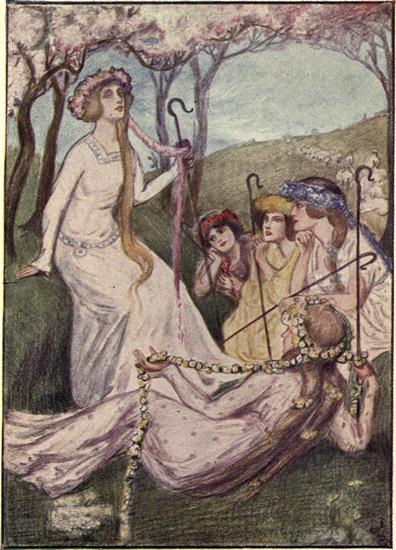
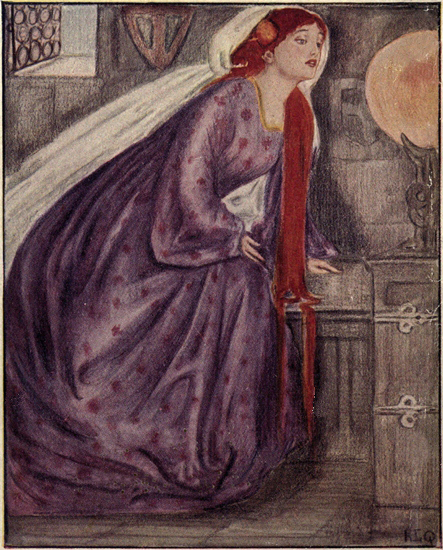
In the middle of the ring of girls sat Pastorella (page 63)
And Calidore gladly went with him, for that was just what he was longing
to do.
All evening, as he listened to the talk of Melibœus, who was a wise and
good old man, Calidore’s eyes followed Pastorella. He offered Melibœus
some gold to pay for his lodging, but Melibœus said, ‘I do not want
your gold, but, if you will, stay with us and be our guest.’
So, day after day, Calidore stayed with the shepherds. And, day after day,
he loved Pastorella more. He treated her and said pretty things to her as
knights were used to treat and to speak to the court ladies. But
Pastorella was used to simpler things, and liked the simple things best.
When Calidore saw this, he laid aside his armour and dressed himself like
a shepherd, with a crook instead of a spear. Every day he helped
Pastorella to drive her sheep to the field, and took care of them and
drove away the hungry wolves, so that she might do as she liked and never
have any care, knowing that he was there.
Now, one of the shepherds, whose name was Corydon, for a long time had
loved Pastorella. He would steal the little fluffy sparrows from their
nests, and catch the young squirrels, and bring them to her as gifts. He
helped her with her sheep, and tried in every way he knew to show her that
he loved her.
When he saw Calidore doing things for Pastorella he grew very jealous and
angry. He sulked and scowled and was very cross with Pastorella.
One day when the shepherd who piped the best was playing, the other
shepherds said that Calidore and Pastorella must dance. But Calidore put
Corydon in his place, and when Pastorella took her own garland of flowers
and placed it on Calidore’s head, Calidore gently took it off and put it
on Corydon’s.
Another time, when the shepherds were wrestling, Corydon challenged
Calidore to wrestle with him. Corydon was a very good wrestler, and he
hoped to throw Calidore down. But in one minute Calidore had thrown
Corydon flat on the ground. Then Pastorella gave the victor’s crown of
oak-leaves to Calidore. But Calidore said ‘Corydon has won the oak-leaves
well,’ and placed the crown on Corydon’s head.
All the shepherds except Corydon soon came to like Calidore, for he was
always gentle and kind. But Corydon hated him, because he thought that
Pastorella cared for Calidore more than she cared for him.
One day Pastorella and Corydon and Calidore went together to the woods to
gather wild strawberries. Pastorella’s little fingers were busy picking
the ripe red fruit from amongst its fresh green leaves, when there glided
from out the bushes a great beast of black and yellow, that walked quietly
as a cat and had yellow, cruel eyes.
It was a tiger, and when Pastorella heard a twig break under its great
pads, and looked up, it rushed at her fiercely. Pastorella screamed for
help, and Corydon, who was near her, ran to see what was wrong. But when
he saw the savage tiger, he ran away again in a fearful fright. Calidore
was further off, but he, too, ran, and came just in time to see the tiger
spring at Pastorella. He had no sword nor spear, but with his shepherd’s
crook he struck the tiger such a terrific blow, that it dropped, stunned,
to the ground. Before it could rise, he drew his knife and cut off its
head, which he laid at Pastorella’s feet.
From that day Pastorella loved Calidore, and he and she were very, very
happy together.
It chanced that one day Calidore went far into the forest to hunt the
deer. While he was away a band of wicked robbers attacked the shepherds.
They killed many of them, and took the rest prisoners. They burned down
all their cottages, and stole their flocks of sheep.
Amongst those that they drove away as captives were Melibœus and his
wife, Corydon, and Pastorella. Through the dark night they drove them on,
until they came to the sea. On an island near the coast was the robbers’
home. The island was covered with trees and thick brushwood, and the
robbers lived in underground caves, so well hidden amongst the bushes that
it was hard to find them. The robbers meant to sell the shepherds and
shepherdesses as slaves, but until merchants came to buy them they kept
their prisoners in the darkest of the caves, and used them very cruelly.
One morning the robber captain came to look at his captives. When he saw
Pastorella in her pretty gown, all soiled now and worn, with her long
golden hair and beautiful blue eyes, and her face white and thin with
suffering, he thought her so lovely that he determined to have her for his
wife.
From that day she was kindly treated. But when the robber told Pastorella
that he loved her and wanted her for his wife, she pretended she was ill.
‘I am much too ill to marry any one,’ she said.
To the island there came one day the ships of some merchants who wished to
buy slaves. They bought Melibœus and Corydon and all the others. Then
one of the robbers said to the captain:
‘They are all here but the fair shepherdess.’
And he told the merchants that Pastorella would make a much more beautiful
slave than any of those they had bought.
Then the captain was very angry.
‘She belongs to me,’ he said. ‘I will not sell her.’
To show the merchants that Pastorella was ill and not fit to be a slave,
at last he sent for her.
The cave was lighted only by flickering candles, and Pastorella’s fair
face looked like a beautiful star in the darkness. Although she was so
pale, she was so beautiful that the merchants said that they must
certainly have her.
‘I have told you I will not sell her,’ said the captain sulkily.
They offered him much gold, but still he would only say, ‘I will not sell
her.’
‘If you will not sell this slave,’ said the merchants, ‘we will not buy
any of the others.’
Then the other robbers grew very angry with their captain, and tried to
compel him to give in.
‘I shall kill the first who dares lay a hand on her!’ furiously said the
captain, drawing his sword.
Then began a fearful fight. The candles were knocked down, and the robbers
fought in the dark, no man knowing with whom he fought.
But before the candles went out, the robbers in their fury killed all
their prisoners, lest they might take the chance of escaping, or fight
against them. Old Melibœus and his wife were slain, and all the other
shepherds and shepherdesses, excepting Corydon and Pastorella.
Corydon, who was always good at running away, escaped in the darkness.
The robber captain put Pastorella behind him, and fought for her. At last
he was stabbed through the heart and fell dead. The sword that killed him
pierced Pastorella’s arm, and she, too, fell down in a faint.
When she opened her eyes the robbers who were left had stopped fighting,
and had lighted the candles, and were counting their dead and wounded.
When she saw her dear father and mother and her friends lying cold and
still beside her, she began to sob and cry. As soon as the robbers knew
that she lived, they thrust her back into the darkest of their caves. The
most cruel of all the robbers was her gaoler. He would not allow her to
bind up her wound, and he gave her scarcely anything to eat or to drink.
He would not even let her rest, and so, in pain and hunger and sadness,
Pastorella passed her weary nights and days.
Now when Calidore got back from his hunting, he expected to hear the
shepherds’ pipes, and their songs, and the bleating of the sheep, and to
see Pastorella in her dainty gown and with flowers in her golden hair
coming to meet him.
Instead of that, the place which had been so gay was sad and silent. The
cottages were smouldering black ruins, and there was no living creature
there.
Calidore wildly sought everywhere for some trace of Pastorella. But when
he sought her in the woods and called ‘Pastorella ... Pastorella ...’,
only the trees echoed ‘Pastorella.’ In the plains he sought her, but they
lay silent and lonely under the stars, and they, too, only echoed
‘Pastorella ... Pastorella....’
Week after week he searched for her, until one day he saw a man running
across the plain. The man’s hair was standing up on his head as if he were
in a terrible fright, and his clothes were in rags.
When he got near, Calidore saw that it was Corydon.
‘Where is Pastorella?’ eagerly asked Calidore.
Corydon burst into tears.
‘Ah, well-a-day,’ he said, ‘I saw fair Pastorella die!’
He then told Calidore all about the robbers’ raid, and all that had
happened in that dreadful cave. Only one thing he did not know. He did not
know that Pastorella was alive. He had seen her fall down, and he thought
that she was dead.
So Calidore’s heart was nearly broken, and he vowed a vow that he would
not rest until he had punished the wicked men who had killed Pastorella.
He made Corydon come with him to show him the way to the robbers’ island.
At first Corydon was too frightened to go, but at last Calidore persuaded
him. Together they set off, dressed like shepherds. But although Calidore
carried only a shepherd’s crook, under his smock he wore his steel armour.
When at last they had reached the island, they found some sheep grazing,
and knew them for some of those that had belonged to Melibœus. When
Corydon saw the sheep he had taken care of in the days when he was most
happy, he began to cry.
But Calidore comforted him, and they went on to where some robber
shepherds lay asleep in the shade. Corydon wanted to kill them as they
slept, but Calidore had other plans, and would not let him.
He awoke them, and they talked together. The robbers told him that they
did not care to look after sheep, but liked better to fight and rob and
kill. When Calidore and Corydon said that they would help them to keep the
sheep, the robbers were glad. All day they stayed with the flocks, and at
night the robbers took them home to their dark caves. There Calidore and
Corydon heard news that made them glad, but made Calidore the more glad,
for he loved Pastorella more than Corydon had ever done.
They learned that Pastorella was alive.
And so, day after day, they went on with their work, and waited and
watched for a chance to set Pastorella free.
One night when the robbers had been away all day stealing and killing, and
were all very tired, Calidore knew that the time had come to try to save
Pastorella.
Corydon was too frightened to go with him. So all alone, at dead of night,
Calidore went to the cave where the new robber captain, Pastorella’s
gaoler, slept. Calidore had managed to get a little sword belonging to a
robber, but he had nothing else to fight with.
When he came to the cave, he found the door fastened. He put his strong
shoulder against it, and burst the door in. The crash awoke Pastorella’s
gaoler, and he ran to see what it was. With one blow of his sword Calidore
killed him. Then he called, till his voice rang through the gloomy cave,
‘Pastorella!’
Pastorella heard the noise, and lay trembling lest some new dreadful thing
had come upon her. But when, again and again, Calidore called her name,
her heart jumped for joy, and she ran out of the darkness right into her
true knight’s arms. And Calidore threw his arms about her, and kissed her
a thousand times.
The robbers had waked up, hearing the crash of the door, and the yell of
the robber as he died, and Calidore’s cry of ‘Pastorella.’ Like a swarm of
angry wasps they flocked to the door of the cave, but in the doorway stood
Calidore with his sword, and slew every man who dared to try to kill him.
He slew and slew until the doorway was blocked with dead bodies. Then
those robbers that still lived were afraid to touch him, and went away to
rest until morning.
Calidore also rested, and when daylight came he found amongst the dead
robbers a better sword than the one he already had, and with that in his
hand he walked out of the cave.
The robbers were lying in wait for him, and rushed at him from every side
when he appeared.
But Calidore was like a lion in a herd of deer. With his sharp sword he
thrust and smote, until the robbers who did not lie dead around him fled
in terror, and hid themselves in their caves.
Then Calidore went back to where he had left Pastorella, and cheered and
comforted her. Together they went through the robbers’ caves, and took the
richest of their treasures of gold and precious jewels. All the sheep they
gave to Corydon, who gladly drove them away.
Then Calidore took Pastorella to the castle of one of his friends, a noble
knight, whose gentle wife was called Claribel.
Calidore had to go to hunt the monster that he was pursuing when he first
met the shepherds, so he left Pastorella with the knight and his lady.
Pastorella was so gentle and beautiful that they loved her for her own
sweet sake, as well as for Calidore’s, and cared for her as if she was
their own daughter.
An old woman who had always been Claribel’s maid was given as maid to
Pastorella.
One morning as this woman helped her to dress, she noticed on Pastorella’s
white breast a curious little mark. It was as if some one had painted on
the fair skin a tiny purple rose with open petals. The old woman ran to
her mistress, Claribel.
‘Your baby lives!’ she cried; ‘the little baby I left crying under the
green bushes is the beautiful Pastorella who is to marry Sir Calidore!’
Claribel ran to Pastorella’s room, and looked at the little rose, and
asked many questions. And when Pastorella had answered her, she was quite
satisfied that she was indeed the baby-girl for whom her heart had been so
hungry through all those years.
‘My daughter, my daughter, that I mourned as dead!’ she sobbed, as she
held Pastorella in her arms and kissed her again and again.
When the knight knew that he was Pastorella’s father, he was as glad as
Claribel. So they lived happily together until Calidore had slain the
monster and come back to marry Pastorella.
Then instead of Pastorella, the shepherd’s daughter, with her little
dainty gown and her wreath of wildflowers, he found a Pastorella in
jewels, and silks, and satins, who was the daughter of a great knight and
his lady, and grand-daughter of the Lord of Many Islands.
Yet the Pastorella who married brave Sir Calidore was evermore Pastorella,
the simplest and sweetest bride that any knight ever brought to the court
of the Faerie Queen.