AMERICAN WHO SERVED WITH THE FRENCH FOREIGN
LEGION, NOW AN AIRMAN, GIVES VIVID ACCOUNT
OF "DITCH" LIFE.
Bert Hall, who wrote the article printed herewith,
is an American, and has had experience both
as a racing automobile driver and an airman. At
the beginning of the war he joined the French
Foreign Legion, but was afterward transferred to
the French Aviation Corps.
By Bert Hall.
There was no hands-across-the-sea Lafayette
stuff about us Americans who joined the Foreign
Legion in Paris when the war broke out. We just
wanted to get right close and see some of the fun,
and we didn't mind taking a few risks, as most of
us had led a pretty rough sort of life as long as
we could remember.
For my part, auto racing—including one peach
of a smash-up in a famous race—followed by three
years of flying, had taken the edge off my capacity
for thrills, but I thought I'd get a new line of excitement
with the legion in a big war, and I reckon
most of the other boys had much the same idea.
We got a little excitement, though not much, but
as for fun—well, if I had to go through it again
I'd sooner attend my own funeral. As a sporting
proposition, this war game is overrated. Altogether,
I spent nearly three months in the trenches
near Craonne, and, believe me, I was mighty glad
when they transferred me (with Thaw and Bach,
two other Americans who've done some flying) to
the Aviation Corps, for all they wouldn't take us
when we volunteered at the start because we
weren't Frenchmen, and have only done so now
because they've lost such a lot of their own men,
which isn't a very encouraging reason.
But anyway if the Germans do wing us, it's a
decent, quick finish, and I for one prefer it to slow
starvation or being frozen stiff in a stinking, muddy
trench. Why, I tell you, when I got wounded
and had to leave, most of the boys were so sick of
life in the trenches that they used to walk about
outside in the daytime almost hoping the Germans
would hit them—anything to break the monotony
of the ceaseless rain and cold and hunger
and dirt!
It wasn't so bad when we first got there, about
the beginning of October, as the weather was
warmer (though it had already begun to rain and
has never stopped since), but we were almost suffocated
by the stench from the thousands of
corpses lying between the lines—the German
trenches were about four hundred yards away—where
it wasn't safe for either side to go out and
bury them. They were French mostly, result of
the first big offensive after the Marne victory,
and, believe me, that word just expresses it—they
were the offensivest proposition in all my experience.
Well, as I was saying, we reached the firing line
on October 4, after marching up from Toulouse,
where they'd moved us from Rouen to finish our
training. We went down there in a cattle truck at
the end of August in a hurry, as they expected the
Germans any minute; the journey took sixty hours
instead of ten, and was frightfully hot. That was
our first experience of what service in the Foreign
Legion really meant—just the sordidest, uncomfortablest
road to glory ever trodden by
American adventurers.
After we'd been at Toulouse about a month,
they incorporated about two hundred of us recruits—thirty
Americans and the rest mostly
Britishers, all of whom had seen some sort of
service before—in the Second Regiment Etranger
which had just come over from Africa on its way
to the front. They put us all together in one company,
which was something to be thankful for, as
I'd hate to leave a cur dog among some of the
old-timers—you never saw such a lot of scoundrels.
I'll bet a hundred dollars they have specimens
of every sort of criminal in Europe, and,
what's more, lots of them spoke German, though
they claimed to have left seventeen hundred of
the real Dutchies behind in Africa. Can you beat
it? Going out to fight for France against the
Kaiser among a lot of guys that looked and talked
like a turn verein at St. Louis!
Why, one day Thaw and I captured a Dutchie
in a wood where we were hunting squirrel—as a
necessary addition to our diet—and, believe me,
when we brought him into camp he must have
thought he was at home, for they all began jabbering
German to him as friendly as possible, and
every one was quite sad when he went off in a
train with a lot of other prisoners bound for some
fortress in the West of France.
But that was only a detail, and now I'm telling
you about our arrival in the trenches. The last
hundred miles we did in five days, which is some
of a hurry; but none of the Americans fell out,
though we were all mighty tired at the end of the
last day's march. Worse still, that country had
all been fought over, and there were no inhabitants
left to give us food and drinks as we had
had before at every resting place, which helped
us greatly. Along the roadside lots of trees had
been smashed by shell fire, and there were hundreds
of graves with rough crosses or little flags
to mark them, and every now and then we passed
a broken auto or a dead horse lying in the gutter.
At the end of the fifth day we got our first sample
of war—quite suddenly, without any warning,
as we didn't know we were near the firing line.
We had just entered a devastated village when
there came a shrill whistling noise like when white
hot iron is plunged into cold water, then a terrific
bang as a shell burst about thirty yards in
front of our columns, making a hole in the road
about five feet deep and ten in diameter, and sending
a hail of shrapnel in all directions. One big
splinter hit a man in the second rank and took his
head off—I think he was a Norwegian; anyway,
that was our first casualty. No one else was injured.
Our boys took their baptism of fire pretty
coolly, though most of us jumped at the bang and
ducked involuntarily to dodge the shrapnel, which,
by the way, isn't very dangerous at more than
thirty yards, though it does a lot of harm at
shorter range. Personally, I wasn't as scared as
I expected, and most of the others said the same.
At first, one is too interested to be frightened, and
by the time the novelty has worn off one has gotten
fairly used to it all—at least that seemed to
be our general opinion.
There were no more shells after that one, and
we continued our march till nightfall, when we
camped in an abandoned village. Next morning
there were 100 big auto trucks ready to take us
to a point about forty miles along the lines, and we
clambered aboard them and set off at a good
speed—all but twenty unlucky lads, who were left
to pad the hoof as a guard for our mules and baggage.
My pal, William Thaw, was among the
number; he marched for thirteen hours practically
without a stop, and when he reached our
camp he lay right down in the mud by the roadside
and went straight off to sleep, though it was raining
like sixty and he was drenched to the skin.
But he was all right again in the morning, though
it was a man's job to wake him up.
Next day we set off before dawn, having received
orders to take our place in the trenches
about eight miles away. It soon got light, and
after marching about half an hour we were unlucky
enough to be seen by a German aeroplane
which signaled us to their batteries. The first
shell burst near, the second nearer, the third right
among us, killing nearly a dozen old-timers; and
we were forced to break ranks and take cover
until nightfall, as they'd got the range and it
would have been suicide to try and go on. Pretty
good shooting that at five or six miles' distance!
The French talk a lot about their artillery, but,
believe me, the Dutchies are mighty fine gunners,
especially with their cannon—even the very biggest.
Why, one day when my company was having its
usual weekly rest from the trenches, there were a
couple of hundred of us bunking in a big barn fully
eight miles behind our lines. About three in the
afternoon along came a German aeroplane, and
half an hour later they dropped a couple of shells
between the barn and a church some thirty yards
farther back, just by way of showing what they
could do. We thought that was all, and settled
down comfortably for the night; but not a bit of
it! At ten o'clock sharp a shell dropped plump
onto the barn itself and killed five or six and
wounded a dozen more, none of them Americans.
We got out on the jump, though of course it was
raining; and we were wise, for in the next half
hour they hit the barn eleven times without a
single miss, and at ten-thirty there weren't any
big enough bits of it left to make matches of. The
barn was perhaps thirty yards long by fifteen
wide, but remember they were firing at a range of
ten miles or so and in pitch darkness. Of course,
they had got their guns trained right in the afternoon
and just waited till night to give us a pleasant
surprise. I did hear those were Austrian
mortars, not German; anyway, they were good
enough for us, I can tell you.
But to go back to my story: We broke ranks
and fled to cover, and remained in hiding all that
day near a ruined farm with shells falling all
about, though they didn't do much damage. But
our old-timers didn't like it one little bit. They
had not been used to that kind of thing in Africa,
and then the Germans and Austrians didn't at all
fancy the idea of being fired upon by their own
people. In our company all of the Sergeants and
most of the other non-coms were Austrian—not
that they turned out later to be any the worse
fighters for that. There was one Sergeant named
Wiedmann who fought like a lion; he was the
bravest man in the regiment. Poor chap, I've just
heard he was killed the other day by a hand
grenade, and I'm sorry. He was a real white man
if ever I knew one. Our Lieutenant was a German
named Bloch, and only the Captain was a Frenchman.
But all this mixture of races led to some
rather curious results, as the following story will
show:
Among the recruits who joined us at Paris there
were two young fellows from Corsica—the Corsican
brothers, we called them, as they always stuck
together—who said they belonged to the Corsican
militia, but preferred to volunteer, as they wanted
to see some fighting right away. Besides French,
they spoke English fluently, and used to jabber
away together in some local patois, but they were
both very smart soldiers and were soon promoted
Corporals and got along fine. Every one liked
them, and they stood very well with the officers as
well. After we had been in the trenches about ten
days these two chaps disappeared one wet night
and left behind a note for the Colonel, which I
was lucky enough to see. It ran something like
this:
Most Honored Sir:
Though we have spent a most agreeable time in
your regiment—of which we have a good opinion,
although the discipline is sometimes rather more
lax than we are accustomed to—we feel that the
moment has come for us to join our friends, which
we were unable to do at the mobilization, when we
naturally preferred the Foreign Legion to a concentration
camp.
We will give a good account of you to our
friends and hope to have the pleasure of meeting
you again before long.
Otto X——
Ober-Lieutenant, Potsdam Guards.
Hermann Y——
Lieutenant, Potsdam Guards.
Wouldn't that fease you? The Colonel nearly
blew up.
Well, at nightfall we resumed our march by
separate companies. Our Captain didn't know
the country, so of course we got lost. It was
raining heavily, and the mud was frequently knee
deep. Add to that incessant tumbles into numberless
shell holes full of water, and you will realize
that we were a pretty sad procession that finally
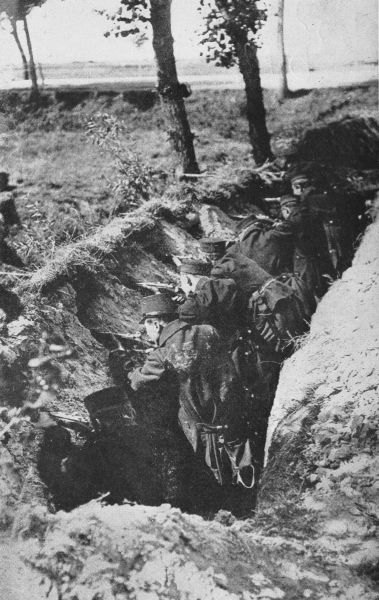
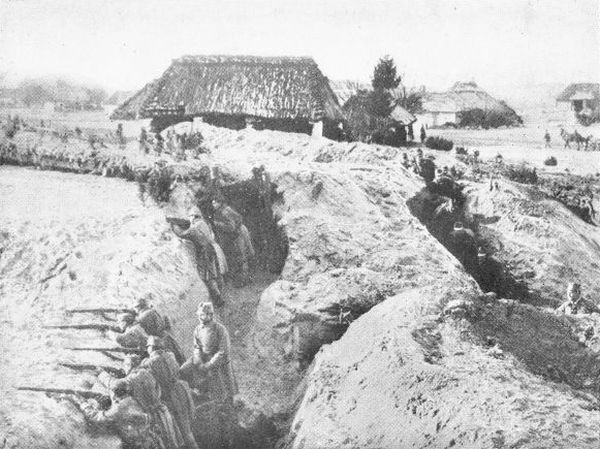
at three A. M. scrambled into the stinking ditch
where we were to spend the greater part of the
next three months.
For three or four days we had nothing to do but
dodge the shrapnel and try and keep warm, as the
enemy maintained a constant artillery fire—with
a regular interval for luncheon—starting about
six A. M. and stopping toward five P. M.; and they
got the range. I tell you, one lies pretty flat when
there's any shrapnel about. Some of the English
boys were killed the second day, but we Americans
have been fine and lucky—only one killed the
whole time, though we have had some very narrow
shaves. For instance, Thaw had his bayonet
knocked off his rifle by a "sniper" while on sentry-go,
and another boy named Merlac had his
pipe taken clean out of his mouth by a shrapnel
ball in the trenches. It didn't hurt him at all, but
I never saw any one look so surprised in my life.
Shortly afterward Jimmy Bach (who is now in
the Aviation Corps with Thaw and me) had his
head cut by a rifle bullet which just grazed it
without doing more than make a deepish scratch.
I myself had a close squeak the very day of our
arrival in the trenches. A piece of shell weighing
three or four pounds smashed to bits the pack on
my back—including my best pipe, which I couldn't
replace until I got back to Paris—without so much
as bruising me, though it scared me something
dreadful.
Our company had an eight days' "shift" in the
trenches, followed by three days' rest at a camp
four miles in the rear.
During the week's duty it was impossible to
wash or take off one's clothes, and we quickly got
into a horrible condition of filth. To begin with,
there was a cake of mud from head to foot about
half an inch thick; but what was worse was the
vermin which infested our clothes almost immediately
and were practically impossible to get rid
of. They nearly broke the heart of Lieutenant
Bloch. He had a wonderful crop of bright red
whiskers, of which he was as proud as a kitten
with its first mouse, because he thought they gave
him a really warlike appearance, and he was always
combing them and squinting at them in a
little pocket mirror. Well, one day the lice got
into these whiskers and fairly gave him hades. He
bore it for a week, scratching away at his chin
until he was tearing out chunks of hair by the
roots; but at last he could stand no more, and had
to have the whole lot shaved off. He was the saddest
thing you ever saw after that, with a little
chinless face like a pink rabbit, and was so
ashamed he hardly dared show himself in daylight.
But mud and vermin were only minor worries,
really; our proper serious troubles were cold and
hunger. It's pretty cool in the middle of France
toward the end of November, and for some reason—I
guess because they were such a lot of infernal
thieves at our depot—we never got any of the
clothes and warm wraps sent up from Paris for
us. It was just throwing money away to try it.
My wife mailed me three or four lots of woolen
sweaters and underclothes, but I never received
a single thing, and the rest of the boys had much
the same experience.
That was bad, but the hunger was something
fierce. The Foreign Legion is not particularly
well fed at any time—coffee and dry bread for
breakfast, soup with lumps of meat in it for luncheon,
with rice to follow, and the same plus coffee
for dinner, and not too much of anything, either.
But in our case all the grub had to be brought in
buckets from the relief post, four miles away, by
squads leaving the trenches at three A. M., ten
A. M., and five P. M., and a tough job it was, what
with the darkness and the mud and the shell holes
and the German cannonade, to say nothing of occasional
snipers taking pot shots at you with
rifles. I got one bullet once right between my
legs, which drilled a hole in the next bucket in
line and wasted all our coffee.
As you can imagine, quite a lot of the stuff
used to get spilt on the way, and then the boys
carrying it used to scrape it up off the ground and
put it back again, so that nearly everything one
ate was full of gravel and, of course, absolutely
cold. More than once when the cannonade was
especially violent we got nothing to eat all day
but a couple of little old sardines; and, believe
me, it takes a mighty strong stomach to stand that
sort of treatment for any length of time. As far
as we Americans were concerned, who were mostly
accustomed to man-sized meals, the net result
was literally slow starvation.
The second night in the trenches we had an
alarm of a night attack. I crept out to a "funk-hole"
some thirty yards ahead of our trench with
a couple of friends. It was nearly ten o'clock
and there was a thin drizzle. We stared out into
the darkness, breathing hard in our excitement.
The usual fireworks display of searchlights and
rockets over the German trenches was missing—an
invariable sign of a contemplated attack, we
had been told. Suddenly I glimpsed a line of dim
figures advancing slowly through the darkness.
"Hold your fire, boys," I gasped. "Let them get
good and close before you loose off." They came
nearer, stealthily, silently. We raised our rifles.
Suddenly my friend on the right rolled over, shaking
with noiseless laughter. For a moment we
thought he was mad. Then we, too, realized the
truth. The approaching column, instead of eager,
bloodthirsty Germans, was a dozen harmless domestic
cows, strays, doubtless, from a deserted
farm. There were considerable casualties among
the attacking force, and for a week at least the
American section of the Foreign Legion had an
ample diet.
The next night the three of us were out there
again, but there was still no attack, though we had
rather a nasty experience all the same. We were
crawling back to our trench about midnight when
suddenly we found ourselves under a heavy fire.
One bullet went through Thaw's kepi, but we soon
saw that instead of coming from the Germans, the
fire was directed from a section of our own
trenches who thought there was an attack. We
yelled, but they went on shooting. I was so mad
that I shot back at them, but luckily there was no
damage done anywhere.
Two nights later there really did come an attack
in considerable force. A lot of us crawled
out into a hollow in front of our trench and, starting
at about forty yards' distance, we let them
have it hot and heavy. We had our bayonets
fixed, but they didn't get near enough to charge.
I think we kept up America's reputation for
marksmanship; anyway, they melted away after
about half an hour, and in the morning there were
several hundred dead bodies in front of the trench—they
had taken the wounded back with them.
The bodies were still there when I left, nearly
three months later. I crawled out a night or two
afterward and had a look at them, and was lucky
enough to get an iron cross as a souvenir off a
young officer. He was lying flat on his back with a
hole between the eyes, and he had the horriblest
grin human face ever wore; his lips were drawn
right back off the teeth so that he seemed to be
snarling like a wild beast ready to bite.
We took no prisoners at all; in fact, none of
them got near enough, and our Colonel didn't
think it worth while risking a counter-charge. To
tell the truth, we hardly took any prisoners any
time, except here and there an occasional straggler.
I've heard stories about the Dutchies surrendering
easily, but you can take it from me
that's all bunk. I used to think that one Irishman
could lick seventeen Dutchmen; but, believe me,
when they get that old uniform on they are a very
different proposition. On one occasion a company
of the Legion surrounded a Lieutenant and
eleven men. They called on them to surrender,
but not a bit of it. They held out all day and
fought to the last gasp. At last only the Lieutenant
and one soldier were left alive, both
wounded. Again they refused to give in, and
they had to kill the Lieutenant before the last survivor
finally threw down his rifle and let them
carry him off. I heard he died on the way to the
station, and I'm mighty sorry; he was a white
man, if he was a German.
One remarkable thing about the prisoners we
did get was their exceedingly thorough knowledge
of everything going on, not only of the war in
general, but of all that was taking place back of
our trenches. Their spy system is something marvelous.
Why, they knew the exact date our reinforcements
were coming on one occasion nearly a
week beforehand, when the majority of our fellows
hadn't even an idea there were any expected!
In some cases they got information from French
villagers whom they had bought before they retreated.
I saw one such case myself. We were
bivouacked in a ruined village, and a lot of us
were sleeping in and around a cottage that hadn't
been damaged. We were downstairs, while the
owner of the cottage and his wife and kid had the
upstairs room. One of our boys happened to go
outside in the night and, by jingo! he saw the fellow
coolly signaling with a lamp behind his curtain.
He went along and told the Captain, who
was at the schoolhouse, and they came back with
a couple of under officers and arrested them red-handed.
He tried to hide under the bed, and
howled for mercy when they pulled him out. His
wife never turned a hair—the Sergeant told me
she looked as if she was glad he'd been caught.
They shot him there and then in his own yard, and
his wife was around in the morning just as if
nothing had happened.
After that we always used to be very suspicious
of any house or village that wasn't devastated
when everything round had been chewed up; there
was nearly always a spy concealed somewhere not
far off. To give you a case in point: There was a
fine big château near Craonelle, where our
trenches were, that hadn't been bombarded,
though they had stripped most of the furniture
and stuff out of it. Well, one fine day the General
commanding our section thought it would be a
convenient place to hold a big pow-wow. He and
his staff had only been seated at the table about
ten minutes when a whacking great 310-millimeter
shell burst right on top of the darned place, followed
by a perfect hail of others. The General
and his staff ran for their lives; luckily none of
them were badly hurt, though they got the deuce
of a scare.
After the bombardment some of us went along
to look at what was left of the château, and—will
you believe me?—we found a little old Dutch
sous-off half choked in the cellar, but still hanging
on to the business end of a telephone. I call that
the pluckiest thing I've seen at the war, and I can
tell you we were mighty sorry to have to shoot
him. He never turned a hair, either, and we
didn't even suggest bandaging his eyes. He knew
what was coming to him from the start; that he
was as good as a dead man from the moment he
got into the cellar. He told us he had been there
a week, just waiting for some confiding bunch of
French officers to come along and hold a meeting.
It's funny how some men meet death, anyway.
We had one nigger prize fighter along with us
named Bob Scanlon. He was the blackest coon
you ever saw, until one day there came a great big
"marmite" that burst almost on top of him and
buried him in the mud. We dug him out, and he
wasn't even scratched, but ever afterward he has
been a kind of mulatto color, he was so darned
scared by the narrowness of his escape.
Another boy, an Englishman, got out of the
trench one day to stretch his legs, as he said he
was tired of sitting still. Some one called to him
to come down and not be a fool, as the Germans
were keeping up a constant rifle fire, and after a
minute or two he jumped back into the trench.
"They didn't get you, did they?" called out some
one. "Oh, no!" he answered, sitting down. Then
all of a sudden he just keeled over slowly sideways
without a sound, and, believe me, when they went
to pick him up he was as dead as David—plugged
clean through the heart. He never even felt the
shock of it. If they do ever get me, that's the way
I hope to die.
Bert Hall.