STORIES ABOUT —.
Transcriber’s Note:
New original cover art included with this eBook is granted to the public domain.
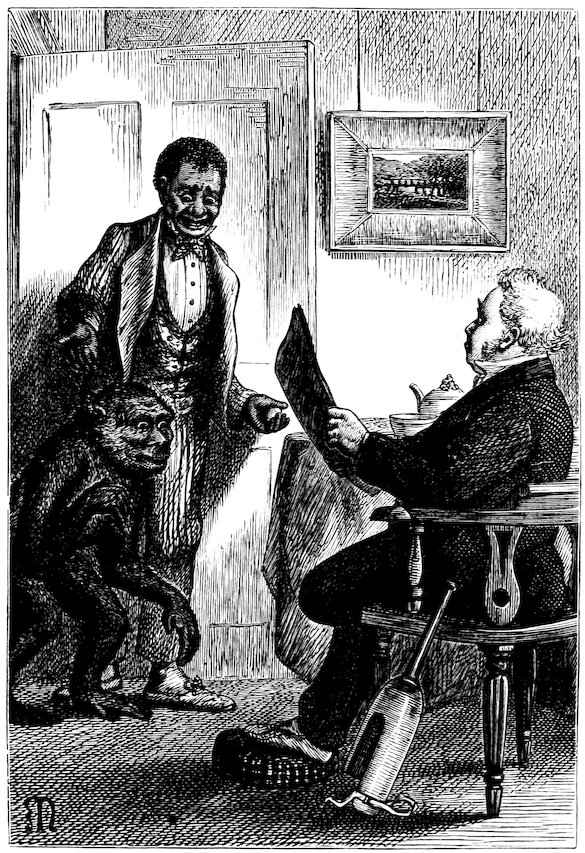
One Lilly black gentleman to see Massa.—p. 26
CONTENTS.
LIST OF ILLUSTRATIONS.
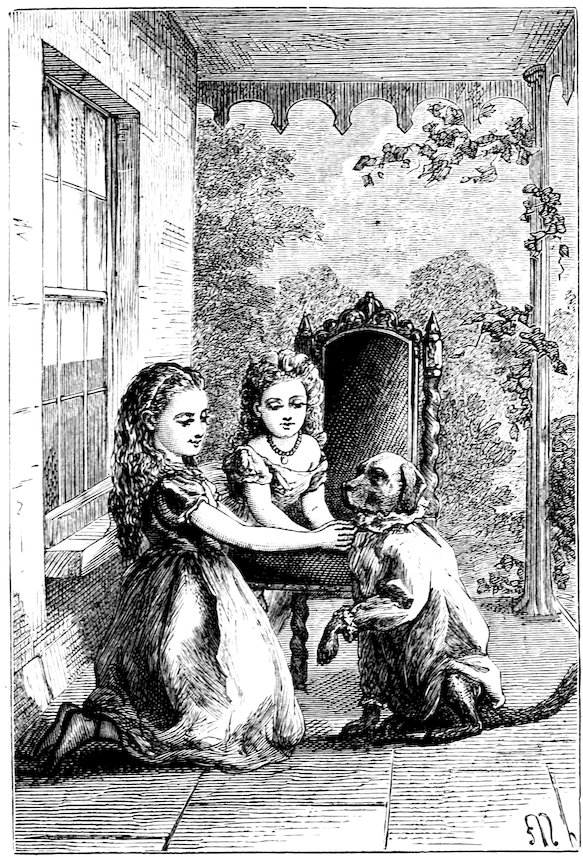
| TURK AND JESSIE | Title-page |
| ‘ONE LILLY BLACK GENLEMANS TO SEE MASSA’ | Frontispiece |
| MASTER GRANNY AND HIS PETS | To face page 82 |
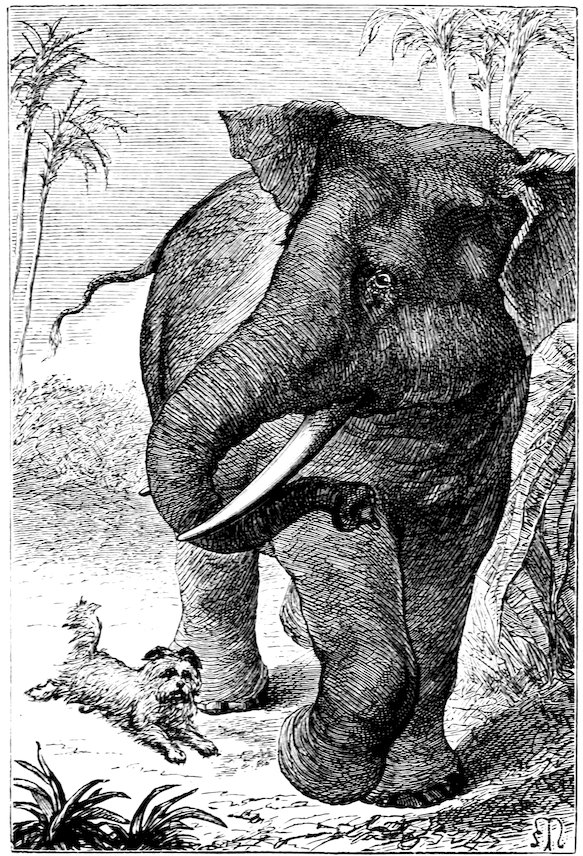
| NETTLE AND THE ELEPHANT | „ „ 144 |
| PUNCH’S TOILET | „ „ 180 |
ABOUT MONKEYS.
I never can tell a story properly unless there are several little listeners gathered round me, and I like to have one rosy-cheeked darling to cuddle up on my lap; so now we must fancy all these preparations made, a bright fire burning, before which we have settled ourselves comfortably, and we know that nurse is not coming with her fatal tap at the door (which must be instantly obeyed, remember) for a whole hour yet. I think I hear a chorus of little voices say, ‘Go on, please.’ What shall the stories be about to-night? Let me see; what do I know about monkeys? not out of books, or from other people’s lips; these will be monkeys of my personal acquaintance.
2In case any little boys or girls wish very much to have a monkey for their very own, I will first warn them by telling them of three attempts I made to set up one of these animals as a pet. My first monkey was brought to me early one morning at Lucknow, a great city in India, a few years ago. I had only been a fortnight in India, and about two days at Lucknow. The evening before, at a dinner-party, I happened to say how much I should like to have a monkey, and immediately four voices said, ‘Oh! I will give you mine with pleasure.’ When I thought of this afterwards, it looked very suspicious that the owners of the monkeys should be so ready to part with them; it seemed as though they had been rather troublesome pets; but at the time I only felt how good-natured everybody was, and how much I should like to be able to accept all four monkeys; but as this was impossible, I contented myself with selecting one whose master gave him an excellent character. My last thought at night and my first in the morning was one of joy and impatience to see my 3new pet. It is the custom in India, as I daresay you have heard, to get up very early, so by six o’clock I was dressed in a loose muslin wrapper, and sitting under the shade of a beautiful clump of trees in the garden. The lady with whom we were spending a few days was with me, and we had some delicious coffee and biscuits on a table before us for our chotahasseri, or ‘little breakfast.’ Our husbands had gone to a review, and we two ladies intended to be very industrious, and take a lesson in Hindoostanee from a Moonshee with a long white beard. The old gentleman had not yet arrived to teach us, so I inquired whether my dear monkey had made its appearance, and heard that it was in the ‘compound’ or courtyard, and that its late master had sent the servant who always took care of it, in case I wished to secure his services. I wanted to have the monkey brought to me at once, but as the Moonshee could now be seen coming slowly up the garden walk, looking very clean and nice with his snow-white 4robes and turban, Mrs. R—— persuaded me to wait till our lesson was over.
I am sadly afraid that, although I was big enough and old enough to know better, the poor Moonshee had one rather idle and inattentive pupil that morning, and I was very glad when the time came for shutting up the books with their dreadful crabbed letters, and Mrs. R—— kindly said, ‘Now, shall we send for the monkey?’ I need not tell you how eagerly I answered ‘Yes,’ to this proposal; and a few moments afterwards I saw a tall swarthy Indian servant approaching us, making low bows down to the ground at every step. He was leading a monkey by a chain round its waist, and carrying a plate in the other hand. I could not tell the height of the animal on account of its shambling way of half-walking half-crawling, but it turned out afterwards to be about as tall as the table; it was not quite black, but very glossy. When they were within two or three yards of us, the ‘mater’ (as that class of low-caste servant is called in India) said, ‘Salaam, Bobbee,’ 5and Bobby put his black paw up to his forehead, and slapped it several times, bending low as he did so, exactly in the way the mater had been going on ever since he came in sight. It is the Indian way of saying ‘How do you do?’ or ‘Good morning.’ I was delighted of course, and thought Bobby had charming manners, but when he came closer I did not quite like his being so big and strong, or so very inquisitive; he did not seem in the least shy, but made himself at home directly, and when his servant put the fruit and cake which he had brought for him on the table before me, Master Bobby quickly climbed up and seated himself on my knee, as if he had known me all his life. As soon as he had finished his breakfast,—and he did not take long about it,—the mater took away the empty plate, and with many more salaams retired leaving Bobby still on my knee, very busy examining my buckle and ear-rings, pricking his fingers with my brooch, and every now and then stroking my hair. I was not at all easy in my mind, but sat quite still, and tried to 6conceal from Bobby that I disliked his company or felt frightened. After a little while he noticed some ribbon on my sleeve, and tried to pick it off with his finger and thumb, as if it had been a flower; he next set to work diligently to roll up the wide open sleeve of my dressing-gown into a long narrow bundle: this he did very slowly and neatly, chattering softly to himself all the time. By degrees he got it all rolled up to my shoulder, leaving my arm quite bare. I sat patiently waiting to see what he was going to do next, when he gave a sort of yell, dug his nails and teeth into my arm, and tore it down to the wrist, leaving four or five rows of bleeding scratches on it. I jumped up with a scream, which brought all the servants out to see what was the matter; not one of them would touch him, but some ran to call the mater, who carried Master Bobby off kicking and fighting like a naughty child. He had fastened on poor Mrs. R——’s foot after I had shaken him off my lap, and was biting and scratching it with all his might.
7In the meantime my arm was smarting dreadfully; it did not bleed much, but the pain was really very severe, and I had to keep wet cloths wrapped round it all day. The servants told us that the mater had already confessed that Bobby was ‘very bad to Mem-sahibs,’ and did not like them at all; so after our breakfast I wrote a polite little note to his former master, and returned Bobby to him with many thanks. This was the end of my first attempt to have a pet monkey; he was only mine for two hours.
A year or so afterwards I was on my way back to England, and the ship stopped at Ceylon for a few days. I had been told that most beautiful little monkeys were to be bought there; and all the time we were at Point-de-Galle I tried very hard to find one to purchase, but it was too early in the spring for the young ones to be taken from their mothers, so there were none in the market. I returned, after a week’s absence on shore, very disconsolately to the ship without having succeeded in procuring a monkey; 8but the first person I met on board was the fat, good-natured old captain nursing tenderly in his arms a wee monkey of a beautiful tawny-golden colour, and with the gentlest, sweetest little face. The moment the dear old gentleman saw me he came up, and before I could speak, handed me the treasure, saying, ‘I knew you would not be able to get one at this time of year, and a friend of mine promised to keep one for me, so here it is for your very own.’ You may imagine how delighted I was; this was exactly the sort of monkey I had always wanted, and I did not know how to leave off thanking the captain. For the next day or two I nursed and fondled my monkey incessantly; it was very shy, and as quiet as a little mouse, but the most engaging gentle creature. Its timidity was not at all like stupidity, for it was very intelligent, but seemed completely dazed by the noise and bustle of a large steamer full of passengers. There was a squalling baby on board, whom it never tired of watching, I suppose because it was nearest its own size; and 9when this infant was on deck and set up one of its shrill shrieks, the monkey used to stop its ears with its tiny fingers, and look up piteously in my face, as much as to say, ‘What a horrid noise!’
Unfortunately for my pretty little pet, I fell ill, and could not have the monkey in my cabin, but I was assured that the head steward, in whose care it was solemnly placed, looked after it, and reported well of its state of health. As soon as ever I could get on deck I asked for my monkey to be brought to me, but saw at once that something was wrong, for every one to whom I applied put me off with a different excuse; so after dinner, in the cool of the evening, when our dear old captain came to speak to me, I begged him to take me ‘forrard’ (as the front part or bow of a ship is called) that I might find out how and where my monkey was. I could only walk very slowly, for I was weak still; and whilst we were crawling towards the place where the sheep and poultry were kept, the captain told me there was a very large fierce monkey also on board called ‘Jenny,’ 10belonging to the crew, and that she had caught sight of my poor little darling, seized it in her arms, and that nothing would induce her to part with it for an instant night or day. She seemed very fond of it, but her affection was evidently so disagreeable to my little pet, that the sailors had watched her incessantly to try and get it out of her clutches; however, as she always vented her rage at these attempts on the unoffending monkey, whom she cuffed and shook heartily, the men thought it best to leave her alone, hoping she would tire some day of her plaything. When the captain and I came upon her she had my poor monkey tucked under one arm, and was skipping about the bulwarks. You never saw anything so forlorn as the little one looked. One of its eyes was bleeding from a scratch its nurse had just given it, and it went to my heart to see the melancholy way it put its little black paw up to the wound, and showed me the blood on its fingers.
Weak and ill as I still was, and armed only with my parasol, I determined at once to rescue my 11monkey from Jenny’s tender mercies, so I let go the captain’s arm; and though, he and everybody else entreated me to take care, for Jenny was very ferocious when roused, I boldly attacked her, and fairly drove her into a corner where there were no ropes by which to escape up the rigging. I made up my mind not to care in the least for scratches or bites; I suppose Jenny perceived that I was desperate, and, sooner than let me have her favourite plaything, she seized it by its tail, whirled it round her head, and flung it into the sea! Oh! how grieved and angry I felt. It was quite useless to attempt to save my poor little pet, for we were going full speed, and no one could see even where it fell: it must have been drowned in a minute. I fairly sat down and cried, and I should have liked Jenny to have been well punished; but no one dare touch her, so she escaped to the rigging, from which she chattered defiance at us.
My third and last pet monkey was not mine at all! Joey belonged to some one else in the house, but 12attached himself to me from the moment he arrived, as his friend and protectress, and I never saw any animal so fond of a human being as Joey was, and I may say is, of me, though he no longer lives in the same house, having been exchanged by his owner for a musical box! Since his departure from his first home I have been to call on him once or twice, and he is always delighted to see me, and cries piteously when it is time for me to go away.
Joey came last year from the great forests near Panama, and when I first saw him after his sea-voyage I thought him more like a little black imp than anything else. He was very small and hideous, quite black, with a white beard and enormous eyes; having lived in a rough box or cage on board, he had rubbed all the hair off his body and tail, and was very thin and dirty besides: he was made to undergo a whole course of warm baths on his arrival, which he hated; but they improved him immensely, and in a few weeks he became completely clothed in a coat of long glossy black hair, and as handsome as he 13was capable of looking, which, however, is not saying much. Joey never was shy; his intelligence and cleverness were extraordinary; but it was impossible to make a pet of him on account of his incurably dirty habits, and his unceasing mischief. He was never still for a second, and always doing something wrong, and yet he was so inexpressibly ridiculous that no one had the heart to punish him; he quite understood that he had been naughty, but he had a way of scratching his head when we were scolding him, and looking at us as much as to say, ‘Well, now, really I didn’t think that was any harm.’ Our home at that time was in the country, so Joey had a wide field for mischief; and, as he arrived whilst it was still summer, he commenced some extensive gardening operations of his own at once, which resulted in depriving me of every leaf and blossom on my creepers. No chain could keep him confined; it was merely a question of time. Joey sat down to consider how to get rid of every attempt to fasten him up, and his little clever fingers always contrived 14to free himself. He would eat or drink almost anything, but he was not at all greedy; the food he liked best was bread and milk, but he took very little of even that. How you would have laughed to see Joey and his favourite companion the kitten sharing their morning meal of milk! He soon taught the kitten that he was to have the first drink, and would lift the little cup up to his lips, take as much as he wanted, placing it on the floor for the kitten afterwards; but whilst she was lapping slowly and with great difficulty, Joey would get impatient, and shake the cup to hasten her movements, walk all round her, tweaking her tail or nipping her fur; but the kitten never stopped lapping, and when he could bear it no longer he used suddenly to drag her head up by both her ears, snatch away the cup, and either break it to pieces as the shortest way of disposing of it, or nimbly mount up on a table or chair and put it out of poor Pussy’s reach. The worst of this playfellow for Joey was that she wanted to play all night and sleep all day, whereas Joey never was still 15for a second in the daylight, but, as soon as it became dusk, he rolled himself up in his blanket and went to sleep. He could not bear to be disturbed, and used to get into furious rages with the kitten, after vainly trying to persuade her to be quiet and share his blanket with him. I had to watch Joey incessantly on account of his love of hearing the crash china made in falling; the cook could not keep a cup or plate on the dresser—they had to be stowed away in drawers, and for several weeks Joey tried to get at a thermometer which hung outside the house: it baffled him for some time, but at last he discovered a projecting nail, round which he curled his long tail, swung himself up, and had the great satisfaction of making a splendid smash of it. Fortunately the only room in the house into which he would not venture alone was the drawing-room. On each side of the fireplace stood screens of stuffed Indian pheasants of bright and gaudy plumage. Joey was horribly afraid of these, and when I took him into the room never ceased clinging tight round my neck 16with one slender paw, whilst he covered his face with the other, and peeped at the birds with evident awe. One day I heard extraordinary sounds of choking proceeding from a bedroom as I passed it; the door was closed, but not fastened, so I first knocked, and then, as no one answered, looked in. There was Joey seated on the dressing-table, with his head back, waving his long arms, his eyes starting out of his head, and at the last gasp for want of breath. I found he was trying to swallow a large signet-ring which he had found, and it had stuck in his throat; there was enough of it in his mouth for me to take hold of, and I got it up with much difficulty; but that was very nearly Joey’s last trick, for if some one had not passed he must have died soon. He had previously put everything in the room which could be squeezed down its neck into the water-jug; the soap and sponges were there, so were several trinkets lying about and a small pincushion; the candles (he had broken the candlesticks) and a slipper were sticking out at the top.
17I must tell you one more amusement of Joey’s, and that will be the last about him—for a wonder it was not destructive mischief. I missed him one morning, and spent at least two hours in hunting for him, feeling sure he was doing something very naughty by his being so quiet. I searched the house first thoroughly, then the stables, even the coal shed, looked into the washhouse, without seeing him, when just as I was leaving the last place I heard a very gentle chirrup proceeding from behind a pile of empty boxes, and I immediately went softly to see what he was doing. In one of the boxes was a quantity of feathers, and on these the old cat and her kitten had lain down to have a quiet sleep. Joey had found them out, and as they would not wake up and play with him, he amused himself as well as he could by covering them up with feathers; he had succeeded in hiding the kitten completely, and the cat’s ear was the only part of her to be seen. Joey was doing his best to hide this also, but however gently he laid a small 18feather on it, the cat twitched her ear, and the feather came off. Joey hunted among the boxful for a still lighter feather and tried again, laying it down with the utmost care, but in vain. After many attempts he brought me one and made me try, but my clumsy touch had no chance when his tiny paw had failed. I left him still trying to cover that restless ear.
Now I think perhaps you would like to hear a little of monkeys who were not pets by any means. Whilst I was in India we went up to Simla very early in the season, before the houses were filled with people; and as the place is nearly deserted in the cold winter months, the monkeys, bears, and panthers get very tame, and I am told almost live in the verandahs of the empty houses. I never saw either a bear or a panther,—they betake themselves to the woods the moment they catch sight of any one more alarming than the two or three old watchmen who take care of the town for four months of the year; but the monkeys are not so 19easily dislodged. Soon after I arrived at Simla, I had to complain to my ayah or maid, that every night the lamp went out, and it was not to be wondered at, for when I examined it in the morning there was no oil in it. In vain she protested that it was regularly filled—if ever I awoke the room was dark, and I did not like this, especially as, though it was an upstair room, and consequently safe from thieves, my window was open. I determined to watch, and saw a big monkey come in very softly at the window and blow out the light, then I could hear him drinking off the oil and smacking his lips over it. On another occasion I was told I could not go out riding because my saddle was unstuffed. As it was perfectly new, I was very much surprised, but it turned out that when my syce or groom was leading my horse with the saddle on, he had lain down to rest, taking the saddle off first, lest the horse should hurt it by rubbing. The syce fell asleep, and when he awoke 20a crowd of monkeys were gathered round my poor saddle, out of which they had taken every bit of horsehair stuffing. I suppose in time they would entirely have destroyed it, but the lining was the easiest for their strong clever fingers to unpick first.
I had a little terrier who could not endure monkeys, and barked and chased them whenever he saw them. They soon learned to dread and hate him, and when Fury and I were out walking alone, pieces of dry stick, showers of leaves, and boughs of rhododendron blossom would come down on our heads, but Fury only barked and chased our assailants more ferociously than ever. One day the narrow path led through a very thick clump of evergreen oaks, with branches hanging low down on the path. As Fury and I were making our way under these boughs, a long skinny arm was stretched down, Fury was grasped firmly by his long hair, and carried off. I was in despair. I heard my poor dog’s snaps and barks and yelps, but could do 21nothing. The sounds mounted higher and higher, till at last I caught a glimpse of poor Fury handed about from one to another among a group of monkeys, who were pinching, and pulling, and buffeting him well. When they were tired of this amusement, and had tortured their little enemy to their hearts’ content, they dropped him over the precipice, and there was an end of poor Fury at once.
But the worst trick the large mountain monkeys (‘langours’ they call them at Simla) ever played me was one evening when I had a dinner-party. I must explain to you that the house we lived in was placed on the top of a sharp-pointed hill, and the very little flat ground which remained after the house was built had been left in front of it, so that at the back, where the dining-room stood, there was quite a precipice steep down, with large rhododendron and oak trees growing against the side of the hill. Their trunks were out of sight, but the topmost branches came against the windows, 22and it was very beautiful to see clusters of bright crimson flowers almost thrusting themselves into the room.
I was very anxious that this, my first party, should be a pretty one, and instead of the heavy, old-fashioned Indian dinners, with quantities of food in big silver dishes, I had the table arranged à la Russe. I wonder if my little readers know what that is. All the meat and puddings and pies were to be handed by the servants, and nothing was put on the dining table except pretty things. There were little white china boys holding baskets of fruit, vases of flowers, preserved fruits and bon-bons from Gunter’s, all sorts of new-shaped goblets and water-jugs, &c. &c. I took a great deal of trouble to see all this properly done by my crowd of stupid servants, and when it was at last arranged stopped to take one more look at it before going to dress, thinking it was all as pretty and nice as possible. I desired one of the men to remain in the room, and went off quite happily to 23make my toilette. When I had dressed, instead of going into the drawing-room, I thought I should like to have one more look at my dinner-table, and went softly into the dining-room. What a sight met my eyes! No servant was there, he had gone off to smoke his hubble-bubble the moment my back was turned, and the table was surrounded by monkeys, who had got in by the trees which grew close to the windows. They had not contented themselves only with eating up my fruit and cakes, but they had upset the glass dishes, and smeared the preserves all over the table-cloth; they had broken the water bottles, knocked the heads off half my little china boys; in short, you never saw such a mess in your life, and there they stood grinning and chattering, hardly moving even when I rushed at them brandishing my fan as if it had been a poker. I rang the hand-bell furiously, and that frightened them more than anything else. In a moment the old khansamah, or butler, and half-a-dozen other servants came up. I pointed to the table, for I was too 24angry to speak; and the khansamah, bowing low, joined his hands, and tried to console me by saying in Hindoostanee, ‘Pearl of the Universe, it is the will of Heaven.’ I could not stop to argue this point with him, as my guests were arriving, so I told him to get dinner ready in the usual way as quickly as possible, and went to the drawing-room feeling very much as if I should like to have a good cry over the ruin of all my pretty things. In conclusion, I may tell you that we did not get any dinner at all for more than an hour, and that it was extremely nasty when it came, for everything was over-cooked and spoiled; so I think, considering all things, I have a right to feel angry with langours whenever I remember that unfortunate evening.
We have just five minutes more before nurse comes, so I will end with a short story my father told me, of something which happened many years ago in Jamaica. A new Governor was expected to arrive by the following steamer; he was coming from Demerara, where monkeys abound; his wife 25was very fond of these pets, and had sent on before her a large iron cage full of monkeys of all sorts and sizes, in charge of a servant. These animals created great excitement on their arrival in Spanish Town, especially among the negroes, who had never seen a monkey, and fancied they were inferior beings of the same class as themselves. The cage was fastened outside the ‘King’s House’ (where the Governor was to live), and for a few days all went well. I must explain to you that the next house to this was one where the President of the Council lived, and was only separated from it by a large garden. Owing to the carelessness of the servant, the cage door was found open one morning, and the monkeys were disporting themselves in the President’s garden, making sad havoc among his fruits and flowers. They were all captured after a little time, except one huge baboon, who climbed into a high tree, and hid himself so cleverly that he could not be found. When the coast was clear, Mr. Monkey came down, and set out on his travels, 26making his first visit to the President. The black hall-porter was so astonished and alarmed at this unwonted visitor, that he hastily ran upstairs, the baboon following him closely, flung the door of the breakfast-room open, and said in trembling tones: ‘One lilly black genlemans to see massa,’ and then retreated as fast as he could, shutting the door behind him. Now the poor old President had only one leg, and his wooden substitute lay on a chair near him, for he never put it on unless he wanted to move about. He was very indignant at the impudence of his uninvited guest, who immediately began to help himself to the dainties on the table, and he flung his wooden leg at the intruder, never reflecting that he could not stir without its help. When my father happened to look in an hour afterwards he found the old gentleman speechless with rage, still helpless on his chair, and the monkey scrimmaging all over the room, upsetting inkstands, breaking china, and creating the greatest havoc among the President’s books and papers.
27Now, there is nurse; do you know those charming lines at the end of Miss Procter’s pretty poem, ‘The Comforter?’—
ABOUT JAMAICA. — PART I. — PART II.
I am going to give you an account of the first adventure I ever had; and, although it happened so many years ago, I remember all about it quite well. I was only six years old at the time, but it was talked of in the family for long afterwards, as you may suppose, and this prevented me from forgetting it. Then, by and by, as soon as the younger ones grew old enough to like stories, they would often beg their eldest sister to tell them the famous one of the ‘great upset.’ Since those days I have told the story many times to other children, and now I am going to repeat it once more.
I daresay you would not wish me to begin with 29the geography or history of Jamaica, though I hope any little boy or girl who is interested in these stories will ask their papa to tell them where it is, and how it came to belong to us long ago, and that they will try to remember all about it. I will only say that it is a most beautiful island, with splendid scenery, lovely flowers and delicious fruits growing wild, parrots flying about the woods, and humming-birds flitting among the aloe-blossoms. But then, on the other hand, it is not nearly so nice a place to live in as our dear old England, in spite of her fogs and grey skies; for in Jamaica, as well as in all our West Indian Islands, the climate is very bad, except in the high mountains: there are earthquakes and hurricanes, snakes, mosquitoes, scorpions, and quantities of poisonous berries and blossoms. Children are seldom taken or kept there after two or three years old, and they have not the free outdoor life of English boys and girls; for they are never allowed to go out except very early in the morning and late in the afternoon, on account of the 30hot sun, which would probably give them fever, or even kill them.
When I first remember Jamaica, we had been there only a few months. My dear mother was too delicate to live in England during the winter, and my father had been fortunate enough to obtain what was in those days an excellent Government appointment. It was the year that Slavery was abolished: I am always glad to think it was done away with before I knew anything about the country; and the negroes, as I saw them, were only a good-humoured happy race for ever laughing and singing.
The ‘we’ I have spoken of above included, besides Mamma and Papa, a young aunt of whom we children were excessively fond, an English nurse, my sister, and myself. Jessie was about four years old, the prettiest little fairy imaginable, and the idol and pet of every one. I am sorry to say I was very ugly, tall, thin, and sallow, and a regular Tom-boy, besides being the most mischievous child in the 31world. I did not mean to be naughty, but it seemed so dreadful to be always told to be quiet. No one ever thought of finding me any occupation, and, as I was forced to seek it for myself, spending my time in a series of scrapes, I am afraid I did not choose proper employments. Lesson hour was the happiest part of the day, but unfortunately it lasted only a short while; I used to envy the servants their regular duties, and whenever I read in little books of children being obliged to work hard for their parents, I thought it must be much happier than having nothing to do, which was my constant complaint. Our nurse could not at all understand this ceaseless activity, and often drew a mortifying contrast between me and gentle, pretty little Jessie, whom she declared was ‘a born lady,’ implying that I was just the reverse.
We remained in Spanish Town, the capital of Jamaica, where my father’s office was, until the hot weather set in, about March, and then we all got ill one after the other. Papa was looking out 32for a cottage in the mountains, in which to spend the summer, when a friend, who was going to England, offered us the use of his country place in the centre of the island. The climate was very cool there, but to get to it we had to climb a high range of hills, and the lowest pass by which we could cross them was so steep and dangerous that it still kept the name of ‘Monte del Diavolo,’ or ‘Devil’s Mountain,’ by which the Spaniards had christened it nearly 300 years ago. When the time came to start on our journey, the English coachman was too ill to accompany us. My father therefore drove the britschka; Joe, the black groom, was on the box next him; and inside sat Mamma, Aunt Nelly, the nurse, and Jessie and I. We had a journey of fifty miles before us, but the horses were very valuable ones, and had just arrived from England: we therefore only travelled in the early morning and the cool evening, as they could not endure the tropical sun at mid-day. These horses had an unfortunate dislike, or dread, of the negro 33grooms, and when we began to ascend the Monte del Diavolo on the afternoon of the second day, my father gave strict orders to Joe not to leave the coach-box on any account, but to take the reins, saying that he himself would go to their heads if necessary. You must know that the road was exceedingly steep, and so narrow that even a man on horseback could not pass a carriage. In several places a recess had been blasted by gunpowder out of the side of the mountain; a negro mounted on a mule preceded us, and blew a shell loudly, to warn any country carts that might be blocking up the way to draw aside into one of these recesses till we had passed. Child as I was at the time, I remember the grandeur of the scenery, and how I jumped about the carriage from side to side, admiring first the steep cliff rising straight up from the narrow path along which we drove, and next the precipice, which sunk away almost from beneath the horses’ feet; the tops of the tall cedar, mahogany, and cotton trees were on a level with the 34road, and numbers of bright-plumaged birds flitted about among their branches. At the bottom of this ravine there sparkled what looked like a thin thread of water. I immediately begged for some to drink, and Mamma was explaining to me that what I saw really was a large river, and that its great distance below us made it appear to be only a brook, when my attention was attracted by the warning notes of the shell. Whilst I listened intently, Mamma tied the strings of my cottage-bonnet securely under my chin. You will see presently why I mention this. My little bonnet was very hot and uncomfortable, being exactly like those charity-school girls now wear; but in the days I write of it was quite fashionable. The hood of the carriage was still up, though the sun was sinking below the high hills towards the west, and I thrust my restless head beyond it to see what was going on. How well I remember it all! Just at that moment a second discordant blast came from the shell; the horses pricked up their ears and 35slightly started, enough to send one of the hind wheels to the very edge of the steep precipice. My father encouraged them with both voice and whip, and all would probably have been right, if poor well-meaning but stupid Joe had not forgotten all his master’s cautions. He jumped off the coach-box, and was at the spirited animals’ heads in a second. At the sight of a figure dressed entirely in white with jet-black face, hands, and bare feet, the horses backed a little more, and the off hind wheel slipped over the edge of the precipice. What follows takes much longer to tell than it did to happen. The horses tried to drag the carriage up again, but in vain; every instant added to the weight. I can distinctly recollect my father’s blanched face as I saw him fling down the useless reins and whip, and spring to the horses’ heads to help Joe to drag them back by main force on to the road. We remained quite still and breathless where we sat. I remember the sensation of the carriage gradually slipping back and dragging the horses nearer the 36edge; their frantic struggles—I saw them dig their front hoofs, as a cat might its claws, into the bank over which their hind legs had now slipped. That was the last I saw, for we heard a sort of scream from the terrified animals, mingling with the men’s voices of encouragement to them, and I felt Mamma suddenly snatch me into her arms and fold me tight with my head buried in her breast. Then came a swift rushing through the air, which soon took away my small senses; and I never can forget my amazement, on awaking from what I thought a deep sleep, to feel a soft weight preventing me from stirring. I must have made a slight movement, for Mamma gave me a little shake and asked me if I was alive. We have often laughed at that question since, but you must remember that our wits were rather scattered after such a fall. I assured her I was very much alive and anxious to get up, if she would only move; which she accordingly did very slowly, poor darling, for she was a good deal bruised and shaken. I was on my feet in a second, and 37rather delighted with the novelty and excitement. Mamma and I had fallen out on the first landing, as it were, of the steep mountain-side, not very far from the top. She desired me to tell her what I could see of the others, so I rushed about in great excitement and delight, reporting my observations. In a tall cotton-tree below us I caught a glimpse of the nurse and Jessie lodged like birds in the upper branches. I announced that nurse was lying quite still, holding Jessie’s frock, but the poor little girl was kicking vigorously and crying to be taken down.
Papa I could see on the road above, with his hat and coat off, and literally tearing his hair out with his hands—the only time in my life I have ever seen any one do this. There were bonnets, shawls, books, &c. strewn all about, and I was particularly delighted to perceive a very smart embroidered parasol belonging to Aunt Nelly lying near me. I must confess to being very naughty indeed about this parasol, and I will tell you how. Mamma 38asked me if the carriage or horses were to be seen, but though I fancied there was something dark in the bed of the river below us, it was impossible to tell what it might be, and, selfish, naughty little girl that I was, I felt very anxious to get away from her with my prize, the parasol, which I had always been strictly forbidden to touch. I suggested, therefore, calling Papa to help Jessie and nurse out of the cotton-tree, and so escaped with the parasol tucked under my arm. Poor Papa was very glad to see me unhurt, and to hear that Mamma was also safe, and on my pointing out the cliff under which she was still lying, he prepared to go to her assistance first. Joe had been already despatched to a place where a detachment of soldiers was quartered in those days, about three miles off, with an entreaty from Papa to the commanding officer to send a cart directly to our help, and also the surgeon. The sun was now fast setting, and I thought with sorrow that my precious parasol would soon be useless, as there would be no sun from 39which to shelter: but I determined to avail myself of the few moments left; so I opened it and strutted up and down the road. What a ridiculous little object I must have looked!—my frock, &c. torn to ribbons, my bonnet crushed quite flat, and now hanging down my back (the doctor said afterwards its thickness had saved my head from a frightful blow, as the straw was quite cut through in one place), and my thick shock head of hair all blowing about my face: think of the contrast of this little beggar-girl’s appearance to a very smart light-coloured parasol embroidered in bright silks! I can distinctly remember my surprise at finding that my successful piece of disobedience did not make me so happy as I expected it would; on the contrary, my conscience began to prick me horribly. I seemed to hear a voice telling me quite plainly how wicked it was to take advantage of my poor aunt’s absence to do what she had forbidden; in short, I was so tormented by the clamour of these internal reproofs, that I hastily closed the parasol and put 40it carefully on one side, resolving to confess my naughtiness as soon as possible. I must tell you here that I went about with this burden on my mind for many days before any one would listen to my penitent acknowledgment, and then I was fully and freely forgiven, and never wished to touch the parasol again.
I have only fitful gleams of memory as to what followed. I fancy I see dear Mamma sitting on some of the carriage cushions and leaning against the rocks by the roadside. I see Jessie in Papa’s arms, choking and coughing, and I heard afterwards that in her struggles she had fallen from the branch which caught her head-foremost into the hollow of the old cotton-tree, and had been nearly smothered by a fine powder, caused by decay, with which the vast trunk was filled. Here I am going to make a little digression to explain something to you. The cotton-tree of which I have spoken is quite different from the cotton-plant which furnishes us with all our calico and our pretty cotton frocks. That cotton 41is the snow-white contents of a small pod about as big as an egg. First there is a bright yellow flower on the shrub (for it never grows more than eight or nine feet high), then a pod succeeds quickly to the blossom, and when this bursts the little tree looks so pretty with these tufts of cotton on it, each with some seeds inside. It grows freely in Jamaica, but is not cultivated to any great extent. Most of the cotton we use comes from India and America, and some even from the South Sea Islands. Now the cotton trees, into one of which poor Jessie fell, grow in the forests and are as big as elms or beeches, and with very thick trunks. They also bear a pod full of cotton, but it is quite useless, though exquisitely soft and fine. In the first place, it is of a light-brown colour, just like a mouse’s back, and in the next place it is quite full of little seeds the size of apple pips. Sometimes the negroes collect this silky down to stuff a pillow, but to pick out the little seeds takes so long that it is not worth much for other purposes. I hope you now understand quite 42clearly the difference between the cotton-tree and the cotton-plant.
We must go back to the slowly-assembling party by the roadside. Nurse was still in the tree, for, warned by Jessie’s fate, she thought it better to stay quite still till plenty of help arrived, which it did in a wonderfully short time; for long before we thought Joe could even have reached the Moneague he had returned, accompanied by every officer and soldier in the place, and a couple of carts with mattresses and pillows inside, and, best of all, some large stone bottles of water, for we were all dreadfully thirsty. How kind everybody was! I can remember a big soldier attempting to tidy me a little, and saying, ‘Why, little lady, you’ll frighten your poor Mamma to death if she sees you like this;’ and he actually contrived to make me more presentable by arranging my hair, tying my sash properly, rough, kindhearted nurse that he was. But all these were trifles compared to the great anxiety every one felt about poor Aunt Nelly’s fate. After a hurried search among 43the upper terraces of the steep mountain-side and along the track of broken boughs caused by the rapid descent of the carriage and horses, it was resolved that a party of soldiers, Papa, and the surgeon should go quite down to the bottom of the precipice and search for her. I do not remember how long they were away, I only know I was very unhappy; for all my first excitement had died out before the real trouble and sorrow around me. I was so frightened to see Mamma’s pale face and closed eyes. Nurse, who had been extricated from her lodging among the topmost branches of the tree, was giving her something out of a teaspoon, and whenever I came near she said, half-crossly, ‘Now go away, Miss; pray go and play with Miss Jessie:’ but Jessie and I had no heart to play; we were getting very hungry and sleepy, and thoroughly terrified at the position of affairs.
The most vivid of all my recollections of that sad afternoon is hearing a soldier say that he saw the exploring party returning, and he added, ‘The young 44lady is alive too, I am certain.’ I rushed off to Mamma with the news, but I suppose, as usual, I managed to tell it in the worst way, for my joy was damped by Nurse saying in great anger, ‘There, Miss, you’ve made your poor Mamma faint again; now go away, do.’ So I returned, just in time to see Aunt Nelly, who had been brought up in a shawl carried by soldiers, lying on the white dusty road, her pretty dress all torn and soiled, her dark curls dabbled in blood, the kind, smiling eyes closed, and her face as white as the handkerchief with which the doctor was preparing to make a bandage. I am told that I gave such a shriek of terror and dismay that my voice roused her from the long swoon in which they had found her; and nothing which happened yesterday is half so plain before me as her bewildered face, as she unclosed her eyes, and looked at me. To the surprise of every one, she almost immediately raised herself on her elbow—and, oh! how well I remember the deep, horrible cleft in her head which I then saw!—and, putting up the other hand to clear 45away the blood which was streaming over her face, said feebly, ‘My hair is getting into my eyes, I wish you would keep it away,’ and then sank back again. I think my story is getting so much too dismal that I must hasten to tell you she is alive and well at this moment, and the only lasting consequence of her terrible fall was that the hair which grew where the cut on her head had been turned quite grey. It does not matter now, for all the rest matches it, but for many years this long thick lock of silver was very conspicuous among her brown curls. Now that I have eased your minds a little, I will go back to that dreadful evening. We were packed in the carts and conveyed to the barracks, where everything was done to make us as comfortable as circumstances would admit of; but I do not remember much after my fright at the first glimpse of my dear pretty aunt with her head cut open. I have been told since that she had passed her arm inside the long strap at the side of the carriage, just as she knew we were going to have an accident, 46thinking to save herself from tumbling out; but when they found her at the bottom of the precipice she was lying near the dead horses, and the surgeon said he fancied the blow on her head must have been given by a kick from one of them. The carriage was broken into little pieces, so small that each bit could be carried up the hill again in a man’s hand. The poor horses were frightfully battered and cut, but fortunately they were quite dead, and so was a little pet spaniel which I have forgotten to mention, and which had been lying under the boxseat during the journey. Our own escape was so marvellous, and we were so thankful to God for preserving our lives, that I never heard a regret wasted on either horses or carriage, though I mourned in secret for a long time over the sad fate of poor beautiful Whitefoot and Firefly.
Aunt Nelly lay for many days dangerously ill, and the moment she could bear the voyage Papa sent her, Jessie, Nurse, and me back to England, where we remained till I grew up into a tall 47young lady of sixteen, when we returned to Jamaica and spent two very happy years there. Another time I intend to tell you all about our pets and the sort of life we led; but before I finish for the present I think I must add one great piece of naughtiness which I committed before we left Jamaica with Aunt Nelly. The curious part of the story is that I had no intention of being naughty, nor any idea that my experiment would have been better left untried.
To make you understand how the idea came into my head I must explain that I was very tall for my age, whilst Jessie was extremely short. She was always longing and wishing to be as tall as I was, and asking everybody if they did not think she was growing bigger; but still she remained a little fat dot of a thing, whilst Nurse declared that my frocks had to be let down an inch every week. I was very sorry that Jessie remained so small, and helped her to remedy the defect upon every opportunity. I had already got into trouble for abstracting a pot of pomade from Mamma’s dressing-case. I 48hid it under my pillow, and as soon as Nurse had taken away the light at night, slipped out of my little bed, felt my way to Jessie’s crib, and, with her full consent and approbation, rubbed her all over from her head to her feet with pink pomatum. I leave you to imagine the state of the sheets, &c. in the morning. When I was brought up for judgment and sentence before the authorities, my only defence was that I had heard Papa say, a day or two before, speaking of this wonderful pomatum, ‘Why, I believe it would make even little Dot grow.’ This was quite enough to determine me to try the effect on her. However, I was only lectured and dismissed without any punishment, but unfortunately with the idea more firmly rooted than ever in my silly little head, that it was my duty, to devise some way of helping Jessie to grow taller.
It must have been several weeks after this failure that, upon the occasion of a large garden-party in the afternoon, Jessie and I found ourselves wandering about the grounds of a friend’s house, in our best 49frocks, waiting for the arrival of some other children who were to play with us. We believed ourselves to be very smart indeed; and so we were for those days; but I think if you saw two little girls playing in the square now, dressed exactly as we were, you would think they looked very odd. We had on very pale pink silk petticoats, over which were muslin pelisses—I remember mine had a frill round my waist!—pink drawn silk bonnets (hats had never been heard of for little girls), very big, hot, and uncomfortable, tied tightly under our chins, muslin trousers with lace and work round our ankles, and pink silk boots! Fancy running about the grass in pink silk boots. However, Nurse pronounced that we looked very nice indeed, and I tried hard to believe her, though I had great doubts on the subject. We were particularly told by her not to go off the smooth gravelled walks (on account of these horrid boots); so we considered that we were strictly keeping within the limits of the law when we followed a narrow path which led us round rather 50to the back of the house, among thick shrubs. Here we stopped to examine a deep hole which had just been dug for a large plant. There was a wateringpot full up to the brim standing temptingly near it, and also a spade. I cannot recollect what led to the subject, except that hardly an hour ever passed without an allusion to it, but I remember Jessie peering into the hole and saying wistfully, ‘Oh! I wish I could grow like the plants!’ Immediately I felt a strong conviction that at last we had hit upon the only way to improve her tiny stature; so I said eagerly, ‘Well, I don’t see why you shouldn’t, if only you could be planted: but perhaps Nurse might not like the trouble of digging the hole, or of watering you afterwards.’ These were the only objections which occurred to me; and when Jessie timidly said, ‘I wonder if that hole is big enough for me?’ I immediately felt that it would be absolutely wrong to miss such an opportunity of trying an experiment, so I urged her to get in. She did not want much persuasion, but jumped down into the hole—I think 51I see her pretty little anxious face now, peeping out from the frightful heavy bonnet-cap of bows of ribbon and net which framed it. I asked her how she felt, and she said it was very cool to her feet; so I directly made up my mind to carry out the idea thoroughly, and assured her, as if I knew it to be a fact, that was the first symptom of growth, and I proceeded to tilt the big wateringpot with all my strength (for I could not possibly lift it), until a stream began to trickle down upon the pink silk boots. Jessie said, with a little gasp, half of fright, “It’s very cool and nice, but I’m afraid Nurse won’t like it on account of my boots;” so I comforted her by assurances that when Nurse saw how tall she had grown she would not mind it. Soon the water was all poured in, and it was too late for any hesitation about the fate of the boots, or of the lace frills of the little trousers and the skirt of her pelisse which were hopelessly splashed and muddy. We both felt quite reckless now, and I proposed to shovel in the loose earth, giving as a reason that plants required earth 52as well as water to make them grow. In a wonderfully short time I had really planted my poor little sister up to her shoulders, and jumped upon the earth to press it in, just as I had seen the gardener do. Jessie was wonderfully brave about it, and I encouraged her by assurances of my belief in her being a little taller already. However, it promised to be rather a long process, and I felt too restless to wait and watch; so, entreating Jessie not to be afraid, but to be patient and quiet, I gave her a kiss and went away. No sooner had I lost sight of my victim than all my courage vanished, and my troublesome conscience began upbraiding me. I was in such a dreadful mess myself that I did not dare to go near the front of the house, but spent a dismal afternoon hiding behind the shrubs, afraid to go back to where Jessie was planted. At last Nurse swooped down upon me, terrible in her wrath, speechless with horror. Even my tongue was dumb when I saw poor pale little Jessie, who had been discovered, and with some difficulty dug up. I remember feeling 53bitterly convinced that she had not grown in the least; she appeared to be weeping tears of mud, for my gardening had splashed her face a good deal with earth, and her fast-falling tears melted it all. She was crying for the punishment which she knew would overtake me, much more than for her own misery and discomfort, and I certainly would have cried for myself if I could have foreseen that for three long days and nights I was to be locked up in a spare dressing-room. Nurse came twice a day with a large piece of bread and a jug of water, but her countenance was too awful for me to dare to speak to her. I was quite as miserable as I deserved to be, and the only ray of comfort I had was when Jessie managed to escape and rush to my door, flinging herself down in a perfect agony of grief outside it. We never had time for more than a word or two before she was recaptured and carried off; but I heard with additional sorrow that she was not supposed to be a bit taller, though she had been planted for three hours when she was discovered and released.
I have no more pieces of naughtiness to relate, for at the time this story begins ten years had passed, and I had returned to Jamaica a tall young lady of sixteen. Jessie was, as you may remember, nearly two years younger; she had certainly grown taller, but was still only a little creature, with large dark eyes, which had a most beseeching look in them, as if she was asking everybody to take care of her. I have never seen anyone with such beautiful hair: it was dark brown, and in such quantity, that when she was sitting on an ordinary chair to have it brushed, it touched the ground. She was always singing, just like a bird; and it used to be a great puzzle to me how she could possibly remember the words of 55all her songs. Jessie and I had one very decided taste in common, and that was our great love of pets of all kinds, especially of birds. Whilst we lived in England we never could sufficiently indulge this hobby, for the schoolroom maid rebelled against taking care of more than one cage of canaries, so we were obliged to be satisfied with that; but when we returned to our beautiful summer home in the mountains of Jamaica, we collected a little zoological garden around us in a few months, and it is about these pets I am now going to tell you.
I am sure you will like me to begin, as always, at the very beginning, so I shall first mention that, as soon as we were all settled in our mountain cottage, Jessie and I begged Mamma to allow our rooms to be changed to the only two which were downstairs. In hot countries the sleeping rooms are always upstairs, partly to be cooler, and partly to avoid the risk of venomous insects; but there was no danger of heat where our little summer home was built, for the nights were always cold enough to allow us to use a 56blanket; and as for the scorpions, centipedes, ants, &c., we thought we could protect ourselves against them. We had discovered two charming little rooms side by side, downstairs, opening with French windows on a verandah, the pillars of which were covered with beautiful creepers: from this verandah you stepped on a lawn sheltered from the sun by a grove of orange and mango trees, towards the south-east, and beyond that lay the garden, which sloped down to a long valley, divided into paddocks of the tall, bright green Guinea grass (so called because the seed was brought from Guinea, on the coast of Africa), of which the cows and horses were so fond.
The chief reason Jessie and I begged for these rooms was, that the verandah and the adjoining trees would be so nice for all our pets, and after some hesitation and a great many warnings, against snakes, scorpions, and other insects, Mamma at last consented to allow us to change; so for a few days we were happy, and busy moving all our absurd little possessions down to their new quarters, which had 57hitherto only been used by gentlemen visitors, and were generally called the ‘Bachelor rooms.’ It took us some time to arrange our pictures, books, and ornaments to our own satisfaction; and dear Mamma was often called upon to give her opinion on our devices.
But the very first thing to be attended to was the comfort of the pets, and they certainly must have approved of the change. The parrots at once established themselves in a large tree, and we watched them with great delight clambering about its branches, nibbling at the fruit, and chattering incessantly. They were nine in number, and had been brought to us at different times in the nest some months before, when their beaks were quite soft, and we had to feed them on boiled rice and sugar. Nothing could be tamer than these birds were; when we sat down in our rocking chairs in the verandah, they used to scramble and flutter out of their tree, and come waddling towards us in a great hurry with their toes turned in, clambering up the arms of the 58chairs in the hope of getting a piece of sugar cane. I am sorry to say, however, that not one of our parrots could speak at all well; they whistled and chattered incessantly in their own way, but it was very difficult to teach them even a word or two, and their voices were thick and husky. It required a great many lessons before the cleverest of them could learn so much as a bar of one of Jessie’s songs; and when he began to practise, all the other birds had a most insulting way of stopping their own chatter to listen to his ‘tra-la-la,’ and going off into peals of laughter, mingled with the negro exclamations of ‘Hi hi,’ or ‘My king!’ This conduct affronted Master Bully—that was his name, bestowed on account of his tyrannical and greedy nature—very much, and he always ceased the song directly the laughter began, and sat sulkily ruffling up his feathers. They were all of the same kind, these parrots; rather small, of a blight emerald-green colour, with a few red and blue wing feathers, and a gay yellow top-knot; their beaks were quite black, and so were their tongues. 59Their wings were cut to keep them from joining the flocks of wild parrots which constantly flew overhead. Their greatest enemies were the owls, who used to swoop upon the poor sleeping Polly and carry it off at night; we lost two in this way before we discovered the cause, but then we taught them to go to roost every evening in a large wooden cage under shelter of the verandah, the door of which was securely fastened, and our noisy pets lived to a good old age. It is the custom in Jamaica to have a cup of coffee brought to your bedside every morning at six o’clock, and as soon as our black maid ‘Rosetta’ had awakened us, she used to open the French windows into the verandah, unfasten the door of the parrots’ cage, and place a saucer of bread and milk on the threshold where we could see it. In a moment all the parrots were round it chattering and gobbling it up; Bully had a bad habit of getting into the saucer and trampling the food into a mess, so Jessie and I were obliged to take it by turns to get up and drive him away and see fair play. As 60soon as they had finished their breakfast, they set off as fast as they could waddle to an enormous shallow pan of water, which was sunk to the level of the ground and filled twice a day with fresh water. It was such fun to watch them splashing and dashing the water over each other, enjoying their bath thoroughly; then they betook themselves to the shelter of the trees, and there dried and pruned their feathers, spending the remainder of their time in eating fruit and clambering about. In the middle of the day they generally took a nap, and the quiet which reigned during that time was most remarkable.
We had also a cage full of love-birds, a sort of paroquet which comes from Carthagena in South America; but though these pretty little things were very affectionate to each other and to us, I must confess they were rather stupid pets. They sat close together in pairs all day long, occasionally uttering a little chirrup and caressing each other with their tiny bills; but they either had very delicate constitutions, or else they were very greedy, for they all died 61one after another from fits caused by over-eating themselves and swallowing their food in a hurry. One love-bird of a stronger digestion than the rest survived some months, but he also had a daily fit in the middle of his dinner. I was so accustomed at last to this performance, that it was quite a surprise to me one day to observe him lying by the side of his little saucer longer than usual, and to find on a closer examination that he had shared the fate of his brothers and sisters.
Jessie’s especial favourites among our birds were her own white doves, and certainly they were lovely creatures, so soft and snowy, perfectly tame, and never so happy as when nestling close to their beloved little mistress. I have often thought since what a pretty picture might have been made of Jessie, in her white dress, seated on the marble step of the verandah, its arch festooned with creepers forming a frame for her figure, her dark hair twisted into a thick coronet round her head, with generally a wild flower stuck into it, her guitar with its broad 62riband lying on her knee, and these white doves on her shoulder, listening apparently with great attention to her sweet voice crooning some quaint old ballad for the delight of the younger children who were seated on the grass at her feet. These doves met, however, with a most tragical fate, and I must tell you all about it.
Jessie always took their bamboo cage into her own room at dusk for greater security; and one night, just after we had all separated to go to bed, I was very much frightened at my poor little sister suddenly bursting into my room as pale as a ghost, and perfectly speechless with terror; she looked so horrified that my alarm was quite as great as hers, though I did not know what was the matter. She really could not speak, though she tried to do so, but seized my arm and dragged me towards her room, which, as I have told you, was next to mine, but with no door between. At first I thought Jessie must have gone suddenly mad, for everything there looked just as usual, and I could not see any cause 63for all this agitation. She did not, however, let my arm go, but pulled me towards a recess where the doves’ cage stood on a low table. There, indeed, I saw a horrible sight; a huge yellow snake, with loathsome black spots all over it, had forced its way in through the slender, elastic bamboo bars of the cage, and lay coiled up at the bottom, with its flat head raised, its forked tongue sticking out, and its small cruel eyes fixed on the only surviving dove. It had already swallowed one, and the end of the survivor was very near. Poor little ‘Selim’ was on the lowest perch swaying backwards and forwards, gazing at the snake; at last he sank slowly down, just as if he had fainted, and in an instant had almost disappeared among the coils of the horrid snake’s body. I never saw anything so rapid as the way the reptile crushed the dear little helpless dove the moment it dropped within its reach. Jessie gave such a shriek that I feared the snake would be roused and perhaps escape, but he was too intent on his supper to mind us, so I took courage, and proposed 64to go for our old Portuguese butler, who I thought would know what to do. Jessie still clung to me, sobbing, and we found the old man’s room, roused him up, and whilst he was dressing we remembered our schoolboy brother, who would be certain to enjoy a scrimmage at any hour of the day or night, and, in answer to our knocks at his door, he soon appeared, as quickly dressed as if he had gone to bed with half his clothes on!
When we returned with this reinforcement to Jessie’s room, the dove was dead, but the snake had not yet quite swallowed it; and here I must tell you how curiously it had prepared the poor little plump bird to go down its narrow throat. Those dreadful squeezes among its coils had broken all the dove’s bones, and the snake had carefully licked its feathers the reverse way, so that instead of being a fat snowy ball, it was of a great length, and so drawn out that it was quite thin; the snake was leisurely proceeding to swallow it, and we could see by the bulges exactly where the other dove was in 65its horrid body. The old butler first cut off the bamboos which formed a sort of dome to the cage, and then he and Harry prepared to kill the half-gorged snake, but, before they struck the first blow, Jessie and I went into my room, as we could not bear to see it.
In a few moments Harry triumphantly announced that it was all over, but he seemed rather disappointed at the snake not showing any fight. It was not venomous: none of the large snakes in Jamaica are so, being only dangerous to the poultry-yard, and particularly fond of newly-hatched ducks and chickens or even a baby-turkey. There is a very small snake, only two feet long, called the ‘whip snake,’ from its resemblance to the lash of a driving whip, which is said to give a poisonous bite, and is apt to make its way into cellars, as it is fond of a cold, damp place. I never heard, however, of any one being bitten even by this reptile.
I killed a very large snake once all by myself; and, though it was quite by accident, I felt as 66proud as if I had performed a great feat of strength or valour. I was dressed for riding, and had my whip in my hand, but being very thirsty I went into the bath-room to see if the water in the great earthenware Spanish jars was any cooler than that in my bedroom. The walls of this bath-room were made of jalousies, which could be left open all night, so as to allow the cool air from the mountains to get in and make the water in the big cedar tubs fresh and nice for our morning bath. Whilst I was drinking some deliciously cold water very slowly and with great enjoyment, a large snake suddenly thrust its head through the open jalousies, and began greedily drinking out of the very jar from which I had just taken a tumblerful of water. It was so thirsty it did not perceive me at first, but in a moment it raised its head and hissed at me. I thought this so impertinent that, without thinking I should hurt it in the least, I gave it a smart tap with my little riding whip. The snake shrank back, and I heard a heavy fall on the grass 67outside. Of course I immediately looked out of the window to see where it was going, but to my surprise it lay quite still, so I called Harry to back me up in case of danger, and we went to examine it nearer. It was actually quite dead. Harry was as much astonished as I was at my little blow having had such an effect, and he immediately proceeded to measure my victim, triumphantly proclaiming it to be over six feet long.
We used often to find the skins of these snakes in old stone walls, for they shed them every year, and the roughness of the stones helps the snake to pull its skin neatly off its head, turning it inside out like a glove. We generally found them quite perfect and unbroken: in this state they were very pretty, pure white, the little scales glistening in the light with all the colours of the rainbow, just as if they were made of the thinnest fibre of mother-of-pearl, and even the places where the snake’s eyes had been were perfect little circles.
But now I must come back to the pets. The 68tortoises were very quiet, but not very amusing protégés; they lived in a little pond with some rock work in the middle for shelter from the sun. They were no bigger than half-crowns when we first got them, and they grew very slowly. We used to feed them twice a day with raw meat cut up into very fine pieces; at our whistle the tortoises would leave the shelter of their rocks and come paddling slowly towards us, looking out carefully for danger. If anything alarmed them they would draw in their queer little heads, tuck up their fins, or rather feet, and sink down to the bottom of the pond; but we generally took care not to frighten them, and they would eat their dinners very leisurely off the point of a pin. They all disappeared in time; and as we never could find any trace of their bodies, we fancied they must have contrived to escape and make their way to some of the very large reservoirs which were in the paddocks for the cows and horses to drink from, as there was no river near.
69Then we had owls and hawks, and once we had a beautiful pair of Egrets given to us. We did not know what these birds were at first, as no one had ever seen any like them, and it was only by hunting through the picture-books about birds that we discovered their likeness under that name. They were flying overhead when some tiresome person, who happened to have a gun in his hand, shot at them, wounding the female, who fluttered to the ground, and her mate would not desert her, and was easily captured. They were exquisitely beautiful, though with fierce wild natures. Their legs were bright red and rather long, but their plumage was very peculiar—milk-white, and the feathers which composed their tails and their large crests or topknots were fluffy, like marabout, or the down of the eider duck. We fed them on raw meat at the risk of having our eyes pecked out, and our fingers were soon covered with wounds, but we bravely persevered, and tried all the surgical art we possessed to heal the poor broken wing of the female 70but she only lingered a few days, and then died in great pain, I fear. Her mate became still more fierce and untameable, and we were afraid to let him out of his large cage lest he should share his wife’s fate. He ate well and seemed healthy, but very restless and miserable, and we could only keep him alive for three or four months.
I must tell you how we came by our most favorite owl. One of the spare rooms had a large open hearth in it which was generally covered up by a board, and against this was placed a chest of drawers, as the fireplace was neither ornamental nor useful, for it was never cold enough to make a fire really necessary, even on the high table-land in the middle of Jamaica, where we spent our summers. However, after a week of heavy rain, Jessie and I took it into our heads that we should like to have a fire in this particular room. I really believe our only reason was a wish to see a blaze again, it was so long since we had enjoyed one; and as some visitors were coming in a few days, we 71pretended to be very anxious lest the room might have got damp during the late rains. Nothing was easier than to have some sweet-scented chips brought and some great dry logs of cedar, which made a delicious perfume; and Jessie and I rejoiced in a splendid fire, though we were obliged to have all the windows open on account of the heat, and the fire was never replenished. We soon left the room, and one of the housemaids, who looked in on passing, thought the fire was quite out, as she could only see a heap of white feathery ashes, so she carefully replaced the board and moved the chest of drawers back again to its place against it. In a short time the house was filled with the most unpleasant odour; we all began hunting about for the cause; and although we tracked the smell to this spare room, it never occurred to us to have the board removed again until Mamma appeared on the scene and immediately had it taken away. I don’t know which was the worst, the sight or the smell. The great draught caused by putting up the board must have 72carried some of the light ashes which were not quite extinguished up to the top of the chimney, where a whole colony of owls had built their nests for years past. The twigs and straw were soon ablaze, and as the bottom of the nests gave way, the young owls came tumbling down the chimney to meet a lingering death on the hot bricks of the hearth. There were owls in every stage of roasting; some quite dead, and others struggling among the hot ashes. They were more hideous to look at than you can imagine, for, at its best, a young owl is a frightful looking object, with its awkward unwieldy body, quite bare of feathers, with patches of down on it; and then its wide face and great goggle eyes blinking and staring at you. Whilst we were in our first moment of horror and disgust, another victim fluttered and fell down the wide chimney, but before it could reach the hot hearth Harry had rushed forward and seized it, so it was quite uninjured, and Jessie and I immediately took possession of the ugly little creature, making a great pet of it, and rearing 73it most successfully. As soon as it came to years, or rather weeks, of discretion we gave it its liberty, but ‘Moses’ always retained a grateful recollection of our care; and if we called him at night when we saw other owls flitting about, he was sure to come to us and allow himself to be stroked and petted as of old. I used to like to bury my face in the soft feathers at the top of his head, and ‘Moses’ would perch quietly on my finger whilst I did this, only his claws became very long and sharp, and as he held on very tight by them to my hand whilst I was petting him, I soon got tired of having wounds all over my fingers.
We had also a cage full of ‘Cardinals,’ most beautiful birds with bright scarlet feathers. In fact, they were scarlet all over, their legs and even their eyes included. They were very healthy and apparently very happy in a sort of hut at one end of the verandah, with plenty of room to fly about, and, above all, a constant supply of water for their incessant baths; whenever they wanted something to do they took a bath! These birds do not belong to 74Jamaica, but are brought from South America, and so were our beautiful ‘Tropioles.’ Never have I heard such a clear sweet note as these last-named beauties possessed; it had all the gladness of the skylark’s, as well as the sweetness of the blackbird’s. They were our only musical pets, and their song awakened us at daylight. They seemed very happy, and were quite tame, eating fruit out of our hands. Their plumage was magnificent, rich glossy black, and the most brilliant orange-coloured markings. Such bright fearless birds they were, about as large as a thrush, but of a much more graceful shape.
The last pet birds of which I am going to tell you were not at all successful. Outside our window grew a tree called the ‘sandbox;’ its foliage is something like a horse-chestnut, and it bears a pod of a round shape, made up of the most symmetrical divisions like the quarters of an orange; when this pod is ripe it goes off like a small pistol, and scatters the seeds all about. In spite of this disagreeable habit of exploding suddenly, the tree is 75very popular on account of its deep shade, and on one of its lowest boughs Jessie and I watched a beautiful pair of ruby humming-birds build their tiny nest. They made it of tufts of cotton and an occasional horsehair to keep it all together, lining it with down from their own shining breasts. Presently, during the morning absence of the hen, we discerned two eggs, exactly like little white sugar-plums, and for some weeks we never wearied of seeing the cock flitting backwards and forwards with a drop of honey in his long slender beak, for his mate’s refreshment. He did not alight whilst he fed her, but would flit like a winged jewel towards the nest, and just hover over her for a second; we could see the dear patient little hen raise her bill, which he touched; then with a little cry he would dart off again into the brilliant sunshine. I cannot find words to tell you how beautiful the sight was; one felt as if it was fairy land, for such exquisite and tiny creatures did not seem to belong to this great big rough world of ours. Presently, after nearly three weeks of watching, 76we saw the hen also very busy carrying honey, and then by gently moving a sheltering leaf we peeped in to see two little birds, each no bigger than a bee. Can you fancy a bee with a beak? for that was exactly what they were like. We asked the opinion of several people as to whether it would be cruel to take the nest as soon as the young ones grew a little bigger, and at last we very carefully cut the twig it rested on, and transferred the branch to a cage, which we hung outside our window, under an awning. The parent birds saw it directly, and flew in and out of the open door, feeding their young ones just as regularly, till their feathers came and they looked quite full grown. The papa and mamma now deserted them, and Jessie and I shut the cage door and tried to induce them to feed themselves with honey out of the same flowers from which we had seen their parents bring them their incessant meals; but no, they were either too lazy, or too stupid. We then endeavoured to feed them ourselves with honey, or with sugar and water, but we 77saw in a very few days that it would only end in their death. They drooped and lost the burnished look of their plumage, so we very reluctantly opened the cage door, and after a few preliminary flutters our lovely little captives darted away into the free air. We watched them hovering over a bough of honey-bearing blossoms, and feeding themselves quite cleverly, and then they were off like a glancing sunbeam, and we never saw them again!
AUNT ANNIE’S STORIES ABOUT HORSES.
No doubt some of my young readers have ponies of their own; but I am sure that even those who have not, like to hear stories about horses. Nearly all boys and girls in town or country have noticed in how many ways these strong and beautiful animals do good service to man; most of us, even grown-up people, take pleasure in watching a carriage go by with its well-groomed pair trotting proudly together, and have often admired the enormous creatures which drag with equal pride heavy carts and waggons. But you need not fear from this beginning that I am going to write you an essay upon the uses and habits of the horse, for you will learn 79all this in good time from natural-history books, or, what is much better, from your own observation; besides, ladies are not supposed to know much about horses, and I might make sad mistakes if I were to write of them in this fashion. But though my horse-talk may not be quite as accurate as a groom’s, still in my time I have seen so many horses of all sorts and sizes that I may perhaps be able to amuse you by some stories of those I have ridden or known; and I will begin with an account of our first steed ‘Grenadier.’
He was a shaggy little Shetland, no higher than the table, and more like a broad-backed Newfoundland dog than a pony. It was most absurd to see this tiny creature in its stall on a line with those of the big horses, and to read its name printed in large black letters on a white China tablet hung over its little toy manger; the name was so big, and ‘Granny’ (for we children soon shortened his name to that) was so small. He was an old pony when he was given to us, and so we could not expect to alter 80or improve any of his ways or manners. His chief peculiarity was his love of children: we must have teased him a great deal, yet he was always perfectly gentle and patient to us, allowing us to pull his tail, lift up his legs one after the other, creep under him, though we very soon grew too big for this; in fact, he would let us children do anything we liked with him. But the moment a grown-up person approached, Granny’s whole nature seemed to change; his eyes gleamed with rage under his shaggy forelock, he snorted with indignation, and the groom used to declare he was always in terror of his life whilst he was feeding or cleaning the pony. I remember well how delighted my sister and I were at some one saying, after listening to the stable-helper’s eloquent account of what he endured at Granny’s legs, ‘Why, my man, don’t you lift him up and put him in the manger, out of your way, whilst you clean his stall?’ It seemed quite possible.
One of my earliest recollections takes me back to 81a summer afternoon in the country; on the hall-door steps my father was standing with some other gentlemen, and they were talking about horses which were dangerous or difficult to ride. Grenadier’s name very soon came up in this discussion, and my father sent for him. I think I see the little creature now; a groom held the halter quite close to his muzzle, and he approached the group on the steps with many bounds and kicks, behaving in fact more like a lion than a discreet old pony, warranted ‘very quiet with children.’ He was so perfect of his kind that he excited a great deal of admiration; but all the gentlemen agreed that he seemed anything but amiable. However, at last the groom was induced by the promise of half-a-crown to mount Master Granny, but I don’t think he kept his seat for more than two minutes; then one of the gentlemen tried; and, lastly, my father, who was an excellent rider: but they all shared the fate of the groom, and were speedily deposited on the grass. By this time Granny had worked himself up into a 82fury, and would hardly let any one approach him: we were called to pacify him, and the moment we came near with our little hands outstretched, and our childish voices scolding him, Granny changed as if by magic, and first one and then the other little girl was lifted up and seated on the broad pad which was the only saddle on which we learned to ride. I can remember quite well the look of alarm on the gentlemen’s faces, and their entreaties to my father not to be so rash. I believe they expected to see us both—fearless little creatures that we were—killed before their eyes; but nothing was further from dear old Granny’s mind than hurting us in any way. With Jessie and I clinging to each other, and to his shaggy mane, he ambled gently and carefully about the lawn, taking the greatest care not to turn round sharply, or in any way peril the very slight amount of balance by which we kept ourselves on his back. As soon as he thought we had ridden long enough, he deliberately walked to where our nurse was, and stood perfectly still while she helped us down; indeed, I am ashamed to say that my favourite mode of alighting was to scramble to my feet on the pad, and then with a whoop of defiance at my unfortunate nurse, to jump off, tearing or soiling my frock in this exploit. Dear eccentric old Grenadier! he died long ago at an advanced age, petted and tended to the last by his little child-friends; one of his tiny hoofs was mounted as an inkstand, with his name and age engraved underneath it, and for many years Jessie and I used to cherish the China tablet painted with his name as a precious relic.
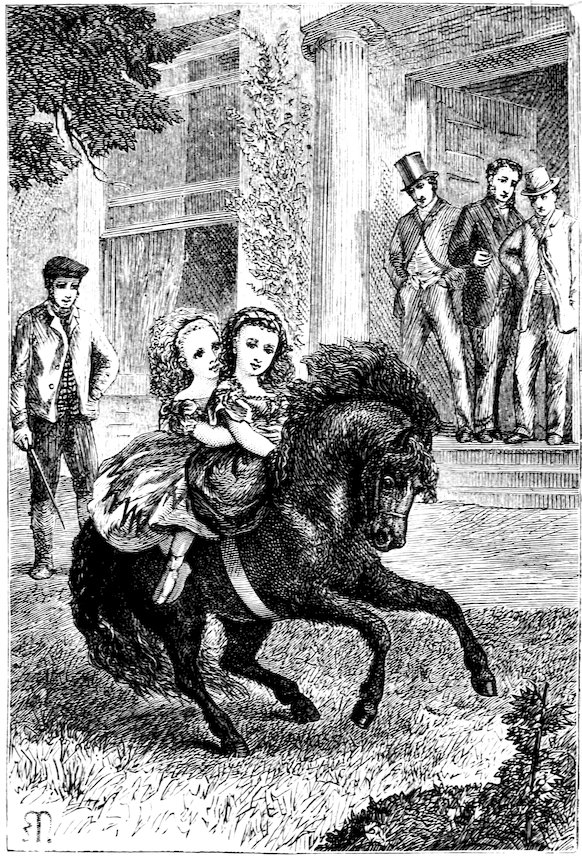
Master Granny and his Pets.—p. 82
83The pony to which I was next promoted was called ‘Vic.’ He was much larger, but so very good and well-behaved, that I cannot find anything amusing to tell you about him; and we must pass on to ‘Alarm,’ a most beautiful bright bay pony with black points, the sole property of our schoolboy brother. Harry was very proud of this animal, but it really was a most dangerous beast to ride. My father’s theory about ‘Alarm’ was, that in his youth 84he must have been cruelly beaten or knocked about; for although he was treated with the utmost gentleness whilst in our possession, his temper never improved, and up to the last he could not be saddled without first having his eyes bandaged, as the sight of the saddle always seemed to drive him nearly wild with rage or terror.
When once Harry had scrambled on Alarm’s back, he contrived to stick on by the same wonderful power of adhesion which keeps sailors as well as schoolboys on horse and pony back, when, according to all the laws of gravitation, they ought to fall off.
I only saw Harry once pitched off Alarm, and then it was in so absurd a way, I must tell you about it. Jessie, Harry, and I were returning quietly home from a long ride, and at the turn of a lane we suddenly came upon a load of cut green grass by the roadside: there was no cart or anything near it—nothing but the soft green heap. Alarm shied violently at this, and absolutely refused 85to pass it; so Harry begged Jessie and me to go on first; we did so, and then turned round to watch our brother’s efforts to get the refractory pony up to the grassy heap. The groom entreated Harry to get off, and allow Alarm to be led past; but of course he would not listen to this suggestion, and, by dint of sundry coaxings and pattings, Alarm was induced to approach the object of his dread. But Harry would not be content until he had made the pony go quite close up to it, informing us, with an air of superior wisdom, that ‘that was the only way to prevent his being so foolish again;’ and at last he actually got Alarm’s nose near enough to smell the grass. But it seemed as if the pony did not approve of its perfume, for with a loud snort he flung up his heels so suddenly and so high, that poor Harry turned a somersault in the air, and was nearly buried in the heap of grass; whilst Alarm trotted off with his tail standing straight out, and arching his lovely glossy neck, as if he were very proud of having won the victory.
86Alarm’s fate is unknown: he was sold, when Harry grew too big to ride him, to a gentleman who was very anxious to give him to his little boy; but, about three weeks later, his new owner returned to his home on foot, having started on Alarm’s back, and announced that the pony had thrown him and then got away. For some days after this, fragments of the saddle and bridle were brought in; but poor Alarm was never more seen or heard of, in spite of search and inquiry. It was a very hilly part of the country, and we can only suppose that he fell down some precipice and was killed. Harry mourned long and bitterly for his favourite, and never ceased regretting having consented to part with him.
Before Alarm passed out of our possession he was concerned in a wholesale massacre, of which I must tell you. I was extremely fond of taking care of the poultry, and had just persuaded Mamma to depose an old woman, who used to look after them, and I reigned in her stead. But, alas! my subjects 87died in the most terrible way, as soon as I assumed the reins of government, and I had an uneasy consciousness that, unless things improved very soon, the old woman would be triumphantly restored to her post. It was in the spring, when the turkeys were bringing out their broods, and the books on poultry-keeping, which I studied attentively, desired me to turn the young turkeys out every morning into a grass paddock, and to feed and shut them up again at night. Now there was exactly the paddock I wanted close to my poultry-yard, and into it I turned my turkey-hens, each with twelve or fourteen dear little chicks, crying ‘twee-twee-twee’ around her. When the time for shutting them up arrived, the turkey-mothers all answered my call, but they returned with only one or two chicks each, and looked disconsolately about them for the remainder. This was very dreadful, and in the course of two days I had lost about fifty baby-turkeys. I searched the paddock carefully, and found several flattened little bodies, but with no mark of 88a bite on them. There was nothing in the paddock except Alarm, and he, I thought, was perfectly quiet and harmless. I was in despair, and next morning prepared to spend the whole day sitting under a tree to watch what befell my last batch of young turkeys. Presently my attention was attracted by seeing a hen turkey, with outstretched wings and loud cries, flying at Alarm’s legs; it seemed very odd that she should assault the pony in this way without any provocation, so I came softly up behind him, and arrived just in time to see his uplifted foreleg descend on a youthful turkey, crushing it quite flat and dead with one pat. Yes! this was the way in which Alarm had amused himself for some days past, the result being, that out of at least a hundred fine healthy young turkeys, I had only about ten left. The worst of it was, that no one pitied me. Harry evidently thought it very clever of Alarm to devise this amusement; the old woman told Mamma I ought to have had the coops placed in the paddock, so as to keep the chicks within 89bounds; and the end of it was that I had to resign my place!
After I grew up, my wandering destiny led me into many countries, and it so happened that, in the course of my travels, I had to ride a great deal, and became acquainted with horses of various tempers and tricks; yet, with all this practice, I could not ride at all well. I was always frightened, never feeling quite at home on horseback. I do not like riding: perhaps for the reason that I have had too much of it all my life. Riding for pleasure, as you do in England, is very different from being obliged to take a long ride every day, and having no other means of getting about than on horseback; and then, in these foreign countries, the horses are generally only half-broken, and would not here be considered fit for a lady to ride.
One horse I was obliged to ride used to lie down in water, whenever we came to a river or brook, which was every day in the course of a long journey of several hundred miles. ‘Claude’ used to double 90up his legs at what he considered was a suitable place in the stream, and lie down deliberately for two or three minutes. It was so impossible to prevent him from doing this, that at last I looked upon it quite as a matter of course, and jumped off as soon as he showed the first symptom of a wish for a bath. By this means I seldom got wet much above my ankles; whereas, if I remained on whilst he lay down, he always tried to roll, and I got my saddle spoilt into the bargain. If Claude had done this only with me, I should of course have thought it was my bad riding; but he went through the same performance with excellent riders on his back, and quite regardless of all the chastisement they gave him. I must say I was delighted to find he was just as tiresome with other people.
During this long journey I rode several horses at different times: sometimes, if the stage was a very long one, and had to be accomplished quickly, we changed horses in the middle of it; and upon one 91occasion, just as I had mounted my second horse, and before I had gathered up the reins, or got my knee over the pommel of the saddle, he jerked his head free in some mysterious way, leaving his bridle in the hands of the groom who was holding him, and bolted home as hard as he could gallop! I held tight on with one hand to the front and with the other to the back of the saddle, and on we flew for seven or eight miles. We were not long about it, I can assure you, and we went so fast that everything appeared to be racing past us. My hat came off, my hair tumbled down my back, and I must have looked like a lunatic, sitting or rather clinging in this extraordinary way, with a very pale, scared face and bare head. At last we reached the place from which we had started; it was quite deserted, so I slipped off ‘Rajah’s’ back, went into the verandah and sat down, feeling most dreadfully shaken and frightened. There was no one there to look after the horse; but I was so disgusted at having all the way to go back again, that I did not care 92what became of him, and left him to his own devices. Presently I heard a great noise on the floor of the verandah, and there was Rajah coming to look for me, poking his pretty grey nose into my hand for his accustomed lump of sugar! Did you ever hear of such impertinence?
There never was his equal for bolting; once he bolted with me at an inspection of cavalry, taking offence at the sudden flashing of the soldiers’ sabres as they drew them to salute their inspecting officer. I must acknowledge it was rather startling; but the worst of it was that the horse upon which was mounted one of the high officials assisting at the ceremonial, bolted too, and the faster Rajah flew with the bit between his teeth and his tail standing straight out, the more the other horse tried to overtake him. It was a regular race for four miles, and I had no breath left at the end of it, for the pace was tremendous; nothing but a thoroughbred Arab in good condition could have kept it up so long: but I did not feel afraid of tumbling off upon that 93occasion, for I was fairly in the saddle, and had nothing to do except—as a dear little boy once said to me—‘stick on like a plaster.’ The ride back was very disagreeable, for my fellow-runaway was dreadfully sulky, and evidently thought the misadventure my fault, whereas I considered that if he could have pulled up his own horse, Rajah would have stopped much sooner.
But running away is nothing to kicking. I had once to ride a horse who never saw a pony without wanting to fight him; he used to paw at them with his forelegs and try to bite them; or, if he could not do that, he would make a grab at the poor rider’s leg, and often give it a nip. Whilst riding him, I did not dare to take my eyes off his ears; for when he laid them back, and I could see him trying to find out if I was watching, I knew what was coming. He would stop dead short in the middle of a canter, and begin to kick or suddenly dart across the road to bully another horse; fortunately, ‘Afreet’ had a tender mouth, so if I was on the watch, and could 94get his head well up in time, I had some chance of stopping his little game.
But as a contrast to all these horses I have been telling you about, who were the reverse of the proverb about ‘Handsome is, &c.,’ I must give you a short memoir of ‘Jack,’ who was not at all handsome, but who was the most clever and sensible animal I ever knew, as well as the most hard-working. I made dear old Jack’s acquaintance out in New Zealand three or four years ago, and I am happy to say he is still alive and well, gradually sinking into a green old age, beloved and respected by all who know him. Jack did not belong to any one person in particular: on the station where I lived he was called a ‘station screw,’ and was used by all who wanted him. Now I don’t exactly know what a ‘screw’ means. I believe it is something unkind when applied to a horse; but I know that whereas the more valuable horses used occasionally to meet with accidents, or have some ailment, Jack was never ill or unable to do what was required of him. I am 95afraid Jack’s exterior was clumsy and rather of the plough-horse kind; but then he could go like ‘Eclipse’ on an emergency; you could ride him all day; he would carry you a long weary journey, and when grander horses would be too tired to eat, Jack would calmly munch his oats as if he had not been a mile away from home, and look as fresh as a daisy next morning. If ever I have to ride in a circus, I will send for Jack! Any one could stand up on his back and jump through hoops or perform feats of agility, and Jack would canter or walk steadily round and round all the time. I have often ridden for miles on Jack with the reins knotted on his neck, and my hands in the pockets of my jacket to keep them warm. When my own showy mare was laid up, I rode Jack. If any one wanted to look for a stray horse or cow, they rode Jack. If a horse was wanted on a pinch to draw a cart or even a dog-cart, Jack was ‘all there.’ If mutton was wanted from the home station, ‘Where is Jack?’ was the first question. Other horses were very difficult to catch, but 96Jack walked confidingly up to you when he saw the halter in your hand. One defect he had, and only one; he certainly was very greedy. Jack would do anything for a feed of oats. He has been known to eat his own feed and that of two other horses also; and as for a haystack, Jack scented it miles away, and no fence could keep him out; at least no New Zealand fence, for they are only wire railings about three feet six inches high, and Jack quietly and cautiously steps over them, one leg at a time. I saw him caught in a fence once, as he was getting over it into a paddock of beautiful clover, and instead of struggling, he stood perfectly still; and when he saw me in the verandah, he whinnied to attract my attention, knowing I would come and help him at once.
Jack preferred a steady, sober pace, but upon occasion he could go very fast, as I will tell you. The horses in New Zealand are seldom or never kept in stables or even in paddocks, but roam all over the ‘run,’ in what are called ‘mobs;’ that is, 97several of them together. If a horse is wanted out of the mob, the only way to get it is to drive all the others, as well as the one you require, into a stock-yard, or enclosure made of strong, high posts and rails. On these occasions I generally begged to be allowed to help, for the sake of the pleasant ride on a lovely afternoon among the hills, and the excitement of finding the mob and driving them into the stock-yard. The horses were often very difficult to catch. If one saw us coming, perhaps he would give the alarm, and the whole mob would set off up the gorge of a river, or over a steep hill-pass, and we would have to go round a long way to turn and drive them back. The gentlemen of the party carried stock-whips, which they cracked from time to time, the report echoing among the quiet lonely valleys like that of a pistol. Sometimes I rode my own mare, Helen, but the galloping and shouting used to excite her very much, and it was all I could do to take care of myself when I was on her back; so I preferred dear, quiet, old Jack, 98whenever he was not wanted for the real business of the expedition; generally, however, he was in great request, as he was one of the best ‘stock-horses’ in all the country-side. Upon this occasion we had found the mob without much trouble, driven them into the stock-yard, caught the chestnut pony which was wanted, and were all returning quietly home in the gloaming, enjoying the beautiful sunset, and the fresh, sweet air which steals down the glens after a hot summer day. I was on Jack’s back, ambling gently along, when suddenly a wild cat started up under our feet and bolted into a large, thick bed of fern close by. In a moment the gentlemen were off their horses and, with many shouts and yells, were trying to help the dogs to get poor pussy out of her cover. I offered to hold the chestnut’s flax bridle, but my assistance was declined, and the sort of leading rein (also made of flax) was securely fastened to the stump of a Ti-ti palm close by. Jack evidently distrusted this arrangement, or else he knew more of the chestnut’s sly tricks than we did. At all 99events, he edged up to where the horse was hitched, and stood quite close to him, watching every movement attentively. And it was well he was so careful, for in the most exciting moment of the cat-hunt, when everybody’s attention was engaged, the pony threw up his head, gave a violent plunge and a pull back at the same time; a badly tied knot in the flax halter gave way, and off he flew like the wind to join the other horses, which were feeding in a large mob just in sight, at the entrance of the gorge of a river.
Before I knew what had happened, Jack was off after the runaway. Never have I been carried at such a pace. Jack did just as he liked; instead of going warily and carefully over the rough country, he jumped every hole or prickly bush which came in his way, to save the time required to go round it; when we reached a creek, instead of discreetly seeking for the best place at which to cross it, Jack scrambled down its steep, crumbling banks, splashed through the water, and was up the other side like a 100cat, and on again, watching every turn of the chestnut, who was doing his best to join the mob, with them to make a final bolt up the gorge and escape us for that night. Jack felt bound in honour to prevent this, so he laid himself well out to his work, and with the most wonderful instinct availed himself of every inch of ground by which he could gain the entrance to the gorge before the mob. He not only succeeded in heading the horses, but actually turned them into the stock-yard close by; and when I recovered my presence of mind, I found myself still on Jack’s back, who was standing across the open place where the slip-rail ought to have been put. He quite understood that I was incapable of jumping off and getting the long pole into its proper position, so as to keep all the horses in, and therefore he took this duty on his own shoulders. How he shook himself when we had reached this point! I was already jolted nearly to death, for I am bound to say that dear Jack’s paces were very rough when he galloped fast, and to be shaken violently directly after such a 101skelter was too trying. When the gentlemen came up, they could hardly speak for laughing, at which I was much affronted, for I felt we deserved great praise for our exertions; but it seems that we looked very absurd, tearing along like a whirlwind (both Jack and I being ordinarily very quiet and deliberate in our movements), jumping all obstacles, disappearing sometimes in the bed of a creek, and finally gaining the victory single-handed against some twenty horses.
I have one more story to tell you, and it takes me back again to the time when I was a little girl. My father came home one day, and announced that he had bought a very handsome horse to go in single harness. First of all we inquired what colour he was? A bright bay. Then we asked about his mane and tail; and lastly, some practical person demanded what price was to be paid for ‘Tom.’ I well remember the astonishment when my father said how very little his owner asked for him. Of course, the next question was, ‘Is he sound?’ ‘Oh yes, he is all 102right,’ Papa said; ‘but he has fits of obstinacy, and stands quite still for hours: however, I don’t think he will try any of his tricks with me.’
In due time Tom came home, and a very handsome horse he was, large and powerful, with splendid action, and very showy. I had overheard the gentlemen talking together about his having ‘a sullen eye,’ and I immediately flitted off to the stable to see what this sort of eye was like. To my disappointment, Tom’s eyes were just like those of all the other horses. Every morning, Papa used to take Tom out in a sort of light gig, with a groom by his side. I anxiously inquired how Tom had behaved; the answer was always the same, ‘Perfectly well.’ There was nothing I liked so much in those days as going out with my father for a morning drive, and at last, after some weeks of excellent behaviour on Tom’s part, and earnest entreaties on mine, I was allowed to accompany Papa again. Tom went as peacefully as a lamb; he was often tried by having to stop to allow a gate to be opened, but he never 103minded this check, and went on amiably afterwards, until one unlucky day, when Papa and I were alone. We came to a large white gate—how well I remember it now; I jumped out to open it as quickly as possible, so as not to try Tom’s temper; but running past him to scramble up again to my perch, I saw at once what they meant by a sullen eye. It was a look of sheer rage and obstinacy, such as you would not believe a horse could assume. It did not surprise me to find that Tom made no movement in reply to Papa’s ‘click.’ First of all, kindness and petting were tried; I did what I could to help by coaxing and patting. Tom stood as if he were carved out of wood; then my father beat him; Tom never winced. I remember Papa’s laughing at my suggestion that we were in fairy land, and that a wicked enchanter had turned Tom into stone. It really seemed like it, for time passed and Tom was motionless. The whip was broken, and my father’s arm was tired; still Tom did not stir. At last, when no one was touching him, he gave a sudden bound into the air, 104all four legs off the ground at once, and fell between the shafts, which snapped short off, sending Papa and poor little me flying into the dusty road. As soon as we had picked ourselves up and found we were not hurt, we went to Tom, who was lying perfectly still, with some blood on the dust by his head. He was quite dead; and after I grew up, and reminded Papa of that adventure, he told me that a veterinary surgeon examined poor Tom’s body, and found that he had burst a large vessel in his heart, from rage or indignation, we don’t know which. I was so sorry for Tom!
I have now told you all the horse-stories which I can remember, and must try to think of something else to amuse you with next time.