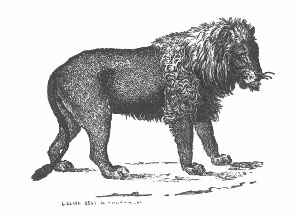
Uncle Thomas relates some Very Remarkable Stories about the Cat;
points out to the Boys the Connexion subsisting between the
Domestic Cat and the Lion, Tiger, &c., and tells them some Stories
about the Gentleness, as well as the Ferocity of these Animals.
"Though far from being so general a favourite as the dog, the domestic
cat has many qualities to recommend it to attention and regard, and some
of the stories which I am going to tell you exhibit instances of
instinctive attachment and gentleness which cannot be surpassed.
"Here is one of attachment, which will match with the best of those of
the dog.
"A cat which had been brought up in a family became extremely attached
to the eldest child, a little boy, who was very fond of playing with
her. She bore with the most exemplary patience any maltreatment which
she received from him—which even good-natured children seldom fail,
occasionally, to give to animals in their sports with them—without ever
making any attempt at resistance. As the cat grew up, however, she daily
quitted her playfellow for a time, from whom she had formerly been
inseparable, in order to follow her natural propensity to catch mice;
but even when engaged in this employment, she did not forget her friend;
for, as soon as she had caught a mouse, she brought it alive to him. If
he showed an inclination to take her prey from her, she anticipated him,
by letting it run, and waited to see whether he was able to catch it. If
he did not, the cat darted at, seized it, and laid it again before him;
and in this manner the sport continued as long as the child showed any
inclination for the amusement.
"At length the boy was attacked by smallpox, and, during the early
stages of his disorder, the cat never quitted his bed-side; but, as his
danger increased, it was found necessary to remove the cat and lock it
up. The child died. On the following day, the cat having escaped from
her confinement, immediately ran to the apartment where she hoped to
find her playmate. Disappointed in her expectation, she sought for him
with symptoms of great uneasiness and loud lamentation, all over the
house, till she came to the door of the room in which the corpse lay.
Here she lay down in silent melancholy, till she was again locked up. As
soon as the child was interred, and the cat set at liberty, she
disappeared; and it was not till a fortnight after that event, that she
returned to the well-known apartment, quite emaciated. She would not,
however, take any nourishment, and soon ran away again with dismal
cries. At length, compelled by hunger, she made her appearance every day
at dinner-time, but always left the house as soon as she had eaten the
food that was given her. No one knew where she spent the rest of her
time, till she was found one day under the wall of the burying-ground,
close to the grave of her favourite; and so indelible was the attachment
of the cat to her deceased friend, that till his parents removed to
another place, five years afterwards, she never, except in the greatest
severity of winter, passed the night any where else than at the
above-mentioned spot, close to the grave. Ever afterwards she was
treated with the utmost kindness by every person in the family. She
suffered herself to be played with by the younger children, although
without exhibiting a particular partiality for any of them.
"There is another story of the cat's attachment, of a somewhat less
melancholy cast, which I lately saw recorded in a provincial newspaper.
"A country gentleman of our acquaintance, who is neither a friend to
thieves nor poachers, has at this moment in his household a favourite
cat, whose honesty, he is sorry to say, there is but too much reason
to call in question. The animal, however, is far from being selfish in
her principles; for her acceptable gleanings she regularly shares among
the children of the family in which her lot is cast. It is the habit of
grimalkin to leave the kitchen or parlour, as often as hunger and an
opportunity may occur, and wend her way to a certain pastrycook's shop,
where, the better to conceal her purpose, she endeavours slily to
ingratiate herself into favour with the mistress of the house. As soon
as the shopkeeper's attention becomes engrossed in business, or
otherwise, puss contrives to pilfer a small pie or tart from the shelves
on which they are placed, speedily afterwards making the best of her way
home with her booty. She then carefully delivers her prize to some of
the little ones in the nursery. A division of the stolen property
quickly takes place; and here it is singularly amusing to observe the
cunning animal, not the least conspicuous among the numerous group,
thankfully mumping her share of the illegal traffic. We may add that
the pastrycook is by no means disposed to institute a legal process
against the delinquent, as the children of the gentleman to whom we
allude are honest enough to acknowledge their four-footed playmate's
failings to papa, who willingly compensates any damage the pastrycook
may sustain from the petty depredations of the would-be philanthropic
cat.
"I remember how highly pleased you were with the story which I told you
about the dog discovering the murderers of his master. There is one of a
very similar description of a French cat, which I am sure will equally
interest you.
"In the beginning of the present century a woman was murdered in Paris.
The magistrate who went to investigate the affair was accompanied by a
physician; they found the body lying upon the floor, and a greyhound
watching over it, and howling mournfully. When the gentleman entered the
apartment, it ran to them without barking, and then returned with a
melancholy mien to the body of his murdered mistress. Upon a chest in a
corner of the room sat a cat, motionless, with eyes expressive of
furious indignation, stedfastly fixed upon the body. Many persons now
entered the apartment, but neither the appearance of such a crowd of
strangers, nor the confusion that prevailed in the place, could make her
change her position. In the mean time, some persons were apprehended on
suspicion of being the murderers, and it was resolved to lead them into
the apartment. Before the cat got sight of them, when she only heard
their footsteps approaching, her eyes flashed with increased fury, her
hair stood erect, and so soon as she saw them enter the apartment, she
sprang towards them with expressions of the most violent rage, but did
not venture to attack them, being probably alarmed by the numbers that
followed. Having turned several times towards them with a peculiar
ferocity of aspect, she crept into a corner, with an air indicative of
the deepest melancholy. This behaviour of the cat astonished every one
present. The effect which it produced upon the murderers was such as
almost to amount to an acknowledgment of guilt. Nor did this remain long
doubtful, for a train of accessory circumstances was soon discovered
which proved it to complete conviction.
"I have often warned you against stories of ghosts and hobgoblins, and
shown you on how frail a foundation they generally rest. There is a
story in which a cat was one of the principal actors, which contains the
elements of as marvellous a tale of this description as could be
desired. It happened in the west of Scotland.
"Some years ago, a poor man whose habits of life had always been of the
most retired description, giving way to the natural despondency of his
disposition, put an end to his existence. The only other inmate of his
cottage was a favourite cat, When the deed was discovered, the cat was
found assiduously watching over her late master's body, and it was with
some difficulty she could be driven away.
"The appalling deed naturally excited a great deal of attention in the
surrounding neighbourhood; and on the day after the body was deposited
in the grave, which was made at the outside of the church-yard, a number
of school-boys ventured thither, to view the resting-place of one who
had at times been the subject of village wonder, and whose recent act of
self-destruction was invested with additional interest. At first, no one
was brave enough to venture near; but at last, the appearance of a hole
in the side of the grave irresistibly attracted their attention. Having
been minutely examined, it was at length determined that it must have
been the work of some body-snatcher, and the story having spread, the
grave was minutely examined, but as the body had not been removed, the
community considered themselves fortunate in having made so narrow an
escape. The turf was replaced, and the grave again carefully covered
up.
"On the following morning the turf was again displaced, and a hole,
deeper than before, yawned in the side of the sad receptacle.
Speculation was soon busy at work, and all sorts of explanations were
suggested. In the midst of their speculations, alarmed perhaps by the
noise of the disputants, poor puss darted from the hole, much to the
confusion of some of the most noisy and dogmatic expounders of the
mystery. Again the turf was replaced, and again and again was it removed
by the unceasing efforts of the faithful cat to share the resting-place
of her deceased master. It was at last found necessary to shoot her, it
being found impossible otherwise to put a stop to her unceasing
importunities."
"Poor puss! What a pity it should have been necessary to destroy such a
faithful animal. I wonder no one tried to gain its affections, and thus
charm it from its dreary abode. Uncle Thomas, did you ever hear Dr.
Good's account of a very extraordinary instance of sagacity exemplified
by his cat? I was very much struck with it when I saw it a day or two
ago in his 'Book of Nature.' If you please, I will read it to you."
"Very well, Harry, I shall be glad to hear it; I dare say it is an old
acquaintance of mine. I have been such a diligent searcher after stories
of this description, that I think very few have escaped me."
"A favourite cat, that was accustomed from day to day to take her
station quietly at my elbow, on the writing table, sometimes for hour
after hour, whilst I was engaged in study, became at length less
constant in her attendance, as she had a kitten to take care of. One
morning she placed herself in the same spot, but seemed unquiet, and,
instead of seating herself as usual, continued to rub her furry sides
against my hand and pen, as though resolved to draw my attention, and
make me leave off. As soon as she had accomplished this point, she
leaped down on the carpet, and made towards the door, with a look of
great uneasiness. I opened the door for her, as she seemed to desire,
but, instead of going forward, she turned round, and looked earnestly at
me, as though she wished me to follow her, or had something to
communicate. I did not fully understand her meaning, and, being much
engaged at the time, shut the door upon her, that she might go where she
liked.
"In less than an hour afterwards, however, she had again found an
entrance into the room, and drawn close to me, but, instead of mounting
the table, and rubbing herself against my hand, as before, she was now
under the table, and continued to rub herself against my feet, on moving
which I struck them against a something which seemed to be in their way,
and, on looking down, beheld with equal grief and astonishment the dead
body of her little kitten which I supposed had been alive and in good
health, covered over with cinder dust. I now entered into the entire
train of this afflicted cat's feelings. She had suddenly lost the
nursling she doated on, and was resolved to make me acquainted with
it,—assuredly that I might know her grief, and probably also that I
might inquire into the cause, and, finding me too dull to understand her
expressive motioning that I would follow her to the cinder heap, on
which the dead kitten had been thrown, she took the great labour of
bringing it to me herself, from the area on the basement floor, and up a
whole flight of stairs, and laid it at my feet. I took up the kitten in
my hand, the cat still following me, made inquiry into the cause of its
death, which I found, upon summoning the servants, to have been an
accident, in which no one was much to blame; and the yearning mother
having thus obtained her object, and gotten her master to enter into her
cause, and divide her sorrows with her, gradually took comfort, and
resumed her former station by my side."
"Thank you, Harry, I do not think I ever heard that story before. Here
is one that will match it however, displaying considerable ingenuity in
a cat in the protection of her young.
"A cat belonging to Mr. Stevens, of the Red Lion Hotel, Truro, having
been removed from that town to a barn at some distance, soon afterwards
produced four kittens. Not wishing the stock increased, Mr. Stevens
desired three of them to be drowned, next morning, before opening their
eyes on the world. Puss was deeply affected by this bereavement, and
resolved on moving her remaining offspring to a place of security. When
the person appointed to feed grimalkin went with her breakfast next day,
no traces of her or her kitten were to be found. He called; but all was
silent as the tomb; every corner was searched in vain; no cat was
forthcoming. Here the matter rested for several days, when, at length,
early one morning, puss made her appearance in the court of her master's
house, a melancholy picture of starvation. Having satisfied her hunger,
and loitered about the house during the day, late in the evening she
took her departure, carrying away some meat. For several days she
continued her visits in the same manner, taking care never to leave home
empty-mouthed at night. Her proceedings having excited attention, she
was followed by two men, in one of her nocturnal retreats, and traced to
the top of a wheat stack, at some distance. On obtaining a ladder, her
surviving kitten was found, in a curiously constructed hole, sleek and
plump, but as wild as a young tiger, and would allow no one to touch it.
A few days afterwards, the mother finding, perhaps, that her own daily
journeys were rather fatiguing, or thinking it was time that the object
of her solicitude should be introduced into the world, or, probably,
that the kitten had attained an age when it could protect itself, she
took advantage of a dark and silent night, when cat-worrying dogs and
boys were reposing, to convey it safely to Truro, where tabby and her
kitten found a welcome reception.
"Though from bad education the cat and dog are generally the most
determined enemies, some instances have occurred of the greatest
friendship subsisting between these animals. Here is an instance
recorded by a French author on the Language of Brutes.
"I had a cat and dog, which became so attached to each other, that they
would never willingly be asunder. Whenever the dog got any choice morsel
of food, he was sure to divide it with his whiskered friend. They always
ate sociably out of one plate, slept in the same bed, and daily walked
out together. Wishing to put this apparently sincere friendship to the
proof, I, one day, took the cat by herself into my room, while I had the
dog guarded in another apartment. I entertained the cat in a most
sumptuous manner, being desirous to see what sort of a meal she would
make without her friend, who had hitherto been her constant table
companion. The cat enjoyed the treat with great glee, and seemed to have
entirely forgotten the dog. I had had a partridge for dinner, half of
which I intended to keep for supper. My wife covered it with a plate,
and put it into a cupboard, the door of which she did not lock. The cat
left the room, and I walked out upon business. My wife, meanwhile, sat
at work in an adjoining apartment. When I returned home, she related to
me the following circumstances:—The cat, having hastily left the dining
room, went to the dog, and mewed uncommonly loud, and in different tones
of voice; which the dog, from time to time, answered with a short bark.
They both then went to the door of the room where the cat had dined, and
waited till it was opened. One of my children opened the door, and
immediately the two friends entered the apartment. The mewing of the cat
excited my wife's attention. She rose from her seat, and stepped softly
up to the door, which stood ajar, to observe what was going on. The cat
led the dog to the cupboard which contained the partridge, pushed off
the plate which covered it, and, taking out my intended supper, laid it
before her canine friend, who devoured it greedily. Probably the cat,
by her mewing, had given the dog to understand what an excellent meal
she had made, and how sorry she was that he had not participated in it;
but, at the same time, had explained to him that something was left for
him in the cupboard, and persuaded him to follow her thither. Since that
time I have paid particular attention to these animals, and am perfectly
convinced that they communicate to each other whatever seems
interesting."
"Oh! indeed, Uncle Thomas, do you think that animals understand each
other?"
"I have no doubt that they do to a limited extent, Harry, but I cannot
go the whole length of Monsieur Wenzel, who records the story I have
just told you.
"I will now tell you some stories about some of the other animals of the
cat kind, such as the lion, tiger, &c.; and though these animals differ
so much from the domestic cat, they all belong to the same family; the
huge lion, which carries off with ease a buffalo from the herd, or makes
the forest tremble with his hoarse roar is no more than an enormous cat.
"I dare say you have all heard the story of 'Androcles and the Lion,'
which is recorded in that most delightful book, 'Sandford and Merton.'
It is so captivating a tale, that I must repeat it to you as much for my
own gratification as for yours. I will just observe, however, that it is
a fiction, and not a real story, though I can tell you one or two very
similar ones, which occurred in real life."
"There was a certain slave named Androcles, who was so ill treated by
his master that his life became insupportable. Finding no remedy from
what he suffered, he at length said to himself:—'It is better to die
than to continue to live in such hardships and misery as I am obliged to
suffer. I am determined, therefore, to run away from my master; if I am
taken again, I know that I shall be punished with a cruel death, but it
is better to die at once, than to live in misery. If I escape, I must
betake myself to deserts and woods, inhabited only by wild beasts, but
they cannot use me more cruelly than I have been by my fellow-creatures,
therefore I will rather trust myself to them, than continue to be a
miserable slave.
"Having formed this resolution, he took an opportunity of leaving his
master's house, and hid himself in a thick forest, which was some miles
distant from the city. But here the unhappy man found that he had only
escaped from one kind of misery to experience another. He wandered about
all day through a vast and trackless wood, where his flesh was
continually torn by thorns and brambles. He grew hungry, but he could
find no food in this dreary solitude. At length he was ready to die with
fatigue, and lay down in despair in a large cavern.
"The unfortunate man had not been long quiet in the cavern, before he
heard a dreadful noise, which seemed to be the roar of some wild beast,
and terrified him very much. He started up with a design to escape, and
had already reached the mouth of the cave, when he saw coming towards
him a lion of prodigious size, which prevented any possibility of
retreat. He now believed his destruction to be inevitable, but to his
great astonishment the beast advanced towards him with a gentle pace,
without any mark of enmity or rage, and uttered a kind of mournful
voice, as if he demanded the assistance of the man.
"Androcles, who was naturally of a resolute disposition, acquired
courage from this circumstance to examine his monstrous guest, who gave
him sufficient leisure for this purpose. He saw, as the lion approached
him, that he seemed to limp upon one of his legs, and that the foot was
extremely swelled, as if it had been wounded. Acquiring still more
fortitude from the gentle demeanour of the beast, he advanced towards
him, and took hold of the wounded part as a surgeon would examine his
patient. He then perceived that a thorn of uncommon size had penetrated
the ball of the foot, and was the occasion of the swelling and the
lameness which he had observed. Androcles found that the beast, far from
resenting his familiarity, received it with the greatest gentleness, and
seemed to invite him by his blandishments to proceed. He therefore
extracted the thorn, and, pressing the swelling, discharged a
considerable quantity of matter, which had been the cause of so much
pain. As soon as the beast felt himself thus relieved, he began to
testify his joy and gratitude by every expression in his power. He
jumped about like a wanton spaniel, wagged his enormous tail, and licked
the feet and hands of his physician. Nor was he contented with these
demonstrations of kindness. From this moment Androcles became his guest;
nor did the lion ever sally forth in quest of his prey, without bringing
home the produce of his chase, and sharing it with his friend.
"In this savage state of hospitality did the man continue to live
during several months. At length, wandering unguardedly through the
woods, he met with a company of soldiers sent out to apprehend him, and
was by them taken prisoner, and conducted back to his master. The laws
of that country being very severe against slaves, he was tried and found
guilty of having fled from his master, and as a punishment for his
pretended crime, he was sentenced to be torn in pieces by a furious
lion, kept many days without food, to inspire him with additional rage.
"When the destined moment arrived, the unhappy man was exposed, unarmed,
in the middle of a spacious arena, inclosed on every side, round which
many thousand people were assembled to view the mournful spectacle.
Presently a dreadful yell was heard, which struck the spectators with
horror, and a monstrous lion rushed out of a den, which was purposely
set open, with erected mane and flaming eyes, and jaws that gaped like
an open sepulchre. A mournful silence instantly prevailed. All eyes
were turned upon the destined victim, whose destruction seemed
inevitable. But the pity of the multitude was soon converted into
astonishment, when they beheld the lion, instead of destroying its
defenceless enemy, crouch submissively at his feet, fawn upon him as a
faithful dog would do upon his master, and rejoice over him as a mother
that unexpectedly recovers her offspring. The governor of the town, who
was present, then called out with a loud voice, and ordered Androcles to
explain to them this unintelligible mystery, and how a savage of the
fiercest and most unpitying nature should thus in a moment have
forgotten his innate disposition, and be converted into a harmless and
inoffensive animal. Androcles then related to the assembly every
circumstance of his adventures, and concluded by saying, that the very
lion which now stood before them, had been his friend and entertainer in
the woods. All present were astonished and delighted with the story, to
find that even the fiercest beasts are capable of being softened by
gratitude; and, being moved by humanity, they unanimously joined to
entreat for the pardon of the unhappy man, from the governor of the
place. This was immediately granted to him, and he was also presented
with the lion, which had twice saved the life of Androcles."
"Oh, what a delightful story, Uncle Thomas! What a pity it is that it is
not true."
"I can tell you one which is true, John which is hardly, if at all,
inferior in interest:—
"Sir George Davis, who was English consul at Naples about the middle of
the seventeenth century, happening on one ocassion to be in Florence,
visited the Menagerie of the Grand Duke. At the farther end of one of
the dens he saw a lion which lay in sullen majesty, and which the
keepers informed him they had been unable to tame, although every effort
had been used for upwards of three years. Sir George had no sooner
reached the gate of the den, than the lion ran to it, and evinced every
demonstration of joy and transport. The animal reared himself up, purred
like a cat when pleased, and licked the hand of Sir George, which he had
put through the bars. The keeper was astonished and frightened for the
safety of his visitor, entreated him not to trust an apparent fit of
frenzy, with which the animal seemed to be seized; for he was, without
exception, the most fierce and sullen of his tribe which he had ever
seen. This, however, had no effect on Sir George, who, notwithstanding
every entreaty on the part of the keeper, insisted on entering the
lion's den. The moment he got in, the delighted lion threw his paws upon
his shoulders, licked his face, and ran about him, rubbing his head on
Sir George, purring and fawning like a cat when expressing its affection
for its master. This occurrence became the talk of Florence, and reached
the ears of the Grand Duke, who sent for Sir George, and requested an
interview at the menagerie, that he might witness so extraordinary a
circumstance, when Sir George gave the following explanation; 'A
captain of a ship from Barbary gave me this lion, when quite a whelp. I
brought him up tame; but when I thought him too large to be suffered to
run about the house, I built a den for him in my court-yard. From that
time he was never permitted to be loose, except when brought to the
house to be exhibited to my friends. When he was five years old, he did
some mischief by pawing and playing with people in his frolicsome moods.
Having griped a man one day a little too hard, I ordered him to be shot,
for fear of myself incurring the guilt of what might happen. On this a
friend, who happened to be then at dinner with me, begged him as a
present. How he came here, I know not.' The Grand Duke of Tuscany, on
hearing his story, said it was the very same person who had presented
him with the lion."
"Oh! Uncle Thomas: I should have been terribly afraid to have ventured
into the lion's den!"
"I dare say you would, John, and so should I. But some stories are
recorded of the gentleness of the lion, as almost to justify such acts
of what would otherwise appear fool-hardiness.
"Part of a ship's crew being sent ashore on the coast of India for the
purpose of cutting wood, the curiosity of one of the men having led him
to stray to a considerable distance from his companions, he was much
alarmed by the appearance of a large lioness, who made towards him; but,
on her coming up, his fear was allayed, by her lying down at his feet,
and looking very earnestly, first in his face, and then at a tree some
little distance off. After repeating these looks several times, she
arose, and proceeded towards the tree, looking back, as if she wished
the sailor to follow her. At length he ventured, and, coming to the
tree, perceived a huge baboon, with two young cubs in her arms, which he
immediately supposed to be those of the lioness', as she crouched down
like a cat, and seemed to eye them very stedfastly. The man being afraid
to ascend the tree, decided on cutting it down, and having his axe
with him, he set actively to work, when the lioness seemed most
attentive to what he was doing. When the tree fell, she pounced upon the
baboon, and, after tearing her in pieces, she turned round, and licked
the cubs for some time. She then returned to the sailor, and fawned
round him, rubbing her head against him in great fondness, and in token
of her gratitude for the service done her. After this, she carried the
cubs away one by one, and the sailor rejoined his companions, much
pleased with the adventure.
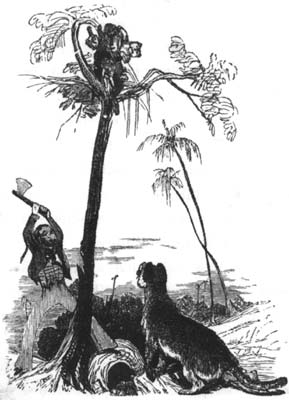
THE LIONESS AND THE BABOON—Page 117.
"Another author tells such a graphic story of a lion's entertaining a
hunter, that I must let you hear it also, though I must say that I think
he has rather overstrained it.
"A hunter on one occasion having gone in search of a lion, and having
penetrated a considerable distance into a forest, happened to meet with
two whelps of a lion that came to caress him. The hunter stopped with
the little animals, and waiting for the coming of the sire or the dam,
took out his breakfast, and gave them a part. The lioness arrived,
unperceived by the huntsman, so that he had not time, or perhaps wanted
the courage, to take his gun. After having for some time looked at the
man who was thus feasting her young, the lioness burst away, and soon
after returned, bearing with her a sheep, which she came and laid at the
huntsman's feet. The hunter, thus become one of the family, took
occasion to make a good meal,—skinned the sheep, made a fire, and
roasted a part, giving the entrails to the young. The lion, in his turn,
came also; and, as if respecting the rights of hospitality, showed no
tokens whatever of ferocity. Their guest, the next day, having finished
his provisions, returned home, and came to a resolution never more to
kill any of these animals, the noble generosity of which he had so fully
experienced. He stroked and caressed the whelps at taking leave of them,
and the dam and sire accompanied him till he was safely out of the
forest."
"Well, Uncle Thomas, I cannot believe that. I think the man would have
been too glad to escape, to have staid so long with such unsafe
companions."
"You are quite right, Harry, I cannot expect that you should give credit
to a story which I myself disbelieve. Here is a story about the ferocity
of the lion, which is, however, beyond all, doubt.
"In the year 1816 the horses which were dragging the Exeter mail coach
were attacked in the most furious manner by a lioness, which had escaped
from a travelling menagerie.
"At the moment when the coachman pulled up, to deliver his bags at one
of the stages a few miles from the town of Salisbury, one of the leading
horses was suddenly seized by a ferocious animal. This produced a great
confusion and alarm. Two passengers, who were inside the mail, got out
and ran into the house. The horse kicked and plunged violently; and it
was with difficulty the driver could prevent the coach from being
overturned. It was soon observed by the coachman and guard, by the light
of the lamps, that the animal which had seized the horse was a huge
lioness. A large mastiff dog came up and attacked her fiercely, on which
she quitted the horse and turned upon him. The dog fled, but was pursued
and killed by the lioness, within about forty yards of the place. It
appears that the beast had escaped from a caravan, which was standing on
the road side, and belonged to a menagerie, on its way to Salisbury
fair. An alarm being given, the keepers pursued and hunted the lioness,
carrying the dog in her teeth, into a hovel under a granary, which
served for keeping agricultural implements. About half past eight, they
had secured her effectually, by barricading the place, so as to prevent
her escape. The horse, when first attacked, fought with great spirit;
and if he had been at liberty, would probably have beaten down his
antagonist with his fore feet but in plunging he entangled himself in
the harness. The lioness, it appears, attacked him in front, and
springing at his throat, had fastened the talons of her fore feet on
each side of his gullet, close to the head, while the talons of her hind
feet were forced into the chest. In this situation she hung, while the
blood was seen streaming, as if a vein had been opened by a lancet. The
furious animal missed the throat and jugular vein; but the horse was so
dreadfully torn, that he was not at first expected to survive. The
expressions of agony, in his tears and moans, were most piteous and
affecting. Whether the lioness was afraid of her prey being taken from
her, or from some other cause, she continued a considerable time after
she had entered the hovel, roaring in a dreadful manner, so loud,
indeed, that she was distinctly heard at the distance of half a mile.
She was eventually secured and led back in triumph to her cell."
"It was fortunate that it did not attack the passengers, Uncle Thomas."
"Very much so, indeed; it might have turned out a very serious affair,
Frank."
 CATCHING WILD HORSES—Page 13.