A few weeks after the interview mentioned in the last
chapter, the Vicar preached three sermons from the
same text, St. John iii. 5: "Except a man be born of water
and of the Spirit, he cannot enter into the kingdom of God."
The first sermon was on the necessity of Baptism; the second,
on its benefits; and the third, on its mode of administration,
specially in the case of infants. Mr. Ambrose could not help
noticing that Mr. Dole was on each occasion deeply affected,
for he saw tears on his face, which evidently manifested deep
emotion within. He was, therefore, hardly surprised, when,
after his third sermon, a knock at the vestry-door announced a
visit from his parishioner.
"I have listened very attentively to your last three sermons,
Mr. Ambrose," said he, "and the subjects of them have also,
as you know, for a long time past been seriously and prayerfully
considered by me; I am now come to ask you to receive
me into the Church by Baptism."
"Have you never yet been baptized, my friend?" inquired
the Vicar, taking his hand in a kind and friendly way.
"No, I have not; when I was an infant, my parents objected
to my being baptized, and since I became a man, I must
confess with shame, that I have never had the courage to go
through the service at our meeting. That service, you know,
sir, is such as to deter far more courageous men—and specially
women—than I am, and I have always, too, had my doubts
about its propriety."
"I am not surprised at that. I once, when a boy, attended
a baptism at one of your meetings, and I shall never forget it;
for a more unseemly spectacle I never witnessed. There were
several young men and women immersed by the preacher, in a
large tank of water, in the middle of the meeting-house. Each
was clothed in a flannel garment fitting almost closely to the
body, and the appearance of the first of them was the signal for
a general rush to the best places for seeing; men and boys
climbed noisily over the pews, and some took their places on
the backs of the seats, so as to get a good view; and the whole
scene was most disorderly and irreverent.
"I have explained to you that our own Church also admits
of baptism by immersion[70], but it does not require it, nor even
recommend it. Nevertheless occasionally persons desire it;
and there are a few churches, chiefly in Wales, where a
large tank of water, as well as a smaller font, is provided
for such special cases. But this mode of baptizing is not
encouraged by the Church, for these among other reasons:—It
is not necessary—for 1, the word Baptism, in the original,
does not necessarily mean entire immersion; 2, in the absence
of proof to the contrary, we may fairly conclude, from the
peculiar circumstances[71] of the cases, that many of whose
baptism we read in the New Testament were not so immersed;
3, the Church from the earliest period has not considered
immersion as necessary to the validity of Baptism. It is also
inconvenient—for 1, in some cases it would be most difficult to
obtain sufficient water for the purpose; 2, in many cases there
would be much risk and danger attending its practice; 3, in all
cases there would be difficulty in securing that solemnity, propriety,
and order so desirable in the administration of this holy
sacrament. But the Baptism of adults, even according to the
Church's ordinary rules, is no small test of courage, as well as
sincerity. You are aware, no doubt, that your own Baptism
and reception into the Church must be in the face of the congregation.
The law of the Church is very plain on this point; it
distinctly forbids Baptism to be administered privately, either
at home or in the Church, 'unless upon a great and reasonable
cause;' and it is much to be regretted that this rule has
ever been departed from."
"Yes, sir, I have well considered that point."
The Vicar remained long that afternoon in the vestry in
serious conversation and earnest prayer with his parishioner.
He again went over the subject of the last three sermons;
showing, 1st, how the text could refer to nothing else than
holy Baptism, and that, if it did refer to it, then no doubt, where
it can be had, Baptism must be necessary for us, in order that
we may "enter into the kingdom of God;" 2ndly, that the
promise is as sure as the warning; and, 3rdly, that the terms
of the text are unexceptional, that they refer to all mankind
without any exception whatever, men, women, and children.
In speaking of these different subjects, of course he had to meet
the various objections which Dissenters are used to adduce;
but on all these points it was not very difficult to satisfy
the mind of one who had already freed himself from the
trammels of prejudice, and was earnestly seeking for the truth.
On the following Sunday afternoon therefore, after the second
lesson, Mr. Dole presented himself, with his chosen witnesses,
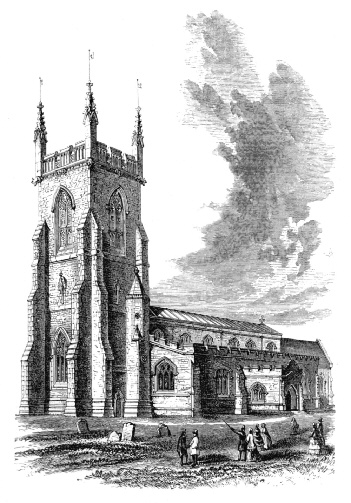
at the Font of St. Catherine's. The service was a very solemn
one, and all the congregation evidently took the greatest
interest in it. Mr. Dole made the responses in a firm manly
voice, its very tone seemed to say, "This is the result of my
deep and honest conviction; I have been wrong, and I am
not ashamed to say so before all those who are here present,
from whom I have so long been separated, but who are henceforth
my brethren in Christ." And then for the first time, he
quietly and calmly took his place on a bench at the west end
of the building—a sincere member of the Christian Church.
It was natural that the Squire and Vicar should have some
conversation after service on an event of so much importance
in the village as was this. They both foretold, and rightly,
the downfall of the little village "Bethel" as soon as its chief
supporter had left it.
Its former attendants came back to the Church one by one,
till at length the owner of the building, finding no prospect of
receiving his rent, closed the "Meeting," and appropriated it
to another purpose.
The Vicar and Squire were standing near the Font, and the
conversation took its rise from the object before them.
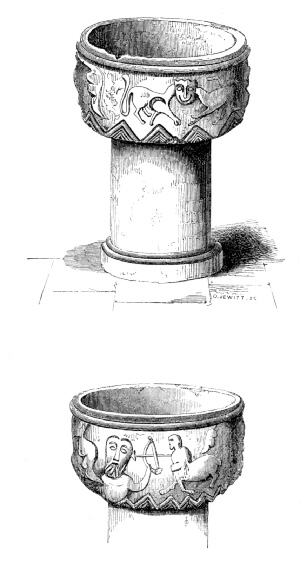
"How often, Mr. Vicar, we find these old Norman Fonts
preserved, when there is hardly another bit of masonry remaining
in the church of the same date."
"Yes; and it is remarkable it should be so, considering the
exposed part of the church in which they are placed, and the
perishable stone of which they are not unfrequently composed;
besides which, the carvings upon them are often of so mysterious
and grotesque a character as naturally to excite the
wrath of the Puritan fanatics who so relentlessly destroyed the
beauty of our Houses of God, and 'brake down all the carved
work thereof with axes and hammers.'
"It is very interesting to watch the progress of architectural
changes as delineated on Fonts. Each period of ecclesiastical
architecture, as well in its general features as in its details, is
abundantly illustrated by the carvings and mouldings to be
found on Fonts. The early Fonts were with few exceptions
made of stone. Marble was seldom used till in comparatively
recent times. Some of the early Fonts had a solid leaden bowl,
placed on a stone base[72]; I have never seen but one ancient
wooden Font[73]; that was placed on a stone base of the Norman
period, but was itself no doubt much later. The sculpture on
very ancient Fonts, as well as other church carving of the
time, sometimes borrowed its symbolism from the heathen
mythology which preceded it[74]."
Constance Acres, who had been hitherto a quiet listener,
here asked Mr. Ambrose why the Font was always placed near
the door of the church.
"It's a natural inquiry, my dear, for one of your age," said
the Vicar, "but the reason is evident. Its position there, at
the entrance of the material fabric, fitly represents Baptism as
the outward form of admission into the Christian Church. The
Font, too, thus placed, should ever remind us, as we enter the
church, of the vows and promises made in our name when first
we were brought in our helpless infancy to be presented to God,
and to be made members of Christ through the grace of our
second birth. If people would only accustom themselves to
associate such thoughts with the baptismal Font, then just a
glance at it as they come into the church would be enough to
solemnize their minds, and help to fit them for the sacred
services in which they are about to take a part. It was once
the custom, Constance, to place what were called stoups, at the
entrances to our churches, and there are still remains of them
at the doors of many old churches. These were small basins,
made of stone, for the purpose of holding water, which—like
the water in the Font—was consecrated by the priest. When
persons came into the church, they dipped a finger in the
basin, and crossed their forehead with the water, just as the
priest now crosses the brow of the person who has been baptized.
The forehead, you know, is always regarded as the seat
of shame or courage[75]; and so the person, when baptized, is
signed with 'the sign of the Cross, in token that hereafter he
shall not be ashamed to confess the faith of Christ crucified.'
The old custom of frequent crossing with holy water has now
for a long time been discontinued by us, the practice was
regarded by many as superstitious, nor does there appear to be
authority for it in the Primitive Church. The same motive
which prompted the use of the stoup, however, still induces
some persons to use the sign of the Cross on entering a church:
I do not myself do so; not that I see any harm in the practice
in itself, as it is intended to remind persons of the Sacred
Presence to which they are about to enter, and to drive away
worldly thoughts by this memento of the crucifixion of their
Lord; but I think it is better, in my own case, as some would
be offended by it, to try to accomplish this right object by other
means."
"People's minds have very much changed in late years
respecting the use of the Cross," said Mr. Acres. "A few
years ago not only was the sign of the Cross in baptism considered
superstitious, but it was considered even wrong to use it
in church architecture, or as an ornament within the church,
or as a part of a memorial in the churchyard; there are few
now, I suppose, who regard such use of the sacred symbol as
superstitious. I was in a bookseller's shop the other day when
a 'Baptist' preacher came in to purchase a Prayer Book to
present to a friend; the bookseller said to him, 'Of course
that will not suit you, sir, as it has a Cross upon it.' 'I like the
book very much,' was his reply; 'and as for the Cross, why
the Puritans may object to that if they like, I don't.' But
I am of opinion that people are going a little in the opposite
extreme, and, at least as a personal ornament, the Cross is
become too common."
"Why do you fall into the popular error, my good friend,"
said the Vicar, reprovingly, "of calling these Anabaptist
preachers, Baptists? Surely they ought to be called any thing
rather than Baptists, for they make more light of Baptism than
any other people who can properly be said to believe in Baptism
at all. Do let us call things by their proper names;—why, to
call them Baptists, is almost as bad as to call Roman Catholics,
Catholics, and so to ignore our own claim to be members of the
Christian Church, because we allow them a name which would
imply that they are the only Church in the world. I need not
tell you that the word ANAbaptist[76] exactly expresses what they
are, namely, they who baptize a second time those who have
already been baptized in infancy. The term 'Baptist' is far
more applicable to Church people than to them."
"I see, I deserve your rebuke: mine is a mistake too often
made. By-the-bye, Mr. Vicar, I was very pleased to hear your
reply to Mr. Dole, when he inquired what was the fee to be
paid for his baptism. I heard you tell him that the sacraments
of the Church were always free."
"Yes, certainly I did; and I confess I cannot understand
how any one can dare, in these days, to demand a fee for
Baptism; the claim is as illegal as it is unchristian, and I
believe goes far to make the poor take a low view of this holy
rite. I wish, too, I could make the poor understand that
Baptism has nothing to do with Registration; many of the
most ignorant of them really regard them as the same thing.
Some of them, too, will persist in thinking that to be privately
baptized, is to be 'half baptized.' Of course they must be altogether
baptized, or not baptized at all; but they do not readily
see that the baptism is complete, though the reception into the
Church is not perfected till the service is concluded in the face
of the congregation."
CHAPTER XVI
THE PULPIT
"He commanded us to preach unto the people."
Acts x. 42
"The pulpit, therefore (and I name it, fill'd
With solemn awe, that bids me well beware
With what intent I touch that Holy thing),
I say the pulpit (in sober awe
Of its legitimate peculiar powers)
Must stand acknowledged, while the world shall stand,
The most important and effectual guard,
Support and ornament of virtue's cause.
There stands the messenger of truth: there stands
The legate of the skies! His theme divine,
His office sacred, his credentials clear.
By him the violated law speaks out
Its thunders; and by him, in strains as sweet
As angels are, the Gospel whispers peace."
Cowper.