The recent chapters have, I think, established, by the
evidence derived from folklore and tradition, that there
was in the long past a combined worship of trees,
wells and streams in the neighbourhood of sacred
places, the sacred place being a stone circle or some
other monument built up of stones.
We have gathered also that the chief times of
worship were on or near the most important dates
defined for us by the May year, the original year
marked out by the various agricultural and other
operations proper to the various seasons.
It is again imperative that I should point out that
if the basis of this worship was not utility it must
have been started by men sufficiently skilled to
indicate by their astronomical knowledge the proper
times for the various operations to which I have
referred. In this we see the reason for the local
combination of the worship in the neighbourhood of
the stones, for the stones were really the instruments
which enabled the astronomer-priest to be useful to
the community; that he in process of time became
powerful and sacred because he was wise, and added
medicine and magic to his other qualifications, was
only what was to be expected.
I am not the first to have been driven by the
facts to note the close association to which I have
referred, that the cults were not separate but were
parts of one whole.
Wood-Martin speaks with the most certain sound
on this point. “It will be seen that, from a review
of the whole subject, stone, water, tree, and animal-worship
are intimately connected.”[83]
What the analysis in the recent chapters, taken in
connection with the astronomical results previously
stated, has done is perhaps to give a clear reason for the
connection. Not only were the cults started together, but
they remained together for a long time; it is only in
quite late years that the traditions have become so
dim that practices once closely connected are now
dealt with apart from the rest.
Hope points out (p. xxii) that the 16th of the canons
of the reign of Edgar, A.D. 963, which enjoins the clergy
to be diligent, advance Christianity, and extinguish
heathenism, mentions especially the worship of stones,
trees, and fountains. The laws of Knut (A.D. 1018)
specify the worship “of heathen gods, the sun, moon,
fire, rivers, fountains, rocks, or trees.”
Now, although the folklore evidence I have brought
together has been gathered for the most part from
the British Isles, my inquiries have not been limited
to that area.
It was natural that when the study of folklore had
suggested that there was a close connection between
the worship carried on in Britain at stone monuments,
sacred trees, and sacred wells an attempt should
have been made to see whether these three cults had
been associated out of Britain with the ceremonials
of any of the early peoples for which complete and
trustworthy information is available.
On this point the traditions of widely sundered
countries is amazingly strong.
The folklore of the Pyrenees, France, Spain and
Portugal regarding sacred wells is very similar to that
of Ireland. Borlase writes:[84]
“It is interesting to notice that the pre-Christian
custom called dessil, or circuit around a venerated spot,
which is practised in Ireland in the case of one dolmen
at least, as well as at wells and Churches innumerable,
is found also in Portugal.”
In the Pyrenees, too, fairies and spirits are thought
much of in this connection. Borlase tells us:[85] “They
are the presiding genii of certain wells.” He adds:
“It is not in Ireland alone that dolmens are associated
with the notion of wells and water springs. The
Portuguese names, Anta do Fontao, Fonte Coberta, Anta
do Fonte-de Mouratao, and the French names, Fonte
de Rourre, and Fonte nay le Marmion, show this to be
the case.”[86]
In Persia Sir Wm. Ouseley saw a tree covered with
rags, and similar trees in the Himalayas are associated
with large heaps of stones (Gomme, p. 105).
The late General Pitt-Rivers affirms that the customs
of well-offerings I referred to in the last chapter are
invariably associated with cairns, megalithic monuments
or some such early Pagan institutions, and he adds that
the area in which traces of well-offerings are found is
conterminous with the area of the megalithic monuments.[87]
The idea that the waters of certain wells have
marvellous healing powers is also not confined to the
British Isles, for in a great many parts of Europe,
perhaps more especially in France, Spain and Portugal,
we find instances.
The practice of worshipping in connection with wells
and the sacred stones and sacred trees which were associated
with them, as we have seen, was indeed in ancient
days almost, if not quite, universal wherever man existed.
The traditions of the past, therefore, are to be gathered
over a very wide area. I quote a summary of the
universality of this practice given by the late General
Pitt-Rivers in the paper already noticed:
“Burton says it extends throughout northern Africa
from west to east; Mungo Park mentions it in western
Africa; Sir Samuel Baker speaks of it on the confines of
Abyssinia, and says that the people who practised it
were unable to assign a reason for doing so; Burton also
found the same custom in Arabia during his pilgrimage to
Mecca; in Persia Sir William Ouseley saw a tree close to
a large monolith covered with these rags, and he describes
it as a practice appertaining to a religion long since proscribed
in that country; in the Dekkan and Ceylon
Colonel Leslie says that the trees in the neighbourhood of
wells may be seen covered with similar scraps of cotton:
Dr. A. Campbell speaks of it as being practised by the
Limboos near Darjeeling in the Himalaya, where it is
associated, as in Ireland, with large heaps of stones; and
Huc in his travels mentions it among the Tartars.”
The astronomical facts given in this book, gathered
from a study of the monuments in these islands, can
only give us information touching the introduction of
the combined worship here.
My investigations have strongly suggested, to say the
least, that there were men here with knowledge enough to
utilise the movements of the sun and stars for temple,
and no doubt practical purposes before 2000 B.C., that
is, a thousand years before Solomon was born, and at
about the time that the Hecatompedon was founded
at Athens.
If this is anywhere near the truth, these men must
have been representatives of a very old civilisation.
Now the civilisation principally considered by archæologists
in connection with the building of the monuments
which I have studied is the Aryan, of which the
Celts formed a branch. This view, however, is not
universally held; the late General Pitt-Rivers, and I
know of no higher authority, stated his opinion that
“The megalithic monuments... take us back to pre-Aryan
people, and suggest the spread of this people
over the area covered by their remains.”[88]
Mr. Gomme is of the same opinion (p. 27):
“Ceremonies which are demonstrably non-Aryan in
India, even in the presence of Aryan people, must
in origin have been non-Aryan in Europe, though the
race from whom they have descended is not at present
identified by ethnologists.”
Sergi also points out:—
“Indo-Germanism led to almost entire forgetfulness
of the most ancient civilisations of the earth, those born
in the valleys of the Euphrates and the Tigris, and in
the valley of the Nile; no influence was granted to
them over Greco-Roman classic civilisation, almost none
anywhere in the Mediterranean.”[89]
It is not necessary for me to deal at length with the
great Aryan controversy in this book, even if the subject
were within my competence, which it is not; but
now that we have a large number of monuments dated,
say, within twenty years of their use, it is important
to bring forward some dates arrived at by archæologists
and philologists to compare with those which the
astronomical method of inquiry has revealed.
Hall[90] gives evidence to show that the Aryans did
not reach Greece till after the earlier period of the
Mycenæan age, which he dates at about 1700 B.C.
With regard to the date of the Aryan invasion of
Britain, Mr. Read, of the Department of Ethnography,
British Museum, informs me that it may be taken as
about 1000 B.C.; it was associated with cremation. It
is highly probable that these Aryans were the Goidels
or the Gael. These were followed some 700 years later
by another Aryan sept—the Brythons. Mr. Read is
also of opinion that the Goidels reached Britain from
the country round the South Baltic, and the Brythons
from or through north-east France.
Archæologists, however, recognise a pre-Aryan invasion,
about 1800 B.C. (a date determined by the introduction
of bronze), of a brachycephalic folk who built covered
barrows, different in these respects from the neolithic
folk, who were long-skulled and built long barrows.
Now, in relation to the stone structures to which this
book especially refers, the question arises, are we then
dealing with this swarm or the people whom they
found on the soil?
There are some indications in the traditions which
imply that we are really dealing with an early stone
age, when flints were the only weapons, and there were
no clothes to speak of. I will give one or two examples
of these traditions. Gomme (p. 53) refers to a singular
fact preserved among the ceremonies of witchcraft in
Scotland:
“In order to injure the waxen image of the
intended victim, the implements used in some cases
by the witches were stone arrowheads, or elf-shots, as
they were called, and their use was accompanied by
an incantation. Here we have, in the undoubted form
of a prehistoric implement, the oldest untouched detail
of early life which has been preserved by witchcraft.”
Gomme (p. 39) also tells us that one of the May
practices at Stirling is for boys of ten and twelve years
old to divest themselves of their clothing, and in a state
of nudity to run round certain natural or artificial
circles. “Formerly the rounded summit of Demyat,
an eminence in the Ochil range, was a favourite scene
of this strange pastime, but for many years it has
been performed at the King’s Knot, in Stirling, an
octagonal mound in the Royal Gardens. The performances
are not infrequently repeated at Midsummer
and Lammas.” He adds, “The fact that in this instance
the practice is continued only by ‘boys of ten and
twelve years old,’ shows that we have here one of the
last stages of an old rite before its final abolition.”
Baring-Gould (p. 21) provides us with a practice in
Brittany which would seem to be a remnant of a pre-clothing
age.
Near Carnac is a menhir, at which a singular “ceremony
took place till comparatively recently, and may perhaps
still be practised in secret. A married couple that have
no family repair to this stone when the moon is full,
strip themselves stark naked and course one another
round it a prescribed number of times, whilst their
relations keep guard against intrusion at a respectful
distance.”
Now it is in connection with this question that I
am in hopes that some help may be got from the
astronomical results recorded in the present volume. The
dates revealed by the orientation of the circles and
outstanding stones already dealt with (and there is
a large number to follow) indicate that it is among
the records of some people of whom the civilisation
is very ancient that we must look in the first instance
with a view of tracing the origin of our British
monuments.
Further, now that we have been able to follow their
astronomical methods, to note how sound they were,
and to gather the purposes of utility they were intended
to serve, it is simply common sense to inquire, in the
first instance, if they may have been connected with
these ancient peoples whose astronomical skill is
universally recognised, and whose records and even
observations have come down to us.
Now, while we know nothing of the astronomy of
the Aryans generally, or that of the Celts in particular,
the astronomical knowledge of the Babylonians
and Egyptians is one of the wonders of the ancient
world.
Hence Babylonia and Egypt are at once suggested,
and the suggestion is not rendered a less probable
one when we remember that both these peoples
studied and utilised astronomy at least some 8,000
years ago.
But here we are dealing with two peoples. It is
more than probable that they both were associated more
or less near the origin with one race, the ideas of which
permeated both civilisations.
I have it on the highest authority, that of Dr. Budge,
that in Babylonia there were originally the Sumerians
and the Semites. The primitive race which conquered
the Egyptians seems to have been connected with the
former as regards civilisation, and with the latter as
regards some aspects of the Egyptian language.
This race was Semitic, and as the pyramids, built
some 6,000 years ago, are a proof of the interaction of the
two civilisations at that time, for the Easter festival
celebrated on the banks of the Nile came from the
valleys of the Tigris and Euphrates, we may omit the
pre-Semites from our consideration.
There is other evidence that the connection between
the Semites and Egyptians was close astronomically,
so that any Semitic influence in later times or in
other lands would be sure to show traces of this
connection, and in temple worship it would be traceable.
While the carefully oriented Egyptian temples built
of stone remain and have been carefully studied,
those erected in the centres of Semitic power, built of
unbaked brick, have for the most part disappeared, but
for the most part only; some stone structures remain,
but in regard to them there has been no Lepsius; of
their orientation, too, little is known. This is all the
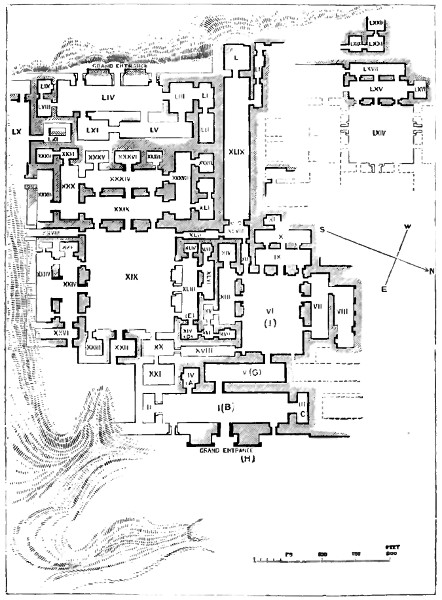
more to be regretted since Layard, in addition to many
E. and N. buildings found at Nimrood, noted at the
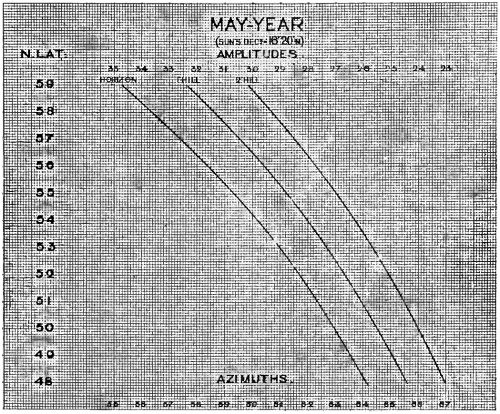
mound of Kouyunjik, the site of Nineveh, lat. 36° 20′ N.,
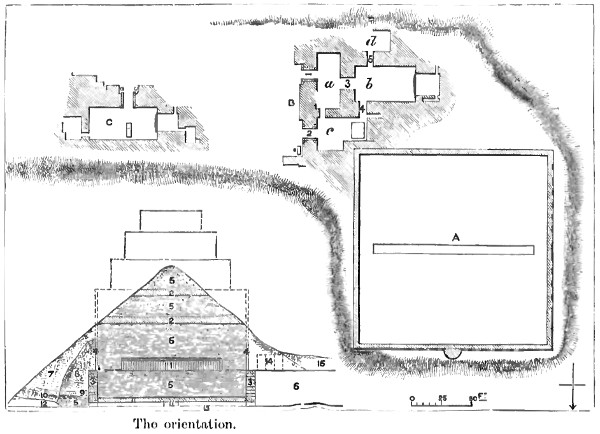
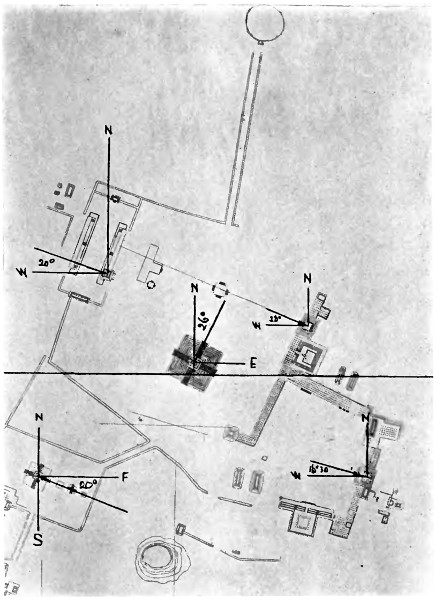
that Sennacherib’s palace, which appears to have been
built round a central temple, was oriented to the May
year.[91] (Az. N. 68° 30′ E. = Dec. N. 16°.)
Now, calling in the Babylonians as the originators of
what went on in Britain 4,000 years ago may seem
to some to be far-fetched in more ways than one;
but the Babylonians were a remarkable people; according
to some they originated all the voyaging of the early
world, though other authorities point out that the first
ships in the eastern seas must have been Indian.
Ihering[92] adduces a series of facts which indicate
clearly that the Babylonians carried on maritime
navigation at least as early as about 3500 B.C. But,
whatever this time was, the Semites and Egyptians had
already a rich culture behind them at a time when the
Aryans, whatever or wherever their origin, had not made
themselves a place in the world’s history. An ancient
sea connection between Babylonia and India may
explain the similarity of the British and Indian
folklore.
Some facts with regard to long distance ancient
travel are the following. Our start-point may be that
Gudea, a Babylonian king who reigned about 2500
B.C., brought stones from Melukhkha and Makan, that
is, Egypt and Sinai (Budge, History of Egypt, ii.,
130). Now these stones were taken coastwise
Sinai to Eridu, at the head of the Persian Gulf,
a distance of 4,000 miles, and it is also said that
then, or even before then, there was a coast-wise
traffic to and from Malabar, where teak was got to
be used in house- and boat-building. The distance
from Eridu coastwise to Malabar, say the present
Cannanore, is 2,400 miles.
The distance, coastwise, from Alexandria to Sandwich,
where we learn that Phœnicians and others
shipped the tin extracted from the mines in Cornwall,
is only 5,300 miles, so that a voyage of this length
was quite within the powers of the compassless navigators
of 2500 B.C.
The old idea that the ancient merchants could
make a course from Ushant to, say, Falmouth or
Penzance need no longer be entertained; the crossing
from Africa to Gibraltar and from Cape Grisnez
to Sandwich were both to visible land, i.e. coastwise.
The cliffs on the opposite land are easily seen on a
clear day.
Hence it would have been easier before the days
of astronomical knowledge and compasses to have
reached England, and therefore Ireland and the Orkneys,
than to get to some of the islands in the Mediterranean
itself.[93]
It is seen then that it is possible that Semites
might have built our stone monuments between 2000
and 1200 B.C., while it is quite certain that the
Aryans did not build them, if the archæologists are not
widely wrong in their dates.
Let us, then, begin our inquiries by considering the
information available with regard to the Semites. Let
us see in the first instance whether they had stone
monuments, and sacred trees and sacred wells; a
system of worship; and whether this worship was connected
with the sun and stars.
It is fortunate for us in this matter that one of the
most fully equipped scholars which the last century
produced, Robertson Smith, devoted his studies for many
years to The Religion of the Semites, and information on
the points raised is to our hand; all I need do is to
give as shortly as possible a statement of the various
conclusions he had reached on the points to which our
attention may in the first instance be confined. I quote
from his book The Religion of the Semites.
The Semites include the Babylonians, who spoke a
Semitic dialect, for there were Sumerian speaking peoples
among them, Assyrians, Phœnicians, Hebrews, Arabs
and Aramæans, who in ancient times occupied the
fertile lands of Syria, Mesopotamia and Irak from the
Mediterranean coast to the base of the mountains of
Iran and Armenia. They also embrace the inhabitants
of the great Arabian peninsula, which is believed to
have been the centre of dispersion.
The ordinary artificial mark of a Semitic sanctuary
was the sacrificial pillar, cairn, or rude altar (p. 183):
it was a fixed point where, according to primitive rule,
the blood of the offering was applied to the sacred
stones; or where a sacred tree, as we shall see presently,
was hung with gifts; the stones and tree being symbols
of the God (p. 151).
Further, it is certain that the original altar among
the northern Semites was a great unhewn[94] stone, or a
cairn, at which the blood of the victim was shed (p. 185).
Monolithic pillars or cairns of stones are frequently
mentioned in the more ancient parts of the Old Testament
as marking sanctuaries; Shechem, Bethel, Gilead, Gilgal,
Mizpah, Gibeon, and En-Rogel are referred to (p. 186).
There is evidence that in very early times the sanctuary
was a cave (p. 183). The obvious successors of a natural
cave are, (1) an artificial cave made in the earth like
the natural one, and (2) a model or representation of a
cave built of stone, with a small entrance which would
be barred, and covered over with earth, thus protecting
the priests from wild animals and the weather.
The dolmens and cromlechs which are found in the
Semitic area where there are stones doubtless had this
origin.
The use of a cave was probably borrowed both by the
Egyptians and Greeks (there is a cave, for instance, at
Eleusis) from the Semites.
In later times, when caves or their equivalents were
no longer in vogue and temples were erected, they
enclosed a Bit-ili or Beth-el, an upright stone, consecrated
by oil.[95]
We next learn (pp. 170 and 183) that no Canaanite
high place was complete without its sacred tree standing
beside the altar.
In tree-worship pure and simple as in Arabia, the
tree is adored at an annual feast (? May), when it is
hung with clothes and women’s ornaments (p. 169).
The tree at Mecca to which offerings are made is
spoken of as a “tree to hang things on.”
The references to “groves” given in the Bible as associated
with temple worship are misleading, “groves”
being a wrong translation of the word Asherah, which was
a pole made of wood which the Jews adopted from the
Canaanites. It was ornamented and perhaps draped, and
was most probably originally a tree. It may have been
used in the “high places” because single trees would not
grow there in the East any more than on the moors
in Devon and Cornwall.
The antiquity of this emblem is proved by Smith’s
statement (p. 171) that in an Assyrian monument from
Khorsābād an ornamental pole is shown beside a
portable altar. “Priests stand before it engaged in an
act of worship and touch the pole with their hands or
perhaps anoint it with some liquid substance.”
The draping of the tree seems to be proved by the passage
which suggested the mistranslation to me before I
wrote to some Hebrew scholars among my friends who
allowed me to consult them. The passage is as follows
(II. Kings, xxiii., 6, 7):—
“And he brought out the grove from the house of
the Lord, without Jerusalem, unto the brook Kidron,
and burned it at the brook Kidron, and stamped it
small to powder, and cast the powder thereof upon the
graves of the children of the people.
“And he brake down the houses of the Sodomites, that
were by the house of the Lord, where the women wove
hangings for the grove.”
To show how little variation there was in the Semitic
practices to those recorded in British folklore I may
state that one of my friends—one of the revision
committee—informed me that his impression was that
the Asherah was furnished with pegs or hooks, so that
the garments, &c., might be easily hung on it.
I next come to the sacred waters. A sacred fountain,
as well as the sacred tree, was a common symbol
at Semitic sanctuaries (p. 183). Nevertheless, they
were sometimes absent, the main place being given
to altar worship. Further, Robertson Smith was of
opinion that this altar worship did not originate with
tree [? or water] worship (p. 170); but still, sacred
wells are among the oldest and most ineradicable
objects of reverence among all the Semites, and were
credited with oracular powers (pp. 128, 154). The
fountain or stream was not a mere adjunct to the
temple, but was itself one of the principal sacra of
the spot (p. 155).
Undoubtedly there were ordeals among other things
at these wells (p. 163). One case is given in Numbers,
v., 17, where the words “holy water” occur, and
other water “that causeth the curse” is referred to.
Ordeal by water is not unknown among British customs.
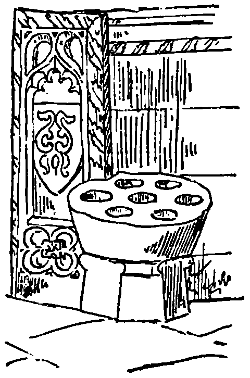
It is interesting to note that special sanctity was
attached to groups of seven wells (p. 167), and that
one such group was called Thorayga=Pleiades (p. 153).[96]
We may gather from this that one of the most sacred
times for Semitic worship was at the May festival,
marked by the rising of the Pleiades.
Although I do not find many references in Robertson
Smith’s book as to great festival days, there is other
evidence which shows that the May festival was the
greatest, and represented New Year’s Day. I have
already shown that the May-November year is the
one recognised in the present Turkish, Armenian and
I believe Persian calendars (p. 29). As this was the
year used at Thebes 3200 B.C., we may take it that
at that time it was universal in W. Asia and the
adjacent lands. The Jews afterwards adopted the
equinoctial year.
It seems highly probable that we may learn from
many passages in the Old Testament what the Semitic
temple practices were generally. There were sacrifices
of men and beasts, burnt offerings, and lighting of
fires, through which the children were made to pass.
I give some references to these fire practices.
“And thou shalt not let any of thy seed pass
through the fire to Molech.”—Leviticus, xviii., 21.
“There shall not be found among you any one that
maketh his son or his daughter to pass through the
fire, or that useth divination, or an observer of times,
or an enchanter, or a witch,
“Or a charmer, or a consulter with familiar spirits,
or a wizard, or a necromancer.”—Deuteronomy, xviii.,
10, 11.
“He walked in the way of the kings of Israel, yea,
and made his son to pass through the fire.”—II. Kings,
xvi., 3.
“And they caused their sons and their daughters to
pass through the fire, and used divination and enchantments.”—II.
Kings, xvii., 17.
“And he defiled Topheth, which is in the valley of
the children of Hinnom, that no man might make his
son or his daughter to pass through the fire to
Molech.”—II. Kings, xxiii., 10. (See also 4 and 5.)
Fire sacrifices which were interpreted as offerings of
fragrant smoke were prevalent among the settled Semites
(p. 218). Sacrificial fat was burned on the altar. Smith
remarks: “This could be done without any fundamental
modification of the old type of sacred stone or altar
pillar, simply by making a hollow on the top to
receive the grease, and there is some reason to think
that fire-altars of this simple kind, which in certain
Phœnician types are developed into altar candlesticks,
are older than the broad platform altar proper for
receiving a burnt offering” (p. 364).
With regard to the worship of the sun and stars
by the Semites, we read that the Semite addressed his
God as Baal or Bal. The simple form of Baal was
the sun.[97]
By the Semites the stars were, on account of their
movements, held to be alive; they were therefore
gods, and it was in consequence of this widespread
belief that the stars were worshipped (p. 127). The
worshippers “burned incense unto Baal, to the sun, to
the moon and to the planets, and to all the hosts of
heaven” (II. Kings, xxiii., 5). Job congratulated himself
that “his heart had not been enticed, nor his mouth
kissed his hand, if he beheld the sun when it shined,
or the moon walking in her brightness” (Job, xxxi.,
26-27). The worship of the morning star as a god
is the old Semitic conception (Isa., xiv., 12), “Lucifer
son of the Dawn.”
We gather from the later practices of the Saracens
that the sacrifices to the morning star could not be
made after the star had disappeared in the dawn.[98]
The God had to be in the presence of the worshippers.
The Semitic worship was generally carried on in
“high places”; in the Babylonian temples built in a
river valley the “high places” were secured by building
towers with the sanctuary on the top.
These high places were necessary because exact observations
of the risings of the heavenly bodies formed part
of the ceremonial, and a clear horizon was absolutely
imperative. That this was generally understood and
acted on is well evidenced by the fact that in the Old
Testament the mention of high places is nearly always
associated with the references to the religion of the
Canaanites and other Semitic nations as if the high
places were among the most important points in it.
Other arguments may be founded upon linguistic
considerations. Prof. J. Morris Jones[99] finds that
the syntax of Welsh and Irish differs from that of
other Aryan languages in many important respects, e.g.
the verb is put first in every simple sentence. Prof.
Rhys had suggested that these differences represented
the persistence in Welsh and Irish of the syntax of a
pre-Aryan dialect, and as the anthropologists hold that
the pre-Aryan population of these islands came from
North Africa, it seemed to Prof. Jones that that was
the obvious place to look for the origin of these syntactical
peculiarities. He finds the similarities between
Old Egyptian and neo-Celtic syntax to be astonishing;
he shows that practically all the peculiarities of Welsh
and Irish syntax are found in the Hamitic languages.
This conclusion practically implies that the bulk of
the population of these islands, before the arrival of
the Celts, spoke dialects allied to those of North
Africa. The syntactical peculiarities must have represented
the habits of thought of the people, which survived
in the Celtic vocabulary imposed upon them.
These conclusions were not known to me when I
began to see the necessity of separating the cult of
the June from that of the May year, and the
identity of the conclusions drawn from astronomical
and linguistic data is to me very striking and also
suggests further special inquiries.
It is also worth while to state that the Semites, including
the Hebrews and Phœnicians, did not burn their
dead. Finally, I may quote a remark made by General
Pitt-Rivers in the paper already referred to:—“If we do
not accept one old civilization as the origin of the various
practices, then we must assume accidental origins in each
country.”