IN my Enquiries into these works of the antient Druids in our island,
I observed a greater exactness in placing them, with regard to the
quarters of the heavens, than one would expect, in works seemingly so
rude; and in so remote an age, to which we must necessarily refer them.
What more particularly mov’d my attention, was a certain variation from
cardinal points, which I observed regular and uniform, in the works
of one place. And that variation was different, in works of another
place; yet equally regular and uniform in that place. Suppose (for
instance) the works about Abury in Wiltshire generally vary 9 or
10 degrees to the left hand, from cardinal points: i. e. westward
from the north. And the works at Stonehenge generally vary to the
right hand, from cardinal points, and that to the quantity of 6 or 7
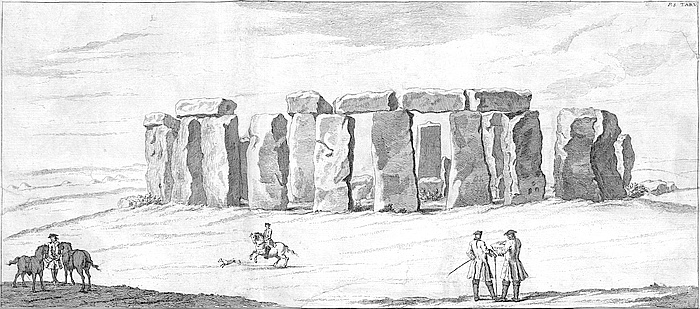
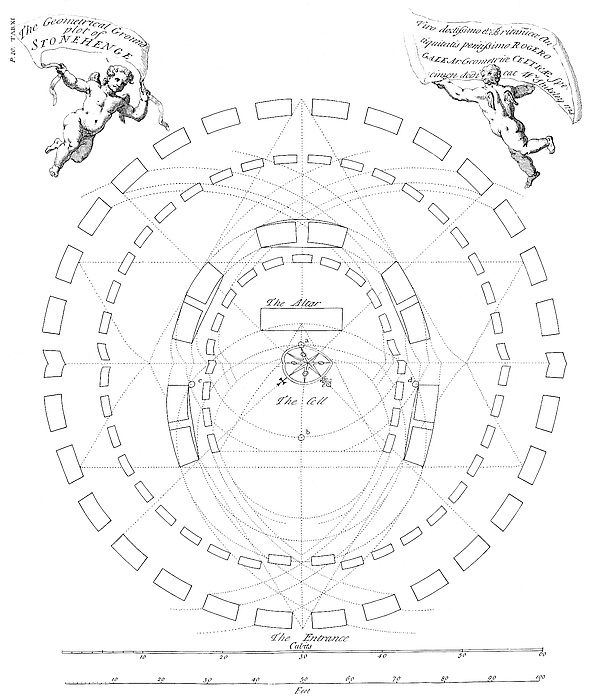
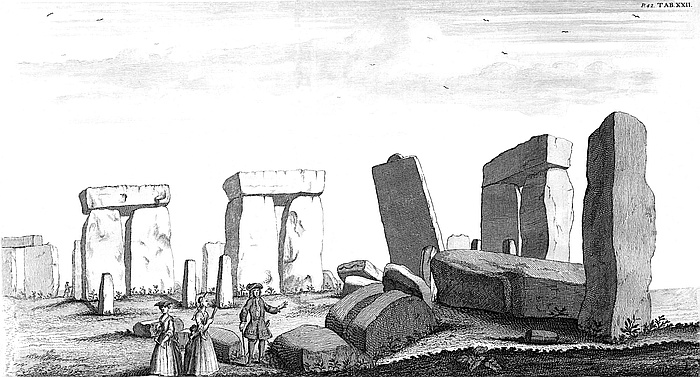
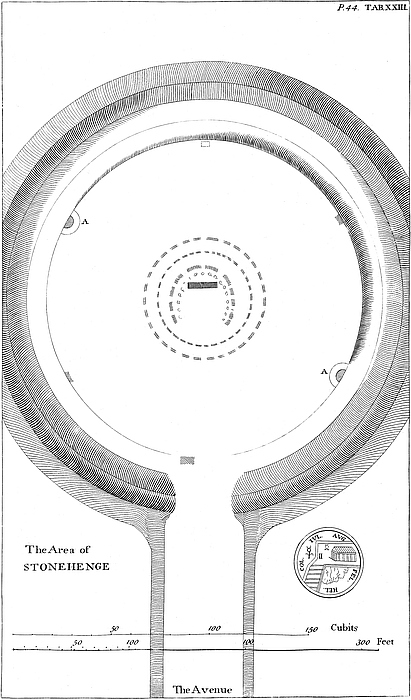
degrees. The principal diameter or groundline of Stonehenge, leading
from the entrance, up the middle of the temple, to the high altar,
(from which line the whole work is form’d) varies about that quantity
southward of the north east point. The intent of the founders of
Stonehenge, was to set the entrance full north east, being the point
where the sun rises, or nearly, at the summer solstice. As well because
that is the farthest elongation of the great celestial luminary,
northward; the complement of our earthly felicity, in ripening the
fruits of the earth: as because then they celebrated one of their
principal religious meetings or festivals, with sacrifices, publick
games, and the like. Such was the custom of all the antient nations.
The Isthmian, Nemæan, Olympian, Pythian games, famous in the
works of the learned nations: those of Tyre II. Maccabees iv. 18.
dedicated to their and our founder, the antient Tyrian Hercules, who,
I suppose, conducted the first Phœnician colony, with our Druids,
into Britain: these were all held at this time of the year. A custom
continu’d from patriarchal times.
This exactness with which the Druids set their works, and the
uniformity of their variation, make me believe, this variation was not
the effect of chance or negligence.
By a superficial reflexion upon it, we should be apt to suspect, it
was owing to their observing the sun’s rising on the longest day of
the year, or summer solstice, and setting their line by it. For this
is supposed to be a method by which they formerly set our Churches:
marking the sun’s rising at the equinox. But the Druids were too good
astronomers and mathematicians to need so mean an artifice: nor does
it correspond to the quantity precisely enough. Besides, this same
variation appears where it cannot possibly regard the sun’s rising at
that time.
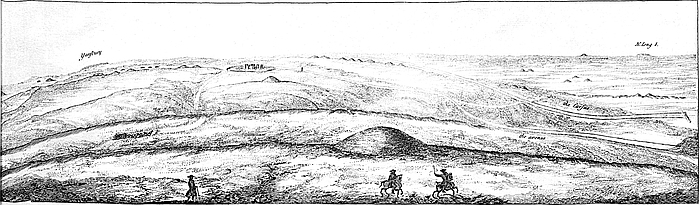
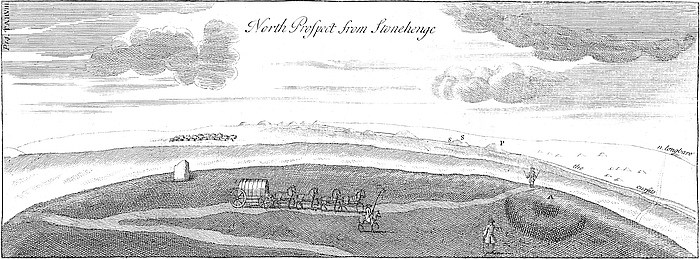
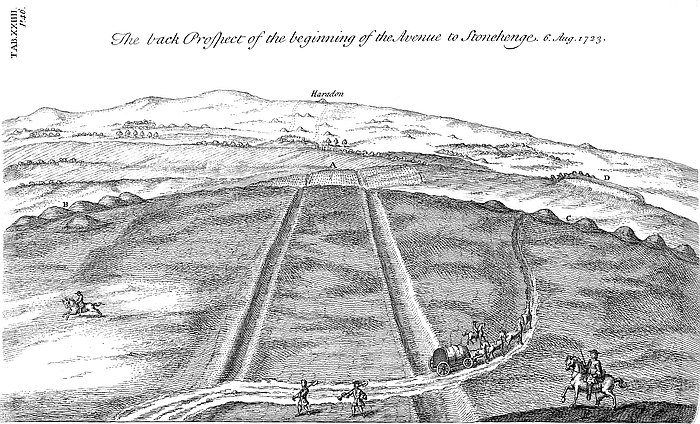
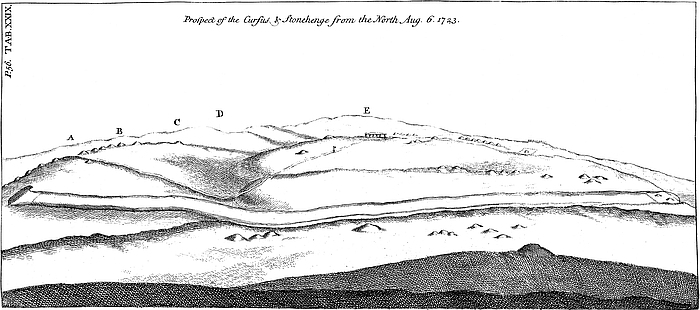
Prospect of the Cursus & Stonehenge from the North Aug. 6. 1723.
A. The Entrance of the Avenue. B. The 7 Barrows. C. The Kings
Barrow. D. Salisbury Steeple. E. Stonehenge.
For, I observ’d the like variation, or very near, in all the other
parts relating to this temple before taken notice of; beside the
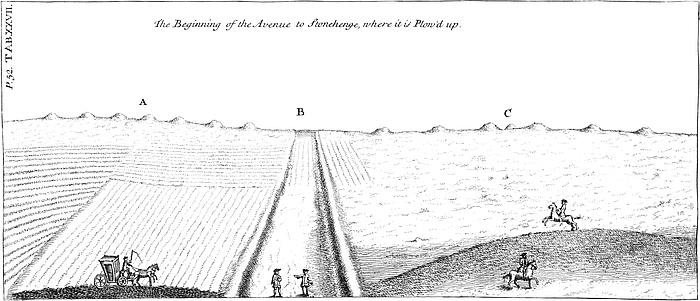
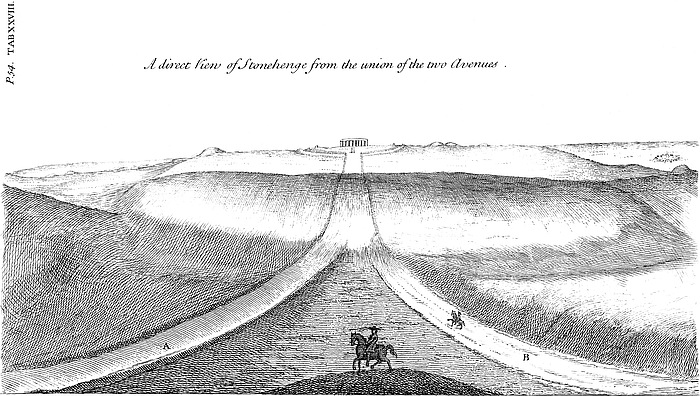
avenue leading up to the temple from the north east, in a strait
line; which has the before-mention’d variation all the way. At the
bottom of the hill, this avenue divides into two wings, each going
off from the last mention’d part, with a decent sweep; the one to the
left hand, westward, the other to the right hand, eastward. They go
off with a like angle, and that angle varies the like quantity. The
western wing goes to the cursus, before observ’d, the place upon the
downs, half a mile off Stonehenge, made for races with chariots and
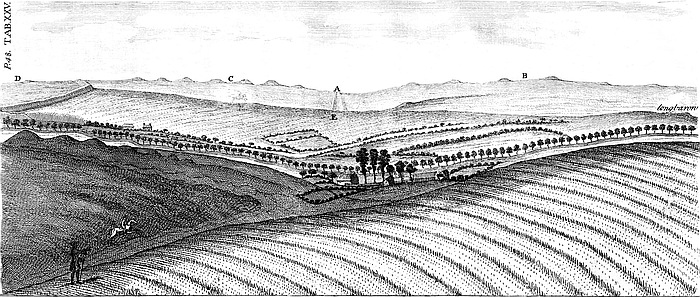
horses. The right hand wing of the avenue runs directly eastward for
a mile together, pointing to a place on an angle of the river, called
Radfin. This part of the avenue, which was intended by the founders,
to have been drawn precisely east and west, varies about 5 or 6 degrees
to the south.
Likewise, that great work of the cursus itself, which stretches its
length across the downs, from east to west, like a line of latitude
upon the globe, varies such a like quantity, from true east and west,
the same way. The meridian line of Stonehenge passes exactly through
the middle of this cursus.
Further, at the east end of this cursus, the huge bank of earth,
above 200 foot long, made across the end of the cursus, as a meta,
and whereon sat the princes and judges of the prizes: This bank of
earth is drawn exactly at a right angle with the cursus, consequently
due north and south, but with the variation before spoken of. These,
and other like observations here, as well as in other Druid Works,
appear’d to me no otherwise to be accounted for, but that the Druids
us’d a magnetical compass, in laying down the works: and that the
needle vary’d so much, at that time, from the true meridian line.
I remember I open’d this affair, near 20 Years ago, to Dr. Halley,
who was of the same sentiment. Nor am I the first who suspected the
Phœnicians of old were possessed of this great secret, as well as the
Chinese, from times immemorial. I am not moved to think otherwise by
what Bochart writes against it. The very name of the magnet lapis
Heraclius strongly suggests, the Tyrian navigator before-mention’d
knew it, as is well argued by Fuller in his Miscellanies, IV. 19.
And many things occur, in the mythology of the antients, wherein (if
I mistake not) I discern most evident traces of this knowledge of
the directive power of the magnet. We are not to despise the fables
of the antients, but to make the best use of them, and search out
for their latent truths. My predecessor Cumberland, observes in
Sanchoniathon, p. 325. “that Apollodorus (for instance) hath
many truths in his mythic history, deriv’d from the tradition of
Phœnicians and Egyptians, planting Athens.” And the Greeks,
those happy practitioners in writing, as well as other arts, took the
unlucky turn of the marvellous, to so exorbitant a degree, as to
write nothing without it. In Apollodorus, put out by the learned Dr.
Gale, p. 114. we have an account of the 10th labour of Hercules,
his conquest of Cadiz, or Gadira, as then call’d, or Erythea.
We are told, the hero set up the 2 pillars at the Streights mouth, at
Gibralter, or then Tartessus; which we may reasonably suppose some
temple made of these rough stones, or some main ambres, like those
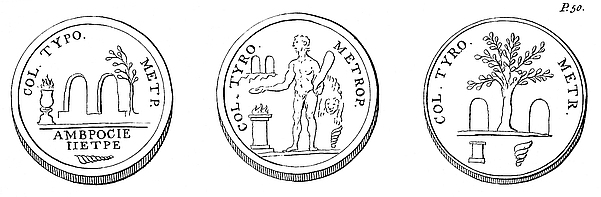
we mention’d before, the petræ ambrosiæ in the Tyrian coins. Then,
says our author, going on his journey, “the rays of the sun were so
vehement upon him, that he had the boldness to draw his bow against
him. The god admiring the intrepidity of the man, gave him a golden cup
with which he sail’d over the ocean.” Pisander in his IId. book, (in
Atheneus Deipnos. XI.) writes the same, only that Oceanus lent him
the cup. Panyasis in his I. of the history of Hercules, says, he
begg’d it of Nereus, son of Sol, and with it sail’d to Erythea.
(Macrob. Saturn. XXI. 5.) Theoclytus, in Atheneus aforesaid, in
his II. de tempest. mentions the same thing. He said it before in
his Titanomachia. Pherecydes, in his III. of history, quoted both
in Atheneus and Macrobius, tells a story somewhat like that of
Apollodorus, but more particular. Servius Æn. VII. mentions it,
but as some of the former, makes the cup of brass, instead of gold.
Alexander Ephesius the like. All very ancient writers. Lucian says,
that Hercules sail’d in a sea-conch shell. What can we understand by
all this, mention’d by so many grave authors, but a compass-box, which
enabled him to sail the great ocean, and penetrate to our northern
island, less obnoxious to the suns vehement heat? Add to this, in
the same place, Apollodorus speaks of his fighting Albion and
Dercynus, by Mela, called Bergion, Sons of Neptune; which were
the most antient names of the Britannic Isles, before the name of
Britain. Diodorus Siculus, in his IV. book delivers a like account
of this 10th labour of Hercules, but in a mere historical manner.
And adds, that when he return’d by Sicily, he dedicated a grove to
Geryon the hero, where, to his time, the people did religious rites.
For this affair of sacred groves, we know our Druids were famous.
He built a temple likewise at Gades. We are not to suppose it a
cover’d edifice, like what posterity call’d a temple, but an open one,
according to the mode of those days. Cover’d temples, at that time,
being a thing unknown in the world. Afterward, a magnificent temple,
properly, was there built to him. Mela witnesses, that it was our
Egyptian Hercules, who was there worshipped. For I suppose our
Egyptian and the Tyrian Hercules to be all one. The same mention’d
by the name of Assis, in Manethons XVII. Dynasty, in Josephus
c. App. in Africanus, Eusebius, and Syncellus. Apollonius II.
14. writes, it was not the Theban but the Egyptian Hercules that
came to Gades: which is confirm’d by Hecateus. And Herodotus,
in Euterpe says, Hercules is a very antient deity among the
Egyptians, not so, among the Greeks. And I suppose this hero lived
at, or very near the time of the patriarch Abraham.
These were the times about the beginning of idolatry. And Hercules
was far from being an idolater himself, though worshipp’d afterwards,
for his great exploits, and perhaps on this very account of his
inventing or knowing the use of the compass. This is the Hercules
kneeling on one knee, a constellation in heaven, taken notice of by
Dionysius Halycarn. by Tzetzes, Hyginus, Æschylus and others.
It seems to indicate his piety; for which the astronomers his disciples
plac’d him in the heavens. He kneels upon the arctic circle, and
supports the zodiac on his shoulders; tho’ this is not understood by
the painting on our modern globes. The Phœnicians, his successors
in the tin trade of Britain, kept the trade and the very name of
the Island as a great secret; as well as the use of the compass, till
it was lost with them. But it seems highly probable, because Lucian
describes Hercules with a sphere in his hand, that he affixed the
present Asterisms of the zodiac: and his successors, the Phœnicians,
propagated them.
’Tis next to our present purpose, to consider that famous oracle of
Jupiter Ammon in Africa, to be referr’d to the most early times
of idolatry: render’d illustrious by Alexander the Great taking a
journey to it. Which gives us the opportunity of knowing somewhat of it.
Quamvis Æthiopum populis, Arabumq; beatis
Gentibus, ac Indis, unus sit Jupiter Ammon. Lucan.
All these nations, with Egypt and Africa, were peopled by the
posterity chiefly of Ham. They were the first that fell into
idolatry, and worshipped their common progenitor, call’d Amynus, in
Sanchoniathon. Hecateus says, Amoûn, as the Egyptians write
it, is the word of those that invoke god, and that they meant somewhat
very mysterious by it. The history of its origin is this. Bacchus,
the hero, or demigod, travelling through the sandy desarts of Africa,
with a great army, was perishing with thirst; he pray’d to his father
Jupiter for relief, who sent a ram that show’d him a spring, sav’d
him and his host. Out of gratitude, the hero builds a temple there, to
the deity who thus aided him under the form of a ram. There is no
room to doubt, that this is in part copied from the transaction of the
children of Israel, in the Arabian wilderness. They have added to
it, a name and notion borrowed from patriarchal tradition, of a divine
person, symboliz’d by a ram; horned, anointed, which is all one. We
christians mean Messiah. Innumerable passages in old authors, which
I might cite, innumerable monuments of antiquity in sculpture, shew,
that Jupiter Ammon was figur’d as a ram, with a ram’s head, with rams
horns. They applied the patriarchal notion of the Messiah, to their
progenitor Ham, in an idolatrous way: and deified him under that
character. There is a very remarkable passage in Herodotus, which, it
is worth our while, to transcribe.
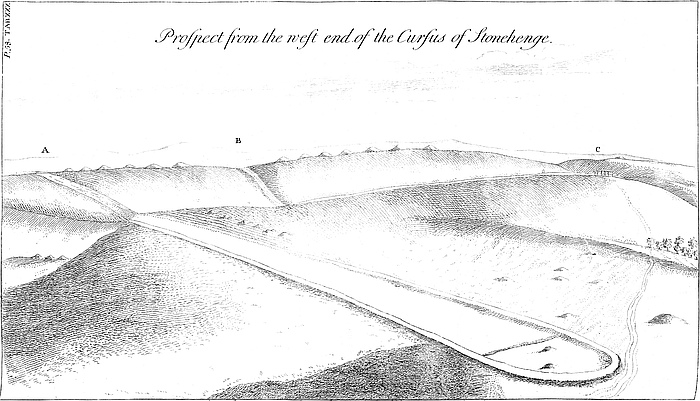
Stukeley d.
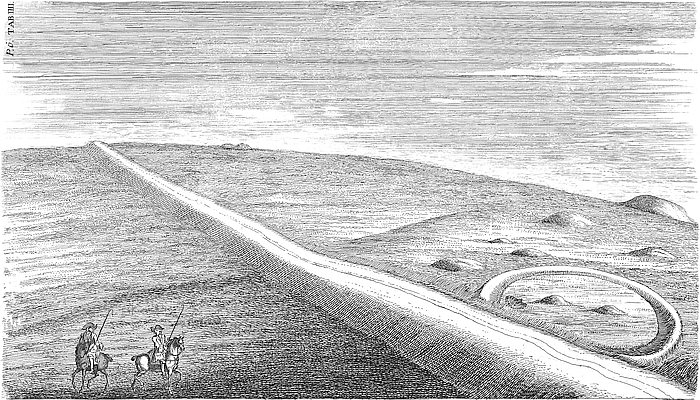
Prospect from the west end of the Cursus of Stonehenge.
A. the eastern meta. B. the eastern wing of the avenue. C.
Stonehenge.
In Euterpe cap. 42. that author tells us, why the Theban Egyptians
pay so great a regard to the sheep. “Hercules on his importunity
to Jupiter, that he might have the honour personally to see him,
at length prevail’d. And the god consented to exhibit himself to his
view, under this device. viz. Jupiter cut off a ram’s head, put the
skin over his own head, and thus appear’d to Hercules. Whence the
Egyptians made the statue of Jupiter, with a ram’s head, and call
Jupiter Ammôun. Whence they hold sheep for sacred animals, never kill
them but once a year, upon the festival day of Jupiter, when only one
ram is sacrificed, and his head put upon the statue of Jupiter; all
that are there present, beat the ram, and at last he is buried in a
sacred urn.”
It is impossible not to see, that this is derived from that history
recorded, Exodus xxxiii. Moses desires of Jehovah repeatedly,
that he might see him. He calls it seeing his glory. He is answer’d at
length. “I will make all my goodness pass before thee, and I will
proclaim the name of Jehovah before thee. Thou canst not see my
face, but I will put thee in a cleft of the rock, and cover thee with
my hand, whilst I pass by. Thou shalt see my back parts only.” Here he
notoriously promises Moses, that he shall see him, in a symbolical
form. In the next chapter, Jehovah descended in the luminous cloud,
or Shechinah, and proclaimed the name of Jehovah; recites those
attributes that relate to his dealings with mankind, in the strongest
point of light; “his goodness and mercy, and long-suffering, forgiving
iniquity, transgression and sin: but adds, he will by no means clear
the guilty, but visit the fathers iniquity upon the children.” Wherein
our original and fatal transgression is sufficiently intimated, and
that God’s justice is equal to his mercy; and the necessity of a divine
redemption by sacrifice, which in scripture language is call’d, “the
lamb slain from the foundation of the world.”
All this the most ancient nations had a knowledge of, from patriarchal
tradition. When they laps’d into idolatry, they applied these good
notions to their new idolatry, and made statues from the symbolical and
figurative forms of speech, us’d in true religion. Their sacrificing
the ram on the festival day of Jupiter, their beating the ram,
putting his head on the statue of their deity, burying him in a
sacred urn: all most evidently pointing out the notions they had, in
the most early times, of the suffering state of the Messiah. And
such was the origin, in short, of Jupiter Ammon. But it appears,
by what learned authors write, on Curtius’s description of his
statue, that a magnetical compass box made one considerable part of
his sacreds. This we read in Hyde Pers. relig. p. 495. in Curtius
publish’d by Pitiscus, and by Rader the jesuite, and Schottus
in Ortelius, by Fuller, Herwart and others. “This compass box
with the statue of the deity, was set in a golden ship (the golden
cup of Hercules) and carried in procession on the shoulders of the
priests, accompanied by women singing an hymn in their own language.”
I doubt not, but the circumstance of carrying this golden ship, on the
shoulders of the priests, is an imitation of the Mosaic ark in the
march of the Israelites, thro’ the wilderness, during their forty
years pilgrimage. Tho’ they mistook the reason of the thing; the
Jewish church then being in a military and travelling state. But
where the camp rested, the ark was reposited, in the adytum of the
tabernacle: so likewise when in possession of the land of Canaan.
This is sufficient proof, that the Lybians herein, copied after the
Israelites, not vice versa, as our moderns are willing to think, in
these cases.
Curtius tells us, the habit of Ammon’s statue was made of Smaragd
and other precious stones, wrought in Mosaic work. Which I take
to be too, in imitation of the pontifical attire, under Moses’s
administration: particularly of the sacred, oracular pectoral, made
of Mosaic work, with gems. I apprehend, that beside the statue of
Ammon, there was a figure of (the upper part at least of) a ram, on
the compass box: which was the oracle. And it is easy to guess how this
may be managed for the purpose; even beyond the trick of Januarius’s
blood, and other Popish devices.
Hence we may better understand the famous golden fleece, which
occasioned the Argonautic expedition, one of the earliest and most
memorable Æra’s of the Grecian history. If we suppose this golden
fleece to be a compass box, we see the reason why the choice youth
of Greece set out upon that voyage: which, as all other matters of
ancient history, among the Greeks, is so unaccountably puft up with
the leaven of fable. It became navigators to run any hazard for such a
treasure. If we enquire into its origin, it is thus. Phrixus son of
Athamas and Nepheles (according to the Greeks) had a ship given
him by his mother. The ship is call’d in the fable a golden ram, or
the ram with a golden fleece (the same thing as Hercules’s golden
cup.) In this, he and his sister Helle, flying the ill-usage of
their mother-in-law Ino, sail away by sea. Helle affrighted in the
voyage, falls overboard and gives name to the Hellespont. Phrixus
continues the voyage, and goes to Æetes king of Colchis, where he
hangs up his golden ram in the temple, to Jupiter Phyxius, (one
would be apt to imagine they meant Pyxius, alluding to the box.)
Jason made his far-fam’d expedition thither afterward, and stole
it. But the ram was placed in the heavens, among the constellations,
as a memorial; the first sign in the Zodiac: which shews the high
antiquity of the story.
This account manifestly pretends very great antiquity, and some signal
event. I observe this Ino their mother-in-law, is said to be the
nurse of Bacchus, and throwing herself with her son Melicerte
into the sea, became a goddess, under the name of Leucothea. Her
son became a god, under the name of Palæmon. This Melicerte is
allowed by all the learned, to be no other than our Melcartus
above-mention’d. Palæmon is Hercules, says Hesychius. Palæmon
is his name of deification. Pausanias in the beginning of his
corinthiaca informs us, this apotheosis of Ino and Melicerta
was the occasion of founding the famous Isthmian games. Plutarch
says the same, and Phavorinus. Again, I observe, Phrixus is said to
be son of Nephele (a cloud) whence call’d nubigena by Columella.
We must hence expect somewhat very secret and obscure. Further, all
writers say openly this ram or ship of Phrixus was oracular and
could speak upon occasion. So all the writers of the Argonautics too
will have the ship Argos to be loquacious and oracular. Magnes
another name of the load-stone is often call’d Adamas, which seems
to be no other than Athamas. Apollodorus makes Magnes the son of
Æolus, who marrying Nais, inhabited the isle Seriphus. Æolus
was a great sailor, invented sails, and studied the winds, therefore
deified and made the god of the winds. I suppose it all ends in the
mysterious invelopement of the knowledge of the magnetic compass.
I hope for the readers candour, in reciting thus much from antient
fable, which I did as concisely as possible. But in matters of obscure
antiquity, we must make use of all helps. And in heathen antiquity we
have no other. A strictly historical way of writing in former times, is
only to be expected in the sacred canon of the Jews. And what is
remarkable, after God’s holy spirit had deserted them, their writers
became the greatest fablers in the world, and, if possible, out-did the
Greeks, in that way.
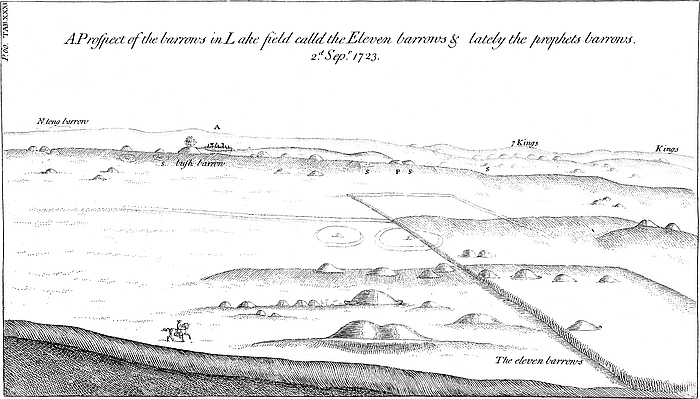
Stukeley d.
A Prospect of the barrows in Lake field called the Eleven barrows &
lately the prophets barrows.
2d. Sepr. 1723.
A. Stonehenge .P. barrow open’d by. L. Pembroke. SS. by
Stukeley.
One would imagine, the fashion of these most antient charts, was to
divide the circle into 12 parts, and affix the celestial signs of the
zodiac to them; beginning with the east at aries, where the sun
rises at the equinoxes; and thence they might call the box by the
name of aries, as shewing the east where aries is plac’d. As now
the Turks and Arabians call it kibla noma, i. e. shewing the
kibla, or south point, the way toward which they turn their faces
in devotion. So we only enquire for the north point; and call it the
lode-stone, because it shews the lode-star or north pole. But ’tis all
one; any one point in a circle being found, the rest are found too.
From what has been said, it seems probable, that the fable of the hero
finding out the spring in the sandy desarts of Africa, by the help
of a ram sent from Jupiter, means the travelling over those immense
plains by the help of a compass, which they call’d by the name of a
ram, or a golden ram. And that the possessors of the antient oracle
of Ammon had such a secret, which they cunningly applied to the
sacreds of their deity. Probably, in that most early age, they had not
improv’d the use of it to the pitch and manner that we enjoy, with a
needle; and that set upon a central pin: but having found out the
veracity of the magnet, they put it into a boat, which was to swim on
water, and therein it would have liberty to turn itself to its proper
direction. And this is the sentiment of the learned Dr. Wallis, in
the Philosophical Transactions, No. 278. This boat was the better
a handle for the mythologists to call Hercules’s vessel a golden
cup, because cups were made in the shape of a boat, and had the same
denomination, cymbium.
Those learned commentators upon Curtius abovementioned agree, there
was a stone along with the statue of Ammon, carried about in the
golden ship; and perhaps, hence the antient navigators took the hint
of applying the figure of the ram to their compasses, however form’d,
and gave it the name of the ram, or golden fleece, which the Greek
fables, their most antient history, ring of: and hence their ships
deriv’d their oracular quality. Phrixus’s ship, the golden ram,
being said to speak on occasion, as well as the ship argos. The
stupendous properties of this stone, without difficulty, would persuade
even those above the vulgar, that there was a divine principle in it,
quite metaphysical, consequently oracular. And in the dawnings of
idolatry, the evil agent who was vigilant to pervert every thing to
his own purpose, would not fail to make great use of the secrets of
the magnet. The intire notion of oracles among the heathen, is caused
by the devil’s mimickry of God’s transactions among the patriarchs
and the Jews. But I believe the Egyptians took their notion of
carrying a boat in all their religious processions, from this magnetic
boat, of which both Herodotus and Plutarch inform us. For they
intended it to signify the movement and descent of the divine ideas
from the supreme mind; especially the very fountain and principal of
those ideas: and it must be own’d to be admirably well chose. Hence
the top and the bottom of the verge or limbus of the celebrated
Isiac tablet, is adorn’d with a boat. In one a ram, in the other
a bull. Meaning the origin of the chain of ideas flowing from the
divine mind. ’Tis highly probable, that with the ram is the copy of
Jupiter Ammon’s boat, mention’d by Curtius. And I suppose this is
Herwart’s opinion, but I have not yet seen his book. Of this I shall
discourse larger in my explication of the Bembin table. However
Herodotus tells us in his II. book, that the temple of Jupiter
Ammon took its rise from Phœnicia. I only mention this for the sake
of those that are over acting the credit of antiquities in Egypt.
We learn in Plutarch’s discourse de Isid. & Osir, that the ship
argos of the Greeks, was in reality the ship that our Hercules
sail’d round the world in. Further, this oracular ship has its name
argos, says my friend Mr. Baxter, gloss. ant. rom. from the
Hebrew and Syrian word argan, an ark. Which confirms what I
said above, concerning the carrying about the ship of Ammon on the
shoulders of the priests. Strabo in II. of his geography, mentions
the temple of Leucothea, built by Phrixus at Colchos; that there
was an oracle there; and that the sheep was never slain at the place.
This shews its relation to that of Jupiter Ammon. Leucothea is the
name of consecration of Hercules his mother, Hercules himself being
call’d Palæmon; both made sea deities: from the extraordinary fame
of Hercules, the first and great sea captain. Pausanias in Atticis
says, he was buried in the Corinthian Isthmus; where the Isthmian
games were kept to his memory. But Mela writes, that his remains
were at Gades. It’s probable there was only an honorary monument of
him at the Isthmus, as founder: as the honorary monument of Jolaus
mention’d to be among the Thebans, by the Stadium, p. 42.
Mr. Baxter in gloss. ant. rom. v. ascania makes Phrixus to be
Aphricus, and the same person as Jupiter Ammon, or the founder
of the temple of Jupiter Ammon; rather, of that prior to Jupiter
Ammon. We are not to regard the little artifices of the Greeks, who
draw all celebrated events and persons of antiquity, into their own
country. Aphricus, no doubt, is the Aphre before-mentioned, son
of Midian, son of Abraham; whom Cleodemus makes an associate of
Hercules, in his Lybian wars. Josephus makes him the conqueror
of Lybia, and that he gave name to Africa. ’Tis not unlikely
but that he is the hero that travell’d over these barren sands by
the help of the compass, as his countrymen the Arabians have from
times immemorial practised, in travelling over their own desarts. And
might probably erect a patriarchal temple there; and in times of his
posterity it degenerated into the idolatrous temple of Jupiter Ammon.
And there the compass box of the hero remain’d, and was converted into
part of the heathen sacreds.
’Tis no very strange matter, if they at another time call this same
hero Bacchus, therein confounding him with the like travels of the
Israelites, through the Arabian desarts. We are not to expert these
histories of old times involv’d in fable, absolutely consistent. But
if this account be agreeable to truth or near it; then we may imagine
the same Aphre, by the Greeks call’d Phrixus, according to Mr.
Baxter, pass’d the Hellespont, made the expedition into Colchis,
and built a like temple there. And a compass box called the golden
ram, was made alike part of the object of their adoration. This is
exceedingly confirm’d by the report of Herodotus and Diodorus S.
who say, the Colchi practised the rite of circumcision, a matter
which the learned cannot account for; but appears plain from hence:
these being the descendants of Abraham. They say, at the same time,
that the Ethiopians practise the like: and that ’tis no recent custom
among them, but from the beginning. I apprehend by Ethiopians are
meant Arabians, who are people descended from Abraham. Herodotus
says likewise the Egyptians circumcis’d, which must be accounted for
in this same manner; some Arabian or Ethiopian nation bringing
the custom among them. As a further confirmation of Phrixus being
Aphricus, Bochart shews the Colchic and Hebrew tongue is much
a-kin. And thus we may account for what Mr. Toland, p. 133. says,
that the idiom of the Irish language (which we suppose the remnant of
the most antient oriental,) has a mixture of Arabic in it.
I saw a book in Dr. Mead’s library, Museo de las medallas
desconocidas Espanolas, p. 35. No. 82, 83. are two ancient unknown
medals, such as they often find in Spain. The first a head (not of
the best workmanship) on the obverse, young, but heroical enough, a
necklace on. Behind it Α Φ Ρ Α in the old Phœnician character, like
the Samaritan. Reverse a horseman, and under the exergue another
word in like Punic character. The other No. 83. has the same head
in the obverse, but without the necklace: and Α Φ Ρ Α before, in plain
Greek, behind a dolphin. The reverse as the last. There is another
such coin in the same book, no difference, but the name and dolphin
transpos’d. I verily believe this is our Aphra, or Apher in our
English translation call’d Epher, Gen. xxv. 4. struck by some
city in Spain, who acknowledged him their founder.
P. 62. TAB. XXXII.
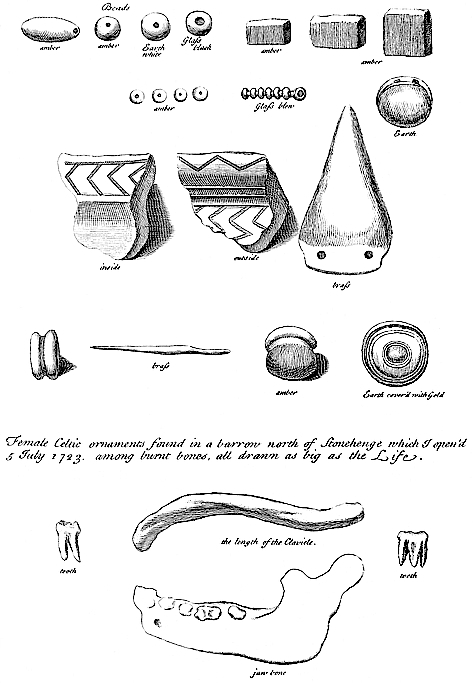
Female Celtic ornaments found in a barrow north of Stonehenge which I
open’d 5 July 1723. among burnt bones, all drawn as big as the Life.
It is remarkable enough, what Mr. Norden writes, in his history of
Cornwall. The Cornish men universally suppose that the Jews
are the people who first work’t in their rocks, for tin: and in old
neglected tin-works, they find some of their tools. The workmen call
them attal sarazin, the Jews cast off works, in their Hebrew
speech, says Norden. Now I apprehend he means our Arabians: and it
is a circumstance confirming the former notions. And to it we may refer
the origin of the odd reports, of our Stonehenge coming from Africa
and the like. By the Greeks, Hercules Melcartus or Melicerta,
and Phrixus or Apricus are made half brothers: by Josephus,
Hercules is son-in-law to Aphricus. The Phœnicians paid tythe. So
the Arabians, in Pliny, the like: being patriarchal customs.
Aphricus or Phryxus we may very well suppose to be father of the
Phrygians. And his expedition thro’ the propontis to the Euxine
sea, the Greeks colour over with their Helle and Hellespont. But
we cannot entertain too high a respect for him, because I see it no
less reasonable, to refer the origin of the Britons to him. I mean
that eastern colony that came hither with Hercules, upon the old
possessors or aborigines Albionites, which gave the more famous name
of Britain to the island. The Brigantes is the same name, says Mr.
Baxter the common and more ancient name of this people: who being
driven northwards by inundations of foreigners from the continent in
after times, the name became more appropriate to the inhabitants of
Yorkshire and the neighbouring counties. In Tacitus the Brigantes
are called maxima Brittanorum natio. At the same time they forc’d
the ancientest possessors, the Albionites or Albanians still more
northwards. Likewise many of these Brigantes pass’d into Ireland,
where they became a famous nation. The Bryges, Phryges, Phrixi,
Brisones, Brigantes, Britones are intirely synonimous words in
different dialects. And this assignment of the origin of our ancestors,
very well accounts for that notion of their Phrygian or Trojan
descent, so riveted in the minds of the old Britons. A notion which
prevail’d among some of the Gallic nations on the continent, and they
had retain’d the memory of it, in the time of Ammianus Marcellinus,
who mentions it. Likewise in Cæsar’s time, some Gallic nations,
claimed kindred with the Romans; probably upon this very account.
This is, in short, some presumptive evidence we have, of Hercules
and Aphricus planting Britain, introducing the Druids with the
patriarchal religion: and concerning the knowledge they had of the use
of the compass. This whole matter will be further considered, when I
come to treat of it expressly. At present we will continue the history
of the compass, as it became more fully known to the world.
Martinius in his Atlas, and Gilbertus de magnete, Lib. I.
2. show us, the Chinese have us’d the magnetic needle from times
immemorial: that they have a trick of telling fortunes with it: as
the heathen afore-mentioned made it oracular. The Arabians likewise
have us’d it, for travelling over the great and wild desarts, of
weeks together, where there is no track to guide them; nor have
they any notion of time when they began this practice. Herwartius
published admiranda ethnicæ theologiæ, wherein he endeavours to
prove that the old Egyptians had the use of the magnetic needle,
and that the Bembin table contains the doctrine of it, invelop’d
in hieroglyphicks. The learned Fuller in his Miscellanies Lib.
4. 19. asserts, that the Phœnicians knew the use of it, which they
endeavour’d to conceal by all possible means, as they did their trading
in general. That it was lost with them, as many other arts, their ars
plumaria, the dying of purple, (the invention of our Hercules of
Tyre) the Hebrew poetry, and other curious knowledge, which is
perished.
’Tis not unlikely that the lodestone being applied to religious use,
was one cause of its being forgot: together with the secrecy of the
Phœnician voyages. Suetonius in Nero, speaks of a prophetic
needle, which the emperor us’d to pay his devotions to. The learned
Burman shews, that most, or all of the old MSS. and printed books,
read it acuncula, acucula, or acungula; which, in my opinion, the
criticks have causelesly corrected into icuncula: because they had no
notion of the magnetic needle being understood by it.
Monsieur Fauchet, a famous French antiquary, in his antiquities of
France, quotes some verses from a poet in that country, who wrote A. D.
1180, wherein is as plain a description of the mariner’s box, as
words can make. The poet mentions it by accident, not as a thing new
and strange. Osorius in his discourse of the acts of king Emanuel,
refers the use of the compass among the Europeans, to Gama and
the Portuguese, who found it among some barbarous pyrates, about
the Cape of Good Hope; who probably were some remains of the old
Phœnicians, or Arabians, or at least have preserved from them, this
practice. About A. D. 1260. Paulus Venetus is said to have brought
it from China; by the great author on the magnet, our countryman
Gilbert. Genebrand in his chron. says, the use of the lode-stone
reviv’d among us about A. D. 1303. by Fl. Melvius a Neapolitan,
and others attribute it about that time to John Goia a Neapolitan.
Joseph de Costa says, some Mahometan seamen whom Vasquez de
Gama met with near Mosambick, who had sail’d those seas by the use
thereof, taught it him. I observe our ancient Britons, the Welsh,
call a steers-man or pilot llywydd, whence no doubt comes our
English word lode-stone, and lode-star, the north-pole. Llyw is the
helm of a ship in British. Lodemanage in Skinner’s etymology an
old English word, signifying the price paid to the pilot. Our lords
of the Cinque Ports keep a court at Dover, by that name. These
things seem to indicate some memorial of the magnet left among the
Welsh, from the oldest times: and of its application to sailing.
Thus have we given a kind of history of this prodigy in nature, the
magnetic needle: to confirm, our suspicion, that the British Druids
knew the use of it, and used it in these works of theirs, which we
have been treating of. We learn in the Philosophical Transactions,
Lowthorp, Vol. II. p. 601. that there are considerable veins of the
magnet, in our own country, in Devonshire; where the Phœnicians and
Druids must needs be very conversant.
We return now to our first subject Stonehenge, and apply what has
been said, to the observation we there made. It is not to be thought,
that the Druids, men who employed themselves in those noble studies,
which Cæsar gives us an account of, and who were at the pains of
bringing these vast stones together, from such a considerable distance
of 16 miles: I say, it is not to be thought, but that they would be
nice and exact in placing them. And this, not only particularly, in
respect of each other, upon the projected ground-plot: but also in
general, in respect of the quarters of the heavens. And this I found
to be a just surmise, when I examined their works for several years
together, with sufficient accuracy, with a theodilite. As I took
notice before, the works of one place regarded the cardinal points,
but with a certain uniform variation therefrom. Whence I grounded my
conjecture, that they were set by a compass, which at that time varied,
according to that quantity observ’d. Of which property of variation
we may well suppose, the Druids were ignorant. This I now propose for
the rule of investigation, of the time when Stonehenge was erected.
Hoping the reader will judge as favourably of the attempt, as things of
this great antiquity require.
Stukeley delin.
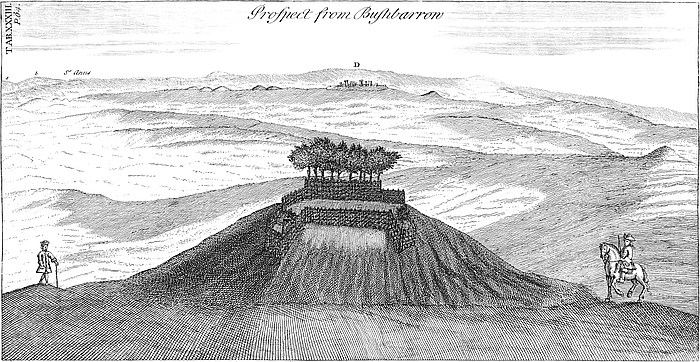
Prospect from Bushbarrow
a. Rundway hill b. Oldbury D. Stonehenge.
The variation at Stonehenge is about 6 or 7 degrees, from the north
eastward. I have in order to form our hypothesis, set down a scheme of
the state of the variation in England, from the best observations
I could meet with. Dr. Halley takes notice, that the variation at
Paris is always 2 degrees and a half more easterly than with us.
Orontius Finæus in 1550 observ’d it to be there, about 9 degrees,
easterly, therefore to reduce it, I have stated it at 11 degrees 30.
and from thence continued it, to the present time, as in the ensuing
table.
| Anno Dom. |
Observation. |
Variation.
deg. min. |
1550 |
By Finæus |
11 30 |
east. |
1580 |
Mr. Burroughs |
11 15 |
east. |
1600 |
|
8 0 |
east. |
1622 |
Mr. Gunter |
6 0 |
east. |
1634 |
Mr. Gellibrand |
4 5 |
east. |
1642 |
|
3 5 |
east. |
1657 |
Mr. Bond |
0 0 |
|
1665 |
Mr. Bond |
1 22 |
west. |
1666 |
Capt. Sturmy |
1 27 |
west. |
1667 |
Capt. Sturmy |
1 33 |
west. |
1672 |
Dr. Halley |
2 30 |
west. |
1683 |
|
4 30 |
west. |
1685 |
|
5 5 |
west. |
1692 |
|
6 0 |
west. |
1723 |
|
11 0 |
west. |
1733 |
|
12 0 |
west. |
1740 |
|
15 45 |
west. |
By this table it appears, that in the space of 180 years, the variation
of the magnetic needle in England, has shifted from 11 degrees and
a half eastward, to 11 degrees and a half westward. In 90 years the
medium of those extremes, which was 1657, there was no variation at
all; the needle pointing due north and south. But alas our observations
extend no farther. We know not the bound of the variation, on either
hand: nor the quantity of its motion, when thereabouts. Mr. Geo.
Graham thinks it is now near the western bound. It is very slow, in
all probability, when upon the return, and as it were, stationary:
like the sun’s motion at the tropics, when it is returning. So that
the nice determination of its circle, and of its motion, is reserved
for remote posterity. Dr. Halley conjectures, that the whole period
of variation, is perform’d in about 700 years. Upon this supposition,
in gross, we may thus found our conjecture, of the time of building of
Stonehenge.
By what we can find, the variation is about 9 minutes in a year, or
a degree and a half in 10 years, at this part of its circle. Now I
observ’d at Stonehenge, that the eastern wing of the avenue, the
cursus and other parts belonging to the temple, abated somewhat in
their variation, eastward, being somewhat less than that of the temple
itself. It is highly reasonable to believe, that the great work of
Stonehenge could not take less than half a score years in building:
and that those other works were made in succeeding years, not long
after it was finished. From hence I gather, which way the magnetic
variation was moving, at the time of founding Stonehenge, viz. from
east toward no variation and so to west. This must be the foundation of
our calculus.
Therefore at the time of the founding of Stonehenge, the variation
was about the same quantity and place, as about A. D. 1620. in our
preceding table. Supposing with Dr. Halley, the revolution of this
variation be about 700 years, three intire revolutions thereof, bring
us to about the year of the city of Rome 280. which is about 460
years before our Saviour’s time: 420 years before Cæsar invaded
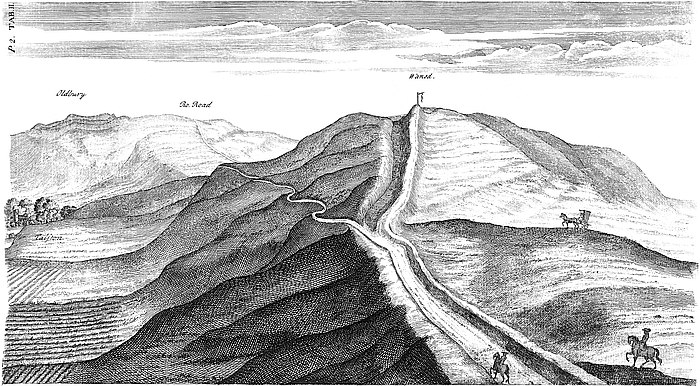
Britain. About 100 years before our Saviour’s birth, Divitiacus
made the Wansdike north of Stonehenge, and drove the possessors
of this fine country of the Wiltshire downs, northwards. So that
the Druids enjoyed their magnificent work of Stonehenge, but about
360 years. And the very great number of barrows about it, requires,
that we should not much shorten the time. Sir Isaac Newton in his
Chronology, reckons 19 years for a medium of a king’s reign. So
that in that space, there were about 19 kings, in this country. And
there seems to be about that number of royal barrows (in my way of
conjecturing) about the place.
I observe, this time we have assign’d for the building of Stonehenge,
is not long after Cambyses’s invasion of Egypt. When he committed
such horrid outrages there, and made such dismal havock, with the
priests and inhabitants in general, that they fled the country to all
parts of the world. Some went as far as the East Indies, and there
taught many of the antient Egyptian customs; as is taken notice of
by the learned. It is not to be doubted that some of them fled as far
westward, into the island of Britain, and introduced some of their
learning, arts and religion, among the Druids; and perhaps had a hand
in this very work of Stonehenge: the only one that I know of, where
the stones are chizel’d. All other works of theirs, are of rude stones,
untouch’d of tool, exactly after the patriarchal and Jewish mode:
therefore older.
This was at a time, when the Phœnician trade was at height, the
readier a conveyance to Britain: it was before the second temple at
Jerusalem was built: before the Grecians had any history.
Directions to the binder.
All the half sheet plates are to be bound up with the book, as single
leaves, according to their pages, and without guards, viz. Plate,
No. 1, 2, 4, 6, 7, 8, 9, 10, 12, 14, 15, 16, 23, 24, 25, 26, 27, 28,
29, 30, 31, 32, 33, 34, 35. Those Plates, No. 11, 17, 19, 21, are to
be once folded in the middle, and bound up with guards. Those Plates,
No. 3, 5, 13, 18, 20, 22, are to be folded in three parts, and bound
up with guards.
Stukeley del.
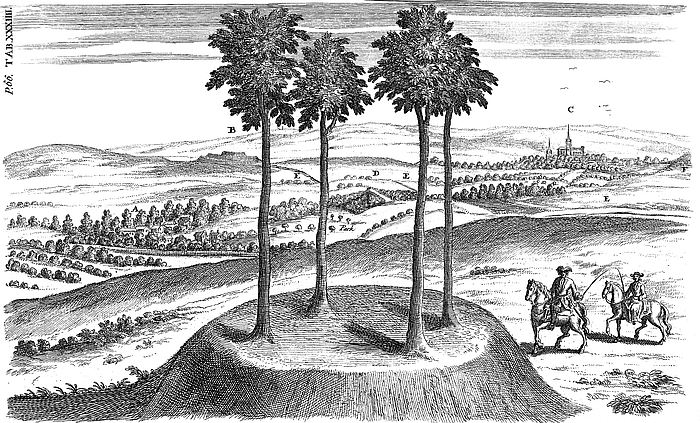
Carvilii Regis Tumulus Iuly 29. 1723.
A. Wilton. B. Sorbiodunum. C. Salisbury. D.
M. Aurelius. E. the Icening street road. F. Harnham hill.
Stukeley delin.
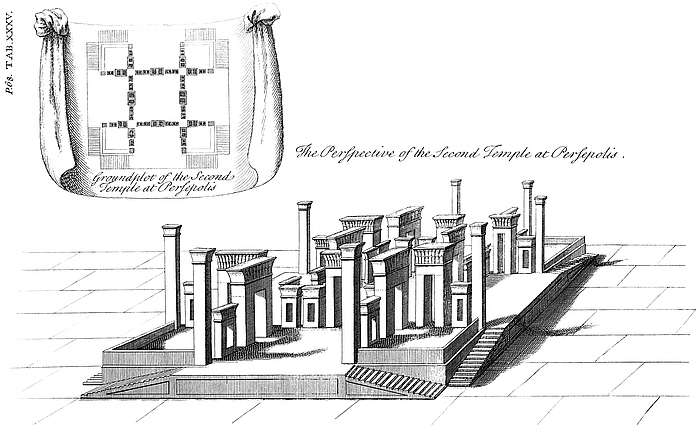
Groundplot of the Second Temple at Persepolis
The Perspective of the Second Temple at Persepolis.