Once more a minor became sovereign of Scotland.
Not, however, as in former cases, by the early
death of the preceding monarch did the throne
become vacant again, but by a deed of abdication
which the helpless captive Queen was compelled
to sign at Lochleven. On July 29th, 1567—a few
days after the close of Mary’s reign—the thirteen
months old Prince of Scotland was crowned at
Stirling as James VI. The Chapel at the castle on
this occasion was not the scene of the function, the
High or Parish Church being chosen as a suitable
place for the ceremony. The child was anointed
by the Protestant Bishop of Orkney, while the
Earl of Atholl held the crown over the royal head.
Morton and Home took the oath for the King that
he would maintain the true religion, and after Knox
had preached a sermon, the company returned to
the castle, Mar carrying the infant monarch and
Atholl bearing the crown.
For twelve years after his coronation young
James resided in Stirling Castle under the care of
the family of Mar. During almost the whole of
that period the government of Scotland was carried
on in the name of the King by four Regents in
succession; and Stirling, being the sovereign’s
seat, figured conspicuously in the history of the
time. In September, 1569, at a council held in
the castle by the Regent Moray, Maitland of
Lethington was accused by Thomas Crawford of
having taken part in the murder of Darnley. His
trial being fixed for December 21st, Lethington
was placed in confinement in the fortress, but a few
days later he was carried to Edinburgh, where he
managed to escape from bondage by the instrumentality
of Kirkcaldy of Grange.42
Less than two years later there was thrust into
Stirling Castle another prominent member of
Queen Mary’s dwindling faction. This was John
Hamilton, Archbishop of St. Andrews, the prelate
who had taken the leading part at the Prince’s
baptism not many years before. He had been
seized in Dumbarton Castle on the memorable
night when the King’s men scaled the rock, and
had been brought without delay to his enemies’
headquarters. Like Maitland of Lethington, he
was charged with having been implicated in the
murder of James’s father, and his confinement in
Stirling, like Lethington’s, lasted for only one or
two days. The Archbishop, moreover, was held
to be guilty of having encouraged Bothwellhaugh
to assassinate the Regent Moray, so after a hasty
trial he was hanged at the market cross in April,
1571.
Stirling, being at this time the young King’s
home, was naturally the headquarters of his
mother’s opponents. Edinburgh, where the castle
was held for the Queen by Sir William Kirkcaldy
of Grange, was the principal seat of Mary’s less
powerful party. A plan was accordingly devised
by the Laird of Grange that nearly succeeded in
changing, for a time at least, the course of Scottish
history. Knowing that the leaders of the opposite
faction were gathered together for a meeting of
Parliament, he resolved to surprise and capture
Stirling, to seize all the prominent supporters of
the King, and to obtain possession, if possible, of
the royal child himself. Kirkcaldy was anxious to
conduct the expedition in person, but, being persuaded
by his followers not to run such a risk,
he appointed the Earl of Huntly, Lord Claude
Hamilton, Scott of Buccleuch and Ker of Fernihirst
to undertake the enterprise.
On the evening of the 3rd of September, 1571,
these chiefs, accompanied by three or four hundred
men, rode out of Edinburgh and took the road to
Jedburgh in order to deceive their enemies as to
the object of their journey. In the gathering
darkness they wheeled to the right and made their
way swiftly to within a mile of Stirling, where they
halted and left their horses.43 One of the party, a
native of the place, knowing of the existence of
a secret passage, guided the raiders into the town
at an early hour in the morning. There was not
even the bark of a dog to give the citizens alarm;
the burghers and nobles were aroused by the cries
of “A Hamilton” and “God and the Queen.”
Houses were instantly broken into and most of
the lords were captured with ease, but at Morton’s
lodging some fighting took place, resulting in the
slaughter of two of the Earl’s retainers. Morton,
however, eventually gave himself up to the Laird
of Buccleuch, the Regent Lennox surrendered to
Spens of Wormiston, and the Earls of Glencairn
and Eglinton also submitted themselves to the
adventurers.
The Queen’s party seemed to have triumphed
completely, but their easily-won victory led to
their defeat. The Borderers, unable to resist the
temptation of plunder, rushed in all directions in
search of booty, so that when the Earl of Mar
sallied forth from the castle with a band of
musketeers, a panic at once ensued. The citizens
armed themselves and turned on their despoilers,
while the castle soldiers kept up a fire from behind
the walls of Mar’s unfinished house. The raiders
were demoralised and quickly took to flight, but
rather than allow the Regent Lennox to be rescued,
a man named Calder fired his pistol at the Earl.
By throwing himself in front of his distinguished
prisoner, Spens of Wormiston was shot, and the
bullet passing through his body, mortally wounded
Lennox. The dying Regent was conveyed to the
castle, where in the evening he passed away. His
death was deplored not only by his friends but by
his foe, Kirkcaldy of Grange, who had desired the
Raid of Stirling to be, if possible, a bloodless
triumph.44
Little more than a year had elapsed when another
Regent died in Stirling Castle. This was the
King’s hereditary keeper, John, Earl of Mar, who
had been elected to govern the realm in the room
of James’s grandfather, Lennox.45 The cares of
state and the worries of the civil war seem to
have been responsible for the Regent’s premature
decease, although the usual report of poisoning
was given circulation at the time. Mar left the
charge of the King and the castle to his brother,
Alexander, Master of Erskine, for his son, the new
Earl, a companion of James, was a boy not much
older than the King.
The next governor, the Regent Morton, was in
favour of the young sovereign’s continuing his
residence at Stirling. His education was meanwhile
receiving attention from George Buchanan
and Peter Young, the former a brilliant scholar
and a strict disciplinarian, the latter too full of
respect for the Lord’s Anointed to oppose his
pupil’s wayward will. “My Lady Mar was wise
and sharp,” wrote Sir James Melville, “and held
the King in great awe; and so did Mr. George
Buchanan. Mr. Peter Young was gentler and was
loath to offend the King at any time, and used
himself warily, as a man that had mind of his own
weal, by keeping of His Majesty’s favour; but
Mr. George was a Stoic philosopher, and looked
not far before the hand.”
In June, 1574, Killigrew, the English ambassador,
visited Stirling Castle, and heard James translate
into French a chapter, chosen at random, of a
Latin version of the Bible; while to show that his
accomplishments were not confined to intellectual
pursuits, the King delighted the English envoy by
an exhibition of dancing.46 Weldon, in his oft-quoted
description of James, writes: “His legs
were very weak ... that he was not able to stand
at seven years of age.”47 Weldon’s unflattering
portrait of the King is held by some to be a faithful
representation; but the statement regarding
James’s physical weakness seems to be untrue, for
if he could not stand at seven, he would surely be
unable to give a display of dancing when exactly
eight years of age. Later in the same year the
two famous Melvilles—Andrew and his nephew
James—were presented to their sovereign at Stirling.
The younger man notes in his Diary that
the boy monarch, on account of his strange and
extraordinary gifts, was the sweetest sight in
Europe that day. The writer goes on to say:
“I heard him discourse, walking up and doun in
the auld Lady Mar’s hand, of knowledge and ignorance,
to my great marvel and astonishment.”48
James had companions at work and play in those
schooldays at the castle. The young Earl of Mar,
Lord Invertyle and others learnt their lessons with
their King at Stirling. That Buchanan showed no
favouritism in his dealings with his pupils will be
seen by the following story, originally told by
Invertyle: The Earl of Mar possessed a tame
sparrow which the King was anxious to obtain.
On the young nobleman’s refusing to hand over the
bird to his sovereign, a struggle between the two
playmates ensued, ending in the death of the
sparrow. Mar burst into tears at the loss of his
pet, and Buchanan, being informed of the cause
of the weeping, gave the King a box on the ear,
and told him he was a true bird of the bloody nest
of which he was come.49
That the stern preceptor was not devoid of
humour the following anecdote will show. The
young King’s readiness to grant requests thoughtlessly
was noted by Buchanan with distress.
Determined to teach the boy a lesson, he requested
him to sign two documents, the purport of one
being to transfer the regal power to Buchanan for
fifteen days. After asking one or two random
questions, the sovereign willingly signed the
papers without taking trouble to read their contents;
and that same day the tutor acted the part
of King to the astonishment of the courtiers
and the utter amazement of James. At length
Buchanan informed his pupil that he had temporarily
resigned his crown, and as the King continued
to appear bewildered, the document was produced.
Before James had time to recover from his discomfiture,
the tutor followed up his practical
lesson by a discourse on the evils that are likely
to accrue from the rashness and carelessness of
kings.50
Buchanan’s interest in education during the
Stirling period of his life was not confined to the
training and instruction of the monarch and his
companions. He was appointed president of the
commission which met in Stirling Castle to consider
the question of a standard Latin grammar,
as teachers had been complaining of the confusion
arising from the various manuals in use throughout
the country. The result of the proceedings
was that Buchanan and two commissioners, Andrew
Simson and James Carmichael, schoolmasters,
undertook to produce a new book which was to
supersede all the others. In due time the joint
work of these eminent scholars appeared, but it never
became established as the one and only grammar.51
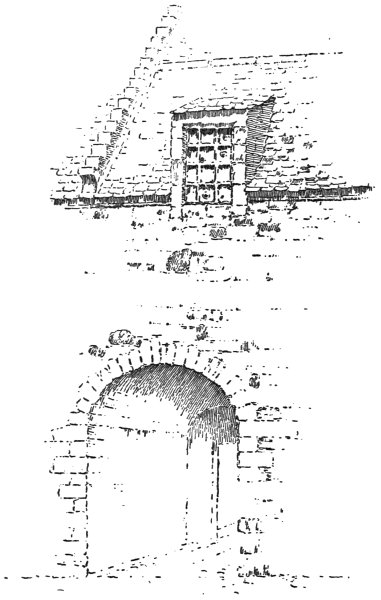
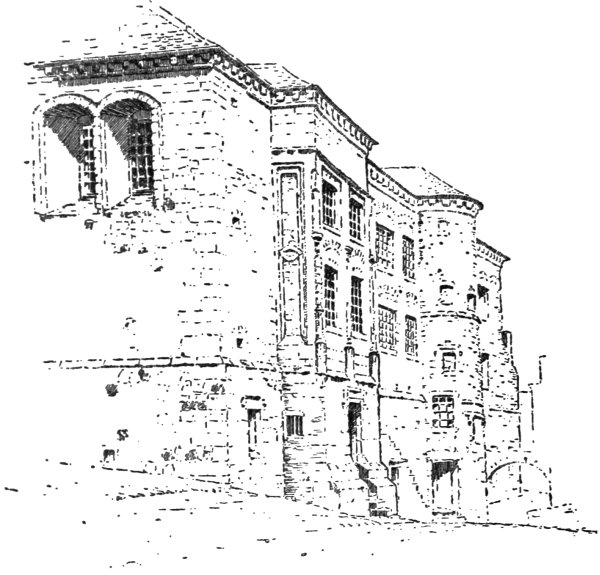
The room still exists in the Keep of the castle
where George Buchanan and Peter Young are
believed to have discharged their pedagogic duties,
and a terrace below is called the Prince’s Walk,
where James, it is said, was wont to take the air
before returning to his studies. Doubtless the
young King and his comrades romped on this
narrow playground, but it owes its name more
likely to James’s son, Prince Henry, for the father
was a crowned monarch before his education began,
and the terrace is known not as the King’s but as
the Prince’s Walk.
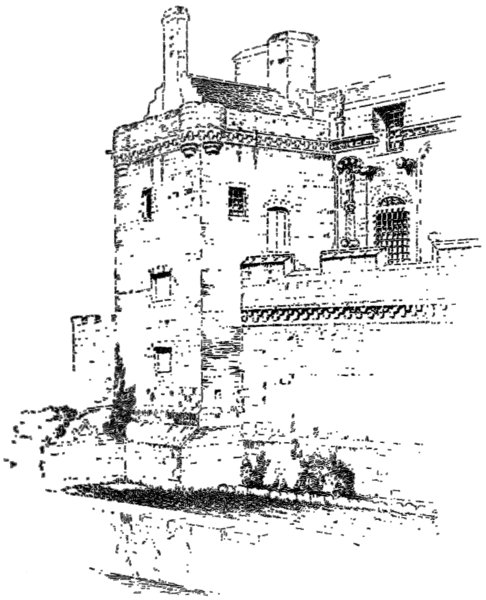
THE KEEP AND THE PRINCE’S WALK.
The regency of Morton was, on the whole, a
time of peace, but his enemies were all the time
planning his overthrow. The greater part of the
nobility was hostile to the Regent; thus when
the King, at the instigation of Argyll, and with
the approval of Buchanan and Alexander Erskine,
summoned a convention of peers to Stirling Castle
in March, 1578, Morton felt compelled to send in
his resignation. The clever Earl, however, soon
found an opportunity of placing himself again in
power. On the morning of the 26th of April, the
young Earl of Mar, possibly acting on Morton’s
advice, called for the keys of the castle as though
he intended to ride forth to hunt. Although the
hour was about six o’clock the Master of Erskine
was already astir, and meeting his nephew’s followers
at the gate, he called his servants to his
assistance. After a scuffle, in which the Master’s
eldest son was so severely crushed that he died
next day, the parties withdrew to the hall to discuss
the situation. The proceedings resulted in
the young Earl of Mar’s being allowed to take
over the charge of the King and the keeping of Stirling
Castle.52 It was also decreed that James was to
remain in the castle, that no earl was to be received
within the gates with more than two servants, no
lord with more than one attendant, and no gentleman
with any retainer at all.53 The stirring events
of that morning made such an impression on the
youthful King, that for several nights his sleep was
disturbed by visions of the fray.
Morton was not long in breaking through the
decrees. Riding secretly by night from Edinburgh
to Stirling, towards the end of May, he
persuaded Mar to admit him and his followers into
the royal castle. Once within the same building
as the King, the Earl was now as powerful as
before. He managed to arrange the formation of
a new Council, with himself in the principal place,
and he persuaded the King to order the Parliament,
which had been summoned to meet at Edinburgh,
to assemble in the hall of Stirling Castle. The
opponents of Morton, naturally objecting to the
Estates being convened within the walls of a fortress,
were determined not to appear without a protest,
so they sent the Earl of Montrose and Lord
Lindsay of the Byres to lay their remonstrances
before the King. James opened the Parliament in
person, and before any business was transacted,
Lord Lindsay protested against its proceedings.
Morton interrupted him and ordered him to sit
down, but Lindsay disobeyed the command until
it was repeated by the King. Later in the day
the intrepid lord again arose to make objections,
and this time also he was silenced by James, who,
at Morton’s prompting, declared that the Parliament
was free and that those who loved him would
think as he thought.54
Morton’s recovery of power rendered civil war
imminent. Argyll and Atholl raised the town of
Edinburgh and were joined by the Borderers of
Teviotdale and the Merse. Angus, on the other
side, was preparing his forces at Stirling. The
armies came within sight of each other near the
town of Falkirk, and some skirmishing took place,
but through the intervention of two leading ministers
of the church and of Bowes, the English
ambassador, an agreement was arrived at without
any fighting taking place. The settlement left
things much as they were, with the power in
Morton’s hands, but the Earl of Montrose and
Lord Lindsay of the Byres were admitted into the
Council.
Although not holding the title of regent, the
Earl of Morton was now as powerful as ever he
had been. His opponents felt themselves incapable
of compelling him to deliver up their sovereign,
and so secure did Morton consider his
position and the King’s to be, that on the 12th
of June, 1579, James was allowed to leave the
castle by the nether bailey gate at five o’clock in
the morning, with his own domestics, and was permitted
to remain in the Park until seven o’clock
at night. This was the first occasion on which the
King passed beyond the castle walls without the
protection of an armed guard.55
Morton’s day of triumph, however, was beginning
to draw to a close. There arrived in Scotland
a man from France, who quickly won the favour
of King James, and who set himself to restore
Queen Mary to the throne, to overthrow the Protestant
religion in Scotland and to ruin the Earl of
Morton. He was successful in only the last of
these three enterprises. This remarkable person
was Esmé Stewart, Lord of Aubigny in France,
and nephew of the Regent Lennox. “He was a
man of comely proportion, civil behaviour, red-bearded,
honest in conversation.”56 Recommended
to James by the Guises, whose special agent he was,
he arrived at Stirling in September, 1579, and was
presented to the King in the hall of the castle.
The artful schemer was not long in winning James’s
favour. Soon he received the wealthy Abbey of
Arbroath, which had been in the possession of the
Hamilton family, and about the same time he was
made a privy-councillor and was given the Earldom
of Lennox.
Esmé Stewart had not been many months at
Court before a rumour was reported to the Earl
of Mar to the effect that the half-foreign favourite
and his partisans intended to remove the King to
Dumbarton, and afterwards to convey him secretly
to France. The night of the 10th of April, 1580,
was believed to be the time arranged by the conspirators
for carrying out their plan. The rumour,
whether well-founded or not, gave rise to intense
excitement in the castle. When the dreaded evening
came round, Mar placed soldiers both within
and without the King’s apartment, and ordered
them on no account to allow anyone to enter the
room. Lennox, armed and supported by a guard
of friends, prepared to defend himself in his own
chamber, for he heard the threatening shouts in the
courtyard and knew that his life was in danger.
The night passed away, however, without an
attack being made upon Stirling, although in the
morning the Earls of Argyll, Glencairn and Sutherland—friends
of Esmé Stewart, Lord Lennox—endeavoured
without success to gain admittance
to the castle.57
Lennox and another rising favourite, James
Stewart, together worked for the hated Morton’s
fall, and as the King was completely in their hands
and bore no love to the stern ex-regent, the Earl
was condemned to death in 1581, for being “art
and part” in the murder of Darnley. Yet not
much more than a year after Morton’s death,
Lennox’s ascendency came to an end. A number
of nobles—Mar, Gowrie, Lindsay and others—seized
the King at Ruthven Castle, near Perth,
and virtually held him a prisoner, while Lennox
was ordered to leave the country—a step which at
last he reluctantly took. James was brought back
to Stirling, and, although chafing at the restraint,
was compelled to announce that he was a free King
and that he desired to reside in the castle. But the
Ruthven Raiders were unable to keep their sovereign
for more than ten months in their hands.
In June, 1583, a plot for the recovery of his
freedom was formed, and he escaped from Falkland
Palace to St. Andrews, where he threw himself into
the castle.
Their inability to hold the King in their power
was disastrous to the leaders of the Raid of
Ruthven; consequently they lost little time in
arranging a scheme to place themselves again in
command. The Earl of Mar and the Master of
Glamis had retired to the north of Ireland, but in
the spring of 1584 they stealthily crossed the
Channel, and on the 17th of April, with five hundred
horse, they seized the Castle of Stirling. James
at once raised an army in Edinburgh and marched
to attack the rebels. No fighting of any sort took
place, however, for the insurgent lords, taken aback
by the King’s swift action and disappointed in the
support of their friends, fled towards the Border
before the royal army appeared. The small garrison
which they left to guard the fortress surrendered
at once to the King. The constable and three
of the men were hanged as a sign of the royal
displeasure.58 On the failure of the conspiracy,
the Earl of Gowrie, who had come to be regarded
with distrust by both parties, was tried at Stirling
and executed almost beneath the walls of the castle.
In November, 1585, another Raid of Stirling
occurred. The exiled lords who had forsaken the
castle in the previous year, collected their forces
in the south of Scotland, where they were joined
by a number of the Border lairds. Proclaiming
that they sought to save the King and the country
from the evil rule of James Stewart, Earl of Arran,
they advanced northwards with some nine hundred
men and camped at St. Ninians on November 1st.
Next morning at daybreak they crept into the
town, like Buccleuch and Fernihirst fourteen years
before, while Arran and Montrose, who had kept
watch on the walls, immediately took to flight, the
former seeking safety beyond the Bridge of Forth,
the latter finding refuge in the castle with the King.
Having captured the town with comparative ease,
the lords proceeded to invest the fortress which
they knew to be ill prepared for a siege. After
sending messengers to treat with the invaders,
James agreed to surrender, for his attempt to escape
by bribing William Maxwell of Newark, who had
charge of one of the postern doors, was discovered
by the besiegers. The nobles entered the castle on
the 4th of November, assuring their sovereign that
they had acted from motives of loyalty, while he
replied that words were unnecessary, as their
weapons had spoken quite loudly enough. Differences
were settled for the time, and James professed
to be pleased with the change; Arran was banished
for ever from the Court, and to Mar, who had
forfeited his hereditary privilege, the custody of
Stirling Castle was restored.
Too often in Scottish history the conduct of
the barons towards the sovereign was insolent and
disloyal; but there were occasions in which their
coercive action was fraught with good to the
country. The nobles who captured James VI.
at Ruthven Castle and who besieged him in his
own stronghold of Stirling, were actuated to some
extent by selfish motives, but at the same time they
realised that their measures were such as would
confer real benefit upon the land. Yet although
the weakness of the King in placing his trust in
unpopular favourites justified the daring steps
taken by the nobles, it is not a matter for wonder
that in his later life the shout of “Treason”
escaped from James’s lips whenever an unexpected
incident occurred.
James VI. married Anne, second daughter of
Frederick II. of Denmark, in 1589, and Stirling
Castle was chosen to be the birthplace of their
eldest son, who was born in February, 1594. For
the Prince’s baptism great preparations were made,
including the hasty reconstruction of the Chapel,
for James was always anxious to impress his visitors
with the dignity of the Scottish Court. The
foreign representatives arrived at Stirling before
the end of August, and on the 30th of that month
the christening service was held.59 The Prince was
carried to the Chapel by Elizabeth’s representative,
the Earl of Sussex, who walked under a canopy
supported by the Lairds of Cessford, Buccleuch,
Dudhope and Traquair; and in the procession
Lord Hume carried the ducal crown, Lord Seton
bore the basin and Lord Livingstone the towel.
The chief officiating clergyman was David Cunningham,
Bishop of Aberdeen, who at the King’s
command named the royal infant Frederick Henry,
and thereafter addressed the congregation in Latin.
At the conclusion of the service the company
retired to the Prince’s chamber, where James
created his child a knight and bestowed on him
the usual titles belonging to the eldest son of the
King. After a number of less important knights
had been made, supper was served in the great hall
of the castle, at which, for the entertainment of the
guests, a decorated chariot and ship were drawn in,
containing viands for the later courses of the
banquet.60 No ill-timed jest spoilt the pleasure of
the party, as on the occasion of the festivities in
celebration of James’s baptism; but this time,
owing to the religious change in Scotland, no
French representatives were present at Stirling.
A few months before he departed from Scotland
to take possession of the English crown, James
looked down from Stirling Castle upon a strange
and striking spectacle. On December 21st, 1602,
a band of riders, consisting mainly of women, was
observed advancing from the west. It was seen
that the principal members of the party were bearing
bloodstained garments and were displaying
them to view with the object of attracting attention.
The procession wound its way up the castle hill,
and at the King’s command was admitted within
the gates. Alexander Colquhoun of Luss was the
leader of the company, and from him the King
learned that a party of Macgregors had raided the
lands of Glenfinlas in the Lennox, had plundered
the farms of the Colquhoun tenants, and had killed
and wounded a number of men, and that these
women bearing the bloody shirts were the relatives
of the clansmen who had innocently suffered.
The sorrowing deputation and the accompanying
tale of woe so greatly shocked King James
that he granted a commission to Alexander Colquhoun,
giving him licence to repress such crimes and
to lay hold of any malefactors. The knowledge
that their enemies possessed this commission so
enraged the Macgregors that they rose in great
force to oppose the Colquhouns, and inflicted upon
them a heavy defeat at the memorable conflict of
Glenfruin.61 Their triumph, however, although
sweet for the moment, brought long and bitter
sorrow to the victors, as they came to be regarded
as the most lawless of the Highland clans, and were
pursued with fire and sword at the instance of the
Government. To assist in crushing the indomitable
race, the Earl of Mar, in 1611, sent two pieces
of ordnance from Stirling Castle, to be used in the
guerrilla warfare against the hunted Clan Gregor.62
James VI.’s son, Henry, was the last Prince of
Scotland to be brought up in Stirling Castle. He
spent nine years—exactly half of his life—in his
royal birthplace on the rock. The King’s former
companion, the Earl of Mar, was appointed guardian
of the boy, and Annabella, the Countess-Dowager,
was authorised to assist her son in his
charge. James had perfect confidence in the friend
of his youth, but the Queen, partly, perhaps, from
political motives and partly from a natural desire
to be with her child, endeavoured in 1595 to
remove the Prince from the custody of Mar. This
intrigue becoming known to the sovereign led to
a quarrel between him and his Consort, the result
being that the Earl received a written statement
from the King granting him full charge of the boy
until he should reach the age of eighteen years:—“1595,
July 24. Stirling.—Milorde of Mar.
Because in the suretie of my sonne consistis my
suretie and that I have concreditid unto you the
chairge of his keiping upon the trust I have of
youre honestie, this present thairfore sall be ane
warrande unto you not to delyver him out of youre
handis except I commande you with my awin
mouth, and being in sikke cumpanie as I my self
sall best lyke of, otheruayes not to delyver him for
any chairge or message that can cum from me.
And in kayce God call me at any tyme that nather
for Quene nor Estaitis pleasure ye delyver him
quhill he be auchtein yeiris of age and that he
commande you himself. At Stirling the xxiiij of
Julie, 1595. James R.”63
The Queen succeeded in a later attempt to gain
possession of her son. After James had set out for
England to occupy Elizabeth’s throne, she made
her way to Stirling in April, 1603, in order to seize
the person of the Prince. The family of Mar,
refusing to deliver their charge, even when a band
of nobles appeared in support of the Queen, Anne,
in her disappointment, fell dangerously ill, whereupon
the King dispatched the Duke of Lennox
with instructions to the Earl of Mar to deliver the
Prince to the Duke.64 In order to appease the
Queen, Lennox and the Council handed the boy
to his mother, who at once began her journey with
her son, reaching Windsor at the end of June,
after a progress of more than four weeks.
On his father’s accession to the English throne,
the Prince of Scotland at once became Duke of
Cornwall, and almost immediately after his arrival
in England he was invested with the Order of the
Garter. Not until 1610 was young Henry created
Prince of Wales, a title which he was destined to
enjoy for little more than two years. In October,
1612, he began to suffer from headaches and
languor, but always making light of bodily ailments,
he continued to lead an active life and to
play his favourite games. Fever, however, most
probably typhoid, compelled him to take to his bed.
The best physicians were in attendance during his
illness, but from the first there was little hope of
recovery, and on the 6th of November he lost his
speech and peacefully passed away.
So much beloved was the Prince by the people,
and such a sensation did his early death create, that
nearly all the eminent authors of the day, and many
undistinguished mourners, wrote verses extolling
his virtues and lamenting his demise. Donne,
Heywood and Drummond of Hawthornden, were
among the poets whose elegies were called forth by
the national bereavement. Henry was a young
man of great force of character, who held strong
opinions on the topics of the day, and who did not
fear to speak out his mind concerning some of his
father’s actions. He was naturally of a religious
disposition, being strict in his attendance at the
services of the Church, and his own deliberations
on the different forms of faith led him to become
a stronger Protestant than James. Kind-heartedness
was one of Henry’s characteristics. His
pedagogue in the early Stirling days had been
Adam Newton, a man whom the Prince always held
in the highest esteem. Newton continued to discharge
the duties of tutor after the Royal Family
had migrated to England, but, like William Dunbar
at the Court of James IV., he longed to be
presented to an ecclesiastical benefice. In January,
1606, His Royal Highness sent a letter to the
King, reminding him of his promise to give preferment
to the tutor, and stating that for two years
past Master Newton had been looking for the
Deanery of Durham. James complied with his
son’s request, and in September the faithful tutor
was rewarded with the coveted position.65
Steadfast attachment to his early friends was a
feature of Henry’s character. When an infant in
Stirling Castle, he had been lovingly cared for by
David Murray the attendant who slept in his
chamber. The trusty Scot followed his young
master to England and the friendship between them
grew closer as the Prince advanced in years, till at
last, when the fatal fever had rendered him almost
speechless, he called out repeatedly for David.
When Murray approached the bed the dying youth
recognised his life-long companion, but sighed as
he muttered again and again “I would say somewhat
but I cannot utter it.”66
According to the French ambassador, de la
Boderie, Henry spent less time in study than in
out-of-door exercise and games. “None of his
pleasures,” says the Ambassador, writing when the
boy was little more than twelve, “savour the least
of a child. He is a particular lover of horses and
what belongs to them; but is not fond of hunting;
and when he goes to it, it is rather for the pleasure
of galloping, than that which the dogs give him.
He plays willingly enough at Tennis, and at another
Scots diversion [golf] very like mall; but this
always with persons elder than himself, as if he
despised those of his own age. He studies two
hours a day, and employs the rest of his time in
tossing the pike, or leaping, or shooting with the
bow, or throwing the bar, or vaulting or some other
exercise of that kind; and he is never idle. He
shows himself likewise very good natured to his
dependants, and supports their interests against any
persons whatever; and pushes what he undertakes
for them or others, with such zeal, as gives success
to it.”67
The Frenchman was probably wrong in supposing
that the Prince played golf with persons
older than himself because he despised those of his
own age. The likelihood is that, as golf was introduced
into England by Scotsmen who went south
with James, only amongst his father’s northern
courtiers would Henry be able to find opponents
and partners for his game. An anecdote of the
Prince regarding golf is told by Strutt in The
Sports and Pastimes of the People of England.
“At another time playing at goff, a play not unlike
to pale-maille, whilst his schoolmaster stood talking
with another, and marked not his highness warning
him to stand farther off, the prince thinking he had
gone aside, lifted up his goff-club to strike the
ball; mean tyme one standing by said to him,
‘beware that you hit not master Newton’: wherewith
he drawing back his hand, said, ‘Had I done
so, I had but paid my debts.’” Henry’s remark
seems to infer that good Master Newton had not
spared the rod in the course of his tutorial duties,
just as George Buchanan, a generation earlier, did
not shrink from chastising the Prince’s father in
the schoolroom at Stirling Castle.
The departure of Prince Henry for the south,
after his father had come to his new inheritance,
marks the end of the history of Stirling Castle as
a regular dwelling-place of royalty. The ancient
seat of monarchy was seldom occupied by princes
after James had made his progress to London; but
from time to time distinguished persons were
lodged in the forsaken pile, albeit their stay within
the fortress was not of their own seeking. In
November, 1604, John, fifth Earl of Cassillis, was
brought as a prisoner to Stirling from Blackness,
his offence being that in the course of a dispute
with his wife he attacked her in the presence of the
Privy Council and dragged her out of the chamber.
As the nobleman soon repented of his deed and
sent a letter expressing his contrition to the Council,
he was released from the castle at the end of the
year, but was forbidden to pass further east than
Linlithgow.68
In the following year Stirling Castle received as
prisoners men of lowlier rank but of loftier spirit
than Cassillis. These were several Presbyterian
ministers, who, with others that were warded in
Blackness, had attended the Assembly at Aberdeen
in 1605, although the Privy Council, at James’s
instigation had forbidden all persons to appear at
such a meeting. For about one year the disobedient
clergymen were detained in the castle by
the King.69
James at this time was inclined for little
toleration towards either Presbyterians or Roman
Catholics. In 1608, George, first Marquis of
Huntly, was warded in Stirling Castle for refusing
to abjure the Romish religion, and for alleged
disloyalty, while for the same reasons the Popish
Earl of Erroll was placed in confinement in Edinburgh.70
After enduring imprisonment for many
months, Huntly and Erroll wrote to their sovereign
vainly beseeching him to grant them liberty, “for
the King (as the treuth was) thought that he could
not preserue the publicke peace better, then be
keiping thesse birdes of prey so caidget wpe.”71
In the beginning of 1610, however, the Marquis
was released on the understanding that henceforward
he should embrace the Protestant faith.
Just about the time of Huntly’s discharge the
Earl of Mar, in his capacity of Sheriff of Stirlingshire,
placed in the Palace at Stirling Castle a man
named John Murray, who was charged with murder
or manslaughter. The delinquent should have
been lodged in the Tolbooth of the town, but the
magistrates, “being movid with some foolishe
consait,” as Mar complained to the Privy Council,
refused to concern themselves with the Sheriff’s
prisoners, and so he was obliged to turn the
King’s Palace into a common gaol. However,
the Lords of Council listened to the Earl’s petition
and ordered the Stirling magistrates to receive in
future such persons as he should apprehend.72
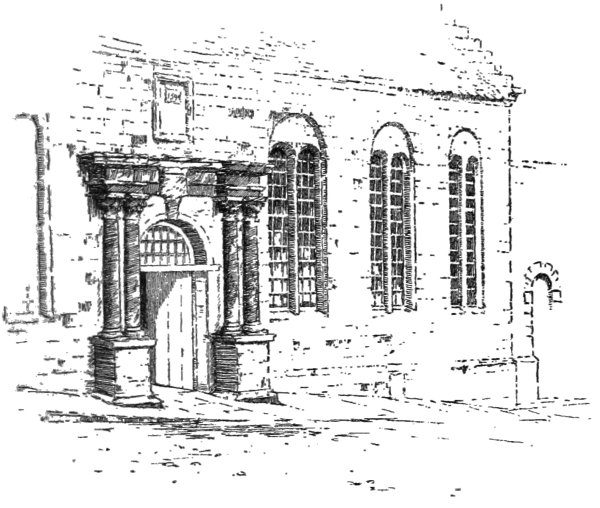
THE CHAPEL ROYAL.
James was once again to reside in the home of
his early days. Before leaving Scotland he had
promised his people that he would return to his
native land every three years; but only once in
the course of his English reign did he pass within
the borders of his northern kingdom. The summer
of 1617 was the season chosen for the visit. Edinburgh,
Dundee, St. Andrews and Glasgow were
honoured by the presence of the King, and the
inhabitants of Stirling had twice an opportunity
of according welcome to their sovereign. The
early days of July were spent by James in the
familiar castle, and again towards the end of the
month he came to reside in the Palace.
It was at the time of this, his last, visit to the
castle that he heard the Regents of Edinburgh
College discourse on the various branches of
philosophy. A rumour had gone abroad that
James intended to suppress the Universities of
Aberdeen and Edinburgh, leaving the more ancient
St. Andrews and Glasgow to be the Oxford
and Cambridge of Scotland.73 The Regents had
desired to address the King at Edinburgh, but as
no opportunity was given to them in the capital
they made the journey to Stirling, hoping, doubtless,
to impress him with their erudition and to
justify the existence of their college. The scene
of the disputation was the Chapel of the castle,
where, on the evening of the 19th of July, a
number of Scottish and English lords assembled
with the King. Speeches were delivered in Latin
and Greek, the pronunciations of the ancient
tongues being after the Scottish mode, so that
James took occasion to call the Englishmen’s
attention to the superior grace which the languages
acquired when spoken in the manner prevalent
north of the Tweed.
The King was highly pleased with the discussion,
and after supper he summoned the Principal and
Regents. The fears of the Professors as to the
future of their seat of learning were dispelled at
this evening interview, for James graciously offered
himself as Patron of their institution, giving it
the name of King James’s College, and granting
permission for the placing of his coat-of-arms on
the gate of the humble building.
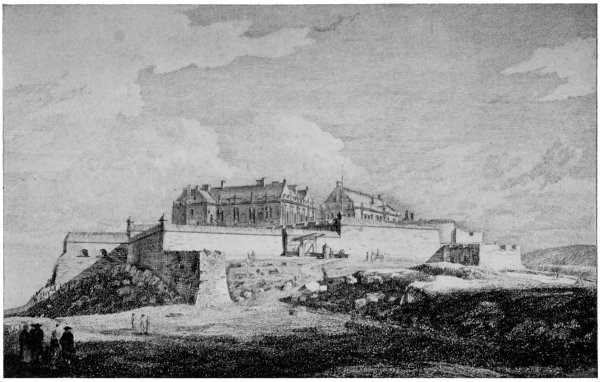
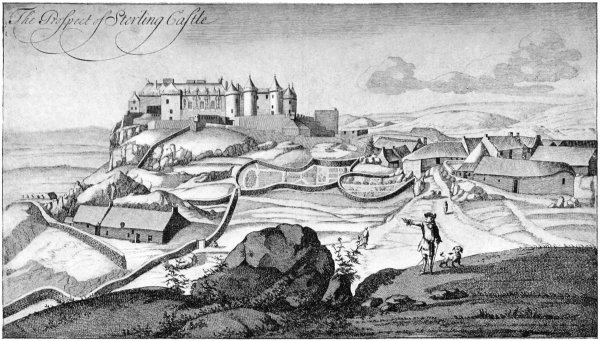
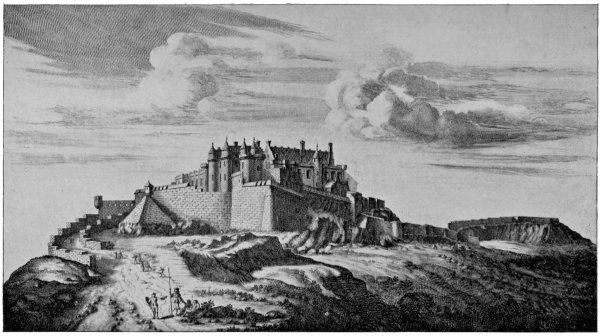
STIRLING CASTLE.
From Engraving by Robert Sayer, 1753.
James’s two brief sojourns at Stirling gave the
inhabitants a taste of the glory that had formerly
belonged to their town, while his residence in the
castle after an absence of fourteen years must have
brought again to his own mind a throng of gay
and gloomy memories. The Park recalled the
summer hours spent in his favourite pastime of
hunting; the Keep reminded him of weary tasks
and the rigid discipline of George Buchanan;
the Chapel, where he listened to the Edinburgh
Regents, had been the scene of his eldest child’s
baptism—that promising son who did not live to
see again the place of his birth and early training.
Young Mar’s revolution and the second Raid of
Stirling were events of too stirring a kind to be
forgotten, and the King doubtless felt as he recalled
his early reign that although his responsibilities
had increased with his accession to the
English throne, his life and liberty were less at his
subjects’ mercy than in the days when he reigned
over Scotland alone.