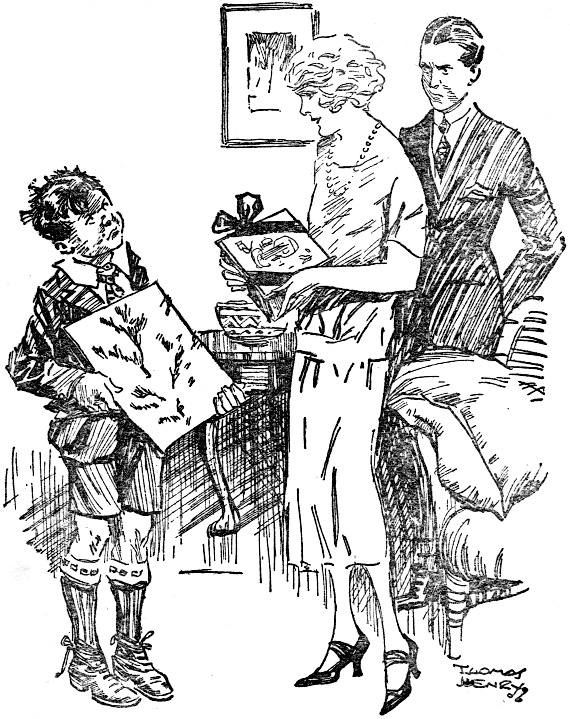
Until now William had taken no interest in his
handkerchiefs as toilet accessories. They were greyish
(once white) squares useful for blotting ink or carrying
frogs or making lifelike rats to divert the long hours
of afternoon school, but otherwise he had had no pride
or interest in them.
But last week, Ginger (a member of the circle
known to themselves as the Outlaws of which William
was the leader) had received a handkerchief as a birthday
present from an aunt in London. William, on
hearing the news, had jeered, but the sight of the
handkerchief had silenced him.
It was a large handkerchief, larger than William
had conceived it possible for handkerchiefs to be. It
was made of silk, and contained all the colours of the
rainbow. Round the edge green dragons sported
upon a red ground. Ginger displayed it at first
deprecatingly, fully prepared for scorn and merriment,
and for some moments the fate of the handkerchief
hung in the balance. But there was something about
the handkerchief that impressed them.
“Kinder—funny,” said Henry critically.
“Jolly big, isn’t it?” said Douglas uncertainly.
“’S more like a sheet,” said William, wavering
between scorn and admiration.
Ginger was relieved. At any rate they had taken
it seriously. They had not wept tears of mirth
over it. That afternoon he drew it out of his pocket
with a flourish and airily wiped his nose with it. The
next morning Henry appeared with a handkerchief
almost exactly like it, and the day after that Douglas
had one. William felt his prestige lowered. He—the
born leader—was the only one of the select circle
who did not possess a coloured silk handkerchief.
That evening he approached his mother.
“I don’t think white ones is much use,” he said.
“Don’t scrape your feet on the carpet, William,”
said his mother placidly. “I thought white ones
were the only tame kind—not that I think your
father will let you have any more. You know what
he said when they got all over the floor and bit his
finger.”
“I’m not talkin’ about rats,” said William. “I’m
talkin’ about handkerchiefs.”
“Oh—handkerchiefs! White ones are far the
best. They launder properly. They come out a good
colour—at least yours don’t, but that’s because you
get them so black—but there’s nothing better than
white linen.”
“Pers’nally,” said William with a judicial air,
“I think silk’s better than linen an’ white’s so tirin’
to look at. I think a kind of colour’s better for your
eyes. My eyes do ache a bit sometimes. I think
it’s prob’ly with keep lookin’ at white handkerchiefs.”
“Don’t be silly, William. I’m not going to buy
you silk handkerchiefs to get covered with mud and
ink and coal as yours do.”
Mrs. Brown calmly cut off her darning wool as she
spoke, and took another sock from the pile by her chair.
William sighed.
“Oh, I wouldn’t do those things with a silk one,”
he said earnestly. “It’s only because they’re cotton
ones I do those things.”
“Linen,” corrected Mrs. Brown.
“Linen an’ cotton’s the same,” said William, “it’s
not silk. I jus’ want a silk one with colours an’ so
on, that’s all. That’s all I want. It’s not much.
Just a silk handkerchief with colours. Surely——”
“I’m not going to buy you another thing, William,”
said Mrs. Brown firmly. “I had to get you a new
suit and new collars only last month, and your overcoat’s
dreadful, because you will crawl through the ditch
in it——”
William resented this cowardly change of attack.
“I’m not talkin’ about suits an’ collars an’ overcoats
an’ so on——” he said; “I’m talkin’ about
handkerchiefs. I simply ask you if——”
“If you want a silk handkerchief, William,” said
Mrs. Brown decisively, “you’ll have to buy one.”
“Well!” said William, aghast at the unfairness
of the remark—“Well, jus’ fancy you sayin’ that to
me when you know I’ve not got any money, when you
know I’m not even going to have any money for years
an’ years an’ years.”
“You shouldn’t have broken the landing-window,”
said Mrs. Brown.
William was pained and disappointed. He had no
illusions about his father and elder brother, but he had
expected more feeling and sympathy from his mother.
Determinedly, but not very hopefully, he went to
his father, who was reading a newspaper in the library.
“You know, father,” said William confidingly,
taking his seat upon the newspaper rack, “I think
white ones is all right for children—and so on. Wot
I mean to say is that when you get older coloured
ones is better.”
“Really?” said his father politely.
“Yes,” said William, encouraged. “They wouldn’t
show dirt so, either—not like white ones do. An’
they’re bigger, too. They’d be cheaper in the end.
They wouldn’t cost so much for laundry—an’ so on.”
“Exactly,” murmured his father, turning over to
the next page.
“Well,” said William boldly, “if you’d very kin’ly
buy me some, or one would do, or I could buy them
or it if you’d jus’ give me——”
“As I haven’t the remotest idea what you’re
talking about,” said his father, “I don’t see how I
can. Would you be so very kind as to remove yourself
from the newspaper rack for a minute and let me
get the evening paper? I’m so sorry to trouble you.
Thank you so much.”
“Handkerchiefs!” said William impatiently. “I
keep telling you. It’s handkerchiefs. I jus’ want a
nice silk-coloured one, ’cause I think it would last
longer and be cheaper in the wash. That’s all. I
think the ones I have makes such a lot of trouble for
the laundry. I jus’——”
“Though deeply moved by your consideration for
other people,” said Mr. Brown, as he ran his eye down
the financial column, “I may as well save you any
further waste of your valuable time and eloquence by
informing you at once that you won’t get a halfpenny
out of me if you talk till midnight.”
William went with silent disgust and slow dignity
from the room.
Next he investigated Robert’s bedroom. He opened
Robert’s dressing-table drawer and turned over his
handkerchiefs. He caught his breath with surprise
and pleasure. There it was beneath all Robert’s other
handkerchiefs—larger, silkier, more multi-coloured
than Ginger’s or Douglas’s or Henry’s. He gazed at
it in ecstatic joy. He slipped it into his pocket and,
standing before the looking-glass, took it out with a
flourish, shaking its lustrous folds. He was absorbed
in this occupation when Robert entered. Robert
looked at him with elder-brother disapproval.
“I told you that if I caught you playing monkey
tricks in my room again——” he began threateningly,
glancing suspiciously at the bed, in the
“apple-pie” arrangements of which William was
an expert.
“I’m not, Robert,” said William with disarming
innocence. “Honest I’m not. I jus’ wanted to
borrow a handkerchief. I thought you wun’t mind
lendin’ me a handkerchief.”
“Well, I would,” said Robert shortly, “so you can
jolly well clear out.”
“It was this one I thought you wun’t mind lendin’
me,” said William. “I wun’t take one of your nice
white ones, but I thought you wun’t mind me having
this ole coloured dirty-looking one.”
“Did you? Well, give it back to me.”
Reluctantly William handed it back to Robert.
“How much’ll you give it me for?” he said shortly.
“Well, how much have you?” said Robert
ruthlessly.
“Nothin’—not jus’ at present,” admitted William.
“But I’d do something for you for it. I’d do
anythin’ you want done for it. You just tell me
what to do for it, an’ I’ll do it.”
“Well, you can—you can get the Bishop’s
handkerchief for me, and then I’ll give mine to you.”
The trouble with Robert was that he imagined
himself a wit.
The trouble with William was that he took things
literally.
******
The Bishop was expected in the village the next
day. It was the great event of the summer. He was
a distant relation of the Vicar’s. He was to open
the Sale of Work, address a large meeting on
temperance, spend the night at the vicarage, and
depart the next morning.
The Bishop was a fatherly, simple-minded old
man of seventy. He enjoyed the Sale of Work except
for one thing. Wherever he looked he met the gaze
of a freckled untidy frowning small boy. He could
not understand it. The boy seemed to be everywhere.
The boy seemed to follow him about. He
came to the conclusion that it must be his imagination,
but it made him feel vaguely uneasy.
Then he addressed the meeting on Temperance,
his audience consisting chiefly of adults. But, in the
very front seat, the same earnest frowning boy fixed
him with a determined gaze. When the Bishop
first encountered this gaze he became slightly disconcerted,
and lost his place in his notes. Then he tried
to forget the disturbing presence and address his
remarks to the middle of the hall. But there was
something hypnotic in the small boy’s gaze. In the
end the Bishop yielded to it. He fixed his eyes
obediently upon William. He harangued William
earnestly and forcibly upon the necessity of self-control
and the effect of alcohol upon the liver. And
William returned his gaze unblinkingly.
After the meeting William wandered down the
road to the Vicarage. He pondered gloomily over
his wasted afternoon. Fate had not thrown the
Bishop’s handkerchief in his path. But he did not
yet despair.
On the way he met Ginger. Ginger drew out his
interminable coloured handkerchief and shook it
proudly.
“D’ye mean to say,” he said to William, “that
you still use those old white ones?”
William looked at him with cold scorn.
“I’m too busy to bother with you jus’ now,” he
said.
Ginger went on.
William looked cautiously through the Vicarage
hedge. Nothing was to be seen. He crawled inside
the garden and round to the back of the house, which
was invisible from the road. The Bishop was tired
after his address. He lay outstretched upon a deck-chair
beneath a tree.
Over the head and face of His Lordship was stretched
a large superfine linen handkerchief. William’s set
stern expression brightened. On hands and knees he
began to crawl through the grass towards the portly
form, his tongue protruding from his pursed lips.
Crouching behind the chair, he braced himself for
the crime; he measured the distance between the chair
and the garden gate.
One, two, three—then suddenly the portly form
stirred, the handkerchief was firmly withdrawn by a
podgy hand, and a dignified voice yawned and said:
“Heigh-ho!”
At the same moment the Bishop sat up. William,
from his refuge behind the chair, looked wildly round.
The door of the house was opening. There was only
one thing to do. William was as nimble as a monkey.
Like a flash of lightning he disappeared up the tree.
It was a very leafy tree. It completely concealed
William, but William had a good bird’s eye view of the
world beneath him. The Vicar came out rubbing
his hands.
“You rested, my Lord?” he said.
“I’m afraid I’ve had forty winks,” said His Lordship
pleasantly. “Just dropped off, you know. I
dreamt about that boy who was at the meeting this
afternoon.”
“What boy, my Lord?” asked the Vicar.
“I noticed him at the Sale of Work and the meeting—he
looked—he looked a soulful boy. I daresay
you know him.”
The Vicar considered.
“I can’t think of any boy round here like that,”
he said.
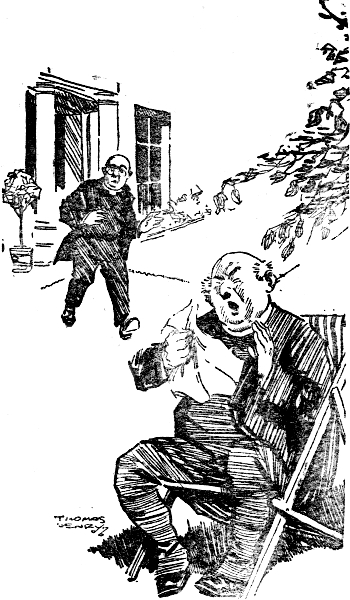
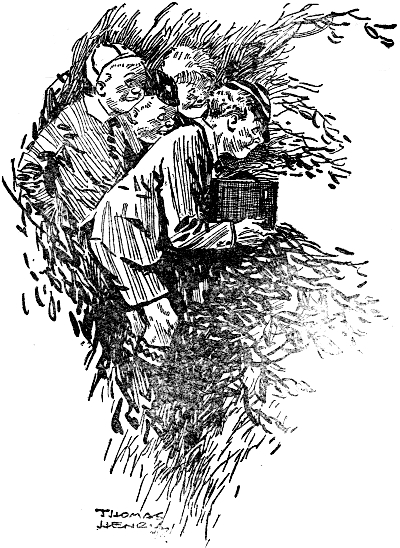
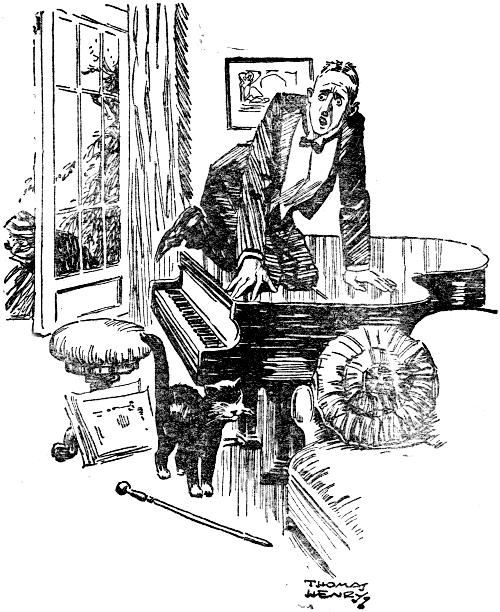
THE BENT PIN CAUGHT THE BISHOP’S EAR,
AND THE BISHOP SAT UP WITH A
LITTLE SCREAM.
The Bishop sighed.
“He may have been a stranger, of course,” he said
meditatively.
“It seemed an
earnest questing
face—as
if the boy
wanted something—needed
something. I
hope my little
talk helped
him.”
“Without
doubt it did,
my Lord,” said
the Vicar
politely. “I
thought we
might dine out
here—the
days draw out
so pleasantly
now.”
Up in his
tree, William
with smirks
and hand-rubbing
and mincing
(though
soundless)
movements of
his lips kept
up a running
imitation of
the Vicar’s
speech, for the edification apparently of a caterpillar
which was watching him intently.
The Vicar went in to order dinner in the garden.
The Bishop drew the
delicate handkerchief
once more over his
rubicund features. In
the tree William
abandoned his airy
pastime, and his face
took on again the
expression of soulful
earnestness that had
pleased the Bishop.
The breast of the
Bishop on the lawn
began to rise and sink.
The figure of the Vicar
was visible at the
study window as he
gazed with fond pride
upon the slumbers of
his distinguished
guest. William dared
not descend in view of
that watching figure.
Finally it sat down in
a chair by the window
and began to read a
book.
Then William began
to act. He took from
his pocket a bent pin
attached to a piece of
string. This apparatus lived permanently in his
pocket, because he had not given up hope of
catching a trout in the village stream. He lowered
this cautiously and drew the bent pin carefully on
to the white linen expanse.
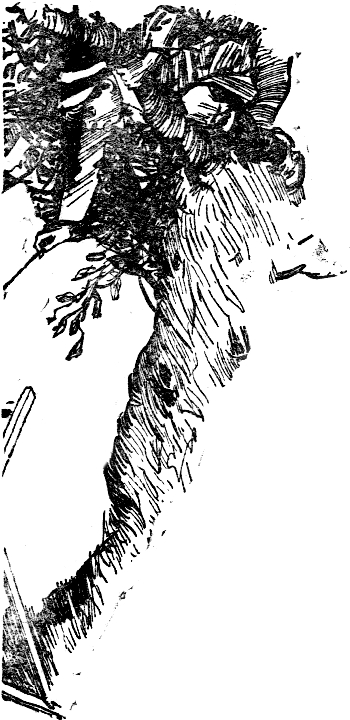
FROM THE TREE WILLIAM MADE A
LAST DESPERATE EFFORT.
It caught—joy!
“Phut!” said the Bishop, bringing down his hand
heavily, not on the pin, but near it.
The pin was loosened—William drew it back
cautiously up into the tree, and the Bishop settled
himself once more to his slumbers.
Again the pin descended—again it caught.
“Phut!” said the Bishop, testily shaking the
handkerchief, and again loosening the pin.
Leaning down from his leafy retreat William made
one last desperate effort. He drew the bent pin
sharply across. It missed the handkerchief and it
caught the Bishop’s ear. The Bishop sat up with a
scream. William, pin and string, withdrew into the
shade of the branches. “Crumbs!” said William
desperately to the caterpillar, “talk about bad
luck!”
The Vicar ran out from the house, full of concern
at the sound of the Bishop’s scream.
“I’ve been badly stung in the ear by some insect,”
said the Bishop in a voice that was pained and
dignified. “Some virulent tropical insect, I should
think—very painful. Very painful indeed——”
“My Lord,” said the Vicar, “I am so sorry—so
very sorry—a thousand pardons—can I procure some
remedy for you—vaseline, ammonia—er—cold
cream——?” Up in the tree the pantomimic
imitation of him went on much to William’s
satisfaction.
“No, no, no, no,” snapped the Bishop. “This
must be a bad place for insects, that’s all. Even
before that some heavy creatures came banging
against my handkerchief. I put my handkerchief
over my face for a protection. If I had failed to do
that I should have been badly stung.”
“Shall we dine indoors, then, my Lord?” said
the Vicar.
“Oh, no, no, NO!” said the Bishop impatiently.
The Vicar sat down upon his chair. William
collected a handful of acorns and began to drop them
one by one upon the Vicar’s bald head. He did this
simply because he could not help it. The sight of
the Vicar’s bald head was irresistible. Each time an
acorn struck the Vicar’s bald head it bounced up into
the air, and the Vicar put up his hand and rubbed his
head. At first he tried to continue his conversation
on the state of the parish finances with the Bishop,
but his replies became distrait and incoherent. He
moved his chair slightly. William moved the position
of his arm and continued to drop acorns.
At last the Bishop noticed it.
“The acorns seem to be falling,” he said.
The Vicar rubbed his head again.
“Don’t they?” he said.
“Rather early,” commented the Bishop.
“Isn’t it?” he said as another acorn bounced
upon his head.
The Bishop began to take quite an interest in the
unusual phenomenon.
“I shouldn’t be surprised if there was some sort
of blight in that tree,” he said. “It would account
for the premature dropping of the acorns and for
the insects that attacked me.”
“Exactly,” said the Vicar irritably, as yet another
acorn hit him. William’s aim was unerring.
Here a diversion was caused by the maid who came
out to lay the table. They watched her in silence.
The Vicar moved his chair again, and William, after
pocketing his friend the caterpillar, shifted his position
in the tree again to get a better aim.
“Do you know,” said the Bishop, “I believe that
there is a cat in the tree. Several times I have heard
a slight rustling.”
It would have been better for William to remain
silent, but William’s genius occasionally misled him.
He was anxious to prevent investigation; to prove
once for all his identity as a cat.
He leant forward and uttered a re-echoing
“Mi-aw-aw-aw!”
As imitations go it was rather good.
There was a slight silence. Then:
“It is a cat,” said the Bishop in triumph.
“Excuse me, my Lord,” said the Vicar.
He went softly into the house and returned holding
a shoe.
“This will settle his feline majesty,” he smiled.
Then he hurled the shoe violently into the tree.
“Sh! Scoot!” he said as he did it.
William was annoyed. The shoe narrowly missed
his face. He secured it and waited.
“I hope you haven’t lost the shoe,” said the Bishop
anxiously.
“Oh, no. The gardener’s boy or someone will
get it for me. It’s the best thing to do with cats.
It’s probably scared it on to the roof.”
He settled himself in his chair comfortably with a
smile.
William leant down, held the shoe deliberately
over the bald head, then dropped it.
“Damn!” said the Vicar. “Excuse me, my Lord.”
“H’m,” said the Bishop. “Er—yes—most
annoying. It lodged in a branch for a time probably,
and then obeyed the force of gravity.”
The Vicar was rubbing his head. William wanted
to enjoy the sight of the Vicar rubbing his head.
He moved a little further up the branch. He forgot
all caution. He forgot that the branch on which
he was was not a very secure branch, and that the
further up he moved the less secure it became.
There was the sound of a rending and a crashing,
and on to the table between the amazed Vicar and
Bishop descended William’s branch and William.
The Bishop gazed at him. “Why, that’s the boy,”
he said.
William sat up among the debris of broken glasses
and crockery. He discovered that he was bruised
and that his hand was cut by one of the broken glasses.
He extricated himself from the branch and the table,
and stood rubbing his bruises and sucking his hand.
“Crumbs!” was all he said.
The Vicar was gazing at him speechlessly.
“You know, my boy,” said the Bishop in mild
reproach, “that’s a very curious thing to do—to
hide up there for the purpose of eavesdropping. I
know that you are an earnest, well-meaning little boy,
and that you were interested in my address this afternoon,
and I daresay you were hoping to listen to me
again, but this is my time for relaxation, you know.
Suppose the Vicar and I had been talking about something
we didn’t want you to hear? I’m sure you
wouldn’t like to listen to things people didn’t want
you to hear, would you?”
William stared at him in unconcealed amazement.
The Vicar, with growing memories of acorns and shoes
and “damns” and with murder in his heart, was
picking up twigs and broken glass. He knew that
he could not, in the Bishop’s presence, say the things
to William and do the things to William that he wanted
to do and say. He contented himself with saying:
“You’d better go home now. Tell your father
I’ll be coming to see him to-morrow.”
“A well-meaning little boy, I’m sure,” said the
Bishop kindly, “well-meaning, but unwise—er—unwise—but
your attentiveness during the meeting
did you credit, my boy—did you credit.”
William, for all his ingenuity, could think of no
remark suitable to the occasion.
“Hurry up,” said the Vicar.
William turned to go. He knew when he was
beaten. He had spent a lot of time and trouble and
had not even secured the episcopal handkerchief. He
had bruised himself and cut himself. He understood
the Vicar’s veiled threat. He saw his already distant
chances of pocket-money vanish into nothingness
when the cost of the Vicar’s glasses and plates was
added to the landing window. He wouldn’t have
minded if he’d got the handkerchief. He wouldn’t
have minded anything if——
“Don’t suck your hand, my boy,” said the Bishop.
“An open cut like that is most dangerous. Poison
works into the system by it. You remember I told
you how the poison of alcohol works into the system—well,
any kind of poison can work into it by a cut—don’t
suck it; keep it covered up—haven’t you a
handkerchief?—here, take mine. You needn’t trouble
to return it. It’s an old one.”
The Bishop was deeply touched by what he called
the “bright spirituality” of the smile with which
William thanked him.
******
William, limping slightly, his hand covered by a
grimy rag, came out into the garden, drawing from
his pocket with a triumphant flourish an enormous
violently-coloured silk handkerchief. Robert, who
was weeding the rose-bed, looked up. “Here,” he
called, “you can jolly well go and put that
handkerchief of mine back.”
William continued his limping but proud advance.
“’S’ all right,” he called airily, “the Bishop’s is
on your dressing-table.”
Robert dropped the trowel.
“Gosh!” he gasped, and hastened indoors to
investigate.
William went down to the gate, smiling very slightly
to himself.
“The days are drawing out so pleasantly,” he was
saying to himself in a mincing accent. “Vaseline—ammonia—er—or
cold cream——Damn!”
He leant over the gate, took out his caterpillar,
satisfied himself that it was still alive, put it back
and looked up and down the road. In the distance
he caught sight of the figure of his friend.
“Gin—ger,” he yelled in hideous shrillness.
He waved his coloured handkerchief carelessly in
greeting as he called. Then he swaggered out into
the road....
CHAPTER II
HENRI LEARNS THE LANGUAGE
It was Joan who drew William and the Outlaws
from their immemorial practice of playing at Pirates
and Red Indians.
“I’m tired of being a squaw,” she said plaintively,
“an’ I’m tired of walking the plank an’ I want to
be something else an’ do something else.”
Joan was the only girl whose existence the Outlaws
officially recognised. This was partly owing to Joan’s
own personal attractiveness and partly to the fact
that an admiration for Joan was the only human
weakness of their manly leader, William. Thus
Joan was admitted to all such games as required the
female element. The others she was graciously
allowed to watch.
They received her outburst with pained
astonishment.
“Well,” said Ginger coldly, “wot else is there
to do an’ be?”
Ginger felt that the very foundation of the Society
of Outlaws was being threatened. The Outlaws had
played at Red Indians and Pirates since their
foundation.
“Let’s play at being ordinary people,” said Joan.
“Ordinary people——!” exploded Douglas.
“There’s no playin’ in bein’ ordinary people. Wot’s
the good——?”
“Let’s be Jasmine Villas,” said Joan, warming to her
theme. “We’ll each be a person in Jasmine Villas——”
William, who had so far preserved a judicial silence,
now said:
“I don’ mind playin’ ornery people s’long as we
don’ do ornery things.”
“Oh, no, William,” said Joan with the air of meekness
with which she always received William’s oracles,
“we needn’t do ornery things.”
“Then bags me be ole Mr. Burwash.”
“And me Miss Milton next door,” said Joan hastily.
The Outlaws were beginning to see vague possibilities
in the game.
“An’ me Mr. Luton,” said Ginger.
“An’ me Mr. Buck,” said Douglas.
Henry, the remaining outlaw, looked around him
indignantly. Jasmine Villas only contained four
houses.
“An’ wot about me?” he said.
“Oh, you be a policeman wot walks about outside,”
said William.
Henry, mollified, began to practise a commanding
strut.
In the field behind the old barn that was the scene
of most of their activities they began to construct
Jasmine Villas by boundary lines of twigs. Each
inhabitant took up their position inside a twig-encircled
enclosure, and Henry paraded officiously around.
“Now we’ll jus’ have a minute to think of what
things to do,” said William, “an’ then I’ll begin.”
******
William was sitting in his back garden thinking
out exploits to perform that afternoon in the character
of Mr. Burwash. The game of Jasmine Villas had
“taken on” beyond all expectation. Mr. Burwash
stole Miss Milton’s washing during her afternoon
siesta, Mr. Buck locked up Mr. Luton in his coal
cellar and ate up all his provisions, and always the
entire population of Jasmine Villas was chased round
the field by Henry, the policeman, several times
during a game. Often some of them were arrested,
tried, condemned and imprisoned by the stalwart
Henry, to be rescued later by a joint force of the
other inhabitants of Jasmine Villas.
William, sitting on an inverted flower pot, absent-mindedly
chewing grass and throwing sticks for his
mongrel, Jumble, to worry, was wondering whether
(in his rôle of Mr. Burwash) it would be more exciting
to go mad and resist the ubiquitous Henry’s efforts
to take him to an asylum, or marry Miss Milton.
The only drawback to the latter plan was that they
had provided no clergyman. However, perhaps a
policeman would do.... Finally he decided that it
would be more exciting to go mad and leave Miss
Milton to someone else.
“’Ello!”
A thin, lugubrious face appeared over the fence
that separated William’s garden from the next door
garden.
“’Ello!” replied William, throwing it a cold glance
and returning to his pastime of entertaining Jumble.
“I weesh to leearn ze Eengleesh,” went on the
owner of the lugubrious face. “My godmother ’ere
she talk ze correct Eengleesh. It ees ze idiomatic
Eengleesh I weesh to leearn—how you call it?—ze
slang. You talk ze slang—ees it not?”
William gave the intruder a devastating glare,
gathering up his twigs and with a commanding “Hi,
Jumble,” set off round the side of the house.
“Oh, William!”
William sighed as he recognised his mother’s voice.
This was followed by his mother’s head which appeared
at the open drawing-room window.
“I’m busy jus’ now——” said William sternly.
“William, Mrs. Frame next door has a godson
staying with her and he is so anxious to mix with
boys and learn colloquial English. I’ve asked him
to tea this afternoon. Oh here he is.”
The owner of the thin lugubrious face—a young
man of about eighteen—appeared behind William.
“I made a way—’ow say you?—through a ’ole
in ze fence. I weeshed to talk wiz ze boy.”
“Well, now, William,” said Mrs. Brown persuasively,
“you might spend the afternoon with Henri and
talk to him.”
William’s face was a study in horror and indignation.
“I shan’t know what to say to him,” he said
desperately. “I can’t talk his kind of talk.”
“I’m sure that’ll be quite all right,” said Mrs.
Brown, kindly. “He speaks English very well.
Just talk to him simply and naturally.”
She brought the argument to an end by closing
the window and leaving an embittered William to
undertake his new responsibility.
“’Ave you a ’oliday zis afternoon,” began his new
responsibility.
“I ’ave,” said William simply and naturally.
“Zen we weel talk,” said Henri with enthusiasm.
“We weel talk an’ you weel teach to me ze slang.”
“’Fraid I’ve gotter play a game this afternoon,”
said William icily as they set off down the road.
“I weel play,” said Henri pleasantly, “I like ze
games.”
“I’m fraid,” said William with equal pleasantness,
“there won’t be no room for you.”
“I weel watch zen,” said Henri, “I like too ze
watching.”
******
Henri, who had spent the afternoon watching the
game, was on his way home. He had enjoyed watching
the game. He had watched a realistically insane
Mr. Burwash resist all attempts at capture on the
part of the local policeman. He had watched Mr.
Luton propose to Miss Milton, and he had watched
Mr. Buck in his end house being gloriously and
realistically drunk. This was an accomplishment of
Douglas’s that was forbidden at home under threat
of severe punishment, but it was greatly appreciated
by the Outlaws.
Henri walked along jauntily, practising slang to
himself.
“Oh, ze Crumbs ... oh, ze Crikey ... ze jolly
well ... righto ... git out ... ze bash on the
mug....”
General Moult—fat and important-looking—came
breezily down the road.
“Ah, Henri ... how are you getting on?”
“Ze jolly well,” said Henri.
“Been for a walk?” said the General yet more
breezily.
“Non.... I been to Jasmine Villas.... Oh,
ze Crumbs.... I see ole Meester Burwash go—’ow
you say it?—off ze head—out of ze chump.”
“What?”
“Oh, yes,” said Henri, “an’ the policeman ’e come
an’ try to take ’im away an’ ’e fight an’ fight, an’
ze policeman ’e go for ’elp——”
The General’s mouth was hanging open in
amazement.
“B-but, are you sure?” he gasped.
“Oh, yes,” said Henri cheerfully. “I ’ave been
zere. I ’ave ze jolly well watch eet.”
“But, good heavens!” said the General, and
hastened in the direction of Jasmine Villas.
Henri sauntered on by himself.
“Ze ’oly aunt ... a’right ... ze boose ...” he
murmured softly.
At the corner of the road he ran into Mr. Graham
Graham. Mr. Graham Graham was tall and lank,
with pince-nez and an earnest expression. Mr.
Graham Graham’s earnest expression did not belie
his character. He was, among other things, the
President of the local Temperance Society. He had
met Henri with his godmother the day before.
“Well, Henri,” he said earnestly. “And how
have you been spending your time?”
“I ’ave been to Jasmine Villas,” said Henri.
“Ah, yes—to whom——?”
Henri interrupted.
“An’ I ’ave seen Meester Buck ... oh, ze crumbs
... ’ow say you? ... tight ... boozed ... derrunk.”
Mr. Graham Graham paled.
“Never!” he said.
Mr. Buck was the Secretary of the local Temperance
Society.
“Oh, yes, ze ’oly aunt!” said Henri, “ze policeman
’e ’elp ’im into the ’ouse—’e was, ’ow say you?
ro-o-o-o-olling.”
“This is impossible,” said Mr. Graham Graham
sternly.
“I ’ave seed it,” said Henri simply. “I laugh ...
oh, ze Crikey ... ’ow I laugh....”
Mr. Graham Graham turned upon Henri a cold
condemning silent glance then set off in the direction
of Jasmine Villas.
Henri wandered homewards.
He met his godmother coming out of her front gate.
“We’re going to Mrs. Brown’s to tea, you know,
Henri,” she reminded him.
“A’right,” said Henri. “A’right—righto.”
He accompanied her to Mrs. Brown’s.
“And did you spend the afternoon with William?”
said Mrs. Brown pleasantly.
“Oh, yes,” said Henri as he sat down comfortably
by the fire, “at ze Jasmine Villas.... Mr. Luton
’e kees Miss Milton in the garden.”
Henri’s godmother dropped her buttered scone.
“Nonsense!” she said.
“’E did,” said Henri calmly. “I ’ave seed ’im.
An’ she gave ’im—’ow say you?—ze bash on ze
mug. But she tell me she goin’ to marry ’im—righto.”
“She told you?” gasped Mrs. Brown.
“Oh, yes,” said Henri, “she tell me so ’erself.”
Both Mrs. Brown and Henri’s godmother were pale.
“Do you think she doesn’t know that he’s married
and separated from his wife?” said Henri’s godmother.
“I don’t know,” said Mrs. Brown. “I feel that I
can’t eat a thing now. Someone ought to tell her
at once.”
“Let’s go,” said Henri’s godmother suddenly,
“before she tells anyone else. The poor woman!”
They went out quickly, leaving Henri alone in the
drawing-room. Henri chose a large sugared cake and
began to munch it.
“Ze jolly well good,” he commented contentedly.
******
The General approached Mr. Burwash’s house
cautiously. There was no sign of a disturbance.
Evidently the policeman had not yet returned with
help. The General entered the garden and went on
tiptoe to the morning-room window. He was full
of curiosity. There was the madman. He was
sitting at a table with his back to the window. There
was a mad look about his very back. The General
was suddenly inspired by the idea of making the
capture single-handed. It would be a glorious page
in the annals of the village. The front door was
open. The General entered and walked very slowly
down the hall. The morning-room door was open.
It was here that the General made the painful discovery
that his boots squeaked. The squeaking would
undoubtedly attract the attention of the lunatic
as he entered. The General had another inspiration.
He dropped down upon his hands and knees. He
could thus make his way unseen and unheard to the
back of the madman, then spring to his feet and
overpower him.
He entered the room.
He reached the middle of the room.
Then Mr. Burwash turned round.
Mr. Burwash was met by the sight of the General
creeping gingerly and delicately across his morning-room
carpet on hands and knees. Mr. Burwash leapt
to the not unreasonable conclusion that the General
had gone mad. Mr. Burwash knew that a madman
must be humoured. He also dropped upon his
hands and knees.
“Bow-wow!” he said.
If the General thought he was a dog, the General
must be humoured.
“Bow-wow!” promptly replied the General.
The General also knew that madmen must be
humoured.
They continued this conversation for several minutes.
Then Mr. Burwash, intent on escape, made a leap
towards the door, and the General, intent on capture,
made a leap to intercept him.
They leapt about the room excitedly uttering
short, shrill barks. The General never quite knew
what made him change into a cat. It was partly
that he was tired of barking and partly that he hoped
to lure Mr. Burwash after him into the more open
space of the hall and there overpower him. Mr.
Burwash’s pursuit was realistic, and the General,
violently chased into the hall, decided to leave the
capture to the police after all, and made for the hall
door. But a furiously barking Mr. Burwash cut off
his retreat. The General, still miaowing unconsciously
in a high treble voice, scampered on all fours
up the stairs and took refuge in a small room at the
top, slamming the door against the pursuing lunatic.
The key was turned in the lock from outside.
At the top of the stairs Mr. Burwash stood trembling
slightly, and wiped his brow. A violent sound of
kicking came from the locked room.
******
Mrs. Brown and Henri’s godmother heard vaguely
the distant sounds of the kicking next door, but their
delicate interview with Miss Milton was taking all
their attention.
Miss Milton, who had been to see a girl whom she
was engaging as housemaid for Mr. Luton, was just
taking off her things. Miss Milton kept a purely
maternal eye upon Mr. Luton.
“You know, dear,” said Henri’s godmother, “we
felt we had to come and tell you as soon as we heard
the news. He’s got one already.”
“Who?” said Miss Milton, angular and severe
looking.
“Mr. Luton.”
“He might have told me,” said Miss Milton.
“But she’s left him,” put in Mrs. Brown.
“Then I’d better see about providing him with
another,” said Miss Milton.
“She—she’s not divorced,” gasped Mrs. Brown.
“I should hope not,” said Miss Milton primly.
“I’m always most particular about that sort of thing.”
“But when we heard he’d been seen kissing
you——” said Henri’s godmother.
Miss Milton gave a piercing scream.
“ME?” she said.
“Yes, when we heard that Mr. Luton had been
seen——”
Miss Milton gave a still more piercing scream.
“Slanderers,” she shrieked, “vampires....”
She advanced upon them quivering with rage.
“I’m so sorry,” gasped Mrs. Brown retreating
precipitately. “Quite a mistake ... a misunderstanding....”
“Liars ... hypocrites ... snakes in the grass!”
screamed Miss Milton, still advancing.
Mrs. Brown and Henri’s godmother fled trembling
to the road. Miss Milton’s screams still rent the air.
There, two curious sights met their eyes. The General
and Mr. Graham Graham were making their exits
from the two end houses in unconventional fashion.
Mr. Graham Graham fell down the steps and rolled
down the garden path to the road. An infuriated
Mr. Buck watched his departure.
“I’ll teach you to come and insult respectable
people,” shouted Mr. Buck. “Drunkard
indeed! And I’ve been Secretary of the Temperance
Society for forty years. You’re drunk, let me
tell you——”
Mr. Graham Graham, still sitting in the road, put on
his hat.
“I’m not drunk,” he said with dignity.
“I’ll have the law on you,” shouted Mr. Buck.
“It’s libel, that’s what it is——”
Mr. Graham Graham gathered together his collar
ends and tried to find his stud.
“I merely repeat what I’ve heard,” he said.
Mr. Buck slammed the door and Mr. Graham Graham
staggered to his feet.
Then he stood open-mouthed, his eyes fixed on
the other end house. The stout figure of the General
could be seen emerging from a small first floor window
and making a slow and ungraceful descent down a
drain pipe. It was noticed that he had no hat and
that his knees were very dusty. Once on the ground
he ran wildly across the garden into the road, almost
charging the little group who were watching him.
With pale, horror-struck faces the four of them gazed
at each other.
“Henri told me——” all four began simultaneously,
then stopped.
“D-do come and have some tea,” said Mrs. Brown
hysterically.
******
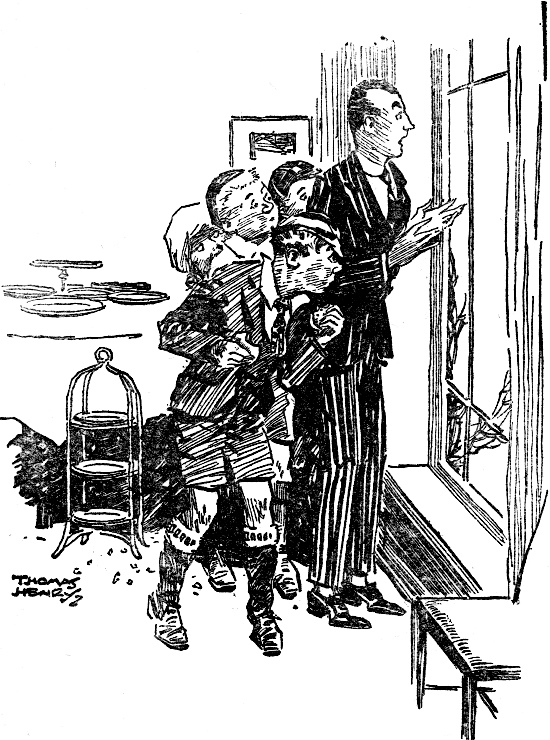
AT THE WINDOW HENRI EXCLAIMED SHRILLY, “OH, ZE
’OLY AUNT!” AND THE OUTLAWS HASTILY JOINED HIM.
William was leading his Outlaws quietly round
from the front gate to the back of the house, passing
the drawing-room window on tiptoe. Suddenly
William stopped dead, gazing with interest into the
drawing-room. The expected tea party was not
there. Only Henri still eating sugar cakes, was there.
William put his head through the open window.
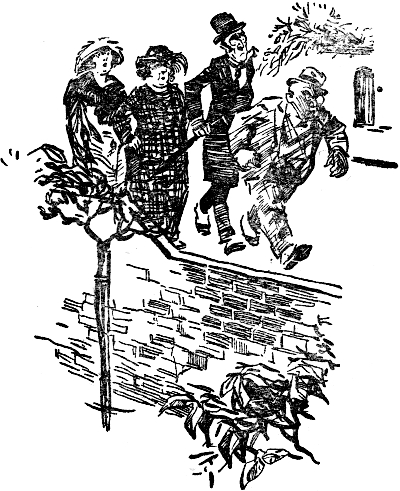
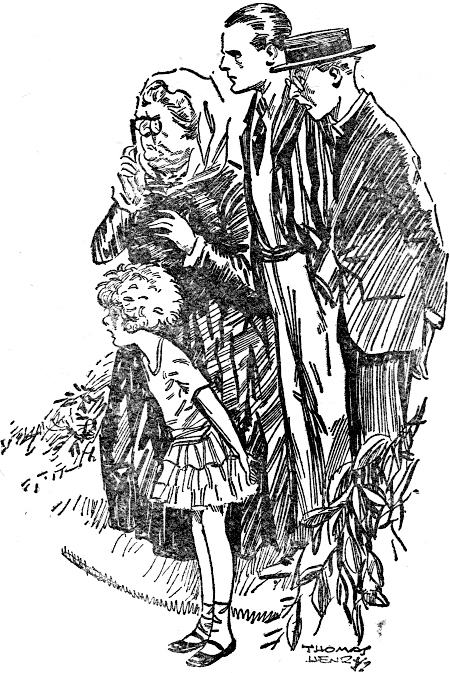
FOUR PEOPLE WERE COMING DOWN THE
ROAD—FOUR VERY ANGRY PEOPLE.
“I say,” he said in a hoarse whisper, “they been
an’ gone?”
“Oh, yes,” smiled Henri, “they been an’ gone—righto.”
“Come on!” said William to his followers.
They crept into the hall and then guiltily into the
drawing-room. William looked at the plates of
dainty food with widening eyes.
“Shu’ly,” he remarked plaintively, “’f they’ve
been an’ gone they can’t mind us jus’ finishin’ up what
they’ve left. Shu’ly.”
William made this statement less at the dictates
of truth than at the dictates of an empty stomach.
“Jus’—jus’ look out of the window, Ongry,” he
said, “an’ tell us if anyone comes.”
Henri obligingly took up his position at the window
and the Outlaws gave themselves up whole-heartedly
to the task of “finishing up.”
They finished up the buttered scones and they
finished up the bread and butter and they finished up
the sandwiches and they finished up the biscuits
and they finished up the small cakes and they finished
up the two large cakes.
“I’m jus’ a bit tired of this ole Jasmine Villas
game,” said William, his mouth full of sugar cake.
“I votes we go back to Pirates an’ Red Injuns
to-morrow.”
The Outlaws, who were still busy, agreed with
grunts.
“I think——” began Douglas, but just then Henri
at the window ejaculated shrilly, “Oh, ze ’oly aunt.”
The Outlaws hastily joined him. Four people
were coming down the road. The General—could it
be the General? (the drain pipe had been very dirty)—Mr.
Graham Graham, his collar open, his tie awry,
Henri’s godmother with her hat on one side, and Mrs.
Brown, her usual look of placid equanimity replaced
by a look that was almost wild. They were certainly
coming to the Browns’ house. William looked
guiltily at the empty plates and cakestand. Except
upon the carpet (for the Outlaws were not born
drawing-room eaters) there was not a crumb to be seen.
“P’raps,” said William hastily to his friends,
“p’raps we’d better go now.”
His friends agreed.
They went as quietly and unostentatiously as
possible by way of the back regions.
Henri remained at the window. He watched the
curious quartette as they came in at the gate.
Details of their appearance, unnoticed before,
became clear as they drew nearer.
“Ze Crumbs an’ ze Crikey!” ejaculated Henri.
******
It was two hours later. William sat disconsolately
upon the upturned plant pot throwing stones half-heartedly
at the fence. Jumble sat disconsolately
by him snapping half-heartedly at flies. The
Outlaws had nobly shared the sugar cakes with
Jumble and he was just beginning to wish that
they hadn’t....
Suddenly Henri’s face appeared at the top of the
fence.
“’Ello!” he said.
“’Ello!” sighed William.
“Zey talk to me,” said Henri sadly, “’ow zey
talk to me jus’ because I tell ’em about your leetle
game.”
“Yes,” said William bitterly, “and ’ow they talk
to me jus’ ’cause we finished up a few ole cakes and
things left over from tea. You’d think to hear ’em
that they’d have been glad to come home and find
me starved dead.”
Henri leant yet further over the fence.
“But zey looked ... ’ow zey looked!”
There was silence for a moment while the mental
vision of “’ow zey looked” came to both. Then
William’s rare laugh—unmusical and penetrating—rang
out. Mrs. Brown, who was suffering from a
severe headache as the result of the events of the
afternoon, hastily closed the drawing-room window.
Followed Henri’s laugh—high-pitched and like the
neighing of a horse. Henri’s godmother tore herself
with a groan from the bed on which she was indulging
in a nervous breakdown and flung up her bedroom
window.
“Henri, are you ill?” she cried. “What is it?”
“Oh, ze nosings,” replied Henri.
Then, leaning yet more dangerously over the
fence, “What ze game you goin’ to play to-morrow,
Willem?”
“Pirates,” said William, regaining his usual calm.
“Like to come?”
“Oh, ze jolly well righto yes!” said Henri.
CHAPTER III
THE SWEET LITTLE GIRL IN WHITE
The Hall stood empty most of the year, but
occasionally tenants re-awoke the passing interest
of the village in it. This summer it was taken by
a Mr. and Mrs. Bott with their daughter. Mr. Bott’s
name decorated most of the hoardings of his native
country. On these hoardings citizens of England
were urged to safeguard their digestion by taking
Bott’s Sauce with their meat. After reading Bott’s
advertisements one felt convinced that any food
without Bott’s Sauce was rank poison. One even
felt that it would be safer to live on Bott’s Sauce
alone. On such feelings had Mr. Bott—as rubicund
and rotund as one of his own bottles of sauce—reared
a fortune sufficient to enable him to take the Hall
for the summer without, as the saying is, turning
a hair.
William happened to be sitting on the fence by the
side of the road when the motor containing Mr. and
Mrs. Bott—both stout and overdressed—and Miss
Violet Elizabeth Bott and Miss Violet Elizabeth
Bott’s nurse flashed by. William was not interested.
He was at the moment engaged in whittling a stick
and watching the antics of his mongrel, Jumble, as he
caught and worried each shaving. But he had a
glimpse of a small child with an elaborately curled
head and an elaborately flounced white dress sitting
by an elaborately uniformed nurse. He gazed after
the equipage scowling.
“Huh!” he said, and it is impossible to convey
in print the scorn of that monosyllable as uttered
by William, “a girl!”
Then he returned to his whittling.
******
William’s mother met Mrs. Bott at the Vicar’s.
Mrs. Bott, who always found strangers more
sympathetic than people who knew her well, confided
her troubles to Mrs. Brown. Her troubles included
her own rheumatism, Mr. Bott’s liver, and the
carelessness of Violet Elizabeth’s nurse.
“Always reading these here novelettes, the girl is. I
hope you’ll come and see me, dear, and didn’t some one
say you had a little boy? Do bring him. I want Violet
Elizabeth to get to know some nice little children.”
Mrs. Brown hesitated. She was aware that none
of her acquaintances would have described William
as a nice little child. Mrs. Bott misunderstood her
hesitation. She laid a fat ringed hand on her knee.
“I know, dear. You’re careful who the little
laddie knows, like me. Well now, you needn’t worry.
I’ve brought up our Violet Elizabeth most particular.
She’s a girlie who wouldn’t do your little boysie any
harm——”
“Oh,” gasped Mrs. Brown, “it’s not that.”
“Then you’ll come, dearie, and bring the little
boysie with you, won’t you?”
She took Mrs. Brown’s speechlessness for consent.
******
“Me?” said William indignantly. “Me go to
tea with that ole girl? Me?”
“She—she’s a nice little girl,” said Mrs. Brown
weakly.
“I saw her,” said William scathingly, “curls and
things.”
“Well, you must come. She’s expecting you.”
“I only hope,” said William sternly, “that she
won’t ’spect me to talk to her.”
“She’ll expect you to play with her, I’m sure,”
said his mother.
“Play?” said William. “Play? With a girl?
Me? Huh!”
William, pale and proud, and dressed in his best
suit, his heart steeled to his humiliating fate, went
with his mother to the Hall the next week. He was
silent all the way there. His thoughts were too deep
for words. Mrs. Brown watched him anxiously.
An over-dressed Mrs. Bott was sitting in an over-furnished
drawing-room. She rose at once with an
over-effusive smile and held out over-ringed hands.
“So you’ve brought dear little boysie,” she began.
The over-effusive smile died away before the look
that William turned on her.
“Er—I hadn’t thought of him quite like that,”
she said weakly, “but I’m sure he’s sweet,” she added
hastily.
William greeted her coldly and politely, then took
his seat and sat like a small statue scowling in front
of him. His hair had been brushed back with so
much vigour and application of liquid that it looked
as if it were painted on his head.
“Would you like to look at a picture book, boysie?”
she said.
William did not answer. He merely looked at her
and she hastily turned away to talk to Mrs. Brown.
She talked about her rheumatism and Mr. Bott’s
liver and the incompetence of Violet Elizabeth’s nurse.
Then Violet Elizabeth entered. Violet Elizabeth’s
fair hair was not naturally curly but as the result of
great daily labour on the part of the much maligned
nurse it stood up in a halo of curls round her small
head. The curls looked almost, if not quite, natural.
Violet Elizabeth’s small pink and white face shone
with cleanliness. Violet Elizabeth was so treasured
and guarded and surrounded with every care that
her small pink and white face had never been known
to do anything else except shine with cleanliness.
But the pièce de résistance about Violet Elizabeth’s
appearance was her skirts. Violet Elizabeth was
dressed in a white lace trimmed dress with a blue
waistband, and beneath the miniature blue waistband
her skirts stood out like a tiny ballet dancer’s in a
filmy froth of lace trimmed petticoats. From this
cascade emerged Violet Elizabeth’s bare legs, to
disappear ultimately into white silk socks and white
buckskin shoes.
William gazed at this engaging apparition in horror.
“Good afternoon,” said Violet Elizabeth primly.
“Good afternoon,” said William in a hollow voice.
“Take the little boysie into the garden, Violet
Elizabeth,” said her mother, “and play with him
nicely.”
William and Violet Elizabeth eyed each other
apprehensively.
“Come along, boy,” said Violet Elizabeth at last,
holding out a hand.
William ignored the hand and with the air of a
hero bound to his execution, accompanied Violet
Elizabeth into the garden.
Mrs. Brown’s eyes followed them anxiously.
******
“Whath your name?” said Violet Elizabeth.
She lisped! She would, thought William bitterly,
with those curls and those skirts. She would. He
felt at any rate relieved that none of his friends could
see him in the unmanly situation—talking to a kid
like that—all eyes and curls and skirts.
“William Brown,” he said distantly, looking over
her head as if he did not see her.
“How old are you?”
“Eleven.”
“My nameth Violet Elizabeth.”
He received the information in silence.
“I’m thix.”
He made no comment. He examined the distant
view with an abstracted frown.
“Now you muth play with me.”
William allowed his cold glance to rest upon her.
“I don’t play little girls’ games,” he said scathingly.
But Violet Elizabeth did not appear to be scathed.
“Don’ you know any little girlth?” she said
pityingly. “I’ll teach you little girlth gameth,”
she added pleasantly.
“I don’t want to,” said William, “I don’t like
them. I don’t like little girls’ games. I don’t want
to know ’em.”
Violet Elizabeth gazed at him open-mouthed.
“Don’t you like little girlth?” she said.
“Me?” said William with superior dignity. “Me?
I don’t know anything about ’em. Don’t want to.”
“D-don’t you like me?” quavered Violet Elizabeth
in incredulous amazement. William looked at her.
Her blue eyes filled slowly with tears, her lips quivered.
“I like you,” she said. “Don’t you like me?”
William stared at her in horror.
“You—you do like me, don’t you?”
William was silent.
A large shining tear welled over and trickled down
the small pink cheek.
“You’re making me cry,” sobbed Violet Elizabeth.
“You are. You’re making me cry, ’cause you won’t
say you like me.”
“I—I do like you,” said William desperately.
“Honest—I do. Don’t cry. I do like you.
Honest!”
A smile broke through the tear-stained face.
“I’m tho glad,” she said simply. “You like all
little girlth, don’t you?” She smiled at him
hopefully. “You do, don’t you?”
William, pirate and Red Indian and desperado,
William, woman-hater and girl-despiser, looked round
wildly for escape and found none.
Violet Elizabeth’s eyes filled with tears again.
“You do like all little girlth, don’t you?” she
persisted with quavering lip. “You do, don’t you?”
It was a nightmare to William. They were standing
in full view of the drawing-room window. At any
moment a grown up might appear. He would be
accused of brutality, of making little Violet Elizabeth
cry. And, strangely enough, the sight of Violet
Elizabeth with tear-filled eyes and trembling lips made
him feel that he must have been brutal indeed.
Beneath his horror he felt bewildered.
“Yes, I do,” he said hastily, “I do. Honest I do.”
She smiled again radiantly through her tears.
“You with you wath a little girl, don’t you?”
“Er—yes. Honest I do,” said the unhappy
William.
“Kith me,” she said raising her glowing face.
William was broken.
He brushed her cheek with his.
“Thath not a kith,” said Violet Elizabeth.
“It’s my kind of a kiss,” said William.
“All right. Now leth play fairieth. I’ll thow
you how.”
On the way home Mrs. Brown, who always hoped
vaguely that little girls would have a civilizing effect
on William, asked William if he had enjoyed it.
William had spent most of the afternoon in the
character of a gnome attending upon Violet Elizabeth
in the character of the fairy queen. Any attempt
at rebellion had been met with tear-filled eyes and
trembling lips. He was feeling embittered with life.
“If all girls are like that——” said William, “well,
when you think of all the hundreds of girls there
must be in the world—well, it makes you feel sick.”
Never had liberty and the comradeship of his own
sex seemed sweeter to William than it did the next
day when he set off whistling carelessly, his hands
in his pockets, Jumble at his heels, to meet Ginger
and Douglas across the fields.
“You didn’t come yesterday,” they said when they
met. They had missed William, the leader.
“No,” he said shortly, “went out to tea.”
“Where?” they said with interest.
“Nowhere in particular,” said William inaccurately.
A feeling of horror overcame him at the memory.
If they knew—if they’d seen.... He blushed with
shame at the very thought. To regain his self-respect
he punched Ginger and knocked off Douglas’ cap.
After the slight scuffle that ensued they set off down
the road.
“What’ll we do this morning?” said Ginger.
It was sunny. It was holiday time. They had
each other and a dog. Boyhood could not wish for
more. The whole world lay before them.
“Let’s go trespassin’,” said William the lawless.
“Where?” enquired Douglas.
“Hall woods—and take Jumble.”
“That ole keeper said he’d tell our fathers if he
caught us in again,” said Ginger.
“Lettim!” said William, with a dare-devil air,
slashing at the hedge with a stick. He was gradually
recovering his self-respect. The nightmare memories
of yesterday were growing faint. He flung a stone
for the eager Jumble and uttered his shrill
unharmonious war whoop. They entered the woods,
William leading. He swaggered along the path.
He was William, desperado, and scorner of girls.
Yesterday was a dream. It must have been. No
mere girl would dare even to speak to him. He had
never played at fairies with a girl—he, William the
pirate king, the robber chief.
“William!”
He turned, his proud smile frozen in horror.
A small figure was flying along the path behind
them—a bare-headed figure with elaborate curls and
very short lacy bunchy skirts and bare legs with
white shoes and socks.
“William, darling! I thaw you from the nurthery
window coming along the road and I ethcaped. Nurth
wath reading a book and I ethcaped. Oh, William
darling, play with me again, do. It wath so nith
yethterday.”
William glared at her speechless. He was glad
of the presence of his manly friends, yet horrified
as to what revelations this terrible young female
might make, disgracing him for ever in their eyes.
“Go away,” he said sternly at last, “we aren’t
playing girls’ games.”
“We don’t like girls,” said Ginger contemptuously.
“William doth,” she said indignantly. “He thaid
he did. He thaid he liked all little girlth. He thaid
he withed he wath a little girl. He kithed me an’
played fairieth with me.”
A glorious blush of a rich and dark red overspread
William’s countenance.
“Oh!” he ejaculated as if astounded at the depth
of her untruthfulness, but it was not convincing.
“Oh, you did!” said Violet Elizabeth. Somehow
that was convincing. Ginger and Douglas looked
at William rather coldly. Even Jumble seemed to
look slightly ashamed of him.
“Well, come along,” said Ginger, “we can’t stop
here all day talking—to a girl.”
“But I want to come with you,” said Violet
Elizabeth. “I want to play with you.”
“We’re going to play boys’ games. You wouldn’t
like it,” said Douglas who was somewhat of a
diplomatist.
“I like boyth gameth,” pleaded Violet Elizabeth,
and her blue eyes filled with tears, “pleath let me
come.”
“All right,” said William. “We can’t stop you
comin’. Don’t take any notice of her,” he said to
the others. “She’ll soon get tired of it.”
They set off. William, for the moment abashed
and deflated, followed humbly in their wake.
******
In a low-lying part of the wood was a bog. The
bog was always there but as it had rained in the
night the bog to-day was particularly boggy. It
was quite possible to skirt this bog by walking round
it on the higher ground, but William and his friends
never did this. They preferred to pretend that the
bog surrounded them on all sides as far as human eye
could see and that at one false step they might sink
deep in the morass never to be seen again.
“Come along,” called William who had recovered
his spirits and position of leadership. “Come along,
my brave fellows ... tread careful or instant death
will be your fate, and don’t take any notice of her,
she’ll soon have had enough.”
For Violet Elizabeth was trotting gaily behind
the gallant band.
They did not turn round or look at her, but they
could not help seeing her out of the corners of their
eyes. She plunged into the bog with a squeal of
delight and stamped her elegant white-clad feet into
the black mud.
“Ithn’t it lovely?” she squealed. “Dothn’t it
feel nith—all thquithy between your toth—ithn’t
it lovely? I like boyth gameth.”
They could not help looking at her when they
emerged. As fairy-like as ever above, her feet were
covered with black mud up to above her socks. Shoes
and socks were sodden.
“Ith a lovely feeling!” she commented delightedly
on the other side. “Leth do it again.”
But William and his band remembered their manly
dignity and strode on without answering. She
followed with short dancing steps. Each of them
carried a stick with which they smote the air or any
shrub they passed. Violet Elizabeth secured a stick
and faithfully imitated them. They came to a clear
space in the wood, occupied chiefly by giant
blackberry bushes laden with fat ripe berries.
“Now, my brave fellows,” said William, “take your
fill. ’Tis well we have found this bit of food or we
would e’en have starved, an’ don’ help her or get
any for her an’ let her get all scratched an’ she’ll soon
have had enough.”
They fell upon the bushes. Violet Elizabeth also
fell upon the bushes. She crammed handfuls of ripe
blackberries into her mouth. Gradually her pink and
white face became obscured beneath a thick covering
of blackberry juice stain. Her hands were dark red.
Her white dress had lost its whiteness. It was stained
and torn. Her bunchy skirts had lost their bunchiness.
The brambles tore at her curled hair and drew it
into that state of straightness for which Nature had
meant it. The brambles scratched her face and
arms and legs. And still she ate.
“I’m getting more than any of you,” she cried.
“I geth I’m getting more than any of you. And I’m
getting all of a meth. Ithn’t it fun? I like boyth
gameth.”
They gazed at her with a certain horrified respect
and apprehension. Would they be held responsible
for the strange change in her appearance?
They left the blackberry bushes and set off again
through the wood. At a sign from William they
dropped on all fours and crept cautiously and (as they
imagined) silently along the path. Violet Elizabeth
dropped also upon her scratched and blackberry
stained knees.
“Look at me,” she shrilled proudly. “I’m doing
it too. Juth like boyth.”
“Sh!” William said fiercely.
Violet Elizabeth “Sh’d” obediently and for a
time crawled along contentedly.
“Are we playin’ bein’ animalth?” she piped at last.
“Shut up!” hissed William.
Violet Elizabeth shut up—except to whisper to
Ginger who was just in front, “I’m a thnail—what
you?” Ginger did not deign to reply.
At a sign from their leader that all danger was over
the Outlaws stood upright. William had stopped.
“We’ve thrown ’em off the scent,” he said scowling,
“but danger s’rounds us on every side. We’d better
plunge into the jungle an’ I bet she’ll soon’ve had
enough of plungin’ into the jungle.”
They left the path and “plunged” into the dense,
shoulder-high undergrowth. At the end of the line
“plunged” Violet Elizabeth. She fought her way
determinedly through the bushes. She left remnants
of her filmy skirts on nearly every bush. Long
spidery arms of brambles caught at her hair again
and pulled out her curls. But Violet Elizabeth
liked it. “Ithn’t it fun?” she piped as she followed.
Under a large tree William stopped.
“Now we’ll be Red Indians,” he said, “an’ go
huntin’. I’ll be Brave Heart same as usual and
Ginger be Hawk Face and Douglas be Lightning Eye.”
“An’ what thall I be?” said the torn and stained and
wild-headed apparition that had been Violet Elizabeth.
Douglas took the matter in hand.
“What thall I be?” he mimicked shrilly, “what
thall I be? What thall I be?”
Violet Elizabeth did not run home in tears as he
had hoped she would. She laughed gleefully.
“It doth thound funny when you thay it like that!”
she said delightedly. “Oh, it doth! Thay it again!
Pleath thay it again.”
Douglas was nonplussed.
“Anyway,” he said, “you jolly well aren’t going
to play, so there.”
“Pleath let me play,” said Violet Elizabeth.
“Pleath.”
“No. Go away!”
William and Ginger secretly admired the firm
handling of this female by Douglas.
“Pleath, Douglath.”
“No!”
Violet Elizabeth’s blue eyes, fixed pleadingly
upon him, filled with tears. Violet Elizabeth’s
underlip trembled.
“You’re making me cry,” she said. A tear traced
its course down the blackberry stained cheek.
“Pleath, Douglath.”
Douglas hesitated and was lost. “Oh, well——”
he said.
“Oh, thank you, dear Douglath,” said Violet
Elizabeth. “What thall I be?”
“Well,” said William to Douglas sternly. “Now
you’ve let her play I s’pose she’d better be a squaw.”
“A thquaw,” said Violet Elizabeth joyfully, “what
thort of noith doth it make?”
“It’s a Indian lady and it doesn’t make any sort
of a noise,” said Ginger crushingly. “Now we’re
going out hunting and you stay and cook the dinner.”
“All right,” said Violet Elizabeth obligingly.
“Kith me good-bye.”
Ginger stared at her in horror.
“But you mutht,” she said, “if you’re going out
to work an’ I’m going to cook the dinner, you mutht
kith me good-bye. They do.”
“I don’t,” said Ginger.
She held up her small face.
“Pleath, Ginger.”
Blushing to his ears Ginger just brushed her cheek
with his. William gave a derisive snort. His self-respect
had returned. Douglas’s manly severity had
been overborne. Ginger had been prevailed upon to
kiss her. Well, they couldn’t laugh at him now.
They jolly well couldn’t. Both were avoiding his
eye.
“Well, go off to work, dear William and Douglas and
Ginger,” said Violet Elizabeth happily, “an’ I’ll cook.”
Gladly the hunters set off.
******
The Red Indian game had palled. It had been a
success while it lasted. Ginger had brought some
matches and over her purple layer of blackberry juice
the faithful squaw now wore a layer of black from the
very smoky fire they had at last managed to make.
“Come on,” said William, “let’s set out looking
for adventures.”
They set off single file as before, Violet Elizabeth
bringing up the rear, Jumble darting about in ecstatic
searches for imaginary rabbits. Another small bog
glimmered ahead. Violet Elizabeth, drunk with
her success as a squaw, gave a scream.
“Another thquithy plath,” she cried. “I want
to be firtht.”
She flitted ahead of them, ran to the bog, slipped
and fell into it face forward.
She arose at once. She was covered in black mud
from head to foot. Her face was a black mud mask.
Through it her teeth flashed in a smile. “I juth
thlipped,” she explained.
A man’s voice came suddenly from the main
path through the wood at their right.
“Look at ’em—the young rascals! Look at
’em! An’ a dawg! Blarst ’em! Er-r-r-r-r!”
The last was a sound expressive of rage and
threatening.
“Keepers!” said William. “Run for your lives,
braves. Come on, Jumble.”
They fled through the thicket.
“Pleath,” gasped Violet Elizabeth in the rear,
“I can’t run as fatht ath that.”
It was Ginger and Douglas who came back to hold
her hands. For all that they ran fleetly, dashing
through the undergrowth where the keepers found
it difficult to follow, and dodging round trees. At
last, breathlessly, they reached a clearing and in the
middle of it a cottage as small and attractive as a
fairy tale cottage. The door was open. It had an
empty look. They could hear the keepers coming
through the undergrowth shouting.
“Come in here,” gasped William. “It’s empty.
Come in and hide till they’ve gone.”
The four ran into a spotlessly clean little kitchen,
and Ginger closed the door. The cottage was certainly
empty. There was not a sound.
“Ithn’t it a thweet little houth?” panted Violet
Elizabeth.
“Come upstairs,” said Douglas. “They might
look in here.”
The four, Jumble scrambling after them, clattered
up the steep narrow wooden stairs and into a small
and very clean bedroom.
“Look out of the window and see when they go
past,” commanded William, “then we’ll slip out and
go back.”
Douglas peeped cautiously out of the window.
He gave a gasp.
“They—they’re not goin’ past,” he said. “They—they’re
they’re comin’ in at the door.”
The men’s voices could be heard below.
“Comin’ in here—the young rascals! Look at
their footmarks, see? What’ll my old woman say
when she gets home?”
“They’ve gone upstairs, too. Look at the marks.
Blarst ’em!”
William went to the window, holding Jumble
beneath his arm.
“We can easily climb down by this pipe,” he said
quickly. “Then we’ll run back.”
He swung a leg over the window sill, prepared to
descend with Jumble clinging round his neck, as
Jumble was trained to do. Jumble’s life consisted
chiefly of an endless succession of shocks to the nerves.
Ginger and Douglas prepared to follow.
The men’s footsteps were heard coming upstairs,
when a small voice said plaintively, “Pleath—pleath,
I can’t do that. Pleath, you’re not going to leave me,
are you?”
William put back his foot.
“We—we can’t leave her,” he said. Ginger and
Douglas did not question their leader’s decision. They
stood in a row facing the door while the footsteps
drew nearer.
The door burst open and the two keepers appeared.
“Now, yer young rascals—we’ve got yer!”
******
Into Mr. Bott’s library were ushered two
keepers, each leading two children by the neck.
One held two rough-looking boys. The other held a
rough-looking boy and a rough-looking little girl.
A dejected-looking mongrel followed the procession.
“Trespassin’, sir,” said the first keeper, “trespassin’
an’ a-damagin’ of the woods. Old ’ands, too. Seen
’em at it before but never caught ’em till now. An’
a dawg too. It’s an example making of they want,
sir. They want prosecutin’ if I may make so bold.
A-damagin’ of the woods and a-bringing of a dawg——”
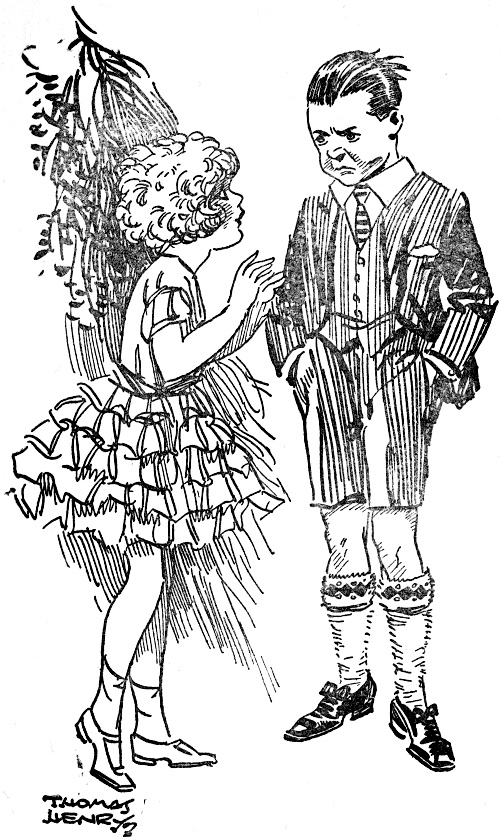
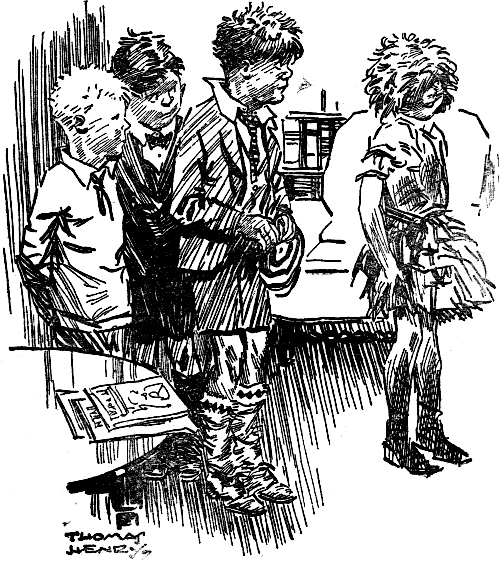
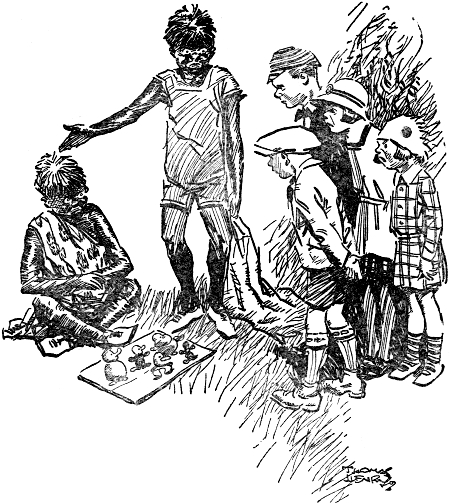
“WE’VE FOUND HER,” ANNOUNCED WILLIAM, AND VIOLET
ELIZABETH TOOK A STEP FORWARD. “IT’S ME,” SHE
PIPED.
Mr. Bott who was new to squiredom and had
little knowledge of what was expected of him and
moreover was afflicted at the moment with severe
private domestic worries, cast a harassed glance at the
four children. His glance rested upon Violet
Elizabeth without the faintest flicker of recognition.
He did not recognise her. He knew Violet
Elizabeth. He saw her at least once or almost
once a day. He knew her quite well. He knew
her by her ordered flaxen curls, pink and white face
and immaculate bunchy skirts. He did not know
this little creature with the torn, stained, bedraggled
dress (there was nothing bunchy about it now) whose
extremely dirty face could just be seen beneath the
tangle of untidy hair that fell over her eyes. She
watched him silently and cautiously. Just as he
was going to speak Violet Elizabeth’s nurse entered.
It says much for Violet Elizabeth’s disguise that her
nurse only threw her a passing glance. Violet
Elizabeth’s nurse’s eyes were red-rimmed.
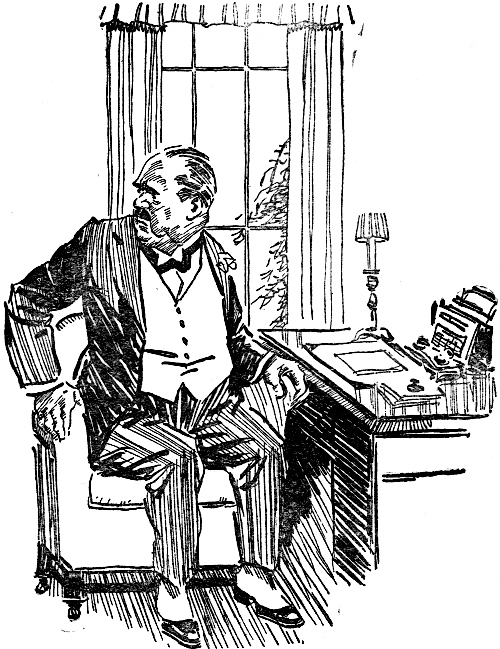
“GOD BLESS MY SOUL,” EXCLAIMED MR. BOTT, PEERING
AT THE APPARITION. “IT’S IMPOSSIBLE.”
“Please, sir, Mrs. Bott says is there any news?”
“No,” said Mr. Bott desperately. “Tell her I’ve
rung up the police every minute since she sent last.
How is she?”
“Please, sir, she’s in hysterics again.”
Mr. Bott groaned.
Ever since Violet Elizabeth’s disappearance Mrs.
Bott had been indulging in hysterics in her bedroom
and taking it out of Violet Elizabeth’s nurse. In
return Violet Elizabeth’s nurse had hysterics in the
nursery and took it out of the nursery maid. In
return the nursery maid had hysterics in the kitchen and
took it out of the kitchen maid. The kitchen maid had
no time for hysterics but she took it out of the cat.
“Please, sir, she says she’s too ill to speak now.
She told me to tell you so, sir.”
Mr. Bott groaned again. Suddenly he turned to
the four children and the keepers.
“You’ve got their names and addresses, haven’t
you? Well, see here, children. Go out and see
if you can find my little gall for me. She’s lost.
Look in the woods and round the village and—everywhere.
And if you find her I’ll let you off. See?”
They murmured perfunctory thanks and retired,
followed by Violet Elizabeth who had not uttered one
word within her paternal mansion.
In the woods they turned on her sternly.
“It’s you he wants. You’re her.”
“Yeth,” agreed the tousled ragamuffin who was
Violet Elizabeth, sweetly, “ith me.”
“Well, we’re going to find you an’ take you
back.”
“Oh, pleath, I don’t want to be found and tooken
back. I like being with you.”
“Well, we can’t keep you about with us all day,
can we?” argued William sternly. “You’ve gotter
go home sometime same as we’ve gotter go home sometime.
Well, we jolly well want our dinner now and
we’re jolly well going home an’ we’re jolly well goin’ to
take you home. He might give us something and——”
“All right,” agreed Violet Elizabeth holding up her
face, “if you’ll all kith me I’ll be found an’ tooken
back.”
******
The four of them stood again before Mr. Bott’s desk.
William and Ginger and Douglas took a step back and
Violet Elizabeth took a step forward.
“We’ve found her,” said William.
“Where?” said Mr. Bott looking round.
“Ith me,” piped Violet Elizabeth.
Mr. Bott started.
“You?” he repeated in amazement.
“Yeth, father, ith me.”
“But, but—God bless my soul——” he ejaculated
peering at the unfamiliar apparition. “It’s
impossible.”
Then he rang for Violet Elizabeth’s nurse.
“Is this Violet Elizabeth?” he said.
“Yeth, ith me,” said Violet Elizabeth again.
Violet Elizabeth’s nurse pushed back the tangle
of hair.
“Oh, the poor poor child!” she cried. “The
poor child!”
“God bless my soul,” said Mr. Bott again. “Take
her away. I don’t know what you do to her, but
do it and don’t let her mother see her till it’s done,
and you boys stay here.”
“Oh, my lamb!” sobbed Violet Elizabeth’s nurse
as she led her away. “My poor lamb!”
In an incredibly short time they returned. The
mysterious something had been done. Violet Elizabeth’s
head was a mass of curls. Her face shone with
cleanliness. Dainty lace-trimmed skirts stuck out
ballet-dancer-wise beneath the pale blue waistband.
Mr. Bott took a deep breath.
“Now fetch her mother,” he said.
Like a tornado entered Mrs. Bott. She still heaved
with hysterics. She enfolded Violet Elizabeth to
her visibly palpitating bosom.
“My child,” she sobbed, “Oh my darling child.”
“I wath a thquaw,” said Violet Elizabeth. “It
dothn’t make any thort of a noith. Ith a lady.”
“How did you——” began Mrs. Bott still straining
Violet Elizabeth to her.
“These boys found her——” said Mr. Bott.
“Oh, how kind—how noble,” said Mrs. Bott.
“And one’s that nice little boy who played with her so
sweetly yesterday. Give them ten shillings each,
Botty.”
“Well, but——” hesitated Mr. Bott remembering
the circumstances in which they had been brought
to him.
“Botty!” screamed Mrs. Bott tearfully, “Don’t you
value your darling child’s life at even thirty shillings?”
Hastily Mr. Bott handed them each a ten shilling
note.
******
They tramped homewards by the road.
“Well, it’s turned out all right,” said Ginger
lugubriously, but fingering the ten shilling note in
his pocket, “but it might not have. ’Cept for the
money it jolly well spoilt the morning.”
“Girls always do,” said William. “I’m not going
to have anything to do with any ole girl ever again.”
“’S all very well sayin’ that,” said Douglas who
had been deeply impressed that morning by the
inevitableness and deadly persistence of the sex, “’s
all very well sayin’ that. It’s them what has to do
with you.”
“An’ I’m never goin’ to marry any ole girl,” said
William.
“’S all very well sayin’ that,” said Douglas again
gloomily, “but some ole girl’ll probably marry you.”
CHAPTER IV
WILLIAM TURNS OVER A NEW LEAF
William had often been told how much happier
he would be if he would follow the straight and narrow
path of virtue, but so far the thought of that happiness
had left him cold. He preferred the happiness that he
knew by experience to be the result of his normal
wicked life to that mythical happiness that was
prophesied as the result of a quite unalluring life of
righteousness. Suddenly, however, he was stirred.
An “old boy” had come to visit the school and had
given an inspiring address to the boys in which he
spoke of the beauty and usefulness of a life of Self-denial
and Service. William, for the first time, began
to consider the question seriously. He realised that
his life so far had not been, strictly speaking, a life of
Self-denial and Service. The “old boy” said many
things that impressed William. He pictured the liver
of the life of Self-denial and Service surrounded by
a happy, grateful and admiring family circle. He
said that everyone would love such a character.
William tried to imagine his own family circle as
a happy, grateful and admiring family circle. It
was not an easy task even to such a vivid imagination
as William’s but it was not altogether impossible.
After all, nothing was altogether impossible....
While the headmaster was proposing a vote of
thanks to the eloquent and perspiring “old boy,”
William was deciding that there might be something
in the idea after all. When the bell rang for the end
of school, William had decided that it was worth
trying at any rate. He decided to start first thing
next morning—not before. William was a good
organiser. He liked things cut and dried. A new
day for a new life. It was no use beginning to be self-denying
and self-sacrificing in the middle of a day
that had started quite differently. If you were going
to have a beautiful character and a grateful family
circle you might as well start the day fresh with it,
not drag it over from the day before. It would be
jolly nice to have a happy, grateful and admiring
family circle, and William only hoped that if he took
the trouble to be self-denying and self-sacrificing
his family circle would take the trouble to be happy
and grateful and admiring. There were dark doubts
about this in William’s mind. His family circle
rarely did anything that was expected of them. Still,
William was an optimist and—anything might happen.
And to-morrow was a whole holiday. He could give
all his attention to it all day....
He looked forward to the new experience with
feelings of pleasant anticipation. It would be
interesting and jolly—meantime there was a whole
half of to-day left and it was no use beginning the
life of self-denial and service before the scheduled time.
He joined his friends, Ginger, Henry and Douglas
after school and together they trespassed on the
lands of the most irascible farmer they knew in the
hopes of a pleasant chase. The farmer happened to
be in the market town so their hopes were disappointed
as far as he was concerned. They paddled in his
pond and climbed his trees and uttered defiant shouts
to his infuriated dog, and were finally chased away
by his wife with a fire of hard and knobbly potatoes.
One got William very nicely on the side of his head
but, his head being as hard and knobbly as the potato,
little damage was done. Next they “scouted” each
other through the village and finally went into Ginger’s
house and performed military manœuvres in Ginger’s
bedroom, till Ginger’s mother sent them away because
the room just below happened to be the drawing-room
and the force of the military manœuvres
was disintegrating the ceiling and sending it
down in picturesque white flakes into Ginger’s
mother’s hair.
They went next to Henry’s garden and there with
much labour made a bonfire. Ginger and Douglas
plied the fire with fuel; and William and Henry, with
a wheelbarrow and the garden hose, wearing old tins
on their heads, impersonated the fire brigade. During
the exciting scuffles that followed, the garden hose
became slightly involved and finally four dripping
boys fled from the scene and from possible detection,
leaving only the now swimming bonfire, the wheelbarrow
and hose to mark the scene of action. A long
rest in a neighbouring field in the still blazing sunshine
soon partially dried them. While reclining at ease
they discussed the latest Red Indian stories which
they had read, and the possibility of there being any
wild animals left in England.
“I bet there is,” said Ginger earnestly, “they
hide in the day time so’s no one’ll see ’em, an’ they
come out at nights. No one goes into the woods
at night so no one knows if there is or if there isn’t,
an’ I bet there is. Anyway let’s get up some night
’n take our bows ’n arrows an’ look for ’em. I bet
we’d find some.”
“Let’s to-night,” said Douglas eagerly.
William remembered suddenly the life of virtue
to which he had mentally devoted himself. He
felt that the nocturnal hunting for wild animals was
incompatible with it.
“I can’t to-night,” he said with an air of virtue.
“Yah—you’re ’fraid!” taunted Henry, not because
he had the least doubt of William’s courage but
simply to introduce an element of excitement into
the proceedings.
He succeeded.
When finally Henry and William arose breathless
and bruised from the ditch where the fight had ended,
Douglas and Ginger surveyed them with dispassionate
interest.
“William won an’ you’re both in a jolly old mess!”
Henry removed some leaves and bits of grass from
his mouth.
“All right, you’re not afraid,” he said pacifically to
William, “when will you come huntin’ wild animals?”
William considered. He was going to give the
life of virtue, of self-denial and service a fair day’s
trial, but there was just the possibility that from
William’s point of view it might not be a success.
It would be as well to leave the door to the old life open.
“I’ll tell you to-morrow,” he said guardedly.
“All right. I say, let’s race to the end of the field
on only one leg ... Come on! Ready?... One,
two, three ... GO!”
II
William awoke. It was morning. It was the
morning on which he was to begin his life of self-denial
and service. He raised his voice in one of his
penetrating and tuneless morning songs, then stopped
abruptly, “case I disturb anyone” he remarked
virtuously to his brush and comb.... His father
frequently remarked that William’s early morning
songs were enough to drive a man to drink....
He brushed his hair with unusual vigour and
descended to breakfast looking (for William) unusually
sleek and virtuous. His father was reading the
paper in front of the fire.
“Good mornin’, Father,” said William in a voice
of suave politeness.
His father grunted.
“Did you hear me not singin’ this mornin’,
Father?” said William pleasantly. It was as well
that his self-denials should not be missed by the
family circle.
His father did not answer. William sighed. Some
family circles were different from others. It was
hard to imagine his father happy and grateful and
admiring. But still, he was going to have a jolly
good try....
His mother and sister and brother came down.
William said “Good mornin’!” to them all with
unctuous affability. His brother looked at him
suspiciously.
“What mischief are you up to?” he said
ungraciously.
William merely gave him a long silent and
reproachful glance.
“What are you going to do this morning, William
dear?” said his mother.
“I don’ mind what I do,” said William. “I jus’
want to help you. I’ll do anything you like, Mother.”
She looked at him anxiously.
“Are you feeling quite well, dear?” she said with
concern.
“If you want to help,” said his sister sternly, “you
might dig up that piece of my garden you and those
other boys trampled down yesterday.”
William decided that a life of self-denial and service
need not include fagging for sisters who spoke to one
in that tone of voice. He pretended not to hear.
“Can I do anything at all for you this morning,
Mother dear,” he said earnestly.
His mother looked too taken aback to reply. His
father rose and folded up his newspaper.
“Take my advice,” he said, “and beware of that
boy this morning. He’s up to something!”
William sighed again. Some family circles simply
didn’t seem able to recognise a life of self-denial
and service when they met it....
After breakfast he wandered into the garden.
Before long Ginger, Douglas and Henry came down the
road.
“Come on, William!” they called over the gate.
For a moment William was tempted. Somehow it
seemed a terrible waste of a holiday to spend it in self-denial
and service instead of in search of adventures
with Ginger, Douglas and Henry. But he put the
temptation away. When he made up his mind to
do a thing he did it....
“Can’t come to-day,” he said sternly, “I’m busy.”
“Oh, go on!”
“Well, I am an’ I’m just not comin’ an’ kin’ly
stop throwin’ stones at our cat.”
“Call it a cat! Thought it was an ole fur glove
what someone’d thrown away!”
In furious defence of his household’s cat (whose
life William in private made a misery) William leapt
to the gate. The trio fled down the road. William
returned to his meditations. His father had gone to
business and Ethel and Robert had gone to golf.
His mother drew up the morning-room window.
“William, darling, aren’t you going to play with
your friends this morning?”
William turned to her with an expression of
solemnity and earnestness.
“I want to help you, Mother. I don’t wanter play
with my friends.”
He felt a great satisfaction with this speech. It
breathed the very spirit of self-denial and service.
“I’ll try to find that bottle of tonic you didn’t
finish after whooping cough,” said his mother
helplessly as she drew down the window.
“GOOD HEAVENS!” SAID MISS DEXTER. “DOES HE
KNOW YOU’VE COME TO ASK ME?”
“ROBERT’S DEEP IN LOVE WITH YOU,” SAID WILLIAM,
“HE’S WRITIN’ PO’TRY AN’ NOT SLEEPIN’ AN’ NOT EATIN’
AND CARVING YOUR INITIALS ALL OVER THE HOUSE.”
William stared around him disconsolately. It was
hard to be full of self-sacrifices and service and to
find no outlet for it ... nobody seemed to want
his help. Then a brilliant idea occurred to him.
He would do something for each of his family—something
that would be a pleasant surprise when
they found out....
He went up to his bedroom. There in a drawer
was a poem that he had found in Robert’s blotter the
week before. It began:
“O Marion
So young and fair
With silken hair....”
It must be Marion Dexter. She was fair and,
well, more or less young, William supposed. William
didn’t know about her hair being silken. It looked
just like ordinary hair to him. But you never knew
with girls. He had kept the poem in order to use it
as a weapon of offence against Robert when occasion
demanded. But that episode belonged to his old evil
past. In his new life of self-denial and service he
wanted to help Robert. The poem ended:
“I should be happy, I aver
If thou my suit wouldst but prefer.”
That meant that Robert wanted to be engaged to
her. Poor Robert! Perhaps he was too shy to
ask her, or perhaps he’d asked her and she’d refused
... well, it was here that Robert needed some help.
William, with a determined expression, set off down
the road.
III
He knocked loudly at the door. By a lucky
chance Marion Dexter came to the door herself.
“Good afternoon,” she said.
“Good afternoon,” said William in a business-like
fashion. “Has Robert ever asked you to marry him?”
“No. What a peculiar question to ask on the
front doorstep. Do come in.”
William followed her into the drawing-room. She
shut the door. They both sat down. William’s
face was set and frowning.
“He’s deep in love with you,” he said in a
conspiratorial whisper.
Marion’s eyes danced.
“Did he send you to tell me?”
William ignored the question.
“He’s deep in love with you and wants you to
marry him.”
Marion dimpled.
“Why can’t he ask me then?”
“He’s shy,” said William earnestly, “he’s always
shy when he’s in love. He’s always awful shy with
the people what he’s in love with. But he wants
most awful bad to marry you. Do marry him, please.
Jus’ for kindness. I’m tryin’ to be kind. That’s
why I’m here.”
“I see,” she said. “Are you sure he’s in love
with me?”
“Deep in love. Writin’ potry an’ carryin’ on—not
sleepin’ and not eatin’ an’ murmurin’ your name
an’ puttin’ his hand on his heart an’ carvin’ your
initials all over the house an’ sendin’ you flowers an’
things,” said William drawing freely on his imagination.
“I’ve never had any flowers from him.”
“No. They all get lost in the post,” said William
without turning a hair. “But he’s dyin’ slow of
love for you. He’s gettin’ thinner an’ thinner. ’F
you don’t be engaged to him soon he’ll be stone dead.
He’ll die of love like what they do in tales an’ then
you’ll probably get hung for murder.”
“Good heavens!” said Miss Dexter.
“Well, I hope you won’t,” said William kindly,
“an’ I’ll do all I can to save you if you are but ’f
you kill Robert with not gettin’ engaged to him
prob’ly you will be.”
“Does he know you’ve come to ask me?” said Miss
Dexter.
“No. I want it to be a s’prise to him,” said William.
“It will be that,” murmured Miss Dexter.
“You will marry him, then?” said William
hopefully.
“Certainly—if he wants me to.”
“P’raps,” said William after a slight pause, “you’d
better write it in a letter ’cause he’d like as not, not
b’lieve me.”
With eyes dancing and lips quivering with suppressed
laughter Miss Dexter sat down at her writing table.
Dear Robert (she wrote),
At William’s earnest request I promise to
be engaged to you and to marry you whenever you like.
Yours sincerely, Marion Dexter.
She handed it to William. William read it gravely
and put it in his pocket.
“Thanks ever so much,” he said fervently.
“Don’t mention it,” said Miss Dexter demurely.
“Quite a pleasure.”
He walked down the road in a rosy glow of virtue.
Well, he’d done something for Robert that ought
to make Robert grateful to him for the rest of his life.
He’d helped Robert all right. He’d like to know
what service was if it wasn’t that—getting people
engaged to people they wanted to be engaged to.
Jolly hard work too. Now there remained his mother
and Ethel. He must go home and try to find some
way of helping them....
IV
When he reached home Ethel was showing out Mrs.
Helm, a tall, stern-looking lady whom William knew
by sight.
“I’m so frightfully disappointed not to be able
to come,” Ethel was saying regretfully, “but I’m
afraid I must go to the Morrisons. I promised over
a week ago. Thank you so much for asking me.
Good morning.”
William followed her into the dining-room where
his mother was.
“What did she want, dear?” said Mrs. Brown.
“Go and wash your hands, William.”
“She wanted me to go in this evening but I told
her I couldn’t because I was going to the Morrisons.
Thank Heaven I had an excuse!”
William unfortunately missed the last sentence,
as, still inspired by high ideals of virtue, he had gone
at once upstairs to wash his hands. While he
splashed about at the handbasin an idea suddenly
occurred to him. That was how he’d help Ethel.
He’d give her a happy evening. She should
spend it with the Helms and not with the Morrisons.
She’d sounded so sorry that she had to go to the
Morrisons and couldn’t go to the Helms. He’d
fix it all up for her this afternoon. He’d help her
like he’d helped Robert.
He had hoped to be able to give Robert Miss
Dexter’s note at lunch, but it turned out that Robert
was lunching at the golf club with a friend.
Directly after lunch William set off to Mrs. Morrison’s
house. He was shown into the drawing-room. Mrs.
Morrison, large and fat and comfortable-looking,
entered. She looked rather bewildered as she met
William’s stern frowning gaze.
“I’ve come from Ethel,” said William aggressively.
“She’s sorry she can’t come to-night.”
Mrs. Morrison’s cheerful countenance fell.
“The girls will be disappointed,” she said, “they
saw her this morning and she said she was looking
forward to it.”
Some explanation seemed necessary. William
was never one to stick at half measures.
“She’s been took ill since then,” he said.
“Oh dear,” said Mrs. Morrison with concern,
“nothing serious, I hope?”
William considered. If it wasn’t serious she might
expect Ethel to recover by the evening. She’d
better have something serious.
“I’m ’fraid it is,” he said gloomily.
“Dear, dear!” said Mrs. Morrison. “Tch! tch!
What is it?”
William thought over all the complaints he knew.
None of them seemed quite serious enough. She
might as well have something really serious while he
was about it. Then he suddenly remembered hearing
the gardener talking to the housemaid the day before.
He’d been talking about his brother who’d got—what
was it? Epi—epi——
“Epilepsy!” said William suddenly.
“What?” screamed Mrs. Morrison.
William, having committed himself to epilepsy meant
to stick to it.
“Epilepsy, the doctor says,” he said firmly.
“Good heavens!” said Mrs. Morrison. “When
did you find out? Will he be able to cure it? Is
the poor girl in bed? How does it affect her? What
a dreadful thing!”
William was flattered at the impression he seemed
to have made. He wondered whether it were possible
to increase it.
“The doctor thinks she’s got a bit of consumption
too,” he said casually, “but he’s not quite sure.”
Mrs. Morrison screamed again. “Heavens! And
she always looked so healthy. The girls will be so
distressed. William, do tell me—when did your
mother realise there was something wrong?”
William foresaw that the conversation was becoming
complicated. He did not wish to display his ignorance
of the symptoms of epilepsy and consumption.
“Jus’ soon after lunch,” he said with rising
cheerfulness. “Now I’d better be goin’, I think.
Good afternoon.”
He left Mrs. Morrison still gasping upon the sofa
and in the act of ringing for her maid to fetch her
smelling salts.
William walked down the road with a swagger.
He was managing jolly well.... The next visit was
easier. He simply told Mrs. Helm’s maid at the
front door to tell Mrs. Helm that Ethel would be able
to come to-night after all, thank you very much.
Then he swung off to the woods with Jumble, his
faithful dog. In accordance with his new life of
virtue he walked straight along the road without
burrowing in the ditches or throwing stones at
telegraph posts. His exhilaration slowly vanished. He
wondered where Ginger and Henry and Douglas were
and what they were doing. It was jolly dull all alone
... but still the happiness and gratitude and
admiration of his family circle when they found out all
he had done for them would repay him for everything.
At least he hoped it would. His mother ... he had
done nothing for his mother yet. He must try to
do something for his mother....
V
When he returned home it was almost dinner time.
His mother and Ethel and Robert were still out.
The Cook met him with a lugubrious face.
“Now, Master William,” she said, “can I trust
you to give a message to your Ma.”
“Yes, Cook,” said William virtuously.
“Me cold in me ’ead’s that bad I can’t stand on
me feet no longer. That ’ussy Ellen wouldn’t give up
’er night hout to ’elp me—not she, and yer Ma said if
I’d leave things orl ready to dish hup I might go
and rest afore dinner ’f I felt bad. Well, she’ll be hin
hany minute now and just tell ’er it’s hall ready to
dish up. Tell ’er I ’aven’t made no pudd’n but I’ve
hopened a bottle of stewed pears.”
“All right, Cook,” said William.
Cook took the paper-backed copy of “A Mill Girl’s
Romance” from the kitchen dresser and slowly sneezed
her way up the back stairs.
William was to all intents and purposes alone in
the house. He wandered into the kitchen. There
was a pleasant smell of cooking. Several saucepans
simmered on the gas stove. On the table was a
glass dish containing the stewed pears. His father
hated cold stewed fruit. He often said so. Suddenly
William had yet another brilliant idea. He’d make
a proper pudding for his father. It wouldn’t take
long. The cookery book was on the dresser. You
just did what the book told you. It was quite easy.
WILLIAM WENT ON BREAKING EGGS TILL NOT ANOTHER
EGG REMAINED TO BE BROKEN.
He went over to the gas stove. All the gas rings
were being used. He’d better get one clear for his
pudding. He supposed his pudding would need a
gas ring same as all the other things. There were
two small saucepans each containing dark brown
stuff. They might as well be together, thought
William, with a business-like frown. He poured the
contents of one of the saucepans into the other. He
had a moment’s misgiving as the mingled smell of
gravy and coffee arose from the mixture. Then he
turned to his pudding. He opened the book at random
at the puddings. Any would do. “Beat three
eggs together.” He fetched a bowl of eggs from the
larder and got down a clean basin from the shelf. He’d
seen Cook doing it, just cracking the eggs, and the
egg slithered into the basin and she threw the shells
away. It looked quite easy. He broke an egg.
The shell fell neatly on to the table and the egg slithered
down William on to the floor. He tried another and
the same thing happened. William was not easily
baulked. He was of a persevering nature. He went
on breaking eggs till not another egg remained to be
broken, and then and then only did he relinquish his
hopes of making a pudding. Then and then only
did he step out of the pool of a dozen broken eggs
in which he was standing and, literally soaked in egg
from the waist downward, go to replace the basin
on the shelf.
His thirst for practical virtue was not yet sated.
Surely there was something he could do, even if he
couldn’t make a pudding. Yes, he could carry the
things into the dining-room so that they could have
dinner as soon as they came in. He opened the oven
door. A chicken on a large dish was there. Good!
Burning his fingers severely in the process William
took it out. He’d put it on the dining-room table all
ready for them to begin. Just as he stood with the
dish in his hands he heard his mother and Robert
come in. He’d go and give Robert Miss Dexter’s
letter first. He looked round for somewhere to put the
chicken. The table seemed to be full. He put the
dish and the chicken on to the floor and went into the
hall closing the door behind him. Robert and his
mother had gone into the drawing-room. William
followed.
“Well, William,” said Mrs. Brown pleasantly,
“had a nice day?”
Without a word William handed the note to Robert.
Robert read it.
He went first red, then pale, then a wild look came
into his eyes.
“Marion Dexter!” he said.
“You’re in love with her, aren’t you?” said William.
“You’ve been writing pomes to her.”
“Not to Marion Dexter,” screamed Robert. “She’s
an old woman. She’s nearly twenty-five....
It’s—it’s Marion Hatherley I——”
“Well, how was I to know,” said William in a
voice of irritation. “You should put their surnames
in the pomes. I thought you wanted to be
engaged to her. I’ve took a lot of trouble over it
gettin’ her to write that.”
Robert was reading and re-reading the note.
“My God!” he said in a hushed voice of horror.
“I’m engaged to Marion Dexter!”
“Robert,” said Mrs. Brown. “I don’t think you
ought to use expressions like that before your little
brother, whoever you’re engaged to.”
“I’m engaged to Marion Dexter,” repeated Robert
in a tone of frenzy, “Me! ... chained to her for
life when I love another....”
“Robert dear,” said Mrs. Brown, “if there’s been
any mistake I’m sure that all you have to do is go
to Miss Dexter and explain.”
“Explain!” said Robert wildly. “How can I
explain. She’s accepted me ... how can any man of
chivalry refuse to marry a woman who.... Oh,
it’s too much.” He sat down on the sofa and held
his head in his hands. “It’s the ruin of all my hopes
... he’s simply spoilt my life ... he’s always
spoiling my life ... I shall have to marry her now ...
and she’s an old woman ... she was twenty-four
last birthday, I know.”
“Well, I was trying to help,” said William.
“I’ll teach you to help,” said Robert darkly,
advancing upon him.
William dodged and fled towards the door. There
he collided with Ethel—Ethel with a pale, distraught
face.
“It’s all over the village, mother,” she said angrily
as she entered. “William’s told everyone in the
village that I’ve got epilepsy and consumption.”
“I didn’t,” said William indignantly. “I only
told Mrs. Morrison.”
“But William,” said his mother, sitting down
weakly on the nearest chair, “why on earth——?”
“Well, Ethel didn’t want to go to the Morrisons
to-night. She wanted to go to the Helms’——”
“I did not,” said Ethel. “I was glad to get out
of going to the Helms’.”
“Well, how was I to know?” said William desperately.
“I had to go by what you said and I had to go
by what Robert wrote. I wanted to help. I’ve took
no end of trouble—livin’ a life of self-sacrifice and
service all day without stoppin’ once, and ’stead of
being grateful an’ happy an’ admirin’——”
“But William,” said Mrs. Brown, “how did you
think it was going to help anyone to say that Ethel had
epilepsy and consumption?”
“I’d rather have epilepsy and consumption,” said
Robert who had returned to the sofa and was sitting
with his head between his hands, “than be engaged
to Marion Dexter.”
“I must say I simply can’t understand why you’ve
been doing all this, William,” said Mrs. Brown. “We
must just wait till your father comes in and see what
he makes of it. And I can’t think why dinner’s so late.”
“She’s gone to bed,” said William gloomily.
“I’d better see to things then,” said Mrs. Brown
going into the hall.
“Epilepsy!” groaned Ethel.
“Twenty-four—twenty-four if she’s a day—and
the sort of hair I’ve always disliked,” groaned Robert.
William followed his mother to the kitchen rather
than be left to the tender mercies of Ethel and Robert.
He began to feel distinctly apprehensive about the
kitchen ... that pool of eggs ... those brown
liquids he’d mixed....
Mrs. Brown opened the kitchen door. On the
empty chicken dish on the floor sat Jumble surrounded
by chicken bones, the wishing bone protruding from
his mouth, looking blissfully happy....
VI
In his bedroom whither he had perforce retired
supperless, William hung up the Outlaws’ signal of
distress (a scull and crossbones in black and the
word “Help” in red) at his window in case Ginger
or Henry or Douglas came down the road, and then
surveyed the events of the day. Well, he’d done
his best. He’d lived a life of self-denial and service
all right. It was his family who were wrong. They
hadn’t been happy or grateful or admiring. They
simply weren’t worthy of a life of self-denial and
service. And anyway how could he have known
that it was another Marion and that Ethel couldn’t
say what she meant and that Jumble was going to
get in through the kitchen window?
A tiny pebble hit his window. He threw it open.
There down below in the garden path were Douglas,
Henry and Ginger.
“Ho! my trusty mates,” said William in a
penetrating whisper. “I am pent in durance vile—sent
to bed, you know—an’ I’m jolly hungry. Wilt
kill some deer or venison or something for me?”
“Righto,” said Ginger, and “Yes, gallant captain,”
said Douglas and Henry as they crept off through
the bushes.
William returned to his survey of his present
position. That old boy simply didn’t know what he
was talking about. He couldn’t ever have tried it
himself. Anyway he (William) had tried it and he
knew all there was to know about lives of self-denial
and service and he’d done with lives of self-denial and
service, thank you very much. He was going back to
his ordinary kind of life first thing to-morrow....
A tiny pebble at the window. William leant out.
Below were Ginger, Henry and Douglas with a
small basket.
“Oh, crumbs!” said William joyfully.
He lowered a string and they tied the little basket
on to it. William drew it up fairly successfully.
It contained a half-eaten apple, a bar of toffee that had
spent several days unwrapped in Henry’s pocket,
which was covered with bits of fluff, a very stale bun
purloined from Ginger’s mother’s larder, and a packet
of monkey nuts bought with Ginger’s last twopence.
William’s eyes shone.
“Oh, I say,” he said gratefully, “thanks awfully.
And, I say, you’d better go now ’case they see you,
and I say, I’ll come huntin’ wild animals with you
to-morrow night.”
“Right-o,” said the Outlaws creeping away through
the bushes.
******
Downstairs William’s family circle consumed a
meal consisting of sardines and stewed pears. They
consumed it in gloomy silence, broken only by Mr.
Brown’s dry, “I suppose there must be quite a heavy
vein of insanity somewhere in the family for it to come
out so strong in William.” And by Ethel’s indignant,
“And epilepsy! Why on earth did he fix on epilepsy?”
And by Robert’s gloomy, “Engaged to be married
to her ... twenty-four ... chained to her for life.”
Upstairs the cause of all their troubles sat on the
floor in the middle of his bedroom with his little
pile of eatables before him.
“Come on, my gallant braves,” he said addressing
an imaginary band of fellow captives. “Let us eat
well and then devise some way of escape or ere dawn
our bleached bones may dangle from yon gallows.”
Then quite happily and contentedly he began to
eat the fluffy stick of toffee....
CHAPTER V
A BIT OF BLACKMAIL
Bob Andrews was one of the picturesque figures of
the village. He lived at the East Lodge of the Hall,
and was supposed to help with the gardening of the
Hall grounds. He was tall, handsome, white-bearded
and gloriously lazy. He had a roguish twinkle in his
blue eye and a genius for wasting time—both his own
and other people’s. He was a great friend of William
and the Outlaws. He seemed to them to be free of
all the drawbacks that usually accompany the state
of grownupness. He was never busy, never
disapproving, never tidy, never abstracted. He took
seriously the really important things of life such as
cigarette-card collecting, the top season, Red Indians,
and the finding of birds’ nests. Having abstracted
a promise from them that they would take “one igg
an’ no more, ye rascals,” he would show them every
bird’s nest in the Hall woods. He seemed to know
exactly where each bird would build each year. He
had a family of two tame squirrels, four dogs and
seven cats, who all lived together in unity. He could
carve boats out of wood, make whistles and bows and
arrows and tops. He did all these things as if he
had nothing else to do in the world. He would stand
for hours perfectly happy with his hands in his pockets,
smoking. He would watch the Outlaws organising
races of boats, watch them shooting their bows and
arrows, taking interest in their marksmanship,
offering helpful criticism. He was in every way an
eminently satisfactory person. He was paid a regular
salary by the absent owner of the Hall for occasionally
opening the Lodge gates, and still more occasionally
assisting with the gardening. He understood the
word assistance in its most literal sense—that of
“standing by.” He also was generous with kindly
advice to his more active colleagues. It says much
for his attractive personality that this want of activity
was resented by no one.
******
Mr. Bott, the new owner of the Hall, was a business
man. He liked to get his money’s worth for his
money. It was not for nothing that passionate
appeals to safeguard their health by taking Bott’s
Sauce with every meal met England’s citizens in every
town. Mr. Bott believed in getting the last ounce
of work out of his work-people. That was what had
raised Mr. Bott from grocer’s errand boy to lord of
the manor. When Mr. Bott discovered that he had
upon his newly acquired estate a man who drew a
working man’s salary for merely standing about and
at intervals consuming the more choice fruit from
the hot houses, Mr. Bott promptly sacked that man.
It would have been against Mr. Bott’s most sacred
principles to do otherwise....
The Outlaws avoided Mr. Bott’s estate for some
time after their adventure with his daughter. But
having heard that she had departed on a lengthy visit
to distant relatives, the Outlaws decided to return
to their favourite haunts. They entered the wood by
crawling through the hedge. For a time they amused
themselves by climbing trees and turning somersaults
among the leaves. Then they tried jumping over
the stream. The stream possessed the attraction
of being just too wide to jump over. The interest
lay in seeing how much or how little of their boots
got wet each time. Finally the Outlaws wearied of
these pursuits.
“Let’s go and find Bob,” said William at last.
Scuffling, shuffling, dragging their toes along the
ground, whistling, punching each other at intervals,
in the fashion of boyhood, they made their way slowly
to the East Lodge.
Bob stood at his door smoking as usual.
“Hello, Bob,” called the Outlaws.
“Hello, ye young rascals.”
“I say, Bob, make us some boats an’ let’s have
a race.”
“Sure an’ I will,” said Bob knocking out his pipe
and taking a large penknife out of his pocket, “though
it’s wastin’ me time ye are, as usual.”
He took up a piece of wood and began to whittle.
“How’s the squirrel, Bob?”
“Foine.”
“Bob, they’re building in the ivy on the Old Oak
again.”
“Shure an’ I knew that before you did, me bhoy.”
But though he whittled and whistled Bob was
evidently not his old self.
“I say, Bob, next month——”
“Next month, me bhoys, I shall not be here.”
They stared at him open-mouthed.
“What—you goin’ away for a holiday, Bob?”
Bob whittled away nonchalantly.
“I’m goin’ away, me bhoys, because th’ould devil
up there has given me the sack—God forgive him
for Oi won’t,” he ended piously.
“But—why?” they said aghast.
“He sez I don’t work. Me!” he said indignantly.
“Me—an’ me wearin’ me hands to the bone for him
the way I do. An’ he says I steal ’is fruit—me what
takes only the few peaches he’d come an’ give me with
his own hands if he was a gintleman at all, at all.”
“What a shame!” said the Outlaws.
“Turnin’ me an’ me hanimals out into the cold
world. May God forgive him!” said Bob. “Well,
here’s yer boats, ye young rascals,
an’ don’t ye go near me pheasants’
nests or I’ll put the fear of God
on ye.”
“We’ve gotter do something,”
said William, when Bob had
returned, smoking peacefully, to
his Lodge.
“We can’t do anything,” said
Ginger despondently. “Who’d
listen to us? Who’d take any
notice of us, anyway?”
William the leader looked at
him sternly.
“You jus’ wait an’ see,” he said.
******
Mr. Bott was very stout. His stoutness was a
great secret trouble to Mr. Bott. Mr. Bott had
made his money and now Mr. Bott wished to take his
proper place in Society. Mr. Bott considered not
unreasonably that his corpulency, though an excellent
advertisement of the nourishing qualities of Bott’s
Sauce, yet detracted from the refinement of his
appearance. Mrs. Bott frequently urged him to “do
something about it.” He had consulted many expensive
specialists. Mrs. Bott kept finding “new men” for
him. The last “new man” she had found was
highly recommended on all sides. He practically
guaranteed his treatment to transform a human
balloon to a human pencil in a few months. Mr.
Bott had begun the treatment. It was irksome but
Mr. Bott was persevering. Had Mr. Bott not been
persevering he would never have attained that position
of eminence in the commercial world that he now
held. Every morning as soon as it was light, Mr.
Bott, decently covered by a large overcoat, went down
to a small lake in the grounds among the bushes.
There Mr. Bott divested himself of his overcoat and
appeared in small bathing drawers. From the pocket
of his overcoat Mr. Bott would then take a skipping
rope and with this he would skip five times round
the lake. Then he would put away his skipping rope
and do his exercises. He would twist his short fat
body into strange attitudes, flinging his short fat arms
towards Heaven, standing upon one short fat leg
with the other thrust out at various angles and
invariably overbalancing. Finally, Mr. Bott had to
plunge into the lake (it was not deep), splash and
kick and run round it, in and then emerge to dry
himself on a towel concealed in the other pocket of
his overcoat, shiveringly don the overcoat again and
furtively return to the house. For Mr. Bott was shy
about his “treatment.” He fondly imagined that
no one except Mrs. Bott, the “new man” and himself
knew about his early morning adventures.
******
One chilly morning Mr. Bott had skipped and leapt
and twisted himself and splashed himself and emerged,
shivering and red-nosed, for his overcoat. Then Mr.
Bott received a shock that was nearly too much for
his much-exercised system.
His overcoat was not there.
He looked all round the tree
where he knew he had left
it, and it was not there. It
was most certainly not there.
With chattering teeth Mr.
Bott threw a glance of
pathetic despair around him.
Then above the sound of the
chattering of his teeth he
heard a voice.
“I’ve got your coat up
here.”
Mr. Bott threw a startled glance up into the tree
whence the voice came. From among the leaves a
stern, freckled, snub-nosed, wild-haired face glared
down at him.
“I’ll give you your coat,” said William, “’f you’ll
promise to let Bob stay.”
Mr. Bott clasped his dripping head with a dripping
hand.
“Bob?”
“Bob Andrews what you’re sending away for
nothing.”
Mr. Bott tried to look dignified in spite of the
chattering of his teeth and the water that poured
from his hair down his face.
“I have my reasons, child,” he said, “of which
you know nothing. Will you kindly give me back
my coat? I’m afraid you are a very naughty, ill-behaved
little boy to do a thing like this and if you
aren’t careful I’ll tell the police about it.”
“I’ll give you your coat if you’ll promise not to
send Bob away,” said William again sternly.
“I shall most certainly speak to your father and
the police,” said Mr. Bott. “You’re a very impudent
little boy! Give me my coat at once.”
“I’ll give you your coat,” said William again,
“if you’ll promise not to send Bob away.”
Mr. Bott’s dignity began to melt away.
“You young devil,” he roared. “You——”
He looked wildly around and his eyes fell upon
something upon which William’s eye ought to have
fallen before. William had for once overlooked
something vital to his strategy. In the long grass
behind the tree lay a ladder that had been left there
long ago by some gardener and forgotten. With a
yell of triumph Mr. Bott rushed to it.
“Oh, crumbs!” said William among the leafage.
Mr. Bott put the ladder against the tree trunk and
began to swarm up it—large, dripping, chattering with
rage and cold. William retreated along his branch, still
clinging to the overcoat. Mr. Bott pursued furiously.
“You young rogue—you young devil. I’ll teach
you—I’ll——”
The branch down which William was retreating
pursued by Mr. Bott was directly over the lake.
William alone it could easily have supported, but it
drew the line at Mr. Bott. With a creaking and a
crashing above which rose a yell of terror from Mr.
Bott, it fell into the water accompanied by its two
occupants. The splash made by Mr. Bott’s falling
body at first obscured the landscape. Before William
could recover from the shock caused by Mr. Bott’s
splash and yell and his own unexpected descent, Mr.
Bott was upon him. Mr. Bott was maddened by rage
and fury, and wet and cold. He ducked William and
shook William and tore his wet overcoat from William.
William butted Mr. Bott in his largest and roundest
part, then scrambled from the lake and fled dripping
towards the gate. Mr. Bott at first pursued him,
then realising that the path was taking him within
sight of the high road, turned back, drew his soaked
overcoat over his shoulders and fled chatteringly and
shiveringly towards his resplendent mansion.
******
Two hours later, William met the other Outlaws
by appointment in the old barn where all their
meetings were held.
“Well?” said the other Outlaws eagerly.
William, who was wearing his best suit, looked
pale and chastened but none the less determined.
“It didn’t quite come off,” admitted William.
“Something went wrong.”
Their faces fell, but they did not question him.
“Well, we’ve done all we can,” said Ginger
resignedly, “an’ we jus’ can’t help it.”
ONCE MR. BOTT THOUGHT HE SAW THAT HORRIBLE BOY’S
FACE IN THE BUSHES. ONCE HE IMAGINED HE HEARD
AN ODD CLICK, AS IF SOMEONE HAD STEPPED ON A TWIG.
“I’ve got another idea,” said William grimly.
“I’ve jolly well not finished yet.”
They looked at him with awe and respect.
“We’ll have another meeting in three days,” said
William with his stern frown, “an’—an’—well, you
jus’ wait and see.”
MR. BOTT LEAPED AND SKIPPED AND GAMBOLLED AND
SPLASHED. HE WAS DETERMINED TO OBEY TO THE FULL
THE SPECIALIST’S ADVICE ABOUT PHYSICAL EXERCISES.
The next day was bright and sunny. Mr. Bott
almost enjoyed his morning exercises. He thought
occasionally with indignation of the events of the
previous morning. That dreadful boy ... anyway
he’d shown him—he wasn’t likely to come again after
yesterday. And most certainly Bob Andrews should
go ... he’d like to see any fool boy dictating to him.
But Mr. Bott could not feel bad-tempered for long.
It was such a bright sunny morning and he’d just
discovered himself to be ⅞ of an inch thinner round
the waist than this time last week.... He leapt
and skipped and gambolled and splashed. Once
he imagined he saw the horrible boy’s face in the
bushes, but looking again he came to the conclusion
that he must have been mistaken. Once too, he
thought he heard a snap or a click as if someone had
stepped on a twig, but listening again he came to the
conclusion that he must have been mistaken. He
enjoyed his exercises for the next two mornings as well.
But on the third morning as soon as he had come
down, dressed and glowing, to his study after his
exercises, to look at his letters before breakfast the
butler threw open the door and announced:
“They said it was himportant business, sir, an’
you knew about it. I ’ope it’s all right.”
Then four boys walked up to his desk. One was
the boy who had taken his overcoat up a tree two days
before. The butler had gone. Mr. Bott, sputtering
with rage, reached out to the bell. (He was going to
say “Kick these boys out”) when the worst of the
boys—the devil—laid half a dozen snapshots on his
desk. Mr. Bott looked at them, and then sat rigid and
motionless, his hand still outstretched towards the bell.
Then his rubicund face grew pale.
The first snapshot showed Mr. Bott, short, fat,
and (except for his microscopic bathing drawers)
naked, skipping by the lake. The angle of his legs
was irresistibly comic. The second snapshot showed
Mr. Bott, still short and fat and almost naked, balancing
himself on one arm and one leg, the others stuck
out wildly in the air, his eyes staring, his tongue
hanging out of his mouth. The third snapshot
showed Mr. Bott in the act of over-balancing in a
rather difficult exercise. That was the gem of the
collection. The fourth showed Mr. Bott lying on
his back and kicking his legs in the air. The
fifth showed Mr. Bott standing on two very stiff arms
and stiff legs with an expression of acute suffering
on his face. The sixth showed Mr. Bott splashing in
the lake.
Mr. Bott took out his handkerchief and wiped away
the perspiration that was standing out on his brow.
“If you burn ’em,” said William firmly, “we can
get more. We’ve got the films and we can make
hundreds more—and jolly good ones too.”
Mr. Bott began to stammer.
“W-hat are you g-going to d-do with them?” he
asked.
“Just show them to people,” said William calmly.
Horrid visions passed before Mr. Bott’s eye. He
saw the wretched things in the local paper. He
saw them passed from hand to hand in drawing-rooms.
He saw strong men helpless with mirth as
they seized on them. His position in Society—well,
the less said about his position in Society if those
things became public the better....
William took a crumpled document from his pocket
and laid it solemnly upon Mr. Bott’s desk.
“That’s a contrack,” he said, “signed in all our
life’s blood sayin’ that we’ll keep ’em hid safely and
never show ’em to anyone s’long as you let Bob stay.”
Mr. Bott knew when he was beaten. He moistened
his lips.
“All right,” he whispered. “All right ... I
promise—only—go away.”
They went away.
Mr. Bott locked the contract in his desk and pocketed
the key.
Mrs. Bott came in. Mr. Bott still sat huddled in
his chair.
“You don’t look well, Botty darling,” said Mrs.
Bott with concern in her voice.
“No,” said Mr. Bott in a hollow voice. “I don’t
know that this treatment’s doing me any good.”
“Isn’t it, ducky?” said Mrs. Bott. “Well, I’ll
try to find you a new man.”
******
That afternoon the Outlaws passed Bob. He
stood outside his Lodge, hands in pockets, pipe in
mouth, handsome, white-bearded, gloriously lazy.
“I’ve found a grass snake for ye, me bhoys,” he
sang out, “he’s in a box in the yard beyond. Oh,
an’ Bob Andrews is not goin’, me bhoys. The sack
is withdrawn. Th’aud devil’s realised me value,
glory be to God.”
******
That night Robert, William’s elder brother, came
downstairs with his camera in his hand.
“I say,” he said, “I could have sworn I put this
away with half a dozen films in.”
“When did you have it last, dear?” said his mother.
William took a book from a shelf and sat down at
the table, resting his head on his hands.
“I put it away last Autumn till the decent weather
came round, but I could have sworn I put it away with
a roll of films in.”
His eye fell sternly and accusingly upon William.
William looked up, met it unflinchingly with an
expression of patient endurance on his face.
“Robert,” he said with a sigh. “I wish you’d
talk more quietly. I’m trying to learn my history
dates.”
Robert’s jaw dropped. Then he went quietly from
the room still gaping. There was simply no making
head or tail of that kid....
CHAPTER VI
WILLIAM THE MONEY-MAKER
The rain poured ceaselessly upon the old barn where
the Outlaws were assembled. They had meant to spend
the afternoon birds-nesting, and they had continued
to birds-nest in spite of the steady downpour
till Ginger had torn such a large hole in his knickers
that as he pathetically remarked, “S’all very well for
you. ’S only rainin’ on your clothes. But it’s
rainin’ right on to me through my hole an’ it’s jolly
cold an’ I’m goin’ home.”
His threat of going home was hardly serious. It
was not likely that any of the Outlaws would waste
the precious hours of a half-holiday in a place so barren
of any hope of adventure as home.
“All right,” said William the leader (upon whose
stern and grimy countenance the rain had traced
little channels of cleanliness) testily. “All right.
My goodness, what a fuss you make about a bit of rain
on your bare skin. What would you do if you was a
Red Indian an’ had to be out of doors all weathers and
nearly all bare skin?”
“Well, it doesn’t rain in Red Indian climits,”
said Ginger. “So there! Don’t you be too clever.
It doesn’t rain in Red Indian climits.”
William was nonplussed for a moment, then he
summoned his fighting spirit.
“How do you know?” he said. “You ever been
there? You ever been to a Red Indian climit?
Well, I din’t know you’d ever been to a Red Indian
climit. But I’m very int’rested to hear it. It’s very
int’restin’ an’ funny you din’t get killed an’ eat, I
mus’ say.”
William’s weapon of heavy sarcasm always proved
rather bewildering to his friends.
“I don’ see that it matters whether I’ve been to
a Red Indian climit or not,” said Ginger stoutly,
“’it wun’t stop me feelin’ wet now if I had, would it?”
“Well, what would you do if you was a diver,”
went on William, “’f you’re so frightened of gettin’
a bit wet? P’raps what with knowin’ so much
about Red Indian climits you’ll say it’s not wet
in the sea. Of course ’f you say it’s not wet in the
sea we’ll all b’lieve you. Oh yes, we’ll all b’lieve you
’f you say it’s not wet in the sea. I s’pose that’s wot
you’ll be sayin’ next—that it’s not wet in the sea—with
knowin’ so much about Red Indian climits——”
At this moment there came a redoubled torrent
of rain and turning up their sodden collars the Outlaws
all ran to the old barn which was the scene of many
of their activities.
“I’m s’prised to see you run like that,” said Ginger
to William. “I should’ve thought you’d have liked
gettin’ wet the way you talk about divers an’ Red
Indians.”
William shut the door of the barn and pushed his
wet hair out of his eyes.
“I thought it was you wot knew all about Red
Indian climits an’ the sea not bein’ wet,” he said
severely. “Seems to me you don’t know wot you are
talkin’ about sometimes. One minute you say the
sea’s not wet——”
“I never said the sea wasn’t wet,” said Ginger.
“You sim’ly don’t listen to what I do say.—You jus’
keep on talkin’ an’ talkin’ yourself an’ you don’
listen prop’ly to wot other folks say. You get it all
wrong. You go on talkin’ and talkin’ about Red
Indians an’ divers——”
But Henry and Douglas, the other two Outlaws,
were tired of the subject.
“Oh, do shut up!” said Henry irritably.
“Who shut up?” said William aggressively.
“Both of you,” said Douglas.
Ginger and William hurled themselves upon the
other two and there followed one of those scrimmages
in which the Outlaws delighted. It ended by Ginger
sitting on Henry and William on Douglas, and all
felt a little warmer and dryer and less irritable. The
subjects of Red Indians and divers were by tacit
consent dropped.
It was raining harder than ever. The water was
pouring in through the roof at the other end of the
barn.
“What’ll we do?” said Ginger disconsolately
rolling off his human perch.
Their afternoon so far had not been encouraging.
They had with characteristic optimism aimed at
collecting forty eggs before tea. They had all sustained
severe falls from trees, they were wet through,
they were scratched and torn and bruised, and the
result was one cracked thrush’s egg from a deserted
nest, which Ginger subsequently dropped and then
inadvertently trod upon while climbing through a
hedge. This incident had made Ginger unpopular
for a time. It had drawn forth the rough diamonds
of William’s sarcasm.
“’S very kind of you, I’m sure. Yes, we took
all that trouble jus’ so’s you could have the pleasure
of treadin’ on it. Oh, yes, we feel quite paid for all
the trouble we took now you’ve been kind enough
to tread on it. Can we get you anythin’ else to tread
on? I’m sure it’s very nice for the poor bird to
think it’s had all the trouble of layin’ that egg jus’
for you to tread on——”
This rhetoric had resulted in a fight between William
and Ginger, at the end of which both had rolled into
a ditch. The ditch was not a dry ditch, but they
were both so wet already that the immersion made
little difference.
“Do?” said Henry indignantly. “Jus’ tell us
what there is to do shut up in this ole place. Do?
Huh!”
“I know what we can do,” said William suddenly,
“we can make up a tale turn an’ turn about.”
They were sitting on the two wooden packing
cases with which they had furnished their meeting
place. A small rivulet ran between, having its source
just beneath the hole in the roof at the other end of
the barn and flowing out under the door. The Outlaws
carelessly dabbled their feet in it as it passed. Their
drooping spirits revived at William’s suggestion.
“A’ right,” said Henry, “you start.”
“A’ right,” said William modestly. “I don’
mind startin’. Once there was a man wot got cast
upon a desert island.”
“Why?” said Ginger, “why was he cast upon a
desert island?”
“’F you’re goin’ to keep on int’ruptin’ askin’
silly questions——” began William sternly.
“A’ right,” said Ginger pacifically. “A’ right.
Go on.”
“He was cast upon a desert island,” repeated
William, “an’ the desert island was full of savage
cannibals what chased him round an’ round the island
till he climbed a tree an’ they all s’rounded the tree
utterin’ fierce yells——”
“What was they yellin’?” said Henry with interest.
“How could anyone tell what they was yelling
without knowin’ the langwidge?” said William
impatiently. “Do you know the cannibal langwidge?
No, an’ the man din’t, so how could he tell wot they
was yellin’?”
“Well the one wot’s tellin’ the tale oughter know,”
said Henry doggedly, “You oughter know. The
one wot’s tellin’ the tale oughter know everythin’
in the tale——”
“Well, I do,” said William crushingly, “but I’m
not goin’ to tell you wot they was yellin’, so there.
An’ when you’ve all kin’ly finished int’ruptin’ I’ll
kin’ly go on. They was all beneath the tree utterin’
fierce yells wot I know wot they meant but wot I’m
not goin’ to tell you, when he took a great big jump
right off the tree, splash into the sea again an’ caught
hold of a whale wot was jus’ passing and got on its
back an’ held tight on by its fins——”
“I don’t think a whale’s got fins,” said Douglas
dubiously.
“I don’ care whether other whales’ve got fins or
not,” said William firmly, “this one haddem anyway.
An’ he kept rearin’ up an’ turnin’ over so’s to shake the
man off but the man held tight and—now, Henry, go
on.”
“A’ right,” said Henry, “well he went on an’
on on the whale’s back till he came to a ship an’ he
jumped up on to it from the whale’s back——”
“He couldn’t have done,” said Douglas firmly.
“What?” said Henry.
“Couldn’t have done. Couldn’t have jumped from
a whale’s back to a ship. A ship’s high.”
“Well, he did,” said Henry, “so it’s no use talkin’
about whether he could or not. If he did he could,
I should think.” William’s sarcasm was infectious.
“Well, he found it was a pirate ship an’ they put
him in irons an’ made him walk the plank an’ just when
he got to the end of the plank—now Ginger, go on.”
“Well, you’ve gottim in a nice mess, I mus’ say,”
said Ginger bitterly, “an’ I s’pose you want me to
gettim out of it—chased by cannibals an’ now walkin’
a plank! Well you gottim into it an’ I’m not goin’
to bother with him. I din’t start it an’ I don’t like it.
I’d rather have soldiers an’ fightin’ an’ that sort of a
tale. An’ wot can I do with him walkin’ the plank?
I’m jus’ about tired of that man. An’ he’s not even
gotta name. Well, jus’ as he got to the end of the
plank he fell in an’ the whale ate him up an’ he died.”
“It isn’t fair,” said Douglas indignantly, “gettin’
him dead before I’ve had my turn. What’m I goin’
to do?”
“You can tell about someone catchin’ the whale
an’ findin’ his dead body inside,” said Ginger calmly.
“Oh, can I?” said Douglas, “well I’m not goin’
to.”
“No, ’cause you can’t,” jeered Ginger. “You
can’t finish it however we left it.”
“Oh, couldn’t I?” said Douglas.
They closed in combat. William and Henry
watched dispassionately.
Douglas’s collar had completely broken loose from
its moorings and two of the already existing tears in
Ginger’s coat had been extended to meet each other.
They sat down again on the packing cases.
“Still raining,” said Henry morosely.
“I bet your mother’ll say something about that
tear,” said William to Ginger severely.
“Well, you bet wrong then,” said Ginger, “’cause
she’s gone to London to see the Exhibition.”
“Fancy goin’ to London to see an ole exhibition,”
said William scornfully, “What she see there?”
“Oh, natives,” said Ginger, “black uns, you know,
an’ native places an’ jugs an’ things made by natives.”
“That all?”
“Well, there’s amusements an’ things too, but
that’s all really,” said Ginger. “You pay money
an’ jus’ see ’em’ an’ that’s all.”
“Crumbs!” said William. His face was set in
deep scowling thought for a minute, then a light broke
over it. “I say,” he said, “let’s have a nexhibition—let’s
get a nexhibition up. Well, ’f Ginger’s mother
’ll go all the way to London to see a nexhibition it’d—well,
it’d be savin’ folks’ money to givvem a
nexhibition here.”
“We’ve done things like that,” said Henry morosely.
“We’ve got up shows an’ things an’ they’ve always
turned out wrong.”
“We’ve never got up a nexhibition,” said William,
“a nexhibition’s quite diff’rent. It couldn’t go
wrong an’ we’d make ever so much money.”
“I don’t b’lieve in your ways of makin’ money,”
said Henry, “something always goes wrong.”
“A’ right,” said William sternly, “don’t be in
it. Keep out of it.”
“Oh, no,” said Henry hastily, “I’d rather be in
it even if it goes wrong. I’d rather be in a thing that
turns out wrong than not be in anything at all.”
“Where’ll we get natives?” said Ginger.
“Oh, anyone can look like a native,” said William
carelessly. “That’s easy ’s easy.”
“What’ll we call it?” said Douglas.
“The London one’s called Wembley,” said Ginger
with an air of pride in his wide knowledge.
“What about ‘The Little Wembley’?” said Henry.
“Well that’s a silly thing to do!” said William
sternly, “tellin’ ’em it’s littler than Wembley before
they’ve come to it. Even if it is littler than
Wembley we needn’t tellem so.”
“Let’s call it just Wembley,” suggested Douglas.
“No,” said William, “it would be muddlin’ havin’
’em both called by the same name. Folks wouldn’t
know which they was talkin’ about.”
“When I stayed with my aunt,” said Ginger slowly,
“there was a place called a Picture Palace de lucks.
Let’s call it Wembley de lucks.”
“What’s de lucks mean,” said William suspiciously.
“I ’spect it means sorter good luck,” said Ginger.
“All right,” said William graciously, “that’ll
do all right for a name. Now how’re we goin’ to
let people know about it?”
“How did they let people know about the other
Wembley?” said Henry.
“They put advertisements in the papers an’ things,”
said Ginger who was beginning to consider himself
the greatest living authority on the subject of the
Wembley Exhibition.
“We can’t do that,” said Henry, “the papers
sim’ly wouldn’t print ’em if we wrote ’em. I know
’cause I once sent somethin’ to a paper an’ they
sim’ly didn’t print it.”
“Well, then,” said William undaunted, “we’ll
write letters to people. They’ll have to read ’em.
We’ll stick ’em through their letter boxes an’ they’ll
have to read ’em case they was somethin’ important.
An’ I say, it’s nearly stopped rainin’. Let’s see ’f
we can find any more eggs.”
II
A week later the Outlaws were sitting round the
large wooden table of the one-time nursery in Ginger’s
house. In a strained silence they wrote out the
letter drafted by William, a copy of which was before
each of them. The table was covered with ink stains.
Their hair, their faces, their tongues, their collars,
their fingers were covered with ink. Most of them
wrote slowly and laboriously with ink-stained tongues
protruding between ink-stained teeth.
“Dear Sir or Maddam (ran the copy),
On Satterdy we are going to have a Wembley
not the one in London but one here so as to save
you fairs and other exspences there will be natifs in
natif coschume with natif potts and ammusments
and other things which are secrits till the day entranse
will be one penny exsit free ammusments are one
penny hopping to have the pleshure of your compny,
Yours truely, The Wembly Comitty.
P.S. It is a secrit who we are.
P.P.S. It will probly be in the feeld next the barn
but notises will be put up latter.”
When the notes had been written the Outlaws were
both physically and mentally exhausted. They
could run and wrestle and climb trees all day without
feeling any effects, but one page of writing always
had the peculiar effect of exhausting their strength
and spirits. As William said, “It’s havin’ to hold
an uncomfortable pen an’ keep on thinkin’ an’ lookin’
at paper an’ sittin’ without a change. It’s—well I’d
rather be a Red Indian where there aren’t no schools.”
The notices were distributed by the Outlaws
personally after dark in order the better to conceal
their identity. They did not deliver notices to their
own families or the friends of their families. Their
own families were apt to be suspicious and not very
encouraging. The Outlaws regarded their families as
stumbling blocks placed in their paths by a malicious
Fate.
At last, spent and weary and ink-stained, they
bade each other good-night.
“Well, it oughter turn out all right with all the
trouble we’re takin’ over it,” said Ginger rather
bitterly. “I feel wore out with writin’ an’ writin’
an’ walkin’ an’ walkin’ and stickin’ things through
the letter boxes. I feel sim’ly wore out.”
“I think I’m goin’ to be sick soon,” said Henry
with a certain gentle resignation, “swallerin’ all
that ink.”
“Well, no one asked you to swaller ink,” said
William whose position of responsibility was making
him slightly irritable. “You talk ’s if we’d wanted
you to swaller ink. It’s not done any good to us
you swallerin’ ink. ’F you’ve been wastin’ Ginger’s
ink swallerin’ it then you don’ need to blame us.
It’s not Ginger’s fault that you’ve swallered his ink,
is it?”
“Yes, an’ it is,” said Henry, “it got all up his
pen an’ on to my fingers an’ then I had to keep lickin’
’em to get it off an’ that’s wot’s made me feel sick.
Well, ornery ink doesn’t do that. It’s somethin’
wrong with Ginger’s ink I should say. It——”
“Henry!” called an irate maternal voice through
the dusk, “when are you coming in? It’s hours past
your bedtime.”
The Outlaws scattered hastily....
III
The Outlaws had decided to hold the exhibition in
Farmer Jenks’ field behind the barn. Farmer Jenks
was the Outlaws’ most implacable foe. He frequently
chased the Outlaws from his fields with shouts and
imprecations and stones and dogs. He had once
uttered the intriguing threat to William that he
would “cut his liver out.” This had deeply impressed
the Outlaws and William had felt proud of the fame
it won him. He could not resist haunting Farmer
Jenks’ lands because the chase that always ensued
was so much more exciting than an ordinary chase.
“Well, he’s not cut it out yet,” he used to say
proudly after each escape.
But just now Farmer Jenks was away staying with
a brother and Mrs. Jenks was confined to bed, and
the farm labourers quite wisely preferred to leave
the Outlaws as far as possible to their own devices.
So the Outlaws were coming more and more to regard
that field of Farmer Jenks’ as their private property.
The afternoon of the exhibition was unusually
warm. The exhibition opened at 2 o’clock. To the
stile that led from the road was attached a notice
THIS WAY T
O WEMBLY D
E LUCKS
and on the hole in the hedge by which spectators were
to enter Farmers Jenks’ field was pinned another notice.
THIS WAY T
O WEMBL
EY DE L UCKS.
At 2.30 which was the time advertised for the opening
a small and suspicious-looking group of four school
children had gathered at the stile. William, his face
and bare legs thickly covered with boot blacking and
tightly clutching an old sack across his chest, met
them, frowning sternly.
“One penny each please!” he said aggressively.
“An’ I’m part of the exhibition an’ I’m a native
an’ come this way please an’ hurry up.”
There was a certain amount of bargaining on the
part of the tallest boy who refused to give more than a
halfpenny, saying that he could black himself and look
in the looking glass for nothing if that was all there
was ’n a nexhibition, and there was a small scene
caused by a little girl who refused to pay anything at
all, and yet insisted on accompanying them in spite of
William’s stern remonstrances, and finally followed
in the wake of the party howling indignantly, “I’m
not a cheat. You’re a cheat—you narsy ole black boy
an’ I won’ give you a penny an’ I will come to your
narsy old show, so there! Boo-oo-oo-oo!”
William shepherded his small flock through the
hole in the hedge. Then he took his stand behind a
little piece of wood on which were ranged pieces of
half-dry plasticine tortured into strange shapes.
With a dramatic gesture William flung aside his piece
of sacking and stood revealed in an old pale blue
bathing costume that had belonged to his sister Ethel
in her childhood.
“Now you can look at me first,” he said in a deep
unnatural voice. “I’m a native of South Africa
dressed in native coschume an’ this here is native
orn’ments made by me an’ you can buy the orn’ments
for a penny each,” he added not very hopefully.
“Yes,” said the tallest boy, “an’ we can do without
buyin’ ’em equ’ly well.”
“Yes, an’ I’d jus’ as soon you din’ buy ’em,” said
William proudly but untruthfully, “’cause they’re
worth more’n a penny an’ I’ll very likely get a shillin’
each for ’em before the exhibition’s over.”
“Huh!” said the boy scornfully. “Well, wot’s
next? ’S not worth a penny so far.”
“’F it’d been worth a penny so far,” said William,
“d’you think I’d’v let you see it all for a penny.
Why don’ you try to talk sense?”
The small girl at the tail of the procession was still
sobbing indignantly.
“I’m not a cheat. Boo-hoo-hoo an’ I won’t give
the narsy boy my Sat’day penny. I won’t. I wanter
buy sweeties wiv it an’ I’m not a cheat, boo-hoo-hoo!”
“A’ right,” said the goaded William. “You’re
not then an’ don’t then an’ shut up.”
“You’re being very wude to me,” said the young
pessimist with a fresh wail.
Beyond William were three other sacking-shrouded
figures, each behind a piece of wood on which were
displayed small objects.
“TALK AUSTRALIAN!” COMMANDED WILLIAM.
“MONKEY, FLUKY, TIM-TIM,” SAID GINGER.
“CALL THAT AUSTRALIAN?” SAID THE AUDIENCE
INDIGNANTLY.
“Now I’m a guide,” said William returning to his
hoarse, unnatural voice. “This way please ladies
an’ gentlemen an’ we’d all be grateful if the lady
would kin’ly shut up.” This remark occasioned a
fresh outburst of angry sobs on the part of the aggrieved
lady. “This,” taking off the first sackcloth with a
flourish and revealing Ginger dressed in an old tapestry
curtain, the exposed parts of his person plentifully
smeared with moist boot blacking, “this is a native
of Australia, and these are native wooden orn’ments
made by him. Talk Australian, Native.”
The confinement under the sacking had been an
austere one and the day was hot and streams of
perspiration mingling with the blacking gave Ginger’s
countenance a mottled look. Before him were
wooden objects roughly cut into shapes that might
have represented almost anything. As examples
of art they belonged decidedly to the primitive School.
“Go on, Ging—Native, I mean. Talk Australian,”
commanded William.
“Monkey, donkey, fluky, tim-tim,” said Ginger,
“an’ crumbs, isn’t it hot?”
“Call that Australian?” said the audience
indignantly.
“Well,” said William loftily, “he’s nat’rally learnt
a bit of English comin’ over here.” Then, taking
up one of the unrecognisable wooden shapes and handing
it to the little girl: “Here, you can have that if
you’ll shut up an’ it’s worth ever so much, I can tell
you. It’s valu’ble.”
She took it, beaming with smiles through her tears.
“I ’spect some of you’d like to buy some?” said
William.
His audience hastily and indignantly repudiated
the suggestion.
“What do I do now?” said Ginger.
“You jus’ wait for the next lot,” said William
covering him up with the sacking. Ginger sat down
again muttering disconsolately about the heat beneath
his sacking.
Henry was a Canadian and Douglas was an Egyptian.
Both were pasted with blacking and both shone with
streaky moisture. Henry wore a large cretonne
cushion cover and Douglas wore a smock that had
been made for use in charades last Christmas. Both
obligingly talked in their native language. Douglas,
who was learning Latin, said, “Bonus, bona,
bonum, bonum, bonam, bonum,” to the fury and
indignation of his audience.
In front of Henry were balls of moist clay; in front
of Douglas were twigs tied together in curious shapes.
The sightseers refused all William’s blandishing
persuasions to buy.
“Well, it’s you I’m thinking of,” said William.
“’F you go home without takin’ these int’restin’
things made by natives you’ll be sorry and then it’ll
be too late. An’ you mayn’t ever again see ’em to
buy an’ you’ll be sorry. An’ if you bought ’em you
could put ’em in a museum an’—an’ they’d always
be int’restin’.”
The smallest boy was moved by William’s eloquence
to pay a penny for a clay ball, then promptly regretted
it and demanded his penny back.
It was while this argument was going on that Violet
Elizabeth appeared.
“Wanter be a native like Ginger—all black,” she
demanded loudly.
William, who was harassed by his argument with
the repentant purchaser of native ware, turned on her
severely.
“You oughter pay a penny comin’ into this show,”
he said.
“I came in a different hole, a hole of my own so
I’m not going to,” said Violet Elizabeth, “an’ I
wanter be a native like Ginger an’ Henry an’ Douglas—all
lovely an’ black.”
“Well, you can’t be,” said William firmly.
Tears filled her eyes and she lifted up her voice.
“Wanterbean-a-a-tive,” she screamed.
“All right,” said William desperately. “Be a
native. I don’t care. Be a native. Get the blacking
from Ginger. I don’t care. Be one an’ don’t blame me.
The next is the amusements, ladies an’ gentlemen.”
There were three amusements. The first consisted
in climbing a tree and lowering oneself from the
first branch by a rope previously fastened to it by
William. The second consisted in being wheeled once
round the field in a wheelbarrow by William. The
third consisted in standing on a plank at the edge of
the pond and being gently propelled into the pond by
William. The entrance fee to each was one penny.
“Yes,” said the tallest boy indignantly, “an’ s’pose
we fall off the plank into the water?”
“That’s part of the amusement,” said William
wearily.
The smallest boy decided after much thought to
have a penny ride in a wheelbarrow....
IV
Mrs. Bott was walking proudly up the lane. She
had in train, not an earl exactly, but distantly related
to an earl. At any rate he was County—most certainly
County. So far County had persistently resisted
the attempts of Mrs. Bott to “get in” with it. Mrs.
Bott had met him and captured him and was bringing
him home to tea. She had brushed aside all his
excuses. He walked beside her miserably, looking
round for some way of escape. Already in her mind’s
eye Mrs. Bott was marrying Violet Elizabeth to one
of his nephews (she came to the reluctant conclusion
that he himself would be rather too old when Violet
Elizabeth attained a marriageable age) and was killing
off all his relations in crowds by earthquakes or floods
or wrecks or dread diseases to make quite sure of the
earldom. Ivory charmeuse for Violet Elizabeth of
course and the bridesmaids in pale blue georgette....
Suddenly they came to a paper notice pinned very
crookedly on a stile in the hedge:
******
The distant relation to the peer of the realm
brightened. He stroked his microscopic moustache.
“I say!” he said, “sounds rather jolly, what?”
Mrs. Bott who had assumed an expression of
refined disgust hastily exchanged it for one of
democratic tolerance.
“Yars,” she said in her super-county-snaring
accent, “doesn’t it? We always trai to taike an
interest in the activities of the village.”
“I say, I think I’ll just go in and see,” he said.
He hoped that it would throw her off but as a ruse
it was a failure.
“Oh yars!” she said, “Let’s! I think it’s so
good for the village to feel the upper clarses take an
interest in them.”
The hole in the hedge proved too small for Mrs.
Bott’s corpulency, but the depressed connection of the
peerage found a larger one further up which afforded
quite a broad passage when the hedge was held back.
They entered the field.
William, his blacking and perspiration falling in drops
on to his pale blue native costume, had just finished the
wheelbarrow ride. His hair stood up round his face
in matted clusters. He scowled at the newcomers.
“You come to the exhibition?” he said sternly,
“’cause you’ve gotter pay a penny ’f you have.”
The Honourable Marmaduke Morencey took out a
sixpence and gave it to William. William unbent.
“’F you come round with me,” he said, “I’ll
guide you. I’m a guide—a native guide. I’m a
South African, I am.”
“Rahly?” said the Honourable Marmaduke.
“How very quaint!” sighed Mrs. Bott with a
kindly smile. “I do wish my little gurl was heah.
She’d have loved it. But I don’t let her mix with
common children. She’s so carefully gorded. She’s
in the gorden with her nurse now. She’s a beautiful
chehild, and gorded most careful from chehildhood.”
THE LAST SHROUDED FIGURE THREW OFF ITS COVERING
AND JUMPED EXCITEDLY INTO THE AIR. “I’M A NINDIAN,”
SQUEAKED VIOLET ELIZABETH, “AND I’M GOING TO DO
A DANCE.”
“I DO WISH MY VIOLET ELIZABETH WAS HERE,” SAID
MRS. BOTT. “SHE’D BE SO INTERESTED—BUT THERE,
I’VE ALWAYS KEPT HER FROM COMMON CHILDREN.”
Henry’s canvas was removed and the Honourable
Marmaduke smiled a weary smile and Mrs. Bott
imitated it carefully but not very exactly.
Ginger was shown and the Honourable Marmaduke’s
smile became less weary.
Douglas was shown and the Honourable Marmaduke
almost (not quite) laughed. He certainly murmured.
“I say.... By Jove, you know ... isn’t it?
What?” Even William realised that no higher
praise could be expected of him than that.
“I do wish my Vahlet Elizabeth was here,” said
Mrs. Bott. “She’d be sow int’rested—but, there,
I’ve always kept her gorded from common children.”
Then the last shrouded figure threw off its covering
and jumped excitedly into the air. It was dressed
in stays and small frilled knickers. Hair, face, arms
and legs were covered with blacking (William had
“borrowed” a good supply from the store cupboard.
He was never a boy for half measures).
“I’m a Nindian,” squeaked Violet Elizabeth, leaping
up and down joyfully in her scanty attire. “I’m a native
Indian in a native-Indian coschume an’ I’m goin’ to do a
native-Indian dance. I’m a Nindian. I’m a Nindian!”
With a scream that rent the very heavens Mrs.
Bott made a grab at her erring child.
At that moment from the other end of the field came
a bellow of rage that drowned even the voice of Mrs.
Bott. The Outlaws, paralysed with terror, saw the
dread form of their foe advancing upon them
wrathfully across the field. Farmer Jenks had
returned home unexpectedly.
“Grr-r-r-r-r,” he roared as he ran. “I’ll—I’ll—I’ll—Gu-r-r-r-r-r ...
Ye young.... I’ll ... G-r-r-r-r-r ...
At ’em, Rover! Kill ’em, Rover! Eat ’em, Rover!
Ye young ... I’ll.... Gr-r—r-r-r!”
The Outlaws awaited no explanation. Like so
many flashes of lightning they were through the hole
in the hedge and already half way to the stile.
After them with little gasps of “By Jove! I say,
you know!” panted the languid aristocrat. Seeing
Rover behind him he shed his languidness and sprinted
as he had never sprinted in his aristocratic life before.
Rover pursued them to the stile then returned thoughtfully
chewing a piece of the aristocratic nether garments.
The native Indian at the maternal scream had
taken to its heels, flying swiftly round the field by the
hedge, closely pursued by the irate maternal person.
Farmer Jenks, seeing the other victims had escaped,
turned to the pursuit of Mrs. Bott with a roar of fury.
In a few minutes the native Indian had found another
hole in the hedge and was well on its way to its home—a
little flying black and white streaked figure.
Mrs. Bott, discovering suddenly that she was
being pursued by a ferocious man, sat down in the
middle of the field and began to have hysterics....
V
The Outlaws reassembled in the lane. They had
changed into their normal clothes and (partially)
removed the blacking. Washing it, as Ginger remarked,
only seemed to spread it. It retreated from
the centres of their faces to their hair and necks.
They were extremely weary and extremely hot.
The sun still beat down upon the world unmercifully.
They surveyed sadly the gains of the afternoon—one
sixpence and two pennies. They had lost the other
penny and the halfpenny on their flight from the field.
“Eightpence,” said Ginger bitterly, “sim’ly wore ourselves
out over it an’ it’s only made eightpence. What
can we do with eightpence? Kin’ly tell me that?”
It was William, his hair standing up like black
smeared spikes around his earnest red and black face,
who told him.
“We can jolly well get a twopenny glass of
lemonade each,” he said. “Come on.”
CHAPTER VII
“THE HAUNTED HOUSE”
“Well, you jus’ tell me,” demanded William,
“you jus’ give me one reason why we shun’t dig
for gold.”
“’Cause we shan’t find any,” said Douglas simply.
“How d’you know?” said William the ever-hopeful,
“how d’you know we shan’t? You ever tried?
You ever dug for gold? D’you know anyone what’s
ever dug for gold? Well, then,” triumphantly, “how
d’you know we shan’t find any?”
“That’s ’cause why,” said Douglas with equal
triumph, “’cause no one’s ever done it ... ’cause
they’d of done it if there’d been any chance....”
“They didn’t think of it,” said William impatiently.
“They sim’ly didn’t think of it. In the fields an’
woods f’rinstance—no one can ever of dug there an’
f’all you know it’s full of gold an’ jewels an’ things.
How can anyone tell till they’ve tried diggin’. People
in England sim’ly didn’t think of it—that’s all.”
“All right,” said Douglas, tiring of the argument.
“I don’t mind diggin’ a bit an’ tryin’.”
“You can’t tell it at once—gold,” said William
importantly. “You’ve gotter wash it in water an’
then it shows up sud’nly. So we’d better start diggin’
by some water.”
They began operations the next morning by the
pond, and had dug patiently for two hours before they
were chased furiously from the spot by Farmer Jenks
and a dog and a shower of sticks and stones.
The washing of the soil had been the only part
of the proceeding they had really enjoyed and a
good deal of the resultant mud still adhered to
their persons. They wandered down the road.
“Well, we’ve not found much gold yet, have we?”
said Douglas sarcastically.
“D’you think the gold diggers in—in——”
William’s geography was rather weak, so he hastily
slurred over the precise locality—“anyway, d’you think
the gold diggers found it in one morning? I bet it
takes weeks an’ weeks.”
“Well, ’f you think I’m goin’ to go on diggin’
for weeks an’ weeks, I’m not!” said Douglas firmly.
“Well, where can we find some more water to dig
by, anyway?” said Ginger the practical.
“It’s a silly idea diggin’ by water. I bet I’d see gold
in the earth if there was any without washin’ it,”
said Henry.
“An’ I bet you wun’t,” said William indignantly,
“I’ve been readin’ tales about it, an’ that’s what it
says. D’you think you’re cleverer than all the gold
diggers in—in—in those places?”
“Yes, I do, ’f they can’t see gold without washin’
it,” said Henry.
“Where’s some more water, anyway?” said Ginger
again plaintively.
They were passing an old house in a large garden.
The house had been empty for more than a year
because the last owner had died in mysterious
circumstances, but that fact did not affect the Outlaws
in any way. A stream flowed through the overgrown,
neglected garden. William peered through the hedge.
“Water!” he called excitedly. “Come on, an’
dig for gold here.”
Led by William they scrambled through the hedge
and trampled gleefully over the grass of the lawn
that grew almost as high as their waists.
“Jus’ like a jungle!” shouted William. “Now we
can imagine we’re in—in—in real gold diggin’ parts.”
They dug industriously for half an hour. William
had a spade, “borrowed” from the gardener. (The
gardener was at that minute hunting for it through
toolhouse and greenhouse and garden. His thoughts
were already turning William-wards in impotent fury).
Ginger had a coal shovel with a hole in it rescued from
the dust-bin. Henry had a small wooden spade
abstracted from his little sister when her attention was
engaged elsewhere, and Douglas had a piece of wood.
They threw every spadeful of earth into the stream
and churned it about with their spades.
“Seems a silly idea to me!” objected Henry again.
“Jus’ makin’ mud of it! Seems to me you’re more
likely to lose the gold, chuckin’ it into the water every
time. I shun’t wonder ’f we’ve lost lots already,
sinkin’ down to the bottom among the pebbles.
We’ve not found much, anyway.”
“Well, I tell you it’s the right way,” said William
impatiently. “It’s the way they do. I’ve read it.
If it wasn’t the right way they wun’t do it, would
they? D’you think the gold diggers out in—out in
those places would do it if it wasn’t right?”
“Well, I’m gettin’ a bit tired of it anyway,” said
Henry.
He voiced the general opinion. Even William’s
enthusiasm was waning. It seemed a very hot and
muddy way of getting gold ... and it didn’t even
seem to get any.
Douglas had already laid aside his sodden stick and
wandered up to the house. He was pressing his nose
against a dirty, cracked window pane. Suddenly he
shouted excitedly.
“I say ... a rat ... there’s a rat in this
room!”
The Outlaws gladly threw away their spades and
rushed to the window. There was certainly a rat.
He sat up upon his hind legs and trimmed his whiskers,
staring at them impudently. All thought of gold left
the gold diggers.
“Open the window!”
“Catch him!”
“Gettim! Crumbs! Gettim!”
The window actually did open. With a yell of joy
William raised it and half-rolled, half-climbed over
the sill into the room, followed by the Outlaws, uttering
wild war whoops. After one stricken glance at them
the rat disappeared down his hole....
But the Outlaws were thrilled by the house. They
tramped about the wooden floors in the empty re-echoing
rooms—they slid down the dirty balusters—they
found a hole in a floor and delightedly tore up
all the rotten boards around it—they explored the
bedrooms and the cistern loft and the filthy, airless
cellars—they met four rats and chased them with
deafening shouts.
They were drunk with delight. Their hands and
faces were covered with dust and their hair full of cobwebs.
Then William and Ginger claimed the upstairs
as their castle and Henry and Douglas charged from
below and they all rolled downstairs in a mass of arms
and legs and cobwebs. Finally they formed a
procession and marched from room to room, stamping
with all their might on the wooden floors and singing
lustily in their strong and inharmonious voices. They
had entirely forgotten their former avocation of gold
digging.
“I say,” said William at last, hot and dirty and
breathless and happy, “it’d be jus’ the place for a
meeting place, wun’t it? Better than the ole barn.”
“Yes, but we’d have to be quieter,” said Ginger,
“or else people’ll be hearin’ us an’ makin’ a fuss
like what they always do.”
“All right!” said William sternly, “you’ve been
makin’ more noise than anyone.”
“An’ let’s keep at the back,” said Henry, “or
ole Miss Hatherly’ll be seein’ us out of her window
an’ comin’ in interferin’.”
William knew Miss Hatherly, whose house overlooked
the front of the empty house. He had good
cause to know her. Robert was deeply enamoured
of Marion, Miss Hatherly’s niece, and Miss Hatherly
disapproved of Robert because he had no money
and was still at college and rode a very noisy motor
cycle and dropped cigarette ash on her carpets and
never wiped his boots and frightened her canary.
She disapproved of William still more and for reasons
too numerous to state.
******
The empty house became the regular meeting place
of the Outlaws, and the old barn was deserted. They
always entered cautiously by a hole in the garden
hedge, first looking up and down the road to be sure
that no one saw them. The house served many
purposes besides that of meeting place. It was a
smugglers’ den, a castle, a desert island, a battlefield,
and an Indian Camp.
It was William, of course, who suggested the midnight
feast and the idea was received with eager joy
by the others. The next night they all got up and
dressed when the rest of their households were in bed.
William climbed down the pear tree which grew right
up to his bedroom window, Ginger got out of the
bathroom window and crawled along the garden wall
to the gate, Douglas and Henry got out of the downstairs
windows. All were athrill with the spirit of
adventure. They would not have been surprised
to meet a Red Indian in full war paint, or a smuggler
with eye patch and daggers, or a herd of lions and
tigers—or even—despite their scorn of fairy tales—a
witch with a cat and broomstick walking
along the moonlit road. William had brought his
pistol and a good supply of caps in case they met
any robbers.
“I know it wun’t kill ’em,” he admitted, “but
the bang’d make ’em think it was a real one and
scare ’em off. It makes a fine bang. Not that
I’m frightened of ’em,” he added hastily.
Ginger had brought a stick which he thought would
be useful for killing snakes. He had a vague idea
that all roads were infested by deadly snakes at night.
They entered the house, disturbing several rats who
fled at their approach.
They sat around a stubby candle-end thoughtfully
provided by Henry. They ate sardines and buns and
cheese and jam and cakes and dessicated cocoanut
on the dusty floor in the empty room whose paper
hung in cobwebby strands from the wall, while rats
squeaked indignantly behind the wainscoting, and
the moon, pale with surprise, peeped in at the dirty
uncurtained window. They munched in happy silence
and drank lemonade and liquorice water provided by
William.
“Let’s do it to-morrow, too,” said Henry
as they rose to depart, and the proposal was eagerly
agreed to.
******
Miss Hatherly was a member of the Society for the
Encouragement of Higher Thought. The Society for
the Encouragement of Higher Thought had exhausted
nearly every branch of Higher Thought and had
almost been driven to begin again at Sublimity or
Relativity. (They didn’t want to because in spite
of a meeting about each they were all still doubtful
as to what they meant.)
But last week someone had suggested Psychical
Revelation, and they had had quite a lively meeting.
Miss Sluker had a cousin whose wife thought she had
heard a ghost. Miss Sluker, who was conscientious,
added that the cousin’s wife had never been quite
sure and had admitted that it might have been a
mouse. Mrs. Moote had an aunt who had dreamed
of her sister and the next day her sister had found a
pair of spectacles which she had lost for weeks. But
no one else had any psychic experience to record.
“We must have another meeting and all collect
data,” said the President brightly.
“What’s ‘data’?” said little Miss Simky to her
neighbour in a mystified whisper.
“It’s the French for ghost story,” said the neighbour.
“Oh!” said little Miss Simky, satisfied.
The next meeting was at Miss Hatherly’s house.
The “data” were not very extensive. Miss
Euphemia Barney had discovered that her uncle had
died on the same day of the month on which he had
been born, but after much discussion it was decided
that this, though interesting, was not a psychic
experience. Miss Whatte spoke next. She said that
her uncle’s photograph had fallen from its hook
exactly five weeks to the day after his death. They
were moving the furniture, she added, and someone
had just dropped the piano, but still ... it was
certainly data.
“I’m afraid I’ve no personal experience to record,”
said little Miss Simky, “but I’ve read some very
exciting datas in magazines and such like, but I’m
afraid they won’t count.”
Then Miss Hatherly, trembling with eagerness,
spoke.
“I have a very important revelation to make,”
she said. “I have discovered that Colonel Henks’
old house is haunted.”
There was a breathless silence. The eyes of the
members of the Society for the Encouragement of
Higher Thought almost fell through their horn-rimmed
spectacles on to the floor.
“Haunted!” they screamed in chorus, and little
Miss Simky clung to her neighbour in terror.
“Listen!” said Miss Hatherly. “The house is
empty, yet I have heard voices and footsteps—the
footsteps resembling Colonel Henks’. Last night,”—the
round-eyed, round-mouthed circle drew nearer—“last
night I heard them most distinctly at midnight,
and I firmly believe that Colonel Henks’ spirit is
trying to attract my attention. I believe that he
has a message for me.”
Little Miss Simky gave a shrill scream and was
carried to the dining-room to have hysterics in comfort
among the wool mats and antimacassars.
“To-night I shall go there,” said Miss Hatherly,
and the seekers after Higher Thought screamed again.
“Don’t, dear,” said Miss Euphemia Barney. “Oh—it
sounds so—unsafe—and do you think it’s quite
proper?”
“Proper?” said Miss Hatherly indignantly.
“Surely there can be no impropriety in a spirit?”
“Er—no, dear—of course, you’re right,” murmured
Miss Euphemia Barney, flinching under Miss
Hatherly’s eye.
“I shall go to-night,” said Miss Hatherly again
with one more scathing glance at Miss Euphemia
Barney, “and I shall receive the message. I want
you all to meet me here this time to-morrow and I
will report my experience.”
The Society for the Encouragement of Higher
Thought expostulated, but finally acquiesced.
“What a heroine! How brave! How psychic!”
they murmured as they went homewards.
“What a thrilling data it will make,” said little
Miss Simky, who had now recovered from her hysterics
and was feeling quite cheerful.
******
William was creeping downstairs. It was too
windy for him to use his pear tree and he was going
out by way of the dining-room window. He was
dressed in an overcoat over his pyjamas and he held
in his arms ten small apples which were his contribution
to the feast and which he had secretly abstracted
from the loft during the day. Bang!—rattle—rattle—rattle!—— Three
of them escaped his encircling
arms and dropped noisily from stair to stair.
“Crumbs!” muttered William aghast.
THE OUTLAWS STARED AT EACH OTHER, AND THEIR HAIR
STOOD ON END. “A GHOST!” WHISPERED HENRY WITH
CHATTERING TEETH.
No one, however, appeared to have heard. The
house was still silent and sleeping. William gathered
up his three apples and
dropped two more in the
process—fortunately upon
the mat. He looked round
anxiously. His arms seemed
inadequate for ten apples,
but he had promised ten
apples for the feast and he
must provide them. His
pockets were already full of
biscuits.
He looked round the moonlit
hall. Ah, Robert’s “overflow
bag!” It was on one of
the chairs. Robert had been
staying with a friend and had
returned late that night. He
had taken his suit case upstairs
and flung the small and
shabby bag that he called his
“overflow bag” down on a
chair. It was still there.
Good! It would do to hold
the apples. William opened
it. There were a few things
inside, but William couldn’t stay to take them out.
There was plenty of room for the apples anyway. He
shoved them in, took up his bag, and made his way to
the dining-room window.
******
“SPEAK!” A LOUD AND
VIBRANT VOICE CALLED
SUDDENLY. “SPEAK! GIVE
ME YOUR MESSAGE!”
The midnight feast was in full swing. Henry had
forgotten to bring the candles, Douglas was half
asleep, Ginger was racked by gnawing internal pains as
the result of the feast of the night before, and William
was distrait, but otherwise all was well.
Someone had (rather misguidedly) given William a
camera the day before and his thoughts were full of
it. He had taken six snapshots and was going to
develop them to-morrow. He had sold his bow
and arrows to a class-mate to buy the necessary
chemicals. As he munched the apples and cheesecakes
and chocolate cream and pickled onions and currants
provided for the feast he was in imagination developing
and fixing his snapshots. He’d never done it
before. He thought he’d enjoy it. It would be so
jolly and messy—watery stuff to slosh about in little
basins and that kind of thing.
Suddenly, as they munched and lazily discussed
the rival merits of catapults and bows and arrows
(Ginger had just swopped his bow and arrows for a
catapult), there came through the silent empty house
the sound of the opening of the front door. The
Outlaws stared at each other with crumby mouths
wide open—steps were now ascending the front stairs.
“Speak!” called suddenly a loud and vibrant
voice from the middle of the stairs, which made the
Outlaws start almost out of their skins. “Speak!
Give me your message.”
The hair of the Outlaws stood on end.
“A ghost!” whispered Henry with chattering teeth.
“Criky!” said William, “let’s get out.”
They crept silently out of the further door, down
the back stairs, out of the window, and fled with all
their might down the road.
Meanwhile, upstairs, Miss Hatherly first walked
majestically into the closed door and then fell over
Robert’s “overflow bag,” which the Outlaws had
forgotten in their panic.
******
Robert went to see his beloved the next day and to
reassure her of his undying affection. She yawned several
times in the course of his speech. She was beginning
to find Robert’s devotion somewhat monotonous. She
was not of a constant nature. Neither was Robert.
“I say,” she said interrupting him as he was telling
her for the tenth time that he had thought of her every
minute of the day, and dreamed of her every minute
of the night, and that he’d made up a lot more poetry
about her but had forgotten to bring it, “do come
indoors. They’re having some sort of stunt in the
drawing-room—Aunt and the High Thinkers, you
know. I’m not quite sure what it is—something
psychic, she said, but anyway it ought to be amusing.”
Rather reluctantly Robert followed her into the
drawing-room where the Higher Thinkers were assembled.
The Higher Thinkers looked coldly at Robert.
He wasn’t much thought of in high-thinking circles.
There was an air of intense excitement in the room
as Miss Hatherly rose to speak.
“I entered the haunted house,” she began in a
low, quivering voice, “and at once I heard—VOICES!”
Miss Simky clung in panic to Miss
Sluker. “I proceeded up the stairs and I heard—FOOTSTEPS!”
Miss Euphemia Barney gave a
little scream. “I went on undaunted.” The
Higher Thinkers gave a thrilled murmur of admiration.
“And suddenly all was silent, but I felt a—PRESENCE!
It led me—led me along a passage—I
FELT it! It led me to a room——” Miss Simky
screamed again. “And in the room I found THIS!”
With a dramatic gesture she brought out Robert’s
“overflow bag.” “I have not yet investigated it. I
wished to do so first in your presence.” (“How
Noble!” murmured Mrs. Moote.) “I feel sure that
this is what Colonel Henks has been trying to show
me. I am convinced that this will throw light upon
the mystery of his death—I am now going to open it.”
“If it’s human remains,” quavered Miss Simky,
“I shall faint.”
With a determined look, Miss Hatherly opened
the bag. From it she brought out first a pair of
faded and very much darned blue socks, next a shirt
with a large hole in it, next a bathing suit, and lastly
a pair of very grimy white flannel trousers.
The Higher Thinkers looked bewildered. But Miss
Hatherly was not daunted.
“They’re clues!” she said, “clues—if only we
can piece them together properly; they must have
some meaning. Ah, here’s a note-book—this will
explain everything.”
She opened the note-book and began to read:
“Oh, Marion, my lady fair,
Has eyes of blue and golden hair.
Her heart of gold is kind and true,
She is the sweetest girl you ever knew.
But oh, a dragon guards this jewel
A hideous dragon, foul and cruel,
The ugliest old thing you ever did see,
Is Marion’s aunt Miss Hatherly.”
“These socks are both marked ‘Robert Brown’,”
suddenly squealed Miss Sluker, who had been
examining the “clues.”
Miss Hatherly gave a scream of rage and turned to
the corner where Robert had been.
But Robert had vanished.
When Robert saw his “overflow bag” he had turned
red.
When he saw his socks he had turned purple.
When he saw his shirt he had turned green.
When he saw his trousers he had turned white.
When he saw his note-book he had turned yellow.
When Miss Hatherly began to read he muttered
something about feeling faint and crept unostentatiously
out of the window. Marion followed him.
“Well,” she said sternly, “you’ve made a nice
mess of everything, haven’t you? What on earth
have you been doing?”
“I can’t think what you thought of those socks,”
said Robert hoarsely, “all darned in different coloured
wool—I never wear them. I don’t know why they
were in the bag.”
“I didn’t think anything at all about them,” she
snapped.
They were walking down the road towards Robert’s
house.
“And the shirt,” he went on in a hollow voice,
“with that big hole in it. I don’t know what you’ll
think of my things. I just happened to have torn
the shirt. I really never wear things like that.”
“Oh, do shut up about your things. I don’t care
what you wear. But I’m sick with you for writing
soppy poetry about me for those asses to read,” she
said fiercely. “And why did you give her your
bag, you loony?”
“I didn’t, Marion,” said Robert miserably.
“Honestly I didn’t. It’s a mystery to me how she
got it. I’ve been hunting for it high and low all
to-day. It’s simply a mystery!”
“Oh, do stop saying that. What are you going
to do about it? That’s the point.”
“I’m going to commit suicide,” said Robert
gloomily. “I feel there’s nothing left to live for now
you’re turning against me.”
“I don’t believe you could,” said Marion
aggressively. “How are you going to do it?”
“I shall drink poison.”
“What poison? I don’t believe you know what
are poisons. What poison?”
“Er—prussic acid,” said Robert.
“You couldn’t get it. They wouldn’t sell it to
you.”
“People do get poisons,” Robert said indignantly.
“I’m always reading of people taking poisons.”
“Well, they’ve got to have more sense than you,”
said Marion crushingly. “They’re not the sort of
people that leave their bags and soppy poems all over
the place for other people to find.”
They had reached Robert’s house and were standing
just beneath William’s window.
“I know heaps of poisons,” said Robert with dignity.
“I’m not going to tell you what I’m going to take.
I’m going to——”
At that moment William, who had been (not very
successfully) fixing his snapshots and was beginning
to “clear up,” threw the contents of his fixing bath
out of the window with a careless flourish. They
fell upon Robert and Marion. For a minute they
were both speechless with surprise and solution of
sodium hyposulphate. Then Marion said furiously:
“You brute! I hate you!”
“Oh, I say,” gasped Robert. “It’s not my fault,
Marion. I don’t know what it is. Honestly I didn’t
do it——”
Some of the solution had found its way into Robert’s
mouth and he was trying to eject it as politely as
possible.
“It came from your beastly house,” said Marion
angrily. “And it’s ruined my hat and I hate you and
I’ll never speak to you again.”
She turned on her heel and walked off, mopping
the back of her neck with a handkerchief as she went.
Robert stared at her unrelenting back till she was
out of sight, then went indoors. Ruined her hat
indeed? What was a hat, anyway? It had ruined
his suit—simply ruined it. And how had the old cat
got his bag he’d like to know. He wouldn’t mind
betting a quid that that little wretch William had had
something to do with it. He always had.
He decided not to commit suicide after all. He
decided to live for years and years and years to make
the little wretch’s life a misery to him—if he could!
CHAPTER VIII
WILLIAM THE MATCH-MAKER
William was feeling disillusioned. He had received,
as a birthday present, a book entitled “Engineering
Explained to Boys,” and had read it in bed at midnight
by the light of a lamp which he had “borrowed”
from his elder brother’s photographic apparatus for
the purpose. The book had convinced William that
it would be perfectly simple with the aid of a little
machinery, to turn a wooden packing case into a motor
boat. He spent two days on the work. He took all
the elastic that he could find in his mother’s work
drawer. He disembowelled all the clockwork toys
that he possessed. To supplement this he added part
of the works of the morning-room clock. He completely
soaked himself and his clothes in oil. Finally
the thing was finished and William, stern and scowling
and tousled and oily, deposited the motor boat on
the edge of the pond, stepped into it and pushed off
boldly. It shot into the middle of the pond and
promptly sank.... So did William. He returned
home wet and muddy and oily and embittered, to
meet a father who, with a grown-up’s lack of sense
of proportion, was waxing almost lyrical over the
disappearance of the entrails of the morning-room clock.
It had been for William a thoroughly unpleasant day.
He was still dwelling moodily on the memory of it.
“How was I to know the book was wrong?” he
muttered indignantly as he walked down the road,
his hands deep in his pockets. “Blamin’ me because
the book was wrong!”
If William had not been in this mood of self-pity
he would never have succumbed to the overtures of
Violet Elizabeth. William at normal times disliked
Violet Elizabeth. He disliked her curls and pink-and-white
complexion and blue eyes and lisp and
frills and flounces and imperiousness and tears. His
ideal of little-girlhood was Joan, dark haired and
dark-eyed and shy. But Joan was away on her
holidays and William’s sense of grievance demanded
sympathy—feminine sympathy for preference.
“Good morning, William,” said Violet Elizabeth.
“G’ mornin’,” said William without discontinuing
his moody scowl at the road and his hunched-up
onward march.
Violet Elizabeth joined him and trotted by his side.
“You feelin’ sad, William?” she said sweetly.
“Anyone’d feel sad,” burst out William. “How
was I to know a book din’ know what it was talkin’
about? You’d think a book’d know, wun’t you?
Blamin’ me because a book din’ know what it was
talkin’ about! ’S’nough to make anyone feel sad!
Well, you’d think a book about machinery’d know
jus’ a bit about machinery, wun’t you?... Sinkin’
me in a mucky ole pond an’ then when you’d think
they’d be a bit sorry for me, goin’ on’s if it was my
fault, ’s if I’d wrote the book!”
This somewhat involved account of his wrongs seemed
to satisfy Violet Elizabeth. She slipped a hand in
his and for once William, the stern unbending despiser
of girls, did not repel her.
“Paw William!” said Violet Elizabeth sweetly.
“I’m tho thorry!”
Although William kept his stern frown still fixed
on the road and gave no sign of his feelings, the dulcet
sympathy of Violet Elizabeth was balm to his wounded
soul.
“Play gamth with me,” went on Violet Elizabeth
soothingly.
William looked up and down the road. No one
was in sight. After all, one must do something.
“What sort of games?” said William suspiciously
transferring his stern frown from the road to Violet
Elizabeth and, contrary to his usual custom,
forbearing to mimic her lisp.
“Play houth, William,” said Violet Elizabeth
eagerly. “Ith suth a nith game. You an’ me be
married.”
“Red Indians an’ you a squaw?” said William
with a gleam of interest.
“No,” said Violet Elizabeth with distaste, “not
Red Indianth.”
“Pirates?” suggested William.
“Oh no, William,” said Violet Elizabeth. “They’re
tho nathty. Juth a nordinary thort of married. You
go to the offith and me go thopping and to matineeth
and thee to the dinner and that sort of thing.”
William’s dignity revolted from the idea.
“’F you think I’d play a game like that——” he
began coldly.
“Pleath do, William,” said Violet Elizabeth in a
quivering voice. The blue eyes, fixed pleadingly on
William, swam suddenly with tears. Violet Elizabeth
exerted her sway over her immediate circle of friends
and relations solely by this means. Even at that
tender age she possessed the art, so indispensable
to her sex, of making her blue eyes swim with tears
at will. She had, on more than one occasion, found
that it was the only suasion to which the stern and
lordly William would yield.
He looked at her in dismay.
“All right,” he said hastily. “All right. Come on!”
After all there was nothing else to do and one might
as well do this as nothing.
Together they went into the field where was the
old barn.
“Thith muth be the houth,” said Violet Elizabeth,
her tears gone, her pink and white face wreathed in
smiles. “An’ now you go to the offith, darlin’ William,
an’ I’ll thee to thingth at home. Good-bye an’
work hard an’ make a lot of money ’cauth I want a
loth of new cloth. I’ve thimply nothing fit to wear.
The offith ith the corner of the field. You thtay
there an’ count a hundred and then come back to
your dinner an’ bring me a box of chocolath an’ a
large bunch of flowerth.”
“’F you think——” began William, hoarse with
indignant surprise.
“I don’ mean real onth, William,” said Violet
Elizabeth meekly. “I mean pretend onth. Thticks
or grath or anything’ll do.”
“Or won’t!” said William sternly. “’F you think
I’m goin’ even to pretend to give presents to an ole
girl——!”
“But I’m your wife, William,” said Violet Elizabeth.
There was the first stage—a suspicion of moisture—of
the swimming tears in the blue eyes and William
hastily retreated.
“All right, I’ll see,” he capitulated. “G’bye.”
“Aren’t you going to kith me?” said Violet
Elizabeth plaintively.
“No,” said William, “I won’t kiss you. I’m
’fraid of givin’ you some sort of germ. I don’t think
I’d better. G’bye.”
He departed hastily for the corner of the field
before the tears had time to swim. He was already
regretting the rash impulse that had made him stoop
to this unmanly game. He waited in the corner of
the field and counted fifty. He could see Violet
Elizabeth cleaning the window of the barn with a
small black handkerchief, then sallying forth with
languid dignified gait to interview imaginary trades-people.
Then William suddenly espied a frog in the field
beyond the hedge. He scrambled through in pursuit
and captured it and spent a pleasant quarter of an
hour teaching it tricks. He taught it, as he fondly
imagined, to know and love him and to jump over his
hands. It showed more aptitude at jumping over
his hands than at knowing and loving him. It
responded so well to his teaching in jumping that it
finally managed to reach the ditch where it remained
in discreet hiding from its late discoverer and trainer.
William then caught sight of an old nest in the
hedge and went to investigate it. He decided that
it must have been a robin’s nest and took it to pieces
to see how it was made. He came to the conclusion
that he could make as good a one himself and considered
the possibilities of making nests for birds
during the winter and putting them ready for them
in the hedges in the Spring. Then he noticed that the
ditch at the further end of the field was full and
went there to see if he could find any water creatures.
He soaked his boots and stockings, caught a newt, but,
having no receptacle in which to keep it (other than
his cap which seemed to hold water quite well but only
for a short time) he reluctantly returned it to its
native element.
Then he remembered his wife and returned slowly
and not very eagerly to the barn.
Violet Elizabeth was seated in the corner on an old
box in a state of majestic sulks.
“You’ve been at the offith for more’n a day. You’ve
been there for monthth and yearth an’ I hate you!”
“Well, I forgot all about you,” William excused
himself, “An’ anyway I’d a lot of work to do at the
office——”
“An’ I kept waiting an’ waiting and thinking you’d
come back every minute and you didn’t!”
“Well, how could I?” said William. “How
could I come back every minute? How could anyone
come back every minute? And anyway,” as
he saw Violet Elizabeth working up her all-powerful
tears, “it’s lunch time and I’m going home.”
******
William’s mother was out to lunch and Ethel was
her most objectionable and objecting. She objected to
William’s hair and to William’s hands and to William’s
face.
“Well, I’ve washed ’em and I’ve brushed it,” said
William firmly. “I don’ see what you can do more
with faces an’ hair than wash’ em an’ brush it. ’F
you don’ like the colour they wash an’ brush to I
can’t help that. It’s the colour they was born with.
It’s their nat’ral colour. I can’t do more than wash
’em an’ brush it.”
“Yes, you can,” said Ethel unfeelingly. “You
can go and wash them and brush it again.”
Under the stern eye of his father who had lowered
his paper for the express purpose of displaying
his stern eye William had no alternative but to
obey.
“Some people,” he remarked bitterly to the stair
carpet as he went upstairs, “don’ care how often they
make other people go up an’ downstairs, tirin’ themselves
out. I shun’t be surprised ’f I die a good lot
sooner than I would have done with all this walkin’
up an’ downstairs tirin’ myself out—an’ all because
my face an’ hands an’ hair’s nat’rally a colour she
doesn’t like!”
Ethel was one of William’s permanent grievances
against Life.
But after lunch he felt cheered. He went down to
the road and there was Joan—Joan, dark-eyed
and dark-haired and adorable—back from her
holidays.
“Hello, William!” she said.
William’s stern freckled countenance relaxed
almost to a smile.
“Hello, Joan,” he replied.
“What you doing this afternoon, William?”
“Nothing particular,” replied William graciously.
“Let’s go to the old barn and see if Ginger or any
of the others are there. I’m so glad to be back,
William. I hated being away. I kept thinking about
you and the others and wondering what you were doing
... you especially.”
William felt cheered and comforted. Joan generally
had a soothing effect upon William....
As they neared the stile that led to the field, however,
William’s spirits dropped, for there, looking her
most curled and cleaned and possessive, was Violet
Elizabeth.
“Come on, William, and play houth again,” she
called imperiously.
“Well, an’ I’m not goin’ to,” said William bluntly.
“An’ I’m not goin’ to be married to you any more
an’ ’f I play house I’m goin’ to have Joan.”
“You can’t do that,” said Violet Elizabeth calmly.
“Can’t do what?”
“Can’t change your wife. Ith divorth if you do
an’ you get hung for it.”
This nonplussed William for a moment. Then
he said:
“I don’ believe it. You don’ know. You’ve
never been married so you don’ know anything about
it.”
“I do know. Hereth Ginger and Douglath and
Hubert Lane. You athk them.”
Ginger and Douglas and Hubert Lane, all loudly and
redolently sucking Bulls’ Eyes, were coming down the
road. Hubert Lane was a large fat boy with
protruding eyes, a superhuman appetite and a morbid
love of Mathematics who was only tolerated as a
companion by Ginger and Douglas on account of the
bag of Bulls’ Eyes he carried in his pocket. He had
lately much annoyed the Outlaws—by haunting the
field they considered theirs and, in spite of active and
passive discouragement, thrusting his unwelcome
comradeship upon them.
“I SAY, MR. MARCH,” YELLED WILLIAM, “IS IT DIVORCE
OR BIGAMY IF YOU CHANGE YOUR WIFE?”
“Hi!” William
hailed them loudly
from the top of the
stile. “Is it divorce
if you change your
wife an’ do you get
hung for it? She
says it is! ’S all she
knows!”
The second trio
gathered round the
first to discuss the
matter.
“’S called bigamy
not divorce,” said
Ginger authoritatively.
“I know
’cause our cousin’s
gardener did it an’ you
get put in prison.”
“’S not big—what
you said,” said Violet
Elizabeth firmly.
“Ith divorth. I
know ’cauth a friend
of mine’th uncle did
it. Tho there!”
The rival champions
of divorce and bigamy glared at each other
and the others watched with interest.
“D’you think,” said Ginger, “that I don’ know
what my own cousin’s gardener did?”
“An’ d’you think,” said Violet Elizabeth, “that
I don’t know what my own friendth uncle did?”
“Here’s Mr. March comin’,” said Douglas. “Let’s
ask him.”
“HA, HA!” LAUGHED MR. MARCH.
“EXCELLENT! WHICH OF YOU
IS NOT SATISFIED WITH HIS
SPOUSE?”
Mr. March was a short stumpy young man with a
very bald head and short sight. He lived in a large
house at the other end of the village and rather fancied
himself as a wit. He was extraordinarily conceited
and not overburdened by any superfluity of intellect.
“I say, Mr. March,” yelled William as he approached.
“Is it divorce or bigamy if you change your wife?”
“An’ do you get hung for it or put in prison?”
added Ginger.
Mr. March threw back his head and roared.
“Ha, ha!” he bellowed, “Which of you wants to
change his wife? Which of you is not satisfied with
his spouse? Excellent! Ha, ha!”
He went on down the road chuckling to himself.
“He’s a bit cracked,” commented Ginger in a tone
of kind impartiality.
“But my mother says he’s awful rich,” said Douglas.
“An’ he’s gone on your sister,” said Ginger to William.
“Then he mus’ be cracked!” said William bitterly.
“Anyway,” said Violet Elizabeth. “It ith divorth
an’ I don’ care if it ithn’t. ’F you don’ play houth
with me, I’ll thcream n’ thcream till I’m thick. I
can,” she added with pride.
William looked at her helplessly.
“Will you play house with me, Joan?” said Hubert,
who had been fixing admiring eyes upon Joan.
“All right,” said Joan pacifically, “and we’ll live
next door to you, William.”
Violet Elizabeth had gone to prepare the barn and
Joan and Hubert now followed her. William glared
after them fiercely.
“That ole Hubert,” he said indignantly, “comin’
messin’ about in our field! I votes we chuck him
out ... jus’ sim’ly chuck him out.”
“Yes,” objected Ginger, “an’ he’ll tell his mother
an’ she’ll come fussin’ like what she did last time an’
tellin’ our fathers an’ ’zaggeratin’ all over the place.”
“Well, let’s think of a plan, then,” said William.
Five minutes later William approached Hubert with
an unnatural expression of friendliness on his face.
Hubert was politely asking Violet Elizabeth to “have
a Bulls’ Eye” and Violet Elizabeth was obligingly
taking three.
“I say, Hubert,” whispered William to Hubert,
“We’ve gotter a secret. You come over here ’n
we’ll tell you.”
Hubert put a Bulls’ Eye into his mouth, pocketed
the packet and accompanied William to where Ginger
and Douglas were, his goggle eyes still more a-goggle
with excitement. Joan and Violet Elizabeth were
busying themselves in transforming the interior of
the barn into two semi-detached villas with great
exercise of handkerchief-dusters and imagination.
“Douglas,” whispered William confidentially, “’s
found out a secret about this field. He got it off a
witch.” Hubert was so surprised that his spectacles
fell off. He replaced them and listened open-mouthed.
“There’s a grass in this field that if you tread on it
makes you invisible. Now we’re jus’ goin’ to tread
about a bit to see ’f we can find it an’ we don’ want
to leave you out of it so you can come an’ tread about
a bit with us case we find it.”
Hubert was thrilled and flattered.
“I bet I find it first,” he squeaked excitedly.
They tramped about in silence for a few minutes.
Suddenly William said in a voice of great concern.
“I say, where’s Hubert gone.”
“I’m here,” said Hubert, a shade of anxiety in his
voice.
William looked at him and through him.
“Where’s Hubert gone?” he said again, “He was
here a minute ago.”
“I’m here!” said Hubert again plaintively.
Ginger and Douglas looked first at and through
Hubert and then all around the field.
“Yes, he seems to have gone,” said Ginger sadly.
“I’m ’fraid he mus’ have found the grass!”
“I’-I’m here!” squeaked Hubert desperately,
looking rather pale.
“I’ll jus’ see if he’s hidin’ over there,” said William
and proceeded literally to walk through Hubert.
Hubert got the worst of the impact and sat down
suddenly and heavily.
“Boo-hoo!” he wailed rising to his feet. He
was promptly walked into by Ginger and sat down again
with another yell.
“’S mos’ mysterious where he’s got to,” said
William. “Let’s call him!”
They yelled “Hubert!” about the field, callously
disregarding that youth’s sobbing replies. Whenever
he rose to his feet one of them walked through him
and he sat down again with a bump and a yell.
“Did the witch say anything about makin’ them
visible again?” said William anxiously.
“No,” said Douglas sadly, “I’m ’fraid he’ll always
be invisible now and he’ll die slow of starvation ’cause
no one’ll ever see him to give him anything to eat.”
Hubert began to bellow unrestrainedly. He rose to
his feet, dodged both Ginger and Douglas who made a
dart in his direction, and ran howling towards the stile.
“Boo-hoo! I’m going home. Boo-hoo! I don’
wanter die!”
As soon as he reached the stile, Ginger and Douglas
and William gave a shout.
“Why, there’s Hubert at the stile.”
Hubert ceased his tears and hung over the stile.
“Can you see me now?” he said anxiously. “Am
I all right now?”
He wiped his tears and began to clean his spectacles
and straighten his collar. He was a tidy boy.
“Yes, Hubert,” said the Outlaws. “It’s all right
now. We can see you now. You mus’ have jus’
trod on the grass. But it’s all right now. Aren’t
you comin’ back to play?”
Hubert placed one foot cautiously over the stile.
“Ginger!” said William excitedly, “I believe
he’s beginning to disappear again.”
With a wild yell, Hubert turned and fled howling
down the road.
“Well, we’ve got rid of him,” said William
complacently, “and if I’m not clever I don’ know who
is!”
Over-modesty was not one of William’s faults.
“Well, I bet you’re not quite as clever as you
think you are,” said Ginger pugnaciously.
“How’ d’you know that?” said William rising
to the challenge. “How d’you know how clever I
think I am? You mus’ think yourself jolly clever
’f you think you know how clever I think I am!”
The discussion would have run its natural course
to the physical conflict that the Outlaws found so
exhilarating if Joan and Violet Elizabeth had not
at this moment emerged from the barn.
“You have been making a noith!” said Violet
Elizabeth disapprovingly. “Wherth the boy with
the Bullth Eyth?”
“Heth gonth awath,” said William unfeelingly.
“I want a Bullth Eye. You’re a nathty boy to
let him go away when I want a Bullth Eye.”
“Well, you can go after himth,” said William, less
afraid of her tears now that he was surrounded by his
friends. But Violet Elizabeth was too angry for tears.
“Yeth and I thall!” she said. “You’re a nathty
rude boy an’ I don’t love you and I don’t want you for
a huthband. I want the boy with the Bullth Eyth!”
“What about divorce or big or whatever it is?”
said William, taken aback by her sudden and open
repudiation of him. “What about that? What
about being hung?”
“If anyone trith to hang me,” said Violet Elizabeth
complacently, “I’ll thcream and thcream and thcream
till I’m thick. I can.”
Then she put out her tongue at each of the Outlaws
in turn and ran lightly down the road after the figure
of Hubert which could be seen in the distance.
“Well, we’ve got rid of her too,” said William,
torn between relief at her departure and resentment
at her scorn of him, “and she can play her silly games
with him. I’ve had enough of them. Let’s go an’
sit on the stile and see who can throw stones farthest.”
They sat in a row on the stile. It counted ten to
hit the telegraph post and fifteen to reach the further
edge of the opposite field.
Ethel who had been to the village to do the household
shopping came past when the game was in full
swing.
“I’ll tell father,” she said grimly to William.
“He said you oughtn’t to throw stones.”
William looked her up and down with his most
inscrutable expression.
“’F it comes to that,” he said distantly, “he said
you oughtn’t to wear high heels.”
Ethel flushed angrily, and walked on.
William’s spirits rose. It wasn’t often he scored
over Ethel and he feared that even now she would
have her revenge.
He watched her go down the road. Coming back
along the road was Mr. March. As he met Ethel a
deep flush and a sickly smile overspread his face.
He stopped and spoke to her, gazing at her with a
sheep-like air. Ethel passed on haughtily. He had
recovered slightly when he reached the Outlaws,
though traces of his flush still remained.
“Well,” he said with a loud laugh, “Divorce or
bigamy? Which is it to be? Ha, ha! Excellent!”
He put his walking stick against Ginger’s middle
and playfully pushed him off the stile backwards.
Then he went on his way laughing loudly.
“I said he was cracked!” said Ginger climbing
back to his perch.
“He’d jus’ about suit Ethel then,” said William
bitterly.
They sat in silence a few minutes. There was
a far-away meditative look in William’s eyes.
“I say,” he said at last, “’f Ethel married him she’d
go away from our house and live in his, wun’t she?”
“U-hum,” agreed Ginger absently as he tried
to hit the second tree to the left of the telegraph
post that counted five.
“I wish there was some way of makin’ them fall
in love with each other,” said William gloomily.
“Oh, there is, William,” said Joan. “We’ve been
learning it at school. Someone called Shakespeare
wrote it. You keep saying to both of them that
the other’s in love with them and they fall in love
and marry. I know. We did it last term. One
of them was Beatrice and I forget the other.”
“You said it was Shakespeare,” said William.
“No, he’s the one that tells about it.”
“Sounds a queer sort of tale to me,” said William
severely. “Couldn’t you write to him and get it a
bit plainer what to do?”
“Write to him!” jeered Ginger. “He’s dead.
Fancy you not knowin’ that! Fancy you not knowin’
Shakespeare’s dead!”
“Well, how was I to know he was dead? I can’t
know everyone’s name what’s dead, can I? I bet
there’s lots of dead folks’ names what you don’ know!”
“Oh, do you?” said Ginger. “Well, I bet I know
more dead folks’ names than you do!”
“He said that anyway,” interposed Joan hastily
and pacifically. “He said that if you keep on making
up nice things and saying that the other said it about
them they fall in love and marry. It must be true
because it’s in a book.”
There was a look of set purpose in William’s eyes.
“It’ll take a bit of arrangin’,” was the final result
of his frowning meditation, “but it might come off
all right.”
******
William’s part was more difficult than Joan’s.
William’s part consisted in repeating to Ethel compliments
supposed to emanate from Mr. March.
If Ethel had had the patience to listen to them she
would have realised that they all bore the
unmistakable imprint of William’s imagination.
William opened his campaign by approaching her
when she was reading a book in the drawing-room.
“I say, Ethel,” he began in a deep soulful voice,
“I saw Mr. March this afternoon.”
Ethel went on reading as if she had not heard.
“He says,” continued William mournfully, sitting
on the settee next to Ethel, “he says that you’re the
apple of his life. He says that he loves you with a
mos’ devourin’ passion. He says that you’re ab’s’lutely
the mos’ beauteous maid he’s ever come across.”
“Be quiet and let me read!” said Ethel without
looking up from her book.
“He says,” went on William in the same deep
monotonous voice, “he says that he doesn’t mind
your hair bein’ red though he knows some people
think it’s ugly. That’s noble of him, you know,
Ethel. He says——”
Ethel rose from the settee.
“If you won’t be quiet,” she said, “I’ll have to
go into another room.”
She went into the dining-room and, sitting down
in an armchair began to read again.
After a short interval William followed and taking
the armchair opposite hers, continued:
“He says, Ethel, that he’s deep in love with you
and that he doesn’t mind you bein’ so bad-tempered.
He likes it. Anyway he ’spects he’ll get used to it.
He says he’ adores you jus’ like what people do on the
pictures. He puts his hand on his stomach and rolls
his eyes whenever he thinks of you. He says——”
“Will—you—be—quiet?” said Ethel angrily.
“No, but jus’ listen, Ethel,” pleaded William.
“He says——”
Ethel flounced out of the room. She went to the
morning-room, locked the door, and, sitting down
with her back to the window, continued to read.
After a few minutes came the sound of the window’s
being cautiously opened and William appeared behind
her chair.
“I say, Ethel, when I saw Mr. March he said——”
Ethel gave a scream.
“If you mention that man’s name to me once more,
William, I’ll—I’ll tell father that you’ve been eating
the grapes in the hot-house.”
It was a random shot but with a boy of William’s
many activities such random shots generally found
their mark.
He sighed and slowly retreated from the room by
way of the window.
Ethel’s attitude made his task a very difficult one....
******
Joan’s task was easier. Joan had free access to
her father’s study and typewriter and Joan composed
letters from Ethel to Mr. March. William “borrowed”
some of his father’s notepaper for her and she
worked very conscientiously, looking up the spelling
of every word in the dictionary and re-typing every
letter in which she made a mistake. She sent him
one every day. Each one ended, “Please do not
answer this or mention it to me and do not mind if
my manner to you seems different to these letters.
I cannot explain, but you know that my heart is
full of love for you.”
One letter had a p.s. “I would be grateful if you
would give half-a-crown to my little brother William
when next you meet him. I am penniless and he is
such a nice good boy.”
Anyone less conceited than Mr. March would
have suspected the genuineness of the letters, but to Mr.
March they seemed just such letters as a young girl
who had succumbed to his incomparable charm might
write.
It was William who insisted on the p.s. though Joan
felt that it was inartistic. It had effect, however.
Mr. March met William on the road the next morning
and handed him a half-crown then, with a loud guffaw
and “Divorce or bigamy, eh?” pushed William
lightly into a holly bush and passed on. Mr. March’s
methods of endearing himself to the young were
primitive.... But the half-crown compensated
for the holly bush in William’s estimation. He
wanted to make the p.s. a regular appendage to the
letter but Joan firmly refused to allow it.
After a week of daily letters written by Joan and
daily unsuccessful attempts on the part of William
to introduce imaginary compliments from Mr. March
into casual conversation with Ethel, both felt that
it was time for the dénouement.
The final letter was the result of a hard morning’s
work by William and Joan.
“Dear George (May I call you George now?),
Will you meet me by the river near Fisher’s
Lock to-morrow afternoon at three o’clock? Will
you wear a red carnation and I will wear a red rose
as gages of our love? I want to tell you how much
I love you, though I am sure you know. Let us be
married next Monday afternoon. Do not speak to
me of this letter but just come wearing a red carnation
and I will come wearing a red rose as gages of our
love. I hope you will love my little brother William
too. He is very fond of caramels.
Yours with love Ethel Brown (soon I hope to be March).”
The reference to William had been the subject of
much discussion, but William had overborne Joan’s
objections.
“I reely only want it put because it makes it seem
more nat’ral. It’s only nat’ral she should want
him to be kind to her brother. I mean, not knowin’
Ethel as well as I do, he’ll think it nat’ral.”
The stage managing of the actual encounter was
the most difficult part of all. Ethel’s reception
of her swain’s supposed compliments had not been
such as to make William feel that a request to meet
him at Fisher’s Lock would be favourably received.
He was feeling just a little doubtful about the working
of Joan’s love charm in the case of Ethel but with
his usual optimism he was hoping for the best.
“Ethel,” he said at lunch. “Gladys Barker wants
to see you this afternoon. I met her this morning.”
“Did she say any time?” said Ethel.
“Soon after three,” said William.
“Why on earth didn’t you tell me sooner?” said
Ethel.
The road to Gladys Barker’s house lay by the
river past Fisher’s Lock.
“’S not tellin’ a story,” William informed his
conscience. “I did meet her this mornin’ an’ I don’
know that she doesn’t want to see Ethel this afternoon.
She prob’ly does.”
About quarter to three William came in from the
garden carefully holding a rose. He wore his most
inscrutable expression.
“I thought you might like to wear this, Ethel,”
he said, “It goes nice with your dress.”
Ethel was touched.
“Thank you, William,” she said.
She watched him as he returned to the garden,
humming discordantly.
She wondered if sometimes she misjudged
William....
******
It was ten minutes past three. On the path by
the river near Fisher’s Lock stood Mr. March with a
red carnation in his button hole. Concealed in a tree
just above his head were Ginger, Douglas, William
and Joan.
Down the path by the river came Ethel wearing
her red rose.
Mr. March started forward.
“Well, little girl?” he said with roguish tenderness.
Ethel stopped suddenly and stared at him in
amazement.
“Ah!” said Mr. March, shaking a fat finger at
her, “The time has come to drop the mask of
haughtiness. I know all now, you know, from
your own sweet lips, I mean your own sweet pen....
I know how your little heart beats at the thought of
your George. I know who is your ideal ... your
beloved knight ... your all those sweet things
you wrote to me. Now, don’t be frightened, little
girl. I return your affection, but not Monday afternoon!
I don’t think we can manage it quite as
soon as that.”
“Mr. March,” said Ethel, “are you ill?”
“Ill, my little precious?” ogled Mr. March. “No,
well, my little popsie! Your dear loving letters have
made me well. I was so touched by them, little
Ethelkins!... You thinking me so handsome and
clever and, you know, I admire you, too.” He
touched the red rose she was wearing playfully,
“the gage of your love, eh?”
“NOW, DON’T BE FRIGHTENED, LITTLE GIRL,” SAID MR.
MARCH. “I KNOW HOW YOUR LITTLE HEART BEATS AT
THE THOUGHT OF YOUR GEORGE.”
“MR. MARCH!” EXCLAIMED ETHEL, “ARE YOU ILL?”
“Mr. March,” said Ethel angrily, “You must be
mad. I’ve never written to you in my life.”
“Ah,” he replied, “Do not deny the fond
impeachment.” He took a bundle of type-written
letters out of his pocket and handed them to her,
“You have seen these before.”
She took them and read them slowly one by one.
“I’ve never heard such rubbish,” she said at last.
“I’ve never seen the idiotic things before. You
must be crazy.”
Mr. March’s mouth fell open.
“You—didn’t write them?” he said incredulously.
“Of course not!” snapped Ethel. “How could
you be such a fool as to think I did?”
He considered for a minute then his expression of
bewilderment gave place again to the roguish smile.
“Ah, naughty!” he said. “She’s being very
coy! I know better! I know——”
He took her hand. Ethel snatched it back and
pushed him away angrily. He was standing on the
very edge of the river and at the push he swayed for
a second, clutching wildly at the air, then fell with a
loud splash into the stream.
“Oh, I say, Ethel,” expostulated William from
his leafy hiding place. “Don’t carry on like that ...
drownin’ him after all the trouble we’ve took
with him! He’s gotter lot of money an’ a nice garden
an’ a big house. Anyone’d think you’d want to
marry him ’stead of carryin’ on like that!”
At the first sound of his voice, Ethel had gazed
round open-mouthed, then she looked up into the
tree and saw William.
“You hateful boy!” she cried. “I’m going straight
home to tell father!”
She turned on her heel and went off without looking
back.
Meanwhile Mr. March was scrambling up the bank,
spitting out water and river weeds and (fortunately)
inarticulate expletives.
“I’ll have damages off someone for this!” he said
as he emerged on to the bank. “I’ll make someone
pay for this! I’ll have the law on them! I’ll....”
He went off dripping and muttering and shaking
his fist vaguely in all directions....
Slowly the Outlaws climbed down from their tree.
“Well, you’ve made a nice mess of everything!”
said Ginger dispassionately.
“I’ve took a lot of trouble tryin’ to get her married,”
said William, “and this is how she pays me! Well,
she needn’t blame me.” He looked at the indignant
figure of his pretty nineteen-year-old sister which was
still visible in the distance and added gloomily, “She’s
turnin’ out an old maid an’ it’s not my fault. I’ve
done my best. Seems to me she’s goin’ to go on livin’
in our house all her life till she dies, an’ that’s a nice
look out for me, isn’t it? Seems to me that if she
won’t even get married when you practically fix it
all up for her an’ save her all the trouble like this,
she won’t ever marry an’ she needn’t blame me ’cause
she’s an old maid. I’ve done everythin’ I can. An’
you,” he transferred his stern eye to Joan. “Why
don’ you read books with a bit of sense in them?
This Shake man simply doesn’t know what he’s talkin’
about. It’s a good thing for him he is dead, gettin’
us all into a mess like this!”
“What are you goin’ to do now?” said Douglas
with interest.
“I’m goin’ fishin’,” said William, “an’ I don’
care if I don’t get home till bed time.”
******
It was a week later. The excitement and altercations
and retaliations and dealing out of justice
which had followed William’s abortive attempt to
marry Ethel were over.
Ethel had gone into the morning-room for a book.
The Outlaws were playing in the garden outside.
Their strong young voices floated in through the
open window.
“Now let’s have a change,” William was saying.
“Ginger be Mr. March an’ Joan be Ethel....
Now, begin ... go on.... Joan, come on ...
walkin’ kind of silly like Ethel ... an’ Ginger go
to meet her with a soft look on your face.... That’s
it ... now, start!”
“Well, little girl?” said Ginger in a shrill affected
voice. “I know how your little heart beats at me.
I know I am your knight an’ all that.”
“You’ve left a lot out,” said William. “You’ve
left out where he said he wouldn’t marry her on
Monday. Now you go on, Joan.”
“Mr. March,” squeaked Joan in piercing hauteur,
“are you mad?”
“No,” corrected William. “’Are you feelin’ ill?’
comes first. Let’s start again an’ get it all right....”
Ethel flounced out of the room and slammed the
door. She found her mother in the dining-room
darning socks.
“Mother,” she said, “can’t we do anything about
William? Can’t we send him to an orphanage or
anything?”
“No, darling,” said Mrs. Brown calmly. “You
see, for one thing, he isn’t an orphan.”
“But he’s so awful!” said Ethel. “He’s so
unspeakably dreadful!”
“Oh, no, Ethel,” said Mrs. Brown still darning
placidly. “Don’t say things like that about your
little brother. I sometimes think that when William’s
just had his hair cut and got a new suit on he looks
quite sweet!”
CHAPTER IX
WILLIAM’S TRUTHFUL CHRISTMAS
William went to church with his family every Sunday
morning but he did not usually listen to the sermon.
He considered it a waste of time. He sometimes
enjoyed singing the psalms and hymns. Any stone-deaf
person could have told when William was singing
the psalms and hymns by the expressions of pain
on the faces of those around him. William’s singing
was loud and discordant. It completely drowned
the organ and the choir. Miss Barney, who stood
just in front of him, said that it always gave her a
headache for the rest of the week. William contested
with some indignation that he had as good a right to
sing in church as anyone. Besides there was nothing
wrong with his voice ... it was just like everyone
else’s....
During the Vicar’s sermon, William either stared
at the curate (William always scored in this game
because the curate invariably began to grow pink and
look embarrassed after about five minutes of William’s
stare) or held a face-pulling competition with the
red-haired choir boy or amused himself with insects,
conveyed to church in a match box in his pocket, till
restrained by the united glares of his father and mother
and Ethel and Robert....
But this Sunday, attracted by the frequent
repetition of the word “Christmas,” William put his
stag beetle back into its box and gave his whole
attention to the Vicar’s exhortation....
“What is it that poisons our whole social life?”
said the Vicar earnestly. “What is it that spoils
even the holy season that lies before us? It is deceit.
It is untruthfulness. Let each one of us decide here
and now for this season of Christmas at least, to cast
aside all deceit and hypocrisy and speak the truth
one with another.... It will be the first step to a
holier life. It will make this Christmas the happiest
of our lives....”
William’s attention was drawn from the exhortation
by the discovery that he had not quite closed the match
box and the stag beetle was crawling up Ethel’s
coat. Fortunately Ethel was busily engaged in taking
in all the details of Marion Hatherley’s new dress across
the aisle and did not notice. William recaptured
his pet and shut up the match box ... then rose
to join lustily and inharmoniously in the first verse
of “Onward, Christian Soldiers.” During the other
verses he employed himself by trying a perfectly
new grimace (which he had been practising all week)
on the choir boy. It was intercepted by the curate
who shuddered and looked away hastily. The sight
and sound of William in the second row from the front
completely spoilt the service for the curate every
Sunday. He was an æsthetic young man and
William’s appearance and personality hurt his
sense of beauty....
But the words of the sermon had made a deep
impression on William. He decided for this holy
season at least to cast aside deceit and hypocrisy and
speak the truth one with another.... William
had not been entirely without aspiration to a higher
life before this. He had once decided to be self
sacrificing for a whole day and his efforts had been
totally unappreciated and misunderstood. He had
once tried to reform others and the result had been
even more disastrous. But he’d never made a real
effort to cast aside deceit and hypocrisy and to speak
the truth one with another. He decided to try it at
Christmas as the Vicar had suggested.
Much to his disgust William heard that Uncle
Frederick and Aunt Emma had asked his family to
stay with them for Christmas. He gathered that the
only drawback to the arrangement in the eyes of
his family was himself, and the probable effect of his
personality on the peaceful household of Uncle
Frederick and Aunt Emma. He was not at all
offended. He was quite used to this view of himself.
“All right!” he said obligingly. “You jus’ go.
I don’ mind. I’ll stay at home ... you jus’ leave
me money an’ my presents an’ I won’t mind a bit.”
William’s spirits in fact soared sky-high at the prospect
of such an oasis of freedom in the desert of parental
interference. But his family betrayed again that
strange disinclination to leave William to his own
devices that hampered so many of William’s activities.
“No, William,” said his mother. “We certainly
can’t do that. You’ll have to come with us but I
do hope you’ll be good.”
William remembered the sermon and his good
resolution.
“Well,” he said cryptically, “I guess ’f you knew
what I was goin’ to be like at Christmas you’d almost
want me to come.”
******
It happened that William’s father was summoned
on Christmas Eve to the sick bed of one of his aunts
and so could not accompany them, but they set off
under Robert’s leadership and arrived safely.
Uncle Frederick and Aunt Emma were very stout
and good-natured-looking, but Uncle Frederick was
the stouter and more good-natured-looking of the
two. They had not seen William since he was a baby.
That explained the fact of their having invited William
and his family to spend Christmas with them. They
lived too far away to have heard even rumours
of the horror with which William inspired the grown-up
world around him. They greeted William kindly.
“So this is little William,” said Uncle Frederick,
putting his hand on William’s head. “And how is
little William?”
William removed his head from Uncle Frederick’s
hand in silence then said distantly:
“V’ well, thank you.”
“And so grateful to your Uncle and Aunt for asking
you to stay with them, aren’t you, William?” went
on his mother.
William remembered that his career of truthfulness
did not begin till the next day so he said still
more distantly, “Yes.”
That evening Ethel said to her mother in William’s
presence:
“Well, he’s not been so bad to-day, considering.”
“You wait,” said William unctiously. “You
wait till to-morrow when I start castin’ aside deceit
an’ ... an’. To-day’ll be nothin’ to it.”
******
William awoke early on Christmas day. He had
hung up his stocking the night before and was pleased
to see it fairly full. He took out the presents quickly
but not very optimistically. He had been early disillusioned
in the matter of grown-ups’ capacity for
choosing suitable presents. Memories of prayer books
and history books and socks and handkerchiefs floated
before his mental vision.... Yes, as bad as ever!
... a case containing a pen and pencil and ruler, a new
brush and comb, a purse (empty) and a new tie ...
a penknife and a box of toffee were the only redeeming
features. On the chair by his bedside was a book
of Church History from Aunt Emma and a box containing
a pair of compasses, a protractor and a set
square from Uncle Frederick....
William dressed, but as it was too early to go down
he sat down on the floor and ate all his tin of toffee.
Then he turned his attention to his Church History
book. He read a few pages but the character and
deeds of the saintly Aidan so exasperated him that he
was driven to relieve his feeling by taking his new pencil
from its case and adorning the saint’s picture by the
addition of a top hat and spectacles. He completed the
alterations by a moustache and by changing the book
the saint held into an attaché case. He made similar
alterations to every picture in the book.... St. Oswald
seemed much improved by them and this cheered
William considerably. Then he took his penknife and
began to carve his initials upon his brush and comb....
******
William appeared at breakfast wearing his new tie
and having brushed his hair with his new brush or
rather with what was left of his new brush after his
very drastic initial carving. He carried under his arm
his presents for his host and hostess. He exchanged
“Happy Christmas” gloomily. His resolve to cast
away deceit and hypocrisy and speak the truth
one with another lay heavy upon him. He regarded
it as an obligation that could not be shirked. William
was a boy of great tenacity of purpose. Having
once made up his mind to a course he pursued it
regardless of consequences....
“Well, William, darling,” said his mother. “Did
you find your presents?”
“Yes,” said William gloomily. “Thank you.”
“Did you like the book and instruments that Uncle
and I gave you?” said Aunt Emma brightly.
“No,” said William gloomily and truthfully.
“I’m not int’rested in Church History an’ I’ve got
something like those at school. Not that I’d want
’em,” he added hastily, “if I hadn’t ’em.”
“William!” screamed Mrs. Brown in horror.
“How can you be so ungrateful!”
“I’m not ungrateful,” explained William wearily.
“I’m only bein’ truthful. I’m casting aside deceit
an’ ... an’ hyp-hyp-what he said. I’m only sayin’
that I’m not int’rested in Church History nor in those
inst’ments. But thank you very much for ’em.”
There was a gasp of dismay and a horrified silence
during which William drew his paper packages
from under his arm.
“Here are your Christmas presents from me,” he said.
The atmosphere brightened. They unfastened their
parcels with expression of anticipation and Christian
forgiveness upon their faces. William watched them,
his face “registering” only patient suffering.
“It’s very kind of you,” said Aunt Emma still
struggling with the string.
“It’s not kind,” said William still treading doggedly
the path of truth. “Mother said I’d got to bring you
something.”
Mrs. Brown coughed suddenly and loudly but not
in time to drown the fatal words of truth....
“But still—er—very kind,” said Aunt Emma
though with less enthusiasm.
At last she brought out a small pincushion.
“Thank you very much, William,” she said. “You
really oughtn’t to have spent your money on me
like this.”
“I din’t,” said William stonily. “I hadn’t any
money, but I’m very glad you like it. It was left
over from Mother’s stall at the Sale of Work, an’
Mother said it was no use keepin’ it for nex’ year
because it had got so faded.”
Again Mrs. Brown coughed loudly but too late.
Aunt Emma said coldly:
“I see. Yes. Your mother was quite right.
But thank you all the same, William.”
Uncle Frederick had now taken the wrappings
from his present and held up a leather purse.
“Ah, this is a really useful present,” he said
jovially.
“I’m ’fraid it’s not very useful,” said William.
“Uncle Jim sent it to father for his birthday but
father said it was no use ’cause the catch wouldn’
catch so he gave it to me to give to you.”
Uncle Frederick tried the catch.
“Um ... ah ...” he said. “Your father was
quite right. The catch won’t catch. Never mind,
I’ll send it back to your father as a New Year present
... what?”
As soon as the Brown family were left alone it
turned upon William in a combined attack.
“I warned you!” said Ethel to her mother.
“He ought to be hung,” said Robert.
“William, how could you?” said Mrs. Brown.
“When I’m bad, you go on at me,” said William
with exasperation, “an’ when I’m tryin’ to lead a
holier life and cast aside hyp—hyp—what he said,
you go on at me. I dunno what I can be. I don’t
mind bein’ hung. I’d as soon be hung as keep havin’
Christmas over an’ over again simply every year
the way we do....”
******
William accompanied the party to church after
breakfast. He was slightly cheered by discovering
a choir boy with a natural aptitude for grimaces and
an instinctive knowledge of the rules of the game.
The Vicar preached an unconvincing sermon on
unselfishness and the curate gave full play to an
ultra-Oxford accent and a voice that was almost as
unmusical as William’s. Aunt Emma said it had
been a “beautiful service.” The only bright spot to
William was when the organist boxed the ears of the
youngest choir boy who retaliated by putting out his
tongue at the organist at the beginning of each verse
of the last hymn....
William was very silent during lunch.... He
simply didn’t know what people saw in Christmas.
It was just like ten Sundays rolled into one....
An’ they didn’t even give people the sort of presents
they’d like.... No one all his life had ever given
him a water pistol or a catapult or a trumpet or bows
and arrows or anything really useful.... And if
they didn’t like truth an’ castin’ aside deceit an’—an’
the other thing they could do without ...
but he was jolly well goin’ to go on with it. He’d
made up his mind and he was jolly well goin’ to
go on with it.... His silence was greatly welcomed
by his family. He ate plentifully, however, of
the turkey and plum pudding and felt strangely
depressed afterwards ... so much that he followed
the example of the rest of the family and went up
to his bedroom....
There he brushed his hair with his new brush, but
he had carved his initials so deeply and spaciously
that the brush came in two with the first flourish.
He brushed his shoes with the two halves with great
gusto in the manner of the professional shoe black....
Then having nothing else to do, he turned to his
Church History again. The desecrated pictures of the
Saints met his gaze and realising suddenly the enormity
of the crime in grown up eyes he took his penknife
and cut them all out. He made paper boats of them,
and deliberately and because he hated it he cut his
new tie into strips to fasten some of the boats
together. He organised a thrilling naval battle with
them and was almost forgetting his grudge against
life in general and Christmas in particular....
He was roused to the sense of the present by sounds
of life and movement downstairs, and, thrusting his
saintly paper fleet into his pyjama case, he went
down to the drawing-room. As he entered there
came the sound of a car drawing up at the front door
and Uncle Frederick looked out of the window and
groaned aloud.
“DON’T YOU THINK IT’S VERY LIKE ME?” ASKED LADY
ATKINSON.
“IT’S NOT AS FAT AS YOU ARE,” SAID WILLIAM, CRITICALLY.
“I’M NOT IMPOLITE. I’M BEING TRUTHFUL.”
“It’s Lady Atkinson,” he said, “Help! Help!”
“Now, Frederick dear,” said Aunt Emma hastily,
“Don’t talk like that and do try to be nice to her.
She’s one of the Atkinsons, you know,” she explained
with empressement to Mrs. Brown in a whisper as
the lady was shown in.
Lady Atkinson was stout and elderly and wore
a very youthful hat and coat.
“A happy Christmas to you all!” she said graciously.
“The boy? Your nephew? William? How do
you do, William? He—stares rather, doesn’t he?
Ah, yes,” she greeted every one separately with
infinite condescension.
“I’ve brought you my Christmas present in person,”
she went on in the tone of voice of one giving an
unheard-of treat. “Look!”
She took out of an envelope a large signed photograph
of herself. “There now ... what do you think
of that?”
Murmurs of surprise and admiration and gratitude.
Lady Atkinson drank them in complacently.
“It’s very good isn’t it? You ... little boy
... don’t you think it’s very like me?”
William gazed at it critically.
“It’s not as fat as you are,” was his final offering
at the altar of truth.
“William!” screamed Mrs. Brown, “how can
you be so impolite!”
“Impolite?” said William with some indignation.
“I’m not tryin’ to be polite! I’m bein’ truthful.
I can’t be everything. Seems to me I’m the only
person in the world what is truthful an’ no one seems
to be grateful to me. It isn’t ’s fat as what she is,”
he went on doggedly, “an’ it’s not got as many little
lines on its face as what she has an’ it’s different
lookin’ altogether. It looks pretty an’ she doesn’t——”
Lady Atkinson towered over him, quivering with
rage.
“You nasty little boy!” she said thrusting her
face close to his. “You—NASTY—little—boy!”
Then she swept out of the room without another
word.
The front door slammed.
She was gone.
Aunt Emma sat down and began to weep.
“She’ll never come to the house again,” she said.
“I always said he ought to be hung,” said Robert
gloomily. “Every day we let him live he complicates
our lives still worse.”
“I shall tell your father, William,” said Mrs. Brown,
“directly we get home.”
“The kindest thing to think,” said Ethel, “is that
he’s mad.”
“Well,” said William, “I don’ know what I’ve
done ’cept cast aside deceit an’—an’ the other thing
what he said in church an’ speak the truth an’ that.
I don’ know why every one’s so mad at me jus’ ’cause
of that. You’d think they’d be glad!”
“She’ll never set foot in the house again,” sobbed
Aunt Emma.
Uncle Frederick, who had been vainly trying to
hide his glee, rose.
“I don’t think she will, my dear,” he said cheerfully.
“Nothing like the truth, William ...
absolutely nothing.”
He pressed a half-crown into William’s hand
surreptitiously as he went to the door....
******
A diversion was mercifully caused at this moment
by the arrival of the post. Among it there was a
Christmas card from an artist who had a studio about
five minutes’ walk from the house. This little
attention comforted Aunt Emma very much.
“How kind of him!” she said, “and we never
sent him anything. But there’s that calendar that
Mr. Franks sent to us and it’s not written on. Perhaps
William could be trusted to take it to Mr. Fairly
with our compliments while the rest of us go for a
short walk.” She looked at William rather coldly.
William who was feeling the atmosphere indoors
inexplicably hostile (except for Uncle Frederick’s
equally inexplicable friendliness) was glad of an
excuse for escaping.
He set off with the calendar wrapped in brown
paper. On the way his outlook on life was considerably
brightened by finding a street urchins’ fight in
full swing. He joined in it with gusto and was soon
acclaimed leader of his side. This exhilarating
adventure was ended by a policeman who scattered
the combatants and pretended to chase William
down a side street in order to vary the monotony
of his Christmas “beat.”
William, looking rather battered and dishevelled,
arrived at Mr. Fairly’s studio. The calendar had
fortunately survived the battle unscathed and William
handed it to Mr. Fairly who opened the door. Mr.
Fairly showed him into the studio with a low bow.
Mr. Fairly was clothed in correct artistic style ...
baggy trousers, velvet coat and a flowing tie. He
had a pointed beard and a theatrical manner. He
had obviously lunched well—as far as liquid refreshment
was concerned at any rate. He was moved
to tears by the calendar.
“How kind! How very kind.... My dear
young friend, forgive this emotion. The world is hard.
I am not used to kindness. It unmans me....”
He wiped away his tears with a large mauve and
yellow handkerchief. William gazed at it fascinated.
“If you will excuse me, my dear young friend,”
went on Mr. Fairly, “I will retire to my bedroom
where I have the wherewithal to write and endite a
letter of thanks to your most delightful and charming
relative. I beg you to make yourself at home here....
Use my house, my dear young friend, as
though it were your own....”
He waved his arms and retreated unsteadily to an
inner room, closing the door behind him.
William sat down on a chair and waited. Time
passed, William became bored. Suddenly a fresh
aspect of his Christmas resolution occurred to him.
If you were speaking the truth one with another
yourself, surely you might take everything that other
people said for truth.... He’d said, “Use this
house, my dear young friend, as though it were your
own.”... Well, he would. The man prob’ly
meant it ... well, anyway, he shouldn’t have said
it if he didn’t.... William went across the room
and opened a cupboard. It contained a medley of
paints, two palettes, two oranges and a cake. The
feeling of oppression that had followed William’s
Christmas lunch had faded and he attacked the cake
with gusto. It took about ten minutes to finish the
cake and about four to finish the oranges. William
felt refreshed. He looked round the studio with
renewed interest. A lay figure sat upon a couch on
a small platform. William approached it cautiously.
It was almost life-size and clad in a piece of thin silk.
William lifted it. It was quite light. He put it
on a chair by the window. Then he went to the
little back room. A bonnet and mackintosh (belonging
to Mr. Fairly’s charwoman) hung there. He dressed
the lay figure in the bonnet and mackintosh. He
found a piece of black gauze in a drawer and put it
over the figure’s face as a veil and tied it round the
bonnet. He felt all the thrill of the creative artist.
He shook hands with it and talked to it. He began
to have a feeling of deep affection for it. He called it
Annabel. The clock struck and he remembered
the note he was waiting for.... He knocked
gently at the bedroom door. There was no answer.
He opened the door and entered. On the writing
table by the door was a letter:
“Dear Friend,
Many thanks for your beautiful calendar.
Words fail me....”
Then came a blot—mingled ink and emotion—and
that was all. Words had failed Mr. Fairly
so completely that he lay outstretched on the sofa
by the window sleeping the sleep of the slightly
inebriated. William thought he’d better not wake
him up. He returned to the studio and carried
on his self-imposed task of investigation. He found
some acid drops in a drawer adhering to a tube of
yellow ochre. He separated them and ate the acid drops
but their strong flavour of yellow ochre made him feel
sick and he returned to Annabel for sympathy....
Then he thought of a game. The lay figure was a
captured princess and William was the gallant rescuer.
He went outside, opened the front door cautiously,
crept into the hall, hid behind the door, dashed into
the studio, caught up the figure in his arms and dashed
into the street with it. The danger and exhilaration of
a race for freedom through the streets with Annabel in
his arms was too enticing to be resisted. As a matter of
fact the flight through the streets was rather disappointing.
He met no one and no one pursued him....
He staggered up the steps to Aunt Emma’s house
still carrying Annabel. There, considering the matter
for the first time in cold blood, he realised that his
rescue of Annabel was not likely to be received
enthusiastically by his home circle. And Annabel
was not easy to conceal. The house seemed empty
but he could already hear its inmates returning from
their walk. He felt a sudden hatred of Annabel for
being so large and unhidable. He could not reach
the top of the stairs before they came in at the door.
The drawing-room door was open and into it he rushed,
deposited Annabel in a chair by the fireplace with her
back to the room, and returned to the hall. He
smoothed back his hair, assumed his most vacant
expression and awaited them. To his surprise they
crept past the drawing-room door on tiptoe and
congregated in the dining-room.
“A caller!” said Aunt Emma. “Did you see?”
“Yes, in the dining-room,” said Mrs. Brown. “I
saw her hat through the window.”
“Curse!” said Uncle Frederick.
“The maids must have shown her in before they
went up to change. I’m simply not going to see her.
On Christmas day, too! I’ll just wait till she gets
tired and goes or till one of the maids comes down
and can send her away!”
“Sh!” said Uncle Frederick, “She’ll hear you.”
Aunt Emma lowered her voice.
“I don’t think she’s a lady,” she said. “She
didn’t look it through the window.”
“Perhaps she’s collecting for something,” said Mrs.
Brown.
“Well,” said Aunt Emma sinking her voice to a
conspiratorial whisper. “If we stay in here and keep
very quiet she’ll get tired of waiting and go.”
William was torn between an interested desire
to be safely out of the way when the dénouement
took place and a disinterested desire to witness the
dénouement. The latter won and he stood at the
back of the group with a sphinx-like expression upon
his freckled face....
“I’LL HAVE ONE MORE TRY,” SAID UNCLE FREDERICK,
AND ENTERED THE ROOM. “GOOD AFTERNOON,” HE
BELLOWED.
They waited in silence for some minutes then Aunt
Emma said, “Well, she’ll stay for ever it seems to
me if someone doesn’t send her away. Frederick,
go and turn her out.”
They all crept into the hall. Uncle Frederick went
just inside and coughed loudly. Annabel did not
move. Uncle Frederick came back.
“Deaf!” he whispered. “Stone deaf! Someone
else try.”
Ethel advanced boldly into the middle of the room.
“Good afternoon,” she said clearly and sweetly.
Annabel did
not move. Ethel
returned.
ANNABEL DID NOT MOVE.
“I think she
must be asleep,”
said Ethel.
“She looks
drunk to me,”
said Aunt Emma,
peeping round
the door.
“I shouldn’t
wonder if she
was dead,” said
Robert. “It’s
just the sort of
thing you read
about in books.
Mysterious dead
body found in
drawing-room.
I bet I can find
a few clues to the
murder if she is
dead.”
“Robert!” reproved Mrs. Brown in a shrill whisper.
“Perhaps you’d better fetch the police, Frederick,”
said Aunt Emma.
“I’ll have one more try,” said Uncle Frederick.
He entered the room.
“Good afternoon,” he bellowed.
Annabel did not move. He went up to her.
“Now look here, my woman——” he began laying
his hand on her shoulder....
Then the dénouement happened.
Mr. Fairly burst into the house like a whirlwind
still slightly inebriated and screaming with rage.
“Where’s the thief? Where is he? He’s stolen
my figure. He’s eaten my tea. I shall have to
eat my supper for my tea and my breakfast for my
supper.... I shall be a meal wrong always.... I
shall never get right. And it’s all his fault. Where
is he? He’s stolen my charwoman’s clothes. He’s
stolen my figure. He’s eaten my tea. Wait till
I get him!” He caught sight of Annabel, rushed into
the drawing-room, caught her up in his arms and
turned round upon the circle of open-mouthed spectators.
“I hate you!” he screamed, “and your nasty
little calendars and your nasty little boys! Stealing
my figure and eating my tea.... I’ll light the
fire with your nasty little calendar. I’d like to light
the fire with your nasty little boy!”
With a final snort of fury, he turned, still clasping
Annabel in his arms and staggered down the front
steps. Weakly, stricken and (for the moment) speechless,
they watched his departure from the top of the
steps. He took to his heels as soon as he was in the
road. But he was less fortunate than William.
As he turned the corner and vanished from sight,
already two policemen were in pursuit. He was
screaming defiance at them as he ran. Annabel’s
head wobbled over his shoulder and her bonnet
dangled by a string.
Then, no longer speechless, they turned on William.
“I told you,” said Robert to them when there was
a slight lull in the storm, “You wouldn’t take my
advice. If it wasn’t Christmas day I’d hang him
myself.”
“But you won’t let me speak!” said William
plaintively. “Jus’ listen to me a minute. When I got
to his house he said, he said mos’ distinct, he said,
’Please use this——’”
“William,” interrupted Mrs. Brown with dignity.
“I don’t know what’s happened and I don’t want
to know but I shall tell your father all about it directly
we get home.”
******
Uncle Frederick saw them off at the station the next
day.
“Does your effort at truth continue to-day as well?”
he said to William.
“I s’pose it’s Boxing Day too,” said William. “He
din’ mention Boxing Day. But I s’pose it counts
with Christmas.”
“I won’t ask you whether you’ve enjoyed yourself
then,” said Uncle Frederick. He slipped another
half-crown into William’s hand. “Buy yourself
something with that. Your Aunt chose the Church
History book and the instruments. I’m really grateful
to you about—Well, I think Emma’s right. I
don’t think she’ll ever come again.”
The train steamed out. Uncle Frederick returned
home. He had been too optimistic. Lady Atkinson
was in the drawing-room talking to his wife.
“Of course,” she was saying, “I’m not annoyed.
I bear no grudge because I believe the boy’s possessed!
He ought to be ex—exercised.... You know, what
you do with evil spirits.”
******
It was the evening of William’s return home. His
father’s question as to whether William had been
good had been answered as usual in the negative and,
refusing to listen to details of accusation or defence,
(ignoring William’s, “But he said mos’ distinct, he
said. Please use this—” and the rest of the explanation
always drowned by the others) he docked William
of a month’s pocket money. But William was not
depressed. The ordeal of Christmas was over. Normal
life stretched before him once more. His spirits
rose. He wandered out into the lane. There he met
Ginger, his bosom pal, with whom on normal days he
fought and wrestled and carried out deeds of daring
and wickedness, but who (like William) on festivals
and holy days was forced reluctantly to shed the light
of his presence upon his own family. From Ginger’s
face too a certain gloom cleared as he saw William.
“Well,” said William, “’v you enjoyed it?”
“I had a pair of braces from my aunt,” said Ginger
bitterly. “A pair of braces!”
“Well, I had a tie an’ a Church History book.”
“I put my braces down the well.”
“I chopped up my tie into little bits.”
“Was it nice at your aunt’s?”
William’s grievances burst out.
“I went to church an’ took what that man said an’
I’ve been speaking the truth one with another an’
leadin’ a higher life an’ well, it jolly well din’t make
it the happiest Christmas of my life what he said it
would.... It made it the worst. Every one
mad at me all the time. I think I was the only person
in the world speakin’ the truth one with another an’
they’ve took off my pocket money for it. An’ you’d
think ’f you was speakin’ the truth yourself you
might take what any one else said for truth an’ I
keep tellin ’em that he said mos’ distinct, ‘Please
use this house as if it were your own,’ but they won’
listen to me! Well, I’ve done with it. I’m goin’
back to deceit an’—an’—what’s a word beginnin’
with hyp——?”
“Hypnotism?” suggested Ginger after deep
thought.
“Yes, that’s it,” said William. “Well, I’m goin’
back to it first thing to-morrow mornin’.”
CHAPTER X
AN AFTERNOON WITH WILLIAM
William’s family was staying at the seaside for its
summer holidays. This time was generally cordially
detested by William. He hated being dragged from
his well-known haunts, his woods and fields and
friends and dog (for Jumble was not the kind of dog
one takes away on a holiday). He hated the
uncongenial atmosphere of hotels and boarding houses.
He hated the dull promenades and the town gardens
where walking over the grass and playing at Red
Indians was discouraged. He failed utterly to
understand the attraction that such places seemed to
possess for his family. He took a pride and pleasure
in the expression of gloom and boredom that he
generally managed to maintain during the whole
length of the holiday. But this time it was different.
Ginger was staying with his family in the same hotel
as William.
Ginger’s father and William’s father played golf
together. Ginger’s mother and William’s mother
looked at the shops and the sea together. William
and Ginger went off together on secret expeditions.
Though no cajoleries or coaxings would have persuaded
William to admit that he was “enjoying his holiday,”
still the presence of Ginger made it difficult for him
to maintain his usual aspect of gloomy scorn. They
hunted for smugglers in the caves, they slipped over
sea-weedy rocks and fell into the pools left by the
retreating tide. They carried on warfare from trenches
which they made in the sand, dug mines and counter-mines
and generally got damp sand so deeply ingrained
in their clothes and hair that, as Mrs. Brown said
almost tearfully, they “simply defied brushing.”
To-day they were engaged in the innocent pursuit
of wandering along the front and sampling the various
attractions which it offered. They stood through
three performances of the Punch and Judy show,
laughing uproariously each time. As they had taken
possession of the best view and as it never seemed to
occur to them to contribute towards the expenses,
the showman finally ordered them off. They wandered
off obligingly and bought two penny sticks of liquorice
at the next stall. Then they bought two penny giant
glasses of a biliousy-coloured green lemonade and
quaffed them in front of the stall with intense enjoyment.
Then they wandered away from the crowded
part of the front to the empty space beyond the rocks.
Ginger found a dead crab and William made a fire
and tried to cook it, but the result was not encouraging.
They ate what was left of their liquorice sticks to take
away the taste, then went on to the caves. They
reviewed the possibility of hunting for smugglers
without enthusiasm. William was feeling
disillusioned with smugglers. He seemed to have
spent the greater part of his life hunting for smugglers.
They seemed to be an unpleasantly secretive set of
people. They might have let him catch just one....
They flung stones into the retreating tide and leapt
into the little pools to see how high they could make
the splashes go.
Then they saw the boat....
It was lying by itself high and dry on the shore.
It was a nice little boat with two oars inside.
“Wonder how long it would take to get to France
in it?” said William.
“Jus’ no time, I ’spect,” said Ginger. “Why,
you can see France from my bedroom window. It
must jus’be no distance—simply no distance.”
They looked at the boat in silence for a few minutes.
“It looks as if it would go quite easy,” said William.
“We’d have it back before whosever it is wanted
it,” said Ginger.
“We couldn’t do it any harm,” said William.
“It’s simply no distance to France from my
bedroom window,” said Ginger.
The longing in their frowning countenances changed
to determination.
“Come on,” said William.
It was quite easy to push and pull the boat down
to the water. Soon they were seated, their hearts
triumphant and their clothes soaked with sea water,
in the little boat and were being carried rapidly out
to sea. At first William tried to ply the oars but a
large wave swept them both away.
“Doesn’t really matter,” said William cheerfully,
“the tide’s takin’ us across to France all right without
botherin’ with oars.”
For a time they lay back enjoying the motion and
trailing fingers in the water.
“’S almost as good as bein’ pirates, isn’t it?” said
William.
At the end of half an hour Ginger said with a dark
frown:
“Seems to me we aren’t goin’ in the right d’rection
for France. Seems to me, Cap’n, we’ve been swep’
out of our course. I can’t see no land anywhere.”
“Well, we mus’ be goin’ somewhere,” said William
the optimist, “an’ wherever it is it’ll be int’resting.”
“It mightn’t be,” said Ginger, who was ceasing to
enjoy the motion and was taking a gloomy view of life.
“Well, I’m gettin’ jolly hungry,” said William.
“Well, I’m not,” said Ginger.
William looked at him with interest.
“You’re lookin’ a bit pale,” he said with over-cheerful
sympathy, “p’raps it was the crab.”
Ginger made no answer.
“Or it might have been the liquorice or the
lemonade,” said William with interest.
“I wish you’d shut up talking about them,”
snapped Ginger.
“Well, I feel almost dyin’ of hunger,” said William.
“In books they draw lots and then one kills the other
an’ eats him.”
“I wun’t mind anyone killin’ an’ eatin’ me,” said
Ginger.
“I’ve nothin’ to kill you with, anyway, so it’s no
good talkin’ about it,” said William.
“Seems to me,” said Ginger raising his head from
his gloomy contemplation of the waves, “that we
keep changin’ the d’rection we’re goin’ in. We’ll
like as not end at America or China or somewhere.”
“An’ our folks’ll think we’re drowned.”
“We’ll prob’ly find gold mines in China or somewhere
an’ make our fortunes.”
“An’ we’ll come home changed an’ old an’ they
won’t know us.”
Their spirits rose.
Suddenly William called excitedly, “I see land!
Jus’ look!”
They were certainly rapidly nearing land.
“Thank goodness,” murmured Ginger.
“An uninhabited island I ’spect,” said William.
“Or an island inhabited by wild savages,” said
Ginger.
The boat was pushed gently on to land by the
incoming tide.
Ginger and William disembarked.
“I don’t care where we are,” said Ginger firmly,
“but I’m goin’to stop here all my life. I’m not goin’
in that ole boat again.”
A faint colour had returned to his cheeks.
“You can’t stop on an uninhabited island all your
life,” said William aggressively, “you’ll have to go
away. You needn’t go an’ eat dead crabs jus’ before
you start, but you can’t live on an uninhabited island
all your life.”
“Oh, do shut up talkin’ about dead crabs,” said
Ginger.
“Here’s a hole in a hedge,” called William. “Let’s
creep through and see what there is the other side.
Creep, mind, an’ don’ breathe. It’ll prob’ly be wild
savages or cannibals or something.”
They crept through the hedge.
There in a wide green space some lightly-clad beings
were dancing backwards and forwards. One in the
front called out unintelligible commands in a shrill
voice.
William and Ginger crept behind a tree.
“Savages!” said William in a hoarse whisper.
“Cannibals!”
“Crumbs!” said Ginger. “What’ll we do?”
The white-clad figures began to leap into the air.
“Charge ’em,” said William, his freckled face set
in a determined frown. “Charge ’em and put ’em
to flight utterin’ wild yells to scare ’em—before
they’ve time to know we’re here.”
“All right,” said Ginger, “come on.”
“Ready?” said William through set lips. “Steady ...
Go!”
******
The New School of Greek Dancing was a few miles
down the coast from where William and Ginger had
originally set forth in the boat. The second afternoon
open-air class was in progress. Weedy males
and æsthetic-looking females dressed in abbreviated
tunics with sandals on their feet and fillets round their
hair, mostly wearing horn spectacles, ran and sprang
and leapt and gambolled and struck angular attitudes
at the shrill command of the instructress and the
somewhat unmusical efforts of the (very) amateur
flute player.
“Now run ... so ... hands extended ... so
... left leg up ... so ... head looking over
shoulder ... so ... no, try not to overbalance ...
that piece again ... never mind the music ...
just do as I say ... so ... Ow ... OW!”
“Go!”
WILLIAM AND GINGER RUSHED OUT FROM BEHIND A TREE
AND CHARGED WILDLY INTO THE CROWD OF ÆSTHETIC
AND BONY REVELLERS.
Two tornadoes rushed out from behind a tree
and charged wildly into the crowd of æsthetic and bony
revellers. With heads and arms and legs they fought
and charged and kicked and pushed and bit. They
might have been a dozen instead of two. A crowd of
thin, lightly-clad females ran screaming indoors.
One young man nimbly climbed a tree and another
lay prone in a rose bush.
“We’ve put ’em to flight,” said William breathlessly,
pausing for a moment from his labours.
“Yes,” said Ginger dispiritedly, “an’ what’ll we
do next?”
“Oh, jus’ keep ’em at bay an’ live on their food,”
said William vaguely, “an’ p’raps they’ll soon begin
to worship us as gods.”
But William was unduly optimistic. The flute
player had secured some rope from an outhouse and,
accompanied by some other youths, he was already
creeping up behind William. In a few moments’ time
William and Ginger found themselves bound to neighbouring
trees. They struggled wildly. They looked
a strange couple. The struggle had left them tieless
and collarless. Their hair stood on end. Their faces
were stained with liquorice juice.
“They’ll eat us for supper,” said William to Ginger.
“Sure’s Fate they’ll eat us for supper. They’re
prob’ly boilin’ the water to cook us in now. Go on,
try’n bite through your rope.”
“I have tried,” said Ginger wearily, “it’s nearly
pulled all my teeth out.”
“I wish I’d told ’em to give Jumble to Henry,”
said William sadly, “they’ll prob’ly keep him to
themselves or sell him.”
“They’ll be sorry they took my trumpet off me
when they hear I’m eaten by savages,” said Ginger
with a certain satisfaction.
The Greek dancers were drawing near by degrees
from their hiding places.
“Mad!” they were saying. “One of them bit me
and he’s probably got hydrophobia. I’m going to
call on my doctor.” “He simply charged me in the
stomach. I think it’s given me appendicitis.” “Kicked
my leg. I can see the bruise.” “Quite spoilt the
atmosphere.”
“William,” said Ginger faintly, “isn’t it funny
they talk English? Wun’t you expect them to talk
some savage language?”
MR. BROWN PAID VAST SUMS OF HUSH MONEY TO THE POLICE
FORCE AND BROUGHT IN HIS SON BY THE SCRUFF OF THE
NECK.
“I speck they’ve learnt it off folks they’ve eaten.”
From the open window of the house behind the
trees came the loud tones of a lady who was evidently
engaged in speaking through a telephone.
“Yes, wild ... absolutely mad ... must have
escaped from the asylum ... no one escaped from
the asylum? ... then they must have been going
to the asylum and escaped on the way ... well,
if they aren’t lunatics they’re criminals. Please
send a large force.”
******
It was when two stalwart and quite obviously
English policemen appeared that William’s bewilderment
finally took from him the power of speech.
“Crumbs!” was all he said.
He was quite silent all the way home. He coldly
repulsed all the policemen’s friendly overtures.
Mrs. Brown screamed when from the lounge window
she saw her son and his friend approaching with their
escort. It was Mr. Brown who went boldly out to
meet them, paid vast sums of hush money to the police
force and brought in his son by the scruff of his neck.
“Well,” said William almost tearfully, at the end
of a long and painful course of home truths, “’f they’d
reely been cannibals and eaten me you’d p’raps have
been sorry.”
Mr. Brown, whose peace had been disturbed and
reputation publicly laid low by William’s escort and
appearance, looked at him.
“You flatter yourself, my son,” he said with
bitterness.
******
“What’ll we do to-day?” said Ginger the next
morning.
“Let’s start with watchin’ the Punch and Judy,”
said William.
“I’m not goin’ in no boats,” said Ginger firmly.
“All right,” said William cheerfully, “but if
we find another dead crab I’ve thought of a better
way of cooking it.”
CHAPTER XI
WILLIAM SPOILS THE PARTY
The Botts were going to give a fancy dress dance
at the Hall on New Year’s Eve, and William and all
his family had been invited. The inviting of William,
of course, was the initial mistake, and if only the
Botts had had the ordinary horse sense (it was Robert,
who said this) not to invite William the thing might
have been a success. It wasn’t as if they didn’t
know William. If they hadn’t known William,
Robert said, one might have been sorry for them,
but knowing William and deliberately inviting him
to a fancy dress dance—well, they jolly well deserved
all they got.
On the other hand William’s own family didn’t
... and it was jolly hard lines on them (again I quote
Robert).... Knowing that they had William all
day and every day at home, anyone would think
they’d have had the decency to invite them out without
him.... I mean whatever you said or whatever
you did, you couldn’t prevent it ... he spoilt your
life wherever he went.
But the Botts (of Botts’ Famous Digestive Sauce)
had a ballroom that held 200 guests and they wanted
to fill it. Moreover the Botts had a cherished daughter
of tender years named Violet Elizabeth, and Violet
Elizabeth with her most engaging lisp and that hint
of tears that was her most potent weapon, had said
that she wanted her friendth to be invited too an’
she’d thcream an’ thcream an’ thcream till she was
thick if they din’t invite her friendth to the party
too....
“All right, pet,” had said Mr. Bott soothingly,
“After all we may as well give a real slap-up show
while we’re about it and swell out the whole place—kids
an’ all.”
Mr. Bott was “self-made” and considering all
things had made quite a decent job of himself, but
his manners had not “the repose that stamps the caste
of Vere de Vere.” Violet Elizabeth on the other hand
had been brought up from infancy in the lap of luxury
and refinement provided by the successful advertising
of Botts’ Famous Digestive Sauce.
******
The delight with which Robert and Ethel (William’s
elder brother and sister) received the invitation to the
fancy dress dance was, as I have said, considerably
tempered by the fact of William’s inclusion in the
invitation. And William, with his natural perversity,
was eager to go.
“Any show we want him to go to,” said Robert
bitterly, “he raises Cain about, but when a thing like
this comes along—a thing that he’ll completely spoil
for us if he comes like he always does——” he spread
out his arm with the eloquent gesture of one tried
almost beyond endurance, and left the sentence
unfinished.
“Well, let’s accept for ourselves, and say that
William can’t go because he’s got a previous engagement,”
suggested Ethel.
“But I haven’t,” said William indignantly, “I
haven’t got anything at all wrong with me. I’m quite
well. An’ I want to go. I don’ see why everyone
else should go but me. Besides,” using an argument
that he knew would appeal to them, “you’ll all be
there an’ you’ll be able to see I’m not doing anything
wrong, but if I was alone at home you wouldn’t know
what I was doing. Not,” he added hastily, “that I
want to do anything wrong. All I want to do is to
make others happy. An’ I’ll have a better chance of
doin’ that at a party than if I was all alone at home.”
These virtuous sentiments did but increase the
suspicious distrust of his family. The general feeling
was that far worse things happened when William
was out to be good than when he was frankly out to
be bad.
“Oh, I think William must go,” said Mrs. Brown
in her placid voice. “It will be so interesting for
him and I’m sure he’ll be good.”
Mrs. Brown’s rather pathetic faith in William’s
latent powers of goodness was unshared by any
other of his family.
“Anyway,” she went on hastily, seeing only
incredulity on the faces around her, “the thing to
do now is to decide what we’re all going as.”
“I think I’ll go as a lion,” said William. “I should
think you could buy a lion skin quite cheap.”
“Oh, quite!” said Robert sarcastically. “Why
not shoot one while you’re about it?”
“Yes, an’ I will,” said William, “’f you’ll show me
one. I bet my bow and arrow could kill a few lions.”
“No William, darling,” interposed Mrs. Brown
again quickly, “I think you’d find a lion skin too
hot for a crowded room.”
“But I wun’t go into the room,” said William,
“I want to crawl about the garden in it roarin’ an’
springin’ out at folks—scarin’ ’em.”
“And you just said you wanted to go to make
people happy,” said Robert sternly.
“Well that’d make ’em happy,” said William
unabashed, “it’d be fun for ’em.”
“Not a lion, darling,” said his mother firmly.
“Well a brigand then,” suggested William, “a
brigand with knives all over me.”
Mrs. Brown shuddered.
“No, William.... I believe Aunt Emma has
a fancy dress suit of Little Lord Fauntleroy that
Cousin Jimmie once wore. I expect she’d lend it,
but I’m not sure whether it wouldn’t be too small.”
Wild shouts greeted this suggestion.
“Well,” William said offended, “I don’ know
who he was but I don’ know why you should think
me bein’ him so funny.”
The Little Lord Fauntleroy suit proved too small
much to the relief of William’s family, but another
cousin was found to have a Page’s costume which
just fitted William. But it certainly did not suit him.
As Mrs. Brown put it, “I don’t know quite what’s
wrong with the costume but somehow it looks so much
more attractive off than on.”
Robert was to go as Henry V and Ethel as Night.
William to his delight found that all the members
of his immediate circle of friends (known to themselves
as the Outlaws) had been invited to the fancy dress
dance. All had wished to go as animals or brigands
or pirates, but family opposition and the offer of the
loan of costumes from other branches of their families
had been too strong in every case. Ginger was to
be an Ace of Clubs, Henry a Gondolier (“dunno
what it is,” remarked Henry despondently, “but you
bet it’s nothing exciting or they wouldn’t have let
me be it”). Douglas was to be a Goat Herd (“It’s
an ole Little Boy Blue set-out,” he explained mournfully,
“but I said I wouldn’t go if they didn’t call
it something else. Not but what everyone’ll know,”
he ended gloomily).
“An’ we could’ve been brigands s’easy, s’easy,”
said Ginger indignantly. “Why, you only want a
shirt an’ a pair of trousers an’ a coloured handkerchief
round your head an’ a scarf thing round your
waist with a few knives an’ choppers an’ things on
it.... No trouble at all for them, an’ they jus’
won’t let us—jus’ cause we want to.”
There was a short silence. Then William spoke.
“Well, let’s,” he said, “let’s get Brigands things an’
change into ’em when we’ve got there. They’ll never
know. They’ll never notice. We’ll hide ’em in the old
summer house by the lake an’ go an’ change there,
an’—an’ we won’t wear their rotten ole Boy Blues
an’ Gondowhatevritis. We’ll be Brigands.”
“We’ll be Brigands,” agreed the Outlaws joyfully.
******
The Botts were having a large house party for the
occasion.
“Lord Merton is going to be there,” said Mrs.
Brown to her husband, looking up from her usual
occupation of darning socks, as he entered the room.
“Just fancy! He’s in the Cabinet! Mr. Bott’s
got to know his son in business and he’s coming down
for it and going to stay the night.”
“That fellow!” snorted Mr. Brown, “he ought to
be shot.” Mr. Brown’s political views were always very
decided and very violent. “He’s ruining the country.”
“Is he, dear?” said Mrs. Brown in her usual
placid voice. “But I’m sure he’ll look awfully nice as
a Toreador. She says he’s going as a Toreador.”
“Toreador!” snorted Mr. Brown, “very appropriate
too. He is a Toreador!—and we’re the—bull.
I tell you that man’s policy is bringing the country
to rack and ruin. When you’re dying of starvation
you can think of the fellow Toreadoring—Toreador
indeed! I wonder decent people have him in their
houses. Toreador indeed. I tell you he’s bleeding
the country to death. He ought to be hung for
murder. That man’s policy, I tell you, is wicked—criminal.
Leave him alone and in ten years time
he’ll have wiped out half the population of England
by slow starvation. He’s killing trade. He’s
ruining the country.”
“Yes, dear,” murmured Mrs. Brown, “I’m sure
you’re right.... I think these blue socks of yours
are almost done, don’t you?”
“Ruining it!” snorted Mr. Brown, going out of
the room and slamming the door.
William looked up from the table where he was
engaged theoretically in doing his homework.
Practically he was engaged in sticking pins into the
lid of his pencil case.
“Why’s he not in prison if he’s like that?” said
William.
“Who, darling?” said Mrs. Brown, “your father?”
“No, the man he was talking about. And
what’s a Toreador?”
“Oh ... a man who fights bulls.”
William’s spirits rose.
“Will there be bulls there?”
“I hope not, dear.”
“Shall I go as a bull? It seems silly to have a
Tor—what you said, without a bull. I could easy
get a bull skin. I ’spect the butcher’d give me one.”
Mrs. Brown shuddered.
“No dear, most certainly not. Now do get on
with your homework.”
William, having fixed all his pins except one into
the lid, now took the last pin and began to
twang them with it. They made different noises
according as they were twanged near the head or
near the point. Mrs. Brown looked up, then bent
her head again over her darning ... what funny
things they taught children nowadays, she thought.
******
The day of the dance drew nearer. Robert was
still feeling sore at the prospect of William’s presence.
He relieved his feelings by jeering at William’s costume.
William himself, as it happened, was not quite happy
about the costume. It was a long stretch from the
animal skin and Brigand’s apparel of his fancy to
this pale blue sateen of reality. When he heard
a visitor, to whom Mrs. Brown showed it, say that it
was “picturesque” his distrust of it grew deeper.
Robert was never tired of alluding to it. “Won’t
William look sweet?” he would say, and “Don’t
frown like that, William. That won’t go with the
little Prince Charming costume at all.”
William accepted these taunts with outward
indifference, but no one insulted William with
impunity. Robert might have taken warning from
past experiences....
When not engaged in tempting the Fates by teasing
William, Robert was engaged in trying to win the
affection of a female epitome of all the virtues and
graces who had come to stay with the Crewes for the
dance. This celestial creature was called Glory
Tompkins. Robert called her Gloire as being more
romantic. At least he spelt it Gloire but pronounced
it Glor. Through Robert’s life there passed a never-ending
procession of young females endowed with
every beauty of form and soul. To each one in turn
he sincerely vowed eternal fidelity. Each one was
told in hoarse accents how from now onwards his
whole life would be dedicated to making himself
more worthy of her. Then after a week or two
her startling perfection would seem less startling,
and someone yet more perfect would dawn upon
the horizon, shattering poor Robert’s susceptible
soul yet again. Fortunately the fidelity of these
youthful radiant beings was about on a par with
Robert’s own.... Anyway Glory was the latest,
and Robert called on the Crewes every evening to tell
Glory with his eyes (the expression that he fondly
imagined to express lifelong passion as a matter of
fact was suggestive chiefly of acute indigestion) or
with his lips how empty and worthless his life had
been till he met her....
William had his eye on the affair. He generally
followed Robert’s love affairs with interest, though
it was difficult to keep pace with them. A handle
against Robert was useful and more than once Robert’s
love affairs had afforded useful handles. Robert’s
physical size and strength made William wary in his
choice of weapons, but it was generally William who
scored....
******
On the day before the dance Robert had written a
note to Miss Tompkins.
“Beloved Gloire (Robert preferred writing Gloire
to saying it because he had a vague suspicion that
he didn’t pronounce it quite right).
“You will know with what deep feelings
I am looking forward to to-morrow. Will you have
the 1st and 3rd and 4th and 7th and 8th with me.
The 4th is the Blues you know that we have been
practising. If it is fine and the moon is out shall we
sit out the 1st in the rose garden on the seat by the
sundial? It will be my first meeting with you for
two days and I do not want it profaned by other
people, who know and care nothing of our deep
feeling for each other, all about us. When the music
starts will you be there, and just for the few sacred
moments we will tell each other all that is in our
souls. Then we will be gay for the rest of the evening,
but the memory of those few sacred minutes of the
first dance in the rose garden, just you and me and the
moon and the roses, will be with us in our souls all
the evening.
“Your knight,
“Robert.”
He was going to take it himself though he knew
that his idol had gone away for the day. However a
friend hailed him just as he was setting out, so he
put the note on the hatstand and went out to join
his friend, meaning to take the note later.
He met William just coming in.
“Hello, little page——” he said in mock affection.
William looked at him, his brows drawn into a
frown, his most sphinx-like expression upon his
freckled face. William’s stubbly hair as usual stood
up around his face like a halo.... William was
not beautiful.
Robert, whistling gaily, went down the steps to
join his friend at the gate.
William took up the note, read the address, and
went into the drawing-room where Mrs. Brown was,
as usual, darning socks.
“Sh’ I take this note for Robert?” he said,
assuming his earnestly virtuous expression. Mrs.
Brown was touched.
“Yes, dear,” she said, “how thoughtful of you.”
An hour later Robert returned. “I say,” he
said, “where’s that note? I left a note here. Has
it been taken round?”
“Yes, dear,” said Mrs. Brown absently.
At that moment William was sitting on a gate far
from the main road reading the note. On his face
was a smile of pure bliss. There was a look of
purpose in his eye.
******
The evening arrived. William as a Page, Ginger
as Ace of Clubs, Douglas as a Goat Herd, Henry as a
Gondolier, stood in a sheepish group and were gazed
at proudly by their fond mothers. They looked far
from happy, but the thought of the Brigands’ clothes
concealed in the summer house comforted them.
Robert as Henry V was having a good deal of trouble with
his costume. He had closed the vizor of his helmet and
it refused to open. Several of his friends were trying
to force it. Muffled groans came from within.
“JUST TO THINK, DARLING,” MURMURED ROBERT, “THAT
LAST WEEK I DIDN’T KNOW YOU. YOU’VE GIVEN A NEW
MEANING TO MY LIFE.”
Violet Elizabeth was dressed as a Star. She was
leaping up and down and squeaking, “Look at me.
I’m a thtar!” She shed stars at every leap, and an
attendant nurse armed with needle and cotton sewed
them on again.
Pierrots, peasant girls, harlequins, kings, queens,
gypsies and representatives of every nationality
filled the room. It was noticed, with no particular
interest on anyone’s part, that William the Page
was no longer the centre of the sheepish group of
fancy-dressed Outlaws. William the Page had crept
into the ladies’ dressing-room, and in the temporary
absence of the attendant (who was engaged in carrying
on an impromptu flirtation with a good-looking
chauffeur in the drive) he purloined a lady’s black
velvet evening cloak and a filmy scarf. Fortunately
the cloak had a hood....
******
Robert, helmetless and rather purple in the face
as the result of his prolonged sojourn behind his
vizor (from which he had finally been freed by a tin
opener borrowed from the kitchen), came to the rose
garden. Upon the seat that was the appointed
trysting place a petite figure was awaiting him
shrouded in a cloak.
“Glory!” breathed Robert softly.
The figure seemed to sway towards him, though its
face was still completely hidden by its scarf and hood.
Robert slipped his strong arm round it, and it
nestled on his shoulder.
“Just to think,” murmured Robert, “that this time
last week I didn’t know you. You’ve given an
entirely new meaning to my life—I feel that everything
will be different now. I shall give up all my life to
trying to be more worthy of you——”
The figure gave a sudden snort and Robert started.
“Glor! Are you ill?”
The figure hastily emitted a deep groan.
Robert sprang up.
“Glor,” he cried in distress. “I’ll get you some
water. I’ll call a doctor. I’ll——”
He fled into the house, where he got a glass of water
and actually found a doctor—a very unhappy doctor
in a hired Italian costume that was too small for him.
When he found the seat empty he turned upon Robert
indignantly.
“But she was here,” said the bewildered Robert.
“I left her here in the most awful agony. My God,
if she’s dead.”
“If she’s dead,” said the doctor coldly, “I’m
afraid I can’t do anything. I’m sorry to seem
unsympathetic, but if you knew the pain it causes
me to walk in these clothes you’d understand my
saying that I’ll let the whole world die in awful agony
before I come out here again on your wild goose chase
after dying females.”
Robert was hunting distractedly under all the bushes
around the seat....
******
The Outlaws had changed their clothes. They
stood arrayed as Brigands in all the glory of coloured
scarves and handkerchiefs and murderous-looking
weapons. Upon the floor lay the limp outer coating
of the Page, the Ace of Clubs, the Gondolier and the
Goat Herd. They leapt with joy and brandished
kitchen choppers and bread knives and trowels.
“Now what’re we going to do?” said Ginger.
“Everyone else is dancing,” suggested Douglas
mildly.
“Dancing!” repeated William scornfully. “D’you
think we’ve put these things on to dance?”
“Well, what’re we goin’ to do?” said Ginger.
“There’s one thing we mus’ do first of all,” said
William. He spoke in his leader’s manner and his
freckled face was stern. “There’s a man here dressed
as a tor—as a bull killer.”
“A Toreador,” said Douglas with an air of superior
knowledge.
William looked at him crushingly.
“Well—din’ I say that?” he said, then turning
to the others. “Well, this man, this torrydoor
man’s been starvin’ folks an’ killin’ ’em. I heard my
father say so. Well, we’ve gotter do something—we
may never get a chance of gettin’ him again.
He’s a starver an’ a murderer, I heard my father say
so, an’ we’ve gotter do something to him.”
“How?” said the Brigands.
“Well, you listen to me,” said William.
The Brigands gathered round.
******
William crept round the outside of the ballroom.
Through the open window came the sound of the
band, and looking in, William could see couples of
gaily dancing youths and maidens in fantastic dresses.
Near one open window Henry V stood with a small
and dainty Columbine.
“But it is my dance with you, Glor,” Henry V
was saying hoarsely. “I wrote to you and asked
you, and oh, I’m so glad that you’re better. I’ve
been through hours of agony thinking you were
dead.”
“You’re absolutely mad,” Glory replied
impatiently. “I’ve no idea what you’re talking
about. You never wrote and you’ve never asked
me for a dance. I’ve never seen you all evening till
this minute, except in the distance with everyone
trying to pull your head off. You shouldn’t come in
a costume like that if you don’t know how to open
and shut it, and now you suddenly come and begin
to talk nonsense about me being dead.”
“Glor——”
“I wish you’d stop calling me by that silly name.”
“But—Glor—Glory—you must have got my note.
You were in the rose garden. You let me put my
arm round you. I’ve been treasuring the memory
all evening when I wasn’t racked with agony at the
thought of you being ill—or dead.”
“I never met you in the rose garden. You’re mad!”
“I’m not. You did. Oh, Glor——”
“Stop calling me that. It sounds like a patent
medicine or a new kind of metal polish ... and as
you don’t care for me enough to get a dance in decent
time, and as you go mooning about the garden with
other girls—girls who seem to go dying all over the
place from your account—and pretend you think
they’re me——”
“I didn’t pretend. I thought it was. It must
have been. Oh, Glor——”
“Stop saying that! I’ve simply finished with
you. Well, if you don’t care about me enough to
know who is me and—thank you, when I want to die
I’ll do it at home and not in a beastly old rose garden—so
there—And I’ve finished with you, Robert Brown,—so
there.”
Columbine flounced off and Henry V, pale and
distraught, pursued her with a ghostly, “Oh,
Glor——”
The Brigand passed on, a faint smile on his face.
******
The Toreador had found a quiet corner in the empty
smoking-room and was relaxing his weary limbs in an
arm chair. He had indulged in a quiet smoke and
was now indulging in a quiet doze.... He did not
like dancing. He did not like wearing fancy dress.
He did not like the Botts. He did not like the noise
of the band. He did not like anything....
He opened his eyes with a start, conscious of an
alien presence. By his side he saw a small and very
villainous-looking Brigand with a stern freckled face,
a row of gardening tools and a carving knife round his
waist and a red handkerchief tied round his head.
“There’s a Russian wants to see you,” said the
Brigand in a dramatic whisper, “he’s waiting for you
in the coach-house. He’s gotter message for you
from the Russians—private.”
The Toreador sat up and rubbed his eyes. The
Brigand was still there.
“Please say it again,” said the Toreador.
“There’s a Russian wants to see you. He’s waiting
for you in the coach-house. He’s gotter message
for you from the Russians,” repeated the Brigand.
“Where did you say he was?” said the Toreador.
“In the coach-house.”
“And what do you say he’s got?”
“A message from the Russians.”
“What Russians?”
“All the Russians.”
“Good Lord!” said the Toreador. “Just pinch
me, will you?”
William obeyed without a flicker of expression
upon his face.
“Still here,” said the Toreador in a resigned tone
of voice. “I thought it might be a nightmare.
Well, there’s no harm in going to see. What’s he like?”
“Oh—just like a Russian,” said William vaguely.
“Russian clothes an’ Russian face an’—an’—Russian
boots.”
“How did he get here?”
“Walked,” said William calmly. “Walked all the
way from Russia.”
“Does he speak English?”
“No. Russian.”
“How do you know what he says then?”
“I learn Russian at school,” said William with
admirable presence of mind.
“You’re a linguist,” commented the Toreador.
“No, I’m not,” corrected William, “I’m English
like you.”
They were on the way to the coach-house.
“I may as well see it through,” said the Toreador.
“It’s so intriguing. It’s like Alice in Wonderland.
A Russian brought a message from all the Russians
and walked all the way from Russia. He must have
started when he was quite a child. It’s better than
being bored to death watching idiots making still
greater idiots of themselves.”
“This is the coach-house,” said the Brigand.
“It’s dark.”
“Yes,” said the Brigand. “He’s right in the
corner over there. He’s just having a little sleep.”
The Toreador stepped into the coach-house. The
door was immediately slammed and bolted from outside.
The Toreador took out his pocket torch and
looked round the room. It was empty. No Russian
in Russian boots, etc., with a message from all the
Russians slept in a corner. The only means of exit
were the door and a barred window. He went to
the barred window. Four small stern Brigands stood
outside.
“I say,” said the Toreador. “Look here——”
The freckled frowning Brigand who had led him
there spoke.
“We’re not going to let you out,” he said, “till
you’ve promised to go away from England and never
come back.”
“But why?” said the Toreador. “Why should I?
I know it’s all a dream. But just tell me why I
should, anyway.”
“Because you’re starvin’ an’ killin’ folks,” said
the Brigand sternly. “You’re ruinin’ the country.”
“I do hope I remember all this when I wake up,”
said the Toreador, “it’s too priceless. But look here
—if you don’t let me out I’ll kick the door down. I’ve
never starved anyone and I’ve never killed anyone,
and I——”
“I SAY,” SAID THE TOREADOR, “IF YOU DON’T LET ME
OUT I’LL KICK THE DOOR DOWN.”
“We don’ want to argue,” said William remembering
a frequent remark of his father’s and trying to
imitate his tone of voice, “but we’re not goin’ to
let you out till you promise to go out of England and
never come back.”
“WE’RE NOT GOING TO LET YOU OUT,” SAID WILLIAM,
“TILL YOU PROMISE TO GO OUT OF ENGLAND, AND NEVER
COME BACK.”
With that the Brigands turned and went slowly
back to the house. The sound of a mighty kick against
the coach-house door followed them into the night.
“What we goin’ to do now,” said Ginger.
“Oh, jus’ look round a bit,” said William.
Again they went round the outside of the house
passing by each open window. Just inside one sat
Henry V with a very demure Spring.
“I can’t tell you what a difference it’s made to
me getting to know you——” Henry V was saying.
By another a group of people stood around a—Yes—the
Brigands rubbed their eyes, but there he
was—a Toreador.
A tall angular Helen of Troy well past her first
youth and quite obviously never having possessed a
face that could launch a thousand ships, was sitting in
the window recess with an emaciated Henry VIII.
“Look,” she was saying, “that Toreador’s Lord
Merton—on the Cabinet you know, quite important.”
The Brigands gaped at each other.
A few minutes later Helen of Troy looking down
saw a small meek boy dressed in a sort of pirate’s
costume sitting by her.
“Please,” he said politely, “Would you kin’ly
tell me who that man in a bull fighter’s dress is.”
“That’s Lord Merton, dear,” said Helen of Troy kindly.
“He’s in the Cabinet. Do you know what that means?”
“Then is there—are there two Toreadors?”
“Yes. The other’s Mr. Jocelyn. He’s a writer,
I believe. Nobody important.”
“We’ve took the wrong one,” said William in a hoarse
whisper, as he rejoined the Brigands, “There was two.”
“Crumbs!” said the Brigands aghast.
“What we goin’ to do now?” said Ginger.
William was not one to relinquish a task half
done. “We’ll have to put this one in an’ let the
other out,” he said.
A few minutes later the Toreador came out on to
the lawn smoking a cigar.
“If you please,” said a miniature Brigand, who
seemed to rise up from the ground at his feet, “Some
one wants to see you special. He says he’s a German
with a message quite private. He doesn’t want
anyone else to know.”
“Ha!” snorted the Toreador throwing away his
cigar. “Show me, boy.”
He followed William to the coach-house. The
other Brigands came behind athrill for whatever
would happen. William flung open the door of
the coach-house. The second Toreador entered. The
first Toreador, who had by this time completely lost
sight of any humorous aspect the affair might previously
have had in his eyes, and had worked himself
up into a blind fury, sprang upon the second Toreador
as he entered and threw him to the ground. The
second Toreador pulled the first down with him, and
they fought fiercely in the dark upon the floor of the
coach-house, with inarticulate bellows of rage and
rendings of clothes and hurling of curses....
******
Aghast, and apprehensive of consequences, the
Brigands turned and went quickly towards the house
so as to be as far as possible from the scene of the crime.
But all was changed at the house. There was no
dancing. The band was mute. In the middle of the
ballroom was a little heap of clothes, a Page’s costume,
an Ace of Clubs costume, a Gondolier’s costume, and a
Goat Herd’s costume, and over it stood four distraught
mothers. Mrs. Brown was almost hysterical. The
guests stood in wondering groups around.
“The clothes have been found near the lake,”
sobbed Mrs. Brown.
“There’s no trace of them anywhere,” sobbed
Ginger’s mother.
“The grounds have been searched.”
“They’re nowhere in the house.”
“They must have taken off their clothes to swim.”
“And they’re drowned.”
“Drowned.”
“Now don’t take on,” said Mrs. Bott soothingly to
the distraught mothers, “don’t take on so, dearies.
Botty’ll have the lake dragged at once. There’s
nothing to worry about.”
The mothers went down to the lake followed by
the whole assembly. The Brigands, feeling that
the situation had got far beyond their control,
followed cautiously in the rear keeping well in the
shadow of the bushes.
It was bright moonlight. All the guests stood
round the lake gazing with mournful anticipation at
its calm surface. The mothers clung to each other
sobbing.
“He was always such a good boy,” sobbed Mrs.
Brown. “And he looked so sweet in his little blue suit.”
Henry V, with one arm round Spring, was leaning
over the lake and vaguely fishing in it with a garden
rake that he had picked up near by. “You didn’t
know him, of course,” he said to Spring, “but he
was such a dear little chap and so fond of me.”
Then the Toreadors arrived, torn and battered and
cobwebby and grimy. “Where are they?” they
panted as they ran. “We’ve been insulted. We’ve
been outraged. We’ve been shamefully treated. We
demand those boys. We—ah!”
They caught sight of four Brigands cowering
behind the bushes, and sprang at them.
The Brigands fled from them towards the lake.
Henry V and Spring blocked William’s way. He
pushed them on to one side, and both fell with a
splash into the lake.
Then the guests and fate closed round the Brigands.
In the scene of retribution that followed Robert
showed himself unsympathetic, even glorying in
William’s afflictions.... For a whole week after
the fancy dress dance Robert repeatedly proclaimed
that William had spoilt his life again.
“She’ll never look at me now, of course,” he said
bitterly to his mother. “How could she look at the
brother of the boy who nearly drowned her. And the
only girl I’ve ever met who really understood me. And
her mother says she’s had a cold in her head ever since.”
“What was her name? Glory something, wasn’t
it, dear?”
“No, Mother,” impatiently, “That’s a girl I knew
ever so long ago, and who never really understood me.
This one——” William entered and Robert stopped
abruptly.
“How do you like those new socks I made for you,
dear?” said his mother to William. “Are they all
right?”
William felt that his hour had come. He’d had
a rotten time but he was going to do just a little
scoring on his own.
“Yes,” said William slowly, “and just to think
that this time last week I didn’t know them. They’ve
given an entirely new meaning to my life. I shall
give up all my life trying to be more worthy of them.
I’ve not got them on now because I don’t want them
profaned by people who don’ know or care about
them——” Then William gave a little groan and
flopped into a chair in a fainting position.
“William,” said Mrs. Brown, “What ever’s the
matter with you?”
But Robert had gone a deep purple and was
creeping quickly from the room.
William watched him, smoothing back his
unsmoothable hair.
“Oh, Glor!” he ejaculated softly.
CHAPTER XII
THE CAT AND THE MOUSE
William’s signal failure as a student of science was
not due to any lack of interest. It was due to excess
of zeal rather than to lack of zeal. William liked to
experiment. He liked to experiment with his experiments.
He liked to put in one or two extra things
and see what happened. He liked to heat things
when he was not told to heat them just to see what
happened. And strange things happened. On
several occasions William was deprived of his
eyebrows and front hair. William in this condition
felt proud of himself. He felt that everyone who
saw him must imagine him to be the hero of some
desperate adventure. He cultivated a stern frown
with his hairless eyebrows. Old Stinks the Science
Master rather liked William. He kept him in for
hours in the lab. after school washing up innumerable
test tubes and cleaning the benches as atonement
for his unauthorised experiments; but he would
generally stay there himself, as well, smoking by the
fire and drawing from William his views on life in
general. On more than one occasion he gravely
accepted from William the peace offering of a liquorice
stick. In spite of William’s really well-meant efforts,
Old Stinks generally had to re-wash all the test tubes
and other implements when William had gone.
Occasionally he invited William to tea and sat
fascinated at the sight of the vast amount of nourishment
that William’s frame seemed able to assimilate.
In return William lent him his original stories and plays
to read (for William rather fancied himself as an
author and had burnt much midnight candle over
“The Hand of Deth” and “The Tru Story of an
Indian Brave”). It is not too much to say that
“Stinks” enjoyed these far more than he did many
works of better known authors.
But this term, Old Stinks, having foolishly contracted
Scarlet Fever on the last day of the holidays,
was absent and his place was taken by Mr. Evelyn
Courtnay, an elegant young man with spats, very
sleek hair and a microscopic moustache. From
the moment he first saw him William felt that Mr.
Evelyn Courtnay was the sort of man who would
dislike him intensely. His fears were not ill-founded.
Mr. Courtnay disliked William’s voice and William’s
clothes and William’s appearance. He disliked everything
about William. It is only fair to add that
this dislike was heartily reciprocated by William.
William, however, was quite willing to lie low. It
was Mr. Courtnay who opened the campaign. He
set William a hundred lines for overbalancing on
his stool in an attempt to regain a piece of his
litmus paper that had been taken with felonious intent
by his vis-à-vis. When William expostulated he
increased it to three hundred. When William,
turning back to his desk and encountering a whiff of
hydrochloric acid gas of his neighbour’s manufacture,
sneezed, he increased it to four hundred. Then
came a strange time for William. William had previously
escaped scot free for most of his crimes. Now
to his amazement and indignation he found himself
in the unfamiliar position of a scapegoat. Any
disturbance in William’s part of the room was visited
on William and quite occasionally William was not
guilty of it. Mr. Evelyn Courtnay, having taken a
dislike to William, gratified his dislike to the full.
Most people considered that this was very good for
William, but it was a view that was not shared by
William himself. He wrote lines in most of his spare
time and made a thorough and systematic study of
Mr. Courtnay. Silently he studied his habits and
his mode of life and his character. He did this because
he had a vague idea that Fate might some day deliver
his enemy into his hand.
William rarely trusted Fate in vain.... He
gleaned much of his knowledge of the ways of Mr.
Courtnay from Eliza, Mr. Courtnay’s maid who
occasionally spent the evening with Ellen, the Brown’s
housemaid.
“’Is aunt’s comin’ to dine wif ’im to-morrer
night,” said Eliza one evening.
William, who was whittling sticks in the back
garden near the open kitchen door, put his penknife in
his pocket, scowled and began to listen.
“Yes, it’s goin’ to be a set out an’ no mistake,”
went on Eliza. “From what I makes out ’e’s expectin’
of money from ’er an’—oh my! the fuss—such a
set out of a dinner an’ all! I can’t abide a young
man what fusses to the hextent ’e does. An’ ’e sez
the larst time she ’ad dinner wif ’im she seed a mouse
an’ screamed the place down an’ went orf in an ’uff
so there’s got to be mousetraps down in the dining
room all night before she comes as well as all the
hother fuss.”
“Well, I never!” said Ellen.
William took out his penknife and moved away
in search of fresh sticks to whittle.
But he moved away thoughtfully.
******
The next morning William had a Science lesson.
He was still thoughtful. Mr. Evelyn Courtnay was
jocular and facetious. In the course of a few jocular
remarks to the front row he said, “The feline species is
as abhorrent to me as it was to the great Napoleon.
Contact with it destroys my nerve entirely.”
“What’s he mean?” whispered William to his
neighbour.
“He means he don’t like cats,” said William’s
neighbour.
“Well, why don’t he say so then?” said William
scornfully.
Someone near William dropped a test tube. Mr.
Courtnay turned his languid eye upon William.
“A hundred lines, Brown,” he said pleasantly.
“It wasn’t me what did it, sir,” said William
indignantly.
“Two hundred,” said Mr. Courtnay.
“Well!” gasped William in outraged innocence.
“Four hundred,” said Mr. Courtnay.
William was too infuriated to reply. He angrily
mixed two liquids from the nearest bottles and heated
them over his bunsen burner to relieve his feelings.
There was a loud report. William blinked and wiped
something warm off his face. His hand was bleeding
from the broken glass.
Mr. Courtnay watched from a distance.
“Six hundred,” he said as William took a bit of
test tube from his hair, “and to be done before
Saturday, please.”
“Don’t do ’em,” said Ginger as he walked
homeward with William.
“Yes,” said William bitterly, “an’ that means
go to the Head an’ you know what that means.”
“Well, Douglas ’n Henry ’n me’ll all help,” said
Ginger.
William’s countenance softened, then became
sphinx-like.
“Thanks,” he said. “I’ve thought of a better
plan than that but thanks all the same.”
******
“CATCH THE MOUSE,”
SCREAMED MISS FELICIA.
“GET DOWN AND CATCH
THAT MOUSE!”
William walked slowly down the road. One hand
was in his pocket. The other held a covered basket.
He approached with a stern frown and many cautious
glances around him the house of Mr. Evelyn Courtnay.
He entered the back gate warily. His entry did not
suggest the welcome guest
or even anyone who had
the right of entry. There
was something distinctly
furtive about it. He made
his way round to the house
by the wall behind the
bushes. He peeped in at the
dining-room window. The
perspiring Eliza was engaged
in putting the last touches
to the dining table. He
peeped into the drawing-room
window. There sat
Mr. Evelyn Courtnay in the
most elegant of elegant dress
suits, engaged in the process
of charming his aunt, Miss
Felicia Courtnay. Miss
Felicia Courtnay was elderly
and grim and not very
susceptible to charm, but her
nephew was doing his best.
Through the open window
William could hear plainly.
“Oh yes, I get on splendidly,
Aunt. I’m so fond of
children—devoted to them.
In some ways, of course,
teaching is a waste of my
talents, but on the whole—”
It was here that William
drew his hand from his pocket
and noiselessly deposited
something on the floor through the open window. The
something scuttled along the floor by the skirting
board. William withdrew into the shadow. Suddenly
a piercing scream came from within.
“It’s a mouse, Evelyn! Help! Help! HELP!”
More screams followed.
William peeped in at the window and enjoyed the
diverting spectacle of Miss Felicia Courtnay standing
on a chair holding up her skirts and screaming, and of
Mr. Evelyn Courtnay on his knees with the poker in
one hand, trying to reach the mouse who had taken
refuge beneath a very low sofa. It was at that moment
that William took Terence from the basket and
deposited him upon the floor. Now Terence, William’s
cat, though he disliked William intensely, was of a
sociable disposition. He found himself in a strange
room with a fire upon the hearth. He liked fires.
He did not like the basket in which he had just made
his journey with William. He did not wish to go
in the basket again. He wished to stay in the room.
He decided that the best policy was to make up to the
occupants of the room in the hopes that they would
allow him to sit on the hearthrug in front of the fire.
He approached the only occupant he could see. Terence
may have known that there was a mouse in the room
or he may not. He was not interested. He was a
lover of comfort only. He was no mouser.
MR. EVELYN COURTNAY SPRANG UP WITH A YELL AND
LEAPT UPON THE GRAND PIANO. “THE BRUTE TOUCHED
ME!” HE SHOUTED.
Mr. Evelyn Courtnay, who was now lying at full
length on the floor trying to look beneath the low
sofa, felt suddenly something soft and warm and furry
and purring rub itself hard against his face. He
sprang up with a yell and leapt upon the grand piano.
“The brute!” he screamed. “The brute! It
touched me.”
The episode seemed to have driven him into a state
closely bordering on lunacy.
William’s cat purred ingratiatingly at the foot of
the grand piano.
“Catch the mouse!” screamed Miss Felicia
Courtnay. “Get down and catch the mouse!”
“I can’t while that brute’s in the room,” screamed
Mr. Evelyn Courtnay from the grand piano. “I
can’t—I tell you. I can’t bear ’em. It touched
me!”
“You coward! I’m going to faint in a minute.”
“So am I, I tell you. I can’t get down. It’s
looking at me.”
“I shall never forget this—never! You brute—you—you—tyrant——”
“I shan’t either. Go away, you nasty beast, go
away!”
At that moment two things happened. The mouse
put its little whiskered head out of its retreat to
reconnoitre and Terence, determined to make friends
with this new and strange acquaintance, leapt upon
the grand piano on to the very top of Mr. Evelyn
Courtnay. Two screams rent the air—one a fine
soprano, one a fine tenor.
“I can see it. Oh, this will kill me!”
“Get down, you brute. Get down!”
At this critical moment William entered like a
deus ex machina. He swooped down upon the mouse
before it realised what was happening, caught it by
its tail and dropped it through the open window.
Then he picked up Terence and did the same with him.
Miss Felicia Courtnay, tearful and trembling, descended
from her chair and literally fell upon William’s neck.
“Oh you brave boy!” she sobbed. “You brave
boy! What should I have done without you?”
“I happened to see you through the window trying
to catch the mouse,” said William, looking at her
with an inscrutable expression and wide innocent
eyes, “an’ I di’n’ want to disturb you by comin’ in
myself so I just put the cat in an’ when I saw that
wasn’t no good I jus’ come in myself.”
Mr. Evelyn Courtnay had descended hastily from
his grand piano and was smoothing his hair with
both hands and glaring at William.
“Thank the dear little boy, Evelyn,” said Miss
Felicia giving her nephew a cold glance. “I don’t
know what I should have done without his protection.
He practically saved my life.”
Mr. Evelyn Courtnay glared still more ferociously
at William and muttered threateningly.
“A little child rushing in where grown men fear
to tread,” misquoted Miss Felicia sententiously, still
beaming fondly at William. “He must certainly
stay to dinner after that.”
Mr. Evelyn Courtnay, to his fury, had to provide
William with a large meal to which William did full
justice, munching in silence except when Miss Felicia’s
remarks demanded an answer. Miss Felicia ignored her
nephew and talked with fond and grateful affection
to William only. It was William who volunteered the
information that her nephew taught him Science.
“I hope he’s kind to you,” said Miss Felicia.
William gave her a pathetic glance like one who
wishes to avoid a dark and painful subject.
“I—I expect he means to be,” he said sadly.
William departed immediately after dinner. He
seldom risked an anticlimax. He possessed the artistic
instinct. Mr. Evelyn Courtnay accompanied him
to the door.
“No need to talk of this, my boy,” said Mr. Courtnay
with elaborate nonchalance.
William made no answer.
“And no need to do those lines,” said Mr. Courtnay.
“Thank you,” said William. “Good-night.”
He walked briskly down the road. He’d enjoyed
the evening. Its only drawback was that he could
never tell anyone about it. For William, with all
his faults, was a sportsman.
But he’d scored! He’d scored! He’d scored!
And Old Stinks was coming back next week!
Unable to restrain his feelings, William turned
head over heels in the road.
CHAPTER XIII
WILLIAM AND UNCLE GEORGE
It was William who bought the horn-rimmed
spectacles. He bought them for sixpence from a boy
who had bought them for a shilling from a boy to
whose dead aunt’s cousin’s grandfather they had
belonged.
William was intensely proud of them. He wore
them in school all the morning. They made everything
look vague and blurred, but he bore that
inconvenience gladly for the sake of the prestige
they lent him.
Ginger borrowed them for the afternoon and got all
his sums wrong because he could not see the figures,
but that was a trifling matter compared with the joy
of wearing horn-rimmed spectacles. Douglas bagged
them for the next day and Henry for the day after
that. William had many humble requests for the loan
of them from other boys which he coldly refused.
The horn-rimmed spectacles were to be the badge of
superiority of the Outlaws.
On the third day one of the masters who discovered
that the horn-rimmed spectacles were the common
property of William and his boon companions and
were, optically speaking, unnecessary, forbade their
future appearance in school. The Outlaws then wore
them in turn on the way to school and between lessons.
“My father,” said Douglas proudly, as he and
William and Ginger strolled through the village
together, “’s got a pair of spectacles an’s gotter wear
’em always.”
“Not like these,” objected William who was
wearing the horn-rimmed spectacles. “Not great
thick ’uns like these.”
“That’s nothin’,” said William. “False teeth
isn’t like spectacles. They look just like ornery
teeth. You can’t see they’re false teeth.”
“No, but you can hear ’em,” said Ginger. “They
tick.”
“Well, anyway,” said Douglas, “my cousin knows
a man what’s gotter false eye. It stays still while
the other looks about.”
“Well,” said William determined not to be outdone,
“my father knows a man what’s gotter false leg.”
“I think I remember once hearin’,” said Ginger
somewhat vaguely, “’bout a man with all false arms
an’ legs an’ only his body real.”
“That’s nothin’,” said William giving rein to
his glorious imagination. “I once heard of a man
with a false body an’ only legs an’ arms reel.”
His companions’ united yell of derision intimated
to him that he had overstepped the bounds of credulity,
and adjusting his horn-rimmed spectacles with a
careless flourish he continued unperturbed, “Or I
might have dreamed about him. I don’ quite remember
which.”
“I bet you dreamed about him,” said Ginger
indignantly. “I bet it isn’t possible. How’d his
stomach work ’f he hadn’t gotter real one?”
“An’ I bet it is possible,” said William stoutly.
“It’d work with machinery an’ wheels an’ springs
an’ things same as a clock works an’ he’d hafter
wind it up every mornin’.”
The other Outlaws were impressed by William’s
tone of certainty.
“Well,” said Ginger guardedly, “I don’ say it
isn’t possible. I only say it isn’t prob’le.”
The vast knowledge of the resources of the English
language displayed by this remark vaguely depressed
the others, and they dropped the subject hastily.
“I can walk like a man with a false leg,” said
William, and he began to walk along, swinging one
stiff leg with a flourish.
“Well, I can click my teeth ’s if they was false,”
said Ginger, and proceeded to bite the air vigorously.
“I bet I can look ’s if I had a glass eye,” said
Douglas, making valiant if unsuccessful efforts to
keep one eye still and roll the other.
They walked on in silence, each of them wholly
and frowningly absorbed in his task, William limping
stiffly, Ginger clicking valiantly, and Douglas rolling
his eyes.
A little short-sighted man who met them stopped
still and stared in amazement.
“Dear me!” gasped the little old man. “How
very extraordinary!”
They left him staring after them....
Douglas, wildly cross-eyed, set off at the turning
to his home. He was labouring under the delusion
that he had at last acquired the knack of keeping one
eye still while he rolled the other, though William
and Ginger informed him repeatedly that he was
mistaken.
“They’re both movin’.”
“They’re not, I tell you. One’s keepin’ still. I
can feel it keepin’ still.”
“Well, we can see it, can’t we? We oughter know.”
“I don’ care what you can see. I know what I
do, don’ I? It’s my eye an’ I move it an’ I oughter be
able to tell when I’m not movin’ it.... So there!”
He rolled both eyes at them fiercely as he
departed.
William and Ginger went on together, stumping
and clicking with great determination. Suddenly
they both stopped.
On the footpath just outside a door that opened
straight on to the street, stood a bath-chair. In it
were a rug and a scarf.
“Here’s my bath-chair,” said William. “’S tirin’
walkin’ like this with a false leg all the time.”
He sat down in the chair with such a jerk that
his horn-rimmed spectacles fell off. Though it was
somewhat of a relief to see the world clearly, he
missed the air of distinction that he imagined they
imparted to him and, picking them up, adjusted them
carefully on his nose. The sensation of being the
possessor of both horn-rimmed spectacles and a false
leg had been a proud and happy one. He wrapped
the rug around his knees.
“You’d better push me a bit,” he said to Ginger.
“’S not tirin’ havin’ false teeth. You oughter be
the one to push.”
But Ginger, unlike William, was not quite lost
in his rôle.
“It’s not our bath-chair. Someone’ll be comin’
out an’ makin’ a fuss if we start playin’ with it.
Besides,” with some indignation, “how d’you know
havin’ false teeth isn’t tirin’? Ever tried ’em?
An’ let me tell you clickin’ is tirin’. It’s makin’
my jaws ache somethin’ terrible.”
“Oh, come on!” said William impatiently, “do
stop talkin’ about your false teeth. Anyway it couldn’t
rest your jaws ridin’ in a chair, could it? A
chair couldn’t rest your jaw or your teeth, could
it? Well, it could rest my false leg an’, anyway,
we’ll only go a bit an’ whosever it is won’t miss it
before we bring it back, an’ anyway I don’t suppose
they mind lendin’ it to help a pore ole man with a
false leg an’ another with false teeth.”
“Not much helpin’ me pushin’ you!” said Ginger
bitterly.
“Your false teeth seems to be makin’ you very
grumpy!” said William severely. “Oh, come on!
They’ll be comin’ out soon.”
Ginger began to push the bath-chair at first reluctantly,
but finally warmed to his task. He tore
along at a break-neck speed. William’s face was
wreathed in blissful smiles. He held the precious
horn-rimmed spectacles in place with one hand and
with the other clutched on to the side of the bath-chair,
which swayed wildly as Ginger pursued his
lightning and uneven way. They stopped for breath
at the end of the street.
“You’re a jolly good pusher!” said William.
Praise from William was rare. Ginger, in spite
of his breathlessness, looked pleased.
“Oh, that’s nothin’,” he said modestly. “I could
do it ten times as fast as that. I’m a bit tired of false
teeth though. I’m goin’ to stop clickin’ for a bit.”
William tucked in his rug and adjusted his
spectacles again.
“Do I look like a pore old man?” he said proudly.
Ginger gave a scornful laugh.
“No, you don’t. You’ve gotter boy’s face.
You’ve got no lines nor whiskers nor screwedupness
like an old man.”
William drew his mouth down and screwed up his
eyes into a hideous contortion.
“Do I now?” he said as clearly as he could through
his distorted mask of twisted muscles.
Ginger looked at him dispassionately.
“You look like a kinder monkey now,” he said.
William took the long knitted scarf that was at
the bottom of the bath-chair and wound it round and
round his head and face till only his horn-rimmed
spectacles could be seen.
“Do I now?” he said in a muffled voice.
Ginger stared at him in critical silence for a minute
and said:
“Yes, you do now. At least you look’s if you
might be anything now.”
“All right,” said William in his far-away muffled
voice. “Pretend I’m an old man. Wheel me back
now ... slowly, mind! ’cause I’m an old man.”
They began the return journey. Ginger walked
very slowly, chiefly because it was uphill and he was
still out of breath. William leant back feebly in
his chair enjoying the rôle of aged invalid, his horn-rimmed
spectacles peering out with an air of deep
wisdom from a waste of woollen muffler.
Suddenly a woman who was passing stopped.
“Uncle George!” she said in a tone of welcome
and surprise.
She was tall and thin and grey-haired and skittish-looking
and gaily dressed.
******
“Well, this is a pleasant surprise,” she said.
“When you didn’t answer our letter we thought you
really weren’t going to come to see us. We really
did. And now I find you on your way to our house.
What a treat for us! I’d have known you anywhere,
dear Uncle George, even if I hadn’t recognised the
bath-chair and the muffler that I knitted for you
on your last birthday. How sweet of you to wear it!
And you’re looking so well!” She dropped a vague
kiss upon the woollen muffler and then turned to Ginger.
“This little boy can go. I can take you on to the
house.” She slipped a coin into Ginger’s hand.
“Now run away, little boy! I’ll look after him.”
Ginger, after one bewildered look, fled, and the
lady began to push William’s chair along briskly.
William was so entirely taken aback that he could
for the moment devise no plan of action, and meekly
allowed himself to be propelled down the village
street. With an instinctive desire to conceal his
identity he had pulled the rug up to his elbows and
arranged the flowing ends of the all-enveloping scarf to
cover the front of his coat. Wistfully he watched
Ginger’s figure which was fast disappearing in the
distance. Then the tall female bent down and
shouted into his ear.
“And how are you, dear Uncle George?”
William looked desperately round for some chance
of escape, but saw none. Feeling that some reply was
necessary, and not wishing to let his voice betray
him he growled.
“So glad,” yelled the tall lady into the muffler.
“So glad. If you think you’re better, you will be better
you know, as I always used to tell you.”
To his horror, William saw that he was being
taken in through a large gateway and up a drive. He
felt as though he had been captured by some terrible
enemy. Would he ever escape? What would the
dreadful woman do to him when she found out?
He couldn’t breathe, and he could hardly see, and he
didn’t know what was going to happen to him....
He growled again rather ferociously, and she leant
down to the presumptive region of his ear and
shouted.
“Much better, dear Uncle George!... Ever so
much better ... it’s only a question of will power.”
She left him on a small lawn and went through
an opening in the box hedge. William could hear
her talking to some people on the other side.
“He’s come! Uncle George’s come!” she said in
a penetrating whisper.
“Oh, dear!” said another voice. “He’s so trying!
What shall we do?”
“He’s wealthy. Anyway we may as well try to
placate him a bit.”
“Hush! He’ll hear you.”
“Oh, no, he’s been as deaf as a post for years.”
“How did you meet him, Frederica, darling?”
“I met him quite by accident,” said Frederica
darling in her shrill and cheerful voice. “He was
being brought here by a boy.”
“And did you recognise him? It’s ten years
since you saw him last.”
“I recognised the bath-chair. It’s the one poor,
dear Aunt Ferdinanda used to have, and the darling
was wearing that scarf I knitted for him. Oh, but I
think I’d have recognised the old man anyway. He
hasn’t changed a bit; though he’s dreadfully muffled
up. You know he was always so frightened of fresh
air ... and he’s shrunk a bit, I think ... you
know, old people do—and I’m afraid he’s as touchy
as ever. He was quite huffy on the way here because
I said that if he’d will to be well he would be well.
That always annoyed him, but I must be true to my
principles, mustn’t I?”
“Hadn’t someone better go to him? Won’t it
annoy him to be left alone?”
“Oh, I don’t know. He’s not sociable, you know—and
as deaf as a post and——”
“Perhaps you’d better explain to the boys,
Frederica——”
“Oh, yes! It’s your great Uncle George, you
know—ever so old, and we’ve not seen him for ten
years, and he’s just come to live here with his male
attendant, you know—taken a furnished house, and
though we asked him to come to see us (he’s most
eccentric, you know—simply won’t see anyone at his
own house) he never even answered and we thought he
must be still annoyed. I told him the last time I
saw him, ten years ago, that if only he’d think he could
walk, he’d be able to walk, and it annoyed him, but I
must be true to my principles—anyway to my surprise
I found him on his way to our house this afternoon
and——”
Frederica paused for breath.
“We’d better go to him, dear. He might be feeling
lonely.”
******
William was far from lonely. He was listening
with mingled interest and apprehension to the conversation
on the other side of the hedge and revolving
in his mind the question whether they’d see him if he
crawled across the lawn to the gate—or perhaps it
would be better to make a dash for it, tear off the rug
and muffler and run for all he was worth to the gate
and down the road.
He had almost decided to do that when they all
suddenly appeared through the opening in the hedge.
William gave a gasp as he saw them. First came
Frederica—the tall and agile lady who had captured
him—next a very old lady with a Roman nose, and
expression of grim determination and a pair of
lorgnettes—next came a young curate—next a
muscular young man in a college blazer, and last a
little girl.
William knew the little girl.
Her name was Emmeline, and she went to the same
school as William—and William detested her. William
now allowed himself the slight satisfaction of putting
out his tongue at her beneath his expanse of muffler.
But his heart sank as they surrounded him. They
all surveyed him with the greatest interest. He
looked about desperately once more for some way of
escape, but his opportunity had gone. Like the
psalmist’s enemies, they closed him in on every side.
Nervously he pulled up his rug, spread out his muffler
and crouched yet further down in his bath-chair.
“YOU REMEMBER MOTHER, DEAR UNCLE GEORGE, DON’T
YOU?” FREDERICA SCREAMED INTO THE MUFFLER.
WILLIAM MERELY GROWLED.
“You remember Mother, dear Uncle George, don’t
you?” screamed Frederica into the muffler.
The dignified dame raised the lorgnettes and held
out a majestic hand. William merely growled. He
was beginning to find the growl effective. They all
hastily took a step back.
“Sulking!” explained Frederica in her penetrating
whisper. “Sulking! Just because I told him on
the way here that if he willed to be well he would
be well. It always annoyed him, but I must be true
to my principles, mustn’t I?—even if it makes him
sulk—even if he cuts me out of his will I must——”
THEY ALL SURVEYED THE OCCUPANT OF THE BATH-CHAIR
WITH GREAT INTEREST.
“Hush, Frederica! He’ll hear you!”
“No, dear, he’s almost stone deaf.”
She leant down again to his ear.
“Is your DEAFNESS any better, Uncle George?”
she screamed.
She seemed to regard Uncle George as her own
special property.
William growled again.
The circle drew another step farther back. The
old lady looked anxious.
“I’m afraid he’s ill,” she said. “I hope it’s
nothing infectious! James, I think you’d better
examine him.”
Frederica drew one of the bashful and unwilling
young men forward.
“This is your great-nephew, James,” she shouted.
“DEAR Uncle George. He’s a MEDICAL STUDENT,
and he’d SO love to talk to you.”
The rest withdrew to the other end of the lawn
and watched proceedings from a distance. It would
be difficult to say whether James or William felt the
more desperate.
“Er—how are you, Uncle George,” said James
politely, then, remembering Uncle George’s deafness,
changed his soft bass to a shrill tenor. “HOW ARE
YOU?”
William did not answer. He was wondering how
long it would be before one of them tore off his rug
and muffler, and horn-rimmed spectacles, and hoping
that it would not be either of the young men who
would administer punishment.
“Er—may I—er—feel your pulse?” went on
James, then remembered and yelled “PULSE.”
William sat on his hands and growled. James
mopped his brow.
“If I could see your tongue—er—TONGUE—you
seem to be in pain—perhaps—TONGUE—allow me.”
He took hold of the muffler about William’s head.
William gave a sudden shake and a fierce growl
and James started back as though he had been bitten.
William was certainly perfecting the growl.
It was gaining a note of savage, almost blood-curdling
ferocity. James gazed at him apprehensively,
then, as another growl began to arise from the depth
of William’s chair, hastily rejoined the others.
“I’ve—er—examined him,” he said, making a
gesture as though to loosen his collar, and still gazing
apprehensively in the direction of Uncle George.
“I’ve—er—examined him. There’s nothing—er—fundamentally
wrong with him. He’s just—er—got
a foul temper, that’s all.”
“It is a case for you, then, I think, Jonathan,”
said the old lady grimly.
Frederica drew the second reluctant youth across
the lawn.
“This is your great-nephew Jonathan,” she yelled
into the muffler. “He’s in the CHURCH. He’s
looking forward SO much to a TALK with you, DEAR
Uncle George.”
With a sprightly nod at the horn-rimmed spectacles,
she departed. Jonathan smiled mirthlessly. Then he
proceeded to shout at William with sotto voce interjections.
“GOOD AFTERNOON, UNCLE GEORGE—confound
you—WE’RE SO GLAD TO SEE YOU—don’t
think—WE EXPECT TO SEE A LOT OF YOU
NOW—worse luck—WE WANT TO BE A HAPPY,
UNITED FAMILY—you crusty old mummy—WE
HOPE—er—WE HOPE—er——”
He couldn’t think what else to hope, so, purple
with the effort of shouting, he stopped for breath.
William, who was enjoying this part, chuckled.
Jonathan with a sigh of relief departed. He went
to the others who were watching expectantly.
“It’s all right,” he said airily. “The old chap’s
quite good-tempered now—my few words seemed to
hit the spot.”
William watched the group, wondering what was
going to be done next and who was going to do it.
He hardly dared move in case his spectacles or muffler
or rug fell off and revealed him to the cold light of
day. He felt instinctively that the cold light of day
would have little pity on him.
Then he saw two maids come round the house to the
lawn. One carried a table and the other a tray on
which were some cakes that made William’s mouth
water. Would he—Oh, would he have to sit fasting
and watch these unworthy people eat those glorious
cakes and, Oh, scrummy!—there was a bowl of
fruit salad. Surely——
Oh, surely he deserved a bit of food after all he’d
been through. His eyes shone eagerly and hungrily
through his horn-rimmed spectacles—if he just undid
his muffler enough to eat a bit of fruit salad—and
that chocolate cake—and the one with green icing—Oh,
and that one with nuts on the top—surely eating
just a little like that wouldn’t give him away. He
couldn’t starve for ever.
And what was going to happen to him, anyway—he
couldn’t stay all his life in a bath-chair in that garden
starving and growling at people—he was jolly sick of
it already, but he didn’t know what to do—they’d
have to find out sometime—and he didn’t know what
they’d do when they did find out—and he was sick
of the whole thing—and it was all Ginger’s fault going
off and leaving him and— He looked across the lawn
at them. His gaze through the horn-rimmed spectacles
was wistful.
To his horror he saw Emmeline being launched
across the lawn to him by Frederica. Emmeline
wore a super-sweet expression and carried in her
hand a bunch of roses. She laid them on the bath-chair
with an artless and confiding smile.
“Dear, Great great Uncle George,” she said in
her squeaky little voice. “We’re all so glad to see
you and love you so much an’——”
The elders were watching the tableau with proud
smiles, and William was summoning his breath for a
really ferocious growl when suddenly everyone turned
round. A little old man, purple with anger, had
appeared running up the drive.
******
“Where is he?” screamed the little old man in
fury. “They said he came in here—my bath-chair—where
is he?—the thief—the blackguard—how dare
he?—I’ll teach him—where is he?”
William did not wait to be taught. With admirable
presence of mind he tore off his wrappings, flung away
his horn spectacles, and dashed with all his might
through the opening in the hedge and across the back
lawn. The little old man caught up a trowel that
the gardener had left near a bed and flung it after
William. It caught him neatly on the ankle and
changed his swift flight to a limp.
“Dear Uncle George,” cooed Frederica to the old
man. “I don’t know what’s happened, but I always
said you could walk quite well if you liked.”
With a howl of fury the old man turned on her,
snatched up the bowl of fruit salad and emptied it
over her.
Meanwhile the muscular young medical student
had overtaken William just as he was disappearing
through the gate and in spite of William’s struggles
was administering fairly adequate physical correction....
Occasionally Nemesis did overtake William.
******
The next day William met Ginger on the way to
school.
“Well, you’re brave, aren’t you?” he said sarcastically,
“goin’ off an’ leavin’ me an’ not rescuin’ me
nor nothin’.”
“I like that,” said Ginger indignantly. “What
could I do, I’d like to know. You would ride an’ me
push. ’F you’d bin unselfish an’ pushed an’ me rode
you’d ’ve got off.”
This was unanswerable, but while William was
trying to think out an answer Ginger said scornfully:
“You still practisin’ havin’ a false leg? I stopped
clickin’ ever so long ago. I should think you was
tired of that old game.”
“Well, I’m not!” said William with great self-possession.
“I’m goin’ to go on sometime yet jus’
to show I can.”
Just then Emmeline appeared on the road, wearing
the horn-rimmed spectacles.
“I say, those is ours!” said Ginger.
“Oh, no!” said Emmeline with a shrill triumphant
laugh. “I found them on our front lawn. They’re
mine now. You ask William Brown how I found them
on our front lawn. But they’re mine now. So there!”
For a moment William was nonplussed. Then a
beatific smile overspread his freckled face.
“Dear great great Uncle George!” he mimicked
in a shrill falsetto. “We’re all so glad to see you—we
love you so much.”
Emmeline gave a howl of anger and ran down the
road holding her horn-rimmed spectacles on as she ran.
“Boo-hoo!” she sobbed. “Nasty William Brown!
Comin’ into our garden an’ breathin’ our air an’
runnin’ over our beds an’ makin’ Uncle George cross
an’ wastin’ our fruit salad an’ bein’ nasty to me—Nasty
William Brown—they’re my spectacles, they is—Boo-hoo!”
“I say, what happened yesterday?” said Ginger
when she had disappeared.
“Oh, I almost forget,” said William evasively.
“I growled at ’em an’ scared ’em no end an’ I didn’t
get any tea an’ he threw somethin’ at me—Oh, a
lot of things like that—I almost forget—But,” with
sudden interest, “how much did she give you?”
“Sixpence,” said Ginger proudly, taking it out
of his pocket.
“Come on!” said William joyfully, giving a cheerful
little limp forward. “Come on an’ let’s spend it.”
CHAPTER XIV
WILLIAM AND SAINT VALENTINE
William was, as not infrequently, under a cloud.
His mother had gone to put some socks into one of
his bedroom drawers and had found that most of the
drawer space was occupied by insects of various kinds,
including a large stag beetle, and that along the side
of the drawer was their larder, consisting of crumby
bits of bread and a little pool of marmalade.
“But it eats marmalade,” pleaded William. “The
stag beetle does. I know it does. The marmalade
gets a little less every day.”
“Because it’s soaking into the wood,” said Mrs.
Brown sternly. “That’s why. I don’t know why
you do such things, William!”
“But they’re doing no harm,” said William.
“They’re friends of mine. They know me. The
stag beetle does anyway and the others will soon. I’m
teaching the stag beetle tricks.... Honest, it
knows me and it knows its name. Call ‘Albert’ to
it and see if it moves.”
“I shall do nothing of the sort, William. Take
the creatures out at once. I shall have to scrub the
drawers and have everything washed. You’ve got
marmalade and crumbs all over your socks and handkerchiefs.”
“Well, I moved ’em right away when I put them
in. They’ve sort of spread back.”
“Why ever didn’t you keep the things outside?”
“I wanted to have ’em and play with ’em at nights
an’ mornin’s.”
“And here’s one of them dead!”
“I hope it didn’t die of anythin’ catchin’,” said
William anxiously. “I shun’t like Albert to get
anythin’. There’s no reason for ’em to die. They’ve
got plenty of food an’ plenty of room to play about
in an’ air gets in through the keyhole.”
“Take them away!”
William lovingly gathered up his stag beetle and
woodlice and centipedes and earwigs and took them
downstairs, leaving his mother groaning over the
crumby marmalady drawer....
He put them into cardboard boxes and punched holes
in the tops. He put Albert, the gem of the collection,
in a small box in his pocket.
Then it began to rain and he came back to the house.
There was nothing to do....
He wandered from room to room. No one was in.
The only sounds were the sounds of the rain and of
his mother furiously scrubbing at the drawer upstairs.
He wandered into the kitchen. It was
empty. On the table by the window was a row of
jam jars freshly filled and covered. His mother had
made jam that morning. William stood by the table,
half sprawling over it, resting his head on his hands
and watched the rain disconsolately. There was a
small knife on the table. William took it up and,
still watching the rain, absent-mindedly “nicked”
in all the taut parchment covers one by one. He was
thinking of Albert. As he nicked in the parchment,
he was vaguely conscious of a pleasant sensation like
walking through heaped-up fallen leaves or popping
fuschia buds or breaking ice or treading on nice fat
acorns.... He was vaguely sorry when the last
one was “nicked.”
Then his mother came in.
“William!” she screamed as she saw the jam
jars.
“What’ve I done now?” said William innocently.
“Oh ... those! I jus’ wasn’t thinking what I
was doin’. Sorry!”
Mrs. Brown sat down weakly on a kitchen chair.
“I don’t think anyone ever had a boy like you
ever before William,” she said with deep emotion.
“The work of hours.... And it’s after time for you
to get ready for Miss Lomas’ class. Do go, and then
perhaps I’ll get a little peace!”
******
Miss Lomas lived at the other end of the village.
She held a Bible class for the Sons and Daughters of
Gentlefolk every Saturday afternoon. She did it
entirely out of the goodness of her heart, and she had
more than once regretted the goodness of her heart
since that Son of Gentlefolk known to the world as
William Brown had joined her class. She had worked
hard to persuade Mrs. Brown to send him. She
thought that she could influence William for good.
She realised when William became a regular attendant
of her class that she had considerably over-estimated
her powers. William could only be persuaded to join
the class because most of his friends, not without much
exertion of maternal authority, went there every
Saturday. But something seemed to have happened
to the class since William joined it. The beautiful
atmosphere was destroyed. No beautiful atmosphere
was proof against William. Every Saturday Miss
Lomas hoped that something would have happened
to William so that he could not come, and every
Saturday William hoped equally fervently that something
would have happened to Miss Lomas so that
she could not take the class. There was something
dispirited and hopeless in their greeting of each
other....
William took his seat in the dining-room where Miss
Lomas always held her class. He glanced round
at his fellow students, greeting his friends Ginger
and Henry and Douglas with a hideous contortion
of his face....
Then he took a large nut out of his pocket and cracked
it with his teeth.
“Not in here, William,” said Miss Lomas faintly.
“I was goin’ to put the bits of shell into my pocket,”
said William. “I wasn’t goin’ to put ’em on your
carpet or anything, but ’f you don’t want me to’s all
right,” he said obligingly, putting nut and dismembered
shell into his pocket.
“Now we’ll say our verses,” said Miss Lomas
brightly but keeping a fascinated apprehensive eye on
William. “William, you begin.”
“’Fraid I din’t learn ’em,” said William very
politely. “I was goin’ to last night an’ I got out my
Bible an’ I got readin’ ’bout Jonah in the whale’s
belly an’ I thought maybe it’d do me more good than
St. Stephen’s speech an’ it was ever so much more
int’restin’.”
“That will do, William,” said Miss Lomas. “We’ll—er—all
take our verses for granted this afternoon,
I think. Now, I want to give you a little talk on
Brotherly Love.”
“Who’s Saint Valentine?” said William who was
burrowing in his prayer-book.
“Why, William?” said Miss Lomas patiently.
“Well, his day seems to be comin’ this month,”
said William.
Miss Lomas, with a good deal of confusion, launched
into a not very clear account of the institution of Saint
Valentine’s Day.
“Well, I don’t think much of him ’s a saint,” was
William’s verdict, as he took out another nut and
absent-mindedly cracked it, “writin’ soppy letters
to girls instead of gettin’ martyred prop’ly like Peter
an’ the others.”
Miss Lomas put her hand to her head.
“You misunderstand me, William,” she said.
“What I meant to say was— Well, suppose we leave
Saint Valentine till later, and have our little talk on
Brotherly Love first.... Ow-w-w!”
Albert’s box had been accidentally opened in William’s
pocket, and Albert was now discovered taking a
voyage of discovery up Miss Lomas’ jumper. Miss
Lomas’ spectacles fell off. She tore off Albert and
rushed from the room.
William gathered up Albert and carefully examined
him. “She might have hurt him, throwing him about like
that,” he said sternly. “She oughter be more careful.”
Then he replaced Albert tenderly in his box.
“Give us a nut,” said Ginger.
Soon all the Sons and Daughters of Gentlefolk
were cracking nuts, and William was regaling them
with a racy account of Jonah in the whale’s belly, and
trying to entice Albert to show off his tricks....
“Seems to me,” said William at last thoughtfully,
looking round the room, “we might get up a good
game in this room ... something sort of quiet, I
mean, jus’ till she comes back.”
But the room was mercifully spared one of William’s
“quiet” games by the entrance of Miss Dobson, Miss
Lomas’ cousin, who was staying with her. Miss
Dobson was very young and very pretty. She had
short golden curls and blue eyes and small white
teeth and an attractive smile.
“My cousin’s not well enough to finish the lesson,”
she said. “So I’m going to read to you till it’s time
to go home. Now, let’s be comfortable. Come and
sit on the hearthrug. That’s right. I’m going to
read to you ‘Scalped by the Reds.’”
William drew a deep breath of delight.
At the end of the first chapter he had decided that
he wouldn’t mind coming to this sort of Bible class
every day.
At the end of the second he had decided to marry
Miss Dobson as soon as he grew up....
******
When William woke up the next morning his
determination to marry Miss Dobson was unchanged.
He had previously agreed quite informally to marry
Joan Crewe, his friend and playmate and adorer, but
Joan was small and dark-haired and rather silent.
She was not gloriously grown-up and tall and fair
and vivacious. William was aware that marriage
must be preceded by courtship, and that courtship
was an arduous business. It was not for nothing that
William had a sister who was acknowledged to be
the beauty of the neighbourhood, and a brother who
was generally involved in a passionate if short-lived
affaire d’amour. William had ample opportunities
of learning how it was done. So far he had wasted
these opportunities or only used them in a spirit of
mockery and ridicule, but now he determined to use
them seriously and to the full.
He went to the garden shed directly after breakfast
and discovered that he had made the holes in his
cardboard boxes rather too large and the inmates
had all escaped during the night. It was a blow, but
William had more serious business on hand than
collecting insects. And he still had Albert. He put
his face down to where he imagined Albert’s ear to
be and yelled “Albert” with all the force of his lungs.
Albert moved—in fact scuttled wildly up the side of
his box.
“Well, he cert’n’ly knows his name now,” said
William with a sigh of satisfaction. “It’s took
enough trouble to teach him that. I’ll go on with
tricks now.”
He went to school after that. Albert accompanied
him, but was confiscated by the French master just as
William and Ginger were teaching it a trick. The trick
was to climb over a pencil, and Albert, who was labouring
under a delusion that freedom lay beyond the pencil,
was picking it up surprisingly well. William handed
him to the French master shut up in his box, and was
slightly comforted for his loss by seeing the master
on opening it get his fingers covered with Albert’s
marmalade ration for the day, which was enclosed in
the box with Albert. The master emptied Albert
out of the window and William spent “break” in
fruitless search for him, calling “Albert!” in his
most persuasive tones ... in vain, for Albert had
presumably returned to his mourning family for a
much-needed “rest cure.”
“Well, I call it stealin’,” said William sternly,
“takin’ beetles that belong to other people....
It’d serve ’em right if I turned a Bolshevist.”
“I don’t suppose they’d mind what you turned,”
said Ginger unfeelingly but with perfect truth.
It was a half-holiday that afternoon, and to the
consternation of his family William announced his
intention of staying at home instead of as usual joining
his friends the Outlaws in their lawless pursuits.
“But, William, some people are coming to tea,”
said Mrs. Brown helplessly.
“I know,” said William. “I thought p’raps you’d
like me to be in to help with ’em.”
The thought of this desire for William’s social help
attributed to her by William, left Mrs. Brown speechless.
But Ethel was not speechless.
“Well, of course,” she remarked to the air in front
of her, “that means that the whole afternoon is spoilt.”
William could think of no better retort to this than,
“Oh, yes, it does, does it? Well, I never!”
Though he uttered these words in a tone of biting
sarcasm and with what he fondly imagined to be a
sarcastic smile, even William felt them to be rather
feeble and added hastily in his normal manner:
“’Fraid I’ll eat up all the cakes, I s’pose? Well, I
will if I get the chance.”
“William, dear,” said Mrs. Brown, roused to
effort by the horror of the vision thus called up,
“do you think it’s quite fair to your friends to desert
them like this? It’s the only half-holiday in the
week, you know.”
“Oh, ’s all right,” said William. “I’ve told ’em I’m
not comin’. They’ll get on all right.”
“Oh, yes, they’ll be all right,” said Ethel in a meaning
voice and William could think of no adequate
reply.
But William was determined to be at home that
afternoon. He knew that Laurence Hinlock, Ethel’s
latest admirer, was expected and William wished to
study at near quarters the delicate art of courtship.
He realised that he could not marry Miss Dobson for
many years to come, but he did not see why his courtship
of her should not begin at once.... He was
going to learn how it was done from Laurence Hinlock
and Ethel....
He spent the earlier part of the afternoon collecting
a few more insects for his empty boxes. He was still
mourning bitterly the loss of Albert. He deliberately
did not catch a stag beetle that crossed his path
because he was sure that it was not Albert. He found
an earwig that showed distinct signs of intelligence and
put it in a large, airy box with a spider for company
and some leaves and crumbs and a bit of raspberry
jam for nourishment. He did not give it marmalade
because marmalade reminded him so poignantly
of Albert....
Then he went indoors. There were several people
in the drawing-room. He greeted them rather coldly,
his eye roving round the while for what he sought.
He saw it at last.... Ethel and a tall, lank young
man sitting in the window alcove in two comfortable
chairs, talking vivaciously and confidentially. William
took a chair from the wall and carried it over to them,
put it down by the young man’s chair, and sat down.
“DON’T YOU WANT TO GO AND PLAY WITH YOUR
FRIENDS?” ASKED THE YOUNG MAN.
There was a short, pregnant silence.
“Good afternoon,” said William at last.
“Er—good afternoon,” said the young man.
There was another silence.
“Hadn’t you better go and speak to the others?”
said Ethel.
“I’ve spoke to them,” said William.
There was another silence.
“Don’t you want to go
and play with your
friends?” asked the young
man.
“No, thank you,” said
William.
Silence again.
“I think Mrs. Franks
would like you to go and
talk to her,” said Ethel.
“No, I don’t think she
would,” said William with
perfect truth.
“NO, THANK YOU,” SAID
WILLIAM.
The young man took
out a shilling and handed
it to William.
“Go and buy some
sweets, for yourself,” he
said.
William put the shilling
in his pocket.
“Thanks,” he said.
“I’ll go and get them to-night
when you’ve all
gone.”
There was another and
yet deeper silence. Then Ethel and the young
man began to talk together again. They had
evidently decided to ignore William’s presence.
William listened with rapt attention. He wanted
to know what you said and the sort of voice you said
it in.
“St. Valentine’s Day next week,” said Laurence
soulfully.
“Oh, no one takes any notice of that nowadays,”
said Ethel.
“I’m going to,” said Laurence. “I think it’s a
beautiful idea. Its meaning, you know ... true
love.... If I send you a Valentine, will you
accept it?”
“That depends on the Valentine,” said Ethel with
a smile.
“It’s the thought that’s behind it that’s the vital
thing,” said Laurence soulfully. “It’s that that
matters. Ethel ... you’re in all my waking dreams.”
“I’m sure I’m not,” said Ethel.
“You are.... Has anyone told you before
that you’re a perfect Botticelli?”
“Heaps of people,” said Ethel calmly.
“I was thinking about love last night,” said
Laurence. “Love at first sight. That’s the only
sort of love.... When first I saw you my heart
leapt at the sight of you.” Laurence was a great
reader of romances. “I think that we’re predestined
for each other. We must have known each other in
former existences. We——”
“Do speak up,” said William irritably. “You’re
speaking so low that I can’t hear what you’re
saying.”
“What!”
The young man turned a flaming face of fury on to
him. William returned his gaze quite unabashed.
“I don’ mean I want you to shout,” said William,
“but just speak so’s I can hear.”
The young man turned to Ethel.
“Can you get a wrap and come into the garden?”
he said.
“Yes.... I’ve got one in the hall,” said Ethel,
rising.
William fetched his coat and patiently accompanied
them round the garden.
******
“What do people mean by sayin’ they’ll send a
Valentine, Mother?” said William that evening.
“I thought he was a sort of saint. I don’ see how you
can send a saint to anyone, specially when he’s dead ’n
in the Prayer Book.”
“Oh, it’s just a figure of speech, William,” said Mrs.
Brown vaguely.
“A figure of what?” said William blankly.
“I mean, its a kind of Christmas card only it’s a
Valentine, I mean.... Well, it had gone out in my
day, but I remember your grandmother showing me
some that had been sent to her ... dried ferns and
flowers pasted on cardboard ... very pretty.”
“Seems sort of silly to me,” said William after
silent consideration.
“People were more romantic in those days,” said
Mrs. Brown with a sigh.
“Oh, I’m romantic,” said William, “if that means
bein’ in love. I’m that all right. But I don’ see
any sense in sendin’ pasted ferns an’ dead saints and
things.... But still,” determinedly, “I’m goin’
to do all the sort of things they do.”
“What are you talking about, William?” said
Mrs. Brown.
Then Ethel came in. She looked angrily at
William.
“Mother, William behaved abominably this afternoon.”
“I thought he was rather good, dear,” said Mrs.
Brown mildly.
“What did I do wrong?” said William with
interest.
“Followed us round everywhere listening to everything
we said.”
“Well, I jus’ listened, din’ I?” said William rather
indignantly. “I din’ interrupt ’cept when I couldn’t
hear or couldn’t understand. There’s nothing wrong
with jus’ listenin’, is there?”
“But we didn’t want you,” said Ethel furiously.
“Oh ... that!” said William. “Well, I can’t
help people not wanting me, can I? That’s not my
fault.”
Interest in Saint Valentine’s Day seemed to have
infected the whole household. On February 13th
William came upon his brother Robert wrapping up
a large box of chocolates.
“What’s that?” said William.
“A Valentine,” said Robert shortly.
“Well, Miss Lomas said it was a dead Saint, and
Mother said it was a pasted fern, an’ now you start
sayin’ it’s a box of chocolates! No one seems to
know what it is. Who’s it for, anyway?”
“Doreen Dobson,” said Robert, answering without
thinking and with a glorifying blush.
“Oh, I say!” said William indignantly. “You
can’t. I’ve bagged her. I’m going to do a fern for
her. I’ve had her ever since the Bible Class.”
“Shut up and get out,” said Robert.
Robert was twice William’s size.
William shut up and got out.
******
The Lomas family was giving a party on Saint
Valentine’s Day, and William had been invited with
Robert and Ethel. William spent two hours on his
Valentine. He could not find a fern, so he picked a
large spray of yew-tree instead. There was no time
to dry it, so he tried to affix it to paper as it was. At
first he tried with a piece of note-paper and flour and
water, but except for a generous coating of himself
with the paste there was no result. The yew refused
to yield to treatment. It was too strong and too
large for its paper. Fortunately, however, he found a
large piece of thick cardboard, about the size of a
drawing-board, and a bottle of glue, in the cupboard
of his father’s writing desk. It took the whole bottle
of glue to fix the spray of yew-tree on to the cardboard,
and the glue mingled freely with the flour and water
on William’s clothing and person. Finally he surveyed
his handiwork.
“Well, I don’ see much in it now it’s done,” he said,
“but I’m jolly well going to do all the things they do
do.”
He went to put on his overcoat to hide the ravages
beneath, and met Mrs. Brown in the hall.
“Why are you wearing your coat, dear?” she said
solicitously. “Are you feeling cold?”
“No. I’m just getting ready to go out to tea.
That’s all,” said William.
“But you aren’t going out to tea for half an hour
or so yet.”
“No, but you always say that I ought to start
gettin’ ready in good time,” said William virtuously.
“Yes, of course, dear. That’s very thoughtful of
you,” said Mrs. Brown, touched.
William spent the time before he started to the
party inspecting his insect collection. He found that
the spider had escaped and the earwig was stuck fast
in the raspberry jam. He freed it, washed it, and
christened it “Fred.” It was beginning to take
Albert’s place in his affections.
Then he set off to Miss Lomas’ carrying his Valentine
under his arm. He started out before Ethel
and Robert because he wanted to begin his courtship
of Miss Dobson before anyone else was in the field.
“WHAT IS IT, WILLIAM?” ASKED MISS DOBSON.
“A VALENTINE,” REPEATED WILLIAM. “MY valentine.”
Miss Lomas opened the door. She paled slightly
as she saw William.
“Oh ... William,” she said without enthusiasm.
“I’ve come to tea,” William said, and added hastily,
“I’ve been invited.”
“You’re rather early,” said Miss Lomas.
“Yes, I thought I’d come early so’s to be sure to
be in time,” said William, entering and wiping his
feet on the mat. “Which room’re we goin’ to have
tea in?”
With a gesture of hopelessness Miss Lomas showed
him into the empty drawing-room.
“It’s Miss Dobson I’ve really come for,” explained
William obligingly as he sat down.
Miss Lomas fled, but Miss Dobson did not
appear.
William spent the interval wrestling with his Valentine.
He had carried it sticky side towards his coat,
and it now adhered closely to him. He managed at
last to tear it away, leaving a good deal of glue and
bits of yew-tree still attached to his coat.... No
one came.... He resisted the temptation to sample
a plate of cakes on a side table, and amused himself
by pulling sticky bits of yew off his coat and throwing
them into the fire from where he sat. A good many
landed on the hearthrug. One attached itself to a
priceless Chinese vase on the mantelpiece. William
looked at what was left of his Valentine with a certain
dismay. Well ... he didn’t call it pretty, but if it
was the sort of thing they did he was jolly well going
to do it.... That was all.... Then the guests
began to arrive, Robert and Ethel among the first.
Miss Dobson came in with Robert. He handed her a
large box of chocolates.
“A Valentine,” he said.
“Oh ... thank you,” said Miss Dobson,
blushing.
William took up his enormous piece of gluey cardboard
with bits of battered yew adhering at intervals.
“A Valentine,” he said.
Miss Dobson looked at it in silence. Then:
“W-what is it, William?” she said faintly.
“A Valentine,” repeated William shortly, annoyed
at its reception.
“Oh,” said Miss Dobson.
Robert led her over to the recess by the window
which contained two chairs. William followed, carrying
his chair. He sat down beside them. Both ignored him.
“Quite a nice day, isn’t it?” said Robert.
“Isn’t it?” said Miss Dobson.
“Miss Dobson,” said William, “I’m always
dreamin’ of you when I’m awake.”
“What a pretty idea of yours to have a Valentine’s
Day party,” said Robert.
“Do you think so?” said Miss Dobson coyly.
“Has anyone ever told you that you’re like a bottled
cherry?” said William doggedly.
“Do you know ... this is the first Valentine I’ve
ever given anyone?” said Robert.
Miss Dobson lowered her eyes.
“Oh ... is it?” she said.
“I’ve been thinkin’ about love at first sight,” said
William monotonously. “I got such a fright when I
saw you first. I think we’re pre-existed for each other.
I——”
“Will you allow me to take you out in my side-car
to-morrow?” said Robert.
“Oh, how lovely!” said Miss Dobson.
“No ... pre-destinated ... that’s it,” said
William.
Neither of them took any notice of him. He felt
depressed and disillusioned. She wasn’t much catch
anyway. He didn’t know why he’d ever bothered
about her.
“Quite a lady-killer, William,” said General Moult
from the hearth-rug.
“Beg pardon?” said William.
“I say you’re a lady-killer.”
“I’m not,” said William, indignant at the aspersion.
“I’ve never killed no ladies.”
“I mean you’re fond of ladies.”
“I think insects is nicer,” said William dispiritedly.
He was quiet for a minute or two. No one was
taking any notice of him. Then he took up his
Valentine, which was lying on the floor, and walked
out.
******
The Outlaws were in the old barn. They greeted
William joyfully. Joan, the only girl member, was
there with them. William handed her his cardboard.
“A Valentine,” he said.
“What’s a Valentine?” said Joan who did not
attend Miss Lomas’ class.
“Some say it’s a Saint what wrote soppy letters to
girls ’stead of gettin’ martyred prop’ly, like Peter an’
the others, an’ some say it’s a bit of fern like this, an’
some say it’s a box of chocolates.”
“Well, I never!” said Joan, surprised, “but it’s
beautiful of you to give it to me, William.”
“It’s a jolly good piece of cardboard,” said
Ginger, ’f we scrape way these messy leaves an’
stuff.”
William joined with zest in the scraping.
“How’s Albert?” said Joan.
After all there was no one quite like Joan. He’d
never contemplate marrying anyone else ever again.
“He’s been took off me,” said William.
“Oh, what a shame, William!”
“But I’ve got another ... an earwig ...
called Fred.”
“I’m so glad.”
“But I like you better than any insect, Joan,”
he said generously.
“Oh, William, do you really?” said Joan, deeply
touched.
“Yes—an’ I’m goin’ to marry you when I grow up
if you won’t want me to talk a lot of soppy stuff
that no one can understand.”
“Oh, thank you, William.... No, I won’t.”
“All right.... Now come on an’ let’s play Red
Indians.”
The End
Transcriber’s Notes:
Variations in spelling and hyphenation are retained.