When I came face to face with Robert Louis
Stevenson it was the realization of one of my
most cherished dreams.
This was at Manasquan, a village on the New
Jersey coast, where he had come to make a farewell
visit to his old friend Will Low, the artist.
Mr. Low had taken a cottage there that summer
while working on his series of Lamia drawings
for Lippincott's, and Stevenson, hearing that we
were on the other side of the river, sent word
that he would come to see us on the morrow.
"Stevenson is coming," was announced at the
breakfast-table as calmly as though it were a
daily occurrence.
Stevenson coming to Manasquan!
I was in my 'teens, was an enthusiastic student
of poetry and mythology, and Stevenson was my
hero of romance. Was it any wonder the intelligence
excited me?
My husband, the late Wyatt Eaton, and Stevenson,
were friends in their student days abroad,
and it was in honor of those early days that I
was to clasp the hand of my favorite author.
It was in the mazes of a contradance at Barbizon,
in the picturesque setting of a barn lighted
by candles, that their first meeting took place,
where Mr. Eaton, though still a student in the
schools of Paris, had taken a studio to be near
Jean François Millet, and hither Stevenson had
come, with his cousin, known as "Talking Bob,"
to take part in the harvest festivities among the
peasants.
These were the halcyon days at Barbizon,
when Millet tramped the fields and the favorite
haunts of Rousseau and Corot could be followed
up through the Forest of Fontainebleau, before
Barbizon had become a resort for holiday makers,
or the term "Barbizon School" had been
thought of.
Now, of all places in the world, the quaint
little Sanborn Cottage on the river-bank, where
we were stopping, seemed to me the spot best
suited for a first meeting with Stevenson. The
Sanborns were very little on the estate and the
place had a neglected look. Indeed, more than
that, one might easily have taken it for a haunted
or abandoned place—with its garden choked
with weeds, and its window-shutters flaunting
old spider-webs to the breeze.
It was, of course, the fanciful, adventure-loving
Stevenson that I looked forward to seeing,
and I was not disappointed; and while others
spoke of the flight of time with its inevitable
changes, I felt sure that, to me, he would be just
Stevenson who wrote the things over which I
had burned the midnight oil.
He came promptly at the hour fixed, appearing
on the threshold as frail and distinguished-looking
as a portrait by Velasquez. He had
walked across the mile-long bridge connecting
Brielle and Manasquan, ahead of the others, for
the bracer he always needed before joining even
a small company.
Shall I ever forget the sensation of delight
that thrilled me, as he entered the room—tall,
emaciated, yet radiant, his straight, glossy hair
so long that it lay upon the collar of his coat,
throwing into bold relief his long neck and keenly
sensitive face?
His hands were of the psychic order, and were
of marble whiteness, save the thumb and first
finger of the right hand, that were stained from
constant cigarette rolling—for he was an inveterate
smoker—and he had the longest fingers
I have ever seen on a human being; they were, in
fact, part of his general appearance of lankiness,
that would have been uncanny, but for the
geniality and sense of bien être that he gave off.
His voice, low in tone, had an endearing quality
in it, that was almost like a caress. He never
made use of vernacularism and was without the
slightest Scotch accent; on the contrary, he
spoke his English like a world citizen, speaking
a universal tongue, and always looked directly
at the person spoken to.
I have since heard one who knew him (and
they are becoming scarce now) call him the man
of good manners, or "the mannerly Stevenson,"
and this is the term needed to complete my first
impression, for more than the traveller, the
scholar or the author, it was the mannerly Stevenson
that appeared in our midst that day. He
moved about the room to a ripple of repartée
that was contagious, putting every one on his
mettle—in fact, his presence was a challenge
to a jeu d'esprit on every hand. How self-possessed
he was, how spiritual! his face glowing
with memories of other days.
He had just come from Saranac, Saranac-in-the-Adirondacks,
that had failed to yield him
the elixir of life he was seeking, where he had
spent a winter of such solitude as even his courageous
wife was unable to endure.
His good spirits were doubtless on the rebound
after good work accomplished, for there, in "his
hat-box on the hill," as he called his quarters at
Baker's, were written his "Christmas Sermons,"
"The Lantern Bearer," and the opening chapters
of "The Master of Ballantrae." In this
"very decent house" he would talk old Mr.
Baker to sleep on stormy nights, and the good
old farmer, never suspecting that Stevenson was
"anybody in particular," snored his responses
to those flights in fact and fancy for which
there are those who would have given hundreds
of dollars to have been in the old farmer's place.
But it was the very carelessness of Mr. Baker
that helped along the talking spell. This is often
the case with authors; they will pour out their
precious knowledge into the ears of some inconsequential
person, a tramp as likely as not,
picked up by the way; the non-critical attitude
of the illiterate seems to help the thinker in
forming a sequence of ideas; this explains, too,
why the artist values the lay criticism—it hits
directly at any false note in a picture, thus saving
the painter much unnecessary delay.
Sometimes Dr. Trudeau, also an exile of the
mountains, would drop in professionally on
these stormy evenings and would stay until about
midnight, having entirely forgotten the nature
of his visit. Stevenson had this faculty of making
friends of those who served him. To the
restaurant keeper of Monterey, Jules Simoneau,
who trusted him when he was penniless and
unknown, he presented a set of his books, leather-bound,
each volume autographed, and this
worthy man has since refused a thousand dollars
for the set. "Well," he explained, "I do not
need the money, and I value the gift for itself."
I think this friend of Stevenson's must feel like
Father Tabb in the library of his friend when
he said:
"To see, when he is dead,
The many books he read,
And then again, to note
The many books he wrote;
How some got in, and some got out.
'Tis very strange to think about."
But to return to our story.
Stevenson's Isle-of-the-blest was calling to
him, and hope lay that way, where life was elementary
and where a man with but one lung to
his account might live indefinitely. Not that
he feared to die. Oh, no! It takes more courage
sometimes to live, but it was hard to give up
at forty, when one just begins to enter into the
knowledge of one's own powers. A blind lady
once said to me, in speaking of a mutual friend,
"When Mr. B. comes, I feel as if there was a
sprite in the room," and this is the way I felt
about Stevenson, for during those moments of
serious discussion when most people are tense,
he moved actively about, and his philosophies
were humanized by his warm, brown eyes and
merry exclamations.
Another reason for the sprite feeling, was that
he was consciously living in the past that day,
and each face was like reseeing a milestone long
passed, on some half-forgotten journey.
It was this sense of detachment that, more
than anything else, gave us the feeling that he
was already beyond our mortal ken, that he was
living at once in the visible and in the invisible,
one to whom the passing of time had little significance.
I think this is true, more or less, of all
those who are marked for a brief earthly career.
By this time the other members of the family
had arrived. His mother, Lloyd Osbourne, and
Mrs. Strong, his step-children; "Fanny," his
wife, was in California, looking after some property
interests she had there, and provisioning
the yacht chartered for the voyage to the South
Seas. In all his enterprises she was his major-domo,
and her devotion no doubt helped to prolong
his life. Their mutual agreement on all
financial matters reminded me of a remark made
by mine host at a country inn, who, in speaking
of his wife, said, "She is my very best investment,"
and so was Mrs. Stevenson to her husband,
Lewis, for so the family called him, and
never Robert Louis. I am inclined to think that
yoking of contrasts is an important part in
Nature's economy of things. Ella Wheeler Wilcox
said to me that she owed her success to
Robert—her husband—because in all her undertakings
he went before and smoothed the
way; but Mr. Wilcox's version of the case is
another story. "I keep an eye on Ella," said
he, "to prevent her from giving away too much
money."
Stevenson was now seated before the grate,
the flickering light from the wood fire illuminating
his pale face to transparency. Now and
then he relapsed into silence, gazing into the fire
with the rapt look of one who sees visions.
"Are you seeing a Salamander," I asked, "or
do the sparks flying upward make you think of
the golden alchemy of Lescaris?"[A]
"A Salamander," he replied, smiling. "Yes,
a carnivorous fire-dweller that eats up man and
his dreams forever."
"Gracious! But you are going to worse
things than Salamanders, the Paua,[B] they will
get you, if you don't watch out."
And then, suddenly becoming conscious of my
temerity in interrupting the thread of his reflections,
to cover my embarrassment, I ran upstairs
for my birthday-book.
An autograph!
Of course. And he wrote it, reading out the
quotation that filled in part of the space. It
was one of Emerson's Kantisms, something about
not going abroad, unless you can as readily stay
at home (I forget the exact words). It was decidedly
malapropos and called out much merriment.
"Oh, stay at home, dear heart, and rest;
Home-keeping hearts are happiest."
Somebody quoted, to which another replied:
"Home-keeping youth have ever homely wits."
The autograph has long since disappeared,
but how often have I thought with regret of the
amused expression in Stevenson's eyes at the
Salamander fancy! What tales of witchery
might have been spun from those themes worthy
of the magic of his pen, the fire-dwelling man-eater,
or the discovery of the Greek shepherd!
Stevenson was amused over our enthusiasm,
and the eagerness of some of the younger members
of the company to lionize him.
"And what do you consider your brightest
failure?" inquired our host.
"'Dr. Jekyll and Mr. Hyde,'" he replied,
without a moment's hesitation, adding, "that is
the worst thing I ever wrote."
"Yet you owe it to your dream-expedition,"
some one reminded him.
"The dream-expedition?" he repeated. "Yes,
that was perhaps a compensation for the bad
things."
Benjamin Franklin has said that success ruins
many a man. The success of "Trilby" killed
Du Maurier, and many authors have had their
heads turned for far less than the Jekyll and
Hyde furore that swept the country at that time.
But the Mannerly Stevenson carried his honors
lightly. Smiling over the popularity of the
"worst thing he ever wrote," he revealed that
quality in his own nature that was finer than
anything he had given to print, the soul whose
indomitable courage could bear the brunt of adverse
circumstance, and even contumely, and
hold its own integrity, becoming a law unto itself.
Here was the man who had passed himself off
as one of a group of steerage passengers on that
memorable trip across the Atlantic on his way to
Monterey in quest of the woman he loved, the
man whose life was more vital in its love-motif
than any of his own romances, the man who, in
spite of ill-health and uncertainty of means, yet
paid the price for his heart's desire.
"See here," said a lusty fellow, lurching up
to him one day on deck. "You are not one of
us, you are a gentleman in hard luck."
"But," added Stevenson triumphantly, in telling
the story, "it was not until the end of the
voyage that they found me out."
This points the saying that it was the great
washed that Stevenson fought shy of, and not
the greater unwashed, with whom he was always
on the friendliest terms.
He talked delightfully, too, on events connected
with his journey across the plains, which he
made in an emigrant train, associating with
Chinamen, who cooked their meals on board, and
slept on planks let down from the side of the
cars.
"The air was thick," said he, "and an Oriental
thickness, at that."
But this period of his life was a painful subject
for his mother, who was present, and some
of his best stories were omitted on her account.
He told us, however, about being nearly
lynched for throwing away a lighted match on
the prairie. "And all the fuss," said he, "before
I was made aware of the nature of my
crime." Both his mother and Sydney Colvin
had done their best to make him accept enough
money, as a loan, to make this trip comfortable.
But he had refused. He was, he explained,
"doing that which neither his family nor friends
could approve," and he would therefore accept
no financial aid.
"Just before starting," said he, "being in
need of money, I called at the Century office,
where I had left some manuscript with the request
for an early decision, but was politely
shown the door."
Consternation seized us at this announcement,
for all present knew the editor for a man of
sympathy and heart. But Stevenson himself
came to our relief with, "But Mr. Gilder was
abroad that year."
After the lapse of more than a quarter of a
century, it might not come amiss to recount another
little incident at the same office.
I mentioned one day to Mr. Gilder that some
notes by Mr. Eaton written during his last illness
had been rejected. "You don't mean to
tell me that anything by Wyatt was rejected at
this office," said he, and going into an inner
room, returned in a few minutes with a goodly
check. "There," said he, as he put it in my
hand, "Send in the notes at your convenience."
Stevenson laughed good-naturedly over the
dilemmas the editors of western papers threw
him into, by their tardiness in paying space
rates for the stories and essays that now rank
among his finest productions. Indeed one wonders
whether he would have survived the hardships
of those Monterey days, had not the good
Jules Simoneau found him "worth saving," a
circumstance for which he is accorded the palm
by posterity rather than for the flavor of his
tamales.
In many ways it is given to the humble to minister
to the needs of the great. A distinguished
author once said to me: "I could never have
arrived without the help of my poor friends."
As Stevenson went from reminiscence to
reminiscence, we felt that from this period of
his vivid obscurity might have been drawn material
for some of his most stirring romances,
and we were rewarded as good listeners by the
discovery of that which he thought his best work,
namely, the little story called "Will o' the Mill."
"Ah!" exclaimed Mr. Sanborn, his eyes beaming,
"if you live to be as old as Methuselah, with
all the world's lore at your finger-ends, you
could never improve on that simple little story."
We teased Stevenson a good deal on the hugeness
of his royalties on "Dr. Jekyll and Mr.
Hyde," which, besides having had what the publishers
call a "run," was bringing in a second
goodly harvest from its dramatization, by which
his voyage to the South Seas had become a reality.
Remembering his remark that his idea of Purgatory
was a perpetual high wind, I asked him:
"Why have you chosen an island for your future
habitat; or, if an island, why not Nevis in the
West Indies, where one is in the perpetual doldrums,
so to speak?" "There will be no more
wind on Samoa than just enough to turn the
page of the book one is reading," he replied;
and windless Nevis was British, you see, and his
first necessity was to get away where nobody
reads. Like Jubal, son of Lamech, who felt
himself hemmed in by hearing his songs repeated
in a land where everybody sang, so he was
shadowed by the Jekyll and Hyde mania in a
land where everybody read.
The very essence of his isolation is felt in a
playful little fling at a Mr. Nerli, an artist, who
went out there to paint his portrait, as well as
the boredom everyone experiences in sitting to
a painter:
"Did ever mortal man hear tell, of sae singular a ferlie,
Of the coming to Apia here, of the painter, Mr. Nerli?
He came; and O for a human found, of a' he was the pearlie,
The pearl of a' the painter folk, was surely Mr. Nerli.
He took a thraw to paint mysel'; he painted late and early;
O now! the mony a yawn I've yawned in the beard of Mr. Nerli.
Whiles I would sleep, an' whiles would wake, an' whiles was mair than surly,
I wondered sair, as I sat there, forninst the eyes of Nerli.
O will he paint me the way I want, as bonnie as a girlie?
Or will he paint me an ugly type, and be damned to Mr. Nerli!
But still and on, and whiche'er it is, he is a Canty Kerlie,
The Lord proteck the back and neck of honest Mr. Nerli."
Which shows that he was not altogether free
from bothers even after reaching his "port o'
dreams" in running away from Purgatorial
winds, only to be held up by a paint-brush!
Also, as most of us when excited fall back upon
our early idiom, so Stevenson, in jest or lyric
mood, drifted into the dialect of his fathers.
We found, much to our surprise, that Stevenson
knew every nook and cranny of the Sanborn
estate, and told us of his trespassings—in
their absence—in search of fresh eggs for
his breakfast, having observed that the hens had
formed nomadic habits, laying in the wood-pile
and in odd corners all over the grounds. This
was during a former visit when he stayed at
Wainwright's, a landmark that has since been
wiped out by fire.
"One day, as I walked by," said he—meaning
the Sanborn place—"I heard a hen cackling
in that triumphant way that left no doubt as to
her having performed her duty to the species.
I vaulted the fence for that particular egg and
found it, still warm, with others, on its bed of
soft chips. After that, I had an object in my
long, solitary walks. New laid eggs for all occasions!
And why not," he asked merrily, "seeing
there was no other proprietor than Chanticleer
Peter, who had been the victim of neglect
so long that he would crow me a welcome, and
in time became so tame that he would spring
on my knee and eat crumbs from my fingers?"
The Sanborns were in Europe that year and,
all things considered, is it any wonder that he
took the place for being abandoned?
"Nothing but my instinct for the preservation
of property kept me from smashing all the windows
for exercise," said he.
"I am glad thee was good to Peter, said
Mrs. Sanborn. Her extinct brood was a pain
still rankling in her bosom. She found Peter
frozen stiff on the bough on which he was roosting,
after his hens had disappeared by methods
too elemental to explain.
They had left no servants in charge, and
neighbors there were none to restrain the attacks
of marauders, and they were prize leghorns, too.
She almost wailed.
What a shame!
Well might all bachelors who are threatened
with a wintry solitude take warning by unhappy
Peter.
But he is not without the honor due to martyrdom—is
Peter, for Mrs. Sanborn had him
stuffed, and presented him to "Fanny," who
took him to California, where he survived the
great San Francisco earthquake.
"He must have been our mascot," said Lloyd
Osbourne to me long after, "for the fire that
followed the earthquake came just as far as the
gate and no farther."
Since the cup that cheers is not customary in
Quaker homes our hostess proposed an egg-nog
by way of afternoon collation and all entered
with zest into the mixing of the decoction. One
brought the eggs, another the sugar-bowl, while
our host went to the cellar for that brand of
John Barleycorn that transmutes every beverage
to a toast.
Now, while Stevenson came to regard new-laid
eggs as the natural manna of the desert, he
had his doubts as to the feasibility of egg-nog,
seeing that milk is a necessary constituent. He
did not know, you see, that a little White Alderney
cow was chewing the end of salt-meadow
grasses in the woods nearby, and, even as he
doubted, Mrs. Sanborn and her Ganymedes had
brought in a jug of the white fluid, topped with
a froth like sea-foam.
"It's nectar for the gods on Olympus," said
I—meaning the milk.
"True Ambrosia of the meadows," agreed
Mrs. Sanborn.
"Well, this is Elysium, and we are the gods
to-day."
Elysium-on-Manasquan.
"To be more exact," said Stevenson, "it
should be Argos; it was there they celebrated the
cow, as we are now celebrating——"
"Tidy," said Mrs. Sanborn.
"Io," corrected Stevenson, waving his fork,
for he, too, was helping to beat the eggs:
"Argos-on-Manasquan."
He lingered over the name Manasquan as
though he enjoyed saying it.
"The first thing that impressed me in travelling
in America," said he, "was your Indian
names for towns and rivers. Temiscami,
Coghnawaga, Ticonderoga, the very sound of
them thrills one with romantic fancies. Why do
you not revive more of these charming Indian
names?"
"We are too young yet to appreciate our
legendary wealth," said Mr. Sanborn, with an
emphasis on the "legendary."
"Qui s'excuse, s'accuse," reminded Mrs. Low,
who was a French woman.
"Quite right," assented Mr. Sanborn, "it is
not precedent we lack, but valuations."
"To return to Argos," said Mrs. Sanborn—the
peace-maker—"I always feel in the presence
of a divine mystery when I milk Tidy. No one
could be guilty of a frivolous thing before the
calm eye of that little cow."
Mrs. Sanborn possessed the reverent spirit of
the pre-Raphaelites which burned modestly in
its Quaker shrine or flared up like lightning as
occasion required; and she delighted in the deification
of her little cow. And why not? Had
not Tidy's worshipped ancestors nourished kings
of antiquity, and given idols to their temples,
and stood she not to-day as perfect a symbol
of maternity?
I do not now remember whether it was referring
to Samoa as Stevenson's "port o'
dreams" that brought up the discussion of
dreams. To some one who asked him if he believed
that dreams came true, he replied, "Certainly,
they are just as real as anything else."
"Well, it's what one believes that counts, isn't
it, and one can form any theory in a world where
dreams are as real as other things, and is it the
same with ideals?" somebody ventured.
"Ideals," said Stevenson, "are apt to stay
by you when material things have taken the
proverbial wings, and are assets quite as enduring
as stone fences."
"And was it a want of faith in the durability
of stone fences, or ignorance of their
dream-assets, that accounts for the way that
Cato and Demosthenes solved their problems?"
was the next question, but as this high strain
was interrupted by more frivolity, my thoughts
again reverted to the solidity of Stevenson's
dreams, that now furnished his inquiring soul
with new fields for exploitation, as well as a
dominant interest to fill up the measure of his
earthly span.
He regretted leaving the haunts of man, he
told us, particularly the separation from his
friends, which was satisfactory, coming, as it
did, from the man who coined the truism that
the way to have a friend is to be one.
But this was his fighting chance, "and a
fellow has to die fighting, you know." What
was civilization anyway to one who needed only
sunshine and negligée? Thus in no other than
a tone of pleasantry did he refer to his condition,
and never have I seen a face or heard a voice so
exempt from bitterness. He told me, in fact,
that he was unable to breathe in a room with
more than four people in it at a time. This
sounds like an exaggeration, or one of the vagaries
of the sick, yet things that seem trifles to the
well, can be tragic to the nervous sufferer. Mrs.
Low has told me that at a dinner of only five or
six covers Stevenson would frequently get up
and throw open a window to breathe in enough
ozone to enable him to get through the evening.
He was embarking to the lure of soft airs and
long, subliminal solitudes, accepting gracefully
the one hope held out, when the crowded habitations
of cities had become a torture. We felt the
pity of the enforced exile of so companionable a
spirit, but we did not voice it, feeling constrained
to live up to the standard of cheerfulness
he had so valiantly set for us.
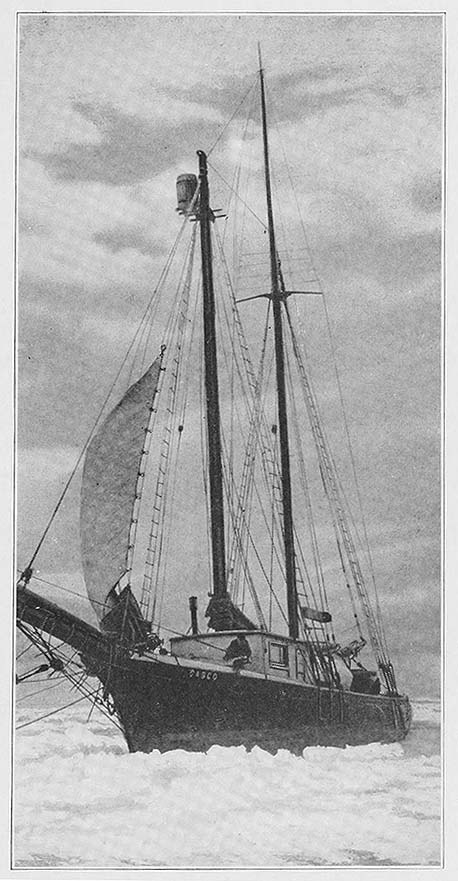
Mr. Eaton, who boasted that, in him, a good
sea captain had been spoiled to make a bad painter,
encouraged Stevenson to talk freely of his
plans, and he dwelt at some length on the beauty
and seaworthiness of the yacht Casco, that had
been chartered for the voyage. This sea theme
led, of course, to the inevitable fish stories, and
after some mythological whale had been swallowed
by some non-Biblical Jonah, I remarked,
in the lull that followed, "Maybe the waters of
the South Seas will yield you up a heroine."
A laugh went around at this, for some present
thought I had said a "herring." But Stevenson
had no doubt as to my meaning. "I am
always helpless," said he, "when I try to describe
a woman; but then," he added, brightly,
"how should I hope to understand a woman,
when God, who made her, cannot?" As straws
show how the wind blows, so this little joke
throws light on Stevenson 's state of mind toward
womankind in general. During this heroine
discussion, he remarked that he was always "unconscionably
bored" by the conversation of
young girls. He had no desire, it seems, to
mould the young idea to his taste, as Horace,
when he said:
"Place me where the world is not habitable,
Where the Day-God's Chariot too near approaches,
Yet will I love Lalagé, see her sweet smile,
Hear her sweet prattle."
Even as a school-boy he was unable to mingle
with lads of his own age. This, doubtless, is
another of the precocities of the early-doomed,
who feel that every moment of life they have
must be lived to the full. A well-known artist,
Who was suffering with tuberculosis, once said to
me, in describing his working hours at the
studio, "I must make every touch tell, and
every moment count." So to Stevenson the
rounded out sympathies of maturity were more
attractive than the sweet prattle of girlhood,
because, like the painter, with his paint, he,
with his life, had to make every moment count.
This, of course, explains his having chosen a
woman so much older than himself as a life-companion;
a woman in whom he could find a response
on his own mental plane.
In the following little poem, which is perhaps
his best known tribute to his wife, he embodies
in cameo clearness my own early impression of
the intrinsic qualities of her character:
"Trusty, dusky, vivid true,
With eyes of gold and bramble-dew,
Steel-true and blade-straight,
The great artificer
Made my mate.
Honor, anger, valor, fire;
A love that life could never tire;
Death quench or evil stir,
The mighty master
Gave to her.
Teacher, tender, comrade, wife,
A fellow-farer true through life,
Heart-whole and soul-free,
The august father
Gave to me."
It was at the Lows' Apartment in New York
that I first met Mrs. Stevenson. I called one
afternoon to see Mrs. Low, who was convalescing
from an illness. She sent word that she would
be able to see me in half an hour, and I was
shown into the living-room, where, meditating
by the fire, sat Mrs. Stevenson. She seemed
exceedingly picturesque to me, in a rich black
satin gown, her hair tied back by a black ribbon
in girlish fashion and falling in three ringlets
down her back.
She told me stories of her first arrival in New
York that were as amusing as some of Stevenson's
prairie experiences. She engaged a messenger-boy
to pioneer her through the great stone
jungle, not from fear of pickpockets or the like,
but to save her from a helplessly lost feeling she
always had when alone on the streets of a strange
city. On arriving, she went directly to the old
St. Stephen's Hotel on University Place and
Eleventh Street, registering thus:
"Mrs. Robert Louis Stevenson (wife of the
author of Dr. Jekyll and Mr. Hyde)."
To those of the friends who smiled over it,
she explained that, being ill at the time, she had
a horror of dying unknown in a hotel room and
being sent to the morgue.
I replied to this by telling her how my mother,
being alone at a large London hotel for a night,
insisted on having one of the chambermaids
sleep with her, no doubt from the same sense of
hopeless wandering in a similar Dædalian Labyrinth.
Years after, some autograph collector hunted
up that old St. Stephen's register and cut the
name from the page, which reminded me of a
little story I once told Mrs. Low.
As a boy Mr. Eaton one day mounted the pulpit
of the church in the little village of Phillipsburg,
P. Q., Canada, where he was born, and
made a drawing on one of the fly-leaves of the
Bible. When it was later told in the village
that he had exhibited at the Paris Salon, someone
cut the leaf from the Book of Books.
When one starts story telling to a good listener,
little incidents dart through the brain that
for long have lain dormant, and to pass the time,
I told Mrs. Stevenson that on the day Mr. Eaton
finished his portrait of President Garfield for the
Union League Club, he asked the newly landed
Celtic maid if she would wash his brushes for
him (an office that he generally performed for
himself), to which she exclaimed joyfully, "To
think that I have lived to see the day that I
washed the brushes that painted the President
of the United States!"
What the artist regarded as an added chore
to her already full labors, was to her willing
hands a pride and an honor. It may be a truism
that a rose by any other name would smell as
sweet, but there certainly seems to be a good
deal in a view-point. In looking back, I know
that I grasped, that day, something of what the
later years proved her to the world, for I read
her then, as a highly gifted woman who had
submerged her own personality in the greater
gifts and personal claims of her invalid husband
and in a recent reading of her Samoan notes
there was imparted to me, by means too subtle
to explain, those glimpses that insight bestows,
that are called reading between the lines—a
realization of the hardship of much of her life
in the South Seas. I felt distinctly the under-current
of troubled restlessness beneath the apparent
good time of an unusual environment.
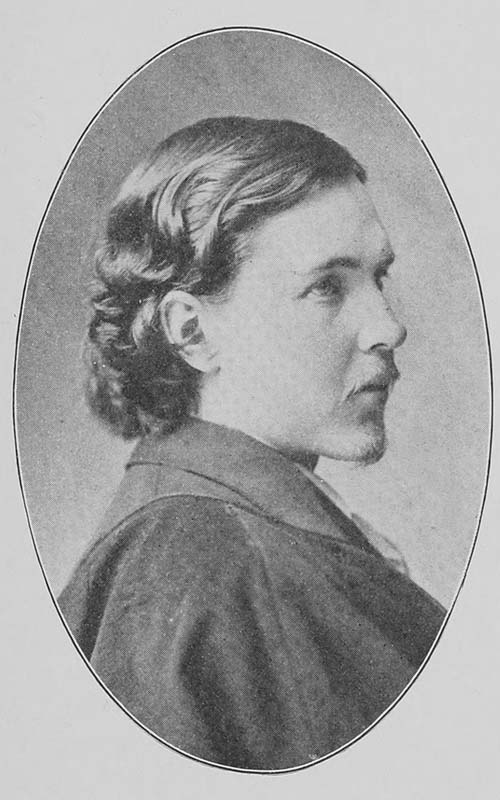
Wyatt Eaton as a Student
Photo by Kurtz, N. Y.
To the woman who loves becoming toilets and
the vivacity and movement of life in literary
and social centres, and who, moreover, possesses
the useful hands and right instincts both in artistic
and domestic relationships, the long sojourns
in desolate places, the doing with makeshifts
and the like that these entail, are a real
deprivation, and a persistent irritation that calls
for the counteraction of an exceptional degree of
poise and self-mastery.
Nothing, in short, emphasizes this sense of her
isolation, to my mind, so strongly as Stevenson
himself in describing her quarters on board the
schooner Equator, as a "beetle-haunted most unwomanly
bower," and this simultaneously with
the reminder that it will be long before her
eyes behold again the familiar scenes of rural
beauty dear to her memory.
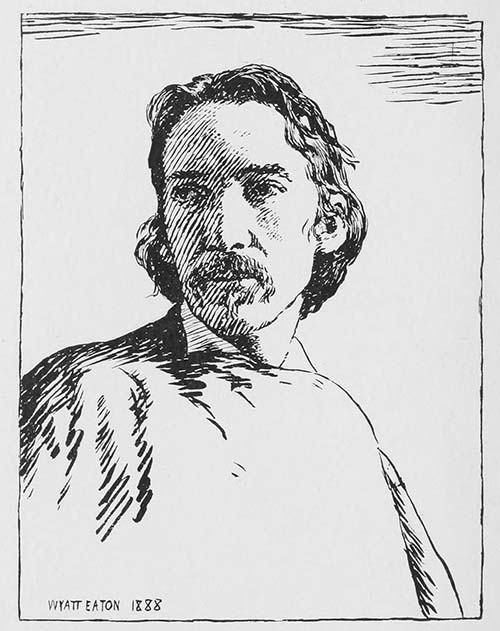
The pen sketch of Stevenson forming the frontispiece
was drawn by Mr. Eaton in a few
minutes from memory. I regret to say that it is
reproduced from a reproduction, the original
(owned by Mr. S. S. McClure) could not be
found, when wanted, Mr. McClure being in
France at the time, but we were glad to obtain
one of these copies, now becoming rare.
I have never seen a portrait of Stevenson
that equalled his appearance that day. The bas-relief
by Saint Gaudens approximates it somewhat
in ethereal thinness, but the verve, the
glow, the vital spark, are lacking even in that.
It has always been a satisfaction to me that
our meeting was on an occasion when his illness
was least apparent. My memory of his face has
nothing of that pain-worn expression so often
seen in photographs.
The afternoon of the day we received his message,
I caught a glimpse of him at a distance
from my window. He was coming up from the
Inlet, where, no doubt, he had gone to take a
plunge. There was a briskness about his movements
that seemed like the unconscious enjoyment
of sound health, and in appearance he certainly
was as romantic a figure as any of his own
characters. Whenever I read "In the Highlands,"
I see him as he appeared at that moment,
treading through a maze of bright sabatia
and sweet clover, the mental picture, as it were,
becoming a part of that beautiful and touching
poem:
In the highlands, in the country places,
Where the old plain men have rosy faces,
And the young fair maidens quiet eyes;
Where essential silence cheers and blesses,
And for ever in the hill-recesses
Her more lovely music broods and dies.
O to mount again where erst I haunted;
Where the old red hills are bird-enchanted,
And the low green meadows bright with sward;
And when even dies, the million-tinted,
And the night has come, and planets glinted,
Lo! the valley hollow, lamp-bestarred.
O to dream, O to awake and wander
There, and with delight to take and render,
Through the trance of silence, quiet breath;
Lo! for there, among the flowers and grasses,
Only the mightier movement sounds and passes;
Only winds and rivers, life and death.
I felt the poetry of the day more poignantly
as the hour for parting approached, and when
the sun began to wane, I went out on the lawn
to see the place under the spell of the lengthened
shadows and the mellow sun-rays that turn the
tree-trunks to burnished gold. This has always
been my favorite hour, this charmed hour before
sunset, when we can almost feel the earth's
movement under our feet—an hour that transcends
in poetry anything that can be imagined
by the finite mind.
I walked up and down under the cedars bordering
the river, to quiet my emotion. It was
there, too, under the cedars, that a remark of
Mr. Eaton's, in describing to me his first meeting
with Stevenson, flashed across my memory:
"He combined the face of a boy with the distinguished
bearing of a man of the world."
And I thought, as I saw him then, merrily recalling
the scenes and escapades of student life,
"How well the distinguished man of the world
had succeeded in keeping the heart of a boy!"
A passage in Mr. Low's book, "A Chronicle
of Friendships," that recalls that day most
vividly, is this: "Stevenson never once excused
himself from our company on the plea of
having work to do." For so it was with us;
he seemed to have no cares or preoccupations,
but to be content to be there, enjoying the conversation
and the pleasantness of the passing
hour.
I had a cosy quarter of an hour with his mother
after my walk, and off by ourselves, in a corner,
away from interruption, she spoke of her
son's childhood. In her eyes, he was still the
"bonnie wee laddie" who scouted about in his
make-believe worlds among the chairs and tables
in the drawing-room while she entertained her
friends, and we repeated bits from "A Child's
Garden of Verses."
I think that if there is any clue to the character
of a great man we must look to his mother.
Mrs. Stevenson embodied the idea of her son's
peculiar charm; there was the same triumphal
youthfulness, and her cheeks were round and
rosy like a ripe apple.
I think of the mother now, after so many years,
as the crowning influence of the day, quiet and
reticent, but always felt, and honored by all as
became the mother of our welcome guest.
In her letters, written in the Marquesas to her
sister in Scotland, she carries out this impression
of habitual freshness of spirit, and her
humor is subtle and optimistic: "Nothing gives
me more pleasure or a better appetite than an
obstacle overcome." She shows herself the life
of "The Silver Ship," as the people of Fakarava
dubbed the Casco, and never a word of criticism
or complaint is penned at any inconvenience or
annoyance endured by the way. Indeed, one
marvels at her tranquillity in the midst of so
many complications—just as one wondered at
the simplicity of Queen Victoria in her diary.
One of the chief delights in the perusal of these
letters is the questions they project into the
mind of the reader. Is it a style, a native virtue,
a mannerism, a fad, or what?
For example, she never suspects that the
French man-o'-war in one of the bays may account
for some of the good behavior of the natives,
or that their bounty in cocoanuts and
bread-fruit may be tendered with an eye to the
novelties to be had in exchange, but accepts all
in good faith, as part of their native generosity.
And what a joy it is to see her taking holy
communion with these people, so lately reclaimed
from cannabalism, and taking the ceremony "au
grand serieux"! Thus, a missionary within, a
warship without, the amenities of religion and
society are enjoyed to the full.
One lays down these letters and laughs, many
a time, where no laughter was intended. Certainly,
she was a good mixer as well as the born
mother of a genius.
Stevenson's death is an anomaly no less pathetic
than his life, for in eluding extinction by
consumption, he probably achieved a still earlier
end by apoplexy. I had the account from Mrs.
Low, who received it directly from "Fanny" by
letter. Mrs. Stevenson was mixing a salad of
native ingredients of which Stevenson was very
fond, when he joined her in the kitchen, complaining
that he was not very well, and sitting
down, laid his head on her shoulder, where in
about twenty minutes he expired.
I said at the beginning that I was not disappointed
in the personality of Stevenson, but it
would be nearer the mark to say that my anticipations
fell far short of the reality.
It is often the case in meeting literary celebrities
that one has the feeling that they are first
authors, and after that men. Rodin, the French
sculptor, focuses this idea by saying that "many
are artists at the expense of some qualities of
manhood." With Stevenson one was clearly in
the presence of a man, and after that the scholar
and the gentleman.
Was it not this fine distinction that, in spite
of woolen shirt and a third-class transportation,
awoke the suspicions of his companions of the
steerage, that prompted the already quoted remark,
"You are not one of us?"
And on that memorable journey across the
plains, seeking the woman of his choice, resolved,
though penniless and unknown, to make
her his wife in spite of every obstacle, the truth
that the frailty of the body is no criterion for
the strength of the spirit is well brought out.
It was, in fact, this quality of initiative that
constituted his chief charm—the quality that,
above all others, made us so spontaneous in his
presence and so proud of his achievement.
We knew that we were seeing him at his best,
surrounded by his old friends, and with the light
of the memory of his youthful ambitions on his
face. We knew, too, that the parting would be
a life-long one, and that we would never look
upon his like again. This regret each knew to
be uppermost in the mind of the others, but when
the good-byes began, we made no sign that it
was to be more than the absence of a day.
Nevertheless, the tensity of the last moments
of parting was keenly felt. Stevenson had
planned to spend his last night at Wainwright's,
and Lloyd Osbourne was to row him across the
river. Mr. Eaton and I went down to the river-bank
to see them off and to wave our last adieux.
The rumble of carriage-wheels in the distance,
and the reverberations of footsteps and voices on
the old wooden bridge grew fainter and died
away, before the little boat was pushed off; and
then, these two friends, Robert Louis Stevenson
and Wyatt Eaton, both at the zenith of their life
and powers, and both hovering so closely on the
brink of eternity, sent their last messages to each
other, across the distance, until the little boat
had glided away, on the ebb-tide, a mere speck
in the gray transparency of the twilight.