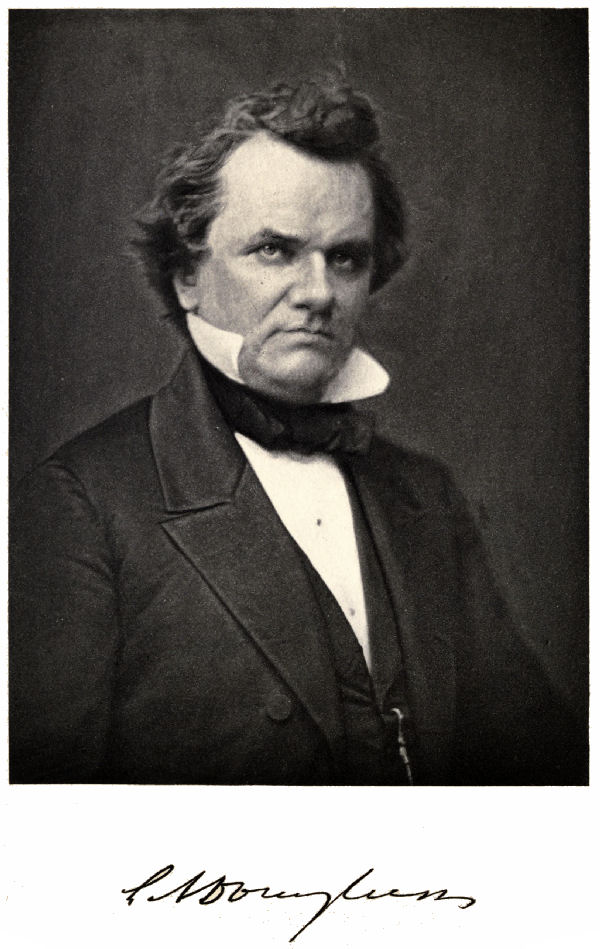
The ten years of American history from 1850 to 1860 have a fascination
second only to that of the four years which followed. Indeed, unless one
has a taste for military science, it is a question whether the great war
itself is more absorbing than the great debate that led up to it;
whether even Gettysburg and Chickamauga, the March to the Sea, the
Wilderness, Appomattox, are of more surpassing interest than the
dramatic political changes,—the downfall of the Whig party, the swift
rise and the equally swift submergence of the Know-Nothing party, the
birth of the Republican party, the disruption and overthrow of the
long-dominant Democratic party,—through which the country came at last
to see that only the sword could make an end of the long controversy
between the North and the South.
The first years of the decade were marked by the passing of one group of
statesmen and the rise of another group. Calhoun's last speech in the
Senate was read at the beginning of the debate over those measures which
finally took shape as the Compromise of 1850. The Compromise was the
last instance of the leadership of Clay. The famous Seventh of March
speech in defense of it was Webster's last notable oration. These voices
stilled, many others took up the pregnant theme. Davis and Toombs and
Stephens and other well-trained Southern statesmen defended slavery
aggressively; Seward and Sumner and Chase insisted on a hearing for the
aggressive anti-slavery sentiment; Cass and Buchanan maintained for a
time their places as leaders in the school of compromise. But from the
death of Clay to the presidential election of 1860 the most resonant
voice of them all was the voice of Stephen Arnold Douglas. It is
scarcely too much to say that during the whole period the centre of the
stage was his, and his the most stirring part. In 1861, the curtain fell
upon him still resolute, vigorous, commanding. When it rose again for
another scene, he was gone so completely that nowadays it is hard for us
to understand what a place he had. Three biographers writing near the
time of his death were mainly concerned to explain how he came to be
first in the minds of his contemporaries. A biographer writing now must
try to explain why he has been so lightly esteemed by that posterity to
which they confidently committed his fame. Blind Tom, the negro mimic,
having once heard him speak, was wont for many years to entertain
curious audiences by reproducing those swelling tones in which he rolled
out his defense of popular sovereignty, and it is not improbable that
Douglas owes to the marvelous imitator of sounds a considerable part of
such fame as he has among uneducated men in our time. Among historical
students, however seriously his deserts are questioned, there is no
question of the importance of his career.
He was born April 23, 1813, at Brandon, Vermont, the son of Stephen
Arnold Douglas and Sarah Fisk, his wife. His father, a successful
physician, was doubtless of Scotch descent; but the founder of the
Douglas family in America was married in Northamptonshire. He landed on
Cape Ann in 1639–40, but in 1660 he made his home at New London,
Connecticut. Dr. Douglas's mother was an Arnold of Rhode Island,
descended from that Governor Arnold who was associated with Roger
Williams in the founding of the colony. Sarah Fisk's mother was also an
Arnold, and of the same family. Their son was therefore of good New
England stock, and amply entitled to his middle name. Dr. Douglas died
suddenly of apoplexy in July, 1813; it is said that he held the infant
Stephen in his arms when he was stricken. His widow made her home with a
bachelor brother on a farm near Brandon, and the boy's early years were
passed in an environment familiar to readers of American biography—the
simplicity, the poverty, the industry, and the serious-mindedness of
rural New England. He was delicate, with a little bit of a body and a
very large head, but quick-witted and precocious, and until he was
fifteen years of age his elders permitted him to look forward to a
collegiate education and a professional career.
But by that time the uncle was married, and an heir was born to him.
Stephen was therefore made to understand that the expense of his
education could be met only from his mother's limited means. He promptly
resolved to learn a trade, walked fourteen miles to the neighboring town
of Middlebury, and apprenticed himself to a cabinet-maker. He worked at
cabinet-making two years, and afterwards, even when he had risen so high
that many of his countrymen were willing he should try his hand at
making cabinets of men, he protested that those two years were by far
the happiest of his life, and that he would never willingly have
exchanged his place in the Middlebury workshop for any other place
whatsoever. As it was, he left it because he was not strong enough for
that sort of work.
The following year he pursued his studies at the academy of Brandon.
Then his mother married again, and he went with her to the home of his
stepfather, Gehazi Granger, Esquire, near Canandaigua, New York, and
finished his schooling at the Canandaigua Academy, which appears to have
been an excellent one. Meanwhile, he also read law, and showed great
proficiency both in his classical and his legal studies. Not much is on
record concerning his schoolboy life. It is known, however, that he had
a way of making his fellows like him, so that they of their own accord
put him forward, and that he had a lively interest in politics. It is
said that even so early as the campaign of 1828, when he was but
fifteen, he organized a band of his playmates to make war on the "coffin
handbills" wherewith the Adams men sought to besmirch the military fame
of General Jackson, already become his hero. At Canandaigua, four years
later, he espoused the same cause in debating clubs, and won an
ascendency among his fellows by his readiness and the extent of his
information. In the life of another man, these boyish performances
might be set down merely as signs of promise; but Douglas was so soon
immersed in real politics, and rose to distinction with such astounding
swiftness, that his performances as a schoolboy may well be accounted
the actual beginning, and not merely a premonition, of his career. He
was only twenty, when, in June, 1833, he set forth to enter upon it.
Save that he was going West, he does not seem to have had any
destination clearly in mind. He carried letters to certain persons in
Cleveland, and stopped there to see them, and so made the acquaintance
of Sherlock J. Andrews, a leading lawyer of the town, who persuaded him
to remain and read law in his office until a year should elapse and he
could be admitted to the Ohio bar. However, in less than a week he fell
ill of a fever which did not leave him until the expense of it had
well-nigh emptied his slender purse. His physicians, fearing he was too
slight and delicate for Western hardships, urged him to go back to
Canandaigua, but when he left Cleveland he again turned westward,
resolved in his own mind never to go back without the evidences of
success in his life. It is doubtful if among all the thousands who in
those days were constantly faring westward, from New England towns and
the parishes of Virginia and the Carolinas, there ever was a youth more
resolutely and boldly addressed to opportunity than he. Poor, broken in
health, almost diminutive in physical stature, and quite unknown, he
made his way first to Cincinnati, then to Louisville, then to St. Louis,
in search of work. Coming almost to the end of his resources, he
reasoned that it would be best for him to seek some country town, where
his expenses would be slight; and guided merely by a book of travel he
had read he fixed on a town which, as it happened, bore the name of his
political patron saint. In November, 1833, being now twenty years and
six months old, he arrived at Jacksonville, Illinois, with a sum total
of thirty-seven cents in his pocket. The glimpses we get of him during
his wanderings, from the recollections of certain men with whom he made
acquaintance in stages and on river steamboats, make a curious and
striking picture of American character. The feverish, high-strung boy
was never dismayed and never a dreamer, but always confident,
purposeful, good-humored.
He found no work at Jacksonville, and walked to Winchester, sixteen
miles to the southwestward, where he hoped to get work as a teacher. The
next morning, seeing a crowd assembled in the public square of the
village, he pushed his way to the centre and learned that there was to
be an auction of the wares of a merchant who had recently died. The
auctioneer was in need of a clerk to keep the record of the sales, and
the place was offered to the young stranger. He took it, served three
days, earned six dollars, made acquaintance with the farmers gathered
for the sale, and got a chance in the talk about politics to display
those qualities which he never failed to display when opportunity
offered—the utmost readiness in debate, good-natured courtesy, and keen
political instinct. A school was arranged for him, and within a week he
had forty pupils entered for three months. A lawyer of the place
befriended him with the loan of some books, and he gave his evenings to
law and politics. When the three months were ended, he went back to
Jacksonville and opened an office. March 4, 1834, he was licensed to
practice, and from that time he rose faster than any man in Illinois, if
not in the whole country, notwithstanding that he rose on the lines
along which many and many another young American was struggling toward
prominence, and notwithstanding that Illinois was exceptionally full, as
later years were to prove, of young men fitted for such careers as
Douglas sought—notwithstanding, too, that there had already drifted to
New Salem, in the very next county, a young Kentuckian destined to such
eminence that the Illinois of those years is oftenest studied now for
light on him, and is most amply revealed to us in the books about him.
But for the very reason that Douglas rose so fast it is not necessary,
in order to understand how or why he rose, to study the conditions and
men he had to deal with so carefully as they have done who seek to
explain for us the slower progress of that strange career with which his
is indissolubly associated. Jacksonville, which was to be his home for a
few years, was a small country town, but it was the county seat of
Morgan, one of the two wealthiest and most populous counties in the
State. A few years earlier, that whole region had been a frontier, but
the first roughness was now worn away. True, the whole northern half of
Illinois was practically unsettled, and Chicago was but three years old,
and not yet important. But it appears that the general character of the
central counties was already fixed, and what followed was of the nature
of growth rather than change. Certain small towns, like Springfield,
were to become cities, and certain others, like New Salem, were to
disappear. Railroads were not yet, though many were planning, and
manufactures were chiefly of the domestic sort. But in the matter of the
opportunities it presented to aspiring youth the country was already
Western, and no longer wild Western. Hunting shirts and moccasins were
disappearing. Knives in one's belt had gone out of fashion. The merely
adventurous were passing beyond the Mississippi, and the field was open
to the enterprising, the speculative, the ambitious.
Enterprise and speculation were in the air, and ambition, if it took a
political turn, must perforce take account of them. The whole country
was prosperous, and Illinois was possessed with the fever of development
then epidemic throughout the West and the South. If one examines the
legislation of any of the States west of the Alleghanies during the
second administration of President Jackson, by far the most numerous
category of bills will be found to deal with internal improvements,
particularly railroads and canals. Money, however, was needed for these
things, and Illinois, like all new countries, had to look backward to
older communities for capital. President Jackson had but lately made his
final assault upon the National Bank, the principal dispenser of
capital, by the removal of the deposits, and public opinion was much
divided on his course, when Douglas opened his law office and began to
discuss public questions with his neighbors. While he still lived at
Winchester, he had helped to get subscribers for a Democratic newspaper
at Jacksonville, and he soon called upon the editor, who was first
surprised at his visitor's youthful appearance and then, as he himself
tells us, at "the strength of his mind, the development of his
intellect, and his comprehensive knowledge of the political history of
his country."
Boy as he looked, and boy as he was, for he had not yet passed his
twenty-first birthday, Douglas actually got the leadership of the
Jackson party in that neighborhood before he had lived there a month. An
enthusiastic supporter of the President's policy on the bank question,
he talked about the matter so well on Saturdays, when, according to the
Western and Southern custom, the country people flocked into town, that
he was put forward to move the Jackson resolutions at a mass meeting of
Democrats which he and his friend, the editor, had contrived to bring
about. There was a great crowd. Josiah Lamborn, an orator of some
reputation, opposed the resolutions. Douglas replied in an hour's
speech, discomfited Lamborn, and so swept his audience that they seized
upon him and bore him on their shoulders out of the room and around the
public square. He was the "Little Giant" from that day, and the speech
became a Democratic tradition. Of course, in after years, the men who
could say they heard it could not be expected to admit that he ever made
a better speech in his life.
Within a year, he was so well known that he was chosen to the office of
public prosecutor, or district attorney, of the first judicial circuit,
the most important in Illinois, and his successful candidacy for the
place is all the more remarkable because he was chosen by the
legislature, and not by his neighbors of the circuit. Moreover, his
competitor, John J. Hardin, was one of the foremost men of Illinois. It
is true that Hardin was a Whig, and that by this time there was a
pretty clear division between Whigs and Jackson men on offices as well
as measures, so that the contest was a party as well as a personal
affair; but from auctioneer's clerk to district attorney was a promotion
hardly to be won in a year by a youth of qualities less than
extraordinary.
The election was in February, 1835, and Douglas held the office the
better part of two years. A justice of the supreme court had declared,
on hearing of the legislature's choice, that the stripling could not
fill the place because he was no lawyer and had no law books.
Nevertheless, he was an efficient prosecutor. No record of his service
is available, but there was a tradition in later years that not one of
his indictments was quashed. Certainly, his work in the courts of the
district increased his reputation and strengthened his hold on his own
party. In the spring of 1836, the Democrats of Morgan held a convention
to nominate candidates for the six seats in the house of representatives
to which the county was entitled. This was a novel proceeding, for the
system of conventions to nominate for office was not yet developed; the
first of the national party conventions was held in preparation for the
presidential campaign of 1832. Douglas was a leader in the movement, and
as a result of it he himself was drawn into the contest. Morgan was a
Whig county, but the solid front of the Democracy so alarmed the Whigs
that they also abandoned the old plan of letting any number of
candidates take the field and united upon a ticket with Hardin at its
head. No man on the Democratic ticket was a match for Hardin. One of the
candidates was withdrawn, therefore, and Douglas took his place, and he
and Hardin canvassed the county together in a series of joint debates.
Mainly through his championship, the convention plan was approved, and
the Democrats won the election; but Hardin's vote was greater than the
weakest Democrat's, and so the rivalry between him and Douglas was
continued in the legislature, where they took their seats in December,
1836.
In that same house of representatives were John A. McClernand, James
Shields, William A. Richardson, and other men who rose to national
distinction. Abraham Lincoln, a Whig representative from Sangamon
County, was already well known for his ungainly length of body, for his
habit of reasoning in parables which were now scriptural and now vulgar
to the point of obscenity, and for a quaint and rare honesty. He was
four years older than the new member from Morgan, and nearly two feet
taller. Douglas, many years later, declared that he was drawn to Lincoln
by a strong sympathy, for they were both young men making an uphill
struggle in life. Lincoln, at his first sight of Douglas, during the
contest with Hardin for the attorneyship, pronounced him "the least man
he ever saw."
Douglas was the youngest member of an unusual house, but he at once took
his place among the leaders. When the governor's message, animadverting
severely on the President's course with the Bank, brought on a
discussion of national party questions, he and Hardin seem to have won
the chief honors of the debate. He was appointed chairman of the
Committee on Petitions, to which numerous applications for divorce were
referred, and introduced a resolution which passed and which put an end
to divorces by act of the legislature. On the great question of the
hour, the question of development and internal improvements, he declared
that the State ought to attempt no improvement which it could not afford
to construct and to own. He favored a few specific enterprises and the
making of careful surveys and estimates before any others should be
taken up. But it was the very height of "flush times" in Illinois, and
the legislature added millions to the vast sums in which the State was
already committed to the support of canals, railroads, river
improvements, and banks. It was but a few weeks from the adjournment in
March to the great financial panic of 1837, which crushed every one of
the state-aided banks, stopped the railroad building and river dredging,
and finally left Illinois burdened with an enormous debt. There was a
special session of the legislature in the summer, occasioned by the
depression and hard times which had followed so hard upon the flush
times of the winter, but Douglas was not there to tax his associates
with their unwisdom. He had taken another step in his unexampled career
of office-holding by accepting from President Van Buren the office of
register of public lands at Springfield, the growing town in Sangamon
County which the legislature had just made the capital of the State, and
where, within a few years, Shields, McClernand, Lincoln, and other
rising young men were gathered.
From this time, Douglas and Lincoln knew each other well, for they lived
together several years in an atmosphere of intimate personal scrutiny.
For searching study of one's fellows, for utter disregard of all
superficial criteria of character and conventional standards of
conduct, there is but one sort of life to be compared with the life of a
Southern or Western town, and that is the life of students in a
boarding-school or a small college. In such communities there is little
division into classes, as of rich and poor, educated and illiterate,
well and obscurely born. On the steps of the court-house, in the
post-office while the daily mail is sorted, in the corner drug store on
Sundays, in lawyers' offices, on the curbstone,—wherever a group of men
is assembled,—there is the freest talk on every possible subject; and
the lives of men are open to their fellows as they cannot be in cities
by reason of the mass or in country districts by reason of the solitude
and the shyness which solitude breeds. Against Douglas there was the
presumption, which every New England man who goes southward or westward
has to live down, that he would in some measure hold himself aloof from
his fellows. But the prejudice was quickly dispelled. No man entered
more readily into close personal relations with whomsoever he
encountered. In all our accounts of him he is represented as surrounded
with intimates. Not without the power of impressing men with his dignity
and seriousness of purpose, we nevertheless hear of him sitting on the
knee of an eminent judge during a recess of the court; dancing from end
to end of a dinner-table with the volatile Shields—the same who won
laurels in the Mexican War, a seat in the United States Senate, and the
closest approach anybody ever won to victory in battle over Stonewall
Jackson; and engaging, despite his height of five feet and his weight of
a hundred pounds, in personal encounters with Stuart, Lincoln's athletic
law partner, and a corpulent attorney named Francis.
On equal terms he mingled in good-humored rivalry with a group of
uncommonly resourceful men, and he passed them all in the race for
advancement. There is some reason to believe that Lincoln, strange as it
seems, was his successful rival in a love affair, but otherwise Douglas
left Lincoln far behind. Buoyant, good-natured, never easily abashed,
his maturity and savoir faire were accentuated by the smallness of his
stature. His blue eyes and his dark, abundant hair heightened his
physical charm of boyishness; his virile movements, his face,
heavy-browed, round, and strong, and his well-formed, uncommonly large
head gave him an aspect of intellectual power. He had a truly Napoleonic
trick of attaching men to his fortunes. He was a born leader, beyond
question; and he himself does not seem ever to have doubted his fitness
to lead, or ever to have agonized over the choice of a path and the
responsibilities of leadership. Principles he had—the principles of
Jefferson and Jackson as he understood them. These, apparently, he held
sufficient for every problem and every emergency of political life.
He believed in party organization quite as firmly as he believed in
party principles, and in the summer of 1837 he had a hand in building up
the machinery of conventions and committees through which the Illinois
Democrats have governed themselves ever since. He defended Van Buren's
plan of a sub-treasury when many even of those who had supported
Jackson's financial measures wavered in the face of the disfavor into
which hard times had brought the party in power, and in November,
although the Springfield congressional district, even before the panic,
had shown a Whig majority of 3000, he accepted the Democratic nomination
for the seat in Congress to be filled at the election in August, 1838,
and threw himself with the utmost ardor into the canvass. The district
was the largest in the whole country, for it included all the northern
counties of the State. His opponent was John T. Stuart, Lincoln's law
partner, and for five months the two spoke six days every week without
covering the whole of the great region they aspired to represent. The
northern counties had been filling up with immigrants, and more than
36,000 votes were cast. Many ballots were thrown out on technicalities;
most of the election officials were Whigs. After weeks of uncertainty,
Stuart was declared elected by a majority of five. The moral effect,
however, was a triumph for Douglas, who at the time of his nomination
was not of the age required of congressmen.
He announced that he would now devote himself to his profession. But it
was by this time very difficult, even if he so wished, to withdraw from
politics. He was constantly in council with the leaders of his party,
and belonged to a sort of "third house" at Springfield which nowadays
would probably be called a lobby. During the winter there was an angry
controversy between the Democratic governor and the Whig senate over the
question of the governor's right to appoint a secretary of state, the
senate refusing to confirm his nomination of McClernand on the ground
that the office was not vacant. The question was brought before the
supreme court, whose Whig majority, by deciding against the governor,
strengthened a growing feeling of discontent with the whole judiciary
among the Democrats, and Douglas took strong ground in favor of
reorganizing the court. In March, addressing a great meeting at
Springfield, he defended the Virginia and Kentucky resolutions of 1798,
and when the presidential campaign opened in November he had a debate
with Lincoln and other Whig orators. He was, in fact, the leading
Democratic orator throughout the campaign in Illinois, and there is no
doubt that his enthusiasm and his shrewdness had much to do with the
result there. Of all the Northern States, only Illinois and New
Hampshire went for Van Buren.
Meanwhile, however, he had practiced law with such success that no
account of the Illinois bar of those days omits his name from the list
of eminent attorneys. It was noted that whereas Lincoln was never very
successful save in those cases where his client's cause was just, a
client with but a slender claim upon the court's favor found Douglas a
far better advocate. He never seems to have given much time to the
reading of law or to the ordinary drudgery of preparing cases for trial,
but he mastered the main facts of his cases with the utmost facility,
and his mind went at once to the points that were sure to affect the
decision. Early in his experience as a lawyer he had to be content with
fees that seem absurdly small; once, he rode from Springfield to
Bloomington to argue a case, and got but five dollars for his services.
But he was a first-rate man of business, and soon had a good income from
his profession.
In January, 1841, the legislature, now Democratic in both branches,
removed the Whig incumbent from the office of secretary of state, and
the governor at once appointed Douglas to succeed him. That office,
however, he held less than a month, for the legislature had also
reconstructed the supreme court in such a way as to increase the number
of judges, and in February, being then less than twenty-eight years old,
he was named for one of the new places. One of the reasons why the court
was reconstructed was its opposition to the Democratic position on the
franchise question. Douglas, arguing a famous franchise case before it,
had made himself the champion of unnaturalized inhabitants claiming the
right to vote, and had thus established himself in the good-will of a
large and increasing constituency throughout the State. Under the new
law, each justice was assigned to a particular circuit,—Douglas to the
westernmost, whose principal town was Quincy, on the Illinois River,
where he made his home.
The Mormon settlement of Nauvoo was in that circuit, and the most
interesting of all the cases brought before Judge Douglas grew out of
the troubles between the followers of Joe Smith and their neighbors. On
one occasion, Joe Smith was himself on trial, and the Christian populace
of the neighborhood, long incensed against him and his people, broke
into the court-room clamoring for his life. The sheriff, a feeble-bodied
and spiritless official, showed signs of yielding, and the judge,
promptly assuming a power not vested in his office, appointed a stalwart
Kentuckian sheriff, and ordered him to summon a posse and clear the
room. By these means the defendant's life was saved, and Douglas,
notwithstanding various decisions of his against them, earned the
gratitude of the religious enthusiasts. There is a story that some years
later, when he was no longer a judge, but a major in a militia regiment
sent on an expedition against Nauvoo, he was ordered to take a hundred
men and arrest the "twelve apostles." The Mormons, outnumbering the
militia, were fortified for defense. Major Douglas, however, proceeded
alone into their lines, persuaded the twelve to enter their apostolic
coach and come with him to the Christian camp, and so brought about an
agreement which prevented a fight.
Both as a judge and as a member of the council of revision Douglas stood
out with commendable firmness against the popular feeling, strong
throughout the country during the hard times, and which in some of the
States got a complete ascendency over courts and legislatures, in favor
of the relief of debtors. He enforced the old laws for the collection of
debts, and he baulked several legislative schemes to defraud creditors
of their due by declaring the new laws unconstitutional. For the rest,
his decisions have seemed to competent critics to show that he possessed
unusual legal ability and grasp of principles and a corresponding power
of statement, scant as his legal training was.
According to the American usage, he was "Judge Douglas" all the rest of
his life, but the state bench no more satisfied his ambition than the
other state offices he had held. In December, 1842, when the legislature
proceeded to ballot for a United States senator, his name was presented,
though again his age fell short of the legal requirement, and on the
last ballot he had fifty-one votes against the fifty-six which elected
his successful competitor. The next year, being nominated for the lower
house of Congress, he accepted, and at once resigned his place on the
bench, though the district had a Whig complexion. At the end of a
canvass which left both himself and his opponent, Browning, seriously
ill, he was elected by a majority of several hundred.
On his way to Washington, he visited Cleveland, where his westward
journey had come so near an abortive ending, and then his home-folk at
Canandaigua. He was but thirty years old, yet he had held five important
political offices, he had risen to high rank in his profession, he was
the leader of the dominant party in a great State; and all this he had
done alone, unaided. Few aged men have brought back such laurels from
their Western fortune-seeking. In December, 1843, he took his seat in
the House of Representatives and began to display before the whole
country the same brilliant spectacle of daring, energy, and success
which had captivated the people of Illinois.