THE STORY OF THEIR
DEVELOPMENT FROM THE
EARLIEST TIMES TO THE
PRESENT DAY
BY
E. KEBLE CHATTERTON
With a Coloured Frontispiece by
CHARLES DIXON
and over 130 Illustrations from Original Sources,
Photographs, Models, &c.
Extra Royal 8vo, 384 pages, in Designed Cover,
Cloth Gilt, 16s. net
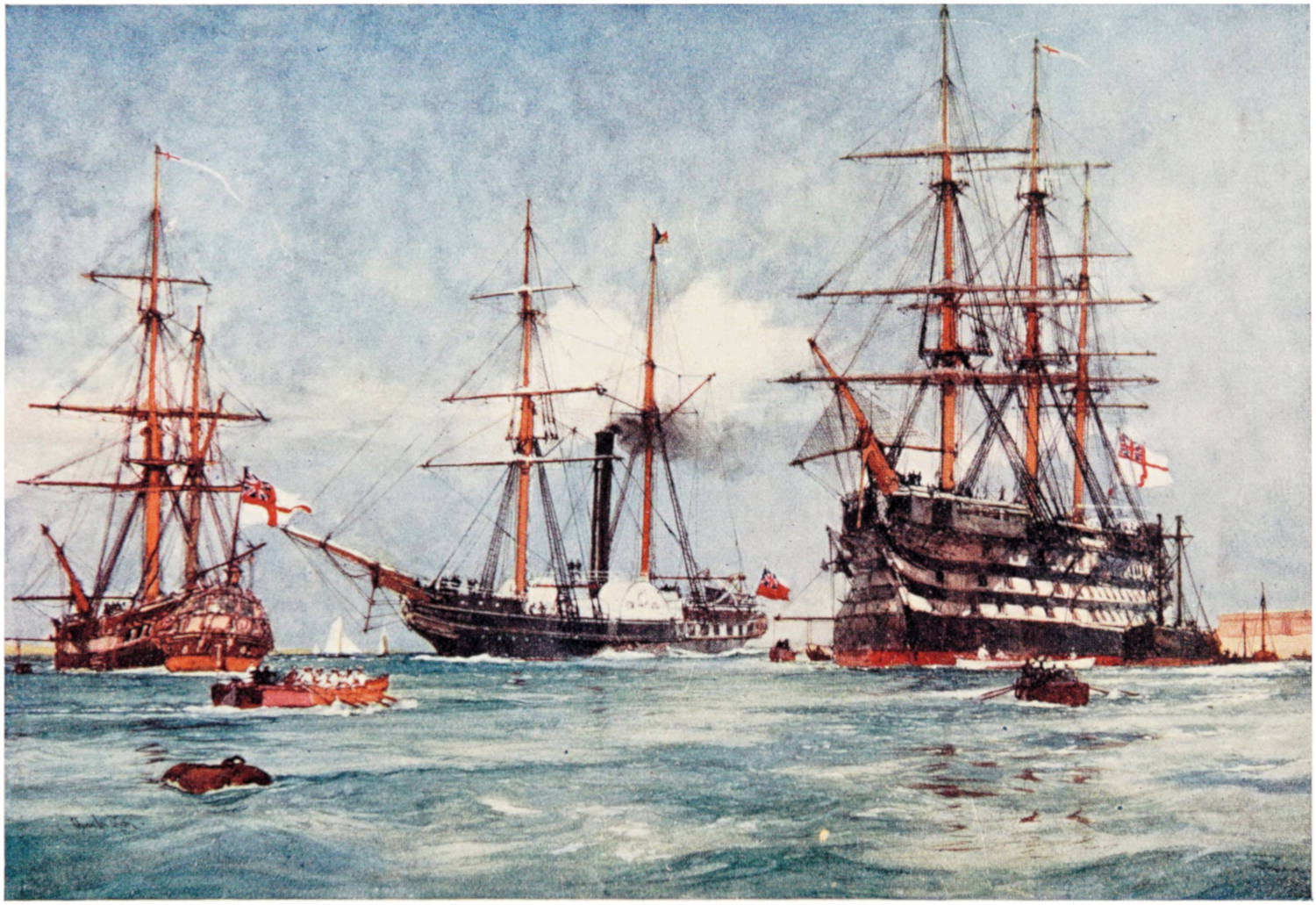
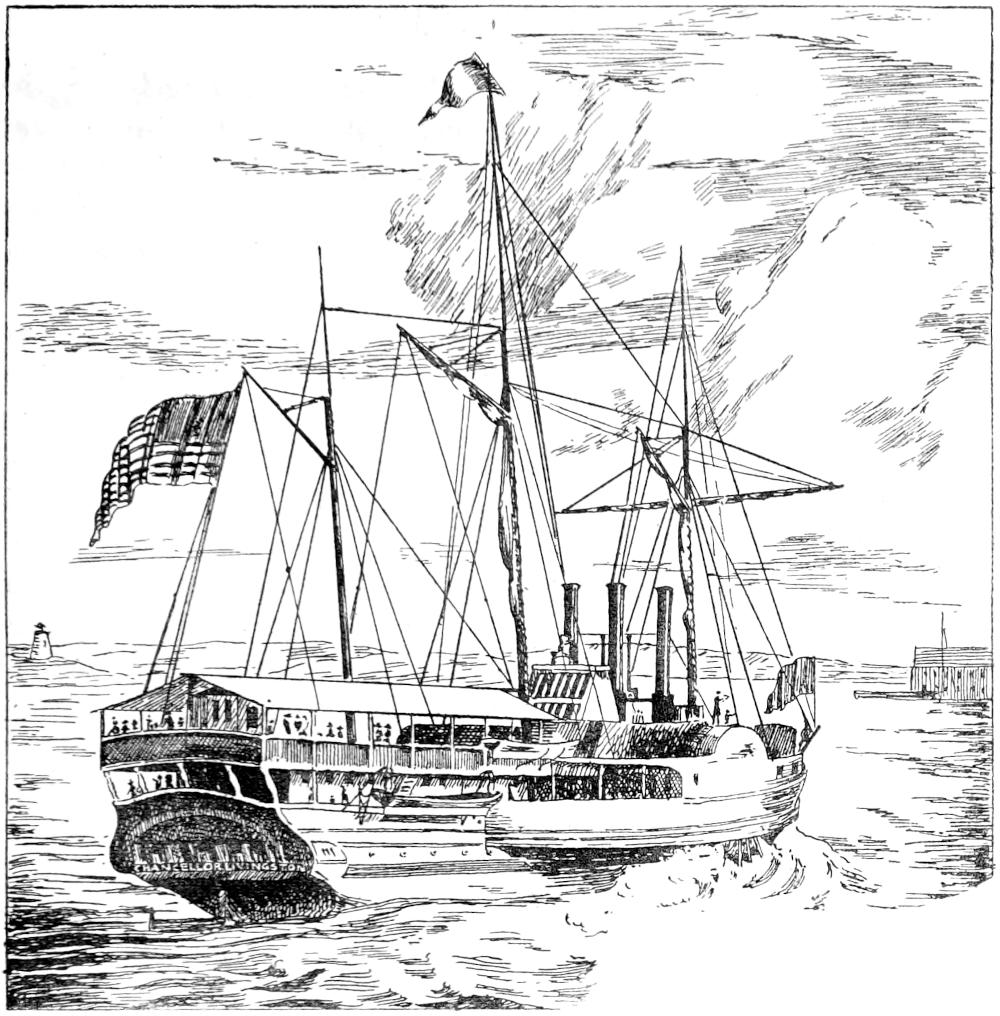
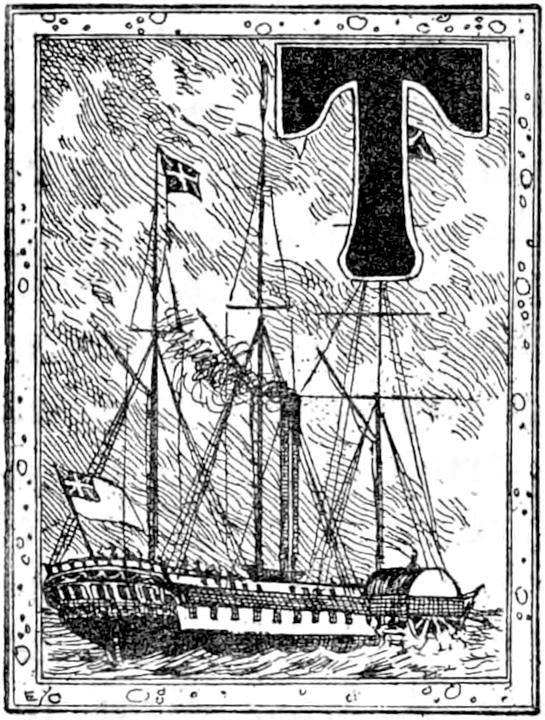
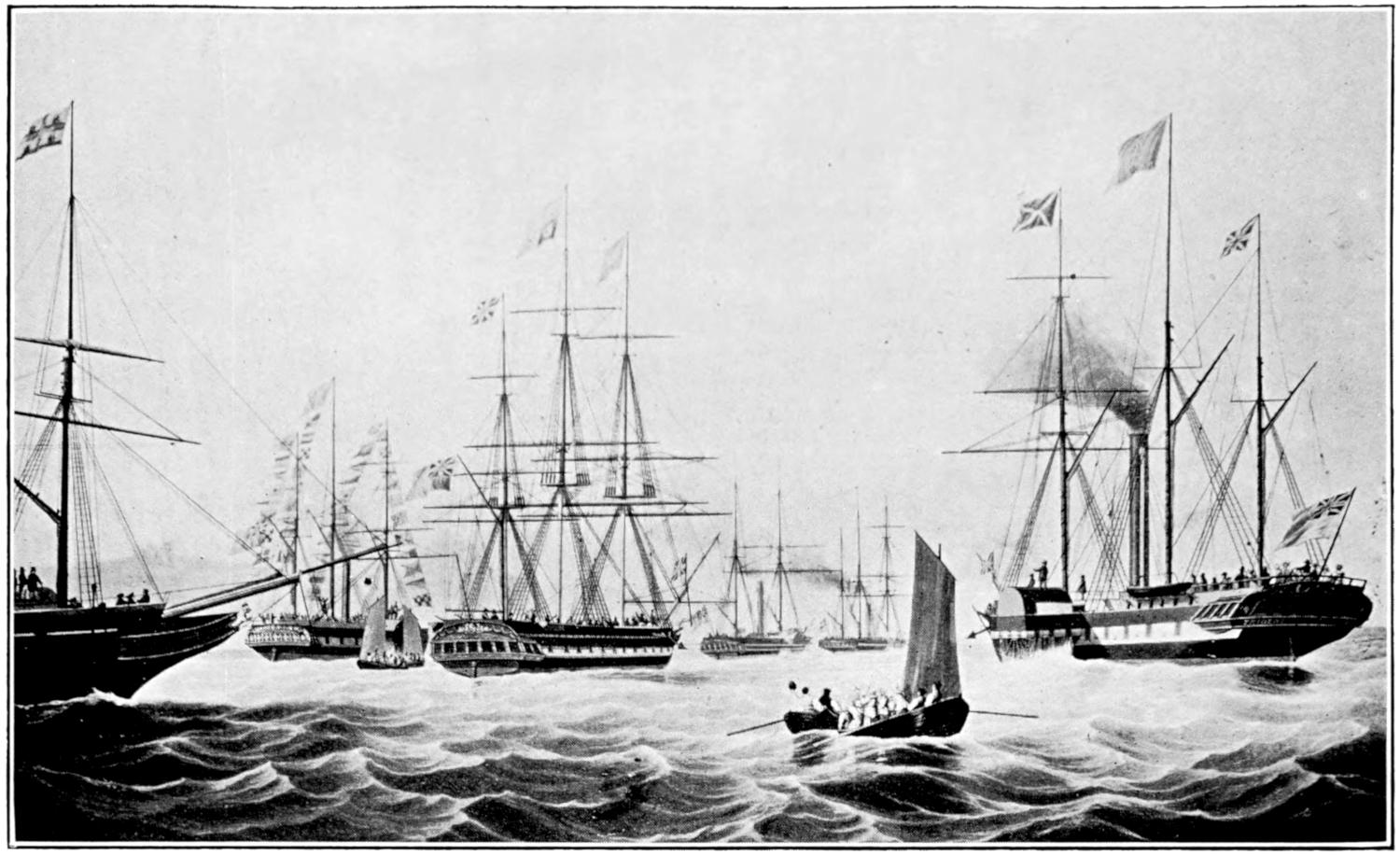
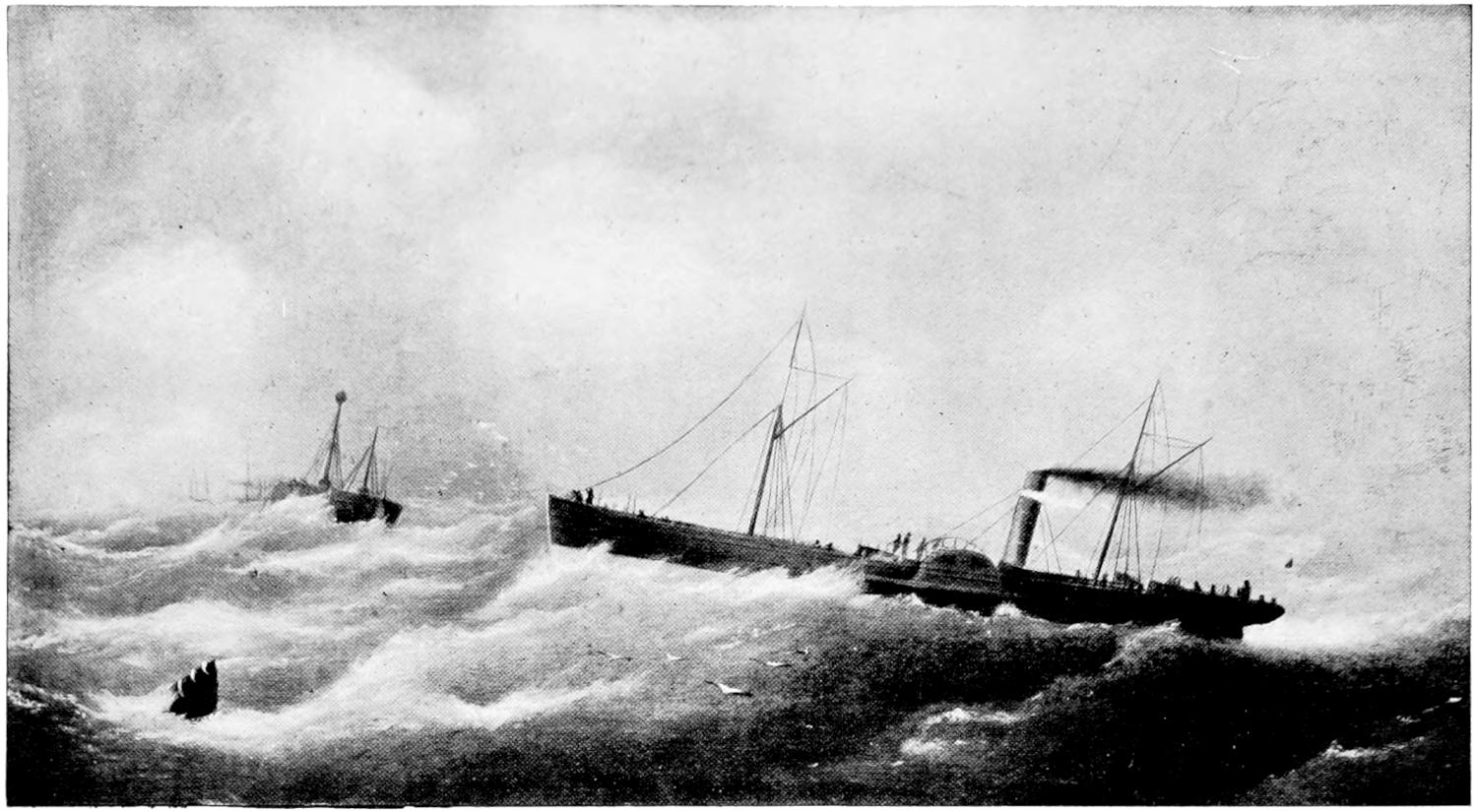
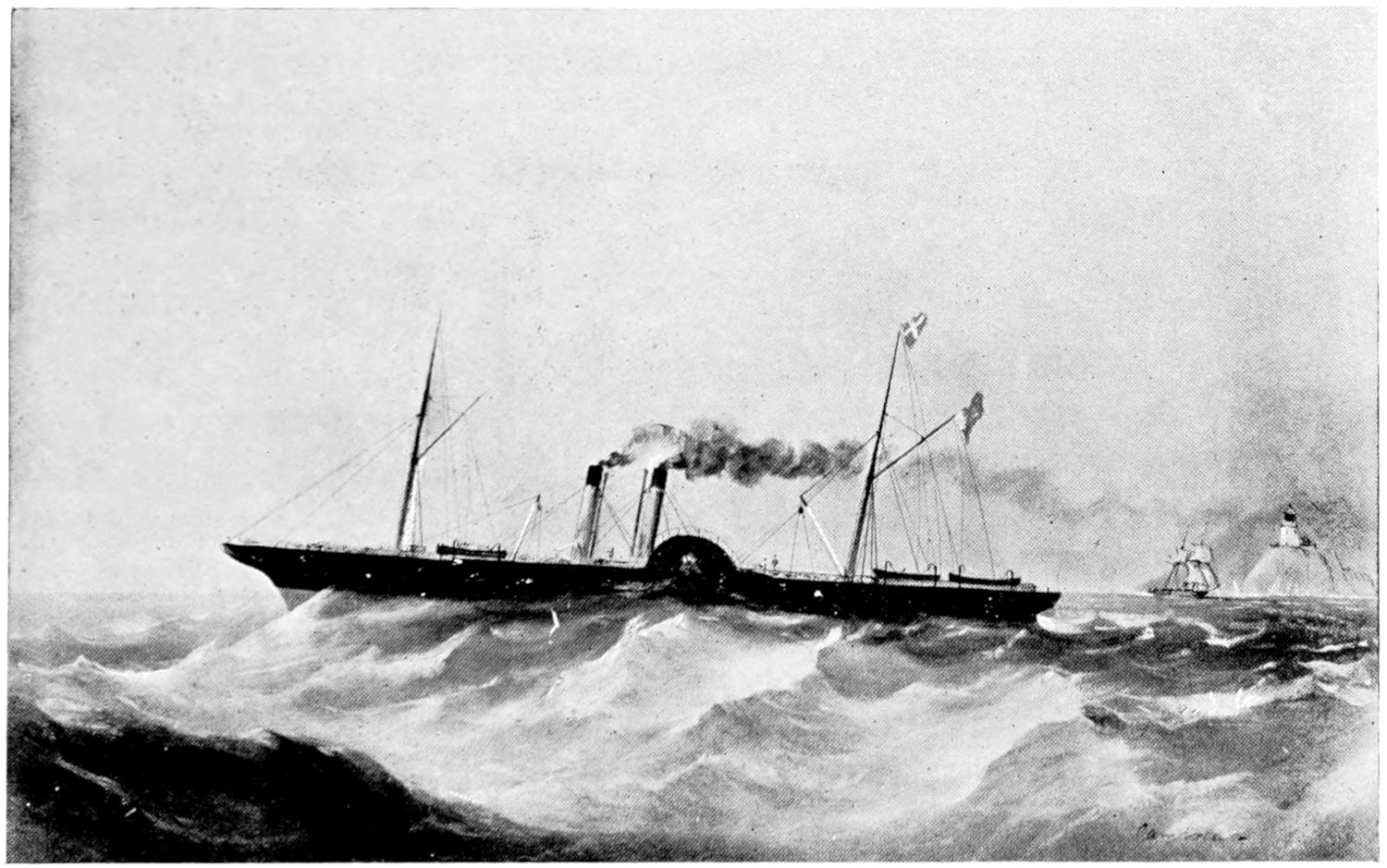
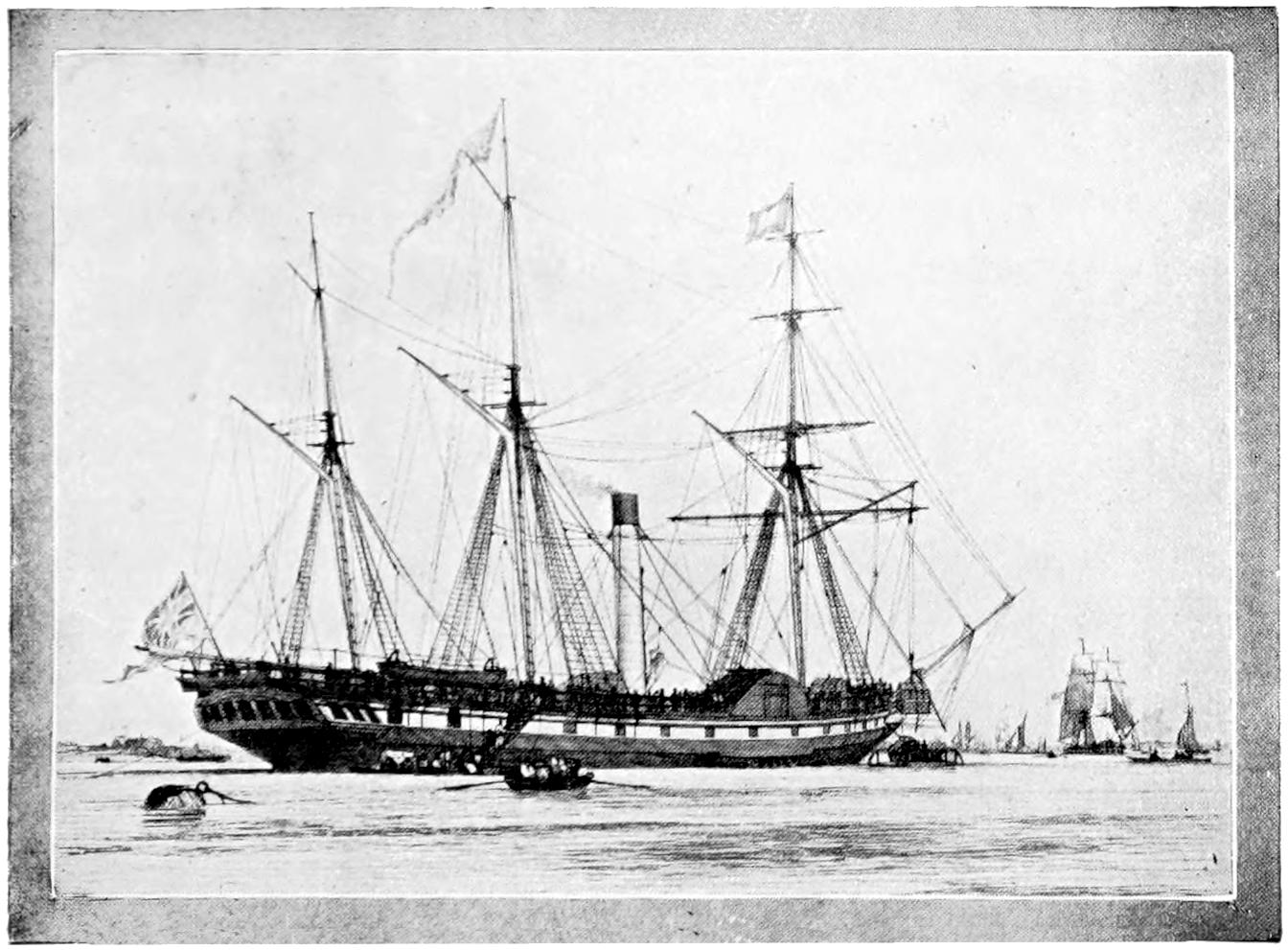
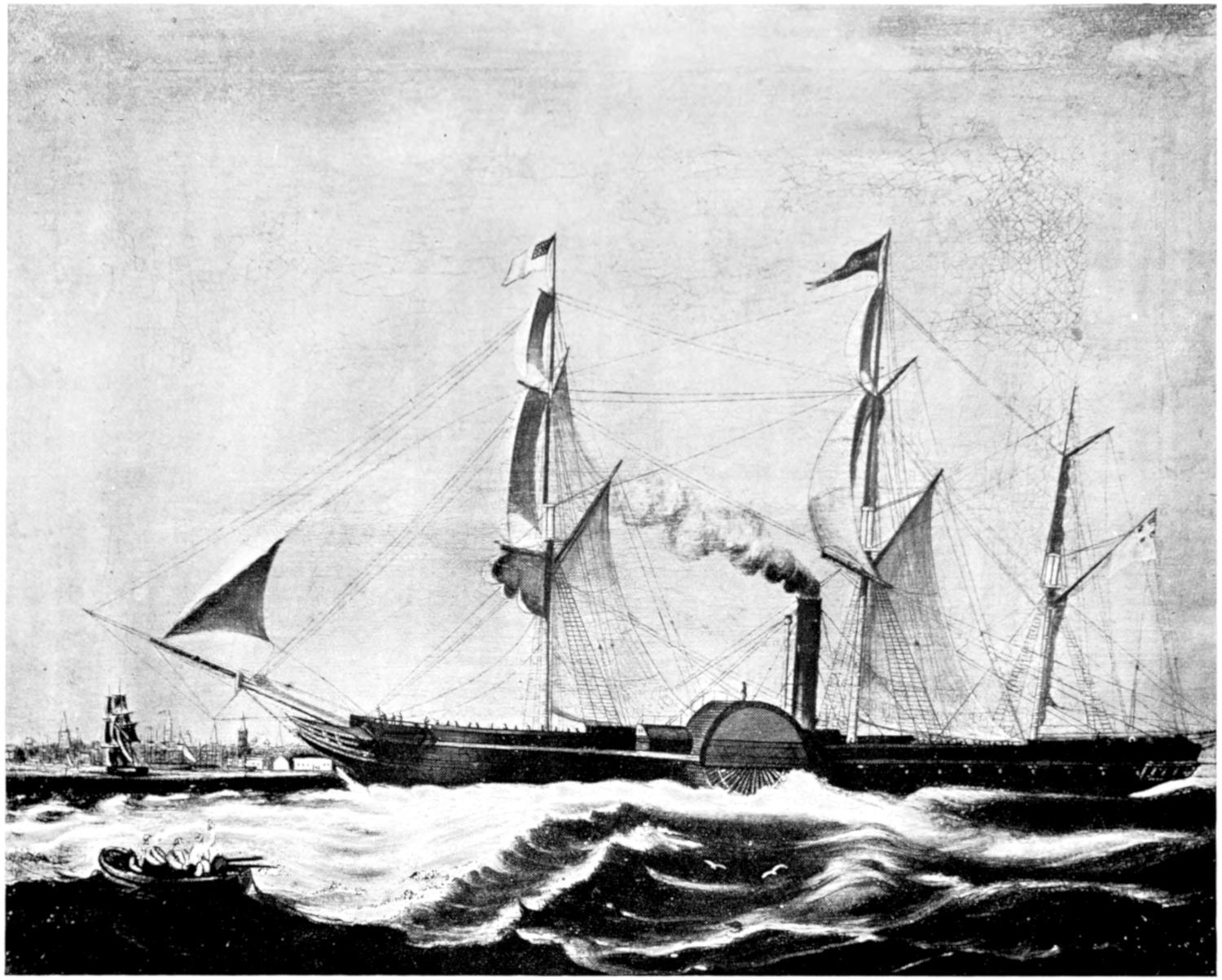
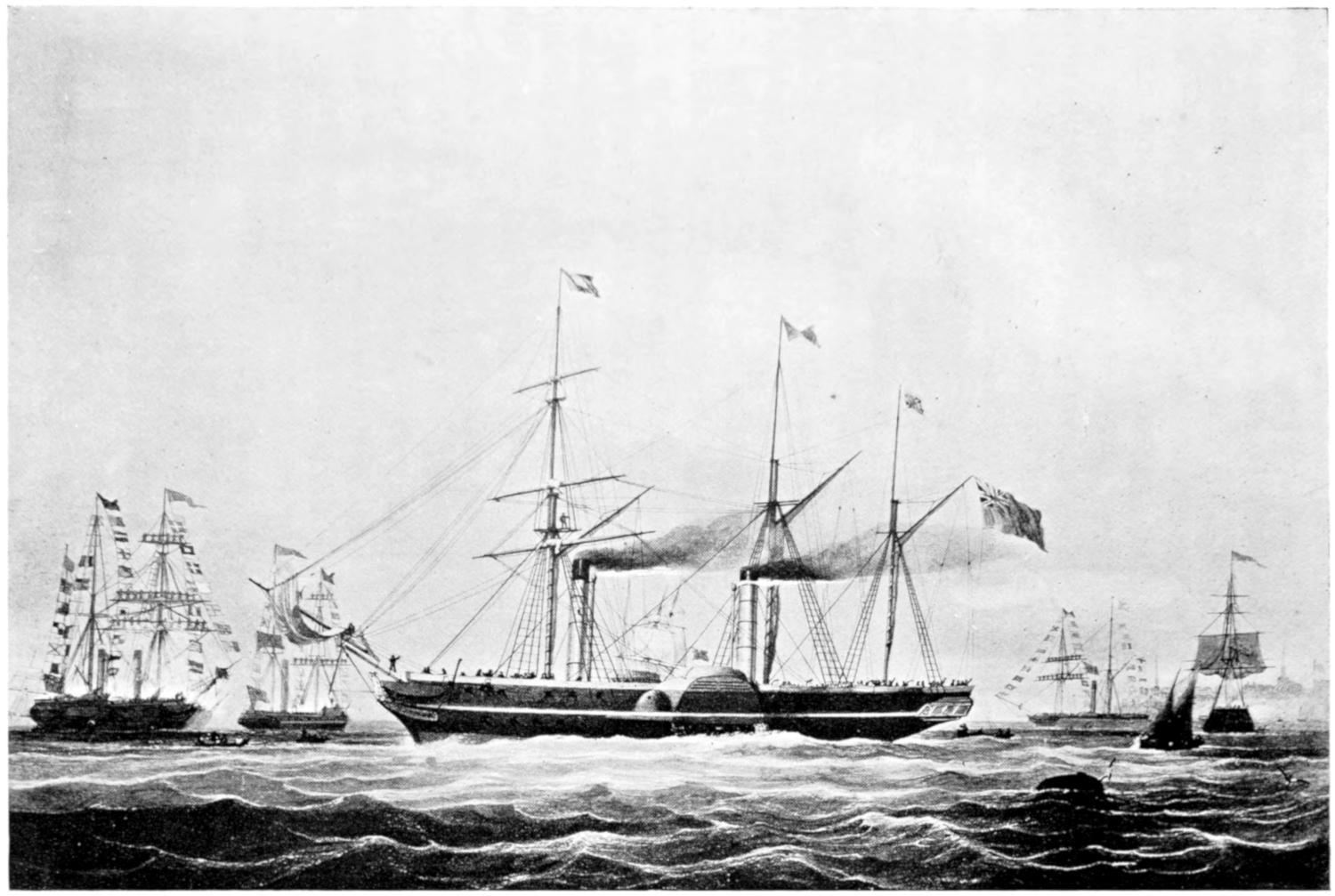
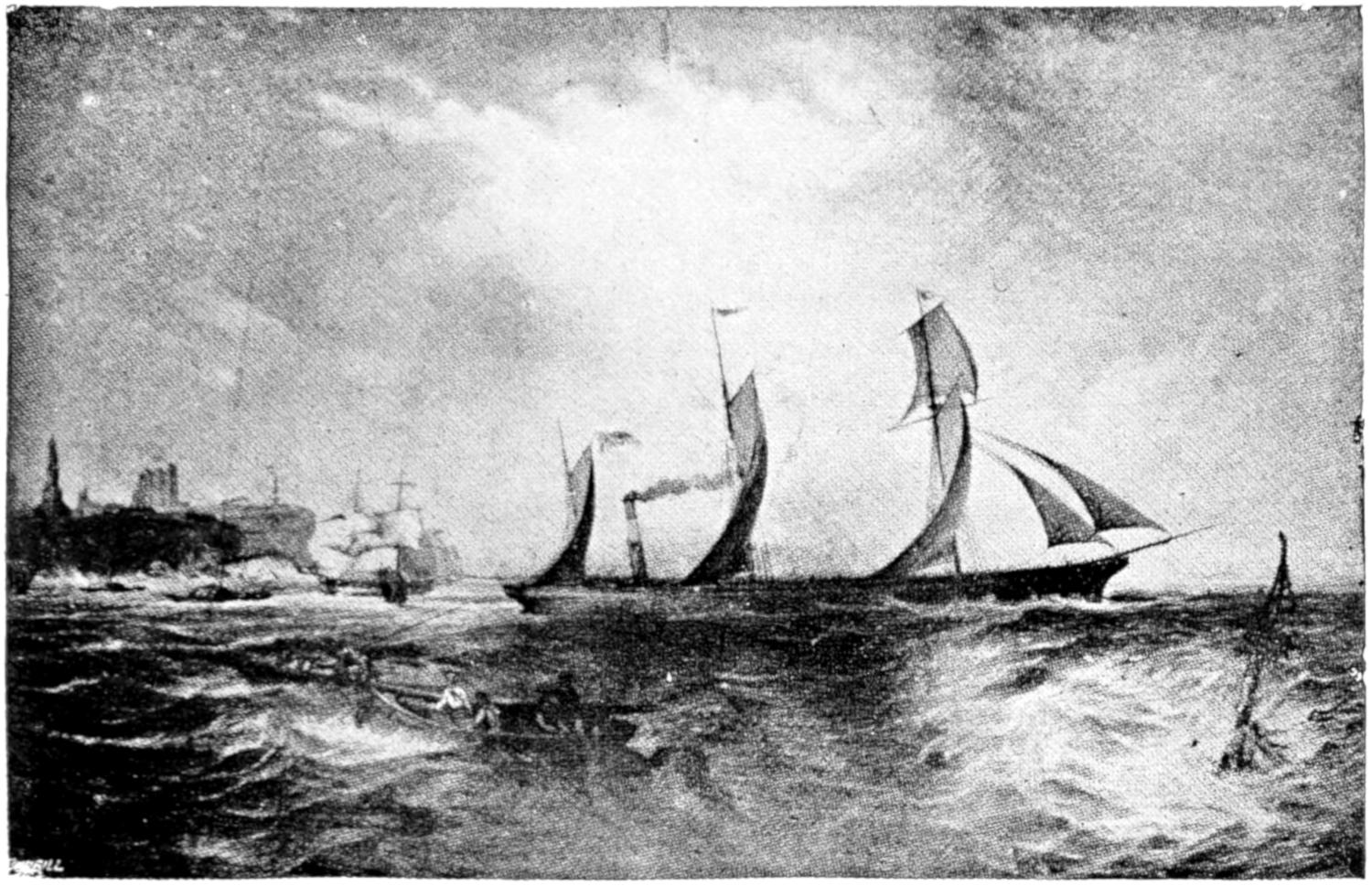
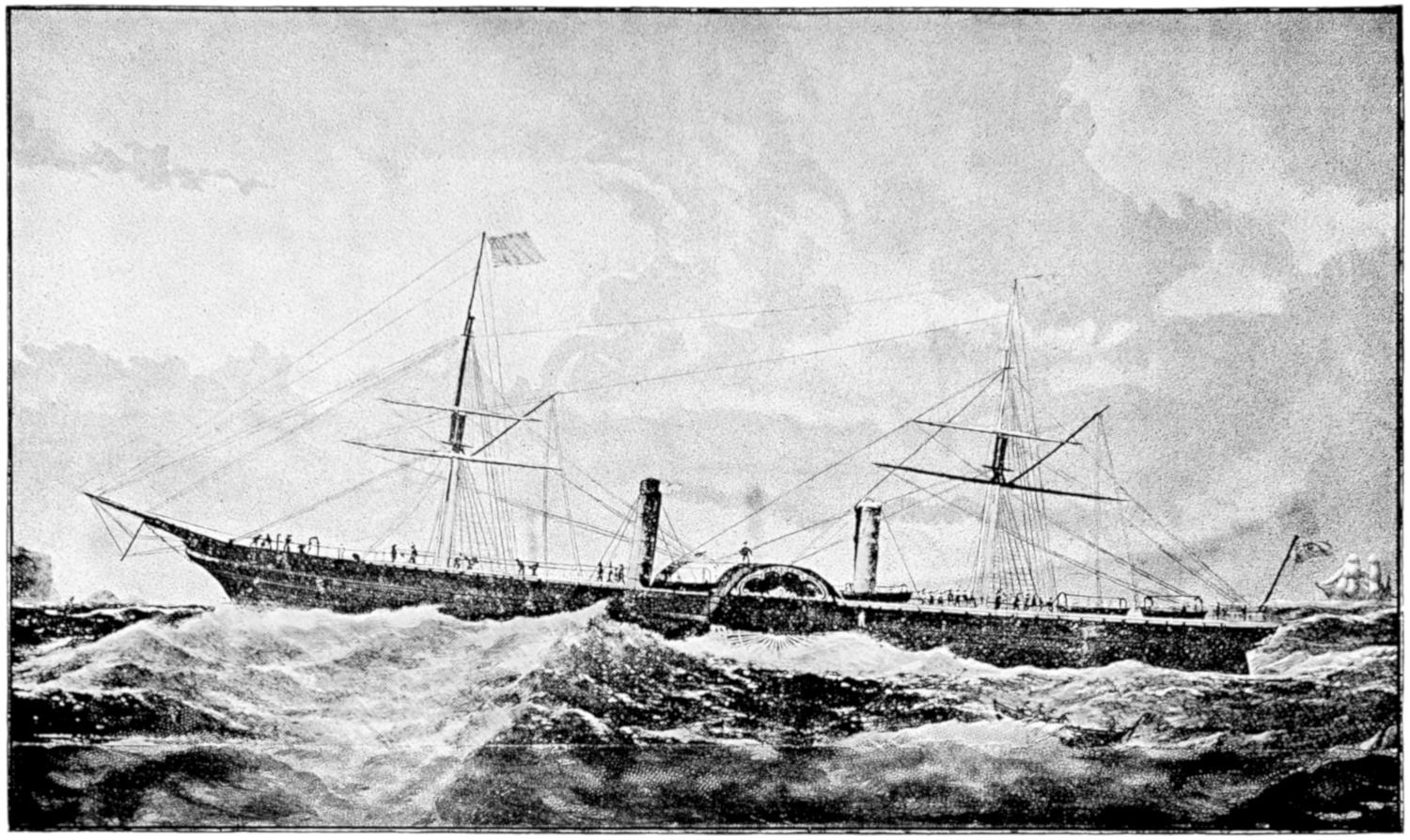
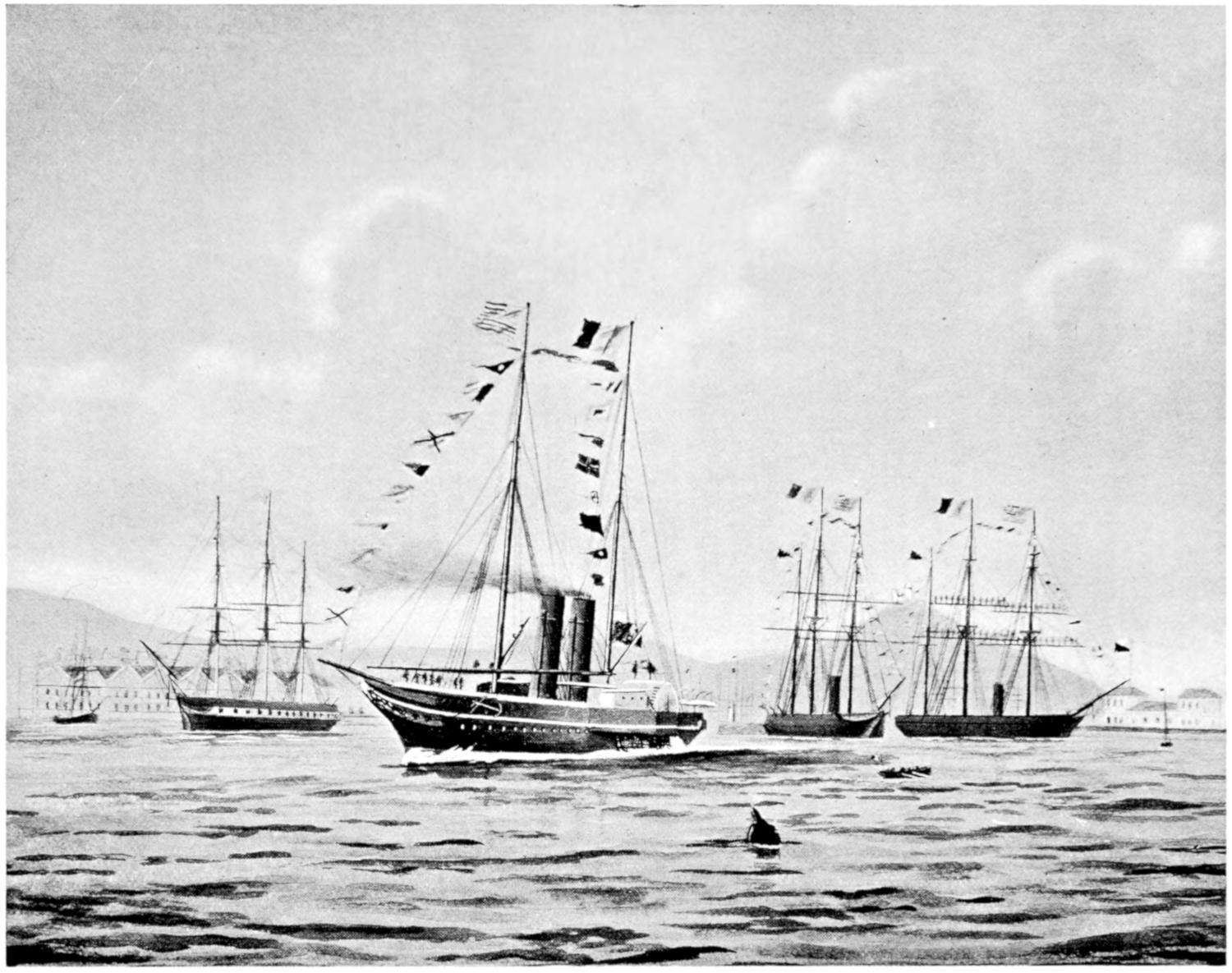
The “William Fawcett,” the First P. & O. Steam-ship, 209 Tons, Built 1829.
On the Left is a Bomb Ketch, a Type withdrawn
from the Navy about this Date.
On the Right is H. M. S. “St. Vincent,”
101 Guns.
From a Painting by Charles Dixon
By kind permission of the Peninsular & Oriental Steam Navigation Co.
STEAM-SHIPS
THE STORY OF THEIR DEVELOPMENT
TO THE PRESENT DAY
BY R. A. FLETCHER
WITH A HUNDRED AND
FIFTY ILLUSTRATIONS
LONDON SIDGWICK & JACKSON, LTD.
3 ADAM STREET, ADELPHI, W.C.
1910
All rights reserved
PREFACE
The story of the Steam-ship, and of its development up to the
present time, covers little more than a hundred years. In
the companion volume,[1] the evolution of the sailing ship
necessitated a comprehensive survey of some eight centuries; but that
we need vessels, not only faster than the sailing ship, but also more
independent of the weather conditions, is shown by the fact that in
the world’s shipping tonnage of to-day (omitting small vessels) the
proportion of steam to sail is as nine to one. The “seven seas” must
be crossed with speed and safety, in the interest of all nations that
have a mile of sea coast; but the Anglo-Saxon race, as it has contributed—from
either side of the Atlantic—most largely to the
mechanical and structural development of the steam-ship, now
depends most vitally upon the organisation of its naval and transportation
systems. Napoleon said that the strength of an army lay
in its feet; no less true is it that the strength of our Empire lies
in her ships.
[1] “Sailing Ships and their Story,” by E. Keble Chatterton, 1909.
A hundred years ago it was impossible to forecast with any
accuracy how long a journey might take to accomplish, and the
traveller by land or sea was liable to “moving accidents by flood and
field”; but side by side with the growth of the steam-ship, and the
accompanying increase of certainty in the times of departure and
arrival, came the introduction of the railway system inland. Between
the two, however, there is the fundamental difference that the sea is a
highway open to all, while the land must be bought or hired of its
owners; and the result of this was that inland transportation, implying
a huge initial outlay on railroad construction, became the business
of wealthy companies, whereas any man was free to build a
steamboat and ply it where he would. The shipowner, moreover,
has a further advantage in his freedom to choose his route, because
he is at liberty to “follow trade”; but if, as has happened before
now, the traffic of a town decreases, owing to a change in, or the
disappearance of, its manufactures, the railway that serves it becomes
proportionately useless.
In another essential, the development of steam-transport on
land and sea provides a more striking contrast. The main features of
George Stephenson’s “Rocket” showed in 1830, in however crude a
form as regards detail and design, the leading principles of the
modern locomotive engine and boiler; but the history of the marine
engine, as of the steam-ship which it propels, has been one of radical
change.
The earliest attempts were made, naturally enough, in the face of
great opposition. Every one will remember Stephenson’s famous
retort, when it was suggested to him that it would be awkward for
his engine if a cow got across the rails, that “it would be very
awkward—for the cow”;—and at sea it was the rule for a long while
to regard steam merely as auxiliary to sails, to be used in calms.
While ships were still built of wood, and while the early engines consumed
a great deal of fuel in proportion to the distance covered, it
was impossible to carry enough coal for long voyages, and a large sail-area
had still to be provided. Progress was thus retarded until, in
1843, the great engineer Brunel proved by the Great Britain that the
day of the wooden ship had passed; and the next ten years were
marked by the substitution of iron for wood in shipbuilding.
Thenceforward the story of the steam-ship progressed decade by
decade. Between 1855 and 1865 paddle-wheels gave place to screw
propellers, and the need for engines of a higher speed, which the
adoption of the screw brought about, distinguished the following
decade as that in which the “compound engine” was evolved. Put
shortly, “compounding” means the using of the waste steam from
one cylinder to do further work in a second cylinder. The extension
of this system to “triple expansion,” whereby the exhaust steam is
utilised in a third cylinder, the introduction of twin screws, and the
substitution of steel for iron in hull-construction, were the chief
innovations between 1875 and 1885. The last fifteen years of the
century saw the tonnage of the world’s shipping doubled, and the
main features of mechanical progress during that period were another
step to “quadruple expansion” and the application of “forced
draught,” which gives a greater steam-pressure without a corresponding
increase in the size of the boilers. The first decade of the present
century has been already devoted to the development of the “turbine”
engine.
I have to thank the Institute of Marine Engineers at Stratford,
E., for much valuable assistance and for placing its Transactions at
my disposal; if I have not acknowledged every item derived therefrom
I trust that this general acknowledgment will suffice. To
Mr. J. Kennedy, author of “The History of Steam Navigation”;
Mr. A. J. Maginnis, author of “The Atlantic Ferry”; and Captain
James Williamson, author of “The Clyde Passenger Steamer,” I am
greatly indebted for their kind permission to draw freely upon their
books: and to the publishers of the two latter, Messrs. Whittaker
and Co. and Messrs. MacLehose and Sons respectively, for the loan of
illustrations. Special thanks are also due to Mr. E. A. Stevens of
Hoboken, New Jersey, U.S.A., not only for information concerning
the experiments made by Colonel Stevens with the screw propeller,
but also for the loan of some unique photographs of early American
boats. Mr. A. J. Dudgeon, M.I.N.A., M.I.C.E., son of the well-known
Thames shipbuilder, has revised a large amount of my work,
and was good enough to place at my disposal his valuable scrap-books,
from the pictures in which my friend Mr. Ernest Coffin has drawn
several charming line-illustrations and the initial letters to the
chapters. For various assistance I have to thank other friends and
correspondents: Mr. James A. Smith, M.I.N.A; Mr. Harry J.
Palmer, formerly of Shipping Illustrated, New York, and now
assistant to Captain Clark, Lloyd’s agent at New York; Mr. J. W.
Little, of Messrs. Little and Johnson; and Mr. James Gallagher of
Paris for his researches at the Academy of Sciences and elsewhere.
For permission to reproduce many illustrations of models, &c., in
the Science Museum at South Kensington, I am indebted to the
Board of Education; while for particular information I am glad to
acknowledge the especial courtesy of Messrs. Barclay, Curle and Co.,
Ltd., of Whiteinch, Messrs. R. and W. Green, Ltd., Messrs. Swan,
Hunter, and Wigham Richardson, Ltd.; and, for revising the portion
relating to Floating Docks and supplying illustrations thereof, to
Messrs. Clark and Standfield. To many other famous shipbuilding
firms who have supplied material or illustrations thanks must also be
tendered: Messrs. Harland and Wolff of Belfast; Messrs. A. and J.
Inglis of Glasgow; Messrs. Thornycroft and Co., Ltd.; the Carron
Company; Messrs. Yarrow; Messrs. Eltringham and Co., Ltd.; Messrs.
Smith’s Docks Co., Ltd.; Messrs. Palmer’s Shipbuilding and Iron Co.,
Ltd.; Messrs. Armstrong, Whitworth and Co., Ltd.; the Parson’s
Marine Steam Turbine Co., Ltd.; the Thames Iron Works and Shipbuilding
Co., Ltd.; the Vulcan Shipbuilding Co. of Stettin; Messrs.
W. Denny and Brothers, Ltd., of Dumbarton; Messrs. Osbourne
Graham and Co., Ltd.; Messrs. William Gray and Co., Ltd.; Sir
Raylton Dixon and Co. of Middlesbrough; Messrs. W. Doxford and
Sons of Sunderland; and the Newport News Shipbuilding and Dry
Dock Company, U.S.A.
To many shipowning firms I and my publishers are alike indebted
for information and the loan of illustrative material; the Peninsular
and Oriental Steam Navigation Co., Ltd.; The Cunard Company;
the White Star Line; the American Line; the Pacific Steam
Navigation Company; the Orient Line; Messrs. Shaw, Savill and Co.,
Ltd.; Lund’s Blue Anchor Line; the Royal Mail Steam Packet
Company; Messrs. Elder, Dempster and Co., Ltd.; the General Steam
Navigation Company; the Isle of Man Steam Packet Company, Ltd.;
the principal Railway Companies owning steam-ships; the Anchor
Line; the Allan Line; Messrs. Brocklebank and Co.; the Bibby
Line; Messrs. George Thompson and Son’s Aberdeen Line; the
North German Lloyd, and the Hamburg-American Line.
Certain illustrations appear by arrangement with the editors of
the Magazine of Commerce, the Shipping World, the Syren and
Shipping, the Master, Mate, and Pilot (of New York), the Engineer,
and the Shipbuilder. The photograph of the Minas Geraes is
reproduced by special permission of his Excellency the Chief of the
Brazilian Naval Commission.
CHAPTER I PRIMITIVE EXPERIMENTS IN PROPULSION—SOME EARLY EXPERIMENTS WITH STEAM
Opinions are divided as to whether
the paddle-wheel is a development
from the action of a man paddling
a canoe, or the result of applying to
a vessel an ordinary wheel, with
blades to make it bite the water; or
it may be stated thus: Did the
paddle-blades grow out of the wheel,
or the wheel out of a number of
paddle-blades? There is no satisfactory
evidence one way or the
other; suffice it that the idea of
revolving paddles was developed.
How the power which caused the revolution of the
paddles was applied at first is as unknown as the identity
of the man who first thought of making navigation easier
by mechanical means. It was probably human power, as
the first inventor can hardly have discovered how to
utilise animals for the purpose, and from what we know
of primitive expedients we may conjecture what the first
contrivance used to urge a boat onwards without sails or
oars was like. The craft would be a small one. Perhaps
the proprietor was too poor to hire rowers. Perhaps,
a subtle financier, he realised that if he could bring his
goods to a certain place before rival shippers he would
secure the market. Hence, stimulated by poverty or
cupidity or both, he reflected, experimented, and finally
invented the revolving paddle. But his apparatus was
probably nothing more than a smooth, straight branch
or tree log, which projected over either side of the boat
and carried at each end paddles fixed radially. He probably
used two or four paddles, as it would be easier
to attach them to the axle in pairs. The radii of the
paddles consisted of two poles tied at right angles about
the middle and there fastened to the axle ends, rough-hewn
boards or strips of bark being attached at the
extremities of the poles to form the paddle-blades. The
axle was doubtless kept in place either by pins in the
gunwales placed before and after it, or by bringing two of
the ribs on either side above the gunwale line and disposing
the axle between them. In many modern row-boats
one or other of these plans is adopted for the
accommodation of the oars or sculls. This much being
accomplished, it only remained to apply the power. The
inventor now passed a rope twice round the middle of the
axle, and tied the ends together. By hauling on it he got
all the power he was likely to require; to go astern he
had merely to pull the rope the other way. If more
power was required more men tugged at the rope.
When paddles were made larger to suit hulls of larger
dimensions, it may fairly be assumed that a winch turned
by several men was used, and that the power was transmitted
to the axle of the paddle by means of an endless
rope. But soon it occurred to the shipowners that animals
might be used to produce the power instead of men.
Horses or oxen were made to drive a turntable or capstan,
to work in a cage after the fashion of white mice in their
cylinders, or on a moving floor which imparted its motion
to an axle connected by an endless rope with the axle
of the paddle. Such boats, deriving their power from
animals, were built by the Romans, were in use in the
early centuries of the Christian era, and were not unknown
in the nineteenth century in Britain and the United States.
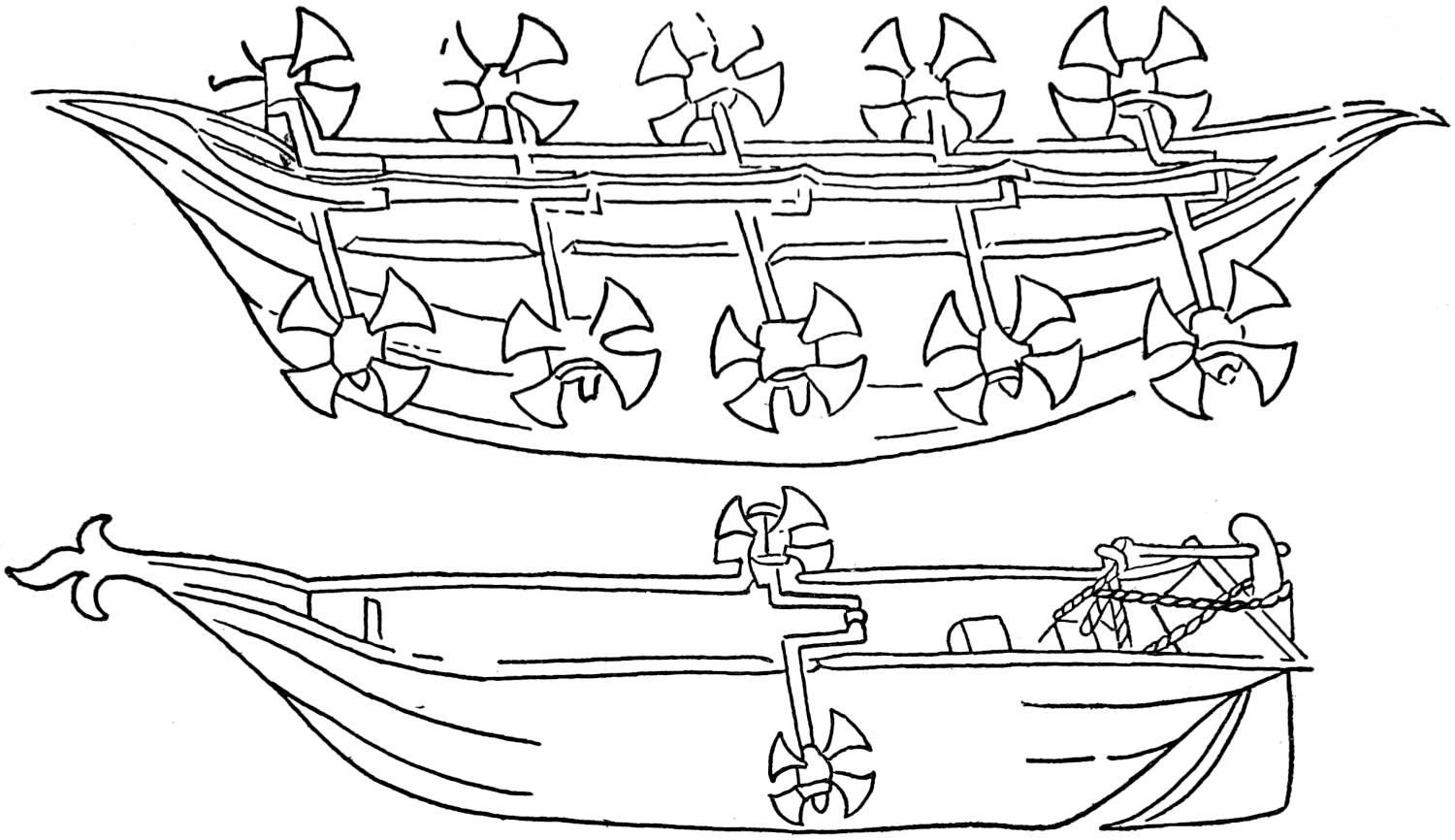
Primitive Paddle-boats.
From Valturius’ “De Re Militari,” 1472.
One of the earliest authentic records of a vessel fitted
with paddle-wheels is to be found in Robertus Valturius’
“De Re Militari,” published in 1472, wherein are pictures[2]
of two boats, one of which has five pairs of paddle-wheels,
and the other one pair. Modern engineers know by experience
that if two wheels be placed one behind another—and
in the early days of steam navigation several boats
were equipped with two pairs of paddle-wheels—the hinder
wheels, having to work in disturbed and moving water, are
practically useless. But at the time of which Valturius
writes the wheels were so small, the number of revolutions
were so few, and the propelling power they exerted so slight,
that no wheel was likely to have its efficiency much interfered
with by any number of wheels in front of it. The
wheels had four paddles each, and were revolved by
cranks on their axles, the cranks of the ten-wheeled boat
being connected by a rope to give uniform action.
[2] The designs have been attributed to Matteo de’ Pasti, who lived
at the court of Malatesta (d. 1464).
In the Far East also, wheel-boats were in use long
before steam-driven paddle-wheels were invented. The
Chinese certainly used them. In a paper read at the
Society of Arts in April 1858, Mr. John McGregor, a
barrister, who devoted considerable time to the study of
early mechanical appliances, stated that an old work on
China contains a sketch of a vessel moved by four paddle-wheels,
and used perhaps in the seventh century. In certain
“Memoires” of the Jesuit Fathers at Peking, published at
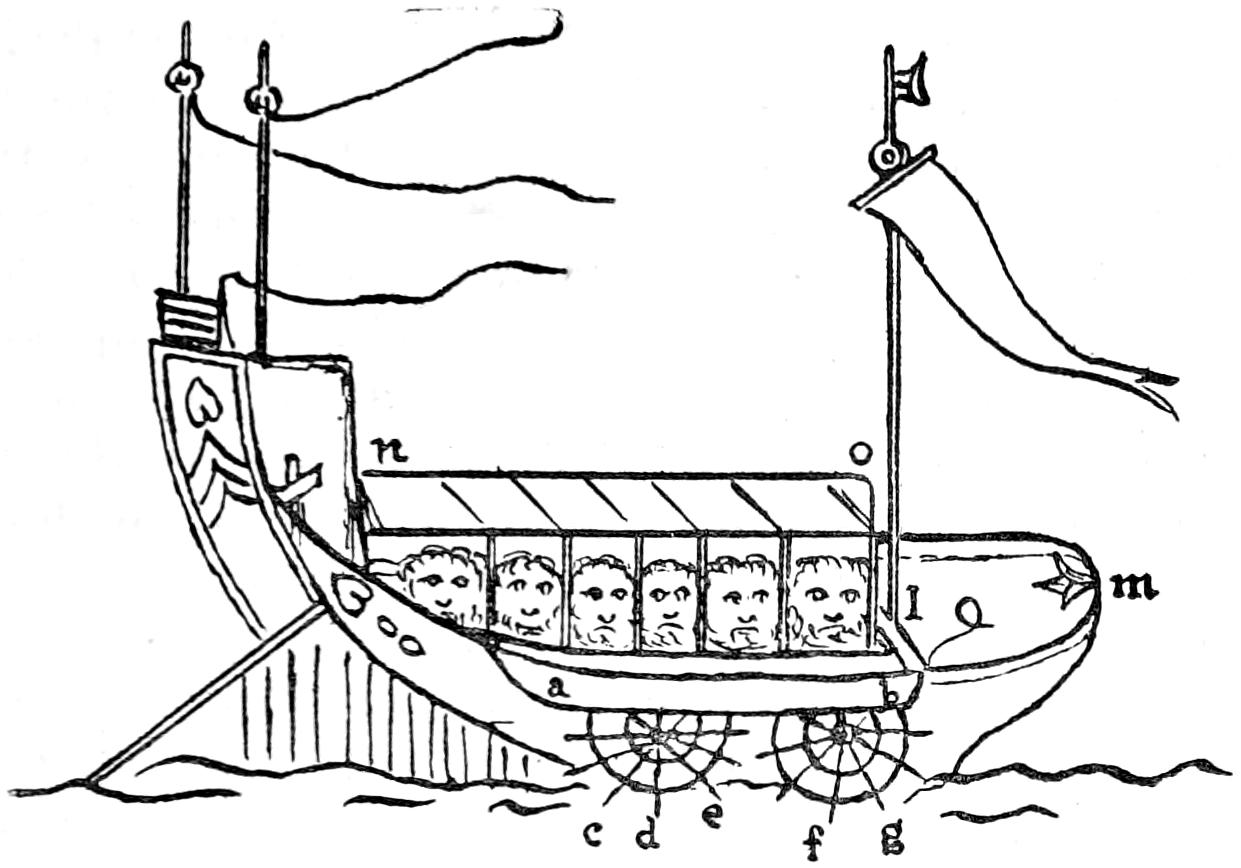
Paris in 1782, there appears this quaint description of a
“barque à roues”: “This vessel is 42 feet in length and
13 feet in width. The wheels are fixed in an empty space
about a foot high situate underneath the strip between the
stout planks a b. From the axle or centre of the wheels
any number of spokes radiate which act like teeth for the
wheels. They enter the water to the depth of a foot. A
number of men make the wheels turn round. The length
of the prow from l to m is 8 feet. The length of the
body of the vessel from n to o is 27 feet, and the length
of the poop 7 feet. Heads of tigers are represented on
movable boards covered with leather, about 5 feet in
height and 2 feet wide. These boards shelter from the
enemy the soldiers who are behind them. They are removed
when the crew decide on boarding the enemy’s
vessel.” The good Fathers in their “Memoires” add a
recommendation to experts in Paris to study the principle
with a view to its adoption in French vessels, and they
point out that even if the extra speed attained were ever
so slight it might be sufficient to bring a vessel out of a
dangerous situation. It may well be doubted, however,
whether the shipping experts in Paris at that date profited
by this humanitarian suggestion. Be this as it may, the
passage proves that the propulsion of vessels by revolving
wheels was not a western idea only.
“Barque à Roues,” Primitive Chinese Paddle-boat.
Panciroli, writing in the sixteenth century, describes an
extraordinary boat of which he had seen a picture. His
book is not illustrated; but we find a representation of
a liburna, or galley, which exactly corresponds to
Panciroli’s description,[3] in Morisotus’ (Claude Barthélemy
Morisot) “Orbis Maritimi ... generalis Historia,” published
in 1643.
[3] “Vidi etiam effigiem Navium quarundam, quas Liburnas dicunt;
quæ ab utroque latere extrinsecus tres habebant rotas, aquam attingentes:
quarum quælibet octo constabat radiis, manus palmo e rota prominentibus:
intrinsecus vero sex boves machinam quandam circumagendo rotas
illas incitabant: et radii aquam retrorsum pellentes, Liburnam tanto
impetu ad cursum propellebant, ut nulla triremis ei posset resistere.”—Guido
Panciroli: Rerum memorabilium, libri ii. Ambergæ, 1599.
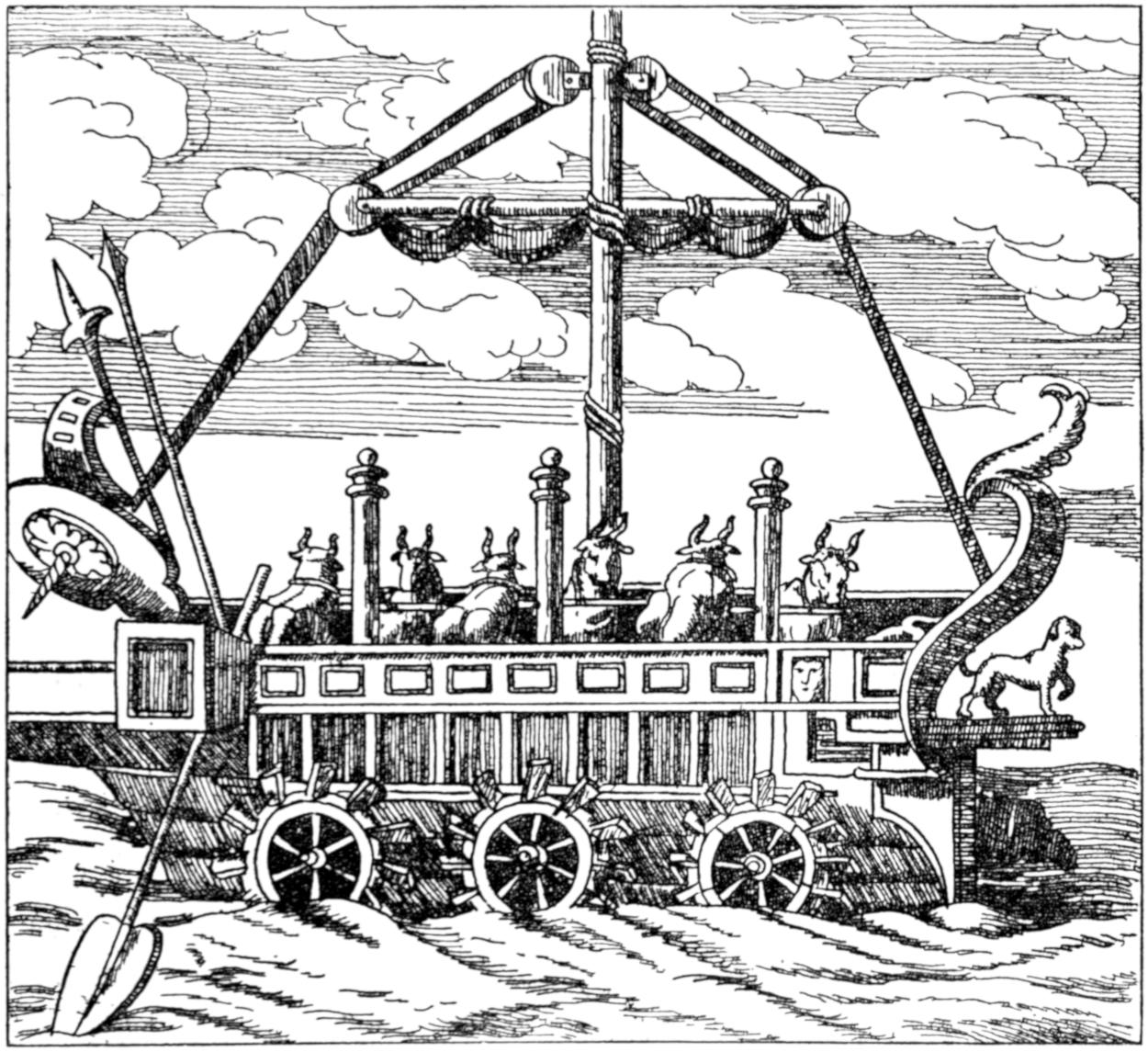
The vessel, an Illyrian galley, had six wheels propelled
by as many oxen. The curious picture suggests an
unwieldy, top-heavy concern which could only be of use
in still water, and would probably be safest in shallow
water, so that if anything happened the oxen and men
could walk ashore without trouble. The cattle apparently
occupy most of the space, an immense bird’s head with a
hooked nose juts out in front immediately above the water-line;
this is of course the ram, above which is a platform
upon which a dog stands as the vessel’s figure-head.
It is unnecessary to go in detail into all the schemes
devised by inventors and visionaries for propelling vessels
by mechanical means. Several of them from time to time
suggested placing wheels on the outside of the boat, and
“turning the wheeles by some provision so that the wheeles
make the boat goe,” to quote William Bourne’s proposition
of 1578, but the “some provision” constituted a
problem which he and many others found too much for
them. David Ramsay in 1618 took out a patent “to
make boats for carriages running upon water as swift in
calms and more safe in storms than boats full sailed in
great winds,” and twelve years later another patent is
recorded to his credit for making ships and barges go
against the tide. The optimism of these and other
mechanical pioneers was wonderful; indeed, had their
inventive genius only equalled their imagination, some of
the difficulties which until comparatively recently baffled
naval engineers and marine architects would have been long
since overcome.
“Liburna” or Galley, worked by Oxen.
From Morisotus.
The webbed feet of water-birds suggested to many
a form in which mechanical propulsion could be applied.
This was only natural, as early shipbuilders took as their
models the birds which they saw floating before them. In
1759 a Swiss pastor named Genevois published at Geneva
a proposal to use an oar fitted with a foot which should
expand when used for propelling a boat and contract when
being moved forward through the water for another
stroke. Genevois visited London in 1760 to lay his
proposal before the Government. His propellers were to
be worked by springs which in turn were to be compressed
by a kind of cannon with a piston. A pamphlet which he
issued at the time of his application to the Government
contains the interesting statement that he had been
informed that a Scotchman had propounded a scheme
thirty years earlier for propelling vessels forward by the
recoil from the firing of cannon over the stern. The
gunpowder of the period made up in smoke what it lacked
in power; hence, although the vessels of his day were not
large, the ingenious Scot “found, by the experiments
made for that purpose, that thirty barrels of Gun-powder
had scarce forwarded the ship the space of ten Miles”; and
it is not surprising that this means of mechanical propulsion
shared the fate of all of its predecessors.[4]
[4] “Some New Inquiries tending to the Improvement of Navigation,”
by J. A. Genevois, 1760.
Many other extravagant schemes might be quoted.
Edward Ford in 1646 was quite modest in his patent to
“bring little ships, barges, and vessels in and out of any
havens without or against any small wind or tide,” to
which he cautiously added the qualification “if the seas be
not rough.” With the exception, however, of a few
sporting proposals of which the Scotch Gunpowder Plot
is a type, no advance in solving the problem of producing
the power for propulsion was made for centuries. The
burden of physical exertion had been shifted from men to
animals, but that was all; and yet in every age during the
last two thousand years there seem to have been many
people who were acquainted with the expansive power of
steam, a fact which makes this slow development the
more remarkable.
The first person to observe the properties of steam, or
at any rate the first to record his observations, was Hero
of Alexandria in 120 B.C., but though he advanced from
theory to practice, his æolipile does not seem to have
answered any useful purpose. This machine consisted of
a hollow glass ball supplied with steam at its axis. The
steam escaped by means of a series of hollow tubes, placed
at right angles and projecting from the globe at a circle
on its circumference equidistant from the two poles, the
tubes being closed at the ends and provided with orifices
at the sides near the ends. Nothing came of his invention,
so far as is known, and the æolipile remained an interesting
toy and nothing else—a toy, however, which has the
honour of being the first mechanical contrivance in which
the expansive power of steam was used. After this, for
many centuries, no attempt was made to use this great
natural agency for the purpose of producing what Bacon
called “fruits” for mankind. Unscrupulous priests worked
“miracles” by this means for the edification of their flocks,
and doubtless revived thereby many whose faith had
become lukewarm. It never seems to have occurred to
them that a far more direct means of moving mountains
was already under their control.
At last in 1629 the use of steam as a means of producing
power was suggested by Giovanni Branca of
Loretto, who, apparently adopting a simplified form of
Hero’s device, planned so that a jet of steam blew against
a series of vanes arranged on the rim of a wheel.
In the seventeenth century also, that eccentric genius
the second Marquis of Worcester published his “Century
of Inventions.” In this he suggested a number of
mechanical contrivances, some of which contained the
fundamental ideas of later inventions, the most notable
being that of a steam-engine with a piston and lever; but
he does not seem to have designed any vessel which
would justify the claim sometimes made on his behalf
that he was the inventor of the steamboat.[5]
[5] Partington’s edition of the “Century of Inventions.”
About the same time, Sir S. Morland, another experimenter,
estimated the expansive force of water at 2000
times, in which he was not far from the truth.
England, however, was not the only country to produce
inventors. One Blasco de Garay, who flourished
a hundred years before the Marquis of Worcester, is
declared by his champions to have been the first to solve
the problem of propelling a vessel by steam-power. But
investigations as to the accuracy of the story tend to the
belief that he did nothing of the kind, and that the
beautifully circumstantial account of his experiment does
greater credit to the imagination of the narrator than to his
regard for accuracy.[6] De Garay’s experiment was made at
Barcelona in the year 1543 in the presence of representatives
of the Emperor Charles V. Ravago, the Treasurer,
reported to the Emperor that the vessel would go two
leagues in three hours, but that the machine was complex
and expensive, and that the cauldron in which the steam
was generated might burst. This is exactly the report
which a cautious financier, presumably not an expert in
mechanics, might be expected to make. Other reports
were more favourable to the project, the commissioners
appointed for the purpose ascribing to the vessel a speed
of a league an hour. What has been established beyond
question, however, is that De Garay made the experiment
with a boat fitted with paddle-wheels, but that the wheels
were turned by men and not by steam.
[6] Mr. John McGregor reported to the Society of Arts that the claim
that De Garay used a steam-engine is unfounded, human power being
used.
Salomon de Caus, a native of Normandy, is sometimes
claimed by French writers to have first thought of using
steam as a motive power in 1615, but his invention does
not seem to have fructified. Half a century later the
unlucky Doctor Denis Papin, a native of Blois, entered
the field of invention. He came to this country from
France in 1675, was elected a Fellow of the Royal Society
in 1681, and in 1690 described a steam cylinder fitted
with a piston which descended by atmospheric pressure
when the steam below it was condensed. He suggested
that one of the uses to which his engine might be put was
the revolution of paddle-wheels fitted to a ship, several
cylinders being applied which worked alternately with the
rackwork he designed. He may have been led to this by
witnessing in 1681 the experiments on the Thames with a
boat designed by Rupert, the Prince Palatine, with revolving
fans, which easily left behind a boat manned by a number
of oarsmen. It has been claimed for Papin that he was
the inventor of the safety-valve, but this is disputed.[7]
Prior, however, to his atmospheric engine he brought out
in 1685 a machine for raising or pumping water, but the
Royal Society treated it with contempt and referred to it
as a “mere trick.” Neither of his machines received the
recognition which historians have since decided was their
due, and he went back disheartened to France, whence he
was driven by the Revocation of the Edict of Nantes
to Marburg. He reappeared in England in 1707 and
announced a project for moving ships by means of wheels
and steam. Unfortunately for him, Thomas Savery, born
in 1658, had already been at work on the problem, and
had brought out his fire-engine, which among other things
he thought might be used to propel ships. His machine
lacked power, and was replaced by one made after the
design of his partner Newcomen. Papin was also associated
with Newcomen and Savery at one time. Savery
says of his own machine that he would refer the question
of its suitability for shipping to those more competent
than himself to judge. Papin appealed to the Naval
Department to consider his invention, but the Government
of the day, after the manner of Governments when
face to face with a new project, thought it useless, and
made severe remarks on his presumption in continuing to
invent for them. He exhibited his invention on the
Thames, but no one took any interest in it. Thoroughly
disheartened by the failures which attended all his efforts,
Papin went to Germany, and is stated to have there built
a steamer which was actually tried on the Fulda or the
Weser, but the local watermen, fearing the rivalry of the
new machine, smashed it, and that is the last which history
has to record of Papin as a pioneer of steamboats. It is
asserted that this boat was built for him by Newcomen
and Savery in this country. As an experimenter he did
valuable work, for he seems to have been the first to have
grasped the importance of the vacuum under the piston.[8]
In 1730 another remarkable proposition was made for
marine propulsion. Doctor John Allen thought it possible
to move a boat by pumping in water at the bows and
pumping it out again at the stern, this scheme being
probably the earliest attempt to secure motion by what
has since become known as the jet-propeller system.
Like almost all other inventions of his period it was crude
in its details and does not seem to have been put to any
practical use.
The next inventor who turned his attention to the
question was Jonathan Hulls, for whom it has been
claimed, with some show of justification, that he was the
actual inventor of the steamboat. That he did invent a
steamboat is beyond question, but whether his vessel was
ever built, and if so whether it attained any measure of
success, are points upon which historical evidence is not
conclusive. But if it was constructed, and there is strong
circumstantial evidence in support of this contention, then
to the West of England, which has contributed so largely
to the maritime glory of Britain, must be ascribed also
the honour of being the birthplace of one of the two
inventions which have done more than anything else to
aid in the spread of civilisation and commerce. Hulls
was born at Aston Magna in 1699. By occupation he
was a clock repairer, a precarious trade at best. The
difficulties he had to encounter through lack of means
were very great, but he persevered, and a patron at last
appeared in the person of a Mr. Freeman, of Batsford
Park, near Chipping Campden, who supplied him with
about £160 to develop and patent his invention. This
enabled Hulls to proceed to London, and he petitioned
Queen Caroline, as Guardian of the Realm in the absence
of her Consort George II. at Hanover, for Letters Patent
for the invention, which was accordingly granted to him
December 21, 1736, provided he enrolled in Chancery
within the following three months a specification describing
his invention.[9] The patent read as follows:
“Whereas our Trusty and Well Beloved Jonathan
Hulls hath by his petition humbly represented unto Our
most dearly beloved Consort the Queen.... That he
hath with much Labour and Study, and at Great Expense
Invented and Formed a machine for carrying Ships and
Vessels out of or into any Harbour, &c., which the
Petitioner apprehends may be of great service to our
Royal Navy and Merchant Ships, and to Boats and
other Vessels, of which Machine the Petitioner hath made
oath that he is the sole inventor, as by affidavit to his said
petition annexed.
“Know ye therefore that we of our special grace, have
given and granted to the said Jonathan Hulls our special
license, full power, sole privilege and authority during the
term of fourteen years, and he shall lawfully make use of
the same for carrying ships and other vessels out to sea,
or into any harbour or river.
“In witness whereof we have caused these our letters
to be made patent.
“(Witness) Caroline, “Queen of Great Britain.
“Given by right of Privy Seal at Westminster this 21st
day of December 1736.”[10]
[9] Mr. J. H. Hulls’ lecture at the Institute of Marine Engineers on
“The Introduction of Steam Navigation,” February 26, 1906.
[10] From copy of patent in possession of Mr. J. H. Hulls.
Mr. P. C. Rushen, in referring to the experiment,
writes:
“About this time it may be presumed that Jonathan
set about constructing a vessel in accordance with his
plans, and for this purpose he had the help of the Eagle
Foundry at Birmingham, to which he forwarded rough
model plans and sketches to aid in founding and forging
the various parts. Until quite recent years these relics
were existent, but on the sale and demolition of the
foundry they seem to have been destroyed.
“The new vessel was tried on the Avon, but tradition
says it was a failure, by reason of the inventor not providing
the proper means to communicate the power to the
paddle. That the experiment was a failure seems evident
from the fact that nothing more was heard of the boat,
but for the given reason is very improbable, because the
very ingenious means the inventor describes, although
perhaps not quite practical on a large scale, are not
palpably unworkable for a small experimental boat. Even
if these means were a failure, it would be ridiculous to
suppose that a clever mechanic such as Hulls shows himself
to be in his pamphlet would be at a loss for some
expedient.
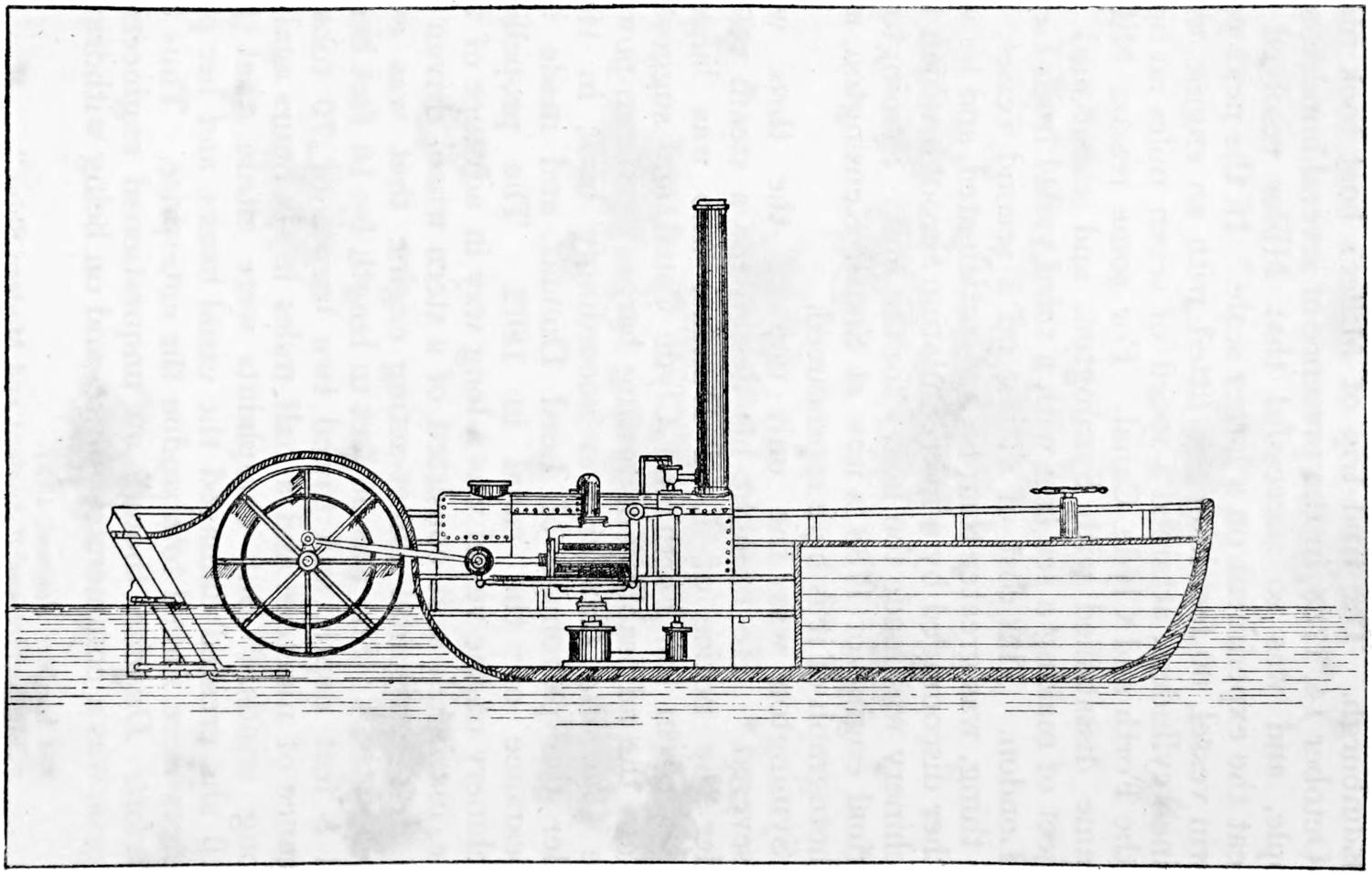
Jonathan Hulls’ Paddle Steamer, 1737.
“The more probable reason of Hulls’ failure was the
want of financial support, that previously accorded him
being perhaps withdrawn on the first hitch in the experiments,
or for some other reason, this so disheartening him
that he relinquished the idea. While Hulls had been at
work on his project, he had worn a brown paper cap, as
usual with mechanics at that time, and this fact was taken
advantage of in a scathing doggerel, which was circulated
upon his failure, and which ran:
[11] P. C. Rushen’s “History and Antiquities of Chipping Campden in
the County of Gloucester,” 1899.
The engine which Hulls used was an adaptation of
Newcomen’s. He published a lengthy description of his
boat, in which he states that, in his opinion, it would
not be practicable to place his machine on anything but a
tow-boat, as it would take up too much room to allow of
other goods being carried on the same vessel, and it could
“not be used in a storm, or when the waves are very
raging.” Hulls died in London destitute, and the world
inherited his ideas. Steam tow-boats are now found all
over the world, and the despised stern-wheeler of his day
was the forerunner of the great stern-wheelers of the
Mississippi.
Another person who took up the subject seriously was
a Frenchman, Jouffroy d’Abbans, better known perhaps
as Claude François Dorothée, Marquis de Jouffroy. His
invention was known as the Pyroscaphe. It was claimed
for him by the Marquis de Bausset-Roquefort that “he
was the first who carried out in practice a scheme for
navigation by steam, his successful experiments on the
Saône at Lyons in 1783 being attested by official
documents, and by the evidence of thousands of spectators.
The glory of the invention of the means of using
steam-power in navigation belongs therefore to France, as
is clearly shown by the archives of the town of Lyons.”
The Marquis de Jouffroy was born at Roche-sur-Rognon
in 1751. A duel fought while he was page to the
Dauphin caused his exile to Provence, where he studied
the methods by which the ancient rowing galleys were
propelled. He returned to Paris in 1775 and conceived
the idea of inventing some form of steamboat while
looking at the Chaillot fire-pump which Périer[12] had
erected a short time previously. He communicated his
project to Périer, who made some fruitless experiments
and declared the idea impossible. Jouffroy, however,
persevered, and in 1776 had constructed a machine which
he adapted for use on a boat. “His first pyroscaphe was
13 m. long, and 1 m. 95 c. wide. The ‘swimming’
apparatus consisted of rods 2 m. 66 c. in length suspended
on either side well forward and carrying at their extremity
frames fitted with hinged flaps with a dip of 50 c.
The frames were capable of describing an arc of 2 m. 66 c.
(8 feet) radius and of 1 m. (3 feet) in length, and
were drawn forward at the end of the stroke by a
counterweight. A single-acting engine by Watt, installed
in the middle of the boat, set in action these
hinged flaps. The construction of this apparatus in
a locality where it was impossible to obtain a cast
and bored cylinder was a work of genius, courage, and
patience. Despite its imperfections it was superior to
anything attempted up to that time in navigation.
The boat worked on the Doubs at Baume-les-Dames
between Montbéliard and Besançon during the months
of June and July.” This system, since called the
“Palmipède,” imitated the movements of aquatic birds, and
was the only one that could be applied to the steam-engine
as then known. It was, however, useless for moving large
masses or for working against the current. “Jouffroy saw
the defects caused by the fact that the rapidity of the
boat’s motion prevented the hinged flaps from reopening
after the forward stroke, especially when the pyroscaphe
was moving upstream or against the tide. Hence the
engine only acted at intervals instead of keeping up a
sustained movement. But Jouffroy substituted paddle-wheels
for the hinged flaps (volets à charnière) and devised
a new machine in which the action of the steam was made
continuous by means of two bronze cylinders, the top
placed lengthwise with the run of the ship, making with
the horizon an angle of about 50 degrees. The bottoms of
the cylinders were encased in a metal box containing a
sliding tile which opened and shut, alternately giving
a passage to the steam and the intake of water in each
cylinder.
“By July 1, 1783, Jouffroy had constructed a second
boat which was launched at Lyons. Its dimensions were
considerable, the length attaining 46 m. and the breadth
4 m. 50 c. The wheels were 4 m. diameter, the paddles
1 m. 95 c., dipping 65 c. The draught of water of the vessel
was 95 c. The total weight was 327 milliers, of which 27
were for the vessel and 300 for the freight. This
enormous vessel voyaged against the tide of the Saône
from Lyons to L’île Barbe in the presence of the Commission
de Savants and thousands of spectators, as
officially recorded in the archives of the Municipality of
Lyons.” Arago says this vessel continued to navigate the
Saône for sixteen months.[13]
[13] Paper read by the Marquis de Bausset-Roquefort before the Lyons
Literary Society in 1864, and preserved at the Mazarin Library (Academy
of Sciences), Paris.
Jouffroy now thought of starting a company to run
boats on the new system, and applied to the Government
for the necessary permission. The question was submitted
to the Academy of Sciences, who appointed a Commission
to inquire into the matter, but among the members of
the Commission was the unsuccessful Périer, whose opposition
resulted in the Academy concluding that the
experiments at Lyons were not decisive. The Marquis
had not the means to continue building steamboats and,
profoundly discouraged, he abandoned the rôle of inventor.
He had already been subjected to much ridicule, and it
was generally agreed that he must be mad to think of
“making fire and water agree”; he was even nicknamed
“Pump Jouffroy.” He witnessed the experiments of
Fulton in France, but did not think of claiming the merit
of his discovery until 1816, when he issued a publication
entitled “Steamboats.” The same year he took out a
patent, formed a company, and on August 20 launched a
steamboat at Bercy, but the venture did not come up to
the expectations of the shareholders, and this was his last
effort. Jouffroy died of cholera at the Hôpital des
Invalides in 1832. Arago, the historian, says that his
claims to be the first inventor of the steamboat have been
established, and, according to Larousse’s “Dictionnaire
universel du XIXe siècle,” Fulton himself openly acknowledged
them in the United States law courts.
CHAPTER II AMERICAN PIONEERS IN STEAM NAVIGATION
Towards the end of the eighteenth
century American inventors turned
their attention to the problem
of navigation by steam, and to
one of them, Robert Fulton, the
credit of having invented the steamboat
has usually been given. Livingston’s
“Historical Account of the
Application of Steam for the Propelling
of Boats” has been accepted
as an authority on the subject,
but as he was Fulton’s friend and
backer, and Fulton married into the Livingston family,
there is reason to question the absolute accuracy of
the circumstantial story told by this most eloquent
special pleader, though there is some excuse for his
partiality. A little investigation makes it apparent that
Fulton was not the first American to design a successful
steamboat, nor even the first to make the running of
steamboats a satisfactory speculation.
In 1909 a Mr. John Moray of West Virginia presented
a petition to Congress in which he asked for the official
recognition of James Rumsay as the inventor of the
steamboat, and the perpetuation of his memory by the
placing of an appropriate bust in the Statuary Hall at the
Capitol. According to the petition “The deed-books of
Berkeley County, Va., for the year 1782 record the fact
that James Rumsay, a native of Maryland, who was a
millwright and Revolutionary soldier, purchased a farm,
and soon after a pond, for experimental purposes in the
line of his calling. On that pond, as the results of many
experiments in steam and hydrostatics by James Rumsay,
the wonderful discovery of the principle of steam navigation
took place. Thoroughly satisfied by continuous
experiments that the newly discovered principle would
become of immense value in the world, Rumsay contracted
with his brother-in-law, Joseph Barnes, for the
building of a boat for steam purposes at St. John’s Run,
on the Potomac River. The resulting steamboat was
publicly exhibited at Shepherdstown, Va., on the Potomac,
on December 3 and 11, 1787. The great success and
useful character of Rumsay’s steamboat were established
by sworn testimony of many notable witnesses, including
General Horatio Gates, conqueror of Burgoyne, and by
a multitude of astonished and delighted spectators. This
practically successful trial took place twenty years before
the Hudson River trial in 1807, and the speed of
Rumsay’s boat was fully equal to that of the Clermont in
its initial trip to Albany—four miles an hour—without
sails, paddles, and the complexities of the Hudson River
boat.”
Rumsay afterwards launched on the Potomac a boat
propelled by a steam-engine and machinery, both of which
were of his own construction. His method of propelling
the boat was to force out a stream of water at the stern,
a system known as the “Jet,” which has never commended
itself to engineers in general, owing to the friction caused
in the pipes by the water rushing through them. A trial
trip, in December 1787, was successfully made in the
presence of a great number of spectators, and resulted in
Rumsay being granted the right to navigate the streams
of New York, Maryland, and Virginia. His scheme was
taken up by an organisation formed in Philadelphia for
that purpose, and known as the Rumsay Society.
Benjamin Franklin was among its members. Rumsay
also visited England and the Continent, and obtained
patents for his invention in Great Britain, France, and
Holland, but he did not live long enough to develop his
schemes. He made a successful trip on the Thames in
1792, and died in London the same year.
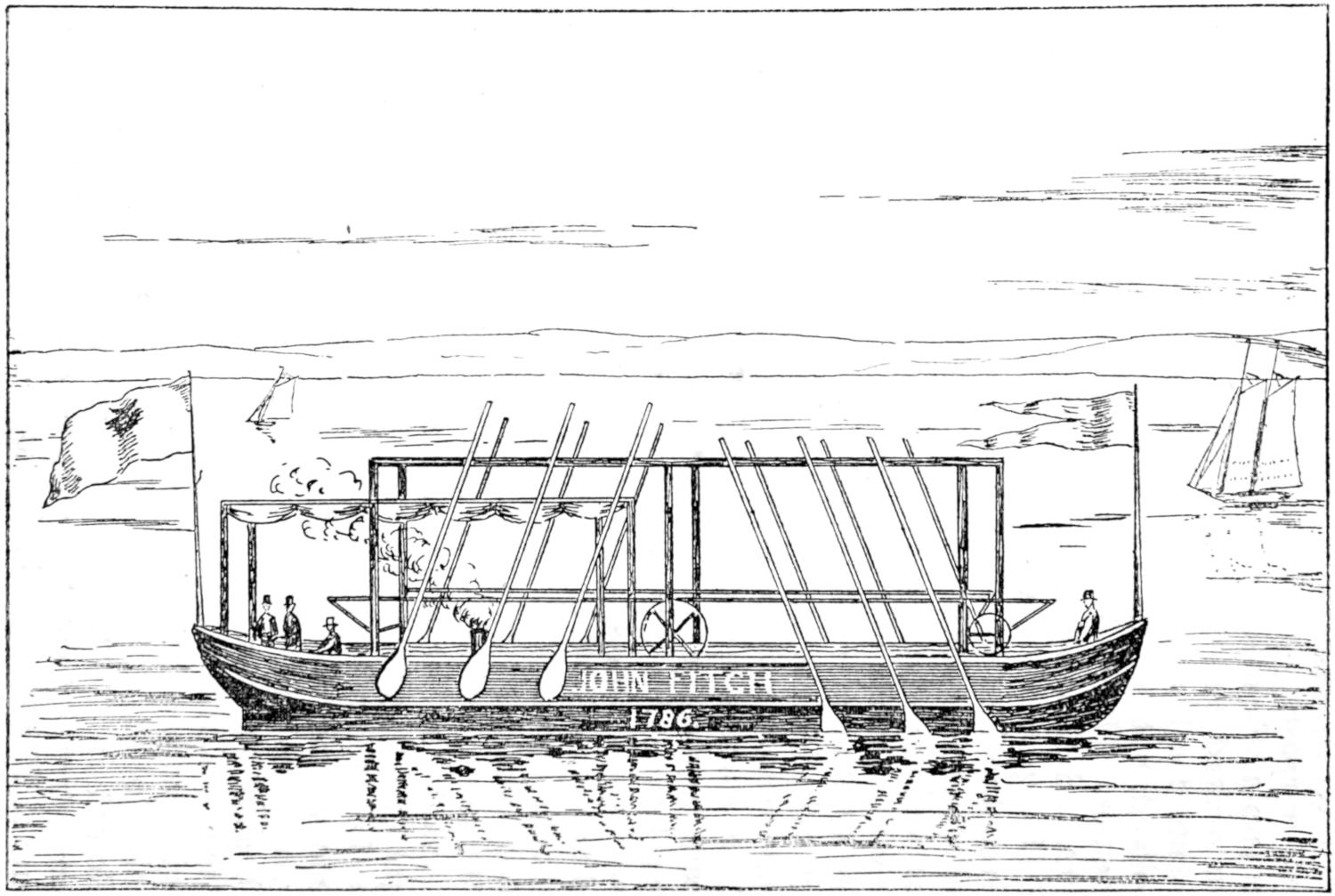
His great rival was John Fitch, who, in 1785, conceived
the idea of using steam-power for land carriages
and afterwards for vessels. His first model of a steamer
carried large wheels at the sides, but these were found to
labour too much in the water, and in his experiments in
July 1786 upon a skiff with a steam-engine having a three-inch
cylinder, the wheels were replaced by paddles or oars
supported by a framework above the vessel. Convinced
of the success which must ultimately attend the use of
steam-power, he petitioned Congress and the State
Legislature for a grant of money, but without avail. As a
result of his efforts to interest “the leading scientific and
public men of that day, everywhere and at all times,” and
his bold advocacy of the adoption of steam for purposes of
navigation, he was generally considered insane. But in
1786 he succeeded in persuading the State of New Jersey
to grant him for fourteen years the sole and exclusive
right to navigate its waters by steam, and this example
was followed in 1787 by the States of New York, Delaware,
Pennsylvania, and Virginia. He had earned some money
by map-making, and now formed a company and built
a boat of 60 tons. She was 45 feet long with a beam of
12 feet, had six oars or paddles on each side, and carried an
engine with a 12-inch cylinder. She made a successful
trial trip at Philadelphia in 1787. A still larger boat
followed in 1788, and another in 1790. The latter
demonstrated “with their increased speed and facility the
value of Fitch’s invention,” and the last was run during the
summer as a passenger boat between Philadelphia and
Burlington at a speed of about eight miles an hour. She
appears, from an illustration in Appleton’s “Cyclopædia of
American Biography,” to have had three large paddles at
the stern held in place by a projecting frame, a cross-beam
at the extreme end of the frame supporting the rudder, which
was placed a little distance behind the paddles. Consequent
upon the Virginia patent which gave him the
exclusive right of navigating “the Ohio River and its
tributaries” he now designed a boat called the Perseverance,
for freight and passengers on the Mississippi.
But as, owing to a storm, she could not be got ready in
time, the default clause in the patent became operative.
Fitch’s associates now left him and his own resources were
at an end, and after one or two other misfortunes he went
to France in 1793. Needless to say, that country was in
no mood then to entertain the idea of building steamboats.
Finding no one ready to listen to his schemes, Fitch
departed for London, having deposited his plans and
specifications with the American Consul at Lorient.
John Fitch’s Oared Paddle boat, 1786.
A rather curious thing then happened.
“During this absence his (Fitch’s) drawings and papers
were loaned by the Consul to Robert Fulton, then in
Paris, in whose possession they were for several months.”[14]
Until now, it must be remembered, Fulton had scarcely
been heard of in connection with steamboats.
Meantime the ill-starred Fitch, unable to gain a hearing
in England either, worked his passage back to America as
a common sailor. In 1796, still determined to convince
the public of the need for steamboats, he obtained a ship’s
yawl, and fitted her with an engine and screw-propeller.
With these he experimented in New York and, as usual,
no one took any interest in the boat except the proprietor.
In 1798 he made and tried upon a small stream near
Bardstown a steamboat model measuring three feet in
length, but a few weeks later he committed suicide by
taking poison. His “Journal” contains the following
passage: “The day will come when some more powerful
man will get fame and riches from my invention, but
nobody will believe that poor John Fitch can do anything
worthy of attention.”
About twenty years later Fitch’s merits as an inventor
were recognised by a Committee of the New York
Legislature, which reported that “the steamboats built by
Livingston and Fulton were in substance the invention
patented to John Fitch in 1791, and Fitch during the term
of his patent had the exclusive right to use the same in the
United States.”
Other inventors were at work. Fulton was in France
thinking over the Fitch drawings which had been left
there in 1793, trying a submarine boat on the Seine, and
in 1801 making a variety of experiments under the
auspices of the French Government.
In America, one Samuel Morey, in 1790, built a strange
boat with a paddle-wheel in the prow, constructed a steam-engine
for her, and presently was voyaging on the
Connecticut River at the break-neck speed of four miles an
hour. A few years later he had another boat ready which
could do five miles an hour, this boat having a wheel at
the stern, and by request he took Chancellor R. Livingston
and others for a trip in New York waters. The Chancellor,
who had made a trip in Morey’s first boat at Orford, perceived
two things, first, that the speed ought to be
increased, and, second, that there was money in steamboats.
He promised Morey 100,000 dollars, it is believed, if he
could run a boat at eight miles an hour, and offered him
7000 dollars for a patent for the North River as far as
Amboy for what had already been accomplished. The
latter offer was not accepted. Morey in 1795 took out a
patent for a steam-engine, in which the power was to be
applied by crank motion, to propel boats of any size. Two
years later he built a steamer which he placed on the
Delaware, and propelled it by means of two paddle-wheels,
one on either side. These wheels gave better results than
any method which had yet been tried.
When, a little later, Livingston went to France and
became associated with Fulton as the financier of his
enterprises, it is probable that the knowledge the former
had gained of Morey’s work and Roosevelt’s experiments,
and the latter of Fitch’s designs, proved extremely useful
to both of them. Nicholas J. Roosevelt had attracted
some attention by building a small wooden boat across
which was an axle projecting over the sides, and carrying
paddles, the contrivance being made to revolve by a light
cord wound round the middle of the machine and attached
to hickory and whalebone springs. In 1798 he recommended
to Livingston a vertical wheel, and the Chancellor
replied, “Vertical wheels are out of the question.” As late
as 1802 Fulton favoured chains and floats, and it was not
until after Livingston had communicated Roosevelt’s plan
to him that they applied vertical wheels on Roosevelt’s
system to their boat on the Seine.
About this time also Livingston was engaged with John
Stevens, his brother-in-law, and Nicholas J. Roosevelt
on the construction of a steamboat to be used on the
Hudson, the New York State Legislature having granted
the necessary monopoly. The State required that the
boat should attain a speed of three miles an hour, but this
was not achieved. Livingston was appointed Minister to
France in 1801, and was thus cut off from his two partners
and brought into communication with Fulton. Another
version is that the boat made three miles an hour, and that
the State stipulated for four miles an hour.
Robert Fulton, asserted to be an Irishman by descent,
was born in Pennsylvania in 1765. When a boy he had
witnessed the experiments made on the Delaware by John
Fitch, but the problems of steam navigation were only a
few of those which occupied his versatile genius. He
came to England in 1786, and in 1794 invented a marble-sawing
machine, a flax-spinning machine, a machine for
ropemaking and a mechanical dredger. In 1795 he published
a treatise on canal navigation in which he suggested
a number of improvements in lock construction.
In 1797 he went to France and was for some time
occupied in designing and experimenting with submarine
boats. He suggested to the French Government that his
submarine would be useful in destroying the British Fleet.
The Directory would have nothing to do with his plans,
but when Napoleon became First Consul a Commission
was appointed to investigate and report upon them.
Beyond agitating the British Government for some time,
however, while he experimented with torpedoes designed
to destroy their fleet, and trying unsuccessfully to sell his
invention to the French Government, nothing was accomplished.
He came over to England in 1804 prepared to
sell his invention to the British Government. From one
point of view Fulton appears as the inventor of a horrible
engine of destruction, ready to dispose of it to any country
which would buy at a remunerative price.
But there is another aspect of Fulton, and this is
exhibited by his enthusiastic biographer Cadwallader D.
Colden. According to this gentleman, Fulton took no
interest “in the then existing contest” between England
and France. England and France were to him possible
torpedo buyers and their fleets possible torpedo victims.
But his ideals included universal free trade and the liberty
of the seas, and he looked upon the annihilation of naval
armaments as a step in the right direction, as it would
destroy what he called the war system of Europe. If this
could be effected nations would engage in education,
science, and a rivalry of peaceful arts.
Fulton has been called a prophet and a statesman; but
the doctrine that warfare will be ended by elaborating a
more deadly means of destruction than has hitherto been
known, coupled with the implied assertion that each
invention is the last word in destruction, suggests at once
conspicuous limitations in prophecy and statecraft. He
never thought of torpedo destroyers.
In 1793 Fulton corresponded with Lord Stanhope on
the subject of steam navigation. Lord Stanhope was fully
aware that invention was knocking at the door, for in a
letter to Wilberforce he says: “This country is vulnerable
in so many ways, the picture is horrid.... I know,
and in a few weeks I shall prove, that ships of any size
may be navigated so as to go without wind and even
directly against both wind and waves.... The most
important consequence which I draw from this stupendous
fact is this. It will shortly render all the navies of the
world (I mean military navies) no better than lumber.
For what can ships do that are dependent on wind and
weather against fleets that are wholly independent of
either? Therefore the boasted superiority of the British
Navy is no more. We must have a new one. The French
and other nations will for the same reasons have the same.”
He was himself an experimenter, and had been
endeavouring to propel a boat by means of an appliance
resembling a mechanical duck’s foot. The plans which
Fulton submitted to him show a boat with an immense
bow or spring fastened to a stumpy mast amidships,
operating on a large paddle for which the rail at the
extreme end of a raking stern acted as a fulcrum; a
second plan shows the boat with a three-paddle revolving
wheel at the side.
When Livingston went to France in 1801, an
enthusiast for steam navigation, and, what was more
important, an enthusiast of considerable means, Fulton,
whom he there met and financed, was stimulated to fresh
exertions. By 1803 a boat to their joint account was
built, 70 feet long and 8 feet beam. With this it was
proposed to experiment on the Seine. But the machinery,
which is said to have been made by Périer, who opposed
the Marquis de Jouffroy, was too heavy for the hull. The
night before the trial trip was to be made was stormy:
the boat broke in half and sank. Notwithstanding this
blow to their hopes the partners proceeded with their
attempts. The machinery was recovered and found to be
practically uninjured, and the hull was rebuilt more
strongly. The trial trip took place in August 1803, when
the boat made four and a half miles an hour. This was a very
moderate speed and was disappointing to all concerned.
Nevertheless a voyage by a steam-ship had been made, and
it is strange that very little notice was taken of the event
in France. Livingston wrote home to America and
described it enthusiastically, and he and Fulton determined
to build a boat for American waters as soon as
Fulton should return thither.
Shortly after this experiment Fulton visited Symington,
who, as will be seen in the next chapter, had succeeded,
with the assistance of Lord Dundas, in starting a little
steamer, the Charlotte Dundas, on the Clyde as early
as 1802. While this boat was being used on the Forth
and Clyde Canal, Fulton introduced himself to Symington,
whom he accompanied on a trip in the boat, the voyage
being made solely on Fulton’s account.[15] The American
took copious notes in a memorandum book and, to quote
from Symington’s narrative, “after putting several pointed
questions respecting the general construction and effect of
the machine, which I answered in a most explicit manner,
he jotted down particularly everything then described, with
his own remarks upon the boat while moving with him
on board along the canal; but he seems to have been
altogether forgetful of this, as notwithstanding his fair
promises, I never heard anything more of him until
reading in a newspaper an account of his death.”
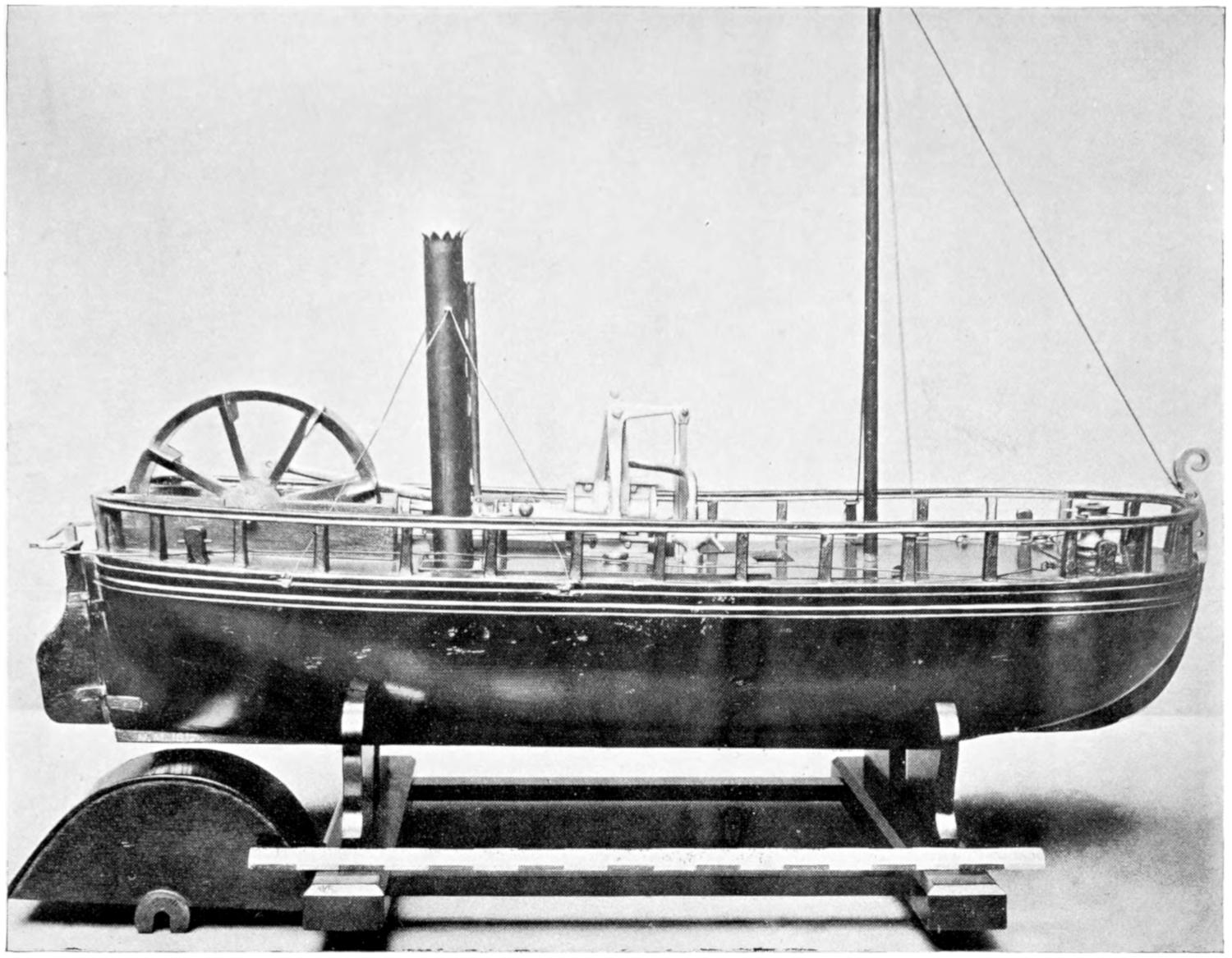
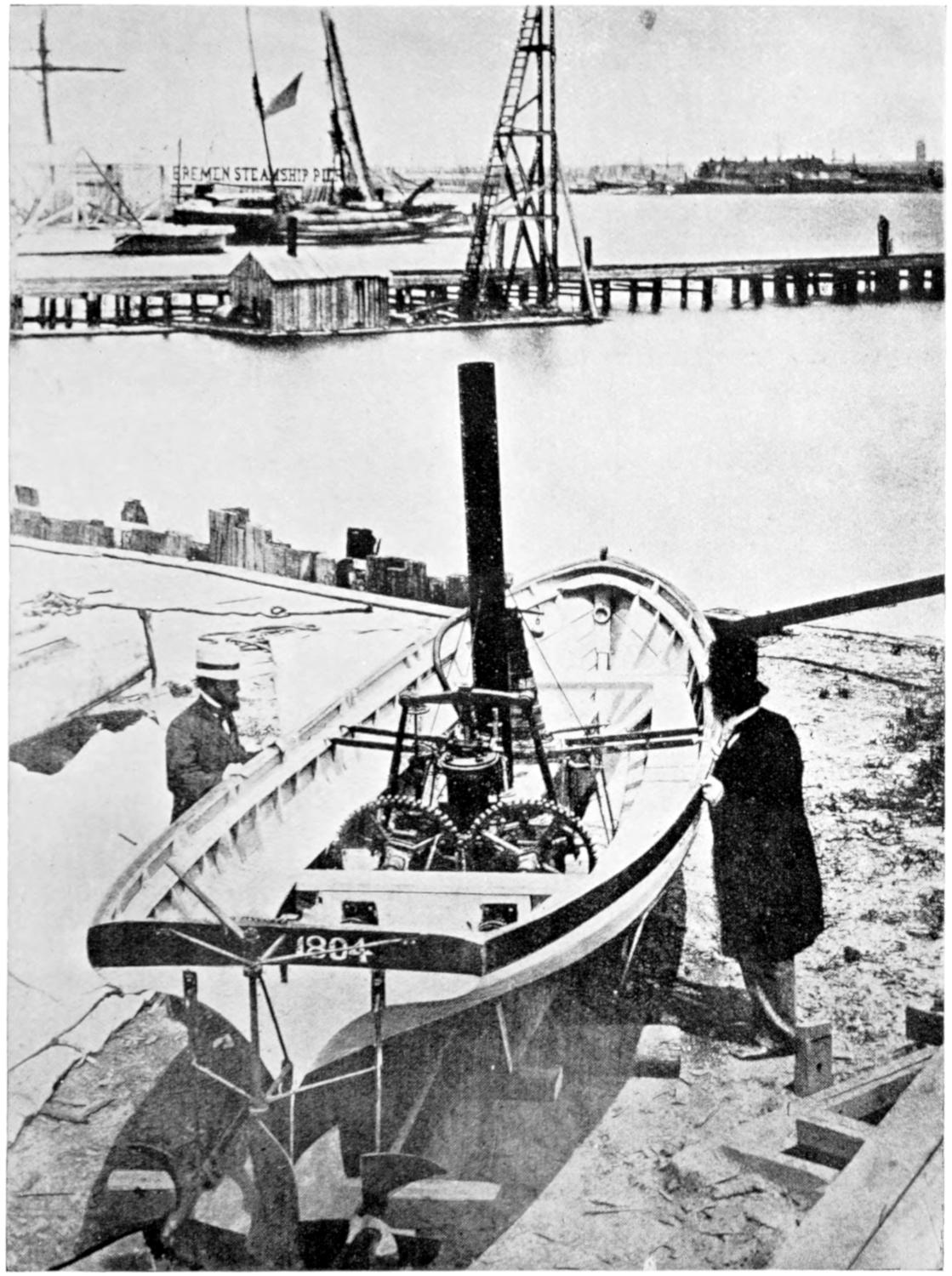
Meantime Stevens, left to himself, had, in 1804, built
a vessel propelled by twin screws which navigated the
Hudson River. This vessel was remarkable in many
ways. The boiler was tubular, and the screw was almost
identical with the short four-threaded helix which many
years afterwards was generally adopted. It is interesting
to note that the screw propeller was tried so early, for it is
generally believed that it was not used at all until many
years after the introduction of paddles. The engine and
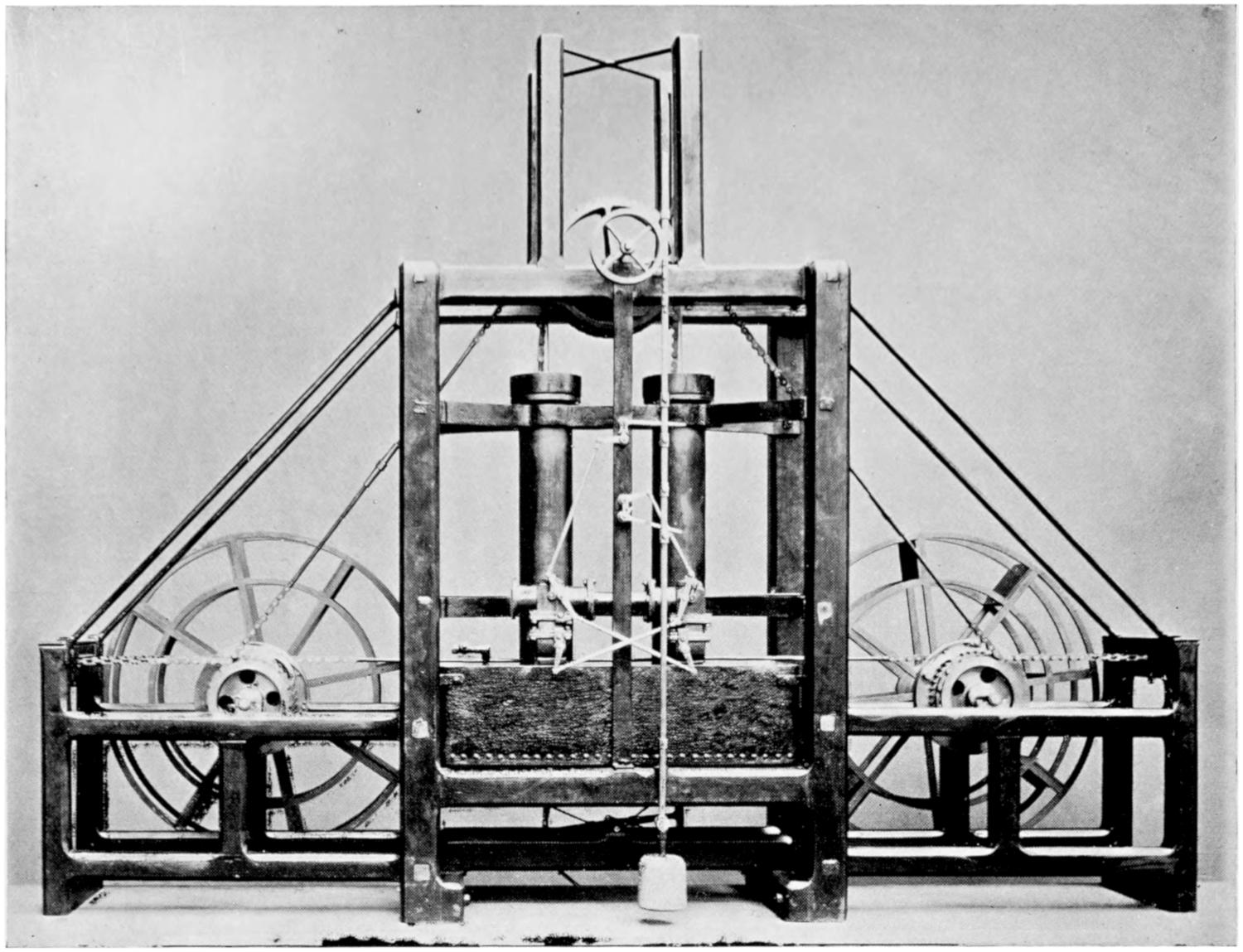
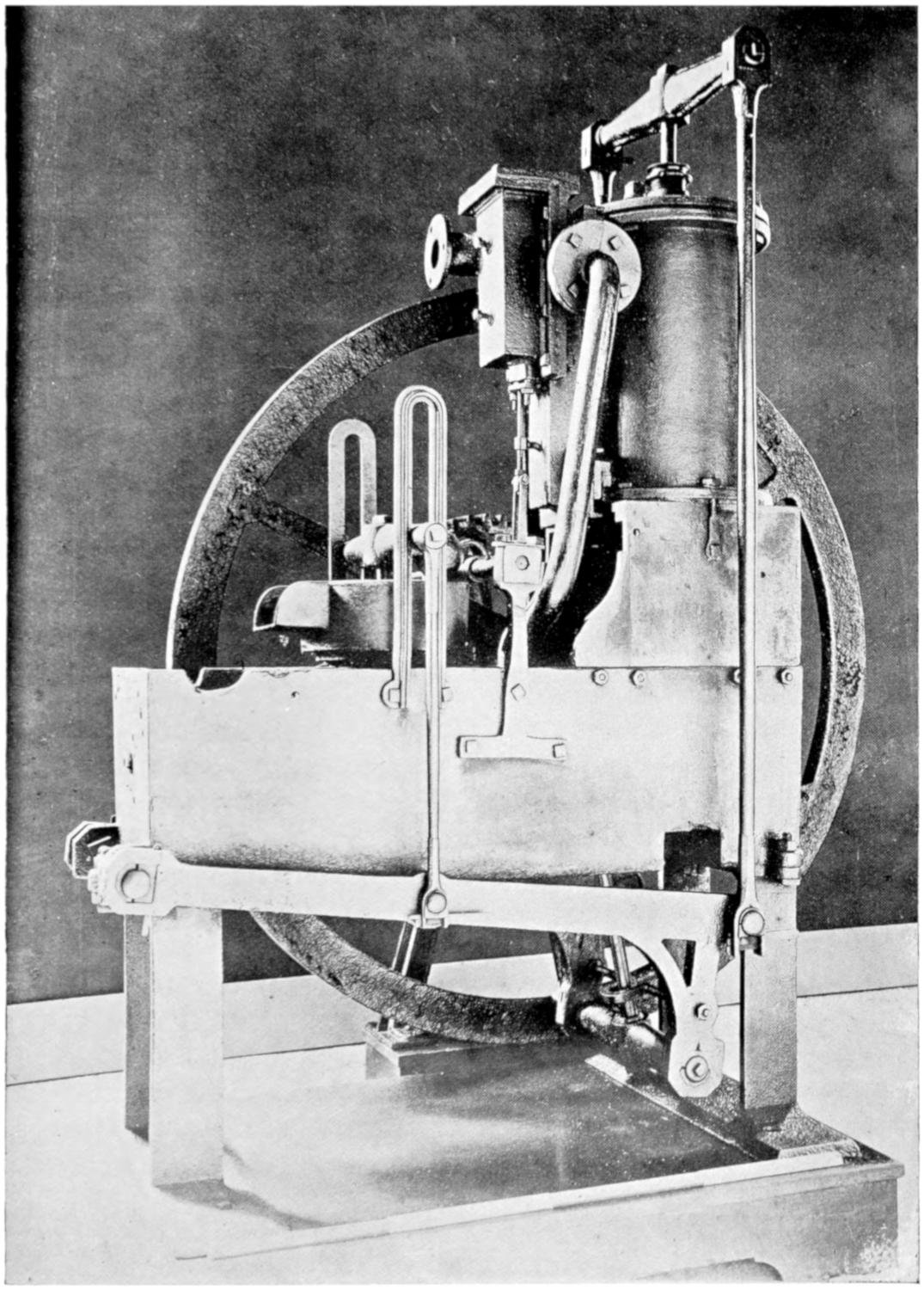
boiler of Stevens’ boat are preserved at the Stevens
Institute at Hoboken. After his death his son tried the
engine and boiler in a boat, which, in the presence of
a committee of the American Institute of New York,
attained a speed of about nine miles an hour. Although the
screw proved its suitability for propulsion, its superiority
was not acknowledged, and for many years afterwards
marine engineers confined their attention to the improvement
of paddle-wheels and the engines for driving them.
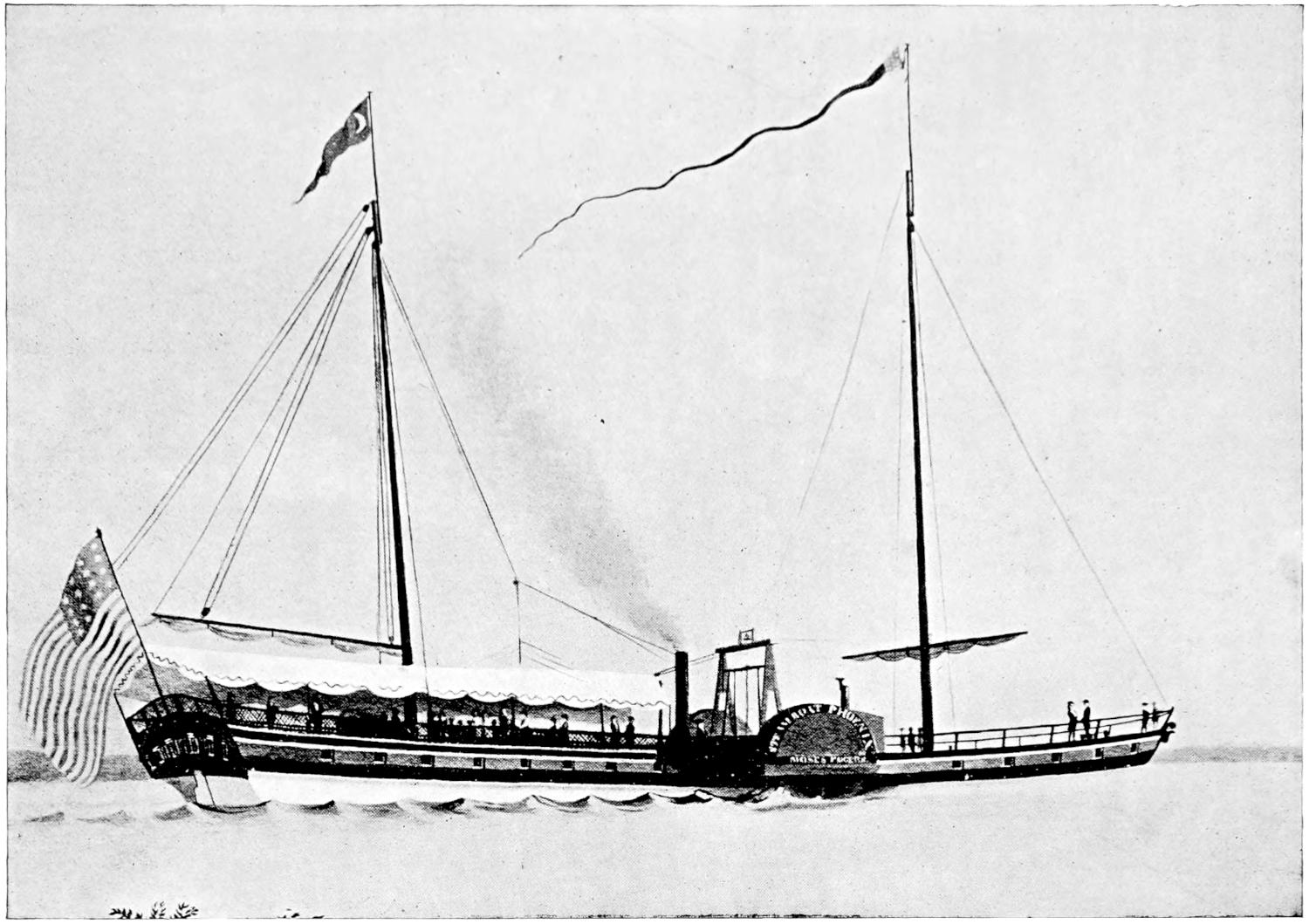
In 1807, with the assistance of his son Robert, Stevens
built the paddle-wheel steamer Phœnix, which plied for six
years on the Delaware.
Dr. James Renwick of Columbia said that “the
Stevenses were but a few days later” than Fulton “in
moving a boat with the required velocity,” and that
“being shut out of the waters of New York by the
monopoly of Livingston and Fulton, Stevens conceived
the bold design of conveying his boat, the Phœnix, to
the Delaware by sea, and this boat, which was so near
reaping the honour of first success, was the first to
navigate the ocean by the power of steam.” The piston-rod
of the Phœnix was guided by slides instead of the
parallel motion of the Watt engine, and the cylinder
rested on the condenser. A point in which the superiority
of the Phœnix over the Clermont was shown, was that the
paddle-wheel of the Phœnix had a guard beam, which the
Clermont lacked. The Phœnix was taken to Philadelphia by
sea by Robert Livingston Stevens, son of Robert Stevens.
He was accompanied on this voyage by Moses Rogers,
to whom the title of “Pioneer Steam Navigator” has
been given by American historians, partly on account
of this voyage and partly because he was on board the
auxiliary sailing ship Savannah on her memorable voyage
to Europe.[16]
In 1806 Fulton returned to America, having ordered
an engine to be made by Messrs. Boulton and Watt at
Birmingham. He did not tell them what he proposed to
do with it, but it was the engine for the first steamboat
constructed by him for American voyages—the famous
Clermont. After this engine was delivered in New York
it remained in the Customs while Brownne, a shipbuilder,
constructed the hull. In 1807 the boat made her first
trip on the Hudson.
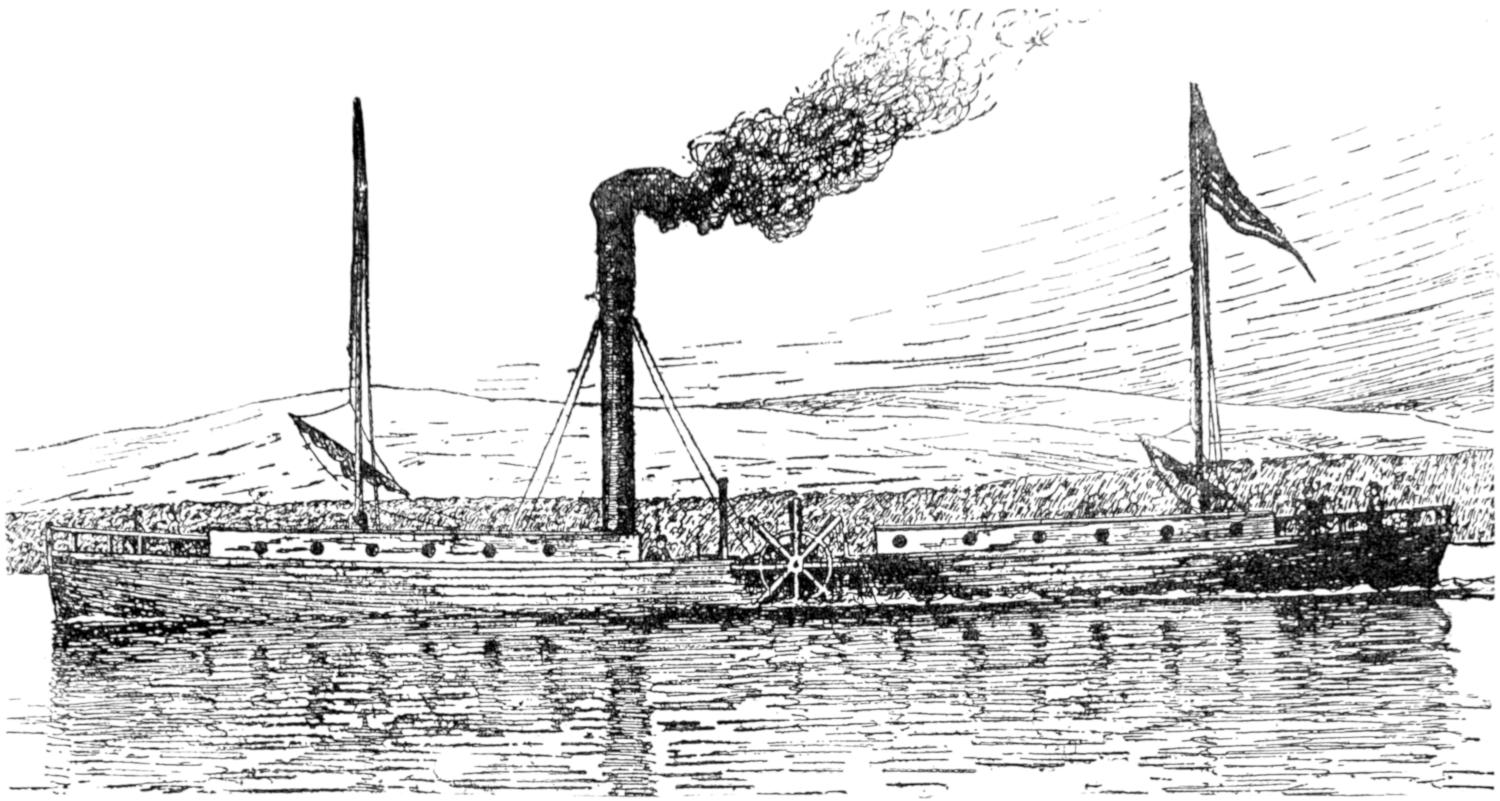
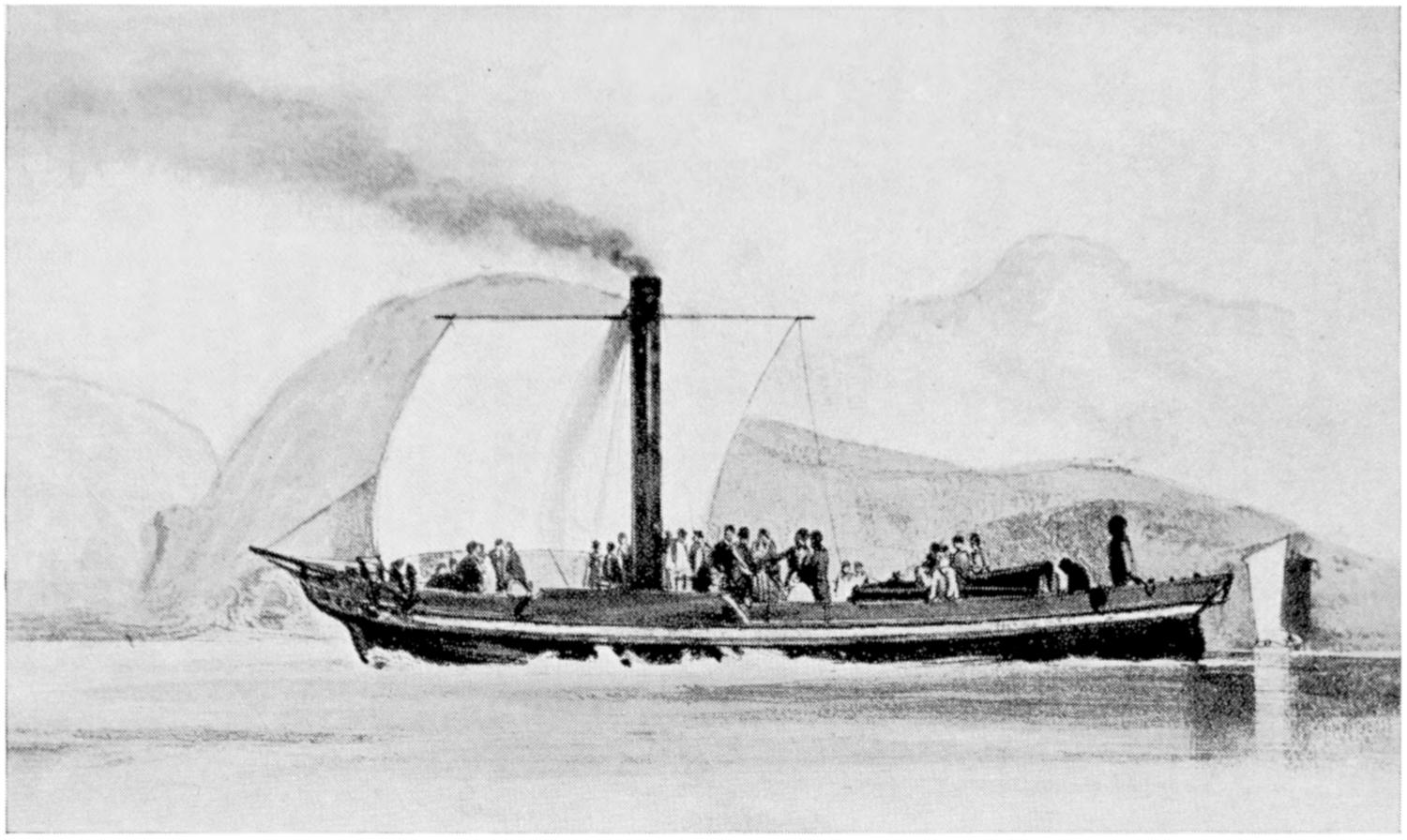
The original dimensions of the Clermont have been
variously stated, the discrepancies being probably due to
the alterations to which the vessel was subjected, and also
to methods of measurement. From a letter which Fulton
wrote it appears that the boat was 150 feet long and
13 feet wide, drawing 2 feet of water.[17] This was no doubt
the over-all figure, as other data give slightly less lengths
which would be on the water-line, or the inside measurements
between stem and stern, both of which raked.
[17] Reprinted in the Nautical Gazette, New York, August 22, 1907.
Messrs. Millard and Kirby, of New York, who made
most exhaustive researches into the history of the Clermont
with a view to the reproduction of that historical vessel at
the centenary celebration at New York in September
1909, state that when Fulton worked out his displacement
and wetted surface and resistance, his results corresponded
with a boat of the dimensions just given, and no other
figures could have given those results.
On November 20, 1807, Fulton wrote to Livingston
that the boat was so weak that she must have additional
knees and timbers, new side timbers, deck beams and
deck, new windows, and cabins altered; that she, perhaps,
must be sheathed, her boiler taken out and
a new one put in, her axles forged and ironwork
strengthened. With all this work the saving of the hull
would be of little consequence, particularly as many of
her knees, bolts, timbers and planks could be used in the
construction of a new boat. His opinion, therefore, was
that a new hull should be built with knees and floor
timbers of oak, bottom planks of two-inch oak and side
planks of two-inch oak for 3 feet high. “She is to be
16 feet wide, 150 feet long; this will make her near twice
as stiff as at present and enable us to carry a much greater
quantity of sail. The 4 feet additional width will require
1146 lb. additional purchase at the engine, moving 2 feet
a second or 15 double strokes a minute; this will be
gained by raising the steam 5 lb. to the inch, as 24
inches the diameter of the cylinder gives 570 round
inches at 3 lb. to the inch—1710 lb. purchase gained.
To accomplish this work a good boiler and a commodious
boat running our present speed, of a voyage in 30 hours,
I think better and more productive to us than to gain one
mile on the present boat.”
The first Clermont had a depth of hold of 7 feet. She
had masts and sails but no wheel enclosures, no bulwarks,
no berths in the cabin, and no covering over the boilers;
this work being done, according to Fulton’s letter of
August 29, 1807, after his return from the first trip.
When she was altered on account of instability, in the
winter 1807-8, she was widened to 16 feet on the bottom
and 18 feet at the deck, which made her much stiffer. It
was then that her poop was built up and various other
improvements made.
Her fly-wheels were outside the hull, placed forward
of the paddles, and revolved the same way, and it is
related that on a subsequent voyage one of the paddle-wheels
becoming disabled, paddles were affixed to the
fly-wheel and the voyage resumed.
The American Citizen of August 17, 1807, announced
that: “Mr. Fulton’s ingenious Steamboat, invented with
a View to the Navigation of The Mississippi from New
Orleans upwards, Sails to-day from the North River near
The State Prison to Albany, the Velosity of the Steamboat
is calculated at four miles an hour; it is said that it will
make a progress of two against The Current of The
Mississippi, and if so it will certainly be a very valuable
acquisition to the Commerce of the Western States.”
An immense crowd assembled to witness the fiasco
which was expected to mark the first experimental
voyage of “Fulton’s Folly,” and jeered Fulton and his
steamer unmercifully. But when the vessel moved into
midstream under the power of her own engines, the crowd
cheered as energetically as only a crowd can when it has
been agreeably surprised and the appeal of facts to its
chivalry is irresistible.
“Dense volumes of smoke began to pour forth from
the smokestack. The boiler began to hiss. At one
o’clock the hawser was drawn in, the throttle opened, and
to the accompaniment of the stertorous exhaust, the
uncovered sidewheels began to quiver, then slowly to
revolve. A hush fell on the spectators. Fulton’s own
hand at the helm turned the bow. The Clermont moved
out into the stream, the steam connections hissing at the
joints, the crude machinery thumping and groaning, the
wheels splashing, and the smokestack belching like a
volcano.... One honest countryman, after beholding
the unaccountable object from the shore, ran home and
told his wife he had ‘seen the devil on his way to Albany
in a sawmill.’”[18] A passenger, recording the voyage, says
a miller boarded the Clermont at Haverstraw and said he
“did not know about a mill going up stream and came to
inquire about it.”
The boat itself was wedge-shaped at bow and stern,
which were cut sharp to an angle of 60 degrees. She was
almost wall-sided. She was flat-bottomed and keelless,
leeway being prevented by two steering boards. Her
tiller was at the back end of the after cabin so that it was
difficult for the steersman to see ahead. The paddle-wheels,
15 feet in diameter, being uncovered, splashed
tremendously, and drenched the passengers. A paddle-wheel
had to be disconnected when it was desired to turn
the vessel round.
The Clermont reached Chancellor Livingston’s residence
at Clermont, 110 miles from New York, in 24
hours, against the wind, the average speed being 4·6 miles
an hour. The running time for the whole journey to
Albany of 150 miles was 32 hours, or nearly five miles
an hour; the return trip was made in 32 hours, running
time, the sails not being used on either occasion. An
eye-witness as she passed up the river thus describes
her:
“It was in the early autumn of the year 1807 that a
knot of villagers was gathered on a high bluff, just
opposite Poughkeepsie, on the west bank of the Hudson,
attracted by the appearance of a strange-looking craft,
which was slowly making its way up the river. Some
imagined it to be a sea monster, whilst others did not
hesitate to express their belief that it was a sign of the
approaching judgment. What seemed strange in the
vessel was the substitution of a lofty and strange black
smoke-pipe rising from the deck, instead of the gracefully
tapered masts that commonly stood on the vessels
navigating the stream, and, in place of the spars and
rigging, the curious play of the working beam and piston,
and the slow turning and splashing of the huge and naked
paddle-wheels, met their astonished gaze. The dense
clouds of smoke, as they rose wave upon wave, added
still more to the wonder of the rustics. This strange-looking
craft was the Clermont on her trial trip to Albany;
and, of the little knot of villagers above mentioned, the
writer, then a boy in his eighth year, with his parents,
formed a part, and I well remember the scene, one so well
fitted to impress a lasting picture upon the mind of a
child accustomed to watch the vessels that passed up and
down the river. On her return trip, the curiosity she
excited was scarcely less intense—the whole country
talked of nothing but the sea monster, belching forth fire
and smoke.
“The fishermen became terrified and rowed homeward,
and they saw nothing but destruction devastating their
fishing grounds; whilst the wreaths of black vapours, and
rushing noise of the paddle-wheels, foaming with the
stirred-up waters, produced great excitement amongst the
boatmen, until it was more intelligent than before; for the
character of that curious boat, and the nature of the
enterprise she was pioneering had been ascertained.”
According to Colden, those who saw the Clermont at
night described her as “a monster moving on the water,
defying the winds and the tide, and breathing flames and
smoke.” She had, he proceeds to say, “the most terrific
appearance from other vessels which were navigating the
river when she was making her passage. The first steamboats,
as others yet do, used dry pine-wood for fuel, which
sends forth a column of ignited vapour, many feet above
the flue, and whenever the fire is stirred a galaxy of sparks
fly off, which in the night have an airy, brilliant, and
beautiful appearance. This uncommon light first attracted
the attention of crews of other vessels. Notwithstanding
the wind and tide were adverse to its approach, they saw
with astonishment that it was rapidly coming towards
them; and when it came so near that the noise of the
machinery and the paddles were heard, the crews in some
instances shrunk beneath their decks from the terrific
sight; and others left their vessels to go on shore; while
others again prostrated themselves, and besought Providence
to protect them from the approach of the horrible
monster which was marching on the tides, and lighting its
path by the fires which it vomited.”
After the improvements had been made in the Clermont
she entered in the spring of 1809 upon the regular work
for which she was intended—the day service between New
York and Albany.
The guards and paddle-boxes, which were mere
temporary structures, were made substantial and permanent,
and the cabins were rearranged and refitted in
the most beautiful manner. The Clermont, said Professor
Renwick, “thus converted into a floating palace, gay with
ornamental painting, gilding, and polished woods, commenced
her course of passages for the second year in the
month of April.”[19]
When rebuilt she was christened the North River and
maintained the service alone until October, when a second
Fulton boat, the Car of Neptune, was launched. She was a
larger boat, and ran continuously until 1817, and the other
vessels which were added to the little fleet also proved
successful.
The complete list of Fulton’s steamboats would
include also the Rariton (1809), New Orleans (1811),
Paragon, Firefly, a Jersey ferryboat, and Camden (1812),
Washington and a York ferryboat (1813), Richmond,
a Nassau ferryboat, Fulton, Vesuvius, and Demologos,
a warship (1814), Aetna, Buffalo, and Mute (1815), Olive
Branch, Empress of Russia, and Chancellor Livingston
(1816).
Fulton and Livingston’s enterprise was a financial
success almost from the first, and naturally others thought
to share in it; as they could not join the pioneers they
determined to rival them. One of the chief of these was
a Captain Elihu S. Bunker, who maintained a line of
sailing sloops between Hudson City and New York.
The steamers were taking the wind out of his sails in
more senses than one, and not liking the prospect of being
becalmed, financially, he determined to go in for steam.
A syndicate of capitalists of Albany backed him. The
fact that Livingston and Fulton had been already granted
an absolute monopoly for navigating the waters of the State
of New York by steam deterred them not a whit. They
ordered two boats, to be about the size of the Clermont,
and called them the Hope and Perseverance. They were
each 149 feet in length, 25 feet beam inside the paddles,
and had a depth of 7 feet 7 inches.
Robert Fulton’s “Clermont,” 1807.
Legal proceedings quickly followed, Livingston and
Fulton having their work cut out to defend their monopoly.
How like these boats were to the Fulton boats
is evident from the affidavit of Charles Brownne, the
builder of the Clermont. He says that he has “examined
the steamboats Hope and Perseverance and they are not
built like any vessels which navigate by wind or oars on
any of our waters, or any foreign waters that he knows of.
That said steamboats being more than Six the length of
their breadth[20] of beam and flat at bottom are not calculated
to navigate with sails only. And that the first boats of
such make of the said steamboats which he ever saw or
heard of was built by him from drawings and directions
given to him by Robert Fulton and constructed to be
navigated by steam and wind, and which boats are now
known by the name of North River and Car of Neptune
Steamboats: This deponent also saith that the water
wheels; the guards round the water wheels, the covering
to the water wheels; the steps from the wheel guards to
enter the row-boats, space on the guards for wood for the
engine, bins or lockers in the wheel guards and necessaries
on the fore part of the wheel guards, are exact copies from
the Boats built by him for Livingston and Fulton, and
such water wheels, wheel guards and conveniences he has
never known or heard of to any other kind of boat or
vessel. This deponent further saith that in the said
Steamboat Hope the manner of arranging the rudder with
a perpendicular iron bar on its after part, and leading
from its wheel ropes, along the sides of the boat to a
steering wheel before the Chimney of the Boiler and to a
Station above the place of the engineer and fireman, is an
exact copy from the boats of Livingston and Fulton. This
deponent objected to this mode of steering at the time the
said Fulton proposed it, believing it to be impracticable, and
he does not know of a like mode of steering to any other
kind of vessel. This deponent also says that the mode of
placing the main mast far forward, and the mizzen mast
so far aft, as to leave a convenient space between the two,
which shall not be incommoded by ropes, booms, or yards,
and afford room for spreading an awning for the comfort
and convenience of passengers is the same exactly in the
said Hope Steamboat as in the boats built by him for
Livingston and Fulton. That this mode of placing masts
so far apart, to the best of his knowledge, is not known in
any other kind of vessel, and would not answer for a
vessel intended to work with wind only, without the aid of
steam, but in union with steam has been proved by three
years’ experience on the North River Steamboat to succeed
perfectly well. This deponent further says that the form
and make of the said Hope and Perseverance steamboats,
their wheels, wheel guards, manner of steering, mode of
placing the masts and rigging, mode of arranging the
awning, arrangements of the Cabins and kitchen, suspending
their row-boats from the sides instead of from the
stern, as is usual, are in his opinion in all these combinations
and arrangement, exact copies from the Car of
Neptune Steamboat, and more like her than she is like the
North River Steamboat which was first built, and further
this deponent saith not.”[21]
[20]Sic: probably means “their length was rather more than six
times their beam.”
[21] “Steamboats on the Hudson,” in the “Master, Mate, and Pilot,”
October 1909.
The Hope and Perseverance ran throughout the
season of 1811 with passengers and freight, between New
York and Albany, and met with as much of the public
patronage as did the other boats. The courts, however,
decided that Captain Bunker and his supporters were
acting illegally, and gave the drastic order that their
steamers should be confiscated and handed over to
Livingston and Fulton, who did not run them but had
them broken up.
Writing in 1838, in regard to his early experiments, to
the Secretary of the Treasury at Washington, Captain
Bunker described an incident which unfortunately for
American steamship records does not stand alone. The
Captain was undoubtedly fortunate that matters were no
worse.
“In 1811,” he says, “I had command of the steamboat
Hope plying between New York and Albany. The
engine and boilers were made and put in by Robert
McQueen. On the second trip from New York, while Mr.
McQueen’s foreman had still charge of the works on board
(they not having been delivered as completed), this man
had a gang of his own men from the shop, and, while
proving the machinery, had a man that he was instructing
to become engineer of the boat. While on the passage,
off Esopus meadows, something appeared to be wrong in
the fire-room (which was in charge of a miserable drunken
fireman) and the engine moving very slowly. I found on
examination, that there was not a drop of water in either
of the boilers, and that both of them were red-hot, as well
as the flues, and must have been so for at least half an
hour. The heat was great enough to melt down five
solder-joints of steam-pipe, which was made of copper. I
immediately started the forcing pump myself, not thinking
that there could be any danger in the operation; the effect
of which was a crackling in the boiler as the water met
the hot iron, the sound of which was like that often
heard in a blacksmith’s shop when water is thrown upon a
piece of hot iron. I cannot, therefore, believe for a single
moment that explosions are produced, to such a degree as
I have before recited, by throwing cold water into a red-hot
boiler. In the way above described, I cooled down
both of the boilers, during which time neither of them
jumped out of its place; nor do I see how it could be
possible for such an effect to be produced, having always
been of opinion that there could be no other cause for a
boiler to burst than the pressure of steam inside, and not
gas produced by letting cold water or lukewarm water
into it; for I deem it impossible for a red-hot boiler to
contain heat enough to explode with any quantity of water
that might be suddenly thrown into it. Besides, it must
be remembered that the supply-pipes are connected with
the bottom of all steam-boilers, or are very near to the
bottom; therefore, instead of producing explosion, the
forcing of cold or lukewarm water into hot water must
have the tendency to cool it. For instance, I have known
engineers to keep off their feed as long as they possibly
dared, when running with another boat, knowing that as
soon as they began to feed, the steam would fall, especially
if they could not get a full supply of steam for the
engine.”[22]
[22] The “Master, Mate, and Pilot,” Vol. II. No. 5.
So far as the Hudson was concerned the decision of
the courts crushed Captain Bunker, and frightened off
any other possible trespassers on the monopoly. But
Bunker had determined to become a steamship owner, and
being crowded out of the Hudson he started a line of
steamers as near New York City as he could, the Long
Island Sound Line. The first of his vessels he named
after his late opponent Fulton. She was built in 1813
and plied for the whole of her first season in 1814 on the
Hudson River, as, the United States being then at war
with England, it was feared that she would be captured
if she ventured up the Sound.
The “Paragon.” Built 1811.
At the time the Fulton boats had to meet Bunker’s
opposition, the third Fulton steamboat, the Paragon, made
its first appearance on the river. She was both faster
and larger than her predecessors. She was fitted with
two masts, one stepped very far forward, and the other
very far aft. The foremast carried an immense square
foresail with a little square topsail above it, and there was
also a large triangular sail carried on the stay from the
end of the bowsprit to the cap of the lower mast. The
aftermast carried an ordinary trysail or mizzen. The vessel
had a large rudder and was steered from amidships,
according to a contemporary print.
The following year another Fulton steamer, the Firefly,
came on the scene. She was a small vessel, only 81 feet
in length, and though designed for the lower river service,
was used elsewhere as occasion demanded. Fulton by
this time was himself planning the placing of steamers on
other rivers, and in 1814 the Richmond was launched from
his designs for the James River in Virginia. The British-American
War at this time rendered it unsafe to send her
south, and as the North River, late Clermont, was about
worn out by now, the Richmond took her place. Fulton
seems to have been associated to some extent with
Bunker, for the latter’s boat, Fulton, was designed by
Fulton himself. She was a sloop-rigged vessel with a
single mast stepped well forward, and made considerable
use of sails. She was 134 feet in length and 26 feet beam,
and had a large square engine-house that extended rather
above the sides of her paddle-boxes. Hitherto all the
American steamers had been of the wall-sided, flat-bottomed
type inaugurated by the Clermont. The Fulton
was the first steamer to be constructed with a round
bottom like a sailing ship.
Fulton was also interested in steamboats on the
Mississippi and other western waters. He and Nicholas
Roosevelt were associated in 1809 in this project, and in
1811 the steamer New Orleans was built. It was the
pioneer boat of the service, and descended the Ohio and
Mississippi Rivers from Pittsburg to New Orleans in fourteen
days. In 1817 the Chancellor Livingston appeared
on the Hudson and in her general equipment marked a
decided improvement in every respect upon anything that
had gone before. She was the finest vessel without
exception that Fulton and Livingston ever possessed.
Her designer was Henry Eckford, one of the leading naval
architects in America. She was, moreover, the biggest
steamboat which had been built in the world, as she was
of over 500 tons burden. The building of this boat
was supervised at first by Fulton himself, but he died
before it was completed. The Chancellor Livingston was
three-masted, and fore-and-aft rigged throughout, and
carried in addition a large square sail on the foremast.
She had three funnels which were placed forward of the
paddle-boxes and between the fore and main masts. Her
engines were of the steeple type. She was square-sterned,
and not only carried a deck-house, but the roof of
the deck-house was extended to form a square deck or
gallery, and above this again were a smaller deck-house
and a large awning, so that passengers on either deck were
amply protected from the weather. The gallery, at
the stern, was the same shape as the stern itself. It was
supported by stanchions, and carried as far forward as the
paddle-boxes. Early pictures of this vessel represent her
as having portholes along the sides of the hull abaft the
paddles, from which it would appear that in the body of
the ship itself there was also passenger accommodation.
She was therefore the first vessel to have three decks
devoted to passengers.
The first trip of this boat was made towards the end
of March 1817, between New York and Newburgh, the
65 miles being covered in less than nine hours, in only
three of which was the tide running with the ship.
Coming back she did the distance in eight hours fifteen
minutes, for the most part against wind and tide. Her
cost complete was 110,000 dollars.
This boat was not allowed to lie idle, and a statement
was published in December 1821 that the Chancellor
Livingston made during the season of that year “170
trips from New York to Albany. Allowing the distance
to be 150 miles the aggregate will exceed 25,000 miles,
which would more than have carried her round the globe.
We presume the Richmond has performed the same
number of trips, and when it is considered that these
boats are generally filled with passengers, some idea may
be formed of the extent of travel on the North River.”
Already excursions were very popular. The Chancellor
Livingston took excursionists once a week during July
and August as far as Sandy Hook. The same year, 1821,
the steamer Franklin took passengers to the fishing banks
twice weekly, and the Olive Branch of the Philadelphia
Line gave its patrons what its owners called “a sail around
Staten Island and turtle feast,” and it was added that
“a fine green turtle will be cooked, and a band of music
provided,” all for one dollar seventy-five cents. Captain
Bunker, who had the Enterprise built in 1818 at
Hartford, Connecticut, brought her into the New York
service in 1821, for an excursion starting at half-past four
in the morning from the East River for Sands Point.
This is one of the earliest records of a steamer built
elsewhere coming to New York waters to enter upon
the local trade.
Henry Eckford also planned the steamer Robert
Fulton, which in 1822 made the first successful steam
voyage from New York to New Orleans, and thence to
Havana, in which trade she was afterwards engaged
regularly. The Robert Fulton then passed into the
possession of the Brazilian naval authorities, who turned
her into a sailing ship and she became the fastest warsloop
in the Brazilian navy.
The Firefly was the first steamer to get round Point
Judith, on the Rhode Island shore, and reach Newport
from New York. This was May 26, 1817, and the
voyage lasted twenty-eight hours. The sailing packets
on the route, as usual, resented her incursion, and when
the wind was favourable they usually outsailed her. The
competition grew so great between the steamer and the
sailers that the latter made the typical American sporting
proposal not to charge passengers for the voyage between
New York and Newport if they did not reach port before
the steamer.
Although the size of the American river steamers had
been steadily increasing, there had not been a great
acceleration in the matter of speed. Even at the time of
Fulton’s death few, if any, American river steamers
exceeded an average of seven miles an hour for the trip.
Robert Livingston Stevens, son of John Stevens, built
about that time (1813) the Philadelphia, which attained
an average speed of eight miles. Speed was a question to
which he devoted considerable attention, for he realised
its importance, and nearly every vessel he turned out was
an improvement upon its predecessor. The inventions
and improvements which he introduced inaugurated a
new era of steamboat construction. Of the fate which
overtook some of these early vessels, it may be noted that
the Clermont died of premature old age, the Car of
Neptune was broken up, the Paragon went to the
bottom, and the Hope, the Perseverance, the Firefly,
and the Richmond were broken up.
The “Philadelphia.” Built 1826.
According to evidence given before a Select Committee
of the House of Commons in 1817 by Mr. Seth Hunt of
Louisiana, there were then ten steam vessels running
between New York and Albany, two between New York
and Connecticut ports, four or five between New York
and New Jersey ports, besides ferryboats on the Hudson
and East Rivers. There were also steamers on the
Delaware, between Philadelphia and Trenton, Newcastle,
and Wilmington; also steamers from Baltimore to
Norfolk, Virginia, which crossed the estuary of the
Chesapeake. Steamers had been to New London and
New Hartford. The Powhatan steamer of New York
was three days exposed to a gale in the open sea,
after which it arrived at Norfolk, Virginia, and thence
steamed up the James River to Richmond. At that time,
according to this witness, there were on the Mississippi
two steamers, the Etna and Vesuvius, which were each of
450 tons, carried 280 tons of merchandise, 100 passengers,
and 700 bales of cotton.
Towards the middle of the last century numbers of
steamboats were placed on the coastal and river services
from New York. The Fulton ferryboats Union and
William Cutting were both built in 1827; and in the
following year the De Witt Clinton was built in Albany
for the passenger service between New York and Albany;
she was 571 tons gross, more than any of her contemporaries.
A notable vessel, then the fastest steamboat
ever built, was the Lexington, which began to run in
1835 between Providence and New York. As the railway
companies were formed about the same time, the
competition between the steamboat companies and the
railways was lively and fares were reduced with American
thoroughness. The Narragansett arrived at Providence
in October 1836. She was fitted with a 300-horse-power
horizontal engine, which was too heavy for her, for on her
trial trip she rolled over with the directors of the
company and their guests on board. Fortunately no
lives were lost. In 1838, the John W. Richmond
appeared as the rival of the Lexington and there were
many exciting races between the two, but two years
later the Richmond was sold for employment elsewhere.
The Lexington was burnt in 1840, and the Richmond met
with a similar fate three years later. The Fall River
Line was established in 1847 and has maintained the
service to the present day.
All these steamers were built of wood, and as they
increased in size they developed a marked tendency to
“sag,” that is, drop in the middle, or to “hog,” that is,
drop at the ends. This tendency was overcome by an
ingenious system of stump-masts and strutts, and iron ties,
invented by Colonel Stevens. There are various methods
of applying these stiffeners, and the peculiar framework of
wooden arches and stump-masts which appears on so many
American river steamers is due to the necessity of employing
one or other of these systems for strengthening purposes.
In some of the later vessels (as in the De Witt Clinton)
these ties are put into the framework of the superstructure.
In construction, the development of American
steamers on inland waters since Fulton’s time has proceeded
on entirely different lines from those which
marked the progress of river navigation in Great Britain.
American river steamers were designed not only to cope
with the traffic in narrower and shallower places, but to
carry whatever was necessary in deeper waters, and at
the same time get through the more difficult places
somehow. The great distances to be travelled on the
American rivers rendered necessary the provision of
vessels carrying large quantities of cargo and extensive
accommodation for passengers, whilst the bars occurring at
intervals in the beds of the rivers made it compulsory that
the vessels should be of light draught. The construction
of English river steamers, on the other hand, has been
conditioned by the comparative narrowness of the English
rivers and the lowness of the many bridges which span
them.
The “De Witt Clinton.” Built 1828.
The Fall River Line boats were the pioneers of the
modern type of Hudson River steamers, the first of them
being the famous Bay State, plying between New York and
Fall River. She was 315 feet long and 40 feet beam and
of 1500 tons burden. Her engines were of 1500 horse-power.
The Bay State, being intended for Long Island
Sound work, was much more strongly built than those
boats which were confined to the Hudson River Line.
This vessel was both the largest and fastest craft of her
day. She ran the distance from Fall River to New York
in nine hours fifteen minutes, including a stop at Newport.
In 1864 she was dismantled, and her hull was converted
into a barge, her machinery being placed in a new steamer
named Old Colony. Vessels followed each other in rapid
succession, but although rival companies sprang up with
considerable frequency, few of them lasted very long and
their boats, if good enough, were sometimes acquired by
the Fall River Company. One of the most dangerous
competitors was the Merchants’ Shipping Company, which
controlled fifteen steamers, and for which William H.
Webb, the famous American shipbuilder, constructed
those two historic boats, the Bristol and the Providence.
The line lost two or three of its steamers in rapid
succession, and had to suspend payment. The Bristol
and Providence had each two hundred and twenty-three
state-rooms. They were lighted by gas throughout, and
were afterwards steam-heated. Each boat carried a band
of music, and for the first time on an American merchant
vessel the officers and crew were in uniform. In 1883
the first iron steamboat in Long Island Sound, the
Pilgrim, was built. She had a double hull divided into
ninety-six water-tight compartments. The Puritan followed
her. The Plymouth was launched in 1890, and was
burnt in dock ten years later, and in August of the
following year the present Plymouth was launched. All
these vessels were side-wheelers, the later ones being
of steel, and having a speed of twenty miles an hour.
One of the finest vessels now afloat is the Commonwealth.
She is 456 feet in length, 35 feet moulded
breadth, 96 feet breadth over the guards, and has a depth
of hull of 22 feet. She has sleeping accommodation for
2000 persons.
Like all steamers on the Fall River Line, the
Commonwealth is built of steel. Seven doorless bulkheads
extend to the main deck. The hull is double, and the
space between the bottoms is divided into a great many
water-tight compartments. She has also collision bulkheads
on each side at the guards and a bulkhead athwart
ship. Her engine is of the double inclined compound
type, with two high-pressure cylinders 96 inches in
diameter, all having a common stroke of piston of 9 feet
6 inches. The wheels are of the feathering type with
curved steel buckets. Besides the usual auxiliary steam
pumps, there is a large pump for use only on the fire-sprinkler
system. Her speed is twenty-two miles an hour.
During the nineteenth century there was an equally
striking development among the steamers of the various
lines on the Hudson River. The Empire of Troy, to
distinguish her from another steamer called the Empire
built in the ’forties and belonging to a rival line, was then
the largest river steamer in the world, being 307 feet over
all and of 936 tons register. She was quickly superseded
by the Hendrick Hudson of the Albany Line, which was
the first Hudson River steamer to exceed a thousand tons.
This in turn was eclipsed by the Oregon. The St. John, of
2645 tons, built in 1863, was the first to exceed 2000 tons,
The Adirondack, of 3644 tons, was placed on the river in
1896, and in 1904 the C. W. Morse, of 4307 tons,
appeared.
The “William Cutting.” Built 1827.
The Hudson River boats, after the first or experimental
types of vessel, have always been famous for their
speed and beauty no less than their comfort. One of
the most famous of them all was the Alida. Two
others, which raced occasionally, were the Oregon and the
C. Vanderbilt, one notable contest in which they engaged
being in 1847, for a stake of 1000 dollars. On the way
back the Oregon ran short of fuel, whereupon the owners
threw into the furnaces the furniture and everything else
that would burn which they could lay hands on.
The time of the run was 3 hours 15 minutes, which gave
an average speed of 20 miles an hour. After the heroic
sacrifice made by the Oregonians, it is satisfactory to learn
that the Oregon won by 400 yards. The Alida and the
Hendrick Hudson raced from New York to Albany, the
former doing the voyage in 7 hours 55 minutes, the latter
boat being 15 minutes longer on the voyage. The
scheduled time of the present Hudson River Day Line
steamers over the same water is 9 hours 30 minutes, from
which it would appear that the boats of sixty years ago
were as capable of fast travelling as are their palatial
successors of the present day. One of these, a second
Hendrick Hudson, was launched on the Hudson in 1907,
a hundred years from the day of the Clermont’s first
voyage up the river.
The “Mary Powell.”
The decade from 1840 to 1850 was the golden age for
steamboat proprietors on the Hudson River, as there was
then no railroad competition, though there were several
competitive steam-ship companies. In 1849 there were no
less than twenty steamers on the route between New York
and Albany, and the fares were cut as low as 12¹⁄₂ cents
for the 145 miles. One of the steamers on the river in the
’forties was the Norwich. A few years later she was converted
into a tug-boat, and up to the end of 1909 was still
in active service. She has been repaired so often, however,
that not much of her original hull is left, but her
first engine is still in use. A steamer which is still held in
affectionate memory by all frequenters of the Hudson
River, the celebrated Mary Powell, was launched in 1861,
and was never eclipsed in speed by any vessel until the
modern torpedo-boats were built. She frequently covered
27 miles an hour. This remarkable boat came from the
New Jersey yards of Messrs M. A. Allison. Originally she
was 260 feet in length, but in 1874 she was increased
to 286 feet, and again in 1897 to 300 feet. Her
paddle-wheels were 31 feet in diameter, with 26 floats
to the wheel, each float being 10¹⁄₂ feet long by 1 foot
9 inches wide and dipping 3¹⁄₂ feet. One vessel, the Glen
Cove, attained notoriety if not fame by being the first to
carry that novel musical instrument known as the calliope.
Fortunately for New Yorkers, the innovation was not
popular. The machine consisted of a large steam chest, on
the top of which were arranged a number of valves
according to the number of whistles to be blown. As a
powerful calliope could be heard for a distance of some
miles, and as the instrument frequently consisted of from
eight to twelve whistles, and the selection performed upon
it was of the “Shall we gather at the river” variety, it cannot
be said that the English have been the only people to
take their pleasures sadly. Three boats plying in New
York Bay carried these excruciating instruments. The
Glen Cove was sold with her calliope to ply on the
James River in Virginia, and was sunk by the Confederates
during the Civil War. The most aggressive calliope was
carried on the Armenia. It had thirty-four powerful
whistles.
The “Hendrick Hudson” (Hudson River Day Line), 1906.
In 1860, the Daniel Drew, a long and very narrow
boat, reduced the time of the voyage to Albany to seven
hours twenty minutes. It is impossible for the heavy
steamers of the present day to travel on the up-river
stages as fast as the lightly built boats of that time, but in
the deeper waters of the lower river they are faster than
the lighter vessels. A steamer of the latest type is the
Robert Fulton, built for the Day Line by the New York
Shipbuilding Company of Camden, N.J., and the
W. and A. Fletcher Company of Hoboken. Her trials
took place exactly 116 days after her keel was laid, and
she began to run in 1909.
The development of the steam-ships on the lakes was
no less remarkable than on the sea-coasts. At the outset
the boats were of wood, which was gradually superseded
first by iron and then by steel, and with the introduction
of the latter has come also their greatest development in
carrying capacity. The first steamer placed in service on
the Great Lakes, above Niagara Falls, was launched
in 1818, and bore the picturesque Indian name Walk in
the Water, after a noted Wyandotte chief. She was of
338 tons gross and built at a spot which is now a part of the
City of Buffalo. The machinery was furnished by
Robert McQueen of New York, one of her owners.
By 1844 there were three large steamers of over 1000
tons each on the lakes, built wholly for the American
passenger service from Buffalo. The first screw-propelled
boat on the lakes was the Vandalia, built at
Oswego in 1841. She was one of the earliest vessels
to have her machinery placed right aft. By 1849 there
were enrolled at Buffalo, which was the chief lake port,
29 side-wheelers, 18 of which were of from 500 to 1500
tons, and 10 screw-propelled boats of under 500 tons, but
by 1862 the number of steamers had increased to 147
side-wheelers and 203 screw-propelled boats. The construction
of the Welland Canal and the Sault Ste. Marie
Canal with larger locks than hitherto had a most stimulating
effect on lake shipping. American ingenuity
devised freight-carrying steamers peculiarly adapted for
work on the lakes. The largest boat on the Great Lakes
is the William M. Mills, a “bulk-freighter.” She is virtually
an immense box girder 607 feet in length, 585 feet length
of keel, 60 feet beam, and 32 feet in depth, with triple-expansion
engines. She is built on the hopper and girder
system, and has a cargo hold 447 feet long without
obstruction other than three screen bulkheads fitted for
convenience in carrying grain; her cargo capacity is
514,505 bushels of wheat. She and her two sister ships
can each carry 12,380 tons of ore. Her water-ballast
tanks will take 7000 tons, and her pumps are so powerful
that the whole of this quantity can be discharged overboard
in three hours. The officers and crew are accommodated
in a deck-house situated on the forecastle. Above
this deck-house are the navigating bridge and steering-house.
The engines are placed at the extreme end of the
vessel, so that the whole space between the engine
bulkhead and the forecastle is devoted to the cargo. The
scantlings of the hull throughout are the heaviest on fresh
water.
The “Robert Fulton” (Hudson River Day Line), 1909.
On the Mississippi River and its tributaries a type of
large shallow steamers, propelled by immense side or stern
paddle-wheels, was developed. These vessels were noted
for their high superstructures and towering funnels.
Racing was frequent among them.
In April 1838 the Mississippi River steamer Moselle,
crowded from stem to stern with passengers for St. Louis,
blew up. She had gone a little way up the river from
Cincinnati for the purpose of exhibiting herself and of
coming back past the city “a-flying.” As she stopped to
turn, the boilers exploded, blowing the ship to fragments.
The captain, who was in the pilot-house, was blown about
eighty yards away; a boy on board was found dead on the
roof of a house on shore. It was never known exactly
how many perished, but the number is estimated at anything
from one hundred to two hundred. One of the
boilers was thrown ashore by the explosion, and in falling
made a large hole in the pavement.[23]
Another accident of that year befell the steamer
Oroonoko on the Mississippi. Her boilers blew up and,
the wreck taking fire, about one hundred lives were lost,
most of the victims being burnt to death. The engineer,
before he died, said the boilers were full of water, and that
his department was not in fault, but that the boilers were
old and worn out and not fit for such a boat.[24]
About the same time two other steamers, the Pioneer
and Ontario, were racing on the river near Cincinnati
and collided. The Ontario ran purposely into the Pioneer,
which returned the compliment by deliberately ramming
the Ontario, killing one passenger, dangerously wounding
two others, and smashing the Ontario’s guards. The Pioneer
won that race, but intentional collisions were too much
even for the sensation-loving public which patronised the
racing Mississippi steamers and used to bet heavily on the
result, and dangerous racing of this character was for a
time tabooed.
One of the most famous races on record was that
between the Eclipse and the Natchez, two magnificent
vessels which were very evenly matched. It is recorded
that the immense funnels of these two boats, as they tore
along almost on a level with only a few feet between them,
were red-hot, and that the blaze from their pine-fed
furnaces made the dwellers on either side of the bank think
that the vessels were on fire.
The finest passenger steamer which has ever been
placed on the Lakes is, without exception, the City of Cleveland.
The hull, built of mild steel, is divided into ten
compartments by water-tight cross bulkheads extending
from the keel to the main deck. The double bottom,
which reaches nearly the entire length of the ship, is also
divided into ten compartments, which can be used for
water-ballast, and she has a steadying tank holding 100
tons of water and situated amidships to check the rolling
in a heavy sea. The City of Cleveland is 400 feet over all,
390 feet keel, 54 feet across the hull, and has a depth of
22 feet. Like nearly all American paddle-steamers she is
decked to the full width of the guards. She has seven
decks, the main deck, which is of steel, being sheathed with
wood to deaden the noise of the handling of cargo. Her
electric plant provides 1500 lights, as well as a search-light
of 50,000 candle-power. Her engine was constructed by
the American Shipbuilding Company and consists of an
inclined three-cylinder compound engine, the high pressure
being arranged between the two low-pressure cylinders.
The high-pressure cylinder is 54 inches in diameter and the
low-pressure cylinders are each 82 inches and the stroke of
piston is 8 feet. The paddle-wheels are 29 feet in diameter
and are fitted with feathering blades, each of which is
14 feet long and 4 feet wide. This steamer makes two trips
a day between Detroit and Cleveland, and is credited with
having attained to a speed of twenty-four miles an hour.
The “City of Cleveland.”
The “William M. Mills.”
The Canadian-built lake steamers are similar to those
from United States yards, and a typical specimen of
colonial construction is the Midland Prince, launched
in 1907 by the Collingwood Shipbuilding Company of
Collingwood, Ontario, which, like the Collingwood, is an
immense freighter.
One or two “whalebacks,” a type designed for the Lakes
by Captain McDougall, have been seen on the Atlantic
occasionally, but they were not a great success. A vessel
of this type visited Liverpool some years ago, the Charles
Wetmore, and having her engines placed aft, and being
built with a perfectly flush whaleback, without hatchways,
and with a “scow and pig-snout” bow, was a decided
curiosity. The ingenuity of her design and the excellent
workmanship displayed in her construction impressed
naval architects favourably, but there was nothing to
show that she was superior as a cargo vessel to the single-deck
steamers on this side of the Atlantic. The whaleback
steamer is less in favour than it was, even in
America, but a good many of them are still to be seen on
the Lakes and the Pacific coast.
CHAPTER III THE PROGRESS OF STEAM-SHIP BUILDING IN GREAT BRITAIN — General Steam Navigation Company — London and Edinburgh Shipping Company — The Carron Company — Dundee, Perth and London Shipping Company — Isle of Man Steam Packet Company — Messrs. James Little and Co. — The British and Irish Company, etc. — The Powell and Hough Lines — Alexander Laird and Co.
The first steam-ship built in the
United Kingdom (and so far as is
known unnamed) was constructed
on the River Carron in 1789 by
William Symington, and the engines
for it were made at the Carron
Works at a cost of £363 10s. 10d.
The following affidavits relating to
this vessel are of interest, as they go
far to prove that William Symington
was the inventor of the marine
steam-engine, the patent of which
was taken out in 1786:
“I, William Symington, civil engineer, now residing
at Falkirk, in the County of Stirling, in that part of the
United Kingdom called Scotland, produce herewith, and
refers[25] to a memorial containing a narrative of his
connection with the invention of steamboat navigation,
each page of which memorial is subscribed by the
deponent as his relative hereto, and he maketh oath and
sayeth that the said memorial contains a true narrative of
facts, as connected with the said invention; and he further
sweareth that he did not receive any aid or assistance of
any kind to enable him to invent and apply a steam-engine
to the propelling of boats.
“Sworn at Woodburn, in the County of Stirling, upon
the first day of December, in the year one thousand eight
hundred and twenty-four, before me, one of His Majesty’s
Justices of the Peace for the County of Stirling.
“(Signed) William Symington.
“(Signed) John Callander, J.P.”
“Joseph Stainton Esq., of Biggarshiels, manager for
Carron Company at Carron, in the County of Stirling, in
that part of the United Kingdom called Scotland, maketh
oath, and sayeth: That he knows William Symington,
engineer at Falkirk. That he has access to know that
the said William Symington made certain experiments in
the year one thousand seven hundred and eighty-nine, by
applying a steam-engine to propel a boat along the
Forth and Clyde Canal. That the machinery for said
experiment was made at Carron, under the direction of
the said William Symington, and the expense thereof,
amounting to three hundred and sixty-three pounds, ten
shillings and ten-pence, was paid to Carron Company by
the now deceased Patrick Miller, Esq., of Dalswinton.
That the deponent has seen the boat in which the said
experiments were made, and has frequently heard of the
experiments mentioned. That in the year one thousand
eight hundred and one, or about that time, the said
William Symington was employed by the now deceased
Thomas Lord Dundas to erect a boat and construct a
steam-engine to propel it along the said canal. That the
deponent saw the said boat when completed, and had
access to know that it was employed in the way of
experiments to drag vessels along the canal. That it
consists with the deponent’s knowledge, Robert Weir
was employed by the said William Symington about the
said boat. That he knew the said Robert Weir, who now
resides at Kincardine, to be a man of respectable character
and of veracity. That the said William Symington
afterwards constructed a larger boat, and the deponent
had access to see both the boats, and to know that they
were propelled by steam.”
“Sworn at Carron, in the County of Stirling, upon the
thirtieth day of November, one thousand eight hundred
and twenty-four, before me, one of His Majesty’s Justices
of the Peace for the County of Stirling.
“(Signed) John Callander, J.P.
“(Signed) J. Stainton.”[26]
[26] “A Century and a Half of Commercial Enterprise,” by the Carron
Company.
Scotland owes her pre-eminence in shipbuilding and
marine engineering to Patrick Miller, an Edinburgh
banker who, having retired with a large fortune to
Dalswinton, among other things set himself to ascertain
whether some better means of propelling vessels than sails
or oars could not be obtained. He had exhibited at Leith
a triple vessel “having rotatory paddles in the two interspaces
driven by a crank,” which was turned by four men.
This he matched against a fast-sailing Customs wherry
between Incholm and Leith Harbour over a distance
of six or seven miles, and was very well satisfied with the
victory he secured. But his sons’ tutor, James Taylor of
Cumnock, having taken his turn at the crank, was so
convinced by the violence of the exertion that some more
reliable power was needed, that he urged on Mr. Miller
the propriety of employing a steam-engine. Mr. Miller had
placed a new double boat on his lake at Dalswinton,
and Taylor, with his permission, arranged with his friend
William Symington to fit it with a steam-engine. Symington,
who was then engaged as a mining engineer, at Wanlockhead,
had constructed a model of a steam carriage in which he
had converted the reciprocating motion of the pistons into
a rotatory motion. Miller and Taylor were shown this
model in December 1787. The engine had only four-inch
brass cylinders, made, curiously enough, by George Watt
of Edinburgh. The trial trip of Miller’s boat took place
on October 14, 1788, in the presence of several hundreds of
people, and was so successful that Miller resolved to
repeat the experiment on a larger scale. In the next year
a twin vessel, 60 feet long and fitted with an engine with
18-inch cylinders, attained a speed of seven miles an hour
on the Forth and Clyde Canal. For some reason Miller
became dissatisfied with Symington, and abandoned his
project of making a sea trip with a third vessel from Leith
to London. The cost of fitting up a second vessel, for
one thing, was greater than he had anticipated, and he was
further discouraged by a miscalculation through which the
machinery was made too heavy for the hull. Symington’s
original engine of 1788 is now at South Kensington, and
a photograph of it is here reproduced.
Model of Miller’s Double Boat.
Symington was the only one of the three who
persevered.[27] He brought his design for a steam vessel
under the notice of Lord Dundas, who was largely
interested in the Forth and Clyde Canal, and suggested
to him the advisability of towing barges by steam-power.
The Charlotte Dundas was accordingly built in 1801
under the patronage of Lord Dundas, and made her
appearance on the canal in 1802. The propelling
machinery of the vessel was a long way in advance of the
time, inasmuch as it consisted of a stern wheel driven by
the first horizontal direct-acting engine that was ever
constructed.[28] She was 56 feet in length by 18 feet beam
and 8 feet depth, and towed two barges of 70 tons a
distance of nineteen and a half miles in six hours against
strong winds. But complaints were made that the
swell she created damaged the canal banks, and her proprietors
were forced to abandon the enterprise. Thus the
Charlotte Dundas, though an unquestioned engineering
success, was a commercial failure, and on being withdrawn
from service was laid up in Lock No. 16 and allowed to rot,
a monument to the genius of her constructor and the
prejudice of those who were too ignorant to recognise the
obvious. A photograph of the model at South Kensington
Science Museum, and a section showing her machinery,
are given here.
Symington also brought his steamboat to the notice
of the Duke of Bridgewater, who became his patron and
contemplated trying steam-towage upon the Bridgewater
Canal; but on the Duke’s death his executors repudiated
the verbal contract and dashed Symington’s hope to the
ground. He was reduced to abject poverty, and died in
the East End some years later.[29]
The next experiment of importance in steam navigation
was made by Henry Bell of Helensburgh. He was
a house carpenter at Glasgow for many years, and then,
having opened a boarding-house at Helensburgh, he
conceived the idea of inducing more visitors to go thither
by providing for their convenience boats moved by
paddles worked by manual labour. This failing, he
determined upon a steamboat.
He was probably influenced in his decision by the
correspondence he had with Fulton. The exact nature
of the relations between Fulton and Bell has never been
satisfactorily determined. The Caledonian Mercury in
1816 published a letter from Bell stating that Fulton
wrote to him about Miller’s boats, and asked for a drawing
and description of the machinery. Bell saw Miller and
sent Fulton the required information. The date of this
transaction is not given, though Fulton is said to have
written afterwards to Bell that he had constructed a
steamer from the drawings Bell sent.
Bell’s story was that these letters were left in Miller’s
hands. Bell further states that the consideration of the
absurdity of writing his opinion to other countries, and
not putting it into practice himself, roused him to design
a steamboat for which he made various models. The result
was the Comet, built for him by John Wood and Co.
She was 40 feet on the keel, 10¹⁄₂ feet beam, and about 25
tons burden. The vessel was inferior to Symington’s.
The furnace was enclosed with brickwork and the fire was
not wholly surrounded by water. The boiler was placed
at one side of the vessel, and the funnel, bent so as to rise
from the centre, also had to do duty as a mast.
Bell had previously witnessed the experiments made
in 1789 at Carron with Miller’s second boat, and when
Symington’s experiments came to an end in 1803 he
continued to investigate on his own account.
He advertised that his vessel was for passengers only,
and that he had “at much expense, fitted up a handsome
vessel to ply upon the River Clyde, between Glasgow and
Greenock, to sail by the power of wind, air, and steam.”
The vessel was to go down to Helensburgh one day and
return the next, thus making three trips each way in the
week. Many of the sailing-boat owners regarded the
Comet with undisguised hatred, and its invention as a
device of the evil one. Thus, one Dougal Jamson, a
Clyde skipper, whenever the steamboat passed his slow-going
sloop,[30] invariably piped all hands—a man and a boy—and
bade them “Kneel down and thank God that ye
sail wi’ the A’michty’s ain win’, an’ no’ wi’ the deevil’s
sunfire an’ brimstane, like that spluttery thing there.”
The Comet’s engine, which was built by John
Robertson, was of four nominal horse-power with a single
upright cylinder of 12¹⁄₂ inches diameter and 16 inches
stroke, and drove a pair of half side-levers by means of
two rods. A connecting-rod from the levers worked the
crank shaft, which carried a heavy fly-wheel. The slide
valve was driven by an eccentric on the main shaft
through a rocking shaft, while the condenser was placed
between the side-levers, which drove the vertical air-pump.
Originally the engine was fitted with a smaller
cylinder, but after being used for some months this was
replaced by the one described. Steam was supplied by an
internal flue boiler, built by David Napier. The vessel
was originally propelled by two paddle-wheels on each
side, driven by spur gear, with the paddles on detached
arms, but this arrangement giving trouble, complete
wheels were substituted, and subsequently, after the
vessel had been lengthened about 20 feet, the number
of wheels was reduced to two.[31]
[31] “The Clyde Passenger Steamers,” by Captain Williamson, and
Catalogue of the Victoria and Albert Museum, London.
They had considerable difficulty with the boiler. Its
builder, David Napier, writes that they first tried to make
the internal flues of cast iron, but finding that would not
do they tried malleable iron, “and ultimately succeeded
by various devices in getting the boiler fitted.” The
Comet’s first master was William Mackenzie, originally
a schoolmaster at Helensburgh, and the engineer was
Robert Robertson. The crew numbered eight, not forgetting
a piper. According to an advertisement, “the
elegance, safety, comfort, and speed of this vessel require
only to be seen to meet the approbation of the public.”[32]
But her speed was unsatisfactory and Bell arranged with
Robertson to make alterations in the engine and paddle-wheels.
She then made six miles an hour, but even this
was not sufficient to attract passengers. The boat was
not a financial success, and it is believed that neither the
builders’ nor Robertson’s accounts were ever settled.
The career of the Comet, indeed, was not a long one.
On December 13, 1820, she was wrecked outside Crinan.
She parted amidships, and while the stern drifted away
the remainder of the vessel, with Bell, his crew, passengers,
and machinery, stuck fast. All scrambled ashore, and the
machinery was afterwards recovered. Her original engine
was put to some strange uses. A Glasgow coachbuilder
took it as payment for a vehicle he had previously
supplied to Bell, and used it to drive the machinery in
his coach-works. It then went to Greenock and was
installed in a brewery. Another purchaser brought it
back to Glasgow, and it ultimately came into the
possession of Messrs. R. Napier and Sons of Glasgow,
and Messrs. R. and J. Napier in 1862 presented it to the
South Kensington Museum.
But the Comet was not the only boat with which
Robertson was concerned. Wood built the Clyde for
him in 1813, and she began her work in June of that year.
She was 72 feet long with a beam of 14 feet and depth of
7 feet 6 inches, and regularly went from Glasgow to
Gourock and back in about 3¹⁄₂ hours each way, including
a few stoppages, on a coal consumption of 24 cwt. The
Tay was built for him at Dundee in 1814, but he had the
engine built at Glasgow. She plied for some time
between Perth and Dundee, and in 1818 was back at
Glasgow, being then known as the Oscar. In 1814
Robertson had two other boats built at Dundee, for which
he provided the engines. These were the Caledonia and
the Humber, and are thought to have been the first
steamers sent from Scotland to England.
Rivals quickly appeared on the scene, for the Comet
had shown that what had hitherto been looked upon as an
impossible undertaking could now be regarded as a
commercial speculation. In 1813 the Elizabeth was built
and was followed shortly afterwards by the Clyde. The
Elizabeth was sent to Liverpool and was the first British
steamer to make a sea voyage. The vessel was in charge
of Colin Watson, his cousin, neither of them nineteen years
of age, and a boy.[33]
The engine of the Elizabeth was only
8 horse-power. The three adventurers brought the vessel
in safety from Glasgow to Liverpool through a violent
gale—a very remarkable performance. This voyage was
made in 1815.
[33] Letter from Mr. K. Y. Watson in the second edition of Mr. John
Kennedy’s “History of Steam Navigation.”
The Original Engines of the “Comet.”
Watson left Glasgow for Grangemouth on May 8, and
on the following day started from Grangemouth with the
Elizabeth, bringing her along the canal. Obstacles of one
sort or another caused detention in the canal, specially at
Lock No. 27, and Bowling was not reached until May 12.
The voyagers arrived at Port Glasgow on the 13th, where
another stay was made while the damages sustained in
navigating the canal were repaired, and preparations were
made for the sea voyage.
The Clyde was left on June 2, but the little vessel had
to be brought up in Lamlash, Isle of Arran, there being a
“dreadful storm at night,” as the captain narrates. They
sailed from Lamlash about one o’clock in the afternoon of
the 4th, “and after undergoing great peril, reached Port
Patrick the same night twelve o’clock.” A lengthy stay
was made there, due partly to an accident, the nature of
which is not stated, “but principally the want of money,”
till Saturday 24th, when they left Port Patrick. The
Elizabeth’s adventures were by no means over, for she was
obliged to bring up in Ramsey Bay, Isle of Man, an
accident throwing off one of her paddles. The financial
difficulty having been further overcome to the extent of
six guineas, the Elizabeth left the Isle of Man with a fine
breeze, “day lovely, but, after working all day and night,
we found on the morning of Wednesday 28th, we had been
deceived by our compass and were off the coast of Wales.
“We again unshipped our paddles, and drifted nearly
to Dublin ere we could again get them to work, but luckily
did effect that and anchored off George’s Dock Pier,
Liverpool.”[34]
[34] The full log appears in Mr. Colin Watson’s “Doubly in Crown
Service”; the original log is stated to be preserved in Brown’s Museum.
Another famous vessel of this period was built in 1814
at Fairlie by William Fyfe. This was the Industry,
known in later years as the Coffee Mill because of the
grinding noise made by the cog-wheels in her machinery.[35]
She is also remarkable as being the only trading steamer
ever built at the Fairlie yard, for William Fyfe steadfastly
refused to construct anything but yachts and smart fishing
smacks.[36]
[35] Mr. John Hastie’s Address to the Institute of Engineers and Shipbuilders
in Scotland, December 2, 1880.
The year 1814 saw the building of the Princess Charlotte
and Prince of Orange, the first British steamers with engines
by Boulton and Watt. In the same year at Dumbarton,
Archibald MacLachlan built the Marjory, the first
steam vessel to enter the Thames. She was sent through
the Forth and Clyde Canal and down the east coast, and
as her beam was wider than the canal locks her wings had
to be removed.
Steamship building now proceeded with great energy.
In 1815 boats were built in Ireland at Cork, and the first
voyage of a steamer from Glasgow to London was made
by the Thames, while in England the London river steamboat
service was opened.
The Thames, previously the Argyle, is described by
the Times, July 8, 1815, as a steam yacht, and as a
“rapid, capacious, and splendid vessel,” which “lately
accomplished a voyage of 1500 miles, has twice crossed
St. George’s Channel, and came round the Land’s End
with a rapidity unknown before in naval history....
She has the peculiar advantage of proceeding either by sails
or steam, separated or united, by which means the public
have the pleasing certainty of never being detained on the
water after dark, much less one or two nights, which has
frequently occurred with the old packets.”
The “Comet,” 1812.
The Thames always did her journey, a trip to Margate,
in one day. “Her cabins,” says the Times eulogist, “are
spacious and are fitted up with all that elegance could
suggest or all that personal comfort requires, presenting a
choice library, backgammon boards, draught tables, and
other means of amusement. For the express purpose of
combining delicacy with comfort a female servant tends
upon the ladies.” The Thames was of 70 tons register,
79 feet on the keel, 16 feet beam, and carried engines of
14 horse-power. Her funnel did duty as a mast, and
carried a large square sail. “A gallery upon which the
cabin windows opened projected so as to form a continuous
deck, interrupted only by the paddle-boxes, an
arrangement which had the further effect of making the
vessel appear larger than she really was.”[37] She also
displayed on her sides eighteen large painted ports, besides
two on her stern, which gave her such a formidable
appearance that several naval officers stated in evidence
before a Parliamentary Committee that they would have
attempted to reconnoitre her before bringing her to. For
in those days merchant vessels carried cannons and did not
hesitate to show their noses through the ports if need
were.
Her voyage to London was made under the command
of a former naval officer named Dodd. She sailed from
Glasgow about the middle of May, carrying, besides
Dodd, a mate, engineer, stoker, four seamen, and a boy.
The first night out they met a heavy gale, and instead of
being off the Irish coast as Dodd intended, they found
themselves in the morning perilously near Port Patrick, its
rock-bound coast being less than half a league on their lee.
Dodd saw that his only hope of safety was to run the
engine for all it was worth, and the little steamer managed
to fight her way against the wind and a tempestuous sea,
gaining at the rate of about three miles an hour. Two
passengers, a Mr. and Mrs. Weld, joined the ship at
Dublin.[38] Weld’s journal records that he went to see the
vessel “and found her on the point of starting with a
number of curious visitors upon an experimental trip in the
Bay.” He was so pleased that he asked Captain Dodd, who
at once consented, to take him as a passenger to London,
and Mrs. Weld “resolved on sharing the dangers of the
voyage.”
When the adventurous journey was resumed several
persons went with them as far as Dunleary, now Kingstown,
where they landed after being violently sea-sick
owing to the rough water. Some naval officers on board
prophesied that the vessel could not live long in heavy
seas. Kingstown was left, and the steamer soon found
herself in as rough a sea as ever. The next morning they
arrived off Wexford. The smoke led the people to
suppose the vessel was on fire, and all the pilots in the
place put off to her help, but their dreams of salvage were
disappointed. The weather becoming worse, Dodd sought
safety in Wexford Bay. They sailed again for St. David’s
Head. Both paddle-wheels met with an accident and had
to have a blade cut away, the vessel’s progress, however,
suffering but slightly in consequence. Milford Haven was
safely reached, but when nearing the port they met the
Government mail packet from Milford to Waterford under
full sail. They had passed the packet about a quarter of a
mile when Dodd thought he would send some letters by
her to Ireland; accordingly the Thames was put about,
overhauled the packet, and sailed round her. The letters
having been put aboard, Dodd took his boat again round
the packet, although the latter was under way, and then
continued his journey. At Milford the engine and boiler
were cleaned. But after leaving Milford the pilot declined
to attempt to round the Land’s End that night. Dodd
put into St. Ives, where the Thames was again mistaken
for a ship on fire. There being no shelter at St. Ives he
went on to Hayle. Off Cornwall Head a tremendous
swell from the Atlantic met the steamer, and the waves
were of such a height as to render her position most
alarming. Dodd battled on, and after a night’s struggle
rounded the Land’s End. At Plymouth and Portsmouth
officials and thousands of sightseers went to see her, and at
Portsmouth the Port Admiral was asked to grant the
voyagers a guard that order might be preserved.
The “Industry,” 1814.
The Thames steamed up the harbour with wind and
tide at nearly fourteen miles an hour. A court-martial
which was being held at the time on one of the warships
hurriedly adjourned to witness the wonderful sight.
Margate and London were reached in due course, the
ninety miles’ run from Margate to Limehouse being done
in ten hours.
Sir Richard Phillips, in his “Million of Facts,” published
in 1839, writes: “In her first voyage to Margate
none would trust themselves, and the editor and three of
his family with five or six more were the first hardy
adventurers. To allay alarm he published a letter in the
newspapers, and the end of that summer he saw the same
packet depart with three hundred and fifty passengers!”
They must have been packed as tightly as herrings in a
barrel.
Another steamer on the Thames in 1815 was the
Defiance. She was possibly the first steamer to be built
on the banks of the Thames, but as there is no discoverable
record of the fact, it is equally possible she was built
as a sailer, and was fitted with engines. The Majestic
appeared in 1816, and is thought to have been the first
steamer employed in towing ships. On August 28, 1816,
she towed the Hope, an Indiaman, from Deptford to
Woolwich at a rate of three miles an hour against the wind.[39]
It is recorded that prior to the appearance on the
Thames of the Marjory, Defiance, and Thames, a man
named Dawson in 1813 had a steamer on the river plying
between Gravesend and London. This Dawson is stated
to have made steamship experiments in Ireland, and
according to his own account he built a steamboat of 50
tons burden, worked by a high-pressure steam-engine
as early as 1811, which, by one of those singular
coincidences frequently met with in the history of inventions,
he named the Comet.[40]
[40] Stuart’s “History” and Knight’s “Cyclopædia.”
The first steam vessel known with certainty to have
been built on the Thames was the Regent, designed by
Isambard Brunel, and built in 1816 by Maudslay, the
founder of one of the most famous shipbuilding firms
London river has known. She was of 112 tons, with
engines of 24 horse-power, and her machinery and paddles
together were so light that they only weighed five tons.
She was placed on the London and Margate passenger
service, and in July 1817 was burnt off Whitstable. Fortunately
no lives were lost.
An apparently insignificant incident which occurred in
1818 resulted in one of the most important discoveries in
the history of the marine engine. James Watt the
younger happened to be on the steamer Dumbarton Castle,
built a year earlier, when the engineer told him that the
vessel had grounded the previous evening, and that the
rising tide, turning the paddles the wrong way, had caused
the engines to reverse. Watt explained to the engineer
the importance of this, and at last took off his coat and
showed what could be done with the engines. Before
that date the reversing of machinery on steamers was
either unknown or not generally practised. Watt’s discovery
enabled the steamer to take its position at Rothesay
Quay with precision and promptitude, the custom previously
having been to stop the engine some distance from
the point of mooring and allow the vessel to drift alongside.[41]
[41] “The Clyde Passenger Steamers,” by Captain J. Williamson.
Plan and Lines of the “Comet.”
The Engine of the “Leven.”
After the experimental voyages described above it was
not long before owners of steam vessels and enterprising
shippers generally recognised the benefits to be derived
from the establishment of regular coastal steamship
services. The year 1816 saw steam communication established
between Great Britain and Ireland with the
Hibernia of 112 tons register, which enjoyed the distinction
of being the first boat employed in cross-channel
service in the British Islands. She was built for the
Holyhead and Howth service, was lugger-rigged, nearly 80
feet in length, and about 9 feet draught, and her passages
averaged about seven hours.
David Napier now introduced a great change in the
shape of the fore part of steamers’ hulls, which added to
the superiority of their speed over sailing ships. Hitherto
steamers had been built with the bluff bows which characterised
the sailers. Napier observed that the obstruction
caused to a ship’s progress by bows of this shape was
very great, especially in dirty weather. He was crossing
from Glasgow to Belfast on one of the sailing packets
which then did the journey in anything up to a week,
and perched himself on the bows, where he remained,
heedless of the waves and spray which continually dashed
over him. He was engaged in watching the bows and
the waves, and thinking. Occasionally he turned to the
captain and asked if the sea was rough. The captain said
it could not yet be called very rough. The weather grew
worse, and at last a tremendous wave, breaking over the
vessel, swept her from stem to stern. Napier went back
to the captain and asked, “Do you call it rough now?”
The captain replied that he could not remember a worse
night in his experience. To his astonishment Napier was
delighted with this answer, and went down to his cabin
remarking, “I think I can manage if that is all.”[42]
[42] An account of this voyage by Napier is given in the American
Admiral Preble’s “History of Steam Navigation.”
Subsequently he made a series of tank experiments
with models, and these resulted in the adoption of the fine
wedge-shaped bows which distinguished the steamships
he afterwards built. This was the origin of the first
great departure from sailing-ship models in steamboat
construction.
In 1820 regular communication between Dover and
Calais was established by the Rob Roy, a Scotch-built
boat. In the previous year the Talbot had been built by
Wood for the Holyhead and Dublin service. She was
92 feet long by 18 feet beam with a tonnage of 150. For
this boat D. Napier provided the engines, while the first
steamer engined by Robert Napier was the Leven, built
in 1823. The Leven’s engine, of the side-lever type, is
still preserved on Dumbarton pier.
In 1822 the St. George Steam Packet Company
launched two large and powerful steamers, the St. Patrick
and St. George, for the trade between Liverpool and
Dublin, and a few years later their Sea-Horse sailed
weekly between Hull and Rotterdam. The Original
Steam Packet Company also ran the Waterloo and the
Belfast on this route. A third company was now projected.
Mr. C. W. Williams of Dublin came over to
Liverpool to seek financial support for his project of building
steamers for the same route. Failing at Liverpool,
he returned to Dublin and met with such encouragement
that in the following February he came back to
Liverpool, and placed an order with Wilson, popularly
called “Frigate Wilson,” the leading shipbuilder of his
time on the Mersey, for the first steamer of what was
destined to become one of the most famous steamship
companies in the world, the City of Dublin Steam Packet
Company. This vessel, the City of Dublin, was to be
constructed to carry general cargo besides livestock and
passengers, and to maintain the service throughout the
year. She was probably the first steamer designed to
carry both passengers and cargo. Williams saw that it
was as much to the interest of merchants to have their
goods delivered with regularity as it was to the interest
of passengers to reach their destinations punctually.
The “Sea-Horse.” About 1826.
Merchants were equally quick to see the advantages of
punctual delivery, and the Williams enterprise prospered.
The following month he contracted with Wilson for the
building of the Town of Liverpool, there being some
delay in placing this contract as Wilson had just contracted
to build the steamer Henry Bell for the Liverpool
and Glasgow trade. The City of Dublin’s maiden voyage
was made on March 20, 1824.
Meanwhile the Dublin and Liverpool Steam Navigation
Company had been founded, and started trading
operations in September 1824 with the steamer Liffey.
In December of the same year the Mersey was added,
and in 1825 the Commerce. The last named was the
largest vessel so far employed in cross-channel traffic.
She was built at Liverpool by Messrs. Grayson and
Leadley.
The competition among the companies was exceedingly
keen, and increased as they added to their respective
fleets. The City of Dublin Company paid little heed to
what was known as the Original Company, but found its
work cut out in competing with the other two. The
first really serious rate war broke out, and seems to have
spread to the steamer companies in the Scottish and
North of Ireland passenger trade.
Not content with cutting rates to vanishing-point,
the northern rivals indulged in lively newspaper polemics
in the shape of advertisements, which praised their own
boats and gave the lie direct to the manifestos of their
opponents. The owners of the Swift, sailing from Glasgow,
advertised the “great superiority” of their vessel “over
the cock boat that is puffed off as sailing direct from
the Bromielaw.” “For the sake of strangers coming
from a distance it may be proper to state that her power
and size are double, and her speed so much greater, that
when the two vessels start together the Swift runs the
other out of sight in five or six hours.”
The George Canning was the vessel referred to in
this contemptuous manner and her owners retorted in
kind. Their advertisement referred to the “contemptible
article in the Swift’s advertisement” as “stating a gross
falsehood knowing it to be such.” The Swift is challenged
to produce a single instance of ever having accomplished
her passage from Belfast in so short a time as the George
Canning, and the public are informed that the two have
never yet sailed together either from Belfast or Glasgow,
and the Swift is asked when and where she ran the
other out of sight.[43] So matters went on until the Swift
was sold to the London, Leith, and Edinburgh Shipping
Company in 1826. The companies actually carried saloon
passengers from Belfast to Glasgow for 2s. a head; second
cabin passengers went for 6d., and deck passengers went free.
The war on the Liverpool and Dublin route ended in
the Liverpool Companies carrying saloon passengers for 5s.
and steerage passengers for 6d. each, one of the vessels
conveying on one voyage seven hundred steerage passengers
at that fare.
Negotiations between the City of Dublin Steam
Packet Company and the Dublin and Liverpool Steam
Navigation Company followed, by which the former purchased
the Navigation Company’s steamers. They had
then a fleet of fourteen vessels and entered upon a long
career of prosperity, chequered by occasional battles with
rival companies. A rate war with the Langtry Company
of Belfast ended in the steerage fare between Liverpool
and Belfast being reduced to 3d., including bread and
meat. For a time, too, there was rivalry between the
Dublin Company and the Waterford Commercial Steam
Navigation Company, which in 1837 joined in the trade
between that city and Liverpool with the iron paddle-steamer
Duncannon, of 200 tons, built by Laird of
Birkenhead. This was probably the first iron steamer
built for the cross-channel service, but by no means the
first to be seen in Irish waters.
While the companies were struggling, passengers were
even carried free between Liverpool and Waterford, and
sometimes between Liverpool and Dublin. “A story is
told of a passenger going into the Dublin Company’s
office at Waterford, and inquiring the cabin fare to
Liverpool. He was told he would be taken for nothing,
to which he replied, ‘That is not good enough, you must
feed me as well.’” There is a tradition also that when one
of the rival companies of the Liverpool and Dublin service
“advertised its willingness to carry passengers for nothing,
and to give them a loaf of bread, the other company capped
the offer by the addition of a bottle of Guinness’ stout.”[44]
The fight continued for three years, until the City of
Dublin and the Waterford Company came to terms.
This settlement brought about peace between the Belfast
and the British and Irish Companies, the former sharing
the Liverpool and Belfast trade with the Cork Company,
while the British and Irish Company shared the London
and Dublin trade with the Waterford Company. This
truce continued for several years, but the war had sent
nearly all the Waterford trade to Liverpool, to the
detriment of the line running between Waterford and
Bristol. A dispute followed between the Waterford and
Bristol Companies and was maintained until the Bristol
Company bought off the Waterford Company with an
annual subvention of one thousand pounds.
The increase in the number of steamers from 1820
onwards was extraordinary. In 1825, forty-four steamers
were building at London and Liverpool alone, with tonnages
varying from 250 to 500. Most of these vessels were
built for the coastal service, the only international voyages
being between the British coast, France, and the Netherlands.
In 1818, according to Dodd, steamers were
employed on the Clyde in the conveyance of merchandise,
though for the most part vessels propelled by the new
invention, as it was generally called, were confined to
passengers, the goods being sent by sailing boats. In 1820
and 1821 no steamers were employed in the foreign trade,
but in 1822 it appears that the entrances inward of steamers
engaged in the foreign trade numbered 159, with a tonnage
of 14,497, while the clearances numbered 111 with a total
of 12,388 tons. The coasting trade in that year for the
United Kingdom was 215 vessels entered inward, with a
tonnage of 31,596, and the clearances numbered 295 with
an aggregate tonnage for the year of 42,743. The year
1823 saw a falling off in the entrances and clearances in
the foreign trade, but in the following year there was a
partial recovery which was continued in 1825; and in
1826 the number of entrances of steam vessels was 334,
with an aggregate tonnage of 32,631, the clearances being
268 with a tonnage of 27,206. In that year also the
coasting trade showed 2810 entrances of 452,995 tons, and
3833 clearances of 518,696 tons. By 1828 the coasting
entrances rose to 5591, with an aggregate of 914,414 tons,
with 6893 clearances and an aggregate tonnage of
1,009,834. French-owned steamers first appeared in the
United Kingdom records in 1822, when there were ten
entrances of 520 tons altogether. In 1823 the entrances
from France had shrunk to seven, of a total of 364
tons, and the clearances were the same; but by 1827,
74 entrances of French steamers are recorded, and 43
clearances.
In 1829 Holland appears for the first time in the list
with one steamer entered and cleared. But in 1830 the
steamer traffic between the two countries had grown so
that the entries of Dutch steamers numbered twenty-three,
with an aggregate of 6463 tons, and the clearances thirty-two
with 8992 tons. By 1836 the entries in the United
Kingdom coastal trade were 13,003, with an aggregate
tonnage of 2,238,137, and the clearances 12,649 with an
aggregate of 2,178,248 tons. In 1837 Belgium, France,
and Spain figured in the returns, and in 1838 Portugal
and Brazil. Russia and Turkey were added to the list in
1839. In that year the United Kingdom coastal entries
numbered 15,556 of 2,926,521 tons, and the clearances
15,498 of 2,894,995 tons. These figures do not include
vessels in ballast nor those with passengers only.
The report of the Commissioners appointed by the Privy
Council in 1839 to inquire into steamship accidents, shows
that some laxness prevailed in regard to registration, no fewer
than 83 unregistered steam vessels being discovered, most of
which were in the passenger trade; thirty-seven of these were
on the Mersey, sixteen on the Thames, twenty-six on the
Humber, and four on the rivers on the east coast of
Scotland. The Commissioners added that there were
probably many others unregistered, as they did not visit
all the ports.
On the other hand, there were only twenty-five registered
steamers on the Humber, Ouse, and Trent, and thirty-nine
at Liverpool. Two Liverpool companies owned more
vessels than the total number registered there. The
Commissioners found that nineteen-twentieths of the large
number of trading steamers between Ireland and Liverpool,
some of which were registered in English and some in
Irish ports, were owned in Ireland. The report further
stated that of the 766 steam vessels tabulated as belonging
to Great Britain, Ireland, the Isle of Man, Guernsey, and
Jersey, 484 might be considered as river steamers and
small coasters, and 282 as large coasters and sea-going
ships.
The total number of registered vessels at the end of
1838 was 677, with a total registered tonnage of 74,510,
a total computed tonnage of 131,080, and estimated horse-power
54,361. Unregistered vessels numbered 83 of 9638
tons gross, and 2129 estimated horse-power. The foregoing
particulars show how rapidly the number of steamers
increased for some years.
Services seem to have been started between almost
every two or three ports of the United Kingdom. The
little wooden vessels were long-lived, and had some
unique experiences owing to the venturesome characters
of their captains, owners, or charterers. Provided the
vessel would float and get along it seemed to be the
opinion of its owners that it could go anywhere and carry
anything. Thus a vessel built for river traffic was thought
suitable for deep-sea work also. It is not surprising to find
that many of the steamers changed hands frequently.
They were renamed at every change, and the resulting
confusion makes it difficult to trace their history.
It seems fairly certain, however, that accidents were
frequent, and it became necessary to devise means of
carrying boats which would accommodate at least a
considerable number of the passengers if necessary.
Regulations as to the compulsory carriage of life-buoys,
life-belts, rafts, floating seats, and other contrivances for
supporting people in the water did not come into force
until many years after. The sole means of safety in the
early days of steam navigation were the boats and such
wreckage as happened to float if the vessel sank or went
to pieces. But most of the steamers were so small, and
on their voyages so crowded, that they could not carry
nearly as many boats as were required.
The boats were generally carried on the tops of the
paddle-boxes. A suggestion which was carried into effect,
especially in some of the larger ocean-going steamers, was
that the paddle-boxes should be built square and be
detachable from the guards, so that if a disaster should
befall the vessel they could be used as boats. This
contrivance had numerous disadvantages, not the least of
them being the unwieldiness of the paddle-boxes, and the
difficulty of managing them when afloat. Another suggestion
was that each steamer should carry two large boats
of equal dimensions which could be used as the tops of the
paddle-boxes. The main advantage claimed for this idea
was that it would not add materially to the weight of the
vessel. Captain George Smith, in the ’thirties, contrived a
peculiarly shaped lifeboat which would fit over the paddle-wheels
and take the place of the paddle-boxes, and
might when occasion required be turned right side
uppermost and launched outside the paddle-wheel.
He tried this experiment on the steamer Carron. “The
upper section,” he wrote, “of her paddle-wheel is covered
by a lifeboat 25 feet long, 9 feet beam, and having four
air-tight cases which may be removed if required on particular
occasions. This lifeboat is capable of containing
between forty and fifty persons. When in her place over
the paddle-wheel the midship thwarts are unshipped, which
admits of the wheel revolving within 6 inches of her keelson;
she lies bottom upwards on two iron davits, which
enable her to be turned over and lowered by six men in
two or three minutes.”
The early river steamers were often overcrowded, which
is not to be wondered at in those days of insufficient control,
and a cartoon of the period represents the passengers
as hanging on to the rigging, the bowsprit, the funnel, and
anything else of which they could catch hold. Complaints
of reckless speed and careless navigation were frequent,
and the Worshipful Company of Watermen and Lightermen
gave orders that the speed should not exceed five
miles an hour: but the captains of the Thames steamers
were often fined for breaking the rules, as they were in the
habit of racing against boats belonging to rival companies.
As to overcrowding, the Times of April 16, 1838, thus
delivered itself: “It would be as well if some measures be
adopted to prevent steamers being overcrowded during
the Easter holidays. During the last Easter and Whitsuntide
holidays the steamers were crammed with passengers
in a fearful manner, the small vessels carrying 500 and 600
passengers at one trip, and the larger ones 1000 and 1500
persons, as closely packed as negroes in the hold of a slave-ship.”
By 1846 the rivalry among the companies on the river
brought about the usual rate war. The steamers and the
Watermen’s Company were often at loggerheads, and
neither always agreed with the City Corporation. An
attack of the City Corporation employees upon those of
the Watermen’s Company was valiantly resisted, and the
watermen went to gaol in consequence. Punch commented
on this as follows: “Considerable excitement has
been occasioned by some experiments which have lately
been tried in the Thames navy, on the same principle as
that recently applied to the Bellerophon, which was got
ready for sea in sixty hours, and got unready again with
equal promptitude. The Waterman No. 6 took in coals
and ginger-beer, manned her paddle-box, lit her fire, threw
on a scuttle of coal, filled her boiler, blackleaded her
funnel, tarred her taffrail, and pitched her stoker into her
engine-room, all within twenty minutes, and sailed away
from her moorings at Paul’s Wharf amidst the cheers of
her checktaker. This manœuvre was accomplished for
the purpose of striking terror into the minds of the civic
forces at Blackfriars Pier, who are only tranquil at present
in compliance with the terms of a recent armistice.”
The modern development of the coastal steamer
service has naturally been confined to a strict meeting of
its own requirements, and it is not proposed to go at length
into all the minutiæ of the differences between the
steamers of the various lines. Some of the most famous
companies have already been mentioned and their early
struggles with competitors described. In connection with
coastal and cross-channel traffic it will now be sufficient to
sketch the careers of a few others which have helped to
make steam-ship history.
TRINITY YACHT
MONARCH
ROYAL GEORGE
TRIDENT
The “Monarch” and “Trident” (General Steam Navigation Co.) convoying the Royal
Yacht with the Queen and Prince Consort to Edinburgh, 1842.
To London shipowners belongs the credit of establishing
one of the oldest steam-ship companies in the world,
the General Steam Navigation Company. It was founded
as far back as 1820 and its first steamer, the City of
Edinburgh, was built expressly for trade between Edinburgh
and London by Messrs. Wigram and Green at
Blackwall, and was launched on March 31, 1821. Her
engines were by Boulton and Watt, and were of 80 horse-power
nominal.
A steam-ship of any kind was a novelty at that time, and
the launch of such a large vessel on the Thames attracted
the attention of all classes. The Duke and Duchess of
Clarence, who were afterwards William the Fourth and
Queen Adelaide, accompanied by the Duchess of Kent
and a large suite, paid a special visit to the wharf to
see her. The royal party expressed themselves as much
surprised by the magnificence of the accommodation provided
for the passengers as by the noble and graceful
proportion of the vessel in which such powerful machinery
had been placed. The City of Edinburgh was followed
in June 1821 by the James Watt, launched by Messrs.
Wood and Co. of Port Glasgow, and at that time
described as “the largest vessel ever seen in Great Britain
propelled by steam.” Her engines were of 100 nominal
horse-power, and drove paddle-wheels 18 feet in diameter
with sixteen floats, which were 9 feet in length by 2 feet
broad.
The company was incorporated in 1824 and then and
for many years afterwards occupied a place second to none
in the British mercantile marine as carrier of passengers,
mails, goods, and cattle on the leading routes from
London to the North, and to the principal commercial
ports of Western Europe. The Earl of Liverpool, of 168
tons register and 80 horse-power, was built for the
company at Wallis’s yard on the Thames in 1822.
An early picture of this vessel shows her to have been
two-masted, carrying on the foremast three jibs, two topsails,
and a trysail, and on the mizzen two enormous flags,
one several yards long bearing the name of the vessel, and
the other, half the size of her spanker, being the company’s
house flag, while at the stern she displayed an immense
ensign, and at the bows a little Union Jack. Her paddle-boxes
were rather forward of amidships, and a tall funnel
with a spark-catcher above stood a short distance in front
of the mizzen-mast.
In 1833 this company built the Monarch, of which
a contemporary newspaper says, under the heading
“Gigantic Steamboat”:
“The dimensions of the Monarch, Edinburgh steamer,
launched a few days since are as follows:—extreme length
206 feet 1¹⁄₂ inches, width of deck 37 feet, width outside the
paddles 54 feet 4 inches, length of keel in the tread 166
feet; length of deck from the stem to the taffrail
193 feet, depth in hold 18 feet. The extreme length
given above is within 2 feet of the largest ship in the
British Navy; she is larger than any of His Majesty’s
frigates, and longer than our 84-gun ships. Her tonnage
is somewhat more than 1200 tons, and the accommodation
below is so extensive that she will make up 140 beds, and
100 persons may conveniently dine in her Saloons.”
The “Trident,” in which the Queen and Prince Consort returned, Sept. 1842.
The Trident, built in 1842, was another of the company’s
famous ships, and was probably the first steam-ship
in which a reigning sovereign went for a lengthy sea voyage.
Queen Victoria paid her first visit to Scotland and made
the return journey from Edinburgh with Prince Albert
and their suite on this vessel. An interesting description
of the voyage appeared in “Leaves from the Journal of
our Life in the Highlands.” The Queen remarked of the
accommodation on the Trident “that it was much larger
and better than on the Royal George,” which was the royal
yacht of the period, and that it was “beautifully fitted
up.” The Trident soon lost sight of all the accompanying
vessels, except the company’s steamer Monarch, which
“was the only one that could keep up with us.” Writing
a few days later to the King of the Belgians the Queen
says: “We had a speedy and prosperous voyage home of
forty-eight hours on board a fine, large, and very fast
steamer, the Trident, belonging to the General Steam
Navigation Company.”
These vessels, of course, were of wood, but when iron
steamers were introduced and paddles gave way to the screw
propeller, the company was not slow to see the advantages
of the innovations, and to adopt them for its services.
In modern times this company has distinguished itself
by its zeal for self-improvement. Every important
development in steam-ship construction and engineering
has been marked by the company by an addition to its
fleet, one of the most recent being the Kingfisher, the
first steam turbine-driven passenger steamer on the Thames.
Probably on none of the British coasts was the advent
of the steamer hailed with more pleasure than on the east
coast. Travel between London and the east of Scotland,
before railways were possible, and when the land journey had
to be made by stage-coach or on horseback, or a sea journey
performed in sailing smacks, was a tedious operation. The
smacks were large of their sort, and as comfortable as
vessels of that period usually were (which is not saying
much), but the North Sea was as turbulent then as now,
so that passengers who went down to that part of the sea
in smacks usually had an experience which lasted them a
lifetime.
The London and Leith service of the present day is
maintained by a line of steamers as good as any on the
coast. The existing company was not the first to trade
between the two ports whence it takes its name, but its
history connects it with the earliest attempts to found a
regular service between the English and Scottish capitals.
This was established in 1802 by the old Edinburgh and
Leith Shipping Company, with six smacks. About seven
years later there was established a London and Edinburgh
Shipping Company, which possessed ten smacks. There
had previously been a Leith and Berwick Company, so
called because Berwick was a port of call between the
Forth ports and London. This was the Union Company,
which for fifty years previously had traded from Berwick.
It was absorbed by the London and Leith Shipping
Company in 1812, and this combination was joined by
another in 1815. The existing company is the lineal
descendant of the combination of the three.
Before steam was used “it was not an uncommon
experience,” says an historical publication issued by the
London and Edinburgh Shipping Company, “for a smack
to lie windbound in the roads for days before venturing
out of the Forth, and instances were more than traditional
of a smack with a cabin full of passengers being tossed
about on the North Sea for days or weeks, and then
forced to come back to Leith for the replenishment of
stores, without having been any nearer to London than
when she set out.” On one occasion a smack in which
there were seven cabin passengers was nine days at sea,
the year being 1825, and the month March. Upon
leaving Leith for London and getting well into the North
Sea they were driven towards Norway for four days, when
a “welcome change of wind set in, which drove them
back towards Scotland with equal rapidity.” Having
sighted the Bell Rock they continued the voyage to
London, and made a good run in spite of the loss of some
spars and canvas. The passengers were “unhappy” and
at times were not allowed on deck for fear of being
washed overboard. Another smack was three weeks
endeavouring to get to London and then had to return
for more stores. Prior to the smacks the voyages were
usually made by brigs of anything between 160 to 200 tons,
which sailed when their owners thought they had enough
cargo and passengers aboard.
The “Carron” (Carron Co.).
The “Kingfisher” (General Steam Navigation Co.).
Presumably no one sailed by smack who could afford to
coach between Scotland and London, but the coach fare
in 1824 was £13 and the smack fare £4. Passengers by
smack had a fair chance of witnessing a sea-fight, during
which the ladies would be locked up in the cabin while
the martially-inclined among the passengers might be
called upon to assist the crew in repelling the attack of a
French privateer. The smacks were superseded by the
celebrated Aberdeen schooners or themselves converted to
that rig, and the schooners bravely upheld the reputation
of sail as long as possible against the all-conquering power
of steam. But in 1850 the company introduced steam
and the fine clippers were withdrawn. It is this company’s
proud boast that it has never lost a passenger.
The Carron Company, manufacturers of iron goods,
maintained a passenger service between Carron and
London with sailing sloops long before steam-ships were
invented. So long ago as 1779 the company advertised
in the Edinburgh Advertiser as follows:
At CARRON—For LONDON.
To ſail March 5, 1779
THE GLASGOW, Robert Paterſon maſter, mounting
fourteen twelve pounders, and men anſwerable. For
freight or paſſage, apply to Mr. G. Hamilton, Glaſgow,
Meſſ. James Anderſon & Co. Leith, or the Carron
Shipping Company at Carron Wharf.
N. B. The Carron veſſels are fitted out in the moſt
complete manner for defence, at a very conſiderable expence,
and are well provided with ſmall arms. All mariners,
recruiting parties, ſoldiers upon furlow, and all other
ſteerage paſſengers who have been accuſtomed to the
uſe of fire arms, and who will engage to aſſiſt in defending
themſelves, will be accommodated with their paſſage
to or from London, upon ſatiſfying the maſters for their
proviſions, which in no inſtance ſhall exceed 10s. 6d.
ſterling.
The Carron veſſels ſail regularly as uſual, without
waiting for the convoy.
As the sloops carried the company’s famous carronades
there can be no doubt that they were well armed.
The company can boast a more ancient connection with
steam-ship building than any other firm in the British Isles,
for they constructed the hull for one of the Miller boats
and assisted in the construction of one of Symington’s
engines. Miller is reported to have examined Symington’s
engines at the Carron works. The company soon ran
steamers instead of sailing vessels along the east-coast
route and have continued to do so up to the present day,
the latest additions to their fleet being the Thames by
A. and J. Inglis, and the Carron, 308 feet long, which has
her steering gear fitted aft at the rudder head and controlled
by hydraulic action on the telemotor principle.
An interesting fact in connection with the Carron
Company is that the first set of complete castings for
James Watt’s steam-engine were made at their works, and
were erected at the house of Dr. Roebuck, who was one of
the founders of the company and a personal friend of
Watt. A part of the cylinder of this engine marked
“Carron 1766” is still preserved at the works. John
Smeaton, of Eddystone Lighthouse fame, was also associated
with the Carron works.
The “Fingal” (London and Edinburgh Shipping Co.).
The “Lady Wolseley”
(British and Irish Steam Packet Co.)
This company dates, like others on the east coast, from
the time when the voyage between the Thames and
Scotland was only performed by sailing smacks, and of
these they ran nineteen. But in 1834 the smacks were
removed and paddle-steamers took their place. Their
first steamers were the Dundee and the Perth, each boat
having a commander as well as a sailing master. They
were wonderful vessels for the time, being of 650 tons
burden and 300 horse-power. They were advertised as
“these splendid and powerful steamers”; the cabins were
“airy, commodious” (epithet beloved of steam-ship companies),
and “elegant.” The company’s present-day fleet
consists of the London and the Perth, each of 1737 tons
and 3000 horse-power.
No steamer company holds a more honourable position
in the coastal and passenger trade than the Isle of
Man Steam Packet Company. The vessels in early years
were known as “the little Cunarders,” a compliment which
they well deserved. The appearance of the vessels of the
two companies was much the same, and the red and black
funnel has always been a distinguishing feature of both
lines. The first boat of the Isle of Man Company was
built by John Wood of Glasgow in 1830, and named the
Mona’s Isle, a title which has been borne by more than
one distinguished successor. She was schooner-bowed,
and carried on her paddle-boxes, which were placed well
forward, the familiar three-legged sign of Manxland.
The engines of the first Cunarder built for the transatlantic
service were by Napier, who also built the hull,
and this steamer was to all intents and purposes a
large edition of the Mona’s Isle, whose engines he had
previously built. Her dimensions were 116 feet in length
by 19 feet beam, with a depth of 10 feet, and 200 gross
tonnage. She cost £7042, and when sold in 1851 after
twenty-one years’ service, in which she proved a most profitable
vessel, she fetched £580.
But the first steamer seen in Manx waters was the
Henry Bell, named after the constructor of the historic
Comet; she was on her way from the Clyde to Liverpool
to be placed on the service between Liverpool and
Runcorn and put in at Ramsey Bay. In May of the
following year the Greenock arrived at Douglas, whence
she took some passengers to Laxey, and, as a local
chronicler puts it, “moved by apparent enchantment.”
The Mona’s Isle was thought to be too large and
valuable to risk being used in winter, and a smaller
boat was therefore ordered from the same builder. This
was the Mona, and after her arrival in July 1832,
she was engaged in a service between the island and
Whitehaven and in taking visitors on trips round the
island. Even before the advent of the steamers, the
Isle of Man had become a favourite place at which
to spend the summer, especially among the people of the
north and west counties. If affection for the island could
induce so many hundreds of people to brave the discomforts
of a voyage from the Mersey to Douglas and
back again in the small sailing packets which then were
the means of communication, it is little wonder that the
advent of the steamers, restricted in dimensions as they
were, poor in accommodation, and slow travellers, should
have increased her popularity. Occasionally the sailing
packet took as long as a week to make the trip, and it was
hailed as an extraordinary circumstance that a vessel
trading between Douglas and Whitehaven was able
to make fifty-two voyages each way in the course
of a year. In 1813 also, a sailer took three days and
nights to get within sight of Liverpool, and was then
driven back by stormy weather to the island.
The “Ben-my-Chree” (I.). Built 1845.
The Mona had one mast on which she could carry a
jib, a forestay-sail, a mainsail, and a topsail, and her
funnel was abaft the paddle-boxes, which were amidships.
She was faster than her predecessor, and usually did the
journey between Liverpool and Douglas in about seven
and a half hours. She once reached Whitehaven from
Douglas in a trifle over four and a half hours, which was
claimed to be one of the fastest pieces of travelling on
record. The Queen of the Isle, which was the company’s
third ship, was the fastest vessel afloat at the time.
These three boats, according to a bill issued in 1834, were
known as the Royal Mail and War Office steam-packets,
though they never had any connection, so far as the
company has been able to ascertain, with the War Office.
A Liverpool firm purchased the Mona in 1851 and sold
her to the City of Dublin Company, who ran her for
several years, until she was hopelessly outclassed in size
and accommodation by newer boats. She was then used
as a tug, and so spent the remainder of her days.
The first steamer ordered by the company to be built
in the island was the first King Orry, by John Winram,
with engines by Robert Napier. This boat was the last
of the company’s wooden paddle-steamers. She was a
very reliable boat but not particularly fast, for she usually
took about seven hours for the trip each way. In 1843
the Queen of the Isle was relieved of her engines, sold,
and turned into a full-rigged sailing ship and met her fate
off the Falkland Islands.
The Ben-my-Chree, a three-masted schooner, the first
of the company’s steamers to be built of iron, was
fitted with the Queen of the Isle’s engines. The Tynwald,
a larger steamer still, followed in 1845, and was
herself followed by the Mona’s Queen, a rather smaller
vessel but faster, and bearing a figure-head which the
carver said was a likeness of Queen Victoria; be that as it
may, the vessel was named in commemoration of the visit
of the Queen to the island in 1847.
Hitherto the company’s steamers had been of little
more than local interest; the Douglas was now ordered
and she acquired international fame. This vessel was the
first of the Manx boats in which the straight stem was
adopted. She was built in 1858; her length between
perpendiculars was 205 feet, with a beam of 26 feet and a
depth of 14 feet, and a gross tonnage of 700. The
Tynwald, which was of the same tonnage was 188 feet
long, by 27 feet beam, and 13 feet 6 inches depth. The
Douglas was thus longer in proportion to her beam than
any of her predecessors, and being powerfully engined,
made 17¹⁄₄ knots on her trial trip. She did the passage
between Liverpool and Douglas in 4 hours and 20
minutes, and was the fastest sea-going paddle-steamer
afloat.
The situation at this time between the Northern and
Southern States of the United States of America was
becoming strained, and there were already indications
of the approaching conflict. After four years’ service the
Douglas was sold, through a third party, to the Confederate
agents.
The “Tynwald” (I.). Built 1846.
In a coat of grey paint, with her upper works
altered, carrying two or three guns, and rechristened the
Margaret and Jessie, the trim Manx boat became one
of the most famous blockade-runners the Southern States
possessed. Her career was brief, but exciting. In 1863
she was sighted off Abaco by the Federal steamer Rhode
Island, which chased her to Eleuthera in the Bahamas
and fired upon her when she was only 250 yards off shore.
Shot and shell were rained at her by the gunboat, many
of the missiles passing beyond the fugitive and striking
the shore. At length a shot penetrated her boiler, and
another struck her bows so that she had to be beached.
This is her last recorded exploit. Contradictory stories
are told of her. One states that she was patched up, refloated,
and became a peaceful trader among the islands;
another, that she was wrecked where she lay; yet another
that she resumed her blockade-running under another
name, though this may be explained by the fact that
blockade-runners often changed their names and disguises,
and that one of them may have had a name somewhat
similar; and a fourth story is that she was turned into a
sailing schooner and ultimately became a coal-barge.
The next boat built by the company was the no less
famous Ellan Vannin, first named the Mona’s Isle. She was
an iron vessel built in 1860. Her dimensions were: length
198 feet 6 inches, breadth 22 feet 2 inches, depth 10 feet
7 inches, with a gross tonnage of 380. Her indicated
horse-power was 600 and her nominal horse-power 100.
She averaged about 12 knots. She was lost with all on
board at the mouth of the Mersey in the terrible gale of
November 1909. She was originally a paddle-boat, but
was converted into a twin-screw steamer in 1883, and was
then renamed the Ellan Vannin. Her regularity of passage
and her immunity from accident were as noteworthy
under her new conditions as under the old, and until she
ended her career under circumstances which make her loss
one of the most remarkable mysteries of the shipping of
the port of Liverpool, she was looked upon as the mascot
of the fleet.
Three years later the Snaefell was ordered; she was
326 feet in length, by 26 feet beam, with a gross tonnage
of 700, and was propelled by engines of 240 nominal horse-power.
She brought down the passage from Douglas to
Liverpool to 4 hours 21 minutes.
The Royal Netherlands Steamship Company, being in
want of a fast steamer for the conveyance of the mails
between Queenborough and Flushing, bought the Snaefell
and afterwards chartered the second Snaefell built in 1876,
of rather larger dimensions, and with a gross tonnage of
849, and engines of 540 nominal horse-power and 1700
indicated, capable of driving her at an average speed of 15
knots. In 1871 the second King Orry was built. She
was 290 feet in length by 29 feet beam, with a depth of
14 feet 7 inches, and of 1104 gross tonnage, and was much
the largest steamer the company had possessed up to this
time. Her engines were of 622 nominal horse-power, and
4000 indicated, and her speed was 17 knots. Her original
length was 260 feet, and another 30 feet were added in
1888. The second Ben-my-Chree was built to the order
of the company in 1875, and was 310 feet in length, 1192
gross tonnage, and with a speed of 14 knots. She was
the only passenger vessel for some time in the British
Isles to be fitted with four funnels, two of which were
carried before and two abaft the paddle-boxes. From this
peculiarity of her construction she was known to her
patrons and to the west of England shipping people as the
floating coach-and-four. What advantage was gained
by the four funnels is not known, for they held a lot of
wind.
The second Mona, a much smaller vessel, followed in
1878 and was the first of the company’s fleet to be fitted
with a screw. Three years later the Fenella, which in its
general dimensions was almost a sister ship to the second
Mona, was built and was the first to be fitted with twin
screws. She was so successful that the conversion of the
Mona’s Isle into a twin-screw boat followed. The company
returned to paddle-wheels for their next vessel, the
third Mona’s Isle, which was the first to be built of steel,
of which material all the company’s subsequent boats
have been constructed. The Mona’s Isle was 330 feet
7 inches between perpendiculars, 38 feet 1 inch beam,
15 feet 1 inch depth of hold, and of 1564 gross tonnage.
Her engines were of 1983 nominal horse-power, and 4500
indicated, and her speed was 17¹⁄₂ knots. Two years later
the little Peveril was launched, also bearing a name of
historical association in the island. She was the company’s
first steel twin-screw boat, and was lost in September
1899, not far from where the Ellan Vannin went
down. The second Mona’s Queen, only slightly smaller
than the second Mona’s Isle, followed in 1885, and in
1888 the sister vessels Prince of Wales and Queen Victoria
were added to the fleet.
The “Mona’s Isle” (II.). Built 1860 as a Paddle Steamer.
They were each 330 feet between perpendiculars, 39
feet 1 inch beam, 15 feet 2 inches depth of hold, with a
gross tonnage of 1557. The engines of each were of 925
nominal horse-power, and of 6500 indicated, and their
average speed was 20¹⁄₂ knots. Both these were paddle-vessels.
The third Tynwald was launched in 1891, and is a
twin-screw ship. The Empress Queen, the biggest paddle-steamer
the company ever possessed, was ordered in 1896
from the Fairfield Company. She is 360 feet 1 inch
between perpendiculars, 42 feet 3 inches beam, and 17 feet
depth of hold. Her gross tonnage is 2140; her engines,
of 1290 nominal horse-power and 10,000 indicated, gave
her then a speed of 21¹⁄₂ knots, which has since sometimes
been exceeded. The third Douglas and the third Mona
call for no special comment, except that the former was
the Dora of the London and South-Western Railway,
from which the Manx Company purchased her in 1901, and
that the last-named steamer was the last paddle-boat
ordered by the company. The directors in 1905, finding
the need of newer and faster vessels, ordered the steamer
Viking, propelled by triple screws driven by turbine
machinery, and so successful was she that the third Ben-my-Chree
was added in 1908.
It may be questioned if any other of the coasting companies
presents in its vessels such an illustration of the
development of steam-ships and steam-engines, from the
insignificant little tubs no bigger than river barges to the
latest examples of the shipbuilder’s art.
The opposition which the Manx Company has had to
fight has been severe. Its first steamer, the Mona’s Isle,
on her first voyage found herself pitted against the Sophia
Jane, the boat which afterwards made the first steam
voyage to Australia. It would be more correct to say
that in this case the Mona’s Isle was the opposition boat,
as the Sophia Jane, which belonged to the St. George
Company, was already on the service. The older boat got
in first by something less than two minutes. But new
steamers seldom attain their best speed at first, and the newcomer
soon developed such speed that the old boat was
left behind on every voyage afterwards in which they
competed, and once came in after a rough trip three and
a half hours behind. The rivalry resulted in the usual
rate war, and the St. George Company brought its fares
down to 6d. single. But neither this step nor the placing
of the splendid steamer St. George on the service did the
Manx Company any harm. The first race between their
vessels was remarkable for an ingenious piece of seamanship
on the part of the commander of the Mona’s Isle.
The little paddle-boats of those days usually felt a strong
beam wind to such an extent that the paddle on the
windward side would be out of the water half of the
time, and that on the lee side half buried owing to the
boat heeling over. The captain, judging that the dirty
weather which then prevailed would continue next day,
spent the night before the race in shifting the cargo and
coal on board his boat to the windward side. When the
two vessels left the Mersey in the morning the St. George
was in beautiful trim, and the Manx boat was leaning
over on one side in a fashion which caused those who did
not understand what had been done to laugh at her.
When the open sea was reached it was the St. George’s
turn to heel over before the gale, and the Mona’s Isle
went along practically on an even keel, using both her
paddles to the best advantage, while the St. George had
one nearly buried and the other beating the air uselessly
much of the time. Of course the Mona’s Isle won. This
incident is interesting as it shows the daring nature of
the expedients which the captains of the little steamers of
those times were prepared to adopt.
The “Ellan Vannin” (the foregoing altered to a Screw Steamer
and renamed, 1883).
This rivalry was destined to end in the wreck of the
St. George. The Manx captain, having probably a better
knowledge of local conditions than the commander of the
St. George, foresaw that a south-easterly gale was rising,
which always blows inshore at Douglas. As soon, therefore,
as he landed his passengers he put to sea again, but
the St. George was anchored in the bay, and during the
night as the gale freshened she was blown on the Connister
Rocks and went to pieces. All on board were saved
by the Douglas lifeboat, whose captain was one of the
founders of the Royal Lifeboat Institution. The St.
George Company maintained the opposition for a little
while longer, until another vessel, the William the Fourth,
was lost. They then retired from the service altogether.
The St. George Company was itself an opposition
line at first to that established by Messrs. Little and Co.;
but the last-named firm have maintained their steamship
connection with the island until within the last few years.
It is little wonder that the Manx Company was started
to supersede the St. George Company, for the latter,
having no opposition during the winter months, used for
that station its slowest and smallest boats, which were
devoid alike of adequate comfort and shelter for the
passengers.
This firm, which was established as early as 1812,
despatched in 1819 the first steamer which ever carried
passengers from the Clyde to Liverpool. This was the
Robert Bruce, a small vessel of 98 feet in length; she
was soon followed by the Superb, and in 1820 by the
Majestic, and two years later by the City of Glasgow.
The steamers on the Liverpool and Glasgow service
called at Port Patrick and Douglas, and in 1828 Messrs.
Little inaugurated their Glasgow and Belfast service with
a new vessel, the Frolic. It was for this service also
that some years later they ordered, from Messrs. Denny
and Co. of Dumbarton, the Waterwitch, which was the
first screw steamer built on the Clyde. Another of their
most notable boats was the Herald, a Clyde paddle-steamer,
built in 1866 and placed by them on the Barrow
and Isle of Man service the following year. They afterwards
added those fine steamers Manx Queen, Duchess of
Devonshire, and Duchess of Buccleuch, which were so
successful that the rivalry between them and the Isle of
Man Steam Packet boats became very keen, the Barrow
route to the Isle of Man being shorter than the
Liverpool.
The evident popularity of the Isle of Man services has
proved a sore temptation to speculators to start rival lines
to those already in existence. The Isle of Man Steam
Packet Company had a virtual monopoly of the Liverpool
and Manx service for close on half a century, but
in 1887 two large and fast paddle-steamers, Queen Victoria
and Prince of Wales, each of 1657 tons, built by the
Fairfield Company for the Isle of Man, Liverpool, and
Manchester Company, were started in opposition. Both
vessels are stated to have done the journey in a trifle over
three hours, and the Prince of Wales once accomplished
it in under the three hours. After another season’s conflict
the two boats were bought by the Manx Company.
Another opposition company tried its fortunes for a
season with the Lancashire Witch, a twin-screw steamer,
which now, under the name of the Coogee, belongs to
the great Australian shipowning firm, the Huddart Parker
and Co. Proprietary, Ltd. There have been several other
attempts at opposition with boats neither so fast nor so
comfortable as those of the established company.
“The Majestic.”
THE MAJESTIC,
Captain OMAN, AND THE CITY OF GLASGOW,
Captain CARLYLE,
Sail from GREENOCK every MONDAY, WEDNESDAY, and
FRIDAY, at One o’Clock in the Afternoon, and from LIVERPOOL, every
MONDAY, WEDNESDAY, and FRIDAY, at Ten o’Clock in the Forenoon,
calling off PORT PATRICK, and at DOUGLAS, ISLE OF MAN,
both in going and returning from LIVERPOOL.
These Packets carry no Goods, being expressly fitted up for the
comfort and accommodation of Passengers.
FARES.
For the First Cabin, including Provisions and Steward’s Fees.
To Port Patrick.
To Isle of Man.
To Liverpool.
To Greenock.
From
Greenock,
£1
1
0
£1
10
0
£2
5
0
£0
0
0
Port Patrick,
0
0
0
1
1
0
1
11
0
1
1
0
Isle of Man,
1
1
0
0
0
0
0
17
0
1
10
6
Liverpool,
1
11
6
0
17
0
0
0
0
2
5
0
For the Second Cabin without Provisions.
To Port Patrick.
To Isle of Man.
To Liverpool.
To Greenock.
From
Greenock,
£0
10
0
£0
10
0
£0
10
0
£0
0
0
Port Patrick,
0
0
0
0
10
0
0
10
0
0
10
0
Isle of Man,
0
10
0
0
0
0
0
9
6
0
10
0
Liverpool,
0
10
6
0
9
6
0
0
0
0
10
0
Children under Twelve Years of Age Half Price.
ON DECK.
A Coach,
£4
15
0
A Horse,
£2
10
0
A Chaise,
4
0
0
Dogs, per couple,
0
10
0
A Gio,
2
10
0
Parcels Forwarded to the Isle of Man and all Parts of England.
The Proprietors will not be accountable for the Delivery of any Parcel of the Value of
Two Pounds and upwards, unless entered, and paid for accordingly.
Passengers are put on Board and landed at Greenock, Douglas, and Liverpool, free of expence.
The Passage between Greenock and Liverpool is generally made with Twenty-five hours.
May 1, 1826.
JAMES LITTLE,
Agent,
Greenock,
In 1836 the British and Irish Steam Packet Company
was inaugurated. A copy of an old sailing bill of that
year makes curious reading. Its reference to the “legal
quays” is also interesting as reminding us of a condition
of affairs which has now passed away. The “legal
quays” were those reserved by the Government for the
cross-channel mail steamers, and also those at which
special facilities were given to encourage subsidised lines.
This was not, however, by any means the first company
to run steamers between Dublin and London, the City of
Dublin Company having preceded it by several years,
as also did the Cork Steamship Company, and the
St. George Company. The first steamers of the British
and Irish Company were the City of Limerick, Devonshire,
and Shannon, but it would appear from the bill just
quoted that the Devonshire and Shannon gave place to, or
were supplemented by, the Nottingham and Mermaid.
This bill, according to the company’s handbook, was
issued in 1836. The Duke of Cornwall, added to the
fleet in 1842, was, like the others, a little wooden paddle-steamer,
and schooner-rigged; she was the last of the
vessels of this type purchased by the company. Three
years later, by which time the superiority of the screw
for sea-going steamers had already compelled recognition,
the company showed its enterprise by placing two
auxiliary screw steamers, the Rose and Shamrock, on its
London and Dublin service, each of them proving an
unqualified success. That decade will ever be memorable
for the introduction of iron vessels with screw propellers.
In 1850 the company purchased the Foyle, one of the
finest iron steamers in existence at the time, and in the
summer of the next year established its regular service
between Liverpool and London, with calls both ways at
the intermediate south of England ports. It ran for a year
a service between London and Limerick with the screw
steamer Rose, which was disposed of the next year.
Two fine steamers, the Nile and the Lady Eglinton, were
secured in 1852, and the chartering of the latter vessel as a
troop and storeship by the Government during the Crimean
War, and the wreck of the Nile off Cornwall, caused the
cessation of the company’s London and Liverpool service.
An interesting connection between the company and
the transatlantic service is found in the history of the
invariably unsuccessful attempts to inaugurate a service
between Galway and America.
The Lady Eglinton made two trips between the Irish
port and the St. Lawrence in 1858. This vessel was
lengthened in 1865 by 30 feet. One of the company’s
boats, a little paddle-steamer named the Mars, which
maintained a local service between Dublin and Wexford,
was a good sea-boat, and sufficiently speedy for her
size to attract the attention of the agents of the Confederate
States of America, who purchased her for use as a
blockade-runner. In this she was fairly successful for
some little time, but accounts differ as to what became of
her. It is stated that a blockade-runner of that name
was wrecked on one of the keys off Florida in endeavouring
to escape from a Federal gunboat. Another version is
that the Mars received a hostile shell between wind and
water, which exploded inside the ship so that she went
down. In 1865 the Lady Wodehouse was built for the
company at Dublin by the shipbuilding firm of Walpole,
Webb and Bewley, who four years afterwards built the
Countess of Dublin. The year 1870 was one of the most
important in the history of the company, for it bought the
steamers of Messrs. Malcomson’s London and Dublin
Line, the Cymba and Avoca, and has since had a monopoly
of that service. The Lady Olive, of 1096 tons, acquired
in 1879, was the last iron vessel the company had built; all
the succeeding vessels have been of steel.
The “Lady Roberts”
(British and Irish Steam Packet Company).
The engines of the earliest boats were of the usual side-lever
type. These in time gave place to compound
engines, and the modern steel vessels have triple-expansion
engines. The present fleet consists of the Lady Olive and
the Lady Martin, of 1365 tons gross, the latter, built by
Messrs. Workman and Clark at Belfast in 1888, being the
company’s first steel ship. The Lady Hudson-Kinahan,
of 1375 tons, was built by the Ailsa Shipbuilding Company
at Troon in 1891, and this company also constructed in 1897
the Lady Roberts, of 1462 tons gross, while the Lady
Wolseley was launched in 1894 by the Naval Construction
Company at Barrow.
These, like nearly all of the older coastal lines that
were associated with the firm of H. Powell and Co.,
started with small sailers between Liverpool and London,
with calls at the various ports on the south coast. The
history of the line has been one of continued progress,
and it maintains at the present time a regular service
of fast steamers between London and Liverpool, calling at
Falmouth, Plymouth, Southampton, and Portsmouth.
Its earlier steamers, as was only natural in the then
imperfect state of steam navigation, were, compared
with the present boats, small, but were fully up to
the average of the coasting fleet, and in many cases could
not be surpassed by any vessels trading on the coast,
or even by some making ocean voyages. The Augusta,
built in 1856, with a gross tonnage of 188, and 50
horse-power, was a screw steamer, and carried three
masts. On the foremast were square sails. The
company’s latest vessels are the Masterful and Powerful.
The Masterful is of 2600 tons and is built of steel
throughout, and the Powerful is of 2200 tons; the
improvement in their accommodation compared with
that of the boats of fifty years ago is as noticeable
as is the increase in size. These vessels are two of the
few in the coasting trade fitted with submarine signalling
apparatus. The Powell Line also has cargo services
between Liverpool and Bristol and a number of ports
on the south coast, and between Manchester and Bristol
Channel ports and certain south-coast ports.
Associated with this line are the steamers of Messrs.
Samuel Hough and Co., the vessels of the two companies
sailing as a rule alternately.
The St. George Company withdrew from the Clyde
and Mersey trade in 1822, and in 1823 Alexander Laird
and Co. began the Liverpool, Clyde, and Isle of Man
service with the steamer Henry Bell, built by Wilson
of Liverpool. In 1824 Mr. Laird placed on the
Glasgow and Liverpool service the James Watt, which
had been a couple of years with the General Steam
Navigation Company. She was rigged as a three-masted
schooner, and had the distinction of being the first
steamer entered at Lloyd’s. Laird’s service between
Glasgow and Inverness was started in 1825, and in
the following year the sailings were changed from
fortnightly to weekly.
In 1827 Messrs. T. Cameron and Co. started a service
of steamers between Glasgow and the north and west of
Ireland, but in 1867 it was taken over entirely by Messrs.
Laird and Co.
The “Augusta” (Powell Line, 1856).
The Northman (1847) and Irishman (1854) were
among the earliest iron steamers built; they belonged to
the Glasgow and Dublin Screw Steam Packet Company,
under which name Messrs. Cameron ran a service
between those ports and were opposed by the Sligo
Steam Navigation Company until an arrangement was
made between Laird’s and the Sligo Company. The
Irishman was the last steamer to carry the white funnel
with a black top which was the distinguishing-mark of
the old St. George Company. Other vessels of increasing
size and importance were added from time to time and
the Laird Company’s fleet now comprises twelve ships,
of which the latest is the Rowan, a beautiful steel vessel
of about 1500 tons, launched in 1909.
CHAPTER IV RAILWAY COMPANIES AND THEIR STEAM-SHIPS — London, Brighton, and South Coast Rly. Co. — London and South-Western Rly. Co., etc. — Great Western Rly. Co. — Great Eastern Rly. Co. — Great Central Rly. Co. — London and North-Western Rly. Co.
The railway companies early saw the
advantages to be gained by the addition
of steam-ship services to and
from the ports to which their lines
ran. Steam-ship owning by the railway
companies was not permitted
by Parliament at one time, and the
proposal, whenever brought forward,
was strongly opposed by the private
steam-ship owners. The first company
to enter the field was probably
the North Lancashire Railways,
which were subsequently absorbed by the London and
North-Western Railway Company, and which, in conjunction
with the City of Dublin Steam Packet Company,
instituted in 1844 a steam-ship service between Fleetwood
and Dublin, the Hibernia being the first steamer employed
for the purpose. The venture was a success and brought
to the Dublin Company such an immense increase in its
trade between England and Ireland that in the following
year the directors decided to add to their line three auxiliary
screw schooners and five paddle-steamers.
In 1839, the Government arranged that the mails
should be despatched every morning and evening from
Liverpool to the Irish capital, via Kingstown, on the
arrival of the mail trains from London. The morning
service was by Admiralty steam packet and the evening
service by the boats of the Dublin Steam Packet Company.
The strong rivalry which immediately sprang up
between the two services was intensified by the agreement
between the North Lancashire Railways and the City of
Dublin Company, and resulted in a vast improvement
being effected in the steamers employed. For ten years
this battle of the services was waged with unabated vigour
on both sides, but finally in 1850 the Admiralty withdrew
their steamers and left their rivals in full possession of the
carriage of the Irish mail service.
The Dublin Company was not, however, long permitted
to enjoy the fruits of their well-earned victory over the
Admiralty, but was almost immediately involved in a
similar conflict with the Chester and Holyhead Railway
Company, this time over the conveyance of the mails from
Holyhead to Dublin. Recognising the importance of
Holyhead as a port, the directors of the Dublin Company
had not only placed some of their vessels there, but had
also put in a tender for the Trans-Irish Channel mail
service, which was accepted by the Admiralty. The
Chester and Holyhead Railway Company, who were also
steamship owners, were under the impression that no one
could compete with them, and believing that they could
obtain their own terms from the Admiralty neglected
to tender. Prior, however, to the ratification by the
Government of the Admiralty’s acceptance of the City of
Dublin Company’s tender, the railway company, by some
means best known to itself, obtained information of what
was going on and used every means in its power to bring
pressure on the Government to prevent the conclusion
of the contract. These efforts were so far successful that
fresh tenders were asked for by the Admiralty. From the
facts which have since been made public, it would appear
that the Dublin Company were not at all fairly treated in
the first instance, because the amount at which they tendered
having been allowed to leak out, the Chester and Holyhead
Railway Company was enabled to undercut them. Fearing
that similar tactics might be employed on the second
contract, the Dublin Company, in consideration of the
importance of the issue involved, put in at a very much
lower figure than on the former occasion, secured the
contract, and without loss of time inaugurated their new
service. Further complications ensued owing to the
persistent attempts made by the Chester and Holyhead
Railway Company to wrest the contract from their
opponents. They, however, were unsuccessful and the
matter was finally settled in favour of the Dublin Company
by the appointment of a Parliamentary Committee, which
reported in favour of the arrangements already made.
Before many of the railway companies became steam-ship
owners they made working arrangements with existing
steam-ship lines. This method of dealing with the
passenger, coasting, and over-sea traffic was due, not to
any lack of initiative on the part of those responsible for
the management of the railways, but to the uncompromising
antagonism of the steam-ship companies, who
objected to the railway companies being permitted to own
steamers. A Bill empowering the Chester and Holyhead
Railway Company to purchase and work steamboats was
brought before Parliament in 1848, but was strongly
opposed by the steam-ship companies on the ground that it
would create undue competition and would interfere with
their existing rights, and further, that over-sea competition
was outside the legitimate sphere of a railway company’s
operations. The directors and large shareholders of the
Chester and Holyhead Company retaliated by forming
themselves into a small independent firm to run steamboats
between Holyhead and Ireland. The necessary
capital was subscribed, and four new iron passenger
steamers, the Anglia, Cambria, Hibernia, and Scotia,
were built. They were each of 589 tons gross, and were
207 feet long, 26 feet beam, and 14 feet in depth, having a
draught of 8 feet 10 inches. Each carried 535 passengers.
Parliament was thus placed in a difficult position, because
even if the Bill were thrown out, the boats were advertised
to run on August 1, 1848, and as they belonged to a
private firm the Legislature and the opposition companies
were powerless to interfere. A month later, at the half-yearly
meeting of the Chester and Holyhead Railway
Company, the directors reported that their Bill had been
successfully passed, and that the boats had commenced
running on the advertised date. These boats were able to
attain a speed of from 14 to 15 knots per hour. The
opposition of the steam-ship companies, although not
entirely killed, was less effective than formerly. The
battle was won by the railway companies, and steam-ship
owning by railway companies is now regarded as a matter
of course.
The Turbine Steamer “Marylebone” (G.C. Railway).
The “Cambria” (L. & N.W. Railway).
Along the south-east and south coasts, between
Harwich and Falmouth, the greater part of the Anglo-Continental
passenger traffic, with a large amount of goods
traffic, is carried by railway-owned steamers. To meet
the heavy requirements of the cross-channel service
between Dover and Calais, the South-Eastern and Chatham
Railway Company run steamboats. These are the large
paddle-steamers Empress, Dover, Calais, Lord Warden,
Le Nord and the Pas-de-Calais, and the three turbine
steamers Queen, Victoria, and Empress. The Victoria was
built by Messrs. W. Denny Bros., Dumbarton, and is one
of the finest boats owned by the company. On her trials
she attained a speed of over 22¹⁄₂ knots, being 1³⁄₄ knots
in excess of the guarantee and sufficient to make the
Channel passage under the hour. The Empress, built by
the same firm, is generally similar to the Victoria; she is
310 feet long, 40 feet in moulded breadth, and 24 feet
6 inches deep from the awning deck, which extends from
stem to stern. The rudder is of the balanced type, of a form
specially designed by the builders for their turbine vessels,
and is worked by a steam tiller, controlled on the flying
bridge by a telemotor. For convenience in canting and
backing out of English and French harbours the vessel is
fitted with a large bow rudder worked by steam steering-gear
controlled by a wheel on the flying bridge. The propelling
machinery consists of three turbines, each driving
a separate shaft and propeller. For their Folkestone-Boulogne
service the company also have the steamers
Princess of Wales, Duchess of York, Grace, and Mabel,
each of which is exceedingly fast and powerful.
A considerable amount of difficulty was experienced
by the London, Brighton, and South Coast Railway
Company in their preliminary attempt to open up the
Newhaven-Dieppe route in 1847. As Brighton was a
very unprotected departure and arrival station, and they
were unable to come to terms with the Shoreham Harbour
authorities, the company decided on Newhaven as the
base for their cross-channel operations. The Brighton,
Newhaven, and Dieppe steamers carried both passengers
and cargo. As, at that time, it was illegal for railway
companies to own steamboats, the South-Eastern Railway
Company entered a complaint, and the London, Brighton,
and South Coast Railway Company were mulcted in a
heavy fine for the cross-channel trading that had already
been carried on. The service was in consequence completely
stopped and the boats sold. For three years Anglo-Continental
trade was left to private steamship owners, and
then an arrangement was entered into with Messrs. Maples
and Morris to run steamers ostensibly on their own
account, but really on behalf of the company. Among
the earlier steamers thus employed were the Ayrshire
Lassie, Culloden, and Rothesay Castle, all built at Glasgow.
The extra amount of business anticipated from the Great
Exhibition of 1851 necessitated fresh arrangements being
made in connection with the service, and an agreement
was entered into by which Mr. Maples was to run his
steamers for seven years. In the meantime the company
endeavoured, but unsuccessfully, to obtain powers to
own steamers themselves. At the expiration of Maples’
contract, it was extended for another four years. During
the second period the powers for which the company had
been asking were granted by Parliament, but Maples
would not release them till his contract expired. When
he did leave the service he took with him the Paris,
Rouen, Dieppe, Marco, Hope—the latter an iron brig noted
for having about seven feet of false keel—and another,
and £38,000 in hard cash, which he subsequently lost.
The three Scotch boats mentioned ran through the whole
of the summer of 1851, at the end of which the Aquila
was also chartered for the company. Two of Maples’
privately-owned boats on the Newhaven-Dieppe service
were the screw steamers Collier and Ladybird. The latter
was about 160 feet long, of 150 horse-power and steamed
11 knots. She was fitted with inverted geared engines to
work the screw shaft, the ratio being 2¹⁄₂ to 1. Subsequently
she went to Australia, and in 1854 carried the
first Sydney to Melbourne mail. One of the most
remarkable of the earlier boats employed by the London,
Brighton, and South Coast Railway Company was the Wave
Queen. She was built in 1852 by Messrs. Robinson
Russell and Co. for a Belgian gentleman, whom she did
not suit, and was sent to Newhaven by Mr. Scott Russell
until he could get the Lyons and Orleans ready for use. She
was of iron with a length of 200 feet, but her breadth was
little more than 13 feet. For her beam she was one of
the longest boats ever constructed, and consequently
attracted a considerable amount of attention. Her
engines were of 80 horse-power. She had clipper bows
with very fine lines even for so narrow a vessel, and
she had also an exceedingly long overhanging counter.
A special feature of her construction was the total absence
of sheer, and she enjoyed the reputation of being a swift
and dry boat. According to contemporary records she
was held to be the smallest vessel then afloat capable of
attaining the speed required. Her engines were of the
oscillating type and made fifty revolutions per minute, and
steam at 25 lb. pressure was supplied by two tubular
boilers. These were 15·7 feet long, 10·5 feet wide, and 6·5
feet high, having a total grate area of 100 square feet and
2342 square feet of heating surface. The aggregate
weight of engines, boilers, and water was 55¹⁄₂ tons. Her
paddle-wheels, which were unusually small for her length,
were 12·4 feet in diameter, and each had sixteen feathering
floats 6 feet by 2 feet 6 inches, her average speed being
15¹⁄₂ knots and her load displacement 225 tons with a
gross register of 196 tons. On one of her trips she ran
into the West Pier fourteen feet, but although she
remained fixed during one tide she did not start even
a rivet, and was got off on the next tide without having
admitted a drop of water.
The London, Brighton, and South Coast Railway
Company started their Littlehampton trade in 1866. In
1875 the company acquired from Messrs. Elder the
celebrated Paris, commonly spoken of as the most
handsome steamer that ever crossed the Channel. Larger
and faster vessels being required about this time for the
Dieppe and Honfleur routes, they purchased the Honfleur
from Messrs. Gurley Bros. She was 376 gross tonnage,
had engines of 45 n.h.p., with two cylinders of 18 inches
and 34 inches diameter and a piston stroke of 18 inches.
The twin-screw Rennes, built in 1866, was sent to the
Thames to be overhauled, and her engines were compounded
by Messrs. J. and W. Dudgeon, the result being a
great increase in speed and a reduction of somewhere about
45 per cent. in coal consumption. Two new screw steamers,
the Newhaven and Dieppe, were built for the company by
La Société des Forges et Chantiers at Havre, but owing
to structural imperfections, a considerable amount of
trouble was experienced before they could be made to
meet the requirements of Lloyd’s and the Board of Trade.
At their best they were very slow. A great increase in
traffic being expected from the Paris Exhibition of 1878,
two paddle-steamers, the Brighton and Victoria, were
ordered from Messrs. Jno. Elder and Co. of Govan. Their
bridges were filled with the first steam-steering gear ever
seen at Newhaven. A larger type of boat than had been
used heretofore was adopted in 1882, when the Normandy
and Brittany were purchased from the Fairfield Company
of Glasgow, and in 1885 the Lyons and Italy were
obtained from Govan for the cargo trade. The vessels
now employed are the Arundel, Brighton, Calvados,
Dieppe, Paris, Sussex, and Trouville.
Farther westward on the south coast, an equally
important line of communication between England and
France is maintained by the steamboat service now
carried on by the London and South-Western Railway
Company from Southampton to Havre and Honfleur, St.
Malo and the Channel Islands. The early boats employed
in the cross-channel traffic were all of much the same type
and size on whatever line they were engaged, and as the
same limitations of ports applied to those run by the
South-Western Railway Company as to the steamers
of other companies, there was little to choose between
them in regard to speed, seaworthiness, or accommodation.
During the early years of the past century the mail and
passenger service between England and the Channel
Islands was performed by cutters similar to those employed
in the French mail service between Dover and Calais.
Later the mails were conveyed under the auspices of the
Admiralty from Weymouth to Guernsey and Jersey
by the ships of H.M. Navy, Meteor, Dasher, Wildfire,
and Cuckoo. The Dasher was employed until very recent
years in guarding the fisheries off Jersey.
The first records of the steam-packet services from
Southampton are dated 1835, and mention a service
between Southampton and Havre twice a week in
each direction by the Camilla, of 186 tons; and
between Southampton and the Channel Islands by the
Ariadne, 218 tons, these vessels being the property of
the South of England Steam Navigation Company, who
appear to have been the pioneers of these services. Even
at that time there was opposition on the Channel Islands
Station by the Lord Beresford and on the Havre station
by the Apollo, both vessels belonging to the British and
Foreign Steam Navigation Company. About one hundred
passengers were carried to the Channel Islands
on each trip during the summer season of 1835.
One of the earliest steamers employed in the Channel
Islands service was the Lady de Saumarez (January
1836) of 350 tons, belonging to the British and Foreign
Steam Navigation Company, with two 40-horse-power
engines and fitted with Seaward’s improved vibrating
paddles.
In May 1836 the Monarch was launched from the
shipyard of Rubie and Blaker, Northam, and was the
largest steam vessel which had been constructed on the
Itchen. Her dimensions were 140 feet long, 23 feet beam,
360 tons, and she was built in four months. Her engines,
of 120 horse-power, were supplied by Horseley and Co.
of Tipton, near Birmingham, and the vessel was sent to
London to receive them. The Monarch was placed on
the Havre station by her owners, the South of England
Steam Navigation Company. On June 2, 1836, the
Atalanta, of 400 tons and 120 horse-power, was launched
from the yard of Mr. Thomas White, West Cowes. She
began running on the Channel Islands station for the
South of England Steam Navigation Company during the
month of July. The Atalanta was lengthened by Mr.
White some years later, her bows being cut off and
up-ended in his yard for a workmen’s shelter. She ended
her days as a coal-hulk in Jersey.
In July 1836 the Watersprite, a vessel of 200 horse-power,
was put on the Channel Islands station by the
British and Foreign Steam Navigation Company, which
two years later became the Commercial Steam Packet
Company. This company owned also the Grand Turk, a
vessel of 500 tons and 300 horse-power, and she was
reputed to be the fastest and most handsomely furnished
ship of her day. Her saloon was 50 feet in length by
30 feet wide. She ran both to Havre and the Channel
Islands, and in 1841-1842 had opposed to her the steamer
Robert Burns.
The Grand Turk was chartered in 1848 for two years
to run between Alexandria, Beyrout, Tripoli, and other
Mediterranean ports with passengers and mails. On her
return she plied between Southampton and Morlaix for
the South-Western Steam Packet Company.
The Transit, another of the old steamers of the
South-Western Steam Packet Company, was running
in 1836 under the ownership of the British and Foreign
Steam Navigation Company, between Southampton and
Spanish ports, carrying cattle and general cargo. She is
recorded to have made the passage from Lisbon to
Falmouth in three and a half days during the winter of
1836. When withdrawn from this trade she was run to
the Channel Islands by the South-Western Steam Packet
Company, and she, too, ended her days as a coal-hulk.
Between 1838 and 1845 the mail service between
England and the Channel Islands appears to have been
performed by a steam-packet service from Weymouth, of
which no reliable records can be discovered. The transfer
of this mail service to the steamers of the South-Western
Steam Packet Company from Southampton took place on
April 1, 1845. But in October 1899, when the steamers
of the London and South-Western Railway Company
from Southampton and the Great Western Railway
Company from Weymouth were joined in the Channel
Islands service the mails were once more carried via
Weymouth three days a week during the winter months.
The advertisement columns of the Hampshire Advertiser
of 1845 refer to the “South-Western Steam Packet
Company” as the owners of the cross-channel steamers, and
they seemed to have remained so until 1860, when their
steamers were taken over by the London and South-Western
Railway Company.
The merchants of the Channel Islands started an
opposition company, called the Weymouth and Channel
Islands Steam Packet Company, with the steamers Aguila,
Cygnus, and Brighton. This opposition continued until
1888, when the service was taken up by the Great Western
Railway Company. After keeping up a keen opposition to
the London and South-Western Railway Company for
eleven years an amicable arrangement was entered into for
a joint service, which still continues.
In consequence of the opposition of the Weymouth and
Channel Islands Steam Packet Company a South-Western
Railway Company’s steamer, the Wonder, was sent to
Weymouth. This ran until 1860, when the Weymouth
service was given up by the London and South-Western
Railway and all their energies were concentrated upon the
Southampton route.
Although steamers ran from Southampton to Jersey
and thence to St. Malo from 1845, the regular connection
between Jersey and France was by a French company’s
steamer called the Comet. This company was bought
out by the London and South-Western Railway Company
in 1867. The latter company then commenced running
their steamer Dumfries regularly from Jersey to Granville
and St. Malo in connection with the Southampton and
Channel Islands service.
In 1860 a direct service was opened between Southampton
and St. Malo by the new iron screw steamer St. Malo,
the first of this type built for the London and South-Western
Railway.
The paddle-steamer South-Western, the first iron
steamer employed in the Channel Islands service, had
a speed of about 12 knots. She was 131 tons net and was
sold in 1863. Her floats were taken off and after being
rigged for the purpose she was sailed out to Japan.
After the South-Western came the Wonder, Express,
Courier, and Dispatch. They each had a speed of thirteen to
fourteen knots. The Express was built and launched in six
weeks. At the time she was laid down the engines put into
her were in the yard ready for a Government steamer, but
were used for the Express instead. This same Express was
the steamer which brought Louis Philippe a fugitive from
France in 1848, her commander on that occasion being
Fred Paul, R.N., who had been lent by the Government to
the company for that purpose. Louis Philippe, disguised as
a fisherman, crossed from Honfleur to Havre in a fishing
smack and was put on board the Express lying in the avant-port
of Havre. As soon as his feet touched her deck, Commander
Paul, who was lying under a full head of steam,
slipped her moorings, steamed away and landed the fugitive
at Littlehampton. A brass plate stating the facts was
fastened to the sofa in the saloon, on which Louis Philippe
slept. The Express was lost on September 20, 1859, on
the passage from Jersey to Southampton in the Jailer
Passage off the Corbière Lighthouse, Jersey.
The next steamers acquired by the company were the
Alliance in 1855, Havre, Normandy, and Southampton in
1860, and Brittany in 1864. Until she was outclassed by
larger and faster ships the Alliance was on the Havre
route. She was afterwards transferred to the service
between Jersey and St. Malo, and was sold in 1900.
The Havre ran alternately to her name-port and the
Channel Islands until her career was ended on February
16, 1875, by the Platte Boue, a sunken rock in the
Russel Passage near Guernsey. There was no loss of life
and the mails were also saved.
Equal ill-fortune attended the Normandy. This boat,
which was employed almost exclusively on the Channel
Islands service, was sunk on March 17, 1870, in collision
with the screw steamer Mary while on the outward
passage, some twenty-five of the passengers and crew being
drowned. The Southampton, built by Palmer in 1860, was
reckoned the strongest vessel of her tonnage at that time.
In 1880 she was lengthened and given new engines and
boilers by Day, Summers and Co., and was engaged in
the Channel Islands trade until 1880, when the service
was entirely performed by screw steamers. She was then
transferred to the Havre route and continued running
there until the present twin-screw steamers, Columbia and
Alma, came out and superseded her. Her last piece of
active service was to make a trip round the fleet at
Spithead on the occasion of the Jubilee Naval Review in
1897. The Brittany, built at Cubitt Town in 1864, was
also employed in the Channel Islands trade until 1880,
when, like the Southampton, she was transferred to the
Havre route until 1894. Her last appearance was at the
same review. She was lengthened thirty feet and given
new engines and boilers in 1883. The company in 1868
purchased for their Channel Islands service the Waverley,
a paddle-steamer of about fifteen knots, which had been
employed running from Silloth to Dublin. She was the
finest ship which had yet been employed on that service.
She came to grief on June 5, 1873, when she struck
upon the Platte Boue rock. The whole of the passengers,
mails, and baggage were brought off in safety.
The Turbine Steamer “St. Patrick” (G.W. Railway).
The outbreak of hostilities between France and
Germany in 1870 brought about the purchase by the
company of the paddle-steamers Alice and Fannie. These
each had a speed of fifteen knots, and were placed on the
Southampton-St. Malo route and conveyed horses and
provisions for the French. Both ships ran backwards
and forwards for some months at their highest possible
speed, only remaining at the quay side just long enough
to load and discharge cargo.
The Waverley was also employed during that period
running to and from Havre taking British provisions for
the French, and conveying to England fugitive French
families and all the valuables they could bring with them.
These valuables were transhipped in Southampton Water
to a steamer of the French Transatlantique Company,
which was moored there for that purpose.
The Fannie and Alice ran alternately upon the Havre
and Channel Islands stations until 1887, when they were
sold out of commission. They were always favourites
owing to their speed and spacious deck and cabin
accommodation.
In 1871 the company purchased the paddle-steamer
Wolf, which had been sunk for some time in Belfast
Lough. She was employed, until sold in 1900, on the
Havre route.
The first screw steamer to be employed in the Channel
Islands mail and passenger service was the steam yacht
Griffin, purchased in 1865 from a Mr. Beard, a Scotch
iron-master.
The Diana was the first of the new screw boats built
for the company and was launched in 1877, and in 1881
was supplemented by the Ella and in 1882 by the Hilda.
Nine years later these vessels, together with the paddle-steamers
Brittany and Southampton, were in their turn
superseded by the twin-screw steamers Lydia and Stella.
The latter had a very successful career until March 30,
1899, when she foundered on the Casquets, her sailings
being taken by the Alberta. A further change was made in
1894, the Southampton, Brittany, and Wolf being replaced
by the Columbia and Alma, which were faster and more
up-to-date boats. In 1896 the Princess Ena, a twin-screw
vessel, was launched to replace the Hilda, and the Vera
was also purchased as an auxiliary boat for the Channel
Islands and Havre routes. Numerous additions have
since been made by the company to their fleet, which now
numbers twenty-six vessels. These are the Ada, Alberta,
Alexandra, Alma, Atalanta, Bertha, Cherbourg, Columbia,
Duchess of Albany, Duchess of Connaught, Duchess of
Edinburgh, Duchess of Fife, Duchess of Kent, Ella,
Frederica, Guernsey, Honfleur, Laura, Lydia, Lymington,
Princess Ena, Princess Margaret, Solent, South-Western,
Vera, and Victoria. These steamers all carry sufficient coal
for the out and home trip, with an additional quantity to
meet any contingency that may arise.
Another important south-coast mail and passenger
service is carried on by the Great Western Railway
Company from its southern terminus at Weymouth
to the Channel Islands and Brittany. Formerly this
company also conveyed mails and passengers between
England and Ireland by their line of steamers from
Milford to Rosslare. This has since been discontinued
in favour of the Fishguard-Rosslare route.
Working arrangements exist between certain of the
railway companies and the steam-ship lines, one of the most
important being the joint service maintained by the
Great Eastern Railway Company and the General Steam
Navigation Company from London to Hamburg, via
Harwich. The steamers on this route sail twice weekly.
There is also an agreement between the Great Eastern
Railway Company and Danish Royal Mail steamers of
the Forenade Line of Copenhagen by which these vessels
convey passengers three times per week between Harwich
and Esbjerg. The Great Eastern Railway Company also
maintains a fleet of fast and powerful steamers for
their Anglo-Continental mail and passenger business.
This was started in 1863, when the company chartered
two steamers for carrying goods between Harwich and
Rotterdam. This service was made a biweekly one
in 1864, and a similar service was also run to and from
Antwerp. The company then introduced four new
steamers specially built for the trade and conveying both
passengers and cargo. In 1882, owing to the development
of the traffic, the Harwich services to and from
Rotterdam and Antwerp were extended to every week
day.
The R.M. Turbine Steamer “Copenhagen” (G.E. Railway).
The Hook of Holland quay at the mouth of the
River Maas was finished in June 1893 and the company’s
steamers began to call there. This greatly accelerated the
service to Berlin and other parts of North Germany and
a daily service was then started. In the same year the
company acquired larger steamers for this service. A new
railway line round Rotterdam was opened in May 1899
which shortened the journey to Berlin; and in May 1903
an express train was run between the Hook of Holland
and Berlin in connection with the steamers. Since the
opening of this route the passenger traffic has trebled.
The company now have a fleet of eleven fast and
powerful turbine and twin-screw steamers, all of which are
fitted with apparatus for wireless telegraphy and submarine
signalling. The latest addition is the Royal Mail
turbine steamer Copenhagen, with a speed of 20 knots, on
the Harwich-Hook of Holland route. In her passenger
accommodation she has many features of the latest type of
Atlantic liner.
Farther along the east coast, the Great Central Railway
Company maintains a service between Grimsby and several
of the Continental ports. The company in 1864 secured
parliamentary powers to run steamers to Hamburg,
Rotterdam, Antwerp, Flushing, Lubeck, Stockholm, Copenhagen,
Revel, Cronstadt, St. Petersburg, and Königsberg.
Subsequently they purchased the Anglo-French Company’s
fleet and began to run steamers to Hamburg in July 1865.
In April 1866, the railway company initiated a new
service of steamers between Grimsby and Rotterdam, and
in the August of the following year the service was
extended to Antwerp. On December 1, 1885, the sailings
between Grimsby and Hamburg were increased from two
to four per week; and on July 1, 1891, a daily service was
established. The sailings between Grimsby and Rotterdam
were increased in September 1906 from two to three per
week, and early in 1907 two new 18-knot turbine steamers
Marylebone and Immingham were placed on this service.
In essential particulars these are sister ships, though
differing somewhat in their internal arrangements. The
Immingham has a length over all of 282 feet, beam 41 feet,
and depth moulded 21 feet 6 inches. Accommodation is
provided for seventy first and twenty-four second-class
passengers, and three hundred in the third class, besides one
thousand tons of cargo. She is driven by three Parsons
turbines actuating three shafts. These two steamers
marked a new era in the Continental service from the
Humber, being far in advance in accommodation and speed
of anything hitherto employed.
On the west coast the principal part of the cross-channel,
Irish mail, passenger, and cargo traffic is divided
between the services organised by the London and North-Western
Railway Company, the Midland Railway Company,
and the Great Western Railway Company. For
four years after the London and North-Western Railway
Company had absorbed the Chester and Holyhead Railway,
they continued to work the Irish service with the
boats acquired from the latter company. A new type of
paddle-boat, 230 feet in length, with carrying capacity of
700 tons, their speed being fourteen knots per hour, and
conveying both passengers and cargo, was then put on for
the service. The first of these, the Stanley, was built by
Messrs. Caird of Greenock, and had as sister boat the
Alexandra, constructed by Laird of Birkenhead. These
vessels did excellent work and were afterwards supplemented
by the Countess of Erne, Admiral Moorsom, Duke
of Sutherland, Duchess of Sutherland, and Edith, all boats
of a similar type. Two of these, the Duchess of Sutherland
and the Edith, were in 1888 and 1892 respectively converted
into twin-screw steamers. The Duchess was sold in
1908, but the Edith is still employed in the North Wall cargo
service. This service was, in 1876, supplemented by a day
express boat in each direction between Holyhead and
Dublin North Wall, two paddle-steamers, Rose and
Shamrock, being built by Messrs. Laird Bros. of Birkenhead.
A night service in each direction was started in
1880 with the Lily and Violet, built by Messrs. Laird.
They were each 310 feet long and had a gross tonnage of
1035 tons, with a speed of 19 knots per hour. The Lily
was sold in 1900 and ran for some time between Liverpool
and the Isle of Man. The Violet was also disposed of two
years later. In 1884, the Banshee, another paddle-boat of
the Lily type, was built for the company by Messrs.
Laird, and ran until February 1906, when she was sold out
of the service. On December 15, 1897, the Cambria, the first
of a new class of steel twin-screw steamers which almost
equal the great ocean liners in speed, magnificence,
and comfort, was placed on the North Wall service.
She was followed by the Hibernia on February 2,
the Anglia on May 2, 1900, and by the Scotia on April
23, 1902. The Scotia is 337 feet 6 inches in length,
has a moulded breadth of 39 feet, with a depth to the
awning deck of 29 feet 6 inches. The twin screws are
driven by two sets of triple-expansion engines of 7000
horse-power, the eight single-ended boilers giving steam at
a pressure of 160 lb. per square inch. There are four
cylinders to each set of engines, which are balanced on the
new Schlick principle, so as to avoid vibration. Even in the
worst weather she can accomplish a speed of 21 knots.
Her accommodation provides for 600 saloon and 700 third-class
passengers.
A direct service between Holyhead and Greenore was
opened in 1873 with the three paddle-driven boats Eleanor,
Isabella, and Earl Spencer. These served until 1895, when,
at the suggestion of Captain Binney, the company’s Marine
Superintendent, three new steamers of greater speed and
capacity—the Rosstrevor, Connemara, and Galtee-More—were
ordered for the service. These vessels are 280 feet
in length, with a gross tonnage of 1000 tons, and a
maximum speed of 18 knots. The engines are triple-expansion
of 2500 horse-power, and the boats are propelled
by twin screws. In 1908 the Rosstrevor was replaced
by the Rathmore, the former vessel being converted into
a cargo and cattle steamer. The Rathmore is 300 feet
long, and has a gross tonnage of 1600 tons; her engines
are of 6180 horse-power and give a speed of 20¹⁄₂ knots
per hour.
The “Scotia” (L. & N.W. Railway).
The goods, cattle, and general cargo traffic between
Holyhead and North Wall, Dublin, is served by eight
cargo boats, all of which are twin-screw ships. They
convey third-class passengers but are not provided with
any first-class accommodation.
For very many years the Midland Railway Company
were partners in the Barrow Steam Navigation Company,
whose fleet maintained a daily service between Barrow
and Belfast and, during the season, between Barrow and the
Isle of Man. When Heysham Harbour was opened
in September 1904, the Midland Company put on a
fleet of seven powerful and magnificently fitted steamers
of the most modern type for their Heysham-Belfast
service. They also bought out the other partners in
the Barrow Steam Navigation Company, which has now
been dissolved. Two of the vessels formerly belonging
to the Barrow Steam Navigation Company were disposed
of at a comparatively recent date and have been broken
up. As regards the existing fleet, the Londonderry is
installed with the Lodge-Muirhead system of wireless
telegraphy. The Antrim and the Donegal will shortly
be similarly equipped. There is a wireless telegraphic
station at Heysham and wireless communication was
first established on the company’s service nearly six
years ago. The Londonderry and Manxman are propelled
by turbines, whilst the Antrim, Donegal, Duchess
of Devonshire, and City of Belfast are twin screws.
During the season, the Isle of Man service between
Heysham and Douglas is maintained by the Manxman
and the Duchess of Devonshire. Except on Sundays,
a nightly service between Heysham and Belfast is
carried on regularly by the Antrim, Donegal, and
Londonderry, whilst the City of Belfast runs on alternate
days from Barrow and Belfast.
CHAPTER V OPENING OF THE TRANSATLANTIC SERVICE
When once the ability of steam-ships
to make open-sea passages such as
those between Liverpool, Belfast,
and Glasgow had been demonstrated,
shipowners began to turn
their attention to the possibility of
steamers crossing the Atlantic. The
first steam vessel which is known to
have made the crossing is the Conde
de Patmella. Unfortunately very
little is known about this boat. She
sailed from Liverpool on October 20,
1820, for Lisbon, and arrived there in the remarkably short
time of four days. Thence she sailed for the Brazils, being
the first steam vessel to cross the Atlantic from east to west.
In the year 1819 the Savannah, a sailing vessel using an
auxiliary steam-engine, crossed the Atlantic, but as this
vessel sailed nearly the whole of the way and scarcely used
her engines except when leaving or entering port, she
cannot be described as having made the first steam crossing,
although this claim is often put forward by American
writers. But this voyage of the Savannah is of great
historical interest, as it proved what many had doubted,
viz., the possibility of a sailing vessel with steam auxiliary
crossing the Atlantic, and carrying enough coals for her
purpose. This boat when built was not intended for a
steamer. Messrs. Scarborough and Isaacs of Savannah
thought that a sail-plus-steam crossing could be made, and
they accordingly instructed Moses Rogers (who, it has
already been mentioned, had made the first sea trip by
steamboat from New York to the Delaware in 1807 with
Stevens’ Phœnix) to look out for a hull in which an
engine could be placed for the experiment. He found the
Savannah then being built by Francis Ficket, of the firm
of Ficket and Crocker, at New York, and she was
accordingly purchased for Scarborough and Isaacs. Her
engine is stated to have been built at Morristown, New
Jersey, by Stephen Vail, though Daniel Dod[45] of Elizabeth,
New Jersey—one of the foremost marine engineers of
America at that time—who built the boilers and paddle-wheels,
is sometimes said to have been responsible for the
engines also. The paddle-wheels were constructed with
eight radii, which were hinged at the axle, so that they
could be folded and removed from the paddle-shaft, and
stowed on deck in dirty weather. She was a full-rigged
ship of 350 tons burden, 130 feet in length by 26 feet beam,
and 16¹⁄₂ feet depth. Her trial trip in New York Bay in
March 1819 was considered satisfactory, although the
steam pressure employed was only 2 lb., while the estimated
pressure was 10 lb. On March 28, 1819, she sailed
for Savannah. Her engines were not used until April 2,
when her wheels were placed on the paddle-shafts. They
were shipped and unshipped at intervals, until the conclusion
of the voyage on April 6. At Charleston, South
Carolina, President Monroe, of “Doctrine” fame, visited
her. She then returned to Savannah, and sailed thence
for Liverpool on May 24 carrying neither passengers nor
cargo.
[45] Dod was killed in 1823 by the explosion of a boiler on a steamer
whose engines he was testing after having made some experimental
alterations.
On this first voyage to Savannah, which occupied
207 hours, the engines were running for only 4¹⁄₂ hours.
On June 17 she arrived off the coast of Ireland, where the
revenue cruiser Kite pursued her, under the impression
that she was a ship on fire, and three days later she was
off Liverpool. The voyage occupied 29 days 11 hours,
and according to the record kept by Rogers, which is now
preserved in the United States National Museum, steam
was raised six times on the voyage and the engines were
run for a total of 80 hours. The reason the engines were
used so little was that she had a very insufficient supply of
fuel. She steamed up the Mersey, her arrival—the
arrival of the first vessel under steam from America—being
witnessed by thousands of persons, some of whom
could hardly believe their eyes, so often had the voyage
been described as impossible of accomplishment.
Extracts from the Savannah’s log read:
“Saturday, May 22, 1819.—These twenty-four hours
begins with fresh breezes at N.E. at 7 A.M. got steam
up, winded ship, and hove up the anchor, at 9 A.M. started
with the steam from Savannah, at 12 A.M. anchored at
Tybee stowed the boat and spars and lashed them. Latter
part light breezes at S.E. and flying clouds.
“Sunday, May 23, 1819.—These twenty-four hours
begins with fresh breezes at east and clear, latter part
light breezes and clear.
“Monday, May 24, 1819.—These twenty-four hours
begins with light breezes and clear at 5 A.M. got under way
off Tybee Light and put to sea with steam and sails, at
6 A.M. left the pilot, at 8 A.M. took off the wheels in twenty
minutes, middle part pleasant. Course E.N.E., wind
S.S.E., the ship going 6.7.8. to 9 knots, and without her
wheels.
“Tuesday, May 25, 1819.—These twenty-four hours
begins with light breezes and pleasant, all sail set to the
best advantage at 12 A.M. Tybee Light bore W. 6 S. 8
leagues distant from which I take my departure.”
The “Savannah.”
The ship continued under canvas until May 30, when
at 8 A.M. steam was got up for ten hours. And on June 18
the captain entered: “4 P.M. Cork bore W. 6 S. 5 leagues
distant. At 2 A.M. calm, no cole to git up steam.”
A later entry on Sunday, June 20, 1819, reads: “5 P.M.
shipped the wheels, frld. the sails, and running to the
River Mercer at 6 P.M. came to anchor off Liverpool with
the small bower anchor.”
The voyage was not without its humorous side. The
sailing master, Rogers, communicated to the New London
(Connecticut) Gazette an account of their experiences.
The Cape Clear telegraph station had reported a ship on fire,
and the Admiral at Cork despatched a cutter to her relief.
“Great was their wonder at their inability,” says the
paper, “with all sail in a fast vessel, to come up with a
ship under bare poles. After several shots were fired from
the cutter the engine was stopped, and the surprise of her
crew at the mistake they had made, as well as their
curiosity to see the singular Yankee craft, can be easily
imagined. They asked permission to go on board and
were much gratified by the inspection of this naval
novelty. On approaching Liverpool hundreds of people
came off in boats to see her. She was compelled to lay
outside the bar till the tide should serve for her to go in.
During this time she had her colours all flying, when a
boat from a British sloop of war came alongside and
hailed. The sailing master was on deck at the time and
answered. The officer of the boat asked him—‘Where is
your master?’ to which he gave the laconic reply, ‘I have
no master, sir.’ ‘Where’s your captain, then?’ ‘He’s
below; do you wish to see him?’ ‘I do, sir.’ The
captain, who was then below, on being called, asked what
he wanted, to which he answered—‘Why do you wear
that pennant, sir?’ ‘Because my country allows me to,
sir.’ ‘My commander thinks it was done to insult him,
and if you don’t take it down he will send a force that
will do it.’ Captain Rogers then exclaimed to the
engineer—‘Get the hot-water engine ready.’ There was
no such machine on board, but the order had the required
effect and the boat sheered off.”
From Liverpool the Savannah sailed for St. Petersburg,
calling at Elsinore and Stockholm. This voyage lasted
thirty-three days, on ten of which the vessel was under
steam; and twice the machinery was run for a spell of
fifty-two hours. Eighteen hours was her longest spell
while crossing the Atlantic. The homeward voyage was
made in the stormy months of October and November.
The paddles were unshipped throughout that voyage and
were not again used until November 30, when she arrived
at Savannah, the ocean journey having been made under
sail only. The cost of purchasing and fitting out the
Savannah for this experimental voyage was £10,000. In
December she returned to New York, her machinery was
removed, and she was then used as a sailer between New
York and Savannah until 1822, when she left her bones
on the shores of Long Island.
One of the earliest steamers to cross the Atlantic in a
west-bound direction was a little vessel called the Rising
Star.[46] It was decided in 1818 that she should be
built, but it was not until 1820 that her construction was
begun. It has even been disputed that this vessel made
the voyage at all, and many of the principal books of
reference do not mention her; nevertheless, it appears to
be indisputable that she existed, that she made the voyage
to Chili, and that she had an eventful career which lasted
several years, and was finally wrecked; and that the
circumstances under which she left this country for Chili
in connection with the Chilian revolution in favour of
independence, and the events subsequent to her arrival as
far as paying for the steamer is concerned, reflect as little
credit upon the Chilian Government as upon that of
Great Britain. Early in the last century the relations
between Chili and Spain became strained to breaking-point.
The Chilian people determined to free themselves
from the yoke of Spain and to establish a republic.
Whatever may be the case now, there is little question
that one of the characteristics of all the South American
States at that time and for many years afterwards was an
extraordinary ingratitude towards those who had in any
way helped them. The history of that revolution and of
the prominent part which Lord Cochrane played in
bringing it to a successful issue are too well known to
need recapitulation, but a short reference to it is not out
of place in considering the circumstances under which the
Rising Star was sent on her journey.
[46] The “Dictionary of Dates” and the American “Universal
Gazetteer” give the name of the vessel as the Rising Sun, but this would
appear, from Lord Dundonald’s papers, to be incorrect.
In a recent letter to the writer Lord Dundonald says:
“In 1817, when my grandfather, the tenth Earl of
Dundonald, was engaged by the Chilian Government to
create and take command of the Chilian Navy, he made a
stipulation that a steamboat should at once be constructed
and sent out to Chili to take part in the war, his opinion
being that the great disparity in numbers between the
Chilian Navy and the Spanish Navy in the Pacific would be
neutralised by the advantage obtained in utilising a steam
vessel for purposes of war. The vessel was constructed
on the Thames at Rotherhithe, and my grandfather had
anticipated going out in her, but as she took longer in
construction than was expected, he went out with his wife
and two children in the Rose merchantman of 300 tons.
“It appears that the Rising Star was taken out by my
great-uncle, Major the Hon. William Cochrane, but apparently
she arrived in Chili when my grandfather had
practically swept the seas of the Spanish fleet; a revolution
had just taken place on her arrival and there was no
money available to pay for the Rising Star. The history
of the claim made against the Chilian Government by
Major the Hon. William Cochrane of course need not be
gone into except in a word or two; as you will understand,
Chili was at that time a prey to revolution and
a poor country with little money and little credit; she
repudiated obligations at that time and would be much
ashamed of her action now.”
Don José Alvarez, the Chilian agent, in a communication
to Lord Cochrane, had called attention to the
“unfortunate delay,” and urged him to embark immediately
with his family in the ship Rose to proceed to Chili.
The agent’s letter contained “the assurance that I will
attend to the affairs of the Rising Star, and take care that
everything is done to her.”
The memorial of the Hon. William Erskine Cochrane
to the President of the Chilian Republic many years later,
in reciting the circumstance, states that Mr. Edward Ellice,
then an eminent English merchant and a well-wisher to
the independence of Chili, undertook the completion
and equipment of the Rising Star, but after having expended
£8000 and the machinery being found defective,
he declined making any further advance, and being unable
to obtain repayment of the sum he had expended or the
funds requisite for the necessary alterations and equipment
he advertised the vessel for sale. Don Alvarez then wrote
to Lord Cochrane on April 18, 1820, announcing Messrs.
Ellice and Co.’s intentions and solicited his assistance
and added: “I shall, on the part of the Government of
Chili, agree to the following terms: The ship, engines
and stores to be sold or made over to any one of your
nomination for £6000; by that person and at his expense,
the engines must be altered in the following manner, viz.,
the pipes which convey the steam from the boilers to be
removed and larger ones provided. Alterations to be made
in the condensers. The paddle-blades to be altered.
The smoke apparatus to be completed and fitted, and the
effect of the engines tried. The ship must then undergo
any necessary repairs in her hull and rigging, when she
must be manned, victualled, insured, and conveyed to
Chili at the expence of the purchaser; boats and pumps of
which she is now deficient must also be provided. The
amount of these various items, together with the interest
of money and profit, to be calculated at nine thousand
pounds, so that on the arrival of the vessel at Chili she will
be purchased by Government at fifteen thousand pounds.[47]
In addition to which the licences formerly granted to
Messrs. Ellice for the importation of goods to the amount
of 40,000 dollars[48] of duties shall be made over and transferred
to the person who undertakes this matter, and all
property conveyed out in the Rising Star shall be admitted
into Chili free of duties.”[49]
The Rising Star was completed, and arrived at
Valparaiso in April 1822. But Lord Cochrane’s work
was practically over and she was therefore not required for
the purpose originally intended of enabling the Chilians to
cope with the Spanish Navy. In June 1823 there was a
sudden change of government in Chili, and the O’Higgins
Cabinet was overthrown. The change was accompanied
by the restless outbreaks which have often marked political
differences in the South American States, and a good
many of the papers relating to the building of the Rising
Star and sending her to Chili were destroyed.
The new Chilian Government, being very short of
money, took advantage of the destruction of the papers
and repudiated the obligation to Lord Cochrane. It
would take too much space to go into the details of this
lamentable affair, but it is sufficient to say that the vessel
was sold, that the Cochrane interest in her vanished, and
the Hon. Wm. E. Cochrane was called on for payment of
a considerable additional sum solely in consequence of the
vexatious delay of the Chilian Government in saying
whether they would or would not fulfil their engagement.
The “Rising Star.”
From a journal kept by Major W. E. Cochrane
it appears that on May 31, 1820, he made his first
payment of £50 on account of the vessel to Mr. Kier,
engineer. He seems to have visited very frequently the
yard at Deptford where the vessel was built, sometimes
with the Chilian agent, and payments on account of
construction of £50 or so are frequent. By the 14th
of the following September the engines were sufficiently
advanced to undergo a trial, with what result is not
stated. On October 6, he paid Mr. Ellice £2000 on
account of the price of the ship. On the 17th he
paid her another visit, when the engines were tried,
and on the 18th he went again and tried the open
paddles. Extensive alterations to the engines were
necessary, for on November 11 there appears the item
that he paid the balance of Kier’s account for that work,
£163 4s. 11d. On January 30, 1821, he went and took
dimensions for the smoke-burning apparatus.
The Rising Star left the dock on February 5, when
the engineers received £1 for working on Sunday.
On the 7th, the wheels were tried and one of them
broke, and on the 8th he ordered the wheels to be
brought to town. On the 16th, a payment was made
of £79 19s. “for the deeds relating to the purchasing
of the Rising Star.” On the 21st, he paid a bricklayer
for constructing the smoke-burning apparatus in the
flues of the boilers. Presumably the repairs were effected
after the ship had been returned to dock, for on February
22 she was taken out of dock again. On March 20,
the name of Captain Scott, as master, first appears.
On the 24th, Major Cochrane “went to the ship and
got the balance wheels fixed,” and on the 26th “tried the
wheels, which did not propel.” The weights were taken
off the paddles on the following day and reversed, and
another trial was made of which the result is not stated,
and there was yet another trial on the 11th of the
following month. In April he paid to Mr. Brent, the
builder, for docking the Rising Star, £120 15s. 3d.
On May 9 he ordered “my new vertical paddles,” which
were erected on the 29th. On this date there is a curious
entry: “Steward and boat 6s. 6d.,” which is probably the
first recorded instance of a ship’s steward receiving a
tip. The wheels were tried while the vessel was in
dock on June 8, and were found to act well, and Don
José Alvarez visited her the next day.
On the 11th of that month the first real trial of
the ship took place, for the entry reads: “Tried the ship
with my vertical paddles. She went from 5 to 6 knots,
(standard broke).” A new standard was ordered and on
July 5, “tried my new paddles, went 20 miles at the
rate of 5³⁄₄ knots an hour.” On the 18th of that month
he paid Brent’s bill for alterations and repairs, £193 3s. 8d.
On September 4 the ship was taken five miles down
the river, and on the 11th he “ordered her into dock
to have her paddle-case closed (on account of insurance).”
The paddle-cases were fitted on the 13th, and on October
17 she went down to Gravesend. Then comes a series of
entries which are interesting as showing the rates of
pay at the time.
The Rising Star sailed from Gravesend on October 22,
1821. Numerous heavy bills came in shortly afterwards,
among which are “Insurance on ship £800,” and Mr.
Brown’s account, in which is included the heavy expenses
at Cork, when the ship put in there in distress, having
sprung a leak off the coast of Portugal, £913 9s. 1¹⁄₂d.
Altogether the actual outlay in cash amounted to
£13,295 4s. 4¹⁄₂d. The sum agreed upon in the arrangement
with Don Alvarez was £15,000, to which was added the
interest to the year in which the claim was made thirty-four
years later, bringing the total amount of the claim of
the Cochrane family on account of this little steamer to
£40,500.
Mr. W. Jackson went to Chili to join Lord Cochrane
as secretary, and remained with him in that capacity until
his lordship’s return to England. Mr. Jackson wrote on
June 20, 1856, from Melton Mowbray: “I sailed in her
[the Rising Star] to Valparaiso, having been appointed
joint agent with Mr. Barnard, already at that place, for her
transfer to the Chilian Government. She arrived there in
April 1822 in excellent condition, having proved herself a
very superior sea-boat, frequently going twelve knots an
hour. She was then tendered to the Government on the
terms of the contract, but they first claimed her in virtue
of a partial advance they had made for the building of the
hull, and failing to obtain possession on that ground they
repudiated the contract with Alvarez altogether, without
assigning any valid reason for so doing. The sum agreed
to be paid on her delivery was £15,000, no part of which
was there received.”
Unfortunately, little is known as to the nature of her
machinery or means of propulsion. An illustration of the
Rising Star, published in 1821, represents her as a full-rigged
ship and carrying two funnels placed abreast and
situated between the main and fore masts; but she seems
to have neither paddle-boxes nor uncovered paddle-wheels.
The description attached to the picture states that the
Rising Star was “built under the direction of Lord
Cochrane upon the principle of navigating either by sails
or by steam, the propelling apparatus being placed in the
hold and caused to operate through apertures in the
bottom of the vessel.”
From this it may be conjectured either that the paddles
were discarded or that she was also fitted with some
modification of the jet system.
Although no further attempt was made to send a
steamer across the Atlantic for many years, the project
was not lost sight of, and schemes innumerable were formed
and abandoned. Ten years after the Savannah’s voyage
some Dutch merchants purchased the Curaçoa, a Clyde-built
vessel of 320 tons, and despatched her to the West
Indies from Antwerp. Her engines were of 100 horse-power,
and consumed slightly over seven pounds of coal
per indicated horse-power per hour, but there is no record
of her having attempted to make the voyage under steam.
The first steamer to cross the Atlantic from west
to east depending largely though not entirely on her
own steam was the Royal William, built by James
Goudie for the Quebec and Halifax Steam Navigation
Company at Quebec, in the shipyard of Black and
Saxton Campbell, upon the lines of an early Clyde
steamer, the United Kingdom, built by Steele of
Greenock in 1826 for the London and Leith service.
She was 176 feet long, and 146 feet between perpendiculars.
Her beam was 27 feet, and outside the paddle-boxes
43 feet 10 inches, and her depth 17 feet 9 inches. Her
tonnage is variously given as 830 gross[51]
and 1370 B.M.[52]
She had side-lever engines of 180 horse-power[53] or 200
horse-power,[54] by Boulton and Watt. She was engined
at St. Mary’s foundry, Montreal. Her launch took place
on April 29, 1831, and after trading for a time between
Quebec and Nova Scotian ports she was sold to another
company, which ultimately tried the experiment of sending
her across the Atlantic. Mr. Samuel Cunard was one of
the directors of this company, but there is nothing to
show that he assisted in the promotion of the scheme to
send her over the ocean.[55] Nevertheless it is a fact that
“the idea of starting a line of steamers to connect the
two countries had occurred to his mind as early as 1830.”[56]
On August 4, 1833, the Royal William sailed from
Quebec, coaled at Pictou, and began her journey. She is
said to have steamed the greater part of the way, some
writers say the whole of it, and arrived at Gravesend on
September 11 after calling at Cowes. Probably owing to
there being another vessel of the same name a few years
later, some misconception has arisen as to her performance,
for as a matter of fact, the first Royal William did not
steam all the way, but made a considerable portion of the
voyage under sail alone. It is to the credit of Canadians,
however, that this steamer was despatched, and it is upon
this particular enterprise that the claim of the Canadians
to have made the first steam-ship voyage across the Atlantic
is founded. The subsequent history of this vessel is
interesting. She stayed in the Port of London for a few
weeks, after which she was chartered by the Portuguese,
and while in their service her speed attracted the attention
of the Spanish Government. The Spaniards purchased
her towards the end of 1833 at the time of the first
Carlist rebellion and changed her name to the Ysabel
Secunda. It was shortly after this that she obtained the
doubtful honour of being the first steamer to fire a gun in
war, the Spaniards having armed her with six cannon.
Her eventful career ended when she went to pieces on
the Santander rocks.
These two voyages stand in a class by themselves, and
both mark a distinct step forward in the progress of the
modern mercantile marine. The earliest steamboats,
whether European, British, or American, were smooth-water
vessels only, and were admitted to be of an elementary
and experimental character. The Charlotte
Dundas and Comet in Scotland and the Clermont and
Phœnix in America were much beyond anything that
had preceded them, and were significant as indicating
a perception of the possibility of extending the activity of
steam-propelled boats from the placid waters of canals or
rivers to the greater waters of harbours, ports, and
estuaries. The four vessels first named demonstrated,
each in her own way, that it was necessary to build the
hull to suit the engine, instead of acquiring a hull and
putting an engine into it and trusting to luck. The
Phœnix showed in 1807 that a vessel constructed to carry
a steam-engine of a suitable size could be trusted on the
open sea, by steaming from New York to the Delaware.
A few years later, the Clyde shipbuilders showed that
they could construct steamers which should go down the
Clyde estuary and even essay the journey to Ireland.
It is true they used sails whenever possible, but when
winds or tides were against them the engines alone were
depended on. Vessels with two and three masts were
employed, and as marine engines were made of greater
size, power, and weight, vessels of greater dimensions were
equipped with them, and the coastal service was inaugurated.
By this time the engine had become a
powerful auxiliary to sail on short voyages for which
large bunker space was not required. The maintenance
of the coastal voyages in all weathers proved the
thorough seagoing qualities of the steamers. In estimating
the value of the Savannah’s voyage and its place
in the history of steam navigation, it must not be forgotten
that she was a sailing vessel, was built to be one,
that the form of her hull was not altered in any way when
she was engined, and that on her return, when her
machinery was taken out of her, she resumed her
place in her country’s trade as a sailer. Quebec’s Royal
William, on the contrary, was designed and built to be
a steam auxiliary vessel, and it was not until she had
established herself in that capacity that her voyage to the
Mother Country was decided upon. The performances of
these two ships were thus of great importance; they
demonstrated, in the case of the Savannah, that a little
sailing ship could carry a small auxiliary engine which
might help her in and out of port, and at other times if it
were necessary and fuel permitted; and in the case of the
Royal William that a steam packet could essay an ocean
voyage and depend both upon her sails and steam-engines
to enable her to reach her destination in good time.
No further attempts were made, however, until 1838,
which was destined to become a memorable year.
Before this, various companies had been proposing to
build steamers, but nothing had been done. In 1828 an
Act of Parliament was obtained for the incorporation of
the Valentia Transatlantic Steam Navigation Company,
which was to run a line of steamers from the west coast
of Ireland to America. The company proposed to build
a steamer at a cost of £21,000. She was to carry fifty
cabin passengers and as many in the steerage, and 200
tons of cargo in her hold. It was suggested that she
should be of about 800 tons displacement, with engines of
200 horse-power, and her speed was to be such that she
could make six voyages each way in twelve months.
The company announced in 1828 that it would commence
operations immediately, but the public held aloof, and
seven years later matters were no further advanced.
Then the project was revived, and considerable interest
was taken in it because it was suggested that the enterprise
should be worked in connection with the new railway
from London, the new Post Office packets and the
Valentia Railway.
It was at this time that Dr. Lardner, a man of
recognised scientific attainments, made his remarkable
assertion regarding the impossibility of establishing steam
navigation between New York and Liverpool. According
to a report of a meeting at which Dr. Lardner was present,
that gentleman pointed out that “the only difficulty
would be as to the run from Valentia to St. John’s.” He
continued: “As a last resource, however, should the distance
between Valentia and St. John’s prove too great they
might make the Azores a stage between, so there remained
no doubt of the practicability of establishing a steam
intercourse with the United States. As to the project of
making a voyage directly from New York to Liverpool, it
was, he had no hesitation in saying, perfectly chimerical,
and they might as well talk of making a voyage from
New York or Liverpool to the moon.”[57]
While England was listening to the depressing remarks
of Dr. Lardner, America was at work.
In 1835 Junius Smith[58] from Massachusetts began to consider
the navigation of the ocean by steamers, and in 1836 he
proposed to form the British and American Steam Navigation
Company. The company was actually established in
1837 by Mr. Macgregor Laird with a capital of £1,000,000,
but Smith’s connection with the scheme ceased, as he saw
himself unlikely to make as much out of the enterprise as
he had anticipated.
[58] The name is given as “Junius Smith” in Appleton’s “Cyclopædia
of National Biography.”
Mr. Kennedy’s “History of Steam Navigation,” however,
states that Doctor Julius Smith organised in 1836
“a transatlantic steam-ship company bearing the title
of the ‘British Queen Steam Navigation Company,’ with
a capital of £1,000,000, and Mr. Macgregor Laird as
secretary.” The most remarkable event in the annals of
this company is the voyage of the Sirius from London to
New York in 1838. “The Sirius! The Sirius! The
Sirius! Nothing is talked of in New York but about the
Sirius. She is the first steam vessel that has arrived here
from England, and a glorious boat she is.... Lieutenant
Roberts, R.N., Commander, is the first man that has
navigated a steam-ship from Europe to America.”[59] The
Sirius was sent across the Atlantic really as a desperate
remedy against competition.
The Transatlantic Company had placed a contract as
early as 1836 with Messrs. Curling and Young of Blackwall,
London, for the construction of the British Queen steam-ship,
but the bankruptcy of Messrs. Claude Girdwood
and Co. of Glasgow, who had contracted to build the
engines, caused considerable delay. Enterprising rivals
at Bristol, seizing the opportunity, formed the Great
Western Steamship Company to build and equip the
Great Western, which they determined to put on the
service before the British Queen could be got ready. In
this they were successful, and to save the honour of their
own company the British Queen directors hired the Sirius
from the Cork Steamship Company. It was known
at the time that she was too small to be employed as a
regular transoceanic trader, and even before she started
on her first voyage the announcement was made that she
would make two voyages only.
She was 178 feet long, 25¹⁄₂ feet broad, 18¹⁄₄ feet deep,
and of 703 tons register. Her engines, like those of all
other vessels of her time, were of the side-lever type; their
cylinders were of 60 inches diameter, and had a stroke
of 6 feet, and she carried a surface condenser similar to
those now in use. She was a two-masted vessel, carrying
three square sails on the foremast, her aftermast being
fore-and-aft rigged only. She had one funnel situated
abaft the paddle-boxes, which were about amidships. A
picture of the vessel is in existence which represents her as
three-masted, and with her paddles rather far forward, but
this is inaccurate. She was almost a new ship at this time,
and it is not likely that a mast would have been taken out
of her between her launch and her Atlantic voyage. Her
schooner bows bore as figurehead a dog with a star between
his front paws.
The Sirius left London, sailing from East Lane Stairs,
on March 28. She took no goods, as she was intended to
be a passenger steamer only. On going down the river
she overtook the Great Western “with a respectable
pleasure party on board,” and a trial of speed was the
consequence. When the Sirius had reached Gravesend
she was upwards of a mile ahead of her rival. She had
made the distance from Greenwich to Gravesend against
a strong tide in one hour and fifty-six minutes. Both
ships had their colours hoisted, and the banks of the river
were thronged with spectators. Soon after the departure
of the Sirius the American Line packet-ship Quebec
came down the river in tow, and wagers were freely laid
that the Quebec would arrive before the Sirius at New
York. But those who backed the Quebec lost their
money.
The Ocean, a vessel belonging to the Irish Company,
acted as tender to the Sirius when the latter called
at Cork, and arrived there from Liverpool on April 3,
with mails and passengers for the venturesome little craft.
At a few minutes after ten o’clock on the morning of
the 4th, the Sirius proceeded on her voyage. The day
was beautifully fine, every vessel in the harbour was decked
with flags in honour of the event, a salute was fired
from the battery on shore, and every boat which could
be pressed into service was crowded with enthusiastic
sightseers when, accompanied by the Ocean, the vessel
left the harbour. The Ocean went with her as far as the
entrance to the bay.
The Watt, which arrived at Liverpool on April 8,
reported having sighted on April 5, in latitude 51° N.
and longitude 12° W., the Sirius bound for New York,
bravely encountering a westerly gale. “When it is
considered,” the Liverpool Standard of the day naively
remarked, “that this is the first steam vessel to cross
the Atlantic, this information may not be altogether
unimportant.”
New York was reached at ten o’clock in the evening
of April 22, not without some adventure. Lieutenant
Roberts, her commander, was determined to carry the
voyage through, but it was only “thanks to stern
discipline and the persuasive arguments of loaded firearms”
that he brought the crew round to his way of
thinking, as they became somewhat demoralised by
continuous head-winds and declared that it was utter
madness to proceed in so small a vessel. There were
94 passengers on board, of whom 30 were in the state-cabin,
29 in the fore-cabin, and 35 were steerage
passengers.[60]
[60] It has been said the Sirius carried no passengers. According to
Notes and Queries, the New York Herald, of April 28, 1838, in reporting
the arrival of the Sirius, says that forty-two passengers were on board, of
whom eleven were females, for whose accommodation a stewardess was
carried. A contributor to Notes and Queries quotes the authority of the
Registrar-General of Shipping and Seamen for the statement that the
stewards’ department consisted of three stewards, one assistant, two
cooks, and a boy, and he asks whether this staff would have been
required in an ordinary boat of 412 tons if there were no passengers.
The “Sirius,” from a Print of 1837.
The passage occupied sixteen and a half days, and the
average speed was 8¹⁄₂ knots per hour; about twenty-four
tons of coal per day being consumed. Her arrival at New
York was hailed with delirious enthusiasm, and the
excitement was yet further intensified when it became
known on the morning of the 23rd, only a few hours
after the Sirius had anchored off the Battery, that
another steam-ship was sighted making its way to the port,
and that the approaching vessel was greater than any
steam-ship ever seen in American waters.
This was the Great Western, and New York celebrated
the double arrival with that strenuous abandon
attainable only in the Empire City.
The Great Western was built at Bristol by Patterson.
She was brought round to London and left London
again for the western port on March 31. Off Southend
she was discovered to be on fire, and the heat and smoke
were so great that all the engine-room staff had to take
refuge on deck. Fortunately they had forgotten to stop
her engines, and the vessel was beached on the Chapman
Sands, her decks were cut into, and volumes of water were
poured upon the flames. The fire was soon extinguished,
and the damage was found to be much less
than was feared. She floated on the tide and resumed
her voyage under her own steam to Bristol. The fire
was due to the ignition of the felt packing round the
boilers. Owing to this adventure the Great Western
did not sail from Bristol for New York quite as early
as was expected, and it was this delay which enabled the
Sirius to gain pride of place. The Great Western left
for New York three days after the departure of the Sirius
from Cork. Her average speed to New York was 208
knots per day, and she used 655 tons of coal on the
voyage. Another account, published in 1840, says that
of her 660 tons of coal only 452 were used when she
reached New York. On her homeward voyage her speed
was nearly 9 knots an hour as against the 8·2 knots
outward, but she burnt only 392 tons of coal, the
difference being accounted for by the fact that on the
outward voyage she experienced very rough weather.
Although she made a much faster passage than her
little rival, it is but fair to remember that she was nearly
twice her size, and with engines developing more than
twice the horse-power.
A contemporary writer thus describes the Great
Western: “The officers, crew, and engineers are about
sixty in number. The saloon is 75 feet long, 21 feet broad,
exclusive of recesses on each side, where the breadth is
34 feet and the height 9 feet. The decorations are in the
highest degree tasteful and elegant, and the apartment
may vie with those of the club-houses of London in
luxury and magnificence. The splendour of a saloon is,
however, a matter of very inferior consequence, and it is
higher praise to state that the more essential parts of the
vessel and all her machinery are examples of mechanical
skill and ingenuity which cannot be surpassed.”
The “Great Western.” From a Print of 1837.
The saloon was decorated with about fifty panels, the
larger ones, according to a contemporary description,
representing “rural scenery, agriculture, music, the arts
and sciences, interior views and landscapes, and parties
grouped, or engaged in elegant sports and amusements;
the smaller panels contained beautifully pencilled paintings
of Cupid, Psyche, and other aerial figures.”[61] Every berth
and cabin had a bell communicating with the stewards’
room, the method of communication being described as
follows for the instruction of travellers: “When the
attendance of the steward is required, the passenger pulls
the bell-rope in his berth, which rings the bell in the small
box (in the stewards’ room) and at the same time by means
of a small lever forces up through a slit in the lid a small
tin label with the number of the room painted requiring
the services of the steward, and there remains, until the
steward has ascertained the number of the room and
pushed it down again. Thus, instead of an interminable
number of bells there are only two. This arrangement,
which is alike ingenious as it is useful, is deserving the
notice of architects.”[62]
From the same publication it appears that the floors
are of great length and overrun each other. “They are
firmly dowelled and bolted, first in pairs and then together
by means of 1¹⁄₂-inch bolts about 24 feet in length, driven
in four parallel rows. The scantling is equal in size to
that of our line-of-battle ships; it is filled in solid and was
caulked within and without up to the first futtock heads
previously to planking, and all to above this height of
English oak. She is most closely and firmly trussed with
iron and wooden diagonals and shelf-pieces, which with
the whole of her upper works are fastened with screws and
nuts to a much greater extent than has hitherto been put
in practice. Her engines are the largest marine engines
yet made. The boilers are constructed with several
adaptations for the economy of steam and fuel on an
entirely new principle. There are four distinct and
independent boilers, any number of which can be worked
as circumstances require. The wheels have the cycloidal
paddles. The figure-head is a demi-figure of Neptune
with gilded trident, and on each side are dolphins in
imitation bronze.”
The Sirius made two transatlantic voyages as advertised,
and was utilised henceforward for the trade for which she
was built, namely, carrying passengers and goods between
ports on the coast. She traded chiefly between Liverpool,
Cork, Glasgow, and London, and occasionally to St.
Petersburg, and at last, in June 1847, she was wrecked in
Ballycotten Bay.
While the Sirius and Great Western had been
monopolising the attention of the public, the directors of
the City of Dublin Steam Packet Company, who had
already formed a company to join in the transatlantic
traffic, determined upon making their start with the new
paddle-steamer Royal William. This was not the Canadian
Royal William, but a boat built in 1836 by Wilson of
Liverpool, with engines by Fawcett and Preston, and one
of a quartet intended to compete with the Government
steamers carrying the mails between Liverpool and
Kingstown. She was a faster vessel than any of the
Government boats. One voyage, in which she created a
record which stood for some time, was when she was
engaged between London and Dublin, and did the
260 miles run from Falmouth to Kingstown in 23 hours.
She was slightly shorter than the Sirius, but her capacity
was 817 tons gross, and her engines of 276 horse-power.
Although she had accommodation for eighty passengers,
she had on board only thirty-two when she started from
Liverpool on Thursday, July 5, 1838. She carried no
cargo, all the space apparently being used for fuel.
“Coal filled her bunkers, her holds, and even her well-deck,
so that her paddles were buried six feet, her
sponsons were submerged, and it was possible, by leaning
over the bulwarks, to wash one’s hands in the water
that surged at the vessel’s sides.”[63]
Her departure
from Liverpool was celebrated in a manner befitting the
occasion; the spectators gathered by thousands, and every
cannon on either side of the river that could be used
to fire a salute was requisitioned, while the steamers
and large sailing ships anchored in the river, many of
which carried guns, joined in the salute. The outward
voyage lasted nineteen days, but she did the passage
back in fourteen and a half days.
While she was being got ready, the directors accepted
an offer from Sir John Tobin to run a steamer, which was
built for him, alternately with the Royal William. She
was named the Liverpool, and was of 1150 tons, carrying
engines of 404 horse-power. She sailed on October 20,
1838, and had got about one-third of the way across the
Atlantic when it was found necessary to turn back on
account of bad weather. She accordingly took refuge at
Cork. A stay of ten days was made there, and she
eventually arrived at New York on November 23.
The British Queen, as befitted her name, was launched
on the Queen’s birthday in 1838, and made her first
voyage from London to New York in July 1839. She
was commanded by Lieutenant Roberts, formerly of the
Sirius, and was at that time the largest and fastest steam
vessel afloat; and with Roberts in charge, it is not to be
wondered at that she did some good work. Lieutenant
Roberts, writing to a friend from New York, says in the
course of a letter dated June 1, 1840: “I can only state
there is not a faster seagoing vessel in the World, and
time will tell. We have beat the Great Western every
voyage this year and [word illegible] last year; therefore
whoever gave you the idea of our Speed and Power were
perfectly ignorant of Steam and Steam Vessels. I have
made the passage from Portsmouth to New York shorter
than ever performed, only 13 d. 11 h. from Pilot to Pilot.
Let Great Western do that if she can, though she has ten
hours’ shorter distance to run. I sail at 1 P.M. this day
with full cargo and every berth taken, and sincerely do
I wish to make a short passage.” He adds: “I intend
trying for some shore berth ... but will not leave till I
command the first iron vessel to steam across the
Atlantic.” This was not to be, however, for he was in
command of the President when that ill-fated vessel left
New York with one hundred and thirty-six passengers
on March 12, 1841. No trace of her has been found from
that day to this.
The “President.”
The President was launched on December 7, 1839, on
the Thames by the same builders, Messrs. Curling and
Young. She was almost a sister ship to the British Queen,
as far as appearance and general equipment went, but the
engines of the second vessel were slightly more powerful.
The “British Queen.” From an Original Painting in the Possession of the Author.
The following comparative table, showing the dimensions
of these vessels, was published in 1840:
Dimensions.
Great Western.
British Queen.
President.
Extreme length (feet)
236
275
265
Extreme length under deck (feet)
212
245
238
Extreme length keel (feet)
205
225
220
Breadth within the paddle-boxes (feet)
35·4 in.
40
41
Breadth, including paddle-boxes (feet)
59·8 in.
64
64
Depth of hold at midships (feet)
23·2 in.
27·6 in.
23·6 in.
Tons of space
679¹⁄₂
1053
--
Tonnage of engine-room (feet)
641¹⁄₂
963
--
Total tonnage (tons)
1321
2016
1840
Power of engines (horses)
450
500
540
Diameter of cylinders (inches)
73
77¹⁄₂
80
Length of stroke (feet)
7
7
7¹⁄₂
Diameter of paddle-wheels (feet)
28·9 in.
30·6 in.
31
Total weight of engines, boilers, and water (tons)
480
500
500
Total weight of coals, twenty days’ consumption (tons)
600
750
750
Total weight of cargo (tons)
250
500
750
Draught of water with the above weight of stores (feet)
16·8 in.
16·7 in.
17
They were square-sterned vessels, barque-rigged, and
carried a long white funnel with a black top. The paddles
were placed almost amidships, with the funnel abaft the
paddle-boxes. The Great Western might be described as
a four-masted barquentine. She had one funnel carried
between the fore and main masts, and the paddles were
set abaft the main-mast. All three vessels had engines of
the side-lever type. Those of the British Queen were
supplied by Napier from the Clyde, and those of the
President by Fawcett and Preston of Liverpool. The
Great Western’s engines were built by Maudslay, Son, and
Field of London.
The President was built of oak with fir planking, her
upper deck being flush from bows to stern. The stern
was ornamented with the British and American arms,
supported by the lion and eagle, appropriately painted.
And for a figure-head she had a bust of Washington.
The paddle-boxes were decorated with a five-point star.
The first attempt to float the President was not a success
owing to the tide not being high enough. A second
attempt the following day also failed, but on the third day,
Monday, December 9, 1839, she was floated, and towed
out of the dock and down to Blackwall, where she was
safely moored.
After the loss of the President in 1841, the British and
American Steam Navigation Company sold the British
Queen to the Belgians and retired from business altogether,
leaving the Great Western practically in sole possession of
the Atlantic. But, as the next chapter will show, this
splendid isolation was not hers for long.
CHAPTER VI DEVELOPMENT OF THE TRANSATLANTIC SERVICE
The success which attended the
voyages of the Great Western,
and the manifest superiority of
that steam-ship over the brigs which
were then thought good enough
to carry the mails across the
Atlantic, induced the Government
in October 1838 to invite tenders
for the conveyance of the mails to
America by steam vessels. Circulars
were distributed broadcast, and
one of them reached Samuel Cunard,
a merchant of Halifax, Nova Scotia, who, as already
stated, had entertained for many years the idea that the
mails might be conveyed across the Atlantic more speedily
than the “coffin brigs,” as the Government’s vessels
were contemptuously termed, could carry them. From
the year 1830, Cunard had been actively endeavouring
to forward his scheme, but so little was thought of
the powers of the steam-ship that the local merchants
condemned his ideas as visionary and refused their
co-operation. Accordingly he came to London but met
with as little sympathy and financial support there as
at Halifax. Fortunately for him and for the world, he
was able to take a letter of introduction from the
Secretary of the East India Company to Mr. Robert
Napier, at that time the foremost steam-ship builder on
the Clyde, and probably in the world. Mr. Napier had
just achieved a remarkable success in the construction of
one of the earlier Isle of Man boats, the Mona’s Isle, and
the experiences through which she passed in triumph in
one or two of her earliest voyages had greatly increased
the fame of her builder. Mr. Napier himself used to say
that he was largely indebted for his prosperity and reputation
to the name made for him by the Mona’s Isle. He
introduced Cunard to John Burns of Glasgow, who was
already extensively engaged in the steamer coasting trade
between Scotland, England, and Ireland, and he in turn
introduced Cunard to his Liverpool partner, David
MacIver. After hearing Cunard’s explanation of his
project, the partners decided to support it, and such was
their reputation for enterprise and for achieving success
in everything they undertook that, through their instrumentality,
the whole of the capital required, amounting to
£270,000, was obtained. Backed up by Burns and
MacIver, and with the promised support of Napier,
Cunard was among those who tendered to the Admiralty
for the conveyance of the mails once a fortnight between
Liverpool, Halifax, and Boston. A tender was also offered
by the Great Western Steamship Company, on whose
behalf it was urged that their Great Western was already
in existence and was prepared to undertake the work at
once, and that the Cunard Company would either have to
charter steamers or wait till they could be built. But the
Government accepted the Cunard tender and a contract
was signed for seven years, it being stipulated that four
suitable steamers should be employed instead of three as
originally required, and further, that the dates of arrival and
departure should be adhered to. In consideration of these
more onerous conditions the subsidy was increased from
£60,000 to £81,000 per annum. The first four vessels of
the Cunard Line, or as it was then formally known, “The
British and North American Royal Mail Steam Packet
Company,” were practically sister ships. There was little
choice between them in size or power of engines, nor was
there much difference in their internal arrangements.
These vessels were built on the Clyde, the Britannia by
R. Duncan, the Arcadia by John Wood, the Caledonia by
C. Wood, and the Columbia by R. Steel. The orders
were placed with four different builders so that the steamers
might be ready as soon as possible. They were all launched
in 1840, and all were fitted with the ordinary side-lever
engines by Robert Napier, who had brought this type of
engine to a high pitch of perfection. The Britannia was
207 feet long by 34 feet 4 inches broad, with a moulded
depth of 24 feet 4 inches, and had a tonnage of 1154; her
engines indicated 740 horse-power and gave her an average
speed of 8¹⁄₂ knots on a coal consumption of 38 tons per
day. Her cargo capacity was about 225 tons. Each of
these vessels was fitted to carry 115 cabin passengers but
none in the steerage. All were adapted for the transport
of troops and stores in time of war. The first steamer
actually sent across the Atlantic for the Cunard organisation
was the Unicorn, which left Liverpool on May 16,
1840, for Halifax and Boston, and was then employed for
several years between Picton and Quebec, in connection
with the liners, and carried both mails and passengers.
The first departure under the mail contract, however, was
on Friday, July 4, 1840. That a Friday should be
selected for the inauguration of the service, even though
it was “Independence Day” in America, was received
with much shaking of the head by those who clung to the
sailors’ superstition concerning the unlucky nature of
Friday, but nothing untoward happened, and the choice
of “Independence Day” for the first departure of the new
line was hailed in America as a most graceful compliment.
The voyage to Boston lasted 14 days 8 hours. The mail
service was continued with conspicuous regularity for
three years, when it was found that the traffic had increased
to such an extent that the four steamers were no
longer able to cope with it. Accordingly in 1843 the
Hibernia was added, and in 1845 the Cambria, sister ships
of 210 feet in length between perpendiculars, 35 feet
9 inches beam, 24 feet 2 inches moulded depth,
1422 tons gross, and with engines of 1040 indicated horse-power,
and an average speed of 9¹⁄₄ knots.
In 1844 the Britannia, on arriving at Boston in February
of that year in a particularly severe winter, became
ice-bound. When the day came for her departure for
Liverpool, the Bostonians showed their appreciation of
the line and of the regularity of communication it
maintained with England by cutting at their own expense
a channel seven miles long and a hundred feet wide
through the ice to liberate her, her sailing being only two
days behind time. In 1847, even with the two extra
ships, the company was unable to cope with the demands
made upon it, and the commerce between the two
countries had increased to such an extent that the
Government felt bound when the time came for the
renewal of the contract to require that the service should
be doubled. It was stipulated that the company should
provide a vessel of not less than 400 horse-power nominal
and capable of carrying guns of the largest calibre.
Its steamers were to leave Liverpool, calling at Holyhead
if required, every Saturday for New York and Boston
alternately, the Boston steamer touching at Halifax,
and the New York one to do so also if required by the
Admiralty. For these augmented sailings the subsidy
was raised to £173,340 per annum, at which figure it
remained to the end of 1867. This change necessitated
the building of four new ships, namely, the Niagara,
Canada, America, and Europa. They were 251 feet long
between perpendiculars, 35 feet beam, 26 feet 3 inches
moulded depth, and of 1825 tons gross register, and
had engines of 2000 indicated horse-power, which gave
them an average speed of 10¹⁄₄ knots. In 1850 the
Asia and Africa were added to the fleet; they were
sister ships, 266 feet between perpendiculars, 40 feet
beam, 27 feet 2 inches depth, and of 2226 gross tonnage,
and had engines of 2400 indicated horse-power, with
an average speed of 12¹⁄₂ knots. In 1852 the Arabia
was built, 285 feet between perpendiculars, 8 inches more
beam, with a depth of 29 feet, and a gross tonnage
of 2402. Her engines developed 3250 horse-power and
gave her an average speed of 13 knots.
The “Britannia” (Cunard, 1840).
The building of the Arabia marks the close of the
first period in the history of the Cunard Line for, in
1855, the company began to build iron ships. She was
intended to be a reply to the steamers of the Collins Line.
For some reason or other the Americans made very
few attempts to enter upon the transatlantic steam-ship
trade until nearly the middle of the nineteenth century.
Probably they were satisfied with the performances of
their sailing clippers, as they had good reason to be,
for the clippers often made faster passages than the early
Cunarders. From 1838 to 1847 every Atlantic liner flew
the British flag, but in 1845 the United States Congress
passed an Act authorising contracts to be made with
owners of American vessels, steamships preferred, for the
regular transportation of the United States mails.
As an American writer says:
“This Act of 1845 is all-significant as the beginning of
American steam-ship service in the foreign trade. Not
until national protection was offered in the form of
generous subsidies could our enterprising merchants and
sailors see their way clear to enter into the rivalry with the
State-aided steam fleets of Europe. The mail subsidy
legislation of 1845 was a wise step and indispensable, but
it was too long delayed. Congress should have acted five
years before, when the first Cunarder, floated and
maintained by a liberal subsidy from Parliament, came
across the ocean, beating the time of our celebrated
packet ships. Individual resource could never compete
with the great treasury of the British Empire.”[64]
[64] “The American Mercantile Marine,” by W. L. Marvin.
In 1847 the Americans made a determined effort to
establish a fortnightly service between New York and
Bremen, calling at Southampton or Cowes. This venture
was known as the Ocean Steam Navigation Company, and
though it had a contract for carrying the American mails
in return for a subvention of 200,000 dollars, it ceased
operations in little more than a year. It had two wooden
paddle-steamers, the Washington and Hermann, built by
Westervelt and Mackay for Mr. Edward Mills. Both
were barque-rigged and carried a great spread of canvas.
The Washington was 236 feet in length, by 39 feet
beam, 31 feet depth, and of about 2000 tons gross.
The Hermann was slightly larger. The Washington, on
her first voyage eastward in June of that year, was pitted
against the Britannia, which the Americans expected to
beat easily, but though the American boat had twice
the engine-power, and the Cunarder was seven years old,
the latter arrived two days ahead.
The New York and Havre Steam Navigation Company,
another American enterprise, was founded in 1848 to
carry the mails between those ports for a subsidy of 150,000
dollars per annum and to touch at Southampton. Its first
vessel was the wooden paddle-steamer Franklin, 263 feet
in length, of about 2184 tons, and 1250 indicated horse-power.
She sailed on her first voyage in 1850, and was
joined in the service by the Humboldt, a slightly larger
vessel, in the following year. In December 1853 the
Humboldt was wrecked near Halifax, and the Franklin
went to pieces on Long Island in 1854. The company
ordered two other vessels, the Arago and Fulton, which
were launched in June 1855 and February 1856 respectively.
They were rather larger than the Humboldt, but
instead of lever engines had oscillating cylinder engines,
the cylinders being 65 inches diameter with a 10-foot stroke.
Until they were ready the company maintained the service,
after the loss of its earlier boats, with chartered vessels.
The New England Ocean Steamship Company, formed
by Messrs. Harnden and Co. of Boston, placed the
iron screw-steamer Lewis of 1105 tons on the service
between that port and Liverpool in October 1851, but
withdrew her the next year.
By 1850 there were no fewer than seven or eight lines
of steamers trading between New York and Liverpool.
The Cunard Company had eight of the finest steamers in
the world, and the ninth, the Africa, was expected shortly
to arrive from the builders at Glasgow.
An agitation had been maintained for some years in
America for a subsidised American steam-ship service,
which should surpass the British line. The Government
at last was prevailed upon to promise financial support to
a line of steamers under certain conditions, and the
necessary legislation was passed by Congress in March
1847. The vessels were to be of the highest class, of great
speed, and of superior passenger accommodation, and so
fitted that they could be turned into war steamers at small
expense. Mr. K. Edward Collins of New York, owner of the
well-known Dramatic Line of sailing ships, so called because
they were named after famous theatrical people, organised
the line and was well supported by American capitalists
and influential commercial men generally.
The Collins Line, as the organisation was called, undertook,
by a contract signed in November 1847, to provide a
mail service between New York and Liverpool, fortnightly
in summer and monthly in winter, with five first-class
steam-ships, for which 19,250 dollars per trip for twenty
round trips, or 385,000 dollars a year, were to be paid, but
as the first four ships built for the line were very much
larger, swifter, and more expensive and more valuable to
the nation[65] than the exact terms of the contract required,
the Government in 1852 increased the subsidy to
858,000 dollars a year.
Money was spent upon the Collins liners like water,
and everything in every department was of a most costly
and luxurious description. Indeed, so lavish was the
expenditure upon the Collins boats that even had they not
met with the series of disasters which afterwards befell
them, and had the line not been deprived by the United
States Government of its subsidy for carrying the mails, it
is doubtful whether it would ever have been a commercial
success. Thus a description of the Atlantic says: “Her
interior fittings are truly elegant, the woodwork being of
white holly, satin wood, rosewood, &c., so combined and
diversified as to present a rich and costly appearance. In
the drawing-room the ornaments consist of costly mirrors,
bronze-work, stained glass, paintings, &c. On the panels
between the stateroom passages are the arms of the
different States of the Confederacy painted in the highest
style of art, and framed with bronze-work.
“The pillars between are inlaid with mirrors, framed
with rosewood, and at the top and bottom are bronzed
sea-shells of costly workmanship. In the centre of each
are groups of allegorical figures, representing the ocean
mythology of the ancients, in bronze and burnished gold.
The ceiling is elaborately wrought, carved and gilded.”
The vessel was steam-heated, an improvement introduced
for the first time in steam-ships.
The Atlantic left New York on April 27, 1850, with
about a hundred passengers on board and a valuable cargo.
Outside Sandy Hook she met some drifting ice which
damaged her paddles, and she had to proceed at reduced
speed across the ocean as the weather was too tempestuous
to permit of the floats being repaired. On May 8,
one of her condensers gave way, and the steamer was
hove-to for forty hours, after which she resumed her
voyage still at reduced speed. She arrived at Liverpool
on May 10. The Pacific sailed from New York on
May 25, and was followed by the Arctic, Baltic, and
Antarctic. Their beam was such that they could not
enter any existing docks at Liverpool, and a dock at
the North End was therefore constructed for their
accommodation.
Special interest attached to the arrival of the Atlantic
owing to the presence in the river of the new Cunarder
Asia, just built by Messrs. Steel at Greenock, and engined
by Robert Napier. An opportunity was thus afforded of
comparing these two representative vessels, as the Asia, outward
bound, steamed past her rival and exchanged salutes.
The Atlantic and her sister ship the Arctic excelled in
dimensions every steam-ship hitherto built. The length
was 276 feet on the keel and 282 feet on the main deck,
beam 45 feet, breadth across paddle-boxes 75 feet, depth of
hold 31 feet 7 inches, diameter of paddle-wheels 36 feet,
diameter of cylinder 96 inches, stroke 9 feet; the side-lever
engines were of 1000 horse-power, and the tonnage
2860. The saloons were 67 feet long by 20 feet wide,
and the dining saloons 60 feet long by 42 feet wide.
Two remarkable points of difference between them and
the Cunarders and all British steamers at that time were
their rounded sterns and straight cutwaters without
bowsprits. Powerfully engined though they were, they
depended considerably on sail-power. Their paddles, like
those of so many American steamers, were placed rather
far aft, the idea being that a more uniform immersion of
the blades was thus obtained. The Collins steamers were
all built with flat floors (a departure in the shape of the
hull to which considerable exception was taken but which
was justified by events), long, wedge-like bows, and a long,
easy run to the stern. The frames were of white and live
oak, and the stout timbers were filled in solidly to the
turn of the bilge. The huge oak keelsons were specially
heavy under the boilers and engines. The planking was
hard pine, metal-fastened below the water-line by copper
bolts and above by galvanised iron. The frames were
strengthened by a latticework of iron bands. Their wood
construction was more massive than that of a line-of-battle
ship. In his patriotic efforts to gain the Atlantic
supremacy for his country Collins did far more than the
Government required. The Arctic and Atlantic were
built by W. H. Brown of New York, and their construction
was superintended by G. Steers, who modelled
the schooner-yacht America, the winner of the cup which
has not yet been “lifted.” Mr. Faron, of the firm Sewell
and Faron, chief engineer to the United States Government,
was the chief engineer of the company, and designed
the Arctic and Baltic boilers. These were arranged with
double furnaces and had lower water-spaces connected by
a row of tubes, round which the heated gas circulated;
there was also a hanging plate which checked a too
rapid flow to the funnel and increased the combustion.
The Arctic burned about 83 tons of coal in 24 hours,
which gave her a speed of 316·4 knots for the day. Her
gross consumption was 87 tons when she covered 320
knots in 24 hours.
The funds subscribed were exhausted long before the
construction of the boat was finished, and the Government
not only granted the company’s appeal for assistance, but
went further and released the company from its obligation
to build the fifth steamer. It increased the subsidy to
33,000 dollars per round voyage, but in return it demanded
an increased speed, which, according to Mr. Bayard
in Congress, would enable the Collins steamers to
overtake any vessel they wished to pursue, and escape
from any vessel they wished to avoid.
For some years the Collins Line seemed to have
secured the premier position in the Atlantic trade. Its
vessels eclipsed the Cunarders in size, speed, and luxury.
The company, however, was expensively, almost wastefully,
managed, and the steamers were run extravagantly.
Great though its income was, its expenditure was greater.
At its best the Collins Line never paid a dividend and its
fall was hastened by two terrible disasters. Its first great
calamity was the loss of the Arctic, which was rammed
by the French iron steamer Vesta in a very thick fog
between sixty and seventy miles from Cape Race. The
Arctic was so well built that, although three large holes
were torn in her side, through two of which the water
poured, no apprehension was felt for her safety, and her
captain sent a boat in charge of one of his officers to the
other vessel to rescue those on board if necessary. One
of the Vesta’s crew was killed in the collision, and several
others on board were injured. The rest of the crew and
passengers made a rush for her boats and launched two,
one of which was swamped; the other was occupied by
two of the crew and several passengers, who, disobeying
their captain’s orders, cut their boat adrift and were soon
lost to sight in the fog.
Meanwhile on the Arctic it had been discovered that
the steamer was sinking. Preparations were made to
save the lives of the passengers and crew by means of the
boats. One of the tackles of the first boat to be filled
gave way while it was being lowered to the water, and all
her occupants, except one sailor who seized the other
tackle and a lady who clung to him, were precipitated
into the sea and drowned. Among those who lost their
lives at this time were Mrs. Collins, the wife of the
managing owner, and their son and daughter. The
second boat was lowered without mishap and was provisioned
and quickly filled with passengers. The water
continued to pour into the ship, and she was headed
for the nearest port, but in about a quarter of an hour
the furnaces were put out. All the other boats but
one left the ship, the exception being a large lifeboat
which there were not sufficient seamen left on board to
launch.
This boat is believed to have been filled by passengers,
who thought that it might be left afloat when the ship
went down. It is probable that it was so crammed that
it had no chance of floating, and that it was sucked down
with its occupants in the vortex caused by the sinking of
the steamer.
The loss of life is variously stated. One version is
that the Arctic had three hundred and sixty-five persons
on board of whom only eighty-seven survived. An
American writer, however, states: “The Arctic foundered
with two hundred and twelve of her passengers and one
hundred and ten of her crew.”[66] The Vesta left St. Peter’s
the day before the disaster with one hundred and forty-seven
passengers and a crew of fifty, of whom thirteen
were reported missing when she reached St. John’s.
[66] “The American Mercantile Marine,” by W. L. Marvin.
The “Adriatic” (Collins Line, 1857).
The Pacific, a sister ship to the Arctic, was the next
of the Collins liners to succumb to the perils of the sea.
She sailed from Liverpool for New York in January 1856
and never reached her destination, and not a trace of her
has been discovered to reveal her fate. The loss of these
two splendid steamers within two years seriously crippled
the Collins organisation.
Mr. Collins, to replace the Arctic, ordered the fifth
steamer which was stipulated for in the contract with the
United States Government at the time the line was started.
This steamer, the Adriatic, like the other four vessels of
the line, was in excess of the American Government’s
requirements, and was larger, speedier, and even more
luxuriously fitted than any of her four predecessors. She
was built by George Steers at New York and launched in
April 1855. She was 355 feet in length, 50 feet beam, and
33 feet deep, with a gross tonnage of 4144 tons. Her cost
was £240,000. It was hoped that this splendid vessel
would retrieve the falling fortunes of the Collins Line, but
in the following month a bitter attack was made in
Congress upon the policy under which the line had been
granted Government aid, and in consequence of this
attack the subsidy to the line was reduced. The mail pay
to the Collins Line was lessened by the withdrawal of the
473,000 dollars added in 1852; and the original subsidy of
385,000 dollars, or considerably less than half the amount on
which Collins had been relying, was now to be paid to the
company. This was further reduced to 346,000 dollars, and
in 1858 the subsidy was withdrawn altogether. The line
ceased operations at once. The Adriatic made one trip to
Liverpool and, after lying idle there for some time, passed
into the hands of the promoters of the Galway Line.
An equally unfortunate enterprise was the attempt
to establish a line between Galway and America.
The project of connecting the west coast of Ireland
with Newfoundland by a line of fast steamers has always
had its attractions for those who are seeking to cut down
the ocean voyage to a minimum, but so far as the passengers
are concerned, the prospect of a long land journey from
St. John’s or Halifax to New York has always militated
against the scheme. There are also the no less serious
drawbacks of a trip across the Irish Sea to Dublin or
other Irish port, continued by a railway journey to
Galway before finally embarking on the ocean voyage.
For the conveyance of mails this might be the fastest
possible route, but until the Government adopt the exceedingly
unlikely course of subsidising a line of mail
packets for this purpose, the Galway-Newfoundland
route has no prospect of becoming a serious factor in the
North Atlantic traffic.
The first proposal to use Galway was made in 1851,
when some of the Irish railway authorities and an
American named Wagstaff visited the port, and in June
of that year sent the steamer Viceroy to New York via
Halifax. She was a wooden cross-channel boat and not
suited for the work, and nothing more was done in the
matter until 1857, when the project was revived by a
Manchester man named Lever. Two steamers, the
Indian Empire and Propeller, were chartered for the
enterprise and sailed for New York via Halifax in the
next year. In the autumn of that year, the Newfoundland
Government contracted with the promoters of the
line to carry the mails monthly from Galway to St. John’s,
and a service of six steamers was to be established. The
British Government and the company entered into a
contract whereby the company was to carry the mails
from Galway to Portland (Maine), and to Boston and
New York. Four steamers were ordered but were not
up to the requirements of the postal authorities in respect
to speed, and one or two were not perfectly seaworthy,
and the effort to maintain the service with chartered
steamers not being satisfactory—only the last of the
Collins liners, the Adriatic, which had been purchased,
being able to run to stipulated time—the company, after
a series of misfortunes which probably constitutes a record,
went into liquidation, and the mail contract was cancelled,
after resulting in a heavy financial loss to every one who
had anything to do with it.
CHAPTER VII THE DEVELOPMENT OF STEAM AUXILIARY
The Atlantic was not the only scene
of steam-ship enterprise in the early
part of the nineteenth century, for
merchants and shipowners recognised
the importance of a faster
and more regular communication
between England and the Far East,
and began to consider the desirability
of employing steam-ships as
soon as these vessels had shown that
they could be used for sea voyages.
At a meeting held in London in 1822
and attended by a number of merchants engaged in the
Eastern trade, it was decided to form a steam-ship company
to establish regular communication with India via the Cape
of Good Hope, and to send Lieutenant Johnston to India to
endeavour to interest merchants there in the scheme. The
meeting naturally was in favour of the all-sea route by the
Cape, but Johnston went to India via Suez, and became so
convinced of the superiority of the latter route for mails
and passengers and light merchandise that he became an
enthusiastic advocate for its adoption. His mission to
Calcutta was so successful that, in December 1823, Lord
Amherst, the Governor, officially signified approval of
steam-ship communication between the two countries, and
recommended the Council to make a grant of 20,000 rupees
to any British person or company who should, before the
end of 1826, “permanently establish steam communication
between England and India, either by the Cape of Good
Hope or the Red Sea, and make two voyages out and two
voyages home, occupying not more than seventy days on
each passage.”[67]
Thanks to the generosity of the Rajah of Oude a
sum of 80,000 rupees was subscribed in India. The
enthusiasm shown in the East for the project induced the
promoters in London to charter the Enterprise, which was
then being built by Messrs. Gordon and Co. at Deptford.
Johnston returned to England, and when the Enterprise
was completed he was appointed her captain. She was a
wooden paddle-steamer, 122 feet on the keel, and 27 feet
beam, and of 479 tons register. Her engines of 120 horse-power
were estimated to give her a speed of eight knots per
hour in good weather. Her boiler, which was of copper
in one piece, cost £7000 and weighed about 32 tons. She
sailed from London on August 16, 1825, and arrived at
Calcutta on December 7. Her stoppages to replenish her
bunkers occupied ten days, so that her actual travelling
time was ninety-three days. She depended largely on
sail. This voyage is of importance as it was the first made
to India by a vessel built for ocean navigation and fitted
with an auxiliary engine.
The Enterprise cost £43,000, and soon after her
arrival, as the first Burmese war was then in progress, the
Indian Government gave £40,000 for her.
The Falcon, a sailing ship of 176 tons, and having
steam auxiliary, went to Calcutta in 1825, but it is to the
steamer Enterprise that the honour belongs of having first
reached Calcutta as a steamer. All that the voyage of
the Falcon proved was that she arrived safely; her engines
were not much used and her small size shows that even if
she had been filled with coal she could not have steamed
all the way to Calcutta, nor were there sufficient coaling
stations to enable her to do so.
The pilot of the Enterprise at Calcutta was Thomas
Waghorn, then in the Bengal pilot service. The Calcutta
Steam Committee, on behalf of the Indian Government,
consulted him in 1827 on the question of the establishment
of steam navigation between England and India,
but though he visited a number of towns in England, his
project of establishing a regular line of steamers via the
Cape of Good Hope was not carried out. This, however,
was not his only scheme.
One of the difficulties in the way of establishing
steamers on the Red Sea route was the high price of coal
at Suez. Waghorn ascertained that coal could be
brought to Suez by camel from Cairo at a reasonably
cheap rate, and he therefore urged the adoption of this
route. While he was still in England he heard that the
East India Company intended to send the Enterprise
from India to Suez, and he then offered to make a trial
voyage. He was appointed courier to the East, and left
London in 1829, undertaking to carry despatches to
Bombay and return with the reply in three months, a
time which was usually occupied by sailing ships in
voyaging one way. When he reached Suez he found that
the Enterprise had broken down on the way, and he
accordingly took an open boat and began the journey
down the Red Sea. Fortunately, the company’s sloop
Thetis, which had been sent to look for him, picked him
up and took him to Bombay, and he returned to London
in the appointed time. A steamer service down the Red
Sea was then established. The Hugh Lindsay made the
voyage from Bombay to Suez and back once a year until
1836, when two large steamers, the Atalanta and
Berenice, took her place. During these years Waghorn
devoted himself to overcoming the difficulties and dangers
of travel across the desert from Alexandria to Suez.
“He associated with the Arabs, he lived in their tents,
and gradually taught them that pay was better than
plunder. He established a regular service of caravans, built
eight halting-places between Cairo and Suez, and made
what had been a dangerous path beset with robbers a secure
highway. Before he left Egypt in 1841 he had a service of
English carriages, vans, and horses to convey travellers.”[68]
Meanwhile the service on the Cape route had been
steadily improving.
By 1840, Messrs. Green of Blackwall owned a fleet
of splendid East Indiamen fitted with auxiliary steam.
One of them, the Earl of Hardwicke, which may be taken
as typical of the others, had a steam-engine of 30 horse-power,
working paddle-wheels intended to propel her in
light airs and calms, such as are common in the region of
the tropics. These paddles could be disengaged in one
minute from the engine whenever it was desired to use
sails alone. Although the Earl of Hardwicke was of 1600
tons, the space occupied by her boilers and engine was
only 24 feet in length and 10 feet in width of the main
deck, no part going into the hold or above deck. This engine
in calm weather could give the ship a speed of five knots
an hour on a coal consumption of three tons in twenty-four
hours. In August 1840, in steaming from London to
Spithead on her way to Calcutta, she beat the Wellington
by twelve hours, the steam-engine working for upwards of
forty hours. The ship was expected to make the voyage
in 75 days, which, considering that she would have to go
round the Cape, was quick work. She was a sister ship
to the famous Vernon, with which the experiment of
auxiliary steam for a regular East Indiaman was first
made. The Vernon went from Calcutta to Spithead in
86 days, and for the first eight days and nights, in going
down the Bay of Bengal, the wind was so light that she
had to use her engines all the time. On the run from the
Cape to Spithead she made the then shortest passage on
record of 32 days, during which she used her steam nine
days. The engines of the Vernon were constructed by
Messrs. Seaward and Capel, of the Canal Ironworks,
Limehouse, who were also builders of many other marine
engines, some of large size, including that of the
Nicholai, the largest steamer then belonging to Russia.
The “Earl of Hardwicke.”
When the Vernon left Blackwall on her trial trip her
engines gave her a speed of about three and a half miles
an hour, against a strong wind. Both these vessels, like
all the rest of the Indiamen, were full-rigged ships. They
were built to be sailing ships with steam auxiliary, and
therefore were necessarily very differently constructed
from the vessels which were launched about the same
time for the North Atlantic trade, such as the Great
Western, the President, and the British Queen, all of
which were steamers with sail auxiliary. The interdependence
of the two means of propulsion must not be
lost sight of in considering the naval architecture of the
period. The Indiamen of Messrs. Green illustrated the
adaptation of steam as an aid to sailing vessels, which even
then had not attained their full magnificence and power,
but which showed continual improvement in speed as
fresh ones were built. This improvement was partly
forced upon sailing-ship builders by the opinion, universally
held at that time, that steam could never supersede
sail for long voyages, owing to the difficulty of
carrying enough coal. The steamers designed for the
North Atlantic trade, on the other hand, were only
intended for a short voyage—short, that is, in comparison
with those made by the Indiamen. Consequently, the
North Atlantic liners have developed as steamers first
and foremost with sail auxiliary, and the latest flyers on
this ocean would be of little use as flyers if trading to
the Far East or Australia, because they could not carry
enough coal and would have to stop frequently to
replenish their bunkers, while the liners of the southern
and eastern oceans would be equally unable to compete
on the North Atlantic routes.
Some sailing ships with steam auxiliary were, however,
seen on the Atlantic. One of the most remarkable boats
of the time was the Massachusetts. She arrived at Liverpool
after a run of thirty days from New York, which
she left on November 17, 1845. She had an Ericsson
screw-propeller, which could be lifted when it was desired
to run her under sail only. Her screw was merely an
auxiliary and was only intended to be of use in calms or
against light head winds. She was confessedly an experiment.
Her engine-space meant one-tenth less cargo-space,
but it was the owner’s idea that, if the voyage were
accomplished with so much greater rapidity than the
ordinary packet ships could achieve as to recompense
them for the loss of tonnage, the experiment would be a
success. Her owner was Mr. R. B. Forbes of Boston,
and she cost altogether about £16,000. She sailed from
Liverpool for New York, beating such well-known sailing
ships as the Shenandoah and Adirondack by thirteen
days, and the Henry Clay by five days.
The “Massachusetts.”
The United States Nautical Magazine in 1845 said:
“Let it be distinctly understood that we do not call her a
steamer or expect her to make steamboat speed except
under canvas; her steam-power is strictly auxiliary to her
canvas.” The Massachusetts was the first ship of a line
intended to run between New York and Liverpool under
the American flag. Her length on deck was 161 feet,
and her beam 31 feet 9 inches, with 20 feet depth of hold,
and she was about 751 tonnage. Her full poop extended
as far forward as the main-mast, and contained accommodation
for thirty-five passengers. Her bow was very sharp.
She carried what is known as a false bow, which increased
her sharpness, and was filled in on somewhat original lines.
In her equipment everything that could be devised was
provided. She carried lensed lights on each bow, and
also aft between the main and mizzen masts. Her
ventilators were similar to those on the Cunard steamers.
Each stool, chair, and settee had airtight compartments,
so that it could be used as a lifebuoy; she was well
supplied with boats in case of accidents. The fact that
she had an engine did not interfere with her sail equipment,
for she was square-rigged throughout and carried
skysails on all three masts. Her sail area was 3833 yards.
A peculiarity of her rig was that all the masts were
fidded abaft the lower masthead; but the advantages of
this innovation were not found, in this or any other ship in
which they were tried, to be very great, and it was not
commonly adopted. It was thought that by fidding the
masts in this fashion a vessel might be kept more steadily
on her course when it became necessary for the sailors to
reef or take in sail. She carried a condensing engine with
two cylinders, working nearly at right angles, of 26 inches
diameter with a stroke of three feet. She had two
“waggon” boilers, each 14 feet long, 7 feet wide, and
9 feet high, with a furnace to each, and a blowing engine
and blower for raising steam quickly. The diameter of
the propeller was nine and a half feet. It was made of
wrought copper and composition metal, and could be
raised out of the water when the steam-power was not
required. This was effected by means of a shaft from the
engine-room through the stern, above and parallel to the
propeller shaft. The upper shaft revolving raised the
propeller and placed it close against the flat of the stern,
where it was secured with chains. The propeller shaft
passed close to the stern-post on the larboard side, and
rested in a socket bolted to the stern-post, and was further
supported by a massive brace above. Messrs. Hogg and
Co. of New York constructed the engines to Captain
Ericsson’s design. The rudder had the peculiarity of a
“shark’s mouth” cut across it. This is an opening or gap
extending a considerable distance across the rudder so that
the rudder itself shall not be impeded by the screw-shaft
which extends beyond it, the upper and lower portions of
the rudder passing above and below the shaft when turned
in that direction. Several steam auxiliary vessels were
thus fitted, but it was not long ere the plan was adopted
of cutting away the dead wood in front of the rudder-post
and placing the screw before the rudder instead of behind.
This enterprise was short-lived, as the vessel made but
two round voyages and thereafter remained in American
waters. A sister boat, the Edith, was purchased by the
United States Government before she had made a voyage.
The Massachusetts was chartered to carry American
troops to Mexico in 1846, and continued in the United
States Navy until 1870, when she was sold and converted
into the sailing ship Alaska, under which name she made
some good passages.
The Vanderbilt, also an auxiliary steamer, built by
Simonson of New York for his uncle, Commodore
Vanderbilt, in 1855, was 331 feet in length, and had
a gross tonnage of 3360. She was probably the first
and perhaps the only American-built vessel with two
overhead beams to cross the Atlantic; certainly her appearance
attracted no small amount of attention. Her two
cylinders were each 90 inches diameter and 12 feet
stroke; her indicated horse-power was 2800 and her
boiler-pressure was as high as 18 lb. The engines were
built at the Allaire works. She ran on the New York,
Havre, and Cowes route until November 1860, besides
going once to Bremen in 1858, and on the outbreak of war
was presented by the Commodore to the United States
Government. She was afterwards laid up and bought in
1873 by a San Francisco firm, who removed the engines and
turned her into the full-rigged three-masted ship The
Three Brothers; she was next bought by a British firm to
end her days as a hulk at Gibraltar.
One of the last of the vessels carrying steam for
admittedly auxiliary purposes only was the clipper Annette,
built by Messrs. Russell and Co. in 1863. She was fitted
with a screw and a small oscillating engine with cylinders
3 feet in diameter and 3 feet stroke, and a tubular boiler
9¹⁄₂ feet long by 13 feet high gave steam at 20 lb.
pressure. Her screw was 11 feet in diameter with 22 feet
pitch, and a universal joint connected it to the engine-shaft
so that it could be lowered or raised as desired. The
masts carried 1418 square yards of canvas.
The full-rigged, fast-sailing clipper ships, fitted with
auxiliary screw propellers, found one of the finest representatives
of their class in the Sea King, which was built
at Glasgow for the trade with China, where several
splendid vessels, fast under sail and carrying powerful
auxiliary engines, were engaged. They were peculiarly
suitable for those waters, for the coaling stations were few
and far between, and coal was expensive, and their engines
consumed a great deal more fuel in proportion to results
than do those of modern steamers. The Sea King was
composite built; that is, she had an iron frame with wood
planking. Her screw could be lifted when the wind was
favourable, and her ability to show a clean pair of heels to
most sailing craft afloat is proved by her making the
passage home from Shanghai in seventy-nine days, or,
after allowing time for coaling en route, seventy-four days.
She was of 1018 registered tonnage, and her engines were of
200 nominal horse-power; she was 220 feet in length by
32¹⁄₂ feet beam, and 20¹⁄₂ feet depth.
Her career for a time was exciting. She was one of
the many vessels bought by the agents of the Confederate
States in 1864, nominally as a blockade-runner,
but she became a privateer—pirate the Northerners called
her—and as such she had the distinction of being the only
vessel which carried the Confederate flag round the world.
Her name was changed to Shenandoah when she was
purchased; she was neither the first nor the last famous
sailing vessel of that name. The last Shenandoah, the
biggest wooden sailing vessel ever built in America, a four-masted
barque, returned the fire of a Spanish gunboat in
the recent Spanish-American War, and then out-sailed
her. The commander of the Shenandoah of the ’sixties
was James Tredell Waddell, whose record justified his
appointment. He was formerly an officer in the United
States Navy, and was wounded and lamed for life in a
duel in 1842. He nevertheless served in the Mexican
War and then commanded the American storeship
Release at the building of the Panama Railway. All his
officers and crew were down with yellow fever, but with a
few convalescent seamen he sailed his vessel to Boston.
He declined, in 1862, the offer to command one of the
vessels in the bomb fleet then being fitted out to attack
New Orleans, but instead he got through the blockade
from Annapolis to Richmond and joined the Confederate
Navy. He was in command of the ram Louisiana when
the Southern fleet was attacked and scattered by the
Federal fleet under Admiral Farragut, and sank the
Louisiana rather than let her be captured. Next he was
ordered to take command of the Shenandoah, then being
fitted out at Liverpool for a cruise in the Pacific. He
commissioned his ship off Madeira in October 1864 and
set sail for the south. He captured and either burnt or
sank nine American sailing ships before he arrived at
Melbourne on January 25, 1865, but the ship’s stay was a
short one, for it was expected an American vessel or two
would be on her track, and she left Port Phillip on
February 8, 1865. Three months later she began her
destructive work among the whalers in the Okhotsk and
Behring Seas and the Arctic Ocean. Three months after
General Lee had surrendered at Appomattox Court-house,
the Shenandoah continued her activity, and it was not
until the British barque Barracouta was spoken that
Waddell learnt that the war was ended. Waddell then
sailed the Shenandoah to Liverpool and surrendered her to
the British Government, by whom she was handed over in
November 1865 to the United States Consul. During
her career under Waddell’s command she captured thirty-eight
vessels, of which six were released on bond and
thirty-two were sunk or burnt. She afterwards passed
into the possession of the Sultan of Zanzibar, and some
years later was lost with all hands in a gale. Waddell
returned to America in due time and commanded the
San Francisco, of the Pacific Mail Line, until she struck a
rock and went to the bottom. All the passengers were
saved and Waddell was the last to leave the ship.[69]
[69] Appleton’s “Cyclopædia of American Biography.”
The other most notorious blockade-runner and commerce-harrier
was the Liverpool-built Alabama, a wooden
three-masted screw steamer, rigged as a barque; she
was of 1040 tons register and 220 feet in length and had
horizontal engines of 300 nominal horse-power, operating
one propeller and giving her a speed, under steam, of nearly
13 knots, while with steam and sail together she could
cover 15 knots. The story of her exploits and of her
destruction by the United States wooden cruiser Kearsarge
off Cherbourg in June 1864, and of the “Alabama
claims,” is too well known to need repetition here.[70]
[70] A good account may be found in Appleton’s “Cyclopædia.”
The mail route between England and India via the
Cape was admittedly slow; and it seemed possible to
carry the mails by way of Suez in a much shorter time.
The eastern half of this service was maintained in a very
inefficient manner by the East India Company. The
British Government had inaugurated in February 1830
its mail steam-packet service from Falmouth to the
Mediterranean. Up to this date the mails had been
carried in sailing brigs, although steam navigation with
the Mediterranean had already been established and the
steamers beat the sailing brigs by many days. The first
of these Government steam packets was the Meteor, and
the others employed included the African, Messenger, Firebrand,
Echo, Hermes, Colombia, Confiance, and Carron.
The Dublin and London Steam Packet Company,
under the management of Messrs. Bourne, decided in 1834
upon establishing a line of steamers between London and
the Spanish peninsula. The proposed line was to be
called the Peninsular Steam Navigation Company, and its
first steamer was probably the Royal Tar. This steamer,
by the way, had previously been chartered in 1834 to
Don Pedro and then to the Queen Regent of Spain.
It is hardly correct, however, to describe these
Admiralty vessels as warships, for the Admiralty steam
vessels at that time were gunboats, or despatch vessels,
steam for line-of-battle ships not being used until some
years later.
The Peninsular Company chartered a number of
vessels for its early service, but it was not until 1837 that
it commenced to despatch mail-packets regularly from
London to Lisbon and Gibraltar under contract with
the British Government, which at that time and for
twenty years afterwards was represented by the Lords
Commissioners of the Admiralty. This contract was
tendered for by both the Peninsular Steam Navigation
Company and a concern called the British and Foreign
Steam Navigation Company, but the latter was unable to
convince the Government that it possessed the resources,
both financial and shipping, which would enable it to
carry out the engagement. The Peninsular Company,
on the other hand, was able to give the required
assurance. The company undertook, in return for an
annual subsidy of £29,600, to convey the mails monthly to
the Peninsula. The pioneer vessel of this service was the
Iberia, of 690 tons and 200 horse-power, which sailed
in September 1837. Altogether the company had ten
vessels, two of which were chartered from the City of
Dublin Company.
The statement is often made that the steamer William
Fawcett[71] was the first boat of the company; she was built
in 1829 by Caleb Smith of Liverpool, and her engines
were by Messrs. Fawcett and Preston, also of Liverpool;
and after being used for some years as a ferry-boat on the
Mersey she was placed on the Liverpool and Dublin
route and may have been “chartered for a short time to
the Peninsular Steam Navigation Company in 1835 or
1836, as she does not appear in the company’s advertised
sailing list for 1838.”[72]
In 1839 the British and French Governments arranged
that the Indian mails should be sent by way of Marseilles
and thence taken by an Admiralty packet to Malta to be
transhipped to another Admiralty packet for conveyance
to Alexandria. As was to be expected, an arrangement
of this sort, involving such possibilities of delay, did not
last long, and the Government advertised for tenders for
the mails to be carried between Alexandria and England,
with calls at Gibraltar and Malta both ways. Four
tenders were sent in, and that of the Peninsular Company,
which offered to do what was required for £34,200, was
accepted. The company also offered to charge reduced
fares to officers travelling on the public service and to
carry Admiralty packages for nothing.
The urgency of a more regular steam communication
between England and India than was supplied by the
sailing or auxiliary Indiamen was now being extensively
discussed, and the Government was asked to subsidise a
line of steamers between England and Calcutta which
should make the passage in thirty days. The Peninsular
Company offered to carry the mails between England and
Alexandria with the two steamers Great Liverpool and
Oriental, and in 1840 the company was incorporated by
Royal Charter under the name of the Peninsular and
Oriental Steam Navigation Company, with a view to
the extension of its operations to the Far East. The
Great Liverpool was of 1540 tons, and had been built for
the Liverpool and New York trade, and the Oriental was
of 1600 tons and 450 horse-power. The company was
afterwards requested to place two smaller steamers on the
Malta and Corfu branch of the mail service, and did so for
no less than £10,712 below what it had cost to maintain
the Admiralty packets.
The “Hindostan” (P. & O. Company, 1842).
The inadequate service maintained between Calcutta
and Suez had given rise to many complaints, and at last,
after considerable pressure had been brought to bear on
the East India Company by the Government in London,
the former consented to enter into a contract with the
P. & O. Company for the conveyance of the mails between
these two points. The company despatched its first
steamer to India in September 1842, this being the
Hindostan, a fine vessel of 2017 tons, and 520 horse-power.
She was a three-masted vessel, and carried square
sails on the foremast, and of her two funnels one was set
before and the other abaft the paddles. Her departure
was regarded as of national importance, and the warships
she passed as she left port were manned in her honour.
She was placed on the route between Calcutta and Suez,
with calls at Madras and Ceylon; and as other steamers
followed, the company was soon able to contract for the
conveyance of the mails monthly from Ceylon to Hong-Kong,
with calls at Penang and Singapore, for a subvention
of £45,000. The company received £115,000 for its
service between Calcutta and Suez. The Eastern services
were attended with no little difficulty. At Suez and
Aden fresh-water supplies had to be organised, and coaling
stations, docks, and store establishments had to be established
wherever necessary.
The scramble over the isthmus of Suez, whence came
the name of the “overland route,” was one of the great
drawbacks of this way to the East, and many persons
preferred to travel to India by way of the Cape. In spite
of its name the overland route was mostly a waterway, for
the Mahmoudieh Canal enabled the P. & O. Company to
transport its passengers and goods from Alexandria to the
Nile, where they travelled by steamer to Cairo, and the
land portion of the journey was rather less than 100 miles
across the desert from Cairo to Suez. Caravans, sometimes
numbering more than three thousand camels, were
employed to convey a single steamer’s loading between
Suez and Cairo. In passing from the Red Sea to the
Mediterranean port every package had to undergo three
separate transfers.
“For nearly twenty years this system of working the
company’s traffic continued in operation, but it sufficed
for carrying on a trade which, for the value of the
merchandise in proportion to its bulk, has, it may safely
be said, never been equalled. It attained sometimes the
annual value of forty millions sterling.”[73]
The East India Company’s service between Suez and
Bombay was as bad as that formerly maintained with
Calcutta, owing to indifferent management and unsuitable
steamers, and as it cost about 30s. per mile,
whereas the P. & O. maintained its services to India and
China for 17s. per mile, there was a renewal of the
agitation for the service to be taken out of the control
of the East India Company and entrusted to a concern
which could work it better and more economically.
Parliament in 1851 supported the agitation, but the East
India Company would not give way until the fates were
too strong for it; one lot of Bombay mails went to
the bottom in a native sailing vessel in which they had
been placed at Aden, as the company had no steamer
ready for them at Suez. At the request of the Government,
the P. & O. Company agreed to take over this
service for a subvention of £24,000 per annum, as against
the £105,000, or thereabouts, which the old arrangement
had cost.
The P. & O. Company opened its Australian service
in 1852 as a branch line, but this connection proved so
beneficial to the company and the Australian Colonies
alike, that in course of time it was made a main-line
service, to the mutual advantage of the company and
the Colonies. So many of the company’s steamers were
employed in the Crimean War and during the Indian
Mutiny for the Army, that the Australian portion of the
service was dropped for some time.
H.M. Troopship “Himalaya” in Plymouth Sound. (The “Royal George,”
120 Guns, in background.)
In 1852 the company added eleven vessels to its fleet,
including the celebrated Himalaya, then the largest
steam-ship afloat and the fastest ocean-going vessel, with
the possible exception of a few on the North Atlantic.
Eleven of the company’s steamers were chartered to the
Government as transports during the Crimean War, and
one of them, the Colombo, was nicknamed Santa Claus
when she arrived at Sebastopol one Christmas Eve with
presents and sorely needed stores and provisions for the
troops.
The East India Company in 1855 asked for tenders
for the Calcutta and Burmah mails, and an agreement
was entered into with Messrs. McKinnon and Co. of
Glasgow, but the steamers they employed were unsuitable
and small and the enterprise was a failure. Two
steamers, the Baltic and Cape of Good Hope, were sent
out for the work, and fortunately for the owners were
acquired soon afterwards as transports during the Indian
Mutiny.
This undertaking was known as the Calcutta and
Burmah Steam Navigation Company, and was at that
time purely local in its operations. Its steamer the Cape
of Good Hope was lost in a collision in the Hoogly, and
another steamer of the line was wrecked while on her way
out to India on her first voyage while off the coast of
Ireland.
However, the company changed its name in 1862 to
the British India Steam Navigation Company, Ltd., and
notwithstanding its inauspicious start under its old name,
it has grown apace and is now one of the principal lines
trading between England and the Eastern Hemisphere.
The opening of the Suez Canal in 1869, which threatened
serious financial loss to the P. & O. Company,
proved of great benefit to the British India Company.
The P. & O. “for thirty years had built up and depended
for existence upon the only traffic which was possible in
connection with the transit through Egypt, viz., the
conveyance of passengers and goods at rates which were
necessarily high, owing to the conditions under which the
work had to be carried on. These conditions and the
rates depending on them were swept away by the opening
of the canal, and the financial consequences were such
that for some time the future existence of the company
appeared to hang doubtfully in the balance. The
company’s work had therefore to be reorganised, and a
new fleet procured with what diligence was possible under
the adverse condition of reduced, and at one time of
vanished, profit.”
This extract from the company’s Handbook is interesting,
but considering how long the Suez Canal was
in building, the company can hardly be said to have
made any undue haste in anticipating the coming
change.
The difficulties of the P. & O. Company, caused by
the opening of the Suez Canal, were increased by the
objections which the Post Office raised to the use of the
canal for the passage of the mails instead of the Egyptian
Railway, but it gave way on this point “for a pecuniary
consideration, that is to say, for a sensible abatement of
the subsidy, which was not an easy matter to arrange at a
time when the company was struggling for existence.
However, the company made some concession, and it was
finally arranged that the heavy mails which were then sent
from England by sea should in future be carried by the
Suez Canal, but it was not till 1888, when the company
had reduced their charge for the conveyance of the mails
by nearly £100,000 per annum, that the accelerated mails
sent via Brindisi were also transferred to the Canal Route.
The company’s connection with the Overland Route
through Egypt, which had existed for half a century, was
then finally closed.”[74]
The Union Line was founded in 1853 as the Union
Steam Collier Company, and it made a start with five
little steamers, the largest of which were the Dane and
Norman of 530 tons. The outbreak of the Crimean War,
and the consequent withdrawal of the P. & O. steamers
from the Southampton and Constantinople service for use
as transports, saw the Union vessels placed upon that
service till they also were engaged as transports, and a
sixth vessel was acquired. When the war was ended, the
steamers were placed for a time in the Southampton and
Brazil trade, but it was not a very profitable venture and
they were diverted to the South African trade, the
company receiving a subsidy of £30,000 a year for five
years for carrying the mails to and from the Cape of Good
Hope. The first sailing was made by the Dane in
September 1857, and the sailings thereafter were monthly.
The subsidy was increased by £3000 the following year on
condition that calls were made at St. Helena and
Ascension.
In 1857, Rennie’s “Aberdeen” Line, after having been
for many years in sail, went in for steam and despatched
its first steamers, Madagascar and Waldensian, from
London to South Africa, carrying the mails between Cape
Town and Durban. These are stated to have been the
first steamers on the South African coast. The Madagascar,
of 500 tons, was commanded by Captain George
Rennie. Like all the long-distance steamers of her time,
she carried a large spread of sail, but her engines, like
those of most of her contemporaries, were calculated to be
able to render her independent of the wind if it did not
happen to be suitable, and therein they marked a great
improvement upon those of an earlier type, which were
merely assistants to sail. The steamers built in the later
’fifties were intended to place reliance principally on their
engines, because of the regularity of passage thereby
secured, rather than upon their sail-power; so that even
by this time, although the vessels were described as
auxiliary steamers, a more correct description would have
been that they were steam-propelled vessels carrying a
large spread of canvas.
In March 1859, Messrs. J. and W. Dudgeon issued a
circular on the subject of steam navigation direct to
Calcutta round the Cape, pointing out that “steam hereafter
will be almost exclusively employed in the transport
of goods between East India and Australia and the
United Kingdom may be taken for granted; this is merely
a matter of time.” The circular continued that the Cape
route would certainly be simple and safe, and therefore
superior to the overland route, especially if it could be
rendered expeditious and profitable. The conditions required
that vessels of not less than 5500 tons, builders’
measurement, be supplied at a total cost per vessel of
£150,000; the voyage, it was anticipated, would take
thirty or thirty-five days, or only a couple of days more
than the overland route. As a correct forecast of the
size of vessels which until a few years ago conveyed
the great bulk of the merchandise between Britain
and the Far East, this statement is interesting and
shows how accurately the needs of the traffic were
estimated.
The “Norman” (Union-Castle Line, 1894).
In 1855 Messrs. A. and J. Inglis of Pointhouse,
Glasgow, entered into a contract “with a degree of boldness
which only complete success could have justified.
They undertook to build the steamer Tasmanian to the
order of the European and Australian Steam Navigation
Company. The machinery, of over 3000 horse-power,
was at that time considered of the largest size, and to
undertake the erection of it in a little wooden shop barely
twenty feet high, and furnished with a fifteen-ton crane,
was almost heroic. The soleplate of this set of engines
weighed 40 tons, and had to be lowered with screw-jacks
into a pit dug out to give height under the travelling
crane. Messrs. Inglis actually built up the crank-shaft
themselves, working the material in the smithy. The
Tasmanian proved one of the fastest screw steamers built
up to that time, having easily attained over 14¹⁄₂ knots at
Stokes Bay. Her consumption of coal, about three
pounds per indicated horse-power, was for that day extremely
moderate. The engines were constructed with
three cylinders, had a built crank-shaft, valves at the side,
variable expansion, steam reversing gear, a built propeller,
and other fittings which are still reckoned in that comprehensive
term, ‘all modern improvements.’ The
engines worked most successfully until the general
adoption of the compound engine made so many admirable
contrivances obsolete.”[75] Shortly after building
the Tasmanian, Messrs. A. and J. Inglis began to build for
the British India Company with excellent results to all
concerned, and since then they have constructed many
vessels for this famous company.
In July 1858, owing to the failure of the European
and Australian Mail Company, the Royal Mail Steam
Packet Company agreed with the Lords Commissioners of
the Admiralty to continue the Australian mail service,
and entered into a mail contract for eight months for a
subsidy at the rate of £185,000 per annum, giving a
monthly sailing, with Government guarantee of £6000 a
month under certain circumstances if there were loss in
the working.
The line of mail packets between Panama, New
Zealand, and Sydney was maintained in connection with
the R.M.S.P. service to the West Indies and Panama
with the mails, and was regarded as a useful alternative to
the line from Point de Galle to King George’s Sound and
other Australian ports. The Panama, New Zealand, and
Australian Royal Mail Company was granted a yearly
subsidy of £9000 for the main line, excluding the intercolonial
services, the amount to be increased to £110,000
if the New Zealand Government should afterwards
stipulate for a higher rate of speed. The Ruahine, the
second vessel laid down, but the first completed for this
line, was constructed by Messrs. Dudgeon, and was a brig-rigged
steamer of 1500 tons, and was 265 feet long, 34
feet beam, and 25 feet 7 inches deep, and had engines of
354 nominal horse-power, driving Dudgeon’s double
screws. She had accommodation for 100 cabin passengers,
40 second cabin, and 65 in the steerage. She left London
on her maiden voyage in April 1865, and made the voyage
to her final Australian port in 63 days, of which she was
only 55 days actually at sea, the other days being accounted
for by calls en route. She was expected to make
the passage between Panama and Wellington in 25
days.
The Pacific Steam Navigation Company, which celebrated
the seventieth anniversary of its foundation in
February 1910, owes its inception to the enterprise
of William Wheelwright, an American, who was born at
Newburyport, Massachusetts, in 1794, and died in London
while visiting England in September 1873. He began his
business life as a printer’s apprentice, but soon went to sea,
and by the time he was nineteen years old he was in command
of a ship. He was captain of the Rising Empire
when she was wrecked in 1823 off the Plate, and then
shipped as supercargo on a vessel bound from Buenos
Ayres to Valparaiso. The following year he was appointed
United States Consul at Guayaquil and five years
later removed to Valparaiso. With the view of extending
American commerce and supplying better communication
than then existed on the coast, he established in 1829 a
line of passenger vessels between Valparaiso and Cobija,
and in 1835 decided to place steamers on the west coast.
It took him three years to obtain the necessary concessions
from the South American countries concerned. American
capitalists fought shy of his proposals, so in 1838 he came
to England, where he was well received. His plan included
the adoption of the route across the Isthmus of
Panama, though many years passed before this portion
of it was realised. The necessary capital, £250,000, was
raised in 5000 shares of £50 each, and a Royal Charter was
granted on February 17, 1840. The two wooden paddle-steamers,
Chili and Peru, were built for the line by
Messrs. Curling, Young and Co. of London in 1839; they
were sister vessels and were each about 198 feet long by
about 50 feet over the paddle-boxes and were brig-rigged,
of about 700 tons gross, and had side-lever engines of about
150 horse-power by Miller and Ravenhill. In 1840 they
passed through the Straits of Magellan, Mr. Wheelwright
being on board one of them, and received a series
of national welcomes along the west coast. Coaling
difficulties were serious, and at one time the boats were
laid up for three months. At last, in order to secure a
sufficient supply, Mr. Wheelwright began to operate
mines in Chili. These vessels were not, as has often been
stated, the first steamers to enter the Pacific, for in 1825
a small steamer, the Telica, belonging to a Spaniard, tried
to trade on the coast, but was a financial failure and the
owner blew up his vessel and himself with gunpowder at
Guayaquil.
The Pacific Steam Navigation Company came near
to being a failure, but held on, and in 1852, having
secured a further postal contract, the company added
four larger vessels of about 1000 tons each to its fleet,
all of them being employed on the purely local
service.
In 1852 there was a bimonthly service from Valparaiso
to Panama, where the line had a connection across the
isthmus with the Atlantic navigation. In 1855 the
Panama Railway was opened, and the company’s activity
was greatly increased. In the following year also the
company adopted the compound type of engines, which
was only just brought out, being, it is stated, the first
steam-ship proprietary to do so for ocean traffic, and
influenced probably by the immense saving thereby made
in fuel consumption.
Contracts were made in 1848 by the United States
Government with George Law, an American financier and
shipowner, and his associates, to carry the American mails
from New York to Aspinwall on the Isthmus of Panama,
and with C. H. Aspinwall to convey the mails on the
Pacific side from Panama to San Francisco and ports
beyond. This was the inauguration of the Pacific Mail
Line, and its first steamer, the California, sailed from New
York in October of that year for San Francisco. The
gold rush was at its height and the demand for the steam-ships
was so great that she was quickly followed by the
Pacific and Oregon, the latter built in 1845. All three
were wooden paddle-steamers about 200 feet long and
of nearly 1060 tonnage, and made good passages round
Cape Horn.
With the arrival of the three steamers on the west
coast, the transisthmian route was adopted for passengers
and light merchandise, and the Ohio and Georgia, which
Law had built, carried, in 1849, the first passengers by
steam-ship to the isthmus from New York.[76]
When the Pacific Mail Company established a competing
line between New York and Chagres, Law placed
an opposition line of four steamers on the Pacific. In
1851 the rivalry was ended by his purchasing their
steamers on the Atlantic side, and selling to them his new
line from Panama to San Francisco.
Twenty-nine fine steamers, of a total of 38,000
tons, were built in ten years for the two branches of
the Californian trade, and the Pacific Mail Company,
representing an amalgamation of the Law and Aspinwall
interests, assumed the position, which it has retained ever
since, of the leading American steam-ship company in the
Pacific. The company is asserted to have carried 175,000
passengers to the “golden west” in that decade and to
have brought back gold to the value of forty million
pounds sterling.
“The Administration, which was so liberal in helping
the Collins Line to beat the British, contracted with the
Pacific Mail Steamship Company, formed in 1847, for a
service from Panama to Astoria, and from New York,
Charleston, and New Orleans to Havana, from which port
the company already had a connecting line to Chagres
(Colon), thus completing the connection between the
coasts.... The speed from Panama to San Francisco
was more than ten miles an hour. Thus the United
States had line traffic of first-class character connecting
its remote coasts before it had an American line to
Europe. At Panama it connected with the Pacific
Steam Navigation Company, giving service to Peru and
Chili, so that before the middle of the century the
Pacific had at least 5000 miles continuous steam line
traffic.”[77]
The Royal Mail Steam Packet Company in the seventy
years of its existence has played an eventful part in the
history of the mercantile marine. Its earliest steamers
were wooden paddle-boats, and were among the best, but
in spite of their excellence they experienced an extraordinary
run of misfortunes, and losses by fire and wreck
marred the records of the company for several years after
its incorporation in 1839. Its charter has been revised
and extended from time to time, one clause being that the
whole of the share capital must be British owned, and the
management British. In its long career it has served
almost every port in the West Indies with the mails, and
has had no less than fifty-three contracts. At one stage
its management was subjected to some strong criticism,
but under its present management the company has
prospered by leaps and bounds, affording an excellent
illustration of the value of well-directed energy and
enterprise.
The history of the Royal Mail Steam Packet Company
is the record of the development of the steamship connection
between this country and the West Indian
Colonies. In 1840 the original contract was entered into
with the Admiralty Commissioners for executing the
office of Lord High Admiral for the commencement of
the mail service to the West India Colonies, the Spanish
Main, New York, Halifax, Mexico, Cuba, &c.
The conditions under which the mail contract was to
be carried out were somewhat onerous. One was that the
company should receive on board every vessel a naval
officer or other person and his servant to take charge of
the mails, and that every such person should be recognised
and considered by the company as the agent of the
Commissioners in charge of the mails. He was empowered
to require a strict observance of the contract and
“to determine every question whenever arising relative to
proceeding to sea, or putting into harbour, or to the
necessity of stopping to assist any vessel in distress, or to
save human life.” A suitable first-class cabin was to be
furnished at the company’s expense, and appropriated to
the officer’s use; he was to be victualled by the company
as a first-cabin passenger without charge, and should he
require a servant, such servant, “and also any person
appointed to take charge of the mails on board,” should
also be carried at the company’s cost. From which it
would appear that some very comfortable places were at
the disposal of the Admiralty. The Admiralty representative
was also to be allowed a properly manned
four-oared boat to take him ashore whenever he felt
inclined to go. Various penalties were applicable for
breaches of the contract, the fines ranging from £100 for
doing something of which the official did not approve to
£500 for a delay of twelve hours, and a further £500 for
every twelve hours “which shall elapse until such vessel
shall proceed direct on her voyage in the performance of
this contract,” so far as the Barbadoes mails were concerned,
and of £200 for mails for other places. Another
stipulation was that naval officers were to be charged
only two-thirds of the ordinary fares as passengers.
The company’s subsidy was to be £240,000 per
annum.
The company’s first steamer, the Forth, was launched
at Leith in 1841, and on January 1, 1842, the West
Indian mail service was established by the sailing of the
steamer Thames from Falmouth. On completion of her
voyage she proceeded to Southampton, which has been
the terminal port of the company ever since. The
company organised transit by mules and canoes across
the Isthmus of Panama in 1846, opening up the route
via Colon and Panama to the Pacific ports.
In the same year the Admiralty, in order to make a
through mail communication between England and the
West Coast of South America, contracted with the Pacific
Steam Navigation Company for the carrying of mails
from Panama in connection with the R.M.S.P. service to
Colon, and the next year the latter company made
through arrangements with the Pacific Steam Navigation
Company and the Panama Railroad Company for traffic
from Southampton (via Panama) to the South Pacific
Ports.
Enough has been written to indicate in some detail
the progress made in steam-ship construction. Wood
was the material chiefly used until near the middle of the
nineteenth century. Iron then began to take its place
and the screw-propeller to supersede the paddle-wheel.
Some iron screw steamers have already been mentioned,
but this was inevitable, as no hard and fast line can
be drawn across the history of invention and commercial
enterprise, to separate iron from wood and screw from
paddle. The screw propeller had actually been tried by
Stevens in 1802, and iron boats for inland waters were
built as early as 1787.
But the general adoption of iron for building steam-ships
and of the screw for the propulsion of ocean-going
ships marks a new era in the history of steam-ship
building.
CHAPTER VIII EXPERIMENTAL IRON SHIPBUILDING
The suitability of iron for shipbuilding
purposes had been admitted long
before the construction of wooden
vessels reached its limit as a profitable
undertaking. The first experiments
with iron were on a small
scale, but they demonstrated the
theory of displacement, so that observant
marine builders had it borne
in upon them that flotation depended
rather upon the displacement of the
floating body than upon the specific
gravity of the material for which the floating body was constructed.
But the general public was unconvinced, and
making deductions from a limited knowledge of the
subject, cried: “Put a piece of iron on the water and see
if it will float.” With the increase in the size of wooden
steamers and sailing vessels there came the demand for
stronger, heavier, and thicker timbers for all parts. This
meant so much more unremunerative weight of hull to
be carried and so much less space available in proportion
to the size of the vessel; so that in time the limit of
carrying cargo at a profit and of staunchness of construction
was bound to be reached.
In wooden steam-ships the limit of length was about
275 feet over all; the Great Eastern, built in 1858, proved
that there was apparently no limit to the length of the
iron ship.[78]
[78] Mr. John Ward’s Presidential Address to the Institution of
Engineers and Shipbuilders in Scotland, 1907.
This length has been exceeded by a few American
wooden sailing vessels. The largest square-rigged vessel
ever built in America, the shipentine Shenandoah, was of
wood; her dimensions being 299·7 feet, beam 49·1 feet,
and depth 19·9 feet; 3407 tons gross and 3154 net. She
was built at Bath (Maine) in 1890 for Messrs. A. Sewall
and Co., and was acquired a couple of years ago by the
United States Government for a hulk at San Francisco, but
has since been recommissioned. Though not a clipper in the
strict sense of the word, she was a fast sailer and is sometimes
called the last of the Yankee wooden clippers.
As wooden hulls were made larger they displayed a
tendency, especially when they were built to carry propelling
engines, to sag or hog, that is to say, to droop
amidships or at the ends. This difficulty was ingeniously
overcome in America, where wooden steamers were built
longer and lighter and shallower than in Great Britain to
suit the vast rivers of that country, by Stevens, who
introduced his hogging frame, to which fuller reference
has been made in Chapter II. But in the steamers of Great
Britain, which were entirely for deep sea, this arrangement
was impossible, and the solution of the difficulty had to
be found in the use of a material other than wood.
The only substitute was iron. The change from wood
to iron meant a saving in weight of hull of about thirty to
forty per cent., while it is asserted that in a few cases
there has been an even greater difference. The saving also
meant that the difference in weight could be added to the
weight of the cargo, without increasing the displacement;
while another advantage was that the beams and ribs and
stringers were of smaller dimensions, and the space thus
gained, added to that obtained by the substitution of thin
iron plates for wooden planking several inches thick, also
very considerably increased the space available for the
stowage of cargo. Practically every part of a ship was
of wood until 1810, in which year the scarcity of oak
resulting from the extensive felling of trees in the English
forests compelled the use of iron for the knees or connections
between the deck-houses and the ribs, and for the
breast-hooks and pillars of ships.
An experimental iron barge was made in 1787 by
J. Wilkinson the ironmaster.
As early as 1809 it was proposed by Richard Trevithick
and Robert Dickenson that ships should be built of
iron, but the proposal was received with derision. The
Vulcan, built in 1818 at Faskine near Glasgow, is, so far
as is known, the first iron vessel constructed for commercial
purposes, and so well was she built that as
recently as 1875 she was engaged in transporting coal on
the Forth and Clyde Canal, and looked little the worse
for wear. Her builder was one Thomas Wilson.
The first iron steamer, however, was the Aaron
Manby, built in 1821 at the Horseley Iron Works near
Birmingham, to the order of Captain Napier, afterwards
Admiral Sir Charles Napier, and Mr. Manby. She was put
together at Rotherhithe, and in May 1822 at Parliament
Stairs took on board a distinguished party of naval officers
and engineers, whom she conveyed for a trip of several
hours up and down the river between Blackfriars and
Battersea. A contemporary newspaper described her as
“the most complete specimen of workmanship in the
iron way that has ever been witnessed.” This little vessel
was 106 feet long and 17 feet broad, and carried a 30-horse-power
engine. Her wheels were of the type known
as Oldham’s revolving bars. Her only sea voyage was to
France under the command of Captain Napier. Upon
arrival she was employed on the Seine or Loire. Another
iron vessel intended for navigation on the Seine was
shortly afterwards made in this country, and the parts
sent to France to be put together.
Little appears to have been attempted in this country
for some years in the way of iron shipbuilding, although in
Ireland three or four small iron sailers or steamers were
constructed for inland navigation purposes. But in 1828
John Laird of Birkenhead had his attention directed to
iron shipbuilding, and completed his first iron vessel
there the following year. Other builders followed where
he showed the way, and in less than three years there
were shipbuilders on the Thames, Clyde, and east coast
of Scotland who were launching iron vessels, the great
majority of which were sailing ships. The famous yards
on the Cheshire side of the Mersey remained for some
time the headquarters of the new industry. The first
iron vessels for the United States—not the first iron-plated
vessels, and this is a distinction which should be
noted—were launched there, and so immediate was the
recognition of the advantages of iron ships over wooden
ones that by 1835 there had been built at Laird’s the
first iron vessels for use on the rivers Euphrates, Indus,
Nile, Vistula, and Don. They were small compared with
the wooden vessels afloat.
The Garry Owen, built in 1834 by MacGregor, Laird
and Co. of iron, was only 125 feet in length, 21 feet 6 inches
beam, with two engines totalling 90 horse-power. There
were no Lloyd’s rules as to scantlings for iron steamers
in those days, and builders put in as much material as
they thought necessary for the strength of the vessel,
which usually meant a liberal allowance. The Garry Owen
was not much to look at, but she was very strongly built,
a circumstance which had a great deal to do with the
development of iron steam-ship building. She nearly came
to grief on her first voyage, for she was overtaken by a
violent storm, which drove her and several other vessels
ashore. These others were of wood. Some of them were
soon pounded to pieces by the heavy seas, and those that
escaped total loss were badly damaged; but the Garry
Owen, though bumped and dented somewhat, was able to
get afloat again little the worse and return under her
own steam.
If a steamer strongly built of iron could survive a
storm and stranding which ended the careers of several
wooden ships of larger dimensions, it was admitted that
there was no valid reason why other iron vessels should
not prove equally safe, especially if they were larger.
It was considered that iron steamers might find useful
employment in short voyages, and several were built.
One of the chief of these vessels was the Rainbow,
launched in 1837 for the London and coastal trade. She
was 185 feet long by 25 feet beam, and of 600 tons, with
engines of 180 horse-power.
The use of iron in construction was not the only
factor in the tremendous change which was coming in
shipbuilding. A new form of propulsion was necessary,
and it was found in the screw propeller.
Before considering this, however, the development in
the construction of paddle-wheels and of the engines
designed for paddle-boats may be noticed.
The ordinary paddle-wheel had the floats fixed upon
the radial arms, but it was soon found that an improvement
could be made by causing the floats to assume a position
vertical, or nearly so, at the moment of contact with the
surface of the water, and to retain that position until the
float had left the water. To effect this the floats are not
bolted to the arms but pivoted, and are retained in the
required position by means of levers operated by an
eccentric pin. By this means a much greater propulsive
force was exerted. The old style of paddle-wheel
with fixed floats is now very seldom employed.
These wheels are now only to be found in vessels in which
the expense of construction has to be cut down to a
minimum, or in a certain type of steamer plying in shallow
rivers, where the wheel is rather large, and the dip of the
float slight; but here again economy of construction may
count for more with the proprietor of the boat than the
increased speed he could obtain with the more expensive
feathering wheels. Many of the modern wheeled vessels
have floats of steel, but in the great majority of cases
wood is employed, elm being largely used for this purpose.
The floats are usually about four times as long as they are
broad. Various forms are used, some being left square at
the corners, others are rounded, others again have the
outer edge elliptical in shape, and the experiment has also
been tried with a fair measure of success of inclining the
floats to the axis of the wheel, instead of having them
parallel to it. The advantages claimed for this last method
are that the stream of water formed by the rotatory
motion of the paddles is driven slightly away from the
sides of the vessel, instead of in a direction parallel with
her length. Wheels of this type, however, lose much of
their effectiveness when the engines are reversed. Radial
wheels are sometimes made with the floats adjusted so
that they enter the water almost perpendicularly, but they
are much more oblique under this arrangement when
leaving the water.
A difficulty which paddle-vessels have to contend with
is that of securing a proper immersion of the floats. For a
vessel in smooth water the immersion of the top edge is
usually calculated at about one-eighth of the breadth of
the float; but for a vessel intended for general sea service,
an immersion of not less than half the breadth of the
float is allowed, that is to say, the float at its moment of
deepest immersion has a height of water above it equal to
half its diameter. If the float goes much deeper the
efficiency of the wheel becomes impaired. This is a
point which has to be taken into consideration in designing
paddle-boats, so that the maximum power shall be available
when the vessel is fully laden, and shall not be much
lessened when the vessel is running light. The earliest
steamers suffered greatly in this respect as their designers
had not discovered the right size of wheels or floats to suit
the hulls. A loaded vessel consequently went very
slowly owing to the great depth to which her floats were
immersed. To overcome this difficulty an ingenious
system of what can best be called reefing was invented.
Affixed to the axle of the wheel was a rod with an
arrangement of cogs at the end, and these fitted into a
series of teeth in rods affixed to the floats, so that it was a
simple matter to expand or contract the effective diameter
of the wheel by altering the position of the floats as
required. The same result has sometimes been obtained
by a system of levers, but the toothed wheel business was
the older. It was tried on a few of the earlier boats on
the Clyde, not always, however, with success.
A peculiarity of some of the larger paddle-wheels in
use in America is that they are not only of much greater
size than those in use in Great Britain in proportion to
the size of the boat, but they have a proportionately less
immersion and the wheel is constructed in a very different
fashion. The floats, instead of being of one piece, as here,
are constructed of three narrow fixed strips, two of which
are on the same radius but have a space between them
equal to the breadth of the third strip, which is placed a
few inches behind the vacant space. It is contended that
this method disturbs the water less than the broad float
and increases the propelling efficiency. Probably the
most notable instance is the great wheel of the Sprague.
Referring now to the construction of the engines of
the earliest boats, Symington’s Charlotte Dundas used a
horizontal direct-acting engine, and the general arrangement
of her machinery would be considered creditable
even at the present day.[79] The engine of the Savannah
was of the inclined direct-acting type. The type of
engine which Newcomen invented has been retained for
many years, but the oscillating or walking beam which is
such a conspicuous feature of nearly all the American
river craft has been placed by engineers in this country
below the crank axle instead of above. The type of
engine with the beam below the crank axle is known as
the side lever. It is a type peculiarly suitable to paddle-wheels,
and this being the only method of propulsion
adopted on this side of the Atlantic for many years, there
was little change for a considerable period in the shape of
the engines, which therefore attained to a high stage of perfection
until the limit of their profitable employment was
reached. When larger engines became necessary, in consequence
of the rapidly increasing size of vessels, the great
weight of the side-lever engines proved a serious drawback.
[79] Sennet and Oram’s “The Marine Steam-Engine,” 1898.
Engineers were not long in devising a more compact
form of machinery, and direct-acting engines were introduced,
these involving the abandonment of the use
of the heavy side levers. As the side-lever engines were
made larger it became customary to use two beams, one
on each side, and a rod from one end of each of these
connected with a cross-piece at the top of the piston-rod.
The other ends of the double beam were united by a cross-piece
which carried from its centre the rod or lever which
worked the crank of the paddle-shaft. Where it became
necessary to use two engines in one vessel, they were so
arranged that while one rod and crank were at their
period of least activity, the other pair were exerting their
greatest effort. The system of condensation of steam,
which it would take too much space to describe in detail,
is also a matter of great importance in determining the
power of the engine, but the principle upon which the
condensation is effected is well known, and the various
methods of condensation can easily be ascertained from
the numerous handbooks on engineering.
Maudslay’s Oscillating Engine.
Another early form of marine engine was that in
which the side levers were arranged as levers of the third
order, the fulcrum being at one end and the steam
cylinder placed between it and the connecting-rod. The
peculiar motion thereby given to the machinery caused
this type to be known as the grasshopper engine, from a
fancied resemblance to the long legs of a grasshopper.
The direct-acting engines were much more compact, more
powerful, and lighter than the old side levers. The
necessity of providing a connecting-rod of sufficient length
was met by Messrs. Maudslay by the provision of two
cylinders. The cross-head was not unlike the letter T, the
foot of which passed down between the cylinders, and the
lower end of this was fitted with a journal from which the
connecting-rod extended to the crank in the axle. A still
further improvement was made when the oscillating engines
were invented, which form an even more compact and
simple type. Messrs. Maudslay fitted a pair of oscillating
engines in 1828 into the paddle-steamer Endeavour, and
subsequently into several ships. This form of engine was
improved upon by Mr. John Penn, the famous engineer at
Blackwall, and the perfection which he gave it has not
been surpassed.
The great feature of this method is that the trunnions
are hollow, and the steam is admitted to and exhausted
from the cylinders through them. The connecting-rod
is dispensed with and the upper end of the piston-rod acts
directly on the crank pin. This type of engine is the
most economical for space and weight that has yet been
provided for paddle-wheel engines, the majority of which
of late years have been made on this system.
Its adaptability for certain classes of work has given
the paddle-wheel a long lease of life. Paddles are
peculiarly suitable for certain conditions, such as smooth
waters and shallow rivers, where speed and light draught
combined with considerable carrying power are essential.
The Indian rivers, for instance, early demanded suitable
steamers, and the paddle-steamers Lord W. Bentinck,
Thames, Megna, and Jumna were built of iron in 1832 for
the East India Company for the navigation of the Ganges.
They were designed and constructed by Maudslay, Sons,
and Field, and fitted with oscillating cylinder engines of
30 nominal horse-power. They were flat-bottomed and
were shipped to India in pieces. They were 120 feet in
length, 22 feet beam, and had a draught of 2 feet. Their
tonnage was 275, builders’ measurement.
The steamers sent to India, however, from over sea
were not the only ones in that country.
As far back as 1820 there was launched at Bombay the
first steamer built in India; she was intended for service on
the River Indus. Her engines were designed by a Parsee.
She must have been a familiar object to many hundreds of
Anglo-Indians during her long career. She was only
broken up as recently as 1880, and her end came not
through weakness but through her supersession by more
modern and commodious boats.
There is a custom peculiar to Bombay, and stated to
be of Parsee origin,[80] of driving a silver spike into the
stern of a vessel at its launch. This is said to be analogous
to the placing of coins under the foundation-stone. The
ceremony was observed at the launching of a paddle-steamer
at Bombay in 1875, when a nail some seven inches
in length and three-quarters of an inch in diameter was used,
but whether such a ceremony took place at the launch in
1820 is not recorded. If it is a Parsee ceremony, however,
it is quite likely to have been observed, for the East clings
faithfully to its traditions.
A paddle-wheel steamer built in 1859 for service on
the Indus had a draught of only 20 inches. The hull
was a frameless cellular raft, but the walls of the deck
cabin were worked into the depth of the vessel, which
was thus made a girder 200 feet in length, and by this
contrivance the engine and boilers, weighing 150 tons,
were supported. A couple of plate girders having a run
of 115 feet were included in her middle length. These
were 15 feet deep and formed the sides of the cabins, and
they also projected under the deck for a distance of
35 feet. The hull of the vessel was practically a long,
flat, shallow box; the stern was rounded and the keel was
turned up about 2 feet to allow of the water rising easily.
The bow was rather fine and designed on the wave-line
principle. The engines were of 688 horse-power and
the boilers had a pressure of 25 lb. The paddle-wheels
were 14¹⁄₄ feet in diameter. Her load displacement was
331 tons and her draught when laden was only 24 inches.
The Ly-ee-moon, launched in 1860 by the Thames Iron
and Shipbuilding Company, resembled in some respects the
steam-yacht of the Queen. She was built for Messrs. Dent
and Co. for service between Hong-Kong and Shanghai,
and was 270 feet in length and 27 feet 3 inches beam with
a draught of 12 feet 6 inches. She was of 1003 tons
register and 1394 tons displacement; her oscillating
engines had cylinders of 70 inches diameter, with a stroke
of 5¹⁄₂ feet. She was the first merchant vessel fitted with
Lindsay’s apparatus for scaling the boilers with superheated
steam. The paddles were 22 feet diameter. She
had two masts, the foremast carrying lower yard, topsail
yard and topgallant yard, and the trysails reached to the topmast
head and gave her a good spread of canvas. She
also carried several guns, and the sponsons were so fitted that
the guns could be worked on them in case of need. Her
speed was from 18 to 19 miles an hour. She afterwards
passed into the possession of the Japanese; the story goes
that when she was making her first run with Japanese
only on board, the Japanese engineers, being unable to stop
the engines, put the helm hard over and sat down to
wait with true Oriental patience until the steam gave out
and she stopped of her own accord. The Ly-ee-moon afterwards
passed into Australian ownership and she ran for a
long time in the excursion and coastal trade, and was finally
wrecked in March 1886, when seventy persons lost their lives.
The paddle-steamer Leinster was one of four constructed
of iron for the mail service between Holyhead
and Kingstown in 1860 by Samuda Bros. She had
nine water-tight bulkheads. A vessel intended for this
service, on which exceedingly rough weather is at times
encountered, through which the vessels are driven at full
speed in order to ensure the punctual delivery of the
mails, has to be built very strongly to stand the strain of
the rough seas. For this purpose the paddle-boxes were
formed of iron plates internally, continued from the sides
and bulwarks of the vessel together with a strong girder
extending from each bow. Two of the four, the Ulster
and Munster, were withdrawn from the service in 1896-7
and turned into barquentines, their places being taken by
larger vessels of the same names. The present bearers of the
names are twin-screws and have triple-expansion engines.
The engines of the former boats had each two oscillating
cylinders, 98 inches in diameter and having a stroke of
78 inches, situated immediately below the paddle-shaft.
They had each eight multitubular boilers bearing steam at
20 lb. pressure, arranged in pairs, four before and four
abaft the engines, and with their ends backed to the sides
of the vessel so as to allow of the stoking of the furnaces
from a middle gangway. The paddle-wheels, 32 feet
diameter, had fourteen floats 12 feet in length by 5 feet
in width. The indicated horse-power was 4751, and the
average speed in all weathers was 15¹⁄₂ knots.
Model of the Engines of the “Leinster.”
Messrs. Scott, Russell and Co. launched at Millwall in
September 1854, for a Sydney company, the steamer
Pacific, which was expected to prove one of the fastest
vessels afloat. She was 270 feet in length over all, breadth
82 feet, depth 34 feet, and tonnage 1200. She had
oscillating engines of 450 horse-power nominal and over
1000 effective, four independent boilers, and her feathering
paddle-wheels were of exceptional strength. She was
estimated to steam sixteen miles an hour.
The “Pacific.”
There was launched in the beginning of 1861 by
Messrs. Pearse and Co. of Stockton-on-Tees, for the conveyance
of troops on the lower Indus, a vessel which
fulfilled the rather unusual requirements of a Government
Commission appointed to discover the best means of
navigating the Indian rivers which, though broad, are
often shallow in places, and abounding in sandbanks.
This vessel was 377 feet over all, beam 46 feet, breadth
over paddle-boxes 74 feet, depth 5 feet, with a displacement
at 2 feet draught of 730 tons. Her tonnage was 3991
under the old system of measurement. Her engines, by
Messrs. James Watt and Co., were of 220 nominal horse-power,
with horizontal cylinders of 55 inches diameter
and 6 feet stroke. The paddle-wheels were 26 feet in
diameter. The hull was of steel strengthened longitudinally
by four arched girders, two of which carried the paddle-wheels,
and the other two extended nearly the full length of
the ship. Other girders strengthened her athwartships. She
had no rudders in the ordinary sense, but was steered at each
end by blades, which were raised from or lowered into the
water at the required angle. The vessel had two tiers of
cabins, and could accommodate 800 troops and their officers.
The paddle-steamer Athole, built by Messrs. Barclay,
Curle and Co., Ltd., in the year 1866, was the first steamer
to be fitted with the saloon above the upper deck. The
credit for this improvement rests entirely with the late
Mr. John Ferguson, who was then manager of the shipbuilding
yard. So impressed were Lloyd’s that they desired
Mr. Ferguson to patent his improvement, but this he
refused to do as he considered it ought to be given to the
shipbuilding world free of royalty.
Messrs. A. and J. Inglis were the builders in 1882 of
the steel paddle-steamer Ho-nam, which has the distinction
of being one of the few, and probably the first, English-built
vessels constructed on the American plan. She was
rigged as a two-master carrying fore and aft sails only. Her
paddles were placed very far aft, and she was fitted with a
walking beam-engine. She was constructed for the Chinese
coastal trade and was of 2364 tons gross register, and was
so successful that others of the same type followed.
These necessarily brief notices of some of the more
remarkable paddle-boats of modern times, together with
references in other chapters to paddle-steamers of still
more recent years, are sufficient to show that the earlier
form of propulsion has never been entirely superseded by
the screw.
Possibly the earliest definite attempt to apply the screw
for propelling purposes was made by David Bushnell in
his abortive submarine exploit, an account of which appears
in Chapter XII. hereafter;[81] but the propeller seems to
have been very primitive. The screw propeller was also
proposed in 1752 by the mathematician Daniel Bernoulli.
A patent was granted in 1794 to William Lyttleton for a
screw propeller which was caused to revolve by an endless
rope passing round a wheel at the end of the axle. It was a
distinct attempt to solve the problem and nearly succeeded,
but it failed because there was too much of it. Had he been
contented to use one pair of blades he would have obtained
better results than by using two pairs of wide blades and
two odd blades, arranged with three blades on either side
of the axle so that his propeller became really a long spiral
wheel. He also failed from the lack of sufficient power to
drive the wheel, as manual labour only was used. Still, a
boat fitted with this screw was tried at the Greenwich
Dock, London, and a speed of two miles an hour was
stated to have been obtained.
In 1800 Mr. Shorter, master of the transport Doncaster,
brought out two plans of propulsion. One was in the
form of two duck-foot paddles with an alternate movement;
the other was a two-bladed screw propeller. The
latter was attached to an inclined shaft carried by a
universal joint to the deck of the vessel. One of these
methods was said to have moved the Doncaster at a
speed of about a mile and a half an hour, the contrivance
being driven by eight men running round a capstan. It
is difficult to believe from the picture which accompanies
his plan, dated 1800, that a transport of the size depicted
could have been moved at half that speed with the
apparatus shown, although the fact that it was mechanically
propelled is attested by credible witnesses.
The first really successful screw-propelled boats were
those of Colonel John Stevens, which were in operation on
the Hudson River from the years 1802 to 1806, and were
the first to be used for the effective navigation of the
waters of any country. References have already been
made to Stevens’ experiment with paddle propulsion in
1796. When he, Chancellor Livingston, Nicholas J.
Roosevelt, and Isambard Brunel were making experiments
in steam propulsion on the Passaic River, New
Jersey, they tried a horizontal centrifugal wheel in a
boat of 30 tons, drawing water from the bottom of the
boat and discharging it at the stern. This is in its general
principles similar to the plan that Mr. Ruthven tried in
England on the Waterwitch more than half a century
afterwards. They also, unsuccessfully, attempted to use
elliptical paddle-wheels.
Probably the best description of Colonel Stevens’ propeller
is that which he himself contributed to the Medical
and Philosophical Journal of New York in January 1812.
He refers to the “mischievous effects necessarily resulting
from the alternating stroke of the engine of the ordinary
construction” which induced him to turn his attention to
the rotary principle of steam-engine construction. “For
simplicity, lightness, and compactness the engine far
exceeded any I have yet seen. A cylinder of brass, about
eight inches in diameter and four inches long, was placed
horizontally on the bottom of the boat: and by the
alternate pressure of the steam on two sliding wings, an
axis passing through its centre was made to revolve. On
one end of this axis, which passed through the stern of
the boat, wings like those on the arms of a windmill
were fixed, adjusted to the most advantageous angle for
operating on the water. This constituted the whole of
the machinery. Working with the elasticity of the steam
merely, no condenser, no air-pump was necessary; and as
there were no valves, no apparatus was required for
opening and shutting them. This simple little steam-engine
was, in the summer of 1802, placed on board a flat-bottomed
boat I had built for the purpose. This boat
was 25 feet long, and about 5 or 6 feet wide. She
was occasionally kept going until the cold weather
stopped us. When the engine was in the best order, her
velocity was about four miles an hour. I found it, however,
impracticable, on so contracted a scale, to preserve
due tightness in the packing of the wings in the cylinder
for any length of time. This defect determined me to
revert again to the reciprocating engine.”
Stevens’ 1804 Engine, fitted into Open Boat with
Twin-Screw Propellers.
Stevens and his son were crossing the Hudson in this
boat on one occasion when the boiler, which was constructed
of small tubes, gave way, and the next boiler was
constructed with the tubes placed vertically. The engine
was kept going for a fortnight or three weeks in the latter
part of the summer of 1804, the boat making excursions
for two or three miles up and down the river, and for a
short distance he could get a speed out of it of seven
or eight miles an hour.
Stevens’ early experiments with the screw propeller
taught him that a vessel driven by only one screw has
a tendency to move in a circle. This tendency is displayed
in single-screw vessels to the present day. As is
well known, a vessel driven by a right-handed screw will
deflect slightly to the left, and a vessel driven by a left-handed
screw will have a tendency to turn to the right.
The explanation given of this peculiarity in the Stevens’
boat by Dr. P. Jones, who was superintendent of the
United States Patent Office up to the date of its reorganisation
under the law of 1836, in the Journal of the
Franklin Institute for 1838, is that this tendency was due
to the lessened resistance, as the vanes of the propeller rose
towards the surface, in consequence of the greater ease
with which the water was removed out of the way.
Consequently Stevens overcame this difficulty by using
two such wheels placed side by side and revolving in
reverse directions.
The original screw-engine is still in existence in the
Museum of the Stevens Institute at Hoboken, New
Jersey. The original boat, of course, has long since
disappeared. A replica of it was tried with the old engine
on the Hudson in October 1844, and attained a speed of
eight miles an hour.
One great difficulty which early steamers had to
contend with was that of boiler pressure. It should be
remembered that the five distinct means Stevens proposed
in connection with his screw propeller were:
1. The short four-bladed screw propeller.
2. The use of steam of high pressure.
3. The multitubular boiler.
4. The quick-moving engine connected directly to the
propeller shaft.
5. Twin screws.
Not one of these means was applied to steam-ships
until about forty years later, but all have contributed
since their adoption to the success of the ocean navigation
of the present day.
Stevens’ plan for working twin screws by a single
cylinder is the most simple that could be devised. When
the screw propeller came into use this plan was revived
both in America and in Europe, and was known in France
as the “Etoile” engine.
The principal reason for Stevens’ failure with the screw
propeller was that there were no tools or competent
workmen in America to construct properly the steam-engines
that he planned between 1800 and 1806, and
success was therefore impossible. He therefore reverted
to the paddle-wheel with its slow-moving engine and the
boilers then in use, carrying steam at a pressure of two or
three pounds above the atmosphere. Stevens was not
disposed to abandon the screw entirely, for he presented
a plan in 1816 to the United States Government for a
warship propelled by that means, but nothing came of it.
In the spring of 1825 an advertisement appeared in
the Times offering a hundred guineas for a means of
propelling vessels without paddles, and in that year a
company was formed for applying the gas vacuum engine
to canal navigation.
The “Q.E.D.”
Some of the earlier steam-engine-propelled iron vessels
were strange craft. Designers and builders felt that they
were entering upon new ground, and being less trammelled
by tradition allowed their fancy free play. Their plans
were occasionally daring in their originality and came
astonishingly near to achieving success.
A freakish-looking vessel was launched on July 15,
1844, from the yard of her owner and builder, Mr.
Cootes, at Walker-on-Tyne. She was a collier, built of
iron, and carried a screw propeller driven by a small
engine. On this account she is said to have been the
first iron screw collier, antedating by some years the John
Bowes, to which the honour is usually given. This ship
was confessedly an experiment and was named the Q.E.D.,
and as her name was not changed during her career she
no doubt gave satisfaction. The sea-borne coal trade was
largely confined to wooden brigs of comparatively small
tonnage. The Q.E.D. was barque-rigged, “with taut
masts and square yards, the masts raking aft in a manner
that is seldom seen except in the waters of the United
States. She was provided with a 20-horse-power engine
by Hawthorn, which turned a propeller (screw), a compound
of several inventions, having four flies or flaps at
right angles with each other, the bend of each flap at an
angle of 45 degrees from the centre.”
On her first voyage to London,[82] when she had about
twenty keels of coal on board, she grounded on the Gunfleet
Sands, but was refloated undamaged after some of her cargo
had been thrown overboard.
[82] Mr. Charles Mitchell, afterwards head of the shipbuilding firm
which amalgamated with Sir W. G. Armstrong and Co. under the style of
Armstrong, Mitchell and Co., Ltd., went to sea in this vessel for one or two
voyages, to watch the behaviour of her engines.—“The Making of the
River Tyne,” by L. W. Johnson.
Constructionally she presented several very novel
features, which embodied the iron shipbuilding science of
the time. Her over-all length was 150 feet, beam 27 feet
6 inches, and with the 340 tons of coal on board she was
constructed to carry, she drew 11 feet 9 inches aft and
10 feet 3 inches forward. She is said to have been the
first water-ballast vessel, for her hold was divided into
separate chambers and each chamber had a false floor,
between which and the hull was the space for water-ballast.
The water, which was her only ballast, was admitted
through taps and was pumped out by her engine.
This was just a small steam auxiliary, capable of giving
her a speed of four knots in a calm. Her mizzen-mast
was of iron and hollow and was used as a funnel for the
engine fires, so that when her furnace was going her
mizzen rigging appeared to be on fire. Her bows had a
sharp wedge-shape with considerable sheer, her stern
overhung to an unusual degree, and her counters were
very flat so as to lift her stern to the sea. The stern bore
an armorial bearing with the motto “Spes mea Christus,”
and “Q.E.D of Newcastle.” The cabin was commodious,
with a raised roof surrounded with window lights, and had
four sleeping compartments, with a stateroom for the
captain. A swinging compass was suspended, having a
magnet on each side, and one before it, to counteract the
attraction of the iron. Her shrouds were of wire rope
served over with a strong double screw to each, a method
in use to the present time. The main-mast from step to
cap was 65 feet, the main yard 52 feet, and the mast, from
the keel to the royal truck, was 130 feet.
As she steered with ease, sailed well, and exceeded
expectations with the screw propeller, confidence was
expressed “that the time is not far distant when our
ships of the line will be fitted with engines and screws in a
somewhat similar manner.” Four years after her launch
her engines were removed and she was rigged as a
barquentine. She ultimately went to the bottom of
the English Channel in 1856.
As a steam collier the Q.E.D. can scarcely have been
a success or her engines would not have been taken out of
her. Probably the first real steamer to which the title
can be applied was the John Bowes, built at Messrs.
Palmer’s yard, formerly in the possession of Mr. Cootes.
Messrs. Palmer Brothers and Co. established the fifth yard
on the Tyne for iron shipbuilding purposes and the John
Bowes was their first vessel. Two steam colliers of a sort
had already been built on the Mersey, but they were little
better than steam barges. This, the first seagoing steam
collier with a screw propeller, was 167 feet over all, 25 feet
7 inches beam, 15 feet 6 inches depth, and of 270 tons
register. The firm started in 1851, and about this period
the working of the new Midland coalfields began seriously
to affect the sale of north country coal, which had hitherto
been conveyed to London in small collier brigs. It now
became imperative in the interests of colliery owners to
devise some means by which the staple produce of the
district could be conveyed to the metropolis expeditiously
and regularly. Sir (then Mr.) Charles Palmer, who was
connected with several large collieries in Northumberland
and Durham, therefore designed the John Bowes with a
carrying capacity of 650 tons, and capable of steaming
nine miles an hour. She was launched on June 30, 1852.
The experiment proved a complete success, and to it may be
attributed the important development of iron shipbuilding
on the north-east coast which afterwards took place. The
John Bowes was the forerunner of a long list of screw
colliers, and was speedily followed by the William Hutt,
the Countess of Strathmore, and numerous vessels of a
similar type.
Captain Blackett, R.N., speaking at the launch of the
John Bowes, expressed the opinion that paddle-wheel ships
were doomed altogether. The chairman, Mr. Charles M.
Palmer, referred to the superiority of the vessel over the
sailing brigs, and added: “The application of iron to shipbuilding,
especially to colliers, gives great advantages.
There being much more space than is required for cargo,
the surplus in the John Bowes is available for water-ballast,
by placing an inner bottom, with compartments, thus
saving much detention and expense, the water being
pumped out by the engine used for the screw propeller.
When this description of collier is brought into general
use, and the coal merchants can be supplied with regularity,
and, moreover, cannot take advantage of the fleets, they
will no doubt purchase from the coalowners at a price on
board in the north, and thus obviate the ruinous speculations
now existing, and present the most effectual mode of
regulating the trade. I am aware that in substituting
iron screw steamers for wooden sailing vessels we are
running counter to the wishes of many shipowners, but I
am satisfied we are taking the right course; we have the
public with us: and I am confident of success.” His
confidence is justified by the history of the Tyne.
The “John Bowes.” Launched 1852.
The “John Bowes,” 1906
(passing Palmer’s Shipyard, where she was launched, 1852.)
Numerous attempts were made to solve the problem
of the proper application of the screw propeller. Most of
them were fantastic and a few were even absurd. The
difficulties that inventors had to surmount were so great
that it is no wonder many gave up the struggle in despair,
notwithstanding the obvious advantages of this method.
They had to decide where the propeller should be placed
so as to give the best results, without interfering with the
steering powers of the rudder. They had to ascertain the
best material for the bearings of the propeller shaft in
order to avoid the wearing away or the overheating of the
shaft and bearings through the friction caused by its
revolutions; for worn bearings meant leakage and excessive
vibration, and the latter meant an ever-increasing strain
on the structure of the ship, this being particularly the
case with wooden vessels.
By degrees these obstacles were overcome, but the
questions of the number, size, and shape of the blades,
their pitch, or theoretical forward movement in making
a complete turn, their degree of immersion and their
most efficacious speed, are taxing the brains of the most
skilled naval engineers and architects of the present day.
Obviously, these questions are of the highest importance
to all students of marine engineering no less than to
steam-ship owners. As the power of the engines increased
other considerations had to receive attention, including the
best material for the construction of the propeller and the
best methods of building or casting it to stand the enormous
strains imposed upon it by the work it had to perform.
Almost simultaneously John Ericsson, the famous
Swedish inventor, and Francis Pettit Smith, a Middlesex
farmer, were engaged in experiments. Mr. (afterwards
Sir) F. P. Smith made, in 1836, a clockwork model of a
boat with a screw propeller, and it was so successful that
he built a steam launch in order to try the experiment on
a larger scale. This boat, the F. P. Smith, was about 29
feet long and 5 feet 9 inches beam, and was tried in the
Paddington Canal in 1837; its power was derived from a
steam-engine with a cylinder having a diameter of 6 inches
and a stroke of 15 inches. The propeller was of wood
with two full turns, and was placed some distance in front
of the sternpost, where it was driven by a system of bevel
wheels from the engine to the shaft. The propeller lost a
blade on one of its trips, thereby adding to the speed of
the vessel, and this led Mr. Smith to instal another screw
with one turn only, or a half-turn on each blade. A
metal propeller was afterwards substituted, and the boat
went from London to Folkestone and other places on the
coast at an average speed of five to five and a half knots.
It is stated Mr. Smith built a vessel of 60 tons[83] which,
with a screw propeller, attained a speed of seven or eight
miles an hour and went from Blackwall to Margate in
eight and a half hours, and that she also towed the British
Queen steamer into the West India Dock. This probably
refers to the F. P. Smith, the assertion that she was
of 60 tons being erroneous. The results of the experiment
were so satisfactory that a syndicate was formed
which took the matter up and brought out the Ship
Propeller Company, to whose capital Messrs. Rennie, the
shipbuilders, subscribed £2000.
This syndicate built the steam-ship Archimedes, the first
seagoing vessel driven by a screw propeller. She was of
232 tons, and had engines of 80 horse-power. The
cylinders were 37 inches in diameter and of 3 feet stroke,
and the screw, being geared in the proportion of a fraction
over five to one, made 140 revolutions per minute to
about 27 revolutions of the engine shaft. The screw
was formed of plates of iron fastened to arms of wrought
iron, keyed upon a wrought-iron shaft. The boiler was
suited to the shape of the vessel. The engines, chimney,
boiler, coal-boxes, driving machinery, and propeller weighed
altogether rather more than 64 tons. The propeller
was fitted in such a way that it could be brought on
deck for repair or when not required for use. The ship
was 125 feet over all and 22¹⁄₂ feet beam. Various types
of propeller blades were tried with her, and she was also
sent on a voyage round the ports of Great Britain to
demonstrate the effectiveness of this method of propulsion.
On this trip she called at Bristol, where the Great Britain
was under construction, and was thus the cause of the
screw propeller being adopted for that ship.
One of the tests to which the Archimedes was subjected
was a voyage between Dover and Calais in the company
of two of the Post Office packets, which she beat handsomely.
She went from London to Portsmouth in 1839,
and continuing her voyage round the ports of the British
Islands, to provide ocular proof to all interested, put in at
Plymouth, where she was boarded by Admiral Sir Grayham
Moore and the Commander-in-Chief, who were then convinced
of the usefulness of the screw.
The next year the Novelty was built for the owners of
the Archimedes by Mr. Wimshurst at Blackwall, to
demonstrate still further the seagoing merits of a screw-propelled
vessel. Her two-bladed screw was placed as
near the sternpost as possible, and one of its features was
that it had only a quarter of a turn to the blade. Her
boilers worked at a steam pressure of sixty pounds above
that of the atmosphere, the highest then attempted, and up
to then regarded as impossible for a steamer. She took a
general cargo to Constantinople, to which port she was the
first screw cargo boat to go; but as on her return objections
were raised that the pressure was too high, other
engines were substituted working at only a quarter of the
pressure. She was one of the few vessels in which the
mast was used as a funnel, her mizzen-mast being made
hollow and of iron for the purpose: she is also said to
have been the first vessel to be fitted with an iron mast.
John Ericsson in 1836 patented a propeller consisting
of two drums from which projected seven helical
blades connected by an external hoop. The blades were
inclined in opposite directions, thus forming a double screw
propeller, the propellers being placed immediately behind
the rudder, which had the usual “shark’s mouth” to allow
of steering. The shafts were made so that one passed
through the other, the outer one being tubular. The
drums revolved in opposite directions, that nearer the
sternpost moving at a slightly faster rate than the after
drum. This method of arranging the propellers was
adopted with a view to avoiding the loss caused by the
motion imparted to the water by the single screw, but it
was found that the trouble caused by the contrivance was
not worth the results obtained. Another drawback was
that the extra friction induced by one shaft operating
within the other was so great that the contrivance was
practically useless where a high speed was desired. The
steamer Francis B. Ogden was tried with this type of
propeller in 1837, and towed the American sailing ship
Toronto, of 630 tons burden, on the Thames at the rate of
five miles an hour. The Francis B. Ogden was about
double the tonnage and power of Smith’s boat, being
45 feet long and having a high-pressure two-cylinder
engine giving the propellers about 30 revolutions per
minute. Ericsson’s next experiment was with the Robert
F. Stockton, which was built by Laird at Birkenhead in
1838. She was 63 feet long and of 33 tons, and had
engines of 30 horse-power. Prior to this his screw boat
towed the Admiralty barge with my Lords of the Admiralty
on board on the Thames, but the effort to convince them
of the practicability of the method was doomed to failure,
since they had previously decided that as the power was
applied at the stern the vessel would not steer.
Model of the “Novelty.” Built 1839.
The Robert F. Stockton crossed the Atlantic under
canvas in 1839, and after one of the screws had been
removed as useless, she was employed for a quarter of a
century as a single-screw tugboat on the Delaware, under
the name of the New Jersey. Commodore Robert F.
Stockton in that year induced Ericsson to resign his office
in London as superintending engineer of the Eastern
Counties Railway and go to the United States. Several
vessels were fitted with his propellers for river and inland
waters navigation in America.
Mr. Ogden, who was American Consul at Liverpool
from 1829 to 1840, and at Bristol from 1840 to 1857, “is
credited with having first applied the important principles
of the expansive power of steam and with the
employment of right-angular cranks in marine engines.
In 1813 he received a patent for low-pressure engines
with two cylinders, working expansively, and the cranks
being adjusted at right angles, and in 1817 the first
engine ever constructed on this principle was built by him
in Leeds, Yorkshire. He submitted his plan to James Watt,
at Soho, who declared at once that it was a beautiful
engine and that the combination was certainly original.”[84]
[84] Appleton’s “Cyclopædia of American Biography.”
The definite adoption of the screw propeller, both for
the Royal Navy and the Mercantile Marine, may be said to
have taken place in 1840-41. For some years no bearings
of brass or other metal could be got to stand the strain of
the stern shaft, “and at one moment it seemed as if the
screw must be abandoned and the paddle-wheel reverted
to. Mr. Penn solved the problem by using lignum-vitæ
wood bearings, which, lubricated by water, were found to
act without any appreciable wear, and in this simple way
the screw has already been able to reach a point of
development from which we can now calmly look back
upon the financial risks and terrors which beset the early
days of steam navigation.”[85]
The difficulty of steering screw-propelled vessels was
considerable, principally owing to the method of placing
the screw in an aperture in the deadwood, while at the
same time retaining the full underbody aft. The full
power of the screw could not thus be exerted, and the
attendant churning of the water interfered with the
steering power of the rudder. A system of double
rudders was brought out in an attempt to solve the
difficulty, but the disadvantages it possessed were against
its general adoption. These rudders were hung respectively
one on each side of the forepart of a somewhat
extended sternpost, against which they lay when amidships,
moving out as required to steer the ship, or both
could be moved outwards to help to stop her. The sternpost
was really a vertical hollow box through which the screw
framing passed, the screw working behind it and beyond
the rudders. Later improvements in shipbuilding rendered
this device unnecessary.
The difficulty was solved by the simple expedient of
placing the sternpost farther aft so as to give room for a
greater space in the deadwood in which the propeller was
to act.
The superiority of the screw to paddles was now being
gradually admitted, and the number of small vessels fitted
with screws increased. But no one had as yet dared to
launch a large screw steamer for ocean voyages.
The honour of being the first to do this was gained by
the Great Western Steamship Company. The Great
Western, which has been mentioned in Chapter V, had
been so successful that her owners felt justified not
only in ordering another vessel but in determining
that their new steamer should be the largest afloat
and illustrate the latest theories of construction. There
were already rumours of competition in the North
Atlantic trade, and the Great Western directors did not
intend to be forestalled. They decided to build an iron
ship and it was accordingly announced that the Great
Western was to be followed by the Great Britain, of iron.
This project was roundly condemned by the public. The
fact that iron steamers were already in existence on Irish
waters did not count for much. These might be good
enough for Irish lakes and rivers but would be unfit for the
Atlantic Ocean. The Garry Owen was already forgotten.
The Great Western Company, however, persisted. The
Great Britain was designed by the younger Brunel and
launched in 1843. Her length of keel was 289 feet, and
length from figure-head to taffrail 320 feet. Her beam was
51 feet. The total depth from the under side of the upper
deck to the keel was 31 feet 4 inches. Her tonnage was
3500 tons and her displacement at 16 feet was 2000 tons.
Her cargo capacity was 1200 tons measurement, and her
coal bunkers held 1000 tons. Since no shipbuilder had
the necessary data for the construction of such a vessel,
and shipbuilders as a whole were by no means favourably
disposed towards iron ships, possibly because they had
not the plant necessary for their construction, and as
there was also a very widespread belief that a vessel of
the size and dimensions of the Great Britain could not be
built of iron, the directors were unable to find a contractor
who would undertake her construction. They were
therefore obliged to instal the plant for building the ship
and the engines also. She was built under the supervision
of Paterson of Bristol, who was responsible for the Great
Western. It was at first intended that the Great Britain
should be a paddle-steamer and her lines followed in
several respects those of the best paddle-steamers of the
day; though the Great Britain herself contained so many
novel features and was of so experimental a character
that it could hardly be said that she followed anything.
Little had been done to demonstrate the power of
the screw propeller, which for some unfathomable reason
was considered to be suitable only for small vessels.
However, after the construction of the Great Britain had
been commenced, the steamer Archimedes, fitted with
Smith’s screw propeller, arrived at Bristol during her tour
of the ports and demonstrated once and for all that the
screw propeller could be used in seagoing vessels, and that,
provided engines of sufficient power were installed, the
screw propeller was more suitable for large hulls built to
make ocean voyages than the best paddle-wheels then
designed. But many years were to elapse before the
shipping industry generally accepted this view.
The advantages of the screw, as proved by the
Archimedes, were not, however, lost upon the enterprising
directors of the Great Western Steamship Company,
and they did not hesitate to order the designs of the
Great Britain to be altered so that she could be fitted
with a screw instead of paddles. She was not built on a
slip whence she might have been launched into the river,
but in an excavated dock, and when she was afloat in the
dock it was found that she was too big to be got out of it.
That is to say, that having been fitted with her engines
while still in dock, their weight immersed her to such
an extent that she could not float out. This was owing
to the dock officials’ delay in finishing alterations to the
dock entrance, and not to any mistake or negligence on
the part of the steamer officials. She was water-borne
on July 19, 1843, and was christened by Prince Albert.
The floating was attended by vexatious mishaps. The
Great Britain was attached by a hawser to the tug
Avon, which was outside the dock, but at the critical
moment the hawser broke. The bottle of wine thrown at
the ship by the Prince fell several feet short. He threw
another bottle of champagne, which struck the bows, and
the wine and broken glass fell upon the men below, who
were pushing against her sides to keep her off the dock
walls.
Model of the “Great Britain.”
Her figure-head consisted of the royal arms, flanked
with a beehive, two cog-wheels, a dove, square, and the
caduceus of Mercury in bronze on a white ground, with
a scroll above and below. Her anchor was on Porter’s
newly invented patent, which had been satisfactorily
tested in the Navy for three years.
Her designer and builder took no chances. She was
put together as strongly as possible, and it was well that
this was so, for in her eventful career she was altered so
frequently and so much that had she not been excellently
put together she would very soon have succumbed to
ship surgery. Her keel was formed of iron plates varying
from three-quarters of an inch thick in the middle to one
inch at the ends.
The plates of the hull under water were from three-eighths
to half an inch at the top, except the upper plate,
which was five-eighths of an inch. She was clincker-built
and double riveted throughout. Towards the bow and stern
and in the upper strakes the thicknesses were reduced
gradually to seven-sixteenths. The ribs were of angle iron
six inches by three and a half, by half an inch thick at the
bottom of the vessel and seven-sixteenths thick at the top.
The boiler platform was of plate iron supported upon ten
iron keelsons. The hull was divided into five compartments
by water-tight iron bulkheads. The decks were of
wood and consisted of the cargo deck, two cabin decks,
and the upper deck.
The beams for the support of the decks were bars of
angle iron about three inches across with an additional
bar measuring five inches by half an inch riveted on the
side. The beams were from 2 feet 4 inches to 3 feet
apart. There were also between the angle-iron bars and
deck planks a series of diagonal flat tension bars, forming
a continuous horizontal truss from end to end in each
principal deck; these bars were riveted to the angle irons
at the crossings and at the ends in order to prevent
horizontal straining. The engine-room was strengthened
by adding nine additional double ribs and sixteen
additional reverse ribs riveted to the original framing. Her
three boilers were each 33 feet in length, 10 feet wide, and
24 feet high; she had 24 fires, 12 fore and 12 aft, with a
total surface of fire-box of 288 superficial feet. Her
chimney was 8 feet in diameter and about 45 feet high;
her four cylinders were 7 feet 4 inches diameter with a
piston-stroke of 6 feet. Her two condensers of wrought
iron three-quarters of an inch thick were 12 feet in
length. The main wrought-iron shaft measured 15 feet
9 inches.
The engines were after Sir Mark Brunel’s patent in
the position of the cylinders, except that they were disposed
at an angle of about 60 degrees. The pitch of the screw
was 13 feet 2 inches and its diameter 15 feet. It was six-bladed,
and the screw shaft was revolved by four endless
chains.
The crew numbered one hundred and thirty all told
and she could accommodate three hundred and sixty
passengers. Her principal promenade saloon was 110 feet
in length by 48 feet at the widest part and 7 feet high,
and had two staircases at each end. Her first-class dining-room
was 100 feet in length by 50 feet wide and 8
feet high, with staircases communicating with those of
the promenade saloon. Seeing how far she excelled all
other steam-ships, she well merited being called by the
newspapers a “stupendous steam-ship” of “unparalleled
vastness.”
Model of Engines of the “Great Britain.”
Her rig was as unique as her hull. She had six masts,
of which only the second carried square sails, all the others
being fore and aft rigged, and her one funnel was placed
between the second and third masts. Five of her masts
were stepped on turntables on deck so that they could be
lowered and offer less resistance when going against a head
wind. The lines of the ship were very fine, especially about
the entrance from the forefoot. There was little of the
“cod’s head and mackerel tail” style of build about her.
She was admitted to be rather full amidships, for the accommodation
of the engine, but was thought to approach
as near the figure of least resistance as possible. The hull
had a slight sheer and the vessel realised the expectation
that she would be what sailors call “a dry ship.”
After getting out of the dock at last she left for
London, where she arrived in January 1845 after a stormy
voyage which tested her thoroughly. She remained five
months at Blackwall, being visited by the Queen and
Prince Albert, and left in June of that year with about
eighty passengers for Liverpool, calling at a number of
ports en route. She left the Mersey for New York on
July 26 with from forty-five to sixty passengers (accounts
differ) and about 600 tons of cargo. The voyage
lasted 14 days 21 hours, and her average speed was nine
and a half knots, but the engines were only worked at
about 600 horse-power. New York was disappointed
with her, as her six low masts contrasted unfavourably
with the tall graceful masts of the American ships. She
made the return journey in a day less.
On a subsequent voyage she broke one of the blades
of her propeller, but as she made between ten and eleven
knots, using both propeller and sail, it was decided when
she was docked for repairs that her new propeller should
have four blades only. In September 1846 she ran on the
rocks in Dundrum Bay on the coast of Ireland, and was
not refloated until August 1847. Thanks to her strong
construction she was able to withstand a winter’s storms
and a stranding of eleven months.
After being brought to Liverpool, she lay for some
time at the North Docks and, as the Great Western
Steamship Company thought the repairs would be too
costly, she was purchased by Messrs. Gibbs, Bright and Co.,
formerly agents for the company, and they decided to
refit her. The rolling plates attached to the sides of the
hull were removed. An oak keel was bolted through
upon the iron plates which had done duty for a keel when
she was first built, to prevent rolling. Her bottom for
about 150 feet had to be entirely renewed. The bows
and stern were strengthened by double angle-iron framing
secured by three tiers of iron stringers 2 feet 3 inches
wide and five-eighths of an inch thick. Ten new keelsons
were placed in the ship running her entire length, half as
deep again as those formerly used. The various alterations
resulted in the cargo capacity being increased by
about 1000 tons, partly through the space saved by
new boilers and partly through the construction of a deck-house
300 feet long and 7 feet 6 inches high. New
bulwarks were erected higher than the previous ones. The
number of masts was now reduced to four.[86] Two of the
lower masts were iron cylinders and the two centre masts
were ship-rigged, carrying royals. The fore and jigger were
fore and aft rigged, but whereas the topsail of the foremast
was shaped like a lugsail that of the jigger was
carried on a gaff, according to a contemporary picture.
The old engines were of 1000 nominal horse-power, but it
is a question if they ever worked over 600 horse-power;
the new engines were nominally 500 horse-power. Her
new pair of oscillating engines were by John Penn and Son,
engineers, Greenwich, and had cylinders 82¹⁄₂ inches
diameter and 6 feet stroke. By the use of cog-wheels the
screw shaft made three revolutions to one of the engine.
[86] According to a description and picture in the Illustrated London
News she had five masts, the first, fourth, and fifth masts being fore and
aft rigged, but the fifth mast is probably an incorrect addition to the
picture. If she had five masts the number must soon have been
reduced.
The screw was three-bladed, 15 feet 6 inches diameter,
and 19 feet pitch. There were six boilers, and her
bunkers held 700 tons, and other accommodation enabled
her to stow 510 tons more. To lessen the vibration
experienced from the screw and machinery, eight new
wrought-iron beams were placed transversely through the
vessel, locking her sides together. The bases on which
the machinery rested were made stronger, and she was
further strengthened by massive iron entablature beams
to the engines, buttressed by a framing of teak wood,
each piece being 20 inches wide and 3 feet deep,
running on either side of the engines transversely and
diagonally to the sides of the ship. This solid timber
extended 17 feet 6 inches on each side of the engine.
The whole of this framing was bolted together and to the
sides of the ship by wrought-iron bolts. The new
arrangement of the boilers gave her a lessened coal
consumption.
Little more need be said about this steamer. She
made one voyage afterwards to New York and back, and
being then acquired by Messrs. Antony Gibbs and Sons
was placed in the Australian trade at the time of the gold
fever, and continued a regular voyage between England
and Australia for many years. She was afterwards
patched up afresh and had her engines removed, but was
then such a failure that though she got as far as the
Falkland Islands, leaking badly, she was abandoned to
the underwriters, and is now ingloriously ending her days
as a coal hulk.
CHAPTER IX DEVELOPMENT OF IRON SHIPBUILDING
After the launching of the Great
Britain in 1845, steam-ship building
was carried on with great activity,
though the change from wood to
iron and from paddles to the screw
was gradual. Many wooden vessels,
both steamers and sailers, continued
to be built, as the prejudice against
iron for ship construction died slowly.
The screw propellers were at first
simply auxiliary to sail. This was
due to three causes: mistrust of the
propeller, the cost of continually running it, and the
difficulty of carrying sufficient coal.
Describing the gradual evolution of the steam-ship in
its early days, Mr. John Ward, a director in Messrs.
Denny’s famous firm, in his Presidential Address to the
Institution of Engineers and Shipbuilders in Scotland,
in 1907, said:
“The necessities of the screw propeller after its
general adoption demanded a much greater increase of
engine revolution than constructors in the early days, or
for some years after, deemed it prudent to adopt. Thus
a great variety of design, including beam, steeple, oscillating,
and other forms of machines were used, all with
gearing between the engine and the propeller. But a few
direct-acting engines appeared very early, and gradually,
as engineers gained confidence, the latter type became
universal, and assumed the form of the inverted cylinder
in the so-called steam-hammer engine which was the
universal type for mercantile purposes until the end of the
century.
“John Elder we may look upon as the father of
multiple-expansion engines. He, together with his
partner Charles Randolph, was trained in the marine
school of Mr. Robert Napier, Vulcan Foundry, Glasgow.
In 1852 they commenced business, and by 1856 had
constructed several four-cylinder compound engines.
Randolph, Elder and Co. entered into a contract for a set
of engines, the coal for which, on trial, would not exceed
3 lb. per indicated horse-power per hour. The trial ...
worked out at 2¹⁹⁄₂₀ lb.” In regard to coal consumption,
the Pacific Steam Navigation Company’s boats Callao,
Lima, and Bogota, after being brought home from the
Pacific coast to be re-engined, all showed a consumption
of from 2 to 2¹⁄₂ lb. (per indicated horse-power) of best
Welsh coal. The Bogota’s speed with the old engines
was 9·75 knots and the coal consumption not less than
38 cwts. per hour. On her outward voyage with new
engines she “gave a mean speed of 10·47 knots with
19 cwts. of coal per hour.” The steam-pressure was 22 lb.
and the horse-power was about 950 indicated.
“These early fathers seemed to see into the future.
Walter N. Neilson, in his Presidential Address (1859), refers
to the ‘three grand requirements (of marine engines) as—a
safe and suitable boiler for 100 lb. and upwards; a good
arrangement of engine to receive the initial force of the
steam without shock or liability to derangement, and carry
out expansion to the greatest practical limits; and, lastly,
an efficient surface condenser.
“John Elder was among the first to adopt the surface
condenser and the cylindrical boiler, and he thus in the
’fifties brought to a successful issue these three grand
requirements. We must go back to these early days to
realise what it meant to make a boiler which would be safe
for 100 lb.; steel plates of the present day weighing tons
were then represented by puddled iron plates weighing
hundredweights. This led John Elder to try a water-tube
boiler, practically the modern Yarrow boiler, also a
spiral tube boiler, but probably none of these was
successful owing to the salt-water difficulty, evaporators
not being introduced till many years afterwards.”
As the adaptability of iron for constructional purposes
became more generally recognised, it led to the proposal
that steamers should be built on the longitudinal principle
instead of with an ordinary keel and a series of transverse
ribs. The use of iron also enabled shipbuilders to
increase the safety of their vessels considerably by means
of transverse bulkheads, the number of these being increased
until, even as early as 1838, the iron steamers then
being built for the Glasgow and Liverpool line were each
divided into five sections, any three of which were estimated
to be sufficient to keep the steamer afloat if the
other two should become waterlogged through collision.
Several vessels were constructed on modifications of the
longitudinal system, the chief among them being the
Great Eastern. In 1853 James Hodgson of Liverpool
issued a circular on the advantages of iron sailing ships,
in which he pointed out not only the greater strength
obtained by using iron but the comparative cheapness of
construction. The circular stated that a wooden ship of 1000
tons would cost £16 10s. per ton, and an iron ship £13 10s.
per ton, both fitted for trade to the East. The wooden
ship would not carry more than 1500 tons, whereas an iron
ship built from the same external lines would carry
1800 tons, and this difference at £5 per ton out and home,
added to allowances for insurance, depreciation, and
interest, would make a difference in favour of the iron
ship of £2295.
The “Sarah Sands,” 1846.
What was true of sailing ships was equally true of
steamers, and Hodgson had shown this some years before
the publication of his circular, when he built the Sarah
Sands.
The Sarah Sands afforded an excellent example of the
strength of iron ships if well and substantially built. She
grounded on the Woodside Bank in the Mersey when
carrying 1000 tons dead weight, and remained high and
dry until the tide flowed again, during which time she did
not sustain the slightest damage. She experienced several
mishaps at one time and another, which demonstrated not
only the superior manner in which she was put together,
but also the superiority of iron ships over wooden ones, for
it is difficult to suppose that a wooden vessel would have
withstood all these casualties without sustaining serious
damage. The Sarah Sands was built in 1846 at Liverpool;
she was 182 feet between perpendiculars, 33 feet beam,
32 feet deep, and of 1400 gross tonnage. Her engines
were of 300 indicated horse-power and were built by
Messrs. Bury, Curtice, and Kennedy of Liverpool. She
had two oscillating cylinders of 50 inches diameter and a
stroke of 3 feet, working upwards to the crank shaft, and
a still greater novelty was the application of a direct
coupling between the crank shaft and the screw shaft.
Her boilers were of the wet-bottomed type, and had six
furnaces besides return tubes, the steam pressure being
9 lb. She was four-masted and heavily canvassed, carrying
courses, topsails, and topgallant sails on the main and
mizzen masts, while she was fore and aft rigged, including
topsails, on the fore and jigger masts; her head sails included
a large fore staysail and two immense jibs.
She made her first voyage from Liverpool to New
York in January 1847, in connection with the Red Cross
Line, and remained in this service until the end of 1849,
when she was transferred to the American coastal route
between Panama and San Francisco, being probably the
first iron screw vessel to go round South America. The
discovery of gold in Australia caused her to be sent to
Sydney with a crowded passenger list of gold-seekers, and
she was thus the first iron screw steamer to cross the
Pacific to Australia; she afterwards came back to Liverpool
and was again placed on the New York trade, and in
1854 was sent to Canada and was the first iron screw
steamer in that trade also. On her return passage she
struck the rocks in the St. Lawrence, near Belle Isle, and
remained fast four days and nights. When she returned
to Liverpool it was found that she had not started so
much as a rivet, which says a good deal for the strength
of her construction. This was destined to have another
unnecessary proof, for as she left the graving dock she
capsized owing to her ballast having been removed and
not replaced, but again she was none the worse. Next she
was employed as a transport for troops to India in 1857, and
caught fire in her saloon, but as the hull was of iron the fire
was subdued and she put into Mauritius with the whole
after-part burnt out. This ended her career as a steamer,
for she returned to England under sail and was converted
into a sailing ship, and in the following year met with a
disaster which even her tough frame could not withstand;
she struck on the rocks near Bombay and went to pieces.
In 1850 several boats were designed for mail service
in any weather for a run not exceeding sixty miles
and on which sleeping accommodation was not required.
One of the best of the type was Her Majesty, built and
engined by Robinson and Russell in 1850 for the
Portsmouth and Ryde station. She was an iron paddle-steamer.
The engines had two oscillating cylinders
27 inches in diameter with 30 inches stroke, and made
58 revolutions per minute. Her tubular boiler, 9·75 feet
long, 11·25 feet wide, and 6 feet high, developed steam at
20 lb. pressure. The heating surface was 1234 square
feet. Engines, boilers, and water weighed 30·5 tons.
The paddles were 11·16 feet in diameter and each had
nine fixed floats. There were three masts and the sail
area was 64 square yards. Her speed was 12·8 knots;
displacement, 93 tons; length, 127 feet; extreme beam,
26 feet.
The steamer Crœsus, for the Australian trade,
launched at Mare’s yard, Blackwall, in June 1853, for the
General Screw Shipping Company, was the largest vessel
yet built for the firm. She was of 2500 tons, with
engines by Messrs. G. and J. Rennie, of 400 horse-power.
Messrs. Maudslay, like Messrs. Penn and other
eminent engineers, had been in the habit of having the
ships for which they contracted built by other firms, while
they themselves supplied the engines. They decided
to do their own shipbuilding, and accordingly opened
a yard at East Greenwich. The first vessel launched
there was the Lady Derby, of 530 tons gross, built for the
General Iron Screw-Collier Company.
Those were the days when Thames shipbuilding was at
its zenith. While trade was good, freights high, and shipowning
was profitable, shipowners did not mind paying
high prices for their vessels; but as the north-east coast,
the Mersey, and the east and west coasts of Scotland
developed their iron shipbuilding facilities, and by reason
of their proximity to the coal and iron fields were able to
obtain these commodities at lower prices than the Thames
shipbuilders could secure them, they were able to underbid
the Thames shipbuilders and secure the industry, with the
result that there is now but one shipbuilding establishment
of importance in the Thames equipped to turn out a
large warship or liner. Its competitors and neighbours of
half a century ago vanished one after another. Some
have passed out of existence, others have become merely
repairing yards, and two or three have gone elsewhere and
prospered. The one survivor is the Thames Iron Works
and Shipbuilding Company, which, on the site made
historic by Mr. Penn’s enterprise, proudly endeavours to
hold its own and maintain the traditions of the river.
Mare’s shipbuilding yards on the shores of Bow Creek,
near its entrance to the Thames, started in a very small
way, but within seventeen years it extended until it was
employing nearly 400 hands. In 1845, a large portion of
the Essex side of the yard was a marsh, covered with
water at high tide. By 1854 it was one of the principal
shipbuilding yards in the world. The wages of the workmen
at Blackwall averaged for eighteen months £5000 per
week, and some weeks it was £1600 more. The yards of
Messrs. Green, Messrs. Scott Russell, Messrs. Dudgeon,
Messrs. Maudslay, Messrs. Samuda, Messrs. Yarrow, and
Messrs. Thorneycroft, to mention only a few, besides a
host of smaller builders, employed their thousands of
hands; but never a keel is laid there now. The banks of
the river which rang to the stroke of the shipwrights’
hammers are silent; the slips are unoccupied or devoted
to other uses, the furnaces are cold; the machinery is sold
or dismantled, and fragments of it may yet be seen
rusting ingloriously on the scrap-heap. Dawn now brings
no activity to the shipbuilding yards of the Thames, and
dusk adds nothing to their stagnation. Steam-ship
repairing work is nearly all that London river sees now.
If, as sailors say, ships have spirits that return to the yards
where the vessels were built, when those ships are lost or
broken up, there must be many homeless phantoms
haunting the banks of the historic stream, seeking rest
and finding none, and perchance, as did certain of the
ships they represent, going down the river with the tide
never to return: a ghostly fleet bearing many mysteries
which shall not be solved till the day when the insatiable
sea is called upon to surrender all it has taken captive.
The general superiority of iron screw steamers over
those of wood led to the introduction of a number of
types designed to meet the requirements of special trades.
James Hodgson, who, in addition to the Sarah Sands,
built the Antelope, the first iron screw steamer to leave
Liverpool for the Brazils, introduced the tubular type of
iron vessels. The Carbon, a vessel of this type, was built
by him for the Eastern Archipelago Company in 1855.
In the construction of this boat he proposed to dispense
with the ordinary side frames altogether.
He stated in his synopsis that calculations of the
strength of thirty frames, in a ship that had answered
exceedingly well, showed that a partial bulkhead or frame
projected from the side of the vessel to the extent of only
20 inches was more than equal in strength to the thirty
frames, if it were supported on two bearings at a given
distance and weighted on the upper side in the middle.
This frame, of 20 inches deep, would carry more than the
whole of the thirty frames, and when the bulkhead was
extended across to the other side of the ship there would
be a great preponderance of strength in favour of the
bulkhead. But, in dispensing with frames, it might, in
some cases, be necessary to increase the plating for the
sides, to give some additional strength. Since the strength
of the materials increased as the square of the thickness,
the addition of one-eighth to five-eighths of an inch plate
increased the strength to resist a blow sideways, or in a
lateral direction, by nearly 50 per cent. The strength of the
vessel was further increased by placing the bulkhead in the
widest part of the ship, amidships, and by other bulkheads
placed midway between the midship bulkhead and the
bow and stern, should it be deemed advisable; and also by
the interposition of stiffening plates. Other strengthening
means were also recommended. The vessel would
be, he contended, “capable of sustaining a considerable
pressure, either externally or internally, having round,
swelling, or convex sides, with a ridge or rib on the lower
side which answers the purpose of a keel.”
Vessels of this type were expected to be much more
economical to build, and no more expensive to run than
those built on the ordinary lines. It was disputed
whether a tubular vessel being without frames, floors, &c.,
would be strong enough for all purposes. An accident to
Mr. Hodgson’s tubular cargo vessel, The Carbon, however,
seemed to justify his contentions, for she stranded badly
when being launched, so that her stern was submerged
at high water. She was towed up the slip again, and
refloated, and it was found that only two plates required
repairs. The Carbon was running until quite recent
years in the east coast coal trade to London.
Another important development in construction was due
to Mr. J. Scott Russell, who has been described, like Sir I. K.
Brunel, as a man before his time. Mr. Russell’s services
to steam navigation in his exposition of the wave-line
theory of ship construction were of incalculable benefit to
the science. His object was to diminish the resistance
offered by the water to the passage of the ship, and the modifications
he made in the lines of the hull not only effected
this to a very remarkable degree, but also increased the
seaworthiness and speed of the vessels. He designed a
number of small vessels suitable for special trades or to
meet particular requirements.
One introduced about 1855, for North Sea work, was an
iron screw steamer with a long parallel middle body which
made a capacious ship, the fore and after parts being
designed in accordance with his wave-line theory.
Another of his cargo vessels, having a greater length of
parallel middle body and wave-line ends, had the screw
propeller abaft the rudder, which was entirely below the
propeller shaft, there being a loop in the rudder stock
through which the propeller shaft passed. A second
vessel of this type, but rather longer in proportion to its
beam, was designed for the Baltic trade, and had the
peculiarity that its forecastle extended as far as the
midship deck-house.
The “City of Glasgow” (Inman Line, 1850).
The period from 1845 to 1880 is remarkable for the
progress made in steam-ship building prior to the general
adoption of steel for the construction of ocean vessels.
The early history of the Cunard Line has already been
related. Before the last wooden Cunarders were built, the
Inman Line appeared on the scene with a service of iron
steamers with screw propellers, the first being the City of
Glasgow, launched in 1850 by Tod and McGregor on the
Clyde, for a transatlantic service they themselves intended
to establish with Glasgow as its headquarters. The side-lever
engine of the ordinary type was modified for this
vessel, as it was fitted with two beams working across the
ship. The cylinders were on one side of the ship, and on
the other was a large wheel which geared three to one
with ordinary teeth into the propeller-shaft pinion. Her
machinery was placed low down in the hold so as to leave
her decks as free of encumbrances as possible.
She was a three-decked vessel of 1069 tons gross,
227 feet long by 33 feet beam and 25 feet depth; and
her engines of 350 horse-power drove a two-bladed screw of
13 feet in diameter and 18 feet pitch. She was designed
to carry 52 passengers in the first class; 85 in the second
class, and 400 in the steerage, and a crew of about 70.
The hull was divided by five water-tight bulkheads into
six compartments, and as a further provision for the safety
of her passengers and crew she carried six lifeboats. Her
fresh-water tanks contained no less than 13,000 gallons.
She was barque-rigged, of almost yacht-like lines, and had
a graceful clipper bow. The City of Glasgow made a few
voyages between Glasgow and New York in the spring
and summer of 1850.
Mr. William Inman of Liverpool had meanwhile
been preparing for the establishment of a line of steamers
between Liverpool and America. His idea was that
modern iron vessels, equipped with screw propellers, were
bound to supersede paddle-wheel vessels, and also that
there was money to be made in the emigrant trade. His
decision to place fast steamers in this trade, however, was
as much philanthropic as commercial, for he was profoundly
moved by the reports of the sufferings and inconveniences
experienced by emigrants in sailing ships, no
less than by the accounts of the fearful mortality among
them. The carrying of emigrants was, at that time,
confined to sailing ships, many of which were wholly
unsuited to the purpose. The steamer companies catered
chiefly for those who could afford to pay well. Mr.
Inman determined to cater for the emigrant traffic also,
and for forty-two years the line bearing his name was
pre-eminent in this branch of the work of the Atlantic
ferry.
Practically the only steamer which met the requirements
he had in mind was the City of Glasgow, and
in the autumn of 1850 she was acquired by the founders
of the Inman Line.
“It was on December 10, 1850, that the Liverpool
and Philadelphia Steamship Company was established.
Their agents were Messrs. Richardson Bros. and Co.,
who had already a number of packet ships of their own.
They were the chief owners of the City of Glasgow, and
their junior partner was Mr. William Inman, who
managed the shipping department of the business.” This
extract from the “Official Guide” of the Inman and International
Steamship Company Ltd., published about 1888,
is of interest in view of the various accounts of the
inception of the company which have been made public.
The first sailing of the City of Glasgow for her new
owners took place on December 17, 1850, from Liverpool
for Philadelphia. She was under the command of
Captain Matthews, who formerly had charge of the Great
Western.
In June 1851, the City of Manchester, by the same
builders and also of iron, was purchased by the Inman
organisation. She was of 2125 tons and carried “overhead”
or “steeple” geared engines of 350 horse-power.
Her cylinders and proportion of gearing, however, were
identical with those of the City of Glasgow.
In October 1851 the City of Pittsburg was built at
Philadelphia and was the first American-built screw-propelled
steamer in the North Atlantic service. The City
of Philadelphia was delivered by Messrs. Tod and McGregor
in 1853, being of slightly greater tonnage than her predecessor
from the yard; but she was eclipsed by the City
of Baltimore ordered the same year, the dimensions of
the last named being: 326 feet in length, 39 feet breadth,
26 feet depth, 2472 tons gross and 1774 net.
This vessel took the place of the City of Glasgow,
which in March 1854 disappeared in mid-ocean with
480 souls on board. In September of the same year the
City of Philadelphia was wrecked off Cape Race, but
there was no loss of life.
“Inman’s iron screws,” as they were dubbed, were
attracting attention, and it was recognised as merely
a question of time when steamers of this type would prove
successful rivals to the paddle-boats.
Mr. Inman became sole managing director in October
1854, as the result of the offer of the British Government
to charter certain of the steamers as transports during the
Crimean War, the use of the vessels for this purpose being
disapproved by Messrs. Richardson, who were Quakers.
About this time the company purchased the Kangaroo
from the Pacific and Australasian Company, and ordered
the City of Washington from Messrs. Tod and McGregor.
The Kangaroo was 257 feet in length, 36 feet in breadth,
27 feet depth, and had a gross tonnage of 1719 tons. The
City of Washington was 358 feet in length, 40 feet in
breadth, and 26 feet depth, with a gross tonnage of 2870
tons.
The Crimean War saw a great demand by the Allies
for transports, and as the French Government offered
better terms than the British Government, the City of
Manchester was chartered to the French, and was followed
by the City of Baltimore, and six months later, when she
had concluded her trial trips, by the City of Washington.
Upon the termination of their engagement as transports
these vessels returned to the Liverpool and Philadelphia
service.
For some time Mr. Inman had been considering
the advisability of making New York his American
port instead of Philadelphia, and when the Kangaroo,
with all her passengers on board, was frozen up in
the Delaware and her departure for Liverpool was delayed
for five weeks, he inaugurated, in December 1856,
a monthly service to New York with the City of
Washington. Two months later the Inman sailings were
increased to fortnightly, the sailings in the alternate weeks
being undertaken by the Collins liners. This arrangement
was very short-lived, for in the same month the
Collins Line service was withdrawn. In 1857 also, the
title of the organisation was changed to “The Liverpool,
New York, and Philadelphia Steamship Company,” to
mark the extension of the service to New York.
In October 1857 Mr. Inman’s Company bought up
the Glasgow and New York Steamship Company, and
placed two of the vessels, the Edinburgh and the Glasgow,
in the trade between Liverpool and New York. By 1860
the demands upon the resources of the line were such that
the first City of New York was ordered from Tod and
McGregor. She was 336 feet in length, by 40 feet beam,
and 28 feet depth, and was of 2360 tons gross. Her
engines were of the horizontal, trunk type, and she was
the first vessel of this line in which engines of this design
were installed.
The rivalry between the Inman and Cunard Lines was
intense, and neither company produced a steamer which
the other did not seek to surpass, but the Inman Company
forged ahead both in the matter of speed and passenger
accommodation and became for a time the premier
company on the Atlantic. The White Star Line, however,
entered the “ferry” with vessels of a different type,
and the competition between the three great companies
became keener than ever. The first City of Paris was
added to the fleet in 1866. Her Cunard rival was the
Russia. The City of Brussels, of 3081 tons, began her
sailings in October 1869. She was the last of the Inman
Line to be fitted with the long wooden deck-house which
was a conspicuous feature of so many ocean-going
steamers. Her average speed was between 14 and 15
knots, which was slightly increased when she was re-engined
in a few years’ time. In December 1869 she
made the voyage from New York to Queenstown in
7 days 20 hours 33 minutes, a record which remained
unbeaten until September 1875, when the City of Berlin
made the westward passage in 7 days 18 hours and
2 minutes, and the homeward run in 7 days 15 hours
48 minutes. The City of Brussels was the first vessel,
apart from the Great Eastern, in the North Atlantic trade,
in which McFarlane Gray’s steam-steering gear was
introduced.
The dangers inseparable from the North Atlantic
traffic led to the adoption by the company in 1870 of the
“lanes” or routes across the ocean as suggested by Lieut.
Maury of the United States Navy, a more southerly
course being taken during the months from January to
August, to avoid the icebergs from the northern regions.
The Cunard and other steam-ship companies adopted the
system about the same time.
The City of Berlin was contracted for by Messrs.
Caird and Co. in 1873, and when she was launched the
Inman fleet counted up thirty-one vessels with a total of
76,766 tons. The rivalry between the builders of the
great ocean-going liners, no less than between the firms
owning the ships and the officers of the ships themselves,
was very great, and Messrs. Caird were successful in their
endeavour to turn out a vessel which should be admitted
to be the finest ocean-going steamer afloat. The rapid
acquisition of one first-class vessel after another placed the
Inman Company in the front rank. This steamer was
489 feet long on the keel, and 513 feet over all, by 45 feet
beam and 36 feet depth. Her speed was about 16 knots.
She was of 5491 tons gross and 3139 tons net. She had
a pair of engines of the inverted direct-acting compound
type, with high- and low-pressure cylinders, and of 1000
nominal horse-power, but on her trial trip the indicated
horse-power was 5200, and this was sometimes exceeded
in her voyages. Her low-pressure cylinder was 120 inches
in diameter, and the high-pressure was 72 inches. Her
twelve boilers were heated by thirty-six furnaces,
the boilers being so arranged that any number of them
could be cut off.
It was pointed out by the Nautical Times that while the
nominal horse-power of the City of Bristol, added to the
fleet in 1860, was as one to ten as regards the gross
tonnage, that of the splendid City of Berlin, put on the
line in March 1875, was as one to five and a half. She
could accommodate 400 passengers, of whom 200 were
in the saloon, 100 in the second cabin, and the remainder
in the steerage, and her crew numbered 150. Electricity
as a means of lighting was introduced into the transatlantic
trade on this steamer in November 1879.
All the Inman vessels hitherto launched were ship-rigged,
and all had the graceful clipper bows for which
the line was famous, the Inman fleet being unequalled for
beauty. At times, as they were overhauled, they were
barque-rigged, and one or two were given a three-masted
schooner rig.
The “City of Rome” (Inman Line, 1881).
In June 1881 the beautiful City of Rome was launched
at Barrow for the company, and sailed on her maiden
voyage in the following October. She was constructed of
iron throughout, and was 560 feet in length by 52¹⁄₂ beam
and 37 feet depth, and was of 8144 tons gross. This was
the first of the company’s steamers to have three funnels,
and being placed between the main and mizzen masts at
regular spaces they served to add to the appearance of the
vessel. Her machinery marked another important innovation
as, although the engine was on the three-crank
system, it had three high-pressure cylinders of 46 inches
diameter each, and three low-pressure cylinders of
86 inches diameter each, arranged on the tandem
method, and the piston had a stroke of six feet. The
eight boilers worked up to 90 lb. pressure, with forty-eight
furnaces so arranged that a water-tight bulkhead was
fitted fore and aft and formed the coal bunkers, but this
arrangement was modified afterwards. This splendid
vessel did not come up to expectations in the matter of
speed and was returned to the builders.
In 1875 the company was converted into the Inman
Steamship Company, Ltd. The City of Rome was the
last steamer the founder of the line ordered, and he died
before her completion. No further additions were made to
the fleet of the Inman Company. After the company and
fleet were acquired by the International Navigation
Company in 1886, the new firm also bought the City of
Chicago while she was on the stocks for the Dominion
Line. This vessel was the only one under the Inman
flag to have a straight stem. She ran for several years,
and was then lost on the south coast of Ireland.
The “City of Chicago.”
The “Persia” and “Scotia” (Cunard, 1856 and 1862).
The first iron steamer built by the Cunard Company
was the Persia, and she deserves more than a passing
mention because of the association with her of David
Kirkaldy, Napier’s draughtsman, to whom modern steel
shipbuilding owes the discovery of the way to toughen
steel and remove its brittleness. Kirkaldy’s drawings of
the Persia are stated to have been the only steam-ship
designs ever exhibited at the Royal Academy. He was
also the first on the Clyde to give the question of trial
performances the attention it deserved. The first trial
trips recorded by him, on the Larriston, on September 22
and October 18, 1852, were printed when the Admiralty
asked for particulars of the respective behaviour of a Smith’s
and a Griffith’s propeller. But he was not allowed to continue
his researches in this direction, and even the Persia
left the Clyde without a single diagram having been taken,
for although Kirkaldy was in the engine-room during
the entire trial, he had not permission to record her
performances. He obtained data concerning many
vessels “so as to be able to deduce the variations of
behaviour and relative economy, and trace such to their
respective origins, e.g., whether any variation was due
wholly or in part to the difference in the shape of the
vessels, in the propellers, in the engines, or in the boilers.
The utility of these investigations was signally demonstrated
in the case of two vessels, Lady Eglinton and
Malvina ... the former proved a great success on her
trial trip, and the latter a comparative failure. He was
able to trace the cause of the failure and in great measure
to rectify it. He clearly foresaw that the time was surely
approaching when his employers would require to estimate
for and construct vessels to fixed requirements as to
draught, speed, and economy of working.”[87]
[87] “Illustrations of David Kirkaldy’s System of Mechanical Testing,”
by Wm. G. Kirkaldy.
The drawings of the Persia were made for his own
pleasure, and the first intimation of their existence was
the announcement in the papers that they had been
admitted to the Academy. By Napier’s instructions they
were exhibited at the Paris Exhibition of 1855 together
with drawings of the steam-ships Europa, America,
Niagara, and Canada. Napier received a gold medal and
the Legion of Honour as exhibitor, and Kirkaldy received
a medal as draughtsman. The drawings of these four
ships were placed in the Louvre Museum after being
presented to the Emperor Napoleon.
The Scotia, the second and last of the Cunard iron
paddle-steamers, followed in 1862. She was 379 feet in
length, of slightly greater beam and depth than the
Persia, and of 3671 tons, and her engines of 4900 indicated
horse-power gave her a speed of nearly 14¹⁄₂ knots. The
Persia was sold in 1868, and was converted into a
sailing ship. The Scotia was kept in the service as long
as possible, as she was a favourite with the public, but
her very limited cargo space and her immense consumption
of coal made it impossible to run her except at considerable
loss. She was consequently withdrawn in 1875,
and sold to the Telegraph Construction and Maintenance
company, which had her re-engined and turned into a
twin-screw boat. She remained in the service of this
company for many years, and was used for cable-laying
purposes. These were not, however, the Cunard Company’s
first iron steamers, as they had already had for
some time two smaller vessels of iron in their Liverpool
and Continental service.
By this time the Cunard directors were convinced, by
the success of the Inman steamers, and by the advice of
the engineers whom they consulted, that the paddle-steamer
had reached its utmost point of development.
Henceforth they built screw steamers, the first being the
China, launched in 1862, and followed by the Java in
1865, and the Russia in 1867.
The “China” (Cunard, 1862).
The “Russia” (Cunard, 1867).
The Russia, and the Inman steamer City of Paris, the
finest commercial vessels afloat, left New York on the
same day in February 1869, within about an hour of each
other and arrived at Liverpool with only thirty-five
minutes difference between them. They made the run
across the Atlantic, with the twenty minutes’ stop at
Queenstown, in about eight days, eighteen hours. The
City of Paris started first, and got in at 3.45 A.M., and the
Russia at 4.20. The vessels were in company for four
days. Once the Russia passed the City of Paris, but the
Inman liner took the lead again, and at another part of
the voyage the Cunarder recovered her lost ground. As
racing, however, was strictly forbidden by the rules of the
two companies, and the ships’ logs showed that no extra
pressure of steam was used, it is supposed that in this, as
in many other cases of supposed ocean racing, the race
existed mainly in the imagination of the passengers, who
for lack of anything else to do worked themselves up into
a frenzy of excitement about it. The captains, of course,
merely concerned themselves with putting in all the
seamanship they knew. Pictures published at the time
show that both vessels were under full sail, and even
carried stunsails.
The China, after some years’ service, was sold and
converted into the sailing ship Theodor, and proved as
fast after the change as when a steamer. She foundered
at sea in 1908.
In 1866 another competitor appeared on the North
Atlantic. The fate of the Collins and Galway Lines did
not deter Mr. S. B. Guion from inaugurating a rival
service to that maintained by the Cunard and Inman
Lines, and for a time it seemed as if he would be successful
in wresting from the splendid vessels of these companies
the premier position on the Atlantic. The steamships
which he placed on the service between Liverpool and
New York were at that period superior in size, speed, and
luxury to any of their competitors. He started the
service with the Manhattan, and thus inaugurated in 1866
what may be called the great race of the greyhounds of
the Atlantic. The Manhattan was built by the Palmer
Company of Newcastle-on-Tyne, and was the first of
seven steamers comprising the line. Her length was 343
feet, her beam 42 feet 6 inches, and her depth 28 feet,
and her register was 2866 tons. She had accommodation
for 72 passengers in the first class, and 800
in the second class, and besides taking 1000 tons of coal
could carry 1500 tons of cargo. A feature of this vessel
was the attention paid to the comfort of the second-class
passengers, the cabins for this class being on the main deck
and thoroughly ventilated, wherein they showed a marked
improvement on the many other vessels carrying emigrants.
She was fitted with low-pressure inverted direct-acting
surface condensing engines, designed by Messrs. J. Jordan
and Co. These had cylinders of 60 inches in diameter,
with a piston stroke of 42 inches. The Chicago and the
Merrimac, sister ships, followed from the same builders.
The Chicago was wrecked in a fog on the rocks near the
entrance to Cork Harbour, and, a contrast to some of the
disasters to Atlantic liners, not a life was lost, the whole
of the passengers and crew, numbering 130, being landed
by the ship’s boats within an hour of the accident. The
earlier Guion liners were brig-rigged steamers, and some
of them carried the new American double topsails on both
masts. Other boats which formed a part of the earlier
fleet of the Guion Line were the Nebraska, Minnesota,
Colorado, Idaho, and Nevada. In 1870 these were augmented
by the Wyoming and Wisconsin, also built and
engined by Messrs. Palmer. These were each 366 feet
long, 43 feet broad, 34 feet deep, and of 3238 tons register.
Among other distinctive features they had the first compound
engines on the transatlantic route. These had
one vertical high-pressure cylinder of 60 inches in
diameter, and one double-trunk horizontal low-pressure
cylinder of 120 inches in diameter, both working on the
same crank, and having a stroke of 42 inches. Great
expectations as to speed were entertained when the
Montana and Dakota, from the Palmer yards, were
brought into the service in 1872. They exhibited a new
design in hull and machinery as they had an abnormal
slope of side, flush steel plating, and water-tube boilers.
These vessels each had a length of a little over 400 feet,
with a breadth of 43³⁄₄ feet and a depth of 40³⁄₄ feet. Like
the Wyoming and Wisconsin, they had compound engines,
one high-pressure cylinder of 60 inches diameter, working
inverted on a forward crank, and two low-pressure
cylinders working horizontally on the after crank. The
Montana’s boilers were constructed of a series of cross-tubes
15 inches in diameter and were intended to carry
a head of 100 lb. of steam, but in consequence of an
explosion when at 70 lb. pressure, they were replaced by
ordinary tubular boilers with a pressure of 80 lb. of steam.
The Dakota was wrecked on the Welsh coast in May 1877,
and a similar fate befell the Montana three years later.
Seven years passed and then the Arizona was brought
into the Guion service. She was of iron and was built
and engined by Messrs. John Elder and Co. of Glasgow.
Her dimensions were: 450 feet long, 45¹⁄₈ feet broad,
35³⁄₄ feet deep, with a register of 5147 tons. She differed
from the earlier boats of the line by being four-masted,
carrying square sails on the fore and main masts, having
two funnels, and having her saloon accommodation amidships;
in all these particulars, as well as in the straight
cutwater, she bore a strong resemblance to her rivals of
the White Star Line.
Model of the “City of Paris,” 1866.
Although there was no deviation in her hull from the
existing type, her machinery displayed some novel features.
Her engines were compound with three crank shafts, each
having one cylinder. The high-pressure cylinder was
62 inches in diameter, and was placed in the centre, between
the low-pressure cylinders each of 90 inches, and all had
a piston stroke of 66 inches. Steam was generated in
seven boilers capable of withstanding 90 lb. pressure,
and furnished with thirty-nine furnaces, which had an
average coal consumption of 125 tons per day, or in round
figures 25 per cent. in excess of her fastest rivals, which
were then in the White Star Line. On her homeward
voyage from New York in July 1879, the Arizona
succeeded in breaking the record, and repeated the feat
on her outward passage in May 1880, when she made the
passage from Queenstown to New York in 7 days, 10
hours, 47 minutes, thus proving herself for two years in
succession the fastest boat on the Atlantic. While on
her homeward passage in November 1879, the Arizona
collided at full speed with an iceberg. Although she gave
the berg a direct blow she is one of the few vessels that
have managed to survive after such an experience. It
was stated at the time that there was a projecting spur of
ice from the berg under water, and on this the ship slid.
Her weight caused the berg to rock, and it was to this
circumstance alone that she owed her safety, for the
rocking of the huge mass of ice enabled her to slip off the
spur into deep water again. A tremendous quantity of ice,
dislodged by the shock, crashed down upon her deck,
doing a considerable amount of damage, and she had only
drifted a few hundred yards from the berg, after the impact,
when an immense portion of it fell at the spot
where only a few moments previously the ship had rested.
This is one of the narrowest escapes recorded in the annals
of the sea. Fortunately, her collision bulkhead withstood
the enormous strain, and the vessel received a magnificent,
though entirely undesired, testimonial to the soundness
and stability of her construction. She put into St. John’s,
Newfoundland, and was found to be so badly damaged
that she had to have entirely new bows. The success of
the Arizona led to the building of the Alaska, which
proved another triumph for Messrs. John Elder and Co., for
the speed she developed won her the title of the Atlantic
Greyhound, her homeward passage in June 1882 being
less than seven days. This remarkable run was, however,
eclipsed by the Oregon, the last vessel added by the
Guion Company prior to its dissolution; she sailed from
Liverpool to New York on October 6, 1883, and accomplished
the passage from Queensland to Sandy Hook in
6 days 10 hours 9 minutes. The Oregon was an iron
vessel built and engined by Messrs. John Elder and Co.,
on similar lines to, but of greater dimensions than, the
Arizona and the Alaska. She was no less than 500 feet in
length, 54 feet wide, 40 feet deep, and registered 7375
tons. Her engines were compound and consisted of
one 70-inch high-pressure cylinder placed in the centre,
and two low-pressure 104-inch cylinders, with a 6-foot
stroke; her boilers had a steam-pressure of 110 lb., and
her average daily consumption of coal was 310 tons.
The “Oregon” (Cunard and Guion Lines, 1883).
From about this time the passenger service across the
Atlantic began to assume proportions and a degree of
importance to which it had never before attained. Hitherto
the steamers engaged on the transatlantic route had depended
considerably on their cargo capacity as a means of
meeting expenses, but with the demand for larger and faster
vessels—and faster vessels could only be made larger—there
was developed an express passenger boat which depended
almost wholly on its passenger accommodation and carried
a much smaller amount of cargo than some of the older
and smaller vessels then engaged in the trade. The
Guion Line did not wholly meet these requirements, and
on the death of Mr. S. B. Guion, the line gradually
dropped out of existence, the remaining vessels of the
famous fleet of steamers being dispersed in various directions.
Some years before this happened, however, the
White Star Line began to build steamers for the
Atlantic.
The White Star Line has always been the line of big
ships. In its sailing-ship days it owned some of the
finest wooden clippers afloat, famous alike for their size
and speed. When Mr. T. H. Ismay in 1867 took over
the management of the line and formed with some friends
the Oceanic Steam Navigation Company, there were
already in existence the Cunard, Inman, Guion, and
National Lines, which had secured such control of the
Atlantic trade that it seemed almost rashness for the
new line to venture to compete with them. “Nothing
venture, nothing win”; the line now holds a position
second to none in the world for the magnificence and
size of its steamers. All its vessels have been built
by Messrs. Harland and Wolff at Belfast. The first
of the fleet was the Oceanic, launched on August 27,
1870, which started on her maiden voyage and the inaugural
voyage of the fleet on March 2, 1871. Several
vessels of the same type followed in rapid succession, all
having the straight stem, four masts, and single funnel
which were the distinguishing marks of the White Star
steamers in those days. The Oceanic was 420 feet long,
41 feet beam, 31 feet deep, and had a registered tonnage of
3707. These steamers were somewhat differently designed
from the other boats on the North Atlantic. The
high bulwarks and narrow wooden deck-houses were
dispensed with, and instead another iron deck was added
with open iron railings round it, there being thus nothing
to hold any water that might come on board. The saloons
were amidships and extended the entire width of the vessel,
and the staterooms were placed before and after the saloon
and were better lighted and ventilated than those of any
other steamers. The engines also were of a novel type;
they were compound, four-cylindered, and arranged
tandem, with two high-pressure cylinders each 41 inches
diameter and two low-pressure each 78 inches in
diameter, working on two cranks and having a stroke of
five feet. The engines were arranged fore and aft, and
each formed a complete engine in itself, so that either
could be worked in case of accident to the other. The
Oceanic inaugurated the era of the modern type of
express ocean liner. After a few voyages some alterations
were made in her, which added to her efficiency, her
masts being shortened, and a whaleback being built over
her stern. In 1875 she was transferred, together with
her sisters the Belgic and Gaelic, to the Pacific to
inaugurate the White Star steam service between Hong-Kong,
Yokohama, and San Francisco.
Two famous sister ships the White Star Line had were
the Germanic and Britannic, built in 1875 and 1874
respectively; they were each 455 feet long, 45 feet broad,
33 feet 9 inches deep, and of 5004 tons register. The
hulls were built at Belfast, but the engines were by
Maudslay, Sons and Field and similar to those of the
Oceanic. With a speed rather above 16 knots, they were
the first to reduce the passage to below seven days.
Numerous experiments were made with a lifting propeller
in the Britannic, but they were not a success and the
principle was never tried in any more of the company’s
boats. The company sought also to improve the lighting
of their steamers. The old system of lighting a ship by
candles was seldom more than enough to make the
darkness visible, and oil lamps were not always much
better; so an attempt was made to install a gas-lighting
apparatus. It worked very well while the vessel was in
port, the experiment being made on the Adriatic in 1872,
and the Celtic in 1873; but there was a certain amount of
leakage through the working of the ship in a sea-way and
the experiment was abandoned. Oil lamps were then
installed in these steamers and remained in use until
superseded by electric light. Another White Star experiment
was with the oscillating saloon, intended to keep
berths and staterooms level while the ship was rolling,
but this was no more a success on the broad Atlantic
than it was on the English Channel when tried in the
steamer Bessemer.
Other lines which have played a conspicuous part in
the North Atlantic trade are the State, the Beaver, and
the National Lines, all of which owned some very fine
steamers. The last named was founded to run a line
between Liverpool and the ports of the Confederate
States when the war should terminate, but it proved a
financial failure and the promoters then decided to enter
the Liverpool and New York trade. Its three vessels,
Louisiana, Virginia, and Pennsylvania, were the largest
cargo-carriers on the ocean, being of nearly 3500 tons
gross. Three larger steamers, The Queen, Erin, and
Helvetia, were added in 1864, and three more in the
next two years. The Italy, of 4300 tons, was regarded
as a wonderful ship on account of her size, and is stated
to have been the first of her type in which compound
engines were fitted. Other and larger steamers were added
to the fleet to meet its extensive requirements, until it
sustained not only a weekly service each way between
Liverpool and New York, but also had regular sailings from
London to New York, calling at Havre. Its steamers were
not beautiful or fast, but were very steady, made cargo-carrying
a feature, and conveyed a great number of
emigrants. Then the National Line surprised every one
by bringing out in 1884 one of the most beautiful and
graceful steamers ever seen on the Atlantic, and certainly
the fastest of her day—the America, which, as she was
built of steel, belongs properly to a later period of ship
construction. She was 5528 tons gross, built and
engined by Messrs. J. and G. Thomson, and was sold in a
few months to the Italian Government. Some years later
the line began to decline and it is now a part of the
“Combine,” only two or three vessels being under its flag.
The “America” (National Line, 1884).
The first mail steam-ship line between Liverpool and
Canada was started by McKean, McLarty, and Lamont
of Liverpool in 1852 under contract with the Government,
but the effort was a failure, and in the next year
H. and A. Allan undertook the work. Their first steamer
was the Canadian in 1853, followed by the Indian, North
American, and Anglo-Saxon, and as the Grand Trunk
Railway was completed next year to Portland, this town
became the winter terminus of the line and Montreal the
summer terminus. Upon the completion of the intercolonial
railway in 1876, connecting Quebec with Halifax,
the Nova Scotian port became the winter terminus of the
Allan Line. By 1882 the service had increased to such
an extent that the sailings were made weekly instead
of fortnightly. In 1862 the Allans established a line
between Glasgow and Montreal; a few years afterwards
sailings were made between London and Canada, and
more recently still Continental calls were added.
The Donaldson Line, established in 1855, has for many
years maintained a service between Glasgow and Montreal,
its vessels ranging from sailers to some of the finest
steamers entering the St. Lawrence River. Its present
service is performed with the twin-screw steamers
Athenia and Cassandra, and nine single-screw boats; and
another twin-screw boat, the Saturnia, is shortly to be
delivered, and will be of about 8000 tons, the largest in
the company’s fleet. The salient feature of the Donaldson
Line passenger steamers is the carriage of one class of
cabin passengers only, called second cabin. This enables
travellers to enjoy the best the ships afford, the accommodation
being equal to that on many long-distance steamers,
such as those that go to Australia. Its first steamer
to Montreal was the Astarte in 1874, upon the withdrawal
of the line from the South American trade in
which it had been engaged up to then; and its Canadian
service, fortnightly at first, became weekly in 1880. A
line to Baltimore, Maryland, was established in the winter
of 1886-7, and the winter service to Canada began with
the Baltimore boats calling at Halifax on their west-bound
voyages.
No further attempt was made by the Americans to
establish a line of steamers across the Atlantic until 1871,
but in that year Messrs. Cramp of Philadelphia received
orders for four large steamers of over 3000 tons each, and
these with some English vessels maintained the service
of the American Line. In 1884 the Red Star Line took
over the line and ran the boats as cargo steamers. They
were again transferred in 1893 to another American Line
which three years later sold them. In the meantime, the
later American Line ordered a number of vessels and,
besides buying up the Inman Line, absorbed the Inman
and International, which owned the steamers City of Paris
and City of New York. The new owners dropped the
words “City of,” and also had two steamers built in
America to comply with the Act of Congress under
which the line was formed.
The screw propeller was naturally not long in commending
itself to the builders of ships for the long
voyages to India and Australia.
Mr. John Dudgeon, in an article published in 1856 on
steam expansion and the suitability of expansion engines
for long voyages, was almost prophetic in his remarks on
the relative value of the screw propeller and the paddle-wheel.
In the article he said:
“The application of this property in steam to
Australian screw steam navigation, would, if adopted,
effect a radical change in the whole question. When
we find that vessels of the magnitude of the Great
Britain have to run thousands of miles out of their
course to get a fresh supply of coal, it becomes a question
whether that state of matters may not be amended. I
therefore propose that vessels of, say, 2000 tons be
built and fitted with engines working up to 1100 horses
actual power, which would ... consume 1609·5 lb. of
coal per hour, and with this power the vessel would steam
at least 10 knots an hour ... equal to 19 tons 4 cwt. per
day and a speed of 240 knots; 500 tons of coal would therefore
be enough for a run of twenty-five days, and 6000
nautical miles. Should it be deemed prudent to carry a reserve
stock, coal for an additional 1500 miles would still not
seriously interfere with the carrying properties of a large
vessel, while it would obviate the necessity of having any
stoppage but the Cape between Great Britain and Port
Phillip. A vessel of 2000 tons builders’ measurement
will carry at least 2000 tons dead weight, over and above
her own weight of ship and machinery. Presuming that
she takes coal for 9000 miles, or 750 tons, we still have a
balance of 1250 tons for cargo and, in a well-arranged
vessel, room for 350 passengers. Now I apprehend that as
regularity and multiplied means of communication are the
prime wants in all commercial matters, we should do better
to sail such ships as these, with frequent departures, than
if we were to build vessels of double the size, and have
double the time to wait for a full freight and a full complement
of passengers. No doubt that in a vessel double
the size we may manage to carry coal for the whole
distance to Port Phillip, but I apprehend that the delay
of waiting for freight and passengers would more than
balance the delay of coaling at the Cape. It must also be
cheaper to send out coals in vessels adapted for the trade
of carrying coal, than to occupy the valuable room in even
a large vessel which ought to be appropriated to the
carriage of that class of goods which will pay for rapid steam
communication. The sole question at issue is: Can a vessel
of from 2000 to 3000 tons be worked with an economy equal
to a vessel of from 4000 to 6000 tons? I contend that
not only is such the case, but that the balance of returns,
and convenience to the public, must be in favour of the
moderate-sized vessel. With such Leviathan vessels there
is, first, the double outlay upon one ship and corresponding
interest of capital; secondly, there is a double risk in case
of losing the ship; a correspondingly higher premium of
insurance; additional risk of not having full cargo; additional
time required for procuring freight, stowing, and
loading vessel, and the almost impossible feat to be
performed of finding a sufficiently large body of passengers
ready to go at the same time; the impossibility of entering
the ordinary docks in the kingdom necessitating the use
of a port of embarkation at a distance from the main
channel of business. The whole of these weighty objections
then have to be balanced by the economy theoretically
presumed to be attainable by the increased capacity
of vessels for carrying coal, cargo, and passengers. It
appears obvious that coal-carrying can be done cheaper
by auxiliary vessels, where the station is in a direct line,
than by the vessel carrying them herself. It is only when
the power of carrying coal is so small or the consumption
is so large, that the vessel is forced to make a great
number of stoppages, and make considerable detours to
arrive at coaling stations, that stopping to coal becomes so
serious an evil.”
The writer goes on to contend that the propeller
should be placed outside the rudder, so that a coarse pitch
may work with proper effect, “as it is clearly proved that
working the propeller in the deadwood destroys a large
portion of its useful effect, so much so that an increase in
the pitch of a propeller to the extent of one-third does not
show more slip (when used behind the rudder) than the
two-thirds when used before it.” He further contended
that the proportion of stroke to diameter should be greater
in an engine that is to drive a screw propeller direct than
what is required for applying the same power to a paddle-wheel,
and it would soon be found that as an instrument
of propulsion, even for great speed, the screw would not
be inferior to the most approved patent paddle-wheel.
One has only to read a declaration of this character,
by one of the leading shipbuilders of his day, and then
compare the situation, the difficulties of which appeared to
him wellnigh insuperable, but every one of which has
passed away, with the frequent sailings of the enormous
vessels which journey the whole of the way between
England and Australia under steam alone without
stopping, and carry passengers by the hundred, to realise
the phenomenal developments which have marked the
progress of the last fifty years.
Races between steamers fitted with the rival modes of
propulsion were not uncommon, but did not always take
place with official sanction, though the results were carefully
noted. One most exciting race was held by arrangement
in the Channel to test the relative capacities of twin-screw
and paddle boats in March 1865, the competitors
being the twin-screw steamer Mary Augusta and the
London, Chatham, and Dover Railway Company’s new
steamer La France, said to be the fastest boat in the
Channel service. The screw boat left Greenhithe early
in the morning and steamed down to Dover to wait the
departure of the mail steamer. The latter, when time
was taken, was about three cables’ length ahead of and on
the weather bow of the Mary Augusta. The screw drew
level, but a hot bearing developed in her starboard engine,
necessitating that engine making fewer revolutions and
causing her to steer badly. She continued to gain however,
her rival, according to a contemporary record, “emitting
such immense volumes of steam and smoke from her two
funnels as satisfactorily proved that the engines were
having more steam than they could make use of, and that
La France could never at any time or under any circumstances
during her yet short career have been driven with
more purpose to win than at the present.” After the
heated bearing was cooled the Mary Augusta resumed her
full speed and the race was her own from that moment,
and she reached Calais Pier three and a half miles ahead.
The Mary Augusta returned to England at full speed
without entering Calais Harbour. The time occupied by
her in the double run from Dover to Calais and back was
2 hours 45 minutes 10 seconds, a rate of speed never
equalled by any screw steamer before. She went to the
Thames at full speed in a violent north-east gale and was
back at Gravesend at a quarter-past nine the same
evening.
We will now continue the history of the steam-ship
services to the East, Africa, and South America. The
P. & O. steamer Himalaya has already been mentioned.
She was built of iron, was launched at Mare’s shipyard at
Blackwall in May 1853, and was originally intended to
carry paddle-wheels driven by engines of 1200 horse-power,
but at an early stage in her construction it was
decided that she should be a screw boat. Her engines, by
John Penn and Son, were of 700 horse-power. This steamer
was 340 feet between perpendiculars and 46 feet 2 inches
beam, and of 3550 tons.
One notable steamer the company had was the Delta,
launched in 1859 by the Thames Iron Works and Shipbuilding
Company, and described as the handsomest of her class
yet built on the Thames. She was a clipper-bowed vessel,
carrying stump bowsprit, had two masts, and was fore
and aft schooner-rigged. Her masts and her two funnels
raked aft considerably, and gave her the appearance of
possessing great speed. She was 350 feet in length over
all, with a beam of 35 feet 3 inches. The engines, by
Penn of Greenwich, were previously in the Valetta, from
which they were taken to make room for machinery of
less power. The change was of benefit to the Valetta, as
she did equally well with her new engines. At her trial
in Stokes Bay the Delta averaged rather more than 14¹⁄₂
knots an hour, stated to be a greater speed than had been
attained there by any previous vessel. She was double the
tonnage of the Valetta and carried 300 tons more coal, and
had 1200 tons more displacement. Her engines, of
400 nominal horse-power, gave an indicated horse-power
of over 1600.
The “Delta” leaving Marseilles for the Opening of the Suez Canal.
The company kept abreast of the times in its steam-ships,
and without displaying any recklessness was not
behind in adopting innovations likely to be advantageous.
Its experiences with the compound engine were not such,
however, as to encourage it to take the lead with new inventions.
Its first essay in this direction was in the Mooltan,
built in 1860, and by 1864 several steamers had been constructed
with the new and costly engines.
“But the result was a grave disappointment. The
economy was undoubted; but the machinery, although it
had been fitted by one of the most eminent firms in the
country, regardless of cost, was found to be unreliable.
The accidents were numerous, and although comparatively
slight, they occurred so frequently that the efficiency of
the mail service was in danger of being impaired. The
result was that several of the ships thus fitted had these
costly engines replaced by less complex machinery, involving
the company in serious loss. The Mooltan was an
example of a vessel fitted with appliances in advance of
the age. Not only were her engines of the new type, but
she was likewise fitted with hydraulic steering gear and
refrigerating machinery; and all these appliances had
eventually to be removed, because they could not be
relied on to work satisfactorily throughout a long voyage.
It was not until 1869 that the company succeeded in
building a steamer with high and low pressure machinery
which could be considered thoroughly successful.”[88]
The African Steamship Company was incorporated in
1852 to carry out a contract with the British Government
for conveying the mails monthly to the principal ports of
the west coast of Africa and to Madeira and Teneriffe,
and also to establish a line of steamers between Sierra
Leone and the West Indies. The contract for the mails
was entered into by Mr. Macgregor Laird in December
1851, and was for ten years from the ensuing December,
commencing with an annual payment of £23,250 and
diminishing by £500 a year during the continuance of the
contract, thus averaging £21,500 per annum.
Five steamers were built for this service by Laird of
Birkenhead; they were of iron and were screw-propelled
vessels. By 1860 the company was in difficulties and it
was proposed to wind it up, but the directors were
persuaded to try a service between Liverpool and the
west coast of Africa, with excellent results to all concerned
for a time, but the control of the company was
not too efficient in London and the concern dwindled
until, in 1891, it passed into the possession of Elder
Dempster and Co., and then progressed even more rapidly
than it had previously declined.
The Royal Mail Steam Packet Company, who it will
be remembered launched their first steamers in 1841,
adopted the screw propeller in 1849 when they launched
the Esk. They were the first to adopt screw propulsion
for the conveyance of mails. The company assisted the
Panama Railroad Company in 1850 by lending them
125,000 dollars towards the completion of the railroad
across the isthmus, and in January 1851 opened a mail
service from Southampton to Brazil and the River Plate.
Several of their steamers were chartered as transports
during the Crimean War. The Dee was chartered in
1860 to the French Government to convey the “Irish
Brigade,” which had been raised in Ireland to fight for
Pope Pius IX. against Garibaldi, from Havre to Cork on
their return from Italy.
In the following year the Confederate States commissioners,
Messrs. Slidell and Mason, were taken by force
in West Indian waters by the Federals from the R.M.S.P.
Trent. The “Trent affair,” as the ensuing international
crisis was called, ended in January 1862, when the
company’s La Plata arrived at Southampton with the
two commissioners on board.
The Shannon, one of their steamers, arrived at Southampton
in August 1864 from the West Indies with a
record consignment of specie, consisting of gold and silver
to the value of £1,511,426 in 2207 packages, which was
transferred to the Bank of England in forty-one waggons.
In 1869 the R.M.S.P. transatlantic steamers extended
their voyage from Rio de Janeiro to Buenos Ayres, thus
avoiding transfer to smaller vessels at Rio de Janeiro;
the Douro being the steamer inaugurating this extension.
The steam-ship Victoria, built of iron in 1852 for the
Australian Royal Mail Steam Navigation Company,
gained the prize of £500 offered by the colonies for the
fastest voyage to Australia. Her time from Gravesend to
Adelaide was sixty days, including two days’ stay at
St. Vincent. She was designed by Messrs. I. K. Brunel and
J. Scott Russell for a speed of ten knots under full steam,
and to provide as much passenger accommodation and space
for high-priced cargo as her coal requirements would
permit. She was 261 feet on the water-line and registered
1350 tons. The entrance and run of the ship were of the
wave-like form, while the central 45 feet were parallel;
the bilges were round, the topsides tumbled home, and
there was no external keel, so that she was very heavy in
a seaway. The hull was in twelve water-tight compartments,
and longitudinal bulkheads were carried through
from the engine and boiler rooms so as to separate the
coal from the machinery. The engines were of the
oscillating type. The ship had four masts and a sail
area of 1540 square yards. Under steam alone the
engines at full power made 59 revolutions per minute and
gave a speed of 11 knots, with a coal consumption of
37 tons per 24 hours. Under sail alone, with the screw
held vertically, the speed was 5¹⁄₂ knots, but when the
screw was allowed to run freely the speed increased to
7¹⁄₂ knots. Her average speed was nearly 11³⁄₄ knots.
The Pacific Steam Navigation Company’s operations
were confined to the west coast of South America until
1865, when, in pursuance of a supplemental charter, it
extended its sphere to the River Plate. Steamers were
specially built for the service, and in 1868, the Pacific, after
being about three years on the coast, sailed for Liverpool
from Valparaiso to inaugurate the new mail service. Six
other iron screw vessels were added and the venture proved
so profitable that it was determined to make the sailings fortnightly,
and the steamers Chimborazo, Aconcagua, Garonne,
Cuzco, and Lusitania were built. All these steamers were
afterwards in the Orient Line’s service to Australia, together
with the John Elder, which was one of the earlier batch
of boats on the Liverpool-Valparaiso route. Seven
more steamers were added in 1871, and by 1873 the
number of new vessels totalled eighteen. They were all
clipper-bowed barque-rigged steamers and were very
handsome craft. After this the company went in for the
straight stem and pole-masted type of steamer.
The rivalry in the various over-sea trades was very
great, and no sooner did one shipowner secure a vessel
which surpassed its competitors than other owners sought
to improve upon it. The sailing ships were soon obliged
to give way to the steam auxiliary vessels, especially when
craft like the Lightning appeared. The Lightning was
built by the Hendersons of Glasgow, and so pleased were
her owners, Messrs. Apcar of Calcutta, and their representative,
Captain Durham, with her, that he ordered the
Thunder. The Thunder was built by Mr. Lungley at his
yard on the Thames and engined by Messrs. Dudgeon, and
was an improved edition of her predecessor.
The Thunder was launched in December 1859, and
soon demonstrated that she was the fastest steamer yet
provided with a screw propeller. She was a handsome
vessel, ship-rigged, with clipper bows, and her masts and
funnels had a slight rake which gave her a very attractive
appearance. Her length was 240 feet between
perpendiculars, beam 30 feet, depth 22¹⁄₂ feet, and her
tonnage, builder’s measurement, was 1062. The engines
were of 210 nominal horse-power with cylinders of 55
inches diameter, and a piston stroke of three feet. A
peculiarity in her boilers was that they consumed the fuel
and heat in furnaces and tubes to the point that the
remainder escaped up the chimney and heated the superheater
to a temperature of 300 degrees, without regulation.
On her trial trip she travelled at the rate of at least
seventeen statute miles per hour, and afterwards did even
better. Her coal consumption also was the lowest then
attained, being about one pound per indicated horse-power
per hour. Her screw was of the ordinary type and was
placed outside the rudder. The Lightning and the
Thunder were both employed in the China trade.
The “Thunder.”
The first ocean-going screw steam-ship of her class to
which the modern double or twin-screw system was
applied was the iron vessel Far East, which was launched
from Dudgeon’s yard, Millwall, towards the close of
1863. She was intended for the China tea trade of the
owners of the Lightning and Thunder. The Far East
was 227 feet between perpendiculars and 210 feet on the
keel; 34 feet beam, 22 feet moulded depth, and 20 feet
6 inches depth of hold; her depth at load water-line was
17 feet, her displacement 2200 tons, and her builder’s
measurement tonnage 1258 tons. On her upper deck she
had a capacious poop and forecastle, and there were deck-house
and cabins amidships. Her engines were of 150
nominal horse-power, driving a two-bladed lifting screw
under each quarter. The engines had annular combined
cylinders, the diameter of the high-pressure cylinder being
24 inches and of the expansive cylinder 50 inches, with a
piston stroke of 24 inches. The screws were 8 feet
2 inches in diameter, with a pitch of 16 feet. Each of
the two boilers had six furnaces with 109 square feet of
firebar surface, and a tube surface of 1883 feet. The
shafting of the screws projected through a wrought-iron
tube of great strength bolted to a false iron bulkhead
clear of the ship’s frame. The tube at its outer end was
connected with a wrought-iron slide, which guided the
screw to the well when being lifted, or to the shafting
when being lowered. The screws were raised by a worm
and barrel apparatus. The lower and top masts were of
iron bolted together through flanges, and the topgallant
masts fitted closely into the topmast heads, so that the
masts from deck to button looked like immense slender
poles. There were no tops, but light iron cross-trees
spread the rigging, and preventive top and topgallant
backstays were carried far aft of the lower rigging. Her
funnel was placed well abaft the main-mast. She was
given a full rig on all three masts, and in addition carried
fore and main try-sails.
No sooner was she afloat than the double-screw steamer
Pallas was sent into the water from the adjoining slipway;
this being the first time on record that two iron
twin-screw vessels were launched from the same yard on
the same day.
In January 1865 the double twin-screw steam-ship,
Louisa Ann Fanny, was launched, and as it was thought
she might possibly be acquired by the Confederates, the
bunkers were so arranged as to afford ample protection
for her engines from hostile shot. Her machinery consisted
of horizontal direct-acting engines with cylinders of
40 inches diameter, and 22¹⁄₂ inch stroke, driving two
three-bladed screws of 9 feet 3 inches diameter and a pitch
of 17 feet 3 inches, the distance from centre to centre of
the screws being 10 feet 10 inches. She attained, when
loaded, a speed estimated at 15³⁄₄ miles an hour after
allowing for the tide.
Want of space has prevented the relation of further
details of the steam-ship history of the period, though a
few from the long list of steam-ship companies of other
countries may be mentioned. The Messageries Maritimes
de France grew out of a company formed to carry
inland mails. In 1851 they contracted to carry some of
the oversea mails, and extending their operations as the
years went on are now the largest steam-ship company in
France. The next largest French company is the
Compagnie Générale Transatlantique, which was formed
in 1862 and is also a mail carrier. To this company
belong the largest steamers ever constructed in France.
The Hamburg-America Company of Germany launched
its first steamer, the Borussia, in 1855 for the Atlantic
service, and the Norddeutscher Lloyd followed in 1856
with the Bremen. These boats were, however, built in
Great Britain, as all large German steam-ships were until
comparatively modern times. The Austrian Lloyd Steam
Navigation Company, which belongs to Trieste, was
founded as far back as 1836 for the Mediterranean service.
This chapter may be fitly brought to a conclusion
with a reference to the Great Eastern—the wonder and
the failure of her age in popular estimation. To the
general public she appeared as an extraordinarily large
ship which was a complete failure as a commercial undertaking.
To a few she was the embodiment of all that
skill and scientific genius had conceived in construction
up to that time. She was the great illustration of the
longitudinal system of construction invented by Scott
Russell, and of the use of longitudinal and transverse
bulkheads.
Scott Russell’s invention of the longitudinal frame was
due to his perception of the fact that as vessels increased
in size the longitudinal strain would become greater,
especially when they were carrying heavy machinery
amidships or nearly so. In the vessels of the size then
constructed the longitudinal strain experienced by small
iron ships was comparatively small. One method adopted
to strengthen hulls longitudinally was to give them a
number of floor-plates, forming a strong continuous keelson.
Other keelsons were also constructed to run fore and aft
near the bilges; a bilge stringer was added, while on the
outside, bilge keels were sometimes fixed. Russell introduced
the system in 1835, but the registration societies
did not look with approval on the innovation and nothing
came of it at the time.
As ships were made larger, however, the nature of the
stresses they had to bear became better understood, and
precautions had to be taken to prevent the hogging and
sagging to which they are subjected by the motion of the
sea, besides the lateral and other stresses. In 1835-6
Mr. Russell built three small iron vessels, one of which
had a longitudinal middle-line bulkhead and four transverse
bulkheads connected by longitudinal stringers and without
transverse frames. The other two had no longitudinal bulkheads
but were fitted with a greater number of transverse
partitions and stringers. He applied the latter method in
1850 to a small iron screw boat on the Humber, and in
her some deep web plates were fastened by angle irons to
the shell-plating and were also stiffened with angle irons
along the inner edge. The inventor described this
arrangement as being ordinary transverse bulkheads with
the whole of the centre portion removed. The same year
he built an iron paddle-steamer, 145 feet in length by
15 feet beam, and 7 feet 6 inches depth, on the longitudinal
principle. Notwithstanding its extraordinary length in
proportion to its beam and depth the vessel was a perfect
success. One notable vessel constructed on this principle
was the Rhenus, 197 feet over all, by 25 feet extreme
breadth, and 9 feet depth, and drawing only 3 feet of
water. These vessels, which were almost experimental in
character, were followed by several others of a more highly
developed type, such as the Baron Osy, a fine and fast
paddle-steamer launched in 1855 for the London and
Antwerp service. She was strengthened with the partial
or open bulkheads of the type already described, which
acted as frames, and had broad top stringers under the
deck. This vessel had an oscillating condensing engine
with two cylinders, and her paddles gave her a speed
above that of other vessels on the route. The success
achieved by her, both in regard to constructional strength
and seaworthiness, had not a little to do with the designing
of the Great Eastern. Before this, however, in 1852,
Scott Russell designed with Brunel, who was consulting
engineer to the Australian Royal Mail Steam Navigation
Company, two steamers, the Victoria and Adelaide, on
the wave-line principle, but they were not on his longitudinal
system though including some of its features.
In these vessels he introduced for the first time fore and
aft bulkheads amidships combined with a part iron deck.
They had an important influence on the adoption of the
longitudinal system, as the constructional strength of the
vessels was provided for by the addition of a flat keelson
extending almost to the bilges and connected at either
side with a longitudinal bulkhead which formed the coal
bunkers and rose as high as the main deck, the hull thereby
being transformed into a powerful box-girder. The
experience derived from these vessels caused them to be the
forerunners of the Great Eastern, and like her they were
a financial failure. They could not carry enough fuel for
the voyage, and this and other considerations led Brunel
to design the great ship in an attempt to solve the difficulties
to which these vessels had directed attention. He
estimated that the vessel would be able to attain a speed
of 15 knots at a less coal consumption per ton than any
steamer in existence. The Eastern Navigation Company
was formed in 1851 and decided on the construction of a
steamer in accordance with his views. It was proposed to
run a line of big steamers to the East, via the Cape of
Good Hope, and as the vessels were referred to as Leviathans
the name Leviathan was chosen for the first (and, as it
happened, the last) vessel the company ever owned.
This was the Great Eastern. The lines of the vessel were
designed by Russell, who also built the hull. The details
of the ship’s construction were settled by Russell and
Brunel; the longitudinal system was adopted, together
with the bulkhead system, to which Russell attached such
importance.
The Great Eastern was built with an inner skin from
the keel to the water-line, thus being a double-hulled
vessel. The inner and outer skins were of the same thickness
of iron plates, the bottom plates being one inch thick
and the other plates three-quarters of an inch. The space
between the two hulls was 34 to 36 inches, and this was
estimated to hold 2500 tons of water-ballast if required.
The transverse iron bulkheads divided the ship into a
number of compartments, each sixty feet long, and in
order to add to the strength of the ship and increase her
safety in case of collision, there was no opening in these
bulkheads lower than the level of the second deck. For
350 feet of her length the vessel had two longitudinal
bulkheads 36 feet apart, beside which there was a second
intermediate bulkhead up to the main deck, forming a
coal bunker. Five of her six masts were of iron and
hollow, and the sixth of wood.
Model of the “Great Eastern.”
The project of building this enormous ship was received
with enthusiasm by the public. Every item of
news, correct or otherwise, was welcomed eagerly, and the
newspapers vied with each other in the extravagance of
their assertions. She had both paddle-wheels and a screw
propeller, and it was confidently stated that she would
attain a speed of even twenty-five miles an hour, and this,
it was thought, might be exceeded if she had a strong
favourable wind and used both her mechanical aids. Her
size was expected to make her indifferent to the storms of
the ocean, and her behaviour at sea was confidently
prophesied under all sorts of conditions.
Chambers’ Journal published an article in which the
powers of the vessel were set forth, and in which it said:
“It has generally been conceived that the ill-fated
President steam-ship snapped across some Atlantic wave,
as a match might be snapped between the fingers; the
still more gigantic Great Western, Himalaya, Atrato, and
Persia have, however, since that unfortunate accident,
continued to plough their ways in safety through the
ocean storms. The Great Britain lay for months among
the breakers of the rock-bound coast of Ireland, and yet
finally floated off unscathed, to render good service to the
British Government as a transport in time of need. The
grand experiment of the cyclopean order of naval architecture
is, however, in preparation, and shortly to be put
to the test. The Great Eastern Steam Navigation
Company have for some time been engaged in building an
iron ship upon a scale, both as regards absolute dimensions
and strength of material, that will at once change all its
leviathan predecessors into pigmies.
“The upper deck runs flush and clear from stem to
stern for a breadth of about twenty feet on either side,
thus affording two magnificent promenades for the passengers
just within the bulwarks. These promenades will
be each rather more than the eighth part of a mile long.
Four turns up and down either of them would exceed a
mile by 256 feet. The vessel when launched will be
more than as long again as the steam-ship Great Britain;
it will be nearly three times as long as the line-of-battle
ship the Duke of Wellington, and nearly as long again as
the Himalaya; eighty-eight feet more would make it as
long again as the Persia, at present the longest vessel
afloat upon the ocean.
“It is anticipated that this multiplication of internal
braces and supports will be sufficient to enable the hollow
hull to resist, as a whole, very much more violence and
much heavier strains than the elements can ever inflict
upon it.
“It is calculated that a sharp long wedge of this kind,
impelled by the force of nearly 4000 horses, and extending
its length on the water along a distance of nearly 700 feet,
will pass through it with the speed of twenty miles an
hour. This would be amply sufficient to enable it to
make the voyage to India, round the Cape of Good Hope,
in thirty days, or to Australia in thirty-three days.
“The anchors alone will weigh 55 tons, and
there will be 200 tons of capstans, cables, and warps
connected with them. These ponderous implements
obviously could not be wielded by human hands, and
accordingly steam-sailors will be prepared to do what the
flesh-and-blood sailors would not be able to accomplish.
There will be journeymen steam-engines stationed conveniently
for effecting the anchoring and weighing, and,
indeed, for performing many other services ordinarily
carried out by the crew. Possibly there will be steam-steersmen
for the guidance of the mass. It is on account
of this supplementary and subsidiary steam-service that
only 400 men will be needed to work so vast a ship.
Longitudinal Section of the “Great Eastern.”
“Once again, how will the winds and the waves
affect this leviathan mass, when they chance to be in
their surly and ungenial moods? A connected mass of
27,000 tons is not as easily heaved as a cork or a cockle-shell;
but the storm-winds and the storm-waves of the
open ocean have a tremendous power. What will they
do then, with this stupendous morsel, when they have it
fairly within their clutches? The heaviest hurricane-wind
blows with a force that would act upon a square
foot of resisting surface with a pressure equivalent to a
weight of 40 lb. Such a wind could only heel the
leviathan with its full load out of the perpendicular to the
extent of six inches even if it struck it quite on the side!
The waves of a fresh sea run about 100 feet long. Those of
a moderate sea are 300 feet long. Of such the leviathan
would take two at once, and would preserve the while
almost an even keel. The highest storm-waves ever seen
on the wide and deep ocean are only 28 feet high from
trough to crest, and 600 feet long from trough to trough.
Of course the leviathan would still take two at a time,
when the crest of one was near to the bow, and the crest
of the other near to the stern. Under the most unfavourable
circumstances such waves would not disturb
the horizontal equilibrium of the deck line to the extent
of more than five degrees.... The captain of the
leviathan will have a cabin for himself, situated conveniently
near the centre of his domains, on the mid-deck,
and between the huge paddle-boxes. But placed here
like a spider lurking in the centre of its web with outstretched
attentive feelers, he will have to use his
telescope to see what is going on at the bows and stern;
and the old contrivance for issuing orders, the speaking
trumpet, will be altogether out of date and valueless in
his hands. His voice, even with this aid, would hardly
be heard half-way to the stern. He will have to signal
his directions to his officers by semaphore arms by day
and by coloured lamps by night. He will also have electric-telegraphs
ramifying to the engine-rooms, and to other
places to which it may be necessary that his instructions
should be instantaneously communicated. The compasses
will be placed aloft on a staging reared forty feet above
the deck, to remove them from disturbing influences
inherent in the vast masses of iron below; and it is proposed
that strong shadows of the needles shall be cast from a
tube, so that the steersman may at once watch these
shadows, and so follow exactly the movements of the
compasses as they traverse. It is also proposed to carry
a perpetual moonlight diffused around the ship, emanated
from an electric light planted on the foremast head.
“Up to the present time £350,000 has been expended
upon this wonderful construction, and by the time the
vessel is ready for sea, this sum will have been augmented
into nearly £800,000. It will, however, be understood
that there is a fair capacity in the vast vessel for yielding
a revenue ample enough to render the undertaking a
commercial success, notwithstanding this great cost, when
it is borne in mind that if the fares for a single outward
or homeward passage to India or Australia for the three
classes be fixed only at £65, £35, and £25 respectively,
the passage-money alone for the voyage out and home
would amount collectively to something beyond £300,000
if all the berths were occupied. It is an interesting fact
that naval engineers fix the amount of tonnage required
in a steam vessel designed for any particular voyage by
a very simple standard; they consider that one ton of
burden is needed for every mile to be traversed; hence it
is that this vast steam-ship has been made capable of
carrying 25,000 tons. It is intended to go in every
voyage 25,000 miles: it is a distance equal in extent to
the circumference of the world.
Caricature of the “Great Eastern,” from a Contemporary Print.
“It is estimated that this great vessel with 5000 tons
of merchandise and her complement of 4400 living beings
would still be able to store enough coal for her consumption
during a complete circumnavigation or a voyage out
and home.”
The iron plates used in the construction of her hull
weighed 10,000 tons and to fasten them together required
three million rivets. Her length was 680 feet, breadth
82¹⁄₂ feet, depth 58 feet, and displacement 27,384 tons. The
paddle-engines were of 1000 nominal horse-power and
worked up to 3411; and weighed no less than 836 tons.
The four cylinders weighed when finished 28 tons each,
they were 74 inches in diameter and had a stroke of 14
feet. Each of the two right-angle cranks was driven by
two cylinders, inclined at a mean angle of 22¹⁄₂ degrees
from the vertical. Each paddle-wheel was worked by a
complete double-cylinder engine and could be revolved
without the other if necessary. Four double-ended
tubular box boilers supplied steam for the paddle-engines
at 24 lb. pressure. They were each 17¹⁄₂ feet long by 17
feet 9 inches wide, and 13 feet 9 inches high, and had
forty furnaces and 4500 square feet of heating surface.
Each boiler weighed fifty tons and contained about forty
tons of water. Her first paddle-wheels were 56 feet in
diameter, but these were damaged in some rough weather,
and the next pair, only 50 feet in diameter, were much
stronger and equally serviceable in the matter of speed
and lasted out the ship. Her calculated speed under both
screw and paddles was 15 knots and under the wheels
alone seven knots. She certainly never approached the
fanciful speeds predicted for her by the newspaper enthusiasts,
and it is only fair to her builders and designers to
say that these prophecies did not originate with them.
The engines for the screw propeller by James Watt
and Co. were horizontal and direct-acting, and were of
1800 nominal horse-power and 4886 horse-power indicated.
They weighed 500 tons. Six double-ended tubular
rectangular boilers gave steam at 25 lb. pressure. The
propeller was a four-bladed cast-iron screw 36 tons in
weight, and of 24 feet diameter and 44 feet pitch. The
shaft of the propeller weighed 60 tons and was 150 feet in
length. So as not to interfere with her speed when the
screw should not be working, two small auxiliary engines
were fitted to keep it revolving when disconnected from
the main engines. Her speed under the screw alone was
about nine knots.
Her longitudinal bulkheads were carried to the uppermost
deck, which was perfectly flush and extended from
one end of the ship to the other. An iron deck connected
the head of each longitudinal bulkhead with the ship’s sides
and this, being at the greatest possible distance from the
bottom of the girder, was in a position to contribute most
to the longitudinal strength. The Britannia Bridge over
the Menai Straits has its top and bottom flanges of cellular
construction, and Brunel practically repeated this formation
in the Great Eastern, by making both the bottom and
the upper deck cellular.
The launch of the Great Eastern was arranged for
November 3, 1857, and it was not till then that it became
known that this was to be the vessel’s name and not
Leviathan. The vessel moved only a few feet and then stuck.
One of the causes of the hitch was that the ship was being
launched sideways, thereby greatly adding to the difficulties
of the operation. Another attempt a few days later did not
move her an inch. On January 11 she was got a little
nearer the water and the next day was moved a little
farther; she was finally launched at the next spring tides
at the end of the month.
Model of the Paddle-Engines of the “Great Eastern.”
“It is incomprehensible how so eminent an engineer
as Brunel should have made such a mistake as to attempt
to force so huge a fabric broadside-on into the river. The
costly experiment added £120,000 to the cost of the ship,
and practically ruined the company.”[89]
As the company had not the money to finish her, it
was wound up and the ship was sold to another company,
formed to take her over, the price being £160,000. It
was necessary to raise another £300,000, and as the
financiers would not find the money, the public was
appealed to and responded to the extent of £50,000 from
some of the humblest classes in the community, “without
any expectation of profit, but solely that they might hear
of the great ship, which they looked upon as the pride of
England, being fairly afloat on the deep waters.”[90]
Her first trial trip took place in September 1859 and
was marred by an explosion which killed six men,
wounded several others, and wrecked the saloon. She
was designed to carry 800 first-class passengers, 2000
second-class, and 800 third-class, or 10,000 troops, it
being expected that the Government would utilise her
as a troopship. Her first voyage was made, not to India,
to which she never went, but to New York, to which she
took 36 passengers. She left Southampton on June 17,
1860, and arrived on June 28, all New York turning out
to see her. Her best day’s run was 333 miles, and at no
time did she exceed 14¹⁄₂ knots an hour. On her homeward
voyage she did rather better, as she carried 212
passengers and a large cargo in a passage of 9 days
11 hours. Her one experience as a trooper was when she
took 2125 soldiers to Canada at the time of the Trent
affair. On her next outward voyage she met with a gale in
which her steering gear was rendered useless and she was
nearly lost. In 1865 she was engaged in laying the
Atlantic cables. She was employed in this kind of work
for some years, off and on, until in 1886 she was acquired
by an enterprising drapery and tea firm and used as a
show-place and advertisement. In 1890 she was sold
to be broken up, and thus disposed of in small lots
at little better than old iron prices. The Great Eastern
was an unlucky ship from start to finish. From the
bankruptcy of Mr. Scott Russell some time before she was
launched until she was left to rust on a Mersey mud-bank,
almost every one concerned with her had a share of
her misfortune. The one task in which she acquitted
herself well was the Atlantic cable-laying.
But her significance in the history of steam-ship construction
must not be under-estimated. Sir William H.
White’s opinion on this point was given in his address to
the Institution of Civil Engineers, in 1903, as follows;
“Having recently gone again most carefully through
Brunel’s notes and reports, my admiration for the remarkable
grasp and foresight therein displayed has been
greatly increased. In regard to the provision of ample
structural strength with a minimum of weight; the
increase of safety by water-tight subdivision and cellular
double bottom; the design of propelling machinery and
boilers, with a view to economy of coal and great endurance
for long-distance steaming; the selection of forms
and dimensions likely to minimise resistance and favour
good behaviour at sea; and to other features of the design
which need not be specified, Brunel displayed a knowledge
of principles such as no other ship-designer of that
time seems to have possessed, and in most of these
features his intentions were realised. To him large
dimensions caused no fear. ‘The use of iron,’ he remarks,
‘removes all difficulty in the construction,’ and
experience of several years has proved that size in a ship
is an element of speed, strength, and safety, and of greater
relative economy, instead of a disadvantage, and that it is
limited only by the extent of demand for freight, and by
the circumstances of the ports to be frequented.”
CHAPTER X THE BUILDING OF STEEL SHIPS
As early as 1853 mild cast steel had
been suggested for shipbuilding, and
in 1855 Howell introduced it as
“homogeneous metal,” but shipbuilders
took little notice of the suggestion
for some years. Robert
Napier and Sons received orders in
1858 for some high-pressure boilers
and marine machinery where lightness
combined with strength was
of the utmost importance, and it
was proposed to use “homogeneous
metal” for the one and puddled steel for the other instead
of the wrought iron which was ordinarily employed. Steel
as then made was very brittle and many attempts were
made to remedy this defect. David Kirkaldy made a series
of important experiments which lasted three and a half
years and attracted the attention of the Scottish Shipbuilders’
Association. His principal service was the discovery
and placing on record of the effects of oil hardening
upon the properties of steel.
The Ma Robert is said to have been the first steel
steamer ever built; she was constructed by Laird’s for the
Livingstone expedition to the Zambesi. High tensile steel
was used with a limit of elasticity of about twenty-three
tons, which is very similar to the metal used in the
Mauretania and Lusitania where stresses are to be met.
Strength and lightness were essential in the Ma Robert
and therefore the new material was used. The little
vessel was 73 feet long, 8 feet wide, and 3 feet deep,
and was flat-bottomed and of very little draft. But the
hull corroded badly and leaked very much, and the
steamer came to grief on a sandbank in the Zambesi.
The Rainbow, built of steel plates in 1858, was a smart,
handsome paddle-boat, schooner-rigged, and carrying two
very tall masts. She had a high-pressure engine and her
steam-pipe emitted the energetic snort which was peculiar
to the locomotive of the time. Indeed her high-pressure
machinery made such a noise that she could be heard from
one side of the Mersey to the other. She was intended for
the Niger Exploration expedition, and on her trial attained
a speed of between twelve and thirteen miles an hour.
She was 130 feet long by 16 feet beam. Although her
plates were only one-eighth of an inch thick she had the stiffness
and rigidity of a strong ship, and there was almost an
entire absence of vibration from the engines. Her boilers,
which were of puddled steel plates, were proved up to
200 lb. on the square inch, though they were only
worked at 50 to 60 lb. The engine was of 60 nominal
horse-power, working up to 200 indicated. The hull
was divided athwartship and longitudinally by bulkheads
into ten or twelve water-tight compartments.
It must be remembered that these experimental steel
boats were intended for inland navigation, and being
taken to Africa were withdrawn from the observation of
practically every one who was competent to judge of the
relative merits of iron and steel. Certainly no one
attempted to build a steel boat for the ocean for some
years afterwards, and it was not until 1875, when the
Admiralty, acting upon observations made in the dockyards
of France where steel was being used, represented
to British manufacturers the importance of improving the
quality of steel, that the Siemens-Martin process was
brought out, and in consequence two cruisers were constructed
of steel produced in this way.
The “Britannic” (White Star Line, 1874).
The “Umbria” and “Etruria” (Cunard).
With the launching of the Rotomahana, an ocean
steel steamer of 1777 tons gross built by W. Denny and
Bros. in 1879 for the Union Steamship Company of New
Zealand, the iron age of the steamer may be said to close
and the age of steel to begin. It has been shown how
iron slowly but surely replaced wood in construction;
when the superiority of steel to either had been practically
demonstrated the change from iron to steel was rapid.
In 1891 over 80 per cent. of the steam-ships under
construction were of steel.
The Rotomahana was followed in 1881 in the transatlantic
trade by the Allan liner Buenos Ayrean. The
Allan Line has always been to the fore in the provision of
first-class steamers. They were the first to have a steel
ocean steamer; the first to adopt bilge keels on vessels,
the Parisian in 1884 being fitted with them; and they
were the first to make the experiment with turbine-driven
steamers for ocean traffic in the Victorian and
Virginian in 1903. These two vessels are 540 feet in
length by 60 feet in breadth, and 40 feet 6 inches in
depth. They are of 12,000 tons register, and have a
speed of 17 knots. Besides these, the company has five
twin-screw boats of tonnages ranging from 9000 to 11,000
tons, and twenty-two screw boats from 3000 to 5395 tons.
The Cunard Line’s first steel steamer was the Servia,
built by Messrs. J. and G. Thomson, and completed in 1881.
She was 515 feet in length, and of 7392 gross tonnage,
and her engines, of 10,000 indicated horse-power, gave
her a speed of 17 knots. Incandescent electric lamps
were fitted in her, she being the first of the fleet to
carry them. The Aurania, of slightly less length, but of
equal speed, and also of steel, was built in 1883. After
her came the Umbria and Etruria, steel single-screw
steamers, with engines of 14,500 indicated horse-power,
giving them a speed of 20 knots. The sisters Campania
and Lucania, steel twin-screw vessels of 12,952 tons, were
added for the New York trade, and later the Caronia and
Carmania. They were sisters except in their engines;
the latter being the company’s first turbine experiment,
and having triple propellers. They are each 675 feet in
length by 72 feet 6 inches beam, and 43 feet 9 inches
moulded depth.
The Etruria was sold in 1909 to the shipbreakers for
£16,750, and with her there ended another chapter in the
history of the navigation of the North Atlantic. She was
a “flyer” only a few years before being disposed of, her
record passage from Queenstown to New York being
5 days 20 hours 55 minutes, and her eastward passage
6 days 37 minutes. She was built to outstrip the Oregon,
a vessel built for the Guion Line in 1883 by John Elder and
Co., and known from her speed of 18 knots as “the greyhound
of the Atlantic.” The same builders were ordered
by the Cunard Company to eclipse her, and constructed
two steamers, the Etruria and Umbria, which for many
years were the fastest ships afloat. Before they left the
builders’ hands, however, the Oregon was acquired by the
Cunard Company. The two Cunarders had the largest
compound engines in existence. These boats were 500 feet
between perpendiculars, 57 feet 3 inches beam, and 40 feet
moulded depth. They were each of 8127 tons gross, and
had engines of 14,500 indicated horse-power, giving them
an average speed of 19 knots. It was stated of them at
one of the meetings of the Cunard Company that “no
ships ever gave their owners less uneasiness than these
two, and no ships have done such an extraordinary amount
of good work. They are monuments that cannot lie to
the skill of the design and the faithfulness of the labour
that went to their accomplishment.”
The “Mauretania” (Cunard, 1907).
The “Campania” (Cunard, 1892).
The Cunard express steamer Mauretania, sister ship to
the Lusitania, launched at Clydebank, was constructed on
the Tyne by Messrs. Swan, Hunter, and Wigham Richardson,
Ltd., who were already represented in the Cunard
fleet by the Ultonia, Ivernia, and Carpathia. A description
of the Mauretania given by the builders and the Cunard
Company states that the flat keel-plate is five feet
wide and three and three-quarter inches thick, and forms a
portion of the bottom of the ship. Associated with this
flat keel is a vertical keel, five feet high and one inch
thick, and to this vertebra are attached, directly or indirectly,
the frames and beams which make up the
skeleton. The double bottom is divided by this vertical
keel and the transverse frames into compartments in which
water-ballast may be taken. The tops of these tanks
are carried well round the turn of the bilge, so that should
the bilge keels be torn away and the hull pierced, the
entering water would be confined between the inner and
outer bottoms. As a further precaution towards securing
insubmersibility, the lower deck is made completely
water-tight. Below it are the orlop and lower orlop decks,
and above are the main, upper, shelter, promenade, upper
promenade, and boat decks—nine decks in all. Automatically
closing water-tight doors are fitted in the bulkheads,
and can be closed from the navigating bridge in a
few seconds. The Mauretania has 175 water-tight compartments,
so that it is claimed for her that she is as
unsinkable as a ship can be.
“The steel plates which cover the ribs or framing of
the vessel or are used for the decks, bulkheads, and casings,
or in other ways, number 26,000, the largest being about
48 feet in length, and weighing from four to five tons.
To secure these plates to each other and the structural
framework of the ship, over 4,000,000 rivets have been
used, aggregating in weight about 500 tons. The largest
rivets are used in the keel-plate, and these are eight inches
in length and weigh 2³⁄₄ lb. The main frames and
beams placed end to end would extend thirty miles;
the rudder, which has two sets of steering gear, both of
which are below the water-line, weighs 65 tons, and the
diameter of the rudder stock is 26 inches. The castings
for the stem, stern-post, shaft bracket and rudder together
weigh 280 tons. Her ground gear is, with that
manufactured for her sister ship, the Lusitania, the
strongest yet made. The three anchors each weigh ten
tons, while the 1800 feet of cable is composed of 24-inch
links, the iron in which is 3³⁄₄ inches in diameter and the
weight of each link about 1¹⁄₂ cwts. This mighty harness
has been vigorously tested, sample links and shackles
emerging successfully from a test strain of 370 tons.
“The principal measurements of the Mauretania are:
Length
790
feet.
Breadth
88
„
Depth (moulded)
60
„
Gross tonnage
32,500
tons.
Displacement tonnage
45,000
„
Load draught
37 ft. 6
ins.
Height of funnels
155
feet.
Diameter of funnels
24
„
Height of masts
216
„
“Figures, however, convey but a bare idea of the
great size. A favourite standard of comparison in shipping
is the leviathan of Brunel, the Great Eastern, the mammoth
steamer, which, born before its time, yet solved in
her construction many of the most difficult problems with
which the modern builders of big ships have to grapple;
yet the Mauretania quite dwarfs the gigantic Great
Eastern, as the following figures show:
Great Eastern.
Mauretania.
Length
692
feet.
790
feet.
Breadth
80
„
88
„
Displacement
27,000
tons.
45,000
tons.
Paddle, screw, and sail.
Quadruple screws.
Speed
13 to 14
knots.
25
knots.
“The Great Eastern was an experiment, but there is
nothing of the experiment about the Mauretania and her
sister, the Clyde-built ship Lusitania. The valuable data
obtained from the running of the 20,000-ton turbine
Cunarder Carmania has afforded a valuable object-lesson
in adapting the turbine method of propulsion to liners of
the leviathan class, demonstrating the suitability of the
steam turbine to the largest type of vessel.
“The Mauretania is propelled by turbine engines of
about 70,000 indicated horse-power, driving four shafts,
each of which is fitted with one three-bladed propeller of
manganese bronze. The outermost shafts are each connected
with a high-pressure turbine, the inner shafts being
rotated by the low-pressure turbines.
“The boilers and turbine engines of the Mauretania
were constructed by the Wallsend Slipway and Engineering
Company, Ltd., of Wallsend-on-Tyne. There are
twenty-three double-ended and two single-ended boilers,
and one hundred and ninety-two large furnaces. The
boiler plates are the largest yet made. The steam is conducted
from the boilers into the turbines, of which there
are four.” The turbines contain about 3,000,000 blades,
rotating four shafts, the united length of which is close
upon 1000 feet with a weight of about 250 tons, each
shaft carrying 17,000 or 18,000 indicated horse-power.
Under the covenant with the Government made at the
time she was arranged to be built, she is fitted for an
armament of 12 six-inch guns. Her rudder and both
sets of steering-gear are below the water-line, and in the
way of the engine and boiler rooms there are side bunkers
which, filled with coal, are equivalent to an armour-belt
round the vulnerable portion of the ship.
Although the Mauretania and Lusitania are usually
spoken of as sisters, there are some differences in the
design. They are the same length, but the former is
six inches deeper, which adds about 500 tons to her
registered tonnage. Special high tensile steel was used to
a greater extent in the construction of the Mauretania,
making that vessel something like 1000 tons lighter.
Her lines are slightly finer, and it has been claimed to
account for her speed that there is some superiority in her
engines.
In regard to the structure of the Lusitania, it is stated
that with the whole structure of mild steel Lloyd’s
accepted a stress of ten tons to the square inch, and that
in view of the strains thrown upon the upper works a
high tensile steel of less scantling was adopted for those
parts; a material having been discovered with a tensile
strength 20 per cent. greater than mild steel, a reduction
of 6 per cent. in the scantlings was allowed from those
for mild steel. The Cunarders were not the first vessels
by many years in which high tensile steel of a strength of
thirty-six tons was used, as it was introduced twenty-three
years ago in the steam-ship America.
Whether the great Cunarders pay in the financial
sense is known only to the management of the line, but
there is no denying that they are a great national asset.
A detailed estimate, published at the time they were
about to make their first voyages, placed the expenditure
at £17,990 per voyage, and the income, allowing for a
full passenger list, at £31,350.[91] But this did not profess
to be more than a general estimate and in no sense official.
The question has been raised in various quarters whether
an equal speed could not have been obtained from
reciprocating engines with a less consumption of coal; as
a reply to this view it has been pointed out that the sizes
that would have been required for the ingots, &c., for the
machinery were beyond the capabilities of our steel
manufacturers, and thus, as so often has happened, the
new set of conditions was met by the new development
of invention.
“The above table shows at a glance the ships that have
come between the Campania and the Lusitania. The
Baltic shows the type of steamer that pays the best, going
across at a moderate speed sufficient for most people
while at the same time carrying an enormous amount of
cargo.”[92]
Alterations have been made in the propellers of both
these steamers with a view to finding the size, pitch,
number of blades, material, weight, and number of
revolutions per minute and the other details upon which
efficiency depends, but the result is carefully guarded.
Such tests are expensive.
In 1889 the White Star Company built the Teutonic
of 10,000 tons, which, like her sister ship the Majestic, was
intended to be an armed mercantile cruiser. These two
vessels, which each took nearly three years in building,
were at that time the finest the world had seen, and the
speediest, and were regarded with such wonder that at
the naval review in 1889, one of them was visited by the
German Emperor and the late King Edward (then Prince
of Wales) and many distinguished officers of the Navy.
The Majestic soon brought the record from Queenstown
to New York down to 5 days 18 hours 18 minutes, but
this was reduced by the Teutonic to 5 days 16¹⁄₂ hours.
The second Oceanic, also of steel and a twin-screw
boat, was placed in the Liverpool and New York service
in 1899. She was 704 feet in length and was the first
vessel to be built longer than the Great Eastern, but in
other respects she was smaller, her beam being 68·3 feet,
her gross tonnage 16,900 and her displacement tonnage
26,100. The indicated horse-power of the Oceanic was
29,000 as against the 11,000 of the Great Eastern, and
her speed was 21¹⁄₂ knots as compared with 13. In equipment,
too, she was regarded as the last possible word
in luxury and magnificence. Her promenade deck was
400 feet long, and the saloon was 80 by 64 feet, the latter
surmounted by a glass dome 21 feet square.
Two enormous steamers, the Celtic in 1901 and the
Cedric in 1902, of 20,904 tons gross, again established a
record for size; the latter is slightly the larger vessel, but
in other respects they are sisters. These were the last
vessels built for the White Star Line as an independent
organisation, as in the following year the line became a
part of the great Morgan Combine though still retaining
its individuality of management.
The Republic, a White Star steamer which had just
left New York for England, was rammed off Nantucket in
January 1909 by the Italian Lloyd steamer Florida inward
bound. The White Star liner Baltic took off from the
Florida all the passengers that had been saved from the
Republic. The latter vessel was kept afloat all night by her
water-tight compartments. All the while she was afloat
she signalled by wireless telegraphy for assistance and this
brought the Baltic and other vessels on the scene. The
Republic was built in 1903 for the Boston-Liverpool trade
of the Dominion Line and was named the Columbus, and
was afterwards taken over by the White Star. She was
a twin-screw steel steamer of 15,378 tons gross, and the
largest vessel which has yet been lost at sea.
The “Teutonic” and “Majestic” (White Star Line, 1889).
The “Olympic” (White Star Line, 1910). From
the Painting by Charles Dixon.
A notable event in the trade with Canada was the
introduction of the White Star liners Megantic and
Laurentic, which are run as White Star-Dominion Line
steamers to save possible complications with other lines in
the Canadian trade. They are important, not only on
account of their size, but also because of the engineering
experiments they embody, the Megantic standing for the
highest perfection of the twin-screw balanced reciprocating
engine, while the Laurentic is remarkable for the introduction
of reciprocating engines and low-pressure turbines. In
other respects they are sister ships. They are the largest
vessels yet placed in the Canadian trade. The Laurentic
was launched in September 1908 at Belfast by Messrs.
Harland and Wolff, and the Megantic left the slips the
following December. They are each 565 feet long by
67 feet 4 inches beam, and about 15,000 tons gross. Each
carries 260 first-class passengers, 420 second-class,
and over 1000 in the third class. Their cargo capacity is
also very great. They are singled-funnelled, two-masted
steamers. Like all the other vessels of the White Star
Line they have been constructed throughout on the most
approved principles, nothing that long experience and
practical knowledge could suggest being wanting to make
them as perfect as possible in all particulars.
The last three or four years have seen the advent of
the largest steamers afloat, and before the end of 1910 they
will be eclipsed by one of the two steamers, the Olympic and
the Titanic, now building for the White Star Line by Harland
and Wolff at Belfast, which are to be of about 45,000
tons each. At present the largest White Star vessel is the
Adriatic, launched in September 1906 and placed upon the
service to New York in the spring of 1908. This gigantic
ship is 709 feet 2 inches in length, 75 feet 6 inches beam,
and 52 feet deep, and her displacement is over 40,000 tons.
Besides the usual luxurious fittings of the vessel, which
are all in accordance with the traditions of the White
Star Line—she is in this respect an improved version of
all her great predecessors—she has an electric passenger
lift giving communication between the various decks, a
gymnasium, and a full set of turkish baths besides plunge
bath, massage couches, and electric baths. The hull is
divided into twelve water-tight compartments, the bulkheads
being fitted with doors which can all be closed
instantaneously from the bridge if desired, and there are
no fewer than nine steel decks.
The Inman and International liners City of New
York and City of Paris, steel twin-screw steamers,
were launched in 1888 and 1889. These two steamers
marked one of those epochs of complete transformation
in type of vessel necessitated by the public
demands and rendered possible by the advance of
engineering science.[93] They had considerable beam and
their subdivision into water-tight compartments was more
thorough than in any vessel hitherto built. Another
innovation in their construction was the arrangement of
fore and aft bulkheads in addition to the transverse bulkheads.
Both these ships were of the Inman type with
clipper bows and the usual long graceful lines, but they
spread less sail than any of their predecessors, being fitted
simply with three pole masts carrying fore and aft
schooner rig only. The funnels of each boat, which
were three in number, were placed between the fore and
main masts. Each vessel carried two separate engines
built on the three-crank system, and the boilers were constructed
to work at the then unusual pressure of 150 lb.
to the inch. The rudder was in many respects different
from that usually constructed for merchant steamers, and
more nearly approximated to the type adopted in the
Navy, in which, as a protection against hostile projectiles,
the rudder is wholly submerged. This form of rudder
was introduced in these two steamships as they were
intended to be used as auxiliary cruisers. The rudder
itself was constructed on a modification of the balanced
system, in which a portion of the rudder is placed forward
of the stock. Both these steam-ships made some very
rapid passages, the City of Paris in May 1889 bringing
down the time of the transatlantic journey to less than
six days. These were the last vessels added to the Inman
and International Line. In March 1893 the line was reorganised
and became the American Line. This company
launched the St. Louis and St. Paul built at Cramp’s
yard at Philadelphia. The two American-built ships
were each 554 feet in length and of 11,600 tons gross
register. They held the record for the New York-Southampton
service for some years. During the
Spanish-American War they were used as auxiliary
cruisers.
The “Olympic” building, October 18, 1909 (White Star Line).
The increase in the size of steam-ships is not confined
to the Atlantic alone, but is a feature of all the great lines
whatever part of the world they may serve. The
Peninsular and Oriental, the Pacific Steam Navigation
Company, the Ellerman Lines, all the passenger lines
trading to North America, the Royal Mail Steam Packet
Company, the Orient Line and the principal lines trading
to the Far East, are all the possessors of steamers of
12,000 tons or over, though in the case of those that use
the Suez Canal the size is limited by the fact that if they
were made any larger they might have difficulty in getting
through the canal at all. The heavy canal dues, which
are already a serious item to the owners of all steamers
using the canal, would be more onerous still if the vessels
were of greater size, and as it is, some of the lines trading
to Australia deliberately take the Cape route so as to
avoid this expense.
Lloyd’s Register’s Annual Summary issued in January
1910 contains the following on the production of large
steamers since 1893:
“The number of large steamers launched in the
United Kingdom during 1909 has been less than during
any of the previous four years. During the years 1893-6, on
an average, ten vessels of 6000 tons and upwards were
launched per annum in the United Kingdom; in the
following four years, 1897-1900, the average rose to 32,
at which figure it stood for the four years 1901-4, and at
30 for the four years 1905-8. During 1909 only 19 such
vessels were launched. Of vessels of 10,000 tons and
upwards only three were launched in the four years
1893-6; 24 were launched during the four years 1897-1900;
27 were launched during the four years 1901-4, and
a similar number during the four years 1905-8.
“During 1909 six vessels of 10,000 tons and above were
launched, the names of which are as follows:
Balmoral Castle
13,000
tons
gross.
Orvieto
12,130
„
„
Osterley
12,129
„
„
Otranto
12,124
„
„
Mantua
10,885
„
„
Ruahine
10,758
„
„
“At the present time there are under construction
37 vessels of 6000 tons and upwards, of which eight are of
over 10,000 tons each.
“The average tonnage of steamers launched in the
United Kingdom during 1909 is 2092 tons: but if
steamers of less than 500 tons be excluded the average of
the remaining steamers reaches 3080 tons gross.
“Of the vessels launched in the United Kingdom
16 are capable of a speed of 17 knots and above. The
fastest of these vessels is the turbine yacht Winchester
(26 knots). The fastest merchant vessels are five
steamers intended for Channel service (two turbine and
three twin-screw vessels), all of which attain the high
speed of 22 knots.”
Of late years the P. & O. Company has added several
magnificent vessels to its fleet, of a size and degree of
equipment superior to any of their predecessors, mostly
of the “M” class, so called because all their names
begin with that letter. These are Moldavia, Mongolia,
Macedonia, Marmora, Mooltan, Morea, and Malwa, and
they mark a new epoch in the history of the company’s
shipbuilding operations, as they far exceed in size the
largest previous type as represented by the China, Persia,
Egypt, and others, which in their turn were far ahead of
all the steamers before them.
The Marmora and Macedonia, built at Belfast by
Messrs. Harland and Wolff, are each of 10,500 tons, and
are 530 feet long by 60 feet broad, with a moulded depth
of 37 feet. Accommodation is provided for 377 first and
187 second saloon passengers. The Moldavia and Mongolia,
built at Greenock by Messrs. Caird and Co., have a gross
register of about 10,000 tons, and are 520 feet long by
58 feet broad and 33 feet deep. They have been fitted
for the conveyance of 348 first and 166 second saloon
passengers. The arrangements in connection with the
passenger accommodation are in advance of anything
hitherto attained in the company’s steamers in respect to
comfort, roominess, light, and ventilation. All the cabins
are on the main, spar, hurricane, and boat decks, and most
of the inside ones are lighted from the outside of the ship
by a passage-way to the scuttle.
The vessels have a coal capacity of 2000 tons in
bunkers and reserves, and have a limited cargo space of
about 3500 tons, half this space being fitted with the
most up-to-date appliances for the conveyance of refrigerated
produce.
The fifth of this class of steamers, the Mooltan, was
built by Messrs. Caird and Co., Greenock.
The Morea and Malwa combined the best features
of all these steam-ships. They are of 11,000 tons register,
with engines of 15,000 indicated horse-power driving twin
screws, giving them a speed of 18 knots. The former
was built by Messrs. Barclay, Curle and Co., being the
largest which has yet left their yards. This shipbuilding
firm, by the way, claims to be the oldest on the Upper
Clyde, and has probably built and engined first-class mail
steamers for as many companies as any other shipbuilding
establishment in existence. The Malwa was built by
Caird and Co.
It is thirty-eight years since Barclay, Curle and Co.
began building for the P. & O. line, their first steamer
being the Zambesi in 1873.
The “St. Louis” (American Line).
The “Morea” (P. & O. Line).
It is now some years since steel-built vessels propelled
by new and economical machinery became the premier
cargo carriers in the Australian trade. Recognising that
it would no longer be profitable to build sailers to compete
against the steam-ships, many of the sailing-ship
owners decided to adopt steam-power and to dispose of
their sailing ships as the opportunity offered. The principal
steamer lines which brought about this change were
the Peninsular and Oriental Steamship Company and the
Orient Line. The steam-ships of the Orient Line began
to run in June 1877, when the Lusitania, chartered from
the Pacific Steam Navigation Company, was despatched
from London to Adelaide, Melbourne, and Sydney via
the Cape of Good Hope. In the following year the joint
efforts of Messrs. Anderson, Anderson and Co. and Messrs.
F. Green and Co. founded the Orient Steam Navigation
Company. The service at first was to be monthly, but it
was soon evident that fortnightly sailings were imperative
to meet the demands upon the line by shippers and
passengers. The fortnightly service was determined upon
in the beginning of 1880, the company obtaining the
co-operation of the Pacific Steam Navigation Company.
Among the earlier vessels were the Cuzco, Garonne,
Chimborazo, Cotopaxi, Lusitania, and Sorata, which were
some of the finest that had ever crossed to Australia.
The Orient Company afterwards built the steam-ship
Orient, an iron vessel, and at that time the largest and
finest steam-ship afloat. She remained in active service
for no less than thirty years, and was disposed of to be
broken up only a few months ago, when she was still as
sound as on the day she was launched, her only defect being
that she was unequal to modern requirements. The Orient
Company also built the Austral, which had the misfortune
to sink in Sydney Harbour whilst coaling. She was raised
again and continued in active service until a few years
ago. The Orient Company for some years carried
the mails to Australia with vessels the ownership of
which was shared by the founders of the line, Messrs.
Anderson, Anderson and Co., and Messrs. R. and H.
Green and Co. and the Pacific Steam Navigation Company,
the line being then known as the Orient-Pacific Line.
The Royal Mail Steam Packet Company bought out the
Pacific Steam Navigation Company and for some years
the line was known as the Orient Royal Line. The
Orient proprietary, however, recently bought out the
Royal Mail Steam Packet Company, and the Orient
Company are now the exclusive owners of the service.
New vessels have from time to time been added to the
fleet, all of which are of steel and propelled by twin screws.
When the Government of the Australian Commonwealth
entered into a fresh contract with the Orient
Company in 1908, for the conveyance of the mails, for a
subsidy of £170,000 per annum until 1920, the company
placed orders for the building of five new splendidly fitted
steam-ships which are among the largest and fastest
travelling to Australia. On the Orient mail route to
Australia eleven ports are visited between London and
Brisbane, and the journey is thus relieved of the
monotony and tedium usually incidental to a long sea
voyage. Notwithstanding the many calls made, the
voyage to Sydney is made in 43 days, or in 33 days
if the railway is made full use of.
Messrs. Geo. Thompson’s Aberdeen Line of steamers
is a direct descendant of one of the most famous of the
clipper lines. At one time it owned about 25 sailers of
the highest class, including the Thermopylæ, Patriarch,
and Miltiades; the first named made the fastest passage
on record for a sailing ship to Australia, 60 days from
London to Melbourne, and with the others afterwards
distinguished herself in the tea races. Such was the
speed and reputation of the Aberdeen Line clippers that
the company did not find it necessary to adopt
steam until 1881, but then they decided to be well ahead
of the times, and on the advice of the late Dr. Alexander
Kirk had the steamer Aberdeen, which they ordered,
fitted with the first set of triple-expansion engines that
had ever been applied to a large ocean-going steamer.
This vessel was followed in 1884 by the Australasian,
and then by the Damascus, and other vessels of the same
high class were added as required. How great is the care
taken of passengers is shown when it is stated that in all
its long career not one of the company’s vessels has ever
lost a life except through natural causes. The vessels of
this line travel by way of the Cape, where a call is made.
The steamer Miltiades, added in 1903, accomplished on her
maiden voyage the fastest passage ever made up to then
from London and Plymouth to Melbourne, and a year
or two after, when required at a few days’ notice to take
the running of the regular mail boat via the Suez Canal,
landed the Australian mails more than 24 hours before
time.
The old proprietary of Geo. Thompson and Co. was
turned into a limited liability company in 1905, and both
Messrs. Ismay, Imrie and Co., who represented the White
Star Line, and the Shaw, Savill, and Albion Company,
Ltd., accepted the invitation to become interested in
it. Hitherto its largest vessels were the Marathon and
Miltiades, each of 6800 tons, but in 1907 the Pericles was
launched by Messrs. Harland and Wolff, being named
after an old clipper of the line which in her day was one
of the finest and fastest ships ever built. The Pericles
was a twin-screw steel steamer of over 11,000 tons
register with two sets of quadruple-expansion engines,
and her scantlings and fittings were in most cases considerably
beyond the requirements of the Board of Trade
and the Admiralty Transport Department. Her length
was 500 feet, and her beam 62 feet. She was unfortunately
lost in 1910 by striking an uncharted rock off the
West Australian coast.
The first regular cargo line of steamers between England
and Australia was established in 1880 by the late
Mr. W. Lund, who previously owned a large number of
sailing vessels. These steamers were started as cargo
boats but carried a limited number of passengers, and as
newer steamers were added they became very favourably
known for the comfort of their accommodation. The
first steamer owned by the Lund, or, as it is better known
in the South African and Australian trades, the Blue
Anchor Line, was the Delcomyn. In 1909, their largest
steamer, the Waratah, a fine screw steamer of 9000 tons,
was mysteriously lost with all on board between Durban
and Cape Town. The Blue Anchor Line has recently
been acquired by the P. & O. Company.
The Shaw, Savill, and Albion Company, Ltd., is
an amalgamation, formed in 1883, of the two historic
firms whose names it embodies. The united company
ceased a couple of years ago to despatch sailing ships, but
the main result of the combination has been the placing
on the route of some of the finest passenger and cargo
steamers afloat, and the inauguration of a fortnightly
service between London and New Zealand. Shaw,
Savill and Co. in the early days made London their main
port of departure, and just in the same way the Albion
Company adhered to the Clyde. The joint concern
covers the whole ground. The steamers of the line are
built specially for the company, and are expressly
designed for the Colonial trade, and are second to none
in comfort, celerity, and security combined.
The outward voyage of the steamers is via Teneriffe,
Cape Town, and Hobart; and the homeward trip is made
via Cape Horn, calling at Monte Video or Rio de
Janeiro and Teneriffe.
The company has played an important part in the
development of the frozen meat traffic between England
and New Zealand. The machines used are those patented
as the “Haslam” and “Bell Coleman,” known as the
Patent Dry Air Refrigerators, though in the later steamers
the CO2 system is installed. The Shaw, Savill, and
Albion Company, Ltd., were the pioneers in this trade.
They fitted up the first sailing ship with refrigerating
machinery, and successfully inaugurated an industry
which has since grown to such vast dimensions.
The company is one of the largest carriers of frozen
meat in the world, bringing over to this country in their
steamers considerably over 2,800,000 carcases of mutton
per annum.
All the company’s present steamers are of steel, and
most are twin screw, their tonnage ranging from 5564 in
the Karamea to 10,000 in their newest boats, the Pakeha
and Rangatira. Its service is maintained in connection
with the White Star Line, which supplies four or five
steamers of 12,000 tons each.
By few firms has such an extraordinarily rapid progress
been shown as by that known as Elder, Dempster and Co.,
of which the late Sir Alfred Jones was the head. After his
death the line was acquired by Lord Pirrie, who transferred
it to a new company bearing the name of Elder, Dempster
and Co., Ltd. The firm originally consisted of Alexander
Elder and John Dempster, who founded the British
and African Steam Navigation Co., Ltd., in 1868,
and in 1879 Mr. (afterwards Sir) Alfred L. Jones was
admitted to partnership. Under his direction the firm
became of considerable importance, but it was not until
he and Mr. W. J. Davey became partners and sole
managers that the firm progressed by leaps and bounds
and rapidly became one of the largest and most influential
commercial houses in the world. Its energies were
tremendous and its successes no less so. The Beaver Line
of steamers to Canada from Liverpool was at one time
the property of this firm, who sold it to the Canadian
Pacific Railway. The shipping companies controlled by
Elder, Dempster and Co. included the British and African
Steam Navigation Company (1900), Ltd., the African
Steamship Company (incorporated under Royal Charter),
Elder, Dempster Shipping, Ltd., Cie. Belge Maritime
du Congo, Imperial Direct West India Mail Service, and
the Compañia de Vapores Correos Interinsulares Canarios.
Only a few years have elapsed since the banana was
almost a curiosity here, but thanks to the enterprise of
Elder, Dempster and Co., who practically created the
tropical fruit trade and built several steamers for the conveyance
of tropical fruit to England, the banana has become
most popular. The West India Islands, especially Jamaica,
have derived immense benefit from this trade, the encouragement
of this and other tropical products having
brought it no small measure of prosperity. For this work
the Imperial Direct West India Mail Service, Ltd., was
established in 1901, maintaining at first a fortnightly and
then a weekly service from Bristol to Jamaica. In connection
with this service there are numerous inter-island
services.
The Royal Mail Steam Packet Company in 1905
inaugurated their splendid “A” class of steamers, of which
the Aragon, Amazon, Avon, Araguaya, and Asturias are
examples. The largest of these is the Asturias of
12,500 tons.
In part directly and in part through its connections the
company’s enterprise extends to all parts of the world. It
acquired in 1907 an interest in the Shire Line of steamers
engaged in a regular service from London to Port Said,
Suez, Colombo, Penang, Singapore, Hong-Kong, Shanghai,
Nagasaki, Kobe, and Yokohama; and in 1908 it took
over the old-established Forwood Line service from London
to Gibraltar, Morocco, Las Palmas, Teneriffe, and
Madeira.
The repairs effected to ships since they have been
built of steel are no less wonderful than the building of
the ships themselves. It is by no means uncommon for a
ship to be cut in half, the pieces drawn asunder, and the
intervening space built up. The repairing of the Suevic
by fitting it with a new bow was not the first operation
of the kind. The Milwaukee was similarly treated at
Wallsend by Armstrong. The destroyer Syren lost her
bows by stranding at Berehaven, but the after portion
with the machinery was saved and given new bows
by the Palmer Company, the two parts being towed to
Haulbowline for the purpose. The Norddeutscher Lloyd
steamer Hudson had her bows so badly damaged by fire
that she had to be provided with new ones. Nor are the
repairing feats effected by the steamers’ engineers in mid-ocean,
often in circumstances of extreme difficulty, less
praiseworthy and remarkable, especially when it is a matter
of patching a fractured propeller shaft while the vessel is
rolling in the trough of a heavy sea and the work has to
be performed in the semi-darkness of the shaft tube.
The steamer Norfolk, in 1906, after her engines broke
down in the Indian Ocean, was taken into Fremantle
under improvised sail. The sails were made of tarpaulins
stitched together and the necessary spars were improvised
out of derrick booms.
The “Assiniboine” in Sault Ste. Marie Canal (Canadian Pacific Railway Co.).
The steamer Hansa broke down in October 1908 in
the South Pacific through the propeller jamming against
the rudder stock. After a delay, the shaft broke when
the steamer was 1281 miles out from Newcastle, New
South Wales, for New Zealand. The shaft tank was
flooded and the ship drifted in circles with sea anchors
out, under such sail as the crew could set, while the
engineers worked for almost twenty days—night and day—and
sometimes more than waist-deep in water in the
stern tube, till they managed to repair the shaft. Then
the funnels of the steamer were used as masts and
tarpaulins were rigged to them as sails. But such sails as
they could set were insufficient and she drifted broadside on.
The ship was picked up and finally brought into port, but by
that time she was able to get her own engines to work
and release the strain on the towing steamer.
Repair work of a totally different kind is associated
with steamers built to be severed and joined up again.
The Canadian Pacific Railway steamer Assiniboia, for
instance, was constructed by the Fairfield Company at
Govan in 1907 for service on the Great Lakes and was so
made that she could be cut in half in order to pass
through the canals to reach her destination, after which
the pieces were reunited.
That a vessel should be built in order that she may be
sunk and raised was the unique experience of the steamer
Transporter, built by Messrs. Vickers, Sons and Maxim,
Barrow-in-Furness, in 1908. Some time previously the
Japanese Government placed with the firm an order for
two submarine vessels, and a special steamer had to be
constructed to carry them. This vessel is over 250 feet
long, very broad and with large hatchways. When the
submarines were ready for shipment the steamer was
taken to Liverpool and sufficiently submerged in dock to
allow of them being floated into the hold. She was then
pumped dry, and after being overhauled she left for Japan.
The most serious competitors British shipbuilders
have are those of Germany. The industry there is of
comparatively modern growth, and it is not more than a
few years since all the large steamers required by German
owners were built in Great Britain. All the early
steamers of the Hamburg-Amerika Linie and also of the
Norddeutscher Lloyd were constructed here, but in the early
’seventies, owing to the patriotism of a Secretary of State
for the Navy in encouraging the construction of warships
in German yards, shipbuilding was taken up in earnest and
there are now shipyards in Germany capable of turning
out steam-ships in every respect equal to the best that
British establishments can produce. At first, German
competition was not regarded very seriously by British
builders, nor were German owners altogether enamoured
of the products of their own yards owing to the
lack of uniformity in the quality of the materials employed.
The foundation of the Germanischer Lloyd
during the ’sixties meant that a new influence was
exercised upon German shipbuilding equivalent to that
exercised by Lloyd’s upon the British mercantile marine.
It was not, however, until 1882 that the Hamburg-Amerika
Linie inaugurated the serious competition
between German and British builders by entrusting the
building of the mail steamer Rugia to the Vulcan
Shipbuilding and Engineering works at Stettin, and the
Rhaetia to the Reiherstieg Shipbuilding and Engineering
Works at Hamburg. Previous to this the German
yards had been constructing small steamers, the first of
which there is any record being the Weser, built about
1816, at the Johann Lange yards. Iron shipbuilding was
established at what is now the Stettin Vulcan yard in
1851 and the same year the “Neptun” yard was founded
at Rostock. The first German iron steamer was built at
the Schichau Works at Elbing in 1855, and from 1859 to
1862 the machinery for wooden gunboats was supplied.
Two iron steamers were launched by Klawitter at Dantzic
in 1855, in which year also the Godefroy wooden shipbuilding
yard, the present Reiherstieg yard, laid the keel
of the first iron ocean-going steamer built on the North
Sea coast. The Norddeutsche Werft was started in 1865
at the newly created naval harbour of Kiel, and in 1879
was united with the Maschinenbau-Gesellschaft, formerly
Egells, whence arose the well-known Germania shipbuilding
establishment.
Without entering upon debatable economic questions
it may be asserted as a fact that German shipbuilding is
a State-developed industry. Little was done until von
Stosch, Minister of the Navy, in introducing a Bill for the
establishment of a German Navy defined once for all the
relations between the German Navy and the German
industries. Not only did the State give assistance by the
placing of orders, but further assistance was afforded in 1879
by the exemption from import duty of mercantile shipbuilding
materials, a concession the importance of which was
recognised when the Norddeutscher Lloyd placed an order
with the Vulcan yard in 1886 for six imperial mail steamers
for the East Asiatic and Australian lines. These were the
first large iron passenger steamers built in Germany. Being
Government mail steamers, German material was to be
used in their construction as far as possible.
Before this, the Vulcan and the Reiherstieg yards had
each shown what they could do by building an ocean
steamer of about 3500 tons. Several English-built
steamers were bought for the N.D.L. in 1881 and the
following years, but in 1888-90 the company had three
steamers of 6963 tons gross built by the Vulcan Company;
these vessels had engines of 11,500 indicated horse-power
and a speed of 18¹⁄₂ miles an hour. In these steamers
were adopted central saloons and a long central deck-house
with a promenade deck above, while on the main deck a
dining-room, extending from one side of the ship to the
other, was built. In these ships also German decorators
and furnishers were given the opportunity to distinguish
themselves and rival the British, and they did so.
Steam-ship after steam-ship was produced, each one excelling
its predecessor, until the N.D.L. decided upon
the construction of the Kaiser Wilhelm der Grosse under
the onerous condition that if she did not come up to the
very strict requirements they imposed, the Vulcan Company
should take her back. One condition was that the
ship should be exhibited in a trial trip across the ocean
to New York. The Barbarossa type, corresponding to
the White Star intermediate vessels, appeared in the
’nineties, carrying a large number of passengers and having
great cargo capacity. In 1894 the twin-screw vessels
Prinz Regent Luitpold and Prinz Heinrich were added
with special equipment for the tropics. Since then
steamers have been added to the fleet with almost
startling rapidity to cope with the company’s many
services, all the important German yards being favoured
with orders. The largest steamer the company has is the
George Washington, launched in November 1908 by
the Vulcan Company, which is the greatest steamer yet
constructed in Germany. She is 725¹⁄₂ feet in length with
a displacement of 36,000 tons, while her gross registered
tonnage is 26,000 tons. She is a first-class twin-screw
steamer with five steel decks extending from end to end;
she has also thirteen water-tight bulkheads, all of which
reach to the upper deck and some even to the upper
saloon deck. Contrary to the English practice, which is
to reduce the number of masts as much as possible in
these big liners, she has four masts, all steel poles, and
carries 29 steel derricks. Her accommodation is for
520 first-class passengers in 263 staterooms, 377 second-class
passengers in 137 staterooms, 614 third-class passengers
in 160 staterooms, and 1430 fourth-class passengers
in eight compartments, this vessel being the first in which
four classes of passengers are carried. Besides the 2941
passengers she has a crew of 525. She has two four-cylinder,
four-crank, quadruple-expansion engines of
20,000 horse-power, which give her a sea speed of 18¹⁄₂
knots.
Photo. G. West & Son.
The “Kronprinzessin Cecilie” (Norddeutscher Lloyd).
Photo. G. West & Son.
The “Kaiser Wilhelm II.” (Norddeutscher Lloyd).
With this steamer and four others only slightly less in
size, the Kaiser Wilhelm der Grosse, the Kronprinz
Wilhelm, the Kaiser Wilhelm II., and the Kronprinzessin
Cecilie, the company is able to carry out its ambition of
maintaining a weekly express service between Bremen
and New York.
The other great German shipping organisation, the
Hamburg-Amerika Linie, started with a fleet of sailing
ships, but inaugurated its steam service in 1856 with the
Borussia, built by Caird of Greenock, who in the next
few years executed orders for a number of vessels for the
line. This steamer was one of the best of her day. The
progress of this line, which claims with good reason to be
the greatest shipping organisation in the world, has been
extraordinary. Long ago it was adopted as its motto
“My field the World,” and well it has acted up to it. Its
fleet had grown by 1897 to sixty-nine steam-ships with a
total of 291,507 tons register, in addition to several
smaller steamers for coastal and harbour work.
Its extension in the last few years has been phenomenal.
Among its largest and fastest boats are the Cleveland
and Cincinnati, Koenig Wilhelm II., Amerika, Kaiserin
Auguste Victoria, Patricia, President Grant, President
Lincoln, and Deutschland, the last being one of the fastest
afloat. Some of its larger vessels have been built at Belfast,
notably the Amerika, and the Spreewald and others of her
class at the Middleton yard, Hartlepool. In March
1909, the fleet comprised 164 ocean steamers of a total of
869,762 tons register, and 223 smaller steamers of 46,093
tons, or a total of 387 steamers and 915,855 tons. Both
these companies, by their direct services and the numerous
lines which they control, are in connection with every
port of importance throughout the world.
With regard to engineering developments, it must be
remembered that high-pressure and multiple-expansion
engines were known before 1879.
The little Enterprise was engined by Wilson of
London, in 1872, with a pressure of 150 lb.; the Sexta,
engined by the Ouseburn Engine Works of Newcastle-on-Tyne
in 1874, had boilers with a pressure of 120 lb. and
triple-expansion engines working on three cranks; the
Propontis, engined in the same year by Elder, of Glasgow,
was also fitted with triple-expansion engines. Mr.
Perkins’ tri-compounds came out in the ’seventies, the Isa
(yacht) in 1879, with a pressure of 120 lb.; and there
were a few others. With the exception of the Isa, all the
others may well be designated experiments that failed, and
it was owing to the success of this little yacht that the
possibility of the ordinary boiler for still higher pressures
suggested itself.[94]
[94] Paper on “Cargo Boat Machinery,” by Mr. J. F. Walliker,
Institute of Marine Engineers.
The Propontis, built in 1864, was re-engined and
fitted with tri-compounds and new boilers in 1874. The
boilers (of the water-tube type) were a failure, and were
replaced by cylindrical boilers in 1876, at a reduced
pressure of 90 lb. With these she worked till 1884, when
her boilers were renewed. Dr. Kirk declared “that the
want of a proper boiler had delayed the introduction of
the triple expansion.”
Plates of five tons in weight and upwards are in
common use for boiler shells, yet in 1881 hardly a firm on
the north-east coast would undertake to build a boiler for
150 lb. pressure.
The success of the triple engine resulted in many
vessels being converted and fitted with new boilers, while
others were re-engined.
Messrs. Palmer, in the James Joicey, fitted an interchangeable
crank-shaft with the crank-pin on the centre
engine, made with a coupling at each end to fit into a
recess in the web. It was seen at quite an early stage of
tri-compounds that the three-crank engine, with cranks at
equal angles, from its easy turning moments, would be the
most satisfactory, and its universal adoption in new
engines was only the work of a very short time. The
steamers Aberdeen and Claremont, both launched in 1881,
were the first to have commercially successful triple-expansion
engines.
As to how high steam-pressures may go, it is recorded
that the yacht Salamander, with triple-expansion engines,
had the valve set at 600 lb.
The invention of the turbine has been the most
remarkable event in the modern history of the steam-engine.
The following passages, taken from the Hon. C.
A. Parsons’ paper on turbines, read at the Engineering
Exhibition, 1906, give an account of its adoption for
purposes of steam navigation:
“Turbines in general use may be classified under three
principal types, though there are some that may be
described as a mixture of the three types. The compound
or multiple expansion type was the first to receive commercial
application in 1884; the second was the single
bucket wheel, driven by the expanding steam-jet, in 1888;
and lastly a type which comprises some of the features of
the other two, combined with a sinuous treatment of the
steam in 1896. The compound type comprises the
Parsons, Rateau, Zoelly, and other turbines, and has
been chiefly adopted for the propulsion of ships. The
distinctive features of these varieties of the compound type
lie principally in design; nearly all adopt a line of flow of
the steam generally parallel and not radial to the shaft.
In the Parsons turbines there are no compartments: the
blades and guides occupy nearly the whole space between
the revolving drum and the fixed casing, and the characteristic
action of the steam is equal impact and reaction
between the fixed and moving blades. The chief object is
to minimise the skin friction of the steam by reducing to
a minimum the extent of moving surface in contact with
the steam, and another, to reduce the percentage of
leakage by the adoption of a shaft of large diameter and
great rigidity, permitting small working clearances over
the tops of the blades. The other varieties of turbines
have all multicellular compartments in which the wheels
or discs revolve.”
The first vessel to be fitted with a turbine engine was
the little Turbinia, in 1894, and successful though she was
it was found necessary in the two following years to make
a number of experiments which resulted in radical changes
in the design and arrangement of the machinery. The
first engine tried was of the radial flow type, giving about
1500 horse-power to a single screw. A speed of only
18 knots was obtained. Several different propellers were
tried with this engine, and the result not being satisfactory
the original turbine engine was removed, and the engines
finally adopted consisted of three turbines in series—high
pressure, intermediate pressure, and low pressure—each
driving a separate shaft with three propellers on each
shaft. A reversing turbine was coupled with the low-pressure
turbine to the central shaft. The utility of the
turbine for fast speed having been demonstrated by the
Turbinia, the destroyers Viper and Cobra were built and
given Parsons turbines and propellers, and the Viper
showed herself the fastest in the world with a speed of
36·86 knots per hour. These two vessels came to grief,
through no fault, however, of the turbines.
Photo. G. West & Son.
“Turbinia.”
Captain Williamson, the well-known steamer manager
on the Clyde, was the first to order a turbine-propelled
boat for commercial purposes, this being the steamer King
Edward, built in 1901. She gave such excellent results
that the Queen Alexandra was ordered. The South
Eastern and Chatham Company was the first railway
company to order a turbine steamer, The Queen, 310 feet
long and of 1676 tons gross, with engines of 7500 horse-power.
The first ocean liners fitted with turbines were
the Allan liners Victorian and Virginian, built in 1904, each
of about 10,754 gross tonnage and having turbine engines
of about 12,000 horse-power. The Cunard Line built a
turbine steamer in the following year, the Carmania, with
turbines of 21,000 horse-power and of 19,524 tons gross.
So satisfactory, apparently, was the experiment that the
Cunard Line next ordered the Lusitania and Mauretania
with turbine engines of 70,000 horse-power each.
After the two torpedo vessels already mentioned, the
Admiralty ordered the Velox and Eden, which had
additional engines for obtaining economical results at low
speeds. Then came the third-class cruiser Amethyst, and
comparative trials with sister vessels fitted with reciprocating
engines showed the superior economy of the
Amethyst’s engines. Next the Dreadnought was fitted
with turbine engines. Another conclusive proof of the
superiority of the turbine was afforded by the steamer
Princesse Elisabeth on the Ostend and Dover service,
which in her first year averaged 24 knots as against the
22 knots of the Princesse Clementine and Marie Henriette
on an average coal consumption per trip of 23·01 tons,
compared with their 24·05 and 23·82 tons respectively.
The turbine boat also does the trip in about 15 per cent.
less time than the other two, or, “to reduce the turbine
boat to the displacement and speed of the paddle-boats,
and assuming that the indicated horse-power varies as the
cube of the speed, the mean consumption of the Princesse
Elisabeth would be about 17 tons as against 24 tons in the
paddle-boats, thereby showing a saving of over 25 per
cent.” Many other vessels have been fitted with turbine
machinery, including the royal yacht.
The multiple propellers tried in some of the earlier
vessels were found to be less satisfactory than single propellers
on each shaft.
The first in which a combination of reciprocating and
turbine engines was installed was the Otaki by Denny, for
the New Zealand Shipping Company.
The “Otaki” (New Zealand Shipping Co.).
CHAPTER XI STEAM-POWER AND THE NAVY
The steam vessels first built for the
Navy were hardly worth calling warships
and were of little or no value
for fighting purposes. The first
steam-propelled vessel in the Navy
was the Monkey, of 210 tons, built
at Rotherhithe in 1820 and fitted
with engines of 80 nominal horse-power
by Boulton and Watt. She
had two cylinders of about 35¹⁄₂
inches diameter and 3 feet 6 inches
piston-stroke. The Active, of 80
nominal horse-power, was launched by the same firm two
years later, and in 1823 Messrs. Maudslay began with
the Lightning that connection with the Royal Navy
which was maintained as long as the firm was in existence.
Up to 1840 about seventy steam vessels were added to
the Government fleet, the majority of which were given
side-lever engines and flue boilers with a steam-pressure
of about 4 lb. to the square inch above the air-pressure.
All these vessels were chiefly used for towage and general
purposes, including mail carriage when necessary, and not
as warships. There was a gradual improvement in the
size of the vessels, and in 1832 the Rhadamanthus was
constructed by Maudslay, Sons, and Field with engines
of 220 nominal horse-power and 400 indicated. Her
machinery weighed 275 tons.
The steamer Salamander appeared in 1832, and thereafter
several similarly propelled wooden-hulled steamers
were added to the Navy. Between 1840 and 1850
tubular boilers were generally adopted, the boilers being
lighter and more compact than those previously in
use, enabling the working pressure of the steam to be
increased to ten or fifteen pounds above that of the
atmosphere. All these vessels had paddle-wheels. Warships
similarly propelled were adopted by other nations
also, but with the exception of skirmishes with the natives
of uncivilised or semi-civilised countries, vessels of this
type were not tested in serious warfare until the war in
the Crimea. Even then many of the British and French
warships were stately wooden three-deckers. Such
vessels of the attacking fleets as were paddle-driven
usually suffered badly about the wheels when they
ventured within range of the Russian guns; while those,
chiefly despatch vessels and gunboats, which had screws,
were comparatively safe so far as their propellers were
concerned, but were too weak to engage the Russian
batteries. Floating armoured batteries were therefore
decided upon, some of which had screw propellers, single
or twin, but from the marine, apart from the military,
point of view, they achieved no great success.
Long before this, however, the screw propeller had
proved so reliable and the advantage of its position below
the water-line was so obvious that the Admiralty could
no longer maintain its prejudice, and the warsloop Rattler
was built at Sheerness in 1843 and fitted with a screw
propeller. Her displacement was 1078 tons. Her
engines, of 437 indicated horse-power, had a spur gearing
by which the revolutions of the screw were increased to
four times those of the crank. The steamer Alecto had
paddle-engines of the direct-acting type, and of about the
same power as those of the Rattler. The two vessels
were made fast stern to stern with only a short distance
between them to test the powers of their respective
methods of propulsion, and although each did her best
the screw boat towed the other at a speed of nearly
2¹⁄₂ knots. Of course a test of this sort could not demonstrate
the superiority of one method over the other; all
that it proved was that the Alecto was less powerful than
the Rattler. A similar contest took place in the English
Channel in June 1849, between the screw corvette Niger
and the paddle-sloop Basilisk. The tug-of-war lasted an
hour, and the Niger towed the Basilisk stern foremost
1·46 knots. These two vessels were very evenly matched
in every respect, and the test in this case left no room for
doubt as to which was the better method.
The first screw-propelled vessel in the British Navy
was the Dwarf, built as the Mermaid by Messrs.
Ditchburn and Mare at Blackwall in 1842, and as she
attained at her trial the guaranteed speed of twelve miles
an hour, the Admiralty fulfilled its promise and took
her over and then renamed her. She was engined by
Messrs. J. and G. Rennie. Her cylinders were vertical,
of 40 inches diameter with 32 inches stroke, and the
propeller was on their conoidal principle in which three
blades are used, the surface of which, according to the
specification, is “obtained by the descent of a tracer
down the surface of a cone or conoid,” this giving
an increasing pitch. The vessel was 130 feet long and
of 164 tons measurement. Three years later she was
used for a series of experiments with a variety of screw
propellers.
Of the many inventions brought under the notice of
the Admiralty and of private shipowners, one which
attained a considerable measure of success was the contrivance
patented by Taylor and Davies in 1836, and
known as a modified and improved form of Bishop’s disc
engine. It was tried in a pinnace, the Geyser, built in
1842 by Rennie.
In this form of engine the steam chamber is partly
spherical, and the end-covers are cone-shaped, while the
chamber contains a piston or circular disc fitted with a
central boss that fits into spherical seats made in the
covers, and a projecting arm placed at right angles to the
disc engages with a crank arm on the screw shaft. A
fixed radial partition intersecting the disc divides the
chamber into four cells, to which steam is admitted by a
slide valve. In 1849 H.M.S. Minx was equipped with
one of these engines having a disc of 27 inches diameter,
in addition to the high-pressure engine, and coupled to the
propeller shaft in such a manner that it was not necessary
to disconnect the horizontal engines. With the disc
engine the vessel attained a speed 11 per cent. higher
than without. Improvements in other engines, however,
rendered inevitable the relegation of the disc engine to
the list of superseded contrivances.
In 1838 Mr. John Penn’s oscillating engines with
tubular boilers were fitted in some of the boats running
above London Bridge, and attracted the attention of the
Admiralty. The Admiralty yacht Black Eagle was
turned over to him and he installed, instead of her former
engines, oscillating engines of double their power, with
tubular flue boilers, the change entailing no addition to
the weight or engine space. The advantages of this
installation were so great that many other vessels were
similarly treated, among them being the royal yacht
Victoria and Albert. His trunk engine, designed for the
propulsion of warships carrying a screw, and capable of
being placed below the water-line so far as to be out of
reach of hostile shot, achieved an even greater success, and
in 1847 Mr. Penn was instructed to place engines of this
type in H.M.S. Arrogant and H.M.S. Encounter. These
were so satisfactory that orders for engines were received
for vessels ranging from a small gunboat, to be fitted with
engines of 20 horse-power, to vessels like the Sultan, with
engines of 8629 horse-power, and Neptune (ex Independencia),
with 8800 indicated horse-power. Up to the time
of his death his firm fitted 735 vessels with engines having
an aggregate actual power of more than 500,000 horses.
Among them were the Orlando, Howe, Bellerophon,
Inconstant, Northampton, Ajax, Agamemnon, Hercules,
Sultan, Warrior, Black Prince, Achilles, Minotaur, and
Northumberland.
The barque-rigged steam frigate Penelope attracted as
much attention in the Admiralties of the world as did the
advent of the first Dreadnought a few years ago. She was
an ordinary 46-gun frigate, and might have attained
neither more nor less publicity than fell to the lot of
other ships of her class. Her conversion in 1843, however,
into a steam frigate made her famous. She was described
as “a war steamer of a magnitude unequalled in our own
or any foreign service, with an armament that will enable
her to bid defiance to any two line-of-battle ships,
especially as her steam will give her the means of taking a
commanding position.”[95] She was one of the old French
Hebe class of frigates, of which there were between thirty
and forty lying in the various British ports in good condition,
but considered useless, as larger frigates had been
introduced by other powers. She was cut in half amidships
and lengthened by 63 feet, the new middle space
being devoted to her engines and boilers and to bunkers
capable of holding 600 tons of coal. In addition to her
crew of 300 officers and men, she could accommodate 1000
soldiers, with provisions and water for a voyage to the
Cape of Good Hope. Her armament as a steamer consisted
of two 10-inch pivot guns, each weighing 4 tons
4 cwt.; eight 68-pounders capable of firing both shot and
shell, and fourteen 32-pounders. Her two steam-engines
were believed to be of greater power than any yet made,
having a combined horse-power of 625 horses. The
cylinders had a diameter of 92 inches with a piston stroke
of nearly 7 feet. The engines were direct-acting, and
similar to those of the Cyclops, Gorgon, and other steam
frigates in the Navy. A recess between the two foremost
boilers contained the step for the main-mast, which therefore
stood almost in the centre of the engine- and boiler-room.
The funnel was placed abaft the main-mast, but
the paddles were before it.
In 1845, Admiral Fishbourne adopted Scott Russell’s
wave-line principle and made certain recommendations as
to the lines on which a ship of war should be built.
These were: “the buttock-lines are continuous curves, to
minimise pitching; with the same object a fine bow and
full afterbody are provided. To promote steady steering
there is a long run of perpendicular side, a long keel,
a lean forefoot, and a fine heel, while to insure powerful
action of the rudder the draught of water is greatest aft;
the floor rises aft from the midship section.”
But although shipbuilding of the modern type was
initiated nearly three-quarters of a century ago, and iron
vessels as warships had proved their utility more than
once in the “affairs” of other nations, the British
Admiralty remained faithful to wooden three-deckers
long after a radical change in their allegiance would have
been justified. It took a long time to convert the
Admiralty. As early as 1842 an iron frigate was built
by Laird at Birkenhead, called the Guadeloupe, for the
Mexican Government. It was 187 feet long by 30 feet
beam and 16 feet depth. An iron vessel, the Nemesis, was
used in the Crimean War and was struck fourteen times
by the enemy’s shot, the holes in every instance being
clean and free from splinters. The Admiralty was not
convinced, however, and as late as 1861 ordered nearly a
million pounds’ worth of wood for warship construction.
Other iron vessels carrying heavy guns, the Nimrod,
Nitocris, Assyrian, Phlegethon, Ariadne, and Medusa,
were built for the East India Company at Laird’s. The
Admiralty had their first iron vessel, the Dover, built there,
followed by the Birkenhead troopship, both paddle-steamers.
The brigantine-rigged steam frigate Birkenhead
was 210 feet in length between her perpendiculars, 60 feet
6 inches breadth outside the paddle-wheels, and 37 feet
6 inches inside the paddle-wheels, and had a depth of 23 feet.
Her engines of 556 horse-power were by George Forrester
and Co. A peculiar feature she had in common with several
of her contemporaries was that she was clincker-built below
water and carvel-built above. The unhappy ending of
this ship is one of the most tragic events in the annals of
the British Navy. She sailed from Queenstown, January
1852, for the Cape, having on board a portion of the 12th
Lancers and of nine infantry regiments. She struck a
pointed rock off Simon’s Bay, South Africa, and of the
638 persons on board no fewer than 454 of the crew and
soldiers perished. The remainder, many of whom were
women and children, were saved by the boats.
The honour of being the first British steam iron
warship belongs to the Trident, a paddle-steamer, launched
from Ditchburn and Mare’s shipbuilding yard at Blackwall
in December 1845. Her length was 280 feet, the
length of engine-room 45 feet, her beam 31 feet 6 inches,
her breadth over paddles 52 feet 6 inches, her depth of
hold 18 feet, and she was of 900 tons burden, including
machinery, coals, water, guns, and stores. Her displacement
at launching was 385 tons; the engines of 330 horse-power
had oscillating cylinders, and her boilers were of a
tubular pattern. She was designed by the builders. Her
ribs were double, each rib being composed of two angle
irons 4 inches by 3¹⁄₂ inches by half an inch thick, riveted
together, and in one entire length from the gunwale to
the keel, there being 270 pairs of these double ribs. The
iron skin was three-quarters of an inch thick at the keel,
and half an inch at the gunwale. The skin contained
1400 plates of iron which were riveted to each other and
to the ribs and the keel by 200,000 rivets. Each rivet
was wrought red-hot and required the united labours of
three workmen and two boys to fix it in its corresponding
hole. The price of iron when the ship was commenced
was £8 10s. per ton, and when it was launched £16.
The Trident carried two long swivel guns of 10-inch
bore, one forward and one aft, to fire in line with the keel,
and had also four 32-pounder broadside guns.
The Greenock, built by Scott, Sinclair and Co. at
Greenock in 1849, was a second-class steam frigate
and was the first steam frigate ever launched on the
Clyde for the British Navy. Her length was 213 feet and
her tonnage 1413 tons Admiralty measurement, with
engines of 565 horse-power by the same builders. The
screw propeller was 14 feet in diameter, constructed on
F. P. Smith’s principle, and though it weighed seven tons,
could be disengaged from the machinery and raised from
the sea with ease. “The funnel also is to have some
peculiar mode by which its hideous and crater-like physiognomy
can be made at once to disappear, and leave the
ship devoid at once of this unsightly feature, and of those
cumbrous excrescences, paddle-boxes, giving her all the
appearance and symmetry of a perfect sailing ship.”[96] Her
figure-head was a bust of the late Mr. John Scott, father
of the head of the firm who built her. The keel, stem,
and stern were of solid malleable iron, measuring 5
inches thick by 9 inches deep. The Greenock was the
only one of four vessels ordered by the then Board of
Admiralty, to be fitted as a frigate and propelled with full
power. She was armed on the main deck, and her model
was so designed as to enable her to fight her bow and
stern guns in line with the keel, in which important
qualification she stood almost alone in the Navy.
The value of private shipbuilding yards able to undertake
Admiralty work at short notice was abundantly
proved during the Crimean War.
“In 1854, at the commencement of the Crimean
War,” said the Times in an article on the building of
warships in private establishments, “when Admiral
Napier found himself powerless in the Baltic for want of
gunboats, it became imperative to have 120 of them,
with 60 horse-power engines on board, ready for next
spring, and at first the means for turning out so large
an amount of work in so short a time puzzled the
Admiralty. But Mr. Penn pointed out, and himself
put into practice, an easy solution of the mechanical
difficulty. By calling to his assistance the best workshops
in the country, in duplicating parts, and by a full use of
the admirable resources of his own establishments at
Greenwich and Deptford, he was able to fit up with the
requisite engine-power ninety-seven gunboats. This performance
is a memorable illustration of what the private
workshops of this free country can accomplish when war
with its unexpected requirements comes upon us....
Altogether during the Crimean War 121 vessels were
fitted with engines for our Government by Mr. Penn.”
Two paddle-wheel gunboats, Nix and Salamander, were
launched in 1851 by Messrs. Robinson and Russell for the
Prussian Government, which exchanged them during the
Crimean War for a frigate called the Thetis, and they were
renamed Recruit and Weser. They were double-ended
and could steam in either direction without turning. The
paddle-frigate Dantzig, built by the same firm for the same
foreign Government, had the peculiarity of being able to
carry guns on her sponsons. The last wooden battleship
built for the Navy was the Victoria, 121 guns, launched
in 1859, commissioned in 1864, and discarded in 1867.
She was engined by Maudslay with horizontal return
connecting-rod engines indicating 4400 horse-power
and giving her a speed of 12 knots. The Bann and
Brune were built by Scott Russell as improvements on
the Salamander, and were on the longitudinal system
with wave-lines, and they had internal bulkheads separating
the engine and boiler rooms from the bunkers.
The success of the floating batteries at the Crimea
was held by the French to justify the construction of a
sea-going ironclad, and the Gloire resulted. Experiments
in America had shown the possibility of the plan, but the
French naval architect, Dupuy de Lôme, considered that
it would be sufficient to plate existing vessels. The
Gloire was a big wooden ship cut down and iron-plated.
This stirred the Admiralty to activity and the Warrior
was ordered. The launch of this vessel on the Thames
was regarded as an event of national importance, and in
spite of the cold day at the end of December 1860 on
which she took the water, the attendance was exceedingly
large, even the tops of the tall chimneys of the neighbourhood
having been let out for the day to enthusiastic
sightseers. She was frozen down to the ways so firmly
that it was with the utmost difficulty that she could be
got into the water at all. Tugs, hydraulic presses, the
hammering by hundreds of men on the ways, and the
firing of cannon from her deck to start her by concussion
were all tried separately and then together, and at last
the ship glided slowly into the water. The beauty of her
lines was remarkable as she floated in her light trim, and
afterwards, when she was properly equipped and in sea-going
trim, she was one of the most beautiful ships the
country ever possessed. She was iron built throughout,
frame and plating being alike of the metal. She was
420 feet over all, 58 feet in breadth, and 41 feet 6 inches
in depth from spar deck to keel. She was of 6177 tons
builders’ measurement. Her engines, which were of 1250
nominal horse-power, weighed about 950 tons, but her
bunkers only held 950 tons, or enough coal for six days’
steaming. She was divided into twenty-seven water-tight
compartments at the bows and stern, and as the whole of
her sides were so armoured as to afford protection to the
vital parts of the ship, it was stated that even if the fore
and stern parts of the ship were shot away, the centre
would remain as a floating battery.
The “Waterwitch.”
The Waterwitch is chiefly remarkable for the trial
given in her to Mr. Ruthven’s system of hydraulic propulsion.
A small boat was fitted with the machinery and
tried on the Thames. A vessel provided with the Ruthven
apparatus was built to the order of the Prussian Government
in 1853, and for many years worked satisfactorily
on the Oder. The chief engineer of Portsmouth Dockyard,
when testifying to the Government as to the capabilities
of the Ruthven method, said it afforded extraordinary
facilities for manœuvring under steam, and he
saw no reason why a speed should not be attained with it
equal to that of the paddle or screw. A vessel called the
Seraing was built by the Belgian shipbuilding firm of
Cockerill and fitted with a Ruthven propeller, and when
tried against a paddle-wheel vessel of the same form,
tonnage, and horse-power was found to have about 10 per
cent. greater speed than the other. The testimony of the
chief engineer of the Portsmouth Dockyard resulted in
the Waterwitch experiment. The hull of this vessel was
constructed by the Thames Iron Works and Shipbuilding
Company, and the design of the engines and the construction
of the enormous turbine wheel, of which the
propeller consists, were entrusted by the Admiralty to
Messrs. Dudgeon. The Waterwitch was built of iron and
was of 778 tons measurement, 162 feet in length by
32 feet in breadth, and 13 feet 9 inches in depth. She
was flat-bottomed, broad in proportion to her length, and
double-ended and had a rudder at each end. Her armour
consisted of a belt of plating 4¹⁄₂ inches in thickness at
the water-line and centrally on her broadside, with armour-plated
bulkheads across her upper deck, the object of the
latter arrangement being to enable her to fight her guns
over her deck in line with her keel, through gunports in
the thwartship bulkheads as well as through broadside
ports. For the machinery, and in the bottom of the vessel
near the centre, was a long and shallow iron box with its
length in the direction of the vessel. The lower side of
this box had an immense number of small rectangular
orifices, admitting water from outside and under the ship’s
bottom, the passage of the water being controlled by
valves which were only opened when the engines were at
work. The turbine wheel drew the water in through the
bottom of the vessel and ejected it through copper propulsion
pipes and nozzles, through an aperture on each
side of the ship, a little below the water-line.
The propelling power of the hydraulic wheel is obtained
from the force and volume of the column of water ejected
by the wheel from the discharge pipes, on a principle that
a gun recoils on being discharged, but with this difference,
that the recoil from the water-wheel is continuous. If
the column of water were discharged towards the stern
the vessel moved forward, and if towards the stem it
moved in the other direction; if discharged in both
directions the vessel remained stationary, and if discharged
forward on one side and towards the stern on the other,
the vessel turned either on her centre as on a pivot, or if
the pressure were greater in one direction than in the
other, in a circle the size of which depended on the
pressure of the discharge from either set of nozzles. No
reversing of the engines or of the hydraulic wheel was
required under any circumstances, the direction and force
of the discharge being regulated by a series of valves.
The hydraulic wheel was fixed immediately over the
sluice valves and water-box, and revolved in a cast-iron
circular case 19 feet in diameter. The wheel was itself
14 feet 6 inches in diameter and weighed eight tons, and
was fitted with eleven vertical or radial arms and blades.
The engines were of 160 nominal horse-power, and steam
was supplied by two ordinary tubular boilers. At her
trial the Waterwitch covered the measured mile in Long
Reach in 6 minutes 20 seconds. At other trials later in
the day she averaged 9 knots.
The shape of the vessel and the fact that she could be
steered in either direction with equal facility were of
undoubted advantage from the point of view of manœuvring,
but the trials can hardly be called successful so much
as experimental, as it was ascertained that she would
probably have done better had her nozzles been differently
placed and provision made for altering the size of the
nozzles according to the speed at which the vessel was
required to travel. The machinery itself, however,
worked beautifully.
The Government ordered a number of comparative
tests to be made in which the efficacy of the Waterwitch
method could be judged against that of the double-screw
system installed in the gunboats Viper and Vixen, all
three vessels being of the same size. The two gunboats
were not the best of their kind as they had double
sternposts with a cavernous recess between them and
flat overhanging sterns.
Mr. M. W. Ruthven, son of the inventor of the
system, it being under his father’s patent that the
Waterwitch machine was built, in addressing the Institute
of Marine Engineers a few years ago, said:
“My efforts to make a ship safe, from an engineer’s
point of view, lie in the method of propulsion. My
plans are to apply all the engine-power of the ship
to pumps for propulsion, and which can be used for
pumping out leakage and propelling at the same time.
In the largest pump I have made, 800 indicated horse-power
discharged 350 tons of water a minute, and
propelled the vessel faster than her sister ships with
twin screws. The hydraulic propeller is of greatest value
for the highest speeds, and has the greatest power of
control. As the hydraulic is capable of subdivision to
a great degree, the greatest amount of safety is possible.
After an experience of sixty years of hydraulic propulsion,
I am still of opinion that it is the means by which greater
safety can be obtained at sea, and by which the highest
speeds can be obtained with safety and economy.”[97]
[97]Institute of Marine Engineers’ Transactions, vol. ix.
This, however, was said before such phenomenal
speeds were obtained with turbines and combined
turbine and reciprocating engines.
A number of lifeboats fitted with jet-propelling
machinery have been built by, among others, Messrs.
Thornycroft, and have given every satisfaction. Whatever
be the advantages of the system, and they are many,
the drawbacks are very great, and the hydraulic method
has been generally condemned because of the friction
engendered by the pumping of such large quantities of
water, and the probability of the inlet orifices becoming
choked by sand, mud, or floating matter.
Notwithstanding its evident advantages, the screw
propeller, whether single or double, had many enemies.
It was asserted to be the cause of premature decay in both
wood and iron vessels, and stringent orders were even given
to ship captains to use canvas except in extreme cases when
steam was absolutely necessary. “Our screw navy is,
therefore,” said a paper of that period, “more of a sailing
than a steam navy.” The twin-screw arranged by Messrs.
Dudgeon was claimed to have developed the principle in
such a way as to leave no doubt of its superiority over the
single propeller. Twin-screws were no new thing at this
time. Captain Smith, known as “Target Smith” because
of his movable target in use on the Excellent, had experimented
with some with a considerable measure of success,
but it was Messrs. Dudgeon who solved the problem of
twin-screw propellers for ocean-going steamers. They
demonstrated that as good results could be got from two
small propellers as from one large one.
The first application of twin-screws on the modern
principle was made by Messrs. J. and W. Dudgeon in the
Flora in November 1862.
Twin-screws were tried by the Admiralty some years
earlier in the construction of the iron-cased floating
batteries, but were driven in those vessels by one motion
from the engines. The adoption of the twin-screw in
their case enabled the Admiralty to build vessels that
required only a moderately light draught of water, and
carried, for their tonnage, an enormous weight of armament
and armour, besides the weight of their engines;
but the vessels had no increased powers of turning nor
could they manœuvre rapidly under steam in any circumscribed
space. The double independent screws overcame
these drawbacks.
A small vessel in the Clyde worked two screws also,
with two rudders, the idea, as acknowledged by the
adaptor, having been derived from the model exhibited in
the Exhibition of 1851 by Mr. John Sturdee, master
shipwright’s assistant at Portsmouth Dockyard.
An unusual degree of interest attached to the trial of
the steam-ship Flora by reason of the fact that each of
her twin-screws was to be operated by its own engine.
In the light of future events it is worthy of note that up
to this time it was thought that the twin-screw would
be useful for smaller vessels and gunboats carrying six
guns or less; whereas the Flora, as representative of ships
capable of carrying large armaments of guns, with considerable
engine-power, and a light draught of water, and
with a power of manœuvring such as could not be
possessed by a single-screw vessel, marked a step forward
in the march of improvement which was destined to have
far-reaching results, both in the Navy and the Mercantile
Marine. So important was the trial deemed that the
Admiralty sent special representatives to report thereon.
The Flora was an iron vessel, 150 feet long, 22¹⁄₂ feet
beam, and 13 feet depth, and of 365 tons. She had two
independent engines and screws, the latter being placed
one under each quarter, and therefore in front of the
rudder, in contrast to the prevailing system of placing
a single screw right astern and behind the rudder. The
cylinders of the two engines were 26 inches in diameter,
with a stroke of 21 inches; and the propellers were each
of 7 feet diameter with a pitch of 14¹⁄₂ feet. She had two
tubular boilers working at 30 lb. pressure, and one high-pressure
boiler working at 50 lb. pressure, the latter
boiler being intended to be used for producing a steam
blast in the chimney and to dry the steam from the two
common boilers. The engines were of 120 horse-power
collectively. She was rigged as a fore-and-aft schooner.
The principal test to which the vessel was subjected tried
her capabilities of being manœuvred. With the helm
hard over and the engines going full speed ahead, the
first circle was made in 3 minutes 14 seconds, the next in
one second less time, and the third circle in 3 minutes
16 seconds, the diameter of the circle being about three
lengths of the ship, but slightly diminished each time.
The ship was then tested with one screw working ahead
and the other astern. One circle was made in 3 minutes
39 seconds, and another in 3 minutes 49 seconds; “in
making these circles the action of the ship’s hull was
extraordinary, the central part being stationary, and both
ends moving round equally. The circle was made on a
pivot from the ship’s midship section. The vessel was
then put in a straight course, stopped, and from a state of
rest the engines were started, one ahead and the other
astern, the circle being completed in 3 minutes 55 seconds
and the diameter being as before within the ship’s length.”[98]
The Flora proved herself faster than any other steamer
of her size and horse-power, and became, thanks to her
speed, one of the most successful blockade-runners during
the American Civil War.
The experiments in the Flora, and afterwards in the
Hebe and Kate, which were of about the same dimensions
and power, were considered so satisfactory that a trial on
a larger and more important scale was made in the
summer of 1863 with the Aurora. This was an iron
vessel, 165 feet in length, with a beam of 23 feet, and
a depth of 13 feet 6 inches. Her engines, of 120
collective nominal horse-power, drove two three-bladed
screws, each independently of the other; the screws were
7 feet in diameter and had a pitch of 14 feet 6 inches.
The cylinders were of 26 inches in diameter with a stroke
of 21 inches. On her trials she steered equally well with
either propellers or rudder, and in the matter of speed
passed everything she came across, including the Sea
Swallow, one of the fastest paddle-boats on the Thames.
The distance from Tilbury to the Nore, twenty nautical
miles, was done in 1 hour 17 minutes, “an almost unparalleled
rate of speed, considering the vessel’s horse-power
of engine and hull displacement.”[99]
The Experiment was the first twin-screw boat built
for the Navy. The engines were direct-acting, horizontal,
high-pressure, and drove two three-bladed propellers,
having a diameter of 3 feet 6 inches. She was built by
Dudgeon in February 1863.
Some interesting experiments were also carried out in
February 1863 with a steamer called the Edith, built by
Dudgeon with a view to testing further, for the benefit of
the Admiralty, whose representatives were present, the
advantages of the twin-screw for naval manœuvring
purposes. This vessel was not constructed for the Navy,
however, but for commercial service across the Atlantic.
She was rather larger than the Experiment, being 175
feet in length, 25 feet in breadth, and drawing 9 feet aft
and 6 feet 6 inches forward. The twin-screws, each driven
by its own engine, were three-bladed and had a diameter of
8 feet 6 inches, and a pitch of 16 feet. On her trial run
down the river with the Admiralty officials on board,
a speed was attained of nearly 12 knots against the tide,
and nearly 15 knots with the tide, the engines averaging
100 revolutions a minute under 28 lb. steam-pressure. The
vessel turned a complete circle in 3 minutes 29 seconds
with her own centre as a pivot, and then the action
of both screws was suddenly reversed. Their action
upon the vessel was instantaneous, the revolving motion
of the ship being changed to the opposite direction with
the greatest ease. The manœuvre was repeated several
times, and the vessel thus represented a revolving battery
mounted with heavy ordnance, too heavy for training
upon any given object by ordinary appliances. The hull
became the carriage for such heavy guns, and trained
them upon any given point by revolving under the action
of the screws alone.
Photo. G. West & Son.
The “Koenig Wilhelm,” German Navy.
Photo. G. West & Son.
The “Baden,” German Navy.
The American Navy up to the time of the Civil War
was not taken into very serious consideration by the other
nations, but in that momentous struggle the Federals
awoke to the need of thoroughly effective vessels and
built them quickly. They were the last to take to iron
ships of war but they more than made up for the delay. In
scarcely a year after the launch of Ericsson’s Monitor, the
first ship of its class possessed by the Federal Government,
there were built, or building, close upon twenty of these
vessels. Various modifications were introduced but the
principle was the same. This was the turret on the deck,
where the armament of the vessel was placed, it being
sought to construct an effective battery for defensive
operations rather than to build a sea-going ship.
The contest between the Confederate iron protected
Merrimac and the Federal wooden warships, which ended
disastrously for the latter, and the battle between the
Monitor and the Merrimac proved that the old wooden
three-deckers had become obsolete and that they would
be perfectly useless against a steam ram like the Merrimac
and harmless against an ironclad ram like the Monitor.
For a time rams and turrets were regarded as all-important.
The extreme in this combination was reached
in the French ironclad ram Taureau. She was one of
the most peculiar warships ever constructed. Seen end on
she looked like a tremendous buoy, surmounted by a
turret, a funnel, and two masts. A side view showed that
an immense bow extended forward as a long ram, and
that the turret was situated near the bows. The prow
was of bronze and weighed eleven tons, and projected
some forty feet under the water. Her deck view represented
her as almost pear-shaped, with cylindrical sides,
and she had her greatest beam at about the water-line.
She was iron-clad for about three feet above the water-line
amidships and aft, but the turret and bows had 5
inch armour. Altogether she was about 197 feet long by
48 feet beam, and carried one heavy gun in the turret.
A combination of three-decker and ironclad ram was
the French warship Magenta, constructed in 1862. She
had an enormous ram like the Taureau and carried eighty
guns, and was barquentine rigged.
In England, Captain Coles began in 1859 to urge the
construction of vessels of the cupola or turret type, and
after the lesson of the famous contests in America between
the two ironclads, the British Admiralty decided
to try Captain Coles’ boats experimentally. He advocated
the cutting down of the three-deckers into one-deck
ships, carrying on this one deck one or more turrets or
cupolas in which the guns should be placed. These
turrets were capable of being turned so that the guns in
them could be fired in any direction, and he proposed
that a portion of the bulwarks should be hinged in order
that they could be let down when it was required to fire
the guns, and thus form a sort of additional protection to
that portion of the ship’s side above the water-line, while
when raised they would add to the seaworthiness of the
vessels by keeping the water off their decks. Vessels
built according to Captain Coles’ plans, it was contended,
would be floating defences “which would be at once
thoroughly manageable, impervious to shot, movable with
ease, and seaworthy. Nor would they be so monstrous
and unsightly to a nautical eye as the inventions of our
American cousins. They would be fitted with masts and
yards, having the one peculiarity of being made of one
uniform size, so that ships of all classes abroad could be
furnished at depots, in case of accident, or ships meeting
each other could exchange with or supply their comrades,”
to quote from one of the descriptions published at the
time. Another advantage was that the conversion of
heavy frigates and line-of-battle ships into iron-plated
vessels, fitted with the Coles shield, could be effected at
a comparatively moderate cost. Experiments with the
cupola were tried on the Trusty and Hazard with
success. The standardisation of masts and rigging was
another point on which Captain Coles laid stress. The
cupola system had so much to recommend it that Sir
William Armstrong wrote to the Times endorsing it as
solving the problem of working the heaviest guns. Could
shipbuilding have stood still at that period the system
would have been an unqualified success, but the rivalry
between armour-makers and gunmakers was so intense
that no sooner did an armour-plate maker produce
a plate impenetrable to existing guns and projectiles
than the gunmakers set to work to produce a gun and
projectile which should smash the armour plate.
Photo. G. West & Son.
H.M.S. “Devastation.”
Photo. G. West & Son.
H.M.S. “Thunderer.”
The steam corvette Pallas, launched at Woolwich in
1865, differed materially from any other vessel hitherto
constructed. She was originally intended to be built of
iron, but as the necessary machinery was not then in
existence at Woolwich, she was constructed of wood and
iron-plated, and had a belt of armour to protect the most
important parts. She was rigged as a ship so that she
might keep at sea for a considerable time, the sails
enabling her to economise her fuel. In order to increase
her seaworthiness she was made high above the water, her
fixed bulwarks being eighteen feet above the water-level.
She was also designed to be able to fight end on. The
engines were of 600 horse-power, and, to counteract the
enormous strains the screw propeller was expected to
impose, a new system of stern construction was adopted
whereby the sternposts and deadwood were connected with
the sides by internal iron bulkheads, decks, and flats, and
external brass castings. The Pallas was 2372 tons burden,
and was intended to be a faster vessel than any wooden
frigate in the Navy. The fastest wooden frigate afloat and
complete then was the Mersey, which once got up to 13¹⁄₄
knots an hour. The Pallas was provided with Mr. Reid’s
new bow, known as the U bow from its shape. This bow
gave considerable buoyancy where it was needed to support
the ram, but its shape created a wave forward and thus
militated against the vessel’s speed.
H.M.S. Minotaur, launched in 1865, was almost the
last of the great sailing warships carrying a ram and
having powerful auxiliary machinery. She had five
square-rigged masts, and all five topsails were on the
divided principle.
The German ironclad Prinz Hendrick, built by Laird
Brothers of Birkenhead, and launched in October 1866,
was barque-rigged, and was fitted with Captain Coles’
tripod masts. She was also fitted with revolving turrets,
hinged bulwarks, and a sliding funnel.
The Hercules, begun in June 1866, and launched in
February 1869, was one of the best specimens of the
entirely iron-built, iron-armoured frigates the Navy possessed
at that time. Her ram bow did not protrude so far
as in former vessels and only weighed about five tons.
The armour plating on the sides of the ship weighed
1145 tons. The total weight of metal worked into the
ship was 4252 tons. The bulwarks were of wood, but
below them the first two strakes were of plates 6 inches
thick; next was a strake of 8-inch armour covering the
lower portion of the main deck or central box battery;
then two strakes of 6-inch armour, then a belt of 9-inch
armour along the water-line, then a strake of 6-inch plates
resting above the double skin of the hull itself. The
9-inch plates were backed by 10 inches of teak, inside of
which was an iron skin 1¹⁄₂ in. thick, supported by vertical
frames 10 inches deep and 2 feet apart, while further
stiffening structures were also included. The engines
worked up to over 7000 indicated horse-power. The
vessel also afforded an illustration of the tendency to
reduce the number of guns and increase their weight. To
add to her steering capacities she had a balanced rudder
which was itself jointed and hinged upon the line of pivot.
H.M.S. “Dreadnought.”
The carrying of such quantities of armour was against
the maintenance of high speed at sea, and accordingly the
unarmoured iron frigate Inconstant was launched later in
the same year. She carried sixteen guns and was faster
than any other warship afloat.
The Prussian ironclad Koenig Wilhelm, built by the
Thames Iron Works and Shipbuilding Company, from
designs by Mr. E. J. Reid, in 1869, was commenced for
the Turkish Government, and was built on the longitudinal
system, having a series of wrought-iron girders or frames
extending from end to end of the ship. There was an
inner skin on the inner sides of the frames and ribs, as
though one ship was inside another. She was then the
heaviest vessel ever docked in the Thames, as she weighed
8500 tons. Her armour was 8 inches thick amidships and
tapered slightly towards the ends.
The year 1869 was remarkable for the introduction
into the British Navy of large ironclads without masts or
sails and relying upon steam alone for their propulsion,
and these vessels also demonstrated the most perfect form
then understood of the turret ship as applied to a sea-going
warship of large capacity. The Devastation, built
at Portsmouth, and the Thunderer at Pembroke, were
the first of this class, and were claimed to be more formidable
than any other warships in existence both for
offence and defence. They were each of 285 feet in
length and 4406 tons, as compared with the first ironclad
Warrior, 380 feet and 6019 tons, and the Minotaur, of
400 feet length and 6021 tons. The Warrior’s armour
was 4¹⁄₂ inches of hammered plate that would break under
the impact of heavy shot; that of the Minotaur was
5¹⁄₂ inches of rolled armour, in each vessel there being a
strong backing of teak and iron plating built into the
frame. The two turret ships had 12 inches of rolled
armour plating on a teak backing built into an immensely
strong framing 18 inches thick, and the whole was backed
up with an inner skin of iron plating 1¹⁄₂ inches thick. The
thickest armour then in use in the French Navy was 8¹⁄₄
inches and was carried only by rams of the Bélier class.
These vessels also included an improvement in the bracket-frame
system of construction, first introduced in the
Bellerophon by Mr. Reid. The “breastwork monitor” of
the Devastation type was regarded as an improvement on
the American types of monitors. The turrets were
mounted on Captain Coles’ system and each turret
carried two 30-ton guns. The ships were driven by
independent twin-screws and had a speed of 12¹⁄₂ knots.
In 1870 the ill-fated Captain was lost. She was
designed by Captain Coles and built by Messrs. Laird as a
sea-going turret vessel. The principal armament was four
25-ton Armstrong guns carried in two turrets, one
fore and one aft; these turrets were 27 feet diameter
outside and 22¹⁄₂ feet inside, half the thickness of the
wall consisting of iron plating. This ship behaved admirably
on her trials and also on an experimental cruise,
and was sent to sea with the fleet in September of that
year. From some reason never explained satisfactorily
she capsized without warning, and went down in a few
seconds during a gale in the Bay of Biscay before daylight
on the morning of September 7. Only nineteen of the
500 persons on board were saved, among the drowned
being Captain Coles himself.
This disaster evoked such an amount of criticism as to
the vessel’s stability and seaworthiness that no more of the
type were constructed, the turret ships subsequently built
being modifications of the principle.
Photo. G. West & Son.
H.M.S. “Lightning.”
Photo. G. West & Son.
H.M.S. “Tartar,” Torpedo Boat.
Armour-plated batteries found their chief representatives
in the batteries of the time of the Crimean War, of
which the Glatton and Terror may be regarded as
types, and the double-turret principle was developed in
such vessels as the Cerberus. The Terror was built by
Palmer’s for the destruction of the Cronstadt forts. She
had three masts carrying square sails on the fore-mast, and
excessively sloping sides and bluff ends, and would form a
remarkable contrast to the graceful lines of the modern
battleship. The Terror was built, armour-plated, and
launched in about three months, thanks to Sir Charles
Palmer’s invention of rolling instead of forging the armour
plates.
The battle of Tsushima afforded naval architects some
valuable lessons, and the Dreadnought and the Lord
Nelson may be regarded as the first results. The
Japanese-built Satsuma is virtually on the same lines,
there being little to choose between the Satsuma and the
Lord Nelson.
The Dreadnought’s turbine machinery drives four
shafts, and immediately aft of the inner shafts are twin
rudders to give the ship greater steering facilities. The
Admiralty adopted turbines, according to an official
statement, because “of the saving in weight and reduction
in number of working parts, and reduced liability to breakdown;
its smooth working, ease of manipulation, saving
of coal consumption at high powers, and hence boiler-room
space and saving of engine-room complement; and also
because of the increased protection which is provided for
with this system, due to the engines being lower in the
ship: advantages which more than counterbalance the
disadvantages. There was no difficulty in arriving at a
decision to adopt turbine propulsion from the point of
view of seagoing speed only. The point that chiefly
occupied the committee was the question of providing
sufficient stopping and turning power for purposes of easy
and quick manœuvring. Trials were carried out between
the sister vessels Eden and Waveney, and the Amethyst and
Sapphire, one of each class fitted with reciprocating and
the other with turbine engines.... The necessary
stopping and astern power will be provided by astern
turbines on each of the four shafts.
“These astern turbines will be arranged in series, one
high- and one low-pressure astern turbine on each side
of the ship, and in this way the steam will be more
economically used when going astern, and a proportionally
greater astern power obtained than in the Eden
and Amethyst.”
Messrs. John I. Thorneycroft and Co.’s first torpedo-boat
for the British Navy was the Lightning, of 18
knots, but the firm’s Tartar, launched in 1907, broke
all records by travelling at 35·67 knots.
The latest destroyers have a speed of 33 knots, though
the coastal destroyers have a speed of only 26 knots.
Another remarkable feature in the Navy of late years has
been the number of vessels to be fitted with oil-burning
apparatus instead of coal.
The destroyer Mohawk, built by J. Samuel White
at Cowes, is 270 feet in length, 25 feet beam, and 765
tons displacement, and contains water-tube boilers and
turbines of 14,000 horse-power, and attained a speed of
forty miles an hour. She carries no coal, oil fuel being
used, of which her bunkers can take seventy-three tons.
The Tartar’s record was broken by the destroyer Swift, 345
feet in length with a displacement of 1800 tons, and
having quadruple turbine engines giving her a speed of
36 knots.
The cruiser Invincible, launched by Armstrongs at
Elswick in April 1907, is a first-class armoured cruiser
530 feet in length and of 17,250 tons displacement, and has
turbine engines of an equivalent horse-power of 40,000 and
a speed of 25 knots.
Photo. G. West & Son.
H.M.S. “Lord Nelson.”
Photo. G. West & Son.
H.M.S. “Invincible,” Armoured Cruiser.
The construction of warships has resolved itself into a
struggle to attain an ever-increasing speed combined with
offensive power and great range of action, and warships
of varying types have been produced with startling
rapidity, so that one powerful vessel after another has
been evolved, each superseding its predecessor in some
degree, until there are “Dreadnoughts” and “Super-Dreadnoughts”
carrying guns and armour and possessing
a speed undreamt of a few years ago. Among smaller
vessels, torpedo-boats, destroyers, scouts, cruisers of
various classes, commerce destroyers, cruiser-battleships,
and submarines now take their places in the nation’s
fleet. There is no telling in what direction the next
development will be. The battle of the boilers has
played an important part in the development of the
warship, and it is safe to say that had this struggle not
taken place to produce a boiler which should give a great
pressure of steam quickly, the speed of the warship as
now known would not have been attainable. Twin
screws are succeeded by triple screws, and these are to be
followed by quadruple screws.
The second-class protected cruiser Bristol, launched at
Messrs. John Brown and Co.’s Clydebank establishment in
February last, is of special interest as she embodies the
introduction of yet another method of propulsion. When
it became known that an experiment was to be made there
was some speculation as to whether the gas system was to
be tried, as the experiments in the gunboat Rattler are
understood to have been successful, and it is well known that
more than one engineering firm has been giving attention
to the subject. The Rattler experiments did not prove
that the requisite power could be developed by the method,
and the Bristol experiment is an installation of the
“Brown-Curtis” turbine, this vessel being the first of recent
years for the British Navy in which Parsons turbines have
not been placed. She is of 4850 tons displacement and is
to have a speed of 25 knots. Four sister ships, also
building, are fitted with Parsons turbines. The Bristol
will have twelve Yarrow water-tube boilers, and the
furnaces will use either coal or oil. Two other British
warships, one an improved Bristol, are to be fitted with
Curtis turbines, besides vessels for other Powers, and
another experiment which will be watched with considerable
interest is the combination of Parsons and Curtis
turbines proposed to be placed in the 32-knot destroyers
under construction for the Argentine Government by
Cammell, Laird and Co.
Foreign Governments, the French especially, have
made many experiments in warship building and designing,
for the attempts to develop fixed types have failed in
this country as elsewhere, as the type has been generally
superseded almost before the specimen vessel has been
completed. This was particularly the case with the
turrets when first introduced. The barbette system has
descended from it, and in turn has been subjected to
numerous changes. The amount of sail carried by modern
gunboats and cruisers, if any, is reduced to the smallest
quantity, the masts being little else than signalling poles;
while in the big battleships and cruisers the masts, which
were at one time of the “military” pattern and were used
as hoists for ammunition, being made hollow and of large
diameter for the purpose, have in their turn given way to
skeleton masts and tripods, and combinations of the two,
of a strictly utilitarian character. The bringing down of a
mast, fitted for wireless telegraphy, at the first round in
some firing practice recently, showed that naval architects
have not yet reached the last word in the development, or
diminution, of the masts.
Some exceedingly powerful battleships have been built
in this country for foreign nations, among the latest being
the Minas Geraes, by Armstrongs on the Tyne, for Brazil,
which represents all that is most modern in the construction
of a warship, this vessel and her sister being two of the most
powerful battleships ever designed. They show, too, what
private yards can accomplish.
The “Minas Geraes,” Brazilian Navy.
Many of the vessels which defeated the Russians at the
battle of Tsushima were built in this country. Both
Germany and Japan, which were among Britain’s best
customers for warships, now depend, entirely in the case of
Germany and almost entirely in that of Japan, upon their
own shipbuilding yards. The Germans have been building
warships of the “Dreadnought” class and making such
improvements as they thought suited to their needs, and of
late years have been producing a number of vessels equal
in power and speed to the British ships, and, if some people
are right, of even greater fighting capacity in every way.
The rise of Germany to the position of a first-rate Naval
Power has been rapid, and the sacrifices the country has
made to obtain its magnificent Navy have been great.
The American Navy has developed in its own way.
The naval architects of the United States have been
unfettered by the traditions of the navies of other
countries and their products have been remarkable for the
number of vessels designed to meet special circumstances.
This was particularly the case during the Civil War, when
all sorts of steamers, from excursion boats to tugs, were
pressed into service, and many gave an exceedingly good
account of themselves. A remarkable vessel which was
expected to revolutionise naval warfare was the Destroyer,
in which a special make of dynamite gun was fixed, but it
was hopelessly outranged by other guns. The opposition
to steam in the Navy was as bitter in America as in this
country when the innovation was first proposed. James
Kirke Paulding, a member of Van Buren’s Cabinet in
1837, disliked steamers so much that he wrote that he
would “never consent to see our grand old ships supplanted
by these new and ugly sea-monsters”; and
elsewhere he wrote “I am steamed to death.”
In 1858 the American naval architect, John Willis
Griffiths, built to the order of the American Government
the gunboat Pawnee, which was fitted with twin screws
and a drop bilge to increase the stability at the least
expenditure of engine-power. The Pawnee carried a
frigate’s battery, but it is stated to have drawn only ten
feet of water. He also, in 1866, designed and constructed
triple screws for great speed.
The United States decided upon a very powerful Navy
a few years ago, and sent a splendid fleet on a tour round
the world as an object-lesson. As it is contended that
the life of a battleship as a fighting unit of the first class
is only fifteen years, an extensive modernising process has
been going on. The sister ships Kentucky and Kearsarge
were constructed with superimposed turrets, two fore and
two aft, the lower turrets having two 13-inch guns and
the upper turrets two 8-inch guns each, but this method
of placing the turrets has not commended itself to naval
architects of other countries, and has not been repeated in
the American Navy.
The warships Wilmington, Kearsarge, Missouri,
Arkansas, West Virginia, Charleston, Virginia, North
Carolina, and Delaware are among those built by the
Newport News Shipbuilding and Dry Dock Company,
and several have been constructed by Messrs. Cramp at
Philadelphia and by the Union Iron Works at San
Francisco.
The battleship of the future, in the opinion of one
eminent shipbuilder at least, will be very different from
existing types. Messrs. Vickers, Sons, and Maxim, who
are no mean authorities on warship construction, were
stated recently to have been engaged in elaborating plans
for a mastless vessel, propelled by a system of gas
machinery, without funnels or other deck obstructions, of
a greater speed than any warship afloat, and able to fire
ten 12-inch guns on either broadside and six of them
either right ahead or astern, without counting a number
of smaller guns. Such a vessel would be propelled by
four screws.
Photo. G. West & Son.
The “Kearsarge,” U.S. Navy.
Photo. G. West & Son.
The “San Francisco,” U.S. Navy.
CHAPTER XII MISCELLANEOUS APPLICATION OF STEAM-POWER Tugs — Cargo-boats — Floating Docks — Ferries — Icebreakers — Yachts — Eccentricities of Design — Conclusion
Not the least important of the types
of steamers which throng the ports
of the world—or which used to do
so, for their number is decreasing—is
the tugboat. Up to a few years
ago it played a most important part
in the work of a port; every sailing
ship entering port usually engaged
the services of a tug; many ports,
like that of London, could not be
entered at all by a large sailing
ship without the services of “a
fair wind ahead,” as sailors often call the tug, and
in the waters outside the Port of London the tugboats
found one of the best “pitches” in their business. To be
towed safely into port might mean a saving of many days
in avoiding the waiting for a wind. The tug was equally
useful to a ship leaving port, as she might not only tow
her into the open sea, but might even take her right out of
sight of land altogether, in helping her along until a favourable
slant of wind was met. At ports like Liverpool sailing-ship
masters often, when wind and tide were favourable,
brought their ships into port under full sail without a tug,
though probably three or four of them kept her company
in the hope that their services would be required, as they
generally were when the time came to enter dock.
Nowadays sailing ships are few in number and are becoming
fewer, and steamers seldom require aid. They
enter and leave port under their own steam and even at
times dispense with a tug when passing through the dock
entrance, their own steam or a steam capstan ashore being
found sufficient.
But a certain amount of towing has still to be done,
and the tug is then able to prove herself indispensable.
She has often to tow a ship from one coast port to another,
while for rescue work on the coast their services mean all
the difference between success and failure. A lifeboat is
towed to a wreck or vessel in danger. The tug, which has
perhaps been several hours fighting her way forward against
a howling gale and a terrific sea which threatens to overwhelm
her, then stands by, and a paragraph in the papers
to that effect is about all the recognition she gets, yet the
perils undergone by the men on the tug are no less real
than those of the lifeboatmen. Year in and year out the
tugs pursue their calling, and it must indeed be bad weather
that will induce a tugboat captain to seek the shelter of a
harbour if his bunkers are fairly full and he sees a chance
of doing business.
The feats performed by some tugs are extraordinary.
They will undertake a voyage of a few thousand miles as
serenely as one of as many yards. Cleopatra’s needle, in
its strange cylinder ship, was towed to this country, after
being lost adrift in the Bay of Biscay, by a well-known
London tug. Among the most remarkable recent feats
are the towing of immense unwieldy floating docks from
this country to South American west-coast ports; it is not
too much to say that a tug-owner will cheerfully undertake
to tow anything that will float from any one seaport to any
other.
The cargo steamer until ten or fifteen years ago possessed
no special features. It was simply a big box carrying propelling
machinery and as much cargo as possible on the
smallest attainable registered tonnage. Such vessels were
usually loaded and discharged by the necessary machinery
on the quay side, while if the transfer of cargo had to be
to or from barges alongside, the operation was likely to be
tediously performed by means of a derrick or two, or a gaff
with tackle that might or might not be worked by a steam-winch.
The increasing size of vessels and the use of steel
for steamer building rendered imperative the adoption of
faster methods, and the demands for special steamers
adapted for particular trades brought about the development
in cargo steamers of special types. These types have
to a very large extent taken the trade away from the
steamer of the “tramp” class, which wandered from port to
port taking cargoes of anything or everything from anywhere
to anywhere. They were usually slow and uncomfortable
boats and the complaints made as to the condition
of some of them were fully justified. The demand for
better cargo accommodation was met by the supply of
vessels of various types which are a tremendous advance
upon the old “tramp,” and their advent compelled the
builders of ordinary cargo carriers to produce a better
and larger steamer in every way, and fitted with modern
appliances for the rapid and satisfactory handling of cargo.
The cargo “tramps,” built about 1902, were on an
average about 350 feet long, 2800 tons gross and 4000 tons
dead weight. In build they were of the poop, bridge, and
forecastle deck type with main deck below the upper deck,
and fitted with double bottoms. The appliances for working
cargo are extraordinarily complete and effective. To
each hatch there are usually two winches and two derricks,
having 5 tons lift each, with, as a rule, a heavy derrick
capable of lifting from 20 to 30 tons; the last is portable,
so that it can be used at either of the two main hatches.
Cathead davits have been dispensed with as, with stockless
anchors, they are not required owing to the anchors stowing
up the hawse pipes. Officers, &c., are berthed in
deckhouses built on the bridge deck, leaving the bridge
’tween deck clear for cargo. Electric light and steam-heating
are fitted to all rooms, advantages not enjoyed by
older boats.
About the year 1904 the shelter-deck type reached its
present stage of perfection, the advantage of this type being
increased cargo capacity on a small net tonnage. The
accommodation of officers and engineers is fitted in midship
deckhouses and side houses. Much more attention is now
paid to the ventilation of the holds and ’tween decks, more
especially in coal-carriers, where efficient ventilation is of
the highest importance. The adoption, within very recent
years, of wide-spaced pillars in holds and ’tween decks has
greatly improved the facilities for stowage of large cargo.
The four desiderata of a modern cargo-boat are that
she should have a low registered tonnage in comparison
with her capacity, ample water-ballast tanks, large hatchways,
and holds as free from obstruction as possible.
Three or four methods are practised by builders for attaining
these objects, and every builder has made modifications
of them as time has shown the necessity of the changes to
meet varying trade conditions.
The principal types of cargo vessels are the turret,
trunk, cantilever, and side tank.
The earlier modern ocean-going steamers were usually
flush-decked. This left the machinery openings bare in
the deck, so a bridge was added for their protection, and
the flush deck was further encroached upon by the addition
of a forecastle and poop. In some cases the quarter deck
was raised, which was an awkward arrangement on account
of the change it necessitated in the structure and framing,
and in others the bridge and poop were joined. What is
sometimes called the “three island” type, a very appropriate
name in rough weather when the steamer takes a
sea on board, came into great favour; it consists of a forecastle,
bridge, and poop, and many vessels of considerable
size have been built in that style. The cattle trade was
responsible for some important changes in design, the
“wells” where the cattle are carried being given iron and
steel shelters, which thus form the shelter decks, a type of
light deck introduced into the superstructure of most
ocean-going steamers.
The secret of the turret steamer is strength without
unnecessary weight. Every ton of steel that can be kept
out of a ship without reducing her strength adds a ton to
her carrying capacity. This object is partly achieved in
the turret steamer by the large amount of flanging adopted
in the construction of these vessels. This is shown in the
whole of the sheer strake and stringer plates, in the deck
and frames of the cellular bottom work, and with great
success in the joggled plating of the hull. Since 1895,
when the Doxfords introduced a new method of rolling
ships’ plates with joggled edges, they have built all their
vessels under this system, making “packing” unnecessary.
The turret gives longitudinal strength in the hull and
leaves the hold clear. The strength is so great that in a
steamer in which, by the substitution of deep for ordinary
frames, all internal supports, beams, and girders are dispensed
with, a clear hold is obtained. The firm claims
that 58 cubic feet per ton dead weight under hatches is
secured against 52 to 54 cubic feet per ton in the ordinary
type. Thus the turret carries more on a given displacement,
and having a lower registered tonnage, can earn
more freight and save expenses. There are several designs
of turret steamers adapted to different trades. Their suitability
for bulk cargo, such as coal, or for large and heavy
packages, is evident, while other types are equally suitable
as passenger steamers, not a few lines having adopted
them. Another advantage is that deck cargoes of wood
can be carried with perfect safety on the turrets. Some
of the cargo-boats designed for the ore and coal trade have
their machinery right aft, and their holds are absolutely
clear of obstruction of any kind whatever. Many of these
are mastless but are fitted with twin derricks, a 10,000-ton
boat carrying as many as seven pairs. The first of the
mastless type was the Teucer. Convention fixed the
depth of hold at about 15 feet, but now a depth of 26 feet
and more is becoming fairly common. All cargo vessels
are built on the box-girder system, which ensures great
strength and capacity, and permits of enormous hatchways,
and marine engineers have solved the problem of
providing greater speed without additional expense.
Messrs. Doxford, in their latest attempt to solve the
problem of the easily-shifting cargo in bulk, proposed that
vessels intended for this trade should have inner upright
walls fitted some distance from the hull, and so arranged
that when the vessel is heeled over within the usual range
of inclinations of a vessel at sea, the weight of the cargo
and the buoyancy create a restoring couple in all conditions
of loading. The spaces between the cargo-hold and
the outer shell may be left empty or used for water-ballast
as required. In some instances the bottom is reduced in
depth as much as the loading regulations will allow.
Among the more notable features of recent years in
cargo-boats specially adapted for the coal, iron ore, and
other dead-weight trades is the patent cantilever framed
type of steamer built by Sir Raylton Dixon and Co., Ltd.,
Cleveland Dockyard, Middlesbrough, on the Harroway
and Dixon patents. This type of boat has the advantage
of having totally unobstructed holds with very large hatchways
and an additional 75 per cent. water-ballast, which is
placed in the tanks inside the cantilever construction at
the top of the holds under the deck. In these steamers
the space on either side and under the decks is used for
water-ballast, which is carried in triangular tanks at either
side of the vessel, immediately beneath the main deck.
The tanks extend from the coamings to the sides of the
ship, the greatest side of the triangle being towards the
cargo and supported by the cantilever framing; the tank
framing and plating increase the strength of the hull
materially. The sloping topsides thus formed prevent
bulk cargo shifting. An advantage to the owner is that
the tanks are exempt from tonnage measurement. When
these tanks are filled with water and also the lower and
peak tanks the vessel is seaworthy even if the cargo-space
is empty.
This additional water-ballast has the special merit of
immersing the ship deeper when in ballast only, consequently
giving more power to the propeller and rendering
the ship more manageable when light, as well as supplying
unique security in case of damage, for when one of these
boats is loaded and the topside tanks are empty, they correspond
to the air tanks of a lifeboat and thus prevent the
ship from sinking.
These vessels in some cases have been fitted with
shelter decks right fore and aft for the carriage of cattle
and horses, and indeed would be suitable for passenger
service, for which the very easy rolling movement would
be a great recommendation.
This type of vessel has been on the market for about
four years and already some 200,000 tons have been built.
One of the largest steamers built on this plan is the
Echunga, 405 feet long, 56 feet beam, and 28 feet 8 inches
moulded depth. She was built in 1908 for the Adelaide
Steamship Company. Her net register is 2245 tons, her
dead-weight capacity 8400 tons, and her measurement
11,000 tons. Her topside tanks contain 1350 tons, and
her total water-ballast is 3200 tons.
In the steamers built by Messrs. William Gray and Co.,
Ltd., of West Hartlepool, water-ballast is carried not only
in the double bottoms but in side tanks, the inner skin of
the double bottoms being carried a considerable distance
up the sides. A hull within a hull is thus formed, the intervening
space being used as water-ballast tanks. Not
the least advantage is the great additional strength the
ship is given. The trunk system of shipbuilding adopted
by Messrs. Ropner and Sons, Ltd., of Stockton-on-Tees,
differs from the turret by having a double wall on each
side, and has not the rounded turret base. The steamer
Thor, built for a Norwegian owner, has only one hold, no
less than 250 feet in length, the engines being placed
aft.
Messrs. R. Craggs and Sons, Ltd., of Middlesbrough,
have made a speciality of building tankers, and were the
designers and contractors for the first ocean steamer to
load oil in bulk. Their stringerless system of construction
is, they claim, the last word in transverse framing, and
has numerous advantages for single-deck vessels.
During the last three years three distinct innovations
in steam-ship construction have been made. All three
are of a revolutionary character, and two are likely to
have no small influence upon the construction of both
passenger and cargo steamers, while the third is of great
importance for the rapid loading and discharging of coal
and ore cargoes. The first of these is the Isherwood system
of longitudinal ship construction, in which the transverse
frame as ordinarily understood is dispensed with, but deep
transverse web frames are placed at intervals of 15 to 18
feet apart and extending right round the ship, forming
both frame and beam together. These frames are intersected
by longitudinal frames consisting of sections of convenient
form, preferably bulb angles, spaced about 20 to
30 inches apart, just as transverse frames are under the
ordinary system. The fore and aft frames are fitted beneath
the deck also, and are spaced from 30 to 50 inches apart.
In the double bottom the fore and aft girders are formed
of plates and angles.
The first general cargo vessel on this plan was the
Craster Hall, launched in February 1908 by Messrs.
William Hamilton and Co., Ltd., Port Glasgow. Her
length is 392 feet 6 inches; breadth, 50 feet; depth, 29
feet to the upper deck; dead weight, 7300 tons.
The “Monitoria.”
The “Iroquois” and the “Navahoe.”
Two oil-tankers, the Paul Paix and Gascony, have been
built by Messrs. Craggs and Sons on this system. One
of them grounded off Calais with a cargo of oil or benzine
on board, and on being dry-docked for examination was
found to have no damage to her plates whatever. All
the steamers built on the Isherwood plan have a marked
absence of vibration even when running light.
The corrugated steam-ship Monitoria, launched in the
summer of 1909 by Messrs. Osbourne Graham and Co.,
Sunderland, to the order of the Ericsson Shipping Company
of Newcastle-on-Tyne, is another departure from
accepted ideas. She is an ordinary “tramp” steamer so far
as dimensions and engine-power go; her only difference,
and it is an important one, is that she has two corrugations
running along each side between bilge and load water-line,
and extending from the turn of the bow to the turn
of the quarter. These corrugations do not project very
greatly, but according to the inventor, they so affect the
stream and wave action around and under the vessel that
a source of wasted energy is prevented, and more power
becomes available for propulsion. The Monitoria’s dimensions
are: length, 288 feet 6 inches over all; breadth,
39 feet 10¹⁄₂ inches; the breadth over the corrugations is
nearly 42 feet. The space for bulk cargoes is greater than
on her sister ships by the cubic contents of the corrugations,
but the tonnages remain unaltered. As a sea-going
ship it was found that the corrugations made her much
steadier, acting as though they were bilge keels, and that
the coal consumption was less, notwithstanding that she
made faster time than her sister vessels under precisely
similar conditions.
The “Monitoria”: Transverse Section.
The third innovation is the application of the belt-conveyor
principle to a collier. The steamer Pallion, in
which the machinery is installed, is equipped throughout
with twin belt conveyors which, travelling fore and aft
the vessel in a space under the cargo, carry the cargo
towards the stern, whence it is carried on other belts at
the front of the poop for delivery. The latter belts are
carried on swivel booms which can be raised or lowered or
moved sideways, so that the cargo is delivered direct by
the belts into railway trucks on the quay or into barges,
and the operation can be conducted at the rate of 250 tons
an hour on each side of the vessel simultaneously. Under
this system no shoots are used, and there is no handling
of the coal. The Pallion requires only about six hours to
discharge a full cargo with six men, as against over a
hundred men and eleven hours in the ordinary way. Her
water-ballast tanks can be emptied or filled as fast as the
cargo is placed in her or taken out. She was built by
the Doxford firm at Sunderland for a Newcastle Shipping
Company.
The carrying of petroleum in bulk has spread enormously
of late years in both steamers and sailing vessels
specially designed for the purpose. In all such vessels the
method of the subdivision of the holds into tanks is of the
greatest importance, together with that of ventilation, and
every builder and owner of such vessels has his own
theories as to the best means to be adopted. A later
type of tanker has the engines astern. A further innovation
in this class of steamer is to fit them for burning
oil fuel, the two big tankers Oberon and Trinculo having
had the necessary installation placed in them last year at
Smith’s Dock, North Shields, sometimes called “the home
of tank-steamer repairing work.”
An economical method of transporting oil in bulk
across the Atlantic is adopted in the case of the steamer
Iroquois, which herself carries about 10,000 tons of oil in
bulk, and also tows with her the sailing barge Navahoe,
carrying an equal quantity, one set of engines thus doing
duty for both cargoes. The Navahoe is the largest sailing
ship in the world, is schooner-rigged on all her six masts,
and is able to make her way to port in case she becomes
separated from her consort.
The floating dock is one of the most interesting of the
many developments in connection with the naval and
mercantile marine of the second half of the nineteenth
century. Like all innovations, floating docks were received
with derision.
Now they have proved their worth, but circumstances
are easily conceivable in which all the marvels they have
already accomplished will be far eclipsed by what they
may be called upon to do. In the case of a naval battle,
for instance, it may be a matter of impossibility for a
crippled warship to enter a dry dock, or even to get to
one; but a floating dock can be sent to meet the injured
warrior and possibly save it from going to the bottom
altogether.
The floating dock is a sort of raft, and the first man
who ever hauled a boat from the water upon another boat
or raft to repair, it started the idea of the floating dock.
The first real floating dock, as the term is now understood,
was probably that which was improvised in the Baltic Sea,
so tradition says, by the skipper of a vessel which had
sustained some damage in those waters. He bought an
old hulk, removed the stern, and in its place constructed a
flap gate. His vessel was then floated into the hulk, the
flap gate was closed and the water pumped out. Floating
docks of this type were almost the only kind known up to
the beginning of the nineteenth century, and are in use
to-day at some ports for small yachts, fishing-boats, and
vessels of similar dimensions.
With the growing size of vessels, greater docking facilities
became necessary, and, as the commerce of the world
increased and ports were developed, demands arose for
docking accommodation which could not always be met,
owing in some cases to financial difficulties, and in others
to the engineering difficulties connected with the localities.
As a solution of the problem, the floating dock, as it is
known to-day, was invented. In spite of the opposition
with which it was greeted, the new contrivance held
its own, and its merits became generally recognised.
The difficulties and the cost of constructing dry docks
are very great, and the time taken in the work may run
into years; one dock, indeed, is stated to have taken
fifteen years to complete.
As an instance of rapidity of floating-dock construction,
the Vulcan Company of Stettin required a dock 510 feet
long and of 11,000 tons lifting power at short notice. The
complete dock with all machinery and fittings was launched
within seven and a half months, and within eight months
and thirteen days of the inception of the project, the dock,
after being towed across the North Sea and moored in
place at its site, was sunk ready to receive its first ship.
The Havana dock was delivered at Havana within eleven
months after the signing of the contract for its construction;
the actual time expended on it, dating from the day the
first plate was laid until the complete dock was launched,
was six months and a day. Both these docks are of over
10,000 tons lifting power. How long would it have taken
to excavate and build graving docks capable of receiving
vessels of the size that these docks can accommodate?
No dry dock can take a vessel larger than itself, and in
reckoning the dimensions of a dock for receiving purposes
it must be remembered that its cill is a fixture, that the
width of the entrance at the cill must not be made greater
than the strength of the structure will permit, and that
though a dock may in other respects be able to receive a
vessel it cannot do so if that vessel through any mishap
should draw as much water as that at depth of cill, or if
in heeling over, its bilges should be wider than the width
of the dock entrance. None of these drawbacks apply to
the floating dock. These immense modern structures of
steel and iron can receive vessels longer than themselves,
and in the case of the off-shore docks, can receive vessels
wider than themselves.
Should a vessel be heavily down by the head or stern,
a floating dock can be tilted to lift it, and should the
vessel be heeling over, the dock itself can be inclined so
that it shall receive it without difficulty. Yet another
advantage is that the floating dock can be used in any
kind of ordinary weather. Lying at its moorings it is
head on to wind and sea. The amount of surface it
opposes to the direct action of wind and sea is comparatively
slight. The very massiveness of its structure
reduces longitudinal and lateral motion to a minimum,
especially when submerged. Even with a fairly heavy sea
running, a damaged and leaking vessel can be brought
upon the dock where its weight, added to that of the dock
itself, makes the combined structure additionally stiff, so
that the necessary repairs can be undertaken in safety as
soon as the vessel is lifted, and with as much ease as if the
dock and its burden were in still water. Floating docks
also can be used at any state of the tide, but he would be
a rash man who attempted to warp a vessel into an
ordinary dry dock with the tide running past the entrance
with any degree of strength.
Old Floating Dock at Rotherhithe,
circa 1800.
The earliest type of the modern floating dock is that
known as the box dock. It consists of a pontoon divided
into cells or compartments, and having on either side a
large wall also divided into compartments arranged in
tiers, the ends of the structure between the walls being
open. The earliest of these docks were made of wood,
and compared with those of later date were of small
dimensions. One of the most noteworthy wooden docks
was that at Rangoon, launched in February 1866, and
having a length of 300 feet, with a breadth of 90 feet, and
an inside breadth of 70 feet, and able to take vessels
drawing from 15 to 16 feet of water. There is also at
Altona a wooden floating dock built in 1868 and still in
active use; it is 138 feet in length, and can lift vessels up
to 420 tons register. The early floating docks were
usually in transverse section like the capital letter U, and
followed fairly closely the form of the round-bottomed
ships of the time. As the girder principle, however, became
introduced in shipbuilding it was recognised that floating
docks must be constructed approximating to that shape,
and modern floating docks are now built rectangular in
transverse section, though in constructional details this
form is a modification of the U shape.
Floating docks themselves are in occasional need of
repair, and when it was found that they could be constructed
of a greater size than any then existing dry dock, it being
customary to dry dock them for repair, the necessity arose
of devising a means whereby the repairs could be made
without taking the floating dock out of the water. Sometimes
a dock can be tilted endways or sideways as occasion
requires, for a portion of its under-water surface to be
exposed, but there is obviously a limit to this operation
and to the effectiveness with which work under these
conditions can be carried out. This difficulty was met
by constructing docks on the sectional principle, whereby
any two sections of a floating dock constructed in three
sections can lift the other one; while with off-shore docks,
which are usually built in two sections, either can lift the
other. An attempt to careen the old U-shaped Bermuda
dock nearly capsized her altogether.
One of the earliest—if indeed not the earliest—of self-docking
double-sided docks is that associated with the
name of Mr. Rennie, and now generally known as the
Rennie type, or, in an attempt made at uniform classification
of self-docking docks by Messrs. Clark and Standfield,
who probably have had greater experience of floating-dock
designing than any other firm in the world, the “sectional
pontoon” dock. This is an extremely simple form of dock,
consisting of a series of similar pontoons connected together
into a whole by the walls or side girders, which run along
each side on top of the pontoon, to which they are attached
by bolts. In self-docking, any particular pontoon can be
unbolted from underneath the walls, allowed to sink
slightly, and then be drawn out sideways, turned half
round, and lifted on the rest of the dock. The type is
also very suitable for erection abroad, for the pontoons can
be built and launched separately, and, being but light
structures, require no expensive launching slips, whilst the
side walls can be erected on top of the pontoons after they
are afloat.[100]
[100] “Modern Floating Docks,” by Lyonel Edwin Clark, M.I.N.A.
The first Bermuda Dock, launched at North Woolwich
by Messrs. Campbell, Johnstone and Co., in September 1868,
was the largest built up to that time, and was ordered by
the Admiralty for the use of British ships in the West
Indian Squadron. It was 381 feet in length, 123 feet
9 inches in extreme breadth, and had a total depth of
74 feet 5 inches. Caissons enclosed a dock space of
333 feet by 83 feet 9 inches in width, capable of receiving
a vessel of 3000 tons. The section of the dock is of U
form throughout, though for convenience of towing, a
tapered bow of wood was added, and remained until it
rotted off at Bermuda. The dock was designed by Mr.
Campbell. The sides consisted of a cellular space 20 feet
in width, and midway between the inner and outer skin
was a water-tight bulkhead, running the whole length of
the structure. Each side was subdivided by longitudinal
bulkheads into three compartments, named from the
bottom, the “air,” “balance” and “load” chambers, and
was further subdivided into twenty-four water-tight cells.
The dock was fitted with four steam engines and pumps
on each side. Hitherto all floating docks had been built
in sections, shipped to their destinations and erected there.
The Bermuda dock, however, was towed there, experimentally,
and so successfully was the work accomplished that
the towing of floating docks across the ocean has become
the rule, and some wonderful feats of towing have been
performed. This dock, becoming unequal to the requirements
of modern shipping, gave place to the present dock
built at Wallsend in 1902.
Model of the Bermuda Dock.
The length of the present Bermuda dock is 545 feet
over the keel blocks, its width of entrance 100 feet, and it is
capable of normally taking vessels drawing 33 feet of water
over keel blocks 4 feet high. The walls themselves are
53 feet 3 inches high, and 435 feet in length, and they form
girders of enormous strength. Three pontoons, secured
to the lower portions of the walls by fish-plate joints, lugs,
and taper-pins, form the bottom or deck of the dock. The
middle pontoon is a rectangle 96 feet by 300 feet; the end
pontoons, each 120 feet long, taper for 49 feet towards their
outer extremities to facilitate towing.
At this immersion the walls have a freeboard of 3 feet
6 inches, which in urgent cases might be safely reduced by
a foot or more in order to increase the depth of water over
the blocks. Its lifting power up to pontoon-deck level is
15,500 tons, but by utilising the “pound” formed by the
bulwark surrounding the pontoon decks, additional lifting
power up to 17,500 tons can be gained. The dock,
without its machinery, weighs 6500 tons. When called
upon to perform its maximum lift the dock is sunk until
the summit of its walls is but 2 feet 6 inches above sea-level.
Water is admitted into the three pontoons and the
two side walls, and from them removed by eight 16-inch
centrifugal pumps at a rate sufficient to lift an ironclad of
15,000 tons in three and a half hours. In order that the
dock may not tilt as it rises, the whole is divided into
fifty-six divisions, each of which is separately connected
with the pumps. By turning off cocks, water can be left
in any desired divisions, and the dock forced to incline in
any direction for purposes of cleaning and repairs. When
undergoing its official tests the Bermuda dock lifted
H.M.S. Sans Pareil over 11,000 tons, and after its arrival
at Bermuda it received and raised completely out of the
water H.M.S. Dominion, when that vessel was badly
damaged through stranding and was so down in the
water as to displace nearly 17,000 tons.
It is specially important that a structure of this kind
should be self-docking, that is, able to lift any part of
itself clear of the water. To expose the bottom of one
side the dock is first lowered to a depth of 20 to 21 feet,
the water inside the wall compartments being brought to
the same level as that of the water outside. The dock is
then raised by emptying the pontoons, and when these are
exhausted the water is released from the side to be exposed
until the outer corner is two feet or more clear. The pontoons
are lifted in turn by withdrawing the pins of one, and
allowing it to float, while the rest of the dock sinks.
The pontoon is then made fast to the walls at its floating
level, and the dock emptied, so exposing the whole of the
bottom of the raised pontoon. The two end sections can
be treated simultaneously, and floated if required on to
the central portion, but the latter must be moved only
when the other pontoons are in position. Electric lights
and hauling machinery are distributed over the dock. A
crane capable of lifting five tons runs along each wall from
end to end.
A somewhat similar dock to that at Bermuda, slightly
shorter but of greater lifting power, was designed for the
Navy Department of the United States of America, and
constructed by the Maryland Steel Company at Baltimore,
and stationed at Algiers near New Orleans. Its length is
525 feet over blocks, its entrance 100 feet, and its lifting
power up to pontoon-deck level no less than 18,000 tons,
making it as regards lifting power then the most powerful
dock in the world. This lifting could be increased to 20,000
tons by using the “pound.” Its hull weight is 5850 tons.
Self-docking of the Bermuda Dock (well heeled).
Bermuda Dock: Centre Pontoon Self-docked
It is interesting to note the different methods adopted
by the Governments of the two countries for the shoring
or berthing of the ships on the dock. The English
custom in the case of ironclads of the pre-Dreadnought
era, and also that of Italy and Japan, is to support the
armour belt on more or less vertical shores inserted under
an angle-iron firmly attached to the belt.
These shores are put into position as the ship is rising,
and, as the water recedes, more and more shores are
inserted. The Bermuda dock has large and heavy altars
constructed for this purpose. The American custom is to
strengthen the bilges of their ironclads with strong bilge
docking keels, forming, with the keel proper, a level
bottom. No shores are required beyond those necessary
to centre the vessel, and no great care is required in
adjusting the berth, and one set of bilge blocks does for
all sizes of vessels. The American plan affords a great
saving in weight and quantity of shores, and, what is more
important, a great saving in time, not only in the preparation
of the berth and centreing of the ship, but also in the
actual lifting. With the American plan it would be
perfectly feasible to dock a vessel completely in the time
required to centre and adjust her with shores disposed
according to English practice.
The Penarth Floating Dock was constructed in 1909
at Wallsend to the order of the Penarth Ship Building
and Ship Repairing Company, Ltd. The dock is of the
off-shore or single-walled type, and is one of the finest
of its kind. It has an over-all length of about 380 feet,
an extreme width of 75 feet, and is capable of accommodating
vessels having a beam of 55 feet, with a draught of
water up to 18 feet, and a displacement of 4200 tons. Its
pumping machinery consists of four centrifugal pumps
and engines, for which steam is supplied by two large
Babcock and Wilcox boilers, working at 160 lb. pressure.
This plant can lift a vessel of 7000 tons dead weight in
three-quarters of an hour. For self-docking, the dock is
divided transversely into two equal portions, each with its
own pumping plant, so that either section can be docked
by the other portion. A powerful steam capstan is fitted
at each end of the top wall to assist in warping vessels
into position when lifting or otherwise. It has eight
mechanical side shores in addition to the usual accessories
for facilitating the rapid handling of vessels, such as bilge
shores, roller fenders, rubbing timbers, and bollards. A
duplex reciprocating pump, with a capacity of about
100 tons per hour, has a connection to the main drain of
the dock, and enables practically the whole of the water
to be pumped out of the dock. On the delivery side the
pump is connected to a service-pipe, which has connections
at intervals for 3-inch delivery hose. The pump is
capable of throwing three jets of water to a height of
40 feet.
To enable this floating dock to enter the wet dock in
which it was to work, the entrance to which is several feet
less than the width of the dock, a joint was provided
running the whole length of the pontoon. On arrival of
the dock in Penarth roads this joint was disconnected,
and the separate sections towed into the wet dock, and
reconnected, and the necessary attachment made to the
quay wall.
Bolted Sectional Dock Lifting a Vessel.
The Callao floating dock, the towing of which to its
destination from the Tyne was the most hazardous towing
feat ever accomplished, merits special attention, both on
account of the completeness of its equipment and of the
extraordinary interest which was manifested in its journey.
It is one of the double-sided self-docking type, known as
“bolted sectional,” and is divided into three separate portions.
It is capable of lifting vessels having a displacement
of 7000 tons, but it is so designed that this lifting capacity
may be increased to 9500 tons at some future period by
the addition of a fourth section, making the over-all length
about 510 feet, the present length being 385 feet. Its
extreme width, i.e., the clearance between the rubbing
fenders, is 70 feet, and the draught over keel blocks is sufficient
to take vessels drawing 22 feet. As in previous
floating docks built on the Clark and Standfield principle,
each section has its own independent pumping machinery
and steam-supply. Such usual accessories as keel and
bilge blocks, mechanical side shores, rubbing timbers, flying
gangways, head capstans, &c., are supplied, and there
is also a heavy mooring outfit of anchors and cables. The
dock was launched in June 1908, and at that time satisfactorily
completed a self-docking trial by lifting one of
the end pontoons alongside the Wallsend shipyard. For
this purpose the three sections of the dock were disconnected,
and the two end sections were turned round end
for end, so that their points came opposite to the central
section which is square-ended. They were then lowered
under the water and drawn in under the central section.
On pumping out the end sections they rose, bringing up
with them the central section, which was then resting on
their pointed ends. The dock left the Tyne on August 20
of that year, in charge of the powerful Dutch tugs Roodezee
and Zwartezee, each of which has an indicated horse-power
of 1500, their bunker capacity being 650 tons and 600 tons
respectively. The dock in its journey to Callao was
manned by a captain, mate, engineer, and nine sailors.
It was fastened to the tugs by extra superior Manila
ropes of 18 inches, with 30 fathoms of flexible steel wires
of 4¹⁄₂ inches circumference on both ends, while each tug had
on board a new spare rope of precisely the same size and
quality. One tug broke down on the way, and another
had to be sent to Monte Video to take her place.
The time taken on the journey was 225 days, but after
deducting the delays in the Thames and at Monte Video,
the time occupied on the passage was only a little over
four months.
The long voyage down the Atlantic, culminating in the
passage of the dreaded Straits of Magellan, caused the
vessel to be kept upon the marine reinsurance list almost
from start to finish.
The distance from the Tyne to Callao does not represent
a world’s record for a tow of this nature, inasmuch as
it has been exceeded by the Dewey Dock built by the
Maryland Steel Company of Baltimore for the United
States Government, which, in the summer of 1906, was
towed from America to the Philippines, a distance of
13,089 miles, in 150 days.
Great Britain, though a large builder and the principal
designer of floating docks, does not possess very many;
possibly the number and excellence of the dry docks
scattered round her coasts may be the explanation. But
as dry docks are costly to make or alter, the British
Admiralty has ordered the construction at Wallsend of a
floating dock which will take the largest battleship afloat
or likely to be built for some years to come. In anticipation
of the possible needs of the mercantile marine, plans
have been prepared for a floating dock with a lifting power
of 45,000 tons.
The largest floating dock in existence at present is at
Hamburg, which has a better equipment in this respect
than any other port in the world. It was built by Messrs.
Blohm and Voss, the shipbuilders, for their own use, and
was completed last year and can lift 35,000 tons. Hamburg
has altogether eighteen iron and steel floating docks.
Bremen has three large floating docks, two of which, if
used together, have a lifting power of 3300 tons. The
third dock, 385 feet long by 83 feet inside measurement,
can lift a vessel of 10,500 tons.
Other countries also have provided themselves with
floating docks; indeed there are few nations of any importance
which have not several floating docks, modern in
type, of great lifting power, and thoroughly equipped. A
few, like Austria, reserve the docks for naval purposes
only.
The “Baikal.”
The Cartagena Dock.
The life of the iron or steel floating dock of whatever
type is likely to be far longer, if care be taken of the
structure, than might at first be supposed. Rennie’s
Cartagena dock, built of iron in 1859, was in such splendid
condition when the proposal was made to build a Havana
dock that as a counter-proposal it was suggested to send
the Cartagena dock there. The Nicolaieff built in 1876,
has been uninterruptedly employed ever since in lifting the
vessels of the Russian Navy. The Victoria Dock is
310 feet in length, and of the hydraulic-lift type, with a
lifting power of 3000 tons, and has nine pontoons or trays
of a total length of 2185 feet, and an aggregate lifting
power of 17,060 tons; the pontoons were constructed
between 1857 and 1876, the largest of them being of 5000
tons. The Malta dock, also of the hydraulic type, is 340
feet in length, with a lifting power of 4000 tons, and was
built in 1871. It has two pontoons of 4000 and 2500 tons
respectively. The hydraulic floating dock at Bombay,
built in 1872, was rather larger, being 400 feet in length
with a lifting power of 8000 tons, its pontoon of the same
length lifting 6500 tons. These lifts were designed by the
late Edwin Clark, M.I.C.E., who introduced floating docks
from which the present types have directly sprung. These
hydraulic docks are no longer at work.
The carrying of railway trains by ferry-steamers across
stretches of water too large to be bridged over is no new
thing, there being several such in the United States and
Canada. Many of the vessels thus employed are of considerable
size. These waters are comparatively landlocked,
and the traffic, except in unusually stormy weather, is seldom
interrupted. The American ferry-boats are double-ended,
so that a train can enter at one end and leave at the other
after crossing the water, the ends of the ferry-boat and of
the pier supporting the shore lines being constructed to fit
exactly. Most of the modern American ferry-boats
taking railway trains have two, three, or four sets of
rails on their decks, and accommodate their passengers on
a deck above, where the saloons and cabins are situated.
Where the railway-level is different on the two sides
of the water, the boat or the landing-stage is provided
with hoisting machinery which raises the train to the
desired level, a truck or two or a passenger coach at a
time.
The nature of the work these railway ferry-steamers
have to perform, and the fact that every one has to be
built to suit the special conditions of the ferriage where it
is to be employed, make it inevitable that no two of them
are alike, except such as may be sister vessels employed on
the same station. In Russia the conditions are very difficult.
The current of the River Volga is swift, the height
of the water-level varies as much as 45 feet, and as the ice
is frequently two feet in thickness the work of maintaining
the ferry is not to be undertaken lightly. The vessel by
which the service is performed was built by Messrs.
Armstrong, Mitchell and Co. To enable it to be sent to
its destination it was constructed in four parts, so that it
would pass through the Marinsky Canal to get to the
Volga. The boat is 252 feet long by 55 feet 6 inches
broad, and 14 feet 6 inches deep. It has four lines of rails,
converging at the bow into two, and altogether can accommodate
twenty-four trucks. At the bow is a high framework
for a hydraulic hoist which lifts the trucks between
the deck and the rails ashore, a distance of 25 feet, the
difficulty of negotiating the remaining portion of the
difference in the level being overcome by there being two
levels of rails on the landing-stage. The propelling
machinery, of the surface-condensing type with twin
screws, gives the vessel a speed of nine knots an hour.
The bronze propellers are unusually strong and heavy to
withstand blows from the ice in the river; the actual ice-breaking
to keep the passage clear is performed by another
steamer.
A ferry-steamer of a different type is that which plies
across Lake Baikal in Central Asia in connection with the
Transasiatic Railway. As the lake is frozen over for
nearly half the year and the vessel has to do duty as an
icebreaker as well, the hull has been made extraordinarily
strong and heavy. The stem and stern are of massive
steel castings. The vessel, which is of steel throughout,
is 290 feet in length by 57 feet beam, and the draught of
water is rather over 18 feet. The hull bears an outer
plate an inch thick and 9 feet wide, placed from end to
end along the water-line as a further protection against
the friction of the ice. The vessel is also subdivided
extensively into water-tight compartments in addition to
the usual bulkheads. Over the railway deck are large and
sumptuous public and private staterooms. Three sets of
triple-expansion engines have been installed with boilers
working at a pressure of 160 lb.; there are twin propellers
at the stern, and a third propeller at the bow.
This vessel is also remarkable as being probably the most
rapidly constructed vessel of her size in existence. Not
six months elapsed from the time the order was received
until the steamer was built, unbuilt, and packed on board
a steamer ready for departure to Russia, this including also
the making of the engines. The packages were conveyed
as far as possible along the Siberian Railway and thence by
sledges to Lake Baikal, where the ship was re-erected.
The only sea-going railway ferry-steamer in existence is
the Drottning Victoria, launched in January 1909 from
the Neptune Works of Messrs. Swan, Hunter, and Wigham
Richardson, Ltd., to the order of the Royal Administration
of the Swedish State Railways. She was built to ferry
trains across the Baltic, between Sassnitz in Germany and
Trelleborg in Sweden, a distance of 65 nautical miles.
High sea-going qualities were necessary as the voyage is
occasionally a very rough one. The vessel is 354 feet in
length by over 50 feet beam, and is propelled by twin-screw
triple-expansion engines, supplied with steam from four
large boilers working under Howden’s system of forced
draught. The trains are carried on two tracks on the car
deck, occupying nearly the whole surface of the deck.
Above and below this deck is very luxurious passenger
accommodation. The vessel has been designed to be very
steady at sea, and has unusually large bilge keels fitted to
minimise the rolling. Spring buffers and other necessary
appliances are arranged to prevent the cars from moving
when at sea. A bow rudder is fitted as well as the stern
rudder, and both are controlled by steam from the captain’s
bridge. The steamer has been divided into a very large
number of water-tight compartments, which, with the bulkhead
doors with which she is fitted, render her practically
unsinkable. She is also to be fitted with a submarine
signal installation. The ventilating and heating are ensured
by an installation of thermo tanks, enabling fresh, warm
air to be forced into all the rooms in winter and fresh cool
air in summer. Her speed is over 16 knots per hour, and
the journey is made within four hours.
The performances of this boat are being watched with
no small amount of interest, as it has been suggested that
if she should prove equal to all requirements a modification
of this form of steamer might be successful in the cross-Channel
service between Dover and Calais, or other ports
on either side of the English Channel.
Photo. Frank & Sons, South Shields.
The “Drottning Victoria.”
Ferry-boats of other types exist by the score, from
barges upwards, propelled by an extraordinary assortment
of contrivances, some of the older and quainter of which
have been referred to in an earlier portion of this book.
The historic Tyne ferries were withdrawn not long since
for financial reasons, but an attempt is being made to restart
them. The ferries at Glasgow and over the Mersey
have each their own special features, and even the Thames
has not always been without penny steamers. The
Thames Steamboat Company and other organisations have
made the experiment. The later effort of the London
County Council to establish a service deserved a better
fate, for the boats were well built and the engines were
compact and powerful for their size.
The necessity of keeping open waterways which Nature
wishes to close annually by freezing over, led to the invention
of a species of vessel planned with that object. The
most famous ice-breaker is the Ermack, launched in 1899
by Messrs. Armstrong, Whitworth and Co. for the Russian
Government, for which she was designed by Vice-Admiral
Makaroff. Many of the harbours of northern Europe are
frozen over for the greater part, and sometimes the whole,
of the winter, to such an extent that the ice attains a thickness
of several feet; and navigation is at a standstill so far
as those ports are concerned. The only way of keeping
a channel open is to prevent the ice from freezing too
thickly to permit of the passage of vessels, and this is done
by keeping a vessel moving frequently up and down the
channel to break the ice before it can freeze so thickly as
to become impassable.
An ice-breaking ship, to perform its allotted task, must
be both weighty and powerful, and capable of travelling at
a speed sufficient to give her the required momentum so
that she may break the ice by the sheer force of the blow
she delivers when she rams it, and she must be strong
enough to inflict and not sustain damage by the collision.
Further, besides cracking the ice into fragments weighing
a few score tons apiece, she must be able to slide upon the
ice and crush it by sheer weight. The Ermack is 305 feet
long, 71 feet beam, and 42 feet 6 inches deep. She had
three screws aft and, when first built, had a fourth screw
forward, the forefoot being considerably cut away to allow
it to operate between the stem and keel. The idea was
that the forward screw would agitate the water under the
ice about to be struck and thus lessen the support the ice
received from the water, and that it would also prevent an
accumulation of ice under the ship’s bottom by creating a
current of water towards the stern where the after propellers
would throw the ice astern of the ship. This screw
was found to be less useful than was expected, or rather it
was discovered in practice that as good results could be
obtained without it as with it in dealing with the massive
Arctic ice, or any ice over a certain thickness, and when
the ship was sent back to her builders a few years later to
be lengthened, the forward propeller was taken out and not
replaced. When the alterations were made the bow was
severed in dry dock, and another bow having been built it
was launched and floated into the dock and attached to the
vessel. This bow is of a different shape from the other
and has proved to be even more effective than the old one.
Three screws aft are necessary in an ice-breaker of this size
in order to give the power for the proper performance of
her duties and also to enable her to be steered in very
limited areas, greater steering facilities being obtainable by
this means than by any other. The Ermack is fitted with
three sets of triple-expansion machinery, having cylinders
25 inches, 39 inches, and 64 inches diameter, with a 42-inch
stroke of piston, working at a pressure of 160 lb. The
boilers are six in number, 15 feet in diameter by 20 feet long,
working under forced draught. The machinery develops
about 10,000 horse-power.
One of the Ermack’s feats was to rescue the coast defence
armour-clad General Admiral Apraxine, which had got
frozen in after stranding in the Baltic.
She finds no insuperable difficulty in smashing her
way through ice 12 or 13 feet in thickness. The first
piece of ice she ever attacked was drift ice about five feet
thick, through which she went easily with her engines
giving her little more than half-speed. The most serious
test was against ice estimated at 25 feet thick, consisting
of 5 feet of field ice, 9 feet of pack ice above it, and ice
11 feet thick, and perhaps more, below the field ice.
Thick snow on top of thick field ice forms the most serious
obstacle, the snow forming an immense cushion or ridge
which becomes worse the more an effort is made to get
through it. On another occasion she made her way by
ramming through ice 34 feet in thickness. Another experience
was to rescue eight of nine steamers which were
nipped in the ice; the ninth was so badly squeezed by the
ice that she sank before the Ermack could force her way
to her.
A smaller ice-breaker, the Sampo, built by the same
firm for Finland, has gone through sheet ice 12 inches
thick at a speed of 8¹⁄₂ knots, and frequently through drift
ice 10 or 12 feet thick.
On the other side of the Atlantic, whenever a severe
winter is experienced, many of the Canadian and United
States lake and coast ports are only kept open by means
of ice-breaking ferry-steamers. Of the latter type is the
Scotia, built by Armstrong, Whitworth and Co. for the
carriage of railway trains across the Straits of Canso to
and from Port Mulgrave, Nova Scotia. She is 282 feet
in length, and on the rails laid on her decks she is capable
of taking a load of nine Pullman cars, and can also accommodate
an express locomotive and tender weighing as
much as 118 tons. She has an ice-breaking propeller and
a rudder at each end, and has two sets of triple-expansion
engines of 1200 horse-power each. Her speed is rather
over twelve knots.
About four years ago the ice-breaking and surveying
steamer Lady Grey was launched by Messrs. Vickers,
Sons, and Maxim at Barrow-in-Furness for the Canadian
Government, and performed some exceedingly effective
work, particularly in the St. Lawrence River or in duties
associated with the Marine and Fisheries Board. A larger
and faster vessel being required, the builders were asked
to provide a steamer which, while preserving all the
qualities of an ice-breaker, should yet be able to attain a
speed of seventeen knots, and be capable of use for a
variety of purposes. The Earl Grey was launched in
June 1909, and besides fulfilling these requirements has
been engaged in the passenger traffic across the Northumberland
Straits. She has been fitted with special quarters,
enabling her to be employed as an official yacht by the
Governor-General. Provided with a cut-water or schooner
stem with a short bowsprit, an elliptical stern, and two
steel pole schooner-rigged masts, which rake considerably,
and having been designed with a graceful sheer, she has
more of the appearance of a large yacht than an ice-breaker
intended to be able to make her passages in all sorts of
weather and under widely varying conditions. The hull
is built with extraordinary strength; the frames are very
closely spaced in order to take up the thrust of the pack
ice which in winter may sometimes be piled round the
vessel; the shell plating is of unusual thickness, and the
outer skin is double right fore and aft along the water-line
and to the bottom of the keel in the fore body, where the
friction of the ice tends in the case of ice-breaking steamers
to wear away the material. The ordinary practice of this
and all other ice-breakers, in whatever part of the world,
is to utilise their weight to break the ice by rising upon it
and crushing it. In order to possess as great a weight as
possible, large tanks are built into the fore part of the
Earl Grey which can be filled or emptied at a rate of
250 tons an hour. The vessel is also equipped for breaking
ice when going astern, the counter having been suitably
strengthened to resist the shocks; while to secure the
rudder from injury it has been built into the form of the
ship so that her movements are not impeded by the ice-floes.
The Earl Grey is 250 feet in length, 47 feet
6 inches beam, 17 feet 7 inches depth, and 3400 tons displacement.
She has accommodation for fifty first-class
passengers and twenty in the second class, and under
these circumstances winter ice-breaking excursions may
yet become the vogue among those in search of a new
sensation.
The “Ermack.”
The “Earl Grey.”
The introduction of steam-propelled vessels was
objected to by sailing-yacht owners, but the advantages
of auxiliary power in yachts intended for cruising overcame
all opposition, and in the course of a few years the
number of yachts of all rigs, even cutters, fitted with
auxiliary power, steadily increased. Machine-driven
yachts are intended as cruisers. A few steam-yachts had
paddle-wheels, the latter being specially favoured for all
vessels intended for Government or for Royal use, where
sea-going qualities were required. One of the most
notable of this type was the Victoria and Albert, built to
the order of her Majesty the late Queen Victoria, which
was, at the time of her launch, one of the finest yachts
afloat. Among the earliest of the Royal yachts was the
screw steamer Fairy, which was built for the late Queen
in 1845 at the Thames Iron Works, Shipbuilding and
Engineering Company’s yard at Blackwall, then owned
by Messrs. Ditchburn and Mare. This was the first iron
vessel owned by the British Government. Her dimensions
were: length 144·8 feet, breadth 21 feet 1¹⁄₂ inches,
draught 6 feet, displacement 210 tons, horse-power 416,
and speed 13·21 knots.
It is only fitting that the finest Royal yachts afloat
intended purely for pleasure purposes should be at the
disposal of the monarch of the leading maritime nation,
and the latest Royal yachts built for the late King Edward
merit this description. They are the present Victoria and
Albert and the Alexandra, the latter built in 1908. Other
modern Royal yachts of note are the German Emperor’s
Hohenzollern, which is heavily armed and can be utilised
as a fast cruiser if necessary, and the Russian Pole Star
and Standart.
Amongst the celebrated Royal yachts of the past
belonging to foreign rulers are the iron paddle-steamer
Faid Gihaad, built in 1852 by Messrs. Ditchburn and
Mare for Said Pasha, the then Khedive of Egypt. She
was a flush-decked barquentine, 285 feet in length between
perpendiculars, 318 feet over all, with a breadth of beam of
40 feet and a tonnage of 2200. Her engines were of
800 horse-power and were built by Messrs. Maudslay and
Field. She was equipped as a war vessel and carried an
armament of two 84-pounder pivot guns, twelve 32-pounder
broadside guns on the upper deck, and fourteen 32-pounders
on the main deck. Like everything else that the Pasha
indulged in, the Faid Gihaad illustrated his taste for
luxury. Externally the vessel was painted white from
the water-line, below which she was copper-coloured.
The stern was ornamented with a gold scroll, and each
paddle-box had a crescent and star in gold. Three years
before the building of the Faid Gihaad there was
constructed at Alexandria, by order of Said Pasha, a
steam-frigate called the Sharkie, which was sent to this
country to be fitted with steam-engines and a screw
propeller. She was 220 feet in length, was rigged as a
second-class frigate, and had engines of 550 horse-power
by Miller and Ravenhill. These were capable of driving
her nearly 11 knots an hour. Her armament consisted of
36 guns of heavy calibre. The furniture and panelling of
the cabins were richly inlaid with ivory and mother-of-pearl,
which may have admirably suited the taste of Said
Pasha in these matters, but can hardly have conduced to
the efficiency of the vessel as a fighting machine.
Photo. G. West & Son.
The Royal Yacht “Victoria and Albert.”
Photo. G. West & Son.
The Imperial Yacht “Hohenzollern.”
In the days when the Papal States were a power in the
land and his Holiness was not a voluntary prisoner in the
Vatican, the then occupant of St. Peter’s chair was the
possessor of a very fine armed screw steam-yacht, the
Immacolata Concezione. She was built by the Thames Iron
Works and Shipbuilding Company, with engines by Messrs.
J. Seaward and Co. of Millwall. She carried eight brass
18-pounder guns, and was a three-masted full-rigged ship
of some 627 tons burden. The engines were of 160 nominal
horse-power and 300 indicated, and were capable of
giving her a speed of 13 knots an hour.
Among other famous iron vessels which were either
specially built or employed as Royal yachts in the middle
of the last century may be mentioned the Jerome Napoleon,
constructed by M. A. Normand at Havre for the late
Prince Napoleon, afterwards Emperor of the French; the
Peterhoff, built by Messrs. Ditchburn and Mare at Blackwall
in 1850 for the late Emperor Nicholas of Russia, which
was wrecked on her outward voyage to the Baltic; the
Falken, built at Deptford in 1858 by Messrs. C. Langley
for the late King Frederick VII. of Denmark. She was
an iron schooner-rigged vessel 127 feet in length, and could
steam at 10 knots an hour. The Miramar was a favourite
yacht with the late Empress of Austria. The Russian
Imperial Yacht Livadia was circular and shallow, and is
the only large turbot-shaped yacht afloat. These yachts,
however, have been gradually superseded by vessels of a
thoroughly modern type. As a case in point, the Princess
Alice, owned by H.S.H. the Prince of Monaco, and constructed
by Messrs. R. and H. Green at Blackwall in 1891,
is built of steel frames with teak planking, her bottom
being covered with copper sheeting. Thus in her general
finish she is one of the finest specimens of marine architecture
on the composite principle which ever took the water.
Unlike most Royal yachts, she is used not merely for
pleasure but also for scientific research, for the Prince of
Monaco is well known for his contributions to the scientific
knowledge of ocean depths and all that pertains thereto.
The expeditions which he has organised, and most of which
he has conducted in person, are invariably made on this
yacht, which is splendidly equipped for the purpose. In
order that she may be able to cover a large radius of action,
she is fitted with an unusual coal capacity and can store in
her bunkers sufficient to carry her 3700 miles. Under
steam alone she can make 9 knots an hour, and with steam
and sail combined she has been known to attain to nearly
12 knots an hour.
The Safa-el-bahr, designed and constructed in 1894 by
Messrs. A. and J. Inglis of Glasgow for his Highness the
Khedive of Egypt, is also a steel-built two-decked yacht.
She is schooner-rigged, and is fitted with three-stage
expansion engines with cylinders 18 inches, 29 inches, and
48 inches in diameter, giving a piston stroke of 36 inches.
These are supplied with steam at a pressure of 160 lb.
from two boilers having a heating surface of 2300 square
feet, and give an indicated horse-power of 1200, with
a speed of 14·1 knots per hour. Her tonnage under
yacht measurement is 677 tons. She has a length of
221 feet, breadth 27·1 feet, depth 17·3, with a draught of
12 feet.
As private yacht-owning is a pastime in which only
the wealthy can indulge, and as almost all private yachts
are built to suit the fancy of their owner, a considerable
individuality is displayed by them. They range in size
from vessels not bigger than a ship’s boat to ocean-going
liners. The Winchester, the latest boat of her class yet
devised, is a triple-screw turbine yacht, bearing a strong
resemblance to a torpedo boat. Her dimensions are: length
165 feet, breadth 15³⁄₄ feet, depth 9³⁄₄ feet, and displacement
180 tons. She was built in 1909 for Mr. W. P. Rouss, a
prominent member of the New York Yacht Club, by
Messrs. Yarrow and Co. of Scotstoun. The propelling
machinery consists of three Parsons marine steam turbines
constructed by Messrs. Yarrow. She has two Yarrow
water-tube boilers, and her furnaces are fitted to burn oil
fuel. The hull is of steel. At her trials at Skelmorlie she
easily maintained a speed of 26³⁄₄ knots, which was ³⁄₄ of a
knot in excess of the speed stipulated in her building
contract; and it was believed that a much higher rate
could have been achieved, as 250 lb., the full working
pressure of her boilers, was not reached, the high pressure
of her high-power turbine being only 160 lb.
The Iolanda, of about 2000 tons yacht measurement,
was built for an American owner in 1908, and was then
stated to be the second largest privately owned yacht in the
world. She was both constructed and engined by Messrs.
Ramage and Ferguson, Ltd., Leith. Her length over all is
about 305 feet; beam 37 feet 6 inches; depth 23 feet. Her
twin-screw machinery is of the triple-expansion four-crank
type of 3000 to 4000 indicated horse-power. Her boilers
are partly cylindrical marine return tubular and partly
water-tube. This combination, the first installed in any
yacht, affords the advantage of being able to raise steam
and get under way at practically a moment’s notice, or
provides additional speed at short notice when required,
while the bunker capacity of some 550 tons gives the yacht
a very extensive ocean-steaming radius. She is provided
with motor and steam launches, quick-firing guns, electric-lighting
apparatus, which is accredited as being the largest
ever installed in a private yacht, and includes arrangements
for manipulating the Marconi wireless telegraphy.
Among eccentricities of design in steamboats may be
mentioned cigar ships, vessels shaped like birds, early
submarines, double-hulled boats, and numerous other extravagances.
One of the earliest submarines was contrived
by a Dutchman named Hollar, about 1653, but whether
this wonderful vessel ever got beyond the imaginative or
paper stage is unknown. There is a picture of it in the
British Museum. This singular craft was to be 72 feet in
length, 12 feet high, and 8 feet beam, with a wheel in the
centre where it “hath its motion.” The description says it
was built at Rotterdam. The inventor undertook in one day
to destroy 100 ships. “It can go from London to Rotterdam
and back in one day, and in six days can go to the
East Indies, and can also run as fast as bird can fly.”
“No fire, no storm, no bullets can harm her unless it please
God.” There is no further trace of her.
The first submarine which achieved any measure of
success was that of David Bushnell, an American, who
devised it in the hope of blowing up a British warship and
failed egregiously. Bushnell, who was born at Saybrook,
Conn., in 1742, devoted a large amount of attention to
submarine warfare. His idea was to fix a small powder
magazine to the bottom of a vessel and explode it by means
of a clockwork apparatus. He constructed a tortoise-shaped
diving boat, made of iron, and containing sufficient air to
support a man for half an hour. This boat, called the
American Turtle, was propelled by a sort of screw or
oar worked from inside. It could be immersed by admitting
water through a valve in the bottom, and lightened by
pumping the water out again. She was tried, without
success, against the British warship Eagle in New York
harbour, and a later attack on the Cerberus left that frigate
unharmed, but blew up an American schooner and some of
her crew.
The Gemini twin steamer, invented by Mr. Peter
Borrie, was a double-hulled boat, launched in the summer
of 1850. The keels and stems were not placed in the
centre of the hulls but towards the inside of them, thus
making the water-lines very fine on the inside. This was
intended to diminish the tendency of the water to rise
between the hulls. The inner bilges were much fuller
than the outer ones, the idea being to afford a greater
degree of buoyancy on the inside, in order to support the
weight of the deck. The steamer was 157¹⁄₂ feet long over
all, and 26¹⁄₂ feet broad on deck. Each hull was 8¹⁄₂ feet
broad, with a space 9¹⁄₂ feet between them. The frames
were of angle iron, and the keels were formed by carrying
the plates downwards, so as to form channels for the bilge-water
inside the hulls. This arrangement was intended
for river craft of this type, but for sea-going vessels drawing
more water the inventor planned keels of iron bars,
with the garboard-strakes riveted upon them in the customary
way. The plating was not carried to the top of
the frames on the inner side of the hulls, except at the
space in the middle for the paddle-wheel, but was carried
up to the deck, thus forming an arch between the two
hulls, which were bound together with stays. The hulls
were divided into water-tight compartments. The vessel
was two-ended and could travel in either direction without
turning. There was a rudder at each end, placed in the
centre of the opening between the two hulls. It was constructed
somewhat in the manner of the balanced rudder
of later years, as it was affixed, to a vertical shaft in such
a way that it was divided into two unequal parts, and
when left free would accommodate itself to the vessel’s
motion. The steamer was estimated to carry from 800 to
1000 passengers.
Whether in the sailing days or since, the crossing of
the Channel between Dover and Calais has been attended
with an amount of misery altogether disproportionate to
the shortness of the voyage. It is therefore not surprising
that inventors have at one time and another attempted to
design vessels which should give the maximum of speed
and comfort and the minimum of sea-sickness. The
English Channel Steamship Company, Limited, was
formed in 1872 to adopt the plan of a steam-ship designed
by Captain Dicey, and construct the steam-ship Castalia.
His idea was that two large hulls should be used, and
placed at such a distance apart that each should act as an
outrigger to the other, and the whole structure should
remain comparatively steady. The Castalia was built by
the Thames Iron Works Company. She was 400 feet long,
and each hull had a beam of 20 feet, with a depth of hold of
20 feet. The distance between the two hulls was 35 feet,
and they were united by strong girders. The hulls were
very sharp at the ends, and flat in the floors, and the draught
of water was only 6 feet. The inner sides of the hulls had
a freeboard of 14 feet, and the uniting girders were slightly
arched, but a difference in the methods of fixing them to
the hull was made, compared with previous experience
with double-hulled vessels. In former attempts to solve
the problem of the navigation of twin steamers, the connecting
beams had usually been placed in such a way that
their ends extended under the decks of the hulls. This in
the case of wood was manifestly a plan which did not permit
of a very large vessel or of a certain limit of strength
being exceeded. Captain Dicey’s scheme in adopting the
arched form of girder was to utilise to the utmost the
strength of the iron, and bind with the utmost rigidity
the whole structure together. Where the girders entered
the hulls the upper part was just under the deck; the girders
were carried right across to the outer sides of each hull,
additional strength being provided by bolting every girder
to a bulkhead. The space between the hulls was decked
over, and allowed ample accommodation for passengers.
Each hull carried a powerful engine for driving a large
paddle-wheel, the wheels being placed with a space between
them amidships between the two vessels. The vessel
could be steered at either end, thus obviating the necessity
of turning, and a navigating bridge extended across the
tops of the two paddle-boxes. It was even claimed that
the ship would be large enough to carry railway trains
across the Channel, but this does not seem to have been
tried. As she drew only a trifle over 6 feet of water she
could enter the harbours on either side of the Channel at
any state of the tide, and though she was steady enough
as a sea boat she was too slow, and was withdrawn from
service.
A double-hulled boat of a somewhat different type,
and from which great things were expected, was the
Calais-Douvres. Her principal features were to be an
increase in speed and stability, and by means of the
steadiness of her double hull, the abolition of sea-sickness.
She was an enlarged Castalia. The expectation of her
owners on these points was not realised and after a few
trips she was withdrawn from service and replaced by
another and more efficient vessel of the ordinary type.
To the category of magnificent failures there should be
added the steam-ship Bessemer, launched at Hull in 1874
and designed by and named after Mr. (afterwards Sir)
Henry Bessemer. The object her designer had in view
was to mitigate the horrors of the cross-Channel passage,
and to accomplish this he fitted his boat with a spacious
saloon which, by means of a series of pivots and a gyroscope,
would remain in a level position without oscillation, no
matter how much the vessel might roll or how rough the
weather might be. These arrangements worked perfectly
in theory, but immediately the Bessemer went to sea for
her trials and the test became a practical one, it was discovered
that she must be relegated to a conspicuous place
among the successes that might have been. Everything
about her was on a lavish scale. A peculiarity was that
she had four paddle-wheels, two a side, an experiment that
has never been successful. Her form also was against her,
and in dirty weather she would have been a wet ship,
difficult to steer, and almost helpless.
On her private trial trip the Bessemer attained a speed
of eleven knots in crossing from Dover to Calais, but
was thirty-five minutes in getting alongside the French
pier.
One of the most extraordinary vessels ever designed
was that known as the Connector. She was not rigid,
but was built of sections which could be joined together,
so that she would bend in accord with the motion of the
waves. The joints were constructed by giving to the
after end of all sections (but the last) a concave form so
that it would overlap the convex bow of the adjoining
section. These were joined and hinged by massive iron
bolts resting in stout wrought-iron sponsons built into the
ship’s sides and framework. If necessary one of the
sections could be disconnected and the other three joined
up. As each section was fitted with a fore and aft rig, like
a cutter, it could make its way under sail alone if necessary.
The engine was contained in the hindmost section, which
really pushed the other three along. She was intended to
be used as an iron screw collier in the London and North-East
coast coal trade. Each section was to act as a
lighter, and could be left where desired, while the others
were sent to their respective destinations, to be picked up
again in turn when it was desired to reunite the vessel, and
send her for another cargo. The advantage claimed for
this peculiar system was that vessels of very light draught,
and of length far greater than hitherto and carrying the
largest cargoes, might be used without the danger of
breaking their backs, or even straining, the yielding of the
joints neutralising that liability; also that their great length,
light draught, and narrow midship section, permitted
unprecedented speed, while the facility for detaching part
of the vessel in case of collision, fire, sudden leakage, or
grounding with a falling tide, would afford a means of
saving life and a portion of hull and cargo, when otherwise
all would be lost. A company called the Jointed Ship
Company was formed to exploit this novelty in ship
construction. Like other experimental schemes it was
not a success, the theory of the designers and the practice
of Father Neptune not being in accord.
The Winans cigar ship, as her name indicates, was shaped
like a huge cigar. Messrs. Winans began experimenting in
the ’fifties at Baltimore with a view to ascertaining the
amount of water-friction sustained by surfaces of differing
smoothness at various speeds, the relative resistance of
proportions and speeds, and whether any advantages were
to be gained from spindle-shaped vessels as compared
with ordinary vessels. These experiments resulted in the
launching in October 1858 at Ferry Bay, Baltimore, of a
spindle- or cigar-shaped vessel having about its middle a
ring bearing flanges set at an angle calculated to strike
the water and propel the vessel. She had four powerful
engines placed amidships, and rudders at both ends
measuring 4 feet by 3 feet. She was 16 feet in diameter
at the widest part and 180 feet long, and it was expected
she would cross the Atlantic in four days; she belied
those expectations. The owners stated that she was
designed “to obtain greater safety, despatch, uniformity,
certainty of action, as well as economy of exportation by
sea.” They believed that “by discarding sails entirely,
and all the necessary appendages, and building the vessel
of iron, having reference to the use of steam alone, these
most desirable ends may be even still more fully attained
than by vessels using both sails and steam.” They continue:
“The vessel we are now constructing has no keel,
no cutwater, no blunt bow standing up above the water-line
to receive blows from the heaving sea, no flat deck to
hold or bulwark to retain the water; neither masts, spars,
nor rigging.” The plan and position of the propelling
wheel were supposed to be such that its minimum hold of
the water would be much greater in proportion to tonnage
than the maximum hold of the propelling wheel or
wheels in ordinary steamers. The engines were high
pressure with a cut-off variable from one-sixth to full
stroke; combined, they were to exert threefold more
power in proportion to displacement of water than
those of the most powerful steam-packets then built.
Her boilers were of the locomotive type, consuming
30 tons of coal in twenty-four hours, the smoke, &c.,
being carried away by two funnels. She was divided
into several water-tight compartments. With 200 tons
of coal on board she was to displace about 350 tons of
water, and accommodate about twenty first-class passengers
and the United States mail, with room to spare for
small valuable packages, specie, &c. The same principles
and properties which were to adapt the vessel to high
average speed were claimed to be also adapted to the
cheap, safe and sure transportation of freight as compared
with vessels using sails only or sails and steam combined.
There was a railed-in space on her upper surface for the
deck.
Messrs. Winans’ first cigar ship, though not fulfilling
all the hopes formed of her, was, on the whole,
sufficiently successful to encourage the continuance of the
experiments, for in the two following years she was severely
tested both for speed and seaworthiness in all sorts of
weather. Another vessel was built at St. Petersburg in
1861 with a submerged screw propeller at the stern, which
gave so much more satisfactory results than the revolving
belt apparatus that Messrs. Winans were encouraged
to order a third spindle ship. This was built by Mr. John
Hepworth of the Isle of Dogs, and was named after her
inventor, Mr. Ross Winans. This boat was 256 feet in
length with a diameter and depth of 16 feet, and was
circular in form throughout. The top of the vessel was
strengthened for 130 feet amidships by four longitudinal
ribs of steel which supported the deck, and also rendered
the top as strong to resist tension and other strains as the
bottom. Internally there were iron ribs running round the
vessel 4 inches deep and 3 feet apart in the engine and
boiler room, and 7 inches deep and spaced 6 feet elsewhere.
The bottom and side plates were of iron, were thicker
amidships than at the end, while the bottom was further
strengthened and protected outside the skin plates by a
plate of iron 1 inch thick and 33 inches across at its widest
and diminishing to a point at the ends. The skin plates
of the top were of toughened steel ³⁄₈ inch thick amidships.
The two screw propellers, one at either end, were
22 feet in diameter and were only half immersed in the
water, though it is difficult to imagine what advantages
were supposed to be gained by incomplete immersion,
seeing that the exposed part represented so much dead
weight to be carried, to say nothing of the other drawbacks.
A space 48 feet 6 inches long amidships was
devoted to the engines and boilers. Each of the four
boilers had a fire-box, and was surmounted by two vertical
cylinders containing vertical tubes; while the centre portions
of the boilers were tubeless to allow of more ready
cleaning and a better circulation. A fan increased the
draught and also the ventilation of the ship. The engines
were surface-condensing. The problem of allowing the
longest possible stroke was ingeniously solved. Above
each of the three jacketed steam cylinders was a shaft,
carrying two cranks and working by the sides of the
cylinder, the piston-rods passing the shaft and connecting
with a cross-head above, which was connected with the
cranks by two rods. The three engines were joined by a
system of return cranks and a peculiar coupling, which
prevented cross-strains from the transmission of power
from engine to engine, and from the shafts of the different
engines getting out of line. The ship could carry coal for
twelve days at normal consumption. On deck it carried
two masts and two funnels, all having a considerable
rake aft.
In 1860, Captain George Peacock, F.R.G.S., formerly
a London merchant, and then residing near Exeter,
invented a yacht in the shape of a swan. Her title, the
Swan of the Exe, was displayed on a banneret, the brass rod
of which was held in the swan’s beak. This mechanical
bird was 17 feet 6 inches in length, with a maximum beam
of 7 feet 6 inches, and its height from the keel to the top
of the back was 7 feet 3 inches. Its neck and head, which
were gracefully curved, rose 16 feet above the water. Its
long neck had to do duty as a mast for supporting by
means of halliards the two wings, each of which consisted
of a double lateen sail. The halliards passed through gilt
pendant blocks, attached to a ring, fastened round the
neck just below the head. The vessel itself consisted
of twin boats beneath the water-line, there being an oblong
compartment in the centre, though viewed from the front
or side it appeared to consist of one hull only. She had
two powerful webbed and feathering feet, constructed of
steel, to propel her. These were placed between the keels
or hulls, and worked by a lever attached to a contrivance
such as is seen on old-fashioned hand fire-engines, operated
by two or four persons as required. With two oars which
she could also carry, her fishtail-shaped rudder, her feet,
and her wings, she could get up a speed before the wind
of five miles an hour. She was only intended for
ornamental waters or inland lakes. Her interior
fittings suggested those of a first-class railway carriage,
with plate-glass windows at the sides, &c. Her centre table
was big enough for ten persons to dine comfortably at,
and at night it could accommodate a mattress upon which
to sleep. A description of her at the time adds: “In the
table are small apertures which open to the water underneath,
and thus afford the opportunity of fishing while
sitting at table. Any aquatic prey thus obtained may be
dressed in a multum-in-parvo cooking apparatus on board,
the smoke from which is conveyed through the bird’s neck,
and out at its nostrils. In the breast of the bird is a ladies’
cabin fitted up as a boudoir.” The Swan was of about
5 tons register, and when fully stored and carrying 15
persons, only drew 17 inches of water. About the only
thing of which the inventor had not thought was to
make one eye green and the other red, to represent ship’s
lights.
The only ship of her kind ever built with a hot-air
engine was the Ericsson, named after her inventor and
generally called the Caloric, because of her peculiar engines.
These had four immense cylinders which drove paddle-wheels
32 feet in diameter, the energy being transmitted
by a contrivance Ericsson invented and termed the
“regenerator.” The shape of the furnaces and the small
amount of fuel they required, together with the absence of
boilers, enabled a greater amount of space to be devoted
to the accommodation of merchandise and passengers. The
vessel was 250 feet long, 40 feet broad, 31 feet deep, and
had a gross tonnage of 1920. She was built in 1852, of
wood, and was asserted to have made a speed of 12 knots
an hour on her trial trip, but she never came anywhere
near this subsequently.
The absence of funnels and the presence of two large
paddle-boxes made her one of the most extraordinary
vessels ever seen. She made one slow journey across the
Atlantic to Liverpool and back to America, and after
another set of caloric engines had been tried in her with
about as much success, in regard to her speed, as the first,
she was fitted with engines of the ordinary type.
Three other inventions which have not yet passed the
experimental stage are the Hydrocurve, the Hydroplan,
and the Hydroplane.
The hydroplan is a motor-boat carrying two enormous
propellers, one above the stem and the other above the
stern, which revolve in the air and not in the water. The
vessel is said to have been invented by a gentleman named
Fortanini, and with a 70-horse-power motor is claimed to
have attained, on Lake Maggiore, two or three years ago,
a speed of 40 miles an hour. For all practical purposes
the hydroplan may be described as a “skimming dish”
hull gliding on the surface of the water, its draught being
a few inches only.
For some time past some attention has been directed
to the trials, on the Illinois River, of a curious type of
aquatic motor, named the hydrocurve. Instead of ploughing
through the water, the hull of the hydrocurve displaces
the water, not sideways as with an ordinary type of vessel,
but downwards from the surface, each particle of water
being moved in one direction only. According to a report
published in the Popular Mechanic of Chicago, this
curious vessel on her first trial made a speed of 35 miles an
hour. In a further test she achieved 1¹⁄₈ mile in 1 minute
30 seconds, or, roughly speaking, 45 miles an hour. She is
40 feet in length and carries an 80-horse-power motor.
The bottom of the boat is concave, lengthways and across.
The theory that with an increase in speed the tendency
of a ship is to rise, so that when travelling at a fast rate
she will draw less water than when going slowly, and consequently
will have less resistance and less skin friction,
has attracted the attention of naval architects for many
years. So far as theory is concerned, there is nothing to
prevent a vessel being built on this principle, but when it
comes to considering stability, it is another question
altogether. The principle is based upon the well-known
theory that if the hull of a vessel be made flat in the bottom
and inclined slightly, so that it forms an inclined plane,
the vessel will rise to an extent governed by the speed at
which it travels. The Rev. C. M. Ramus, of Rye, Sussex,
in 1872 improved on this theory by making a flat bottom
in two inclined planes, one behind the other, so that each
should have an equal lifting power. The Admiralty tested
several models made by him, but without satisfactory
results, probably due to the comparative inefficiency of the
screw-propelling machinery of the period. An American
engineer, named Fauber, taking advantage of improved
propelling machinery, designed a vessel on these lines with
hydroplanes attached directly to the bottom, and a year or
two ago it carried six persons at a speed of 35 miles per
hour. If a vessel of this size can be constructed and retain
its stability, there is no reason why one of much greater
size should not be built. The development of the principle
is that the planes should be placed at some distance below
the bottom of the hull, so that when the vessel travels at a
considerable speed, it shall rise out of the water and be
supported by the planes, which shall skim along the surface.
This, however, can only be achieved at present by sacrificing
stability to speed. An improvement in construction
is to shape the bottom of the hull like a very wide letter
V, with a series of planes underneath. It is claimed that
an ocean liner can be built on this system, carrying six
propellers arranged in three pairs, and that the necessary
air would be pumped under the vessel by the action of the
propellers as she travelled along.
A steamer on wheels, but intended to travel on the
water, was invented a few years since by a Frenchman
named Bazin. He constructed a model, which worked
well and was on the scale of one-twenty-fifth of the liner
he hoped to see built some day. The model consisted of
four pairs of hollow wheels or discs, each wheel being in
appearance like two immense soup-plates set face to face
and set on edge. These wheels were caused to revolve,
thereby reducing the friction of the water to a minimum,
and the vessel was propelled by a screw. The decks, being
built on a framework over the axles, had space for ample
accommodation, and in order that the speed of the ship
should not suffer it was intended to carry no cargo. A
vessel on this plan was constructed and launched on the
Seine. The platform was 126 feet long by about 40 feet
wide, and each wheel was about 32 feet in diameter and
about 10 feet at its greatest width. The total weight of
the boat was about 280 tons. The boat proved her utility
when tried. The inventor estimated that an ocean-going
liner constructed on this system would easily cross the
Atlantic at a rate of thirty knots an hour.
It is impossible to say what the development of the
steam-ship will be in the future. The piston engine has
probably reached its utmost development, or very nearly
so, and much more in that direction is not to be expected.
Naval architects are already considering whether the
existing lines of the steam-ship are the best for speed, and
a design has been brought out for a steamer constructed
on what are known as tetrahedral lines. There has
recently been described in the Scientific American a
vessel, a model of which has been constructed, designed
upon this tetrahedral principle. It is contended that
this form for ships offers less resistance than any, and
that by it alone can the greatest attainable speed at sea
be reached. Yarrow boilers with Schultz turbines are
recommended for vessels of this type.
A proposal for fast Atlantic travelling, which has not
gone beyond the paper stage, is that three long narrow
hulls should be built parallel to each other and supporting
the main body of the hull. The inventor claims that the
method would enable a greater speed to be attained than
by any existing liner, and at a less cost; but readers who
have followed the development of the steam-ship will
recollect that this suggestion provides a curious parallel to
the experiments of Patrick Miller with his triple-hulled
boats in the eighteenth century.
Few, however, will doubt that, great as have been the
changes in shipbuilding and steam-propulsion during the
last hundred years, there will be changes as great in the
present century.
C. Watson’s Dock at Rotherhithe,
lifting H.M. Brig “Mercury.” From Watson’s Specification.—A.D. 1785.
The Bermuda Floating Dock, lifting a 15,000-Ton Ironclad
of the “Majestic” Class. From the Contract Drawings.—A.D. 1900.
The Vulcan Co.’s Floating Dock for Hamburg, lifting a
36,000-Ton Ship of the “Mauretania” Class. From the Contract Drawings.
The Evolution of Floating Docks, 1800-1910.
BIBLIOGRAPHY
Adamson, A. Sea-borne Traffic. (Paper read before the Institute
of Marine Engineers.)
Aisbitt, M. W. Shipbuilding Ancient and Modern.
American “Fall River” and “Hudson River Day” Lines,
publications of.
American “Merchants’ Magazine.”
American Report of the Merchant Marine Commission.
Appleton’s Cyclopædia of American Biography. 1887-9.
Bates, Captain W. The American Marine.
Bourne, John, C.E. Treatise on the Screw Propeller, Screw Vessels,
and Screw Engines.
Brassey’s Naval Annual.
Buckwell, G. W. The History of the Newhaven and Dieppe
Service. (Paper read before the Institute of Marine Engineers,
1891.)
“Cassier’s Magazine.”
“Century Magazine.”
Channing, E., and Lansing, M. F. The Story of the Great Lakes.
“Chamber’s Journal.”
Clark, Lyonel E., M.I.N.A. Floating Docks.
Colden, Cadwallader C. Life of Fulton.
Cunard Line, History of. 1886.
“Daily News.”
Dictionary of National Biography.
Dictionnaire Universel.
Drewry, T. Propellers.
Encyclopædia Britannica.
“Engineering.”
“Engineer,” The.
Furman, Franklin de R., M.E., and Humphreys, A. C., M.E., Sc.D.,
LL.D. A History of the Stevens Institute of Technology. 1905.
Goodeve, T. M., M.A. The Elements of Mechanism.
—— Text-book on the Steam-engine.
Haldane, J. W. C. Atlantic Liners and their Engines.
—— Steam-ships and their Machinery. 1893.
Hall, Henry. American Navigation.
—— Shipbuilding Industry of the United States.
Holmes, Sir George, C.V., K.C.V.O., C.B. Ancient and Modern
Ships. 1906.
Hulls, J. H. Lecture on the Introduction of Steam Navigation.
(Delivered before the Institute of Marine Engineers, February 6,
1906.)
“Illustrated London News.”
“Illustrated Times.”
Inman Line Official Guide.
“International Marine Engineering.”
Johnson, R. W. The Making of the River Tyne.
Journal of the American Society of Naval Engineers.
Kennedy, John. History of Steam Navigation. 1903.
Knight’s Encyclopædia.
Latrobe, J. B. A Lost Chapter in the History of the Steamboat.
Lindsay, W. S. A History of Merchant Shipping.
—— Our Merchant Shipping.
Link of Empire, A: or Seventy Years of British Shipping. (Souvenir
of the Seventieth Year of Incorporation of the Royal Mail Steam
Packet Company.) 1909.
“Liverpool Journal of Commerce.”
“Liverpool Courier.”
Macfarlane. History of Propellers.
Maginnis, A.J., M.Inst.C.E. The Atlantic Ferry: Its Ships, Men,
and Working. 1900.
Marvin, W. L. The American Merchant Marine.
“Master, Mate, and Pilot.” (New York.)
Mechanic’s Register.
Morrison. American Steam Navigation.
Morse, J. T., jun. Benjamin Franklin.
Murray, Robert, C.E. Rudimentary Treatise on Marine Engines and
Steam Vessels; together with Practical Remarks on the Screw and
Propelling Power as used in the Royal and Merchant Navy. 1852.
“Nautical Gazette.”
“Nautical Magazine.”
Nimmo, J., jun. American Treasury Department’s Report, 1870.
Orient Line Guide.
Palmer’s Shipbuilding and Iron Company. Some Account of the
Works of. 4th edition, 1909.
Parsons, Hon. C. A. The Development of the Marine Steam
Turbine. (Paper read before the Institute of Marine Engineers.
Sept. 29, 1906.)
P. & O. Company’s Handbook.
“Penny Magazine.”
Phillips, Sir R. A Million of Facts.
Renwick, James. Robert Fulton. 1845.
Seaton, A. E. A Manual of Marine Engineering. 1890.
“Scientific American.”
Semmes, Captain Raphael. Voyages of the Sumter and Alabama.
Sennet, R., and Oram, H. J. The Marine Steam-engine. 1898.
Shaw, Savill and Albion Co.’s Guide.
“Shipbuilder,” The.
“Shipping.”
“Shipping Illustrated.”
“Shipping World,” The.
Sinclair, A. Two Years on the Alabama.
Smith, J. Russell. The Ocean Carrier.
Sparks’ Library of American Biography.
“Standard,” The.
“Steam-ship,” The.
Stevens, Francis B. The First Steam Screw Propeller Boats to
navigate the Waters of any Country. (Reprint from the
Stevens Indicator, Vol. X., April 1893.)
Stretton, Clement E., C.E. The History of the Holyhead Railway
Boat Service. (A Paper read on the occasion of the Jubilee of
the Railway Companies’ Working, August 1, 1898.) 2nd edition
(enlarged), 1901.
“Times,” The.
Transactions of the Institute of Marine Engineers.
Walliker, J. F. Twenty Years of Progress in Cargo-boat
Machinery. (Paper read before the Institute of Marine Engineers,
Feb. 12, 1900.)
Watson, Colin. Doubly in Crown Service.
Wells, D. A. Our Merchant Marine.
Williams, Harry, R.N. The Steam Navy of England, 1893.
Williamson, Captain James. The Clyde Passenger Steamer: Its
Rise and Progress during the Nineteenth Century. 1904.
Collins Line, 153, 155 et seq.; construction of ships, 158;
secures premier position, 159; extravagances and losses, 159; subsidy reduced and line ceased,
161; service, 240
Crimean War, 98; iron vessel in the, 316; and shipbuilding yards, 319;
floating batteries, 312, 320; P. & O. steamers employed, 180; steam-ships in the,
312; transports, 183, 239, 262
Cunard Line, 281-287; first Cunarder based on Manx steamer, 87; beginnings,
150; sizes, &c. of first steamers, 151; increase of business, 152; builds iron ships,
153; rivalry with Inman Line, 240; first iron steamer, 243; last paddle-steamer,
246; adopt screw-steamers, 246
Fulton, Robert, as inventor of steamboats, 19; and drawings of John Fitch, 23, 24;
financed by Livingston, 25; his career, 25; experiments with submarines, 26; corresponds with Lord
Stanhope, 27; steamboat experiments, 28; relations with Symington, 28; the Clermont,
30; list of his steamboats, 35; relations with Bell & Miller, 61
Iron ships: first on Long Island Sound, 47; first cross-Channel, 75; introduction of screw propellers,
97; introduction of iron, 191; length of, 194; suitability, 193;
saving in weight, 194; proposal to build iron ships decided, 195; first vessel for commercial purposes,
195; first iron steamer, 195; growth of iron shipbuilding, 196 et seq.; strange vessels,
211; developments, 230; cost of iron ships, 230; tubular type, 235;
first Cunarder, 243; Admiralty’s conservatism against iron, 316
London and tugboats, 341; shipbuilding, 233-234; City Corporation
employees and the Watermen’s Co., 80; County Council steamers, 367; river steamboat service opened, 66
Napier, David, and the boiler of the Comet, 63; and the shape of bows of steamers, 71; provides engines,
72
Napier, Robert & Sons, engines by, 72, 88, 89, 147,
151, 157; and Mr. S. Cunard, 149; present engine of the Comet to South Kensington Museum,
64; and David Kirkaldy, 243; and high-pressure boilers of steel, 279
Peninsular and Oriental (P. & O.) Co., incorporated, 178; first steamer to India, 179; transport over Suez
isthmus, 179; services to India and China, 180; subsidy for Indian mails, 180; Australian
service, 180; difficulties on opening of Suez Canal, 182; overland route through Egypt closed, 182;
ships, 260-261; increase of size of ships, 291, 293; and Australian trade,
294; acquires Blue Anchor Line, 297
Peninsular Steam Navigation Co., 176-178; becomes the P. & O. Co., 178
Penn, John, and Son, engines by, 226, 233, 260; oscillating engines,
201, 314; number of engines fitted by, 315; for the Crimean War, 319;
and screw bearings, 219
Propelling vessels by recoil from cannon, 8; by animals, 2; by steam, early experiments,
10-11; by pumping water, 12; by screws, 29. See alsoPaddle-wheels
Russell, Mr. Scott, and the Wave Queen, 107; and wave-line construction, 236, 316,
320; shipbuilding on the Thames, 204, 234; designs Victoria, 263;
and the Great Eastern, 268, 278
Russian Government ice-breaker, 367; Navy floating dock, 363; royal yachts, 371,
373
Screw propellers, invention of 29; first Manx steamer to use, 92; for sea-going steamers, 97;
supersede paddle-wheels, 191; tried in 1802, 192; earliest attempts to apply, 206,
207; movement of vessels with single screw, 209; twin-screws, 210; first ocean steamer
with twin-screws, 265; fantastic forms, 215; first sea-going vessel with screw, 216;
definitely adopted, 219; lifting propeller, 253; for long voyages, 256; adopted for mail boats,
262; multiple screws, 310; first vessel in the Royal Navy with, 313; removable screws,
318; twin screws, 325; tests of twin screws, 326
Steam-engines: steam experiment of Hero of Alexandria (120 B.C.), 9; of Giovanni Branca,
9; of the Marquis of Worcester, 9; of Blasco de Garay, 10; of Salomon de Caus,
10; of Dr. Denis Papin, 11; of Thomas Savery, 11; of Jonathan Hulls,
12; of Jouffroy d’Abbans, 15; of James Rumsay, 20; of John Fitch, 21;
of Robert Fulton, 31; Symington the inventor of the marine engine, 56; his engine, 58;
first horizontal direct-acting engine, 59; Bell’s engines, 62; Robertson’s engines, 62,
64; Napier’s engines, 72; side-lever type, 72. See alsoEngines
Steam-ship companies’ antagonism to railway-owned vessels, 104
Steam-ships, competition between sailers and steamers, 44; increase from 1820, 75; British ships in 1838,
77; change of ownership and renaming, 78; first to fire a gun in war, 135; development
and progress, 259; Lloyd’s summary quoted for size of large vessels, 291-393; repairs
to ships, 300; built in halves, 301; first in the Royal Navy, 311; eccentric designs,
375 et seq.; future development, 387
Steel, Messrs., of Greenock, ships built by, 134, 151, 157
Steel ships, the building of, 279-310; first steel steamer, 279; first ocean steamer,
281;
Transatlantic steam service, the beginnings of, 98, 122-148; first steamer to cross,
122; sail with steam auxiliary, 122; first crossing from West, 134; Canadian claims,
135; early steam voyages, 138-144
Printed by Ballantyne & Co. Limited
Tavistock Street, Covent Garden, London
Uniform with this Volume
SAILING SHIPS
THE STORY OF THEIR DEVELOPMENT
FROM THE EARLIEST TIMES
TO THE PRESENT DAY
By E. KEBLE CHATTERTON
With a Coloured Frontispiece by Chas. Dixon, and over 130 Illustrations
from Photographs, Models, &c. Extra Royal 8vo, 380 pages, in designed
cover, cloth gilt, 16s. net.
“This is a book that can be read with both pleasure and profit by any one
who takes an interest in ships and the sea, which means every English man,
woman, and child ... its author has set down all that is and ever has been
known concerning those vessels which have navigated the ocean under sail.
The text is helped out by a series of really beautiful illustrations.... From
the Seaman’s point of view the book is above all praise, as no man can write
lovingly of ships and not deal in the technicalities of the craft of the mariner.
This has been done here with a certainty and sureness of touch which is the
outcome of an absolutely perfect knowledge of the subject, and at the same
time with such clearness and simplicity of style that the land-lubber can read
and understand.... There is no unnecessary wealth of detail in this book, but
at the same time no important facts are slurred over, no important change in
build or rig is ever missed. It is this that makes of it such eminently satisfactory
reading.... A work of such special and remarkable value that it is certain to
survive as a classic on this particular subject.”—Pall Mall Gazette.
“It is the full and complete history of the Sailing Ship from early
Egyptian times to the present, written, not by a “dry-as-dust” or a book-worm,
but by a man who is passionately devoted to the sea.... The volume, as might
only be expected of the publishers, is beautifully printed, and is filled with
excellent illustrations showing every shape of the development of sailing ships.
It is impossible to do justice to Mr. Chatterton’s book within a small space.... There
is nothing left to be desired in the matter of plans, pictures, or
index, and we can only offer our hearty congratulations to the author on a
very fine piece of work.”—The World.
“It is not only a book that the average British boy will gloat over and
revel in to his heart’s content, but it is even one that his elders will find abundant
interest in—sufficient to chain their attention once they essay to dip into its pages.
The book itself is made beautiful with a hundred and thirty illustrations, while
it is not often that one comes across a work got up in such excellent style, or
that does such real credit to its publishers.”—United Service Gazette.
“Mr. Chatterton has the right temper and inclinations for writing a book
of this sort.... He has a practical knowledge of sailing, and an evident
passion for what Stevenson called “the richest kind of idling”—hanging about
harbours and docks and picking up sea-lore from communicative “shellbacks.”
Besides this, he is a scholar in naval learning.... The illustrations in the book
are excellent ... this book should be in every naval library.”—Spectator.
“We need only say that the whole book is as interesting as a romance, and
as informing as an encyclopædia, while not a single page can be called dull or
dry. The numerous illustrations are excellent and appropriate, and the whole
book deserves the highest praise and commendation.”—Bookseller.
“A monument of research.”—Daily Mail.
“Interesting and instructive ... both timely and welcome.”—Times.
“Admirable ... his criticisms are always those of the seaman as well as
of the expert.”—Westminster Gazette.
“Beautifully printed and copiously illustrated. ‘Sailing Ships and their
Story’ will be found most interesting and instructive to every lover of the sea....
The work is one that should be found in the library of every yachtsman.”—Yachting
World.
“Must be considered ... a standard work.”—Yachting Monthly.
“Mr. Keble Chatterton’s final chapter on the development of the fore and
aft rig will be of special interest to yachtsmen.”—Daily News.
“This is a heartfelt book ... it will long hold first place as an authoritative
work.”—Nation (New York).
“A work full of fascination, and abounding with accurate information.”—The
Field.
“It is just the sort of book to have for handy reference on board the yacht
when one sits on deck in the gloaming of the second dog-watch smoking a pipe
and arguing with a nautical friend. It is a book, too, for the marine artist, its
one hundred and thirty illustrations being technically correct.”—The
Dial (Chicago).
“Mr. Chatterton has produced a valuable book.”—Daily Chronicle.
“Altogether it is the most absorbing historical work of its kind I have ever
read.”—Collier’s Weekly.
“... Likely to be recognised as a standard work on the subject....”—Court
Journal.
“There isn’t one ‘dry’ or uninteresting page in the whole treatise.”—Maritime
Review.
“A work that will prove a veritable classic of the sea, and make of him the
standard historian of the sailing ship.”—Nautical Magazine.
“To compress the history of the development of the sailing vessel from
the rude dug-out of prehistoric Nile explorers to the iron clippers of to-day into
some three hundred pages is a feat of which Mr. Chatterton may well be
proud.”—Naval and Military Record.
SIDGWICK & JACKSON, LTD.
3 ADAM STREET, ADELPHI, LONDON, W.C.
Inconsistencies in spelling, hyphenation, formatting, etc. have been retained, except as mentioned below.
French and German accents have not been changed or added unless listed below. The inconsistent and unusual use of units
(knots for both distance and speed, yards for both length and area, etc.) is as in the source document.
List of Illustrations: numbers 128 (Cartagena Dock) and 129 (Baikal) are in reverse order in the list compared to the
text. This has not been rectified so as to not mix up the photo credits. Some other
discrepancies between the list and the captions have been rectified, as mentioned below.
Page 147, table: the contradicting units (feet, inches) are as printed in the source document.
Page 229, ... the ‘three grand requirements (of marine engines): the closing quote mark is lacking.
Page 361 (and Index), ... the powerful Dutch tugs Roodezee and Zwartezee ...: they were called the Roode Zee and the Zwarte Zee.
Changes made
Footnotes and illustrations have been moved out of text paragraphs; some ditto signs have been
replaced with the dittoed text. Page references under illustration giving the page number opposite which the illustration was printed have been deleted.
Some obvious minor typographical and punctuation errors have been corrected silently.
List of Illustrations: illustration numbers have been added. Illustrations numbers 33 (originally Kingfisher) and 34
(originally Carron) interchanged cf. the order of the illustrations in the text; ditto for numbers 44
(Cambria) and 45 (Marylebone), numbers 51 (Dieppe) and 52 (United Kingdom), and numbers
94 (Campania) and 95 (Mauretania).
Perier and Périer have been standardised to Périer.
Page 65: ... to bring up in Ramsay Bay ... has been changed to ... to bring up in Ramsey Bay ....
Page 86: ſatisfying has been changed to ſatiſfying.
Page 118: Konisberg has been changed to Königsberg.
Page 187: Miller and Ravenhall has been changed to Miller and Ravenhill.
Page 320: Dupuy de Lome has been changed to Dupuy de Lôme.
Index entries changed to conform to the text: Belier to Bélier; Bernouilli to Bernoulli; Browne, Charles to Brownne, Charles;
Cambia (Cunard Co.) and Cambia (L. & N.W.R.) to Cambria (Cunard Co.) and Cambria (L. & N.W.R.) (ships); Chipping Camden to
Chipping Campden (entry Freeman, Mr.); Dupuy de Lome to Dupuy de Lôme; Fire-brand to
Firebrand (ship); Grayson & Leadly to Grayson & Leadley; Humbolt to Humboldt (ship); Jorden, J., & Co.
to Jordan, J., & Co.; Jouffrey d’Abbans to Jouffroy d’Abbans; Jumma to Jumna (ship); Liffy to Liffey (ship);
Maudsley, Sons & Field to Maudslay, Sons & Field; Morisot’s “Orbis Maritimi,” to Morisotus’ “Orbis Maritimi,”; Munroe, President
to Monroe, President (also moved to proper place); Prince Regent Luitpold to Prinz Regent Luitpold (ship); Rubic and Blaker to Rubie and
Blaker; James Rumsey to James Rumsay (entry Moray, John); Salamon de Caus to Salomon de Caus (entry Steam-engines); Sans Pariel to
Sans Pareil (ship); Shaw, Savil & Albion Co. to Shaw, Savill & Albion Co.; Winan’s cigar ship to Winans’ cigar ship.