The History of Steam Navigation in the several Provinces
of the Dominion and Newfoundland.
AMONG the names of those who were chiefly connected with the
introduction and development of steam navigation in this province may
be mentioned the Hon. John Molson, Messrs. John and David Torrance, and
George Brush.
The founder of the Molson family and father of the steamboat enterprise
in Canada came to this country from Lincolnshire, England, in 1782. Two
years later he returned to Britain and raised money on his paternal
estate to erect a brewery in Montreal. Subsequently he sold his English
property, which enabled him to complete the Canadian enterprise that
eventually grew into an extensive and lucrative business. Mr. Molson
was an excellent business man and did much to advance the commercial
and educational interests of his adopted country. He was President of
the Bank of Montreal from June, 1826, till his death, which occurred
in Montreal in 1836, in his seventy-second year. He was also an
influential member of the Executive Council of Lower Canada. His son,
the late Hon. John Molson, who inherited his father’s enthusiasm in
regard to steamboats and shipping, also took a prominent part in the
introduction of railways in Canada. The Molsons Bank and the William
Molson Hall of McGill University are fitting memorials of the family in
Montreal.
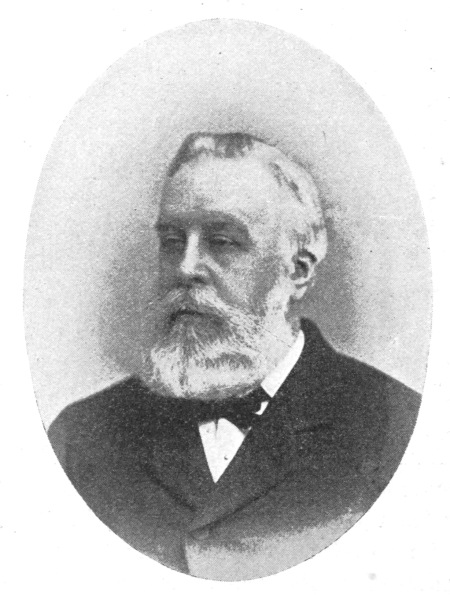
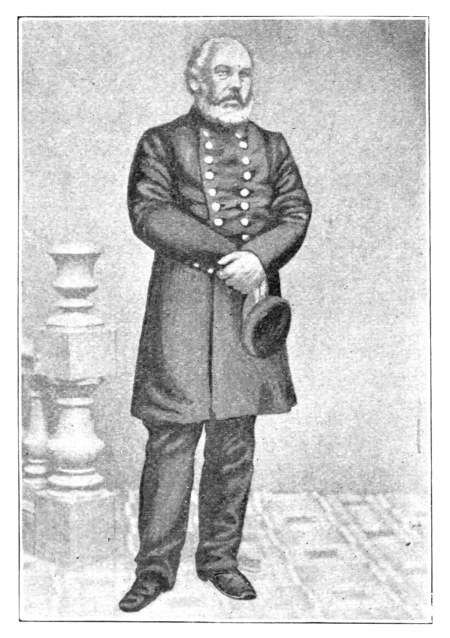
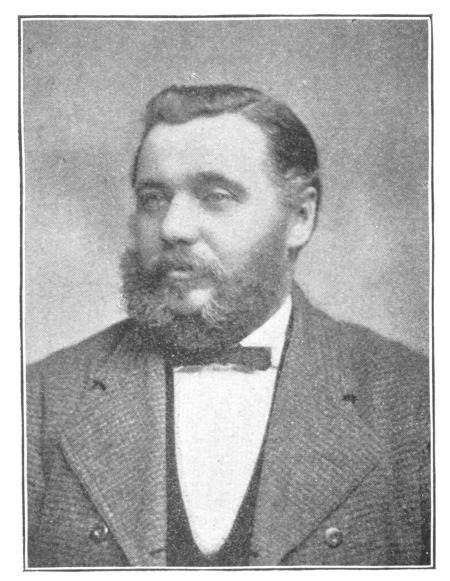
JOHN TORRANCE.
The Torrances are a “Border” family. The late Mr. John Torrance was
born at Gatehouse, in the Shire of Galloway, Scotland, June 8th, 1786.
Early in the century he came to Canada, and before long established a
wholesale business in Montreal and founded the eminent firm of John
Torrance & Co. His elder brother Thomas had preceded him in Montreal,
and was at the head of a large and lucrative business, residing at
Belmont Hall, which he built, and which was at that time considered
a palatial mansion. On his removal to Quebec this fine property was
acquired by a member of the Molson family. Mr. David Torrance, a
nephew of Mr. John Torrance, was born in New York in 1805. He came to
reside in Montreal about the year 1821, and became a partner in his
uncle’s firm. He was a man of exceptional business capacity, energy
and enterprise, and did much to advance the commercial interests
of Montreal and Canada. In 1826 this firm purchased the steamboat
Hercules and placed her on the Montreal and Quebec route, in the
double capacity of a tow-boat and passenger steamer—this being the
first step towards the vigorous opposition to the Molson line of
steamers that ensued. They were also the first in Canada to branch
out into direct trade with the East Indies and China. Mr. David
Torrance died in Montreal, January 29th, 1876. His son, Mr. John
Torrance, now the senior member of the firm of David Torrance & Co.,
was born in Montreal in August, 1835. He has had the Montreal agency
of the Dominion Line of steamships for many years, and is otherwise
extensively occupied in the shipping business. It may be added that
after the death of Mr. John Torrance, primus, in 1870, the name of
the firm was changed to David Torrance & Co., which it still retains.
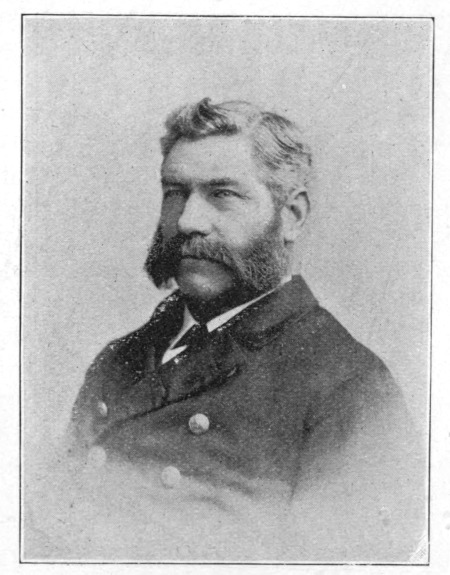
Mr. Brush was a native of Vermont, born at Vergennes, in 1793. After
some time spent in mercantile pursuits, he engaged in boat-building
and navigation on Lake Champlain, and became captain of a steamer
plying between St. John’s and Whitehall. He afterwards had command of
some of Mr. Torrance’s steamers on the St. Lawrence. In 1834 he became
manager of the Ottawa and Rideau Forwarding Company, and resided in
Kingston until 1838, when he joined the Wards in the Eagle Foundry,
Montreal, of which he became the sole proprietor in 1840. Mr. Brush
died in Montreal, at the advanced age of ninety years and two months.
The following extracts from memoranda left by him are interesting and
valuable:
“The steam-engines for the Swiftsure (1813), the Malsham (1814),
the Car of Commerce (1816), and the Lady Sherbrooke (1817), were
all made by Bolton & Watt, of Soho, England, who would not allow more
than four pounds pressure of steam; and a hand-pipe was used to feed
the boilers by gravitation. The first steam-engine built in Canada was
in 1819, for the Montreal, a small ferry-boat, of about fourteen
horse-power, built by John D. Ward, at the Eagle Foundry. In 1823
the merchants of Montreal formed a stock company for the purpose of
building tow-boats. I was employed by that company to build their boats.
The first (the Hercules) we built in Munn’s shipyard, about where
H. & A. Allan’s office now stands. The Hercules was fitted with an
engine of one hundred horse-power, built by J. D. Ward & Co., at the
Eagle Foundry, on the Bolton & Watt low-pressure principle. Under my
command the Hercules commenced towing vessels in May, 1824, when she
towed up the ship Margaret of Liverpool from Quebec to Montreal and
up the current of St. Mary’s—the first ship so towed up. Our company
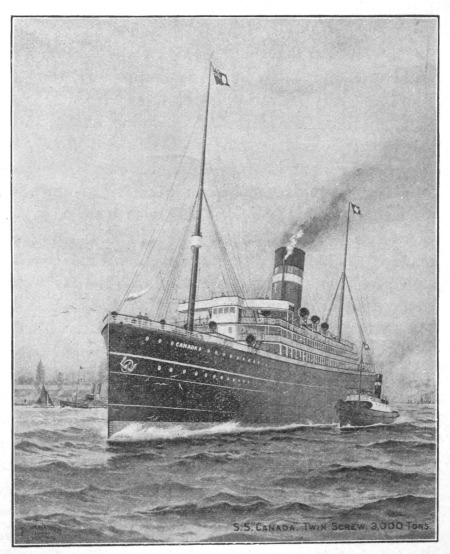
also built the steamers British America, St. George and Canada,
of about 150 horse-power each.”
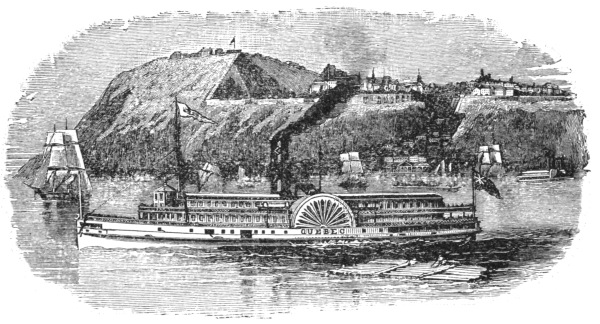
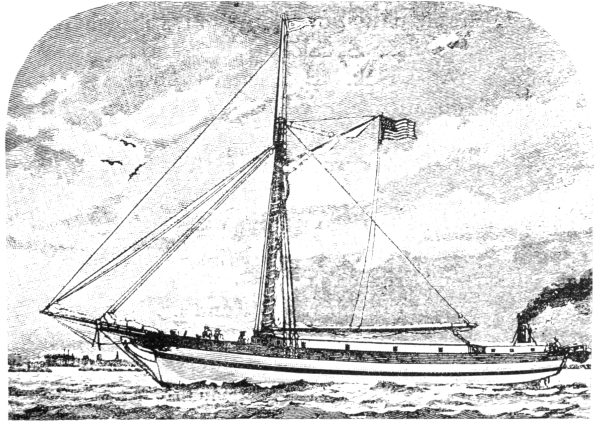
STEAMER “QUEBEC” AND CITADEL.
“In 1838-39 the Imperial Government built a steam frigate here, called
the Sydenham. It was engined by Ward, Brush & Co., with a pair of
side-lever engines, and proved to be one of the fastest vessels in the
Royal navy of that time.”
Connected with Mr. Brush there is a good fish story, which is better
authenticated than some of that class that have passed current. A
pike-headed whale—the only one that is known to have visited these
waters—followed some vessel up from sea into the harbour of Montreal,
in September, 1823. Captain Brush rigged a boat and captured him with a
harpoon. He was a beautiful specimen, measuring 39½ feet in length, and
23 feet in circumference. His jaw-bones were for many years to be seen
overarching the entrance to Gilbault’s Gardens, and there are those
still living who remember having seen the carcase as it lay, far too
long for sensitive nostrils, on the river bank.
As already stated, Molson’s Accommodation began to ply between
Montreal and Quebec in 1809—two years later than Fulton’s Clermont
on the Hudson, and three years earlier than Bell’s Comet on the
Clyde. The Accommodation proved a fairly successful commercial
venture, although Mr. Molson did not obtain a monopoly of the business
as Mr. Fulton had done. She was soon followed by the Swiftsure,
the Malsham, the Car of Commerce, the John Molson, the
Lady Sherbrooke, and other steamboats. The last-named was 170 feet long,
34 feet beam, and 10 feet in depth, with a sixty-three horse-power
side-lever engine. A much better service had now been instituted, for
up to about 1818 many preferred to drive all the way from Montreal to
Quebec in caleches over rough roads. Now, however, that the steamboats
had comfortable cabins, and canvas awnings over their decks, they
secured nearly all the through passenger traffic. About the year 1823
several powerful tow-boats were built, which also carried passengers.
After these the Waterloo and the John Molson of the Molson Line,
the St. George, the British America and the Canada, owned by
John Torrance & Co., and other boats of larger dimensions, having better
passenger accommodation and higher speed, followed in rapid succession.
The Waterloo foundered in Lake St. Peter, and was replaced by the
John Bull, a fine boat of 190 feet in length, but which was burned
in 1838. The John Bull used too much coal to be profitable, and
the saying that she made most money when lying at anchor, arose from
the fact that, anchored off the city, she was repeatedly used as the
official residence of the Governor-General, Lord Durham. The Canada,
which came out in 1837, was 240 feet long, and was accounted the
largest and fastest steamer then afloat in the New World. In 1840 the
Lord Sydenham (the former Ontario) and the Lady Colborne ran
as the mail boats to Quebec. About 1845 several famous boats were
built—the Rowland Hill, Mr. Torrance’s Montreal, Wilson Connoly’s
Quebec, the Queen and the John Munn—all upper cabin boats of
high speed. The John Munn was longer than any previous, or, indeed,
any subsequent, river steamer on the St. Lawrence, being 400 feet in
length. Her boilers were placed on either guard, as the fashion then
was, and a huge walking-beam in the centre. She was too large for the
trade. After running a few years she was broken up, and her magnificent
engines were sent to New York. The Montreal, also a large and fine
steamer, was lost in a snow-storm near Batiscan, in November, 1853, and
was replaced by the Lord Sydenham, afterwards lengthened to 250 feet,
and renamed the Montreal.
The first iron steamers came into use on the St. Lawrence in 1843,
namely, the Prince Albert and Iron Duke, which at that time began
to ply as ferry-boats to Laprairie and St. Lambert, in connection
with the Champlain and St. Lawrence railway service. These boats were
designed in Scotland, sent out in segments, and were put together by
Parkins, of the St. Mary Foundry, Montreal.
The Richelieu Steamboat Company, formed in 1845, commenced business by
running a market boat to Sorel. In 1856 they put two small steamers on
the through line to Quebec, the Napoleon and the Victoria. About
this time Messrs. Tate Brothers, ship-builders, in Montreal, purchased
the Lady Colborne, renamed her the Crescent, and coupling her with
the Lady Elgin, started a fourth line of steamers to ply between
Montreal and Quebec. The business had already been overdone, and this
was the last straw that breaks the camel’s back. The opposition had
gone far enough when it had reduced the cabin fare to $1.00, including
meals and stateroom, and the steerage passage to 12½ cents! The
excitement that prevailed at this time was intense. The arrival
and departure of the boats at either end of the route were scenes
of indescribable confusion. Vast crowds of people assembled on the
wharves, while clouds of smoke issuing from the funnels and the roar
of escaping steam plainly indicated that the stokers were doing their
level best to burst the boilers. This vicious and ruinous opposition
was brought to an end by a tragic occurrence, the burning of the
steamer Montreal.
On a fine summer evening in June, 1857, while on her voyage from Quebec
with a load of over 400 passengers, most of whom were emigrants from
Scotland, who had just completed a long sea voyage, and were gazing
with interest on the shores that in anticipation were to offer them
happy homes, suddenly the cry of “Fire!” was raised. Clouds of smoke
burst out from between decks. A panic ensued. Groups of men and women
clung to each other in despair, imploring help that was not to be
found; then a wild rush, with the terrible alternative of devouring
flames and the cold water below. Two hundred and fifty-three persons
perished; and all the more sadly that the calamity was traced by
public opinion and the press of the day to “culpable recklessness
and disregard of human life.” A truce to ruinous opposition ensued.
An amicable arrangement was reached, by which superfluous boats were
withdrawn. The bulk of the passenger business fell to the Richelieu
Company, which continued for a number of years to do a lucrative trade,
paying handsome annual dividends to its shareholders.
In 1875 an amalgamation was effected with the Canadian Steam Navigation
Company (the old Upper Canada Line), under the name of the Richelieu
and Ontario Navigation Company, which has become one of the largest
enterprises of the kind in America, having a paid-up capital of
$1,350,000, a fleet of twenty-four steamers, and operating a continuous
line of navigation a thousand miles in length. The Montreal and
Quebec, which ply between the cities from which they are named,
though more than thirty years old, still have a high reputation for
speed and comfort. They are each over 300 feet long, and have an
average speed of about sixteen miles an hour. They have each ample
sleeping accommodation for some 300 cabin passengers. They make their
trips during the night. Supper on board either of these steamers is an
event to be remembered.
The head office of the Richelieu and Ontario Company is in Montreal.
The General Manager is Mr. C. F. Gildersleeve. Mr. Alexander Milloy,
the Traffic Manager, who was born in Kintyre, Scotland, in 1822, came
to Canada in 1840, when he entered the Montreal office of the Upper
Canada Line of mail steamers, and continued his connection with the company,
amid all its changes, until May, 1898, when he retired from the service.
The navigation of the Ottawa differed from that of the St. Lawrence
in that its rapids were wholly impassable for boats with cargo. The
necessity for canals thus became urgent. The original Grenville Canal
was designed and commenced by the Royal Engineers for the Imperial
Government, and was completed in 1832, simultaneously with the Rideau
Canal. It was enlarged by the Dominion Government a few years ago, but
it is not yet of sufficient capacity to allow the free passage of the
larger steamers on this route. Travellers are therefore subject to
transhipment at Carillon, and are conveyed by railway to Grenville, a
distance of thirteen miles, where another steamer is ready to convey
them to Ottawa. This little bit of railway is one of the oldest in
Canada, and is further remarkable as being the only one of 5 feet 6
inches gauge in the country. It was purchased by the Ottawa River
Navigation Company in 1859, and is operated only in connection with
their steamers, not being used in winter.
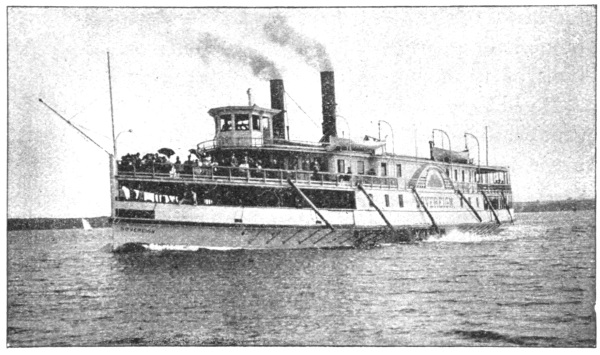
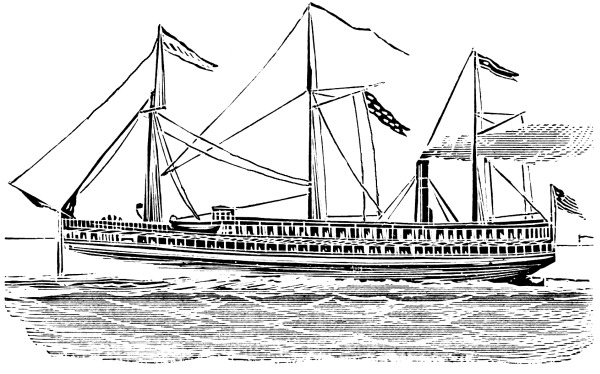
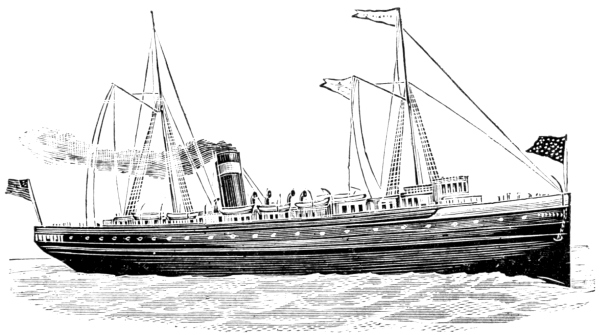
OTTAWA RIVER STEAMER “SOVEREIGN.”
The completion of the Grenville Canal in its original form opened up
a new route to the West, somewhat circuitous, doubtless, but with
greatly increased facilities for the transportation of merchandise, the
immediate effect of which was to transfer the great bulk of west-bound
traffic from the St. Lawrence route to that of the Ottawa and Rideau.
About this time was formed “The Ottawa and Rideau Forwarding Company,”
by leading merchants in Montreal, with Mr. Cushing as manager. A few
years later the forwarding business became a lucrative one, and was
carried on by a number of prominent firms represented at Montreal,
Prescott, Brockville and Kingston. Chief among these were the Messrs.
Macpherson, Crane & Co., Hooker & Jones, Henderson & Hooker (afterwards
Hooker & Holton), H. & J. Jones of Brockville, and Murray & Sanderson
of Montreal. Messrs. Macpherson and Crane were easily the foremost in
the enterprise, for they owned a private lock at Vaudreuil and thus
held the key to the navigation of the Ottawa, and had complete control
of the towage until 1841, when Captain R. W. Shepherd, then in command
of the steamer St. David, belonging to a rival company, as the result
of a clever and hazardous experiment, discovered a safe channel through
the rapids at St. Ann’s, which put an end to the monopoly.
Up to 1832 the long portage between Carillon and Grenville was a
serious drawback to traffic, necessitating a double service of steamers
and barges, one for the upper and one for the lower reach of the
river. The first steamer on the upper reach seems to have been the
Union, Captain Johnson, built in 1819, and which commenced to ply the
following year between Grenville and Hull, covering the distance of
sixty miles in about 24 hours! On the lower reach the William King
began to ply about 1826 or 1827, at first commanded by Captain Johnson,
afterwards by Captain De Hertel. The St. Andrew followed soon after.
In 1828 the Shannon, then considered a large and powerful steamer,
was built at Hawkesbury and placed on the upper route, commanded at
first by Captain Grant and afterwards by Captain Kaines.
At the height of the forwarding business on the Ottawa, Macpherson &
Crane owned a fleet of thirteen steamers and a large number of bateaux
and barges, which were towed up the Ottawa and through the Rideau
Canal to Kingston, the entire distance being 245 miles. The flotilla
would make the round trip, returning via the St. Lawrence, in twelve
or fourteen days. The steamers engaged in this service were mostly
small, high-pressure boats—commonly called “puffers.” At the first
the noise which they made, especially the unearthly shriek of their
steam-whistles, scared the natives as well as the cattle along the
banks of the river. The passengers were usually accommodated in
the barges in tow of the steamers, but as time went on a few of
the “puffers” attained the dignity of passenger boats, and, when
unencumbered with tows, made the round trip in a week. The writer well
remembers making the trip in the early forties on the Charlotte,
Captain Marshall, and a very pleasant trip it was, the chief
attractions being the long chain of locks at the small village of
Bytown—soon to become the beautiful capital of the Dominion; the big
dam at Jones’ Falls, with its retaining wall three hundred feet in
thickness at the base and ninety feet high; the marvellous scenery of
the Lake of the Thousand Islands, and, as the climax, what was then the
novelty of shooting the rapids on a steamboat. Captain Howard informed
me that the first steamer to shoot the “lost channel” of the Long Sault
rapids was the old Gildersleeve of Mr. Hamilton’s line, in command of
Captain Maxwell and piloted by one Rankin. That was in 1847, and was
considered a daring feat at the time, but it established the safety of
the new channel which has ever since been used by the larger passenger
steamers. No one, however, can form an adequate idea of the grandeur of
this raging torrent who has not made the descent upon a raft; though,
speaking from experience, this mode of shooting the “lost channel” is
not to be recommended to persons of weak nerves.
It is said that in 1836 a steamboat named the Thomas Mackay plied
between Quebec and Ottawa, but its journeyings seem to have been
erratic and its subsequent history “lost in obscurity”—a phrase that
applies in some degree, indeed, to the early history of steam on the
Ottawa. The St. David was the only steamer that could pass through
the Grenville Canal in 1841. The first truly passenger service on the
Ottawa commenced in 1842 with the Oldfield on the lower route and
the Porcupine on the upper. In 1846 the Oldfield was purchased by
Captain Shepherd and others who formed a private company named the
“Ottawa Steamers Company.” The steamer Ottawa Chief was built by that
company in 1848, but she was found to draw too much water, and in the
following spring was chartered by Mr. Hamilton and placed on the St.
Lawrence route. The Lady Simpson, built in 1850, was the precursor of
a number of excellent steamers that have made travelling on the Ottawa
popular with all classes. Among these were the Atlas, Prince of
Wales (which ran for twenty-four years), Queen Victoria, Dagmar,
Alexandra, etc. The reputation of the line is well sustained at
present by the Empress, Captain Bowie, and the Sovereign, Captain
Henry W. Shepherd, both very fine and fast steel boats of 400 and 300
tons, respectively. Other steamers in commission and employed in the
local trade bear such loyal names as Maude, Princess and Duchess
of York.
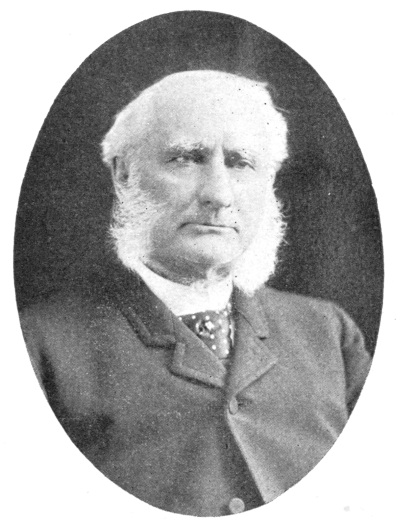
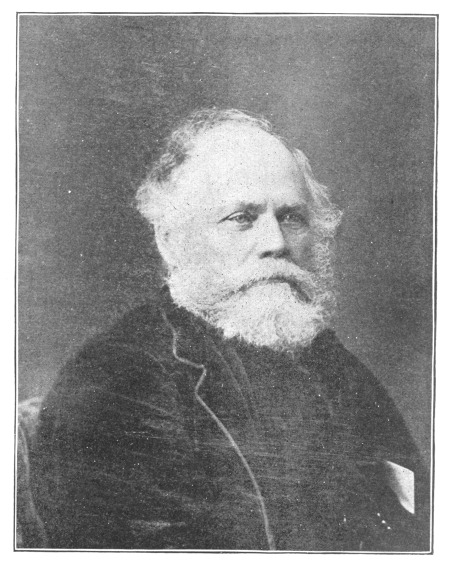
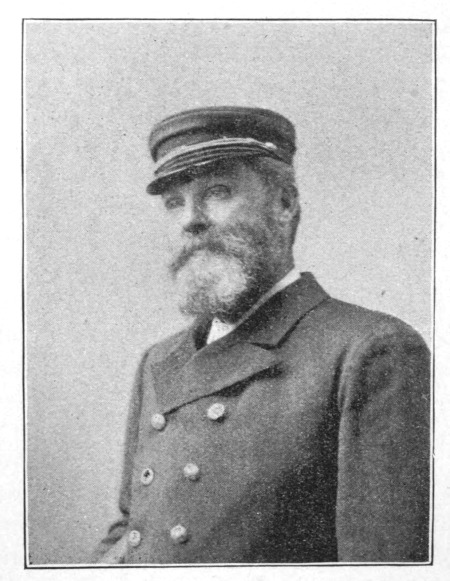
CAPTAIN R. W. SHEPHERD.
Captain Robert Ward Shepherd retired from
active service in 1853, when he was appointed General Manager of
the line. In 1864 the Steamers Company was incorporated by Act of
Parliament under the name it now bears, the Ottawa River Navigation
Company, of which Mr. Shepherd was President as long as he lived. Mr.
Shepherd was born at Sherringham, County Norfolk, England, in 1819. He
died at his country seat at Como, Quebec, August 29th, 1895, having
been for fifty-five years closely identified with the progress of
steam navigation on the Ottawa, and having earned for himself a high
reputation. His brother, Captain H. W. Shepherd, who succeeded him in
the command of the Lady Simpson in 1853, is now the commodore of the
fleet—the oldest and most experienced captain on the Ottawa, who in all
these years has not been chargeable for any accident to life or limb
of the many thousands who have been committed to his care. The head
office of the company is in Montreal, Mr. R. W. Shepherd, a son of the
founder, being the Managing Director.
As already mentioned in the previous chapter, the Frontenac and the
Queen Charlotte were the first two steamers in Upper Canada, launched
respectively in 1816 and 1818. In 1824 another steamer was built for
Hon. Robert Hamilton—the Queenston, of 350 tons—which was at first
commanded by Captain Joseph Whitney and plied between Prescott, York
and Niagara. The Canada, Captain Hugh Richardson, came out in 1826
and used to run from York to Niagara (36 miles) in four hours. The
famous Alciope, of 450 tons, Captain Mackenzie, appeared in 1828, and
plied with great éclat between Niagara, York, and Kingston, under the
Hamilton flag.
The late Hon. John Hamilton, who for many years may almost be said
to have controlled the passenger traffic on the Upper Canada route,
commenced his connection with the steamboat business about the year
1830, when he built the Great Britain, of 700 tons, the largest
vessel then on the lake. After this there was a rapid succession of
steamers, and some very fine ones. The Cobourg, of 500 tons, Captain
Macintosh, came out in 1833; the Commodore Barrie, 275 tons, Captain
Patterson, in 1834. The Sir Robert Peel, 350 tons, one of the finest
boats then on the lake, was seized and burned on the night of May
29th, 1838, by a gang of rebels headed by the notorious Bill Johnson.
The Queen Victoria, Thomas Dick, commander, launched in 1837, was
advertised to sail daily between Lewiston, Niagara and Toronto,
connecting at Toronto with the William IV. for Kingston and Prescott.
“This splendid fast sailing steamer is fitted up in elegant style,
and is offered to the public as a speedy and safe conveyance.” The
Sovereign, 500 tons, Captain Elmsley, R.N., Captain Dick’s City of
Toronto, and the famous Highlander, Captain Stearns, began to run
about 1840. The Chief Justice Robinson, Captain Wilder, the Princess
Royal, Captain Twohey, and Captain Sutherland’s Eclipse were all
noted steamers in their day. The Traveller and the William IV.,
Captain Paynter, both powerful steamers, famous also for many years,
ended their careers as tow-boats, the latter being conspicuous by her
four funnels.
“These steamers, and others that could be named,” says one of my
informants, “bring to mind good seaworthy ships, fit for any weather
and commanded by able seamen. Nor was the steward’s department unworthy
of the vessels. As good a breakfast and dinner was served on board as
could be desired.” Such were some of the early steamboats in Upper
Canada more than fifty years ago, for which the public are indebted
to the Hon. John Hamilton, Mr. Alpheus Jones, of Prescott, Mr. Donald
Bethune, of Cobourg, and Mr. Heron, of Niagara, as well as to Captains
Dick, Sutherland and Richardson.
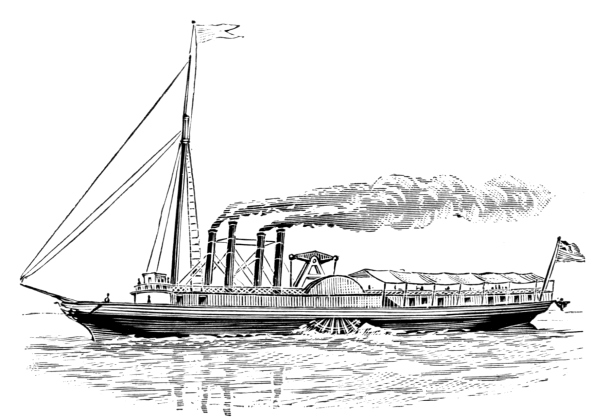
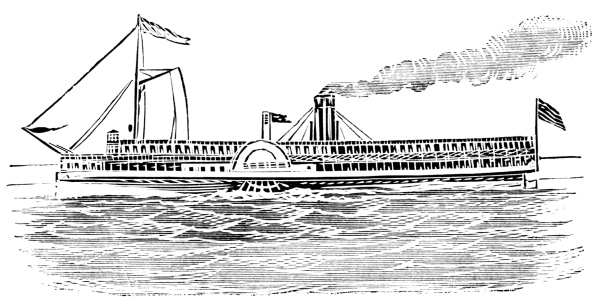
OLD “WILLIAM IV.,” 1832.
Up to 1837 the lake steamers did not venture farther down than
Kingston, but about that time they commenced running through the Lake
of the Thousand Islands to Prescott. From that point the small steamer
Dolphin sailed every morning for the head of the Long Sault rapids,
enabling passengers to reach Montreal the same evening. The route was
from Dickenson’s Landing to Cornwall by stage, thence through Lake St.
Francis by steamer to Coteau du Lac, thence by stage over a plank road
to the Cascades, where the quaint old steamer Chieftain would be
waiting to convey passengers to Lachine to be driven thence in a coach
and six to Montreal. It was not until 1848, when the enlarged Lachine
Canal was opened, that the Upper Canada steamers began to run all the
rapids of the St. Lawrence as they now do.
In 1840 Mr. Hamilton had built a powerful steamer, the Ontario,
with the expectation that she might be able to ascend the rapids,
but failing in this she was sold to a Montreal firm and placed on
the Quebec route. The Ontario descended all the rapids of the
St. Lawrence safely on the 19th of October, 1840, being the first
large steamer to do so. Facile descensus! It is not recorded that
more than one steamer ever succeeded in ascending those rapids. In
November, 1838, the little Dolphin, after four weeks of incessant
toil, was towed up the Long Sault rapids with the aid of twenty yoke
of oxen, besides horses, capstans and men, added to the working of
her engine—the first and probably the last steamer that will ever
accomplish the feat. About this time the Iroquois, with one large
stern-wheel, was built for the purpose of stemming the swift currents
between Prescott and Dickenson’s Landing, but had so much difficulty
in ascending the river that at Rapide Plat and other points posts were
sunk at short distances along the shore to each of which she made fast
in turn until she recovered her breath.
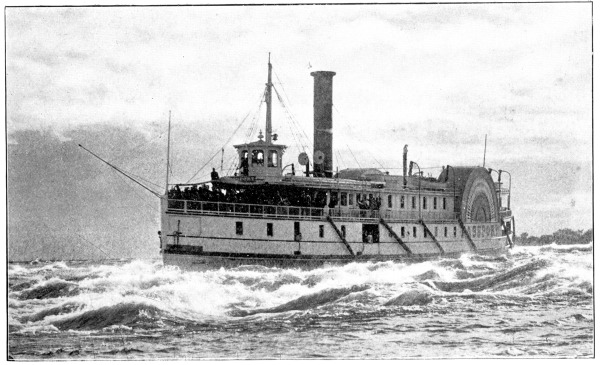
“PASSPORT,” SHOOTING THE RAPIDS IN HER FIFTIETH YEAR.
The completion of the canals prepared the way for a larger class of
steamers between Lake Ontario and Montreal, and the “Royal Mail Line”
was accordingly re-enforced. The Passport was built of iron on the
Clyde and brought out in sections in 1847, and is still in commission
and in good running order. The Magnet, also built of iron and on the
Clyde, and in which Captain Sutherland had a large pecuniary interest,
came out shortly after the Passport, and under the name of the
Hamilton, in command of Captain A. J. Baker, is now, in her green
old age, and with her hull as sound as a bell, performing a weekly
service between Montreal and Hamilton. The Kingston, since named
the Algerian, followed in 1855, and was first commanded by Captain
Clarke Hamilton, now of H. M. Customs at Kingston. About this time
the Brockville, Captain Day, the Gildersleeve, Captain Bowen, the
Banshee, Captain Howard, and the Lord Elgin, Captain Farlinger,
were well-known and favourite boats.
The fifteen years from 1840 to 1855 were the most prosperous in the
history of steam navigation on Lake Ontario and the St. Lawrence. The
Americans had at that time several lines of steamers plying between
Ogdensburg, Oswego, Rochester and Lewiston. Some of these were large
and very fine passenger steamers, such as the United States, the
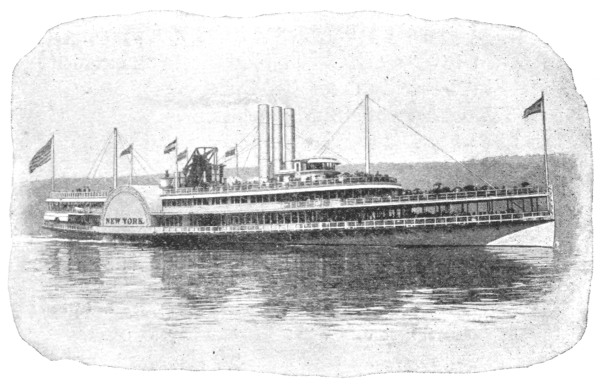
Bay State, the New York, the Rochester, the Lady of the Lake,
the Northerner, the Cataract, and the Niagara. The Great Western
Railway Company had also a fleet of splendid steamers—the Canada,
the America, the Europa and the Western World. At the breaking
out of the American civil war, most of these vessels and some others
were purchased by the United States Government and taken round to New
York. Their places on the lake are now occupied by numerous screw
propellers, chiefly doing a freight business, but many of them having
excellent accommodation for passengers also.
The opening of the Grand Trunk Railway in 1855 proved disastrous to the
steamboat interests. Mr. Hamilton, as well as many others, struggled
gallantly for a time, endeavouring to stem the tide of competition
with the new system of transportation, but about the year 1862 he was
obliged to retire from the business which he had created and carried
on successfully for thirty years. The steamers in which he had a large
personal interest were sold to a joint stock company, which was named
the “Canadian Steam Navigation Company.” Mr. Hamilton was appointed
General Manager of the new company; Sir Hugh Allan, President, and
Alexander Milloy. Secretary-Treasurer. A few years later Captain Thomas
Howard became Superintendent of the line, a position which he held
until 1881, when he was appointed Harbour-master in Montreal. He died
in Montreal on Easter Sunday, 1898. In 1875 the company united with the
Richelieu Company, as already stated.
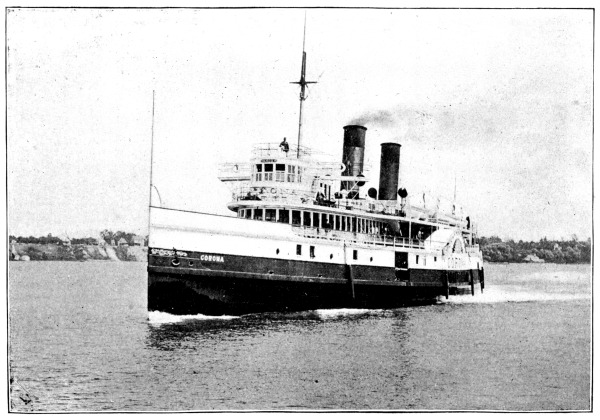
“CORONA,” ON NIAGARA RIVER, 1896.
Lake Ontario.—The volume of steam traffic on Lake Ontario at the
present time, though not to be compared with that on the Upper Lakes,
is by no means inconsiderable. From the official “Report of Trade
and Navigation of the Dominion for 1895,” the arrival and departure
of steamers at eighteen ports of entry on Lake Ontario, either as
coasting vessels or as trading with the United States, was 17,558, and
an aggregate of 6,443,443 registered tonnage; to which must be added
the large amount of steam shipping that frequents the harbours on the
American side of the lake, as at Lewiston, Oswego, Sackett’s Harbour,
Cape Vincent, and that descends the St. Lawrence to Ogdensburg.
Niagara heads the list on the Canadian side with 3,198 arrivals and
departures, and 1,581,643 tonnage. Toronto, with 3,844 arrivals and
departures, counts for 1,569,123 steam tonnage; Kingston stands third,
with 3,563 vessels, and 882,414 tonnage. Hamilton is represented by
427,100 tonnage. After these come Belleville, Picton, Cobourg, Port
Hope, Deseronto and Port Dalhousie, in the order named, and eight other
smaller ports, each contributing its quota.
Toronto is largely interested in steam navigation. Not to speak of
numerous steam yachts, ferry steamers and tug-boats, it controls a
large passenger traffic. The Niagara Navigation Company of Toronto
has three very fine steamers running to Niagara and Lewiston—the
Chicora, Chippewa and Corona. The Chicora was built
in England, as a “blockade runner,” more than thirty years ago, but the civil
war was ended before she reached this side of the Atlantic. She is an iron
side-wheel vessel of 518 tons, with a rakish, Old-Country look about
her. The Chippewa, built at Hamilton, Ont., in 1893, is a very fine
paddle-wheel steamer of 850 tons, modelled somewhat after the Hudson
River boats, with a conspicuous walking-beam. The latest addition
to the fleet is the Corona, launched in May, 1896, from the noted
ship-building yard of the Polsons, Toronto, which takes the place of
the Cibola, a Clyde-built steel steamer, put together by the Rathbun
Company, Deseronto, in 1887, and which was burned at Lewiston in
1895. The Corona is claimed by her owners to be “a model of marine
architecture, and one of the finest day-steamers in the world!” Though
only 277 feet long, and 32 feet beam (59 feet over the guards), she
carries nearly two thousand passengers. The hull is constructed of
open hearth steel. The engine is of the inclined compound condensing
type, and develops nearly two thousand indicated horse-power. The
mechanical fittings are all of the most approved kind, and the internal
arrangements highly artistic.
The Hamilton Steamboat Company has two fine powerful screw steamers,
the Macassa and Modjeska, plying between Hamilton and Toronto. Both
were built on the Clyde, and have been very successful financially,
and also as seaworthy, fast sailing vessels. Kingston, which occupies
an important position at the foot of the lake and head of the river
navigation, owns a fleet of no less than forty-six steamers, and is the
headquarters of half a dozen steamboat companies, some of which are
largely interested in the Lake Superior trade, while others connect
Kingston with ports on the Bay of Quinte, Rochester and Cape Vincent,
N. Y., and Gananoque and the Thousand Islands. The James Swift plies
between Kingston and Ottawa, via the Rideau Canal. The Passport,
the oldest steamer now afloat in Canada, is registered at Kingston, and
was built, as already stated, in 1847.
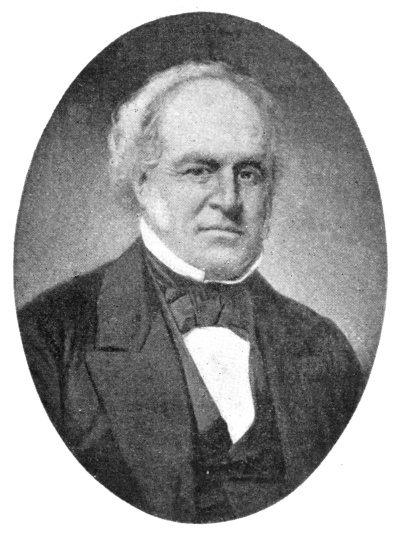
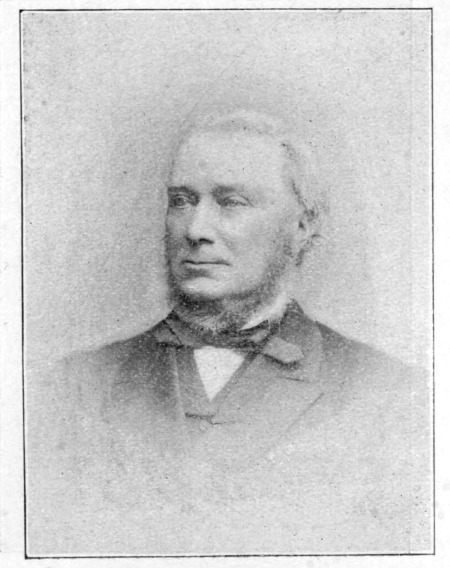
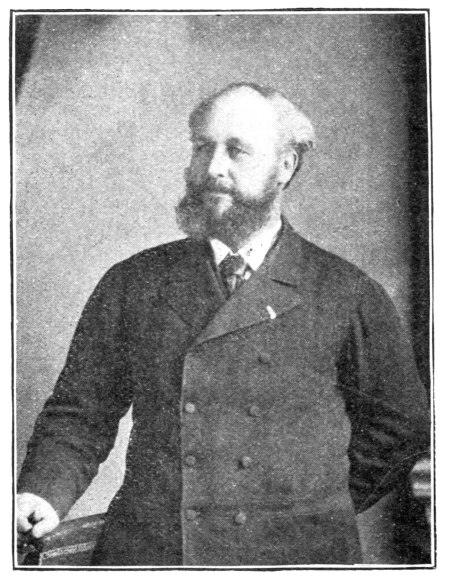
HON. JOHN HAMILTON.
The Hon. John Hamilton, whose name is so intimately associated with the
rise and progress of steam navigation in Western Canada, was born at
Queenston, Ontario, in 1802—the seventh and youngest son of the Hon.
Robert Hamilton, formerly of Edinburgh. One of the sons founded
the city of Hamilton, another attained distinction in the medical
profession. John devoted the greater part of his life to the
development of commerce between Montreal and the cities and towns
bordering on Lake Ontario, having his headquarters at Kingston. Mr.
Hamilton was a man of fine presence and highly accomplished; was called
to the Legislative Council of Upper Canada by Sir John Colborne in
1831, and to the Senate of the new Dominion, by writ of Her Majesty’s
sign-manual, in 1867. He was an influential member of the Presbyterian
Church, and many years chairman of the Board of Trustees of Queen’s
College, Kingston. He died in 1882.
The first steamer to ply on the Red River was brought in pieces
across the country from a tributary of the Mississippi, and rebuilt
at Georgetown, a small place some twenty miles north of the present
town of Moorhead. The boat was called, before its transportation, the
Anson Northrup, and was afterwards known as the Pioneer. She
began her career on the Red River in 1859, and in that year took a cargo to
Fort Garry. She was the joint property of the Hudson’s Bay Company and
Messrs. J. C. and H. C. Burbank & Co., of St. Paul, Minnesota. (A cut
of this steamer may be seen in a book called “The Winnipeg Country,”
published by Cupples, Upham & Co., Boston.)
The next steamer was the International, built at Georgetown, in
1861, for the Hudson’s Bay Company, at a cost of about $20,000. Her
length was 160 feet, breadth 30 feet, depth (from the water-line to the
ceiling of her upper saloon) 20 feet, and her registered tonnage was
133⅓ tons. She was found to be too large for the Red River navigation.
The same company’s steamer, the Northcote, commenced to ply on the
Saskatchewan about 1875. In 1878 there were running on the waters of
Manitoba seventeen steamers, among which were the Manitoba, Dakota,
Selkirk, Swallow, Minnesota, Prince Rupert,
Keewatin, etc.
The Hudson’s Bay Company at that time owned a propeller which ran on
Lake Winnipeg to the portage at the mouth of the Saskatchewan, where
connection was made with the Northcote and a steel-built steamer, the
Lilly. This company had also another steamer plying on the Red River,
named the Chief Commissioner.
Since the opening of the country by railways the navigation of the
Upper Red River and the Assiniboine has been of small account, but
below Selkirk there is still a considerable trade carried on. There
are at least half a dozen companies interested in the navigation of
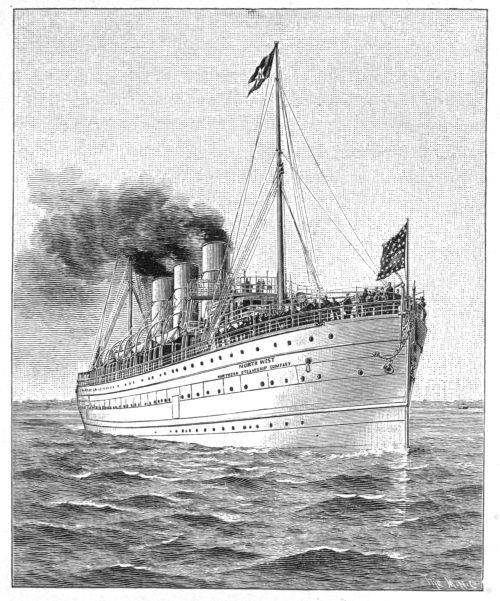
these waters. The North-West Navigation Company runs three steamers,
the Princess, 350 tons; the Red River, 200 tons; the Marquette,
160 tons, and a number of barges. The Selkirk Fish Company owns the
Sultana, of 200 tons; the Manitoba Fish Company has the City of
Selkirk, of 160 tons. Besides these there is a numerous fleet of
steam-tugs and barges. In all there are some fifty steamers on these
inland waters. During the palmy days of Red River transportation the
leading name was that of Norman W. Kittson, at that time of St. Paul,
Minnesota, but formerly a trader of the old Red River settlement, who
was often familiarly called “Commodore Kittson.”
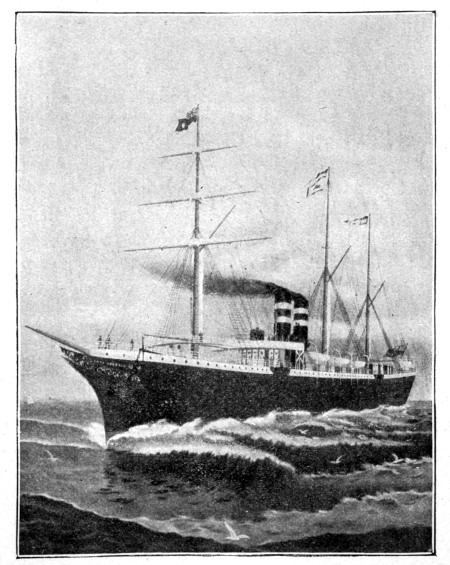
The pioneer steamship of the Northern Pacific was the Beaver, whose
history from first to last was a very romantic one. This vessel was
built at Blackwall, on the Thames, by Messrs. Green, Wigram and Green,
for the Hudson’s Bay Company, and was launched in 1835 in the presence
of 150,000 spectators, including William IV. and many of the English
nobility. Cheers from thousands again greeted her in answer to the
farewell salute of her guns when she sailed away for the New World.
The Beaver was a side-wheel steamer, 101.4 feet long, 20 feet beam,
and 11 feet deep; tonnage, 109. Her machinery, made by Boulton & Watt,
was placed in position, but the paddle-wheels were not attached. She
was rigged as a brig, and on August 27th sailed for the Pacific under
canvas, in command of Captain Home, with the barque Columbia as her
consort. On March 19th, 1836, the Beaver dropped anchor at the
mouth of the Columbia River, having made the voyage in 204 days.
In her log-book it is recorded on May 16th: “Carpenters stripping
paddle-wheels. At 4 p. m. engineers got up steam, tried the engines,
and found to answer very well; at 5 o’clock, came to anchor, and moored
in our old berth; at 8 o’clock all hands were mustered to ‘splice the
main brace’”—a nautical phrase used in reference to the custom, less
common now than then, of celebrating particular events by serving out
a liberal supply of rum. The Beaver went into service without delay,
running up and down the coast, in and out of every bay, river and inlet
between Puget Sound and Alaska, collecting furs and carrying goods for
the company’s posts.
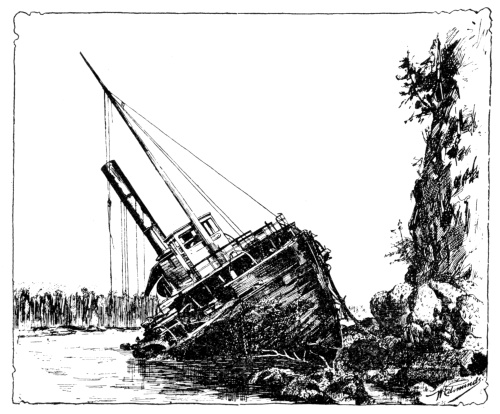
THE LAST OF THE OLD “BEAVER.”
On March 13th, 1843, the Beaver arrived at Camosun with Factor
Douglas and some of the Hudson’s Bay Company’s people to found the Fort
Victoria, and the first salute which echoed in what is now Victoria
harbour, was fired on the 13th of June, when the fort was finished and
the company’s flag hoisted.[65]
“The old steamer Beaver,” as she was called, continued her rounds
under different owners with remarkable regularity and success until the
fatal trip in July, 1888, when she went on the rocks near the entrance
to Vancouver harbour, and was totally wrecked.
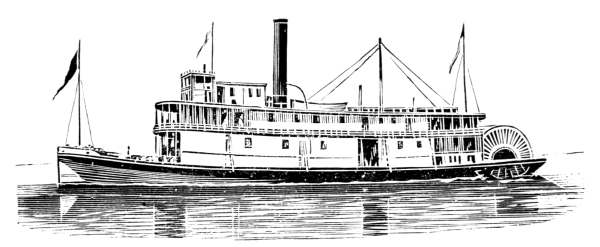
THE STERNWHEELER “NELSON,” AT NELSON, B. C.
It was fourteen years after the arrival of the Beaver before much
effort was made at steam-boating in these waters. About that time
several small steamers were built on the Columbia River. In 1852 the
Hudson’s Bay Company had another vessel built at Blackwall: this was
the Otter, a screw steamer of 220 tons, with a pair of condensing
engines by Penn, of Greenwich, which took the first prize at the London
Exhibition in 1851. The Otter left London in January 1853, and
arrived at Victoria five months later. The year 1858 witnessed a boom
in steam navigation, consequent upon the rush and wild excitement of
gold-seekers to the Fraser River and Cariboo. “The Surprise first
woke the echoes in the grand mountain gorges in the wild regions of
Fort Hope with the shrill scream of the steam-whistle, and astonished
the natives with her wondrous power in breasting successfully the
fierce current of the now world-renowned Fraser. That wild and
unearthly yell of the imprisoned steam escaping into the free air of
heaven must have astonished the denizens of those mountain fastnesses
and startled man and beast into the belief that some uncanny visitor,
not of earth, had dropped in upon their solitude.” The Surprise was
followed by a fleet of small steamboats built in the United States.
Among those were the Ranger and Maria—mere steam launches of about
40 feet in length. The Maria was brought up from San Francisco in
a barge. The first boat built in British Columbia was the Governor
Douglas, a good-sized stern-wheeler which commenced to ply between
Victoria and the Fraser River in 1859. Among the other notable boats
were the Seabird and the Eliza Anderson. The former carried immense
crowds, but drew too much water for the river trade. The latter was
a side-wheeler, built in Portland, 140 feet long, and of registered
tonnage, 279. On her arrival at Victoria in 1859 she commenced a career
of money-making which has seldom been equalled. After these appeared
the Umatilla, Enterprise and Colonel Moody, the last-named being
the fastest yet built for this route. All the light-draught boats
were then, as they are now, stern-wheelers. About this time another
and larger vessel arrived from London, the Labouchere, a side-wheel
steamer, of 680 tons register, 202 feet long, 28 feet beam, and 15 feet
hold. She continued running up north until 1865, when she was granted
a subsidy of $1,500 a trip to carry mails between Victoria and San
Francisco, but was lost on her first voyage. In 1861 more steamboats
were built than in any previous year. Nearly a dozen were added to
those already plying on the rivers and lakes, and the subsequent
progress in steam navigation was continuous. The entrance of mining
prospectors into the Kootenay country in 1886 led to the necessity
of increased transportation on the Columbia River, which has gone on
increasing until now on that river and the Kootenay lakes there are
some of the finest river steamers in the Dominion, fitted with every
comfort and appliance that experience can suggest. The development of
the coast wise trade has also led to the building of special steamers
both in British Columbia and also in England. The coal mines at Nanaimo
and the Comox district also find employment for a large quantity of
steam tonnage.[66]
The aggregate amount at the four ports of Victoria, Vancouver, Nanaimo,
and Westminster for 1895 was: Arrivals, 1,496,409 tons; departures,
1,513,233 tons. There are at present registered in British Columbia 161
steamboats with a tonnage of 24,153.
Besides the inland steamers there are coasting lines from Victoria and
Vancouver to Portland and San Francisco, and to Puget Sound and Alaska.
There are also four regular lines of steamships to Japan and China,
namely, the Canadian Pacific Steamship Company, with its beautiful
fleet of “Empress” steamers; the Northern Pacific Steamship Company;
the Oregon R. R. and Navigation Company, and the Nipon Yunen Kaisha of
Japan. There is also the direct line of steamers to Australia elsewhere
referred to. The number of vessels in the different lines is uncertain,
as they are increased by chartered boats whenever there is much freight moving.
The harbour of Halifax is one of the finest in the world. It is easy
of access and open all the year round. It is nearly six hundred miles
nearer to Liverpool than is New York, and has therefore many advantages
to offer as a point of arrival and departure for ocean steamers. It is
the centre of an extensive local and coasting trade, in which a large
number of both steamers and sailing vessels are employed. The number of
arrivals of sea-going vessels in 1895 was 978, with a gross tonnage of
627,572 tons; the number of arrivals of coasting vessels was 3,651, of
which 496 were steamers, with a tonnage of 153,790 tons. The number of
steamers registered in the port is 55, with a gross tonnage of 10,912
tons. The steam tonnage which entered the port in 1896 was 212,085; the
clearances were 229,653 tons.
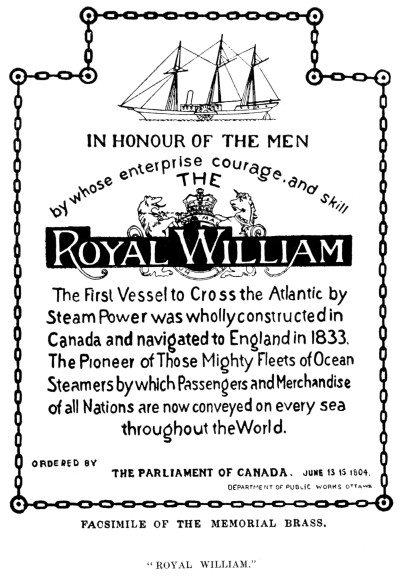
The first steamer to enter this renowned harbour was the Royal
William (Captain John Jones, R. N.), from Quebec, August 24th, 1831,
which arrived here on the morning of the 31st and was welcomed with
great éclat. The trip was made in six days and a half, including two
days’ detention at Miramichi. The cabin fare was £6 5s., including
meals and berths. Having been built for this trade, the Royal William
made a number of successful voyages between Quebec and Halifax,
calling at intermediate ports previous to her historic voyage across
the Atlantic, which was to proclaim her the pioneer of ocean steam
navigation!
The Cunard Line commenced to call at Halifax fortnightly en route to
Boston, in 1840. The Britannia was the first of that famous fleet
to enter the harbour of Halifax. This arrangement did not last very
long, however, for, on making New York their western terminus, the
Cunarders gave “the finest harbour” the go-by, never to return except
in cases of emergency. There are, however, some fifteen or sixteen
lines of steamers plying regularly from Halifax to Britain, the United
States, the West Indies, South America, Newfoundland, and Canadian
ports. During the winter months the Beaver Line, carrying the Canadian
mails, calls here weekly en route from St. John, N. B., to Liverpool.
The Allan Line from Liverpool to Philadelphia, via Newfoundland,
touches here once a fortnight going and coming. The Furness Line has
excellent steamers sailing fortnightly from London to Newfoundland
and Halifax. The Canada and Newfoundland Line also maintains a good
service from Halifax to St. John’s, Liverpool and London; the Jones
Line to Jamaica; the Pickford and Black Line to Bermuda and the West
Indies; the Musgrave Line to Havana. The Red Cross Line from New York
to Newfoundland calls here; besides, a number of coasting steamers
to Cape Breton, Newfoundland, Yarmouth, Bridgewater, St. Pierre and
other places call at Halifax, while the Canada Atlantic and Plant Line
supplies a direct route to Boston and all points in the United States.
Many “tramp” steamers call at Halifax with freight or for freight. Many
call for coal. Many a storm-tossed mariner is glad to make for Halifax
and to find in it a secure harbour of refuge, with all needful
appliances for refitting a battered ship. The whole coast of Nova
Scotia, indeed, is indented with harbours of refuge, which are the
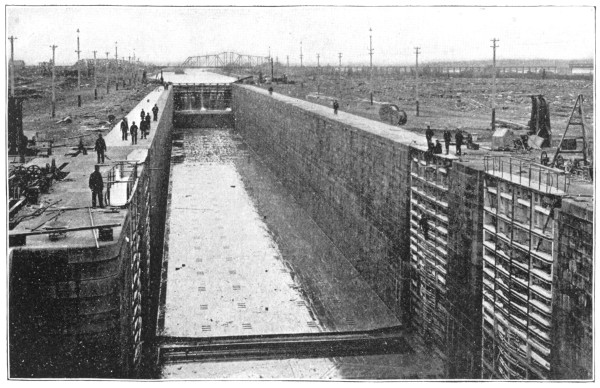
resorts of large numbers of sailing craft. The graving-dock at Halifax
is the largest on this continent. It was completed in 1889 by a private
company, subsidized by the Imperial and Federal Governments and the
city of Halifax to the extent of about $30,000. It is 585 feet in
length, 89¼ feet wide at the entrance, and has 30 feet of water on the
sills. It is adapted for steamships of the Teutonic class, but is 35
feet too short for the Lucania. A few months ago it had the honour
of accommodating within its walls the Indiana, one of the largest
of the United States ships of war, sent here for repairs. There are
three other graving-docks, the property of the Dominion Government, as
follows:[68]
| At | Esquimalt, B. C., |
built in | 1886, |
430 × 65 × 26½ | feet. |
| " | Kingston, Ont., |
" | 1871, |
280 × 55 × 16½ | " |
| " | Levis, Que., |
" | 1887, |
445 × 62 × 26½ | " |
The first steamboat in New Brunswick, the General Smyth, was launched
from the yard of John Lawton, Portland, St. John, in April, 1816. Her
owners were John Ward, Hugh Johnson, sen., Lauchlan Donaldson, J. C.
F. Bremner, of St. John, and Robert Smith, of Fredericton. This vessel
was run between St. John and Fredericton, making the round trip in a
week. She started from St. John on her first trip, May 13th, 1816.
She was a paddle boat. No official description of her is extant, as
the registry book of that date was burned in the great fire of 1877.
Later steamboats on this route were the St. George, John Ward,
Fredericton, St. John, Forest Queen, Heather Bell, Olive,
Prince Arthur, David Weston, Rothsay (which afterwards ran
between Montreal and Quebec), the Fawn and May Queen.
The second steamer, the St. George, was launched on April 23rd, 1895,
from the yard of John Owens, at Portland, St. John. Her owners were
John and Charles Ward, of St. John; Jedediah Slason and James Segee, of
Fredericton—the last-named being the first master of the vessel. Her
tonnage was 20417⁄94;
length, 105 feet; greatest breadth, 24 feet 6½ inches;
depth of hold, 8 feet 6 inches. She had one mast, a standing
bowsprit, square stern, and was carvel built. She had a copper boiler,
and, like the General Smyth, made one trip each way between
Fredericton and St. John in a week. The Victoria, the first steam
ferry-boat between St. John and Carleton, commenced running September
5th, 1839.
The pioneer steamboat on the Bay of Fundy was the St. John, built at
Deer Island, N. B., in 1826. In her was placed the machinery of the
General Smyth. Her tonnage was 8784⁄94;
length, 89 feet; breadth, 18 feet; depth, 8 feet. Later boats on this route were the Royal
Tar, Fairy Queen, Maid of Erin, Pilot, Emperor, Commodore,
Empress, Scud, Secret and City of Monticello. The steamers
at present running from St. John are: to Digby, the steel paddle SS.
Prince Rupert, 620 tons, having a speed of 18⅞ knots; to Windsor and
Hantsport, N. S., the Hiawatha, 148 tons; to Yarmouth, N. S., the
Alpha, 211 tons; to Grand Manan, the Flushing, 174 tons.
The first New Brunswick steamer to ply between St. John and Boston
was the Royal Tar, 25690⁄94
tons, Thomas Reed, master, built at Carleton in 1835.
She was burned in Penobscot Bay, October 25th, 1836,
on her voyage to Portland, Maine, when thirty-two lives were lost; also
a whole menagerie with elephants, horses, etc. This service is now
performed daily by the International Steamship Company of Portland,
Maine, who have three splendid steamers on the route—the State of
Maine, 818 tons; the Cumberland, 896 tons, and the St. Croix,
1,064 tons. On the River St. John there are eight passenger steamers
and eleven tug-boats. A large number of tugs also ply on the harbour.
The number of steamers that entered the port during the year ending
June 30th, 1897, was 823, aggregating 609,319 tons. Of these, 359 were
ocean and 464 coasting steamers. The lines of ocean steamers plying
to and from St. John during the winter of 1897-98 were: the Furness
Line, to London and to the West Indies; the Beaver Line, carrying Her
Majesty’s mails to Liverpool, via Halifax and Moville; the Allan Line
and William Thomson & Co.’s boats to London; the Donaldson Line, to
Glasgow, and the Head Line, to Belfast and Dublin.
Many advantages are claimed for St. John as
a winter port for the Dominion. In point of distance from Liverpool
it has the advantage over Portland of 80 miles, and over New York
of 450 miles. Halifax is nearer England by 200 miles, but the land
carriage from the West is much greater. St. John is the centre of an
extensive lumber business. It is connected with Western Canada by both
the Intercolonial and Canadian Pacific railways. The approach to the
harbour is said to be free from fogs in the winter months, and ice is
altogether unknown in the Bay of Fundy. Large sums of money have been
expended during the last few years in improving the export facilities,
and the lieges of St. John see no reason why this port should not
become the Canadian winter terminus of the coming “Fast Line.”
Captain W. L. Waring, the Inspector of Steamboats in New Brunswick and
Prince Edward Island, claims that the invention and application of the
compound steam-engine, which has done so much towards the increase of
power and lessening the amount of fuel for its production, belongs
rightfully to Canada. Though experiments had been made in using steam
twice for the same engine, it was only in 1856 that John Elder, of the
Fairfield Ship-building Company on the Clyde, reduced it to a practical
success in Britain, and it was not until 1870 that it came into general
use. Captain Waring states that the steamer Reindeer, 129 feet 9
inches long, 13 feet 8 inches wide and 8 feet deep, was built by Thomas
Prichard at Fredericton, N.B., and launched April 20th, 1845, and that
she was fitted with compound engines, the diameter of the high-pressure
cylinder being 17 inches, of the low-pressure cylinder 32 inches, and
the length of stroke 4 feet 9 inches. “This,” says Captain Waring, “was
the pioneer steamboat with engines using steam the second time. For the
first four or five years she was not a success. While the principle was
good, the machinery was defective, and between the incredulity of the
people and the defects in the machinery she was near being laid up as
a failure. After a thorough overhaul, it was demonstrated on her trial
trip—the writer being on board—that she was a success, in proof of
which the owners of the steamers on the St. John River bought her at
an advance of four times what they offered for her in the fall.” It is
added that the Reindeer’s machinery was placed in a new boat called
the Antelope, which proved a great success, being very fast. It was
next placed in the Admiral, where it now is, the original compound
engine of 1845.
Honour to whom Honour! Mr. Barber states that the first steam
fog-whistle in the world was started on Partridge Island, at the
entrance of St. John harbour, in 1860, under the superintendency of Mr.
T. T. Vernon Smith. “The whistle was made by Mr. James Fleming, of St.
John, in 1859.”
The smallest of the provinces of the Dominion and the last to enter
Confederation, in 1873, has long been noted for its marine enterprise,
its ship-building, and its fisheries. As many as a hundred sea-going
vessels have been built there in a single year; but iron and steel in
these days have so largely superseded wood, this branch of industry
has greatly decreased in Prince Edward Island, which modestly claims
not much more than 2 per cent. of the registered steam tonnage of the
Dominion of Canada.
The first steamer to enter any port in Prince Edward Island was a
tug-boat, built in Pictou for the Albion Mines Coal Company, and named
after the then manager, Richard Smith. She brought over a party of
excursionists to Charlottetown, on August 5th, 1830, and returned the
same day. On September 7th, 1831, the famous Royal William, on her
first return voyage from Halifax to Quebec, called at Charlottetown,
but as the merchants of that place declined to purchase the fifty
shares of stock in the new enterprise, which they had been offered
conditionally, she called there no more. On May 11th, 1832, a steamer
named the Pocahontas, built in Pictou, commenced to ply between
that port and Charlottetown, about fifty miles distant, under
arrangement with the post-office authorities. This vessel was followed
at successive intervals by the Cape Breton, the St. George, the
Rose, and the Rosebud, the last three being owned on the Island.
A fine steamer, the Lady Marchant, owned in Richibucto, also made
Charlottetown a port of call. There were many periods, however, between
these steamers when communication with the Island had to be kept up
by sailing schooners, until about 1852, when a regular service was
commenced by the Fairy Queen and the Westmoreland, between Point du
Chene and Summerside, and thence to Charlottetown and Pictou.
In 1863 the Prince Edward Island Steam Navigation Company was
organized, and the steamer Heather Belle, built in Charlottetown,
began the service in 1864, followed by the Princess of Wales, built
at St. John, N.B. The St. Lawrence was added in 1868. With these
three steamers a regular service was maintained between Miramichi,
Richibucto, Point du Chene, Summerside, Charlottetown, Brulé and
Pictou, until the railway was opened to Pictou, when the service was
extended to Port Hood and Hawkesbury, on the Gut of Canso, and to
Georgetown and Murray Harbour on the Island. Again, on the completion
of the Cape Breton railway and the extension of the Island railway to
Georgetown, the service was changed to a daily route between
Charlottetown and Pictou, and Summerside and Point du Chene, as at
present. The new steamers, Northumberland and Princess, are
scarcely surpassed for the work they have to do by any steamers in
Canada, and the company are able to show a record which is probably
unique—that during thirty-three years not an accident has occurred by
which a person or a package of freight has been injured.
Some years ago the North Atlantic Steamship Company was organized at
Charlottetown, with a view of establishing a direct trade with the Old
Country. The fleet consisted of one steamer only, the Prince Edward,
and as the enterprise did not prove self-sustaining, after having run
for several seasons the vessel was sold at a considerable loss to the
shareholders.
Prince Edward Island, lying in the southern part of the Gulf of
St. Lawrence, is separated from the mainland by the Strait of
Northumberland, which at its narrowest point is about nine miles wide.
Owing to the accumulation of ice by which this strait is obstructed in
winter, communication with the Island at that season of the year has
always been attended with difficulty and not unfrequently with danger.
For many years the only conveyance for mails and passengers in winter
was by means of open boats or canoes manned by expert boatmen. Latterly
these boats, most of which now belong to the Government of Canada, have
been greatly improved. They now make the passage never less than three
together, each manned by five able men, and the fleet under the charge
of an experienced ice-captain. If large ice-fields should be jammed
between capes Tormentine and Traverse, the crossing may be made without
putting the boats into the water at all—the men, assisted by the male
passengers, hauling the boats over the ice by straps fastened to the
gunwales. When the ice is good the passage may be made in three or four
hours. At other times lanes of open water occur into which the boats
are launched and rowed as far as practicable. If there is much “lolly”
to work through, this entails great loss of time and labour. Or the
ice may be very rough and hummocky, which makes the crossing difficult
and tedious. When overtaken by a snow-storm there is danger of losing
the bearings and of travelling in the wrong direction. There have been
occasions when parties have been out all night and nearly perished; but
since the Government has taken charge of the ferry better regulations
are in force. Each boat carries a fixed number of passengers and a
limited amount of mail and baggage. This, with carrying compasses,
provisions, and proper fur wraps, has greatly improved the service.
The ice attached to the shores on either side of the strait extends
about one mile, leaving seven miles for the ferry, but owing to the run
of the tide—about four miles an hour—which carries with it, to and
fro, huge masses of ice, often closely packed, the actual distance
traversed by the boat is greatly increased. Horses and sleighs await
the arrival of the boats at the board-ice on either side, when the
passengers and mails are conveyed to the boat-sheds. For about two
months every winter this boat service proves the quickest and most
reliable means of crossing, and it is likely to remain so.
At the time of Confederation the Dominion Government guaranteed to
provide the Island with a steam ferry service. The first effort to
carry out the agreement was made by employing an old steamer, the
Albert, to run between Pictou and Georgetown, but she had not
sufficient power to force her way through the ice. In the meantime the
Northern Light was being built at Quebec—a vessel of considerable
power and extraordinary shape. She drew nineteen feet aft, and it was
intended that her keel, forward, should be above the water-line, but
owing to a miscalculation as to her displacement, it proved to be some
two feet below, and this spoiled her for ice-breaking; but on the Whole
she did good service from 1876 to 1888, although she was often “frozen
in,” and was for several weeks at a time fast in the ice when full of
passengers.
The Stanley, which succeeded the Northern Light, was built in 1888
at Govan on the Clyde, after the model of similar ice-steamers in
Norway and Sweden. She has done excellent service, and her powers of
breaking ice and separating large floes must be seen to be understood
or believed. That she has not been able to keep up continuous
communication does not surprise those who know what the Gulf is at
some seasons of the year. She has made passages when it seemed futile
to expect it; and while she has been imprisoned in the ice for as
much as three weeks at a time, she has made the voyage from Pictou
to Georgetown—40 miles—in two hours and a half. During the season
1894-95 the Stanley carried 1,600 passengers. Her earnings were
$9,266.92; the cost of her repairs and maintenance was $28,179.32.
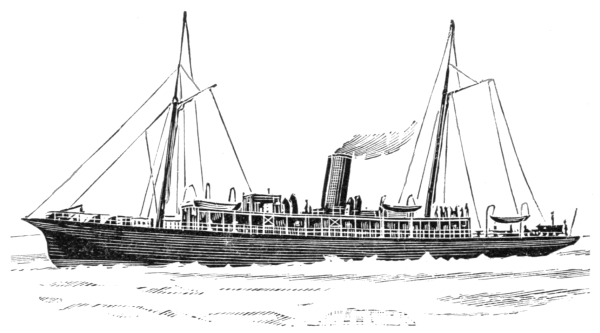
“STANLEY,” WINTER FERRY-BOAT TO PRINCE EDWARD ISLAND, 1881.
The Stanley is built throughout of Siemens-Martin steel. Her
dimensions are: length, 207 feet; breadth, 32 feet; depth, 20 feet 3
inches. She is a screw boat of 914 tons gross, and 300 horse-power,
and attains a speed of nearly 15 knots in clear water. She is so
constructed that she runs up on heavy ice, breaking it with her sheer
weight. At times she has passed through what is called “shoved ice,”
eight feet in thickness. She has good state room accommodation for
about fifty cabin passengers, and is in every way a very efficient,
powerful and staunch boat.
In the spring and fall of the year the Stanley is employed in the
Coast Buoy service; in summer she takes her place in the Fisheries’
Protection fleet, and proves herself a smart and formidable cruiser
and a terror to evil-doers. She commences the winter mail service
from Charlottetown to Pictou about the first of December, and about
Christmas, when the Charlottetown harbour is frozen over, she takes
up the route from Pictou to Georgetown, at the eastern end of Prince
Edward Island. When she is imprisoned in the ice, as frequently
happens, the mails and passengers are taken by the open boats in
manner above described. From February 8th to April 12th, 1895, when
the Stanley was laid up for repairs, the ice-boat service carried
3,497 mail bags, 458 pounds of baggage, 76 pounds of express goods, 9
passengers, and 77 “strap-passengers.”
In connection with the Lighthouse and Buoy service and the Fisheries’
Protection the Canadian Government employs fourteen steamers and three
sailing vessels. The aggregate gross tonnage of the steamers is 5,589
tons. Of these the Stanley is the largest, after which come the
Newfield, 785 tons; the Aberdeen, 674 tons; the Acadia, 526
tons—all of Halifax; the Lansdowne, 680 tons, of St. John, N.B.; the
Quadra, 573 tons, of Victoria, B.C.; La Canadienne, 372 tons, of
Quebec, etc., etc.
The history of steam navigation in this province begins with the year
1840, when Her Majesty’s ship Spitfire—a paddle steamer—entered the
harbour of St. John’s with a detachment of soldiers to strengthen the
garrison. In 1842 the steamship John McAdam visited St. John’s, and a
number of ladies and gentlemen made excursions in her to Conception and
Trinity bays, startling the natives by the sight of a vessel walking
the waters without the aid of sails or oars. In 1844 the Government
arranged with the owners of the steamship North American to carry
mails and passengers regularly between St. John’s and Halifax. When
this vessel first entered the harbour, with her huge walking-beam and a
figurehead of an Indian, painted white, half of the population of the
city crowded the wharves to see her. She had made the run from Halifax
in sixty hours. Soon after this a contract was made with the Cunard
Company for a mail service between St. John’s and Halifax, fortnightly
in summer and monthly during the winter months. In 1873 direct steam
communication with England and America was established by arrangement
with the Allan Line for the conveyance of mails, passengers and goods,
fortnightly during nine months of the year and monthly during the
remaining months, though at a later date fortnightly trips were made
all the year round.
At the present time there are five regular lines of steamships sailing
from St. John’s—the Allan Line, the Canadian and Newfoundland
Steamship Company, the Red Cross Line, the Black Diamond and the Ross
Lines. Besides these, a steamer plies regularly between Halifax and the
western ports of Newfoundland; and two local steamers ply between St.
John’s and the principal ports north, south and west.
The total number of steamers registered in St. John’s is thirty-two,
with a gross tonnage of 9,272 tons. About 1,500 vessels arrive and
depart annually from the several ports of Newfoundland. The sealing
fleet comprises some twenty steamers, with a united tonnage of 6,230
tons, and crews numbering 4,680 men. The first steamers to engage
in the seal fishing were the Bloodhound and the Wolf in 1862.
The former arrived with 3,000 seals, and the latter with only 1,300.
The largest catch of seals recorded was in 1844, when 685,530 were
captured. The cod-fishing industry is carried on by sailing schooners.
The annual catch in the Newfoundland waters is about 1,350,000 quintals
of 112 pounds. But the total amount of cod caught in North American
waters is estimated at 3,700,000 quintals annually. Allowing fifty fish
to a quintal, we have the enormous number of 185,000,000 fish caught
every year. And still they continue to multiply and replenish the sea!
As yet no steamers have been built in Newfoundland.
The total number of vessels on the registry books of the Dominion on
December 31st, 1896, was 7,279, with a gross tonnage of 789,299 tons.
Of that number 1,762 were steamboats, with a gross tonnage of 251,176
tons.[72]
The steam tonnage of the Dominion is divided about as follows:
Ontario, 41.1 per cent.; Quebec, 32.3 per cent.; British Columbia, 10
per cent.; Nova Scotia, 7.9 per cent.; New Brunswick, 3.8 per cent.;
Manitoba, 2.6 per cent.; Prince Edward Island 2 per cent.
The total number of steamers registered and enrolled in the United
States in 1896 (including steam yachts, barges, etc.), was 6,595
vessels, with a tonnage of 2,307,208 gross tons.[73]
The total number of steam vessels in the United Kingdom of Great
Britain and Ireland, over 100 tons gross, recorded in Lloyds Register
for 1896-97, was 6,508; their gross tonnage was 9,968,573 and their net
tonnage, 6,143,282. Including the British Colonies, the number of steam
vessels is 7,373 and their gross tonnage, 10,508,443 tons.[74]
Of these only about 420 are built of wood, 3,883 are built of iron and
the rest of steel.
According to Lloyds Register above quoted, the total number of steam
vessels, over 100 tons, in the world in 1897 was 13,652, and their
gross tonnage, 17,737,825 tons. The number of wooden steamers was
1,163; of iron, 7,099, and 5,390 of steel.
The British Empire owns 54 per cent. of the entire merchant marine
tonnage of the world, estimated by Lloyds at 25,614,089 tons gross; she
owns 62 per cent. of the entire merchant marine steam tonnage.
If to these figures were added the number of steam vessels in the
navies of the world, the grand total would be very largely increased.
The British navy alone would increase the number of vessels by 700 at
least, and the tonnage by more than 1,500,000 tons.
Reliable statistics are not easily found and are often accounted dry
reading. From a variety of causes, figures are peculiarly prone to err.
But whatever may be thought of the merely numerical argument which has
almost unavoidably been introduced in these pages, the indisputable
fact remains, that of all the triumphs of mind over matter in this
nineteenth century nothing has contributed more to the advancement of
civilization and the spread of Christianity, to the wealth of nations
and the convenience and comfort of the human race, than the marvellous
development of steam navigation which will ever be identified with the
history of the illustrious reign of Her Majesty Queen Victoria.