Star and Hawk kept a steady pace for more than an hour. Neither of the
boys had spoken a word during that time, then Star's rider whispered
softly—"Sh——" like the hiss of a snake in the grass, or the noise of
wind through the leaves.
Small, strong hands reached from either side of Star's neck, and fingers
were pressed firmly on his nostrils. The pressure did not interfere with
the pony's breathing, but so long as it continued Star knew that it
would be impossible for him to whinny. His rider did not know that the
pony understood the reason and the importance of being quiet.
Faintly the sound of stamping, restless hoofs came to Star's ears, and
told him that strange ponies were near. His nose touched Hawk's neck,
and the other pony signalled an answer. Star and Hawk had been friends
and playmates ever since they had been born. Hawk was two days older
than Star, but Star had always been more swift when they had chased
each other about the Comanche camp in play. Hawk belonged to a young
warrior who had not many ponies, so, long before Star had been fully
grown, Hawk had been carrying his owner. The work had made the muscles
of his back and legs very strong for so young a pony.
The two boys now released their grip on the ponies' noses and slid
cautiously down. Star watched them lying flat and crawling slowly in the
direction from which the noise of ponies could be heard. Hawk and Star,
with noses together, waited patiently.
For a long time everything was silent, then shrill yells caused the two
ponies to jump nervously. They heard snorting of ponies and trampling of
hoofs, and men's voices were calling loudly in words that were not like
the Comanche tongue. Star reared and plunged against a small rope of
buffalo hide by which he was fastened to a scrubby tree. Hawk, also
tied, was lunging and kicking.
Then something terrible happened. Frightful noises, like cracking of
thunder, seemed everywhere. Lightning flashed close to the ground. It
did not come from the sky, like other lightning when it stormed. Star
crouched and trembled in fear of the thing he could not understand, but
Hawk with a still greater effort broke loose.
"Come!" he called to Star, turning to run from the noise that was
deafening. "Come quickly! It is the fire-stick that kills Comanches and
their ponies. Run! Run! Run!"
He did not wait while Star fought and struggled against the stout
rawhide rope which held him fast. Fire leaped from darkness and noises
grew louder. Then the thud of racing ponies grew more distinct and in
the dim light Star saw a vast herd of pure white ponies rush past him
and vanish like snowflakes blown by a strong wind.
But the flashes of fire did not cease, and the pony threw his whole
weight against the rope. It broke and he was free. With a shrill squeal
Star followed the fleeing animals. Though they had passed him so quickly
he had seen two small dark forms on white ponies at the end of the herd.
They were ahead of him now, and Star redoubled his efforts until he came
abreast of Hawk. Together they raced, but slowly and surely Star passed
him.
Like a thin cloud the white ponies kept ahead of Star. His ears cocked
sharply, his nose was thrust far out and level with his shoulders, his
eyes peered into the gloom to gauge the distance and make his own pace,
his body flattened more closely to the ground, and the steady stride of
his slender legs never wavered, while his mane tossed wildly and his
long black tail fluttered in the air that he cut in his wild race.
He reached the fear-crazed white animals, and edging his way between
them, Star found the boy who had ridden him now seated astride one of
the largest white ponies. Star looked at it as he ran beside it. He had
never seen such a big pony in all his life. But the Comanche pony saw
that the white pony was breathing very hard, while its legs moved
uncertainly and heavily as it ran.
"It is a big pony," Star said to himself, "but I can out-run it without
trouble. Buffaloes are big and heavy. They can run fast, too. But an
antelope or deer is more swift. I can out-race an antelope. So can my
mother!"
He tossed his saucy head and slyly poked the big white pony in the ribs,
to make it go faster. But the poor beast was doing its very best, and it
rolled its eyes toward Star.
"Please don't bite me," it spoke. "I am too old and too fat to run so
fast and so far!"
"I won't hurt you," replied the Comanche pony, crowding more closely.
The Indian boy on the white pony's back saw Star, and twisting sidewise,
the lad gathered himself, leaped from the horse he was riding and landed
firmly on the back of the Comanche pony.
The boy's shout of triumph mingled with Star's squeal of delight as out
of the darkness rode Quannah on Running Deer, while back of the chief
dashed the rest of the warriors.
Circling about the white horses the Comanches urged them rapidly over
the low rolling hills until they were completely hidden in thick
undergrowth, where they halted.
The white horses showed plainly how hard the pace had been, for they
stood with heads hanging low, their sides drawn and nostrils dilating
rapidly. Many of them lost no time in lying down where they stood,
without even seeking a comfortable soft spot.
"They tire easily," Star said to his mother who was near him. "Hawk and
I could have left them far behind and it would not have made us puff
like these white ponies. They must belong to squaws and children. They
are too fat and too slow for fighting men."
"No herd can run as fast as the ponies of the Quahadas," replied his
mother. "Come, lie down and rest while there is time. When we are out
with the warriors it is our duty to rest and feed whenever we have time,
for when we travel we cannot tell when we will stop. Only Quannah knows
that."
Star glanced at the warriors who sat on the ground and talked together,
while still others, on their ponies, guarded the captured white animals.
Two days and a night of fast travelling made Star feel that he had
earned a good rest, so he slipped to the ground and soon was fast
asleep.
But in his dream he was racing again. This time he was trying to reach
Songbird who was calling to him that the white men were taking her away,
as they had taken Quannah's mother and sister, so that she could never
come back again to her people. He was running faster than any Comanche
pony had ever run before—twice as fast as Running Deer could run, for
he thought she was trying now to keep pace with him and was falling
behind. Only the storm wind could travel that fast. Star found that no
matter how swiftly he raced Songbird was always beyond him. He could not
see her, but her voice came back to him.
"I am coming," he whinnied shrilly.
Her voice grew more faint and at last it ceased altogether while he
whinnied despairingly, hoping to hear her answer.
Then he felt his mother touch him, and opened his eyes to see her lying
beside him.
"What is the matter?" she asked. "You are kicking so that you wakened
me."
He told her the dream and she listened gravely, though she answered
carelessly, "You are over-tired. After all, you are but a colt and your
muscles are soft. You have been tested as few colts are tested at your
age. Go to sleep again, so that you will be ready to travel with us, for
last night I heard Quannah say that as soon as the big white ponies have
rested, we would start for the camp of the women and children. Now that
we have captured the white men's ponies they cannot catch us. That is
why we are to rest for to-day."
When it was time to get up, Star felt as well as though he had never
raced, but the big white ponies were still weary. Some of them did not
rise. Many others moved stiffly as they mingled with the Comanche herd
while they cropped the grass together like old friends.
Most of the warriors had gone across a small ridge into a gully or
ravine, where they made a camp. This was done so that the smoke from
their camp fire might not be seen from afar, and thus tell the white men
where to hunt their lost ponies. Only dry wood was used for the camp
fire. Wood fresh or green would have made too much smoke. A few warriors
were left to guard the herd, for the Comanche ponies were trained to
keep together, while the white ponies were too tired to run away, even
if given a chance to escape.
Star wandered near the white horse that had begged him not to bite it
because it was too old and too fat to run so fast. With raised head and
a bunch of grass hanging from its lips, it looked curiously at the
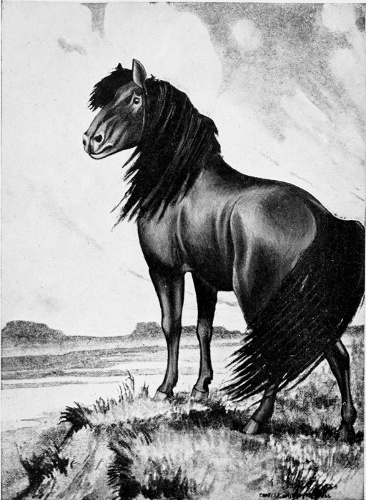
Comanche pony. Slowly its eyes travelled from Star's velvety nose, along
his straight back, his slender legs and strongly muscled flanks to the
sweeping black tail that almost touched the ground. The white horse
swallowed the clump of grass before it spoke.
"You are a beautiful horse!"
"I am not a horse," Star answered indignantly, "I am a Comanche pony.
What is a horse, anyway?"
"A horse is a big pony," replied the other. "I am a horse. We cannot run
as swiftly as you ponies, but we are stronger to haul burdens when we
are hitched to wagons by our masters."
Star was so surprised that he stopped grazing to talk with the
good-natured white beast, and it told him there were thousands of men
with white faces, who carried guns and lived in houses made of rocks
instead of tepees of hides. He told how these men fed corn and hay to
their horses, as well as grass. Then he explained how some horses were
taught to be gentle, so that saddles were placed on their backs and bits
in their mouths; other horses learned to drag carriages in which women
and children rode safely, and still other horses hauled heavier wagons
loaded with blankets and food.
"They even build houses for us," he continued, "and when it storms we
are warm and dry and have nothing to do but chew our grain. If we have
to go out in a rain, when we come back we are rubbed dry and a warm
blanket covers us to our heels so that we may not be chilled. But
sometimes white men are cruel to us," he added.
"I hate men with white faces," snorted Star, stamping his forefoot
angrily. "My mother says that they will take our game and our grass and
kill all the Comanche ponies and people. The white men took Quannah's
mother and sister away and they never came back to us. That is why I
hate men with white faces!"
"Not all of them are that way," the big horse said earnestly. "Many
white people do not wish to fight. Sometimes Indians have killed white
women and children and have burned their homes, or taken them prisoners.
Then the Great Father of the whole world, who is over the white people
and the Indians, too, has to send soldiers to find the white prisoners
and make the Indians keep away from the homes of the white men."
Star thought over these words before he asked, "Who told you all this?"
"I learned it myself, through many years of hard work," was the reply.
"Ever since I was five years old I have belonged to the White Horse
Troop which was captured by the Indians last night. Only white horses
are in that troop, but in other troops there are blacks and bays and
sorrels. Each of the troops has three officers and the captain is in
command while the others are under him. So for many years I have gone
with the troop over miles of rough country, sometimes swimming great
rivers, and often we encountered big bands of Indians who fought us.
Maybe the Indians are wrong, maybe it is the white man, but men are our
masters and so, right or wrong, we obey them and love them. Yet we
horses do not understand, nor do we fight the Indian ponies. I am old
and I do not wish to fight any one. But we must obey our masters. When I
was young I did not ask questions, but now that I am stiff from years, I
wonder why people fight one another."
"Do all your horses fight?" was Star's puzzled comment.
"Not the band horses," replied the white horse. "They do not go out of
the garrison where we all live together. Their riders have shining horns
and big drums that make such beautiful music that when we troop horses
come out on parade, we cannot keep our feet from dancing or our necks
from curving with pride. The Band horses are very proud and keep to
themselves when we are all out grazing, and of course, no one could
blame them for that."
Star listened in amazement. He was anxious to learn all that he could,
so as to repeat this wonderful story to his mother.
"You use so many strange words," he said at last. "What is a parade?"
"Why, just a big green piece of ground, but all around it are buildings
where officers and soldiers live. In the centre of each parade is a very
high white pole. On top of it floats a beautiful flag."
"What is that?" interrupted Star, bewildered.
"It is like a big blanket made of fine cloth. There are stripes of white
and red and in one corner is a patch of blue with white stars on it."
"I know what a star is," said the Comanche pony. "My name is Star
because I have the white mark on my forehead. Songbird, the little
daughter of Chief Quannah, gave me that name when I was too small and
too weak to stand up on my legs. I belong to Songbird, and my mother,
Running Deer, is the favourite pony of the chief," he ended proudly.
"I saw her talking to you," was the answer, "and I thought how beautiful
she was!"
Star edged more closely to his new acquaintance. "Even though our
masters fight, I like you and we will be friends," he said, rubbing his
nose against the white horse's neck, then letting his neck rest across
the troop horse's back, Star bit gently, while the big horses did the
same to him. Only horses who are fond of one another give this pledge of
friendship.
"I wish our masters would be friends, too," said the old troop horse at
last. "If every one would be friends there would be no more fighting."
"There is enough grass and room for all the tepees, so maybe they will
stop fighting soon," Star spoke hopefully.
"Some horses kick and bite and steal grain from the others," the white
horse answered, "and when one horse in a team kicks, balks, or will not
pull its share of the load, the other horses must do it all. White men,
Indians, and horses are all the same. Some are good, some are bad, but
the burdens of those who are bad must be carried by those who try to do
right. I am the oldest of those in the White Horse Troop and I speak of
things I have seen in many long years. I am sorry for the horse that
kicks and bites and steals, but I do not hate him. The whip is made to
punish him, and some day he will suffer."
The day passed quickly for the troop horse and the Comanche pony. When
the shadows of the trees disappeared because the sun was straight above
the camp, the troop horse stretched out for a noonday sleep, and Star's
black head rested on the white horse's neck.
Running Deer, searching for her colt, found them together and she lay
down beside them.