So they came to the place where the
Princess was. And when they looked
down there were treetops—
But that is not a proper beginning
when nobody knows who they were
or anything about it.
There were four of them,—the Princess and three
Others.
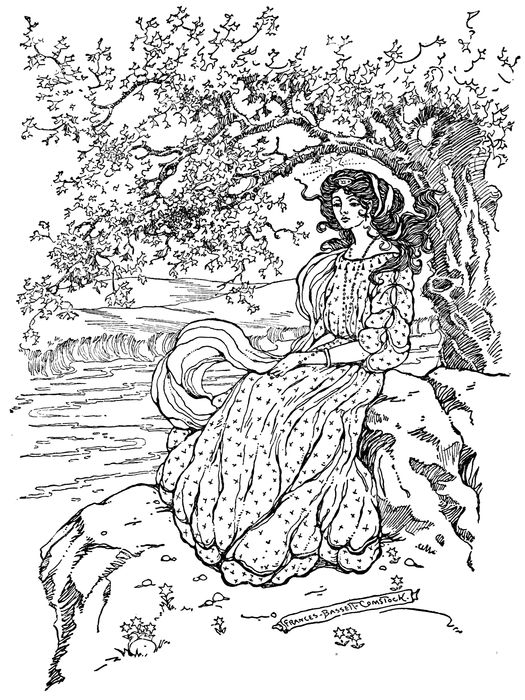
What the Princess’s name was isn’t to be told, and she
was not a real princess. But that made no difference to the
Others. She was the most wonderful person they knew, and
everything a princess should be, and they loved her loyally.
2The Others were called Prudence, Pat, and the Kitten;
but the true name of each one of them was the true name
of the Princess,—that isn’t to be told and doesn’t matter.
Prudence was the oldest, and very wise. (That was why
she was Prudence, but more often the Princess said, “Miss
Phyllis-y.”) She had brown eyes, clear and steady, and
short hair. There was a perky little lock on one side of the
middle of her forehead that reminded the Princess of a
question mark. She was small and looked years younger
than she was, and that made her funny when she was so
sagacious.
Pat was the tallest and the most impatient. (So they
called her “Patience”—because she wasn’t!—and shortened
it to Pat.) She talked with her eyebrows; and sometimes
they would fairly frighten you if you didn’t know she
couldn’t do it! Her hair was braided and tied tight, but
usually a good deal of it escaped and ruffled before it reached
the braids. She was over nine and Miss Phyllisy was not
far from twelve, and they considered the Kitten extremely
young,—which the Kitten didn’t deny. She was young,
and she had other kitten-tricks,—like coming and sitting
on a person’s knee without being invited when she wanted
to, and other times being very independent and going her
own ways; and she made soft little songs for herself,—that
3didn’t begin or end any more than a real kitten’s,—and
purring sounds instead of talking when she was pleased.
But she could talk faster than countless kittens when there
was any occasion for it.
That is who they were. And any one can fancy how
they were frisking about in the garden and out,—and the
nearer it grew to bedtime, the farther they kept from the
house; and how they trailed up the crooked path on the
side of the hill,—the Kitten following along, making a
song for herself,—and finally came to the farthest, high,
wild lookout place, with a railing at the edge overlooking
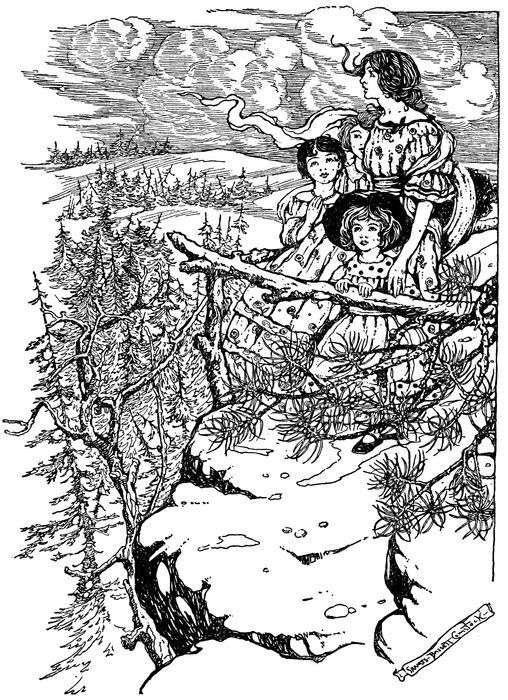
the dark treetops. And there they found the Princess
watching pale little stars coming out in the light sky.
The Kitten didn’t come close until she was ready, and
then she immediately cuddled up, sleepy; but the Others
went straight to the Princess. She put her arm around
them and they leaned against her, but they didn’t talk,
they watched with her. And more stars came out where
they looked steadily, and others came where they didn’t
look, more than they could count, all silent, to look back
at them. And the Princess was smiling to herself.—
But that didn’t suit Pat very long, it made her uneasy.
First she puckered her eyebrows, but nobody saw her;
4then she sighed, but nobody noticed; then she spoke,—“What
are you looking at?”
The Princess still looked, but she squeezed with her arm.
“Some people I know. Friends of a friend of mine.”
Pat didn’t understand, so she grew wary (that was one
of her ways). She twitched her shoulder, but she wouldn’t
be the next to speak—unless it were too long!
“What people, Dearie?” asked Prudence, when they
had waited a minute and the Princess didn’t speak
again.
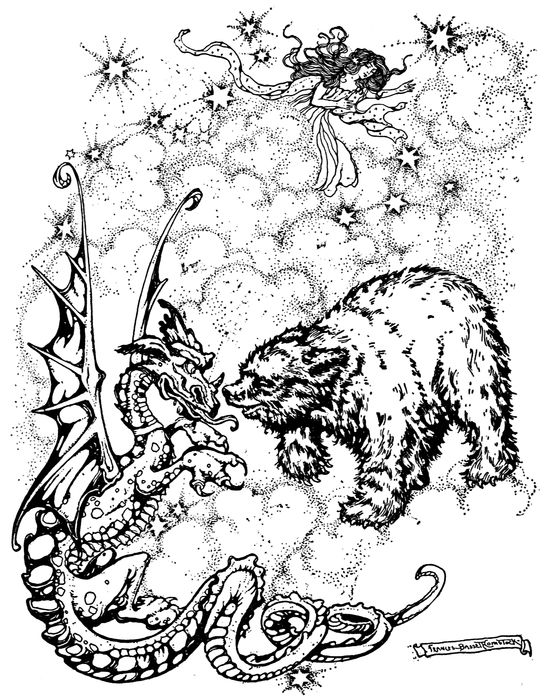
“Most illustrious, highly exalted. A king and a queen, a
royal dragon, and an indispensable little bear—wonderfolk,”
ended the Princess, as if that explained it.
“You’re looking at the stars,” said Pat-who-would-n’t-be-imposed-upon.
“Star People, Pat. Can you guess now?”
“I think I can, Dearie. But you tell,” said Prudence.
The Princess took her arm away so she could point
with it, and she put her head down beside a dreadfully
scowling little girl’s, so they could look along and off the
end of the same finger. It pointed where five stars made
a zigzag in the sky. She pointed to one after another.
THEY WATCHED WITH HER
5“Look like a ‘W,’ don’t they, Pat?—But there’s another
star—very pale—and another off here. Now, see—tipped
up—so—Isn’t that a pretty good chair? How would you
like to sit there and overlook things?”
“Cassiopeia wouldn’t let her,” said Prudence. “That’s
Cassiopeia’s Chair, Pat. She doesn’t allow any one to sit
in it.”
“I don’t want to.” Pat spoke in a loud whisper.
“That is where you’re mistaken, Miss Phyllisy,” said
the Princess. “She wouldn’t mind a bit. But she is sitting
there herself, this minute.”
“Really, Princess? I didn’t know that!”
“Did you ever see her out of it?” (Miss Phyllisy
giggled.) “There is one of the stars on her most loftical
head. Do you see it?”
“Who said it was that?” asked Pat. Her manner was
a trifle threatening, but she was ready to be friends.
“Said what?”
“Cas—what you called it. Why did you call it that?”
“Cassiopeia’s Chair? That is what it was named long and
long ago.”
“Long as Ancients?” (The Princess knew all about
the Ancients,—several kinds of them. She knew everything.)
“Long as that,” she answered. “They’re the very ones
who named the Star People for us, saw the figures in the
6stars, and gave them the names of their own gods and
heroes, animals,—all sorts of queer things. Useful lives
they led, those Star People, ever after.”
“How were they useful?” asked Phyllisy.
“To the sailors, Beloveds, most of all, or any one who
wants to find his way where there’s nothing on Earth to
guide him. In the middle of the most vastest ocean or the
most widest plain, all they have to do is to look up and
see where the Star People are; then they’ll know where
they are themselves, and where to go to be somewhere
else. Of course the Star People can’t help any one who
doesn’t know them,” she added.
“We don’t. We could be lost any time,” said Pat.
“You might have been once, but not after this. There’s
a whole Royal Family right before your eyes now: Queen
Cassiopeia on her throne and King Cepheus beside her
and their pretty daughter, Andromeda.—That is one of
Cepheus’ stars—and there’s another.” The Princess drew
lines with her finger from the stars of the big “W” to the
ones they wanted to find. And the Others picked them
out, passing from star to star like crossing a brook, jumping
from stone to stone. There were different colors, too,
to help them. The Princess saw them plainly,—red stars
and blue and yellow, and never before had the Others
7seen anything but all alike and plain shining. At first they
believed it only because the Princess said so; then they
began to see it themselves, but it was still too light to see
very well. And they found a few stars of Andromeda.
“There is a beautiful young hero who belongs with
them,” said the Princess. “He’s down below the treetops
now; he will come up later. He is Perseus,—the Rescuer.
He helped the Cassiopeia family out of terrible trouble
when they were all Earth People.”
Miss Phyllisy nodded, and Pat twisted her eyebrow.
“Well,—she’s eleven and nine months, and I’m only
nine and seven months,” she said, just as if she were arguing
something.
“I only happened to, Pat,” said Phyllisy.
“She’ll tell you some time; then you’ll know him too,”
said the Princess. “I want to show you somebody splendid.
Tip your heads up. Do you see four stars that make
a long diamond,—three brighter and one not so bright at
the point? That’s Draco’s head,—the great Dragon.
See his spiky wings lifted. His tail comes down this way.
Look,—a curl,—so.” She swung her finger around.
“Isn’t he fine? Keep your eye right on him and I’ll tell
8you who he is. He isn’t one of your common, everyday
dragons you meet so often.—Is your eye on him,
Pat?”
Pat tipped her head up, then she tipped it down and
nodded. The Princess squeezed the young Other One,
who was sleepy, in the hollow of her arm, and began in a
story-telling voice: “There was once a young man named
Jason, who had a great many adventures. One of them
was when he set out to bring home the fleece of a ram.
(A ram is a grown-up lamb, Kitten.” The Kitten made a
funny little bleating noise, like a mother-cat; but she was
only partly awake.) “And this was a golden fleece. And it
hung on a tree all-by-alone, where any one might have
stolen it,—ONLY, it was guarded by a great dragon that
lay curly at the foot of the tree, and never closed his eyes,
watching it. And that was the very identical Dragon
you’re looking at this minute.”
“Tell us what happened then, Dearie,—when he
didn’t close his eyes,” urged Phyllisy, after they had
looked again at the Dragon.
“He did!” the Princess closed the words off—snap!—so
they were tight shut,—and the Others giggled. “Jason
gave him some magic drops that put him to sleep, and
carried off the fleece.”
9“What did they do to the Dragon when they found the
fleece was gone?”
“I wasn’t exactly there, Phyllisy; but you may judge by
this, they made him a Star Person to reward him because
he was a good reliable dragon until he met a Bewitchment
that he couldn’t help.—And he’s very happy there in the
Sky, half surrounding the indispensable Little Bear who
carries the Sailor’s Star on the tip of his tail. He’s still
guarding something very precious, you see.”
“You haven’t told us about the indispensable little
bear,” said Phyllisy.
“Tell about little bear,” the Kitten murmured.
“Tell us,” said Pat, coaxing the Princess’s hand up and
down.
The Princess didn’t answer at once. She was looking
up into the twinkly blue—very far away—as if she were
forgetting the Others. At last she spoke: “Little Bear is
a very special friend and friend’s friend. I’d rather tell you
about him another time,—when he isn’t listening.”
“Can he hear?” Pat whispered it.
“Surely,—and carry messages.”
“Will he do it?”
“He did,—brought me one and took one.”
“Oh-h,—what did he say?”
10The Princess laid her fingers on her lips.
“Is it secrets?” asked Phyllisy.
“Long secrets.” Her voice smiled in the dusk. “But
I’ll tell you the Word of it,—‘Faithful.’”
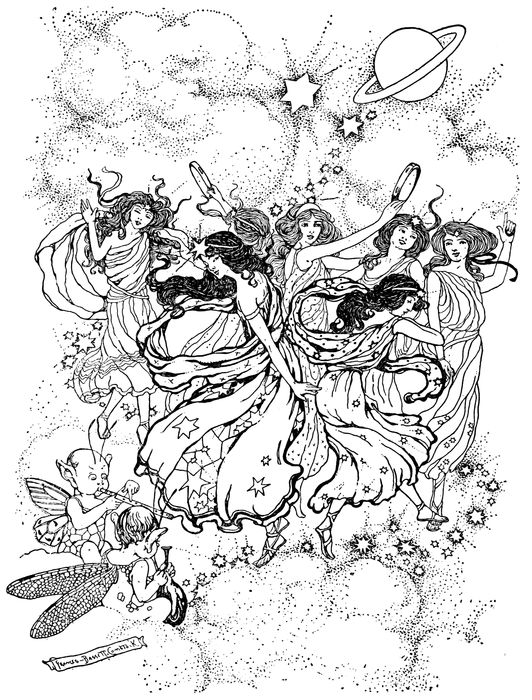
The Sky was dark and deep and crowded with stars.
They sat very still and mysterious while a wind came out
of Beyond. They could hear it turning back the leaves
in the treetops,—saying, “H—ss-sh—” as it passed
through, and all the stars winked.—
“Wake up, Kitten!” said the Princess.
But she didn’t have to wake up entirely, for the Princess
held her hand coming back, down the rocky steps and
along the paths, and her feet walked themselves.
II THE SAILOR’S STAR
11
Quite suddenly the Princess was there,
at the head of the path where four steps
came down the terrace,—all silken and
wonderful and growing up into a rose
at the top, that wasn’t a rose but a hat!
The Others dropped everything and
ran, and she waited until they got there and hung on her
arms. And they walked around her to look at it in the
back.
“What kind of a party was it?” asked Pat.
“They were married and lived happy ever after, and
there were bridesmaids all in a row,” said the Princess.
“So there wasn’t any more to that;—and if anybody
12wanted me to tell them about how the Pole Star happened,
I should say this was the most suitable time.”
“It is for us, very convenient,” said Miss Phyllisy. “We’ll
come this minute.”
They waited while the Princess gathered up her skirt
where it trailed,—soft outside, but fluffy under,—and
threw it over her arm, to start fair: One, two, three, and
away!
The Kitten won, because she truly ran very fast and she
looked straight ahead, but Pat wanted to see behind at the
same time, to know if the others were gaining.
By the Shadow Pool, they two watched the Princess
with Prudence beside her—very companionable—walking
the last bit of it—across the little bridge below, then
turning up the dark path on the edge of the ravine, with
trees arching over from the hillside. Looking out the other
way through a gap in the trees, they could see—like a
picture in a frame—the steps coming down the terrace
and the path curving down by the petunias, all in the sun,
then dropping away out of sight into the trees that it came
out of to cross the bridge.
In here it was cool and deep shade, in tall woods on the
steep hillsides that opened out like a “V.” There were
rocks with maidenhair and moss in the banks behind; and
13in the point of the “V”—higher than any one could reach—a
thin waterfall came over the edge of the rock, and
fell a little way, and slid the rest into the still pool with
goldfish in it, and others that were the same color as
shadows in water and scarcely showed unless they darted
across. The water went on over another edge that was
made for it, and ran away at the bottom of the ravine,—hunting
for the sea; but the fishes lived there for always.
There were seats around the pool in convenient places
where a tree or a rock made part of it and twisted wood the
rest. But there was one broad seat with a high twisted
back against the rocks behind, and a long flat rock before
it for a footstool, that was stately for the Princess.
She pulled out long pins,—curious ones, carved at the
top,—and the hat that wasn’t a rose, but grew up as if it
were part of her, came off and left her altogether finished
without it, with coils on top.
And because the Princess was willing, Miss Phyllisy put
it on her own head. The Shadow Pool was a mirror, so she
could see if it looked as if it were growing there, and Pat
looked with her. But Pat looked also at the back of Miss
Phyllisy’s head. “It ought to be more hair—done up,” she
said. Phyllisy twisted her head to see in the pool, and she
put up her hand and felt down her hair behind; it ended in
14a point in the middle of her neck,—the locks crossing in
from the sides,—like a very small duck’s tail, about an inch.
The Kitten slipped her finger under and turned up the
lock, and it curved around the finger.
So Phyllisy took the hat off and they put it carefully where
it wouldn’t fall, and “would be all right, Dearie,”—and
they settled down in their most usual places: Phyllisy,
where she could look into the pool from across and see the
Princess upside down; Pat, in the narrow seat in the crotch
between two trees,—but she would move to another pretty
soon, because she always did,—and the Kitten, sitting on
her foot in the seat next largest to the Princess’s.
“It is about the last, youngest Star Person of all; and
how there came to be the Pole Star,” said the Princess.
“We’ve told the Kitten what she didn’t hear, all she
could understand;—so you won’t have to plan about
that,” said Prudence.
“I could understand before,” said the Kitten. “I heard,
too,—myself.”
“Oh, Dearie,”—Prudence had “Dearies” to spare for
others beside the Princess,—“you were asleep, and you
couldn’t be expected to understand it all; you’re such a
little girl—under seven.”
15“I’m going to tell it most particularly to you, Kitten.
Now, see if you don’t,” said the Princess.
She leaned a little forward on the stately seat, her elbow
on her knee, and the silken folds fallen down on the broad
stone. She looked for a long moment, her eyes shining
straight out. And then she began:—
“Once upon a time, so long ago that nobody can remember
when, a beautiful ship was sailing along under a
spanking breeze with all sails set. The name of the ship
was the Jane Ellen, and she was named for the Captain’s
wife. At her prow was the figure of a mermaid, with long
waving hair; and the head of the mermaid was like the
head of the Captain’s wife. But that was when she was
young. Now she sat at home and knit; but to the Captain
she looked just like the lovely mermaid, and he kept the
Jane Ellen spick and span from truck to keel,—the finest
ship afloat, as she was the best of wives.”
(No one could tell stories as the Princess told them.
The things she told she knew so well, it was as if she
were seeing them, and words were waiting for her and
came orderly, just as she needed them to make it plain.)
“Now, as the ship was sailing along on this fine starlight
night, and everything favorable, the Captain in his
cabin felt a great jolt, then a s-scrape, and the ship leaned
16away over, and everything that could slid down to one
side. The next minute it tilted the other way, and most
of them slid back again, and then the ship went on as
before.
“The Captain jumped up and put his head out of the
cabin window and looked fore and aft along the deck. He
saw a man coming toward him, and called, very sharply,
‘Mr. Morganwg!’[1]
1. He called it “Morgan-ough,” but he was particular about the spelling.
“It was the Mate of the Jane Ellen. He was young and
big, and he had gray eyes and black hair and heavy black
eyebrows that almost met over his eyes, and he could look
very stern, but his eyes laughed; and he could sing, and
if he had had time, he could have played on a harp, because
he was a Welshman, and his name was Taffy. But
he didn’t have time, because if you are mate of a ship
like the Jane Ellen, you have a great deal to do, and have
to be everywhere at once, to see that things are done as
the Captain wants them.
“‘What was that?’ asked the Captain.
“‘We struck on Porpoise Rock, sir,’ said Taffy.
“‘Who’s steering?’
“‘Nelson.’
“‘Well?—he knew the rock was there, didn’t he? It’s
17marked on his chart plain enough. There’s no excuse, a
bright starlight night like this.’
“‘Yes, he knew it,’ said the Mate, ‘but he says he
didn’t make enough allowance for the stars moving. He
says if there were one star, only, that he could depend
on to be in the same place every night, it would be all
right.’
“‘Well, there isn’t,’ said the Captain.
“‘I know it,’ answered the Mate. ‘But you know yourself,
it’s confusing to steer by them.’ Taffy spoke quite
respectfully, but he often made suggestions to the Captain
when no one was listening, and the Captain loved
him like his own son.”
“Do they move?” asked Pat.
“Yes,” said Phyllisy. “Don’t you know?—rise and
set.”
Pat looked at the Princess to see if that was what she
meant, and she nodded, and went on:—
“‘H’m!’ said the Captain. ‘You go and drop anchor
right now. I won’t have any more paint scraped off from
this ship. Then you come here and we’ll talk it over.
Something’s got to be done.’
“‘Very well, sir,’ said Taffy, touching his cap. And a
few minutes later a great quivering and trembling went
18through the ship as the anchor chains slid out; and then
they lay quiet, rocking gently on the waves, and everybody
went to bed except the Lookout and the Captain
and the Mate.
“No one knows just what was said in the Captain’s
cabin, or whether he or Taffy made the suggestion, but
this is what happened:—
“The next morning, just before sunrise, the Mate
stepped out of his cabin and walked for’ard. He leaned
over the fo’c’s’le hatch, which stood open, and called,
‘Bos’n!’
“‘Ay, ay, sir,’ answered the Bos’n from below. The
next minute he stood beside Taffy on the deck.
“‘Assemble ships!’ ordered the Mate.
“‘Ay, ay, sir,’ said the Bos’n again. He had a whistle
hanging from a string around his neck that he used for a
signal to the sailors, but he didn’t use that now. Instead
he took from a pocket inside his shirt another whistle.
It was no larger than the first, but when he put it to his
lips and blew,—the sound was so high and clear it
seemed as if it must go all around the world! And before
very long,—just as if it had gone, and was broken up
on the way, and was coming back in little pieces,—from
every direction came a faint, thin little answering whistle.
19“And then the Captain and the Mate and the second
Mate and the four Quartermasters and the Bos’n and the
sailors and the cook and the cabin boy—who were all on
deck by this time—saw appearing, one by one, on the
horizon, little specks, that as they came nearer, showed
themselves to be ships of all descriptions,—schooners
and brigs and barkentines and barks and frigates and
luggers and full-rigged ships. And every time one of the
little specks appeared the Lookout would call from the
masthead, ‘Sail ho!’ and the Captain would say, ‘Where
away?’ and the Lookout would answer, ‘Two points on
the weather-bow,’ or wherever it happened to be.
“All the morning long, all these different kinds of ships
tacked and jibed and went about and missed stays and
luffed and beat to wind’ard, and in all these ways drew
nearer and nearer, until, just as the Quartermaster made
it seven bells, the last one of them hove to, and the Jane
Ellen lay surrounded by fifty-two ships of every kind you
ever saw,—but none so fine as she!
“Then from the peak of the Jane Ellen fluttered a
string of little flags,—red and yellow and white and
green,—and the little flags said to the captains of the
other ships, ‘Will you please come aboard the Jane
Ellen?’ Then from every ship a boat put out, and was
20rowed to the side of the Jane Ellen, where a rope-ladder
was let down to the water’s edge. Her Captain stood on
the deck by the rail, with the Mate standing by, and shook
hands with every captain as he came over the side, and
said, ‘I’m glad to see you, sir!’
“When they all had come aboard and were assembled on
the hurricane deck the Captain made them a speech,
while the Mate went and told the cook to ‘look alive with
lunch, to have it ready when the “Old Man” gets through
with the powwow!’
“This is the Captain’s speech: ‘I suppose you wonder
why I called you together? Perhaps you noticed a big
mar on the Jane Ellen’s bows, where the good new paint
is scraped off?’ All the other captains nodded. ‘That
happened last night,’ said our Captain. ‘We ran on Porpoise
Rock; and my quartermaster, Nelson, said he ran
a-foul of it because he didn’t make enough allowance for
the stars moving. I’ve got as good quartermasters as any
ship afloat, but I know—you all know—that kind of
thing happens to all of us.’ The captains nodded again.
‘The trouble isn’t with the man at the wheel, it’s just
here,’—and the Captain struck the palm of one hand with
the forefinger of the other several times, and they all
looked at it to see what it was,—‘He hasn’t the right
21kind of stars to steer by!’ The captains all looked up at
the sky, and blinked, because it was just noon and the
sun was very bright, and then looked at one another, and
one of them said, ‘What kind of stars could we have?
We’ve got all there are.’
“‘Oh, these stars are all right, but they move about so!
Night after night they go ’round and around! A man is
almost too old to take his trick at the wheel before he
learns to make allowance for it. Now, we’ve been fair and
honest, and we’ve steered by these stars—and sworn by
them—as long as there have been ships and sailors, and
the Star People ought to do something to help us out.
So I propose to send some one to put it to them fairly,
and see if they can’t keep one star always in the same
place. Then we could start from that, and know where
we were.’
“‘How are you going to get up there?’ asked the same
captain who had spoken before.
“‘We’ll show you after lunch,’ said the Captain of the
Jane Ellen. ‘That is, if you all agree?’
“The other captain asked, ‘Do you all agree?’ and they
all nodded.
“Then the other captain said, ‘Three cheers for the
Skipper!’ and fifty-one captains shouted, ‘Hurrah!’ three
22times. So that was settled, and they went down to the
cabin for lunch.”
“What did they have?” asked the Kitten.
“Plum duff,—full of raisins,” said the Princess.
“Did they like it?” asked Pat.
“You’d have thought so if you’d seen them. Every
one took a second helping until Taffy was almost discouraged.
He was in a hurry to be through. But at last
they were finished and back on the deck to hear what the
Captain had to propose.
“‘Now,’ said the Captain, ‘we shall have to borrow
your masts and some anchors.’ They nodded, and the
Captain called; ‘Mr. Morganwg! You may set to work.’
“‘At once, sir,’ said Taffy, and called, ‘Bos’n!’
“‘Ay, ay, sir,’ said the Bos’n, running up.
“‘Call the men,’ ordered the Mate.
“The Bos’n blew his ordinary whistle, and at the same
time the captains began to go over the side of the Jane
Ellen to return to their own ships. They all looked very
smiling and good-natured but one man,—the one who
hadn’t cheered.
“When it came his turn to say good-by, he just humped
up his shoulder and growled, and then he turned around
and said, very loud, ‘The rest of you can do as you like,
23but I’m blowed if you take my mainmast for any such
foolishness!’ Then he went down the side of the ship and
was rowed away.
“The captains who heard him looked perfectly disgusted,
and Taffy said to his captain, ‘Shall I attend to him, sir?’
“‘Yes!’ said the Captain, and they all nodded.
So, before they did anything else, Taffy and the Bos’n
and his men went to the rude Skipper’s ship (it was a brigantine,
the Wandering Willie), and they set all the sails,
and tied the ropes in hard knots instead of just belaying
them, as every one knows is seamanlike. Then they
weighed the anchor, and got off as quickly as they could,—and
off went the Wandering Willie! And it had gone
only a little way when the wind changed, and the Skipper
shouted in the roughest voice, ‘Ease ’er off!’ And when
the sailors tried, they couldn’t untie the knots, and the
ship keeled over, farther and farther, until, all at once, she
turned bottom up, and every one had to swim back to the
other ships! The crew were glad of it, because they were
better off; and the rude captain, who couldn’t swim very
well, had to be thankful to be pulled aboard and allowed
to ship before the mast on the Jane Ellen. And he learned
in time to be a very good sailor.”
“That was just right for him,” said Pat.
24“That’s what I think,” said the Princess. “But while
all this was happening, the work was going on on all the
ships. The first thing they did, they brought twenty-four
large anchors, and anchored the Jane Ellen, twelve
on a side and her own two at the bows, so she couldn’t
even wabble. Then they drew up all the other ships in a
long line, one after another, with a space between, and unstepped
the mainmast of every ship. When every ship had
her mainmast lying on the deck, beginning with the Jane
Ellen, they spliced them all together, the top of one to the
bottom of the next one. It took them all that afternoon
and part of the next morning to do it.
“Meanwhile, other sailors had brought twenty mizzen-masts
to the Jane Ellen, and, one after another, they were
carried up her mizzen-mast and spliced to the top of
the one below. When they were all in place some hoisting-tackle
was made fast to the top, pulley-ropes were run
through it and carried out over the other ships and fastened
to the spliced mainmasts, about a third of their length away.
“By this time it was four bells in the afternoon, and
everybody was pretty tired, so the Captain said they might
rest for an hour, all except the cook, and he had to serve
out grog. So all the seamen had their grog, and lay
around on the deck and looked up at the tall mizzen-mast
25and the hoisting-tackle, and thought what a good captain
they had, and that the Jane Ellen was the finest ship afloat.
“Six bells had hardly finished striking when the Mate
jumped down from the rail where he had been sitting, and
called, ‘Bos’n!’
“The Bos’n sprang up and said, ‘Ay, ay, sir!’
“‘Pipe the men aft,’ ordered the Mate.
“‘Ay, ay, sir,’ said the Bos’n again, and blew his whistle.
“The seamen all jumped up nimbly and came trooping
aft to the foot of the mizzen-mast. There some of them
brought a winch, and some more arranged the pulley-ropes
and passed them around the winch, and carried
them fore and aft, and arranged more tackle around the
heel of the mainmast, and did a great many things to
them that I don’t know anything about, but the Mate did,
for he directed it all, without stopping even to think.
And the Captain came and looked on, and he looked as
proud as if he had done it himself!
“At last everything seemed to be done, and Taffy
asked, ‘Are you all ready, Bos’n?’
“‘Just waiting for Tom Green to sing the chanty, sir,’
said he. And in a minute, Tom Green came.
“He wasn’t a very large sailor, but he had one blue
and one brown eye, and red and blue anchors and ships
26and stars and a weeping-willow tattooed on his arms; and
he wore his sleeves rolled up high to show them. And he
stood up on a water cask in the stern, and the sailors all
stood ready, in long lines, with the ropes in their hands.
“Then the Mate said, ‘Are you ready, Bos’n?’ and the
Bos’n said, ‘Ay, ay, sir!’
“‘Then, hoist away!’ ordered the Mate.
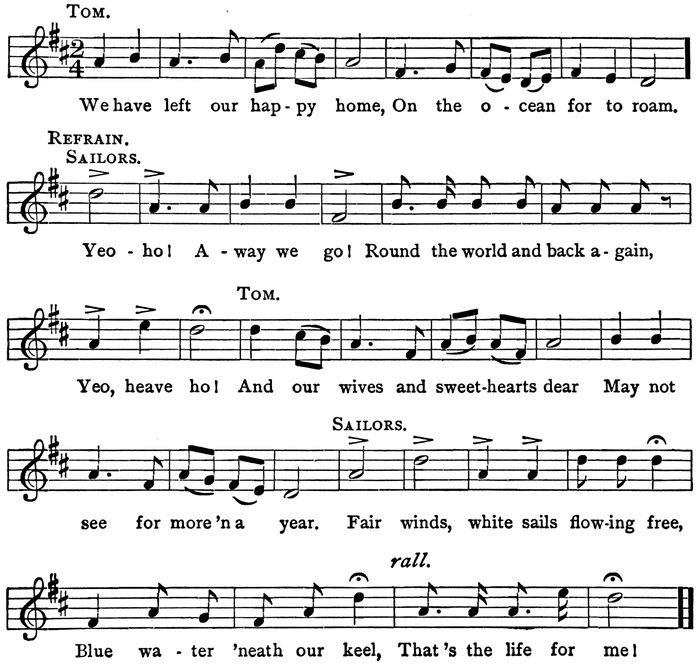
“The Bos’n blew his whistle, and Tom Green began to
sing the chanty, and this is how it began:—
We have left our hap-py home, On the o-cean for to roam.
Refrain.
Sailors.
Yeo-ho! A-way we go! Round the world and back a-gain, Yeo, heave ho!
Tom.
And our wives and sweet-hearts dear May not see for more’n a year.
Sailors.
Fair winds, white sails flow-ing free, Blue wa-ter ’neath our keel, That’s the life for me!
27The Princess laughed with her eyes at the Others,
while she held the last long note until it seemed to die
away in the woods, and they laughed back, but they
didn’t speak, and she went on, quite seriously:—
“I give you only one verse of it, but there were ninety-three,
and it told all about their life on the ocean wave
and what they wanted to do, and Tom Green made most
of it up as he went along,—so perhaps he worked as
hard as any of them!
“Now, every time when they sung the refrain, the
sailors all pulled together on the ropes, and little by little—inch
by inch, almost—the great long mainmast rose
in the air. And on all the other ships the sailors stood
watching, because they had nothing else to do, and they
all joined in the chanty, and the sound of it mounted up
through the clouds. There never was a chanty like it
since the world began!
“It had been bright, sunshiny weather when the work
began, but all the afternoon the clouds had gathered until
the sky was completely overcast, like a solid roof of gray,
and when the mast rose up, about one quarter of it pierced
the clouds. At last it stood, straight and tall, the heel
firmly fixed on the step above the deck of the Jane Ellen,
and the top hidden from sight in the cloud roof, and a
shout went up that must have reached the heavens!
Then everybody drew a long breath, and went to rest, and
waited for it to be quite dark.”
The Princess paused. “Perhaps you, yourselves, would
28like to stop and hear the rest another time?” she suggested.
But they were sure they wouldn’t. So, after only
a moment, while Pat changed to another place, she went
on:—
“When it was time, and every one was on deck (the
other captains had come aboard again), the Captain of the
Jane Ellen looked up at the great tall mast, going up and
up until it went out of sight in the clouds, and he said to
the other captains, ‘Whom shall I send up to talk to the
Star People?’ And the other captains said, very decidedly,
‘You’ll have to send an able seaman.’
“So the Bos’n picked out the very best able seaman
there was, and he stepped out before the captains. He
swayed his body when he walked, and hitched up his
trousers, and he could dance a hornpipe better than any
man aboard, and wrap his leg four times around a rope
when he climbed. He was just the man to climb to the
top of that great tall mast.
“The Captain looked at the Able Seaman, and said,
‘You go aloft there; and when you get to the top, you
tell the Star People you want to talk to their captain. Do
you understand?’
“The Able Seaman pulled his forelock and said, ‘Ay,
ay, sir,’ and the Captain went on: ‘You tell him, we want
29one star that we can depend on, to steer by. We’ve
steered by them ever since there were ships, and they
move about all the time, and we can’t stand it any
longer! We’ve done the fair thing by them, and now
they can do the fair thing by us, or by Jiminy! we’ll
throw the whole lot of ’em over, and they’ll be out of a
job!—Do you understand?’
“The Able Seaman pulled his forelock and said, ‘Ay,
ay, sir.’
“‘Then, up you go!’ and the Able Seaman turned
away and came to the foot of the great tall mast.
“There were two ropes that ran from the top to the
bottom. He wound his leg four times around one of them,
and took hold of the other and began to climb. And
everybody watched him go up and up, and grow smaller
and smaller until he wasn’t nearly so large as a fly.
And then he went clear out of sight in the clouds. And
they couldn’t have seen him at all, any of the way, if they
hadn’t thrown a strong light on him as he went up.
“Then—though there was nothing to see, and their
necks ached—nobody could take his eyes from the spot
where he disappeared. And before very long they saw a
little speck, smaller than a fly, appear again and come
down the great tall mast,—so tall it took thirty-eight
30minutes to come down from the place where it entered
the cloud. The captains hardly could wait for him to get
down.
“‘What did you find?’ asked the Captain.
“‘A lot of Star People—I dunno who they was,’ answered
the Able Seaman.
“‘Well,—what did they say?’
“‘They wanted to know what that singin’ was, this
afternoon.’
“‘But what did they say about the star?’
“‘I didn’t ask ’em.’
“‘Didn’t ask them!’
“‘No. I come back to ask what to say about the
singin’. You didn’t tell me that.’
“‘Thunder!’ said the Captain. ‘Did you come clear
down here to ask me that? You get back, as quick as
ever you can, and tell them what I said. Of course
you’re to answer a civil question!’
“‘Ay, ay, sir,’ said the Able Seaman without winking;
and he climbed up the mast again. And all the captains
watched him as before, only their necks ached a little
harder.
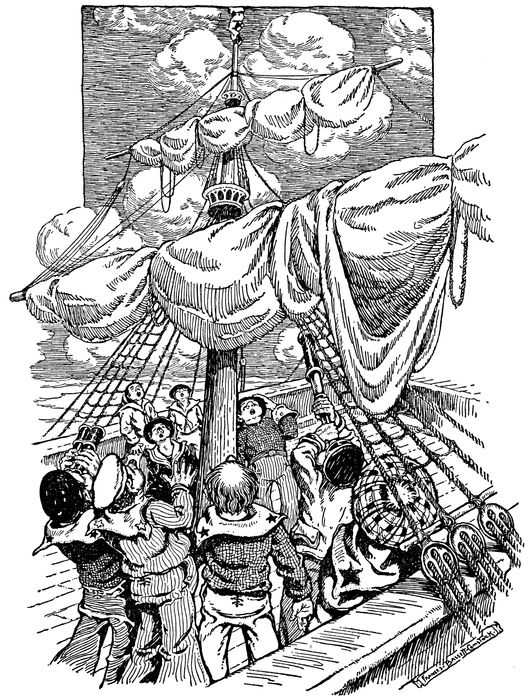
EVERYBODY WATCHED HIM GO UP AND UP
31“He was gone a trifle longer, and then back he came.
It only took thirty-six minutes this time, because he was
more used to it (beside the time it took to go up, of course,
and the time he was above the clouds).
“‘Well?’ said the Captain.
“‘I tol’ ’em it was the chanty. And I asked to speak
to the captain, an’ a big man said they hadn’t no captain,—they’re
a Republic.’
“‘Then what?’ asked the Captain, as the Able Seaman
paused.
“‘Then, I didn’t know who to ask for,—so I—’
“‘Thunder-ation!’ cried the Captain. ‘Did you come
clear down here again, to ask me that? You go back—quick—and
don’t you come down again till you finish
your errand!’ And the Able Seaman said, ‘Ay, ay, sir,’—and
all the other captains looked at each other and said,
‘Thunderation!’ or some other word that meant the
same thing.
“Then the Able Seaman climbed up the mast again,
and nearly all of them watched him. But some of the captains
who had short necks couldn’t watch another minute,
until one of them lay down on his back on the deck;
then a good many of them did the same thing, and were
more comfortable.
“And this time he was gone a long time—so long, the
Captain was just going to send up the second-best able
32seaman to see what was the matter, when they saw him
coming down. It took a little longer, because the leg of
his trousers caught in the third twist of the rope, and he
had to unwrap his leg and twist it around again. It took
forty-one minutes this time, and it seemed forever to
the captains! Three or four of them waited at the foot of
the mast, and caught at him as he slid down.
“‘What did they say?’—‘Will they do it?’—they
asked eagerly.
“The Able Seaman breathed hard. ‘You wait a minute—till
I get—my breath.’
“They waited. Finally the Captain said: ‘Now?’ and
the Able Seaman pulled his forelock and said: ‘I tol’
’em, sir,—just as you said,—an’ they all talked an’
talked—’
“‘Who talked?’ asked the Captain.
“‘I dunno their names. I ain’t no navigator.—There
was the big man, an’ a woman sittin’ in a chair, an’ another
man, and a feller with a head in his hand—all
snakes!—an’ a big dragon kep’ pokin’ his blame head
in all the time,—an’ some more people; an’ they all
talked to onc’t.’
“‘What did they say? Will they give us the star?’
“‘I can’t make out,’ said the Able Seaman. ‘I guess
33they was willin’, but they didn’t seem to know what to do,
and they was quarrelin’ about who’d do it.’
“The Captain looked around. ‘Mr. Morganwg!’ he
said. (The Mate was there almost before he spoke.) ‘It’s
no use. You’ll have to go.’
“‘Certainly, sir,’ said Taffy, and his eyes shone when
he said it, and he turned and walked to the foot of the
mast.
“He weighed two hundred and eleven pounds, but he
walked so lightly his feet seemed hardly to touch the
deck; and when he sprang into the ropes and began to
go up the mast, he made the Able Seaman look like an
apprentice! And the captains all stood and watched him,
and they were so pleased and so sure it would be all
right, their necks almost forgot to ache.”
“He wanted to go,” said Phyllisy, when the Princess
paused.
“He’d better have gone before, and saved all that
time,” observed Pat.
But the Princess said nothing for a moment. Then she
went on with the story: “Up and up climbed Taffy,
higher and higher, until it seemed to him a thick cloud
came down and wrapped him about so he could see only
a few feet ahead of him. But he knew it didn’t come
34down at all. It was he who had climbed up into the
clouds. So he kept steadily on, and very soon it began to
grow thin; and as he came out of it he saw a sight that
almost took his breath away, and made him lose his hold
of the rope. But he wouldn’t even look, but kept climbing
on until he reached the top of the fifty-second mast,
and with one leg wrapped easily around one rope, and
his elbow resting on the gilt ball on the top of the mast,
and his chin in his hand, he was as comfortable as a boy
in an apple tree. Now he had time to look about him,—and
he could take it, for the Star People were so busy
talking among themselves they hadn’t seen him come.
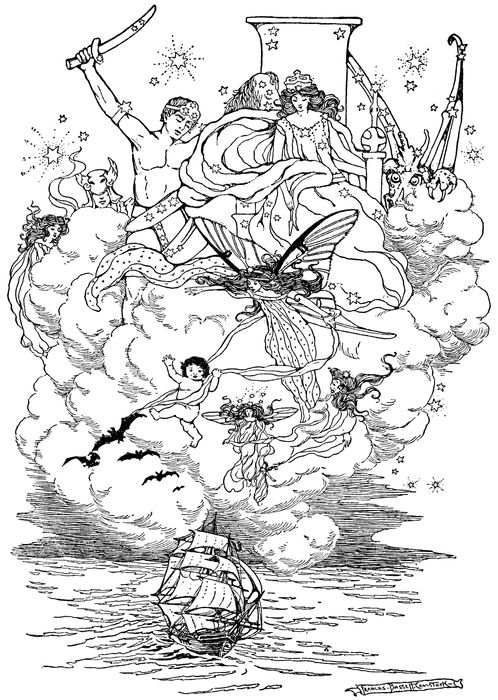
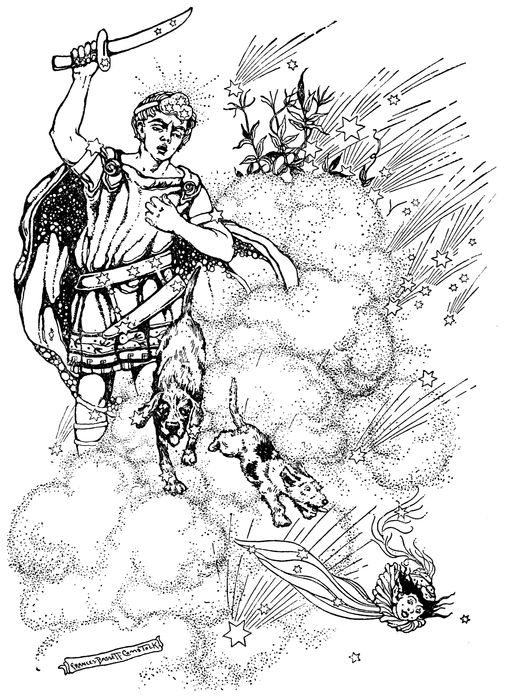
“Two persons seemed to be the centre of the group.
One was a tall, splendid man with a sword on his belt and
a shaggy lion’s hide hanging carelessly over his arm. Set in
his belt and on his head and in the clasp around his knee
were great blazing stars, and two dogs were at his heels.”
“Orion,” said Phyllisy, “I used to know him ages ago.”
The Princess nodded: “Yes. Taffy knew him at
once.—The person to whom he was talking was a beautiful
lady (not so very young), who sat in a massive, star-jeweled
chair, and was alternately crying and scolding,
while a man, evidently her husband, leaned over the chair
and tried to quiet her. Near by stood a young man, looking
35very sulky; and from his hand swung a curious object.
It was a woman’s head, with snakes instead of hair.”
“Snakes?” said Pat, her voice sliding up and down on it.
“Snakes,” said the Princess, firmly.
“For pitysakes!”
“They had once been quite stiff and wriggly snakes,
and had stood up on end, each one of them, and squirmed,
but now they were limp and raggy. And Taffy didn’t
wonder when he saw how Perseus was absent-mindedly
swinging it by one or another of the snakes, and letting
it wind up and unwind again around his finger.
“Like Orion and his dogs, these people and others who
crowded near were studded and decked with shining stars;
and it was by their stars, that he knew so well, that Taffy
recognized these Star People in their unaccustomed places.
“‘Yes, I could!’ the lady in the chair was saying.
‘And he isn’t the one to say, anyway!’
“‘What’s the matter?’ asked Taffy; and they all
jumped, and then all began talking at once, so he couldn’t
understand a word they said.
“‘Hus-sh!’ he said, holding up his hand. And they
gradually stopped talking, all but Orion. (And Cassiopeia
kept on saying things to her husband—but that didn’t
count.)
36“‘Who are you?’ asked Orion.
“‘I’m the Mate of the Jane Ellen,’ said Taffy. ‘And I
want to know what’s the trouble. It doesn’t seem much
to ask for—just one star.’
“‘No,’ answered Orion, ’it doesn’t. And we’re all willing.
But who is going to hold that star?—and how are
we going to know it’s always in the same spot?’
“‘I should think you might agree about that easily
enough,’ said Taffy.
“‘Well, we can’t,’ said Orion. ‘I can’t do it; I have
other things to attend to.’
“‘And you won’t let any one else!’ broke in Cassiopeia.
‘You know how I just sit in my chair, and I’d love
to hold it.’
“‘She can’t,’ said Orion. ‘Pretty thing for a woman
to do!’
“‘I’m not a woman,’ observed Perseus.
“‘Don’t you say another word!’ said Cassiopeia. (‘And
stop twirling that Gorgon!—You make me nervous.) You
know perfectly well, you have to keep away the monster
from my darling child.’
“Perseus said no more, but he looked sulkier than ever.
“‘No, he can’t,’ said Orion. ‘And beside that, you’re
used to seeing us move about. Now if one of us gives up
his own place, it will mix you all up.’
37“‘That’s true,’ said Taffy. And just as he spoke, something
rubbed against his hand,—something that sent a
little prickly shock through him at first, and at the same
time, the very softest thing he ever had felt or imagined.
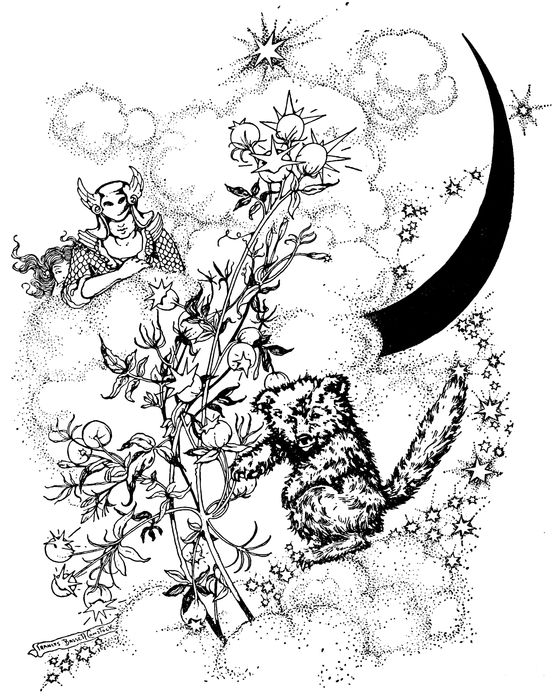
“He looked down and saw a little bear—but such a
little bear! His long fur was, in color, a beautiful blue-gray,
and the tip of each hair seemed to have been dipped
in moonlight or powdered with star-dust, for it shone and
glinted in the starlight as he moved; and his eyes twinkled
like two little stars themselves; and curiously enough
for a little bear, he had a great long tail. And unlike any
of the Star People, he hadn’t a star on him anywhere.
“‘Hello, little one!’ said Taffy. ‘What are you doing
here?’ And he bent down to stroke Little Bear. Little
Bear leaned against his leg; and as his hand sank in the
soft, soft fur, and again the electric tingles ran up his arm,
it was as if they took the message to his brain: ‘Oh, dear
Taffy, let me take care of the Sailor’s Star!’
“It came so clearly to him, Taffy spoke again: ‘Would
you really like it?’—and the answer came, like a long,
‘Oh-h!’ of rapture.
“‘See here,’ said Taffy to the Star People. ‘Why don’t
you let this little chap have it? That would settle it.’
“‘Little Bear?’ said everybody. Then everybody looked
38at everybody else, and said, ‘Why not?’—because they
all loved Little Bear; and they were glad to find a way to
settle the dispute and stop talking.
“Taffy told them what to do; and Cassiopeia was the
first one to take a lovely star from the back of her dress,
where it never had been seen by the sailors and wouldn’t
be missed; and they all agreed that, if she couldn’t hold
the Sailor’s Star herself, she should be the one to give it.
And they fastened that star on the very tip of Little
Bear’s tail. Then Orion and Perseus and the Big Dragon,
who came and looked on, and the rest of them gave more
stars to fasten on Little Bear, and he stood pressed against
Taffy’s knee while they did it; and his fur sparkled and
shone and his two bright eyes twinkled, bright as any of
the stars, while little electric thrills of pleasure and gratitude
ran to Taffy’s heart as his hand stroked the beautiful
fur that was softer than anything in the whole World!
“‘There!’ said Orion, as he fastened the last star and
pushed one of the dogs back with his foot, while Little
Bear growled, a soft small growl. ‘He’s fine as a birthday
cake! Now I want to know how you are going to be
sure that star is always in the right place?’
“‘Easy enough!’ said Taffy. ‘You know where the
North Pole is, don’t you?’
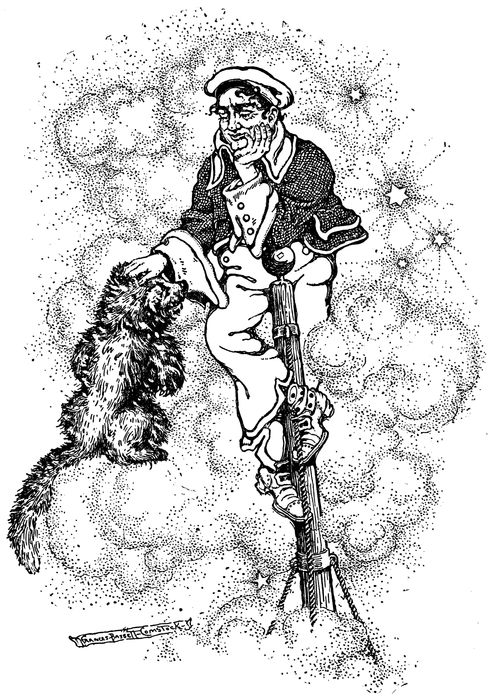
“OH, DEAR TAFFY, LET ME TAKE CARE OF THE SAILOR’S STAR”
39“‘Of course we do,’ said Orion, and the other Star
People echoed: ‘Of course!’
“‘Then, all Little Bear has to do is to keep the star
directly over that Pole. And he’ll do it,’ said Taffy, laying
his hand on Little Bear’s head—and the message thrilled
through it: ‘Oh, I will, dear Taffy! The Sailor’s Star
shall never wander!’
“When the Mate stepped on to the deck of the Jane
Ellen it was almost morning, and all the captains who
weren’t asleep had such stiff necks they hardly could turn
their heads to look at him. And when he touched his
cap and said to the Captain of the Jane Ellen: ‘It’s all
arranged, sir,’ they were so worn out they were glad to go
back to their own ships and go to bed without asking a
single question. It wouldn’t have been any use if they
had, for the Captain took Taffy straight into his own
cabin and shut the door; and that was the last any one
saw of them that night.
“The next morning every one was as busy as a bee; and
they worked so fast that before evening every mast had
been put back, and the twenty-four anchors returned to
their own ships, and they were all ready to sail.
“During the afternoon the clouds had broken up, and
the sun went down in a clear sky. As darkness fell, the
40crew of each ship assembled on the deck, with every eye
fixed on the Northern sky.
“Taffy stood beside the Captain of the Jane Ellen while
the rose-red faded into yellow, and palest green, and violet,
and a few large stars came out, one by one. Then,—faint
at first, then, brighter and brighter,—the stars that told
Taffy Little Bear was at his post! And a great shout
went up from all the ships, that must have reached the
sky! It seemed to Taffy that the stars glowed brighter,
and he could almost feel the touch of soft fur, softer than
anything in the world, and a little thrill went to his heart,
that said: ‘You see, Taffy dear, I’m here!’
“Then the fifty-two ships set sail in every direction,
and the Jane Ellen was alone once more. And all night
long, as she went on her way, whenever Taffy looked up
at the Northern sky, the Sailor’s Star hung over the Pole.
But Little Bear swung slowly, slowly around it, watching,
watching the ships that were sailing to all quarters of the
world. And on every ship the sailors said:—
“‘God bless the Little Bear!’”
As the Princess came to the end the children grew
very still. When she had spoken the last word no one
stirred for a moment. Then they all stirred at once. The
41Kitten slid off from her big chair and came straight across
to sit on the Princess’s silken knee, and the Others with
her, to crowd as close as they could,—to talk about it
and ask all the questions they had saved for the end, not
to interrupt the story. And they had a great deal to say,
and had saved a great many questions.
“You did understand, didn’t you, Kitten?” said the
Princess. “I knew you would.”
The Kitten nodded, and wriggled on the Princess’s
knee. “Could you feel it prickle?” she asked.
“‘Little thrills,’ she means,” Phyllisy suggested.
“Um-m,” said the Kitten. “That night—you said he
brought a message.”
“But you were asleep,” said the Princess.
“I heard. Would it hurt?”
“No, indeed! It was a little warm thrill that went to
my heart.”
“The same as Taffy,” said Pat.
“Just the same,” said the Princess.
Then Miss Phyllisy brought her the rosy hat, and she
pinned it on; for there were long shadows across the sloping
lawn and the petunia bed; only the high steps down
the terrace were still in the sun.
III THE COMET AND THE POLE STAR
42
“How did they fasten the stars on
him?” asked the Kitten. She
didn’t say who “he” was, but
they knew, though it was quite
another time.
“With a half-hitch and another
half-hitch, then belay,” said the
Princess, promptly. “Much better than sewing them, or
pins. Don’t you think so?”
“Pins would stick him,” agreed the Kitten.
“Whereabouts did they fasten them?” asked Pat.
The Princess reached out her arm and picked a narrow
pointed shell out from the hard sand. It lay broad and
brown between them and the gray sea, worrying, whiteand-green
43at the other edge. Out over the sea whitish-gray
fog was waiting all around in a circle. It went up and
joined the gray sky over; and a salt smell blew out of it.
She began to draw in the sand with the pointed shell,
and the Others watched it grow. She began at his head
and worked back, quickly.
“Is it going to be Little Bear?” asked Pat.
“Yes,” said the Princess. “But I can’t make it really a
likeness.”
“You could, Dearie, if you had a pencil and paper,”
said Phyllisy. “Nobody could, in the sand with a shell.”
“It’s like him the way the map is America,” said Pat.
“More—much.”
“Now make the stars,” said the Kitten, when she drew
his last foot.
“No,” said the Princess. “You must do that.—Who’ll
give a star to Little Bear?”
“What shall we give?” asked Pat. But the Kitten
spied a clear, shiny pebble, and she didn’t need to be told;
she pounced at it quickly, and purred when the Princess
took it from her.
“‘And they fastened that star on the very tip of Little
Bear’s tail,’” quoted Phyllisy. “Now we must all give stars.”
So they scurried over the sand and brought suitable
44pebbles to the Princess,—and some of them were shells,—and
she showed them where to place them, where he
truly wore them; but they placed only the principal ones,
because it was a sketch, not a likeness.
“But you don’t see even this—of a bear—in the
sky?” said Pat, doubtfully. It wasn’t as easy for her to
make believe as it was for Phyllisy. Phyllisy loved it. As
for the Kitten, it was no trouble for her; real or make-believe,
it was all alike.
“No, indeed,” said Phyllisy, explaining to Pat, and perfectly
familiar with it. “Just the stars of him, and play
the rest. When it’s night, we’ll look, and see if we can
find them ourselves.”
“You can’t when it’s cloudy,” said Pat. “And it’s
cloudy to-night—will be.”
“And the Star People will have a holiday,” said the
Princess.
“Will they?” asked the Others, though she had just
said it.
“Sure as sure. When it’s a cloudy night and the sailors
couldn’t see them wherever they were, they may go
where they like.”
“They might go where they like in the daytime,” said
the Kitten.
45“So they might. But you have to sleep some time, Kit.
And if you have to stay up all night to be looked at,
you’d better take a long nap in the daytime. So, when it
begins to be light, the Star People just quietly fade away
in their places, then when night comes they wake up,
fresh as daisies.”
“Suppose some time they would go off, and it was a
clear night—and they moved around?” said Pat.
“I couldn’t imagine anything so dreadful,—nor the
Star People, either! Don’t you fancy, because they
haven’t any captain, that they have nothing to obey.”
“What?”
“They have Law!—and that’s something every one
of them obeys without a single word, or ever stopping to
argue. When anything is the Rule of the Sky, that ends
it.—Unless you’re a comet.”
“Oh, comets!” exclaimed Phyllisy.” What do they
do?”
“What don’t they do?” corrected the Princess. “They’re
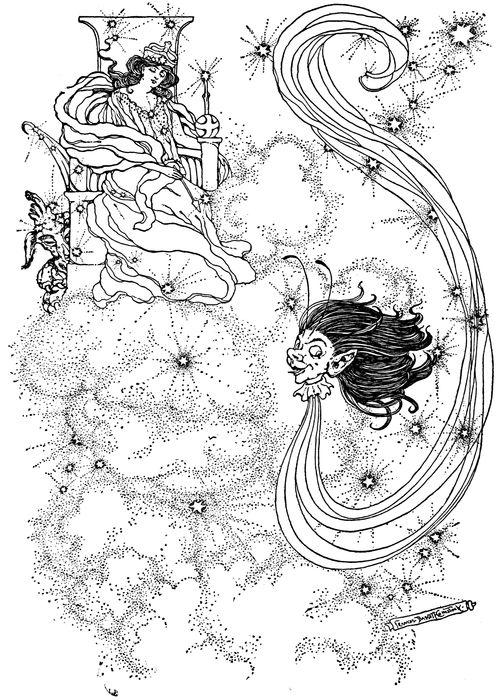
silly. Just a head, with the wildest, fuzziliest hair,”—she
drew on the sand as she talked,—“that never saw a hairbrush—and
tails!—switching and flying and spreading
over everything and curling around!—and, as if one such
tail weren’t bad enough, some of them must have two!”
46The Princess stopped drawing, because the sand was
filled up with comets, as far as she could reach. “That
one is like the Kitten,” said Pat. “Yours would be, if it
weren’t braided,” the Kitten answered.
“Only in looks, I’m sure,” said the Princess, politely.
“The Star People try to be charitable, and when they
hear of some fresh bad thing one of those flyaways has
done, they say: ‘He doesn’t know enough to be good;’
and they don’t talk about it any more. But when any
really horrid mischief is done, it’s always when a comet
or two has been around.”
“What did one do?—some mischief,” Pat suggested.
“I should think you’d all rather hear about somebody
good,” said the Princess. But the Others giggled—and
wouldn’t.
“Make some more Star People while you consider,
Dearie,” urged Phyllisy.
So the Princess moved along the sand (and they were
glad it was a good, gray day, not glaring), and she drew
more, the same way as Little Bear. They didn’t try to be
likenesses, but you would know whom they were meant
for,—Cassiopeia and the Dragon and Orion and more,—and
the Others put in the stars. It used a great many
pebbles and shells, though they put in only the principal
ones. But they ought to be pretty ones, so they went a
good way off to find them.
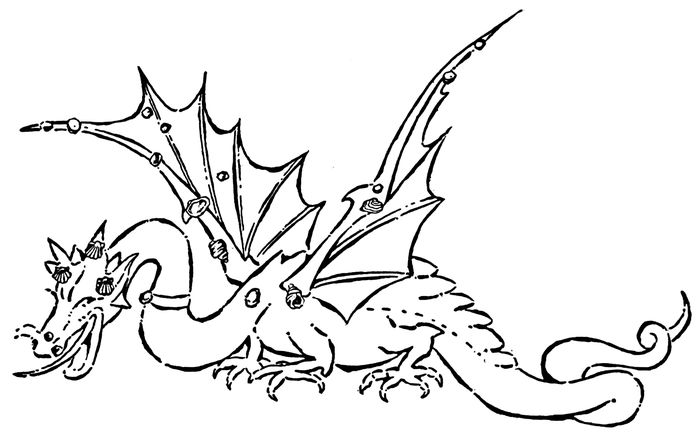
DRACO
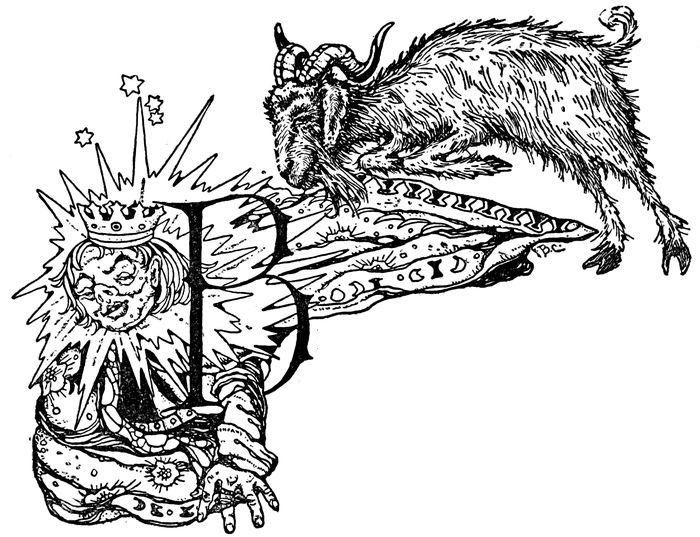
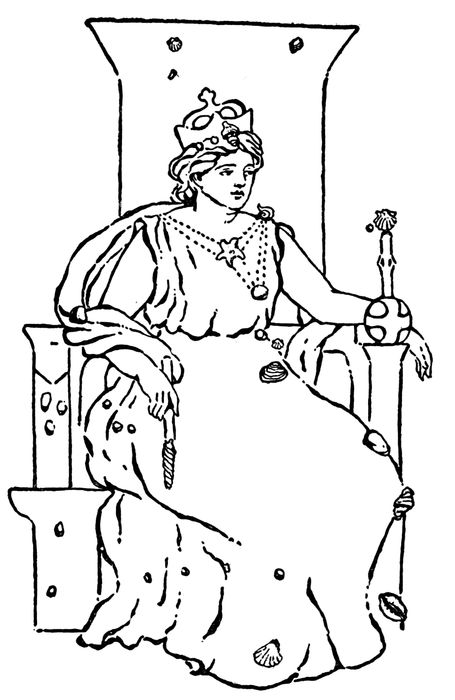
“This is the way Draco looked, guarding the Golden Fleece, except his expression. He had to look fierce then, but he always had a sweet nature.—You’ll observe that he has no teeth. He did have, but Jason took them. He threw the magic drops straight into Draco’s jaws when they were gaping open to swallow him, and the Dragon went so immediately to sleep that he hadn’t even time to close his mouth. Then Jason took, not only the fleece, but his teeth; because he always liked to have a few dragon’s teeth in his pocket. He had used them before, for a Bewitchment, and he never knew when he might need them.—Very few people know about this, but it’s just as true as the part they do know.” The Princess spoke severely, but the Others giggled.
They thought Draco ought to have stars on his tail, but she said his wings folded back over most of it when they weren’t set up. Hercules gave him the small star on his nose, because he had a great many, and Draco needed that one to make him symmetrical.
47When they came back from farther off, they couldn’t
guess what the long wavy line was meant for, that she
was drawing beyond Orion—in deep loops down and
back.
“This is the Starland River,” she explained. “The
Ancients called it the Eridanus. That was the name of
one of their own Earth rivers. Once Phaeton tried to
drive the chariot of the Sun,—the Sun God was his
father,—but he didn’t know how, and horses, chariot,
and all plunged into the river, and he was drowned for his
folly, but the chariot and horses came out shining again
the next morning at sunrise. And Phaeton’s three sisters
stood on the bank of the river and mourned and mourned
for him, and wouldn’t go away. So Jupiter kindly changed
them into poplar trees;—and right here—and here—and
here”—she showed the places and the Others laid
especial shells—“are the stars that mark the tall poplars
on the bank. At least, that’s what I think. You may
choose others if you like, but they are certainly there.”
The Princess surprisingly sprang up, and the pointed
shell flew out of her hand, over the hard sand, and beyond
the worrying green-white edge, into the gray sea.
48“What did you do that for?” Pat remonstrated.
“Because-that-was-a-sign-that-it-wouldn’t-be-lucky-to-have-any-more-drawing-on-the-sand-because-that-was-Enough,”
said the Princess.
“Will you tell it now?” asked the Kitten.
And she would; but back under the cliff, where there
were rocks—smooth and hollowed by the ocean, long
ago, and another one for a back,—and where those crazy
comets on the sand wouldn’t be looking at them.
“You hardly would believe how happy the care of the
Sailor’s Star made Little Bear,” said the Princess, when
they were all comfortable,—“proud of his responsibility,
and most grateful to the Star People.”
“Because they gave him stars?” asked the Kitten.
“Yes, and allowed him to have that responsible thing
to do when he wanted it so much; and it made them
happy to see his pleasure, and to feel that they all had a
share in it—because he was their own dear Little Bear.
Now, at the time this story happened, everything had been
comfortable and pleasant for a long time. Little Bear
hadn’t had his star so long he had forgotten the time
before he had it; but he had grown used to having it on
the end of his tail, and could keep it over the Pole without
49giving his mind to it. And nobody had seen a comet
for ever so long, so they weren’t thinking about them.
“But, very early one morning, any one of the Star People
who had been awake to look, might have seen, peeping
up over the rim of the Sky, a small, vagabond head.
He shook his fuzzy hair out of his eyes and came up a
little farther, switching his long tail that had a wicked
crook at the end of it, as he danced up and down like an
elf! A more rascally Comet you wouldn’t care to see!”
The Others wriggled with appreciation, but they didn’t
speak, to interrupt.
“The Star People were in their first sleep, and not
dreaming of any harm; and what a chance for the worst,
small comet in the Sky!
“What should he do? Hammer a dent in Cepheus’
crown? Tie a knot in the Dragon’s tail? He darted here
and there,—rapid, uncertain little darts; nothing seemed
quite worth while when he had such an opportunity.
“Cassiopeia stirred slightly in her chair, and the wicked
imp dropped where he was, and wound himself all up, like
a porcupine, holding himself together by the crook in his
tail. You never would have guessed that he could tuck
all his wild hair and streaming tail into a little round
bunch, as quick as a flash! But she didn’t wake up, so he
50let himself go, and his hair and tail sprang out like a
jack-in-the-box; and now he danced harder than ever, for
rage!
“How he did hate Cassiopeia! He remembered how
she had boxed his ears when he had come that way before,
and he would rather do something to plague her than anything
else. He looked about him, and saw Little Bear,
fast asleep—never dreaming of any harm,—and he
stopped short in his dance. He knew, now, what he could
do; but, wicked little Comet as he was, he was almost
frightened. This was much worse than anything any of
them ever had done. But how it would plague Cassiopeia!—and
set the whole sky by the ears. He puckered
up his face and stuck out his tongue at her.”
“And she couldn’t see him,” Pat murmured.
“Then there was a whizz,—a switch of a long tail with
a crook in the end of it,—a zigzag streak of light across
the morning sky—and the Comet was gone!
“And the Star People were all sound asleep, and never
dreamed he had been there.
A MORE RASCALLY COMET YOU WOULDN’T CARE TO SEE
51“Oh, dear! It seemed almost a pity Little Bear had to
wake up at all, with such trouble waiting for him. But the
time had to come, and he stirred a little and opened one
eye, and shut it again and rolled on to his side. There he
lay for a minute; then he gave a soft sneeze that waked
him up altogether. So he opened his eyes, that twinkled
like stars, and looked about him. Every one else was still
sleeping, and that seemed like wasting time, because it
was a cloudy night, which meant a holiday. So Little
Bear stood up and shook himself, and sparks seemed to
fly from his fur, and then—his heart gave a great jump,
and almost stopped beating!—The Sailor’s Star was
gone!
“It was such a blow he could hardly see, and he sat
down, quite dazed.
“In a few minutes Cassiopeia opened her eyes. Now,
Little Bear felt as if he couldn’t stand it to have any one
know what had happened to him. But the minute he saw
Cassiopeia was awake, though it was the last thing he
meant to do, and before he knew what he was about, he
had run to her and put his head in her lap; and she knew
in a second something was wrong.
“‘Why, Little Bear, what is it?’ she began to say—then
she saw—and such an outcry! Everybody awoke,
and the next minute, everybody was searching in every
possible and impossible place;—all but Little Bear. He
was too miserable to do anything but sit still, and wish
the clouds would rise up and cover him all over.”
52“Poor little soul!” said Phyllisy, and the Others crooned
in sympathy, the Princess with them. Then she went
on:—
“‘It’s no use. It isn’t here,’ said Cepheus, who had
been down on his hands and knees, looking, just as hard
as if he hadn’t been a king. (He tucked his sceptre under
his arm while he was looking, except when he poked with
it in a corner.) As he spoke, he stood up and straightened
out the ‘crick’ in his back, and the others took it for a
signal to stop the search.
“Cassiopeia had stopped some time before, without any
signal, and sat in her chair, with Little Bear leaning
against her knee again.
“‘No, I didn’t think it was any use,’ she said, significantly.
‘That star didn’t go without hands,—or claws!’—and
she looked straight at Draco, who stood every
night before Little Bear, to guard him, looking very terrible,
though he hadn’t a tooth in his head. But no one
would know that unless he spoke, and he had been hunting
for the star as hard as any of them.
“‘Doeth thhe mean me?’ he asked, in surprise. (He
lisped a little, on account of having no teeth.) Then, indignantly:
‘I thould think you’d be athamed!—I believe
you took it back yourthelf!—Indian-giver!’
53“Cassiopeia’s hand flew to the back of her dress where
the star had been, and she began hotly: ‘The idea—’
“‘There, there,’ said Cepheus, soothingly, while Little
Bear stirred uneasily, ‘don’t quarrel! It’s bad enough
without that.’
“‘Maybe he didn’t take it himself,’ said Cassiopeia.
‘But it’s a very poor watch he kept. And this isn’t the
first time something has been lost while he was asleep!’
“‘Shame on you!’ cried Cepheus. (And it was mean
in her to call up the time when he lost the Golden Fleece.)
“‘Don’t mind her,’ said Perseus to Draco. ‘She
doesn’t mean anything.’
“‘I don’t think Cathiopeia liketh me very well,’ said
Draco, almost crying. ‘I can’t thtay awake all day. I
alwayth did need a great deal of thleep.’
“‘Well, let’s not talk about it any more,’ said Cassiopeia,
impatiently. ‘We’d better be doing something!
It’s a good thing it’s so cloudy. I’ll tell you what you
do,’ she went on, turning to Cepheus. ‘You go straight to
Boreas, and tell him he mustn’t blow away one scrap of
cloud until we find that star.’ Boreas had a great conch
shell, like a trumpet, and when he shouted his orders
through it, the clouds flew before the sound—just as he
told them to go.”
54“The North Wind,” said Pat. “I’ve heard about him.
He lived in a cave.”
The Princess nodded. “‘I don’t think it looks very well
for me to be running errands,’ said Cepheus.
“‘Looks or no looks, you go along,’ said Cassiopeia.
‘I’m going on one myself.’
“When Orion waked up that night he was pleased to
see the clouds, because there was something he wanted
to do. Every one knows he was a famous hunter; and
there was no animal so fierce or so wild that he could not
face it and conquer it. But that was not what he prided
himself upon. What he liked to do, more than anything,
and what he thought was his special talent, was gardening!
“He had his garden on the Milky Way, where he was
forever planting things, and digging them up again to
look at the roots, and transplanting them to see if they
wouldn’t do better somewhere else, and pruning them
and training them and spraying them; and the only rest
and chance to grow those poor things had was when there
was a long spell of clear weather, and Orion had to leave
them alone! And with all his care, there wasn’t a place
on the whole Milky Way that had so many bare spots in
it as Orion’s garden!”
55“Like mine,” observed Pat.
“Now, he had some young meteors just coming up; so,
as soon as he was awake, he called his two dogs and set
out for his garden. He was down on his knees examining
the young plants, when the dogs began to bark. He looked
up, and he was astonished to see Cassiopeia hurrying
toward him.
“‘I knew where I should find you!’ she called, breathing
hard. (She wasn’t exactly thin.)
“‘What over the Sun brings you here?’ exclaimed
Orion.
“‘Somebody’s stolen the Pole Star!’
“‘No!’ cried he.
“‘Yes, they have. While we were asleep. It was there,
all right, when Little Bear went to sleep, and when he
waked up, it was gone.’
“Orion scowled fearfully. ‘There’s just one Star Person
who would do such a thing—’ he began.
Cassiopeia interrupted him:—
“‘Now that’s all nonsense! Just because you hate the
Scorpion, is no sign he would steal. You’d better come
along with me, and we’ll have a meeting to see what to do.’
“As Cassiopeia and Orion were coming back together,
they met Cepheus, returning from his errand.
56“‘Did you see Boreas?’ called she.
“‘Yes,’ answered Cepheus, pushing up his crown. (It
didn’t fit very well, and was always slipping down.) ‘He
says he’ll do the best he can; but he can’t promise more
than two days.’
“‘Oh, we’ll find it before then,’ said Orion, confidently.
“But before the two days were gone he began to feel
very differently, and so did every one else. They talked
and they talked, and suggested and consulted, and hunted,
and went back and hunted again and again in all the
places they had searched before; and every one almost began
to look suspiciously at every one else.
“And it would have made any one’s heart ache, to see
Little Bear. No one blamed him, but he couldn’t help
feeling that it was his fault, and he wanted his dear Star,
too. So he mourned and drooped, and all the sparkle
went off from his beautiful soft fur, and out of his bright
eyes; and when Perseus offered to let him take the Gorgon’s
head to play with, he didn’t even care for that.
“Cassiopeia took him up into her chair beside her, and
sang little songs to him. The one about the fishes, that
he always liked.”
“What song?” asked the Kitten, quickly.
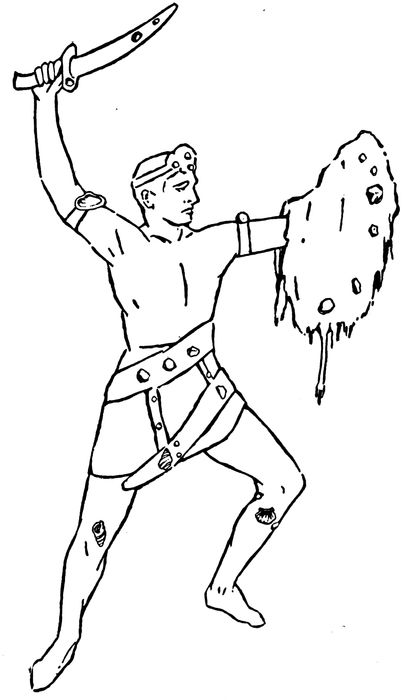
ORION
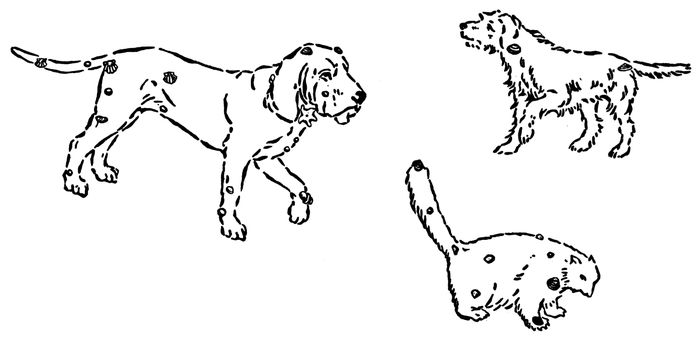
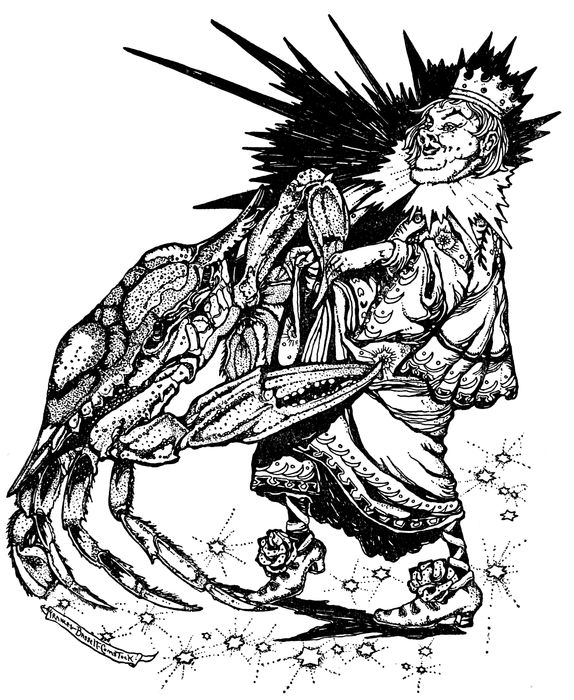
“Orion was a mighty hunter,” she explained. “This is the way he would attack a lion or any wild creature, without the slightest fear. But he died at last from the bite of a scorpion. The Scorpion is in the sky too, spread out very glittering—a lobstery-kind of a thing—but never at the same time as Orion, because that wouldn’t be good manners. So, sometimes we see Orion marching across, with his two dogs, Sirius and Procyon; then we see the Scorpion, but never the two together.”
And she couldn’t draw the dogs near him, where they belonged, because the Kitten had stepped there; they had to move along to a place where the sand was smooth.
57“This,” answered the Princess:—
There are just as good fish in the sea—the sea
As ever came out (they say);
But the finest fish that ever were there
Have come to the Sky to stay.
These fishes lived in a pool—a pool,
Where coral and seaweed grow.
The great waves dash on the reef without,
But here they ripple and flow.
You’d think ’twas a place where a fish—a fish
Would willingly live and die;
But these two fishes were not content—
They wanted to go to the Sky!
The Fisherman, up above—above,
Espied the fish from afar;
He spun a line from a moonbeam fine,
And baited it with a star.
Now, these silly fish didn’t try—didn’t try
To make the best of their home;
They fumed and they splashed and they lashed their tails,
Till the water was covered with foam.
And the Fisherman, watching above—above,
And wanting to pull them in,
Could only wait till the fish were too tired
To move a tail, or a fin.
Then, twice, on the face of the placid pool,
He dropped the star from on high;
And, one by one, drew the Fishes up,
To shine each night in the Sky!
58And the moral’s plain, of this tale (your tail,
If you are a bear, or a fish),
Don’t fume and splash and disturb your pool,—
And you’ll probably get your wish!
“Little Bear liked to hear it, but Cassiopeia could see
that it wasn’t really any comfort to him, and she was at
her wit’s end to know what to do.”
“They ought to have thought it was a Comet,” said
Pat.
“It was stupid in them, but they never once thought
of them,” said the Princess.
“Don’t you know, it is like that sometimes,” said Phyllisy,
“the most probable thing you forget all about.”
“That was the way with them,” agreed the Princess.
“They thought of everything else, and the two days were
almost gone when Boreas sent word that he couldn’t
possibly wait any longer; but he wouldn’t blow the clouds
clear off—only break them up, and send them flying
about; so perhaps it wouldn’t be noticed that the Star
was gone.
“‘That won’t do at all,’ said Orion. ‘We can’t take
chances like that. But what can we do?’
“‘The next best thing,’ said Cassiopeia. ‘We must get
another star as near like it as we can find.’
59“‘I have one the same color; but it’s not the right
size,’ said Cepheus.
“‘Let me have it,’ said Cassiopeia. ‘I’ll try to match
it.’
“She took it from him; and the Star People came, one
by one, and turned their backs to her, and she held up
the star that was the right color by those that were the
right size and in a place where they wouldn’t be missed;
and you never would believe how many sizes and colors
there were! It was enough to drive one crazy, and she
was ready to give up in despair. At last she went back to
one she had rejected before, on the back of Perseus’
elbow.
“‘It isn’t right,’ she said, ‘but it’s the best there is.’
“‘Oh, that’s not so bad,’ said Orion. ‘A man on horseback
wouldn’t notice the difference!’
“‘That’s a very poor joke!’ snapped Cassiopeia—her
nerves were quite frazzled. ‘Come, Little Bear!’
“And Little Bear came to her, and they fastened the
false star on his tail; and he let them do it, quite quietly,
though he felt as if his heart would break—and so
ashamed! It was almost worse than no star at all, and
seemed like trying to cheat the sailors who trusted him.
“All that night and the next and still another night,
60Boreas blew and shouted through his trumpet, and the
clouds swept back and forth, whirling and tumbling, while
Little Bear stood at his post, wheeling slowly around the
false star, with his head drooped low and the silver glint
all gone from his soft fur, and his heart almost breaking,
whenever, through the rifts of the racing clouds, he saw
the ships flying before the gale—sailing to all quarters
of the world.
“And the other Star People were almost as unhappy
as he was, because they loved him, and because such a
dreadful thing had happened, and somebody must have
been so very wicked. By the time the third night was
gone they felt that it couldn’t possibly go on that way any
longer; and every one went to sleep, perfectly worn out
with trying to think what they could do, and how they
could comfort Little Bear, if nothing else could be done.
“Orion was just in his first sound sleep, when a big,
jolly voice called: ‘Are you all asleep there? Wake up,
Orion!’
“Orion turned around, and there was Old Sol himself,
fairly beaming with happiness and good humor, and—what
do you think?—in his hand he held up the lost
Pole Star!
“‘Wh-why, where did you find it?’ gasped Orion.
61“‘Oh, this fellow had it tucked into the crook in his
tail. I caught him, going by, and shook him up, and out
it fell. So I brought it to you.’
“Then Orion saw that Sol held in his other hand the
most disreputable little Comet that ever was seen! His
hair and tail—what was left of them—were hanging in
shreds. He had struggled to escape, and Sol had held
him. Now, scarcely enough of him was left to be worth
holding—just a rag! and his head seemed positively
shriveled up.
“‘For the love o’ the Law!’ exclaimed Orion, ‘what’s
that? A Comet! And we never once thought of it. Give
me that star.’ He fairly snatched it from Sol’s hand, and
started, as fast as he could run, North, waking every one
as he ran, calling: ‘We’ve found the Pole Star!’
“The Comet seemed to think this was a good chance
to escape, and wriggled cautiously between Old Sol’s
fingers. ‘Oh, no!’ said Sol. ‘You’ll stay with me,
where you won’t do any more mischief.’ And he put him
in his pocket, and followed Orion, as fast as he could, to
the North.
“And when he came in sight, Little Bear was just
awake, with everybody crowding around him, and talking
to him so fast he couldn’t understand what it was all
62about. But when he saw his own Star once more—then
he knew! And Old Sol laughed to see Little Bear (who
had been so patient and uncomplaining when he was
most unhappy) give his tail such a switch and jerk that
it sent the false star flying off—nobody knew where, nor
cared! They kept right on talking—all at once, and
nobody listening to anybody else—and saying how stupid
it was in them not to have thought of the Comet.”
(“And it was,” said Pat, under her breath; but Phyllisy
shook her head at her—not to interrupt.)
“Cassiopeia cried, a very little, while they fastened the
Sailor’s Star once more on Little Bear’s tail; and the
good old Dragon said, anxiously: ‘Be thure you fathen it
thtrong!’
“And Little Bear quivered and trembled with delight,
his eyes sparkling, even in the sunshine; and then—everybody
began to be so sleepy they couldn’t hold their
eyes open. So they all hurried back to their places and
faded away again; while old Sol, with the Comet in his
pocket out of harm’s way, glowed brighter and brighter
with pleasure.
“But when night fell, calm and cloudless, who was so
proud as Little Bear? His eyes twinkled brighter than
any stars, and his soft fur glittered and shone, and he held
63up his head bravely as he swung around the Pole Star—watching
the ships; while the sailors on the ships said:
‘How bright all the stars are to-night! The rains have
cleared the air.’
“The next cloudy night, Little Bear sat beside Cassiopeia,
in her great jeweled chair, and she sang songs to him
once more—about the Fishes, and the other songs he
liked. Best of all, the one she couldn’t sing to him when
he was so unhappy, about his very own Sailor’s Star:—
“Oh, how do the ships go sailing
Over the starlit sea?
They’re sailing East,
And they’re sailing West,
And they’re sailing South,—
But they love the best,
Where the North Star shines unfailing.
“Oh, how do the ships go sailing
Over the angry sea?
The winds blow high,
And the clouds sweep low,
And the ship flies fast!—
But the sailors know
Their Star still shines unfailing.
“And still the ships go sailing
Forever, over the sea;
For the winds will drive
64The clouds away,
And the stars shine forth,
And the sailors say,
Their Star for aye’s unfailing!”
“‘The Sta-a-ar’s unfailing,’” sang the Kitten, after her.
And they two sang the last few lines again, together.
“Oh!” exclaimed Miss Phyllisy.
“What is it?” asked Pat.
“Orion’s leg is gone; I’ve been expecting it. A wave
just went over.”
And another wave followed close, and shoved it back
still higher, before it had time to run away out.
“He doesn’t mind,” said the Kitten.
“Not a bit,” said the Princess. “It wasn’t even a likeness.
And where are the Comets?”
There wasn’t a sign of one left. And that was a sign
that every one else had better be starting!
ORION’S DOGS AND LITTLE BEAR
The name of the big dog was Sirius, and the little one was Procyon. And Orion himself hadn’t so splendid a star as Sirius wore in his collar. Procyon’s wasn’t quite so fine, because he was smaller.
“And they’ve just been over here to see Little Bear, and they’re hurrying to catch up with Orion and be in their own places,” said Phyllisy.
IV OLD SOL’S MENAGERIE
65
Because she had said she
would, and they had come expressly
when the tide was out,
the Princess didn’t wait to be
asked; she only looked to see
what kind of an Ocean it was,
while the others hunted for a pointed shell like the one
she used before—and it was a cool blue one, with little
waves running on it and cloud shadows moving across.
Then she took the shell that Miss Phyllisy brought,
with the Others following; and perhaps it was the very
one that flew out of her hand! Anyway, it was exactly
66like it; it could have been brought back by the sea, and
that was a sign that it was lucky to draw more Star People
on the sand.
They chose a place to begin, and the Princess drew a
circle around her, as large as she could reach from the
middle; and it was surprisingly round—when it wasn’t
mechanical. Then she came to the line of it and reached
over and drew another, larger, circle just so far outside;
then she made marks—little neat ones—on the edge,
to have it even, and drew lines across to divide it into
spaces; and there would be twelve. And the Princess was
inside, drawing, and the Others were outside, watching to
see what it was going to be—like a Bewitchment, with
nobody speaking. For each time Pat started to say:
“Whatever is it?” Prudence said: “Don’t speak!” and
she stopped. But the Kitten lay on the sand, propped on
her elbows, watching and making a song for herself, inside,
until the Princess was ready to talk.
As she drew the last line across, that made twelve
spaces, she began, sing-song: “Walk right up, ladies and
gentlemen! The greatest show in Skyland is now ready
to begin. Unrivaled aggregation of animals and galaxy of
talented artists. Old Sol’s Menagerie, in Sky-Language
called the Zodiac. Something between a zoölogical garden
67and a circus, and better than both put together—”
She stopped and laughed, teasing with her eyes.
“What does it mean?” asked Pat.
“I’m going to show you. These are twelve great cages
that make a splendid ring all around the Sky—Houses,
the Star People call them. They think it sounds better;
but they aren’t in the least like either cages or houses;
they’re more like a place; and it isn’t a flat circle like
this. It’s that way in Starland. You can’t really describe
it, because it’s so different; but we can draw it this way,
and call it what we like.” The Princess stooped down and
began to draw: “In this first cage, Sol keeps the Ram
that had the Golden Fleece, that they took away from
him, to take such care of! And now that he’s a Star-Ram,
he has it back and takes care of it himself.”
“So Draco needn’t watch it any more,” observed Phyllisy.
“The Ram likes it much better this way,” said the
Princess. “And here is his name, like a doorplate on his
house.” She made a funny little mark in the corner of the
space. “Wherever you see that mark, Beloveds, it’s the
Sign of the Ram; and it looks like his curving horns.
Next door is a great white Bull. One time he was grazing
in a meadow where some children were playing. He was
68very gentle, and let them wind garlands of flowers around
his horns. At last, one of them climbed on his back, and
away he went with her and swam over the sea. Did you
ever see such remarkable, lofty horns?” All the time
she was drawing.—“Here’s the sign of his House,
and here go his stars.” The Others had stars collected,
and when they had finished the Bull, she went on: “In
this House are the Gemini Brothers, twin boys who do
boxing and wrestling, and ground-and-lofty tumbling.
Wonderful singers they are, too, Castor and Pollux, and
especial friends of all sailors. They were great sailors
themselves, and once drove all the wicked pirates out of
the Ægean Sea.”
“The Star ones?” asked Pat.
“No; the real ones. We want two beautiful pebbles for
the stars that they wear in their helmets. And up here”—the
Princess whirled across—“in this last House
that brings it around the circle are two more twins—the
Fishes that Cassiopeia sang about to Little Bear. They
can have only small stars, because they were discontented.”
When they were done the Princess turned back to the
place where she left off.
“In this cage at the North is a Crab; and in the cage
69exactly opposite is a Goat, but not a common goat. He
is a Sea-Goat—like this, with a kind of fish tail.” She
left the Crab, and drew the Goat to show. “These two
were once impertinent to Old Sol; and now he has them
in his Menagerie; and I’m glad of it! Aren’t you, Kitten?”
“What did they do?” asked Phyllisy.
“It’s poetry,” said the Princess. She stopped drawing
and clasped her hands around her knees, sitting in the
middle of the Zodiac to say the poetry; and the Others
sitting outside to listen.
A kindly gentleman was Mr. Sol.
He sallied forth one day, to take a stroll,
Saying: “This morning I will make my goal,
The South Pole.”
With smiles for all he met, and greetings gay,
He southward bent his steps,—nor would delay
Because he saw, directly in his way,
A Billy-Goat stood at bay!
“Yez can’t go anny farther!” cried the Goat.
“The language on that sign I’d have yez note:
‘The passage South is closed.’ Kape on yer coat!
That’s the Law! Ye’d orter know’t!”
His language rude could only cause surprise,
And Sol advanced. Oh, who’d believe his eyes!
70With lowered head Bill rushes—and Sol lies,
Knocked flat!—sprawly-wise!
Old Sol arose and said: “I’d have you learn”
(So grieved his rage had scarce begun to burn)
“There’s still a Pole to visit; and I’ll turn
To the North! Your Pole I spurn!”
But as he walked and thought upon his wrong,
His rage waxed hotter, his resolve more strong.
“The next who thwarts me won’t be happy long!
Just let him try!—I think he’ll change his song!”
So striding northward, with his face ablaze,
He overtook a Crab, who’d paused to gaze
Where stood the Pole. His courteous amaze
Sol’s wrath allays.
Now, even as the Goat was set to guard
The Southern Pole, and visitors retard,
The task of Mr. Crab was just as hard:
The North he barred.
But what’s the use of knock-down argument,
When courtesy will answer your intent?
If with a little tact ’tis wisely blent.
Why break a will, that may as well be bent?
“Shall we not walk together, sir?” he said.
Sol—still determined, though his rage was fled—
Agreed, if to the Pole his friend’s path led.
Waving his claw, the Crab said: “Straight ahead!”
“SHALL WE NOT WALK TOGETHER, SIR?”
71But wily Mr. Crab did not confess
(And Sol was far too much engrossed to guess,
So pleasant and straightforward his address),
He backward walked,—like all crabs—none the less!
They strolled together down the road awhile
With jest and chat, that might the way beguile;
Then bade adieu. And then Sol saw the wile
That turned him from his purpose with a smile!
He had not noticed that they backward walked,
Because the Crab so pleasantly had talked.—
Thus, twice in his ambition was he balked:
The Goat had felled him—and the Crab had mocked!
Since then, he’s fixed a limit for his stroll;
He never tries to go around the Pole.
Deceit and rudeness worry Mr. Sol
Past his control!
“That is the poetry,” said the Princess, “and this is
very truly true: Old Sol makes a visit and spends a little
while every year in each of the Houses of the Zodiac. But
when he comes to the farthest North—which is the
Crab—in the Summer, he turns back and goes South
until he comes to the Goat’s House, which is the farthest
South, in the Winter; then he turns and comes back, and
so forever and always.”
“Won’t they let him go?” asked the Kitten.
72“He doesn’t give them a chance to prevent. Now he
knows it’s a Rule of the Sky he obeys it even before he
comes to the place they say he mustn’t pass.”
“But they might have told him politely,” said Phyllisy.
“It means something behind, doesn’t it, Dearie?—just
plainly true without anything around it?”
The Princess laughed suddenly, because Miss Phyllisy
was so earnest and so funny; but she nodded, “Yes.”
“And the ‘House’ just means that part of the sky
where they are?”
The Princess nodded again.
“And Old Sol has put a Bewitchment around it so
they can’t get out—instead of bars,” Phyllisy added,
going back of her own accord to the make-believe, because
she preferred it. And that was one of the ways she
was wise. What was plainly true could very well wait
until she was older and had more time to think about it.
“Here, in Mr. Crab’s House, Sol keeps a beehive.”
The Princess went back to her drawing where she had
left off the Crab to draw the Goat; and the Others found
very tiny yellow shells that looked like them, for the bees.
“Now, here is a Lion who doesn’t have to be any lion
in particular because he’s so splendid just being himself.
He’s like ‘Terrible as an army with banners,’ not because
73he’s terrible, but he’s like a heraldry lion. Right next
him is Mlle. Virgo, very ladylike and not a bit afraid.”
“What is she for?” asked Pat, while the Princess was
drawing her.
“She does ‘poses plastiques’—which means that she
looks perfectly lovely being all kinds of statuary on top
of a pedestal, and when she doesn’t do that she does
remarkable juggling with a pair of great scales that are
carefully kept in the cage next hers, so they shan’t get
out of order.”
“Could they weigh anything?” asked the Kitten.
“Yes, indeed! The Star People may go in and be
weighed on them, if Mlle. Virgo goes with them. But the
Scorpion really does the weighing—puts on the weights
for her—because she’s so ladylike. He lives next door,
on the other side, and he’s very handy with his claws.”
“The Orion one?” asked Pat.
“The Orion one,” said the Princess, beginning in the
middle to draw him. “Somebody will have to find a
splendiferous red something for the star he wears above
his fiery heart.” She drew down his body into his curled-up
tail; then she put on his lobstery claws.
“And this gentleman is Mr. Sagittarius, with a head
and body like a man joined to the body of a horse; and
74he is a better shot with a bow and arrow than a Red
Indian. Then, there’s the Goat—we’ve done, and the
Fishes—we’ve done. And there’s just one more House
I haven’t told you about. An old man lives in it. He’s
like Orion in one thing, he’s very fond of gardening.
But he hasn’t any garden, only a watering-pot. And
that’s the part of him we’ll draw, because that’s where
he wears his stars.”
“You’re making two spouts,” said the Kitten.
“Because it has. If you want to garden, and have no
garden but a watering-pot, you can’t have too many spouts.
The Ancients said the two streams that flowed from it
watered all the gardens of the world.”
“It must have felt funny to be an Ancient,” said Pat.
“Why?” asked Phyllisy.
“With those queer ideas in them,” said Pat.
The Princess looked around the Zodiac ring, to see
what was left out; and it was all done but signs in the
Fishes, and three more she had not put in when she made
them. She put them in now, in the corners of the Houses.
So it was finished; and it had taken a good while—drawing
and talking and starring them all; but, because she
wasn’t tired, they moved along a little farther and began
afresh.
75It was a tremendous man, with lumpy arms and legs;
and that was Hercules, the strongest person in the Sky.
“I’ve heard about him,” said Pat. “He killed lions,
and strangled some snakes when he was just a little baby
in his cradle—immense ones; he must have been always
strong.”
“I suppose he inherited it,” said the Kitten—very
grown-up.
“Just hear the child!” said Miss Phyllisy. “What does
that mean, Kit?”
“I know,” the Kitten insisted. “He could do it.”
“Course he could!” said the Princess; “and because
of that. He came of a very fine family—none better. He
was a God of the Greeks.”
“A God!” exclaimed Pat. “Do you—mean—to say—that
Hercules was a God?”
“I do,” said the Princess; and, “One of those Ancients,
you know, Pat,” explained Phyllisy. But Pat paid
no attention.
“Well! For pitysakes! Hercules—a God!” she said
once more.
And that was all; and nobody will ever know why it
surprised her so.
“That’s what he was,” said the Princess, drawing
76away, very industrious,—“a demi, to begin with, and
they made him a whole one. He was highly cultivated
and accomplished, besides being so strong. But he had a
great deal of trouble, and had to work very hard; and
altogether it quite broke him down. It made him always
on the lookout for unfortunate signs. Now that he’s a
Star Person, he isn’t particularly intellectual, but he is
perfectly amiable; and that is a great deal to be thankful
for, when you consider how strong he is.” And by that
time he was ready for his stars.
Miss Phyllisy suddenly thought of something.
“Oh, Dearie!” she exclaimed. “There’s somebody you
never drew.”
“Who is that, Miss Phyllisy?”
“The Big Bear. You never talk about him.”
The Princess made little marks in the sand, all in a
row, that didn’t mean anything. When she spoke it was
in a slow, thinking-it-out way: “There is something curious
about that Bear, that makes him not do the things
the other Star People do; and this is it:”—she spoke
very impressively,—“The Great Bear doesn’t know
whether he’s a bear or a dipper!”
“Oh-h!” cried the Others.
“What do you mean?” asked Phyllisy.
CASSIOPEIA
“Of course it isn’t a likeness,” said the Princess, putting a quirl on her crown, “but you can tell something by it. And do you think Cassiopeia looks like the kind of person who would boast of her own beauty?”
The Others looked at her critically.—“She looks to me more domestic,” said Phyllisy. “Did she?”
“Some old mythologies say she did, but it was truly Andromeda’s beauty she was so proud of. The trouble was, Cassiopeia wasn’t satisfied with knowing in her own heart that her child was the loveliest thing the sun shone on; she talked about it. And at last it came to the Sea Nymphs’ ears. They heard in all the waves—like coming out of a shell—‘Andromeda is fairer than the Sea Nymphs: Cassiopeia says so,’—and off they went to their father, crying: ‘Vengeance, Father Neptune, upon the impious Cassiopeia!’ That was the way they talked, only a great deal more of it. And rather than hear them whining and teasing he consented to punish Cassiopeia. She and Cepheus were obliged to chain Andromeda to a rock on the seacoast to be devoured by a horrible sea monster; and that would have been the end of her and her beauty if Perseus hadn’t come to the rescue.”
Then they stopped talking about that, because it was time to put on Cassiopeia’s stars.
77“He’s confused,” said the Princess. “You see, before
he was a Star Person he was a performing bear, and in
one of his tricks—the best one—he stood on his head
so much it affected his brain. Now he is a Star Person,
and he’s quite harmless, but he thinks perhaps he’s a
Dipper. And, of course, when he thinks that he can’t go
about or talk; and there’s nothing for him to dip, so he
doesn’t lead a very amusing life.”
“Wouldn’t the Star People let him go with them?”
asked the Kitten.
“Certainly they would—be glad to. But he doesn’t
want to. And they let him have his way. They call him
‘Major’; and that pleases him when he thinks he’s a
bear, and when they see he has a ‘dipper-fit’ they don’t
talk to him at all, because he doesn’t like it.”
“I should think they’d be glad,” said Pat. “What
could they talk about?”
“Nothing intelligent,” agreed the Princess, “so they
let him alone, to be happy in his own way.”
“Is Little Bear his child?” asked the Kitten.
“No, Kitten. They aren’t related; they only both happen
to be bears and neighbors. Major never goes away
from his place—almost never,” she corrected herself.
Then she stopped, and began again, talking to herself.
78“There was once—such a time as they had—” She
shook her head, but she did’t say any more.
“Aren’t you going to tell it?” asked Pat.
“Bimeby,” said the Princess, suddenly energetic. “I’m
going to draw him now.
“Now, my Hearties! How’s that for a bear? and just
crying for stars. Look alive! and see what you’ll see
when he has them on.”
They placed his pebbles, and seven were especially
large, and all the time Pat kept saying: “I don’t see
anything. What is it?”—and all the Princess would say
was, “Look at him hard,—his stars,—never mind his
legs.” And then Phyllisy saw something that made her
laugh. “Oh, Dearie! Is that what made you think of it?—The
Dipper—what he thinks?”
“S-sh,” said the Princess.
“What are you laughing at? Tell me now,” said Pat.
“Don’t you see, Pat?” explained Phyllisy. “It’s the
old Dipper we always knew—part of it is. I never thought
of it’s being the same.”
“Two names for it?” asked Pat, looking at the Princess.
She nodded. “I know another one.”
“Aren’t you going to tell it?”
79“Bimeby,” she said again, just as she had said it before.
And that was drawing enough, and no time for a story,
but much better for a scamper on the beach, along the
edge of the waves that had stopped going out and were
running all the time nearer.
V MAJOR
80
Exactly far enough to be convenient
to sit down for a while
was the old great Wreck that had
been there for years and years and
years.
So there was only a part of it left, pushed deep in the
sand, and sand inside, because the sea had eaten away the
rest. And it was pale and gray-bleached where it stood
up toward the sky, but underneath dark and sodden, with
long seaweed weeping off into the water—back and forth—back
and forth—forever.
Going up by the rocks on the other side, some strong
timbers laid over made a bridge across into the broken
place where her ribs showed. There were pale waves
churning, flat, in and out among the rocks and below the
81bridge when they crossed over and came out on the old
gray deck with the old black capstan standing in the
middle of it; and everywhere around there was water.
The Ocean was much larger from here than it was when
they were walking on the sand; so large that any ship in
the whole wide world might have come sailing across it—and
a fair wind blowing. The Princess looked for several
minutes, to see if there was coming the finest ship afloat.
And there was not; but she hadn’t expected it, because
she knew it was not there.
“Now is it a suitable time to tell it?” asked Pat.
And the Princess thought it was, while they rested,
sitting on the tilting deck, with the sea running in and
out in the dark hollow place under it.
“You know how you feel about something that is
always there,” she began; “a tree on the lawn, or a church
steeple, or something you take for granted and expect to
see when you look for it. You don’t look the first thing
in the morning to see if it has gone away in the night.
“That was the way with Major. The Star People were
so used to seeing him in his place that they thought very
little about him.
“It was rather cloudy one morning when it was time
to fade away, and it promised to be more cloudy by night.
82The Star People had plans for what they wanted to do;
and they waked up, quite full of their own affairs. So,
though each one of them in Major’s neighborhood had
a feeling that something was strange and lacking, they
didn’t think enough about it to realize what it was. And
it wasn’t until Cepheus said suddenly: ‘Why, where’s
Major?’ that they saw that he was gone, and that was
what they missed.
“‘Now, what do you thuppoth pothethed him?’ said
Draco.
“‘I’ve no idea,’ said Cassiopeia. ‘But we must find
him and bring him back. We can’t let the silly old thing
go wandering about, nobody knows where. Perseus!’ she
called. ‘You and Andromeda come and help.’
“They were so interested in some scheme of their own
they weren’t noticing what was going on. But as soon as
they did, they were just as much concerned as anybody,
‘Major gone!’ they said. ‘Why, where can he be?’
“‘I thee him!’ called Draco, excitedly. He had flown
up to look about. Now he dropped again. ‘He’th almotht
to Orion’th garden, and going Thouth ath fatht ath ever
he can!’
“‘Run, Perseus. You’re young,’ said Cassiopeia; and
off he started, with Andromeda after him. She and Perseus
83very easily ran faster than the other Star People who
followed: Cepheus and Cassiopeia, with Draco, half flopping
his wings and half running on his short crooked
legs, like a dachshund’s, and after them Hercules and
Little Bear. Hercules picked him up and put him on his
shoulder, and came after the others—all racing down
toward the Southern Sky, to find Major and bring him
back home.
“Cassiopeia was not much of a runner; but Hercules
came up and put his hand under one arm, and Cepheus
put his under the other, to help her along, so they made
pretty good speed; though, of course, not so good as
Perseus and Andromeda. So they weren’t surprised,
when they finally came in sight of Major, to see that the
young people had caught up with him, and they and Orion
were going along by his side.
“For Major wasn’t noticing them, nor stopping to
listen to their talk. He kept straight on, lifting his great
paws high and throwing them out as he trotted—not as a
bear usually runs, and not getting along so very fast, either.
“When he was actually in sight Cassiopeia declared
she couldn’t go another step without resting. So she sat
down; and Perseus, who saw them, came racing back
with Andromeda after him, of course.
84“‘Guess what he thinks!’ he called, when he came
within hearing distance. ‘He thinks he’s a wagon!’ cried
Andromeda, in the same breath.
“‘A wagon!’ said everybody.
“‘Yes, he does,’ said Andromeda. ‘Orion ran out after
him when he went by the garden, and Major made him
look out for the wheels. He thinks his legs are wheels, and
he will run over any one who’s in the way.’
“‘Did you ever hear more?’ said Cepheus. ‘I’d like to
know how such an idea came into his addled old head.’
“‘I’d just like to know how to put it out!’ said Cassiopeia.
“‘How’ll you stop him, if you don’t?’ asked Hercules.
‘He’ll keep on forever—now he’s started.’ And that was
perfectly reasonable, certainly, and quite observant for a
person who didn’t pretend to be bright.
“‘I can thtop him,’ said Draco.
“‘How?’ asked Perseus.
“‘You wait and thee. We’ll catch up with him thoon.
He doethn’t go very fatht.’”
The Princess stopped, and looked off, over the sea.
Then she looked back at the Others, all waiting for her
to go on.
“It’s terribly exciting, Dearie,” said Phyllisy.
85“Then what happened?” asked the Kitten.
“By this time Cassiopeia was ready to go on, and they
started once more. They could see that Orion still talked
and argued as he kept on by Major’s side, with the two
dogs running about them both; but Major never once
glanced at him or his dogs, and kept up his curious gait.
“And—do you believe?—now that they knew what
his idea was, his legs did seem to make a circular motion;
and they couldn’t help thinking that he did look a
little like a great clumsy wagon; but they wouldn’t, one
of them, have owned it to the others!
“‘Now what do you think of that?’ asked Orion, stopping
to let them come up with him. ‘He’s started, and
he may go forever!’
“‘That’s what I say,’ observed Hercules.
“‘Draco says he can stop him,’ said Andromeda.
“‘Oh, can he?’ said Orion. ‘All right. Go ahead. It’s
more than I can do.’
“‘I’m pretty thure I can,’ said Draco, as he flopped
along—and they stood aside to let him pass, he took so
much room; ‘but you’ll have to thtand by what I thay.
It’ll take diplomathy.’
“Then they all followed after to see what his diplomacy
was, and how he would use it. And when he came up
86with Major he didn’t stop; he didn’t even seem to notice
him, but kept flopping along until all but three coils of his
tail had passed him. Then he stopped abruptly, as if he
were very much surprised. ‘Why, I thought you were a
wagon,’ he said. ‘But where are your hortheth?’
“Major held one foot suspended in the air for a moment,
and they thought he might stop. But it was only
an instant; then he went on.
“Draco raised his voice higher: ‘Don’t you know, you
thilly, a wagon can’t go without thomething to draw it?’
“‘Then how did he get here?’ asked Perseus.
“‘S-s-sh!’ said every one.
“‘Now he’th thpoiled everything!’ complained Draco.
And he flopped right down in the road—but Major kept
straight on.
“‘No, he hasn’t,’ said Andromeda, encouragingly.
‘Don’t you mind. That was fine! I know how to manage.’
Then she ran on until she was a little ahead of
Major. And she looked at him, very hard, and stooped
down and looked at his legs. Then she called back, over
his head:—
“‘It’s running downhill; but it will stop now. It’s beginning
to go up.’
“WHY, I THOUGHT YOU WERE A WAGON,” HE SAID, “BUT WHERE ARE YOUR HORTHETH?”
87“Sure enough, it did begin to curve up just there; and
Major lifted one foot—and put it down, heavily; then he
swung the other around wildly—and they all crowded
near, and said: ‘There! It’s stopping. It can’t run up-hill.’
And the next minute Major sat down with a hard
thump, not very far from the edge of the Zodiac. And if
you don’t believe he was a tired old Bear, you try it yourself!”
The Others giggled; but they believed it without interrupting.
And the Princess went on: “When I told
you about the old man in the Zodiac, I didn’t tell you
this: besides his watering-pot, he has a great reputation
for giving wise advice. So when the Star People are in
any difficulty they go and consult Aquarius. Or they
would go; but when he once begins to talk he goes on
forever; and they are so tired with it, and it is so impossible
to stop him without being rude, that they are rather
more likely to say to some one else, ‘Why don’t you go
and ask Aquarius?’ than they are to go themselves.
“When Major sat down hard, he was not far from
Aquarius’ House, and the old man came to its limit to see
what was going on, but the Star People pretended they
didn’t see him, because they didn’t want him to begin
talking.
“Cassiopeia was the person who discovered that they
88were out of one trouble only to be in another. They had
stepped aside a little, to be out of Major’s hearing, and
everybody—except Cassiopeia—was saying how good
it was he had stopped. Draco just observed complacently,
for the third time: ‘I don’t know how I happened to
think of it. It theemed to come to me,’ when Cassiopeia’s
voice broke in on them, very cold and depressing: ‘It’s
a pity it came so soon. Why didn’t you turn him around
first?’
“‘Turn him around?’ said Cepheus. ‘What for?’
“‘What is the first Rule of the Sky?’ asked Cassiopeia,
and they all recited in unison:—
“‘A Place for Everything; and Everything in its
Place.’
“‘Yes,’ said Cassiopeia. ‘There he is,’ and she pointed
to Major, just sitting exactly as he dropped, ‘and there’s
his place!’ and she waved her arm toward the North.
‘How are you going to get him there?’
“Then they were in a pickle! Major had always liked
Andromeda, and she tried to coax him. But he wouldn’t
pay the slightest attention when she talked.”
“He thinks he’s a Wagon, just the same, if he has
stopped,” said Phyllisy.
“Of course,” said the Princess. “So it was no use to
89talk to him. Then they tried to push him and pull him
around; but he shook them off, and even growled as no
one had heard him growl before. Besides that, he was
naturally an extremely large bear, and being a Dipper,
with nothing to dip, and doing absolutely nothing else,
had made him grow fat. Even if he had allowed them,
they could hardly have moved him all that way. And
certainly not without Hercules’ help. All this time he
had stood aside, saying nothing, though they hadn’t
noticed it, they were so busy with Major himself. At last
Orion almost suggested setting his dogs on him. But
they all said: ‘The idea! Poor, dear, old Major!’ and he
said quickly, of course he didn’t mean it. He only said
they could. Nobody answered him; nobody spoke at all
for as much as a minute.
“Then Cassiopeia sniffed. Then she looked very hard
at Hercules, and remarked: ‘If I could do anything I
wouldn’t wait to be asked.’
“‘Who could?’ asked Perseus.
“‘I don’t say any one could,’ said Cassiopeia. ‘But if
I were so strong that my hands just—er—swung, and I
saw that poor old lamb, far from his home, and with not
sense enough to go to it, I’d do the best I could to take
him there!’
90“‘There aren’t stars enough in the Sky to make me
touch him!’ said Hercules. ‘And it isn’t carryin’ him I
mind. Bless you, I could pick him up like a baby. He
doesn’t weigh so much.’
“‘Then why don’t you do it?’ asked Cepheus.
“‘’Tisn’t lucky,’ said Hercules. ‘He isn’t willing; and
he’s an Innocent. No good ever comes of crossing an idjit.
I wouldn’t lay so much as a finger on that loony bear—unless
he was willing—for all you could offer! No, sir-ee!’
“Then they were just about ready to give up, or take
anything that offered, so they weren’t very reluctant to see
old Aquarius, who had been beckoning to them and waving
his watering-pot for some time, and evidently had something
to say. They drew near, where he could talk to
them, though they groaned when they did it, for they knew
he would bore them almost to death.
“‘I have been strangely unable to gain your notice,
although I have made considerable effort to that end,’ he
began, in his prosy way. ‘I have waved my hand—thus’
(he showed them how he had beckoned), ‘and my watering-pot—thus’
(and he showed them how he had waved
the watering-pot, and hadn’t spilled a drop of water,
although it had two spouts), ‘but in spite of my endeavors,
I have been unable to attract your notice.’ (They
91looked at each other, and sighed.) ‘I have been thus
persistent,’ he went on, ‘for your good; not for my own
pleasure—although conversation with congenial persons
is always most agreeable to me—’
“‘Me, too,’ said Draco. ‘I jutht love to talk to my
friendth.’
“‘Er—exactly,’ said Aquarius. ‘But it was not merely
to converse—agreeable as it may be to us all—all,’ he
repeated, waving his watering-pot benevolently. (And
they looked at each other again; and some of them
changed their weight over onto the other foot.) ‘No, I
had a purpose in calling you hither. I rarely act without
a purpose—’
“‘What was it?’ asked Perseus.
“‘I was about to mention it!’—looking at Perseus
reprovingly. ‘You seemed in some perplexity concerning
the removal of that misguided Bear to his proper place. I
gather that he considers himself—and wishes to be considered—a
Wagon! A most surprising hallucination. It
might be interesting to consider how it could have arisen?’
He looked at them, in turn, to see if they were inclined
to consider it, but they were not, and stood perfectly still,
without any expression in their faces, until Hercules said:
‘You were going to tell us something.’
92“‘Yes. I remember to have heard something that applies
exactly to such a case. I am sure it will be a helpful
suggestion.’
“Every one looked hopeful and interested, but Aquarius
stopped short. They waited. Then, ‘I seem to have
forgotten it for the moment. But never mind—it will
come—it will come—’
“‘Oh, what’s the use waiting?’ muttered Orion.
“‘It will come,’ went on Aquarius, cheerfully. ‘It is
something about wagons—and stars—I am sure it is
just what is needed. Ah! I have it now: “Hitch your
wagon to a star!”—The very thing! I knew it would
come,’ and he went right on talking; but the Star People
were not listening. If that was the best he could do in the
way of advice, they were completely discouraged.
“‘I never heard such rubbish in my life!’ said Cassiopeia,
under her breath. ‘Nor I,’ said Orion. ‘I know
pretty much all there is to know about stars—and how
could you hitch a wagon to one? And if you did, what
then?’ They all thought that was the very silliest advice
that ever was given; and there was old Aquarius talking
and talking—and they didn’t know how they were to
escape from him, when some one said:—
“‘Look at Major!’
93“They all looked—even Aquarius stopped with his
mouth open—and, what do you think? With all their
trying they couldn’t move that foolish old Bear one
inch. But now, when they were worried to death, and
trying to think what to do next, and were leaving him
alone—
“All at once he turned his great head and seemed to
see for the first time where he was. Then he stood up;
and they held their breath to see what he would do. He
stood for a moment, swaying his huge body back and
forth; then he swung around until his nose pointed to the
North, and started off at an even trot, never looking to
the right nor to the left, just like an ordinary bear, and
not in the least like a wagon or a dipper! And he didn’t
stop until he reached his very own place in the Sky.
The Star People followed him all the way on tiptoe, not
daring to speak for fear he would change his mind again
before he reached home. But I shouldn’t wonder if
old Aquarius went right on talking, though there was
not a soul left to hear him; for no one thought to say
‘Good-by.’
“That was a long time ago, and Major still thinks he’s
a Dipper; but he knows it’s no use to be a Wagon without
horses. So he stays in his place, and the Star People
94feel pretty comfortable about him. But”—the Princess
dropped her voice, and glanced up at the sky—“just
suppose he ever finds out about Automobiles!”
“O-o-o-oh!” said the Others, politely horrified.
Then: “He won’t,” said Pat. “And I know what the
other name for it is, besides Dipper and Great Bear. You
needn’t tell.”
“I know, too,” said Phyllisy.
“I’d like to tell somebody,” said the Princess. “Come
close, Kitten, and let me whisper it.”
So the Kitten came close, and she and the Princess
found her ear—warm and rosy under a great deal of
troublesome hair—and the Princess whispered in it until
the Kitten laughed. “Now we all know, don’t we?” said
the Princess. And they all nodded.
The waves were running away from them, up the beach,
a long way beyond the point of the ship where the bowsprit
used to be.
The Kitten knelt down and looked through a chink in
the deck, at the water under it. She curved her hands
each side of her eyes to shut off the sunlight so she could
see more plainly, and to keep her hair from falling into
them. “O-oh! it’s pretty closer,” she said.
“Let me see,” said Pat. The Kitten let her have the
95place, and she saw for herself. She was satisfied in a
minute; then she settled back on her heels. “It’ll come
just so close; then it’ll go back—and not any more.
What makes it do that?” she said.
“The tide,” said Miss Phyllisy.
“I know that,” said Pat. “What makes it?”
“It’s on account of Lady Moon going by,” said the
Princess.
“That would be a different kind of Star Person. Isn’t
she?” said Phyllisy.
“Pretty different, and especially nice. This is the story
of her: She is Mother Earth’s dear daughter. Long ago
her mother held her close in her arms; then Lady Moon
was called away to live in Starland, and had to leave her
mother’s side. Her dim gray robes never could be seen
in that distant sky, so she carries a glowing lantern hung
on her arm; and when the slide is open and Mother Earth
sees its light, she knows where her child is wandering
among the stars. Then her heart longs for her, and she
reaches out toward her, trying always to come a little
nearer. If you listen, you’ll hear the sea sobbing, to
think how far away she has gone.” The Princess stopped
talking, and tipped her head, listening. They listened with
her, to the waves running into the old ship—and they
96truly seemed to grow sadder and sadder; not unhappy-sad,
but romantic.
“That is beautiful, Dearie,” said Phyllisy. “It’s parable,
isn’t it?”
“This is truly true,” answered the Princess. “Wherever
the moon is, there every bit of the Earth feels it, and
is drawn out toward it.”
“Hard rocks and all?” asked Pat, as if she never
would believe it.
“Rocks and mountains and all,” said the Princess.
“But they are so stiff they don’t give very much. But
the sea yields easily, and the water heaps up toward the
moon, and pulls away from the shore behind it; then when
the moon passes on, it flattens out again. If we were down
on the sand before every bit of the hard is covered up, I
could draw something to show it plainer, in about two
seconds, on the way back. But there’s no time to waste.”
So, without wasting any time, they left the old Wreck
deep in the sand and water, with the waves running in
from the Ocean and hurrying by it—on to the land.
And when they found a hard place, the Princess drew the
large round Earth with the sea humping up on the side
of it toward the small round moon. And she drew several
moons on several sides, to show how the hump would
97follow, and make the tide; but it was all one moon—only
gone along a little farther. And she said it was truly
the Earth that whirled in the middle, not the moon going
around; but they weren’t to bother about that—and they
didn’t.
VI THE BEE BABY
98
“The pleasure of your company to
drink tea with the Princess,” it
said. And the Others left all their
occupations and came at once.
She was expecting them, with the
little tea-table set out and ready;
but they might wash their hands in the Princess’s own
bath-room, and have verbena water out of a tall bottle on
them, if they liked; and they did—a great deal.
ANDROMEDA
“Poor Andromeda!” said the Princess. “She must have wished she had been born with piggy eyes and a turned-up nose when she found what came of her beauty. Here she is: chained to the rock, waiting for the sea monster to come and devour her, but still lovely.”
“She isn’t chained now?” said Pat. “In the sky?”
“Dear me, no! Never, since Perseus happened along with Medusa’s head in his wallet, and turned the sea monster into a rock. But this is the way they stand to be looked at,—a tableau, with Perseus coming to the rescue, and Cassiopeia looking on, thinking what a lucky escape they had, and that her child is truly much lovelier than any Nymph whatever. But she isn’t talking about it any more.”
“Perhaps she would have thought so, just the same, if Andromeda had looked piggy,” observed Phyllisy.
“Very true, Madam Owl,” agreed the Princess. “But whether or no, she certainly has four undeniably beautiful stars to wear—if anybody will find them for her.”
99The “tea” was in a high, cool, clinking pitcher of
strange colored glass that let the light shine through, and
it was golden and yet pinky, and tasted of fruits, but no
kind any one could say. But they could have it in a teacup
if they would rather. (The teapot was there too, by
courtesy, to look on.) The Princess sat beside the table to
pour it, with wide lace hanging over her arms, and coming
out from under, but not catching when she handled the
fragile cups, because she knew how—very deftly.
Pat chose a yellow cup, with butterflies and tiny roses,
and Miss Phyllisy took one, white and very thin, with a
dragon coiled around it and a red curly handle; but the
Kitten had hers in a tall glass like the pitcher, and so did
the Princess. And there were delicious little cakes, the
kind the Princess had, and never any one else. It was most
refreshing and restful to hot little girls out of a garden.
At last they said, “No, thank you, really,” when she
asked if they would have another cup, because the cups
were so small. Then the Princess went over to a comfortable
chair near the long window, and watched the Others
wandering about the room. Outside it would still be hot
in the garden; but in the Princess’s own room it was cool
and shaded, with interesting things to see, that they loved
because they had seen them before.
“Suppose there were an Indian Squaw (and there was),”
said the Princess, “and she was weaving a beautiful basket.”
“Is it that basket?” asked Pat.
100“That very identical basket you’re going to hand
me.”
So Pat brought it to the Princess, and Phyllisy and
the Kitten came too. “And suppose, when she came near
the top, she wove in this row of brown points like the
teeth of a saw”—their heads were close together, following
the Princess’s finger with their eyes. “Wouldn’t any
one know that she meant them for mountains?”
“Did she?” asked Phyllisy.
“She did,” said the Princess.
“Oh-h,” said the Others.
“Or,” said the Princess, “suppose there were an Ancient
Egyptian—the Ancientest kind—who lived on the
edge of a flat desert; and could never—alive or dead—go
to a mountain without crossing miles of blazing sand.
If he happened, at the same time, to be a King (and he did),
with thousands of slaves to work for him, he might set
them to work to build him a mountain. And what shape
would it be when it was done?”
“What?” asked the Kitten.
“I know what I think,” said Phyllisy, “maybe.”
“Say it, Miss Phyllisy. I think so, too.”
“A pyramid?”
“Would it?” asked Pat.
101“What shape would it?” repeated the Kitten.
The Princess didn’t answer directly. “Let’s just once
more suppose. Suppose there were a little girl, who wanted
to draw the picture of a mountain. (And I saw the picture.)”—“M-m-mm”
purred the Kitten.—“Her pencil went
up one side—so,” the Princess slanted up with her finger,
and the Kitten did the same with hers, “and down the
other,”—their fingers slid down again—“like a letter
‘A,’ very much spread out and without any cross-piece.
Now: could there well be three kinds of people more different
than an Indian Squaw, an Ancient Egyptian, and
a Kitten—I mean a little girl? And yet they agree precisely
about how a mountain ought to look. Doesn’t it
seem as if they must be right?”
The Others thought it did—looking at the Pyramid
picture over the glass cabinet. Then the Princess leaned
forward, with the lace all falling away, and her voice grew
more impressive:—
“There is Some One else who thinks just as they do;
and she doesn’t stop with thinking, she takes the best of
care that there shall be one perfect example of a truly
symmetrical mountain.”
“Oh-h,” said Phyllisy. “Was that what it was all for?
I thought it was just conversation.”
102“Not at all,” said the Princess. “It was designed to
lead you gradually up to that especial mountain.”
“Are you going to tell us?” asked Pat.
“If you don’t think it will tire you.” She said it very
politely, like a question. And they all shook their heads—one
great, vigorous shake. So the Princess began to
tell it:—
“Sometimes, on her voyages, the Jane Ellen passes
near a coast where there is a long line of white surf edging
the blue water; then just as long a line of white sand; and
back of both, the level forest extending back to the line
of the coast mountains. And back of this coast range—so
far away that it looks as if it were painted flat on the
pale blue sky, with paint only a shade darker—rises the
great triangle that, Taffy says, is the most satisfactory
mountain in the world.
“And that is Xyntli’s mountain.”
“Did Taffy see it?” asked Pat.
“He did,” said the Princess, “from the sea. He sometimes
thought he would like to go inland and see what it
was like, near at hand. But the Jane Ellen never stopped
there—there was nothing to stop for—and he never
went. And that’s all he and the Jane Ellen had to do
with it.
103“If he had left the ship and gone ashore to climb to the
top of the range of hills, he would have seen that they
sloped down again; and far away, over miles of green,
rolling country, the great cone of the mountain lifts its
bare slope out of the forest. And on the southern side,
almost at the top, his sailor eyes might have made out the
hole (with the peak of the mountain, like a pointed hood,
behind it) that leads down into the depths where Xyntli
sleeps—long naps that keep her young and beautiful in
spite of her age.
“No one can tell how beautiful she is, because she wraps
herself in a veil when she looks out; but her splendid,
fiery-gold hair streams out of it, and floats and sparkles
in the wind when she stands on tiptoe inside, to look
out and see that the mountain is just as she wants it to
be,—an even slope from top to bottom; clean rocks,
with no creeping green things and trees littering up its
sides.
“It must be trying to her (and she is a nervous person,
too) to lie down to peaceful slumber for a hundred years
or more, leaving her mountain the pink of perfection; and
to wake and look out—only to see that the waters that run
down its sides have collected into streams, and dug irregular
channels for themselves (like scratches on the mahogany
104table!), and to listen and hear the winds whispering
in the leaves of the forest:—
Creeping, creeping,
Forward stealing—
Up the mountain
Follow, follow;
Tiny rootlets,
Thrusting, feeling
Every crevice
(S-s-ssh!),
Silence keeping—
In the hollow
Of her mountain
Xyntli’s sleeping!
Silence keeping—
Soft gray mosses
Cover rocks,
And, onward creeping,
Claim the mountain!
Forward leaping,
Winged seeds!
You’ll soon be peeping
O’er the rim,
Where, in the hollow
Of the mountain,
Xyntli’s sleeping.
—and then to see that the forest actually is marching up
the sides of her own fortress! Wouldn’t that be discouraging?
105“But Xyntli is not discouraged. Not she! She calls up
her fiery snakes from below, and sends them crawling
down the sides of the mountain, while she stands on the
top, waving her wonderful smoky veil, and urging them
on.
“Down they glide,—filling up the channels the streams
have dug, hissing with hatred as they swallow the streams
themselves, and devouring the advancing forest.
“At last the mountain stands once more, smooth and
polished—the green army driven back to the valley.
“Then Xyntli is satisfied, and cuddles down in her
hollow for another nap.
“It was during one of these naps—after it had lasted
a very long time—that the Bee Baby was born.
“Year after year, the forest had marched steadily on;
so the people who lived in the valley seldom thought how
the snakes had come down and driven it back in the old
days. The very old people occasionally shook their heads,
and said: ‘When Xyntli wakens she will have her own.’
But the young people didn’t listen, and followed the forest,
building their curious houses fairly upon the slope of
the mountain.
“They were very strange houses indeed—a good deal
like willow bird-cages. In a snowstorm they would have
106been about as useful for a house as a mosquito net for an
overcoat. But there came never a snowstorm; and the
house where the Bee Baby lived was built of slender
branches of trees, set in the ground, side by side, and
interwoven with palm-fibre—the light glimmered through
it in little flecks. The roof went up to a point in the middle
and sloped four ways. That was woven even closer, of
the palm leaves, so the rain couldn’t come through. The
house had only one room, and nearly the whole of one
side was the doorway—with the roof extended over it a
little way, like an awning. There was no floor but the
earth, and no door. So, when the Bee Baby woke in the
morning, all he had to do was to rub his big brown eyes
with his little brown fists, and trot through the open doorway,
to be in the warm sunshine, where there wasn’t a
fence nor a bar between him and the whole enchanting
world.
“There was no one to watch him very closely, either,
because he had no mother. He did have a father; but he
spent a great deal of his time driving a pair of drowsy
oxen in a cart with two solid, wooden wheels. Such a
queer cart!
“Of course his father knew that one of the brown
babies that played and tumbled about in the village of
107bird-cage huts was his. But when babies wear only their
own shining skins to cover them, it isn’t easy for a father
who spends most of his time driving an ox-cart to pick
out his particular baby.”
“Not any clothes—didn’t they wear?” asked Pat.
“Most of the little children didn’t. A few of them—who
were very fashionable—wore one garment. It was
a straight piece of cloth that covered their plump little
bodies in front; the ends were gathered up in the back,
and tied in a bow between the shoulders. It looked very
stylish—but the Bee Baby was more comfortable. Stand
up a minute, Kitten, and I’ll show you how it was.”
So the Kitten came and stood before her, and she showed
them how the fashionable little children dressed, using a
piece of Chinese embroidery for the straight piece of
cloth. Then they settled down once more to listen.
“If an owl had looked through a chink in the wall, very
early one morning, he might have seen the Bee Baby’s
family—his aunts and his grandmother and four or five
brown babies and children—all asleep on flat straw mats
on the ground. But nobody but an owl could have counted
exactly how many there were, it was still so dark.
“Then the first sunbeam slipped in at a chink, and put
its finger on one of the poles in the side of the hut. It
108felt its way slowly down, until it touched a small, dark heap
at the foot of it.
“And that was the Bee Baby.
“He sat up on his mat and looked around him at the
other heaps.
“Not one of them stirred; and that was pretty stupid.
“Then he saw something interesting; his own little
foot with the sunbeam resting on it, as he sat with his
toes pointing straight up at the roof. He looked at it for
a moment, and frowned as if he were anxious. Then he
leaned forward and felt of it.
“It was a perfectly good foot; and feet are made to be
walked on; and it is much more amusing to be walking
than sitting on a mat in a dusky hut like a bird-cage.
That, probably, is the idea that came into the Bee Baby’s
head when he found his foot was so satisfactory; and a big
dimple came in his cheek, but he didn’t make any noise.
“To get up, he rolled over on to his face and planted
his feet firmly, only when they were quite solid, lifting his
hands from the ground. And there he was, all dressed
and ready to go out. He trotted over to the doorway and
stopped a minute, looking out.
“The hut stood on the edge of a grove of tall cocoanut
trees. There were bananas growing among them; and vines
109with gorgeous orange and red flowers creeping everywhere.
Black and spotted pigs ran grunting through the
vines and about the huts of the little village; it all looked
clean and fresh in the early sunlight. The Bee Baby’s was
the last hut of the village, at the edge of the grove, that
stretched on beyond it, up the slope of Xyntli’s mountain.
“When one is not much over two years old, one can’t
think of everything, and the Bee Baby didn’t notice that
which the older people had been watching for a month—Xyntli
was awake!
“After a sleep of two hundred years—and more—one
night she had stirred and turned herself, shaking her
mountain and the village on its slope. The next morning
a thin, gray streamer floated from the top of the cone;
and the old people said: ‘Xyntli’s veil! Oh, when she
sees—’ And they shook their heads.
“Since that day the veil had floated, sometimes like a
broad banner, then again Xyntli drew it in until it was
gathered down inside. But yet, she had not looked out
and seen how the forests and streams were defacing her
mountain.
“And the Bee Baby didn’t look up at the great blue
triangle. The kitchen was at the right of the house; and
he had a feeling that said: ‘Breakfast.’ So those good
110little feet carried him over to the big stone where the
women ground corn to make the flat cakes that he liked
to nibble with his brand-new teeth. The stone oven where
they were baked was there too; and the Bee Baby found
some cakes lying on the grinding-stone. He had to stand
on his tiptoes and feel over the stone, to find them; but
he knew where to feel, and where to find a banana, too.
So why should he wake the cook?
“With the flat cakes in one hand and the bitten banana
in the other, he set out, following the level sunbeams into
the green grove. He knew just where he wanted to go,
and trotted straight on until he came to an old tree.
“If it had been a tree that he was looking for, it wasn’t
much to see. It hadn’t a green leaf on it, and only a few
scraggly branches. But he was not a bird, nor a squirrel;
he was a Bee Baby. And considered as a beehive, it left
nothing to wish for. There was the fine hollow trunk to
store the honey; and a round knot-hole near the ground,
for the bees to pass in and out, all day long, in sunshiny
weather. And that funny brown baby never seemed tired
of watching them—hurrying off, and coming back dusty
with pollen, and with masses of it in the pockets on their
legs, or laden with clear, sweet honey. Sometimes a bee
lit on his finger. Then the wise baby sat quite still, and
111never brushed it off; so he didn’t find out that it carried
a needle in its tail—as sharp as its temper. (But he was
careless about letting the dimple come in his cheek. It’s
a wonder the bees didn’t fly in, it was so deep and red and
sweet.)
“When the baby came to the tree this morning, even
he could see that something was different. The bees were
not going about the business of the day—gathering
honey—in their usual orderly fashion. No, indeed! They
were running in and out of the knot-hole, helter-skelter;
and such a humming as there was inside the tree!
“He came close to the trunk to listen, and a gray cockatoo
sat on a tree near by and watched. And it’s a pity
there was no one else to see what a quaint little figure he
was, with one arm clasping the tree-trunk, as far as it
would go, with a cake still grasped in his chubby hand,
and his ear pressed against the rough bark—listening—listening—
“‘Buzz-z-z-z,’ hummed the bees; and the baby listened,
with lips apart,—serious and wondering.
“Then that soulless cockatoo ‘squawked’ as if it were
the funniest thing in the world, and swung herself, head
down, around the branch where she had been sitting; and
then worked her way into the next tree, clutching the
112vines with beak or claw, squawking all the way. She had
neither manners nor dignity; and she was a grandmother,
too.
“Her noise startled the Bee Baby so he toppled over;
but he didn’t mind, and sat where he fell, to finish his
cake and to watch.
“The buzzing in the hive was louder now, and there
were very few bees outside. Then—all at once—they
began to come out in numbers, and flew wildly about before
they collected on a low branch near by. You can’t
imagine how many there were—all in a dark cluster
clinging to the vine. The baby never had seen anything
like it, and his eyes were round with amazement. He got
up from the hummock, to see more plainly.
“Perhaps because he disturbed them, as he came near,
the whole mass rose together in the air, and flew up a
natural path through the forest. And straight after them
went the Baby!
“But it was not a fair race; for they had wings to fly,
and several thousand eyes apiece to see where they were
going; and he had only his two small feet to carry him,
and his one pair of eyes to watch the bees. So he couldn’t
look where his feet were going; and the next thing that
happened—he tripped and fell on his nose.
113“It didn’t hurt him, and he picked himself up; but the
bees were gone, and he could only follow on in the direction
they had flown.
“He was such a baby, it isn’t likely he even remembered
what he was looking for; but there were other things
to see beside bees; and a green forest, with birds and monkeys
and all kinds of little living creatures in it, is a fine
place to be in.
“So he strayed on, amusing himself in his baby way,
until he had gone really a considerable distance from the
village, and was on a ridge of high land that ran up the
mountain.
“Suddenly, something was the matter with the ground,
and try as he would, he couldn’t stand up on it—it was
swaying—and the forest was full of strange noises; and a
black cloud covered the sun so that it grew dark all in a moment.
The great trees groaned and waved their branches,
as if they too were trying to balance themselves on the
rocking Earth. Those that were young and supple held
their own; but a few that were old and dry fell crashing,
and carried others down in their fall.
“But though the trees cried and shrieked in their distress
and amazement,—and the monkeys and birds too,—the
Bee Baby never made a sound. He lay pressed
114close against the ground in the awful darkness; as chickens
cower when the mother hen sees the hawk’s shadow,
and sounds her warning to them.
“He was like a little frightened animal, too, when the
rocking stopped, and the forest gradually grew quiet
around him; and he crept along the ground, through the
green tangle, to where a tree had fallen against a cleft
in the rocky ledge, carrying a mass of vines down with it,
and making a sort of den or shelter.
“The brown baby crawled into the farthest corner, and
huddled down close under the rock, to wait helplessly for
whatever was to come.”
The Princess paused. “Poor little soul!” said Phyllisy.
“Please go on, Dearie.” And after a moment, she began
to speak again:—
“Of course you know—though the Bee Baby didn’t—what
was making all this disturbance; and if he hadn’t
left home so early that morning, before his people were
awake, they wouldn’t have forgotten all about him. But
when they were awake, they found enough to think of in
watching Xyntli.
“There stood the giant cone of the mountain, with the
thin gray streak of her veil floating from the top.
“It looked very peaceful.
115“Suddenly—without further warning—Xyntli stood,
straight and tall, in the top of the mountain, borne up on
the servant-winds that live with her inside!
“Her veil wrapped her from head to foot, and its loose
folds were blown upward by the breath of the winds. Her
hair streamed through its topmost folds like gleaming
flames; and the blue flashes that shot forth from the veil
might have been the anger that flared in her blue eyes
when she saw the outside of her mountain!
“Now, for the snakes!
“She gave a strange, wailing cry—like the wind, or
flames rushing up the black throat of the chimney—and
down in the depths of the mountain her fiery serpents
came writhing out of their caverns, obedient to her call.
The blue cone and the whole countryside shuddered with
their motion; and as their hot breath scorched the inside
of the mountain, thick black smoke arose like thunderclouds,
and blotted out the sun. Then the heads of the
fiery monsters peered over the rim at the mountain’s top,
and they came crawling, gliding down its sides.
“And the very fiercest, hungriest of them all was rushing
straight to the village of bird-cage huts, nestling in the
hollow upon the slope of the mountain!
“It was a splendid sight—the mighty cone, purple in
116the midday darkness, with the green forest at its base, and
the serpents, like rivers of fire, pouring down its sides.
Smoke and flame rose, streaming upward, where they
passed.
“And in the midst of the murky clouds, on the mountain-top,
stood Xyntli, beautiful exceedingly, in her iridescent,
gray veil, with her glittering, red-gold hair. Swaying
lightly on the shoulders of her servant-winds, waving her
arms and crying, she urged on her fiery snakes, that were
to restore her kingdom to her as she would have it—clean,
smooth, unbroken;—the pattern of a perfect mountain!
“But the people in the village saw the terror, not the
beauty; and they thought only of their flight from it.
“They huddled the babies and the old people who
couldn’t walk and their few poor possessions onto the ox-carts.
Some of them tried to drive the spotted pigs before
them; and any one who has tried to drive one pig (a plain
one at that) can imagine how much confusion it made
when there were dozens and dozens. And it’s not to be
wondered at, that the aunts and the grandmother didn’t
count correctly. So they didn’t miss the Bee Baby until
they were far away; and the body of Xyntli’s hideous
snake lay stretched across the blackened hollow where the
little huts had stood in the green grove.
THEY THOUGHT ONLY OF THEIR FLIGHT
117“There is a curious thing about a snake. It has a habit
of slipping out of its skin, and squirming away, leaving
the old one behind, looking quite like itself.
“Xyntli’s snakes were unusual in many ways; but in
this they certainly did something very like the rest of
their tribe. When they had gone down the mountains and
filled up the hollows with their bodies, their fiery hearts
seemed to die out of them where they lay. One might
think they were asleep, or dead; but I believe it was only
their cast-off skins they left behind, while the real snakes
stole back into the mountain, to be ready when Xyntli
wanted them again.”
“I believe it, too; that’s what they did,” said Pat.
“If they didn’t, they wouldn’t be there always, when
she called,” agreed Phyllisy.
“It seems so to me,” said the Princess. Then she took
up the story again: “At last Xyntli stopped her wild
motion and looked down on her mountain.
“The snakes had done their work well this time. There
were no hollows left, and no green thing but one slender
spur of forest, like a finger pointing up the slope, and
that was hardly worth noticing.
“The smoke was thin now, and blue. Xyntli stood,
swaying softly on the mountain-top. Then she sank
118slowly, drawing her veil after her. Now she was nearly
gone; now, only a gleam of her red hair flickered against
the sky; now—she was quite gone—
“When—suddenly she shot up, straight, towering
above the cone, and flung a long fold of her veil wide
over the land; and from it fell a shower of fine powder,
soft as snow, that filled all the cracks and crevices and
covered the horrid bodies of the snakes, and choked every
green thing left in its track.
“Then—as suddenly—Xyntli vanished! and in her
hollow mountain, slept once more.”
The Princess’s voice died away in a hush that lasted a
long moment, as if some one really were sleeping.
Then Pat drew a deep breath: “Well! I should say! For
pitysakes! I hope she’s done mischief enough for once!”
“She didn’t mean it for mischief. She had to make the
mountain clean, didn’t she, Dearie? She couldn’t help
it if they were in the way,” said Miss Phyllisy, with the
wise little mind the Princess loved in her, clear and fair
and earnest.
“But she wouldn’t be sorry,” Pat insisted.
“No; she went straight off to sleep,” Phyllisy admitted.
“And that poor little baby!—We’re ready to go on,
Dearie, whenever you’re rested.”
119And after a few minutes the Princess was ready also.
“There isn’t much that goes on on Mother Earth that
the Star People don’t know about,” she began, whisking
them away to Starland without any warning. “On clear
nights, when they are standing still to be looked at, they
watch—and watch. And Old Sol keeps watch by day. So
there is not much that escapes them: certainly not Xyntli
and her naps, and particularly her wakings!
“She was a tantalizing person in this way: though they
might look at her naps—that were nothing to see but
a place!—as much and as long as they liked, no sooner
was she fairly awake than the clouds would gather thick,
and the Star People had to seize every chance to look
through chinks. Any one who had a good sight had to
tell it over to the others, again and again. But they did
have glimpses, and Sol too; and after it was all over they
could see what had been done. So they had a pretty clear
idea of her and her actions.”
Pat nodded her head, as if she had, too; but she didn’t
speak.
“When Xyntli vanished in her mountain the sky was
full of heavy clouds; so when night came the Star People
stationed themselves wherever there seemed the chance
for a tiny gap, through which they might look.
120“Now, Old Sol dearly loved the Bee Baby; and he had
told the Zodiac People all about the quaint little child
who was so happy by himself, in the sunshine, watching
the bees. So the Star People understood just what Andromeda
meant when she exclaimed, from her chink in
the cloud:—
“‘The Bee Baby is left all alone by himself in that
strip of forest on the ridge!’
“‘Are you thure? I didn’t thee him,’ said Draco, at
another chink.
“‘You’re always imagining things,’ said Orion.
“‘I didn’t imagine this,’ insisted Andromeda. ‘The light
from Lady Moon’s lantern shone through for a moment,
and I saw him plainly—standing in front of a dark hole
in the rock. Then he ran back, as if he were frightened.’
“‘Well, I’d like to know what his people are made of!’
said Cassiopeia. ‘They don’t deserve to have a child, if
they can’t take better care of him than that!’
“‘Maybe they aren’t so bad,’ said Hercules. ‘I don’t
believe Xyntli asked ’em which way they’d rather be
chased out. When they saw those snakes coming they
hadn’t any time to go back for stray babies! I don’t mind
snakes, myself, big or little, but I want ’em cold! They
are, too—mostly.’
121“‘Too what?’ asked Perseus.
“‘Cold,’ answered Hercules; ‘toads, too.’
“‘I thought you said you’d rather have them cold?’
“‘I would. And they are—mostly.’
“‘Then why did you say they were too cold?’
“‘I didn’t. I want ’em that way. And they are, too.’
“‘But you’—
“‘There’s a conundrum about that,’ interrupted Orion.
(He couldn’t stand it, to have them go on arguing.) ‘I’ve
forgotten what it is; but the answer is: Because a hot
snake is better than a cold hop.’
“‘Why! that isn’t it—at all!’ said Andromeda.
“‘I should think you were all cold snakes and toads
yourselves!’ broke in Cassiopeia, indignantly. ‘Arguing
like that, with that poor child all alone in the middle of
desolation! What do you propose to do about it?’
“‘There isn’t anything we can do,’ said Cepheus. ‘It
isn’t our place.’
“‘Xyntli is the one who ought to do something. She
made all the trouble,’ said Andromeda.
“‘Don’t you be so silly,’ said Cassiopeia. ‘This is a serious
matter.’
“‘I thouldn’t like her to bring up my child,’ said Draco.
‘The ’th too exthitable.’
122“‘We can decide about yours when you have one!’
said Cassiopeia. ‘Now, who is going after that baby? Because
I think they’d better be starting.’
“‘What over the sun are you talking about?’ asked
Orion. ‘Going where?’
“‘We are going to adopt that Bee Baby. If some one
doesn’t start at once, I shall go myself!’
“‘Adopt the Bee Baby!’ cried every one in chorus.
They were too much astounded to say anything original;
they could only repeat her words—though they knew it
was rude.
“‘That was what I said,’ said Cassiopeia.
“‘But you can’t,’ said Orion. ‘No one ever thought of
doing such a thing. It isn’t the Rule of the Sky.’
“‘Do you know any Rule that says we can’t?’ asked
Cassiopeia.
“‘No,’ answered Orion; and that disposed of him.
“‘How could you take care of him?’ asked Perseus.
‘He’d keep getting lost; and he mightn’t like it.’
“‘It’s a pity if I can’t take care of one small child, and
make him happy!’ said Cassiopeia. ‘I’ll learn.’
“‘Wouldn’t he just love to watch Sol’s bees!’ said Andromeda.
‘It would be a good thing to have some one to
watch them; there’s always such a fuss when they swarm.’
123“‘Yeth, indeed!’ said Draco. ‘Don’t you remember
latht time?—when they got away when no one wath notithing,
and every one thought they were a comet?’
“‘Yes,’ said Cassiopeia. ‘It might have made a great
deal of trouble. I think we really need him. I’m going
now. Is any one coming with me?’
“‘No!’ exclaimed Cepheus. ‘I forbid it! I am your
husband, Cassiopeia; and I will be obeyed!’
“Every one looked at him—startled to hear him speak
like that. He stood holding up his sceptre in a magnificent
attitude, and looked absolutely majestic. Cassiopeia was
too much astonished to speak for a moment, but Andromeda
slipped her fingers into his and laid her cheek
against his shoulder; and when he bent his head to listen
to her pretty coaxing in his ear, his crown tilted a trifle,
and he looked like his usual, cloudy-night self. So no one
was surprised to hear him say:—
“‘Yes, I suppose so. But your mother needn’t go.’
“‘I’ll go,’ said some one who hadn’t spoken before.
“It was Lady Moon.”
(“Oh-h,” said the Others, softly, and very glad; and the
Princess smiled back at them.)
“The moment she spoke, the Star People felt every perplexity
smoothed away, and it all became simple and plain.
124There wasn’t the slightest reason in the Heavens, why
they should not take that lonely little baby for their own,
to care for and to love.
“The clouds in piled-up masses lay low on Xyntli’s
mountain; and it was an easy matter for the Star People
to follow Lady Moon down from level to level. When
they reached the limit of the cloud-stairway, they could
see once more; how right it was that they should wait—their
blazing glory hidden—while Lady Moon, her lantern
darkened, should slip unseen down the bare shoulder of
the mountain, to the strip of forest, left like a dark finger
pointing up the slope.
“Ah, but think of a helpless, frightened little child—only
two years and a scrap over—alone in a dark cave
in that awful desolation!
“How must he have felt—that little Bee Baby—when,
suddenly, a soft light shone into the cave, and he looked
into the face of the loveliest of ladies, who was holding
her lantern so that it disclosed to her—huddled into the
farthest corner of the cave—a small brown heap. Only
the eyes, like a little frightened animal’s, looking out of
it, showed that it was alive.
“And the baby?
HIS WONDERING EYES LOOKED FROM LADY MOON’S SHOULDER
125“When he looked into that pitying face, and saw the
tender arms held out to him, his own went out in answer;
and then he was held close—nestled like a young bird or
a tired baby—as he was—in the shelter of that loving
breast.
“Then, what baby king had ever such a royal progress
as that brown little child?
“His wondering eyes looked from Lady Moon’s shoulder,
as she carried him up the stately stairway of mass upon
mass of cloud, whose lowest step was the mighty mountain,
and whose highest led to the measureless Heavens! And
grouped along its heights were the radiant Star People,
whose splendors might have frightened him if their faces
had not been so kind with loving welcome. All those of
whom we have talked, and many more, assembled to welcome
one little helpless child.
“It was worth it, to see his eyes shine and the happy
dimple come in his cheek. He clasped one arm, tight,
around Lady Moon’s neck, and stretched out the other to
these new friends, without a trace of fear. Why should he
be afraid? Hadn’t he loved the shining sun, and all beautiful
things, his whole two years of life?
“So he listened to the song Lady Moon sang low to
him; and as they passed along, the Star People caught the
refrain, and took it up:—
126“The sorrow is over;
Thy Star life’s begun.
Hear the golden bees humming
For joy at thy coming,
Oh, little Bee Baby,
Dear child of the Sun!
“Listen!” said the Princess.
There was a sound, very small and clear and silvery:—One—two—three—four—and
One more!
And that was a Bewitchment! Everybody must vanish
at once!
VII LADY MOON’S LANTERN
127
On the terrace there was a Pergola—that
was two rows of white columns
with criss-cross bars overhead and
vines growing over it. There were
built-in seats between the columns,
but there were always chairs besides.
There was no one in it. Down below, in the garden,
there were Shapes flitting about in the dusk. They came
up out of it, to the Pergola, all together; and they were
the Princess and the Others.
A large spider was spinning down, with a clear yellow
128sky behind it, at the far end of the Pergola. They were
obliged to watch it. It dropped and sprung, elastic, on the
end of its thread—then dropped—and sprung; and then
it clawed up again, working its legs. They could see them
distinctly against the sky, though it was quite a distance
away. Out at their end, the sky was cool, with a white
moon in it; so there were two kinds of shadows: large,
blurred ones from the last daylight; and in them, moon-shadows
of the vines on the long white seats and on the
floor and down one side of the Princess’s dress—sitting in
a chair. The moon-shadows were very faint, but they were
a clear pattern, and the daylight shadows had no edges;
soon there would be only moon. It was very interesting.
And the slide of Lady Moon’s lantern was about three
quarters open.
“Wasn’t it lovely she took him?” said Phyllisy. “I’d
rather she than anybody else.”
“But it stopped short,” said Pat.
“That was a proper end of a story, with everybody
happy,” said the Princess. “You wouldn’t want any more
than that, would you?”
“The people weren’t, with the houses and everything
spoiled.”
“But they built new ones, very quickly. It doesn’t take
129long to build a house like a bird-cage. They drove the
loaded ox-carts only a little way down the slope of the
mountain; and before you could think, there was a new
village just like the old, and everything was just as it was
before. The brown babies and the spotted pigs ran and
tumbled about, and the women went right on grinding
corn to make more and more flat cakes; but they didn’t
do much housework or sewing, and everybody slept a good
deal in the midday heat; then when the cool evening came
they gathered together to visit comfortably, while the children
played about in the moonlight.”
“Like us?” asked the Kitten.
“Like us,” said the Princess. “Only you aren’t playing
about; you are listening to more story.”
“Oh, is it more?” asked Pat.
“A tiny bit,” said the Princess. And the Others wriggled
down into their places to listen quite differently from the
way they listened when it was conversation. She began to
speak in a still voice:—
“So it was one night when the full, round moon shone,
silver-bright above the treetops. One of the women sat a
little apart, and watched it soaring among the stars. And
as she looked, it seemed to her it was not quite round; a
tiny slice was gone from one edge.
130“‘See the moon!’ she called to the others, pointing
upward.
“They gathered near; and as they watched it, the dark
shadow crept forward, across the face of the moon.
“‘What is it?’ asked the children.
“‘I know not,’ said the old grandmother. ‘It comes so
at times; but never have I seen it like this. Before, it has
covered the whole moon, or gone over one edge—like a
great shadow. But this is round, like a dark ball, and small.
See, the moon shows around it.’
“It was as she said: a thin thread of light, like a silver
ring, almost surrounded the dark something that came
between their eyes and the moon.
“‘It is just like the Bee Baby!’ said one of the children.
‘Don’t you remember how round his little head
was?’
“‘I wonder what became of him,’ said another.
“‘Perhaps he’s there—in the sky,’ said a third.
“But the grandmother said: ‘You are foolish children.
He is dead. Xyntli’s snakes could tell—’
“Wise children know when to stop arguing with older
people about things that only children understand. So they
said no more to the grandmother, but drew away, and
talked and whispered to each other—while the small round
shadow passed on, across the bright lantern of the moon,
and left it clear once more.”
THE SMALL ROUND SHADOW PASSED ON ACROSS THE BRIGHT LANTERN OF THE MOON
131“But it was truly the Bee Baby,” said Pat. “And now
they could know what became of him.”
“What did he do to the moon?” asked the Kitten, because
she didn’t exactly understand.
“What do you think about this?” asked the Princess.
“If a little child—so tall”—she showed, with her hand—“follows
a beautiful lady with a lantern hung on her
arm, don’t you think, once in a great while, his round little
head might come in the way, and interfere with its light?”
“It did. That was it,” said the Kitten comfortably.
Then, with Lady Moon throwing leaf patterns and white
light down upon them, and the whole world very still, the
Princess told them a song:—
“Who loves to follow wherever you roam,
Lady Moon?”
“Bee Baby.”
“Is he happy in Starland?—so far from his home?”
“He may be.
“Over Milky-Way meadows
Fly the bees, living gold;
There he strays, blessed Lamb,
Safe, with love for his fold.”
132“Who comes to nestle so close in your arm,
Lady Moon?”
“Bee Baby.”
“Is he falling asleep, to a Starland lullaby’s charm?”
“Hush—he may be!”
VIII ANDROMEDA’S BIRTHDAY
133
“Nine more days,
And then comes a birthday,”
the Kitten sang, over and over, making different tunes
each time. She sang it softly, to herself, but it was loud
enough to be heard.
“Dear-my-soul!” said the Princess. “Whatever will
happen when you’re a seven-year-longlegs, ’stead of six?
Skeeters, you know.”
The Kitten stopped singing and rubbed her leg where
there were lumpy spots above her socks.
“She’ll have stockings when they get too long,” said Pat.
“And the next thing we know, she’ll begin to be a Cat!
Why don’t you have birthdays like the Star People’s?”
134“What kind?” asked the Kitten.
“Steady and reliable,” said the Princess. “Everybody is
exactly the right age to begin, and then they never grow
any older.”
“But they are different ages,” Pat objected.
“The right age for them,” the Princess explained.
“Haven’t you noticed that they were?”
The Others thought about it for a minute, and decided
that they couldn’t very well be different.
“But if they are always going along the same, perhaps
they wouldn’t notice their birthdays,” said Phyllisy.
“Indeed, they would,” said the Princess, earnestly.
“They’re particularly good about remembering dates and
anniversaries and times of the year. And they’d never
think of letting a birthday go by without noticing it.”
“Would they have a party?” asked the Kitten.
“They do usually. Do you think it would help you
along a little through one of those nine days, to hear about
one of them?”
And the Kitten seemed to think it would.
“Whose birthday is it going to be?” asked Pat.
“Andromeda’s, the same year that the Sailor’s Star was
stolen; and Orion gave the party. You remember the young
meteors that he had planted were just coming up in his
135garden when Cassiopeia came to tell him what a misfortune
had happened? All those same young plants had kept on
growing and growing, unusually well, and Orion was as
proud of them as a comet with two tails. They promised
to be ripe just in time for Andromeda’s birthday, and he
said he would like to give the party.”
“To eat them?” asked Pat.
“Never!” said the Princess. “I thought you knew about
meteors: when they are exactly ripe you give them a bit
of a pinch. Pop! goes a beautiful starlet with a trail of
gold-dust behind it.”
“Fireworks,” said the Kitten.
“That’s the way a balsam seed pops,” said Phyllisy.
“Yes, it reminds me of it,” agreed the Princess. “When
they are ripe one has to be very careful not to hit them,
or they go off too soon. Orion wouldn’t even pick off a
leaf or pull up a weed, he was being so careful to save
every one for the birthday celebration; and how he did
have to watch the dogs, to keep them out!
“The night before, it was partly cloudy, and Orion
almost drove Cassiopeia wild, dodging about behind the
drifting clouds, making his last arrangements. Little Bear,
too. It seemed as if he were possessed, he who was always
so quiet and steady—‘The best Little Bear that ever happened!’
136Andromeda used to say, when she gave him a
bear-hug, and then rubbed his soft fur the wrong way, from
his tail clear down his nose, to feel the tingles and see the
sparks fly. But no sooner had they begun to talk about
her birthday than he began to be excited; and this last
night it seemed as if he could not keep still. Whenever a
cloud lay so that he could, he would go clear to the edge
of it to watch Orion. Once, Cassiopeia could scarcely
believe her eyes: there was Orion, talking to Lady Moon
behind the clouds; then she saw Little Bear crowding in
between them, looking up at them eagerly. Orion was too
much engrossed to notice him, but Cassiopeia called at the
top of her voice (and it was a very high top), ‘Come here
this minute, Little Bear! I should think you were crazy!’
“He heard her, and came prancing back, zigzag, as fast
as he could dodge from cloud to cloud. When he was back
in his place, barely in the nick of time, his eyes almost
twinkled out of his head, and his fur shone so that Cassiopeia
could hardly see his stars. She couldn’t help laughing,
though she was annoyed. It was bad enough for
Orion to dodge around like that; but his legs were so long
he could get back to his place always before the clouds
floated off.
“The next night no one could have asked for better
137star-weather, just plain clouds, not a jumpy kind to keep
them wondering every half-hour what it was going to do.
“A little before midnight the Star People began to come
to the party. Orion was the first to arrive, then Hercules
and Draco.”
“Not Little Bear?” asked the Kitten.
“He was there without arriving—Andromeda and
Cepheus and Cassiopeia and Perseus and Little Bear.
Very soon there was such a noise and chattering down
the Sky that one might have thought a whole flock of
magpies was coming: but Orion and Draco and Cassiopeia
knew better, and magpies don’t squeal and giggle
quite like that.
“‘Jutht hear thothe Pleiadeth girlth,’ said Draco. ‘I
don’t thee how any one can be tho thilly.’
“‘That’s because you never were a girl,’ said Cepheus.
At that, Andromeda began to giggle too; and the more
she tried to stop, the harder she giggled.
“‘Now, what’th the matter with her?’ asked Draco.
“And then Andromeda squealed, and laughed so she
choked, and Perseus had to thump her on the back, while
she gasped: ‘To think of Draco’s being a g-gu-girl!—Oh!’
“‘She’s one, all right,’ remarked Orion, ‘and here are
the others.’
138“Maybe they were silly, but the seven Misses Pleiades
certainly were pretty to look at as they came in sight.
Their gowns were of thin golden gauze, with a multitude
of tiny stars woven into the underdress; their interlacing
beams made a pattern, like gold embroidery, and they
shimmered faintly through the mist-like tissue that veiled
them.
“They wore no other stars but one above the forehead.
The stars of six of the sisters were very brilliant, but the
seventh was puzzling. When one gave a quick glance and
looked away one could see the star quite plainly; but
when one looked directly at her it was gone! It was like
the place where a star had been. This sister’s name was
Merope, and her eyes were so sweet and gentle that the
people who loved her never missed the star from her soft
brown hair.
“The tallest of the sisters, whose name was Maia, came
ahead (as much as any one could be ahead where they all
walked in a bunch!), and she called to Orion: ‘Oh,
weren’t you mean! Why didn’t you wait for us?’
“‘Didn’t you hear us calling you?’ cried Taygeta.
“‘We thought we’d be late,’ said Electra (no one
thought of waiting for an answer), ‘Taygeta kept us waiting
so.’
139“‘I never!’ said Taygeta. ‘It was Alcyone!’ Then
they all looked at each other and giggled again, and
Andromeda giggled with them, where she and Merope
stood with their arms around each other’s waists. It was
a giggling match, and Cepheus and Cassiopeia and Orion
and Hercules and Perseus and Draco and Castor and
Pollux—”
“The Zodiacs?” asked Phyllisy.
“Yes, the Gemini Brothers.”
“Did Sol let them?” asked Pat.
“Of course, for a party. They came just after the
Pleiades girls. They all looked at the gigglers, and they
smiled because they were young and pretty, and they
seemed to know what they were laughing at, but the
others couldn’t guess what it was, to save them!”
“Weren’t they silly?” said Pat. “But we do it, too.”
“And quite big girls—much bigger than we,” added
Phyllisy.
“Even worse, Miss Phyllisy. I’ve noticed it,” said the
Princess.
“Finally Cepheus said: ‘You might as well go home,
Orion. These girls don’t want a party to-night.’
“‘Oh, yes, we do!’ they cried. ‘Only Taygeta—’
Then they were off again.
140“‘Come, come!’ said Cassiopeia. ‘Just pretend you have
a little sense!’
“‘Draco has!’ cried Andromeda. ‘He never was a girl!’
“Then everybody laughed together—Draco, and all;
and when they were quieted down they were ready to
begin the party.
“Andromeda and Perseus took Little Bear and went
off a little way, while Orion placed the other Star People
in two lines that led up to Cassiopeia’s Chair. She and
Cepheus stood at the head of the lines, on either side of
the chair. And then they began to sing Andromeda’s
Birthday Song:—
“The stars sang together at the little maiden’s birth;
They watched her through the years
Of gladness and of tears;
And they said: ‘She’ll come to dwell with us when she shall leave the Earth.
“‘She shall bring an earthly blessing in which we have no part;
We can only shine by night,
When the sun has sunk from sight;
She shall bring the sunshine with her—though it’s hidden in her heart!’
“A thousand, thousand greetings to the maiden, ever young!
As the years the birthdays bring,
The stars together sing
The praise of maid the sweetest whose praise was ever sung!
141“As the Star People sang, Perseus led Andromeda
slowly up to them. Little Bear walked ahead; and he was
so proud and, at the same time, so excited, that he hardly
knew whether he wanted to walk in a very dignified way,
or to prance and dance. The consequence was, he did
both. Every few steps, he made a funny little skip; then
he was so embarrassed to think he had done it that he’d
rub his paw over his nose, and almost tip over, because he
was walking along all the time.
“How they did laugh at him! all but Andromeda; she
looked very serious and grave, because it was a Ceremony.
As she walked, with her hand in Perseus’, between her
friends to the chair where her father and mother stood
waiting for her, she was so sweet and modest and stately—like
a little queen—that no one who saw her could
have helped loving her.
“There was no doubt how Cepheus and Cassiopeia felt
about it, when she stopped before them, and Perseus and
Little Bear stepped back; then she clasped her hands
and recited, in her clear, fresh voice, her little verse:—
“With heartfelt joy and thankfulness,
I come to you, that you may bless
Your happy child to-day.
You, whom I owe all reverence
And love and prompt obedience,
Accept them now, I pray!
142“A father-and-mother kiss on one’s birthday isn’t the
gayest part of it, but we know it’s the best—don’t we,
Kitten?—and Andromeda is the only Star Person who
can have it. That is one reason why they love to keep her
birthday; it can be so complete.
“Cassiopeia and Cepheus placed Andromeda in the
great chair, and the Star People came, one by one, and
knelt and kissed her hand, then fastened a star-daisy in
her hair—they kissed her pretty pink cheek too, when
they had done it; but that was just love and extra, not
part of the ceremony; so they made her a beautiful crown,
and she looked more like a queen than ever.
“When this was over she stepped down from the chair
and took Perseus’ hand, and, with Little Bear ahead once
more, they went down the Sky. Orion followed with Maia;
then Castor and Taygeta, and Pollux and Alcyone. Hercules
took Merope, because she was so gentle and never
laughed at him. That left three of the Pleiades girls,—Electra,
Celeno, and Sterope,—but Draco said: ‘That’th
all right. I gueth I can walk with three girlth. I’m long
enough!’ How they squealed and giggled! But that was
the way they arranged it; and Cepheus and Cassiopeia
came at the end of the procession.”
“Where was it going?” asked Pat.
143“First, they were going all around the Zodiac to carry
greetings to the people who were shut up. They always
did it on birthdays, and they liked that part, but it took a
good while, and this time Orion was impatient to have it
over. He wanted to have them come to his especial share
of the party.
“And at last they came in sight of his garden; and
Little Bear skipped the funniest prance yet, when he saw
what was waiting for them. This was what Orion was
talking about the night before, to Lady Moon.” The
Princess stopped just long enough to let the Others
wonder what it could be.——
“A moonbow,” began the Princess, and the Others
said, “Oh-h!”
“A moonbow,” she repeated, “isn’t so gayly colored as
a rainbow, but it is shinier, and the most delightful thing
you can imagine, to sit on, to see a meteor party. And
kind Lady Moon stood with her lantern behind the edge
of a cloud, so that the light shouldn’t interfere with the
meteors, and held the bow steady, exactly in the best
place.
“Cassiopeia declared she never could walk up; but she
did—to the top, and sat down, with Little Bear cuddled
up by her side with his toes straight out in front of him,
144between her and Andromeda. The others settled themselves
on either side—all except Hercules and Draco.
Draco would have taken too much room; and Hercules
said:—
“‘I guess I’ll stay here. If that cloud should happen to
flop around, that thing would go out like winkin’. I’ve
seen ’em do it.’
“The Pleiades girls shrieked, and pretended they were
coming down; and Draco said: ‘Never mind. I’ll catth
you if it meltth.’
“‘You sit still,’ said Orion. ‘That moonbow is there to
stay. Lady Moon and I know about that.’ But they never
meant to get down; they only liked to make a fuss.—What
is it, Kitten?” The Princess could tell, by the way
she wriggled, when she wanted to know something.
She held her foot tight and rocked on her tucked-under
leg when she asked it: “Was the Bee Baby too young to
invite?”
“He would have been rather young for a party; but
that wasn’t the reason he didn’t come. This birthday was
before there was any Bee Baby. Little Bear was the only
child they had.”
“All right,” said the Kitten. “Then what did they do?”
“At last, when they were all settled on the moonbow,
145Orion went into his garden. He stooped over one of the
bushes, very carefully, lest he should rub against some of
the others, and gave just the right kind of a pinch,—then,
‘Ah-h,’ said the Star People, as a lovely meteor flew up—up,
over their heads, leaving a little trail of gold-dust behind
it.
“That was the beginning; and Orion had good reason
to be proud of his garden, for each meteor seemed lovelier
than the last. They couldn’t decide whether the blue
ones were prettier than the red or the green; or those that
flew in straight lines than those that flew in spirals, they
were all so beautiful.
“So it went on with hardly a mishap. Almost every
meteor was just ripe, and Orion joggled only two so that
they went off too soon; and he had come to the last two
bushes. They stood side by side and were the finest in
the garden; that was why he had saved them for the last.
“‘What are those dogs after?’ asked Cepheus. Orion
had left them with Sagittarius, in the Zodiac, for fear of
accidents.
“‘Where?’ called Orion, who couldn’t see from the
garden, so well as they from the moonbow.
“‘There they come,’ said Cassiopeia, and they all craned
their necks to see.
146“‘Yap! yap!’ cried the dogs, and on they came; and
just ahead of them—barely out of reach—was—? A
comet, of course! What else could it be? It was only a
scrap of a comet, with a stub of a tail, and how it was
scrabbling along!
“It was heading straight by, when it saw Orion standing
by his meteor bushes; and what did that bad, mischievous
little comet do, but turn square off, with a flirt
of his saucy tail under the dogs’ noses, and make directly
for the two bushes! Straight after it came the dogs—and
three Orions couldn’t have stopped them, they hated
a comet so—and rip—smash! they ran right through
the bushes, and thirty meteors at once flew up in one
splendid blaze!
“Orion’s first thought was that it was a misfortune, and
spoiled the end of his party. But Cassiopeia said, as soon
as she could get her breath: ‘I think that was perfectly
splendid! And you never would have had the heart to send
them all off at once, like that!’
“‘Yes, indeed!’ said every one else; and Orion thought
so, too.”
“I’d rather,” said Pat. “Wouldn’t you?”
“Much rather,” agreed the Princess. “Who would choose
deliberately to have a party fizzle out, when it might go in
THREE ORIONS COULDN’T HAVE STOPPED THEM
147a blaze of glory? It was time to go home, anyway; so
they climbed down from the moonbow.
“‘Oh, hasn’t this been the loveliest party we ever had?’
said Andromeda.
“‘Yes, it has,’ said Merope. ‘And I know who has enjoyed
it more than anybody.’
“‘Who?’
“‘Little Bear.’
“Andromeda turned and dropped on her knees beside
him to give him a hug, and his eyes twinkled like stars.
“‘Bless his little heart!’ said Cassiopeia. ‘I wish we
could keep his birthday, but nobody knows when it is.’
“‘But we love him just the same!’ said Andromeda, rubbing
his fur the wrong way and ending with a little shake
of his nose—and the sparks flew as if he were a garden
of meteors himself. And that was really the end of the
party.”
The Kitten had something in her mind to do at once
when she was perfectly sure the party was over. For that
very minute when the Princess came to the end and Pat
and Miss Phyllisy began to talk about it, she slipped her
foot out from under her to have it ready to walk on. And
the next minute, when Phyllisy looked around to see why
148the child wasn’t talking too, when it was rather especially
her story, she was already starting away—and she didn’t
care to tell what for.
Because they wondered, and they knew she wouldn’t
mind—it was only that she didn’t like to explain—they
followed after. When she was clear away, the Kitten
began to run, so when they came to the place in the garden
where the balsams grew all in a row, she was there
and had found a ripe one.
There were very few flowers left, and a great many seedpods,
and when they pinched them at the tip—or only
barely touched them—they popped delightfully, but there
didn’t any star shoot out.
But they pretended there did; and—as Miss Phyllisy
remarked—you couldn’t see actual fireworks if you set
them off with the sun shining like that.
IX A SURPRISE PARTY
149
It seemed to the Others that the Princess
was a long time coming. And
once they had been afraid they
wouldn’t be ready in time. But they
were—too soon, and it was the
watching that made it seem so long.
They flew when they saw her, and hurried her along.
“It’s something to surprise you,” said Miss Phyllisy.
“We did it all this morning,” added Pat.
“Thought of it and gathered them and everything,”
chattered the Kitten, walking on all sides of them.
“Don’t you tell,” warned Pat’s eyebrows.
150“You couldn’t guess, could you?” asked the Kitten.
“Now stop; from here,” said Phyllisy, “shut your eyes
and we’ll lead you so you won’t see too soon.”
So the Princess shut her eyes, and Pat and Phyllisy led
her and the Kitten went ahead over the lawn until they
said, “Now, open!”
Directly before them was the great wicker chair from
the piazza, sitting under a tree. But nobody would have
known it was that chair at all—so trimmed and flowery.
There were pink and purple and white ones from the
garden, and tall plumes of small feathery ones, that were
wild ones, nodding on the back, and all lovely.
“Do you notice what they are?” asked Phyllisy. “We
wouldn’t have any other kind.”
“Do you know why we had that kind?” asked Pat.
“They’re stars!” cried the Kitten.
“Because you said ‘asters’ meant stars,” said Phyllisy.
“And it’s Cassiopeia’s!—For you!” they all finished.
“Do you like it?”
And the Princess reached around and gathered them
all into one four-sided hug, because how she loved it she
couldn’t otherwise tell. And Cassiopeia’s never had a
quarter so many stars. “We didn’t leave one in the
garden,—large enough to pick,” said Pat.
151“That’s where you’re going to sit to tell the story,”
said the Kitten.
“And when you’re ready, we’ll lead you up to it, and
make ‘salaams,’” said Miss Phyllisy.
When she had admired more particularly the way they
had done it, she was ready, and they went off to the next
tree to come back properly, Pat and Miss Phyllisy leading
the Princess, and the Kitten holding up her gown behind.
Then the Princess turned around and stood in front of
the chair, and the Others stood facing her in a row.
“Salaam alekûm,” said the Princess, bowing very low
and saluting with her down-dropped hand from her feet,
to her heart, to her forehead, in two scallops.
“Alekûm essalaam,” replied the Others, saluting the
same to her.
And to the Princess and Miss Phyllisy and the Kitten
it was a kind of game they played, but it was not play at
all to Pat. Even the little children said, “My compliments
to you,” like that, where she came from.
“This story begins with Perseus and Andromeda sitting
in a favorite place of theirs, where three tall poplars
grow on the bank of the Starland River,” the Princess
announced when she had taken her seat.
152“The three sisters that were changed into them?”
asked Phyllisy.
The Princess nodded. “Must have been.”
“Is it a real river?” asked Pat. “Like any river?”
“Like all the most beautiful rivers in the world in one,
only changed into star-meanings—fireflies winking among
the reeds, and fairy trees along the banks, with strange glowing
fruit and blossoms on their shadowy branches. The
poplars carry theirs proudly on their tops, like a crown.”
“It’s something Beyond, isn’t it, Dearie?—to understand
just what it’s like,” suggested Phyllisy, “you have
to know it inside, and stop.”
“That’s the only way,” said the Princess. “It’s gone
in the telling—like fairy gold when you touch it. But the
river was there in Starland, and there were Perseus and
Andromeda having a cosy talk.
“‘What do you suppose ails Little Bear, to make him
act so?’ said she.
“‘How does he act?’ asked Perseus.
“‘I don’t see how you could have helped noticing him.
It’s ever since my birthday. He hops when he walks, and
looks so important; and lately he has taken to going off
by himself—nobody knows where. I believe he’s planning
something.’
153“‘Let’s watch him, and find out what it is.’
“‘Yes. That’s what I spoke about it for. But we
mustn’t let him guess we are watching. It would spoil
his fun.’
“‘Of course not,’ said Perseus.
“A few nights later, Perseus beckoned mysteriously to
Andromeda. She was listening to old Aquarius. She often
went to visit him, and it pleased him even more than it
bored her, so she liked to do it.
“But when she saw Perseus, she made her escape as
quickly as she could, and came to him.
“‘What is it?’ she whispered.
“‘Little Bear has just gone again. I saw him coming
toward Orion’s garden. Orion was there, and Little Bear
pretended he was going by—not anywhere in particular.
Then Orion came out of the garden and went toward
Sagittarius’ House, and Little Bear turned in, quick as a
wink, and went through and on—down the Milky Way.’
“‘Come, quick!’ said Andromeda. ‘Are you sure you
know which way he went?’
“‘Yes. We’ll find him easily enough.’
“Orion had come back to his garden, but they were in
such haste they didn’t even see that he was there. He
154watched them whisk through, and as they were going out
at the farther side, he called to them: ‘Did you come to
see me?’
“‘No,’ answered Perseus. ‘What makes you think we
did?’
“‘Because you are in my garden.’
“‘We aren’t now,’ said Andromeda over her shoulder—pushing
Perseus ahead of her. ‘You don’t mind, do
you?’
“‘No. Only you might say good-evening.’
“‘We do,’ she called. ‘But we can’t stop now.’
“So she and Perseus ran on, and before long they
caught sight of Little Bear. They crept cautiously nearer,
where they could watch him unseen. He was hunting for
something.
“‘What do you suppose it is?’ whispered Andromeda.
“‘I can’t make out—wait—there! What’s that he’s
found?’
“‘It’s a meteor bush,’ said she.
“Little Bear stopped by the bush—looked at it—looked
around him; then he trotted on—hunting for
something.
“They watched him find another bush—and another;
and each time look back and forth. It was very mysterious.
LITTLE BEAR STOPPED BY THE BUSH
155“‘He is fixing the places in his mind, so that he can
come back to them again!’ exclaimed Andromeda.
“‘That’s it,’ agreed Perseus. ‘I wonder what for.’
“‘We’ll find out.—Be careful! He’s coming home.’
“They kept close until Little Bear had trotted by them
and was out of sight. Then they went themselves to examine
the bushes. But that didn’t help them to understand.
They were the ordinary kind of wild meteors that
never grow very large; and they were still quite green.
“So they gave up puzzling about it, and went back to
be civil to Orion. But when he wanted to know why they
were in such a hurry, they were so mysterious he thought
they had a secret; and he never guessed that the secret
was Little Bear’s, and one reason why they wouldn’t tell
was because they didn’t know it themselves!
“They began to think they never were going to know,
for Little Bear didn’t go off again and gave them no
chance to find out.”
“I thought I knew, once,” said Miss Phyllisy. “But I
don’t know so well now. Can you guess, Pat?”
Pat shook her head. “No. But she’ll tell us.” And the
Princess went on to tell them, in her own way:—
“Cepheus awoke one night, the first of the Star People.
As he turned his head quickly, something bobbed against
156his forehead; and he could see—out of the tail of his
eye—something dangling that moved when he did. He
took off his crown and looked at it. There was a rather
wilted green meteor tucked into it. He knew he didn’t
put it there himself, but he didn’t take it out, and while
he was thinking about it, Draco woke.
“He gave his wings a flap to see that the joints worked
right, and something fell out of the fold of one of them.
What should it be but a little green meteor with a very
short stem!
“‘That’th funny,’ he said. Then he stuck it on one of
the sharp prongs of his wing, and came over to Cepheus.
“‘Thee what I’ve got,’ he said.
“‘So have I,’ said Cepheus. ‘Where did they come
from?’
“‘Maybe it’th a joke. Do you thuppoth any one elth
hath them?—I’m going to look.’
“‘Cathiopeia hath!’ he called, in a whisper. ‘Right on
the arm of her chair bethide her.’
“Cepheus was perfectly willing to have some one else
do the running about; so he waited, and in a few minutes
Draco came back to him.
“‘Every thingle perthon around here hath one,’ he
said. ‘Herculeth’ ith thtuck into the crook of hith thumb
157where he’th holding hith club; and Pertheuth’ hath two
thnakes twithted around it on hith Gorgon’th head.’
“But the time was gone by to discuss it quietly, for
Cassiopeia was awake. By chance, her meteor was the first
thing her eye rested upon.
“‘What is that?’ she said to herself, and picked it up.
‘I’d like to know where that came from. See here!’ she
called to Cepheus, and her voice began to sound excited.
‘Look at that!’
“He came toward her, and Draco followed him. ‘What
is it?’ he asked, pretending not to know.”
“To be funny?” asked Pat.
“Yes. Cepheus was a bit of a wag in his way. ‘Can’t
you see?’ Cassiopeia asked impatiently. ‘A little wilted
green meteor!’
“‘What of it? It won’t hurt you.’
“‘Of course it won’t! But how did it come here?’
“‘You must have put it there yourself, to decorate.’
“‘Now you know better. Wouldn’t I know it if—Why!
You’ve got one yourself!’ she almost shrieked.
“‘Have I?’ asked Cepheus, innocently.
“‘There—in your crown!’ and she pointed to it. And
Draco could not keep still another second.
“‘We’ve all got them!’ he cried. Then Cassiopeia
158knew they had been pretending—to make sport of
her; and that was the time everybody else had to wake
up!”
“It was Little Bear put them,” said the Kitten.
“That was the very person. And Andromeda guessed
it at once. But even she couldn’t guess why. So she chose
to wait a little before she spoke. Perseus must have forgotten,
or it took him longer to wake up; but suddenly it
occurred to him too. Andromeda pulled his elbow just as
the word was at his lips. ‘Don’t say anything,’ she whispered.
‘Look at Little Bear!’
“Perseus looked; and it was hard not to laugh. Little
Bear did laugh—in his own way. He twinkled! He was
close by Cassiopeia’s chair, and fairly bursting with importance
and excitement, but he was so little they quite overlooked
him.
“Cassiopeia went straight on talking.
“‘I want to understand it,’ she said. ‘It seems as if it
must mean something, and I can’t see one bit of sense in
it,—just little green meteors that won’t go off. What are
they for?’
“‘Little Bear knows,’ said Andromeda, quickly. She
was afraid his feelings would be hurt to hear his meteors
spoken of disrespectfully.
159“‘Little Bear!’ cried Cassiopeia; and the Star People
fell back in a circle and left him in the centre, the twinkles
running over his fur as he laughed inside and shook with
excitement.
“‘Little Bear,’ said Cassiopeia, ‘did you do it?’
“Little Bear’s eyes danced with delight; then he buried
his nose in Cassiopeia’s dress.
“‘Of course he did,’ said Perseus. ‘We saw him hunting
for them.’
“‘But what is it for?’ she insisted.
“‘I know—I know!’ cried Draco. ‘Don’t you know
what night thith ith? It’th the night Little Bear got hith
Thtar!’
“‘And he means it instead of a birthday!’ cried Cassiopeia.
‘Don’t you remember? We said we’d keep it if we
knew when it was.’
“Andromeda was on her knees beside Little Bear, her
arms around him, when Orion and the Pleiades girls arrived—each
with a little green meteor—to know what
it meant. Then how they did chatter!—a regular Star
People’s chorus.
“‘Now, wasn’t that the cleverest Little Bear you ever
heard of?’ said Maia. ‘Just think of his picking them all
with his little nose, for us.’
160“‘And tucking them in where we’d be sure to find
them,’ said Alcyone.
“‘I wish I’d seen him traveling back and forth while
we were asleep,’ said Orion. ‘How many times do you
suppose he went through my garden?’
“‘If we knew how many he brought at onthe, we could
tell,’ said Draco. ‘Jutht count how many there are of uth.’
“It seemed as if they never would make an end of petting
Little Bear and praising his cleverness, and wondering
what he thought they could do with those silly, useless
little meteors; but they were careful not to let him
hear them say they were of no use. But when they had
said it all again and again, Merope thought it was time
to do something better.
“‘What shall we do for the party?’ she asked.
“They were troubled then; they would have liked to do
something very particular, and it was hard to think of
anything without taking time to plan. Cassiopeia advised
them to put it off, but—to their astonishment—Hercules
objected. He wouldn’t listen to any such word.
“‘We aren’t going to do anything of the kind,’ he said.
‘After that Little Bear has worked like that, and given
something to every one of us, he’s going to have his party
the same night, and not be kept waiting.’
161“‘Very well,’ said Orion. ‘You plan it.’
“‘I will. Maybe it won’t be much; but it’ll be now.’
“‘It’s a surprise party, to have you plan it,’ suggested
Andromeda. ‘And they’re always fun.’
“‘What shall we do?’ asked Electra.
“‘We’ll go to the Ship,’ announced Hercules, ‘and
Little Bear shall be Captain. I guess we can have a pretty
good party, if we haven’t been thinking about it.’
“The Star-Ship was across the river; and Hercules
often went there, because it reminded him of a voyage he
had taken before he was a Star Person, but they seldom
went there together. So, only to go was a frolic.”
“Did they go in a procession?” asked the Kitten.
“Yes, just as they did on birthdays, and explained to
the Zodiac People how they were celebrating because
Little Bear had his Star. He marched at the head, and
you can fancy whether he felt proud. They pretended
they were a party of adventurers setting out on a cruise,
and they took Castor and Pollux along with them.
“They crossed the river by the tall poplar trees and
came to the splendid Ship. The stern went up high in a
beautiful quirl, and the figure on the prow was the head
of a woman.”
“That’s like the Jane Ellen,” said Phyllisy.
162“Yes, but the ships were very different. This was the
good ship Argo: Captain Little Bear. And they made a
wonderful voyage, because they were all good sailors on
the Sea of Make-Believe. There were storms and pirates;
and they stopped at a cannibal island, off the coast of
Borneo, rescued a captive damsel, who was just about to
be eaten, and restored her to her parents in Scotland in
three shakes of Little Bear’s tail. There never was a captain
like him, nor such a happy Little Bear. And when
they were tired of thrilling adventures, the Pleiades girls
danced, and Castor and Pollux sang songs for them—while
the Ship took care of herself.
“On shipboard, when the sea is smooth is a proper time
to spin yarns; so, at the end of one of the dances, Maia
said: ‘Now somebody must tell a story.’
“‘Hercules,’ said Andromeda. ‘This is his party.’
“‘His surprise party,’ corrected Orion. And they never
were more surprised than to hear him say:—
“‘I will. What about?’
“‘Bears,’ said Andromeda. ‘Because it’s for Little
Bear.’
“‘All right,’ agreed Hercules. ‘I’d just as soon have it
that as anything.’
“They settled themselves around him to hear the story.
163‘Now go on—about the bears,’ said Andromeda, giving
Little Bear a squeeze.
“‘Before there were any Star People in the Sky, it was
full of bears,’ began Hercules.
“‘Little Bears?’ asked Orion.
“‘No. Great, big, horrible bears.’
“‘Ath big ath Major?’ asked Draco.
“‘Bigger—twice over; and bad. They’d go roarin’
and fightin’ around, and they’d eat up a girl—like Taygeta,
here—as quick as they’d look at her; but there
weren’t any girls here to eat.’
“‘Were they polar bears?’ asked Perseus.
“‘No. They were—were—China bears. The worst
kind there is. There weren’t any girls then, nor any Star
People. There were just bears, and not so many stars as
there are now. There were just exactly one thousand;
but there were meteors—and the bears liked ’em better
than anything.’ (Little Bear gave a shiver of joy, and
Hercules went on.) ‘The meteors were big, too, bigger
than any you ever saw. When they were ripe, they were
bigger than a bear’s head; but sometimes they wouldn’t
go off—and that’s what made the bears do what they
did.’
“‘What did they do?’ asked Perseus.
164“‘That’s what I’m telling you,’ said Hercules.
“‘S—sh!’ said Cassiopeia. ‘Don’t interrupt. When
didn’t they go off?’
“‘For the biggest bear’s party. There was going to be
a party, and the bears all came; and not one of them
would go off.’
“‘The bearth?’ asked Draco.
“‘S—sh!’ said Cassiopeia. ‘The meteors, of course.’
“‘It thounded ath if he meant the bearth,’ explained
Draco; but Hercules went on, undisturbed. It was remarkable
how he could talk, now he was started. He
looked right at Little Bear while he told his story, and
Little Bear looked back at him in perfect delight.
“‘There wouldn’t one of ’em go off,’ he repeated, ‘and
that made the great big horrible bears madder than hornets—and
they went tearin’ around, and they would have
smashed all the meteors and eaten each other up; but there
was one bear that was a funny fellow, and he used to
make ’em laugh. And they liked that sometimes, when
they were tired of fightin’.
“‘So this bear said to the others: “I’ve thought of
something. Let’s have some fun. I know what to do with
these meteors.”’
“‘What?’ asked Perseus.
165“‘S—sh!’ said Cassiopeia; and ‘You wait,’ said Hercules.
“‘So the other bears said: “All right. You tell us what
it is.” And the funny bear told ’em what to do, and they
all went to work, and they gnawed out the inside of the
meteors. And they were bigger than the bears’ heads—so
their heads went inside; and they gnawed ’em out
until there wasn’t anything left but the thin shell; and
they gnawed holes through that in places, besides—just
the way the funny bear told ’em to. And it was a cloudy
night, and those bears all worked like sixty, and before
morning they had just a thousand meteors all gnawed out.
“‘The next night began by being cloudy too; but about
two hours after dark, it all cleared off. The clouds rolled
up from one side, all together, like a curtain in front of a
tableau. And the first man that looked up at the sky fell
right down in a fit, so everybody around had to attend to
him. But when he began to come out of it, the rest of
them looked up—just to see what the weather was; and
every one of ’em yelled right out!’
“Hercules stopped and looked around at his audience.
They were listening so breathlessly they couldn’t even
ask questions, and he must have been proud of his success.
He paused to enjoy it, until Cassiopeia said, ‘Oh, go on!’
166“‘What do you suppose made ’em?’ he asked, looking
at Little Bear,—‘made ’em yell, I mean. In that sky,
there ought to have been just one thousand stars, spread
around equally; instead of that, there were one thousand
Chinamen’s heads, grinnin’ at ’em, over each other’s
shoulders, all on one half of the sky.’ (‘Oh!’ gasped the
Star People.) ‘Those horrible bears had popped one star
inside of each of those gnawed-out meteors, and arranged
’em like that.’”
(“Like the heads on the Chinese plates,” whispered
Phyllisy, and the Princess twinkled at her with her eyes.)
“‘Made jack-o’ lanterns of them,’ said Cepheus.
“‘Yes,’said Hercules. ‘One thousand jack-o’lanterns,
because that funny bear said it would be a joke.’
“‘I should think it was,’ said Orion.
“‘Well, it wasn’t,’ said Hercules. ‘At least, it was the
poorest joke those bears ever tried. It did for them! Of
course, people couldn’t stand such goings on with the
stars. So they said: “Those bears have got to be cleared
out; and we’ll have some Star People to take care of our
sky.” So they picked out some people they knew were
good at huntin’ wild animals and weren’t afraid; and
Orion and Perseus and I—and some more of us—came
first; and we just cleared out those horrible bears that
167weren’t fit to be here, and made this the right kind of a
Starland for us all to live in.’
“‘Did you drive them, every one, out?’ asked Alcyone.
“‘Yes,’ said Hercules. ‘At least—almost; but there was
just one little bit of a bear that didn’t seem at all like the
others,’—Little Bear wriggled with delight—‘and Orion
said to me, “I guess we’ll keep this little chap. He seems
a pretty good kind of a bear.” And I said, “All right.
We’ll try him; but if he goes to cuttin’ up—out he’ll
go, after the others!”’
“‘But he didn’t!’ said Andromeda, squeezing him,
‘and we couldn’t live without him! Is one single bit of
that story true?’
“‘There’s Little Bear, to prove it,’ said Orion. And it
was not fair to ask; for it was an absorbing story while it
lasted, and that’s more than can be said for a great many
stories,” finished the Princess.
“Not yours, Dearie,” said Miss Phyllisy. “Yours are
always as good as that—and better.”
“They interrupt just like us, don’t they?” asked Pat.
“Just as we’re interrupting now,” said Phyllisy. “What
came next, Dearie?”
She was looking off, over their heads, at the sky beyond
the treetops; she looked back quickly, smiling at the
168Others. “Next, Miss Phyllisy? Not very much. When
the laughter and talk about the story had died away, every
one sat quiet, a little tired and ready to be serious—and
they fell to talking about the Ship.
“‘Isn’t she beautiful?’ said Celeno. ‘Wouldn’t you
love to see her sailing?’
“‘We shall, some time,’ said Orion.
“‘Do you really believe it?’ asked Maia.
“‘Surely,’ said Castor. ‘She’s lighter now than she
used to be.’
“‘A good deal,’ agreed Hercules. ‘I measure every
once in a while, and she keeps going up—every year a
little.’
“‘Sing the song about it, Castor,’ said Andromeda. But
he didn’t, because Draco exclaimed suddenly: ‘It’th
going to clear!’
“They had forgotten all about the weather!
“‘Goodness!’ cried Cassiopeia. ‘I do believe it is!
And we’ve all that way to go! Come this second, or
we’ll be caught in it!’
“And, just as we’re going to scurry in before that big
black cloud catches us, those careless Star People had to
scamper, laughing all the way, back to their places, to be
there before the clouds drifted away. They were lucky
169that it cleared so late. All they lost of the party was
Castor’s song about the ship. And they knew it as well
as he did.”
“But we don’t know it,” said Phyllisy.
Pat twisted her eyebrow and glanced up for an instant.
“If we go now, we can’t scurry. It won’t come soon enough.
You can tell it.”
The Kitten looked up, too, weatherwise. Then she
folded her hands very comfortably in her lap. “It truly
won’t,” she said. And the Princess believed her, and
leaned back once more in the flowery chair.
“I’d like to sing it to you,” she said, “because it’s such
a pretty song, and it explains what they meant by the
Ship’s growing lighter.”
The wind of the shower stirred the plumes of asters
behind the Princess’s head while she sang; but even when
the song was ended they weren’t obliged to scurry. So
they waited a little longer for an excuse to scamper, because
they wanted to.
THE SONG OF THE SHIP
“I’ll build you a palace of gold, my dear,
With diamond knobs for its doors;
With banqueting-halls,
And rooms to give balls,
170And thistle-down rugs on the floors.
And other splendors untold, my dear,
Shall be yours. When I once begin
To build the palace, it won’t take long.”
“Oh, when?”
“When my ship comes in.”
“Would you ride in an ivory chariot, my dear,
With steeds that are swift as the wind?
Six zebras shall stand
To wait your command;
Then, away!—and leave dullness behind!
Their harness of silk all a-tinkle with bells
Of crystal, makes musical din.
They shall surely be yours, if you’ll say but the word.”
“But when?”
“When my ship comes in.”
There’s a Ship that is freighted with heart’s desires;
Fast moored ’midst the stars she must lie,
Till the last, least weight
Of greed or of hate
Shall out of her cargo fly.
When the wish of each heart is gentle and kind,
With no taint of a selfish sin,
Then—light as a dream—the buoyant Ship,
The Ship from the Stars shall come in!
X TRAVELERS’ TALES
171
There came a frost one night, and
it was most exciting in the morning
to see the bewitchments everywhere.
Sometimes it was whole trees and rows
of trees solid gold, and sometimes it
was only one tiny branch blazing red
by itself out of plain green. It was joyful surprises every
minute to walk in it. They filled their hands with leaves,
more than they could hold, gathered one by one—and
each the most beautiful they had found. The Others gave
them to the Princess until her hands were brimming; then
they filled their own, but they were still for her.
Before they could believe it, they came to the hill that
172was the round top of the world. It was covered with short
grass, very slippery to climb but worth while, for from it
they could see World-without-end, and Ocean. There
were mountains, far away, on three sides, and on the
fourth—also far away—was the Ocean, set up on edge.
The sharp top line of it came opposite, but everything
was below them, with long slopes going wide, and they
were up in the middle, directly under the deep blue sky.
And they could see frost-bewitchments over all the land.
On the face of the very blue sea were tiny white flecks
that were ships. They looked as if they were climbing up,
or slipping down, on account of the sea being set up on
edge.
“Suppose this,” said Miss Phyllisy to Pat and the
Kitten (the Princess was looking off, thinking: “What if
the finest ship afloat were coming?” and the Others
wouldn’t disturb her). “Suppose this: Wouldn’t it be
funny if a ship went straight up; and it climbed up until
it came to the edge, and then kept going straight on
ahead—off into the air?”
“But it couldn’t,” said Pat. “It has to stick right on;
and then it keeps rounding over until it is curling under.
It does, truly,” she insisted, though they didn’t contradict
her, “because I’ve done it—when I came; and it goes
173right along and nobody would know, but still it is curling
under; and you would think it was going straight ahead,
because—I ought to know, because I’ve been clear
under, halfway around; and it’s night there now. Now
that is really true. Honestly!”
“That is the way it is, honestly,” said the Princess, for
she had heard all they said. “You can’t get off. Straight
ahead you go and seem to go and keep going; and back
you come to the place you started from—if you go long
enough, because you’re tied down to it. But it’s a beautiful
old Earth to travel on, isn’t it?—and Starland to see
besides.”
“Orion could sail straight off in a Star-Ship,” said the
Kitten.
“Of course the Star People could go anywhere,” agreed
Phyllisy. “How far could they go, truly straight ahead,
Dearie?”
“To the other end of Nowhere, and be no nearer the
end—I should say. But they don’t go, because their Law
says they are to stay in their own Starland.”
“Then they’ll be there at night,” said the Kitten.
“Where would they go?” asked Pat.
“To other Starlands,” said the Princess. And that was
a surprising answer, because not one of them supposed
174there could be any others. “The Star People say there
are,” the Princess assured them, “and I should think they
ought to know.”
“But how would they know, if they never go to them?”
Miss Phyllisy objected.
“Partly by seeing. For instance, there are the Far-Away
Isles—two little filmy streaks of light away down in the
Southern sky, that look like scraps of the Milky Way.
The Star People often talk about them; and from time to
time some bit of news comes trickling in about outside
places, nobody knows how—vague rumors. It made a
story one time, news coming that way,” she ended, looking
very attentively at a leaf in her hand, and turning it
over to examine the back, as if she didn’t know what was
expected of her!
But the Others were immediately disposing of their
leaves where they would be safe under stones, hopping
and chirping like birds in a bush, to settle themselves
on the smooth ledges of rock that came through the
hill where it was thin on top, and were toasty warm
from the sun. And the Princess watched them, smiling
to herself, but not saying a word until everybody was
comfortable.
“As I told you,” she began, “there are often bits of
175news floating about in Starland—a sort of impression of
something, very vague, that comes—nobody knows how,—comets,
possibly. And nobody would depend on what
they said.”
The Others were very sure they wouldn’t.
“Neither would I,” said the Princess. “And perhaps
that isn’t the way it comes. But it comes some way.
Sometimes vaguer and other times more distinct. This
time, all at once, there sprang up a real, definite rumor:
They were to have a visitor!
“Orion was the person who first spoke of it to the
Pleiades girls. They were dancing a pretty, twisty dance
when he came strolling along and called to them:—
“‘Are you practicing to be ready for company?’
“They didn’t catch what he said, and Taygeta would
have stopped, but Maia wouldn’t let them. So Orion
waited and watched while they untangled and finished in
a straight line; and he might have gone far to see anything
so pretty as they were, in their gauzy gowns all
a-glimmer with tiny stars.
“‘Now you may talk, if you like,’ said Maia. ‘Alcyone
often makes a mistake in that, so I wanted to go straight
through it.’
“‘What dance was that?’ asked Orion.
176“‘That’s one of the “Sailor’s Knots,”’ said Taygeta.
‘There’s such a lot of them!’
“‘Yes,’ said Alcyone, ‘and they are a good deal alike
and entirely different. Any one might be mixed. You
have to tie them up, first, and then untangle them.’
“‘She can do it perfectly well when she wants to,’ said
Maia. ‘All our family know about ocean things; but any
one can make her giggle and be silly.’
“‘What was it you said as you came?’ asked Merope,
quickly. She had tact about changing the subject.
“‘I don’t remember. Nothing much,’ said Orion.
“‘Yes, it was,’ said Taygeta. ‘Something about company.’
“‘Oh, yes. Haven’t you heard?’
“‘Heard what?’
“‘Tell us—quick!’ They all spoke together; and they
should have known better than to let Orion see how eager
they were. It gave him a chance to tease.
“‘Why—some one. Oh, I’m sure you must have
heard. You don’t want me to tell it all over again?’
“‘Yes, we do—’
“‘No, we haven’t—’
“‘Now, don’t be so mean—’
“‘Don’t ask him,’ said Maia. ‘He’s dying to tell.’
177“Then they said not another word, but stood in a lovely
row, locking arms and balancing on their toes, and looked
at him; and Orion looked back at them. Then he pushed
his lion’s skin up over his shoulder and spoke to his
dogs:—
“‘Come, Sirius! We’d better go and get ready before
the Stranger comes,’ and he turned to go. But there were
seven girls to stop him, and they were around him in a
second.
“‘No, you shall not—’
“‘Now, Orion—’
“‘Oh, please—’
“‘What is it?’ they asked; and he was dying to tell!
“‘I can’t tell you so very much,’ he said. ‘But they say
we are to have a visitor from the Far-Away Isles.’
“‘Who says so?’
“‘Who is coming?’
“‘When will he be here?’
“‘What is he coming for?’ They were like seven interrogation
points!
“‘I don’t know,’ said Orion. ‘I don’t remember who
told me—and I’m not quite sure what. Everybody but
you seems to know about it.’
“‘Did you ever know any one so tiresome?’ asked
178Maia. And six Pleiades girls said they never had, and
‘We’ll have to ask some one else.’
“So, off they went to try to find out what was going to
happen; and how anybody knew about it.
“It was a curious thing, but by the time they had talked
with the other Star People, they were in the same state
as Orion and all the others. No one could tell quite where
he had heard it, and no one knew exactly what he had
heard; but every one had a perfectly clear impression
that a visitor was coming from the Far-Away Isles.
“When they tried to talk a little more definitely about
him, they did not altogether agree. Still, there was a strong
idea that he was young and splendid and handsome, of
course; some one very distinguished in his own country.”
“A prince, for instance?” asked Phyllisy.
“More than likely.—
“‘What do you suppose he is coming for?’ asked Maia.
“‘Perhapth, becauth he’th going to all the Thtar-Countrieth,’
said Draco. ‘He couldn’t do that unleth he came
here.’
“‘That’s so,’ said Hercules. ‘We’re one of ’em.’
“‘You’re mistaken,’ said Cepheus. ‘He’s heard about
the prettiest seven sisters in Starland, and he wants to
take his choice of them back with him. You’ll have to
179polish up your stars, girls, and dance your best for him.’
(That was his idea of a joke!)
“‘Indeed we won’t!’ said Electra, with her nose very
high. ‘We care nothing about him.’
“‘No,’ said Alcyone. ‘We won’t do one thing!’
“‘Now, don’t you put nonsense into their heads,’ said
Cassiopeia to Cepheus. ‘He’s just coming to be friendly,
and because he can; and I think it’s lovely. We are going
to do everything possible to give him a fine welcome; and
the girls will look just as pretty as they can, to be a credit
to us all.’
“‘I wish Merope’s star were brighter,’ said Celeno.
‘Do you think there is anything we could do about it?’
“There was one thing they could do: they could talk!
And they began that very minute. It seems hardly possible
that people could talk so much about so little! No one
had thought before that Merope was not quite as she
should be. If her star was faint and vanished when one
looked hard at it, that was the way of Merope’s star, and
that was all there was about it.
“But now, with the thought of stranger eyes, they began
to feel that perhaps it was extraordinary that she should
be different from her sisters. And the more they thought
and talked about it, the more important it seemed to be.
180“Every one had some suggestion to make, except poor
Merope herself; she never had given it a thought, and
now she declared she didn’t care.
“‘But we care,’ said Maia. ‘It isn’t creditable to our
family. What will the Stranger think, to see you different
from us?’
“So they talked—and talked—”
“Why didn’t they give her a star?—like Little Bear?”
asked the Kitten.
“They would have given it, gladly, but Merope wouldn’t
take it; and, what is more, none of them had a star of the
right kind to give.”
“They’re terribly particular about them, aren’t they?”
said Phyllisy.
“They have to be,” answered the Princess. “But not
in the way they were now. Those foolish people went on
talking, and fixed their eyes and their thoughts on the star
until they quite lost their senses, and it seemed the most
calamitous thing that could happen—that the splendid
Stranger should come from the Far-Away Isles and see
Merope with the puzzling star above her forehead.
“One night, at this time, Perseus came along by the river,
and there he found Merope sitting alone. She was thinking
so deeply she didn’t see him until he was close beside her.
HE FOUND MEROPE SITTING ALONE
181“‘Where are the rest of you?’ he asked.
“‘Dancing somewhere; I don’t know where. I came
here to think.’
“That sounded pretty sad to Perseus, and he tried to
say something to cheer her.
“‘I wouldn’t worry about that star. You look all
right.’
“‘I wouldn’t mind for myself,’ said Merope; ‘but I’m
not going to disgrace my family.’
“It was not long after this that the six Pleiades began
to say: ‘Where is Merope?’ and then the other Star
People said: ‘Where can Merope be?’—until the whole
Sky seemed one great Question; and the nearest it came
to an answer was that Perseus had seen her sitting on the
bank of the river, quite downcast, but plainly resolved to
do something.
“Cassiopeia was so worried, she lost her temper.
“‘I hope you girls are satisfied now’ she said. ‘Persecuting
that poor child!—and all for vanity. If anything
has happened to her, I don’t know how you’ll forgive
yourselves!’
“‘You were in it, too,’ observed Perseus; and she was.
“‘I know it,’ she said, after a pause. ‘That’s how I
know how they ought to feel.’
182“‘I don’t see how anything could have happened to her.’
said Orion.
“‘Then where is she?’ asked Perseus. And that was
what no one of them could answer; and Starland wasn’t
a happy place.”
“They could think she’d run away,” suggested the Kitten.
“Or drowned in the river,” said Miss Phyllisy in a tragic
voice.
“They couldn’t bear to think it was anything serious;
but it was a mystery where she could be. They wandered
from place to place, asking one another what it could
mean. And everywhere they ran across Little Bear, roaming
uneasy and disconsolate: even old Major was restless.
“‘You don’t suppose the Stranger came and carried her
off to the Far-Away Isles, do you?’ asked Andromeda.
“‘No, I do not,’ said Orion, very positively.
“‘She wouldn’t have gone! She wouldn’t have left
us,’ Taygeta declared.
“‘Suppose he took her?’ insisted Andromeda.
“‘Nonsense!’ said Cassiopeia.
“But when the night was gone without any sign of
her, and a cloudless night followed and there were only
six girls in the group where there should have been seven,
183what could they think? What could keep one of the Star
People from her place, unless something really had happened
to her? And when they had borne her absence for
two cloudless nights, their hearts had grown heavier and
heavier, and they had almost given up any hope of seeing
their dear Merope again.”
“And they couldn’t hunt for her when it was clear,”
said Phyllisy.
“No. They could only stand still and brood over it for
two endless nights.
“The third night came, cloudless still. The daylight
grew dim until it was nearly gone, and one after another,
each star glimmered in its place. When——
“Who was it?—coming—far down the Sky?
“The Star People neither spoke nor stirred while Merope
came swiftly and slipped into her place just as the
last gleam of daylight faded away. And if that didn’t
show how faithful and obedient they were, what could?”
“They had to keep all their questions in them,” said Pat.
“Yes, for a while. But about midnight thick clouds
spread across the sky; and then Merope might have answered
twenty questions at once, if she had had so many
mouths.
“‘Where have you been?’ and ‘Why did you go?’
184“‘Has anything hurt you?’
“‘Didn’t you know we would worry?’ That was Cassiopeia.
“‘If you’ll listen, I’ll tell you all about it,’ said Merope.
‘But you all talk at once.’
“‘We won’t,’ said Cassiopeia. ‘Be quiet, everybody!
Tell us this minute. Who took you?’
“‘Nobody. I went myself.’
“‘That’s not the way to begin,’ said Orion. ‘Where
did you go?’
“‘I went where the stars are made.’
“‘What did you do such a thing as that for?’
“Merope’s arm was around Little Bear, as he sat close
beside her, and she drooped her head until her chin
touched his sharp little ear and bent it over.
“‘I wanted a new star,’ she said very softly. ‘Wait—I’ll
tell you all about it. I thought you were ashamed of
me, and I didn’t want to disgrace you; and I thought and
thought until I made up my mind to go where they were
made, and get a new one.’
“‘But how could you be gone from your place?’ asked
Maia. ‘Don’t you know it’s been clear weather?’
“‘Yes,’ said Merope. ‘But I knew my star was so dull it
wasn’t likely I’d be missed. I’m not very important.’
185“‘Yes, you are—just as important as any of us,’ said
Taygeta.
“‘And we’ve been almost crazy, missing you,’ said
Cassiopeia. ‘Even Major had the fidgets. I think our
feelings ought to be considered.’
“‘I know it. I’m sorry now. I didn’t think of that.’
“‘But tell us what you did,’ said Orion. It seemed almost
impossible to keep them to the subject.
“‘I will. You know the place—off that way,’ and she
pointed over the river. ‘I knew all I had to do was to
keep going straight on until I came there. So I slipped
off quietly, when you were all busy.’
“‘If I’d seen you start, you wouldn’t have gone,—unless
I went too,’ said Hercules. ‘It wasn’t safe—a girl
all alone.’
“‘But what happened? Did anything frighten you?’
“‘No. Only the dark, and cold.’
“‘Dark! Was it really dark, Merope?’
“‘Well—I never heard anything like that!’ said Cassiopeia.
(“The reason they were so astonished is because it
never is dark in Starland. There is always the starlight.”
The Princess answered the question the Others didn’t
ask, except by looks. “Oh—h!” they murmured.)
186“‘Yes, it was,’ said Merope, ‘part of the time. Not at
first. After I crossed the river I went straight on for a
good while; it was about like this,’ she waved her hand.
‘It was all right until it was dark—’ Then she stopped
talking just at the most interesting place.
“‘Oh, go on, Merope!’ said Alcyone. ‘Where was it
dark?’
“‘I don’t believe I can explain it. It came all at once—everywhere—as
if I had walked off the edge—into the
sea; only there wasn’t any sea. There wasn’t anything!’
“‘There was you, wasn’t there?’ asked Perseus.
“‘Yes. But I knew there wouldn’t be, long.’
“‘I wish you would explain things as you go along,’
said Cassiopeia.
“‘I’ll try,’ said Merope. ‘But it’s very perplexing. It
was perfectly dark; you never saw any dark like it—’
“‘You can’t see dark, ever,’ said Orion. ‘That’s what
it is.’
“‘That’s what I meant. You couldn’t see it; even
my own little stars were out’ (she glanced at her dress),
‘and it was cold—deathly! and not a sound—and I
didn’t know which way anything was. I was just colder
and colder, and still—and I knew, someway, I was going
out.’
187“‘Out where?’ asked Hercules.
“‘Nowhere,’ said Merope. ‘Like a candle.’
“‘Goodness! Weren’t you frightened?’ asked Andromeda.
“‘Yes. And I tried to think what to do, but I couldn’t.
I kept growing colder and stiller—I couldn’t move.
Then I thought about all of you, and there came a little
warmth inside, and I knew the cold couldn’t reach me.’
“‘Because love was stronger than cold or dark?’ suggested
Andromeda.
“‘Yes; that was it. Nothing could put it out.’
“‘Then how did you find your way out?’ asked Cepheus,
after a minute.
“‘That was easy. When I thought of you and home,
something pulled me; so I knew which way you were.’
“‘Then you came back,’ said Taygeta.
“‘No, I didn’t. I couldn’t come without the star. And
I thought if I kept going in the direction I started, I’d
come to the right place. So I kept on, the way I didn’t
want to go.’
“‘Now, I call that downright clever!’ said Draco. ‘It
thowth what it ith to uthe your reathon.’
“‘Merope always was the brightest one of our family,
really,’ said Maia. ‘What did you do then?’
188“‘Kept on. And after I came out of the dark I was not
very far from the new stars.’
“‘Oh, tell us about them!’ said Cassiopeia. ‘How are
they made? Tell us every single thing!’
“‘I can’t,’ said Merope. ‘I’m not good at understanding
such things. There were a great many—all colors.
I think they are made of something very light—and spread
out—it was like fog, in places; then, in other places, it
was whirling—I don’t know what makes it begin to whirl:
then it seemed to thicken up, when it whirled—’
“‘How, thicken up?’ asked Orion.
“‘I can’t explain; but the star-fog collected and drew
together into a ball, and that was the star. There were all
sizes and kinds. Sometimes there was one in the centre
and more little stars whirling around in rings outside it.
And trails of fog—I never could describe it. You would
have to see for yourself. And they sang. Oh, it was beautiful!’
Then she stopped again, to recall it; and that was
trying to the others, because she certainly did not make
things very clear to them.
“‘Now, Merope,’ said Cassiopeia, ‘you give your mind
to it, and describe things a little better. I wish I’d gone
myself. I could tell what I’d seen and heard. What was
the singing like?’
189“‘It wasn’t like anything,’ said Merope. ‘That’s why
I can’t tell you. It was quite, quite beautiful. Every star—when
it whirled—seemed to have its own song—’
“‘Like tops?’ asked Perseus.
“‘Perhaps, a little—’ said Merope, doubtfully; ‘and all
the songs made one; and—I don’t know what it said,
but I think—’ then she hesitated.
“‘Go on!’ said Maia.
“‘I think it said, they were glad they were alive.’
“‘Of course,’ said Cassiopeia. ‘Then what?’
“‘Then it was time for me to come home.’
“‘Didn’t you dread coming through the dark place
again?’ asked Electra.
“‘Yes. But I knew I could get through. And it wasn’t
so hard as going; all I had to do was to come the way I
wanted to. So I just came.’
“‘But, Merope,’ said Andromeda, ‘where is your new
star?’
“Then every one of the Star People looked at Merope,
and saw—what not one of them had noticed before, they
were so glad to have her back—her own, strange, vanishing
star still glinted above her forehead.
“‘Couldn’t you find the right kind?’ asked Taygeta.
“‘Weren’t you allowed to have it?’ asked Orion.
190“‘Did you lothe it, coming back?’ asked Draco.
“‘Answer, Merope!’ said Cassiopeia.
“Merope looked confused, and she bent over Little
Bear once more (he was a very convenient Little Bear),
but she had to speak.
“‘There were plenty of stars,’ she said slowly, ‘and I
might have taken one, but when I saw them—all so
splendid—they didn’t seem like me; and then I thought
you all loved me, and I knew you didn’t care really, for
the star; and I liked my own best. So—I just came
home.’
“‘We’re glad, Merope,’ said Andromeda. ‘We love you
best like this.’
“And every one of the Star People felt the same.”
“We do too, Dearie,”said Phyllisy. “That was the best
ending.”
Pat and the Kitten wriggled and nodded, and the Princess
smiled at them, but she held up her finger for them
to wait for the very end.
“Then it was Merope’s turn to ask a question. But it
didn’t occur to her until a little later.
“The sisters were dancing—the very prettiest and
most twirly of the ‘Sailor’s Knots’—and Merope was the
centre of the twist, when she stopped short and asked:—
THE SISTERS WERE DANCING—THE VERY PRETTIEST AND MOST TWIRLY OF THE “SAILOR’S KNOTS”
191“‘When will the Stranger be here?’
“The Star People looked at each other in complete
astonishment. They had forgotten all about him.
“‘He isn’t coming,’ said Orion, after a pause.
“‘How do you know he isn’t?’ asked Hercules.
“‘The same way we knew he was,’ answered Orion.
“‘I’d jutht like to know who thtarted that thtory,’ said
Draco. ‘I believe it wath a comet!’
“‘So do I,’ said Cassiopeia.”
“Truly was it?” asked the Kitten.
“What do you think?” asked the Princess.
Then all the questions they had kept inside of them
began to come out, and they lasted down the hill—very
jerky, on account of having to run or slip—and most of
the long way back. But there was time beside to gather
more leaves to take the place of those they had forgotten
and left safe under small stones on the hill-top!
There were thousands and thousands of them fallen,
too beautiful to pass over, so it was just as well.
XI TORQUILLON’S LAIR
192
Precisely when the clock had
struck three there came three
raps on the door. (There had
been shuffling, whispering noises,
and a squeak like a mouse before,
very small, but different from the sound
of the rain against the windows.)
“Come in!” said the Princess; and
there entered the very ones she expected
to see, because it was an appointment.
The first thing, she wanted to ask
them if they didn’t think it would be
comforting to have a fire in the fireplace,
to look at.
The Others instantly thought it would.
Miss Phyllisy shivered her shoulders when she thought it,
and the Kitten shivered hers when she saw Miss Phyllisy.
193But Pat did not shiver, because none of them was truly
chilly, only it was such a disconsolate day, with cold gray
coming in at the windows and the corners dark, and large
doleful brown leaves hanging sodden from a branch and
beating back and forth in the rain.
The Princess was sure they would feel that way about
the fire, and she thought they wouldn’t mind the trouble
of starting it themselves, it was so jolly to see the first
blaze. And they didn’t mind in the least; they loved it.
It was laid ready—large logs and small pieces to kindle
it, but they were very busy for several minutes, changing
the small pieces as Miss Phyllisy wanted them, because
she had a talent for fires.
When it was arranged to suit her, the Kitten struck the
match and lighted the paper—and they all stood quite still
while a flame stole around, weaving in and out, and the
blackened paper drew up where it passed. A round puffing
smoke rose above and sharp red tongues flipped out
at the top—a fine crackle began to sound—then came a
broad roar. The next minute flames were wrapping around
the great logs, the whole length of them, and blazing up
the chimney, and the room to the farthest corner and
across the ceiling was full of moving firelight, with little
fires winking from everything shiny in it—even the raindrops
194chasing down the panes. It was surprising, the
change it made. Now, the miserable day outside only
made them more cosy and contented, here by Miss Phyllisy’s
beautiful fire, where their Princess sat ready to tell
them a most especial story that she would love to have
them hear. But, as Prudence said, it wouldn’t be wise to
begin while the fire needed attention, and there was no
hurry. So they watched the first blaze pass off; then the
logs settled and fell apart, and they poked them and put
on one more, and Pat set the fender in place.
The new log sputtered a minute before the blaze began
to eat it. They watched a few minutes longer, to be sure
it was all right; and it was. The Princess said she never
had seen a more satisfactory fire,—and likely to last.
So Pat and the Kitten curled up in the pillows on the
broad couch in the corner near the fireplace, and Phyllisy
sat on a stool at the end of the hearth, where she could
reach the poker without interrupting, if it should be necessary.
The Princess was in her large chair, drawn up a little
way off. The rings on her clasped hands glittered, and
there was a big rosette on the toe of her slipper, pointed
out toward the glow. The firelight shone in her eyes and
they looked very joyful, and her lips were smiling before
she began to speak.
195“The Jane Ellen,” said the Princess softly, making the
name long, as if she liked to say it, and the Others wriggled
as if they liked to hear,—“the Jane Ellen was a
very busy ship, and made important journeys, carrying
splendid cargoes from port to port; but she sailed so fast
when she was going straight on that the Captain always
had time to stop on the way to attend to any little thing
that needed it, or to be obliging and kind—like the time
when they arranged about the Sailor’s Star.
“Now if you had sailed on the Jane Ellen on one of
the most interesting cruises she ever made, you would
have come to a place where a long point of land ran out
for miles into the sea. The point ended in a great rock
that looked like the head and shoulders of a lion, coming
out of the forest that covered the hills back of him, and
roaring because he couldn’t get across to the point of a
very large island that lay in the sea opposite. There was
another great rock that made the point of the island (as
if they were two gate posts), and this rock was the head
of a man, frowning and dark; and one would hardly know
which he was angriest with; the Lion, or any one who
tried to pass through the gateway.
“Besides the large island, there were a great many
smaller ones—like a flock of ducks—and between them
196the water was shallow. So ships that wanted to pass that
way had either to go through the dark Gateway, between
the Roaring Lion and the Frowning Man, or else turn
away to the south and sail miles and miles out of their
course, around that whole flock of islands. And a great
many ships did want to go that way; for it led to a land
where the pearls were as large as gooseberries and all
lovely tropical things grew because they couldn’t help it.
“It isn’t pleasant to have even a rock man look as if
he would like to bite off one’s bowsprit, or crowd one over
into the jaws of a roaring lion; but they were only rocks
with a good passage between, and no captain who was in
the least bit of a hurry would have hesitated one minute,
or even thought of sailing around those hundreds of
islands on their account. But every captain who sailed
the sea knew that, once inside that Gateway, he would
come into the haunt of Torquillon, the Waterspout. And
that was reason enough for any ship to go miles the other
way.”
(Torquillon was a stranger to the Others, but they nodded
as if they thought it was an excellent reason. The
story was beginning in a way that made them very quiet,
not wanting to interrupt.)
“Now when the Jane Ellen passed that way, if the Captain
197were not on deck and the Mate was commanding the
ship, he liked to sail close to the Gateway instead of taking
the shortest way to go around the islands, because he
was not so old as the Captain, and he never had had so
much as a glimpse of Torquillon.
“This time that I’ve begun to tell you about, the Captain
was taking a nap, and Taffy had things his own way
as they came into that part of the ocean.
“‘How’s the wind, Quartermaster?’ he said to the man
at the wheel.
“‘Sou’west-by-south, sir,’ answered the Quartermaster.
“Taffy looked up at the sails and the clouds and out
over the sea—as if he were making up his mind, instead
of knowing all the time what he meant to do! Then he
said to the Quartermaster:—
“‘Keep her as she is until we reach this point,’ and he
made a little mark on the chart, right near the large island;
‘then we’ll make a long run to the south.’
“‘Ay, ay, sir,’ said the Quartermaster. But when the
Mate turned away to walk for’ard, he drew up one side of
his face so it was all bias, and winked at the Bos’n!
“Taffy went into his own cabin, and came out again
with a long spy-glass in his hand. He walked to the foot
of the foremast-shrouds and rested the spy-glass in the ratlines
198to steady it, and looked toward the place where the
Gateway led into Torquillon’s Lair.
“And the Jane Ellen was sailing so fast that he hadn’t
been looking long before he saw a little gray hump on the
edge of the water, that he knew was the large island. Then
he put down the glass and waited a little while. The next
time he looked, both the island and the mainland showed
plainly, with a little, little gap between.
“But he never could spend much time doing what he
liked without being interrupted, so very soon he put down
the glass and went below to see why Tom Green hadn’t
polished the binnacle.
“While he was gone the Jane Ellen kept sailing on;
and by the time he came back the Gateway showed even
without the glass. And when Taffy had the glass steady
once more and looked through it, he saw a dark speck on
the water, outside the Lion’s head. He looked for a moment,
then he called, ‘Bos’n!’
“‘Ay, ay, sir,’ said the Bos’n, coming up. Taffy handed
him the glass.
“‘See what you make of that?’
“The Bos’n took the glass and looked carefully. Then
he rubbed the small end with a loose fold of his shirt, and
looked again.
199“‘It looks to me like a brig, sir. She’s hove-to; and
she’s lost some of her riggin’,’ he said.
“Taffy took the glass, and while he was looking, who
should come along but the Captain! He had just stepped
out of his cabin, and was surprised to see the island so near.
“‘Why are we here, Mr. Morganwg?’ he asked. ‘Aren’t
we out of our course?’
“‘We are, sir, a little,’ said Taffy. ‘But that’s because
the wind is sou’west-by-south. I thought we’d make better
time this way.’
“‘And go by that Gateway, too,’ said the Captain; and
he looked at the Bos’n and laughed. The Bos’n laughed
too, so Taffy felt a wee bit foolish, and he thought he’d
rather talk about something else. So he said, ‘There’s a
ship lying over there, in distress.’
“‘Let me see,’ said the Captain, taking the glass. ‘Sure
enough! We must go and see what is the matter.’”
“Everybody knew he wanted to go, didn’t they?” said
Pat.
“Everybody,” said the Princess. “But they were all
eager, now, to go to the rescue.
“So the Jane Ellen sailed on fast, and drew nearer and
nearer to the brig; and when they were near enough to
see, she was a sight!
200“Some of her rigging was gone, and halyards and bowlines
and braces and all kinds of ropes and sails were
trailing in the water; and a flag of distress flip-flip-flipping
in the breeze over it all.
“It was the Reindeer brig, and her captain was a friend
of the captain of the Jane Ellen. So when they were hove-to,
beside the Reindeer, the Captain—with the Mate standing
by—was very glad to welcome his friend on board.
“‘Now, tell us all about what has happened to the
Reindeer,’ he said.
“The captain of the brig was a short man with bright
black eyes, and he hated to wait for anything. When he
wanted a thing, he wanted it that very minute; and when
he sent a man on an errand he often went after him before
he had time to come back, because it seemed so long to
him. His name was Gryller, but Skipper seemed to suit
him exactly, so he was very seldom called Captain Gryller.
“When he came aboard the Jane Ellen, he could hardly
wait for the proper greetings to be over before he began
to tell his story. He spoke very fast; the words pattered,
clean, and there sounded a great many rr’s in them.
“‘It’s that Waterspout!’ he said. ‘He’s played the mischief
with my rrigging!’
“‘What? Torquillon?’ asked the Captain.
201“‘Certainly. Did you ever hear of any other waterspout
hereabouts? I didn’t. He took my main-to’gal’n’mast at
the first whack!’
“‘But where was he?’ asked the Captain.
“‘Chasing me!’ said the Skipper, indignantly.
“‘Out here?’ asked the Captain, perfectly surprised.
And he looked at the Lion and the Man, to see if Torquillon
were peeping out.
“‘No!’ exclaimed the Skipper, loudly. ‘Inside.’
“‘Inside!’ said the Captain, even louder. ‘What were
you doing there?’
“‘Going through, of course!’ shouted the Skipper. ‘Do
you suppose I was trying to anchorr?’ and he almost
danced on the deck, he was so impatient.
“The Captain looked at him. Then he said in his
ordinary voice:—
“‘We’re neither of us deaf, and there isn’t a gale of
wind; and will you please begin at the beginning, and
tell me what you did do?’
“‘That’s just what I was trying to do; but you interrupted.’
“‘Because you began in the middle.’
“‘How could any one begin in the middle? The place
where you begin is the beginning!’
202“‘Well, what made you go through there, anyway?’
asked the Captain. (He wasn’t quite sure whether the
beginning was the middle or the end or the other end,
he felt so tangled up.)
“‘I didn’t go through,’ insisted the Skipper. ‘Didn’t
I just tell you?’
“‘Then, will you tell me what you did do?’
“‘I starrted to go.’
“‘Why?’
“‘Why does a hen run across the road?’ asked the
Skipper.
“‘To get to the other side,’ answered the Captain; and,
‘Because she can’t go ’round it,’ said Taffy.
“‘Which is it?’ asked the Captain.
“‘Both,’ said the Skipper. ‘I wanted to get to the other
side, and I didn’t want to go around all those islands.
It’s ridiculous, with that good passage through, to go
miles out of the way because of that Waterspout—and
I hadn’t the time to spend.’
“‘I don’t see that you’ve saved very much,’ said the
Captain.
“‘I should have—if I’d gone through. It’s all very
well for you; but every ship is not as fast as the Jane
Ellen. Anyway, I made up my mind to try, and I got
203halfway through before that fellow caught me. But then
he did smash me up like kingdom-come! and I had to
box-haul her, and come back.’
“‘What do you want to do now?’ asked the Captain.
“‘I hoped a ship would come along and let me have
some extra spars to make the Reindeer ship-shape; and
then—I’ve got a Plan;’ and he stopped, and looked very
mysterious and important.
“‘Are you going in again?’ asked Taffy, hoping he
would say Yes—and he did.
“‘Yes, I am. And you’re going too.’
“‘I don’t know whether I am, or not,’ said the Captain.
‘What for?’
“‘I want to bottle up that Waterspout, and clear that
passage so ships can go through there safely.’
“‘You don’t want to do much!’ said the Captain.
‘Have you thought how you could do it?’
“‘Yes, I know all about it. It’s no use to run him
down; for he just spills and comes up again; and you
can’t tie him up. But I noticed, about halfway through
the passage there is a little island. It’s hardly large
enough to call an island—just a flat-topped rock, not
much above the water. In that rock there is a deep hollow.
Now, I think we might lead Torquillon such a chase that
204he would trip over the island and spill into the hole.
Then we could cover him over, quick, with a big tarpaulin,
and afterward roof him in solid, so he never could get out.
Don’t you think that would be worth spending a little
time to do?’
“‘Yes,’ said the Captain. ‘If we could do it.’
“‘We can’t, of course, if we don’t try!’ said the Skipper.
‘Will you do it?’
“‘One thing at a time,’ said the Captain in that sensible
way that is so annoying when one has an idea. ‘We’ll
rig the Reindeer first—and consider about it.’
“And that was all he would say, though it seemed as
if the Skipper couldn’t stand it, not to have it settled that
very minute. But the Captain lent him some extra spars
and his ship’s carpenter and some men, and they set to
work; and before they knew it, almost, the Reindeer was
ship-shape again, and looked as good as new.
“Except the Jane Ellen—that was a full-rigged ship
anyway—there wasn’t a prettier little brig on the high
seas. Captain Gryller had had her painted brown, dappled
with lighter spots on her sides and two large light spots on
her stern, because he meant to call her the Reindeer. And
he didn’t care whether that was like a reindeer or a moose
or a stag or a wapiti, or none of them; he liked it that way.
205“While they were working, the Captain considered.
And the more he considered, the more he didn’t know
whether it would be one bit of use; but the less he wanted
to go sailing away around all those islands without trying
to bottle up that waterspout and clear the passage for all
the ships that should come after.
“And Taffy never considered a minute. He didn’t
know, and he didn’t much care, whether they could bottle
up anything, or not; he thought only, some way or other,
he must go in at that Gateway between the Lion and the
Man, and see what was inside. So when the Captain
called him into his cabin to consult with him, I think you
can guess what kind of advice Taffy gave.”
(The children looked as if they could very easily. They
would have given the same themselves.)
“When the Skipper came aboard for his answer, he
found there was no persuasion needed; but they could
begin at once to lay their plans very carefully for what
they should do when they were once inside. The Skipper
drew a chart, the way he remembered it, and they laid their
course, just how they would sail, and settled everything so
that there could be no mistake.
“At last the Captain said: ‘There! I think that’s all.
And we can make a start the first thing in the morning.’
206“‘To-morrow morning!’ shouted the Skipper. ‘Shiver
my timbers! Do you think we can wait forever?’
“‘Nobody wants to wait so long as that,’ said the Captain.
‘But it’s too late to go in to-day. You don’t want
to be caught in there in the dark.’
“‘Who’s going to be caught?’ asked the Skipper. ‘I’m
not. And we’re going in to-day!’
“‘We’re going in to-morrow,’ said the Captain, just as
firmly. The Skipper turned huffy.
“‘I’d like to know who’s planning this,’ he said.
“‘You are,’ said the Captain. ‘And I don’t think it’s
much of a plan—whoever made it! And if you’re so set,
we’ll go now,—the time may be as good as the plan,—but
it’s too late!’
“‘It’s nearly the longest days in the year,’ said the
Skipper. As if that wouldn’t have made it all the easier
to wait for morning!”
“Then it was a wrong argument,” remarked Phyllisy.
“Yes; but he didn’t think long enough to see it.
“So, because he was so impatient, just after three bells
of the second watch of the afternoon had struck, the Jane
Ellen and the Reindeer weighed their anchors and made
sail, and advanced side by side, like two white swans, to
the Gateway that led into Torquillon’s Lair.
207“There were always clouds hanging over it; and they
lowered dark over the Frowning Man, so he scowled
harder than ever as they passed out of the sunshine that
made their sails shine white as snowdrifts, into the shadow
of the cloud that suddenly turned them gray.
“But they sailed boldly by, close under his nose; and
Taffy looked curiously, to see what sort of place they
had come into.
“It was a fine open stretch of sea. The mainland
curved back from the point into a great bay, so large that
the point at the farther side of it was only a distant gray
streak. The flock of islands lay at the right, and separated
it from the wide ocean. High mountains rose up on
the mainland, and the islands, too, were like mountaintops;
but graceful palm trees and bananas and other
lovely green things grew among the craggy rocks.
“Now, as they passed into the shadow of the great dark
cloud and sailed under the nose of the Rock Man, a little
wind, that lived in a cave on the large island, cried:—
“‘Whoooooo-uuuuuu-eeeEEE—!’ and struck, first the
Jane Ellen, then the Reindeer, on the starboard bow,
so that they heeled over to port; but they went steadily
on.
“Then another little wind, that lived in a rocky gorge
208on the point of land back of the roaring Lion, began to
whisper:—
“‘Wh-h-i-i-is-sssss-sh-sSH—!’ and blew the Reindeer
and the Jane Ellen along from over the stern. The sails
shivered and the sailors swung the yards; then the sails
filled and the ships went right on.
“Another wind lived in a beautiful valley, where a waterfall
came tumbling down, like a white ribbon, over the
edge of the cliff, and while the first two winds were still
whispering and crying, this wind woke up and shouted:
“‘Whooooooooo-eeeeeee-ooooop!’ and came tearing
over the green water, splashing it up in white foam under
his feet as he ran to meet the Jane Ellen and the Reindeer,
that were swinging on, down the wide channel.
“Then, wakened by the whispering and shouting and
crying, other little winds came racing out of their crannies
on the islands and in the mountains, and all scurried after
the Reindeer and the Jane Ellen, until they couldn’t tell,
to save them, which was the lee and which the weather
shore! And these winds were little, only compared with
the great winds that travel over the whole Earth. They
were large enough for this land-locked sea; and the Jane
Ellen and the Reindeer found them all they cared to meet.
But the two ships were sailed so well they rode weatherly
209under storm-sails; and by continually trimming sails and
bracing yards and luffing and doing numberless other things
that sailors know all about—and you and I don’t understand
a bit of—they kept on their course down the channel,
looking on every side for Torquillon, the selfish Waterspout
who claimed it for his own, and wouldn’t let any
one pass through. As if there weren’t room for him and
them too!
“They had not gone far before the whistling of the
winds, like barking watch-dogs, roused Torquillon; and he
raised his head to see who was coming into his waters.
“The Captain was sailing the Jane Ellen himself, so
Taffy was free to watch; and far ahead, just under a black
cloud that hung very low, he saw the dark water rise in a
mound.
“That was only for a moment, and it dropped back
again. But the winds had seen their Master; and—as if
he had called them to him—they rushed from all sides,
whistling and crying and whooping, and left the Jane
Ellen and the Reindeer with sails drooping in the sudden
calm, while they circled to the spot where Torquillon’s
head had pushed above the water.
“And as they reached him he rose with one powerful
leap from the waves, and caught the dark sagging cloud,
210pulling it down behind his head, swinging and twisting
as the winds flung themselves upon him, and filled the cloud
that floated like a banner and served for a sail. And then
he caught sight of the two ships, and the chase began!
“Down the channel he came flying; and the Reindeer
and the Jane Ellen waited, side by side, their sails hanging
idly in the dead calm, and the sailors all standing by
the braces to be ready when the winds struck them. And
now Taffy had his wish; for no one ever had a better
chance to see a monstrous Waterspout.
“As he whirled and twisted, his long trailing robes
wound close about his feet, then curved out again, smooth
and black in the water, like the curves of a lily-petal.
They looked quite black to Taffy; but as the light struck
through the edges and thin folds, he saw that they were
green—like the green water under him. And following
after, leaping, snarling, jumping at the edges of his robes,
the white foaming waves joined in the chase, and came
rushing, whirling down on the two motionless ships.
“‘Wh-iiii-sss-shoooouuuuuu-eeeeEEE—!’ shrieked the
winds, and the next instant Torquillon would have had
them—but just in time the sails filled; and off flew the
Jane Ellen to the right, and off darted the Reindeer to
the left, and left him hanging in the wind, because he
DOWN THE CHANNEL HE CAME FLYING
211couldn’t chase both at once, and didn’t know which to
follow first.
“But it didn’t take him long to decide. He had seen
the Reindeer before; and it made him very angry to see
that she had come back as good as new. He swung his
black banner high over his head, so that it caught the
wind from the large island, and tore after the white spots
on the stern of the brown Reindeer, that showed plainly
although it was beginning to be dusk.
“The Captain had said it was too late to go in that
night; and here was their work just begun, and very little
more daylight to do it in, but he didn’t say, ‘I told you
so,’ even to Taffy; but did his best to carry out the plan.
“When Torquillon was almost within reach of the
Reindeer, he glanced aside and saw the Jane Ellen slipping
along down the channel, and seeming about to
escape him altogether. With a howl of rage he turned
and flew after her instead. Then the Reindeer had her
chance, and she turned down the channel as if she were
going to escape. So, crossing and turning, the two ships
dodged under the nose of that angry Waterspout, who
was in such a rage it was very easy to bewilder him.
“And always they drew him nearer and nearer to the
flat little island with the hollowed rock where they planned
212to seal him up forever, when he should have tripped into
it.
“The winds shrieked and screamed from all sides, and
the clouds pressed down, thick and black. But just before
they reached the island, the sunset light broke through a
narrow rift in the clouds, and shone through the gap
between the Lion and the Rock Man; and all the foaming
crests of the waves and the edges of Torquillon’s
robes turned to fiery gold; and down his dark sides and
in the black curves about his feet were blood-red streaks;
and the great sable banner over his head burst into crimson
flame!
“Then the Jane Ellen passed the island, and Torquillon
tore after in his crimson fury, never heeding where he
went—and the rock directly in his path. The Reindeer
scudded after, the sailors on both ships standing by to
lower the boats, with the wide tarpaulin ready to cover
him over. And the Skipper fairly danced up and down
on the deck in his excitement and delight to think how
near they were to success. And Torquillon was almost
on the rock!—when up went his feet, and on went the
flaming scarlet sail—with the purple hollow on the side
away from the sun—and carried him clean over, without
even touching it; though the waves that followed crashed
213and boiled to the very top, and covered the rock from
sight!
“Then the clouds closed in—black and heavy—and
night had come almost in a minute. And there were the
Jane Ellen and the Reindeer in the middle of an inland
sea, without a star to guide them, the winds raging and
shrieking about, and a furious Waterspout at their heels!”
The Princess stopped—as if that could possibly be the
end of it!
“Oh, Dearie! You can’t have the heart to leave them
like that,” Phyllisy remonstrated. “We’re so excited.”
“I’m pretty excited myself, Miss Phyllisy,” said the
Princess. “I’d like to rest a few minutes. What should
you say to a few chocolates? You might look at the box, at
least, if you don’t care to eat them. It’s a very pretty one.”
“Where is it?” asked Pat.
When she brought it to the Princess, they all crowded
around her chair and admired the outside of the box.
Then she lifted the cover slowly, to show the chocolates
packed in rows of different shapes with crimpy paper, and
little tongs to pick up the kind they wanted. And the
Princess let them go down to the under layers to see if
they were different.
214Still, they were very anxious to go on and find out what
happened; and when the Princess had rested and Phyllisy
had attended to the fire—it would have needed it soon
any way—they went back to their old places and the
Princess began again.
“You know how Old Sol stays a little while every year
in each of the Houses of the Zodiac?
“It happened, when he glanced through the long slit in
the clouds at Torquillon and the two ships, that he was
making his visit to the Gemini Brothers; and that was very
fortunate, because it gave him an idea.
“It was only a glimpse he had of that chase, but it
was enough to show him that it was going to be hard
times for the Jane Ellen and the Reindeer unless something
were done for them before it was too late. And
Castor and Pollux were right at hand and able to do it,
so it was the most natural thing that he should send
them.”
“And they’re specially for sailors—friends,” remarked
Pat.
“Specially; Sol knew it. ‘Now’s your chance,’ he said,
‘you ground-and-lofty tumblers. Tumble right down, or
that wicked Torquillon will have the Jane Ellen and the
215Reindeer made into kindling wood—if they don’t run
ashore first, in the dark.’
“The darkness came so suddenly on the ships when the
clouds closed down in the West, that it was bewildering.
And they were so surprised and disappointed that Torquillon
had not fallen into the trap they had laid for him
that they hardly knew what to do.
“Fortunately, the same darkness that confused them
confused him, too; but it was not long before the chase
began again. Now the ships had no thought of anything
but of how they should escape: and whether it was
better to go back or forward they didn’t know. The
darkness grew blacker and blacker, and they flew wildly
back and forth—until they had no idea where they were,
nor where the entrance lay, and could only guess where
Torquillon was by the shrieking of the wild winds.
“Once he passed so close to the Reindeer that he nipped
off her flying-jib-boom. But the flying jib was not set, of
course, in that weather, so it didn’t much matter; and he
carried a trysail on the Jane Ellen out of the gaskets with
a crack like a cannon. Still they were managing to escape
him, when, as the ships happened to be close together,
and Torquillon was raging down the channel some distance
away, trying to find them in the darkness, Taffy
216heard a sound—different from the screeching of the winds
in the rigging—and it seemed to come from the foremast
of the Jane Ellen.
“As he listened to the sound, like music, he looked
up at the place from whence it came, and above the ends
of the topsail yards were two glowing flames of pure white
fire that threw a faint light on the deck, and the music
grew clearer to his ears.
“And in a moment, all the men on both ships were
looking and listening. But some could hear only the
wind in the rigging and see two little lights hovering
about the mast. Some could see and hear a little more;
and Taffy,—because he was a Welshman and had a
young heart,—more plainly than all, saw, standing lightly
on the yards, high, high in the air, the twin brothers,
Castor and Pollux! Young and strong, and with star-tipped
spears in their hands and helmets on their heads
with the white, flaming star streaming from the top like
a plume.
“The Captain, who had a young heart, heard the music
of their singing, though he couldn’t tell the words, but
he looked at Taffy—and his eyes were shining, so the
Captain knew he understood, and that the beautiful Star
People wanted to save them, and that Taffy was the one
STANDING LIGHTLY ON THE YARDS, HIGH, HIGH IN THE AIR, THE TWIN BROTHERS CASTOR AND POLLUX
217to help them do it. So he said softly, ‘Mr. Morganwg,
you may take command.’
“Taffy only nodded, he was watching and listening so
intently. And the Shining Brothers were singing:—
“Follow through the darkness
Where the Lion roars,
Where the Rock Man, scowling,
Marks Torquillon’s shores;
“Through the Gateway flying,
From his fury free,—
Follow, Taffy, follow
To the open sea!
“They pointed their star-tipped spears and Taffy gave
his orders: and fast and faster sped the Jane Ellen
through the black waters, the Reindeer following, led by
the gleaming flames on her topsail yards—though the
Skipper couldn’t hear a sound of the music nor see anything
more than the little lights, because he wasn’t a
Welshman, and if he had a young heart, he was too impatient
to listen to what it said.
“Torquillon, too, saw the little flames of fire, and
saw how fast they flew, and he knew the ships were
escaping. And with the winds howling and shrieking
(they were hoarse by this time, you may believe, for they
218had had no rest for two hours), and the waves snapping
at his heels, he came tearing once more up the channel—after
the Jane Ellen and the Reindeer, that were flying
for their lives!
“And when they reached the Gateway and slipped
by the roaring Lion’s jaws, Torquillon was so close he
couldn’t stop himself, and dashed his whole height against
the towering rock!
“It was like the crash of a hundred great breakers at
once on a rocky beach; and he slipped and splashed down
the streaming rock, into the sea at the foot of it, while the
Jane Ellen and the Reindeer passed safely out, to the
singing of the Star Brothers:—
“Follow, follow safely,
To the open sea!
“Then the two flames were gone from the topsail yards,
and the ships dropped anchor to wait for morning.
“But don’t you think the Star People were interested
when Castor and Pollux came back to their House in the
Zodiac?
“They were all waiting for them, and they listened, quiet
as mice, while Pollux told them (with Castor correcting
him when he didn’t tell it straight) how they had saved
219the ships and escaped from Torquillon; and what a smash
and tumble he had had at the end.
“‘And that’s the end of him’, said Cassiopeia.
“‘Bless you, no, it isn’t!’ said Castor. ‘He doesn’t mind
a spill like that. Of course it shakes him up, but he’ll
come up like a jack-in-the-box.’
“‘Uglier than ever,’ remarked Orion.
“‘Then he ought to be ashamed of himself,’ said Cassiopeia.
“‘I don’t thuppoth he had any bringing up,’ said Draco.
‘He doethn’t theem to have any mannerth.’
“‘Not a manner,’ said Pollux. ‘And he’s too old to
learn.’
“‘But he can’t be allowed to be rude and selfish where
polite ships want to sail,’ said Castor. ‘Taffy will wait,
and we are going back to-morrow night to teach him
that.’
“‘How?’ asked Perseus.
“‘We want to talk with you about that,’ answered
Castor.
“So they talked and they talked, and I’m not going to
tell you what they said; but this is what happened after
they had finished talking.
“Orion went striding away on his long legs, with his
220sword jingling at his side and the two dogs capering
before him, until he said, ‘Come to heel, Sirius! Heel,
Procyon!’ So they came to heel and the three walked
fast along the Milky Way, through the star daisies, and
at last they came to the edge of a great dark hole. It
might have been a small lake, but there was no water in
it, or, if there was, it was so deep down that it could not
be seen. It seemed bottomless. No star-flowers grew
around the bleak margin; and you wouldn’t wonder if
you had been with Orion and felt the cold that came from
the black emptiness which he looked into.
“He didn’t spend any time looking, but he knelt by the
edge, with Sirius and Procyon watching every motion from
either side, where they stood almost tumbling in. And they
saw that Orion held in his hand two small, curious-shaped
flasks. He took from his pocket a ball of moonbeam cord,
and made a slip-noose in the end of it and put it around
the neck of one of the flasks. Then he lowered it into the
depths beneath him, and he and the dogs watched it go
down—down—until it was swallowed up in the dark:
but still he lowered the fine shining cord that was like a
thin shaft of light. After a time he began to draw it up
again. And when he had the flask in his hand, it was full
of liquid, clear as crystal.
221“He put in the stopper—quick—and lowered the other.
When that was filled he wound up the cord, and he and
the dogs came striding and capering back to the Gemini’s
House. They were looking for him, and Orion handed
them the flasks.”
“They couldn’t go themselves unless Sol told them,
could they?” asked Pat.
“Of course not, the Zodiac People,” said Phyllisy. “I’m
perfectly wild to know what’s in those flasks, but I don’t
want you to tell, Dearie.”
“She will,” said Pat.
“Of course, at the right time. Please go on, Dearie.”
Then the Princess went on:—
“Very early the next morning Captain Gryller came
aboard the Jane Ellen; and you never would have guessed,
to see him, that it was his plan that had been such a
failure, and that they had come so near losing the ships
and their own lives because he had insisted on going in
so late. When he stepped on deck he looked about him,
and was surprised to see that they were not making ready
to sail.
“‘I’ve just come to say good-by,’ he said to the Captain.
‘We had a narrow escape last night, didn’t we?’
“‘Yes, we did,’ said the Captain.
222“‘Well—we’ll have to go around the islands after all.
I’ve wasted too much time already, and I must be off.’
“‘Not yet,’ said the Captain. ‘We’ve only half done our
work—not even that—and I’m not going to leave until
that channel is clear.’
“‘But what’s the use?’ said the Skipper. ‘We’ll just
risk our ships for nothing. You saw how we failed last
night!’
“‘That’s because we didn’t do it right,’ said the Captain.
‘Who helped us last night?’
“‘The Star People.’
“‘Exactly. And they’ll help us again. And the Jane
Ellen is going to stay here to do it!’
“‘Then the Reindeer will stay, too,’ said the Skipper.
“That day the sailors and every one had a good rest,
for it was very hot and the fight with Torquillon had been
hard work, and they wanted to be fresh to begin again.
So all they did was to make the Jane Ellen and the Reindeer
ship-shape, and wait for night and the Star Twins.
“When twilight came, the captain of the Reindeer saw
the little flag fluttering from the peak of the Jane Ellen
that said it was time to sail; and the two ships moved forward
side by side, like soft gray birds in the gathering
darkness.
223“When they reached the Lion and passed into the
shadow of the clouds that hung low and black over Torquillon’s
Lair, it looked as if they were about to enter an
enormous cavern, and night fell all at once, but not quite
dark. For far as eye could see, the water was covered
with a pale greenish glow—like phantom light. The crests
of the little waves crinkled and crisped up in faint flames,
and the smoke of the Sea-fire rose where the forefoot of
the ship cut through the black water and turned it back
in ripples and streams of light.
“All sailors know the phosphorescence, and Taffy had
seen it often, but never so much nor so beautiful. And
over this lake of pale, floating light the two ships sailed
side by side, and the Mate of the Jane Ellen was in command.
“As they passed fairly between the Lion and the
Frowning Man, the Wind from the Lion’s side cried:
‘Mmmmmmm-whooooo-uuuuu-eeeeEEE—!’ and rushed
out upon them. Then all the other winds awoke and soon
were screaming about them; and with their voices Taffy
heard the sound of music—and there on the topsail yard,
poised light as two dragonflies, stood the lovely Star
Brothers with the streaming white flame-feathers in their
helmets.
224“They pointed straight ahead with their star-tipped
spears and sang their brave song:—
“Onward, and onward, fly fast o’er the foaming wave,
Onward, still onward, with never a fear;
Meet the foe boldly, heed not though the wild winds rave;
Over the Sea-fire points on the bright spear.
“Onward, still onward! Torquillon in all his might
Whirling comes, swirling, hot rage in his heart!
Vainly they fight, who ’gainst Right and the Stars fight,—
Cold shall he be ere his rage will depart.
“Onward, then, onward—press forward to meet him;
Torquillon comes raging!—and coldly we’ll greet him!
“The straining ropes of the rigging hummed and sang
with them as if the ships were mighty harps; and they
held their way steadily down the channel in spite of the
frantic winds, to meet Torquillon; and what they were to
do with him, they hadn’t an idea, but they were sure Castor
and Pollux would show them when the time came.
“That was a tremendous spill Torquillon had, just as
he thought he had the two ships that had defied him,
where he could crush them the next minute. So he was
furiously angry when he gathered himself together at the
225foot of the rock; but at least he had taught them he was
not to be trifled with! He took himself off, far down the
channel; and there he sulked and made himself perfectly
miserable because he couldn’t decide whether he would
rather have the ships come back, so that he could crush
them, or have them so frightened they never would try it
again, nor let any one else.
“He had fallen into a sulky sleep when the watching
winds cried, ‘WhiiiissssssshhhhhhooooouuuueeeEEE—!’
and he wakened and raised his head as the winds from
beyond him rushed by to meet the two ships.
“He gave a scream of mingled rage and joy that called
the winds to him, and, springing up, caught the floating
banner that hung, always ready, over his head, and came
whirling down the channel, black and furious and terrible
to see! And the two ships came on steadily, never
swerving.
“The Sea-fire ran up and down, in and out of the folds
of his trailing robes in streaks of pale light, and curled on
the edges of the waves that foamed about his feet. So they
came nearer and nearer—and then they were so close
he towered above them, higher than the tops of the masts—and
the next instant it would have been too late—when
Castor darted like a dragonfly to the fore-royal yard of
226the Reindeer, and pointed to the left with his spear, and
at the same moment Pollux mounted to the fore-royal
yard of the Jane Ellen, and pointed to the right with his
spear, and the two ships turned to the right and the left,
and Torquillon went straight on to pass between them
before he could stop or turn himself.
“And as they swept by, the Twins raised their arms;
and each held in his hand a curious-shaped flask, filled
with a liquid, clear as crystal.
“They flung it out, over Torquillon! and as it came
from the mouth of the flask, it spread and pushed and
billowed, on and on, pulsing and crowding in clouds of
vapor; and the air grew cold—cold—so chill it seemed
no living thing could stand against it.
“The winds cried: ‘Ughhhhhoooouuuuughhhhhh-h—’
and fled back to their caves. But they carried some
of the cold with them, and the monkeys and cockatoos
shivered and sneezed in the trees as the frost-needles
pricked them. And some of them had bad colds the next
morning.
“And as the ships swept by, almost within reach, and
the vapor poured over him, Torquillon shrieked with rage
and loosed his hands from his banner, to catch them. It
floated off; and Taffy, looking back from the Jane Ellen,
227and every one on the two ships saw their enemy stand,
his hands still lifted above his head, and the drapery of
his robes hanging stiff about him—shining and glittering
in the calm moonlight like diamonds and emeralds and
sapphires—no longer a terrible Waterspout, but a glorious
Iceberg, frozen to his hot, angry heart!
“And all the air was full of finest diamond frost-needles—drifting—floating—slowly
settling about him and over
the two ships—until every spar and rope was coated with
hoar-frost, and the sails and decks shone like silver; but
the Star Twins were gone.
“Then all the clouds drifted away, and the dark blue sky
of the tropic night arched over Torquillon’s Lair, with the
throbbing stars looking down; and the most beautiful
thing they saw was that wonderful Iceberg—all his rage
gone—calm and shining in the tranquil sea.”
The Princess’s voice ceased. There was no sound, only
a long-drawn breath through the room, as if great music
had just come softly to a close.
She began again in a different voice—talking: “But
the Captain knew it never would do to leave him there;
for he would melt in the hot sun and be as bad as ever;
though he was frozen harder than any ice he ever had
228seen. So they didn’t wait even for morning, but fastened
ropes around him and set off to tow him North. They
didn’t mind if it took a month—it was such a good thing
to do. They carried him far up toward the North Pole,
and left him frozen fast in the ice. And he will never get
away!
“Now ships pass freely through the wide channel that
was Torquillon’s Lair; and since he has gone the clouds
have left too, and the Rock Man has forgotten to frown,
and if the Lion roars, it is a roar of welcome. The little
winds caper and frisk around the ships until the channel
seems the pleasantest spot in the ocean, and they are sorry
to leave it.”
The Kitten had her foot already off the edge of the
couch, but she stopped, because the Princess leaned forward,
with her finger up, to say one more word, and mischief
began to dance in her eyes. “And,”—said the Princess,
“if any one asks Taffy if he ever saw a Waterspout,
his eyes shine and his white teeth, and he says, ‘Sure!’”
Then she opened her arms and the Kitten ran into
them.
“I’ll ask him,” she said. “Will he tell me? Will he
come soon?” She asked it so quickly, it was all one question,
and her arm around the Princess’s neck pulled her
229head forward where the glow from the burned-down fire
was on her face. It grew suddenly like a rose.
“I shouldn’t be one bit surprised if he did,” she
answered.
“But, Dearie-Dearest,” said Phyllisy, perched on the
arm of the chair and playing with the Princess’s fingers,
“I wish you’d just explain this: You said it was so long
ago—Taffy and all—nobody can remember when. I
thought it was—not exactly ‘Ancient,’ you know, but
‘Once upon a time’?”
“That is perfectly true,” said the Princess, soberly.
“But you know—”
“Yes?” prompted Miss Phyllisy.
“You know, Taffy had a young heart? It seems to me,
he must have been always.”
That kept everybody silent for a moment, thinking
about it. Then Pat’s voice came from among the pillows
in the dusky corner of the couch: “Well—I hope to
goodness he’ll like us!”
“I don’t see how he could help it,” said the Princess.
EPILOGUE
230
Come back, Little Katharines, still for a time to our glamour-world,
Ere our ship’s prow touches the daylight shore,
And her sails are furled.
The sun has gone on his way o’er the mountain’s rim;
The mighty Earth-shadow creeps slowly up from the East,
And the heavens grow dim.
See, in the soft gloaming the stars steal forth into sight,
Till over the dun Earth-plain broods the deep blue vault
Of the jeweled night.
They are there, dear hearts; each one of our Star Folk blest
Faithful and motionless stands, borne on by the firmament’s
Ceaseless roll to the West.
They listen, they wait, expectant. For what? In the vast,
Deep hush of the night their heart-beats throb in the stars.
At last,—
In the Northern heavens a gleam of wavering light
Floats upward—dies. Then again—pulsing up, ever stronger,
More bright.
With the first, faint gleam, a shadow of sound—a sigh
As a breath over harp-strings—sets trembling the stars
As it passes through Earth and Sky.
(Too fine for our bodily ears, little sisters, but clear
231To the blessed to whom all beauty is one. Only look;
You shall hear!)
Fuller toned now, and deeper, as broadening pennons of light
Uprush from below the horizon; the heavens are alive—
Filled with splendor the night!
What do the Star People see that is hid from our eyes,
Where the ramparts of hills rise black in the North
’Gainst the flame of the skies?
Ranks beyond ranks of radiant Spirits! They stand
In dazzling circles;—a golden censer swinging
From each one’s hand.
From the Shining Ones’ censers, soft swinging, there float and ascend
Streams of pure radiance; and one with their rhythm, the deep
Swelling harmonies blend.
Like music heard faintly in dreams—first afar—it draws near,
Till the triumphant chant sweeps into the Star People’s hearts;
Then, joyous and clear:—
“The Heavens declare the glory—” There follows a gush,
A bursting in spray of the sound, as it pours like a wave
In its o’erwhelming rush!
The splendor ineffable blinds them; their hearts fill with awe
And reverence—they know not for what; all the Power that they know
Is their Law.
232Yet Law is obedient to this Nameless One,
Whose glory all Creation sings; and shall be
While the Ages run!
“Might, Power, Dominion—” Still the censers swing;