Mercury, Venus, and Mars—How to make a Drawing of our System—The
Planet Mercury—The Planet Venus—The Transit of Venus—Venus
as a World—The Planet Mars and his Movements—The
Ellipse—The Discoveries made by Tycho and Kepler—The Discoveries
made by Newton—The Geography of Mars—The Satellites of
Mars—How the Telescope aids in Viewing Faint Objects—The
Asteroids, or Small Planets.
We can hardly think of either the sun or the moon
as a world in the sense in which our earth is a world,
but there are some bodies called planets which seem
more like worlds, and it is about them that we are now
going to talk. Besides our Earth there are seven
planets of considerable size, and a whole host of insignificant
little ones. These planets are like ours in a
good many respects. One of them, Venus, is about
the same size as this earth; but the two others, Mercury
and Mars, are very much smaller. There are also some
planets very much larger than any of these, namely,
Jupiter, Saturn, Uranus, and Neptune. We shall in
this lecture chiefly discuss three bodies, namely, Mercury,
Venus, and Mars, which, with the earth, form
the group of “inner” planets.
The planets are all members of the great family
dependent on the sun. Venus and the earth may be
considered the pair of twins, alike in size and weight.
Mercury and Mars are the babies of the system. The
big brothers are Jupiter and Saturn. All the planets
revolve round the sun, and derive their light and their
heat from his beams. We should like to get a little
closer to some of our fellow-planets and learn their
actual geography. Unfortunately, even under the most
favorable circumstances, they are a very long way off.
They are many millions of miles distant, and are always
at least a hundred times as far as the moon. But far
as the planets may be, astronomers have been familiar
with their existence for ages past. I can give you a
curious proof of this. You remember how we said the
first and the second days of the week were called after
the sun and the moon, Sun-day and Moon-day, or Monday,
respectively. Let us see about the other days.
Tuesday is not quite so obvious, but translate it into
French and we have at once Mardi; this word means
nothing but Mars’ day, and our Tuesday means exactly
the same. Wednesday is also readily interpreted by
the French word Mercredi, or Mercury’s day, while
Venus corresponds to Friday. Jupiter’s day is Thursday,
while Saturn’s day is naturally Saturday. The
familiar names of the days of the week are thus associated
with the seven moving celestial bodies which
have been known for uncounted ages.
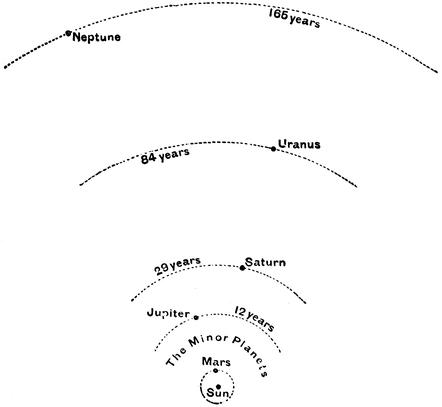
I want every one who reads this book to make a little
drawing of the sun and the planets. The apparatus
that you will need is a pair of compasses; any sort of
compasses that will carry a bit of pencil will do. You
must also get a little scale that has inches and parts of
inches divided upon it; any carpenter’s rule will answer.
The drawing is intended to give a notion of the true
sizes and positions of the fine family of which the earth
is one member. The figure I have given (Fig. 46) is not
on so large a scale as that which I ask you to use, and
which I shall here mention. Try and do the work neatly,
and then pin up your little drawings where you will be
able to see them every day until you are quite familiar
with the notion of what we mean by our solar system.
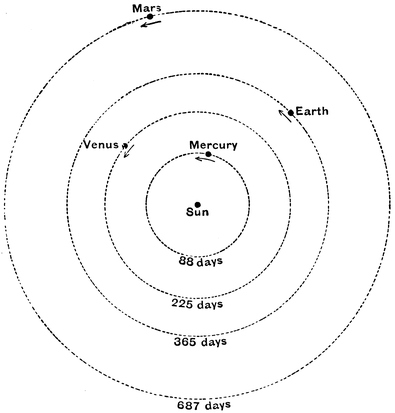
Fig. 46.—The Orbits of the Four Inner Planets.
First open the compasses one inch, and then describe
a circle, and mark a dot on this as “Mercury,” in neat
letters, and also write on the circle “88 days.” At the
centre you are to show the “Sun.” This circle gives
the track followed by Mercury in its journey round the
sun in the period of 88 days. Next open your compasses
to 1¾ in., which you must do accurately by the
scale. The circle drawn with this radius shows the
relative size of the path of Venus, and to indicate
the periodic time, you should mark it, “225 days.” The
next circle you have to draw is a very interesting one.
The compass is to be opened 2½ in. this time, and the
path that it makes is to be marked “365 days.” This
shows the high road along which we ourselves journey
every year, along which we are, indeed, journeying at
this moment. If you wanted to obtain from your figure
any notions of the true dimensions of the system, the
path of the earth will be the most convenient means of
doing so. The earth is 93,000,000 miles from the sun,
and our drawing shows its orbit as a circle of 2½ in.
radius. It follows that each inch on our little scale
will correspond to about 37,000,000 miles. As, therefore,
the radius of the orbit of Mercury has been taken
to be one inch, it follows that the distance of Mercury
from the sun is about 37,000,000 miles.
We have, however, still one more circle to draw
before we complete this little sketch. The compass
must now open to four inches, and a circle which
represents the orbit of Mars is then to be drawn. We
mark on this “687 days,” and the inner part of the
solar system is then fully represented. You see, this
diagram shows how our earth is in every sense a planet.
It happens that one of the four planets revolves outside
the earth’s path, while there are two inside. By
marking the days on the circles which show the periods
of the planets, you perceive that the further a planet
is from the sun, the longer is the time that it takes to
go round. Perhaps you will not be surprised at this,
for the length of the journey is, of course, greater in
the greater orbits; but this consideration will not
entirely explain the augmentation of the time of revolution.
The further a planet is from the sun, the more
slowly does it actually move, and therefore, for a double
reason, the larger orbit will take a longer time. From
London to Brighton is a much longer journey than from
London to Greenwich, and, therefore, the journey by
rail to Brighton will, of course, be a longer one than
by rail to Greenwich. But suppose that you compared
the railway journey to Greenwich with the journey,
not by rail, but by coach, to Brighton, here the comparative
slowness of the coach would form another
reason besides the greater length of the journey for
making the Brighton trip a much more tedious one than
that to Greenwich. Mars may be likened to the coach
which has to go all the way to Brighton, while Mercury
may be likened to the train which flies along over the
very short journey to Greenwich.
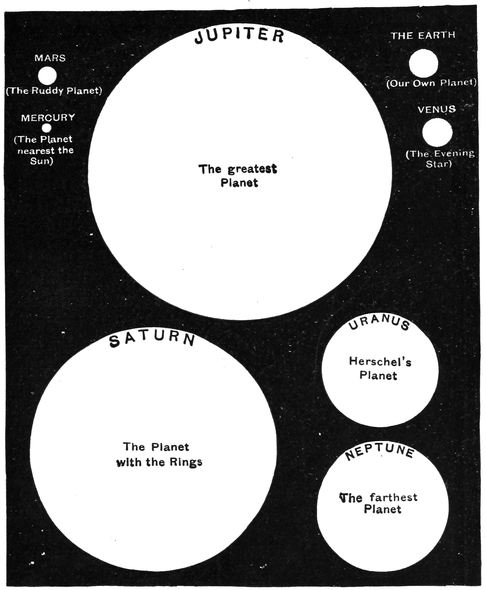
Fig. 47.—Comparative Sizes of the Planets.
We can easily show from our little sketch that
Mercury must be moving more quickly than Mars, for
the radii of the two circles are respectively one inch
and four inches, and therefore the path of Mars must
be four times as long as the orbit of Mercury. If
Mars moved as fast as Mercury, he would, of course,
require only four times as many days to complete his
large path as Mercury takes for his small path; but
four times 88 is 352, and, consequently, Mars ought to
get round in 352 days if he moved as fast as Mercury
does. As a matter of fact, Mars requires nearly twice
that number of days;
indeed, no less than
687, and hence we
infer that the average
speed of Mars
cannot be much
more than half that
of Mercury.
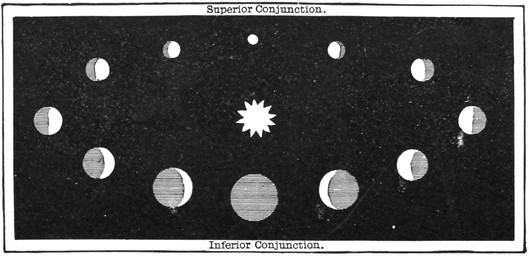
Fig. 48.—Phases of an Inferior Planet.
To appreciate
duly the position of
the earth with regard
to its brothers
and sisters in the
sun’s family it will
be necessary to use
your compasses in
drawing another
little sketch, by
which the sizes of
the four bodies
themselves shall be
fairly represented.
Remember that the
last drawing showed
nothing whatever about the sizes of the bodies; it merely
exhibited the dimensions of the paths in which they
moved. As Mercury is the smallest globe of the four, we
shall open the compasses half an inch and describe a
circle to represent it. The earth and Venus are so nearly
the same size (though the earth is a trifle the larger)
that it is not necessary to attempt to exhibit the
difference between them, so we shall represent both
bodies by circles, each 1¼ inches in radius. Mars, like
Mercury, is one of the globes smaller than the earth,
and the circle that represents it will have a radius of
¾ of an inch. You should draw these figures neatly,
and by a little shading make them look like globes.
It would be better still if you were to make actual
models, taking care, of course, to give each of them
the exact size. A comparative view of the principal
planets is shown in Fig. 47.
Quicksilver is a bright and pretty metal, and, unlike
every other metal, it is a liquid under ordinary circumstances.
If you spill quicksilver, it is a difficult task to
gather the liquid up again. It breaks into little drops,
and you cannot easily lift them with your fingers; they
slip away and escape your grasp. Quicksilver will run
easily through a hole so small that water would hardly
pass, and it is so heavy that an iron nail or a bunch
of keys will float upon it. Now, this heavy, bright,
nimble metal is known by another name besides quicksilver;
a chemist would call it mercury, and the astronomers
use exactly the same word to denote a pretty,
bright, nimble, and heavy planet which seems to try to
elude our vision. Though Mercury is so hard to see,
yet it was discovered so long ago, that all record is lost
of who the discoverer was.
You must take special pains if you want to see
the planet Mercury, for during the greater part of
the year it is not to be seen at all. Every now and
then a glimpse is to be had, but you must be on the
alert to look out just after sunset, or you must be up
very early in the morning so as to see it just before
sunrise. Mercury is always found to be in attendance
on the sun, so that you must search for him near the
sun; that is, low down in the west in the evenings, or
low down in the east in the mornings. To ascertain
the proper time of the year at which to look for him
you must refer to the almanac.
We have seen how Mercury revolves in a path inside
that of Venus, and it is therefore nearer to the sun.
Indeed, Mercury is so close to the sun that it is
generally overpowered by his brilliance and cannot be
seen at all. Like every other planet, Mercury is
lighted by the sun’s rays, and shows phases in the
telescope just as the moon does (Fig. 48). In this
figure the different apparent sizes of the planet at
different parts of its path are shown. Of course the
nearer Mercury is to the earth the larger does it
seem.
If we can only see Mercury so rarely, and if even
then it is a very long way off, does it not seem strange
that we can tell how heavy it is? Even if we had a
pair of scales big enough to hold a planet, what, it
may be asked, would be the use of the scales when
the body to be weighed was about a hundred millions
of miles away? Of course the weighing of a planet
must be conducted in some manner totally different
from the kind of weighing that we ordinarily use.
Astronomers have, however, various methods for weighing
these big globes, even though they can never touch
them. We do not, of course, want to know how many
pounds, or how many millions of tons they contain;
there is but little use in trying to express the weight
in that way. It gives no conception of a planet’s
true importance. One world must be compared with
another world, and we therefore estimate the weights
of the other worlds by comparing them with that of
our own. We accordingly have to consider Mercury
placed beside the earth, and to see which of the two
bodies is the bigger and the heavier, or what is the
proportion between them. It so happens that Mercury,
viewed as a world, is a very small body. It is a good
deal less in size than our earth, and it is not nearly
so massive. To show you how we found out the
mass of Mercury I shall venture on a little story. It
will explain one of the strange devices that astronomers
have to use when they want to weigh a distant body
in space.
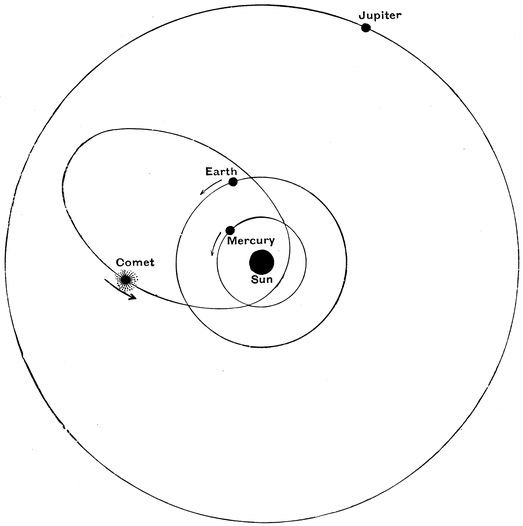
There was once, and there is still, a little comet
which flits about the sky; we shall call it after the
name of its discoverer, Encke. There are sometimes
splendid comets which everybody can see—we will
talk about these afterwards—but Encke is not such
a one. It is very faint and delicate, but astronomers
are interested in it, and they always look out for it
with their telescopes; indeed, they could not see the
poor little thing without them. Encke goes for long
journeys through space—so far that it becomes quite
invisible, and remains out of sight for two or three
years. All this time it is tearing along at a tremendous
speed. If you were to take a ride on the comet, it
would whirl you along far more swiftly than if you
were sitting on a cannon-ball. When the comet has
reached the end of its journey, then it turns round and
returns by a different road, until at last it comes near
enough to show itself. Astronomers give it all the
welcome they can, but it won’t remain; sometimes it
will hardly stay long enough for us to observe that it
has come at all, and sometimes it is so thin and worn
after all its wanderings that we are hardly able to see
it. The comet never takes any rest; even during its
brief visit to us it is scampering along all the time, and
then again it darts off, gradually to sink into the depths
of space, whither even our best telescopes cannot follow
it. No more is there to be seen of Encke for another
three years, when again it will come back for a while.
Encke is like the cuckoo, which only comes for a brief
visit every spring, and even then is often not heard by
many who dearly love his welcome note; but Encke is
a greater stranger than the cuckoo, for the comet never
repeats his visit of a few weeks more than once in three
years; and he is then so shy that usually very few
catch a glimpse of him.
An astronomer and a mathematician were great
friends, and they used to help each other in their
work. The astronomer watched Encke’s comet, noted
exactly where it was, on each night it was visible, and
then told the mathematician all he had seen. Provided
with this information the mathematician sharpens his
pencil, sits down at his desk, and begins to work long
columns of figures, until at length he discovers how
to make a time table which shall set forth the wanderings
of Encke. He is able to verify the accuracy of
his table in a very unmistakable way by venturing
upon prophecies. The mathematician predicts to the
astronomer the very day and the very hour at which
the comet will reappear. He even indicates the very
part of the heavens to which the telescope must be
directed, in order to greet the wanderer on his return.
When the time comes the astronomer finds that his
friend has been a true prophet; there is the comet on
the expected day, and in the expected constellation.
This happens again and again, so that the mathematician,
with his pencil and his figures, marks stage by
stage the progress of Encke through the years of his
invisible voyage. At each moment he knows where the
comet is situated, though utterly unable to see it.
The joint labors of the two friends having thus discovered
law and order in the movements of the comet,
you may judge of their dismay when on one occasion
Encke disappointed them. He appeared, it is true, but
then he was a little late, and he was also not in the
spot where he was expected. There was nearly being
a serious difference between the two friends. The
astronomer accused the mathematician of having made
mistakes in his figures, the mathematician retorted that
the astronomer must have made some blunder in his
observations. A quarrel was imminent, when finally
it was suggested to interrogate Encke himself, and see
whether he could offer any explanation. The mathematician
employed peculiar methods that I could not
explain, so I shall transform his processes into a dialogue
between himself and the offending comet.
“You are late,” said he to the comet. “You have
not turned up at the time I expected you, nor are you
exactly in the right place; nor, indeed, for that matter,
are you now moving exactly as you ought to do. In
fact, you are entirely out of order, and what explanation
have you to give of this irregularity?”
You see the questioner felt quite confident that there
must have been some cause at work that he did not
know of. Mathematicians have one great privilege;
they are the only people in the world who never make
any mistakes. If they knew accurately all the various
influences that were at work on the comet, they could,
by working out the figures, have found exactly where
the comet would be placed. If the comet was not there,
it is inevitable that there must have been something
or other acting upon the comet, of which the mathematician
was in ignorance.
The comet, like every other transgressor, immediately
began to make excuses, and to shuffle off the
blame on somebody else. “I was,” said Encke, “going
quietly on my rounds as usual. I was following out
stage by stage the track that you know so well, and
I would certainly have completed my journey and have
arrived here in good time and in the spot where you
expected me had I been let alone, but unfortunately I
was not let alone. In the course of my long travels—but
at a time when you could not have seen me—I
had the misfortune to come very close to a planet, of
which I dare say you have heard—it is called Mercury.
I did not want to interfere with Mercury; I
was only anxious to hurry past and keep on my journey,
but he was meddlesome, and began to pull me
about, and I had a great deal of trouble to get free
from him, but at last I did shake him off. I kept my
pace as well as I could afterwards, but I could not
make up the lost time, and consequently I am here a
little late. I know I am not just where I ought to be,
nor am I now moving quite as you expect me to do;
the fact is, I have not yet quite recovered from the bad
treatment I have experienced.”
The astronomer and the mathematician proceeded
to test this story. They found out what Mercury was
doing; they knew where he was at the time, and they
ascertained that what the comet had said was true, and
that it had come very close indeed to the planet. The
astronomer was quite satisfied, and was proposing to
turn to some other matter, when the mathematician
said:—
“Tarry a moment, my friend. It is the part of a
wise man to extract special benefit from mishaps and
disasters. Let us see whether the tribulations of poor
Encke cannot be made to afford some very valuable
information. We expected to find Encke here. Well,
he is not here—he is there, a little way off. Let us
measure the distance between the place where Encke
is, and the place where he ought to have been.”
This the astronomer did. “Well,” he said, “what
will this tell you? It merely expresses the amount
of delinquency on the part of Encke.”
“No doubt,” said the mathematician, “that is so;
but we must remember that the delinquency, as you
call it, was caused by Mercury. The bigger and the
heavier Mercury was, the greater would be his power
of doing mischief, the more would he have troubled
poor Encke, and the larger would be the derangement
of the comet in consequence of the unfortunate incident.
We have measured how much Encke has actually
been led astray. Had Mercury been heavier than
he is, that distance would have been larger; and if
Mercury had been lighter than he is, you would not,
of course, have found so large an error in the comet.”
We may illustrate what is meant in this way. A
steamer sails from Liverpool to New York, and in
favorable circumstances the voyage across the Atlantic
should be accomplished within a week. But supposing
that in the middle of the ocean a storm is encountered,
by which the ship is driven from her course. She will,
of course, be delayed, and her voyage will be lengthened.
A trifling storm, perhaps, she will not mind, but
a heavy storm might delay her six hours; a still greater
storm might keep her back half a day; while cases are
not infrequent in which the delay has amounted to one
day, or two days, or even more.
The delay which the ship has experienced may be
taken as a measure of the vehemence of the storm. I
am not supposing that her machinery has broken down;
of course, that sometimes happens at sea, as do calamities
of a far more tragic nature. I am merely supposing the
ship to be exposed to very heavy weather, from which
she emerges just as sound as she was when the storm
began. In such cases as this we may reasonably measure
the intensity of the storm by the number of hours’
delay to which the passengers were subjected. “The
weather we had was much worse than the weather you
had,” one traveller may say to another. “Our ship was
two days late, while you escaped with a loss of one
day.”
When the comet at last returned to the earth after
a cruise of three years through space, the number of
hours by which it was late expressed the vehemence
of the storm it experienced. The only storm that the
comet would have met with, at least in so far as our
present object is concerned, was the trouble that it had
with Mercury. The mass of Mercury was, therefore,
involved in the delay of the comet. In fact, the delay
was a measure of the mass of the planet. I do not
attempt to describe to you all the long work through
which the mathematician had to plod before he could
ascertain the mass of Mercury. It was a very tedious
and a very hard sum, but at last his calculations arrived
at the answer, and showed that Mercury must be a light
globe compared to the earth. In fact, it would take
twenty-five globes, each equal to Mercury, to weigh as
much as the earth.
I dare say you will think that this was a very long
and roundabout way of weighing. Supposing, however,
we had to weigh a mountain, or rather a body which
was bigger than fifty thousand mountains, and which
was also many millions of miles away, all sorts of expedients
would have to be resorted to. I have told you
one of them. If you feel any doubts as to the accuracy
with which such weighings can be made, then I must tell
you that there are many other methods, and that these
all agree in giving concordant results.
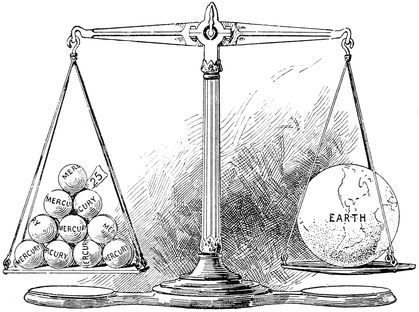
Fig. 49.—Relative Weights of Mercury and the Earth.
We hardly know anything as to what the globe of
Mercury may be like. We can see little or nothing
of the nature of its surface. We only perceive the
planet to be a ball, brightly lighted by the sun, and we
cannot satisfactorily discern permanent features thereon,
as we are able to do on some of the other planets.
You will have no difficulty in recognizing Venus, but
you must choose the right time to look out for her. In
the first place, you need never expect to see Venus
very late at night. You should look for the planet in
the evening, as soon as it is dark, towards the west, or
in the morning, a little before sunrise, towards the east.
I do not, however, say that you can always see Venus,
either before sunrise or after sunset. In fact, for a
large part of the year, this planet is not to be seen at
all. You should therefore consult the almanac, and
unless you find that Venus is stated to be an evening
star or a morning star, you need not trouble to search
for it. I may, however, tell you that Venus can never
be an evening star and a morning star at the same time.
If you can see it this evening after sundown, there is
no use in getting up early in the morning to look out
for it again. The planet will remain for several weeks
a splendid object after sunset, and then will gradually
disappear from the west, and in a couple of months
later will be the morning star in the east. Venus
requires a year and seven months to run through her
changes, so that if you find her a bright evening star
to-night, you may feel sure that she was a bright evening
star a year and seven months ago, and that she will
be a bright evening star in a year and seven months
to come. Nor must you ever expect to see her right
overhead; she is always to the west or to the east.
The splendor of Venus, when at her best, will prevent
you at such times from mistaking this planet for
an ordinary star. She is then more than twenty times
as bright as any star in the heavens. The most conclusive
proof of the unrivalled brightness of Venus is
found in the fact that she can be recognized in broad
daylight without a telescope. Even on the brightest
June afternoons the lovely planet is sometimes to be
discerned like a morsel of white cloud on the perfect
azure of the sky.
Venus is so brilliant that perhaps you will hardly credit
me when I tell you that she has no more light of her
own than has a stone or a handful of earth, or a button.
Is it possible that this is the case, you will say, for as
we see the planet so exquisitely beautiful, how can she
be merely a huge stone high up in the heavens? The
fact is that Venus shines by light not her own, but by
light which falls upon her from the sun. She is lighted
up just as the moon, or just as our own earth is lighted.
Her radiance merely arises from the sunbeams which
fall upon her. It seems at first surprising that mere
sunbeams on the planet can give her the brilliancy that
is sometimes so attractive. Let me show you an illustration
which will, I trust, convince you that sunbeams
will be adequate even for the glory of Venus.
Here is a button. I hang it by a piece of fine thread,
and when I dip it into the beam from the electric lamp,
look at the brilliancy with which the mimic planet glitters.
You cannot see the shape of the button; it is too
small for that; you merely see it as a brilliant gem,
radiating light all around. Therefore, we need not be
surprised to learn that the brilliancy of the evening star
is borrowed from the sun, and that if, while we are
looking at the planet in the evening, the sun were to
be suddenly extinguished, the planet would also vanish
from view, though the stars would shine as before.
Thus we explain the appearance of Venus. The
evening star is a beautiful, luminous point, but it has
no shape which can be discerned with the unaided eye.
When, however, the telescope is turned towards Venus
we have the delightful spectacle of a tiny moon, which
goes through its phases just as does our own satellite.
When first seen as an evening star Venus will often be
like the moon at the quarter, and then it will pass to
the crescent shape. Then the crescent becomes gradually
thinner, and next will follow a brief period of
invisibility before the appearance of Venus as the morning
star. It seems at first a little strange that Venus
when brightest should not be full like the moon, which
in similar circumstances is, of course, a complete circle
of light. The planet, however, has a very marked
crescent-shaped form in these circumstances. But at
this time the planet is so near us that the gain of brilliancy
from the diminution of distance more than compensates
for the small part of the illuminated side which
is turned towards us.
You ought all to try to get some one to show you
Venus through a telescope. A very large instrument
is not necessary, and I feel sure you will be delighted
to see the beautiful moon-shaped planet. You will then
have no difficulty in understanding how the brightness
of the planet has come from the sun. The changes in
the crescent merely depend upon the proportion of the
illuminated side which is turned towards us. Were
Venus itself a sunlike body we should, of course, see
no crescent, but only a bright circle of light.
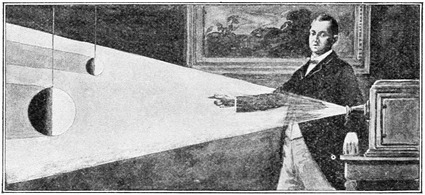
In Fig. 50 you will notice an imaginary picture of a
young astronomer surveying Venus with a telescope. I
have not, as is obvious, attempted to show the different
objects in their proper proportions. The sun is supposed
to have set, so that his beams do not reach the astronomer.
Night has begun at his observatory; but the
sunbeams fall on Venus, and light her up on that side
turned towards the sun. A part of this lighted side is,
of course, seen by the telescope which the astronomer
is using, and thus the planet seems to him like a crescent
of light.
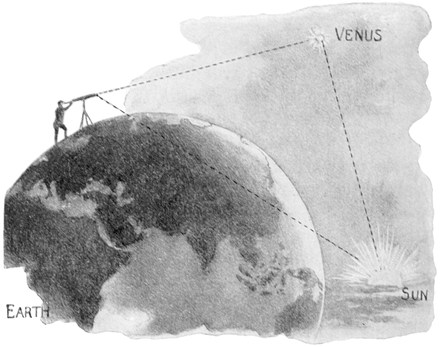
Fig. 50.—To show that Venus shines by Sunlight.
We might naturally think from Fig. 46 that Venus
must pass at every revolution directly between the
earth and the sun; and therefore it might appear that
what is called the transit of Venus across the sun ought
to occur every time between the appearance of the planet
as the evening star and the next following appearance
as the morning star. No doubt on each of these occasions
Venus seems to approach the sun closely; but the
orbits of Venus and the Earth do not lie quite in the
same plane, and hence the planet usually passes just
over or just under the sun, so that it is a very rare
event indeed for her to come right in front of the sun.
But this does sometimes happen. It happened, for
instance, in the year 1874, and again in the year 1882;
but, alas! I cannot hold out to you the prospect of
ever seeing another such spectacle. There will be no
further occurrence of the transit of Venus until the
year 2004, though there will be another eight years
later, in 2012.
It seems rather odd that one transit of Venus should
be followed by another after an interval of eight years,
and that then a period of much more than a century
should have to elapse before there will be a repetition
of a similar pair. This is in consequence of a curious
relation between the motion of Venus and the motion
of the Earth, which I must endeavor to explain with
the help of a little illustration.
Let us suppose a clock with ordinary numbers round
the dial, but so arranged that the slowly moving short
hand requires 365.26 days to complete one revolution
round the dial, while the more rapidly moving long
hand revolves in 224.70 days. The short hand will
then go round once in a year, and the long hand once
during the revolution of Venus. Let us suppose that
both hands start together from XII, then in 224.70
days the long hand is round to XII again, but the short
hand will have only advanced to about VII, and by the
time it reaches XII the long hand will have completed
a large part of a second circuit. It happens that the
two numbers 224.70 and 365.26 are very nearly in the
ratio of 8 to 13. In fact, if the numbers had only been
224.8 and 365.3 respectively, they would be exactly in
the proportion of 8 to 13. It, therefore, follows that
eight revolutions of the short hand must occupy very
nearly the same time as thirteen revolutions of the long
hand. After eight years the short hand will of course
be found again at XII; and at the same moment the
long hand will also be back at XII, after completing
thirteen revolutions.
We can now understand why the transits, when they
do occur, generally arrive in pairs at an interval of eight
years. Suppose that at a certain time Venus happens to
interpose itself directly between the earth and the sun,
then, when eight years have elapsed, the earth is, of
course, restored for the eighth time since the first transit
to the same place, and Venus has returned to almost
the same spot for the thirteenth time. The two bodies
are practically in the same condition as they were at
first, and, therefore, Venus again intervenes, and the
planet is beheld as a black spot on the sun’s surface.
We must not push this argument too far; the relation
between the two periods of revolution, though nearly,
is not exactly 8 to 13. The consequence is that when
another eight years have elapsed, the planet passes a
little above the sun or a little below the sun, and thus
a third occurrence of the transit is avoided for more
than a century. The next transit will take place at the
opposite side of the path.
We were fortunate enough to be able to see the
transit of Venus in 1882 from Great Britain. Perhaps
I should say a part of the transit, for the sun had set
long before the planet had finished its journey across
the disk. Venus looked like a small round black spot,
stealing in on the bright surface of the sun and gradually
advancing along the short chord that formed its
track.
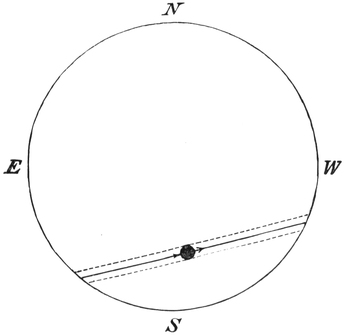
Fig. 51.—Venus in Transit across the Sun.
An immense deal of trouble was taken in 1882, as
well as in 1874, to observe this rare occurrence. Expeditions
were sent to various places over the earth
where the circumstances were favorable. Indeed, I do
not suppose that there was ever any other celestial event
about which so much interest was created. The reason
why the event attracted so much attention was not
solely on account of its beauty or its singularity; it was
because the transit of Venus affords us a valuable means
of learning the distance of the sun. When observations
of the transit of Venus made at opposite sides of the
earth are brought together, we are enabled to calculate
from them the distance of Venus, and knowing that,
we can find the distance of the sun and the distances
and the sizes of the planets. This is very valuable
information; but you would have to read some rather
hard books on astronomy if you wanted to understand
clearly how it is that the transit of Venus tells us all
these wonderful things. I may, however, say that the
principle of the method is really the same as that mentioned
on pp. 19–25. When you remember that not
we ourselves, nor our children, and hardly our grandchildren,
will ever be able to see another transit of
Venus, you will, perhaps, not be surprised that we tried
to make the most of such transits as have occurred in
our time.
Though Venus exhibits such pretty crescents in the
telescope, yet I must say that in other respects a view of
the planet is rather disappointing. Venus is adorned
by such a very bright dress of sunbeams that we can
see but little more than those sunbeams, and we can
hardly make out anything of the actual nature of the
planet itself. We can sometimes discern faint marks
upon the globe, but it is impossible even to make a
conjecture of what the Venus country is like. This is
greatly to be regretted, for Venus approaches comparatively
close to the earth, and is a world so like our own
in size and other circumstances that we feel a legitimate
curiosity to learn something more about her.
But the marks on the planet, though very faint, are
still sufficiently definite to have enabled some sharp-sighted
astronomers to answer a question of much
interest. They have made it plain that in one most
important respect Venus is very unlike our Earth. Our
globe, of course, rotates on its axis once each day, but
Venus requires no less than 225 days to complete each
rotation. In fact, this planet rotates in such a fashion
that she always keeps the same face to the sun. The
inhabitants of Venus will therefore find that it is perennial
day on one side of this globe and everlasting
night on the other.
Venus is one of the few globes which might conceivably
be the abode of beings not very widely different
from ourselves. In one condition especially—namely,
that of weight—she resembles the earth so closely that
those bodies which we actually possess would probably
be adapted, so far as strength is concerned, for a residence
on the sister planet. Our present muscles would
not be unnecessarily strong, as they would be on the
moon, nor should we find them too weak, as they would
certainly prove to be were we placed on one of the very
heavy bodies of our system. Nor need the temperature
of Venus be regarded as presenting any insuperable
difficulties. She is, of course, nearer to the sun than
we are, but then climate depends on other conditions
besides nearness to the sun, so that the question as to
whether Venus would be too hot for our abode could
not be readily decided. The composition of the atmosphere
surrounding the planet would be the most material
point in deciding whether terrestrial beings could live
there. I think it to be in the highest degree unlikely
that the atmosphere of Venus should chance to suit us in
the requisite particulars, and therefore I think there is
not much likelihood that Venus is inhabited by any
men, women, or children resembling those on this
earth.
The path of the earth lies between the orbits of the
planets Venus and Mars. It is natural for us to endeavor
to learn what we can about our neighbors. We
ought to know something, at all events, as to the people
who live next door to us on each side. I have, however,
already said that we cannot observe very much
upon Venus. The case is very different with respect to
Mars. He is a planet which we are fortunately enabled
to study minutely, and he is full of interest when we
examine him through a good telescope.
The right season for observing Mars must, of course,
be awaited, as he is not always visible. Such seasons
recur about every two years, and then for months
together Mars will be a brilliant object in the skies
every night. Nor has Mars necessarily to be sought in
the early morn or immediately after sunset, in the
manner we have already described for Venus and
Mercury. At the time Mars is at his best he comes
into the highest position at midnight, and he can
generally be seen for hours before, and be followed for
hours subsequently. You may, however, find some difficulty
in recognizing him. You probably would not at
first be able to distinguish Mars from a fixed star. No
doubt this planet is a ruddy object, but some stars are
also ruddy, and this is at the best a very insecure characteristic
for identification. I cannot give you any
more general directions, except that you should get
your papa to point out Mars to you the next time it is
visible. It is just conceivable that papa himself might
not know how to find Mars. If so, the sooner he gets
a set of star maps and begins to teach himself and to
teach you, the better it will be for you both.
Mars, though apparently so like a star, differs in
some essential points from any star in the sky. The
stars proper are all fixed in the constellations, and
they never change their relative positions. The groups
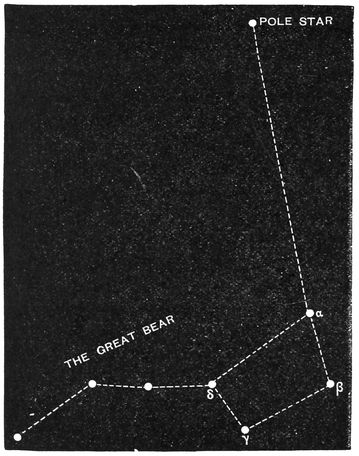
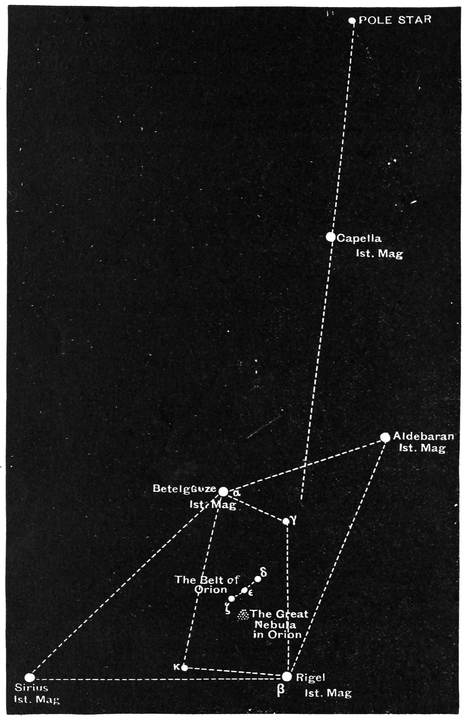
which form the Great Bear or the Belt of Orion do not
alter, they are just the same now as they were centuries
ago. But the case is very different with a planet such
as Mars. The very word planet means a wanderer, and
it is justly applied, because Mars, instead of staying
permanently in any one constellation, goes constantly
roaming from one group to the other. He is a very
restless body; sometimes he pays his respects to the
heavenly Twins, and is found near Castor and Pollux
in Gemini, then he goes off and has a brief sojourn with
the Bull, but it looks as if that fierce animal got tired
of his company and hunted him off to the Lion. His
quarters then become still more critical. Sometimes it
looks as if he desired to seek for peace beneath the
waters, and so he visits Aquarius, while at other times
he is found in dangerous proximity to the claws of the
Crab.
Mars cannot even make up his mind to run steadily
round the heavens in one direction; sometimes he will
bolt off rapidly, then pause for a while, and turn back
again; then the original impulse will return, and he
will resume his journey in the direction he at first
intended. It is no wonder that I am not able to give
you very explicit directions as to how you may secure
a sight of a truant whose wanderings are apparently so
uncertain. Yet there is a definite order underlying all
his movements. Astronomers, who make it their business
to study the movements of Mars, can follow him
on his way; they know exactly where he is now, and
where he will be every night for years and years to
come. The people who make the almanacs come to the
astronomers and get hints from them as to what Mars
intends to do, so that the almanacs announce the positions
in which the planet will be found with as much
regularity as if he was in the habit of behaving with
the orderly propriety of the sun or the moon.
We must not lay all the blame on Mars for the
eccentricities of his movements. Our earth is to a very
large extent responsible. What we think to be Mars’
vagaries are often to be explained by the fact that we
ourselves on the earth are rapidly shifting about and
altering our point of view.
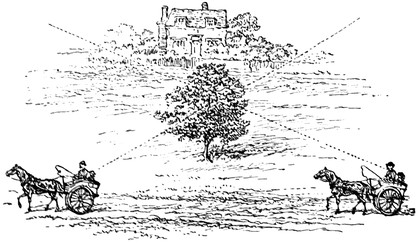
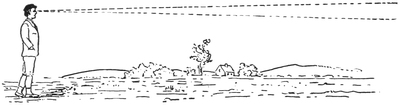
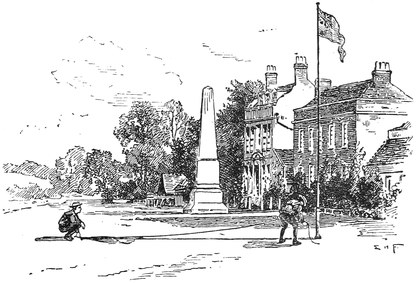
Fig. 52.—How the Tree seems to move about.
I was driving down a pretty country road with a
little girl three years old beside me, when I was
addressed with the little remark, “Look at the tree
going about in the field.” Now, you or I, with our
longer experience of the world around us, know that it
is not the custom of trees to take themselves up and
walk about the fields. But this was what this little
girl saw, or rather what she thought she saw; and very
often what we do see is something very different from
what we think we see. We think we see Mars performing
all these extraordinary movements, as the little
girl thought she saw the tree moving about. But just
as that little girl, when she grew to be a big girl, found
that what she thought was a tree walking across the
field must really have some quite different explanation,
so we, too, find that what Mars seems to do is one thing,
and what Mars actually does is quite another thing.
Let us see what the little girl noticed. She was
looking at the tree, and first she saw it on one side of
the house, and then she saw it on the opposite side (Fig. 52).
If it had been a cow instead of a tree, of course
the natural supposition would have been that the cow
had walked. Our little friend may, perhaps, have
thought it unusual for a tree to walk, but still she saw
the undoubted fact that the tree had shifted to the
other side of the house, and therefore, perhaps, remembering
what the cow could do, she said the tree had
moved.
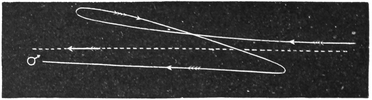
Fig. 53.—A Specimen of the Track of Mars.
The little girl did not stop to reflect that she herself
had entirely changed her position, and hence arose the
surprising phenomenon of a tree that could move about.
You will understand this, at once, from the two positions
of the car here shown. In the first position, as the girl
looks at the tree, the dotted line shows the direction
of her glance, and the other dotted line shows how the
apparent places of the tree and the house have altered.
It is her change of place that has accomplished the
transformation. Observe also that the tree appeared to
her to move in the direction opposite to that in which
she is going.
Mars generally appears to move round among the
stars from west to east. In fact, if we were viewing
him from the sun he would always seem to move in
this manner. But at certain seasons our earth is moving
very fast past Mars, and this will make him appear
to move in the opposite direction. This apparent
motion is sometimes so much in excess of his real
motion, that it may give us an entirely incorrect idea
of what the planet is actually doing.
Thus, notwithstanding that Mars is moving one way,
he may appear to us who dwell on the earth to be going
in the opposite way. This illusion only happens for a
short time, just when we are passing Mars, as we do
every two years. The effect on the planet is to make
the path he pursues at this time something like that
shown in Fig. 53. The planet is nearest to us at the
time he is moving in this loop. He is then to be seen
at his best in the telescope, so that it is especially interesting
to watch Mars through this critical part of his
career.
I want to show you how to make a little calculation
which will explain the law by which the seasons when
we can see Mars best will follow each other. The period
he requires for a voyage round the sun is not quite two
years, for that would be 730 days, and Mars only takes
687 days for his journey. It is, however, true that 1-15/17
years is very nearly the period of Mars. Hence, every
32 years Mars will complete 17 rounds. From this we
shall be able to see how long it will take after the earth
once passes Mars before they pass again. I shall suppose
there is a circular course, around which two boys
start together to run a race. One of these boys is such
a good runner that he will get quite round in 17 minutes;
but the other boy can hardly run more than half
as quickly, for he will require 32 minutes to complete
one circle. Here then is the question. Suppose the
two boys to start together: how long will it be before
the faster runner gains one complete circuit on the
other? By the time the good runner (A) has completed
one circuit, the bad runner (B) has only got a
little more than halfway. When A has completed his
second circuit, he has, of course, run for twice 17 minutes—that
is, for 34 minutes. This is two minutes
longer than the time B requires to get round once;
therefore B is only ahead by a distance which A could
cover in about one minute; but B will have advanced
during this minute a distance for which A will require
another half-minute, during which B covers a distance
for which A will need a further quarter, and so on.
But all these intervals—one minute, half a minute, a
quarter of a minute, one-eighth, one-sixteenth, and so
on—added together amount to two minutes, and hence
it follows that B will not be overtaken until about two
minutes after A has completed his second round—that
is, in 36 minutes altogether.
We can pass from this illustration to the case of the
planet Mars and the earth. The orbit of the earth is
traversed in a year, and therefore, after the earth has
once passed Mars, which is then, as astronomers would
say, in opposition, about two years and the eighth of a
year—that is, two years and six or seven weeks—will
elapse before Mars is again favorably placed. You will
thus see that we need not expect to observe Mars under
the best conditions every year. Besides, the distance
of the planet from the earth at opposition varies so
greatly that some oppositions are more favorable than
others.
The time has come when I must tell you something
about the shapes of the paths in which the earth and
the other planets perform their great journeys round
the sun. Perhaps you will think that I am going to
contradict some of the things that I have told you
before. I have often represented the orbits of the planets
as circles, and now I am going to tell you that this
is not correct. The fact is that the paths are nearly
circles; but, still, there is some departure from the
exact circular shape. Mars, in particular, moves in a
path which is more different from a circle than the path
of the earth, and consequently it is appropriate to introduce
this subject when we are engaged about Mars.
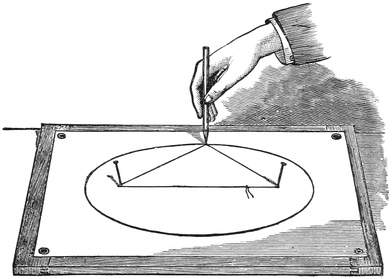
Fig. 54.—How to draw an Ellipse.
We must first take another lesson in drawing, and
the appliances I want you to use for the purpose are
very simple. You must have a smooth board and some
tacks or drawing-pins, besides paper, pencil, and twine.
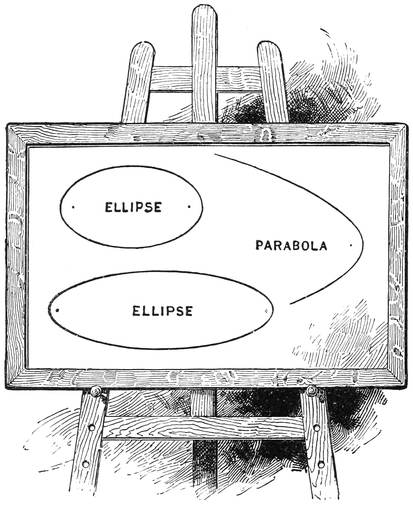
Fig. 55.—Specimens of Ellipses.
We first lay a sheet of paper on the board, and then
put in two tacks through the paper and into the board.
It does not much matter where we put them in. Next
we take a piece of twine and tie the two ends together
so as to form a loop, which we pass round the two tacks
(Fig. 54). In the loop I place the pencil, and then you
see I move it round, taking care to keep the twine
stretched. Thus I produce a pretty curve, which we
call the ellipse. I must ask all of you to practise this
experiment. Try with different lengths of string, and
try using different distances between the tacks. Here
are some sketches of two shapes of ellipse and a parabola
(Fig. 55). Elliptic curves can be made almost circles
by putting the two tacks close together, or they
can be made very long in comparison with their width.
They are all pretty and graceful figures, and are often
useful for ornamental work. The ellipse is a pretty
shape for beds of flowers in a grass-plot.
The importance of the ellipse to astronomers is
greater than that of any other geometrical figure. In
fact, all the planets, as they perform their long and
unceasing journeys round the sun, move in ellipses;
and though it is true that these ellipses are very nearly
circles, yet the difference is quite appreciable.
It is also important to observe that the sun is not
in the centre of the ellipse which the planet describes.
The sun is nearer to one end than to the other. And
the actual position of the sun must be particularly
noted. Suppose that some mighty giant were preparing
to draw an exact path for the earth, or for Mars, of
course he would want to have millions of miles of string
for producing a big enough curve, and one of the nails
that he used would have to be driven right into the
sun. The following is the astronomer’s more accurate
method of stating the facts. He calls each of the
points represented by the tacks around which the string
is looped a focus of the ellipse; the two points together
are said to be the foci; and as the planet is describing
its orbit, the position of the sun will lie exactly at one
of the foci.
The ellipse is a curve that nature is very fond of
reproducing. From an electric light, a brilliant beam
will diverge. If you hold a globe in the beam, and let
the shadow fall on a sheet of paper, it forms an ellipse.
If you hold the sheet squarely, the shadow is a circle;
but as you incline it, you obtain a beautiful oval, and by
gradually altering the position, you can get a greatly
elongated curve. Indeed, you can thus produce an
ellipse of almost any form. The electric light is not
indispensable for this purpose; any ordinary bright
lamp with a small flame will answer, and by taking
different sized balls and putting them in various positions,
you can make many ellipses, great and small.
It was by the observations of a celebrated old
astronomer, named Tycho Brahe, that the true shape
of a planet’s path came to be afterwards determined.
Tycho lived in days before telescopes were invented.
He had few of the excellent contrivances for measuring
which we have in our observatories. We shall take a
look at this fine old astronomer, as he sits amid his
curious astronomical machines.
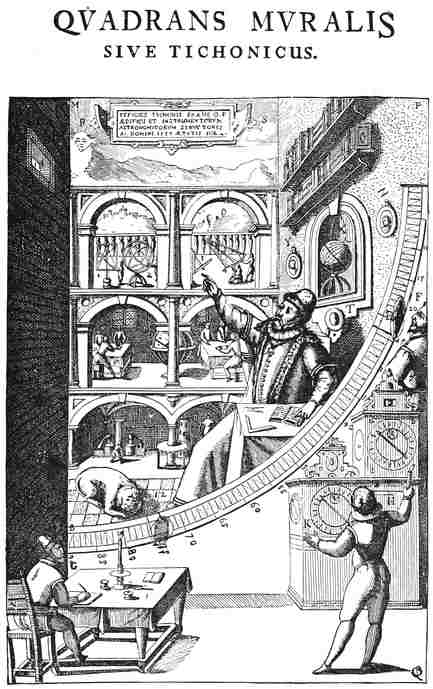
Fig. 56.—Tycho Brahe in his Observatory.
He lived on an island near Copenhagen, and he has
given us a picture of himself (Fig. 56), as he is seated
with his quaint apparatus, and his assistants around
him, busily engaged in observing the heavens. You
see the walls of his observatory are decorated with pictures;
and one of the great Danish hounds which the
King of Denmark had presented to him lies asleep at
his feet. I do not think we should now encourage big
dogs in the observatory at night. Nor do modern astronomers
put on their velvet robes of state, as Tycho
was said to have done when he entered into the presence
of the stars, as, by so doing, he showed his respect
for the heavens. Astronomers, nowadays, rather prefer
to wear some comfortable coat which shall keep out
the cold, no matter what may be its appearance from
the picturesque point of view. In this wonderful contrivance,
you see Tycho Brahe did not use any actual
telescope. He observed through a small opening in the
wall, and lest there should be any mistake as to what
is going on, you see he is pointing towards it, and giving
his three assistants their instructions. The most important
work is being done by the man on the right.
He is engaged in making the actual observation. But
he has no aid from magnifying lenses. All he can do
is to slide a pointer up or down till it is just in line
with the planet or star as he sees it through the hole
opposite.
On the circle a number of marks have been engraved,
and there are numbers placed opposite to the marks; it
is by these that the position of the object is to be ascertained.
If the object is high, then the pointer will be
low; and if the object is low, then the pointer will
be high. The observer calls out the position when he
has found it, and there, you see, is a man ready with
writing materials to take down the observation. Notice
also the other astronomer who is looking at the clock.
He gives the time, which must also be recorded accurately.
In fact, the entire process of finding the place
of a heavenly body consists in two observations—one
from the circle and the other from the clock; so that
though Tycho had no telescope to aid his vision, yet
the principle on which his work was done was the same
as that which we use in our observatories at this
moment.
You may think that such a concern would hardly be
capable of producing much reliable work. However,
Tycho compensated in a great degree for the imperfection
of his instrument by the skill with which he used
it. He had a noble determination to do his very best.
Perseverance will accomplish wonders even with very
imperfect means. A great astronomer has said that
a skilful observer ought to be able to make valuable
measurements with a common cart-wheel!
It was with instruments on the principle of that
which I have here shown that Tycho made his celebrated
observations of Mars. Week after week, month
after month, year after year, did the patient old
astronomer track the planet through his capricious
wanderings.
Before we try to explain anything, it is of course
necessary to ascertain, with all available accuracy,
what the thing actually is. Therefore, when we seek
to explain the irregular movements of a planet, the
first thing to be done is to make a careful examination
of the nature of those irregularities. And this was
what Tycho strove to do with the best means at his
disposal.
The full benefit of Tycho’s work was realized by
Kepler when he commenced to search out the kind of
figure in which Mars was moving. First he tried various
circles, and then he sought, by placing the centre
in different positions, to see whether it would not be
possible to account thus for the irregularities of the
wayward planet. It would not do; the movement was
not circular. This was thought very strange in those
days, for the circle was regarded as the only perfect
curve, and it was considered quite impossible for a
planet to have any motion except it were the most perfect.
There was, however, no help for it; so Kepler
sagaciously tried the ellipse, which he considered to
be the most perfect curve next to the circle. He continued
his long calculations, until at last he succeeded
in finding one particular ellipse, placed in one particular
position, which would just explain the strange wanderings
of our erratic neighbor. It was not alone that
the motion of the planet traced out an ellipse; it was
further discovered that the sun lies at one of the foci
of the curve. If the sun were anywhere else, the
motion of the planet would have been different from
that which Tycho had found it to be.
You must know that this discovery is one of the very
greatest that have ever been made in the whole extent
of human knowledge. After it had been proved that
the orbit of Mars was elliptic, it became plain that the
same path must be traced by every planet. There are
very big planets, and there are small ones; there are
planets which move in very large orbits, and there are
planets whose paths are comparatively small. In all
cases the high road which the planet follows is invariably
an ellipse, and the sun is invariably to be found
situated at the focus. It is surely interesting to find
that these beautiful ellipses which we can draw so simply
with a piece of twine and a pencil should be also
the very same figures which our great earth and all the
other bodies which revolve around the sun are ever
compelled to follow.
Kepler also made another great discovery in connection
with the same subject. If the planet moved in
a circle with the sun in the centre, then there would be
very good reason to expect that it would always move
at the same speed, for there would be no reason why it
should go faster at one place than at another. In fact,
the planet would then be revolving always at the same
distance from the sun, and every part of its path would
be exactly like every other part. But when we consider
that the motion is performed in an ellipse, so that the
planet is curving round more rapidly at the extremities
of its path than in the other parts where the curvature
is less perceptible, we have no reason to expect that
the speed shall remain the same all round.
We know that the engine-driver of a railway train
always has to slacken speed when he is going round a
sharp curve. If he did not do so, his train would be
very likely to run off the line, and a dreadful accident
would follow. The engine-driver is well aware that
the conditions of pace are dependent on the curvature
of his line. The planet finds that it, too, must pay
attention to the curves; but the extraordinary point is
that the planet acts exactly in the opposite way to the
engine-driver. The planet puts on its highest pace at
one of the most critical curves in the whole journey.
There are two specially sharp curves in the planet’s
path. These are, of course, the two extremities of the
ellipse which it follows. The cautious engine-driver
would, of course, creep round these with equal care,
and no doubt the planet goes slowly enough about that
end of the ellipse which is farthest from the sun. There
its pace is slower than anywhere else; but from that
moment onwards the planet steadily applies itself to
getting up more and more speed. As it traverses the
comparatively straight portion of the celestial road, the
pace is ever accelerating until the sharp curve near
the sun is being approached; then the velocity gets
more and more alarming, until at last, in utter defiance
of all rules of engine-driving, the planet rushes round
one of the worst parts of the orbit at the highest possible
speed. And yet no accident happens, though the planet
has no nicely laid lines to keep it on the track.
If lines are necessary to save a railway train from
destruction, how can we possibly escape when we have
no similar assistance to keep us from flying away from
the sun and off into infinite space? Kepler has taught
us to measure the changes in the speed of the body
with precision. He has shown that the planet must,
at every point of its long journey, possess exactly the
right speed; otherwise everything would go wrong. I
dare say you have seen, at different points along a line
of railway, boards put up here and there, with notices
like, “Ten miles an hour.” These words are, of course,
an intimation to the engine-driver that he is not to vary
from the speed thus stated. Kepler has given us a law
which is equivalent to a large number of caution boards,
fixed all round the planet’s path, indicating the safe
speed for the journey at every stage. It is fortunate
for us that the planet is careful to observe these regulations.
If the earth were to leave her track, the
consequences would be far worse than those of the
most frightful railway accident that ever happened.
Whichever side we took would be almost equally disastrous.
If we went inwards we should plunge into
the sun, and if we went outwards we should be frozen
by cold.
We owe our safety to the care with which the speed
of the earth is prescribed. When near the sun, the earth
is pulled inwards with exceptionally strong attraction.
We are often told that when a strong temptation seizes
us, the wisest thing that we can do is to run away as
hard as possible. This is just what the laws of dynamics
cause the earth to do at this critical time. She puts
on her very best pace, and only slackens when she has
got well away from the danger.
The peril that we are exposed to when the earth is
at the other end of the orbit is of an opposite character.
We are then a long way from the sun, and the pull
which it can exercise upon the earth is correspondingly
lessened. Care is then required lest we should escape
altogether from the sun’s warmth and his guidance.
We must therefore give time to the sun to exercise his
power, so as to enable the earth to be recalled; accordingly
we move as slowly as possible until the sun conquers
the earth’s disposition to fly off, and we begin to
return.
You may remember that when we were speaking
about the moon, I showed you how a body might
revolve around the earth in a circle under the influence
of an attraction towards the earth’s centre. So long as
the path is really a circle, then the power with which
the earth is drawing the body remains the same. In a
precisely similar way, a body could revolve around the
sun in a circle, in which case also the attraction of the
sun will remain the same all round. But now we have
a very much more difficult case to consider. If the
body does not always remain at the same distance, the
power of the sun will not be the same at the different
places. Whenever the object is near the sun, the
attraction will be greater than when it is farther off.
For example, when the distance between the two bodies
is doubled, then the pull is reduced to the fourth part
of what it was before.
I have now some great discoveries to talk to you
about, which were made by Sir Isaac Newton. He was
not an astronomer who looked much through a telescope,
though he made many remarkable experiments.
He used to sit in his study and think, and then he used
to draw figures with his pencil, and make long calculations.
At last he was able to give answers to the
questions: What is the reason why the planet moves
in an ellipse? Why should it move in this curve
rather than in any other? Why should this ellipse
be so placed that the sun lies at one of the foci?
If the planet had run uniformly round its course,
Newton would have found his task an impossible one.
But I have already explained that the motion is not
uniform. I described how the planet hurried along
with extra speed at certain parts of its path; how it
lingered at other parts; how, in fact, it never preserved
the same rate for even a single minute during the whole
journey. Kepler had shown how to make a time-table
for the whole journey. In fact, just as a captain on
a long voyage keeps a record of each day’s run, and
shows how to-day he makes 170 miles, and to-morrow
perhaps 200, and the next day 210, while the day after
he may fall back to 120, so Kepler gave rules by which
the log of a planet in its voyage round the sun might
be so faithfully kept that every day’s run would be
accurately recorded.
When Newton commenced his work, one of the first
questions he had to consider was the following: Suppose
that a great globe like a planet, or a small globe
like a marble, or an irregular body like an ordinary
stone, were to be thrown into space, and were then to
be left to follow its course without any force whatever
acting upon it, where would it go to?
You may say, at once, that a body under such circumstances
will presently fall down to the ground;
and so, of course, it will, if it be near the earth. I am
not, however, talking of anything near the earth; I
want you to imagine a body far off in the depths of
space, among the stars. Such a body need not necessarily
fall down here, for you see the moon does not fall,
and the sun does not.
If you were at a great distance from our globe and
from all other large globes—so far, indeed, that their
attractions were imperceptible—you could try the
experiment that I wish now to describe. Throw a stone
as hard as ever you can, and what will happen? Of
course, when you do it down here, it moves in a pretty
curve through the air, and tumbles to the ground; but
away in open space, what will the stone do? There
will be no such motion as up or down, as we ordinarily
understand it; for though the earth, no doubt, will lie
in one particular direction at a great distance, yet there
will be other bodies just as large in other directions;
and there is no reason why the stone should move
towards one of these rather than to another; in fact, if
they are all far enough, as the stars are from us, their
attractions will be quite inappreciable. There is, therefore,
not the slightest reason why the stone should
swerve to one side more than to another. There is no
more reason why it should turn to the right than why
it should turn to the left. Nor could you throw the
stone so as to make it follow a curved path. You can,
of course, make it describe a curve while it remains in
your hand, but the moment the stone has left your
hand, it proceeds on its journey by a law over which
you have no control. As the direction cannot be changed
towards one side more than towards the other, the stone
must simply follow a straight line from the very moment
when it is released from your hand.
The speed with which the stone is started will also
not change. You might at first think that it would
gradually abate, and ultimately cease. No doubt a
stone thrown along the road will behave in this way,
but that is because the stone rubs against the ground.
If you throw a stone across a sheet of ice, then it will
run a very long distance before it stops, and all the
time it will be moving in a straight line. In this case
there is but little loss by rubbing against the ice, because
it is so smooth. Thus we see that if the path be exceedingly
smooth, the body will run a long way before it
stops. Think of the distance a railway train will run
if, while travelling at full speed along a level line, the
steam is turned off.
These illustrations all show that if you let a body
alone, after having once started it, and do not try to
pull it this way or that way, and do not make it rub
against things, that body will move on continually in a
straight line, and will keep up a uniform speed. We
can apply this reasoning to a stone out in space. It
would certainly move in a straight line, and would go
on and on forever, without losing any of its pace.
I need hardly tell you that no one has ever been able
to try this experiment. In the first place, we reside
upon the surface of the earth, and we have no means of
ascending into those elevated regions where the stone
is supposed to be projected. There is also another difficulty
which we cannot entirely avoid, and that arises
from the resistance of the air. All movements down
here are impeded because the body has to force its way
through the air; and in doing so it invariably loses
some of its speed. Out in open space there is, of
course, no air, and no loss of speed can therefore arise
from this cause.
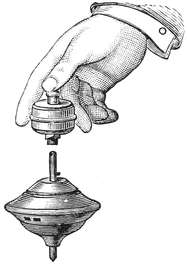
Fig. 57.—The Humming-top.
There are, however, several actual experiments by
which we can assure ourselves of the general truth. Set
a humming-top spinning (Fig. 57); it gradually comes
to rest, partly because of the rubbing of its point on the
table, and partly because it
has to force its way through
the air. In fact, the hum of
the top that you hear is only
produced at the expense of its
motion. Supposing I use a
much heavier top; if I set it
spinning it will keep up for
many minutes, because its
weight gives it a better store
of power wherewith to overcome
the resistance of the air.
I remember hearing a story
about Professor Clerk-Maxwell. He had, when at Cambridge,
invented one of these large and heavy tops, which
would spin for a long time. One evening the top was
left spinning on a plate in his room when his friends
took their departure, and no doubt it came to rest in due
time. Early the next morning, Professor Maxwell,
hearing the same friends coming up to his rooms again,
jumped out of bed, set the top spinning, and then got
back to bed, and pretended to be asleep. He thus
astounded his friends, who, of course, imagined that
the top must have been spinning all the night long!
If we spin a top under the receiver of an air pump
(Fig. 58), it will keep up its motion for a very much
longer time after the air has been exhausted than it
would in ordinary circumstances. Such experiments
prove that the motion of a body will not of itself naturally
die out, and that if we could only keep away the
interfering forces altogether, the motion would continue
indefinitely with unabated speed. What I have been
endeavoring to illustrate is called the first law of motion.
It is written thus:—
“Every body continues in its state of rest or of uniform
motion in a straight line, except in so far as it may
be compelled by impressed forces to change that state.”
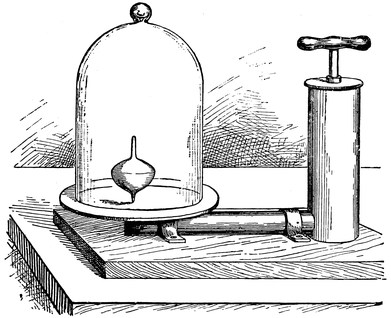
Fig. 58.—To illustrate the First Law of Motion.
I would recommend you to learn this by heart. I
can assure you it is quite as well worth knowing as
those rules in the Latin Grammar with which many of
you, I have no doubt, are acquainted. The best proof
of the first law of motion is derived, not from any
experiments, but from astronomy. We make many
calculations about the movements of the sun, the moon,
the stars, and then we venture on predictions, and we
find those predictions verified. Thus we had a transit
of Venus across the sun in 1882, and every astronomer
knew that this was going to occur, and many went to
the ends of the earth so that they might see it favorably.
Their anticipations were realized; they always
are. Astronomers make no mistakes in these matters.
They know that there will be another transit of Venus
in the year 2004, but not sooner. The calculations by
which these accurate prophecies are made involve this
first law of motion; and as we find that such prophecies
are always fulfilled, we know that the first law of motion
must be true also.
Newton knew that if a planet were merely left alone
in space, it would continue to move on forever in a
straight line. But Kepler had shown that the planet
did not move in a straight line, but that it described an
ellipse. One conclusion was obvious. There must be
some force acting upon the planet which pulls it away
from the straight line it would otherwise pursue. We
may, for the sake of illustration, imagine this force to
be applied by a rope attached to the planet so that at
every moment it is dragged by some unseen hand. To
find the direction this rope must have, we take the law
of Kepler, which explains the rules according to which
the planet varies its speed. I cannot enter into the
question fully, as it would be too difficult for us to discuss
now. I should have to talk a great deal more about
mathematics than would be convenient just at present;
but I think you can all understand the result to
which Newton was led. He showed that the rope must
always be directed towards the sun. In other words,
suppose that there was no sun, but that in the place
which it occupied there was a strong enough giant constantly
pulling away at the planet, then we should find
that the speed of the planet would alter just in the way
it actually does. Thus we learn that some force must
reside in the sun by which the planet is drawn, and
this force is exerted, although there is no visible bond
between the sun and the planet.
There is another fact to be learned about the sun’s
attraction, and this time we obtain it by knowing the
shape of the curve followed by the planet. The laws
by which the planet’s speed is regulated prove that the
force emanates from the sun. We shall now learn
much more when we take into account that the path
of the planet is an ellipse, of which the sun lies at
the focus. Nothing has been said as yet regarding the
magnitude of the pull which is being exerted by the
sun. Is that pull to be always the same, or is it to be
greater at some times than at other times? Newton
showed that no ellipse other than a circle could be
described, if the pull from the sun were always the
same. Its magnitude must be continually changed,
and the nearer the planet lies to the sun, the more
vehement is the pull it receives. Newton laid down
the exact law by which the force on the planet at any
one place in its path could be compared with the force
at any other position. Let us suppose that the planet
is in a certain position, and that it then passes into a
second position, which is twice as far from the sun.
The pull upon the planet at the shorter distance is not
only greater than the pull at the longer distance, but
it is actually four times as much. Stating this result
a little more generally, we assert, in the language of
astronomers, that the attraction varies inversely as the
square of the distance. If this law were departed from,
then I do not say that it would be impossible for the
planet to revolve around the sun in some fashion, but
the motion would not be performed in an ellipse described
around the sun in the focus.
You see how very instructive are the laws which
Kepler discovered. From the first of them we were
able to infer that the sun attracts the planets; from
the second, we have learned how the magnitude of the
attracting force varies.
The true importance of these great discoveries will
be manifest when we compare them with what we have
already learned with regard to the movements of the
moon. As the moon revolves around the earth it is
held by the earth’s attraction, and the moon follows a
path which, though nearly a circle, is really an ellipse.
This orbit is described around the earth just as the
earth describes its path around the sun. That law by
which a stone falls to the ground in consequence of the
earth’s attraction is merely an illustration of a great
general principle. Every body in the whole universe
attracts every other body.
Think of two weights lying on the table. They no
doubt attract each other, but the force is an extremely
small one—so small, indeed, that you could not measure
it by any ordinary appliance. One or both of the
attracting masses must be enormously big if their
mutual gravitation is to be readily appreciable. The
attraction of the earth on a stone is a considerable
force, because the earth is so large, even though the
stone may be small. Imagine a pair of colossal solid
iron cannon-balls, each 53 yards in diameter, and weighing
about 417,000 tons. Suppose these two globes were
placed a mile apart, the pull of one of them on the other
by gravitation would be just a pound weight. Notwithstanding
the size of these masses, the hand of a child
could prevent any motion of one ball by the attraction
of the other. If, however, they were quite free to move,
and there was absolutely no friction, the balls would
begin to draw together; at first they would creep so
slowly that the motion would hardly be noticed. The
pace would no doubt continue to improve slowly, but
still not less than three or four days must elapse before
they will have come together.
By the kindness of Professor Dewar, I am enabled to
exhibit a contrivance with which we can illustrate the
motion of a planet around the sun. Here is a long wire
suspended from the roof of this theatre, and attached
to its lower end is an iron ball, made hollow for the
sake of lightness. When I draw the ball aside, it
swings to and fro with the regularity of a great pendulum.
But when I place a powerful magnet in its
neighborhood (Fig. 59), you see that as soon as the
ball gets near the magnet it is violently drawn to one
side, and follows a curved path. This magnet may be
taken to represent the sun, while the ball is like our
earth, or any other planet, which would move in a
straight line were it not for the attraction of the sun
which draws the body aside.
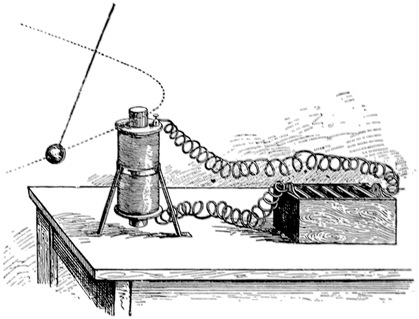
Fig. 59.—The Effect of Attraction.
We will now say something with respect to the
geography of our fellow-planet, a subject which seems
all the more interesting because Mars is so like the
earth in many respects. We require a fairly good telescope
for the purpose of seeing him well, but when
such an instrument is directed to the planet, a beautiful
picture of another world is unfolded (Fig. 60).
There are many things visible on his surface, but we
must always remember that even with our most powerful
telescopes the planet still appears a long way off.
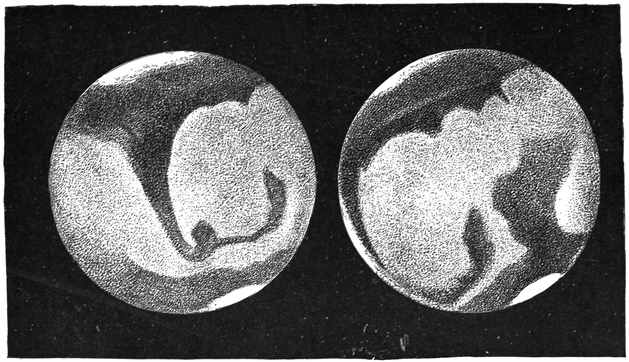
Fig. 60.—Views of Mars.
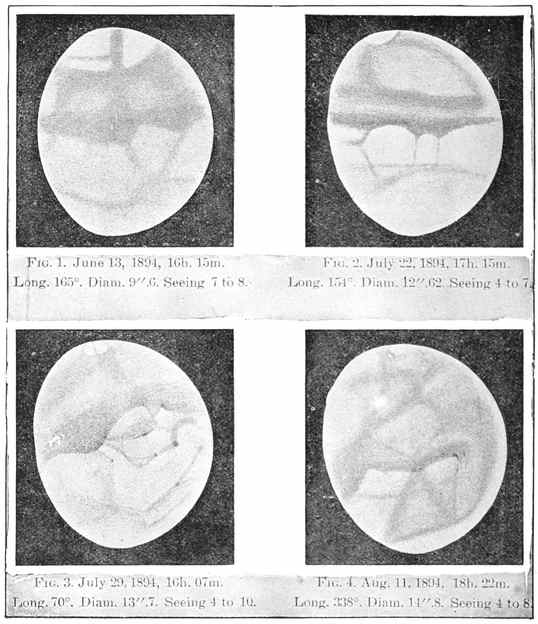
Fig. 61.—Mars.
(By Douglass, Lowell Observatory.)
In the most favorable circumstances, Mars is at least
one hundred times as far from us as the moon. But
we know that an object on the moon must be as large
as St. Paul’s Cathedral if it is to be visible in our telescopes.
An object on Mars must be, therefore, at least
one hundred times as broad and one hundred times
as long as St. Paul’s Cathedral if it is to be discernible
by astronomers on our earth. We can, therefore,
only expect to see the general features of our fellow-planet.
Were we looking at our earth from a similar
distance, and with equally good telescopes, the continents
and oceans, and the larger seas and islands, would
all be large enough to be conspicuous. It is, however,
doubtful whether they could ever be properly revealed
through the serious impediment to vision which our
atmosphere would offer.
It fortunately happens that the surface of Mars is
only obscured by clouds to a very trifling extent, and
we are thus able to see a panorama of our neighboring
globe laid before us. Mars is not nearly so large as our
earth, the diameters of the two bodies being nearly as
two to one. It follows that the number of acres on the
planet is only a quarter of the number of acres on the
earth. Careful telescopic scrutiny shows that the chief
features which we see on Mars are of a permanent character.
In this respect Mars is much more like the moon
than the sun. The latter presents to us merely glowing
vapors, with hardly more permanence than is possessed
by the clouds in our own sky. On the other
hand, the entire absence of clouds from the moon
enables us to see the permanent features on its surface.
Most of the visible features on Mars are also invariable;
though occasionally it would seem that the climate produces
some changes in its appearance.
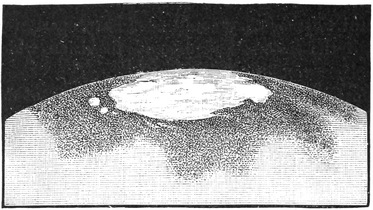
Fig. 62.—The South Pole of Mars, September, 1877 (Green).
We first notice that there are differently colored
parts on Mars. The darkish or bluish regions are
usually spoken of as seas or oceans; though we should
be going beyond our strict knowledge were we to
assert that water is actually found there. Look at the
horn-shaped object in the centre of the lower picture
in Fig. 60. We call it the Kaiser Sea, and it is so
strongly marked that even in a small telescope it can
be often seen. You must not, however, always expect to
notice this feature when you look at the planet through
a telescope, for it turns round and round. We can make
a globe representing Mars. On this are to be depicted
this great sea and the other characteristic objects. But
as we turn the globe around, the opposite side of the
planet is brought into view, and other features are
revealed like those represented in the upper figure.
Mars requires 24 hours 37 minutes 22.7 seconds to
complete a single rotation. It is somewhat remarkable
that this only differs from the earth’s period of rotation
by a little more than half an hour.
Mars contains what we call continents as well as
oceans, and we also find there lakes and seas and
straits. These objects are indicated in the drawings
that are here represented. But the most striking features
which the planet displays are the marvellous
white regions, which are seen both at its North Pole
and at its South Pole (Fig. 62). If we were able to
soar aloft above our earth and take a bird’s-eye view of
our own polar regions, we should see a white cap at the
middle of the arctic circle. This appearance would be
produced by the eternal ice and snow. It would increase
during the long, dark winter, and be somewhat
reduced by melting during the continuously bright
summer. Though we cannot thus see our earth, yet
we can sometimes observe one Pole of Mars and sometimes
the other, and we find each of these Poles crowned
with a dense white cap, which increases during the
severity of its winter, and which declines again with
the warmth of the ensuing summer.
Sketches of Mars have been made by many astronomers;
among them we may mention Mr. Green, who
made a beautiful series of pictures at Madeira in 1877.
These may be supplemented by the drawings of Mr.
Knobel in 1884, when the opposite Pole of the planet
was turned to view. The drawings show the polar snows,
and there seem to be some elevated districts in his arctic
regions which retain a little patch of snow after the main
body of the ice cap has shrunk within its summer limits.
An interesting case of this kind is shown in Fig. 62,
which has been copied from one of Mr. Green’s drawings.
It has lately been surmised that the continents on
Mars are occasionally inundated by floods of water.
There are also indications of clouds hanging over the
Martian lands, but the inhabitants of that planet, in
this respect, escape much better than we do. A certain
amount of atmosphere always surrounds Mars, though
it is much less copious than that we have here. As to
the composition of this atmosphere we know nothing.
For anything we can tell, it might be a gas so poisonous
that a single inspiration would be fatal to us; or if
it contained oxygen in much larger proportion than our
air does, it might be fatal from the mere excitement to
our circulation which an over-supply of stimulant would
produce. I do not think it the least likely that our
existence could be supported on Mars, even if we could
get there. We also require certain conditions of climate,
which would probably be totally different from
those we should find on Mars.
Many remarkable observations of Mars have been
lately made by Mr. Percival Lowell. It seems very
doubtful how far our former division of continents and
oceans on Mars can be maintained. Mr. Lowell has
paid special attention to a wonderful system of lines
on the planet’s surface to which the name of “canals”
has been given, which often show such a degree of regularity
as would almost suggest the idea that they had
been laid down by intelligent guidance.
When Mars appeared in his full splendor in 1877,
he was for the first time honored with the notice of
instruments capable of doing him justice. I do not,
however, mean that in former apparitions he was not
also carefully observed, but a great improvement had
recently taken place in telescopes, and it was thus under
specially favorable auspices that his return was welcomed
in 1877. This year will be always celebrated
in astronomical history for a beautiful discovery made
by Professor Asaph Hall, the illustrious astronomer at
Washington.
Before I can explain what this discovery was, I must
have a little talk about moons, or satellites as they are
often called. You know that we have one moon, which
is constantly revolving round the earth, and accompanies
the earth in its long voyage round the sun. But
the earth is only a planet, and there are many other
planets which are worlds like ours. It is natural to
compare these worlds, and as we have one moon, why
should not the other planets also have moons? If there
are children in one house in a square, why should there
not be children in the other houses? We find that
some of the other planets have satellites, but they do
not seem to be distributed very regularly. In fact, they
are almost as capriciously allotted as the children
would be in eight houses that you might take at
random.
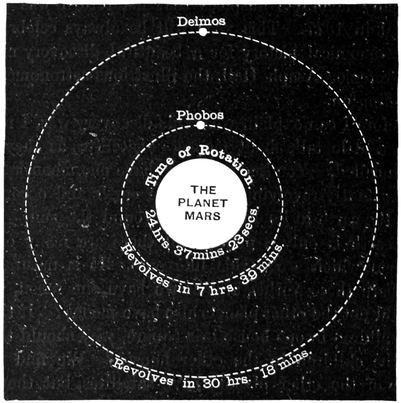
Fig. 63.—Mars and his Two Satellites.
In Number One there lives an old bachelor, and in
Number Two a single lady. These are Mercury and
Venus, and of course there are no children in either of
these houses. Number Three is inhabited by old mother
Earth, and she has got a fine big son, called the Moon.
Number Four is a nice little house inhabited by Mars.
There are to be found a pair of little twins, and nimble
creatures they are too. Number Five is a great mansion.
A very big man lives here, called Jupiter, with
four robust sons and daughters that everybody knows.
I fancy they must go to many dancing parties, for every
night they may be seen whirling round and round. For
three hundred years these four moons have been known
to astronomers, but in 1892 there was an addition to
the family in the shape of a tiny moon which had never
been seen up to that time. Number Six is also a fine
big house, though not quite so big as Number Five, but
larger than any of the others. It is inhabited by Saturn,
and contains the biggest family of all. Up till the
other day eight sons and daughters were known to live
here, but they are not nearly so sturdy as Jupiter’s
children; in fact, the young Saturns do not make much
display, and some of them are so delicate that they are
hardly ever seen. In this household, too, a new member
has recently appeared. For fifty years the family was
known to consist of these eight sons and daughters, but
in August, 1898, when they were being photographed
in a group, it was discovered that a ninth moon had
been added. Number Seven is also a fine large house;
but Uranus, who lives there, is such a recluse that
unless you carefully keep your eye on his house, you
will hardly ever catch a glimpse of him. There are
four children in that house, I believe, but we hardly
know them. They move in circles of their own, and
apparently have seen a good deal of trouble. Only one
more house is to be mentioned, and that is Number
Eight, inhabited by Neptune. It contains one child,
but we are hardly on visiting terms with this household,
and we know next to nothing about it.
Before 1877, Mars appeared to be in the same condition
as Venus or Mercury—that is, devoid of the dignity
of attendants. There was, however, good reason
for thinking that there might be some satellites to Mars,
only that we had not seen them. You see that, as Number
Three had one child, and Numbers Five, Six, Seven,
and Eight had each one, or more than one, it seemed
hard that poor Number Four should have none at all.
It was, however, certain that if there were any satellites
to Mars, they must be comparatively small things; for
if Mars had even one considerable moon, it must have
been discovered long ago.
On the memorable occasion in 1877, Professor Hall
discovered that the ruddy planet Mars was attended,
not alone by one moon, but by two. Their behavior
was most extraordinary. It appeared to him at first
almost as if one of these little moons was playing at
hide-and-seek. Sometimes it would peep out at one
side of the planet, and sometimes at the other side.
I have here a picture (Fig. 63) which shows how these
moons of Mars revolve. That is the globe of the planet
himself in the middle, and he is turning round steadily
in a period which is nearly the same as our day. But
the remarkable point is that the inner of the moons of
Mars runs round the planet in 7 hours 39 minutes. It
would seem very strange in our sky if we had a little
moon which rose in the west instead of in the east, and
which galloped right across the heavens three times
every day—and this is what Mars has. The outer moon
takes a more leisurely journey, for he requires 30 hours
18 minutes to complete a circuit. If for no other reason
than to see these wonderful moons, it would be very
interesting to visit Mars.
The satellites of this planet are in contrast to our
moon. In the first place, our moon takes 27 days to go
round the earth, and is comparatively a long way off.
The moons of Mars are much nearer to their planet,
and they go round much more quickly. There is also
another difference. The moons of Mars are much
smaller bodies than our moon. If we represent Mars
by a good-sized football, his moons, on the same scale,
would be hardly so big as the smallest-sized grains of
shot. Does it not speak well for the power of telescopes
in these modern days that objects so small as the satellites
of Mars should be seen at all? You remember, of
course, that neither Mars himself nor his moons have
any light of their own. They shine solely in consequence
of the sunlight which falls upon them. They
are merely lighted like the earth itself, or like the
moon. The difficulty about observing the satellites is
all the greater because they are seen in the telescope
close to such a brilliant body as Mars. The glare from
the bright planet is such that when we want to see
faint objects like the satellites we have to hide Mars, so
as to get a comparatively dark space in which to search.
Now that they know exactly what to look for, a
good many astronomers have observed the satellites of
Mars. A superb telescope is nevertheless required.
And, in fact, you could not find a better test for the
excellence of an instrument than to try if it will show
these delicate objects. But do not imagine that merely
having a good telescope and a clear sky is all that is
requisite for making astronomical discoveries. You
might just as well say that by putting a first-rate
cricket-bat in any man’s hands will ensure his making a
grand score. Every boy knows that the bat does not
make the cricketer, and I can assure him that neither
will the telescope make the astronomer. In both cases,
no doubt, there is some element of luck. But of this
you may be certain: that as it is the man that makes
the score, and not the bat, so it is the astronomer that
makes the discovery, and not his telescope.
Deimos and Phobos were the names of the two personages,
according to Homer, whose duty it was to
attend on the god Mars, and to yoke his steeds. A
conclave of classical scholars and astronomers appropriately
decided that Deimos and Phobos must be the
names of the two satellites to the planet which bears
the name of Mars.
We have been hitherto talking about large planets,
which, if not as big as our earth, are at least as big as
our moon. But now we have to say a few words about
a number of little planets, many of them being so very
small that a million rolled together would not form a
globe so big as this earth. These little objects you
cannot see with your unaided eye, and even with a telescope
they only look like very small stars.
I have often been asked why it is that a telescope
enables us to see objects, both faint and small, which
our unaided eyes fail to show. Perhaps this will be
a good opportunity to say a few words on the subject.
I think we can explain the utility of the telescope by
examining our own eyes. The eye undergoes a remarkable
transformation when its owner passes from darkness
into a brilliantly lighted room (Fig. 64). Here you see
two views of an eye, and you notice the great difference
between them. They are not intended to be the eyes
of two different people, or the two eyes of the same
person; they are merely two conditions of the same eye.
They are intended to illustrate two different states of
the eye of a collier. The right shows his eye when he
is above ground in bright daylight; the left is his eye
when he has gone down the coal-pit to his useful work
in the dark regions below. I remember when I went
down a coal-pit I was lowered down a long shaft, and
when the bottom was reached a safety lamp was handed
to me. The gloom was such, that at first I found some
little difficulty in guiding my steps, but the capable
guide beside me said in an encouraging voice, “You
will be all right, sir, in a few moments, for you will get
your pit-eyes.” I did get my “pit-eyes,” as he promised,
and was able to see my way along sufficiently to enjoy the
wonderful sights that are met with in the depths below.
This shows the Eye in
the Dark.
This shows the Eye in
the Daylight.
Fig. 64.
The change that came over my eyes is that which
these two pictures illustrate: the black, round spot in
the centre is an opening covered with a transparent
window, by which light enters the eye; the black spot
is called the pupil, and nature has provided a beautiful
contrivance by which the pupil can get larger or smaller,
so as to make vision agreeable. When there is a great
deal of light we limit the amount that enters by contracting
the pupil so as to make the opening smaller.
Thus the picture with the small pupil represents the
state of the collier’s eye when he is above ground in
bright sunlight. When he descends into the pit, where
the light is very scanty, then he wants to grasp as much
of it as ever he can, and consequently his pupil enlarges
so as to make a wider opening, and this is what he calls
getting his “pit-eyes.”
But you need not go down a coal-mine to see the
use of the iris—for so that pretty membrane is called
which surrounds the pupil. Every time you pass from
light into darkness the same thing can be perceived.
When we turn down the lights in a room, so that we are
in comparative darkness, our pupils gradually expand.
As soon as the lights are turned up again, then our
pupils begin to contract. Other animals have the same
contrivance in their eyes. You may notice in the
Zoölogical Gardens how quickly the pupil of the lion
contracts when he raises his eyes to the light. The
power of rapidly changing the pupil might be of service
to a beast of prey. Imagine him crouching in a dense
shade to wait for his dinner; then of course the pupil
will be large from deficiency of light; but when he
springs out suddenly on his victim, in bright light, it
would surely be of advantage to him to be able at once
to see clearly. Accordingly his pupil adjusts itself to
the altered conditions with a rapidity that might not
be necessary for creatures of less predaceous habits.
These changes of the pupil explain how the telescope
aids our eyes when we want to discern any faint objects,
like the little planets. Such bodies are not visible to
the unaided eyes, because our pupils are not large
enough to grasp sufficient light for the purpose. Even
when they are opened to the utmost, we want something
that shall enable them to open wider still. We must
therefore borrow assistance from some device which
shall have an effect equivalent to an enlargement of
the pupil beyond the limits that nature has actually
assigned to it. What we want is something like a
funnel which shall transform a large beam of rays into a
small one. I may explain what I mean by the following
illustration: Suppose that it is raining heavily, and
that you want to fill a bucket with water. If you
merely put the bucket out in the middle of a field, it
will never be filled; but bring it to where the rain-shoot
from a house-top is running down, and then your bucket
will be running over in a few moments. The reason,
of course, is that the broad top of the house has caught
a vast number of drops and brought them together in
the narrow shoot, and so the bucket is filled. In the
same way the telescope gathers the rays of light that
fall on the object glass, and condenses them into a small
beam which can enter the eye. We thus have what is
nearly equivalent to an eye with a pupil as big as the
object glass. Thus the effect of a grand telescope
amounts to a practical increase of the pupil from the
size of a threepenny-piece up to that of a dinner-plate,
or even much larger still.
An asteroid is like a tiny star, and in fact the two
bodies are very often mistaken. If we could get close
to the objects, we should see a wide difference between
them. We should find the asteroid to be a dark planet
like our earth, lighted only by the rays from the sun.
The star, small and faint though it may seem, is itself a
bright sun, at such a vast distance that it is only visible
as a small point. The star is millions of times as far
from us as the planet, and utterly different in every
respect.
It is a curious fact that the planets should happen to
resemble the stars so closely. We can find an analogous
fact in quite another part of nature. In visiting a good
entomological collection, you will be shown some of
the wonderful leaf-like insects. These creatures have
wings, exactly formed to imitate leaves of trees, with
the stalks and veins completely represented. When
one of these insects lies at rest, with its wings folded,
among a number of leaves, it would be almost impossible
to penetrate the disguise. This mimicry is no
doubt an ingenious artifice to deceive the birds or other
enemies that want to eat the insect. There is, however,
one test which the cunning bird could apply: the
leaves do not move about of their own accord, but the
leaf-insects do. If therefore the bird will only have
the patience to wait, he will see a pair of the seeming
leaves move, and then the deception will be to him a
deception no longer, and he will gobble up the poor
insect.
In our attempts to discover the planets we experience
just the same difficulties as the insect-eating bird.
Wide as is the true difference between a planet and a
star, there is yet such a seeming resemblance between
them that we are often puzzled to know which is which.
The planets imitate the stars so successfully, that when
one of them is presented to us among myriads of stars
it is impossible for us to detect the planet by its appearance.
But we can be cunning—we can steadily watch,
and the moment we find one of these star-like points
beginning to creep about we can pounce upon it. We
know by its movements that it is only disguised as a
star, but that it is really one of the planets.
It is not always easy to discover the asteroids even
by this principle, for unfortunately these bodies move
very slowly. If you have a planet in the field of
view, it will creep along so gradually that an hour or
more must have elapsed before it has shifted its position
with respect to the neighboring stars to any appreciable
extent. The search for such little planets is
therefore a tedious one, but there are two methods of
conducting it: the new one, which has only recently
come into use, and the old one. I shall speak of the
old one first.
Although the body’s motion is so slow, yet when
sufficient time is allowed, the planet will not only move
away from the stars close by, but will even journey
round the entire heavens. The surest way of making
the discovery is to study a small part of the heavens
now and to examine the same locality again months or
years afterwards. Memory will not suffice for this purpose.
No one could recollect all the stars he saw with
sufficient distinctness to be confident that the field of
the telescope on the second occasion contained either
more or fewer stars than it did on the first. The only
way of doing this work is to draw a map of the stars
very carefully. This is a tedious business, for the stars
are so numerous that even in a small part of the heavens
there will be many thousands of stars visible in the
telescope. All of these will have to be entered faithfully
in their true places on the map. When this has
been done the map must be laid aside for a season, and
then it is brought out again and compared with the sky.
No doubt the great majority of the objects will be found
just as they were before. These are the stars, the distant
suns, and our concern is not at present with them.
Sometimes it will happen that an object marked on the
first map has left a vacant place on the second. This,
however, does not help us much, for, whatever the
object was, it has vanished into obscurity, and a new
planet could hardly be discovered in this way. But
sometimes it will happen that there is a small point of
light seen in the second map which has no corresponding
point in the first. Then, indeed, the expectation of
the astronomer is aroused; he may be on the brink of a
discovery. Of course he watches accurately the little
stranger. It might be some star that had been accidentally
overlooked when forming the map, or it might
possibly be a star that has become bright in the interval.
But here is a ready test: is the body moving? He
looks at it very carefully, and notes its position with
respect to the adjacent stars. In an hour or two his
suspicions may be confirmed; if the object be in motion,
then it is really a planet. A few further observations,
made on subsequent days, will show the path of the
body. And the astronomer has only to assure himself
that the object is not one of the planets that have been
already found before he announces his discovery.
The new method of searching for small planets,
which has only come into use in recent years, is a very
beautiful one, and renders the process of making such
discoveries much more easy than the older method
which I have just described.
We can take photographs of the heavenly bodies by
adjusting a sensitive plate in the telescope so that the
images of the objects we desire to see shall fall upon
it. The method will apply to very small stars, if by
excellent clockwork and careful guiding we can keep
the telescope constantly pointing to the same spot until
the stars have had time to imprint their little images.
Thus we obtain a map of the heavens, made in a thoroughly
accurate manner. Indeed, the delicacy of photography
for this purpose is so great, that the plates
show many stars which cannot be seen with even the
greatest of telescopes. Suppose that a little planet
happened to lie among the stars which are being photographed.
All the time that the plate is being exposed
the wanderer is, of course, creeping along, and after an
hour (exposures even longer are often used), it may
have moved through a distance sufficient to ensure its
detection. The plate will, therefore, show the stars
as points, but the planet will betray its presence by
producing a streak.
The asteroids now known number between 400 and
500. Out of this host a few afford some information
to the astronomer, but the majority of them are objects
possessing individually only the slightest interest. No
small planet is worth looking at as a telescopic picture.
We should consider that asteroid to be a large one
which possessed a surface altogether as great as England
or France. Many of these planets have a superficial
extent not so large as some of our great counties.
A globe which was just big enough to be covered by
Yorkshire—if you could imagine that large county
neatly folded round it—would make a very respectable
minor planet.
We know hardly anything of the nature of these
small worlds, but it is certain that any living beings
they could support must have a totally different nature
from the creatures that we know on this earth. We
can easily prove this by making a calculation. I shall
suppose a small planet one hundred miles wide, its
diameter being, therefore, the one-eightieth part of the
diameter of the earth. If we were landed on such a
globe, we should be far more puzzled by the extraordinary
lightness of everything than we should be in the
similar case of the moon to which I referred (p. 124).
If we suppose the planet to be constructed of materials
which had the same density as those of which the earth
is made, then every weight would be reduced to the
eightieth part of what it is here.
There would be one curious consequence of residence
on such a globe. We have heard of attempts to
make flying machines, or to provide a man with wings
by which he shall soar aloft like the birds. All such
contrivances have hitherto failed. It may be possible
to make a pair of wings by which a man can fly down,
but it is quite another matter when he tries to fly up
again. Suppose, however, we were living on a small
planet, it would be perfectly easy to fly, for as our
bodies would only seem to weigh a couple of pounds,
we ought to be able to flap a pair of wings strong
enough to overcome so trivial a force. I should, however,
add that this is on the supposition that the atmosphere
has the same density as our own.
Life on these small planets would indeed be extraordinary.
Let us take, for example, Flora, and
see how a game of lawn tennis on that body would be
managed. The very slightest blow of the racket would
drive the ball a prodigious distance before it could
touch the ground; indeed, unless the courts were about
half a mile long, it would be impossible to serve any
ball that was not a fault. Nor is there any great exertion
necessary for playing lawn tennis on Flora, even
though the courts are several hundred acres in extent.
As a young lady ran to meet the ball and return it,
each of her steps might cover a hundred yards or so
without extra effort; and should she have the misfortune
to get a fall, her descent to the ground would be
as gentle as if she was seeking repose on a bed of the
softest swan’s-down.
These little planets cluster together in a certain part
of our system. Inside are the four inner planets, of
which we have already spoken; outside are the four
outer planets, of which we have soon to speak. Between
these two groups there was a vacant space. It
seemed unreasonable that where there was room for
planets, planets should not be found. Accordingly the
search was made, and these objects were discovered.
Even at the present day, more and more are being
constantly added to the list.
Up till quite recently all the small planets which
had been discovered confined themselves to the space
lying between the paths of the major planets Mars and
Jupiter. This invariable rule was, however, departed
from in the case of one of these bodies which was discovered
in August, 1898. This little body, which was
known for some time by the provisional appellation of
D Q, and which has now been definitely christened
Eros, is an exception to this rule. It travels at an
average distance from the sun actually less than that
of Mars, and at the nearest point can come within
15,000,000 miles of the earth.
We occasionally get information from these little
bodies; for in their revolutions through the solar system,
they sometimes pick up scraps of useful knowledge,
which we can elicit from them by careful examination.
For example, one of the most important problems in the
whole of astronomy is to determine the sun’s distance.
I have already mentioned one of the ways of doing this,
which is given by the transit of Venus. Astronomers
never like to rely on a single method; we are therefore
glad to discover any other means of solving the same
problem. This it is which the little planets will sometimes
do for us. Juno on one occasion approached very
close to the earth, and astronomers in various parts of
the globe observed her at the same time. When they
compared their observations they measured the sun’s
distance. But I am not going to trouble you now with
a matter so difficult. Suffice it to say, that for this, as
for all similar investigations, the observers were constrained
to use the very same principle as that which
we illustrated in Fig. 5.
Let me rather close this lecture with the remark that
we have here been considering only the lesser members
of the great family which circulate round the sun, and
that we shall speak in our next lecture of the giant
members of our system.