On the 22d of May the two other caravans of Stanley joined him, only
three hours' march from Mpwapwa, so that the one caravan numbered some
four hundred souls, but it was none too large to insure a safe transit
through dreaded Ugogo. A waterless desert thirty miles across, and which
it would take seventeen hours to traverse, now lay before them. On the
way, Stanley was struck down with fever and, borne along in a hammock,
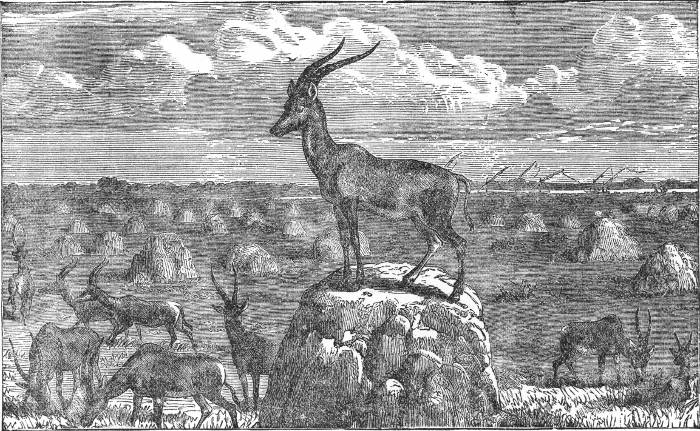
was indifferent to the herds of giraffes, and zebras, and antelopes that
scoured the desert plain around him. The next morning the fever had left
him and mounting, he rode at the head of his caravan, and at 8 A. M. had
passed the sterile wilderness and entered the Ugogo district. He had now
come into a land of plenty, but one also of extortion. The tribute that
all passing caravans had to pay to the chiefs or sultans of this
district was enormous. At the first village the appearance of this white
man caused an indescribable uproar. The people came pouring out, men and
women, naked, yelling, shouting, quarreling and fighting, making it a
perfect babel around Stanley, who became irritated at this unseemly
demonstration. But it was of no use. One of his men asked them to stop,
but the only reply was "shut up," in good native language. Stanley,
however, was soon oblivious of their curiosity or noise, as heavy doses
of quinine to check a chill sent him off into a half doze.
The next day, a march of eight miles brought him to the sultan of the
district. Report did not exaggerate the abundance of provisions to be
found here. Now came the pay of tribute to the exorbitant chief. After a
great deal of parley, which was irritating and often childish, Stanley
satisfied the sultan's greed, and on the 27th of May he shook the dust
of the place from his feet and pushed westward. As he passed the
thickly-scattered villages and plenteous fields, filled with tillers, he
did not wonder at the haughty bearing of the sultan, for he could
command force enough to rob and destroy every caravan that passed that
way. Twenty-seven villages lined the road to the next sultan's district,
Matomhiru. This sultan was a modern Hercules, with head and shoulders
that belonged to a giant. He proved, however, to be a much more
reasonable man than the last sultan, and, after a little speechifying,
the tribute was paid and the caravan moved off toward Bihawena. The day
was hot, the land sterile, crossed with many jungles, which made the
march slow and difficult. In the midst of this desolate plain were the
villages of the tribe, their huts no higher than the dry, bleached
grass that stood glimmering in the heat of the noonday sun. Here he was
visited by three natives, who endeavored to play a sharp game on him,
which so enraged Stanley that he would have flogged them out of camp
with his whip, but one of his men told him to beware, for every blow
would cost three or four yards of cloth. Not willing to pay so dearly to
gratify his temper he forbore. The sultan was moderate in his demands,
and from him he received news from his fourth caravan, which was in
advance, and had had a fight with some robbers, killing two of them.
The water here was so vile that two donkeys died from drinking of it,
while the men could hardly swallow it. Stanley, nervous and weak from
fever, paid the extravagant tributes demanded of him, without
altercation. From here to the next sultan was a long stretch of forest,
filled with elephants, rhinoceros, zebras, deer, etc. But they had no
time to stop and hunt. At noon they had left the last water they should
find until noon of the next day, even with sharp marching, and hence, no
delay could be permitted. The men without tents bivouacked under the
trees, while Stanley tossed and groaned all night in a paroxysm of
fever, but his courage in no way weakened. At dawn the caravan started
off through the dark forest, in which one of the carriers fell sick and
died.
At 7 A. M. they drew near Nyambwa, where excellent water was found. The
villagers here crowded around them with shouts and yells, and finally
became so insolent that Stanley grabbed one of them by the neck and gave
him a sound thrashing with his donkey-whip. This enraged them, and they
walked backward and forward like angry tom-cats, shouting, "Are the
Wagogo to be beaten like slaves?" and they seemed by their ferocious
manner determined to avenge their comrade, but the moment Stanley raised
his whip and advanced they scattered. Finding that the long lash, which
cracked like a pistol, had a wholesome effect, whenever they crowded
upon him so as to impede his progress, he laid it about him without
mercy, which soon cleared a path.
The Sultan Kimberah was a small, queer and dirty old man, a great
drunkard, and yet the most powerful of all the Ugogo chiefs. Here they
had considerable trouble in arranging the amount of tribute, but at
length everything was settled and the caravan passed on and entered on a
vast salt plain containing a hundred or more square miles, from the salt
springs of which the Wagogo obtained their salt. At Mizarza, the next
camping-place, Stanley was compelled to halt and doctor himself for the
fever which was wearing him to skin and bones. Early in the morning he
began to take his quinine, and kept repeating the doses at short
intervals until a copious perspiration told him he had broken the fever
which had been consuming him for fourteen days. During this time, the
sultan of the district, attracted by Stanley's lofty tent, with the
American flag floating above it, visited him. He was so astonished at
the loftiness and furnishing of the tent, that in his surprise he let
fall the loose cloth that hung from his shoulders and stood stark naked
in front of Stanley, gaping in mute wonder. Admonished by his son—a lad
fifteen years old—he resumed his garb and sat down to talk. Stanley
showed him his rifles and other fire-arms, which astonished him beyond
measure.
On the 4th of June, the caravan was started forward again, and after
three hours' march it came upon another district, containing only two
villages occupied by pastoral Wahumba and Wahehe. These live in cow-dung
cone huts, shaped like Tartar tents. Stanley says:
"The Wahumba, so far as I have seen them, are a fine and well-formed
race. The men are positively handsome, tall, with small heads, the
posterior parts of which project considerably. One will look in vain for
a thick lip or flat nose amongst them; on the contrary, the mouth is
exceedingly well cut, delicately small; the nose is that of the Greeks,
and so universal was the peculiar feature, that I at once named them the
Greeks of Africa. Their lower limbs have not the heaviness of the Wagogo
and other tribes, but are long and shapely, clean as those of an
antelope. Their necks are long and slender, on which their small heads
are poised most gracefully. Athletes from their youth, shepherd bred,
and intermarrying among themselves, thus keeping the race pure, any of
them would form a fit subject for a sculptor who would wish to
immortalize in marble an Antrinus, a Hylas, a Daphnis, or an Apollo. The
women are as beautiful as the men are handsome. They have clear ebon
skins, not coal black, but of an inky hue. Their ornaments consist of
spiral rings of brass pendent from the ears, brass ring collars about
the neck, and a spiral cincture of brass wire about their loins, for the
purpose of retaining their calf and goat skins, which are folded about
their bodies, and depending from the shoulder, shade one-half of the
bosom, and fall to the knees.
"The Wahehe may be styled the Romans of Africa.
"Resuming our march, after a halt of an hour, in four hours more we
arrived at Mukondoku proper.
"This extremity of Ugogo is most populous. The villages which surround
the central tembe, where the Sultan Swaruru lives, amount to thirty-six.
The people who flocked from these to see the wonderful men whose faces
were white who wore the most wonderful things on their persons, and
possessed the most wonderful weapons: guns which 'bum-bummed' as fast
as you could count on your fingers, formed such a mob of howling
savages, that I, for an instant, thought there was something besides
mere curiosity which caused such a commotion, and attracted such numbers
to the roadside. Halting, I asked what was the matter, and what they
wanted, and why they made such a noise? One burly rascal, taking my
words for a declaration of hostilities, promptly drew his bow, but as
prompt as he had fixed his arrow my faithful Winchester with thirteen
shots in the magazine was ready and at my shoulder, and but waited to
see the arrow fly to pour the leaden messengers of death into the crowd.
But the crowd vanished as quickly as they had come, leaving the burly
Thersites, and two or three irresolute fellows of his tribe, standing
within pistol range of my leveled rifle. Such a sudden dispersion of the
mob which, but a moment before, was overwhelming, caused me to lower my
rifle and indulge in a hearty laugh at the disgraceful flight of the
men-destroyers. The Arabs, who were as much alarmed at their boisterous
obtrusiveness, now came up to patch a truce, in which they succeeded to
everybody's satisfaction.
"A few words of explanation, and the mob came back in greater numbers
than before; and the Thersites who had been the cause of the momentary
disturbance were obliged to retire abashed before the pressure of public
opinion. A chief now came up, whom I afterwards learned was the second
man to Swaruru, and lectured the people upon their treatment of the
'white strangers.'"
The tribute-money was easily settled here. On the 7th of June, the route
was resumed. There were three roads leading to Uyanzi, and which of the
three to take caused long discussion and much quarreling, and when
Stanley settled the matter and the caravan started off on the road to
Kiti, an attempt was made to direct it to another road, which Stanley
soon discovered and prevented only by his prompt resort to physical
arguments.
At last they reached the borders of Uyanzi, glad to be clear of the land
of Ugogo, said to be flowing with milk and honey but which had proved to
Stanley a land of gall and bitterness. The forest they entered was a
welcome change from the villages of the Ugogo, and two hours after
leaving them they came, with the merry sound of horns, to a river in a
new district. Continuing on, they made the forest ring with cheers, and
shouts, and native songs. The country was beautiful, and the scenery
more like cultivated England in former times than barbaric Africa.
Passing thus merrily on, they had made twenty miles by five o'clock. At
one o'clock next morning the camp was roused, and by the light of the
moon the march was resumed, and at three o'clock they arrived at a
village to rest till dawn. They had reached a land of plenty and fared
well. Kiti was entered on the 10th of June. Here cattle and grain could
be procured in abundance.
A valley fifteen miles distant was the next camp, and a march of three
hours and a half brought them to another village, where provisions were
very cheap. They were now approaching Unyanyembe, their first great
stopping-place, and where the term of service of many of Stanley's men
expired. They marched rapidly now,—to-day through grain-fields,
to-morrow past burnt villages, the wreck of bloody wars.
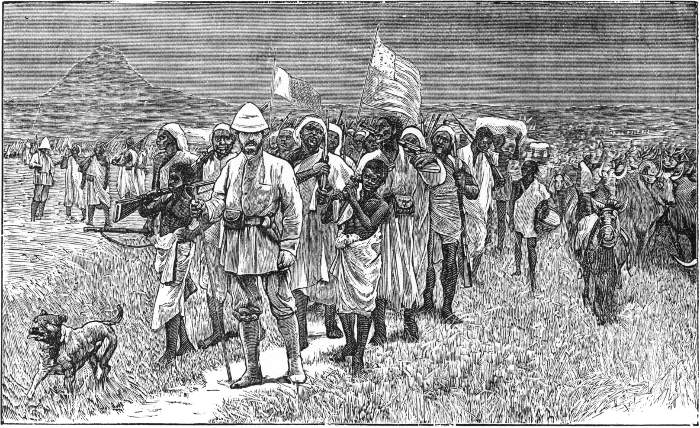
At last, with banners flying and trumpets and horns blowing, and amid
volleys of small arms, the caravan entered Unyanyembe.
Of the three routes from the coast to this place, Stanley discarded the
two that had before been traveled by Speke and Burton and Grant and
chose the third, with the originality of an American, and thus saved
nearly two hundred miles' travel.
Mr. Stanley, after reaching this first great objective point, goes back
and gives a general description of the regions he has traversed. To the
geographer, it may be of interest, but not to the general reader. But
the following, taken from his long account, will give the reader a clear
idea of the country traversed and of its inhabitants. Beginning with
Wiami River, emptying into the Indian Ocean near Zanzibar, he says:
"First it appears to me that the Wiami River is available for commerce
and, by a little improvement, could be navigated by light-draft steamers
near to the Usagara Mountains, the healthy region of this part of
Africa, and which could be reached by steamers in four days from the
coast, and then it takes one into a country where ivory, sugar, cotton,
indigo and other productions can be obtained."
Besides, he says:
"Four days by steamer bring the missionary to the healthy uplands of
Africa, where he can live amongst the gentle Wasagara without fear or
alarm; where he can enjoy the luxuries of civilized life without fear of
being deprived of them, amid the most beautiful and picturesque scenes a
poetic fancy could imagine. Here is the greenest verdure, purest water;
here are valleys teeming with grain-stalks, forests of tamarind, mimosa,
gum-copal tree; here is the gigantic moule, the stately mparamnsi, the
beautiful palm; a scene such as only a tropic sky covers. Health and
abundance of food are assured to the missionary; gentle people are at
his feet, ready to welcome him. Except civilized society, nothing that
the soul of man can desire is lacking here.
"From the village of Kadetamare a score of admirable mission sites are
available, with fine health-giving breezes blowing over them, water in
abundance at their feet, fertility unsurpassed around them, with docile,
good-tempered people dwelling everywhere at peace with each other, and
with all travelers and neighbors.
"As the passes of the Olympus unlocked the gates of the Eastern empires
to the hordes of Othman; as the passes of Kumaylé and Sura admitted the
British into Abyssinia; so the passes of the Mukondokwa may admit the
Gospel and its beneficent influences into the heart of savage Africa.
"I can fancy old Kadetamare rubbing his hands with glee at the sight of
the white man coming to teach his people the words of the 'Mulungu'—the
Sky Spirit; how to sow, and reap, and build houses; how to cure their
sick, how to make themselves comfortable—in short, how to be civilized.
But the missionary, to be successful, must know his duties as well as a
thorough sailor must know how to reef, hand and steer. He must be no
kid-glove, effeminate man, no journal writer, no disputatious polemic,
no silken stole and chasuble-loving priest, but a thorough, earnest
laborer in the garden of the Lord,—a man of the David Livingstone, or
of the Robert Moffatt stamp.
"The other river, the Rufiji, or Ruhwha, is a still more important
stream than Wiami. It is a much longer river, and discharges twice as
much water into the Indian Ocean. It rises near some mountains about one
hundred miles southwest of Nbena. Kisigo River, the most northern and
most important affluent of the Ruhwha, is supposed to flow into it near
east longitude thirty-five degrees; from the confluence to the sea, the
Ruhwha has a length of four degrees of direct longitude. This fact, of
itself, must prove its importance and rank among the rivers of East
Africa.
"After Zanzibar, our début into Africa is made via Bagomayo. At this
place we may see Wangindo, Wasawahili, Warori, Wagogo, Wanyamwezi,
Waseguhha and Wasagara; yet it would be a difficult task for any person,
at mere sight of their dresses or features, to note the differences.
Only by certain customs or distinctive marks, such as tattooing,
puncturing of the lobes of the ears, ornaments, wearing the hair, etc.,
which would appear, at first, too trivial to note, could one
discriminate between the various tribal representatives. There are
certainly differences, but not so varied or marked as they are reported.
"The Wasawahili, of course, through their intercourse with
semi-civilization, present us with a race, or tribe, influenced by a
state of semi-civilized society, and are, consequently, better dressed
and appear to better advantage than their more savage brethren farther
west. As it is said that underneath the Russian skin lies the Tartar, so
it may be said that underneath the snowy dish-dasheh, or shirt of the
Wasawahili, one will find the true barbarian. In the street or bazaar he
appears semi-Arabized; his suavity of manner, his prostrations and
genuflexions, the patois he speaks, all prove his contact and affinity
with the dominant race, whose subject he is. Once out of the coast
towns, in the Washensi villages, he sheds the shirt that had half
civilized him, and appears in all his deep blackness of skin,
prognathous jaws, thick lips—the pure negro and barbarian. Not keenest
eye could detect the difference between him and the Washensi, unless his
attention had been drawn to the fact that the two men were of different
tribes.
"The next tribe to which we are introduced are the Wakwere, who occupy a
limited extent of country between the Wazaramo and the Wadoe. They are
the first representatives of the pure barbarian the traveler meets, when
but two days' journey from the sea-coast. They are a timid tribe and a
very unlikely people to commence an attack upon any body of men for mere
plunder's sake. They have not a very good reputation among the Arab and
Wasawahili traders. They are said to be exceedingly dishonest, of which
I have not the least doubt. They furnished me with good grounds for
believing these reports while encamped at Kingaru, Hera and Imbiki. The
chiefs of the more eastern part of Ukwere profess nominal allegiance to
the Dwians of the Mrima. They have selected the densest jungles wherein
to establish their villages. Every entrance into one of their valleys is
jealously guarded by strong wooden gates, seldom over four and a half
feet high, and so narrow, sometimes, that one must enter sideways.
"These jungle islets which in particular dot the extent of Ukwere,
present formidable obstacles to a naked enemy. The plants, bushes and
young trees which form their natural defense, are generally of the
aloetic and thorny species, growing so dense, interlaced one with the
other, that the hardest and most desperate robber would not brave the
formidable array of sharp thorns which bristle everywhere.
"Some of these jungle islets are infested with gangs of banditti, who
seldom fail to take advantage of the weakness of a single wayfarer, more
especially if he be a Mgwana—a freeman of Zanzibar, as every negro
resident of the island of Zanzibar is distinguished by the Washensi
natives of the interior.
"I should estimate the population of Ukwere, allowing about one hundred
villages to this territory (which is not more than thirty miles square,
its bounds on the south being the Rufu River, and on the north the River
Wiami), at not more than five thousand souls. Were all these banded
together under the command of one chief, the Wakwere might become a
powerful tribe.
"After the Wakwere we come to the Wakami, a remnant of the once grand
nation which occupied the lands from the Ungerengeri to the Great
Makata River. Frequent wars with the Wadoe and Waseguhha have reduced
them to a narrow belt of country, ten rectilinear miles across, which
may be said to be comprised between Kiva Peak and the stony ridge
bounding the valley of the Ungerengeri on the east, within a couple of
miles from the east bank of the river.
"They are as numerous as bees in the Ungerengeri Valley. The unsurpassed
fertility has been a great inducement to retain for these people the
distinction of a tribe. By the means of a spyglass one may see, as he
stands on the top of that stony ridge looking down into the fair valley,
clusters of brown huts visible amid bosky clumps, fullness and plenty
all over the valley, and may count easily over a hundred villages.
"From Ukami, we pass Southern Udoe, and find a warlike, fine-looking
people, with a far more intelligent cast of features, and a shade
lighter than the Wakami and Wakwere—a people who are full of traditions
of race, a people who have boldly rushed to war upon the slightest
encroachment upon their territories, and who have bravely defended
themselves against the Waseguhha and Wakami, as well as against nomadic
marauders from Uhumba.
"Udoe, in appearance, is amongst the most picturesque countries between
the sea and Unyanyembe. Great cones shoot upward above the everlasting
forest, tipped by the light, fleecy clouds, through which the warm,
glowing sun darts its rays, bathing the whole in sunlight, which brings
out those globes of foliage, which rise in tier after tier to the
summits of the hills, colors which would mock the most ambitious
painter's efforts at imitation. Udoe first evokes the traveler's love of
natural beauty after leaving the sea, her roads lead him up along the
sharp spines of hilly ridges, whence he may look down upon the
forest-clad slopes, declining on either side of him into the depths of
deep valleys, to rise up beyond into aspiring cones which kiss the sky,
or into a high ridge with deep, concentric folds, which almost tempt one
to undergo much labor in exploring them for the provoking air of mystery
in which they seem to be enwrapped.
"What a tale this tribe could relate of the slave-trader's deeds.
Attacked by the joint forces of the Waseguhha from the west and north,
and the slave-traders of Whinde and Sa'adani from the east, the Wadoe
have seen their wives and little ones carried into slavery a hundred
times, and district after district taken from their country, and
attached to Useguhha. For the people of Useguhha were hired to attack
their neighbors, the Wadoe, by the Whinde slave-traders, and were also
armed with muskets and supplied with ammunition by them, to effect large
and repeated captures of Wadoe slaves. The people of this tribe,
especially women and children, so superior in physique and intelligence
to the servile races by which they were surrounded, were eagerly sought
for as concubines and domestics by the lustful Mohammedans.
"This tribe we first note to have distinctive tribal marks—by a line of
punctures extending lengthwise on each side of the face, and a chipping
of the two inner sides of the two middle teeth of the upper row.
"The arms of this tribe are similar to the arms of the Wakami and
Wakwere, and consist of a bow and arrows, a shield, a couple of light
spears or assegais, a long knife, a handy little battle-axe and a club
with a large knob at the end of it, which latter is dexterously swung at
the head of an enemy, inflicting a stunning and sometimes a fatal blow.
"Emerging from the forest of Mikeseh, we enter the territory of the
Waseguhha, or Wasegura, as the Arabs wrongly call this country. Useguhha
extends over two degrees in length, and its greatest breadth is ninety
geographical miles. It has two main divisions, that of Southern
Useguhha, from Uruguini to the Wiami River, and Northern Useguhha, under
the chieftain Moto, from the Wiami River to Umagassi and Usumbara.
"Mostly all the Waseguhha warriors are armed with muskets, and the Arabs
supply them with enough ammunition, in return for which they attack
Waruguru, Wadoe and Wakwenni, to obtain slaves for the Arab market, and
it is but five years since the Waseguhha organized a successful raid
into the very heart of the Wasagara Mountains, during which they
desolated the populated part of the Makata plain, capturing over five
hundred valuable slaves.
"Formerly wars in this country were caused by blood feuds between
different chiefs; they are now encouraged by the slave buyers of the
Mirma, for the purpose of supplying these human chattels for the market
of Zanzibar. The Waseguhha are about the most thorough believers in
witchcraft, yet the professors of this dark science fare badly at their
hands. It is a very common sight to see cinereous piles on the roadside,
and the waving garments suspended to the branches of trees above them,
which mark the fate of the unfortunate 'Waganga' or medicine man. So
long as their predictions prove correct and have a happy culmination,
these professors of 'uchawi'—magic art—are regarded with favor by the
people; but if an unusual calamity overtakes a family, and they can
swear that it is the result of the magician's art, a quorum of
relentless inquisition is soon formed, and a like fate to that which
overtook the 'witches' in the dark days of New England surely awaits
him.
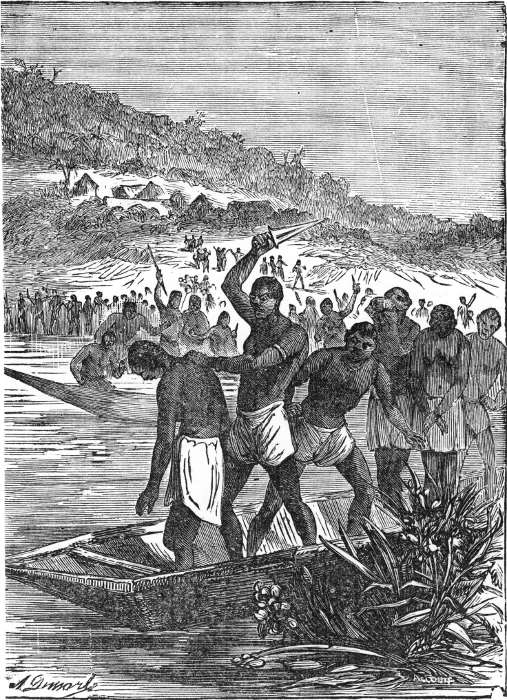
EXECUTION FOR WITCHCRAFT.
Sometimes performed by burning; at other times by beheadal and casting
into the river.
"Enough dead wood is soon found in their African forests, and the
unhappy one perishes by fire, and, as a warning to all false professors
of the art, his loin-cloth is hung up to a tree above the spot where he
met his doom.
"In Southern Usagara, the people are most amiable; but in the north, in
those districts adjacent to the Wahumba, the people partake of the
ferocious character of their fierce neighbors. Repeated attacks from the
Waseguhha kidnappers, from the Wadirigo or Wahehe robbers on the
southwest, from Wagogo on the west and from Wahumba on the north, have
caused them to regard strangers with suspicion; but after a short
acquaintance they prove to be a frank, amiable and brave people. Indeed,
they have good cause to be distrustful of the Arabs and the Wangwana of
Zanzibar. Mbumi, Eastern Usagara, has been twice burned down, within a
few years, by the Arabian Waseguhha kidnappers; Rehemeko has met the
same fate, and it was not many years ago since Abdullah bin Nasib
carried fire and sword from Misonghi to Mpwapwa. Kanyaparu, lord of the
hills around Chunyo, Kunyo, once cultivated one-fourth of the Marenga,
Mkali; but is now restricted to the hill-tops, from fear of the Wadirigo
marauders.
"The Wasagara, male and female, tattoo the forehead, bosom and arms.
Besides inserting the neck of a gourd in each ear—which carries his
little store of 'tumbac' or tobacco, and lime, which he has obtained by
burning land shells—he carries quite a number of primitive ornaments
around his neck, such as two or three snowy cowrie-shells, carved
pieces of wood, or a small goat's horn, or some medicine consecrated by
the medicine man of the tribe, a fund of red or white beads, or two or
three pieced Lungomazzi egg-beads, or a string of copper coins, and
sometimes small brass chains, like a cheap Jack watch-chain. These
things they have either made themselves or purchased from Arab traders
for chickens or goats. The children all go naked; youths wear a goat or
sheep-skin; grown men and women, blessed with progeny, wear domestic or
a loin-cloth of Kaniki, or a barsati, which is a favorite colored cloth
in Usagara; chiefs wear caps such as are worn by the Wamrima Diwans, or
the Arab tarboosh.
"Next on our line of march, appears the Wagogo, a powerful race,
inhabiting the region west of Usagara to Uyanzi, which is about eighty
miles in breadth and about one hundred in length.
"The traveler has to exercise great prudence, discretion and judgment in
his dealings with them. Here he first heard the word 'houga' after
passing Limbomwenni, a word which signifies tribute, though it formerly
meant a present to a friend. Since it is exacted from him with threats,
that if it is not paid they will make war on him, its best
interpretation would be, 'forcibly extorted tribute or toll.'
"Naturally, if the traveler desires to be mulcted of a large sum, he
will find the Wagogo ready to receive every shred of cloth he gives
them. Moumi will demand sixty cloths, and will wonder at his own
magnanimity in asking such a small number of cloths from a great Musungu
(white man). The traveler, however, will be wise if he permits his chief
men to deal with them, after enjoining them to be careful, and not
commit themselves too hastily to any number or amount of gifts.
"They are, physically and intellectually, the best of the races between
Unyamwezi and the sea. Their color is a rich dark brown. There is
something in their frontal aspect which is almost leonine. Their faces
are broad and intelligent. Their eyes are large and round. Their noses
are flat, and their mouths are very large; but their lips, though thick,
are not so monstrously thick as those our exaggerated ideal of a negro
has. For all this, though the Wagogo is a ferocious man, capable of
proceeding to any length upon the slightest temptation, he is an
attractive figure to the white traveler. He is proud of his chief, proud
of his country, sterile and unlovable though it be; he is proud of
himself, his prowess, his weapons and his belongings; he is vain,
terribly egotistic, a bully, and a tyrant, yet the Wagogo is capable of
forming friendships, and of exerting himself for friendship's sake. One
grand vice in his character, which places him in a hostile light to
travelers, is his exceeding avarice and greed for riches; and if the
traveler suffers by this, he is not likely to be amiably disposed toward
him.
"This sturdy native, with his rich complexion, his lion front, his
menacing aspect, bullying nature, haughty, proud and quarrelsome, is a
mere child with a man who will devote himself to the study of his
nature, and not offend his vanity. He is easily angered, and his
curiosity is easily aroused. A traveler with an angular disposition is
sure to quarrel with him—but, in the presence of this rude child of
nature, especially when he is so powerful, it is to his advantage and
personal safety to soften those angles of his own nature. The Wagogo
'Rob Roy' is on his native ground, and has a decided advantage over the
white foreigner. He is not brave, but he is at least conscious of the
traveler's weakness, and he is disposed to take advantage of it, but is
prevented from committing an act because it is to his advantage to keep
the peace. Any violence to a traveler would close the road; caravans
would seek other ways, and the chiefs would be deprived of much of their
revenues.
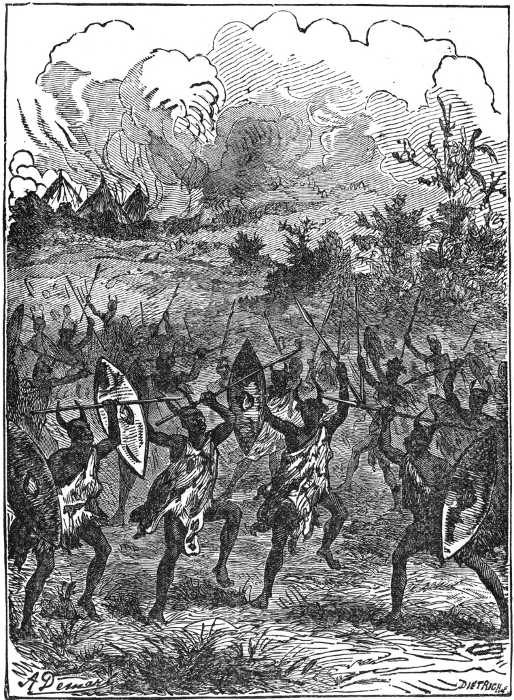
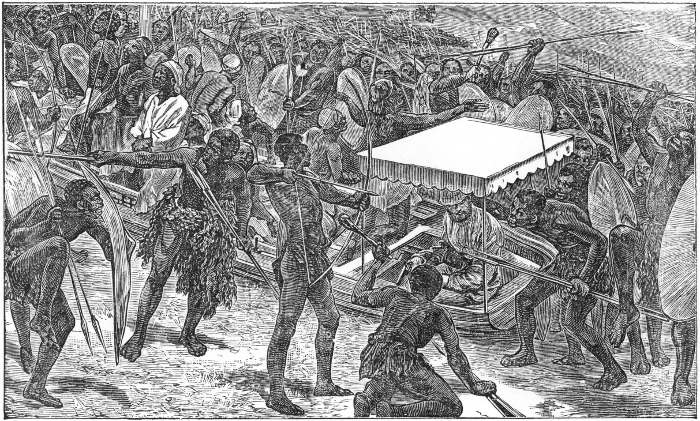
AFRICAN WARRIORS.
The shields and assegais are flourished in the air while the demon-like
warriors dance and yell in preparation for battle.
"The Wagogo warrior carries as his weapons a bow and a sheaf of
murderous-looking arrows, pointed, pronged and barbed; a couple of
light, beautifully-made assegais; a broad, sword-like spear, with a
blade over two feet long; a battle-axe, and a rungu or knob-club. He has
also a shield, painted with designs in black and white, oval-shaped,
sometimes of rhinoceros, or elephant, or bull-hide. From the time he was
a toddling urchin he has been familiar with his weapons, and by the time
he was fifteen years old he was an adept with them.
"He is armed for battle in a very short time. The messenger from the
chief darts from village to village, and blows his ox-horn, the signal
for war. The warrior hears it, throws his hoe over his shoulder, enters
his house, and in a few seconds issues out again, arrayed in war-paint
and full fighting costume. Feathers of the ostrich, or the eagle, or the
vulture nod above his head; his long crimson robe streams behind him,
his shield is on his left arm, his darting assegai in his left hand, and
his ponderous man-cleaver—double-edged and pointed, heading a strong
staff—is in his right hand; jingling bells are tied around his ankles
and knees; ivory wristlets are on his arms, with which he sounds his
approach. With the plodding peasant's hoe he has dropped the peasant's
garb, and is now the proud, vain, exultant warrior—bounding aloft like
a gymnast, eagerly sniffing the battle-field. The strength and power of
the Wagogo are derived from their numbers.
"Though caravans of Wagogo are sometimes found passing up and down the
Unyamwezi road, they are not so generally employed as the Wanyamwezi in
trade. Their villages are thus always full of warriors. Weak tribes, or
remnants of tribes are very glad to be admitted under their protection.
Individuals of other tribes, also, who have been obliged to exile
themselves from their own tribes, for some deed of violence, are often
found in the villages of the Wagogo. In the north, the Wahumba are very
numerous; in the south may be found the Wahehe and Wakimbu, and in the
east may be found many a family from Usagara. Wanyamwi are also
frequently found in this country. Indeed, these latter people are like
Scotchmen, they may be found almost everywhere throughout Central
Africa, and have a knack of pushing themselves into prominence.
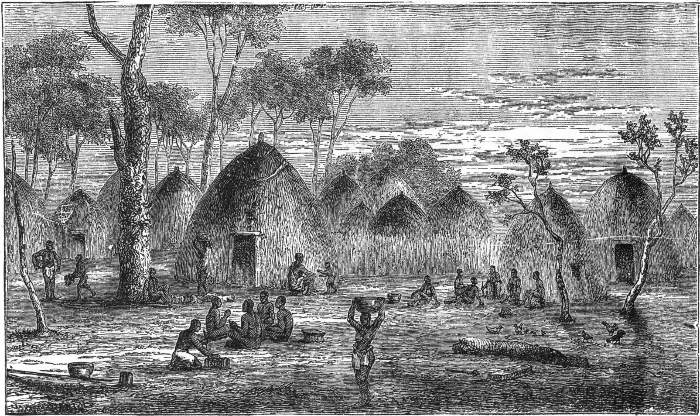
"As in Western Usagara, the houses of the Wagogo are square, arranged
around the four sides of an area—to which all the doors open. The roofs
are all flat, on which are spread the grain, herbs, tobacco and
pumpkins. The back of each department is pierced with small holes for
observation and for defense.
"The tembe is a fragile affair as constructed in Wagogo; it merely
consists of a line of slender sticks daubed over with mud, with three or
four strong poles planted at intervals to support the beams and rafters,
on which rests the flat clay roof. A musket-ball pierces the wattled
walls of a Wagogo tembe through and through. In Uyanzi, the tembe is a
formidable affair, because of the abundance of fine trees, which are cut
down and split into rails three or four inches thick.
"The tembe is divided into apartments, separated from each other by a
wattled wall. Each apartment may contain a family of grown-up boys and
girls, who form their beds on the floor, out of dressed hides. The
father of the family, only, has a kitanda, or fixed cot, made of
ox-hide, stretched over a frame, or of the bark of the myombo tree. The
floor is of tamped mud, and is exceedingly filthy, smelling strongly of
every abomination. In the corners, suspended to the rafters, are the
fine, airy dwellings of black spiders of very large size, and other
monstrous insects.
"Rats, a peculiarly long-headed, dun-colored species, infest every
tembe. Cows, goats, sheep and cats are the only domestic animals
permitted to dwell within the tembe.
"The Wagogo believe in the existence of a God, or sky spirit, whom they
call Mulungu. Their prayers are generally directed to him when their
parents die. A Wagogo, after he has consigned his father to the grave,
collects his father's chattels together, his cloth, his ivory, his
knife, his jeinbe (hoe), his bows and arrows, his spear and his cattle,
and kneels before them, repeating a wish that Mulungu would increase his
worldly wealth, that he would bless his labors and make him successful
in trade. They venerate, and often perform a dance in honor of the moon.
"The following conversation occurred between myself and a Wagogo trader:
"'Who do you suppose made your parents?'
"'Why, Mulungu, white man.'
"'Well, who made you?'
"'If God made my father, God made me, didn't He?'
"'That's very good. Where do you suppose your father has gone to, now
that he is dead?'
"'The dead die,' said he, solemnly, 'they are no more. The sultan dies,
he becomes nothing—he is then no better than a dead dog; he is
finished, his words are finished—there are no words from him. It is
true,' he added, seeing a smile on my face, 'the sultan becomes nothing.
He who says other words is a liar. There.'
"'But then he is a very great man, is he not?'
"'While he lives only—after death he goes into the pit, and there is no
more to be said of him than any other man.'
"'How do you bury a Wagogo?'
"'His legs are tied together, his right arm to his body, and his left is
put under his head. He is then rolled on his left side in the grave. His
cloth he wore during his life is spread over him. We put the earth over
him, and put thorn-bushes over it, to prevent the fize (hyena) from
getting at him. A woman is put on her right side in a grave apart from
the man.'
"'What do you do with the sultan, when he is dead?'
"'We bury him, too, of course; only he is buried in the middle of the
village, and we build a house over it. Each time they kill an ox, they
kill before his grave. When the old sultan dies, the new one calls for
an ox, and kills it before his grave, calling on Mulungu to witness that
he is the rightful sultan. He then distributes the meat in his father's
name.'
"'Who succeeds the sultan? Is he the eldest son?'
"'Yes, if he has a son; if childless, the great chief next to him in
rank. The msagira is the next to the sultan, whose business it is to
hear the cause of complaint, and convey it to the sultan, who, through
the sultan, dispenses justice, he receives the honga, carries it to the
mtemi (sultan), places it before him, and when the sultan has taken what
he wishes, the rest goes to the msagiri. The chiefs are called
manya-para; the msagiri is the chief manya-para.'
"'How do the Wagogo marry?'
"'Oh, they buy their women.'
"'What is a woman worth?'
"'A very poor man can buy his wife from her father for a couple of
goats.'
"'How much has the sultan got to pay?'
"'He has got to pay about one hundred goats, or so many cows, so many
sheep and goats, to his bride's father. Of course, he is a chief. The
sultan would not buy a common woman. The father's consent is to be
obtained, and the cattle have to be given up. It takes many days to
finish the talk about it. All the family and friends of the bride have
to talk about it before she leaves her father's house.'
"'In cases of murder, what do you do to the man that kills another?'
"'The murderer has to pay fifty cows. If he is too poor to pay, the
sultan gives permission to the murdered man's friends or relatives to
kill him. If they catch him, they tie him to a tree, and throw spears at
him—one at a time first; they then spring on him, cut his head off,
then his arms and limbs, and scatter them about the country.'
"'How do you punish a thief?'
"'If he is found stealing, he is killed at once, and nothing is said
about it. Is he not a thief?'
"'But, suppose you do not know who the thief is?'
"'If a man is brought before us accused of stealing, we kill a chicken.
If the entrails are white, he is innocent; if yellow, he is guilty.'
"'Do you believe in witchcraft?'
"'Of course we do, and punish the man with death who bewitches cattle or
stops rain.'
"Sacrifices of human life as penalty for witchcraft and kindred
superstitions—indeed for many trivial offenses—are painfully numerous
among nearly all the tribes.
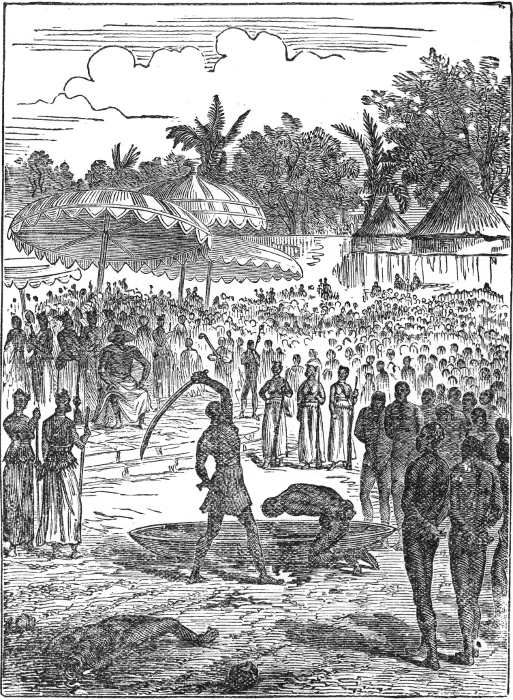
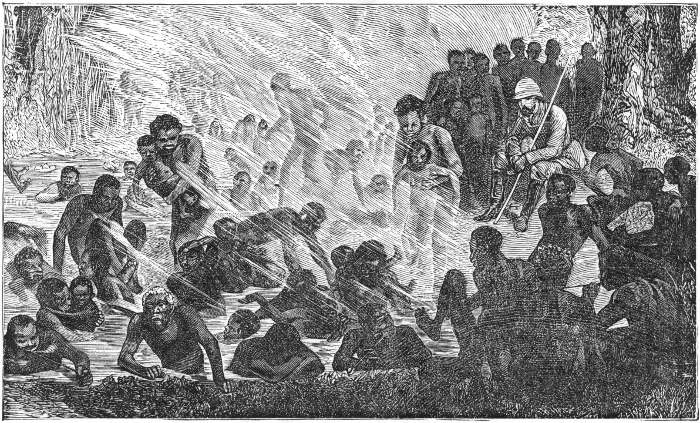
WASTE OF HUMAN LIFE.
Human life is sacrificed as a penalty for witchcraft, theft, murder and
many trivial offenses.
"Next to Wagogo is Uyanzi, or the 'Magunda Mkali'—the Hot Field.
"Uyanzi or Magunda Mkali is at present very populous. Along the
northern route—that leading via Munieka—water is plentiful enough,
villages are frequent and travelers begin to perceive that the title is
inappropriate. The people who inhabit the country are Wakimbu from the
south. They are good agriculturists, and are a most industrious race.
They are something like the Wasagara in appearance, but do not obtain a
very high reputation for bravery. Their weapons consist of light spears,
bows and arrows, and battle-axes. Their tembes are strongly made,
showing considerable skill in the art of defensive construction. Their
bomas are so well made, that one would require cannon to effect an
entrance, if the villages were at all defended. They are skillful, also,
in constructing traps for elephants and buffaloes. A stray lion or
leopard is sometimes caught by them."