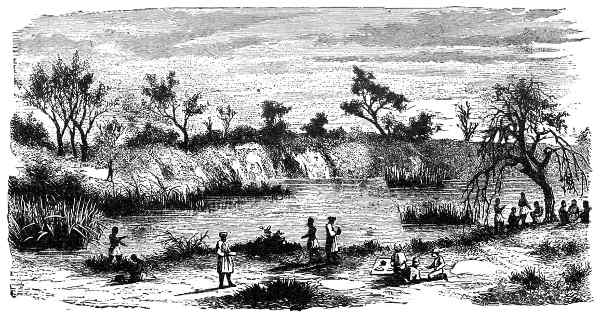
It is not alone as a commercial, scientific and political field that
Africa attracts attention. No country presents stronger claims on the
attention of Christian philanthropists. The Arabs entered Africa as
propagandists of Islamism. The Portuguese advent was signalized by the
founding of Catholic missions. When they arrived off the mouth of the
Congo, in 1490, the native king, “seated on a chair of ivory, raised on
a platform, dressed in glossy, highly colored skins and feathers, with
a fine head-dress made of palm fibre, gave permission to the strangers
to settle in his dominions, to build a church, and to propagate the
Christian religion. The King himself and all his Chiefs were forthwith
baptised, and the fullest scope was allowed to the Roman Catholic
missionaries who accompanied the expedition to prosecute their appointed
work.”
Thus runs an old chronicle. It is valuable as showing the antiquity of
Christian interest in Africa, as well as showing the fine opportunity
then presented for introducing the gospel into benighted lands. We say
fine opportunity, because Portugal was then a power, able and willing
to second every effort of the church, and the church itself was well
equipped for missionary work. Its zeal was untiring. Its formula was
calculated to impress the African mind. The regalia of its priesthood
was captivating. Its music was pleasing and inspiring. But the sequel
proved that something was wrong. The priesthood laboured arduously,
establishing missions, baptizing the natives by the thousand, adapting
their ceremonies and processions to heathen rites and superstitions. The
process was not that of lifting pagan souls to a high Christian level,
so much as
a
lowering of Christian principles to a heathen level. Then
the church was too dependent on, too intimate with, the state. Even
Portuguese historians admit that physical force was frequently employed
to bring the natives more completely under the will of the priests. The
accounts given of some of the floggings which took place, both of males
and female, would be alternately shocking and ludicrous, but for the fact
that they were associated with the propagation of religion. Also, both
church and state countenanced the crime of slavery, and fattened on the
infernal traffic. The ultimate result of such a system might have been
easily foreseen. After a long career of so-called missionary success,
during which hundreds of mission stations were founded on the entire
western and on a great part of the eastern coast of Africa, and many even
far inland, the priests fell under the jealousy of the chiefs, clashed
with them respecting polygamy and various other customs, and were finally
forced back with the receding wave of European influence, when the
power of Portugal began to wane. Within one hundred years of the above
described arrival of the Portuguese missionaries off the mouth of the
Congo, no trace of the labors of Catholic missionaries could be found and
no tradition among the natives that they had ever been there. The finest
mission stations elsewhere had fallen into ruins, and only those remained
which were near ports of entry and fortified commercial points.
It may be truthfully said that missionary work in Africa lay as if dead
till the spirit of African discovery was revived in England by the
formation of the British African Association, in the latter part of
the eighteenth century. Even its first pioneers were not missionaries,
but rather explorers in a commercial and scientific sense. They were,
however, philanthropic Christian men, and the problem of evangelizing
Africa was ever present in their minds. Among them were Leyard, Major
Houghton, Mungo Park who met his death on the Upper Niger, Frederic
Horeman, Mr. Nicholls, Prof. Roentgen, Mr. James Riley, Captain Tuckey
who manned the first Congo expedition in 1816, Captain Gray and Major
Laing, Richie and Lyon, Denham and Clapperton who pierced Bornou and
visited Lake Tchad, Laing and Caillié whose glowing descriptions of
Timbuctoo were read with delight.
These were followed at a later period by Richard and John Lander who
really solved the problem of the Niger, and by Laird and Oldfield and
Coulthurst and Davidson. Now came a time, 1841, when broader sympathies
were enlisted. An expedition was organized under the direction and at
the expense of the British Government which was not merely to explore
the interior of the vast Continent, promote the interests of art and
science, but check the slave trade, introduce legitimate commerce,
advance civilization and social improvement, and thus prepare the way
for the introduction of Christianity. For this purpose, treaties were
to be formed with native princes, agriculture was to be encouraged, and
Christian missions were to be established. Two missionaries went along,
Rev. Messrs. Muller and Schon. The expedition began the ascent of the
river Niger, but was soon forced to return. Failure was written over
the enterprise, and the cause was the deadly climate, which had been
too little studied in advance. African enterprise in the north again
fell back on pioneering exploits, and we have the splendid researches
of Barth, Krapf and Rebman in 1849, and in 1857 those still more
brilliant efforts of Burton and Speke, who entered the continent from
Zanzibar, on the east, and brought to light the mystery of Victoria
Nyanza and Tanganyika. Following these came Baker, and then the immortal
Livingstone, who united the pioneer and the missionary.
Livingstone entered Africa in 1840, under the auspices of the London
Missionary Society, and founded a missionary station at Kolobeng, South
Africa, 200 miles north of the Moffat station at Kuruman. He married Rev.
Robert Moffat’s daughter, and was thus doubly fortified for missionary
work. He labored earnestly and faithfully in his field till driven by
the hostility of the Boers to provide himself another mission further
north and beyond the great Kalahari desert. After suffering untold
hardships in his trip across the desert, he discovered Lake Ngami,
decided that it would be a good base for further missionary work, and
then returned for his wife. A third time he crossed the desert, which
had been regarded as impassable, and this time with his family. It was
the year 1851. He reached the river Chobe after a hard struggle, his
animals having perished under the bites of the poisonous tsetse fly.
Here he
entered
the kingdom of Sebituane, the renowned warrior, whose
favor he had previously secured. But that chieftain had died, and his
successor detained Livingstone for a time. When a permit was obtained to
go where he pleased, he pushed on 130 miles to Sesheke, and thence to
the Zambesi, in the center of the continent, in the country of the famed
Macololos. But finding the country too unhealthy for a permanent mission,
he returned to Cape Town, whence he planned and carried to success a
journey back to the Zambezi, and westward, through the Macololos and
other tribes, to Loanda in Angola, quite across the continent. This was
in 1852. This journey came about because, when at Cape Town, he learned
of the total destruction of his parent mission station at Kolobeng by the
Boers. This left him without a pastoral charge, but it proved a turning
point in his life. Henceforth the field of adventure and exploration
was his, and he easily became the most noted of African travelers, till
Stanley established for himself a greater fame. What the Church lost
a whole world gained. His further travels, how he lost and buried his
faithful wife on the banks of the Shiré, his own sad death in the swamps
of Lake Bangweola, the return of his dead body to Zanzibar, borne by his
faithful servants Chuma and Susi, have all been described elsewhere in
this volume.
The recent advance of the Portuguese toward the head-waters of the
Zambesi, and their reduction of the Macololo territory to a Portuguese
possession, together with the complications with other ambitious nations
of Europe, likely to grow out of it, bring that strange Central African
people again into prominence. The region was made known, in olden times,
by the Portuguese traveler, Silva Porto, who described it as fertile, and
the people as of divided tribes. But Livingstone describes the section
as the empire of the Macololos, and gives many glowing descriptions of
the people, their rulers, products and possessions. He was well received
by them, liked their country, and left a profound impression among
them, for Major Serpa Pinto, in his visit many years afterwards, found
Livingstone’s name mentioned everywhere among the then detached and
demoralized tribes with respect.
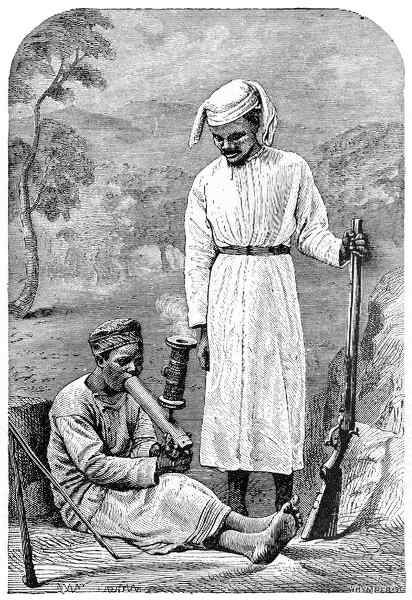 CHUMA AND SUSI.
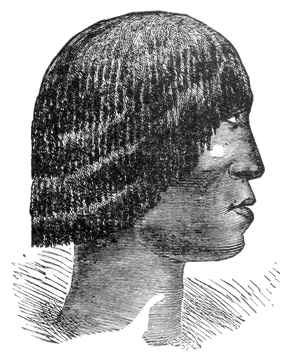
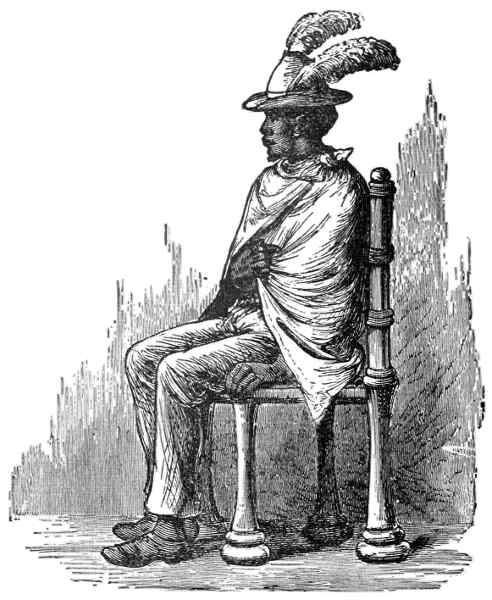 KING LOBOSSI.
According to Livingstone, the powerful Basuto tribe, south of the
Zambesi, crossed to the north side under the lead of their
chief,
Chibitano, and reduced the numerous tribes who inhabited the vast
stretches of country as far as the river Cuando. Chibitano gave to
his army, formed of different elements, and to his conquered peoples,
made up of a variety of origins, the name of Cololos, hence the word
Macololos, so well known throughout Africa. This powerful warrior and
legislator held his conquered tribes as brethren in one common interest
till his death, when they began to set up independent empires. In this
disintegration the Luinas, under King Lobossi, came to the front, and
are yet the most powerful of the Macololos. Pinto says that the Macololo
empire is now composed of a mongrel crew—Calabares, Luinas, Ganguellas,
and Macalacas—all given to drunkenness and moral brutishness. They are
polygamous and deep in the slave traffic. Their country—200 miles long
and over 50 wide—is full of villages and fine plantations. The Luina
herds
cover the plains of the upper Zambesi, and no finer cattle are to
be found in Africa. Lakes abound, and while they contribute to malarial
diseases, they give a rich variety of fish. The men do not take readily
to farming, but the women are wonderful milkmaids and vegetable raisers.
As a people, they are skillful iron-workers and wood-carvers, and expert
at pottery work. They cultivate tobacco for snuff, but smoke only
bangue. They dress fuller and better than most Central African people,
and some of their garbs are quite fantastic.
Prof. Henry Drummond, of Glasgow, in a lecture on “The Heart of Africa,”
gives a vivid description of the perils which beset missionary life in
the Zambesi regions:
As his boat swept along the beautiful lake Nyassa, he noticed in the
distance a few white objects on the shore. On closer inspection, they
were found to be wattle and daub houses, built in English style and
whitewashed. Heading his boat for the shore, he landed and began to
examine what seemed to be the home of a little English colony. The first
house he entered gave evidence of recent occupancy, everything being
in excellent order; but no human form was to be seen or human voice to
be heard. The stillness of death reigned. He entered the school-house.
The benches and desks were there, as if school had been but recently
dismissed; but neither teachers nor scholars were to be seen. In the
blacksmith shop the anvil and hammer stood ready for service, and
it seemed as if the fire had just gone out upon the hearth; but no
blacksmith could be found. Pushing his investigations a little further,
he came upon four or five graves. These little mounds told the whole
story and explained the desolation he had seen. Within them reposed the
precious dust of some of the missionaries of Livingstonia, who one by
one had fallen at their post, victims of the terrible African fever.
Livingstonia was Scotland’s answer in part to the challenge which Henry
M. Stanley gave to the Christian world to send missionaries to eastern
equatorial Africa. When that intrepid explorer, after untold hardship,
had found David Livingstone, and during months of close companionship
had felt the power of that consecrated life, he blew the trumpet with no
uncertain sound to rouse the church to her privilege and responsibility
in central Africa. But it was
not
till the death of the great missionary
explorer, that the land which gave him birth resolved to send a little
army of occupation to the region which he had opened to the Christian
world. On the 18th of January, 1875, at a public meeting held in the city
of Glasgow, the Free, the Reformed, and the United Presbyterian churches
of Scotland founded a mission, to be called Livingstonia, and which was
to be located in the region of Lake Nyassa, the most southern of the
three great lakes of central Africa, with a coast of eight hundred miles.
Although founded by the churches just named, it was understood that it
was to be regarded as a Free Church mission, the others co-operating with
men and means as opportunity offered or necessity required.
The choice of location was most appropriate, not only because Dr.
Livingstone had discovered that beautiful sheet of water, but because
he had requested the Free Church to plant a mission on its shores. The
first company of missionaries, which included also representatives of
the Established Church, who were to found a separate mission in the
lake region, after immense toil and severe hardship, reached the lake,
via the Zambesi and Shiré rivers, October 12th, 1875. They selected
a site near Cape Maclear as their first settlement, and as soon as
possible put into operation the various parts of the mission work they
had been commissioned to prosecute—industrial, educational, medical and
evangelistic. From the first the mission met with encouraging success,
becoming not only a center of gospel light to that benighted region,
but also a city of refuge to which the wretched natives fled to escape
the inhuman cruelties of the slave traders. As the years rolled on,
however, it was found necessary to remove the main work of the mission
to a more healthful region on the lake—hence the desolation seen by
Prof. Drummond—the work at Cape Maclear being now mainly evangelistic
and carried on by native converts. The mission still lives and comprises
four stations, one of which is situated on the Stevenson Road, a road
constructed at a cost of $20,000 by an English philanthropist, and
intended to promote communication between Lakes Nyassa and Tanganyika.
After this diversion, forced upon the reader by reason of Livingstone’s
dual missionary and pioneering work, we turn again to
the
north of
Africa, and to historic Egypt. Comparatively little has been done in this
land by Christendom for the evangelization of its degraded population.
Wesleyan missionaries were stationed at Alexandria in the early part of
the century, but the field proved unpropitious and they were removed
to a more promising sphere of labor. Even the Church of England, now
most in favor there, has not achieved much in the way of Christianizing
the people. Perhaps the American United Presbyterians have been most
successful in this uninviting field. They have several missionaries
there, numerous lay agents, over a score of stations and schools, and
quite a following of converts and pupils. The Khedive has granted them
toleration and valuable concessions. The Church of Scotland sustains one
mission and several prosperous schools at Cairo, in Egypt.
In Nubia, the Mohammedan religion is so firmly fixed, that missionary
effort has been almost entirely discouraged.
The Abyssinians boast of their relationship to King Solomon, resulting
from the visit of the Queen of Sheba to Jerusalem. They also claim to
have received their Christianity from its fountain head in Judæa, on the
return of the Ethiopian eunuch to the Court of Queen Candace, after his
conversion to the faith of the Gospel by Philip, the Evangelist. Whatever
truth there may be in these traditions, it is a fact that the religion
of the country is a species of Christianity, combined with certain
Judaic observances, as circumcision, abstinence from meat, keeping of
Saturday as the Sabbath, and also with many Catholic forms, as reverence
for the Virgin, the calendar of saints, etc. As a missionary field the
Catholics were the first to enter Abyssinia in 1620, and they succeeded
in persuading the king to declare Catholicism to be the religion of the
State. This bold step, however, occasioned civil wars which ended in
their expulsion from the country. Jesuit missionaries from France came
later, but they were also banished.
The Church of England Missionary Society in 1829 sent out two
missionaries. Others followed, but little was accomplished. The well
known German missionary, Herr Flad, has accomplished quite a work in
recent times. The defeat and murder of the Abyssinian king was one of the
sad events of 1888. It followed
successful
invasions of the country and
the slaughter and enslavement of large numbers of Abyssinians in 1885 and
1886 by the Mahdists, and their defeat by King John in 1887. Herr Flad
transmitted a letter to the British and Foreign Anti-Slavery Society from
Christian Abyssinians, which is a most earnest and pathetic appeal for
help from their fellow Christians and such help as will prevent their
enslavement and the entire desolation of their country. Very pertinently
these people, whose liberties and lives are in such imminent danger,
inquire of Christians in other lands, after depicting the desolation of
their own, the selling of thousands of people into slavery, and the cruel
butchery of other thousands, “Why should fanatic and brutal Moslems be
allowed to turn a Christian land like Abyssinia into a desert, and to
extirpate Christianity from Ethiopia?” They close with this earnest plea:
“For Christ’s sake make known our sad lot to our brethren and sisters in
Christian lands, who fear God and love the brethren.” While Abyssinian
Christianity may not be without spot, Abyssinians are God’s men and women.
Later missionary letters to the London Anti-Slavery Society say that
the Mahdists have made Western Abyssinia a desert. Whole flocks and
herds have been destroyed, thousands of Christians have been thrown into
slavery, thousands of others have been butchered, and hundreds of the
noblest inhabitants have been taken to Mecca as slaves in violation of
treaties.
The English gunboat Osprey recently captured three cargoes of slaves off
the island of Perim, which guards the Aden entrance to the Red Sea. When
brought to the Admiralty Court at Aden they proved to be about 217 in
number, chiefly Abyssinian boys and girls from 10 to 20 years of age,
captured by the fierce Mohammedan Gallas, and run across to Mocha to be
sold to the Mohammedans. The Foreign Missionary Committee in Scotland
appeal for a special Rescued Slaves’ Fund for the support and Bible
education of these captives.
In Barca, Tripoli, Fezzan, Tunis, Algiers, and Morocco, known as the
Barbary States, owing to the exclusive character of the Moslem faith, all
missionary effort for the evangelization of the general population has
been precluded until recently. A note
from
Edward H. Slenny, secretary
of the North Africa Mission, says Jan. 26, 1889: “I have just returned
from visiting most of the missionaries connected within the North Africa
Mission in Morocco, Algeria and Tunis. The prospect among the Mohammedans
is encouraging and we are hoping to send out more laborers. There are
now forty-one on our staff, and two more leave us in a week. We are now
proposing to take up work among the Europeans as well as the Mohammedans,
and also establish a station in Tripoli, which is quite without the
Gospel.”
Algeria was occupied in some measure in 1881, Morocco in 1884, Tunis in
1885 and in 1889. Mr. Michell, who has been working in Tunis, accompanied
by Mr. Harding, who left England February 1, landed in Tripoli the 27th.
Thus far they are getting on well. They find the people more bigoted
than in Tunis. Besides the work they may be able to do in the city and
neighborhood, they will be able to send some Scriptures by the caravans
leaving for the Soudan which, with the blessing of God, will spread the
light around Lake Tchad.
A correspondent of The Christian, (London) writing from Gibraltar,
says: “We have had very cheering news from Morocco. A wonderful work
has sprung up among the Spanish and Jewish people of Tangier. Meetings,
commenced two or three months ago, have been held in Spanish, addressed
through an interpreter by some brethren of the North African Mission, and
there has been an intense eagerness to hear the truth. The Holy Spirit
has carried home the Gospel message with conviction to many hearts,
and a few days ago the brethren informed me that seventeen Jewish and
Spanish converts were baptized, and others were waiting for baptism.
The meetings have been crowded night after night, so much so that the
friends in Tangier contemplate hiring a music-hall, at present used for
midnight revelry and sin. This revival has aroused the enmity of both
rabbi and priest, consequently bitter persecution has followed. Several
Jewish inquirers have been beaten in the synagogue, converts have been
dismissed from their employment, and the priests have offered bribes and
made threats to the Spanish converts to induce them to cease attending
the meetings, but so far the converts are holding firm.”
E. F. Baldwin is meeting with great success in Morocco. He writes from
Tangier:
“We have had great encouragement in the work here. For some two months
we have had nightly meetings for inquirers and young converts, attended
by from ten to twenty. Many have received Christ as their personal
Saviour and have been at once baptized. For some weeks most of my time
was occupied from morning until night talking with interested ones who
visited me, and daily there would be natives in my room much of the
time. At times conversions occurred daily. All of them are brought out
of Mohammedan darkness. They all renounce that false religion formally
at their baptism. Almost all are young men, some of good position, but
most of them from among the poor. There is not one who has not prayed and
spoken in our meetings from the day of his conversion.
“Two of the earliest converts are in the mountains traveling on foot
without purse, scrip or pay, preaching in both Arabic and Shillah. They
have been away now several weeks. Others, whose faces we have never seen,
have been converted in distant places through one from here, and write us
of many others believing through their word. We have reason to believe
the Gospel has taken root in several places in Southern Morocco within
these few weeks. Two others of our number are arranging to start at once
to preach in another direction. Mr. Martain and I are also leaving as
soon as we can get away, and will travel also as Christ commanded, on
foot and without purse or scrip.”
Later he writes from Mogador: “For upwards of a year new accessions
have been constant, and every one baptized has renounced Mohammedanism.
For a time the work was seemingly much hindered by severe persecution,
imprisonment, beating, disowning, banishment—these are all too familiar
to the converts here in Southern Morocco. But when it was impossible to
work longer here in Mogador we travelled and preached, going literally
on the methods laid down in Matthew X, which we hold with,
we find, increasing numbers of God’s children, to be of perpetual
obligation. We have found them to contain the deep and matchless wisdom
of God for missionary effort. Several others besides myself,
including
recently converted natives, are so travelling. The natives knowing no
other methods, have gone gladly forth, without purse or scrip, on foot,
taking nothing, and marvellous blessing in the way of conversion has
followed the step of their simple faith. They go with no thought of pay
or salary. The Father makes their simple needs His care. My own position
as an unattached missionary, dependent only on God for temporal supplies
(which, blessed be His name, He ceaselessly supplies), enables one to
consistently instruct these native Christians in the principles and
methods of Mathew x, and encourage them to go forth upon them.
“It is to this return to these first principles of mission work I
attribute the constant flow of blessing we are having, and which is so
exceptional in Mohammedan fields. I earnestly recommend them to others
who may have the faith and are so circumstanced as to practice them. I
say this without any reflection upon the more ordinary and accepted lines
of mission endeavor. The field is vast and the need great, and by all and
every means let the Gospel be preached.
“Just now the vigilance of our persecutors and adversaries has
somewhat relaxed, and our frequent meetings (sixteen in Arabic and
eight in English per week,) are well attended and we are cheered by
more conversions. Several are just presenting themselves for baptism.
Last night one of the most intelligent and best educated Moors I have
ever met, publicly confessed Christ for the first time—both speaking
and praying (as all the native Christians do from the hour of their
conversion) in our meeting before many witnesses. He is one of the few
‘honorable’ ones who have been won. We trust he may become a veritable
Paul. He was some months since arrested and thrown into prison on the
suspicion of being a Christian, which at that time he was not. His feet,
like Joseph’s, ‘they hurt with fetters,’ the scars of which he will
never cease to carry. Poor fellow! He was then without the comfort that
comes to a child of God in affliction, and yet enduring reproach for
Christ. But God blessed his dreary sojourn in prison to his soul, and it
contributed to his conversion.
“Some from among the few resident Europeans and from
among
the Jews also
have turned to the Lord and confessed Him in baptism.
“Tidings from different places in the interior, where the word of life
has been carried from here, tell us of many turning from Mohammed’s cold,
hard, false faith, to the love and light the Gospel brings them. May not
all this encourage the zeal and faith of scattered workers toiling in
these hard Moslem fields?
“Some new workers, all committed to Mathew X lives, have just
joined us. There are now six of us here, all men of course, with our
lives given up to toil for Christ under his primitive instructions. A
band is forming in Ayrshire, Scotland, of others who will come to us
soon, we trust. Others in different places are greatly interested. We
hope to have many natives together here in the summer months for training
in the Word, that they may afterwards go forth two by two, without purse
or scrip.”
Alfred S. Lamb writes as follows:
“Within four days’ journey of Britain one may land on African soil and
find a large field—almost untouched—for Christian labor among the
natives of Algeria, the Kabyles. Visiting recently among these people,
and making known to them, for the first time, the glad tidings of
salvation, I was much struck with the attention given to the message.
Doubtless the novelty of an Englishman speaking to them in their own
unwritten language, and delivering such a message as a free salvation
without works, was sufficient of itself to call forth such attention.
Seated one evening in a Kabyle house, I was greatly delighted with
the readiness to listen to the Gospel. The wonderful story of the
resurrection of Lazarus was being read, when my host announced that
supper was ready, and when I liked I could have it brought up. Having
expressed a desire to finish the narrative, the little company of
Mohammedans continued to give the utmost attention to the words read and
spoken. Supper ended, the conversation was renewed. One of our company,
an honorable Marabout or religious Mohammedan, who, because of having
made a pilgrimage to Mecca, was called Elhadj, entertained us while he
read from an Arabian tract. The man showed us, with evident pride, a book
in Arabic (I presume a portion of Scripture,) given him two years ago in
Algiers
by a Christian English lady who was distributing tracts among
the people. Frequently during that evening’s conversation, my statements
were met by the words, ‘You are right,’ ‘Truly.’ That night I had two
sharing the sleeping apartment with me. Having seen me bow the knee in
prayer, one of them asked me afterward if I had been praying. Replying
that I had, he added, ‘May God answer your prayer!’”
The north of Africa, so long neglected by the missionaries, seems now to
share in the interest that has been awakened in the whole continent.
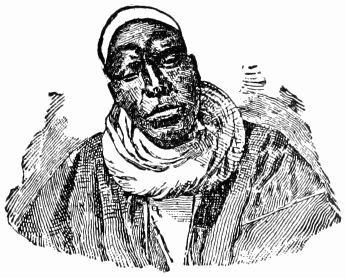 WEST AFRICAN MUSSULMAN.
We come now to the west coast. Western Africa is divided into numerous
petty States, in all of which the most degrading superstition and
idolatry, with their usual concomitants of lawlessness and cruelty,
are the outstanding features. The entire population was no doubt pagan
at no very remote period; but in modern times the religion of Mohammed
has extensively prevailed, having been jealously propagated with fire
and sword by northern tribes of Arab descent. But there is not so much
difference between the Mohammedanism and paganism of the negroes as
many suppose. The distinction is rather nominal than real, so far as
the moral conduct of the people is concerned. All profess to believe in
the existence of God, if a confused notion of a higher power may be so
designated; but all are entirely ignorant of the character and claims of
the Divine Being, and exceedingly superstitious. The African Mussulman
repeats the prayers, and observes the feasts and ceremonies prescribed in
the Koran, but he has quite as much, if not more faith, in his charms and
amulets, or greegrees.
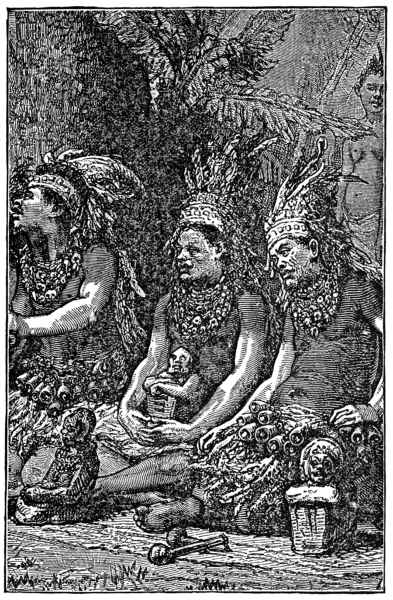
Paganism in West Africa is known by the name of “fetishism.” It assumes
different forms in the various tribes. It is to a large extent a system
of devil worship, in connection with which the belief in witchcraft
plays an important part. Not only are the deities themselves called
“fetishes,” but the religious performances of acts of worship, and the
offerings presented are also spoken of as “fetish,” or sacred, because
they are performed and offered in honor of those deities. In the daily
household worship, in every domestic and public emergency, in seasons of
public calamity, when preparing for and engaged in war, in the taking
of oaths, at births and deaths and funerals, and, indeed in connection
with every event in life, the “fetish” superstition holds the people in
the most slavish, degrading, and cruel bondage. When a death occurs a
solemn assembly is held in a palaver house to inquire into its cause;
and as witchcraft is the one often assigned it results in death to some
unfortunate individual suspected of the crime.
To be suspected of witchcraft is the worst thing that can overtake a
man or woman in Africa, and at every death it is the priests’ business
to make out who has been the cause of the death. On such occasions
a brother, sister, father, nay, in many cases even a mother, may be
accused of the unnatural crime of having occasioned the death of their
dearest. Against such a charge there exists no defense. Free room has
been left to the priesthood for the execution of its malicious plottings
and selfish designs, as they mostly are. It is hard to say which men
dread the most, the effects of witchcraft or being themselves accused of
practicing it. People avoid with the utmost carefulness and solicitude
every look, every word, every act, which is in the slightest measure open
to misinterpretation. If any one is seriously ill, care is taken not to
be too cheerful, lest it should appear as if one was rejoicing over the
expected decease. But, again, one does not dare to seem too solicitous,
lest it should be surmised that he is concealing his guilt under a mantle
of hypocrisy. And yet, with all these precautions, one is never secure.
If such a suspicion has once been uttered against any one, neither age,
nor rank, nor even known nobility of character defends him from the
necessity of submitting to the ordeal of poison, the issue of which is
held infallible.
The people through belief in this doctrine, are the victims of the
priests and priestesses—the “fetish” men and women—who constitute a
large class. The most incredible atrocities resulting from this belief
form one of the darkest chapters in the history of this dark land.
Some of the superstitious rites and ceremonies of the negro race partake
more of the nature of open idolatry than any of those which have yet
been mentioned. For instance, they pay homage to certain lakes, rivers
and mountains, which they regard as sacred, believing them to be the
special dwelling places of the gods. They also adore various animals
and reptiles, which they believe to be animated by the spirits of their
departed ancestors. In some places large serpents are kept and fed, in
houses set apart for the purpose, by the “fetish” priests. To these ugly
creatures sacrifices are presented and divine homage is paid by the
people at stated periods—a liberal present being always brought for the
officiating priest on all such occasions.
The ruling people of the Niger delta, at Bross, New Calabar, Bonny and
Opobo, are the Ijos. Every community of them had formerly its “totem,”
or sacred animal, in whose species the ancestral Spirit of the tribe was
supposed to dwell. So profound was this belief that the English traders
in the Oil River region—the Oil Rivers embrace the tributaries of the
Niger, and are so called in general because the commerce in palm-oil
is large upon them—were forbidden to kill the sacred lizard of Bonny,
and the more sacred python of Bross. One agent of a large trading firm
at Bross found a python in his house and inconsiderately killed it. On
learning of it, the Bross natives destroyed the firm’s factory and store,
dragged the agent to the beach and inflicted indignities on him. The
British consul considered the case, but such was the sentiment against
the sacrilegious conduct of the agent, that the consul, as a matter of
trade polity, was forced to decide that redress was impossible, in as
much as he had brought the punishment on himself.
This “totem” worship made the monster lizard at Bonny a nuisance. They
grew in number and impudence, till it was nothing unusual to see their
six feet of slimy length stretched across paths and upon doorways, and to
feel the lash of their serrated
tails
on your legs as you passed along.
If one were wounded or killed, there was no end of trouble, for the irate
natives were sure to carry the case to the consul on board ship, where
they secured the judgment of a fine, or else taking the law into their
own hands, they insulted, or assaulted the slayer till their anger was
appeased.
In other parts of the delta, a shark became the tribe “totem,” or
a crocodile, or water-bird, but in no part was Zoölatry—animal
worship—carried to a greater extent than at Bonny and Bross, where
the lizard and python were favorites. In 1884, the Church Missionary
Society took the matter in hand, and finally succeeded in doing what
consuls and the war-ships had failed to accomplish. The society screwed
the courage of the native converts up to the sticking point and finally
proclaimed the destruction of the lizards in Bonny on one Easter Sunday
morning. Men and boys, armed with hatchets and sticks went about killing
the ugly beasts, and so complete was their work that the day ended with
their extermination. But the sickening smell which pervaded the air for
days, came near producing a pestilence. It was a hard blow to native
superstitions, but the riddance soon came to be acquiesced in. A change
equally abrupt put an end to the python worship at Bross, and so there
has been of late years, a gradual giving up of this “totem” observance
among the Niger tribes, thanks to missionary rather than commercial
enterprise.
Here, surely, if anywhere on the face of the earth, the Gospel, with its
enlightening, purifying, and ennobling influence, was needed. What then
has been done to carry it to these degraded people, and what have been
the results of missionary labor among them? Take a glance first at Sierra
Leone, as it was the earliest visited by the missionaries. It is situated
in the southern part of Senegambia. It has an area of 319 square miles,
and a population of over 80,000, nearly all blacks. Formerly it was one
of the chief emporiums of the slave trade. In 1797 the British African
Company purchased land from the native princes with the view of forming
a settlement for the emancipated negroes who had served in British ships
during the American Revolution, and who on the conclusion of peace were
found in London in a most miserable condition. In 1808 this land was
transferred to the British Crown, additional tracts of
country
being
subsequently acquired. The colony has since served as an asylum for the
wretched victims rescued from the holds of slave ships.
The history of missionary enterprise, in this land of sickness and death,
is a chequered one. Colonial chaplains were appointed at different
times, from the beginning, to minister to the government functionaries
and others; but owing to frequent deaths and absences from illness,
the office was often vacant. The first effort of a purely missionary
character for the benefit of West Africa was made by the Baptist
Missionary Society in 1795. Efforts of other societies followed in rapid
succession; but it was not until after the commencement of the present
century, when the Church and Wesleyan Missionary Societies undertook the
work of evangelization in Western Africa, that the cause took a permanent
and progressive form.
The Church Missionary Society in 1804 sent out to Sierra Leone Mr.
Renner, a German, and Mr. Hartwig, a Prussian, to instruct the people in
a knowledge of Divine things. In 1806 Messrs. Nylander, Butscher, and
Prasse—all of whom had been trained at the Berlin Missionary Seminary,
and ordained according to the rites of the Lutheran church—embarked at
Liverpool to strengthen the mission. In 1816 Wm. A. B. Johnson went out
as a schoolmaster to this colony. “He was a plain German laborer, having
but a very limited common-school education and no marked intellectual
qualifications, but he was trained in the school of Christ and was
a good man, full of faith and of the Holy Spirit. It became obvious
that he was called of God to preach the Gospel, and he was ordained in
Africa. His period of service was brief, but marvelous in interest and
power, and he raised up a native church of great value. Into the midst
of these indolent, vicious, violent savages he went. He found them devil
worshipers, and at first was very much disheartened. But though William
Johnson distrusted himself, he had faith in Christ and his Gospel. Like
Paul, he resolved to preach the simple Gospel, holding up the cross,
show them plainly what the Bible says of the guilt of sin, the need of
holiness, and the awful account of the Judgment Day. He simply preached
the Gospel and left results with God, confident that his Word would not
return
to
him void. For nearly a year he pursued this course. And he
observed that over that apparently hopeless community a rapid and radical
change was coming. Old and young began to show deep anxiety for their
spiritual state and yearning for newness of life. If he went for a walk
in the woods, he stumbled over little groups of awakened men and women
and children, who had sought there a place to pour out their hearts to
God in prayer; if he went abroad on moonlight evenings, he found the
hills round about the settlement echoing with the praises of those who
found salvation in Christ, and were singing hymns of deliverance. His
record of the simple experiences of these converts has preserved their
own crude, broken, but pathetically expressive story of the Lord’s
dealings with them, and the very words in which they told of the work
of grace within them. No reader could but be impressed with their deep
sense of sin, their appreciation of grace, their distrust of themselves
and their faith in God, their humble resolves, their tenderness of
conscience, their love for the unsaved about them, and their insight into
the vital truth of redemption.”
The improvement in the appearance and habits and social condition of the
people that followed was nothing short of a transformation. Their chapel
was five times enlarged to accommodate the ever increasing numbers who
attended. “Seventy years ago, if you had gone to what was afterward known
as the Regent’s Town, you would have found people, taken at different
times from the holds of slave-ships, in the extreme of poverty and
misery, destitution and degradation. They were as naked and as wild as
beasts. They represented twenty-two hostile nations or tribes, strangers
to each other’s language, and having no medium of communication, save
a little broken English. They had no conception of a pure home, they
were crowded together in the rudest and filthiest huts, and, in place
of marriage, lived in a promiscuous intercourse that was worse than
concubinage. Lazy, bestial, strangers to God, they had not only defaced
his image, but well-nigh effaced even the image of humanity, and combined
all the worst conditions of the most brutal, savage life, plundering and
destroying one another. Here it pleased God to make a test of his grace
in its uplifting and redeeming power.”
When Johnson was under the necessity of leaving for England, hundreds of
both sexes accompanied him a distance of five miles to the ship and wept
bitter tears at the thought of being separated from their best earthly
friend. “Massa, suppose no water live here, we go with you all the way,
till no feet more move.”
Similar success attended the work at other stations, so that we find
Sir Charles M’Arthy, the governor, reporting in 1821 as follows in
regard to the villages of these recaptured negroes: “They had all the
appearance and regularity of the neatest village in England, with a
church, a school, and a commodious residence for the missionaries and
teachers, though in 1817 they had not been more than thought of.” In 1842
a committee of the House of Commons thus testified to the state of the
colony. “To the invaluable exertions of the Church Missionary Society
more especially—as also, to a considerable, as in all our African
settlement, to the Wesleyan body—the highest praise is due. By their
efforts nearly one-fifth of the whole population—a most unusually high
proportion in any country—are at school; and the effects are visible in
considerable intellectual, moral and religious improvement.”
The bishopric of Sierra Leone was founded in 1851, and some idea may be
formed of the trying nature of the climate from the fact that no fewer
than three bishops died within three years of their consecration. In
1862 the Native Church having been organized on an independent basis,
undertook the support of its own pastors, churches, and schools, aided by
a small grant from the society.
In a work entitled “The English Church in Other Lands,” it is stated
that “in the first twenty years of the existence of the mission, 53
missionaries, men and women, died at their post;” but these losses seemed
to draw out new zeal, and neither then, nor at any subsequent period, has
there been much difficulty in filling up the ranks of the Sierra Leone
Mission, or of the others established on the same coast. The first three
bishops—Vidal, Weeks and Bowen—died within eight years of the creation
of the See, and yet there has been no difficulty in keeping up the
succession.
The present results are a sufficient reward for all the self-sacrificing
devotion. There is now at Sierra Leone a self-sustaining
and
self-extending African church. The only white clergyman in the colony
is Bishop Ingram; the whole of the pastoral work being in the hands of
native clergymen. Many native missionaries, both clerical and lay, have
been furnished for the Niger and Yoruba missions.
An outline of the proceedings of the Wesleyan Missionary Society in this
part of the wide field may be compressed into a few sentences. Among
the negroes who were conveyed from Nova Scotia to Sierra Leone in 1791,
there were several who had become partially enlightened and otherwise
benefited by attending services of the Methodist ministers in America.
Some of these having made repeated applications to Dr. Coke for preachers
of their own denomination to be sent from England, in the year 1811 the
society responded to their request by the appointment of the Rev. G.
Warren as their first missionary to Western Africa. He was accompanied
by three English schoolmasters. They found about a hundred of the Nova
Scotia settlers who called themselves “Methodists.” These simple minded
people had built a rude chapel in which they were in the habit of meeting
together to worship God from Sabbath to Sabbath, a few of the most
intelligent among them conducting the services and instructing the rest
according to the best of their ability. They received the missionary
from England with the liveliest demonstrations of gratitude and joy;
and to them, as well as to the poor afflicted liberated Africans, who
were from time to time rescued from bondage by British cruisers and
brought to Sierra Leone, his earnest ministrations were greatly blessed.
But the missionary career of Mr. Warren was of short duration. He was
smitten with fever and finished his course about eight months after his
arrival—being the first of a large number of Wesleyan missionaries
who have fallen a sacrifice to the climate of Western Africa since the
commencement of the work. Other devoted missionaries followed who counted
not their lives dear unto them if they could only be made instrumental
in winning souls for Christ. No sooner did the intelligence arrive in
England that missionaries and their wives had fallen in the holy strife,
than others nobly volunteered their services, and went forth in the
spirit of self-sacrifice—in many instances to share the same fate. This
has been going on for
three
quarters of a century; and although the
mortality among the agents of the society is appalling to contemplate,
the social, moral, and spiritual results of the mission are grand
beyond description. Congregations have been gathered, places of worship
erected, native churches organized, and Christian schools established,
not only in Free Town, but in most of the villages and towns in the
colony. High schools have, moreover, been established for the training
of native teachers and preachers, and to give a superior education to
both males and females. The advancement of the people, most of whom have
been rescued from slavery, in religious knowledge, general intelligence,
moral conduct, and, indeed, in everything which goes to constitute
genuine Christian civilization, is literally astonishing. In addition to
the Church and Wesleyan Missionary Societies, who took the lead in the
work of religious instruction in Sierra Leone, other agencies have been
advantageously employed. The census of 1881 showed 39,000 evangelical
Christians, about equally divided between the Wesleyans and the Church of
England. Some reports give the nominal Christian population as high as
80,000.
In the Gambia district the inhabitants on both sides of the river are
chiefly Mandingoes and Jalloffs, most of whom are Mohammedans, with a few
pagans here and there. A large number of “liberated Africans,” as they
are technically called, have, however, been brought to the Gambia from
time to time, and located on St. Mary’s and McCarthy’s islands and in
the neighboring districts, as thousands before had been taken to Sierra
Leone. These are poor negro slaves of different nations and tribes who
have been rescued from bondage, and landed from slave ships taken by
British cruisers while in the act of pursuing their unlawful trade.
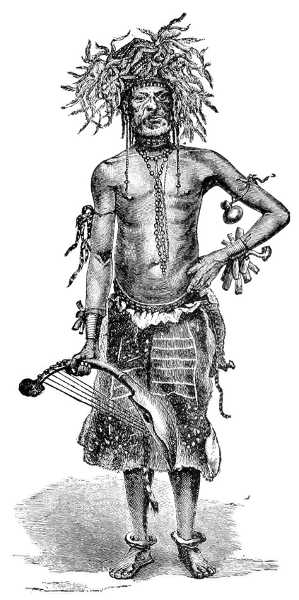
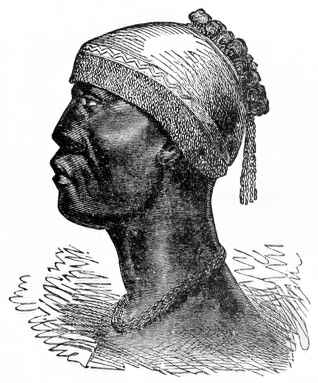
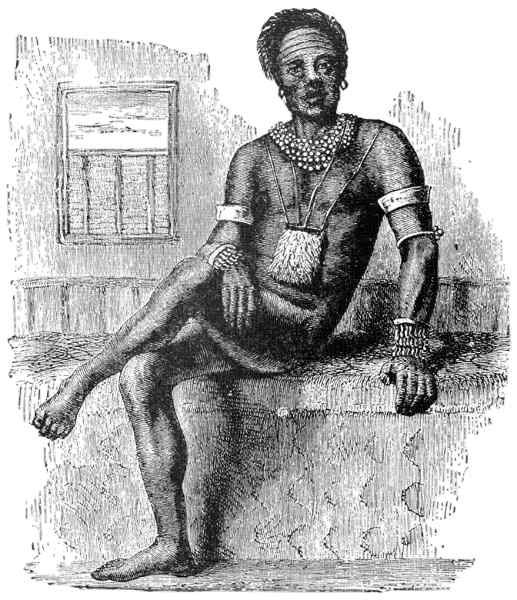 AN AFRICAN CHIEF.
No provision had been made for the moral and religious instruction of the
colonists (British,) or the native tribes of this part of Africa, when
the Wesleyan Missionary Society commenced its labors in 1821. The first
missionary sent out was the Rev. John Morgan. He was soon afterwards
joined by the Rev. John Baker from Sierra Leone, when these two devoted
servants of God began to look about for the most eligible site for a
mission station. Their object being chiefly to benefit the surrounding
native tribes, they were anxious if possible to establish themselves on
the
mainland.
Accordingly they went to visit the chief of Combo, on
the southern bank of the Gambia. Having offered their presents, they
were graciously received by his sable majesty, who signified his consent
for the strangers to settle in any part of the country which they might
select as most suitable for their object. They fixed upon a place called
Mandanaree, about eight miles from St. Mary’s. Although considerably
elevated it was far from healthy; and when the rainy season set in both
were prostrated with fever, and were obliged to move to St. Mary’s
where they could have medical aid. Before the end of the year, however,
Mr. Baker proceeded to the West Indies by direction of the Missionary
Committee, his
health
having become so impaired by his long residence in
West Africa, as to render a change absolutely necessary.
Mr. Morgan had recovered from his attack of fever and was pursuing his
work alone, when he had the pleasure of receiving as his colleague
the Rev. Wm. Bell, who had been sent from England by the committee to
reinforce the mission. This devoted young missionary appeared well
adapted for the enterprise upon which he had entered; but he was soon
called away to the “better country.” He died of fever at St. Mary’s
forty-six days after his arrival. For a time his place was taken by the
Rev. Geo. Lane, from Sierra Leone, but his health also failing he was
obliged to return, and he shortly afterwards finished his course. On the
14th of April, 1824, Mr. Morgan was relieved by the arrival from England
of the Rev. Robert and Mrs. Hawkins, who entered upon their work at once.
By this time it had become evident that the proper place for the
principal station was St. Mary’s island, and arrangements were forthwith
made for the erection of a mission-house and place of worship in
Bathurst, the principal town. A number of native converts were soon after
united in church fellowship as the result of the faithful preaching of
the Gospel; schools were organized for boys and girls, and the machinery
of a promising mission station was fairly put in motion. Mr. and Mrs.
Hawkins suffered much from sickness during their period of service,
but they labored well and successfully, and were spared to return home
in 1827, the Rev. Samuel and Mrs. Dawson being appointed to take their
place. Mrs. Dawson was smitten with fever and died at Sierra Leone, on
her way to the Gambia, and her sorrowful and bereaved husband proceeded
to his station alone. On the 18th of November, 1828, Rev. Richard
and Mrs. Marshall arrived at the Gambia from England to relieve Mr.
Dawson; and the school being once more favored with the supervision of
a Christian lady, and the station with an energetic missionary, the
work prospered in a very pleasing manner. Mr. Marshall had labored with
acceptance and success for nearly two years, when he fell a sacrifice to
the climate, and finished his course with joy at Bathurst on the 19th
of August, 1830. Two days after the funeral of her lamented husband,
Mrs. Marshall embarked with her infant son for England. They arrived
at
Bristol
on the first of October; and worn out with mental and
bodily suffering, the lonely widow sank into the arms of death about
forty-eight hours after she landed on the shores of her native country.
Gambia Station was thus left without a missionary or teacher, but six
months later, on the 10th of March, Rev. W. Moister and wife arrived at
St. Mary’s and set to work at once to recommence the mission schools
and public services. Their labors were crowned with success; and native
preachers having been trained to take a part in the work, they felt that
the time had come when some effort should be made to carry the Gospel
to the regions beyond. With this object in view Mr. Moister made three
successive journeys into the interior; and with much toil and exposure
succeeded in establishing a new station at McCarthy’s Island, nearly 300
miles up the Gambia,—a station which from that day to this, a period
of over half a century, has been a centre of light and influence to all
around, and the spiritual birthplace of many souls. Mr. Moister was
relieved in 1833 by the arrival from England of a noble band of laborers.
The Rev. Wm. and Mrs. Fox took charge of St. Mary’s and Rev. Thomas and
Mrs. Dove were appointed to take charge of the new station at McCarthy’s
Island. They labored long and successfully in this trying portion of the
mission field, and some of them fell a sacrifice to the deadly climate.
They were succeeded by others in subsequent years, many of whom shared
the same fate; but whilst God buried His workmen, He carried on His work.
A rich harvest has been already reaped, and the work is still going on. A
commodious new chapel and schoolrooms have been built at Bathurst, and a
high school established for the training of native teachers and others;
whilst large congregations, attentive and devout, meet together for
worship.
“The Gold Coast” is the significant name given to a maritime country
of Guinea, in Western Africa, in consequence of the quantity of gold
dust brought down from the interior by the natives for barter with
the European merchants. The Wesleyan Missionary Society commenced its
labors on the “Gold Coast” in 1834. Their first station was at Cape
Coast Town, and though the missionaries died in rapid succession, the
station was never without a missionary for any considerable time. As
the work advanced native
laborers
were raised up; and in succeeding
years stations were established, places of worship built, congregations
gathered, and Christian churches and schools organized, not only in Cape
Coast Town, but also at Elmina, Commenda, Dix Cove, Appolonia, Anamabu,
Domonasi, Accra, Winnibab, and other places along the coast and in the
far distant interior. In 1889 they had 21,000 Christians.
The Basle and North German Missionary Societies have also several
important stations on the “Gold Coast,” at Accra, Christianburg,
Akropong, and other places. During the last century the attention of
Count Zinzendorf was drawn toward the propagation of the Gospel on the
“Gold Coast.” Three times (1736, 1768 and 1769) missionaries were sent
to Christianburg and Ningo; but all died after a short stay, without
seeing any fruit of their work. They are buried, eleven in number, at
Christianburg and Ningo. Upwards of half a century elapsed ere this
“white man’s grave” was taken possession of again. At length in 1827,
the Basle German Evangelical Mission sent out four missionaries, J.
P. Henke, C. F. Salbach, J. G. Schmid, and G. Holzwarth. They arrived
on the 18th of December, 1828, at Christianburg, then and until 1851
a possession of the Danish Crown. From Governor Lind they received a
cordial welcome. Within nine months after their arrival three of them
succumbed to the climate, two of them dying on the same day. Two years
later the fourth (Henke) was removed. Three new laborers arrived in
March, 1832, but in the course of four months two of them had died.
The third, A. Rüs, having been raised up from the very gates of death,
labored for several years, and afterwards removed to Akropong, the
capital of Aquapim, a more healthful region in the interior. The
Aquapims and their king proved very friendly. The reports from this new
region had the effect of infusing fresh life into the society, and two
missionaries, along with Miss Wolter, who became the wife of Rüs and
was the first missionary lady on the “Gold Coast,” were forthwith sent
to his aid. Two years thereafter, Rüs and his wife were left alone, the
remorseless climate having again done its deadly work. The mission had
now been in existence for ten years, and within that period no fewer
than eight missionaries had died. Rüs returned in broken health to Basle
in 1840. The directors of
the
society were greatly perplexed, as well
they might be. The prevailing feeling was in favor of the abandonment of
the mission, but a new inspector, the Rev. W. Hoffman, came into office.
Fired with missionary zeal he proceeded in 1843 to Jamaica in order to
enlist Christian emigrants for the work in Africa. Twenty-four members of
the Moravian congregation there responded. They arrived in Christianburg
in April of that year. Henceforth Akropong became as a city set on a
hill. Rüs returned to Africa but was compelled to retire altogether from
the field in 1845, his health having again completely broken down. But
reinforcements were sent out by the society from time to time.
The mission now assumed a more encouraging aspect. Between 1838 and 1848
only one missionary had died, and by the close of the latter year forty
natives had been gathered into the church. Ten years later the society
was able to report that no fewer than eighteen missionaries, with nine
married and three unmarried ladies, besides twenty-six catechists and
teachers, had been settled at the stations already named and at various
other places. The church members at the close of 1858 were 385. The
next decade showed still more gratifying results, the numbers being
31 missionaries, 19 ladies, 25 native catechists, 15 native male, and
12 native female teachers, and 1581 church members. Out-stations were
largely multiplied.
During this last period the work was developed in other directions. The
Mission Trade Society had begun operations, its object being to prepare
the way by means of trade based on Christian principles. Elders had
been appointed to assist the missionaries in their work, and to settle
minor cases of jurisdiction. Besides the day schools, boarding schools
for boys and girls, a teachers’ training school, and a theological
school had been established. Industrial departments too had been added
at Christianburg. These are now self-supporting and are proving an
important means of promoting the moral and social well-being of the
natives. In these industrial schools may now be seen native shoe-makers,
tailors, carpenters, and other craftsmen, busy at work plying their
respective avocations, and preparing themselves for useful positions in
life. Some of the missionaries have, moreover, rendered good service
to
literature,
and to those who may succeed them in the field, by
the useful dictionaries, grammars, and vocabularies which they have
compiled of native languages, and the translations which they have made
of Scripture into the dialects of the people among whom they labor. The
entire Bible has been translated into two of the various languages—viz,
in the Gâ or Akra, by the late Rev. J. Zimmerman; and in the Tshi by
the Rev. Christaller—the latter language being spoken by at least a
million of negroes on the “Gold Coast,” and far into the interior.
During the Ashanti war in 1874 Captain Glover bore the following
emphatic testimony to the piety and general good conduct of the native
converts who joined the British army from some of the stations mentioned
above: “Two companies of Christians, one of Akropong, and the other
of Christianburg, numbering about a hundred each, under two captains,
accompanied by Bible-readers of the Basle Mission, attended a morning
and evening service daily, a bell ringing them regularly to prayers.
In action with the enemy at Adiume, on Christmas day, they were in the
advance, and behaved admirably, since which they have garrisoned Blappah.
Their conduct has been orderly and soldier-like, and they have proved
themselves the only reliable men of the large native force lately
assembled on the Volta.”
In 1875 they sent out for the Ashanti Mission a staff of six men for two
new stations—Mr. and Mrs. Ramseyer among them. One of these stations,
Begorro, is not in the Ashanti territory, but is a frontier town, and a
connecting link between their former “Gold Coast” Mission and Ashanti
proper. It is the healthiest of all the African stations of the society.
The other station, Abetifi, is the capital of Okwao, a former province of
Ashanti, which gained its independence after the victory of the British
army over the Ashantis. The chief of the capital, Abetiffi, told the
missionaries to settle wherever they liked.
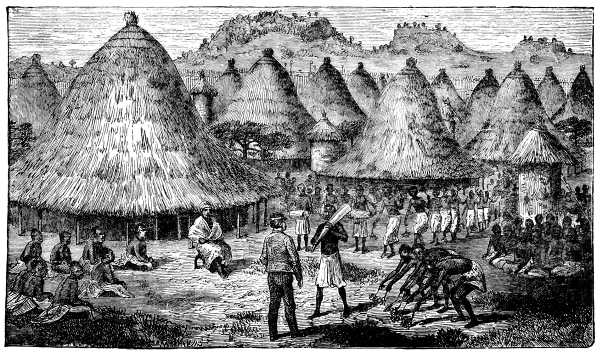
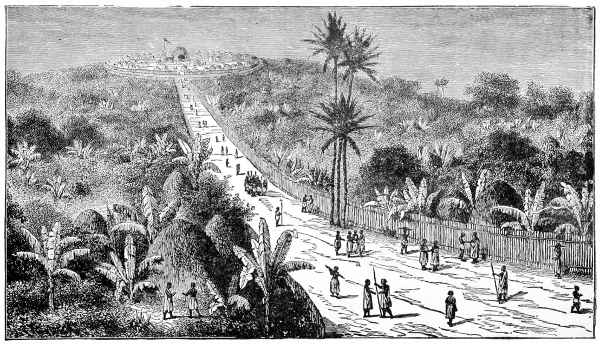
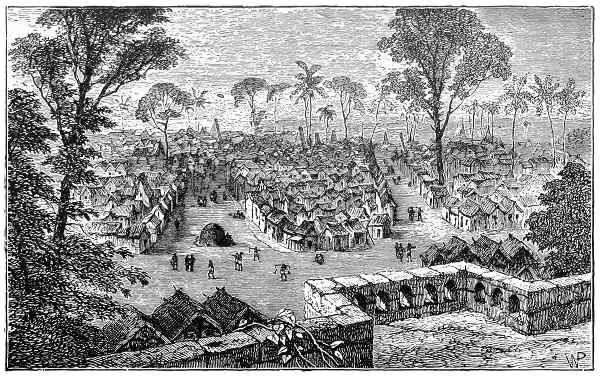 COOMASSIE THE CAPITAL OF ASHANTI.
Larger.
COOMASSIE THE CAPITAL OF ASHANTI.
Larger.
Early in 1881 two of the missionaries, accompanied by several native
preachers and the necessary bearers, undertook a journey to Coomassie,
the capital, in order to ascertain the disposition of the people and
the prospect of establishing a mission among them. During their stay
they preached regularly morning and evening, with the king’s permission,
to large audiences. But the king
did
not desire a mission established
there, and they deferred attempting to commence missionary operations in
Coomassie.
One beneficial result of the war with Ashanti has been the abolition of
domestic slavery in the “Gold Coast” colony.
The work of the society (Basle) generally on the west coast of Africa
has been very gratifying. In 1882 under the care of the 34 European
missionaries and upwards of a hundred other agents, there were some 4,000
natives, from whose minds the darkness of night has been dispelled,
besides about 1,500 pupils under instruction who may be expected to do
good work in the future. Many of the churches on the “Gold Coast” have
attained to a position of self-support.
One single fact may be mentioned, as indicating the influence of the
mission here. The king of Cape Coast in early life was the means of
getting it established. He forsook the “fetish” of his country. In
consequence he was cut off from the succession to the chieftainship, and
publicly flogged. But after thirty years’ profession of Christianity, he
was elected chief or king, and, on the occasion of the anniversary in
1864, he publicly acknowledged his obligations to the mission.
Lagos, a considerable island in the Bight of Benim, was in former times
one of the most notorious slave depots on the western coast of Africa.
It is situated at the mouth of a river, or rather, a large lagoon,
which runs parallel with the sea for several miles, and affords water
communication with the interior in the direction of Badagry, Dahomi,
Abeokuta, and other parts of the Yoruba country. It is now a British
settlement, with its resident lieutenant governor and staff of officers.
The population of Lagos and the neighboring native towns, both in the
Yoruba and Popo countries, is of a similar character to that which is
found on other parts of the coast. Perhaps it became somewhat more mixed
several years ago, by the emigration from Sierra Leone of a large number
of “liberated Africans,” who ventured thus to return to the countries
from which they had been dragged as poor slaves, when they heard that
the slave trade was abolished. Some of these emigrants had the happiness
to find parents, brothers, sisters or other relatives and friends still
living,
who received them as alive from the dead; whilst others sought
in vain for any one who could recognize them. There were many touching
and affecting meetings, and great was the surprise of the natives of
Lagos, Abeokuta, and other places in Yoruba and Popo countries, to see
the change which had passed upon their friends and relatives by the
residence of a few years in a free British colony. They all appeared
decently clothed in European apparel, many of them had learned to read
and write in the mission schools, and a few of them had become the happy
partakers of the great salvation, which they had heard proclaimed in all
its simplicity and power in the land of their exile.
It was the extensive emigration of civilized “liberated Africans” from
Sierra Leone to Lagos and the neighboring towns in the Yoruba country,
that led to the vigorous efforts of the Church and Wesleyan Missionary
Societies to evangelize the natives of this part of Africa. The Christian
emigrants who had been connected with these organizations in Sierra
Leone, on reaching their destination reported to their respective
ministers the state in which they found the country and earnestly
requested that their friends and countrymen might be favored with the
proclamation of the Gospel which had made them so happy. These appeals
were cheerfully responded to by the parties concerned, and a work was
commenced which for prosperity and blessing has had few parallels in the
history of missions.
The Church Missionary Society was happy in the selection of the Rev.
Samuel Crowther, an educated and ordained native minister, as the leader
of the enterprise. The history of Mr. Crowther is equal in interest to
any romance that was ever written. Torn away from his native land and
sold as a slave when a mere boy in 1821, he was rescued from a Portugese
slaver by a British cruiser and brought to Sierra Leone, where he was
educated in the mission school, and being specially bright was sent to
England. He completed his education in Islington Training Institution and
was ordained by the Bishop of London. He returned to Sierra Leone and was
afterwards in 1846 appointed as a missionary to Abeokuta, to labor among
the Sierra Leone emigrants and others. It was here, to his inexpressible
delight, he met his mother, twenty-five
years
after he had been
snatched from her by the slave dealers; and in 1848 he had the further
unspeakable joy of seeing her admitted, along with four others, into the
membership of the Christian church. They were the first fruits of the
mission. In 1864 he was consecrated at Canterbury Cathedral, Bishop of
the Niger territory and superintendent of all the stations in the Yoruba
and adjoining countries. Making the island of Lagos his headquarters,
Bishop Crowther, assisted by a noble band of native missionaries, has
succeeded in establishing stations, erecting churches and organizing
Christian schools, not only in Lagos and Abeokuta, where the work was
first commenced, but also in various towns and villages in Yoruba and
Popo countries, and in several centres of population on the banks of the
Niger. The principal stations on the Niger are Bonny and Bross at the
mouth of the river, and Onitsha, Lokoja, New Calabar, and Egan, higher
up. The last named is 350 miles from the mouth of the river. In 1877 a
steamer named the Henry Venn was supplied to the mission, thus doing away
with the hard labor and slow navigation by means of the old fashioned
canoe in vogue on the river. An exploratory voyage made up the Binue in
1879 revealed the existence of numerous tribes ready to receive teachers.
At Bross and Bonny there has lately been a remarkable movement in the
direction of Christianity, hundreds of people throwing away their idols
and attending the church services, which are thronged every Sabbath.
The famous Juju temple, studded with human skulls, is going to ruin. A
village opposite Bonny has been named “The Land of Israel” because there
is not an idol to be found in it. At an important market town thirty
miles in the interior, the chiefs and people, influenced by what they
had seen at Bonny, and without ever having been visited by a Christian
teacher, spontaneously built a church with a galvanized iron roof, and
benches to seat 300 worshipers, got a school-boy from Bross to read the
church services on Sundays, and then sent to ask the Bishop to give them
a missionary.
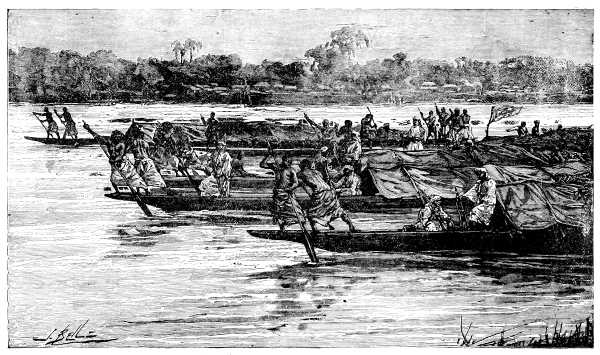
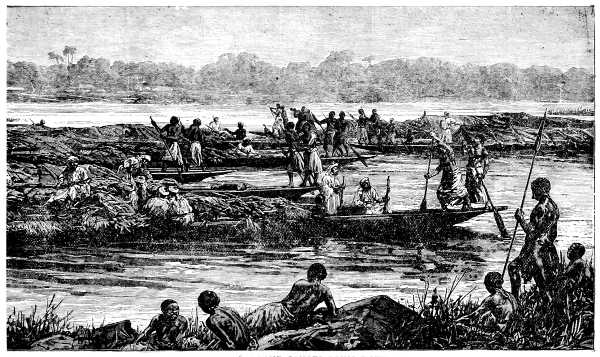
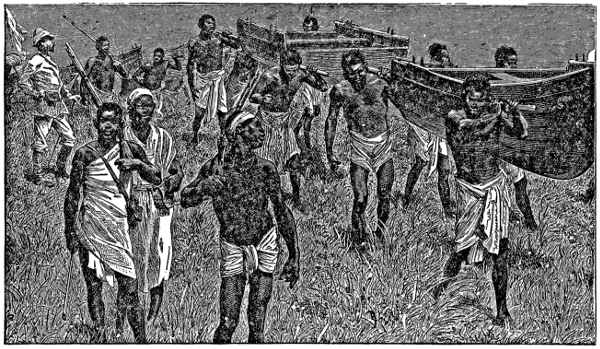
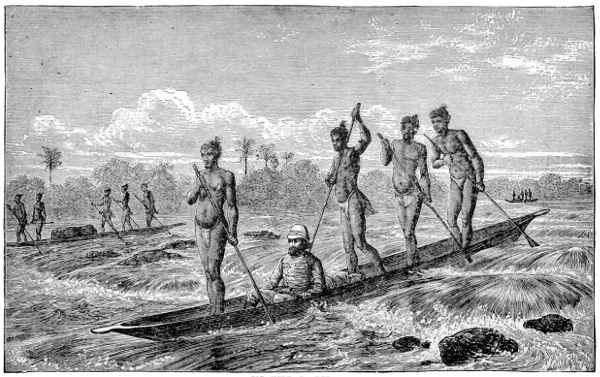
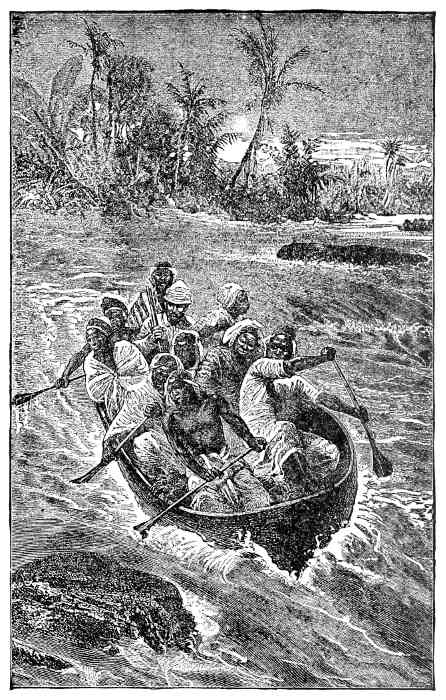
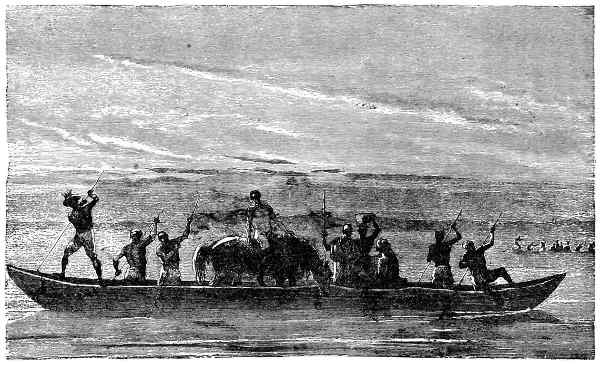 CANOE TRAVEL ON THE NIGER.
Rev. W. Allan writing from Bonny in 1889 says: “The worship of the iguana
is overthrown, the priest is a regular attendant at the house of God, and
the iguana itself converted into an article
of
food. The Juju temple,
which a few years ago was decorated with 20,000 skulls of murdered
victims, I found rotting away in ruin and decay. I passed through the
grove which was formerly the receptacle of so many murdered infants, and
I found it had become the regular highway from the town to the church,
and that the priest was now a baptized Christian. At 11 o’clock I went
ashore and addressed 885 worshipers, including the king, the three former
heathen priests, chiefs, and a multitude of slaves, and was thankful
to ascertain that the work of conversion was still going on; for, in
addition to 648 persons already baptized, of whom 265 are communicants,
there are over 700 at Bonny alone who are now under instruction.”
Bishop Crowther has now about 10,000 Christians under his care. He lately
opened at Bonny a new church built of iron, with sittings for 1,000.
The agents of the Wesleyan Missionary Society have been as zealous and
successful, in a somewhat more limited sphere, as those of the Church of
England, with whom they have generally lived and labored in harmony and
love. Among the emigrants from Sierra Leone there were many Wesleyans who
preferred their own ministers, whilst the domain of heathendom, on every
hand, was sufficiently extensive to occupy the agents of both societies.
At an early period a commodious Wesleyan Mission-house and chapel were
erected at Lagos, where the work has progressed in a very satisfactory
manner from the beginning. Many have been converted from time to time and
united in church fellowship, some of whom have gone out to make known
the good news to their fellow-countrymen. To provide for the training
of native preachers and teachers, as well as to give a better education
to those who are in a position to need it, a Wesleyan high school has
been erected and opened at Lagos, which promises to be a most useful
institution. Common day-schools are also taught in connection with all
the out-stations of the Lagos circuit, and the Gospel is preached to
the people in two or three different languages. They have about 6,000
adherents. The drink traffic is one of the great hindrances to missionary
work in this section.
Says Rev. W. Allan: “In Africa we have to contend
against
the devil’s
missionary agency. The liquor traffic is increasing, and it is a
gigantic evil—greater, even, than the slave trade—debasing the people
and ruining legitimate commerce. In West Africa it has deepened the
degradation of the negro instead of civilizing him. Over 180,000,000
gallons of spirits had been imported last year in the district of Sierra
Leone, and in Lagos it was far larger, while all the land was strewn with
demijohns. The Niger Company imported 220,000 gallons during the last two
years, and 500 cases of gin and 500,000 gallons of rum were landed by the
Caliban, in which I sailed from Liverpool. The selling price of rum is
less than a penny a gallon, and the gin sold at three-pence a bottle. The
liquor so sold was of the most execrable character.”
A lurid picture of the western part of this region has lately been
presented by the English district commissioner. He says: “The population,
which has been recruited for many years past by a constant influx of
refugees from the surrounding tribes, falls roughly into three divisions.
These are: the Popos, chiefly engaged in fishing, forestry, and farming,
but averse to steady work of any sort, and much addicted to theft; the
Yombas, the most enterprising people in the district; and the Houssas,
who are farmers and palm-nut gatherers. The Mohammedans among them are
more enterprising and industrious than the fetish worshipers; while the
Christians, though few in number, form a fairly thriving community. But
all are alike in ‘intense and obtuse conservatism, so long as they are
left to their own devices, and in a keen spirit of petty trading.’ The
sole article of their moral code is ‘to do to your neighbor as you hope
to avoid being done to by him.’ It is useless to appeal to any higher
motive, and it is certain that without European influence to urge them
on commerce must decline. Fishing is carried on wholly in the lagoons,
the people never having had the enterprise to build surf-boats, which
would enable them to engage in sea-fishing. Some progress has been made
in agriculture, owing to the efforts of the Roman Catholic Mission at
Badagry, the administrative centre. In the Frah Kingdom, also, the
local British officer has succeeded in inducing the people to plant a
considerable area of fertile land with corn, so that villages which were
almost starving two years ago on smoked fish are now supplying large
quantities of grain to the
local
markets. But this increased prosperity
has only increased the drunken habits of the people, who exchange for
vile imported spirits the products of their labor. Katamu, the Frah
capital, is rapidly falling into a ruinous state of disrepair. Every
fourth or fifth house is a rum shop, and the so-called palm-wine sheds
are filled every night with drunken men and women. The evils of the
drink traffic are so apparent to the people themselves that they have
petitioned the Governor to put an end to the sale of liquor altogether.
If this were done the fertile flood lands of Frah might become a source
of food supply for the whole colony. In spite of the valuable resources
of the forests, nothing is done to develop them save the collection and
treatment of the palm-nuts. Trading is the African’s special delight,
but until quite recently the markets of Lagos were not in a prosperous
condition. Now that a British firm has established a branch at Badagry,
and made the place a market town, it is estimated that 5,000 persons
with every variety of native produce assemble there every market day,
and in eight months the monthly export has increased from £30 to £1,878.
Cocoanut planting, road making, corn-growing, and the cessation of the
drink traffic appear to be the official methods for civilizing the West
African negro.”
An extensive district on the western coast of Africa, between Sierra
Leone and Cape Coast Castle received the name of Liberia, from the
circumstance of its being colonized by liberated slaves and free persons
of color from America. On the 22d of November, 1888, the secretary of the
Manchester Geographical Society read an interesting paper contributed
by the Hon. G. B. Gudgeon, consul-general for Liberia in London. The
following is an extract: “It was stated that the famous negro republic
of Liberia was founded by the American Colonization Society in 1822.
The work of civilizing and Christianizing the inhabitants of that
almost unknown country was entirely carried on for more than twenty
years by this society. The missions established along the coast and at
various points inland had developed into Liberia’s prosperous towns and
settlements. It became an independent state in 1847. Nearly 2,000,000
souls were subject to the rule of the Liberian Republic, consisting of
about 40,000 freed slaves and their descendants, the remainder belonging
to numerous aboriginal
tribes.
While the state possessed a seaboard of
500 miles and an interior extending over 200 miles, she had acquired
no territory except by treaty, purchase, exchange, or barter. Bishop
Taylor had described the country as healthy and its climate salubrious
and enjoyable, without a plague of flies and with few mosquitoes. Many
travelers had confirmed the bishop’s testimony. The Republic of Liberia
stood before the world as the realization of the dreams of the founders
of the American Colonization Society, and in many respects more than
the realization. Far beyond the recognized limits of the country,
and hundreds of miles away from the coast, the effects of American
civilization were to be witnessed. Men of color entirely governed the
republic, and if any proof were wanting of the capacity of freedmen to
govern, Liberia was an interesting illustration. The ability, learning,
and skill of many of Liberia’s citizens were found in their code of laws,
which for humanity, justice, and morality no other country could excel.
The English tongue is spoken throughout the republic except among the
native tribes not yet civilized; but among these too it is making good
progress.”
Rev. S. L. Johnson, who recently visited Liberia, says: “The scenery
along the coast of Liberia, from Cape Mount to the Gulf of Guinea, a
distance of about 600 miles, is exceedingly grand. A few miles from the
coast the country rises to hills, with gigantic trees, presenting a
panorama that can only be described by a skilful artist.
“Monrovia is the capital of the republic. It rests on a beautiful
hill overlooking the sea, surrounded by trees. There are many fine
buildings in the city, which are creditable to the Monrovian people. The
president’s house is built of brick, as are also many of the buildings;
others are built of stone. The wharves face the sea, where there are
colored firms doing business with England, Germany, and America.
“Mr. Sherman does a large business with England and America. After my
return to England I wrote to Mr. Sherman for information regarding the
articles of trade. This is the answer:—‘The articles of trade are
palm-oil, palm kernels, coffee, ivory, camwood, ginger, and rubber. Many
of our merchants do a business of
$100,000
to $150,000 a year. A vessel
left here for New York on the 7th inst., with a cargo of $50,000 worth,
collected within two months. In this cargo were 118,000 pounds of coffee.’
“The soil of Liberia is extremely fertile, and produces all kinds of
tropical fruits, sugar-cane, indigo, Indian corn, rice, cotton, cocoa,
peanuts, and coffee, the latter the finest in the world. Vegetables
are cultivated with great success. There are to be found the finest
dye-woods, ebony, gum plant, and the gigantic palm-trees, which produce
the palm-oil. On my way to England from Africa 1,500 casks were shipt on
the same steamer to Liverpool, a good share of it being from the coast of
Liberia. Goats, swine, sheep, cattle, and fowls, all thrive in Liberia.
“This republic has a glorious work to accomplish in the future. It will
undoubtedly be in time, the most prosperous state on the west coast of
Africa. With the civil, social, and religious advantages she enjoys, she
must succeed. The annexation of the kingdom of Medina, with five hundred
thousand inhabitants, and her wide and fertile domain, extending over two
hundred miles into the interior, will no doubt inspire renewed energy in
giving fuller opportunities for the advancement of the Gospel, as well as
an open door for civilization and commerce.
“Much zeal and perseverance have been displayed throughout the republic.
Fine churches, school buildings, and a college are to be seen in Monrovia.
“At Nifou, on the coast of Liberia, I counted forty-nine canoes, with
two or three men in each, going out fishing. At twenty-five minutes to
ten we stopt at Grand Cess, Liberia. Here fifteen canoes came out, with
from three to twenty men in each. These belong to the Kru tribe, the
aborigines of a part of Liberia. They are a fine-looking people, and very
industrious. But for this class of people I do not know what the European
traders of the African steamship companies would do. All the steamers
reaching Sierra Leone and the coast of Liberia take on board a gang of
‘Kru-men’ to do the work of the ship. One hundred and thirty men were
taken on board our steamer to go down the coast to work. Many of them
speak broken English well.”
As might be expected, this territory, extending upwards
of
300 miles
along the coast to Cape Palmas, has been occupied by the American
churches—viz. the Baptist, Methodist Episcopal, Protestant Episcopal,
and Presbyterian Church (north). Much zeal and perseverance have been
displayed in connection with all these agencies, and the result is seen
in the parsonages, and places of worship, colleges and school buildings
which have been erected in most of the towns and villages in the
settlements, and in the improved morals of the people.
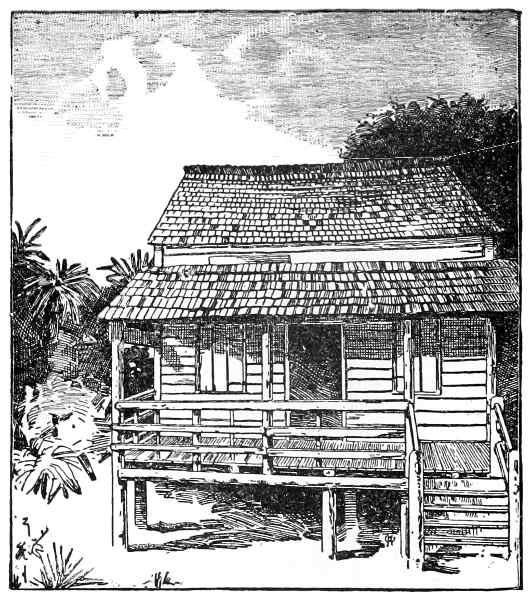 METHODIST PARSONAGE OF AFRICA.
For some years past the Missionary Society of the Methodist Episcopal
Church has been gradually reducing the appropriations for the carrying
on of the missions from $37,000 to $2,500—a procedure that has been
regarded by the conference in Liberia as inconsistent with the general
spirit of the church and the growing interest felt of late years in the
evangelization of Africa, and which for a time threatened to result
in a severance of the ecclesiastical relations subsisting between the
conference and the society. The action of the latter has been dictated
solely by an earnest desire to secure in the native churches “the
development of a spirit of self-reliance and independence—elements
indispensable to a self-perpetuating church in any land.” The General
Conference of 1888 changed the name and boundaries of the “Liberian
Conference” to the “African Annual Conference” embracing the entire
continent of Africa. In the other missions in Liberia there seems also a
disposition to rely on foreign aid.
Fernando Po is one of the most important islands on the western coast
of Africa, and enjoys many advantages from its peculiar position. It
is situated in the Gulf of Guinea, about seventy miles from the coast
of Benim. It is thirty miles long and twenty broad; and in its general
aspect it is rugged and mountainous in the extreme, though there are some
fertile valleys between the mountains, and several promising tracts of
land along the shore.
Among the settlers and aborigines of Fernando Po some really useful
missionary work has been done at different times, which deserves a
passing notice. The first in the field were the agents of the Baptist
Missionary Society. They labored for several years among the settlers of
all classes with very good results, whilst the English had possession
of the island; but when it was given over to the Spaniards, Roman
Catholicism was proclaimed to be the established religion of the
settlement, and the harshness and persecution with which the Baptist
missionaries were treated by the government authorities ended in their
removal to the continent. In 1870—some improvement having taken place
in the Spanish government—the Primitive Methodists were induced to
commence a mission in Fernando Po, the Rev. Messrs. Burnett and Roe
being the first missionaries sent out. They and their successors labored
for several years very successfully. In 1879, in consequence of some
misunderstanding, the missionaries were again banished from the island.
An appeal was at once made to the home authorities, and in the course of
a few months they were allowed to return.
This question of conflict between Protestant and Catholic mission work in
Africa has, at certain times and in certain places, been serious, and is
greatly to be regretted, for it destroys the efficacy of both Churches,
and proves a stumbling block to the natives. Pinto speaks of it with
amazement, in his trip across the continent. He found places where the
natives had been utterly demoralized by the spirit of contention indulged
by the two Churches, and where their final answer to his advice to live
at peace and deal justly with one another was, that white people might
talk that way, but their actions proved that they did not mean what they
said.
In former times—notably in the Spanish, French and Portuguese
provinces of Africa—the Catholic mission was a part of the
political
establishment, and it was expected to use its influence to extend and
perpetuate the power which protected it. This was equivalent to warning
off all competitors as intruders. Happily this condition is undergoing
rapid modification.
Similarly, the Protestant mission of other countries was treated as part
of the commercial establishment, under the protection of the consul, and
of the trading company, to whom the territory was allotted. Its business
was therefore, in part, to cultivate the trading spirit and make its
success contribute to the wealth of the parent country. This notion, too,
is undergoing modification.
All of which is directly in the line of that Christian enterprise so much
needed for the conversion of the African heathen.
On the mainland opposite Fernando Po, and on into the interior, good work
has been done. We will speak first of the Old Calabar Mission.
Old Calabar, on an affluent of the Cross river, is a recognized centre
of the trade of the Oil river sections. It has a population of 15,000
natives and 150 white. An insight into the characteristics of the natives
beyond Old Calabar can best be gotten from the journey of Mr. Johnson
up the Cross river in 1888. His object in making an ascent of the
river was to treat with the natives and at the same time settle an old
quarrel between the Union people and the tribes about Calabar. Stopping,
merely to observe that the Kruboys, of whom Mr. Johnson speaks, are the
Krumen—Kroomen—of the Liberian coast, among whom Bishop Taylor has, in
his four years of African labors, established more than twenty missions,
we let the adventurer tell his own story. He says: “Having decided to
ascend the Cross river and having no steam launch at my disposal, I was
obliged to make the journey in native canoes, of which I hired three,
and fitted the largest with a small house in the centre for my lodging.
I took with me about thirty Kruboys. These invaluable native workers
come from the Liberian coast. Without their aid European enterprise on
the west coast of Africa would be at a standstill; for, invariably,
the negroes who are indigenous will not undertake any persistent work.
The Kruboy is a strong, good tempered, faithful creature; able to row,
paddle, carry, dig, wash clothes, or turn his hand to anything—in fact,
he
is a great deal sharper and more industrious than the average English
navvy. My first object in going up the Cross river was to settle an
outstanding quarrel between the people of a district called Umon and the
natives of Old Calabar. Union is at a distance of about a hundred miles
from the sea. The people speak a language quite distinct from the Calabar
language. They were, till lately, terribly priest-ridden. Their life
was a burden to them, with its load of cruel superstitious practices.
The last few years, however, since they have come into contact with the
missionaries, the state of affairs has greatly improved. As I appeared in
the light of a mediator, I was most warmly welcomed. An imposing fleet
of eighty large Calabar canoes reached Umon soon after I arrived, and
formed a really pretty sight, as they were all painted in brilliant, but
tasteful combinations of color, their little houses hung with bright
carpets or leopard skins, each canoe being decorated with gaudy banners.
The crews were most fantastically dressed in gorgeous clothes. The
beating of drums, blowing of horns, and the firing of guns made a clamor
most disturbing to my comfort, which I promptly stopped. I need hardly
say that I had the Calabar people all under my control, for there was not
only a personal attachment between us, but they knew that I was working
in their interest, and the Umon people were much impressed by the way
in which my shabby little despatch canoe, with two of my Kruboys in it,
could marshal the imposing Calabar fleet.
“As both sides were longing to have their quarrel at an end, and were
fully prepared to accept my decision, the conference was a brief one. I
decided that it was six of one and half a dozen of the other. I made the
Calabar people surrender the Umon captives, and the Umon surrender their
Calabar prisoners. Peace was reestablished, trade was resumed, and I was
free to continue my journey.
“We next visited the important Akuna-Kuna country, very populous, and
inhabited by friendly, industrious people, whose chiefs very promptly
and willingly concluded a treaty with the British Government, and
loaded me with such an abundance of provisions—bullocks, goats, sheep,
fowls, ducks, yams, and Indian
corn—that
our progress was seriously
impeded, our canoes nearly capsized, and my Krumen suffered severely from
indigestion.
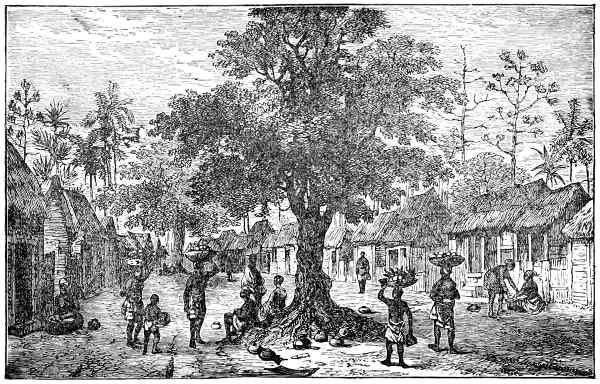 AFRICAN VILLAGE AND PALAVER TREE.
“Some distance up the river we had rather a ticklish task to perform.
Another quarrel, and that a bitter one, had to be settled between the
people of Akuna-Kuna and the inhabitants of Iko-Morut. Here I was
awkwardly situated. Had I been enabled to travel in a steam-launch, I
could have gone safely up the river, or in any direction where there was
sufficient water; but traveling simply in native canoes, the inhabitants
of these wild countries in the interior, who look on every stranger as
an enemy, had no idea that a white man was visiting them, and often
proceeded to attack us before I could make myself seen.
“As soon as we came in sight of the stockaded villages of Iko-Morut,
many excited chocolate-colored natives could be seen hurrying along the
banks of the stream and posting themselves in ambush behind the trees.
Then first one gun, then two, three, four guns went off; then there was a
regular hail of slugs and stones, whipping up the surface of the water,
and, in one or two cases, whizzing over our canoes. In the face of this
warm reception, it would have been impossible to proceed, for, at any
moment, a shot might strike our canoes and send them to the bottom. As
to returning the fire of these poor, stupid savages, nothing was further
from my thoughts. It was always open to me to retreat, and, unless I
could proceed peacefully and with a friendly reputation preceding me, it
was futile to continue my ascent of the Cross river. So I had the canoes
steered to an unoccupied sand-bank in the center of the stream, and as
soon as the natives saw that we stopt, they ceased firing. Then I got
into my small despatch canoe, with two interpreters, hoisted my white
umbrella, and assuming my smile, quietly landed on the crowded beach, to
the silent amazement of the natives, who were armed to the teeth. I was
conducted to the chief, who, for a long time, could not be prevailed on
to see me, on account of my presumed powers to bewitch him; but a little
friendly conversation through the red screen of his apartment, and the
hint that I had brought a pretty present, reassured him, and we soon made
excellent friends.
“To make a long story short; the result of my stay at
Iko-Morut
was
equally satisfactory to that of Umon. I made peace between Akuna-Kuna and
Iko-Morut, and the chiefs of the latter place concluded a treaty with me.
“Then on, beyond Iko-Morut, day after day, we paddled up the beautiful
stream, sometimes received by the natives in a gush of friendliness,
sometimes sullenly avoided, sometimes boisterously attacked. At length,
in the heart of the cannibal country, on the outskirts of Atam, where
the Cross river attains its furthest reach to the north, our journey
came forcibly to an end. I had several times been captured and released,
several times fired at and then hugged by those who had attacked me, but
the strain was becoming too great for the nerves of my Kruboys.
“As we approached one village, a shot, better directed than usual, went
through the roof of my little ark, and though no doubt our ultimate
reception at the village would have been the same as at the preceding
ones—first sullen hostility, then timid inquiry, and lastly a cordial
hand-shaking and hugging, and the giving of presents—still, before
this happy consummation should come about, some of us might have
been accidentally killed, or our canoes—our only means of regaining
civilization—sunk or disabled; consequently I decided to turn back. Then
ensued an awful afternoon, when for miles and miles we had to run the
gauntlet past populous villages of cannibals, whom we had much difficulty
in avoiding on our ascent of the river; and who, taking our retreat for a
flight, seemed bent on capturing us or plundering our canoes and eating
the wretched Kruboys, who turned blue with fright at the prospect of
being eaten, as they desperately paddled down the river past shrieking
natives, who waded out into the shallows, or pursued us in canoes. Every
now and again we would stick on a sand bank, and the shouts of the
natives would come nearer and nearer; then we would get off again, and
paddle for our lives; then stick again, and so on, till at last we were
out of this savage district. I hesitate to say hostile, for, wherever I
landed, or was captured, I was always well treated as soon as they found
out what I was like and what my objects were in visiting their country.
At length we arrived in the delightful district of Apiapum, where we put
up for a week at the clean and comfortable town of Ofurekpe, whose chief
and
people
were some of the nicest, kindliest, most friendly folk I have
ever seen in Africa, though they were in their practical way cannibals,
like their neighbors—that is to say, they were given to eating the flesh
of all whom they might catch in war. I did not here observe that other
kind of cannibalism which I have occasionally met on the Upper Cross
river, which is of a sentimental character, namely, where the old people
of that tribe, when they become toothless and useless, are knocked on the
head, smoke-dried, pounded into paste, and re-absorbed into the bosom of
the family.”
The Old Calabar Mission originated with the Jamaica Presbytery of what
is now the United Presbyterian Church of Scotland. The first band
of missionaries, led by Mr. Hope Waddell, a member of the Jamaica
Presbytery, reached their field of labor on the Old Calabar river on
April 10th, 1846. They were cordially welcomed by King Eyamba and the
chiefs of Duke Town, as also by King Eyo of Creek Town and his chiefs.
Suitable sites for mission stations were readily granted. Mr. Waddell
held a service with Eyamba and his chiefs the first Sunday after his
arrival, and presented the former with a Bible.
Mission houses and schools were in due time erected at both stations, a
printing press being also usefully employed in scattering the seeds of
Divine truth. At Creek Town the first sermon was preached in the court
yard of King Eyo’s palace, the king himself acting as interpreter.
The mission was reinforced in July, 1847, by the arrival of additional
missionaries from Jamaica.
In May previous King Eyamba died. It was the occasion of one of those
scenes of cruelty, too common in heathen lands.
Notwithstanding the efforts of the missionaries, no fewer than a hundred
victims were sacrificed, among whom were thirty of the king’s wives.
Here is the account given of the burial: “The people dug a large hole in
one of King Eyamba’s yards, and having decked him in his gayest apparel,
with the crown on his head, placed him between two sofas, and laid him in
the grave. They killed his personal attendants, umbrella carrier, snuff
box bearer, etc., (these the king was supposed to need in the world of
spirits), by cutting off their heads, and with their insignia of office
threw
them in above the body; and after depositing a quantity of chop
and of coppers, they cover all carefully up, that no trace of a grave
could be seen. Over this spot a quantity of food is daily placed.”
In February, 1850, an Egbo law was passed abolishing the inhuman practice
of sacrificing human beings when a king or chief died. It is spoken of
as “A good day for Calabar”—“One memorable in the annals of the land.”
About the same time the marriage ceremony was introduced—King Eyo having
witnessed the first regular marriage.
On the suggestion of Mr. Waddell, their domestic idol, which consisted
of a stick surmounted by a human skull and adorned with feathers, was
expelled from every house.
The death of King Eyo in December, 1858, put the Egbo law to the
test. Much excitement prevailed. Fears were entertained that the old
superstition would triumph. Happily no such dreaded result followed.
Other heathen practices were one by one abandoned through the influence
of the mission.
The mission extended its sphere of operations from time to time—Ikunetu,
situated on the Great Cross river, about twenty miles above Creek Town,
being occupied in 1856, and Ikorofiong, also on the Cross river, about
twenty miles above Ikunetu, in 1858. The Presbytery of Old Calabar was
established September 1st, 1858, under the designation of the Presbytery
of Biafra.
In 1878 Mr. Thomas Campbell, the European evangelist at Old Town,
accompanied by a number of natives, explored in two directions—first in
Oban, up the Qua river, and then beyond Nyango, on the Calabar river.
Everywhere he was well received by the chiefs and people. On September
6th, 1880, there was an agreement entered into between D. Hopkins, Esq.,
British consul, and the kings and chiefs of Calabar, in accordance with
which a number of superstitious and cruel customs are held as criminal
and punishable by law. These include the murder of twin children, human
sacrifices, the killing of people accused of witchcraft, the giving of
the esere or poison bean, the stripping of helpless women in the public
streets, etc., etc.
In the Missionary Record, June, 1881, appears the following
intelligence: “The mission which seemed so long fruitless, is
now
one of
the most fruitful in the whole earth. The increasing number and activity
of the communicants, the increasing number of students in training
as teachers and evangelists, and the manifestations of a Christian
liberality not yet reached at home, tell of the changes which the Gospel
has wrought. We ploughed in hope: we sowed in tears: and now already we
reap in joy. The most recent tidings are the most heart-stirring. A new
tribe, which had long resisted our approach, has been visited. They had
never seen among them a white man till they looked on the face of the
devoted Samuel Edgerly. They invite teachers to settle among them. They
offer us suitable sites. The country is far beyond the swamps; it is high
and healthy. This favorable entrance was greatly aided by the wise and
good King Eyo, who sent a prince to accompany Mr. Edgerly beyond Umon to
Akuna Kuna. When the expedition returned and the king heard the result,
he gave utterance to one of the noblest of sentiments. ‘God,’ said he,
when Mr. Edgerly had told his tale, ‘has unlatched the door, and wishes
us to push it open.’”
Such results as have been achieved at the Old Calabar Mission are worth
all the money and toil and sacrifice of health and even of life which
they have cost.
The mission to the Cameroons was established in 1845 by the Baptist
Missionary Society. When the missionaries of that society were expelled
from the neighboring island of Fernando Po, where they had been laboring
since 1841, they settled among the Isubus at Bimbia, where a mission had
previously been projected. The mission was afterwards extended to King
Bell’s Town in an easterly direction, the people inhabiting that region
being the Dualas. The entire New Testament has been translated into the
languages of both tribes.
The Gaboon Mission was called into existence by the American Board in
1842. Baraka was the first station occupied. It was transferred in 1870
to the Mission Board of the American Presbyterian Church (north.) The
Mpongwes on the coast, and the Shekanis, Bakalais, and Pangwes in the
interior, are the tribes embraced in the field of operation. Not much
progress has been made owing to the opposition of the Roman Catholics.
In all
the
French possessions on the west coast of Africa the Roman
Catholics predominate and very little has been accomplished. Recently
the Paris Evangelical Missionary Society has been doing a good work at
Senegal and other settlements.
We come now to Angola. Angola was discovered by European mariners long
before Christopher Columbus had given to the world another continent, yet
many years passed before the value of the discovery was recognized and
the country taken possession of and occupied by the Portuguese, at that
period when Portugal was made remarkable by the commercial enterprise and
maritime prowess of its people, more than three hundred years ago.
For several years before the occupation of Angola, the king of Congo had
been doing a large and lucrative trade with the Portuguese in slaves. The
sources from which were drawn victims to keep alive this nefarious barter
were never failing. The superstitions of the people, their customs and
habits, a season of drouth, a failure of crops, in fact anything, even
the least trivial happenings, were all factors giving Congo’s king excuse
for the selling of his subjects to securing wealth; wealth represented by
many wives, granaries filled to bursting with manioc, and wooded hills
and fertile valleys stocked to overrunning with flocks of sheep and
droves of lowing kine; wealth which enabled Congo to dominate and overawe
all contemporary tribes, and which naturally incited the jealousy of
other kings and chiefs who ruled over the natives of other districts in
this country of Congoland.
Among the savage rulers who were envious of the power of their rival,
was Nmbea, king of Angola, autocrat of a large and densely populated
country. Holding at his disposal millions of helpless and superstitious
subjects, Nmbea soon recognized that by copying the practices of his
powerful neighbor he, with but little difficulty, would also become chief
and powerful. So, moved by this desire, he opened a correspondence with
the Portuguese. He sent one of the rich men of his tribe, with presents
of slaves, ivory and strangely wrought curios, as ambassadors to the
Portuguese court at Lisbon, with instructions to endeavor to have the
Portuguese establish trading relations between the two kingdoms.
At this time the attention of the Portuguese queen and
the
people
generally was attracted towards Brazil. Enterprising colonists,
venturesome explorers and wealth seekers of all classes saw in this South
American district a new Cathay. Thousands from among the patrician, as
well as other thousands from more humble circles, rushed into that new
land, necessarily causing large sums of money to follow in their wake.
The enthusiasm with which this American opportunity was cultivated and
the resultant drain from the royal treasury and from the coffers of the
people caused Queen Catherine to receive with indifference all stories
of African wealth. Thus obstacles were formed which prevented Nmbea from
carrying out his plans until several years had passed, when the growing
demands for slaves, needed to supply labor in Brazilian mines and on East
Indian coffee farms, had become a matter of great importance. Then the
request of Angola’s king was considered, and a party of Portuguese were
landed at a place in his kingdom which they called St. Paul de Loanda.
In the selection of this place these adventurers were most fortunate,
for it was not long before trade, in ever-increasing volume, flowed
towards the sea coast at this point. The growth of the city was rapid
and, despite wars with native tribes and trouble with marauding Dutch,
it grew wealthy and powerful. Large and beautiful cathedrals were built,
imposing palaces were erected as were many important public buildings,
and dotted here and there about the suburbs, were fruitful farms and
valuable plantations. So with the moving years the city waxed strong and
mighty, thriving on its traffic in human flesh. But a time came when this
trade was shaken to its base and the prosperity of its citizens brought
to a temporary end.
The inhabitants of the civilized world began to look with disfavor upon
the slave traffic, and were induced to attempt its suppression. This,
for Loanda, was the writing on the wall, for it meant the placing of
an embargo upon the trade which was the only source from which the
city derived revenue for its support. Philanthropy succeeded, and as a
consequence Loanda’s glory faded. The palaces passed away, the stately
cathedrals crumbled into ruins and the large and costly slave barracoons
became useless except as fuel for the poor.
Then for years death-like quiet reigned in the city, and all signs of
commerce ceased. But this stagnation was not to last forever. England and
other commercial nations of Europe, in their efforts to find markets for
the sale of the products of their mills and workshops, had established
depots for trade at almost every important place in the world. The eyes
of European merchants were turned towards the prolific field of southwest
Africa.
Stories which told how great wealth was to be gained in African trade
began to be chronicled in the exchanges of all the great commercial
centres, and a wave of commercial endeavor was put in motion, which
carried with it many richly freighted barks to again fill the harbor of
the African city of St. Paul de Loanda. Since then Loanda has improved
beyond all expectation, and now the vessels of four lines of steamers
as well as many sailing craft are constantly in the harbor loading and
discharging their cargoes. Many large public buildings have been built.
Acres of flat and swampy shore have been reclaimed and are now utilized
for docks and wharfs. Ruins of churches and monasteries have been cleared
away and walks and squares have been laid out and planted. There are
many shops supplied with all kinds of European goods. Pipes have been
laid, through which flows into the city sweet water from the river Bengo,
nine miles away, and when the railway, now in course of construction, is
in operation to bring the products of the farms, plantations and rich
forests of the interior to the city, Loanda will have become a fair
specimen of a thriving tropical town.
The city is situated on the shore of a large and beautiful bay and is
divided into a lower and an upper town. The “Cidade Buixa,” or lower
town, which is built on the flat shore which fringes the water of the
bay, nestles at the base of a hill and straggles up its rising sides
until it joins the “Cidade Alto.” The upper town stretches along the brow
of the elevation and sweeps outward towards the ocean until it ends at
a bold and rocky precipice where Fort St. Miguels, a frowning sentinel,
watches over the safety of the port.
The harbor is a bay where a thousand ships might at one time ride at
anchor and find secure protection from the severest storm. A long, low
and narrow neck of land, called Isle of Palms,
leaves
the mainland
about twelve miles to the south and runs north until it reaches a point
opposite the city, where it flattens out its surface of sunlit sands to
give protection to the harbor of which it forms the southern boundary.
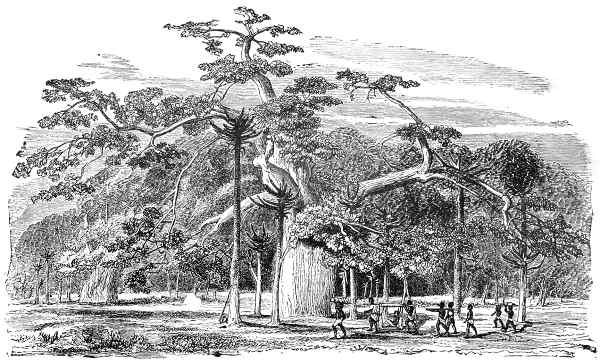 FOREST SCENE IN ANGOLA.
This spit of land is partly covered with groves of cocoa palms, among
which the residents of the city have erected many small houses where
they visit daily to enjoy surf bathing. On other parts of this sandy
breakwater are numerous villages occupied by native fishermen, who make
an easy living.
Loanda contains a population of nearly 20,000 people, about one-third
of whom are white. The houses, as a rule, are built of stone and roofed
with tile, and are large and commodious. The houses all have spacious
yards attached, in which are situated the stores, kitchens, wells and
habitations of the slaves and servants. Arranged in this manner, and
with wide and spacious streets, the city is very open and comparatively
healthy. It covers a large expanse of ground. The principal business
street contains a number of fine structures. On it are situated the
buildings of the Banco da Ultra Marenho, the barracks of the military
police, the custom-house and the offices of the foreign consuls. There
are also three hotels, many stores and warerooms, several billiard rooms
and cafés. In the middle of the street rows of banyan trees have been
planted, making a shady walk, where the natives gather to buy and sell.
These open-air sales, called in Bunda talk “Quitanda” market, are
well patronized. Four uprights, a few “Loandas” mats for a shed, a
stone-bowled pipe and a wooden pillow, are all the furnishings needed
to make comfortable the colored women merchants. On the ground and
all around the booths are laid out pieces of cotton, cheap calico,
brilliantly colored handkerchiefs, native-made baskets containing balls
and reels of cotton, beads, needles, pins, etc., cheap crockery and
cutlery, empty bottles and balls of different colored clay. Suspended
from the uprights and resting against the trees are stacks of native
tobacco, plaited into rolls or wound about sticks and sold by inches. The
venders at these open sales are always women, and as a rule are clean
and comely. They are shrewd sellers and close buyers, and in a few years
become,
from
a native’s point of view, quite wealthy. When conducting
the business of the day, they squat or lie down upon the sand and indulge
in quip and joke, and gossip with one another and their customers.
Covering a whole square in the center of the lower town is the general
market. It is a large, square, uncovered enclosure made of terra cotta
and brick, built in excellent taste. All the public buildings of Loanda
are under the direct control of the military police and are well
conducted.
At break of day one hears the loud sound of many horns, trumpets and
beating drums. Down through the flower scented streets, in soldierly
order moving, with burnished guns and glistening bayonets, 100 blacks,
all dressed in spotless white, come marching until they reach the
market gates. Here good Father Anselmo, of the Ursulines, pours out a
benediction upon the market and the awaiting people. When the gates are
opened the police take their stations and the market is ready to receive
the buyers and sellers of the day. Through the open portals into the
market flows a stream of laughing, singing men and women. One carries
upon her head a large basket, from whose open top protrudes the heads
of cackling geese and scolding hens. Another has a pot of neichineas
(water oil). Some bring meat and others vegetables. Millions of fleas
and “jiggers” are always present, and in and out among the wares run
countless naked and dirty children. The buyers and sellers shout aloud in
boisterous tone.
Besides this market there is another given up entirely to the sale of
fish. In the haze of early morning, far out upon the ocean, hundreds of
black spots are seen bobbing up and down upon the water. They are the
canoes of the fishermen who are hastening towards the land with the fruit
of their night’s labor. In a little time they reach the shore and their
scaly cargoes are tumbled out upon the sands. The women and children at
once proceed to clean the fish. In one spot they arrange the fish for
drying, while others salt and pack them in barrels for shipment. Others,
again, fry, boil and roast the fish and all are eating raw or half-cooked
fish, interspersing everything with shouting, singing, dancing and grunts
of satisfaction.
During the period when the city’s prosperity was interrupted, its streets
were left uncared for and their beautiful pavements became covered with
a bed of loose red sand, which was washed by the rain down from the
surrounding hills. This drifting still continues, rendering walking so
very difficult that it is indulged in only by the convicts and natives.
The better classes have resource to the “maxilla.” The “maxilla” is a
flat frame of canework with one or two arms at the side and a low back
provided with a cushion. This frame is hung by cords to a hook on a palm
pole, about eighteen feet long, and is carried upon the shoulders of two
blacks, who travel with it easily at the rate of three or four miles an
hour. It is covered with an awning of oiled cloth and has silk curtains
hung all around it.
Loanda is a convict settlement, but, contrary to what might be expected,
its people are remarkably law-abiding. This may arise from the fact that
discovered law-breakers are punished most severely, often dying under the
lash. The convicts, as a rule, are store-keepers and farmers. They are
prosperous, and soon become contented with their lot and rarely return to
Europe. Ignorant and unrefined, they assimilate readily with the native
classes, and take part in all their pleasures.
The “batuco,” country dance, is the popular form of amusement. A “batuco”
is danced in the following fashion: A large ring is formed of men and
women. On the outside several fires are kept burning, near which are
assembled the musicians with horns, drums and the twanging “maremba.”
Others clap their hands and sing a kind of chorus. Two dancers, a man
and a woman, jump with a yell into the ring, shuffle their feet with
great rapidity, passing backwards and forwards. Then facing one another,
suddenly advance and bring their breasts together with a whack. These
dances are not in great favor with the better class of free blacks, but
this does not prevent them from occurring every night. Although the
abolition of slavery is supposed to have taken place in 1878, almost all
servants are slaves. They are well treated, however, as public opinion
condemns harshness and quite a rivalry exists in having household slaves
well dressed and happy looking.
The city has no places of public amusement except a theatre,
but
this
for some time has not been used on account of a social war between
the married women and those who do not consider the marriage ceremony
essential to their welfare. There is a fair military band, however, which
plays twice a week in the park in the upper town, and there is hardly a
night that there is not something going on at some of the private homes.
A dance at the Governor’s palace is certain to be given once a mouth.
The aborigines of Loanda owe much to the Catholic Church. Its priests
have taught the natives many trades and industries. There are four
newspapers published in the city, but they deal mainly in unpleasant
personalities.
Even more important than Angola, in a commercial and political sense, is
the Portuguese province to the south, known as Benguella, with Benguella
as the capital. The town is an old one and has not shared the decay
incident to the early Portuguese settlements on the western coast. The
harbor is excellent, and is the entrepôt to the celebrated Bihé section,
through a series of tribes which Pinto visited and which he describes
as of superior physique and intelligence. Benguella was once the seat
of an active slave trade, and Monteiro says, in his volume published in
1875, that he has seen caravans of 3,000 blacks coming into Benguella
from Bihé, fully 1,000 of which were slaves. The white settlers cleared
many fine plantations about Benguella, which they stocked with slaves and
upon which large crops of cotton were formerly raised. The contiguous
tribe is the Mundombe, wild and roving, dirty and selfish, little clothed
and living in low round-roofed huts. Cattle are their principal riches,
yet they seldom partake of their flesh, except upon feast days, when
the whole tribe assembles, and as many as 300 head of fine cattle are
dispatched in a single day.
It is only within the last few years that this region has been entered by
the Protestant missionaries. In 1880 the American Board sent out three
missionaries to Benguella, the port of the Bihé country. They were Rev.
Walter W. Bagster, grandson of Samuel Bagster, publisher of the Polyglot
Bible, and the leader of the expedition; the Rev. Wm. H. Sanders, son
of a missionary in Ceylon; and Mr. Samuel T. Miller, both of whose
parents were slaves. The kings of Bailunda and Bihé showed themselves
friendly, and
the
missionaries, since reinforced, entered hopefully upon
their work. On February 22, 1882, Mr. Bagster died from malarial fever.
Bishop Taylor has opened up a number of stations in Angola, of which
mention will be made when we come to speak of his work in establishing
self-supporting missions in Africa.
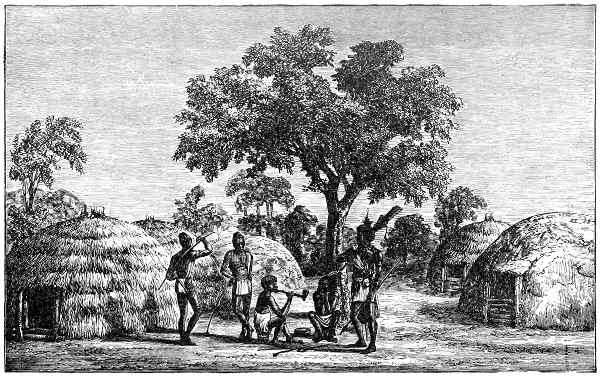 MUNDOMES AND HUTS.
A wonderful field has been opened up along the mighty Congo for
missionary effort. Ten years ago the king of Belgium entered upon the
development of the Congo region and the establishment of a new African
State. An official report of the progress attained has just been
rendered, giving these facts: The Lower Congo has been opened up to
navigation by large vessels as far as Boma, soundings having been made
and the course marked out by buoys; a cadastral survey of the Lower Congo
has been made as a step towards the preparation of a general map of the
entire region; justice is regularly administered in the Lower Congo, and
a trustworthy and cheap postal service has been established. At Banana,
Boma, and Leopoldville medical establishments, under the direction of
Belgian doctors, have been founded, and a considerable armed force of
blacks, officered by Europeans, has been called into existence. The
caravan route between Matadi and Leopoldville is as free from danger
as a European road, and a complete service of porterage by natives has
been established. A railway has been projected and the route almost
entirely surveyed. The state has established herds of cattle at various
stations, and in the very heart of Africa; on the waters of the Upper
Congo there is a fleet of steamers every year increasing in number.
A loan of 150,000,000 francs has been authorized and the first issue
subscribed. Many of the more intelligent natives from the country drained
by the Upper Congo have taken service with the State, and numerous
trading factories have been established as far up the river as Bangala
and Leuebo. In addition several private companies have been formed for
developing the country, and finally geographical discoveries of the
greatest importance have been made, either by the officers of the State
or by travelers who received great assistance in their work from the
State.
Speaking of the Congo Mission Dr. Pierson in the Missionary Review
says: “A grand open door is that which God has set
before
our Baptist
brethren in the Congo basin! a million square miles in the heart of
equatorial Africa, made accessible by the great Congo and its tributaries.
“The great lakes, Nyassa, Victoria, Tanganyika, are comparatively
isolated; but the Congo and its branches present from 4,000 to 6,000
miles of river roadway, needing only steamers or canoes to give access to
these teeming millions. One starts at the mouth of this imperial stream
and ascends 125 miles of navigable river, then for 185 miles encounters
rapids and cataracts; but beyond that for over 1,000 miles, from Stanley
Pool to Stanley Falls, is one grand stretch of navigable river, with
branches running each way navigable from 100 to 800 miles, and leading
into the heart of this rich and populous territory.
“The people from the river-mouth up to Stanley Pool and the Equator
line are being civilized by contact with white traders, and their pagan
customs largely modified. They speak one language, musical, of large
capacity of expression and easy of acquisition, and along this line
the seven Congo stations are already planted. Beyond the point where
the Congo crosses the Equator, lies another vast population, more
degraded, less civilized, and needing at once the full array of Christian
institutions, but yet entirely destitute.
“Their moral and spiritual state is hardly conceivable without contact
with them. With no idea of God or immortality, they worship fetish
charms; sickness is not brought about by natural causes, but is the
result of enchantment; hence the medicine-man must trace disease and
death to some unhappy human victim or victims, who must suffer the
witch’s penalty. One death therefore means another—it may be a dozen.
Here runaway slaves are crucified, robbers buried alive, young men
cruelly decapitated, and human beings are even devoured for meat.
“And yet this people, after centuries of virtual seclusion, are now both
literally and morally accessible. They welcome missionaries, come to the
chapels, and prove teachable. Even now cruel customs and superstitious
notions are giving way before patient, humble, scriptural instruction.
The walls are down, and the hosts of God have but to march straight on
and take what Dr. Sims calls ‘the last stronghold of Paganism,’
“Wonderfully indeed has God linked Protestant, Greek, Roman Catholic, and
even Moslem nations in the administration of the Congo Free State. Never
was such a highway open for the Gospel since our Lord ascended.
“The Arabs from Zanzibar and the coast are moving toward Stanley Falls
and the north country, establishing themselves in large villages to
capture slaves and carry on nefarious traffic, while the Protestant
forces slowly move upward from the west. The question is, Who is to
occupy the Congo Basin? and the question is to be settled at once. This
great highway of rivers means traffic and travel; this rich and splendid
tropical country invites trade and settlement. Into whose hands shall
such a heritage be surrendered? The Christian Church must give prompt
answer by action, her reply must be a taking possession, and the old law
is the new one: ‘Every place that the sole of your feet shall tread upon
shall be yours,’ the resolutions of enthusiastic missionary conventions,
the prayers of all Christendom, the planting of the banner of the cross
at a few commanding points—all this will not do. We must send out enough
Christian laborers to measure off that soil with their own feet.
“‘But it is unhealthy?’ So are all tropical and especially equatorial
climes to those who are not accustomed to the intense and steady heat,
and do not use common sense in adapting their clothing, eating and
drinking, and habits of life, to these peculiar surroundings. One must
not go from temperate to torrid zone, and wear the garments, eat the
heating food, use the stimulating drinks, risk the exhausting labors, or
even live in the same unventilated houses which are permissible in cooler
latitudes. A trip to New Orleans or Florida has proved fatal to many a
fool who would not take advice. Even the heroism of the Gospel does not
demand needless exposure or careless venture.
“Here is a grand opportunity. It may be doubted whether there has been
anything like it since the clarion voice of our Great Captain trumpeted
forth the last commission. Ethiopia is stretching forth her hands unto
God. On those hands are the marks of manacles which England and America
helped to rivet there. There is but one atonement we can make for
Africa’s
wrongs—it
is to lay down our lives, if need be, to redeem her
sable sons from the captivity of sin.
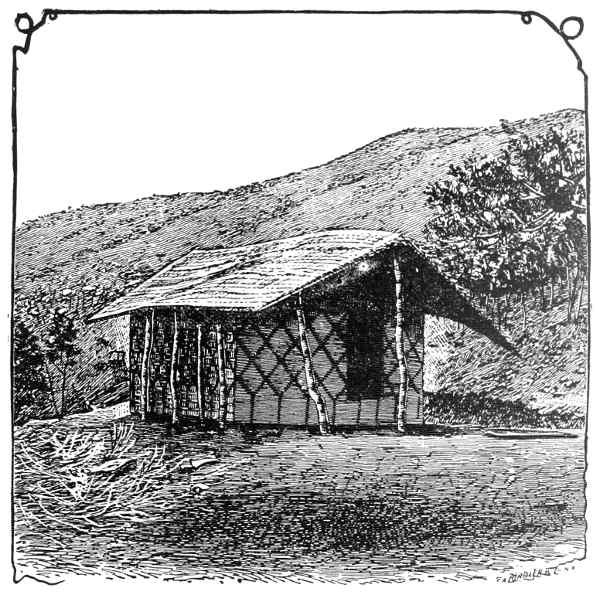 NATIVE GRASS HOUSE ON THE CONGO.
“We ought to turn this Congo into a river of life, crowd its waters with
a flotilla of Henry Reeds, line its banks with a thousand chapel spires,
plant its villages with Christian schools, let the Congo Free State mark
its very territory with the sign of Christian institutions, so that to
cross its border will be to pass from darkness into light. Where is
our Christian enterprise, that such a work, with such a field and such
promise, should wait for workmen and for money! What do our converted
young men want, as a chance to crowd life with heroic service, that the
Congo Basin does not attract them! Here what a century ago would have
taken
fifty
years to accomplish, may be done in five. The unexplored
interior is open, the ‘Dark Continent’ waits to be illuminated. Nature
has cast up her highway of waters, and there is no need to gather out the
stones. Give us only the two-wheeled chariot, with steam as the steed to
draw it, and the men and women to go in it bearing the Gospel, and from
end to end of this highway we can scatter the leaves of that tree which
are for the healing of the nations.
“Where are the successors of Moffatt and Livingstone! What a hero was
he who dared forty attacks of fever and then died on his knees beside
Lake Bangweolo, that he might open up the dark recesses of Africa to the
missionary! Let us pour men and money at the feet of our Lord. We have
not yet paid our debt to Simon the Cyrenean and the Eunuch of Ethiopia!”
The Baptist church has for years carried on energetic mission work in
Africa. The English Baptist Missionary Society, working in co-operation
with American Baptists, has pushed its way, by means of flourishing
stations far up the Congo and into the interior. In 1885, it presented
a steamer, on the Upper Congo, to the American missionaries, and then
proceeded to build another for its own use. Dr. Guinness, the president
of this large and prosperous society, on a visit to the United States
in 1889, spoke thus of the missionary field in Africa: “Stanley was
three years in discovering the source of the Congo, and though he met
hundreds of strange tribes in that journey of 1000 miles, he never saw a
mission station. He found difficulty in coming down this region, but our
missionaries sent out to evangelize this country found their difficulty
in going up. We found it comparatively easy to found a station near the
mouth, and as far as a hundred miles up. After years of labor we reached
Stanley Pool, which is the key to the interior, but not without the loss
of hundreds of lives.
“The mission in Africa is in its infancy. Africa is a world in itself.
The languages spoken would take more than ten hours to enumerate, as
there are over 600. They are principally the great Soudanese groups. I
gave a year to making the first grammar of the Congo language that was
ever prepared. More than 1000 natives have been converted. In this work
there is the stage of pure indifference, succeeded by one of inquiry,
then hostility,
and
finally acquiescence. The natives themselves become
in many cases messengers of the Gospel.
“I don’t know under Heaven, unless it be in China, a more hopeful mission
than that Congo field, and here it is for you. You have now water-way
to the whole of it. It is healthy, notwithstanding all statements to
the contrary. The interior is healthy, because it is high land, well
watered, richly wooded, moderate in its climate, and rich in population.
The trouble with missionaries has been that they stick to the coast
line, which is malarious. Instead of keeping up in the ordinary way in
red-tape style a particular station with a few missionaries, you want to
make an advance into this great interior parish. It is no use for your
people in this country to say: ‘This is the colored men’s work, let them
do it,’ They are not suited to be the explorers and controllers of such
movements. White men must be the leaders and lay the foundation, when the
colored men will be the helpers.”
Mr. Guinness is maturing plans for a grand advance of three columns
of missionaries to go simultaneously up the three branches of the
Congo—northern, central and southern. The central one may be considered
as started a fortnight since, by the departure of eight missionaries
from London, to work as an English auxiliary to the American Baptist
Missionary Union.
Mr. Richards, of the American Baptist Missionary Union, reports that
the work at Banza Manteke, the place where so many converts have been
baptized, is still prospering. The young church has been greatly
tried by persecution as well as by sickness and death. Not less than
twenty of those baptized have died, and the fatality has been a great
stumbling-block to the heathen, who have asserted that the sickness was
sent by their gods because they have been neglected. This has prevented
many from accepting the Christian faith. The heathen are bitterly
opposed, and would take the lives of the Christians if they could.
Recently 17 were baptized, and others are asking for the ordinance, and
the knowledge of the truth is spreading far and wide.
Those who become intimately acquainted with the negro race as found
in various parts of Africa bear testimony to its good qualities. The
coast negro who has learned some of the vices of
civilization
is
undoubtedly a sorry specimen of humanity; but where native tribes can be
found uncontaminated by contact with foreigners, they exhibit sterling
qualities. Rev. George Grenfell, who has visited all the tribes along
the Congo, says that the negro would stand his ground before the white
man. “There is a vitality of race and power about him that is going
to make him take his place some day among the nations of earth.” In
support of this opinion, he gives several incidents showing the vigor and
fidelity of the natives, and especially mentioned an incident which he
witnessed at Banza Manteka, the station at which the American Baptists
have recently received so many converts. Three years ago their place was
a stronghold of grossest superstitions, and there seemed no hope of a
spiritual harvest; but as Mr. Grenfell was coming down the river, on his
way to England, he met a band of native evangelists going forth on an
evangelistic tour. They had set out of their own accord, without even the
knowledge of the missionary, evidently taking upon themselves the Lord’s
command to go and preach the Gospel. They had not only forsaken their own
superstitions, but were vigorously seeking to propagate their new faith.
We have thus given in brief outline a sketch of the work done on the
west coast of Africa and some of the countries in Central Africa which
are reached through the west coast. In no part of the world has the
Gospel achieved more signal triumphs than here, among this barbarous
people. When the present century opened, the slave trade, with its
untold horrors, held everywhere undisputed sway. Human sacrifices and
other cruelties were fearfully prevalent. Revellings and abominable
idolatries, with the other works of the flesh described in the fifth
chapter of Galatians, were indulged in to a frightful extent and without
the slightest restraint. There was then not one ray of light to relieve
the dense darkness that universally prevailed. It is otherwise now.
Though little has been done compared with what remains to be done, still
the slave trade and many other cruel practices have received their death
blow. The standard of the Cross has been planted all along the western
shores, and even far into the interior of that great continent. In all
West Africa, called “The White Man’s Grave,” from Senegambia on the
north, where the Paris Society is laboring,
to
Benguella on the south,
where the American Board has begun to work, there are more than a hundred
stations and over 200 English, German, French and native missionaries,
belonging to sixteen societies, with 120,000 converts. And were it not
for the evils of civilization, which are so much easier for the poor
barbarians to learn than the virtues, there would be nothing to prevent
the universal spread of the Gospel in Western Africa, for the people
there are willing to receive the simple proclamation of Divine truth, and
the Christian church is awaking to the glorious privilege of making it
known unto them.
Little mention has been made of the work of Bishop Taylor in this sketch
of the missions of Western Africa. His work is of such recent date, and
of so unique a character that we deemed it of sufficient importance to
warrant a fuller treatment than could be given in connection with the
other missions. By this method also we can give a much clearer idea of
what he has done. As his mission stations are confined to Western Africa,
and regions entered by way of the west coast, this is the proper place to
speak of his enterprise.
Perhaps the most notable missionary movement of the age is that started
by Bishop Wm. Taylor of the Methodist Episcopal Church, on the continent
of Africa. Bishop Taylor is of Scotch-Irish parentage, his grand parents
having immigrated from County Armah, Ireland, to Virginia about 130 years
ago. They were Revolutionary patriots and so hostile to slavery that they
set all slaves free, belonging to the family. His father, Stuart Taylor,
married Martha A. Hickman, and they settled in Rockbridge County in 1819.
They were Presbyterians, but eventually became converts to Methodism.
The son, William, was born May 21, 1821. In 1843 he was attached to the
Baltimore Conference. He came into notice as a Methodist street preacher,
of extraordinary power, in San Francisco, in 1849. He established a
church there and continued to preach till 1856. Being a natural pioneer
in the mission field, full of pluck and original ideas, he visited other
parts of the United States and went into Canada and England. Then he
went to the West Indies and into British Guiana, preaching and founding
churches. Next, he visited Australia, where he met with a success which
may well
be
called phenomenal. The same success attended his trip to
Tasmania and New Zealand. With a foot that never tired, he went to
South Africa and then to the Island of Ceylon, awakening the people by
his eloquence and earnestness. He returned through India, arousing the
sleeping nations, and leaving as a permanent monument to his fame the
fully organized South India Methodist Conference.
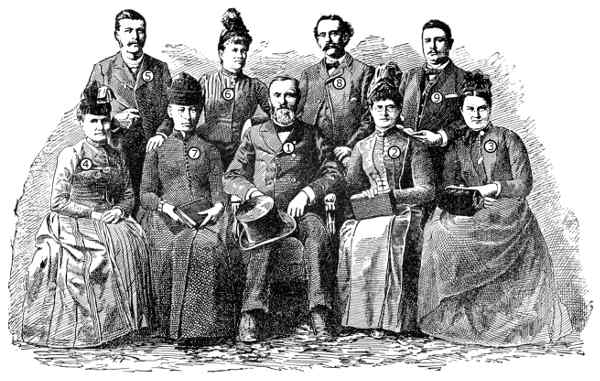 SOME OF BISHOP TAYLOR’S MISSIONARIES. 1:
Rev. B. F. Kephart, St. Paul, Minn. 2: Mrs. Kephart.
3: Agnes McAllister, Troy, Ohio. 4: Barbara Millard,
Hemmingford, Quebec. 5: Eddy H. Greely, Fostoria, Ohio. 6:
Georgina Dean, Des Moines, Iowa. 7: Clara Binkley,
Bristol, Ontario. 8: K. Val. Eckman, Fulda, Minn. 9: Robt.
C. Griffith, Gotland, Sweden.
SOME OF BISHOP TAYLOR’S MISSIONARIES. 1:
Rev. B. F. Kephart, St. Paul, Minn. 2: Mrs. Kephart.
3: Agnes McAllister, Troy, Ohio. 4: Barbara Millard,
Hemmingford, Quebec. 5: Eddy H. Greely, Fostoria, Ohio. 6:
Georgina Dean, Des Moines, Iowa. 7: Clara Binkley,
Bristol, Ontario. 8: K. Val. Eckman, Fulda, Minn. 9: Robt.
C. Griffith, Gotland, Sweden.
He was now in the midst of his powers, and with well defined aims as to
the plan and scope of mission establishments. As to himself, personal
work was what was required; as to the missions, a sense of independence
which would conduce to their growth and perpetuity. No mission was to be
an asylum for lazy, superannuated men and women, drawing on a home fund
for support, but each was to be self-supporting as far as possible, after
its period of juvenility was over. Full of this impression he entered the
Brazilian country, or for that matter, South America at large, and began
a work of founding missions which astounded his church and the world by
its success. Schools and churches sprang up as if by magic, right in the
midst of populations wedded to the old Catholic creeds and forms, and the
effect of his evangelism is as far reaching as time.
After this he turned his attention to Africa, as a field calling most
loudly for civilization and Christianity; and more, as the field best
suited to his evangelizing methods. He was elected Bishop of Africa by
the General Conference of the Methodist Church, in May, 1884, and sailed
for his new and limitless parish in December, 1884. After four years of
heroic struggle, with successes which in every way justified his labors
and plans, he returned to the United States in April, 1888, and sailed
again for Africa in December of the same year, having equipped and sent
in advance, November 13, 1888, twenty new missionaries.
His Transit and Building Fund bore the expense, and it was well supplied
for the emergency by voluntary contributions from the United States and
Canada. Fifteen homes in Africa became a requisite for these Christian
workers, together with at least a year’s sustenance. Still the fund
failed not, but had to spare for the Bishop’s personal comfort. Thus at
one end of the Christian line work inured to the supply of necessities
which should lead up
to
self-support in the missionary field, and at the
other end it shaped for the development of those indigenous resources
which should establish independence.
The characteristics of his work, aside from his individual energy,
wonderful ingenuity, and magnetic power, are:
(1) Self-supporting Missions. Missionaries are provided with a suitable
outfit, have their passage paid, are provided with a home and seeds
for planting. They are expected to do the best with the first year’s
equipment, and to take such steps as will put them on an independent
footing by the second year. This is not more a test of their own industry
and efficiency, than an example to the natives to live in peace and
adopt civilized means of obtaining a livelihood. It is an invitation to
heroic spirits to enter the mission field, and is an earnest of tact and
endurance which must prove of infinite value to those with whom they
are in contact. It is the nearest approach any church has ever made to
the thought, that a spiritual avenue to the heathen, and especially the
shrewd African heathen, is most direct when it leads up through his
business and work-a-day instincts to his heart.
(2) Native Coöperation. This is best assured by appearing to be on an
equality with them. The missionary who is backed by a home exchequer and
who is not compelled to resort to ordinary means of subsistence, is apt
to grow exclusive and become a source of envy and suspicion. He is far
more potential when he is as much one of his people as circumstances
will allow, and like them dependent on the ordinary laws of industry
for subsistence. There is but little risk in this to the man of energy,
skill and health, where climate and soil are favorable for production,
and all nature conspires to reward industry. It attracts the natives,
secures their confidence and coöperation, and adapts them for the almost
unconscious receipt of enlightenment and Christianity. Nothing so disarms
them of suspicion, or serves better to silence controversy, than this
quiet show of permanent settlement in their midst and the atmosphere
of thrifty contentment which surrounds a newly-made mission home and
vegetable garden.
(3) Elements of a Pure Civilization. The school goes with the mission,
the garden and field with the school. Sermons there
are,
but not to the
neglect of school work. School-hours there are, but not to the neglect of
soil cultivation. Practical education is paramount. The seeds, the trees,
the plants, which are fitted for the climate, are planted and tended,
and the natives are asked to come and work by the side of the missionary
and to learn the art of turning the earth to account. Thus a primitive
Industrial School is started in every mission, and the laws of thrift and
self-dependence go hand in hand with those of morality and spirituality.
As things have gone, it is surely a novel, and perhaps a hard, life for
a missionary, but in that it is an effective means of conversion and
enlightenment, the sacrifice does not seem too great. After all, does it
not entirely meet the objections of those who so vehemently urge that the
only way to make missionary work successful among African natives is to
wait until commerce has reconciled them to contact with the outer world?
(4) Not Confined to the Ordinary Ministry. It opens the field of
missionary endeavor to earnest, moral men of every occupation. Teachers,
artisans, laborers in every branch of industry, become invaluable
servants of the Lord, under this system. Children as well as parents may
share the honors of introducing Christ in this practical way, the key to
which is example. What so inspiring as the confidence of equality and
co-labor! To be like a teacher in what appertains to material welfare, is
father to a wish to be like him or her in what appertains to spiritual
welfare.
(5) Coast-Line Missions. These are practicable and necessary at first.
But they are only evangelical bases for the more numerous and grander
structures soon to be erected within the continent.
In support of his system the Bishop brings to bear an experience wider
than that of any living missionary, to which must be added a special
study of the African natives and the entire African situation.
He says that the untutored heathen of Africa have no vain philosophy by
which to explain away their perception of God as a great personal being.
They have their “greegrees,” “charms” and “armulets,” but they never pray
to them, they cry to God in the day of trouble. In the extreme south
God’s name is “Dahlah,” “Tixo” and “Enkosi.” In south central Africa His
name is “En
Zambe.”
The Zambesi river is called after God. On the west
coast his name is “Niswah.” All these words express clear perceptions of
one great God of heaven and earth.
He further relates that one day he was preaching to King Damassi of the
Ama Pondo nation, about the resurrection. One of the king’s counsellors
expressed dissent from the Bishop’s doctrine. The king, a giant in
physique, frowned at him and said: “Hold your tongue you scoundrel! You
know well our fathers believed in the resurrection of the dead, and so do
we.”
When a Kaffirman dies they dig a grave about two feet wide and five deep
and let the corpse down in a squatting position. But before it is lowered
they seat him beside the grave, to allow anyone who wishes to talk with
it. This is consequence of their belief that though the spirit has left
the body it still lingers near for a last communication with friend or
foe. If any present has an unadjusted quarrel with the hovering spirit,
he approaches and makes his peace, and then begs that the shade will not
return to bewitch his children or cattle. Others come and send messages
of peace to their fathers by means of the departing spirit, and still
others send word very much as if the departure of a spirit were a sure
means of communication between this and the final home of good people.
When analyzed, their belief is supreme that the body returns to dust at
death, but that the spirit is immortal; that the spirit retains all its
faculties and forces, and has independent senses corresponding with the
bodily senses; that good spirits dwell with God in happiness and that
those who follow will commune with them. These things they have never
learned from books, nor teachers. They are intuitions.
In February, 1888, Bishop Taylor visited a dead chief, near Tataka on
the Cavalla river. He had been a prominent man, a giant in size, and had
given leave to found a mission in his tribe. But he knew no language but
his own and had never heard the Gospel preached. He was found sleeping
tranquilly in death, and inquiry revealed the fact that he had talked all
through the night of his death with “Niswah”—God—and had called on Him
repeatedly—“Niswah I am your man!” “Niswah, I trust
you!”
“Niswah, I
accept you!” Belief, even unto salvation, could not have been seemingly
stronger.
To translate the Christian Bible into the languages spoken by those
among whom missionary effort is put forth, has always been regarded as a
necessary step to successful apostolic work. It would be an herculean,
if not impossible task in a country where languages are so numerous and
dialects so diverse as in Africa. Even if not so, the task requires
scholarship of a high order, patience such as few mortals possess, time
which might count for much if otherwise employed, and an exchequer
which can be drawn upon indefinitely. Bishop Taylor has reversed the
old procedure in his missionary contact with the African natives. Still
recognizing the necessity for learning their languages in order to
facilitate communication, he, however, insists that they shall learn
ours, as a means of fuller expression of ideas, and especially of those
ideas which represent newly acquired knowledge and quickened spiritual
emotions. But how should he overcome the formidable obstacle our language
presents, in its complicated grammar and orthography, to all foreigners?
Especially, how should the African boy and girl, in the mission school,
be taught what our own more favored boys and girls find so appallingly
difficult? The Bishop’s way out of it was to introduce the phonetic, or
natural sound, element into his mission schools. It proved, in common
parlance, a hit from the start. Here is a sample of his English, as
phonetically adapted for his African pupils:
“Bishop Taylor findz our English mod ov speling wun ov the gratest
drabaksin teching the nativz; and also wun ov the gratist obstiklz in
redusing the nativ languajez to riting. Mishunarez evri whar hav kompland
ov thez dificultez. Bishop Taylor haz kut the Gordian not; or at lest haz
so far swung los from komun uzaj az to adopt Pitman’z fonetik stil ov
reding, riting and teching.
“Just rit a fu pajz, speling az we do her; and then, ‘just for the fun ov
it,’ rit a few letrz to frendz in the sam stil. Bi the tim u hav dun so,
u wil be enamrd with its ez, and son will pronouns it butiful az wel az
ezi. Tech it to sum children and se how qikli tha wil mastr it.”
Probably no better description can be given of what has
already
been
accomplished, than that found in his report to the Missionary Committee,
which we give in full, and in extracts from his recent letters.
BISHOP TAYLOR’S REPORT TO THE MISSIONARY COMMITTEE.
“Dear Brethren and Fellow-laborers in the work of the Lord:
“I respectfully submit the following report of our new missions in
Africa. The report of the African Conference I sent, as usual, to the
missionary secretaries immediately after its adjournment last February.
I might repeat the same here, but did not retain a copy, and leaving
Liberia in April, and ever since moving on, I have not received a copy of
the printed minutes.
“I will, in this report, note the stations in the order in which I
visited them this year, and not in the order of time in which they were
founded.
“West Coast Stations.—Most of these stations commenced, with
mission-houses erected on them, two years ago, when a portion of them
were supplied with missionaries, a portion not till March of this year;
and two or three remain to be supplied. Miss Dingman and Miss Bates have
gone out since I left Liberia, and I have not heard where Brother Kephart
has stationed them. It was understood from the beginning that we could
not take boarding-scholars, nor open our school-work regularly till we
could produce from the soil plenty of native food for their sustenance,
and build school-houses. I arranged for building fourteen houses in our
missions on the west coast this year for chapel and school purposes. I
have received no general report since I left in April; hence, I cannot
say how many of these houses have been completed. They were to be good
frame and weather-boarded and shingle-roofed houses, 18×25 feet, and
will, I doubt not, be all finished before the end of this year.
“Cavalla River District.—B. F. Kephart, P. E.
“(1) Wissikah Station, about forty miles up from the mouth of the
river. Its king, chiefs and people received a missionary, built him a
good native house and supported him for several months, when he was
removed to supply a larger station vacated by one who withdrew from our
work; so Wissikah remains to be
supplied.
Probable value of our land and
improvements on Wissikah Station, $500.
“(2) Yubloky, ascending the stream, also on the west bank of Cavalla
river. Missionary, J. R. Ellery. A good basis of self-sustentation
already laid. Probable value, $1,000.
“(3) Yorkey.—Andrew Ortlip, missionary. Regular preaching in both of
these stations, and some progress in teaching. Probable value, $1,000.
“(4) Tataka, on the east bank of the river, Miss Rose Bowers and Miss
Annie Whitfield, missionaries. These are very earnest missionaries, and
have done an immense amount of hard work, teaching, talking of God and
salvation to the people in their own houses and growing most of their own
food. Probable value of land improvements, $1,000.
“(5) Beabo.—H. Garwood, missionary. Brother Garwood was appointed
to Beabo last March, and will, I trust, make a success, which was but
limited under the administration of his predecessor, who is a good
man but not a self-supporting success, and has hence returned home.
Beabo is on the west bank of the river, and has adequate resources of
self-support, and of opportunities for usefulness. Probable value, $900.
“(6) Bararobo, on the east bank. Chas. Owens and E. O. Harris,
missionaries. This station, with two energetic young men to develop its
capabilities, will, I hope, in the near future prove a success. Probable
value, $900.
“(7) Gerribo, west bank. A mission-house built two years ago, but the
station remains to be supplied. Probable value, $800.
“(8) Wallaky is the big town of the Gerribo tribe, twelve miles west of
Gerribo town, on west bank of the river. Our missionary at Wallaky is Wm.
Schneidmiller, a zealous young man from Baltimore. Having been brought up
in a city, he has much to learn to become an effective backwoods pioneer;
but he has faith, love, push, and patience and is succeeding. Probable
value, $900.
“We have traveled nearly a hundred miles up the river, almost equal to
the Hudson, and then west twelve miles to Wallaky. Now we go south by a
narrow path over rugged mountain, hills and dales, a distance of about
forty miles to—
“(9) Plebo.—Wm. Yancey and wife, missionaries. A hopeful young station
of good possibilities. Probable value, $900.
“Nine miles walking westerly we reach
“(10) Barreky.—Wm. Warner and wife, missionaries. They are hard
workers, and are bound to make self-support. Brother Warner is mastering
the native language, and when ready to preach in it, will have open to
him a circuit of eleven towns belonging to the Barreky tribe. Probable
value, $900.
“On eight of the ten stations just named, we have frame, weather-boarded,
shingle-roofed houses, the floors elevated about six feet above ground;
the whole set on pillars of native logs from the forest. In all these
places, also, school-houses, as before intimated, are being built. Each
station is in a tribe entirely distinct and separate from every other
tribe, and each river town represents a larger population far back in the
interior of the wild country.
“Cape Palmas District.—B. F. Kephart, P. E. Brother Kephart is
Presiding Elder of Mt. Scott and Tubmantown Circuit. Sister Kephart is
a grand helper. They are teaching the people the blessedness of giving
adequately to support their pastors. These people are confronted by two
formidable difficulties, their old-established habits of being helped,
and their poverty and lack of ability to help themselves; but they are
being blest in giving like the Widow of Serepta, and will, I hope, work
their way out.
“Clarence Gunnison, our missionary carpenter, and Prof. E. H. Greely.
B. A., to be principal of our academy and missionary training-school in
Cape Palmas, as soon as we shall get the seminary repaired, have their
headquarters at Cape Palmas, but are engaged in building school-houses,
and will then (D.V.) repair the seminary buildings, both in Cape Palmas
and in Monrovia. We had unexpected detention in getting suitable lumber
for repairs, but can now get the best Norway pine delivered on the ground
at a cheap rate.
“(11) Pluky, across Hoffman River, from Cape Palmas, is the beginning
of our Kru coast line of stations. Miss Lizzie McNeal is the missionary.
Though two years in the station, we have not yet built a mission-house in
Pluky. Miss McNeal teaches school in a native house in the midst of the
town, and preaches on Sabbath days under the shade of a bread-fruit tree.
Her school-house
is
crowded, and she has six of her boys and three girls
converted to God, who testify for Jesus in her meetings, and help her in
her soul-saving work. Probable value, $800, in land. Miss Barbara Miller
assists her temporarily, but her specialties are kindergarten and music,
awaiting the opening of the academy.
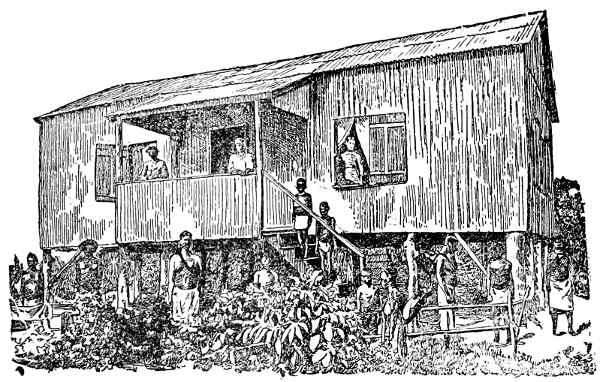 GARAWAY MISSION HOUSE.
“(12) Garaway, twenty miles northwest of Cape Palmas. Miss Agnes
McAllister is in charge of the station, and Miss Clara Binkley has
special charge of our educational department, both working successfully
as missionaries. Aunt Rachel, a Liberian widow woman, runs the farm, and
produces indigenous food enough to feed two or three stations. This is
a station of great promise. Probable value, $1,200. We have a precious
deposit in a little cemetery on the plain, in sight of the mission-house,
of the consecrated blood and bones of dear Brother Gardner and dear
Sister Meeker.
“(13) Piquinini Ses.—Miss Anna Beynon is in special charge of the
household department. Miss Georgianna Dean has charge of the school-work,
and Victor Hugo, a young German missionary, has charge of the school
farm. Mrs. Nelson, a Liberian widow, is chief cook. They are succeeding
hopefully for beginners.
This
station is about thirty miles northwest of
Cape Palmas. Probable value, $1,100.
“(14) Grand Ses.—Jas. B. Robertson, assisted by Mr. Hanse, a Congo
young man, who was saved at a series of meetings I conducted in Cape
Palmas, in 1885. They are just getting started in their work, but already
see signs of awakening among the people. Probable value, $1,100.
“(15) Sas Town.—Missionaries, K. Valentine Eckman, R. C. Griffith.
I spent a month in Sas Town last spring, and we have there a church
organization of probationers, numbering twenty-five Krumen. Probable
value, $1,400.
“(16) Niffu. To be supplied. Probable value, $1,000.
“(17) Nanna Kru.—Henry Wright appointed last April, not heard from
since. Probable value, $1,000.
“(18) Settra Kru.—B. J. Turner and wife. A fair promise of success in
farming, teaching and preaching. Probable value, $1,100.
“On each of these Kru stations named, except Pluky, we have a
mission-house of frame, elevated on pillars, six feet above ground;
floors of boards from the saw-pits of Liberia, siding and roofing
of galvanized iron; each house measuring in length thirty-six feet,
breadth twenty-two feet, beside veranda, providing space for a central
hall, 12x22 feet, and two rooms at each end, 11x12 feet. There is not a
Liberian or foreigner of any sort in any of the stations named on Cavalla
River or Kru Coast, except our missionaries, all heathens, as nude as any
on the Congo, except a few men of them who ‘follow the sea,’ hence, our
houses, which would not be admired in New York City, are considered to be
‘houses of big America for true.’
“(19) Ebenezer, west side of Sinou River, nearly twenty miles from
Sinou. New house just completed. Z. Roberts in charge. A school of over
twenty scholars opened. The king of the tribe has proclaimed Sunday as
God’s, and ordered his people not to work on God’s day, but go to his
house and hear his Word. This mission supersedes Jacktown, on the east
bank of Sinou River, where we proposed last spring to found a mission,
but did not. Ebenezer is worth to us $800 at least.
“(20) Benson River.—Missionary, Dr. Dan Williams. This is in Grand
Bassa Country, difficult of access; hence, in my hasty voyages along the
coast I have not yet been able to visit the Doctor, and cannot report
definitely. He is holding on, and will, I hope, hold out and make a
success in all his departments of work. The station ought to be worth
$800.
“The Benson River Station is in the bounds of Grand Bassa District. We
arranged for building on two other stations in Grand Bassa Country at
the same time that I provided for Benson River; namely, King Kie Peter’s
big town, and Jo Benson’s town; but at last account the houses were not
built, so for the time we drop them off our list. They are on a great
caravan trail to the populous interior. We will take them up or better
ones by and by.
“From the west coast we proceed by steamer to the great Congo country.
Two days above Congo mouth we land at Mayumba, and proceed in boats
seventeen miles up an inland lake to Mamby, where Miss Martha E. Kah is
stationed, and where our Brother A. I. Sortore sleeps in Christ. When
we settled there it was in the bounds of the ‘Free State of Congo,’ but
later the published decrees of the Berlin Conference put it under the
wing of the French Government. The French authorities have recognized
and registered our native title to 100 acres of good land, and are not
unfriendly to us by any means, but ‘by law’ forbid us to teach any
language but French. Good has been done at Mamby, and is being done.
Owing to this disability we have proposed to abandon it, but Martha Kah
is entirely unwilling to leave, and as it is our only footing in French
territory, and as they hold a vast region, peopled by numerous nations of
African heathen, we have thought it best thus far to hold on to Mamby.
Probable value, $1,000.
“(21) Kabinda, near the Congo mouth. I never have had time to make
the acquaintance of any person at Kabinda. Having full confidence in
J. L. Judson as a man of superior ability and integrity, I gave him
letters to the Portuguese governor of Kabinda, requesting the consent
and co-operation of his excellency, to enable Judson to found a mission
there. His excellency received him most cordially, gave him a public
dinner, the merchants of the place being guests. For a year he reported
extraordinary success in
every
department of his work. He went in by a
dash, and went out like a flash—by sudden death.
“I called at Kabinda last May, and learned from a merchant there that
King Frank, of whom Judson bought our mission premises, held the property
for nonpayment, which Judson had reported all settled, conveyed, and deed
recorded. King Frank, at the time of my call, was absent away up the
coast, so that I could not reach the exact facts. I have written to the
merchant whom I met, requesting him to find out the facts, but have as
yet received no reply. So things at Kabinda are in a tangle at present.
I have not yet found time to go and unravel it. To recover it or lose it
will neither make nor break us, but we shall regret to lose it.
“Passing the mouth of the Congo River, we proceed by steamer over 300
miles to the beautiful land-locked harbor of St. Paul de Loanda. This
Portuguese town has many massive buildings, including churches in ruins,
dating back over 300 years. It has an estimated population of 5,000,
a few hundred of whom are Portuguese (one English house of business),
the rest being negroes. From the beginning we have had adequate
self-supporting resources in Loanda from the Portuguese patronage of
our schools, and have now, but at present we lack the teaching corps
requisite.
“Wm. P. Dodson, who succeeded C. M. McLean, who returned home last May
on account of sickness, is our minister at Loanda. He is a holy young
man, a good linguist in Portuguese and Kimbundu, and is doing a good
work. He has one fine young native man saved, whom I baptized during my
recent visit. I learn since that he is leading a new life, and becoming
a valuable helper in our work. Our mission property in Loanda is worth
at least $10,000. It is quite unnecessary for Loanda or for any other
station we have in Africa to add ‘and no debts,’ for we have none.
“We are trying to find just the right man and wife for our school in
Loanda, but would rather wait for years than to get unsuitable persons.
“From Loanda we proceed by steamer sixty miles south by sea, and cross
the bar into the mouth of Coanza River, as large as the Hudson, and
ascend 180 miles to Dondo, at the head of
steamboat
navigation. Dondo
is a noted trading centre, and has a population of about 5,000, mostly
negroes.
“We had good property in Dondo, worth about $5,000. A great deal of
hard work, successful preparatory work, has been done in Dondo. Its
school-work and machine-shop were self-supporting when manned, but is now
in the same position as Loanda, awaiting good workers to man it.
“Our Presiding Elder, E. A. Withey, of Angola District, and his daughter
Stella, a rare linguist in Portuguese and Kimbundu, and of great
missionary promise, were holding the fort at Dondo when I recently
visited that region. Their home was at Pungo Andongo, eighty-nine miles
distant. Stella and I walked a mile or more to visit the graves of Sister
Cooper, and of our grandest Dondo worker, Mrs. Mary Myers Davenport,
M.D., in the cemetery, which is inclosed by a high stone wall. Her last
words are inscribed on her tombstone. They were addressed to Him who
was nearest and dearest to her in that lone hour—to Jesus: ‘I die for
Thee, here in Africa.’ She would have died for Jesus anywhere, but had
consecrated her all to him ‘for Africa.’ In about a month from that time
our dear Stella, so ripe for heaven, but so greatly needed
in
Africa,
was laid by her side. So that three of our missionary heroines sleep in
Jesus at Dondo. Their ashes are among the guarantees of our ultimate
success in giving life to millions in Africa, who are ‘dead in trespasses
and sins.’
“From Dondo, we ‘take it afoot’ fifty-one miles over hills, mountains
and vales, by the old caravan trail of the ages to Nhanguepepo Mission
Station. Our property there is worth about $6,000. It was designed to
be a receiving station, in which our new-comers might be acclimatized,
taught native languages and prepared for advance work. Under the
superintendency of Brother Withey a great preparatory work has been done
at this station. It has, however, become specially a training school
for native agency, under the leadership of one young man of our first
party from America, Carl Rudolph. We already have an organized Methodist
Episcopal Church at this station, composed of thirteen converted native
men and boys, who are giving good proof of the genuineness of the change
wrought in them by the Holy Spirit. From 5 to 6 o’clock every morning
they have a meeting for worship, Scripture reading and exposition by
Carl, singing, prayers and testimony for Jesus by all in English,
Portuguese and Kimbundu, intermingled with hallelujah shouts of praise to
N’Zambi the God of their fathers and of our fathers.
“The forenoon is devoted to manual labor by all hands, then school
and religious exercises in the afternoon. The work of each day is
distributed; two of our boys, called “pastors,” have the care of about
100 head of cattle belonging to the mission. Several boys are taught
to yoke and work oxen in sled or plow; several boys have learned to
be stone-masons, and when I was there last were engaged in building a
stone wall round the cattle corral. One boy is trained to business in
the little store belonging to the mission. One very trusty fellow is the
man-of-all work about the house and the cook. All these varieties of work
are done by our own converted people, and not by heathen hirelings. This
station yields ample sustentation for all these workers. The brethren are
making improvements continually, and paying for them out of their net
profits. In building a chapel next summer they may need a little help,
but probably not.
“Dear Nellie Mead, one of ‘our children’ of 1885, natural musician and
lovely Christian, died at the age of about 16 at this station. A tomb of
rude masonry marks the sacred spot, near the caravan trail, where Nellie
and baby Willie Hicks will wait till Jesus comes.
“A march of thirty-eight miles easterly along the same old path brings us
to Pungo Andongo, a great place for trade, a town of probably 1,200 or
1,500 population. It is wedged in between stupendous mountains, in solid
blocks of conglomerate of small stones of basalt and flint, perpendicular
for a thousand feet on all sides. We have a large adobe-house, including
chapel and store-room, and nearly an acre of ground with fruit-bearing
trees in the town, and a good farm of about 300 acres a mile out, worth
probably altogether about $4,000.
“That is the residence of A. E. Withey and Mrs. Withey. Their son Bertie,
in his seventeenth year, tall and commanding, speaks fluently the
languages of the country and has in him the making of a grand missionary.
His two little sisters, Lottie and Flossie, are among the Lord’s chosen
ones. The developed stand-by of this station is Charles A. Gordon. He is
a young man of marvelous ability, adapted to every variety of our work.
In preaching power in all the languages of that region he is second to
none. Withey and Gordon are our principal merchants, and while doing a
good business, in the meantime, by truth, honesty and holy living and
faithful testimony for Jesus in different languages are bringing the
Gospel into contact with a large class of traders from the far interior,
who could not be reached by ordinary methods.
“Pungo Andongo Station has crossed the lines of sustentation and of
absolute self-support, and is making money to open new stations in the
regions beyond. We have two missionary graves at Pungo Andongo, one
of Henry Kelley, a noble missionary apprentice from the Vey Tribe of
Liberia, and the other of dear Sister Dodson (formerly Miss Brannon, from
Boston). They both ‘sleep in Jesus,’ and will rise quickly to his call in
the morning.
“An onward march of sixty-two miles brings us to Malange, a town of
probably 2,000 population, and noted for its merchandise. Our people
there are Samuel J. Mead, P. E., his wife
Ardella,
refined, well
educated and a fine musician, at the head of our school-work. Willie Mead
is head of the mechanical department; his wife is especially engaged in
teaching missionaries. They are all noble specimens of vigorous minds,
holy hearts, healthy bodies and superior linguists and workers. Robert
Shields, a young missionary from Ireland, who was brought up at home
for a merchant, runs a small mission store at Malange, preaches in the
Kimbundu, and has a growing circuit extending among the villages of the
surrounding country. Our Kimbundu teacher in the school was Bertha Mead,
niece of Samuel J. Mead. She was one of ‘our children’ in 1855. She was
wholly devoted to God and his work. On the first Sabbath of my visit
to Malange, last June, she was united in marriage to Robert Shields.
Immediately after her marriage she put my sermon for the occasion into
Kimbundu, without hesitation, in distinct utterances, full of unction,
which stirred a crowded audience, a number of whom were from the kingdom
of Lunda, about 600 miles further east. In Sunday-school of the afternoon
of that memorable day I heard Bertha put forty-one questions from the No.
1 Catechism of our church, and the school together answered the whole of
them promptly; first in English and then in Kimbundu. The native people
of that country are known by the name of the Umbunda people. Kimbundu is
the name of their language. An interesting episode occurred while the
forty-one questions were being asked and answered. The old king, who
lived nineteen miles distant from Malange, was present, and manifested
great interest in the proceedings, and interjected a question, of course,
in his own language, which was: ‘Why did not the first man and his wife
go right to God, and confess their sins, and get forgiveness?’ Bertha
answered him, of course, in his own language, to this effect: ‘They were
not guilty simply of a private offense against their Father, but a crime
against the government of the great King of all worlds. The penalty
involved was death and eternal banishment to a dreadful place prepared
for the devil and all his followers, called ‘Inferno.’ God had to break
his own word, dishonor his government, and destroy the legal safeguards
he had established to protect the rights of his true and loyal subjects,
or execute the penalty of law on that guilty man and his
wife.
Moreover,
the devil-nature had struck clear through that man and his wife. They had
become so full of lies and deceit that they had no desire to repent, so
that all the Judge could righteously do was to pass sentence on them and
turn them over to the executioners of justice.’ The heathen king leaned
over and listened with great attention, and his countenance was like that
of a man awaiting his sentence to be hung. Bertha went on and pictured
the guilty pair standing at the bar of justice, each holding the saswood
cup of death in hand, awaiting the order to drink it and die. ‘Then the
Son of God was very sorry for the man and his woman, and talked with his
Father about them, and made a covenant with his Father to redeem them.
He would at a day agreed on unite himself with a son descended from the
guilty woman, and drink their cup of death, and provide for them his
‘cup of salvation,’ and would protect God’s truth, righteousness and
government, and provide deliverance, purity and everlasting happiness for
the guilty man and his wife, and for all their family—the whole race of
mankind.’ As Bertha went on to describe how Jesus did, according to his
covenant, come into the world and teach all people the right way for them
to walk in, and did die for man the most awful of all deaths—‘even the
death of the cross’—and did arise from the dead and is now our law-giver
in God’s Court, and our doctor to heal and purify us, and invites all
to come to him, ‘and he will give them rest,’ the old chief seemed to
take it all in through open eyes, ears and mouth till he could no longer
restrain his feelings, and broke out and cried and laughed immoderately,
and yelled at the top of his voice, and clapt his hands for joy. He had
never heard the ‘good news’ before. I, meantime, quietly wept and prayed,
and then thanked God. I remember how Bertha and our other dear missionary
children used to ramble with me over the hills of Loanda. I was the only
big playmate they had, and they used to wait anxiously for the shades of
evening in which to have a stroll with their big brother; and now to see
my tall, modest Bertha with perfect ease breaking the bread of life to
the heathen fathers, I have no remembrance of ever before quietly weeping
so much in one day as I did that day.
“Brother Samuel Mead has adopted eight native boys and girls,
and
is
bringing them up in the way they should go. His hour for morning family
worship is from 4 to 5 o’clock. The alarm clock rouses them all at 4 A.M.
In fifteen minutes they are all washed and dressed. The services vary
and are full of life and interest: Scripture reading and explanation,
singing of a number of different hymns in three different languages.
None are called on to pray, but voluntarily they all lead in turn, some
in English, some in Portuguese and some in Kimbundu. I kept account one
morning and found that sixteen different ones led in prayer at that
meeting. From 11 A.M. to 12 M., Sam Mead joins Willie’s family in a
similar service. No family worship in the evenings, as many of them are
taken up by public meetings in the chapel.
“Our church, organized at Malange at the time of my visit, contained
twenty-one natives, all probationers, of course, but baptized and saved.
The tide is rising.
“Our property at Malange is worth probably $6,000. Samuel J. Mead has
charge of a big farm and is making it pay. Brother Willie trained four
native men to run two pit-saws, and in the last year has turned out
$1,500 worth of lumber, which sells for cash at the saw-pits. These men
are also preachers, and preach several times each week in the Portuguese
language. In labor, money and building material they have recently
completed a new two-story mission-house and other mission improvements,
amounting to an aggregate cost of $1,200, without any help from home. Men
who are making money and attending to all their duties as missionaries
have a legal right, under the Decalogue and Discipline, to a fair
compensation from their net earnings; but all the missionaries we have
still abiding in our Angola Missions, go in with the self-sacrificing,
suffering Jesus under the ‘new Commandment.’ They invest their lives with
all they possess, including all the money they have or can make in his
soul-saving work in Africa, and have no separate purse which they call
their own. If on this line of life they should suffer lack, or bring the
Lord in debt to them, it would indeed be ‘a new thing under the sun.’
“We have graves at Malange also. Mrs. Dr. Smith, an estimable Christian
lady, sleeps there. Dear Edna Mead, one of ‘our children’ of 1885, a
lovely Christian, perhaps of 12 years,
sleeps
in our own cemetery on
our mission farm. While I was there last June, we buried a Libolo young
man—brought up and saved in our mission—in our cemetery; and six weeks
after her marriage, our dear Bertha, our grand missionary Bertha, was
smitten down and laid there to rest.
“A great many good people in the Church on earth do not believe in my
missions, but God means that the Church above all shall think well of us:
hence, he has not taken from us a single dwarfish, shabby specimen, but
from the beginning has selected from the front ranks of the very best we
had, so that we are not ashamed of our representative missionaries in
heaven. Nearly all of our present force in Angola have made a marvelous
achievement in the mastery of the Portuguese and Kimbundu languages.
Prof. H. Chatelain has printed them in the form of a grammar, beside a
primer and the Gospel by John in the Kimbundu. The rest of our people
there, the same as himself, learned the vernacular by direct and daily
contact with the natives, but Brother Chatelain’s books are of great
value to them, both in advance study and in teaching.
“Our Angola Missions were commenced a little over four years ago.
They have furnished many useful lessons from the school of experience,
and demonstrated the possibilities of success in the three great
departments of our work, educational, industrial and evangelical,
and of early self-sustentation later, absolute self-support and then
self-propagation—founding new missions without help from home. Our work
has to be run mainly along the lines of human impossibilities, combining
rare human adaptabilities with Divine power and special providences
under the immediate administration of the Holy Spirit. Hence, our
greatest difficulty is to find young men and women possessing these
rare adaptabilities. We have them now in Angola, and also on the Congo
and west coast, but the sifting at the front required to get them is
too big a contract for me. I can only do the best I can, and commit
and intrust all the issues to God. He works out his will patiently and
kindly. The people he sends home are good Christians, but on account of
personal disabilities, or family relationship and responsibilities, find
themselves disqualified for this peculiar style of work and not able to
make self-support, and hence quietly leave for
home.
Many of such would
gladly stay if we would pay them a salary, which we cannot do, though we
don’t question their natural rights. Thus we lose numbers and gain unity
and strength.
“From Malange, a tramp of 1,000 miles northeast will bring us to
Luluaburg, in the Bashalange Country, discovered by Dr. Pogge and Lieut.
Wissmann, in 1883. The Governor-General of the Independent State of
Congo, at my request, gave to Dr. Summers, one of our men from Malange,
permission to found a station for our mission at Luluaburg, which he did,
and built two houses on it, and was making good progress when he became
worn out by disease and died. I hope soon to send a successor to dear Dr.
Summers.
“I have arranged at the land office in Boma for the completion of their
conveyance of title by deed to our mission property at Luluaburg, on my
return to Boma in April next (D.V.). Those vast countries of the Upper
Kasai and Sankuru Rivers are immensely populous. By the will of God we
shall hold our footing and a few years hence shall (D.V.) plant a
conference in that county.
“From Luluaburg, a week of foot traveling northwest will bring us to
Lueba, at the junction of the Lulua and Kasai Rivers. Thence, in a little
steamer descending the Kasai River about 800 miles, we sweep through
‘Qua mouth’ into the Congo, descending which seventy miles we will tie
up at Kimpoko, near the northeast angle of Stanley Pool. We opened this
station in 1886, designed as a way-station for our transportation to
the countries of the Upper Kasai. The Lord is by delay preparing us
the better to go up and possess the land in his set time. He meantime
approves of our good intentions. We have now stationed at Kimpoko,
Bradley L. Burr, Dr. Harrison, Hiram Elkins and his wife Roxy. At
Kimpoko, we made an irrigating ditch a mile long, drawing from a bold
mountain creek an abundant supply of water to insure good crops at all
seasons. We have there about ten acres under cultivation, and grow in
profusion all the indigenous food that we can use. To provide good beef
in abundance and ready money, Brother Burr goes out for a few hours and
kills a hippopotamus or two. They are in demand among the traders and
the natives for food. Brother Burr recently sold three in Kimpoko for
$80. Brother Burr, who is
our
Presiding Elder at Kimpoko, writes that
the station has been nearly self-sustaining from the beginning, but
entirely so since the beginning of this year. They are building a new
mission-house this dry season, about 15x80 feet. In this work they may
require a little help—a few bales of cloth from home. At a low estimate,
our property in Kimpoko is worth at least $1,000.
“From Kimpoko we go by oars or steamer twenty miles to the lower end of
Stanley Pool—Leopoldville. Thence by foot 100 miles to South Manyanga
(which is called the North Bank route; by the south route we walk from
Leopoldville 231 miles to Matadi or Lower Congo). From Manyanga we go
by a launch of three or four tons capacity, propelled by oars and sails
and currents, eighty-eight miles to Isangala. We have had a station at
Isangala for over two years, on which we have built good native houses,
but had not bought the site of the Government till my last visit to the
land office at Boma. The site, containing seven and one-half acres, cost
us nearly $80. A good garden spot. Our brethren dug a yam from their
garden in Isangala when I was there, a few weeks ago, which weighed
twenty-two pounds—more wholesome and delicious, if possible, than Irish
potatoes. Our paying industry there will be in the transport line of
business. As our Vivi Station is at the highest point of small steamer
navigation, so Isangala is the lowest point of the middle passage of
the Congo from Isangala, eighty-eight miles to Manyanga. Our site at
Isangala, with improvements, is worth $300. We would refuse the offer of
five times that amount on account of prospective value.
“Our missionaries at Isangala are Wm. O. White and Wm. Rasmussen. Both
have made good progress in the mastery of the Fiot or Congo language;
but Rasmussen is a prodigy in language. He interpreted for me with
great fluency and force and is preaching in many contiguous villages.
He has been out two and a half years, and (D.V.) will soon be an able
envangelist to go forth among the native nations and receive from them
a support. A journey over the mountains and vales of fifty-five miles
will bring us to Vivi Mission Station. We bought this site—the seat of
government before it was settled at Boma—over two years ago, for $768.
We have there but twelve acres of land, but can
procure
more if needed.
It is a high plateau and seems so dry that I did not think we could farm
to advantage. We needed the place for a receiving and transport station;
but to my agreeable surprise on my recent visit, I find that J. C. Teter,
our Preacher-in-Charge and transport agent, has near the end of the dry
season an acre and a half of green growing manioc, an orchard of young
palm and mango trees, and plantains and yams growing in a profusion of
life and fruitfulness. In the way of live-stock he has twenty-five goats,
eight sheep, two head of young cattle, half a dozen muscovy-ducks and 100
chickens, and when short of meat he takes his gun and goes out and kills
a deer or a buffalo. While I was with him, a few weeks ago, he killed two
koko bucks. The koko is a species of deer, but as big as a donkey. So
in every place we settle, we find that God has resources of self-support
of some kind waiting to be developed. Vivi will be self-supporting in the
near future, and the most beautiful station on the Congo. At any rate, J.
C. Teter and Mary Lindsay, his wife, can make it such if the Lord shall
continue to them life and health. Probable value, $2,000.
“One hundred miles by steamer down the Congo to Banana brings us within
an hour and a half by oars of our mission-station at Matumba. Miss
Mary Kildare, a superior teacher, linguist and missionary, is our sole
occupant of the station at Matumba. I bought of the Government nearly
ten acres of good ground there for nearly $120, having previously bought
the native title. We have a comfortable little house of galvanized iron,
22x24 feet, set on pillars six feet above ground. The house is divided
into two rooms, 12x12 feet, and a veranda, 12x124 feet, inclosed by a
balustrading and a gate, and is used for a school-room. She has now a
school of twenty scholars. She does her preaching mostly in the village;
the house is in an inclosure of nearly an acre, surrounded by a high
fence, with strong gate, which is locked up at 9 P.M. daily. So Mary, the
dear lady, is perfectly contented, and is doing good work for God. She
is an Irish lady, and paid her own passage to go to Africa to work for
nothing. I took her recently a box of Liberian coffee-seed, which she has
in a nursery growing beautifully, and she has a fruit orchard coming on.
“Our property at Matumba is worth $1,000. Two years ago,
we
started
three stations between Vivi and Isangala—Vumtomby Vivi, Sadi Kabanza and
Matamba. We built pretty good houses at a total cost of $30, not counting
our labor. One of the noblest young missionaries we had, John A. Newth,
of London, sleeps all alone in his station at Sadi Kabanza. Dear Brother
Newth!—I was with him much and under a great variety of circumstances,
and highly prized his lovable character and great versatility of
practical talent. He loved his field of labor and would have made a
success if the Master had not called him from labor to reward. This was
in 1888, but belongs to this chapter of unreported history. The people I
appointed to work Vumtomby Vivi and Matumba Stations became dissatisfied
with their work and huddled together at Vivi with others of kindred
spirit and worked against us.
“‘Then they went out from us, but were not of us; for if they had been of
us they would no doubt have continued with us,’
“‘This is the same old breed,
Of which we read.
I do not think
They become extinct,
But expose them to the weather,
Give them time and tether,
And they leave us altogether,
And peace abides.’
“Since that, Brother Reed and wife and Brother Bullikist, very good
people, sent out by Dr. Simpson, of New York, have opened a station
nearly midway between Vumtomby Vivi and Sadi Kabanza, so when we get
ready to go out to found new stations we shall prefer, instead of
resuming work at those vacated, to go into the more populous regions of
the interior. The Congo State has a strip of country densely populated,
100 miles from the north bank of the Congo and extending from Banana
250 miles to Manyanga, all unoccupied and open to us, except a few
new stations near the Congo. So God is opening a vast field for us on
the Lower Congo, as well as on the Upper Congo and Kasai. I did not
set out to found any new stations this year, and have not, except to
consent to the birth of Ebenezer Station on Sinou River. Our business
this year was to find out or to put in the guarantees of self-support
for
each station. We have found out that most of those founded in the
short period of the work are self-supporting in the main. In our new
Liberian stations, beside abundance of fruit and vegetables for food, our
principal or most reliable resource in marketable value is coffee. So I
provided, before leaving Liberia last April, that every station having
men who can utilize oxen and plow, should be furnished with a plow and a
yoke of cattle and that every occupied station should be supplied with as
many coffee scions as they can plant and cultivate up to 1,000 plants for
each station and provided each station with a bushel of coffee-seed to be
planted in nursery, from which to enlarge each coffee orchard as fast as
the ground can be cleared and the coffee scions set out up to 5,000 or
6,000 trees. Coffee means money, and it is only a question of industry,
patience and time. It requires about five years to make a coffee orchard
productive, but with a little attention it will yield a plentiful annual
crop—two crops in Liberia—for fifty years without resetting. We ought
to give all the stations a good start in cattle, (say) a dozen head for
each one. God is manifestly with us along the lines of our work, and
success is certain, and the glory will be wholly his.
“The teaching force of all the facts in the case, as we now see them,
leads us clearly to the conclusion that we need our steamer on the Lower
Congo much more than on the Upper. So, the Lord permitting, we will put
her together at the base of the hill on which Vivi Mission is located,
during the next dry season. She will carry goods from the side of ocean
steamers at Banana 100 miles up to her berth, in the mouth of a little
creek in which she will be constructed, the highest point of steamer
navigation. This will save us exorbitant rates of freight up the river
and land our goods where we want them, and give other missions a chance
to reduce their heavy leakage of the same sort. The price for carrying to
Stanley Pool is twice as large now as two years ago. We can’t pay such
prices and found the stations in the Upper Kasai. That we feel (D.V.)
bound to do; but with our steamer on the Lower Congo and a steel boat of
our own, of three or four tons, to be worked by oars and sails on the
middle passage, to carry freights from Isangala to Manyanga, will give us
the inside track of the freight business to those upper countries, and
cut down our expenses more than a
half
of the present rate, and do work
for other missions as well. Except in leadership and superintendency, all
this heavy work will be done by natives, whom we wish to employ and train
to habits of industry—one of the auxiliaries of our mission work.
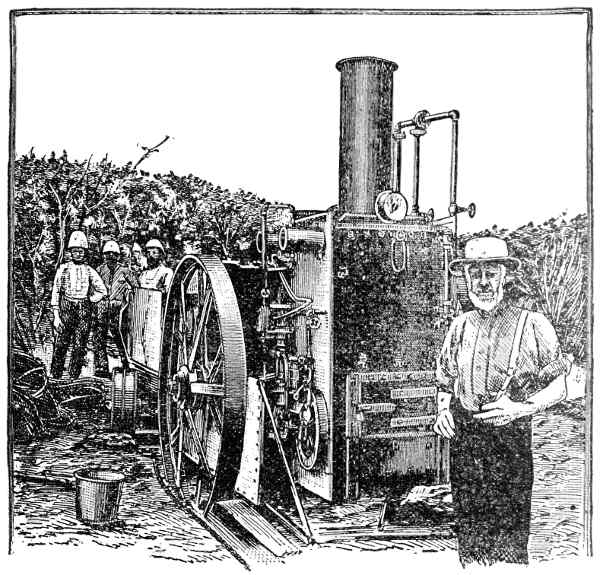 STEAM WAGONS FOR HAULING AT VIVI.
“The steamers on the Upper Congo water-ways have multiplied from four
or five to a dozen in the past three years, so that we can get passage
for the few missionaries we want to put in to hold our Kasai pre-emption
claim till we can work up from our lease, and by and by send up a small
steamer of our own for our enlarged Kasai work. I am on my way now to
make final arrangements with the builder of our steamer to put her up
and launch her at the earliest practicable moment, and will, the Lord
permitting, be back
to
Liberia in December. I will ask Richard Grant to
furnish a statement of the total expenditures.
“In regard to appropriations, I remark: (1) That if the Committee wish to
enlarge the appropriation to the African (Liberia) Conference, I make no
objection, but I ask at least for the continuance of the usual amount of
$2,500, sent altogether as it was last year, and have the distribution at
Conference for the whole year.
“(2) If the Committee are pleased to order $500 subject to my call, all
right. I did not draw it last year, because I had not time to use it for
the purpose I had in mind.
“(3) If the Committee will appropriate $10,000 or $5,000 for the
establishment of self-supporting schools for the principal countries of
Liberian population, for the education alike of the Liberian and the
heathen children, I will administer it as carefully as possible and
report progress. It would take five or six years to grow marketable
values adequate to self-support, but quantities of food can be produced
from the first or second year.—October 4, 1889.”
Writing in June 1889, Bishop Taylor speaks as follows concerning his
Angola Missions:
MARCH FROM DONDO TO NHANGUEPEPO.
“Nhanguepepo, Monday, June 3, 1889.
“I left Dondo last Thursday morning. Brother Withey walked with me about
a mile. Four carriers—who brought cargoes from Nhanguepepo, arriving in
Dondo on Tuesday, and taking a day for rest—were ready to start on their
return trip on Thursday. I employed two of them, one to carry my bed and
the other my food, and half a cargo for Brother Withey. We spent the
first night at Mutamba, thirteen miles out, stopping about eight miles
out for lunch, and four hours of rest.
“Four years ago, after waiting four or five days in Dondo trying in vain
to get carriers, we depended on half-a-dozen Kabindas, whom we hired in
Loanda, on good recommendations, as a standby in case we should fail.
We were repeatedly told by men of long experience in Angola, that ‘it
would be impossible for us, as strangers, especially as we would neither
drink nor sell, nor
give
rum, gin nor wine, to get any carriers for the
interior.’ ‘The traders, with their long and widely extended experience,
facilities and free rations of grog, can’t get more than half the
carriers required at this time.’ ‘One gentleman of my acquaintance,’
said, ‘I had 5,000 bags of coffee at Kazengo, thirty-six miles from
Dondo, and could not put it into the market for want of carriers.’
“So, a part of our pioneer party, viz: myself, Willie Mead, W. P. Dodson,
Joseph Wilks, Henry Kelley, the Vey boy from Liberia, determined to make
a start on Friday night (about June 1, 1885,) even if we should have to
do our own carrying, for the Kabindas whom he had hired refused to carry
for us; and they had a lot of their own luggage, twice as much as regular
carriers take with them.
“I learned from an old trader, who had thirty years of observation along
our contemplated line of work in Angola, that Nhanguepepo was the best
site for a mission between Dondo and Pungo Andongo. So we aimed to reach
this first and best place. About 9 o’clock, on that night, we succeeded
in getting six Kabindas to shoulder each a load of our luggage and food
for the trip, leaving one Kabinda with Dr. Summers and C. M. McLean, in
care of a large amount of our stuff at Dondo, stored in our tents, inside
of a stone wall enclosure, said to have been a slave pen in the dark days
of old. I and my little party of missionaries each took a load of stuff,
and struggled up the mountain range four miles to Pambos, arriving about
midnight. We spread our bed on the ground and got a little sleep. Before
sunrise I had carried wood and made a fire, and had on the tea-kettle.
The Kabindas looked grimly on, but declined to help with the camp work.
Breakfast over, we made a move for our march, but the K.’s refused to
pick up their loads. All my kind talk, and Brother M.’s scolding, failed
to move them, so we ‘were stuck in the mud.’ We got the men through the
English house in Loanda, and about 9 P.M. I saw Mr. N., the head of the
English house, coming in his ‘tipoia,’ carried by men from his farm at
Kazengo. So I went a little way from our camp, and met him, and explained
to him the situation.
“He said: ‘The trouble is the Kabindas are not carriers. They are sailors
and porters and gentlemen’s servants. They were
represented
to you as
good for any service to which you might want to put them, but they have
not been trained to work of this sort.’
“I replied: ‘Well, Mr. N., if you can prevail on the fellows to carry
till we can reach an interior village we can pick up all the carriers we
need.’
“‘Yes; I’ll try.’ He had a palaver with the men, and they agreed to carry
till we could find natives who would do it. Then we cleared the camp and
marched about four miles, and stopped at a small hamlet for our lunch,
and there we hired half-a-dozen men to carry the loads of the K.’s to
Nhanguepepo, and we transferred our knapsack to the K.’s.
“The price quoted in Dondo for carriers to Nhangue was ‘sixty-four
makutas’ ($1.92) per man. We offered that, but could not get a man.
The price asked by these country fellows was but ‘twenty-five makutas’
(seventy-five cents), confirming the theory I had advanced, ‘If we can
get to the country villages inland, we can get all the carriers we may
require.’ So with our new team we went on about five miles and camped
at Mutamba, and rested on the Sabbath. Many villagers called to see the
show, the sight of white men, and exhibited great interest in us. We had
our worship and a good day of rest. On Monday morning the K.’s refused to
carry unless we would hire another carrier, which we did, and soon found
that they overloaded the carriers by tying their luggage to our cargoes.
We could not speak their language, and they knew but little of ours, so
it was of no avail to try to reason with them about their oppressions;
but soon after I reached Nhanguepepo, I settled with them, and sent them
back to the sea where they belonged.
“On my trip last week I had no trouble with carriers. I started from
Mutamba at 6 A.M., walked twelve miles to Kasoki, took lunch and rested
till 2.30 P.M.; marched seven miles further to Ndanji a Menia on the
divide of a range of mountains, and camped without a tent, just where we
pitched our tent four years ago, and I was reminded of the trouble we
then had with our carriers. The villagers we had hired complained of the
bad treatment they had received from the Kabindas, besides overloading
them with their luggage, and refused, to go any further. I quietly
offered to give them
extra
pay, and thus induced them to proceed with
their big load to Nhanguepepo.
“I had a refreshing sleep at Ndanji a Menia last Friday night, took lunch
on Saturday at Endumba, and reached Nhangue—nineteen miles—at 5 P.M.,
and was joyously received by our dear Brother Rudolph.
“I have tramped the fifty-one miles between this and Dondo, back and
forth many times, but never with less fatigue than on my trip last week.
I don’t purpose to give a history of all those journeys through the
mountains, but simply note a few points of contrast between my first
trip, and the one of last week. We arrived in the midst of drought and
‘famine’ four years ago. We came through from Dondo dry-shod, but last
Friday I doffed my boots and waded the pools and streams seven times, and
on Saturday five times, and I found it to be pleasant and healthful to my
feet.
“Till railroads shall be built through this country, the best mode of
traveling, and the most healthful, is to walk, and ‘wade.’ As for speed
in a journey of a few hundred miles, a man on foot will out-travel a
bull, or even a good horse. Persons who travel in a ‘tipoia,’ amid the
rattle of sleigh bells, and the shouts of their carriers, are not in a
position to receive my statement, but I base it, not on a theory, but on
facts from the field of action.
“When we were here four years ago, we lived in tents near the Caravansary
for about three months. We had been invited by the Governor-General,
Sr. Amaral, to settle on Government land wherever we chose, and the
Government would make us a grant of any amount required up to 2,400
acres. Having explored the Nhanguepepo region pretty thoroughly, we
concluded that the Lord would have us open a mission here. Our families
and a number of our young men were waiting—in Loanda at a heavy
expense—for us to open fields for them; and the dry season was passing
away, so we had to proceed as expeditiously as possible.
“I opened a mortar bed for making adobes (sun-dried brick) preparatory
to the erection of a mission house near the Caravansary, where crowds of
carriers, many of whom were from a distance of five or six hundred miles
east of us, camped every night. Having made inquiry I believed the site I
had selected was Government land,
but
was notified by the “Commandante,”
before I had proceeded with my adobe-making, that all the land about the
Caravansary was private property. He was very kind to us, but wanted
to sell us the house in which he lived, a roomy, substantial building,
with adjoining roofless walls of solid masonry of much larger extent. I
saw on examination that the property would be suitable for our purposes
of residence for our large families, and for a receiving and training
station for new recruits from home in coming time, being a high, breezy,
healthful region; but we had no money. However, firmly believing that the
God of Abraham would lead us, and provide for us, I wrote to our people
in Loanda to come on as quickly as they could. Owing to the continued
illness of a large proportion of them, and the difficulty and delay in
getting steamer passage up the Coanza on account of the drought and low
state of the river, our people came in groups in July and August. I was
notified at the time of their transit that our money in Loanda was all
used up. As strangers, we could not ask for ‘credit,’ and as servants
of God, doing business solely for Him, and not for ourselves, I did not
think it necessary, nor feel at liberty to try to put His credit on the
market, so I worked and waited.
“My people could not travel inland without money to pay their carriers,
and we had no place in which to shelter them, even if they could get in.
Our cloth was all of one kind—white cotton, which became popular and
marketable months later, but at that time was declared to be entirely
unsuitable for the market, and hence could not be passed off at any
price. Money was the thing required, and without it our people in transit
could neither travel beyond Dondo, nor stop and pay expenses. I did not
doubt that I was working in the order of God’s providence, hence could
not and did not doubt that He would lead us, and provide for these
demands on us, outside of our abundant home supplies which He had already
provided. The fact is, I brought into the country, in money, only the
small sum of about $1,200, and $1,000 of that had been handed to me by
dear Brother Critchlow to meet ’emergencies’ in Loanda. Heavy duties,
house-rent for forty persons with high rates for wood, water, etc., soon
swallowed that amount. But just in
our
extremity, Mr. J. T., a Church of
England man in the City of London, gave us £250—over $1,200.
“The Lord thus tided us over that bar. So in our extremity of need, as
before described, the God of ‘the Church of England’ as well as of our
own, through His servant J. T. of London, gave us £250 more. With that
we bought the Nhanguepepo property of the Commandante, and settled our
people here, also at Pungo Andongo, and Malange.
“I proposed that our Nhangue Station should bear the name of our London
brother, but when I spoke to him about it, he replied, ‘No, Bishop
Taylor, no! that is an honor I do not deserve. I live at home in comfort.
Call it after somebody who has suffered and done something for God among
the heathen.’
“All the members of the families, and young men appointed to Nhanguepepo
four years ago, are still at the front making a record for God and
heaven, save Nellie and Edna Mead, who have gone to represent us in the
home country of our King. Brother Carl Rudolph, however, is the only one
who remains at Nhangue, and is at present in sole charge of the station,
and is breaking in native workers, and is likely to make this a training
station of native, rather than an American agency. If such should turn
out to be in the line of God’s wisdom, and gracious leading, all the
better. These are acclimatized, know the languages, and the life of
the people, and have many advantages over foreign agency. The foreign
missionary is sent by the Holy Spirit ‘to prepare the way of the Lord,’
but the sooner he can train and trust the native-born men and women whom
God shall call to be heralds and witnesses of the truth, the better.
“The station buildings that were in good repair when we took possession,
remain so; some portions not entirely furnished with ant-proof rafters,
need repairs. Many of the walled rooms have been roofed and utilized.
“A walled room we have, 18x40 feet, would answer for a chapel and
school-room. We hope to have it covered and fitted up this dry season.
We are also building this season a new stone wall around our corral, and
must have a shed for milking the cows.
“A new house, 18x40 feet, of adobe bricks, has been put up
near
our main
building, and a farm house of adobe brick, 20x40 feet, a mile distant, at
the mission farm.
“A great deal of material work has thus been done in the four years.
I provided for putting in a herd of cattle here before I left, nearly
four years ago. The herd increased and went up to a total of 144 head,
including calves. To protect them from thieves and from wolves they have
to be carefully guarded by two boys by day and secured within heavy stone
walls by night. One night, about two years ago, the herd got out of the
‘corral’ and went to their grazing ground, and a pack of wolves killed
and partly devoured one of the cows. Later, a couple of wolves managed to
get hold of a calf that seemed to have laid near the gate. Some natives
heard their barking and raised an alarm, which frightened the wolves
away. Brothers Withey and Rudolph went out with a light, and found the
calf outside the gate, and one of its legs broken. It appeared to have
been dragged through an opening in the gate, caused by a broken bar, and
thus got its leg broken. It was midnight, but Brother Rudolph at once
slaughtered and dressed the calf for food. Meantime he preached to the
crowd of natives thus drawn together about the devil-wolves which were in
pursuit of them, and said their only refuge is in the fold of Jesus; that
they should not go outside, nor lie down to sleep too near the gate.
“The crowding together of so large a herd of cattle proved to be
unwholesome for them, especially in the wet season, when they could not
keep the corral clean. Many of them became afflicted with an itchy,
festering skin disease, though otherwise healthy and fat. Such were
separated from the main herd to prevent possible contagion, and were
gradually slaughtered and used to meet the demand for beef, fresh or
dried; others proved to be ‘lean kine,’ which greatly ran down in weight
during the dry season, when the grass was short; some milk cows were poor
in the quantity and quality of their milk; others would not yield to kind
treatment; all these varieties, noted as unprofitable stock to keep, were
sold or slaughtered, so that now of ‘the survival of the fittest’ we have
left a herd of eighty-four head, including calves; beside selected seed
for a herd at our Pungo Andongo Mission, which now numbers twenty head,
old and young.
“Brothers Withey and Gordon were both merchants for years at home;
hence very proficient in that line, but not so well adapted to farming
or mechanics; so the Lord is giving them success in establishing a
commercial business, both at Nhanguepepo, and at Pungo Andongo. It was
contemplated from the start that when such men should be put down by the
Lord in a good place, and shall so be led by His Spirit and Providence,
that trading posts should constitute one branch of our school industries.
These give ample support now to the two stations named, but are still
assisted from home in taxes, repairs and new additions to church
properties.
“The foundation industry, however, is farming, fruit, coffee-growing,
etc., (1) because of its intrinsic value, present and future. (2) That
we may thus train boys and girls for industrial pursuits, by which,
when grown, they may secure good homes of their own and form Christian
communities as a basis of self-supporting churches and schools.
“The soil of Nhangue is abundant, rich and ready for the plow, but thus
far, owing to the great attention given to building, to the stock,
and to merchandizing, and the departure of so many who ran well for a
season, our farming interest has suffered; but Brother Rudolph will
give the farming and industrial school-boys and girls to help and to be
helped, a fair trial, as soon as we supply him with an assistant, and,
by the blessing of God, he will, I am sure, make a success which will
demonstrate grand possibilities on that line. This is essential, even if
the stores should far exceed absolute self-support, which they will do if
kept solely in charge of such men as we have named; but all the boys we
train can’t be merchants. The school work commenced with promise nearly
four years ago, has not made decided progress, for the same reasons named
in regard to farming, but good results are manifest from the educational
work, especially in some of the boys trained by our good brother, Wm. P.
Dodson, who give evidence of their genuine conversion to God. In spite of
all discouragements, which, among ourselves, have not been small nor few,
God is at the front and will lead all who abide there with Him to early
and glorious successes on all the lines of our movement, especially in
the salvation of the heathen
around
us. I am so assured of this that I
am praising Him now for the coming work of salvation among the heathen.
Glory to God! Glory to God! Wm. Taylor.”
NHANGUEPEPO.
“Arrived in Nhanguepepo by a walk of fifty-one miles from Dondo, on
Saturday, June 1, 1889. At present we have but one missionary on this
station, Brother Carl Rudolph, but he is doing the work of two or three
by breaking in the native boys. He has a self-supporting store of
varieties, a large herd of cattle, is building a stone wall for enlarged
corral for the cattle, teaching and preaching daily, and preparing to put
in a large crop of corn, beans, manioc, sweet potatoes, sugar cane, etc.
“This was designed for a receiving and training station for our newly
arriving recruits from America, but instead it has become a training
station for native boys who are acclimatized, who know the language
of the country and the life of the people, and have many points of
adaptability which a foreigner must spend years to acquire, and meantime
is likely to get sick—home sick, and skip out. Yet native agency can’t
be trained without competent men of God to train them. God has developed
such from our first force whom we settled in Angola four years ago, who
will do a wonderful and widely extended work, even if no more should
come. If we can get more from home, who, like these, will stick, and
do and die for Jesus in Africa, well; but otherwise, Angola, already
self-supporting, except some help in repairing and enlarging our mission
properties, will be worked by our present force of Americans and the
natives themselves. We have the nucleus of a Methodist Episcopal Church
in Nhanguepepo, now consisting of half-a-dozen saved boys, and others are
seeking.
“On Sabbath, the 2d inst., I was late in rising from bed, just off a
journey; indeed, I wished, at any rate, to spend part of the day in
Sabbatic rest in that way. But, I was going to say, as I lay in bed,
a blind man, whom I met here four years ago, came to see me. He is a
native of Dondo, and learned there to read and write in Portuguese, and
speaks that language as well as his own Kimbundu,
but
for years he has
been blind, and lives alone in a hut not far from our house. His name is
Esessah. He expressed great pleasure in meeting me again, and Brother
Rudolph gave him a seat by my bedside, and sat down near him. After the
compliments of the occasion I said to myself: ‘This is my chance for
Sunday morning preaching, which has been the habit of my life for the
last forty-seven years. If the Holy Spirit will use me this morning we
can get this poor man saved. He has groped in the dark a long time; to
walk in the light for the remaining time of his pilgrimage, and then
leap into the joyous brightness of eternal day, will be a blessed gain
for this poor man.’ So I said: ‘Brother Ruldolph, I want to preach to
this man, and have you put it in plain Portuguese or Kimbundu.’ Brother
Carl is perfect in love to God and man, and his whole soul and life are
devoted to such work, and he is well up in those languages. So I gave him
my Gospel Short Cut to the mind, conscience and heart of the heathen.
The Spirit of God put Divine electric fire into it, which broke us down
with weeping again and again. At the close of the discourse, the three of
us went on our knees. I was led to pray that the Divine Spirit would make
his repentance so deep and expressive, and his conversion to God so clear
and distinctive, as to leave no ground for doubt in his mind, nor ours,
and which would give point and force to his testimony to his heathen
neighbors. So I and Carl led in prayer, then the blind heathen broke out
in audible prayer, and wept, prayed and wept, till finally he submitted
to treatment and received the Lord Jesus, the Great Physician, and was
straightway pardoned and healed, and gave a clear testimony to the facts
in his case.
“We did not call to see him on Monday. I thought it was well to leave him
alone with God for a season, but on Tuesday, yesterday, Brother Carl and
I went to his hut, and he received us joyfully. He is not at all a noisy
man, but courteous, unobtrusive and very sensible, and in low, distinct
articulation, he is a fluent talker. We had a long teaching talk with
him, and heard his most clear and distinct testimony to the saving power
of God in his head and heart. I led in vocal prayer, Carl followed and
then Esessah prayed intelligently and earnestly. As we were leaving, Carl
and he embraced each other and wept, and held each other and wept
on
for
some time: meantime, I was waiting in the path, and tearfully thanking
God for such a sight in the midst of heathendom. Glory to God! The big
rain drops are falling on us. A thunder-gust of glory will sweep through
these mountains, soon followed by the regular ‘former and latter rains’
in this season. Glory to God! My eyes shall not dim much with age till I
shall see these things. Let all the people who have been praying for us,
praise God for the glory to be revealed. Wm. Taylor.”
FROM NHANGUEPEPO TO PUNGO ANDONGO.
“Thursday, June 6, 1889.—I left Nhangue at 6.30 this morning, with my
two carriers, whom I seldom see on the path, being usually ahead of
them. Two miles out I called to see the Assistant Commandante. He and
the Commandante called to see me the other day, and of course I returned
their call. A Commandante, appointed by the Portuguese Provincial
Government, has charge of a detachment of soldiers, and is also a
magistrate of a certain district of the Province. Some of them are
Portuguese. The others, probably the larger proportion, are Africans,
who have had some advantages of education. They have been courteous and
kind to me and to my missionaries almost invariably, and we reciprocate
cordially.
“Three miles on my way I called to pay my respects to Sr. Jacintho,
a Portuguese trader, whom we used to call ‘the honeyman,’ because he
occasionally, when we were strangers in a strange land, presented us with
a bottle of honey to sweeten us up a bit. We bought of him some of our
best cattle in starting to form our herd.
“In the forenoon I walked fourteen miles to Sangue. On my first trip over
this path, to settle Joseph Wilks in Pungo Andongo, we spent a night at
the house of the Commandante at Sangue.
“I had been overworked at Nhangue, and was not in good condition for
walking that day, and, on reaching Sangue, soon found a corduroy bedstead
in a private room, and laid me down to rest. I heard Brother Wilks say to
our host, “Bispo doente, muito doente”—Bishop sick, very sick. I said to
myself: “If my kind
Father
will give me a refreshing night’s rest across
these rough irregular poles, we will see before to-morrow night who will
be the delicate brother.”
“In due time our host sent me a basin of delicious native soup, which
refreshed me very much, and though I spent much of the night in turning
over, I slept well in the intervals, and was up with the day-dawn and
ready for a march of twenty-four miles. We waded through long reaches of
sand in the path, which made wearisome walking for us. Wilks was good for
a long pull, but he had no more to say about “Bisbo doente,” as the walk
that day put him up for all he could do to keep up, and to hold out till
we reached Pungo Andongo, a little before sunset. We were kindly received
and entertained at the trading ‘factory’ of Sanza Laurie & Co.
“Marcus Zagury, a member of this firm, had visited us at Nhangue a few
days before, and gave us full information and encouragement in regard to
Pungo Andongo, as the place for planting a mission, and tendered us the
hospitality of their house. The evening of our arrival had been set for
an entertainment—a big dinner—for the Government officials and traders
of the town at this house; so we made somewhat the acquaintance of those
gentlemen, also of a Catholic priest, who was an East Indian. All spoke
encouraging words to us, but of course did not engage to paddle our canoe
for us. Next day we rented from Sr. Zagury, at a cheap rate, a pretty
good house for a school and for residence of the mission family, and I
left Brother Wilks in charge and returned to Nhangue.
“These are some of the remembrances that crowd on me today, as I lay
down on the leaves for noon rest and lunch at Sangue. In the afternoon
of to-day I walked nine miles further to ‘Queongwa’ (Kaongwa), not a
town, but a camping-ground for carriers and travelers, and a house for
upper-class natives, with some villages contiguous and a running stream
of water the year round, which is of great utility in this country.
Brother Withy, our Superintendent, has bought a sight here for planting a
mission school for the towns of this vicinity.
“A resident here, who has always shown kindness to my
missionaries,
Sr. Candanga, met me in the path and gave me a welcome to his house of
‘wattle and daub.’ It is 60x18 feet, divides into two large end rooms and
a central hall.
“One of these seemed to be reserved for strangers, furnished with a
table, two or three chairs, and a European double bedstead with mattress
and spread, which he put at my disposal. I had a good portable bed which
I preferred to any other, but to honor his hospitality I spread my
bedding on his bedstead and enjoyed a night of balmy sleep.
“I had walked twenty-three miles during the day, waded the waters eight
times, and verified the truth—the ‘rest of a laboring man is sweet.’
“On Friday, June 7th, I was up at peep ‘o day, rolled up my bedding, took
my lunch in my hand, and was on the path long before the sunshine struck
the tops of the mountains, and walked to Pungo, about fourteen miles
distant, by 11 A.M.
“My second tramp over this path was in company with Sister Wilks and
Agnes, in August, 1889, on their way to join Brother Wilks at Pungo. Such
was the immense avoirdupois of Sister W. that at Dondo we spent a week in
trying to get carriers to take her thence to Nhangue. All our men travel
on foot, but the ladies are carried by a couple of strong men—two also
as alternates—in a hammock suspended from a long pole. We could find no
carriers for her at Nhangue, so she walked fourteen miles to Sangue. On
the way that day, we met Brother Wilks coming to meet wife and daughter.
Agnes was carried and took a fever; the mother walking, and perspiring
freely and sluicing the sewerage of her system, was in no danger of
fever. When we reached Sangue, I hired a native to get four strong men
to carry her next day to Pungo. He succeeded, but it was 8 A.M. before
we could get them on to the path. We stopped at Queongwa for lunch. At 2
P.M., when we were ready and anxious to proceed on our journey, we found
our carriers had just hung on the pot for boiling their breakfast. It was
Saturday, and fourteen weary miles between us and Pongo, so Brother Wilks
ordered them to their burdens: ‘No time now for cooking. You should have
done that an hour ago, and we can’t wait any longer. We must be off now.’
The carriers replied: ‘We
can’t
go any further to-day; we will camp
right here, and rest till tomorrow.’
“I waited till their temper abated, and went to them, and said: ‘You have
had a heavy load, boys, and I know you must be very tired and hungry; so,
cook away, and eat a good breakfast, and then come on. I and this lady
whom you have engaged to carry through to Pungo Andongo to-day, will walk
on till you overtake us,’ Then without waiting for a reply, we took the
path, and in about an hour afterward they overtook us and shouldered the
‘mulker grande’—woman large—and struggled on. We reached the mission
house about 10 P.M., when the poor fellows were relieved of a heavy load
from their shoulders, and I from my mind.
“On this day, June 7, 1889, when about a mile short of our mission house
in Pungo, I was met by Bertie Withey, a wholly consecrated lad of sixteen
and one half years. He was a boy of twelve when he, with his parents
and three sisters younger than himself, enlisted for this work. These
children, like their parents, walk humbly before God on the line of
supreme loyalty and love. They are well up in the use of the Portuguese
language, and in the Kimbundu. The native people here bear the name of
‘Umbunda’ plural, Mubunda singular. Kimbundu with them means language. So
with them it would be tautology to say Kimbundu language.
“Our missionary occupants here at present are Chas. W. Gordon, Sister
Withey, Bertie, Lottie and Flossie; the eldest sister, Stella, being with
her father at Dondo. Sister Withey is quite unwell just now. She has
passed through the fiery ordeal of bilious fever in this country a number
of times, but lives in the light and love of holiness, and carries no
anxious care of any sort a bit longer than the casting of ‘all her cares
on Jesus who careth for her.’ Her husband and she came to this work under
a conscious call from God, and consecrated themselves and their children
to it for life. One of the stipulations was that, if either should be
struck down by the hand of Death, the other should remain in the work and
train the children to stick to it to the end of their lives.
“Now, while I write I hear Lottie and Flossie quietly conversing with
each other in the Kimbundu, seemingly oblivious of the English language.
“Brother Gordon is one of the forty who came with me four years and
four months ago. He is slender but symmetrical in his build, blue eyes,
pleasant countenance, gentle and courteous, firmly adhering to the
principles of truth and righteousness. He was rather delicate in health
at first, but has grown strong and healthy by all sorts of hard work in
the radius of our mission industries. He has a clear head, is a good
school-teacher, a good wayside preacher of the Gospel to a crowd, or to
one poor native, or to any dignitary of the Provincial Government, and
walks in love, perfect love to God, and is in profound sympathy with
men. Brother Withey and he, from years of experience in Massachusetts,
are our trained merchants. With the surplus of their earnings, in that
line during the past year, above self-support of this station, they
have bought and paid for the new mission property, before mentioned, at
Queongwa, and a mission farm of probably three hundred acres of good
land, bounded on one side by an ever-running stream of water, with many
valuable fruit trees and a substantial adobe house, 55x18 feet, divided
into three rooms. They are this dry season putting on a new roof, and
will put the whole premises under good repair. This is the industrial
school farm of the Pungo Andongo mission, and is sixty yards short of a
mile west of it.
“In competent hands, suitably located, a store, like the one here,
constitutes an important branch of our industries. Conducted, as it
is, on strict principles of truth and honesty, it sheds light into the
commercial sphere of this country, and brings our missionary traders
into personal contact with native carriers and merchants from a radius
east and south, covering the countries of the Lundas, Kiokos, Bilundas,
Libolas and still others, 500 or 600 miles distant from this place.
“The traders are of different European nationalities, and, in the main,
are smooth and gentlemanly in their bearing toward their neighbors, and
we always get on pleasantly with them; but they are free to say our
‘principles are entirely impracticable in this country and can’t succeed.’
“The popular method of business here is: On the arrival of a caravan,
laden with rubber, beeswax, ivory, etc., (1) to serve its traders and
carriers with free rations of rum; (2) free rations
of
food. With that
they usually pass the first night in a large, well-covered shed built
for their accommodation. Camp-fires, cooking, eating and drinking is
the order in every direction. After the feasting, comes the dancing,
with clapping of hands, and singing and shouting at the top of their
stentorian voices. This is kept up through most of the night. (3)
From the traders further, a free distribution of cheap fancy goods,
dressing up the head men of the caravan in broadcloth coats and pants,
highly-colored silk sashes and umbrellas, and in a display of these, with
music, they march through the town and back to the camp.
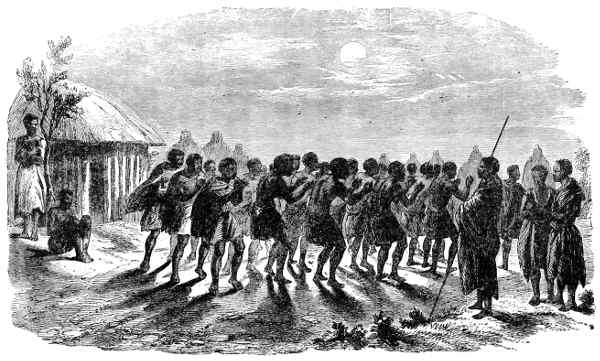 REED DANCE BY MOONLIGHT.
“Then (4) comes the weighing of the rubber, wax, ivory, etc., and payment
in cloth of various kinds and colors, flint-lock guns, powder, beads,
knives and fancy goods in variety, and rum in huge bottles encased in
willow wicker-work. In the ‘Mohamba’ of the carriers—a kind of long
basket—five of these demijohns are placed, weighing from seventy to
eighty pounds, to be carried often 500 or 600 miles.
“(5) ‘The dispatch,’ just before the departure of the caravan, which
consists of throwing out into the crowd, caps, hats and toys in variety
for a grab game of the carriers. I once saw two fellows grab a cap, who
pulled and hauled and quarreled till a third fellow ran up with his knife
and cut the cap in two, and stopt the strife.
“Our Christian traders provide some accommodations for shelter and
comfort for native carriers and traders. Those who come for the first
time call for rum.
“‘We don’t sell rum; don’t use, nor keep it in the store.’ Some fellows
here, the other day, disputed Brother Gordon’s statement, saying, ‘Don’t
I see it there,’ pointing to some cans of kerosene.
“‘Well, do you want to try some of that?’
“‘Yes; that is what we want.’
“So he drew some and passed it to them, saying, ‘Now, you had better put
it to your nose first.’ One or two of them smelled it, and passed it back
with a look of surprise and horror.
“‘Well, we want some tobacco.’
“‘We don’t use tobacco; don’t sell it; don’t keep it to sell.’
“‘Do you want to buy rubber?’
“‘Yes, I am ready to buy your rubber,’
“‘What will you give us in exchange for our rubber?’
“‘I will give you money, if you like; or give you cloth, rice, fish,
sugar, soap, anything you want, except rum, tobacco, beads and
trinkets—such things as can do you no good. We sell nothing but what
will be useful to you.’
“‘How much you give us for our rubber?’
“‘When I examine to see its quality I will show you whatever you want,
and how much I will give you for each ‘arroba’ (thirty-two pounds). We
give you no ‘matebeesh’—gifts—like other traders, and can afford to
give you a good price for your rubber. If you, then, think that you can
do better elsewhere, you can take your rubber away to the best market you
can find. We want you to do the best you can for yourselves; remember,
the men who give you things so freely, cannot afford to do it out of
their own pockets; they must therefore take it out of you in their prices
of purchase or sale.’
“Some leave us quietly, but many remain, and see, and confess to a fair
deal. Then comes a free friendly talk about their country, and their
people, and a Gospel talk about ‘Nzambi’—God.
“The people who thus trade with us go away in every direction, telling
their friends they have become acquainted with ‘another people,’
“Thus our holy brethren are making more than a missionary self-support,
and business increasing daily, and not only have their regular Sabbath
services in the Kimbundu, but are talking six days a week beside;
from morning till night they are talking in the Kimbundu of Jesus and
Salvation to people who listen attentively, and repeat with great
accuracy and earnestness any new thing that comes into their ears.
“All this talk, which I have indicated through the English language,
transpired in the Kimbundu, so that our missionary traders are daily
learning the vernacular of the country much more rapidly and accurately
than they could if confined to their libraries, especially as there was
but a single fragmentary grammar, till one of our missionaries, Hèli
Chatelain, learned from the people who speak accurately, and has since
printed a grammar and the Gospel by John; but as these are just from the
press, our people have become
familiar
with the Kimbundu by direct and
daily contact with the people without the aid of books.
“On Saturday, June 8th, Brother Gordon and Bertie slept alternately night
after night at the farm-house, and in the morning see that the hired
men get early to work, and look after the cattle and send them out to
pasture, and then return in time for breakfast.
“I went to the farm-house early this morning and found Brother Gordon
reading and explaining Scripture truth to the hired men in their own
Kimbundu. When one grasped a new thought, he repeated it to the rest,
with a glowing face.
“Our cattle herd here is not large, but growing, and of choice stock.
They require daily attention. Any fresh wounds on any of them will soon
mortify if not properly attended to. I saw Brother Gordon lasso a couple
of young bullocks this morning, almost as dexterously as I used to see
the Spaniards do it in California. It took him about a minute to lasso
one, throw him, tie his legs, and put a bar across his neck, so that the
animal was entirely helpless. The object was, daily to clean and dress a
wound till fully healed.
“A wild plant grows plentifully in this country, called by the natives
‘Lukange,’ a decoction of which applied hot—not to scald—appears to be
more effective than carbolic acid. First, a cleansing of the wound with
soap and warm water; second, an application of the lukange by means of a
syringe. Then, to prevent ‘flyblow’ and its consequences, a preparation
of salt and baked tobacco, pulverized, is applied. The nicotine of
tobacco, boiled out, is the great remedy used by Australian sheep growers
for killing a bad breed of lice, which would otherwise destroy their
flocks. Tobacco is certainly a very poisonous, destructive weed, and
death to vermin.
“On Sabbath, 9th, Brother Gordon had a teaching and preaching meeting
in the chapel at 10 A.M., then I preached a short discourse, and he
interpreted into the Kimbundu. We had first and last about thirty native
hearers. Some of them were greatly interested, and repeated to the rest
the new thought that had just struck him.
“At the close, a soldier, who was among the most attentive
of
the
hearers, said, ‘I want to turn to God, and receive Jesus and be saved.’
“Brother Gordon questioned him about giving up all his sins, and let
Jesus take them all away.
“He said, ‘Yes, I’ll give up everything that is wrong, and let Jesus save
me,’
“Then Brother Gordon asked if he had more than one wife?
“‘Yes, I have two; but I am willing to give up either the one or the
other; but I want you to tell me which one I should give up?’ Then, just
as we were hoping to help him to come to Jesus, he had to respond to a
call to duty as a soldier, and left, and we have not seen him since.
Brother Gordon knows him, and will seek opportunity to help him.
“Our mission house here, of solid adobe walls, 3 feet thick, is about 100
feet front by 20 wide, for 82 feet, and the remaining 18 feet forms an
L extension back about 50 feet, which is the chapel; the 82 feet being
divided into four apartments, one of which is the room for trade. Back of
the house is an abundant supply of oranges, mangoes in their season, and
some other varieties, the whole covering about half an acre of ground;
‘the best site in town’ for all our purposes. Our committee bought it,
and paid for it over three years ago.
“On Monday, 10th, I again visited Brother Gordon at the farm this
morning, and visited on the premises, near a large tree, the grave of
dear Sister Dodson—Miss Brannon. They had been united in marriage but
about six months. She had on her wedding garment when called by the
Master, and went quickly into the royal guest chamber of the King. Her
short and sure way from Boston to heaven was through Angola in Africa.
“To-day Brother Gordon and I took breakfast with Sr. Coimbra—“Costa &
Coimbra,” the largest business firm in Pungo Andongo. We took breakfast
with Sr. Coimbra, seven miles this side of Malange, nearly four years
ago. He is a kind, social man of the world.
“On Tuesday, 11th, preparing for an early start to-morrow morning for
Malange. Will go alone, of course, except the occasional sight of my two
carriers, yet in ‘blessed fellowship divine,’ never alone nor lonely.
Wm. Taylor.”
FROM PUNGO ANDONGO TO MALANGE.
“On Wednesday, 7 A.M., June 12th, I started from Pungo. My two carriers,
engaged yesterday, had not reported at 7 A.M., so I started on my
journey, leaving orders for them to join me at Korima, ten miles out.
“I waited at Korima nearly an hour when they arrived, so we lunched
and rested till 1.30 P.M. I walked that P.M. fifteen miles, and lodged
at Kalunda Quartel. Quartel is not a hotel, but nevertheless a lodging
place for travelers who carry their own bed and provisions. It is a rude
barracks, for a small detachment of soldiers, under a Commandante, who
lives in his own residence contiguous. I meant to stop at the house of
the Commandante, who attended our preaching at Pungo last Sabbath, and
dined with us, and who expressed a strong desire to have us establish a
mission at Kalunda. It was, however, an hour after dark when I arrived at
the Quartel, and the soldiers said it was a long distance to the house
of the Commandante, so I waited about an hour for my carriers, and then
took my cold lunch, put up my bed in a room without doors, and slept
well. Was up and off at 6.15 in the morning, having rolled up my bedstead
and bedding, and taken my breakfast in the early dawn. I walked thirteen
miles, and waited three hours for my carriers, which put my dinner off
till 3, so I walked but six miles that evening, and lodged in a rude
construction of poles, with roof, but sides not covered with mortar or
grass. It gave shelter from dew and afforded fresh outdoor air, which is
always my preference in this country. I found several native travelers,
with a camp-fire blazing when I arrived, among whom was a woman, husband
and little girl of about 6 years. I spoke kindly to the naked little
thing, and the parents were delighted. After I retired I was entertained
till I lost consciousness in sleep, by the singing of the little
six-year-old, who never heard a Christian hymn or tune in her life. She
sang the words and tunes of about half-a-dozen native songs, and when she
seemed to run out of words she sang on, ‘La, la, la, la,’ I thought of
the countless millions of little children in Africa, all heirs of ‘the
free gift which is unto the justification of life,’ and as susceptible of
being ‘trained up in
the
way they should go,’ as the children of England
or America; but, I said, with tears, Where are the trainers? O thou
Creator and Redeemer of mankind, how long, how long?
“Friday, 14th, I walked thirteen miles, lunched and rested a couple of
hours, and six miles farther landed me in Malange. Just as I crossed the
Malange River, I met Brothers Samuel J. and William H. Mead, and Robert
Shields, accompanied by Mrs. Ardella and Miss Bertha Mead, mounted on
bull backs, with portable organ, base viol, cornet, etc., on their way to
Kolamosheeta, where I had lunched that day, to hold religious services.
“The people of that town are hungry for the truth of God. I begged them
not to stop for me, but to go on to their appointment, but they replied
that the people would not assemble till their arrival was announced,
and said they ‘were going out at this time, thinking they might meet me
there.’ So they returned and I accompanied them to the mission-house in
Malange. Malange is sixty-two miles distant from Pungo Andongo.
“The fifty-one miles of travel from Dondo to Nhanguepepo is mainly
through a region of rugged mountains and precipitous cliffs of solid
rock, opening out into the long and widening grassy plateaus of
Nhanguepepo. The thirty-eight miles from Nhangue to Pungo extend through
and mainly across a series of ridges and hollows sparsely covered with
scrubby timber. The soil not so rich, hence grass not so heavy and grass
fires not so hot; therefore there is half a chance for trees to grow,
with no chance at all from Dondo to Nhangue, except some very sappy
varieties of but little value.
“From Pungo on for twenty miles the ridges are much broader and not so
high as those described; there is more sand, less grass and heavier, but
still scrub-timber. Then for eight or ten miles we cross low, beautifully
rounded grassy ridges, with a little streams of water near the surface,
about half a mile apart between the ridges. Then, for most of the way
to Malange we cross ridges less fertile, much higher, with an ascent of
from two to four miles. The whole line of march bears southeasterly. All
appears to be a good grazing country, with many herds of cattle, but not
a tithe of the number required to keep the grass down, and thus keep
up
good short grass pasturage the year round, and preclude the great
‘prairie fires,’ which destroy the young timber and prevent the growth of
forests. For many miles around Malange, there is a fair supply of good
hard-wood timber in variety.
“Sam Mead, Ardella his wife, and Bertha his niece, and I came together to
Malange, nearly four years ago. Sr. J. Preitas was then in charge of the
long established business house of Sanza Laurie & Co., in Malange, and
gave us the temporary use of a house for our missionaries. After a day or
two here, he informed me that Sanza Laurie & Co. intended soon to close
out their business in Malange, and that I had better buy their house and
town lot on which it stood, containing an acre of land and some banana
trees. The house was an extension of house added to house joined into
solid walls, about one-third of wattle and earth, and the rest of adobe
brick. The last one added, forty feet in length, was new, consisting
simply of walls with no roof. The frontage of the whole was about 165
feet, by a width of 18 feet. I inquired: ‘What is the price of the whole
property, house and land?’
“He replied: ‘You can have it for two hundred milreis, $214.’
“I said: ‘I’ll give that amount,’ and the bargain was closed in about
as few words as I have written. It is worth four times that amount now.
The plates, girders and timbers are nearly all of ant-proof, and almost
everlasting hard-wood, most of which are as solid to-day apparently as
when new. One of them has a fire-proof covering by means of a double
roof. On the lower is a heavy layer of cement of adobe clay, precluding
rats, rain and fire. Over this is a thatch roof of long native grass.
On the sunny side it has kept dry and sound, but on the north side our
brethren have put on new thatch, cleaned and whitewashed the rooms, and
finished the new forty-foot room, and fitted it up for a school-room and
chapel, which is the seventh room in the building.
“In the few days I was here, four years ago, Brother Sam and I selected
and stept off a mission-farm adjoining our mission-house. He and Brother
Gordon fenced, cleared and planted several acres in corn, beans, manioc,
sweet potatoes, etc., and everything grew beautifully, but the brethren
were kept indoors by illness for a few days, and just what an old
Portuguese settler predicted came
to
pass, their fencing was all stolen
for firewood, and the cattle and hogs devoured every green thing from the
premises. Bad outlook for self-support. It was in the midst of a ‘three
years’ drought,’ which precluded the growth of supplies at our other
Angola stations, but our farm was not far from the ‘laguna,’ a lake, a
few hundred yards wide, and perhaps a mile long, occasioned by the spread
of the Malange River over a plain, which gave moisture to the soil for a
considerable distance from its shore. We did not seek to get nearer to
the lake for fear of malaria, being warned of that peril by old residents.
“A fair share of the supplies for the first year of food, tools, and a
little money, came to Malange for six missionaries, including Bertha, in
her thirteenth year, with fresh supplies for the second year, and seven
new missionaries to help to use them up, but all that was but to keep the
wolf away, and afford means for the development of self-support. Sister
Ardella’s health was so far gone, for months, that it was believed her
life depended on her having apartments in a second story. But there were
none in town, so a two-story house must be built. In the changes that
were one way and another rapidly occurring, for the most part by attacks
of home-sickness, that carried them off and clear out of the country,
most of the work devolved on Brother Sam Mead, till two years ago his
cousin, Brother Willie H. Mead and family moved hither from Nhangue,
preceded by Brother Robert Shields, sent out by our Committee from
Ireland. These have all stuck to the work here to which God called them,
except that Edna Mead, a ripe Christian of about 12 years of age, at the
call of God went up to join her sister, Nellie, in their heavenly home.
“The results of this unpromising attempt at self-support I will sketch in
my next letter. Wm. Taylor.”
MISSIONARY SELF-SUPPORT AT MALANGE.
“Malange Station received, at the beginning, its proportion of cloth,
provisions, tools and a little money to tide a small band of workers—Sam
Mead, Ardella his wife, and Bertha Mead, of 13,
his
niece, and two young
men—through the first year, which proved to be the second of a ‘three
years’ drought and famine.’
“So a partial supply was sent for the ensuing year to prevent suffering
from want. Meantime, the ‘tent-making’ by the missionaries, to ‘make ends
meet,’ would have sufficed in a pinch, but the subsidy was salutary and
safe, for they were not of the sort to be surfeited and suffocated even
by an excess of supplies if they had had them, taking real pleasure in
‘scratching’ for themselves. Two years were required for apprenticeship,
experimenting in many things, with everything to learn essential to
self-support.
“About the beginning of the third year, after various changes by the
coming and going of new workers, the coming of Willie H. Mead, with his
family from Nhanguepepo, to join his cousin, Sam—about the beginning
of the third year, marked the period when self-support really began to
abound.
“Minnie Mead, Willie’s wife, turned in $40 by her sewing machine. Hèli
Chatelain an equal sum by teaching languages to some traders. Robert
Shields, from his private purse, put in $22. Willie has put in $80 per
year from the rents of some property he has in Vermont, his old home,
and, within a few months after arrival, put in $200 from pit-sawing and
selling lumber. Most of these sums, with about $100 worth of goods sent
as a present from Ireland to Brother Shields, were used to stock a little
store for a small commercial business, as one branch of industry which
was felt to be specially needful.
“Most of the business of the labor market of Angola is transacted through
copper coin currency. It is so difficult to procure and keep a supply of
it on hand that to purchase it, even with gold, ten per cent. premium has
to be paid. The patrons of a variety shop bring in for the purchase of
things they require a good supply of the copper coin.
“Robert Shields, having served a regular apprenticeship to the grocery
business in Ireland, with an additional experience in it of a year and
a half, was appointed to take charge of this industry, and work it in
connection with his studies, and special evangelizing among the villagers
adjacent to Malange.
“The farm selected at the beginning was found to be too near
the
town,
and the whole work of ‘a season’ on it having been destroyed in a night,
there was no ground of hope for anything better by a repetition of
the experiment of fencing and farming there. So Sam Mead, in a state
of semi-desperation, mounted one of his bulls and managed to struggle
through grass as high as his head to explore the lake shore, along which
he found a neglected farm, on which were growing many valuable fruit
trees; he also discovered that the farm, save its lake-side boundary,
was enclosed by a strong growing hedge, and contained a body of about
300 acres of black clay and loam of the most productive quality. He
immediately sought for the owner—the heir to the man deceased, who had
spent so much time, toil and money on it, and he bought and paid for it
with money belonging to Ardella, his wife. He then went to work with a
will, under a new inspiration of hope, assisted for a time by Brothers
Rudolph and Gordon, and produced abundantly a variety of tropical and
temperate zone products for food.
“The mechanical industries were under the special charge of Wm. H.
Mead. His sons—Johnnie and Sammy, the former about 12, and the latter
nearly 11—out of school-hours are valuable helpers in each department,
alternating where needed most.
“Willie’s two pit-saws, in the two years he has been in Malange, have
turned out $1,500 worth of planks and scantling, about half of which he
sold, and used up the other half on improvements of mission property. To
haul the logs from the forest, Sam had the oxen and Willie bought a huge
Portuguese cart, with wheels of hard-wood, about four feet in diameter,
and a hard-wood frame to match, all very strong and durable.
“The outlay of the earnings of these workers, for the past two years,
over and above self-supporting subsistence, may be seen in the following
exhibit:
“(1) The roofing and fitting up for school and chapel purposes of the
unfinished hall, 18x40 feet, belonging to the block of buildings first
bought for the mission. The girders, plates, rafters and collar beams are
all of enduring hard-wood. The roof is double; the nether is covered with
fire-proof clay; the upper with thatch grass. The shutters and doors, and
frames for both, are of sawn hard-wood. Its slab benches, without backs,
give quite a ‘rise’ to people
always
accustomed to sit on the ground.
The cost of these improvements in material, labor and money is estimated
to have been $300.
“(2) The farm-house, 15x20 feet; corn crib, about 6x11 feet, set on
posts, capt with inverted tin-pans, to prevent the rats from getting up;
and two out-houses, about 10x10 feet, and a corral of heavy logs for the
cattle, cost a total of $100.
“(3) Willie Mead’s saw-pits, a shed, workshop and appliances, located in
the mission yard, cost about $100.
“(4) A new mission-house on the same lot on which stands the old one.
It is 24x30 feet, two stories high. The lower story is built of dressed
stone, the upper of adobe brick, solid walls, below and above, three and
one-half feet thick, with a second-story, veranda front and rear of the
building. Double fire-proof roof—as the chapel roof before described.
Doors, window shutters, and frames of both, together with the verandas
and upper-story floors, are all sawn hard-wood. The lower floor and walks
outside are of flag-stones. It is the only two-story house in Malange,
and believed to be the only house in Angola furnished with a chimney and
fireplace, which adds greatly to its comfort in the really cold weather
of Malange at this season of the year. The upper story is used by Sam
and Ardella, and about half a dozen of their adopted native children.
The lower story has also sleeping accommodations, but is the dining-room
for Sam, Ardella, Robert Shields and Bertha, and the school ‘internoes.’
The house is not large, but most symmetrical and substantial, and is
prophetic of progress, and bears from the veranda facing the street a
tall flag-staff from which floats the flag of our home country—the stars
and stripes.
“The brethren estimate the cost of this building, in materials, money
and labor, at $800. To buy all the materials, and depend on hiring
workmen, it could not be done for that amount. It will be observed that
the aggregate outlay for these improvements amounts to $1,300, not a
dollar of which was furnished by our Transit and Building Fund Society;
the brethren preferring to do it themselves than to ask for or receive
aid from home. They are now engaged in building a wall round our Malange
Mission premises 1,000 feet long.
“(5) The farm Brother Sam bought, with its field of sugar cane, so
thickly set as to defy anything short of an elephant a passage through
it; its fruit orchard; its live stock of twenty herd of cattle, including
three yoke of oxen; and eleven breeding sows and male, and chickens, is
worth in the market one thousand dollars.
“As soon as Sam began to inquire for the owner, others began to compete
with him as bidders for it, so, to avoid the peril of delay, he bought it
at the earliest possible moment, and had it deeded to himself, and has
held it in good faith for the mission. During my recent visit to Malange,
I offered to refund Ardella’s money with interest.
“Sam and Ardella laid the subject before the Lord, and returned
answer, that, having given themselves and all they have to God for his
self-supporting missions in Africa, they refuse a refund; but will
immediately deed the farm and all the appurtenances thereunto belonging
to the Transit and Building Fund Society, to be held in trust for the
self-supporting missions of the Methodist Episcopal Church. I put the
matter into the hands of Brother C. W. Gordon, our legal attorney, and
the conveyance will be made, no doubt, before this MS. can be printed.
“The building of the new house has absorbed a large proportion of the
stock in trade of their little store. They were quite disinclined to
allow me to help them stock it up a bit, but I prevailed on them to
accept the small amount of $214.
“As Willie Mead is a noted mechanical genius, on the
short-cut-cheap-line, adapted to a country like this, and as Malange
has greatly the advantage of any of our other Angola missions in timber
supply, and the farthest inland, he should have an outfit of tools and
machinery for a few branches of industry well adapted to that locality.
This need has been in part provided for. Our Committee has sent a new
supply of farming implements and carpenter’s tools for Malange, soon to
arrive.
“I have, on my return trip to the sea, ordered them a turning lathe from
Nhangue; also a farmer’s outfit, the gift of Thomas Walker & Sons, of
England; and have sent from Dondo a blacksmith’s anvil, vice, tongs,
etc. What Malange yet needs is a small steam-engine, of four or five
horse-power, with ‘arbor’ and
belting,
and other appliances, and a
thousand feet of small piping for pumping water, to run by steam, (1)
their sugar cane crushing mill; (2) their corn meal grinding mill; (3)
their turning lathe; (4) a small circular saw of eighteen or twenty
inches diameter, also a small circular cross-cut saw, the saw to be sent
from home with the engine, belting, and water-piping. We don’t want for
Malange a saw mill, big engine, or anything costly or too heavy for easy
transport on the heads of natives 150 miles from Dondo to Malange. Willie
Mead did not ask for these things, but needs them for mission industrial
teaching, in connection with his powerful preaching in the Portuguese
language. He was proposing to sell his little property in Vermont, to use
the money derivable from the sale of his homestead, to buy the engine,
etc., as above, for Malange Mission, but I protest against that. Such men
as the Meads are just the men we can afford to help with certainty of
broad self-supporting missionary independency and wide-spread efficiency,
without danger of dependency. Wm. Taylor.”
RETURN FROM MALANGE TO DONDO.
“I was planning to leave Malange, Monday, 24th of June, but ‘Magady was
dying,’ so I yielded to the request of our brethren and sisters, and
postponed till Wednesday, the 26th. Magady was a ‘Labola boy,’ who, as a
little fellow, gave himself to Sam and Arda, nearly four years ago. He
was very black, but pronounced by some as ‘the most beautiful boy they
ever saw.’ The people on the south side of the Coanza, from its mouth
up for 250 miles, are called Kasamas; thence on for 200 or 300 miles, a
similar people are called the Libólos. Neither will allow the Portuguese
people to travel through their country.
“Magady’s story was that his parents were dead, and that his uncle
treated him so badly he ran away from his country, and became cook for
the Malange mission. He was taught to know, to fear and to love the
Lord, and to sing our hymns. For about two years he was a consistent
Christian. Then, through the intrigues of an influential, designing,
bad man, he was enticed into bad company, and forsook the Lord. Then he
was visited by a disease
of
his head. He would be walking along, and
fall as suddenly as if shot by a Remington rifle, and lie some time in a
state of insensibility, but that was as nothing compared with severe and
sudden pains in his head that caused him to scream aloud at all hours,
day and night. None but himself attempted to diagnose his case. He said
‘Gan N’Zambi’ sent it on him for his wicked departure from Him, and
would destroy his body, but had forgiven him, and washed his spirit, and
that he was sure he would soon go to live with God, and was anxiously
waiting for the call of the King. About 2 P. M. Monday, June 24th, he
died. Willie Mead made him a hard-wood coffin, and lined and covered it
with white cotton cloth, and he was laid in a grave six feet deep in our
own mission burial-ground, where dear Edna Mead sleeps. I conducted the
funeral service, about thirty persons being present—a ‘brand snatched
from the burning,’ our first Angola representative in heaven.
“During my sojourn in Malange, this trip, I slept in my own bed, as
usual, set up in the second-story veranda of our new house, overlooking
the street. The nights were very cold and the winds very high, but I
rested sweetly, and improved the tone of my health. For two years I had
endured an unmitigated high pressure of care and anxiety, on account of
the combinations against the success of my work, within and without,
front and rear, threatening the life of my missions. But for the great
kindness and care of my gracious God and Father it would have killed me.
Viewing the blessed harmony and efficiency of our workers from Loanda,
and on for 390 miles to Malange, I set up my Ebenezer, and wept, wept,
and praised God softly, softly. Then I rested my weary spirit on the
bosom of Jesus, and resigned my way-worn body to sleep. There, in the
breezes of the high veranda, days and nights together, I slept and
slept, and waked, only to say ‘thank God,’ and slept again. Then I got
up feeling as fresh as the morning. I bade adieu to my kindred dear in
Malange, and left at a quarter to eight Wednesday morning, June 26th, and
Friday P.M. reached Pungo Andongo, and had a blessed two days’ sojourn
with Brother Gordon, Sisters Withey, Bertha, Lottie and Flossie—holy,
lovely people. Brother Gordon is a master in the Portuguese and Kimbundu.
We preached an hour Sunday A.M. I knew his rendering into Kimbundu
was
clear and forcible, by its manifest effect on the hearers. It was their
regular chapel service for each Sabbath. The soldier who was awakened on
my way out has been called away on duty, so that we can’t report progress
in his case, but half-a-dozen men, or more, came forward on this occasion
as seekers of pardon, and prayed audibly, but did not appear to enter
into life.
“I left for Nhangue, Monday morning, July 1st. Brother Gordon accompanied
me fourteen miles to Queongwa, to show me a mission farm Brother Withey
recently bought there, of probably 250 acres. We went through it that
afternoon, from end to end. It is bounded on the west by a bold running
stream, and on the north by the caravan path, stretching across a ridge
of fertile soil over 200 rods wide. The former owner was with us, and
wanted to sell us the lower end of the same ridge, extending from this
path about 200 rods to the hollow, northward, where it is bounded by
another little river, till it flows into the one that bounds the whole
tract on the west side, and has another shallow stream flowing through
the addition near its eastern boundary. So, as this new survey, of about
200 acres, was offered to us at a very small figure, we bought it. The
former purchase from self-supporting earnings, has already been conveyed
to the T. and B. F. Soc. for the M. E. Church, and this will be, or is by
this time.
“Brother Gordon is a symmetrical, lovely character, and efficient in
everything he takes hold of. When Brother Withey and he took hold of our
little store in Pungo a little over a year ago, its assets were $200,
now over $1,000, and the preaching done across the counter in all holy
conversation and honest dealing, is a power for God in that centre of
far-reaching influence.
“I reached Nhangue on Tuesday P.M., and rested Wednesday till 4 P.M. We
had a preaching and baptismal service. Brother Rudolph has had several
young natives converted during my absence. Here, as at Malange, many
candidates for baptism we had to put off for better preparation. We
baptized none of responsible years who were not well recommended by
missionaries who had been training them for many months, and who were
assured, from their profession and lives, of real conversion to God,
and declined to baptize any children whose parents were not
prepared
publicly to pledge themselves to teach or have their children taught
their baptismal relation and obligations to God, and to trust Him for His
baptismal pledges to them. Those rejected were disappointed. However,
on Wednesday P.M., I baptized twenty-one little children, and several
converted lads, and five new probationers were added to our native
church, making thirteen natives at Nhanguepepo, and twenty-one at Malange.
“On Thursday morning, Brother Karl accompanied me as far as Nellie Mead’s
grave, under a shade tree, about two rods from the caravan trail. A
construction of solid masonry, about 5x8 feet, and two feet high, covers
her consecrated bones, all given to God before she left America, and laid
at the front, according to her covenant, to live and die for Jesus in
Africa. She was a natural musician, and has gone to take lessons where
‘the new song’ is attuned to the ‘harpers’ of the melody of heaven. She
was one of our children, of the same age, but less stature, of Bertha
Mead. Dear little Willie Hicks sleeps beside her, and will, with her,
wake up at the first call, early in the morning.
“I bade dear Karl adieu, and walked that day twenty-six miles, and camped
at Kasoki, and next day, July 5th, walked twenty-five miles, and put up
with dear Brother Withey and Stella, at our mission-house at Dondo. I
thus completed my walk of 300 miles with less weariness than the same
route cost me nearly four years ago. Glory to God, my patient loving
Father in heaven and here in the mountains and vales in Africa! Wm.
Taylor.”
Writing in September, 1889, Bishop Taylor says of his Congo missions:
“Vivi is about 100 miles from the ocean, on the north side of the Congo
River.
“Old Vivi, founded by Mr. Stanley, is reached by climbing a steep
ascent of half a mile or more from the steamboat landing and Government
warehouses at the river-side. It is now entirely deserted. Proceeding
by the same road along the slope of the ridge on which old Vivi stands,
and thence across a deep glen and up another steep hill, we reach ‘Vivi
Top,’ the site of the first capital of the State. It is located on a
broad and beautiful plateau, commanding a full view of several miles of
the river with its whirlpools and
sweeping
currents. The villages of
Matadi, Tundua, the site of Underhill Mission of the English Baptists,
and several trading stations, all dressed in white paint and lime, stand
out and grace the scene on the south bank of the great river.
“The Government imported and built several large houses of wood and iron
at Vivi. One of the houses, I was informed, cost the Governor-General
$17,000. We could have bought it for $9,000, but had to decline the
generous offer for lack of means.
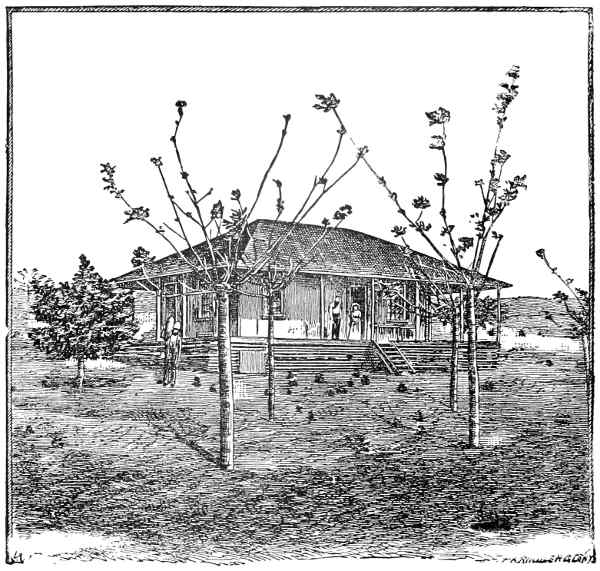 MISSION HOUSE AT VIVI.
“The large houses were taken down and shipt to Boma, the present capital,
about fifty miles below Vivi, and were reconstructed on Boma plateau.
“We bought the site of the old capital, comprising about
twelve
acres of
land and a few small buildings, sufficiently capacious for our needs for
a few years, for $768.
“The plateau being so high and dry, I did not apply for much land,
considering it unsuitable for profitable cultivation. We require the
site for a receiving station for the transport of supplies for our
contemplated industrial stations in the interior north of the Congo, and
the great Upper Congo, and Kasai countries.
“I now perceive that under the judicious management of my
Preacher-in-Charge, J. C. Teter, Vivi will become, in the near future,
a self-supporting station, and the most beautiful mission premises on
either bank of the river. On my recent arrival in Vivi, about the 8th
of August, with the dry season far advanced, I was delighted to find,
on the high and dry soil of Vivi, a field of manioc, beautifully green
and growing. The mango and palm trees on the place when we came into
possession have made a remarkable growth during my absence, and are
full of fruit; a young orchard of choice varieties of tropical fruits
are getting a fine start, and in the garden plenty of yams as large as
my head. I also find a promising start in the production of live stock.
We already have at Vivi eight choice African sheep; twenty-five goats,
which multiply like rabbits; 100 chickens, and a male and a female calf.
Brother Teter built a house for the sheep, another for the goats, and a
corral for the calves. These are not in care of keepers or dogs during
the day, and they return to their houses in the evenings and are shut
in from the leopards. One of those dangerous customers reached his paw
in through a slight opening in the wall of the goat house, and tore a
fine female goat so that it was necessary to kill her. The morning after
my arrival I went with Brother Teter to see the goats come out of their
fortress. As they came rushing through the door, I was surprised and
amused to see three monkeys mounted on the backs of goats, as pompously
riding out to the grazing grounds as if the flock belonged to them. They
lodge with the goats by night, and spend most of their time with them
through the day, and are often seen riding as erect as a drill sergeant
of cavalry. They spend many of their leisure hours in picking bugs and
burrs off the goats, and playing
with
the kids. Their indescribable
antics are enough to make a dog laugh, and to relieve a confirmed
dyspeptic of the blues.
“Brother Teter is building of stone a snake-proof chicken-house. A lesson
of sad experience led him to build of solid masonry. Some months ago,
Sister Teter went into the chicken-house, then in use, to look after a
sitting hen. While stooping over the nest, which she thought was occupied
by the hen, she felt something like a jet of spray come into her face,
and this was quickly repeated two or three times, filling her eyes with
the poison of a “spitting snake,” which lay coiled in the nest. All that
night she suffered, in total blindness, indescribable agony of pain. By
the prompt application of powerful remedies her life was saved, and her
sight restored, but her health was injured by the poison. The dear woman
was quite unwell on my recent arrival, but seemed quite restored before I
left.
“I have furnished a glimpse of the sunny side of Vivi, produced by the
genius and industry of our faithful Preacher-in-Charge. Our Vivi Station
and our cause have suffered temporarily by the disaffection and departure
of those who were numbered with us; but their departure has left us in
peace and harmony, with the possibility and certainty of success in the
work to which God has called us. ‘They went out from us, but they were
not of us; for if they had been of us, they would no doubt have continued
with us,’ There are many not very good, and many who are very good,
who are ‘not of us’ and not ‘with us’ in our Self-Supporting Mission
movement. When such of either class, by mistake, get into our list of
workers, the best thing for all concerned is for them to get out, as
quietly and as quickly as possible. We are sorry for them, and cease not
to love them and to pray for them.
“On Wednesday afternoon, the 14th of August, accompanied by Lutete, a
native man, employed to carry my blankets and food, I took the path for
Isangala; distant, ’tis said, fifty-five miles from Vivi. We walked
twelve miles, and put up for the night at a new mission just being opened
by Mr. and Mrs. Reed and Mr. Bullikist, recently sent out as missionaries
by Dr. Simpson, of New York.
“They seem to be earnest Christians, and will, I trust, make a
soul-saving success. They are having three native houses
built,
each
about 12x18 feet, which will give shelter for three or four years. Their
faithful dog shared in their tent lodgings, till one night, a few weeks
since, a leopard or panther scented him, took ‘a fancy to him,’ and
carried him off. Brother Reed is expert in the use of a gun, and supplies
his table with venison from the prairies. Soon after his arrival, he went
out and killed a deer, and a native king and some of his people came and
claimed and clamored for it. Reed got their attention, and, leveling his
rifle at a tree, he put an explosive bullet into a knot and tore it to
pieces. He then drew his revolver, and discharged it a few times in the
air. His argument had its effect on their minds, and they quietly retired.
“At 7 o’clock next day, having disposed of a good breakfast, I took the
trail, and walked seventeen miles, to Matamba Creek, by 3 P.M. I was
quite disinclined to camp so early, but there being no available water
for seven miles beyond, I made my pallet on the ground and turned in for
the night. I usually have my very comfortable portable bedstead, but
going only for a short stay at Isangala, I took but one carrier instead
of two, my usual number.
“Passing through Bunde Valley to-day, I saw a herd of nine or ten koko—a
huge deer as big as a donkey, with longer legs. They bounded away a few
rods, and at the distance of about a hundred yards stood and looked at us
till we passed out of sight. My Winchester would have brought one of them
down if it had been with me, instead of at Vivi.
“Twice, later in the day, we were within easy shot of large red deer.
On my return, in the same valley, which is about eight miles long,
stretching between mountains or high hills north and south of it, and
abounding in game, I was within easy shot of a koko, which stood and
looked at me without moving. We also heard buffalo in a jungle of
grass and bushes, not thirty yards from us. I saw plenty of game when
I traveled this path over two years ago, but I don’t carry a gun in
traveling, having enough to do to carry myself, and no time for curing
and packing the meat, if taken.
“I went out from Vivi with Brother Teter, the other day, to
get
meat for
use. Our hunting-ground was about ten miles from home. The first day we
got no meat, but saw many koko and deer. The second day at noon, we had
nothing, and were getting into a position to sympathize with a hungry
hunter of the olden time who sold his birthright for a pot of soup with
no venison in it. Teter was becoming desperate, for he is a noted hunter,
hungry for meat, and withal had a reputation to sustain. As soon as we
got our lunch of all we had, he took my Winchester and set off alone.
When he had gone half a mile from camp, he ‘stalked’ a small herd of
koko, and shot a young buck through the neck and killed him, and then
emptied the gun-chamber of its dozen cartridges in trying to bring down
another buck. He shot off its right fore leg, and shot off the sinews
of the left one, and put a bullet into its hip, but he would not down.
Teter, having no more cartridges, left the gun and pursued the wounded
deer and stoned him to death. We had with us two Liberia boys. We camped
near by for the night, and before the morning dawn, we had the larger
buck cut into thin slices and cured by the fire. The younger one, about
a year and a half old, was carried whole to Vivi, by a hired native.
Our Liberia boys, with a good supply of fresh meat, were so refreshed
in their minds that they sang the songs of Moody and Sankey, almost
incessantly, for days. The deer of this section are smaller than the
antelope and gemsbock varieties which we read of in other sections, and
which offer such royal sport for those who go equipped for hunting.
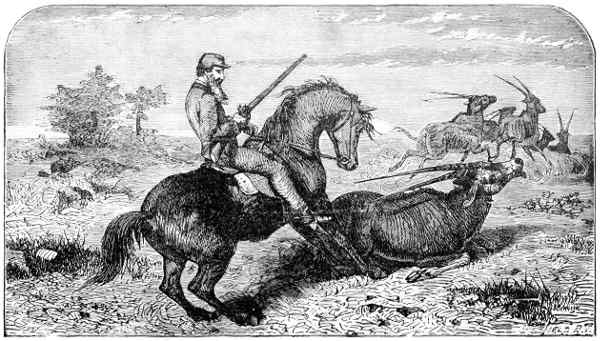 HUNTING THE GEMBOCK.
“On Friday, we walked from Matamba Creek, twenty-three miles to Isangala.
By my usual speed of three miles an hour, I made the distance from Vivi
to Isangala, fifty-two miles instead of fifty-five, as per Mr. Stanley.
I was, however, in fine condition for walking, and may have overstept my
ordinary gait. Arriving at Isangala, I came first to the station of the
State, and by invitation of Mons. C. La Jeune, the Government Chief of
Isangala, I stopt for half an hour in pleasant conversation, and then
proceeded a few hundred yards to our Isangala Mission Station.
“I found our faithful missionaries, Brothers White and Rasmussen, in good
heath, and happy in the Lord.
“They have built a cheap but comfortable house, about
15x40
feet, also
a kitchen and warehouse for storing our stuff. They have made a garden
also, which yields a goodly portion of their support. A single yam,
dug while I was there, weighed twenty-two pounds. Beside vegetables,
they have a large flock of chickens. These brethren both belong to our
transport corps, but have done this station work beside, and have made
good progress toward the mastery of the Fiot or Congo language.
“Brother Rasmussen, though but two and a half years in this country,
speaks the Fiot fluently, and preaches in it in the villages contiguous.
I remained with those dear brethren from Friday evening till Tuesday, the
20th. We had Blessed Communion with the Holy Trinity and with each other.
On Sabbath, I preached to a company of natives, and Brother Rasmussen
interpreted without hitch or hesitation. In another year or two this
dear brother, under the anointing of the Holy Spirit, can go forth as an
apostle among the nations of Congo.
“One part of my business was to advise with these brethren on the
possible solution of our steamer problem. I had talked up all the points
with Brother Teter, and he was so sure these brethren would concur in
our conclusions, he thought it quite sufficient for me to write them,
and thus save myself the labor of a rough walk of over a hundred miles.
I said: ‘Nay, brother, I will walk it, and get the unbiased decisions
of their own judgment, and enlist the free good-will and effective
co-operation of the brethren in the work before us under a new impulse
which personal contact would communicate.’
“Before intimating the conclusions reached at Vivi, I drew out the candid
opinions and judgment of these brethren, and found they were of exactly
the same mind with us. When by mistake we take the ‘wrong road,’ and
travel a long distance in it, it seems a grievance to us to face about
and trudge our weary way back to the ‘cross-roads,’ but however much it
may go against the grain, that is the thing to do. It seems to lighten
the task a little, if some unfortunate fellow can be branded as ‘the
scape-goat’ to bear the blame of the mistake, for we all are of kin to
that dear lady we read about, who tried to make a scape-goat of the
devil; and to the unmanly man, who had the honor to be her husband, and
tried
to make a scape-goat of his wife. But our well-intentioned mistake
was not a sin and we have no need of a scape-goat.
“Well, without enumerating the sources of clearer light, and the new
conditions and changes which have intervened in the last two years,
our unanimous judgment is that the Lord wants our present steamer for
the Lower Congo,—and a much lighter one for the Upper Congo and Kasai
water-ways two or three years hence. We will, as soon as the Lord will
help us, occupy our station at Luluaburg, vacant since the death of Dr.
Summers, and hold our footing in that vast and populous region.
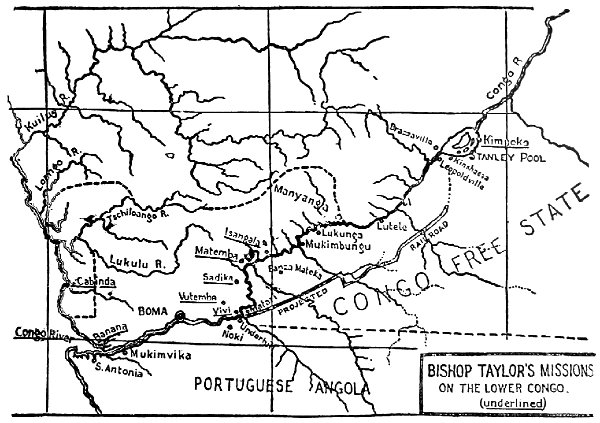 BISHOP TAYLOR’S MISSIONS ON THE LOWER CONGO.
(underlined)
Larger.
BISHOP TAYLOR’S MISSIONS ON THE LOWER CONGO.
(underlined)
Larger.
“I believe the Lord has a special providential purpose to fulfil in
settling us on the north side of the Lower Congo. He wants us to occupy a
densely populated, and utterly neglected region, so far as missionaries
are concerned, belonging to the Free State of Congo, extending 230 miles,
from Banana to Manyanga, and 100 miles wide. So that, while we shall, the
Lord willing, carry out our plan of planting missions in the countries
of the Upper Kasai and Sankuru Rivers, we will also provide for these
vast regions so near us. Our steamer will be available for the supply
of all these vast
fields.
Beside all this, if our time and space will
permit, we can carry for our neighbors any variety of freights, except
intoxicating liquors. Our plan, from the beginning, was in connection
with books and Gospel preaching, to establish industries to employ the
natives, and prepare them for usefulness. So, if it shall please the Lord
to give us a money-saving and a money-making transport service, direct
from Banana to the regions before-named, it will be in perfect accord
with our plan of missionary work for this country, and furnish us means
for its more rapid extension.
“Much of the work will be done by natives, whom we shall train, and
our own missionaries engaged in it will not be throwing away either
time or opportunity. Associating daily with the people, mastering their
languages, visiting their homes, employing them in business, bettering
their condition, exhibiting to them in all our words and ways the loving
spirit of Christ, and unfolding to them the hidden treasures of Divine
light and life is the kind of missionary work specially adapted to these
nations. There is no personal money-making motive nor purpose in it. ‘We
are workers together with God.’ We can trust Him for board and lodging
while in His service, and trust Him for reward when the work is done.
“During my absence from Congo of over a year and a half, Brother
Teter, in charge at Vivi, has had to stand firmly in defense of me, my
Committee, and my cause of Self-Supporting Missions, and having a few
sets of my books, he is continually lending them to the traders and State
officials stationed along the river from Vivi to Banana. Among these was
Mons. C. La Jeune, who became so interested in them, that at our recent
meeting in Isangala, he asked me to allow him to translate and print some
of them into the French language, for circulation in Belgium. He said he
was soon going home for at least six months, and would in that time make
the translations and arrangements for their sale. I had the pleasure of
giving him a written permission to do as he desired.
“The officers of the Congo State, from the Governor-General down, are
extremely polite and obliging, but the amount of Governmental tape that
belongs essentially to the administration of an
old
European Government
is a means of grace, especially the grace of patience to an American
pioneer.
“On Sunday, 25th, I preached in the open to twenty-six seated, attentive
English-speaking negroes from Liberia, Acra and Lagos, and a crowd that
stood and looked on. There are many scores of such people employed at
Boma, and their numbers are increasing. A great deal of missionary
money has been expended in civilizing and Christianizing these people,
especially those from the missions of the coast of Guinea, by the
Lutheran, Church of England and Wesleyan Methodists. They are very
anxious for a place of worship in Boma, it being the capital of the State
in which, by the will of God, we will plant hundreds of mission stations
in the near future. We ought to have a mission-school and church in Boma.
To accomplish all this next year we really lack but one thing, and that
is, the money. The cheap stations we establish in the wild regions of
the heathen are not of the style required for Boma. A plain, substantial
building for residence, school and preaching services would cost about
$5,000. Wm. Taylor.”
SOUTH AFRICAN MISSION FIELDS.
South Africa next engages our attention. Passing by its natural scenery,
soil, productions, climate, its cities, towns and villages, manners and
customs of its many native tribes, and the character of its colonists, we
will confine ourselves strictly to what has been done for the moral and
religious welfare of the inhabitants. And first of the Western Province
of Cape Colony.
The Dutch Reformed church being that of the original colonists is the
strongest religious denomination, and it is numerously represented in
most of the towns and villages throughout the country. Formerly it was
regarded as the church of the white people alone. It was not till the
advent of the missionaries that the Dutch church awoke to the necessity
of doing something for the natives. Lately they have nobly redeemed their
character and in connection with many of their churches a large amount of
missionary work is done. The same was true of the Church of England.
Now, with the aid of funds from home, they have been erecting churches
and
school
buildings in the towns and villages and appointing ministers
and teachers to labor among all classes. Lutherans, Presbyterians and
Baptists were also represented by churches in Cape Town but they did
nothing for the masses of the people.
Cape Colony, in common with other parts of South Africa, is chiefly
indebted to the missionary societies for the moral and religious
instruction of the masses.
The Moravians had the honor of being the first in the field, the Rev.
Geo. Schmidt having gone out to the Cape as early as 1737. A writer in
the Missionary Review in 1889 says:
“Foremost in the fight with ignorance and evil in South Africa stands the
figure of George Schmidt, prepared for the hardships of his missionary
life by six years of imprisonment for conscience’ sake in Bohemia, during
which his brother in tribulation, Melchior Nitschmann, died in his arms.
Whence came the zeal which moved Schmidt to make his way alone to South
Africa in 1737, and to dwell among his little colony of Hottentots in
Bavianskloof, until in 1743 the persecutions of the Dutch settlers and
clergy drove him from the country, and their intrigues prevented his
return? Whence came the ardent heart’s desire, which led him day by
day to a quiet spot near his German home, and there poured itself out
in prayers for his orphaned flock far away, until, like Livingstone,
he died on his knees pleading for Africa? Such burning love and such
persistent prayer are not of man, they are of God. And though the answer
tarried long—yes, fifty years—it came before this century commenced.
George Schmidt was no longer on earth to hear the reports of the three
men upon whom his mantle fell—how they found the spot which he had
cultivated, the ruins of his hut yet visible, the whole valley a haunt
of wild beasts; and, better, how they found one surviving member of that
little congregation of 47 who had long waited and hoped for the return
of the beloved teacher. This was an aged blind Hottentot woman, who
welcomed them as Schmidt’s brothers with “Thanks be to God,” and unrolled
from two sheep-skins her greatest treasure, a Dutch New Testament which
he had given her. Soon this so-called Bavianskloof (i.e. Baboon’s
Glen) was changed into “The Vale of Grace” (in Dutch, Genadendal), and
where Schmidt’s poor
hut
stood there is now a large settlement, with
a congregation of more than 3,000 members. From this center the work
has spread over Cape Colony, and beyond its borders into independent
Kaffaria. Now its two provinces include 16 stations with their filials,
where 60 missionary agents have charge of 12,300 converts.”
The Evangelical French Missionary Society has stations at Wallington
and Waggonmaker’s Valley, but its principal field is in the interior.
The Berlin Missionary Society are also represented in the Riversdale
district. The Rhenish Missionary Society also occupies many important
stations. The London Missionary Society began its work in 1799, and has
made its influence to be felt for good in various parts of the country.
The Wesleyan Missionary Society commenced its labors in 1814. They were
hindered for a few years by the government authorities, but in the
course of time they made great progress in building churches and mission
premises, and in organizing schools all over the Colony.
The Eastern Province of Cape Colony is also indebted to the missionary
societies for religious instruction. Prosperous stations of the Moravian,
Berlin, Rhenish, French Evangelical, Presbyterian, London, and Wesleyan
Missionary Societies have been established in various places. The two
societies last mentioned, however, have been most extensively engaged in
purely missionary work. The London Society began in 1799 by sending out
Dr. Vanderkemp and the Wesleyan in 1820, the Rev. William Shaw being the
pioneer missionary. The temporal and spiritual benefits resulting from
the labors of these two societies to the people of different tribes and
languages in the Eastern Province of the Cape Colony were very marked.
In Kaffaria most of the religious denominations and missionary societies
at work in the Eastern Province of Cape Colony are at work here also.
In Natal, the Church of England has been unfortunate in the part it has
taken in the work there. As early as 1838 a missionary, a teacher and a
doctor, were sent out by the Church Missionary Society. Soon afterwards
others were sent to evangelize the natives, but war breaking out the work
was entirely relinquished. In 1853 Natal was constituted a diocese and
Dr. Colenso was
consecrated
the first bishop; but, according to his own
confession, instead of converting the natives to Christianity, he was
himself converted by a Zulu Kaffir, and proceeded at once to encourage
polygamy and other heathen practices. Another bishop was appointed, but
Dr. Colenso determined not to be superseded, and a scene of wrangling and
litigation ensued, painful to contemplate. Churches have been built in
several towns for the benefit of the settlers, but not much has been done
for the religious instruction of the natives by the Church of England.
The American Board of Foreign Missions sent out missionaries in 1834.
They were men of superior learning and intelligence. They have labored
chiefly among the natives. By their literary ability and persevering
efforts they have rendered good service to the cause of God by the
part they have taken in the translation of the Scriptures and their
remonstrances with Bishop Colenso. The Berlin, Hermannsburg, Swedish,
Norwegian, London and Wesleyan Missionary Societies have representatives
in Natal. The Dutch Reformed Church and the Scotch Presbyterians have a
few ministers and churches as have also the Free Church of Scotland and
the Independents.
The Rev. James Scott of Impolweni, Natal, writes to the Free Church
Monthly in reference to an interesting work among the Dutch Boers, and
extending to the Zulus in the northern portion of Natal about Greytown.
Most of the Boers belong to the Dutch Reformed Church, and while they
have attended outwardly to Christian ordinances, they have heretofore
cared little for the native population. Three years ago a religious
awakening began among these Boers, and the genuineness of this interest
was shown by their desire to reach the Zulus, whom they had regarded
as little better than animals. There are now fifteen preaching places
where the Gospel is proclaimed, and which Mr. Scott says are simply the
farmhouses of the Boers. He speaks of seeing eighty Boers and three or
four hundred Zulus gather together for worship. The Zulus come from
kraals and villages, both old and young, some clothed, but most of
them heathen in their blankets. Over one hundred in Greytown have been
formed into a native church in connection with the Dutch church. This
work is now being
carried
forward under the direction of a committee
of the Dutch farmers, employing three native Evangelists. One of these
evangelists is the son of the Zulu warrior who in 1836, at the signal
from Dingaan, the cruel tyrant, fell upon the Dutch leader Retief and his
party of about seventy men, murdering them all in cold blood. This father
still lives, and is a member of the Christian church and listens gladly
to his son as he preaches the gospel of peace.
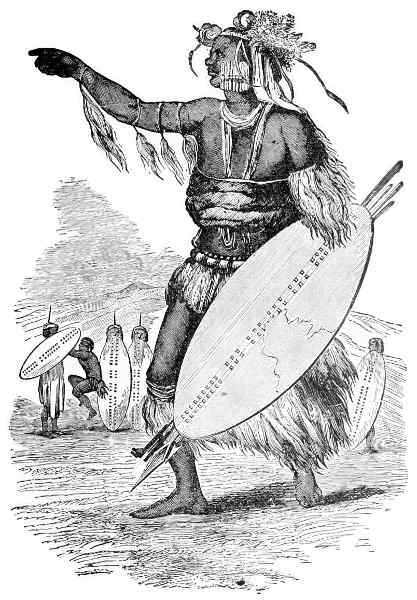 NATIVE WARRIOR.
The Orange Free State is an independent Dutch republic. The whites,
Dutch, English, and other Europeans greatly outnumber the colored
persons, who are of different tribes, but chiefly half-castes. The
religious instruction of these people is fairly provided for by the
different agencies now at work among them. The Dutch Reformed church of
course takes the lead, and they have erected places of worship, appointed
ministers, and gathered congregations in all the towns and villages
and in many of the rural districts. The Berlin and Wesleyan Missionary
Societies are also doing a good work especially among the wandering
tribes of Bechuanas, Baralongs, and Korannas. In Zululand, previous to
the war in 1879, the Propagation Society of the Church of England, and
the Hermannsburg and Norwegian Missionary Societies, had established
stations, and attempted the evangelization of the natives, but with very
slender results. On the breaking out of hostilities, all the missionaries
and teachers had to leave the country. They have since returned and gone
to work under more favorable auspices.
It is stated that a nephew of the late King Cetewayo, after six years in
Sweden in theological and other studies has gone back to carry on mission
work in his native land.
No people in South Africa have benefited more by missionary labor than
those in Basutoland. The agents of the French Evangelical Society have
taken the lead in the work, having entered the field in 1833. They have
many flourishing stations, and their efforts have been very successful
in converting the heathen and in diffusing among the people general
knowledge calculated to promote their civilization and social elevation.
The Wesleyan missionaries have also established important and prosperous
stations. By the presence and influence of the missionaries, industrious
habits
have
become the distinctive characteristics of the Christian
Basutos. The commercial relations of the country have been facilitated. A
great impulse has been given to agriculture, in so much that the general
aspect of the country, even in those parts that have not come under the
influence of the Gospel, has been transformed. This has been strongly
testified to by Mr. Griffiths, the British commissioner.
One of the most pleasing incidents in Pinto’s narrative is his meeting
with the Coillard missionary family at Luchuma, on the Cuando. They were
French missionaries, and the family was composed of Mr. and Mrs. Coillard
and a niece, Elise. At the time of the meeting, Mr. Coillard was on his
way to King Lobossi, to receive his reply to a request to enter his
country for missionary purposes—a request which, by the way, was denied.
This failure made it necessary for Mr. Coillard to return to Bamanguato,
so the family and Pinto joined resources and took up the line of march
together.
More than fifty years ago the land of the Basutos, whose boundaries touch
the colonies of the Cape and of Natal on the south and of the Orange
Free State on the west, became the abode of numerous French Protestant
missionaries. They worked so faithfully that the native sense of savagery
disappeared and the Basutos came to be the most civilized of the South
African tribes. Now the Christian schools of Basuto number thousands
of pupils. After a time the missionaries extended their field of work,
but were finally headed off by the Boers and forced back to Pretoria.
It was then that François Coillard was placed in charge of the Leribe
Mission. He pushed his way north amid hardships and danger, till made a
prisoner by the Matebelis and dragged before their chief, Lo-Bengula.
What the missionary and the ladies of his family suffered during the time
they remained in the power of that terrible chief is a sad and painful
story. They were at length released and ordered to leave the country.
On reaching Shoshong, the capital of Bamanguato, Coillard determined to
renew his efforts in another direction. So he struck out for the Baroze
region, having first sent a request to King Lobossi for admission and
countenance. It was while on this mission to the Upper Zambesi that Pinto
met him and his family. Pinto says of him: “He and his wife had resided
in
Africa for twenty years. He is warmly attached to the aborigines,
to whose civilization he has devoted his life. He is the best and
kindest man I ever came across. To a superior intelligence he unites an
indomitable will and the necessary firmness to carry out any enterprise,
however difficult.”
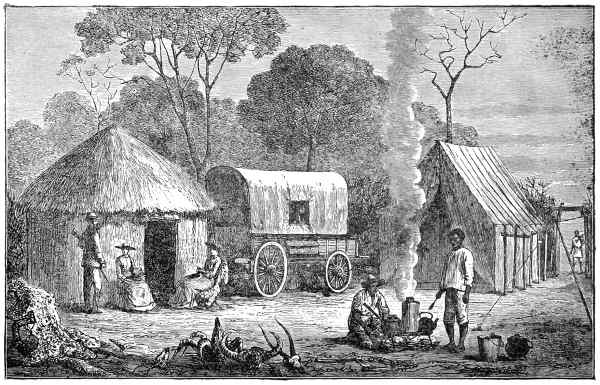 INTERIOR OF THE COILLARD CAMP.
On the south side of the Zambesi and north of latitude 24°, Africa is
divided from sea to sea into three distinct races. On the east are
the Vatuas; between are the Matebelis, or Zulus; westward are the
Bamanguatos. They are all sworn enemies. The king of the latter, at
the time of Pinto’s visit was Khama, a Christian convert, educated by
the English, a civilized man of intelligence and superior good sense.
True, he usurped the throne, but he treated his family with leniency,
and became the idol of his people. Unlike every other native governor
in Africa, Khama was unselfish. He spent his wealth for his people, and
encouraged all to labor, that they might grow rich in herds and flocks.
And they were not only rich in cattle, but were fine agriculturists;
fond, too, of out-door sports, being experts in the hunting of game, as
the antelope, ostrich, giraffe, elephant, etc. Though a Portuguese and
influenced by the Latin church, Pinto gives this account of missionary
work in South Central Africa: “How is it that in the midst of so many
barbarous peoples there should be one so different from the others? It is
due, I firmly believe, to the English missionaries. If I do not hesitate
to aver that the labors of many missionaries, and especially of many
African missionaries, are sterile, or even worse, I am just as ready to
admit, from the evidence of my own senses, that others yield favorable,
or apparently favorable results.
“Man is but fallible, and it is easy to conceive that when far removed
from the social influences by which he has been surrounded from his
infancy, lost, so to speak, amid the ignorant peoples of Africa, and
inhabiting an inhospitable clime, his mind should undergo a remarkable
change. This must be the general rule, which has, of course, its
exceptions. The exceptions are the men who rest their faith on those
‘blossoms of the soul’ which give comfort to the wrecked mariner and aid
the monk to suffer martyrdom at the hands of those to whom he brings the
blessings
of civilization. They who possess these inestimable treasures
may, if left to themselves, pursue their way and attain to a sublime
end, but such are veritable exceptions. Flesh is weak, and weaker still
is human spirit. Were it otherwise, we might dispense with laws and
governments, and society would be organized on a different basis. The
‘blossoms of the soul’ would suffice to govern the world.
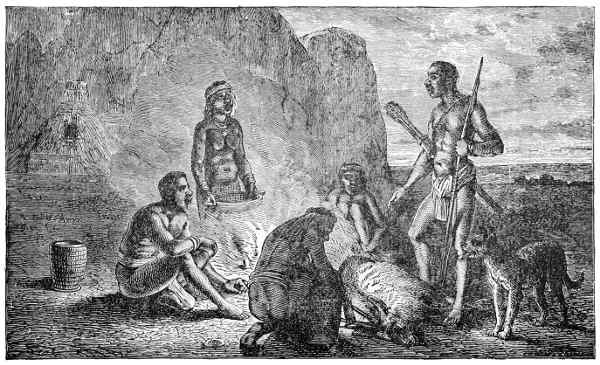 AT HOME AFTER THE HUNT.
“The passions to which man is subject will often lead the missionary—but
a man and with all a man’s weakness—to pursue a wrong course. The strife
between Catholics and Protestants in the African missions is an example
of this. The Protestant missionaries (I mean, of course, the bad ones)
say to the negro. ‘The Catholic missionary is so poor he cannot even
afford to buy a wife,’ and thus seek to injure him, for it is as great a
crime to be poor in Africa as in Europe. On the other hand the Catholics
leave no stone unturned to throw discredit on the Protestants. From this
strife springs revolt, the real cause of mission barrenness, where so
many beliefs are struggling for mastery. To the south of the tropics the
country swarms with missionaries, and to the south of the tropics England
is engaged in perpetual war with the native populations. It is because
the evil labors of many undo the good labors of some.
“Let us however, put aside the evil ones and speak only of the good. I
have spoken of King Khama and his Bamanguato people. The king’s work
was well done, but those who made it possible deserve more credit. The
first workman in that field was Rev. Mr. Price, recently charged with the
mission at Ujiji on Lake Tanganyika. The second was Rev. Mr. Mackenzie,
the Kuruman missionary. The third was the Rev. Mr. Eburn, now among these
people. It is with the utmost pleasure I cite these worthy names, and put
them forward as noble examples to all workers in the fields of African
civilization.”
The above named Rev. Mr. Mackenzie took charge of the Kuruman mission
in the Crown Colony of Bechuanaland in 1876, and his first work was to
found and build a memorial institution to his predecessor, the lamented
Dr. Moffat, for the education of native ministers. A fund of $100,000
was subscribed in England for
this
purpose and soon a substantial set
of structures arose as a witness to Dr. Wm. Mackenzie’s zeal and the
profound respect in which Dr. Moffat was held.
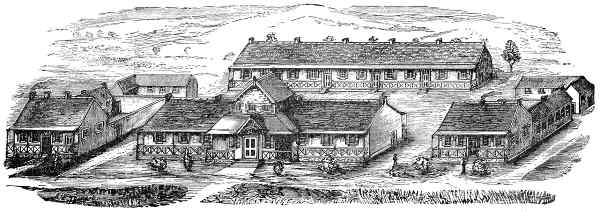 MOFFAT INSTITUTION—KURUMAN.
Says the Rev. A. Boegner: “Basutoland has frequently been saved from the
destruction of its nationality by the intervention of the missionaries,
and the natives blessed their name. The result in respect to education
is that we have 80 elementary schools, having together 4,666 pupils,
besides the normal school and the higher girls’ school, with 30 or 40
pupils, and 15 industrial, biblical, and theological school stations, 94
out-stations, 19 missionaries, 176 native workers, 6,029 communicants and
3,412 catechumens.”
In Bechuanaland many of the tribes, especially the Batlapins and the
Baralongs, have for several years past been favored with the means of
religious instruction by the agents of the London and Wesleyan Missionary
Societies. It was among these people that the celebrated Dr. Moffat
achieved his greatest success, and it was into their language that he
succeeded in translating the Scriptures. And it was from a station among
them that Dr. Livingstone started on his first adventurous journey of
discovery. Thousands of these people have been to a considerable extent
civilized, evangelized, and many have been taught to read the word of
God for themselves. The earliest attempt to carry the Gospel to the
Bechuanas was made in 1800 by Messrs. Edwards and Kok, agents of the
Dutch Missionary Society in Cape Town. It proved unsuccessful. They were
succeeded by the travellers Lichenstein in 1805, and Burchell in 1812,
and during the latter year by the well-known Rev. John Campbell, who may
be regarded as the earliest pioneer missionary to the Bechuanas, the two
agents of the Cape Town Society being known among the Batlapins rather
as traders than missionaries. In accordance with a request made to Mr.
Campbell by the chief Mothibi, who said, “Send missionaries, I will
be a father to them,” the London Missionary Society appointed Messrs.
Evans and Hamilton to Lallakoo, which they reached in 1816. Their hopes
of a welcome were, however, doomed to disappointment. The Bechuanas,
with Mothibi’s, consent, reyoked the wagons of the missionaries and
sent them away, hooting after them in genuine heathen fashion. They did
not want “the teaching,” fearing it would be with
them
as with the
people of Griqua Town, “who” they said “once wore a ‘kaross’ but now
wear clothes; once had two wives but now only one.” Mr. Robert Moffat
made the next attempt to introduce the Gospel among these people and
was more successful. We have not space to give even an outline of the
career of this wonderful man. One illustration, however, will suffice to
show at once his character and that of the people among whom he labored
so long and well. During a time of severe drought when the heavens were
as brass and the earth as iron, the cattle were dying rapidly, and the
emaciated people were living on roots and reptiles. The rainmakers were
consulted. They attributed the cause of the drought to the prayers of the
missionaries, and to the bell of the chapel, which they said frightened
the clouds! The chief soon appeared at the missionaries’ door, spear in
hand, with twelve attendants, and ordered them to leave the country,
threatening violent measures if they refused. Mrs. Moffat stood at
her cottage door with a baby in her arms watching the result at this
crisis. Looking the chief straight in the face, Moffat calmly replied:
“We were unwilling to leave you. We are now resolved to stay at our
post. As for your threats we pity you; for you know not what you do. But
although we have suffered much, we do not consider that it amounts to
persecution, and are prepared to expect it from those who know no better.
If resolved to get rid of us you must take stronger measures to succeed,
for our hearts are with you. You may shed my blood, or you may burn our
dwelling; but I know you will not touch my wife and children. As for me,
my decision is made. I do not leave your country.” Then throwing open
his coat, he stood erect and fearless. “Now then,” he proceeded, “if
you will, drive your spears to my heart; and when you have slain me, my
companions will know that the hour is come for them to depart.” Turning
to his attendants the chief said, “These men must have ten lives. When
they are so fearless of death, there must be something of immortality.”
All danger was now past. The intrepid missionary had got access to their
hearts, and they were, for the time at least, subdued.
The country long known as Griqualand is situated beyond the Orange river,
and around its junction with the Vaal.
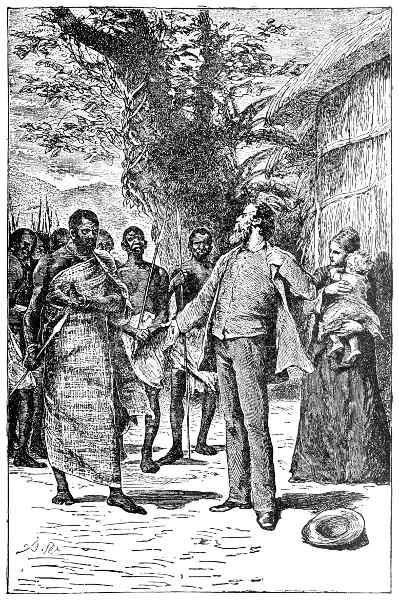 MOFFAT’S COURAGE.
The Griquas are a mixed race, of which there are several clans vulgarly
called “Bastards,” being the descendants of Dutch Boers and their
Hottentot slaves. They are a tall, athletic, good looking race, of light
olive complexion. They speak a debased patois of the Dutch language, as
do most of the colored inhabitants of South Africa. About the year 1833
the Griquas began to collect and settle in the country which bears their
name, and to rally round a leader or chief named Adam Kok, who displayed
considerable tact and skill in governing the people who acknowledged his
chieftainship. Some time after, a part of the clan separated themselves
from the rest, and gathered round a man named Waterboer, who became
their captain or chief. Both of these chiefs, for many years, received
annual grants from the Colonial Government on condition of their loyalty
and good conduct. They and their people were ultimately removed by an
arrangement with the government authorities to a region known as “No
Man’s Land;” and of late years have become scattered. In all their
locations they are generally now regarded as British subjects, and
they have gradually advanced to a pleasing state of civilization and
general knowledge. They are largely indebted to the missionaries for
the respectable position to which they have attained among the native
tribes. The honored instruments in their moral and social elevation have
chiefly been the agents of the London Missionary Society who have labored
among them for many years with remarkable energy, zeal and success. The
Wesleyan Missionary Society have also some prosperous stations in some
of the Griqua settlements where no other agencies are at work, and the
results of their labors have been very encouraging.
In Namaqualand, under circumstances of peculiar trial and privation
the Wesleyan and Rhenish Societies have labored with commendable zeal
and diligence. Some time ago the Wesleyan stations were by a mutual
arrangement transferred to the German missionaries.
In Damaraland missionaries have labored earnestly for many years, but the
results thus far have been meagre.
What has been the sum total accomplished by the missionary societies in
South Africa?
The Wesleyan Missionary Society began work there in
1814.
Extending its
operations by degrees from the Cape Colony to Kaffaria, Natal, and the
Bechuana regions, it now numbers forty stations, sixty missionaries, and
more than 6,000 members. The Rhenish Society which commenced operations
in this field in 1829, now numbers more than 10,000 members; and the
Berlin, which commenced in 1833 and has 8,000 members. The American
Board which entered the field in 1834, has grown into three missions,
the Zulu, the East African and the West African, and now numbers 30
stations, 48 laborers from America, more than 40 native assistants, about
2,000 under instruction and 7,000 adherents. Besides these the French
Society is doing a great work among the Bechuana and other tribes. The
Norwegians are laboring among the Zulus, the Scotch among the Kafirs, the
Hanoverians and the Church of England in Natal and Zululand.
These with a few other organizations make more than a dozen societies at
work in South Africa, occupying more than 200 stations, and employing
about 500 foreign laborers, besides a much larger force of native
helpers. Of the success and value of these labors we get some idea when
we find it estimated that not less than 40,000 souls have been brought in
this way into Christ’s kingdom, 50,000 children gathered into Christian
schools, and 100,000 men and women blessed with the direct teaching of
the Gospel.
EAST AFRICAN MISSIONS.
Leaving South Africa we will now consider briefly what has been done
by the missionaries in Eastern Africa and that part of Central Africa
reached by way of the east coast. Here there seemed to be less opposition
to the entrance of the Gospel than in some other parts of Africa.
Dominant superstitions do not stand so much in the way of its reception.
There is less idolatry or fetish worship, such as is found on the western
coast, and there are fewer barbarous or unnatural rites. The greatest
hindrance has been the Arab slave trade, which, driven from the west
coast had established itself on the east coast. The unwise course of the
Germans who established a commercial enterprise there in 1889 has led to
Arab
hostilities
that appear disastrous in the extreme to missionary
work for the present, especially among the Ugandas.
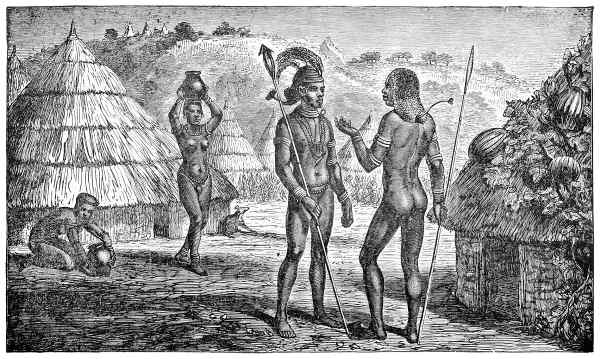 LARI AND MADI NATIVES.
There are very extensive missionary interests in East Africa. No less
than thirteen societies are at work on the coast or in the interior. It
will be more convenient, in considering what has been accomplished, to
note the work done by each society separately, rather than to follow our
usual order of treatment by tribe or locality.
As the Church Missionary Society was first in the field we will notice
its efforts first.
The first missionary was Dr. Krapff, a zealous and devoted German. He
had previously labored for several years among the Lari and Madi natives
of the province of Shoa, and when the Abyssinian government prohibited
his longer residence there he removed to Mombasa, where he laid the
foundation of a new station under promising circumstances. When the way
appeared to open up for usefulness among the Gallas and other important
tribes, Dr. Krapff was joined by four additional laborers who were sent
out by the society to aid him in his work. Their headquarters were at
Kisulidini and the mission had every promise of success. But death soon
thinned the ranks and disappointed many hopes. Only one of the missionary
band, Mr. Rebmann, had strength to hold out against the climate. He
remained at his solitary post of duty several years after the Doctor
had been obliged to embark for Europe; but in 1856 he was driven by the
hostile incursions of savage native tribes to take refuge in the island
of Mombasa, and for two years the mission on the mainland seemed to be at
an end. Mr. Rebmann resolved not to lose sight of its ruins, however, and
employed his waiting time in preparing a translation of the Bible into
the language of the people among whom he labored. At length the desire
of the lonely missionary was gratified by a cordial invitation to return
to Kisulidini, and the hearty welcome he received on going there proved
that there was further work for him to do among this people. For years
he labored single-handed among this people and managed to keep alive the
spark of light which Dr. Krapff had been the means of kindling. After
long and patient waiting relief came. The deep interest called forth by
Dr.
Livingstone’s last despatches and death, stirred up the church at
home to fresh efforts on behalf of the African race, and a much needed
reinforcement was sent out to strengthen the mission on the eastern
coast, including Mr. Price and Jacob Wainwright, Livingstone’s faithful
negro servant. When they arrived at Kisulidini they found Mr. Rebmann
aged and feeble, and almost blind, but still the centre of a little
band of native converts at the old mission premises. This mission now
comprises eight stations with Mombasa as its base. The constituency at
these stations is composed chiefly of liberated slaves, who are rescued
by British cruisers from slave dhows and handed over to the mission, now
living in comfort as free men, cultivating their own little plots of
ground, building their own little huts on the society’s land, enjoying
the rest of the Lord’s day, seeing their children taught to read and
write like the white man, and having access at all times for counsel and
guidance to patient and sympathizing Englishmen.
Recently, their former masters combined and threatened to destroy the
stations if their slaves were not given up. How this catastrophy was
averted by the tact and generosity of Mr. Mackenzie the following will
tell: “At Mombasa, Frere Town and Rabai, on the east coast of Africa, the
English Church Missionary Society has for some time been carrying on a
work similar to that which has been so greatly blessed at Sierra Leone
and other places on the west coast. The natives who have been rescued
from the Arab slave vessels by the British cruisers have been taken to
the first-named towns, where they have been cared for and instructed by
the missionaries of the society, and a large number of them have become
new creatures in Christ Jesus, and are now diligent in tilling the soil
or in following other industrial pursuits.
“For several years fugitive slaves from the adjoining country have sought
refuge at the mission stations from the oppressions of their Mohammedan
masters. Every effort has been made by the missions to prevent mere
runaways from settling around the stations; but it has lately been found
that many who came and placed themselves under Christian teaching, and
who were supposed to be free natives, were really fugitive slaves. Many
of them have
embraced
Christianity, been baptized, and are leading
‘quiet and peaceable lives in all godliness and honesty.’
“Suddenly the former Mohammedan masters of the fugitives combined and
threatened destruction to the missions unless they were given up again
to slavery. It has been a time of great anxiety to the missionaries,
and in this crisis they could only commit all to the Lord. Happily the
danger has been averted by the wise and timely action of Mr. Mackenzie,
the chief agent of the new Imperial British East Africa Company, whose
headquarters are at Mombasa. Mr. Mackenzie saw that if the régime
of this politico-commercial company began with the restoration of a
thousand escaped slaves to the slave owners, its influence would be
seriously injured. He has, therefore, undertaken to compensate the
Arab slave-owners, on condition that the whole of this fugitive slave
population, a large portion of which is Christian, are declared free
forever. This arrangement has delighted all parties. A grand feast has
been given by the Mohammedans to Mr. Mackenzie, while the slaves are set
free and the missions are saved.”
This society had also a line of stations stretching from Zanzibar to
Uganda. They were nine in number, beginning with Mambola and Mpwapwa,
nearly due west from Zanzibar, and including Usambiro, Msalala and Nasa,
south of Victoria Nyanza, and Rubaga, in Uganda, north of the great lake.
The origin of the mission in Uganda was on this wise: “When Stanley went
away from Uganda, Mtesa, the king, said to him, ‘Stamee, say to the white
people, when you write to them, that I am like a man sitting in darkness,
or born blind, and that all I ask is that I may be taught how to see,
then I shall continue a Christian while I live.’ Mtesa’s appeal, through
Stanley, to English Christians, had its response. The Church Missionary
Society sent several missionaries, who were heartily welcomed by Mtesa,
and protected as long as he lived.”
As public attention has recently, and for different reasons, been very
generally directed to Uganda, it may not be amiss to give a more detailed
account of the situation and prospects there.
Near the shores of those majestic lakes—Albert and Victoria
Nyanza—which give rise to the Nile, are large tribes, akin to one
another in speech and habit, and quite advanced in civilization,
as
things go in Africa. They are the Baganda, Luganda and Uganda, all of
which have been visited and described by Stanley and other well-known
travellers. Of these, the Uganda are the most numerous and advanced. This
region was for a long time looked upon as a fair field for missionary
enterprise, irrespective of the fact that it had been an old and favorite
stamping ground for Arab traders and slave dealers, whose influence would
naturally be against Christian intervention. But in 1876, missionaries
went out from England, and founded several missions, mostly in the Uganda
country. They proved to be prosperous, and fast became the centres of
Christian communities, whose influence was felt from one lake to the
other. But after over ten years of prosperity, a civil war broke out,
instigated by the Arabs, which resulted in the enthronement of Mwanga,
who was hostile to the missionaries and their Christian converts. He
signalized the first year of his reign by the murder of Bishop Hannington
and the massacre of many of his Christian subjects. By 1889, all but one
of this missionary band had perished either through disease or royal
cruelty, and their converts were forced to become refugees. The survivor,
Mr. Mackay, after being held as a hostage for months, was finally
released, and made his escape to Usambiro, where he took up work with the
hope that at no distant day he might be able to extend it back into the
abandoned lake regions.
In his “Emin Pasha in Central Africa,” Mr. R. W. Felkin thus sketches the
character of the two great Uganda kings, Mtesa and Mwanga:
“Mtesa was first heard of in Europe from Speke and Grant, who visited
Uganda in 1862. He professed to trace back his descent to Kintu (or Ham)
the founder of the dynasty. When I visited him in 1879 he was about
45 years of age, a splendid man, some six feet high, well formed and
strongly built. He had an oval face, and his features were well cut.
“He had large, mild eyes, but if roused by anger or mirth they were lit
up by a dangerous fire. He had lost the pure Mhuma features through
admixture of Negro blood, but still retained sufficient characteristics
of that tribe to prevent all doubt as to his origin. All his movements
were very graceful; his hands
were
slender, well formed, and supple;
he was generally dressed in a simple white Arab kaftan. It is somewhat
difficult to describe his character; he was intensely proud, very
egotistical, and, until near the end of his life, he thought himself to
be the greatest king on earth. In his youth, and in fact until 1878,
there is no doubt that he was cruel, but an illness from which he
suffered certainly softened him.
“His chiefs often said to me, ‘Oh, if Mtesa were well, there would be
plenty of executions.’ It has been said that he was extremely changeable
and fickle, and to superficial observers he was so; that is to say, as
far as his intercourse with Europeans went. If, however, one looks a
little deeper into his character, he finds that his apparent vacillation
was overruled by a fixed idea, which was to benefit his people, increase
his own importance, and to get as much as possible out of the strangers
who visited his court. This explains his being one day a friend to the
Arabs, on another to the Protestants, and on a third to the Catholics. A
newcomer, especially if he had a large caravan, was always the favorite
of the hour. It is not difficult for any one to enter Uganda, but to
get away again is no easy task, unless he is going for a fresh supply
of goods. Mtesa liked Europeans and Arabs to be present at his court;
it gave him prestige, and he also wished his people to learn as much as
they could from the white men, for he well knew and appreciated their
superior knowledge. In manners he was courteous and gentlemanly, and he
could order any one off to execution with a smile on his countenance. His
mental capacity was of a very high order. He was shrewd and intelligent;
he could read and write Arabic, and could speak several native languages.
He had a splendid memory, and enjoyed a good argument very keenly. If he
could only get Protestants, Catholics and Arabs to join in a discussion
before him, he was in his element, and although apparently siding with
one or other, who might happen to be at the time his especial favor, he
took care to maintain his own ground, and I do not believe that he ever
really gave up the least bit of belief in his old Pagan ideas. While too
shrewd and intelligent to believe in the grosser superstitions which find
credit among his people, he was yet so superstitious that if he dreamt
of any of the gods of
his
country he believed it to be an ill omen, and
offered human sacrifices to appease the anger of the offended deity.
Shortly after I left Uganda, he dreamt of his father, and in consequence
had 500 people put to death. He also believed that if he dreamt of
any living person it was a sign that they meditated treachery, and he
condemned them forthwith to death. This supposed power of divination is
said to be hereditary in the royal race. In concluding my remarks about
Mtesa, I may say that he denied his Wahuma origin; not only, however, did
his features betray him, but many of the traditions he held regarding
his ancestors, especially his descent from Ham, point conclusively to an
origin in the old Christianity of Abyssinia.
“When I was in Uganda, Mtesa had 200 or 300 women always residing at his
court. He did not know exactly how many wives he had, but said that they
certainly numbered 700. He had seventy sons and eighty-eight daughters.
“Mwanga is the present king of Uganda, having been chosen by the three
hereditary chiefs at the death of his father, Mtesa, and it is certainly
to be attributed to the influence of the missionaries in Uganda, that the
usual bloodshed which attends the succession to the throne in Uganda,
did not take place. On ascending the throne he was about 16 years of
age, and up to that time had been a simple, harmless youth, but his high
position soon turned his head, and he became suspicious, abominably cruel
and really brutal. He began to drink and to smoke bang, and up to the
present time his rule has been characterized by tyranny and bloodshed,
far surpassing anything that happened in his father’s time. Nor does he
appear to possess those good characteristics which certainly caused his
father to deserve some respect. A number of Christians, Protestants and
Catholics have been tortured and burned at the stake by his orders, and
Bishop Hannington was murdered by his command at Lubwa, on the borders of
Uganda.”
A writer in the N. Y. Evangelist observes further:
“Of course, Mwanga was a coward as well as a cruel and bloodstained
despot. Because he made Uganda impenetrable, no direct news from Wadelai
about the movements of Stanley or Emin Pasha could reach Zanzibar. Very
naturally he was obliged to
face
an insurrection. To save his worthless
life he fled from his kingdom, and his older brother, Kiwewa, succeeded
him. Because under his rule the missionaries were again in favor, Kiwewa
was soon forced to abdicate before an insurrection incited by the Arabs,
whom the policy of his brother had brought into the kingdom, and in
which such of his own subjects who opposed the missionaries cheerfully
participated. While about a score of missionaries escaped unharmed,
all missionary property was destroyed, many native missionaries were
murdered, the Arabs became dominant in Uganda, and the kingdom, it
may be for several years, is closed against Christianity. The living
missionaries have quite recently been ransomed.
“What is to be the influence of this new Arab kingdom in Central Africa?
This, with many, is a pressing question. In answering it we must remember
that these so-called Arabs really have in their veins no Arab blood. They
are coast Arabs of the lowest classes, and the proud and strong Uganda
chiefs will not submit for any considerable length of time to the rule
of any such men. They may use such men; they will never become their
slaves. The country is more likely to be broken up into hostile sections.
These may wear themselves out in wars against each other, and thus may be
realized the hope that the British East African Company, from their new
territory between Victoria Nyanza and the coast, would push its influence
and its operations over Uganda, and the whole lake region of Central
Africa. These Arab slave-traders are certainly not the men to construct
or reconstruct an empire. Those who know them best see no prospect that
they will be able by intrigue, which is their only agency, to sustain
themselves in Uganda.
“The character and habits of the Uganda people seem to forbid their
enslavement. They are the only people in Central Africa that clothe
themselves from head to foot. Besides their own ingenious utensils for
housekeeping, the chase and war, thousands of European weapons and
implements are found in their possession, and being ready workers in
iron, they immediately imitate what they import. They are apt linguists,
and their children have rapidly acquired the French and English languages
from the missionaries. They have neither idols nor fetishes. They have
no
affiliations
with Mohammedanism, and are not likely to become its
subjects for any considerable time. There is still good reason to hope
for a better future for Uganda.”
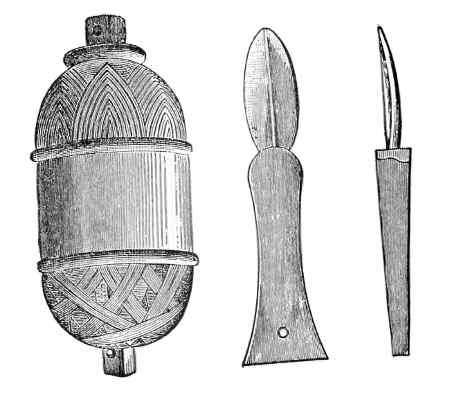 TINDER-BOX, FLINT AND STEEL.
The London Missionary Society has ever been forward to enter new fields
of labor. On Livingstone’s return to England, after his great journey
across the continent of Africa in 1856, he urged this society, in whose
service he had previously been engaged, to establish a mission on the
banks of the Zambesi, with a tribe of natives known as the Makololo,
with the view of reaching other tribes in the interior through them. A
mission was organized accordingly, which was to start from the Cape of
Good Hope direct for the interior. This journey was to be made in the
usual South African style, namely, in wagons drawn by long teams of oxen.
Livingstone himself went round by the eastern coast, purposing to meet
the missionaries in the valley of the Zambesi, and to introduce them
to the chiefs with whom he was personally acquainted. The missionaries
selected for this purpose were Revs. Helmore and Price, the first of whom
was a middle-aged minister, with a wife and
family,
and had labored in
South Africa for several years previously, whilst Mr. Price was a young
man recently married, and was entering upon mission work for the first
time. The incidents of the journey, as well as the issue of this mission
were the most afflictive and distressing. The mission wagons had scarcely
passed the boundary of the Cape Colony when water and grass for the oxen
became scarce, and their progress was accordingly slow and dreary. Many
of their oxen died and their places were supplied with difficulty by
cattle purchased from the natives. When they came to cross the outskirts
of the desert of Kalahara their sufferings were terrible. They at length
reached the valley of the Zambesi where they had an ample supply of grass
and water; but they soon found themselves in a low, swampy, unhealthy
country, and when they reached their destination in the Makololo country,
they did not meet with the cordial reception from the chief and his
people which they expected. Dr. Livingstone, who was engaged in exploring
the lower branches of the Zambesi was moreover unable to meet them as he
intended. They naturally became discouraged; and before they got anything
done of consequence in the way of teaching the people, the chief still
withholding his consent to their movements, the country fever broke
out among them with fearful violence. Mr. Helmore’s four children, who
suffered so much from thirst in the desert, were smitten down one after
another and died. They were buried but a short time when graves were made
beside them for both their parents. Mr. and Mrs. Price began to think of
retracing their steps to the Cape Colony, and at length with heavy hearts
they yoked the oxen to the wagons and started toward civilization. But in
crossing the desert Mrs. Price also died, so that Mr. Price was left to
return alone.
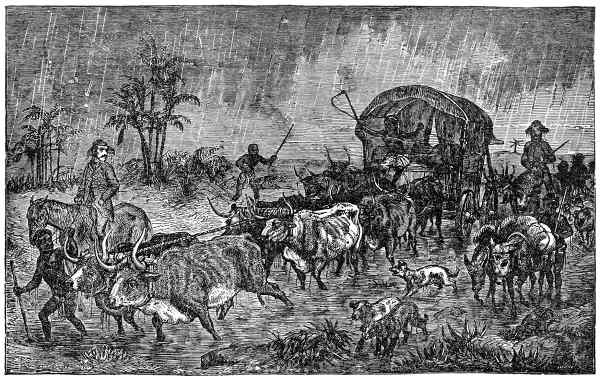 BOUND FOR THE INTERIOR DURING THE RAINY SEASON.
In 1877 in response to an application made by the son and successor of
the chief in Makololo, the Rev. J. D. Hepburn, of Shoshong, and outpost
of the Bechuana mission, commenced a mission on Lake Ngami, two native
evangelists who had completed their studies at Kuruman were settled there
and are doing good work.
The London Society goes further west than any of the other societies
and plants two stations on Lake Tanganyika, and one
at
Urambo in the
Unyamwezi, south of the Victoria Nyanza and near the stations of the
Church Missionary Society.
The Universities’ Mission has twelve stations, one in Zanzibar, four in
the Usambara country north of Zanzibar, four on or near the river Rovuma
and three on the east shore of Lake Nyassa.
The mission of the Free Church of Scotland on the shores of Lake Nyassa
was founded in 1861 by Rev. Dr. James Stewart. Reinforcements were sent
out in 1875. They took with them the steam launch Llala to be used upon
the waters of Lake Nyassa. In 1876 Dr. Wm. Black, an ordained medical
missionary, an agriculturist, an engineer, and a weaver, joined them. In
1879 Miss Watterston joined the staff, as female medical missionary and
superintendent of the girls’ boarding and training school. In 1880 they
met with a great loss in the death of their agriculturist, John Gunn, who
had proved himself helpful in every department of work.
The Free Church of Scotland has recently opened a new mission at Malinda,
on the high plain north of Lake Nyassa. The station is surrounded by
seventeen villages, embosomed in gardens of magnificent bananas. At
Karonga two services are held every Sabbath, and the congregation numbers
600 natives. Dr. Cross attempted to push his work into the highlands,
but was driven back, and compelled to rely on Capt. Lugard’s armed force
of 150 natives. These aggressive movements against the missions in
Nyassaland, as elsewhere, are attributable to Arab slave traders, who are
the worst enemies Christianity has to contend with in Africa. They now
have five stations on Lake Nyassa.
The Established Church of Scotland Mission was founded in 1875 by
Mr. Henry Henderson. The staff comprised a medical missionary, an
agriculturist, a blacksmith, a carpenter, a joiner and a seaman and
boatbuilder. To Mr. Henderson belongs the credit of having selected an
incomparable site. It was originally intended that the mission should be
planted in the neighborhood of Lake Nyassa; but he found a more suitable
locality in the highlands above the Shiré, east of the cataracts, and
midway between Magomero and Mount Soché. The ground rises from the river
in a succession of terraces. It is about 3,000 feet above the sea, and
extends from twelve to fifteen miles in breadth. Gushing
springs
and
flowing streams abound. The scenery is beautiful and picturesque. The
soil is fertile. There is abundance of good timber and iron ore. The
chiefs are friendly and the people are willing to receive instruction.
And, what is an essential requisite, the climate is in a high degree
salubrious. In the words of Livingstone, “it needs no quinine.”
The settlement, which is named Blantyre, after Livingstone’s birth-place,
was planned and laid out under the superintendence of Dr. Stewart and Mr.
James Stewart. On the farm and gardens surrounding, over 500 natives of
both sexes are employed. Mr. Henderson having returned, on the completion
of the special work for which he was appointed, Rev. Duff Macdonald and
wife were sent out in 1878. They were soon after recalled on account
of difficulties arising from the mission’s claim to exercise civil
jurisdiction over the settlement. Rev. David Clement Scott was appointed
to take their place.
One of the most important works in connection with Livingstonia, the
name of the Free Church of Scotland’s Mission, and Blantyre Mission, was
the formation of a road, projected by Dr. Stewart and surveyed by Mr.
J. Stewart. It varies from six to ten feet in width, and extends from
the Upper Shiré, at the head of the cataracts, for a distance of about
thirty-five miles to Blantyre, and thence for nearly an equal distance
through a steep and rugged country to Ramakukan’s, at the foot of the
cataract. Facilities are thus afforded for communication with the coast.
The expense of its construction was borne equally by the two missions. A
traveller who has frequently visited this region writes as follows:
“The outlet for the waters of Lake Nyassa is the river Shiré which
flows into the Zambesi. Except for a short distance in one part, this
river is navigable throughout its course; and at about sixty or seventy
miles after it leaves the lake it takes a bend westward, and here below
Matope, a station of the African Lakes Company, it becomes unnavigable
by reason of the Murchison Cataracts. Below these is another station of
the African Lakes Company at Katunga’s, and from here there is no further
difficulty in navigating the river. All goods, therefore, and passengers
bound for Nyassa, are landed from the African Lakes Company’s steamer
at
Katunga’s, and after a journey of some seventy miles across a ridge of
high ground are put on the river again at Matope. About half-way between
Katunga’s and Matope is the African Lakes Company’s store and settlement
at Mandala, and little more than a mile from it the flourishing mission
village of Blantyre of the Established Church of Scotland. It is
wonderful to see this village, with its gardens, schools, and houses, in
the midst of Africa. The writer has twice, within the last three years,
when visiting Nyassa, experienced the generous hospitality of Mandala
and Blantyre, and so can speak from his own personal observation. Being
situated on such high ground, the climate is much more favorable to
Europeans than at most mission stations in that region. It is easier
also, for the same reason, to grow fruits and vegetables imported from
Europe. It is difficult to overestimate the effect of such a settlement
as a civilizing agency in the country. Mr. Hetherwick, who was in charge
of the station for some time in Mr. Scott’s absence, has mastered the
language of the great Yao tribe, and has lately published a translation
of St. Matthew’s Gospel, which shows a wonderful grasp of the genius of
the language. Mr. Hetherwick has now returned to his mission station,
some fifty miles to the northeast, under Mount Zomba. Mr. Scott is
said to be equally a master of Chinyanja, the language of the Nyassa
tribes. The English government have recognized the important influence
these settlements are likely to have by appointing a consul on Nyassa,
who has lately built a house close to the flourishing coffee and sugar
plantations of Mr. Buchanan under Mount Zomba, about forty miles from
Blantyre, and near Lake Kilwa or Shirwa. Mr. Buchanan is also a good
Yao scholar, and takes care to teach the people, who come to him in
considerable numbers for employment. Situated high up on the slope of
Mount Zomba, which rises precipitously above it, the streams which rush
down from its summit are diverted and distributed so as to form a system
of irrigation. Mr. Buchanan’s plantation is a picture of beauty and
prosperity, and offers every prospect of health and permanence.
“When we come to Lake Nyassa, we find missions established on each
side of the lake. On the west side are the stations at Cape Maclear
and Bandawe, while connected with the latter are
sub-stations,
among
which is an important mission to the Angoni, a marauding tribe of Zulu
origin. Dr. Laws, at Bandawe, has been a long time in the country, and
has thoroughly won the confidence of the people. On one occasion, when
the writer visited him, some five or six hundred people assembled in
his schools, in which large numbers of children are taught daily. The
Universities’ Missions are on the east side of the lake.”
The United Methodist Free Churches in 1863 began a mission at Ribé,
about eighteen miles north of Mombasa. The ministers selected for this
service were the Revs. New and Wakefield. For several years they were
engaged in preparatory work, erecting buildings, cultivating garden
grounds, exploring the country, learning the native language, preparing
translations, teaching school, and preaching as they had opportunity.
Their difficulties were numerous and their progress slow. The unhealthy
character of the climate here, as on the western coast, is the greatest
hindrance to the progress of the work. Rev. C. New fell a sacrifice to
its fatal influence in 1876, and Mrs. Wakefield died later, but others
have taken their places. They now have two stations in the Mombasa
District, Ribé and Joursee and one in Gallaland.
Several German societies are also represented in East Africa. The New
Kirchen Society has had since 1887 a station at Ngao, on the Tana in
the Suabali country, with two missionaries. The Evangelical Lutheran
Missionary Society of Bavaria has stations at Junba, and at Mbangu among
the Wakamba, six hours inland, with three missionaries. The Berlin
Society have stations at Zanzibar and Dar-es-Salam where one of the
massacres took place.
The Roman Catholics—French and German—have several stations in East
Africa. The French have three stations on or near Lake Victoria Nyanza,
the most important of which is the one in Uganda under Pere Lourdel; two
at Lake Tanganyika; one at Bagamoya, west of Zanzibar, and one or two
others. The Jesuits have also a few stations, and the German Catholics
have one at Dar-es-Salam. These are all the societies at work in East
Africa. As we look at their achievements, to human ken they do not appear
commensurate with what they have cost. We do not mean of course in money,
though that has been great, one society
alone
having spent $500,000,
but in the sacrifice of human health and human lives. Four bishops,
Mackenzie, Steere, Hannington, Parker, and a great army of missionaries,
some of them nobly and highly-gifted men, have given up their lives for
East Africa. We can but reverence the heroism which has led them forth
to die in a strange land. The apparent results are meagre and even some
of these seem likely to be destroyed; but we dare not say their lives
have been needlessly wasted. In human warfare when a fortress has to be
stormed, does the knowledge of the fact that many of the flower of his
army will perish in the attempt, cause the general to hesitate? Do the
soldiers refuse to obey the command, because the undertaking is fraught
with danger? Were they to do so they would be branded as cowards. East
Africa is a part of the world and Christ’s command surely includes the
taking of such almost impregnable fortresses as frown upon his soldiers
in that dark region. Then, too, the time has been short; great results
may follow in the future the work that has already been done.
We have not written anything concerning missionary work in the Soudan
simply because nothing has been done in that vast region. Dr. Guinness
says of it: “The Soudan is the true home of the negro, a vaster region
than the Congo, which is 4,000 miles across, with its twelve nations,
and not a mission station. It is the last region of any magnitude
unpenetrated by the Gospel.” Through Dr. Guinness’ influence a number
of the most active workers in the Y. M. C. A., in Kansas, Nebraska and
Minnesota have decided to be pioneers in this densely populated part
of Africa. They propose to enter, by the way of Liberia and the Kong
mountains, the Soudan of the Niger and Lake Tchad, where are nearly
100,000,000 of people without a missionary. They mean to form a living
tie between that region and their associations and churches at home.
We have followed the footsteps of the missionaries over all the Dark
Continent only stopping to note the most important of their achievements.
Their sacrifices have been recorded and will not be forgotten. Though
their sufferings have been great, they have been of short duration, for
Africa seems to be the “short cut” to the skies.
We close our account of missionary work in Africa with the
following
from Mr. Grant: “The successes of the past, the openings of the present,
and the demand for the future, should awaken a redoubled devotion to
the blessed work. In no age of the world, in no history of continents,
can anything be found so surprising as the discoveries and developments
made in Africa since the days of those pioneer missionaries, Schmidt and
Vanderkemp. It would take long to tell how her bays have been sounded
since their time, how her plains have been spanned, her mountains scaled,
her rivers threaded, lakes discovered, diamonds found, and a goodly
number of grand highways projected into even the remotest parts of that,
till of late little known, yet most marvelous land of the sun; and all
under the gracious ordering of the Lord, that men freighted with the
blessings of the Gospel of God’s own dear Son might enter and occupy.
Ethiopia, all Africa, is on tiptoe of expectancy, only waiting to know
who God is, that she may stretch out her hands to Him, and be lifted into
His truth and grace.”