| custom |
vicinity |
scarecrow |
murmur |
| uncouth |
adjacent |
appalling |
personage |
In a remote period of American history there lived
in Sleepy Hollow a worthy man whose name was Ichabod
Crane. He sojourned, or, as he expressed it,
“tarried” in that quiet little valley for the purpose of
instructing the children of the vicinity.
He was tall, but very lank, with narrow shoulders,
long arms and legs, hands that dangled a mile out of
his sleeves, and feet that might have served as shovels.
His head was small, with huge ears, large glassy eyes,
and a long snipe nose. To see him striding along the
crest of a hill on a windy day, with his ill-fitting clothes
fluttering about him, one might have mistaken him for
some scarecrow escaped from a cornfield.
His schoolhouse was a low building of one large room,
rudely built of logs. It stood in a rather lonely but
pleasant place, just at the foot of a woody hill, with a
brook running close by, and a birch tree growing near
one end of it. From this place of learning the low
murmur of children’s voices, conning over their lessons,
might be heard on a drowsy summer day like the hum
of a beehive. Now and then this was interrupted by
the stern voice of the master, or perhaps by the appalling
sound of a birch twig, as some loiterer was urged
along the flowery path of knowledge.
When school hours were over, the teacher forgot
that he was the master, and was even the companion
and playmate of the older boys; and on holiday afternoons
he liked to go home with some of the smaller ones
who happened to have pretty sisters, or mothers noted
for their skill in cooking.
Indeed, it was a wise thing for him to keep on good
terms with his pupils. He earned so little by teaching
school that he could scarcely have had enough to eat
had he not, according to country custom, boarded at
the houses of the children whom he instructed. With
these he lived, by turns, a week at a time, thus going
the rounds of the neighborhood, with all his worldly
goods tied up in a cotton handkerchief.
He had many ways of making himself both useful
and agreeable. He helped the farmers in the lighter
labors of their farms, raked the hay at harvest time,
mended the fences, took the horses to water, drove
the cows from pasture, and cut wood for the winter
fire. He found favor in the eyes of the mothers by
petting the children, particularly the youngest; and
he would often sit with a child on one knee and rock
a cradle with his foot for whole hours together.
He was looked upon as a kind of idle, gentlemanlike
personage of finer tastes and better manners than the
rough young men who had been brought up in the
country. He was always welcome at the tea table of
a farmhouse; and his presence was almost sure to bring
out an extra dish of cakes or sweetmeats, or the parade
of a silver teapot. He would walk with the young
ladies in the churchyard between services on Sundays,
gathering grapes for them from the wild vines that
overran the surrounding trees, or sauntering with a
whole bevy of them along the banks of the adjacent
mill pond; while the bashful country youngsters hung
sheepishly back and hated him for his fine manners.
One of his sources of pleasure was to pass long
winter evenings with the Dutch farmers, as they sat
by the fire with a long row of apples roasting and sputtering
along the hearth. He listened to their wondrous
tales of ghosts and goblins, and haunted fields, and
haunted brooks, and haunted bridges, and haunted
houses, and particularly of the headless horseman, or
“Galloping Hessian of the Hollow,” as they sometimes
called him. And then he would entertain them with
stories of witchcraft, and would frighten them with
woeful speculations about comets and shooting stars,
and by telling them that the world did really turn
round, and that they were half the time topsy-turvy.
There was pleasure in all this while snugly cuddling
in the chimney corner of a room that was lighted by the
ruddy glow from a crackling wood fire, and where no
ghost dared show its face; but it was a pleasure dearly
bought by the terrors which would beset him during
his walk homeward. How fearful were the shapes
and shadows that fell across his way in the dim and
ghastly glare of a snowy night! How often did he
shrink with curdling awe at the sound of his own steps
on the frosty crust beneath his feet, and dread to look
over his shoulder lest he should behold some uncouth
being tramping close behind him!
| autumnal |
urchins |
application |
cavalier |
| pensive |
pommel |
apparition |
genuine |
| horizon |
plumage |
luxurious |
gradually |
On a fine autumnal afternoon, Ichabod, in pensive
mood, sat enthroned on the lofty stool from whence he
watched the doings of his little school. In his hand he
held a ferule, that scepter of despotic power; the birch
of justice reposed on three nails behind the stool, a
constant terror to evil doers; while on the desk were
sundry contraband articles taken from idle urchins,
such as half-eaten apples, popguns, whirligigs, and fly
cages. His scholars were all busily intent upon their
books, or slyly whispering behind them with one eye
kept upon the master, and a kind of buzzing stillness
reigned throughout the schoolroom.
This stillness was suddenly interrupted by the appearance
of a negro, in tow-cloth jacket and trousers,
who, mounted on the back of a ragged, wild, half-broken
colt, came clattering up to the schoolhouse door.
He brought an invitation to Ichabod to attend a
merrymaking, or “quilting frolic,” to be held that
evening at the house of Herr Van Tassel; and having
delivered his message, he dashed over the brook, and
was seen scampering away up the hollow, full of the
importance and hurry of his mission.
All was now bustle and hubbub in the late quiet
schoolroom. The scholars were hurried through their
lessons. Those who were nimble skipped over half
without being noticed; and those who were slow were
hurried along by a smart application of the rod. Then
books were flung aside without being put away on the
shelves; inkstands were overturned, benches thrown
down, and the whole school was turned loose an hour
before the usual time, the children yelping and racketing
about the green, in joy at their early freedom.
The gallant Ichabod now spent at least an extra half
hour at his toilet, brushing and furbishing his best and
only suit of rusty black, and arranging his looks by a
bit of broken looking-glass that hung up in the schoolhouse.
That he might make his appearance at the
party in the true style of a cavalier, he borrowed a horse
from the farmer with whom he was boarding, and,
thus gallantly mounted, rode forth, like a knight-errant
in quest of adventures.
The animal he bestrode was a broken-down plow
horse. He was gaunt and shagged, with a slender neck,
and a head like a hammer. His mane and tail were
tangled and knotted with burs. One eye had lost its
pupil, and was glaring and spectral, but the other still
gleamed with genuine wickedness. He must have had
plenty of fire and mettle in his day, if we may judge
from his name, which was Gunpowder.
Ichabod was a rider suited for such a steed. He
rode with short stirrups, which brought his knees
nearly up to the pommel of the saddle; his elbows
stuck out like a grasshopper’s; and as the horse jogged
on, the motion of his arms was not unlike the flapping
of a pair of wings. A small wool hat rested on the top
of his nose, for so his scanty strip of forehead might
be called; and the skirts of his black coat fluttered out
almost to the horse’s tail. Such was the appearance
of Ichabod and his steed as they shambled along the
highway; and it was altogether such an apparition as
is seldom to be met with in broad daylight.
It was, as I have said, a fine autumnal day. The
sky was clear and serene. The forests had put on their
sober brown and yellow, while some trees of the tenderer
kind had been nipped by the frost into brilliant
dyes of orange, purple, and scarlet. Streaming files
of wild ducks began to make their appearance high in
the air. The bark of the squirrel might be heard from
the groves of beech and hickory, and the pensive
whistle of the quail at intervals from the neighboring
stubble fields.
The small birds fluttered, chirping and frolicking,
from bush to bush, and tree to tree, gay and happy
because of the plenty and variety around them.
There were the twittering blackbirds, flying in sable
clouds; and the golden-winged woodpecker, with his
crimson crest and splendid plumage; and the cedar
bird, with its red-tipped wings and yellow-tipped tail;
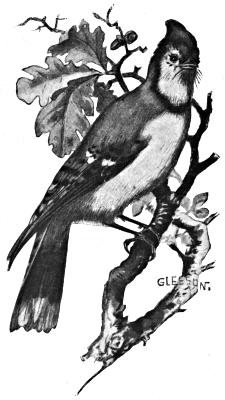
and the blue jay, in his gay, light-blue coat and white
underclothes, screaming and chattering, nodding and
bowing, and pretending to be on good terms with every
songster of the grove.
As Ichabod jogged slowly on his way, his eye ranged
with delight over the treasures of jolly autumn. On all
sides he beheld vast store of apples,—some still hanging
on the trees, some gathered into baskets and barrels
for the market, others heaped up in rich piles for the
cider press. Farther on he beheld great fields of Indian
corn, with its golden ears peeping from their leafy
coverts, and holding out the promise of cakes and hasty
pudding. There, too, were multitudes of yellow pumpkins
turning up their yellow sides to the sun, and giving
ample prospects of the most luxurious of pies.
And anon he passed the fragrant buckwheat fields,
breathing the odor of the beehive; and as he beheld
them, he dreamed of dainty slapjacks, well buttered,
and garnished with honey.
Thus feeding his mind with many sweet thoughts,
he journeyed along the sides of a range of hills which
look out upon some of the goodliest scenes of the
mighty Hudson. The sun gradually wheeled his broad
disk down into the west. A few amber clouds floated
in the sky, without a breath of air to move them. The
horizon was of a fine, golden tint, changing gradually
into a pure apple-green, and from that into the deep
blue of the midheaven. A slanting ray lingered on the
woody crests of the precipices that overhung some parts
of the river, giving greater depth to the dark gray and
purple of their rocky sides.
| adjacent |
innovations |
sumptuous |
piazza |
| antiquated |
animated |
skeleton |
specter |
It was toward evening when Ichabod arrived at the
castle of the Herr Van Tassel. He found it thronged
with the pride and flower of the adjacent country,—old
farmers, in homespun coats and breeches, blue
stockings, huge shoes, and magnificent pewter buckles;
their brisk little dames, in close-crimped caps and long-waisted
gowns, with scissors and pincushions, and gay
calico pockets hanging on the outside; young girls,
almost as antiquated as their mothers, excepting where
a straw hat, a fine ribbon, or perhaps a white frock
showed signs of city innovations; the sons, in short,
square-skirted coats with rows of huge brass buttons,
and their hair generally queued in the fashion of the
times.
What a world of charms burst upon the gaze of my
hero as he entered the state parlor of Van Tassel’s mansion—the
ample charms of a Dutch country tea table,
in the sumptuous time of autumn! Such heaped-up
platters of cakes, of various and indescribable kinds,
known only to experienced Dutch housewives!
There were doughnuts and crisp, crumbling crullers;
sweet cakes and short cakes, ginger cakes and honey
cakes, and the whole family of cakes; and then there
were apple pies, and peach pies, and pumpkin pies;
and slices of ham and smoked beef; and dishes of
preserved plums, and peaches, and pears, and quinces;
not to mention broiled shad and roasted chickens, together
with bowls of milk and cream; all mingled,
higgledy-piggledy, with the motherly teapot sending
up its clouds of vapor from the midst! I want breath
and time to describe this banquet as I ought, and am
too eager to get on with my story. Happily, Ichabod
Crane was not in so great a hurry, but did ample justice
to every dainty.
And now, supper being ended, the sound of music
from the common room summoned to the dance. The
musician was an old, gray-headed negro, who had been
the itinerant orchestra of the neighborhood for more
than half a century. His instrument was as old and
battered as himself. The greater part of the time he
scraped away on two or three strings, moving his
head with every movement of the bow, and stamping
his foot whenever a fresh couple were to start.
Ichabod prided himself on his dancing. Not a
limb, not a fiber about him was idle. How could the
flogger of urchins be otherwise than animated and
joyous? When the dance was over, Ichabod joined a
circle of the older folks, who, with Herr Van Tassel,
sat smoking at one end of the piazza, and told stories
of the war and wild and wonderful legends of ghosts
and other supernatural beings.
Some mention was made of a woman in white that
haunted the dark glen at Raven Rock, and was often
heard to shriek on wintry nights before a storm. The
chief part of the stories, however, turned upon the
favorite specter of Sleepy Hollow, the headless horseman,
who had been heard several times of late patrolling
the country. One man told how he had once met
the horseman and was obliged to get up behind him;
how they galloped over bush and brake, over hill and
swamp, until they reached the bridge by the church,
when the horseman suddenly turned into a skeleton,
threw him into the brook, and sprang away over the
tree tops with a clap of thunder.
A wild, roistering young man, who was called Brom
Bones, declared that the headless horseman was, after
all, no rider compared with himself. He said that returning
one night from the neighboring village of Sing
Sing, he had been overtaken by this midnight trooper;
that he had offered to race with him for a bowl of
punch, and would have won it, too, but just as they
came to the church bridge, the specter bolted and
vanished in a flash of fire.
| idea |
gnarled |
sensitive |
sociability |
| dismal |
covert |
gigantic |
desperation |
| inquiry |
violence |
opposite |
evidently |
The party now gradually broke up. The old farmers
gathered together their families in their wagons,
and were heard for some time rattling along the hollow
roads and over the distant hills. Their light-hearted
laughter, mingling with the clatter of hoofs,
echoed along the silent woodlands, growing fainter and
fainter till they gradually died away, and the late scene
of noise and frolic was all silent and deserted.
It was the very witching time of night that Ichabod
pursued his travel homeward. In the dead hush of
midnight he could hear the barking of a dog on the
opposite shore of the Hudson, but it was so vague and
faint as only to give an idea of the distance between
them. No signs of life occurred near, but now and then
the chirp of a cricket, or perhaps the guttural twang of
a bullfrog from a neighboring marsh, as if sleeping uncomfortably
and turning suddenly in his bed.
All the stories that Ichabod had heard about ghosts
and goblins now came crowding into his mind. The
night grew darker and darker. The stars seemed to
sink deeper in the sky, and driving clouds occasionally
hid them from his sight. He had never felt so lonely
and dismal. He was, moreover, approaching the very
place where many of the scenes of the ghost stories
had been laid. In the center of the road stood an
enormous tulip tree, which towered like a giant above
all the other trees of the neighborhood and formed a
kind of landmark. Its limbs were gnarled and fantastic,
large as the trunks of ordinary trees, twisting
down almost to the ground, and rising again into the
air.
As Ichabod approached this tree, he began to whistle.
He thought his whistle was answered: it was but a
blast sweeping sharply through the dry branches.
Coming a little nearer, he thought he saw something
white hanging in the midst of the tree. He paused,
and ceased whistling, but, on looking more narrowly,
perceived that it was a place where the tree had been
struck by lightning, and the white wood laid bare.
Suddenly he heard a groan. His teeth chattered, and
his knees smote against the saddle. It was but the
rubbing of one huge bough upon another, as they
were swayed about by the breeze. He passed the
tree in safety, but new perils lay before him.
About two hundred yards from the tree a small
brook crossed the road, and ran into a marshy and
thickly wooded glen. A few rough logs laid side by
side served for a bridge over this stream. To pass
this bridge was the severest trial; for it was here that
the unfortunate André had been captured, and under
covert of the thicket of chestnuts and vines by the side
of the road had the sturdy yeomen, who surprised
him, lain concealed. The stream has ever since been
considered a haunted stream, and fearful are the feelings
of the schoolboy who has to pass it alone after dark.
As Ichabod approached the stream his heart began
to thump. He gave his horse half a score of kicks in
the ribs, and tried to dash briskly across the bridge;
but instead of starting forward, the perverse old animal
made a lateral movement, and ran broadside against
the fence. Ichabod jerked the rein on the other side,
and kicked lustily with the contrary foot. It was all
in vain. His steed started, it is true, but it was only
to plunge to the opposite side of the road into a thicket
of brambles.
The schoolmaster now bestowed both whip and heel
upon the ribs of old Gunpowder, who dashed forward,
but came to a stand just by the bridge with a suddenness
that had nearly sent his rider sprawling over his
head. Just at this moment a plashy tramp by the
side of the bridge caught the sensitive ear of Ichabod.
In the dark shadow of the trees he beheld something
huge, black, and towering. It stirred not, but seemed
gathered up in the gloom, like some gigantic monster
ready to spring upon the traveler.
The hair of the affrighted pedagogue rose upon his
head with terror. What was to be done? Summoning
up a show of courage, he called out in stammering
accents, “Who are you?” He received no reply.
He repeated his demand in a still more agitated voice.
Still there was no answer. Once more he cudgeled the
sides of Gunpowder, and, shutting his eyes, broke forth
into a psalm tune. Just then the shadowy object of
alarm put itself in motion, and, with a scramble and a
bound, stood at once in the middle of the road.
Though the night was dark and dismal, yet the
form of the unknown might now in some degree be
ascertained. He appeared to be a horseman of large
dimensions, and mounted on a horse of powerful frame.
He made no offer of molestation or sociability, but
kept aloof on one side of the road, jogging along on
the blind side of old Gunpowder, who had now got
over his fright and waywardness.
Ichabod, who had no relish for this strange midnight
companion, and bethought himself of the adventure
of Brom Bones and the headless horseman,
now quickened his steed, in hopes of leaving him behind.
The stranger, however, quickened his horse to
an equal pace. Ichabod drew up, and fell into a walk,
thinking to lag behind; the other did the same. His
heart began to sink within him. There was something
in the moody and dogged silence of his companion that
was mysterious and appalling. It was soon fearfully
accounted for.
On mounting a rising ground, which brought the
figure of his fellow-traveler in relief against the sky,
Ichabod was horror-struck on perceiving that he was
headless; but his horror was still more increased on
observing that the head, which should have rested
on his shoulders, was carried before him on the pommel
of his saddle. His terror rose to desperation. He
rained a shower of kicks and blows upon Gunpowder,
hoping, by sudden movement, to give his companion
the slip; but the specter started full jump with him.
Away, then, they dashed, through thick and thin,
stones flying and sparks flashing at every bound.
Ichabod’s flimsy garments fluttered in the air as he
stretched his long, lank body away over his horse’s
head, in the eagerness of his flight.
They had now reached the road which turns off
to Sleepy Hollow; but Gunpowder, who seemed possessed
with a demon, instead of keeping up it, made
an opposite turn, and plunged headlong down hill to
the left. This road leads through a sandy hollow,
shaded by trees for about a quarter of a mile, where it
crosses the bridge famous in goblin story; and just
beyond swells the green knoll on which stands the
whitewashed church.
Just as he had got halfway through the hollow, the
girths of the saddle gave way, and Ichabod felt it
slipping from under him. He seized it by the pommel,
and tried to hold it firm, but in vain. He had just
time to save himself by clasping Gunpowder round
the neck, when the saddle fell to the earth, and he
heard it trampled under foot by his pursuer. For a
moment the terror of its owner’s wrath passed across
his mind, for it was his Sunday saddle; but this was
no time for petty fears. He had much ado to keep
his seat, sometimes slipping on one side, sometimes on
another, and sometimes jolted on the high ridge of
his horse’s backbone with a violence that was far from
pleasant.
An opening in the trees now cheered him with the
hope that the church bridge was at hand. “If I can
but reach that bridge,” thought Ichabod, “I am safe.”
Just then he heard the black steed panting and blowing
close behind him. He even fancied that he felt
his hot breath. Another kick in the ribs, and old
Gunpowder sprang upon the bridge; he thundered
over the resounding planks; he gained the opposite
side; and now Ichabod cast a look behind to see if his
pursuer should vanish in a flash of fire and brimstone.
Just then he saw the goblin rising in his stirrups,
and in the very act of hurling his head at him. Ichabod
tried to dodge the horrible missile, but too late. It
encountered his cranium with a tremendous crash.
He was tumbled headlong into the dust; and Gunpowder,
the black steed, and the goblin rider passed
by like a whirlwind.
The next morning the old horse was found without
his saddle, and with the bridle under his feet, soberly
cropping the grass at his master’s gate. Ichabod
did not make his appearance at breakfast. Dinner
hour came, but no Ichabod. The boys assembled at
the schoolhouse, and strolled idly about the banks of
the brook; but no schoolmaster.
An inquiry was set on foot, and after much investigation
they came upon his traces. In one part of the
road by the church was found the saddle trampled
in the dirt. The tracks of horses’ hoofs deeply dented
in the road, and evidently at furious speed, were traced
to the bridge, beyond which, on the bank of a broad
part of the brook, where the water ran deep and black,
was found the hat of the unfortunate Ichabod, and
close beside it a shattered pumpkin. The brook was
searched, but the body of the schoolmaster was not
to be discovered.
As Ichabod was a bachelor, and in nobody’s debt,
nobody troubled his head any more about him. It is
true, an old farmer, who went down to New York on
a visit several years after, brought home the intelligence
that Ichabod Crane was still alive; that he
had left the neighborhood, partly through fear of
the goblin and the farmer whose horse he had ridden,
and partly for other reasons; that he had changed
his quarters to a distant part of the country, had
kept school and studied law, and finally had been made
a justice of the Ten Pound Court. Brom Bones, too,
was observed to look very knowing whenever the story
of Ichabod was related, and always burst into a hearty
laugh at the mention of the pumpkin, which led some
to suppose that he knew more about the matter than
he chose to tell.
—Washington Irving.