BY
AUTHOR OF "THE ARMY AND NAVY SERIES" "YOUNG AMERICA ABROAD" "THE
GREAT WESTERN SERIES" "THE WOODVILLE STORIES" "THE STARRY FLAG
SERIES" "THE BOAT-CLUB SERIES" "THE ONWARD AND UPWARD
SERIES" "THE YACHT-CLUB SERIES" "THE LAKE SHORE SERIES"
"THE RIVERDALE STORIES" "THE BOAT-BUILDER SERIES"
"TAKEN BY THE ENEMY" "WITHIN THE ENEMY'S
LINES" "ON THE BLOCKADE" ETC.
BOSTON 1896
LEE AND SHEPARD PUBLISHERS
10 MILK STREET NEXT "THE OLD SOUTH MEETING HOUSE."
Copyright, 1891, by Lee and
Shepard.
All rights reserved.
STAND BY THE UNION.
TO
MY TWO YOUNG FRIENDS,
Miss Helen Campbell Smith
AND
Miss Anna Rockwell Smith,
THE DAUGHTERS OF
MY FRIEND MR. GEORGE A. SMITH
OF BOSTON,
This Volume
IS AFFECTIONATELY DEDICATED.
"Stand by the Union" is the fourth
of "The Blue and Gray Series." As in the preceding volumes of the
series, the incidents of the story are located in the midst of the war
of the Rebellion, now dating back nearly thirty years, or before any of
my younger readers were born. To those who lived two days in one through
that eventful and anxious period, sometimes trembling for the fate of
the nation, but always sustained by the faith and the hope through which
the final victory was won, it seems hardly possible that so many years
have flowed into the vast ocean of the past since that terrible conflict
was raging over so large a portion of our now united country.
Though it is said that the South "robbed the
cradle and the grave" to recruit the armies of the Confederacy, it is as
true that young and old in the North went forth in their zeal to "Stand
by the Union," and that many and many a young soldier and sailor who had
not yet seen twenty summers endured the hardships of the camp and the
march, the broiling suns, and the wasting maladies of semi-tropical
seas, fought bravely and nobly for the unity of the land they loved, and
that thousands of them sleep their last sleep in unmarked graves on the
sea and the land. The writer can remember whole companies, of which
nearly half of the number could be classed as mere boys. These boys of
eighteen to twenty, who survived the rain of bullets, shot, and shell,
and the hardly less fatal assaults of disease, are the middle-aged men
of to-day, and every one of them has a thrilling story to tell. The boys
of to-day read with interest the narratives of the boys of thirty years
ago, and listen with their blood deeply stirred to the recital of the
veteran of forty-five years, or even
younger, who brought back to his home only one arm or one leg.
In his youth the author used to listen to the stories of several aged
Revolutionary pensioners, one of whom had slept in the snows of Valley
Forge, another who had been confined on board of the Jersey prison-ship,
and a third who had been with Washington at the surrender of Cornwallis.
Not one lives to-day who fought in the battles of the Revolution; but a
multitude of those who trod the battle-fields of the war that was
finished twenty-seven years ago have taken their places, and have become
as interesting to the present generation as the heroes of former wars
were to the fathers and grandfathers of the boys and girls of
to-day.
In the official record of a certain regiment recruited up to the full
standard, we find that 47.5 per cent of the non-commissioned officers
and privates were under twenty-one years of age. We find a few in the
list who were only sixteen and seventeen years. In this regiment,
we find two captains only twenty-one years of age, and three lieutenants
who were only twenty. This regiment was exceptional in regard to age,
though we find that over twenty-five per cent of several companies,
taken at random, were under age. Even boys of fourteen and fifteen were
enlisted as musicians, "drummer boys," and served out their full term.
It can, therefore, be truthfully said, that those who were literally
"boys" did their full and fair share in fighting for the Union. Perhaps
even a larger proportion of minors served in the navy than in the army;
and the record of some of them could be recited to prove that in those
days boys became men prematurely, and distinguished themselves by brave
and daring deeds.
The incidents of the story contained in this volume are suggested by
actual occurrence during the Rebellion, though they are not absolutely
historical details, but are as probable as many real events of the war.
The enemy were busy in some of the Northern cities, and there were
many daring operations undertaken by them which justify the story in its
principal features. Most of the characters have been introduced in the
preceding volumes of the series; and in the succeeding volume the hero
will be presented in a somewhat different field of action, though in
whatever sphere he moves he will continue to be engaged in "Fighting for the Right."
Dorchester, Mass., April 23, 1891.
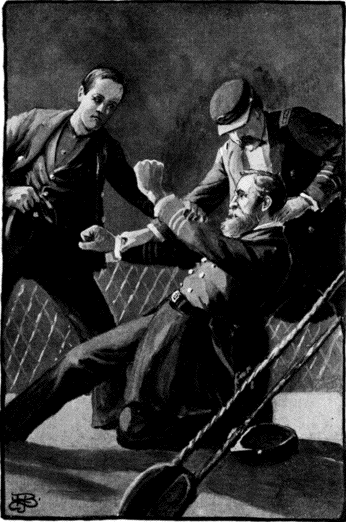
"Mr. Galvinne is Subdued."—Page
166.
A MYSTERIOUS VISITATION
"Who's there?" demanded Christy
Passford, sitting up in his bed, in the middle of the night, in his room
on the second floor of his father's palatial mansion on the Hudson,
where the young lieutenant was waiting for a passage to the Gulf.
There was no answer to his inquiry.
"Who's there?" he repeated in a louder tone.
All was as still as it ought to be in the middle of the night, and no
response came to his second inquiry. The brilliant young officer, who
had just passed his eighteenth birthday, knew what it was even better
than an older person to pass a whole night on difficult duty, without a
wink of sleep, for he had been accustomed to spend a portion of every
night in planking the deck on his watch; but at Bonnydale, his quiet
home, far removed
from the scenes of actual conflict, he was an industrious sleeper,
giving his whole attention to his slumbers, as a proper preparation for
the stirring scenes in which he was again about to engage.
He slept soundly; but he had dreamed that some one opened the door of
his room, or some one had actually done so. He was not a believer in
dreams, and when an impression had fastened itself upon his mind, he was
inclined to investigate it. It seemed to him that he had been awakened
from his sleep by the opening of the door of his chamber. Some member of
the family might be sick, and he might be needed to go for the doctor,
or for some other service.
He leaped from his bed when no answer came to his second demand,
lighted his lamp, and put on his trousers. With the light in his hand,
he opened the door; but there was no one there, and not a sound of any
kind could be heard. He walked about the hall in his bare feet, and
listened attentively at the doors of several of the chambers, especially
at that of Mr. Pembroke, the invalid gentleman whom, with his daughter,
he had brought home as a passenger in the captured Vixen.
Christy heard nothing, and he silently descended the stairs to the lower
hall. All was as quiet there as upon the floor above, and he had begun
to think that the impression he had received had been given him in a
dream, though he could not remember that he had been dreaming. But when
he came to the front door, he found it was ajar. It was usually secured
by a spring lock, and those who were liable to be out in the evening
were provided with night-keys.
At the present time his father was in Washington, and he could not
have neglected to close the door. He had been to the railroad station to
meet the last train, thinking it possible that his father might return,
and he was confident that he had been the last to enter the house. He
was very sure that he had not left the door unfastened, and this
assurance made him confident that some person had entered the house. The
noise at the door of his chamber was not an illusion or a dream: though
it had been made by closing rather than by opening it, or he would have
been likely to find the intruder in his room when he lighted his
lamp.
It seemed to him to be a matter of course that the midnight visitor
had come into the mansion
for the purpose of plundering its occupants, or of securing the
valuables it contained. Putting his lamp on the table, he went out upon
the veranda, and looked all about him. The grounds were very extensive,
and a broad avenue led to the street. It was very dark; but as he cast
his eyes in the direction of the grand entrance to the estate, he
discovered some dark object in motion; but he lost sight of it in a
moment.
It was a living being, or it would not move, and he was certain that
he had made a discovery. Then two regrets flashed through his mind as he
stepped down from the veranda; the first, that he had not put on his
shoes before he left his chamber, and the second, that he had not taken
his pistols, for a bullet would travel a great deal faster than a
barefooted officer, even of the United States Navy. But he ran with all
his speed to the street, to the great detriment of his uncovered
feet.
He reached the grand entrance in an exceedingly short space of time;
but he might as well have been in his chamber, for no ruffian, robber,
or Confederate spy could be seen. He had no means of knowing which way
the intruder at the mansion
had turned, to the right or the left, or whether, like the timid colored
gentleman in a trying situation, he had taken to the woods. Christy
walked up the street, and then down the street; but the underbrush had
recently been cut in the grove, and he did not venture to explore it
without any protection for his feet.
He peered into the gloom of the night with all his eyes, and listened
with all his ears for over an hour; and then, watchful and careful
officer as he was, there were five hundred chances against him to one in
his favor, of finding the intruder, and he reluctantly returned to the
mansion.
Like the other male occupants of the house, the lieutenant was
provided with a night-key. For one who had only just developed a
tolerably thriving mustache, Christy was a prudent and methodical young
gentleman. As a part of his method, he had a great many small drawers in
his rooms, and a dozen or more keys; but he had never lost them, for the
reason that he carried them chained to his nether garment. But he had
two sets of keys, one for the house, and one for the ship. He had taken
the night-key from the former, and put it in his vest pocket; and when
he
reached the front door of the mansion, the key he wanted was in his
chamber, and he had been careful to shut the door when he left the
house.
He could not get in, and he walked around the building to find a
window which had not been closed. His mother had a reasonable dread of
robbers, and she always looked out for the windows before she retired.
He did not wish to arouse the family by ringing the great gong bell, but
it was too cold to spend the rest of the night out-doors in his
half-clothed condition, for he was as liable to take a severe cold as
any less brilliant individual, and he might have to spend a month in his
chamber, instead of reporting to the flag-officer of the Eastern Gulf
squadron, in command of the Bronx.
He rang the bell, and the sound from it reverberated through the
entire mansion. It was some time before a servant came to open the door;
but the man who let him in was astonished to see him partially dressed,
and wondered if he had not been walking in his sleep. In the lower hall,
he was satisfied that the whole house was astir, for the gong which had
sounded was the "emergency
bell," used only when the ordinary one at the front door was not likely
to be heard.
"Walsh!" called Mrs. Passford from the head of the stairs.
"Yes, ma'am," replied the man who had admitted Christy, and who was
still wondering what fit, freak, or fancy had beset the young
officer.
"Who is it? What is the matter?" demanded the lady of the mansion, in
tones which indicated anxiety if not alarm.
"It is Mr. Christy, ma'am; nothing is the matter," replied Walsh; but
then he appeared to think that he had replied without proper
consideration, and he revised his speech. "I don't know that anything's
the matter, ma'am," and still he gazed at the young gentleman, as though
he deemed it possible that he had suddenly gone crazy.
"Nothing is the matter, mother," called Christy. "I am all
right."
"But why are you out at this time of night, my son? It is nearly two
o'clock in the morning," said Mrs. Passford, as she descended the
stairs. "You are not half dressed, Christy."
"But I am all right, mother, and there is not the least reason to
worry about anything, for the
ship is not going to the bottom just yet," replied Christy, indulging in
a forced laugh to assist in quieting his mother's fears.
"But why are you out doors at this time of night?" Mrs. Passford
insisted. "You will catch a cold that will lay you up, if you go out in
that condition."
"I should not have rung that bell if I had not been afraid of taking
cold," added the son.
"But, Christy, something has happened; and you must tell me about it,
or I shall not sleep another wink to-night," persisted the lady,
concluding that her son was trying to conceal something from her, as
indeed he was, for he feared it would alarm her if he told her some one
had come into the house.
"There is nothing to be frightened about, mother; and I will tell you
all about it," added Christy, as he took his overcoat from the stand and
put it on. "I waked an hour ago, or more, with the idea that some one
had opened the door of my room," and he related the circumstances to his
mother, including his search in the grounds and the road.
"Do you think any one came into the house?"
asked Mrs. Passford, though with but little of the woman's terror that
such a statement might have caused.
"That is my decided opinion. A noise at my chamber door woke me; I
found the front door ajar, though I know I closed it when I came in last
night, and I saw something moving down the avenue, which could only have
been a man. Of course, I conclude that it was a burglar; but none of us
have been killed or harmed."
Christy went to his room and completed his toilet. The house was
warm, and he was soon comfortable enough after the out-door chill. By
this time Miss Florry Passford had put in an appearance in the upper
hall, with Bertha Pembroke. The alarm was again briefly explained, and
the invalid gentleman was assured that nothing alarming had occurred.
Then the young lieutenant and his mother proceeded to ascertain what the
burglar had accomplished in the house.
On the lower floor nothing appeared to have been disturbed. In the
parlor a gold watch, adorned with diamonds, had been left on the table
by Florry, who had forgotten it; but it had not been taken. The burglar
could not have helped
seeing it if he had explored the house as such gentry do on such
occasions. In the dining-room no attempt to open the steel safe set in
the wall, which contained a vast amount of silver, jewelry, money, and
other valuables, had been made. In a word, wherever they examined the
rooms, no sign of any depredations could be discovered. The burglar did
not appear to have lunched in the pantry where some choice viands had
been placed. The robber had certainly been very considerate, and had
done no mischief either for plunder or diversion. He had evidently, in
the opinion of Mrs. Passford and her son, undertaken a profitless
enterprise.
"But what could have been his object in coming into the house?" asked
the bewildered lady.
"I shall have to give it up, mother."
"He might have taken Florry's watch, she was so careless as to leave
on the table in the sitting-room," added she.
"But he did not."
"He could not have been disturbed until you spoke to him; and he
might have ransacked the whole of the lower part of the house."
"But he did not."
They had given up the examination of the premises, and given up the
conundrum, and Christy was leading the way up-stairs. He went into his
room, followed by his mother.
"He must have come into your room, my son, or you would not have
heard him at the door. Perhaps he has robbed you," suggested Mrs.
Passford.
The young officer declared he had nothing there to steal. As he
spoke, he took from his coat pocket on the bedpost an envelope
containing his commission and other papers. It was safe; so were his
purse and watch.
The mystery was not solved till Christy embarked for the Gulf.
THE ABSCONDING MAN-SERVANT
Lieutenant Christopher Passford, in his two years' experience in the
navy, had been under the fire of the enemy too many times to be
intimidated by a burglar, and he felt a certain contempt for the
midnight marauder, who had entered the mansion and disturbed his restful
slumbers. He returned to his bed, therefore, and slept like a marine
till the call bell woke him in the morning.
As he dressed himself he could not help thinking of the mysterious
visitation, and he asked himself a great many questions in regard to the
object of the intruder, since it did not appear that he had entered the
house for the purpose of robbing its occupants. He could not determine
whether or not the fellow had actually come into his room; but his
porte-monnaie, which contained a considerable sum of money, and his gold
repeater, a very valuable watch, were just where he had left them the
night before.
In the breast pocket of his uniform coat he found the envelope which
contained his commission as a lieutenant, received only two days before
his orders, and some other papers. As a precaution against inquisitive
persons, if the package should happen to be mislaid in the house, he had
applied some mucilage in the library, and resealed the envelope. It had
not been tampered with so far as he could discover, and he returned it
to the pocket.
The mysterious visitor at the mansion, whoever or whatever he was,
could not be regarded as a burglar, or, if he was, he had strangely
neglected his opportunities, for he had failed to appropriate at least
five hundred dollars worth of watches and money, which he could hardly
have helped seeing. His object was not plunder, and there was nothing to
indicate the purpose of his visit. In retiring from the house the
intruder had left the front door ajar: and Christy thought it would have
been the most natural thing in the world to close it, in order to
conceal the way by which he had left the mansion. But he might have done
this to avoid
the noise of shutting it, or had neglected it in his haste to
escape.
When he had completed his toilet Christy looked at his watch, and was
rather surprised to find that it was a full hour later than usual when
the call bell had been rung. He went down-stairs, and found his mother
and Florry very busy in the dining-room, setting the table. This was the
man's work, and the young officer was astonished to see his mother and
sister doing it.
"What has broken now, mother?" asked the lieutenant, glancing from
one to the other of the busy couple.
"I don't know that anything has broken," replied Mrs. Passford, with
a smile, after she had said good-morning to her son.
"You and Florry are not in the habit of setting the table, mother;
and the first bell rang an hour later than usual," added Christy.
"We were all disturbed last night, and I did not wake till the cook
knocked at my door. She told me she could not find Walsh, and breakfast
had been ready half an hour. That is the reason why everything is late
this morning," Mrs. Passford explained.
"But where is Walsh?" inquired Christy.
"I am sure I do not know. I called in the coachman, and he has been
to his room and looked all over the place without finding him."
"That is very odd," mused the officer, wondering whether this sudden
disappearance had anything to do with the principal event of the
preceding night.
"Peach says he has taken his valise with him, which indicates that he
has gone for good."
"Who is Peach?" asked Christy, who had been at home so little that he
hardly knew the names of the servants.
"He is the coachman. I am not sorry that Walsh has gone, for he has
saved me the trouble of discharging him. Wilder, who had been with us so
many years, took it into his head to enlist in the army, and I was not
willing to persuade him to shirk his duty. Walsh has not been here quite
two weeks. He said he was born in the West Indies; but he was always
prying into matters that did not concern him, and I have several times
found him standing at the door when we were talking about family
matters. I reproved him for it; but it did no good. Your father
intended to discharge him as soon as he returned from Washington."
Christy went to the library, and busied himself in considering
whether or not the sudden departure of Walsh had any connection with the
mysterious midnight intruder. The two events had been near together in
point of time; but he could establish no other relation between them.
Then it flashed upon his mind that the man-servant had been the person
who had opened or closed his door, and visited his room; but he was sure
he had seen a man near the grand entrance of the estate. He had been all
around the house, and Walsh could not have escaped his observation. He
had answered the bell, and admitted him after his search. He concluded
that the servant was not the person who had disturbed his slumbers.
The morning mail brought a letter from Captain Passford, informing
the family that he was detained in Washington, and that he could not be
at home to say good-by to his son, who was to leave that day in the
store ship Vernon. He wrote a special letter to Christy, containing not
only his adieux, but the good advice he would otherwise have given him
in person.
The breakfast was rather a sad gathering on account of this parting, for
Christy was to leave in another hour. Bertha Pembroke and her father
were quite as sad as the mother and sister, and the young officer did
his best to cheer up the family and the guests. He tried to make them
laugh, but he found it was up-hill work.
"You will be in command of a steamer, Christy, when you reach the
Gulf. I hope you will not be rash, and try to do too much," said Mrs.
Passford, as they rose from the table.
"I don't think I am ever rash, mother; and if I have been exceedingly
fortunate, it was more because the circumstances favored me than because
I ran great risks," replied Christy very seriously, for he was sensitive
on the point his mother had brought up. "Father has said a great deal to
me on this subject, and I have always done my best to carry out his
principles. It is not my fault that I have a friend at court, and have
had opportunities that have not been offered to many others. But the
tide may turn against me on my next cruise."
"I hope it will not, my son," added his mother very earnestly.
"No one knows what is going to happen, and I may spend the next year or
two in a Confederate prison. I don't think my Uncle Homer would cry his
eyes out if such should be my fate, for he has lost several vessels and
cargoes of cotton on my account," returned Christy.
"But I am sure he has no ill-will against you."
"I don't think he has."
"By the way, Christy, have you heard anything from him or his family
lately?" asked Mrs. Passford.
"Not a word, and I am not likely to hear from them. Corny Passford
was exchanged, and sent back to the South a year ago or more; and I have
no idea what has become of him since."
After breakfast Christy packed his valise, where he placed the new
uniform in which he intended to present himself on the quarter-deck of
the Bronx. The carriage was at the door to convey him to the railroad
station. The parting was not less tender than it had been on former
similar occasions, and Mrs. Passford preferred that it should be in the
house rather than at the railroad station, in the presence of curious
observers. Many tears were shed after the carriage drove off,
for the patriotic young man might find a grave in southern soil, or
beneath southern waters.
The young lieutenant choked down his emotions, and tried to think of
the future; his case was not different from that of hundreds of
thousands of others who had gone forth to fight the battles of their
country, many thousands of whom slumber in hallowed graves far away from
home and friends. As the train moved on towards the great city, he
obtained the command of his emotions, and felt a new inspiration of
patriotic ardor.
On his arrival in New York he hastened across the ferry to the
navy-yard. As he approached the opposite shore, he discovered a steamer
getting under way. He had not seen the vessel on board of which he was
ordered to report as a passenger, but when he asked a deck hand what the
steamer was, he was informed that it was the Vernon. The ferry-boat had
just gone into the slip, and Christy was terribly startled to learn that
he was late. He was still two hours ahead of the time indicated in his
orders, and the Vernon was actually getting under way.
The young officer was more excited than he had
ever been in the face of the enemy, for the present looked like a case
in which his honor was at stake. He felt that it would be his ruin if
the Vernon sailed without him. There had been some mistake in his
orders, or in those of the commander of the store ship, and he was
likely to be the sufferer for it. He rushed to the stern end of the
ferry-boat in order to obtain a better view of the steamer; and at this
moment he discovered a boat, pulled by one man, headed towards the
navy-yard.
"Boat, ahoy!" shouted Christy, with almost frantic earnestness.
"On board the ferry-boat!" replied the man, resting on his oars.
"Five dollars if you will put me on board of that steamer before she
gets off!" added the officer.
"I'm the one for your money," returned the oarsman, as he headed his
boat into the slip.
Without much difficulty Christy dropped his valise into the boat, and
then dropped himself in after it. The belated passenger cast an earnest
look at the Vernon, which had just begun to move, though at a snail's
pace, and he hoped he should be able to get on board of her.
"Naval officer, sir?" interrogated the boatman.
"Yes; but I have no time to spare, and you must not stop to talk,"
replied Christy rather sharply.
"Time enough, sir, if you are going on board of the Vernon, and I
will give you one of my oars if I don't put you on her deck," said the
boatman very positively. "I hope you are nimble with your feet and
hands, sir."
"I will take care of that part of the matter if you will put me
alongside the steamer," answered Christy. "No more talk, if you please,
for you are wasting your wind."
"I have plenty of it for this job. You said five dollars, I believe,
sir," added the man, looking earnestly at his passenger.
"Five dollars is just what I said," replied the lieutenant, as he
took a bill of that denomination from his porte-monnaie, rolled it
around the boat-hook, and fixed it so that it should not blow away.
"Thank you, sir," said the rower, as he pulled with more vigor even
than before, and did not say another word till the boat was alongside
the Vernon.
Christy found a rope hanging over the side, to
which the boatman attached his valise, the young officer going up the
line hand over hand as though he was used to that sort of thing. The
oarsman secured his five-dollar bill, and Christy hauled up his valise.
He felt that he had saved himself from the dishonor of failing to obey
his orders, and he looked about him for some one who would be able to
explain to him how the steamer happened to be sailing two hours before
the time named in his orders. Three or four sailors were at work in the
waist, where the lieutenant came on board; and Christy was not a little
astonished to observe that Walsh, the absconding man-servant, was one of
them.
CHRISTY PASSFORD IS UTTERLY CONFOUNDED
The appearance of Walsh, fully dressed in the garb of a seaman, was
so great a surprise to Christy Passford, that he hardly noticed any
other person on the deck of the Vernon. He had given no particular
attention to the man when he saw him at his father's house, though he
regarded him as a very good-looking and intelligent person for one in
the situation in which he found him. The absconding man-servant had
certainly made good use of his time since he left Bonnydale, for he
appeared to have become a full-fledged sailor in the space of ten
hours.
For the size of the steamer, she seemed to be manned by a very large
crew; but the letter he had received from his father that morning
informed him that the greater part of the crew of the Bronx had been
transferred to other vessels upon more active service, and that a large
number of seamen
were to be sent immediately to reinforce the squadron. This was not
pleasant intelligence, for he had become acquainted with all on board of
the Bronx, and he would have preferred to begin his permanent service as
commander with the former ship's company of the little steamer. However,
the exigencies of the service required the change, and he could not
complain.
It was probable that the greater part of his new crew would be made
up from the men now on board of the Vernon; and this belief caused him
to regard these men with more interest than he might otherwise have
done. He had no fault to find after the glance he had bestowed upon
them, for they presented a very trim appearance in their new uniform,
and looked a great deal more tidy than they would after they had been on
duty a few weeks.
Lieutenant Passford was on board of the Vernon, and he had no further
solicitude in regard to a literal obedience to his orders. The commander
of the steamer, whoever he was, did not appear to have noticed the new
arrival, and no one gave any attention to Christy. He walked forward to
take a better view of the crew, and the seamen touched
their caps to the shoulder straps of a lieutenant with which he had been
careful to ornament his coat.
The men at work in the waist finished their task as Christy was
returning from his promenade, with the intention of presenting himself
to the commander. Among those who saluted him in proper form was Walsh.
He seemed to be a little diffident about encountering the son of his
late employer, and turned his face away as he touched his cap. But the
officer had fully identified him, and spoke to him, calling him by name.
The sailor made no reply; but Christy had placed himself directly before
him, and he could not escape without a breach of discipline.
"I spoke to you, Walsh," said the lieutenant, in the tone he had
learned to use when he intended to enforce respect and obedience.
"I beg your pardon, sir; my name is not Walsh," replied the sailor,
with all the deference the occasion required.
"Your name is not Walsh!" exclaimed Christy with a frown.
"No, sir; that is not my name, and I supposed that you spoke to some
other man," pleaded the late man-servant of the mansion at
Bonnydale.
The lieutenant gazed earnestly into the face of the sailor, for he was
willing to admit to himself the possibility of a mistake. Walsh, or
whatever his name might have been, was a man of robust form, not more
than an inch or two short of six feet in height. He was clean-shaved,
with the exception of his upper lip, whereon he sported a rather long
dark brown mustache, of which a Broadway dandy might have been vain. As
a servant, he had been rather obsequious, though Christy had observed
that he used very good language for one in his menial position. As the
officer examined his form and features, and especially regarded the
expression in general, he was satisfied that he could not be
mistaken.
"I did not speak to another man; I spoke to you," added Christy, as
he intensified the gaze with which he confronted the man, resorting to
the tactics of a sharp lawyer in the cross-examination of an obdurate
witness.
"I ask your pardon, sir, but you called me Welch, or some such name,"
replied the late servant, as Christy was sure he was in spite of his
denial.
"I called you Walsh; and that is the name to
which you responded at two o'clock this morning," persisted the
lieutenant.
"That is not my name, sir; and I refer you to the ship's papers to
prove it. I am not the man to be ashamed of my name, which is not Welch
or Walsh, sir, if you will excuse me for saying so."
"Will you deny that you were employed as a servant at the house of
Captain Passford, at Bonnydale on the Hudson?" demanded Christy, with
not a little energy in his tones and manner.
"Where, sir, if you please?" asked the sailor, with a sort of
bewildered look.
"At Bonnydale!"
"Boddyvale? I never heard of the place before in my life, sir,"
answered the runaway servant.
Possibly the man under examination was not wholly responsible for his
distortion of the name of Captain Passford's estate, as Christy was
beginning to reap the penalty of his imprudence the night before, in
exposing himself barefooted and half-clothed to the chill midnight air,
and was developing a cold in the head that already affected his
enunciation.
"Bonnydale!" repeated the officer, after using his handkerchief, and
thus improving his utterance of the word.
"I never heard of the place before, sir," persisted the seaman.
"Byron!" called a boatswain's mate from the forecastle.
"That's my name—Byron, sir, at your service," said the man, as
he touched his cap to the lieutenant, and rushed forward in answer to
the call of his superior, evidently glad to escape from the inquisition
to which he had been subjected. "On deck!" he added, as he made his way
to the forecastle.
Christy was a passenger on board of the Vernon, and he had nothing to
do. The commanding officer appeared to be engaged in the details of his
duty, though the steamer was in charge of a pilot. He could see from his
shoulder straps that he was an ensign, and the officers in the waist and
on the forecastle were of the same rank. If there were any other
passengers on board of the vessel who were commissioned officers, they
were not visible on the deck, though they might be in their staterooms,
arranging their affairs for the voyage.
The young lieutenant leaned against the rail, and gave himself up to
the consideration of what
had occurred since he came on board. He had been bewildered by one
mystery the night before, and he could not help asking himself if the
conduct of Walsh had anything to do with the visit of the intruder at
Bonnydale. He could not trace out any connection between the two events;
but, on the other hand, he was unable to satisfy himself that the
mysterious visit, the sudden disappearance of the man-servant, and the
denial of his identity by the latter, were not in some manner related to
each other.
He had no premises on which to base an argument for or against one
thing or another. All was dark to him, and he could not get hold of
anything. After he had raised up a variety of suppositions, and combated
vigorously with them, the darkness seemed only to become more dense, and
he was compelled to abandon the subject without arriving at any
reasonable explanation. Under the instruction of his father, he had
cultivated "a judicial mind," which compelled him to reject all mere
speculation.
Christy was not disposed to believe that he was a brilliant officer,
or to accept unchallenged the extravagant praise that had been bestowed
upon
him. He endeavored to follow the Gospel injunction "not to think of
himself more highly than he ought to think." But while he tried to keep
the flower of modesty in full bloom in his soul, he could not deny that
he had given the enemies of his country a great deal of trouble, and
subjected them to some heavy losses. Then he recalled the conspiracy on
board of the Bronx while he was acting-commander of her; and though it
was for the interest of the Confederacy to get rid of so active an
officer, he believed it was the vessel and not himself that the
conspirators desired to obtain.
Before the Vernon reached The Narrows, everything on her deck had
been put in order by the large crew, and less activity prevailed on
board. Christy thought it was time for him to report to the commander,
and he moved aft for this purpose. He did not even know the name of this
gentleman, and he saw no one to introduce him formally; but the ensign
in command had doubtless received an order to take him as a passenger to
the Gulf.
Before he reached the sacred limits of the quarter-deck, Christy met
a quartermaster, of whom he inquired the name of the commander.
"He has a good name for the captain of a fighting
ship," replied the petty officer, respectfully touching his cap to the
shoulder straps of the inquirer. "The commander is Captain
Battleton."
"Captain Battleton," repeated Christy, to assure himself that he had
correctly understood the name.
"Captain Battleton," added the quartermaster. "I hope you are feeling
better to-day, sir."
"I am feeling very well to-day, except that I have started a cold in
the head," replied Christy, astonished at this display of interest in
the state of his health.
"I am glad to hear it, sir, for you appeared to be quite sick last
night when you came on board," added the quartermaster.
"Did I, indeed? I was not aware of it. I came on board last night? I
was not aware of that fact," said Christy.
The petty officer did not hear his remarks, for he had been called by
the second lieutenant in the waist, and, with a touch of his cap,
hastened away. The lieutenant opened his eyes very wide, as he looked
down at the seams in the deck, and wondered whether he were asleep or
awake. He had been quite sick, and he had come on board the
night before! It was very strange that he was not at all aware of either
of these facts. He felt reasonably confident that he had slept in his
own chamber at Bonnydale the night before, and at that time he was
certainly in a very robust state of health, however it might be at the
present moment. Even now, he could not complain of anything more severe
than an embryo cold in the head, which the medicine his mother had given
him would probably reduce to a state of subjection in a day or two.
At first, he was disposed to be amused at the answers the
quartermaster had given him, for it was evident to him then that he had
been mistaken for another person. It looked as though some officer had
come on board, and reported under his name, for he had not yet learned
anything in regard to the gentleman who had appeared to be quite sick
when he reported himself. It had the elements of another mystery in it.
But the petty officer could easily have made an honest mistake; and this
was the solution he accepted, without bothering his bewildered brain any
further about it.
The commander appeared to be less occupied at this moment than he had
been before, and Christy
stepped forward to the quarter-deck, and politely saluted him. Captain
Battleton was not less punctilious in his etiquette. He was a young man,
though he was apparently six or seven years older than Christy. He was
an ensign, and looked like a gentleman who was likely to give a good
account of himself when he was called to more active duty than that of
commanding a store ship.
"Good-morning, Lieutenant Passford!" said Captain Battleton, as he
extended his hand to his passenger. "I am glad to see that you are
better."
Christy was utterly confounded at this salutation.
THE SICK OFFICER IN THE STATEROOM
Captain Battleton spoke to Christy as though he had met him before,
and needed no introduction. He was glad to see that the young officer
was better, which indicated that he had been sick. He was confounded by
the situation, for he had not been sick an hour, and he had never seen
the commander of the Vernon in his life. The petty officer had told him
that he appeared to be quite sick when he came on board the night
before.
What he had learned within the last few moments was even more
perplexing than the mysterious visitation at Bonnydale. Then the
appearance of Walsh on board, and his denial of his identity, were still
in his mind, and he wondered whether or not all these strange
circumstances had any connection. But he was standing in the presence of
the commander of
the steamer, and he had no time to reach a conclusion of any kind,
satisfactory or otherwise.
Christy took the offered hand of Captain Battleton, and looked
earnestly into his face to determine whether he had ever seen him
before; but the face was entirely new to him. He was quite confident
that he had never seen the commander before. There was something rather
ludicrous in the situation, and he felt as though he was taking part in
a farce; at any rate, there was nothing serious or compromising in it,
and in spite of the confusion in his mind, he could not help
smiling.
"I thank you, Captain Battleton, for your very kind interest in the
state of my health, but with the exception of the first signs of a cold
in the head, I never was better in my life," said Christy in reply to
the salutation of the commander, still holding his hand.
"Then you have improved wonderfully since last evening," added
Captain Battleton.
"I am glad to be informed of the fact, for I am not conscious of any
such improvement as you describe. In fact, I am not in quite so good
condition in a sanitary point of view as I was
last evening, for I took my cold about midnight, or a little later, last
night," added Christy, his smile becoming a little more pronounced.
It was now the turn of Captain Battleton to be puzzled, if not
mystified, by the statement of his passenger, and he looked inquiringly
into his face as if to ascertain if he was not the victim of a practical
joke. But naval officers on duty are not given to pleasantries; and if
he had any such suspicion, he banished it at once, for there was nothing
in the appearance of the lieutenant to warrant it.
"Pardon me, Mr. Passford, but were you not sick when you came on
board of the Vernon last evening?" asked the commander, with something
like a frown upon his brow as the situation became more bewildering.
"If you will excuse me for making an indirect reply, captain, I did
not come on board of the Vernon last evening," answered Christy, his
smile becoming still more decided; and if he had not been on the
quarter-deck of a vessel in service, he might have suspected that he was
himself the victim of a practical joke.
"You did not come on board of the Vernon
last evening!" exclaimed Captain Battleton, gazing very earnestly into
the face of his passenger.
"I did not, captain," replied Christy quietly, though he was amused
rather than disquieted by the earnestness of the commander.
"You did not?"
"Certainly not; and if my simple affirmation is not enough, I could
prove that I slept in my father's house at Bonnydale last night, took my
breakfast there this morning, and was in the city of New York at ten
o'clock this forenoon," answered Christy, in the best of humor.
"This is very strange," said Captain Battleton, fixing his gaze upon
the planks on which he stood, possibly considering whether he or his
passenger was dreaming or out of his head.
"If I were still at Brooklyn doubtless I could find the boatman who
put me on board of the Vernon not more than an hour ago," continued
Christy, willing to convince his auditor that he was entirely in earnest
in his statement.
"I beg your pardon, Mr. Passford, but I did not intend to question
the truth of your reply to my question," said the commander, fearing
that he had overstated his doubts. "I am
simply bewildered, confused, confounded by this interview."
"So am I, captain," added the lieutenant, laughing outright at the
perplexity in which both of them were involved. "I have told you the
simple truth in regard to my movements."
"And you did not come on board of the Vernon last evening?"
"Emphatically I did not."
"You were not sick last evening?"
"I was not; not even as sick as I am at this moment," replied
Christy, using his handkerchief.
"I don't understand it," said Captain Battleton, shaking his
head.
"Now, captain, will you permit me ask what you do not understand, for
I assure you I am profoundly ignorant of the situation which perplexes
you. I was ordered to be on board of the Vernon at one o'clock, and I
found her under way at eleven. I happened to find a boatman before I
left the ferry-boat, who put me on board, or I should have missed my
passage. That is simply all I know about the matter."
"When I called upon you in your stateroom this morning, you told me
that"—
"I beg your pardon, Captain Battleton, but I have not been in any
stateroom, sick or well, on board of the Vernon, and I respectfully
suggest that it was quite impossible for you to have called upon me this
morning, or at any other time," Christy interposed, very pleasantly,
though quite as perplexed as the commander.
"Of course I shall not raise an issue as to your veracity, Mr.
Passford, but after the statement you have made to me, I must change the
form of my phraseology," continued the commander, using a smile to cover
any possible doubts or suspicions in his mind. "When I called at the
stateroom of the officer who reported on board last evening as
Lieutenant Christopher Passford, he told me that I was expected to get
under way and proceed to my destination as soon as the officer and the
seamen were on board."
"Did he bring you an order to this effect?" asked Christy more
seriously.
"He did not, and perhaps I have made a mistake, though my superior
officer told me at the yard that it would be safe for me to obey the
verbal order," replied Captain Battleton, looking somewhat troubled.
"I have no intention to meddle with what does not concern me, captain.
It appears that Lieutenant Passford has already reported to you," said
Christy; and this was the astounding fact to him of the situation.
He was absolutely confident that he was himself Lieutenant
Christopher Passford, and as absolutely confident that the other officer
could not be that person, whoever else he might be. The commander
appeared to be considering what Christy had suggested to him in regard
to his orders, and the passenger had a minute or two to think of the
situation in which he found himself placed. But what was the use to
think of it? He was at the end of a blind alley, where there was no
light from any direction except that by which he had entered it. He had
no premises from which to reason, and it was useless to consider the
matter.
"Mr. Passford, I find myself placed in a very unpleasant position,"
said the commander, after he had deliberated a few minutes. "I have
stated the facts to you; and the deduction I have to draw from them is,
that I have two persons by the name of Lieutenant Passford on
board."
"That seems to me to be a correct deduction," added Christy.
"The brilliant officer who bears this name is too well known to hide his
light under a bushel. I have not the honor to be personally acquainted
with him, and therefore I am unable to decide which of the gentlemen who
report to me under that name is the real one."
"Precisely so."
"You will pardon me if I add that I think one or the other of them
must be an impostor," added Captain Battleton with some diffidence.
"That is a perfectly justifiable conclusion; and it rests with you to
decide which is the genuine Lieutenant Passford, and which is the
impostor," replied Christy frankly. "You will be perfectly justified in
calling upon both for all the evidence they are able to present. I
suggest that each of them must carry his commission about him, as well
as his orders from the department; and it seems to me that these
documents will enable you to decide without any delay;" and Christy
involuntarily put his hand upon his breast pocket, where he carried
these valuable papers.
He could feel the envelope that contained them, and he was satisfied
of the triumph which awaited him when the evidence should be required of
the
two claimants of the name. At the same time he felt that he was moving
in a cloud of mystery, which had begun to enfold him in the middle of
the preceding night.
"I thank you for the suggestion, Mr. Passford, and I must say that
you seem to be entirely fair," said the commander.
"If I am the impostor, I do not know myself; but I have no desire to
forestall your decision. You saw the sick officer when he came on board
last evening, and you have visited him in his stateroom to-day. Do I
look enough like him to be taken for him?" asked Christy with a smile,
as he placed himself in an attitude to be scrutinized by the
commander.
"I am sure that you do, sir; and when I saw you on the quarter-deck
for the first time, I had no doubt you were the officer who came on
board sick last evening," replied Captain Battleton.
"That makes it all the more remarkable, for I was not aware that
there was any officer in the navy who resembled me so closely," added
Christy more bewildered than before, and beginning to scent a plot of
some kind against him or his country.
"I must say that any man who will take upon himself the position and
reputation of the real Lieutenant Passford is a bold man, and even, if
he succeeds in taking his place, he will fail in playing the
rôle."
"I should thank you, Captain Battleton, for the compliment, if I were
not under suspicion of being some other person. May I ask when it will
be convenient for you to settle the question, for it is not pleasant for
me to feel that I am looked upon as even a possible impostor?"
"I shall not regard you as an impostor, Mr. Passford, for I mean to
be entirely impartial, and I shall not brand you even in thought until
the evidence warrants me in doing so," replied the commander, as he
called the surgeon who was just coming on deck. "How do you find your
patient, Dr. Connelly?"
"I find him—I thought I found him; but he appears to be on
deck," replied the surgeon, as he fixed his gaze upon Christy, preluded
by a start, dramatic enough to prove that he was astonished to find his
patient was not in his room below. "I left him not five minutes ago, for
I have not yet been able to discover what ails him. He
complained of a severe headache and pains in his bones; but he has not a
particle of fever, or any symptom of anything that I can discover. I am
glad to see you on deck, Mr. Passford. How is your headache?"
"If I have had any headache, I have entirely recovered from it,"
replied Christy, laughing heartily. "I came on board only an hour ago,
doctor, and I have had no headache, thank you."
"Looking at you more closely, I see that you are not my patient, and
you will excuse me for giving you a headache. But you resemble my
patient very closely," added the doctor.
"I did not answer your question, Mr. Passford," interposed Captain
Battleton. "In an hour we will settle the question."
Christy seated himself and began to consider the strange
situation.
LIEUTENANT PASSFORD AND HIS APPARENT DOUBLE
The Vernon continued on her course, and in another hour the pilot had
been discharged. Christy had puzzled his brains over the events of the
day and the night before without being able to arrive at any
satisfactory conclusion. He was extremely anxious to see the officer who
had taken his name and assumed his character, as he was to obtain all
the information within his reach. His reflections assured him that some
one had chosen the rôle of an impostor for the purpose of
accomplishing some treasonable object, and he was anxious to fathom the
mystery for his country's sake rather than his own.
Captain Battleton would soon begin his investigation, and Christy was
confident that the sick officer would be proved to be the impostor. He
was not at all worried or even disturbed in regard
to the result, for he felt that "truth is mighty and must prevail." His
only solicitude was to unravel the plot. Bands of Confederates had been
put on board of several steamers for the purpose of capturing them; and
it was possible that this plan had been adopted to obtain possession of
the Vernon, for she was a good vessel, and was fitted out as a
man-of-war.
It was plain enough to Christy that the remarkable attempt of one or
the other of the officers on board as passengers to personate the other
had been explained to those on the quarter-deck, for he observed that
they all regarded him with curiosity, and were interested in the matter.
As the surgeon passed near him he spoke to him.
"Does your patient below seem to be improving, doctor?" he asked.
"He still complains that his head and his bones ache, so that I
cannot say he is improving," replied Dr. Connelly.
"How old a man does he appear to be?"
"I should take him for a young man of twenty or twenty-one, but he
says he is only eighteen. He is a very young officer to be put in charge
of a steamer, for I understand that he is ordered
to the command of the Bronx. But then he has made a reputation as the
commander of that vessel, which doubtless justifies his
appointment."
"Does he talk at all?"
"Oh, yes; he has told me about some of his exploits; and as he seems
to forget his aches when he speaks of them, I have encouraged him to
talk as much as possible."
"Is he really sick, doctor?" asked Christy, with a smile which meant
something.
"He says he is, and I have to take his word for it," replied the
surgeon, with a corresponding smile.
"I heard you tell the captain that you could not make out the nature
of his malady."
"I cannot so far, though that does not prove that he is not sick; but
I will venture to say he could not get his discharge from the navy on
his present symptoms. He may have drunk too much wine or whiskey
recently, though he certainly was not in liquor when he came on
board."
"How is your patient, Dr. Connelly?" asked Captain Battleton, joining
them at this moment.
"About the same the last time I saw him. He
ate all the toast I sent to him, and seemed to enjoy it. I don't think
he is in a dangerous condition," replied the surgeon.
"I am glad to hear it. Have you informed him that we have another
lieutenant on board of the Vernon?" continued the commander.
"No, captain: I have not. That is not my affair, and I don't meddle
with what does not concern me."
"An excellent rule. Is he aware of the fact that there is another
Richmond in the field?"
"If he is, he has said nothing to me about the matter."
"Do you think he could go out into the cabin, doctor?" asked the
captain. "I wish to see him on a matter of the utmost importance. Is he
dressed?"
"He is; he dressed himself this morning, and sits up part of the
time."
"Then you will oblige me by getting him into the cabin; I mean my
cabin. I will be there in ten minutes."
The surgeon went below, leaving the commander and Christy
together.
"Can you make anything of this affair yet, Mr. Passford?" asked Captain
Battleton.
"I can come to no conclusion in regard to it, though I may be able to
do so when I have seen my double," replied Christy, whose curiosity in
regard to the sick officer was strongly excited. "It looks like a
conspiracy of some kind, but I can go no farther in the direction of a
solution."
The commander looked at his watch after they had conversed a little
while longer, and then invited Christy to visit his cabin with him. The
other Lieutenant Passford was seated in an arm-chair at the table.
Christy looked at him with the deepest interest, but the back of the
other was turned to him, and he did not get a full view of his face. The
sick man was dressed in the naval uniform with the shoulder straps of a
lieutenant.
"I wish to introduce a gentleman to you; Lieutenant Passford, let me
make you acquainted with Lieutenant Passford," said the commander as he
led the way into the captain's cabin.
"Thank you, Captain Battleton; I shall be very happy to make the
acquaintance of Lieutenant Passford," said the occupant of the cabin,
rising as he spoke, and approaching Christy. "Corny Passford!" exclaimed
the sick officer. "I did not expect to see you here. This gentleman is
my own cousin, Captain Battleton, though I am sorry to say that he is a
rebel; but for all that he is one of the finest fellows in the known
world, and you will appreciate everything about him except his politics,
which I do not admire myself."
Christy was not stunned or overwhelmed by this impudent speech. He
looked at the speaker, and promptly recognized his cousin Corny. He was
astonished at the brazen assurance of the other, for he had always
seemed to him to be a fairly modest young man. Corny extended his hand
to Christy, and it was accepted.
"I am very glad to see you, Corny," said he of the South, "and not
the less glad because the meeting is so unexpected."
"It is certainly very unexpected on my part, Corny," replied Christy,
who began to comprehend the object of his cousin; but there was
something so ludicrous in the situation that he was more disposed to
laugh than to look upon it seriously.
"I am very glad to see you, Corny," continued
he who bore that name in reality. "I did not expect to find you on board
of the Vernon. How are uncle Homer, aunt Lydia, and Gerty?"
"I have not seen my uncle Homer for several months; but I had
not the remotest idea that you had an uncle Homer," replied Christy,
laughing heartily, for the situation seemed so amusing to him that the
serious part of his cousin's obvious plan had so far hardly dawned upon
him. "I should like to inquire of you, as one good turn deserves
another, in regard to the health of your father and mother and
Gerty."
"My father is quite well, but he left Bonnydale last Tuesday to go to
Washington, and had not returned when I left home. My mother is quite
well, and so is Florry," replied the sick officer, who did not appear to
be suffering from a very severe headache just then, for he was quite
cheerful and animated.
"This appears to be a family party," interposed Captain Battleton,
who was very much amused to hear each of the young officers call the
other by the same name, and both of them appeared to be Corny
Passford.
"It is a family party, captain," replied the sick officer, smiling as
cheerfully as though he had never had any practical knowledge of
headache and pains in the bones, which was the description of his malady
given to the surgeon. "As I have hinted before, my cousin Corny is a
rebel of the first order; and you can imagine my astonishment at finding
him in the uniform of a lieutenant on board a United States naval
vessel."
"Good, Corny!" exclaimed Christy, dropping upon the divan of the
cabin and laughing heartily.
"I can easily imagine your astonishment, Mr. Passford, for it seems
to me to be a very remarkable state of things," added the captain, as he
looked from one to the other of the claimants. "One thing seems to be
admitted by both of you, that you are both Passfords, and that you are
cousins."
"So far we do not disagree by the breadth of a hair. My cousin Corny
was raised in the South, while I was raised in the North,"
continued the sick passenger.
"I don't like to contradict my cousin, but I was brought up in
the North," said Christy, hoping Captain Battleton would notice the
difference in the phraseology.
"Then you were both brought up in the North," suggested the captain.
"Not at all, for, as I said, my cousin Corny was brought up in the
South, at Glenfield, near Mobile," protested the ailing officer, who was
careful this time not to use the word "raised."
"Where were you yesterday, Corny?" asked Christy, suddenly
suppressing his mirth.
"I was in New York, preparing to come on board of the Vernon."
"Then you were not at Bonnydale?" demanded Christy sharply.
"Of course I was there; but it was a pretty day, and I went to the
city to attend to some affairs of mine," replied the sick man, with the
first signs of embarrassment he had exhibited.
"In spite of the fact that it was a pretty day, I should think you
would have spent your last day on shore with your mother and sister as I
did," replied Christy.
"I was sick, and I wished to be as near the Vernon as possible. I
felt better in the afternoon and attended to my affairs; but I got bad
again in the afternoon, and I came on board in the evening, for I was
afraid I should not be able to
do so in the morning," answered the invalid, becoming as lively as
before.
"Gentlemen, this seems to be a strange muddle," said the captain, who
was not disposed to listen any longer to the sparring between the
cousins. "At the suggestion of the lieutenant who came on board this
forenoon, I have taken the earliest opportunity to settle the question
as to which is the original and genuine Mr. Passford who was ordered on
board of the Vernon as a passenger for the Gulf, and who, I am informed,
is appointed to the command of the Bronx. I have not much time to spare,
and if you do not object, I shall call in the first lieutenant and the
surgeon to take part in this conference. I am perplexed, and I desire
witnesses if not assistants in these proceedings."
"I have not the slightest objection to the presence of as many
officers as you may choose to call in," added the invalid.
"I shall be equally reasonable," said Christy. "The more witnesses
there are the better it will suit me."
Captain Battleton struck a bell on his table, and sent the steward
who answered it to procure the
attendance of the officers indicated, and they soon presented
themselves.
"Gentlemen, Lieutenant Salisbury, the executive officer of the
Vernon," said the captain. "Both of these gentlemen are Lieutenant
Christopher Passford," he added, with a twinkle of the eye. "Dr.
Connelly, you have both met."
"Are we to understand that one of these officers is the double of the
other?" asked the first lieutenant, who seemed to be disposed to take in
the situation as a pleasantry of the commander.
"Hardly; both of them claim to be the same officer, and I have
invited you to assist me in deciding which is the real Mr.
Passford."
The entire party then seated themselves at the table.
THE CONFERENCE IN THE CAPTAIN'S CABIN
Captain Horatio Passford lived at Bonnydale on the Hudson. He was
rich in several millions of dollars, but he was richer in the possession
of a noble character, one of the most prominent traits of which was his
patriotism. He had presented his large and fast-sailing steam yacht to
the government of the nation at the beginning of the struggle. His motto
was, "Stand by the Union," and from the first he had done everything in
his power to sustain his country against the assaults of
dissolution.
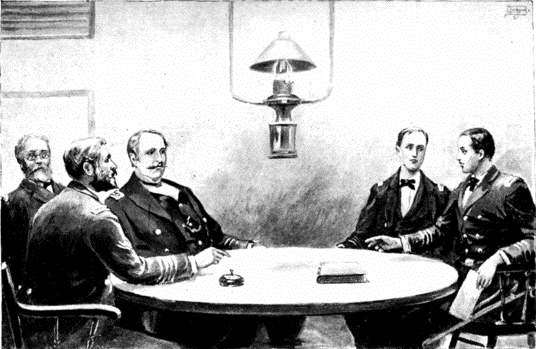
The Conference in the
Captain's Cabin.—Page 70.
He had a wife, a daughter, and a son, and his family were as
patriotic as he was himself. At sixteen Christy, the son, had gone into
the navy. He had learned to be a sailor and an engineer in his repeated
cruises in the Bellevite, his father's large steam yacht, now a
man-of-war in the navy. In two years the young man had worked his way up
to the rank of lieutenant. He was very large for his age, and his
nautical and mechanical education had prepared him for service to a
degree which made him almost a prodigy, though his courage and skill had
been fully equalled, if not surpassed, by other naval officers not older
than himself.
Homer Passford, the only brother of his father, had early in life
settled in Alabama, and become a planter, where he had made a
respectable fortune, though he was a poor man compared with the northern
brother. He had a wife, a son, and a daughter. At the beginning of the
war of the Rebellion he had promptly espoused the cause of the South,
and from his point of view, he was fully as patriotic as his brother on
the other side. He was ready to give himself, his son, and his fortune
to the independence of the South. His character was quite as noble as
that of his brother, and he had done all he could in person and with his
wealth to insure the success of the Southern cause.
His son Cornelius followed the lead of his father, and was faithful
to the teachings given him in his southern home. He had enlisted as a
soldier; but when it was found that he could be more serviceable
to the Confederacy in certain irregular enterprizes, he was detached for this
service. He had been engaged in an attempt to capture the Bellevite in
connection with older and more skilful persons. The plan had failed,
Corny had been severely wounded, and while on parole had lived at
Bonnydale. From there he had been sent to a military prison, and had
been exchanged. From that time, Christy knew nothing about him until he
met him on board of the Vernon.
Corny was two years older than Christy; but the latter looked even
more mature than the former. The resemblance between them had hardly
been noticed by the two families, though Christy had spent several
months at different times at the plantation of his uncle. But the
resemblance was noted and often spoken of by persons outside of the
families, the members of which, being in the habit of seeing them often
together, did not notice the similarity of features and expression. Both
of them resembled their fathers, who were often mistaken the one for the
other in their early years.
After he found that the sick officer was his cousin Corny Passford,
Christy began to apprehend
the object of his southern relative in presenting himself as the bearer
of his name and rank in the navy, though he had no time to consider the
subject. Corny had given him no opportunity to look the matter over, for
he had talked most of the time as opportunity was presented.
Captain Battleton seated himself in the armchair which Corny had
abandoned, and placed a quire of paper before him as though he intended
to take notes of the proceedings. Christy was not at all disturbed by
the formal aspect the affair was assuming, for he felt entirely
confident that poor Corny would be a prisoner of war at its conclusion.
He had his commission and his orders in his pocket, and he was positive
that they would vindicate him.
"I reported to the department that I had only a single vacant
stateroom in the ward room of the Vernon, and I was ordered to receive
Lieutenant Christopher Passford as a passenger, as I could not take
another officer," said the captain. "It is not a serious question
compared with others at issue, but the occupation of the single room,
now in possession of the gentleman who came on board last evening,
depends upon the result of our present inquiry."
"I should say there would be no difficulty in settling this question,"
said Mr. Salisbury.
"These gentlemen are cousins, and both of them bear the name of
Passford," added the captain, as he raised his finger, pointing to
Corny. "Will you give us your name in full, if you please?"
"Christopher Passford," replied the invalid officer, with the most
unblushing effrontery.
"Your father's name?"
"Horatio Passford."
"Where does he live?"
"At Bonnydale, on the Hudson," replied Corny confidently.
"Excuse me, Captain Battleton; may I ask a question?" interposed the
first lieutenant.
"Certainly, Mr. Salisbury. This is not a court-martial, but an
informal investigation, and I shall be glad to have you and Dr. Connelly
entirely free to ask any questions you please," replied the captain, who
was anything but a martinet.
"Where did you say your father lived, Mr. Passford?" asked the
executive officer.
"At Bonnydale, on the Hudson," answered Corny, as we may call him now
that the reader knows who he is.
"Is Bonnydale the name of the town or city in which your father
lives?"
"It is the name of my father's place," replied Corny; and Christy,
who was observing him very closely, saw that he was a little
disturbed.
"Bonnydale sounds like a fancy name, such as any gentleman might give
to his estate, as Sunnyside was the home of Washington Irving. Is this
the fact?" asked Mr. Salisbury.
"I suppose it is," answered Corny, with increasing confusion.
"Don't you know?"
"We always called it Bonnydale; and I know no other name
for it."
"But Bonnydale is not an incorporated town. In what city or town is
your father's place situated?"
"I know no name but Bonnydale," replied Corny; and the flush of fever
or something else was on his cheeks now.
"Nothing more, captain," said the first lieutenant; and the stock of
the other claimant mounted a little.
"Mr. Passford," continued the captain, indicating Christy with his
finger, "your father's name, if you please."
"Horatio Passford," replied Christy with a smile.
"Where does he live?"
"At Bonnydale, on the Hudson."
"Permit me, Captain Battleton," interposed Mr. Salisbury; and the
commander nodded his acquiescence. "Is Bonnydale the name of the town or
city in which your father lives, Mr. Passford?"
"It is the name of my father's place," answered Christy, using the
same words that Corny had.
"Bonnydale sounds like a fancy name, such as any gentleman might give
to his estate," continued Mr. Salisbury, smiling, as he repeated the
phrases he had used before. "Is this the fact?"
"It is; the name was given to the estate by my mother," replied
Christy, unable to follow Corny any farther.
"In what town or city is your father's estate situated?"
"It is within the limits of the town of Montgomery."
"Nothing further, captain," said the executive officer; and the stock
of this particular Lieutenant Passford mounted another trifle.
"Your cousin, who, according to your statement,
was raised in the South, seems to be better informed in regard to the
geography of Bonnydale than you do," added Captain Battleton.
"He is always inquiring into things that I don't care a straw about,"
replied Corny, vexed that he had been tripped up in a matter so
simple.
The commander was disposed to carry the investigation a little
farther in the same direction, and he sent Christy into the ward room,
where he was instructed to remain until he was sent for. Captain
Passford, senior, was well known to all the officers present by
reputation, and he had assisted Dr. Connelly in procuring his
appointment, so that the latter had had occasion to visit Bonnydale
three times.
The captain asked Corny a hundred questions in regard to the estate,
making memoranda of his answers. Once he suggested to the surgeon that
he had better examine the pulse of his patient, for he did not wish to
overtask him in the investigation. The subject of the inquiry declared
that his headache had almost disappeared, and he needed no indulgence on
account of his health.
After half an hour of questioning, Corny was sent to the ward room,
and Christy was called to
the captain's cabin. About the same questions were put to him as to his
cousin; but both of them were prompt in their answers. In the last two
years, Corny had been more at Bonnydale than Christy, and he was quite
as much at home there, so that there was no reason why he should not be
able to describe the mansion and its surroundings as accurately as the
genuine Lieutenant Passford.
So far, Corny, with the single exception of his failure to give the
geography of the estate, stood quite as well as his cousin. Then the
first lieutenant questioned them both, as they were seated at the table,
in a very general way. In their answers, Corny used the word "raised,"
while Christy was "brought up." Several phrases in more common use at
the South than at the North were noted in his answers, which did not
appear in the diction of Christy.
When the questioning was finished, the leaning of the trio of
officers was in favor of Christy; but not one of them said anything in
the presence of the two Passfords. The captain declared that he had
already used up too much time in the inquiry, and he must close the
conference very soon.
Then he asked if either of the gentlemen had any papers they wished to
present in support of his identity.
"I have my commission as a lieutenant, and my orders to take passage
in the Vernon, and to take command of the Bronx on my arrival at the
station of the Eastern Gulf squadron," said Corny, as he pulled a huge
envelope from his breast pocket; and Christy could not but notice the
perfect confidence with which he spoke.
"I have precisely the same papers," added Christy, with as much
assurance as his cousin.
"I had nearly forgotten the most important evidence that can be
presented in this matter," said the captain with a smile. "I dare say
that each of the gentlemen will produce his commission, his orders, and
his appointment to the command of the Bronx; and I don't know how we can
decide between the papers. It looks as though the Bronx was likely to
have two commanders."
"Here are my papers, captain," added Corny, as he passed his envelope
across the table to the commander.
"This is not an official envelope," said the captain,
as he took the package, and then fixed his gaze on the owner of the
documents.
"No, sir; it is not. I had the misfortune to leave it on the table at
Bonnydale, and Walsh, the man-servant, supposing it to be of no value,
threw it into the fire," replied Corny promptly.
The commission and other papers were all right in every respect.
Christy handed his envelope to the commander, and he broke it open. It
contained nothing but a lot of blank paper.
THE ANNOUNCEMENT OF THE DECISION
When Captain Battleton took from the envelope the blank papers, no
one seemed to be inquisitive as to the result, for, as the commander had
suggested, they all expected to find the commission and other papers
regularly and properly made out and signed. Several sheets were unfolded
and spread out upon the table, and Christy was hardly more surprised
than the others at the table.
"Your papers do not seem to be altogether regular, Mr. Passford,"
said the captain, as he held up one of them so that all could
see it.
"I see they are not," answered Christy blankly.
"But they are enclosed in an official envelope," added the captain,
as he held up the cover of the papers. "In this respect they have the
advantage of those presented by the other gentleman.
You appear to be as much surprised as any of the rest of us, Mr.
Passford. Can you explain the fact that you present nothing but blank
papers instead of your commission and orders?"
"At present I cannot; after I have had an opportunity for reflection
I may be able to do so," replied Christy, from whom a more decided
demonstration than he made was expected.
"It is evident from what we have heard, and from the documents
submitted to me that one of these gentlemen is Lieutenant Christopher
Passford," said Captain Battleton; "but we have no means of identifying
the officer. In what vessels have you served, Mr. Passford?"
"My first service was in the Bellevite, and my last in the Bronx, of
which I was acting commander on her voyage from New York to the Gulf,"
answered Christy, to whom the question was addressed.
"Is there any officer on board with whom you have served?"
"So far as I have seen, there is not."
"Any seaman?"
"I have not noticed any seaman whose face was familiar to me."
"If I am correctly informed, you came home as prize master of the Vixen,
convoying quite a fleet of steamers and schooners," continued Captain
Battleton, looking about the cabin as though the inquiry had become
wearisome to him.
"I did; you were correctly informed," answered Corny, as the
wandering gaze of the commander rested upon him.
"Both of you were in command of the Vixen, I suppose," added the
captain with a smile.
"I was, captain; but I cannot speak for my cousin Corny," replied the
possessor of the commission.
"I can say with entire confidence that I was in command of the
Vixen," added Christy.
"A considerable number of officers and seamen must have come with you
in the Vixen and the other vessels," said the captain, raising his
finger to indicate that the question was addressed to Christy.
"Yes, sir; the Vixen was fully armed and manned to protect the fleet
of prize vessels she convoyed."
"Do you remember the names of the officers who served with you in the
Vixen?" asked the captain.
"I could not very well forget them in so short a time," replied Corny,
upon whom the gaze of the commander had again rested as he looked about
him.
"Very well; perhaps you had better answer the question;" and the
captain pointed at Corny. "Who was your first lieutenant?"
"Ensign Gordon Fillbrook," replied Corny promptly.
This was a correct answer, and Christy saw that his cousin had fully
armed himself for his daring scheme, whatever it was.
"Your second lieutenant?"
"Ensign Frederick Jones," answered Corny, with some hesitation.
"Now will you inform me, Mr. Passford, who your officers were?" The
commander pointed at Christy. "Your executive officer?"
"My cousin gave his name and rank correctly."
"And the second lieutenant?"
"Ensign Philip Bangs."
"Here you differ. Did you make a report of your voyage home,
Lieutenant Passford?" continued the captain, pointing at Corny.
"I did, sir; for we captured a privateer on the voyage," answered
Corny.
"Did you keep a copy of that report?"
"I did, captain; I keep copies of all my reports. I have them in my
valise," answered he of the South in a matter-of-fact manner.
Christy laughed in spite of the importance of the investigation at
the coolness and self-possession of his cousin; but he could not
understand how Corny would be able to produce a copy of his report,
which was in his valise with several such papers.
"I must trouble you to produce it, Lieutenant Passford," added the
commander.
"Perhaps I ought to say in the beginning that it is not in my own
handwriting, for after I had written it, Mr. Jones copied it for me,"
Corny explained, and, perhaps, thought he might be called upon to give a
specimen of his chirography.
"That is immaterial," added Captain Battleton, as Corny left the
cabin to procure the document. "Have you a copy of your report,
Lieutenant Passford?" He pointed to Christy.
"I have, captain; and it is in my own handwriting," replied the
officer addressed.
"Produce it, if you please."
He had placed his valise in the gangway, and
he had not far to go to procure the report, his first draft of the
document, which he had revised and copied at Bonnydale.
"I don't think we are getting ahead at all, Mr. Salisbury," said the
captain, while the cousins were looking for their reports.
"I confess that I am as much in the dark as I was in the beginning,"
replied the executive officer.
"I can make nothing of it," added the surgeon. "It looks to me as
though the commission alone would have to settle this matter."
"I don't see how I can go behind the official documents," replied the
commander as Corny presented himself at the door.
A minute later Christy appeared with his report in his hand, and both
of them were presented to the captain. The handwriting was as different
as possible in the two papers. Corny's was in a large, coarse hand, but
it was a fair copy, while Christy's contained several corrections and
inter-lineations. No one could recognize the writing of either of the
claimants, and the documents proved nothing at all. The captain was
evidently weary of the investigation, and nothing but the commission
seemed to throw any reliable light upon the claim of either one or the
other.
"Any further questions, Mr. Salisbury?" asked the captain, bestowing
a bored look upon the executive officer.
"Nothing more, Captain Battleton."
"Dr. Connelly?"
"Nothing, captain."
"Now, gentlemen, I will thank you to retire to the ward room, and I
will send for you to hear my decision," continued the commander, and the
cousins retired together, and both of them appeared to be as
good-natured as though they were in perfect accord on the question in
dispute.
"What is your opinion, Mr. Salisbury?" asked the captain, when the
claimants had retired, careful not to indicate his own conclusion.
"While I acknowledge that I am somewhat prepossessed in favor of the
Lieutenant Passford who came on board this morning, I do not think he
has established his claim to be the true Lieutenant Christopher
Passford. The other uses some peculiarly Southern phrases, as though he
had been 'raised' in the South, and he is not perfect in the geography
of Bonnydale. I think
the commission is the only evidence upon which you can properly rely,"
replied the first lieutenant.
"Your views, if you please, Dr. Connelly."
"One of these officers is evidently a Confederate, and the other a
loyal citizen. The commission, as Mr. Salisbury suggests, outweighs all
the rest of the evidence. One or the other of the two men is an
impostor, and without the commission, I should decide that my patient
was the false Lieutenant Passford," answered the surgeon.
"We appear to agree, gentlemen, for you have expressed my own views
as well as I could state them myself," added the captain. "But when I
decide that the holder of the commission, which I am satisfied is a
genuine document, is the loyal officer, and entitled to be received as
the future commander of the Bronx, I must declare that the other is a
Confederate; and not only that, but also that he is acting as a spy;
that he is on board of the Vernon with mischievous intentions. It will
be my duty to regard him as a prisoner of war, at least. What do you
think of it, Mr. Salisbury?"
"I do not see how you can escape that conclusion," replied the first
lieutenant.
"I am a sort of peace officer," added Dr. Connelly, when the captain
glanced at him, "and I will express no opinion as to the status of the
officer, though it appears to be as you describe it."
"This is an informal conference, doctor, and I hope you will express
your views freely," said the captain.
"There is something in the situation which I cannot explain. I will
only say that it is just possible there is a conspiracy at the bottom of
the whole affair; and I should think it would be well to keep a close
watch upon both of these officers. Why, on the voyage of the Bronx to
the Gulf, Ensign Passford, as he was then, discovered two Confederate
officers in his crew, and squarely defeated their efforts to capture his
ship in the action with the Scotian, I believe it was."
"I have heard of it; and in quite a number of instances, Confederates
have been put on board of steamers for the purpose of taking them from
their officers," added the captain. "At the same time, I do not see that
I can decide this question
on any other evidence than that of the commission and other official
documents."
Both of the other officers assented to this view, and the captain
sent for the two claimants. Neither of them had spoken a word to the
other during their stay in the ward room. Christy looked upon his cousin
as a Confederate who was serving what he called his country, and he had
not the slightest disposition to quarrel with him, and especially not to
lead him to utter any unnecessary falsehoods. Possibly Corny was
somewhat diffident about playing his assumed character before his cousin
when they were alone, for they had always been the best of friends.
"Gentlemen, I have come to a decision in this matter," said the
captain, when the two claimants had placed themselves before him in a
standing position. "I cannot go behind the commission presented by the
officer who came on board last evening, and I consider it my duty to
regard him as the real Lieutenant Passford, recently promoted to his
present rank. There is nothing more to be said."
"Of course I expected that would be your decision," replied Corny, as
he took the papers
which the captain returned to him, including his commission and
report.
"You may retire now, if you please, Mr. Passford," added the
commander.
Corny bowed politely to the officers at the table, and left the
cabin. He did not even glance at Christy, and his face did not look like
that of one who had just won a decided victory. Christy remained
standing where he had placed himself; and he began to wonder what
disposition would be made of him under present circumstances.
THE PRISONER OF WAR
After rendering his decision it was evident that Captain Battleton
had something to say to Christy, for he waited in silence till Corny had
closed the door behind him before he even looked at the officer standing
before him. The lieutenant from the moment the envelopes were opened and
their contents exposed to the view of all present, had fully expected
the result just announced. Whatever he thought, suspected, or surmised
when he saw the blank papers taken from his official envelope, he kept
to himself.
"You have heard the decision I have just given, Mr. Passford, for I
have no doubt that is your real name," said the captain, when the cabin
door was closed.
"I have, captain," replied Christy, bowing respectfully.
"Have you anything to say in regard to it?"
"Nothing at all," replied Christy, bowing again, and bearing himself
with the dignity of a veteran officer; and in the matter of demeanor,
the Confederate Captain Carboneer had presented to him one of the best
models he had seen, both in action and as a prisoner.
"You do not wish to make any explanation of the remarkable situation
in which you find yourself placed at the present moment?"
"At present, I do not, captain."
"You certainly could not have been aware that your official envelope
contained only blank paper. I cannot believe that one more simple-minded
than I believe you to be would have had the effrontery to present such
matter as evidence that he was an officer of the United States Navy,"
continued Captain Battleton, with a look of greater severity than he had
before assumed, possibly because he realized that the real Lieutenant
Passford was higher in rank than he was himself.
"I supposed the official envelope contained my commission and
orders."
"You believe that your papers were taken from you, and the blanks
substituted for them?"
"I cannot explain the matter at present, and
you must excuse me from offering merely vague suspicions and
conjectures."
"Do you realize your present situation, Mr. Passford?" asked the
captain, apparently disappointed at the unwillingness of the young man
to attempt an explanation.
"I think I do, captain, and I submit to your authority as the
commander of the ship," answered Christy, with a dignified bow.
"As I said before, I have no doubt you are a Passford; and I have
been compelled to decide that you are not the son of Captain Horatio
Passford, the distinguished gentleman who has done so much for his
country in the present war."
"With the evidence before you, I do not see how you could have
decided otherwise."
"Whether the decision be just or not, I am obliged to regard you as
son of the Homer Passford who supports the government of the
Confederacy. You and the other Mr. Passford have recognized each other
as cousins."
"We are cousins."
"Then it follows that one of the two must be a Confederate who is on
board of a United States
ship for some purpose not yet explained, but fairly supposed to be
hostile."
"I admit the correctness of your conclusion."
"I have already recognized the Union officer, and therefore you must
be the Confederate."
"Without reflecting upon your decision, I must deny that I am a
Confederate, and proclaim that my motto is 'Stand by the Union!'"
"In spite of your denial and your motto, I shall have to regard you
as a prisoner of war, and treat you as such," said the captain, rising
from his chair, the others following his example.
"I submit to your authority, Captain Battleton," replied Christy,
bowing to the commander.
"But I do not wish to subject you to any unnecessary restraint, and I
shall be willing to accept your parole that you will engage in no
hostile movement on board of the Vernon," continued the captain, in
milder tones.
"I cannot accept a parole, captain, for that would be equivalent to
an admission that I am a Confederate; and I claim to be a loyal
officer."
"If you are, I am sorry that you are unable to prove your claim. I
have only one officer on board as a passenger, for the reason that I had
only
one spare stateroom. There is no place for you in the ward room, and it
does not appear that you are an officer."
"I shall find no fault with my accommodations, whatever they are,"
replied Christy.
"I must object to your wearing the shoulder straps of a lieutenant on
board of the Vernon," added Captain Battleton.
"I have a plain frock in my valise which I wore when the Teaser was
captured," added Christy with a smile. "I will remove my coat and wear
that."
"Now I will see where I can find a place for you to berth," said the
captain as he left the cabin.
"I am sorry you did not explain the blank paper in your envelope, Mr.
Passford," said the surgeon, as they were leaving the cabin.
"I cannot explain it—how can I?" replied Christy. "Whoever took
out my papers and put the blanks in their place, did not make me his
confidant in the operation."
"But can you not recall some event or circumstance which will throw
some light on the mystery?" persisted Dr. Connelly.
"I can; but I have not had time to consider any
events or circumstances, and it would not be treating Captain Battleton
with proper respect to submit a string of crude conjectures to him."
At this moment the captain appeared in the gangway, and interrupted
the conversation. He informed the prisoner of war, as he chose to regard
him, that he had directed the carpenter to put up a temporary berth for
him. Christy opened his valise, and took from it his frock, which he put
on after he had disposed of his coat. Then he looked like a common
sailor. He was informed that his berth was just forward of the steerage,
in that part of the steamer where the men slung their hammocks. The
third lieutenant was directed to show him to the place indicated.
The carpenter and his assistants were still at work on the berth, and
Christy, placing his valise near it, seated himself by it. For the first
time since he came on board of the Vernon he had an opportunity to
reflect upon the events of the day. Corny Passford was the present
master of the situation. He had not been aware till he met him in the
captain's cabin, that his cousin was even in the vicinity of New York.
With an amount of assurance for which he had not given him credit,
Corny had undertaken to personate his nautical relative, and was now
actually on his way to the Gulf to take command of the Bronx.
The little gunboat had certainly done a great deal of mischief to the
Confederate interests, for she had captured two valuable vessels
intended for the southern navy, to say nothing of half a dozen others
loaded with cotton, and ready to sail. From the Confederate point of
view, it was exceedingly desirable that she should be prevented from
doing any further injury to the maritime interests of the South. But it
seemed almost incredible that Corny Passford should be employed to bring
about her capture by stratagem. His cousin was not a sailor; at least,
he had not been one the last time he had met him, and it was hardly
possible that he had learned seamanship, navigation, and naval tactics
in so short a time, and so far as Christy knew, with little practical
experience.
He had seen the commission which Corny presented to the captain of
the Vernon, and recognized it as his own. In spite of the statements his
cousin had made, Christy saw that the handwriting of the report he
submitted as a copy of the genuine document was in Corny's usual
handwriting.
Where had he obtained the commission, and where the original report?
These were not hard questions, now that the preliminaries of the plot
had been fully developed.
Walsh, the man-servant at Bonnydale, was now a seaman on board of the
Vernon, under the real or assumed name of Byron. He denied his identity,
as he would naturally do under the circumstances; but Christy had not a
doubt that he was the man who had suddenly disappeared after the
mysterious visitation of the night before. Doubtless, Corny had been the
visitor at the mansion, and had procured the contents of the official
envelope on this occasion.
He appeared to have been unwilling to trust Byron, as the seaman
preferred to be called, and had attended to the business in person with
the assistance of his confederate. The report was lying on the table in
his chamber, and Byron could have borrowed it for any length of time to
enable Corny to make a copy. Whoever had visited his chamber in the
night, whether Corny or the man-servant, he must have taken the official
envelope to the library, or some other part of the house, for it had
been carefully opened, and restored to its
former condition after the genuine documents in it had been replaced by
the blank paper.
It was now all as clear to Christy as though he had observed the
proceedings of the conspirators, and taken notes of all they had done.
The purpose of all these operations was quite as obvious as the details
of the scheme. Either the Vernon or the Bronx was to be captured,
perhaps both, for of course Christy could not determine in what manner
the mischief was to be accomplished. Prisoner of war as he was, he never
felt burdened with a greater responsibility than when he realized the
actual situation.
This responsibility was not of a personal nature. He did not have the
feeling that he had been vanquished in the contest before the captain,
and the fact that he was a prisoner hardly disturbed him. It was the
prospective injury to the cause of his country which occasioned his
solicitude. His object was to save the Vernon, the Bronx, or both, from
being handed over to the enemy without a struggle to save them, one or
both.
He had no fault to find with the captain for his decision against
him, which seemed to be natural and warrantable. He had no ill-feeling
against
his cousin, for he was trying to serve the cause he had espoused. He was
even willing to believe that he would have done the same thing himself
under like circumstances.
After he had considered the subject for a couple of hours he went
back to one of his first points, relating to the fitness and capacity of
Corny to accomplish the task he had undertaken. It was evident enough on
the face of it that his cousin, even if he had been a veteran naval
officer, could not carry out the plan alone. He must have confederates,
in the double sense, on board of the Vernon. In the early stages of the
war, men who had served in the navy as officers were coming home from
all parts of the world to take part on one side or the other in the
struggle. Those even who were disloyal could obtain commissions in the
loyal navy if their consciences would let them take the oath of
allegiance with a mental reservation. Christy had encountered several of
this kind.
Many of the seamen were foreigners who cared little on which side
they served, and one or more of the four officers in the ward room might
be at work for the Confederacy. Christy thought he
was in an excellent position to investigate the matter, and he decided
that this should be his first duty. Among the crew there must be some
who were to take part in the plot of Corny, whatever it was.
Before the close of the conference the Atlantic had begun to be quite
"sloppy," and the Vernon was now laboring in an ugly cross sea, which
caused her to roll heavily.
A MORAL PHILOSOPHER.
The temporary berth was finished, the bedding put into it, and
Christy took possession of it. For the present he had done all the
thinking he cared to do, and he felt that his present duty was in
action. He was a prisoner of war, and as such he was in disgrace in a
loyal ship's company; at least, he felt that he was so under present
circumstances. He was not disgusted at his failure to establish his
identity, nor disheartened at the prospect before him. More than ever
before in the two years of his experience as a naval officer, he
realized that it was his duty to "Stand by the Union."
The watch below were all around him. Some of them were mending their
clothes, others were reading newspapers they had brought with them, but
the greater part of them were in squads engaged in talking about the
events of the war.
The nearest group to Christy were conversing about the two lieutenants
who claimed to be the real officer ordered to the command of the Bronx.
It seemed rather strange to the listener that they should know anything
about the events which had happened in the secrecy of the captain's
cabin, and this circumstance led him to believe that at least one of the
officers of the ship must be a confederate of Corny.
There was nothing necessarily secret in the proceedings in the cabin,
and the stewards might have heard what was said in the ward room after
the decision had been rendered, reporting it to members of the crew, who
had circulated it as the latest news. At any rate, the group near
Christy were talking about the two officers who claimed to be Lieutenant
Passford. They spoke in low tones, and Christy could hardly hear what
they said. His berth was ready for him, and he concluded to lie down in
it. He took no notice of the speakers, and soon pretended to be
asleep.
"Do you know who is in that berth, Warton?" asked one of the four
men, speaking in a low tone, but loud enough to enable Christy to hear
him.
"I don't know; do you, Rockton?" replied the
one addressed; and it was evident to the listener that the men were at
least persons of average education with but little of the common sailor
in it.
"I do; one of the officers told me all about it not half an hour
ago," answered Rockton. "The fellow who is asleep there is the other
Passford."
"Is that so? Then we mustn't talk here," added Warton, apparently
somewhat alarmed. "Who told you so?"
"I said one of the officers; and you know as well as I do which
one."
The speakers said no more, but leaving the locality near the berth,
they moved forward in a body. Christy was sorry he was not to hear any
more of the conversation; but he felt that he had made some progress in
his work. He had obtained the names of two of the men, and ascertained
that one of the officers in the ward room was a Confederate. With this
information he could the more readily obtain more. Christy did not wish
to sleep, and he felt that he could not afford to spend his time in that
way. He sat up in the berth, and wrote the two names he had heard in his
pocket-diary, in order to make sure that he did not forget
them. While he was thus engaged Dr. Connelly came into the quarters of
the crew.
"Well, Mr. Passford, are you all right?" asked the surgeon, as soon
as he discovered Christy in the dim light of the place.
"All right in every respect," replied the young officer
cheerfully.
"You are not sea-sick?" inquired the doctor, laughing.
"Sea-sick! No, sir; I believe I never was sea-sick in my life."
"You are more fortunate than your cousin, for he is having quite a
hard time of it," added the doctor, who seemed to be very much amused
that the future commander of the Bronx, who had been to sea so much,
should be afflicted in this manner.
"He was always sea-sick when he first went out, and it appears that
he has not yet got over the habit. He was so badly off on one occasion
that my father thought of taking him on shore, and sending him back to
Mobile by land."
"Do you refer to the lieutenant appointed to the command of the Bronx
on our arrival in the Gulf?" asked Dr. Connelly, laughing.
"I do not; I am that person myself," replied Christy very decidedly. "By
the way, I wonder that the commander did not subject the two claimants
to an examination in navigation and seamanship. It might have thrown
some light on the subject."
"Probably Captain Battleton did not think of that, taking it for
granted that you were both sailors; but the other Mr. Passford is not in
condition to undergo such an examination at present."
"I do not ask for it, though of course I am anxious to have the truth
come out, for just now I am in disgrace as an impostor, to say nothing
of being regarded as an enemy of the Union," replied Christy. "He who
occupies a stateroom in the steamer is my own cousin, and the
pleasantest relations have always subsisted between our families. I have
nothing against him personally, and I would do him a kindness as readily
as ever before in my life."
"But he has placed you in a very awkward position, Mr. Passford."
"I am willing to believe that he is doing his duty to his country,
and his grand mistake is in
believing that the fraction of it in rebellion is his country."
"If you are the genuine Lieutenant Passford, in spite of the
captain's decision, your cousin has told lies enough to-day to swamp a
reprobate, to to say nothing of a Christian," added the surgeon, seating
himself at the side of the berth.
"I do not regard his statements as lies in any proper sense of the
word, Dr. Connelly," replied Christy with considerable spirit. "I have
had occasion to deceive the enemy on several occasions; and nearly two
years ago I looked up the morality of lying on the field of battle and
its surroundings. I think my father is as good a Christian man as draws
the breath of life, and I found that I simply held to his opinions."
"Your father is good authority," added the surgeon.
"I studied history a little in relation to this subject, for I wanted
to know whether any lies I might tell in serving my country were to be
registered against me. I know that I would not tell a lie in the
ordinary relations of life; but I am sure that I should have been a
traitor to the Union if I had told the enemy the simple truth on several
occasions. I captured a schooner loaded with cotton by pretending to be
what I was not. If it is justifiable to kill a man in war, it must be
justifiable to tell a lie to the enemy."
"I think you are right, Mr. Passford. You spoke of history."
"George Washington is regarded as one who could not tell a lie from
the time the little hatchet story had birth to the end of the
Revolution. We read that he strongly impressed Clinton with the belief
that he intended to attack New York; and the school history says that
this deception was so successfully practised, that Washington was some
distance on his way to Virginia before Clinton suspected where he was
leading his army.
"Bancroft says that Clinton was deceived by letters which were
written to be intercepted. The books say that Washington used every art
in his power to deceive Clinton. He wrote letters containing the
barefaced lie that he intended to attack New York when he intended to
attack Cornwallis. It was not a mere white lie, for he intended to
deceive. We don't regard Washington as a liar, and he was not a liar in
any proper sense of the word. All the high-toned generals
on both sides in the present war do not hesitate to deceive the enemy,
for it is a part of their duty to do so. In my judgment, a lie that is
acted is the same as a spoken lie."
"You are a moral philosopher, Mr. Passford," said the surgeon,
laughing at the earnestness of the speaker.
"Hardly, doctor; I looked up the subject for my own benefit. I simply
mean to say that I do not consider my cousin a liar," replied Christy,
who was an earnest debater when he became warm in his subject.
Dr. Connelly left him, and made his tour of inspection among the men.
The steamer was still rolling heavily, and the prisoner found himself
more comfortable in his berth than on the lower deck. He had not yet
learned whether or not he was to remain confined in his present
quarters, and when the surgeon returned from his tour, he asked him to
inquire of the captain in regard to his limits. He was informed that he
could go on deck for an hour in the forenoon, and an hour in the
afternoon. It was nearly night and he did not avail himself of this
permission.
For the next three days it blew a gale, moderating
at times, and then piping up again. To a sailor it was not bad weather,
but Christy learned from the surgeon that his cousin was confined to his
berth during all this time. The prisoner went on deck for the time
permitted each forenoon and afternoon. He had his eyes wide open all the
time, on the lookout for anything that would afford him further
information in regard to the plot in the midst of which he was
living.
He identified Rockton and Warton, but not the other two who had
formed the group near his berth, on his first visit to the deck. On the
fourth day out, he saw one of these men talking cautiously to the second
lieutenant. Following up this clew he satisfied himself that Mr.
Galvinne was the black sheep in the officers' quarters. Corny came on
deck that day, for the sea was comparatively smooth, and took a seat on
the quarter-deck.
Christy did not go near him, but he watched him very closely. He had
not long to wait before Mr. Galvinne, who was then the officer of the
deck, spoke to him, and they had quite a long conversation. He could not
hear a word of it; but the fact that they were intimate enough to
hold what appeared to be a confidential interview was enough to satisfy
the prisoner that the second lieutenant was the principle confederate of
his cousin. How many of the crew were "packed" for the enterprise he
could form no idea.
The weather continued favorable till the end of the cruise, and then
on the eighth day the Vernon arrived near her destination off Pensacola
Bay. Thus far no attempt had been made to capture the steamer, and the
plot was as dark as it had been in the beginning. Christy thought that
Corny was becoming somewhat nervous when the vessels of the squadron
were made out in the distance.
"There appear to be only three steamers in sight," said the captain,
who had come into the waist to observe the fleet.
"That is the flag-ship, I think, anchored the farthest from the
shore," replied Mr. Galvinne, to whom the remark had been addressed.
"I suppose that is the Bronx astern of her," added Captain Battleton.
"It is the smallest of the three, at any rate. Mr. Salisbury, you will
run directly for the flag-ship," he added to the executive officer on
the quarter-deck.
Christy recognized the Bronx if others did not, for none of the officers
had been on this station before. He wondered if the present deception
was likely to be carried out to the accomplishment of the end the
conspirators had in view. He could see nothing to prevent its
accomplishment.
"I must ask you to report below, Mr. Passford," said the captain
rather sternly; and perhaps he did not care to be charged with
over-indulgence of his prisoner.
He bowed submissively, and went to his berth in the men's quarters.
The anchor had been cast loose, and the cable put in condition to run
out. Christy had hardly reached his berth before he heard the rattle of
the chain, and the voyage was ended.
A CHANGE OF QUARTERS IN THE CONFUSION
Christy obeyed the order of Captain Battleton when he was directed to
report below; but he felt that he was permitting the plot of his cousin
to be carried out without any opposition, and without any attempt to
check its progress. But he was a prisoner, and he realized that he could
do nothing. His case had been tried, and he had been condemned to his
present condition. It was useless to appeal to the captain, for he had
already passed upon all the facts that had been presented before
him.
Seated on the side of his berth he considered the situation very
faithfully. The Bronx lay off St. Rosa's Island; she was on the
blockade, evidently ready to trip her anchor, whenever occasion should
require. In regard to her officers Christy only knew that Mr. Flint was
in temporary command of her, in place of Mr. Blowitt,
who had become the executive officer of the Bellevite. The other
officers must have been appointed for temporary service.
As Christy viewed the matter, there appeared to be no obstacle to the
success of Corny's scheme for the capture of the Bronx, unless it was
Mr. Flint, who might or might not discover that the new commander was an
impostor. If his old associate saw the two cousins together, he would
have no difficulty in determining which was his former commander; seeing
Corny alone he might be deceived. With the flag-officer, who had seen
Christy but once or twice, he was not likely to suspect that Corny was
an impostor.
The Bronx had but one officer on board who had been permanently
appointed to her, and at least two others must be selected to serve on
board of her. It would be an easy matter for Corny to procure the
appointment of Mr. Galvinne, who was doubtless competent to handle the
vessel as the impostor certainly was not.
When he realized that the scheme of his cousin, or whoever had
devised it, was in a fair way to accomplish its object, Christy felt
that he must do something. Though he was a prisoner and in
disgrace, he did not feel that he was absolved from the duty of
attempting to save the Bronx to the Union. He had refused to accept a
parole, or anything of that kind, and his honor as an officer did not
require him to submit to the discipline of his situation. He was a
prisoner; but the responsibility of retaining him as such belonged to
the captain of the Vernon for the present.
His reflections relieved him of all scruples in regard to any action
he might resolve to take. He was held in confinement as a Confederate.
When he had been taken by the enemy and locked up as a Union prisoner,
he had considered his duty, independently of his desire to be free, and
he had effected his escape with Flint. In the present instance his
confinement was not irksome, but he felt more keenly than before that he
ought to do something to save the little gunboat; and he could do
nothing without first getting into a position where he could act.
Between the decks of the Vernon, he could do nothing; he could not
even see what was going on, though he had no doubt the captain was in
the act of reporting to the flag-officer. Probably Corny would go off in
the first boat to report for
duty, and receive his orders. The seamen who were simply passengers on
board of the steamer, were below in considerable numbers, gathering up
their bags, and preparing for the transfer to the flag-ship, or to the
Bronx, for there were no other vessels near to receive them.
Christy felt very much like a caged tiger. He had hoped that the
Bellevite would be on the station when he arrived, for there were plenty
of officers and seamen on board of her who could identify him beyond the
possibility of a doubt. In that case he intended to make a strong appeal
to Captain Battleton, for he would then have the means of arriving at a
correct conclusion. Then he could explain in what manner he had been
robbed of his papers with some chance of having his statement
accepted.
The prisoner walked up and down the lower deck, doing his best to
conceal the agitation which had taken possession of him. No one took any
notice of him, for the seamen had become accustomed to the presence of
the captive officer. While he was struggling to contain his emotions, he
heard the rattle of the cable again, and saw the chain descending to the
locker below.
"What does that mean, my man?" asked Christy of one of the men near him.
"They appear to be weighing the anchor."
"That is what they are doing," replied the man indifferently.
"What is that for?"
"The flag officer has not told me yet what he is about, and I am not
good at guessing, though I am a Yankee," replied the man chuckling, as
though he believed he had said something funny.
"The flag-officer has signalled for the Vernon to come alongside,"
interposed another seaman who had heard the question.
"Thank you, my man," replied Christy, beginning at once to consider
how this change would affect him.
"The Bronx is getting under way also," said the civil tar, who
evidently had some sympathy for the prisoner. "Probably she is also
ordered alongside. Twenty-five of us have been detailed to serve on
board of her, and I am one of them."
"Then I may see you again, my friend. Thank you for your information,
and will you give me your name?" added Christy.
"My name is Ralph Pennant; I have a sea-going
name, and I suppose that is the reason why I went to sea," replied the
seaman, with a good-natured laugh. "I have been the mate of a steamer,
but I could not get any better position than that of able seaman, and I
wanted to be in this stir-up."
"I have no doubt you will work your way up in good time," added
Christy, who saw that Pennant was an intelligent and reliable man,
though it was possible from the appearance of his face that he had been
in the habit of imbibing too much whiskey for his own good.
In a short time the Vernon was alongside the flag-ship. Christy had
put his uniform coat in his valise, and still wore the frock he had
taken from it. He had removed his linen collar, and put on a woollen
shirt and a seaman's cap, for he did not care to be taken for an officer
among the crew. He carried his valise to the vicinity of the forehatch,
and looked up through the opening to ascertain what he could of the
movements on board.
"There comes the Bronx," said a seaman standing at the head of the
ladder.
"Ay, ay; and she is coming alongside the Vernon," added another.
The store-ship had been made fast to the flag-ship, and at this moment
came a call for all hands to go aft. Christy could not endure the
suspense any longer, and taking his valise in his hand he went on deck,
just as the Bronx came alongside. Mr. Flint was on duty with a couple of
young officers, and gave the orders to make her fast to the Vernon.
Captain Battleton was going up the side of the flag-ship, followed by
Corny.
Christy put his valise in a convenient place, and then concealed
himself in the firemen's quarters under the top-gallant forecastle. He
found a place beneath a bunk which would effectually conceal him unless
a very thorough search should be made for him. But he only kept this
place as a resort in case of emergency, for he placed himself where he
could see out at the door; and it was a good location to overlook all
that took place on the quarter-deck where the officers were, and the
waist where the men had been assembled.
The second lieutenant was calling over a list of names, which Christy
concluded was the draft of seamen for the Bronx. Possibly Captain
Passford had used some influence in this selection,
for all the other hands were to be put on board of the flag-ship to be
assigned to such vessels as needed to be reinforced by the officers of
the staff.
As the names were called the men passed over to the starboard side,
with their bags in their hands, for there was evidently to be no delay
in making the transfer. But it was a full hour before Captain Battleton
and Corny returned from the flag-ship. The prisoner on the forecastle
thought his cousin looked very complacent, and his return indicated that
his plot had not miscarried, and that the flag-officer had not
challenged the identity of the future commander of the Bronx.
Corny's first movement on board of the Vernon was to take the hand of
Mr. Galvinne, whom he appeared to be congratulating on a promotion or
appointment. The second lieutenant promptly handed his lists to the
third lieutenant, Mr. Winter, who proceeded with the calling of the
names. Corny and Mr. Galvinne immediately went below, and Christy
concluded that the officer he had spotted as the traitor had been
appointed to the little gunboat, either as first or second
lieutenant, and that they were making their preparations to go on board
of her. In a few minutes they appeared with the steward of the ward room
carrying their baggage.
Corny politely saluted Mr. Flint, the acting commander of the
gunboat. Mr. Galvinne was introduced, and there was plenty of bowing and
formal politeness. Corny presented his commission and orders for the
inspection of the officer in command, and for the present the
formalities were completed. Corny was evidently in command of the Bronx;
but Christy could not determine the position of Mr. Flint, and he
watched his movements with intense interest for some time.
The late acting-commander did not leave the deck, as he would have
been likely to do if he had been relieved and ordered to report on board
of the flag-ship, though he might have been superseded as executive
officer,—a position which he was clearly entitled to hold. A
little later, the draft of seamen were ordered to file on board of the
Bronx. Then the observer saw Mr. Galvinne, with a rather pompous gesture
point to the men who were coming on board, and say something he
could not hear to Mr. Flint. He had evidently directed him to receive
the seamen as they came on deck. This indicated that the late second
lieutenant of the Vernon had been appointed executive officer of the
Bronx.
Christy felt that the time for action had come. Taking his valise in
his hand he joined the file of men, and cleverly inserting himself
between a couple of them, he went on the deck of the Bronx without being
challenged as to his right to do so. Doubtless Captain Battleton had
reported that he had a prisoner on board, though he had not had time to
tell the whole story of the investigation, which had probably been
postponed to a more convenient time. Mr. Flint went forward to receive
the seamen as they came on deck, and he ordered them to pipe below and
leave their bags there.
"Where is your bag?" asked Mr. Flint, as Christy, the actual
commander of the Bronx, passed him. "What are you doing with a
valise?"
"I have no bag, sir," replied Christy in submissive tones.
"Find a bag, for we shall throw that valise overboard," added Mr.
Flint.
"I don't think you will, sir, after the circumstances have been
explained."
Suddenly the officer started back, and began to look very sharply at
the presumed sailor. But the file pressed behind him, and Christy was
too glad to move with it to delay a moment longer. He went below to the
familiar quarters of the crew, and saw many of his old seamen still on
board, though many of them had been taken to reinforce other
vessels.
Christy deposited his valise in a secure place near the door leading
into the steerage. All hands were on deck attending to the transfer of
seamen, even to the stewards. The way was clear, and the late prisoner
promptly decided what to do. He thought the captain's cabin was the
proper place for him, and he went there.
LAYING OUT A PLAN OF OPERATIONS
Christy had deposited his valise in a place where it was not likely
to be seen unless a search was made for it. There was no one in the ward
room to obstruct his advance to the captain's cabin. He had served as
acting-commander of the vessel in a voyage from New York to the Gulf,
and been the executive officer on board for a short term, and he was
perfectly at home in every part of her. In the conspiracy on his last
voyage in the Bronx, Pink Mulgrum had concealed himself under the berth
in the captain's stateroom, where Dave, the cabin steward, had
discovered him, though he might have remained there a month if his
hiding-place had not been suspected.
Christy thought this would be an excellent retreat for him, not only
because it promised him the greatest security, but because it would
permit
him to hear what passed between the pretended commander and others,
especially Mr. Galvinne. He had been reasonably confident of returning
to the gunboat when he went to the North as prize master, though not as
her commander, and he had left his trunk on board.
It was a humiliating posture for the actual commander of the vessel,
but he promptly got down upon the floor of the stateroom, and crawled
under the berth. He placed the trunk and some other articles there so as
to form a sort of breast-work, behind which he carefully bestowed
himself. It was not an uncomfortable position, for the floor was
carpeted and an old satchel filled with his cast-off garments furnished
him a pillow sufficiently soft for a person on extraordinary duty.
The cabin was to be occupied by Corny, though his cousin had no doubt
that Mr. Galvinne was the real leader in the adventure of capturing the
steamer. Both of them would be obliged to keep up appearances for the
present. Christy's first thought after he had settled himself in his new
quarters related to the cabin steward, who had served him very
faithfully, and whom he had
brought off in the Teaser, the former name of the Bronx. He had no doubt
he was still on board, and probably acting in his former capacity, for
Mr. Flint knew that he was attached to the man for the service he had
rendered, not only to him but to his country. He was absolutely sure
that Dave could be trusted under any and all circumstances, and the
first thing he did would be to make a connection with him.
Christy became rather impatient because the Bronx did not get under
way; but he concluded from such sounds as came to his ears that she was
taking in shot, shells, and powder, as well as stores and supplies. At
any rate, neither Corny nor his first lieutenant came into the cabin, so
far as he could ascertain. But he had not been in his hiding-place an
hour before he heard a noise in the adjoining apartment. It was not the
commander, for the noise was an occasional rapping; it was not an
unfamiliar sound to him, for he had often heard it before when he lay in
his berth. Dave was a remarkably neat person, and he was always dusting
the cabin and stateroom when he had nothing else to do. He was sure that
the rapping was caused by the steward's feather duster.
In a few minutes, when he had made the cabin tidy for the reception of
"Massa Cap'n Passford," he transferred his labors to the stateroom. He
worked in the berth and all its surroundings, including the desk, which
still contained the real commander's papers, and then gave his attention
to the trunk beneath.
"Dave," said Christy, after he had obtained a view of the back of the
steward's head which satisfied him that he was the right man.
"Mullygumps!" exclaimed Dave, as he suspended his labors on the
trunk.
No doubt he was greatly surprised to hear his name, pronounced as
though it came up through the deck, as he had abundant reason
to be.
"Dave," repeated Christy, in a more decided tone after he had heard
the voice of the steward.
"Is that you, Pink Mulgrum?" demanded Dave. "I give you the whole
State of Alabama, but I thought we done rid of you long ago. Who's
there?"
"Don't you know me, Dave?" asked Christy, speaking out plainly so
that the steward might recognize his voice.
"Maggywogs! That sounds like Massa Christy's
voice; but I done seen him on deck five or ten minutes ago."
"No, you didn't, Dave; that was Corny," replied Christy.
"Gollywops! But he was in command of the Bronx, for I done seen Mr.
Flint hand it over to him. Go 'way! You can't fool this colored
person."
"I tell you the truth, Dave; but things are mixed," added
Christy.
"I believe you; they be mixed if you be the captain when I done seen
him on deck just now."
"Sit down on the floor, Dave, and I will tell you all about it,"
continued Christy, though the difficulty of convincing the steward was
not unexpected.
"Let me see your face before you told me anything," persisted Dave,
as he pulled out one end of the trunk, and dropped upon his knees where
he could see under the berth.
Christy crawled to the front of the berth, and thrust his head out
into the stateroom in as natural a position as he could
place it.
"Wollywogs! You look like Massa Christy, for sure," exclaimed Dave,
as he gave himself up
to a study of the face presented to him. "But the captain looks like
Massa Christy too."
"You have never seen my cousin Corny, I believe, Dave; but he looks
like me. Now sit down, and I will tell you all about it."
"I never saw Massa Corny; but I done hear enough about him when I was
at Bonnydale. Show me your knife and your watch, Massa Christy."
He complied with the request, as he saw that it was a very simple
means of identification, for the steward had some skill as a mechanic,
and he had frequently sharpened the knife, and knew the repeater of the
lieutenant from having seen it so often, for it was a very peculiar
watch. Dave's last doubt vanished when these articles were produced.
"But the other Massa Passford looks just like you," added Dave.
"If you saw us together you would not mistake him for me," replied
Christy, as he proceeded to explain the situation to the steward, upon
whom he depended for very important assistance.
He related the incidents which had occurred at Bonnydale, the loss of
his commission and orders,
and the decision of Captain Battleton against him, concluding with the
statement that he was then a prisoner of war, but had made his escape
from the place where he had been required to remain.
"A prisoner of war!" exclaimed the steward. "The commander of the
ship a prisoner!"
"That is exactly the situation, Dave. Can you tell me what they are
doing on deck?" asked Christy, who began to feel more hopeful of the
future.
"The Bronx is taking in provisions, stores, and ammunition. They say
the captain has his orders, but I don't know about that."
"Can you tell me what position Mr. Flint has on board?"
"He's just what he was before, when you was on board; he is the
second lieutenant, and we have a new man for first, I believe they call
him Gallivan," replied Dave, who was intelligent enough to comprehend
what he saw on deck.
"His name is Galvinne, and he was second lieutenant of the Vernon;
but he is a Confederate. I think he is to be the real commander of the
Bronx if they succeed in getting her into Pensacola," added Christy.
"Into Pensacola!" exclaimed the steward, aghast at the remark.
"Of course my cousin Corny intends to hand the vessel over to the
Confederate government."
"Gollywompus! My old master will get me back then!" groaned Dave, who
had been very happy in his new service and at Bonnydale where he had
spent considerable of his time while Christy was waiting for the fitting
out of the Bronx. "I think I had better get on board of the flag-ship
right off."
"Don't do it, Dave, for I hope to save the vessel to the Union, and
you can render me the most important service in this matter," added
Christy.
"Then I stay for sure; I don't go back on you, Massa Christy,"
protested the steward warmly.
"Thank you, Dave."
"There ain't no hole in this millstone for me," continued Dave,
suddenly becoming very thoughtful. "I don't see how Massa Corny can run
away with the steamer when she has her officers and crew on board."
"I have just told you that the first lieutenant is a Confederate
officer; and I have not yet learned who is the third lieutenant. Among
the crew I
know there are at least four men, and there may be twenty of them, who
are to take part in this plot. The loyal men will not be likely to
interfere with the officers unless they have a leader. The fact that the
Bronx is headed into a Confederate port would not create a rebellion on
board unless they were informed of the actual situation. By the time the
Union men found out the plot, it would be too late for them to do
anything, for the vessel would be under the guns of the forts."
"But what are we going to do, Massa Christy?" asked the steward,
dazzled by the situation.
"We must recapture the vessel before she gets into port; and what I
want most now is to see Mr. Flint. You must fix the matter in some way,
Dave, so that I can see him. Now go on deck, and ascertain what is going
on there. If you get a chance, speak to Mr. Flint; but be extremely
careful."
"You can trust Dave, Massa Christy," replied the steward, as the
officer drew back into his hiding-place.
Dave arranged the trunk and other articles to the best advantage for
the concealment of the lieutenant, and then left the stateroom. Christy,
as soon as he had become acquainted with the situation, had arranged his
plan of action, and the new officers of the Bronx were likely to
encounter a mutiny, either to inaugurate or end their sway. In less than
half an hour, the steward returned to the stateroom with the information
that he had spoken to the second lieutenant, and informed him that the
real commander of the Bronx was concealed under the berth in the
captain's stateroom.
"Mr. Flint has not had his breakfast yet, and he will come below for
it very soon," added Dave. "He was just coming down for it when he got
the signal to come alongside the flag-ship."
"Did Mr. Flint say anything?" asked Christy.
"Not a word, sir; only said he would be down to his breakfast in a
few minutes."
The lieutenant took out his memorandum book, and looked at the names
of the men he had spotted as disloyal, Rockton and Warton, to which he
had added two others, Nichols and Swayne, after he had observed that
they were very intimate with the two whose names he had learned from
their own mouths.
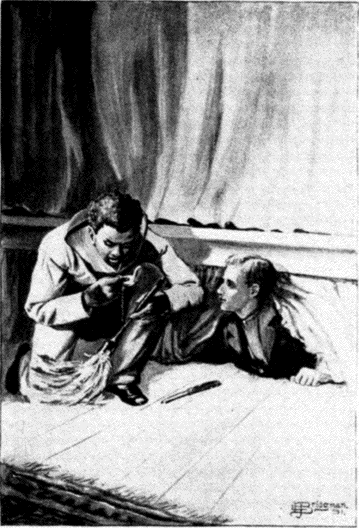
Dave Identifies
Christy.—Page 130.
"Now, Dave, I have another commission for you to execute," continued
Christy, as he tore out the
leaf on which he had written the names. "Not less than twenty-five of
the crew of the Bronx came from New York in the Vernon. One of them is
Ralph Pennant, and he is an intelligent man, and one that can be
trusted. You will see him. Tell him the commander is an impostor. Do you
know what an impostor is, Dave?"
"I reckon I do, sir; your cousin Corny is an impostor," replied the
steward promptly.
"You will find this man, and give him this paper. The names on it are
those of disloyal men. Tell him to look out for them, and find out as
far as he can who are true to the Union."
Christy had hardly finished his instructions to the steward before he
heard footsteps in the cabin. Dave looked into the apartment and
discovered Mr. Flint, who went into the stateroom at once.
A LESSON IN ORDINARY POLITENESS
Though the second lieutenant of the Bronx had not been to breakfast,
it was not his stomach that made the first demand upon him. He directed
the steward to remain in the gangway and apprise him of the coming of
any person in the direction of the cabin and ward room. Dave took his
station on the steps. Mr. Flint entered the stateroom, and the first
thing he did was to drop down on his knees and thrust his right hand
into the space under the berth. It was instantly grasped by Christy, and
given a warm pressure.
"Is it really you, Captain Passford?" asked the second
lieutenant.
"No doubt of it," replied Christy.
"I thought you were somewhat changed in your looks when I saw you
come on board of the Bronx, and then I felt that the greeting you gave
me was rather stiff for an old comrade who had
passed some time with you in a Confederate prison," added Mr. Flint.
"We have no time to talk sentiment now. It is necessary for you to
understand the situation better than you do," interposed Christy; and he
proceeded to explain in what manner his cousin Corny happened to be in
command of the Bronx, while he was himself nominally a prisoner of
war.
"Your absence from the between decks of the Vernon has been
discovered, and Captain Battleton has caused the strictest search to be
made for you on board of all three of the ships. The last I saw of him
he was evidently talking with the flag-officer about you, as I judged
from his looks and gestures," replied the second lieutenant.
"He has not found me yet; and I think that the stateroom of the
commander of the Bronx is the last place he will think of looking for
me. But I have no time to talk of merely selfish matters, for I am not
at all worried about my personal safety while we are within Union lines.
If this plot succeeds, and the conspirators get the ship into a
Confederate port, I shall feel differently about this matter. Has any
third lieutenant been appointed, Mr. Flint?"
"There has, captain; he is a young man by the name of Byron; but I did
not learn his rank."
"Byron!" exclaimed Christy, recalling Walsh, and the name he had
insisted was his own when he first encountered him on board of the
Vernon. "He may have a rank in the Confederate navy, but he has none in
that of the Union. In other words, he is a Confederate officer or
seaman, and he is the man who helped Corny steal my commission and
orders."
"We have a nest of them in the cabin—the captain and two
officers. What is to be done? We cannot allow the Bronx to be captured
by any such trick as this, with forty-five loyal seamen on board of her,
to say nothing of myself as a loyal officer."
"All the crew are not loyal," replied Christy, as he explained the
instructions he had given to the steward.
"But most of the crew must be loyal, for twenty of the old seamen
remain on board, and every one of them is as true as steel," Mr. Flint
insisted.
"But the conspirators do not intend that any issue shall be raised
until the vessel is under the
guns of a Confederate fort. Doubtless Mr. Galvinne, whom I look upon as
the actual commander of the steamer, for Corny is no sailor, will run
into Pensacola Bay under the American flag. Probably he is a pilot in
these waters, and knows what signal to make to the Confederate
forts."
"I don't believe he would attempt to run in while it is broad
daylight," suggested Mr. Flint. "Captain Corny already has his sailing
orders. They are sealed, but he is to proceed to the eastward. I should
say that he would obey orders, and when it is time for him to break the
seals this evening, he will come about, hug the shore of St. Rosa's till
he comes to the entrance of the bay, when he will go in."
"If he does that, so much the better, for we shall have more time to
prepare for a decided stroke," replied Christy. "I have my plan all
ready, though of course it may fail, and to-night we may all be
prisoners of war."
"But don't you believe it will be better to appeal to the
flag-officer?" asked the second lieutenant.
"What good will that do?" demanded Christy. "My cousin has made out
his case before the captain of the Vernon."
"But you had no witnesses then. You have twenty or thirty of them now. I
know you, and so do all the members of the old crew."
"But it appears that you promptly accepted your commander in the
person of my cousin," said Christy, laughing in spite of the gravity of
the situation.
"If I had seen you and Corny together, I should have known which was
which," pleaded Mr. Flint.
"Do you think if I should present myself on deck at this moment,
wearing the frock and shirt of a common seaman, the men would identify
me alongside Corny, who wears the uniform of an officer?"
"I am not so sure of that."
"I don't see how the commodore could go behind the commission which
Corny carries in his pocket, with the orders of the department, any more
than Captain Battleton could. I have thought of this, and I am afraid to
trust myself to the chance," replied Christy very decidedly. "Besides, I
desire to take the conspirators in the very act of running away with the
Bronx; then I can make out a good case."
"But how is this desirable end to be accomplished?" inquired the second
lieutenant, who seemed to be troubled with some doubts.
"Very easily, I think."
"But you must not be rash, captain."
"Will it be the highest prudence to permit the conspirators to take
the Bronx into a Confederate port, Pensacola, or any other?" demanded
Christy with more earnestness than he had yet manifested.
"We may not be able to help ourselves."
"By taking the bull by the horns in good season, I am confident we
can prevent this mischief."
Without discussing this matter any farther, Christy detailed his plan
to Mr. Flint, which was certainly very simple, and the second lieutenant
could raise no objection to it. He was requested to select the men who
were to take part in the enterprise, and all the particulars were
definitely arranged. There was nothing more to be done, and Christy was
left to himself to consider what he had done. The hungry officer helped
himself hastily from the table which was waiting for him in the ward
room, and then hastened on deck.
The transfer of cargo, so far as the Bronx was
concerned, was completed. It appeared that the flag-officer was hurrying
the departure of the steamer on her mission, whatever it was. He had
just had a long talk with Corny, and doubtless there was danger that the
object of the cruise might be defeated by delay. In a short time the
Bronx was under way, headed to the eastward, in accordance with her
verbal orders, for the sealed envelope was not to be opened till nine
o'clock in the evening, as Christy learned from Mr. Flint.
The deck was in charge of the second lieutenant, who was seeing that
everything was put in order. But it might have been observed that he was
more familiar with the men than was his habit. For the first time since
he came on board, Corny went below to take a look at his quarters, Dave
bearing his valise before him. At the same time Mr. Galvinne presented
himself in the ward room to take possession of the stateroom of the
first lieutenant, which was the farthest forward on the starboard side.
It had been Christy's room during his service in the Gulf, though he had
made himself at home in the captain's cabin when he was acting commander
on the voyage from New York.
"This is my cabin, is it?" said Corny, as he followed the steward into
the apartment.
"I think you ought to know it by this time, Captain Passford,"
answered Dave; and the remark was enough to condemn the impostor in the
opinion of the servant. "You lived in here when you were in command of
the vessel."
"All right. You may go into the ward room and ask Mr. Galvinne to
come in here," added Corny, who did not feel quite at home in the cabin,
and was in mortal terror of committing some indiscretion in his
unaccustomed position.
"Invite the first lieutenant to the captain's cabin," said Dave.
"Yes, sir;" and the steward left the cabin.
It was some little time before Mr. Galvinne presented himself, for
probably he did not feel bound to obey the orders of the bogus captain
with especial promptness. However, he came after a quarter of an hour,
and seated himself familiarly in an arm-chair at the table. He had the
bearing of the superior officer, to which Corny made no objection.
"We are all right so far," said Corny.
"Perhaps we are; but you talk too much by
half, Passford, and I have been dreading that you would make a slip of
some kind," replied Mr. Galvinne rather crustily. "You were as stupid as
a Kentucky mule when you stopped to talk with Byron in the waist."
"And you were as stupid as an Alabama mule when you snapped at me for
doing so in the presence of some of the sailors," replied Corny, with
considerable spirit; and Christy, who heard all that was said, was glad
to have him maintain the dignity of the family in his new situation.
"I hope you will not make a donkey of yourself before we have
finished this business," added the executive officer for the time being.
"Now have you looked at your orders?"
"I have not; they are sealed orders, and I am not to open them till
nine o'clock this evening," replied Corny.
"I believe you have lost all the wits you ever had, Passford," said
Mr. Galvinne contemptuously.
"If I did, you did not pick them up."
"I am not going to banter with you, Passford. Where are your orders?"
demanded the first lieutenant in a tyrannical manner.
"They are in my pocket," replied Corny sourly.
"Hand them over to me, and let us have no more fooling."
"I will take care of the orders myself."
"What! Are you not going to give them to me?" demanded Mr. Galvinne,
apparently as much in astonishment as in anger.
"Not till you change your tone. I wish you to understand that I am in
command of this ship, and I have my commission in my pocket. I intend to
be treated with decency at least."
"Well, this is pleasant; and it will be my duty to report your
conduct to my superior officer. In command of this ship! Why, you don't
know enough to lay off the course of the ship, or even to box the
compass."
"I know enough to understand when I am treated like a gentleman.
Change your manners, or I will order you to leave my cabin. You talk to
me as though I were a small boy, and had nothing to do with the
enterprise in which we are engaged," returned Corny.
"Do you expect me to obey your orders?" demanded the executive
officer in a sneering tone.
"If you don't, I will send for the second lieutenant
and a file of men to put you out of my cabin."
There was a silence for a few moments.
"This will never do, Passford," said the tyrannical officer.
"I don't think it will, Galvinne. Behave like a gentleman, and we
shall have no difficulty," added Corny.
"Will you permit me to see your orders, Mr. Passford?" said the
officer.
The breach was closed, and Corny produced the sealed envelope.
THE OPENING OF THE SECRET ORDERS
Christy listened with interest to the conversation in the captain's
cabin, though so far it had afforded him no information in regard to the
present situation, and it was hardly likely to do so, for he had already
been told by Mr. Flint what the next movement of the Bronx was to be.
She had already been ordered to proceed to the eastward, and her sealed
instructions would reveal the enterprise in which she was to engage.
The steamer had been so successful while in command of Captain
Blowitt in breaking up the shipping of cotton in a port where a larger
vessel could not operate, that Christy promptly concluded that she was
to be used in a similar enterprise. The listener was amused rather than
impressed by the conversation which was in progress so near him, and
especially at the display of dignity and authority on the part of his
cousin.
Mr. Galvinne had proved himself to be a very gentlemanly officer in what
little Christy had seen of him on the voyage from New York; but the
situation was entirely changed so far as he was concerned. It appeared
from the conversation, as the listener had for some time supposed, that
the second lieutenant of the Vernon was the real leader of the
enterprise of which Corny was the nominal head. Probably the restraint
of over a week imposed upon him had fretted his spirit, and when he
found himself alone with his incompetent superior, he became conscious
of the superiority his knowledge and training gave him.
Christy rather sympathized with him in his contempt for the one who
was only nominally his superior, though that could not excuse the breach
of good manners of which he had been guilty, whether in the old or the
new navy. He felt that Mr. Galvinne was a man of ability, and that he
was the only person whom he had to fear in carrying out his plan for the
recovery of the vessel.
"I am not a naval officer, though I have given a good deal of
attention to the study of nautical subjects in connection with this
enterprise, and I am not a cipher," continued Corny, after he had
handed the sealed envelope to his companion. "I expect to be treated
with reasonable consideration, even while I defer to you in all nautical
matters. Let us understand each other."
"I acknowledge that I was altogether too brusque with you, Mr.
Passford, and I beg your pardon for my rudeness," said Mr. Galvinne.
"I am entirely satisfied, Mr. Galvinne; and here is my hand," added
Corny, who doubtless felt that he had fully vindicated himself.
"I have been living on a hot gridiron for the last ten days, and in
the first moments of freedom I overstepped the limits of propriety. I
hope we understand each other now, for we are engaged in an important
enterprise, and we cannot afford to be at variance," replied the naval
officer. "Our work is yet unfinished, though it has progressed admirably
so far. Have I your permission to open this sealed envelope?"
"Certainly, Mr. Galvinne; I had heard so much about sealed orders in
the instructions given me for this undertaking, that I was under the
impression that they were not to be seen till the time marked on the
envelope."
"It is not necessary to obey the orders of the
Yankee flag-officer under present circumstances," answered Mr. Galvinne
in a chuckling tone, as it sounded to the listener.
The naval officer read the orders aloud for the benefit of his
associate. The flag-officer had obtained information that a steamer was
loading with cotton at St. Andrew's Bay, and Captain Passford was
instructed to visit that locality and capture the vessel, and any others
that might be found there.
"Why was it necessary to give secret orders for such an expedition as
this?" asked Corny.
"It was wise on the part of the Yankee commodore to make his orders
secret; for information might have been sent by telegraph or otherwise
to St. Andrew's, which would have enabled our people to get the steamer
mentioned out of the way, or to prepare a successful resistance to the
gunboat sent to capture it," Mr. Galvinne explained in the tone of one
who enlightens an ignorant person.
"I see; that is plain enough," added Corny. "How far is it to St.
Andrew's?"
"If I remember rightly it is eighty-three sea miles from the entrance
to Pensacola Bay. But
you do not run away with the idea that it is necessary for you, as the
present commander of the Bronx, to visit this place?" asked the naval
officer.
"Of course we are not bound to obey the orders of the Union
flag-officer," added Corny. "But now you know the situation thoroughly,
Mr. Galvinne, and I suppose you are ready to arrange your plans for the
future."
"There is not much planning to be done; all we have to do is to run
into Pensacola when we are ready to do so," replied the naval
officer.
"Do you think it advisable to do so at once?" asked Corny; and his
motive seemed to be simple curiosity, for he was not competent to give
advice on a naval question, though he was in nominal command of the
steamer.
"Certainly not; for as soon as it was seen on board of the flag-ship
that the commander of the Bronx was disobeying his orders, we should be
chased by the two ships on the station and fired upon."
"How shall you manage it?"
"We shall be well out of sight of the flag-ship by dark, or sooner,
and then we can come about,
and keeping closely under the lee of the land, we shall reach the
entrance of the bay before morning; and then all we have to do is to
run in."
"But the flag-ship will make out the steamer," suggested Corny.
"We shall be too far in for her to do us any harm, for the water has
not less than four fathoms anywhere along the shore of St. Rosa's
Island."
"But she will signal the fort to fire upon us."
"They can't make us out soon enough to do us any harm, or not much,
at any rate," replied Mr. Galvinne confidently.
"I hope it will all come out right, but I have some fears," added the
impostor.
"You need not have. You have played your part remarkably well, Mr.
Passford, and it was an excellent idea on the part of Major Pierson, who
suggested this plan of putting you in the place of your cousin. He had
seen you and your relative together, I believe?"
"He had, for we were both prisoners of war after our unsuccessful
attempt to capture the Bellevite, on the Hudson."
"I have heard about that; and I know that your cousin Christopher is
no chicken."
"He is what the Yankees call smart, and I know he is all that," added
Corny. "What do you suppose has become of him? When Captain Battleton
sent for him in order to let the commodore see us both together, he
could not be found. As you know, all three vessels were very thoroughly
searched without any success."
"There are a great many hiding-places on board of any vessel, and I
am very clear in my own mind as to what became of him. Of course, the
flag-officer, seeing both of you together, would have been as much
perplexed as the captain was, and he would have been compelled to accept
the evidence of the commission and the orders in your possession."
"But Christy would have found plenty of witnesses here: the second
lieutenant and the seamen on board of the Bronx, for example."
"The evidence might have perplexed him; if he had done anything, he
would have been more likely to retain both of you on board of the
flag-ship, and appointed a new officer in command of the Bronx, rather
than go back of the evidence of the commission," argued Mr.
Galvinne.
"But Christy has disappeared all the same; and where do you suppose
he is?"
"I have no doubt he is concealed on board of the Vernon, with the
intention of returning to New York, where he has plenty of influential
friends to fight his battle for him. But I must go on deck, or something
may go wrong in my absence."
Christy heard the footsteps of the late second lieutenant of the
Vernon as he left the cabin. He had listened to the details of the plan
formed by the naval officer, and it agreed with the prediction of Mr.
Flint. While he was thinking of what he had just learned, he heard the
step of Corny—for it could not be that of any other person so
soon—coming into the stateroom; then he saw his feet from behind
his barricade of bags and baggage.
He had not expected his cousin to make any full examination of the
room to be occupied by the commander of the gunboat, for his stay on
board would be short, and he could not feel any great interest in the
room. His curiosity might lead him to make a closer examination of the
interior of the apartment than would be agreeable to his cousin. He felt
that he was in danger of being discovered in his hiding-place; but he
instantly
made up his mind as to what he would do in the event of such an
accident. He had hoped to be spared from any personal conflict with his
cousin, and he had made his plan so as to avoid any such disagreeable
necessity.
But if Corny carried his investigations too far for his safety, and
especially for the success of his enterprise, he decided that the ties
of blood should not prevent him from doing his whole duty as he
understood it. He was therefore prepared to muzzle the intruder, and
confine his hands behind him with a strap he had taken from his valise.
Happily Corny did nothing more than look under the berth while still
standing in the space in front of it, and in this position he could not
see the fugitive. The impostor wandered about the cabin for a time, and
then Christy heard his footsteps on the stairs as he ascended to the
deck.
He had hardly left the cabin before the steward entered the
stateroom, and reported that he had seen Ralph Pennant, and that he had
told him all he knew about the loyalty and the disloyalty of the new
hands in the crew. Ralph reported that he had "spotted" the four seamen
whose names had been given him before the Vernon reached the
station.
"What does he say in regard to me?" asked Christy.
"He said he believed you were bony fido commander of the Bronx, and
he is ready to obey your orders. Mr. Flint had a talk with him while the
first lieutenant was below; he talked to Boxie, and three more of the
men, and he did it mighty sly, too, for the third lieutenant was on the
deck all the time. There's eight bells, Massa Christy, and the second
lieutenant will have the deck."
"I did not think it was so late; but that reminds me that I have
eaten nothing since my breakfast was brought to me early this morning,"
said Christy.
"I hope to drink up every drop of water in the Alabama River if I did
not forget all about that! Gollywomps! Dave is getting stupid,"
exclaimed the steward, springing to his feet. "I can't bring you a
regular dinner, Massa Christy, but I will do the best I can."
"Never mind the regular dinner; but bring me something to eat, if it
is only some crackers and cheese," added Christy; and the steward
hastened to his pantry.
He soon returned with a huge slice of ham and
some cold biscuits. The hungry fugitive, who had not left his appetite
at home, immediately attacked the provision as though it had been an
enemy of the Union, and stood by it till he had devoured the whole of
it; and it proved to be just a pattern for his empty stomach, and he
declined Dave's offer to bring him another.
He had hardly finished it before Mr. Flint paid him another visit,
and reported everything ready for the recapture of the steamer.
THE AFFRAY ON THE QUARTER-DECK OF THE BRONX
Christy was satisfied that all was going well in regard to the
capture of the Bronx, and he went to sleep after he had disposed of his
dinner, and arranged the final details of the enterprise with the second
lieutenant. Mr. Flint was somewhat impatient to carry out his plan; but
Christy insisted that nothing should be done till the orders of the
flag-officer had been actually disobeyed. It was decided that coming
about, and heading the Bronx to the westward would constitute
disobedience.
When Christy awoke it was dark, or at least dusky, as far as he could
judge in his concealment. He heard the rattle of dishes, knives and
forks in the cabin, and he understood that the captain was taking his
dinner. A conversation was in progress, and Christy concluded from the
voices he heard that Corny had invited his first lieutenant to dine with
him.
"I think we shall be in Pensacola Bay by daylight," said Mr.
Galvinne; "and we have just the right kind of weather for our
enterprise. It is cloudy, and it looks as though we might have a fog,
for they often come up after dark when the wind is as it is now."
"What time shall you come about?" asked Corny, apparently from
curiosity rather than any especial interest in the navigation of the
steamer.
"About nine o'clock; perhaps sooner. Byron will have the deck from
eight bells for the first watch; I hope and expect Flint will turn in at
that time, for he will have the mid-watch. It might be a little awkward
if he happens to be on deck when we change our course from east to
west."
Christy did not believe that the second lieutenant would turn in at
the time indicated, though he might make a pretence of doing so, and
shut himself up in his stateroom. Mr. Galvinne proceeded to say that he
should have Rockton and Warton ready to make Mr. Flint a prisoner in
case he became too inquisitive. Nichols and Sayles would
be available near the quarter-deck in case any demonstration was made by
any portion of the crew.
"But there will be no trouble of any kind," added the first
lieutenant. "We are not carrying sail, and I shall quietly give the word
to the quartermaster to make the course west instead of east. Flint is
the only man on board who is at all likely to question the regularity of
the proceedings on board; and I do not see how he can do it, for he
knows nothing at all about the orders under which we are sailing. In
fact, we shall be on the other tack before the time comes to open the
sealed envelope."
"I hope it will all come out right," added Corny.
"You may depend upon it that we shall be under the guns of Fort
Barrancas, or farther up the bay, before daylight," replied the actual
commander.
"What am I to do, Mr. Galvinne?" asked Corny.
"Nothing at all; you can turn in as soon as you like and sleep
through the whole, for there will be nothing at all to disturb you. As I
said,
Flint is the only person on board who is likely to make the least
trouble, and he will be asleep in his berth. If he asks hard questions
when he comes on deck at eight bells for the mid-watch, our men will
secure him. That is the whole of it. I must go on deck now, for I can
smell the fog."
"How are you going to get to the entrance of the bay in a fog?"
inquired Corny.
"If we keep her due west we shall be all right; and I know this coast
as well as I do my father's plantation," replied Mr. Galvinne; and
Christy heard him open the door.
"I think I shall go on deck and see the fun, if there is any, and
turn in if there is none," added Christy.
The dishes rattled for a moment, and then the fugitive heard the step
and the voice of Dave in the stateroom.
"I done bring you something more to eat, Massa Christy," said the
steward, who appeared to have suffered some lapse in his grammar and
pronunciation during the absence at the North of his instructor; and as
he spoke he handed in a piece of pie and a large slice of cake.
Christy was not very hungry after his late dinner, but he ate the
dainties brought to him, and found that the cook of the Bronx had lost
none of his skill. He might not have an opportunity to eat again very
soon, for he did not lose sight of the fact that failure was possible,
and he might soon be an occupant of a Confederate prison with Flint, as
he had been once before.
Dave busied himself in clearing the cabin table, and Christy
impatiently waited the time for the decided action which had been
planned. About half an hour later, when he realized from the condition
of the stateroom that it was quite dark, the sounds coming to him
assured him that the course of the Bronx had been changed as indicated
by Mr. Galvinne. No noise or confusion on deck followed it, and the
naval officer's prediction seemed to be in a fair way to be
realized.
Another half hour elapsed, and except the monotonous plaint of the
screw, no sound was to be heard. A footstep came from the cabin, where
Dave was at work, or appeared to be, for he had been stationed there for
his part of the programme which was presently to be carried out.
"Steward, light the lamp in my stateroom,"
said Corny; and Christy was glad to find that he intended to retire for
the night, for he had no duties to perform unless there was a
disturbance on the quarter-deck.
The lamp on gimbols was lighted, and Corny took
possession of the room, and had not a suspicion that he was not its only
occupant. He lay down in his berth after he had removed his coat and
shoes, and in a few minutes Christy judged that he was asleep from the
sound of his breathing, which soon degenerated into a mild snore. Mr.
Flint was to make a beginning in the project, or, as Dave called it,
"open the ball."
In less than another half hour, Christy heard a knock on the cabin
door, which was the signal from the second lieutenant that it was time
to begin operations. He crawled to the front of the space beneath the
berth at the sound, and at the same moment Dave came in at the door of
the stateroom, which had been left open.
The steward lost no time in acting his part, the first step of which
was to jam a handkerchief into the half-open mouth of Corny Passford;
but he had been counselled to use no more force than was necessary to
subdue him. Dave then turned
him over on his back in spite of his aimless struggles, for, as he was
roused from his sound slumber, he was too much bewildered to accomplish
anything like an effective resistance. The strap which Christy had
provided for the purpose was used in fastening his hands behind him, and
so far as Corny was concerned, the battle was fought and the victory
won.
Christy had crawled out of his narrow quarters under the berth as
soon as Dave began to operate on the sleeper above him, and he stood
ready to assist the steward if his services were required; but there was
hardly anything like a struggle, for Corny had been so completely
surprised that he was incapable of doing anything in self-defence. With
his hands strapped behind him, and with the gag still in his mouth, he
was permitted to remain in the berth under the guard of Dave.
Not a particle of noise had been made in the stateroom; at least,
none that could be heard on the deck above. Christy hastened from the
little apartment through the cabin to the gangway, where he found Mr.
Flint at the head of the stairs prepared to execute the part of the work
assigned to him, which was to fall upon Mr. Galvinne;
but he did not appear to be in a favorable position for the attack.
"What are you waiting for, Mr. Flint?" asked Christy in a whisper, as
he joined the second lieutenant.
"He has gone into the waist," replied the officer in waiting. "He
will be back in a moment."
Christy had looked into the ward room as he passed the door, for the
captain's cabin was not provided with a separate companion-way, as is
usual on men-of-war, for the space could not be spared in so small a
vessel. All was still there, but two men stood near the door waiting for
the signal to rush to the deck.
"What are those men doing aft, Mr. Byron?" demanded the first
lieutenant, with some excitement in his manner. "They were very nearly
on the quarter-deck, and they seemed to be very reluctant to go
forward."
"I am sure I don't know, Mr. Galvinne; I did not order them there,"
replied the third lieutenant, who was in charge of the deck.
"I suppose they have seen that the course of the ship has been
changed, and I thought they might have come aft to ask some questions,
though the men ought to be better trained than that," added Mr.
Galvinne, as he came quite near the companion-way where the second
lieutenant was waiting for him, with Christy behind him, and ready to
support him.
Mr. Flint sprang upon the quarter-deck and threw himself upon Mr.
Galvinne, closely followed by Christy. At the same time, and as soon as
the gangway was clear, the two men who had been stationed in the ward
room leaped upon the deck, and threw themselves upon the third
lieutenant. At the same moment, the six men who had been lurking in the
waist, and who had attracted the attention of the executive officer,
hastened to the scene of the conflict. Rockton, who had been made a
quartermaster, and the helmsman, Warton, went to the assistance of the
first and third lieutenants.
Neither of the two disloyal officers of the Bronx was an infant, and
each struggled like a brave man against the force that attacked them.
Mr. Flint had fallen upon Mr. Galvinne from behind, and had thrown him
down at the first onslaught. He fought like a tiger, but with the aid of
Christy and two of the men from the
waist, he was subdued, and Christy had a strap ready to confine his
hands behind him. Then he was drawn over to the rail and made fast to a
belaying pin.
Byron was not less energetic than his superior in his own defence,
but the two stout sailors who had been selected to capture him were more
than doubly a match for him, and he was carefully secured. At the same
time there was a free fight between Rockton and Warton on the one side,
and the sailors who had come aft, but the disloyal tars were conquered
in the end. The prisoners were all bound and made fast to the rail. The
entire watch had come aft while the battle was in progress, and those
who had been instructed in the situation and had taken part in the
recovery of the ship explained to their loyal companions the meaning of
the affair which had just been brought to a conclusion. Involuntarily
they gave three tremendous cheers, and then three more for the genuine
commander.
Not a few of them who had served with Christy in the Gulf declared
they had not believed that the person who was the nominal captain was
their old first lieutenant; they knew that something
was wrong, they said, though they could not tell what. Perhaps they
found the captain less active than formerly, and considered him somewhat
changed after his visit to the north; but doubtless they were as much
blinded by the resemblance as others had been.
"Mr. Flint, I appoint you acting first lieutenant of the Bronx," said
Christy, as soon as the affray was over. "You will restore order on
board."
The new executive officer sent the men forward, called out one of the
old quartermasters to con the wheel, and placed a loyal seaman under his
charge as helmsman. Order was almost instantly restored under his
direction, and the men had enough to talk about to last them the entire
night. Mr. Flint had his doubts in regard to the security of the
prisoners; their bonds of straps and rope were removed, and their places
supplied by iron handcuffs.
A REBELLIOUS AND PREJUDICED PRISONER
"Well, Mr. Flint, we have been more successful than I feared we might
be," said Christy, after the prisoners except Corny had been put in
irons, though they consisted of only five officers and seamen.
"As usual, you are the hero of the adventure," replied the new first
lieutenant, laughing. "But I must say it was the stupidest enterprise in
which rational men ever engaged."
"I decline to be regarded as the hero of the adventure, as you call
it; and it was not so stupid as you suggest," replied Christy, with the
greatest good-nature.
"Perhaps you builded better than you knew; but if you had not escaped
from the Vernon, and managed the whole affair, it would have been a
success," added Mr. Flint.
"Then the scheme cannot be considered so stupid as you
represent it."
"But it had not one chance in ten of success. Your cousin looks more
like you than he did the last time I saw him."
"He fixed himself up to pass for me, and that helped his case very
greatly. He put on a uniform like mine, such a one as you have never
seen him wear."
"He did not look quite natural to me; but I could not make out what
made the change in his looks," continued Mr. Flint. "You can see for
yourself, that the plot would have been a success if you had not been on
board of the Bronx to tell me what had happened. Whatever passed between
the flag-officer and Captain Battleton, nothing at all was said among
the officers about the decision the commander of the Vernon had been
obliged to make when he accepted your cousin as the genuine Christopher
Passford, ordered to the command of the Bronx. While I thought you were
somewhat altered in appearance, and that your greeting to me was rather
cold and formal when you came on board, I did not suspect that the
officer who represented you was an impostor."
"Do you think you should have let these conspirators
run into Pensacola Bay without meddling with the matter?" asked
Christy.
"I am sure I should, for I could not have helped myself. The captain
had his orders, to be opened about this time; and I should have supposed
you were going into the bay to shell out Fort Barrancas."
"You could hardly have supposed that a little gunboat like the Bronx
was sent all alone on such a mission."
"I obey my orders without question, and I should not have suspected
anything was out of the way. I was rather cut up when I found that
Galvinne had been appointed executive officer; and that, with the cold
greeting you gave me, led me to ask in what manner I had lost your good
opinion."
"Of course Corny asked for his appointment, for Mr. Galvinne was the
real leader of the enterprise. I think you and some of the rest of us
have narrowly escaped a Confederate prison."
"That is plain enough; and we only escaped it because you took it
into your head to leave the Vernon at the time you left her. I think the
Bronx would have gone into Pensacola Bay without
the least trouble, for I have no doubt Galvinne knew just what signals
to make to Fort McRae, and just as well what ones to make to Fort
Pickens. The ship would have been there by midnight, and up to that time
I should have been asleep in my stateroom; and they would not have taken
the trouble to call the watch below at that hour."
"No matter; we have the Bronx again, and she is not yet to become a
Confederate cruiser. But Corny had the sealed orders of the
flag-officer, and I heard Mr. Galvinne read them. The Bronx is ordered
to St. Andrew's to attend to the case of a steamer loading there to run
the blockade. Shall I obey the orders, or return to the flag-ship?"
"The commodore hurried us off, for he feared any delay might allow
the steamer to escape."
"We have five prisoners on board; and we can take care of them well
enough," replied Christy; "but the principal difficulty is that we have
no officers."
"But we have plenty of good men, and some of them will make good
officers," suggested the first lieutenant.
"We have no surgeon, I believe, for Dr. Spokeley
is sick, and was to be sent home before I left in the Vixen for New
York," added the commander, now restored to his own right on board.
"Oh, yes; we have a surgeon, for Dr. Spokeley is to go to New York in
the Vernon, and the doctor of the store-ship is appointed to the
Bronx."
"Dr. Connelly!" exclaimed Christy.
"Just so; and I dare say he is asleep in his stateroom at this
moment."
"Then we had better obey the sealed orders of the flag-officer; we
will come about, and head her for St. Andrew's. Fortunately I have been
there myself in the Bellevite, and I have been up the harbor and bay in
boats, for the yacht, as she was at the time, drew too much water to go
into the bay, for it is shoal inside. Come about, Mr. Flint, and make
the course due east."
"I hope we shall do as well as we did at Cedar Keys," replied the
first lieutenant, when he had given the order to come about to the
quartermaster.
"Look up the log slate, for I suppose they have made the entries, and
when we have run eighty knots from the station, keep a sharp lookout for
the land. Now I will go to my cabin, and find the
envelope that contains the orders, and look them over."
Christy went below, and found Dave in the stateroom, apparently
unwilling to take his eyes off the prisoner who still lay in the berth.
He went to the table in the cabin, and found upon it the sheet upon
which the orders had been written. They were of no use to Galvinne, and
he had thrown them down as soon as he had read them. He sat down at the
table and read the paper; but the order was very simple, and left all
the details to the discretion of the commander, for it was understood
that Captain Passford was well acquainted with the coast as far as St.
Mark's.
Christy was still clothed in the frock and cap of a common sailor,
and he realized that it was time for him to put on his uniform. He went
to the quarters of the men where he had concealed his valise, and
carried it back to the cabin, where he proceeded to make the change. In
a short time he had put himself in proper condition to take his place on
the quarter-deck in command when his presence was required. He had
nothing to do at present, and he concluded to write his report of the
remarkable proceedings on board since the
Bronx left the station. He wanted his desk, and he went to the
stateroom.
"Well, Dave, how is your prisoner?" he asked, halting at the
door.
"I got him safe, Massa Cap'n," replied the steward, exhibiting most
of the teeth in his mouth, for he was pleased with himself after he had
executed the commission assigned to him, and did not feel as much like a
contraband as he might.
"I am in command, Dave, and there must be no more 'massa' now," added
Christy.
"I done forget all about my talk, Captain Passford," replied
Dave.
"That is bad grammar," said the commander, laughing, for he was in an
exceedingly pleasant humor, as may well be supposed. "You know what is
right, and you must not talk like a contraband."
"I won't do so any more, Captain Passford," protested the steward,
showing his ivory, though he was not a very black man, and the contrast
was not as great as in many instances.
"How do you find yourself, Corny?" asked the captain, turning to the
berth.
"I am all right, Corny; but I should like to
have you or some one tell me what has been going on in this steamer, for
this black rascal will not say a word to me," replied the prisoner.
"I don't blame him, if you call him a black rascal," added Christy.
"But you need not call me by your own name any longer, cousin, for it
will not help your case any more. Your game is played out, and you have
been beaten with your own weapons. When you want to play another Yankee
trick, you had better remember that you are not a Yankee, and you are
not skilled in the art of doing it."
"What do you mean by that, Corny?" asked the prisoner, disregarding
the advice of his cousin.
"Corny again!" exclaimed the captain.
"I am the commander of this steamer, and I have been assaulted in my
berth!" replied the sufferer, warming up a little.
"Whew! Then you are still the commander of the Bronx?" repeated
Christy, laughing at his cousin's persistence.
"You know that I am. Wasn't the commission decided to be mine?"
"But we have concluded to reverse the decision of the commander of
the Vernon, and submit the
case to the flag-officer for final adjustment. In the mean time, I have
taken possession of the steamer, and put all your confederates in irons.
For the present, at least, I am in command of the Bronx, and I want my
stateroom. With Dave's assistance, I must ask you to turn out of that
berth."
"I decline to give up my stateroom, or my command of the steamer,"
replied Corny in a sulky manner. "I should like to know how you happen
to be on board of the Bronx, Corny."
"Did you believe that I intended to let you take possession of this
steamer, and run her into a Confederate port, Corny? My name is Passford
as well as yours, and I am not a traitor, and don't believe I am a
coward. At a time which suited my convenience, I left the Vernon and
came on board of the Bronx."
"Where did you hide, for the vessel has been searched in every part
of her for you?"
"I have been under the berth in this stateroom, a hiding-place which
was suggested to me by one of your people who used it as such, and was
caught, as I was not."
"No one thought you would hide in the captain's cabin."
"That is the very reason why I chose this place. I have had the pleasure
of listening to all your conversations with Mr. Galvinne, and I knew
your plans from beginning to end."
"You have been under this berth since the steamer left the
flag-ship!" exclaimed Corny, apparently amazed at the fact.
"I have; but I have no more time to enlighten you. I can only say
that with the assistance of the only loyal officer left on board, and
the loyal seamen, I have recaptured the vessel, and now we are on our
way to St. Andrew's to obey the orders which the flag-officer delivered
to you when you were a rebel in disguise. Now Dave will help you out of
the berth."
"No, he won't! If I was to be captured at all, Corny, you insulted me
when you set a nigger to do the job," said the prisoner angrily.
"You are playing a farce now, cousin; but I cannot stay to fool with
you. Take him out of the berth, Dave."
"Will you set a nigger upon me again, Christy?" using the commander's
proper name for the first time.
"If you will get out of the berth yourself, I will allow you to do
so," added Christy.
"I will," replied the prisoner.
He made the attempt to do so, but he would have fallen to the floor,
with his hands fastened behind him, if Christy and Dave had not received
him in their arms. The steward hugged him like a brother, perhaps
maliciously, and carried him to a divan in the cabin. Corny had
apparently abandoned his cause, and his cousin gave him a berth in the
ward room for the rest of the night.
THE DISPOSAL OF THE PRISONERS
Before Christy could begin his report he was called to the deck by
the first lieutenant, though everything had appeared to be quiet and
orderly there. Ralph Pennant had been at work among the crew, and was
unable to discover that any of the men were disloyal; but the commander
had better information obtained by his own investigations. Ralph was in
consultation with Mr. Flint when Christy went on deck.
"I think the men are all right, and, so far as I can ascertain, not a
man is a rebel," said Ralph in answer to a question of the executive
officer.
"You have the names of the four men that I sent to you by the
steward, have you not?" asked Christy.
"I have, captain; Rockton and Warton took part with Mr. Galvinne, but
Sayles and Nichols did nothing, and they seem to be as in earnest on
the right side as the other two were on the wrong side," replied
Ralph.
"I should not be willing to trust them. I know they were the intimate
associates of Rockton and Warton, for they were in council together on
board of the Vernon. In carrying out our orders, we may have a fight
either with a battery or with some vessel, and we must not have any
black sheep in the crew,—one who might speak a word or make a sign
that would ruin all our calculations," added Christy.
"Of course I can't say that Sayles and Nichols are not rebels; but
they have done nothing that is suspicious, and one of our men has pumped
them both," answered Ralph.
"Have them closely watched, or they may play us some trick when we
least suspect it, and in some critical moment," said the commander.
"But I wished to see you in regard to the prisoners," interposed Mr.
Flint. "We have four of them here made fast to the rail, and Galvinne
complains of his treatment; he says he is cold."
"I should think he might be, for the night air is very chilly,"
replied Christy. "I should have preferred to get rid of these men before
we went
into any enterprise, for they are dangerous persons to us."
"With their arms locked together behind them, they are not in
condition to do any harm," added Mr. Flint.
"I will go below and see what can be done with them. I desire to make
them as comfortable as possible, though I do not believe they will be
satisfied with any location to which I may assign them."
"I think you need not be too particular about them; they have made
their own nest, and now they must live in it," said the first
lieutenant.
"You may come with me, Ralph," added Christy, as he descended the
companion-way.
The commander found Dave keeping close watch over Corny Passford,
though he was fast asleep in his berth. Passing through the ward room
and steerage, Dave unlocked the door that led into the quarters of the
crew. Next to the bulkhead, or partition, was space enough for the
prisoners, and the steward was required to bring five berth sacks, which
were placed on the deck.
"The only objection I have to this as prison quarters is that Sayles
and Nichols will be too
near them; but I shall keep a sentry over them all the time," said
Christy.
"I should think they would be safe with a guard," added Ralph.
"Now, Dave, you will wake your prisoner, and I will relieve you of
all responsibility in regard to him. He is dressed, is he not?"
continued the commander when they reached the ward room.
"He is, Captain Passford, for he did not undress when he turned in
last night," replied the steward.
"What is the matter now?" asked the prisoner in the ward room, after
he had rubbed his eyes for a time.
"Nothing is the matter now on our side of the house, but I must put
you with the other prisoners," replied Christy. "You may unbuckle the
strap, Dave, so that he can get out of the berth."
"Who are the other prisoners?" demanded Corny, as though he had a
right to know.
"They are your confederates in the plot, Corny. Who do you suppose
they are? Jeff Davis is not one of them. The most important one, not
even excepting yourself, cousin, is Mr. Galvinne, late first lieutenant
of the Bronx."
"Is he a prisoner?" asked Corny, as he got out of the berth.
"Of course he is. Do you think I should let him lie around loose on
deck? The next one is the man-servant at Bonnydale by your appointment,
formerly Walsh, but now Byron. He is a very good actor, but he has
played out his rôle."
"He was by profession an actor in Mobile," added Corny.
"I should think he might have been. By the way, Corny, where is my
commission that you and he stole from my pocket at Bonnydale?"
"That is my commission," replied Corny, putting his hand
involuntarily on his left breast, where he had carried his papers on
board of the Vernon.
"You stole it, cousin, and you must give it back to me," added
Christy, very decidedly.
"I shall not," replied Corny, with quite as much firmness.
"Take it from him," said the commander.
The hands of the impostor were now free, and he placed himself in a
defensive attitude; but Ralph Pennant, who was rather above the average
stature, threw his arms around him, and he was
pinned as tightly as though he had been put into a strait jacket. Corny
was probably stiff in his arms from their confinement, and he was unable
to make a very spirited defence. While the seaman held him, Christy took
the envelope from his breast pocket, and transferred it to his own. But
there was considerable noise made in the brief scuffle, which waked some
of the sleepers. From one of the staterooms an officer rushed out, and
demanded the cause of the disturbance. The person proved to be the
surgeon.
"We are putting things to rights on board," replied Christy, who had
not seen the doctor before, for he had retired early to his room.
"I don't quite understand this matter," said the surgeon. "What are
you doing, Mr. Passford?"
"Captain Passford, if you please, Dr. Connelly, for I have the honor
to be in command of the Bronx at the present moment. This is Mr.
Passford," added Christy, pointing to his cousin.
"Then you have reversed the decision of Captain Battleton?"
"For sufficient reasons, I have; with the assistance of the loyal
members of the ship's company, I have taken possession of the vessel,
and we are
now on our way to carry out the orders of the
flag-officer.—Conduct the prisoner to his future quarters," said
Christy, in a very business-like manner.
During this conversation, Ralph, still holding his prisoner, had sent
the steward on deck for a pair of handcuffs, which the seaman proceeded
to apply to the wrists of Corny.
"What are you about?" demanded the prisoner, attempting to shake off
his captor when he felt the cold iron.
"Just giving you a pair of bracelets," replied Ralph, as he grappled
again with his victim, and asked Christy to adjust the handcuffs. "Just
for ornament, you know."
In the grasp of such a powerful man as Ralph Pennant, Corny was
powerless, and he was compelled to submit, though his opposition
appeared to be merely a matter of form with him, for he could not help
realizing that it was utterly useless; but he had not been in the affray
on deck, and he had not learned the full lesson from experience. The
irons were locked upon his wrists, and the seaman was directed to
conduct him to the place assigned to all the prisoners.
"This is mean of you, Christy, to put me in irons," said Corny
reproachfully as he turned to his cousin; "I might have asked Captain
Battleton to put you in irons on board of the Vernon; but I did
not."
"If he had done so, I should not have complained. I have been a
prisoner of war, and I had to take my chances. We may be in action for
aught I know in a few hours, and I do not mean to have half a dozen
rebels at my heels to trip me up if I can help it. The circumstances are
entirely different from those on board of the Vernon."
"I don't think so," muttered Corny. "You treat your own flesh and
blood as though blood was nothing but water with you."
"I stand by the Union, and those on the other side must keep out from
under. When I was in a Confederate prison, my uncle Homer, your father,
did not do a single thing for me. Lead on, Ralph."
Dr. Connelly was so much astonished at the proceedings that he did
not turn in, but completed his toilet, and came out into the ward room
again. He looked troubled, for he had
heard nothing of the struggle on the quarter-deck, and the situation was
a revelation to him. He looked and talked as though he thought that
Christy and his associates who had captured the vessel were simply
mutineers. The captain sent the steward for Boxie, and, giving him a
pair of pistols and a cutlass, informed him that he was to stand guard
over the five prisoners until he was relieved. The old man, who had been
one of the seamen on board of the Bellevite when she was a yacht, took
his place forward of the berth-sacks, and began his march
athwartship.
"You know me, don't you, Boxie?" said Corny as he recognized the old
salt, who was the sheet-anchorsman of the crew, and who was generally
their spokesman.
"You will hold no conversation with the prisoner, Boxie; but you may
let them talk among themselves, and note what they say if it is of any
importance. You will be relieved with the first watch."
Ralph Pennant and three seamen conducted the other prisoners to their
quarters. They were supplied with blankets, in which those from the deck
wrapped themselves up. Corny and Galvin began
to compare notes at once; but Boxie kept his ears open as he marched up
and down within two feet of his charge.
"I hope you have not committed any rash act, Mr. Passford," said Dr.
Connelly as the party passed through the ward room.
"I do not stand on mere forms, Dr. Connelly; but if you continue to
call me simply 'mister,' I shall understand from it that you do not
recognize me as the rightful commander of the Bronx," replied Christy,
as he invited the surgeon with a gesture to enter the captain's
cabin.
"I beg your pardon, Captain Passford; I used the title of 'mister'
from habit, and not as meaning anything," replied the surgeon. "I was
forced by the evidence, and quite as much by the lack of evidence, to
concur with Captain Battleton in his decision."
"I find no fault with you on that account, doctor," added
Christy.
"You made no protest to the flag-officer, but suddenly disappeared.
When I went to my stateroom in the evening, your cousin was in command,
and had sailed to execute the orders given him. You can judge of my
astonishment when I learned
just now that the captain and his officers were prisoners," the surgeon
explained.
"I do not propose to submit to another investigation by you, or any
one but the flag-officer; but for your information I am willing to give
you the facts," said Christy with dignity, of which he had a full supply
whenever it was needed. "As long as the officers in charge of the Bronx
continued to obey the orders of the commodore to proceed to the
eastward, I did nothing; but when they headed the steamer to the
westward, which they did as soon as it was dark, I understood very well
that they were disobeying their orders, and intended to run the Bronx
into Pensacola Bay, and deliver her to the Confederate authorities. Then
I carried out my plan and captured the vessel."
The surgeon was satisfied with this evidence.
THE SECOND AND THIRD LIEUTENANTS
The surgeon went on deck with Christy, where he was presented in due
form to Mr. Flint, though he had been introduced to him before in his
former position as second lieutenant. The commander went forward to the
bridge and pilot-house, and consulting the log slate, found that the
last entry gave seventy-eight knots from the station. But it was foggy,
as Mr. Galvinne had predicted that it would be, and the quartermaster
conning the wheel said it was as "dark as a stack of black cats."
Nothing could be seen in any direction, and the commander decided that
it was not prudent to proceed any farther.
The leadsman was ordered to sound, as the screw was stopped, and he
reported sixteen fathoms with the deep-sea lead. Christy ordered the
quartermaster to go ahead again, and keep the hand-line going all the
time. Mr. Flint came forward, and took his place on the bridge, where
the
officer of the deck was usually stationed on board of the Bronx.
The reports of the leadsman were satisfactory, and the steamer went
ahead for an hour. Then they began to give a diminution of the depth of
water, indicating, as Christy stated it, that the vessel was approaching
the land. He looked over the log slate, and found that the course had
been due east till the order had been given to head her in the opposite
direction. She had sailed rather more than an hour on that tack, during
which the recapture of the steamer had been made.
"Mark under water twelve!" shouted the man with the hand lead.
"We are coming up with the shore," said Mr. Flint, as Christy joined
him on the bridge.
"Yes; but you will get four or five fathoms almost up to the beaches.
When I was here, the Bellevite was anchored outside, and we went gunning
and fishing in St. Andrew's Bay. The bay is about thirty miles long; but
it is as crooked as a ram's horn, and there is no town on it, though
there are some scattered houses," added Christy. "We shot fat ducks, and
caught plenty of red snappers and pompana there."
"And a half ten!" shouted the leadsman, as though he meant to have his
figures understood, as they indicated the shoaling of the depth.
But Christy gave no order to reduce the speed of the vessel, and
seemed to feel so thoroughly at home that Mr. Flint began to be a little
nervous. The young commander had carefully studied the chart of the
coast with the practical knowledge he had of the locality.
"Can you form any idea where we are, Captain Passford?" asked the
lieutenant.
"I figured up the course a while ago, and I think we are off St.
Andrew's Bay. If they had not put her about and run for an hour or more
to the westward, I should be satisfied in regard to my position; as it
is, I am not quite clear in regard to it," replied the commander.
"Quarter less ten!" shouted the leadsman, with even more vigor than
before.
"That will do; stop her and anchor, Mr. Flint," said Christy, as he
looked about him in an endeavor to penetrate the fog in which the vessel
was buried.
Then he listened for any sounds that might come to him from the
direction of the shore; but
all was as still as the tomb itself. The screw stopped in obedience to
the order of the executive officer, who went down to the deck to
supervise the anchoring of the steamer, as he had no inferior officer to
attend to this duty.
"Mr. Flint, drop a drift lead, and station a hand to observe it,"
said Christy, hailing the first lieutenant.
"A drift lead, sir," replied Mr. Flint.
This was a lead weighing twenty pounds, which is dropped on the
bottom by men-of-war to determine if the anchor holds, or if the vessel
is drifting.
"Station a strong lookout, Mr. Flint, and send a man aloft on the
foremast and another on the mainmast," continued Christy when the other
orders had been obeyed.
This completed the preparation for the night. The captain consulted
his repeater, and ascertained that it was twenty minutes past twelve.
The Bronx was in position to learn the fact if any vessel attempted to
run out of St. Andrew's Bay, provided his calculations in regard to the
locality of the Bronx were correct. Christy went down to the deck, and
walked aft with Mr. Flint.
"I think some of us need a little sleep to-night," said the
commander.
"Then you had better turn in, Captain Passford," said the executive
officer. "We can do nothing more to-night except to keep a sharp
lookout."
"You are the only officer on board except myself," replied Christy.
"We are still in the dark as to what we have to do here. We may have to
send off a boat expedition, as we did at Cedar Keys, and we are in
absolute need of more officers."
"We have plenty of material out of which to make them, and we can do
as we did after the fight with the Scotian and the Arran, when we made
them," replied Mr. Flint. "We have men of good education in the crew,
who have either commanded coasters, or been mates on steamers."
"If you will name one, I will name another," added Christy.
"Quartermaster Camden. He commanded a three-masted schooner in the
coal trade. He is not college educated, but he is a remarkably
well-informed man who shipped in the navy to learn the details of duty
on board of a man-of-war."
"I appoint him acting second lieutenant," added Christy.
"I am sure he will get a commission as soon as he applies for it,
captain," added the first lieutenant, pleased with the prompt decision.
"Now, who is your man?"
"Ralph Pennant. I had my eye on him while I was aboard of the Vernon,
where he became a sort of oracle among the seamen on account of his
abundant information on general subjects. He talks like a man with a
good education, and he has been mate of a steamer of good size. But I
know very little concerning him, and am afraid he has one out."
"What is that, captain?"
"I am afraid he is fond of whiskey, though I do not know that
he is."
"He can't get any whiskey here unless it is served out to him; so
that habit, if it is his habit, will do him no harm," argued Mr.
Flint.
"I appoint him third lieutenant temporarily."
"That will amount to their being made ensigns when you go north again
if they prove to be worthy of promotion," added the executive officer,
with a chuckle. "That was what happened to Baskirk and Amden."
"If they are worthy, I shall certainly do the best I can for them,"
added Christy, gaping.
Camden was called aft and formally appointed second lieutenant, but
Ralph was in the watch below, and was in his hammock. The commander
retired to his stateroom, and, letting his report wait till another day,
he was soon sound asleep.
In accordance with the directions he had left with the first
lieutenant, Christy was called with the watch at four o'clock in the
morning. Though the first lieutenant is not a watch officer, he may be
required to do duty as such when the number of commissioned officers is
reduced below three, and Mr. Flint had remained in charge of the
mid-watch, which had been called to the deck at midnight. The captain
relieved him and Camden, and both of them went below, the new appointee
taking the stateroom of the second lieutenant.
"Pass the word for Ralph Pennant," said Christy, as soon as he
reached the quarter-deck.
"I have had considerable talk with Camden, and I am satisfied that he
will make a capital officer," said the executive officer, as he moved
towards the companion-way. "I suppose you
have sent for Pennant with the intention of appointing him third
lieutenant."
"That is my purpose; and here he comes."
"On deck, sir," reported Ralph, touching his cap to the commander, as
Mr. Flint descended the steps to the ward room.
"I think you told me that you had had some experience on board of
steamers, Pennant," replied Christy.
"I told you that I had been the mate of a steamer," answered the
seaman.
"What is your age?"
"Twenty-eight years."
"Then you are older than you appear to be," continued Christy; and he
proceeded to question the seaman in regard to his education and
experience as a seaman.
He had not been mistaken in his estimate of the man, so far as he
could judge from his answers. Pennant had taken a steamer home to New
York from Havana after the captain had died there of yellow fever. He
had expected to be given the command of the vessel; and when he failed
to obtain the position he resigned his place as mate, but secured the
same position in another and larger steamer.
"Do you ever drink whiskey, Pennant?" asked Christy abruptly.
"At present, no, sir," replied the seaman decidedly. "I learned a few
months ago that I failed to obtain the command of the steamer I brought
home from Havana because it was said I took too much whiskey. I knocked
off then, and have not drank a drop since."
"That was a sensible thing to do. You are aware that we are short of
officers, I suppose," said the commander.
"Yes, sir; and since I came on deck, I heard that Phil Camden had
been appointed acting second lieutenant," replied Pennant.
"That is true; and now I am going to appoint you acting third
lieutenant. You will call the watch aft."
"I am very much obliged to you, Captain Passford, for this favor; and
I know you would not give me the place if you did not think me worthy of
it," replied the seaman as he went forward and called the watch to the
mainmast.
"My men, I have just appointed Ralph Pennant acting third lieutenant;
and you will obey and respect him as such," said Christy, addressing the
watch, and then dismissing them.
The men gave three hearty cheers as they were dismissed, proving to the
commander that Pennant was a popular man among them, as Camden had also
been proved to be when his appointment had been announced to the
starboard watch. As in politics, legislation, war, and business, the
masses of the people soon ascertain who are their natural leaders, the
crew of the Bronx, or that portion who had come from New York in the
Vernon, had been prompt in discovering the abilities of the two men now
promoted.
"Now, Mr. Pennant, you may remove your bag to the ward room, and the
third stateroom on the starboard side, counting from the forward one, is
yours for the present," continued Christy.
"But I have no uniform, Captain Passford," suggested the
appointee.
"I have one in my stateroom; but it is altogether too small for you,"
replied the commander, glancing in the gloom of the night at the
stalwart form of the third lieutenant, lacking not more than an inch of
six feet, and his weight could not have been less than one hundred and
eighty. "We will see what can be done in the morning."
"The crew all know me, and I dare say I can
get along without a uniform till we get back to the station, where I
could get one from the store-ship; but it is not likely that I shall
need one then."
"I cannot say as to that. When you go forward take a look at the
prisoners, and report to me," added Christy, as Mr. Pennant went
below.
In a few minutes he reported that the prisoners were all fast asleep.
Boxie had been relieved as guard, and another seaman was marching back
and forth by their couches. It was still dark and foggy, and a hail came
from the mast-head forward.
A BATTLE ON A SMALL SCALE
"On deck!" shouted the lookout at the foremast head. "Light on the
starboard bow!"
"Silence, all!" cried the commander, as soon as he heard the hail
from aloft. "Go forward, Mr. Pennant, silence the hands, and direct the
lookout to hail in lower tones."
The third lieutenant sprang forward to obey the order, and Christy
followed him at a more moderate pace, consistent with his dignity as the
officer highest in rank on board. It was not so much a question of
dignity, however, with him as it was the intention to preserve his
self-possession. A light had been reported on the starboard bow; but
Christy had no more means of knowing what it meant than any other person
on deck. It suggested a blockade runner, a battery, or a house near the
shore where he did not expect to find one.
The captain went on the bridge; but he could not see the light. He
descended to the deck, and then mounted the fore-rigging. The lookout
saw him, and said he could not see the light any longer; it had been in
sight a couple of minutes, and then had disappeared. It was useless to
look for it if gone, and Christy returned to the bridge, where Mr.
Pennant was attentively studying the compass.
"In what direction is the head of the steamer pointed, Mr. Pennant?"
he asked as he joined the lieutenant.
"Exactly north-east, sir," replied Mr. Pennant.
"Then the report of the light on the starboard bow places it directly
to the eastward of us," added Christy. "That is about where the entrance
to St. Andrew's Bay ought to be, if my calculations were correct. We
have been running to the eastward since we left the blockaders' station
off Pensacola Bay. My ruler on the chart gave me that course, and Mr.
Galvinne followed it while he was in charge. We could not have got more
than half a mile off the course in coming about twice. The shoaling of
the water also indicates that we are all right."
The body of the fog evidently lay near the water, and the lookout had
probably seen the light over the top of the bank, as it could not be
made out on the bridge. Christy expressed his belief that the sun would
burn the fog off soon after it rose. No variation of the drift lead had
been reported, and the Bronx was not even swinging at her anchor. For an
hour longer entire silence was preserved on the deck, and the lookout
made no further report.
"There is some sort of commotion among the men on the top-gallant
forecastle," said Mr. Pennant, while Christy was still studying the
situation, and one of the men was seen in the act of hurrying aft.
"I heard men's voices off to the eastward," said this man, when he
had mounted the bridge, and touched his hat to the officers there; and
he spoke in a whisper, in conformity with the orders given.
"Could you hear any slapping of a paddle wheel, or other noises that
sound like a steamer?" asked Christy in the same low tone.
"No, sir; nothing but the voices; but I think the speakers must be in
a vessel of some sort, for
the sound since I first heard it, and could hardly make it out, comes
from farther south," replied the man.
"Take a force of twelve men, with pistols and cutlasses, Mr. Pennant,
in the first cutter, and pull down to the south-east. Whatever you find
in the shape of a vessel or a boat, capture it, and return to the Bronx.
Get off with as little noise as possible, and muffle your oars."
Silently Mr. Pennant selected his crew for the boat, saw them armed,
and had the cutter lowered into the water. In a very short space of time
the boat was off. The commander did not believe that anything very
serious would result from this boat expedition, for he was confident
there was no vessel of any size near the Bronx. The men in the cutter
pulled very quietly, and hardly splashed the water with their oars, for
they had all been trained by Christy himself to pull without noise when
he was executive officer.
This was the first responsible position Mr. Pennant had been called
upon to fill, and he knew that his future depended in a large measure
upon the skill and fidelity with which he obeyed his orders. His crew
believed in him, and they were
very painstaking in their efforts to work in silence. He had stationed
quartermaster Vincent in the bow of the boat as the lookout, and he was
industriously peering out into the gloom of the fog and darkness to
discover a vessel or a boat. He had heard the sounds himself, and he
knew there was something there. When the boat had pulled about fifteen
minutes, Vincent raised his hand up into the air; this was a signal
which the third lieutenant understood, for he had arranged several of
them with the quartermaster.
"Stand by to lay on your oars," said Mr. Pennant in the lowest tones
that could be heard by the crew. "Oars!"
At the last order the men levelled their oars, feathering the blades,
and remained like eight statues in their seats. Vincent listened with
all his ears in the dead silence which prevailed.
"I hear the voices again," he reported to the lieutenant in the stern
sheets, in a voice just loud enough to reach him; "they are more to the
southward."
"Stand by!" added Mr. Pennant, who had been duly trained in boat
service at an oar. "Give way together! No noise!"
The boat went ahead again, though only at a moderate speed consistent
with the least possible noise. The quartermaster in the bow continued to
gaze into the fog bank, though by this time there was a little lighting
up in the east, indicating that the day was breaking. For half an hour
longer the cutter continued on its course. Occasionally Vincent had
raised his hand over his head, and then dropped it to his left,
indicating to the officer in command that the sounds came from farther
to the southward, and the cockswain was directed to change the
course.
In another half hour the noises could be distinctly heard by the
third lieutenant, and he directed the course of the cutter without the
need of any more signals from the bow. His first move was to make a more
decided course to the southward. Then he hastened the crew in their
work.
"Sail, ho!" called Vincent, who had not abated his vigilance on the
lookout; and he pointed with his right hand in the direction he had seen
the craft.
Mr. Pennant concluded that the sail could not be far off, or it could
not be seen, and it would be useless to maintain the dead silence, which
was
painful to all in the boat. He stood up in his place, and, after looking
for a couple of minutes, he made out the sail himself. So far as he
could judge from what he saw, the craft was a small sloop of not more
than thirty-five feet in length.
"Give way now, lively!" said the third lieutenant, in his ordinary
tones. "I make her out, and she is a small sloop. We shall not have much
of a brush."
Under the vigorous pulling of eight stalwart men, the cutter leaped
forward at a speed that would have won an ordinary boat race, and in ten
minutes more, the sloop could be distinctly made out, the cutter running
across her bow. She was close-hauled, with the wind from the south-west,
and very little of it. On board of her were at least ten men, as the
quartermaster counted them, and there might have been more in her cuddy
under the hail-deck forward.
"Boat, ahoy!" shouted a man on the forecastle of the sloop.
"On board the sloop!" replied Mr. Pennant, standing up in the stern
sheets. "What sloop is that?"
"The Magnolia, bound to Appalachicola," replied
the spokesman of the craft. "What boat is that?"
"The first cutter of the United States steamer Bronx! Heave to, and
give an account of yourselves," hailed the officer in command. "Stand by
to lay on your oars!" he added in a lower tone to his crew. "Oars!"
But the boat seemed to be running too far away from the sloop, though
it was near enough for the lieutenant and quartermaster to see that
there was a decided commotion on board of her.
"Hold water!" added the lieutenant. "Stern all!"
The momentum of the cutter was checked, and the boat placed in a
convenient position for a further conference with the sloop. Either by
intention or carelessness the skipper of the sail-boat had permitted her
to broach to, probably because he was giving too much attention to the
boat and too little to the sloop. When the cutter lost its headway, it
was not more than fifty feet from the sloop.
"Hold the sloop as she is, and I will board you," said Mr. Pennant,
as he saw the skipper filling away again.
"Keep off, or we will fire into you!" shouted the man on the forecastle,
who appeared to be the principal man of the party.
"See that your pistols and cutlasses are ready for use," said the
third lieutenant, in a tone loud enough to be heard by the crew
only.
"We are all private citizens," added the sloop's spokesman.
"No matter what you are; I propose to overhaul you and judge for
myself what you are," answered the officer in command of the cutter.
"Let go your sheet, skipper!"
Instead of obeying the order, the boatman hauled in his sheet, and
the sloop began to fill away. Mr. Pennant could form no idea of what the
party were. It was possible that they were private citizens, and
non-combatants; if they were, they had only to prove they were such by
submitting to a further inquiry.
"Stand by, my men! Give way together, lively!" shouted the lieutenant
as though he intended that those on board of the sloop should hear him
as well as his own crew.
The cutter darted ahead; but she had not advanced half the distance
before the men on board
of the sloop fired a volley with muskets at the approaching boat. Mr.
Pennant dropped his left arm very suddenly, and the stroke oarsman went
down into the bottom of the boat.
"Come aft, Kingston!" called the third lieutenant to the nearest man
in the bow, and the one indicated crawled aft with all the haste he
could make. "Take Hilton's oar!" added Mr. Pennant, as with his right
arm he drew the wounded man back into the stern sheets.
The progress of the boat was hardly interrupted by the volley, and in
less than a minute after the discharge of the muskets, her stem struck
the bow of the sloop, though not till the lieutenant had checked her
headway, and ordered the men to stand by to board the rebellious craft.
The quartermaster made fast to the sloop, and then grasped his
cutlass.
"Lay her aboard!" shouted Mr. Pennant; and Vincent led the way,
leaping directly into the midst of the eight men in the standing
room.
"Do you surrender?" asked the lieutenant of the principal man on the
forecastle as he came alongside of him.
"I don't see that we can help ourselves,"
replied the spokesman in a surly tone; for the prospect before him was
not very pleasant, especially as a volley had been fired from the sloop,
presumably by his order, for he was the one who had made the threat in
the first place.
"Don't strike, my men; they have surrendered," continued Mr. Pennant
with a gesture to his men.
"This is an outrage," said the man on the forecastle, who could not
help seeing that the whole party were in a fair way to be annihilated if
they made any further resistance.
"I dare say it is, my friend," replied Mr. Pennant blandly, for he
had been in the navy long enough to adopt the characteristic politeness
which distinguishes its officers. "Take possession of all the muskets
and other weapons you can find, Vincent, and put them in the
cutter."
This order was promptly obeyed. Before it was fully carried out an
elderly gentleman crawled out of the cuddy, and stood up in the standing
room; he was a man of dignity, and evidently of importance.
THE SKIPPER OF THE SLOOP MAGNOLIA
"You were very unwise to order these men to fire upon the boat," said
the dignified gentleman, addressing the man on the forecastle of the
Magnolia; "it was a great mistake, Captain Flanger."
"That's so!" exclaimed Mr. Pennant, feeling of his left arm as he
spoke; for he had been wounded there, though the injury had not for a
moment abated his energy.
"I did not mean to allow the sloop to be captured by a boat load of
men like that," replied Captain Flanger; "and if our men had used their
bayonets we should have been all right. I told them to fix their
bayonets, but they paid no attention to me."
"It was a great mistake," repeated the dignified gentleman, shaking
his head.
Mr. Pennant had time now to look over the craft he had captured, and
the men on board of
her. It was simply a large sailboat, and those on board of her wore
plain clothes. They did not appear to be soldiers or sailors, though
there was a number of bayonets scattered about the standing room. The
seamen from the cutter had leaped on board of the sloop, with cutlasses
in their belts; but there was not space enough to permit the use of the
weapon, and they had seized each of the men by the collar and put a
pistol to his head.
"How many men have you on board, Captain Flanger?" demanded the third
lieutenant, still standing up in the boat abreast of the person he
addressed.
"Count them for yourself!" exclaimed Captain Flanger in brutal
tones.
"All right: I will count you first," added Mr. Pennant, as he reached
over and seized the leader of the party by the collar with his right
hand.
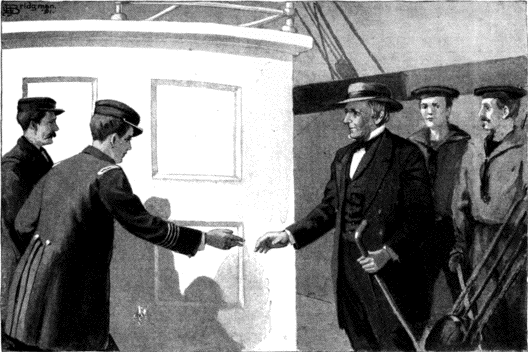
Colonel Homer Passford
Visits the Bronx.—Page 219.
Flanger attempted to shake off his grasp, but the lieutenant was a
very powerful man, and he dragged him into the boat in the twinkling of
an eye. He tossed him into the bottom of the boat, five of the boat's
crew being still in their seats, trailing their oars, for only seven of
them had been able to get on board of the Magnolia for the want of
space.
"Tie his hands behind him," added Mr. Pennant to the men, who fell upon
Flanger the moment he lighted in the bottom of the cutter.
The prisoner was disposed to make further resistance, but two men
fell upon him and made him fast to one of the thwarts. The leader of the
party, as he appeared to be from the first, could do no further
mischief, and the lieutenant gave his attention to the others on board
of the sloop. The dignified gentleman, who was dressed in black clothes,
though they had suffered not a little from contact with grease and tar,
had seated himself in the standing room. He looked like a man of many
sorrows, and his expression indicated that he was suffering from some
cause not apparent.
There were nine men left in the standing room, including the
gentleman in black; they were coarse and rough-looking persons, and not
one of them appeared to be the social peer of him who had condemned the
firing upon the boat. The skipper remained at the tiller of the boat,
and he looked as though he might have negro blood in his veins, though
he was not black, and probably was an octoroon. He said nothing and did
nothing, and had not used a musket when the others fired. He
behaved as though he intended to be entirely neutral. A few drops of
negro blood in his veins was enough to condemn him to inferiority with
the rude fellows on board of the sloop, though his complexion was
lighter than that of any of his companions.
"Vincent, pass one half of the men on board of the cutter," said Mr.
Pennant, when he had looked over the boat and the men on board
of it.
The quartermaster obeyed the order, and four of the party were placed
in the bow and stern sheets of the cutter. Six oarsmen were directed to
take their places on the thwarts. The lieutenant retained his place in
the stern sheets, which he had not left during the affray or the
conference. Three seamen, with a pistol in one hand and a cutlass in the
other, were directed to remain on board of the sloop; but the party had
been disarmed, and their muskets were in the bottom of the cutter, and
they were not likely to attempt any resistance. The painter of the sloop
was made fast to the stern of the Bronx's boat, and Mr. Pennant gave the
order for the crew to give way.
It had been a battle on a small scale, but the
victory had been won, and the cutter was towing her prize in the
direction of the gunboat. The lieutenant's first care was to attend to
Hilton, the stroke oarsman who had been wounded in the affair. He placed
him in a comfortable position on the bottom of the boat, and then
examined into his condition. A bullet had struck him in the right side,
and the blood was flowing freely from the wound. Mr. Pennant did the
best he could for his relief, and the man said he was comfortable.
"Sail ahead!" shouted the bow oarsman, looking behind him.
"What is it, Gorman?" asked the lieutenant, standing up in his
place.
"A steamer, sir," answered Gorman.
"I see her; it is the Bronx," added Mr. Pennant.
By this time it was broad daylight, and apparently the fog was not as
dense as it had been earlier in the morning. The boat with her tow
continued on her course, now headed for the gunboat which the officer
had made out. In ten minutes more the expedition was within hailing
distance of the steamer, which immediately stopped her screw.
The cutter came up at the gangway of the
Bronx, and Christy was standing on the rail, anxious to learn what the
boat had accomplished. He had heard the report of the volley fired at
the cutter, and had been very solicitous for the safety of her crew. He
had weighed anchor as soon as he heard the sounds, and proceeded in the
direction from which they came.
"I have to report the capture of the small sloop, the Magnolia, in
tow," said the third lieutenant, touching his cap to the commander. "We
have eleven prisoners. Hilton is wounded, and I will send him on board
first, if you please."
"Do so," replied Christy. "Mr. Camden, pass the word for Dr.
Connelly."
A couple of men were directed to convey the wounded seaman up the
steps, and he was handed over to the doctor, who had him conveyed to the
sick bay. The obdurate Captain Flanger was next sent up to the deck,
where Mr. Camden received him, and made him fast to the rail without
note or comment; and even Christy made no remark except to give
necessary orders. The other prisoners were not bound, and they were put
under guard in the waist. The dignified gentleman in black was the last
to come up the stairs.
The moment he put his feet upon the deck, the commander stepped back,
with a look of profound astonishment, if not of dismay, on his face, as
he glanced at the important prisoner of the party. At first he seemed to
be unable to believe the evidence of his senses, and gazed with intense
earnestness at the gentleman.
"Uncle Homer!" exclaimed Christy, extending his hand to him, which
Colonel Passford, as he was called at home, though he was not in the
Confederate army, warmly grasped; and the first smile that had been seen
on his face played upon his lips.
"I am glad to see you, Christy," said the prisoner, if he was to be
regarded as such, for he certainly was not a sailor or a soldier.
"I cannot say as much as that," replied Christy, still holding the
gentleman's hand; "I must say I am sorry to see you under present
circumstances, for you come as a prisoner in the hands of my men."
"I am a non-combatant, Christy," replied Colonel Passford. "I have
not served in the Confederate army or navy, or even been a member of a
home guard."
"I have not time now to look into that question;
but I can assure you that you will be treated with the greatest
consideration on board of my ship," added Christy as he conducted him
below, and left him with Dave in his own cabin, returning at once to the
deck to inquire into the operations of the first cutter. The boat had
been hoisted up to the davits, and the Magnolia was made fast astern.
All hands had been called when the Bronx got under way, and the men were
all at their stations.
Mr. Pennant reported in all its details upon his expedition. Dr.
Connelly said his patient was severely, but not dangerously, wounded; he
would recover, but he would not be fit for duty for two or three
weeks.
"While you are here, doctor, I will show you my arm, which is
beginning to be somewhat uncomfortable," said the third lieutenant with
a cheerful smile.
"Are you wounded, Mr. Pennant?" asked the commander, who had listened
to his report at length, without suspecting that he had a wound.
"I was hit in the left arm; but very fortunately the wound did not
disable me," replied the lieutenant as he proceeded to take off his
coat.
"But I cannot dress the wound here, Mr. Pennant," added the surgeon.
"Then I will wait till I have time to attend to it," replied the
heroic officer who treated the injury with contempt; "I have not
finished my report to the captain yet. I will be in the ward room as
soon as the captain is done with me."
"But I can wait, Mr. Pennant," interposed Christy.
"So can I, if you please, captain," added the lieutenant, smiling as
pleasantly as though he had been free from pain, as he could not have
been with the wound in his arm. "I wish to say a few words about the
gentleman in black we captured on board of the sloop."
"Did you learn his name?" asked Christy, greatly interested in what
the officer was about to say.
"No, sir, I did not; I heard no one call him by name. He was in the
cuddy forward when we boarded the Magnolia; and when he came out of the
little cabin, the first thing he said was, 'It was very unwise for you
to order the men to fire upon the boat. It was a great mistake, Captain
Flanger.'"
"That shows that he at least was a non-combatant," added Christy,
pleased to hear this report of his uncle.
"That is all I have to say about him. I studied the skipper of the
sloop and watched him. I am sure he did not fire a musket, and he seemed
to take no part in the affairs of the men on board. Captain Flanger is
the active man of the party; but I have no idea who or what he is. If
you look at the skipper, you will see that he is an octoroon, or
something between a mulatto and a white man, and in my opinion he is not
a cheerful worker on that side of the house. Perhaps the skipper will be
willing to tell you who and what the party are. They claimed to be
private citizens, and that the sloop was bound to Appalachicola; perhaps
the gentleman in black can explain the mission of the party."
"If he can he will not, if they were engaged in an operation in the
interest of the Confederates," added Christy with a smile. "That
gentleman is Colonel Homer Passford."
"He bears your name," said Mr. Pennant.
"He is my uncle; my father's only brother."
"Then I am sorry I brought him in."
"You did your duty, and it was quite right for you to bring him on
board. He is as devoted to the Confederate cause as my father is to the
Union. But go below, and have your wound dressed, Mr. Pennant."
The lieutenant went to the ward room where the surgeon was waiting
for him. Christy called out the skipper of the sloop, and walked into
the waist with him. The octoroon was a large man, of about the size of
the third lieutenant, and he could have made a good deal of mischief if
he had been so disposed.
"Bless the Lord that I am here at last!" exclaimed the skipper, as he
looked furtively about him.
Christy understood him perfectly.
AN EXPEDITION TO ST. ANDREW'S BAY
"What is your name, my man?" asked Christy, as he looked over the
stalwart form of the skipper of the Magnolia.
"Michael Bornhoff," replied the prisoner.
"Are you a Russian?" asked the commander, inclined to laugh at this
singular name of one of the proscribed race.
"No, sir; but I was named after a Russian sailor Captain Flanger
picked up in Havana. I don't mean this Captain Flanger that was on board
of the Magnolia, but his father," replied the stout fellow.
"Are you a free man?"
"No, sir; I belong to Captain Flanger: his father is dead, and left
me to his son."
"Why did you bless the Lord that you were here at last?"
"Because I have been trying to get here for
more than a year," replied the contraband, after looking about him for a
moment, and then dropping his voice as though he feared Captain Flanger
might hear what he said. "Now, mister, will you tell me who you are
before I say anything more? for I shall get my back scored with
forty-nine stripes if I open my mouth too wide;" and again he looked
timidly around the deck.
"You are on board of the United States steamer Bronx, and I am the
commander of her," replied Christy, desiring to encourage Michael
Bornhoff to tell all he knew about the expedition in the Magnolia.
The skipper took his cap off, and bowed very low to Christy when he
realized that he was talking to the principal personage on board of the
gunboat. He was well dressed for one in his position, and displayed no
little dignity and self-possession. Perhaps, if he had not been tainted
with a few drops of black blood in his veins, he might have been a
person of some consequence in the Confederate service.
"Not a bad wound at all, Captain Passford," said Mr. Pennant. "The
doctor says I am still fit for duty."
"Captain Passford!" exclaimed Michael Bornhoff, as he heard the name;
and the third lieutenant passed on to take a look at the prisoners.
"That is my name," added Christy, smiling at the earnestness of the
skipper.
"That is a bad name for this child," said the octoroon, shaking his
head. "Are you the son of Colonel Passford?"
"I am not; but I am his nephew," replied the commander, willing to be
perfectly frank with him.
"Bless the Lord that you are his nephew and not his son!" exclaimed
Michael fervently, as he raised his eyes towards the sky, which was
beginning to be visible through the fog. "I have heard about you, for I
was to pilot a vessel out of Cedar Keys when you came up there in
command of the boats. Colonel Passford was over there, and he saw you on
board of the Havana."
"Then we understand each other, Mr. Bornhoff," added Christy.
"Perfectly, Captain Passford; and I would trust you with my freedom,
which is the dearest thing on earth to me. But don't call me 'mister,'
or you will make me forget that I am a nigger,"
said the skipper, laughing in his delight to find that he was in good
and safe hands. "Captain Flanger called me Mike always, and that is a
good enough name for me."
"Very well, Mike; you are a free man on board of this ship."
"I ought to be, for I am a whiter man than Captain Flanger."
"Now tell me what you know about that expedition on board of the
Magnolia," said Christy more earnestly. "Mr. Pennant reports that your
passengers claimed that they were peaceable citizens, and that your
sloop was bound to Appalachicola. Was that true?"
"Just then they were peaceable enough; but they were not when Captain
Flanger ordered them to fire on your men. Colonel Passford and I were
the only peaceable citizens on board of the sloop, and I was no citizen
at all," replied the skipper, laughing.
"You are one now, at any rate. Were you bound to Appalachicola?"
"Not just then, captain," chuckled Mike, who seemed to be amused and
delighted to feel that he was telling the secrets of his late
companions.
"We were going to Appalachicola after a while, where we were to pilot
out some vessels loaded with cotton."
"Then there are cotton vessels at that port, are there?" asked
Christy, pricking up his ears at this suggestion.
"Half a dozen of them, and a steamer to tow them to sea."
"Are you sure of this information, Mike?"
"I did not see them there, Captain Passford; but it was your uncle's
business to look after them, as he was doing in St. Andrew's Bay."
"Then my uncle has vessels in that bay which are to run out?"
inquired Christy, deeply interested in the revelations of the
skipper.
"Only one, sir: a steamer of five hundred tons, called the
Floridian."
"Precisely; that is the vessel we are after. But what was my uncle
doing on board of your sloop, with Captain Flanger and the rest of your
party?"
"My master was the captain of the Floridian, and we came out here to
see if there was any blockader near, that had come up in the fog. The
steamer was to be brought out by the
pilot, who has been on board of her for three days."
"Who were the men with muskets on board of the sloop?"
"Those were the coast guard, sir," replied Mike, chuckling again.
"The coast guard? I don't understand that," replied Christy, puzzled
at the expression.
"Eight of them, sir; and they have been keeping guard on Crooked, St.
Andrew's, and Hurricane Islands, to let them know inside if there was
any blockader coming this way. They had sky-rockets and flags to make
signals with."
"But why were they brought off if the steamer is still in the
bay?"
"The Floridian was coming out this morning in the fog, if Captain
Flanger made the signal for her to do so. Then the captain was to go on
board of her, and I was to sail the rest of the party to Appalachicola,"
replied Mike, still chuckling with delight at his ability to give the
commander such important information.
"Then the Floridian is all ready to come out of the bay?" asked
Christy, suppressing the excitement he was beginning to feel.
"All ready, sir; and the signal was a sky-rocket, which the pilot could
see over the fog."
"We will not give them any signal, but we will treat them to some
visitors. Is the steamer armed, Mike?"
"No, sir; not a single big gun, and she has only hands enough to work
her. Steam all up when we came out of the bay, sir," said Mike, laughing
heartily, apparently in spite of himself.
"Call all hands, Mr. Camden," said the commander in brusque
tones.
The boatswain's whistle sounded through the steamer. In a moment, as
it were, all hands were in their stations. Nothing like a drill with the
present ship's company had been possible, though the men had been
trained to some extent at the navy-yard and on board of the Vernon; but
the majority of the crew were old men who had served some time on board
of the Bronx, and under the present commander.
The prisoners appeared to be quite as much interested in the
proceedings on deck as the ship's company, and closely observed
everything that was done. Michael Bornhoff was quite excited, and walked
the deck hurriedly, as though he was
in search of something to do; but he was very careful not to go near the
place where Captain Flanger was made fast to the rail.
"Mr. Flint," called the commander to the first lieutenant, as soon as
the crew were assembled on deck, "there is a steamer of five hundred
tons in St. Andrew's Bay, all ready to come out at a given signal from
the party just captured by the first cutter. I propose to capture her
with the boats, and you will take the command of the expedition. The
first and second cutters will be employed, and you will see that they
are ready."
"The boats are in good condition, sir, and they will be ready in five
minutes," replied Mr. Flint, who had come on deck at the call for all
hands, and had hardly learned the results of the recent boat
expedition.
"Mr. Camden will take charge of the second cutter," added
Christy.
While the crews were making the boats ready, and Mr. Camden was
selecting the extra men for them, as he was instructed to do, Christy
gave the executive officer a brief account of the capture of the sloop,
and an epitome of the information he had obtained from Bornhoff.
"What am I to do, Captain Passford?" asked Mike, who was watching the
proceedings on deck with the most intense interest. "I want to ship in
the Yankee navy as a pilot, for I know this coast from the Mississippi
to Key West."
"Are you a sailor?" asked Christy.
"I went to sea for eleven years, and Captain Flanger, father and son,
put my wages in their pockets."
"You cannot ship as a pilot, only as an able seaman, if you know how
to hand, reef, and steer, and how to make knots and splices."
"I know all that, captain, like I know my name."
"Then I will look upon you as an able seaman until you are formally
enlisted. Mr. Flint, this man is Michael Bornhoff; he is an able seaman
and a pilot in these waters. I think you had better take him with you,
for he is fully informed in regard to the Floridian, which you are to
bring out. Let him have pistols and a cutlass," said Christy.
In ten minutes more the expedition left the ship, and soon
disappeared in the low bank of fog that still hung over the shore. Each
of the
cutters had been manned by twelve men besides the officer, and Mike was
an extra hand with the first lieutenant. What remained of the port watch
were on duty, and the rest of the men were dismissed.
Mr. Pennant had the deck, and the commander walked back and forth,
considering the information he had obtained from the skipper of the
Magnolia, of the correctness of which he had no doubt, for Mike
impressed him as a truthful man, and, like all the contrabands, his
interest was all on the side of the Union, which meant freedom to them.
For the first time he began to feel not quite at home in his new
position. He had been compelled to fight for it; but he absolutely
wished that he were the first or second lieutenant rather than the
commander of the vessel.
The traditions of the navy, and of all navies, forbade him to leave
his ship to engage in any enterprise connected with his mission. He had
to take all the responsibility of failure, while he could not take an
active part on such occasions as the present. He had the glory of being
a commander, and of whatever his ship accomplished; but it began to look
like a life of inactivity to
him, for he was not greedy of glory, and all his devotion was for the
Union.
He had learned that several vessels were loading with cotton at
Appalachicola, with the intention of running the blockade, if there was
any blockader off Cape St. George. His uncle Homer was engaged in
superintending the fitting out of these vessels, though whether on his
own account or that of the Confederacy, he was not aware. Christy felt
that he ought to follow up the information he had obtained with decided
action; but he was hardly in condition to do so, for he had fifteen
prisoners on board, and he would be obliged to send a prize crew off in
the Floridian when she was brought out, as he was confident she would
be. He could not settle the question at once, and he went down into his
cabin, where his uncle was waiting very impatiently to see him, and had
asked Dave a dozen times in regard to him.
Colonel Passford was naturally very anxious to ascertain what had
been done, and what was to be done, by the Bronx; but the steward was
too discreet to answer any of his questions, and he was not aware that
his son Corny was a prisoner on board as well as himself.
A NON-COMBATANT ON BOARD THE BRONX
Colonel Passford was reclining on the divan when the commander
entered the cabin; but he rose to his feet as soon as he saw his nephew.
Christy thought he looked thinner and paler than when he had last seen
him. He was now only forty-two years old, but he looked like a man of
fifty.
"I have been wanting to see you, Christy," said the planter, as he
approached his nephew. "I learn, with no little astonishment, that you
are the commander of this steamer."
"I am, uncle Homer," replied the young man.
"Then you can tell me better than any one else in regard to my status
on board of the Bronx," added the colonel, who had won this title years
before in the militia. "Am I considered a prisoner of war?"
"I do not so consider you, uncle Homer; but I cannot say how my
superior officer will look at
the matter when I report to him. You were taken in a sloop that fired
upon the first cutter of the Bronx, wounding one of the crew and the
officer in command."
"That was the folly of Captain Flanger; and I protested the moment I
discovered what had been done," added the planter, who seemed to be
anxious to relieve himself of all responsibility for the discharge of
the muskets.
"Were you in charge of the sloop, uncle Homer?"
"I was not; I had nothing to do with the sloop. She belonged to
Captain Flanger."
"Who is Captain Flanger?" asked Christy.
"You have him on board, and perhaps he had better answer the question
himself," replied Colonel Passford with a smile.
"It was a superfluous question, for I know all about him. He is the
captain of the Floridian, though that would not make him a combatant
unless he fights his ship; and that is what he did on board of the
Magnolia. I regard him and his companions, except the skipper of the
sloop, as prisoners of war. You proved by your words and conduct that
you were not a combatant, and you are at liberty to depart when you
please."
The young commander did not feel entirely sure that his ruling was
correct, for a naval officer must be learned in a great variety of
subjects which he had not had time to study; but he was willing to take
the responsibility in the present instance.
"It is easy enough to say that I may depart; but how shall I do it?"
added the planter with a smile. "I cannot swim ashore."
"I will put you ashore in a boat at the nearest land when the fog
clears off," replied Christy.
"The nearest land is an island, and there is hardly anything like a
village on the entire Bay of St. Andrew's. The region is deserted now,
and I might wander about there for a month, till I starved to death,
before I could get to a settled region."
"I shall not compel you to land, and you can remain on board till I
report to the flag-officer of the Eastern Gulf squadron, off Pensacola,
if you desire to do so; but you will be subject to his decision and not
mine then."
"I prefer that to starving to death in this region," replied the
colonel.
"Very well, uncle Homer, that is settled,"
added Christy. "Now, how are aunt Lydia and Gerty? I hope they are
well."
"Very well the last time I saw them, which was three weeks ago. They
are busy making garments for the soldiers," answered the planter.
"When did you last hear from Corny, uncle Homer?"
"It is all of two months since I had any news in regard to him. He is
still a soldier and has not yet been promoted. His company is still at
Fort Gaines; but he has been sent away once or twice on detached duty.
He is not given to writing many letters; but the last time I was in
Mobile I was told that he had again been sent off on some sort of secret
service with a naval officer by the name of Galvinne. I do not know
whether the report was true or not."
"It was quite true, uncle Homer; and he has been quite as unfortunate
as he was in his former expedition to the North," added Christy very
quietly.
"What do you know about him, Christy?" asked the colonel with the
deepest interest.
"I can assure you first that he is alive and well. I am not informed
how he got to New York, but
he did get there, and in company with two naval officers, one by the
name of Byron, as well as Galvinne."
"Byron was an actor in Mobile; he had been the mate of a cotton ship,
and he obtained a commission in the navy; but for the want of a steamer
both of them were unemployed," the planter explained.
"In New York they got up a plan to obtain a small steamer, about the
size of the Bronx," continued Christy. "Galvinne had been in the navy,
and he readily obtained an appointment as second lieutenant of the
store-ship Vernon. Byron shipped as a seaman. Corny was appointed by the
two officers to take the place of a regular officer, who came down in
the Vernon. He looked something like the officer whom he personated, who
was to command a small steamer in the gulf."
"It was a hazardous plan," suggested Colonel Passford, "and I should
suppose that Corny was hardly competent to play such a
rôle. I hope the scheme was successful, for, as you know
very well, all my prayers and all my aspirations are for the triumph of
the Confederate cause."
"The scheme was successful up to a certain
point, and Corny obtained the command of the steamer, passing for the
genuine officer before the commodore, and even on board of the vessel
where the commander was well known."
"That sounds like a story for a novel," added the planter,
smiling.
"If there had been no setback, Corny would have gone into Pensacola
Bay in a few hours more, in nominal command of the steamer, though of
course Galvinne was the real commander."
"It is a strange story, and I cannot see how Corny succeeded in
passing himself off as the officer he personated."
"He stole that officer's commission and other papers while he was
sleeping in his own home," added Christy.
"But where did you learn this history of Corny's operations?" asked
his uncle, knitting his brow as though he did not quite believe the
narrative.
"Oh, I am the officer whom Corny personated," replied the commander
with a quiet smile. "The story is not a second-handed one, uncle
Homer."
"Corny pretended to be Christy, did he? Then you must have seen him
if he took your commission."
"He did not do that in person; but employed Byron to do it for him; and
for several weeks this actor was a house-servant at Bonnydale," answered
Christy, as he proceeded to narrate the adventure more in detail. "It is
not an old story, for the last event occurred on board of the Bronx at
about eight o'clock last evening."
"The plan was not finally successful, more is the pity," added the
Southern gentleman.
"It was not; for I had concealed myself on board when I realized what
Galvinne was about, and, with the aid of the officers who knew me,
captured the vessel. I am now in command of her, and I am likely to have
a prize to assist in establishing my identity when I report to the
flag-officer."
"But what became of Corny?" asked Colonel Passford, with no little
anxiety on his face.
"He is quite safe; he is a prisoner of war below, with a pair of
handcuffs on his wrists," replied Christy. "You and he together made the
nest for him, and he must sleep in it. I cannot say what the commodore
will do with you."
"Corny on board of this steamer!" exclaimed the father. "In irons
too!"
"I consider the naval officers as dangerous men, and I had to treat
Corny in the same manner that I did his associates. If you wish to see
him, I will send for him."
"Of course I should like to see my son."
Christy struck his bell, and the steward promptly appeared at the
door.
"Dave, go to the quarters, and conduct the prisoner, Mr. Passford, to
this cabin. You may take off his handcuffs; here is the key," said
Christy, and steward took the key and departed.
"How high is the grass in the streets of New York, Christy?" asked
the colonel, with a twinkle of the eye, and a smile.
"Grass! They don't raise it in the city; and there isn't as much of
it in all the streets as I saw in the principal one in Mobile when I was
there, on my way from the prison to the bay," replied the commander
cheerfully. "I don't believe that business was ever so lively in New
York and the other cities of the North as it is at this time; and I left
there ten days ago."
"Do the people there really expect to put down the Rebellion, as they
call it, nephew?" asked Colonel Passford, in a tone which indicated his
confidence in the final success of his cause.
"They have no doubt whatever that the Rebellion will be crushed out. The
last time we met you did not believe that a blockade could be
established; but it has been done, and the government is strengthening
it every day. It is effective, too; and I have been concerned in the
capture of nearly a dozen vessels that were trying to break
through."
"You have been very fortunate, nephew; but it will be impossible to
conquer the South. We shall be the victors in the end as sure as there
is a God in heaven who watches over the affairs of men."
"One who can believe that would swallow Baron Munchausen without
blinking. But I think we had better not talk politics, uncle Homer, for
we don't get ahead at all. I shall continue to stand by the Union, and
the South will raise the same cry after a few years more," said Christy,
as Dave opened the door, and ushered the prisoner into the cabin.
Father and son shook hands, but they were not so demonstrative as
they might have been. Christy was not disposed to burden them with his
presence, but he insisted that Dave should stay
there during the interview. He left them together for two hours, and
then sent Mr. Pennant and a seaman to remove Corny to the quarters. Dave
said they had talked only of family matters, though the son had
explained to his father the plan to obtain possession of the Bronx.
When the commander went on deck, the fog had disappeared, and the
shore was to be seen at the distance of about six miles from the
steamer. At eight bells, or noon, a steamer was discovered coming out of
the bay by a channel between two islands. She carried the American flag
over the Confederate, and no one doubted that she was the Floridian. In
half an hour she was alongside, and she looked like a fine vessel, for
she had come from the other side of the ocean as a blockade-runner.
Mr. Flint reported that she had been captured without any resistance
on the part of the crew. There was no incident worth relating in
connection with the capture, though she was full of cotton, and brought
over seventy thousand dollars when the vessel and cargo were sold. The
two cutters were brought alongside, and hoisted up to the davits.
"I suppose the steamer has a supply of coal on board, Mr. Flint."
"Enough to take her to Liverpool," replied the first lieutenant.
"There are several vessels in Appalachicola Bay, and I thought of
attending to them; but I think we have too much on our hands now, and I
shall sail at once for the station. You will take charge of the
Floridian, Mr. Flint, with such crew as you need," said Christy.
In less than half an hour the two vessels were under way, and just at
dark they were within hail of the flag-ship.
THE STRANGER IN THE CAPTAIN'S CABIN
The Bronx had been absent from the station hardly more than thirty
hours; but she had accomplished the mission with which she had been
charged in her secret orders. The Vernon was still at anchor near the
flag-ship. Christy hastened on board of the latter to make his report,
which he had written out during the passage; in fact, he had two
reports, one of the capture of the Bronx, and the other of the
Floridian.
"You have done your work very promptly, Captain Passford," said the
commodore with a smile.
"The circumstances favored me, sir," replied Christy, bowing. "I
desire to call your attention to the first of the two reports I submit,
for the first battle I was called upon to fight was on board of the
Bronx."
"On board of the Bronx!" exclaimed the flag-officer. "Do you mean that
you had a mutiny to suppress?"
"I had not the honor to communicate with you yesterday before the
Bronx sailed for her destination; but I believe you were called upon to
decide upon the identity of the officer who presented himself to you as
the lieutenant appointed to the command of the Bronx, introduced by
Captain Battleton of the Vernon."
"I was hardly called upon to decide anything, for the matter in doubt
had been settled by the commander of the Vernon before it came to my
knowledge; but I agreed with him that the commission ought to settle the
point. Are you not the officer presented to me by Captain Battleton,
Captain Passford?" asked the commodore, gazing earnestly into the face
of Christy.
"I am not, sir."
"You are not! Who are you, then?"
"I am Lieutenant Christopher Passford."
"Who was the other officer?"
"He was not an officer, either of the navy or the army, but my
cousin, Cornelius Passford, a soldier in the Confederate army."
"I am amazed, and I fear the officers in charge at Brooklyn are not as
cautious as they should be. Not long ago a steamer had to return to the
navy-yard there because her machinery had been tampered with; and the
enemy are putting men on board of steamers for the purpose of capturing
them. Where is your cousin now, Captain Passford?"
"He is a prisoner on board of the Bronx, with two Confederate naval
officers who were his associates in the conspiracy; and we have also two
seamen," replied Christy, who proceeded to give the narrative in full of
the work done on board of the Bronx on the evening of the day she sailed
from the station.
The sea was smooth, and the commander of the Bronx was directed to
bring her alongside the flag-ship. As soon as this was done, all the
prisoners on board of her were transferred to the custody of the
commodore. Christy introduced his uncle Homer to the flag-officer,
suggesting that he was a non-combatant, and stating that he had offered
to put him on shore at St. Andrew's Island.
"I think you are correct in your view, Captain Passford, though
probably he is of more service
to the Confederate government, as your father is to our own, than a
score of sailors or soldiers; but modern civilization does not hold
civilians as prisoners of war. Besides, he is doing so much to provide
our vessels with prizes in the matter of cotton ships, that it would be
a pity to take him out of his sphere of usefulness to us," added the
commodore with a smile.
"The other men in the sloop, with the exception of the skipper, fired
upon my boat, and wounded an officer and a seaman."
"They were taken in arms, and therefore they are prisoners. But you
lost all your commissioned officers but one in the affair on board of
the Bronx, Captain Passford."
"I did, sir; and I was obliged to fill their places;" and Christy
described the men he had appointed.
"There are no officers here that I can give you in their places, and
I am obliged to order you away immediately on another expedition. The
Floridian is a valuable prize; and I must send her to New York, for I am
confident the government will purchase her for the navy. Your acting
lieutenants must continue to serve as such for the present."
"I ask for no better officers, sir. They are well educated, and have had
a great deal of experience as sailors outside of the navy," replied
Christy.
At this time the preparations for the reduction of the forts on the
Mississippi were in progress, and every available vessel was called into
activity. The Bronx had been built for a blockade-runner, and for a
steamer of her size she was of exceptional speed. The vessels of the
Eastern Gulf squadron were employed to a considerable extent in
destroying salt works on the west coast of Florida; but the commodore
was not disposed to order the fleet little gunboat upon such
service.
"Is the Bronx in condition for immediate service, Captain Passford?"
asked the flag-officer.
"She is, sir; she has not been in action since her crew was
reinforced," answered Christy.
"I did not expect your return so soon, but I have your sealed orders
ready. You will get under way as soon as possible," added the commodore,
handing him the sealed envelope. "You will make your course south-west,
and open your orders at twelve o'clock to-night."
The commander of the Bronx left the cabin where the interview had
taken place. On the
deck he met his uncle, who was curious to know what was to be done with
him.
"I can only say that you will not be held as a prisoner of war; but I
must leave you in the hands of the flag-officer, who will dispose of you
as he thinks best. I sail in the Bronx immediately."
Christy hastened on board of his vessel, after hastily shaking hands
with uncle Homer. All the prisoners had been removed from her, and the
commodore had sent a ship's company to the Floridian to relieve the
prize crew in charge of her. He had only to wait for Mr. Flint and the
men attached to the Bronx; and they came on board within an hour.
"You will call all hands, Mr. Flint," said the commander, as soon as
the executive officer appeared on the deck; and the call of the
boatswain's mate sounded through the vessel.
"I came on board to pay my respects to you, Captain Passford," said
Captain Battleton of the Vernon, who had been waiting for him. "Things
have changed since I last saw you. I do not know whether I ought to
apologize to you for my decision on board of the Vernon, or not."
"Not at all, Captain Battleton," replied Christy, taking the hand of the
commander of the store-ship. "The flag-officer sustained your decision;
and with my commission in the pocket of my cousin, I do not see that you
could have adjusted the question in any other manner. I assure you I
have not a particle of ill-feeling towards you on account of what you
did in the discharge of your duty."
"But I do not quite understand the matter yet. You disappeared very
suddenly; and when I wanted to present you to the commodore, you could
not be found," added the captain of the Vernon. "I am very curious to
know what became of you."
"I came on board of the Bronx, and put myself in a place where you
were least likely to look for me,—under the berth in the captain's
stateroom. I was at home there, for I had occupied the room while I was
the acting commander of the vessel on her voyage to the Gulf. But you
must excuse me now, for I am ordered to get under way at once; and the
ship's company of the Floridian have reported on board."
"I may yet be called upon to serve under you
some time in the future; and I did not wish to have any prejudice
against me on account of my decision, in which my officers
concurred."
"I have not the slightest prejudice against you and while we stand by
the Union, shoulder to shoulder, we shall be friends," replied Christy,
warmly pressing the hand of the captain of the Vernon.
Captain Battleton returned the pressure as heartily as it had been
given, and departed from the gunboat. The commander gave the order to
the first lieutenant to get under way; and the fasts were cast off from
the flag-ship. The Bronx backed away from her, came about, and was ready
to proceed on her voyage to the destination as yet unknown on board of
her.
"Make the course south-west, Mr. Flint," said the commander, as soon
as the vessel was ready, and her screw was in motion.
"South-west," repeated the first lieutenant, addressing the
quartermaster who was conning the wheel.
Standing on the bridge with the executive officer, Christy took his
leave mentally of the flag-ship, and the few other vessels that were on
the
station; for most of them were on duty in various expeditions engaged in
the destruction of salt works. A boat expedition had just captured
Appalachicola, with all the vessels loading with cotton in the bay. The
young commander congratulated himself that he had a fast steamer, for
that caused him to be employed in more active duty than the work of
destruction on shore.
"South-west," said Mr. Flint, after the port watch had been
dismissed, leaving the starboard with Mr. Camden as watch officer on
deck. "I thought it probable that we should be sent to Appalachicola
after the information the Russian gave us."
"The boats of the Mercidita and Sagamore have captured the place, and
picked up five or six small vessels loaded with cotton, I was informed
by the commodore," replied Christy.
"We are bound to the westward, and the course looks as though we
might be ordered up the Mississippi," suggested Mr. Flint.
"I hardly think so, though I should be pleased to have it so."
"Why do you think it is not likely, Captain Passford?" asked the
executive officer curiously.
"Because the Bronx is a fast vessel compared with most of the steamers
of the navy, hardly any of which are good for more than twelve knots an
hour, while this ship will make sixteen when she is driven, and fourteen
under ordinary circumstances when we are not trying to save coal. Of
course I have no idea what duty we are to perform, and I am not anxious
to know till the time comes, though midnight is a rather odd time to
open the envelope."
"Probably the odd time means something."
"No doubt of it; for to-morrow morning by four bells we shall be off
the passes of the Mississippi, and our mission may be up Lake Pontchartrain,
or at Ship Island. But let that matter rest, for in three hours and a
half we shall know all about it. I want to ask you about the man you
call the Russian."
"He is a good man, and quite as intelligent as any of our seamen. He
is a pilot on the coast of Florida, and may be farther to the westward
so far as I know. He is forty-seven years old, though he does not look
it, and has been to sea all his life. By the way, that Captain Flanger
has done some business as a smuggler, Mike informs me."
"He looks like a desperate character," added Christy, as he went below
to attend to his supper, which he had so far neglected.
Dave was standing by the door when he entered his cabin. Seated at
the table was a man of stalwart frame, who was helping himself to the
viands prepared for the commander, and making himself entirely at
home.
"Good-evening, Captain Passford; I hope you are all right. I waited a
reasonable time for you to come below to supper; but as you did not
appear, I have made myself at home, for my appetite has been somewhat
stimulated to-day," said the stranger.
The commander looked at the man; but he did not know him.
A VERY IMPUDENT DECLARATION
Christy looked at the stranger with astonishment, and he could not
imagine who he could be. He had seen no such person on board of the
Bronx or on the deck of the flag-ship. When the prisoners from the
Magnolia had been brought on board, Christy had been too much occupied
with other matters to bestow any attention upon them with the exception
of "the dignified gentleman in black," who proved to be his uncle. He
had had no curiosity in regard to them, and Mr. Camden had disposed of
them at the rail.
The commander thought it very strange that there should be a person
on board of the steamer, and especially in possession of his cabin, who
was an entire stranger to him. He looked at the intruder, who was a
stoutly built man of rather more than forty years of age, with his hair
and full beard somewhat grizzled by age. He was
dressed like a seaman in blue clothes, though he was evidently not a
common sailor, but might have been the master or mate of a vessel.
"I am sorry to have kept you waiting for your supper, sir," replied
Christy, falling in with the humor of his involuntary guest. "But that
was the fault of my steward, who ought to have informed me that I was to
have the pleasure of your company at supper."
"Don't blame him, Captain Passford, for it was not his fault that he
did not announce my presence to you. He wished to do so, but I assured
him I was not disposed to disturb you, for you must be occupied with
your own affairs, and I persuaded him not to go for you," added the
person with perfect self-possession.
"You were very considerate," answered Christy, looking at the
steward, who had stationed himself behind the unwelcome guest.
Dave looked as solemn as an owl, and his ivories seemed to be sealed
up in his expansive mouth. He attempted to make a sign to the captain,
but it was not understood. At that moment, the stranger raised his
finger and beckoned to the steward.
"What is your name, boy?" he asked.
"Dave, sir," replied he, evidently deeply impressed by the visitor
for some reason not yet apparent to the captain.
"I don't like to have a man stand behind me, and you will take your
place in the rear of Captain Passford, who is more worthy of your
attention than I am;" and though Dave was a brave fellow, he obeyed the
order.
It was evident enough to Christy that there had been some kind of a
scene in the cabin before he came below, for the steward had certainly
been intimidated by the powerful visitor.
"This fish seems to be red snapper, captain, and it is very good.
Will you allow me to help you to some of it?" continued the stranger
very politely.
"Thank you, sir; I will take some of it, if you please," replied
Christy, as he passed his plate across the table. "Of course, as you
have done me the honor to take a seat at my table, I must be acquainted
with you."
"We have met before," replied the stranger. "Shall I help you to some
of these fried potatoes? They are very good, and I can recommend
them.
I have already learned that you have an excellent cook on board. I
should judge from these potatoes that he was brought up in New
Orleans."
"It may be he was; I don't know about that. You say that we have met
before, but to save my life, I cannot recall the time, and I am sorry to
add that I do not identify your face as that of any person I ever saw
before. I have the pleasure of introducing myself to you as Lieutenant
Christopher Passford, commanding the United States steamer Bronx."
"Thank you, Captain Passford, and I cannot well help being less
polite and less frank than you are; and I shall take the liberty of
introducing myself to your acquaintance and good offices as Captain Boyd
Flanger, lately in command of the steamer Floridian, entirely at your
service."
"Indeed!" exclaimed Christy, not a little startled at the information
thus communicated, for it was plain enough that the intruder meant
mischief in spite of his good manners. "I was under the impression that
you had taken up your abode on board of the flag-ship with others who
were captured in the Magnolia."
"That is very true; I went on board of the flag-ship,
but I am somewhat fastidious in my notions, and I concluded not to
remain there," replied Captain Flanger. "Without any intention of
flattering you, Captain Passford, candor compels me to say that I prefer
your company to that of the commodore. Can I help you to anything more
on my side of the table?"
"Thank you; I will have one of those lamb's tongues," replied
Christy.
"They are very nice; I have just tried one of them," added Captain
Flanger, as he passed the plate over to the commander.
"You do not use your left hand, captain; I hope you were not wounded
in the affair this morning off St. Andrew's Bay."
"No, sir; I was not wounded. Your men did not fire into our party, as
we did into your boat. The fact is, Captain Passford, I have an ornament
on my left wrist which I am a little timid about displaying before
people, though I do not object to showing it to you," replied the guest,
as he held up his left hand, and from the wrist a pair of handcuffs hung
down, for he had succeeded in removing it only from his right hand.
"Such an ornament must be a nuisance to you,
Captain Flanger, and I think we will have it removed. Dave, go and ask
the second lieutenant to report to me with his keys and a file," said
Christy.
"I beg your pardon, Captain Passford, for countermanding your order;
but Dave will do nothing of the sort," interposed the intruder, as
blandly as before. "Dave knows better than to obey such an order."
Dave did know better than to obey the order, and Christy was morally
certain that he had been menaced with a pistol, or threatened in some
manner if he attempted to leave the cabin. He acted as though he felt
confident that a bullet would be sent through his head if he disobeyed
the bold visitor. At the same time there was a certain amount of energy
and earnestness visible in the expression of the steward, which assured
Christy that he was ready to take part in any action that was reasonably
prudent and hopeful.
Captain Flanger had been handcuffed and made fast to the rail of the
vessel with the other prisoners, and with them he had been transferred
to the flag-ship. It was probably in this removal that he had found the
means of securing his liberty,
and had made his way on board in some manner not at all apparent to the
commander of the Bronx, who had been in conference with the commodore
when the change was made.
Whether the escaped prisoner had gone to the captain's cabin for a
special purpose, or had simply followed the most convenient way that was
opened to him in his flight, it was plain enough to Christy that, at the
present time, he had an object before him. He had practically taken
possession of the cabin, and had already overawed the steward. The
commander could not see his way to do anything to improve the situation.
He had no weapon about him but his sword, and he was satisfied that the
intruder was provided with one or more revolvers, as indicated by the
appearance of the side pockets of his blue coat.
Whatever had been said about the imprudence and even recklessness of
the young lieutenant, he was really a prudent and even cautious officer.
He realized that any movement on his part would draw the fire of the
insolent intruder, and he saw that strategy was far preferable to open
violence, since the latter was likely to end only in killing or
disabling him. If he could visit his
stateroom and obtain his pair of navy revolvers, or even the smaller
ones in one of the drawers of his desk, it would improve the chances in
his favor. It was evident that he would not be permitted to do this, and
he did not attempt it.
"Dave is a wise man," said the commander, after he had given a few
moments to the consideration of the situation.
"Dave is a sensible man, and I trust I shall find you his equal in
that respect, Captain Passford," replied the intruder, still seated in
his chair at the supper-table.
"I claim to be reasonably sensible," answered Christy. "As you have
done me the honor to visit me in my cabin, Captain Flanger, it is
reasonable to suppose you have some object in view, for I do not regard
it as a merely friendly call."
Though the young officer was prudent and discreet, he did not lose
his self-possession, and he smiled as though he had been simply the host
in the dining-room of the mansion at Bonnydale. There was a certain
humor about the intruder which would have pleased him under other
circumstances.
"Quite right, captain!" exclaimed the visitor. "I have an object in
view, and both my inclination and my duty are urging me to carry it out.
How your boat happened to capture the Magnolia is beyond my
comprehension up to the present moment, though I think the principal
reason was the lack of a sufficiently osseous vertebra on the part of
your worthy uncle, Colonel Passford. Then the officer in charge of the
cutter did not do what I expected him to do. Instead of falling back
when he and one of his crew were wounded, as he ought to have done, and
using the heavy revolvers with which his men were armed, he did not
delay a moment, but smashed into the sloop, and jerked his men on board
of her, cutlass in one hand and revolver in the other; and that brought
me to the end of my rope. I could not do anything more."
"I am sorry that you are dissatisfied with my third lieutenant's mode
of operations," replied Christy, laughing, though his mirth was of the
graveyard order. "But Mr. Pennant is a new officer, and that was the
first active duty he had been called upon to perform. Very likely he
will suit you better next time."
Christy yawned, or pretended to do so, and in the act he rose from the
table. Captain Flanger was silent as he did so, and watched the captain
with the eye of a lynx, as the latter placed himself behind the chair he
had occupied. He was in position to make a movement of some kind, and
the intruder deliberately drew from his right-hand coat pocket a heavy
revolver. Holding this in his hand, he drew another from the left-hand
pocket, and threw it on the table.
"I don't wish to be rude with a gentleman as polite as yourself,
Captain Passford; but you interrupted my remarks by rising from your
chair," said Captain Flanger, with the revolver still poised in his
hand, while he dropped the other with the handcuff upon it at his
side.
"Excuse me for interrupting you, Captain Flanger; but I have eaten a
hearty supper, encouraged by your friendly presence, and I was sleepy,
for my rest was broken last night, and I wanted simply to stretch
myself," replied Christy, yawning and stretching himself again.
"All right, captain; it is not necessary for me to say a single
word," added the intruder, as he made a slight demonstration with the
weapon in
his right hand, which was not lost upon the commander. "With your
permission, I will proceed with my remarks."
"Certainly, captain; go on."
"My first misfortune was in being made a prisoner. My second and most
annoying mishap was the capture of the Floridian," continued Captain
Flanger. "It was my intention to fit her out as a privateer, with the
proceeds of the sale of her cargo of cotton, for she is a good vessel,
and as fast as the Bronx, as you call her."
"Then I was very fortunate in capturing her," added Christy with a
smile.
"Perhaps not, for I intend to replace her with the Bronx."
The commander was amazed at the impudence of the intruder.
A CRITICAL SITUATION IN THE CABIN
Christy looked at his cool and impudent visitor, whose declaration
was to the effect that he intended to take possession of the Bronx in
compensation for the loss of the Floridian. It looked as though he
intended to capture the gunboat now fully officered, and manned by
forty-six seaman; and so far as the commander could judge, he intended
to do it single-handed.
The lieutenant's first thought, after he realized the intention of
the intruder, was that he was insane, for no man in his senses would
think of accomplishing such a mad enterprise. His second idea was that
he had mistaken the declaration of Captain Flanger, though he had
certainly said that he meant to replace the Floridian with the Bronx,
and the statement could hardly mean anything else.
Christy was forced to admit to himself that the
bold intruder had full possession of the captain's cabin of the steamer,
and that he had the advantage of him in being armed; that any decided
opposition on his part would result in his being killed or wounded. It
was not prudent for him to do anything, and at the present stage of the
proceedings he could do nothing but temporize with his resolute foe.
"I beg your pardon, Captain Flanger; but do I understand that you
intend, single-handed and alone, to capture the Bronx?" asked the
commander, with a smile of incredulity on his face.
"Well, Captain Passford, if you fail to comprehend my purpose, it is
the fault of your understanding, and not of my plain and explicit
declaration, for I assuredly said that I intended to replace the
Floridian with the Teaser, or the Bronx as you have named her, though
she will not be called by any such nut-cracking name after I get her,"
replied the daring privateersman, as blandly and pleasantly as though he
were planning a picnic.
"Of course you see no difficulties in the way of such an undertaking
as you propose," added Christy.
"There may be difficulties; but I think they can be overcome. I purpose
to act through you, my friend, as my resources are rather limited at the
present moment. In other words, I propose that you shall issue certain
orders which I intend to dictate," Captain Flanger proceeded, as coolly
as though he had been in his own cabin instead of that of his
companion.
"You mean to dictate your orders to me," repeated the commander.
"Precisely so; and you will readily see that I am not exactly in a
position to act in any other manner, as I cannot go back on deck and
deliver them in person, for your officers would be prejudiced against
me, and might be disposed to rebel against my authority."
"Not improbable," added Christy. "You propose that I shall go on
deck, and give your orders, acting as your proxy."
"Hardly, my dear friend, for I fear that on deck you would give way
to your own individual prejudices against me, and do something that
would jeopard my interest in the premises. With your approbation, I
should prefer to resort to a method that prevails in the army, though
not to any considerable
extent in the navy. More clearly, I will invite you to send your orders
on deck in writing, over your own signature."
"You think that method would suit you better than the usual one of
delivering orders verbally," said Christy, laughing as much at the
coolness as at the impudence of his companion.
"It will not only suit me better, but you cannot fail to see that it
is the only practicable way for me to operate with my present very
limited resources. If I had a dozen good men and true,—not such
dunderheads as your officer captured in the Magnolia,—I should be
able to proceed in a more orderly and regular manner. In that case, I
should issue my orders in person, and not compel you to act as my
intermediary."
"I understand you perfectly now; but as you have not, fortunately for
me, and unfortunately for yourself, the dozen men at hand, I am to hold
the fiddle while you play upon it, as I have seen a couple of negro
minstrels do it."
"An excellent simile, Captain Passford, and I could not have invented
a better myself," returned the privateersman. "I think we understand
each other perfectly, and therefore it is not necessary to
use up any more time in explanations. You are too intelligent a person
to fail to comprehend my plan. As an epitome of the whole scene, I may
add that I propose to do what my friend Galvinne undertook with that
cousin of yours: I intend to take the Bronx into Pensacola Bay, and have
her used in the service of the righteous cause in which the people of
the South are engaged," continued Captain Flanger, as though he believed
in all he was saying.
"I suppose it is the righteousness of the cause in particular that
calls forth your admiration," chuckled Christy.
"Precisely so; in this cause, though I drink whiskey, chew, and
smoke, and never swear except when I am excited, I am a religious man,"
said the intruder, laughing.
"I suppose you were religiously inclined when you were engaged in the
business of smuggling," added the commander.
"I cannot say that I was; the cause of the South is religion itself,
and I am there every time. Who told you that I had been engaged in
smuggling?"
"It dropped from some of the men that were captured in the
sloop."
"It could have dropped only from Mike Bornhoff, for he is the only one
who knew anything about it. He is my property, and when we are fairly in
Pensacola Bay I shall seize him up to the grating, and give him
thirty-nine for opening his mouth when he ought to have kept it closed.
Where is he now, for I did not find him among the prisoners?"
"He has enlisted as a seaman, and seems to be a good one. By the way,
where did you learn that my cousin attempted to take the Bronx into
Pensacola Bay?" asked Christy curiously, though he was using up the time
he could not yet improve.
"It was not your cousin at all who attempted to take the vessel into
Pensacola Bay; it was Galvinne, for Corny only acted as a figure-head,
as I intend to use you. Galvinne was a prisoner by my side on board of
the flag-ship, and told me all about it when he was releasing my right
hand from the bracelet," replied Captain Flanger.
"Then I am to do duty as a figure-head, am I?" laughed Christy.
"Precisely; and you are a better-looking one than your cousin. But
excuse me for changing the subject of the conversation, for I am losing
time. I see by the telltale over our heads that the Bronx is headed to
the south-west, which is doubtless the course you were ordered to take
by the commodore."
"The telltale is honest, and tells no lies," replied Christy.
"Where are you bound, Captain Passford?" asked Flanger, in a careless
and indifferent manner, as he looked about the cabin.
"I don't know."
"Sealed orders?"
"You must draw your own inferences, Captain Flanger."
"It won't take a six-mule team to draw that one," added the
privateersman, rather sourly for the first time. "Of course I understood
that it would not be advisable for the commodore to let it be known
exactly where the steamer is bound, and that you have sealed orders. I
shall have to trouble you, Captain Passford, to produce the
envelope."
As he spoke Captain Flanger toyed with the revolver in his right hand
as if he intended that the weapon should produce its proper impression
on the mind, and especially upon the nerves, of
the commander, who had continued to walk up and down in front of the
table at which his dangerous associate was seated, occasionally pausing
when a point was made on either side.
"Of course you cannot expect me to betray the confidence of the
commodore; that would not be kind or friendly on your part, Captain
Flanger, for you can see that this is a delicate matter," said Christy,
halting in front of the table.
"It may be delicate; I admit that it is so for you: but as my plans
may depend somewhat upon a knowledge of your instructions, I really feel
compelled to insist upon this point, Captain Passford," replied the
intruder as blandly as ever. "But we are living just now in a state of
war, and it is quite impossible to act with as much delicacy us one
might desire."
"I am sorry that you feel constrained to act in this indelicate
manner; but I cannot, on my honor and conscience, violate my orders, and
I must respectfully decline to produce the envelope," replied Christy,
feeling that he had come to a crisis in the affair.
"You decline to give me your sealed orders? Do I correctly understand
you, Captain Passford?"
demanded the privateersman with a frown upon his brow.
"Undoubtedly you do. I decline to give you my sealed orders. What
then?" replied the commander, who began to feel a certain sense of shame
because he had temporized so long with the bold pirate, for he regarded
him as such.
"What then?" repeated the intruder. "Why, you will reduce me to the
disagreeable necessity of blowing out your brains, if you have any, as I
should judge that you had not, after your refusal to accede to my
request in the face of the death that awaits you."
"I beg your pardon, Captain Flanger, but do you really purpose to
blow out the brains of your figure-head?" asked Christy, as coolly as
though no such threat had been suggested to him.
About this time Dave, who had taken care to keep in the front of the
table as he had been ordered to do, seized upon his feather duster, and
began to dust the divan on the starboard side of the cabin. Flanger was
so much occupied with the commander at that moment, that he was not
disposed to take his eye off him for an instant; for certainly the
situation had become critical, and
he paid no attention to the steward. Dave was a sort of a feather-duster
fiend, and he used the article a great deal of his time, apparently as
much from habit as from cleanliness.
"I should be extremely sorry to put a ball through your head, Captain
Passford, not only because it would disfigure a handsome face, but
because you may be of great use to me," replied the pirate.
"And because, in your present enterprise as you have outlined it, you
cannot get along without me," said Christy.
"In fact, you are more than half right. The sealed orders are not
absolutely necessary to me just now, and I shall not insist upon the
production of them for the present. Now, if you will seat yourself at
the table opposite me, I will dictate an order to you, which you will
oblige me by reducing to writing, and then by signing your name to it as
commander," continued Flanger, still toying with the heavy revolver.
Christy's curiosity was excited: he thought the order would throw
some further light on the plan of the pirate; and he seated himself.
Captain Flanger proceeded to dictate to him an order to
the officer of the deck, to the effect that his sealed orders directed
him to cut out a rebel privateer under the guns of Fort McRae; ordering
him to head the Bronx to the north-west for this purpose, and
instructing him to call him as soon as he made out the shore, Christy
wrote it, and the pirate told him to sign it.
"You must excuse me, Captain Flanger, but I object to signing such an
order," replied Christy, as he rose from his chair.
"Sign it, or you are a dead man!" exclaimed Flanger fiercely.
"Be it so; death before dishonor," replied the commander firmly.
At this moment Dave had worked himself in behind the pirate; and,
with a well-directed blow with the feather duster on the head of
Flanger, he brought him to the floor.
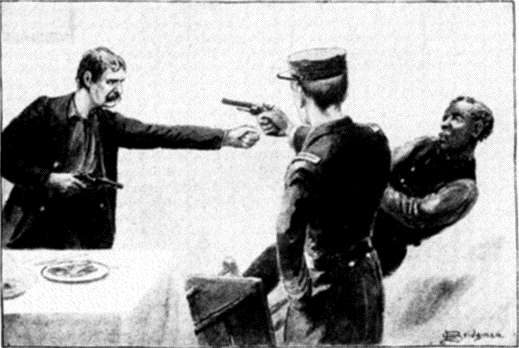
Flanger in the
Captain's Cabin.—Page 281.
THE DESTRUCTION OF A PROMINENT FACIAL MEMBER
The cabin steward had two feather dusters, one of which was very
large, and the other of medium size. He had used the big one so
industriously that very little was left of the feathers except the bare
quills that were inserted in a cylinder of hard wood, too heavy for the
use of a delicate female, though Dave had wielded it till it was in
better condition to be thrown overboard than to be used on the panels
and furniture of the cabin.
Captain Flanger was at the critical point in his operations, and he
was too busy with the commander to give any attention to the negro, whom
he regarded with the contempt begotten of his Southern education. Dave
was intelligent enough to understand the situation accurately, and he
realized that it was rapidly becoming critical. He knew that Christy was
unarmed, and that the
whole attention of the pirate was concentrated upon him, so that he
could do nothing to help himself.
He knew also that if he attempted to leave the cabin to procure
assistance, Flanger would shoot him with as little remorse as he would
kill a coon in the woods. Watching his opportunity without trying to get
behind the intruder till the decisive moment came, he sprang into the
position he had selected in advance, and brought down the heavy head of
the feather duster upon the temple of the privateersman.
Probably it was the shock quite as much as the force of the blow that
brought down the steward's victim. But it was a heavy stroke, for the
wood of the feather duster was split into many pieces, and the stumps of
the feathers were scattered all over the table. The onslaught could not
fail to be very confusing to the ideas of the intruder, and he seemed to
be tangled up in the arm-chair in which he had been seated.
Captain Flanger was a man of stalwart proportions, and Christy
realized that he was no match for him in a hand to hand encounter, even
with the aid of the steward, for the ruffian would not fail to use his
revolvers.
Dave was not satisfied with what he had done, and as his foe went over
in the chair, he sprang upon him, and tried to wrest the pistol from his
hand, and a struggle on the floor was begun, the result of which could
not be foreseen. Christy took in the situation at a glance, and while
the steward and his victim were rolling and writhing on the floor, he
darted into his stateroom, the door of which had been open all the time,
and took his heavy revolvers from the drawer where he kept them, charged
for immediate use.
When he rushed back to the cabin, Flanger had got the better of his
foe, and had risen to his feet, with his grasp upon the throat of the
steward. Then he hurled him from him with a vigorous movement with his
left hand, while he raised the right with the evident intention of
shooting him. The commander saw the imminent peril of Dave; he took a
hasty aim and fired before the intruder had time to do so. He was a good
shot with the navy revolver, for he had taken lessons and practised a
good deal with the weapon.
He had aimed at the head of Flanger, and he saw that he had hit him,
for his face was instantly covered with blood. He did not think it
necessary
to fire a second shot, but he was careful not to let the opportunity
pass by if it was needed to reduce the privateersman to subjection.
Flanger dropped his weapon instantly, and Dave as instantly picked it
up. It was clear to Christy then that the battle had been fought and
won, though the defeated party had another revolver in his pocket.
In spite of his claim that he was a religious man, he indulged in a
volley of profane language which made the commander's blood run cold in
his veins. His right hand, from which he had dropped one of his
revolvers, was pressed upon his nose, as though this organ was the seat
of his injury. He stood behind the table, and continued to swear like a
pirate in a passion. His face and his hand were absolutely covered with
blood.
Both Christy and Dave kept their positions, each with a revolver in
his hand, ready to finish the victim if he exhibited any symptoms of
further violence. This was the tableau presented in the captain's cabin
when the door was suddenly opened by the first lieutenant, who rushed
in, followed by the second lieutenant and Quartermaster Vincent. Mr.
Flint had been on the quarter-deck,
and had heard the report of Christy's revolver when he fired. Calling
Mr. Camden and the quartermaster, he has come to ascertain the cause of
the fracas; and the sight was certainly impressive when he entered.
"Any orders, Captain Passford?" asked the first lieutenant, as he saw
that Christy appeared to be master of the situation.
"Stand by to secure that man," replied the commander, pointing at the
wounded man behind the table. "He has a revolver in his left coat
pocket."
The three officers promptly obeyed the order, and laid violent hands
on Captain Flanger, Mr. Flint taking the weapon from his pocket. They
seized him by the collar of his coat, and the executive officer held his
left arm, with the handcuffs on the wrist. The victim of the affray
still held on to his nose, though Mr. Camden took possession of the
arm.
"You appear to be wounded, Captain Flanger?" said Christy,
approaching the table.
"Wounded, you"—
The oaths and epithets he used need not soil our page; but the
prisoner seemed to be suffering more from his wrath than from his
wound.
"You have shot off by dose, you!"—groaned Flanger. "The ball welt
straight through it."
"Then you are not dangerously wounded," added Christy. "I was afraid
it had gone through your head."
"I wish it had! You have bade a scarecrow of be for life!" he
gasped.
"What's the trouble here, Captain Passford?" asked Dr. Connelly,
presenting himself at the door of the cabin. "Didn't I hear the report
of a firearm in this direction just now?"
"Very likely you did, if your hearing is good," replied Christy with
a smile, for the large revolver, discharged in the small cabin, made a
tremendous noise. "The gentleman behind the table, who is holding on to
his nose, requires some of your professional skill. He was proceeding to
capture the Bronx, and had gone to the point where you find him."
"I dol't walt any Yalkee surgeod at work od be," protested Captain
Flanger, whose speech was badly affected by the injury to his nasal
organ, or by the pressure he applied to it with his hand.
"You can consult your own inclination as to that, my excellent
friend. I shall not force you
to be treated by him," added Christy, "But I must suggest that this
farce has been carried far enough in my cabin."
"Farce! Do you cod this a farce?" demanded the wounded man
indignantly. "You have shot off by dose!"
In fact, Captain Flanger seemed to be more disturbed at the accident
to his proboscis, than by the failure of his quixotic scheme to capture
the Bronx. He was certainly a very good-looking man, and took good care
of his person, as indicated by the care bestowed upon his hair and
beard.
"The farce came to an end when you menaced me with death if I
declined to sign the order you dictated, and the steward played the
first scene in the tragedy. I am sure it was a farce up to that time,"
replied Christy. "Mr. Flint, have the prisoner put in irons, and remove
him to the quarters of the men forward. Give him a berthsack and a
blanket, and place a hand to stand guard over him."
The executive officer sent Mr. Camden on deck for a pair of handcuffs
and a couple of men to execute the order. Flanger still retained his
standing position behind the table, holding on to his nose, which
continued to bleed very freely. The surgeon went over to him, and
endeavored to obtain a sight of the mutilated member.
"I think you had better let me stanch the blood," suggested Dr.
Connelly.
"Do!" exclaimed the patient. "You will take off what is left of by
dose."
"As you please," replied the surgeon, as the second lieutenant
returned attended by two stout seamen.
"Remove the handcuff from his left wrist, and fit him out with a new
pair," said Mr. Flint, who still held the left arm of the prisoner.
Mr. Camden took off the irons, for he had a key to them, and enclosed
the wrist in the new pair. Then the two men were directed to take his
right arm, which they did, and drew his hand from his nose. This act
roused the ire of Flanger, and he began to struggle; but powerful as he
was, the two seamen were too much for him, and he was fairly handcuffed.
The second lieutenant was the officer of the deck, and he was sent back
to his post of duty. Flanger's face was so covered and daubed with the
gore from his wound that the
condition of his prominent facial member could not be determined.
"I protest agailst this brutal treatmelt!" stormed the prisoner, as
he continued to writhe in his irons. "I am a woulded plisoler!"
"I see you are; but you decline to permit the surgeon to dress your
wound. I have no more time to fool with you, and the men will put you on
a berthsack forward. If you want the surgeon to attend to your wound,
you have only to say so."
"It is a bad wound though not a dangerous one," said Dr. Connelly,
who had approached the victim of his own conspiracy near enough to
obtain a view of the injured nose. "The ball has torn away the middle of
the member, and it hangs in pieces from the wound."
"I have had enough of him; remove him to the quarters," added
Christy.
"You took splendid aim, Captain Passford," said the surgeon,
smiling.
"I did not aim at his nose, but at his head in a general way,"
replied the commander. "I fired in a hurry, and I meant to reach his
brains, if he had any. Take him away; I am disgusted."
"The fortules of war are agailst me, Captail Passford;
but if you ever fall ilto my halds, I will cut your dose off cleal to
your face," howled the prisoner, boiling over with wrath.
"Take him away!" added Christy with energy; and the two seamen
dragged him out of the cabin, leaving only Mr. Flint, the surgeon, and
the steward in the cabin. "Dave," he continued, stepping up to the last,
and taking him by the hand, "you have behaved remarkably well, and I
thank you for the good service you have rendered to me and the cause of
your country."
"I done do what I thought was right, Captain Passford, though folks
like that fellow think a poor nigger is no account," replied the
steward, putting every tooth in his head on exhibition.
"Perhaps he will change his mind after this. If you have not saved my
life, Dave, you have saved my self-respect, for your prompt action,
quite as soon as it was prudent for you to act, redeemed me from any
further submission, and I expected to throw away my life rather than
sign that order. I think he would not have killed me, for that would
have blocked his game; but he would have wounded me in two minutes more.
I thank you with all my heart, Dave, and I shall not forget what you
have done."
"Thank you, Captain Passford," replied the steward.
"I do not fully understand this affair, captain," said Mr. Flint.
"Sit down, take a seat, doctor, and I will tell you all about it. You
may go forward, Dave, and report to me the condition of the prisoner,"
added Christy, as he seated himself at the table, and began to tell the
story of the intruder's visit to his cabin.
He finished the narrative, and the officers were discussing it when
there was a knock at the door.
"Sail on the port bow, sir," reported a quartermaster.
THE MEETING WITH THE BELLEVITE AT NIGHT
Christy looked at his watch when the sail was reported to him, and
found that it wanted ten minutes of eleven. The Bronx had been steaming
for just about three hours, and must have made about forty miles, as he
hastily figured up the run in his mind.
"How was the weather when you left the deck, Mr. Flint?" asked the
commander.
"Clear as a bell, and bright starlight," replied the executive
officer.
"Not a night for blockade runners," added the captain.
"No, sir."
"The sail is reported on the port bow, which looks as though she
might be coming in from sea," continued Christy, as he went into his
stateroom with his navy revolver in his hand.
He put the formidable weapon back into the
drawer from which he had taken it; but the lesson of the evening had
made a strong impression on his mind. Though he had permitted Captain
Flanger to believe that he was not at all disturbed by his presence in
his cabin, and had kept up the humor with which the intruder had
introduced himself, yet he had felt a sense of humiliation through the
whole of the scene. It was a new thing to be confronted by an enemy in
his own cabin; and the privateersman, armed with two heavy revolvers,
had all the advantage, while neither he nor the steward had a weapon of
any kind.
With even an ordinary revolver in his hip pocket, he would not have
been helpless, and he might have saved himself without requiring this
service of the steward. Opening his valise, he took from it a smaller
revolver, and put it in his hip pocket, which he had never used for any
other purpose; and he resolved not to be caught again in an unarmed
condition, even when no danger was apparent. In action he carried a navy
revolver in each of his hip pockets.
Thus prepared for any emergency, though none might come for years, he
went on deck, and made
his way to the bridge, where he could get the best view of the
approaching sail. He obtained his first sight of the vessel as soon as
he reached the bridge, and saw that the sail was a steamer, much larger
than the Bronx. She carried no sail, for the wind was from the west; but
the commander soon realized that she was moving at great speed.
"We must be about forty miles off the station of the blockaders
before the entrance to Mobile Bay," said Christy, after he had thought
the matter over for a moment.
"I should think so," replied the first lieutenant.
"That sail appears to be headed for the station. She is a large
steamer, and I judge by the way she is coming up with us that she is
very fast," added Christy with some anxiety in his tones.
"She must be a steamer of fifteen hundred tons, and perhaps more,"
said Mr. Flint, after he had looked at her through his night glass.
"In that case she is too big for us to fight her, and too fast for us
to run away from her; and Captain Flanger may be a free man in a few
hours."
"It does not follow that we shall have to fight
her or run away from her," added the first lieutenant, still gazing at
the approaching steamer through his glass. "I don't believe she is a
Confederate vessel. The rebels do not buy steamers as big as that one in
England."
"But they may have captured her," suggested Christy.
"I may be mistaken, Captain Passford, but I think that steamer is the
Bellevite," added Mr. Flint.
"I hope so," replied Christy, who did not like the idea of fighting
or trying to run away from a craft three times as strong as the Bronx.
"Have the ensign set at the peak, Mr. Flint." And a quartermaster was
sent aft to attend to this duty.
The strange sail continued to approach; and, little by little, the
first lieutenant, who had sailed in the Bellevite several years,
identified her as that steamer. It was probable that she had chased some
vessel, and was now returning to her station. As she came nearer, she
fired a gun for the Bronx to come to; and when within hail of her,
stopped her screw.
"Steamer, ahoy!" came from her in the well-known voice of Mr.
Blowitt, formerly the commander
of the Bronx, and now executive officer of the Bellevite.
"On board the steamer!" replied Mr. Flint from the bridge.
"What steamer is that?" called Mr. Blowitt.
"The United States steamer Bronx, under sealed orders. What steamer
is that?"
"The United States steamer Bellevite. We will send a boat to you,"
returned Mr. Blowitt.
The big steamer, as she certainly was compared with the Bronx,
started her screw again, and came within less than half a cable's length
of the little gunboat, for the water was very still, with a gentle
breeze from the westward. The boat was dropped into the water; and in a
minute or two it was at the accommodation ladder of the Bronx, when a
couple of officers mounted the side.
"I am glad to see you, Captain Passford," said Mr. Blowitt, who was
properly received when he stepped down upon the deck.
"I am just as glad to see you, Mr. Blowitt," replied Christy, taking
the offered hand of his old friend.
"Mr. Vapoor, chief engineer of the Bellevite," said the executive
officer, presenting Christy's
greatest crony on earth, for he had held back in deference to his
superior officer.
"The happiest moment I have had since I saw you last!" exclaimed the
engineer, as he grasped the commander of the Bronx with his right hand,
while he threw his left around the neck of his friend, and would have
hugged him if Christy had not gently avoided such a "gush" in presence
of the watch on deck. "I wish you were back in the Bellevite,
Christy."
"I wish I were myself," replied the commander, in a tone so low that
none but the visitors could hear him.
"No, you don't," interposed Mr. Blowitt. "You are commanding a little
gunboat, though you are only eighteen."
"I thought I should like it, but I find I do not as well as I
expected," answered Christy.
"You don't like it!" exclaimed the engineer of the Bellevite.
"I do not, Paul; I think it wears upon me, though I am willing to do
my duty wherever I am ordered."
"If you wish to get back into the Bellevite, of course you can do so,
for it is not every fellow
that wears shoulder-straps who has such a backing as you have. You have
only to speak, and anything reasonable is yours. But how are all at
home, Christy?"
"Florry was very well the last time I saw her, not more than two
weeks ago, and she talked a great deal about you, Paul," answered her
brother, partly in a whisper.
"Did she?" added Paul with a gush. "Then she has not forgotten all
about me. I almost wish I were not an engineer, for then I might be sent
home once in a while in charge of a prize."
Christy had only time to tell very briefly the story of the adventure
with Corny, and the capture of the Floridian, which he did for the
purpose of introducing a matter of business in the line of his
profession. The officers from the Bellevite asked him a great many
questions, though he felt obliged to cut them short before they were
half done with them.
"You must excuse me, Mr. Blowitt, for I am sailing under sealed
orders, and the commodore hurried me off as soon as I returned with the
Bronx from St. Andrew's Bay; and I do not know that my mission admits of
any delay," said
Christy. "I have a prisoner on board, and I want to get rid of him, for
he is a dangerous character;" and he briefly related the incident of the
evening with Captain Flanger.
"He is a tough sinner," added the first lieutenant of the Bellevite.
"Of course I cannot take him without an order from Captain Breaker; but
I will return to the ship, and put the matter before him."
"I don't know where I am ordered, and this Flanger is capable of
making mischief if I should happen to get into a tight place," added
Christy. "I suppose you are returning to the station off Mobile Bay, and
you can dispose of him better than I can."
"If Captain Breaker decides to take your prisoner, I will send a boat
for him so as to make no unnecessary delay for you. Mr. Vapoor may
remain, and return in the boat I send, for I am confident the commander
will accede to your request. Good-by, Captain Passford," said Mr.
Blowitt, offering his hand to Christy, who pressed it most
earnestly.
"What is the Bellevite doing off here, so far from her station,
Paul?" asked Christy.
"We chased a good-sized steamer out last night, and she gave us a long
run; but we picked her up, and she is now on her way to New York. She is
good for eighteen knots an hour, and the Government is sure to buy her
when she is condemned. Mr. Ballard, the second lieutenant, has gone in
her as prize-master. He is in poor health, and will get leave of absence
till he is better; but I do not believe he will ever come down here
again. Were you in earnest in what you said about not liking your
present position, Christy?"
"I don't say that I absolutely dislike it, for I mean to be happy in
whatever place my duty may call me. The responsibility weighs heavy on
me, and I should prefer to be in a subordinate position," replied
Christy very seriously. "I can't sleep as I used to."
"I am confident there will be a vacancy in the Bellevite, for Mr.
Ballard will not come back: Dr. Linscott said as much as that to me,"
added the engineer. "You can have his place if you want it."
"But there is a third lieutenant who may deserve promotion,"
suggested Christy.
"Captain Breaker is dissatisfied with him, and
he will get him out of the ship, at any rate, as soon as the opportunity
presents itself. I advise you to write to your father, and tell him
plainly just how you feel," said Paul.
"I am not sure that Captain Breaker would be willing to receive me as
his second lieutenant," Christy objected.
"I am sure he would," protested Paul.
"I don't want him to take me simply because my father desires him to
do so," answered the young commander, shaking his head.
"Then let your father give him the choice of two or three officers.
That will settle the matter."
"I don't know, Paul; I will think of the matter, and write to you as
soon as I have time. There comes the boat. Mr. Flint, have the prisoner
brought on deck to be transferred to the Bellevite."
In a few minutes the two stout sailors who had removed him from the
captain's cabin appeared on deck, dragging Captain Flanger after them,
for he would not walk, and did all he could with his hands made fast
behind him to embarrass his conductors.
"Captain Passford, I protest agailst this treatment of a prisoler of
war," howled the privateersman.
"All right, Captain Flanger."
"I say I am abused, and dragged from below like a dog."
"If you stand up and walk like a man, the dog will not be
dragged."
"Boat alongside, sir," reported a quartermaster.
"Put him into the boat," added Christy.
The prisoner was certainly a hideous-looking object, his face daubed
with blood, and his nose a mass of tangled flesh; but he was put into
the boat in spite of his struggles. Paul Vapoor bade his friend an
affectionate adieu, and went over the side. The Bronx started her screw
at once.
THE PLANNING OF AN EXPEDITION
The Bronx continued on her course indicated in the verbal order of
the flag-officer. Christy felt that he had had a narrow escape from
death, or at least a severe wound, at the hands of the desperado who had
invaded his cabin. Flanger had escaped, after he had been put on board
of the flag-ship, with the assistance of Galvinne; and he appeared not
to have taken the trouble to render the same service to his confederate.
The ships' companies of the two steamers were inclined to converse,
giving and receiving the news; and doubtless the prisoner had taken
advantage of the confusion to slip on board of the Bronx and secrete
himself.
His scheme, which must have been devised after he obtained admission
to the cabin, was born of nothing less than madness, and could hardly
have succeeded under any circumstances, though it
might have ended in killing or disabling the commander. Christy felt
that a kind Providence had saved him, and he rendered devout thanks for
the merciful interposition, as it seemed to him.
While he was still considering the subject, he heard the call for
"All the port watch!" on deck, and Mr. Camden came below to wake the
third lieutenant, for the routine was hardly in working order on board
of the steamer. The commander went into his stateroom, and soon returned
with the sealed envelope in his hand. He was deeply interested in its
contents, for he hoped his vessel was ordered to take part in the
Mississippi expedition, which was to attack Forts Jackson and St.
Philip, and capture the city of New Orleans. Eight bells had been
struck, indicating midnight, which was the hour at which he was directed
to break the seal. The first lieutenant was quite as much interested in
ascertaining the destination of the Bronx as the commander. Christy had
invited him to his cabin.
"Midnight is rather an odd time for the opening of the envelope
containing the orders," said Mr. Flint, as he seated himself at the
table. "But I suppose it was chosen for a purpose."
"Undoubtedly; headed to the south-west the ship would be off the passes
of the Mississippi at eight bells in the forenoon. If we are sent to
Lake Pontchartrain or Ship Island, we should be a long way off our
course at that time," added Christy, as he broke the seal of the
envelope. "Neither Lake Pontchartrain nor the Mississippi. We are
ordered to Barataria Bay, where a steamer is loading with cotton."
"I did not believe a little vessel like the Bronx would be sent up
the river," said Mr. Flint, when the commander had read the paper.
"Barataria Bay—that locality is noted for something in history,
isn't it, captain?"
"Perhaps you have never read 'Lafitte, the Pirate of the Gulf;' but
this bay was his famous resort," said Christy, smiling. "It was formerly
quite as noted as a resort for smugglers, and Lafitte was more a
smuggler than a pirate in this region. He was six feet two inches in
height, a well educated and handsome man, so that he was a first-class
hero for a novel of the dime class," added Christy.
"I believe your late passenger in the cabin knows something about
Barataria Bay and its surroundings,
for I think I heard the Russian say that he had done some smuggling in
this quarter," said Mr. Flint. "As you are doubtless aware, by a series
of lakes, bayous, and a canal which comes out near Carrollton, just
above New Orleans, water communication is open to the Mississippi River
for small vessels."
"Do you say that Captain Flanger has been a smuggler in these
waters?"
"I think the Russian said so."
"In that case, probably Mike was with him, and he may be a useful man
to us as a pilot," replied Christy. "The commodore says the Western Gulf
squadron had no steamer that was suitable for this service, for there is
only nine feet of water on the bar of Barataria at low water. For this
reason he had been requested to send the Bronx, not only on account of
her light draft, but of her speed."
The commander read his orders through. It was believed that vessels
were loading with cotton there, towed down in flatboats by small
steamers, and that a steamer of four hundred tons was fitting out in the
bay as a privateer. It might not be practicable for the Bronx to go into
the bay; but she was to do what she could to capture the
cotton vessels and the steamer when they came out.
Mr. Flint went to his stateroom, and turned in; but Christy spread
his chart of the Gulf of Mexico, and using his parallel ruler, he found
that the present course of the Bronx would take her to the Pass à
Loutre, the most northerly entrance of the Mississippi River. He went to
the bridge at once, and directed the officer of the deck to make the
course south-west by south. Everything was going well on deck, and Mr.
Pennant had proved that he was a competent officer.
By this time the commander began to feel that sleep was a necessity
for him, for he had hardly rested at all the night before, and he turned
in at two bells. He dropped asleep almost instantly, and did not wake
till he heard eight bells in the morning. It was quite light in his
stateroom, and he realized that it was eight o'clock, instead of four,
as he at first supposed.
Dressing himself hastily, Christy hastened on deck, and to the
bridge, where he found Mr. Flint, who informed him that the Bronx was
off the South Pass of the Mississippi. The fleet of the flag-officer of
the Western Gulf squadron had
gone up the river, with the exception of a single vessel, which had not
been able to get over the bar. There were a few sail in sight.
"We are all right on the course, Mr. Flint; now make it west," said
Christy to the executive officer; and then went to his cabin for his
breakfast, directing the officer of the deck to report to him when the
steamer was off the South West Pass.
When he had finished his morning meal, he proceeded to study his
chart again. He had never been to the westward of the mouths of the
Mississippi; but he had a chart of the entrance to Barataria Bay. He
examined it with the greatest care, and made himself familiar with the
bearings and distances. In about an hour after he left the deck, a
messenger came to the door of the cabin to inform him that the South
West Pass was in sight, bearing due north.
"Make the course west north-west," said he to the first lieutenant,
as he joined him on the bridge.
"West north-west, sir," repeated the executive officer, as he gave it
to the quartermaster at the wheel.
"We shall soon be where our operations begin; but I am afraid we are
to have a lazy time of it,"
added Christy, as soon as the vessel's head had been pointed in the
direction indicated.
"Why so, Captain Passford?" asked Mr. Flint.
"Barataria Bay makes a big hole in the State of Louisiana, and most
of it is shoal water. At the south of it is the Isle Grande Terre, on
the western end of which is a fort, which commands the entire channel,"
replied the captain.
"That's bad," added Mr. Flint, shaking his head.
"I have no idea of its strength; but I do not care to have the Bronx
knocked to pieces by the big guns of a fort. The bar of Barataria and
the shoal water of the entrance to the bay extend out about two miles
into the Gulf. At low water, two miles from the fort, we should bury our
keel in the mud. It looks just now as though we should have to put the
Bronx under the guns of the fort, or simply blockade the entrance to the
bay. That makes it look like a quiet time in these waters."
"Of course the Confederates on the lower Mississippi are using all
their resources to strengthen Fort Jackson and Fort St. Philip; and they
can make a better use of big guns and artillerymen than in defending an
opening like this one," replied Mr. Flint.
"This is not a cotton-growing region, but is given up to sugar raising,"
added Christy. "They have to bring the cotton a long distance in order
to ship it here."
"For these reasons, I do not believe this fort is of much
account."
"Perhaps not; but I should not care to have the Bronx sunk by a
columbiad in the attempt to find out the strength of the fort."
"It is possible that the Russian knows something about this region,"
suggested Mr. Flint.
"I will have a talk with him," replied the commander, as he left the
bridge.
Seating himself on the quarter-deck, he sent for Michael Bornhoff,
who presently reported to him. This man had proved himself to be
entirely faithful and reliable; and Christy had no doubts in regard to
his loyalty, for his race guaranteed that.
"Do you know where we are bound, Mike?" asked Christy.
"I know what all the crew know, for word has been passed around that
we are bound to Barataria Bay," replied the Russian with a cheerful
smile.
"Were you ever there, Mike?"
"Was I ever there, captain? I lived there a year!" exclaimed the
contraband. "I was in the fishing business at that time," he added with
a significant smile on his face.
"What do you mean by that?"
"We had the Magnolia over here then, and I used to go out fishing in
her about every night," chuckled Mike. "Sometimes I did not catch any
fish, and sometimes I caught five hundred boxes of Havana cigars. I
often caught other kinds of fish."
"You did not always eat the fish you caught," suggested Christy.
"No, sir; but I used to drink some of them."
"Precisely so; West India rum and wines."
"Cigars mostly, sir, was the kind of fish we caught. Captain Flanger
brought them outside the Grand Pass: I took them up to Fort Lafitte, and
the captain's brother worked them into New Orleans and other places.
They did a big business before the custom-house folks broke
it up."
"Very likely; and I dare say you know all about this region."
"No doubt of that, sir."
"What do you know about the fort?"
"Not much, captain, for in our business we did not have anything to do
with forts and such things," chuckled Mike. "The old quarters of the
mechanics and laborers used to be on the Gulf shore, but they moved them
up north of the fort, on the Grand Pass. About a mile east of the fort
there is a big plantation."
"That is all for the present, Mike," added Christy.
The contraband touched his cap, for he had been rigged out in a new
suit of seaman's clothes. The commander retired to his cabin, and again
devoted himself to the study of the chart of the locality. His first
purpose must be to obtain accurate information in regard to the strength
of the fort, and the position of the steamer, if there were such a craft
in the bay. He decided to approach the entrance by the East Channel,
though it would not be possible for the Bronx to reach the Grand Pass
from that direction, for there were hardly more than six feet of water
at low tide; and the rise and fall was less than a foot and a half.
He had decided upon his method of operations, and then wished again
that he was not in command of the steamer; for the expedition he
intended
to send out was one he would have been glad to command in person,
instead of remaining inactive on board of the Bronx. As soon as he had
arranged his plan, he went on deck. To the astonishment of the first
lieutenant, he changed the course of the steamer to the north, and at
noon let go the anchor in four fathoms of water. The vessel remained
there till it was dark, and then proceeded to the westward, sounding all
the time.
THE NEGRO VILLAGE ON THE ISLE GRANDE TERRE
The commander of the Bronx had explained his plan to the first
lieutenant. There was nothing especially perilous in the expedition to
be sent out; and it was the policy of Christy to keep the steamer out of
sight of the fort, and of those in the immediate vicinity of it. After
the Bronx had been on her course about two hours, and four bells had
just struck, the leadsman reported two fathoms. A little later eleven
feet was the depth.
"Quartermaster, strike one bell," said Christy.
"One bell, sir," repeated the petty officer at the wheel.
"Ten feet!" shouted the man at the lead.
"Strike three bells," added the commander; and the steamer began to
back her screw.
As soon as the Bronx had lost her headway, the screw was stopped, and
a drift lead was dropped into the water. A sharp lookout had been kept,
and some flickering lights had been reported. The weather had become
cloudy since noon, but there was no fog and no wind.
"You will let Mr. Pennant command this expedition, Mr. Flint," said
Christy. "He will take the first cutter, with ten men, including
Quartermaster Vincent and Bornhoff."
The third lieutenant was sent for, and his instructions were given to
him. Mike would be his pilot, and could give him such information as he
required in regard to the locality. He was to land in some convenient
locality, cross the island on foot at the plantation, to Fort Lafitte,
distant less than a mile, and ascertain if there were a steamer or other
vessels in the bay. He was also instructed to use all means in his power
to ascertain the strength of the fort. He was to make a landing about
half a mile west of the plantation buildings.
Within the limits of these instructions, he was to act on his own
judgment. Mike was sent for, and further information in regard to the
course was obtained from him. The officer was cautioned to be prudent,
and not fall into any traps. If he discovered that there was a steamer
in the bay,
and that the fort was not heavily armed, he was to burn a red roman
candle as a signal to the Bronx, which would proceed to the southward,
and then enter the Grand Pass by the deepest water.
"Where are the negro quarters of this plantation, Mike?" asked Mr.
Pennant.
"Just west of the big house, sir," replied the Russian.
"I don't know exactly where we are now, Captain Passford," said the
officer of the expedition.
"We lie about south of what Mike calls the big house, a mile and a
half distant from it. Make the boat's course north north-west, and you
will strike the shore about half way between the planter's house and the
fort. But when you get near enough to see both of them, you can land
where you think best," Christy explained.
The boat's crew had already lowered the first cutter into the water.
The oars were muffled, for the chances were that no one in the vicinity
of the plantation had discovered the presence of the Bronx, and it was
not advisable to alarm the people. Vincent acted as cockswain of the
boat, while the Russian, as most of the officers and men
insisted upon calling him, was seated in the stern sheets with the third
lieutenant. The eight men at the oars formed the rest of the crew.
"I don't believe you will find many hands down here, Mr. Pennant,"
said Mike in a whisper.
"What do you mean by hands?" asked the officer.
"Laborers, niggers," replied the Russian.
"Why not?"
"I expect they have sent all the strong ones up to work on the
fortifications."
"Shall we find no one at the negro quarters?" asked the lieutenant
with interest.
"Only the women and the old hands, too old to do much work."
"Can you make out where you are, Mike?" inquired Mr. Pennant, after
about half a mile had been made.
"I can just see the fort and the big house. It is not so very dark
to-night," answered the Russian.
The course was believed to be correct for the point indicated by the
captain, and in less than half an hour the boat grounded; but the shore
was bold enough to enable the men to land. Mr.
Pennant went to the forward part of the boat and took a careful look all
around him. All was as silent as a tomb. Stepping into the fore-sheets,
he leaped on shore, directing the Russian to follow him.
"Vincent, you will remain in charge of the boat and the men," said
the third lieutenant, addressing the quartermaster. "I will explore the
island with Mike. I have the fireworks with me, and you will keep a
sharp lookout in the direction of the fort. If you see a light close to
the water, make for it as fast as you can. Do you
understand me?"
"Perfectly, Mr. Pennant."
"But you need not expect any signal for a couple of hours, or even
three. If we get into trouble, we shall retreat upon the boat direct; so
keep your eyes wide open."
The officer led the way up the shore, and the rows of sugar-cane
extended almost to the water. They could make out the little village of
negro cabins which lay between them and the planter's house, and they
directed their steps towards it. It was but a short walk, and they soon
reached the lane that extended between the rows of huts.
The lieutenant took his two revolvers from his hip pockets, and examined
them as well as he could in the dark, and Mike did the same, for it was
necessary to be prepared for whatever might happen. The village was as
silent as though it were entirely deserted; but it was nearly midnight,
and doubtless they were asleep in the cabins. They entered one. It was
still and dark within the house. Mr. Pennant had brought with him a
small lantern, which he lighted where the glare of the match could not
be seen; but it revealed nothing to the inquirers.
Covering the lantern so that its light could not be seen, they
followed the lane between the two rows of cabins for some distance
farther, and then entered another. Like the first, it was deserted. They
crossed to the other side of the avenue, where they saw some signs that
the cabin was inhabited. Uncovering his lantern, Mr. Pennant threw the
light upon the interior. It contained two beds, and each of them was
occupied by two persons. In one were two silvered heads to be seen,
while the other displayed two heads that appeared to belong to
women.
"Shut the door, Mike," said the officer, in order to prevent the
light from being seen.
"I think I know one of the old men," added the Russian as he returned
from the door, "Shall I wake him up?"
"Yes; but don't frighten him," replied Mr. Pennant.
"Uncle Job," said Mike, placing his hand on the shoulder of the
sleeper on the side of the bed nearest to him.
The head and hair of the old colored man were peculiar enough to
enable the Russian to identify him if he had ever seen him even once
before. His mouth was twisted to one side either naturally or by some
injury, and his kinky hair made him look as though he carried a great
bale of cotton on the top of his head. He opened his eyes when Mike
shook him gently, and looked at the two men at the side of his bed with
a wondering rather than an alarmed expression.
"Who dar?" inquired the negro.
"Good-morning, Uncle Job," replied Mike, taking the hand of the aged
colored person. "How is your health?"
"Don't hab no healf, massa," replied Job, gazing earnestly at the
intruder upon his slumbers.
"Don't you know me, Uncle Job?"
"'Pears like I do; I reckon you's Massa Cap'n Flanger."
"Not exactly; but I'm his man, Mike Bornhoff."
"Jes' so; you was born ob de debbil," replied the old negro, rising
in his bed, and showing all his remaining teeth in an expansive
smile.
"He remembers me," said Mike turning to the lieutenant. "We have
struck the right man. But he don't mean that I am any wickeder than the
rest of the world. I used to be called here by my last name, and Job
invented the pun he has just used."
"Why do you say that we have struck the right man, Mike?" asked Mr.
Pennant, caring little for the former relations of the two men.
"Because, though he don't look it, he is the best posted nigger in
these parts. He is the wise man among his people, and a sort of leader
among them, and fetich man besides."
"All right; get him up if you can. Is he able to walk?"
"He is as tough as a he-bear, and can walk a hundred miles on a
stretch," replied Mike. "He knows everything that is going on in these
times."
The lieutenant had covered his lantern, for he
did not wish to wake the other sleepers in the cabin, after the
description the Russian had given of his man. Mike spoke in a low tone
to him, and it did not take him long to make his toilet, for he slept
just as he was clothed during the day. No one knew how old he was, but
he was still brisk in his movements. The officer led the way to one of
the deserted cabins at a considerable distance from the one occupied by
Uncle Job.
No one was stirring in the vicinity, and the silence was as profound
as death itself. Not a word was said till they reached the cabin the
officer had selected, and when they had entered, he closed the door
behind them. The lantern was unveiled, and the lieutenant seated himself
upon a block of timber, of which there were several in the room.
"Now, Uncle Job, I want you to answer some questions," Mr. Pennant
began.
"'Pose I don't answer 'em?" suggested the negro.
"Then I shall put you in irons, and take you on board of the
steamer," added the officer sternly.
"De steamer! wot's de steamer? Is't a Yankee gumboat?" demanded Uncle
Job, opening his eyes with wonder and astonishment.
"That's just what it is."
"Den I gib you all de answers you want," replied the negro with a
cheerful smile. "Whar de gumboat?"
"She is off the shore not far from here. Now you will answer my
questions. There is a fort here?"
"Yes, sar; ober dar," he replied, pointing to the west.
"How many men are there at the fort?"
"Only twenty, sar; all gone ober to New Orleans, sar."
"How many guns has it? I mean big guns, Uncle Job?"
"I done count only four ob dem w'en I was dar last time."
"Only four!" exclaimed Mr. Pennant. "Are you telling me the truth,
Uncle Job?"
"I neber spoke noffin but the truf, Massa Ossifer."
"Are those four very large,—long as this cabin is wide?" asked
the lieutenant with interest.
"No, sar!" exclaimed Job with energy.
"But they must have had very big guns."
"Yes, sar; but dey done tote 'em all ober to de Mis'sip Riber."
This seemed to be reasonable to the lieutenant, and in accordance with
the belief of his superiors on board of the Bronx, for no Union
man-of-war of any size could pass through the water courses to the great
river. It looked as though the big guns had been replaced with those of
smaller calibre.
Mr. Pennant put out the light in his lantern, and the party started
to cross the island.
A PROFESSIONAL VISIT TO THE FORT
Mr. Pennant had some doubts about the correctness of the important
information he had obtained, but he was at a loss to know how to verify
it. It was a matter of course that sentinels patrolled the vicinity of
the fort, or at least the principal approach to it. He decided to
postpone his inquiry into this matter till a later hour of the night or
morning.
"Whar you gwine, Massa Ossifer?" asked Uncle Job, after they had
walked a short distance from the negro village.
"Over to the other side of the island," replied the lieutenant.
"Wot you gwine to do ober dar, massa?"
"I want to see what there is over there."
"Dis nigger kin told you wot dar is over dar."
"Well, what is there over there?"
"Dar's a steamer ober dar, an' I speck de Yankee
gumboat's gwine in dar to look arter dat steamer," said Uncle Job,
chuckling as though he enjoyed the prospect of such an event. "Say,
Massa Ossifer, is Massa Linkum in yore gumboat?"
"Not exactly; but she is well filled with his people," replied Mr.
Pennant, laughing.
"I done wish dat Massa Linkum come down here hisself," added the
venerable colored person.
"He can hardly spare the time to do that; his business is such that
he cannot leave," replied the lieutenant, much amused at the simplicity
of the negro. "Now tell me something more about this steamer in the bay.
How big is she?"
"I can't told you 'zackly, massa; she as big as de fort."
"Where did she come from?" asked the lieutenant, who had more
confidence in the honesty than in the intelligence of Job.
"I dunno, massa; but she done come in from de sea. When she git off
dar two mile she done stick in de mud," answered the negro, pointing in
the direction of the bar. "Den de little steamers from up the bay take
off de loadin', and she done come in."
"With what was she loaded?"
"All sorts o' tings, massa; guns, and pistols, and close. Dis nigger
help take de tings out ob her."
"What is she doing now in the bay?"
"Loadin' wid cotton de steamers fotch down."
"Where does she lie now?"
"Jes' off de ole Fort Lafitte, whar de water's deep."
In less than half an hour the party reached the locality indicated by
Job. The officer could see the steamer which looked, in the gloom of the
night, as though she was a craft of about five hundred tons. She was
moored in the deep water so far in that she could not be seen by vessels
in the offing. On each side of her was a small river steamer, and she
seemed not to have completed her cargo.
"Do you know the name of that steamer, Uncle Job," inquired Mr.
Pennant.
"Yes, sar; I knows it like my own name, but I can't spoke it if I die
for't," answered Job, laughing.
"Try to do so."
"No use, Massa Ossifer; dis nigger don't hab teef enough to do
dat."
"Can't you spell it?"
"No, sar; can't spell noffin."
But Job was very obliging, and he made a hissing sound, followed by
an effort to sneeze which was a failure. Then he hissed some more,
though the loss of his front teeth interfered with the effort. Then he
said "fing."
"I know what he means," interposed the Russian. "I know that steamer,
for she came in at Cedar Keys when I was there. He means the
Sphinx."
"Dat's it, Massa Ossifer!" exclaimed Job, apparently delighted to
find that he had made himself understood.
"Has she any big guns?"
"Yes, sar; she done h'ist two out ob her innards, and done took two
more from de fort."
"All right; I think we understand the situation up here," said Mr.
Pennant, as he led the way in the direction from which they had
come.
They returned to the negro village, for the commander of the
expedition did not feel as though he had yet finished his mission on
shore.
"Mind yore eye, Massa Gumboat!" exclaimed Job, in a low tone, but
with great earnestness.
"Dar's somebody comin' from de fort! He's comin' mighty quick
shore."
The negro hurried the officer and Mike into one of the cabins, and
shoved them into a sort of closet, while he went to the door himself. He
passed out into the lane, as the man came into it from the middle of the
field, for he had not been near enough to the shore to discover the
boat.
"Who dar?" called Job.
"Soldier from the fort," replied the man. "What are you doing out
here at this time of night?"
"I done get sick, massa, and I's gwine up to de big house to see de
doctor," replied the negro, who probably used the first excuse that came
into his head.
"The doctor!" exclaimed the soldier. "Is there a doctor there?"
"I reckon dar's one dar if he done habn't leabe yisterday."
"Then you can do my errand for me," added the soldier.
"Yes, sar; what's dat, massa?"
"One of our men is very sick, and we have no doctor. We are afraid he
will die before morning,
and we want a doctor. Ours was ordered off a week ago."
"I go for de doctor if he's dar," said Job.
"Very well; I will go back and tell the sick man the doctor's
coming," added the soldier. "That will give him a hope, if nothing
more."
"Dis nigger's 'feered de doctor done gone away."
"If he isn't there, we can't have him; but hurry up, Uncle Job, and
come over and tell us if he isn't there," said the soldier, as he
hurried away as rapidly as he came, evidently believing that hope was a
panacea to a sick man.
As the soldier did not offer to come into the cabin, Mr. Pennant had
come out of his hiding-place, and had heard all that was said by the
soldier, even while he was in concealment.
"Is there any doctor at the big house?" asked the lieutenant as soon
as Job entered the house.
"No, sar; all de family done leave, an' was gwine to New Orleans.
Arter a while I go to de fort and tell de sodgers the doctor done gone,"
replied Job.
"I will go with you, Uncle Job," added Mr. Pennant quietly.
"You, Massa Gumboat!" cried the negro. "De sodgers put de bagonet frou
your crop like a knife frou a pullet's froat!"
"Not if you tell them I am the doctor," added the lieutenant.
"De doctor! Be you a doctor, sar?"
"I have done something in the business, and perhaps I can cure the
man who is sick, if they have the proper medicine," added the
officer.
"Dey hab de medicine at de big house."
"Can you get into it?"
"Yes, sar; de oberseer's sick abed, and dis nigger go right in like
massa hisself," replied Job, as he led the way in the direction of the
planter's house.
The Russian was sent to the boat to await the return of the
lieutenant; but he was instructed not to open his mouth to his shipmates
in regard to what had been done on the island. Job found a way to get
into the big house, and conducted the officer to the dispensary, where
he had so often gone for remedies for his ailments. He found what he
wanted, and then he felt reasonably certain that he should make a
success of his professional visit to the soldier. He took several small
bottles of medicines in addition to the particular one upon which he
depended.
Job conducted him to the fort, which was over a mile distant. The
lieutenant was not dressed in his uniform with the shoulder straps,
though he had procured one from the store ship at the station; but he
had adjusted his garments to the needs of the occasion, so that, if
captured he could hardly be recognized as a Union officer. But he had
his navy revolvers in his hip pockets, though they were covered by the
skirts of the frock coat he wore, for he had borrowed this garment of
the surgeon.
At the principal entrance of the fort they were challenged by the
sentinel. Mr. Pennant was somewhat afraid his northern dialect would
betray him, for he was not a highly educated man, though he was
exceedingly well informed in all matters pertaining to the duties of a
shipmaster.
"Stand! Who comes there?" said the sentinel.
"Friends," replied the lieutenant.
"Advance, friends, and give the countersign!"
"We have no countersign to give."
"Who are you?" demanded the soldier.
"Dr. Waterton," answered Mr. Pennant, giving
the first name that came into his head, for the medical title was the
essential thing.
"All right, doctor; I have been directed to admit you. Pass in,
sir."
Job was familiar with the interior of the fort, and he led the way;
but before they had crossed the parade, the soldier who had gone for the
doctor came to them, and conducted them to a casemate, where the sick
soldier was still suffering terrible pains.
"Lieutenant Fourchon, this is the doctor; but I do not know his
name," said the soldier.
"Dr. Waterton," added Mr. Pennant.
"I am glad to see you, Dr. Waterton, for I have exhausted all my
remedies," said Lieutenant Fourchon. "I was not born to be a doctor. The
patient seems to be no better."
"It does not look like a very bad case," added the doctor, finding it
necessary to say something, as he felt the pulse of the sufferer.
Though the lieutenant of the Bronx was not a physician, he was not
altogether a pretender, for in the capacity of mate and temporary
commander, he had done duty in the healing art in the absence of a more
skilful person.
"A glass of water and a teaspoon," said he to the soldier-nurse; and
they were promptly brought to him.
The doctor took from his pocket a small bottle of chloroform he had
obtained from the big house, and dropped a quantity of it into the
teaspoon. Mixing it with a little water in a glass, he gave it to the
patient, who swallowed it quickly in spite of its burning taste.
"Now a piece of flannel," added the doctor.
Upon this when it was brought he dropped a quantity of the
chloroform, and applied it to the seat of the pain. In a moment the
soldier cried out against the burning heat of the remedy; but the
practitioner insisted that it should remain a while longer. But he
relieved him of it in a short time.
"How do you feel?" asked the doctor.
"Better; a great deal better," replied the patient.
In fact, in less than an hour he said he was entirely relieved from
the severe pain. He was very grateful to the doctor, whom no one
suspected of being a Yankee gunboat officer.
"I had the same thing once before, and I was
sure I should die with it this time," said the sick soldier, "It lasted
me all night and part of the next day the other time."
"I am afraid you did not have a very skilful doctor at that time,"
replied the practitioner with a smile.
Lieutenant Fourchon pressed the hand of the doctor, and left the
casemate with him.
THE ATTACK UPON THE FORT
The Confederate officer was evidently of French descent; at any rate,
he was very polite. He expressed his obligations to the supposed
physician for the service he had rendered in very earnest terms. Mr.
Pennant had been able to see that there were no guns in the casemates of
the fort, and this was really all he wanted to know.
"All your guns seem to be mounted outside," said the naval officer as
he halted on the parade.
"Yes, sir; most of the guns have been removed to points where they
can be used to greater advantage than here. The few we have are
twenty-four pounders, mounted en barbette," replied Lieutenant
Fourchon. "The fort is practically abandoned; and in a short time will
be entirely so, for the enemy's ships of war can do no harm here, and
there is not water enough above to permit their passage into the
Mississippi."
"But the fort can protect your vessels in the bay," suggested the
lieutenant of the Bronx.
"The shoal water is the best protection for the small steamers that
ply on these inside waters; and the Yankee gunboats can take all others
as they come out. The entrance to the bay has not been regularly
blockaded, for there has been little occasion to do so thus far."
Mr. Pennant had learned all he wanted to know, and from the parade he
could see even in the darkness that only four guns were mounted on the
works. He began to feel in a hurry to carry out the remainder of the
programme assigned to him. He took the hand of the Confederate officer
when he reached the point where Uncle Job was waiting for him, bade him
good-morning, and left the fort.
"How's de sick man, Massa Gumboat?" asked the old negro, chuckling as
though he appreciated the stroke of strategy made by his companion.
"He is better; in fact, he was about well when I left him," replied
the practitioner. "But I have no more time to waste," added he, as he
quickened his pace, moving in the direction of the shore.
The day was beginning to break in the east, and he was afraid the
commander of the Bronx would become uneasy in regard to him. The
quarters of the soldiers were passed, though they were not in use, and
the shore reached. The lieutenant thanked the guide for the service he
had rendered, and told him he could go back to his cabin, and finish his
night's sleep.
"No, sar; see you frou, Massa Gumboat," replied Job.
"Do you wish to leave this place, Uncle Job?" asked the officer.
"No, sar; I want to be free, but I'm not gwine away, I want to see de
gumboat."
"You shall see it, and go on board of it if you wish; but we may have
a battle with the fort."
"Don't care for de fight, sar; Job isn't 'feered o' noffin'."
It was less than halt a mile to the cutter, and they soon reached it.
The Russian was standing on the shore, and most of the men were asleep
on the thwarts, though Vincent was wide awake. Mike recognized the form
of the old negro, and reported that the lieutenant was coming.
"Now burn your roman candle, and let us get
off as soon as possible," said Mr. Pennant. "Bowman, help this man to a
seat in the stern sheets;" and he assisted Uncle Job to get in
himself.
The men passed him along over the thwarts, and seated him in the
stern. Vincent burned the red candle himself, and it cast a fiery glare
over the scene, which must have astonished the occupants of the fort if
they saw it. As soon as it had burned out, the quartermaster leaped over
the stem of the cutter, and made his way to the stern, where he jumped
over the backboard, and took his place at the tiller ropes. The cutter
was backed off the ground, and out into the deeper water.
"Up oars! Let fall!" said Mr. Pennant. "Stern, all! Give way!"
The cutter backed rapidly from the shore, and was then brought about.
The lieutenant stood up in his place, and could just distinguish the
Bronx, a mile and a half distant, in the gloom of the early morning. He
watched her a few minutes and soon saw her swing around, and head to the
south-east.
"Make the course about south, Vincent," said the officer, as soon as
he discovered that the steamer was in motion.
"South, sir," replied the quartermaster.
"Now, give way with a will, my men!" called Mr. Pennant in brisk
tones, "for we shall soon have a twenty-four pound shot chasing us
out."
When the cutter was about half a mile from the shore, making it about
three-quarters of a mile from the fort, the peal of a cannon was heard,
and a puff of smoke could be seen as it rose on the clear, starred sky,
for the clouds had rolled away during the night. The shot dropped into
the water a short distance abreast of the cutter.
"Good!" exclaimed Mr. Pennant; and this was the first time he had
ever been under fire, though he had imagined it enough to feel entirely
at home.
Another shot followed the first, and dropped into the water; and if
it had gone fifty feet farther, it would have struck the boat.
"Good again!" exclaimed the lieutenant. "I think that is about the
range of those guns."
A third shot fell a little nearer the cutter; but it was evident
enough that it was out of the reach of the feeble guns of the fort. The
firing continued but a few minutes longer, for it was as plain to
Lieutenant Fourchon as to Lieutenant
Pennant that the shots were harmless to the boat. The commander on shore
could see by this time, if he had not before, that a gunboat was in the
offing, and that he might soon have a better use for his powder than
wasting it upon the boat.
The lieutenant had closely watched the movements of the Bronx. He had
made the signal that the fort was not very dangerous to the well-being
of the gunboat, and he understood her present movement. The light was
increasing, and the Bronx could be distinctly seen, headed to the
south-east, or in other words, making for the deep water outside the
bar. Mr. Pennant still kept the cutter headed to the south.
The steamer went off till she looked very much smaller, and then
changed her course to the south-west. The lieutenant in the cutter
ordered the bowman to sound with the small hand lead, after he had
brought the boat to a full stop. The man reported eight feet. The head
of the boat was then turned to the west, and the crew ordered to give
way. In a quarter of an hour more the course was checked, and the bowman
directed to sound again. Sixteen feet was reported.
Mr. Pennant stood up in the stern sheets, and
gazed in the direction of the fort. On the shore of the Grand Pass,
above the fort, were three buildings, formerly occupied by mechanics and
laborers. The sailing directions for entering the bay were to bring the
fronts of these structures in range, and proceed for a time on the
course indicated. Mr. Pennant had obtained this bearing after he had
backed the boat a few feet. The depth of water then informed him that he
was in the channel.
But he had no intention of again approaching the fort, and he headed
the boat to the south-east, or nearly so, and then ordered the men to
give way. He called the attention of the coxswain to the range, and
directed him to keep it. The bowman was required to keep the lead going
all the time.
"Ten and a half feet!" reported the bowman.
"That is the shoalest we shall get," added the officer.
The crew had been ordered to ease off, and the cutter moved very
slowly. A quarter of an hour later the sounding was ten and
three-quarters feet. The next report was fourteen feet, and then no
bottom at twenty feet. The Bronx was approaching
the boat with full steam, and stopped her screw a short distance from
the cutter. In a few moments more the boat was at the davits, and the
commander of the expedition reported to Captain Passford.
"What have you here, Mr. Pennant?" asked the commander with a smile,
as he pointed to Uncle Job, who seemed to be as bashful as a young girl,
and utterly confounded by what he saw on the deck of the Bronx.
"That is Uncle Job, Captain Passford," replied the lieutenant. "He
has been of very great service to me, and he enables me to make a very
full report to you, sir. This is the captain of the gunboat, Uncle Job,"
he added to the negro.
The old man had no hat to touch or take off, for the mass of hair was
a sufficient protection to his head; but he bowed almost to the deck,
and was too timid to say a single word.
"I am very glad to see you, Uncle Job," said Christy, taking the hand
of the venerable colored person. "I thank you for the service rendered
to my officer. Now, Mr. Pennant, you will come to my cabin and make your
report. Bring Uncle Job with you."
As soon as he reached the cabin, Christy brought from his stateroom
twenty dollars in gold, which he presented to the old negro, who
accepted the gift with many thanks.
"Dave," called the captain.
"Here, sir," replied the steward, coming into the cabin and gazing
with astonishment at the negro. "This man has done a good work; take
care of him, give him a good breakfast, and see that no one insults
him."
As soon as the steward had taken him to the steerage, Mr. Pennant
made his report in full, even to the number and calibre of the guns at
the fort, and including the cure he had wrought upon the Confederate
soldier. Christy was amused at this last part of the narrative; but he
had no time to waste in conversation.
The screw of the Bronx was started again. Though the Russian was a
pilot over the bar, his services were not needed as such. The first
cutter had kept the range of the buildings on the island, and Mr. Flint
had already picked it up. The steamer proceeded at less than half speed,
but the tide was at its highest. By this time it was seven o'clock in
the morning, for a great deal of the time
had been used up in moving the cutter and the steamer. Breakfast had
been served to all hands, and Christy had fortified his stomach for a
busy forenoon. As the Bronx proceeded on her course, the lead going all
the time, making not more than two knots an hour, the report of a gun
was heard from the fort.
"They are awake there," said Christy with a smile to the first
lieutenant, and both of them watched for the fall of the shot, which
struck the water at least a quarter of a mile ahead of the vessel. "Beat
to quarters, Mr. Flint."
The strength of the Bronx was mainly in her heavy midship gun. The
commander had ascertained the range of the twenty-four pounder barbette
guns of the fort, and made his calculations accordingly. He could batter
down the masonry of the works at his leisure, if he chose to waste his
time and ammunition in that way; but the Confederates proposed to
abandon the fort, and it would not pay to destroy it.
"Fourteen and a half feet!" shouted the leadsman.
"That will do, Mr. Flint; stop her, and let go the anchor. Get out a
spring astern and make it fast to that buoy," said the commander.
In ten minutes more the Bronx quivered under the discharge of the great
midship gun, and a cloud of smoke rose above her deck.
"Good for you, Mr. Ambleton!" exclaimed Christy, a few seconds later,
when he saw the wreck of one of the twenty-four pounders on the
fort.
This result was followed by emphatic cheers from the forty-five men
on deck.
"I can do that again, Captain Passford," replied the gunner, who was
in charge of the piece.
"Do it, then," added Christy.
He did not do quite as well every time, but in two hours there was
not a gun in place on the barbette of the fort.
A WOUNDED COMMANDER
The fort had become harmless so far as the use of its guns was
concerned; but the channel of the Grand Pass was hardly a quarter of a
mile in width, and even twenty soldiers with muskets could pick off the
men on the deck of the Bronx. Christy's orders required him to capture
the steamer that was fitting out in the bay, and he intended to do it.
The order to weigh the anchor and cast off the spring was given, and the
commander sent for the chief engineer.
"We are within a mile of the fort, Mr. Sampson, and I mean to run by
it. We shall be exposed to the fire of musketry for about half a mile,
and the quicker we make this distance, the less the danger to the men,"
said the commander, when the engineer presented himself. "We will not
get under way till you have all the steam you need to give the steamer
her best speed."
"I understand the situation perfectly, Captain Passford, and I will
report when we are ready to go ahead in the manner you desire," replied
Mr. Sampson, as he saluted the captain and hastened below.
"The officer in command of that fort is not idle," said Mr. Flint,
who had been using his glass very industriously since the firing ceased.
"The soldiers are busy setting up the guns again, or some of them."
"We will soon stop that," added Christy. "Give them another shot from
the midship gun, Mr. Flint."
The gunner was again fortunate in his aim, and it was seen that the
solid shot cleaned off the carriage upon which the soldiers were at
work. With the aid of the glass it was found that two of the men had
been killed or wounded. The work on that gun was suspended, but the
officer could be seen in the act of directing his force to another of
the barbette pieces.
"That lieutenant is a brave man," said Mr. Pennant, "and I know he is
a gentleman."
"I am only sorry that he is fighting on the wrong side," added
Christy, as he observed the
earnestness of the officer in the discharge of his duty. "Is he an old
man?"
"No, sir; I don't believe he is over twenty, if he is that," replied
the third lieutenant.
Another solid shot sped on its way, and Mr. Ambleton, the gunner,
fully justified the reputation he had earned, though the missile only
ploughed up the earth in front of the party on the fort. But then
Lieutenant Fourchon proved that he was a wise and a prudent man, as well
as a brave one, for he retreated from the exposed position with his men.
It was almost sure death for them to remain there, for they could not
help seeing the cloud of smoke that rose from the funnel of the Bronx,
indicating her intention to go up the Pass.
"Mr. Sampson directs me to report that he is ready to proceed," said
a messenger from the chief engineer.
Quartermaster Vincent was placed in charge of the wheel, with Boxie
as helmsman. All that could be done to protect the pilot-house had been
done, though it was not yet supposed to be proof against the musket ball
that would be fired in that direction. All the men not absolutely needed
for
duty were sent below, but they were armed with revolvers and cutlasses,
ready for service at any instant. The officers retired from the bridge,
for it was folly for any one to be unnecessarily exposed to the musketry
fire from the loopholes of the fort.
"Strike one bell, Vincent!" said Mr. Flint, when the captain had
given him the order to go ahead.
The steamer went ahead slowly; but the steam was hissing, and she
seemed to be as impatient as a fiery horse at the slow starting.
"Four bells, Mr. Flint!" added the commander when the Bronx was
fairly under way.
The order went to the quartermaster, and the vessel began to dart
ahead as though she fully realized what was expected of her. There was
nothing to impede her progress, for the fort was as silent as though it
had ceased to exist. A trusty hand was heaving the lead in the
fore-chains, for the Bronx was not yet within musket-shot range of the
island.
"Mark under water three!" shouted the leadsman, with an earnestness
inspired by the occasion.
Christy planked the deck with Mr. Flint just
abaft the foremast. Both of them were as cool and self-possessed as
though they had been sitting at the cabin-table; but neither of them
felt that the battle had been won, for the officer in command of the
fort was evidently a man of ability, who had not yet exhausted his
resources. The first lieutenant had watched the works very closely with
his glass, and he had informed the captain that something was in
progress there, though he could not tell what it was.
Christy certainly felt very anxious, and he could not help asking
himself whether or not he was engaged in a foolhardy enterprise in
attacking the fort. His orders related only to the steamer that was
loading in the bay, and he had been warned in his instructions to take
the fort into consideration in his operations. He felt that he had given
proper attention to the fort, inasmuch as he had disabled all its guns.
He might have simply blockaded the entrance to the Pass; but he might
have stayed in the offing a month before she ventured to come out. He
was still willing to believe that he had not overstepped his orders.
"And a quarter three!" cried the leadsman.
"Make the course north-west, Mr. Flint," said
Christy, following the sailing directions with a proper allowance for
the tide. "No more sounding; send the man below. We shall have from
three to seven fathoms of water till we have passed the fort."
The Bronx continued to dart ahead at her best speed, and no sound
came from the fort. It was only a question of minutes now before the
steamer reached a point inside of the island where she could accomplish
her mission by the capture of the Sphinx. The officers remained on deck,
but they were protected by the bulwarks, the masts, and especially under
the shelter of the top-gallant forecastle. Christy had earnestly warned
the second and third lieutenants not to expose themselves needlessly to
the musketry of the fort, and Mr. Flint was discreet enough to need no
such warning.
"Soldiers on the fort, sir!" shouted Vincent, when the Bronx was
within less than a quarter of a mile of the works.
Christy and the first lieutenant sprang from the shelter where they
had been waiting the passage of the fort, and rushed up the steps to the
bridge. The commander of the force on shore, with half a
dozen men, was at work on one of the guns on the barbette; but it was
impossible to make out what they were doing. Then there was a flash, a
cloud of smoke went up, and a shot crashed into the deck directly under
the pilot-house, tearing up the planks, and disappearing in the space
below.
"Wheel disabled, sir!" shouted the quartermaster.
"Beat to quarters, Mr. Flint!" said Christy, trying to make out what
mischief had been done by the shot; but he could only see that it had
cut the wheel ropes.
"Strike two bells, Vincent!" he called to the quartermaster.
By this time the executive officer had beat the crew to quarters, and
every man was at his station.
"Strike three bells, Vincent," continued the commander. "Mr. Flint,
open fire upon the fort with the midship gun. Have the carpenter report
at once on the damage done by that shot. Strike two bells, Vincent."
It was plain enough to all the officers and men that the commander
knew what to do in the emergency, and every one was energetic in the
discharge of his duty. Mr. Ambleton was fully alive to the peril of the
moment, and he was careful to make his aim sure with the great gun. It
had been loaded before with a solid shot, and presently the steamer was
shaken to her keel by the concussion of its discharge.
Christy was still on the bridge, and he watched with intense interest
the effect of the shot. In a moment he saw the carriage of the only gun
that seemed to be mounted on the barbette flying in pieces in every
direction. He directed the gunner to use a shell next time; but the
soldiers had hastened away from the place, bearing with them two of
their companions, doubtless wounded by the splinters.
"Let go the anchor, Mr. Flint!" shouted Christy.
This was done under the direction of Mr. Camden. A fresh breeze had
sprung up from the north-west, and the Bronx came up to the cable still
headed in the direction of her former course. The carpenter reported
that the shot had passed out at the side between decks, and that he had
plugged the hole. The third lieutenant was busy rigging new wheel ropes,
which he said would be
ready in half an hour. Mr. Flint, at the order of the captain, had
manned the broadside guns, and loaded them with shrapnel, for the most
perilous part of the enterprise was yet to come.
The fort was silent. It was evident now that the commander of the
little garrison had not left the barbette before till he had prepared at
least one of his guns for further service; but it had again been
disabled, and it was not known on board of the steamer whether or not he
had any other gun fit for use. It was presumed that he had not, for the
Bronx was within easy cannon shot of his works. Christy used the glass,
but could not discover any gun that appeared to be mounted.
"All ready, Mr. Flint," reported the third lieutenant, when he had
completed the repairs on the steering gear.
The first lieutenant inspected the work, and reported to the captain,
who immediately ordered him to weigh the anchor. The chief engineer had
been directed to be ready to proceed, and the steam was hissing with a
merry music. The midship gun was of no service now, and Mr. Flint had
been directed to keep up a steady fire with the
broadside guns at the embrasures of the fort as soon as the Bronx was in
range.
Again the steamer darted ahead at a speed which would soon carry her
beyond the reach of the musket ball of the soldiers. Christy still
remained upon the bridge, observing the fort and all that was done on
the deck of the Bronx. He directed his glass frequently at the barbette
of the fort; but the prudent commander of the garrison had evidently
concluded to confine his efforts to the casemates. At least one-fourth
of his men had been disabled.
"Open with the broadside guns, Mr. Flint!" called Christy, as the
Bronx came abreast of the works.
As he spoke, Boxie dropped in his place at the wheel, and Vincent
grasped the spokes. The blood was streaming down the face of the old
man, and he did not move after he fell. Two sailors bore him below; but
the surgeon promptly declared that he was dead.
The rattle of musketry became quite sharp, and the bullets were
penetrating the bulwarks. Two had been wounded at one of the guns, and
carried below. Christy stepped over to the end of the
bridge to call a hand to take the place of Boxie, and at that moment he
felt a sharp sting, as it were, in his right arm, above the elbow.
Involuntarily he raised his hand to the place, and felt the warm blood
oozing from the wound. It produced a momentary faintness; but he braced
himself up, and wound his handkerchief around his arm, calling upon the
wheelman to tie it, as he hastened to the aid of Vincent. He said not a
word about the accident.
The Bronx dashed upon her course, and in a moment more she was out of
the reach of the balls from the muskets. Half a mile farther up the
Pass, the captain ordered Vincent to strike two bells. The Sphinx was in
sight, not half a mile distant, with a small steamer on each side of
her. Doubtless her captain had full confidence in the ability of the
fort to protect his vessel, and he continued his operations as though he
was in no possible danger.
"Mr. Flint, send Mr. Camden in the first cutter and Mr. Pennant in
the second to take possession of that steamer," said Christy, holding on
at the rail in front of him. "Put fifteen men well armed into each boat,
and send the second engineer with
them. Hurry them off, or they may burn the vessel."
The two boats were soon in the water, though the first lieutenant
wondered that he had not been sent on this important service. The two
officers hurried their crews, and the boats flew on their mission. The
commander felt that it was necessary to keep an eye on the fort, for its
energetic officer was not at all inclined to be idle at the present
exciting time. The Bronx had hardly stopped her screw before the
soldiers were to be seen on the barbette; but the shell with which the
midship gun had been charged sent them all to the casemates in an
instant.
"What is the matter, Captain Passford?" asked the first lieutenant,
as he halted on the deck. "You are as pale as a ghost."
"A ball went through my arm; but it is all right," replied Christy
with a ghastly smile.
He refused to go below, or to permit Dr. Connelly to come to him
until he had attended to the poor fellows who had been wounded on
deck.
At the end of a couple of hours, the flames arose from the two bay
steamers which had been alongside the Sphinx, for the second lieutenant
had been ordered to burn them. The smoke was pouring out of the two
smoke-stacks of the steamer. Several boats filled with men pulled to the
shore, landing the crews of the three vessels. In less than another hour
the Sphinx was under way, and soon came alongside the Bronx.
As only one of the broadsides of the gunboat was available in the
action with the fort, the starboard battery was transferred to the
captured vessel. Men enough to handle them were put on board, and Mr.
Camden was put in command of her. It was late in the afternoon when all
this work had been done, and then the Bronx led the way through the
Pass, her mission fully accomplished.
As soon as the steamer was abreast of the fort, the broadside guns
poured the shrapnel into the embrasures and loopholes, though nothing
could be known of the effect of the firing. The muskets were as active
as before. Christy was on the bridge still, for the doctor had dressed
his wound, and he had taken some refreshment.
This time it was discovered that the vigorous commander of the
garrison had dug out some rifle-pits on the top of his works, and his
men were
doing effective work with their muskets. Three men had been wounded on
the deck of the Bronx, the third lieutenant being one of them. Christy
shouted to Mr. Flint, ordering him to send the men below, and cease the
use of the broadside guns, for the garrison were on the barbette,
sheltered by their earth-works, where the guns could not reach them, so
high was their position.
With the aid of his speaking trumpet he gave the same order to Mr.
Camden on board of the Sphinx; but he had hardly uttered the command
before his left leg gave way under him, and he sunk to the floor of the
bridge. A ball had struck him in the thigh, and he could feel the blood
flowing down his limb. He grasped the rail of the bridge, and drew
himself up. There he stood like a statue, supporting himself with his
well arm, till the Bronx had passed out of musket-shot range.
"Good heavens!" exclaimed the first lieutenant, as he came out from
his shelter. "You are wounded again!"
"I must give up now, I fear," replied Christy feebly; and then he
fainted.
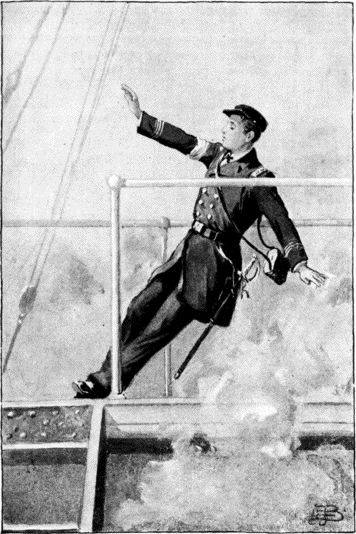
Christy Receives a
Second Wound.—Page 358.
He was carried to his stateroom by his officers, and the doctor
examined his last wound. He was
restored to consciousness, but he looked like death itself beneath the
ruddy brown of his weather-beaten face.
"You will take the command now, Mr. Flint," said he when he saw the
executive officer watching him with the most intense interest. "What do
you think of it, Dr. Connelly?" he asked, turning to the surgeon.
"Severe, but not dangerous," answered the doctor. "The ball did not
touch the bone, but it ploughed deep through the flesh. You were
fortunate in having plenty of meat on your bones."
Dave was the most assiduous of nurses, and had no little skill in
attending to the wants of the sick. The young commander was made
comfortable in a few hours, and Mr. Flint came below to see him at the
end of an hour when he had performed his most pressing duties. He
reported that Mr. Pennant's wound was slight, and did not disable him.
Eight seamen in all had been wounded, and one of them was likely to die
of his injury.
"But we have done our work well, Captain Passford, and I don't
believe that one-half the garrison of that fort are fit for duty at this
moment," added the first lieutenant.
"But that was a splendid fellow who commanded there," continued Christy
with admiration. "If his guns had not been taken away from him, and his
force reduced to a handful of men, we should have had to wait for the
Sphinx to come out of the bay; and it might have been three weeks or a
month before she concluded to do so."
"We have damaged the enemy enough to make it pay, and the steamer and
her cargo will put at least seventy-five thousand dollars into the
pockets of our side in the conflict."
"And by taking the bull by the horns, instead of waiting till the
captain of the Sphinx concluded to take his chances of being captured in
getting to sea, we have made the Bronx available for duty at once in
another quarter, where she can do better work than in chewing her cable
off the bar of Barataria," said the wounded commander, thus satisfying
his conscience that he had done his duty.
The venerable colored man, who had given so much assistance and
information to the third lieutenant on shore, had no desire to leave his
home, and he was landed in the darkness of the evening at a considerable
distance from the fort. Christy
had rewarded him handsomely for the service he had rendered. The men in
the first and second cutters had taken all the cotton in the small
steamers, and put it on board of the Sphinx before they set them on
fire. The four guns in the hold had been hoisted out to make room for
the bales, and the vessel had been put in condition for her voyage.
Early in the evening, the two steamers were standing out into the
Gulf headed to the south-east. In the middle of the afternoon of the
next day, Mr. Flint reported to the flag-officer off Pensacola Bay. The
wounded captain was as comfortable as a young man could be with two
bullet-holes in his limbs. It was the first time he had been wounded so
as to disable him; but he felt that he had faithfully done his duty to
his country, and he was as cheerful as a man in his condition could be.
Dr. Connelly reported that he would not be fit for service again for six
or eight weeks.
Mr. Pennant, the third lieutenant, on account of his wound, which was
not severe enough to render him unfit for ordinary duty, was appointed
prize-master of the Sphinx, with orders to report
at New York for condemnation. A furlough was given to Christy, with a
stateroom on board of the captured steamer. She was fitted out so that
she could defend herself, or even capture any vessel of the enemy within
her reach, and not too strong for her. She was not as fast as the Bronx,
but she had logged over twelve knots on the passage from Barataria Bay,
and was therefore likely to be added to the force of the navy.
Ensign Flint was appointed to the command of the Bronx by the
flag-officer, who had called upon Captain Passford in his stateroom.
Christy had not failed to commend his executive officer in the highest
terms. The commodore suggested that Christy could not be very kindly
disposed towards Captain Battleton of the Vernon, on account of his
decision against him in the matter of his identity.
"On the contrary, I do not see how he could have done otherwise,
commodore, and I have expressed to him my friendly feeling," replied
Christy. "I think he is a devoted and faithful officer, sir."
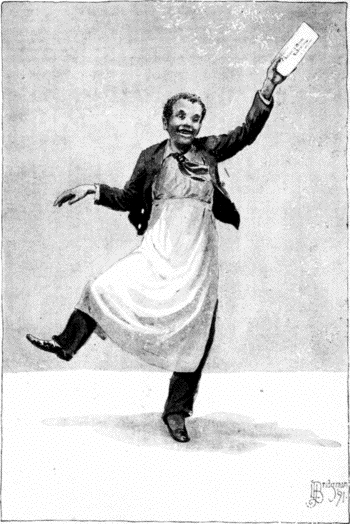
Dave Receives his
Appointment as Steward.—Page 364.
"He desires employment on more active duty than the command of a
store-ship, and I am
instructed to give him such a position if I have one at my disposal,"
added the flag-officer.
"I certainly hope you will do so, sir, if possible."
"I propose to appoint him executive officer of the Bronx."
"I am sure Mr. Flint could not have a better man."
In due time this appointment was made, and Captain Flint, on the
recommendation of Christy, was entirely satisfied to receive him as his
first lieutenant.
"One thing more, Captain Passford," continued the flag-officer; "the
ship's steward of the Mercidita has been very sick for three weeks, and
has applied for a sick-leave. I shall be obliged to transfer Mr. Nawood
of the Bronx to his place."
"I can mention just the right person to take Mr. Nawood's place,"
said Christy eagerly.
"You seem to have a man ready for every vacant position. Who is he?"
asked the commodore with a pleasant smile.
"His name is David Davis; but he is not a relative of the president
of the Southern Confederacy, for he is a mulatto. He has rendered very
important service on several occasions, and there is not a truer or
braver man on board of the Bronx, or any other ship of the squadron,"
replied Christy with enthusiasm.
The commodore shook his head, but he looked very good-natured.
Christy narrated the part Dave had taken in the capture of Captain
Flanger in the cabin, and in recovering possession of the Bronx when it
was shown that the officers were rebels. Mr. Flint was sent for. He was
quite as earnest in his plea for the steward as the commander had been,
and the written appointment of Mr. David Davis was in Christy's hands
when the flag-officer took his leave of the wounded commander.
"Dave," said the wounded lieutenant, the next time the steward came
into the room, "no more 'massa,' no more 'moggywompus,' no more 'done do
it.' You know better than to use such expressions, and you are no longer
a 'nigger;' you are the ship's steward of the Bronx."
"What's that, Captain Passford?" demanded Dave, opening his eyes like
a pair of saucers.
Christy handed him the appointment just made, and the steward danced
about like a madman. He
had expected nothing for his meritorious service, and he found himself
in a position of trust and responsibility. He expressed his gratitude in
the most earnest language, and without using a single objectionable
phrase, for his education was better than his habit in the use of
speech.
Ensign McLinn, who had served on board of the little steamer, but had
recently been on sick leave, was appointed second lieutenant of the
Bronx, while Mr. Camden, outranked by the other officers, remained as
third lieutenant. Christy and Mr. Pennant were transferred to the
Sphinx, with a prize crew; and that same evening the Bronx sailed under
her new commander, with sealed orders, to the eastward.
The Sphinx sailed the next day for New York, and made a tolerably
quick passage. Of course Christy was received with open arms by the
family at Bonnydale, and with a profusion of blushes by Bertha Pembroke,
who happened to be there on a visit. His father and mother looked with
no little anxiety at the pale face of their son, though he was still
cheerful and happy. He had lost a portion of his flesh, and his uniform
hung rather loosely upon him.
He was too feeble from the effects of his wounds, for that in the thigh
had proved to be more severe than the surgeons had indicated, to tell
the exciting story of the escapade of Corny Passford; but when he did
relate it, three weeks later, it thrilled the listeners for three whole
evenings.
"You took the bull by the horns at an opportune moment, my son," said
Captain Passford, Senior. "If you had not done so you would have been in
a rebel prison at this moment. As it is, poor Corny has got back to Fort
Lafayette, with Galvinne and our man-servant, whom I never should have
suspected of being a Confederate officer."
"I don't think I care to go to the Gulf again as the commander of a
vessel," added Christy, who had not changed his mind on this
subject.
"Why not, my son?"
"I don't like the responsibility, in the first place, and the
inactivity, in the second. When I am forty or fifty years old, I shall
like a command better. Others seem to look upon me now as a boy, capable
of any sort of quixotism, however prudent I may be, and point at me as
one who has been
made a commander of a steamer by influence at court. There is a vacancy
at the present time on board of the Bellevite, for the second lieutenant
will be compelled to resign on account of his health."
This matter was fully discussed during the next two months; and at
the end of that time the young lieutenant was again in condition for
duty. Both Mr. Camden and Mr. Pennant obtained the appointment of ensign
on the strength of his reports. Christy was as earnest as ever in his
desire to Stand by the Union; he was ordered to the Bellevite as second
lieutenant, and, after three months' absence, went to the Gulf again,
where we shall find him once more, both on sea and shore, Fighting for
the Right.

WITH NEW AND ATTRACTIVE DIES.
Messrs. Lee and Shepard announce a new
edition of this fine line of 12mo Juveniles, consisting of books by
Kellogg, Kingston, Ballantyne, Headley,
and others. Printed on a fine quality of paper, fully illustrated, and
bound in polished buckram cloth, at $1.00 per volume. Liberal discount
for quantities.
By ELIJAH KELLOGG.
Lion Ben of Elm Island.
Charlie Bell; The Waif of Elm Island.
The Ark of Elm Island.
The Boy Farmers of Elm Island.
The Young Shipbuilders of Elm Island.
The Hardscrabble of Elm Island.
Sowed by the Wind; or, The Poor Boy's Fortune.
Wolf Run; or, The Boys of the Wilderness.
Brought to the Front; or, The Young Defenders.
The Mission of Black Rifle; or, On the Trail.
Forest Glen; or, The Mohawk's Friendship.
Burning the Hatchet; or, The Young Brave of the Delawares.
A Strong Arm and a Mother's Blessing.
The Unseen Hand; or, James Renfew and his Boy Helpers.
The Live Oak Boys; or, The Adventures of Richard Constable Afloat and
Ashore.
Arthur Brown, the Young Captain.
The Young Deliverers of Pleasant Cove.
The Cruise of the Casco.
The Child of the Island Glen.
John Godsoe's Legacy.
The Fisher Boys of Pleasant Cove.
A Stout Heart; or, The Student from Over the Sea.
A Spark of Genius; or, The College Life of James Trafton.
The Sophomores of Radcliffe; or, James Trafton and his Boston
Friends.
The Whispering Pine; or, The Graduates of Radcliffe.
The Turning of the Tide; or, Radcliffe Rich and his Patients.
Winning his Spurs; or, Henry Morton's First Trial.
By P. C. HEADLEY.
Fight it out on this Line; The Life and Deeds of Gen. U. S. Grant.
Facing the Enemy; The Life of Gen. William Tecumseh Sherman.
Fighting Phil; The Life of Lieut.-Gen. Philip Henry Sheridan.
Old Salamander; The Life of Admiral David Glascoe Farragut.
The Miner Boy and his Monitor; The Career of John Ericsson,
Engineer.
Old Stars; The Life of Major-Gen. Ormsby McKnight Mitchel.
By GEORGE MAKEPEACE TOWLE.
Heroes and Martyrs of Invention.
Vasco da Gama; His Voyages and Adventures.
Pizarro; His Adventures and Conquests.
Magellan; or, The First Voyage Round the World.
Marco Polo; His Travels and Adventures.
Raleigh; His Voyages and Adventures.
Drake; The Sea King of Devon.
By CAPT. CHARLES W. HALL.
Adrift in the Ice Fields.
By DR. ISAAC I. HAYES.
Cast Away in the Cold; An Old Man's Story of a Young Man's
Adventures.
By W. H. G. KINGSTON.
The Adventures of Dick Onslow among the Redskins.
Ernest Bracebridge; or, School Boy Days.
By JAMES D. McCABE JR.
Planting the Wilderness; or, The Pioneer Boys.
By DR. C. H. PEARSON.
The Cabin on the Prairie.
The Young Pioneers of the Northwest.
By JAMES DE MILLE.
The Lily and the Cross; A Tale of Acadia.
By F. G. ARMSTRONG.
The Young Middy; or, The Perilous Adventures of a Boy Officer.
By R. M. BALLANTYNE.
The Life Boat; A Tale of Our Coast Heroes.
Sent by mail, postpaid, on receipt of price.
Six Volumes. Handsomely Illustrated. Per Vol.,
$1.25.
THE TINKHAM BROTHERS' TIDE-MILL
PHIL AND HIS FRIENDS
THE SATIN-WOOD BOX
THE LITTLE MASTER
HIS ONE FAULT
PETER BUDSTONE
|
"The more stories Mr. Trowbridge can write, the better for the boys of
this generation. Flooded as our country is with literature of a
dime-novel order, we have need of just such safe and interesting books
as 'The Little Master,' 'Phil and His Friends,' 'Bound in Honor,' etc.,
to put into the hands of our growing boys."—Living
Church.
"Mr. Trowbridge's humor, his fidelity to nature and story-telling power,
lose nothing with years, and he stands at the head of those who are
furnishing a literature for the young, clean and sweet in tone, and
always of interest and value."—The Continent.
Six Volumes. Handsomely Illustrated. Per Vol.,
$1.25.
THE SILVER MEDAL
HIS OWN MASTER
BOUND IN HONOR
THE POCKET-RIFLE
THE JOLLY ROVER
YOUNG JOE AND OTHER BOYS
|
"If every boy could read these stories, or have them read to him, there
would be fewer rogues in the world. Straightforward, honest stories,
without cant, without moralizing, full of genuine fun and hard common
sense, they are just the tales that are needed to make a young fellow
fall in love with simple integrity and fair dealing. They are noble
contributions to juvenile literature."—Woman's Journal.
"Mr. Trowbridge has a good perception of character, which he draws with
skill; he has abundance of invention, which he never abuses; and he has,
what so many American writers have not, an easy, graceful style, which
can be humorous, or pathetic, or poetic."—R. H. Stoddard
in N.Y. Mail.
Four Volumes. Handsomely Illustrated. Per Vol.,
$1.00.
A START IN LIFE
BIDING HIS TIME
THE KELP-GATHERERS
THE SCARLET TANAGER
|
"No better or more pleasing writer for young folks than Mr. Trowbridge
can be found. He draws his characters true to life, concealing no
faults, and exaggerating no virtues, but paints each in their own lights
and shadows so vividly that to avoid the one and imitate the other must
be the natural impulse of all boys and girls who read his most excellent
and fascinating stories."—San José Mercury.
Every boy of our acquaintance likes the books by Trowbridge. Every young
girl ought to enjoy them, also, for they are wholesome, true to nature
and human nature, and full of good sentiment. His stories are always
interesting, sometimes thrilling, and often they contain much
information, either of history or natural history.
LEE AND SHEPARD Publishers Boston
THE
Handsomely Illustrated
Per volume $1.25
The Fortunes of Toby Trafford
Father Brighthopes
Woodie Thorpe's Pilgrimage
And other Stories
|
To see life as it is, and depict it by easy and truthful touches, is a
high attainment. Mr. Trowbridge has abundantly vindicated his claim to a
place among the writers to whom readers attribute the grace and power of
naturalness. "Woodie Thorpe's Pilgrimage," "Uncle Caleb's Roan Colt,"
"Lost on the Tide," etc., are all stories of deep interest, which one
will follow with attention. The book does not preach, but conveys some
salutary lessons.
There is many and many a volume written for boys, but they are not all
alike beneficial; therefore the standard writers, to which class belongs
Mr. Trowbridge, may undisputably claim a kingdom whose reigning motto is
manliness.
LEE AND SHEPARD Publishers BOSTON