We shall have to approach the subject of viewing sixteenth century glass
in a very different spirit from that in which we undertook the tours of
the preceding centuries. We can no longer set up any claim to
thoroughness. If our pilgrim visited all the places recommended in our
thirteenth century excursions, as well as those for the fourteenth and
fifteenth centuries, he can rest with the comfortable assurance that he
has seen about all of the really good glass of those periods. Now we
have a different problem. There has survived a great deal more glass
from the sixteenth century than from all the preceding ones combined. He
cannot hope to see it all, and we will have to limit ourselves to
sketching out for him three tours covering the best—supplementing these
by several detached cities, so that if the glass hunter happens in their
neighbourhood he will not overlook them. He will find, however, some
compensations for the bewilderment caused by the great quantity of
sixteenth century glass, the chief of which is that either Rouen or
Troyes provides in its many churches a complete exposition of that
period’s style. If the pilgrim’s time is limited, he can accomplish more
during a short stay in those two cities than he could upon any tour
which might be outlined. Two other compensations provided by this
abundance of material are—first, that there is a great deal of good
glass to be seen in Paris, and furthermore, the automobilist especially
will delight to learn that there are a half-dozen points in its
immediate neighbourhood which offer an excellent excuse for a half-day’s
outing. For the leisurely traveller who has both time and inclination,
we will arrange three tours; but he must understand that although they
will provide him with a sight of the best sixteenth century glass, there
will still be left a number of towns worth visiting.
Each of these trips will begin in Paris. On Tour (a) we first stop at
Vincennes, just outside the fortifications, then on to Sens, to Troyes,
to Chalons-sur-Marne and back to Paris. Tour (b) takes us by way of
Versailles to Montfort l’Amaury; then to that perfect shrine of
Renaissance glass, Conches; next to Pont-Audemer; then across the Seine
by boat to Caudebec, and from there upstream, by the interesting old
Abbey of St. Wandrille and the stately Jumièges to Rouen. From Rouen we
run out to Grand-Andely, Elbeuf or Pont de l’Arche before we push up the
river Seine to Paris. Tour (c) will particularly recommend itself to
the automobilist, and most of the points are quite near Paris. We go out
through St. Denis to the town of Montmorency, then through the wood of
Montmorency to Ecouen, and next a little further on to Chantilly. From
there our route lies across to Beauvais, and back to Paris. As stated
before, several of the towns comprised in these three tours are so close
to Paris as to enable a glass lover with a half-day on his hands to
pleasantly employ it in a short excursion by train or automobile. Of
course, if he travels by train he can hardly hope in half a day to see
more than one of these. If, however, he is an automobilist and therefore
untrammelled by time-tables, he can combine several. For example, a
glance at the map will reveal that Ecouen, Montmorency and Chantilly are
so close together that an automobilist can fit them into one day. A word
of warning is not out of place for one about to visit these nearby
towns. He must be careful to ascertain from his Baedeker or from the
public prints, upon which days they are open to the public. Montfort
l’Amaury and Ecouen can be seen any day; Vincennes and Chantilly,
Thursdays and Sundays, etc., but these statistics had better be verified
in the manner suggested because the regulations are changed from time to
time. There are three very important glass shrines which are, however,
so located as to make it impossible to combine them into a tour. These
are the Cathedral of Auch (down in the southwest near Toulouse), the
chapel of the château of Champigny-sur-Veude in Touraine, and the famous
church of Brou at Bourg in Savoy. The pilgrim should make every effort
to see them.
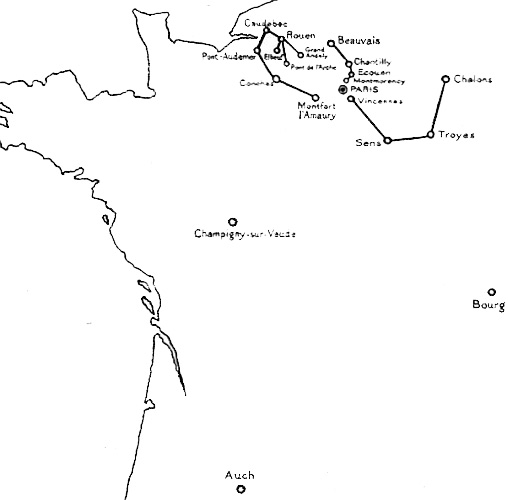 16th CENTURY TOURS.
(a) Vincennes, Sens, Troyes, Chalons.
(b) Montfort l’Amaury, Conches, Pont-Audemer, Caudebec, Rouen, (Grand-Andely, Elbeuf, Pont de l’Arche).
(c) Montmorency, Ecouen, Chantilly (St. Quentin), Beauvais.
Also separate visits to Bourg, Auch and Champigny-sur-Veude.
(For table of distances, see page 295.)
Vincennes lies so close to Paris that it can be reached by an electric
car which starts from the Louvre. Its sternly forbidding fortress of the
most approved feudal type, and the delightful park, have been the scene
of many an interesting episode in French history. In the old forest
which was the predecessor of the modern park, good Louis IX was wont to
seat himself beneath an oak and measure out to all comers that
even-handed justice which supplied one of the reasons for his
canonisation. Often, on our travels, we have noted how enthusiastically
he espoused the cause of stained glass, and, therefore, we of the
Brotherhood of Glass Lovers should feel a sympathetic glow of interest
whenever we happen upon any scene hallowed by his personality. As for
the castle, perhaps the best proof of its great strength is its sinister
record of having served during many reigns as a dungeon for prisoners of
State. Many are the great names on its roster of prisoners, nor shall we
wonder it was chosen for that purpose after climbing to the top of its
donjon tower and remarking the vast thickness of its walls surrounded by
the deep, yawning moat that isolates it from the smiling countryside.
It is with a feeling of relief that we turn from the contemplation of
such a subject to the delight which awaits us in the graceful Gothic
chapel with its fine vaultings, set off by the superb set of windows
from the hand of that great master, Jean Cousin. Poor windows, they have
suffered many vicissitudes since their completion in 1558; it was not
enough that they should be subjected to the ordinary hazards of
time—they were actually taken out of their settings and moved away!
After an interval they turned up in 1816 in the collection of Lenoir.
Later they were restored to their original embrasures, but some of the
heads and limbs having been lost, a bungling repairer replaced them by
fragments from other panels. Fortunately for us, the last restoration in
1878 has corrected this and they are now in condition to show us what
their artist intended to set forth. Notwithstanding the glaring light
from the uncoloured windows to the west, these stained glass pictures
are so delightful in tone and drawing as to give us a very high opinion
of Jean Cousin. It was but natural that he should, in accordance with
the custom of his time, seize this opportunity to recommend himself to
royal favour, and, therefore, we must not criticise him for putting
Henry II attired as a Knight of St. Michael in one of the eastern
windows. We may, however, very properly object to the presence of the
royal mistress, Diane de Poitiers, among the Holy Martyrs! Henry II
must have lacked a keen sense of humour, or the artist might have run
some risks in so placing the fair Diane. The subjects of these windows
are taken from the stories of the Apocalypse and allow the artist wide
scope for his fancy, of which he avails himself to the fullest extent.
He also indulges in several daring combinations of colour, as for
example, in depicting the flames in the panel to the right of the
central one, where he used lilac, yellow, brown and red, and each colour
in several shades. Just below, in his shipwreck picture, he again
represents the flames in the same bold way. Then, too, there is a
distinctly bluish tone to his enframing stone canopies; all this sounds
very raw and harsh, but the general effect is nevertheless excellent.
This was the official chapel of the Order of the Saint Esprit, so we are
not surprised to find upon some of the windows knights of that order in
full regalia. Vincennes is perhaps the best place to study Jean Cousin;
certainly far better than his birthplace, Sens, which we next visit.
There the cathedral contains but two examples of his skill, but they are
veritable masterpieces.
Even the most enthusiastic admirer of Sens could not bring himself to
describe that city, or the surrounding country, as picturesque. The
latter is monotonously flat, relieved only by occasional chalk ridges.
The town straggles away from the river Yonne with little to remind us of
its former glories except the cathedral and its immediate neighbourhood.
As we cross the bridge near the railway station we will remark a very
incongruous service which practical science has exacted from a relic of
the past. Rising from the parapet at the highest point of the bridge is
a crucifix up the back of which runs a wire ending over the head of
Christ in an incandescent electric light! When we passed through Sens on
our earlier trip (see page 77) we took occasion to relate the fateful
coincidence which took place in the twelfth century when representatives
from all parts of Christian Europe came there to visit the exiled Pope
just in time to see William of Sens completing, in the cathedral, the
first great step in Gothic. This coincidence not only caused the rapid
spread of the new style of architecture to every part of the Christian
world represented by these visiting delegates, but also explains why
Thomas à Becket, then sojourning in Sens, selected this architect to
rebuild Canterbury Cathedral in far-off England. Now we come to a
sixteenth century tale which serves to show that the people of the
Middle Ages were likewise keenly interested in art and that an artist’s
fame travelled perhaps even more widely, all things considered, than it
does to-day. The beautifully light and graceful transepts at Sens were
built by Martin Cambiche, who was also the architect of Beauvais
Cathedral and likewise drew the plans for the west front of St. Pierre
at Troyes.
First let us look at the cathedral’s exterior. When viewing the west
front we are struck by the appearance of unusually great breadth, due
partly to the construction of the cathedral itself and partly to the
placing of the Officialité (a thirteenth century building) which has its
greatest length extending to the south level with the cathedral’s west
front. Note the device of the Officialité’s architect to increase the
seeming length of his front by gradually diminishing the distances
between his buttresses. Within this fine hall St. Louis (Louis IX) was
betrothed. This ponderous appearance of breadth resulting from the
juxtaposition of these two buildings might have produced too massive an
effect if it were not for the almost coquettish fashion in which the
tower rises up at the cathedral’s southwest corner, giving a decided
uplift and point to the entire façade. Although the cathedral has far
fewer windows than we shall see at Troyes (because its triforium is not
pierced), the lighting here is almost garish, owing to the fact that the
clerestory embrasures are glazed only in grisaille. In the charming
transepts, however, we obtain what is perhaps the ideal lighting sought
for by the glass artist of the sixteenth century. The windows are very
numerous and of such general excellence as to render these the best
glazed transepts in France. They have not only unusually ample window
space in their sides, but have also large low-reaching panels below the
big rose windows which, as usual, decorate the upper portion of the end
walls. So generous was this architect in the number and size of wall
apertures as to prove how greatly he esteemed the assistance of the
glazier. The records show that those in charge of the building made most
intelligent use of the opportunity provided by the unusual amount of
window space. They sent far and wide for the best artists. We read that
in 1500 they summoned from Troyes three master glass painters,
Lyenin-Varin, Jean Verrat and Balthazar Godon, and turned a large part
of the work over to them. These men finished their task in three years,
and the result amply justifies their selection. The rose windows are
especially pleasing, that to the south showing the Last Judgment with
many repetitions of the Angel Gabriel, and that to the north a most
charming throng of angels playing upon various musical instruments, the
interweaving of the glass tones being as harmonious as befits this
heavenly choir. The best known window in this part of the church is a
very brilliant Tree of Jesse with a red background bearing on one of its
branches the celebrated Grey Jackass (a familiar figure in the old “Fête
des Fous”): it is at the north end of the east wall of the south
transept. Of the beauty of these transepts, as well as of the way in
which their architecture and glass prove mutually helpful, too much
cannot be said. The most famous windows in the church are two by Jean
Cousin, who, although born in this city in 1501, is only represented in
his home cathedral by these examples. His glorious St. Eutropius is in
the third chapel on the right of the nave, but even finer still is the
Tiburtine Sibyl in the Notre Dame de Lorette chapel on the right side of
the choir ambulatory. It is only fair to this second window to say that
it was somewhat damaged during the siege of 1814. After inspecting these
two products of his genius, it is easy to understand why Jean Cousin
enjoyed so wide a fame. We have already referred to the splendid relics
of the twelfth century which are found on the other side of the choir
ambulatory. The result of this very convenient opportunity to compare
the best work of the twelfth and the sixteenth centuries is that we are
sure to be startled by the difference not only in results, but also in
methods.
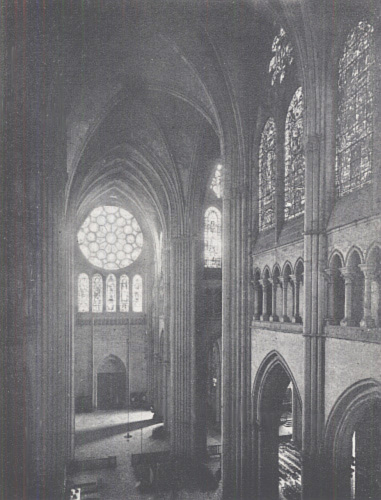
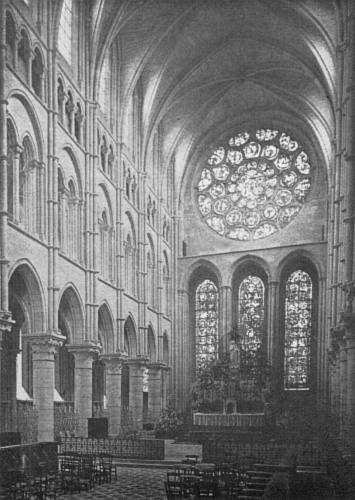
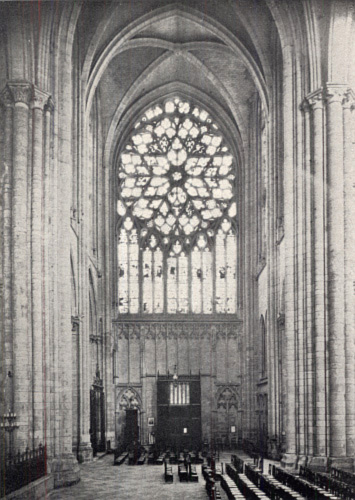 SOUTH TRANSEPT, SENS (16th Century).
The Rose is now greatly elaborated, its lines more flowing, and its
position in the wall beautified by the graceful adjustment of the
lancets below.
To-day the flat country of the ancient province of Champagne, broken
only by occasional ridges of the chalk which underlie the surface to the
great advantage of its famous grapes, affords but little of interest to
the traveller by automobile, and has only its level going to recommend
it to the bicyclist. There is not enough traffic on its roads to enliven
the monotony of the journey. How different must it have been when these
same highways teemed with interesting groups from every rank of society,
all crowding to the famous fair of Troyes, which during the Middle Ages
was the bourne of so many traders, knights and other seekers of
adventure from all parts of Christendom. In those days no one would have
had leisure to notice the monotony of the scenery, so engrossed would he
have been in those passing crowds made up of every nationality of
Europe, all repairing to this great mart of trade. During those halcyon
days of commercial distinction there must have been laid broad
foundations of cosmopolitan tastes, and a reflection upon those times
makes it easier to understand why so many artists should later have
been born citizens of that stout burgh. This also explains why so large
a number of Flemish and Italian artists resorted hither, leaving marked
traces of their influence. This prosperity was temporarily checked by
the edict of Louis X forbidding the Flemish to trade at its fairs, and
the absence of these lowlanders was soon followed by that of the
Italians. From this cause, combined with others, the fairs lost their
importance, and the Hundred Years War coming soon after, put the
finishing touches to the city’s decadence. The damaging and dreary years
of the English occupation were, however, enlivened by the episode of the
marriage of Henry V of England to Catherine of France, attended by all
the pomp and pageantry that would naturally be attracted thither by so
notable an event. Troyes did not, however, recover her old commercial
prestige until just before the beginning of the sixteenth century. Then
she took such a bound forward as, through the new wealth of her
citizens, to make possible that encouragement of art which developed the
unrivalled school of glass painters soon to make her famous far and
near. In fact, so widely was their fame spread and so firmly were they
established, that their school persisted far into the seventeenth
century, the vigour of their art long outliving that of most of the
other French glass centres. There is no place in France in which one can
better see examples of the various ramifications of the sixteenth
century style in glass. We have here not only the cathedral, but church
after church full of the work of the best masters. We shall see not only
the picture window in lively colour, but also that in the subdued style
of grey and yellow stain, to which we have alluded before. Furthermore,
in the Library there is a series of historical panels which is not
excelled anywhere, the secular topics of the scenes giving an excellent
opportunity to show costumes and manners of the times. Nor must one
confine oneself within the exact limits of the sixteenth century,
because we have noted that here the style of that century extended
practically unchanged far into the next. We shall begin when the style
begins and we shall follow it as long as its healthy life continues. Of
the numerous churches in Troyes, those which chiefly interest the glass
student are the Cathedral, St. Urbain, St. Jean, St. Nizier, La
Madeleine, St. Pantaléon, St. Nicolas, and St. Martin-ès-Vignes. Besides
these churches, there is also the Library to be visited for its series
of windows devoted to civic subjects. For a description of that Gothic
eggshell, St. Urbain, turn back to page 82, where will also be found an
account of the splendid thirteenth century glass that makes the choir of
the Cathedral so glorious.
Let us begin our stroll about the town by a visit to St. Jean. It would
be difficult for a church to more completely preserve its mediæval
appearance than this one. Besides, the way in which it is tucked in
between two crooked, narrow old streets conforms to the most approved
rules of stage setting. Its quaint, irregular exterior makes it appear a
picturesque medley of three or four churches of varying size, while its
ancient belfry perched on one side like a feather in a cap lends the
ensemble an almost jaunty air. The altar before which Louis II was
crowned and Henry V of England married, has been removed to the east and
placed in the more modern Lady Chapel. We get an interesting hint of the
great value attached to stained glass when we learn that the original of
a window on the right side of the nave clerestory (showing the
coronation of Louis II) was demanded as part of the ransom of Francis I
when he was captured at the Battle of Pavia. This original window is
said to be somewhere in Spain. The axis of the choir slants quite
noticeably from that of the nave, and the priests say that this slant is
intended to symbolise the inclination of the head of Christ on the Cross
after His death. We notice the same difference in axis, as well as the
same tradition, at Quimper, but we there learned that the true
explanation was not so poetic. Here also we are obliged to reject the
quaint legend of the priests; the municipal improvements after the great
fire which ravaged the city in 1524, necessitated the rectification of
the street line, and the north side of the choir had to be slanted to
conform thereto. The glass is in many ways of interest, but has been a
good deal mutilated. That in the nave has suffered most, but fortunately
much of its beauty remains. Notice the admirable Judgment of Solomon on
the south side. In the choir and in its chapels we shall get a real
taste of the Troyes glass school, some of the windows being excellent,
especially that of the brothers Gonthier, showing the Marriage Feast at
Cana, the Manna in the Desert, etc. In many of the churches in this city
we shall observe paintings hung upon the walls, and two of those which
decorate this sanctuary will serve to remind us that Pierre Mignard, the
great painter of Louis XIV, was born here.
Another ancient church, and one much richer in glass, is St. Nizier. Its
original glazing had remained practically intact until in August, 1901,
when a most unusual calamity overcame some of it. An anarchist exploded
a bomb in a chapel on the north of the choir. We have observed what our
poor friend has had to endure in many places, but to be shattered by an
anarchistic explosion seems a most incongruous fate. It is, however, a
pleasant surprise to find how little damage was done by this act of
vandalism. The finest window is undoubtedly that which adorns the south
transept and shows Religion overcoming Heresy. The central one in the
choir (the Virgin Mary and the Apostles receiving the Holy Ghost) is by
the celebrated Macadré of Troyes, but the writer finds its effect
injured by the fact that the artist (probably to indicate that the side
panels are to be considered in conjunction with the central one) allows
the hands of certain figures at the side to extend over upon the central
panel. This century surely went far enough in its disregard for the
delimiting duties of the leads, but when we find an artist so careless
of the properties of his materials as to put a hand over on the other
side of a stone mullion, it would seem that the limit had been exceeded.
The most ancient of all the Troyes churches is La Madeleine. It contains
a marvellous jubé arch swung in air between the two western columns of
the choir. Although of stone, the workmanship is so delicate and
lace-like that we are not surprised that the epitaph of its builder
buried below used to read that he calmly awaited the Judgment Day with
no fear of the stone arch falling upon him. The glass around the choir
is excellent, but we must go to the Lady Chapel to see the best. On the
right is a Tree of Jesse, remarkable for the number of figures it
contains. The east window is the gift of the Jewellers’ Guild, which
fact is carefully set forth thereon. To the left is a fine example of
glass-making, but in addition to that, because of the treatment of its
subject, it is as interesting as one will often find. Beginning at the
lower left-hand corner and reading to the right, are a series of scenes
depicting the creation of the world, Garden of Eden, etc. The
imagination of the artist set forth the creation of the world in a
manner surprisingly close to the latest theories of modern science. He
starts with a round glowing ball of matter which, by means of rotation
upon its axis, develops in the succeeding pictures, first, a more
symmetrical shape, and then the appearance of land, formation of
continents, etc., etc. On the left of each of these scenes stands the
figure of Jehovah, in a costume resembling that of a high priest. There
is hardly a window in France that tells as much or is more interesting
in the telling than this one.
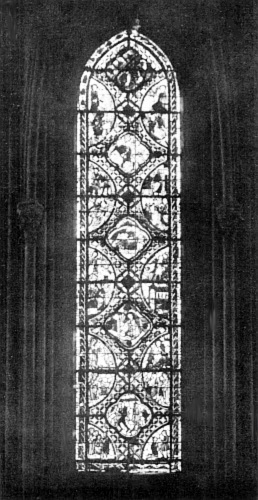
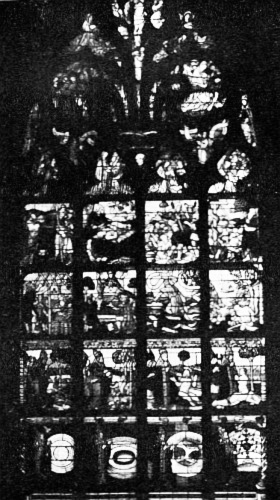 “CREATION” WINDOW, LA MADELEINE, TROYES (16th Century).
Read from left to right, beginning with lowest tier. Earth evolved from
chaos, shown by glowing yellow ball revolving on its axis; birth of Eve,
etc. Tracery Lights above are becoming simpler in form as elaborate
Gothic gives way to Renaissance.
Now we come to a style that is better shown here than anywhere else—the
picture window composed of grey and occasionally some flesh tints, with
touches of yellow stain to relieve it. Two churches are entirely glazed
in this manner—St. Pantaléon and St. Nicolas. The latter, it is true,
has one or two of its upper windows in colour, but the general effect is
that of a church glazed in grey and stain. Of course, these two
interiors, because of this glazing, are very brilliantly lighted, and in
the opinion of the writer, much too brilliantly. This method proved very
felicitous when devoted to domestic purposes (as found towards the end
of this century and during the early part of the next), but for a
religious edifice, although interesting, it is doubtful if it is
beautiful or suitable. There are some unusual architectural features to
be found in both these churches. St. Nicolas has a very graceful stone
gallery extending across the western end approached by a gradually bending staircase, the
supports of which are of admirable design. St. Pantaléon can hardly be
said to be attractive. The interior is too high and too glaringly
lighted, but it affords the best opportunity to study this grey and
stain style. Notice that freely as is the yellow stain used to enliven
the monotony of the greys, it does not succeed in producing the charming
silvery tone yielded by the canopy window of the two preceding
centuries. Here and there one observes an attempt to modify the
ultra-yellowish grey tone by introducing blues into the borders. The
falseness of style everywhere noticeable reaches its climax in a gallery
on the left near the entrance, containing two stone figures which appear
to be looking down from it. Do not fail to visit St. Pantaléon in order
to study its unusual glazing, but do so out of curiosity and not
expecting beauty, or you will be disappointed. Its lack of charm will,
however, prove useful if you go straight on from here to the Cathedral,
for by contrast it will intensify your appreciation of the sympathetic
assistance which the wealth of colour there lends to the splendid
architectural effect of the interior. We have already taken our reader
to inspect the thirteenth century glass around the choir, but now we
will have him stop in the nave to see the work which the sixteenth
century produced. One immediately notices the particularly clear fresh
colouring of the glass, and this, combined with its great quantity (for
the pierced triforium permits an additional row of windows besides the
clerestory above and the aisles below), produces an impression which is
so unique, and so distinctive, that it always lingers in the memory. The
rather unpleasant contrast noticed at Bourges between the depth and the
warmth of the thirteenth century and the lighter tones of the later
glass is fortunately absent from Troyes. The reason for this is the
unusually rich colour of the later windows. From so many excellent ones
it is difficult to select a few to mention, but we particularly commend
the fourth on the right (a Tree of Jesse) and the one in the fourth
chapel on the left, Linard Gonthier’s famous Wine Press. The Tree of
Jesse is not only a beautiful example of its type, but is rather out of
the ordinary because it has a red instead of a blue background. Upon
this window, as well as on most of the others, are to be seen the
donors, their coats-of-arms, and other interesting sixteenth century
features. Gonthier’s Wine Press is so well known as hardly to call for a
word of description. Christ is stretched out in the press, His blood
running into a chalice, while from His breast springs a vine spreading
over the window, bearing as its blossoms the twelve Apostles. Although
this window is dated 1625, it is in the best style of the sixteenth
century and shows no tendency towards decadence in either drawing or
colouring. Before leaving the interior, notice an odd architectural
device in the north rose. This window is of the wheel type and has a
supporting column running up through it as far as its middle, suggesting
a gigantic pinwheel. There is a similar supporting column in the north
rose at Tours, but there it runs straight up through the window to the
top, and unfortunately is too heavily and solidly built.
Nearly all mediæval glass was adorned with religious subjects, and
therefore we have an unusual treat when we visit the large hall of the
Library and examine the thirty-two panels that fill its eight large
windows. They are from the hand of Linard Gonthier, and the scenes are
commemorative of the visit to Troyes of Henry IV in 1595. Very charming,
indeed, are these pictures of the life and pageants of the time. There
are many familiar little touches, such as a small boy being pushed off
into the water by the crowd, etc. Some of the panels are also rich in
armorial bearings.
We have purposely delayed until the last any reference to St.
Martin-ès-Vignes because it was entirely glazed at the time when the
Troyes sixteenth century school, although still worthy of its
traditions, was about reaching its end. This glass is uniformly good and
provides a most pleasing interior, obviously relying for its effect upon
the glazing. The dating is that of the earlier years of the seventeenth
century. If we examine the windows too closely we easily find
indications of a decadence of style. For instance, the second on the
left gives so much importance to the kneeling donors that, although we
cannot deny the excellence of the work, we must strongly criticise the
taste which made them so prominent a feature. Regarded as a whole,
however, the result in this church is so excellent that it clearly
proves what we have before stated, viz.: the virility and strength of
the glassmaker’s art at Troyes outlasted that of most of the
contemporary French schools.
Before paying our second visit here to examine the sixteenth century
windows, let us turn back to page 87 and refresh our memory by glancing
through the account of our thirteenth century trip to this city. We
shall thus be reminded of the modestly retiring beauty of its small
parks, as well as of its cathedral and two fine churches. Every style of
sixteenth century glass is to be found in Chalons, but for all that it
would hardly be selected as one of the best places in which to compare
them. The small church of St. Alpin has in its nave a series of
excellent windows of yellow stain and grey such as we noticed in St.
Pantaléon and St. Nicolas at Troyes. In those two churches the
relatively great window space exposes the weakness of this style by
demonstrating that in large interiors it makes the light glaring. By
contrast, in St. Alpin, where the nave ceiling is low and the window
apertures small, this method of glazing, by admitting a great deal of
light, produces a very happy effect. In this St. Alpin glass there are
marked traces of Italian taste, more so than in that at Troyes, though
the latter is commonly credited with being the most noticeably affected
by foreign influence. The first one on the right, showing St. Alpin
before Attila, is delightful, every advantage having been taken of the
softness of tone which is the chief merit of this particular treatment.
Some of the others are also good, but the one just mentioned is the
best. Around the choir are interesting coloured panels, but so broken up
into small scenes as to be rendered ineffective. The handsome church of
Notre Dame does not, in its windows, fulfill the promise of its
architecture. A great deal of the glass is new, and much of the old is
mutilated, but in the lower row on the left side of the nave there are
several brilliant examples of what the sixteenth century Champagne
school could accomplish in the picture window. Especially vigorous and
striking is the first on the left, showing St. James encouraging the
Spaniards to defeat the Moors. It is as good a battle picture in glass
as one will find. In the fifth on the left (a Crucifixion scene) we note
a trick often observed in this province, for the little golden stars are
separately leaded into the blue sky. Passing on to the Cathedral,
disappointment awaits us. On our former visit we found it so fruitful
and interesting in thirteenth century glass that we had a right to
expect more than is yielded by the inspection of the row of sixteenth
century windows which extend along the lower right side of the nave. The
canopies in the sixth one betray that it is fifteenth century, but all
the others are later. The first on the right is the most interesting of
this series, although it is the poorest in execution. On eleven of its
compartments are represented scenes from the Creation, Garden of Eden,
etc., wherein certain quaint conceits are noticeable. Unfortunately its
many nudes are very poorly drawn and the glass used is mediocre in
quality. We can here clearly see that, although the artist of this
period was saved a great deal of lead work by his large pieces of glass,
their use required him to select sheets of evener tone and better
quality than in the days when his pieces were much smaller.
An agreeable route from Paris to Conches, etc., is by way of Montfort
l’Amaury, which lies beyond Versailles, just off the main road to Dreux,
and 45 kilometres distant from Paris. If the pilgrim is travelling by
train or if he wishes to go straight from Paris to Conches, he should
then postpone until another occasion his visit to Montfort l’Amaury, and
will thus keep in store for himself a very pleasant half-day automobile
excursion. The object of the visit proves to be a small church which has
preserved its sixteenth century glazing practically intact. Nothing
could be more simple than its ground plan, for there are no transepts,
no chapels, simply one long building rounded at the east end, whose
shape suggests that of a man’s thumb. While we must not expect to find
so splendid a glass series as at Conches, neither must we fail to
appreciate that here is a church with thirty-three windows, all of the
sixteenth century, and in excellent state of preservation. As we enter
by the small south portal the effect that meets our eye is most
agreeable. Closer inspection of the windows unfortunately reveals that
they vary markedly in quality and are evidently the work of different
artists. It cannot be denied that many of them are commonplace, although
none is really poor. Their dating helps to explain this mediocrity, for
they were constructed towards the end of the sixteenth century, at a
time when our art was hurrying into decadence. The few earlier ones, and
especially that dated 1544, are the best. The latter is the eighth on
the left and depicts Jesus being shown to the people. Another, the third
on the left, tells the story of Joseph, and is an obvious example of the
Italian influence so prevalent during that epoch. The scene in which he
is escaping from Potiphar’s wife is almost an exact copy from Raphael.
We must not fail to remark the third from the eastern end, in which the
Holy Ghost is descending upon the assembled disciples in the form of a
shower of golden tongues. The grouping of the figures, the play of the
colours, and the richness lent by these touches of gold, all combine to
make a brilliant picture. The second to the right of this contains the
Falling of Manna in the Wilderness, but as the tones used here are much
lower, and the manna is depicted as a rain of white spots, the window,
as a whole, is much quieter than the one just described. In the church
at Montfort l’Amaury an instructive light is thrown upon the obtrusive
appearance of donors so frequently found during the sixteenth century.
We know that the figures are often so large as to be positively
obnoxious, but it is here demonstrated beyond doubt that the artist
worked very much more carefully upon these portraits than upon the rest
of his window. There are few places where this can be more conveniently
studied, and for this reason our visit has been a useful one, even
though the glass be of a class a little below the best.
There are four modest shrines to which every glass lover should contrive
to repair, no matter what may be the difficulties in the way nor how
much time it may take. Of these four, one at Fairford (near Oxford) is
in England, while the other three are in France, and are the Ste.
Chapelle in Paris, the village church at Eymoutiers and Ste. Foy at
Conches. In each we find the church completely glazed in one period and,
furthermore, with the best glass then procurable. The scene that to-day
meets our eye in each of these small sanctuaries is practically the same
that rewarded the artist the day he completed his work. We have
frequently had occasion on our tours to notice how much certain glass
would have been improved if contrasting windows could but be removed
from the edifice, or the edifice itself in some way changed. There will
be no need for any such mental correction of the picture when we visit
Conches. Here, after you have closed the door on the twentieth century
life outside, you feel that you have turned back the finger of time and
are living in the days of that eloquent beauty which speaks out to you
from its windows. Perhaps nowhere else will you get the wonderful accord
of tone with tone and hue with hue that makes the colour at Conches so
radiantly lovely. We find ourselves in a very simple church about twice
as long as broad, the only departure from its rectangular plan being a
small five-sided chapel which projects from its eastern end. There is
nothing to aid the glass in its service of making splendid the interior.
In fact, one might add that there is nothing which dares insult it by an
offer of so obviously unnecessary assistance. Practically all the
windows are of the sixteenth century, and they are so fine that it seems
unfair to call particular attention to the elaborate set designed by
Aldegrevers, a pupil of Albrecht Dürer. These fill the seven tall
windows of two lancets each, which light the eastern chapel and are
dated 1520. Of the forty-two subjects upon these windows, those in the
upper range show scenes from the life of Christ and those in the lower
from that of Ste. Sophia. It is unfair to describe them; they should be
seen. At this point we may comment that although it is occasionally
possible to convey some idea of an individual panel by technical
description, it is useless to attempt, by means of words, to give a
reader a just conception of such an interior as the glass produces at
Conches. Beside these by Aldegrevers there are eighteen others whose
dates, running from 1540 to 1553, show them to be of slightly later
construction. In the fourth on the right the allegorical subject
contains an unusual detail. A group of figures represent the Liberal
Arts, and among them, Music: upon her insignia appears a musical phrase
expressed in proper notation. This representation of written music upon
glass is extremely rare. We shall see another of the very infrequent
instances when we visit Caudebec. Among the finest windows is the fifth
on the right, which represents the allegory of the Wine Press. Here the
subject is not treated in the usual gruesome fashion. It is not the
blood of Christ which serves as the wine but, instead, the juice of
grapes which He is crushing in the press. Throughout all these windows
the distant landscapes are depicted in much more convincing colouring
than is usually found at this time. This seems due to the fact that the
light blue glass used for that purpose is left clear of all paint except
that needed for delineation. Elsewhere these blue backgrounds often have
so much paint upon them as to be rendered partly opaque and therefore
incapable of simulating the depth necessary for great distances. In
strength as well as in judicious combination of a surprisingly wide
range of colours, their century can show few examples to rival these.
Not only is their value enhanced by the simplicity of the interior which
they decorate, and which, therefore, has nothing to distract our
attention from their beauty, but this very beauty is made all the more
impressive by the sharp contrast provided by the dullness of the little
town outside and the plain exterior of the church which it so glorifies.
The church of St. Ouen at Pont-Audemer will always have for the writer
that peculiar charm of almost proprietary right which the discoverer is
sure to feel in something upon which he has happened unexpectedly. On
his way through the town he saw the church, and having noticed from the
outside that the windows contained stained glass, he stopped and went
in, undeterred by the positively dishevelled look of the unfinished and
dismantled west front. A delightful surprise awaited him. Around the
walls of the nave, the space usually occupied by the triforium gallery
here becomes a broad frieze so exquisitely carved in Gothic patterns as
seemingly to drape the walls with lace. In fact, you hardly notice the
unfinished condition of the upper part of the church, so engrossed are
you in this very unusual feature, one of which any cathedral in France
might be proud. And in the embrasures below, what a gallery of
harmonious glass! Not only are the individual windows excellent, but
they harmonise so well as to make one feel that each artist must have
been at the greatest pains to make his work contribute to and not
interfere with the general scheme. It is for the glass hunter a treasure
trove to find a church which has preserved a complete glazing of one
period, but to have the windows all good, and better still, in such
charming accord with each other, makes the occasion of his visit to
Pont-Audemer a red-letter day. The ground plan of the church is somewhat
broken up, but even that seems but to add to the charm of the interior.
The first window to the left in what might be called the choir
ambulatory is not only the best but by far the most interesting. Without
any definite division of its surface into panels, the whole picture
seems to gracefully resolve itself into four contrasting scenes from the
Old and the New Testament, entitled “Devant la Loy,” “Soubz la Loy,”
“Devant la Grace,” “Soubz la Grace.” The effect of clouds in the sky is
very elaborately worked out, while here and there between them peep
forth the head and wings of little cherubs—it is really very engaging.
Possibly the over-captious visitor may consider the combination of small
heads and surrounding clouds somewhat reminiscent of the buttons holding
down upholstery, but such a carping critic should be packed off about
his ill-tempered business! In a window on the right side of the nave the
donors are ranged along a little gallery in the lowest panel. This
method has in its favour that it does not present them as intruders on
the picture, so often the case in this century. We carry away with us a
charming impression of the service rendered by the glass in toning the
light for the graceful stone carvings on the nave walls. The effect is
unique.
On the outskirts of the town there is a small church, St. Germain, whose
east window is an agreeable example of fifteenth century canopy work.
Our way from Pont-Audemer lies for some little distance through the
large Fôret de Brotonne, one of those tidy symmetrical woods produced by
the excellent system of French forestry. Its excellence, however, is
largely practical, for all the charm of the “forest primeval” is pruned
away. On reaching the banks of the Seine we find ourselves in full view
of the pretty town of Caudebec, its graceful cathedral spire beckoning
us across the water. It is just at this point in the river that there
occurs the Mascaret, the local name given to a swift-rushing wave
produced by the conflict between the incoming tide and the outgoing
current of the river; it takes place only at stated intervals and is
then viewed by numerous tourists. Assuming that we have arrived at a
time when the Mascaret is not interfering with navigation, we embark
upon a flat, open ferry-boat and soon reach the bank on the other side
and are off to the cathedral. Few French churches have their Gothic
architecture lightened and beautified by more infinite detail of carving
than this at Caudebec, while over all rises an airy spire encircled at
three different heights by a stone crown—a form of decoration very
unusual and quite lovely. Above the west portal is a gallery that
attracts our notice because its open-work stone railing is composed of
Gothic letters. Once inside the church, we realise that the windows are
well worth a visit, particularly to one seeking quaint details in glass,
for there are many such here. We have already referred in our
introduction to the first window on the right, the Israelites crossing
the Red Sea. In order to render the scene as descriptive and realistic
as possible, red glass is used to make the sea, thus removing any
possible doubt in the observer’s mind as to the identity of that body of
water. Almost opposite (the second on the left) is a Tree of Jesse, upon
which the descendants appear at full length instead of as the usual
busts. Much golden brown is used, not only in the intricate convolutions
of the vine, but also in the costumes and in the stone terrace
supporting the pavilion below which Jesse is seated. Above the small
north portal is a pleasing canopy window of the fifteenth century whose
unusual feature is that the bottom of it is curved to fit the arched top
of the door. Because of this unusual base, the customary pedestals at
the foot could not be used, but the irregularly shaped space is
tastefully filled with decorations of yellow stain, surcharged with
shields whose heraldry catches the eye of the American traveller,
because they bear stars on a blue field, as well as red and white
stripes. Fifteenth century canopies also fill the first window to the
east of this portal and the three to the west, one being dated 1442,
and all containing four lancets. A couple of windows across the church
are also of this type, while the whole of the side-lights of the
clerestory contain contemporary light-admitting panels, whose colour is
restricted to a few round bosses bearing golden rays, and to the broad
golden borders which here are carried up into and almost fill the
tracery panes above. Another very unusual feature (and one which we have
just noticed at Conches) is the presence of two pieces of music written
out in the form called “full chant” and borne by angels.
If one can spare the time, Villequier, four kilometres down the Seine,
should be visited. The small church there has seven excellent sixteenth
century windows, one of which, that in the centre on the north side, is
really famous. The lower half of its three lancets each contains a
figure on a white background bearing an etched damasked pattern,
bordered richly in gold. Across the entire upper half is spread out a
spirited naval battle in which four ships are engaged. The armoured
knights are depicted with great vigour, while excellent use is made of
the artistic possibilities provided by three great pennants, two of red
with white crosses, and one of yellow bearing a black eagle.
The route from Caudebec to Rouen is charming, thanks to the
ever-changing views provided by the windings of the Seine. If we please,
we may stop on the way to view the Abbey of St. Wandrille (recently
purchased by Maeterlinck) and also the loftily impressive ruins of the
Abbey of Jumièges. Jumièges, in the midst of its beautiful park, is most
picturesquely situated within one of those very pronounced loops so
common in the lower Seine, which seem to signify the unwillingness of
its waters to depart from this delightful corner of France.
Upon approaching Rouen one is sure to be struck by the insolent daring
of its situation. Lying on a sloping plain beside the river, it seems to
disdain the well-nigh impregnable site afforded by the steep cliffs
which rise just to the northeast. The history of the city bears out the
audacity of its location. Through all the centuries its inhabitants
concerned themselves so continuously in conquering other peoples that
little time was left in which to consider the security of their own
homes. The Norman boasted that his strongest defence was a vigorous
offence, and he made good his boast. The town of William the Conqueror
seems always to have been imbued by the spirit which gave him his name,
and the triumphs of the Normans in England, and later in Italy, are but
natural expressions of that virility of race which endures to the
present day. Upon the arms of the city there appears a lamb with one of
its forefeet lifted. Upon this is based the old Norman saying, “L’agneau
de la ville a toujours la patte levée,” a homely comment upon the
restless spirit of its citizens and their disposition to be always up
and doing. Perhaps the most characteristic feature of Rouen when viewed
from a distance is the great number of its spires that shoot up above
the house-tops, earning for it the sobriquet of the City of Churches.
This very attractive detail is all the more striking because so rarely
seen in French towns, and is particularly reminiscent to one freshly
arrived from England, a country whose church towers are such a charming
feature of the landscape. Full of significant history is this Rouen—a
history branded for all time by the cowardly fire that ended the
tortures of Joan of Arc, that strangely potent and beautiful spirit.
Fortunately, no trace remains of that dastardly deed. Turning to a less
sinister page in the city’s history, we see on one side of the
market-place, a small pagoda-like structure called the old tower of the
Fiérté. Here, on Ascension Day in every year, was freed a prisoner
selected by the people, and that this privilege was jealously retained
by them is proved by the existence of a complete list of the prisoners
so freed from 1210 to 1790. Nor do the records stop there: they also
narrate many a fierce encounter resulting from the determination of the
burghers to preserve this right. Most of the quaint features of the town
have been modernised away—so thriving a commerce as here flourishes
could not long tolerate the old narrow crooked streets. Where old
features remain they are so obviously protected as to look almost
theatrical. Of this the two best examples are the clockbearing archway
over the street which bears its name (Grosse Horloge), and the ancient
carved wood housefront transported from its original site, affixed to
another dwelling and dubbed the House of Diane de Poitiers.
Placed just at the point where ships coming in from the sea must
transfer their freight to the smaller vessels that go up the Seine,
Rouen is so intent upon her commerce, that all the principal hotels are
strung along the quays on the riverfront, a very unusual arrangement in
a French town. When we visited the church of St. Ouen to see its
fifteenth century glass, we mentioned the esteem in which the Rouen
glass-makers were held at that time both at home and abroad. From what
we are now about to see we can judge for ourselves how much truer it
must have been in the sixteenth century. The number of splendidly glazed
churches which have been preserved for our inspection almost consoles us
for the long list of others swept away by the ruthless vandalism of the
Revolution, and, to a less extent, by the peaceful hand of time or the
mailed fist of war. The principal ones we should visit (beside St. Ouen
already described) are St. Maclou, St. Vincent, St. Patrice, St. Godard,
St. Romain and the Cathedral of Notre Dame. Perhaps the least
interesting sixteenth century glass is in that gem of Gothic
architecture, St. Maclou, whose florid façade has its bizarre charm
accentuated by the graceful bowing outwards of the west front. The
glass that attracts us most is in the transept rose windows, the lancets
below them and in the very brilliant western rose. All these roses are
dwarfed by the excessive size of the pendent lancets: it is all the more
unfortunate, because considered separately the roses as well as the
lancets are excellent. The earlier windows in the choir chapels have
been described in our former visit (see page 144). In the south transept
a well-composed Crucifixion scene is carried across all the lancets. The
north transept contains a Tree of Jesse on a blue background, and oddly
enough, the tree has white branches. In leaving St. Maclou, notice the
dainty spiral staircase that winds up at the south side of the door; it
seems almost too delicate to be made of stone.
St. Vincent has its entire lower part lighted by large embrasures
completely glazed with glass of this period, producing a singularly
brilliant and luminous effect all about us. The columns which separate
the ambulatory from the choir are so slender that they do not materially
interfere with our view, and thus the whole interior is exposed at once,
an enclosure of glorious colour. In fact, it is not too much to say of
this church and, to a less extent, of the two which we shall next visit,
that they are bowers of iridescent glowing light. There are two Trees of
Jesse at St. Vincent, one over the north portal, and another at the east
end of the south aisle, but inspection of the latter reveals that the
genealogical tree rises not from Jesse but from St. Anne! In the true
Jesse tree over the northern door the branches are white, a peculiarity
just noticed at St. Maclou.
St. Patrice differs from St. Vincent in that, instead of seeming to
stand in the midst of a circle of luminous colour, our attention is
rather directed towards the splendid bow-window at the east with its
Crucifixion scene, to which all the rest of the glass seems decorously
subordinated. Although glazed a little later than St. Vincent, it yields
the same splendidly luminous effect, the natural result of a series of
panels all of this period. The chief boast of this church is the Triumph
of the Law of Grace by Jean Cousin in the Lady Chapel. Nor is his the
only great name that we shall find frequently upon the glass of Rouen.
One window much admired for its felicitous combination of theoretically
uncongenial colours is that which sets forth the legend of St. Hubert.
Its greens, reds, yellows and blues must be seen before one can believe
that it is possible to agreeably unite them.
Our next church is St. Godard, whose ancient glories have been so
restored and replaced by modern trash that we find it hard to believe
that, when it possessed its original glass, no church in all Normandy
could vie with it. To-day it is far less attractive than St. Vincent and
St. Patrice, the latter of which, by the way, now contains several of
the original windows of St. Godard. The second in the chapel named
after St. Romain, depicting scenes from his life, is one of the few in
the church which is not either restored or renewed. It is so good in
every way that one is surprised the other windows do not seem more out
of place by contrast. We sigh for the days when there was justified the
phrase used by the Norman peasant in describing good wine, “As red as
the windows of St. Godard.”
Near the railway station is St. Romain, which, though less ancient than
those which we have just visited, is the fortunate possessor of glass
brought from several of the churches swept away by the Revolution.
Particularly notice the spirited scene of St. Romain slaying the
Gargouille, the fabled dragon of early Rouen. On the left, in what seems
to be a transept, is a pretty window at the bottom of which appear such
a sensibly modest row of small kneeling donors that we could wish that
all sixteenth century glaziers might have seen them, and had been
thereby restrained from their customary exaggeration in this particular.
Unfortunately, the ancient panels were not large enough to fill the
embrasures here provided, so this extra space was filled by wide borders
of light modern glass. The result is that these borders admit such a
flood of light as to drown the beauties of the older panels.
Now we have arrived at the Cathedral. Before we enter, let us feast our
eyes upon the delicate Gothic detail which softens and decorates its
sturdy west front. At the southwest corner rises the Tour du Beurre,
built (as was the same named tower at Bourges) from the moneys received
out of the sale of indulgences to eat butter during Lent. The modern
iron spire is so well designed as to seem hardly out of place among its
older sisters. We should enter by the north portal. Just outside it is
an enclosure formerly devoted to exhibiting the wares of booksellers,
which is shut off from the street by a light Gothic screen. Viewed
through it the wonderful carvings on the north portal become doubly
effective. The interior of the cathedral is as full of interest as the
best style of Gothic can make it. On the right is a very attractive
zigzag stairway which leads up to the library. In the Lady Chapel are
two especially fine tombs, one of the Duc de Brézé, husband of the
famous Diane de Poitiers, and the other of Louis XII’s great Minister,
Cardinal d’Amboise. The fourteenth century glass of this chapel has
already been described (see page 144). The 130 windows which light the
cathedral’s interior are mostly glazed in colour, but they are the
product of various centuries and are of varying excellence. We find here
but eight thirteenth century medallion windows, but they are delightful.
Two of them are in the nave, the third and fourth on the left. The
others are in the choir ambulatory and are so placed as to be singularly
effective. If one stands in either the north or the south aisle of the
nave and looks directly east, the only glass which meets his eye is that
of windows brilliant with these early medallions, far off at the other
end of the great cathedral. Just at this time the western rose window
chiefly concerns us because it is of the sixteenth century. Its
concentric circles of white angels, red seraphim, green palm branches,
etc., provide a strong contrast between the reds and yellows (filling
the centre third of it) and the dark greens and dark blues of the outer
two-thirds. In the southeasterly corner of the south transept, the
window on the east, as well as that on the south, are worthy of our
attention. The latter is by Jean Cousin, and its six panels show six
virtues, each entitled in Latin. Those of us who are subject to fits of
depression should especially observe “Fortitudo,” for there the bishop
has slain the Blue Devil, and is pursuing its lilac and its green
brothers!
Although St. Ouen has already been visited for its magnificently
complete fourteenth century glazing (see page 144), the rose windows of
its transepts are such noteworthy examples of the Renaissance that we
must not omit a comment upon them at this point. That in the north
transept has its diverging figures arranged like herrings in a barrel,
but while those at the sides and around the lower part are light in
tone, those in the upper part are red seraphim and blue cherubim: this
is very unusual. The south rose is peopled by a multitude of small
personages, each occupying a pane by itself. Careful examination reveals
that we have here a Tree of Jesse. He is in the middle, but it is only
with some difficulty that we distinguish the branches of the vine
radiating from him.
Before leaving Rouen the traveller should see the interesting carvings
on the House of Bourgetheroulde, depicting the Field of the Cloth of
Gold, nor will he fail to admire the magnificent apartments which Norman
love of equity constructed for it in the Palais de Justice.
Besides the towns already visited, there are three others near Rouen
which contain interesting glass, Grand-Andely, Elbeuf and Pont de
l’Arche, distant, respectively, 33, 20 and 18 kilometres from Rouen.
They are worth a visit if one can spare the time, but we risk an
anti-climax in recommending our traveller to see them after the glories
of the Norman capital. The nearness of these towns and also of
Pont-Audemer (48 kilometres), Caudebec (35 kilometres), and Conches (51
kilometres), suggests a way in which one can change the whole itinerary
just outlined. This can be done by using Rouen as a centre from which to
run out and back, and thus visit all this group of six without cutting
oneself off from one’s base. To one at all encumbered with luggage, this
suggestion will probably appeal.
Of the trio just mentioned, Grand-Andely is much the most interesting,
in fact it deserves greater renown for its glass than it at present
enjoys. Unfortunately only one side of the church retains its original
glazing, but we find ample compensation for this, because the entire
southern half is filled with brilliant sixteenth century subjects, not
only along the chapels below, but also in the clerestory. After a
delightful hour spent here one readily credits the tale that a youth of
the neighbourhood, by constantly contemplating their glories, so
developed his love of colour that he determined to devote his life to
painting. This youth was Nicolas Poussin. The great width of the
embrasures, as well as their number (six in the nave and four in the
choir, on each side, both above and below), provide ample scope for the
display of the glazier’s skill. Among so many of such excellence it is
difficult to select which to praise the most, but the third on the right
in the nave clerestory (dated 1560), because of Abraham’s gorgeous
yellow robe, as well as the blue canopy with red draperies above the
aged Isaac, will linger longest in the writer’s memory. Even when
viewed on a dull, grey day, one cannot escape from the impression that a
bright sun is shining outside, because of the brilliancy of this
window’s hues. It is one of the few examples of this epoch to possess
that peculiarity, which, by the way, is so common among the mosaic type
of the thirteenth century. This tendency towards the ornate, everywhere
apparent throughout this series, finds its ultimate expression in the
sixth nave chapel on the right, where the stonework of the Renaissance
canopies is heavily overlaid with golden designs. The choir’s four
southerly clerestory windows each contains a large figure under a canopy
of the time, the treatment varying in each case. Below, in the south
wall of the choir, the tracery lights of the two easternmost windows are
filled with diminutive angels, eleven praying or playing musical
instruments in one of them, and in the other, nine, each carrying a
symbol of the Passion. The way in which each angel is adjusted to the
small pane it occupies is very graceful.
The apse end is square, in the English fashion. Its great east window
contains good fourteenth century canopy work, in bands across a
grisaille field. The subsequent addition of a Lady Chapel to the east
has injured the effect of this glass, not only by an entrance being cut
through it below, but also because the second tier of canopies is
entirely shut off from the light by the wall of this later chapel built
against it outside. There is thus left only the third, or upper tier,
for our inspection. If the northern side of this church were as
fortunate as the southern in the possession of its original glazing,
this would rank among the best French glass shrines, which is high
praise.
Elbeuf has two churches worthy of our attention, St. Etienne and St.
Jean, but the former is very much the better. In St. Jean the first four
windows on the right, three of those opposite them, and the first on
each side in the Lady Chapel are all of the sixteenth century. There is,
however, so much restoration as to greatly diminish our interest, except
in the Lady Chapel. There the one to the right displays scenes from the
life of the Virgin, with a label below each. The lower right-hand panel,
in which appear Joseph and Mary, carries realism to an extraordinary
point, while its label prevents any misunderstanding of its meaning.
However unsatisfactory St. Jean may prove, we shall be consoled when we
enter St. Etienne. There the whole effect leads up to and culminates in
the splendid bay that, with its three lofty windows, each containing
three lancets in double tiers, forms the eastern end of the choir. There
are no transepts, the nave joining directly on to the choir. Although
the nave glass is all modern, it does not affront the glories of its
older neighbours in the choir, which is, unfortunately, so often the
case elsewhere. One is tempted to confine one’s comments to the splendid
easterly screen of colour, but that would be discriminating unjustly.
The famous legend of St. Hubert, dated 1500 (the second from the east in
the southerly choir aisle), has been too much restored, but this is the
only one that can be thus reproached. In the east end of this aisle we
find at the bottom of a window two panels with tapestry-makers at work,
showing that it was the gift of that guild. Across, in the north aisle,
the easternmost window in the north wall is a Tree of Jesse, dated 1523.
Jesse is seated beneath a pavilion; from the tent pole sprouts a vine,
out of whose blossoms arise the usual half-length figures. In the
topmost pane of the traceries, the Virgin is seen emerging from a great
lily.
Pont de l’Arche, approached from Rouen, is most picturesque. It lies
snuggled down by the river, its bridge flung invitingly towards you
across the Seine, while behind it the forest comes down the steep slope
almost to the town. The church, perched high upon a corner of the old
fortifications, seems to be keeping watch over the homes of its
parishioners. Its elaborately carved exterior gives rise to expectations
that are not realised, for within we find but little glass to arrest our
attention, although what there is dates from the sixteenth century. At
the eastern end of the north wall there is a Tree of Jesse, but it is
clumsily imagined and coarsely drawn. The flowers upon the vine are too
large, and from them protrude great half-length figures, so much out of
balance with the rest of the design as to render the ensemble lumbering
and ungraceful. The reason for our visit is provided by the second
window east from the south portal. The upper part shows Christ walking
on the sea. Below, reaching across the entire window, is a scene full of
the liveliest local interest. A boat is being drawn under an arch of the
bridge over the Seine, and pulling upon the two long tow-ropes are
groups of the townspeople, fifteen of them and two teams of horses
tugging at one rope, and eighteen and one team at the other. These
groups are carefully painted in enamel. A second vessel is being
similarly assisted under another arch of the bridge, the tow-rope in
this instance being made fast to a rowboat. The details of the bridge,
of the fortified island in the right foreground, and of the enamelled
figures of the citizens, are all most engaging. In the matter of correct
perspective, the artist relies heavily upon the indulgence of the
spectator, but otherwise the panel is agreeable, full of quaint
interest, and absolutely unique.
The tour which we now propose will prove particularly attractive to the
automobilist or bicyclist, although we do not by that statement desire
to discourage the traveller by train. He will find the same glass and
the same towns, but he will miss the opportunity to enjoy, en route, the
forests of Montmorency and Chantilly which during the summer are so
alluring. During the first part of the journey we will see glass
designed for moderate sized interiors and, therefore, adapted for close
inspection. On these windows will be found many careful portraits of the
donors, some of which in their perfection of treatment have never been
surpassed. It would be unfortunate if this itinerary for any reason
should be omitted, because without it our study of sixteenth century
glass would not be comprehensively complete. We leave Paris by the road
going north through St. Denis: our pilgrim will hardly, upon this
occasion, stop to visit the Abbey Church, because nearly all of its
glass is modern and glaringly poor. What there is of old glass is
twelfth century and either fragmentary or much restored and repaired.
The celebrated window showing the devout figure of its donor, Abbot
Suger, excites our reverence, hardly our admiration. Its chief interest
lies in the fact that there has come down to us the good abbot’s own
account of this among other windows which he presented. The tombs of the
French kings are, of course, most impressive, and provide one of the
great sights of France to one interested however slightly in its
history, but to-day we are in pursuit of stained glass, so the Abbey of
St. Denis must wait until another occasion. The road straight on to the
north leads to Ecouen, but that visit must be deferred a little, so just
outside of St. Denis we turn sharply to the left and after eight
kilometres arrive at Montmorency, delightfully perched upon a hill with
orchards on every side. From the little platform just outside the west
front we get a fine view of the forest of the same name which,
fortunately for American eyes, has not been so pruned as to no longer
resemble a forest. From Montmorency we take the right hand to Ecouen
there to rejoin the straight road running north out of St. Denis. We
follow this road to Chantilly, where the Montmorency glass ends, then
turn northwest to Beauvais, and after enjoying its splendid cathedral,
return to Paris. At this point let us remark that although automobiles
and trains undoubtedly add to the comfort of the traveller, it would be
better for us on this particular trip if we could substitute for them a
mediæval belief in magic. Then our first move would certainly be to
seize a fairy wand and summon as our guide that glorious warrior,
courtier and patron of the arts, the great constable, Anne de
Montmorency. Nothing could be more incongruous than the selection for
him of a woman’s name, even though borrowed from the Queen of Louis XII.
The reason for summoning him is most obvious: it was he who built the
castles of Ecouen and Chantilly, while the church at Montmorency, though
founded by his father, William, was completed by the son. Who, then,
could better tell us their stories or more delightfully revive by
familiar anecdote the originals of their glass portraits? Even after our
conjuring had secured for us his company, we might find ourselves in
trouble, unless we were willing to discard our automobile or train for a
stout horse. The arts by which we secured his presence in the flesh
might seem to him quite natural, for magic was much more respected in
his time than in these more practical days, but it is greatly to be
feared that the puffing engine would overcome that stern courage, tested
in many a stricken field, and that it would take the utmost vigilance on
our part to prevent him from bolting back into the sixteenth century.
After accompanying him to Montmorency and Ecouen, and after wandering
together through the forest, park and château of Chantilly, we shall bid
him farewell, but we must not be surprised if he stoutly objects to our
turning off towards Beauvais, demanding that, having recalled him from
the spirit world, we hear his story out, and to that end push on to St.
Quentin. The lusty old warrior would be quite right, for the chronicle
of his career would be incomplete if it omitted the delaying and
glorious defeat he there received while commanding the French forces,
thereby providing time for Henry II to rally the remaining strength of
France and save Paris from the victorious Philip II of Spain. The result
of that battle proved highly satisfactory to both victor and vanquished,
for while its delay saved Paris, on the other hand Philip’s victory so
elated him that in memory thereof he erected the famous palace of the
Escorial near Madrid. Though most of us will conclude to refuse the
Constable’s request, some few of our company may desert us and follow
him to St. Quentin. Once there, they must not fail to view the two
splendid sixteenth century windows in the second northern transept of
the church already visited on our thirteenth century tour. They are each
two and a half metres wide by nine and a quarter high. One is dedicated
to Ste. Barbe and is dated 1533, and the other, dated 1541, to Ste.
Catherine, each displaying elaborately gruesome episodes depicting the
martyrdom of the heroine. The latter one shows God the Father at the
top receiving the saint, who is borne upward by flying angels. In the
lowest panel we remark Catherine’s headless body sitting bolt upright,
while nearby on the floor lies her severed head intently regarding it
(see page 107).
Up a steep road that has more turns and branches than a grape-vine, and
suddenly we come out on a little platform before the west front of the
diminutive church of St. Martin. Off to the west and around on each side
there unfolds a panorama of smiling valleys and green hillocks in most
enticing succession.
As one enters the western portal, he first observes that the three
westerly windows on each side are modern, and of these there can be no
higher praise than that they harmonise admirably with their fourteen
ancient neighbours to the east of them. These fourteen are chiefly
interesting because of the delicacy of their composition, which is
really delicious.
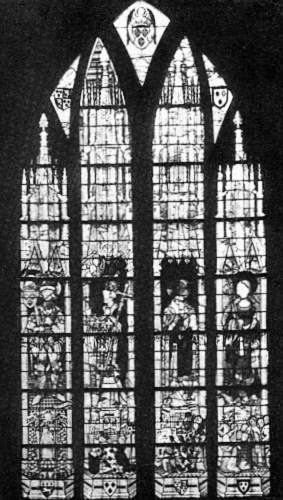
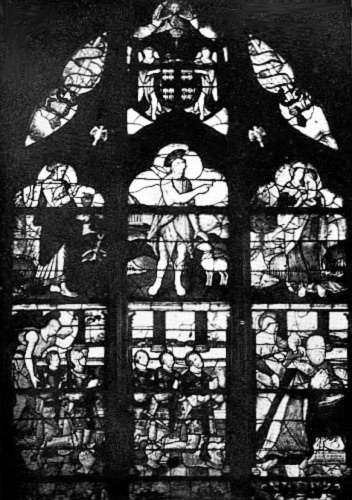 CONSTABLE OF MONTMORENCY AND HIS FIVE SONS, MONTMORENCY
CHURCH (16th Century).
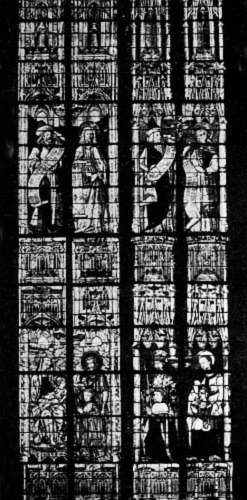
CONSTABLE OF MONTMORENCY AND HIS FIVE SONS, MONTMORENCY
CHURCH (16th Century).
Here the donors are frankly the important feature. So proud were the
Constable and his wife (Madeleine de Savoie) of their five sons and
seven daughters that we find four pairs of windows portraying them.
Perhaps the chief interest here is the gallery of family portraits
afforded by the donor’s figures upon the panes. Among the many admirably
drawn faces of distinguished scions of the House of Montmorency, the
best is that of the founder of this church, William, the father of our
friend the great Constable, which is behind the altar, to the left. It
is evidently the work of a great artist. The fourth on the right and the fourth on the left (and, therefore, opposite each
other) are two windows containing one, Anne de Montmorency, and the
other, his wife, Madeleine de Savoie, each attended by their children.
These two were made about 1563, while those to the east of them range
from 1523 to 1533. The Constable is supported by his five sons and his
wife by her seven daughters. She is looking toward the altar, but he is
looking across at her. Each of these domestic groups occupies nearly
half of the entire embrasures, but it does so in such a frank manner as
to entirely avoid the appearance of intrusion, so generally the result
of portraits like these. As we walk around the church we are amazed that
so fragile a medium as glass should have preserved through all the
centuries these portraits in more perfect condition than many which were
consigned to canvas or marble. In fact, one wonders why this was not
more often done, and at the same time wishes it had been effected as
frankly as in these two just described, and not by the intrusion of
donors upon a window devoted to another subject. It is impossible to
repress a smile upon noticing that the Crucifixion scene which bears the
portrait of its donor, Guy de Laval, shows him kneeling in the central
panel, while the crucifix is in a side one! Lest these comments may have
seemed severely intended, let us point out a few of the many lovely
features. For instance, the second window from the east in the north
wall has in its central panel the Virgin holding the Infant Jesus, who
reaches out His baby hand to receive a dove. The greensward below is
picked out with bright flowers and peopled by small animals, quite as
one sees them on the early tapestries. Nothing could be more charming.
The tracery lights are excellently treated throughout, sometimes in a
most unusual manner. Above the window just described, we find on a lilac
field thirteen golden coins, each bearing a different head. This comment
upon the higher panes leads us to speak of a most delicate group of four
panels perched up above the north portal. Across them extends what
appears to be a long cloister having a rich damasked curtain fastened
shoulder-high from column to column, above which is afforded a distant
prospect of gardens, etc., while in each of the panels there stands a
female saint. But little height is needed for this picture, so the
traceries above come down low, and are filled by a throng of blue
eaglets on a golden ground, the heraldic insignia of the Montmorencys.
Before the Battle of Bouvines the shield of this house bore but four
eaglets, but on that day Mathieu de Montmorency captured twelve of the
enemy’s standards with his own hand. In recognition of these deeds of
prowess King Philip Augustus added twelve more eaglets to his arms, one
for each captured standard, thus raising the total to sixteen. These
arms we shall see often repeated in the windows at Montmorency, Ecouen
and Chantilly. A visit to this little church is a delightful experience
and fills us with eager expectation of what its founder’s son, the great
Constable, can show us in his two castles of Ecouen and Chantilly. We
are tempted to stray off into the charming forest which stretches away
more than five miles to the northwest and to revel in the natural beauty
of its chestnut trees, but the Constable awaits us, so off we must be to
Ecouen.
Ecouen is generally visited because of its fine château, built on the
crest of a hill and entirely surrounded by a delightful wood except on
the side where from a flowered terrace there is disclosed a far-reaching
view out over a smiling country. But it is not the château which lures
us hither, but the parish church down in the town that nestles at the
foot of the castle walls. The château has lost its old glass, the two
panels from its chapel showing the children of Anne de Montmorency being
now in the chapel at Chantilly, which place also rejoices in the
possession of the famous series of forty-four scenes from the adventures
of Cupid and Psyche, which originally decorated the now destroyed Salle
des Gardes at Ecouen. For us, therefore, the château has lost most of
its charm; if you wish to inspect it you must obtain a carte d’entrée
from the Chancellerie de la Legion d’Honneur in Paris, for it is now a
school for daughters of members of that order, and is not open to the
public. For those of us who have come here to see the parish church
there will be no bother about permits, for none is needed. This church
not only contains excellent Renaissance windows, but upon them we shall
find a fine array of Montmorency portraits as well. The upper panels of
the lofty lancets that flank the high altar are filled with scriptural
scenes, but below they contain, that to the left, Anne de Montmorency
with his five sons, and that to the right, his wife attended by five
daughters. Although we have here the same family portraits as those seen
in Montmorency Church, this pair is much older (1544-5), and not only
shows the children as much younger than at Montmorency (1563), but also
has but five daughters instead of the seven seen on the later glass. Nor
are these the only similar pairs of these windows. The Constable was so
proud of his children and of their number that he seemed to never tire
of having them portrayed on glass. We have just referred to a third pair
(dated 1544) made for the chapel of Ecouen château, but now at
Chantilly, and there is still a fourth pair in the nearby church of
Mesnil-Aubry which are the latest of all, for the Constable is there
shown with a snow-white beard. At Ecouen we observe that the parents
occupy each a separate panel from the children, but at Chantilly the
parent panels are both missing. The remaining three windows on the south
side of the choir bear as donors still other Montmorencys, but the work
is later and not nearly so good. The high altar concealed the lower half
of the central eastern windows, so they did the next most sensible
thing to lowering the altar back—they transferred to a little northern
chapel the panels it obscured. The whole northerly side of the choir
opens out into a chapel whose northern and eastern ends are lighted by
three large embrasures filled with excellent Renaissance glazing,
depicting scenes from the life of the Virgin. Especially fine is the
second from the east, showing in the lower half, the death of the
Virgin, while above are clouds peopled with angels, all leading up to
the Father in the top pane of the tracery. The traceries of the three
easternmost choir embrasures are filled with blue eaglets on a golden
ground, the insignia of the Montmorencys. This same treatment of the
traceries may also be remarked in the chapel of the château; in fact,
they are all that remains there of the original glazing. We have already
admired this same form of decoration over the north portal at the
Montmorency Church.
It seems a pity that the Ecouen glass now at Chantilly could not be
restored to the embrasures for which it was made; it obviously does not
belong where it is now found, and, besides, it loses there the historic
significance which it would enjoy in its old home at the château of
Ecouen.
At one time or another during our glass pilgrimages we have happened
upon examples of other mediæval arts and crafts which all combine to
make France so absorbingly interesting. It has been reserved for our
visit to Chantilly to show us one of the formal gardens of Old France in
which nature has been made to yield to the whim and fancy of the
landscape artist. Most travellers have seen the famous gardens of
Versailles and have heard that they were designed and arranged by Le
Notre, but those at Chantilly were designed by this same master before
he was called by the King to do his greatest work at Versailles. There
are many who prefer his earlier effort, and we must be grateful to our
glass for having brought us to this delightful spot. The forest of
Chantilly, which covers over six thousand acres, forms an excellent foil
for the formal stateliness of the gardens. One is not allowed to visit
the château except on Thursdays and Sundays and not then if it happens
to be a day when there is racing at the Chantilly track. This regulation
is to prevent race crowds from overrunning the château and grounds. The
beautiful building with its priceless collections was the private
property of the Duc d’Aumale and was by him presented to the Institut de
France. In a long low gallery especially constructed for them, and which
receives all its light through them, is a much travelled and widely
discussed series of forty-four panels narrating episodes from the
adventures of Cupid and Psyche. They are of the yellow stain and grey
type which we have noticed at Troyes and Chalons, but here the
workmanship is far superior. Note that the grey is in places almost
brown, and that the yellow is used but sparingly. The high state of
perfection to which the design and drawing are carried, combined with
the fact that their subjects are non-religious, make them delightfully
unique. It is easy to observe the strong influence of Italian art, not
only in their general style but also in the very liberal borrowing of
designs from well-known Italian paintings. Until recently they were
attributed to that versatile master of many arts, Bernard Palissy, but
that has been definitely disproved. They are now generally acknowledged
to be the work of Cocxyen, a Flemish student of Van Orley (who made the
windows of Ste. Gudule in Brussels), and the Italian influence is
explained by the fact that he studied in Rome. These panels are dated
1542-4 and were originally made for the windows of the Salle des Gardes
at the Château of Ecouen upon the order of Constable Anne de
Montmorency. The Revolution dislodged them and they found their way into
a museum arranged by Lenoir. This collection was dispersed in 1818. It
is narrated that the Prince de Condé, when visiting the museum, admired
this set of glass. Hearing someone remark that they had formerly adorned
a castle belonging to his family (meaning Ecouen), he had them bundled
up and packed off to his château at Chantilly, where they have since
remained. This picturesque tale serves to show that stained glass panels
were not then regarded as necessarily stationary. We have seen several
other instances of this lack of respect for their stout iron bars. They
were beautiful and valuable, and therefore, when the occasion arose,
they were removed! Excellent as is the work upon these panels and
graceful as are the figures, we cannot but notice that our art is taking
rapid strides towards its decadence. They are no longer windows where
the full value of colour and leading are appreciated and used. In this
set they are careful colourless paintings on glass in which the artistic
value of the leads is so disregarded that they no longer provide or even
assist the drawing—they only mar it as they run across the panes
wherever their supporting strength is necessary. We have arrived at a
time when the windows are becoming painted pictures done in the manner
of paintings on canvas. The artist no longer remembers that stained
glass is a separate art and that he has certain advantages in technique
over the oil painter, just as the latter has over him.
The small ante-chapel has on each side a tall window. In the middle of
each is set a large panel of sixteenth century glass, the one on the
right showing five Montmorency daughters kneeling in a row, attended by
Ste. Agathe, and the one on the left their five brothers, also kneeling,
and similarly attended by St. John. The remainder of the embrasure is,
in each case, filled with modern glass done in the Renaissance manner
and intended to harmonise with the older panel in its midst. The artist
devoted more care to the faces of the boys than to those of their
sisters, for although the latter are monotonously alike in drawing and
posture, the former differ markedly. The face of the smallest boy is
most diverting. His hands are clasped in prayer, but unlike his more
devout brothers and sisters, his eyes are not turned toward the altar,
but he is gazing out into the chapel with childish curiosity. In these
two panels the leads are not so cumbrously intrusive, but there is a
lesson which every glass artist should learn from an inspection of the
carefully painted windows at Ecouen, Montmorency and Chantilly. He
cannot fail to notice how the misuse of the leads has been accentuated
by the careful painting, and he should carry away with him a firm
conviction that the more delicate the design the less it can afford to
quarrel with the leading.
The average tourist looks forwards with keen interest to his first visit
to Beauvais. He has, of course, heard of the ancient glories of its
tapestry, which industry is still kept up by the French Government. He
has also read that the perfect French cathedral would be composed of the
choir of Beauvais, the nave of Amiens, the west front of Rheims and the
towers of Chartres: so of the choir of Beauvais he expects great things.
Nor will he be disappointed, especially if he first views it from the
Amiens road. This approach reveals the town to him in the most
picturesque way imaginable. On reaching the brow of a short hill he
becomes suddenly aware of Beauvais, lying below him in the valley beside
a lazy river. One could more properly say that he first saw not the
town, but the amazing uplift of the cathedral, and next the town about
it. The great height of this edifice is accentuated by the fact that
only the choir and the transepts are now standing. Long ago the nave
succumbed to the great strain which its unnatural height put upon the
materials of which it was constructed, and collapsed. The architect’s
vaulting ambition o’erleapt itself. In fact it is only by means of
constant shoring and repairing that this choir, the loftiest in France,
is preserved in a safe and solid condition. When the pilgrim descends
into the town he comes upon many interesting timber-framed houses, some
of them with second stories projecting over the arcaded footway below
and exhibiting quaintly attractive carvings on their heavy beams. We
find an intelligent attempt to preserve the best traditions of the older
Beauvais tapestry in the modern factory. Just as formerly, it bears
floral designs and very rarely personages, being of the sort called
“basse lice,” and woven on a horizontal frame, thereby differing from
the “haute lice” of the Gobelins factory, where the frames are
perpendicular. Not only in the Cathedral, but also in the church of St.
Etienne, do we find excellent glass of the sixteenth century. The
latter’s fine Gothic choir, adorned with graceful flying buttresses,
provides a strong contrast to its sturdier Romanesque nave. The glass is
only to be found around the choir, and is well deserving of its high
repute. One should notice the tone of the blues, especially in the
background of the church’s finest window, a Tree of Jesse, the first on
the left from the Lady Chapel. It is the work of Engrand le Prince, and
is one of the best known examples of the irrelevant use of portraits of
high dignitaries. Their half-length figures appear as blossoms on the
vine. Among the fourteen, almost all contemporary likenesses, the most recognisable are Francis I
and Henry II. At the back of the choir clerestory there is a fine
window, blue with golden rays of the sun spreading out over it. The
legend of St. Hubert is very agreeably set out just to the east of the
small south portal, the green used therein being seldom surpassed.
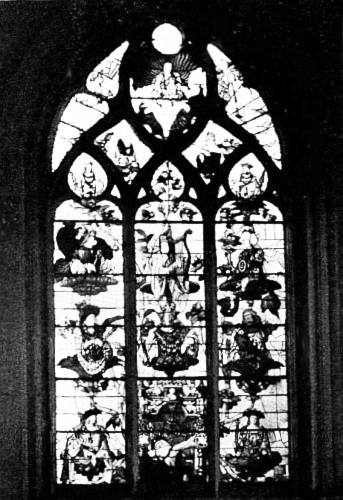 “TREE OF JESSE” ST. ETIENNE, BEAUVAIS (16th Century).
Popular subject in stained glass; the vine springing from the loins of
Jesse generally bears his descendants as blossoms, and culminates above
in a great lily from which emerge the Virgin and Child. Here occurs an
interesting 16th century variation—among the descendants of Jesse
appear contemporary portraits, Francis I, Henry II, etc.
It is difficult to express in words the effect of extreme loftiness
which strikes one as he enters the south door of the Cathedral. It seems
almost impossible to shake off this impression; in fact, one is
constantly being surprised that he does not grow accustomed to the great
sweep of the upward lines. In the two great rose windows which decorate
the transept ends, and in the double row of lancets below each, there is
excellent glass of this period. The northern rose shows the golden rays
of the sun spreading out over a blue background, reminding us of its
prototype at St. Etienne. Below, the ten figures of women are attributed
to Le Pot. The southern rose contains the history of the Creation with
such interesting detail as to well repay the trouble to decipher it
caused by its great height above us. Below are two handsome rows of
lancets dated 1551, the upper containing prophets, and the lower,
saints. The western wall, rising abruptly at the point where the nave
should commence, has in its north and south corners two chapels. Each of
these chapels has large sixteenth century windows, the northerly one in
the west wall, the Descent from the Cross, being very fine; in fact, it
is by some considered the best in the cathedral. The choir also has fine
Renaissance glass, although in several of the choir chapels (especially
in the Lady Chapel) and around the clerestory at the east end, there are
some very interesting thirteenth century windows, one, in particular, a
Tree of Jesse, rendered attractive by the halo of flying birds about the
head of the Saviour. So tall are the clerestory embrasures that
generally only the middle portion of them contains personages, the upper
and lower parts being filled with grisaille. Most of these upper
embrasures were glazed in the fourteenth century, and show to a marked
degree the revulsion from the sombre mosaic, and the demand for greater
illumination. All this glass would be much more effective if nearer the
eye of the observer, the great height at which it is placed not only
spoiling the perspective, but resulting in a jumble of colours. The City
Hall contains the flag which the gallant townswoman, Jeanne Hachette,
captured with her own hands upon the occasion of the attack on the city
made by Charles the Bold and his army. Although this gallant deed was
performed in 1472, it has never been forgotten by the people of
Beauvais, and its anniversary is reverently commemorated upon the 29th
of every June.
In addition to the glass seen during these three trips, there are three
isolated churches whose windows are so interesting as well as important
that one should not be contented to conclude his sixteenth century
studies without visiting them. Not only is each one of them distant from
other contemporary glass, but it would seem as though the Imp of the
Perverse had taken a hand in placing them as far away from each other as
possible. Bourg is down south in Savoy; Auch is near Toulouse in the
southwest; and Champigny-sur-Veude is off in the western part of
Touraine, near the lower reaches of the river Loire. Each of these three
not only was completely glazed during this epoch, but has also retained
its glass in good condition. In each case the special interest which
causes our visit is quite peculiar and very different from that which
attracts us to the others. When we concluded our trips of the fourteenth
and fifteenth centuries we were confronted with the advisability of a
separate journey to Quimper, and in like manner we should now decide to
visit Bourg, Auch and Champigny-sur-Veude. It must be confessed that it
is inconvenient, but it will prove well worth while.
First in importance is the church of Brou at Bourg. Although Savoy now
forms part of France, we shall, upon this excursion, find proof that it
was not always French, and shall furthermore encounter much interesting
history wrapped up in the tale of the building and glazing of the church
of Brou. Up in the north, at St. Quentin, we found the high-water mark
(on French soil) of that splendid empire which the Spaniard, Charles V,
agglomerated under his banner and which he resigned to his son, Philip
II, the victor of the Battle of St. Quentin. So vast and important was
his empire that he lacked only France to have all the continent of
Europe beneath his sway. It was the aunt of this Emperor Charles V,
Marguerite d’Autriche, who built the exquisite church of Brou in memory
of her husband, Philibert le Beau, Duke of Savoy, killed in a hunting
accident. After this glance at history, it is not difficult to
understand why Marguerite sent to Flanders for her architect and for her
glass designers, for as Flanders was part of her nephew’s empire, none
was more fully advised than she of the high reputation then enjoyed by
the artists of the Low Countries. Apropos of the way in which her
husband Philibert died, it is related that when his father had been at
the point of death from a similar hunting accident, Philibert’s mother,
Marguerite de Bourbon, had vowed to erect a chapel to St. Hubert,
patron saint of huntsmen, if he recovered. Her failure to comply with
this vow was by many firmly believed to be the reason why her son
Philibert was killed upon the hunting field, and that his untimely end
was a solemn warning that a vow to St. Hubert must be strictly kept. In
any event, St. Hubert must have been fully satisfied with the manner in
which the oath was finally carried out, for the chapel so built has
remained to amaze and delight many generations. The wonderful marble
tombs, the graceful rood screen, the splendid glass, all go to prove
that there was here lavished everything that wealth, power and
intelligence could command.
It is bewildering to decide with which of the eighteen windows we shall
begin our inspection. Because of our interest in the foundress and her
husband, let us commence with that in the choir, which is at the left of
the most easterly window. Upon this one and its neighbour to the left we
shall see spread out much concerning the life, family and habits of
Philibert. The first window shows the Duke himself attended by his
patron saint, St. Philibert, while in the background there looms up his
favourite ducal palace of Pont d’Ain, where he lived and died. As
indicating the importance of his duchy there are arranged above him
thirteen shields displaying the arms of provinces at one time part of
Savoy. The next window to the left bears a splendid array of
thirty-five shields whose heraldry serves to complete our information
about Duke Philibert by showing the individuals composing his family
tree. Those on the right are of the paternal line of Savoy, and on the
left we follow his mother’s line (the House of Bourbon) as far up as
Louis IX, whose arms appear at the very top of the embrasure. It is most
fitting that the arms of our old friend, the royal patron of stained
glass, should preside over the most brilliant window in this famously
glazed sanctuary. It is to be noticed that this church is very rich in
heraldic blazons; in fact, upon five of its windows we find seventy-one
shields. The Chapelle des Sept Joies contains a gorgeous work, the
Crowning of the Virgin, in which every effort of the glassmaker’s skill
seems to have been exerted. Above the principal subject runs a
panel-like frieze showing in allegory the Triumph of Christ. This frieze
is done in grey and yellow stain. The whole window would leave nothing
to be desired in either technique or colour if it were not made the
victim of an exaggerated outbreak of the curse of donors’ figures. The
foundress and her husband are not only allowed to intrude upon the
drawing of the general subject, but each of them is actually larger than
the figure of the Virgin. The records show that this church (begun in
1511) had all its glass installed at the time of its completion in 1536,
thus showing that the windows were made during the most vigorous part
of the century, a fact thoroughly borne out by internal evidence. We may
consider ourselves fortunate that the use of this glorious building for
a store-house during the Revolution damaged the glass so little. In this
connection it is surprising to read that its beauty was so much
appreciated that the people voted to preserve it as a public monument,
thus staying the hand of the ever-ready vandalism which then raged
through so many French churches.
A sketch of Bourg would not be complete without a reference to the noble
poem of Matthew Arnold. The following lines are particularly appropriate
to the moving cause for our visit to this lovely shrine:
So sleep, forever sleep, O marble Pair!
Or, if ye wake, let it be then, when fair
On the carved western front a flood of light
Streams from the setting sun, and colours bright
Prophets, transfigured Saints, and Martyrs brave,
In the vast western window of the nave;
And on the pavement round the tomb there glints
A chequer-work of glowing sapphire-tints,
And amethyst, and ruby—then unclose
Your eyelids on the stone where ye repose,
And looking down on the warm rosy tints,
Which chequer, at your feet, the illumined flints,
Say: “What is this? We are in bliss—forgiven—
Behold the pavement of the courts of Heaven!”
Seventy-seven kilometres west of Toulouse there lies the interesting
city of Auch, built upon a hillside rising sharply from the river Gers.
Here one will happen upon many an ancient architectural bit which will
take him back to the days when Henry of Navarre here entertained, much
against her will, his mother-in-law, Catherine de Medicis, in this
south-western corner of France, far off from her beloved Paris. The very
remoteness has preserved many of its old-world features, and this
ancient flavour, combined with the picturesque position above the river,
renders it distinctly a town to be visited. But something more than the
general mediæval air of Auch is the cause for our long jaunt hither.
This reason we shall find in the eighteen windows that adorn the choir
ambulatory of the cathedral of Ste. Marie. An inscription in the Gascon
dialect on the final one of the series tells us that they are by the
hand of Arnaud Desmoles and that they were finished June 25, 1513. We
have here the work of a Frenchman, a Gascon at that, and there is no
trace of Italian, German or any other foreign influence; it is the true
flower of the country’s genius growing on its native soil. Perhaps the
drawing and the colouring are not quite so good as we may see elsewhere,
but it is purely French. Any imperfection of detail is hardly noticed,
because we are instantly struck by the ensemble of eighteen windows made
for the building which they decorate, as well as for each other, and all
by the same artist. His scheme of subjects, showing the agreement
between the teachings of the Old and those of the New Testament, is
fully carried through to its completion. The colours show strength and
yet are not too robust. The proportions, too, are very satisfactory,
each window being about three times as high as it is broad. Their
stories begin with the creation of the world and carry us on, step by
step, until they conclude with the appearance of Christ to His
disciples. The central part of each embrasure is filled by a large
personage, with sundry smaller figures above, and groups below. It is
but natural that so complete a series as this should have always enjoyed
a wide reputation. Although we may feel, after examining them, that they
do not reach the standard of perfection attained by some of their
contemporaries elsewhere, still they cannot fail to please us. The charm
lent by their logical completeness causes us to prefer them to others
where the perfection of drawing and style in the individual window is
partly offset by lack of harmony with others near it.
Any mention of Touraine generally calls up before us the picture of a
smiling country through which rolls the lazy Loire hemmed in by its
sandy banks, with every now and again the vision of a charming château,
type of the best mediæval architecture. To the glass lover, however, the
chief and almost the only attraction of the province is the cathedral at
Tours (see page 51). We say “almost,” because although not generally
known and but seldom visited by the tourist, Touraine has another glass
shrine lying within a few kilometres of the Château de Chinon. The
chapel in which we find this glass was formerly part of the Château of
Champigny-sur-Veude, but the chapel alone remains. Before we enter, the
writer wishes to deliver himself of a partial explanation or apology,
and he does so for the following reason: he has all along inveighed
bitterly against the curse of donors’ figures upon windows, but on this
occasion he must frankly admit that he is guilty of taking you to see
glass of which a most interesting feature is these very representations
of the donors. In fact the chapel has a peculiar value because it contains thirty-six portraits of the
Bourbon-Montpensier family. They are to be found along the lowest
panels, each one kneeling before a prie-dieu. The chapel is admirably
lighted, partly due to the destruction of the old château, but chiefly
to the eleven large windows, each seven by three and a half metres. The
same scheme of decoration prevails throughout. Lowest down we find the
kneeling donors; above them and occupying far more space are historical
episodes from the life of Louis IX, of peculiar interest to us, his
humble followers in the love of stained glass. Among the most
interesting of these glass pictures may be cited one showing a battle
with the Saracens in the Holy Land, several portraying ships filled with
armoured knights, and particularly the episode of St. Louis dedicating
the Ste. Chapelle at Paris. Above these in the roomy oval traceries are
scenes from the Passion. Highest of all are small panes containing
either a capital L with a crown slipped down around it, or a bird’s wing
similarly encircled by a crown, referring respectively to King Louis and
the Bourbons. The only variation from the regularity of this general
scheme is the east window, which shows the creation of the world and has
below it Christ between the two thieves. The fact that this chapel is
to-day completely glazed in its original glass and that there is a
thorough coherence of style throughout, would alone serve to repay us
for the long trip from Paris; but when we add the fact that this is a
Bourbon portrait gallery, an historical interest is at once added to its
other attractions. These arguments in its favour will keep us from
observing too keenly how much the crudeness of some of the colours
accentuates the dullness of others. It would be better if the greens
could be softened and the greys enlivened. Lest we may seem by thus
criticising the glass to wish to disparage it, we make haste to urge our
reader to visit Champigny. He will find ample compensation for its
isolation from other glass of its century by the many châteaux which
make a trip through Touraine so enjoyable.
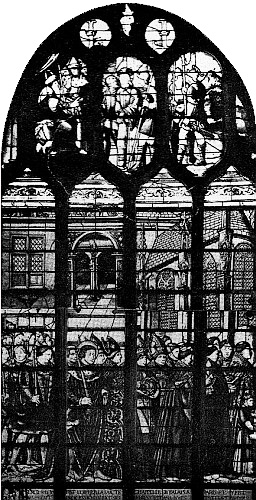 DEDICATION OF PARIS STE. CHAPELLE AT CHAMPIGNY-SUR-VEUDE.
Panel containing kneeling donors not shown. 16th century glass picture
of a 13th century event. (See page 26).
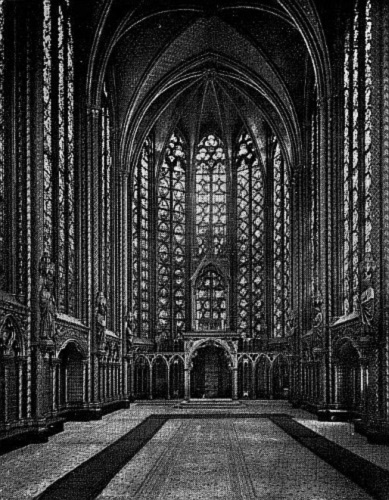 INTERIOR OF SAINTE CHAPELLE, PARIS.