The few examples I have mentioned are the only
ones which can with any probability be dated from
the eleventh century, but of twelfth century work
much more remains.
Poitiers.
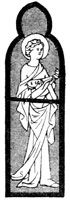
The window at Poitiers in Plate II. shows little
if any change in style from the Le Mans window
in Plate I. It is still almost pure Byzantine, and
if I were to judge by style alone I should place
this window very early indeed. A fragment of an
inscription has, however, been found on it—DITHANC
... BLAS,—which has been thought
to mean that the window was the gift of one
Maurice de Blason, who became Bishop of Poitiers
in 1198. If so, and if we are right in identifying
the Le Mans window with Bishop Hoel's glazing,
a whole century separates the two.
The probable explanation is that the Byzantine
style had lingered on in the south-east of France,
as it may well have done, whereas north of the
Loire a school had by this time arisen, and had
been flourishing for many years, which was producing
work both in France and England of a very
different and far more advanced character.
The school
of Chartres,
St. Denis,
and Canterbury.
The twelfth and early thirteenth century windows
at Chartres, St. Denis, Canterbury and Sens show
such resemblance to each other that there can be
little doubt of their common origin. As, however,
their execution covers a period of at least seventy
years, one man cannot have been responsible for
them all.
Probably they represent the work of a group of
men working together—perhaps never more than
half a dozen at one time—under a master who was
trained by his predecessor, and who in turn would
be succeeded in the leadership by the best of his
pupils. Several of these masters in succession
must have been men of genius, and thus between
them they evolved a style which, carried on by a
succession of lesser men, governed design in stained
glass for a century to come.
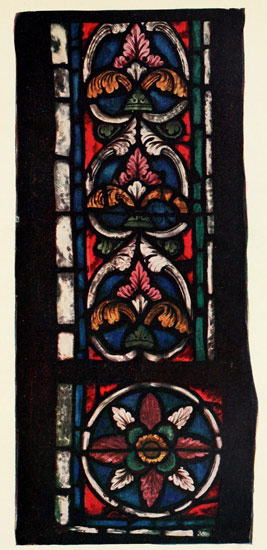
PLATE VII
BORDER, FROM THE TRINITY CHAPEL, CANTERBURY
Twelfth or early Thirteenth Century
The rise of this school is the first of the periodic
impulses to which I have referred, and the work
they produced was, for its dignity and grandeur,
unequalled for two hundred years—if it has ever
been equalled at all.
The figure of Methuselah or "Matusale" in
Plate III., which is one of the few remaining of
the original figures once in the choir clerestory
at Canterbury (it is now in the S. Transept), is a
good example of their work, and a comparison of it
with the Poitiers window (which is actually later
in date but in the older style) shows the greatness
of the change they effected. The change is, in
fact, that from ancient to modern art: from
Byzantine, the last lingering survival of the great
classic tradition of Greece, to Gothic, the first
expression of the art of the modern world.
Who were these men and where did they come
from? Some would have it that there was a great
central school at Chartres, but there is little evidence
for it. When Abbot Suger built the great abbey
of St. Denis, which was dedicated in 1142, he filled
it with glass, "painted," says his secretary, Monk
William, "with exquisite art by many masters of
divers nations" ("de diversis nationibus"). Does
this mean that some of them were English or
Germans, or only men from other provinces than
the Ile de France? No one can say; but they
must have been working together to produce the
results they did. One statement of the Monk
William's leads me to think that the work was
done on the spot. He says the work was very
costly, because they "used sapphires to colour their
glass." Now this is an obvious misunderstanding,
due to the practice, in those days, of describing
coloured glass by the name of the precious stone it
resembled, and such a mistake is most likely to
have been made in conversation with the artists
themselves.
It is, of course, always possible that they had no
permanent headquarters but took up their abode
in whatever city their chief work was for the time
being, there erected their furnaces, which the description
of Theophilus shows to have been simple
affairs, and remained there till their work was
completed—which must have taken some years in
every case—and then moved on to the next work.
Much has been made of the fact that a window
in Rouen bears the signature of one Clement of
Chartres,—"Clemens vitrearius Carnutensis me
fecit,"—but that window is a hundred and forty
years later than St. Denis. By that time the
whole Cathedral at Chartres had been filled with
glass, a task which extended over thirty years;
and Clement may well have learned his trade and
passed from apprentice to master there. No other
artist of the school has signed his name anywhere,
nor has Clement anywhere else.
One can tell pretty well the order in which the
most important of their work which remains was
done. First Chartres and St. Denis,—so near
together that one cannot say which came first,—then
Canterbury, Sens, and then back to Chartres again,
where a fire had destroyed all but the west
windows. This, however, probably represents
only a small portion of their labours, of which
the rest has disappeared. For instance, a few
fragments set among later work in York Minster
have all the characteristics of this school; and
we know that Prior Conrad's choir at Canterbury,
which was completed in 1130 and destroyed
in 1175, was renowned for the splendour of its
glass, which may have been their work too.
A window at Le Mans, rather later than the
one illustrated, and which Mr. Westlake thinks
may be dated about 1120, shows signs of the new
movement. It consists of a series of subjects from
the stories of SS. Gervasius and Protasius, and
already shows the arrangement of small medallions
of simple shape, surrounded by ornament filling
the rectangular openings of the iron-work, though
from the fact that some of the medallions seem to
have been cut down, they are probably not in their
original position. In the drawing of the subjects
the artist is breaking away from the Byzantine
tradition. The new wine is bursting the old
bottles. He is a man in love with life, and when
he depicts a group of men stoning a saint he likes
to make them really throwing, and to show in their
faces, as well as he knows how, that they are
thorough ruffians.
Next in antiquity to this window, and some
twenty or thirty years later (1142-1150), come the
earliest of the windows at Chartres and at St.
Denis.
Chartres.
In the year A.D. 1134 a terrible fire destroyed
the town of Chartres and so damaged the west end
of the Cathedral that it had to be pulled down and
rebuilt—a work which took some fifteen years to
accomplish, while the towers were not finished till
twenty years later still. The three windows over
the west door were filled with glass some time
between 1145 and 1150.
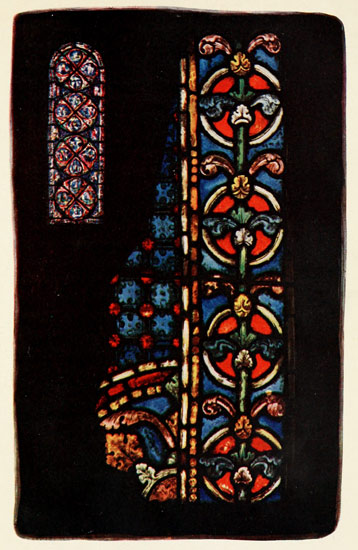
PLATE VIII
BORDER AND MOSAIC DIAPER, FROM THE TRINITY CHAPEL,
CANTERBURY
Thirteenth Century
The west
windows.
In early times churches seem to have been
peculiarly liable to destruction by fire, owing
perhaps to the number of wooden buildings by
which they were surrounded. The early history of
every great cathedral is one of successive disastrous
conflagrations, after each of which the building
rises once more, larger and more splendid. Thus,
in 1194, another fire completely destroyed the
whole of the Cathedral with the exception of
the newly built west end, which included the three
windows in question. These escaped damage,
protected perhaps by the immense depth of their
embrasures, and still remain almost unimpaired to
this day, the largest and most perfect windows of
their time that have come down to us. In them
one feels that the new movement has found itself
and produced a great man.
Two of them, the central one, which is the
largest, being some 30 feet high and 10 wide,
and that on the south, are medallion windows, containing
scenes from the life of Christ. The bars
of the iron-work, which are about 3 feet apart,
divide them into a series of regular squares, which
are filled with square and circular medallions; in
the central window the figures in the medallions
are relieved against alternate backgrounds of ruby
and blue. The ruby of the twelfth and thirteenth
centuries is a wonderful colour. It is never of a
perfectly even tint, each piece having, as it were,
its own character, and the colour seems to have
a slightly granulated or "crumbly" texture, which
gives it a quality unknown in later glass. So
beautiful was it evidently considered that the artist
seldom or never attempted to enrich it with painting.
The Jesse
tree.
The third window, that on the north, is filled
with a "Tree of Jesse."
The subjects of stained-glass windows in this
First Period were chosen with one object—the
exposition of the Christian Doctrine, and of this
the human descent of Christ was an essential part.
Accordingly, at all periods in the history of
mediæval stained glass we find windows devoted
to the representation of "the Tree of Jesse."
The arrangement is always the same as in this
window at Chartres. The figure of Jesse lies
recumbent at the foot of the window, and from his
loins rises the "Tree"—a mass of branching scroll
work with conventional foliage, spreading over the
whole window, carrying on its branches David
and other human ancestors of Christ, and culminating
in the Virgin and Christ Himself at the
top of the window. On either side are ranged the
Prophets who foretold His coming, and the whole,
surrounded by a rich border, forms, at Chartres, a
mass of jewelled colour some 9 feet wide and 25
feet high.
This window and the one of which a part,
identical in design, remains at St. Denis, are the
oldest examples I know of a Jesse tree in stained
glass, and whether or not they were the first to
be made, their design formed a model for others
for long after.
La Belle
Verrière.
The remainder of the windows in the Cathedral,
including the western rose, are of the thirteenth
century with one exception—the one in the south
choir aisle, which contains the great figure of the
Virgin known as "Notre Dame de la Belle
Verrière": the only window, as far as I know, to
which in former times people knelt by hundreds in
adoration, and before which they still occasionally
burn a candle.
The Virgin with the Child on her knee sits
enthroned in the upper part of the window, and
surrounded by angels, on a much smaller scale,
incensing and holding candles, while below are
medallions illustrating the Marriage at Cana and
the Temptation. The angels and the medallions
are of the thirteenth century, but the figures of
the Virgin and Child with their background are
almost certainly of the twelfth. Probably the
veneration in which they were held caused them
to be rescued from the fire,—hurriedly broken out,
perhaps, from the surrounding glass,—and then
reset in thirteenth century work after the Cathedral
was rebuilt.[6] The Virgin is dressed in a robe of
pale greyish-blue, of a colour one seldom sees in
later work, relieved against a background of deep
ruby, set with jewels of a darker blue. The precision
of the colour harmony is wonderful, and no
drawing I have seen of the window gives, even in
outline, the beautiful poise of the head, bent in
gracious benediction.
Although I have said that the workers of this
school were breaking away from the Byzantine
tradition and looking at life with their own eyes,
yet it is never possible for men suddenly to produce
work wholly independent of tradition, even when
they are foolish enough to try; so we find in this
case Greek art, through Byzantine, retains enough
influence with these men to give to their work
a dignity and restraint which is lacking in that of
the thirteenth century. This is very noticeable
wherever one gets the two in close juxtaposition,
as at Chartres and also at Canterbury. There is
an impressive severity of design and a feeling for
proportion in the figure of the Virgin in La Belle
Verrière which one misses in the surrounding work,
which, though very beautiful, is by comparison
small and fussy in treatment.
St. Denis.
In the meantime, in 1142, while the west front
of Chartres Cathedral was still in progress, the
great Abbot Suger had finished the construction
of his abbey of St. Denis, near Paris. He was a
great patron of the arts, as well as a good man
and the first statesman of his age, and he seems
to have spared no pains in the decoration of the
church and especially in the filling of the windows
with stained glass. Of this glass, alas! only the
merest remnant is left, consisting of several
medallions and part of a "Tree of Jesse." They
have been collected and placed in the chapels of
the apse of the church, embedded in garishly
coloured ornament—the work of M. Gérente,
acting under the orders of the great and terrible
Viollet-le-Duc—which effectually prevents one
taking any pleasure in their beauty. They are,
however, very interesting to study. Whether
or not they were done before or after the three
windows at Chartres it is, I think, impossible to
say for certain. The history of the two buildings
shows that they must have been done within a
few years of each other (two of those at St. Denis
contain figures of Suger as donor, and he died in
1152), and they are certainly the work of the same
school. The Jesse tree in particular is either a
copy, or the original, on a smaller scale, of the one
at Chartres, being almost identical in design.
Many of the medallions are interesting from
their deeply symbolical character. In one, for
instance, is Christ, with the seven gifts of the
Holy Spirit, represented, as in the Jesse tree, by
doves, each contained in a circle and connected
with His breast by rays. With His left hand He
unveils a figure labelled "Synagoga," and with His
right He crowns another figure labelled "Ecclesia."
Another very curious medallion represents the
fœderis arca, "ark of the covenant." A figure of
the Almighty supports a crucifix which rises from
the ark,—a square box on four wheels,—while round
about are the four symbols of the Evangelists.
The cross is thus shown as the symbol of God's
new covenant with man as the ark was that of
the old. A quaint feature is that the artist, while
feeling that all four wheels had got to be shown
somehow, has been in some difficulty as to how to
show the farther pair, and has therefore placed
them above the ark, as if resting on it, as an
ancient Egyptian artist might have done in his place.
In most of the medallions the teaching of the
subject is emphasized and the application pointed
out by rhyming Latin hexameters, doggerel in style
and innocent of prosody, such as:
Quod Moyses velat, Christi doctrina revelat.
The same feature is found in the glass at Canterbury.
None of the verses are identical, but the
literary style is the same.
Angers and
Chalons.
At Angers there are some remains of twelfth
century windows which are thought to be about
the same date as those of Chartres and St. Denis,
or even a little earlier, and there are some at
Chalons, but they cannot be dated with any
exactitude, and I have had no opportunity of
examining them. Next after these in point of
date should, I think, come the earliest of the
windows at Canterbury, though nearly thirty years
must separate the two.
Fragments
at York.
A few fragments in York Minster, however,
show where the artists may have been occupied
meantime. There are some scraps in the clerestory—scraps
of a Jesse window of which the details
are almost identical with the St. Denis work—and
a medallion representing Daniel in the Lion's Den,
which is glazed into the foot of the centre light
of the great thirteenth century grisaille windows in
the north transept, known as "the Five Sisters."
It is a circular medallion filled out to a
square form with ornament, no doubt to fit a
square of the iron-work, and strongly resembles
the St. Denis work.
Canterbury
choir.
Of the stained glass of the twelfth and thirteenth
centuries, which was once the glory of Canterbury
Cathedral, only a remnant has escaped the zeal
of the Puritans. The minister placed in charge
of the Cathedral under the Commonwealth, one
Richard Culmer, known to his enemies as "Blue
Dick," though I do not know why, relates with
glee how he stood on a ladder sixty steps high
with a whole pike in his hand and "rattled down
proud Beckett's glassie bones."
I own I feel less resentment against "Blue
Dick," who at least thought the windows important
enough to smash, than against that later vandal
Wyatt, who in the eighteenth century sold the
glass at Salisbury for the price of the lead in it,
or those who even now in many places are letting
old glass perish for want of proper care.
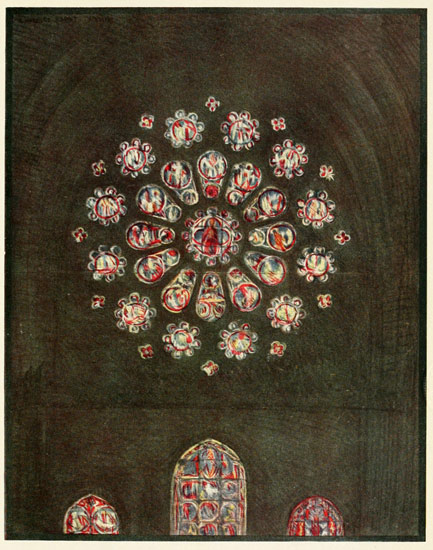
PLATE IX
WESTERN LANCETS AND ROSE, CHARTRES CATHEDRAL
Twelfth and Thirteenth Century
Even "Blue Dick" seems to have tired of his
pious labours before they were quite finished, for,
of the early windows, he has left us two in the north
choir aisle, and four in the Trinity Chapel east of
the choir, in which most of the old glass remains.
Besides these there are many medallions and
numerous fragments scattered about in other windows
and embedded in the work of the modern
restorer, and several large figures from the clerestory,
of which the Methuselah in Plate III., now
in the south transept, is one.
In the year 1174, four years after Becket's death,
the splendid choir built by Prior Conrad in 1130
was completely destroyed by fire, and the monks
immediately set about building a new one. Gervase
the monk has left a detailed account of the progress
of the great work, year by year and pillar by pillar,
for the space of ten years, first under the French
master-builder, William of Sens, and then under
his successor, William the Englishman ("little in
body but in workmanship of many kinds acute
and honest"), so that we know just when each
part of the work was finished. Now in the spring
of 1180, he relates, the monks had a great desire to
celebrate Easter in the new choir, and to gratify
them the master, by a special effort, succeeded in
getting the building finished and roofed in almost
to the east end of the choir, where he placed a
hoarding to keep out the weather.
Since we are told that in this hoarding there
were three glass windows, it seems reasonable to
suppose that the other windows were glazed too.
Now since both the windows in the north choir
aisle and, when in its original position, the
Methuselah on Plate III. were well to the westward
of the point at which the hoarding was
erected, I have no doubt that they were in
position by this date, in which opinion I am
confirmed by the character of the glass itself.
That in the Trinity Chapel to the east of the
hoarding would naturally be later.
The same arrangement seems to have been
followed at Canterbury as elsewhere of having
large figures in the clerestory and small medallions
in the lower windows.
The Methuselah, which seems to have formed
one of a series of Patriarchs,—of which three others
remain, which filled the windows in the clerestory
of the choir,—is a particularly dignified figure, and
it is noticeable that the throne he is seated on is of
somewhat the same type as that of Notre Dame de
la Belle Verrière at Chartres. As in all windows
of this date, the flesh is executed in glass of a
brownish-pink colour instead of white, which later
on became the rule.
This illustration shows very well the early
method of painting. Where possible, as in the rich
blue of the background, the glass is left quite clear.
The folds of the drapery and the features are drawn
in sure and vigorous line work. Diaper is used
very sparingly, only when it is necessary to "keep
back" and subdue a piece of glass, as in the case of
the green cushion to the throne and the border of
the tunic. If you can imagine the glass with these
pieces left clear or with any other piece diapered, you
will see how unerring has been the artist's judgment.[7]
The letters of the inscription are scratched out
of a dark ground of enamel. This is the invariable
method used in early glass, which indeed is always
(except in grisaille, of which more later) conceived
as a light design on a dark ground. In the fifteenth
century the reverse was the case, and then we get
inscriptions in dark lettering on a light ground.
The arched form of the top of the background
shows how it once fitted a clerestory light, though
doubtless with a border, and the space above has
been filled with scroll work of, I think, the same
date, which may have come from some of the
medallion windows in the choir aisles.
The two medallion windows in the north choir
aisle formed part, as we know from an old MS. still
in existence, of a series of twelve dealing with the
life and parables of our Lord.
In style they very closely resemble the St. Denis
work, perhaps a little further developed. Some of
the medallions, indeed, are almost identical with
those at St. Denis, notably that of the Magi on
horseback following the star. The figures are tall
and dignified, and both for drawing and decorative
placing are far better than much work of the
succeeding century. The Calling of Nathaniel is
a particularly good panel.
The westernmost of the two windows still
retains the early arrangement found at Chartres,
the iron-work consisting simply of straight bars
dividing it into a series of regular squares, which
are filled alternately with circular and square
medallions.
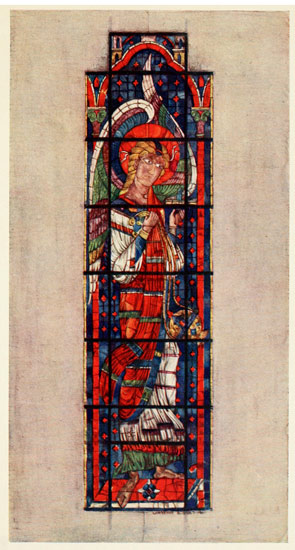
PLATE X
THE BIG ANGEL,
FROM THE CLERESTORY OF THE APSE,
CHARTRES CATHEDRAL
Thirteenth Century
The other one of the two has bent iron-work of a
very simple design, consisting simply of four circles
connected by straight bars, thus marking the transition
from one form to another; which is another
reason for dating these windows between the west
windows of Chartres, where the iron-work is all
straight, and those at Sens, where it is nearly all
bent. The small scale-sketch in the corner of
Plate IV. shows the arrangement of the iron-work
and the medallions. The panel of Noah in the
Ark is from one of the semicircles on the left
side of the window. The spaces between the
medallions are filled up with beautiful foliated
scroll work, on a ruby ground of the same character
as that round the head of Methuselah.
The arrangement of their subjects is so interesting,
forming one of the first and most complete
examples of a "type and antitype" window, that I
shall describe it in some detail.
In each of these two windows the upper two-thirds,
or thereabouts, of the glass is in its original
position, while the lower panels, smashed by the
pike of "Blue Dick," who seems at this point to have
got tired of going up his ladder, have been filled
with subjects from other windows of the series.
Down the centre run the subjects from the life
of Christ, while on each side are the "types" or
subjects from the Old Testament which illustrate
it. Thus the westernmost of the two, once the
second of the series, begins at the top with the
Magi following the star, while on one side is
Balaam, with the words of his prophecy, "There
shall come a star out of Jacob, etc.," and on the
other Isaiah, with the words, "The Gentiles shall
come to Thy light, and kings to the brightness of
Thy rising."
Next below we see in the centre the arrival of
the Magi before Herod, illustrated on the left by
the Israelites coming out of Egypt, led by Moses,
and on the right by the Gentiles leaving a heathen
temple containing an idol—a naked blue figure
(blue merely because the artist wanted some blue
there), and following Christ, by way of a font,
towards a Christian altar, while a demon above
their heads urges them to return to the idol. As
at St. Denis, each of the medallions has a Latin
rhyme attached, explaining and enforcing the
lesson. Here, for instance, it runs:
Stella Magos duxit et eos ab Herode reduxit,
Sic Satanam gentes fugiunt te Christe sequentes.
Next we see the Magi making their offerings
to the infant Christ, on one side of which is the
Queen of Sheba visiting Solomon and on the other
Joseph in Egypt receiving his suppliant brethren.
And so the series goes on. The twelve windows
when complete formed one of the most elaborate
sets of types and antitypes known, and included
not only the life of Christ but eight of His parables—for
some reason a very rare subject in mediæval
glass. Two panels of the Parable of the Sower—the
seed falling among the thorns and the seed
falling by the wayside—remain, and have been used
to fill up the gaps at the bottom of this window.
Above is a curious subject—the Church with the
three sons of Noah, who hold between them the
world, divided into three regions. From the MS.
above mentioned we know that this was the type
to the "leaven which a woman took and hid in three
measures of meal till the whole was leavened"—an
idea taken, I think, from St. Augustine.
The subject of Noah and the Ark from the other
window was originally alongside the Baptism of
Christ, the purging of the world by the flood of
waters serving as the type for the purging of the
soul by baptism.
Altogether as one studies these windows one is
almost as much struck by the subtlety of thought
and earnestness of the teaching they embody as by
the glory of their colouring and grace of their
design.
In one of the triforium windows is some glass
which may perhaps be earlier even than this. It
consists of three medallions, only one of which
is at all perfect, which seem to be part of a life of
St. Alphege, Archbishop of Canterbury, who was
martyred by the Danes. In the one perfect panel
which represents the storming of Canterbury by
the Danes, the warriors wear the long coats of mail
and kite-shaped shields of the Norman period as
shown in the Bayeux tapestry, and a ship in one of
the other medallions is exactly like those in which
William the Conqueror and his knights are there
shown crossing the sea. The obscure position of
this glass in the triforium is not where one would
expect to find a window devoted to St. Alphege,
who before the death of Becket was the most
important saint that Canterbury could boast; it
may be therefore that the medallions have been
moved from elsewhere, perhaps from Archbishop
Lanfranc's nave, or it may, for all we can tell, be
some of Prior Conrad's glass that has survived the
fire.
Vendôme.
Of other twelfth century work there is not
much in existence. There is a Virgin and Child at
Vendôme which somewhat recalls Notre Dame de
la Belle Verrière but has none of her grace, and I
have already referred to the window at Poitiers
illustrated in Plate II.
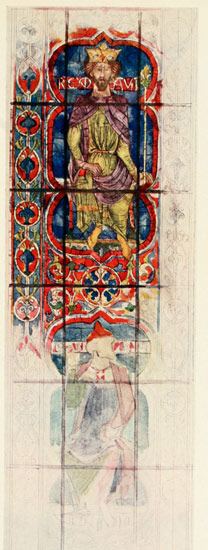
PLATE XI
DAVID,
FROM THE CLERESTORY OF THE APSE,
CHARTRES CATHEDRAL
Thirteenth Century
Poitiers.
This remarkable and impressive window, which
is over 26 feet high and nearly 10 wide, is one
of three, and occupies the central light of the
Cathedral apse. The illustration does not show
the whole of it, for it is surrounded by a rich border,
which in its arrangement of alternate bunches of
foliage and knots of interlaced work resembles
that of the Jesse Tree at Chartres, and below the
Crucifixion is a four-lobed medallion showing the
Martyrdom of St. Peter, and the donor offering
a model of the window.
The design, as I have said, seems to show that
the Byzantine style had lingered on south of the
Loire, where no doubt the influence of the
Limoges school would be strong, and in view of
this fact it is rash to take the age of the Le Mans
"Ascension" altogether for granted.
V
EARLY THIRTEENTH CENTURY GLASS
IN ENGLAND
(CANTERBURY AND LINCOLN)