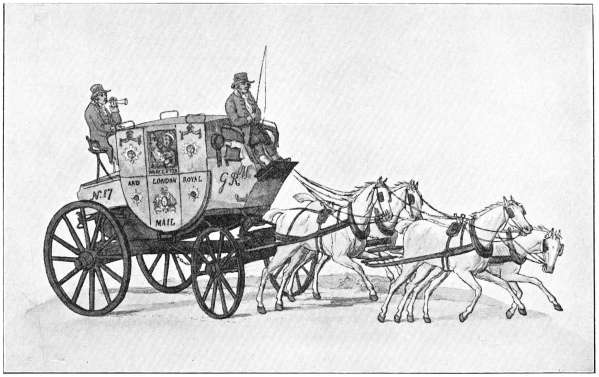
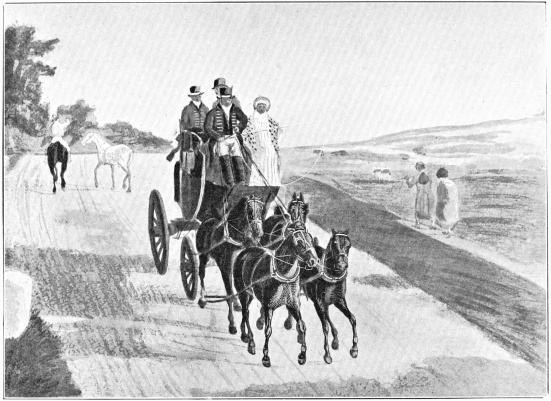
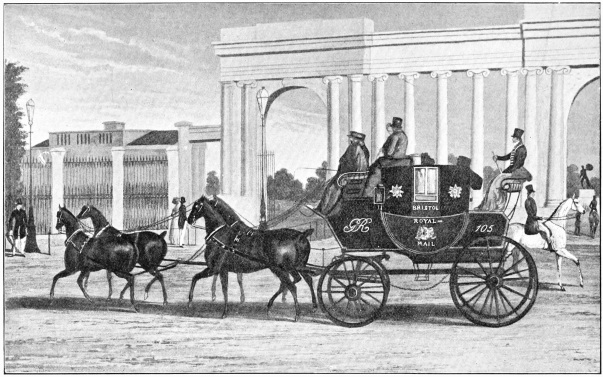
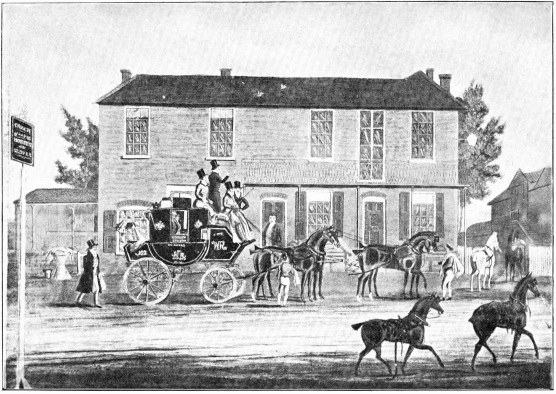
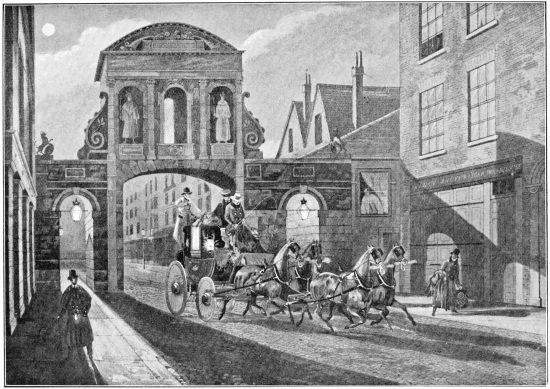
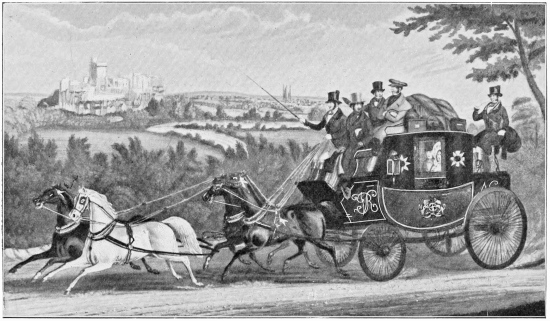
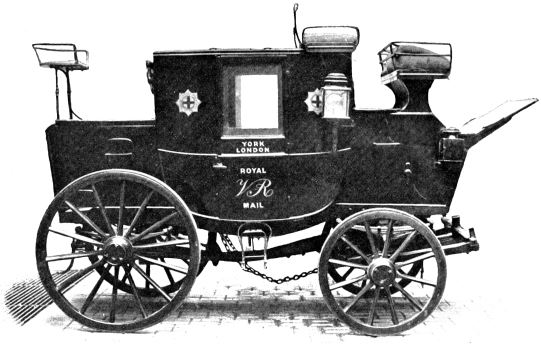
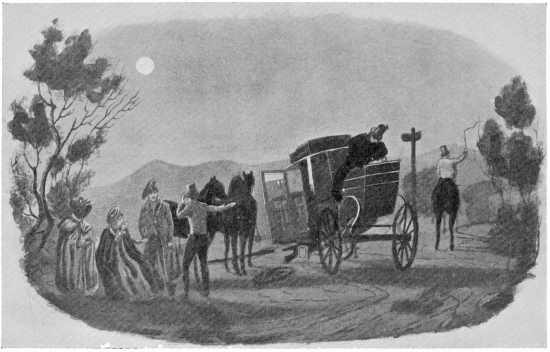
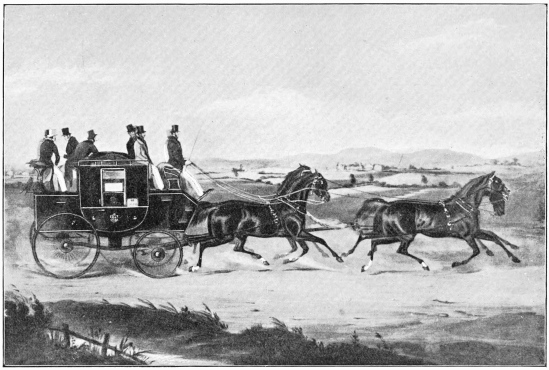
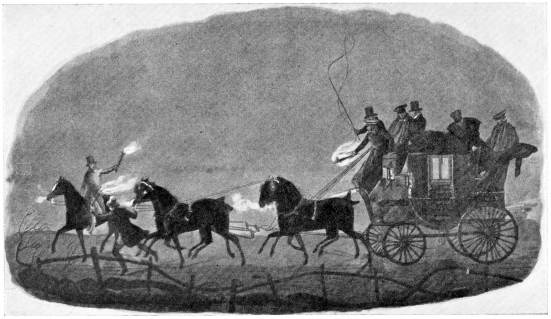
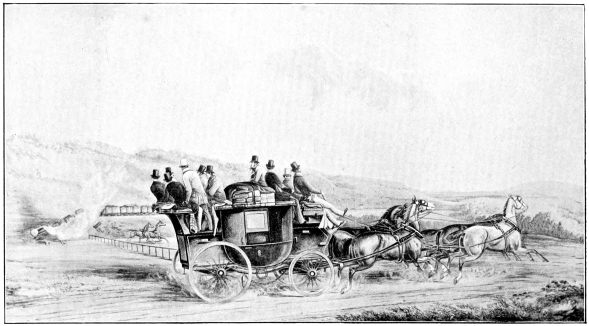
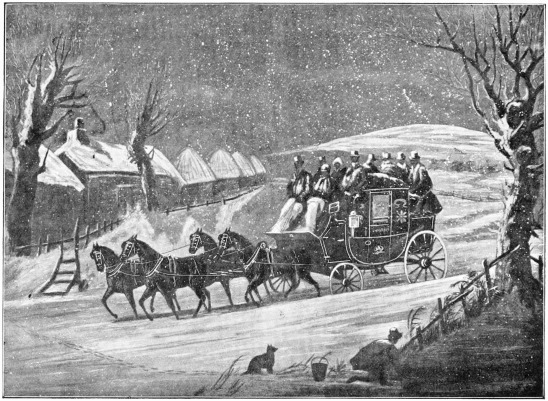
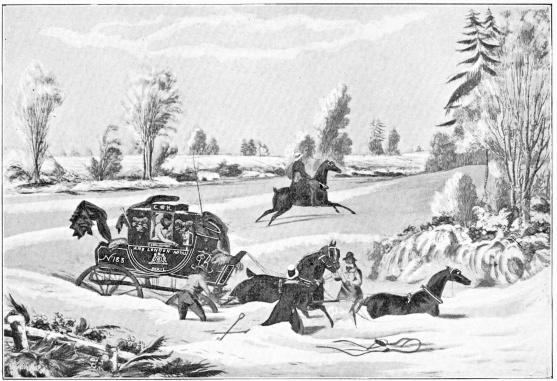
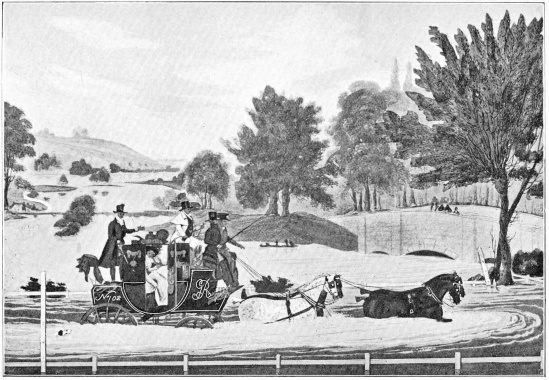
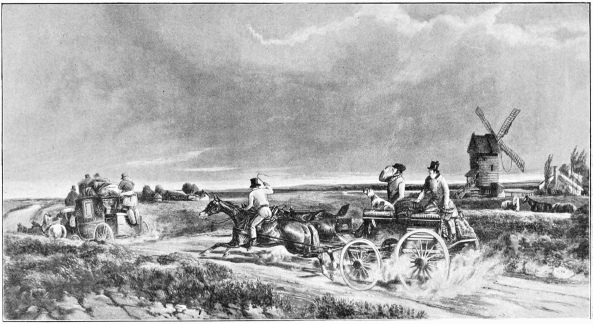
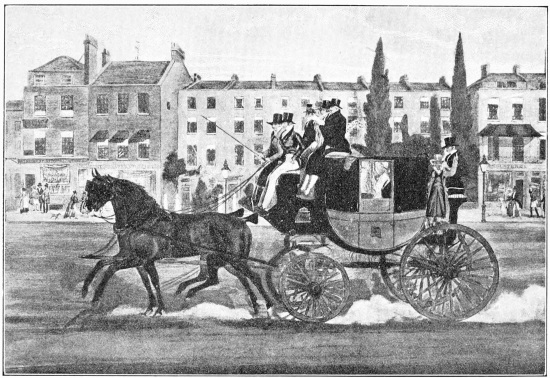
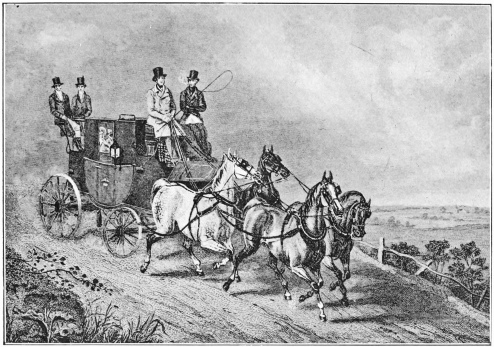
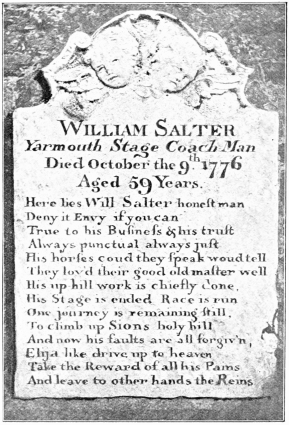
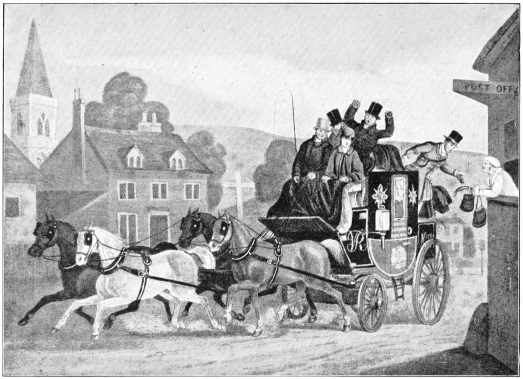
We also will make a tour down the road. It
shall not be, in the strictly accurate sense of
the word, a “journey,” for we shall travel continuously
by night as well as day—a thing
quite unknown when that word was first
brought into use, and unknown to coaching
until about 1780, when coaches first began to
go both day and night, instead of inning at sundown
at some convenient hostelry on the road.
It matters little what road we take, but as
Mr. Murray came to town from Newcastle,
we may as well pay a return visit along that
same highway—the Great North Road. He
does not explain how he came through Highgate,
but for our part, the first sixty miles or so go
along the Old North Road, and we do not touch
Highgate at all.
Now, since we are setting out merely for the
purpose of seeing something of what life is like
on a great highway, there is no need to mortify
the flesh by arising early in the blushing hours
of dawn, to the tune of the watchman’s cry of
“five o’clock and a fine morning!” and so we
will e’en, like Christians and Britons able to
call their souls their own, go by the afternoon
coach. Let the “Lord Nelson” in this year
1830 go if it will from the “Saracen’s Head,”
Snow Hill, at half-past six in the morning. For
ourselves, we will wait until a quarter to three
in the afternoon, and take the “Lord Wellington”
from the “Bull and Mouth.” We can do no
better, for the “Lord Wellington” goes the 274
miles in 30 hours, which a simple calculation
resolves into 9 miles an hour, including stops.
The fare to Newcastle is £5 15s. inside, or about
5d. a mile. Outside, it is £3 10s., or a fraction
over 3d. a mile. As our trip is taken in summer-time,
we will go outside; and so, although a good
deal of the journey will have to be through the
night, we, at least, shall not have the disadvantage
of being stewed during the daytime in
the intolerable atmosphere of the inside of a
stage-coach on a July day. Why, indeed, coach-proprietors
do not themselves observe that in
summer-time the outside is the most desirable
place, and charge accordingly, is not easily understood;
nor, indeed, to be understood at all. That
clever fellow De Quincey notices this, and points
out that, although the roof is generally regarded
by passengers and everyone else connected
with coaching as the attic, and the inside
as the drawing-room, only to be tenanted by
gentlefolk, the inside is really the coal-cellar in
disguise.
We recollect, being old travellers, that the
fares to Newcastle used to be much cheaper.
Time was when they were only four guineas
inside and £2 10s. outside, but prices went up
during the late wars with France, and they have
stayed up ever since. The travelling, however,
is better by some five hours than it was fifteen
years ago.
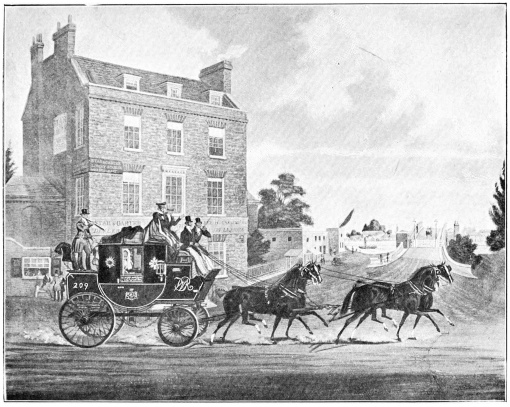
Here we are at the “Bull and Mouth,” in
St. Martin’s-le-Grand, now newly rebuilt by
Sherman, and named the “Queen’s.” It is a
handsome building of red brick, with Portland
stone dressings, but the old stables are still to
be seen at the side, in Bull-and-Mouth Street.
A strong and penetrating aroma of horses and
straw pervades the neighbourhood.
Wonderful building, the new General Post
Office, opened last year, nearly opposite. They
say the Government has got something very like
a white elephant in that vast pile. A great deal
too big for present needs, or, indeed, for any
possible extension of Post Office business. Here’s
the “Lord Wellington.” What’s that the yard-porter
says?—He says “they don’t call it nothin’
but the ‘Vellington’ now.”—Smart, turn-out,
is it not, with its yellow wheels and body to
match? You can tell Sherman’s coaches anywhere
by that colouring. What a d——d
nuisance those boys are, pestering one to buy
things one doesn’t want! No; be off with you,
we don’t want any braces or pocket looking-glasses,
nor the “Life and Portrait of His Late
Majesty,” nor any “Sure Cure for Fleas”—use
it on yourselves, you dirty-looking devils!
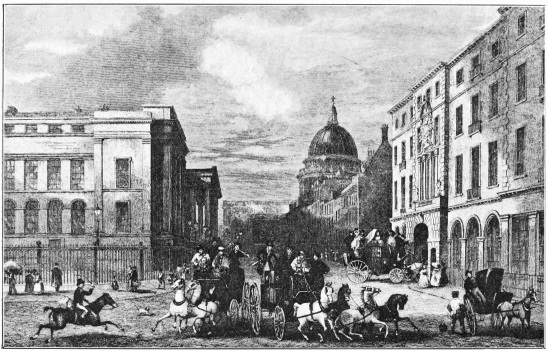
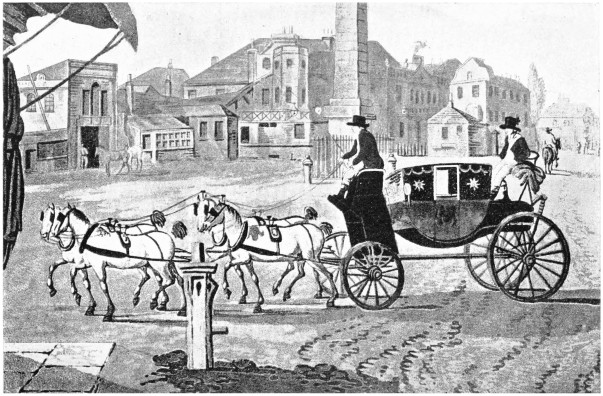
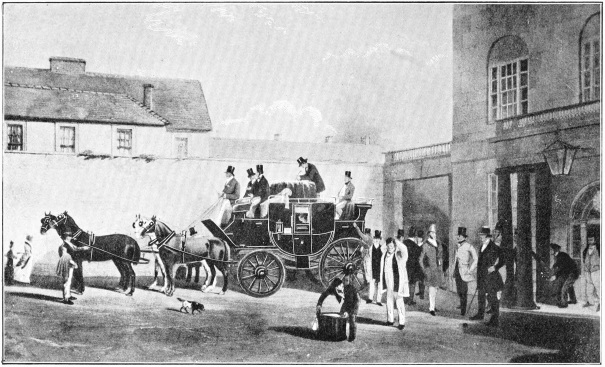
THE “QUEEN’S HOTEL” AND GENERAL POST OFFICE.
After T. Allom.
Thank goodness! we’re off, and the sooner
we’re out of this traffic and off the stones at
Kingsland Turnpike the better. These paved
streets are so noisy, one can scarcely hear oneself
talk, and the rattling sends a jar up one’s
spine. How London grows! we shall soon see
the houses stretching past Kingsland and swallowing
up the country lanes of Dalston and Stoke
Newington.
Hal-lo! That was a near shave. Confound
those brewers’ drays; Shoreditch is always full
of ’em; might have sent us slap over. Why don’t
you keep your eyes open, fool?
The drayman offers to fight us all, one after
the other, with one hand tied behind his back, for
sixpence a head, money down; but though we
have some of “the Fancy” aboard, the “Wellington”
can’t stop for a mill in the middle of
Shoreditch High Street.
Now at last we’re fairly in the country. If
you look back you’ll be able to see St. Paul’s.
This is Stamford Hill, where the rich City indigo
and East and West India merchants live. Warm
men, all of them. There, ahead of us, on the right,
goes the river Lea: as pretty fishing there as you’d
find even in the famous trout streams of Hampshire.
What a quaint, quiet rural place this is at
Tottenham! And Edmonton, with its tea-gardens;
why, London might be fifty miles away!
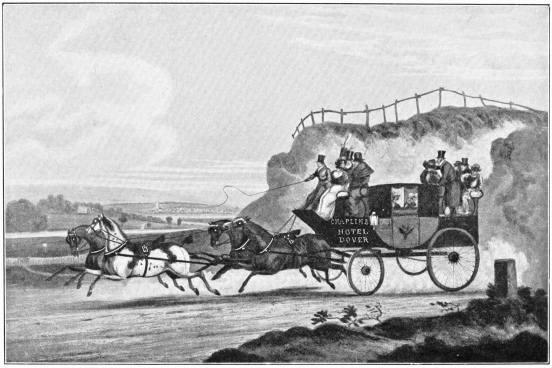
Here we are, already at Waltham Cross, and
at our first change. This is something like traveling!
We change horses at the “Falcon” in little
more than two minutes, and so are off again,
on the ten-mile stage to Ware, through the long
narrow street of Cheshunt, past the New River
at Broxbourne, and along the broad thoroughfare
of Hoddesdon. At Ware we change teams at the
“Saracen’s Head,” and four fine strong-limbed
chestnuts are put in, to take us the rather hilly
stage on to Buntingford. At this sleepy little
town they take care to give us as strong a team as
you will find in any coach on any road, for the
way rises steadily for some miles over Royston
Downs. A good thing for the horses that the
stage on to Royston town is not more than seven
miles. “I believe you, sir,” says the coachman;
“vy, I’ve heerd my father say, vot driv’ over this
’ere road thirty year ago, that he vore out many
a good ’orse on this stage; an’ ’e vere a careful
man too, as you might say, and turned out every
blessed one, hinside to hout, to valk up-hill for
two mile, wet or fine; strike me blue if he didn’t.”
“They talk of lowering the road through the
top of Reed Hill, don’t they, coachman?”
“Oh! yes; they torks, and that’s about all
they does do. Lot o’ good torking does my ’orses.
Vot I vants to know is, v’y does we pay the
turnpikes?”
We change at the “Red Lion,” Royston, and
then come on to the galloping ground that brings
us smartly, along a level road, to Arrington Bridge,
the spelling of whose name is a matter of divergent
opinions among the compilers of road-books. But
whether called Arrington or Harrington, it is a
pretty, retired spot, with a handsome inn and an
equally handsome row of houses opposite.
“Will you please to alight?” asks the stately
landlady of the “Hardwicke Arms” inn and
posting-house, with perhaps a little too much air
of condescension towards us, as coach-passengers.
We of the stage-coaches—nay, even those of the
mails—occupy only a second place in the consideration
of mine host and hostess of this, one
of the finest inns on the road. Their posting
business brings them some very free-handed customers,
and their position, hard by my lord of
Hardwicke’s grand seat of Wimpole, spoils them
for mere ordinary everyday folks.
However, it is now more than half-past seven
o’clock, and we have had no bite nor sup since
two. Therefore we alight at the landlady’s bidding
and hasten into the inn, to make as good a supper
as possible in the twenty minutes allowed.
Half a crown each, in all conscience, for two
cups of tea, and some bread and butter, cold
ham and eggs! We climb up to our places,
dissatisfied. Soon the quiet spot falls away behind,
as our horses get into their stride; and as we
leave, so does a yellow po’shay dash up, and
convert the apparently sleepy knot of smocked
post-boys and shirt-sleeved ostlers, who have
been lounging about the stable entrance, into
a very alert and wide-awake throng.
Caxton, a busy thoroughfare village, where the
great “George” inn does a very large business, is
passed, and soon, along this flattest of flat roads,
that grim relic, Caxton Gibbet, rises dark and
forbidding against the translucent evening sky.
Does the troubled ghost of young Gatward,
gibbeted here eighty years ago for robbing the
mail on this lonely spot, ever revisit the scene,
we wonder?
The wise, inscrutable stars hang trembling in
the sky, and the sickle moon is shining softly,
as, having passed Papworth St. Everard, we drop
gently down through Godmanchester and draw
up in front of the “George” at Huntingdon,
58½ miles from London, at ten o’clock.
We take the opportunity afforded by the
change of filling our pocket-flasks with some rich
brown brandy of the right sort, and invest in some
of those very special veal-and-ham sandwiches for
which good Mrs. Ekin has been famous these
years past. Our coachman “leaves us here,” and
we tip him eighteenpence apiece when he comes
round to inform us of the fact.
The new coachman, after some little conversation
with the outgoing incumbent of the bench,
in which we catch the remark made to the newcomer
that some articles or some persons are
“a pretty fair lot, taking ’em all round”—a
criticism that evidently sizes us up for the
benefit of his confrère—climbs into his seat, and
giving us all a comprehensive and impartial glance,
settles himself down comfortably. “All right,
Tom?” he asks the guard over his shoulder.
“Yes,” answers that functionary. “Then give
’em their heads, Bill,” he says to the ostler; and
away we go into the moonlit night at a steady
pace.
The box-seat passenger, who very successfully
kept the original coachman in conversation nearly
all the way from London to Huntingdon, does not
seem to quite hit it off with our new whip, who
is inclined to be huffish, or, at the least of it, given
to silence and keeping his own counsel. “Have
a weed, coachman?” he asks, after some ineffectual
attempts to get more than a grunt out
of him. “Don’t mind if I do,” is the ungracious
reply, and he takes the proffered cigar and—puts
it into some pocket somewhere beneath the
voluminous capes of his greatcoat. After this,
silence reigns supreme. For ourselves, we have
chatted throughout the day, and now begin to feel—not
sleepy, but meditative.
The moon now rides in unsullied glory through
the azure sky. We top Alconbury Hill at a few
minutes to twelve, and come to the junction of
the Old North and the Great North Roads.
Everything stands out as clearly as if it were
daylight, but with a certain ghost-like and uncanny
effect. “The obelisk,” as the coachmen
have learned to call the great milestone at the
junction of the roads (it is really a square
pedestal) looks particularly spectral, but is not
the airy nothing it seems—as the coachman on
the Edinburgh Mail discovered, a little while
ago. The guard tells us all about it. The usual
thing. Too much to drink at the hospitable bar
of the “George,” at Huntingdon, and a doubt as
to which of the two milestones he saw, on coming
up the road, was the real one. The guard and
all the outsides were in similar case—it was
Christmas, and men made merry—and so there
was nothing for it but to try their quality. Unfortunately,
he drove into the real stone, and not
its spectral duplicate, conjured up by the effects
of strong liquors. We see the broken railings
and the dismounted stone ball that once capped
the thing as we pass. The local surgeon mended
the resultant broken limbs at the “Wheatsheaf,”
whose lighted windows fall into our wake as we
commence the descent of Stonegate Hill.
Stilton. By this time we are too drowsy to
note whether we changed at the “Bell” or at
its rival, directly opposite, the “Angel.” At
any rate, nobody asks us if we would not like
a nice real Stilton cheese to take with us, as
they usually do: it is midnight.
We now pass Norman Cross, and come in
another eight miles to Wansford turnpike, where
the gate is closed and the pikeman gone to bed.
“Blow up for the gate,” said the coachman, when
we were drawing near, to the guard, who blew
his horn accordingly; but it does not seem to
have disturbed the dreams of the janitor. “Gate,
gate!” cry the guard and coachman in stentorian
chorus. The guard himself descends, and blows
a furious series of blasts in the doorway, while
the coachman lashes the casement windows.
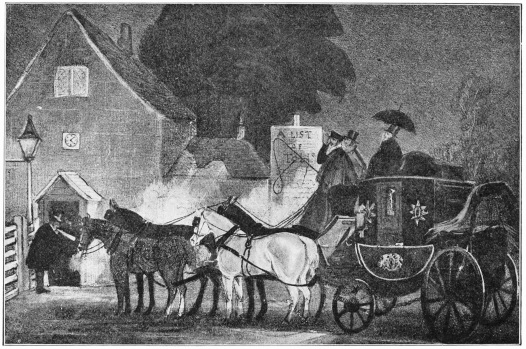
THE TURNPIKE GATE.
From a contemporary lithograph.
At last a shuffling and fumbling are heard
within, and the door is opened. The pikeman
has not been to bed after all; he was, and is,
only drunk, and had fallen into a sottish sleep.
He now opens the gate, in the midst of much
disinterested advice from both our officials—the
guard advising him to stick to Old Tom and leave
brandy alone, and the coachman pointing out
that the Mail will be down presently and that
he had better leave the gate open if he does
not wish to present the Postmaster-General with
forty shillings, that being the penalty to which
a pike-keeper is liable who does not leave a clear
passage for His Majesty’s Mails.
We now cross Wansford Bridge, a very long
and narrow stone structure over the river Nene.
Having done so, slowly and with caution,
we know no more: sleep descends insensibly
upon us.
... Immeasurable æons of time pass by.
We are floating with rhythmic wings in the
pure ether of some unterrestrial paradise. Our
gross earthly integument (twelve stone and a
few extra pounds avoirdupois of flesh and blood
and bone) has fallen away. We want nothing to
eat, for ever and ever, and have left everything
gross and unspiritual far, far below us, and ... a
fearful crash! Convulsively, instinctively, our
arms are thrown out, and we awake, tenaciously
grasping one another. What is this that has
brought us down to earth again and made us
unwillingly assume once more that corporeal
hundredweight, or thereabouts, we had left so
gladly behind? Are we overturned?
No; it was nothing: nothing, that is to say,
but the hunchbacked bridge over the river
Welland, that leads from Stamford Baron into
Stamford Town. It is only the customary bump
and lurch, the guard informs us. May all architects
of hunchback bridges be converted from
straight-backed human beings into bowed and
crooked likenesses of their own abominable
creations! We will keep awake, lest another
such rude awaking await us.
With this intent we gaze, wide-eyed, upon
Stamford Town, its noble buildings wrapped
round in midnight quiet, the moon shining
here full upon the mullioned stone windows of
some ancient mansion, there casting impenetrable
black shadows, making dark mysteries of grand
architectural doorways decorated with curious
scutcheons and overhung with heavy pediments,
like beetling eyebrows. Grand churches whose
spires soar away, away far into the sky, astonish
our newly-awakened vision as the coachman carefully
guides the coach through the narrow and
crooked streets, in which the shadows from
cornices and roof-tops lie so black and sharp
that none but he who has driven here before could
surely bring this coach safely through. Once or
twice we have quailed as he has driven straight
at some solid wall, and have breathed again
when it has proved to be only some oblique
monstrous silhouetted image cast athwart the
way. Fear only leaves us when we are clear
of the town and once more on the unobstructed
road; then only is there leisure for the mind to
dwell upon the beauties of that glorious old
stone-built town. We are thus ruminating when,
between Great Casterton and Stretton, where
we enter Rutlandshire, the glaring lamps of a
swiftly approaching coach lurch forward out of
the long perspective of road, and, with a clatter
of harness and a sharp crunching of wheels, fall
away, as in a vision. The guard, answering someone’s
question, says it is the Leeds “Rockingham,”
due in London at something after ten in
the morning.
The determination to keep awake was heroic,
but without avail. Even the screaming and
grumbling of the skid and the straining of the
wheels down Spitalgate Hill into Grantham did
not suffice to quite waken us. But what that
noise and the jarring of the wheels failed to do, the
stoppage at the “George” at Grantham and the
sudden quiet do succeed in. Our friend the moon
has by now sunk to rest, and a pallid dawn has
come; someone remarks that it is past three
o’clock in the morning, and someone else is
wakened and hauled forth from amid the snoring
insides, whose snores become gasps and gulps, and
then resolve themselves into the yawns and peevish
exclamations of tired men. The person thus
awakened proves to be a passenger who had booked
to Colsterworth, which is a little village we have
now left eight miles behind us. He had been
asleep, and as Colsterworth is not one of our stopping
or changing places, the guard forgot all about
him until the change at Grantham. The passenger
and the guard are now waging a furious war of
words on the resounding pavements of the sleeping
town. It seems that the unfortunate inside,
besides being himself carried so far beyond his
destination, has a heavy portmanteau in the like
predicament. If he had been a little bigger and
the guard a little smaller, his fury would perhaps
make him fall upon that official and personally
chastise him. As it is, he resorts to abuse.
Windows of surrounding houses now begin to be
thrown up, and nightcapped heads to inquire
“what the d——l’s the matter, and if it can’t be
settled somewhere else or at some more convenient
season?” The guard says “This ’ere gent wot’s
abusing of me like a blooming pickpocket goes to
sleep and gets kerried past where he wants to get
out, and when I pulls him out, ’stead of taking ’im
him on to Newark or York, ’e——” “Shut up,”
exclaims a fierce voice from above: “can’t a man
get a wink of sleep for you fellows?”
So, the change being put to, the altercation is
concluded in undertones, and we roll off; the irate
passenger to bed at the “George,” vowing he will
get a legal remedy against the proprietors of the
“Wellington” for the unheard-of outrage.
At Newark, a hundred and twenty-five miles
of our journey performed, it is broad daylight as
the coach rolls, making the echoes resound, into
the great market-square. Clock-faces—a little
blanched and debauched-looking to our fancy—proclaim
the hour to be 5.30 a.m. The change
is waiting for us in front of the “Saracen’s Head,”
and so is our new coachman. The old one leaves
us, but before doing so “kicks us”—as the expressive
phraseology of the road has it—for the
usual fees. He has been, so far as we remember
him, a dour, silent, unsociable man, but we think
that, perhaps, as we have been asleep during
the best part of his reign on the box-seat, any
qualities he may possess have not had their due
opportunity, and so he gets two shillings from
ourselves. A passenger behind us gives him a
shilling, which he promptly spits on and turns,
“for luck” as he says, and “in ’opes it’ll grow.”
The passenger who gave it him says, thereupon—in
a broad Scots accent—that he is “an impudent
fellow, and desairves to get nothing at all;” to
which the jarvey rejoins that he has in his time
brought many a Scotchman from Scotland, but,
“this is the fust time, blow me, that hever I see
one agoin’ back!”—which is a very dark and
mysterious saying. What did he mean?
Our new coachman is a complete change from
our late Jehu. He is a spruce, cheerful fellow,
neat and well brushed, youthful and prepossessing.
“Good morning, gentlemen,” he says cheerily:
“another fine day.” We had not noticed it. All
we had observed was of each other, and that as
every other looked pale, wearied and heavy-eyed,
so we rightly judged must be our own condition.
“Chk!” says our youthful charioteer to his
horses, and away they bound. Newark market-square
glides by, and we are crossing the Trent,
over a long bridge. “Newark Castle, gentlemen,”
says our coachman, jerking his whip to the left
hand; and there we see, rising from the banks of
the broad river, the crumbling, time-stained towers
of a ruined mediæval fortress. Much he has to
say of it, for he is intelligent beyond the ordinary
run. A good and graceful whip, too—one of the
new school: much persuasion and little punishment
for the horses, who certainly seem to put
forward their best paces at his merest suggestion.
It is a good, flat, and fairly straight road, this
ten-mile stage to Scarthing Moor. We cross the
Trent again, then a low-lying tract of water-meadows,
where the night mists still cling in
ghost-like wisps to the grass, and then several
small villages. “This”—says our coachman,
pointing to a church beside the road, and down
the street of one of these little villages—“this is
where Oliver Cromwell came from.”
“What is the name of it?” we ask, knowing
that, whatever its name, the Protector came from
quite a different place.
“Cromwell,” he says.
So this was probably the original seat of that
family many centuries before Oliver came into
the world, which has since then been so greatly
exercised about him.
“Blow up for the change,” says the coachman
to the guard, as, having passed through
Carlton-on-Trent, Sutton-on-Trent, and round the
awkward bend of the road at Weston, we approach
Scarthing Moor and the “Black Bull.” “They’re
a sleepy lot at the ‘Bull,’” he says, in explanation.
The guard produces the “yard of tin” from the
horn-basket, and sounds a melodious tantara: quite
unnecessarily, after all, it seems, for, quite a
distance off, the ostler, dressed after his kind
in trousers and shirt only, with braces dangling
about him, is seen standing in the road, with
the change ready and waiting.
“Got up before you found yourself, this
morning?” asks the coachman.
The ostler says he don’t take no sauce from
no boys what ain’t been breeched above a twelvemonth.
“All right, Sam,” replies the coachman; “your
’art’s all right, if you have got a ’ed full of
wool. Shouldn’t wonder if you don’t make up for
this mistake of yourn by sleepin’ it out for a
month of Sundays after this. If so be you do,
jest hang the keys of the stable outside, and when
we come down agen, Jim and me ’ll put ’em in
ourselves, won’t we, Jim?”
Jim says they will, and will petition Guv’ment
to pension him off, and retire him to the “R’yal
’Orsepital for Towheads.”
Evidently some ancient feud between the
ostler and the coach is in progress, and still far
from being settled. The ostler sulkily watches
us out of sight, as we make our next stage to
Retford. The clocks in the market-place of that
busy little town mark half-past seven, and the
“White Hart,” where we drop a passenger for
the Gainsborough coach and another for Chesterfield,
and take up another for York, is a busy
scene. Appetising aromas of early breakfasts being
prepared put a keener edge upon our already
sharpened appetites, and we all devoutly wish we
were at Doncaster, where our breakfast awaits the
coming of the coach. Across Barnby Moor, past
the great “Bell” inn, we take our way, and come
to one more change, at the “Crown,” Bawtry;
then hie away for Doncaster, which we reach,
past Rossington Bridge and the famous St. Leger
course, at half-past nine o’clock.
“Twenty minutes for breakfast, gentlemen,”
announces the coachman as we pull up in front of
the “New Angel” inn; while the guard, who has
come with us all the way from London, now
announces that he goes no farther. We give him
half a crown, and hasten, as well as stiffened limbs
allow, down the ladder placed for us outsides to
alight by, to the breakfast-room.
We catch a glimpse of ourselves in a mirror
as we enter. Heavens! is it possible an all-night
journey can make so great a difference in a man’s
personal appearance? While here is a lady who
has been an inside passenger all the way from
town, and yet looks as fresh and blooming as
though she had but just dressed for a walk. How
do they manage it, those delicate creatures?
Our friend, who says he is starving, refuses
to discuss this question. He remarks, with eye
wildly roving o’er the well-laden table-cloth,
that something to eat and drink is more to the
point. We cannot gainsay the contention, and do
not attempt it, but sink into a chair.
“Coffee, sir; tea, sir; ’ot roll; ’am and heggs.
Yorkshire brawn, tongue,” suggests the waiter,
swiftly.
We select something and fall-to. After all,
it is worth while to take a long coach journey,
even if it be only for the appetite it gives one.
Here we are, all of us, eating and drinking as
though we had taken no meals for a week past.
Yes, another cup of coffee, please, and I’ll thank
you to pass the——
“Time’s up, gents; coach just agoin’ to start!”
“Oh! here, I say, you know. We’ve only just
sat down.”
“Ain’t got more’n ’nother couple o’ minutes,”
says the new guard; and so, appetite not fully
satisfied, we all troop out and resume our places.
Our coach goes the hilly route, by Ferrybridge
and Tadcaster, to York. We change on the short
stage out of Doncaster, at Robin Hood’s Well,
where the rival inns, the “New” and the
“Robin Hood,” occupy opposite sides of the road;
and again at Ferrybridge, at the “Swan,” where
our smart coachman resigns his seat to an enormously
fat man, weighing nearly, if not quite,
twenty stone. He is so unwieldy that quite a
number of the “Swan” postboys gather round
him, and by dint of much sustained effort, do at
last succeed in pulling and pushing him into his
place, resembling in so doing the Liliputians
manipulating Gulliver; the coachman himself,
breathing like a grampus, encouraging them by
calling out, “That’s it, lads; another heave like
t’last does it. All together again, and I’ll mak’
it a gallon!”
Across the river Aire to Brotherton, and thence
through Sherburn to Tadcaster, where, having
changed at the “White Horse,” we come along
a level stage into York; the new guard, who
rejoices in the possession of a key-bugle and a
good ear for music, signalising our entrance by
playing, in excellent style, “The Days when we
went Gipsying, a Long Time Ago.”
The coach dines at York. The “Black Swan,”
to which we come, is a house historic in the annals
of coaching, for it was from its door that the
original York and London stage set forth; but
it is a very plain and heavy building. Half an
hour is allowed for dining, and, unlike the
majority of houses down the road, the table-cloth
and the knives and forks and glasses are not the
only things in readiness.
“What have you got, waiter?”
“Hot roast beef, sir, just coming in; very
prime.”
“Haven’t you any cold chicken for a lady
here?”
“Yessir; cold chicken on the table, sir; in
front of you, sir.”
“You call that chicken, waiter! why, it’s only
a skeleton. Take it away and give it to the dog
in the yard.”
“Very sorry, sir; ‘Royal Sovereigns’ very
hungry to-day; very good appetites they had,
sir; wonder they left even the bones.”
“You’re laughing at me, you rascal; bring
another chicken!”
“No more chickens, sir; roast lamb, would
the lady like? hot or cold; green peas, new
potatoes?” ...
“Your apple tart, sir. Ale, sir. Claret,
ma’am.” ...
Dinner disposed of, the coach is ready, but
one of our passengers is missing. Has any one
seen him? He went off, it seems, to see the
cathedral, instead of having dinner. Fortunately
for himself he comes hurrying up just as we are
starting, and the guard hauls him up to his outside
place by main force.
“Tip us a tune,” says the coachman to the
guard, who, rendered sentimental by the steak and
the bottle of stout he had for dinner in the bar,
in company with the buxom barmaid, responds
with “Believe me, if all those Endearing Young
Charms,” as we pass the frowning portal of
Bootham Bar and bump along the very rough
street of Clifton, York’s modern suburb.
This is a thirteen-and-a-half mile stage from
York to Easingwold; but although long, it is an
easy one for the horses, if the coachman does not
demand pace of them, on account of the dead level
of the road. He very wisely lets them take their
own speed, only now and then shaking the reins
when they seem inclined to slacken from their
steady trot. It is a lonely stretch of country,
treeless, flat, melancholy; and the appearance
of Easingwold is welcomed. At the “Rose and
Crown” the new team is put in, and off we go
again, the ten miles to Thirsk. At Northallerton
the horses are changed for a fresh team at the
“Golden Lion,” and the fat coachman, assisted
down with almost as much trouble as he was
hoisted up, resigns the ribbons into the hands of
another.
The usual knot of sightseers of the little town
are gathered about the inn to witness the one
event of the day, the arrival of the London coach.
Among them one perceives the coachman out of
a place; a beggar out at elbows; three recruits
with ribbons in their hats, not quite recovered
from last night’s drink, and stupidly wondering
how the ribbons got there; the “coachman wot
is to take the next stage”; several errand boys
wasting their masters’ time; and a horsey youth
with small fortune but large expectations, who
is the idler of the place—the local man about
town. There is absolutely nothing else for the
inhabitants of Northallerton to do for amusement
but to watch the coaches, the post-chaises and
the chariots as they pass along the one long and
empty street.
Our box-seat passenger leaves us here. Although
he has, all the way down, shown himself
anxious to be intimate with the successive coachmen,
and has paid pretty heavily for the privilege
of occupying that seat of honour, it has been of
no sporting advantage to him, for he is only a
Cockney tradesman, who has never even driven
a trap, let alone four-in-hand. So when each
whip in turn asked him the questions, conventional
among whips, “whether he had his
driving-gloves on, and would like to take the
ribbons for the next few miles,” he evaded the
offer by “not being in form,” or not knowing
the road, or something else equally annoying to
the coachman, who, in not having an amateur of
driving on the box, thereby missed the canonical
tip of anything from seven shillings to half a
sovereign which the handling of the reins for
twenty miles or so was worth to the ordinary
sportsman.
Our new coachman, on our starting from
Northallerton, keeps the seat beside him vacant.
He says he has a passenger for it down the road.
Tom Layfield, for that is the name of our present
charioteer, works the “Wellington” up and down
between this and Newcastle on alternate days,
Ralph Soulsby being the coachman on the other.
Tom Layfield is a very prim-looking, tall and
spare man, tutor in coachmanship to many gentlemen
on these last fifty-five miles; and it does not
surprise some of us when, passing Great Smeaton,
we are hailed by a very “down the road” looking
young man, whose hat is cocked at a knowing
angle, and whose entire get-up, from the gigantic
mother-o’-pearl buttons on his light overcoat to
the big scarf-pin in the semblance of a galloping
coach and horses, proclaims “amateur coachman.”
It is the young squire of Hornby Grange, on
the right hand, we are told, who is anxious
to graduate in coaching honours, and to be
mentioned in the pages of the Sporting Magazine
by Nimrod, in company with Sir St. Vincent
Cotton, the Brackenburys, and other distinguished
ornaments of the bench.
“‘Afternoon, squire,” says Layfield, as that
young sportsman swings into the seat beside him;
and they talk guardedly about anything and
everything but coaches, until Layfield asks—as
though it had just occurred to him—if he would
not like to “put ’em along” for a few miles.
He accepts, and is just about to take the reins
over when the voice of a hitherto silent gentleman
is heard from behind.
“I earnestly protest, coachman,” he says,
“against your giving the reins into the hands of
that young gentleman, and endangering our lives.
I appeal to the other passengers to support me,”
he continues, glancing round. “We read in the
papers every day of the many serious, and some
fatal, accidents caused by control of the horses
being given to unqualified persons. If you are
well advised, young gentleman, you will relinquish
the reins into their proper keeping; and you,
coachman, ought to know, and do know, that you
would be liable to a fine of any amount from £5
to £10, at the discretion of a magistrate, for
allowing an unauthorised person to drive.”
The coachman takes back the reins, and sulkily
says he didn’t know he had an informer up; to
which the gentleman rejoins by saying that, so
long as the coachman drives and performs the
duty for which he is paid by his proprietors, he
himself is not concerned to teach him proper
respect; but he cannot refrain from pointing out,
to the coachman in especial, and to the passengers
generally, that it would have been the policy of
an informer to allow the illegal act to be committed
and then to lay an information. He was
really protecting the coachman as well as the
passengers, because it was well known that the
road swarmed with informers, and continued
infractions of the law could not always hope to
go unpunished.
Every one murmurs approval, except the
coachman and his friend, and the guard. The
guard, as an official, is silent; the amateur coachman
has a hot flush upon his face. The coachman,
however, clearly sees himself to be in the wrong,
and awkwardly apologises. Still, we all feel
somewhat constrained, and, passing Croft Spa
and coming to Darlington, experience an ungrateful
relief when the champion of our necks and
limbs leaves us there.
He is no sooner gone than tongues are wagging
about him. “Who is he? What is he? Do you
know him?”
“Talks like a Hact o’ Parlymint,” says the
coachman to his friend.
“And a very good reason, too,” says a man
with knowledge: “he is a Justice of the Peace
and Chairman of the Bench of Magistrates at
Stockton, which holds a higher jurisdiction than
your bench, coachman. I think you’ve had a
very narrow escape of parting with £10 and
costs.”
The guard has a few parcels to take out of
the boot at the “King’s Head,” and a few new
ones to put in, and then we’re off for Rushyford
Bridge, where the coach takes tea, and where we
leave the amateur coachee at the “Wheatsheaf.”
Durham and the coal country open out on
leaving secluded Rushyford. Durham Cathedral,
although itself standing on a height, has the
appearance of being in a profound hollow as the
coach, with the skid on, slowly creaks and groans
down the long hill into the city. Changing at
the “Three Tuns,” the new team toils painfully
up the atrociously steep streets to Framwellgate
Bridge, where the river Wear and the stern
grandeur of the Norman Cathedral, with the bold
rocks and soft woods around it, blend under the
westering sun-rays of a July evening into a lovely
mellowed picture.
Chester-le-Street and Gateshead are ill exchanges
for the picturesqueness of Durham, but
they serve to bring us nearer our journey’s end,
and, truth to tell, we are very weary; so that,
coming down the breakneck streets of Gateshead
in the gathering darkness to the coaly Tyne
and dear dirty Newcastle, with the hum of its
great population and the hooting of its steamers
in our ears, we are filled with a great content.
“Give ’em a tune,” says the coachman; and, the
guard sounding a fanfare, we are quickly over
the old town bridge, along the Side, and at the
Turf Hotel, Collingwood Street. It is nearly ten
o’clock. The journey is done.
Let us tot up the expenses per head:—
| |
£ |
s. |
d. |
| One outside place |
3 |
10 |
0 |
| Supper at Arrington Bridge |
0 |
2 |
6 |
| Brandy and sandwiches at Huntingdon |
0 |
3 |
0 |
| Coachman, Huntingdon |
0 |
1 |
6 |
| Coachman, Newark |
0 |
2 |
0 |
| Breakfast, Doncaster |
0 |
2 |
3 |
| Guard, Doncaster |
0 |
2 |
6 |
| Coachman, Ferrybridge |
0 |
2 |
0 |
| Dinner, York |
0 |
3 |
6 |
| Coachman, Northallerton |
0 |
1 |
6 |
| Tea, Rushyford Bridge |
0 |
2 |
0 |
| Coachman, Newcastle |
0 |
2 |
0 |
| Guard, Newcastle |
0 |
2 |
6 |
| Total |
£4 |
17 |
3 |