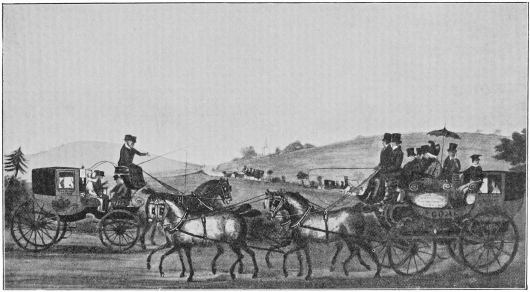
“The single gentlemen, then a hardy race, equipped in jack-boots
and trousers up to their middle, rode post through thick and thin,
and, guarded against the mire, defying the frequent stumble and fall,
arose and pursued their journey with alacrity.”—Pennant, 1739.
Long before wheeled conveyances of any kind
were to be hired in this country, travellers were
accustomed to ride post. To do so argued no
connection with that great department we now
call the Post Office, although that letter-carrying
agency and the custom of riding post obtain
their name from a common origin. The earliest
provision for travelling post seems to have been
in the reign of Henry VIII., when the office of
“Master of the Postes” was established. Sir
Brian Tuke then held that appointment, and to
him were entrusted the arrangements for securing
relays of horses on the four great post roads then
recognised: the road from London to Dover, on
which the carriers came from and went to foreign
parts; the road to Plymouth, where the King’s
dockyard was situated; and the great roads to
Scotland and Chester, and on to Conway and Holyhead.
These relays of horses were established
exclusively for use of the despatch-riders who went
on affairs of State; but by the time of Elizabeth
these messengers were, as a favour, already
accustomed to carry any letters that might be
given into their charge and could be delivered
without going out of their way; while travellers
constantly called at the country post-houses, and
on pretence of going on the Queen’s business,
obtained the use of horses, which they rode to
exhaustion, or overloaded, or even rode away with
altogether.
These abuses were promptly suppressed when
James I. came to the English throne. In 1603,
the year of his accession, a proclamation was issued
under which no person claiming to be on Government
business was to be supplied with horses
by the postmasters unless his application was
supported by a document signed by one of the
officers of State. The hire of horses for public
business was fixed at twopence-halfpenny a mile,
and in addition there was a small charge for the
guide. A very arbitrary order was made that if
the post-houses had not sufficient horses, the
constables and the magistrates were to seize those
of private owners and impress them into the
service. Post-masters, who were salaried officials,
were paid at the very meagre rate of from sixpence
to three shillings a day. They were
generally innkeepers on the main roads; otherwise
it is difficult to see how they could have
existed on these rates of pay. Evidently these
were considered merely as retaining fees, and so,
in order to give them a chance of earning a more
living wage, they were permitted to let out horses
to “others riding poste with horse and guide about
their private business.” Those private and unofficial
travellers could not demand to be supplied
with horses at the official rate: what they were to
pay was to be a matter between the post-masters
and themselves. In practice, however, the tariff
for Government riders ruled that for all horsemen,
as made clear in Fynes Morison’s Itinerary, 1617,
where he says that in the south and west of
England and on the Great North Road as far as
Berwick, post-horses were established at every ten
miles or so at a charge of twopence-halfpenny a
mile. It was necessary to have a guide to each
stage, and it was customary to charge for baiting
both the guide’s and the traveller’s horses, and to
give the guide himself a few pence—usually a four-penny-piece,
called “the guide’s groat”—on parting.
It was cheaper and safer for several travellers to
go together, for one guide would serve the whole
company on each stage, and it was not prudent to
travel alone. Morison says that, although hiring
came expensive in one way, yet the speed it was
possible to maintain saved time and consequent
charges at the inns. The chief requisite, however,
was strength of body and ability to endure the
fatigue.
As to that, the horsemen of the period were,
equally with those of over a hundred years later,
mentioned by Pennant, “a hardy race.” In
March, 1603, for example, Robert Cary, afterwards
Earl of Monmouth, eager to be first in acclaiming
James VI. of Scotland as James I. of England,
left London so soon as the last breath had
left the body of Queen Elizabeth, and rode
the 401 miles to Edinburgh in three days. He
reached Doncaster, 158 miles, the first night,
Widdrington, 137 miles, the second, and gained
Edinburgh, 106 miles, the third day, in spite of a
severe fall by the way. About the same time a
person named Coles rode from London to Shrewsbury
in fourteen hours.
When Thomas Witherings was appointed Master
of the Post, in 1635, the Post Office, as an institution
for carrying the correspondence of the public,
may be said to have started business, although
as early as 1603 private persons were forbidden to
make the carrying of letters a business. Like all
such ordinances, this seemed made only to be
broken every day. It was particularly unreasonable
because, before Witherings came upon the
scene in 1635 and reorganised the posts, there
existed no means by which letters could be sent
generally into the country. Only the post-riders
on business of State on the four great roads were
in the habit of taking letters, and their doing
so was a matter of private arrangement.
The postmasters now, on the appointment of
Witherings, first officially made acquaintance
with letters, and their name began to take on
something of its modern meaning. They still
supplied horses to the King’s messengers and the
King’s liege subjects, and held a monopoly in
these businesses.
In 1657 the so-called “Post Office of England”
was established by Act of Parliament, and the
office of Postmaster-General created, in succession
to that of Master of the Posts. His business was
defined as “the exclusive right of carrying letters
and the furnishing of post-horses,” and these
two functions—the overlordship of what were
officially known for generations afterwards as the
“letter post” and the “travelling post”—the
long line of Postmasters-General continued to
exercise for a hundred and twenty-three years.
In 1658 the mileage the country postmasters
were entitled to charge was, according to an
advertisement of July 1st in that year, increased
from twopence-halfpenny to threepence, and on
the Chester Road, at least, there was no longer
any obligation to take a guide:—
“The postmasters on the Chester Road, petitioning,
have received order, and do accordingly
publish the following advertisement: All gentlemen,
merchants, and others who have occasion to
travel between London and West Chester, Manchester,
and Warrington, or any other town upon
that road, for the accommodation of trade, dispatch
of business, and ease of purse, upon every Monday,
Wednesday and Friday morning, between six and
ten of the clock, at the house of Mr. Christopher
Charteris, at the sign of the Hart’s Horns, in West
Smithfield, and postmaster there, and at the postmaster
of Chester, and at the postmaster of
Warrington, may have a good and able horse or
mare, furnished at threepence the mile, without
the charge of a guide; and so likewise at the
house of Mr. Thomas Challoner, postmaster at
Stone in Staffordshire, upon every Tuesday,
Thursday, and Saturday mornings, to go to
London; and so likewise at all the several postmasters
upon the road, who will have such set
days, so many horses, with furniture, in readiness
to furnish the riders, without any stay, to carry
them to and from any of the places aforesaid in
four days, as well to London as from thence, and
to places nearer in less time, according as their
occasions shall require, they engaging, at the first
stage where they take horse, for the safe delivery
of the same to the next immediate stage, and not
to ride that horse any farther without consent of
the postmaster, by whom he rides, and so from
stage to stage to their journey’s end. All those
who intend to ride this way are desired to give a
little notice beforehand, if conveniently they can,
to the several postmasters where they first take
horse, whereby they may be furnished with as
many horses as the riders shall require, with
expedition. This undertaking began the 28th of
June 1658, at all the places aforesaid, and so
continues by the several postmasters.”
The Chester Road—the road to Ireland—was
of great moment at that age. Indeed, it had
been of importance for centuries past. It was in
a lonely hollow near Flint, on his landing from
Ireland, that Richard II. was waylaid in
1399 by Henry Bolingbroke, and his progress to
London barred; and from Chester as well as from
Milford Haven English expeditions were wont to
sail—some carrying fire and sword across St.
George’s Channel, and later ones taking English
colonists to occupy and cultivate the lands from
which the shiftless Irish had been driven. But it
was not until the close of Elizabeth’s reign, when
Ireland was subjugated, that this road began to be
constantly travelled.
Under James I. the Irish chieftains came to
these shores to swear fealty, and in the wild and
whirling series of events that filled the years
from 1641 to 1692 with horror, a continual flux
and reflux of military travellers and trembling
refugees came and went along these storied miles.
Already, in the year before the announcement
of post-horses on the Chester Road, the first stage-coach
of which we have any particulars had been
established on this very route. It did not
continue to Holyhead, for the individually
sufficient reasons that no practicable road to that
port existed for anything going on wheels, and
that Chester itself, and Parkgate, a few miles
down the estuary of the Dee, were the most convenient
ports of embarkation for Ireland. No
direct road to Holyhead existed until 1783, when
coaches began to run to that port. Before that
time, those who wished to cross from Holyhead
generally rode horseback. Few ventured across
country by Llangollen and Bettws-y-Coed; most,
like Swift, leaving civilisation behind at Chester,
took horse and guide, and going by Rhuddlan and
Conway, dared the precipitous heights of that
great headland called Penmaenmawr, or, even
more greatly daring, crept round by the rocks
underneath at ebb tide. Swift wrote two couplets
for the inn that then stood beside the track on
Penmaenmawr. As the traveller approached he
read, on the swinging sign:—
Before you venture here to pass,
Take a good refreshing glass;
while the returning wayfarer was cheered by:—
Now this hill you’re safely over,
Drink, your spirits to recover.
One personage, greatly daring, did in 1685
succeed in passing his carriage over this height.
This was the Viceroy, Henry, Earl of Clarendon,
who, ill enough advised to try for Holyhead,
embarked his baggage at Chester, and essayed this
perilous undertaking. “If the weather be good,”
he wrote, before setting out, “we go under the
rocks in our coaches.” But it was December, the
weather was not good, and so they had to take to
the hill-top. His Excellency had ample cause to
regret the venture, for he was five hours travelling
the fourteen miles between St. Asaph and Conway,
and on the crossing of Penmaenmawr the “great
heavy coach” had to be drawn by the horses in
single trace, while three or four sturdy Welsh
peasants, hired for the job, pushed behind, so that
it should not slip back. His Excellency walked
all the way across, from Conway to Bangor, and
Lady Clarendon was carried in a litter. How the
Menai Straits were crossed does not appear, but
there is evidence in the tone of his letters that he
was astonished at last to find himself safely come
to Holyhead.
In 1660, on the Restoration, the law of 1657,
constituting the Post Office and regulating the
letting of post-horses, was re-enacted. By some
new provisions and amendments of old ones,
travellers might now hire horses wherever they
could if the postmasters could not supply them
within half an hour. This concession, together
with that which repealed the power given by the
earlier Act for horses to be seized, was evidently
made in deference to the indignation of travellers
delayed by lack of horses in the hands of the
only persons who could legally hire them out,
and by the fury of private individuals who had
seen their own choice animals not infrequently
requisitioned in the King’s name and hack-ridden
unconscionable distances by travellers or
King’s messengers whose first and last thoughts
were for speed, and who had not the consideration
of an owner for the steeds that carried them. The
term “postage,” occurring in the Act of 1660,
shows that a widely different meaning was then
attached to the word: “Each horse’s hire or
postage” is a phrase that sufficiently explains
itself.
Such were the methods and costs of riding horseback
when stage-coaching began. The Government
monopoly, however, was infringed with increasing
impunity as time went on, and as the letter-carrying
business of the Post Office developed, so
was the “travelling post” allowed to decay. The
growing number and increasing convenience of
the coaches, too, helped to make the monopoly less
valuable, for when travellers could be conveyed
without exertion by coach at from twopence to
threepence a mile, they were not likely to pay
threepence a mile and a guide’s groat at every
ten miles for the privilege of bumping in the
saddle all day long. Those who mostly continued
in the saddle were the gentlemen who owned
horses of their own, or those others to whom the
chance company of a coach was objectionable.
The Post Office monopoly in post-horses was,
accordingly, not worth preserving when it was
abolished by the Act of 1780. From that time
the Postmasters-General ceased to have anything
to do with horse-hire, and anything lost by their
relinquishing it was amply returned to the State
by the new license duties levied upon horse-keepers
or postmasters, and coaches. A penny a mile was
fixed as the Government duty upon horses let out
for hire, whether saddle-horses or to be used in
post-chaises. All persons who made that a business—generally,
of course, innkeepers—were to take
out an annual five-shilling license, and were under
obligation to paint in some conspicuous place on
their houses “Licensed to let Post-Horses.” In
default of so doing the penalty was £5. As a
check upon the business done, travellers hiring
post-horses were to be given a ticket, on which the
number of horses so hired, and the distance, were
to be specified. These tickets were to be delivered
to the turnpike-keeper at the first gate, and the
vigilance of these officials was made a matter of
self-interest by the allowance to them of threepence
in the pound on all tickets thus collected.
At certain periods the tickets were delivered to
the Stamp Office, and the innkeepers and postmasters
themselves were visited by revenue
officers, who required to see the books and the
counterfoils from which these tickets had come.
But the Government did not for any length
of time directly collect these duties. They were
farmed out by the Inland Revenue Department,
just as the turnpike tolls were farmed by the
Turnpike Trustees, and men grew rich by buying
these tolls and duties at annual auctions, relying
for their profit on the increased vigilance they
would cause to be exercised. The Jews were
early in this field. In the golden era of coaching
a man named Levy farmed tolls and duties to the
annual value of half a million sterling.
But to return to our horsemen. In the
seventeenth and eighteenth centuries the country
gentlemen, the members of Parliament, the judges
on circuit, every hale and able-bodied man of means
sufficient, rode his horse, or hired one on his
journeys, for the reason that carriages could only
slowly and with great difficulty and expense be
made to move along the distant roads. The
passage from Pennant’s recollections, quoted at
the head of this chapter, shows the miseries made
light of by the single gentlemen, and endured by
those married ones whose wives rode behind them
on a pillion and clutched them convulsively round
the waist as the horse stumbled along.
Nor did stage-coaches immediately change this
time-honoured way of getting about the country,
for there existed an aristocratic prejudice against
using public vehicles. Offensive persons who
never owned carriages of their own were used to
give themselves insufferable airs when journeying
by coach, and hint, for the admiration or envy
of their fellow-passengers, that an accident had
happened to their own private equipage. Satirists
of the time soon seized upon this contemptible
resort of the snob, and used it to advantage in
contemporary literature. Thus we find the committeeman’s
wife in Sir Robert Howard’s comedy
explaining her presence in the Reading coach to
be owing to her own carriage being disordered,
adding that if her husband knew she had been
obliged to ride in the stage he would “make the
house too hot to hold some.”
Here and there we find exceptions to this
general rule. In the coach passing through
Preston in 1662, one Parker was fellow-traveller
with “persons of great qualitie, such as knightes
and ladyes”; and on one occasion in 1682 the winter
coach on its four days’ journey between Nottingham
and London had for passenger Sir Ralph
Knight, of Langold, Yorks; but the single gentlemen
in good health continued for years after the
introduction of stage-coaches to go on horseback,
and when their families came to town they usually
took the family chariot, and either contracted with
stable-keepers for horses on the way, or else,
taking their most powerful horses from the plough,
harnessed four or six of them to their private
vehicle, and so, with the driving of their best
ploughman, came to the capital in state, much to
the amusement of the fashionables of Piccadilly
and St. James’s.
We must, however, suppose, from the fury of
Cresset’s Reasons for Suppressing Stage Coaches, of
1662, that some of the less energetic among the
country gentlemen had already succumbed to
the discreditable practice of travelling in them.
In his pages we learn something of what a
horseman’s life on the road was like, and what
he escaped by taking to the coach. The hardy
race became soft and grievously enervated by the
unwonted luxury; their muscles slackened, and
they developed an infirmity of purpose that
rendered them no longer able to “endure frost,
snow, or rain, or to lodge in the fields”—trifling
inconveniences and incidents of travel which, it
appears, they had previously been accustomed to
support with that cheerfulness or resignation with
which one faces the inevitable and incurable.
But Cresset had other indictments, throwing a
flood of light upon what the horseman endured in
wear and tear of body, mind, and wearing apparel:
“Most gentlemen, before they travelled in
coaches, used to ride with swords, belts, pistols,
holsters, portmanteaus and hat-cases, which in
these coaches they have little or no use for; for,
when they rode on horseback, they rode in one
suit and carried another to wear when they came
to their journey’s end, or lay by the way; but
in coaches a silk hat and an Indian gown, with
a sash, silk stockings, and beaver hats, men ride
in, and carry no other with them, because they
escape the wet and dirt, which on horseback they
cannot avoid; whereas, in two or three journeys
on horseback these clothes and hats were wont
to be spoiled; which done, they were forced to
have new ones very often, and that increased the
consumption of the manufactures and the employment
of the manufacturers; which travelling
in coaches doth in no way do.”
Fortunately, the biographical literature of our
country is rich in records of the horsemen who,
still relying upon their own exertions and those
of their willing steeds, rode long distances and
left the toiling stage leagues behind them at the
close of each day’s journey. Ralph Thoresby, of
Leeds, a pious and God-fearing antiquary who
flourished at this time, gives us, on the other
hand, the spectacle of one who generally rode
horseback trying the coach by way of a change.
He had occasion to visit London in February 1683,
and as there was at that time no coach service
between Leeds and London, he rode from Leeds to
York to catch the stage, which seems to have kept
the road in this particular winter. He rose at five
one Saturday morning, and was at York by night,
ready for the coach leaving for London on the
Monday. Four years earlier he had scorned the
coach, and did not now take it for sake of speed,
for he commonly rode from Leeds to London in
four days, and the York stage at this period of its
career took six; so, including the two days expended
in coming to York, he was clearly twice
as long over the business. He looked forward to
the coach journey with misgivings, “fearful of
being confined to a coach for so many days with
unsuitable persons and not one I know of.”
On other occasions, when he rode horseback,
his diary is rich with picturesque incident. He
finds the waters out on the road between Ware
and Cheshunt, and waits until he and a party of
other horsemen can be guided across by a safe
way, and so avoid the pitiful fate of a poor higgler,
who blundered into the raging torrent where the
road should have been, and was swept away and
drowned. He loses his way frequently on the
high-road; shudders with apprehension when
crossing Witham Common, near Stamford, “the
place where Sir Ralph Wharton slew the highwayman”;
and, with a companion, has a terrible
fright at an inn at Topcliffe, where they miss
their pistols for a while and suspect the innkeeper
of sinister designs against them. Hence,
at the safe conclusion of every journey, with
humble and heartfelt thanks he inscribes: “God
be thanked for his mercies to me and my poor
family!”
In 1715, when John Gay wrote his entertaining
poem, A Journey to Exeter, describing the adventures
of a party of horsemen who rode down from
London, things were, we may suppose, much
better, for the travellers found amusement as well
as toil on their way.
They took five days to ride to Exeter. The
first night they slept at Hartley Row, 36 miles.
The second day they left the modern route of
the Exeter Road at Basingstoke, and, like some
of the coaches about that time, struck out along
the Winchester road as far as Popham Lane, where
they branched off across the downs to Sutton and
Stockbridge, at which town they halted the night,
after a day’s journey of 30 miles. The third
morning saw them making for Salisbury. Midway
between Stockbridge and that city their road falls
into the main road to Exeter. That night they
were at Blandford. The fourth day took them to
Axminster, and the fifth to Exeter:—
’Twas on the day when city dames repair
To take their weekly dose of Hyde Park air;
When forth we trot: no carts the road infest,
For still on Sundays country horses rest.
Thy gardens, Kensington, we leave unseen;
Through Hammersmith jog on to Turnham Green:
That Turnham Green which dainty pigeons fed,
But feeds no more, for Solomon is dead.
Three dusty miles reach Brentford’s tedious town,
For dirty streets and white-legg’d chickens known:
Thence o’er wide shrubby heaths and furrow’d lanes
We come, where Thames divides the meads of Staines.
We ferry’d o’er; for late the winter’s flood
Shook her frail bridge, and tore her piles of wood.
Prepar’d for war, now Bagshot Heath we cross,
Where broken gamesters oft repair their loss.
At Hartley Row the foaming bit we prest,
While the fat landlord welcom’d ev’ry guest.
Supper was ended, healths the glasses crown’d,
Our host extolled his wine at ev’ry round,
Relates the Justices’ late meeting there,
How many bottles drank, and what their cheer;
What lords had been his guests in days of yore,
And praised their wisdom much, their drinking more.
* * * * *
Let travellers the morning’s vigils keep:
The morning rose, but we lay fast asleep.
Twelve tedious miles we bore the sultry sun,
And Popham Lane was scarce in sight by one;
The straggling village harbour’d thieves of old,
’Twas here the stage-coach’d lass resigned her gold;
That gold which had in London purchas’d gowns,
And sent her home, a belle, to country towns.
But robbers haunt no more the neighbouring wood;
Here unnamed infants find their daily food;
For should the maiden mother nurse her son,
’Twould spoil her match, when her good name is gone.
Our jolly hostess nineteen children bore,
Nor fail’d her breast to suckle nineteen more.
Be just, ye prudes, wipe off the long arrear,
Be virgins still in towns, but mothers here.
Sutton we pass; and leave her spacious down,
And with the setting sun reach Stockbridge town.
O’er our parch’d tongues the rich metheglin glides,
And the red dainty trout our knife divides.
Sad melancholy ev’ry visage wears;
What! no election come in seven long years!
Of all our race of Mayors, shall Snow alone
Be by Sir Richard’s dedication known?
Our streets no more with tides of ale shall float,
Nor cobblers feast three years upon one vote.
* * * * *
Next morn, twelve miles led o’er th’ unbounded plain
Where the cloak’d shepherd guides his fleecy train.
No leafy bow’rs a noontide shelter lend,
Nor from the chilly dews at night defend;
With wondrous art he counts the straggling flock,
And by the sun informs you what’s o’clock.
How are our shepherds fall’n from ancient days!
No Amaryllis chants alternate lays;
From her no list’ning echoes learn to sing,
Nor with his reed the jocund valleys ring.
Here sheep the pasture hide, there harvests bend,
See Sarum’s steeple o’er yon hill ascend;
Our horses faintly trot beneath the heat,
And our keen stomachs know the hour to eat.
Who can forsake thy walls, and not admire
The proud cathedral and the lofty spire?
What sempstress has not proved thy scissors good?
From hence first came th’ intriguing riding-hood.
Amid three boarding-schools well stock’d with misses,
Shall three knight-errants starve for want of kisses?
O’er the green turf the miles slide swift away,
And Blandford ends the labours of the day.
* * * * *
The morning rose; the supper reck’ning paid,
And our due fees discharg’d to man and maid,
The ready ostler near the stirrup stands,
And as we mount, our halfpence load his hands.
Now the steep hill fair Dorchester o’erlooks,
Bordered by meads, and wash’d by silver brooks.
Here sleep my two companions, eyes supprest,
And propt in elbow-chairs they snoring rest;
I weary sit, and with my pencil trace
Their painful postures and their eyeless face;
Then dedicate each glass to some fair name,
And on the sash the diamond scrawls my flame.
Now o’er true Roman way our horses sound;
Grævius would kneel and kiss the sacred ground.
On either side fair fertile valleys lie,
The distant prospects tire the travelling eye.
Through Bridport’s stony lanes our route we take,
And the proud steep ascend to Morecombe’s lake.
As hearses pass’d, our landlord robb’d the pall,
And with the mournful scutcheon hung his hall.
On unadulterate wine we here regale,
And strip the lobster of his scarlet mail.
We climb’d the hills when starry night arose,
And Axminster affords a kind repose.
The maid, subdued by fees, her trunk unlocks,
And gives the cleanly aid of dowlas smocks.
Meantime our shirts her busy fingers rub,
While the soap lathers o’er the foaming tub.
If women’s gear such pleasing dreams incite,
Lend us your smocks, ye damsels, ev’ry night.
We rise, our beards demand the barber’s art;
A female enters, and performs the part.
The weighty golden chain adorns her neck,
And three gold rings her skilful hand bedeck;
Smooth o’er our chins her easy fingers move,
Soft as when Venus strok’d the beard of Jove.
Now from the steep, ’mid scatter’d cots and groves,
Our eye through Honiton’s fair valley roves.
Behind us soon the busy town we leave,
Where finest lace industrious lasses weave.
Now swelling clouds roll’d on; the rainy load
Stream’d down our hats, and smoked along the road;
When (O blest sight!) a friendly sign we spy’d,
Our spurs are slacken’d from the horse’s side;
For sure a civil host the house commands,
Upon whose sign this courteous motto stands—
“This is the ancient hand, and eke the pen;
Here is for horses hay, and meat for men.”
How rhyme would flourish, did each son of fame
Know his own genius, and direct his flame!
Then he that could not Epic flights rehearse
Might sweetly mourn in Elegiac verse.
But were his Muse for Elegy unfit,
Perhaps a Distich might not strain his wit;
If Epigram offend, his harmless lines
Might in gold letters swing on alehouse signs.
Then Hobbinol might propagate his bays,
And Tuttle-fields record his simple lays;
Where rhymes like these might lure the nurses’ eyes,
While gaping infants squall for farthing pies.
“Treat here, ye shepherds blithe, your damsels sweet,
For pies and cheesecakes are for damsels meet.”
Then Maurus in his proper sphere might shine,
And these proud numbers grace great William’s sign;—
“This is the man, this the Nassovian, whom
I named the brave deliverer to come.”
But now the driving gales suspend the rain,
We mount our steeds, and Devon’s city gain.
Hail, happy native land!—but I forbear
What other counties must with envy hear.
Dean Swift, too, was a frequent traveller on
horseback, particularly on the Chester and Holyhead
road. He seems once to have tried the
Chester stage, and ever after to have taken to
the saddle. Riding thus in 1710 from Chester
to London in five days, he describes himself as
“weary the first, almost dead the second, tolerable
the third, and well enough the rest,” but
“glad enough of the fatigue, which has served
for exercise.” After making the journey from
London to Holyhead and Dublin in 1726, he wrote
to Pope, describing “the quick change” he had
made in seven days from London to Dublin,
“through many nations and languages unknown
to the civilised world.” He had expected the
enterprise, “with moderate fortune,” to take ten
or eleven days. “I have often reflected,” he adds,
“in how few hours, with a swift horse or a strong
gale, a man may come among a people as unknown
to him as the Antipodes.” Swift was by no means
indulging in playful banter when he wrote this.
He felt a genuine cause for wonder in such
expedition; and certainly if the rustic speech of
rural England was like a strange and uncivilised
tongue, how much more strange and uncivilised
the languages of Wales and Ireland must have
sounded!
The Dean’s last recorded journey was made in
September 1727. The little memorandum-book,
tattered and discoloured, in which he noted down
many of its incidents is still in existence, and is
not only a valuable document in the story of
Swift’s life, but is equally precious and interesting
as an intimate record of the daily trials and
troubles of a traveller in those times, set down
while he was still on his journey and thus echoing
every passing feeling. Swift was in bad health
and worse spirits when he wrote this diary at
Holyhead, where he was detained for seven days
by contrary winds. It was written for lack of
employment afforded to a cultivated mind in
the dreary little seaport, and under the influence
of a great sorrow. “Stella” lay dying over in
Ireland, and he, raging with impatience at Holyhead,
filled his notebook with aimless scribbling.
“All this to divert thinking,” he writes, sadly, in
the midst of it.
The original notebook is still in existence, and
is carefully preserved at the South Kensington
Museum, to which it was bequeathed by John
Forster. Inside its cover the handwriting of
successive owners gives the relic an authentic
pedigree, and Swift himself humorously declares
how he came into possession of the blank book:
“This book I stole from the Right Honourable
George Dodington, Esq., one of the Lords of the
Treasury, but the scribblings are all my own.”
This George Dodington was George Bubb
Dodington, afterwards Lord Melcombe.
On the first page are hastily-scribbled memoranda
for appointments: “In Fleet Street,
about a clerk of St. Patrick’s Cathedral”;
“Spectacles for seventy years old”; “Godfrey
in Southampton Street”; “Hungary waters and
palsy drops.”
Then the Dean left London, riding horseback,
with his servant, Watt, for company on another
nag, and carrying his master’s travelling valise.
The heavy luggage had been sent on by waggon
to Chester. Watt, as we shall presently see, was
a veritable Handy Andy, always doing the wrong
thing, or the right thing in a wrong way. Swift
carried the notebook in his pocket, without writing
anything of his journey in it until Holyhead was
reached.
A few unfinished lines on an old cassock,
out at elbows, preface the diary, which begins
abruptly: “Friday at 11 in the morning I left
Chester. It was Sept. 22, 1727. I baited at
a blind ale house 7 miles from Chester. I
thence rode to Ridland (Rhuddlan), in all 22
miles. I lay there: bred, bed, meat and tolerable
wine. I left Ridland a quarter after 4 morn on
Saturday, slept, on Penmanmaur (Penmaenmawr),
examined about my sign verses the Inn is to
be on t’other side, therefore the verses to be
changed.”A
Here, on the verge of the wild Welsh coast,
the way was so uncertain and dangerous that
travellers had of necessity to employ guides, who
conducted them thence to Bangor, and across
Anglesey to Holyhead. The roads in Anglesey
were unworthy of the name, and only a little
better than horse-tracks; while the inhabitants
of the isle spoke only Welsh, and understood
not a word of English. Nearly two hundred
years have passed, but although the roads
have been made good, the folks of Anglesey
speak English no more than they did then,
when the guides acted the part of interpreters
as well.
Swift, therefore, is found at Conway, mentioning
the guide who had already brought
him safely over Penmaenmawr: “I baited at
Conway, the guide going to another Inn; the
maid of the old Inn saw me in the street and
said that was my horse, she knew me. There I
dined, and sent for Ned Holland, a Squire famous
for being mentioned in Mr. Lyndsay’s verses to
Day Morice. I there again saw Hook’s tomb,
who was the 41st child of his mother, and had
himself 27 children, he dyed about 1638. There
is a note here that one of his posterity new
furbished up the inscription. I had read in Abp.
Williams’ Life that he was buryed in an obscure
Church in North Wales. I enquired, and heard
that it was atB ... Church, within a mile of
Bangor, whither I was going. I went to the
Church, the guide grumbling. I saw the Tomb
with his Statue kneeling (in marble). It began
thus (Hospes lege et relege quod in hoc obscuro
sacello non expectares. Hic jacet omnium
Praesulum celeberrimus). I came to Bangor and
crossed the Ferry, a mile from it, where there
is an Inn, which, if it be well kept, will break
Bangor. There I lay; it was 22 miles from
Holyhead.”
This was the “George” at Menai Straits, a
house that until the building of Telford’s suspension
bridge in 1825, flourished greatly on the
traffic of the ferry that then plied between it and
the opposite shore. Large additions have been
made to the hotel, but the original wing that
Swift knew is still in existence, and is a characteristic
specimen of the architecture in vogue about
the time of Queen Anne.
Swift unfortunately tells us nothing of the
actual crossing of the Straits. He must have
been up at an unconscionable hour, for he was
already on the Anglesey side by four o’clock the
next morning, Sunday: “I was on horseback at
4 in the morning resolving to be at Church at
Holyhead, but we then lost Owain Tudor’s tomb at
Penmarry.” This was Penmynydd, a very steep
and craggy place, whence came those Tudors who
through the fortunate marriage of Owain Tudor
came at last to the throne of England.
“We passed the place,” says Swift, “being a
little out of the way, by the Guide’s knavery, who
had no mind to stay. I was now so weary with
riding that I was forced to stop at Langueveny
(Llangefni), 7 miles from the Ferry, and rest two
hours. Then I went on very weary, but in a few
miles more Watt’s horse lost his two fore-shoes.
So the Horse was forced to limp after us. The
Guide was less concerned than I. In a few miles
more my Horse lost a fore-shoe and could not go
on the rocky ways. I walked above two miles,
to spare him. It was Sunday, and no Smith to
be got. At last there was a Smith in the way:
we left the Guide to shoe the horses and walked
to a hedge Inn 3 miles from Holyhead. There
I stayed an hour with no ale to be drunk. A
boat offered, and I went by sea and sayled in it
to Holyhead. The Guide came about the same
time. I dined with an old Innkeeper, Mrs. Welch,
about 3, on a Loyne of mutton very good, but the
worst ale in the world, and no wine, for the day
before I came here a vast number went to Ireland
after having drunk out all the wine. There was
stale beer, and I tryed a receit of Oyster shells
which I got powdered on purpose; but it was
good for nothing. I walked on the rocks in the
evening, and then went to bed and dreamt I
had got 20 falls from my Horse.
“Monday, Sept. 25.—The Captain talks of
sailing at 12. The talk goes off, the wind is fair,
but he says it is too fierce. I believe he wants
more Company. I had a raw Chicken for
dinner and Brandy with water for my drink. I
walked morning and afternoon among the rocks.
This evening Watt tells me that my landady
whispered him that the Grafton packet-boat just
come in had brought her 18 bottles of Irish
Claret. I secured one, and supped on part of a
neat’s tongue which a friend at London had given
Watt to put up for me, and drank a pint of the
wine, which was bad enough. Not a soul is yet
come to Holyhead, except a young fellow who
smiles when he meets me and would fain be my
companion, but it has not come to that yet. I
writ abundance of verses this day; and several
useful hints, tho’ I say it. I went to bed at ten
and dreamt abundance of nonsense.
“Tuesday 26th.—I am forced to wear a shirt
3 days for fear of being lowsy. I was sparing
of them all the way. It was a mercy there were
6 clean when I left London;—otherwise Watt
(whose blunders would bear an history) would
have got them all in the great Box of goods which
went by the Carrier to Chester. He brought but
one crevat, and the reason he gave was because the
rest were foul and he thought he should not get
foul linen into the Portmanteau. For he never
dreamt it might be washed on the way. My
shirts are all foul now, and by his reasoning I
fear he will leave them at Holyhead when we go.
I got a small Loyn of mutton but so tough I could
not chew it, and drank my second pint of wine.
I walked this morning a good way among the
rocks, and to a hole in one of them from whence
at certain periods the water spurted up several
feet high. It rained all night and hath rained
since dinner. But now the sun shines and I will
take my afternoon walk. It was fiercer and
wilder weather than yesterday, yet the Captain now
dreams of sailing. To say the truth Michaelmas is
the worst season in the year. Is this strange stuff?
Why, what would you have me do? I have writ
verses and put down hints till I am weary. I
see no creature. I cannot read by candle-light.
Sleeping will make me sick. I reckon myself
fixed here, and have a mind like Marshall Tallard
to take a house and garden. I wish you a Merry
Christmas and expect to see you by Candlemas.
I have walked this morning about 3 miles on
the rocks; my giddiness, God be thanked, is almost
gone and my hearing continues. I am now
retired to my chamber to scribble or sit
humdrum. The night is fair and they pretend to
have some hopes of going to-morrow.
“September 26th.—Thoughts upon being confined
at Holyhead. If this were to be my settlement
during life I could content myself a while by
forming new conveniences to be easy, and should
not be frightened either by the solitude or the
meanness of lodging, eating or drinking. I shall
say nothing about the suspense I am in about my
dearest friend because that is a case extraordinary,
and therefore by way of comfort. I will speak as
if it were not in my thoughts, and only as a
passenger who is in a scurvy, unprovided comfortless
place without one companion, and who
therefore wants to be at home where he hath all
conveniences proper for a gentleman of quality.
I cannot read at night, and I have no books to
read in the day. I have no subject at present in
my head to write upon. I dare not send my linen
to be washed for fear of being called away at half
an hour’s warning, and then I must leave them
behind, which is a serious Point. I live at great
expense without one comfortable bit or sup. I
am afraid of joyning with passengers for fear of
getting acquaintance with Irish. The days are
short and I have five hours a night to spend by
myself before I go to Bed. I should be glad to
converse with Farmers or shopkeepers, but none
of them speak English. A Dog is better company
than the Vicar, for I remember him of old. What
can I do but write everything that comes into my
head? Watt is a booby of that species which I
dare not suffer to be familiar with me, for he
would ramp on my shoulders in half an hour.
But the worst part is in my half-hourly longing,
and hopes and vain expectations of a wind, so that
I live in suspense which is the worst circumstance
of human nature. I am a little wrung from two
scurvy disorders, and if I should relapse there is
not a Welsh house-cur that would not have more
care taken of him than I, and whose loss would
not be more lamented. I confine myself to my
narrow chamber in all unwalkable hours. The
Master of the pacquet-boat, one Jones, hath not
treated me with the least civility, although Watt
gave him my name. In short I come from being
used like an Emperor to be used worse than a Dog
at Holyhead. Yet my hat is worn to pieces by
answering the civilities of the poor inhabitants as
they pass by. The women might be safe enough
who all wear hats yet never pull them off, and if
the dirty streets did not foul their petticoats by
courtesying so low. Look you; be not impatient,
for I only wait till my watch makes 10 and then
I will give you ease and myself sleep, if I can.
O’ my conscience you may know a Welsh dog as
well as a Welsh man or woman, by its peevish
passionate way of barking. This paper shall serve
to answer all your questions about my journey,
and I will have it printed to satisfy the kingdom.
Forsan et haec olim is a damned lye, for I shall
always fret at the remembrance of this imprisonment.
Pray pity your Watt for he is called
dunce, puppy and lyar 500 times an hour, and
yet he means not ill for he means nothing.
Oh for a dozen bottles of Deanery wine and a slice
of bread and butter! The wine you sent us
yesterday is a little upon the sour. I wish you
had chosen a better. I am going to bed at ten
o’clock because I am weary of being up.
“Wednesday.—To-day we were certainly to
sayl: the morning was calm. Watt and I walked
up the mountain Marucia, properly called Holyhead
or Sacrum Promontorium by Ptolemy,
2 miles from this town. I took breath 59 times.
I looked from the top to see the Wicklow hills, but
the day was too hazy, which I felt to my sorrow;
for returning we were overtaken by a furious
shower. I got into a Welsh cabin almost as bad
as an Irish one. There were only an old Welsh
woman sifting flour who understood no English,
and a boy who fell a roaring for fear of me.
Watt (otherwise called unfortunate Jack) ran
home for my coat, but stayed so long that I came
home in worse rain without him, and he was so
lucky to miss me, but took good care to convey
the key of my room where a fire was ready for me.
So I cooled my heels in the Parlour till he came,
but called for a glass of Brandy. I have been
cooking myself dry, and am now in my night
gown.... And so I wait for dinner. I shall
dine like a King all alone, as I have done these
six days. As it happened, if I had gone straight
from Chester to Park-gate 8 miles I should have
been in Dublin on Sunday last. Now Michaelmas
approaches, the worst time in the year for the sea,
and this rain has made these parts unwalkable,
so I must either write or doze. Bite, when we
were in the wild cabin I order Watt to take a
cloth and wipe my wet gown and cassock: it
happened to be a meal-bag, and as my gown dryed
it was all daubed with flour well cemented with
the rain. What do I but see the gown and cassock
well dryed in my room, and while Watt was at
dinner I was an hour rubbing the meal out of
them, and did it exactly. He is just come up,
and I have gravely bid him take them down to
rub them, and I wait whether he will find out
what I have been doing. The Rogue is come up
in six minutes, and says there were but few specks
(tho’ he saw a thousand at first), but neither
wondered at it, nor seemed to suspect me who
laboured like a horse to rub them out. The 3
packet boats are now all on their side, and the
weather grown worse, and so much rain that there
is an end of my walking. I wish you would send
me word how I shall dispose of my time. I am
as insignificant a person here as parson Brooke is
in Dublin; by my conscience I believe Cæsar
would be the same without his army at his back.
Well, the longer I stay here the more you will
murmur for want of packets. Whoever would
wish to live long should live here, for a day is
longer than a week, and if the weather be foul,
as long as a fortnight. Yet here I could live
with two or three friends in a warm house and good
wine; much better than being a slave in Ireland.
But my misery is that I am in the very worst
part of Wales under the very worst circumstances,
afraid of a relapse, in utmost solitude, impatient
for the condition of our friend, not a soul to
converse with, hindered from exercise by rain,
caged up in a room not half so large as one of
the Deanery closets; my Room smokes into the
bargain, but the weather is too cold and moist
to be without a fire. There is or should be
a proverb here: When Mrs. Welch’s chimney
smokes, ’Tis a sign she’ll keep her folks, But
when of smoke the room is clear, It is a sign
we shan’t stay here. All this to divert thinking.
Tell me, am not I a comfortable wag? The
Yatcht is to leave for Lord Carteret on the 14th
of October. I fancy he and I shall come over
together. I have opened my door to let in the
wind that it may drive out the smoke. I asked
the wind why he is so cross; he assures me ’tis
not his fault, but his cursed Master, Eolus’s.
Here is a young Jackanapes in the Inn waiting
for a wind who would fain be my companion, and
if I stay here much longer I am afraid all my
pride and grandeur will truckle to comply with
him, especially if I finish these leaves that remain;
but I will write close and do as the Devil did at
mass, pull the paper with my teeth to make it
hold out.
“Thursday.—’Tis allowed that we learn patience
by suffering. I have not spirit enough now left me
to fret. I was so cunning these three last days that
whenever I began to rage and storm at the weather
I took special care to turn my face towards Ireland,
in hope by my breath to push the wind forward.
But now I give up.... Well, it is now three in
the afternoon. I have dined and revisited the
master; the wind and tide serve, and I am just
taking boat to go to the ship. So adieu till I see
you at the Deanery.
“Friday, Michaelmas Day.—You will now know
something of what it is to be at sea. We had not
been half an hour in the ship till a fierce wind rose
directly against us; we tryed a good while, but the
storm still continued; so we turned back, and it
was 8 at night dark and rainy before the ship
got back, and at anchor. The other passengers
went back in a boat to Holyhead; but to prevent
accidents and broken shins I lay all night on
board, and came back this morning at 8. Am
now in my chamber, where I must stay and get
a fresh stock of patience.”
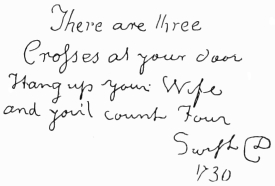
EPIGRAM SCRATCHED WITH A DIAMOND-RING
ON A WINDOW-PANE BY DEAN SWIFT.
So ends this curious diary. This is the last
time that Swift is known to have visited England,
and it has always been assumed, from the lack of
evidence of his again touching these shores, that
he never did return. But he was mentally active
until 1736, and it was not until 1745 that he died,
in madness and old
age. Meanwhile,
there still exists indisputable
evidence
of his travelling
along the Holyhead
Road in 1730; for
an old diamond-shaped
pane of glass,
formerly in a
window of the
“Four Crosses” Inn at Willoughby, and deeply
tinged with a greenish hue, as much old glass
commonly is, may be found in private possession
at Rugby, inscribed by him with a diamond ring.
The handwriting compares exactly with that of
his diary and other manuscripts still extant, and
the ferocity of the humour in the lines is characteristic
of him. Other windows, at Chester and
elsewhere, are known to have been inscribed by
him with epigrams and satirical verses, but they
do not appear to have survived. The occasion of
his offering this advice to the landlord of what was
then the “Three Crosses” has always been said to
have been the landlady’s disregard of his importance.
Anxious to set off early in the morning, he
could by no means hurry the good woman over the
preparation of his breakfast. She told him; “he
must wait, like other people.” He waited, of
necessity, but employed the time in this manner.
John Wesley was of this varied company of
horsemen, and in a long series of years rode into
every nook and corner of England. His “Journal,”
abounding with details of his adventures on
these occasions, proves him to have been a hard
rider and among the most robust and enduring of
travellers in that age. He rode incredible distances
in the day, very frequently from sixty to
seventy miles. Once, in 1738, he travelled in this
way from London to Shipston-on-Stour, a distance
of 82¾ miles, and ended the long day, as usual
with him, in religious counsel. “About eight,”
he says, “it being rainy and very dark, we lost
our way, but before nine came into Shipston,
having rode over, I know not how, a narrow
footbridge which lay across a deep ditch near the
town. After supper I read prayers to the people
of the inn, and explained the Second Lesson; I
hope not in vain.” The next day this indefatigable
traveller and missioner rode 59 miles, to
Birmingham, Hednesford, and Stafford; and the
next a further 53 miles, to Manchester, feeling
faint (and no wonder!) on the way, at Altrincham.
In November 1745, riding from Newcastle-on-Tyne
to Wednesbury, he did not experience many
difficulties until he came, in the dark, to Wednesbury
Town-end, where he and his companion
stuck fast. That is indeed a bad road in which
a horse sticks. However, people coming with
candles, Wesley himself got out of the quagmire
and went off to preach, while the horses were
disengaged from their awkward position by local
experts. The spot where Wesley was bogged is
now a broad and firm macadamised road through
Wednesbury, part of the great Holyhead Road.
Eighteen years before this happening, an Act of
Parliament had been passed for repairing and
turnpiking the road between Wednesbury and
Birmingham; but, although the turnpike gates
may have been in existence, the road itself certainly
does not seem to have been repaired, and
must have remained in the condition described
in the preamble to that Act, when it was “so
ruinous and bad that in the winter season many
parts thereof are impassable for waggons and
carriages, and very dangerous for travellers.” At
the same time, the road on the other side of
Wednesbury was “in a ruinous condition, and
in some places very narrow and incommodious”;
so it is evident that Wednesbury was in the
unenviable but by no means unique position of
being islanded amid execrable and scarcely
practicable roads.
In his old age Wesley occasionally made use
of coaches and chaises, which were then a great
deal better and more numerous than they had
been forty years earlier, when he commenced his
labours; but he did not give up the saddle until
very near the last. In 1779, being then in his
seventy-seventh year, he was still so active that
on one day he rode from Worcester to Brecon,
sixty miles, and preached on his arrival there.
In 1782, when eighty, he still travelled, according
to his own computation, four or five thousand
miles a year, rose early, preached, and possessed
the faculty of sleeping, night or day, whenever he
desired to do so. When he began to travel he
rose at the most astonishing hours—hours unknown
even to the early-rising, hard-riding, hard-living
travellers of that time. Let us look at his
record for February 1746, along the Great North
Road:—
“16th February.—I rose soon after three. I
was wondering the day before at the mildness of
the weather, such as seldom attends me in my
journeys; but my wonder now ceased. The wind
was turned full north, and blew so exceeding hard
and keen that when we came (from London) to
Hatfield neither my companions nor I had much
use of our hands or feet. After resting an hour,
we bore up again through the wind and snow,
which drove full in our faces; but this was only
a squall. In Baldock field the storm began in
earnest; the large hail drove so vehemently in our
faces that we could not see, nor hardly breathe;
however, before two o’clock we reached Baldock,
where one met and conducted us safe to Potton.
About six I preached to a serious congregation.
“17th.—We set out as soon as it was well
light; but it was hard work to get forward, for
the frost would not well break or bear; and, the
untracked snow covering all the roads, we had
much ado to keep our horses on their feet. Meantime
the wind rose higher and higher, till it was
ready to overturn both man and beast. However,
after a short bait at Bugden, we pushed on, and
were met in the middle of an open field with so
violent a storm of rain and hail as we had not had
before; it drove through our coats, great and
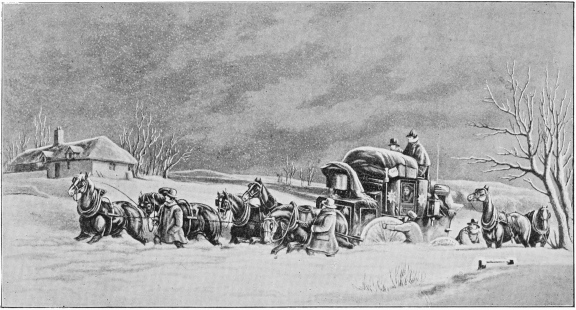
small, boots, and everything, and yet froze as it
fell, even upon our eyebrows, so that we had
scarce either strength or motion left when we
came into our inn at Stilton.
“We now gave up our hopes of reaching
Grantham, the snow falling faster and faster.
However, we took the advantage of a fair blast
to set out, and made the best of our way to
Stamford Heath; but here a new difficulty arose
from the snow lying in large drifts. Sometimes
horse and man were a well nigh swallowed up,
yet in less than an hour we were brought safe
to Stamford. Being willing to get as far as we
could, we made but a short stop here; and about
sunset came, cold and weary, but well, to a little
town called Brig Casterton.
“18th.—Our servant came up and said, ‘Sir,
there is no travelling to-day; such a quantity of
snow has fallen in the night that the roads are
quite filled up.’ I told him, ‘At least we can
walk twenty miles a day, with our horses in our
hands.’ So in the name of God we set out. The
north-east wind was piercing as a sword, and had
driven the snow into such uneven heaps that the
main road was not passable. However, we kept
on on foot or on horseback, till we came to the
White Lion at Grantham”—from whence Mr.
Wesley continued his journey to Epworth, his
birthplace, in Lincolnshire.
Wesley’s economy of time and his methods
when riding are indicated in an interesting way
in his observations on horsemanship:—
“I went on slowly, through Staffordshire and
Cheshire, to Manchester. In this journey, as well
as in many others, I observed a mistake that
almost universally prevails; and I desire all
travellers to take good notice of it, which may
save them both from trouble and danger. Near
thirty years ago I was thinking, ‘How is it that
no horse ever stumbles while I am reading?’
(History, poetry, and philosophy, I commonly
read on horseback, having other employment at
other times.) No account can possibly be given
but this—because when I throw the reins on his
neck, I set myself to observe: and I aver that in
riding above a hundred thousand miles, I scarce
ever remember any horse, except two, (that would
fall head over heels any way,) to fall, or make a
considerable stumble, while I rode with a slack
rein. To fancy, therefore, that a tight rein prevents
stumbling is a capital blunder. I have
repeated the trial more frequently than most
men in the kingdom can do. A slack rein will
prevent stumbling, if anything will, but in some
horses nothing can.”
Dr. Johnson’s is a figure more often associated
with coach and chaise travelling than with horsemanship,
but in his younger days he could ride
horseback with the best. He only lacked the
money to afford it. His wedding-day—when he
took the first opportunity of teaching his Tetty
marital discipline—was passed in a journey from
Derby. His wife rode one horse and he another.
“Sir,” he said, a few years later, “she had read
the old romances, and had got into her head the
fantastical notion that a woman of spirit should
use her husband like a dog. So, sir, at first she
told me that I rode too fast, and she could not
keep up with me; and when I rode a little slower
she passed me and complained that I lagged
behind. I was not to be made the slave of
caprice, and I resolved to begin as I meant to
end. I therefore pushed on briskly, till I was
fairly out of her sight. The road lay between
two hedges, so I was sure she could not miss
it; and I contrived that she should soon come
up with me. When she did, I observed her to be
in tears.”
It has already been noted that judges and
barristers formerly rode circuit on horseback. As
Fielding says, “a grave serjeant-at-law condescended
to amble to Westminster on an easy
pad, with his clerk kicking his heels behind
him.” In such cases, and when a lady rode
pillion behind her squire, clutching him by the
waistbelt, the “double horse” was used. This,
which was by no means a zoological freak, was
the type of horse asked for and supplied by
postmasters to two riders going in this fashion
on one animal. Like the brewers’ double stout,
the “double horse” was specially strong, and
possessed more the physique of the cart-horse
than the park hack. It was chiefly for the use of
the ladies thus riding that the “upping blocks,”
or stone steps, still occasionally seen outside old
rustic inns, were placed beside the road. They
enabled them to get comfortably seated.
Travellers from Scotland to London about the
middle of the eighteenth century were accustomed
to advertise for a companion. Thus, in the Edinburgh
Courant for January 1st, 1753, we find:—
“A Gentleman sets off for London Tomorrow
Morning, and will either post it on horses or a
Post-Chaise, so wants a Companion. He is to be
found at the Shop of Mr. Sands, Bookseller.”
It was then generally found cheap, and sometimes
profitable as well, to buy a horse when
starting from Edinburgh, and to sell him on
arrival in London. Prices being higher in the
Metropolis, the canny travellers who adopted this
plan often got more for the horse than they had
given. This method had, however, the defect of
not working in reverse, and so those Scots who
returned would have had to hire at some considerable
expense, or buy dear to sell cheap, a
thing peculiarly abhorrent to the Scottish mind.
Dr. Johnson would have characteristically brushed
this argument away by declaring that the Scot
never did return.
During many long years Scots travelling in
their own country followed an equally economical
plan. “The Scotch gentry,” said Thomas Kirke
in 1679, “generally travel from one friend’s house
to another; so seldom require a change-house.
Their way is to hire a horse and a man for twopence
a mile; they ride on the horse thirty or
forty miles a day, and the man who is his guide
foots it beside him, and carries his luggage to
boot.” The “change-house” was, of course, an
inn; and from this custom, when every man’s
house was an hotel, the Scottish inns long remained
very inferior places.
Fielding throws a very instructive light upon
the device hit upon by any two travellers who
wished to go together and yet had only one horse
between them. This was called “Ride and Tie.”
He says: “The two travellers set out together,
one on horseback, the other on foot. Now, as it
generally happens that he on horseback outgoes
him on foot, the custom is, that when he arrives
at the distance agreed on, he is to dismount, tie
the horse to some gate, tree, post, or other thing,
and then proceed on foot; when the other comes
up to the horse, he unties him, mounts, and
gallops on, till, having passed by his fellow-traveller,
he likewise arrives at the place of tying.
And this is that method of travelling so much in
use among our prudent ancestors, who knew that
horses had mouths as well as legs, and that they
could not use the latter without being at the
expense of suffering the beasts themselves to use
the former.”
Not until the first decade of the nineteenth
century had gone by did the horseman wholly
disappear from the road into or on to the coaches.
Let us attempt to fix the date, and put it at 1820,
when the fast coaches began to go at a pace equal
or superior to that of the saddle-horse. The
curious may even yet see the combined upping-blocks
and milestones placed for the use of horsemen
on the road across Dunsmore Heath.
In thus giving 1820 as the date of the horseman’s
final disappearance, it need not be supposed
that Cobbett and his Rural Rides are forgotten.
He covered England on horseback some years
later, but his journeys are not on all fours with
those of the horsemen whose only desire was
quickly to get from start to finish of their
journeys. He halted by the way, and from the
vantage-point of the saddle cast a keenly scrutinising
eye upon the agricultural methods of the
various districts, as seen across the tops of hedgerows,
or delayed his travels to harangue the
farmers on market-days. Nor is the existence
forgotten of those country gentlemen and City
merchants who, seventy years ago, rode to and
from the City on horseback; but they also formed
an exception. Already, by some ten years or so,
the commercial travellers, as a body, had left the
saddle and taken to what was, in its first inception,
essentially the vehicle of the commercial
representative. This was the “gig.” The gig
at once became a favourite middle-class conveyance.
Thurtell, the flashy betting-man, vulgar
roué, and murderer, was thought by a witness “a
respectable man: he kept a gig.” This aroused
the scorn of Carlyle, who coined the word
“gigmanity.”
The early commercial travellers, in fact, were
long known as “riders,” from their custom of
riding horseback from town to town, sometimes
with a led pack-horse when their samples were
unusually bulky or heavy. The “London riders”
sometimes found mentioned in old literature were
therefore London commercials. The successive
names by which these “ambassadors of commerce,”
as they have sometimes been grandiloquently
styled, were known are themselves highly illuminating.
They were, in succession, “bagmen,”
“riders,” “travellers,” and “commercial gentlemen.”
They are now “representatives.”