This account of the potting industry in
North Staffordshire will be of interest
chiefly to the people of North Staffordshire.
They and their fathers before them have
grown up with, lived with, made and developed
the English pottery trade. The pot-bank and the
shard ruck are, to them, as familiar, and as full of
old associations, as the cowshed to the countryman
or the nets along the links to the fishing population.
To them any history of the development of
their industry will be welcome.
But potting is such a specialized industry, so
confined to and associated with North Staffordshire,
that it is possible to study very clearly in the
case of this industry the cause of its localization,
and its gradual change from a home to a factory
business. The rise of capitalism, the attempts at
revolt on the part of the workers, the increase
of machinery and steam power, all these can be
studied very closely in the potting industry, just
because the history of the district is the history of
potting and of the inhabitants’ whole lives. So that
I venture to hope that many students of history and
of sociology will find such a trade history as this
of some value in their researches.
The collector, too, may I hope find his special
studies assisted by the identification and linking
together of the relationships of the old master-potters,
of their inventions, and factory sites and
dates.
A hundred years ago Simeon Shaw wrote a
book of this nature. It had its merits, but since
then research among ancient documents, systematic
collection and excavation, the publications of
the William Salt Archæological Society, and, above
all, the modern work of such men as William Burton
and Professor Church, have made it possible
to restate far more exactly what happened, and
when, to potting in North Staffordshire. Mr
Burton’s “History and Description of English
Earthenware” and his various works on porcelain
have been drawn upon very largely in the following
pages.
Both to him and to Professor Church, M. Solon
and to many others, who have given me so much
personal assistance in this work, I desire to express
my gratitude. I can only regret that my own contribution
to original research on the subject has
been confined to the Tunstall Court Rolls, kindly
lent me by Mr Sneyd, and to the MSS of my
great-great-grandfather, Josiah Wedgwood, now
in the museum of the Wedgwood firm at Etruria.
Lastly I would express my indebtedness to my
brother Frank Wedgwood, who has read through
the proofs and made many corrections, such as
would occur to one whose whole life has been
devoted to the practice of the art of potting.
In no country is there a district so utterly associated
with one trade as is the North Staffordshire
Potteries. One even speaks of the
Potteries in the singular as of a pure place-name.
If you spoke in Timbuctoo or California of the
Potteries, none could doubt that you were thinking
of North Staffordshire.
The reason is not that the district is or ever was
given over entirely to pot-banks. Potting was incidental,
a pastime in the middle of agriculture;
as potting grew, so coal and iron mining grew too.
The district is less confined to potting than Walsall
to saddlery or Sheffield to knives. Even a thirteenth
century reference to Walsall will expose
harness; it is difficult to trace pots in the Potteries
before 1650; you find only bloom-smithies and
sea-coal mines. Potting is neither so ancient here,
nor so exclusive as to have made the name. The
real reason of the place-name, the Potteries, is that
no man who valued time could say Tunstall, Burslem,
Hanley, Stoke and Longton, whenever he
wanted to refer to one place—the place where
men made pots—and few people outside the five
towns ever wanted to speak of them separately, or
could even distinguish one from others.
The first reference to “the Potteries” will be
found in the latter half of the eighteenth century;
before that time it was hardly necessary to refer to
them at all.
The area where pots were made in North
Staffordshire has always been peculiarly local
and circumscribed. It extends, and extended,
in a line from Golden Hill to Meir Lane End.
Occasionally, at times, we hear of Pot-works at
Red—or Ridge—Street, at Bagnal or at Bucknall,
outside this narrow area. They only receded finally
from Chesterton during the last century. But,
generally speaking, Staffordshire potters have persisted
always in making pots just where their
fathers made them before, in the hilly land between
the Foulhay Brook and the sources of the
Trent.
There was no need in old times for the people
who made pots to specialize in one district. The
art of potting is as old and as universal as the art
of cooking. In old times it was as simple. Like
most modern trades it was practised at first, and
anywhere, as a branch of housekeeping. Every
family made what pots they required for their
kitchen, and one can see such rude earthenware
utensils among the miscellanea of any excavation.
And like most modern trades the development
from the housekeeping to the manufacturing stage
meant specialization in particular districts.
But why should potting have settled in the
Potteries?
So long as all that was wanted was clay and firewood,
almost any place would do. In England, it
was about the year 1600 that the time arrived
when brushwood became rare and costly; clay and
coal were then found to be the necessaries of a
“potteries.” North Staffordshire had both. Burslem,
and it is Burslem alone which one need consider
in this problem of the first cause, had something
more than clay and coal. The land was split
up into a great number of small copyhold owners,
and immediately after 1600 the copyholds were
enfranchised. There were no demesne lands. The
people were independent, both of big farmers and
of great landlords. There was security of tenure,
and every opportunity for initiative—initiative
which could not then take the shape of intensive
cultivation.
So we find in Burslem and Tunstall at the beginning
of the seventeenth century clay, coal and
the opportunity. By the end of that century the
next requisite was to hand—skilled workmen. By
the end of the next century the last requisite of
trade was in place—the cheap water transport of
the Trent and Mersey Canal.
It is well known that the safest way to test the
presence in early days of particular trades or forms
of employment is to study any local lists of the surnames
of common people of the thirteenth and
fourteenth centuries. We find our first such list for
the Manor of Tunstall (which included Burslem)
in 1299.[1] Not a single name that one can associate
with potting is to be found. A similar list for
Audley of the same date shows a Robert le Pottere,
Thomas Potinger and Richard le Throware.
Probably most similar lists for that date would provide
some such solitary reference to so common a
trade, and I do not jump from this to the conclusion
that Audley was the real mother of the Potteries.
There are Subsidy Rolls giving Tunstall taxpayers
in 1327 and 1333; still no Potter is to be found.
We have also now available a varied selection of
the Tunstall Court Rolls. The earliest, 1326, has
nothing that one can twist into a reference to
potting; but then we can collect in subsequent
years the following:—
1348. William the Pottere gives 6d. for licence to
make earthern pots (facere ollas terreas).
1353. Thomas the Throgher is amerced for a default
at Chatterley.
1363. John Pottere is presented for an affray in
Borewaslym (Burslem).
1369. Robert le Potter gives 12d. for licence to
get earth for making pots until the following
Michaelmas.
1372. Thomas le Thrower takes up land in Thursfield.
1405. Robert Potter is recently dead in Burslem.
1448. Richard Adams and William his brother are
amerced for digging clay (argillium) in the
common road between Sneyd and Burslem.
In several of the leases of land by copy of Court
Roll of the fifteenth and sixteenth century the
right to dig marl or clay (argillium or luteum) is
conceded, but I suspect it was usual even then to
use such marl as manure. The filling in of pits or
lakes (laca) in the roads is also a constant cause of
trouble in these Rolls, but they may have been due
to honest wear and tear and not to the temptations
of a cheap raw material.
It should be mentioned however that we have
hardly one quarter of these early Tunstall Court
Rolls, and must not assume that these few casual
notices of clay or pots is exhaustive. We now skip a
century and pass to:—
1549. The jurors present Richard Denyell for that
he dug mud called clay (fodit luteum vocatum
cley) in the King’s way at Bronehillslane
(Brownhills), and in Burselem.
1604. Penalty laid (i.e. sub pœna). It is ordained by
the jury that any person who digs “argillum
vocatum clay” in a certain way called
Wall Lane, which shall be prejudicial to
the passage by that way, or if he do not
fill up the same well and sufficiently, shall
forfeit to the lord 6s. 8d.
So far still no mention of potting. Various
leisured people began now to describe England,
relating what they saw and heard. Many of them
dealt with Staffordshire, but they notice no special
and curious feature about the North Staffordshire
moorlands. Leyland in 1537, Camden in 1586,
Erdeswick in 1590, say nothing of a “Potteries.”
Speed’s list of the Shire products in 1625 omits
pottery.
It is just possible that some of the impetus for
the local manufacture may have come from the
dissolution of the monasteries. There is reason to
believe, judging from the remains at the Cistercian
Abbey of Hulton, that the monks there made such
encaustic tiles as are to this day called Cistercian.
Now Hulton Abbey and the Abbey’s grange of
Rushton both lie in Burslem parish. Some rudimentary
practice in the art and mystery of potting
may well have come from the seven[2] scattering
brethren of this dissolved monastery, and may account
in part for the development which was to
come.
For now we begin to find potters thick on the
ground in Burslem.
In legal documents the practice grew of adding
after any man’s name, his trade; leases, depositions,
wills, all show this. After 1600 one would certainly
expect to find some trade description, and
at last, in 1616, we find our first “potters.”
1616. Richard Middleton demises to Thomas
Danyell of Burselem senior, potter, a pasture called
Brownehills and another pasture called The Hill
in Burslem containing 3 acres, with right to dig
claye, “ffillinge upe the pitts after him,” for 21
years at a rent of 4s. He demises also to John
Leigh 3 acres in Withiemore, with liberty to dig
clay in the Withiemore when need be. (Tunstall
Court Rolls.)
Next year, 1617, William Adams of Burslem
describes himself in his Will as “potter”; and
among the depositions of witnesses in the Chancery
suit of “Mainwaring v. Shaw” of 1640, one of
the witnesses, Ralph Simpson of Burslem, aged 80,
is described as “potter.” Thereafter every reference
to Burslem or Tunstall is replete with “potters”
or “earth-potters,” and men trained to the trade
were acquiring the skill necessary for the localization
of the coming industry.
The men were ready. The clay and coal are
found together cropping out in the country of the
Staffordshire Potteries. The clay, though not now
used for earthenware, is, and always has been, suitable
for the saggars in which the ware is packed
while being fired, and for the fire-bricks of the
kiln in which the ware is baked. The coals
were so cheap that, in 1680, they cost apparently
only 16d. a ton at the pit’s mouth, and although
such coal had to be carried usually on horseback,
yet it never had to be carried more than two
miles to reach the pot ovens.
One other raw material was wanted—lead. It
was the most expensive, almost the only part of
the master potter’s equipment that required
capital. The ore was got at Lawton Park, six
miles to the north. The capital stock-in-trade of
the early potter is shown by the Will of John
Colclough alias Rowley, of Burslem, who died in
1656, leaving “to Thomas Wedgwood of the
Churchyard of Burslem ... all my pottinge boards
and all other necessary implements and materialls
belonginge to the trade of pottinge (lead and lead
orre onely excepted).” This same Thomas Wedgwood
was great-grandfather of Josiah Wedgwood,
and he, as well as two of his brothers, Aaron and
Moses, also describe themselves in their Wills as
“Potters.”
Burslem was by 1670 full of potters; making
no doubt butter-pots or the commonest of ware.[3]
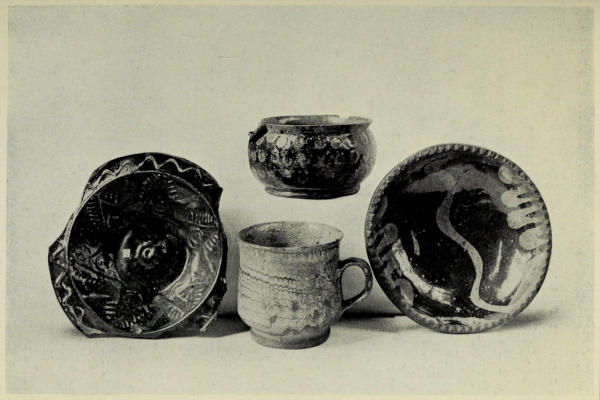
A little further off, in the valley of Tinkersclough,
Thomas Toft was actually attempting decoration.
The Toft dishes are well known. They are signed
with the name, Thomas Toft or Ralph Toft,
written in liquid slip clay upon the plate. They
are made of red, buff or yellow clay, and other
coloured slip-clays are dribbled over them through
a quill, so as to make pictures of Charles II, or
Queen Anne, or a pelican picking its breast to
feed its young. Then the whole is dusted over
with powdered lead ore, and fired till the lead
fuses into the plate and forms a rich yellowish
glaze.
Some of these productions, of what has come
to be called the Toft school, are dated. There is
a candlestick, very elaborate, dated 1649, and
claimed for Staffordshire. Shaw mentions two
dishes marked, one “Thos. Sans,” and the other
“Thos. Toft,” each dated 1650.[4] M. Solon had
seen a slip dish, in a cottage in Hanley, bearing
this inscription scratched on its back, “Thomas
Toft, Tinkers Clough, I made it 166-.”[5] A dish
with the picture of a soldier bearing a sword in
each hand, and inscribed in slip “Ralph Toft,
1677” is also mentioned by M. Solon.[6] Another,
marked Ralph Toft, and bearing the image of a
very wasp-waisted lady is in the Salford Museum,
dated “1676.”[7]
Other makers of this school were Thomas and
William Sans, Ralph Simson and William Taylor.
They made two-handled drinking mugs called
“tygs” with similar decoration; and small model
cradles made in clay and slip—presents for young
married couples, according to their local custom.
Puzzle Jugs were another “freak” production,
speaking the humour of the time. The jug was so
contrived with multiple spouts and hidden passages
as to spill however one tried to drink from
it. A sample of these puzzle jugs in stoneware
bears the inscription “John Wedgwood 1691.”[8]
This man was the eldest son of the Thomas Wedgwood
previously mentioned, and did not pot himself.
I think this jug was made for him by his
nephew, Richard Wedgwood, to whom he both
leased the Overhouse Works and married his
daughter and heiress. Several pieces are marked
with the name “Joseph Glass,” who is known to
have been a potter in Hanley in 1710-15.
All these early master potters were handy men
of many trades. They made their pots in sheds at
the “backsides” of their dwelling houses, alongside
the cow-shed. They dug their own clay, often
in front of their own front doors. The Wedgwoods
at least owned and dug their own coal, wherewith
to fire the oven. It was a peasant industry, carried
on by the family, among the pigs and fowls; and
when they were not making show pieces for presentation
they made butter-pots, in which farmers
might market their butter at Uttoxeter—at least
so says Dr Plot.
CHAPTER II. A PEASANT INDUSTRY.
Dr Plot seems to have visited the Potteries
in 1677. In 1686 he published his
“Natural History of Staffordshire.” Although
he obviously takes the most lively interest
in the dances of witches, and that strange chemical
process called “striking with galls,” yet he was
also a keen observer, and found time to set down
the earliest account—and at the same time an
intelligent account—of the North Staffordshire
potting industry. A contemporary account of this
early date must obviously be of the greatest importance,
and it is here given in full.
“As for tobacco-pipe clays, they are found all
over the County ... whereof they make pipes at
Armitage and Lichfield ... also at Darlaston, but
of late disused, because of better and cheaper
found in Monway field betwixt Wednesbury and
Willingsworth, which make excellent pipes. And
Charles Rigg, of Newcastle, makes very good
pipes of three sorts of clay; a white, and a blew,
which he has from between Shelton and Handley
Green.”
Slip decorated Staffordshire ware.
c. 1660. In the Stoke-on-Trent Museums.
“The most preferable clay of any is that of
Amblecot, of a dark blewish color, whereoff they
make the best pots for the glass-houses of any in
England; ... Other potters clays for the more common
wares, there are ... at Horseley Heath, Tipton
and in Monway field ... of these they make
diverse sorts of vessells at Wednesbury, which they
paint with slip made of a reddish sort of earth
gotten at Tipton.
“But the greatest pottery they have in this
County is carried on at Burslem, near Newcastle-under-Lyme,
where for making their severall sorts
of pots they have as many different sorts of clays,
which they dig round about the towne, all within
half a miles distance, the best being found nearest
the coale; and are distinguished by their colours
and uses as followeth:—
1. Bottle clay, of a bright whitish streaked yellow
colour.
2. Hard-fire clay of a duller whitish colour, and
fuller interspersed with a dark yellow, which
they use for their black wares, being mixed
with the
3. Red blending clay, which is of a dirty red
colour.
4. White-clay, so called, it seems though of a
blewish colour, and used for making a yellow-coloured
ware, because yellow is the lightest
colour they make any ware of.[9]
all which they call throwing clays, because they are
of a closer texture, and will work on the wheel;
“Which none of the three other clays, they call
slips, will any of them doe, being of looser and
more friable natures; these mixed with water they
make into a consistence thinner than a syrup, so
that being put into a bucket it will run out through
a quill; this they call Slip, and is the substance
wherewith they paint their wares; whereof the
1-sort is called the Orange slip, which before it
is worked, is of a greyish colour mixt with
orange balls, and gives the ware when annealed
an orange colour.
2. The White slip, this before it is workt, is of a
dark blewish colour, yet makes the ware yellow,
which being the lightest colour they
make any of, they call it (as they did the clay
above) the white slip.
3. The Red slip, made of a dirty reddish clay,
which gives wares a black colour.
neither of which clays or slips must have any gravel
or sand in them; upon this account before it
be brought to the wheel they prepare the clay by
steeping it in water in a square pit, till it be of a
due consistence; then they bring it to their beating
board, where with a long spatula they beat it
till it be well mixed; then being first made into
great squarish rolls, it is brought to the wageing
board, where it is slit into flat thin pieces with a
wire, and the least stones or gravel pickt out of it;
This being done, they wage it, i.e. knead or mould
it like bread, and make it into round balls proportionable
to their work, and then tis brought to the
wheel, and formed as the workman sees good.
“When the potter has wrought the clay either
into hollow or flat ware, they are set abroad to
dry in fair weather, but by the fire in foule, turning
them as they see occasion, which they call
whaving: when they are dry they stouk them,
i.e. put ears and handles to such vessels as require
them: These also, being dry, they then slip or paint
them with their several sorts of slip, according as
they design their work,—when the first slip is dry,
laying on the others at their leasure, the orange slip
making the ground, and the white and red the
paint; which two colours they break with a wire
brush, much after the manner they do when they
marble paper, and then cloud them with a pensil
when they are pretty dry. After the vessels are
painted they lead them, with that sort of lead ore
they call smithum, which is the smallest ore of
all, beaten into dust, finely sifted and strewed upon
them; which gives them the gloss, but not the
colour;[10] all the colours being chiefly given by the
variety of slips, except the motley colour, which
is procured by blending the lead with manganese,
by the workmen called ‘magnus.’[11] But when they
have a mind to show the utmost of their skill in
giving their wares a fairer gloss than ordinary,
they lead them then with lead calcined into powder,
which they also sift fine and strew upon them
as before, which not only gives them a higher
gloss, but goes much further too in their work,
than lead ore would have done.
“After this is done they are carried to the oven,
which is ordinarily above 8 foot high, and about
6 foot wide, of a round copped forme, where they
are placed one upon another from the bottom to
the top: if they be ordinary wares such as cylindrical
butter pots &c. that are not leaded, they
are exposed to the naked fire, and so is all their
flatware though it be leaded, haveing only parting-shards,
i.e. thin bits of old pots put between them,
to keep them from sticking together. But if they
be leaded hollow-wares, they do not expose them
to the naked fire, but put them in shragers, that
is, in coarse metall’d pots, made of marle (not clay)
of divers formes, according as their wares require,
in which they put commonly three pieces of clay
called Bobbs for the ware to stand on, to keep it
from sticking to the shragers; as they put them
in the shragers to keep them from sticking to one
another (which they would certainly otherwise
doe by reason of the leading) and to preserve them
from the vehemence of the fire, which else would
melt them downe, or at least warp them. In 24
hours an oven of pots will be burnt, then they let
the fire goe out by degrees which in 10 hours more
will be perfectly done, and then they draw them
for sale, which is chiefly to the poor cratemen,
who carry them at their backs all over the whole
Countrey, to whome they reckon them by the
piece, i.e. Quart, in hollow ware, so that 6 pottle,
or 3 gallon bottles make a dozen, and so more or
less to a dozen, as they are of greater or lesser
content; The flat wares are also reckon’d by pieces
and dozens, but not (as the hollow) according to
their content, but their different bredths.”[12]
Again, in discussing the great dairy produce
market at Uttoxeter, at which the Cheesemongers
of London had thought it worth while to set up a
“factorage,” Plot says:—“the factors many mercat
days (in the season) lay out no less than £500 a
day, in these two commodities [butter and cheese]
only. The butter they buy by the pot, of a long
cylindrical form, made at Burslem in this County
of a certain size, so as not to weigh above 6 lbs. at
most, and yet to contain at least 14 lbs. of butter,
according to an Act of Parliament made about
14-16 years agoe, for regulating the abuses of
this trade in the make of the pots and false packing
of the butter.”[13]
Later on, too, he describes how the lead ores are
“dug in a yellowish stone, with cawk and spar, on
the side of Lawton Park;[14] where the workmen
distinguisht it into three sorts, viz. round ore, small
ore, and smithum.” He describes how the ores are
cleaned; “which done, it is sold to the potters at
Burslem for 6 or 7 pounds per tun, who have
occasion for most that is found here for glaseing
their pots.”
For a contemporary inventory of a nascent industry
Plot’s account is extraordinarily full and
accurate. It is so important and so unique, that no
apology need be made for quoting it at length.
The pot-oven described by Plot would be surrounded
by a wall of clods of turf to keep in the
heat, or by a “hovel” with walls of broken saggars,
roofed with boughs and clods of earth. Each
pot-works consisted of a hovel such as this, some
thatched open sheds for drying the ware, and an
open tank or sun-pan in which the clay mixed
with water was evaporated. These sun-pans or sun-kilns
were 12 to 20 feet long and wide and about
18 inches deep. One portion partitioned off, and
deeper and lined with flag-stones, was used for
mixing. Here the clay was “blunged” by a man
with a long pole or paddle, and thoroughly mixed
with the water. The mixture was then poured
through a sieve from the blunging vat into the
sun-pan.
A pot-works of almost exactly this description
is to be seen to-day at Garshall Green near Stone,
for making flower pots; even here, however, a
pugmill has taken the place of the blunging pole.
It was a very raw industry in 1677. What led
to the artistic development of pottery in England
as a whole was the trading contact with the advancing
civilization of Holland and Germany.
The English were learning all through the reigns
of Elizabeth and the Stuarts to adapt pottery to
drinking and eating purposes; and the London
and Bristol potters were learning to copy the tin-enamelled
dishes from Delft, and the stoneware
drinking mugs from the Rhine. The ideas which
Holland and Germany had passed on to London,
found their way at last to North Staffordshire. In
that narrow area were to be found the requisites
needed for a manufacture;—the clays to make, the
coals to fire, the men with experience. All that
was still needed was the artist and experimental
chemist. It might even be said that the artists were
already there and in a sense they were.
Probably the commonest production of the
North Staffordshire Potteries in 1677, after the
redoubtable butter-pots, was the marbled ware
that Plot mentions. This method of decoration
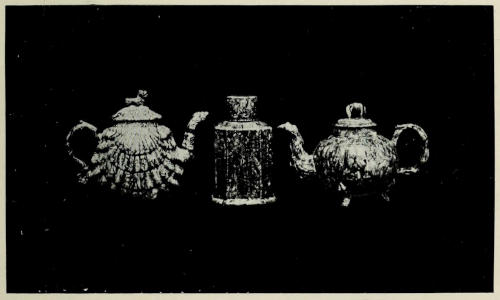
consists of laying on lines or splashes of the different
coloured slips, and then combing or sponging
them together. This marbled ware remained popular
for a hundred years, and was the legitimate
precursor of the solid agate wares of Whieldon and
Wedgwood.
A later historian, Simeon Shaw, writing in 1828,
tells us on the authority of tradition that, besides
makers of the butter-pots, and the mottled and
marbled ware, and the slip-decorated ware, there
was in 1685 a potter, Thomas Miles of Shelton,
who was even then making from a local clay,
mixed with white sand from Baddeley Edge,
something which he calls “stone-ware.”[15] Certain
it is, as will be shown later, that Aaron Wedgwood
and his sons Thomas and Richard and also Matthew
Garner were making brown stoneware and
red teapots in Burslem in 1693. Stoneware, as we
understand it, is so hard and dense that it requires
no glaze to make it impervious to water, because
it can be fired at such a high temperature as to
partially fuse the body of the ware. This stoneware,
afterwards glazed with salt, was to be the
most distinctive product of North Staffordshire.
These peasant potters “fired” and “drew out”
one oven a week. They drew the cold oven on Monday;
refilled it with new ware about Thursday,
and fired it on Friday, giving it a last stoking up
on Saturday morning, after which it cooled till
Monday again. The ordinary ware was at this
time only fired once, and only fired to a moderate
temperature, just sufficient to melt the
dusted lead ore and fuse it into a glaze on the surface
of the ware, thus making it impervious to
water. Though the native potters were even then
trying to improve their craft from the German or
Dutch potters employed in London, yet, as M.
Solon has shown, they owed very little to the
science or knowledge of the world, even the limited
knowledge of that period. The colouring properties
of Copper Oxide were known and employed
throughout England at this period, yet there is
no trace on the wares of the North Staffordshire
potters till the eighteenth century is well advanced
of the distinctive blue given by this invaluable
colouring material.
The ware produced was sold to the travelling
packmen, and, at great cost, distributed on horseback
throughout the country. Everything was
coarse and elementary. There were no turning
lathes to give neatness to the thrown article; there
was no white body or ground upon which to enamel
colours; there were no moulds for any but the
smallest ornamental “spriggs”; no enamel paints;
and there was practically no means of getting to
a market.
Such was the state of the Staffordshire potting
trade in the year 1693, when those mysterious
foreigners, John Philip Elers and David Elers,
appeared upon the scene, like Cortez among the
Mexicans, and broke up for ever the placid uneventful
course of the old peasant industry.
CHAPTER III. ELERS AND ART.
The brothers Elers are supposed to have
come from Amsterdam in the train of the
Prince of Orange. Jewitt has studied their
pedigree and says they were originally of a noble
family of Saxony—their father an ambassador,
their grandfather an admiral! However that may
be, the first notice we have of them is in a note
in the Philosophical Transactions of 1693 by Dr
Martin Lister. He says: “I have this to add, that
this clay Haematites, is as good, if not better,
than that which is brought from the East Indies.
Witness the teapots now to be sold at the potters
in the Poultry in Cheapside, which not only for
art, but for beautiful colour too, are far beyond
any we have from China; these are made from the
English Haematites in Staffordshire, as I take it,
by two Dutchmen incomparable artists.”[16] We too
may call them incomparable artists if we compare
this evidence with Plot’s account of fifteen years
before, or their teapots sold at a guinea a time,[17]
with the almost barbaric puzzle-jars of the native
potter.
It has hitherto been assumed from this statement
of Dr Lister’s that the Elers were in Staffordshire
in 1693. It does not follow from the extract
that the teapots were made in Staffordshire, only
that the clay came from thence. In the same year,
1693, they were sued by Dwight of Fulham for
copying his red teapots, and in the suit they are
described as “of Fulham.” Moreover Dr Martin
Lister, writing again in 1698 in his “Account of
a Journey to Paris in the Year 1698,” says, after
speaking of the porcelain made at St Cloud, “As
for the red ware of China, that has been and is done
in England.... But we are in this particular beholden
to two Dutchmen who wrought in Staffordshire,
as I have been told, and were not long
since in Hammersmith.”[18] This, it will be seen,
confirms the supposition that they first made their
teapots and stoneware in Fulham or Hammersmith.
The important Chancery Suit, discovered by
Prof. Church, in which Dwight sued his copyists
at Fulham, Nottingham and Burslem is as follows:
June 20, 1693. The complaint of John Dwight
of Fulham in the County of Middlesex, gentleman,
showing that the complainant having ... invented
and set up at Fulham several new manufactures
of earthenwares called White Gorges, marbled
porcelaine vessells, statues and figures and fine stone
gorges and vessells never before made in England
or elsewhere, and alsoe discovered the mystery of
opacous red and dark coloured porcelaine and
china ... obtained lettres patent dated June 12,
1684 ... he and his servants have for several years
past used ... said invention ... and sold them....
But having formerly hired one John Chandler of
Fulham ... and employed him in the making ...
thereupon John Elers and David Elers, both of
Fulham (who are forreigners and by trade silversmiths)
together with James Morley of Nottingham
and also Aaron Wedgwood Thomas Wedgwood
and Richard Wedgwood of Berslem in the
County of Stafford and Matthew Garner ... did
insinuate themselves into the acquaintance of the
said John Chandler and ... inticed him to instruct
them ... and to desert the complainant’s service
to enter into partnership together with them to
make and sell the said wares ... but far inferior to
them.... And the said confederates, “the better
to colour their said unjust and injurious practises,”
pretend that the earthenwares made and sold by
them are in no way like those invented by the
complainant but differ from them in form and
figure and have several additions and improvements ...
whereas the truth is they are made in
imitation of the complainants wares ... prays that
writs of subpena be directed to John Chandler, John
Elers, David Elers, Aaron Wedgwood, Thomas
Wedgwood, Richard Wedgwood and Matthew
Garner and James Morley.
The answer, dated June 8, 1694, of the man
with the Staffordshire name of Garner to this Bill
of Complaint, shows that he was apprenticed
about 1680 for eight years to one Thomas Harper
of Southwark, potmaker, and he says that, afterwards,
he invented a way of making earthen brown
pans and mugs, which art he still practises. The
answer of David Elers to the same Bill, dated
July 28, 1693, states that he learnt at Cologne the
manufacture of “earthenware commonly called
Cologne or Stone wares,” and that about three
years ago he and his brother began to make brown
mugs and red teapots “within this kingdom of
England,” and employed John Chandler. He says
that neither he nor his brother nor Morley nor
any of the other defendants knew John Chandler
while he was in the employ of Dwight. He denies
that James Morley was ever a partner with him
or his brother, or that Chandler was more than
a hired labourer. He complains that he and his
brother ought not to be deprived of their living.
An order was made on August 10, 1693, for a
trial of the action against Morley and the Elers
for the making of a brown mug and two red teapots
in imitation of china. Before the trial came
on in November the Elers came to terms with
Dwight, and Morley put off his case by claiming
that he only made brown mugs and not the red teapots.
On December 15, 1693, the three Wedgwoods
were ordered to be added to the Bill as
defendants, and on May 5, 1694, Matthew Garner
was added also. On May 19, 1694, the Wedgwoods
“for delay have craved a dedimus to answer
in the country,” and yet in the meantime proceed
to make and vend the several wares, against which
continuance the plaintiff Dwight obtained an injunction
“until they shall directly answer to the
complaint and the Court shall make other order to
the contrary against them their workmen servants
and agents.” On June 21, 1694, a similar injunction
was obtained against Matthew Garner; and
on July 26, 1695, against Morley. Garner in his
turn wanted his witnesses examined in the country,
and the cases against him and Morley and one
Luke Talbott dragged on till July, 1696, though
nothing more is to be found of the suit against the
Wedgwoods. Probably they too compromised on
the basis of each paying their own costs, for the
last notice there is of these suits is one dated July 1,
1696, which shows Dwight suing his solicitor for
excessive costs.
Earliest known piece of Staffordshire salt
glaze ware, 1701. From the Stoke-on-Trent Museums.
This suit, given by Professor Church in the
“Burlington Magazine” (February, 1908) upsets a
good many preconceptions, and throws considerable
light on the stage at which the development
of the potting craft had arrived in 1693. In the
first place Garner, a Staffordshire lad to judge from
his name, is apprenticed to a London potter.
This shows communication between London and
Staffordshire, and a clear desire to improve a potting
trade in Staffordshire by contact with more
civilized methods. Then the injunction obtained
against Aaron Wedgwood and his sons, “Doctor”
Thomas and Richard “of the Overhouse,” shows
that they were making in 1693 the red teapots,
known to collectors as Elers and Dwight, and the
brown stoneware which, glazed with salt, was
later the characteristic work of Dr Thomas Wedgwood.
We must, therefore, call these Wedgwoods
and Matthew Garner the first known Staffordshire
makers of stoneware, and as Garner was out of his
apprenticeship in 1688, and Elers started in Fulham
in 1690, we can give the date 1690 as the
starting point of the stoneware glazed with salt in
Staffordshire.
If there was a definite partnership between the
Elers and the Wedgwoods I expect it was confined
to the supply of red Staffordshire clay to the factory
at Fulham. It may well be that, as a result of this
very action, the Elers determined to shift their
workshops and put them up in the place whence
hitherto they had got their clay, and where the
unfortunate leakage that had perhaps betrayed
Dwight’s secrets could, in their case, be more
easily prevented. Be the cause what it may, between
1693 and 1698 John Philip Elers, the elder
brother, was established in a secluded farm in
Bradwell Wood under Red Street. It should be
noticed that at this time, and for half a century
afterwards, Red Street was important as a potting
village. Messrs Mayer & Moss of Red Street
were, about 1740, among the most considerable
potters of their day.
Here, at Bradwell, the Elers put up their workshops
and small kiln, while they lived at another
old house, Dimsdale Hall, which is still standing
about a mile to the south. Shaw[19] had a legend
about an elaborate underground speaking-tube,
fixed from Bradwell to Dimsdale, through which
notice might be given to the works of the approach
of strangers. And it is a curious tribute to the value
of such legends that, within the last few years,
white earthenware voice-pipes have actually been
dug up on the site of the Bradwell factory. They
did not, of course, really extend from Bradwell to
Dimsdale, but they went from one part of the
factory to another, and were probably devised to
secure secrecy rather than modern economy. These
pipes are now to be seen in the Hanley Museum,
and the curious thing is that one of them is glazed
with salt. This, besides confirming the legend of
the voice-pipes, is the only certain living witness
that the Elers used salt glaze.
We have spoken of the two brothers going to
Staffordshire, but the recently accepted view is that
John Philip Elers alone worked at Bradwell, while
David remained in London at the shop in the
Poultry, where he sold his brother’s teapots at from
12s. to 24s. apiece.[20]
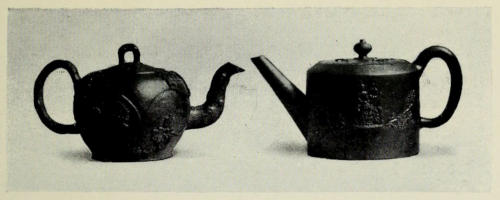
The first pottery ware made at Bradwell was the
same as Dwight’s “red porcelaine.” On the land at
Bradwell Farm was the seam of red clay which
formed the foundation of the ware, giving when
fired a dense hard red stoneware of fine texture.[21]
There are in the South Kensington Museum two
pieces of “red porcelain” credited by Burton
to Elers and illustrated in his book. They are
in marked contrast to the slip decorated and
marbled Staffordshire ware of the same time.
They have been turned in the lathe after throwing,
and thus made thin and light. The clay
body is homogeneous and smooth, showing
greater care in the preparation of the body.
The ornamentation is delicate and artistic,
and has been made by sealing a soft piece of
the clay on to the ware with a metal seal
pressed over the soft clay. There is no glaze,
but a high fire has produced a ware so hard as to
be almost forged solid. These things show the
hand of the ex-silversmith in size and shape and
finish. The Burslem imitators—Garner and the
Wedgwoods—never made things like these. Elers,
though he may have stolen Dwight’s secrets, went
ahead and showed the possibilities of potting. He
is said also to have produced black ware of a
similar character by mixing oxide of manganese—the
“magnus” of Dr Plot—with the
clay body, and, though no known pieces of
black Elers ware can now be certainly identified,
it is this black ware that his copyists chiefly
developed.[22]
1. Red china teapot, probably by Elers.
c. 1700.
2. Sample of later date, with moulded spout. Stoke-on-Trent
Museums.
Samples of solid agate ware made by
Wedgwood or Whieldon. c. 1760.
For Nemesis overtook John Philip Elers, and
in spite of all his secrecy, perhaps because of it,
he was copied. Two potters, Twyford and Astbury,[23]
one of whom at least had already made pots
after local methods in Shelton, set themselves independently
to acquire the arts of the Dutchman.
To lull the suspicions of Elers, Twyford shammed
stupidity, and Astbury, who was younger, passed
himself off as an idiot. Recommended by these
strange qualifications, they asked and obtained
employment and, in time, the knowledge they
desired. They went back to Shelton with their
acquired arts, and, in a few years, the most intelligent
potters of North Staffordshire knew how
to make civilized pottery. But by 1710 John
Philip Elers was tired of his exile and of the
treatment he had received. The true porcelain
which should detect poison was still unattained,
and his “red porcelain” and his black ware were
become by somewhat sharp practice a staple product
of the district. So he shook off the clay of
Staffordshire from his feet and rejoined his brother
in London.
Years later Josiah Wedgwood, who had every
reason to know the history of the potteries from
hearsay, legend and family tradition, gave an account
to his partner Bentley of what John Philip
Elers had done. The son, Paul Elers, had asked
Wedgwood to make a medallion of his father’s
head, surrounded by the motto: “Plasticis Britannicae
Inventor.” Josiah Wedgwood—looking
back on the long array of his ancestors, all potters
born and bred in Burslem before ever Elers put
his hand to the thrower’s wheel—says the motto
“conveys a falsehood,” and that John Philip Elers
merely improved the Art. “The reason,” he writes
in 1777, “for Mr Elers fixing upon Staffordshire
to try his experiments, seems to be that the Pottery
was carried on there in a much larger way,
and in a more improved state, than in any other
part of Great Britain.” “The improvements Mr
Elers made in our manufactory were precisely
these. Glazing our common clays with salt, which
produced Pot d’Grey or Stone Ware.... I make
no doubt but glazing with salt, by casting it
among the ware while it is red hot, came to us
from Germany, but whether Mr Elers was the
person to whom we are indebted for the improvement
I do not know.... The next improvement
introduced by Mr Elers was the refining our common
red clay by sifting, and make it into Tea and
Coffee ware in imitation of the Chinese red
Porcelain, by casting it in plaster moulds, and
turning it upon the outside upon lathes, and ornamenting
it with the tea-branch in relief.”[24]
It is impossible to say why Wedgwood attributed
“casting in plaster moulds” to Elers, for
all the evidence goes to show that the process
known technically as “casting” only came in with
the introduction of alabaster “blocks” and pitcher
moulds after 1730. As to the far more important
and debatable point—the introduction of the
process of glazing with salt—this evidence of
Wedgwood’s is perhaps the most reliable that we
can get.
As the invention of salt glazing not only made,
at one stroke, a new manufacture possible, but
one that was peculiar to North Staffordshire, it
may be as well to examine more closely the evidence
as to its discoverer and its discovery.
The idea that salt glazing was accidentally discovered
at Bagnal by some strong brine solution
boiling away in an earthen pot which became
automatically glazed[25] may be dismissed at once
for the simple reason that it could not happen as
described. It may be urged too in Elers’ favour
that, long before this, salt glazing was practised in
Germany. Again, Aikin in his “History of Manchester,”
written in 1794, gives an elaborate account
of the novelty as practised by Elers. He writes:
“It was in the memory of some old persons with
whom a friend of ours was well acquainted that
the inhabitants of Burslem flocked with astonishment
to see the immense volumes of smoke which
arose from the Dutchmen’s ovens on casting in
the salt; a circumstance which sufficiently shows
the novelty of this practice in Staffordshire Potteries.”[26]
Probably this part of Dr Aikin’s work
was written by Alex. Chisholm, secretary to Josiah
Wedgwood.
At least the same story was told to Josiah
Wedgwood in 1765 by an old workman named
Steel, aged 84, who could remember the Dutchmen
at work at Bradwell, and who joined those
who ran to the place amazed at this unusual mode
of firing. No doubt this is what was in Wedgwood’s
mind when he wrote to Bentley in 1777,
as quoted above.
On the other hand we have the evidence of
Simeon Shaw,[27] first that William Adams and
Thomas Miles produced salt glaze in 1680 (a very
doubtful supposition in view of the Chancery suit
recently discovered), and then that “Mr. John
Mountford, 27 years since (i.e. in 1801), took
down the remains of the (Elers’) oven, and he
states that the height was about 7 feet, but not like
the salt-glaze ovens.” And again: “E. Wood and
J. Riley both separately measured the inside diameter
of the remains, at about 5 feet; while other
ovens, of the same date, in Burslem, were 10 or
12 feet. The oven itself had 5 mouths, but neither
holes over the inside flues nor bags, to receive the
salt, had any been used by them.” “The foundations,”
he adds, “were very distinctly to be seen
in 1808, though now covered by an enlargement
of the barn.”
Also there is the fact that no salt glaze ware
that could be conclusively shown to be Elers’ has
ever been excavated on the site of his factory,
except the white voice-pipes previously mentioned.
Taking everything into consideration—the
impossibility of saying definitely who the makers
of early pieces of salt glaze were; the possibility
of Elers having made his salt-glaze in a different
oven and on a different site to that seen and excavated;
the fact that in 1710-1715 Staffordshire
potters were making stoneware, and that Plot
does not mention it in 1677—none but Garner
and the Wedgwoods were sued for making even
stoneware in 1693—we may assume that the
Elers did, in actual fact, introduce the salt glaze
into North Staffordshire.
The red and black bodies made by Elers are
still in fashion, but even more valuable than the
doubtful invention of the particular ware was his
careful method of refining and mixing the clay
body, and the exact turning of the pieces to extreme
thinness and precision of outline. On the
excellence of his work, rather than on inventions
which were not really new, his fame deserves to
rest. He may not, for example, have been the
first to introduce the method of sealing on the
clay ornaments, but the ornaments themselves
were for the first time in really good taste. It was
this refined taste and precision of execution—and
the proof that it paid financially—which taught
the Staffordshire potters the most valuable lesson.
Thus it was that, when Queen Anne and tea
drinking came in, North Staffordshire had not
only the clay and the coal, but also the tradesmen
to make the ware required.
CHAPTER IV. THE SALT-GLAZE POTTERS.
The successors of Elers—Robert Astbury,
Joshua Twyford, and especially Dr
Thomas Wedgwood—built up the reputation
of the salt-glazed stoneware, which for fifty
years was the glory of North Staffordshire; and,
in the improvements they effected, the first two
atoned for anything that to the modern mind was
irregular in the manner by which they got their
start.
It was to Dr Thomas Wedgwood (1655-1717),
and his son Thomas (1695-1737), who made stoneware
at “Ruffleys” in Burslem, that local tradition
ascribes most of the improvements in salt-glazed
wares. Mr Burton writes of the younger Dr
Thomas: “It has never been suggested that Dr
Thomas Wedgwood, like Twyford or Astbury,
learned anything directly from Elers, but as he was
a man of intelligence and commercial aptitude, as
well as one of the best practical potters of the day,
he would naturally adopt such new ideas as were
brought in his way. Judging by the fragments of
drab salt-glazed stonewares that have been found
on the site of his old works in the centre of the
town of Burslem, collectors are in the habit of attributing
to him, with some show of justice, the
finest pieces of this type.”[28][29]
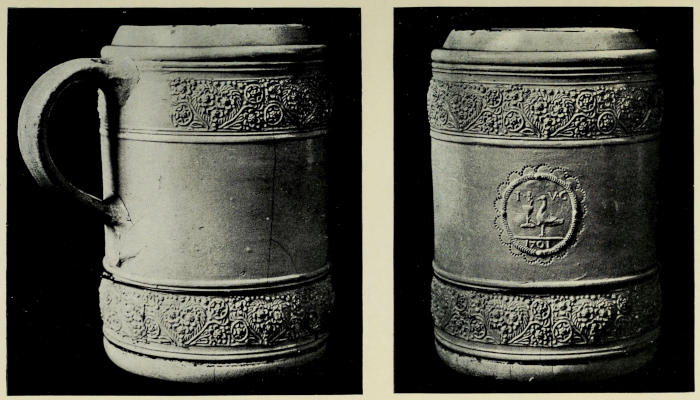
The secret of the salt-glaze process consists in
firing the ware, specially composed of clay mixed
with some siliceous sand or flint, to a temperature
higher than ordinary earthenware will stand, and
then, when red hot, shovelling common salt on to
it through the top of the furnace. The salt fumes,
passing through large holes in the saggars, cover
the ware with a fine coat of colourless soda glaze.
This glaze can always be distinguished from lead
glazes by its peculiar pock-marked roughness,
which indeed makes it somewhat unsuitable for
plates or dishes for ordinary use; and, although for
fifty years salt glaze did more than hold its own in
public estimation, improvements in the old earthenware
finally drove it out. By the end of the
eighteenth century salt glazing had ceased to be
practised.
Without Astbury,[30] who is said to have died in
1743, aged 65,[31] it is doubtful whether even salt
glazing could have been a really great success. He
it was that obtained a body white enough to show
off the transparent salt glaze to the best advantage.
Dr Thomas Wedgwood had only the drab body to
work on—a far less effective medium.
With the object of whitening the clay body,
Astbury began to import the white clays of
Devonshire.[32] At first he used them only as a wash
or dip to whiten the surface of the ware, just as
the tin-enamel had been used to conceal and coat
the coarse body of the Delft ware. Then he developed
the use of the white sands of Baddeley
Edge and Mow Cop to harden the body; and, in
1720, according to tradition, he made the really
vital discovery of the value of calcined flint stones
for both these purposes—to whiten and to harden
the clay body from which the stone ware was
made. Josiah Wedgwood, writing in 1777, attributed
this discovery to a potter of Shelton called
Heath instead of to Astbury,[33] but whoever it was
that first noticed the whiteness of burnt flints, it
was Astbury who first determined the value of the
new material and the manner of using it. This
discovery marks the first stage in the production
of cream-coloured earthenware as well as in the
production of the perfect salt glaze.[34]
Astbury and his son Thomas made red and
black ware also, after the pattern of Elers, but with
this difference, the ornamentation of Astbury’s red
or black ware is generally done in white clay,[35]
instead of in the same colour as the body; and this
is one sign by which collectors distinguish these
two makers. Robert (or John) Astbury was succeeded
by his son Thomas, who had started potting
at Lane Delf in 1725. Their name does not occur
among the potters of the latter half of the eighteenth
century, but Margaret, Thomas Astbury’s
daughter, married Robert Garner, a master potter
of Longton, who attained a considerable position.
Joshua Twyford (1640-1729), like Astbury,
had his factory in Shelton; one stood on either
side of the mound where the church now is. Twyford
is best known for his stoneware, chiefly red
and black in the style of Elers, but he is also supposed
to have made salt-glazed ware.
A particularly full account of the potters of
1710-15, especially of those in Burslem, is preserved
in a document drawn up by Josiah Wedgwood
in 1765. He gives both the weekly cost-account
of a typical pot factory of this period; and
also a list of the potters’ names and the kind of
ware they produced. The document is in his own
handwriting, and it appears from a letter of Wedgwood’s
to Lord Auckland in 1792 that he obtained
the information given in this document by “having
examined some of the oldest men in the pottery
here, near thirty years ago, who knew personally
the masters in the pottery, and very nearly the
value of the goods they got up, fifty years before
that.” ... “From these data,” he goes on to say,
“I can pretty nearly ascertain the annual value of
the goods made here at that time; which was
something under £10,000 a year.”[36] He then
proceeds to guess at the annual value of the trade
in 1792, which he says may be between £200,000
and £300,000. I cannot help thinking that his
estimate was purposely on the low side, for the
manufacturers of this date always lived in fear
of special taxation. In 1821 the export trade
alone was worth £423,399 a year,[37] and in 1822
£489,732.
The document runs as follows:
“Men necessary to make an oven of Black and
Mottled, per week, and other expences—
£
s.
d.
6 men, 3 at 4s. a week, and 3 at 6s.
1
10
0
4 boys at 1s. 3d.
5
0
1 cwt. 2 qrs. Lead Ore, at 8s.
12
0
Manganese
3
0
Clay, 2 cart-loads, at 2s.
4
0
Coals, 48 horse-loads, at 2d.
8
0
Carriage of do., at 1½d.
6
0
Rent of Works, at £5 per ann.
2
0
Wear and Tear of Ovens, Utensils, &c., at £10 p.a.
4
0
Straw for packing, 3 thrave at 24 sheaves to the thrave, at 4d.
1
0
The master’s profit, besides 6s. for his labor
10
0
£4
5
0
“N.B.—The wear and tear, master’s profits, and some
other things are rated too high. £4 per oven-full is
thought to be sufficient, or more than sufficient, for the
black and mottled works of the largest kind, upon an
average, as the above work was a large one for those
times.”
“POT-WORKS IN BURSLEM ABOUT THE YEAR 1710 TO 1715.”
“(£6417) annual produce of the pottery in the
beginning of the eighteenth century in Burslem
parish. Burslem was at this time so much the
principle part of the pottery that there were very
few pot works anywhere else.
“Potters at Hanley, the beginning of the 18th
centy.
Joseph Glass
Clowdy a sort of dishes painted with difft’ color’d slips,
and sold at 3s. and 3s. 6d. a doz.
Wm. Simpson
Clowdy and Motled.
Hugh Mare [Mayer]
Black and Motled.
John Mare
””
Rd. Marsh
Motled and Black. Lamprey Pots and Venison Pots.
John Ellis
Butter Pots &c.
Moses Sandford
Milk Pans and Small Ware.
“Only one horse and one mule kept at Hanley.
No carts scarcely in the country. Coals carried
upon men’s backs. Hanley Green like Wolstanton
marsh. Only two houses (meaning potteries) at
Stoke; Wards, and Poulsonson’s.”[39]
If this list is to be regarded as satisfactory evidence,
and it must be remembered that it only
professes to be a report of the fifty-year-old recollections
of old men, then it would appear that
Burslem was still the narrow home of the Potteries.
It shows us the master potter of that day, employing
11 hands at wages not exceeding 6s. a
week, working himself, and out of his single oven-full
a week making a profit of 10s. As represented
it is still a peasant industry. But the scope and
range of the pottery produced has increased since
Dr Plot described “the greatest pottery they have
in this County.” The butter-pots; the cloudy,
mottled, speckled and black; probably the red
dishes and pans; these all existed in Plot’s time;
but what is the “moulded” ware made by Cartlich
and Thomas Taylor and by Dr Thomas Wedgwood,
jun., in the middle of Burslem? The stone
ware too is new since Plot’s time. The five biggest
factories all make this stoneware, Dr Thomas
Wedgwood, sen., Moses Marsh, Aaron Shaw,
Moses Shaw, Sam. Edge and Richard Wedgwood,
the brother of Dr Thomas.
Undoubtedly this was the new salt-glazed
stoneware. The brown stoneware ascribed in the
list to Dr Thomas Wedgwood coincides exactly
with the drab salt-glazed teapot by him now in
the South Kensington Museum. It is supposed
to have been made by mixing the lightest burning
local clay with the fine white sand from
Baddeley Edge or Mow Cop.[40]
The list gives no potworks at all at the Longton
end of the district, yet then or shortly afterwards
Delft ware was probably made at the place
called Lane Delf, now part of Fenton. Shaw says
that in 1710 Thomas Heath of Lane Delf was
making a strange kind of pottery, and he proceeds
to describe a particular dish in such a way as to
show that it was really Delft ware.[41] There is no
trace of Delft ware having been made anywhere
else in the Potteries, or indeed at any subsequent
time at Lane Delf itself, so that we may fairly
ascribe to this solitary experiment of Thomas
Heath’s the name of the locality.[42]
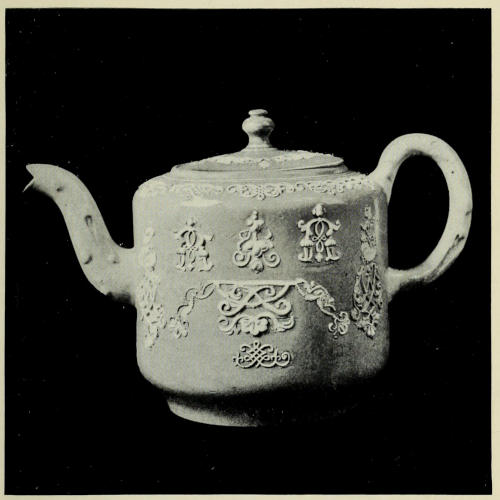
Salt glaze teapot, drab body, supposed
to be by Thomas Wedgwood, died 1737. From the Stoke-on-Trent
Museums.
At this Longton end, soon after 1710, there
was also made white ware of a greenish type,
called Crouch Ware. It was made from clay found
in Derbyshire that bore this name, and survived
as a fairly white ware till Astbury drove it out
with his whiter body. In 1725 Thomas Astbury,
the younger, set up his new factory in Fenton,
and from this date we may say that the whole of
the present Pottery area was engaged in the production
of Earthenware.[43]
In fact all that was wanted to convert the peasant
pottery of North Staffordshire into a great
business was the stimulus given by the refined hand
of Elers, and the new demand in the new clubs and
coffee houses. When once improvements in manufacture
began, invention followed invention; and
though the records during the second quarter of
the eighteenth century are full of entries of patents,
registered for the performance of every possible
and impossible pottery process, yet most of the
improvements—especially the vital changes in
body and glaze made by Astbury and Booth—became
public property unchecked by patent law.
First there was Astbury’s new white body,
made with a fixed mixture of powdered flint and
Devon clay, imported on horseback from the sea-port
of Chester. Twenty years earlier the idea of
bringing clay from Devon would have been regarded
as madness, and, even in 1720, carts could
not get to Burslem, and the clay must have been
brought inland on pack saddles. But the invention
of the calcined flint body meant also the invention
of that terrible disease known as “potter’s asthma”
or “potter’s rot,” which used to cause an even
greater mortality than lead poisoning. When white
flints were first used they were ground and powdered
in the dry state, in an atmosphere of flint
dust, in underground cellars, so that the secret of
this valuable new preparation should not leak out.[44]
This state of things was soon partially remedied,
for between 1726 and 1732 several patents were
taken out—by Gallimore, Bourne, and finally by
Benson—for grinding the flint stones in water.[45]
Benson’s final process has survived to this day as
the universal form of flint mill. A vertical shaft
with four radiating arms revolves in a circular
horizontal pan. The pan, with a hard stone bottom
of chert, is filled with water, and similar chert
blocks, pushed round by the arms, grind the flints
down to a cream. Flint grinding became an industry,
and in the well-watered valleys of North
Staffordshire, wherever there was both water-power
and flint, these flint mills sprung up and
flourished. Though most of them are now closed
down through the progress of railways and steam,
there are some still to be seen working in the Moddershall
valley, whence the creamy slip is sent in
by water-cart to Longton.
About this same time a workman named Alsager
perfected the potter’s throwing wheel as we
know it at this day.[46] And now that potters were
using these mixed ingredients, Devon clay, ground
flint syrup, and native clay in special and patented
proportions, the old method of evaporating the
slip under the sun in an open pan had to go. It is
said to have been Ralph Shaw, a most litigious
personage, who began specially to mix clays in a
liquid form in a fire-heated trough—locked, of
course, that no neighbour might discover the
“mystery.”[47] This same Ralph Shaw, of Burslem,
took out a patent in 1732, professing—as was
almost common form in those days—to make
earthenware like Chinese Porcelain. It was to be
white within, and white when required without.
It was made in reality by dipping the ordinary
ware in a white clay dip—just the process Astbury
had invented some twenty years before. But there
was this that was new to North Staffordshire;
Shaw scratched away the white dip on the outside
of the jug so that the blue ground became visible.
He produced indeed what the mediæval Italians
called “graffiato” ware, and very beautiful much
of it is.[48]
Shaw, however, tried to prevent anybody using
the white slip at all, and became such a nuisance
to his neighbours that they united in 1736 to take
up the case of John Mitchell, of Burslem Hill Top,
who was prosecuted by Shaw for infringing his
patent.[49] Great was the rejoicing in the Potteries
when the Judge at Stafford declared, or is reported
to have declared:—“Gooa whomm, potters, an’
mak what soourts o’ pots yoa leykin.” “An,” says
our narrator, “when they coom ’nto’ Boslum, aw
th’ bells i’ Hoositon (Wolstanton), and Stoke, and
th’ tahin, wurn ringin’ loike hey go’ mad, aw th’
dey.” Ralph Shaw is said to have been so disgusted
at the result that he emigrated to Paris, where he
made pots for many years.[50]
Ralph Shaw’s ware was known as “bit-stone
ware.” The “bit-stones” were put between two
pieces of ware when they were fired in the saggars
in order to keep them from sticking to each other.
They were the more necessary in that Shaw’s ware
was dipped in a light slip. The “bit-stones” have
long since been replaced by “spurs” and “stilts”
and other small earthenware objects, the special
manufacture of which is now a great industry by
itself. The single stilt and spur factory of Thos.
Arrowsmith in Burslem employs now 230 hands
on this manufacture alone.
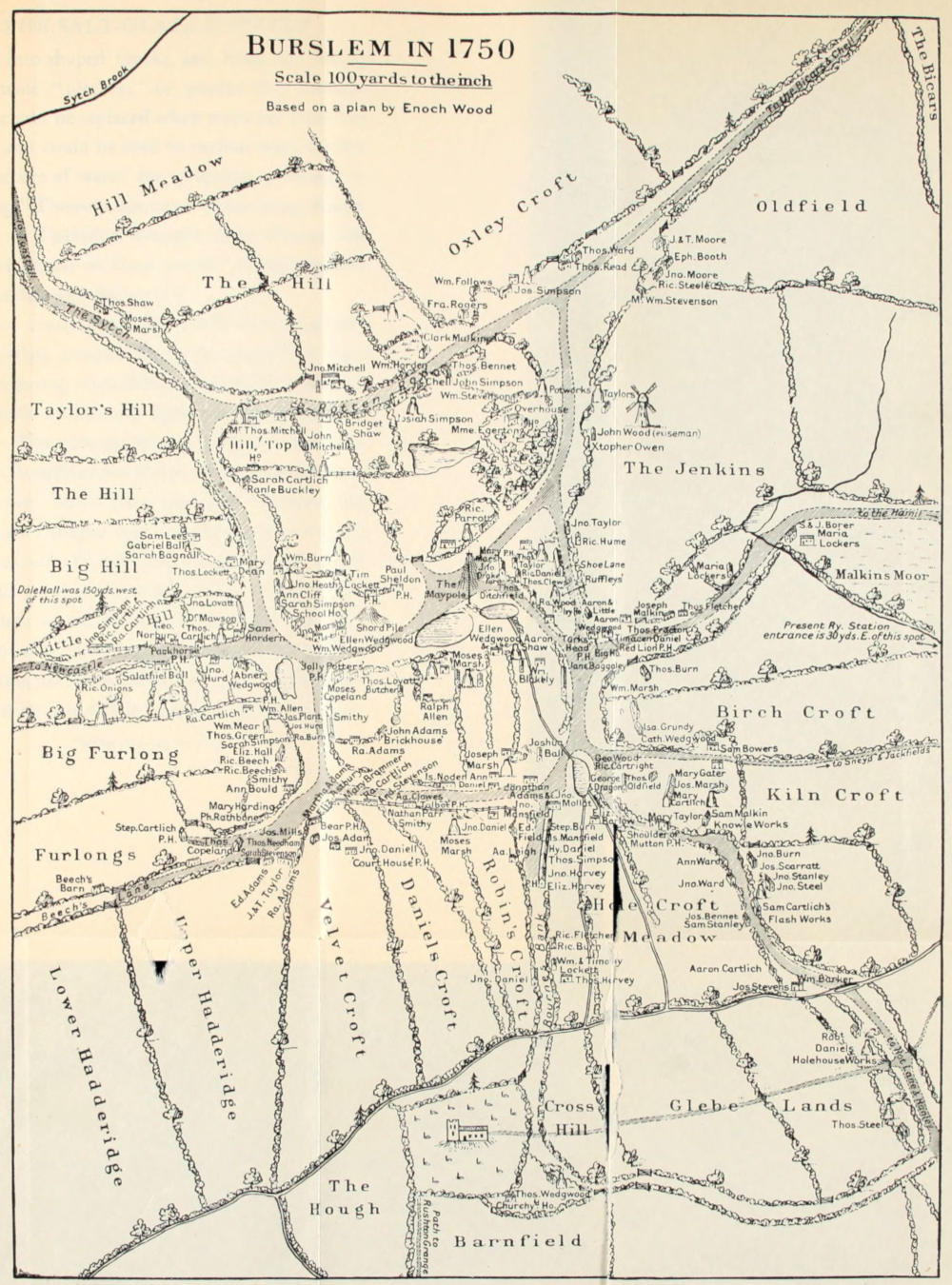
Burslem in 1750
Scale 100 yards to the inch
Based on a plan by Enoch Wood
If the old potters had had to rely only on the
thrower’s wheel for their shapes, no improvement
in whiteness of ware, or in the salt glaze, would
have availed much to increase the demand for
earthenware. The development of the various use
of moulds became of the greatest importance. The
six workmen required at such a potworks, as is
shown on the 1710 list, would be—slipmaker,
thrower, turner, “stouker,” to put on handles and
spouts, fireman and warehouseman. A good workman,
such as the master, could throw, turn and
stouk. But the fresh developments of the salt-glazed
stoneware arising from the use of moulds converted
potting into a specialized industry.
We have seen that Elers used metal seals to press
his ornamental “spriggs” on to his teapots. Such
metal moulds could only be used for small articles
or ornaments, for the mould stuck to the clay, and
had to be carefully oiled. Both for the “sprigging
on” of ornaments, and for the shaping of ware,
a new form of mould was wanted. At first the
alabaster of Derbyshire supplied the want. It was
carved into shaped blocks, and from the blocks
were made “pitcher,” or porous clay moulds,
which could be replaced when worn out from the
blocks, and could be used in various ways for the
manufacture of ware: for sprigging, pressing, or
“casting.” Then—a last step—about 1745, Ralph
Daniel, of Cobridge, brought from France the
secret of plaster of Paris moulds which replaced
both pitcher and alabaster.[51]
Under competition, the Staffordshire potters
were getting critical. The white salt-glazed ware
was competing with Chinese porcelain, and had
to be made as thin and light and transparent as
possible. The ware made by pressing the clay into
the moulds sufficed for plates, basins and any lead-glazed
ware, but it came out much too heavy for
complicated shapes such as sauce-boats, teapots
and vases, etc. To get these shapes Elers would
have had them thrown and turned down in the
lathe: they would all have been round. The process
known as “casting” in a mould produced a
finer result, and gave infinite scope for variation.
In casting, the clay is run in a liquid form into
a porous mould. After standing a few minutes,
the slip is run out again, leaving behind a clay
shell. This “cast” shell, taken out when dry, may
be as fine and as varied in shape as the skill of the
potter and the heat of his furnace will permit.
The process of casting came into use about
1730, and the carving of these moulds (in alabaster
first, from which the “pitcher” mould could
be made), became the most critical operation of
all the potter’s work. This work required all the
skill and artistic instinct of the carver and of the
designer. Block-cutters, as they were called, became
famous. The best known were the two brothers,
Aaron and Ralph Wood of Burslem. Aaron
Wood (1717-85) was bound apprentice in 1731
to Dr Thomas Wedgwood, some of whose best
models he is supposed to have made.[52] He afterwards
worked for J. Mitchell, of Burslem,[53] and
for Wheildon of Fenton, acquiring such a reputation
that he was allowed to work in a locked
room, that his art might thereby be kept secret.
CHAPTER V. THE BEGINNING OF THE FACTORY.
The industry was entering on a new phase.
The introduction of moulds had required
specialized block-cutters, flat and hollow-ware
pressers and casters. And the specializing in
the mixtures of the clay body lead to further
changes. Till 1740 the same clay body served for
both salt glaze and lead glaze, but about this time
manufacturers began to specialize in either salt or
lead glaze, and to use different bodies and mixtures
to suit the varied glazes.
And, just as they had to arrange to import clays,
so they had also to arrange to export their wares. A
London agent, a Liverpool agent, perhaps a Birmingham
agent became necessary. This sort of
business could no longer be carried on by a master
potter on sixteen shillings a week. The master
potter became a capitalist. No business could be
successfully carried on with a turnover of one
ovenful a week. The first attempt to increase the
output was made by either one Shrigley, of Burslem
Hadderidge,[54] or by John Mitchell of the
Hill Top.[55] As no potter, so goes the story, had
ever had more than one oven, their inventive
faculty went no farther than to construct a larger
oven than usual. The pioneer, whoever he was,
built a new one so large that it collapsed, to the
great joy of his conservative rivals. Soon afterwards,
however, the Baddeleys, said to have been
the sons of a Moddershall flint-grinder, put up
behind their factory at Shelton a row of no fewer
than four ovens; and about 1743, Thomas and
John Wedgwood, known as “of the Big House,”
built a tiled factory with five ovens.[56]
The family of Baddeley continued as master
potters in Shelton into the nineteenth century.
They were, with the exception of Wedgwood and
possibly Warburton, the largest exporters of
earthenware of their day.[57] Their cream colour
was good, but their renown with later generations
is due to their basket-pattern salt glaze, often perforated.
John Baddeley died in 1772, but the
family carried on the making of enamelled and
plain salt glaze to a later date than other manufacturers,
certainly after 1780, and good salt glaze
of late date is usually ascribed to the Baddeleys of
Shelton.[58] The Wedgwoods of the Big House
made the white salt glaze of a somewhat earlier
description—the cast hexagonal cups and teapots in
plain white—and with such financial success, that
they built for themselves in 1750 a “Big House”
in Burslem, which stands to this day at the corner
of the Market Place looking south down the new
Waterloo Road.[59] It is now the Conservative
Club. Thomas was an expert thrower to begin
with, and John the best oven fireman in the town.[60]
They retired from business in 1765 with a large
fortune.
It is said that in 1750 no fewer than sixty factories
were making salt glaze in the Potteries, and
every Saturday, for five hours at the time of firing
up, the whole country was black with the smoke
of the burning salt—so black, it is said, that
people groped their way through the streets of
Burslem. But meanwhile Enoch Booth at Tunstall
had invented the fluid lead-glaze destined in
time to turn plain earthenware into “cream-colour”;
Josiah Wedgwood at Burslem was
already devising new mixtures which should convert
“cream-colour” into “Queen’s Ware”; and
in Hot Lane, near by, John Warburton was starting
that enamelling work which, applied to the
Queen’s Ware, was to make it the standard earthenware
of the whole world. These three potters
were to alter entirely the course of the industry,
and make salt glaze a thing of the past, for museums
and collections. Unfortunately they did
not abolish the smoke.
Enoch Booth had married Ann, daughter of
Thomas Child of Tunstall. It was on his father-in-law’s
land that, about 1745, he started the first
considerable earthenware factory in Tunstall.
Booth was the legitimate successor of Astbury.
He took the earthenware body, white as Astbury
had left it, and, instead of using it for salt glaze,
he worked out the most suitable lead glaze, and
the best way of applying it to the piece. Instead
of dusting it over the ware in the dangerous dry
condition, he ground the lead ore up with flint and
clay and water. Into this fluid glaze the ware was
dipped. Not only did this give a uniform glossy
coat on each piece of ware, but different pieces
were all glazed alike. Booth had the ware dipped
after it had been fired, while it was in the porous
or “biscuit” condition but sufficiently firm to be
handled. A second firing to fuse on the glaze was
given to the ware after dipping. These two firings,
in the biscuit oven and in the “glost” oven, are
the ordinary processes of manufacture to this day.
Shaw gives 1750 as the date of this important improvement;[61]
it is possible that fluid glazes were
used before this and by others, but it was the combination
of fluid glaze and double firing that is
important, and this with some certainty we may
put down to Enoch Booth and the year 1750.
Booth’s original factory at Tunstall was probably
the “Old Bank” at the corner of Cross Street and
Well Street, but he extended his works at an early
date over the whole of the area now bounded by
Well Street, Market Square, High Street and
Calver Street, where he built the Phœnix Works.
Sometime before 1781[62] he had been succeeded
by Anthony Keeling who had married his daughter
Ann. Anthony Keeling built Calver House in
1793, but his trade suffered in the French wars,
and in 1810 he retired from business and went to
Liverpool where he died in 1816.[63] The Phœnix
Works were carried on by Thomas Goodfellow
till they were pulled down about 1860.
Ware, besides being thrown, moulded or cast,
and coated with the transparent glaze of salt or
lead, requires decoration. This decoration could
be given by coloured clay slips, after the manner
of the old Toft dishes, or after the manner of
Ralph Shaw’s “graffiato” ware, or as what is
called “scratched blue.” But decoration could also
be given by means of enamelling paints. Paints
that is which are mixed with glass, and, on being
heated, fuse into the glaze and become fast. This
enamelling was in the early days a special trade
and no part of the potter’s business. The shopkeeper
might, if he liked, employ somebody called
an enameller to enamel his particular cups and
saucers. The enameller used a small “muffle”
stove where the ware could be heated sufficiently
to fuse the glaze and paint together, while at the
same time it was kept away from direct contact
with flames or smoke.
Scratched blue salt glaze cup, dated 1750.
From the Stoke-on-Trent Museums.
The best enamellers were to be found in London,
engaged in enamelling the porcelain of Bow
and Chelsea; but it soon became obvious that
enamellers were wanted in the Staffordshire potteries
also. It was again two Dutchmen who
initiated into this art the native potters of Staffordshire.
They probably knew the Warburtons and set
up their enamelling ovens near them in Hot Lane.[64]
Here they worked and attempted to keep their
art secret, with the usual result of attracting
special attention. Their stoves, their mixtures and
their temperatures soon became public property,
and a regular enamelling industry was soon established
round Hot Lane. It is said to have been Ralph
Daniel, the man who had brought the secret of
plaster of Paris moulds from Paris, who did most
to develop enamelling.[65] He imported workmen
from London, Bristol and Liverpool, and soon
after 1750 the enamelling of earthenware and
salt glaze became a Staffordshire industry. Among
enamellers too should be mentioned a Shelton potter,
Walter Edwards, who was chemist and enameller
as well as potter. He had as partner the
Rev. John Middleton, curate of Hanley from
1737-1802, but Edwards, unlike the curate, died
young in 1753, leaving a book full of receipts for
glazes and enamels. The difficulty always was to
get metallic oxides which would stand heat.
From an artistic point of view they had much
better have left their salt glaze plain white, or
drab, or uniformly tinted by a slip dip. The salt-glaze
body compared with Chinese porcelain;
their painting did not compare with Chinese
painting, or only compared in an unfortunate
sense for Staffordshire. Earthenware, being made
for use, had less decoration, and what it got was
less gaudy and more suited for serviceable articles.
Enamelled salt glaze jug, probably by
Baddeley of Shelton, dated 1760. From the Stoke-on-Trent Museums. The
jug was a presentation piece from the Rev. J. Middleton,
who was a partner with the above Baddeley.
There was however one very successful, or at
least artistically successful, manner of colouring
the salt glaze. It was practised by William Littler
and Aaron Wedgwood (1717-1763), two brothers-in-law
who about 1740 were making salt-glaze
pottery at Brownhills. Taking a hint from Astbury,
they dipped their ware in a bath of carefully
lawned slip, so as to gave it a smooth surface before
firing. In this slip they proceeded to put
cobalt, which gave a beautiful uniform blue to
the whole piece, and this smooth blue body, under
the salt glaze, acquired a tint of great brilliance.
On the strength of Shaw’s account of this
process,[66] many writers have mistakenly attributed
to William Littler and Aaron Wedgwood the
first introduction of liquid glazes, but it is quite
clear, as Mr Burton has pointed out, that this
was no leaded blue glaze, but a blue slip subsequently
glazed with salt.[67]
Their success with the salt glaze induced Littler
and Wedgwood to make the first attempt to produce
real porcelain in Staffordshire. The proper
distinction between earthenware and porcelain is
the complete vitrification of the body in the case
of porcelain, as opposed to the vitrifying and
glazing of the surface only in the case of earthenware.
The Bow porcelain factory had started in 1744,
Chelsea in 1745, Worcester in 1751. In 1752
Littler and Wedgwood left their Brownhills factory
and removed to Longton Hall. Here they
began to make the well-known Longton Hall
porcelain. Perhaps Wedgwood or Littler had
worked at Chelsea. However that may be, the
porcelain manufactured was of the Chelsea type.
The body was largely made of ground glass, while
china clay, the basis of true porcelain, was not
used at all. The characteristic feature of this
Longton Hall porcelain is the bright under-glaze
blue that previously adorned Littler’s salt-glaze
ware. This Longton Hall factory only continued
till 1758.[68] Owing to the lack of demand for this
kind of ware, they lost all their money in the
venture and finally discontinued it. The stock-in-trade
is said to have been bought up by Duesbury,
who transferred it to the Derby porcelain factory,
started in 1756.[69] It was not till the discovery of
China Clay and China Stone and of their fusing
properties in 1768 that porcelain was again attempted
in Staffordshire. Through his daughter
Ann this Aaron Wedgwood was the grandfather
of William Clowes, known as the “founder” of
Primitive Methodism.
While the manufacture of salt glaze was flourishing,
more especially at the northern end of the
district, the old soft-fired earthenware, mottled,
black and cloudy, was still being made, and the
old slip decorated ware had not entirely vanished.
But the only famous potter in what might be
called the old Staffordshire style was Thomas
Whieldon.
Thomas Whieldon began making pots at Little
Fenton about 1740. He was a better educated class
of man than the ordinary potter. He potted well;
enjoyed trials and experiments for their own sake;
and, through his connection with both Wedgwood
and Spode, he may be said to have had the same
influence on the taste and education of the Staffordshire
potters that Elers had unintentionally half a
century before. If we are to believe Shaw, writing
in 1828, he began in a very humble way. He says:
“In 1740 Mr Thomas Whieldon’s manufactory
at Little Fenton consisted of a small range of low
buildings, all thatched. His early productions
were knife hafts for the Sheffield cuttlers; and
snuffboxes for the Birmingham hardwaremen, to
finish with hoops, hinges and springs; which he
himself usually carried in a basket to the tradesmen;
and being much like agate they were greatly
in request.”[70]
Plot mentions how the old potters used to marble
their ware by combing together the different
coloured slips, just as the paper on the inside of
book-bindings is now marbled. Whieldon carried
on this imitation work, and made it artistic and
important. Instead, however, of marbling the slip
or the glaze, he marbled his clay body in the solid.
Flat “bats” of clay of different colours—coloured
either naturally or else artificially with manganese,
cobalt or copper—were laid on each other, and
pressed and sliced again and again; care being
taken to preserve the same run of the grain. In
this way a streaked body was produced, which,
when pressed into moulds, retained the curious
markings of agate or marble. This was Whieldon’s
“solid agate,” with which the new trade in snuff
boxes and knife handles was supplied.[71]
He made toys, too, and chimney ornaments of
this same new material, or else glazed with brilliant
coloured glazes in splashes of irregular colour. He
made larger goods also—teapots, dishes and vases
in solid agate. All these were pressed in moulds;
and for moulder or block-cutter he had, from about
1746 onwards, the celebrated Aaron Wood. The
cream-coloured body, with Enoch Booth’s transparent
lead glaze, afforded Whieldon another
material on which to work. He took the colourless
fluid glaze and turned it madder brown with
manganese, or yellow with iron oxide, or green
with copper, or blue with cobalt. Then he mixed
them to give every shade of coloured glaze, and
laid these glazes on the ware to give infinite
variety. In this way he produced those beautiful
tortoiseshell wares for which he is most renowned.
His agate ware is solid; his tortoiseshell ware is a
glaze.[72]
He had acquired fame as a skilful potter before
Josiah Wedgwood joined him in 1754, and probably
produced already both the solid agate and
the tortoiseshell. In his last popular production—the
melon, cauliflower, and pineapple wares, with
their brilliant green glaze—it is probable that
Wedgwood’s incessant experiments played a decisive
part.
Besides having Wedgwood as a partner, he had
in his employ such examples of the new race of
potters as Josiah Spode, Robert Garner, J. Barker,
and Wm. Greatbach. Jewitt[73] has preserved for
us some of the hiring books and accounts of
Thomas Whieldon, in which the names and pay
of three of these four apprentices occur, and which,
as they are unique evidence of wages, are here
given:
Hired Wm. Cope for handleing and vineing cast ware
7
0
Pd his whole earnest
10
6
28
Hird Robt. Garner per week
6
6
Earnest
10
6
Pd him towards it
1
0
I am to make his earnest about 5s. more in
something.[75]
Mar
8
Then hired Jno Barker for ye huvels (ovens) @
5
6
Pd earnest in part
1
0
Pd it to pay more
1
0
Ap.
9
Hired Siah Spoade, to give him from this time to Martelmas next 2s.
3d., or 2s. 6d. if he deserves it
2nd year
2
9
3rd year
3
3
Pd full earnest
1
0
June
2
Hired a boy of Ann Blowers for treading ye lathe, @
2
0
Pd earnest
6
1751
Jany
11
Then hired Saml. Jackson for Throwing Sagers and fireing, per week
8
0
Whole earnest
2
2
0
Pd in part
1
2
0
Pd more [sic]
1
1
0
1752
Febry
22
Hired Josiah Spoad for next Martlemas, per week
7
0
I am to give him earn’
5
0
Pd in part
1
0
Pd do.
4
0
1753
June
21
Hired Wm. Marsh for 3 years. He is to have 10s. 6d. earnest each
year, and 7s. per week. I am to give an old coat or something abt
5s. value.
Aug.
29
Hired Westaby’s 3 children, per week
4
0
Pd earnest
6
1754
Feby
25
Hired Siah Spode per week
7
6
Earnest
1
11
6
Pd in part
16
0
Apparently workmen were hired by the year,[76]
and the highest wages paid were 8s. a week. It
will be seen that there has been practically no
increase in wages since the early days of the century.
One wonders where Wedgwood and Spode
obtained the capital wherewith to start their
businesses.
Josiah Wedgwood was Whieldon’s partner from
1754 to 1759. One of the stipulations of the partnership
is said to have been that Wedgwood might
keep his experiments to himself. It is certain that
he did experiment extensively, and we may attribute
to him the green glaze and successful patterns
of the “cauliflower” and “pineapple” wares.[77] It
would be a mistake to depreciate these patterns as
being unsuitable and vulgar imitations of nature.
The natural shapes were adapted and conventionalized
in a thoroughly artistic way, as anyone who
looks at Whieldon’s or Wedgwood’s samples of
this ware preserved in the South Kensington
Museum can see at a glance. Slavish imitations
there were later, but that was not Whieldon’s way.
Staffordshire figures decorated with
Whieldon glaze, probably by Wedgwood. c. 1760. Stoke-on-Trent
Museums.
Taste changed, however, and Whieldon’s wares
became unfashionable. It is only of quite recent
years that the agate and marble, perfected later by
Wedgwood, or the quaint cottage chimney ornaments
and tortoiseshell ware of Whieldon, Wedgwood
and Ralph Wood, have come to be valued
as a native and genuine Staffordshire art. When
Whieldon found that his market had left him he
made no attempt to follow in the wake of his
pupils, and about 1780 retired from business. His
factory was just south of the present railway station
at Stoke, and he built and lived in the house which
still looks down upon the Trent and the railway.
In 1786 he served as High Sheriff for the county.
He died in 1798, and is buried at Stoke. His
widow died in 1828, and one of his sons, Edward,
was for many years Rector of Burslem, and lived
at Hales Hall, near Cheadle. But his descendants
are now no longer to be found in the potteries.
We know of two other manufacturers who
made agate and tortoiseshell ware—Daniel Bird,
called “the flint potter” because of his experiments
with different proportions of flint in the clay body,[78]
and John and Thomas Alders of Cliff Bank. There
were probably many others. These two made
buttons and knife handles very largely. Both
worked at the Stoke end of the Potteries.
Before entering on the fresh epoch in the History
of Potting which opens with the work of Wedgwood,
it will be as well to recount the end of the
salt-glaze industry. It was a risky manufacture.
The ware was thin, and many accidents happened
in firing. Therefore the ware was costly; and only
small pieces could be so glazed. The fluid lead
glazes used by the skilful potters of the latter half
of the century gave a surface smoother and more
suitable for food. The demand for ornamental salt
glaze was small, and the enormous demand for useful
ware sent all the best potters into the useful
trade; while in the ornamental lines Wedgwood’s
Greek and Etruscan shapes entirely ruled the
market. All these causes conspired to ruin the salt
glaze, and by 1770 it had fallen into general disuse.
The last considerable makers of salt glaze were the
Baddeleys and Christopher and Charles Whitehead
of the Old Hall, Hanley.[79] No single maker
of salt glaze occurs on the 1787 lists. It was a fine
ware, characteristic of and peculiar to Staffordshire,
and when one considers the difficulties under
which its production was carried on, a tribute of
praise is due to those potters who so quickly developed
it to its highest state of perfection.
Shaw had an account, from the lips of an old
man of eighty-three, born in 1720, showing the
conditions under which this old-world industry
was carried on.[80] And before we come to the
modern life with its canals and steam and complete
“factory system,” it is worth while to give this
recollection of potting in 1750.
“Ralph Leigh was employed by John Taylor
of the Hill Top, to look after his horses, and was
the first man whose wages were raised from 10d.
to 12d. a day. With four or six horses he went
twice to Whitfield, or thrice to Norton, in a day for
coals; of which each horse brought 2½ cwt. on its
back; along lanes extremely dirty. At the pit, coals
then cost 7d. the draught, whether 2, 2½, or 3 cwt.,
for the colliers guessed at the quantity. The charge
for carrying each load from Norton to Burslem
was 3d., a penny a mile.[81] During a long time he
carried crates of pottery to Winsford, and brought
back ball clay. Each horse carried a crate on a pack
saddle, and a small panier on each side was used to
hold two or three balls of clay, weighing 60 or 70
lbs. Each horse was muzzled to prevent it biting
the hedges, and the roads were narrow and bad
and without toll gates. Afterwards with a cart and
four horses he went to Winsford and delivered his
crates the same day; and on the second day brought
back a ton of Chester clay to Burslem. He was
allowed four days to take crates to Bridgenorth,
and bring back shop goods for Newcastle. He
went with crates to Willington Ferry, and returned
with flint, plaister stone and shop goods. He has
gone to Liverpool and also as far as Exeter, before
there were regular carriers.”
ETRURIA WORKS
CHAPTER VI. WEDGWOOD AND THE CREAM COLOUR.
Such were the conditions under which the
salt glaze of Staffordshire and the agate of
Staffordshire were produced and perfected;
and having traced these manufactures to their climax,
it now remains to describe the rise of cream-coloured
earthenware—the cream colour, which
under Wedgwood became universal and perfected
as we know it to-day. But it would be a mistake
to attribute all good cream colour to Wedgwood.
Just as all red teapots get put down to Elers; or as
salt glaze is divided between Dr Thomas Wedgwood
and Astbury according to character; and just
as all another class of ware with irregular splashes
of coloured glaze is called “Whieldon,” so much
that Wedgwood never put his hand to has got
dubbed with his name, to the exclusion of contemporaries
as enterprising, such as Warburton
and Turner, and to the neglect of predecessors who,
like Astbury and Booth, had already done very
much to make Wedgwood’s development of the
cream colour possible.
The ordinary earthenware cream-colour body
was composed of ball clay from Dorsetshire, calcined
flint, and the lighter burning local clays.
After the discovery of china clay and china stone
in Cornwall about 1770, these two bodies both
came to be added to the standard mixture, and the
local clays were gradually dropped.[82] The glaze invented
by John Greatbach while at Etruria, and
called “Greatbach’s China Glaze,” finally completed
the development of the cream colour.[83] In
practice the results depended so largely upon the
exact composition of body and glaze, the exact
temperature of firing in biscuit and glost ovens,
and the subsequent decoration, that different potters
achieved different results from their cream
ware, and very different reputations. Josiah Wedgwood,
with whom we must now deal, with his so-called
Queen’s Ware, achieved undisputed pre-eminence,
and became the greatest agent in the
world-wide distribution of the cream-coloured
earthenware of North Staffordshire.[84]
Josiah Wedgwood, thirteenth child of Thomas
Wedgwood, master potter of the Churchyard
works in Burslem, was baptized in Burslem church
on July 12, 1730. He was a son, grandson and
great-grandson of potters. His brothers, his cousins
and his uncles made pots, and many had left an
enduring reputation behind them. Josiah too was
apprenticed to the trade in 1744 in his eldest brother’s
works by the Churchyard side at Burslem.
In 1752 he went into partnership with John
Harrison, a tradesman of Newcastle, and they took
the factory of the Alders’ at Cliff Bank, Stoke.
Here they turned out the agate knife-blades and
buttons that Alders had produced before. In two
years Wedgwood was able to leave this partnership
and join with Whieldon, the best potter of
the day. For five years at least these two men were
in partnership. Whieldon supplied the skill and
traditional knowledge, and Wedgwood the extraordinary
energy which was his chief characteristic.
His experiments were incessant, and the fine green
glaze seen on his cauliflower ware, his first real
success, was his reward.
Truly and affectionately yours,
J. WEDGWOOD
Etruria, 14th Feb. 1774
The Relationships between the various members of this family that have
been mentioned in the course of this history are shown on the following
outline pedigree:—
As soon as he was able to afford a factory of his
own, he went back to Burslem, and in 1759 he
hired, from his uncles John and Thomas Wedgwood
of the Big House, a factory known as the
Ivy House Works. Here, or at the “Brick House”
Works which he hired in 1762,[85] he made cauliflower,
cream colour, and, later, black basalt ware.
There worked for him at the Ivy House Works
a first cousin, Thomas Wedgwood, who afterwards
became his partner in the production of “useful”
ware.
A great number of the letters of Josiah Wedgwood
have survived, and they show the chief
cause of his success to have been his restless passion
for experiment and novelty, coupled with an
almost American love for the extension of business—particularly
profitable business. He was first a
skilful potter, secondly a pushing man of business,
and only thirdly, perhaps, a great artist. When he
broke with his stick some imperfect vase, saying,
“That won’t do for Josiah Wedgwood,” it was
not because the delinquent vase offended his taste,
but because it might damage his reputation and
the sale of his wares. He wanted perfection, and he
got perfection; but he wanted it to sell, as a business
proposition. And when we find him wondering
whether he can keep up the price of his common
cream plates to four shillings a dozen, while
the other potters have brought their price for the
same plates down to two shillings a dozen,[86] then
we catch a glimpse of how well it paid.
The cream-coloured Queen’s Ware was the
chief product of Wedgwood’s early times in Burslem.
It was at first decorated, when required, by the
widow Warburton, of Hot Lane. But the invention
of the cheap method of printing designs on to the
glazed ware, made in 1755 by Saddler and Green
of Liverpool, provided an excellent substitute for
enamelling on the more useful ware. Wedgwood
used to send his ware to Liverpool to be printed,
and was often there himself, importing clay, or
looking after the export trade to America, then,
as now, the most important branch of the export
trade. It was on one of these visits to Liverpool
that he first met his life-long friend, Thomas
Bentley, a dissenting radical merchant of the Clapham
school, who became his partner in 1768.[87]
Wedgwood had moved entirely into the Brick
House Works, afterwards called the Bell Works,
early in 1763, but in 1766 he bought the Ridge
House estate of about 150 acres in Shelton, where
he proceeded to build his new “Etruria”—factory,
dwelling house and village. The Etruria works
were opened for the production of the black basalt
and other ornamental ware in 1769, and here ever
since his descendants have carried on the same
work. The factory at Burslem continued to produce
the useful cream colour, and in this branch
of the business, his cousin Thomas Wedgwood
was his partner from 1766 till his death in 1788.
In 1773, however, Wedgwood, finally closed down
the Burslem works, and transferred the last of the
“useful” work to join the rest at Etruria.[88]
Wedgwood was now becoming famous. In 1765
he opened his first London warehouse under the
charge of his brother John. After John Wedgwood’s
death in 1766,[89] he finally induced Bentley
to take permanent charge of the London office and
showrooms, which became a sort of fashionable
lounge.
But that which chiefly brought Wedgwood
before the public was his determination to secure
better transport facilities to and from the Potteries.
In 1762 he and others were busy pressing for a
new turnpike road[90] from Cliff Bank, on the Newcastle
and Uttoxeter turnpike, through Burslem to
the “Red Bull” at Lawton, on the London, Newcastle
and Liverpool road.[91] The petition sent up
on this occasion gives a description of the state
of the industry which is worth quoting. The
petition says:—
“In Burslem and its neighbourhood are near
500 separate potteries for making various kinds
of stone and earthenware, which find constant
employment and support for near 7000 people.
The ware of these potteries is exported in vast
quantities from London, Bristol, Liverpool, Hull
etc., to our several colonies in America and the
West Indies, as well as to almost every port in
Europe. Great quantities of flint stones are used
in making some of the ware, which are brought
by sea from various parts of the coast to Liverpool
and Hull; and the clay for making the white
ware is brought from Devonshire and Cornwall
chiefly to Liverpool, the materials from whence
are brought by water up the rivers Mersey and
Weaver to Winsford in Cheshire; those from Hull
up the Trent to Willington; and from Winsford
and Willington the whole are brought by land
carriage to Burslem. The ware, when made, is
conveyed to Liverpool and Hull in the same
manner.
“Many thousand tons of shipping ... are employed
in carrying materials for the Burslem ware;
and as much salt is consumed in glazing one species
of it as pays annually near £5000 duty to Government.
Add to these considerations the prodigeous
quantity of coal used in the Potteries ... and it
will appear that ... those who are supported by
the pot trade, amount to a great many thousand
people; ... and the trade flourishes so much as to
have increased two-thirds within the last 14
years.”[92]
The determined opposition of the Newcastle
tradesmen and inn-keepers, afraid of loss of traffic,
prevented the full scheme being carried out. The
Bill, as passed in 1763, provided for the turnpike
from Lawton as far as Burslem only.
A Newcastle and Leek turnpike through the
future Etruria and Cobridge followed. On February
1, 1765, we find Josiah Wedgwood writing
to his brother John in London, “we have another
turnpike broke out amongst us here betwixt Leek
and Newcastle, and they have, vi et armis, mounted
me upon my hobby-horse again.... He carried
me yesterday to Leek, from whence I am just
returned much satisfied with our reception there.
Tomorrow I wait upon Sir Nigel (Gresley) to
beg his concurrence, and on Monday must attend
a meeting to settle the petition etc. at Mony Ash
at yr frd Isaac Whieldons. We pray to have the
Utoxeter and Burslem turnpike joined [i.e. Cliff
Bank, Shelton, Cobridge and Burslem], and to
have the road made turnpike from Buxton and
Bakewell to Leek, and from Leek to Newcastle.
Whether or not our good friends at Newcastle
will give us battle on this occasion we do not
know, if they do there will be some probability
of my having a commⁿ and seeing the great
City again. £2000 is wanting for this road. My
uncles Thos. and John (of the Big House)
have, I am quite serious, at the first asking
subscribed ... five hundred pounds. I have done
the like intending 2 or 300 of it for you, and if
you choose any more you must let me know in
time.”[93]
What these roads were like one can gather
from Arthur Young’s travels. He describes the
road from Knutsford to Newcastle as “in general a
paved causeway, as narrow as can be conceived, and
cut into perpetual holes, some of them two feet
deep; a more dreadful road cannot be imagined....
Let me persuade all travellers to avoid this terrible
country....”[94]
Yet even these roads and lanes seem to have
been moving with the times, for we hear, in 1763,
of one Daniel Morris introducing wagons and carts
for the first time, and acting as carrier.[95] “Pot-wagons”
now took crates of ware to Bewdley on
the Severn and to Willington Ferry on the Trent.
The general rate of transport was 9s. per ton for
10 miles. To the port of Liverpool the rate was
28s. per ton, but flint and clay up from Liverpool
cost only 15s. a ton.[96] To Willington the charge
was 35s. a ton; and the transit down the river to
Hull was almost as expensive.
The Duke of Bridgewater was at this time developing
his estates in Cheshire by means of the
great Bridgewater Canal. In 1761 it was open
from Manchester to Worsley, and James Brindley,
“the schemer,” was engaged in extending it to
tide-water below Warrington. Brindley was already
well known in the Potteries. He was born
in the High Peak in 1716, and after serving his
apprenticeship as a mill-wright at Macclesfield,
and designing many improvements in spinning
factories and mine drainage, he settled more or
less in the Potteries. In or about 1758 he put up a
windmill for grinding calcined flint on an estate
called the Jenkins, near Burslem, belonging to
John Wedgwood of the Big House; and many
other pieces of engineering for the convenience of
potters were invented by him. But in 1759 he
commenced, under the Duke of Bridgewater,
those 365 miles of canal which made his name
famous.[97]
Acting under the orders of Lord Gower and
Lord Anson, Brindley had, in 1758, made a preliminary
survey for a canal to connect the Trent
and Mersey. The success of the Bridgewater canal
caused this project to be revived in 1764, and an
association was formed to obtain Parliamentary
powers. In December of that year a meeting was
held at Lichfield between Lord Gower and others,
at which they discussed the conflicting interests
of the proprietors, the landlords, the manufacturers
and the public.[98] The scheme was dropped
for that session, but all through 1765 Wedgwood,
who saw the prime importance of this new method
of transport, was engaging support, combating
the opposition of rival interests, and getting
Bentley to issue pamphlet after pamphlet showing
all its advantages.
At last, on May 14, 1766, the Bill received the
Royal Assent. On June 3, a meeting of the proprietors
was held, presided over by Lord Gower.
There were present Lord Grey, Mr Bagot, Mr
Anson, Mr Gilbert, Mr Smith of Fenton, Mr
Sam. Robinson and others. A committee was
formed and the following officers appointed:
“James Brindley, Surveyor General,
£200
per ann.
Hugh Henshall, Clerk of the works,
£150
”
T. Sparrow, Clerk to the proprietors,
£100
”
Jos. Wedgwood, Treasurer,
£000
”
out of which he bears his own expenses, and it
was ordered that the work be begun on immediately,
both sides of Harecastle and at Wilden.”[99]
The first sod was cut by Wedgwood on July 26
at Brownhills, between Burslem and Tunstall,
before a great concourse of people, and we are
told that an ox was roasted whole for the populace.[100]
The Trent and Mersey canal is 93 miles long,
with 75 locks, and rises at the Harecastle tunnel
to a height of 326 feet above the Mersey. It is
20 feet broad at the top, 16 feet at the bottom,
and 4 feet 6 inches deep, and it cost £300,000.[101]
It is carried on aqueducts over the Dove, Trent
and Dane, and there are five tunnels. It was pushed
on by Brindley with great energy till his death,
and completed at last in 1777 by Hugh Henshall,
his son-in-law, together with a branch to the
Severn from Great Haywood. Brindley died at
Turnhurst in Wolstanton on Sept. 27, 1772. In
1786 we read that freight for general goods on
the canal was 1¼d. per ton per mile, or less than
one-seventh what freight cost before the canal
was cut.[102] At the same time the £200 shares in
the canal were standing at £600-£700 apiece.[103]
It was carrying over 1,350,000 tons of goods
and minerals a year in 1849, when it was bought
out by the railway company for £1,170,000.
A fresh development of the potting industry
took place even while this canal was building.
China clay and china stone were discovered by
Cookworthy in Cornwall. This was in 1768, and
Cookworthy took out a patent for the use of these
materials. He never succeeded in producing porcelain
on a commercial scale, and in 1773 sold his
patent rights to Richard Champion.[104] Mr Champion
was one of the chief supporters in Bristol of
Edmund Burke, member for that city, and conceived
in 1775 the idea of getting with his aid
a Bill passed through Parliament to extend the
patent which he had bought from Cookworthy
for a further seven years. But china clay and china
stone had during these last few years been proved
of value not only for making china, but also as a
constituent of the clay body used for making the
cream-coloured earthenware of Staffordshire. It
had been imported and used by Wedgwood,
Turner of Lane End, the Warburtons and others,
and an extension of Cookworthy’s patent, giving
to Champion of Bristol the monopoly for seven
more years of the right to use this material,
whether for making china or earthenware, was
naturally resisted by the earth potters of Staffordshire.
In this opposition Wedgwood and Turner
took a leading part; and their action has been
criticized by many who thought they saw in
Champion the struggling inventor penalized by
pushing capitalists. From another and as reasonable
a point of view Champion was a speculator
who tried to use political influence to increase
the value of a monopoly that he had bought on
a different basis. As Mr Burton says, “It certainly
seems that the fullest justice was done when Champion
was allowed an extension of the patent for
the use of china clay and china stone in porcelain,
the only substance ever produced by Cookworthy
or Champion, and the other potters were allowed
to use the same materials in earthenware bodies.”[105]
WILLIAM TURNER, MASTER POTTER
Fl.: 1780
Yet for the part he played in this business John
Turner was afterwards made to suffer and in this
manner. On Lord Gower’s estates he discovered
a clay which made a singularly hard white body,
but the agent for the Earl, remembering, it is
said, the action Turner had taken against Champion,
told him he might look for his clays elsewhere,
and refused to let him work the clay.
The use of china clay and china stone, and the
new glaze called “Greatbach’s china glaze,” completed
the perfection of the cream-coloured earthenware,
and Wedgwood drifted more and more
away from the agate and cauliflower ware of his
youth to the new body—the Queen’s Ware.[106]
Cream colour for the table—printed, enamelled
or plain—became ever more important. In 1770
he received an order for an enormous dinner service
from the Empress of Russia. Each piece was
to have enamelled on it a different view of some
English gentleman’s seat. To complete this extraordinary
order artists and enamellers were collected
from the whole country, and set to work at Chelsea
under Bentley’s guidance. The results do not seem
very attractive. A picture of a gentleman’s seat,
generally in black or drab on a cream-coloured
plate, is only interesting. A good border pattern
is the most suitable decoration for a dinner plate.
Having got his staff of enamellers together,
Wedgwood decided to do his own enamelling in
future instead of sending his ware to the Warburtons
to be enamelled.[107] The sober border
decorations of his tea and dinner ware, which is
to some tastes the very best part of his work, were
done at Chelsea by these artists. His most successful
patterns are mere enamelled borders, perfectly
enamelled on perfectly potted plates.
But this was “useful” ware, and all the time
he was aiming at the development of his ornamental
ware along classical lines. The black
basalt—plain; the black basalt—decorated with
encaustic red paintings unglazed, after the manner
of the Etruscans; the jasper vases and plaques; all
are attempts to reproduce the survivals of Greece
and Rome. This neo-classic style, if not original,
was at least a change from the endless rococo of
Dresden, and the shepherdesses of Chelsea and
Sèvres; and, compared with the “art china” productions
of the first half of the nineteenth century,
the copies of even decadent Rome seem to be the
acme of good taste. One is also tempted to regret
that in them the whole art of the potter is devoted
to the most exact reproduction of bronze,
of Parian marble, of natural cameos, or even of the
glassy Barberini Vase. The reproduction is splendid,
and probably nothing would have shocked
Wedgwood more than to think that posterity
could prefer his lavender tea service, or the vine
pattern on his Queen’s Ware.
HACKWOOD, THE MODELLER
It is however undoubtedly on his jasper that
his fame with succeeding generations has been
based:—the white classical figures, designed by
Flaxman or by Hackwood, embossed on a blue
or black ground. The discovery of the jasper body,
with its admixture of barium sulphate, gave him
a perfectly white hard stoneware body, which
would take a high fire, and become semi-vitrified
without glazing. The body could be stained light
or dark blue, pink, green or black, by the addition
of suitable oxides, and then formed the ground of
his jasper ware; while the white body, pressed into
small plaster moulds, taken out and then “sprigged
on,” formed the ornamental embossments. This
jasper ware could be used, and is still found, as
panels in Adam fireplaces, with Flaxman’s “Dancing
Hours” or “Medusa Head” clean cut on the
blue plaque; as cameo medallions, bearing the
heads of personages of state, for show cabinets; or
as vases under a glass case, such as the Portland
Vase, completed in 1790. And it is this jasper
ware that is called to mind when “Old Wedgwood”
is spoken of by amateurs. A proper description
is impossible here of these Jasper or Black
Basalt vases, statues or plaques, in which he received
the invaluable assistance of Flaxman as a
modeller, and the advice of every gentleman of
the period who prided himself upon his taste.
Description of manufacture and details of patterns
must alike be left to special monographs, such as
that of Prof. Church.
To complete a bald account of Wedgwood’s
career as a potter we must add the following notes.
Between the years 1759 and 1769 he perfected the
cream colour, between 1766 and 1769 the black
Etruscan ware was brought to its highest perfection;
the jasper body and glaze was undergoing
development from 1773 to 1777, and the jasper
dip from 1780 to 1786. His mechanical bent
showed itself in a persistent and successful effort
to develop the turning lathe so as to give a ribbed
surface to the ware. This he called “engine
turning,” and it is a device which has been
largely employed ever since on decorative pieces.
In 1783 he invented a neat pyrometre for registering
the heat of ovens, and was elected in
consequence a Fellow of the Royal Society.
His great partner Bentley died in 1780, and
for a few years Wedgwood carried on his works
alone; but in 1790 he took into partnership
his three sons John, Josiah and Thomas,
and his sister’s son Thomas Byerley. The style
and title of the Firm which had been “Wedgwood
and Bentley” from 1768-80, “Wedgwood”
from 1780-90, now became for a short time
“Wedgwood, Sons and Byerley.” In 1793 his
sons John and Thomas, having no aptitude for
the systematic work of a master-potter, and being
rich enough to be idle, retired from the firm, and
conveyed their shares to the younger Josiah. Till
Thomas Byerley’s death in 1810, the firm was
known as “Wedgwood, Son and Byerley.”[108]
Josiah Wedgwood himself died on January 3,
1795. He bequeathed to his second son Josiah
his share in the factory and an estate of 363 acres
in Stoke and Hanley, and to his other children a
fortune of about £160,000.[109] Mr Burton sums
up the result of his work as follows: “His influence
was so powerful, and his personality so
dominant, that all other English potters worked
on the principles he had laid down, and thus a
fresh impulse and a new direction was given to
the pottery of England and of the civilized world.
He is the only potter of whom it may truly be
said that the whole subsequent course of pottery
manufacture has been influenced by his individuality,
skill and taste.”[110]
MAP OF HANLEY IN 1800
CHAPTER VII. AT THE END OF THE EIGHTEENTH CENTURY.
Wedgwood’s financial success with
his Jasper and Black Etruscan ware, a
success hitherto quite unique in the
experience of the Potteries, led every potter of any
capacity to attempt the same lines. They cannot
be blamed for trying to imitate what was demanded
by the fashionable market. The whole progress of
the industry had been based upon the copying of
successful processes, and Wedgwood did not
patent his patterns or methods, even could he
have done so.
All over the Potteries they followed in his steps,
content to reap with little trouble the advantages
of his past labours—reproducing his patterns and
avoiding all dangerous novelty. Invention died
and the wares, tamely and ignorantly copied by
inartistic workmen, sank artistically throughout
the next half century. The copyist, imitator or
rival, who annoyed Wedgwood most in his lifetime
was Humphrey Palmer of Hanley. Most of
the Palmer and Neale ware we now know of seems
original enough—and good enough—but from
1769-1776 Wedgwood regards him as a copyist
of the most objectionable description.[111] It must be
said however that he always stamped his imitations
with his own name and not Wedgwood’s;
a precaution which is not always observed at this
present day, even with a patent law to enforce a
man’s right to his own trade-mark. It is noticeable
too that when Wedgwood did, in 1771,
patent the method of painting with an encaustic
red on the Black Etruscan ware, Palmer produced
the same results and forced him to share the patent
rights.[112] Palmer however got into financial difficulties,
in 1776, and his business was taken over
by his brother-in-law Henry Neale. Neale, in conjunction
later on with David Wilson, continued
the same style of ornamental ware, and so excellent
are some of his granitic ornamental pieces
now in museums that he must take rank as a rival
rather than as an imitator of Wedgwood. Both
Neale and Palmer had married daughters of that
Thomas Heath who tried to make Delft ware at
Lane End early in the century. Another daughter
is said to have married Mr Pratt, a potter of Lane
Delf, whose descendants have ever since continued
to make pottery on what may be the very spot
where Thomas Heath made his original Delft
ware.[113]
Vase by John Turner of Lane End. d.
1786. From the Stoke-on-Trent Museums.
John Turner, of Lane End, was another competitor
of Wedgwood. He was almost as confirmed
an experimenter, and produced a jasper ware very
close on Wedgwood’s heels. He was born in 1738,[114]
and started his own works at Lane End in 1762,
and his chief productions were the fashionable
cream colour and a cane-coloured stoneware. He
was one of the first to appreciate the value of the
newly discovered china stone for the cream-coloured
body, and he therefore took an active
part in opposing the extension of Cookworthy’s
patent. Afterwards, in 1775, he joined Wedgwood
in leasing some of the Cornish clay mines. A discovery
of a good local clay at Green Dock, close
by Longton Cemetery, led to his most characteristic
production—the cane-coloured stoneware,
ornamented with embossed decoration in the same
colour. The material was also found very suitable
for busts and statuettes. It is recorded that he
could, in this material, make a most life-like representation
of pie-crust, and that once, as a tour
de force, he reproduced exactly an entire banquet
with everything, from the roast beef to the custards,
realistically translated into stoneware. It
will be understood from this that there was room
for a revival of taste in pottery. Turner’s jasper
is quite different to that of Wedgwood, or of
those who made it when the secret of the mixture
had become known. Its ground is an unfortunate
slaty blue, which does not improve the
appearance of the ware, and the designs of the
bas-reliefs are rococo, which is worse than neo-classical.
THOMAS MINTON
c. 1765-1836
John Turner died in 1786, and was succeeded
by his two sons, John and William, who continued
to produce black basalt as well as this strange
jasper. Their business was ruined by the French
wars, and in 1803 they were compelled to close
down. John Turner, jun., became manager to
Thomas Minton, then starting his historic factory
in Stoke.
We have seen that Turner went to Lane End
in 1762. “About 1750,” says Shaw, but probably
some years later, “Mr John Barker, with his brother
and Mr Robert Garner, commenced the
manufacture of shining black and white stoneware
salt glaze at the Row Houses, near the Foley,
Fenton, where afterwards they made tolerable
cream colour. They realized a good property here;
and Mr R. Garner erected a separate manufactory
and the best house of the time in Lane End, near
the old Turnpike Gate.”[115] This was after 1762,
for among the Wedgwood MSS. is an account of
that date from Messrs Robert Garner and J.
Barker jointly for brown china tea-pots and pineapple
jars supplied to Wedgwood at Burslem,[116]
doubtless to complete an order. Roger Woods too
is said to have built in 1756 a factory, afterwards
known as Sampson Bridgwoods, by the brook at
the Lower Market Place in Longton. And about
the same time Thomas and Joseph Johnson started
making good salt glaze just opposite Lane End
church.[117]
In this manner potting spread to the Longton
end of the Potteries. In 1756 there are said to
have only been 100 houses in Longton and Lane
End, and even by 1773 an old estate map of the
Heathcotes’ shows but 180 houses, or a population
of less than 1,000.
As early as 1770 we obtain a familiar glimpse
of the working of the factory system. Some of the
master-potters in that year tried, for the first time
on record, to form a ring to keep up prices. The
bond runs as follows: “We whose hands are hereunto
subscribed do bind ourselves ... in £50 ...
not to sell ... under the within specified prices,
as witness our hands: John Platt, John Lowe, John
Taylor, John Cobb, Robt. Bucknall, John Daniel,
Thos. Daniel jun., Richd. Adams, Saml. Chatterley,
Thos. Lowe, John Allen, Wm. Parrott, Jacob
Warburton, Warburton and Stone, Jos. Smith,
Joshua Heath, John Bourn, Jos. Stephens, Wm.
Smith, Jos. Simpson, John Weatherby, J. and Rd.
Mare, Nic. Pool, John Yates, Chas. Hassells, Ann
Warburton and son, Thos. Warburton, Wm. Meir.”
A list of prices for dishes, tureens, saucers, etc., is
given; and manufacturers of the present day will
be interested to see the first attempt at checking
those “rebates” which have successfully broken
down this and all subsequent attempts to keep
prices artificially high. “To allow no more than
5 per cent for breakage, and 5 per cent for ready
money.” Then follows a sentence which misled
Shaw and made him think that these potters made
salt-glaze stoneware: “To sell to the manufacturers
of earthenware at the above prices, and to
allow no more than 7½ per cent, beside discount
for breakage and prompt payment.”[118] It was the
custom of many, particularly the larger manufacturers,
to buy ware from other makers, either to
decorate, or, more usually, to complete orders in
lines which they did not happen to have in hand;
(orders were far more all-embracing in those days).
Thus we find William Greatbach starting a works
at Lower Lane in 1762 under an agreement with
Wedgwood to be paid by him fixed prices for his
ware.[119] In any case Shaw is obviously wrong in
calling these men salt-glaze potters, for makers of
salt glaze did not usually apply it to the baking
dishes and chamber pots whose prices were under
discussion; and it is only in common and standard
lines that prices can ever be regulated by a ring.
Makers of ornamental salt glaze would have been
the last people to combine, and the only ones
known to have been making salt glaze at this time,
Christopher Whitehead and the Baddeleys, do not
appear on this list of Shaw’s at all.
The most notable potters on this list of 1770
were the Warburtons and the Daniels of Cobridge.
When the art of enamelling became localized at
Hot Lane about 1750, John and Ann Warburton
were among the most successful. They were potters
of old standing, for a Warburton appears as
a master-potter in the Burslem district in 1710-15.
They did most of the enamelling for Wedgwood
in his early days, and their son, Jacob Warburton
(1740-1826), became a potter of great
repute, above all on the Continent where his business
was very extensive.[120] He spent many years
travelling abroad and was a strange man among
the rough potters of that day—a Roman Catholic,
a great linguist, a famous skater; and for some
reason he was always known as Captain Warburton.
He was an intimate friend of Wedgwood, and
in 1771 acted as his arbitrator in his case against
Palmer.[121] When Enoch Booth invented the fluid
glaze, the Warburtons were among the first to take
it up, and their cream-coloured ware, enamelled
with all their exceptional artistic skill, is often
confounded with Wedgwood’s best productions.
But to Jacob Warburton the Potteries are chiefly
indebted for the revival of Littler’s attempt to introduce
the manufacture of hard paste porcelain
into Staffordshire. It will be remembered that
Richard Champion of Bristol had in 1775 obtained
an extension of his monopoly of the use of china
clay and china stone in the manufacture of porcelain.
In spite of this monopoly he met with but
little success in Bristol, and in 1781 he sold his
patent to a company in Staffordshire—the first
instance recorded of a potting company. Of this
company Jacob Warburton was the moving spirit.
After John Turner, of Lane End, and Anthony
Keeling, of the Phœnix Works in Tunstall, had
withdrawn from the scheme, the company—consisting
then of Warburton, Sam. Hollins (the
red china potter of Shelton) and two financiers—settled
their manufactory at Shelton New Hall.[122]
Their porcelain is always spoken of as “New Hall
China,” but it was of little importance or artistic
merit. John Daniel, son of that Richard Daniel
who had introduced plaster of Paris moulds from
France, was appointed manager and became a partner
some years before his death in 1821.[123] Jacob
Warburton himself died at Rushton in the old
Abbey Grange in 1826, but even before that time
the manufacture of hard paste porcelain at the
New Hall had ceased.[124]
Another enameller who attained success by perfecting
the cream-coloured ware was Elijah Mayer.
He is said to have been originally foreign agent
for the Chatterleys, and as late as 1787 he appears
as an enameller pure and simple, though already in
business on his own account. Soon after this date his
factory at Hanley began turning out not only cream
colour, admirably enamelled in the sober artistic
style of Wedgwood’s best Queen’s Ware, but also
black basalt, which is every bit as good and has as
good a reputation as the best that was turned out
at Etruria.[125]
Other very early makers of porcelain were
Messrs Baddeley and Fletcher. For some time
after 1763 they attempted, with William Littler
as manager, to make glassy porcelain similar to
that of Longton Hall. Mr Fletcher was the father
of Sir Thomas Fletcher, M.P. for Newcastle, and
ancestor of the Fletcher-Bougheys, Baronets of
Aqualate. Mr John Baddeley the elder was the
father of Ralph and John Baddeley, who carried
on the works and made an early success with blue
printed earthenware.[126]
The Chatterleys of Shelton were another very
successful potting family of this date. Dr Samuel
Chatterley made the ordinary black Egyptian teapots,
but Charles Chatterley went in for the newer
cream colour and secured a large foreign connexion.
His brother Ephraim became his partner,
and ultimately carried on the business alone till
1793, when he handed it over to his nephews,
James and Charles Whitehead, sons of Christopher
Whitehead of the Old Hall Factory.[127] Ephraim
Chatterley lived at what is now Chatterley House,
and had the singular distinction of being, in 1784,
the first of a long and honourable series of “mock
mayors” of Hanley.[128] Though Hanley and Shelton
were united in 1812, yet it was not till 1856 that
they became incorporated as a borough, and obtained
their first genuine Mayor, John Ridgway
of Cauldon Place.
The list of potters of 1787, which has already
been quoted from, occurs in a rare “Survey of
Staffordshire” made by Wm. Tunnicliffe. The
Survey consists of little but an itinerary of the
main roads, and lists of the manufacturers in each
town. As we have to rely so much on the fallible
recollections of Shaw, this piece of contemporary
evidence is worth quoting in full.
“Survey of the Counties of Stafford, Chester
and Lancaster, compiled and published at Namptwich
in 1787 by Wm. Tunnicliffe, land surveyor,
of Yarlet near Stone; and a Directory of the principal
merchants and manufacturers.”
In the Potteries they give:—
Burslem.
(a) Wm. Adams & Co. Cream-coloured ware and China glaze ware painted.
Wm. Bagley, potter.
John Bourne, China glaze, blue painted, enamelled and cream coloured earthenware.
Bourne & Malkin, China glaze, blue painted, enamelled and cream coloured earthenware.
(h) Enoch & Ralph Wood, all kinds of useful and ornamental earthenware, Egyptian black, cane, and various other colours, also black figures, seals and cyphers.
Josiah Wood [sic, but should be Wedgwood], fine black, glazed, variegated and cream coloured ware, and blue.
Cobridge.
Joseph Blackwell, blue and white stone ware, cream and painted ware.
John Blackwell, Do. do.
Robert Blackwell, Queens ware, blue painted, enamelled, printed etc.
Thos. & Benj. Goodwin, Queens ware and china glazed blue.
(a) Of Greengates Tunstall; (b) afterwards of Newport; (c) of
Hill Top; (d) of the Phœnix Works, Tunstall; (e) of Hill Top;
(f) of Longport; (g) of Brownhills; (h) of Fountain Place; (i) of
Market St.; (j) of Shelton New Hall; (k) of High St.; (l) of Vale
Pleasant; (m) of Shelton Old Hall; (n) of Broad St. Works; (o) of
Cliffgate Bank; (p) afterwards Copelands; (q) afterwards Adams’;
(r) of Market St., Longton; (s) of the Foley Works; (t) of High
St., Longton.
Of course this list is fallible. Josiah and Thomas
Wedgwood potted at Etruria, not Fenton; John
Turner, shown at Fenton, should probably be the
Turner of Lane End; the Josiah “Wood” of
Burslem is almost certainly Josiah Wedgwood,
who owned at that time the old Churchyard
Works, in which he had been born. (They were
sold in 1795 to Thomas Green, and on his bankruptcy
in 1811 passed to John Moseley). Again,
both S. and J. Cartlich, and Wm. Adams, who
certainly potted at Golden Hill and Greengates
respectively, are included with other Tunstall
potters in the Burslem list.
WILLIAM ADAMS
1777-1805
This William Adams of Greengates (1745-1805)[129]
achieved a great reputation for his Jasper
and Black Basalt ware. He was a cadet of the
Adams family, a family which is almost as much
identified with the potting industry as is the family
of Wedgwood. Four generations had potted at
Burslem “Brickhouse” in succession to Thomas
Adams who died a “potter” in 1629, and at the
end of the eighteenth century the representative
of this branch of the family, another William
Adams, was a master-potter at Cobridge, and
could lay some claim to the introduction of under-glaze
blue printing into Staffordshire. The life of
Adams of Greengates is given in “William Adams—an
old English Potter,” Ed. by Wm. Turner,
F.S.S. Born in 1745, he was apprenticed to
Josiah Wedgwood, and became his most adept
pupil. He commenced manufacturing on his own
account at Greengates about 1787, and the jasper
he turned out is difficult to distinguish from that
of Wedgwood. No doubt he had full particulars
of body and firing, but other potters had that information
and yet failed to produce the same class
of ware.[130] This William Adams died in 1805, and
his son wasted his property and sold the Greengates
works about 1820 to John Meir.[131] Of recent
years, however, the Greengates works have been
repurchased by the senior branch of the Adams
family, and it is now managed in conjunction
with their old Greenfield works adjoining.
For the first time in 1787 the mail coaches to
London began to run daily. The best days of
coach travel were yet to come, but even these
early coaches kept up a steady seven miles an hour.
Their time table is given as follows: London
(“Swan with Two Necks”) 9 p.m., St Albans
11 p.m., Coventry 9 a.m., Lichfield 1 p.m., Stone
5 p.m., Newcastle (149 miles) 7 p.m., Warrington
2 a.m., Carlisle 2 p.m.[132]
JOHN WOOD OF BROWNHILLS
1746-1797
Three other potters on the 1787 list deserve
special mention: John, Ralph and Enoch Wood.
They all came of one still celebrated potting
family. Ralph Wood, miller, of Burslem, was their
common ancestor. His eldest son, Ralph, was a
modeller of distinction, and about 1754 started a
works at Burslem, where he, and his son Ralph
after him, made those quaint Staffordshire figures
now in such demand. They are usually decorated
with coloured tortoiseshell glaze, applied with a
brush, and have a singularly decorative effect.
Ralph Wood, the first figure maker of the name,
married the sister of that Aaron Wedgwood who
had once made china at Longton Hall. He died
in 1772, and was succeeded in his work by his
sons John and Ralph.[133] John Wood soon left his
brother, and began, in 1782,[134] to pot at Brownhills.
Ralph kept to figures, and adopted the enamel
process of decoration for some of his busts
and figures. Other makers who were prolific in
this style of figure decoration were John Walton
of Burslem (1800-40), Robert Garner of Lane
End, c. 1786, son of that Robert Garner of the
Foley Works who married Margaret Astbury,
Ralph Salt of Hanley (1812-46), Lakin and
Poole of Hanley (1770-94).[135]
Meanwhile the eldest son, John Wood, was
making ordinary earthenware at Brownhills. This
John Wood was murdered in 1797 by Dr Oliver
of Burslem, a rejected suitor of his daughter.[136]
His son married the heiress of John Wedgwood
of Bignal End, with whom he acquired a large
fortune.[137] He removed the factory from Brownhills
to Tunstall, where he erected the Woodlands
Works in 1831-5.[138] A third John Wedg Wood of
Brownhills carried on these pot works in Tunstall
in partnership with Mr Edward Challenor.
He died in 1857, and was succeeded at the Woodlands
Works by his brother Edmund Thomas
Wedg Wood. This factory was in 1887 sold to
Mr W. H. Grindley.[139]
Ralph Wood, the miller, had another son—that
Aaron Wood who made for himself so great
a reputation as a block cutter when block moulds
were first introduced and the salt glaze was at the
height of its glory. Aaron Wood worked for Dr
Thomas Wedgwood, Thomas Mitchell of the
Hill Top Works, Burslem, and for Whieldon of
Fenton. His eldest son, William, was apprenticed
to Josiah Wedgwood in 1762, and worked with
him, first at the Burslem “useful” works, and
afterwards at Etruria, all his life long. Most of
the Queen’s Ware articles made by Wedgwood
are said to be from block moulds of his carving.[140]
But it was the youngest son of Aaron Wood,
Enoch by name, to whom potters of all time are
most indebted, for he was the first collector of
pottery. And he collected it to illustrate specially
what his family and district had done, and how
the industry had progressed. His splendid collection
was never catalogued, and as it was divided
into four parts at his death and scattered,[141] it is of
less value than it ought to have been; but, without
it, this or any account of the North Staffordshire
Potters’ work must have been a shadow
indeed.
Enoch Wood (1759-1840) was apprenticed to
Palmer of Hanley and remained there some time
as a modeller. In 1783 he commenced business at
Fountain Place, Burslem, so called from the fountain
or pump which he erected there for his factory
and work people.[142] He was at first in partnership
with his cousin Ralph Wood, who made the
Staffordshire figures. About 1790 he was joined
by James Caldwell of Lindley Wood, and the firm
became “Wood and Caldwell.” He bought Mr
Caldwell out in 1819, and thenceforth conducted
business as “Enoch Wood and Sons.” He had 12
children and died in 1840 at Fountain Place, the
patriarch of the Potteries. His most famous work
probably was the well-known bust of John Wesley,
made in 1781 when Wesley was stopping at his
house during one of his preaching tours in the
Potteries. His factory turned out the usual cream
colour, black basalt and jasper,[143] but soon after his
death the firm got into financial difficulties and
closed down. His third son, Edward, was fortunate
in being associated with a clever Italian,
Count Kuntz, in the development of Italian
borax, introduced into the Potteries first in 1828
as a flux for the glaze. In this new business
they realized a fortune, and Edward Wood’s
descendants are now settled at Browhead in Cumberland.
But the borax works in Newcastle are
carried on as “H. Coghill and Son” by Douglas
and Archibald Coghill.
MAP OF BURSLEM IN 1800
CHAPTER VIII. SPODE AND BLUE PRINTING.
When earthenware or salt glaze was enamelled
at Hot Lane it required artists
to do the work. But the eighteenth
century was the age of mechanical invention, and
the hand artists were continually being superseded
by mechanical processes. Saddler and Green, for
instance, invented the method of printing designs
on top of the glaze, so that the artist had only to
fill in the outline with colours. But there was
something hard and crude about the effect of the
on-glaze printing, which prevented it ever really
competing with the best hand-painted ware. The
under-glaze printing, particularly the under-glaze
blue printing, was a more difficult competitor
for the artist to meet; for the glaze gave a rich soft
tone to the colouring matter underneath it which
was partly absorbed in the biscuit ware. And if this
blue printing, with which the willow pattern will
be always associated, drove out the girl artists from
their pleasant work on the pot-banks, yet the new
decoration caused an enormous expansion in the demand
for cream-coloured earthenware. From 1790
onwards “blue printed” seems to have superseded
every other sort of earthenware. It was the
first opportunity common folk had had of getting
a decorative plate to eat off; and it made the fortunes
of the Spodes, the Adamses, the Bournes, the
Mintons, the Ridgways, and many another master
of the good old days. As a mechanical process
under-glaze printing was an unqualified success,
and in course of time the artists too rediscovered
their work in decorating that porcelain which, on
the tables of the rich, replaced the now vulgarized
earthenware. The last ten years of the eighteenth
century were devoted to blue printed, but with the
new century came that development of Staffordshire
porcelain with which run the names of
Spode, Minton and Davenport.
The first Josiah Spode made no porcelain. He
set the fashion in “blue printed,” and his blue
printed is probably the best of its kind ever made.
Born in 1733, Spode was apprenticed to Whieldon,
and after leaving him about 1759 he worked for
Banks of Stoke.[144] It is said of him that he dearly
loved to play the fiddle, and he would go out any
evening to play at public-houses for his friends. So
that “ready and willing as Spode’s fiddle” became
a proverb in the Potteries.
In 1770 he leased Banks’ works in the centre of
Stoke, and began making printed cream colour.
This was the old “on-glaze,” or “black” printed
ware, used to guide the enameller rather than as a
decoration by itself. Cobalt was a cheap paint, and
the designs were filled in with blue. This was becoming
the common ware, and invention was busy
to simplify the process. Attempts were made by
William Adams of Cobridge and, about 1777, by
John Baddeley of Shelton to print in blue upon the
biscuit ware before the ware was glazed, but without
any commercial success.[145] It was Turner of
Worcester who first found a satisfactory way of
transferring an oily-coloured pattern from a copper
plate to a sheet of transfer paper, and then from
the paper to the biscuit ware. He too designed the
willow pattern which seems likely to characterize
“blue printed” for all time. This was in 1780, and
in 1783 Spode got two men from the Caughley
china works, near Worcester, and they taught
him to print in blue under the glaze on earthenware,
as they did on china at Worcester. The invention
spread with enormous rapidity and Spode
made his fortune. He died in 1797,[146] leaving his
son Josiah Spode II to carry on his business.
The second Spode married in 1779 the eldest
daughter of John Barker, master potter of the
Row Houses, Fenton. He had been a dealer in
earthenware, glass and china in London. William
Copeland, a native of Stoke, had been his traveller
and assistant in London. On his father’s death
young Spode made Copeland his partner and put
him in charge of the London office. Even in his
father’s lifetime Spode had begun decorating their
ware with the Japan reds and blues and heavy gilding
that was afterwards the distinguishing mark
of Spode and Copeland porcelain; and in 1800 they
began to make their bone-paste porcelain.[147]
JOSIAH SPODE
1754-1827
Porcelain is a transparent vitreous body which
fuses on being fired, and does not require any glaze.
The early porcelain had been made largely of glass;
Cookworthy’s porcelain, and that made at Shelton
New Hall, relied solely on china clay and china
stone from Cornwall. None of these bodies were
certain, and they failed to become commercial
successes. But when the New Hall Company
ceased, the manufacture of their hard-paste porcelain
in England ceased too, and an entirely new
porcelain body was destined to take its place. It
was not until Spode introduced bone into the body
that the cheap china we know to-day could be
produced.[148]
The modern soft-paste bone porcelain consists
of nearly equal portions of china clay, china stone
and bone ash, fired to a temperature of about
1250 C. and then glazed with a feldspar and china-clay
glaze and refired.[149] The chief porcelain factories
at this time were at Worcester and Derby,
but they were soon outdistanced and beaten by the
better conducted factories of Spode, Minton and
Davenport, who managed to centre the china trade
in North Staffordshire, just as the earthenware
trade had been localized there in the previous century.
To modern taste all the china of the first half of
the nineteenth century, with its florid colouring
and lavish gilding, seems to warrant little success or
praise. In their own day however the success of
the Spodes was very great. The second Spode died
in 1827; William Copeland had died in the previous
year, and in 1833 a third Josiah Spode died
also. From the executors of the last Spode the
whole factory was bought by William Taylor
Copeland, M.P., the second of the name, Alderman
of the City of London.
HERBERT MINTON
1793-1858
Mintons have long been the historic rivals of
Copeland, late Spode. Their factories are almost
side by side in Stoke, lying along the Newcastle
canal, which was cut in 1795. Just across the
Trent, too, lay Whieldon’s old works at Little
Fenton. Wedgwood, in his list of the potters of
1715, says that there were then only two factories
in Stoke—Ward’s and Poulson’s. He meant probably
that the factories carried on when he wrote
in 1785 by Ward and Poulson were in existence
in 1715. However that may be, in 1793 Thomas
Minton, financed by a Mr Pownall, joined Joseph
Poulson, a practical potter already at work, and
began to make “blue-printed” ware at Stoke.[150]
A few years later they began to make porcelain.
In 1802 the firm was “Minton, Poulson & Co.,”
and by 1817 it had become “Thomas Minton &
Sons.” This first Minton died in 1836, and it was
his son, Herbert Minton (1793-1858), that
brought the Minton china to its highest perfection,
and started the manufacture of encaustic
and dust tiles.
A word should be said here on the methods of
gilding—so marked a feature of both Spode and
Minton china. Originally, when gilding was put
on the ware, it was laid on in the form of gold-leaf,
and attached with printers’ size. This sort
of gilding does not usually wear well, and it was
only in his very late years that Wedgwood began
to burn gold into the ware.[151] About 1790, the
method of painting on the gold with mercury,
and burnishing it afterwards, was introduced
from the Continent, and a new decoration
was super-imposed upon the already overladen
ware. It is only within the last decade that
a form of liquid gold has been discovered
which requires no burnishing, and yet is fairly
durable.
Another form of decoration in which gold was
employed was lustre ware. Mr Burton thinks the
application of a gold lustre to Staffordshire pottery
was introduced first about 1792 at Etruria,
and was used on Wedgwood’s “Pearl” dessert
ware, made in the form of shells. If this lustre,
or silver lustre, is laid on thickly, it converts the
earthenware in appearance into gold or silver
plate—an inartistic transformation. When, however,
the lustre is thinly applied, the glaze of the
ware is stained to a purplish-pink colour, on which
the metallic lustre sparkles like shot silk. The
newly discovered metal platinum was used to produce
the similar silver lustre, and during the
period 1792-1810 many fine pieces were produced
by the Wedgwoods (and by, among others,
John Aynsley of Longton), covered with either
the gold or silver plating or lustre.[152]
Other Stoke potters at the end of the eighteenth
century were the Booths of Cliff Bank, and
Thomas Woolfe. Their factories are both shown
on the map of the Potteries in 1802 which is
here inserted. Hugh Booth (1732-89)[153] made a
considerable fortune, and was succeeded by his
brother and nephews, Ephraim, Hugh and Joseph
Booth. Thomas Woolfe (died 1818)[154] contests
with the elder Spode[155] the credit of being the first
to employ steam power in their factories, to drive
the flint and glaze mills. Both Aikin and Shaw
agree in dating this innovation about 1793.
Woolfe’s son-in-law, Robert Hamilton, joined
the firm for a time, but before 1817 the factories
of both Woolfe and the Booths had passed into
the hands of William Adams (1772-1829), the
successful progenitor of the present potting family
of Adams.
CHAPTER IX. METHODISM AND THE CAPITALISTS.
Yet another Staffordshire family founded
on “blue-printed” ware is that of Ridgway.
Ralph Ridgway was a master-potter
at Chell, who failed in business in 1766, and departed
with his family to Swansea, where the
manufacture of porcelain was just commencing.[156]
His younger son, Job (1759-1813), returned to
the Potteries in 1781, and divided his time between
acting as a Wesleyan missionary and work
as a journeyman potter in Hanley.[157] There for
some time he also manufactured lawn for the
sieves used in sifting the clay slip, but this he gave
up, on the strange ground that it led to bribery
and drunkenness, and returned to his potter’s
bench. At last, in 1792, he and his brother George
started a factory of their own in Shelton, at the
bottom of Albion Street, said to have been formerly
that of Warner Edwards.[158] It has been
the “Bell Works,” from the Blue Bell Inn
which stood opposite. Of course they made “blue
printed,” and prospered. In 1802 Job left his brother,
and built the well-known house and works
at Cauldon Place on the Cauldon canal, now
occupied by the porcelain works of Brown, Westhead,
Moore & Co.[159] At Cauldon Place the firm,
“Job Ridgway & Sons,” began in 1808 to make
china. Here, too, Job died in 1813, and was succeeded
by his son John Ridgway, under whom the
Cauldon Place china achieved so great renown.
His other son William went back to the Bell
Works, and, adding factory to factory, soon became
by far the most important potter in Hanley.
JOB RIDGWAY
1759-1813
Photo by H. J. Gover & Co., Hanley
Job Ridgway married the sister of Elijah Meyer,
and made the fortune of his family. But his potting
was not so interesting as his religious zeal,
so typical of the sentiments of the Potteries at
this time; and as the Methodist revival of the last
quarter of the eighteenth century had a profound
effect upon the habits of the pottery people, and
permanently changed their affections from cock-fighting
to psalm singing, it is worth while, even
in a history of potting, to mention this side also
of the work of Job Ridgway. He was “converted”
while working at Leeds in 1781. When he came
to his brother’s house in Hanley, there were only
twenty-five Methodists in Hanley. He formed a
congregation and opened their first chapel in
1784. No sooner was Methodism firmly established
than he quarrelled with these confining
bonds also, and, in 1797, he did more than any
other layman to establish the Methodist New
Connexion.[160] Bethesda Chapel was built in the
following year, and by 1802 Burslem and Lane
End also had chapels of this new itinerant society.
By 1843 there were five chapels of this denomination
in Hanley alone. If you worked for Job
Ridgway, you had to attend his chapel also.
There are some names of manufacturers on the
1802 map of the Potteries which have not received
so far, and yet deserve, special mention. The brothers
John and George Rogers, for instance,
built their factory at Dale Hall near Burslem about
1780. John Rogers built too, about 1800, the house
called “Watlands” in Wolstanton, the home of
many potters, and lived there till his death in 1816.
His son Spencer Rogers succeeded to the firm,
which continued to flourish for over half a century
as “John Rogers and Sons.”[161] Mr Samuel
Ford now owns these works.
Joseph Machin of Burslem was the progenitor
of the Machins of the Hole House Works, afterwards,
in 1843, “Machin and Potts” of the
Waterloo Works. This firm were the first successful
manufacturers of porcelain in Burslem and
they invented too the present method of printing
the transfer papers from revolving steel cylinders,
thereby greatly accelerating the work of producing
these transfers and printing the ware.
The Goodwins of Cobridge had no fewer than
four factories in the neighbourhood as late as
1843;[162] and the firm of John Glass & Sons appears
to have existed in Hanley ever since the beginning
of the 18th century and the days of slip
dishes and “tygs.” William Baddeley, with his
works at Eastwood on the banks of the Cauldon
canal, was chiefly noted for his large flint-grinding
mills. Miles Mason, of Lane Delf, and his son
Charles J. Mason had their factory where the
Stoke and Hanley tram-lines now branch. In 1813
the elder Mason introduced the patent “ironstone”
china, which became very popular and
was the precursor of the “granite” trade of later
days.[163] The senior partner in the firm of Bourne
and Baker of Fenton made a fortune, built the
church at Fenton, and bought the Hilderstone
Hall estate, where his descendants now live.
In Longton the firm of Charles Harvey is notable,
since the proprietor became, about 1820,
the first banker at the Longton end. Mrs Mary
Cyples represents a family of potteresses whose
factory is perpetuated in Cyples Lane. Messrs
Cheetham and Wooley invented a hard white
stone body resembling porcelain, very useful for
relief decoration,[164] and flourished in Commerce
Street for more than half a century. The Locketts
are one of the few firms which have lasted over
a hundred years.
The potting industry, like all others, suffered
stagnation during the French wars. Till 1810
however the growing American trade compensated
to a certain extent for the loss of the continental
market. But in 1810 the Orders in Council
stopped both the continental and American trade.
These Orders were rescinded in 1812, but the
continental trade languished till 1814, and had to
be rediscovered and re-established as an entirely
new business when peace came.
When at last the Continent was reopened to
English china and earthenware one particular firm
came to the front and took the greater part of the
ornamental trade. This was the firm of John Davenport
& Sons. John Davenport came of a small
yeoman family settled near Leek, and he started in
1785, first as a workman and later as a partner, with
Thomas Woolfe of Stoke. In 1794 he commenced
making china on his own account at Longport.[165]
The first factory built on the canal at Longport
was, appropriately enough, put up in 1773
by John Brindley, the younger brother of the
engineer. Edward Bourne and Robert Williamson
followed, and in 1795 Walter Daniel put up a fine
house and factory at Newport near by. All these
factories became, early in the nineteenth century,
the property of the great firm of Davenport, attached
to the “Unicorn Bank.” John Davenport had
built the “Unicorn Bank” in 1794 for the manufacture
of china. In 1797 they started the chemical
preparation of litharge and white lead; and in
1801 was added the manufacture of flint glass.[166]
Davenport china and stained glass attained a
very high reputation, and for many years the
Davenports represented the type of the most successful
potters of the age. They are said in 1836
to have produced earthenware and china alone to
the value of nearly £100,000 and to have employed
1400 workpeople.[167] They had branch
establishments at London, Liverpool, Hamburg
and Lübeck. They enjoyed Royal favour and acquired
princely fortunes. The first John Davenport
bought Westwood near Cheddleton in 1813. He
was a major of volunteers at the time of the French
scare in 1803, and Conservative M.P. for Stoke-on-Trent
from 1832 to 1841. His sons, John,
Henry and William carried on the business and
established themselves, John at Foxley, Co.
Hereford, and William at Maer. William Davenport
was Master of the North Staffordshire Foxhounds.
The third generation also went into
politics, and Henry T. Davenport, after failing to
secure a seat at Newcastle and at Stoke in 1874,
became, from 1880-6, member for the northern
division of the county. As they lost touch with
their works, however, the affairs of the Davenport
firm gradually suffered. In 1868 they sold Westwood;
in 1885 Maer; and in 1887 the “Unicorn
Bank” was closed down and sold to Mr Thomas
Hughes, who died in 1901.
The Davenports were the only manufacturers
of glass of any importance in North Staffordshire,
and no attempt is now made to rival the productions
in this line of the southern part of the county.
The success of the Davenports with their china
in the continental trade, which began to be marked
during the short peace of 1803-4, affected, no
doubt seriously, the trade of the Wedgwood firm,
which since the first Josiah’s death had been carried
on nominally by the second Josiah, but actually by
Thomas Byerley. It is not surprising, therefore, to
find that in 1805 Wedgwoods also commenced
the manufacture of porcelain, and to find them
repeating on china dinner and tea services the
patterns which had been so successful on the
Queen’s Ware. Josiah Wedgwood II bought Maer
in 1803 (where he was succeeded by Davenport),
and began again to attend to business. Though the
new china and the jasper and black basalt with
reliefs in Egyptian red turned out under his regime
fully maintained the reputation of the firm—as
witness the medallions of the admirals and the
Egyptian basalt so typical of the second period[168]—yet
they never recovered the undisputed position
they had held in the ornamental trade of the
Continent.
JOSIAH WEDGWOOD II
1769-1843
By 1819 or 1820[169] indeed they ceased to try and
compete in the china trade, and it was not till 1872
that Wedgwoods again produced the porcelain for
which they are now so famous. In 1828 even their
London showrooms were closed down, and Josiah
Wedgwood II committed the unpardonable vandalism
of selling off the stock, patterns, and moulds
there stored. The collections in the Mayer Museum
at Liverpool and the collection now in the possession
of Sir W. H. Lever were formed out of purchases
made at this sale. After contesting Newcastle
vainly in the interests of “reform” in 1831,
Wedgwood was returned as first radical member
for Stoke-on-Trent in the reformed Parliament of
1832, and died at Maer in 1843. From 1823 he
had had the assistance of his eldest son Josiah, but
from 1827 onwards the works were managed
almost entirely by his third son, Francis Wedgwood.
The firm, which had been called “Josiah
Wedgwood” after Byerley’s death in 1810
and “Josiah Wedgwood & Son” until 1827,
was thenceforth known as “Josiah Wedgwood
& Sons,” which title it retains at the present
day.
Pedigree of the Later Wedgwoods:
The progress of invention and specialization had
brought into existence quite a number of manufactures
subsidiary to potting, and we will take
advantage of a little-known Directory of 1818 to
show both the names of potters then in business,
and also the number and nature of these dependent
trades.
The Directory for 1818 was compiled by W.
Parson and T. Bradshaw, and printed by Leigh of
Manchester. The manufactories of earthenware
on the list are as follows:
The trades of that day dependent on potting
were: Makers of the crates wherein to pack the
ware; gilders; cobalt-refiners and colour-makers,
of whom Machin and Bagguley of the new
“Waterloo” Road were perhaps the most important;
enamellers; engravers of designs on copper,
from which the transfer prints for the under-glaze
blue printing were made; flint-grinders; lead and
litharge makers for the glaze; saggar makers; lathe
makers and lawn manufacturers.
The lawn manufacturers made the lawn sieve
through which the clay body in the slip state was
passed in order to remove all coarse particles. Indeed
the preparation of the clay body was now
carried out so carefully that magnets were used to
attract any particle of iron that might be ground
up with the flint; and the old process of evaporation
which converted the slip into the solid clay body
gave way about 1860 to the clay press now used
to squeeze out the water from the clay. Samuel
Allen, lathe maker of Dale Hall, is the sole representative
to be found in 1818 of the makers of
potters’ machinery, now so important a branch of
manufacture. But the “jiggers,” which exactly reproduce
plates by the thousand, and the “jollies,”
for the mechanical moulding and pressing of hollow
ware, were the creation of a much later age.
Even now these machine tools may be said to be
in their infancy though they are developing under
the hands of skilled engineers such as Messrs
Boulton of Burslem.
A subsidiary manufacture which does not appear
on the 1818 list at all is that of borax. Borax,
or as it was originally called “tincal,” had been
first introduced about 1796 when it was brought
from Thibet. In that year Ralph Wedgwood (see
p. 87), who spent his life inventing things, and
was then a master-potter at Ferrybridge in
Yorkshire,[171] took out a patent for “making glass upon
new principles” by using this tincal. By Hickling’s
patent of 1799 it was also applied to the
enamelling of metal vessels, and it appears again
in the leadless glaze of Mr. Rose of Coalport in
1820.[172] All this time, however, the price was almost
prohibitive of the commercial use of borax.
In 1815 it cost 3s. to 4s. a lb., and it was only on
the development of the Etruscan borax deposits
in 1828 that it came into general use as a flux for
the glazes, partially displacing the lead oxides. As
the borax—as well as the soda used in the glaze—is
soluble in water, glazes containing these have to
be “fritted” or vitrified before being ground with
the other components into a slip for dipping the
ware. This melting or fritting, besides making the
glaze insoluble in water and suitable for dipping,
will, if the lead be fritted with the other components
and not just ground in afterwards, make
the lead more or less innocuous. Unfortunately,
however, the fritted lead requires more exact firing
to produce a good glaze, and can hardly compete
commercially at present. Glazes can be made without
any lead at all by using borax alone as a flux,
but the surface is always full of imperfections and
less glossy than that given by a leaded glaze.
The first important manufactory of borax in
the Potteries was that of Wood, Kuntz & Co.,[173]
a firm in which the sons of Enoch Wood were
interested. Because the risk of lead poisoning is
always present in the preparation and uses of the
lead glazes, attempts have been made for 100 years
to produce a good glaze free from lead—or rather
free from unfritted lead—soluble in hydrochloric
acid. Josiah Wedgwood produced such a glaze,
but it gave a rough surface wherewith it was useless
in those days to try to compete. The Society
of Arts awarded its gold medal in 1823 to Job
Meigh of Hanley for his invention of a leadless
glaze. But Meigh’s leadless glaze was only to be
applied to coarse red pottery.[174] Of recent years
Mr. Furnival and Mr. William Burton have done
most to make safe glazes commercially practicable.
There is no doubt but that by the use of borax a
safe glaze, free from lead, can be made; it will not
be mechanically perfect perhaps, but artistically
it need not be considered inferior to the heavy
smooth lead glaze.
About 1826 an even more dangerous lead process
was introduced by Henry Daniel, who began
in that year to make stoneware “china” in Shelton.
This was the process of “ground laying” and
“colour dusting,” in which the enamel paints are
dusted in a dry state over a sticky oily surface to
which they adhere. The leaded particles of paint
dust are easily breathed into the lungs and caused
a heavy mortality. The ærograph, invented in
1890, which lays the ground mechanically, reduced
the risks of this process, and more recently
the Home Office regulations regarding ventilation,
mufflers, etc., have helped in the same
direction.
Among the Tunstall potters on the list of 1818
occur the names of Benjamin Adams and Jesse
Breeze. Benjamin Adams was the son and successor
of that William Adams who made jasper at Greengates
and died in 1805. Within a year or two of
1818 he had to sell his factory, which was bought
by John Meir, another Tunstall potter.[175] John
Breeze had bought the house and factory built by
Theophilus Smith in 1793 and called Smithfield.
Smith had, in 1800, committed suicide in prison
after failing three times to murder his wife’s lover.[176]
His tragic end caused the name of his house to be
changed to Greenfield; and in 1827 Jesse, son of
this John Breeze of Greenfield, having no sons,
married one of his daughters to William Adams,
son of the successful potter of Stoke, and bequeathed
his factory to him. In this way another
branch of the Adams family returned to
Tunstall. From 1827 to the present day the
Adams family from father to son have continued
to make earthenware at Greenfield. They
have recently bought up Greengates also, and
joined the two old Adams’ factories together. The
firm has had a somewhat chequered career, but
under the management of the present brothers
and partners, William and Percy W. L. Adams,
it has resumed its high reputation as one of the
largest exporters of useful and ornamental ware.
WILLIAM ADAMS
1772-1829
CHAPTER X. STEAM POWER AND STRIKES.
As the nineteenth century advanced, steam
power gradually replaced hand and water
power on the pot-banks. Before 1800,
steam had been introduced to drive the flint mills;
the glaze-grinding mills, the pumps and lawn sifters
came next. But lathes and throwers’ wheels were
still driven by hand, and so were the “jiggers”—revolving
moulds on which flat bats of clay were
“flat-pressed” to make plates and saucers. A tramway
was laid about 1815 from Longton and Fenton
to the canal wharf at Stoke; but transport along
both tramway and canal was still drawn by horses.
With the opening of the Manchester and Liverpool
Railway, however, in 1830, a new era began
in transport, as important as the first canal for the
potting industry.
Land transport had, of course, become thoroughly
organized and cheapened, and coaches,
carrier carts and wagon transport had kept
increasing in speed and numbers. In the 1818 Directory,
for instance, we find that no less than
eleven coaches passed through the district each
way every day. Every afternoon the “Light Post
Coach,” from Liverpool to Burton and London,
ran through the Potteries from the “Red Bull”
at Lawton to Lane End; and two hours later the
“Prince Coburg” from Liverpool passed through,
branching off from the other route at Stoke, and
going through Trent Vale, Stone and Lichfield
to London. The “Regulator” too, on three days
of the week, ran through the Potteries by the
same route on its journey from Liverpool to Birmingham.
In addition to these coaches three
others ran from Liverpool to London, and one
from Manchester to London, passing through
Newcastle, as did also one from Liverpool and two
from Manchester on their way to Birmingham.
You could travel from Newcastle at 6 a.m. to the
“Swan with Two Necks,” in Fetter Lane, in
fifteen hours.
In 1833, however, the Bill for the Grand
Junction Railway, from Birmingham to Manchester,
was passed, and by the completion of
this railway in 1837, Whitmore, the nearest
station, five miles from the Potteries, was brought
within seven hours of London by four trains a day.
Coal gas had been introduced in 1826 into
Burslem, and by 1840 the beginnings of a water
supply were visible. At this period, just before
modern sanitation, locomotion, economies and
“civilization” took root, John Ward, in his
“Stoke-on-Trent,” gives us a table showing
the dimensions of the trade. It runs as follows:[177]
A Table, showing the amount of conveyance of Goods
and Merchandise to and from the Boro’ of Stoke-upon-Trent,
by the navigation from the Trent to the Mersey,
for one year ending 30th June 1836.
INWARD TRADE.—
Tons
From Liverpool
Clay and Stone from Devon, Dorset and Cornwall
70,000
Flint Stone from Gravesend and Newhaven
30,000
Borax, Boracic Acid, Cobalt, Colours, Bone Ash, etc.
4,000
Timber
9,000
Corn, Grain and Flour
7,000
Groceries and Colonial Produce
6,500
Butter, Bacon and other provisions
1,500
Wine, Spirits, Ale and Porter
800
Miscellaneous Goods
1,000
129,800
From South Staffordshire
Iron, Steel and Copper
7,060
Stourbridge Bricks
1,200
8,260
From London
Mercery, Haberdashery, from London and the West
500
Groceries, &c.
1,500
Miscellaneous
1,050
3,050
From Manchester
Cotton, Silk and Woollen Goods
1,200
Window Glass and Lead
300
Malt, &c.
500
Miscellaneous Goods from the North
500
2,500
Total Imports
143,610
OUTWARD TRADE.—
To Liverpool
Earthenware and China, for America, Ireland, Scotland and foreign Countries
51,000
Bricks and Tiles for same countries
10,000
61,000
To Manchester
Earthenware and China
3,500
Bricks and Tiles
30,000
Coal, to Manchester and Stockport
25,000
Miscellaneous Goods
1,000
59,500
To South Staffordshire
Ironstone
15,000
15,000
To Birmingham and the West
Earthenware and China
6,000
6,000
To London and the South
Earthenware and China
12,000
Coals, Cannel and Slack
30,000
42,000
To Chester and North Wales
Earthenware and China
1,000
Total Exports
184,500
It will be noticed that the Stourbridge bricks
were already in request for the pot-ovens, and that
the total weight of ware exported out of the district
amounted to 72,500 tons, of which nearly
three-quarters went abroad. Through the courtesy
of Mr Philips, Manager of the N. S. Ry. Co., I
am able to give some corresponding figures for
later dates, as follows:
By Canal, ’000 tons
By Railway, ’000 tons
Total Ware Exported from District
Year
44
?
?
1862
66
?
?
1872
64
?
?
1882
52
81
132
1884
58
80
137
1886
67
82
149
1888
57
93
150
1890
56
98
154
1892
50
97
147
1894
56
109
165
1896
42
118
160
1898
45
119
164
1900
42
120
162
1901
36
123
160
1902
44
129
173
1903
47
127
174
1904
42
129
172
1905
48
135
184
1906
This shows an export trade from the North
Staffordshire Potteries of 184,000 tons of ware
in 1906 against 72,500 tons exported in 1836,
but it must be remembered that ware is now much
finer and lighter than it was seventy years ago, so
that the real increase in value is more marked than
the increase in weight seems to indicate.
As trade and population increased within the
narrow limits of the Potteries the conditions of
life became harder and poverty more severe.
Already in 1792 we read of troops being sent, to
Wolverhampton of all places, to keep order during
a strike in the Potteries of Staffordshire.[178] While
in 1813 a Chamber of Commerce was formed and
attempted to fix a uniform increased price for
earthenware. A price list was in fact drawn up for
the commoner sorts of ware, and remained in force
for twenty years or more, though it was regularly
evaded by special rebates and discounts.[179]
The first Trade Union is heard of in 1824. It was
formed immediately on the passage of the combination
laws, and the men struck for a rise at Martinmas
1825. The men were utterly beaten and
their union destroyed. Little capital was required
to start a pot-factory in those days, and the strikers
tried to employ themselves in an early example of
a co-operative factory. They were however before
their time and the experiment only hastened their
defeat.[180]
The best days for the Trade Unions came in
1833, when Robert Owen, the socialist, visited the
Potteries and brought them all the enthusiasm of
a great cause. A new union was founded, and was
welcomed by many of the best employers as a lever
to raise prices as well as wages. Chas. J. Mason,
who was then supplying the world with his “ironstone”
china, formed a Masters’ Association to
work with the men’s union; and wages were raised.
The dissentient masters refused to grant the rise,
and a four months’ strike began at Martinmas 1834,
and ended in a victory for the men.[181]
During the years 1833-5 wages are said to have
increased by 25 per cent.[182] But in March 1836 the
masters united in a Pottery Chamber of Commerce
and preparations were made for war. Before however
an account is given of what is still known as
“the great strike,” the two customs of the trade
must be described, against which, then and for
years thereafter, the men struggled in vain.
By the “Annual Hiring” Agreement men were
engaged only at Martinmas (Nov. 11). They were
bound to serve all the following year to make ware
at fixed prices, and if they broke their agreement
they could be, and were, imprisoned. It was entirely
a one-sided bargain. An employer could keep a man
tied to a situation which gave him but one day’s
work a week, yet if the man left he might be
prosecuted. Even if not prosecuted, nobody could
engage him without a written discharge. The
system was similar to the Native Pass Laws of
South Africa.
The greatest number of male workers were flat
or hollow-ware pressers and throwers. These men
were paid by piece, and only for those pieces
which were good. By a strange trade custom,
however, they were not paid for those pieces which
left their hands in good condition, but only for
those that ultimately came good from the oven.
In other words, they suffered for other people’s
breakages and carelessness. The men could get no
proof that the ware was bad at all. They had no
appeal. Some masters were even said to refuse to
pay for what they themselves afterwards sold as
“seconds.”
Against these customs the men decided to strike.
They demanded the right to give a month’s notice
to leave and to be paid for all ware which came
“good-from-hand.” The masters replied that they
“could not allow the old usages of the trade to be
broken up,” and they drew up a new clause to be
added to the annual agreements in future. By this
new clause the agreement was to be suspended
if work at a factory ceased, but only till work was
resumed again. In fact the men were to be suspended
from work and wages but not from servitude.
If they found work during the “suspension”
they were to throw it up as soon as their old master
wanted them back.[183]
As soon as notice of the new agreement was
given to the men, the workmen at fourteen factories
came out. This was on Sept. 1, 1836. When
Martinmas came round sixty-four more of the
biggest factories were laid idle, and seven-ninths
of the trade stopped. It is doubtful whether the
whole history of Trade Unionism records a more
desperate fight than the one that followed. Strike
pay never exceeded 6s. for married men and 4s.
for single men, but the funds became exhausted.
Help came—£7,000 of it—from Sheffield and
Manchester, and that too vanished. Twenty
thousand potters were out of work, and so were
the retail tradesmen and all allied trades. The men
began to dribble back at Christmas, for it was a
very hard winter and the savings were all gone.
Then several hundred devoted men, taking the
remains of their clothes and household furniture,
marched in procession to the pawn-shops and paid
over all the money they could raise into the common
fund. This example inspired the last 10,000
to hold out three weeks longer, and at least got
terms for the men. A conference was presided
over by Mr Twemlow of Betley on January 20,
1837, and the masters agreed to guarantee four
days’ work a week, and to break in the presence
of the man all ware for which they refused to
pay him, on the ground that it came “bad from
oven.”[184]
But even these concessions were futile for the
union was broken. The men took what they could
get. Gradually all the old wrongs crept back again
into the trade customs, and even the wage-prices
of 1833-6 were whittled away by a system of
“allowances.” A potter of 1843 gives an account
of his engagement. He applied for work as a
journeyman, and was asked what kind of a journeyman
he wanted to be, as there were several kinds.
“There were,” said the manufacturer, “some, like
those of so-and-so, who took pay in provisions;
others, like those of such a one, who took their
pay in haberdashery and jewellery; but the class to
which he wished to direct particular attention was
the one which allowed 2d. in the shilling, which
class was divided into two parties; those who consented
to the twopences being stopped out of their
wages on Saturday evening, and those who preferred
to compound with their dignity, get their
money in full on Saturday and pay back the twopences
on Monday morning.”[185]
Wages in fact sank to subsistence level, and the
smaller the master the more he beat down his men
by allowances and undercut his selling prices.
Some of them kept shops as well as factories, and
broke the Truck Act every day. The Chamber of
Commerce in 1836 stated the average wages as
follows: In 1833-4, men 17s. to 21s., women 6s.
to 11s., child of 14, 3s. to 3s. 6d.; in 1836, men
21s. to 28s., women 10s. to 15s., child 3s. 6d. to
4s. 6d. These figures probably exaggerate slightly
the rise in wages, and under the allowance system
they soon sank again to the pre-union level.
The general election took place in the middle
of the black year 1837, and the return of the two
Conservative masters, Davenport and Copeland,
for Stoke-on-Trent, resulted in rioting on the part
of the wage-earners who were then non-voters.
These riots were repeated in a more serious form
at the election of 1841, but it was the houses
rather than the factories of the unpopular side that
were demolished.
During those busy years of the railway boom,
the Trade Unions again raised their head in North
Staffordshire. The third union was started in September
1843. It began with a small success—a
partial strike lasting nine months—but as a rule it
avoided conflicts and tried to work by moral suasion
and public opinion. With this end in view
they published a paper, “The Potters’ Examiner,”
in which the more flagrant cases of “truck” and
“allowance” were exposed. They succeeded in
gradually levelling up the bad masters. A few prosecutions
stopped the truck system, and allowances
vanished in 1844 under gentle pressure from a
strong union and doubts as to their legality. It is
only fair to say that the best firms had never countenanced
the “allowances,” and were glad to see
the worse makers forced to drop them.
A development, however, that helped the union
at first more than anything else, was the invention
of pot-making machines. The potting industry had
survived so long without machinery, that the workmen
had begun to think themselves safe. These
flat and hollow ware-pressers had skill, and they
were paid by the piece. At one fell swoop, and in
the middle of their settled lives, they saw themselves
suddenly deprived of all the value of their
skill and training, and likely to be replaced by
women and lads. During 1845-6 Mr Ridgway tried
a “paste-box” machine, and Chas. J. Mason bought
some sort of a plate “jolly.”[186] The men promptly
struck and prevented their adoption, but the panic
was intensified when Messrs Copeland introduced
a similar dread machine, which the potters in their
terror called the “Scourge.” This machine too was
withdrawn, but not because of the union. The
general election of 1847 was approaching and
Alderman Copeland stood for Stoke-on-Trent. It
is curious to think that the panic fear of the
workers postponed the introduction of these
machines for twenty years. And indeed the
pottery workers themselves have lost something
through the introduction of machinery. The proportion
of women and young persons employed
in the industry is double what it was in 1850, and
the work of married women is not good for the
rest of the people.
Incidentally this machinery panic broke down
the union. Encouraged by William Evans, their
leader and the editor of the “Examiner,” the
union attempted to emigrate the unemployed—almost
to emigrate en masse and fly from the wrath
to come. They bought a great estate in Wisconsin,
called it Pottersville, and to it in 1846 they sent
out settlers as to a new Utopia. The scheme failed,
and with it, in 1849, collapsed the third potters’
union. Drained of money for America, it had been
growing weaker ever since 1847—they could only
humbly petition against Copeland’s “Scourge,”
and as the union weakened “allowances” crept
back into use, while “good-from-oven” and the
annual hiring flourished as before.[187]
It is said that but for the opposition of the Newcastle
innkeepers the main line of the London and
Manchester Railway would have run up the Trent
valley, and Newcastle would now occupy the
position of Crewe as a universal junction. However
that may be, in 1846 a company was formed
for giving the potteries direct railway communication
with the main trunk lines. The moving spirit
in this enterprise was Alderman Copeland, M.P.
for Stoke, and senior partner in Messrs Copeland
and Garrett—the pottery firm that had once been
Spode’s.
ALD. W. T. COPELAND, M.P.
1797-1868
William Taylor Copeland (1797-1868),[188] son of
William Copeland, the partner of the second Spode,
had become sole owner of the old Spode china
factory at Stoke in 1833. He had been Lord Mayor
of London in 1835, and from 1837 till 1865
was generally Conservative member for Stoke-on-Trent.
With the help of his partner, Thomas
Garrett, Lord Ingestre, Richard Cobden, and some
London financiers, the North Staffordshire Railway
was formed. Bills were passed through Parliament
in 1846, and by the end of 1849 Stoke was
connected up with Stafford, Derby, Crewe, and
Manchester. They were forced by Parliament to
buy out the Canal Company’s monopoly at a very
high figure—£1,700,000—which large addition
to the capital of the company has always been
urged as an excuse for any exceptionally high
transport rates on this railway.
We may add here that the loop line through
Tunstall was finished in 1875; while the tramways
with horse draft were commenced in 1861, turned
into steam traction in 1895, and into the present
electric system by the British Electric Traction
Company in 1902.
The railway at first affected principally the
passenger traffic, and it was only gradually that it
came into use for the carrying trade of the district,
as the following figures show:
Total weight of goods and minerals carried by N.S.R. in 1,000 tons
The partnership between Copeland and Garrett
was dissolved in 1847, and the firm took the title
of “W. T. Copeland, late Spode.” This was again
changed in 1867 when Alderman Copeland’s four
sons were admitted into the business, and the name
became “W. T. Copeland & Sons.” It was about
1846 that Messrs Copeland developed the “Parian”
body, a hard white stoneware second only to marble
as a material for statuettes and bas-reliefs. It is
composed largely of feldspar, and figures in this
material, modelled by some of the best artists of
the last half century, still form a large part of
Messrs Copeland’s productions.
Alderman Copeland, who was also a great patron
of the Turf, died in 1868 and his son, Richard
Pirie Copeland, then became sole owner of the
works. Mr R. P. Copeland bought Kibblestone
Hall, and served as High Sheriff for the county
in 1902. His sons have now joined him in the
management of the historic works at Stoke.
CHAPTER XI. MINTON, TILES AND PORCELAIN.
While the Copelands have continued
to perfect the old Spode china, their
rivals, Mintons, have tried several new
fields—tiles, majolica, pâte-sur-pâte. Herbert
Minton (1793-1858)[190] and an elder brother joined
their father’s firm in 1817, and, after his father and
brother retired, he took Robert Boyle as a partner
in these works at Stoke. Here in 1828 Herbert
Minton first turned his attention towards producing
tiles.[191] In 1830 Samuel Wright of Shelton
patented a process for making encaustic tiles in
the manner of the old Cistercian monks. The
patterns were pressed in hollows into the tiles, the
hollows were filled up with different coloured slip
clays, and then the face was all cut level and flush.
This patent was bought up by Minton and Boyle,
and after great difficulties the first successful encaustic
tiles were made in 1836.[192]
But it was the patent of Richard Prosser of
Birmingham in 1840 which gave us the tile
industry of the present day. He compressed clay
dust between metal dies, and made the dry dust
solid under the pressure of a differential screw.
The process was intended at first for making
buttons, door-knobs, etc., and it was for these
purposes that Minton immediately bought the
patent. J. M. Blashfield, who had already had
experience in making mosaic pavements, saw the
value of the machine for making tiles, and developed
this line so effectively that by 1842 no
less than sixty-two presses were at work making
white glazed dust tiles.[193] Herbert Minton took
his wife’s nephew, Michael Daintry Hollins,
into partnership in 1841 to look after the tile
branch.[194]
Tiles—dust and encaustic—were the first of
Minton’s improvements. The next change, due
in some degree at least to Minton, was a general
improvement in taste. The financial success of
common blue printed ware had done away with
any inducement to improve ornamental ware. The
brilliant natural art of Whieldon had been forgotten;
the classic style of Wedgwood fell out of
favour under the Regency; and instead we find
the gaudy decoration of old shapes by artists ever
more mechanical and less artistic. As M. Solon
has said: “Worse and worse became the shapes
and models; lower and lower sank the work of the
decorators; nor could this deplorable state of things
be altered by the inspiring study of fine works of
art. The Potteries were situated very far from the
artistic centre; good examples and good advice
were equally wanting. It is not to be denied that
all that remains of the most pretentious examples
of the pottery of that period (1800-1850) bears
the stamp of an unmitigated bad taste.”[195] Some
second-rate china painter from Worcester or
Derby came over to the Potteries to direct workmen
and was called an artist. The modest cream
colour was embossed and gilded; the white earthenware
was entirely covered with badly engraved
blue printing; and the porcelain pieces of importance
were decorated in the manner which
one now associates with the mantelpiece of the
cheap lodging house.
Gradually this has been changed. The exhibitions
of 1849 in Birmingham, of 1851, 1862, and
1871 in London, and of 1867 in Paris, induced
healthy competition in excellence as an alternative
to competition in cheapness and wage cutting.
The public museums of Hanley, Stoke and Tunstall
came later, but the Museum of Practical
Geology, opened in 1851, and the South Kensington
Museum, opened in 1857, helped to raise
taste. Above all the Wedgwood Institute at Burslem,
opened in 1865 under the fostering care of
Thos. Hulme and William Woodall, M.P., with
its admirable classes for students in applied art,
has given a certain artistic training to the designer,
decorator and moulder. But much credit also must
be given to Herbert Minton for bringing over to
Staffordshire the first of a series of French artists
who have added extraordinarily to the ornamental
value of Staffordshire ware.
M. Leon Arnoux (1816-1902) was engaged in
1849 by Messrs Minton, and became thenceforth
the art manager of the works. He improved the
decoration of their porcelain and the whiteness
of its body, but his chief claim to notice rests on
his “majolica” and his imitation of the old Pallissy,
or Henri II, ware. For 30 years nothing was more
popular than Minton’s majolica, whether for ornamental
ware, tiles or façades. Arnoux was followed
by such artists as Jeanest, Lessore, Protat,[196] and in
1870 by Mons. M. L. Solon, whose special
work—pâte-sur-pâte decoration—still holds the
public taste and deserves to become classical. In
this process white slip clay-paste is painted on to
a dark clay body, and the varying thickness and
transparency of the layers of paint produce an
effect which differs completely from either plain
enamelling or the high relief of jasper. At the
same time it lends itself to the individual taste of
the artist and can never become merely mechanical.
When Herbert Minton died in 1858 his firm
employed 1500 workpeople,[197] a number which
has never been exceeded by any ornamental factory
before or since. His two nephews, M. D. Hollins
and Colin Minton Campbell (1827-1885)—the
latter had become a partner in 1849—carried
on the business jointly under the title of Herbert
Minton & Co. for china and earthenware, and
Minton, Hollins & Co. for tiles. In 1863 they
were joined for a few years by another partner,
Robert Minton Taylor, and on his leaving in
1868 Hollins and Campbell divided the business
between them. Hollins took the tiles, and Campbell
the main factory. One of the conditions of
the division was that Campbell had to take over
the stock of moulds at a valuation. It is said that
they were valued at the unexpected and extraordinary
figure of £30,000, the compulsory payment
of which dissolved the friendship as well as the
partnership of the two cousins. It may have been
the recollection of this heavy grievance that induced
Campbell in 1871 to start the Campbell
Tile Co., a serious competitor for Minton, Hollins
& Co., and the progenitor of many lawsuits.
Colin Minton Campbell was High Sheriff of
Staffordshire in 1869, Chairman of the North
Stafford Railway, and Conservative Member of
Parliament for North Staffs 1874-80. He died in
1885, and his statue stands in the High Street of
Stoke. The Minton Works are now the property
of his son John Campbell of Woodseat, but he
takes no share in the business, which is managed
by Mr J. Robinson. Another John Campbell owns
and manages the Campbell Tile Co. in Stoke.
As for the rival nephew and potter, Michael
Hollins, he built in 1870 the modern factory of
Minton, Hollins & Co. in Shelton Old Road,
Stoke, and continued till his death in 1898 to
make the best encaustic and glazed dust tiles. The
factory, employing some 400 workers, is now
carried on, but under far keener competition, by
his grandson, Michael Daintry Hollins.
Another important tile factory is that of T. &
R. Boote in Burslem. This firm was founded in
1842 by Thomas Latham Boote and Richard
Boote at the “Central Pottery” in Burslem.
About 1850 they bought several old pot-banks,
put up their present “Waterloo Potteries” in
Waterloo Road, and started to make tiles. Mr
T. L. Boote retired in 1879, Mr. R. Boote died in
1891, and the works are now carried on by the sons
of the former, Richard L. and Charles E. Boote.[198]
The British manufacture of tiles is not so entirely
localized in North Staffordshire as is that
of china and earthenware, but 6 out of the 17
largest English firms have their works here. Such
are, beside those already mentioned, G. Woolliscroft
and Sons and the Porcelain Tile Co., both
of Hanley, Henry Richards Tile Co., of Tunstall,
and the Malkin Tile Co. of Burslem.[199]
CHAPTER XII. MODERN MEN AND METHODS.
But the manufacture of tiles, though
economically the most important part of
Minton’s work, ought not to distract
attention from that great artistic development of
his school, which gave us from 1855-1885 the
halcyon days of the English china trade. With
this period the names of Minton, Ridgway,
Brown Westhead and Brownfield are chiefly associated,
while such old firms as Copelands and
Wedgwoods acquired fresh lustre.
John Ridgway of Cauldon Place is reputed to
have produced the best china at the 1851 exhibition,
and when he died in 1860 the Cauldon
Place Works were bought by Messrs T. C. Brown
Westhead, Moore and Co., who have continued
to this day to produce the china for which Cauldon
Place has always been renowned. William
Ridgway, the brother of John, had half a dozen
factories in Hanley—George Taylor’s, Elijah
Mayer’s, Toft and May’s, D. Wilson’s, Hicks’,
Meigh and Johnson’s, besides the old Bell Works,
and made both earthenware and china.[200] His son
Edward John Ridgway built their present Bedford
Works in Hanley, where this family still produce
china, as well as “Granite” and printed ware for
the American trade.
Nor must the name of William Brownfield of
Cobridge be omitted from any account of the
prosperous days of the china trade. This firm,
which has now closed down, made trial recently
of a profit-sharing scheme, which deserved well
of the community. Unfortunately it fell upon the
bad times near the end of the last century and
was discontinued.
The success of Minton in majolica, tiles and
porcelain led the Wedgwoods at Etruria to depart
so far from their special black basalt and jasper
as to take up similar lines of manufacture. Their
brown majolica glaze, known as “rockingham,”
perhaps the most permanently successful form of
majolica, was introduced about 1860.[201] (This
“rockingham” glaze had been first employed
about 1796 near Rotherham on the Marquis of
Rockingham’s estate in Yorkshire.)[202] Then, in
1872, they began again to make porcelain, and this
time with great success. A Wedgwood china
dinner service of 1296 pieces was selected by
President Roosevelt for the White House in open
competition with the whole world. From 1880
till 1902 Wedgwoods also made encaustic and
white-glazed tiles, though without any financial
success. This firm now employs about 700 people,
and is carried on by Messrs Lawrence, Cecil and
Francis Hamilton Wedgwood, the great-grandson
and great-great-grandsons of Josiah Wedgwood,
making altogether eight generations of
master-potters from father to son, probably a
unique example in any industry.
While Mintons, Copelands and Wedgwoods
were producing the most costly porcelain, the
trade in the commoner china had centred more and
more at the Longton end of the Potteries. Charles
J. Mason with his “ironstone china” at Fenton
between 1820 and 1850 was the precursor of this
trade, and it was on this export trade that Longton
grew so rapidly throughout the 19th century.
The manufacture of cheap “jet” and “rockingham”
has become of recent years an important
branch of manufacture at this Longton end, and
very opportunely, for the cheap china trade has
suffered more than any other from the German
and Dutch competition. Messrs Wileman’s factory
at the Foley, now owned by Mr Percy
Shelley, is the most important, but the Longton
china trade generally is in the hands of small men.
A great part of this china trade was formerly with
America, and, apart from ornamental potting, it
has always been the solid American trade which
has made the fortunes of the Staffordshire potters.
In the forties the chief exporters of earthenware
to America were Enoch Wood of Fountain Place,
and Samuel Alcock of the Hill Top Works, both
in Burslem. Samuel Alcock had several factories
in Burslem, and deserves mention for his “Parian”
figures, but his great trade was in plain white and
cream colour with the United States.[203] Alcock’s
old Hill Top Works, where John Mitchell once
used to entertain Wesley, belong now to Samuel
Johnson, noted for his tea-pots.
The close of the American war, 1865, saw the rise
of another potting firm destined to grow to importance
in the American trade. This was the firm
of James and George Meakin. They were the sons
of James Meakin, who had been a small master-potter
in Hanley, and they produced an uniform
hard white earthenware called “granite”—serviceable,
plain and cheap. James Meakin, a man of
great business capacity, financed and gradually
came to control a large proportion of the American
buyers, and all through the seventies this firm
almost monopolized the trade of the United States
in cheap earthenware. James Meakin bought Darlaston
Hall, and died in 1885. His “Eagle Works”
at Hanley are now carried on by his sons Kenneth
and Bernard and by his nephew George Meakin
of Cresswell Hall. Alfred Meakin started a
similar manufacture at the Victoria and Albert
Works in Tunstall in 1874, now taken over by
Johnson Bros. These Johnsons, too, nephews of
James Meakin, began soon after 1880 to rival the
Eagle Works in the production of “granite” and
plain printed ware. They have now no less than
five factories in Hanley, Tunstall and Burslem
specially equipped for this trade. The fourth of
the firms known as “The Big American Four”
(now reduced to three) is that of W. H. Grindley,
who began in 1887 to make “granite” at
Wood and Challenor’s old Woodland Works in
Tunstall. His new factory at Brownhills is said
to afford the best example of up-to-date economical
manufacture, and stands out in striking
contrast to most of the older “artistic” works.
Another factory which owes its reputation to
strict specialization and the latest economical
machinery is that of Samuel Gibson, in the Moorland
Road, at Burslem. Here five hundred men
and girls make tea-pots for the world—only tea-pots—in
jet and brown and rockingham.
The china trade and the American “granite”
trade had their best days from 1870 to 1876. No
doubt the general expansion of trade and the temporary
absence of foreign competition were the
chief factors in producing this prosperity. But a
great deal was due to the increased use of steam
power and the introduction of automatic machinery,
and also to the institution of the Potteries
Board of Conciliation and Arbitration.
The clay filter press, with its steam slip-pumps—patented
by Needham and Kite in 1856—had
replaced the old method of evaporating the moisture
out of the clay slip; and during the seventies a
mechanical steam-driven “blunger” and a similar
“pug-mill” did away with the old laborious
“blunging” and “wedging” in the preparation
of the clay body. Then that form of the thrower’s
wheel, known as the plate “jigger”—which revolved
the flat plate moulds—came to be driven
by steam instead of by a boy at the wheel handle;
and instead of the skilled hand of the flat-presser,
a mechanical “form” or “jolly” was used to press
the “bat” on to the mould, and give the plate
the right contour and thickness.[204]
Such machines for making plates had been invented
as long ago as 1845, but for twenty years
the objections of the workmen and practical imperfections
had postponed their introduction. The
“form” used to be applied by hand, and the plates
consequently varied in thickness, and it required
great skill on the part of the presser to make them
properly. The machine, on the other hand, made
every plate exactly alike, and made them ten times
as quickly as the old hand process. This machine
did away with the work of the old skilled “flat-pressers,”
and was in general use by 1870. A
similar machine, with a somewhat more complicated
“jolly,” or “form,” made hollow-ware,
such as basins and cups, or even bellied ware, such
as ewers or chamber-pots. These came into use
gradually from 1870 onwards, and replaced much
of the work of hollow-ware pressers and throwers.
Then in the eighties came a machine for flattening
out those bats of clay which were to be pressed
on to the “jigger” moulds and “jollied” into flat
or hollow ware.[205] About the same time, too, the
steam drive came to be used for turning the
thrower’s wheel and for the turner’s lathe—fitted
with various devices for controlling the speed of
revolution. The manufacture of potters’ machinery
is now a considerable industry, and, thanks to the
energy and inventive readiness of Messrs Boulton
of Burslem, this industry also is centred in the
Staffordshire Potteries, and has as wide a range of
markets as the Staffordshire pots themselves.
The introduction of all these labour-saving
appliances was facilitated by the co-operation of
masters and men on an arbitration board. A Trades
Union—the fourth—had been reconstituted in
1863 from a few surviving branches of the old
Union. They started a fresh newspaper, “The
Potteries Examiner,” under the able management
of the new Leader, William Owen, the nephew
of Robert Owen, the Socialist. By 1865 they were
strong enough to strike against that good old trade
custom—the annual hiring. The oven-men’s
Union, always the most determined branch of
the Potters Trades Unions, refused to give up the
fight when the other trades were prepared to go
in, and by holding out alone they at last succeeded
in abolishing the annual hiring, and secured for
the potter the right to give a month’s notice.
This was in 1866, and the whole trade shared the
benefits of the change.[206]
The Staffordshire Potters Unions seem at each
burst of activity to have evolved some special enthusiasm
or eccentricity. There was the attempt
at co-operative manufacture in 1825; the enthusiastic
idealism of Robert Owen in 1833; the
attempt to put the unemployed on the land in
Wisconsin, and so relieve the labour market, which
absorbed the enthusiasm and funds of 1845-6;
and now the new Union of 1863, under the guidance
of William Owen, originated a far more important
and practical movement—arbitration in
industrial disputes.
At Nottingham, Mr Mundella had in 1867
established a Board of Arbitration in the stocking
trade. Its success made it attractive to both masters
and men. William Owen approached Mr Mundella,
who brought his influence to bear successfully
on the pottery masters also, and in July, 1868,
a similar Board of Conciliation and Arbitration
was established in the potting industry.[207] On it
there were ten representatives of each side, who
were wherever possible to decide questions that
arose. When they could not agree an umpire was
to be appointed, whose decision was to be binding.
Such men as H. T. Davenport, M.P., Mr Mundella,
Sir Thomas Brassey, “Tom” Hughes, have
at different times been umpires.
At first the Board worked well. The introduction
of each machine was made the occasion for a
readjustment of prices; and, although the struggle
over “good-from-oven” goes on to this day, the
first step was taken before the Board in 1869 on
the motion of one of the masters’ delegates, Mr
Francis Wedgwood, to abolish this old trade custom
and substitute “good-from-hand.”[208] An arbitration
award in 1871 raised wages generally.[209]
But the strain came when the masters tried by
arbitration to reduce wages. The award in 1877
went against them; in 1879, however, they were
more fortunate, for Lord Hatherton awarded a
reduction of 1d. in the shilling.[210] A journeyman
potter’s wages may be said to have averaged 30s.
a week when in full employ, and what are still
remembered as “Lord Hatherton’s pennies” were
a great grievance in the Potteries. Probably the
Board would have broken down at once had it not
been for Owen, and for the hope that arbitration
next year would put it all right again. But Sir
Thomas Brassey’s award on next year’s arbitration
made no change,[211] and the Board broke down. At
Martinmas 1881 a strike began. It was an immediate
failure, for thirteen years of arbitration had
sapped the strength of the Union.
For a short time—1885-91—an Arbitration
Board was re-established, but it was tolerated
rather than supported by either masters or men.
In 1891 another award was given against the men,
and the Board was painlessly extinguished by a
strike of the fighting oven-men. Since then the
Union has gradually gained strength, but even
now, after a successful strike in 1900 which raised
wages by 5 per cent. all round, the potters in all
the Unions do not much exceed 20 per cent. of
the adult male workers alone. Trades Unions have
special difficulties in the Potteries owing to the
large number of small masters employing only two
or three people in each trade; owing to the prevailing
piecework prices which makes the levelling
up process difficult; and owing to the number
of small Unions into which the working potters
are divided. John Lovatt is at present the secretary
of the General Union, while Alderman Thomas
Edwards for long looked after the special interests
of the oven-men.
Invention of recent years has busied itself mostly
with the firing of the ovens. Mr J. P. Holdcroft,
of Hanley, patented in 1898 a new thermoscope
which directs with far greater certainty the exact
heating of the ovens.[212] New methods of firing
these ovens are also on trial. Both “Producer”
and “Mond” gas have been tried and offer some
hope not only of more regular firing, but also of
abolishing the columns of smoke which have
blackened the Potteries for 200 years. The “Climax
Kiln” is another device of quite recent date for
regulating the firing, and saving the piling up and
unpiling of saggars of ware. The ware is packed in
an iron cage on wheels and pulled in and out of the
furnace mechanically, without drawing the fire.
Both the “Climax Kiln” and a new method of
polychrome printing—whereby one transfer only
is used to impart many colours to the piece of
ware to be printed—have been introduced within
the last six years by Mr Leonard Grimwade, perhaps
the most enterprising potter of recent times.
Mr Grimwade has specialized for the Colonial
markets, and holds in them much the position
held by Meakins in the American trade. His factories
are in Hanley and Stoke, adjoining the
Stoke Railway Station.
An off-shoot of the potting trade which almost
amounts to an invention by itself is the manufacture
of stilts, spurs and thimbles. These are the
small “bits” put between the wares to prevent
them sticking together when fired in the saggars,
and they used to be made when and as wanted in
each separate pot-works. It was Charles Ford of
Hanley who, about 1840, first made a special
factory for these spurs and stilts. He used metal
die-stamps driven by a steam hammer which
stamped out stilts by the score at a time. James
Gimson followed with the invention of the
“thimble.” These conical thimbles fit into and
one above each other and have a lug on the
rim, so that three pillar-supports are built up
on which a whole “nest” of plates can rest
while in the oven without touching each other.
Stacked in this way, the “bits” make no marks
on the face of the plate. Somewhat later Wentworth
Buller, a member of the well-known
Devon family, started a stilt and spur factory at
Bovey Tracy in Devonshire, and, finding the cost
of carriage to his market prohibitive, he moved
his works about 1865 to Hanley. Here he began
in 1866-7 to make telegraph insulators—a new
pottery industry. He was joined shortly after by
his cousin, Captain Ernest Wentworth Buller, the
brother of Sir Redvers and an engineer, who became
sole owner in 1869. In 1872 J. T. Harris
joined the firm, which is now controlled and carried
on by his son, John Harris. Having obtained a foothold
in the electrical trade, this firm was naturally
called on to do all the early electrical work. Just
as they had stamped stilts and spurs so they stamped
switches, cut-outs, “roses,” and all manner of
electric fittings. In 1896 Captain Buller sold out
and retired. The elaborate insulators now used are
thrown by hand and then turned and screwed, and
nearly half the world’s supply comes from Bullers
Limited.
A somewhat similar trade was carried on by
James Mackintyre and William Woodall, M.P.,
at Burslem, in the manufacture of furniture fittings.
Door plates, door knobs, knobs and buttons
of all sorts for the furniture trade are stamped in
dies by the score, as are the stilts and spurs. Messrs.
Mackintyre are still the chief makers of furniture
pottery, though they have by no means a monopoly.
Saggars in which ware is packed for firing are also
made by the direct pressure of a large die or press
upon the plastic marl.
Messrs Bullers’ most formidable rival in the
making of insulators is the firm of Doulton’s
Limited; and this last firm carry on also several
other variations of the staple trade. Sir Henry
Doulton (1820-97)[213] began by making sewage
pipes at Lambeth. His trade increased, and he
started branch works for making these things at
St Helens and at Rowley Regis and Smethwick in
South Staffordshire. Between 1867 and 1873,
however, he diverted his attention to the more
ambitious “Electric” and “Sanitary” ware, and
also to the characteristic stoneware known as
“Doulton’s.” This new stoneware caught the
public fancy, and to it he devoted his Lambeth
works. He continued to make the drain pipes at
Rowley Regis, and at Burslem he bought in 1877
Pinder & Bourne’s works in Nile Street for his other
manufactures. Here Doulton’s produce high-class
china and earthenware as well as sanitary and
electric pottery and employ nearly 1,300 hands.
Sir Henry Doulton was knighted in 1887, the
only potter ever so honoured, and died in 1897.
In 1899 his son, Henry Lewis Doulton, converted
the business into a limited company.[214]
But the branch of the trade known as sanitary
pottery owes most of its development in Staffordshire
to Mr Thomas William Twyford. His father
Thomas Twyford started making plumbers’ ware
about 1860, and when he died in 1872 both the
Abbey Works and the Bath Street Works in
Hanley were making basins and closet-pans of an
elementary kind. But no real advance took place
till the eighties. In 1885 the wash-out Pedestal
closets were introduced, made entirely of earthenware,
and in 1889 the latest “deluge” type followed.
Those who can remember the old dirty
enamelled iron pans will recognize the debt that
sanitary science owes to the enterprise of Twyford.
All Twyford’s sanitary pottery was in 1887
concentrated at the present Cliff Vale Works, and
experiments were at once set on foot for yet another
branch of manufacture. This was the production
of very large clay pieces coated with a
smooth white surface and suitable for baths and
lavatories. The common or fire clay is coated while
in the plastic state with a porcelain enamel, which
on firing gives a surface enamel polished as marble
and more adhesive than any enamel on metal.
Very large pieces are coated in this way, and the
earthenware article has since 1890 been replacing
alike the enamelled metal of Wolverhampton and
the marble of Italy. Messrs Twyford’s chief rivals
in Staffordshire are the firm of John Taylor Howson
of Hanley.
From an artistic point of view the only improvements
of recent times are—beside M. Solon’s
pâte-sur-pâte and Doulton’s stoneware—the lustre
ware of Mr William Burton and the “flambé”
ware of Mr Bernard Moore. Mr Burton’s factory
unfortunately lies outside Staffordshire, but much
of his work, both public and private, is still done
in North Staffordshire. He and Mr Moore are
the most enterprising chemists and experimenters
of the present race of master-potters, and their
efforts have also been accompanied by a marked
improvement of taste in enamelled earthenware
and porcelain.
There remains one modern improvement to
point out. It is in the health of the potters. For
generations potter’s asthma and lead poisoning
have taken their toll of the workers on the pot-banks,
but within the last ten years changes have
been made, unfortunately only as a result of State
interference, which are very sensibly affecting the
rate of mortality in the industry.
It was not till 1864 that the Factory Acts
interfered in the potting industry. In that year
women, young persons and children in the pottery
trade first came under the protection of the State.
Their hours were limited to ten a day, and Saturday
became a statutory half-holiday. This meant a half-holiday
for all workers on the pot-banks. Half-time
employment has never been considerable in the
Potteries, and since the passing of the Education
Acts it has gradually and entirely died out. Later
Factory Acts have applied to Potteries as well as to
other factories, but it was when the Bill of 1891
got into committee that the potting trade became
specially and vitally interested in these Acts.
During the passage of the 1891 Factory and
Workshop Bill the working potters managed to
get added to it a provision empowering the Home
Office to make, after due investigation, special
rules for the conduct of “dusty processes” in
dangerous trades, including potting. As soon as
the Act passed, a committee was appointed, and
on their recommendation special rules were
drawn up, making for greater cleanliness in the
dusty and dangerous processes. The employers objected,
and a conference followed in 1894 under
the presidency of Mr G. W. E. Russell. Nevertheless
the rules, slightly modified, were approved
and became law.
These special rules, however, were concerned
more with general dusty evils and affected potter’s
asthma rather than the lead poisoning question.
But in 1898 Prof. Thorpe and Dr Oliver drew
up their celebrated report on lead poisoning for
the Home Office—a report which for a time
threw the whole trade into the most furious excitement.
The doctors averred that glaze could be
made without lead, or without lead in any but the
innocuous “fritted” state. What the employers
said was emphatic and contradictory. They threatened
to close down the whole trade, and no doubt
the report was hasty and ill-considered. For four
years the controversy raged, and at last in 1902
an arbitration court was held before Lord James
of Hereford. Under his award a new set of special
rules were drawn up. These rules, besides enforcing
sanitary provisions such as those for monthly medical
inspection of workers “in the lead,” compelled
those manufacturers who continued to use lead in
a dangerous state to compensate those of their
workers who suffered from lead poisoning, a liability
now generally embodied in the 1907 Workmen’s
Compensation Act.
When one remembers the intense hostility to
this Home Office interference, it is curious to see
how satisfactory and easily the rules have worked
in practice. Potter’s asthma is nearly extinct, and
lead-poisoning cases in the Potteries have fallen
from an average of 362 a year in the period 1896-8
to 93 a year over the years 1905-7.[215] About 5 per
cent of the cases result in death. The chief credit
for this new departure should be attributed to
William Owen of the Potters’ Union, and to the
Duchess of Sutherland and Sir Charles Dilke.
The latest statistics of the industry show that
in 1901 there were about 400 factories employing
some 21,000 adult males, 16,000 adult females,
and 13,000 young persons under 18 years of age.[216]
The employment of great numbers of married
women (some 8,000) and the consequent high
rate of infantile mortality are now the most
serious features of the industry from the sociological
point of view.
In conclusion the official figures are given for
the export of china and earthenware, so as to show
the prosperity at different times of the staple trade
of North Staffordshire.
APPENDIX I.
The Foreign Trade, since 1840. Exports and Imports.
Year.
1840
1841
1842
1843
1844
1845
1846
1847
1848
1849
Value of Exports China, Earthenware and Stoneware £’000
Electric and Chemical Ware, and Furniture Fittings
51,000
Jet, Rockingham and Glazed Terra Cotta Ware
6,000
3,030,000
APPENDIX IV.
Nature of Total Pottery Production for Home and Foreign Trade of the United Kingdom
in 1907. Of this production less than 5 per cent. comes from Scotland and
Ireland, and about two-thirds of the whole is produced in North Staffordshire.
[10] The uncoloured lead glaze generally gave a warm yellow
tint to the ware.
[11] The manganese lead glaze darkened the ware to a rich
brown. It produced the mottled effect by being dabbed or
dusted on in patches.
[12] M. Solon explains this method of reckoning as follows:
“Art of the Old English Potter,” p. 32. “The unit was
represented by a dozen small pieces, and that unit served as
the basis of reckoning for all the rest. For instance, a dish
might have been worth a ‘dozen’; a very large dish ‘counted
2 dozen’; of bowls, jugs, cups, and other articles of middle
sizes it required 2, 3 or 4 to make a dozen. The potter knew
at once the value of the contents of his oven by the number or
‘dozens’ put in; while the workman could easily calculate his
wages by the number of ‘dozen’ he made in the week.... So
convenient was this method of reckoning that it is kept up
to this day in many manufactories both in England and on the
Continent.”
[13] This Act was passed in 1661, which would make the date
of Plot’s visit to the Potteries 1675-7.
[14] Lawton Park is on the Cheshire side of Mow Cop, only six
miles from Burslem.
[23] A list of those who joined the “Association to defend and
avenge King William” in 1696 is preserved at the Record
Office. Among 100 names given in Stoke-on-Trent, which
included Hanley, Shelton, Longton, &c., occur side by side the
names of Joshua Twiford and Robert Astbry. Is it possible
that even then they had their pot-banks side by side, as tradition
says, on the knoll where Shelton Church now stands?
[34] The incident referred to, which Shaw says occurred to
Astbury, and Wedgwood to Heath, was as follows:—One of
them was on a business journey to London, then naturally
taken on horseback; before reaching Dunstable or Banbury,
his horse’s eyes became inflamed. The ostler of the Inn put a
piece of flint into the fire; when it was red-hot he quenched it
with water and pounded it to a fine powder, a little of which
was blown into the horse’s eye, relieving the inflammation.
The potter, noticing the extreme whiteness of the calcined
flint, and also the ease with which it was powdered, was led to
try this material to improve the whiteness of his ware, and
with the most successful results.
[38] A family of Adams lived and potted at the Brick House in
Burslem for over 200 years. In 1762 Josiah Wedgwood rented the
Brick House works for seven years during the minority of the then
Adams of Brick House. The family became extinct early in the nineteenth
century.
[76] It is recorded of the Rev. J. Middleton, Master Potter and
Curate of Hanley, c. 1750, that he refused to hire men by the
year, deeming it slavery. It was not till 1866 that the Trade
Unions put an end to the annual hiring of grown men by a
year’s binding agreement.
[81] This makes 6s. 8d. a ton delivered at the Pot Bank.
[82] Professor Church quotes the following memorandum, done
in red enamel on the back of a large dish of Wedgwood’s
Queen’s Ware in the possession of Mr Sidney Locock:—“This
dish was made at Etruria by Messrs Wedgwood & Bentley,
the first year after Messrs Wedgwood & Bentley removed from
Burslem to Etruria. Ric. Lawton served his apprenticeship at
turning with them, and has had it in his house more than fifty
years. It is my brother William’s modelling. It was turned on
a hand lathe, as plates were at that date. I preserve this to show
the quality of common cream ware before the introduction of
growan or Cornwall stone. This body is formed of flint and
clay only, the same as used for salt-glazed ware at that time,
and flint and lead only instead of salt glaze, and it is fired in
the usual and accustomed way and manner, as usual for glazed
tea-pots, tortoiseshell, mottled, and agate, and cauliflower, &c.
Also sand from the Mole Cop and Baddley Edge was used
either in the body or glaze. N.B. Before flint was used they
used a certain proportion of slip for the body in the glaze to
prevent crazing, and to make it bear a stronger fire in the glaze
oven. I was the first person that made use of bone in earthenware
when in my apprenticeship at Mr Palmers at Hanley
Green.
[84] Many “lives” of Wedgwood have been written, and this
is not the place to repeat them. Miss Meteyard has two large
volumes on him; Jewitt has one; Smiles holds him up in a recent
work as a model of self-help; Professor Church has written
a monograph on him and his Jasper Ware; and lastly, Mr Elbert
Hubbard, of New York, has made his courtship and marriage
the subject of an exhaustive and wholly imaginary study.
But many of these works, and some of the Histories of Potting
too, are marred by indiscriminating eulogy and a fertile imagination.
Simeon Shaw, for instance, within 120 pages, manages to
distinguish no fewer than 47 favoured manufacturers by name
with praise of this stereotyped character:—“of whom we may
observe that great professional ability is in him joined with
philanthropy, and a readiness to accelerate every meritorious
enterprise.” This, however, is perhaps preferable to the style:—“Wedgwood,
poor dear, old soul, got terribly worried,” which
distinguishes another of these Histories.
[85] Wedgwood MS., Bills for carting goods to the “new works.”
[90] The converting of a road into a turnpike road was the only
way in which it could be kept in really good repair. Tolls were
charged and used partly to repair the road and to attract more
traffic.
The original proposition was for a canal 3 feet deep in general,
but at the fords only 30 inches; and the original estimate of
cost, excluding the tunnel, was £700 a mile south of Harecastle
and £1,000 north of that place. The tunnel, a single one, was
to cost £10,000.—Wedgwood’s Letters, III, p. 290.
[141] One part is at present in the Royal Museum at Dresden,
uncatalogued, and much of the rest has found its way into the
Victoria and Albert Museum at South Kensington, though Mr
Wood’s catalogue, if it ever existed, is not there to illustrate
and explain the pieces.
+-Thomas Wedgwood, Master Potter of the Churchyard and of Burslem
|  |  Overhouse, (_c._1617-1679)
|  |
|  +-John Wedgwood, Master Potter of Burslem Overhouse. (1654-1705)
|  |   O.S.P.M.
|  |
|  +-Thomas Wedgwood, Master Potter of the Churchyard Works. (1660-1716)
|     |
|     +-Thomas Wedgwood, Master Potter of Churchyᵈ. (1685-1739)
|     |  |
|     |  +-Thomas Wedgwood, Master Potter of the Churchyᵈ & Overhouse.
|     |  |   (1717-1773)
|     |  |
|     |  +-Josiah Wedgwood, Master Potter of Etruria. (1734-1788)
|     |
|     +-Aaron Wedgwood, of Burslem Hamil. (1697-_c._1750)
|        |
|        +-Thomas Wedgwood, Master Potter of Etruria. (1730-1795)
|           |
|           +-Ralph Wedgwood, Inventor and Master Potter of Burslem
|               and of Ferrybridge (Yorks). (1766-1837)
|
+-Aaron Wedgwood, Master Potter of Burslem. (_c._1624-1700)
|  |
|  +-Dr. Thos. Wedgwood, senr., Master Potter of Burslem. (1655-1717)
|  |  |
|  |  +-Dr. Thos. Wedgwood, jun., Master Potter of Rowleys’ in Burslem.
|  |  |   (1695-1737)
|  |  |
|  |  +-Eve = 1721 Ralph Shaw, Master Potter of Burslem.
|  |
|  +-Aaron Wedgwood, Master Potter of Burslem. (1666-1743)
|  |  |
|  |  +-Aaron Wedgwood. (1695-1722)
|  |  |  |
|  |  |  +-Aaron Wedgwood, Master Potter of Longton Hall. (1717-1763)
|  |  |
|  |  +-Richard Wedgwood, of Spen Green, co. Chester. (1701-1780)
|  |  |  |
|  |  |  +-Sarah, mᵈ Josiah Wedgwood, Master Potter (1734-1815)
|  |  |
|  |  +-Thomas Wedgwood, Master Potters (1703-1776) O.S.P.
|  |  |
|  |  +-John Wedgwood, of the Big Hᵒ. (1705-1780)
|  |     |
|  |     +-John Wedgwood, of Bignal End. (1758-1838) O.S.P.
|  |     |
|  |     +-Thomas Wedgwood, Master Potter of the Big House, Burslem.
|  |     |   (1762-1826) O.S.P.
|  |     |
|  |     +-Mary, mᵈ John Baddeley, Master Potter of Shelton.
|  |        |  (1764-_c._ 1810)
|  |        |
|  |        +-Mary, dᵃ and h., mᵈ John Wood, Master Potter of Brownhills.
|  |
|  +-Richard Wedgwood, Master Potter of Burslem Overhouse, mᵈ Katherine
|     dᵃ and h. of John Wedgwood of the Overhouse.
|
+-Moses Wedgwood, Potter of Burslem. (_c._1626-1677)
Aaron Wedgwood, Brother of Thomas and John of the Big House, Burslem.
 |   (1695-_c._ 1725)
 |
 +-Mary Wedgwood (1715-1756) = -----------------------------------------+
                                                                        |
Ralph Wood, Miller of Burslem, (1677-1753) = Elizabeth.                 |
 |                                                                      |
 +-Ralph Wood, Master Potter of Burslem (Figure maker). (1716-1772) = --+
 |   |
 |   +-Josiah Wood, mᵈ Mary dᵃ of Thos. Wedgwood, Master Potter of the
 |   |    Overhouse.
 |   |
 |   +-John Wood, Master Potter of Brownhills. (1746-1797). Murdered by
 |   |   |   his daughter’s suitor.
 |   |   |
 |   |   +-John Wood, Master Potter of Brownhills. (1778-1848) = 24 XI.
 |   |       |   1807 Mary, dᵃ of John Baddeley, Master Potter of Shelton, by
 |   |       |   Mary, sister and heiress of John Wedgwood of Bignal End.
 |   |       | (_c._ 1785-1866)
 |   |       |
 |   |       +-Marianne, mᵈ Wm. Davenport, Master Potter of the Unicorn
 |   |       |    Bank, Longport.
 |   |       |
 |   |       +-Nicholas Price Wood. (1810-1869)
 |   |       |
 |   |       +-Rev. Ric. Mountford Wood, of Aldbury, Herts. (1811-1889)
 |   |       |   |
 |   |       |   +-Col. Geo. Wilding Wood. b. 1840.
 |   |       |   |   |
 |   |       |   |   +-[symbol indicating ‘had issue’]
 |   |       |   |
 |   |       |   +-Reginald Newcome Wood, of Bignal End. b. 1841. = Emily
 |   |       |   |   |   Ann, dᵃ of Wm. Davenport, Master Potter.
 |   |       |   |   |
 |   |       |   |   +-[symbol indicating ‘had issue’]
 |   |       |   |
 |   |       |   +-Rev. Henry T. Wood, of Aldbury, Herts. b. 1850.
 |   |       |   |   |
 |   |       |   |   +-[symbol indicating ‘had issue’]
 |   |       |   |
 |   |       |   +-John Mountford Wood, of Holkham, co. Norfolk. b. 1861.
 |   |       |         Collector of Staffs. Pottery.
 |   |       |
 |   |       +-John Wedg Wood, Master Potter of Brownhills, & Woodlands,
 |   |       |    Tunstall. (1813-1857) O.S.P.
 |   |       |
 |   |       +-Edmund Thomas Wedg Wood of the Watlands, Master Potter of
 |   |            |   Tunstall. (1822-1886)
 |   |            |
 |   |            +-John Baddeley Wood of Henley Hall, Salop, mᵈ Eliz. dᵃ &
 |   |            |   |   h. of Nicholas Price Wood. Collector of Staffs.
 |   |            |   |   Pottery.
 |   |            |   |
 |   |            |   +-[symbol indicating ‘had issue’]
 |   |            |
 |   |            +-Emily Henrietta, m. 1868 Richard Pirie Copeland, Master
 |   |                  Potter of Stoke.
 |   |
 |   +-Ralph Wood, Master Potter of Burslem (figures) (1748-1795)
 |       |
 |       +-Ralph Wood, only son. (1781-1801)
 |
 +-Aaron Wood, the “Block cutter.” (1718-1785) = Mary Meir, of
    |   Stoke-on-Trent.
    |
    +-William Wood, Modeller at Etruria. (1746-1808)
    |
    +-Enoch Wood, Master Potter of Fountain Place, Burslem.
       |   (1759-1840) = 1780 Ann Bourne, of Newcastle.
       |
       +-Enoch Wood, Master Potter of Fountain Place. (1793-1852)
       |
       +-Edward Wood, Master Potter of Fountain Place, and Borax
          |   Manufacturer. (1796-1882) = Elizabeth Schofield.
          |
          +-Edward Herbert Wood of Newbold Revel (1847-    )
             |
             +-A. H. Edward Wood of Browhead, co. Cumb. b. 1870.
Ralph Ridgway, Master Potter of Chell.
 |
 +-George Ridgway, Master Potter of the Bell Works, Shelton.
 |    (_c._1758-1823)
 |
 +-Job Ridgway, Master Potter of the Bell Works, and of Cauldon Place,
    |   Shelton. (1759-1813) = 1785 Elizabeth, sister of Elijah Meyer,
    |   Master Potter of Hanley. (1755-1810)
    |
    +-John Ridgway, Master Potter of Cauldon Place. 1st Mayor of Hanley
    |    1856. (1786-1860)
    |
    +-William Ridgway, Master Potter of Shelton and Hanley.
       |   (1787-_c._1865)
       |
       +-Edward John Ridgway, Master Potter of the Bedford Works,
          |   Hanley. (1814-1896)
          |
          +-John Ridgway, Master Potter of the Bedford Works, b. 1843
          |
          +-Edward Akroyd Ridgway, Master Potter of the Bedford Works,
          |   |   b. 1846 = Susan, dᵃ of Wᵐ Meakin, of the Eagle Works.
          |   |
          |   +-Henry Akroyd Ridgway, Master Potter of the Bedford Works,
          |         b. 1883.
          |
          +-Emily, mᵈ James Meakin, Master Potter of the Eagle Works,
              Hanley.
Jonathan Davenport of Leek. (1731-1771)
 |
 +-John Davenport of Westwood, Master Potter of Longport. (1765-1848)
    |
    +-John Davenport of Westwood, and of Foxley, co. Hereford.
    |   |   (1799-1862)
    |   |
    |   +-George Horatio Davenport of Foxley, co. Hereford. Sold Staffs.
    |   |   |   estates, 1868.
    |   |   |
    |   |   +-[symbol indicating ‘had issue’]
    |   |
    |   +-Harry Tichborne Davenport, M.P. North Staffs. 1880-6. b. 1833
    |
    +-Henry Davenport, Master Potter of Longport, killed out hunting.
    |    (1800-1835)
    |
    +-William Davenport of Maer, Master Potter of Longport. Mᵈ Marianne,
       |   dᵃ of John Wood, Master Potter of Brownhills. (1805-1869)
       |
       +-Henry Davenport of Maer, Master Potter of Longport. b. 1840
Josiah Wedgwood, Master Potter of Etruria. (1730-1795)
 |
 +-John Wedgwood, Partner at Etruria 1790-2. (1766-1844)
 |
 +-Josiah Wedgwood of Maer, Master Potter of Etruria. (1769-1843)
 |   |
 |   +-Josiah Wedgwood of Leith Hill Place, Partner at Etruria 1823-42.
 |   |    (1795-1880)
 |   |
 |   +-Francis Wedgwood of Barlaston, Master Potter of Etruria.
 |   |   | (1800-1888)
 |   |   |
 |   |   +-Godfrey Wedgwood, Master Potter of Etruria. (1833-1905)
 |   |   |   |
 |   |   |   +-Cecil Wedgwood, D.S.O. b. 1863. Master Potter of Etruria.
 |   |   |         1st Mayor of Stoke-on-Trent 1910.
 |   |   |
 |   |   +-Clement Francis Wedgwood of Barlaston, Master Potter of Etruria.
 |   |   |   |   (1840-1889)
 |   |   |   |
 |   |   |   +-Francis Hamilton Wedgwood, Master Potter of Etruria.
 |   |   |   |
 |   |   |   +-Josiah Clement Wedgwood, M.P. b. 1872. The writer of this
 |   |   |         book.
 |   |   |
 |   |   +-Lawrence Wedgwood, Master Potter of Etruria, b. 1844
 |   |       |
 |   |       +-[symbol indicating ‘had issue’]
 |   |
 |   +-Emma (1808-1896) = -----------------------------+
 |                                                     |
 +-Thomas Wedgwood, Partner at Etruria 1790-2.         |
 |      Chemist and Photographer. (1771-1805)          | [symbol indicating
 |                                                     |   ‘had issue’]
 +-Susannah, mᵈ R. W. Darwin. (1765-1817)              |
    |                                                  |
    +-Charles Robert Darwin, F.R.S. (1809-1882) = ----+
William Adams (brother of Thomas Adams, Master Potter of the Brickhouse,
 |   Burslem), Master Potter of Burslem. d. 1617.
 |
 +-John Adams of Sneyd Green. Will proved 1641.
    |
    +-William Adams of Sneyd Green. Will proved 1677.
       |
       +-William Adams of Bank Hᵒ, Bagnal. Said to have been a
       |    salt-glaze potter. Will proved 1712.
       |
       +-Edward Adams of Sneyd Green and Bagnal. Will proved 1728.
          |
          +-William Adams of Bank Hᵒ, Bagnal. (1702-1775)
          |   |
          |   +-Richard Adams, Master Potter. (1739-1811)
          |       |
          |       +-William Adams, Master Potter of Stoke-on-Trent.
          |            |   (1772-1829) = 1793 Sarah, dau. of Lewis Heath,
          |            |   Master Potter of the Hadderage.
          |            |
          |            +-William Adams, Master Potter of Greenfield.
          |                |   (1798-1865) = 1827 Jane (1804-1864) -----------+
          |                |                                                  |
          |                +-William Adams, Master Potter of Greenfield and   |
          |                     |   Greengates, (1833-1905)                   |
          |                     |                                             |
          |                     +-William Adams.     } Master Potters of      |
          |                     |                    } Greenfields and        |
          |                     +-Percy W. L. Adams. } Greengates, Tunstall.  |
          |                                                                   |
          +-Edward Adams (1709-1745)                                          |
             |                                                                |
             +-William Adams, Master Potter of Greengates, Tunstall.          |
                |   (1745-1805)                                               |
                |                                                             |
                +-Benjamin Adams, Master Potter of Greengates.                |
                                                                              |
John Breeze, Master Potter of Greenfield.                                     |
 |                                                                            |
 +-Jesse Breeze, Master Potter of Greenfield.                                 |
    |                                                                         |
    +-------------------------------------------------------------------------+
James Meakin, Master Potter of Hanley, d. 1855.
 |
 +-Sarah. = Robert Johnson d. _c._ 1910
 |   |
 |   +-Henry Johnson.    }
 |   |                   }
 |   +-Robert Johnson.   } Master Potters of Hanley—“Johnson Bros.”
 |   |                   }
 |   +-Fred. Johnson.    }
 |
 +-James Meakin of Darlaston, Master Potter of the Eagle Works.
 |   |   (1833-1885) = Emily, dᵃ of Ed. J. Ridgway, Master Potter of the
 |   |   Bedford Works, Hanley.
 |   |
 |   +-Kenneth Meakin, Master Potter.
 |   |
 |   +-Bernard Meakin of the Eagle Works.
 |
 +-George Meakin, Master Potter of the Eagle Works. d. 1891
 |   |
 |   +-George Elliot Meakin, Master Potter of the Eagle Works. b. _c._
 |         1865
 |
 +-William Meakin, Master Potter of the Eagle Works, Hanley. d. 1889
 |   |
 |   +-Susan = Edward Akroyd Ridgway, Master Potter of Bedford Works,
 |         Hanley.
 |
 +-Charles Meakin, Master Potter of Joiners Square.
 |
 +-Alfred Meakin, Master Potter of the Victoria and Albert Works,
    |   Tunstall. d. 1904
    |
    +-[symbol indicating ‘had issue’]