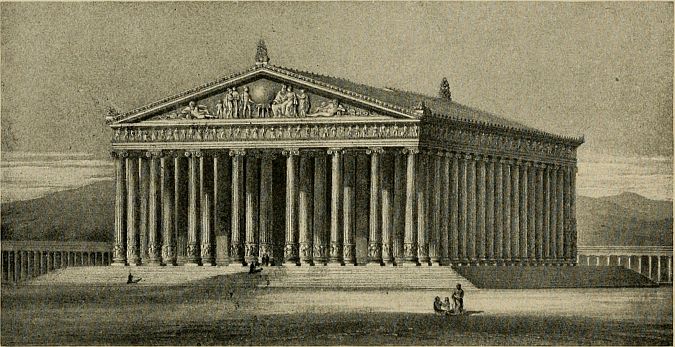
“Father, who made the mountains that
reach clear up into the sky over there where
the sun goes down in the west?”
“It was God, my dear little boy. Don’t
you remember the psalm we read in the synagogue
last week: ‘I will lift up mine eyes
unto the mountains, from whence cometh my
help. My help cometh from the Lord who
made the heavens and the earth’? God made
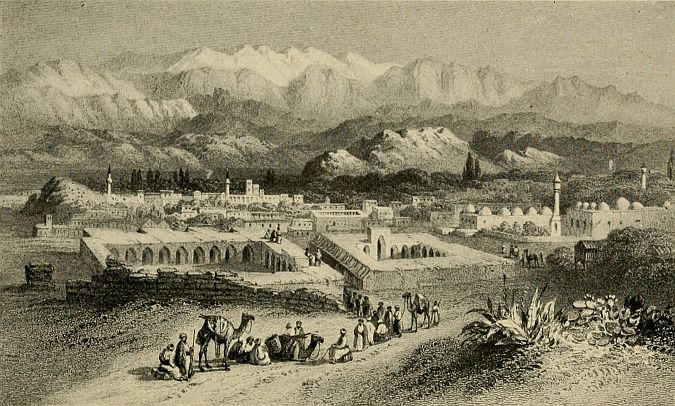
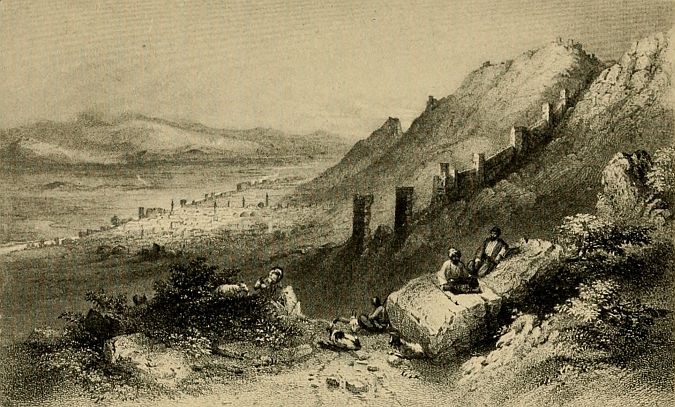
the Taurus Mountains on the west of our dear
city and He made those peaks of the Amanus
you see off there in the East, over which the
storks fly in the autumn, and He made this
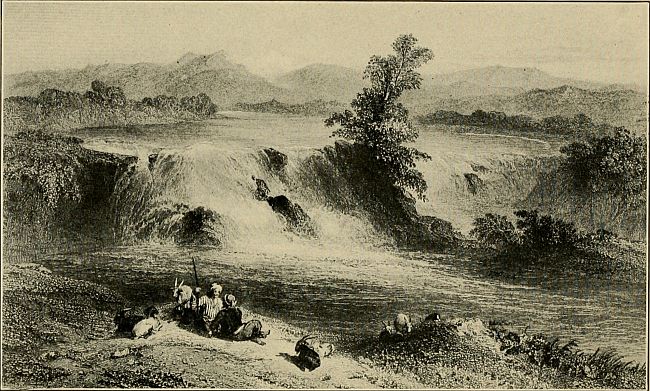
wonderful river, the Cydnus, which dashes
2through the cleft in the mountains and makes
those great waterfalls which you love and
which rushes headlong through the city on its
way to the blue sea.”
“Well, Father, He must be wonderful if
He did that! But I don’t see how He ever
could spread out this great blue tent of a sky
over all these fields and over all the city and
over both the mountain ranges and as far as
men have ever been. All the way to holy
Jerusalem it goes—and farther, to Alexandria
where the man lives, who wrote the book
you read to me yesterday. Is there any end
to that tent and what is it made of? Nobody
in all our province of Cilicia can weave tent-cloth
like that!”
“No, my son, nobody has ever found an
end to the tent of the sky. It covers the whole
world. It is harder to get to the end of it
than it is to go to the end of the rainbow,
which you tried to find a few days ago. But,
my dear boy, God has made something more
3wonderful than the mountains, more wonderful
than the river, more wonderful even than
the blue canopy of the sky, that covers the
world.”
FALLS OF THE CYDNUS
“What can it be, Father, that is more wonderful
than these things? Do you mean the
sea, which you sail over when you go as a
pilgrim to holy Jerusalem, to the passover?”
“No, not the sea, though that is wonderful
and dreadful. I mean the law which God
wrote with His own finger and gave to our
great prophet Moses. That is God’s greatest
gift to our race. I want my little boy to love
the beauty of the mountains and the river and
the sky and the sea. But beyond all things,
I want him to love the holy law of God, to
learn it by heart, to keep every word of it and
to grow up and be one of Jehovah’s own men.
My boy comes of the tribe of Benjamin, the
favourite of all the sons of our father Jacob,
and some day this little boy may become the
leader and deliverer of God’s longsuffering
4people. Will little Saul promise to be Jehovah’s
man, and will he always love and
keep the whole law which our God gave to
Moses?”
“Will it be very hard to do, Father,
and must I give up all the things I like to
do?”
“Yes, my dear boy, it will often be very
hard and you will have to give up some
things you like to do. But if you keep the
whole law of God and make yourself perfect
and do everything God asks you to do in the
holy law, all the people of our race forever
will call you blessed, and you will be the hero
of the tribe of Benjamin, and you will help to
bring the Messiah for whom we long and
pray, and Jehovah will give you eternal life
in His kingdom.”
“Oh, Father, I don’t care how hard it is,
I will do it. I will let my pet stork out of
his cage, so that he can fly off with the other
storks over the mountains. I will not do one
5single thing on the holy Sabbath that is wrong.
I will not play by the river any more with
little Gentile boys. I will learn every word of
Moses’ law and say it all to mother when she
puts me to bed. I will be ready to serve my
race when God calls for some one to do the
great deed, as David did in the book we
read.”
His father patted his boy on the head and
smiled, as they walked home along the banks
of the rushing Cydnus and looked off at the
sun-lit tops of the Taurus Mountains.
Little Saul had had ten birth-days and he
had already caught the spirit of his race
which was very strong in his father and
mother who kept feeding him on the stories
of the past and waking in him the desire to be
the hero of his tribe. Tarsus, a beautiful
city of the province of Cilicia, was his home.
The city was twelve miles from the Mediterranean
Sea and ships came up the river to
the great wharves on either bank. Not far
6away to the south was the great island of Cyprus
and through a pass in the Amanus
Mountains a road went to Jerusalem and the
land of his fathers. He had been often ill
and weak during the ten years he had lived
and often he had lain by the window and
looked out on the world and wondered.
More than once he had seen an army go
marching up the street, carrying the Roman
eagles and flashing Damascus blades in the
sun. He wondered where they were going
and what they would do with these terrible
swords.
He had an older sister who was too old to
play games with him, but she took him on
walks by the river and like everybody else
she told him Hebrew stories about the heroes
he loved. She would picture to him often a
city on a great hill, with valleys running
round it, with a gorgeous temple in it, and
she would say, “Some day you and I will go
there to live and that will be our home and we
7shall be where we can see the temple of God
every day!”
Saul’s father was proud of many things.
He had married a wise and beautiful woman,
of his own tribe, who made his home a very
happy one. He was proud of his wife. He
was proud of this strange boy who pondered
and wondered and who promised to become
some day a great Rabbi and leader. He was
proud of his tribe and of his race. He was
still more proud to be a Pharisee and to be
classed among those who strictly kept the law
and worshipped every least letter of it, and
then he was proud that he was a Roman citizen.
He had done some service to the empire
and the great honour of being enrolled a
citizen had been conferred upon him, so that
little Saul had been born a Roman citizen and
had received a double name, one for his home
people—Saul, and one for Roman citizens to
call him by, Paul, which meant, “the little
one.”
8This was the boy who talked with his father
by the shore of the Cydnus, one evening
about twenty years after Christ was born in
Bethlehem.
II HIS HEROES
9
Months passed by and the little boy of
Tarsus grew stronger and more eager and
earnest. His father had sailed from the port
of Messina for Tyre and Ptolemais and Cæsarea,
on his way to Jerusalem to keep the Passover
in the Holy Land. Little Saul had
begged to be taken with him that he might
see the Temple and stand on the very ground
over which the great heroes of his race had
walked, but he was told that he must wait until
he was a few years older and then he should
go to Jerusalem to study with a great Rabbi
who could answer all his questions. For a
long time he had gazed at the sky where the
sun had gone down over the Taurus. He was
really not looking at anything—he was just
10gazing off into space and wondering. He
wondered whether he would ever see the
world beyond those mountains, the world he
had heard men talk about, the world of Asia
and Greece and Rome. Then he turned to
look toward the dim, yet shimmering peaks in
the East and he wondered whether he would
some day climb those ranges and go through
the pass into Syria and on into the land he
loved best—the real world of his own race.
He had not yet read any of the stories of
Greece. He had dimly heard of the Trojan
war, but it was only a name of little meaning.
Theseus and Jason and Achilles and Ulysses
were not his heroes. They were never mentioned
in his home, though he sometimes
heard the boys in the street speak of them.
His heroes had all lived over the other mountains.
Their names he heard almost every
day. They were household words. He
sometimes made believe that he was David and
he would run with a little hand sling and kill
11again the mighty Philistine giant that threatened
his people. When he climbed a high
hill-top he imagined himself Moses on Nebo,
looking over Jordan on the wonderful land of
promise, and every peak covered with a cloud
that looked like smoke seemed to him once
more Sinai, with the Lord above giving the
law in the darkness and the thunder. He
wished he could see the Seraphim as Isaiah
did, with two wings over their faces, and two
wings all the way down to their feet and two
wings moving like a bird’s to carry them
wherever the Lord willed them to go. And
still more he wished that he could see that
wonderful figure which Ezekiel saw by the
river Chebar—a living creature with the face
of a man, and a calf and a lion and an eagle,
all woven in and out with wings and all full
of eyes, flashing like lightning, whirling like
wheels, and moving wherever the Spirit of
God carried the strange living creature. He
thrilled whenever he heard the story of Daniel
12and he wondered whether he himself would
have dared to pray to Jehovah and go to the
lions for it. He had seen a lion once who
was being carried to Ephesus in a cage, to be
let out in the amphitheatre. The lion roared
and shook his cage and showed his terrible
teeth. Then little Saul thought of calm,
brave Daniel going down into a den full of
beasts like that.
And Shadrach, Meshach and Abed-nego,
the three heroes of the burning fiery furnace,
were men he loved to hear about. “Be it
known unto thee O King, that we will not
serve thy gods, nor worship the golden image
which thou hast set up.” Those words always
stirred him like a trumpet. And he
waited every time to hear once more about
one like unto a son of God walking with these
brave Jews in the midst of Nebuchadnezzar’s
fire. But best of all he liked the story of the
faith of great father Abraham. He could almost
see him laying the sticks of wood on the
13altar and binding his own only boy upon them.
He wondered if his father would have done it
with him, if he heard the Lord tell him to do
it! Then suddenly came the joyous relief:
the ram in the thicket, and little Isaac spared,
just as the dreadful knife flashed in the air.
These heroes were going in procession
through his mind as he gazed at the eastern
gate in the mountains through which the road
ran that led on toward the one city of all the
world. Just then his mother stood by his side
and took his hand in hers. She could see that
big thoughts were moving in him and she felt
a kind of awe as she looked down at the pale
earnest face.
“Mother, which is the hardest of all the
commandments to keep—I mean, really to
keep, and not to break at all?”
In her mind, the fond Jewish mother
standing in the dusk by the boy she loved, ran
over all the commandments. “Thou shalt
not have any other gods but Jehovah.”
14“Thou shalt not make any graven image.”
“Thou shalt not take the name of the Lord
thy God in vain.”
“Thou shalt observe the Sabbath day and
keep it holy.”
“Thou shalt honour thy father and mother.”
“Thou shalt do no murder.”
“Thou shalt not commit adultery.”
“Thou shalt not steal.”
“Thou shalt not bear false witness.”
“Thou shalt not covet, or desire.” While
she was thinking how to answer, little Saul
said: “I know which is the easiest.”
“And which is it?” asked his mother.
“Thou shalt honour thy father and mother.
It is the easiest thing there is to do. I don’t
have to stop to think to do that! It is not so
easy, though, to keep the Sabbath day holy.
There are so many things to remember. Now
that I have let my pet stork go, I do not feel
tempted any more to play with him on the
Sabbath day. But sometimes I start off for a
15walk before I think, and I carry things that
are too heavy to be lifted on the Sabbath day.
I wonder if I shall ever get so righteous, like
our great Hebrew saints, that I shall not do
anything wrong on the Sabbath day. It is
very, very hard to be perfectly good. Do you
not think, Mother, that this is the hardest of
all the commandments to keep?”
“No, my dear Saul, there is one which you
will find much harder to keep. It is the last
one in the list: “Thou shalt not want things—thou
shalt not desire.” This commandment
has to do with what goes on inside. All the
others are about things we do in the world
outside. This one is in there where you
think. It says that you must rule your own
spirit and not want or desire what you ought
not to have or ought not to do. That my little
boy, as he grows larger, will find very hard
indeed to keep. Only the great God who
guided Abraham our father all the way from
Ur of the Chaldees to the dear land of Canaan
16can help my boy to keep that commandment.”
“Anyway I shall try, mother. It isn’t any
harder is it than going into a den of lions or
into Nebuchadnezzar’s fiery furnace?”
“Ah, but my Saul will never have any such
dreadful things to do, for he is born a Roman
citizen and he can always appeal to Cæsar.
Now it is time little boys were in bed.”
III IN JERUSALEM
17
The days grew to weeks and the weeks to
months; the months added themselves and
made years in Tarsus in the first century just
as happens now where my young reader lives.
Time and the multiplication table go on in
one century exactly as in another, no matter
what else changes. Before the father and
mother could quite realise it, or believe it possible,
Saul, once our little boy, who looked out
on his world and wondered, was old enough
to go away from his home to a great school in
Jerusalem where perhaps all his questions
could be answered though only for a little
while. His sister had married now and lived
in Jerusalem and it was arranged for Saul to
have his home with her while he was studying
with the famous Rabbi Gamaliel, who
18knew better than almost any one else the law,
and the rules by which the daily life of a strict
Jew should be guided so that he might be perfect.
Through the Syrian Gate in the Amanus
ridge, Saul had gone with his father on their
way to the holy city for the Passover and for
a short time of sight-seeing and visit before
the hard work of the school began. They
came on through Antioch of Syria, the first
great city which Saul had ever seen and one
which some day he would know much better;
then they journeyed on by hard and dangerous
roads until they saw Damascus, with its
two beautiful rivers and its high city walls.
Some day Saul would know this city better
too! And the time would come when he
would find out how high those city walls
were! Every foot of the road from Damascus
was crowded with interest and excitement
for this fifteen-year-old boy who was seeing
the holy land for the first time. Now he
19thrilled in a new way as he actually saw with
his eyes the scenes which before he had only
pictured in imagination. When they crossed
the Jordan, just south of the blue lake of Gennesareth,
he could hardly contain himself.
More than once he threw himself on the
ground with his arms outspread as though he
were trying to grasp the country and embrace
it.
The road up from Jericho to Jerusalem was
so dangerous and he had heard so many tales
of robbers there that he was too frightened to
enjoy the journey. But when at length the
city—the city of all the world—with its shining
temple gleaming in the sun came in sight,
he forgot all about robbers and dangers and
his sore and tired feet, and fell on his face and
thanked God for letting him see the Holy City
about which he had dreamed and imagined
ever since he was a tiny boy. There it was!
It was no dream but a real city, with real
streets and walls and houses, and above all the
20temple, to his mind the holiest place in all
the world.
The next day when he came to the temple,
his heart beating and his throat swelling with
emotion, he read with pride the inscription
carved on the stones: “Only he that is a Jew
may enter this sacred temple. If any one that
is not a Jew enters he will be answerable for
his death, which will ensue.” Around him
thronged a vast multitude of people who had
come from all parts of the known world to be
present on the Great Day of Atonement. He
could see the choirs of singing men and he
could hear the far-away sound of harps, and
then he saw the long line of priests with their
dress as Moses had described it in the books
of the law and the high-priest with his gorgeous
robe, and on his breast were the mysterious
stones which no man understood save
he who had them.
After the great days of the sacred week had
passed and he had seen the wonders of the city,
21Saul entered the cloister door and came into
the sombre room where the learned doctor,
Gamaliel, gathered his students at his feet to
teach them. The boy was filled with awe as
he got his first sight of the white-haired man
who was to be his guide in the mysteries of the
law and he made a deep salaam before him
and remained bowed until the Master said:
“Rise, my son, and be seated here.”
The quick-eyed boy noticed at once that his
new teacher was as full of kindness as he was
of wisdom. There was something in the face
of the old Rabbi that gave him confidence and
dismissed his fear.
“Dost thou know the commandments?”
asked the teacher.
“I know them all,” answered the youth. “I
have said them many times to my mother in
Tarsus.”
“Dost thou know what the law requires a
faithful son of Abraham to do on the Sabbath
day?”
22The youth surprised his teacher as he ran
through the long and complicated lists of
things that a faithful Jew might do and might
not do on the Sabbath day. At last the teacher
stopped the boy and gravely asked, “where
hast thou studied?”
“With my father and with my mother in the
long evenings at Tarsus. My father is one of
the wisest and one of the most strict of all the
tribe of Benjamin and my mother is like the
woman of whom the wise king Lemuel wrote
in the Roll of Proverbs. They have taught
me many things but I lack much and therefore
have I come to Rabban Gamaliel.”
“Canst thou recite the fifth book of Moses
without a mistake?”
“I can recite every word duly, for the book
itself says ‘Lest ye forget.’”
“Thou hast done well, my son, and thou hast
walked many steps in wisdom for one so
young, but now thou must learn the authorities,
thou must become skilful to interpret,
23thou must know the unwritten law and all the
traditions of the Elders and Scribes and thou
must fill thy mind with all the gathered wisdom
of the great Rabbis until thou canst explain
every passage in the Rolls of the books
which Jehovah our God has given us through
the holy men of old. Thou must work with
diligence, beginning early in the morning and
continuing so long as the light lasts, and thou
must spend years here with me until thou hast
won the truth and until thou knowest clearly
what brings God’s righteousness to a man.
Art thou ready to give up the years of strong
youth; art thou willing to lose the pleasures
of the world; art thou able to endure the toil;
wilt thou go all the way to the end with me?”
Saul stepped one step nearer, raised his fine
face and his dark eyes full of eagerness to the
master’s face and calmly said: “Great Rabban,
for that I come. I have left the things
that are behind. I seek only one thing in this
world—to be righteous, to know the whole
24secret of God, to be a perfect son of Abraham.
Let it cost what it will, I follow where the
wise Gamaliel shall take me, even to the end
of the long road to truth.”
Then the teacher bowed his head and prayed
that the great Jehovah of the fathers would
bless and enlighten the youth from Tarsus who
was to be for many months in the cloister of
Gamaliel.
IV IN RABBI GAMALIEL’S SCHOOL
25
The person who is a real hero in spirit
and nature can be a hero at school as well as
anywhere else. In fact those who prove to
be heroes in later life are almost always heroes
in their school-days. This youth who had
come to Jerusalem from Tarsus of Cilicia did
not have to wait for some occasion, with all
the world looking on, before he could rise to
heroic actions. He found a chance to be
heroic even in the quiet uneventful cloisters
of Gamaliel’s school. All the boys and young
men who gathered round this famous teacher
very soon knew that a brave fellow and a real,
born leader had joined their ranks. When a
hard and difficult thing was to be done they
turned naturally to him. When a question
26was asked which taxed everybody’s brain, they
all looked for him to answer.
There was no end to his zeal. Nothing
seemed too hard for him. He had learned
Greek as a boy in his home at Tarsus and he
had always known the current Hebrew speech,
but now he learned carefully the ancient Hebrew
of his fathers. He pored over the
Rolls of Scripture and took note of each jot
and tittle. He learned all the fine points of
grammar which his great Rabban could teach
him. His patience seemed never to give out
and he would work on in his search for truth
long after the others had rolled up in their
strange mat-like beds and were lost in peaceful
slumber.
He seemed to think of ignorance as a great
giant enemy to be fought with and to be killed,
no matter how long and hard the fight might
be. It was in this fight he showed his true
heroic fibre. He was always hunting a new
weapon to fight with, or he was sharpening an
27old weapon in his possession. He would
travel miles to find a book he wanted or to
discover what a strange word meant or to consult
some authority whose opinion he desired.
“What do you suppose that Saul of Tarsus
will be when he grows up?” the boys would
ask of one another.
“He will surely be a great Rabbi and have
a school in Jerusalem, like our master,” one
would say.
“I think he will be greater even than that,”
another would say. “I think sometimes, as I
look at his face and watch him while he
reads, that perhaps he will be a new prophet
and bring a new word of God to our people.”
“But that is not possible,” a pious youth
from a Jerusalem family would answer.
“The words of God have already all been
given. There will be nothing new until
Messiah comes. I have heard my father say
that many times.”
28This coming of Messiah was one of the
things our youth from Tarsus studied most
carefully. The books and traditions had
much to say about it, but it was hard to decide
just what would happen and just how to get
ready for this greatest event of all the world.
With the help of Gamaliel and his books,
young Saul came to believe that a great day
was soon to come for Jerusalem and for all
good Jews. A new king, like David, only
greater and wiser and better and stronger
would suddenly appear. He would have
power to turn stones to bread, or to leap from
the top of the temple to the ground without
being hurt in the least. He would break the
Roman army all to pieces in a minute. He
would call hosts of angel soldiers from the sky
at the sound of a trumpet and they would destroy
or carry away all who had been bad Jews
and had not kept the law. Then he would
make Jerusalem a perfect city. The streets
would all be cleansed and purified, until one
29could see his face reflected in every pavement.
The walls would be changed into precious
stones, the gates into pearls, and every person
left in the city would be as pure as the city itself.
Nobody would be sick any more, nobody
would die, or have any sorrow. And
best of all, all the good Jews who had ever
lived would be brought back to life again to
live in the perfect Jerusalem with the good
people who were there with the great king.
This king of their hopes and dreams was called
“Messiah,” because he would be “anointed”
by God himself to rule forever. Saul believed
that his people were the only ones out
of all the world who would have this king for
their king and this perfect city, and all who
had ever done anything against his nation
would suffer and suffer and suffer, while the
happy Jews were enjoying their beautiful
Mount Zion.
He believed, too, and he thought his books
proved it, that he and others who were willing
30to work for it, could hurry up this great day
and make it come sooner. This is the way
you could do it. It couldn’t come until there
were a great many persons who were good
enough to start the new world and the perfect
city. The king, Messiah, would not come until
he could find a large number of people all
ready for him and as near perfect as you could
be. Now to be perfect you must keep all the
law and do everything that God commanded
in the Old Testament and in the traditions of
the Rabbis. If you broke one single commandment,
it was as bad as though you broke
them all, for if you broke one, then you had
not kept the whole law.
Now my reader will see, I hope, what a
hero this young Saul was. He had decided
to be one of the men who would be ready for
this mighty king and he was resolved to live
the kind of life that would help bring him
soon. He was going to live as though the
perfect city had come already. He would not
31do one thing that would seem like disobeying
God—even the littlest. Gamaliel had one
student who was trying with all his might to
be perfect, and that meant, to be a hero.
V TENT-MAKING IN TARSUS
32
Like winged birds, the time flew by, just
as it does now for school-boys and school-girls
and Saul’s years at the feet of Gamaliel
were over. He had changed very much
while he had been in Jerusalem. Soft hair
was growing on his face now. His forehead
was broader and fuller, but his shoulders were
bowed over and he walked with a stoop because
he had bent over his books so long and
had taken very little exercise in these years
of eager study. His hands were soft as a
woman’s and he seemed thin and worn with
the strain of his thoughts. But the same fire
was in his dark eyes and the same fine beautiful
light shone on his face. He wondered as
he came up the river Cydnus from Messina to
Tarsus (for he returned by sea), whether his
33mother would know him. The news had
spread that the boat was coming and the whole
family in the home at Tarsus were on the
watch for the returning scholar. He did not
have much time to wonder whether his mother
would know him, for he soon felt her arms
around his neck and he found himself once
more in the dear home with everybody looking
him over and asking him questions until he
needed three or four tongues to answer them
all. His mother did not like the stoop in his
shoulders but everything else pleased her.
The father was too proud of his splendid son
and too much moved with joy to say much,
though he had already given a brief prayer of
thanksgiving to Jehovah for the safe return,
and for the wonderful gift of such a man-child
as this. Meantime a servant was killing the
fattest of all the full-grown kids for the feast
of joy which all the household joined in preparing,
and the whole day was given up to rejoicing.
34It was a proud moment for the family the
next Sabbath when young Saul was given the
Roll of Scripture at the Synagogue and was
asked to read the lesson and explain it. There
he stood with all the Jewish families of Tarsus
looking on and listening while he told them
things they had never heard before. When
the lesson was finished many a man turned to
Saul’s father and said: “God has given you
a remarkable son. He will be an honour to
our race and to our city.”
Now the time had come when Saul’s trade
must be decided upon, for all young men who
were to be Rabbis were expected to learn a
trade, so that they could support themselves.
Early and late in the home the question was
discussed: What was the best trade for a
slight, thin, soft-handed youth who was a great
scholar and who was soon to be a famous
teacher? The mother wanted him to learn a
trade that would straighten his shoulders and
make him strong and robust. The father
35thought he ought to select some occupation
that would be refined and dignified and very
honourable. After long and careful consideration,
it was finally settled that Saul should
learn the trade of weaving the goats’ hair
to make heavy tent-cloth and to cut the cloth
into tent patterns and to sew the long tent
seams.
It was strange work for the delicate scholar—so
different from poring over books and
settling points of the law. At first the soft
hands blistered and the muscles were very
tired with the work of the stiff hand-loom.
But little by little the hands grew harder and
the arms learned the trick of the motions and
the work became natural and easy. Saul went
at this work the way he did everything else.
“It is,” he would say, “a part of my life. I
cannot succeed unless I can support myself
and so I must make tents a little better than
anybody else can do it. Some good stiff work
now and the habit of doing every part of it
36right will make the whole thing easy for me
later.”
He went to the best maker of tents in the
city and worked with him, for he knew the
worth of a good teacher. But this teacher
was so different from his old master in the
school at Jerusalem! Like Gamaliel, this
man also knew every fine point in his field of
work. He had the secret of selecting the
finest goats’ hair and he knew the best weaves
for making water-tight cloth and he drew the
best patterns for both large tents and for small
ones, and he had new ways of sewing seams
that would neither rip in the wind nor leak in
the hardest rains. The only trouble with him
was that he was a Gentile and not a man of
Saul’s race. But he, too, was a scholar. He
had studied in the great University of Tarsus
and he knew many books which Saul had
never read or even heard about. While they
worked at the tent-cloth the master workman
talked much to Saul of what he had learned in
37the University under his Stoic teachers, for
Tarsus was one of the greatest centres of Stoic
wisdom in all the world.
“Do you know,” he would say, as they sat
sewing the long seams, “all my books say that
God is a great Spirit who fills all the universe,
just the way the soul dwells in and fills the
body. This Spirit is in the ocean and in the
river, in the mountains and in the trees, in the
air and in the cloud, in the stars and in the sun
and above all it is in the mind of man. It
makes everything full of purpose, and intelligent.
The bee and the spider are wise because
this Spirit dwells in them and teaches
them. One of our own poets who lived here
in Tarsus, in a great hymn to the Allwise One,
says that we men of earth are children of God
because our spirits have come from his Spirit,
and this Spirit lives and moves in us, if we are
good and wise. The human soul is like a
little inlet into which the great sea flows.
Bad and wicked men have become bad and
38wicked because they shut themselves off from
the inflowing tides of that great divine Spirit.
Those who have most of this divine Spirit in
their souls do not fuss or worry. They are
not disturbed over what happens to them.
They say that the only thing that matters is
to be master of your own spirit and not
to be conquered by anything in the world. If
I should lose all my goats and all my tent-cloth,
and if all my looms should burn up, I
could still be a brave man and start again
just as though nothing had happened, but if I
lost my spirit and began to whine and lament,
nobody could cure me of that. Then I should
be beaten and defeated. We Stoics try to be
citizens, not only of our own city but of the
whole world. We love our own people.
We are proud of our own race, but we want
more than that. We take an interest in all
men everywhere. We want all cities to be
good cities. We want all people everywhere
to know God and love him, and we want to
39make one great family on the earth, all living
in harmony under the great Spirit.”
Saul stopped sewing and sat perfectly still.
It was different from anything he had heard
in Jerusalem. It could not be true or Gamaliel
would have known it and yet it was so
wonderful and beautiful. He would think
about it more, and he would read some of the
books of the Stoics who said that we are the
offspring of God!
VI THE GREAT TEACHER OF GALILEE
40
While the young scholar was working at
his new trade of weaving tent-cloth and making
tents in the busy, thriving town of Tarsus,
wonderful things were occurring beyond the
Amanus Mountains, in the land of Palestine.
Every traveller who came from Galilee and
every pilgrim who passed through Capernaum
brought tidings of a strange and extraordinary
Teacher, totally unlike the great Rabbis and
Scribes.
In far-away Tarsus not much was reported
at first of what this Teacher said. The travellers
told, first of all, of the wonderful things
He did.
One man had heard, as he came through
Galilee, of a little girl who had been very ill.
41Nobody could help her. At last in despair
the father went out to search for this Teacher,
to see if He could do anything to save his
daughter. He found Him by the lakeside
preaching to a great multitude of people, and
he begged Him to come at once, to make his
daughter whole. Many strange and unusual
things happened on the way and, at last, when
they arrived, the little girl seemed beyond
help, for she lay all still and did not breathe.
But this remarkable Person took her by the
hand and spoke some words in His own Hebrew
language and the girl rose up and
walked and was instantly well, and everybody
wondered.
Many other such things they told of this
Teacher. He made all kinds of sick people
well. He even made totally blind persons
see. All the towns around the Lake of Gennesareth
were full of excitement over His
cures and His other miraculous doings, and
in all the country throughout Galilee people
42everywhere talked about Him and went long
journeys to see Him, and to bring sick persons
to Him.
Then, slowly, reports began to come of His
words and His teachings. They said He
seemed to have found out something new
and strange about God. He was not afraid
of God as other people were. He loved
Him and talked about Him as though He
knew Him. He kept calling God His
Father, and He said God wanted to be Father
to all persons, because He was full of love and
tenderness for everybody in the world. He
kept telling, in all His talks with the people
who came to hear Him, about a new kingdom
which He was trying to set up in the world.
It was very hard to tell from the vague reports,
which the travellers brought, what this
kingdom was to be. It did not seem like the
“new Jerusalem,” that Saul had learned about
in Gamaliel’s school. It seemed even greater
than that, for it seemed like a new kind of
43world for everybody. Everybody, who loved
God and learned how to live a life of love
and kindness to all people everywhere, could
be in it, and it would grow and spread like
seeds of grain in the field.
Then, later, when the people who had gone
up from Tarsus to the Passover, came back
from Jerusalem, they brought news of a terrible
thing that had happened there during
the Passover week. This Teacher, it would
seem, had come up to keep the Passover and
the common people had discovered Him and
they thought at first that He must be the long-expected
Messiah and they had made a procession
for Him and had tried to proclaim
Him their king. But this and other things
frightened the rulers in Jerusalem and they
sent by night and seized Him and got Pilate,
the governor of Palestine, to condemn Him
and crucify Him. Then all the people turned
against Him and thronged out of the city in
great multitudes to see Him nailed on the
44cross and to see Him die hanging in the air.
And the pilgrim who brought the reports
said He was not like any other victim that
was ever crucified. Instead of shouting and
wailing and cursing, He had been calm and
unmoved. Every time He spoke, His words
were full of love. Once He spoke in a quiet,
gentle way to a thief who was crucified on a
cross near Him. And once, and this was the
strangest thing they reported, He looked up
toward the sky and then out toward the great
multitude of shouting people and said in a
gentle voice which reached out over all the
throng, “Father, forgive these people. They
do not know what they are doing.”
A few who came back later had another
story which they told but they couldn’t make
anybody at Tarsus believe it. They said that
some of the followers and friends of this wonderful
Teacher from Galilee declared that
they had seen Him alive after He was crucified.
Some of these followers said they had
45heard Him speak just the way He used to do
before He was crucified, and they claimed
that He told them when they were on the way
going up to Jerusalem that He would be crucified,
but that He would come back to life
again.
When Saul heard these strange reports he
was at first very much moved by them. He
could not sleep at night because he thought
so much over the stories he heard from the
travellers. But little by little he made up his
mind that they were just idle tales such as
travellers love to tell to those who stay at
home. He said to himself: “It isn’t likely
that there really was any such person in Galilee
as this one they tell about. I should have
heard about him while I was in Jerusalem,
for he could not have got his power suddenly
and if he was beginning to do these wonderful
things then, it would have been known in the
city. But nobody had heard of him at all.
If he got his power suddenly, without any
46preparation and without studying in any of
the schools, it is probable that some evil spirit,
like Beelzebub, has helped him and revealed
secrets to him. It is almost certain that he
was not sent by God, for the books of the law
do not tell about any such Teacher who would
come and die for his truth, and the words they
bring about his teaching are not at all like
what we know of God from our sacred books.
No, either there was no such person, or, if
there was, he was deluded and misguided.”
But when Saul was talking one beautiful
evening with his mother, who seemed now
much older than when she talked about the
commandments with her little boy, suddenly
Saul said: “Wouldn’t it be strange, Mother,
if what that Galilean Teacher, of whom the
travellers talk, said about God were really
true—I mean, that God is a Father and loves
men, even men who do wrong and sin. My
tent-maker thinks that God is a great Spirit
who dwells in everything and is everywhere.
47But this is more wonderful, that God is full of
love and tenderness for all kinds of people in
the world. It cannot, however, be true, for
the Rabbis would have known it if it had been
so!”
And the mother answered: “Ah, yes, no
doubt the wise Rabbis would know. But is
there not something just a little like that in
some of the beautiful psalms which we sing
in the Synagogue—‘Like as a Father’?”
“But, Mother, this man, they say, died on a
cross, and no good man, whom God approved,
could die that way, for our law says that all
who are hanged on trees are cursed and disapproved
of by God, so that we need not think
any more about him.” But try as he would,
Saul could not get these things out of his
mind.
VII IN JERUSALEM AGAIN
48
All through the quiet period in Tarsus
while Saul was learning his trade and living
with his father and mother in the dear old
home where he had been a boy, he was wondering
what his life was going to be. He always
felt, even as a little boy, that a great life-work
lay before him. It was too sacred and
solemn to talk about and he did not tell even
his mother, but all the time, down deep in his
soul, he dimly knew that he was destined to
have an unusual life and to do something
signal and wonderful. When he lay ill and
everybody thought he would die, he felt very
sure that he was not going to die yet, for the
great work of his life was still to be done!
He had often been in great danger, on his
49journey up to Jerusalem and on the ship coming
back to Tarsus, and many times before he
left home, but he always knew that somehow
he would come through the danger and be
spared.
He was eager now to find his life-work and
to start in on his great career. He was, therefore,
very happy when a traveller of his own
race, coming from the holy land, brought
him a letter from the authorities in Jerusalem
saying that they had work for him to do in
that city. They wanted a young and learned
Rabbi to teach the Jews living in Jerusalem
who spoke Greek and who were called “Hellenists.”
There were, my readers must know,
two kinds of Jews. There were the Jews,
first, who lived all the time in Palestine.
They could keep the law more perfectly and
more completely than other people could.
They thought of themselves as the truly real
Jews and as the inner circle of God’s own people.
Then, secondly, there were the Jews
50who lived and did business in the great cities
of the Roman Empire—cities like Rome and
Alexandria, and Ephesus and Antioch and
Philippi and Corinth and Tarsus. They
could not keep themselves as pure or as perfect
as the Palestine Jews could, for they had
to meet and mingle with Gentiles who were
not pure according to the law and who defiled
those that came in contact with them. Then,
too, these out-dwellers could not get to the
temple very often to make sacrifices and to
keep the requirements of the law. They used
the language which the worldly people around
them used. That was generally Greek.
They had their Scriptures translated into
Greek and many of them did not know and
could not read Hebrew at all. But these Hellenists,
or Greek-speaking Jews, went up to
Jerusalem as often as they could and when it
was possible for them to do so, they would
stay in Jerusalem for long periods in order to
be near the temple. They had a synagogue of
51their own in Jerusalem where they went for
their lessons and for their Sabbath services
and where their little children were taught
while the parents were staying in Jerusalem.
It was to this Synagogue that Saul, the young
Rabbi, was to go, to teach the Jews who came
from all the far-away countries to sojourn in
Jerusalem.
It was very different for him, going to
Jerusalem now from what it had been for the
fifteen-year-old boy the first time he went.
Now he was going, not for a few years, but for
life. Now he was setting his hand to carry
out the great dreams and hopes of his life.
Now he was leaving his mother, perhaps for
the last time. His father would still continue
to go to the Passover and Saul would perhaps
see him there, but his mother would never
leave home again and it would surely be many
years before he would come back through the
mountain-gate, or up the Cydnus River, to his
birth-place. Nobody knows just what goes
52on in a young man’s heart when he takes this
great venture and pushes out from the home
he loves to begin his real life in the strange
and difficult world, where some succeed and
where some fail, where some keep pure and
good, and where some go wrong.
Many things seemed to have changed in
Jerusalem during the short period since Saul
had left it. Everybody was talking of the
strange events that had taken place recently.
A new people had appeared in the city. They
called themselves “the people of the way,”
or “those of the way,” or “those of Jesus’ way.”
Others called them “Galileans,” or “Nazarenes.”
They were men and women who believed
that Jesus the great Teacher of Galilee
was the Messiah and they declared that He
was still alive and would soon return to be
king and lord. They were growing fast in
numbers and spreading in every part of the
city. They met every day from house to
house and ate their evening meal together in
53great joy and fellowship. They took care of
all their poor people and their sick and they
shared everything they had with one another
as though they were all brothers and belonged
to one great family.
The rulers in Jerusalem, however, did not
like to see them spreading through the city.
They watched them carefully and arrested the
leaders when they found them doing anything
to attract attention or trying to get others to
join them. They did not like to be told that
the person they had Pilate crucify was the
Messiah, or that He was raised from the dead
and was now alive. It was easy to see that
there was sure to be trouble in Jerusalem, if
these people went on increasing and if they
would not keep quiet.
There were some of “those of the way” in
the Synagogue where Saul was to be Rabbi.
They were always ready to talk about their
wonderful Teacher, who had been crucified
and they were eager to prove that He was the
54real Messiah that had been so long expected.
Saul thought he could very soon teach them
sense and show them how foolish they were.
He would quickly prove to them that Jesus
could not be the Messiah, for the Messiah
would surely never be crucified! He would
come in splendour and glory, and if the
Romans tried to crucify Him He would call
down from heaven an army of angels and destroy
all His enemies in a moment! And He
would break the Roman Empire all to pieces,
as one breaks an old jar of pottery. It would
be only a few days, Saul felt sure, when he
would be able to stop all this talk about a
crucified Messiah. He would argue them
down and make them ashamed to say such
things any more. But Saul did not know how
hard his task really was. He was to discover
that some things in this world cannot be
hushed up, or argued down!
VIII THE MAN WITH A SHINING FACE
55
There was one man in this Synagogue of
the Hellenists more remarkable than any of
the other people who belonged to it. His
name was Stephen. I do not know what city
he came from. But he was one of the “out-dwellers,”
and he had become a follower of
Jesus, “one of the way”—“a Nazarene.” He
was different from any of the other followers
of Jesus. He saw farther than the rest did.
He seems to have been the first of “those of
the way” to realise that Jesus did not come to
be the Messiah of the Jews alone and to purify
their customs. Stephen thought He came to
bring life and light and joy to all the world.
The other followers of Jesus in this early
period were loyal, devoted Jews. They went
every day to the temple and they kept the law
56as the other Jews did. They supposed that
Jesus was to be the king in Jerusalem and that
only Jews were to be His people. Those
who were not Jews could have no share in the
good news which He proclaimed.
Stephen was so pure and good and wise that
he got a new idea of what the coming of Jesus
meant. The truth was far bigger than the
others dreamed, and he began to see it, and to
tell about it. If God is Father, as Jesus kept
saying He was, then He must love all men as
well as Jews, and if God is Life and Spirit,
then He can come into men’s lives everywhere
without any temple and without priests and
sacrifices. Stephen began to wonder, as he
thought about all that Jesus had said and
taught and done, whether His message was
not far greater and more wonderful even than
the law of Moses, whether some day it would
not take the place of the old system of laws
and customs and sacrifices and whether even
the temple itself might no longer be needed to
57worship God in, for men might worship Him
anywhere where they happened to be.
Stephen was so bold and fearless, and he
was so full of his great idea, that he tried to
tell the people in Saul’s Synagogue about it.
They all turned upon him and called him a
dangerous man. They tried to make him see
that he was not true to the religion of his
fathers, that he was teaching new ideas, that
he was turning people away from the old customs,
and that if the people followed his
teaching they would overthrow the whole
wonderful system of Moses, and so make it
impossible for the Messiah to come, for
whom all good Jews were waiting and longing.
Saul, with all his learning and his knowledge,
thought he could easily answer Stephen
and prove that he was entirely wrong. But
every time he tried, Stephen got the best
of him. Saul would quote texts from the
Old Testament and Stephen would rise up
58and show that these texts meant something
quite different from what Saul had always
thought they meant. He was so powerful and
his life was so noble that all the people who
listened felt that even if he was wrong in his
ideas he was great in his soul, and they began
to wonder if he perhaps might be right and
Saul wrong. Day after day the discussion
went on without any end to it. At last Saul
decided that this would never do. Some way
must be found to stop this dangerous man who
was leading the members of his Synagogue
astray. He told the rulers in Jerusalem that
he had discovered a traitor who must be arrested.
“He talks against Moses,” he said.
“He does not love our holy land, or our holy
law, or our holy temple, the way all true Jews
should.” Then the Council in Jerusalem had
Stephen arrested and brought before them
for trial, and witnesses came in and told all
the things they could think of to make the
Council condemn him.
59While they were talking against him they
all saw a light shine on his face, and he looked
more like an angel than like an ordinary man,
and everybody wondered what he would say
in answer to the charges that were made
against him. And Saul must have been eager
to see what was going to happen to this man
with the shining face, whom nobody could
defeat in an argument. Then quietly Stephen
began to speak for himself. He did not try
to prove that the things which had been said
against him were false. He paid no attention
to his own case. He told the Council that all
through the history of their Hebrew race the
people had always failed to see new light when
God brought it to them; they had always
missed the path when God was trying to lead
them into a new way, and they had always
misunderstood when God was trying to teach
them new ideas. They cried out against
Moses, he told them, in the wilderness. They
worshipped a golden calf just at the time
60when he was giving them the law of God, and
when the prophets came to teach them more
about God, they served Moloch and other
false gods instead of Him. Their great, wise
king Solomon had told them, when he built
the temple, that no temple, however wonderful,
could contain the great God who fills the
universe, but the people did not understand
his words and seemed to think that God lived
only in their temple. “You have always
failed to see the truth,” Stephen cried. “You
have always persecuted prophets when God
has sent them to you. You have killed those
who told about the coming of Jesus. And
now you, yourselves, have betrayed and killed
Him when He did come. You talk about the
law and you say that God gave it through
angels. But you do not understand it and
you do not really keep it.”
That was more than they could stand.
They forgot that they were judges and were
having an orderly trial. They all rushed at
61Stephen. They showed their teeth at him and
howled him down. But he was as calm and
steady as though everything were peaceful.
In the midst of the uproar, they suddenly
heard him say: “I see Jesus! There He is,
up there in the open sky, at the right of God
in His glory.” Then they all stopped their
ears, so that they might not hear what he said,
and they rushed at him and dragged him out
of the city and stoned him. As the people
who stoned him pulled off their garments so
that they could throw the stones better, they
gave their garments to Saul to hold. He did
not join in throwing the stones, but he approved
of what the others were doing and he
ran along with them and carried the garments.
And he could see Stephen’s wonderful face
which was shining more than ever now! He
did not say one hard word against those who
were killing him. But just at the end, Saul
heard him say: “Lord Jesus, do not blame
these people for what they are doing”—“Wilt
62thou now receive my spirit to Thyself.” And
then, with the stones raining round him, the
brave, good Stephen died—with the light still
on his face.
Saul never forgot that face. He thought
Stephen was wrong and he believed that he
must be stopped or he would bring harm to
God’s people. But he had never seen anybody
die like that before! And the more he
meditated and thought about it, the more he
wondered at what Stephen had said, and still
more over his dying words and his happy,
shining face!
IX ON THE ROAD TO DAMASCUS
63
This young man who now unexpectedly
found himself a persecutor was by nature kind
and tender-hearted. He had never wilfully
hurt any creature or given pain to anybody.
He had come up to Jerusalem for his life-career
with the highest hopes and the noblest
aspirations. His whole being was aflame
with a passion for his nation. Ever since he
was old enough to know the story of his own
people he had dreamed of the splendid future
that was soon to dawn. All that the greatest
prophets had seen in distant vision, he believed
he should one day see with his own eyes. He
had tried, with almost superhuman effort,
to make his own life perfect so that he might
be one of the little inner circle of perfect
64Jews, who would help to bring the Messiah
and the perfect age and who would be ready
for this glorious king when he should come.
Now he suddenly found, in his own Synagogue
even, people who said that the Messiah
had come already, that the rulers and Pharisees
who were expecting Him and preparing
for Him had not recognised Him when He
did come and had crucified Him. This
seemed to Saul an awful idea—an unbelievable
tale. He was sure the Messiah could not
be crucified. But he was afraid that these
enthusiastic and misguided followers of Jesus
would ruin his hopes. Everything that could
be done must be done at once to stop their
teaching and to destroy their influence. He
saw only one way to guard the hope of Israel
and that was to crush this movement absolutely
and to shut up or kill every person
who went about claiming that Jesus was the
Messiah. It was a very disagreeable task,
but it must be done for the good of the nation
65and, however hard and distasteful it might
be, Saul was resolved to carry it through and
to leave nobody who would ever again dare
to say that Jesus, the crucified, was the long-expected
king.
Into the peaceful homes of the “Nazarenes”
he went and seized both men and women and
carried them away to prison. He had to separate
husbands from their wives. He had to
take mothers away from their tender little
babies. He had to break up meetings and
drag away those who were preaching the new
gospel to their eager listeners. But everywhere
he went he found that these people had
something which he did not have. In the
midst of their sufferings and their trials they
were calm and peaceful and happy and triumphant
and radiant. When they were persecuted
their faces shone with a light that
seemed almost heavenly. They prayed for
those who injured them and were not disturbed
by any troubles. They kept saying
66most remarkable words about Jesus and their
faith in Him, and they all seemed to believe
that He was still alive and that they would all
soon be with Him.
Saul had been trying all his life to be perfect,
to be fully righteous. He had worked
with all his might to keep all the law and all
the commandments. But he knew deep down
in his soul that he had failed to reach his aim.
He could not do it. He found something in
himself which he could not govern. If he
didn’t break one commandment, he broke another.
If he was strong at one point he
was sure to be weak at another. That commandment
which his mother had told him
was the hardest to keep—“thou shalt not covet
or desire”—was always bothering him. Even
when he did not actually do wrong things, he
found himself wanting to do them, and that he
knew was wrong. It all filled him with discouragement,
and sometimes with despair.
But these people whom he was persecuting
67and dragging away to prisons seemed to be
good almost without trying. They had found
a new power somewhere that seemed to help
them. It made him wonder whether they
were perhaps right and he possibly was
wrong. He hated what he was doing. How
gladly he would stop it, if only he could be
sure that God did not want him to persecute
these strange followers of Jesus. But until
God should make it perfectly plain to him, he
must go on with his hard duty.
He had heard of some of these “Jesus-people”
in the city of Damascus. He would go
to that city and stop them before they had
time to spread. He got documents from the
rulers in Jerusalem giving him power to ride
to Damascus and to seize these people and to
treat them as he had treated those in Jerusalem.
With his band of helpers he started off
on his journey, looking bold and fearless in his
face, but feeling in his soul that it was the
most disagreeable journey he had ever set out
68upon, and wishing all the time that he could
ride straight on through Damascus and the
Syrian gate in the mountains to Tarsus, and
give up the whole sorry work of dragging
mothers away from their children. As he
rode he thought and wondered.
The road took him through Capernaum and
around the magnificent lake where Jesus had
done much of His work, where He had
preached His divine messages and where He
healed multitudes of people. Saul could
hardly stay at any inn in that country without
hearing some wonderful story of the Galilean
Teacher. He might easily see the father of
the little girl who had been raised from her
bed by this Teacher. He might talk with a
man whose eyes had been opened, or with a
person who had been delivered from leprosy
or insanity, which the people in that day called
being “possessed with devils.” He might
hear men tell how they themselves had heard
this wonderful Galilean talk about God His
69Father and about the kingdom of life and
love. And he might hear strange stories of
what had happened after the crucifixion—how
fishermen who had lived by that lake all their
lives had seen Jesus in glorified form, after
He had been dead and buried.
Saul would ride on from Galilee with new
thoughts surging in his mind. The simple
faith of those who saw with their own eyes
and heard with their own ears would stir him
with fresh meditation as he rode over the
stretch of country between Gennesareth and
Damascus.
One thing had always made it impossible
for him to believe that Jesus was divine, that
He was sent by God or that He was the long-looked
for Messiah: He had suffered and
died on the cross. Saul felt sure that, if God
had sent Him and He had been divine, He
would not have had to suffer, but He would
have come in glory and power. But as he
rode along in silence and in deep thought, he
70remembered that he had heard these followers
of Jesus say in their meetings that the Old
Testament was full of prophecies which said
that Christ must suffer. He began to think
more carefully about these passages—especially
the one in the fifty-third chapter of
Isaiah: “He was despised and rejected of
men; a man of sorrow and acquainted with
grief.” “Surely he has borne our griefs and
carried our sorrows.” “He was wounded for
our transgressions, he was bruised for our
iniquities.” “As a lamb that is led to the
slaughter and as a sheep that before her
shearers is dumb; yea he opened not his
mouth.” “For the transgression of my people
was he smitten.” “He poured out his soul
unto death and was counted with the transgressors,
yet he bore the sins of many.”
This might mean that God’s great servant
would not be glorious and full of power when
He came but a sufferer. It might be that He
would come and suffer for the sins of others,
71and that He would do for men what they
could not do for themselves. He might be
the perfect one and He might through His
suffering and death bring them a new power
to live by. If he was only sure that God had
raised Him from the dead and had brought
Him triumphantly through His sufferings and
His crucifixion, then he could believe that
this Galilean was the Saviour and the divine
Deliverer for whom they had been waiting.
Stephen had cried out in his dying moments,
“I see Jesus there, at the right hand of
God.” Saul had heard how others claimed
that they had seen Him alive and glorified.
He would be likely to say to himself as he
rode along: “If I could only see Him as
these others say they have done, I would believe
as they do. I would stop this miserable
work I am doing and I would follow Him
forever and I would make everybody believe
in Him.”
Then in the stillness there suddenly broke
72in upon this young man a light which seemed
brighter than the mid-day sun in the sky and
he saw Jesus and heard Him speak and call
him and his whole life was forever changed
by this wonderful thing that happened on the
road to Damascus.
X IN ARABIA
73
Though dazed and blinded by the light,
which seemed to come from another world
beyond this world, Saul nevertheless felt perfectly
sure that he saw Jesus glorified.
Through all the rest of his life, he always
said that he had seen Christ—he had seen Him
as Stephen saw Him. He had seen Him as
Peter and James and John saw Him and he
never had any doubt any more that He was
alive and victorious over death. He had
heard Him speak, too, in that wonderful meeting
outside the gate of the city. He had
heard Him say: “I am Jesus whom thou
persecutest.” “Why persecutest thou me?”
All the rest of the way into Damascus, he
walked in darkness. His outer eyes were still
74blind from the light, but in the city his sight
came back again and he could see once more.
He knew that a mighty change had come
within himself, but he did not know at once
all that it meant. He wanted to go far away
from all the old scenes of his life, far away
from everybody he knew, far away from the
noisy, busy world, and think out what had
happened. Even before talking with Peter
and the other disciples of Jesus, he wished to
meditate alone and find his bearing in the new
experience which had so suddenly come to
him.
The greatest leaders of Saul’s race had
found out the meaning of life, alone with God,
in the wilderness, or in the mountains, or on
the edge of the desert. Moses had come face
to face with God on Mount Sinai. Elijah
had heard the still small voice speaking to
him, far away from the rush and din of the
world. John the Baptist got his preparation
for his mission in the solitary wilderness
75undisturbed by people. Jesus had discovered in
the desert how to come forth victorious over
temptation and here he had realised that His
kingdom was not to rest on force and worldly
power. So, too, Saul now felt that he must
go away from the city and live for a time in
the heart of nature and open his soul to God.
He decided to go to Arabia for his period
of quiet and of meditation. Perhaps he went,
as Moses had gone, to Sinai, or to some other
region of this strange, mysterious land of
wilderness, mountains and deserts. He has
not told us a word about his life in Arabia
and none of his friends has given us any reports
of these months of solitude and meditation.
To-day, if any man wished to prepare
for a great career of ministry or missionary
service, he would go to some college or university
or seminary or training school and
learn how to do the work which lay before
him, and he would train his body with games
of skill and athletic courses, so as to be at his
76very best in mind and heart and body. Saul
had nothing of this sort open to him. He had
finished his years of study but they only prepared
him to be a Jewish Rabbi, a teacher of
the law. Now he wanted to learn how to tell
the world the full message, the good news,
which Jesus had brought to men. There was
no school where this was taught. There were
no Christian colleges or universities or seminaries
yet. There were only a few followers
of Jesus. Most of them lived in Jerusalem,
and they were ignorant people—fishermen,
and tax-collectors—who had had no chance
to study. The best thing Saul could do was,
therefore, to go away alone and read and think
and let God teach him.
At first he supposed that the good news
which Jesus had brought was for his own
people alone but as he meditated and studied
and listened he began to see that God’s love
reached everybody and that the great Galilean
had come to bring new life to all people in the
77world. It was many years perhaps before
Saul fully realised all that this meant, but I
think he began to see it in Arabia. Another
thing kept coming before him all the time.
He was eager to find out why Jesus had died
on the cross, why He had suffered, and what
it all meant. That also took years of thought
before he understood it, but here in the quiet of
the mountains he began to see. How we wish
he had written some letters from Arabia and
told what he was doing and thinking! If he
had only written to his mother once a week, or
even once a month, and she had preserved the
letters, how eagerly we would read them now!
But there is not a word about it all. We only
know that in the stillness his spirit was gathering
power and his soul was growing richer.
At last he felt that he was “ready.” This
is one of his great words—“I am now ready.”
The time of quiet was over and the busy life
must begin. He felt sure he could make
everybody believe in his Christ. It was all so
78plain and wonderful that people would be
bound to listen as he told them what he had
seen and known and felt! He decided to go
back to Damascus and begin there—near the
place where he had first seen Jesus and where
the great change in his life had come.
But it was not as easy as he expected. In
the first place he soon discovered that he
needed to know more about the life of Jesus.
He had not talked with anybody yet who had
been with Him in Galilee and in Jerusalem.
He must learn more about Him before he
could move people with his words. And then
he found that the people did not want to hear
about Jesus. The Jews in Damascus all
thought Saul was a traitor. He had started
for their city to persecute the followers of
Jesus and now he was one of the followers
himself, trying to make them believe. They
decided to seize him and do to him what he
used to do to the followers of Jesus. They
would soon put him where he would not talk
79any more about this Galilean Teacher. They
watched all the gates of the city so that Saul
could not get away and they had men hunting
for him through the streets. But some of
Saul’s friends put him in a great basket and
in the dark of the night, by a long rope, they
let him down the side of the wall and he got
far away from the dangerous city before the
morning sun came up.
He must have felt a strange thrill as he
passed by the place where he saw the great
light and heard the voice saying: “Saul, why
persecutest thou me?” But he hurried on
over the road through Galilee and came to
Jerusalem, which he had left three years before.
He had started out a persecutor. He
came back a follower of Jesus. He had
crossed the “great divide.”
XI FIFTEEN WONDERFUL DAYS
80
We have invented a little instrument called
a “dictaphone.” If one of these instruments
is hidden away in a room, a person at the other
end of the dictaphone can overhear all the
conversation that goes on in the room where it
is concealed, and the entire conversation can
be written down and kept. How we wish
now that there had been a dictaphone in the
room in which Saul staid with St. Peter for
fifteen days in Jerusalem. Part of the time
James, the brother of Jesus, was there, too,
with them. But the rest of the time they
were alone—talking, talking, talking. St.
Peter was telling Saul the things he wanted
to know about the life of Jesus and about His
death and resurrection. What a wonderful
81story it would be, if we could only get it all
back, word for word! There was that keen
and eager face of the man still young, with all
his life-work before him, and opposite the
older man whose whole life had been boating
and fishing until one with authority had said
to him, “Follow me.” The older man knew
more about this Galilean life than anybody
else knew, unless it were that other fisherman,
named John, and he could answer all the
questions the young man asked so long as they
were just questions about events, for he had
seen with his eyes and he had heard with his
ears and he had handled with his hands and he
knew.
The pity of it is, not a word of this conversation
has been preserved. We can imagine
what some of the questions were and we
can guess what some of the answers would be,
but the actual words are gone. They are lost
forever. What we do know, however, is
that at the end of these fifteen days of wonderful
82talk, Saul went away from Jerusalem, his
mind stored with truth about Jesus. He had
heard from Peter’s lips the supreme facts
about the life of the Person who was henceforth
to be Lord and Master of his own life.
Peter and James told all their friends in
Jerusalem what had happened to Saul, how
his career had suddenly changed, how the
man who once dragged harmless Christians
to prison was now getting ready to give his
whole life to the work of telling the good news
about Jesus and they already saw that a
mighty champion of the truth had joined them
and they all thanked God for Saul of Tarsus.
When he left Jerusalem, after his memorable
visit with Peter, Saul probably went home to
Tarsus, and he lived and worked for a time
in the home province of Cilicia. There is a
long period of his life at this time about which
we know nothing at all. He must have been
at work for he could not settle down and rest.
There was a tremendous drive in his glowing
83spirit, and wherever he was something was
always happening. If he spent some years
in Tarsus, as is probable, it is certain that
many people there heard of Jesus from
him and we can well believe that he went
from town to town through the mountain
province to tell in all the synagogues the truth
which he had learned.
It is possible, however, that he may at this
time have had a long period of serious illness.
He has himself given us one single glimpse
into this unknown period of his life. In the
twelfth chapter of Second Corinthians, he
says that a tremendous experience came to him
fourteen years before—that would be in this
period. He was suddenly “caught up” into
a higher world where he saw what nobody can
see with ordinary eyes and where he understood
the mysteries of life in a new way. It
seemed for a moment as though he had lost his
body and found his soul, as though he had
leaped across all the space of the universe and
84had come to God’s dwelling-place and everything
lay plain and clear before him. But
about this time, he says further, some terrible
illness came upon him, which was so bad that
it felt like “a thorn,” or “a stake in his body”—a
piercing, racking pain that seemed to bore
into his quivering flesh. It was almost more
than he could endure. He begged and besought
that he might be relieved of it but it
lasted on and on. We do not know certainly
what this painful disease was but perhaps a
little later, as we go on with his life, we may
get some idea of what it was, for it appears to
have come back again when he was in Galatia.
What we do know is that, while he was
living in Tarsus, a man named Barnabas
thought of Saul and came to Tarsus to find
him. Barnabas was another man something
like Stephen. He saw farther than most of
the others did. He was always ready for new
things and he was full of faith and activity.
Like Saul, he could not rest—he wanted to tell
85everybody what he had discovered. He
heard of a new movement in the great city of
Antioch, the capital of the province of Syria,
and he went off to Antioch to see what this
movement really was. When he got there he
found that some followers of Jesus who had
been forced to leave Jerusalem, because of the
persecutions, had come to Antioch and had
begun a little church there and were preaching
to everybody who would listen. It did
not make any difference to them whether the
people who came to hear were Jews or not.
They were as ready to tell the good news about
Christ to Greeks as to the people of their
own race. It was the first time and the first
place in all the world that anybody had done
this. In Jerusalem, “those of the way” were
all Jews and they had nothing to do with anybody
else. They never dreamed that peoples
of all races were alike and were equally dear
to God and that Christ came to bless and save
all men. They made a sharp distinction
86between Jews and Gentiles. But in Antioch it
was all different. Those who formed the
church in Antioch forgot about race and
thought only about brotherhood. Greeks
flocked into the same room with Jews and
together they worshipped God like brothers.
And here in Antioch where this new spirit was
born and where this new movement began, the
followers of Christ were for the first time
called “Christians.” In Jerusalem this word
was not used or thought of, because no outside
people came in and there was no need of a new
name. But in Antioch where the Greeks
joined the movement and where everybody
discovered that a new religion was born they
needed a word to name it with and so they
called these persons who talked so much
about Christ, “Christians.” Barnabas was
filled with joy when he found what
was going on in Antioch. It looked like
the beginning of a movement that would sweep
across the world and change the whole
87empire. He saw at once that he must have the
best man whom he could find to help him push
the work along, and as he sat thinking of the
different persons who could do this great
work, suddenly he remembered the young man
whose persecutions had driven these first
Christians to Antioch and he knew that Saul
was now a changed man and a powerful
champion of the truth. Whereupon he hurried
off through the Syrian gate in the mountains
to fetch Saul to Antioch and Saul went
back with him to begin the greatest work any
man has ever done in the world.
XII THE FIRST GREAT MISSIONARY JOURNEY
88
Antioch, the great Syrian city, from this
time on became Saul’s new home. He was
henceforth to be very closely connected with
the flourishing capital of Syria. This was
now to be the mother-church of all his activities.
From Antioch he started out on
all his missionary journeys and he came back
to Antioch at the end of each of his far-reaching
travels. Here were faithful Christians
praying for him as he worked and suffered
and here, when he arrived weary and worn
with labour, were dear friends to welcome
him and to refresh him. Antioch was the
first city in the world to have Gentile Christians
in it and it was from this city that Christianity
spread out over the world and
conquered the Roman Empire and became a
world movement, and, as we shall see, the man
from Tarsus was in this great undertaking the
foremost leader and the untiring worker.
89
ANTIOCH
For a whole year Barnabas and Saul
worked in the city of Antioch, spreading the
knowledge of Christ through that region,
gathering in new people all the time, teaching
them the truth and helping them to live the
new way. It was joyous work and while they
were doing it they were constantly discovering
fresh light and were learning all the time
how to tell the world their “good news” and
how to build churches out of people who had
before been heathen and idol-worshippers.
At the end of the first year when the Antioch
church had become strong and vigorous—full
of life and power—Barnabas and Saul decided,
with the approval of the entire church,
to go out and tell their message to the great
world around them. They felt sure that God
called them to be missionaries and they
90resolved to go wherever He wanted them to go
and to do whatever they felt in their hearts
that He wanted them to do. These two men
took with them as their companion and helper
a third man, named John Mark, who had come
from Jerusalem to Antioch and who was
Barnabas’ nephew. It was probably this
young man who later in life wrote the wonderful
book which we call “The Gospel according
to Mark.”
The whole church came together for a very
solemn meeting and prayed for the travellers
and then the three men, full of joy and enthusiasm,
set out on their journey down the
river to Selucia, where they took ship for the
island of Cyprus which lies west of the Syrian
coast. They visited all the cities of the island,
going from the eastern end across to the
western edge, to the city of Paphos where the
governor of the island lived. This governor
was greatly impressed with the message and
the extraordinary power of the missionaries
91and he, Roman as he was, believed the wonderful
new truths which they told him about
God and about the Christ who had come to
reveal Him.
From Paphos the little band of travellers
struck out for a new field of work. They had
been so successful in Cyprus that they now decided
to attack a still larger and more difficult
region of the earth. They sailed almost
north from Paphos, to the shores of the
Mediterranean, lying west of the Taurus
mountains over which Saul gazed as a boy.
They landed in the district of Pamphilia and
came to the city of Perga, a little way in from
the Sea. From this time on, our hero is never
called Saul any more. His name suddenly
changes here to Paul. It is probably due to
the fact that the field of his work is now
widening out to the Gentile world. He is
leaving behind the narrow circle of his own
people who always called him by his Jewish
name and he is going out among the Greeks
92who henceforth call him by his Greek name,
that has become so familiar to us.
Three things that concern our story seem
to have happened at Perga. Paul appears
to have been taken ill here with some dangerous
disease. It was probably a return of
the trouble which he had a few years before
and which he called “a stake in his flesh.”
The reason why we think he was taken ill
here is that he wrote afterwards to his friends
in Galatia that he came to them because he
had an illness, and he seems to have gone directly
to Galatia now from Perga. The illness
may quite likely have been malaria,
though there is no way to prove it. The few
references to his trouble have made some
scholars think that it was malaria—a disease
which comes back again and again and is
dreadfully annoying to a person who wants to
do a great work. The low land of Pamphilia
may quite likely have brought on a new attack
and compelled our travellers to move up to a
93higher and healthier region. Anyway, whether
this theory is correct or not, Paul and Barnabas
decided to push on farther north to the hill
country of Pisidia. This was the second of
the three things. And the third was that
Mark refused to go on with them. Something
about the undertaking disturbed and frightened
him. He turned back and went off
home. Paul did not like Mark’s desertion,
but Barnabas, who was his uncle, did not treat
it as quite so serious.
The two men now started off alone up over
the hills and through the dangerous robber-infested
country to the finely situated city of
Antioch in Pisidia, which my reader must remember
is very different from the other Antioch
in Syria, from which Paul started on his
journey. This second Antioch is in the
Roman province of Galatia and we must now
realise that on this first great missionary journey
of his life Paul came to one of the cities
of Galatia where, so far as we know, he
94founded the first of his missionary churches.
He began his work in the Jewish Synagogue
in Antioch of Pisidia and he and Barnabas
preached to the Jews of that city and to the
other people who sympathised with them and
who were called “God-fearers” because they
were eager to learn about the God of the Jews.
But after a little time the Jews disagreed with
the message which the missionaries brought
them and so Paul and Barnabas gave up trying
to convince the Jews and set to work to
tell their good news to the Greeks, just as
they had done in Syrian Antioch, and these
people flocked to hear them and believed their
message with great joy, and were ready almost
to pluck out their eyes and give them to Paul.
From this first city of the Galatian province
they went on to other important cities of the
same province—Iconium, Derbe and Lystra.
These four cities, we shall now assume, were
the four centres of the churches of Galatia.
One remarkable incident happened while
95Paul and Barnabas were working in the city
of Lystra. The simple country people here
made up their minds that Paul and Barnabas
must be gods come down from heaven to visit
them and they brought out their oxen and
were ready to sacrifice them to Barnabas and
Paul, who they thought were Jupiter and
Mercury. It was here in this very region
around Lystra that Baucis and Philemon once
lived. And according to the old Greek
stories, Jupiter and Mercury came down to
earth on a visit. They came looking like
common men and nobody knew that they
were gods and when they came to men’s
houses asking to be taken in and entertained,
nobody would receive them. Finally they
came to the poverty-stricken home of Baucis
and Philemon, who received their visitors with
much joy. They killed their only chicken
for the supper and did the best they could to
show true hospitality. Suddenly the two
visitors stood forth as mighty gods. They
96blessed and thanked Baucis and Philemon and
turned their humble dwelling into a splendid
temple and glorified the two poor people who
had received them so kindly.
Well, these simple people at Lystra evidently
thought when they listened to Paul and
Barnabas and saw their wonderful deeds that
Jupiter and Mercury had come back again and
they were resolved not to make a second mistake
and miss the blessing. Paul and Barnabas
had no desire to be treated as gods nor to
have sacrifices made to them, but they had
difficult work getting the simple hearted people
to treat them as men and to drive their
oxen home.
XIII THE FIRST GREAT PROBLEM
97
Paul and Barnabas had another experience
at Lystra which was very different from that
of being taken for gods. Paul’s own people,
the Jews, had begun to see now that he was
not like them. He did not care for the things
which were as important to them as life. His
entire interest lay in telling not about Moses
and his law but about Christ and the new life
which men could live in His power. To the
faithful Jews he seemed like a traitor. They
did not want to hear him preach and they
were determined to make him stop telling
these new things to the people, if they possibly
could.
The Jews got together from the cities which
Paul and Barnabas had visited and they came
98in a body to Lystra and stirred up the fickle,
changeable peasants and set them against the
missionaries who had come to help them.
They dragged them out of the city and stoned
them until they thought they were dead.
Paul must have thought of Stephen as the
stones rained down upon him and he knew
now how it felt to be stoned by the very people
he wanted most to help. Fortunately the
stones did not kill him. They only wounded
him severely and when the mob had gone
away he got up and came back into the city
and preached again to his friends who had
learned to love him and to believe in him.
The next day he and Barnabas left Lystra and
went to Derbe. Then they returned and revisited
all the churches they had started in
Galatia—in Derbe, Lystra, Iconium and
Antioch of Pisidia, after which they went back
to their home-church in great Antioch. It
must have been a happy moment, as the two
travellers sat in the midst of the group at
99Antioch and told of the wonderful events of
their long and dangerous journey and as they
related how in the far-away province of Galatia
they had built up new and flourishing
churches out of people who just before had
been ignorant heathen. But the happiness
and joy were not long undisturbed, for some
members of the church in Jerusalem came to
Antioch and told the Christians there that
Paul was wrong in his ideas and in his teaching,
that Barnabas was wrong and that the
church there in Antioch was wrong. These
men insisted that nobody except Jews could
be Christians. If any Gentile wanted to be a
Christian and come into the church, they said
that he must first be circumcised and become
a Jew and he must keep the whole law of
Moses. Christ came only for Jews, they said.
If anybody went about teaching that Greeks
and barbarians and men of all races and all
customs could be Christ’s followers, that man
was wrong and was a dangerous teacher.
100What these people said struck right against
everything Paul was doing. According to
their views most of the people in the church
at Antioch were not real Christians. They
would have to change all their ways of living.
They would need to accept the whole system
of Moses and all the sacrifices set forth in the
Old Testament before they could have any
part in Christ and His “good news.”
Paul was determined not to yield to these
men from Jerusalem and he saw that he must
go to Jerusalem himself and prove to the
whole church there that this idea that only
Jews could be Christians was false. He must
make them see that the new idea which he
and the Christians at Antioch held was true
and right; the idea that all men everywhere,
of every race and of every colour and of every
custom could follow Christ and come to God
through Him and live by the power of His
Spirit without becoming Jews at all.
Paul and Barnabas, with one of their new
101converts, Titus, who was a Greek and who had
never become a Jew, went together to Jerusalem
to have a council with the church there
and to settle forever, if they could, this important
and difficult question. Paul threw himself
into the discussion with all the earnestness
and fire that were in his nature. He brought
in Titus, as a specimen and exhibit of the kind
of Christians the Greeks made when they gave
their lives to Christ. Paul refused to let
Titus be circumcised. He declared that
Titus was already a full Christian without
doing anything to make himself a Jew. As
Paul talked and showed what Christ meant to
him and told of the wonderful things Christ
had done through him the men in Jerusalem
who had been disciples of Christ were convinced
that he was right and they gave him
their hands as a token of their faith in him and
of their regard for him. But the other
members of the church were not yet ready for
the new teaching and the new ideas. They
102were old-fashioned people who could not
change their habits. They listened to Paul
and were impressed with his shining face and
his glowing words, but when he was done
speaking they thought just as they did before!
Soon after he had returned from the great
conference in Jerusalem, when he thought he
had convinced the church in Jerusalem that
his position was the right one, he heard that
men from Jerusalem had gone to the cities in
Galatia and had told his new converts there—in
Derbe and Lystra and Iconium and in
Pisidia—that the two missionaries, who had
recently visited them and had told them about
Christ, were false teachers and had led them
astray. These Jerusalem men worked upon
the simple-minded Galatian people until they
made them really believe that Paul and Barnabas
were wrong. Their new visitors told the
people in Galatia that they must go on now
and become Jews. They must be circumcised
and keep the law of Moses and they said that
103if they did that they could have the privilege
of enjoying Christ. But if they did not do
that, then they could have no part in Christ.
It was an unspeakable shock to Paul when
this piece of news reached him about his
Galatian friends. He saw how helpless they
had been. He realised how hard it would be
to answer their visitors and he knew that these
simple peasants were not to blame for being
confused. But he quickly saw that he must
save them. He must not let them go astray.
He must come to their help and he must write
them a letter that would open their eyes and
show them the full truth. I am inclined to
think this letter was the first of all his wonderful
epistles. We must turn and see how the
great leader wrote to his beloved friends and
young disciples in the hill country of Galatia.
XIV A LETTER TO HIS CHURCHES
104
When Paul sat down to write to the
churches in the province of Galatia he was
facing one of the greatest crises of his life. If
he could not convince them that he was right
in his teaching and that all men everywhere
could follow Christ and become His disciples,
then his missionary work was ended and his
career was over. He had been proud once to
be a Jew. He had gloried in the privilege of
belonging to the chosen people and he had
hoped to become perfectly righteous by keeping
all the law and the commandments. He
had tried this plan with all his energy and it
had miserably failed. He had never made
himself perfect and he had discovered that
nobody ever could reach perfection that way.
105Just at the moment when he realised his failure
most, he had suddenly found Christ and
through His life and power he had learned
how to live in joy and peace and triumph. It
was the most wonderful discovery! The
whole world seemed new and all nature
seemed changed! The whole business of his
life was to go out and tell people everywhere
about his discovery and what it meant.
And now these men from Jerusalem had
gone out to his new churches and made them
think that all his work was wrong, that all that
he told them was false. They must become
Jews. They must try with all their might
to keep the law. They must do what Paul
had endeavoured to do before he found
Christ. They must strain and struggle on,
all their lives, to make themselves good, and
then, if they succeeded, they could enjoy
Christ. It seemed to Paul a pitiful drop from
his great and wonderful message. He could
never go out and tell people that. If his
106discovery and his message were not true, then he
could never go out again on a missionary
journey. There was nothing left for him but
to go back to Tarsus and make tents and then
to die and be buried like the rest of men.
Now if ever he must make his new converts
see and understand his discovery and he must
absolutely convince them that he was right
and that God was with him. That is what
the Epistle to the Galatians was written for.
Intense and eager and determined as he was,
he was also tender and loving. This letter is
all full of passages in which you can almost
feel this great man’s heart throb. “You are,”
he tells them, “just like my own children. I
came to you when you were living in sin and
ignorance and, like a father full of love, I
helped you into a new life. I brought you to
Christ and I showed you how to get free from
your old bondage and how to rise into a life
of joy and power. I cannot bear to see you
drop back into bondage again. If you believe
107what these visitors have told you, you will
never be free again, you will have to carry
burdens all your days.” “When I came first
among you,” he wrote, “you were full of joy.
You loved me and believed me, as though I
had been an angel or a god come to visit you.
You would have plucked out your eyes and
given them to me, if you could have done it.
I want now to be your friend and I want you
to believe that what I tell you is the truth.”
Then he showed them how foolish was the
story which the Jews from Jerusalem had told
them. They had said that only those who
were “sons of Abraham” could share in the
promises of Christ. “Sons of Abraham,”
Paul cried out to them, “who are the real sons
of Abraham!” “Not those who become Jews
and keep the law but those who are full of
faith, who trust Christ and live by His power.
The most wonderful thing about Abraham
was his faith. He believed God. He trusted
God. He walked with God. He did not
108keep the law, because the law was not given
until many centuries after Abraham had died.
If you want to be ‘a son of Abraham’ you
must live by faith. You must trust God and
take Christ for your leader, your helper, your
inward strength.”
He drew, in his letter, a wonderful picture
of the true way to live. He gave his friends
an account of his own life and told them they
could also have what had come to him.
“Why,” he said, “God has revealed His Son
in my soul. I used to do wrong and go wrong.
I could not keep myself. I tried to live by
the law but it would not work. Now I live
by faith—faith in Christ, and the life I now
live is really the life He lives in me. I do
not care any more for the things people do
to make themselves good. I feel Christ coming
into me and giving me strength and power,
just as the sun comes into the tree and builds
its life from within. You can all have that
power formed in you. You can all feel the
109life of Christ sweep into your lives and that
will make you free. And you will cry ‘Abba,
Father,’ for you will find the life and spirit
of God in your own hearts. When that happens
you will not think much about those
things which these Jews from Jerusalem have
been telling you you must do to be saved!
“There are two great forces in the world,”
he told them. “One is the force that makes
people do wrong. There seems to be something
in us too strong for us to resist. We
mean to do right, but often before we know it,
something seems to push us into evil. We go
the way of instinct. We fight, or we tell lies,
or we take what is not ours, or we get angry,
or we do things which are not pure and clean
and beautiful. How are we to stop this force
from pushing us and controlling us and spoiling
us?” “You must get a new spirit,” Paul
says. “The law and the commandments and
the customs of Moses will not bring you life
and power. You must find a new and higher
110force which will come into you and raise you
out of your old self into a new way of life.
Just that is what Christ does. When He helps
you and comes into you, a new spirit is formed
and you get love, joy, peace, patience, kindness,
goodness, faithfulness, meekness, and endurance
in your own souls. It is like discovering
a new world. It is like a new creation.
That is what Christ does. He makes people
new creatures. These people who came to
you from Jerusalem cannot tell you how to
do that—but I can tell you. I bear in my
body the marks of this new creation which
Christ has formed in me.”
Something like that Paul wrote to his
friends in Galatia and the best of it is, they
believed him and stood by him. When they
had read his letter, they said: Paul is right.
It is so. We will take his way. We will
have Christ and not the law-system—and so
Paul had won his first great battle.
XV “COME OVER INTO MACEDONIA AND HELP US”
111
The old heroes of Greece were heroes because
they went out to fight with beasts and to
free the world of terrible monsters. Then,
again, there were heroes who fought with
giants, or with deadly enemies of their country,
and who risked their lives for their friends
or for their people. Paul was a new kind
of hero. His great battle was a battle with
false ideas, a battle for the truth, a battle for
the good news which Christ had brought to
the world. It is harder to be this kind of a
hero. Most people do not recognise the new
kind of hero when he comes. They do not
know that he is a hero. He often has to fight
alone and he is misunderstood even by his
112friends. Paul had many lonely hours. He
could not have stood the strain and struggle
if he had not been sure of Christ’s presence
and help and if he had not known that he was
the champion of the greatest truth in the
world.
Now that he had won the victory in this
important contest in Galatia, and now that he
had settled the question that Christ was the
Saviour of all men of all races, he could go out
again on another great out-reaching missionary
journey. Paul wanted to go again with
Barnabas, but Barnabas was determined to
take Mark once more as companion and Paul
was just as determined not to have Mark, because
he deserted them on their former journey,
so that they finally agreed to separate.
Barnabas went to Cyprus with Mark, and
Paul took a companion named Silas, and
started out without quite knowing what country
he would travel to before his return. He
and Silas went, probably by land, through the
113Syrian gate in the mountains, to Tarsus and
visited the Christian settlements in the province
of Cilicia, then directly on to see his
friends in Galatia who had been through so
much since he saw them last. How we wish
we knew what he said to them and what they
said to him! But we do not know a single
word that passed while Paul was living among
the disciples of Galatia. We only know that
he decided to take one of these Galatian Christians
along with him as a helper in his work.
This was a young man named Timothy whose
home was in Derbe. He became one of
Paul’s greatest friends and a wonderful help
to him, clear through to the end of his life.
Being with Paul made Timothy a hero too.
After the three men had visited all the
communities of Galatia, they started off toward
the north and visited the cities in the
district of Phrygia which belonged to the
province of Galatia, and then they decided to
strike across west and visit the great cities of
114the province of Asia, the capital of which was
Ephesus, but they soon felt that the time had
not come yet for this journey. They next
tried to go to the country lying along the
shores of the Black Sea, but something made
them realise that this was not the right course
for them to take, so that they went on to
Troas on the shores of the Ægean Sea, without
quite knowing where they would go next.
Troas was the site of the old city of Troy
where the Greeks and Trojans fought for
ten years, and where some of the bravest deeds
were done that the world ever saw. Here
was the tomb of Achilles. Here Alexander
the Great had come on his way to the conquest
of the world. A greater conqueror had now
come to Troas. Alexander went toward the
east for his victories; the new conqueror was
to go west!
While they were here in Troas without any
clear plan of action, Paul felt in his soul that
the next course was to sail across the Ægean
115Sea into Europe. He felt it so clearly and
strongly that it seemed to him as though he
heard a man from the European side of the
sea calling to him and saying: “Come across
into Macedonia and bring us help.” But it
was more than Macedonia that was calling.
It was the whole of Greece. It was more
than Greece that was calling. It was the
whole of Europe. It was more than Europe
that was calling. It was undiscovered
America that was stretching out its hands that
night and saying: “Come over and help us.”
You see, if Paul had not gone into Europe,
across the Ægean, perhaps we who live in
America and in England would never have
been followers of Christ, so that this call meant
very much! Paul heard it and he was
“ready” at once. He answered: “Yes, I
will come.” The next morning he set sail
from Troas on the eastern shore to Philippi on
the western shore of the Ægean. Silas and
Timothy were with him and he also found
116here a new companion. This new travelling-companion
kept a Diary and wrote the account
of this journey and of other journeys,
too. You can find his Diary in the sections
of the Book of Acts that say “we”—“the We
Narratives.” Philippi in Macedonia is the
first spot in Europe on which Paul set his foot
and so far as we know the people in Philippi
were the first people of all Europe who heard
of Christ. They were not as eager to hear as
you might expect. If they were calling to
Paul to come over and help them, they did not
recognise him when he arrived, for they very
soon seized him and put him in prison and
beat him with rods. Some of the people
in Philippi, however, did recognise him.
They were very glad to hear him and they
were full of love for him and for his truth.
They joined him and worked with him and a
new church was formed—perhaps the first in
all Europe. These Christians in Philippi
were very dear to Paul’s heart and they loved
117him as though he had been their own father,
and they remembered him later when he lay
in prison in Rome and was lonely. When he
left Philippi, he went on through the great
cities of Macedonia, preaching and building
up churches, wherever he could find people
ready to listen to his message. In the city of
Thessalonica, which is now called Salonika,
Paul found many listeners and formed a successful
church to which a little later he wrote
two epistles. He found another splendid
group in the city of Berœa and formed a
church there. But in all these cities of Macedonia
he had serious trouble, just as he had
had in the province of Galatia. The Jews
hated him and everywhere he came they
raised a riot and tried to drive him out of the
city or to get him into prison. They set the
mob against him in some of the cities and in
others they had him arrested and badly
treated. But in spite of all their efforts to
hinder him, he succeeded in doing a great
118work and in forming Christian churches all
up and down the famous province of Macedonia.
From the time Paul heard the voice calling
him over into Macedonia, most of the rest of
his life was to be lived and most of his future
work in the world was to be done around the
shores of the Ægean Sea. All the churches
which he gathered after this time were around
the Ægean and all his epistles from this time
were written either to Ægean cities, or written
while he was living in Ægean cities. It was
Paul who shifted the centre of Christianity
from Jerusalem to the Western World and
during his life-time the great centres were
around the shores of this famous Sea. The
most famous of all the cities around the coasts
of this Sea was Athens, the home of Socrates
and Plato and of a hundred other great men,
and to this wonderful city of the ancient world
Paul now came.
XVI ALONE IN ATHENS
119
As Paul’s two companions, Silas and Timothy,
had been left behind in Berœa to finish
the work which had been begun in Macedonia
Paul found himself “alone in Athens.” It
was the most interesting city in the world for
a traveller to visit. It was the “eye of
Greece” and Greece had for five hundred
years been leading the world in art, in poetry,
in philosophy, in architecture and in many
other things. The most beautiful temples
that had ever been built were there for Paul
to see. The most wonderful statues that had
ever been carved were there for him to gaze
upon. The most perfect poems that had ever
been written were in the libraries there in
Athens for him to read. A short walk would
120take him to the garden of the Academe where
Plato once had his school. He could stand
where Socrates stood. He could see the home
of Stoic philosophy which he had heard about
all his life. He was under the most perfect
sky the sun shines through. He looked over
the glorious hills where great deeds had been
wrought. Delightful air wrapped him round
and inspiring sights met him at every turn.
But Paul thought little of these things.
His mind was filled with something else which
seemed to him more important. He wanted
to make this famous city see what he saw. He
wanted to build a church of Christ in the city
that had built the Parthenon. He wanted to
tell his message of truth to the people who
gloried in the wisdom of Plato and Aristotle.
As he was walking about alone in the city, he
noticed an altar with the inscription on it:
“To God Unknown.” At once, he thought,
“How I should like to make these people know
the God whom I know, but whom they have
121not found yet. They want to find Him, or
they would not build altars like that. All
their philosophers have wanted to find Him,
and sometimes they almost did find Him.
Oh, if I could only make them see!” While
Paul was walking around the city, wishing
for a chance to tell his message, the Athenian
people in the streets and market-places were
watching him. They saw at once that he was
a stranger and of a different race. They noticed
him gazing around. Some of them
asked him questions and sounded him to see
whether he brought any new ideas. But they
did not expect much from a mere Jew. They
thought from the little they listened to that
he believed in two gods—or a god and a goddess—whom
they had never heard of before,
for he spoke of Jesus and of the resurrection.
They thought Jesus was a new god and that
the Resurrection was a new goddess. But
most of the people thought that he was a
“babbler”—a man who was talking about
122trifles. They never dreamed that this foreign
visitor, this Jew, could teach them, wise
Athenians as they were, anything that mattered
to them. But some of the inquisitive
and curious ones got Paul to come up to their
great meeting-place on the Hill of Mars,
which they called the Areopagus, and speak
to them. That was exactly what Paul
wanted. Now he had a chance to tell them
his great truth. Would they listen? Would
they understand?
With a polite wave of the hand, he began
to speak in the Greek which he had learned
as a boy at Tarsus. “Athenian men,” he said,
“you are very religious people. I see altars
everywhere and you have filled your city with
objects of worship. One strange thing I noticed
as I walked about. I saw an altar on
which was this inscription, ‘To God Unknown.’
That means that you have not quite
found God yet. Let me tell you about Him,
for I know. He made the world. He made
123all things above and all things beneath. But
He does not dwell in temples. He does not
need the things which men make with their
hands, idols and images and statues. He has
given life and breath to all living beings. He
has planned the universe and put His wisdom
into all the parts of it. He has arranged
everything for men. He expects them to become
one great family. He has put something
into men’s hearts which makes them seek
after Him and which makes them try to feel
their way, as blind persons do, to find Him if
they can. But He is never far away from
anybody. He is near, within reach. We
live in God. We move in Him. All our life
is flooded with Him, and without Him we
could not live at all. Your poets knew that.
They have tried to tell you about it. One of
them in his poem says that we are ‘offspring of
God’—we have come from Him. If that is
true, as your poet says it is, you ought not to
think that God is like silver or gold or marble,
124or that He can be carved and made into a
statue. All that is childlike and is the result
of ignorance. When men were in the child
stage and did not know any better, God excused
them and waited for them to learn.
But now that you are older and wiser, there is
no excuse. God expects everybody now to
live differently, to change their lives, and to
prepare for the great beyond. He has sent
His Son to show them how to do it, and He
has raised Him from the dead.”
They did not listen very well and when they
found that the Resurrection was not a new
goddess they were not interested any longer.
They drifted away to look for something that
was more exciting and they politely told Paul
that they would hear him again some other
time. One man who was a senator and one
woman, who had listened eagerly, were convinced
that this was the truth about God and
they believed and accepted Paul’s way of life.
But Athens was not ready yet for the great
125message and so the chance went by! In a few
days Paul sailed away, out of that wonderful
harbour, looking back on the beautiful city
that had missed its opportunity, and landed in
the great seaport city of Corinth, at that time
the capital of the province of Achaia.
MARS HILL—ATHENS
XVII CORINTH AND EPHESUS
126
In Corinth Paul made two new friends
who became very dear to him and who were
able to be great helpers in his work. Their
names were Aquila—a Jew from Pontus who
had lived sometime in Italy—and his wife
Priscilla who was a very remarkable woman.
They became followers of Christ and joined
with Paul in the work of spreading Christianity
in the great Greek city of Corinth.
Aquila and Priscilla were also tent-makers
and part of the time they all worked at this
trade to get money to live by. Then they gave
all the rest of their time to the main business
for which Paul had come to Corinth. It was
a very happy group of workers for they all
loved and enjoyed each other and they all
127loved and enjoyed their work. As Corinth
was a great city close to the sea, people from
all countries in the world came there. There
were men of many colours and men of many
languages. They had not learned how to live
good and beautiful lives. Very wrong things
were done in Corinth. We sometimes think
that the world is wicked to-day but if we could
see the way the Corinthians lived and then see
how men live to-day we should discover that
there has been some improvement.
For a year and a half, this little group of
missionaries laboured in the city, telling about
Christ and His love and His death for men
and His resurrection and of His Spirit working
in the hearts of men. All kinds of people
were changed by the power of this message.
Jews and Greeks and persons from
many lands listened and rejoiced and believed
and followed Christ. Paul’s old enemies, the
Jews, who had heard about his past life, made
all the trouble they could for him, but he had
128been through trouble before and he knew how
to bear it now. He went straight ahead with
his work and was not disturbed by the difficulties.
His soul was filled with joy as he
saw his little church growing larger every
day. New persons kept coming and there
were more all the time who were trying to
live the new way. All kinds of people came
in to form the new church in Corinth. A
few of them were learned and well off, but
most of them were poor and ignorant. They
were working people who had never had any
real life before, and now the whole world
seemed changed for them. It was as though
they had been living in a dark cave before and
now they had come into the beautiful world
where the bright sun was shining.
EPHESUS
After eighteen months of this hard and
happy work, Paul, with his two companions,
and with his two new friends, sailed away
from Corinth, leaving behind a great group
of Christian men and women and children
129gathered into a church. We can well believe
that all these people, who had found the new
life, were on the shore of the harbour at
Cenchrea to say “farewell” and to wave their
last greetings as the missionaries pushed out
to sea. They sailed in and out among the
famous islands of the Ægean and across its
blue waters to the eastern shore and came to
Ephesus. Paul had wanted to go to Ephesus
at the beginning of this long missionary journey,
but he had not been able to accomplish
his desire then. Now after wonderful experiences,
dangers and trials and after many
months of work in Europe he found himself at
last in the great city of Ephesus. He knew
that this was to be one of the most important
fields of his entire lifework, but he still felt
that the time for his work in Ephesus had not
come yet. So he left Aquila and Priscilla
there and went on by ship to Cæsarea and then
to his beloved home church group at Antioch.
There were many things to tell as the Christian
130Jews and Greeks of Antioch flocked in to
hear Paul recount the wonderful events of the
greatest journey of his life. How the field
had widened and how Christianity had spread
in these eventful years since he last saw Antioch!
After a short stay at Antioch, Paul
went once more, and this was to be the last
time, to see his dear friends in Galatia.
When this visit was finished, he came over the
great stretch of country which formed the ancient
province of Asia to its capital, Ephesus.
He had made a little beginning of work here
before his return to Antioch and now he came
back to finish what he had begun.
Ephesus was much larger than Corinth and
it was also, like Corinth, a very wicked city.
There was much to do here and much to suffer
before Ephesus could be changed into a
city of pure and beautiful citizens. But nothing
ever discouraged Paul. He went at his
great task as though he fully expected to see
it done. It was like fighting beasts in the
131arena to work among the hard and wicked
people who tried every way they could to defeat
Paul and spoil his work. Steadily he
fought on—gaining a little all the time—explaining
to everybody who came to hear and
proving that he had found a new way to live.
Right in the midst of this great work of
transforming and remaking Ephesus, Paul
heard very bad news from Corinth, across the
Ægean. He heard that the church there was
in sad trouble. The people had divided into
parties and were quarrelling. Some of the
people had gone wrong and were doing the
kind of things they used to do when they were
heathen. Paul wrote a wonderful letter to
them—our First Corinthians. It was full of
good advice and counsel and it showed them
how to get back into the new way of living.
The most wonderful thing in the letter was
what Paul said to them about love. He told
them, in the most beautiful words that perhaps
were ever written that love was the
132greatest thing in the world, that when everything
else failed love would not fail and when
everything else vanished away love would still
abide.
You would have thought this letter would
have settled all their troubles but it did not.
When people get wrong it is very hard setting
them right again and it often takes a long time
and much patience. Things went from bad
to worse. Finally Paul had to leave his work
in Ephesus and go across to Corinth, to see the
people there in person and to straighten out
their trouble. But even when he got among
them, they remained stubborn and difficult,
and he had to go back without getting the
trouble settled. Then he sent Timothy over
and he failed. It looked as though the
church would fall to pieces and Paul would
lose all his friends in Corinth. Then he
wrote another letter, full of pleading, which
he sent by his friend Titus, who was now his
companion.
133While he was waiting, full of anxiety, for
Titus to come back with the answer from
Corinth, some dreadful catastrophe happened
in Ephesus. There was a great uprising in
the city against Paul. It seemed for a time as
though there was no hope that his life could
be saved. He has told us that the sentence
of death was pronounced against him—probably
the sentence that he should be thrown
into the arena to fight with lions. For a time
there seemed no hope. But his friends
Aquila and Priscilla, whom Paul sometimes
calls “Prisca,” saved his life. He says that
they “risked their necks” for him and that he
was “delivered from death.”
This catastrophe may very likely be connected
in some way with the strange event so
powerfully described in the nineteenth chapter
of Acts. It happened this way. There
was a man in Ephesus named Demetrius. He
was a silversmith and made little silver images
of the goddess Diana which he sold in
134great numbers to the people. These images
were little copies of the great statue of Diana
which the Ephesians believed had fallen down
from heaven, and so it was looked upon with
awe and was very sacred. One of the most
beautiful temples in the world—one of the
seven “wonders”—had been built to Diana in
Ephesus and in this temple stood the famous
statue. Now Demetrius made a great deal
of money selling his silver images to those
who visited the temple. But suddenly he
discovered that people were not buying as
many of his silver Dianas as they used to do.
He began to wonder what was happening and
he hit upon the idea that all the trouble was
caused by the preaching of Paul! Paul was
calling people to Christ and when they believed
in Christ, they no longer worshipped
Diana. They stopped going to her temple
and they did not care to have copies of the
great statue. Demetrius was losing money.
His business was in danger. Something must
135be done. He called together all the silversmiths
and stirred them up to do something
at once to drive Paul out of the city. “Just
see,” he cried, “how our trade is going down!
We are losing all our business! We are making
no money! This stranger has come to
our city and he has told people that gods are
not made of silver and gold; that gods made
by hands are no gods at all! He has carried
people away with his new ideas. They won’t
buy our images now. Not only is our business
in danger, but our whole city will suffer
as well. People will stop coming to see the
great temple which all the world admired.
We must act. We must save the city and
defend the great goddess!” Then all the
silversmiths and goldsmiths and coppersmiths
and workers in iron and brass began to make
processions through the city, shouting as they
marched, “Great is Diana of the Ephesians.”
“Great is Diana of the Ephesians.” The
whole city was aroused. People rushed out
136of their houses to see what was happening
and a great commotion and excitement followed.
The throng pressed into the immense
city theatre and everybody kept shouting,
some one thing and some another, as generally
happens in a vast mob of excited people.
Paul tried to get into the theatre. He was,
as usual, ready to face the danger and stand
his ground. But his friends kept him back
and would not let him risk his life in such a
wild and seething and furious crowd. When
any one tried to speak the mob drowned the
voice of the speaker with their shouts. A
man named Alexander—perhaps he was
“Alexander, the coppersmith,” who, Paul
says, did him “much evil,” a little later—tried
to speak, when suddenly the vast throng of
excited people began crying again, “Great is
Diana of the Ephesians.” “Great is Diana
of the Ephesians.” For two hours nobody
could stop this cry which went on and on,
with the continual shout, “Great is Diana of
137the Ephesians.” At last the town-clerk of the
city got the people quiet and made a sensible
speech to them, telling them if they had any
charge against Paul the right thing to do was
to take the matter to the courts and not to get
up a riot and endanger the liberty and reputation
of the city. Then he sent the people
away to their homes.
How this uproar affected Paul we do not
know. What danger threatened him now because
of the hate of Demetrius and the silversmiths
we cannot tell. Nobody knows exactly
what happened, but in some way Paul
escaped from the city, never to go back again.
He got to Troas in safety and then crossed
over the Ægean at the same place where he
crossed the first time he entered Europe, and
reached Macedonia where he was among his
friends.
Here in Macedonia where Paul was waiting,
worn and perplexed and weary—but not
cast down—Titus came to him from Corinth
138and told him the good news that his letter to
Corinth had done its work, had saved the day,
and that now his church there was ready to
be faithful to him. Nothing in his life ever
touched his soul with more joy than did that
report which Titus brought. If you wish to
see how he felt, you must read the first nine
chapters of Second Corinthians, for he wrote
those chapters just after Titus came to him.
It makes you love Paul to find how eagerly
he loved his friends and his churches, and to
see how much he suffered when they did
wrong or turned against him. Soon after
this he went to Corinth and spent three months
there with his old and new friends of that city.
TEMPLE OF DIANA
XVIII “READY TO BE BOUND”
139
There were many things to do in Corinth,
on this last visit of Paul’s life to the city where
he had worked so long and suffered so much.
He had many things to tell them. There
were many changes to make in the management
of the church. There were many families
to visit and all the time there were new
people being added to the church. Then
Paul was raising a great fund of money which
he hoped to carry up to Jerusalem on his return,
for the support of the church in that
city. Finally he had letters to write to his
other churches, advice to give them, difficulties
to settle and problems to solve. Perhaps
the most important thing he did during this
stay in Corinth—certainly the most important
140for us—was to write a letter, which we
now call an Epistle, to the Christians in
the city of Rome. It is the longest of all
Paul’s Epistles and the one in which he sets
forth most carefully and fully his entire message
about Christ. He had not been to Rome
yet and he had not met the Christians there,
but he was planning to go to Rome, after he
had been to Jerusalem, on his way to Spain
and he wanted to prepare the Christians in
the great capital of the empire for the teaching
which he expected to give them when he
arrived. He little thought as he was writing
this wonderful letter that when he did come
to Rome he would come chained to two soldiers
and that this would be the end of his
journey! He told the people at Rome, in this
letter, how hard he had tried as a young man
to make himself perfect, how he had resolved
to keep the law and be absolutely righteous,
and how miserably he had failed. “When I
meant to do right,” he wrote, “I did wrong.
141The things I wanted to do I did not do. The
things I did, were just those things which I
ought not to have done. And when I was
defeated and beaten and hopeless then suddenly
I discovered the love of God which
Christ revealed to me. I found a power to
live by, which delivered me from the old
power of sin in my nature. Now through
that love and that power I am more than
conqueror. I know now that nothing can
ever separate me from the love of God.
Neither death nor life, nor angels, nor principalities,
nor powers, nor things present, nor
things to come, nor height, nor depth, nor anything
that has ever been made in the universe,
can separate me from the love of God in
Christ Jesus.”
He told these unseen friends of his in the
far-away city how to live the new way day by
day in the difficult world. He told them not
to overcome evil by doing evil in return but to
overcome it by being good and by doing good.
142He told them not to worry, or fret, or be disturbed,
when things were hard and difficult,
but to keep calm and steady and full of faith
in the love of God, and when they had done
the best they could, to leave it all with God.
They were, as far as possible, to live in peace
and love with all kinds of people and no matter
what others did to them, they were to go
right on loving them and doing good to them.
When he had sent off his great epistle, and
had done all that he could to strengthen the
church in Corinth and had received a large
collection for Jerusalem and had gathered his
friends around him, Paul said farewell to
Corinth and started on his return journey, accompanied
by a number of companions. He
went back through Macedonia—Berœa,
Thessalonica, Philippi—and then across the
Ægean to Troas where he had first heard the
call to go to Europe. There must have been a
church there on “the plains of windy Troy,”
for Paul remained seven days and held meetings
143far into the night, but we do not know
very much about this church by the Simois
River—only that one of the young men there
went to sleep while the meeting was going on
and fell out of a window in the third story to
the ground! Here at Troas Paul found again
his old friend, the writer of the Diary—“the
We Narrative”—who joined the party for the
journey to Jerusalem. They went part of the
way by land and part of the way by sea, stopping
at Assos and Mitylene, touching at the
famous island of Samos, and disembarking at
Miletus. Here at Miletus, the leaders of the
church at Ephesus came down to see the man
whom they had learned to love, to hear his
message and to say farewell to him. It was
probably not safe for Paul to go to Ephesus
with its beasts. There were too many dangers
there for him. After all his years of work and
his perils in that city it was a joy to see the
men and women with whom he had lived and
laboured and to have one more chance to
144speak to them about the highest things in life.
It was a very solemn time as they gathered on
the seashore and Paul told them of the
troubles and dangers that lay before them
and before him. He then told them that they
would never see each other again. They
loved him as though he had been a father to
each one and they all wept as he left them to
go into the ship to sail for Syria. As they
went on their way Paul realised, from what
he heard at every port where the ship stopped,
that it would be very dangerous for him in
Jerusalem. He had not been in the Holy City
since the great conference there with Peter
and James and John. Since that time tremendous
things had happened across the world.
Paul had succeeded, but the more he succeeded
the more the Jews hated him. They
had made trouble for him in every city.
They had come to regard him as a traitor and
as the enemy of their race and they were
eager to get rid of him forever. He knew
145how they felt. He saw the danger ahead.
He understood that if he went to Jerusalem it
would be like going into the lion’s mouth.
But he was determined to go, danger or no
danger, for Paul was a hero. He had a great
gift to carry up to the poor and needy Christians
in Jerusalem and he must have thought
that he could win them over and make them
see his truth at last. He believed that this
was the greatest opportunity of his life. Perhaps
now, after all the wonderful work
around the Ægean Sea he might be able to
make his own people see the truth that had
meant so much to the Greeks and to the Galatians.
Perhaps now he could join both
branches together—those who were Jewish
Christians and those who were Gentile-Christians—and
have one great world church with
no division in it. It was worth trying anyhow.
It was worth any kind of risk. The
great gift would soften their hearts and he
would plead with them, and then it would be
146done! When prophets on the way told Paul
how dangerous the risk was, he said to them:
“Do not talk to me of danger. Do not try to
change my course. I am ready, not only to
be bound in Jerusalem, but if necessary to
die there for this cause”—and on he went, like
the hero he was.
He very soon found that he was in the midst
of enemies. James told him that there were
many thousands of Christian-Jews who had
heard serious charges against him, how he no
longer kept the law of Moses and how he
taught his converts that they did not need to
become Jews, or to do the things which all
good Jews considered necessary and he showed
Paul how stern they were sure to be toward
him.
He had hardly begun to live in Jerusalem
when some Jews discovered him in the city.
They gave a cry and raised a mob and rushed
at him and seized him. They were so furious
that they nearly killed him on the spot, but
147a Roman captain with a troop of soldiers came
up just in time to rescue him and to carry him
away to the military castle where the mob
could not get at him. But he could hear them
cry and shout: “Away with him! away with
him!”
XIX IN THE PRISON AT CÆSAREA
148
Standing on the steps of the castle, with
the angry, surging people in front of him Paul
beckoned for silence and then spoke to the
most difficult audience he ever addressed. He
calmly told them the story of his life. He
gave them an account of that great moment
on the road to Damascus when Jesus met him
and called him to a new life and a new mission.
He explained to them how he tried to
tell the good news to his own people and how
God sent him to the great world of Gentiles.
Then, all of a sudden, the people cried out in
a fury: “Away with such a fellow from the
earth.” They threw off their garments and
would have ended his life in a moment if they
could have reached him. It was another
149scene like the one which occurred when Jesus
was on his way to Calvary, and when Stephen
was being hurried out of the gates of Jerusalem
and Paul himself held the garments of
the men who threw the stones.
This time the crowd was powerless for they
could not get their victim. The soldiers
guarded him and took him into the castle
where he was to be scourged, that is beaten
with rods. The soldiers tied Paul up to the
wall with thongs and were ready to begin the
terrible scourging when he quietly asked the
centurion if it was lawful to scourge a Roman
citizen who had not been found guilty of any
crime. The centurion went out and told the
chief captain that Paul was a Roman, and he
immediately stopped the scourging. The
next day Paul had an opportunity to address
the great council of the Jews in the presence
of Ananias, the high-priest, but the council
divided in their opinion of Paul, some approving
of him and some disapproving, until they
150nearly tore him in pieces in their excitement.
Once more the soldiers saved him by rushing
in and carrying him away to the castle.
Meantime, a band of men got together and
formed a secret plot to kill Paul and have
done with him. This time it was not the
Roman soldiers who saved him. It was his
nephew. Paul, we remember, had a sister in
Jerusalem. And in some way her son discovered
this plot. He got into the castle and
told his uncle, who brought him to a centurion
and the centurion took the young man
to the chief captain where he told all he knew
of the plot. The brave boy saved his uncle’s
life, for the chief captain, when he heard the
boy’s story, ordered two hundred soldiers and
seventy horsemen and two hundred spearmen
to take Paul by night to Cæsarea, where the
Roman governor had his home and headquarters
and where Paul would be safe until
his trial was over. He was taken at first to
Herod’s palace, though we may be pretty sure
151that the part in which Paul lived was more
like a prison than a palace, but this wonderful
man had something in his soul which changed
even prisons into palaces.
Soon after his arrival, Ananias, the high-priest,
with a lawyer named Tertullus, came
down to Cæsarea to lay before Felix, the
Roman governor, the charges against Paul.
Tertullus made a speech charging Paul with
being “a pestilent fellow,” “a mover of insurrections”
up and down the empire wherever
he travelled. He said Paul was “a ringleader
of the Nazarenes” and that he did things contrary
to the laws and customs of the Jews.
Tertullus made out as bad a case as he could
and the other Jews who had come down with
him added whatever they could think of
against the prisoner.
Then Felix made a sign that Paul might
speak in his own defence. He declared, in
calm and persuasive words that he had never
wilfully stirred up the crowd, or encouraged a
152riot. He told the governor that his whole
business in the world was to live the way of
life that God had revealed as the true way.
A little later Paul spoke again before Drusilla,
a Jewess, who was Felix’s wife. He
spoke so powerfully this time of righteousness
and self-control and the perfect way of life
and of the future of joy and woe, that the old
Roman governor trembled as he listened.
But he did not change his life. He was weak
of will and he had woven a chain of habits
which he could not break. He had heard
that Paul had brought great sums of money to
Jerusalem and he hoped that Paul would offer
a large bribe for his liberty so that Felix
kept him in prison two years. Felix saw him
occasionally and gave him a chance to offer
a bribe, which never was offered! Thus two
long years dragged by. Paul was longing to
go on with the work that had been changing
the world. He was eager to see his old
friends and to help them in their troubles, but
153all the time he was fast bound with chains in
the strong prison at Cæsarea. There is in the
Second Epistle to Timothy a fragment of a
letter which Paul may have written from
Cæsarea. He asks Timothy to bring him the
cloak which he left at Troas. The prison by
the sea was a cold place. And more touching
still, he asks him to bring his books—I wish
we knew the titles of these books—and his
pieces of parchment, so that he could write
letters to his churches and to his friends.
After two years had dragged by, there came a
change of governors. Porcius Festus succeeded
Felix. The Jerusalem Jews made a
great effort to prejudice the new governor
against Paul and he proposed to push the trial
through at once and have the case settled. It
was evident that Paul could hardly have a fair
trial in Cæsarea. The Jews were full of passion
against him. They were ready to use all
the ways known to them to secure his condemnation
and death. And Paul saw that he had
154little chance of escape in the local court, so
that as the crisis approached he used his privilege
as a Roman citizen and appealed to be
tried before Cæsar in Rome, and Festus immediately
granted the appeal.
Before the time came for Paul to start on
his momentous journey to Rome, King
Agrippa and his wife Bernice came to Cæsarea
to bring greetings to the new governor and
they heard from Festus of the famous prisoner
who had appealed to Cæsar. King Agrippa
very much desired to see Paul and to hear
him speak and Festus arranged for Agrippa
to hear him. The king sat on a throne with
much splendour. All the distinguished persons
of the court were there. Soldiers with
helmets and with the Roman eagles were stationed
round the hall. And into the midst
Paul was led by his guard and then was
given permission to speak. It was a great
moment for the prisoner. His one thought
was to make some of these people understand
155his great message. Once more he told
the story of his life and how the light had
shined upon him at Damascus and how he
had obeyed the heavenly message which came
to him then. He thought he might make
the king Agrippa see that God always meant
to send His Son to bring light and life to
the world and he was telling him about
the great prophecies in the Old Testament
when suddenly Festus interrupted. He told
Paul that he was wild and deluded, that he
had thought over these things until he had
lost his reason. Unmoved Paul answered and
said “I am not deluded. I am calm and
sober. I am talking about things which are
absolutely certain and real. King Agrippa
knows that these things are so.” Then turning
to the king, he said, “King Agrippa dost
thou believe what our prophets have said? I
know that thou must believe.”
Then king Agrippa found it difficult to answer.
It would not do to have a prisoner go
156on talking that way to a king and yet this prisoner
seemed to be right. King Agrippa
shrugged his shoulders and said: “With a
very little argument you seem to think you can
make me a Christian!” Paul with dignity
raised his chained hands and said: “Whether
my argument is little or great, I would to
God that not only thou but everybody here
who hears me speak to-day might feel what I
feel, and see what I see, and have the kind of
life I have and become such a person as I am—only
without these chains which are on my
hands!”
After Paul had retired King Agrippa said
to Festus: “If this man had not appealed to
Cæsar he might have been set free.”
XX THE STORMY JOURNEY TO ROME
157
The journey from Cæsarea to Rome was at
best a long and dangerous one. Paul was accustomed
to the sea, for he had taken sea voyages
ever since his early youth. He had already
been shipwrecked three times and once
he had clung to a piece of the wreck for
twenty-four hours before he was rescued.
But this was the first time he had gone on
board ship as a prisoner and it was a new experience
to be at sea in the charge of soldiers.
The change from the prison in Cæsarea to the
ship was, however, a welcome one, and now
at last he was going to Rome and, he hoped,
to freedom.
He was in the charge of the Augustan cohort,
with Julius for centurion and there were
other prisoners besides himself. A little band
158of friends attended him and among them was
the writer of the famous “We-Diary” who
has given us a wonderful account of this journey.
The ship touched first at Sidon where
the good-hearted centurion allowed Paul to
go on shore, to visit his friends and to have a
good home meal, which must have been a
welcome change after the long tedious period
of prison fare. Then they sailed under the
lee of Cyprus and skirted the shore of Paul’s
beloved Cilicia. There were the mountains
of his childhood in the distance—Amanus in
the east, Taurus in the west. He could see the
gleaming of the Cydnus on its way to the sea
and imagination pictured the beautiful city on
both banks of the river where he played and
dreamed as a boy—the city he would never
see again. Next came Pamphylia on whose
shores he had landed years before and his
mind ran on over the hills to a precious group
of churches in the cities of Galatia.
From the city of Myra in the province of
159Lycia they found an Alexandrian ship sailing
for Italy and the centurion transferred his
prisoners to it. They went far to the south
of the Ægean, around whose shores the great
work of Paul’s life had been done and where
now groups of friends were praying for him.
The ship took them to the south of the great
island of Crete and finally the wind forced
them to put into Fair Havens near the middle
of the island. Paul warned the centurion not
to go on because of the certain danger of the
voyage in the stormy season, but the master of
the vessel was determined to have the ship
sail and as soon as a favourable wind appeared
they launched forth. But the ship had not
been long at sea when a Mediterranean hurricane
struck it and drove it on through the
desperate waters. The ship was wrenched
and twisted by the fury of the storm and it
leaked seriously so that the sailors were compelled
to put undergirding around it to
tighten up the seams. In the fearful danger
160they threw overboard the freight which the
ship was carrying and finally they threw out
the tackling and furniture of the ship to make
it as light as possible. For fourteen days and
nights they floundered about in the Sea of
Adria at the mercy of the wind and the
boisterous billows. No sun appeared by day
and the nights were appallingly dark. Fear
lay on everybody except one and all hope was
gone in the minds of everybody but one. This
one man had no fear and he was full of hope
and confidence. He had never seen battles
such as the centurion with his cohort had been
through, but he had passed through great experiences
and he had learned to trust God
absolutely. He had received five terrible
beatings from the Jews; three times he had
been given the Roman scourge. He had been
in many prisons. He had faced death again
and again on his journeys. He had often
been where no escape seemed possible, when
an unexpected door had opened and he had
161gone on in safety. He was the man, then, for
this dreadful hour. He had the hero spirit
and he could calm the others and kindle their
courage.
Suddenly he stepped forth on deck and
spoke to the men: “Be full of cheer and
hope. We shall come through. My God has
told me so. And I believe God. His I am.
Him I serve and I know that He has given me
all who sail with me in the ship. Not a life
shall be lost!”
Then when the sailors had sounded and had
found the water growing shallow they threw
out four anchors and waited for morning to
come. We have just seen that Paul had four
anchors, too—four anchors to his soul: “I
believe God”; “His I am”; “Him I serve”;
“He has given me those who sail with me.”
In the morning they loosened the four anchors
and let the sea drive the ship toward the
shore at a place where two seas met and
formed a cove, and there they beached it.
162The force of the waves broke the ship to pieces
and the soldiers were for killing all the prisoners
but the centurion had learned to respect
Paul and was determined to save him, so that
he allowed everybody on board to swim or
float to shore and all were saved. The island
turned out to be Malta, south of Sicily. Here
the ship’s crew and the soldiers and the prisoners
spent three months. Paul was able here
once again to preach to the people and he
worked wonders among them. At the end of
the three months they started out again on the
treacherous sea to complete the journey. The
ship on which they sailed from Malta bore
the sign of “the Twins,” Castor and Pollux,
who were supposed by the Romans to be the
guardians of sailors. The new ship touched
at Syracuse, the famous capital of Sicily,
where Plato had come with his wisdom, and,
after two days, it brought its precious load
into port at Puteoli, near Naples, in sight of a
beautiful, quiet mountain peak, named Vesuvius,
163which, a few years later, was to spout
lava and cinders over the towns lying on the
shores of this wonderful blue bay. Here in
the Italian port, Paul found a group of Christian
believers who greatly refreshed him, and
his kind centurion allowed him to stay there
an entire week. These Christians at Puteoli
were the first people in Italy to hear the great
teacher of the new way of life. Then on foot
or by horses, the strange troop wound up the
glorious valley, leading from Puteoli to
Rome. At the Forum of Appius, about ten
miles out of the imperial city, a band of
Roman Christians came to meet him as though
he were a hero coming in triumph to their
city. They found a prisoner kept by soldiers.
When Paul saw these devoted Christian
men coming to share their love and fellowship
with him he forgot all about being
a prisoner. Here were dear friends who
loved him and that was enough. The long
and arduous journey of many months was
164over. Here in front was Rome. Nero might
be there, and his court and prison might be
waiting for him, but the most important thing
was that there was a church of Christ in Rome
and Paul could see the members and make the
church grow larger!
XXI THE TRIUMPH OF THE HERO
165
“I am not ashamed of the gospel of
Christ,” Paul had said in his letter to Rome.
“It is the power of God.” Rome was the
most powerful city the world had ever seen
up to that time. Its armies had gone everywhere
and this city on the Tiber had become
the conqueror of all lands and peoples. Out
from the capital of the empire the roads ran
like the spokes of a wheel from the hub, and
the soldiers marched forth from this centre
to subdue countries and to hold them wherever
the emperor wished to send them. Here
was power which all eyes could see and which
all men could feel. Over against this visible
power, Paul knew that he had discovered a
new kind of power. It could not be seen as
armies could be seen, but it changed lives and
166it remade cities and it upheld and supported
men and women in the hardest suffering and
trial. Here was this man now bound with
chains, guarded by soldiers, a prisoner of the
emperor’s, weak, frail, alone, but in reality
the bravest, strongest, most powerful man in
the whole empire. Nero is dead now. His
empire has passed away. But Paul is still a
mighty power in the world. Eight million
copies of his letters are sold every year.
Everybody reads what he wrote and he still
goes on working in the world as though he
were yet alive and speaking.
At first, when he came to Rome, he was
treated kindly and was allowed to have his
own house, though of course he was under the
care of Roman soldiers. The guard was
changed every day so that he constantly had
new soldiers by him. It gave him a splendid
chance to preach his gospel to the Roman
army, for he would surely never let a soldier
stay all day by him without telling him of
167Christ. It must have worked, too, for, in his
letter to the church at Philippi, he writes that
“the saints in Cæsar’s household send greetings,”
and he also says that he has been able to
spread the news of Christ through the whole
prætorian guard. Perhaps he did more as a
prisoner than he could have done as a travelling
preacher. Paul was the kind of man that
would appeal to soldiers. They could see at
once that he was as brave as they were, and
they could feel that he was in his way a hero,
and they were ready to listen to his story and
we may be sure that many of them went back
to Cæsar’s palace changed into “saints.”
Others went out with the army and carried
the truth about Christ into the lands where
they were stationed. “It has all happened
right,” Paul wrote to his friends. “My
chains have helped to spread the gospel!”
During the first part of the time in Rome,
Paul expected to be freed. He thought his
trial would come off favourably, and he was
168full of hope. In this early period he wrote
a beautiful letter to his friend Philemon, who
lived in Asia. He told this friend that he
expected soon to be free and he playfully
added you can get me a lodging, for I shall
be coming to Asia before long. He had
found in Rome a run-away slave that belonged
to Philemon. He had told the slave, who was
named Onesimus, about Christ and Onesimus
had become a follower of Christ. Paul sent
him back to his master, changed from a slave
to a brother and Paul calls him his “own son
in Christ.” This was the way Paul’s gospel
worked for all kinds of people. It made
them new men, and it gave them a new relationship
to everybody. One day a poor, mean
slave, the next day a brother and a son! In
this letter Paul calls himself an old man. He
writes: “I am Paul the aged.” He could
not have been very old in years—probably not
more than fifty-five—but his years in prison
and the terrible hardships, through which he
169had been, had left their mark upon him and
he seemed old before he was old.
As time went on, and Paul had had two
years in “his own hired house,” he seems to
have been taken to some imperial prison, perhaps
to the famous Mamertine prison, which
was deep underground, and very dark, cold
and damp. It became more and more evident
that the wonderful prisoner was not to go
free again. His friends in Philippi remembered
him and sent one of their number all
the way to Rome to comfort him and to carry
to him the things he needed in his hard prison
life. He was very deeply touched by their
love and kindness and he wrote an extraordinary
letter of thanks to his first Christian
believers in Europe—those men of Macedonia
who called him to them. He told them that
he did not know whether the outcome of his
trial was to be life or death, but that he was
“ready” for either event that might come. “I
have learned” he wrote, “how to be contented
170with what comes to me. I know how to be
successful and how to be defeated. I know
how to be happy when I am full and I know
how to be happy when I am hungry. I can
do everything with Christ’s help.” “I want
you,” he told his friends, “to learn the secret.
I want you to rejoice and again to rejoice, and
evermore to REJOICE.”
What happened at last, we do not know.
Nobody has written for us any “We-Narrative”
about the last prison days and about the
trial in Cæsar’s court. Some people think
that the great prisoner got his freedom and
went on for many years doing missionary
work across the world, travelling with Timothy
and Titus and the other helpers, and
preaching in new lands and in new cities.
But I do not think so. I think that he never
left Rome again. The Jews who were opposed
to him had a very strong case against
him. They could prove that in almost every
city in the empire where Paul had been there
171had been riots and uprisings and they could
make it seem that Paul was the cause of these
things. He was one lone man with a whole
multitude of furious enemies and in Cæsar’s
court the testimony against him would count
for very much, and would weigh very heavily.
It seems most likely that the trial ended with
a decision against the great missionary. If
he was condemned, as I believe he was, then
he was soon after executed, and, as a Roman
citizen, he would be put to death with the
sword. That is the steady tradition in Rome
that he was taken out to the place now called
the Three Fountains and there beheaded.
We shall probably never know any more about
the end of our hero’s life.
One great fragment of a letter has been preserved
for us. It does not tell anything about
the prison, or the trial, or the manner of the
death. But it does tell about his courage, his
calmness, his faith and his noble spirit. It is
a letter to Timothy, his young friend, written
172by “Paul the aged.” It says: “I am already
being offered up now, and the time of my departure
is come. I have fought the good
fight. I have finished my course. I have
kept the faith. Henceforth there is laid up
for me a crown of righteousness.” At the
end, as always through his life, he was
“ready.” Unmoved and undefeated, and, we
may be sure, with his face shining, as Stephen’s
shone that memorable day in Paul’s youth, he
went to meet his death. They could kill his
body with their sharp sword, but they could
not crush his spirit or conquer his faith and
hope. When his eyes could no longer see
Rome with its capital and its coliseum, he
could see his Christ, and when his ears could
not hear the shouting and the cries of the people,
he could hear a gentle voice say: “Well
done, good and faithful servant, enter into the
joy of thy Lord.” The hero got home with
God at last.
PRINTED IN THE UNITED STATES OF AMERICA
The following pages contain advertisements of
books by the same author or on kindred subjects.
BY THE SAME AUTHOR — The Inner Life — Studies in Mystical Religion — Spiritual Reformers of the Sixteenth and Seventeenth Centuries — The Quakers in the American Colonies
$1.00
This book is a plea for religion, worship, prayer—for
the inner life. Darwin, James, Bergson and others are
discussed. The facts of science and of Biblical
criticism are surveyed, and the conclusion that is
reached is that there is a world of spirit, and that in
this spiritual life Jesus is the best guide. The author’s
style of writing is vigorous, eloquent and suggestive.
“A book of unusually fine quality. The author has
a great message for such a time as this. The book
will help men to be efficient instruments of God in
the world.”—Christian Intelligencer.
“A book from the pen of this Quaker professor
is always worth while, and this little volume is in the
same worthy class. It combines scholarship and
mystic interpretation, and furnishes at once food for
thought and inspiration for devotion.”—Western
Christian Advocate.
Cloth, gilt top, 518 pages, $3.00
PRESS NOTICES
“The book is written with clearness and quiet dignity. It is animated throughout
by breadth of fine and kindly sympathies, and by a sense of the character of
religion as a light and a power that from within control all the social fulfilments of
our nature.”—Philosophical Review.
“Such a work as this is not only a contribution of great timeliness in these days
when the thoughts of scholarly men are turning perhaps as not before for centuries
toward religion, but will go far to give mysticism, of which perhaps Quakerism is the
best American illustration, a standing even at the bar of science.”—American
Journal of Religious Psychology.
“It is a book of wide and conscientious research, solid and steady structure and
noble aim. The style is clear and definite, free of any attempt to dazzle or confuse.
Those who have come to feel that the seat of authority in religion lies in the first-hand
experience of the soul will turn eagerly to it, opening up as it does so many channels
of the spiritual life in the past.”—North American Review.
“It is a careful study of subjective religion, from the New Testament down to
modern times. A vast field is covered and covered completely. The writer has made
excellent use of his materials and given a sympathetic study of religion on its subjective
and personal side.”—New York Times.
“It shows abundant evidence of conscientious research and a careful study of
sources either not easily accessible or generally passed over by the student. Sufficient
attention has been given to the analytical investigation of the subject.”—The
Churchman.
“His study is distinguished by moderation and justice, high intent and reverent
spirit. It has a peculiar significance for us, because, in a generation when many are
following will-o’-the-wisps and garish lights, it studies classic and enduring experiences;
and because it reminds us of a mystic strain which is our inheritance, and, I
hope, our genius, and which in time will have its own poets, philosophers, and
prophets. If this comes not even in some measure in our own day, it will still be
splendid to have prepared the way and made straight the path by some such notable
achievement as this study in mystical religion by Professor Jones.”—Boston
Transcript.
Cloth, 8vo, $3.00
Professor Rufus Jones is well known in this country
and in England for his earlier writings on the history
of Quakerism and other phases of mystical religion,
and this new work on some of the more obscure
teachers among the Reformers will be received with
interest.
The book opens with a general survey of the main
currents of the Reformation, and in succeeding chapters
he deals with the following subjects: II. Hans
Denck and the Inward Word; III. Two Prospects
of the Inward Word—Bunderlein and Entfelder;
IV. Sebastian Franck; V. Caesar Schwenckfeld;
VI. Sebastian Castello; VII. Coornhert and the Collegiants—A
Movement for Spiritual Religion in
Holland; VIII. Valentine Weigel and Nature Mysticism;
IX. Jacob Boehme: His Life and Spirit;
X. Boehme’s Universe; XI. Boehme’s “Way of
Salvation”; XII. Boehme’s Influence in England;
XIII. Early English Interpreters—John Everard
and Giles Randall, and others; XIV. Spiritual Religion
in High Places—Rous, Vane, and Sterry;
XV. Benjamin Whichcote, the First of the “Latitude
Men”; XVI. John Smith, Platonist; XVII. The
Spiritual Poets of the Seventeenth Century.
By Prof. RUFUS M. JONES, M.A., D.Litt.
ASSISTED BY
ISAAC SHARPLESS, D.Sc.
AND
AMELIA M. GUMMERE
8vo, $3.00
This volume is a historical and critical study of the Quaker religious
movement; a movement important both for the history of the development
of religion and for the history of the American Colonies. The subject is
presented not only in its external setting but also in the light of its inner
meaning. The story of the Quaker invasion of the Colonies in the New
World has often been told in fragmentary fashion, but no adequate study of
the entire Quaker movement in Colonial times has yet been made from
original sources, free from partisan or sectarian prejudice and with due
historical perspective. The accounts written from the Quaker point of view
do not furnish a critical investigation of Quakerism and its work in the New
World; while those written from the anti-Quaker point of view are for the
most part one-sided and colored by prejudice, and are obviously lacking in
penetration into the inner meaning of the type of religion which they undertake
to present. By avoiding these extremes and by furnishing a critical
investigation of Quakerism both in its outer forms and its inner spirit, Professor
Jones has produced an excellent piece of work, done in an impartial
and historical spirit and not too brief to admit of details. The account is
an able and clear treatment of the religious principles of Quakerism, replete
with first-hand knowledge and with concrete details, and thus it presents a
truly historical picture of this great movement which bore no small part in
the early political and religious life of this country.
This volume is divided into five books. Book I. deals with the Quakers
in New England; Book II. with Quakerism in the Colony of New York;
Book III. with the Quakers in the Southern Colonies; Book IV. deals with
the early Quakers in New Jersey, and Book V. with the Quakers in
Pennsylvania.
The work thus admirably assists the man of to-day to visualize the life
history of the Quaker movement on this continent.
CHURCH PRINCIPLES FOR LAY PEOPLE — Why Men Pray — The Episcopal Church: Its Faith and Order — The Apostles’ Creed To-day
Each $1.00
By DR. CHARLES L. SLATTERY
“A book with a live and spiritual message ... eminently
clear and reasonable, and as such will appeal
to the mind of the average layman.”—Springfield Republican.
“Eminently sensible and will appeal to those who
want to get a more definite conception of prayer than
they have ever had.”—Boston Herald.
By DR. GEORGE HODGES
“The author writes for humanity, and no better
book for religious study, for clergy, laity, and for the
younger members of churches has appeared in some
time.”—Review of Reviews.
“Contains material to strengthen faith and create
respect.”—Boston Herald.
By DR. EDWARD S. DROWN
Dr. Drown gives an historical interpretation of the
origin and growth of the Apostles’ Creed. He takes
up one after another the different articles of the Creed
relating each to the whole, and showing how each of
them embodies a universal and continuing truth.
THE MACMILLAN COMPANY
Publishers 64-66 Fifth Avenue New York
Transcriber’s Note
Punctuation has been normalized. Variations
in hyphenation have been retained as they were in the
original publication. The following changes have been made:
“new Jersualem,” —> Jerusalem {page 42}
the saints in Cæsar’s househould —> household {page 167}