The pungent, nose-refreshing weed,
Which, whether pulverised, it gain
A speedy passage to the brain,
Or, whether touched with fire, it rise
In circling eddies to the skies,
Does thought more quicken and refine
Than all the breath of all the nine.
How dearly the late Poet Laureate, Tennyson, treasured
his briar-root; how with his ‘silent friend’ he would seek
seclusion, drawing unfailing solace from an inexhaustible
tobacco jar, belongs to the social history of our times. In
the fulness of their hearts, lovers of the weed have declared
that in it they have found ‘the only thing in life that fumes
without fretting.’ If to this excellence be added the further
one of assuaging the fretful, we shall have the whole philosophy
of smoking in a nutshell. Because of these rare
virtues paterfamilias will now and then forego the social
distinction of occupying the paternal chair that he may enjoy
the comforts of a quiet pipe away from all the blessed cherubs
of domesticity. For these, the idolised bachelor, weary of
loving attentions (the ungrateful being!) will watch his opportunity
for flight, and slipping away unseen, will make off
to his favourite hiding-place. Briskly entering his den he
surveys with twinkling eye his own undisputed domain, with
pipe-rack and weeds, benches and books, rifle and rod, all
in undisturbed (dis)order. Tenderly he handles his favourite
calumet, bestows the pabulum of peace, and awaits the
sweet solace which will soon dispel the worries and passions
born of strife in life’s warfare.
Many an over-wrought brain has thus received the balm
that stays the rash hand or the fevered spirit from hurrying
to a reckless end. Surely no one need wonder at the
smoker’s devotion to his pipe, nor be so uncharitable as to
class his troubles and trials and their happy deliverance
with the mere fancies of a lazy man in search of excuse for
an idle habit. Let us not be hard on the smoker. Do we
not all know men who would fain indulge in a social whiff
now and then with their friends were it not for the warnings
of an inward monitor who will not be trifled with? The
man who had conquered Europe was himself conquered by
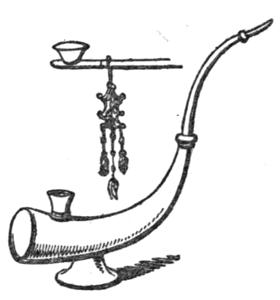
a pipe of tobacco. An oriental pipe of wonderful beauty
and inventive skill was presented to Napoleon by a Persian
ambassador. Though he was an immoderate snuff-taker
he had never smoked, but he would try this pipe. It was
duly charged with tobacco and lighted, says Constant, but
His Majesty, instead of drawing up the smoke in the usual
way, merely opened and shut his mouth with mechanical
regularity. Losing patience, he exclaimed, ‘Devils!
There is no result!’ It was remarked that he had made
the attempt badly, and he was shown how to smoke
properly. But the Emperor simply reverted to his
automatic performance; the pipe went out, and Constant
was desired to relight it. This done, he again instructed
his master in the proper method of smoking. Determined
not to be balked again, the Emperor resolutely drew up the
smoke, and, swallowing it, it came out by his nostrils and
blinded him. As soon as he recovered breath he cried out,
‘Away with it! Oh, the hog! Oh, my stomach! My
stomach turns!’ This was Napoleon’s first and last experience
of smoking. Then let those whom St Nicotine
favours thankfully own her benign sway and be comforted.
The placid oriental, when his wives rave, or affliction
smites him, will stroke his beard—if he have one—and
thank Allah for the good gift
Which on the Moslem’s ottoman divides,
His hours, and rivals opium and his brides.
An old Persian legend, brought to light by Lieutenant
Walpole, tells the story of a virtuous youth distraught at
the loss of a loving wife. A holy man looks tenderly upon
the disconsolate one, and tells him of a balm for his
affliction. ‘Go to thy wife’s tomb, son of sorrow,’ says the
anchorite, ‘and there thou wilt find a weed. Pluck it,
place it in a reed, and put fire to it, then inhale the smoke
thereof. This will be to thee wife and mother, father and
brother, and, above all, will be a wise counsellor, and
teach thy soul wisdom and thy spirit joy.’ The Homeric
strain of this Eastern sage breathes of implicit faith in his
native Shiraz tobacco. For doubtless he, a dweller in
… the land where the cypress and myrtle
Are emblems of deeds that are done in their clime;
Where the rage of the vulture, the love of the turtle,
Now melts into sorrow, now maddens to crime,
had often experienced its influence on a wounded heart.
Indeed, the history and associations of the plant, from its
wild Indian home to the remotest East, are full of romance
of more than ordinary interest. For, like most things
transatlantic, whether products of the soil or of the brain, it
rapidly became universal, spreading literally like wild-fire
wherever man was to be found. Everywhere it was
esteemed a close comfort, a priceless possession, and to its
rare qualities were ascribed almost miraculous powers.
The persistency with which men have stuck to the weed,
after once experiencing its soothing effects, ranks among
the most remarkable examples history affords of the rapid
development of a new taste and the formation of a new
habit; a habit that, after the lapse of three centuries and
more, grows stronger day by day, keeping full pace with the
increase of population, until now it is too deeply rooted
ever to be extirpated, even by taxation, however weighty.
Viewed in its political aspect, the career of the Indian
weed presents a striking illustration of popular opinion
ultimately triumphing over prejudice and power.
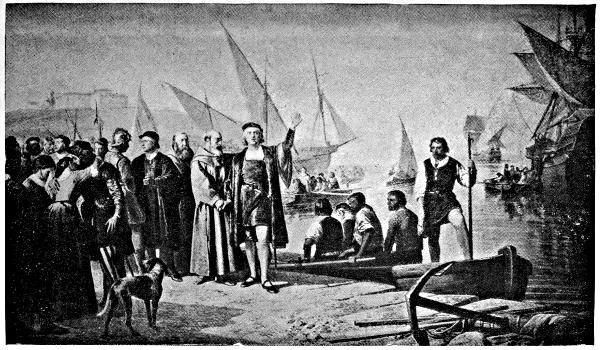
Here let us take a cursory glance back to the heroic age
when the marvellous weed which has almost revolutionised
men’s habits all over the world, and created a new industry
giving employment to millions of human beings, was first
imported into these islands.
A halo of romance surrounds those jubilant days; but, in
the eyes of Englishmen generally, Sir Walter Raleigh stands
out prominently as the hero to whom the honour is due of
giving his countrymen their first instalment of tobacco.
England had just awakened to the reality of a new world
of wonders and boundless wealth lying unexplored in the
far West; a land where everything touched turned to
gold. The far-famed discoveries and conquests of the
Spaniards, their fabled El Dorado, drew forth the daring
and enterprising from every corner of Europe. Stirred by
an overpowering desire to see the marvels, and share in the
treasures of the terra incognita which was in all men’s
mouths, our hardy sea captains, Hawkins, Drake, Raleigh,
and a host more of England’s sturdy sons, sailed the
Spanish main, bent upon achieving fame or fortune, yet
caring little what lot befell them if only renown were won
for their idolised Queen Bess. They encountered the
mild Indian, and explored a portion of his glorious land,
teeming with a rich luxuriance of vegetation such as their
eyes had never before beheld. But what of El Dorado,
the famed city of gold and precious stones, hemmed in by
golden mountains, whose splendour and immense treasure
beckoned them onward? Alas! the gorgeous phantasm of
the New World, like the glories of the setting sun, melted
away before their advancing steps. And yet many a poor,
dispirited wayfarer in the pursuit of the alluring ignis
fatuus found comfort and consolation in the humble weed
which the natives supplied to him and taught him how to
use. In testimony whereof, listen to honest Jack Brimblecombe
in Westward Ho! ‘Heaven forgive me! but
when I get the leaf between my teeth, I feel tempted to sit
as still as a chimney and smoke to my dying day.’ And
faithful old Yeo pours forth his pent-up gratitude for the
comfort he derives from the Indians’ herb in a stream of
consolation for the lonely and afflicted, assuring us that when
all things were made none was made better than this. And
here he enumerates the blessing breathed upon the weary
and worn traveller in those far-off lands by the herb, like
unto which there is not another under the canopy of
heaven.
In the summer of 1584, Raleigh, his imagination aglow
with brilliant colonisation schemes which should eclipse
those of Spain, sent out an expedition to explore the coast
of the new continent. On July 13, the party, under
Captains Amadas and Barlowe, took possession of the
territory which Raleigh subsequently named Virginia, in
honour of the Queen. In the following year a second
expedition was despatched, conveying one hundred and
seven souls, whom, with Master Ralph Lane at their head
as the governor of the new colony, Raleigh had inspired
with his own ardent hopes and plans for the founding of a
new settlement that should, in course of time, rival the
Spanish conquests. The adventure, however, was not
attended with the success anticipated. The party remained
in the new territory from August 17, 1585, to June 18, 1586,
when Sir Francis Drake, with his fleet, returning along the
coast from his victorious raid in the West Indies, called at
their port, and, learning their discontent, brought them back
to England. They took care, however, not to return
empty-handed; a large quantity of tobacco, which the
natives had prepared for them, was stowed on board the
vessels, with a variety of instruments for preparing and
using it. It can well be imagined that Master Lane would
take pride in exhibiting himself to London’s gazing
multitude smothered in Indian clouds. The learned
Camden speaks of Lane as the original English smoker.
It is remarkable that there should have been so much
uncertainty, even in Eliza-Jacobean times, as to the date
when tobacco was first received in this country and the
person by whom it was first introduced. The painstaking
annalist, Stow, says that tobacco came into England about
the twentieth year of Queen Elizabeth (1577). But
Aubrey, speaking of Sir Walter Raleigh, says that ‘he was
the first that brought tobacco into England and into fashion
(1686). In our part of North Wilts—e.g. Malmesbury
Hundred—it came first into fashion by Sir Walter Long.
They had first silver pipes. The ordinary sort made use of
a walnut shell and a straw. I have heard my grandfather,
Lyle, say that one pipe was handed from man to man
round the table. Sir Walter Raleigh, standing in a stand
at Sir Ro. Poyntz parke at Acton, took a pipe of tobacco,
which made the ladies quitte it till he had donne.’ The
author of a gossipy Tour in Wales (Pennant), in 1810,
speaking about the great houses and their associations, says
that Captain Price, of Plasyollin, with Captains Myddelton
and Koet, on their return from the Azores in 1591, ‘were
the first who had smoked or (as they called it) drank
tobacco publicly in London, and that the Londoners
flocked from all parts to see them. Pipes were not then
invented, so they used the twisted leaves, or segars. The
invention is usually ascribed to Sir Walter Raleigh. It
may be so, but he was too good a courtier to smoke in
public, especially in the reign of James.’ Again, in the
1659 translation of Dr. Everard’s Panacea (Antwerp,
1587), it is remarked that ‘Captain Richard Grenfield and
Sir Francis Drake were the first planters of it here
(England), and not Sir Walter Raleigh, which is the
common error; so difficult is it to fix popular discoveries.’
These few selections show us how easily origins are lost
sight of.
It seems ungracious to pluck a plume from one so
eminently distinguished for important services rendered to
his Queen and country as Sir Walter Raleigh; yet nothing
in history is more certain than that the common belief
crediting him with the first introduction of tobacco into this
country is a myth. History, whilst awarding him the palm
for potatoes, points to Sir John Hawkins as the first to
bring to his countrymen the peaceful pleasures of the pipe.
Certainly, the weight of probabilities are in his favour.
Taylor, the Water Poet, says: ‘Tobacco was first brought
into England in 1565, by Sir John Hawkins.’ And
Edmund Howes, in his continuation of Stow’s Annals
says: ‘Tobacco was first brought and made known by Sir
John Hawkins about the year 1565, but not used by
Englishmen for many years after, though at this day it is
commonly used by most men and many women.’ These
accounts correspond with Hawkins’s second voyage, viz.,
October 18, 1564, returning September 20, 1565. Confirmatory
evidence comes from John Sparkes, the younger,
who, in his account of this voyage, says that Hawkins,
ranging along the ‘coast of Florida for fresh water, in July
1565, came upon the French settlement there under
Landoniere, where the natives, when they travel, have a
kind of herbe dryed, which with a cane and an earthen cup
in the end, with fire and the dryed herbe put together, they
do suck through the cane the smoke thereof, which smoke
satisfieth their hunger, and therewith they live four or five
days without meat or drink, and this all the Frenchmen
used for the purpose.’ Hearing these wonderful stories
told of the Indian’s herbe, nothing could be more
natural than that Hawkins should make trial of it for
himself, and, liking it, secure specimens of the plant for
cultivation and use at home. To see and hear and get all
he could, was the sole end and aim of his ploughing the
Spanish main. Bearing in mind that he got back to
England in September 1565, we see that the statements of
Taylor, the Water Poet, and Howes, the annalist, that
tobacco was brought by Sir John Hawkins in 1565, are
consistent and reliable. Collateral evidence on the point
is to be found in L’Obel’s work on Botany,[6] written in
1570, wherein he says: ‘Within these few years the West
Indian tobacco-plant has become an inmate of England.’
This of itself is conclusive against the Raleigh theory.
But let us look a little further into the matter. In 1570,
Raleigh was a youth of eighteen, and had just gone to
France to fight in the Huguenot cause. Again, in the
State Archives, there is still extant an edict issued by Queen
Elizabeth against the use and abuse of tobacco, dated
1584—the year Raleigh’s first expedition sailed to the New
World.
It is amusing to find Queen Elizabeth fulminating
against the pipe she afterwards so willingly countenanced in
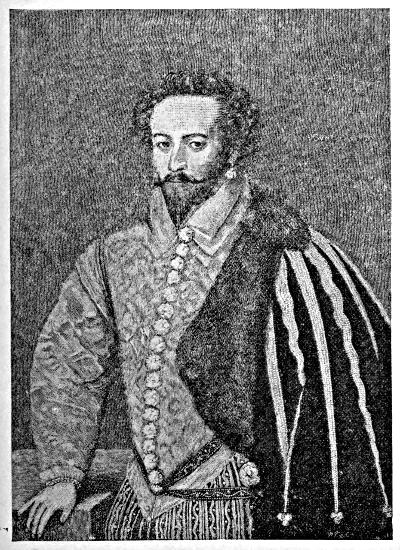
the mouth of her favourite knight. But then Sir Walter
was in every way a splendid man, the typical gallant and
hero in England’s heroic age. Tall, dark, handsome, a
noble brow, commanding voice and mien, he drew to his
side willing hands ready to do his behest, be it what it
might. A gay courtier, his dress was of the richest, and
priceless gems sparkled on every finger. And so it came
about that his proud Queen would quietly sit by his side,
would playfully call him Walter, and listen to his tales
of daring deeds and sufferings endured all for Good
Queen Bess. And had he not won for her a new land full
of rich promise, which, for her sake, was named Virginia?
And thus they would talk on, Sir Walter smoking his finely-wrought
silver pipe in peace, forgetful of the fair, if frail,
Maid of Honour, Bessy Throgmorton, listening, maybe,
behind the arras. Alas! poor mortal man. The untoward
affair at last broke upon Elizabeth like a thunderstorm in a
serene sky, and our gallant hero became an outcast from
the favour of his Queen.[7]
Among the many anecdotes told of Raleigh’s practices with
his pipe may be mentioned that of his outwitting the Queen
in a wager she laid with the gallant knight respecting the
weight of the smoke which exhaled from a pipeful of tobacco.
‘I can assure your Majesty,’ said Raleigh, ‘that I have so
well experienced the nature of it that I can exactly tell even
the weight of the smoke in any quantity I consume.’ ‘I
doubt it much, Sir Walter,’ replied Elizabeth, thinking only
how impossible it must be to catch the smoke and put it in
a balance, ‘and will wager you twenty angels that you do
not solve my doubt.’ Whereupon Raleigh drew forth a
quantity of the weed, placed it in finely adjusted scales, and
having ascertained its weight, commenced to smoke it, carefully
preserving the ashes. These at the finish he weighed
with great exactness. Then would it dawn upon her Majesty
how the wager was to end. ‘Your Majesty,’ said Raleigh,
‘cannot deny that the difference hath evaporated in smoke.’
‘Truly, I cannot,’ was her reply. Then, turning to those
around her, who were eying with amusement this curious play
on the pipe, she continued, ‘Many labourers in the fire have
I heard of (alluding to alchemists) who turned their gold into
smoke, but Sir Walter is the first who has turned smoke into
gold.’
But the Indian weed had a hard fight to hold its ground
in Europe and Asia in face of the most resolute opposition
from potentates, statesmen, and priests. In England
The gentleman called King James
In quilted doublet and great trunk breeches,
Who held in abhorrence tobacco and witches,
[8]
signalised himself and his reign by profound learning and
ponderous invective hurled against the innocent plant,
amongst whose alluring leaves there lurked the ‘lively image
and pattern of hell.’ His Counterblaste to tobacco[9]
is of itself an historic monument to his genius, which posterity
does well to preserve that there may be something in
hand to attest the just appreciation of his ‘loving subjects’
in early recognising in him a Solomon! Though, to be sure,
some will have it that the irreverent Henri Quatre was the
first to see the fitness of the designation, Solomon, for the
son of Mary, Queen of Scots. And yet his astute minister,
the Duc de Sully, professed to have discovered in the flickering
illuminations of this northern light ‘the wisest fool in
Christendom.’ Historians who think it incumbent upon
them to explain every human phenomenon or prodigy, have
perplexed themselves with vain endeavours to unravel this
curious compound of Machiavellian craft, fussy self-conceit
and imbecility. Looking to his preternatural insight into
the uncanny domain of the Black Arts, his mental conflicts
with the de’il, witches and warlocks, and long nebbit things,
the problem his character presents might perhaps form a
fitting study for the modern school of psychology.
With the beginning of the seventeenth century commenced
a literary warfare over the virtues and vices of St Nicotine,
which lasted intermittently down to the present day. Mr.
Solly, of St. Thomas’s Hospital, in the middle of last century
strove valiantly in the columns of the Lancet to get up
a crusade against smoking. All the leading members of the
medical profession took part in the affray; irrefragable statistics
were piled up one upon the other as ramparts from behind
which Mr. Solly proclaimed that there was death in the
pipe; and the rapid degeneracy of the human race, to him
everywhere apparent, was to be regarded as the inevitable
consequence of indulgence in the pernicious weed. Had
Mr. Solly referred to the text-book left by the royal founder
of his faith, he would have learned the right use and value
of trenchant utterance, and as a physiologist, would have
gained knowledge never imparted in St. Thomas’s Hospital.
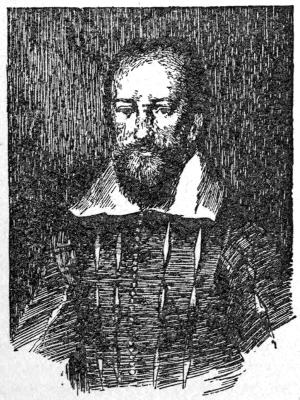
DUC DE SULLY
The royal Counterblaste proclaims that ‘smoke becomes
a kitchen far better than a dining-chamber; and yet it
makes a kitchen oftentimes in the inward parts of men,
soyling and infecting with an unctuous and oyly kind of soote,
as hath been found in some great tobacco takers, that after
death were opened.’ ‘Have you not reason then to be
ashamed and to forbear this filthie noveltie, so basely
grounded, so foolishly received, and so grossly mistaken in
the right use thereof? In your abuse thereof sinning against
God, harming yourselves both in person and in goods, and
raking also thereby the marks and notes of vanitie upon
you; by the custom thereof making yourselves to be wondered
at by all forraine civil nations, and all strangers that
come among you, to be scorned and contemned.’ King
James clinches his argument with a logical acumen there is
no resisting. ‘Why,’ he asks, ‘since we imitate the beastly
and slavish Indians in taking tobacco, do we not imitate
them in walking naked? as they do’—an extraordinary idea
to occur to one accustomed to wear dagger-proof quilted
dress—‘preferring glass beads and feathers to gold and
precious stones? as they do; yea, why do we not deny God
and adore the devil? as they do.’ Then comes his famous
climax: ‘A custom loathsome to the eye, hateful to the
nose, harmful to the orgain (brain), dangerous to the lungs,
and in the black stinking fume thereof nearest resembling the
horrible Stygian smoke of the pit that is bottomless.’ If, after
this display of royal indignation, stiff-necked ones still cast
fond looks at the ‘emblem of hell,’ let them turn their attention
to the King’s words of wisdom stored up in a Collection
of Witty Apothegms. Things that before were obscure
to mental vision are here illuminated with a new
radiance; it is made clear to us that ‘tobacco was the lively
image and pattern of hell, for that it had, by illusion, in it
all the parts and vices of the world whereby hell may be
gained—to wit, first: It is a smoke; so are the vanities of
this world. Secondly: It delighteth them that take it; so
do the pleasures of the world delight the men of the world.
Thirdly: It maketh men drunken and light in the head;
so do the vanities of the world, men are drunken wherewith.
Fourthly: He that taketh tobacco saith he cannot leave it,
it doth bewitch him!… And, further, besides all this,
it is like hell in the very substance of it, for it is a stinking,
loathsome thing, and so is hell.’ But James had his
moments of gaiety; he could jest over the arch enemy, and
it would be most unfair to his memory to pass by any playful
attempt at jocularity that for an instant flickered over his
dreary brain. In the treasury of wisdom already mentioned,
we are told that his Majesty once remarked that ‘if he were
to invite the devil to dinner he should have three dishes:
1. A pig; 2. A pole of ling and mustard; and (3) a pipe
of tobacco for digesture.’
There is a passage in the Counterblaste which seems to
point directly to Raleigh; it runs as follows: ‘Now the
corrupt baseness of the use of this tobacco doeth very well
agree with the foolish and groundless first entry thereof
into this kingdom. It is not so long since the first entry
of this abuse amongst us here, as this present age can very
well remember both the first author and the form of the first
introduction of it amongst us. It was neither brought in
by king, great conqueror, nor learned doctor of physick.
With the report of a great discovery for a conquest, some
two or three savage men were brought in, together with this
savage custom. But the pity is, the poor, wild, barbarous
men died; but that vile, barbarous custom is yet alive, yea,
in fresh vigour, so as it seems a miracle to me how a custom
springing from so vile a ground, and brought in by a
father so generally hated, should be welcomed on so
slender a warrant.’ The mention of ‘two or three savage
men’ clearly indicates the return of Raleigh’s first expedition
in 1584, when Captain Amadas and Barlowe brought
with them two American Indians, whose appearance in the
streets was regarded as one of the sights of London.
James’s inveterate enmity towards Raleigh would seem to
have originated at their first encounter at Burghly, in
Lincolnshire, when the King faltered out: ‘On my soul,
mon, I hae heard but rawley o’ thee,’ a clumsy attempt at a
pun. Doubtless Raleigh’s noble bearing and rich attire
would touch James’s inordinate self-importance, which
seems to have at all times blinded him to a proper sense of
decency, according to Sir Anthony Weldon’s simple, graphic
presentation of him. On the King boasting that, had the
English crown not been offered to him, his Scotch army
would have taken it for him, Raleigh, indignant, made the
injudicious remark: ‘Would God that had been put to
the test.’ ‘Why?’ asked James. Raleigh recovering himself
replied, ‘Your Majesty would then have known your
friends from your foes.’ Aubrey says that James never forgave
this speech. One by one, Raleigh was stripped of all
his offices; and before the end of the first year of James’s
reign (November 4, 1603) he was lodged in the Tower on
a false charge of treason, and after fifteen years’ imprisonment
was judicially murdered by order of the King.
Speaking of this event, Sir Anthony Weldom remarks,
‘How this kingdom was gulled in the supposed treason of
Sir Walter Rawley and others who suffered as traytors,
whereas to this day it could never be knowne that there
ever was such treason, but a mere trick of State to remove
some blotches out of the way.’ When Raleigh’s fate drew
nigh, ‘he took a pipe of tobacco a little before he went to
the scaffolde,’ says Aubrey, ‘which some female persons
were scandalised at; but I think ’twas well and properly
donne to settle his spirits.’
Speaking of this noble victim of James I., Sir Walter
Besant, in his handsome volume on Westminster, says,
‘Raleigh was brought to Old Palauce Yard to die. The
day chosen for his execution was Lord Mayor’s Day, so
that the crowd should be drawn to the pageant rather than
to his execution.’ The body lies buried in the chancel of
St. Margaret’s Church, Westminster, where, near by, a
tablet informs the visitor that
Within the walls of this church was deposited the body of the
great Sir Walter Raleigh, Knt., on the day he was beheaded
in Old Palace Yard, Westminster, 29 October, Ann. Dom. 1618.
Reader, should you reflect on his errors,
Remember his many virtues,
And that he was a mortal.
Considering the deep sympathy the nation has always
evinced for the ill-fated yet illustrious knight, it is almost
incredible that no monument has ever been erected to his
memory. Raleigh was truly great in all those things which
mankind loves to honour and perpetuate. In him
patriotism, valour, and magnanimity stand out conspicuously
in an age of heroes. Though endowed with a
glowing, wildly-romantic imagination, he has left in his
various writings evidence of extensive reading, keen insight,
and sound judgment. The improvements he effected in
naval architecture alone entitle him to the lasting gratitude
of his country. The concluding lines of his History of
the World written when the death sentence had been
passed upon him and all his hopes of life had fled, are
considered to be the finest and grandest example of prose
in the English language. That Raleigh would not surrender
his natural nobility of character to flatter the most
abject monarch[10] that ever sat on the throne is to his everlasting
honour, and marks him as a typical Englishman.
Through the medium of the notorious Star Chamber, the
King, in 1614, directed his efforts ostensibly to restrain the
consumption of tobacco; in effect, to put an end to the
infant colony of Virginia. For this purpose a bill was
drawn up, addressed to ‘Our Right Trustie and right well
beloved Cousin and Counsellor, Thomas, Earle of Dorset,
our High Treasurer of Englande, Greeting.’ Then follows
a rather perplexing, verbose preamble, the drift of which
seems to be the hatching up of excuses for heaping upon
tobacco a monstrous load of taxation for the avowed
purpose of relieving ‘many mean persons’ of the heavy
expense the habit of smoking entailed.
He tells his ‘loving subjects’ that smoking is an ‘evil
vanitie, whereby the health of a great number of people is
impayered, and their bodies weakened and made unfit for
labour, and the estates of many mean persons so decayed
and consumed, as they are thereby driven to unthriftie
shiftes onley to maintain their gluttonous exercise thereof.’
After further admonition and warning of evils in store for
the obdurate, the Act proceeds: ‘We do therefore will
and command you, our Treasurer of Englande, and herebye
also warrant and authorise you to give orders to all
Customers, Comptrollers, Searchers, Surveyors and other
officers of our Portes, that from and after the six-and-twentieth
Day of October next comynge, they shall demand
and take to our use, etc., etc., the sum of Sixe shillings and
8d. upon every pound weight thereof, over and above the
custome of 2d. upon the pound weight usually paid heretofore.’
The penalties for evading payment were, forfeiture
of cargo, ‘and such further Penalties and coporal punishments
as the qualitie of suche so high a Contempt against
Our Royal and Expresse Commandmente in this manner
published shall deserve.’
The imposition, equivalent to about thirty shillings of
our present money, had a startling effect on the tobacco
trade of the country; but when merchants found out that
it was meant to apply only to the tobacco imported
from Virginia, they naturally had recourse to other markets,
as Spain and Portugal, whence it was brought in at the old
rate of twopence on the pound that had satisfied Elizabeth.
Agriculturists, too, saw in the change an opportunity for
extending the home cultivation and manufacture of tobacco,
and readily availed themselves of it, particularly in
Yorkshire, where all the operations connected therewith
were well understood. On the King learning what they
were doing, he hastened to promulgate a further edict
forbidding husbandmen ‘to misuse and misemploy the soyle
of this fruitful kingdom,’ beginning with the words,
‘Whereas we, out of the dislike we have to tobacco.’
Thus expressed, his case against the weed is placed in a
more intelligible light than that which he had in the first
instance thought it expedient to disclose. However absurd
his reasoning, his policy succeeded only too well. Besides
dealing a crushing blow to the young colony, his action
had other far-reaching effects. It created a daring race of
smugglers, who did a thriving contraband trade in tobacco
with pirates on the Spanish main; and home dealers saw
in the greatly enhanced price of the weed a temptation to
‘sophisticate’ too powerful to be resisted. Scattered
through the literature of that period may be found some
curious allusions to the practice, as in Ben Jonson’s
Alchemist, where Abel Drugger, speaking in praise of his
tobacconist, says:
He lets me have good tobacco, and he does not
Sophisticate it with sack-lees or oil;
Nor washes it in muscadel and grains,
…
But keeps it in fine lilly pots, that, opened,
Smell like a conserve of roses, or French beans.
He has his maple block, his silver tongs,
Winchester pipes, and fire of juniper.
In Bartholomew Faire he presents us with a picture of
one, Ursula, a vendor of roast pig, bidding her servant
‘Look to’t, sirrah, you had best! three pence a pipe full I
will ha’ made of all my whole half pound of tobacco, and a
quarter of a pound of coltsfoot, mixed with it too, to eke it
out.’ That sophisticating practices were growing apace
may be gleaned from Dr. Barclay, of Edinburgh, who in
his Nepenthes (1614) speaks of ‘tobacco merchants
apparelling European plants with Indian coats and
enstalling them in shops as righteous and legitimate
tobacco.’ (How very conservative we English are!)
‘Some others, indeed, have tobacco from Florida that they
sophisticate and farde in sundrie sorts with black spice,
galanga, aqua-vitæ, Spanish wine, anise seedes, oyle of
spicke, and such like.’ Less expensive materials than
these were more commonly used (and perhaps still are), as
the leaves of rhubarb, dock, burdock, plantain, oak and
elm, also chickory and cabbage leaves steeped in tar-oil.
If the manufacturers of these and less innocent
‘mixtures’ really find themselves unable to withstand the
pressure from without for a cheap smoke, let them confine
their sophisticating ingenuity to simple vegetable products,
such, for instance, as satisfied Dame Ursula. Coltsfoot or
the leaves of the lettuce, being slightly narcotic, would
form a harmless make-belief for the good folk who
persuade themselves that they could not sleep a wink were
they deprived of their evening comfort. Ages ago both
Greeks and Romans, according to Dioscorides and Pliny,
found comfort in smoking through a reed or pipe the dried
leaves of coltsfoot, which relieved them of old coughs and
difficult breathing. We can picture the legionary in
Britain’s bleak atmosphere, while pacing the Roman Wall,
trying to console himself in his lonely vigil with the vapour
from his ‘elphin pipe,’ fragments of which have been found
among the ruins of those early memorials to the Scots’
persistent determination to travel southwards. And as to
the lettuce, it has been famous since the time of Galen
(Claudius Galenus), who asserts that he found relief from
sleeplessness by taking it at night. Regardless of these
things, the Nicotian epicure of to-day enjoys the inestimable
advantage of luxuriating in the delicate aroma of the
Cuban leaf, while fancying himself wafted on his upward
way to Nirvana. The charming simplicity that leads to
this ideal conception of existence is most refreshing; the
being so lost to the outer world can hardly be blamed if he
says rude things when compelled to touch Mother Earth.
But King James had not yet done with tobacco. A
monarch of his remarkable idiosyncrasy, as displayed in his
creation of a new and lucrative business for the sale of
distinguished titles and high offices of State, where he
himself possessed the sole monopoly, would naturally see
his way to a further stroke of ‘good business’ in the
tobacco market. Accordingly, we are not surprised to
learn that, viewing with a jealous eye the flourishing state
of the new industry, the idea occurred to him that the
State coffers might be replenished by taking a still deeper
interest in the weed. Hence the issue of a royal
proclamation to his loving subjects that they were
forbidden to deal in tobacco unless they purchased Royal
Letters Patent granting them a license to do so. These
could only be procured, on payment of a yearly sum, from
the persons who farmed from the King the right to enforce
and collect the tax. In the Stafford Letters, compiled
by Gerrard, relating to the collection of the new tax, it is
stated that ‘some towns have yielded twenty marks, £10,
£5, £6, fine and rent; none goes under. I hear that
Plymouth hath yielded £100 and as much yearly rent.…
The tobacco licences go on apace; they yield a
good fine, and a constant yearly rent.…’ In some
instances a life-lease to deal in tobacco was granted on
payment of a lump sum. As to the King’s method of
dealing with State affairs of the kind, let Sir Anthony
Weldon speak from personal knowledge. He says of the
King that ‘he was so crafty and cunning in petty things, as the
circumventing any great man. He had a trick of cousen
(cozen) himself with bargains under hand, by taking £1,000
or £10,000 as a bribe, when (at the same time) his Counsel
was treating with his Customers to raise them to so much
more yearly; this went into his Privy purse; wherein he
thought he had over-reached the Lords, but consented
himself; but would as easily break the bargain upon the
next offer, saying he was mistaken and deceived, and
therefore no reason he should keep the bargain. This was
often the case with the Farmers of the Customs.’
There is a document in the State Archives which throws
a curious side-light on the King’s ideas of statecraft. The
settlers in Guiana had become tobacco-planters, and
required a trade-charter with this country. A charter was
granted them, in which a clause was inserted to the effect
that one-tenth of the tobacco grown there should go to the
King. Thus, in a roundabout way, the King became a
tobacco merchant.
The concern which the King had professed for the
‘many mean persons’ of decayed fortune in debt for
tobacco had not resulted in helping them out of their
difficulties, but rather the contrary. From Aubrey we
learn that its cost had risen to the value of silver. He
says, ‘I have heard some of our old yeomen neighbours
say that when they went to Malmesbury or Chippenham
market they culled out their biggest shillings to lay in the
scales against the tobacco. Now (1680) the Customes of
it are the greatest his majestie hath.’ In various
documents of the period, tobacco is mentioned amongst
the most expensive luxuries. Even in Elizabeth’s reign its
price ranged from 10s. to 18s. a pound, according to the
quality.
Meanwhile, jovial spirits were amusing themselves with
a lively paper warfare over the virtues and vices of the rare
Indian plant that, according to the King, had bewitched
them. Early in the fray (1602), appeared anonymously a
booklet entitled, Work for Chimney Sweepers, or a
Warning to Tobacconists, calling the smoker’s attention to
the necessity for securing the services of one of those
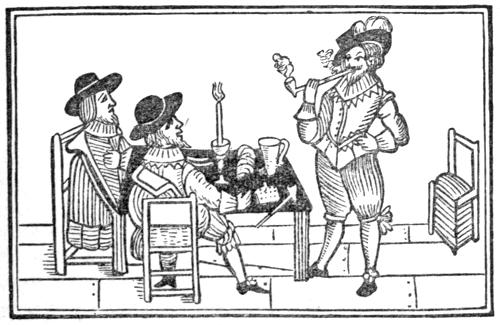
useful members of the community. At that time it was
the fashion among gallants of the weed to draw the smoke
into the lungs and to eject it ‘through the organs of the
nose, with a relish that inviteth,’ says the gay, laughing,
Doctor Barton Holiday, who took such a wicked delight in
tormenting King James at Woodstock in his play of the
Marriage of the Arts. This was speedily answered by
A Defence of Tobacco, printed by Richard Field for
Thomas Man, wherein the author shows that the ‘warning’
should have roosted at home, where, in its absence, zeal
had outrun discretion, and had thereby damaged the cause it
would fain have served.
Verbose titles, full of alliteration, fire and fun, were much
appreciated by the militant writers of this period. Witness
the following heading to a poem against tobacco by Joshua
Sylvester, Gent., the favourite poet of King James:
‘Tobacco battered, and the pipes shattered (about their
eares that idely idolize so base and barbarous a weed; or
leastwise over-love so loathsome a vanitie), by a volley of
Holy shot, thundered from Mount Helicon.’ After this
brave warning we are prepared to hear that
Hell hath smoake
Impenitent tobacconist to choake.
Though never dead, there shall they have their fill;
In heaven is none, but light and glory still.
Samuel Rowlands in his Knave of Clubbs (1611) writes
in a lighter strain, and asks:—
Who durst dispraise tobacco whilst the smoke is in my nose,
Or say, but fah! my pipe doth smell! I would I know but those
Durst offer such indignity to that which I prefer;
For all the brood of blackamoors will swear I do not err,
In taking this same worthy whiff with valiant cavalier,
But that will make his nostrils smoke, at cupps of wine or beer,
When as my purse can not afford my stomach flesh or fish,
I sup with smoke, and feel as well and fat as one can wish.
…
Much victuals serve for gluttony, to fatten men like swine,
But he’s a frugal man indeed that with a leaf can dine,
And needs no napkins for his hands his fingers’ ends to wipe,
But keeps his kitchen in a box, and roast meat in a pipe.
This is the way to help down years, a meal a day’s enough;
Take out tobacco for the rest by pipe, or else in snuff,
And you shall find it physical; a corpulent, fat man,
Within a year shall shrink so small that round his waist you’ll span.
It’s full of physic’s rare effects, it worketh sundry ways:
The leaf green, dried, steep’t, burnt to dust, have each their several praise.
While Englishmen smoked, and laughed at their King’s
wondrous ways, or growled at his tenacious grip upon their
pockets, Eastern potentates were treating their subjects, as
only despots can, for daring to indulge in the Frankish novelty.
In Persia, where but recently jealous strife raged for sole
possession of the tobacco industry, Abbas I., of dread
memory, cut off the lips of those who smoked, and the
noses of any who ventured to snuff. On one occasion he
threw an unfortunate man, whom he discovered selling
tobacco, into a fire along with his goods. Yet, by-and-by,
this demon of cruelty himself was enthralled by Nicotiana’s
charms, and became one of her most fervent devotees.
The Turks, under Amurath IV., were similarly punished
for infringing his edict against smoking. Sir Edwin
Sandys, of Pontefract, in his travels in 1610, bears testimony
to similar acts of cruelty by Mahomet IV. During his stay
in Constantinople he witnessed the punishment of a Turk
who had been caught solacing the burden of life with the
vapour of his new-found joy. Short-lived was the sturdy
beggar’s happiness; he was dragged before the tribunal, and
condemned to the torture of having a hole pierced through
the cartilage of his nose, and a pipe inserted therein.
Then, in order to render the punishment more impressive
to the multitude, he was seated on the back of an ass with
his face to the tail, and driven through the streets of the
city, while criers proclaimed his offence and its merited
punishment, according to the law of the Sultan. Not less
cruel were the punishments inflicted upon Russian smokers,
who, under the Tsar Michael Fedorowitz, were publicly
knouted for using tobacco in any form; in some instances
their nostrils were split open. If guilty of a second offence,
death alone could wipe out the crime. The ambassadors
of the Duke of Holstein, who visited Moscow in 1634, relate
that they were eye-witnesses of a public exhibition of this
kind, where eight men and one woman were punished with
the knout for selling tobacco. By way of palliating this
Russian atrocity, they were informed that houses in Moscow
had been set on fire by smokers falling asleep and dropping
their lighted pipes.
Oppression, however, like persecution in another sphere,
brought succour to the smoker; for, despite every form of
opposition and punishment, men quietly went on comforting
themselves with the weed, until at last their bitterest foes
became their best friends, and gratefully acknowledged
the benign sway of St Nicotine.
There is a peculiar interest, not without instruction, in
observing the change that came over governments with
regard to the consumption of tobacco. One after another
they began to recognise a new and most useful virtue in the
outcast weed, one which had too long remained hidden.
Straightway they took the exotic under their paternal protection,
and handsomely were they rewarded for their acknowledgment
of her value to mankind. By-and-by, many an
anxious custodian of an empty treasury came to look upon St
Nicotine as a divinity
… that cures, a vapour that affords
Content more solid than the smile of lords,
and as they gathered in their golden harvest of taxation,
blessed the name of their benefactress.
In illustration of this change may be mentioned the action
which Peter the Great took with the view of establishing
tobacco culture and manufacture in his dominions. In the
tenth volume of M. de Martin’s magnificent work on the
treaties and conventions concluded by Russia with other
nations from 1710 to 1801, there is a paragraph which
states that Peter the Great, having determined that tobacco
should be cultivated and manufactured in Russia, sought
in England the necessary workmen, machinery, implements,
etc., for transmission to Moscow. Englishmen knew little
at that time of the remote Tsardom of Muscovy, but on
learning the wants and wealth of the monarchy, enterprising
merchants were not slow to undertake the performance
of all that was required of them. Accordingly, a party of
skilled workmen, with engineers, was soon on its way to
Moscow with all necessary material for setting up and working
a tobacco factory. When, later, the English Government
was apprised of what had been done, ‘Her Majesty, Queen
Anne, in Council, was pleased to manifest her profound dissatisfaction,
especially in that they proceeded to the realm
of Moscow to the cultivation of the native products of her
Majesty’s dominions, and in that they have brought to Moscow
for this purpose the requisite English workmen and
material, which is contrary to the interests and usages of the
kingdom of Great Britain.’ Orders were immediately sent
to our envoy at Moscow to not only return the workmen to
their homes, but to privately and secretly destroy all the
materials, machines and instruments of production.
It is not a little amusing to learn how energetically the
envoy carried out the order of destruction. He relates at
considerable length in his home despatch how he and his
secretary (a private secretary undoubtedly) spent a night in
breaking up all the machinery and laying waste the material;
how he afterwards explained to the Tsar that the object of
his zealous operations in smashing up the plant was to save
his Majesty’s subjects from a burdensome monopoly and
thus, really, to encourage and enhance the tobacco trade in
Russia. Remembering that the Tsar was Peter the Great,
we are not surprised to learn that our excellent envoy was
listened to with impatience.