The good St. Nicholas, the bishop-saint, is
strangely little known in America. He has
lent his name to a church here and there and to
a popular magazine for children, his protégés.
But how many people are familiar with the story
of his life? How many even know the date of his
own special festival? There are countries in which
his memory is not thus neglected, in which the
festival of St. Nicholas is one of the important
events of the year. An English newspaper of
the first year of the war has this to report concerning
the Belgian custom:
The feast of St. Nicholas, December 6th, was celebrated
at the Belgian refugee camp at Earle’s Court,
England, with presents for the children, stockings
hung up, a Christmas tree, and all the rest of the
children’s festivities which we associate with Christmas
eve and Christmas morning. This was not a
mere anticipation of Christmas. St. Nicholas’ day,
and not Christmas, is the children’s festival in Holland,
Belgium, and parts of Germany, and we have
borrowed the hanging up of stockings from them and
turned it into a Christmas custom.[1]
Letters from Belgian children, exiled in France
for more than two years, offer further evidence
of the intimate and friendly relationship existing
between St. Nicholas and his Belgian children.
Here is a touching passage from a letter written
by a little eight-year-old Belgian girl from Varengeville-sur-Mer,
in France, to an American “godmother”;
the adult English used in translation
fails to reproduce the naïve charm of the original.
We have just had a grand visit from St. Nicholas.
He came in person to bring us some nice things as he
used to do when we were home. We were playing
when, all at once, we heard singing at one side and
saw a bishop, ringing a bell. What joy, it is St. Nicholas!
We kneeled down to receive his blessing, and
then sang a song and went into the house. St.
Nicholas talked to us and, best of all, he gave us some
presents. He gave us an orange, a barley sweet, a
cake, and some games. My, how happy we were!
Germaine Barbez.
Le 16 dec., 1916.
Another little girl, a little older, writes from the
same place of ‘how the “grand Saint Nicholas”
has gone out of his way to come to see the Belgian
children on December sixth, and how he delivered
admonitions to various boys and girls but did
not fail to distribute among them dainties much
appreciated by all, big and little.’
The importance of St. Nicholas in Belgian life
is evident. His festival day too, the celebration
of which is so deeply rooted as not to lose its life
in an atmosphere of exile and painful memory,
has continued to hold an important place in the
year’s life not only of Belgium but, as remains to
be seen, of Holland. At one time the celebration
of St. Nicholas’ day seems to have been general
in most of western Europe. There is plentiful
record of the earlier popularity of this celebration
in all the southern and western parts of the countries
occupied by the peoples speaking the Teutonic
languages. It can be traced from Holland
and Belgium, through eastern France, the Rhine
provinces, Luxembourg, Alsace and Lorraine,
through Switzerland, both French and German,
as far east as the Tyrol and Salzburg, including
on the way Baden, Württemberg, and Bavaria,
in Germany.[2] In northern Germany, Protestantism,
with its aversion to saint worship, was
hostile to the St. Nicholas celebration. Also the
growing concentration on Christmas day of the
different winter popular celebrations, and especially
the rapid rise in importance, during the
last two centuries, of the Christmas tree, have
caused the St. Nicholas customs, in many places,
to be absorbed into the Christmas celebration,
in other places, to go quite out of use. But popular
customs seem to be to some extent affected by
political boundaries, and in two of the smaller
countries of western Europe, Belgium and Holland,
the St. Nicholas customs still retain much
of their earlier vigor.
In Belgium, St. Nicholas has long been among
the most venerated of saints, hardly second to
St. Martin. In the whole country there are one
hundred and six churches in his honor.[3] Besides
he is the patron saint of many trades and crafts,
for example, of the boatmen in cities on the Meuse,
of sawyers, dyers, turners, and haberdashers at
Bruges, of seedmen, packers, and coopers at
Liège, of haberdashers and mercers at Malines.
But above all he is the protector and the corrector
of children.
The children’s festival at Christmas time does
not exist in Belgium. The grand réveillon, the
great Christmas feast of southern France, which
leads children to call Christmas the “day when one
eats so much,” the English Christmas, with its
life and gayety and open hospitality, have nothing
corresponding at Christmas time in Belgium,[4]
where the celebration of Christmas is confined
almost entirely to services in the church. In
place of the Christmas gayeties of other countries,
Belgium has its St. Nicholas festival. St. Nicholas’
day throughout the whole country is a day of joy,
especially for the young. Even the German
Christmas tree, which has been gradually finding
its way into Belgium, is introduced not on Christmas
day, but on December 6th, the day devoted
to the honor of the popular saint.
A writer of about fifty years back thus describes
the joyous celebration of St. Nicholas’ day by
Belgian children of that time. “Weeks beforehand,
children full of impatience, before going
to sleep ask: ‘How many times must I go to sleep
before he comes?’ They sing to him as soon
as it is dark, and they see him in their dreams,
giving them gifts or punishment, according as they
have been good or naughty. Occasionally they
are made happy by a little gift that comes down
the chimney into a pinafore hung up to receive
it, or is found accidentally in the corner of the
room. A joyful ‘Thank you, Saint Nicholas’
greets each such gift. Each evening every corner
of the room is searched, and the children sing
with fervor their petition, one Flemish version
of which begins:
‘Sint Niklaes, Gods heilge man,
Doe uwen besten tabbaerd aen,
En rydt er mee naer spanje
Om appelen van Oranje
Om peeren van den boom.’”
In one of the versions of this children’s song
the supplication is addressed to “Sinte Niklaes
van Tolentyn,” a saint quite distinct from Saint
Nicholas of Bari, the recognized patron of children,
but the heavenly postal arrangements seem
to be effectively organized, for, so far as known,
the wrong address used, in no way prevents the
desired response from their special protector and
friend.
On the eve of his festival day, St. Nicholas
makes his tour, visiting palace and cottage. Frequently
in the early evening he makes a preliminary
visit in bishop’s robes, with pastoral staff
and miter, at each house making inquiries concerning
the conduct of the children, giving appropriate
praise or warning, and promising on the
following morning to give more substantial reward.
When he is gone, the children place receptacles
for the gifts which St. Nicholas is expected to let
fall down the chimney. The receptacle varies
in different places. Sometimes shoes are neatly
polished for the purpose,[5] at other times plates
or baskets or stockings or specially made shoes of
porcelain are set on the bed, in the open chimney,
before the door of a room, or merely in the corner
of a room. St. Nicholas’ steed, variously conceived
of as gray horse or white ass, is not forgotten.
For him the children put water and hay
or carrot or potato peeling or piece of bread, in
the shoe or basket or stocking. In the morning,
from the tipped-over chairs and general disarray
in the room, it is evident that St. Nicholas has
been present. Replacing the oats or hay or carrot
are found sweets and playthings for children that
have been good, obedient, and studious during
the year.[6] In the case of bad children, rods are
left, and the fodder is untouched.
A recent writer has given a highly interesting
account[7] of the similar celebration at the present
day in Holland, where St. Nicholas’ day has
the same importance as in Belgium.
St. Nicholas’ eve is a time of great importance to
children because at that time they receive a visit from
the saint, and his arrival is looked forward to with
trembling. A large white sheet is placed on the
floor in the middle of the room, and the children
stand about anxiously watching the slow movement
of the hands of the clock. In the meantime some of
the elder members of the family dress up so as to
represent St. Nicholas and his black servant. At
five minutes before the expected time, for St. Nicholas
generally announces at what time he may be expected,
they sing songs asking him to give liberally as is his
wont, and praising his greatness and goodness in eloquent
terms. The first intimation of his arrival is a
shower of sweets on the sheet spread on the floor.
Then, amid the ensuing scramble, St. Nicholas appears
in full bishop’s vestments, laden with presents,
while in the rear comes his black servant with an open
sack in one hand, for naughty boys and girls, and in
the other a rod which he shakes vigorously from time
to time. St. Nicholas usually knows the shortcomings
of individual children, and on his departure gives
each an appropriate lecture, promising to return
later. Sometimes he makes the children repeat a
verse to him or asks about their lessons.
The mysterious events of the ensuing night
closely parallel those recorded for Belgium. St.
Nicholas’ robe, his “beste tabbaerd,” enables him
to pass from place to place instantaneously. But
in his nightly journey over the roofs of houses,
he uses a horse which the children of Holland,
like those of Belgium, remember by leaving a
wisp of hay for his use.[8] If, for some reason, on
account of lack of time or of money, the parents
have neglected to buy gifts, the children say,
“St. Nicholas’ horse has glass legs; he has slipped
down and broken his foot.”[9]
But the joys of St. Nicholas’ eve in Holland are
not confined to children. It is a time, like the
Christmas season in England, for family reunions
and the renewal of old memories, also for the
giving of presents. But the manner of the Dutch
gift-giving has its distinctive features, for:
St. Nicholas’ presents must be hidden and disguised
as much as possible and be accompanied by rhymes
explaining what the gift is, and for whom St. Nicholas
intended it. Sometimes a parcel addressed to one
person will finally turn out to be for quite a different
member of the family from the one who first received
it. For the address on each wrapper in various stages
of wrapping, makes it necessary for the parcel to
change hands as many times as there are papers to
undo. Tiniest things are sent in immense packing
cases. Sometimes the gifts are baked in a loaf of
bread or hidden in a turf. The longer it takes to
find the present, the greater the surprise.
Great delight is taken in concealing the identity
of the giver as long as possible. Even if the gift
comes from a member of the same household, before
the parcel is brought in, the doorbell is rung by a
servant in order to create the impression that the parcel
has come from an outsider. For the same purpose
a parcel for a friend’s house is often entrusted to a
passer-by.
On the evening of the celebration, after St. Nicholas
has said his adieux, promising to come again, the
children are packed away to bed, and the older people
have their special amusement. They sit about a table
in the middle of the room and partake of tea and
“speculaas,” a spice cake bearing a great picture of
St. Nicholas, until their own surprises begin to arrive.
When this part of the program is over, about ten
o’clock, the room is cleared; the dust sheet laid down
for the children’s scramble, is removed, the papers,
boxes, baskets, and the like, used in packing the
presents, are cleared away. The table is spread with
a white tablecloth, and when all have taken seats,
a dish of boiled chestnuts, steaming hot, is brought
in and eaten with butter and salt.[10]
Belgium and Holland have their special forms
of cakes and sweetmeats for the St. Nicholas
season. In Holland these are the flat hard cakes
called “Klaasjes”[11] once made exclusively in the
form of a bishop in honor of the bishop St. Nicholas,
but now made in forms of every conceivable
kind of beast, bird, or fish. In certain places on
the Rhine the figure of the saint himself, the “Klasmann,”
is baked in dough with currant eyes,
or an especially palatable little horse is formed of
honey cake dough and the “Klas” is inlaid on the
horse. Then there is the “Letterbanket” made
in the form of letters so that one may order his
name in cake, and the “Marsepein,” now made in
a great variety of forms, but formerly made only
in heart-shaped sweets ornamented with little
turtle doves made of pink sugar or with a flaming
heart on a little altar. The “Marsepein” was
formerly used as a device in wooing. The young
man sent “Marsepein”[12] with a “Vryer” of cake
to the young lady of his heart, and if she accepted,
he knew his cause was won.
There are also various accounts of the way the
cakes are made. In Vorarlberg if, on the morning
of St. Nicholas’ day, mist is seen to rise, one tells
the children that St. Nicholas is baking his cakes,
“Zelten” or “Klösse.” All the different figures
found on the “Zelten” have been made by St.
Nicholas’ ass stepping on them with his shoes.
Another explanation of the origin of the cakes
has more direct relation with the life story of the
saint. The story is told that the three maidens
rescued from shame by St. Nicholas—whose
story remains to be told in a later chapter—at
their marriage, out of gratitude, baked triple
kneaded rolls and distributed them among poor
children.[13]
Outside the homes, the time about St. Nicholas’
day in Belgium and Holland is one of unusual
life and gayety.
The old-time St. Nicholas fairs are no longer held
in the streets, at any rate, not in the large towns of
Holland, but exchange of presents is as universal as
ever, and the shops are as festive in appearance as
American shops at Christmas time.[14] New attractions
for children are offered each year. Life-sized
figures of St. Nicholas are frequent in front of shop
windows, and some establishments have a man dressed
like the good saint, who goes about the streets mounted
on a white steed, while behind him follows a cart
laden with presents to be delivered. Crowds of
children, singing, shouting, and clapping their hands,
follow.[15]
An older authority records concerning Belgium
that often in country districts this or that peasant
makes up as a long-bearded man or bishop and
rides through the dark streets on a gray horse,
or an ass, or a wooden horse, with a great basket
at his side and a bundle of whips in his hand.[16]
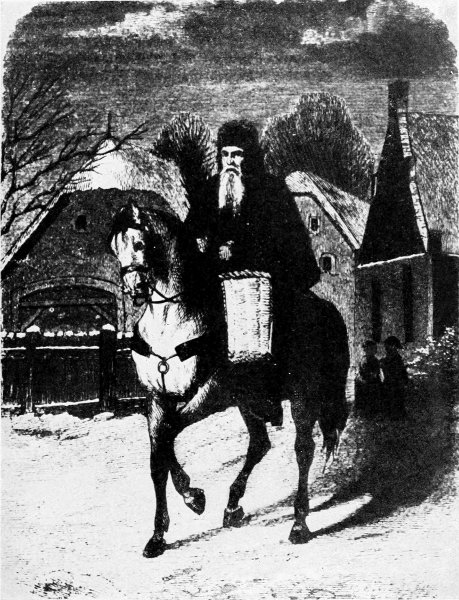
St. Nicholas in East Frisia.
Reproduced from Reinsberg-Düringsfeld, Das festliche Jahr.
In no countries besides Belgium and Holland
is the celebration of St. Nicholas’ day so widely
prevalent to-day. But, as already remarked, in
earlier times the celebration of St. Nicholas’ day
was popular in many parts of Teutonic Europe,
particularly in Austria, Switzerland, and southern
Germany. In various parts of these countries
the old St. Nicholas customs still maintain a
vigorous existence. In Württemberg and Baden,
children on St. Nicholas’ day receive gifts from their
godparents. In Switzerland the gifts are brought
by “Samiklaus,” in the Tyrol by the “Holy Man,”
in lower Austria by “Niglo,” in Bohemia by
“Nikolo.”[17] At Ehingen on the Danube, it is
the custom to keep tally on a stick of the number
of prayers the children have said. The child
that can show many tallies is favored by Santiklos.
Before going to bed children place bowls
under the bed and say the prayer:
“St. Nikolaus, leg mir ein,
Was dein guter Will mag sein,
Aepfel, Birnen, Nuss und Kern
Essen die kleinen Kinder gern.
(St. Nicholas put in for me
What thy good will may be,
Apple, pear, and good sweetmeat,
Little children love to eat.)”
In the morning the bowls are found filled with the
good things desired.
In various places in Germany, Switzerland, and
Austria, the saint, represented by some older
member of the family, appears, or used to appear,
in person, in bishop’s guise with staff and miter,
and makes inquiry concerning the behavior of
the children, and hears the children say their
prayers. Before his coming the children have
placed shoes in the garden behind a bush, and
when after his departure they go out, they find
the shoes filled with apples, nuts, and the like,
if their conduct has been good. But in the case
of ill-behaved children, the shoes are likely to be
occupied by a whip.
In Italy a similar custom was formerly observed
among people of higher social station. In the
courts of princes, on St. Nicholas’ day, it was a
custom to hide presents “in the shoes and slippers
of persons whom it was desired to honor, in such
manner as to surprise them when they came to
dress. The custom was called Zopata from a
Spanish word signifying a shoe.”[18]
The function of St. Nicholas, it will have been
observed, is a double one, to bring pleasing rewards
to good children, but also to bring fear to
children whose conduct has been bad. A Swiss
dialect dictionary published in 1806, defines
“Samiklaus” as a “gift such as parents make to
their children through a disguised person named
Samiklaus (corrupted from St. Nicholas) in order
to give them pleasure and encourage them to duty
and obedience or to frighten them through the
strangely frightful make-up of the bogey man who
accompanies the Samiklaus.”[19] As a means of exciting
fear in the ill-behaved children, the friendly
bishop was often accompanied on his rounds
by a children’s bugaboo, a frightful figure with
horns, black face, fiery eyes, and long red tongue,
variously called Klaubauf, Krampus, Rumpanz,
and the like.[20]
Further evidence of the earlier wider prevalence
of St. Nicholas customs is afforded by the
objections[21] of seventeenth-century Protestant
preachers, quoted in a later chapter, who opposed
the attribution to St. Nicholas of gifts which, they
asserted, came from the Christ Child alone.
In objections such as these, is to be found one
of the causes of the decay of distinctively St.
Nicholas customs. Or perhaps we may better
say, here is an explanation why customs that persisted,
lost their association with the name of St.
Nicholas. There is apparent Protestant objection
to saint worship. There is also in evidence the
rivalry of the celebration in honor of the birth of
Christ which had received the name Christmas.
The Christmas celebration was in its origin a
church affair. Up to the fourteenth century the
church had tried in vain to convert it into a popular
festival. It employed all kinds of methods to
attract the traditional customs and beliefs of the
beginning of winter to the church festival. But
only after the beliefs and practices earlier attached
to Martinmas, to St. Andrew’s day, and
to St. Nicholas’ day were brought into association
with the birth of Christ, did the Christmas festival,
after the end of the fourteenth century, become
a genuinely popular occasion.
From this time on the customs distinctive of
St. Nicholas’ day became more and more absorbed
into the Christmas festival.[22] At times St. Nicholas
retains his association with the old customs,
but the time is shifted from St. Nicholas’ day to
Christmas time. In Catholic Nuremberg, for instance,
at the end of the seventeenth century, the
St. Nicholas gift-giving and the Christmas gift-giving
customs were united, and the St. Nicholas
customs made dependent on the Christmas
customs. Children believed that St. Nicholas
was the attendant of the Christ Child and was
made to carry the wares basket at the Christmas
market, and that St. Nicholas received sweetmeats
as extras from the dealers. As Christmas
time approached, these were put under the pillows
of the children, who believed them to be the gifts
of St. Nicholas.[23]
In all north Germany, too, on Christmas eve,
there goes about a bearded man covered with a
great hide or with straw, who questions children
and rewards their good conduct. His name varies
with the locality. In many places he is called
“Knecht Ruprecht,” a name probably going back
to a pre-Christian time before St. Nicholas became
associated with the children’s festival. In
other places the man is called “De Hele Christ,”
Holy Christ, who later becomes the central figure
of all Christmas activities. In many of his names,
however, such as “Rû Clås,” “Joseph Clås,”
“Clåwes,”[24] “Clås Bůr,” and “Bullerclås,” one
will recognize the juvenile derivative from the name
Nicholas. This figure often rides on a white
horse. Not infrequently his relation to the
Christmas festival proper needs to be made clear
by the presence of the Holy Christ as a companion,
represented by a maiden in white garb who hears
the children say their prayers.
Saint Nicholas in the double rôle of children’s
benefactor and children’s bugaboo found his way
to America. Among the Pennsylvania Germans,
or “Pennsylvania Dutch,” as they are more familiarly
called, at least in the country districts, he
continues to play his old part. “You’d better
look out or Pelznickel will catch you,” is the threat
held out over naughty children about Christmas
time. The nickel in Pelznickel serves to show
the relationship of this personage to St. Nicholas.
Pelznickel is a Santa Claus with some variations.
“On Christmas eve someone in the neighborhood
impersonates Pelznickel by dressing up as an old
man with a long white beard. Arming himself
with a switch and carrying a bag of toys over his
shoulder, he goes from house to house, where the
children are expecting him.
“He asks the parents how the little ones have
behaved themselves during the year. To each of
those who have been good, he gives a present
from his bag. But woe betide the naughty ones!
These are not only supposed to get no presents,
but Pelznickel catches them by the collar and
playfully taps them with his switch.”[25]
Eventually, in many places, St. Nicholas became
quite excluded from the customs with which
he was long associated. In Schleswig-Holstein,
for instance, at the beginning of the nineteenth
century, the old customs were preserved but entirely
separated from their earlier associations
with St. Nicholas and St. Nicholas’ eve, and now
connected with the story of the Christ Child and
His festival, Christmas. The custom was for
each child to borrow a plate or bowl from the
kitchen and place this in an appointed room or in
a window. On Christmas eve, when the tinkle
of the bell summoned the children from the dark
anteroom into the room with the festal decorations,
then each child found what the Christ
Child (“Kindjes”) had brought him. On the
plates lay cakes, fruits, and playthings. Perhaps
a rod was laid beside the other gifts, but it counted
as the most severe punishment when the plate
remained empty.
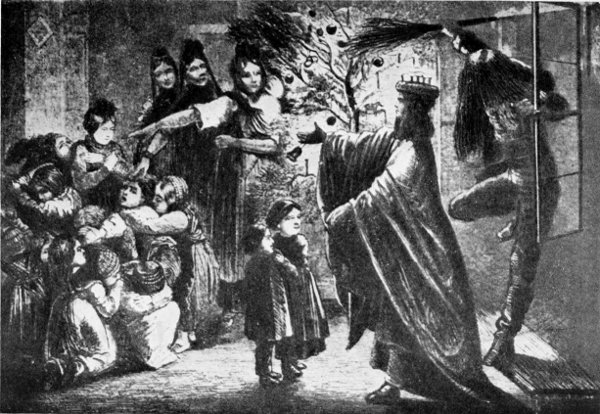
Christkindchen (Kris Kringle) and Hans Trapp in Alsace.
Reproduced from Reinsberg-Düringsfeld, Das festliche Jahr.
Here and there also in the country, as late as
1865, there survived the similar custom, for the
children, before going to bed, to place the plate
before the window, for in the night the Christ
Child took out a pane of glass and laid his gifts
on the plate so that on Christmas morning it was
evident that the “Kindjes” had been present.
Here we see St. Nicholas quite deprived of his old
prerogatives and his place taken by the “Christ
Kindjes,” or as he was called in some places
“Christ kindel,” from whose name, by a process
of popular etymology, presumably was derived
the name Kris Kringle.
In various parts of the United States where
Dutch and German customs prevail, Kris Kringle
appears in the combined rôle of the Christ Child
and Santa Claus, and the vigil of his festival is
called “Christ Kinkle eve.” In certain parts of
Germany children sing, on Christmas eve:
“Christkindchen komm;
Mach mich fromm;
Dass ich zu dir im Himmel komm.”[26]
In the principality of Waldeck[27] down as late
as 1830 there survived a popular Christmas
mummers’ play custom originating in the sixteenth
century and bringing in not only Christ and St.
Nicholas but other personages grotesque in appearance,
some of them survivals from folk
celebrations antedating St. Nicholas customs.
In the play appear Christ, Mary, an Angel, Peter,
and Niklawes, all clad in white, and Hansruhbart,
Brose, who bears the sack, and the shepherd Pamphilius
with the noble steed, Zink. Hansruhbart
and Brose are clad in pea straw and wear frightful
masks. Pamphilius has suspended from a
strap about his neck a box full of dirt with which
he threatens to smear the children. Each person
in turn is summoned to speak. As the chief
offence in the case of children is reckoned the
preference of small beer to coffee. Peter distributes
the gifts, which the children receive only
after they have been forgiven. He has a basket
with apples and nuts, which he throws on a table
for the children. As the children reach out for
his gifts, he strikes them on the fingers with his
rod.
Mumming pieces like this were popular all
over Germany, the personages varying with the
locality. Sometimes the Holy Christ went about
alone, and before him the children presented
themselves. But the most striking of all the
personages in these plays was the one at Waldeck
called Hansruhbart, elsewhere Ruprecht and
Knecht Ruprecht, at his earliest recorded appearance
called Acesto, probably a traditional
figure that originated in customs that antedate
Christianity.
In all this discussion of various customs associated
with the name of St. Nicholas there will
have been seen little to connect with the life story
of a saintly person. The deeds of the children’s
friend, St. Nicholas, to be sure exhibit beneficence,
but the beneficence of a capricious, fairy-like
benefactor rather than of a holy saint. In fact
it is evident that the customs in question, in their
origin, had little, if anything to do with St. Nicholas,
and as they exist to-day show only in certain
external features any relation with the life
story of the kindly Eastern saint. This impression
of the earlier independence of the popular
customs in question from the story of St. Nicholas,
is confirmed by the fact that many of them are
associated with other names. St. Martin, as
well as St. Nicholas, figures as a giver of gifts to
children, especially in the Netherlands. At Antwerp
and certain other cities, according to a report
from a generation ago, on St. Martin’s day, as in
the St. Nicholas’ day celebration already described,
a man with bishop’s vestments and crosier appeared
in the nurseries and made inquiries about
the behavior of the children. According to the
nature of this report he threw on the floor from
his basket, either rods, or apples, nuts, and cakes.
In Ypres children are reported to hang stockings
filled with hay in the open chimneypiece on the
eve of Martinmas. The next morning the stockings
are found filled with gifts from St. Martin
who in the night has ridden over the chimney and
has been grateful for the attention paid to his gray
(or white) steed.[28] There is also an old custom
in Flemish Belgium in which on the eve of Martinmas
the children are placed in the corner of a
room with their backs to the door and told not
to look. The parents then throw in at the door
apples, nuts, peppercakes, and other sweetmeats
of various kinds, pretending that St. Martin has
done it. If one of the children turns around,
St. Martin goes away without leaving anything.
The bugaboo feature of St. Nicholas’ day also
was not lacking in the Martinmas celebration.
In several places in southern Germany, on St.
Martin’s day, “Pelzmärte,” with blackened face
and cowbells, went about giving beatings or
throwing apples into rooms, whichever the children’s
behavior called for.
Some of the Martinmas customs had less resemblance
to St. Nicholas customs. The convivial
customs of Martinmas have given St. Martin
a reputation for drunkenness entirely undeserved
by that zealous defender of Christianity, St.
Martin of Tours. But the ones singled out for
mention evidently belong jointly to St. Martin
and St. Nicholas, although in their origin probably
as little connected with the one as with the other.
The celebration of St. Andrew’s day, also, has
features similar to that of St. Nicholas’ day. On
St. Andrew’s eve (November thirtieth), in the
neighborhood of Reichenberg, children are said
to hang up their stockings at the windows and
in the evening find them filled with apples and
nuts.[29]
The explanation of the origin of these customs
is to be found in practices long antedating the
time of St. Martin or St. Nicholas or even of St.
Andrew. They seem to be practices rooted in
pre-Christian agricultural rites which have been
superseded, or better expressed, have survived
with new meanings read into them. With the
introduction of Christianity, following the usual
course of things, the older modes of celebration
were changed not so much in form as in name.
To St. Martin were devoted customs which coincided
in time with the celebration in honor of St.
Martin, customs originally associated with the
first drinking of the new wine or with the autumn
slaughter, a connection not entirely lost in our
own times, as indicated by the “Martlemas beef”
in Great Britain, the “St. Martin’s geese” and
“St. Martin’s swine” in Germany. With the
shifting of the agricultural practices to a later date,
the customs came to be associated with the celebration
of saints’ days later in the calendar. With
St. Nicholas, on December sixth, became associated
customs and practices earlier associated
with St. Martin, on November eleventh, or with
St. Andrew on November thirtieth, but in their
true nature as little appropriate to one as to the
other.
There have been attempts to show points of
connection between the Christian worship of St.
Nicholas and the earlier worship of the Teutonic
divinities. It has been attempted to connect the
children’s bugaboo variously called Hansruhbart,
Ruprecht, and Knecht Ruprecht, with Odin,
largely through a connection between the name
Ruprecht and one of the variety of names given
Odin.[30] There has been pointed out also the
parallelism between the “beste tabbaerd” of St.
Nicholas sung about by children, and the magic
robe which enabled Odin to pass from place to
place; between the gray horse of St. Nicholas on
which he rode over the roofs of houses, and Odin’s
horse, Sleipnir, on which he took an autumn ride
through the world; between the sheaf of grain in
pagan days left in the field for Odin’s horse and
the wisp of hay left by children in their shoes for
their friend St. Nicholas. But too much stress
must not be laid on these parallelisms. The customs
associated with St. Nicholas in their origin doubtless
antedate Christianity but also antedate the
worship of Odin. Possibly the pre-Christian
practices were influenced by their temporary
association with the Teutonic gods as they afterwards
were by the association with the Christian
saints. But in both cases this influence was only
superficial.
A rapid resumé may clear up some of the obscure
places in the preceding mass of details. In
the practices associated in our time with the name
of Santa Claus we have survivals of pagan sacred
custom once regarded as important in the furtherance
of human welfare. Perhaps influenced superficially
by conceptions of the Germanic gods,
eventually they came to be connected with the
honor of Christian saints. They afford a remarkable
illustration of the longevity of folk customs.
With meaning lost or changed, the older forms
persist. Influenced, as remains to be shown,
superficially, by the life story of the saint with
whose worship they became associated, also to
some extent with the Roman festivities of the
same season, above all converted to the use of
providing pleasure, as well as just reward, for
children, they have survived to our day. But
owing in part to the effort of the Church in earlier
times to convert the church ceremony in honor
of the birth of Christ into a truly popular festival,
in part to the later opposition to saint worship
on the part of Protestantism, the customs once
associated with the worship of St. Nicholas are
now associated with the birth of Christ.
Santa Claus, the name derived from St. Nicholas
through the familiar use of children in Teutonic
countries, crossed to America. The exact route
followed by him is somewhat open to question.
On the way he traded his gray horse or ass for a
reindeer and made changes in his appearance. It
is usually said, however, that he was brought to
America by the Dutch. In America he has made
himself very much at home, and according to the
explanation most generally accepted, from America
he recrossed the Atlantic to England, whence he
has journeyed to the most distant parts of the
British Empire, to India and to Australia, where
he is as familiarly known as in America. In
England, however, while the custom of giving
gifts to children has been made a part of the
Christmas celebration, the gratitude of the
children in some places goes to Santa Claus, but in
other places goes to another creation of the popular
fancy, a personage called Father Christmas. In
parts of the German-speaking countries also, as
has been shown, the honors of Christmas day are
concentrated in the person of the Christ Child,
and the benefactor of children is the Christ Child
himself, the “Kindjes” or “Christ kindel,” more
familiarly known in America as Kris Kringle.
In France the place of the Christ Child as the
purveyor of gifts had been in part filled by “le
petit Noël,” in a manner like that in which in
England Father Christmas in part shares the rôle
of Santa Claus.