These deficiencies I anxiously anticipated; but there was
another evil, upon which I had not calculated, that was still
nearer and more overwhelming. The mode of life in which
I was now engaged, so different from any thing to which I
had been accustomed, excessive fatigue, together with the
occasional heat of the weather, the uneasiness of my mind,
and the sleeplessness of my nights, all combined to throw
me into a fever, which, though it did not last long, had
raged so furiously during the period of its continuance, as
to leave me in a state of the most complete debility. While
the disorder was upon me, I was sensible of my danger;
and, as the brilliant and consolatory prospects of life seemed
for ever closed upon me, I at first regarded my approaching
dissolution with complacency, and longed to be released
from a series of woes, in which I had been originally involved
by my own folly. This frame of mind however
was of no great duration; the more nearly I contemplated
the idea of separation from those I loved, the smaller was
my resignation. I was unwilling to quit those dear objects
by which I still held to this mortal scene; I shrunk with
aversion from that barrier which separates us from all that
is new, mysterious, and strange. Another train of ideas
succeeded this, and I began to despise myself for my impatience
and cowardice. It was by my vices that my family
was involved in a long train of misfortunes; could I shrink
from partaking what I had not feared to create? The
greater were the adversities for which they were reserved,
the more ought I to desire to suffer with them. I had
already committed the evil; in what remained, it was reasonable
to suppose I should prove their benefactor and
not their foe. It was incumbent on me to soothe and to
animate them, to enrich their minds with cheerfulness and
courage, and to set before them an example of philosophy
and patience. By my faculties of industry I was their
principal hope; and, whatever we might suffer combined,
it was probable their sufferings would be infinitely greater,
if deprived of my assistance. These reflections gave me
energy; and it seemed as if the resolute predilection I had
conceived for life contributed much to my recovery.
One thing which strongly confirmed the change my
mind underwent in this respect, was a conversation that
I overheard at a time when I was supposed to be completely
in a state of insensibility, but when, though I was too
much reduced to give almost any tokens of life, my faculties
of hearing and understanding what passed around me were
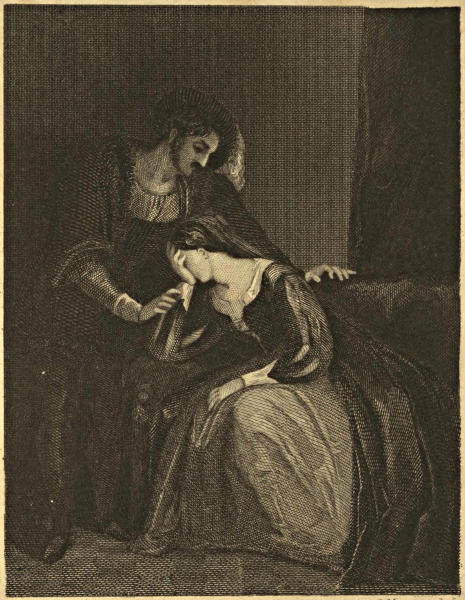
entire. Charles came up to my bedside, laid his hand
upon mine as if to feel the state of the skin, and, with a
handkerchief that was near, wiped away the moisture that
bedewed my face. He had been fitted for many nurse-like
offices by the unwearied attention he had exerted towards
me in the paroxysm of my insanity. Having finished his
task, he withdrew from the bed, and burst into tears. His
mother came up to him, drew him to the furthest part of
the room, and in a low voice began the conversation.
“Do, my dear boy, go down stairs, and get yourself
something to eat. You see, your papa is quiet now.”
“I am afraid that will not last long; and then he will be
so restless, and toss about so, it is dreadful to see him.”
“I will watch, Charles, and let you know.”
“Indeed, mamma, I cannot eat now. I will by and
by.”
“You must try to eat, Charles, or else you will make
yourself quite ill. If you were ill too, it would be more
than I could support.”
“I will not be ill, mamma. I assure you I will not.
But, besides that I have no stomach, I cannot bear to eat
when there is hardly enough for my sisters.”
“Eat, boy. Do not trouble yourself about that. We
shall get more when that is gone. God is good, and will
take care of us.”
“I know that God is good; but for all that, one must
not expect to have every thing one wishes. Though God
is good, there are dreadful misfortunes in the world, and I
suppose we shall have our share of them.”
“Come, Charles, though you are but a boy, you are the
best boy in the world. You are now almost my only
comfort; but you will not be able to comfort me if you do
not take care of yourself.”
“Dear mamma!—Do you know, mamma, I heard that
naughty man below stairs count up last night how much
rent you owed him for, and swear you should not stay any
longer if you did not pay him. If I were a little bigger, I
would talk to him so that he should not dare to insult us in
our distress. But, not being big enough, I opened the
door, and went into the room, and begged him for God’s
sake not to add to your distress. And, though he is so
ugly, I took hold of his hand, and kissed it. But it felt
like iron, which put me in mind of his iron heart, and
I cried ready to burst with mortification. He did not say
hardly a word.”
“He must be paid, Charles: he shall be paid.”
“Do you know, mamma, as soon as I left him I went
to the bishop’s gardens, and spoke to the gardener? I
asked him, if he had heard that my papa was ill, and he
said he had. He said, too, he was very sorry, and wanted
to know what hand we made of it for want of the wages. I
told him, we were sadly off, and the man of the house had
just been affronting me about his rent. But, said I, cannot
you give me something to do, to weed or to rake? I
can dig a little too, and scatter seed. He asked, if I knew
weeds from flowers. Oh, that I do! said I. Well then,
said he, there is not much you can do; but you are a good
boy, and I will put you on the bishop’s list. But now,
mamma, I have not the heart to work, till I see whether
papa will get well again.”
While poor Charles told his artless tale, Marguerite wept
over him, and kissed him again and again. She called him
the best child in the world, and said that, if I were but so
fortunate as to recover, with such a husband and such a son,
she should yet be the happiest of women.
“Oh, my poor father!” exclaimed Charles. “Ever
since the great hail-storm, I have every hour loved him
better than before. I thought that was impossible, but he is
so gentle, so kind, so good-humoured, and so patient! I
loved him when he was harsh, and when he was out of his
mind; but nothing so well then as I have done since.
People that are kind and smile always do one good; but
nobody’s smiles are like my father’s. It makes me cry
with joy sometimes, when I do but think of them. Pray,
papa,” added he, coming up to the bedside, and whispering,
yet with a hurried and passionate accent, “get well!
Do but get well, and we will be so happy! Never was
there a family so happy or so loving as we will be!”
While he spoke thus, I endeavoured to put out my hand,
but I could not; I endeavoured to smile, but I was unable:
my heart was in a feeble, yet soothing, tranquillity. The
accents of love I had heard, dwelt upon my memory. They
had talked of distress, but the sentiment of love was uppermost
in my recollection. I was too weak of frame to suffer
intellectual distress; no accents but those which carried
balm to my spirit, seemed capable of resting upon my ear.
From this hour I regularly grew better, and, as I recovered,
seemed to feel more and more vividly how enviable
it was to be the head of a loving and harmonious
family.
My recovery however was exceedingly slow, and it was
several weeks before I had so far recruited my strength as
to be capable of my ordinary occupations. In the mean
time the pecuniary difficulties to which we were exposed
hourly increased, and the cheerful but insignificant labours
of Charles could contribute little to the support of a family.
The melancholy nature of our situation might perhaps
have been expected to prevent the restoration of my health.
At first however it had not that effect. The debilitated
state of my animal functions led me, by a sort of irresistible
instinct, to reject ideas and reflections which I should
then have been unable to endure. I saw the anxiety and
affection of my family, and I was comforted. I saw the
smiles of Marguerite, and I seemed insensible to the languor,
the saddened cheerfulness, they expressed. I did not
perceive that, while I was provided with every thing necessary
in my condition, my family were in want of the very
bread that should sustain existence.
My health in the mean time improved, and my perceptions
became proportionably clearer. Symptoms of desolation
and famine, though as much as possible covered from
my sight, obtruded themselves, and were remarked. One
day in particular I observed various tokens of this nature in
silence, and with that sort of bewildered understanding
which at once labours for comprehension and resists belief.
The day closed; and what I had perceived pressed upon my
mind, and excluded sleep. Now for the first time I exerted
myself to recollect in a methodical way the state of
my affairs; for the severity of my illness had at length
succeeded to banish from me all ideas and feelings but what
related to the sensations it produced, and to the objects
around me; and it was not without effort that I could once
more fully call to mind the scenes in which I had been
engaged. The truth then by regular degrees rose completely
to view; and I began to be astonished, that my poor
wife and children had been able in any manner to get
through the horrible evils to which they must have been
exposed. This thought I revolved in my mind for near
two hours; and the longer I dwelt upon it, the more perturbed
and restless I grew. At length it became impossible
for me to hold my contemplations pent up in my own bosom.
I turned to Marguerite, and asked her, whether she
were asleep.
She answered in the negative: she had been remarking
my restlessness, and tenderly enquired respecting its
cause.
“How long,” said I, “is it since I was taken with the
fever?”
“A month to-morrow,” replied she. “It was of the
most malignant and distressing kind while it lasted, and
I did not expect you to live. But it has left you a fortnight;
and I hope, Reginald, you find yourself getting
strong again.”
“And so we are here in Constance, and we have left
Switzerland——?”
“Three months, my love!”
“I remember very well the letter we received from monsieur
Grimseld; has any further intelligence reached us from
that quarter?”
“None.”
“None! No supply of any kind has reached you?”
“My dear Reginald, talk of something else! You will
soon, I hope, be well: our children are all alive; and the
calamity, that has not succeeded to separate us, or to diminish
our circle of love even by a single member, we will
learn to bear. Let us fix our attention on the better prospects
that open before us!”
“Stay, Marguerite! I have other questions to ask. Before
you require me to bear the calamities that have overtaken
us, let me understand what these calamities are.
While we waited for intelligence from Switzerland, we expended
the whole sum that we brought with us, and I was
obliged to hire myself to the episcopal gardener for bread;
was it not so?”
“Indeed, Reginald, you are to blame! Pray question
me no further!”
“This was our condition some time ago; and now, for
a month past, I have been incapable of labour. Marguerite,
what have you done?”
“Indeed, my love, I have been too anxious for you, to
think much of any thing else. We had still some things,
you know, that we could contrive to do without; and those
I have sold. Charles too, our excellent-hearted son, has
lately hired himself to the gardener, and has every night
brought us home a little, though it was but little.”
“Dear boy! What children, what a wife, have I brought
to destruction! Our rent too, surely you have not been able
to pay that?”
“Not entirely. In part I have been obliged to pay it.”
“Ah! I well remember how flinty-hearted a wretch has
got the power over us in that respect!”
“He has not turned us out of doors. He threatened
hard several times. At last I saw it was necessary to make
an effort, and the day before yesterday I paid him half his
demand. If I could have avoided that, we might have had
a supply of food a little longer. I intreated earnestly for
a little further indulgence, but it was in vain. It went
against the pride and independence of my soul to sue to this
man; but it was for you and for my children!”
“Remorseless wretch! Then every petty resource we
had is gone?”
“Indeed I do not know that we have any thing more
to sell. I searched narrowly yesterday; but I will examine
again to-day. The poor children must have something
to support them, and their fare has of late been dreadfully
scanty.”
“Their fare! What have they eaten?”
“Bread; nothing else for the last fortnight!”
“And yourself?”
“Oh, Reginald! it was necessary, you know, that I
should keep myself alive. But, I assure you, I have robbed
them as little as I could.”
“Horror, horror! Marguerite, what is it you dream of?
I see my wife and children dying of hunger, and you talk
to me of hope and of prospects! Why has this detail of
miseries been concealed from me? Why have I been suffered,
with accursed and unnatural appetite, to feed on the
vitals of all I love?”
“Reginald! even selfishness itself would have taught us
that! It is to your recovery that we look for our future
support!”
“Mock me not, I adjure you, with senseless words! You
talk idly of the future, while the tremendous present bars
all prospect to that future. We are perishing by inches.
We have no provision for the coming day! No, no; something
desperate, something yet unthought of, must be attempted!
I will not sit inactive, and see my offspring around
me die in succession. No, by Heaven! Though I am
starving like Ugolino, I am not, like Ugolino, shut up in a
dungeon! The world is open; its scenes are wide; the resources
it offers are, to the bold and despairing, innumerable!
I am a father, and will show myself worthy of the name!”
“Reginald! torture me not by language like this! Think
what it is to be indeed a father, and make yourself that!
Be careful of yourself; complete your recovery,—and leave
the rest to me! I have conducted it thus far, nor am I yet
without hope. Eight days ago I applied to the secretary of
the palace, representing your case as a retainer of the bishop,
disabled by sickness, and with a family unprovided for. Till
yesterday I got no answer to my memorial; and then he
informed me, that you had been so short a time in employ,
that nothing could be done for you. But to-day I will
throw myself at the feet of the bishop himself, who arrived
last night only from the other side of the lake.”
Every word that Marguerite uttered went to my heart.
It was not long before the dawn of the day, and the truths
I had heard were further confirmed to me by the organ of
sight. The sentiments of this night produced a total revolution
in me, and I was no longer the feeble convalescent
that the setting sun of the preceding day had left me. The
film was removed from my eyes, and I surveyed not the
objects around me with a glassy eye and unapprehensive
observation. All the powers I possessed were alert and in
motion. To my suspicious and hurried gaze the apartment
appeared stripped of its moveables, and left naked, a mansion
in which for despair to take up his abode. My children
approached me; I seemed to read the wan and emaciated
traces of death in their countenances. This perhaps was
in some degree the painting of my too conscious thoughts.
But there needed no exaggeration to awaken torture in my
bosom, when, thus stimulated, I observed for the first time
the dreadful change that had taken place in Marguerite.
Her colour was gone; her cheeks were sunk; her eye had
the quickness and discomposure expressive of debility. I
took hold of her hand, and found it cold, emaciated, and
white. I pressed it to my lips with agony; a tear unbidden
fell from my eye, and rested upon it. Having finished my
examination, I took my hat, and was hastening to escape
into the street. Marguerite noted my motions, and anxiously
interposed to prevent my design. She laid her hand
on my arm gently, yet in a manner full of irresistible
expostulation.
“Where would you go? What have you purposed?
Do not,—Oh, do not, destroy a family, to whom your
life, your sobriety, and prudence, are indispensable!”
I took her hand within both mine. “Compose yourself,
my love! I have been your enemy too much already, to be
capable now, so much as in thought, of adding to my guilt!
I need an interval for musing and determination. I will
return in a very short time, and you shall be the confidant
of my thoughts!”
With wild and impatient spirit I repassed in idea the
whole history of my life. But principally I dwelt in recollection
upon the marquis de Damville, that generous friend,
that munificent benefactor, whose confidence I had so ill
repaid. “Damville!” exclaimed I, “you trusted to me
your daughter, the dearest thing you knew on earth; you
believed that the wretch did not live who could be unjust
to so rich a pledge. Look down, look down, O best of
men! from the heaven to which your virtues have raised
you, and see of how much baseness man—yes, the man you
disdained not to call your friend—is capable! But, no! a
sight like this might well convert the heaven you dwell in
to hell! You trusted her to me; I have robbed her! You
enriched her mind with the noblest endowments; I have
buried them in the mire of the vilest condition! All her
generous, her unwearied exertions are fruitless; by my evil
genius they are blasted! I have made her a mother, only
that she might behold her children perishing with hunger!
They stretch out their hands to me for the smallest portion
of that inheritance, which I have squandered in more than
demoniac vice! This, this is the fruit of my misdeeds! I
am now draining the last dregs of that mischief, of which I
have so wickedly, so basely, been the author!”
As I returned I met Marguerite, who was come from her
attempt upon the bishop. He had received her paper, and
delivered it to his secretary, that very secretary who had
already disappointed all her expectations from that quarter.
She had attempted to speak, to adjure the bishop, whatever
he did, not to deliver her over to a man by whom her hopes
had been so cruelly frustrated; but the tumult of the scene
drowned her voice, and the hurry and confusion overpowered
her efforts. They, however, drew such a degree
of attention on her, that, in the dissentions which religious
broils at that time spread in Constance, she was suspected
of pressing thus earnestly towards the person of the bishop
with no good design, and in fine was rudely thrust out of
the palace. She had not recovered from the agitation into
which she had been thrown, when I met her. I eagerly
enquired into the cause of her apparent distress; but she
shook her head mournfully, and was silent. I easily understood
where she had been, and the failure of her experiment.
“All then,” said I, “is at an end. Now, Marguerite, you
must give up your experiments, and leave to me the cure
of evils of which I only am the author. I will return this
instant to the garden of the palace, and resume the situation
I formerly occupied.”
“For God’s sake, Reginald, what is it you mean? You
have just acquired strength to seek the benefit of air. The
least exertion fatigues you. At this moment, the little walk
you have taken has covered you with perspiration. You
could not dig or stoop for a quarter of an hour without
being utterly exhausted.”
“Marguerite, I will not sit down tamely, and see my
family expire. In many cases it is reasonable to bid a
valetudinarian take care of himself. But our situation is
beyond that. I must do something. Extraordinary circumstances
often bring along with them extraordinary
strength. No man knows, till the experiment, what he is
capable of effecting. I feel at this moment no debility;
and I doubt not that the despair of my mind will give redoubled
energy to my efforts.”
While I spoke thus, I was conscious that I had little
more than the strength of a new-born child. But I could
not endure at such a time to remain in inactivity. I felt
as much ashamed of the debilitated state in which my fever
had left me, as I could have done of the most inglorious
effeminacy and cowardice of soul. I determined to relieve
my family, or perish in the attempt. If all my efforts were
vain, I could not better finish my career, than exhausted,
sinking, expiring under a last exertion, to discharge the
duties of my station.
We returned into the house. Marguerite took from a
closet the last remnant of provisions we had, the purchase
of poor Charles’s labour of the preceding day. There was
a general contest who should escape from receiving any
part in the distribution. Charles had withdrawn himself,
and was not to be found. Julia endeavoured to abscond,
but was stopped by Louisa and her mother. She
had wept so much, that inanition seemed more dangerous
for her, than perhaps for any other of the circle. No one
can conceive, who has not felt it, how affecting a contest of
this kind must appear to me, sensible as I was to the danger
that their virtue and generous affection were the prelude
only to their common destruction. I said, there was a
general contest who should avoid all share in the distribution;
but I recollect that the little Marguerite, two years
and a half old, exclaimed at first, “I am so hungry, mamma!”
But watching, as she carefully did, every thing
that passed, she presently laid down her bread upon the
table in silence, and almost untouched; and being asked,
Why she did so? she replied, in a tone of speaking sensibility,
“Thank you, I am not hungry now!”
This scene made an impression on my mind never to be
forgotten. It blasted and corrupted all the pulses of my
soul. A little before, I had reconciled myself to poverty;
I had even brought myself to regard it with cheerfulness.
But the sentiment was now reversed. I could endure it, I
could steel myself against its attacks; but never from this
hour, in the wildest paroxysms of enthusiasm, has it been
the topic of my exultation or my panegyric. No change
of circumstances, no inundation of wealth, has had the
power to obliterate from my recollection what I then saw.
A family perishing with hunger; all that is dearest to you
in the world sinking under the most dreadful of all the
scourges with which this sublunary scene is ever afflicted;
no help near; no prospect but of still accumulating distress;
a death, the slowest, yet the most certain and the most
agonising, that can befall us: no, there is nothing that has
power to rend all the strings of the heart like this! From
this moment, the whole set of my feelings was changed.
Avarice descended, and took possession of my soul. Haunted,
as I perpetually was, by images of the plague of famine,
nothing appeared to me so valuable as wealth; nothing so
desirable as to be placed at the utmost possible distance
from want. An appetite of this kind is insatiable; no distance
seems sufficiently great; no obstacles, mountains on
mountains of gold, appear an inadequate security to bar
from us the approach of the monster we dread.
While I speak of the sentiments which in the sequel
were generated in my mind by what I now saw, I am suspending
my narrative in a crisis at which a family, interesting,
amiable and virtuous, is reduced to the lowest state
of humiliation and distress.
They are moments like these, that harden the human
heart, and fill us with inextinguishable hatred and contempt
for our species. They tear off the trappings and decoration
of polished society, and show it in all its hideousness. The
wanton eye of pampered pride pleases itself with the spectacle
of cities and palaces, the stately column and the swelling
arch. It observes at hand the busy scene, where all are
occupied in the various pursuits of pleasure or industry;
and admires the concert, the wide-spreading confederacy,
by means of which each after his mode is unconsciously
promoting the objects of others. Cheated by the outside of
things, we denominate this a vast combination for general
benefit. The poor and the famished man contemplates the
scene with other thoughts. Unbribed to admire and applaud,
he sees in it a confederacy of hostility and general
oppression. He sees every man pursuing his selfish ends,
regardless of the wants of others. He sees himself contemptuously
driven from the circle where the rest of his
fellow-citizens are busily and profitably engaged. He lives
in the midst of a crowd, without one friend to feel an interest
in his welfare. He lives in the midst of plenty,
from the participation of which he is driven by brutal menaces
and violence. No man who has not been placed in
his situation can imagine the sensations, with which, overwhelmed
as he is with domestic ruin and despair, he beholds
the riot, the prodigality, the idiot ostentation, the senseless
expense, with which he is surrounded on every side. What
were we to do? Were we to beg along the streets? Were
we to in treat for wretched offals at rich men’s doors? Alas!
this, it was to be feared, even if we stooped to the miserable
attempt, instead of satisfying wants for ever new, would
only prolong in the bitterness of anguish the fate for which
we were reserved!——
An unexpected relief at this time presented itself. While
the scanty meal I have mentioned was yet unfinished, a letter
was presented me inclosing under its cover a bill of one
hundred crowns. The letter was from Bernardin, the faithful
servant whom we found it necessary to dismiss three
months before, when we quitted our residence in Switzerland.
It informed us that, as soon as he had parted from
us, he had set out on his return to his native town, next
adjacent to my paternal residence; that he found his father
had died a short time before, and that, from the sale of his
effects, he had reaped an inheritance to triple the amount
of the sum he had now forwarded to us. He had heard by
accident of the death of our friend in Switzerland, and the
character of his successor, and dreaded that the consequences
might prove highly injurious to us. He had still
some business to settle with the surviving branches of his
family, but that would be over in a few weeks; and then,
if we would allow him, he would return to his dear master,
and afford us every assistance in his power. The little
property that had now fallen to him would prevent him
from being a burthen; and he would hire a spot of land, and
remain near us, if we refused him the consolation of returning
to his former employment.
What a reproach was it to me, that, descended from one
of the most illustrious families in Europe, the heir of an
ample patrimony, and receiving a still larger fortune in
marriage, I should, by the total neglect and profligate defiance
of the duties incumbent on me, have reduced myself
so low as to be indebted to a peasant and a menial for the
means of saving my family from instant destruction! This
was a deep and fatal wound to the pride of my soul. There
was however no alternative, no possibility of rejecting the
supply afforded us at so eventful a moment. We determined
to use it for the present, and to repay it with the
earliest opportunity; and in the following week, in spite of
the remonstrances of Marguerite, the yet feeble state of my
health, and the penalties annexed to the proceeding, I set
off for the canton of Soleure, determined, if possible, to
wrest the little staff of my family from the hand that so
basely detained it.
I passed through Zurich and a part of the canton of
Basle without obstacle; these parts of Switzerland had not
suffered from the calamity which had occasioned our exile.
In proceeding further, I found it necessary to assume a
disguise, and to avoid large towns and frequented roads. I
reached at length the well known scene in which I had so
lately consumed twelve months of my life; in which I
first began to breathe (to breathe, not to be refreshed) from
ruin, beggary, and exile. There was no pleasing recollection
annexed to this spot; it was a remembrancer of
shame, sorrow, and remorse. Yet, such is the power of
objects once familiar, revisited after absence, that my eye
ran over them with delight, I felt lightened from the weariness
of the journey, and found that the recollection of pains
past over and subdued was capable of being made a source
of gratification. The mountains among which I had wandered,
and consumed, as it were, the last dregs of my insanity,
surrounded me; the path in which I was travelling
led along one of their ridges. I had performed this part of
my journey by night; and the first gleams of day now
began to streak the horizon. I looked towards the cottage,
the distant view of which had so often, in moments of the
deepest despair, awakened in my heart the soothings of
sympathy and affection. I saw that as yet it remained in
its forlorn condition, and had undergone no repair; while
the lands around, which had lately experienced the superintendence
of Marguerite, had met with more attention,
and began to resume the marks of culture. I sighed for
the return of those days and that situation, which, while
present to me, had passed unheeded and unenjoyed.
I repaired to the house of my late protector, now the
residence of monsieur Grimseld. He was a meagre shrivelled
figure; and, though scarcely arrived at the middle of
human life, exhibited all the marks of a premature old age.
I disclosed myself to him, and began warmly to expostulate
with him upon the profligacy of his conduct. He
changed colour, and betrayed symptoms of confusion, the
moment I announced myself. While I pressed him with
the barbarity of his conduct, the dreadful effects it had
already produced, and the incontestible justice of my claim,
he stammered, and began to propose terms of accommodation.
During this conversation we were alone. After some
time, however, a servant entered the room, and the countenance
of the master assumed an expression of satisfaction
and confidence. He eagerly seized on the occasion which
presented itself, and, instantly changing his tone, called on
his servant to assist him in securing a criminal against the
state. I at first resisted, but Grimseld perceiving this, applied
to his bell with great vehemence, and three other
servants made their appearance, whose employment was in
the field, but who had now accidentally come into the house
for refreshment. I had arms; but I found it impracticable
to effect my escape; and I soon felt that, by yielding to
the impulse of indignation, and punishing Grimseld on the
spot for his perfidy, I might ruin but could not forward
the affair in which I was engaged.
I was conducted to prison; and the thoughts produced
in me by this sudden reverse were extremely melancholy
and discouraging. Grimseld was a man of opulence and
power; I was without friends, or the means of procuring
friends. The law expressly condemned my return; and
what had I not to fear from law, when abetted and inforced
by the hand of power? I might be imprisoned for ten
years; I might be imprisoned for life. I began earnestly
to wish that I had remained with my family, and given up
at least all present hopes of redress. It would be a dreadful
accumulation of all my calamities, if now at last I and
my children were destined to suffer, perhaps to perish, in a
state of separation; and the last consolations of the wretched,
those of suffering, sympathising, and condoling with each
other, were denied us.
Full of these tragical forebodings, I threw myself at first
on the floor of my cell in a state little short of the most
absolute despair. I exclaimed upon my adverse fortune,
which was never weary of persecuting me. I apostrophised,
with tender and distracted accents, my wife and children,
from whom I now seemed to be cut off by an everlasting
divorce. I called upon death to put an end to these tumults
and emotions of the soul, which were no longer to be borne.
In a short time however I recovered myself, procured
the implements of writing, and drew up, in the strong and
impressive language of truth, a memorial to the council of
the state. I was next to consider how this was to reach
its destination; for there was some danger that it might be
intercepted by the vigilance and malignity of my adversary.
I desired to speak with the keeper of the prison. He had
some recollection of me, and a still more distinct one of my
family. He concurred with the general sentiment, in a
strong aversion to the character of Grimseld. As I pressed
upon him the hardship of my case, and the fatal consequences
with which it might be attended, I could perceive
that he fully entered into the feeling with which I wished
him to be impressed. He blamed my rashness in returning
to Switzerland in defiance of the positive prohibition that
had been issued; but promised at all events that my paper
should be delivered to the president to-morrow morning.
I remained three days without an answer, and these days
were to me an eternity. I anticipated every kind of misfortune;
I believed that law and malice had succeeded to
the subversion of equity. At length however I was delivered
from my apprehensions and perplexity, and summoned
to appear before the council. It was well for me perhaps
that I had to do with a government so simple and moderate
as that of Switzerland. I obtained redress. It was referred
to an arbitration of neighbours to set a fair price on
my property, and then decreed, that if monsieur Grimseld
refused the purchase, the sum should be paid me out of the
coffers of the state. He was also condemned in a certain
fine for the fraud he had attempted to commit. The affair,
thus put in train, was soon completed; and I returned with
joy, having effected the object of my journey, to my anxious
and expecting family. Soon after, we removed to the spot
we had chosen on the eastern bank of the lake, where we
remained for the six following years in a state of peace and
tranquillity.