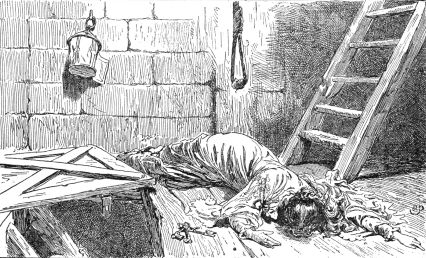
VICTORY AND DEATH.
While the Black Prince was with difficulty governing his province of
Aquitaine, where the mutual jealousies of the English and native
officers caused continual difficulties, King Edward turned all his
attention to advancing the prosperity of England. He fostered trade,
commerce, and learning, was a munificent patron of the two universities,
and established such order and regularity in his kingdom that England
was the admiration of all Europe. Far different was the state of France.
The cessation of the wars with England and the subsequent disbandment of
troops had thrown upon their own resources great numbers of men who had
been so long engaged in fighting that they had no other trade to turn
to. The conclusion of the struggle in Brittany after the battle of Auray
and the death of Charles of Blois still further added to the number, and
these men gathered in bands, some of which were headed by men of
knightly rank, and scattered through France plundering the country and
extracting heavy sums from the towns.
These "great companies," as they were called, exceeded fifty thousand
men in number, and as almost all were trained soldiers they set the king
and his nobles at defiance, and were virtually masters of France. The
most tempting offers were made to them to lay down their arms, and the
pope sent legates threatening excommunication, but the great companies
laughed alike at promises and threats. At last a way of deliverance
opened to France. Pedro, named the Cruel, of Castile, had alienated his
people by his cruelty, and had defeated and driven into exile his
half-brother, Henry of Transtamare, who headed an insurrection against
him. Pedro put to death numbers of the nobles of Castile, despoiled the
King of Arragon, who had given aid to his brother, plundered and
insulted the clergy, and allied himself with the Moors.
His quarrel with the clergy was the cause of his ruin. The pope summoned
him to appear before him at Avignon to answer to the crimes laid to his
charge. Pedro refused to attend, and the pope at once excommunicated
him. The King of Arragon and Henry of Transtamare were then summoned to
Avignon, and a treaty of alliance was concluded between them, and the
pope declared the throne of Castile vacant owing to the excommunication
of Pedro, and appointed Henry to it.
These measures would have troubled Pedro little had it not been that
France groaned under the great companies, and the French king and the
pontiff at once entered into negotiations with them to support Henry in
his war against his brother. It was necessary that a leader in whom the
companies should have confidence should be chosen, and Du Guesclin,
still a prisoner of Chandos, who had captured him at Auray, was
selected, and the pope, the King of France, and Don Henry paid between
them the one hundred thousand francs demanded for his ransom. Du
Guesclin on his release negotiated with the leaders of the great
companies, and as the pope and king promised them large gratuities they
agreed to march upon Spain. They were joined by a great number of French
knights and men-at-arms.
The expedition was under the nominal command of John of Bourbon, but the
real guidance was in the hands of Du Guesclin. As the army marched past
Avignon they worked upon the terrors of the pope until he paid them two
hundred thousand francs in gold. France was filled with joy at the
prospect of a riddance of the free companies which had so long been a
prey upon them. They were, too, eager to avenge upon the cruel King of
Spain the murder of his queen, who was a princess of France. The same
feeling animated the people of Aquitaine, and Calverley, D'Ambrecicourt,
Sir Walter Hewitt, Sir John Devereux, Sir John Neville, and several
other distinguished knights, with a large train of men-at-arms, joined
the adventurers. The great army moved through Arragon, whose king in
every way facilitated their progress. As they entered Castile the whole
people declared in favor of Henry, and Pedro, deserted by all, fled to
Bordeaux and besought aid from the Prince of Wales.
Between Pedro and the English court a firm alliance had existed from the
time when the former so nearly married the Princess Joan, and
immediately the king heard of the expedition against him he issued
orders that no English knights should take part in it. The order,
however, came too late. The English knights had already marched into
Spain with Du Guesclin. As for the English who formed no inconsiderable
portion of the great companies, they had already declined to obey the
king when, at the instance of the pope and the King of France, he had
ordered them to disband.
On Pedro's arrival at Bordeaux with his three daughters and his son,
they were kindly received by the Black Prince, courtesy and kindness to
those in misfortune being among the leading characteristics of his
nature. Pedro, cruel and ruthless as he was, was a man of great
eloquence and insinuating manners, and giving his own version of
affairs, he completely won over the prince, who felt himself, moreover,
bound in some degree to support him, inasmuch as he, an ally of England,
had been dethroned by an army composed partly of English. Pedro made the
most magnificent promises to the prince in return for his aid, ceding
him the whole of the province of Biscay, and agreeing to pay the British
troops engaged in his service when he regained his throne, the Black
Prince engaging to pay them in the mean time.
King Edward aided his son by raising an army in England, which sailed
for Bordeaux under the command of the prince's brother, John of Gaunt,
Duke of Lancaster. Walter formed part of this expedition. The king had
issued his writs to him and other barons of the southern counties, and
the Black Prince had himself written to ask him to join him, in memory
of their former deeds of arms together.
As it was now some years since he had taken the field, Walter did not
hesitate, but with thirty retainers, headed by Ralph, joined the army of
John of Gaunt.
The Black Prince's first step was to endeavor to recall the Englishmen
of the free companies, estimated to amount to at least thirty thousand
men. The news that he was taking up arms and would himself command the
army caused Calverley and the whole of the other English knights to
return at once, and ten thousand of the English men-at-arms with the
great companies also left Don Henry and marched to Aquitaine. The road
led through the territory of the King of Navarre, and the Black Prince
advanced fifty-six thousand florins of gold to pay this grasping and
treacherous king for the right of passage of the army.
By Christmas, 1366, the preparations were complete, but the severity of
the weather delayed the advance for some weeks. Fresh difficulties were
encountered with Charles the Bad, of Navarre, who, having obtained the
price for the passage, had now opened negotiations with Don Henry, and
the governors of the frontier towns refused to allow Sir Hugh Calverley
and the free companions, who formed the advance, to pass. These were
not, however, the men to stand on ceremony, and without hesitation they
attacked and captured the towns, when the King of Navarre at once
apologized for his officers, and renewed his engagements. As, however,
the Black Prince had received intelligence that he had formed a plan for
attacking the English as they passed through the terrible pass of
Roncesvalles, he compelled him to accompany the army. The invitation was
couched in language which was friendly, but would yet admit of no
denial.
On the 17th of February the English army, thirty thousand strong,
reached the pass. It marched in three divisions, the first commanded by
the Duke of Lancaster and Lord Chandos, the second by the Black Prince,
the third by the King of Majorca and the Count of Armagnac. The
divisions crossed over on different days, for the pass was encumbered by
snow and the obstacles were immense. Upon the day when the prince's
division were passing a storm burst upon them, and it was with the
greatest difficulty that they succeeded in crossing. On the 20th of
February, however, all arrived safe on the other side of the Pyrenees.
Du Guesclin, who, seeing the storm which was approaching from Aquitaine,
had returned to France and levied a French army, was nigh at hand, and
kept within a few miles of the English army as it advanced, avoiding an
engagement until the arrival of Don Henry, who was marching to join him
with the great companies and sixty thousand Spanish troops.
Du Guesclin kept up secret communications with the King of Navarre, who
was still forced to accompany the English army. The latter accordingly
went out from the camp under pretense of hunting and was captured by a
detachment of French troops.
On the 1st of April, the Spanish army having joined the French, the
Black Prince sent letters to Don Henry, urging him in mild but dignified
language to return to obedience, and to resign the throne he had
usurped, offering at the same time to act as mediator between him and
his brother, and to do all in his power to remove differences and
abuses. Henry, confident in his strength, replied haughtily and prepared
for battle.
The forces were extremely unequal. The Black Prince had under him thirty
thousand men; while under Don Henry were three thousand men-at-arms on
mail-clad horses, twenty thousand men-at-arms on horses not so
protected, six thousand light cavalry, ten thousand cross-bowmen, and
sixty thousand foot armed with spear and sword.
The night before the battle the Black Prince lodged in the little
village of Navarretta, which had been deserted by its inhabitants.
Walter had been his close companion since he started, and occupied the
same lodging with him in the village.
"This reminds me," the prince said, "of the day before Cressy. They
outnumber us by more than three to one."
"There were greater odds still," Walter replied, "at Poitiers, and I
doubt not that we shall make as good an example of them."
"They are more doughty adversaries," the prince replied. "There are nigh
twenty thousand English in their ranks—all veterans in war—and they
are led by Du Guesclin, who is a host in himself."
"Their very numbers will be a hindrance to them," Walter replied
cheerfully; "and never did I see a better army than that which you have
under you. I would we were fighting for a better man, for Don Pedro is
to my mind treacherous as well as cruel. He promises fairly, but I doubt
if when he has gained his end he will keep his promises. He speaks
fairly and smoothly, but his deeds are at variance with his words."
"It may be, my lord," the prince replied, "that I am somewhat of your
opinion, and that I regret I so quickly committed myself to his cruse.
However, he was my father's ally, and having fulfilled all his
engagements had a right to demand our assistance. I am a bad hand,
Walter, at saying no to those who beseech me."
"It is so, Sir Prince," Walter said bluntly. "Would that your heart had
been a less generous one, for your nobleness of disposition is ever
involving you in debts which hamper you sorely, and cause more trouble
to you than all your enemies!"
"That is true enough," the Black Prince said with a sigh. "Since I was a
boy I have ever been harassed with creditors; and though all Aquitaine
is mine, I verily believe that there is not a man in my father's
dominions who is so harassed and straitened for money as I."
"And yet," Walter said, smiling, "no sooner do you get it than you give
it away."
"Ah!" the prince laughed, "I cannot deny it. It is so much pleasanter to
give than to pay that I can never find heart to balk myself. I am ever
surrounded by suitors. Some have lost estates in my cause, others have
rendered brilliant services in the field, some have burdened themselves
with debts to put their retainers in arms—all have pleas to urge, and
for the life of me I cannot say them nay. I trust, though," he added
more seriously, "that Don Pedro will fulfill his promises to pay my
army. I have bound myself to my soldiers for their wages, besides
advancing large sums to Pedro, and if he keeps not his engagements I
shall indeed be in a sore strait."
"There is one thing," Walter said; "if he fail to keep his promises, we
will not fail to oblige him to do so. If we win a kingdom for him, we
can snatch it from him again."
"We have not won it yet," the prince said.
"We will do so to-morrow," Walter rejoined confidently. "I hope the
fortunes of the day may bring me face to face with Du Guesclin. I am
thrice as strong as when I fought at Cressy, and I should like to try
my hand against this doughty champion."
The next morning the two armies prepared for battle, the Black Prince
dividing his army as before. The divisions were commanded as in the
passage of the Pyrenees, and each numbered ten thousand men.
Don Henry had also divided his force in three parts. In the first
division, commanded by Du Guesclin, were four thousand veteran French
knights and men-at-arms with eight thousand foot soldiers; the second
was led by the prince's brother, Don Tillo, with sixteen thousand horse;
while he himself commanded the third, in which were a multitude of
soldiers, making up the gross total of one hundred thousand men.
As on the night preceding the battle of Poitiers, the English army had
lain down supperless. Soon after midnight the trumpets sounded, and the
troops soon moved forward. At sunrise the prince and his forces reached
the summit of a little hill, whence was visible the approaching host of
Spain. The first division, under the Duke of Lancaster and Lord Chandos,
immediately quickened its pace and charged the division of Du Guesclin,
which received it with great steadiness, and a desperate conflict
ensued. The Black Prince charged the division of Don Tillo, which gave
way at the first attack, and its commander, with two thousand horse, at
once fled. The remainder of the division resisted for some time, but was
unable to withstand the steady advance of the English, who without much
difficulty dispersed and scattered it from the field. The King of
Majorca now joined his division with that of the Black Prince, and the
two advanced against the great division led by Don Henry.
The Spanish slingers opened upon the advancing force and for a time
annoyed them greatly, but when the English archers arrived within
bow-shot and opened fire they speedily dispersed the slingers, and the
men-at-arms on both sides advanced to the attack. The conflict was long
and desperate, and both sides fought with great gallantry and
determination. Don Pedro—who, although vicious and cruel, was
brave—fought in the ranks as a common soldier, frequently cutting his
way into the midst of the Spaniards, and shouting to Don Henry to cross
swords with him. Henry on his part fought with great valor, although, as
he had the burden of command upon him, he was less able to distinguish
himself by acts of personal prowess. Though fighting in the thickest of
the press, he never lost his grasp of the general purpose of the battle.
Three times, when his troops wavered before the assaults of the Black
Prince and his knights, he rallied them and renewed the fight.
While this battle was raging, a not less obstinate fight was proceeding
between the divisions of Lancaster and Du Guesclin. For a long time
victory was doubtful, and indeed inclined toward the side of the French.
The ranks of both parties were broken, and all were fighting in a
confused mass, when, in the midst of the mêlée, a body of French and
Spaniards poured in upon the banner of Chandos. He was struck to the
ground, and a gigantic Castilian knight flung himself upon him and
strove to slay him as he held him down. Chandos had lost sword and
battle-ax, but drawing his dagger, he held with one hand his opponent's
sword-arm, and at last, after repeated strokes with his dagger, he found
an undefended part of his armor and pierced him with his dagger to the
hilt. The Spaniard relaxed his hold, and Chandos, throwing him off,
struggled to his feet and rejoined his friends, who had thought him
dead. They now fought with more enthusiasm than ever, and at last,
driving back the main body of the French knights, isolated a body of
some sixty strong, and forced them to surrender. Among these were Du
Guesclin himself, the Marshal d'Audenham, and the Bigue de Vilaines.
As these were the leaders of the division, the main body lost spirit and
fought feebly, and were soon completely routed by Lancaster and Chandos.
These now turned their attention to the other part of the field, where
the battle was still raging, and charged down upon the flank of Don
Henry's army, which was already wavering. The Spaniards gave way at once
on every side, and ere long the whole were scattered in headlong rout,
hotly pursued by the English. The greater portion fled toward the town
of Najarra, where they had slept the previous night, and here vast
quantities were slaughtered by the English and Gascons. A number of
prisoners were taken and the palace and town sacked. The pursuit was
kept up the whole day, and it was not until evening that the leaders
began once more to assemble round the banner of the Prince of Wales.
Among the last who arrived was Don Pedro himself. Springing from his
charger he grasped the hand of the Prince of Wales, thanking him for his
victory, which he felt would restore him to his throne.
"Give thanks and praise to God, and not to me," the prince replied, "for
from him, and not from me, you have received victory."
About eight thousand men fell in the battle, the loss of the English,
French, and Spaniards being nearly equal; but many thousands of the
latter fell in the pursuit, and as many more were drowned in endeavoring
to cross the river Ebro. Don Henry escaped after fighting till the last,
and reaching the French territory in safety took refuge in the papal
court of Avignon.
Upon the morning after the battle Don Pedro requested the Black Prince
to give him up all the Castilian prisoners, in order that he might put
them to death. The prince, however, was always opposed to cruelty, and
asked and obtained as a boon to himself that the lives of all the
Spanish prisoners, with the exception of one whose conduct had been
marked with peculiar treachery, should be spared, and even induced Pedro
to pardon them altogether on their swearing fealty to him. Even Don
Sancho, Pedro's brother, who had fought at Najarra under Don Henry, was
received and embraced by Pedro at the request of the Prince of Wales.
The city of Burgos at once opened its gates, and the rest of the country
followed its example, and resumed its allegiance to Pedro, who remounted
his throne without further resistance.
As Walter had fought by the side of the Black Prince his desire to cross
swords with Du Guesclin was not satisfied; but his valor during the day
won for him the warm approbation of the prince. Opposed to them were
many of the great companies, and these men, all experienced soldiers and
many of them Englishmen, had fought with great stubbornness. Walter had
singled out for attack a banner bearing the cognizance of a raven. The
leader of this band, who was known as the Knight of the Raven, had won
for himself a specially evil notoriety in France by the ferocity of his
conduct. Wherever his band went they had swept the country, and the most
atrocious tortures had been inflicted on all well-to-do persons who had
fallen into their hands, to extract from them the secret of buried
hoards or bonds, entailing upon them the loss of their last penny.
The Knight of the Raven himself was said to be as brave as he was cruel,
and several nobles who had attempted to oppose his band had been
defeated and slain by him. He was known to be English, but his name was
a mystery; and the Black Prince and his knights had long wished to
encounter a man who was a disgrace alike to chivalry and the English
name. When, therefore, Walter saw his banner in the king's division he
urged his horse toward it, and, followed by Ralph and some thirty
men-at-arms, hewed his way through the crowd until he was close to the
banner.
A knight in gray armor spurred forward to meet him, and a desperate
conflict took place. Never had Walter crossed swords with a stouter
adversary, and his opponent fought with as much vehemence and fury as if
the sight of Walter's banner, which Ralph carried behind him, had
aroused in him a frenzy of rage and hate. In guarding his head from one
of his opponent's sweeping blows Walter's sword shivered at the hilt;
but before the Gray Knight could repeat the blow Walter snatched his
heavy battle-ax from his saddle. The knight reined back his horse for an
instant and imitated his example, and with these heavy weapons the fight
was renewed. The Knight of the Raven had lost by the change, for
Walter's great strength stood him in good stead, and presently with a
tremendous blow he beat down his opponent's ax and cleft through his
helmet almost to the chin.
The knight fell dead from his horse, and Walter, with his band, pressing
on, carried confusion into the ranks of his followers. When these had
been defeated Walter rode back with Ralph to the spot where the Knight
of the Raven had fallen.
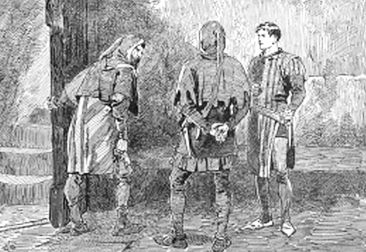
"Take off his helmet, Ralph. Let me see his face. Methinks I recognized
his voice, and he fought as if he knew and hated me."
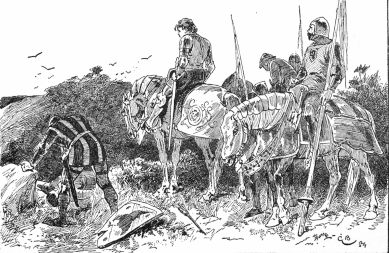
The end of a Recreant Knight.—Page 386.
Ralph removed the helmet.
"It is as I thought," Walter said; "it is Sir James Carnegie, a recreant
and villain knight and foul enemy of mine, a disgrace to his name and
rank, but a brave man. So long as he lived I could never say that my
life was safe from his machinations. Thank God, there is an end of him
and his evil doings!"
Walter was twice wounded in the fight, but upon neither occasion
seriously, and he was soon able to take part in the tournaments and
games which the Prince of Wales instituted partly to keep his men
employed, partly for the amusement of the citizens of Burgos, outside
whose walls his army lay encamped.
The prince was now obliged to remind the king of his promise to pay his
troops; but nothing was further from the mind of the treacherous monarch
than to carry out the promises which he had made in exile. He dared not,
however, openly avow his intentions, but trusting to the chapter of
accidents, he told the prince that at Burgos he could not collect a
sufficient sum; but if the army would march into Leon and take up their
quarters near Valladolid, he himself would proceed to Seville, and would
as soon as possible collect the money which he had bound himself to
furnish. The plan was adopted. Edward marched his troops to Valladolid,
and Don Pedro went to Seville.
Some time passed on without the arrival of the promised money, and the
prince was impatient to return to Aquitaine. Don Henry had gathered a
force in France, secretly assisted by the French king, and had made an
inroad into Aquitaine, where he obtained several successes, and was
joined by many of the disinterested nobles of that province.
"You were right," the prince said to Walter one day; "this treacherous
king, who owes his kingdom to us, intends to break his plighted word. I
know not what to do; my men are clamorous for their pay, and I am unable
to satisfy them. Don Pedro still sends fair promises, and although I
believe in my heart that he has no intention of keeping them, yet I can
hardly march against him as an enemy, for, however far from the truth it
may be, his pretext that the treasury has been emptied by his brother,
and that in the disturbed state of the kingdom no money can be obtained,
may yet be urged as valid."
Scarcely had the army encamped before Valladolid when a terrible
pestilence attacked the army. For a while all questions of pay were
forgotten, and consternation and dismay seized the troops. Neither rank
nor station was of avail, and the leaders suffered as severely as the
men. Every day immense numbers died, and so sudden were the attacks, and
so great the mortality, that the soldiers believed that Don Pedro had
poisoned the wells in order to rid himself of the necessity of
fulfilling his obligations.
The Black Prince himself was prostrated and lay for some time between
life and death. A splendid constitution enabled him to pull through, but
he arose from his bed enfeebled and shattered, and although for some
years he lived on, he received his death-blow at Valladolid. His
personal strength never came to him again, and even his mind was dulled
and the brightness of his intellect dimmed from the effects of the
fever. When he recovered sufficiently to inquire into the state of his
forces, he was filled with sorrow and dismay. Four-fifths of the number
were either dead or so weakened as to be useless for service again. The
prince wrote urgently to Don Pedro for the money due; but the king knew
that the English were powerless now, and replied that he had not been
able to collect the money, but would forward it to Aquitaine, if the
prince would return there with his army. Edward knew that he lied, but
with only six thousand or seven thousand men, many of whom were
enfeebled by disease, he was not in a position to force the claim, or to
punish the base and ungrateful king. Again, therefore, he turned his
face north.
Charles of Navarre had now allied himself with Don Henry, and refused to
allow the remnants of the army to pass through his dominions, although
he granted permission to the prince himself and his personal attendants
and friends. The southern route was barred by the King of Arragon, also
an ally of Don Henry; but with him the prince was more successful. He
had a personal interview with the monarch, and so influenced him that he
not only obtained permission for his troops to pass through his
dominions, but detached him from his alliance with Don Henry and
induced him to enter into a friendly treaty with Pedro.
A greater act of magnanimity was never performed. In spite of the base
ingratitude with which he had been treated, and the breach of faith
which saddled him with enormous liabilities and debts, which weighed him
down and imbittered the rest of his life, Edward remained faithful to
the cause of his father's ally, and did his best to maintain him in the
position which English valor had won for him. He himself with a few
companions passed through Navarre, and arrived safely in Bordeaux, where
his wife awaited him, and where he was received with rejoicings and
festivities in honor of his glorious campaign in Spain.
His health was now irreparably injured. Troubles came thick upon him in
Aquitaine, and he had no longer the energy to repress them. Risings took
place in all directions, and the King of France renewed the war. In
addition to his own troubles from the debts he had incurred and the
enemies who rose against him, he was further shaken by the death of his
mother Philippa, whom he tenderly loved. His friend Chandos, too, was
killed in a skirmish. Unhappily, while thus weakened in mind and body
the treachery of the bishop and people of Limoges, who, having bound
themselves by innumerable promises to him, surrendered their city to the
French, caused him to commit the one act of cruelty which sullied the
brightness of an otherwise unspotted career, for at the recapture of the
town he bade his soldiers give no quarter.
This act, although common enough at the time, is so opposed to the
principles of mercy and humanity which throughout all the previous acts
of his life distinguished the conduct of the Black Prince that it cannot
be doubted that his brain was affected by the illness which was fast
hurrying him to the grave. Shortly afterward he returned to England and
busied himself in arranging the affairs of the kingdom, which his
father's failing health had permitted to fall into disorder. For the
remaining four years of life he lived in seclusion, and sank on the 8th
of June, 1376.
Walter, Lord Somers, returned home after the conclusion of the campaign
in Spain, and rode no more to the wars.
Giles Fletcher and his wife had died some years before, but the good
citizen Geoffrey the armorer, when he grew into years, abandoned his
calling and took up his abode at Westerham Castle to the time of his
death.
In the wars which afterward occurred with France, Walter was represented
in the field by his sons, who well sustained the high reputation which
their father had borne as a good and valiant knight. He and his wife
lived to a green old age, reverenced and beloved by their tenants and
retainers, and died surrounded by their descendants to the fourth
generation.
THE END.
Uniform Cloth Binding. Price $1.00.
"Wherever English is spoken one imagines that Mr. Henty's name is known.
One cannot enter a schoolroom or look at a boy's bookshelf without
seeing half a dozen of the famous volumes. Mr. Henty is no doubt the
most successful writer for boys, and the one to whose new volumes they
look forward every Christmas with most pleasure."—Review of Reviews.
Bonnie Prince Charlie: A Tale of Fontenoy and Culloden. By G. A.
Henty. With Illustrations by Gordon Browne. Price $1.00.
With Clive in India; or, The Beginnings of an Empire. By G. A.
Henty. With Illustrations by Gordon Browne. Price $1.00.
The Dragon and the Raven; or, The Days of King Alfred. By G. A.
Henty. With Illustrations by C.J. Staniland, R.I. Price $1.00.
The Young Carthaginian: A Story of the Times of Hannibal. By G. A.
Henty. With Illustrations by C.J. Staniland, R.I. Price $1.00.
The Lion of the North: A Tale of Gustavus Adolphus and the Wars of
Religion. By G. A. Henty. With Illustrations by John Schönberg.
With Lee in Virginia: A Story of the American Civil War. By G. A.
Henty. With Illustrations by Gordon Browne. Price $1.00.
By England's Aid; or, The Freeing of the Netherlands (1585-1604). By
G. A. Henty. With Illustrations by Alfred Pearse. Price $1.00.
By Pike and Dyke: A Tale of the Rise of the Dutch Republic. By
G. A. Henty. With Illustrations by Maynard Brown. Price $1.00.
Captain Bayley's Heir: A Tale of the Gold Fields of California. By
G. A. Henty. With Illustrations by H.M. Paget. Price $1.00.
Under Drake's Flag: A Tale of the Spanish Main. By G. A.
Henty. With Illustrations by Gordon Browne. Price $1.00.
In Freedom's Cause: A Story of Wallace and Bruce. By G. A.
Henty. With Illustrations by Gordon Browne. Price $1.00.
In the Reign of Terror: The Adventures of a Westminster Boy. By
G. A. Henty. With Illustrations by John Schönberg. Price $1.00.
True to the Old Flag: A Tale of the American War of Independence. With
12 page Illustrations by Gordon Browne. Price $1.00.
With Wolfe in Canada; or, The Winning of a Continent. With 12 page
Illustrations by Gordon Browne. Price $1.00.
By Right of Conquest; or, With Cortez in Mexico. With 6 page
Illustrations by W.S. Stacey. Price $1.00.
St. George for England: A Tale of Cressy and Poitiers. With 8 page
Illustrations by Gordon Browne. Price $1.00.
The Bravest of the Brave: With Peterborough in Spain. With 8 page
Illustrations by H.M. Paget. Price $1.00.
For Name and Fame; or, Through Afghan Passes. With 8 page
Illustrations by Gordon Browne. Price $1.00.
The Cat of Bubastes: A Story of Ancient Egypt. With 5 page
Illustrations by J.R. Weguelin. Price $1.00.
For the Temple: A Tale of the Fall of Jerusalem. With 10 page
Illustrations by S.J. Solomon. Price $1.00.
The Lion of St. Mark: A Story of Venice in the Fourteenth Century.
With 10 page Illustrations by Gordon Browne. Price $1.00.
By Sheer Pluck: A Tale of the Ashanti War. With 8 page Illustrations
by Gordon Browne. Price $1.00.
A Final Reckoning: A Tale of Bush Life in Australia. With 8 page
Illustrations by W.B. Wollen. Price $1.00.
Facing Death: A Tale of the Coal Mines. With 8 page Illustrations by
Gordon Browne. Price $1.00.
Maori and Settler: A Story of the New Zealand War. With 5 page
Illustrations by Alfred Pearse. Price $1.00.
For sale by all booksellers, or sent postpaid on receipt of price by the
publisher, A. L. BURT, 97 Reade Street, New York.
Uniform Cloth Binding. Illustrated.
A carefully selected series of books for girls, written by authors of
acknowledged reputation. The stories are deeply interesting in
themselves, and have a moral charm that emanates from the principal
characters; they teach without preaching, are of lively interest
throughout, and will win the hearts of all girl readers.
Esther. By Rosa Nouchette Carey. Illustrated. Price $1.00.
A World of Girls: The Story of a School. By L.T. Meade.
Illustrated. Price $1.00.
The Heir of Redclyffe. By Charlotte M. Yonge. Illus. Price
$1.00.
The Story of a Short Life. By Juliana Horatia Ewing.
Illustrated. Price $1.00.
A Sweet Girl Graduate. By L.T. Meade. Illustrated. Price
$1.00.
Our Bessie. By Rosa Nouchette Carey. Illustrated. Price
$1.00.
Six to Sixteen: A Story for Girls. By Juliana Horatia Ewing.
Illustrated. Price $1.00.
The Dove in the Eagle's Nest. By Charlotte M. Yonge.
Illustrated. Price $1.00.
Gianetta; A Girl's Story of Herself. By Rosa Mulholland.
Illustrated. Price $1.00.
Jan of the Windmill: A Story of the Plains. By Juliana Horatia
Ewing. Illustrated. Price $1.00.
Averil. By Rosa Nouchette Carey. Illustrated. Price $1.00.
Alice in Wonderland and Alice Through the Looking-Glass. Two volumes
in one. By Lewis Carroll. Illustrated. Price $1.00.
Merle's Crusade. By Rosa Nouchette Carey. Illustrated. Price
$1.00.
Girl Neighbors; or, The Old Fashion and the New. By Sarah
Tytler. Illustrated. Price $1.00.
Polly: A New Fashioned Girl. By L.T. Meade. Illus. Price
$1.00.
Aunt Diana. By Rosa N. Carey. Illustrated. Price $1.00.
The Water Babies; A Fairy Tale for a Land-Baby. By Charles
Kingsley. Illustrated. Price $1.00.
At the Back of the North Wind. By George Macdonald.
Illustrated. Price $1.00.
The Chaplet of Pearls, or, The White and Black Ribaumont. By
Charlotte M. Yonge. Illustrated. Price $1.00.
The Days of Bruce: A Story of Scottish History. By Grace
Aguilar. Illustrated. Price $1.00.
The Palace Beautiful: A Story for Girls. By L.T. Meade.
Illustrated. Price $1.00.
Margery Merton's Girlhood. By Alice Corkran. Illus. Price
$1.00.
Three Bright Girls: A Story of Chance and Mischance. By Annie E.
Armstrong. Illustrated. Price $1.00.
Pythia's Pupils: The Story of a School. By Eva Hartner.
Illustrated. Price $1.00.
The Lady of the Forest: A Story for Girls. By L.T. Meade.
Illustrated. Price $1.00.
Only a Girl: A Tale of Brittany. By C.A. Jones. Illus. Price
$1.00.
Honor Bright; or, The Four-Leaved Shamrock. By the author of Miss
Toosey's Mission. Illustrated. Price $1.00.
Under False Colors: A Story from Two Girls' Lives. By Sarah
Doudney. Illustrated. Price $1.00.
For sale by all booksellers, or sent postpaid on receipt of price by
the publisher, A. L. BURT, 97 Reade Street, New York.