SAINT BALDRED. — SAINT BALDRED OF THE BASS. — Introductory Stanzas. — SAINT BALDRED OF THE BASS. PART I. — The Funeral. — Requiem First. — Requiem Second. — Requiem Third. — SAINT BALDRED OF THE BASS. PART II. — The Pilgrimage. — NOTES TO SAINT BALDRED. — Introductory Stanzas. — NOTES TO SAINT BALDRED. PART I. — 1. — 2. — 3. — 4. — 5. — 6. — 7. — 8. — 9. — 10. — 11. — 12. — 13. — 14. — 15. — 16. — 17. — 18. — 19. — NOTES TO SAINT BALDRED. PART II. — 1. — 2. — 3. — 4. — 5. — 6. — 7. — 8. — 9. — 10. — 11. — 12. — 13. — 14. — 15. — 16.
3
Saint Baldred, the venerable subject of the following
poem, was the disciple of Kentigern or St Mungo,
the tutelary saint of Glasgow. According to Boece, he
was of Scottish descent; and, during the reign of
Brudeus, king of the Picts, held his pastoral charge in
East Lothian, which then formed part of the kingdom
of Pictland. His instructor in the faith was the reputed
son of Thametis, a Pictish princess,[1] who was
cousin to the reigning monarch; it is probable, therefore,
from this circumstance, that he enjoyed the smiles of
royal patronage and favour.
“The Breviary of Aberdeen,” says Dr Jamieson, in
his History of the Culdees, “contains some particulars
with respect to Baldred, which I have not met with
4any where else. ‘This suffragan of St Kentigern
flourished in Lothian, in virtues and in illustrious
miracles. Being eminently devout, he renounced all
worldly pomp, and, following the example of John
the Divine, resided in solitary places, and betook himself
to the islands of the sea. Among these he had
recourse to one called Bass, where he led a life, without
all question, contemplative and strict, in which, for
many years, he held up to remembrance the most
blessed Kentigern, his instructor, in the constant contemplation
of the sanctity of his conduct.’”—Hist.
Culdees, p. 190.
“In this work,” continues the doctor, “we find a
miracle ascribed to the worthy Baldred, that must have
rendered him an inestimable acquisition to a people
living on a rocky coast.—‘There was a great rock
between the said island and the adjacent land, which
remained fixed in the middle of the passage, unmoved
by all the force of the waves, giving the greatest hinderance
to navigation, and often causing shipwrecks.
The blessed Baldred, moved by piety, ordered that he
should be placed on this rock. This being done, at his
nod the rock was immediately lifted up, and, like a
ship driven by a favourable breeze, proceeded to the
nearest shore, and henceforth remained in the same
place, as a memorial of this miracle, and is to this day
5called St Baldred’s Coble or Cock-boat.”—A small
rock, at the mouth of Aldham bay, still bears the
name of Baudron’s Boat.
If personal safety merited consideration from the
ascetic, who was all but adored in that rude age, and
who lived a life of patriarchal innocence and simplicity,
we may suppose that he retired to the “strong castle”
of the Bass from prudential motives; for, at this
period, an exterminating war raged between the Scots
and the Picts, at the instigation of Ethelfrid, the pagan
prince of Northumberland, who sought his own aggrandisement
in the destruction of the contending nations.
While residing in this solitude, Baldred died 6th
March 607–8.—See Boece’s Chron. and Keith’s Cat. He
was held in such veneration by the natives, that on his
demise, the three neighbouring parishes of Aldham,
Tyningham, and Preston, laid claim to his remains.
It being impossible to satisfy the multitude without
supernatural agency, the enraged embassy were on the
point of deciding their right by blows, when a Pictish
sage judiciously advised them to spend the night in
prayer, that the bishop of the diocese might have an
opportunity of settling their dispute in the morning.
“When day dawned,” says Holinshed, “there were
found three biers with three bodies decently covered
with clothes, so like in all resemblance, that no man
6might perceive any difference. Then by commandment
of the bishop, and with great joy of all the
people, the said several bodies were carried severally
unto the said three several churches, and in the same
buried in most solemnwise, where they remain unto this
day, in much honour with the common people of the
countries near adjoining.”—Holin. Chron. vol. i.
The same legend assumes a more warlike attitude in
the English Martyrology.
“The people waxing wroth took arms, and each of
them sought by force to enjoy the same; and when the
matter came to issue, the said sacred body was found
all whole in three distinct places of the house where he
died: so as the people of each village coming thither,
and carrying the same away, placed it in their
churches, and kept it with great honour and veneration
for the miracles that at each place it pleased God to
work.”[2]
In the Breviary of Aberdeen, before quoted, we are
informed, that “the inhabitants of the three parishes
7which were under his charge, as soon as they knew of
his death, assembled in three different troops at Aldham,
where he breathed his last, severally begging his
body. But, as they could not agree among themselves,
they, by the advice of a certain old man, left the body
unburied, and separately betook themselves to prayer.
Morning being come (as aforesaid) they found three
bodies perfectly alike, and all prepared with equal
pomp for interment. Each of the companies, of course,
departed well pleased; and each parish erected a
monument over that body of the saint which had fallen
to their share.”
“Such was the credulity of these times,” concludes
the doctor, “that it was believed, that the body of the
saint was in all these places; and this, of course, afforded
an irrefragable proof of the doctrine of transubstantiation.
Camerarius gravely says, that, ‘for the
termination of the dispute between these parochial
churches, it was at length effected, by the prayers of
the saint himself (for nothing is impossible with God)
that each of them should enjoy this treasure.’”—Major
asserts the doctrine as supported by this fact.—See
Hist. Culdees, pp. 191, 188.
According to the learned Chalmers, a Saxon monastery
of St Baldred was established at Tyningham,
at an after period, whose diocese comprehended the
8whole of East Lothian, and whose lands, says Simeon,
the monk of Durham, extended from Lammermoor to
Inveresk. “Et tota terra quæ pertinet ad monasterium
sancti Balthere, quod vocatur Tyningham a
Lambermore usque ad Escemuthe.”
Two elegant Saxon arches, the remains of the old
chapel, still ornament the beautiful domain of Tyningham,
where the principal scene of the poem is laid.
9
The pilgrim views on Lothian’s eastern shore,
(Whose fields are waving far with golden grain,)
Like giant’s fabled tower, sublimely hoar,
The Bass, majestic, rising from the main:
Here ocean’s waves usurp the rural scene,
And the blue waters gird the mountain’s zone,
Where spread of yore the verdant blooming plain,
As sage geologists have deftly shewn,
In times to topographic lore, alas! unknown.
The muse has deem’d this crag, in fancy’s hours,
The prototype of monster huge and tall,
That having left Zahara’s citron bowers,
Dips his proboscis in the Senegal;
While round his rugged sides the waters fall,
His stately form frowns awful o’er the tide,
Gleams on his back the castellated wall,
As erst by Porus led, in Indian pride,
The tower-crown’d elephant, by green Hydaspes side.
The pious Baldred scoop’d his hermit cell
Upon the sunny summit of the rock,
Whence issued forth a fountain’s crystal well
Which o’er the cliffs in showery spangles broke;
The sea gulls, charm’d to tameness, round would flock,
Bringing their finny offerings to his cave;
While as the Pict skimm’d by in light carrock,
He paused, a holy benison to crave,
Then push’d his little skiff undaunted through the wave.
And oft at dead of night, when howl’d the storm,
The anchorite left his couch his beads to tell;
And press’d the cold bare rock in prayers till morn,
For vessels drifting near the Inch Cape’s bell,
Which rung, between each gust, the seaman’s knell;—
And evermore he closer claspt his hands,
As burst upon his ear the water’s swell,
For the lone wretch who shudd’ring, drowning stands,
Waist-deep, and lock’d in Tyne’s deceitful sinking-sands.
When rosy-finger’d Flora from her urn
Strew’d earth with flowers, and pearl’d the azure deep,
While the red sun in Leo fierce did burn,
At depth of noon, the saint his limbs would steep
In the transparent waves, where breezes creep
O’er Fidrey’s sacred isle; meanwhile, the fry
Sported around in shoals, as glad to keep
Their summer sabbath:—the sea-calf roll’d by,
Forsook her briny pool, and lick’d the patriarch dry.
He was a star in reason’s dawning day,
That led the savage hordes of human kind,
Ere Learning pour’d her intellectual ray
Like light from heav’n upon the vacant mind:
Then God was heard in thunder or the wind,
While meteor forms did aerial conflict wage;
As tattoo’d groups upon the shore reclin’d,
Listen’d the mystic lore of Runic sage,
Cull’d from the Scandinavian’s darkest pagan page.
He travell’d paths untrod, o’er mountains bare,
To preach the gifted creed to barbarous men;
His food alone the jetty juniper
That blossom’d on the steeps of Lammer’s glen;
He dragg’d the savage from his gloomy den,
In silken chains his wayward passions bound,
While Hope’s bright rainbow glitter’d o’er the fen,
And Mercy scatter’d pearls upon the ground,
Where erst dark Odin’s chiefs in blood-stain’d garments frown’d.
Yet deem not that the lonely orison
Was life’s sole business; for he also taught
To rear the rustic dome, which, form’d of stone,
Fair Architecture to perfection brought;
The oaken wall—the roof ingenious wrought,
Pictur’d the Gothic arch with willow wand,
In embryo modelling those shrines of thought;
Such as by Doric Tweed do sculptured stand,
Whose cloisters seem as carved by Nature’s sylvan hand.
And, oh! if e’er he felt that gentle flame,
Which, born in heav’n, on earth like vapour dies,
’Twas sigh’d in secret (and was he to blame?)
For pious Breda,—beautiful as wise,
Who left the pomp of gilded canopies
In regal lands, for the lone convent’s cell.—
And, fair, her house of prayer was seen to rise,
Where the Cistertian sisters loved to dwell
Beneath the mighty shade of Lothian’s Alpine hill.
Of Baldred’s lineage little we may learn,
Whether of princess born or lowly swain,—
Suffice, that he was bred by Kentigern
What time St Colme to Iona came;
And cleans’d the church from her Pelagian stain,
And royal Brudeus to the faith subdu’d;
Who, haply, left the world’s tumultuous scene
To meditate in sentimental mood,
And hold high converse in the Bass’s solitude.
Methinks oft gazing o’er Bodotria’s tide,
King Brude and Baldred sat in cavern’d shade,
The prince’s robes the leopard’s spotted hide,
Thrown o’er his brawny shoulders, which display’d,
Deep painted in his skin, in fierce parade,
The milk-white buffalo and the tusked boar;
And evermore the saint some truth convey’d;
Anon he shook his beard all silver’d o’er,
And talk’d of pilgrimage on Judah’s distant shore.
The prince, wrapt in astonishment, would ask
Of foreign climes, their manners and array;
Now burn’d to crush the Persian basilisk,
Reserved for the crusades of latter day—
Now sought to know if the world’s barriers lay
Where Alps lie pillow’d till they prop the skies!
And much he long’d to pierce the milky-way,
Even as an eagle; while, before his eyes
Fair pictured in the sand, the zodiac’s splendour lies.
Philosophizing thus, the hours were lost,
Till war’s horn blew, and Brudeus graspt the spear;
For valiant Arthur’s Bacchanalian host
Have left their Christmas-pie for rougher cheer;
The Scot and Pict invading warfare bear,
And drive the Table-knights to Humber’s flood;—
Their monarch slain, the Britons yield through fear,
While the sun shone at noon array’d in blood,
And York’s esculent herbs gleam’d crimson from the bud.
Too soon to these leagued warriors omens told
Of broken friendship, desolating woe;
For the Northumbrian prince with treacherous gold
Seduced the Pict to hold the Scot his foe;
Grief for their strife brought saintly Baldred low;
Upon the Bass he pined away, and died,—
When o’er a rainbow-bridge, in robes of snow,
Upborne by angels, he was seen to glide;
As erst St Idan rose from Leader’s pastoral side.
17
The requiem rises loud, but drear,
Within the Bass’s rocky isle;
Where watchful round St Baldred’s bier
The monks await the morning’s smile;
While torch-light reddens the lone cave,
And brightens every paler face,
Till in each feature, darkly grave,
Sorrow her gentle tear may trace.
That day from Preston’s holy fane,
Three friars came the priest to claim;
For there, in Modred’s gloomy reign,
Before the Saxons were subdued,
18His foster-mother was a dame
Supposed the heir of high-born blood.
Three friars came from Aldham’s shrine
In quest of the revered man;
For there, among the Pictish line,
His pastoral charge at first began.
Three friars came from Tyningham
To claim the Saint’s much-hallow’d clay;
For there, enshrined in folds of balm,
His saintly predecessors lay,
The church-light of an earlier day.
Th’ assembled friars stood amazed,
Speechless, and swollen with rage they gazed,
Till arms in angry mood were raised,
And crosier-staffs were broke;
When ripe for vengeance and for war,
They rent the cross-woven scapular,
And tore the scanty cloak;
From grasp and squeeze they pass’d to blows,
One took his neighbour by the nose,
Another by the hair;
Nor ceased to ply the dangerous art,
Till each could shew a wounded part,
And every back was bare!
Alarm’d by the tumultuous roar
The solan left her rocky nest,
And travelling to the Fifean shore,
Like snowy curtains deck’d the west;
While monsters in the Forth were seen,
Disporting in the waters green,
With crested head, like horned owl,
O’erspread with film like Carmelite’s cowl;
Then all look’d ominous and drear
As if some great event was near;
And many saw pale Loda’s form,
Gleam in his meteor-clad array;
While others only heard the storm
As grief or terror held their sway.
Dark grew the Warden’s cheeks of bloom,
Like wizard started from the tomb;
He blest each saint he knew!
And as his ruddy face grew pale,
His lips shook, quivering as the gale,
And pass’d from red to blue.
20By good St Mungo’s soul he swore,
(As evermore his locks he tore,
And fierce his blood did boil,)
That “ere they moved the old man’s bones,
“As easily they’d move the stones.
“Which propp’d the lofty isle!”
When, lo! a vessel near, they spy,
That proudly heaves in sight;
Fair blows the wind, serene the sky,
“Ho! boatmen, o’er the waters fly,
“And reach the land ere night;—
“To favouring breeze your canvass stretch,
“To Holy Island speed;
“And bid the Bishop cease to preach,
“And leave his miracles unwrought,
“And bring him here as swift as thought,
“To aid us in our need!”
Meanwhile a host upon the shore
Await the embassy’s return;
But when the herald struck his oar,
Their souls for vengeance burn:
21While gathering far, on Aldham’s height,
The rival parishes advance;
Now mingle in the deadly fight—
And hurl the sounding lance.
When forward rush’d an aged man,
So venerable in years,
That silence through the warriors ran,
And nerveless fell their spears;—
And thus, the Priest of Garmilton
Loud spake, while from his eyes there shone
Radiance, like lightning from a cloud,
Which backward awed the dusky crowd:—
“O mock not the decree of Heaven,
“In angry strife, to madness driven!
“But let the calm of peace prevail,
“Till supernatural powers be given
“To bless your deep excess of zeal.”
But, frowning still in angry mood
Unmoved, the men of Aldham stood;
A hardy race nursed by the sea,
In manners haughty, fierce, and free;
22Again the smother’d murmur rung,
While they were seen to seek the shore;
For on their backs the corrock hung,
And in their hands the oar,
When rose the Priest of Garmilton,
With his prophetic eye,
“I swear by Hadda-Chuan’s stone,
“That storms are in the sky!
“Yes, by the tempest-saint I swear,
“Of green Iona’s isle!
“That to the depths of hell ye steer,
“Debarr’d from heaven’s smile!
“Backward St Baldred’s rock shall roll,
“And choke your navigation up,
“While fires shall riot on your soul,
“And sea-wolves on you sup,
“If ye despise my warning now!”
Thus spake the priest, and smote his brow.
While back the trembling men return,
As if the curse begun they feel;
And silent for that vengeance burn
Which they dare not reveal.
The friars in the lonely isle
Like guards their watches keep;
Till most of them, o’ercome with toil,
Go piously to sleep;
While others, chatting o’er the bowl,
Simper beneath the monkish cowl
To see their fellows weep,
And quaff, in horns, from mountain still,
The liquor brew’d from heather-bell—
So changing is man’s wayward mood
From false to fair, from smooth to rude.
O death! thou art a fearful thing,
Although ’tis said relief thou’lt bring,
The wretch without a friend or home,
Condemn’d in hungry rags to roam,
Will life’s last bitter chalice drain,
Sooner than mingle with thy train!
Thou strik’st the hermit in his cell,
Who long has bid the world farewell;
Thou strik’st the warrior in the field,
While charging squadrons round him yield;
24And rosy youth, and wrinkled age,
And motley fool, and cunning sage,
Alike before thy arrows fall,
Whose quiver has a barb for all.
Each left the corpse, save that dark man
Cormac, from Aberlady’s shore,
Who, deem’d a cunning artisan,
Had left Kilspindie’s cells at dawn,
Yet landed not till twilight hour.
Two black-hoods follow’d in his train,
Like shadows on the rock,
Who only deign’d to breathe amen!
As low their master spoke:
“Refugium peccatorum,
“Consolatrix afflictorum,
“Ora pro nobis.”
Yet, thought the soldiers of the Bass,
As slow the midnight moments pass,
Some demon horrid rites preferr’d,
To rend the rock asunder,—
For evermore they, shuddering, heard
Deep buried sounds like thunder;
25While underneath the waters boil’d,
As if Leviathan had coil’d
His monstrous shape around the base
The castellated isle to raise;
While started in the unfathom’d deep
The coral tenants from their sleep!
At morning’s dawn the Bass appear’d,
Half hid in ocean’s mantle fold,
Shining as magic wand had rear’d
A mountain pearl in bed of gold.
Afar, impervious to the sun,
The woad-dyed groups, in shadows dun,
Along the summits steal;
While glad the Bishop’s barge they hail,
Seen, swan-like, urged by favouring gale
Westward the port of Bele.
Where high Tantallon’s castle stands,
Like vet’ran set to watch the deep,
Gleam’d nodding heads, and waving hands,
Wherever human foot might creep;
And rocky cave, and ocean bay,
Bore the loud shoutings far away,
That hail’d the monk of Lindisfarn
In friendship free—in virtue stern.
Chiming o’er Lothian’s sunny shore,
The chapel bells began to ring,
And still was echo’d more and more,
“Hail to the holy man ye bring!”
The sails are struck—the oars are plied—
The barge moor’d by the Bass’s side;
And as the Bishop trod the strand,
They forward press’d to kiss his hand:
Enough of worldly bliss for them
To see him ere they die;
To touch that garment’s hallow’d hem
Which he did sanctify.
Down to the castle’s caves they wend,
With hesitating steps and slow,
And, fearful, one by one descend,
As if Vesuvius yawn’d below;
The first sent up a horrid sound,
His glaring torch fell to the ground;
Another, and another fell—
Some vow’d to heav’n, some thought of hell;
And as the smouldering flame upbroke,
They shudder’d as they saw
27The devil tow’ring o’er the smoke,
Seize Baldred, and, with agile bound,
Leap o’er North Berwick Law!
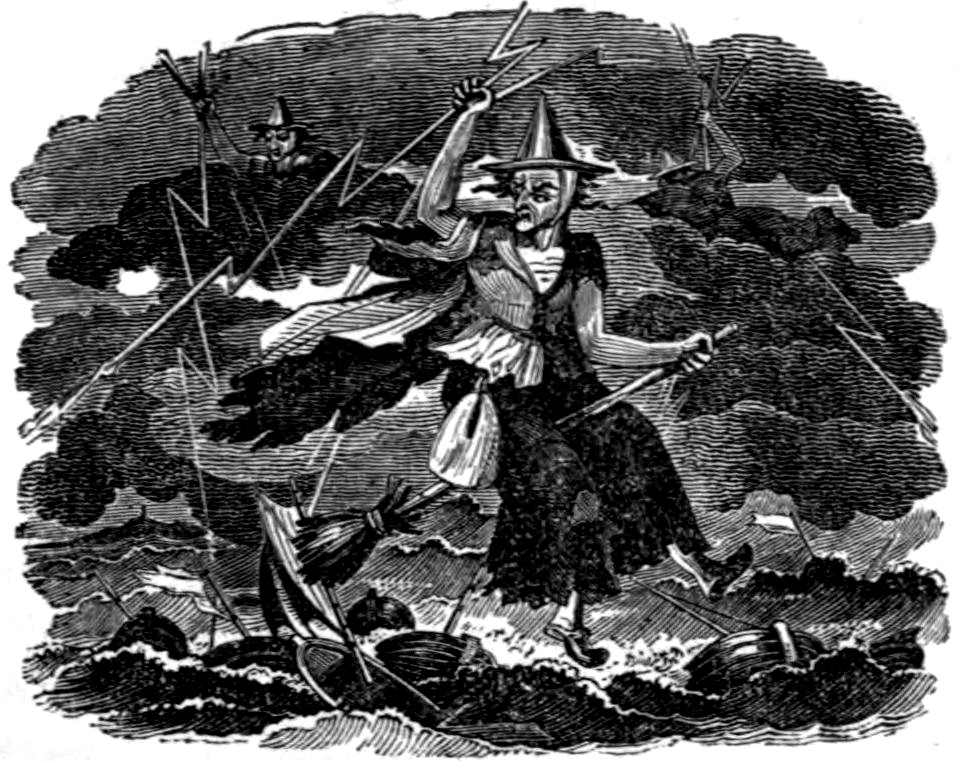
That hill, which in a latter day,
By witchcraft near was borne away,
When the Gyre Carling strode the mast,
And, like a huntress, rein’d the blast.
Retreated all as best they might,
Each sought to save himself in flight;
Nor did the Bishop stoop to kneel—
Unlike St Serf, the church’s keel,
Who with his prayers the dragon slew,
St George eclipsing—if ’tis true!
Surprise upon each brow had striven,
As dread conjecture ran,
When they beheld, as dropt from heav’n,
That lone Aemonian,
The hermit of Inch-Colme’s isle,
Whose face ne’er lighten’d with a smile;
Yet was his temper framed so mild,
In innocence he walk’d a child;
The untamed tenants of the moor
Roam’d in his daily haunts secure;
28For brute and man alike were shewn
That mercy claim’d this priest her own;
But him they question’d not,
So scriptural his answers were,
Long prefaced by a tedious prayer,
The subject he forgot;—
Ere the proeme had been begun,
Another day had seen the sun!
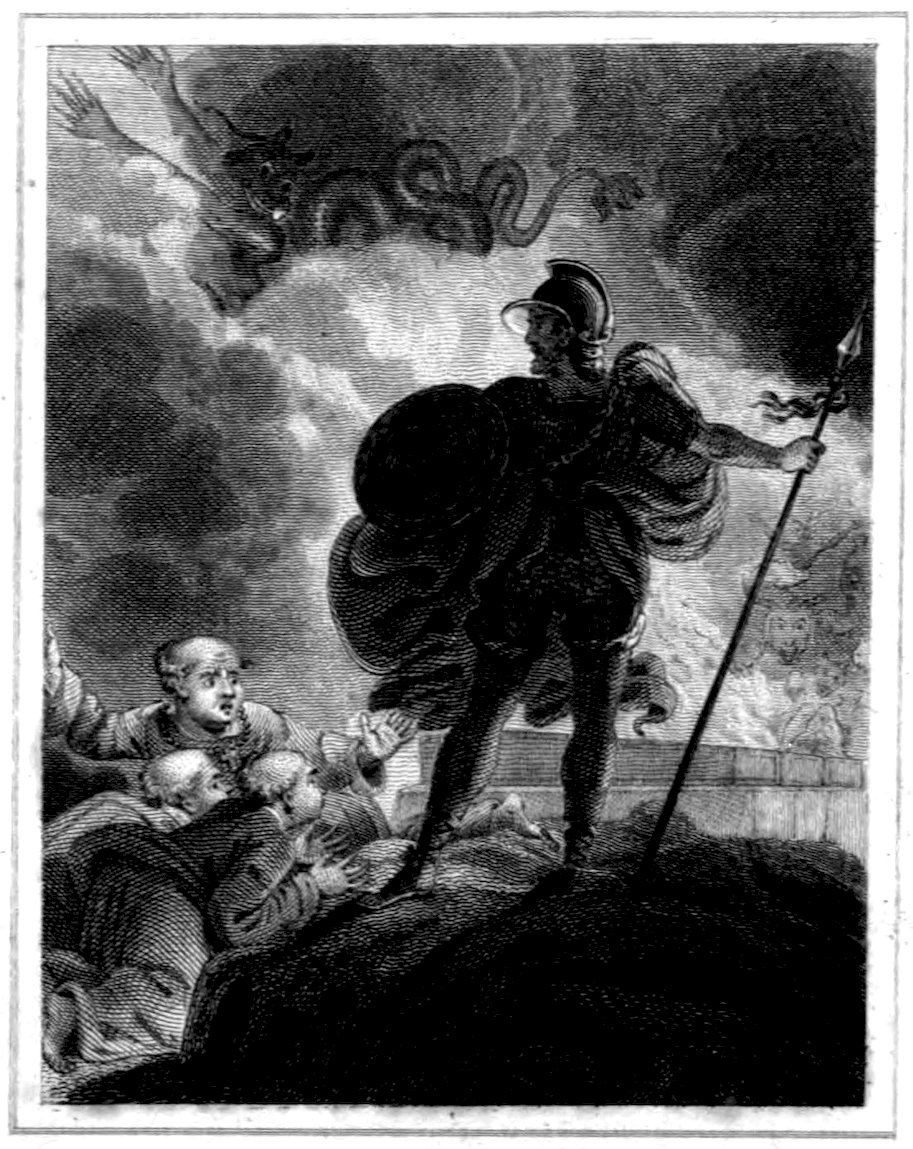
The Warden stood in fierce array,
Like savage of St Julian’s bay,
By nature form’d for martial fray,
In stature towering high;
As trunk of oak his massy limb,
Though muscular, yet moulded trim;—
His visage pointed, long, and grim,
Lank cheeks and hollow eye.
Unlike the carpet-race we boast
The soldier’s jest, though fashion’s toast,
Who leave Castalian springs for wine,—
Whose greatest glory is—to dine!
Men often show least signs of fear
When certain danger hovers near:
29The Pict conceal’d his wrath—
He craved the Bishop’s benison,
Then went like Roman denizen
To victory or death!
His zone with iron hoops was braced;
His buckler on his arm was placed,
Made of the buffalo’s hide;
While, punctured, on his breast appear’d
The monster, fierce as when ’twas spear’d;
Now raising high his sounding lance
He bade the trembling crowds advance,
And march’d with martial stride;
But none durst follow in the van
With that gigantic-bodied man!—
Then fell an awful pause, as when
The Indian striplings fearless run
To slay the tiger in his den,
In caves that never saw the sun:
Meanwhile the Warden had his fears
When he beheld the friars dying,
And, side by side, survey’d three biers
Whereon the saint in state was lying.
Each load was borne most pompously,
Deck’d with its cross and rosary;
30While, one by one, three corpses lay
Like twin-brothers transform’d to clay,
Moulded so nicely like each other,
The eye no difference might discover;
And as the tapers flicker’d dim,
The features look’d uncouth:
Each countenance appear’d more grim,
And seem’d to ope its mouth.
Recovering soon, the Warden raised
His voice, to urge them on, who gazed:
They forward press—they kneel and pray—
While, lacking faith, some steal away,
As starting from their fearful swoon
The astonish’d friars leap to their feet;
The stoled biers look wildly on,
And deem the vision is complete:
Till by a glimpse of reason’s beam
They wake to a substantial dream!—
“Mother of God!” the Bishop cried,
“Thy aid is never sought in vain!
“To crush the paynim in his pride,
“Thy spirit walks on earth again!—
“Where’er thy dove-like presence strays
“Among the bowers of human wo,
31“O teach our harps to sing thy praise
“In strains that seraphs only know!”
They raised the sheet from Baldred’s face,
They turn’d the corpses where they lay,
In each his features clearly trace,
Crown’d with a tuft of silvery gray.
They deem’d his bright ethereal flame
Which mortal form could not control,
From heav’n had held a trio frame
To suit his zealous warmth of soul;
That he might stray in paynim lands,
A pilgrim lone in Palestine;
Now tread the desert’s burning sands—
Now preach the faith by Pictish Tyne;
With that sweet angel for his guide,
Who led St Serf by Bosphorus’ strand,
Attendant duteous by his side,
Like earth and heaven hand in hand!
But, hark! the Bass’s chapel bell
Again its mournful music plies,
And Aldham’s chimes the breezes swell,
And Tyningham as soft replies.
32While o’er the lake in dark parade
The painted chiefs are seen to glide,
From verdant Tyne’s green holly shade
To dwarfish Peffers’ sandy side.
Afar upon the spangled deep
The barges move in solemn show;
The oars their regular cadence keep,
As ’twixt each pause a sob of wo
Bursts from the sailor, and a tear
Falls down unseen on ocean’s breast;
While, in their gloomy livery drest,
The sable nodding biers appear
Reflected in the waters clear,
Like plumes upon a silver crest!
The seal lay on the scarry shore,
As charm’d to hear the distant oar;
The tarrock left Craig Leith’s rough breast,
To crown the isles like feathery crest;
And every rock that gemm’d the deep
Was peopled like the grassy steep;
Some launch the skiff, while others brave
The swelling surface of the wave;
33Anxious to join the funeral train:
And, but for weeds that pictured pain,
’Twas like a festive holiday,
When princes short-lived visits pay,
And the high rulers of the earth
A jubilee give to lowly mirth.
Soon reach’d the pebbly-studded strand,
The oars are struck—the mourners land
In Aldham’s pleasant bay;
Upon the beach three chieftains stood,
With litters form’d of laurel-wood,
And crown’d with rosemary;
On these St Baldred’s relics laid,
With other honours duteous paid,
They forward march’d in sad parade;
Where all were willing—those were blest,
To whom were given the high behest
To bear the corpse away;
Preceded by six vestals fair,
Who tore the long dark glossy hair
That fell upon their shoulders bare
As clouds on mountain snow;
Anon their lily hands they wrung,
And mournfully the requiem sung
In plaintive notes of woe.
34Hymn.
Spirit of bliss! a cup of joy
Awaits thee in the halls of Thor,
Where earthly sorrows ne’er destroy,
Where heavenly hearts are never sore.
Did thy mother, in midnight dreams,
Call thee from this land of care,
To sail on heaven’s transparent streams
With Jhules, the angels of the air?
Save us from pale Loda’s power,
When in the gale his form appears;
Cheer us in affliction’s hour,
And shield us in the strife of spears.
Spirit of bliss! a cup of joy
Awaits thee in the halls of Thor,
Where pleasure charms without alloy,
Where tempests never wreck the shore.
Up Aldham’s flowery steep the biers
Ascend, in a long dusky line,
Where, tow’ring o’er their dark compeers,
The warriors’ glancing helms shine;
35And golden mitres lustre shed
Upon each bishop’s ancient head.
First solemn walk’d, behind the pall,
Conwal, that priest austere and tall,
Who dwelt by Clutha’s winding stream;
His loins were girdled round with hair:
For such like penance he did deem
Useful to fit his soul for prayer.
He was St Baldred’s friend in youth,
St Mungo train’d them both to truth;
And ne’er do tears sincerer flow
Than those which early friends bestow,
When weeping o’er some parted shade
In life’s luxuriant prime decay’d.
Ah! who would wish to linger here
When those who made life sweet are gone,
When loves and friendships disappear
Beneath the dark sepulchral stone;
And all we know of sage and fair,
Is the dull record that—they were!
Upon his right, with martial brow,
Appeared the young Prince Derili,
Who wept in Baldred’s relics now
A lost preceptor, and did sigh
36While running o’er instructive hours—
Which now, alas! too quick had sped—
As oft in Dirleton’s ivied towers
He listen’d to the honour’d dead,
And heard truths morally sublime,
That purified his soul from crime,
And bade him afterwards atone
For errors that were not his own;
And in Loch Leven’s lonely isle
To heaven bequeath a holy pile.
St Conwal, on his left, was led
By Asaph—soon to suffering bred,
A zealous man, who did adorn
The holy church, for which he’d borne
The martyr’s faggot-blaze;
Unburthening his soul of guilt
Three hundred times a-day he knelt
In silent deeds of praise;
So oft he’d paced the altar’s bound,
His steps had worn the marble ground!
He was supported by that sage,
Who ’midst the others shone
So venerable in his age,
The Priest of Garmilton.
37Idan came next of Lindisfarn,
In demon-conflicts bold,
Who, on the gloomy rocks of Fern
Did secret vigils hold,
And afterwards, upon that shore,
The bishop’s pastoral crosier bore.
While Eta, abbot of Melrose,
The bishop’s stoled ranks did close.
Then follow’d those of less degree,
Yet not less famed for sanctity;
There stalk’d Dricthelmus the austere,
Who one dread night in death’s arms slept,
And saw Heaven’s mystic visions fair,
As o’er the golden walls he crept,
When, lo! a weight of earthly sin,
Like Eden-cherub’s flaming brand,
Just as he leap’d to enter in,
Drove him to this terrestrial land!—
There also walk’d those monks profound,
With eye devout upon the ground,
The followers of St Benedict,
In sanctimonious manners strict.
While wander’d in the rabble’s van,
That sadly lone Aemonian!
Where’er this gentle hermit went
Still followed him a sacred cow,
38Whether he trod the sandy bent,
Or clomb the mountain’s heathery brow.
For those who sail’d on Forth’s green wave,
It was a splendid sight to view
The cavalcade, as dark and grave
It gave the cliffs a chequer’d hue;
While evermore the torches threw
A sparkling glare among the crowd,
As stars will hide their eyes of blue
In dawning morning’s dusky cloud;
Then first by Aldham’s holy shade
The solemn pageant paused the while,
As in the church’s holy pile
One body of the Saint was laid
Beneath a yew’s undying bloom,
Emblem of tenant of the tomb.
This tree a holy calm diffused
O’er passing strangers, as they mused
Upon the nicely sculptured scroll,
That told its moral to the soul.
Low chanted in the house of God,
On high the choir’s full measure flow’d,
39While the soft echo of a sigh,
Dimm’d the bright lustre of each eye.
Be hallow’d the place of thy rest,
O soft be thy bed in the tomb!
Thou’rt gone to the land of the blest,
With the souls of the happy to roam:
As planets in loveliness roll,
And light the lone wanderer’s way,
Thou beam’d on the night of the soul,
And left us at dawning of day.
With bay we’ll embroider that stone,
That tells us of glory and thee!
While the changes of seasons roll on,
Thy memory unfading shall be.
Though fled on the seraphim’s wing,
And left us in darkness to mourn,
With earliest blossoms of spring
We duly will garland thy urn.
O who is he, with locks of grey,
That bids the pressing crowds recede,
As backward rolls the ocean’s spray,
Where canvas-crowned galleys glide?
A scallop-shell the stranger wears,
St Peter’s keys in red he bears
Wrought in his scapular;
The Pictish lances rattling sound,
And far the waving pennons float,
The bishop’s palfreys paw the ground,
And startle at the war-horn’s note,
While mingling voices loud exclaim,
“Ho! pilgrim, with your cross of flame!
“Come ye for peace or war?
“Or why upon our march intrude,
“In humble guise, but forward mood.”—
“O let short-breathing space be given,”
The way-worn stranger cried:
“Three moons have scarcely waned in heaven,
“Since Baldred, in Loretto’s shrine,
“Was kneeling at my side.
41“Before the virgin and her son,
“Where silver lamps for ever shine,
“He drank the Eucharistal wine,
“And said—‘My earthly task is done!’
“I turn’d to bid the old man hail—
“And saw his face was waxing pale
“As monumental bust—
“I turn’d; but, lo! the priest was gone,
“And I fell humbled in the dust!”
“Beloved of heaven!” the bishop cried,
“Mary! maiden-mother, fair!
“Who lovest to crush the paynim’s pride,
“And hear the lowly pilgrim’s prayer,
“Again to thee on earth be given,
“That homage which ascends to heaven!
“Holy pilgrim! speed the while,
“Rest thee in the rocky isle,
“Till the morning’s purple light
“Gilds Dumpender’s verdant height;
“Onward then, Heaven be your guide,
“As it has ever been;
“When wafting o’er the western tide,
“O tell by lone Iona’s side
“The mysteries you have seen!”—
’Twas noon, when o’er the Thistly Moor
The funeral held its mazy route,
When roused by sounds unheard before
The wily fox was on the scout;
The woodcock plied his jetty wing,
The red deer made his lofty spring,
A moment view’d the dark array,
Next fleetly bounding shot away,
Just stopp’d to slake his thirst in Tyne,
Then, arrow-like, straight onward flew,
Till on the horizon’s farthest line
His antlers pierced the heaven’s blue!—
Eastward of Binning’s beauteous wood
Stood Baldred’s mossy cell,
Where in communion deep with God
The patriarch loved to dwell,
What time the summer breezes bland
Were wafting perfume o’er the land;
And so serene the ocean lay,
It pictured headland-rock and bay;
And heaven’s veil of azure hue
Was only speck’d by grey curlew.
43Here often, tame as Rylston’s doe,
The chase-driven deer would stand,
And lick the hermit’s palm of snow,
And eat from gentle hand.
And here, before the altar’s mound,
Which time-worn hieroglyphics graced,
His canonized bones they placed,
And sanctified the ground;
And holily they sprinkled o’er
His grave, as sung the pious choir.
When death meets the chieftain ’midst victory’s hum,
His fall is deplored by the trumpet and drum;
But softer the music, and warmer the sighs,
That waft pious soul’s to their throne in the skies.
O drear were our walks in the shadow of death,
Till the star of Balclutha illumined our path!
Like the planet of Bethel it gilded the night,
Till it set in a halo of heavenly light.
Let bay deck the turf where the saint lowly lies,
Like the symbol we scatter, his leaf never dies;
For his fame in its innocence beauteously ’ray’d,
Like the rose-bud of Jericho, never will fade.
The dying sounds had scarcely ceased,
The prayer, half-mutter’d by the priest,
When round, the congregated crowd
Was parted like the thunder-cloud;
Some grasp the sword, some couch the lance,
Backward recoil, or firm advance;
Then quiver’d as with earthquake’s shock
St Baldred’s cradle in the rock,
And Whitberry’s rugged point was broke;
And, lo! (as old traditions’ say)
That boat of stone in Aldham’s bay,
Yclept the Saint’s, was seen to sail
As chaff before the mountain gale;
And all beneath fair Preston’s fane
The Tyne began to boil amain!
Until it foam’d o’er Linton linn,
Whence rose that loud horrific din,
45As if another Tityus lay
Chain’d with the vulture at his heart,
Wailing his soul in groans away
O’er agonies that must ne’er depart!
A knight comes on a lofty steed,
With spear reversed and helmless head,
A branch of olive in his hand.
The bishop bids the mourners stand,
When lighting by St Baldred’s side,
“A boon! a boon!” the warrior cried,
Craving to see the illustrious dead,
As if affiance he might trace
In the old man’s pale ghastly face;
Then roll’d his eyes from earth to heav’n,
Swore, as he hoped to be forgiven,
That, lately, on the Flemish shore,
He met the saint in Antwerp’s choir,
What time the vesper prayers were said:—
“Nay, father! do not doubt my word,
“I do not deal in gasconade,
“But wear a still untainted sword,
“That ever is unsheathed for God,
“Aye ready at the church’s nod;
46“Behold my doublet’s lightsome sheen,
“It once was dervise-pennon green,
“Hard won in Canaan’s holy land,
“When combating the Jews accurst;
“To mount the breach with sword or brand
“St Baldred knew I was the first!
“And thrice he blest me where I stood,
“And thrice he sign’d the holy rood;
“Then press’d my hand—it felt like flame—
“Behold! it left his hallow’d name!
“And now I come this boon to crave,
“That I may lower him in the grave,
“That some last relic you’ll bestow,
“’Twill bear me foremost ‘midst the brave,
“’Twill raise me when my arm is low!”
The bishop waved his hand on high,
And gave propitious reply—
“Gentle knight, thy claim is won;
“Priests and mourners! onward, on!”
The sun, beyond the Pentland’s ridge,
Had given the skies a rainbow hue,
When crossing Tyne on osier bridge
The crowd the funeral’s march pursue;
47The evening dews are falling chill,
The mountain cock with crimson eye,
And jetty wing, has sought the hill
Where mists are shadowing far the sky;
While in the skirts of Lammermoor
The tod peeps from his den secure,
And sees afar the dusky crowd
Move on, like summer’s passing cloud,
In slow and stately majesty,
When scarce a breeze is wafting by;
And as they pass near ancient Cnolle,
Fair Preston’s bell begins to toll,
For they have almost reach’d the goal
Of this eventful day;
And, as by winding Tyne they turn,
Clearer the funeral torches burn,
Seen through the twilight’s grey.
They have made St Baldred’s grave
Under Preston’s sculptured nave,
Where forgotten ’scutcheons wave
Of those who’ve pass’d away!
Gentle space, and mossy stone,
Tell of him who dazzling shone
The meteor of his day!
48He, whom nations could not bound,
Lies in a few feet of ground!
And he, whom kings wou’d bleed to save,
Will lie forgotten in the grave!
They have borne the saint’s last pall,
And placed his statue in the wall;
Dust to dust the bell is tolling,
As it must toll for all;
While through the aisles the anthem’s rolling,
Lovely in its dying fall,
Fanning, with melodious breath,
The solitary house of death!
The waves lie smooth when storms have fled,
Beneath St Abb’s high rocky head;
The green-capp’d islands of the deep
Are lovely when the breezes sleep,
Viewless upon their beds of balm;
But, ah! this is a treacherous calm!
For here the dove no rest can find
While storms are lingering in the wind.
The fairest scenes of earth’s dull round
Trail their dark shadows on the ground;
The thorny rose—the honied sting—
The winter’s cold—the blight of spring:—
While Love’s chill frown, and Hope’s deceit,
And Friendship changing oft to hate,
Prove that the dove no rest can find
Where man to man still proves unkind.
Beyond yon bright cerulean skies
Elysium’s land of promise lies:
Her sun no clouds are ever shading;
Her fruits and flowers are never fading;
Her hearts are pure as those that bear them,
The blight of sin cannot come near them:
Oh! there the dove its rest may find,
And taste that heaven at least is kind.
Thus closed the quire their lyric strain,
In sounds that oft were woke again;
For still the requiem’s notes were sung,
The echoes of the aisles still rung
50The chanted dirge—the fervent prayer
For him who lay embalmed there.
Since then these shores have never seen
So much funereal pomp and show,
Save when the priests of holy mien,
Wander’d o’er Soutra’s chilly brow,
In fair Melrose’s shrine to place
The relics of the great De Vaux,
To sleep with many a nameless race
Till Heaven’s own awful trumpets blow!
Still on the Hebrew’s purim day,
(That day that tells of Haman’s fall)
In after ages, blithe and gay,
Was held St Baldred’s festival.
At earliest morn the swains would go
To deck his loved and hallow’d shrine,
With blooming bay and misletoe,
Cull’d from the daisied banks of Tyne.
The chapel’s Saxon windows dight
So artfully with boughs were drest,
That tuneful birds, decoyed, would light,
To build their temporary nest.
51But now the yellow crocus flower
Sprouts blooming on the breast of Spring,
And blithe in every shady bower
The minstrels of the forest sing;
While, Tyningham! thy chapel bell
Is heard no more these shades among;
For, Time, alas! has ceased to swell
The saintly Baldred’s funeral song!
END OF PART FIRST.
53
They dug his grave e’en where he lay,
But every mark is gone;
Time’s wasting hand has done away
The simple cross of Sybil grey.—Sir W. Scott.
’Tis Autumn—golden Harvest crown’d
Upon his throne of sheaves sits smiling;
The farmer’s feast goes gaily round,
His summer’s ardent toils beguiling:
When tired of the world’s bustling scene,
I seek the flowery fields again,
To snatch a pleasant holiday
Before their lustre die away;
54To tread once more by rural Tyne
A pilgrimage to Baldred’s shrine;
Another votive wreath to shed,
Like hapless poet’s, soon to fade!
In Tyningham’s delicious woods
Her early song the milk-maid sings,
While from the deep’ning solitudes
The spotted plover upward springs;
The woodlark, on the lofty spray,
Pours forth the soul of harmony;
The shrill-toned linnet, in the bush,
Chimes music with the mellow thrush;
And nameless birds of speckled wing,
And golden hues, their offerings bring,
To hail the pilgrim as he gleams
By coppiced woods and shaded streams;
And as I blithely pace the mead,
Fresh with the morning dew,
The flowery carpet which I tread
Glistens with glassy hue;
Enamour’d of the cloudless day
Each floweret woos the sunny ray:
Here, gleaming through its mossy hair.
The wild-rose waves in scented air,
55While blue-bells hang their star-like gems,
And pinks and cowslips scatter’d near,
In nature’s varied colours clear,
Gleam lovely on their dewy stems.
Above, arcades tower o’er my head
Like sculptured arches wove on high,
Which round a solemn grandeur spread,
Veiling with clouds of leaves the sky.
Where, shining through the flowery glade,
The mouth of Tyne translucent streams,
Within a lilac covert’s shade
St Baldred’s shrine romantic gleams.
Two Saxon arches still remain;
But, Time, alas! with viewless hand
Completes the labours of the Dane,
And triumphs o’er the brand:
For thou didst feel the shock of war
When fiery Anlaf storming came,
And horrid shrieks were heard afar
As church and town were given to flame.
Alas! that vengeance did not fall
Upon the minstrel-muffled Dane,
When harping bold in Brunsbury hall
He stood before King Athelstane:
56Had the snake been crush’d in its gilded fold,
The tide of war might have backward roll’d.
In this fair mansion of the dead,
Where rests illustrious Hamilton,
’Neath arched niche, with pillowed head,
A statue lies of sculptured stone,
The image of a lady fair,
Whose hands are claspt in silent prayer.
The blessed lamb kneels at her feet—
The lady of Tyningham we greet;
Or, borrowing tradition’s tale,
Shall we the form of Baldred hail?
This were the sweetest spot below
For saint or anchorite to repose;
So mild the morning breezes blow,
So calm the summer evening’s close;
Here, seated in mosaic grot,
With scrip, and book, and rosary,
Devotion, by the world forgot,
Might charm the leaden hours away,
Could man, to reason’s dictates true,
His wayward passions e’er subdue!
Old Tyningham! thy nut-brown ale
In reaming bumpers flowing,
Once roused the woodman’s sober tale,
And set his heart a-glowing;
Around yon elm, with nimble feet,
They danced—conversed—where green-boughs wave;
The tree which screen’d from summer’s heat,
Now shades their viewless grave!
Thy ancient village, stone by stone,
Removed—its rural inmates gone!
But oft a mossy stone appears
Amidst the leafy solitude,
That marks, where met in other years
The aged tenants of the wood.
The cheering sea-breeze fans my cheek,
As o’er the thick-strewn furze I seek
A pathway to the glorious ocean,
Whose waters glow in peaceful motion;
Spreading wide her whit’ning wings
The startled seagull soaring springs,
And mingles in the clouds away
As morning melts into the day.
58And now I stand on Whitberry’s steep,
And gaze upon the mighty deep,
Where trembles ’neath the wild wave’s shock,
St Baldred’s cradle in the rock;
On which his venerable form
Once rode the billows of the storm.
Far, in the blue haze, dimly seen,
I view the beacon-beaming isle,
Stretching its sides in waves serene,
Like a gaunt rugged crocodile
Bathed in the waters of the Nile;
While farther on the horizon’s line
The Fifean shores in shadows shine;
And as through tansied meads I fly,
New images burst on mine eye;
For, hark! the wild bee leaves the flower,
And pilots me to Aldham’s tower.
Aldham! the wall-flower’s scented bloom
Gleams lovely on thy turrets grey,
And, like the rose strewn on a tomb,
A fragrance sheds around decay.
59No more before thy gates is heard
The herald’s trump; thy stable-yard
Is empty now, and netted o’er
With weeds, and hingeless stands each door;
No harps are murmuring in the hall;
No armour glittering on the wall;
For gone are knight and seneschal,—
The voice of man is dumb!
And nought but ghosts, so gaunt and tall,
At dreary midnight come,
Denouncing vengeance on the spade
That gave to levelling Time its aid;
For Aldham church is gone!
Nor bust nor cipher left to show,
Where death has laid the mighty low.
Time does not spare the mundic urn,
The ruthless ploughshare robs the worm,
O man to fortune blind!
Despite what power and art devised,
The saint whom nations canonized
Is scatter’d by the wind.
But let me leave this darker scene,
And seaward hold my course again,
While brighter scenes before me rise,
Where yon high rock in grandeur lies.
Proud Bass! amidst the crystal sea
Thou’rt like a fairy-haunted isle,
Now echoing blithe the sportsman’s glee,
Now bright with Beauty’s radiant smile.
Upon the wave right glad we hail
Thy rugged face, and strike the sail;
And land upon thy rocky shore,
Stunn’d by the breakers rising roar.
Escap’d the perils of the deep,
We almost kneel to kiss thy steep.
Alas! we may not mark the spot
Where stood the hermit’s holy cell;
Its sacred precincts are forgot,
And if we find his crystal well,
’Tis but the stubborn truth to tell
That streams and rocks remain the same—
Man rather makes the change of scene
Than nature; for she shineth now
With birds in many a snowy flock,
As bright as when the priest did bow
Before the altar of the rock!—
Here Pleasure steers her painted barge—
Joy smiling on the prow;
And soon her votaries roam at large
On thy romantic brow;
Now gazing o’er the dark-blue sea,—
Now seated on the ground,
The cold collation circles free,
While every heart is big with glee,
And jests are passing round;
And as the malt foams by in tides,
Droll Humour holds his shaking sides;
While on their feet, a joyful band
Tread lightsome measure, hand in hand,
To the violin’s dancing voice,
Mellow’d with the flute’s deep tone,
That bids them, while they may, rejoice,
For Pleasure’s blossoms soon are blown.
Here, oft the boatman rests his oar,
While o’er the rock the fowler hung,
Like the bold youth of Kilda’s shore,
Descends to seek the solan’s young.
62That bird, which on gigantic wing,
Like Cormorant, delights to soar,
Then downward makes her deadly spring,
Unfathom’d waters to explore.
Wo to the silvery shoals that lie
’Neath the bright lustre of her eye,
When, like a shark, she cleaves the wave,
To make—but not to find a grave.
Where fissures in the rock are riven,
Birds cluster thick as stars of heaven.
The tarrock shines, like snowy speck;
The pewit gleams with dusky neck;—
The puffin with her crimson bill,
Deem’d sacred by the lone Kurile,
Beholds the fishers shooting by,
And mimics man with mournful cry.
Till, hark! explodes the thund’ring gun,
And feathery myriads veil the sun;
Unnumber’d as the flakes of snow,
When drifting gales o’er Soutra blow.
This rock! where Pictish chiefs held sway,
Was patriots’ boast of latter day;
63Men, who, by Freedom’s watch-word led,
With Wallace for their country bled;
First to oppose tyrannic laws,
The last to leave their sovereign’s cause.
Would’st thou inquire the honour’d name
For whom the muse her meed would claim?
Go to North Berwick’s aisles elate,
And read of Lauder good and great!
These ancient lairds did long retain
The Bass. The solan was their crest,—
And much they loved her lofty nest,
Which kings had coveted in vain.
“I’ll hae my auld crag back again!”
Said Lauder to his lord’s request:
“But come ye here in weal or woe,
“My sword is ready for your foe;
“As erst, in treason’s gloomy hour,
“On faction’s billows wildly driven,
“My holde did shelter Scotia’s flower,
“When from its parent stem ’twas riven.”
Proud rock! thou’st seen a motley race,
Since here St Baldred rear’d his cell;
Like shadows o’er thy rugged face,
I see their forms around me swell:
64There gleams the Pict a warrior brave,
And Covenanter plodding grave;
And murderous Pirate, bath’d in gore,
Frowning defiance on the shore;
Where silken-streamer’d barges flock,
Plied dusky chiefs in light carrock;
And where the modern villa glows,
Huts like the Indian wigwam rose;
And lands were bleak where tempest’s scowl’d,
And monsters ‘mid the brushwood prowl’d;
In marshes deep the otter play’d,
Lit by the vapour’s deadly shade;
Till culture on the ploughshare smiled,
And gardens glitter’d in the wild!—
Ere Meikle, with inventive mind,
Abridged the labours of mankind.
Man also changed;—’twas but in name
His selfish passions were the same!
With more of specious shew and art
He bore conceal’d a savage heart!
Was there in Goran’s gloomy reign
A darker page, of redder stain,
Than that which British annals show’d,
When persecution’s torches glow’d,
And men were at their altars shriven,
Because, as conscience bid, they worshipp’d heaven!
Then Scotia wept, on Bothwell’s plain,
O’er her lone Covenanters slain;
Her zealous clergy chased abroad,
(Deem’d martyrs in the cause of God,)
Before the fierce militia fled,
Denied a home to rest their head;
But as the harmless fawn will bay
When hope has left him for dismay,
So, in affliction’s furnace school’d,
The blood grew warm that might have cool’d,
And firmer for their rights they stood,
And burst their chains though link’d in blood;
Then in the Bass’s dungeons strong
Was pouring Babel’s captive song;
And kiss’d their bonds those sterner few,
Whom threats nor torture could subdue.
Peden, who, with prophetic eye,
Did Bothwell’s fatal fight descry;
Brave Earlston (of Gordon’s line,)
Whose sword sharp-edged for Christ did shine;
Hogg, Rule, and Erskine, men of yore,
Who Scotland’s pulpit honours bore;
And Blackadder, whose pious toil
Resembled his of Patmos isle,
66Till, like the dove that found no rest,
He sought in heaven a peaceful nest.
Farewell! the pilgrim seeks the shore,
Once more we ply the sounding oar;
And as I leap upon the strand,
By Fancy’s form-creating wand,
Their watch the warders keep,
As by Tantallon’s towers I stand,
That crown the wave-worn steep;
Fair Clara waves her hand on high,
While lordly Marmion gallops by;
Till rising, like a warrior’s ghost,
I see the Douglas’ form in awful shadows lost!
Here, like some veteran seared with scars,
The castle’s front appears sublime,
Which braved the brunt of civil wars,
As now it mocks the siege of time;
For, jealous of proud March’s power,
The Douglas built this mighty tower;
And soon that baron held command
O’er the most powerful of the land;
His country’s friend, his sov’reign’s dread,
From royalty he ask’d no meed,
67Save that applause his bosom gave,
Turbulent as the Pentland’s wave!
Now bell’d the cat at Lauder bridge;
Now bearded James on Stirling’s ridge;
With haughty heart, unknown to yield,
Stubborn as that upon his shield;
For he whom thousand hearts obey’d,
Ill brook’d when wavering monarchs sway’d;
But when the sound of Southron’s horn
Among his native valleys ran,
All private feuds were held in scorn,
And mighty Douglas led the van;
As witness Cheviot’s fatal fray,
As witness Flodden’s bloody day;
The Stuart never held command
O’er truer heart and firmer hand.
Near to Tantallon is a spring,—
St Baldred’s well
The maidens tell,
Where birds will dip their charmed wing,
And more melodious sing.
As the parch’d Arab sips the brook
Devotedly, a draught I took,
68When all was shining as a dream,
And round romantic forms did teem.
Methought I saw a beauteous maid
Steal softly from the greenwood shade,
And, as she knelt her rosary counting,
Thus spake the spirit of the fountain:
Spirit.
Maid, why lov’st thou Baldred’s spring?
Does its sedge-crown’d waters bring
Forgetfulness, like that dull stream
That sooth’d the Grecian’s noonday dream?
Do its fallings, whispering near,
Charm thy love-enchanted ear,
And with the music of its voice
Bid thy parched heart rejoice?
Maid.
Stranger! in that font I trace
Sorrows in my faded face,
Where, within its waters clear,
Brighter shadows did appear,
When like dryad, young and fair,
I lean’d to busk my bridal hair,—
Bridal hair that ne’er was tied;
The morn arrived—the bridegroom died!
69Now, I deem some spirit dwells
In that fountain’s crystal wells,
Where the echoes of a voice
Bid me still, rejoice! rejoice!
Since life’s short and stormy day,
Like noiseless waters, steals away,
Till on heaven’s bosom it doth lie,
Mingled with Eternity.
I woke, but, lo! this vestal maid
Had vanish’d to her native shade;
When leaving Baldred’s sacred rill,
And winding round by Hamer’s hill,
Beside her ancient church I stood,
And the blithe priests of Holyrood
Came, marshalling, in merry mood.
But soon they flit, an aerial train,
Like rustling of the wind;
And, though the harp’s lone chords complain;
Deign not to look behind.
I sought St Mary’s chapel fair,—
The holy font was dry!
No priests were there to mutter prayer
For pilgrim passing by;
70All, tomb-like, was her silent quire,
As when the ruthless Edward came,
And gave, in retributive ire,
The lady’s white-robed church to flame,
When on these shores he saw his navy driven,
And strove with mortal arm to strike at heaven!
To Binning Wood I wander’d on,
Where leafy labyrinths darkly shone;
I walk’d upon enchanted ground,
’Neath boughs that clustering met around,
Where a lone flowery circle spreads
In beauty. Fays their small harps sound
Reclining on their violet-beds,
When here in moonlight hours they meet
Beneath the fox-glove’s purple bell,
To shake their soft elastic feet,
As loves, unearthly deem’d, they tell.
And, O! ’tis sweet among these bowers
The blushing hermit-rose to seek;
For still this lovely queen of flowers
Reminds me of Maria’s cheek;
While sylvan spirits hover bland,
And verdant deck the lady’s shrine
71Who bade these canopies expand,
In Gothic-fashion’d wreathes to twine.
In spiral clouds, through holly’s green,
The meadow-hamlet’s smoke I spy,
As hastening, ere the fall of e’en,
To Preston’s sacred shades I fly;
While playful in my path appears
The house-dog pricking up his ears,
And rosy boys that struggling seek
Who first a parent’s name may speak;
And, as expression warms each face,
Rush fondly to their sire’s embrace.
Short greetings were as shortly made,
When winding by the river’s shade,
Where fertile pastures shine,
I stood by Baldred’s noisy wheel,
Where, serpent-like, the waters steal
Bright, through the groves of Tyne.
I sought in Preston’s holy fane,
But all my search was given in vain
To find his sacred shrine;
Here wakes no midnight anthem’s swell,
72No croslet mark remains to tell
Where the saint’s relics lie;
For time, alas! long since has thrown
Oblivion o’er the moulder’d stone,
And veil’d it from the eye!
The moralist may homeward turn,
The futile works of man to mourn;
If mean and lowly be his lot,
The great alike will be forgot!
If earthly glory dims his eyes,
Here let him ponder, and be wise!
73
1.
Here ocean’s waves usurp the rural scene,
And the blue waters gird the mountain’s zone,
Where spread of yore the verdant blooming plain.
There are some ingenious observations on the sea-coast, in the
appendix to the Agricultural Survey of East Lothian, wherein the
writer supposes that the ancient fortress of Tantallon, which is now
nearly insulated, once stood at a considerable distance from the sea.
He imagines that the perpendicular shore on each side of the castle,
which consists for the most part of soft earth, and upwards of two
hundred feet in height, leads the mind back to the time when this
shore ended in a gentle slope, and extended greatly beyond the Bass.
2.
Where breezes creep
O’er Fidrey’s sacred isle.
As early as the reign of William, a chapel stood on the isle of
Fidrey, near the shore of Elbotle, (now forming part of the parish
of Dirleton,) dedicated to St Nicolas. The ruins still remain.
3.
The sea-calf roll’d by,
Forsook her briny pool, and lick’d the patriarch dry.
Bede relates of St Cuthbert, that when on a visit to the Abbess of
Coldingham, one of the monks having discovered that the saint
left the monastery in the night, had the curiosity to trace his
steps, when he discovered him on the sea-shore, standing up to the
74neck in water, where he spent the hours in prayer till the time of
the morning devotions. Having retired from the waves, two sea
calves came forth from the sea, and, approaching the saint, warmed
his feet with their breath, and wiped them dry with their skins,
after which, on receiving his benediction, they retired to the deep.
4.
He also taught
To rear the rustic dome, which, formed of stone,
Fair architecture to perfection brought.
Fenan, the successor of Aidan at Lindisfarn, built a church in the
Scottish fashion, of beams and planks of oak, covered with reeds,
which in those times was judged fit for the seat of a bishop.—See
Bede, book iii. chap. 25. The splendid cathedral of York, which
is esteemed the largest and most magnificent in Europe, owes its
origin to a church built hastily of wood about the time of this
poem, and dedicated to St Peter. These rustic houses of prayer
were held in such veneration, that afterwards, as was the case with
York Minster, when churches of stone began to be built, they
commonly comprehended the old fabric within their walls. From
various passages in Bede, it appears that the monks employed their
leisure hours in the cultivation of agriculture and of the arts.
Easterwin, colleague of the abbot of Weremouth, though a man of
noble birth, and who had been the minister of King Egfrid, yet
having abandoned secular affairs, he sought not to be distinguished
from the other brethren, but would fan, grind, milk cows or sheep,
guide the plough, beat out iron, work in the bakehouse, &c., and
employ himself in any business relative to the monastery as an example
to others.—See Border Hist. Scot.
5.
And, fair, her house of prayer was seen to rise,
Where the Cistertian sisters loved to dwell,
Beneath the mighty shade of Lothian’s Alpine hill.
The ruins of the Cistertian nunnery of North Berwick stand on
an eminence south-west from the town, and command a delightful
75view of the sea, the shores of Fife, the Bass, and an immense
conical hill, called North Berwick Law, which rises at least 800
feet above the level of the sea. Of this nunnery there are three
views in Grose’s Scottish Antiquities. It was consecrated to the
Virgin Mary, and founded by Malcolm, son of Duncan, Earl of
Fife, in 1216. Besides the patronage of the church of Kilconchar,
granted to this place by the Earls of Carrick, and other advowsons,
Dame Isabel Home, daughter to Alexander Home of Polwart,
prioress of this nunnery, gave to her kinsman, Alexander Home,
in feu, the teind sheaves of Largo church in Fife, in 1532; and
Dame Margaret Home, her successor, and daughter to the same
family, gave a tack of the parsonage-teinds of Logie, in the diocese
of Dunblane, to Sir Patrick Home of Polwart and his heirs, in
1555.—See Spotswood’s Acct. Religious Houses. But Sir James
Dalrymple states, that the elder Earl Duncan, who died in 1154,
was the founder, whose father gave to the monastery the lands of
Muthritht in Fife, and other lands, which were confirmed by
King William, as also those of Kirkamstown, and of two hospitals.
The church had been originally the cell or kirk of a religious
person, called Campston.
At the Reformation the revenues of the nunnery were converted
by operation of law into a lordship for Sir Alexander Home, a favourite
of James VI. At this epoch the nunnery was inhabited
by eleven nuns, who had each L.20 a year.—See Caledonia, vol. ii.
p. 506.
A picturesque ruin stands on a sandy eminence, near the harbour
of North Berwick. The adjacent ground seems to have been a
burial place, from the number of human bones scattered around.—Grose.
At Elbotle and Golyn there were also convents of Cistertians;
but what may appear remarkable, these cells belonged not to North
Berwick, but to South Berwick.
6.
Methinks, oft gazing o’er Bodotria’s tide,
King Brude and Baldred sat in cavern’d shade.
Bodotria Æstuarium, the mouth of the Frith of Forth.
76
While torch-light reddens the lone cave,
And brightens every paler face.
Boece describes the Bass as “ane wounderful crag, risand within
the see, with sa narro and strait hals (passage) that na schip
nor bait may arrive bot allanerlie at ane part of it. This crag is
callit the Bas; unwinnabill be ingine of man. In it ar coves, als
proffitable for defence of men, as they were biggit be crafty industry.—Bellenden’s
Boece, vol. 1. cap. xxxvii.—The ruins of the castle,
or rather of later fortifications, still remain.
White monsters in the Forth were seen
Disporting in the waters green,
With crested head, like horned owl,
O’erspread with film like Carmelite’s cowl.
“Ane multitude of fische was sene in Forth, the tane half of thame
above the watter, na thing different fra the figour of man; callit,
be the pepil, Bassinatis. Thir fische hes blak skinnis hingand on
thair bodyis, with quhilk, sum time, thay covir thair heid and
thair cragis, evin to thair schulderis. Quhen thir fische fletis in
our seyis, thay signify gret infortuniteis to mortal pepill.—Ibid,
vol. ii. 179.—These monsters were probably seals, or sea-dogs,
which frequent the mouth of Tyne; but which now come and go
without either breeding terror to man or murrain to cattle.
77
And many saw pale Loda’s form
Gleam in his meteor-clad array.
“The spirit of Loda sat, in his cloud, behind the ships of Frothal.
He hung forward with all his blasts, and spread the white-bosomed
sails.”—Ossian.
Loda is supposed to be the ancient Odin of Scandinavia.
The Priest of Garmilton
Loud spake, while from his eyes there shone
Radiance, like lightning from a cloud.
The priest of Garmilton, or Garleton, is an imaginary character;
but from the writs of Garmilton it appears, that there was a chapel
of St Mungo existed there in 1457.
1. “Foundation of William Tours and his spouse in honour of
the altar of St Mungo, of an annual of ten merks yearly, out of
certain lands in Haddington, January 3, 1457.
2. “An indenture betwixt Sir James Tours, and Walter Henderson,
chaplain of the chaplainry of his chapel of Garleton, founded
of St Mungo, May 26, 1534.
3. “Charter granted by Alexander Tours of Innerleith of the
chaplainry of St Mungo, situate in Garleton-Noble, in favour of
Finlay Hunter, of all and hail, a tenement of land in Haddington,
dated last January 14.”—Heads of the Writs of Garmilton.
Near the chapel was a mineral spring, called, from the virtue of
its waters, the Vertur Well. It was much resorted to by persons
afflicted with scrofulous disorders.
Anciently there were two villages or hamlets at Garleton, called
Garmilton-Noble (from William Noble,) and Garmilton Alexander
(from Alexander II.) or Mid Garleton, now East and West
Garleton. In 1507, the Garletons passed from Lindsay of the
Byres to the celebrated Sir David Lindsay of the Mount, poet,
78and Lord Lyon King at Arms, during the reign of James V.; from
him it was conveyed to John Tours, next to George, Earl of Winton;
in 1720 to Sir Francis Kinloch, and in 1724 to the Earl of Wemyss.—The
original name is evidently derived from Gar-mull-ton, the
bare rocky town, which is applicable to its situation.
There was an old song in praise of Garleton, which Mr Skirving,
author of the fine satirical song on the battle of Prestonpans, and
the father of the celebrated painter of that name, was wont to sing,
but I never heard more than the two first lines, printed in italics;
the other lines I have added, to give some meaning to the verses:
The bonny parks o’ Garleton,
Their name ye ken, their name ye ken,
That lie beneath the Hanging Crags,
Where Cogtal’s gentle waters rin.
The bird that soars frae dawning morn
To pensive e’ening’s twilight fa’,
Beholds nae fairer fields than these
On a’ the earth’s terraqueous ba.’
O! meet me on the Lady’s Koowe,
When day glides o’er the Ochils hie;
Then crowns may deck the monarch’s brow,
While Love and Beauty stray wi’ me.
It is more than probable that St Kentigern or Mungo resided
in this neighbourhood, as the chapel of Garleton is the only one
which I have discovered, dedicated to St Mungo in East Lothian;
and about a mile and a half from its site is a place still called
Mungo’s Wells. I may conclude in the words of Chalmers, that
“at the romantic foot of the Garleton hills stands the house of
Garleton, which shows in its present ruins its ancient magnificence.”—For
a strange story of an apparition, connected with
this decayed mansion, see my notes on witchcraft, appended to
the “Lost Drave,” in this volume; and for an account of the
remains of a Pictish town or fort near this place, see notes to the
“Vision of Hungus.”
While on this subject, I may be pardoned for introducing another
ballad to the notice of the reader, of more importance.
David Lindsay, third son of Patrick, fourth Lord Lindsay
79and Byres, was killed at the battle of Flodden. Some of his tenants
probably accompanied him to that fatal field, since the old song
says,
“For a’ that fell at Flodden field,
“Rouny HOOD of the Hule cam hame.”
It were devoutly to be wished that more of this ballad could be
recovered. The Hule now consists of a few cottages on the farm of
Prora, in the parish of Athelstaneford. The epithet rouny seems
here used as a term of reproach. Old Scottish nicknames commonly
terminated with that syllable; as, custroun, a poor pitiful
fellow, &c.—See Sibbald’s Glossary.
I swear by Hadda-Chuan’s stone,
That storms are in the sky!
Yes, by the tempest saint I swear
Of green Iona’s Isle!
There was a chapel dedicated to St Columba in the isle of Troda,
near the northernmost point of Sky, called Hunish. In Hadda-Chuan
also, that is, Hadda of the Ocean, which is about two
leagues distant from Hunish Point, there is another chapel dedicated
to the same saint.
“It has an altar in the east end; and there is a blue stone of
a round form on it, which is always moist. It is an ordinary
custom, when any of the fishermen are detained in the isle, by
contrary winds, to wash the blue stone with water all around,
expecting thereby to procure a favourable wind, which the credulous
tenant living in the isle, says, never fails, especially if
a stranger wash the stone. The stone is likewise applied to
the sides of people troubled with stitches, and they say it is
effectual for that purpose. And so great is the regard that they
have for this stone, that they swear decisive oaths on it.”—See
Western Islands, p. 27, and Hist. Culdees, p. 184.
80
Each left the corpse, save that dark man
Cormac, from Aberlady’s shore,
Who, deem’d a cunning artisan,
Had left Kilspindie’s cells at dawn.
It has been conjectured that the Culdees had a cell near Aberlady.
There are still visible the vestiges of a small chapel on the
north-west corner of the church-yard. “Kilspindie, the place of
their settlement, near Aberlady, (observes Chalmers,) is supposed
to have derived its name from the Culdees; Cil-ys-pen-du, signifying,
in the British speech, the cell of the Black Heads.”
Cormac, as regards the poem, is a fictitious personage; but while
St Columba resided at the court of Brudi, King of the Picts, he
met with the Regulus, or petty prince of the Orkneys, whose protection
he solicited for Cormac, one of his disciples, whom he foreknew
was on his way to the Western Islands.—Hist. Culd. p. 179.
I may add, with respect to this monk’s being deemed a cunning
artisan, that in a monastery which St Mungo founded in Wales,
“there were daily entertained six hundred three score and three
persons, of which number three hundred were kept at some
manual work within the monastery; other three hundred did
labour in the fields, and practise husbandry; and the rest being
appointed for divine service, had the day and night divided
among them, so that there were some always in the church
praising God.”—Spotswood, p. 11.
That hail’d the monk of Lindisfarn,
In friendship free—in virtue stern.
The introduction of the Bishop of Lindisfarn may in part be considered
an anachronism; as, according to Chalmers, the epoch of
this bishoprick did not exist till 30 years afterwards, when it extended
over the ample range of Lothian, and continued till the
81decline of the Northumbrian kingdom. Tyningham belonged to
this bishoprick, saith Hoveden.—Caledonia, vol. ii. p. 501. In King
Duncan’s charter of grants to St Cuthbert, (who was successor to
Aidan,) the following four places are mentioned: Tyningham,
Aldham, Scuchale (Scoughal) and Cnolle (Knowes,) with Hetherwick
and Brocesmouth.—Ibid.
That hill, which in a latter day
By witchcraft near was borne away,
When the Gyre Carling strode the mast.
For an account of the Gyre Carling, the mother witch of the
Scottish peasantry, see notes to the “Lost Drave” in this
volume.
Unlike St Serf, the church’s keel,
Who with his prayers the dragon slew!
The legend of St Serf is a specimen of the absurd tales that
amused the ignorant in the early ages.
“In dovyn of devotyoune,
“And prayere he slwe a fell Dragowne.”
Wyntown’s Cronykil, book v. chap. 12.
St Mungo was the disciple of St Serf. The long conversation
between St Serf and the devil in a cave at Dysart, is a valuable specimen
of the theology and logic of that age: When Satan found
he could not subdue the Saint,
“He sayd than,
“He kend hym for a wys man;
“For he wan at hym na profyte.”—Ibid.
Amongst other miracles related of St Serf, when he landed in
Fife, on his way to Culross,
“Thare oure the wattyr he kest his wand,
“That suddanly grewe in a tree,
“And bare of appylys gret plente.”—Ibid.
82The story of his favourite ram must not be passed over: On the
thief being brought into the Saint’s presence,
“Soon he worthyd rede for schame,
“The schepe thar bletyd in hys wame.”
Wyntown’s Cronykil, book v. chap. 12.
When they beheld, as dropt from heaven,
That lone Aemonian,
The hermit of Inch-Colme’s isle.
The abbey of Inch-Colm was founded by Alexander I. about the
year 1123; but it was dedicated to St Columba, abbot of Iona,
and had formerly been possessed by one of his followers. Veneration
for the memory of Columba is assigned as the reason of the
royal foundation. It is said, that the king, when attempting to cross
at the Queen’s Ferry, being overtaken by a violent storm from the
south, urged the mariners to run into the isle Aemonia, where at
that time lived a certain hermit, who, devoted to the service of St
Columba, diligently attended to the duties of religion, contenting
himself with such slender support as the milk of one cow and the
shell fishes on the sea shore afforded. The king and his company
being confined here for three days by the storm, were supported
by these means; and, because from his youth he was attached to
St Columba, and had vowed to him, when in danger of perishing
by the storm, that, if he arrived safely at this island, he would
erect some monument worthy of his memory, he afterwards founded
and endowed the abbey here.—Vide Regist. Inch-Colm, 56.—See
Hist. Culd. p. 187.
His zone with iron hoops was braced;
His buckler on his arm was placed:—
Now raising high his sounding lance,
He bade the trembling crowds advance.
“The Pict (says Herodian) has generally no use in apparel,
howbeit the nobler sort of them do wrap their heads and wombs
83“in hoops of iron, esteeming this kind of attire, in such as wear
the same, to be a token of wealth and riches. Besides shaving
their nether lip, they painted over their bodies with the image
of all kinds of beasts. They esteemed it a great glory to have
these paintings seen, instead of other armour, with a short lance
and narrow target or buckler. Their swords were tied to their
naked sides with a thong; and as for jack, shirt of mail or helmet,
they made no regard of them, because they would trouble
them in swimming, or when compelled to wade.”—Holinshed’s
Chron. The end of the Pictish lance contained a hollow bullet of
brass, filled with small pieces of iron, which made a great noise
when shaken.
To sail on heaven’s transparent streams
With Jhules, the angels of the air.
Jhules, a particular species of genii, which the northern nations
worship on certain festivals: they are supposed to inhabit the air,
and to have great power over human actions, yet are without form
or substance. As the Picts are considered to have been a colony of
Scandinavians, or more northern nations, it seems not out of place
to introduce the objects of Teutonic superstition.
Upon his right, with martial brow,
Appeared the young Prince Derili.
A clerical friend of mine is of opinion, that we may trace the
etymology of Dirleton from Derili king of the Picts. If so, it
establishes this beautiful domain as a royal residence of great antiquity.
As the principal seat of the Pictish kings was situated on
the Tay, on the opposite coast, its proximity to the shores of Fife
might render it a desirable residence for a young prince, when it
was more safe and expeditious to travel by sea than over a barbarous
country.
Derili was the son of Brudeus, the patron of Kentigern, who
84was the instructor of Baldred. In the year 700, Brude V., the son
of Derili, bestowed the island of Lochleven on St Serf and the
Culdees residing there.—See Hist. Culdees, p. 131. According to
Winton, there was another of this sirname, called Nectan Derly,
who reigned in 716:
“Sevyn hundyr wynter and sextene,
Quhen lychtare wes the Virgyne clene,
Pape of Rome than Gregore
The secund, quham of yhe herd before,
And Anastas than Empryowre,
The fyrst yhere of hys honowre,
Nectan DERLY wes than regnand
Owre the Peychtis in Scotland.”
Wyntown’s Cronykil, vol i. book v.
St Conwal, on his left, was led
By Asaph, soon to suffering bred.
Conwal and Asaph were both disciples of St Mungo.—Keith’s
Cat. p. 232. The latter, like Baldred, was bishop and confessor,
a title only given to those who, in spite of persecution, had adhered
to the faith. Those who may be credulous of the self-inflicted
mortifications I have ascribed to these early saints, may
consult Swift’s Jocelin’s Life of St Patrick, p. 244. Their master,
St Mungo, after he came to the years of understanding, never tasted
flesh nor drank wine, but slept on the cold ground, with a stone
for his pillow.—See Spotswood, p. 11.
Then first by Aldham’s holy shade
The solemn pageant paused the while.
Aldham church was situated on the sea-cliff west from the village.
Its ruins were visible in 1770, but have since been removed
to make room for agricultural improvements. This church was
said to be founded by Baldred. At Scoughall, a short distance
eastward from Aldham, were also the remains of a chapel.
85
Eastward of Binning’s beauteous wood,
Stood Baldred’s mossy cell.
The church of Tyningham was founded by St Baldred in the
sixth century. This chapel had the privilege of sanctuary; for
Malcolm IV. granted to the monks of Kelso the church of Inverlethan,
with the same privileges of that kind as Tyningham and
Stowe enjoyed, both of which belonged to the see of St Andrews.—Chalmers’
Cal. vol. ii. p. 545.
The ruins of the church, which still remain, will be noticed in
the subsequent pages.
Then quiver’d, as with earthquake’s shock,
St Baldred’s cradle in the rock,
And Whitberry’s rugged point was broke;
And, lo! (as old traditions say)
That boat of stone in Aldham’s bay,
Yclept the Saint’s, was seen to sail!
At Whitberry point, near the mouth of the Tyne, a deep fissure
formed between two rocks, is called St Baldred’s Cradle, which tradition
says elegantly, is “rocked by the winds and the waves.” A
small rock at the mouth of Aldham bay is called Baudron’s
(Baldred’s) Boat. See Introduction to the poem, p. 5.
And as they pass near ancient Cnolle,
Fair Preston’s bell begins to toll.
Cnolle (Knowes) is one of the places mentioned in the charter
of King Duncan to St Cuthbert. As a living proof that it stands
on holy ground, a field adjoining to the present farm house is called
the Bishop’s Garden. Some years ago, the workmen of Mr
86Hunter, while giving a deep furrow to a field south from the house,
came upon the remains of an ancient cemetery. It contained, in
coffins, formed of stone flags, a number of human skeletons, placed
in regular rows, with their feet to the east. From the ground occupied,
it was calculated that six or seven hundred bodies may
have been thus interred. As the teeth of those examined were entire,
and the skeletons measured from four feet four to more than
six feet, it was reasonably conjectured that they were the victims
of a battle. This conclusion is strengthened from the circumstance,
that, in a park, about half a mile distant, on the farm of Kirkland-hill,
is one of those rudely sculptured perpendicular stones, which
are commonly supposed to mark the scene of contention of an early
period. A similar rude monument stands on the north side of
Pencraik-hill; as also several in Athelstaneford parish, which I shall
have occasion to notice in my notes to the “Vision of Hungus.”
They have made St Baldred’s grave
Under Preston’s sculptured nave—
They have borne the saint’s last pall,
And placed his statue in the wall.
The church of Prestonkirk is supposed to have been originally
built for St Baldred; part of the ruins still remain contiguous to
the modern fabric, which was built in 1770. The late Sir George
Buchan Hepburn observes, in a letter to the author of Caledonia,
that “Baldred’s statue lay long in the church-yard; and he had
intended to have got it built into the church-wall; but, during
his absence, an irreverent mason ignorantly broke it in pieces.”—Caledonia,
vol. ii. p. 541.
An old intelligent carpenter told me, that this statue was similar
to the one now lying in Tyningham church. It was called St
Baudron’s; but was supposed to be the figure of some one who had
left large endowments for ecclesiastical purposes.
87
Where, shining through the flowery glade,
The mouth of Tyne translucent streams,
Within a liliac covert’s shade
St Baldred’s shrine romantic gleams.
The church, and the old village of Tyningham stood on the west
side of the Tyne, about half a mile below the site of the present
village. The latter terminated on the east by the side of an elm
tree, and was removed for domestic improvements. The ruins of
the church still remain, and consist of two beautiful Saxon arches,
which are tastefully shaded with shrubbery, and have a picturesque
appearance. This spot is now the cemetery of the noble family of
the domain. Within the interior of the church there is a small
niche, where three shields are sculptured in relievo. Below its arch
a detached figure reclines, habited in a close gown, with hands
claspt in the attitude of prayer. At the feet of this figure lies the
symbolical lamb, originally holding the cross, which is broken
away. The old carpenter formerly mentioned, told me that this
statue, like that of Prestonkirk, was called St Baudrons. This,
however, is evidently the statue of a lady.
88
But, Time, alas! with viewless hand,
Completes the labours of the Dane,
And triumphs o’er the brand.
Anlaf, the Dane, spoiled the church, and burnt the village of
Tyningham, in 941, which, Chalmers observes, is a very early notice
of the kirk-town of this place.
“The fierce Dane
Upon the eastern coast of Lothian landed,
Near to that place where the sea-rock immense,
Amazing Bass, looks o’er a fertile land.”—Home’s Douglas.
While the workmen of the Earl of Haddington were, a few years
ago, clearing the ruins of the church, they dug a considerable way
in search of relics. About five feet below the niche formerly mentioned
something like burnt ashes were turned up, but nothing
further discovered. If the relics of the saint were, however,
spared by the fiery Dane, while in search of plunder, it is not likely
they escaped the mania of the early centuries for this precious merchandise,
when the tooths, legs, and arms of the saints were enchased
in silver, and bartered at a high rate.
Far, in the blue haze, dimly seen,
I view the beacon-beaming isle.
The Isle of May, like the Bass, forms a conspicuous object in
the Frith of Forth. David I. founded a monastery on the island,
for the monks of Reading, in Yorkshire, to whom it originally belonged,
and dedicated his benefaction to all the saints. It was afterwards
consecrated to St Adrian, who, along with Glodian, Gaius,
(or, as others write, Monanus,) archdeacon of St Andrews, and
Bishop Stolbrand, were martyred here by the Danes. It was afterwards
purchased by William Lamberton, bishop of St Andrews,
from the Abbot of Reading; who, notwithstanding the complaints
89of King Edward, bestowed it upon the canons regular of his cathedral.—See
Holinshed. Like Whitekirk, it was of old much
frequented by barren women on pilgrimage.
This island was next granted in feu by Charles I. to Cunningham
of Burns, for the purpose of erecting a lighthouse for the benefit
of mariners. A tower of forty feet was built for that purpose.
The first builder was cast away, in a tempest raised by
witchcraft, while returning from thence to his house in Fife, for
which some unfortunate old women were executed.—See Keith’s
Cat. p. 238, and Grose’s Scot. Ant. vol. i. p. 81.
A lighthouse, upon an improved plan, with revolving burners,
has recently been erected.
Proud Bass! amidst the crystal sea,
Thou’rt like a fairy-haunted isle.
This picturesque rock rises with a bold and rugged sweep, at
least four hundred feet above the surface of the waters, and in the
month of July looks like an enchanted island, where web-footed
birds come to hold a jubilee. It is situated in the mouth of the
Forth, about two miles from the shore, and is inaccessible except
by a narrow passage in the west. The base of the rock is computed
to be an English mile in circumference. From the depth of
the water, extending from thirty to forty fathoms, its entire height
may be estimated at six hundred feet. A cavern runs through
the rock from east to west, which may be traversed at ebb-tide.
It is dark in the centre, where there is a deep pool. While sailing
on the south side of the rock, opposite the opening of this cave,
it was truly delightful to contemplate its sublime scenery. The
rock here appeared piled in tremendous masses, frowning over our
heads, and scattered the restless waves as they rose against its rugged
summits or washed its everlasting foundations, while myriads of
sea birds sat secure and undisturbed on their lofty perches.
Besides the solan geese, which are its principal inhabitants, the
Bass contains pasture for at least twenty sheep, celebrated it is said
in the annals of gluttony; it has also a small warren of rabbits.
90The best season for visiting the Bass is during the incubation
of the geese, in the months of June and July. The most propitious
time is shortly after sunrise, when the waves are calm, and
the greatest variety of birds to be seen. An easterly breeze must
be avoided, otherwise the visitor may expect a good ducking if he
sails round the north side of the rock.
Alas! we may not mark the spot
Where stood the hermit’s holy cell;
Its sacred precincts are forgot.
About half way up the rock, a little below the old garden, is the
remains of a chapel pretty entire, where the ammunition of the
garrison was kept when the island was used as a state-prison for
the Covenanters. The niches for the holy fonts show that it must
have been built prior to the reformation of the church.
The Bass pays annually twelve geese to the church of North
Berwick as part of the minister’s stipend.
Here oft the boatman rests his oar,
While o’er the rock the fowler hung,
Like the bold youth of Kilda’s shore,
Descends to seek the solan’s young.
The solan are commonly taken in the month of August. This
is effected by hoisting the fowler over inaccessible places of the
rock, by a rope fastened to a girdle. The young birds are killed
by striking them on the head, while the boatmen below are ready
to receive them. This perilous employment is often attended with
danger from the falling of loose stones. Some years ago one of the
fowlers would have been buried under a ton-weight of fragments,
had he not had the presence of mind to swing himself under a
jutting crag, where he remained in safety till the mass rolled over
his head.
91
That bird, which on gigantic wing,
Like cormorant, delights to soar.
The solan resembles the cormorant and pelican, both in its
manner of fishing, by diving from a great height, and the method
of securing its prey in a dilatable pouch, of sufficient size to contain
four or five herrings. The gannet or solan goose (the Pelecanus
Bassanus of Linnæus) was supposed to breed no where in Europe
save on the Bass, and the isle of Ailsa in the frith of Clyde; but
they are also found on the Stark of Suliskerry, a holm or uninhabited
island, a little to the south-west of the Orkney isles, and
at St Kilda in the Hebrides.
Wo to the silvery shoals that lie
’Neath the bright lustre of her eye.
The gannet also resembles the cormorant in its quickness of
sight. It has a transparent membrane under the eyelid, with
which it covers the whole eye at pleasure, without obscuring the
sight, which seems a necessary provision for so weighty a creature,
whose method of seizing its prey is by darting down headlong
from a height of at least a hundred feet into the water. “They
have a crane’s neck, and a strong sharp bill, about the length of
one’s middle finger, with which they strike through their prey
with such violence, that it often sticks in a board, baited with
herring, so as they cannot pull it out again, and are catched by
the inhabitants.”—Journey through Scot. 1723. Mr Pennant
relates a similar story of one of these birds, which, when flying
over Penzance, in Cornwall, saw some pilchards lying on a fir
plank, upon which, darting down for the purpose of seizing them,
it struck its bill through an inch and quarter plank, and was killed
on the spot.
Holinshed observes, “Certes, there is nothing in this rock that
92is not full of admiration and wonder: therein is also great store
of solan geese, (not unlike to those which Pliny calleth water
eagles, or, as we say, sea herons,) and no where else but in Ailsa
and this rock. At their first coming, they gather such great
plenty of sticks and boughs together for the building of their
nests, that the same do satisfy the keeper of the castle for the
yearly maintenance of his fuel. Within the bowels of these
geese there is a kind of grease to be had of singular force in medicine,
and flaying likewise the skin from their bodies with the
fat, they make an oil very profitable for the gout, and many
other diseases in the haunches and groins of mankind. In this
crag more there growth a herb very pleasant and delicious for
sallads, but if it be taken up and planted elsewhere, it either
groweth not, or utterly loses its virtues.
“There was some time a stone found here, much like to a water
sponge or pumice, hollow on the one side, and of such a nature,
that if any salt water had been poured thereunto, and suffered
to run through, it would forthwith lose the natural saltness,
and become very fresh and pleasant unto the mouth and taste.
We hear in these days that this stone is to be seen in Fast Castle,
whither it was brought after it had passed many hands for
the trial of this matter.”—See Holinshed’s Chron. vol. i. introd.
The puffin, with her crimson bill,
Deem’d sacred by the lone Kurile.
This remarkable bird is also a native of the Bass, and commonly
goes by the name of the Tommy Nora. It is found, however,
in greater plenty on the isle of Craig Leith, near North Berwick,
where it takes up its abode in the rabbit burrows. When sailing
round the rock on the summer evenings, the bird is heard to
make a mournful noise, like a person crying Ah! ha! Its voice
has been compared to a dumb person attempting to speak, or to
the hum of a large spinning-wheel. This humming sound had a
very pleasant effect, when, from the top of the Bass, we looked
93down on the myriads below, and heard it mingled with the chattering
of the guillimot or skout, and the screaming of the sea-gulls.
The puffin is most celebrated for its bill, which is large and flat,
with its edge upwards, partly ash-coloured and partly red, of a triangular
shape, not unlike the coulter of a plough, hence the bird
gets the name of Coulterneb. The Kamtschadales and Kuriles
decorate their necks with the bill, which the priest puts on with
an appropriate ceremony. While in possession of this amulet, they
consider good fortune will attend them.
This rock! where Pictish chiefs held sway,
Was patriot’s boast of latter day.
The Bass was an ancient possession of the family of Lauder, who
sprung originally from Lauder of that ilk, or Lauder Tower.—Nisbet’s
Heraldry, vol. i. p. 344. According to Henry the Minstrel,
Robert Lauder accompanied Wallace in many of his exploits.
This family continued in a lineal descent till the reign of Charles
I., when it merged into that of Lauder of Beilmouth. In the
aisle of the lairds of the Bass, in the old church of North Berwick,
a tombstone bears the following inscription, in Latin Saxon characters:—“Here
lies the good Robert Lauder, the great laird of
Congalton and Bass, who died May 1311.”
As erst in treason’s gloomy hour,
On faction’s billows wildly driven,
My holde did shelter Scotia’s flower,
When from its parent stem ’twas riven.
The Bass sheltered James, the infant heir of Robert III., in
1405, when it was judged expedient to send the young prince to
France, to secure him against the dark intentions of the Duke of
Albany. Henry Sinclair, Earl of Orkney, was appointed chief attendant
94in this voyage, and a ship was ordered to the isle of Bass
to receive the young prince; but they had only proceeded to
Flamborough-head, when they were captured by the English.
Nineteen years elapsed before James saw the end of his captivity.
While confined in Windsor Castle he wrote his poem of the King’s
Quair.
The Bass was the last place that held out for James VII. in
Great Britain. It was defended by a gallant officer, David, third
son of James Blair of Ardblair, who afterwards went to France to
his royal master, where he died.—See Douglas’ Baronage, p. 191.
After the Revolution a desperate race of pirates got possession of
it, who had a large boat, which they hoisted down at pleasure, and
committed several piracies. Their boat being at length seized or
lost, and not receiving their accustomed supply of provisions from
France, they were compelled to surrender.
Then in the Bass’s dungeons strong
Was pouring Babel’s captive song.
The Bass was purchased by the Crown from Sir Alexander
Ramsay, soon after the Restoration, 1671, for £4000 Sterling, and
converted into a state-prison during the reign of Charles II. and
his brother James, where the western Covenanters, called Cameronians,
were confined for being in arms against the king.—Trans.
Scot. Ant.—It now belongs to Sir H. D. Hamilton, Bart.
Amidst a multitude of prisoners the most remarkable were,
1. Alexander Peden, of prophetic memory. While Peden was
prisoner in the Bass, “one sabbath morning, being about the public
worship of God, a young girl, about the age of fourteen years,
came to the chamber-door mocking with loud laughter; he said,
Poor thing, thou laughest and mockest at the worship of God,
but ere long God shall write such a sudden and surprising judgment
on thee, that shall stay this laughing, &c. Very shortly
after that, as she was walking on the rock, a blast of wind swept
her off to the sea, where she was lost.”
95Another day, while Peden was walking on the rock, some soldiers
passing by, cried, “The devil take him.” He said, “Fy,
fy! poor man, thou knowest not what thou art saying; but
thou shalt repent that. At which the soldier stood astonished,
and went to the guard distracted, crying aloud for Mr Peden,
saying, The devil would immediately come and take him away.
Mr Peden came, and spoke to and prayed for the soldier, and
next morning came to him again, and found him in his right
mind, under deep convictions of great guilt. The guard being
to change, they commanded him to his arms, but he refused;
and said, He would lift no arms against Jesus Christ, his cause,
and his people; I have done that too long. The governor
threatened him with death to-morrow by ten o’clock. He confidently
said, three times, ‘That though he should tear him in
pieces, he should never lift arms that way.’ About three days
after, the governor put him forth of the garrison, setting him
ashore, and he, having a wife and children, took a house in East
Lothian, and became a singular Christian.”—See Biog. Scoticana.
2. Thomas Hogg, minister of Kiltern.—Having contracted a severe
dysentery, he petitioned the council for liberation, which
Sharpe opposed, declaring that the prisoner was in a capacity to do
more hurt in his elbow-chair, than twenty others travelling through
the country; and if the justice of God was pursuing him, the clemency
of government should not prevent it. Hogg was carried to
a low, nasty dungeon, and in a short time recovered. When
speaking of the arch-prelate afterwards, he jocularly said, “Commend
him to me for a good physician.”—See Wodrow, vol. ii.
and Hogg’s Mem. in Scots Worthies.
3. Gilbert Rule, minister at Alnwick. After the Revolution he
became Principal of the University of Edinburgh, and colleague
of Dr G. Campbell, professor of divinity. Dr Rule sat late at his
studies, and Professor Campbell rose early, so that the candle of
the one was often lighted before the other had finished his lucubrations.
Their lodgings being at a little distance with opposite
windows, the one went by the name of the Evening Star, and the
other of the Morning Star.—Crichton’s Mem. Blackadder.
964. Alexander Gordon of Earlston, who was incarcerated in 1683.
His father was slain when on his way to join the Covenanters at
the battle of Bothwell Bridge. He is supposed to be the hero of
the ballad written in commemoration of that fray.—See Minstrelsy
Scot. Border, vol. ii. p. 89.
So Earlstoun rose in the morning,
An’ mounted by the break o’ day;
An’ he has join’d our Scottish lads,
As they were marching out the way.
“Now, fareweel father, and fareweel mother,
“An’ fare ye weel my sisters three;
“An’ fare ye weel my Earlstoun,
“For thee again I’ll never see!”
Then he set up the flag o’ red,
A’ set about wi’ bonny blue.
[3]
After the battle, Earlston narrowly escaped being taken by the
ingenuity of one of his tenants, who, knowing him when he was
pursued through Hamilton, made him dismount, and having hid
his horse’s furniture in a dunghill, dressed him in female attire,
and set him to rock the cradle. On the 22d August, 1684, he was
removed from the Bass and ordered for execution; but through
the intercession of his friend the Duke of Gordon, his life was
spared. He was thrown into Blackness Castle, where he remained
till the Revolution.—See Scots Worthies, Fountainhall, Minstrelsy,
&c.
And, lastly, John Blackadder, a lineal descendant of the house
97of Tulliallan, who died in 1685, after five years’ confinement. He
was buried in North Berwick church-yard, where a handsome
tombstone, with a suitable epitaph, has been erected to his memory.
His Memoirs, by Crichton, have lately been published.
As by Tantallon’s towers I stand,
That crown the wave-worn steep.
Tantallon castle stands about two miles and a half east from
North Berwick, on a high rock, overlooking the sea, which surrounds
it on three sides. The greater part of the building remains
in a ruinous state. The only approach is from the west,
which was defended by batteries. It is said to have been built by
the Douglases, when the overgrown power of the earls of Dunbar
had awakened their jealousy.
The following curious etymology of the place is noticed in
Blaeu’s Atlas, vol. i. p. 41. Two superintendents of the building,
called Thomas and Allan, got permission from the lord of the castle
to inscribe their names on a prominent part of the walls in
Latin, which stood Tom et Allan: hence the country people called
it the castle of Tam ’t Allan.
In 1528 this castle was held for some time against James V.
The particulars of the siege may be found in Lindsay of Pitscottie’s
Chronicle of Scotland.
John Rolland, author of a pedantic poem called the Seven Sages,
resided here about 1544 or 1547. The time and place of composition
are thus mentioned in the Epilogue:—
“So in seven weeks this quair was clene compleit,
Out of plaine prose, now keiping meters feit:
Within the fort and towre of Tamtalloun,
When the English fleat besyde Inchkeith did sleit,
Upon the sea in that great burning heate.
Both Scottis and Inglisch of Leith lay at the toun,
With scharp assiege, and garneist garisoun,
On ather sort quhair sundrie lost the sweit,
That same tyme I maid this translatioun.”
Sibbald’s Chron. vol. iii. p. 287.
98During the protectorate of Cromwell, General Monk was detached
with three regiments of horse and foot to reduce Tantallon.
As the garrison held out, he caused the mortar-pieces to play for
forty-eight hours; but these did little execution, till six battering
guns being planted, they were so well managed, that the governor
was compelled to submit. It was on the high ground, south from
St Baldred’s well, where it is said the artillery was planted.
The following letter of General Monk is preserved in the burgh
archives of North Berwick, which, on account of the singularity
of its style, is worthy of being transcribed:—
“For my very loving friends the Magistrates of the Burgh of
North Berwick.
“Gentlemen,—Having a call from God and his people to
march into England to assert and maintain the liberty and being
of Parliament, our antient constitution, and therein the freedom
and rights of the people of these three Nations from Arbitrary
and Tyrannical usurpations uppon their considering persons
and Estates, and for a Godly ministry, I do therefore expect
from you, the Magistrates of the Burgh of North Berwick,
That you do preserve the peace of Comonweal in yr Burgh, and
I hereby authorize you to Suppress all Tumults, stirring and unlawful
assemblies, and that you hold no correspondency with
any of Charles Stewart’s party, or his Adherents, but apprehend
any such as shall make any disturbance, and send them to the
next Garrison, and do further desire you to assert, countenance,
and encourage the Godly ministry, and all that truely
fear God in the Land, and that you continue faithful to owne
and assert the interest of the Parliamentary Government in yr
several places and stations. I hope my absence will be very
short. But I do assure you that I shall procure from the Parliament
whatever may be for the good Government and relief of
this Nation, and doubt not but to obtain abatements in your
Assess and other public burthens, according to the proportion
of England; and what further services I may be able I shall
not be wanting in, what may promote the happiness and peace
99of this afflicted people. I shall not trouble you further but beg
yr prayers, and desire you to assure yrselves that I am
Your faithful Friend,
And humble Servant,
George Monck.”
Edinburgh, 15th November, 1659.
“I desire that what is behind of the four months of the twelve
months Assess may be in aread in sse against it be called for by
the twelfth of December next.
I desire you to send me word to Berwick under your hands,
how far you will comply with my desires.”
Near to Tantallon is a spring,
St Baldred’s well
The maidens tell.
About half a mile south west from Tantallon, a fountain well
bears the name of the Saint.
And winding round by Hamer’s hill,
Beside her ancient church I stood,
And the blithe priests of Holyrood
Came, marshalling, in merry mood.
The parish of Whitekirk was anciently called Hamer, which in
Saxon signifies the greater Ham; and may have obtained this appellation
in contradistinction to Aldham. The church and manor
of Hamer were granted during the twelfth century to the Monks
of Holyrood-house. This Church was dedicated to the Virgin
Mary, and from the whiteness of its appearance was called Whitekirk.
During the seventeenth century, the parish was augmented
by the annexation of Aldham; and in 1761 it was farther augmented
by the annexation of the adjoining parish of Tyningham.—Chalmers’
Cal. vol. ii. p. 547.
100Hither many pilgrimages were made. It was under pretence of
a pious expedition to Whitekirk, in order to perform a vow which
she had made for the safety of her son, that the Queen-mother
cozened Crichton, the Chancellor, and carried off James II. in a
chest to Stirling.—Hist. Culdees, p. 188. Tradition says, that
Whitekirk was of old a celebrated place for the fattening of barren
wives, who generally returned home (in one sense,) “as women
wish to be who love their lords.” Immediately behind the
church is a large house, now converted into a granary, where the
unfortunate Queen Mary is said to have passed two nights.
On the hill above Whitekirk, a cairn of stones marks the grave
of two persons who were slain at a conventicle, by a party from the
Bass. This was probably the meeting held here in May 1678,
which was dispersed by Charles Maitland, deputy-governor, when
James Learmont and his brother, with one Temple, (from Dunbar,)
were pannelled, 11th September 1678, for the murder of
John Hay, who came with the King’s forces.
While sylvan spirits hover bland,
And verdant deck the lady’s shrine,
Who bade these canopies expand,
In Gothic-fashion’d wreathes to twine.
To the sylvan taste of Helen, sixth Countess of Haddington,
East Lothian is indebted for some of the finest plantations in Scotland.
The horticulturist may consult “Treatise on the manner
of raising Forest Trees,” Edin. 1761, or Douglas’ Peerage, vol. i. p.
683, for an interesting letter, dated Tyningham, Dec. 22, 1733,
from Thomas, sixth Earl of Haddington, to his grandson, giving a
history of the progress of these plantations, which arose under the
cultivated taste of his lady.
This excellent person was only daughter to John Hope of Hopetoun,
and sister to Charles, first Earl of Hopetoun. She died at
Edinburgh in 1768, in her 91st year.