That was the name Squib went by in the
nursery and in the household—“the odd one.”
Not exactly because of any personal peculiarities—although
he had a few of these—but because he had
no especial brother or sister belonging to him, and
seemed to stand alone, whilst all the others could be
paired off together.
Norman and Frank were big boys, away at school
most of the year, near to each other in age, and
always together in the holidays. Philippa and Molly
came next, and were girls, devoted to each other and
to their family of dolls, and even more devoted to
the live dolls in the nursery—the little twin sisters,
Hilda and Hulda, whom nobody knew apart save themselves
and the nurse. But Squib had no brother or
sister to be bracketed with him. The baby who came
next in age to him had died in infancy, and was only
10a dim memory to the brother just above him in age.
So he had always been, as it were, “the odd one” of
the family, although his sisters were very fond of him,
and never refused him a share in their games when
he wanted to join in them.
But Squib did not care for dolls, and his tastes lay
amongst things beyond the walls of nursery or schoolroom.
He wanted always to be out of doors when
not busy with his lessons for Mademoiselle (for so far
he had not gone to school, but had been taught with
his sisters in the schoolroom); and his pursuits were
not of a kind to be attractive to the dainty little
ladies, Philippa and Molly, or to find favour in the
eyes of nurse, who reigned supreme over Hilda and
Hulda. So Squib got into the way of amusing himself
in his own fashion, and took his name of “the
odd one” with great equanimity.
Squib was not his real name, as I suppose I need
hardly say; it was a nickname given him by his
father some years before my story begins, and it had
stuck to him ever since. His real name was Sydenham,
and he had been called Syd for a time, till
Colonel Rutland had hit upon this other appellation.
And the reason for this was a habit of Squib’s
which amused his father a good deal. The child
had a way of sitting perfectly still and silent for a
very long time in the room, not speaking, even when
spoken to, until some exhaustive mental process had
taken place, after which he would suddenly “go off,”
11as his father expressed it, and talk rapidly and
eagerly for several minutes straight on end; then
having thus relieved his mind and delivered himself
of his thoughts, he would relapse into dead silence
until ready for the next explosion. And so his
father called him “Squib;” and Squib he became in
time to the whole household.
It was commonly whispered about the place that
Squib was the Colonel’s favourite amongst his children.
Colonel Rutland was not a man who had
taken a great deal of notice of his sons and daughters
as they appeared upon the scene. He was a busy
man, having a large estate to order, being a magistrate,
churchwarden, and guardian of the poor-law,
and having social duties to attend to as well. He
was a most devoted husband; and people used to say
that never was there a happier couple than he and
Lady Mary, his beautiful wife. He was proud of his
fine young family in the aggregate, but did not notice
the children very much individually, until one or two
small incidents brought Squib before his eyes.
The first of these was a severe altercation which
he chanced to overhear between the child and his
nurse when Squib was five years old. He was
walking through the shrubberies one morning when
the sound of raised voices attracted his attention, the
first being that of a child lifted in indignant protest.
“It’s not a lie. I never tell lies! I did hear
father sing it his own self!”
12“Master Syd, that’s not true. Your father never
would sing such a wicked song. It only makes it
worse, telling stories about it!”
“It isn’t a story!—it isn’t, I tell you! I heard
him my own self, and lots of other people heard him,
too. It’s you who are wicked, saying I tell lies and
father sings wicked songs!” and the crunch of the
gravel betrayed the fact that Squib had brought his
small foot heavily down upon it in a stamp of
passionate wrath.
Colonel Rutland turned a corner and came full
upon the combatants. The nurse—a most excellent
and trustworthy woman, who had been for twelve
years with them—was looking very grieved and disturbed
as she held Squib by the hand, as if with the
intention of taking him at once before some domestic
tribunal; whilst the child’s square, determined face
was flushed a deep crimson, his dark-grey eyes looked
almost black, as they had a way of doing in moments
of passion and excitement, and his whole frame was
quivering with anger and protest as he reiterated his
assertion that he was speaking nothing but the truth.
“What is all this?” asked Colonel Rutland in a
deep voice. “Squib, what do you mean by resisting
your nurse like that? I will have no insubordination
to authority in my house—you know that as well as
I do.” For Colonel Rutland, with his military training,
was a martinet in his house about discipline, and
his children knew perfectly that he would be more
13severe over an act of disobedience than over any
other kind of transgression.
Squib and the nurse both started at the sound
of the Colonel’s voice, and nurse dropped the hand
she was holding and made a respectful courtesy to
her master. Squib stood perfectly silent, after his
fashion, for a full minute, and then burst into rapid
speech,—
“I wasn’t resisting her, father. She told me I was
telling lies—and I’m not. You did sing it. I heard
you; and it isn’t wicked—and she didn’t ought to
say it was. I don’t tell lies. I never did. It isn’t
lies—it’s only about them!”
The Colonel held up his hand to command silence.
“What does all this mean?” he asked, turning to
nurse.
“If you please, sir, I heard Master Syd singing
something that didn’t sound right for a young gentleman,
and when I told him I wouldn’t have wicked
words sung, he turned and said that he’d heard you
sing them, which I was quite sure was not true, and
I told him so. And then he went off into one of his
tantrums—which I hoped he was learning to get
better of—and that’s all I know about it. But I am
quite sure he is not speaking the truth.”
“Leave him to me and I will get at the rights
of the matter,” said the Colonel; and nurse, who had
an ailing baby indoors (Squib’s little brother who
shortly afterwards died), was glad to go in to see
14after him, leaving Squib and his father to settle
things together about the song.
“Now, Squib,” said Colonel Rutland, with grave
severity of manner, “let me hear the whole truth of
this from you. What is it you were singing? Don’t
be afraid to speak the truth.”
“I’m not afraid a bit!” cried Squib, after his
habitual pause. “I’ll sing it to you now. You’ll
know it—it’s your own song,” and taking a deep
breath and swelling himself out in unconscious imitation
of a singer about to commence his song, the
child broke out with the following words, sung in
a deep voice as like that of a man as he could
achieve—
“Fi-ive del dies—
The father of lies!”
And then suddenly breaking off he looked up at his
father and cried,—
“You know you did sing it yourself, father—so it
can’t be wicked!”
The Colonel was puzzled. There was something
in the rhythm of the notes that was familiar to him;
but what could the child mean? How had he got
hold of those absurd words, and what was in his
head?
“When did you hear me sing it, Squib?” he asked,
still not permitting his face to relax.
“Why, father—you know—when all those people
came, and you read such a lot of funny things in
15turn in the drawing-room and sang songs. There
was another song about ‘Ban, ban, Ca-Caliban’—you
must remember; but it was you who sang about
the father of lies, and it can’t be wicked if you did
it, though nurse does say so!”
Colonel Rutland broke into a sudden laugh. The
whole thing flashed across him now. From time to
time in that neighbourhood there were gatherings
generally known by the name of “Shakespeare readings”—friends
meeting together at one another’s
houses to read a play of the great dramatist’s, the
parts being allotted by previous arrangement. Not
very long since “The Tempest” had been read in this
way at Rutland Chase, and the children had been
allowed to come into the room for part of it. It was
just the kind of thing to fascinate Squib, and perhaps
he had succeeded in hiding away and being up longer
than was known. At any rate, he had evidently heard
his father sing the well-known song—
“Full fathom five,
Thy father lies;”
and, with the capricious alchemy of a child’s mind
over anything not understood, had transformed it to
the version which had aroused the ire of his nurse.
Something in this little incident tickled the fancy
of the Colonel and attracted his attention towards
Squib, who had always amused him when he had had
time to notice his children; and the bond was more
16closely drawn between them by two little incidents
which occurred, one after the other, during the ensuing
year.
The first of these had reference to a very fine
Russian wolf-hound, which had been presented to
Colonel Rutland a short time before. It was an
animal almost as big as a calf, of a slate colour
merging almost in black, with a head very broad
across the brows, and a voice like a church bell. He
was a very magnificent animal, but he had a fierce
temper, and made few friends. Colonel Rutland
was one of these few, but even he did not feel that
he had the dog very well under control, and always
took him out with a certain sense of misgiving.
One of the chief difficulties with regard to the
creature was that he was so fierce when chained up
that it was hardly safe to approach him, either to
give him his food or to let him loose when the time
for his daily run had arrived. Colonel Rutland was
having a place made for him where he could be shut
up without being chained, which he hoped would tend
to the humanizing and taming of him; but, meantime,
he had to be fastened up in the yard when not at
large, and Colonel Rutland made a point of both
chaining and loosing him himself—although it was
not without misgiving that he approached the great
brute straining on his chain, and glaring out at the
world with red, defiant eyes.
One day, as he was approaching the kennel, liking
17the looks of the dog rather less even than usual, he
stood meditating at a short distance as to whether it
were really safe to keep such a fierce animal on the
premises, and whether he might not be running a
foolish risk in going near him. He was startled by
the sound of a small voice proceeding from an invisible
questioner quite near at hand.
“Father,” said the little voice, “shall I let Czar
out for you?”
Colonel Rutland looked up, and looked down, and
looked round about him, and again came the sound of
the small voice, saying,—
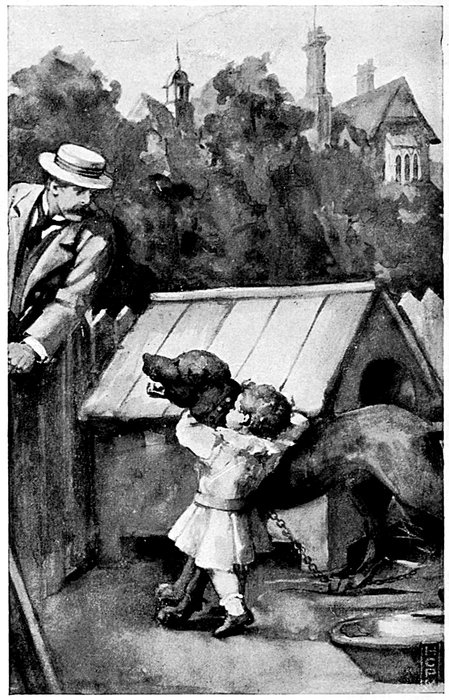
“I’m in Czar’s kennel, father.”
The Colonel had certainly never thought of
looking in such a place for the speaker. Now,
turning his startled glance in that direction, he saw
Squib sitting curled up on the clean straw in the
huge kennel, looking out from his nest with a
friendly smile.
For a moment the fathers heart stood still. Suppose
the great brute should turn and see him! It
was with difficulty he commanded his voice to say
quietly, whilst himself striving to attract the notice of
the dog, “Come out, Squib; come very quietly.”
But the child never heard the last words; he
jumped up at once and made an outward bound, flinging
himself upon the dog as he did so, and throwing
his arms about his neck.
“Oh, father, if you would only let me have Czar to
18go out with me sometimes! We should have such fun
together!”
At the touch of those small childish hands the
aspect of the dog changed at once. The lifted crest
along his back smoothed down, the red light in his
eyes changed altogether, the fierce bay ceased, for the
creature was engaged in licking the child’s hands and
face, and in fondling him with evident delight. The
father looked on in amaze, and when Squib repeated
his question, “Shall I let him out now?” he gave his
assent rather by sign than by word, so great was his
surprise at what he saw.
“Oh, father, may I go with you?” pleaded Squib,
with great, wistful eyes. “I’ve never been out with
Czar yet—and I should so like to!”
His father held out a ready hand.
“Come along, my little man. We will go together.
How came you and Czar to be such friends? I did
not know he had made real friends with anybody
yet.”
Squib did not immediately answer; he was watching
the gambols of the great dog careering round and
round them in wide circles—a thing he had never
done before when out with Colonel Rutland, always
making a rush ahead, and only coming reluctantly
to his side when called with authority. Whenever
Squib held out his hand, Czar made a dash at him
and licked it; and once the child jumped upon the
great creature’s back, and Czar took him for a breathless
19scamper across the park—Squib holding on like
a little monkey; and only when he had come back
and was holding his father’s hand again did he
“go off,” and enter into explanations of this strange
friendship.
“You see, father, it was like this—Czar had nobody
to love him. They were all afraid of him. I
saw coachman give him his supper one day—he had
the stable broom, and he pushed the pan to Czar with
it, and never even gave him a pat, or said a kind
word to him. And it did seem so hard! So when
he was gone I just went up and patted him as he was
eating his great bones, and then I sat just inside his
kennel and talked to him all the time, and made it
sociable for him; and he brought me the biggest bone
of all, and I pretended I liked it very much, and then
I gave it him back and he lay down and ate it, and I
stroked him and talked to him all the time. He is
such an interesting dog to talk to when you know him.
And after that I went every day, and—when I can—I
give him his food, and we always have a great deal
of conversation, and it isn’t nearly so dull for him as
it was at first. But I’ve never been able to go out
with him, because coachman says I mustn’t loose him.
But we’ve always longed to take walks together, and
if you say we may, it will be so nice.”
Colonel Rutland listened to all this with something
of a shiver. He had not lived all this while without
having known many instances of the wonderful understanding
20between children and animals, or of the
forbearance shown often by the fiercest creatures to
confiding little children; but, nevertheless, he could
not picture the first approach of his small son to that
great fierce dog in the midst of his bones without a
tremor of thankful relief. Now it was abundantly
evident that an excellent understanding existed between
them, for Czar would come at the least sound
of Squib’s voice, and, when bidden to do so, would
walk just behind him with docile submissiveness.
The conquest made by the little boy, quite unconscious
of conquest, was complete, and never had the Colonel
felt so secure of training the dog and humanizing him
as he did that day.
“If I let you take Czar out into the park every day
for an hour, Squib,” he said presently, “do you think
you can teach him to be more gentle and obedient?”
“Oh, father, I think I can,” answered the child
with brightening eyes. “I’ll explain everything to
him so carefully—about being obedient and all that.
I think he wants to be good—only he’s got nobody to
teach him and be good to him. But I should like to
teach him. I’m sure he has a very good heart, and
he understands what I say, I’m quite sure.”
So the experiment was tried, and with signal
success. The fierce dog became gradually tamed and
dependable, and a fresh link was formed between
Squib and his father.
Later on in the same year another incident occurred
21which increased the Colonel’s interest in “the odd
one” of the family.
Like most country gentlemen of some leisure,
Colonel Rutland was fond of hunting, although he
could not give the time to it that some of his friends
were able to do. Still, he had always one, and sometimes
two hunters in his stable, and at this time,
when Squib was just six years old, his favourite was
a horse of the name of Charger, upon whom he had
hunted three seasons in succession.
Charger had something of a history of his own
with which Squib was not unconnected. Three years
before, when the horse was five, and Squib three, the
former had been brought up for Colonel Rutland’s
inspection, as the owner desired to sell him. He was
then only just broken, for he had done no work as
yet, the farmer who owned him having wished to let
him run as long as possible, and then to sell him to some
of the gentry as a hunter and weight-carrier. He
was a very beautiful creature, with a grand shoulder
and very strong hind-quarters, legs as sound and fine
as the huntsman himself could wish to see, and a well-turned
head and gentle eye. The Colonel and his
wife and some of the children all assembled at the
front-door to examine and look at the horse, who
stood pawing the gravel, seeming as if he knew
perfectly the commotion his beauty and strength
were exciting. There were several guests in the
house who knew something about horses, and a great
22deal of conversation was going on after the animal
had been walked, and trotted fast, his hoofs examined,
and his eyes well peered into. He was growing rather
restive now with all the waiting and testing, but was
standing pretty quietly, held by the farmer, when
suddenly little Squib, who was always very fond of
animals, and seemed not to know the meaning of fear,
ran forward from the group about his mother, and
clasped his arms tightly round the hind leg of the
young horse, laying his cheek against it with that
caressing movement so common in little children.
A sudden hush fell upon the whole group—every
man among them afraid to move or speak lest the
horse should be frightened and kick out, as it seemed
impossible that he should not do at that strange touch
upon his leg. But the creature turned his head round,
looked at the little, white clinging figure, and stood
perfectly quiet under the unwonted caress. The next
moment the Colonel had caught up his daring little
son, and one of the gentlemen standing by said to the
farmer with a short laugh,—
“I think you may take the horse round to the
stables now; he has won himself a home here, or I
am much mistaken.”
So Charger stayed, and never a horse was better
worth his money, as the Colonel often said. He was
so gentle that Lady Mary herself sometimes rode to
hounds upon him by her husband’s side, and so strong
and clever and enduring that the Colonel could have
23sold him for almost any money in his own county if
he had wished to part with him.
As for Squib, although he did not long remember
the exploit of which he had been guilty that day,
the story was often told in his hearing, and it seemed
to make a bond between him and Charger which was
closer than between him and any other horse, although
the child was fond of them all. He was fonder of
Charger than of his own little Shetland pony, although
Shag was a great friend and favourite. But Charger
was so sensible, so kind, so friendly, and so big!
There is always an attraction to a boy of native
courage in the sensation of being mounted on a big
horse. Often and often, when the great hunter was
saddled and about to be brought round to the door,
Squib would plead to be allowed to ride round upon
him, and though on these occasions coachman himself
would take the bridle and not permit any one else to
superintend the child’s feat, it was accomplished again
and again without any danger; for Squib had ridden
his own pony bare-backed from the time he could
get his small legs across the broad back, and was a
veritable monkey for sticking on the back of anything
with four legs.
But during this particular autumn, when Squib
passed his sixth birthday, and Charger was “rising
nine” as coachman called it, one of those sad mischances
befell him which are unfortunately only too
common with good hunters. He was carrying his
24master in his own gallant fashion over some very
slippery, sticky ground, when, in alighting after a
fine leap, he came down upon a treacherous bit of
ground where the foothold was very bad. With an
effort which seemed to imply that he was thinking first
of his rider’s safety and second of his own, he avoided
the fall which seemed for a moment inevitable, but
he slipped badly and only recovered himself after
a violent struggle. Colonel Rutland sprang safely
to the ground and helped the gallant animal to get
a better footing; but all this was not accomplished
before Charger’s shoulder was badly strained, and he
had to be laid up in a loose box and carefully doctored
for many months before any one could think of riding
him again.
Squib was constant in his attentions to the disabled
favourite all that time, and he and Charger and Czar
spent many a happy morning in the paddock together,
where Charger was turned out for an hour or two on
warm days “to exercise hisself” as the groom called
it. Squib also made great friends with the veterinary
surgeon who attended Charger, and who would tell
him stories of animals by the hour together; and it
was from him that Squib first heard the bad news
about the poor hunter.
“He won’t never be good for hunting again, nor
for that matter for riding either. That shoulder will
always be weak. He might drop on it any time
sudden like, and nobody cares to ride a horse like
25that. The only thing now is to break him for harness
if it can be done; but he’s old to take to collar-work—more
likely it’ll just break his heart instead,
poor fellow!”
The tears rose in Squib’s eyes as he heard these
words.
“They shan’t break Charger’s heart!” he cried indignantly.
“I’m sure my father will never allow it.”
“Well, sir, I hope not, for I don’t think that horse’ll
ever break, for all he’s so gentle and quiet. He’s got
a spirit of his own, he has; and when a creature has
never had a collar over his head up to nine year old,
why, they don’t take kind to it, they don’t!”
Soon it became known that poor Charger’s hunting
days were over, and it was quite a trouble to all the
household to think that the master could never ride
him safely again. Then came the question of breaking
him for harness, but the few attempts that were
made did not encourage the authorities to persevere.
“He throws hisself about so, sir,” coachman would
explain to Squib. “He’s not used to it, and don’t
know what it means. He comes from a race of
hunters, and don’t have them family feelin’s as some
young hacks do, as takes the collar like mother’s
milk as you may say. He’ll only wrench his shoulder
again, and go lame all his life; and that would be
a sad pity, seeing as how well he is now.”
And then it was that a sudden inspiration seized
upon Squib. He went straight from coachman’s
26presence to his father’s study, and stood silently
beside him as he wrote busily before his table. But
when the Colonel presently looked up, as if to intimate
that he was ready to hear what his small son had to
say, Squib “went off” with unwonted vehemence.
“Father, you know about Charger. Coachman
says he won’t break, and Mr. Young said he would
only break his heart. I don’t want his heart to
break. He’s the nicest horse that ever lived, and
I can’t bear it. Father, didn’t I hear you say that
Shag was getting too old to do anything but mow
the lawns, and that you must look out for a new
pony for me by the time I was seven?”
“Yes, Squib, I think I did. Would you like a
little Exmoor? They are very sure-footed and generally
fast.”
“I don’t want an Exmoor, father. I don’t want
a pony at all. I want Charger instead.”
“Charger!”
“Yes, father. Charger could carry me. Coachman
says it’s no more for him than a fly on his back.
He’d be just as if he had nobody, and I’ve ridden
him lots in the paddock. He likes it, and I like it;
and he’d be nice, and safer for me than any pony,
because he knows the country; you say so yourself,
and he’s so good, even mother wouldn’t be frightened
to let me go out on him. Father, I’m rising seven—that’s
what coachman calls it. I’m rising seven, and
I never fall off anything. Let me have Charger
27instead of a new pony. I shall like it so much
better, and so will he!”
Something in the notion tickled Colonel Rutland’s
fancy, and a little conversation with coachman convinced
him that there would be no risk of damage
either to the child or to the horse in such an arrangement.
The strong trustworthy hunter would carry
the light weight of the small boy without the least
fear of renewing the strain; and as Squib said, he
had a remarkable knack of sticking on, whilst he had
“hands as any horse would be proud to answer to,”
as the old coachman put it. And so his request was
granted. The faithful old hunter was neither shot
nor broken to uncongenial toil, but was gently and
regularly exercised by the little fellow on the turf
of the park, or permitted to trot steadily along the
roads with his light burden, by the side of the Colonel
on his own horse.
Squib was delighted, and his father amused, by the
arrangement and the comments it provoked. The
trusty horse justified all the confidence placed in him,
and a stronger bond of friendship was thus established
between the child and his four-footed friend,
as well as between him and his rather stern and
commanding father.
CHAPTER II. GOING AWAY.
28
And now, having introduced my little hero to
you, I will lose no more time, but commence
the story I have to tell of one particular year of his
life.
Squib was by this time “rising nine,” as he generally
liked to call it. His next and ninth birthday would
be in August, and this was May, and at Michaelmas
he was to go to school, to his own mingled pride and
regret. He enjoyed the thought of being a schoolboy,
of gaining the independence and importance that
always seemed to attach to his elder brothers from the
fact that they only spent the holiday months at home,
and were so much away at school; but he did not
like to think of having to leave Czar and Charger
and all his numerous and peculiar pets. He was not
sure that any other person would understand how to
manage them or to make them happy, and it weighed
on him sometimes to think that they would miss him
when he was gone. Still the thing would have to be
done whether he liked it or not, and Squib was
29resolving to take matters philosophically, and look at
things on the bright side as far as possible.
A little excitement had lately come into his life
from the advent of a new uncle from India, whom
Squib did not remember ever to have seen before.
Uncle Ronald was their father’s youngest brother,
and he had had a bad attack of jungle fever, and
was to spend two years in Europe. He came straight
to Rutland Chase, and Squib gave up much of his
time to the entertainment of this new uncle, who
spent a good part of every day in a long bamboo
chair in the big hall, and seemed amused by the
chatter of his small nephew. Squib felt it the more
incumbent upon him to look after his uncle because
his father was very busy, and his mother had been
ailing all the spring-time, so that there was often
nobody else to act as companion to this other invalid—who
did not, however, seem to be suffering
from anything worse than a little lassitude and
languor. Still the doctor came regularly to see both
him and Lady Mary Rutland, and one day as the
little boy was perched up in the window seat of the
big hall, getting up a lesson for Mademoiselle and
keeping an eye upon Uncle Ronald at the same time,
something very interesting happened.
It was a beautiful warm day early in May, and
father had been driving mother out in the pony-carriage
for the first time. As Squib was sitting
there, the carriage returned, and when Colonel Rutland
30led his wife into the house the pair seemed to be
discussing something very earnestly together. Catching
sight of his brother in his favourite chair, the
Colonel exclaimed,—
“I say, Ronald, what do you think of a three
months’ run to Switzerland. We’ve just met Dr.
Dawes in the village, and he says that’s what both
you and Mary want, to set you up again. I’ve not
had a holiday myself since I don’t know when. I’m
half-bitten by the notion, and Mary is quite on fire
to be off!”
“Oh, Bruce! I did not say that. I confess it has
attractions for me; but there is so much to think of.
There are the children—”
“Oh, the children will be all right! Mademoiselle
will keep guard over the girls, and as for the twins,
why, they are as safe with nurse as with us, and the
boys are safe at school till the end of July, when we
shall be back. There’s only Squib, who might get
into mischief if left altogether to petticoat government,
but I’ve half a mind to take the child with
us. His observations of foreign life would amuse us,
and can’t he speak German as well as French? I’m
sure that Swiss nursemaid of his taught him some
barbarous patois of her own.”
“Ah yes—Lisa; I’m afraid she did teach him some
very outlandish German-Swiss patois, if he hasn’t
forgotten it by this time. I wonder if he would like
to go with us. I should enjoy having one child with
31me, as you and Ronald are sure to go off mountaineering
when he is stronger. Only it would be a great
interruption to his lessons.”
“Oh, bother the lessons!” cried Uncle Ronald.
“Squib knows as much as he needs to make a good
start at school—more than I did when I went, I know.
He’s a sharp little chap, and will soon pick up any
lost time. Let’s take him along by all means. I
shall want an interpreter; I expect Asiatic languages
are more in my line than European. Squib shall
come as my interpreter. He speaks French first-rate,
I know, and he’ll do all the talking for me. Hallo!
there he is! Come here, Squib, and tell us how
you’d like to go to Switzerland.”
Squib came forward with eyes shining with excitement.
Ever since he could remember anything it
had been his dream to go to Switzerland, and he
could hardly believe his ears now that he heard the
thing spoken of as an immediate prospect. Switzerland
was as a dream to him—a dream of wonder
and enchantment. From his earliest infancy he had
heard entrancing stories of great, lonely snow-peaks,
whispering pine woods, little chalets perched high up
in green alps, brawling torrents, great, awful glaciers
with dark mysterious crevasses, and spirits of the
mountains who revealed themselves only to those
upon whom the spell of the mountains had fallen.
Crowds of images rose up in the child’s mind as he
slowly came forward, and the stress of his imaginative
32flights was so great that it held him mute
for a longer time than usual; but when he did
give expression to his opinion, it was with such
enthusiasm and emphasis that his father and uncle
both laughed aloud, and it became a settled thing
from that time forward that Squib was to accompany
the party to Switzerland, whenever the start should
be made.
Squib, who was told that he might consider himself
free of lessons from this very day until he went to
school in September, closed the book he was still
holding as though in a dream, and wandered out into
the sunny garden with a heart swelling with wonder
and delight.
Switzerland! He was really going to Switzerland!
He should see with his own eyes the dazzling
snow peaks, hear the roar of the avalanches breaking
the eternal silence of those lonely valleys. He would
see (as he thought at least) the chamois springing
from peak to peak, and hear the yodeling of the
peasants as they took their cattle up into the green
pastures. He would see it all—hear it all—all those
things of which Lisa had told him, of which he had
dreamed until he seemed to be able to see them at
will when he shut his eyes. Perhaps he would even
see Lisa again herself; for had she not returned to
Switzerland? And Switzerland was such a little
country on the map!
Lisa had been Squib’s own peculiar attendant, and
33he had given to her a very large slice of his childish
affections. As has been said in the preceding chapter,
Squib had had a little baby brother when he was
not much more than a baby himself, and this little
brother had been so ailing that nurse had had to
give up almost all her time to him, and so Lisa—a
young Swiss maid who was leaving a friend’s nursery
just at that juncture—was engaged to take entire
charge of the elder little boy.
Having once come in that capacity, she stayed on
for many years—until, in fact, Squib had no longer
any need of a nurse; the delicate little brother who
died, and the little twin sisters who were still in the
nursery, had always occupied all nurse’s attention,
and Lisa had been retained year after year to attend
to Master Squib, and to help with her needle in the
care of the little girls’ clothes. Lisa had loved Squib
from the first with a singular devotion, which he
repaid by a warm affection. He had learned to speak
her curious patois as naturally as he had learned the
English of his parents and sisters, and it seemed
as if the power of using her native tongue again
unsealed the silent Lisa’s lips, for to Squib she would
talk by the hour together of her country, her home,
her people, and all the glories and the wonders of
that land of mountains and wood and water whence
she had come. She had much of the imaginative
temperament which is so often found amongst a
mountain race, and to her nursling she talked with
34the utmost freedom and unreserve. Not only did she
speak of the things she had heard and seen, but she
also told him long stories of fairies and water-spirits,
genii of the mountain, and the little brown men who
dwelt in the caves and rocks, till the child’s head
was as full of enthusiasm as her own for her native
land, as crowded with fanciful imaginings as if he
had been a son of the soil himself.
Lisa had now been gone for nearly a year, and
some of these imaginings had been growing a little
faint and hazy; but they were all there, lying dormant,
and ready to wake into active life on the
smallest provocation, and as Squib wandered down
the garden and into the yard, and found Czar all
ready to share his ramble and his talk, he poured
a whole volley of excited information into the dog’s
ears, lapsing almost unconsciously into Lisa’s German
patois as he did so, which, however, seemed to make
no difference to Czar’s power of comprehension.
The next days seemed to go by like magic. Squib
found himself raised to a position of some importance
in the nursery, on the strength of his approaching
departure. The tailor from the next town called to
measure him for two new suits of clothes; his sisters
made much of him because they were so soon to lose
him; and all the servants talked to him about his
journey, and called him a lucky little boy to be taken.
It was rather hard to think of leaving Charger,
who was such a very great friend and companion; but
35coachman said that it would do Charger a “world of
good” to get a run out for two months, now that he
was growing elderly, and that pleased Squib a good
deal, for he did not want his favourite to miss him
too much.
“Maybe it’ll be a good thing though, sir,” said
coachman, “since you are going to school by-and-by.
It will break him in to having you gone for a spell,
and he’ll kind of know that you’ll be coming back
before so very long. I’ll see he is well looked after,
and he’ll be in first-rate fettle for you by the time
you get back.”
The other trouble, about leaving Czar, was got over
in a very unexpected and most satisfactory way; for
Squib was told one day that Czar was to be taken
with them to Switzerland.
“The master said so himself,” the groom told
Squib, when he came down to loose him for his morning’s
run. Czar was by this time a dog of mature
years, and he had tamed down wonderfully. Indeed,
he was often left loose during the day, and was
allowed to lie on the terrace or patrol the gardens.
But he lived in his house at night, and several of the
men still stood in some awe of him: yet he was
thoroughly under control now, and a very valuable
watch-dog and guard. He was still devoted to Squib,
and would obey him at a word or a look; but by
this time he was attached to all the family; and
whenever the master of the house was away, he slept
36indoors at the foot of the great staircase; and Lady
Mary always said that she never felt nervous when
she knew that Czar was on guard.
“You see, sir,” the groom added in explanation,
“them furrain parts is none too safe, what with all
these bombs and one thing and another; and the
master says as hell feel more happy like to have the
dog with him. If so be as he were to go off hunting
wolves or boars, or whatever they may have over
yonder, or leastways climbing mountains, where her
ladyship couldn’t go, he’d like to leave the dog behind
to look after the house; and so it’s all fixed now that
Czar is to go.”
This was great news for Squib, who quickly found
his way indoors to make sure of it. Uncle Ronald
was in the hall looking at his guns, and he gave
Squib a friendly smile.
“Oh yes, that’s all right enough,” he answered in
response to the eager inquiry. “You see we’ve heard
of a chalet that will just suit your mother, right up
in one of those thals as they call them, out of the
way of regular tourists, where the air is almost
enough to keep you going without the superfluities
of meat and drink. It’s furnished comfortably, too,
which is a consideration; and there’s an old servant
you once had who will come and act maid to your
mother, and help her with the foreign ways of housekeeping—”
“What! Lisa?” asked Squib breathlessly.
37“I think that was the name—anyway she was
the girl who was your nurse so many years. She’s
going to come to be with you, and Mr. and Mrs.
Lorimer are going to come out with us and share
the chalet. You know who the Lorimers are, I
suppose?”
“Yes—they come every year to stay here. They
are very nice. Mrs. Lorimer is mother’s very great
friend, I think. We all like her very much.”
“That’s all right. I’ve heard as much myself.
Well, Mr. Lorimer is a great Alpine Club man, and
no end of a mountaineer, and knows all the passes
and the peaks and the guides, and the ways of
things; and we shall go off from time to time with
him and do some climbing, and then your mother
and Mrs. Lorimer will be left at the chalet with
you for their protector, and we thought that a dog
like Czar would be a good addition to the party;
so it’s settled that he’s to go. That’s just about how
it is, you see.”
“I see,” answered Squib, looking very thoughtful
and contemplative, and after a long pause he asked
tentatively, “I suppose we couldn’t take Charger
with us too?”
“I’m afraid not, old chap. Charger would be
rather a large order; and I don’t think we’d get him
up to the chalet without a steam crane or some trifle of
that sort. Swiss Alps aren’t just cut out for English
horses. I’m afraid Charger must stay at home.”
38However, to have Czar was much, and Squib was
very well content. Czar, he had felt sure, would miss
him more than Charger, for he was more with him;
and Charger had friends amongst all the stable hands,
whilst Czar was regarded with more fear than love
in many quarters. It also pleased Squib greatly to
be told that on the journey Czar was to be his
special care. The party would travel leisurely and
easily on account of Lady Mary, and there would be
a good many stoppages at various places before they
reached their destination. As they would have a
carriage to themselves almost invariably, it was
probable the dog would be able to share it with
them; but at the stations and all such places Squib
was instructed to look after the creature, and have
him upon his mind, as there would be other things
for the gentlemen of the party to think of. Squib
felt a great pride and satisfaction in this charge,
and confided all the arrangements to Czar, who heard
them with great gravity.
Time flew by so quickly that Squib was almost
surprised to awake one morning and find that it was
really the day of departure. The start was to be
made in the morning. They were to go to London
first, and lunch there, and then take the train to
Folkestone, where they would sleep and be ready for
the boat the next day.
Squib had never been to London even, and his
sisters, who had once spent a week there, thought
39it a pity he would not be able to see the Zoological
Gardens, and the Tower, and Madame Tussaud’s.
But Squib had no room for regret on this score, he
was in such a fever to see Switzerland and Lisa
again, and the mountains and glaciers and all the
wonders of his dreams. He felt very grand, dressed
in his new travelling suit of tan-coloured homespun—jacket,
knickerbockers, cap, and waistcoat all to
match—and strong new stockings of the same shade,
with new boots strong enough for mountain scrambling.
His sisters had joined together in the purchase
of a whistle on a chain, which they thought would be
very useful for calling Czar, if he should wander
away in a new place; and Squib wore it for the
first time this morning, and felt wonderfully grown
up in doing so, for the steel chain looked like a
watch chain, and he almost felt as if he were
wearing a watch all the time.
The good-byes were rather hard to make, for the
little girls all cried, and Squib’s own eyes got very
moist, and there was a great lump in his throat which
half-choked him, whilst everything looked misty
and blurred as he went about from one to another,
promising to bring all sorts of treasures back with
him, and leaving last messages with almost everybody.
It made it all the harder because mother was
almost crying too as she kissed her little daughters,
and left all sorts of last charges with kind Mademoiselle;
but Uncle Ronald went about laughing and
40making jokes, telling his little nieces that they ought
to be sent off to India for an indefinite number of
years to know what saying good-bye was like; and
as for getting up the waterworks because mother
was going for a few weeks to Switzerland, why,
they were just little geese—he couldn’t call them
any better name than that!
Uncle Ronald always made people laugh, and so
the good-byes were got over at last between smiles
and tears, and then the party found themselves
skimming along the road to the station, with Czar
running silently along behind, more excited than
usual, because he knew quite well that something
unwonted was afoot, although perhaps he had not
realized quite as clearly as Squib believed that he
was on his way to Switzerland.
Squib’s first sight of the sea was at Folkestone,
and very wonderful he thought it. There was just
enough breeze blowing to make the waves turn over
in great green breakers, and come crashing down on
the shingle with that strange sound which is like
nothing else in the world. Colonel Rutland indulged
his little son with a ramble along the beach after tea,
and Squib enjoyed it greatly, especially sending Czar
into the water after his father’s stick, and his indignant
barking at the crested wave, which would
not stop for all his barking, nor give back for a
second when he flew savagely at it. Other people
besides Squib were entertained by the conduct of
41the great handsome dog, and Squib was very well
satisfied with his first day’s travel.
But the next one was far more exciting.
They were actually to cross the water in the steamboat
which was lying moored alongside the great
stone pier. Uncle Ronald took Squib down to look
at it some short time before they were allowed on
board, and Squib thought it a very wonderful vessel
indeed, although Uncle Ronald laughed and called it
a “poor little tub,” which seemed a very disrespectful
way of speaking about it, Squib thought.
When he was once safely on board, he made
friends with the sailors, and asked them a number
of questions, and then went and looked down at the
great throbbing engines, and talked to a smutty man
who seemed to know a great deal about them, and
who explained a great deal to him very good-naturedly—only,
unfortunately, Squib did not understand
much better at the end than he had done at
the beginning. However, the man admired Czar
very much, and said it wasn’t often they saw such
a fine dog as that in foreign parts, he was sure; and
that pleased Squib very much. So he told his new
friends all about his home and his sisters and
Charger, and how he was going to Switzerland for
two months to take care of his mother when his
father went up mountains; and altogether the time
passed so quickly and pleasantly that he was quite
surprised when the train came puffing up, and everybody
42got busy, and he was taken away by his uncle
to watch the new people coming on board.
Mr. and Mrs. Lorimer were amongst these, and
Squib soon picked them out. He did not, however,
quit his post of vantage till he had seen all the
luggage swung on board by the great crane, which
he thought very interesting; and then he went to
the very back of the boat where he had seen a nice
coil of rope lying, and scrambling up on this he
found that he was able to make a fine perch for
himself, where he could see the water and have a
fine view of the boat, and watch the shore as it
seemed to slip away astern.
There was rather a stiff breeze blowing when they
got into mid-channel, and the vessel rocked and rolled
as the big green waves lifted her up and let her
down. Squib thought it better than any rocking-chair
or rocking-horse he had ever been on, but
he noticed that some of the people began to look
very queer. A sort of green hue overspread their
faces, and then they generally retired from the scene,
and he wondered where they all went. Poor Czar,
too, grew rather restless and unhappy, and got up
from beside Squib, and took a turn or two and then
came and lay down again, and looked up pitifully
at his little master, as if asking for sympathy. He
did not seem able to get comfortable, and Squib wondered
what was the matter.
“Oh, Lor’ bless you, little master, he’s only a bit sea-sick,
43just the same as Christian folks!” said the
kindly sailor whose acquaintance Squib had made
previously, and who chanced to pass along at that
time. “Like enough he’ll just be a bit sick, like
the other folks, and then be right again. It’s a
queer thing when you come to think of it, sea-sickness.
But Lor’ bless you, nine-tenths of the folks as
comes aboard in bad weather can’t stand up against
it. You don’t seem no worse yourself though, little
master.”
“Oh no; I like it. I didn’t know what made
them all look so queer. I heard mother saying she
was afraid it would be rough crossing, and that she
would be ill. I hope she isn’t.”
Poor Czar, however, did not escape, and was very
unhappy for a time, and then quite ill; but the
passage was quickly made, and once on firm ground
again he thought no more of his troubles.
It amused Squib very much suddenly to hear
everybody talking French, and to see the men in their
blue blouses, and the fisherwomen in their white caps.
“I wish they wore pretty things like that in
England,” he thought as he looked curiously about
him, “and what a noise they do make; and how
they jabber, and laugh, and move their hands about—just
like Mademoiselle when she wants to make
us understand. Oh, Uncle Ronald, are we going off
already? It is such fun watching the people! I
think France is a very pretty, funny country. Are
44we going to the Douane now? Mademoiselle told
me all about that. And shall I have to ‘declare’
Czar? Is he contraband?”
“I don’t think so, but you can ask if you like,”
answered Uncle Ronald, laughing. “Come along this
way if you want to see the business. Your father
is going to the train with the ladies, and Mr. Lorimer
will see to the luggage.”
“I should like to go too,” said Squib, keenly interested
in the proceedings; and accordingly his uncle
led him into a great bare room where luggage was
being brought in on the shoulders of blue-bloused
men, and where officials were gravely asking questions
over the counter on which it was placed, and marking
off with white chalk the piles of luggage passed.
Squib was greatly amused, especially when one man
was detected smuggling tobacco under a lot of books.
They could not stay to the end of the altercation,
but the gestures of the French official amused the
child exceedingly, as well as the laborious efforts of
the Englishman to follow, and hold his own in conversation.
Then there was a rush for the train, a confabulation
with the authorities about Czar, who was finally
permitted to go in the carriage with the party, Uncle
Ronald feeling sure that the balance in his favour
was turned by Squib’s pretty childish pleading in
French, and his confidence that everybody must see
the many perfections of his four-footed friend.
45Perhaps the guard did not particularly desire the
companionship of the great hound; perhaps Colonel
Rutland’s air of milord Anglais had due effect.
Anyway, Czar travelled peacefully to Paris with his
owners, and was accorded a like privilege almost the
whole way through.
Paris was very gay as the travellers drove through
the streets to the hotel in the Rue Rivoli, where
Colonel Rutland always stayed. Lady Mary was
by this time very tired, and went at once to her
room; but Squib was immensely excited by everything,
and very anxious to see at least one or two
of those sights of Paris over the description of which
Mademoiselle had so often grown excited; so Uncle
Ronald good-naturedly volunteered to pilot him,
provided he would do the talking, to which Squib
readily agreed.
First they had some lunch in the Champs Elysées
under the trees, which seemed to Squib such a
superior arrangement, that he wondered why people
ever went indoors to eat. Then they visited the
Louvre and spent an hour there, after which a fiacre
was chartered to take them to Notre Dame and one
or two other places of interest, which Squib felt
much elevated by having seen. But the real excitement
of the day was when, in returning, Uncle
Ronald took him into a shop such as only Paris
seems able to produce, and after a great deal of
laughing and chaffering with a bright-faced French
46saleswoman, who was equally amused at Uncle
Ronald’s bad and Squib’s good French, a small silver
hunting-watch was purchased, together with a silver
chain, and presented to the astonished Squib by his
young uncle.
“Something to remember your first visit to Paris
by, old chap,” he said, as he led him back to the
hotel, “and to tell you the time when you get out
amongst the mountains, and have nobody to remind
you of it, and no big gong carrying a mile to ring
you in.”
As for Squib, he hardly knew what to make of
his good fortune, and his thanks were so long in
coming that it seemed as if Uncle Ronald would have
to go without them altogether; but, when they did
come, it was with a “chiff and a rush,” as he described
it afterwards, which was in itself enough to
justify the sobriquet by which his small nephew
went. Early upon the following morning, the party
started for their long journey across France to
Switzerland.
CHAPTER III. THE CHALET IN THE HILLS.
47
“I don’t call France pretty at all, though
Mademoiselle does call it ‘La belle France,’”
said Squib from his station at the carriage window,
after some hours of silent study. “It’s all flat like
a map, and the trees look as if somebody had gone
round with an axe and taken all their heads off when
they were little, and the rivers look like canals. I
like the people and the animals. It’s nice of the
cows to help in the fields and to draw the wagons; and
the dogs help too, which is very kind of them; and
I like the funny clothes the people wear. I should
like a blue blouse myself, when I get to Switzerland.
But I don’t call it pretty at all; not even the vineyards—and
I always thought vineyards would be
lovely. England is much prettier—but there’s something
funny and queer about France, and that makes
it interesting. I like the way they build their châteaux—with
such queer little pepper-box towers, and such
a lot of red roof. I should like to live in one of
those little turrets myself, and have a lot of animals
48there to keep me company. But I don’t think there’s
so very much in France that’s amusing.”
Squib was keenly interested in all he saw, but his
longing all the while was for Switzerland, and the
chalet in the hills of which he had heard so much,
and Lisa, who was to be waiting for them there, with
her stories of mountain-spirits and the water-fairies.
He was almost sorry when he found that a few days
were to be spent at Interlaken before they reached
their final destination; yet as soon as they crossed
the frontier the sense of interest and delight awoke
within him, and he had no time for regrets or useless
longings.
Even the railway travelling was more amusing now—the
little queer carriages with a passage all down
them, the blowing of horns when each station was
reached or left behind, the costumes of the peasants as
the travellers got more and more into the heart of the
country, and the increasing beauty and wildness of
the views from the carriage window.
It was dark when they reached Interlaken, and
Squib had been for some time asleep, leaning against
his father’s shoulder. He did not remember much
about the arrival that night, nor how he got into
that funny little narrow wooden bed, with its big
square pillows and little white eider-down quilt. But
after sleeping the sound, dreamless sleep of childhood
for a number of hours, Squib suddenly woke up very
wide to find the room bright with sunshine, and to
49realize, after a few moments of utter perplexity, that
he was really in Switzerland at last. With a great
throb of sudden excitement he got quickly out of bed
and pattered across the cold polished floor to the
window. A white curtain was drawn across it, but
in a moment Squib had pulled this aside, and then
he gave one great gasp and stood perfectly still—a
little white figure, with a tumbled head of yellow-brown
curls, and a pair of big grey eyes fixed immovably
upon something outside that window, as
though they would never be detached from the sight.
And what was it that Squib saw? A great white
dazzling peak rising up in stately grandeur against
the glorious blue of the summer sky. The sunlight
bathed it in golden light. In that wonderful brilliant
clearness of early morning, space seemed annihilated,
and the grand snow-peak seemed to Squib to be
strangely near—keeping silent watch and ward over
the valley below and all the inhabitants of it. It
was flanked and supported, as it were, by a whole
range of rocky, snow-crowned mountains, yet seemed
to stand alone, lifting its majestic head into the very
heavens. Squib stood and gazed with wonder, awe,
and rapture, until the scene was graven into his
memory for ever. What Lisa had said about the
spell of the snow-mountains was all true. He had
begun already to feel it himself. He stood before
the window lost to all sense of his surroundings,
hearing none of the sounds about him, knowing
50nothing of where he was—eyes and heart and soul
alike gone out to that lonely queen of the mountains,
standing out in dazzling radiance against the brilliance
of the morning sky. How long he thus stood
he never knew, and he was only brought back to the
things of the present by the sound of a laughing
voice behind him.
“Hallo, old chap!—lost in the clouds already?
Has the Jungfrau bewitched you altogether? Or
are you ready for anything so sublunary as breakfast?”
Squib turned round with a jump to find that
Uncle Ronald had come in from his room next door,
and to feel that his own cheeks were wet, just as if
he had been crying, and he was quite positive he had
not even been thinking of anything so silly!
“Come, hurry up, youngster! You are late already;
and we mean to go off to Grindelwald after breakfast,
so you must look sharp! Yes, she’s a grand
lady is the Jungfrau—she gets at all of our hearts
in a fashion; but hurry up now and come down to
the breakfast-room. Mountain air gives one a fine
appetite, as you’ll find out before long.”
Squib woke out of his dream only to find himself
in a country of enchantment. He hurried through
his toilet, and descended to find his party (with the
exception of his mother, who was keeping to her
room to recover from the fatigues of the journey)
seated at one end of a very long table, of which they
51were the only occupants, and was soon seated beside
them discussing omelette and cutlet with fried potato
chips, queer curly rolls, and golden honey, with all the
zest of a growing boy and of a mountain traveller.
Meantime he gleaned from the talk of his companions
that they were about to drive into the heart
of some of those mysterious regions of which he had
hitherto dreamed, without daring to hope to see them.
The glacier at Grindelwald, the wonderful fall of the
Staubbach, the Wengern Alp, Lauterbrunnen and
Mürren! He heard the names in a vague and dreamlike
fashion, but hardly knew what was settled, and
did not trouble to ask. What did it matter where
they went in such a region of wonders? Wherever
they went, that great towering peak must be near at
hand, and if he had that to look at he felt he need
ask no more.
Three or four wonderful days were passed by Squib
in this fairy region. Each day the same carriage
came to the door, with the same two strong, small,
but willing and active little horses. He was set on
the box beside the broad-faced driver, with whom he
soon established terms of mutual intimacy, and after
a little while he found himself able to exchange ideas
with him with perfect freedom. He talked very
much the same odd guttural language that Lisa had
spoken when she was excited and in earnest, and in
a very short time all Squib’s old fluency came back
to him. He was interpreter to the whole party, and
52not a little proud of his position in that respect; but
what he enjoyed even more was getting Johann to
tell him all about the mountains, the people who lived
amongst them, what they did in the long, dark winter
months, when the snow came down and shut them in
week after week and month after month; how the
men in summer went out as guides and porters, and
took travellers across the passes and up the great
white peaks; and how the women stayed at home
and tilled the land, and made provision against the
winter season, driving their flocks of goats out into
the green hills, and making quantities of cheese, some
to sell and some to lay by to be consumed when the
dark, cold season set in.
Johann had once been a guide himself, till a slight
accident had hindered him from any more mountaineering,
and had obliged him to take to the less
exciting life of a driver during the busy summer
season. But Squib learned, to his deep excitement
and delight, that his new friend had twice made the
ascent of the Jungfrau, and he made him give him
every detail of the climb, and listened with breathless
interest to the story each time it was related.
Another friend Squib made at this time was an old
man who stood at a certain place in the roadway,
where was a wonderful echo, and blew an immense
long horn whenever visitors passed, so that they
could hear the echoes reverberating and resounding
backwards and forwards amongst the hills, till it
53seemed as if there were hundreds of voices all
answering each other in weird cries. Squib could
have listened to these echoes for ever, and also to the
stories the old man had to tell about the caves in the
hills, and the wonders of torrent and valley. He
twice spent an hour with him whilst others of the
party were resting or sketching, and having won the
old man’s confidence, both by his talk and by the
gift of sundry coins, he was allowed to blow the
great horn himself once or twice, a thing which
filled him with delight, although he did not find
himself very successful in bringing out the deeper
and more powerful notes as the old man was able
to do.
Of his wonder and awe at the sight of the great
glacier and its blue caves, or of those feelings which
the sight of the dazzling snow-peaks awoke within
him, Squib never tried to speak. Those about him
were not even sure whether any very deep impression
was made by them; but his observations on the
manners and customs of the country would come out
at intervals with a sudden rush, as when sitting at
dinner on the eve of their departure for the chalet, he
suddenly broke out,—
“I shall be sorry to go away for some things,”—this
in answer to a question from his mother—“though
I want to get to the chalet very much.
But everything here is very funny and very interesting.
I shall be sorry not to have Johann and the
54horses any more. Will everything be as funny up
there as it is here?”
“How is it all funny?” asked Uncle Roland.
“Oh, every way, you know. But I was thinking
of the horses just then. I like the horses here, but
I think it’s very confusing for them to have to go
the wrong side of the road always. I can’t think
how they remember so well. I think perhaps it’s
because they grow their manes the wrong side too—to
help them to remember. Most of them have them
manes on the wrong side. I asked Johann about it,
but he didn’t seem to understand that it was wrong.
I’m glad we didn’t bring Charger; he wouldn’t have
liked it at all. But the horses here don’t mind it.
I think they are very good-tempered. They have
such kind faces, and they like to be talked to. They
don’t wear blinkers, hardly ever, except in the carriages.
I think that’s rather nice for them. They
can see the country as they go along. I wonder if
they like seeing the snow-mountains very much! I
think it’s nice that they can look about them the
same as we do.”
But after all, the pleasure and excitement of getting
to their mountain home was greater than anything
else. It took the best part of a day to reach it,
because, although the distance was not very great, there
was no direct road, and they had to take a circuitous
route, which Squib found very delightful, though some
of the party wished it had been a little less tedious.
55First, there was a long carriage drive with Johann,
behind a great coach-like conveyance and four horses,
through winding, ascending roads, with the usual
accompaniments of men with great horns, children
selling flowers, women at work by the wayside at
their lacemaking, and all the sights and sounds of
busy little village communities making the most of
their short season of heat and brightness.
Later on there was a short journey in one of those
strange funiculaire railways, which were such a
source of interest and curiosity to Squib. The little
trains seemed to him to crawl about the mountains
like gigantic serpents, moving silently upwards or
downwards, quite independent of the level which had
been indispensable to the railway travelling with
which he had been previously acquainted. And the
sensation of mounting up and up in one of these
silent, mysterious little vehicles kept him spellbound
with wonder and admiration. Uncle Ronald had
explained to him many times already the principle
upon which they were worked, but nothing seemed
to him to lessen the sense of mystery and unreality
that attached to this mode of progression, as he felt
himself lifted higher and higher into those regions
and altitudes which fascinated him so strangely.
When they left the train they found themselves in
a region unlike any that Squib had seen before.
They were all amongst pine woods and those green
alps which lie beneath the sterner altitudes of the
56snow ranges, and are full of flowers and sunshine,
and the bleat of goats, and the soft sound of wood
and water. There was no regular road here to the
chalet, but only a mule path. Some mules were
waiting in readiness for the party, but only the
ladies cared to ride. The baggage was cleverly
packed and strapped on the rest of the docile animals,
and the march began through these silent stretches
of pine wood, and across bright sloping meadows
gemmed with flowers, now dipping downwards to
cross a plank-bridge through which the shining
water could be seen foaming beneath, now rising
by many a zigzag upwards and onwards towards
the sloping shoulder of the hillside—onward, ever
onward, each turn in the path revealing new beauties,
till at last the lad who was leading the way rounded
a corner in a woodland path, turned back with a
broad smile to Squib, who had kept near to him all
the while, the faithful Czar always at his heels, and
pointing a little downwards and along the hillside,
he said,—
“There!”
Squib reached his side with a bound and looked.
They were just clear of the wood now, and were able
to see plainly before them. They had crossed the
ridge of the hills they had been steadily mounting
ever since they left the rail, and now were able to
look down into the valley on the other side.
What a valley it was! The sides were clothed
57with little woods, some of fir trees, some of young
forest trees, clad now in the tender tints of early
summer; at the bottom ran a leaping torrent of
foaming water, spanned by many a little frail plank-bridge
giving access to the green slopes opposite.
And these green slopes were dotted with those little
low chalets which are used for the shelter of the
flocks in bad weather, and for the temporary abode
of those who tend them there during the brief
summer of the mountains. Above these again lay
grim stretches of rock, seamed with dark fissures,
and above that again the whiteness of the everlasting
snow, as the chain of dazzling peaks lifted itself
against the dark blue of the sky.
Squib gazed and gazed with a sense of tremulous
wonder and delight. It seemed to him as if this
quiet valley were the realization of all his ideals
ever since he had begun to think about his sojourn
in Switzerland. Wood and water, meadows bright
with flowers, green alps and snow mountains beyond!
What could the child of man desire more? In one
place he could even see the green, mysterious depths
of a glacier, and as he stood watching and listening
spellbound, the silence was broken by the rumbling
sound of the fall of an avalanche! Truly there was
nothing left for him to wish for!
But the lad was hardly content with this long
silence, and touched the arm of the little boy.
“There!” he said in his rude patois; “there is the
58place—look! That is the house where the gracious
lords and ladies are going.”
Squib started into keen interest now. He had
realized from the first moment that this valley was
the right one, but he had not had time to think of
the chalet itself in his joy at the surroundings.
“Where?” he asked eagerly.
The lad pointed again, and Squib then saw about
a mile farther on, and standing upon a little eminence
of its own, with a belt of whispering pines behind it,
a chalet such as a wealthy man may build for himself
as a summer residence amongst the mountains, with
the wide-peaked roof, great overhanging eaves, light
wooden exterior staircase, and all those accessories in
the way of balconies and so forth which tend to make
residence in such houses so delightful during the brief
but hot summer season of mountain regions.
With a cry of delight and rapture, Squib sprang
forward. He had walked far already, but was not in
the least tired. He saw before him the home of his
dreams, where Lisa was awaiting him, and without
thinking of pausing for the rest of the party to come
up, he rushed helter-skelter along the narrow mule
path, with Czar tearing along beside him, bounding
on ahead in his excitement (caught from the child),
and then rushing back to see that all was well, and
giving vent to a series of deep bays that awoke the
echoes in the silent valley.
That sound was heard by a pair of listening ears
59within the walls of the chalet. As Squib ran breathlessly
onwards, he was aware that something human
in a fluttering dress, and with something white about
the head, was coming rapidly out towards him. In a
few minutes, with a rapturous cry, the warm-hearted
little fellow had flung himself into the outstretched
arms of his ex-nurse.
“Lisa! Lisa! Lisa!”
“Liebchen! mein Liebchen!”
As for Czar, he was as excited as anybody, and he
remembered Lisa as well as his little master. His
great black muzzle was thrust between the pair, and
faithful Lisa, with a sound between laughing and
weeping, threw her arms about the great dog’s neck
and kissed him between the eyes.
“Kaiser—the good Kaiser!” she cried. “And he
knew poor Lisa too. Oh, the good dog—the grand
Kaiser!”
Lisa always called him Kaiser. Squib had forgotten
that till now, and the familiar sound of it
made him laugh with pleasure.
“Oh, Lisa, it is so nice to see you again! I have
been looking forward to it all the time. Now take
me in and show me the house. I don’t think the
others will be here just yet; the mules come so
slowly up the zigzags. Czar and I just came up
straight with the boy, I was in such a hurry to get
here. I shall have time to see everything before the
rest come.”
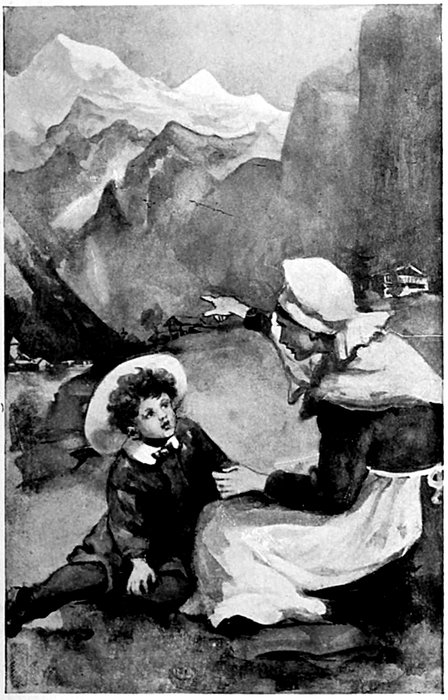
60Lisa led the way back, holding Squib’s hand fast
in hers, and hardly taking her eyes from his face the
whole time. As for Squib, he was perfectly happy
having his old nurse back again, answering her questions
about home, asking her innumerable questions
himself about this valley, and all the wonders and
delights he knew it contained.
The chalet itself was soon seen over. After the
large house at home, and the big hotels he had been
in since, it seemed to the child quite a little place,
fascinating and attractive in its very smallness and
queer bareness, but soon seen and disposed of. The
rooms were all spotlessly clean, and the polished floors
shone like mirrors. The balconies to the rooms were
the chief attraction to Squib; and he was greatly
charmed at finding that not only had his own little
room one of these, but also that it was provided with
a tiny external staircase, by which he could get in
and out at will. He saw by Lisa’s face that she
knew she had prepared a pleasant surprise for him in
this, and his bright smile and hug of acknowledgment
were ample reward.
But it was the outer world that really fascinated
Squib. The chalet was very nice as the necessary
home during his stay amongst the mountains, but it
was the mountains themselves that were everything
to the imaginative little boy—the mountains and the
brawling torrents, and the whispering woods and the
flowers. He had seen gentians by the hundred as he
61ascended by the mule path, and already he was planning
how he should make collections of all the Alpine
flowers, pressing some in a book he had brought for
the purpose, and taking roots of others home to try
to make a bit of Alpine garden in his own special
border. Squib was a born collector and naturalist,
as well as a dreamer of dreams, and had collections
innumerable at home. Lisa had always been his
faithful ally in days of old, keeping his rubbish carefully
so that the head-nurse might not order wholesale
destruction, and she took as keen an interest in
the collections as Squib did himself. He knew that
she would help him now, and he soon saw that she
knew where every flower of the hills was to be found.
Squib was positively radiant with happiness by the
time the rest of the party arrived, and was everybody’s
assistant and messenger as the task of unpacking
and settling down was commenced.
There were other servants in the house, but only
Lisa knew anything of English, and Squib’s fluency
in the odd vernacular of the district was very useful.
He had made firm friends with everybody on the
place before the first evening had passed, and when
they sat down at last to the nondescript travellers’
meal that was like dinner and tea rolled into one,
Colonel Rutland looked across at his wife, who, tired,
but smiling, was seated at the head of the table and
doing the honours of the simple repast, and said,—
“I think I did well to bring Squib along with us.”
62“He is very useful, a capital little interpreter,”
answered Lady Mary with a smile. “I was horrified
once at the frightful jargon Lisa was teaching the
child to talk, and almost sent her away for it, fearing
that it would be the ruin both of his English and of his
German, but it has come in wonderfully useful now.
They do not understand my German half so well as
his patois. And Lisa’s English has got very rusty.”
It was very exhilarating to Squib to feel himself of
use, and there was nothing which he more desired
than to win the approval of his beautiful mother.
Lady Mary was not one of those mothers who are
always caressing and fondling their children, and yet
they loved her with an almost adoring love, and
desired her approval above everything in the world.
As she bent a soft, smiling glance on Squib when she
spoke, he felt his heart give a great bound, and slipping
round the table till he reached her side, he put
his small hand gently upon hers.
“I shall have to take care of you when father
and Uncle Ronald go to climb the mountains with
Mr. Lorimer, shan’t I, mother? You see I can take
care of you now, don’t you? I can be useful, and
there will always be Czar to keep away anybody
who would frighten you. But I don’t think there
will be anybody to do that in our valley. I think
the mountains keep watch over it, as Lisa says, and
keep the evil spirits out!”
The mother, who understood the child’s mind best,
63smiled and kissed him as she dismissed him to bed, for
the time was getting on now, and the long daylight
fading. The gentlemen laughed and teased him a little
about his “queer fancies,” but Squib did not think
them queer at all, he was so sure that there was
something personal and protective about those white
watchers opposite; and when he knelt to say his
prayers that night, he knelt where he had them full
in view all the time.
“They have been there always,” he said to himself,
with a sensation akin to awe, “just as they are now,
with nothing between them and God. I think He
must have made them so grand and white and beautiful
because He liked to look at them, and if He
likes to look down at them, why, it must make them
good!”
There was something very grand and wonderful in
the way those white peaks stood out against the
darkening sky in that clear transparent air. A short
time ago they had been dyed a wonderful rose pink,
as they caught the reflected glory of the setting sun;
now they were rather grey than red, with a look of
almost awful aloofness and grandeur as they stood up
in their spotless whiteness and purity.
And then as the child watched this change with a
strange sense of fascination, the great round moon
rose slowly above the ridge, and at once new beauty
and grandeur were thrown over the whole world.
Great towering shadows seemed to be cast athwart
64the valley, and then the snow-slopes began to glimmer
and shine with a new and almost unearthly radiance.
Squib held his breath as he watched the moon rise
over the snow-covered ridge, and the transformation
of those rugged peaks and fissures into a new world
of ebony and silver.
How long he would have watched it, forgetting all
besides, may well be questioned, but he was quickly
disturbed by an anxious voice,—
“Liebchen!—Liebchen!—what art thou doing?
Thou wilt catch thy death of cold up here in the
nipping mountain air!”
And Squib was quickly caught up in a pair of
strong arms and hustled with ignominious rapidity
into the queer little bed which seemed a necessary
part of Swiss life.
But he was altogether too happy to be seriously
ruffled by any such summary proceeding; and all he
did by way of retaliation was to keep fast hold of
Lisa’s hand and refuse to let her go till she had
talked him to sleep with the most entrancing of her
stories of the mountains.
“Squib listened with a strange sense of fascination.”
Surely never had boy been so happy before as
was little Squib in his mountain home!
He had perfect liberty to rove where he would, so
long as he went nowhere that Czar could not follow
him. This stipulation, as Colonel Rutland observed,
would keep him from any precipitous ascents or descents,
and restrict his wanderings to safe paths; and
the fidelity and sagacity of the dog were quite to be
trusted should the child lose his way. Czar would
be certain to bring him safe home again; but, indeed,
there was not much fear that Squib would lose his
way. He had a decided “bump of locality,” as Uncle
Ronald called it, and the green valley with its many
attractions was a safe place for the boy to wander in.
For the first fortnight of his residence at the
chalet, Squib had no disposition to stray very far
away. There were so many attractions close at hand
that it was needless to go far afield for his pleasures.
Why, just by climbing up through the meadows and
wood behind the house you could find more flowers
66than could be properly pressed and arranged in many
days—gentians, small and large, the delicate little
soldanella with its cyclamen leaf, the tiny and exquisite
pinguicula with its fairy-like white bloom,
and the yellow anemones which made quite a carpet
in one little glade, hemmed in between the spurs of a
dim fir wood. Then down by the bed of the little
brawling torrent, which was always racing and tumbling
down the hillside to join the wider river below,
grew in obscure and shady corners the golden auriculas
with their graceful bells and silvery leaves. As
to the lower-lying meadows, they were glorious with
their wealth of many-hued flowers, the blue salvia,
purple crane’s-bill, yellow clover, the wild salsafy with
its golden bloom, that Squib believed to be a rudbeckia
until somebody told him to the contrary, and
warned him against including it in his collection, as
it was a tiresome thing to have in the garden, and
grew rampant and masterful beyond bearing. The
delicate Alpine roses, too, with their white and yellow
clusters of blossom, were a perfect delight to the little
botanist, and he hardly knew where to begin or where
to stop in digging up roots to be kept in his garden
behind the chalet, ready for final transportation to
England.
His mother took great interest in his flowers and
plants, and Mrs. Lorimer knew the names of almost
all the Alpine plants, and whereabout they grew,
whilst Lisa was able to give him practical help in
67digging and delving, and told him all sorts of stories
about the different properties of the herbs he sometimes
brought home, and how they could be distilled
into Enzian-schnapps as she called it, though what
sort of stuff that might be Squib could never make
out.
And then there were all Lisa’s stories to be listened
to again, with even a greater sense of fascination
here amongst the mountains themselves than in the
nursery at home. Why, the little men of the mountains—the
Bergmännlein, as Lisa called them—might
have their caves in the sides of any of these hills;
and it always seemed as if everybody who once
strayed in there came out a hundred years older at
the end of what had seemed to him a very short
time. Squib sometimes wondered with awe if he
would ever find his way accidentally into one of these
caves one day, and come back to find the chalet in
ruins, the saplings grown to monster forest trees, and
the glacier rolled farther down into the valley; for
Lisa declared that it was always moving on—on—on-although
Squib found it hard to believe.
Talking of the glacier always made Lisa speak of
the Seligen Fräulein as she called them—the ice-maidens,
who loved to woo to sleep the unwary
travellers who trusted to their soft guiding voices, and
let themselves be lured from the path and down—down—down
into some cold dim crevasse or grotto
whence no return could be made. Squib listened
68with a strange sense of fascination as Lisa told him
of these snow-white maidens with shining eyes, and
hair like powdered crystal, and how they sang to
sleep the victims they had lured to destruction, and
how that sleep lasted for years and years, and how
the sleeper was found at last, still smiling in his
dreams, when, after many generations had passed
away, the ice-maidens would yield up their prey
at a certain icy portal where the river came rushing
and sweeping out of a great green ice grotto, in which
the Seligen Fräulein were said to hold high revel.
“And do they wake when they come out?” asked
Squib with breathless eagerness, but Lisa shook her
head.
“Na! na!—they never woke again. Nobody ever
woke who had felt the kisses of the ice-maidens.
They were jealous—they would not have their captives
leave them for others. Na! na! It was an ill
thing to get with the Bergmännlein or the Seligen
Fräulein. The little Herr must beware of all such
things.”
How much Squib believed of all these mountain
legends, and how much Lisa herself believed, it would
be hard to say; but the fascination of the subject
was the same, even though there might be a lingering
doubt in the mind both of listener and teller. The
sense of something weird and unseen, uncomprehended
in these lonely mountain heights, grew upon
the child rather than diminished as he came to dwell
69among them. The legends which had grown up in
the mouths of the peasants were but the expression
of those feelings which life in such lonely heights
cannot but suggest—the sense of mystery and unreality,
the consciousness of great overwhelming forces
at work, the existence of a spiritual and eternal world
just beyond the ken of human knowledge and experience.
Often the talk between the pair would drift from
the fanciful superstitions of an imaginative peasantry
to the region of the world of spirits dimly indicated
in Holy Scripture, and Squib would bring out his
little Bible and search there for such passages as
seemed to give glimpses into the unseen, and strive
to translate them into the language so much more
familiar to Lisa. The book of the Revelation was
now studied by him with an interest it had never
held for him before—though like most children he
had often read the mystic words with a strange sense
of fascination; but now, as he watched from some
lonely knoll or rocky height the gorgeous pageantry
of the clouds, or the reflections they cast upon the
everlasting snows, he would almost think that he saw
the heavens opened and the armies of heaven riding
forth on white horses, conquering and to conquer.
Or amid the wonderful lights of sunrise or sunset,
when the mountains glowed and burned with lambent
fire, and the sky was almost too dazzling for the eye to
rest upon, he would fancy that, far, far away in its
70golden depths, he could see the great white gates of
pearl, or even the shining city coming down out of
heaven, like a bride prepared for the marriage.
But of these things he seldom spoke—perhaps because
he had hardly words in which to express them;
and besides it was not often that he found time for
such solitary musings; for the days were very full
of occupation, and Squib might have been “made
of gutta-percha,” as Uncle Ronald declared he was,
for his readiness to go everywhere and see everything.
So what with his own private botanizing excursions,
and the walks he took with father and uncle, the days
seemed to race by almost faster than he could count;
and it was only when the three gentlemen had departed
for a mountaineering expedition that was likely to last
for some weeks, that Squib felt himself at leisure to
go further afield and explore the more distant parts of
his valley.
He had expected to be his mother’s companion now,
but this expectation was not realized. Not only was
there Mrs. Lorimer to be with her, but a party of
friends from England, who were travelling about in
the neighbourhood, swooped down upon the chalet
only the day after the mountaineers had left, and
they gladly accepted Lady Mary’s cordial invitation
to remain her guests there for as long a time as the
vacant rooms should be at their disposal.
This sudden invasion made a great deal of difference
71to Squib’s plans. He was no longer wanted as his
mother’s companion. She was busy and well looked
after. Even Czar was not required now, when there
were so many people about—and, indeed, the valley
seemed as safe as the house at home, and the people
far more honest; while all this company made the
servants busy, and even Lisa’s time was so fully taken
up in attending to so many ladies, that she had but
little of it to give to the child, and was glad for him
to amuse himself in his own way.
It was quite easy for Squib to do this. Indeed, on
the whole (since his mother really did not need him),
he was very glad of the liberty he now enjoyed to
make long expeditions with Czar, and really explore
the valley from end to end. He would get something
to eat packed in a little satchel in the morning—Lisa
always took care that it should be something
good, and that there should be plenty of it—and with
this little satchel slung on his back, and his iron-pointed
stick in his hand, and Czar bounding beside
him, the happy little pilgrim would start off after his
early breakfast, long before the visitors had thought of
leaving their rooms, and would not return, save by his
own wish, till the evening shadows began to lengthen,
and the valley to lie wrapped in a soft, tender shade.
As for drink—was not every mountain rill a fountain
for him, free from all danger of pollution? And
there were scattered huts and chalets, where a drink
of goat’s milk could always be obtained, and Squib
72soon came to have many a friend along the various
routes which he pursued in turn; for all the simple
peasant folk had a ready smile for the little English
boy with his big, grey eyes and sunny curls, and
square, quaint face so full of thoughtful curiosity.
But though the old folks always looked kindly at
him, and exchanged a morning or evening greeting as
he passed, Squib had as yet made no way with the
bare-headed, bare-footed children who were to be seen
from time to time playing round the huts. If he
spoke to them they only stared, and they seemed
afraid to approach Czar, who generally stood very
close to his little master if there were any huts or
people near. Sometimes they fled at his approach as
if afraid the dog would attack them, and Squib was
not able to understand their guttural exclamations as
he understood the salutations of the grown-up folks.
He was rather sorry for this, as he was a friendly
little fellow and would have liked to fraternize with
some of the children; but they were rather like little
savages up here, he thought, and he went on his way
solitary, but happy, satisfied with the companionship
of Czar, and talking to him when the need of speech
came over him.
But all this was soon to be changed.
One day Squib took a new route, and dropped
almost perpendicularly, by a very tangled path, to
the bottom of the valley, instead of skirting along
its side as had been his fashion heretofore. It
73happened to be a very warm day, and this tangled
woodland path had greater attractions than those
which led through stretches of sunny meadow. The
sound of the brawling torrent at the bottom made
refreshing music in his ears as he descended, and
when at last he found himself at the bottom of the
ravine, he was delighted to see that a narrow bridge
of planks had been thrown across the torrent there,
by which he could easily cross to the other side.
It was a dizzy crossing for any one unused to such
transits, but dizziness was a feeling unknown to Squib;
nor was Czar in any way disturbed by the passage.
He followed his little master soberly and carefully,
and in another minute both were on the opposite side
of the familiar valley.
This was quite a new world for Squib, for, as is
so often the way amongst these hills, one side of a
valley seems to open out quite a new region, and
it is not easy to believe oneself so near to old
haunts.
Squib clambered up the opposite bank of the
torrent, which was rather rough and stony, and then
found himself at the entrance of a little wood, through
which a narrow footpath ran. He followed this upwards
for some distance, and found himself at last
out on a green shoulder of the mountain spur, with
the top of the ridge only a little above him. He
must climb up and look over, he said to himself, and
a few minutes’ breathless clambering brought him to
74the top; and now a new world, of which he had
never dreamed, lay spread out before him.
From the chalet he had fancied that the range of
snow-peaks opposite rose directly from the bed of the
torrent he had just crossed. Now, however, he found
that a whole panorama of meadow, wood, and water
lay between. Sloping gently away from where he
stood were emerald-green meadows full of flowers,
watered by little sparkling rills and foaming cascades
tumbling down the hillsides into a lake at the base
as blue as the sky overhead. To the right and left
the valley seemed closed in by great snow-peaks,
which stood like two silent sentinels looking down
upon it; and opposite to Squib were patches of
cultivated land, with here and there a little peasant’s
chalet—the wooden roof weighted by heavy stones,
piles of wood cut into lengths heaped up against the
wall on the lee side, the whole house raised up on
piles to keep it above the level of winter snow, and
the overhanging eaves and protected gallery showing
that it was lived in all the year round, and not just
an abode for the summer months.
The tinkling of many bells was filling the air, and
Squib’s attention was speedily attracted to a herd of
brown goats feeding at a little distance. Seated on
a green knoll, with (oddly enough, as it seemed to
Squib) a piece of paper and a pencil in his hands,
was a little boy in the rough, snuff-coloured clothes
so common in the district, and a flapping felt hat
75a world too large for him. He sat with his back
towards the little intruder, apparently intent upon
some task.
At the boy’s feet lay stretched a rough-coated dog
with his head on his paws. The dog seemed to be
guarding both the goats and the boy, for he would
rise sometimes and pursue a vagrant goat, who was
in danger of straying away too far, and would make
use of the opportunity for making a rapid circuit
round the whole drove and addressing a word of
admonition to them, after which he would return to
his old position at his little master’s feet.
Squib was always interested in dogs, and looked at
this one with approval, holding Czar by the collar so
that their proximity might not be at once divulged.
It was a good-sized dog with a shaggy blue-black
coat, a square head, a strong shoulder, and a look of
general benevolence and intelligence.
But he was too good a watch-dog to be long
without scenting out the presence of intruders, and
suddenly, sighting or smelling them, broke into a
succession of short, sharp barks, running towards
them bristling all over.
Czar returned the challenge by uttering one of his
deep bays, and this aroused the attention of the little
goat-herd, who, as soon as he saw the pair on the brow
of the hill, rose slowly to his feet and called to his
dog in commanding tones.
Squib, holding Czar by the collar, and bidding him
76be good and peaceable, went forward smilingly, and
when he got nearer he saw that the little boy was a
cripple, one leg being so much shorter than the other
that he could only stand upright with the help of a
rough little crutch. His face, too, was pinched and
pale in spite of its coat of summer tan. He had a
pair of big, wistful, dark eyes, but except for this the
face was not remarkable in any way, the features
being insignificant, and the eyelashes and brows of
the same pale, sandy tint as the hair.
“Guten Tag!” (which means good-day) said Squib,
gravely, and the little boy returned the salutation
in the same words, whilst the two dogs eyed each
other suspiciously. For a minute the two children
stood looking at each other almost in the same tentative
and wondering fashion, and then Squib’s face
suddenly lighted with the smile which few could
resist.
“Let’s sit down and talk,” he said, suiting the
action to the words. “You’ve got a dog and I’ve got
a dog. I think we ought to be friends.”
The little goat-herd smiled in response, and sank
down upon the mossy knoll where he had been before,
looking out at the little English Herr from under his
sandy brows. He was not very ready with his tongue
at first, but he was wooed into speech before long by
Squib’s frank friendliness. He spoke a queer sort of
mixed language, which Squib did not find quite easy
to follow all at once; but a freemasonry was quickly
77established between them, and the shaggy dog lay
blinking at the little stranger, as much as to intimate
that he understood them both.
“My dog’s called Czar—what you would call
Kaiser,” said Squib, with his hand on Czar’s great
head, although the two dogs seemed to find no cause
of quarrel between themselves; “what’s yours called?”
“His name is Moor,” answered the little goat-herd,
“because he’s black. But I often call him Ami, and
that means friend—because he’s the best friend I
have.”
“That’s how I feel about Czar!” cried Squib, a
link at once forming itself between the pair. “He
goes everywhere with me, and they all know I am
safe when Czar is there. Does Moor come out with
you every day when you take the goats up here to
the hill?”
“Yes, I couldn’t come here if it wasn’t for Moor.”
“Why not?” asked Squib, full of interest.
“Because I’m lame. That leg isn’t any use to me
walking. I can get up hill with my crutch and a
stick; but I can only get down with Moor helping
me. I put my leg over his back like this, and then
I can hold myself up; but I couldn’t go hardly anywhere
without Moor.”
“Dogs are so nice and kind and sensible!” said
Squib, drawing a long breath of satisfaction. “May
I kiss Moor for being so good?”
Moor submitted to the caress in pleased silence
78wagging his bob-tail all the while, and he kissed
Squib back again as if to ratify the compact of
friendship. Then he and Czar were formally introduced,
with much wagging of tails, and many snuffs,
and a few dignified gambols. The two boys looked
on with great interest, and Squib suddenly asked,—
“What is your name?”
“Seppi,” answered the child, “and I live over there
in that house,” and he pointed to one of the chalets
Squib had been observing, which were larger and
more solid than the little huts for cattle which lay
around his own present home.
“And do you live there always? or do you go down
into the valleys in the winter?”
“Our thal is warm—we stay there all the year
round,” answered the little boy. “The little Herr
sees how it lies—all open to the warm sun in the
south and west, and sheltered by the great, beautiful
mountains from the cruel north. We get the snow, to
be sure—and we are shut up for the winter months,
except those that can go about in sledges or with
their snow-shoes. But with us the winter does not
last as it does in other parts. When the beautiful
spring comes, and the sun looks over the mountain
ridges for many long hours day by day, then the
snow begins to get full of strange holes, and the ice
slips down off the roof, and there is a great cracking
and crashing amongst the pine trees, and the rivers
begin to wake and leap into life, and the snow goes
79slipping, slipping down into them, and they grow
deeper and wilder and fiercer; and it seems as if
the valley were full of voices and the laughter of
the fairies, pushing the snow down the cascades and
clapping their hands to see it swirled along in the
fierce water. Then the men take up the bridges—because
they would all get swept away—and for a
little bit we are more shut in than ever, for it is
nothing but a world of water. But the sun goes on
shining, shining, shining, and then some morning we
wake up and the valley is green again, and the cows
and goats go out to the hill slopes, and by-and-by the
cows from the valleys come up, and life begins again
as it is in the happy summer-time. But yet I like
the winter too. It is very beautiful, although I do
miss coming out here and taking care of my goats.”
All this was not said at once, but bit by bit, as
Seppi sat staring straight in front of him, and seemed
to see the whole scene rising before him as he conjured
it up before his mental vision. Squib listened
with breathless interest, seeing it all, and hearing the
strange voices of the valley almost as clearly as his
companion. The lake so blue and smiling now, how
did it look when lashed by winter storms and filled
high with masses of half-melted snow?
“Do the Seligen Fräulein play there when it is all
covered with ice and snow?” he asked; but at those
words his companion turned upon him a half-frightened
look.
80“What does the little Herr know of the Seligen
Fräulein?” he asked in a low voice.
“Only what Lisa tells me,” answered Squib; “that
they live in the ice and the snow, and love to catch
mortals and send them fast, fast asleep with their
cold kisses; and that nobody ever wakes again whom
they have kissed to sleep. Have you ever seen them,
Seppi? Lisa never has, nor the Bergmännlein either.”
Seppi shook his head as if in awed doubt. His
voice was very low as he made answer,—
“I don’t think that I saw them; but I was once
down, down, down with them in their blue ice home.”
“O Seppi!—tell me!”
“I don’t know how to tell, for I could never remember.
That’s what everybody asks of me, but I
can’t tell them anything. I was crossing the glacier
with father, oh, long ago now, when I was quite a
little boy. He had a rope round his waist, and he
had tied the end of it round mine to keep me safe.
I was following behind him when my foot caught in
a little crevasse in the ice, and before I could get it
out the rope jerked me off my feet and along, and
then suddenly I found myself falling, falling. I was
going down, down, down a great, green fissure, and
the rope had broken, and there was nothing to hold
me. After that I don’t remember anything till I
woke up at home, with my leg all bound up; and
ever since that it never grew any more, though I
grew, and so I have been a cripple. And the people
81look at me and shake their heads, and say that I
have been with the ice-maidens, and that that is why
I am lame; but the good Herr Adler, he told me once
that I must not think of it like that.”
“Why not?” asked Squib. “And who is the Herr
Adler?”
“He is a man of God—I don’t know how else to
call him,” answered the child with a look of reverence
upon his face. “He lives away over in your country,
little Herr; but he belongs to us too—or to Germany
perhaps; and sometimes he comes here when he wants
a rest, and stays one week, or two, or three here in this
thal, wandering about the valley, and thinking his
beautiful thoughts about everything. He always
comes and talks to me. He is good to every one he
meets, but to the little children most, I think—though,
to be sure, the old women say he is best to them; and
the men, that nobody understands them and their
troubles like the Herr Adler. We all love him here,
and count it a good summer when he comes. He was
not with us last year. Perhaps God will send him to
us soon.”
“And what did he tell you about the ice-maidens?”
asked Squib, with great interest.
“Ah yes, that was what I was saying. I used to be
frightened to think I had been with them, and the old
women would shake their heads and whisper when I
went by; and I knew they were saying that there
was something wrong about me, and that nobody who
82had been kissed by the ice-maidens would ever live to
make old bones. My mother used to cry, and I was
afraid too; for I love our green valley and happy life—I
didn’t want to die, or to be carried off by the
Bergmännlein or the ice-maidens; and once I was
crying about it when the Herr Adler came suddenly
round a corner and found me; and when I told him
all about it, he said such beautiful, good words, and
now, whenever I think of them, I am not frightened
any more.”
“What did he say?” asked Squib, with interest.
“Ah! I cannot say it as he did; but it was something
like this. He spoke of the good God in the
heavens up yonder, and how He had once been a
child Himself, and knew all the dangers which happen
to little children. And how He has told us that
He loves little children, and watches over them
specially, and that the beautiful angels who guard
the children have a high place in heaven, and always
behold the face of the Father. And he said that he
thought when I was falling down, down, into the cold
blue ice, that the angels must have been helping me
and holding me up all the time; for everybody said
it was a miracle I was not killed, and they perhaps
took care of me as I lay there not knowing anything,
and helped father and the men to get me out. He
said that little Christian children could not be hurt
by evil spirits, unless they grew wicked and gave
themselves up to evil. So now when I remember the
83Herr Adler, I am not frightened any more about ice-maidens,
for I think of the beautiful angels who were
watching over me instead. Do you ever think about
the angels, little Herr? I often do now.”
“So do I,” answered Squib, eagerly; “and I think
they must be fond of beautiful places like this.” And
the children talked on and on, passing from one
subject to another in rapid instinctive fashion, till the
sun began to sink in the sky behind, and Squib
realized with a start that he ought to be making his
way home.
CHAPTER V. COMRADES.
84
“Will you be here to-morrow, Seppi?”
“Yes, little Herr. I come every day with
the goats. I like this place the best of any, and so
do they.”
“I shall come and see you again, then,” said Squib,
with a satisfied smile.
“Thank you, little Herr.”
“What do you do all day when you have nobody
to talk to? Were you writing something when I saw
you first?”
Seppi shook his head, but drew from his wallet the
pencil and paper he had stowed away there when the
children had shared together their mid-day meal.
“Sometimes I try to draw a little,” he answered,
with a loving look round him at the wonderful outlines
of the eternal hills, glowing with the glories of
the westering light. “But all that is too big for me.
I draw my goats and Moor the best. See!” and with
a few rapid touches, which showed that there was
talent in those thin brown fingers, Seppi drew a
85picture of one of his own goats standing with a
defiant expression on his queer, semi-human, bearded
face, whilst Moor was represented admonishing him
with a peremptory bark, as Squib had seen him do
a dozen times that day, when some more independent
goat wandered away and appeared disposed to resent
his authority.
Squib laughed aloud as he watched the quickly-moving
pencil.
“Oh, Seppi, how clever you are! I wish I could
draw like that! Who taught you?”
“Nobody, exactly. It seems to be in my fingers.
But the Herr Adler told me many things that helped,
and he gave me a box of pencils when he was here
last, and left me all his paper when he went away.
It’s nearly done now. I have to be very careful.
But if he comes again this summer perhaps he’ll give
me some more. He is so very kind.”
Squib could not linger longer. It was time he went
back. But as he pursued his homeward way his
face was glowing with happiness and with a generous
purpose.
A new page of history had been turned before
Squib’s eyes that day; a new world had been opened
out before him. Hitherto he had lived amongst those
to whom all the good things of this world come as a
matter of course. He himself had had every reasonable
pleasure and enjoyment ever since he could remember,
and although his nurses and parents had
86told him from time to time that other little boys
were not so well off as himself, he had not yet realized
how wide was the gulf which separated his lot
from that of the majority of those about him.
At home he had heard of poverty and trouble; he
had always been used to go in and out of the cottages
on his father’s estate and talk to the people in them,
but he had always fancied that it must be very nice
to live as they did. He found them smiling and content.
He knew that in sickness and trouble they
were cared for; nothing in their condition aroused
his pity or compassion. He used often to think he
should like to have one of the cottages himself, and
work on the farm instead of going to school. All the
conditions of life which he had seen in England were
too familiar to have aroused speculation, but with
this little mountain goat-herd everything seemed different.
He did not quite understand what the difference
was, but in talking to Seppi he had realized it more
than once with singular clearness. He had gleaned
that Seppi hardly knew the taste of meat, that he
and all his family lived with a frugality almost unknown
in England. The bit of black rye-bread and
morsel of goat’s cheese which had been Seppi’s dinner
gave him a better idea of what life in the chalets was
like than he had had before. He had shared his own
dainties with the wondering Seppi, who had plainly
never tasted anything approaching such luxuries before,
87and could hardly believe that the little Herr fed
like that every day. As for Squib, he had eaten a
portion of the hard bread and cheese with a certain
heroic relish, pleased with the novelty of sharing a real
goat-herd’s Swiss dinner, but he could not honestly
feel that he should like such fare every day, and he
secretly had no small admiration for the boy who
seemed to take these things as a matter of course.
And then to think that Seppi could not even obtain
pencil or paper for himself, and could indulge his
favourite occupation only through the kindness of a
chance visitor! Why, to Squib such things came as
naturally as the food he ate or the clothes he wore.
It would never have occurred to him that there could
be any difficulty in getting pencils. Squib spoilt or
lost a dozen pencils in the year, and as for paper—why,
there was always an endless store at home.
And Seppi had to be careful of his meagre supply
because he could get no more unless Herr Adler
came back.
The child’s eyes glowed with a mixture of feelings
as he realized this, and he hurried home as fast as his
legs would carry him, full of a new purpose and plan.
Up to his room he hastened by the little outer stairway
which was such a source of delight to him, and
straight to the cupboard where all his treasures were
stored. This cupboard was in a state of quaint disorder,
but Squib always knew where to find what he
wanted, though the object he was searching for now
88was hidden away almost at the bottom of the receptacle.
He drew it forth at last, however, with a look
of pride and delight. It was nothing more or less
than a big square sketch-book, with thick drawing-paper
of different soft tints filling its stout black
covers. Squib set to work to count the leaves, and
found that there were fifty.
Yes, positively fifty! Fifty pages for Seppi to
fill with drawings of his goats, his dog, perhaps
even the outlines of the hills or the little picturesque
water-troughs or bridges.
“I’m sure she won’t mind when I tell her about
Seppi. I never draw. I don’t think I have time or
know how. I’ll get Seppi to give me one of his
drawings for her, and when I tell her all about him
and how pleased he was, I’m sure she’ll be glad for
him to have it.”
For the sketch-book had been given to Squib by
an aunt of his, who had come to say good-bye at the
Chase before they all went away. He had wandered
into her room one day, as he had a way of doing, and
this book was lying on the table. He asked its use,
and was told that it was a sketch-book, and after they
had talked a little more his aunt had said he might
have it, and that perhaps he would be able to bring
home a few little sketches of some of the things he
had seen in Switzerland, or of the chalet in which he
was going to live.
Of course Squib had been delighted with his new
89possession, and at the time had fancied he should
draw a great deal. He was yet more sure of this
when his aunt had given him a box of coloured chalks
with beautiful fine points to help him with his picture-making.
But somehow, since his arrival at the chalet,
other interests had come uppermost, and Squib had
really not thought of his sketch-book at all since he
had unpacked it and put it carefully at the bottom of
the cupboard, until reminded of it to-day.
Now as it lay open on his knee, and he drew out
the box of chalks and looked lovingly at them—for
they were very pretty—he felt a glow of pleasure in
picturing the happiness they would give. It was just
a little more difficult to think of parting with the
chalks than with the book, but Squib would not let
himself hesitate for a moment.
“You greedy boy!” he said aloud in a tone of stern
admonition, “you know you have got so many things
yourself you don’t know hardly what to do with them
all; and Seppi has got almost nothing, and is lame,
and can’t do anything but sit still all day and mind
his goats. And you can’t draw a bit, hardly, and
he can beautifully. You’re just to give him everything
and not be a pig. I’m ashamed of you, I
really am, thinking you’d like to keep those chalks
yourself!”
And Squib shook his head quite fiercely at himself,
and scrambled to his feet with sketch-book and chalks
safe in his grasp. He made them up into a neat
90parcel and put them into his bag, and then went off
to find Lisa and tell her all about Seppi.
Lisa knew Seppi quite well, and said that he was
a very good little boy, and that his parents were very
honest, hard-working people. Their name was Ernsthausen,
and they had lived a long time in the valley.
The father went off to the mountains to act as a guide
during the summer, and the mother stayed at home
and cultivated their bit of land with the aid of one
son and daughter, whilst little lame Seppi minded the
goats and did a little wood-carving sometimes, though
there was not much sale for it up here, and so many
people carved nowadays that it was not always easy
to get money for such work.
Squib listened with great attention and interest,
many plans coming into his head the while. Perhaps
he would get Seppi to give him some lessons in
carving and pay him for them. He would speak
to mother about it sometime, when he knew Seppi
better and had time to begin. He would like to
carve above everything. He had already bought a
good many charming little carved-wood animals at
Interlaken to give to sisters and friends at home, but
to be able to carve them for himself would be yet
more attractive and delightful.
Next day Squib was off betimes to his new valley,
which in his mind he had already christened the Vale
of the Silent Watchers. There was a vein of poetry
running through Squib’s nature, which helped him to
91enjoy the scenes about him as he could not otherwise
have done, and those two silent peaks, with their
crowns of everlasting snow, looking down on the
smiling valley and shutting it in (as it appeared to
him) at either end, had powerfully affected his imagination.
His dreams that night had all been of
mountain giants and snowy solitudes, and he awoke
eager to talk more with Seppi about the ideas which
came crowding into his head.
Lisa packed him up a more bountiful lunch than
usual, when she knew he was going to join Seppi
again. The little satchel was quite heavy, what with
the sketch-book and what with the dinner, but Squib
was delighted at the weight of his burden, and
hurried down the rough path and up the opposite
side with a light heart and bounding footstep.
Seppi was there before him at the green knoll.
Squib heard the sound of the goats’ bells even before
he reached the crest of the ridge. But this time Seppi
was sitting with his face towards him, and as soon as
he saw his companion of yesterday, he waved his hat
and shouted a glad greeting, whilst Moor rushed forward
with a sharp, joyous bark.
It was very nice to have a friend now to welcome
him and to talk to. The boys met with the frank
fellowship which is only possible on such short acquaintance
between children.
“I’ve got something for you, Seppi!” cried Squib,
as soon as he had disburdened himself of his satchel,
92and was wiping his hot face with his pocket-handkerchief.
“Would you like to see what it is?” And
opening the bag, he drew out his parcel and placed
it in Seppi’s hands.
“Is it for me?” asked Seppi, with wide-open eyes,
as though such a thing as a gift were too wonderful
to be understood all at once.
“Of course it is,” answered Squib, “for your very
own self. I hope you’ll like it. I think you will.”
Squib’s face was flushed with exercise and with
generous pleasure. Over Seppi’s had stolen a strange
look of mingled wonderment and awe. In all life
before (which seemed a long one to him) he never
remembered receiving such a grand present as this
square parcel done up in paper and string. He was
almost afraid to open it, and sat clasping it between
his trembling hands, till Moor pushed an inquisitive
nose against it and Squib said laughingly,—
“Don’t you want to see what it is, Seppi?”
Seppi would not have minded how he prolonged
the exquisite pleasure of that moment, but at Squib’s
words he slowly began to unfasten the string and
unfold the brown paper. With the same deliberate
slowness and look of rapturous intentness on his face,
he drew forth the square black book and the long box
beside it, and with a strange, fleeting glance at Squib
and a catch in his voice, he asked—
“What is it, little Herr?”
“Why, a book for you to put your pictures in, to
93be sure,” answered Squib, taking it for a moment into
his own hands and opening it. “See, all these pages
are blank—you can put in just what you want; and
when you have drawn anything you can colour it if
you like with these chalks. See—” and Squib took
off the lid and displayed to Seppi the rows of graduated
pointed chalks all ready for use, and of all
colours that a young artist could want.
Seppi turned from red to pale and from pale to red.
It seemed as if he could hardly believe his eyes or his
ears; but that he understood the nature of the gift
was plain from the emotion which it excited in him.
“For me! for me!” he kept saying almost under
his breath. “Oh, I can’t believe it; I can’t understand
it; it is too wonderful altogether.”
Squib was greatly delighted at the success of his
experiment. He could not get Seppi all at once to
begin drawing in his book. It was too beautiful to
be done anything with save to be looked at and caressed.
But when the first stress of emotion had passed,
Squib got the boy to make a picture of Moor and
two of the goats upon the brown paper of the
wrapper, and to colour them with the chalks, thereby
producing a picture which so delighted him that he
begged to have it to take home to his mother and Lisa.
Seppi was like a boy in a dream all that day. He
sat gazing out at the mountains with his very soul in
his eyes, and by-and-by Squib drew from him the fact
of his intense longing to put on paper those familiar
94and well-loved outlines, only his attempts hitherto
with his imperfect materials had resulted always in
disheartening failure.
Squib, however, explained eagerly that on thick
paper, and with chalks to give effects of colour, it
would be far easier to draw mountains than in pencil
on flimsy bits of shiny writing paper; and when at
their dinner hour Squib showed him that bread crumbs
would rub out pencil marks from paper without leaving
a trace behind, Seppi consented at last, although
in visible fear and trembling, to try to put upon
paper the outlines of the familiar ridge of snow-capped
hills under whose shadow he had been born and
brought up.
Breathlessly one boy worked and the other watched.
Seppi had the gift of an inborn talent; Squib had had
a little technical training, and had always been keenly
observant, besides possessing a retentive memory. All
his small store of knowledge and recollection was
brought out in aid of Seppi’s efforts, and the picture
slowly grew and grew to the delight and wonder
of both.
When it came to the use of the chalks—putting
the snow-white crowns to the mountain tops, the
green slopes, the bold dashes of red where here and
there the sun struck hot on some ruddy rocks and
made them glow like fire—the excitement became
intense. Seppi drew his breath hard as he worked,
and Squib kept up a running commentary of advice,
95observation, and enthusiastic praise. Whatever the
picture might have appeared to an outsider, to the
vivid imaginations of the children it was a marvellous
reproduction of the scene. Why, even Seppi’s brown
chalet, with its wood-stacks and boundary walls were
all there in place, and the green-blue glacier away to
the right was seen creeping down the hillside at the
corner.
“It is quite splendid,” cried Squib at last, warned
by the rosy flush in the sky that he must be going.
“O Seppi, you are clever! I wish I could draw like
you! But never mind, if you can do it that is just
the same. I’ll watch you, and some day you shall
do me a picture to take to Aunt Adela—it was she
who gave me the sketch-book to draw in—and she’ll
see how clever you are, and how nice it is for you to
have a book to keep your drawings in.”
If this new amusement made such a mark in Squib’s
history just at this time, what must it have done in
Seppi’s?
By the time Squib had reached the Vale of the
Silent Watchers next day, Seppi had been hard at
work for above an hour giving loving touches to
his picture of the night before, trying effects and
making little studies upon the bits of paper in which
Squib’s dinner of yesterday had been wrapped, every
one of which had been eagerly kept and hoarded by
Seppi.
And now a new life began for both the boys, between
96whom such a bond of fellowship had been formed.
Squib confided his ambition of learning to carve to
Seppi, and Seppi, delighted to do anything for one
to whom he felt he owed such a debt of gratitude,
assured him that it was quite easy to learn to carve
little animals and so forth, and offered to teach him
the art so far as he knew it himself.
A compact was soon made. Squib had more than
one knife, and one of almost perilous excellence,
given him by Uncle Ronald. Seppi could bring him
any number of little blocks of wood which had been
rudely shaped by himself at home, and for which
Squib insisted on paying at what seemed to the little
goat-herd to be fabulous rates. But Squib had his
own views on these matters and was very resolute.
“You shall teach me to carve if you will,” he said,
“and I won’t pay you for that, because we’re friends.
But I will pay for the wood, because I want you
to have some money to get paper or chalks with
when these are done and when I’ve gone away.
My father and mother give me money, you see, and
I haven’t anything particular to do with it. I want
to buy your wood, and you must let me, please.”
Then, these preliminaries being amicably settled,
the two boys would pass whole days together in
that sunny, quiet valley, the one intent upon his
pictures, ever learning, ever finding fresh facilities
in the use of his new materials; the other, equally
engrossed with his knife and wood, appealing constantly
to his patient teacher for hints and instruction,
but showing an aptitude for form and a dexterity of
manipulation which excited Seppi’s honest admiration.
“Breathlessly one boy worked and the other watched.”
97Very happy were those days of cloudless sunshine,
when it was almost too hot for Squib to ramble
far afield, and when sitting beside Seppi in the
shade of the pine woods, watching him draw, and
carving busily at his growing family of goats and
dogs, was the pleasantest thing he could find to do.
When not too much engrossed in their tasks, the
children would talk together of all the thoughts and
fancies in their heads. Seppi caught at Squib’s
fancy about the Silent Watchers of the Valley with
the eagerness of a true son of the mountain. He
had not the same power of expression that Squib
could boast. He could describe what he had seen
or heard, but found it less easy to put into words
his own imaginings; but he hailed with delight any
fanciful idea of the little Herr’s, and they soon
began to live in a world and atmosphere of their
own, which comes so readily to those upon whom
the spell of the mountains has fallen.
Squib had many fancies about that rugged range
opposite. He fancied it the home of a great mountain
giant, who dwelt in some mighty caverns
within. When the echoes of the valley would be
awakened by the fall of great avalanches into some
far-away and unseen valleys on the opposite slope,
he would lift his head and cry,—
98“Hark! there is the giant playing bowls in his cave!”
And when little cloud-wreaths circled about the
tops of the ridge, or lay idly along the hollows, he
would pull Seppi by the sleeve and say,—
“See, the giant is smoking his pipe to-day! You
can see the smoke coming out at the cracks!”
There was endless amusement and variety for
Squib in that peaceful vale overlooked by those
Silent Watchers, who, he was sure, regarded him
and his comrade with protecting kindliness and an
especial favour. When it was not too hot, or he
was not too busy, he would stroll down to the bed
of the stream below, where a great flat stone rising
high out of the water gave him a little island home
of his own. A willow tree had sprouted out from
a fissure in the stones, and hung over the rock,
affording shelter from the sun. Within this little
green retreat Squib passed many a happy hour,
sitting very quiet, looking down into the sparkling
depths of the dimpling water, and listening to the
numberless tales it told him.
Sometimes strange changes would occur to that
friendly stream, even as he lay watching it and
listening to its never-ceasing babble. It would
suddenly rise and swell, and down from the heights
above would come tossing and foaming a great surging
volume of water, sometimes brown and turbid, sometimes
clear and sparkling, laughing, playing, foaming,
and shouting as it raced onwards to the lake below.
99And Seppi would explain to Squib afterwards that
that happened with a sudden fall of snow or ice into
the stream above. It would perhaps remain there in a
mass for a day or two; then the hot sunshine would
strike it and melt it with wonderful rapidity, and
the volume of water suddenly set at liberty would
come tearing down the rivulet to swell the stream
and rush helter-skelter to the lake.
This thought made it all the more interesting when
it happened again, and Squib would lean over his rock
and watch the quick rise of the water, and the swirl and
thunder of the miniature cascades, and say to himself,—
“The giant has been throwing his snowballs about,
and the sun is driving the ice-maidens deeper and
deeper into their caverns. Perhaps the giant throws
the snowballs after them to make them run away
quicker! I wonder if I should ever see them if I
were to be here in the long cold winter, when they
fly about touching everything with their wands, and
sending all the world to sleep till the sun comes to
wake it. They must be very beautiful with their
white robes and crystal crowns, and sceptres tipped
with moonlight; but I think they are rather cruel,
too. Perhaps it is better to come when they are
driven back into their green caverns, and can only
hurt the people who seek them there.”
As time went on Squib began to know all about
Seppi, though to be sure there was not much to know
in that very simple and uneventful life.
100It was as Lisa had said. His father, who knew the
mountains well, went out every year through all the
summer months as a guide; and Seppi said his
mother always cried each time he went away, because
she knew he might never live to come back again.
Every year many brave men lost their lives on the
mountains, and skill and strength were often of no
avail against the reckless hardihood of inexperienced
and rash travellers, who would not listen to advice, and
who risked other lives besides their own in their folly
and pride. Nevertheless, hitherto the good God had
always preserved him, and brought him safely home
again, and his wife and children prayed every day
that he might be kept from all peril.
At home there was Peter to help mother in the
fields, and Ann-Katherin, the little sister, who helped
at home, and was Seppi’s chief comrade and sympathiser,
as Squib quickly gathered, though Seppi himself
did not appear to be given to comparisons.
Peter was older than Seppi by one year, and very
much taller and stronger. He was now twelve, and
was looking forward to the time when he should be a
man and could go out first as porter and then as
guide, and leave the monotonous life of the valley for
something more stirring. But for himself Seppi had no
such desire, even had it been possible for him to think
of an active life. He and Ann-Katherin loved their
home and their valley with a love too strong for
expression—a love which had grown with their growth
101and strengthened with their strength till it had
become an essential part of their nature. Squib
thought he could understand that feeling. He felt
that if he had lived in this place he should never
want to leave it. He remembered how Lisa used to
cry when she told him of her mountain home, and
how he had longed to see it for himself. Gradually
as he grew to understand the life led by the peasants,
its hardness and poverty, and yet its quiet contentment
and business, a feeling came over him that it was a
good life to lead—that a little with peace and contentment
was far better than the feverish discontent
that was always striving after more, even at the
expense of the weaker ones who must of necessity
“go to the wall” in the struggle.
Squib was too young to enter with any real comprehension
into the burning questions of the day, but
he was too observant and quick not to have caught
up some notions from the talk he heard amongst his
elders from time to time.
“I like your country,” he said one day to Seppi
very seriously; “I think it’s a good country to live in.
I wish our people in England would come and see you
and learn to be like you. You don’t waste things,
and you don’t grumble. You haven’t any workhouses
and poor-laws; and you don’t seem to want them.
You may be poorer than English people, but you’re
much happier. I think it’s happiness that is the real
thing. I wish we were as happy as you.”
CHAPTER VI. HERR ADLER.
102
Squib was sitting on his favourite stone in the
middle of the brawling stream. He had left
Seppi absorbed in one of his most ambitious attempts
at sketching—so much absorbed that conversation for
the time being was impossible. When that sort of
thing happened, Squib generally wandered down to
“his island,” as he had come to call it. He liked to
sit here in the midst of the tossing and foaming water,
and think of all the things that came crowding into
his head—that seemed to him often like the talk of
the water as it leaped and rushed onward down its
rough bed. To-day its voice was softer and quieter
than it had been when first he heard it. The fine
weather had lasted long now, and the water no longer
raved and foamed, and dashed itself about like a wild
thing. Where the stones impeded its course it broke
into spray and ran foaming in little cascades, or
leaped like a live thing into the air; but there were
other places where it flowed quietly between its green
banks, making a placid murmur of content; and Squib
103would lean over his rock and listen to the many voices,
and dream all sorts of dreams for which he never
could have found words.
Czar sat on the bank with his head on his paws,
and blinked contentedly at his little master. Czar
seldom crossed to the island, unless especially invited.
He did not find enough room there to dispose his big
limbs in comfort, nor were the slippery stepping-stones
or the bed of the stream much to his mind.
He preferred to keep a watchful eye upon his charge
from the bank, and Squib had ceased to try to tempt
him across.
Now all this time Squib had never seen anybody
in his quiet valley except Seppi himself. He had
come to regard it almost as his own little kingdom,
much as he did his favourite haunts at home, where he
and Czar reigned supreme. True, there was a rough,
overgrown path along the margin of the stream, but
he had never seen a living creature treading it, nor
had the sound of a human voice ever broken in upon
his solitary musings; so that it was with a feeling
of great surprise that he suddenly saw Czar rear himself
up on his haunches to-day, and give one of those
deep bays that he uttered at home when somebody
strange passed near his kennel at night. Squib himself
sat up to listen, and soon heard the sound of an
approaching footstep. The steps seemed to be coming
towards him through the little wood opposite. Czar
bayed again, and put up the rough all down his back.
104“Quiet, Czar, quiet,” said Squib in his commanding
way. “This isn’t our wood really. You mustn’t be angry
if other people come. We’re not the masters here.”
The hound ceased baying at the word of command,
and wagged the tip of his tail as much as to say that
he understood and would obey; but he still stood
very erect and bristling, his great eyes, with the red
gleam in them, fixed intently upon the spot whence
the sounds came. The little boy also watched with
considerable curiosity, and thought that the traveller,
whoever he was, did not seem in any hurry. He
must be walking very leisurely.
The steps came nearer and nearer, the brushwood
moved and rustled, and then the traveller came into
view, and Squib saw him quite clearly. It was a
gentleman—not a peasant—as Squib saw at a glance.
He wore a long grey coat, and a soft black hat was on
his head. His head was bent as though in thought,
or in close observation of the things about him, and
his hands were loosely clasped behind his back. He
must be old, Squib decided at the first glance, for his
hair and beard were quite white; but when, at the
sound of Czar’s short explosive bark, he suddenly
raised his head and Squib saw his face clearly, he
never thought again about his being old, for it was
such a kind, good face, and the look in the clear blue
eyes was so friendly and gentle, that the child’s heart
went out to him at once. He knew instantly that
here was somebody “nice.”
105“Don’t be afraid of my dog, sir,” he called out in
German; “he won’t hurt you. It’s only because he’s
so surprised to see anybody here. Generally we are
all alone all the time.—Be quiet, Czar,” he added
sternly to the dog, “I won’t have you make that
noise.”
The traveller looked up at the child, perched upon
his mimic throne in the midst of the stream, and a
smile of amusement and friendly interest dawned
slowly over his face.
“And who may you be, my little man?” he asked,
speaking in English, although there was something in
the accent which told Squib that it was not his native
tongue. “Are you a water-sprite? And is this your
faithful guardian?” and he held out his hand to Czar,
who came slowly up to him, sniffed at his hand and
his coat, and then lay down again with his head on
his paws, quite content with his investigation.
“He likes you,” cried Squib, skipping across the
stones towards the stranger, to whom he felt curiously
drawn; “he doesn’t like many people. Generally he’s
very suspicious for a long time, but he’s not suspicious
of you. Some people think he’s a very fierce dog, and
are afraid of him; but you weren’t afraid, were you?”
“I didn’t know he was fierce,” answered the
stranger, smiling and patting Czar’s great head, while
the dog wagged his tail benevolently. “It is not
worth while to be afraid of a danger beforehand. Is
your dog very clever as well as very fierce?”
106“I don’t know,” answered Squib. “Czar understands
me, I think, but I don’t think he’s particularly clever.
Ought he to be, do you think?”
“I am not sure. Sometimes when dogs are fierce
and clever both, they can be very dangerous. Shall
I tell you a story I heard not very long ago about a
dog that was both, and what he did?”
“Oh, if you please, sir,” answered Squib, who
delighted in an animal story whenever he could hear
one.
“I am not sure what kind of dog it was, but I
think it was a hound of some sort. A farmer had it
who lived in a lonely place. He wanted a rather
fierce dog to guard his house at night and be about
the place by day. He had a daughter who was fond
of the creature, and it would obey her, and she looked
after it, and called it in when any person came up to
the farm and was afraid of the dog. It seemed fond
of her, and she was fond of it.
“I don’t quite know how long it was after the dog
came, but at any rate by-and-by the shepherd came to
tell the farmer that every night a sheep was missing
from the flock. He kept a close watch and found out
that it was a dog that came every night, ran down
and killed a sheep, and ate a part of the carcass. In
the dark he was not able to see exactly what kind of
dog it was, but he said that it looked to him like the
hound the farmer had bought. This, however, seemed
impossible, for the hound slept in the kitchen and
107was locked in there every night, and was always safe
there each morning, doors and windows being all
locked. But still the sheep were killed night by
night, and still the shepherd declared himself more
and more certain that the hound was the culprit.”
“Oh, what a wicked dog!” cried Squib, drawing a
long breath; “but I think these dogs could be very
fierce if once they had begun to do things like that.
Please go on, sir.”
“Well, the thing was getting so serious that the
farmer said something must be done, and his daughter
suggested that she should sleep one night in the
kitchen, where the dog stayed, and really see if it was
possible that he could get in and out. So that night
she made up a bed on the old settle that stood in the
kitchen, and when the time came she fastened herself
in and went to bed. The dog lay in front of the
fire as usual, and looked as if he never meant to
move all night. The girl was getting very drowsy,
when she fancied she heard the dog move cautiously.
There was enough light from the fire for her to be
able to see what went on in the kitchen, and very
soon she saw that the dog had got up and was looking
at her intently. She closed her eyes almost, just
peeping out through the lids, and breathed heavily as
if she were asleep. The dog came stepping up to her
very, very quietly, and she felt his breath on her
cheek as he seemed to be actually sniffing at her to
make sure she was asleep. She was almost afraid of
108him then, there seemed something unnatural about
him; but she lay perfectly still, and he seemed to be
satisfied. Then she felt him move away, and just opening
her eyes a little she saw him go across to a
window, rather high up in the wall, that was fastened
by a little bolt. The dog got upon the window seat,
unfastened the bolt with his teeth, pulled the window
open by the bolt, and sprang out into the night with
a curious whimpering sound like that of a wolf.
The girl lay quite still, rather frightened, but resolved
to see the thing through, and in about an hour or
more, I don’t know how long it might be, the dog
came back. He sprang through the window, pushed
it to, drew the bolt again with his teeth, and then
turned round to look at her, and she saw that there
was blood round his mouth.”
“He had killed a sheep!” cried Squib under his
breath. “Oh, what a wicked dog!”
“Yes, he had killed a sheep; but he was able to
do worse than that. For the girl had been so astonished
to see the creature’s cleverness in getting in and
fastening up the window, that she was sitting up in
bed to watch him, when he turned round and saw
her. It seemed then as if he were clever enough
to know himself found out, for suddenly his eyes
grew fierce and red, and he made a roaring noise like
that of a wild beast. The girl sprang from her bed,
and had just time to reach the door before he made
his spring; she knew that had she been a moment
109later he would have flown at her throat. She saw
by his eyes, and heard in that horrid roaring noise he
made, that he would have flown at her and killed her
had she not been able to escape.”
“Oh, what a dreadful dog!” cried Squib, his eyes
fixed upon the face of the narrator with the gaze of
fascination. “What did the farmer do with him then?”
“Of course he was shot in the morning, and no
sheep were killed after that. It had been this clever
dog that had done it all the time, just as the shepherd
believed.”
“Oh, sir, I am glad Czar is not fierce like that.
Do you think that is a true story?”
“It was told me as true,” answered the stranger,
“and I have heard other stories of hounds that have
been known to be terribly fierce and savage when
their jealousy has been aroused. And I can quite
believe that if a dog once took to killing and eating
sheep, the wild beast in him would get the upper hand
very quickly, and he would soon be quite unsafe.”
“I suppose that’s what father feels about Czar.
I’ve heard him say that if he ever did bite anybody
he would have to be shot. That’s why I try so hard
to make him kind and good to people. I should be
so sorry if he got fierce, he’s such a nice dog to have
with one in a lonely place. I think a dog is great
company. But Czar doesn’t like my island, it’s too
small and slippery for him. Would you like to see
my island, sir? It’s such a nice place. Shall I help
110you across to it? The stones are rather slippery, but
there are not many of them.”
Squib received a friendly smile and nod in reply,
and found that the stranger was quite able to make
his way over the stepping-stones without assistance.
The little boy showed all the wonders and beauties of
his mimic kingdom with great pride: the little delicate
flowers shooting up from the crevices filled with
earth, the willow tree growing out of the solid stone,
as it appeared, and the beautiful green moss which
clothed the sides of the boulder. The traveller was
such a nice person to show things to and to tell things
to! He was interested in everything, and had a
hundred wonderful things to say about the island—things
which Squib himself had hardly observed, and
which had never struck him as they did now. Very
soon Squib found that it was he who was listening
and his new friend who was talking, telling him about
the wonderful way in which the rocks were made,
what sand was, what chalk was, how the world had
come to be the wonderful and beautiful place it was.
Squib listened as he listened to Lisa’s tales of fairies
and goblins, and found it just as interesting. No
matter whether they spoke of rocks or flowers or
trees, or the rushing, tumbling water, there was
always something wonderful to be learned, and presently
Squib drew a long breath and said,—
“Oh, sir, I never knew before what a wonderful
place my island was really!”
111A very kind smile shone in the stranger’s eyes as
he answered,—
“And you will find more and more wonders there
every day of your life, my child; and if you go
through the world with open eyes, you will find that
it is full, crowded, with the most wonderful things,
of which you will be able to learn only a little here
and a little there. But the wonder and the beauty
will fill your heart, and make you very happy in
the thought that some day it will be given to us,
we hope and believe, to understand much, much
more of all these wonders than we can ever hope
to do now.”
Squib looked up at him quickly, not quite certain
of his meaning. He hardly knew whether the next
words were an answer to his unspoken question.
“You know, my child, that the world is full of the
wonders of God. Everything speaks of Him to those
who have ears to hear. That is why I think we can
never know more than just a very little of all these
wonders till we know Him in His glory.”
Squib looked up into the kind face, and saw there
a look which drew him like a magnet, he could not
have said why. He instinctively slipped his hand
within that of his new friend, and said with sudden
conviction,—
“I think you must be Herr Adler.”
The stranger put his head on one side and looked
at the child smilingly.
112“Now what fairy or little bird has whispered that
to you?”
“Neither,” answered Squib laughing; “it came into
my head from something that Seppi said. He told
me about Herr Adler. He called him a man of God.
I didn’t know what he meant. And then he said
that everybody in the valley felt better and happier
when he had been there. I think I understand now.
I am sure you must be Herr Adler.”
A hand was laid for a moment on Squib’s head in
a touch that felt in some way like a blessing. Then
Herr Adler said,—
“So you know my little friend Seppi, do you?
I was on my way to find him when I fell in with
another little boy friend.”
Squib looked up brightly.
“I should like to be your friend. I didn’t know
little boys could count as friends with grown-up
people. Seppi and I are great friends. I go and see
him almost every day. He draws all sorts of things.
He is very clever, and he teaches me to carve animals
and things for the children at home. Will you come
and see him now? He will be so pleased!”
“Yes, I should like to go if you will take me.
And you shall show me your carving and Seppi’s
drawings. But you must tell me your name if we
are to be friends, for I am not such a clever guesser
as you.”
“Oh, as for that, they just call me Squib at home.”
113“Squib! Why, isn’t that a sort of firework?
Now, didn’t I say you were a sprite? I suppose
when you get tired of being here you just set yourself
alight and go fizzling back into elf-land.”
Squib laughed delightedly.
“I wish I could! It would be jolly to go fizzling
through the air and get somewhere you don’t know
how! I should like that awfully! But you see
I can’t. People can’t do that, can they?”
“I only heard of one man who did it and lived to
tell the tale. It was at that wonderful siege of
Antwerp, of which you will read when you grow up,
when the citizens tried to blow up the bridge the
Spaniards had thrown across the mouth of the Scheldt.
In that terrific explosion there was one man lifted
up off his feet, and taken right across that wide river
and set down on the opposite side without being hurt,
and he told his friend afterwards that all the while
he believed himself a sky-rocket going off, and felt no
fear, having no time or breath to think of anything
as he was hurled through the air. Many people
have been blown into the air, but very few have lived
to say what it feels like afterwards.”
Squib listened with the concentrated attention
which was one of his characteristics, and asked some
questions about the bridge and the explosion, which
led to a story from Herr Adler of such thrilling
interest that they had almost reached Seppi’s knoll
before the little boy realized it. What brought him
114back out of the past to the present was the sound of
a joyful cry and as joyful a bark. Moor came
bounding down the slope and made such a jump at
Herr Adler that he was almost able to lick his face,
whilst Seppi was scrambling down the greensward
with a rapidity Squib had never seen in his movements
before.
“Well, good creature! well, good creature!” said
Herr Adler, caressing the eager and delighted dog.
“How well he knows you! How he remembers
you!” cried Squib, looking on with a beaming smile.
“Seppi, I have found Herr Adler! Here he is. He
was coming to look for you, and I showed him the
way.”
Then he stood aside and watched the meeting,
noting the rapture of welcome in Seppi’s face which
he could not put into words, but which brought the
tears into his eyes, and thinking what a beautiful,
kind face Herr Adler had as he stood talking to the
little boy, holding his thin hands all the while, and
asking him of his mother, his family and home, and
how things had gone with them during the past
winter.
Herr Adler spoke Seppi’s country patois as easily
as he spoke English, and whilst he talked to Seppi,
Moor kept putting up his paws and stuffing his nose
into his hand to try to attract attention, and win
one of those quiet caresses and kind words of which
Herr Adler had many to give him.
115After a little while they all moved up again
towards the knoll in the pleasant shade of the pine
trees, and Squib set himself to gather together Seppi’s
chalks and papers, which, in his delight at seeing
Herr Adler, he had cast hither and thither in unceremonious
fashion.
“Do look at Seppi’s drawings, Herr Adler!” cried
the little boy, as he took the sketch-book to his new
friend; “doesn’t he draw beautifully? Hasn’t he got
on well?” and he turned the leaves with pride, whilst
Seppi sat with crimson cheeks, as though almost afraid
to draw breath till he heard what the Herr thought
of his work.
Herr Adler looked through the book very carefully,
and said many kind things about the progress Seppi
had made. But he also pointed out many faults in
his work, and generally showed him how to avoid
that fault another time. He also told Seppi that he
did better when he took easy subjects, such as a goat,
or a few ferns growing out of some stones, or a single
clump of flowers, and advised him to give up for a
time trying to make pictures of the great mountains
and valleys, because he had not sufficient knowledge
for that yet, but to content himself with progressing
a step at a time, and then he would gradually find
himself farther and farther along the road, and be
able to succeed with larger things as his skill increased.
But he said it all so kindly, and with so many illustrations
and stories interspersed, that Seppi was not
116one whit discouraged, laughed quite merrily over some
of his own obvious failures with difficult subjects, and
agreed that it was far better to succeed with some
study than to make a grand-looking daub which had
so many glaring faults in it.
Squib thought it was very good and humble of
Seppi to be willing to set aside the sort of drawing
he loved so much.
“I think it was my fault that he stopped doing
goats and things and did the mountains,” he remarked.
“I wanted him to get on, and to be a great artist
and make grand pictures. It seems tiresome always
doing easy little things, and I thought his pictures
were so very good.”
“I knew they weren’t,” said Seppi softly. “I liked
doing them; it gave me such nice thoughts about
what I should like them to be. But now when I look
at them I can see they are frightful. I will go back
to my goats!”
Herr Adler looked at Squib with one of his kind
smiles, and said,—
“What do you think it is to be a great artist, my
little firework friend?”
“Oh, why, to paint great big pictures that everybody
looks at and talks about, isn’t it, sir?”
An amused look crept into Herr Adler’s eyes.
“That would be a very easy way of getting
to be a great artist. I think even you or I could
paint a great monster picture that everybody
117would stare at who saw it, because it would be so
bad.”
“Oh, I didn’t mean that,” answered Squib laughing;
then he paused, looked into Herr Adler’s face,
and said, “Tell me what you call a great picture,
please.”
Then Herr Adler’s blue eyes seemed to look out
beyond the faces of his listeners in a way Squib
quickly came to know well, and he answered,—
“I think that a great picture is one into which the
painter has put something of his own self—his own
soul—as well as that thing which he has tried to
draw; something which lifts us up above just the
thing itself, and makes us feel a breath from the
world of nature, or draws our hearts and thoughts
upwards towards the Maker of the world. It need
not be a large, grand, ambitious work to do that;
but it must be the best that the painter has to offer—and
it must breathe the spirit of truth.”
Seppi’s face suddenly kindled and glowed.
“Oh, I think I know what you mean!” he cried.
“Oh, how I wish that you painted pictures!”
Squib was not sure that he did quite understand,
but he liked to hear Seppi and Herr Adler talk, and
meantime he busied himself in unpacking the luncheon
and in spreading it invitingly upon green leaves on
their stone table. Lisa had given him a generous
supply of provisions that day, and there was enough
and to spare for all. Herr Adler told them many
118stories as they sat and ate; and then Squib rose and
said good-bye for that day, as he thought that Seppi
might have things to say to Herr Adler that he would
not care for anybody else to hear.
“If I had anything troubling me, I’m sure I should
like to tell Herr Adler about it,” he said to himself as
he fastened up his satchel. “I think perhaps Seppi
would like to talk to him alone. I’ll go home now;
but I hope I shall see Herr Adler again.”
“Are you going to shoot yourself off, my little
friend?” said Herr Adler, as Squib came up with
outstretched hand.
“I think I must go back home now,” answered the
little boy; “but I hope you’ll come again to our
valley, sir, and have lunch with us, and tell us some
more of your stories.”
“That I will with pleasure,” answered Herr Adler.
“This valley and I are old friends. When I am far
away in quite different places, I often shut my eyes
and see it all again: the green slopes with the rocks
and the pine trees lying in the sunlight, and those
two great white peaks towering above, sometimes
dazzlingly white, and sometimes blushing red in the
sunset.”
“I call them the Silent Watchers,” said Squib, looking
from one to the other, “because they seem always
to be watching. Perhaps you can tell us a story about
them some day.”
Herr Adler smiled very kindly.
119“I am not sure that I know any story about them;
but I used to be very fond of a certain walk up
towards the glacier under one of them. If I am not
too old and you are not too young, perhaps you and
I might find our way there one of these fine days.”
“Oh, I should like that!” answered Squib with a
beaming face; “I have so often wanted to go nearer
and see the glacier. Father and Uncle Ronald say
that I walk very well. I hardly ever get tired; and
they have taken me to a lot of places.”
“Then we will think about it,” answered Herr
Adler; and Squib went home with a happy heart,
feeling that something new and interesting had come
into his life.
Next day he started off early for the valley, and
found Seppi there as usual, hard at work drawing.
But the chalks and sketch-book had been laid aside,
and the little goat-herd was making careful studies
from his own flock on odd bits of paper; and so
earnest was he over his task, that Squib had sat some
few minutes looking over his shoulder before he was
aware of his presence.
“O Seppi, you are clever!” cried the admiring
Squib, as he took up the little studies one after the
other, laughing heartily at some of them, where a
goat was depicted in the act of butting its fellow, or
executing some antic over a jutting rock.
“No, no,” answered Seppi quickly; “don’t praise
me any more, little Herr. It makes me conceited,
120and that spoils my work. I’m not clever. I began
to think I was; but when I saw Herr Adler looking
at my drawings, then I knew how bad they were,
and I was horribly ashamed of them! When you
were gone I told him so; and do you know what
he said?”
“What?” answered Squib eagerly.
Seppi paused awhile, and then replied,—
“I can’t say it after all; I mean not as he did.
The words are quite different when he says them.
You know what I mean, don’t you? But it was
something like this—that our lives were somehow
like my drawings. We tried to make them good and
beautiful and clever, and sometimes thought we were
getting on and doing something fine. But when God
came and looked at all we had done, we should just
feel as though it was—oh, so worthless and poor
and bad! not because He would not accept it from
us, but because we should feel it all so dreadfully
unworthy to offer.”
Squib looked grave and a little puzzled.
“I never thought of things that way,” he answered;
“I wish I’d heard Herr Adler talk about it. But I
don’t see how he can feel that. He is so very good.”
“Oh yes,” answered Seppi earnestly; “I think he’s
the best man in all the world. Everybody here knows
that he is a man of God.”
“What is being a man of God, Seppi?” asked Squib
curiously.
121Seppi found that rather a hard question to answer.
“I can’t tell,” he replied; “one feels it somehow.
And then Herr Adler has talked sometimes to me
about the Kingdom. That helps to make one feel it.
It is all so very beautiful.”
“Tell me,” said Squib drawing nearer, “what is
the Kingdom?”
“I’m not sure that I can explain. I can’t say
things right even when I seem to feel them inside
of me. Herr Adler says that the Bible tells us that
some day Jesus Christ will come back again and
reign on earth; and that all things will be made new
and beautiful; and that His saints will reign with
Him. You know about the servants who had the
money, and some did well with it and had cities to
rule over, and one did nothing and had his money
taken away. Herr Adler thinks it will be like that
with us. If we use what is given us now, and do our
very best with it, we shall have things set us to do
in the Kingdom; but if we have wasted it all, or done
nothing, then we shall not be fit to help, and nothing
will be trusted to us. It doesn’t matter what it is
that we do, however little the talent is. If we do our
best with it, and do not waste or bury it, we shall use
it again—oh, so much better then! I can’t say it as
he does. But I feel it is all true; so I’m not going
to try any more to do things much too difficult for
me. That’s not getting on; I think that’s just conceit.
I’m going to draw the things I can do, and do them
122as well as ever I can. I want to make a lot of little
pictures from my goats; and then put them together
in one big picture to give Herr Adler before he goes.”
This was a very long speech for Seppi to make, and
it was not made all at once, but just a bit at a time
as he sat looking out before him, with Squib at his side
looking earnestly into his face as though to learn all
his meaning and encourage him to proceed. The magnitude
of the thoughts suggested was rather much for
his brain, although he apprehended much of it with
the quick intuition of childhood. But Seppi’s last
words suggested a new train of thought; and Squib
answered eagerly,—
“Oh yes, you do that! Make him a beautiful
picture of your goats and the valley and the Silent
Watchers—”
“No, no, no!” cried Seppi almost vehemently.
“Not the valley and the mountains. I can’t do them.
Just a group of my own goats, with Moor watching
them, and some stones and flowers in front, and just
a rift in the sky behind, and the light coming through.
I can see it all—if only I could do it! But it shan’t
be anything grand. I should only get all into a
muddle! I’ll do it all again and again in pencil; and
then I’ll try the chalks for the colours of the goats
and the sky and the flowers.”
“And I’ll carve him something!” cried Squib, fired
by sudden desire. “I’ll make him a carving of Czar!
I think he’ll like Czar when he knows him. He likes
123Moor, and Moor is very fond of him. Perhaps I’ll do
Moor and Czar playing together. They do have great
games. I wonder if I could do that.”
“Try something easy, and do it well,” advised Seppi,
with the touch of diffidence he always showed in offering
an opinion of his own to the little gentleman. He
admired Squib with all his heart, and thought him
wonderfully clever, but he knew that his carving was
crude and unfinished, and that a group of dogs at play
was far beyond his powers.
Squib, however, set to work with great zeal, shaping
a bit of wood to his purpose, and chatting gaily all
the while; and Seppi was soon lost again in his work—studying
the attitudes of his goats as he had never
studied them before, and learning new things about
them every hour.
“Oh!” he cried at last, throwing down his pencil
almost in tears; “I hardly believed it when he said
it; but it seems as if there were never any end of
learning about the least thing in the world! I’ve
been with goats all my life, and I don’t know yet
what they’re like!”
CHAPTER VII. HAPPY HOURS.
124
“Here he is! Here he is!” cried Squib, starting
to his feet; and at that cry Seppi looked up,
and with a beaming face began hastily collecting
together his scattered studies, putting them away in
the little satchel kept for the purpose. As for Squib,
he was already a hundred yards away, dashing along
like a veritable firework till he pulled up short, close
beside the stranger in the long coat, who was not a
stranger to him now.
Moor had been quicker still, and was capering round
Herr Adler in an ecstasy of welcome, whilst Czar came
up with an air of friendly patronage, and sniffed at
the outstretched hand quite affably.
“O sir, I am so glad you have come! Seppi and I
have been counting the days and wondering.”
“You see I have a good many friends to visit when
I get into these parts,” answered Herr Adler, smiling;
“I have been making a little round of old acquaintances.
And have you been here every day, cheering
up my little friend Seppi?”
125“I like to come,” answered Squib; “Seppi and I
are great friends. I think Seppi is a very nice boy.
He is so good and patient about being lame. I
should think it must be so very hard to be lame.
Don’t you?”
“Yes, I think it is one of the greatest trials that a
boy can have to bear; and Seppi was quite strong and
active before the accident that lamed him, as I dare
say he has told you. But still he has a beautiful
place to live in, and his friends the goats to amuse
him, and his drawing and his carving which occupy
his hands. And this summer it seems he has another
little friend to cheer him up. I am very pleased about
that, for his life out here is rather lonely, though he
is so fond of it.”
“Yes; you see Peter and Ann-Katherin are wanted
at home. They can only spare Seppi to mind the
goats. And then he has Moor, and Moor is a very
nice dog. A dog is a very good kind of—of—person
to talk to when you’ve got nobody else. I know that
by Czar. I often think he’s nicer than lots of the
people one sees. I like dogs. They can’t talk, to be
sure, but they try with their eyes and their ears and
their tails. I can have quite nice talks with the dogs
at home, out in the fields. We had a lot of fox-terrier
puppies in the spring. I used to have them all out
together, with Czar to take care of them, and teach
them things. It was great fun. You know dogs are
just as different as people are. They look all alike just
126at first; but they aren’t a bit really. They’re just
as different as children are when you get to know
them.”
“Some people find children very much alike,”
answered Herr Adler with a smile. “I had a dear
old friend, a professor, who married rather late in life.
He had some dear little children, but his wife thought
that their noise would trouble him, so she kept them
very much in the nursery, and when they came down
to see papa, they were as still and quiet as so many
little mice. The professor was very absent and very
short-sighted, and often up in the clouds, as we say;
but all the same he had a very tender heart, and
would have liked to see more of his children, only,
somehow, they never seemed to be there. One day
he was walking up and down in some public gardens
belonging to the row of houses where he lived. He
very seldom went there, but to-day he had gone in,
and by-and-by he saw some children at play, and
grew interested in them and talked kindly to them,
and even joined in their game. And when he went
away he saw one little girl looking up with a very
sweet and half-wistful smile into his face, and he bent
down to kiss her, and said, ‘Well, my little darling,
whose little girl are you?’ and she cried out, ‘Yours,
papa!’—and sure enough it was his own little girls,
as well as some others, with whom he had been playing,
and he had never known them in their hats and coats,
laughing and chatting as they never did at home.
127That was a funnier thing than for people not to know
little puppy dogs one from the other!”
“What a funny man!” cried Squib. “Didn’t he
laugh when he found out?”
“I dare say he did, and perhaps after that he played
more with his children, and taught them not to be
afraid of him. But when people are absent and forgetful
they do very funny things. I heard of an
officer once who rode into his stable-yard and called
out angrily to his men, ‘I can’t find my horse anywhere!
What have you fellows done with him? Go
and bring him out to me at once!”
“And he was on his back all the time!” cried
Squib with a hearty laugh of delight. “Oh, I like
that story; it’s better than the people who hunt everywhere
for their spectacles when they are on their
noses all the time! You must tell Seppi about that.
I am sure it would make him laugh too.”
Seppi’s face was beaming with pleasure by the
time Herr Adler reached the knoll. It was a very
beautiful day of early summer. The air was so
clear and fresh that the heat of the sun was not
overpowering, and everything seemed full of joy and
happiness. Squib did not know which looked the
most beautiful—the great white mountains towering
into the clear blue sky, or the dark-green pines
with their ruddy stems, or the green slopes where
the goats browsed and frisked, or the glimpses of
tossing, foaming water dashing along below them in
128its rocky bed. Everything was so beautiful, he
thought; and it seemed more beautiful than ever
to-day because Herr Adler was there to see it too,
and he pointed out such a number of things that
Squib had never noticed before, and told such wonderful
stories about the things that grew in the
fields and the creatures that lived in the woods, even
about the rocks and the stones, the ice and the snow,
till Squib, drawing a long breath, would exclaim,—
“O sir, how wonderful everything is! I wish I knew
as much as you. It makes everything so interesting.”
“You can know a very great deal more than I
ever shall do, my little friend, and yet feel only how
very, very little you have learned. But you are
quite right. Everything in the world is full of
interest—wonderful interest. Everything can teach
us new lessons. Everything speaks to us a beautiful
language, if we will only listen and be willing to
learn. But learning is often a slow and tedious
process; and sometimes we throw down our books
with disgust, and say, ‘Oh, I can’t be bothered with
all this stupid stuff!’ and we turn to something else
to see if that will be more interesting. But that
isn’t the spirit in which to learn.”
Squib’s face had turned suddenly red.
“O sir” he said, “how did you know?”
At that question Herr Adler smiled; and Squib
went on speaking quickly, but with an honest wish
to be truthful,—
129“I do so often feel like that! I want to know
lots of things; but it does seem so slow and tiresome
learning. Then I get tired and cross and naughty;
and sometimes I just bang down my books and run
away out of doors. I shan’t be able to do that when
I go to school; but at home I can sometimes, because
some of my lessons I do quite alone, and there isn’t
always anybody in the room even.”
“I know that feeling very well,” answered Herr
Adler. “I used to have it too; and I should know
a good deal more than I do now if I hadn’t given
way to it so often. But you take my advice, my
little friend; and next time things seem very dull,
try to find out if they can’t be interesting somehow.
If it’s history, try to think that all these people
were real men and women once; try to put yourself
in their places, and think how you would have
acted if you had been there. If it’s geography, just
shut your eyes and try to picture the places you have
to learn about. Now that you are a bit of a traveller,
you should be able to do that. Think of the
sort of people who live there, and the animals, and
the great mountains and wonderful forests, or rivers,
or deserts—or whatever it is. Even if it’s only a
hard sum, it can be interesting enough if you will
only make up your mind to do your very best with
it. And as for Latin and Greek, you must think of
all the wonderful old books you will be able to read
when you have mastered them. Oh yes, everything
130can be interesting, and is interesting really. It is our
own fault if we cannot find out where the interest lies.”
“I will try that when I get home!” cried Squib,
who was always pleased with a new idea; “and I
shall try to remember you, sir, and all the things you
have told us. I shall say to myself, ‘What would
Herr Adler say if he saw you so idle?’ I think
that will help.”
“You can think of something better than that, my
little friend,” was Herr Adler’s answer; and Squib
looked quickly up into his eyes and did not ask his
meaning, for he seemed to see it written there, and
his face grew suddenly red.
“I’ll try,” he answered, in a tone that was almost
a whisper; and Herr Adler did not ask him what he
meant, yet Squib felt sure he understood.
Seppi heard this talk a little wistfully. Somehow
it seemed to him as if his friends lived in such
a different world from his own. For a moment he
felt isolated from them, almost ashamed of his humble
poverty and lowliness; and when at luncheon-time
the food was brought out, he grew shamefaced over
the coarse fare which he produced from his wallet.
It did not seem fit to offer to his companions, and
he began to make an apology for it, as he had long
ceased to do with Squib now.
Then Herr Adler helped himself to a piece of hard
bread and cheese, instead of taking any of Lisa’s
cakes, saying smilingly,—
131“This reminds me of my boyhood, when I and my
brothers used to wander about Silesia on foot, and
make our money go as far as it would by living with
the peasants and eating their food. No; I like this,
thank you, my little friend. It revives so many
pleasant memories.”
“But it isn’t fit for you,” objected Seppi. “It is
such poor fare. It is only fit for—”
“Now, if you don’t take care I shall serve you
the same as an old friend of mine served his wife,”
said Herr Adler, with a smile, “and tell you the same
story as he told to us.”
The faces of both boys brightened instantly.
“Oh, please, tell us the story!” cried Squib. “I
do so like your stories, and you have so many of
them.”
“Well,” answered Herr Adler, “I will tell you this
one. It happened that one evening, many years ago
now, I was taking an evening walk with some friends
of mine; and towards dusk we found ourselves near
to the house of an old friend whom we had none of
us seen for a long time. Although it was late, we
thought we would call in and see him, and he gave
us a very warm welcome. We sat round the stove
for a time; and then he asked us if we would stay
and have supper with him, which we agreed to do.
Now, he was not a rich man, and he lived quite
simply, as German people often do, you know. But
his wife bustled about and laid the table, and gave us
132an excellent supper of good milk soup, and plenty of
good bread and butter. We were hungry after our
walk, and enjoyed it all greatly; but the hostess was
not at all content at having nothing better to offer
us, and she kept telling us how sorry she was she
had not known beforehand of our visit that she might
have had a better supper. We told her we wanted
nothing better, but she could not be satisfied; and at
last her husband looked up at her with a smile on his
face, and said,—
“’Now wife, be content; say no more, else I tell
our good friends here a story.’
“At that she smiled too, and a different look came
into her face; and she answered in another tone,—
“’Nay, then, I will say no more;’ and she did not.
“But, then, of course, we were all very curious to
hear the story, and we pressed our host to tell it us.
So when the supper was finished, and we had gathered
round the stove again with our pipes, he told us.
“Once upon a time there was a prince, and he
went a-hunting in a great forest near to his castle.
Now this prince, like so many of the princes in
stories (and, perhaps, in real life too), was a rather
self-willed and self-confident young man, reckless in
his ways, and bent on doing as he chose. And it
came to pass that upon this day he outrode all his
followers and nobles in pursuit of the quarry, and
presently found himself quite alone in the heart of
133the great forest. He blew his horn again and again,
but nobody came to his aid; and he did not know
which way to turn, nor even in what direction his
castle lay. He was quite lost. He was getting very
tired too, and it was growing dusk. Also he was
extremely hungry, for he had not tasted food since
the mid-day meal in the forest, and now it was long
past the hour when he generally partook of a sumptuous
repast.
“At last, as he was growing quite desperate—having
wandered hither and thither for over an hour,
and the light beginning now to fade quite out of the
sky—he found a little track in the wood, and following
it eagerly in hopes of coming across some hut or
habitation, he reached a little clearing in which stood
a charcoal-burner’s rude hut. But the hut itself was
empty, for the charcoal-burner was busy over his
meiler a few yards away—so busy that he never so
much as observed the approach of the prince.”
“What is a meiler?” asked Squib.
“I do not know whether there is an English word
for it,” answered Herr Adler. “It is a word that
belongs to the charcoal-burner’s craft. You know
that charcoal is wood burned in such a way as to
leave behind it the charcoal fit for use; and the way
in which this is done in the open forests by the
charcoal-burners is by making first a heap of wood,
and then covering it up with earth. The earth
heaped over it keeps the fire in check when the
134wood is burning. The charcoal-burner has to watch
very carefully, sometimes raking the earth away to
let the fire burn more freely, sometimes heaping more
on to keep it in check; and the great heap he makes
of wood and earth is called a meiler.”
“I understand,” answered Squib. “Now, please,
go on with the story.”
“Well, the prince looked about him, and seeing
the old man a little away off, he hailed him, and
called out,—
“’Can you tell me the way out of the forest? I
want to find the way to the road which leads to the
town. You know it, I suppose?’
“’Oh yes, I know it well enough,’ answered the
old man, and began to try to make the prince
understand how to go. But he soon interrupted,
saying,—
“’My good fellow, how do you suppose for a
moment that I could find such an intricate path as
that in the dark?’
“Then the charcoal-burner stroked his chin, and
replied,—
“’Well, I was just thinking that maybe you
would only lose yourself worse by trying it.’
“Then the prince got rather vexed, and said impatiently,—
“’What’s the use of that, I should like to know?
You must just come with me, my good fellow, and
show me the way yourself.’
135“But at that the charcoal-burner broke into a
gruff laugh.
“’I go with you, indeed! I leave my meiler to
take care of itself whilst I show you the way out of
the forest! That’s a pretty thing to ask! Why, sir,
if I were to leave my meiler for a quarter of an
hour as she is now, the whole batch of charcoal
would be spoiled. Why, I must watch her half the
night through, as a cat does a mouse. Leave my
meiler to show you the way out of the wood! No,
my fine gentleman, that I can’t do;’ and the old
man laughed again at the notion.
“For a moment the prince was inclined to be
angry, for he was not accustomed to be spoken to in
that free and easy way; but he reflected that the
man did not know him, and was quite right to do
his work well and conscientiously. So he checked
the impatient words that rose to his lips, and asked
quietly,—
“’But, my good friend, if you cannot leave your
meiler, pray, what am I to do? I have no wish to
get hopelessly lost in the forest, and, perhaps, fall a
prey to wild beasts.’
“’Well, sir, then why not stay here for a few
hours, till the meiler has cooled down, and I can go
with you through the forest? I’ve a fine, comfortable
hut over yonder, and a bed fit for a prince, so soft
and warm. You can have it, and welcome, since I
must watch by the meiler till dawn. As for your
136horse, he will find plenty to eat if you turn him loose.
He will shift for himself well enough, never fear.’
“’Oh, the horse will do well enough; I’m not
afraid for him,’ answered the prince. ‘It’s of myself
I am thinking. I am really starving; I’ve
had nothing to eat for hours. What am I to do for
supper? Where can I get something to eat?’
“’Oh, as for that, I’ll share my supper with you,’
answered the old man readily. ‘You know the
saying that tells us, “Where one can dine, two can
dine.”’
“’Well,’ said the prince, who had by this time
got off his horse and removed saddle and bridle, so
that the animal could feed at will, ‘I must needs
accept your hospitality for the night, since there seems
nothing else to be done.’
“The charcoal-burner had gone back to his meiler,
and was heaping on earth here and there; but presently
he came back again, and said cheerfully,—
“’Come, sir, I will show you the hut—such a
beautiful hut. Not a drop of rain can find its way
through the roof; and as for the bed, why, you
need never wish for a cleaner or softer one. I made
it myself from dried moss and fern and pine needles.
A prince could not wish a better; and for sleeping,
there’s nothing like it. Why, I fall asleep almost
as soon as I lie down, whether by day or night.
Come and see.’
“The prince followed him into the little dark hut,
137where he soon blew up a few sparks of fire, and
lighted some dry twigs, which blazed merrily. The
prince could see that the hut was clean, though so
small and dark, and the charcoal-burner pointed to
the bed in the corner.
“’There, sir, you can make yourself comfortable
there; and I’ll get the supper as fast as I can.’
“The prince was so tired that he was glad
enough to stretch his limbs even on such a rude
couch as that one; but he was too hungry to go to
sleep yet.
“’Make haste with that supper, my good friend,’
he kept saying. ‘I hope you have something good
to give me.’
“’Oh, excellent,’ answered the old man, who was
dividing his attention between his meiler and his
guest, often darting out to the former, but coming
quickly back again to his hospitable cares; ‘good
bread and plenty of it, and the most excellent
cheese. Why, it gives me an appetite even to think
of it! It is all so good. Drink, did you say, sir?
Why, to be sure. There is water in the brook—such
fresh, sparkling water! Why, no prince in his palace
could have better. Oh, you shall sup well, sir; never
fear. Everything is of the very best.’
“The good man spoke with such hearty conviction
that the prince could not but smile. However, he
was so hungry that he really found pleasure in eating
the coarse fare of the peasant, and was ready to agree
138with him that the food was excellent. The spring
water was clear and pure, and the cup from which
he drank, although only of earthenware, was quite
clean, though the prince could not but feel amused to
think what his knights and servants would think
could they see him sharing the supper and resting
on the bed of the old charcoal-burner.
“But the peasant could not linger long; his meiler
required his constant presence. He slipped away,
and the shadows fell in the hut. The prince
stretched himself upon his bed of moss and leaves,
and was soon in a sound, dreamless slumber.
“When he awoke the sun was up in the sky, and
the charcoal-burner’s task was for the present over.
The meiler could now be left to cool down unwatched,
and the old man was at liberty to guide his guest
through the forest towards the town.
“So the horse was caught and saddled, and the
prince mounted, whilst the peasant walked beside
him and showed him the way through the intricate
forest paths.
“’No wonder I lost my way!’ cried the prince,
‘it is a veritable labyrinth!’
“Prince and charcoal-burner talked together in
friendly fashion whilst they journeyed on, and at
last the old man paused, and pointed through the
trees towards something gleaming white before them.
“’That is the great road, sir; now you cannot lose
yourself any more. Turn to the left when you reach
139it, and it will take you straight to the town. You
will see the castle tower to guide you when you have
gone a little way. The prince lives there, as perhaps
you know.’
“’Have you ever seen the prince?’ asked the
traveller.
“’No, sir, never. They say he is a fine young
gentleman, and often hunts in the forest. I hear the
horns sometimes, but I have never seen him.’
“’What do the people say of him? Does he do
anything else but hunt in the forest?’
“’Why, that’s more than I know, sir, having no
concern with the affairs of princes. I have my
meiler to mind, and he has his country. If he’s a
wise prince, he will know better than to spend all
his time a-hunting. And now, sir, I will wish you
good-day, and go back. I have my day’s work to do
in the forest.’
“But when the prince would have rewarded the
man and paid him for his hospitality, he drew back
hurt, and would not accept a penny. He was no innkeeper,
he said. The gentleman was welcome to all
he had had, and it was plain that he would have been
much pained had the prince insisted on paying him.
“’Well then, my good friend,’ said the prince,
‘since you will not let me pay you anything, you
must come some day and sup with me at my house,
since I have supped at yours. That is fair enough;
you cannot say nay to that.’
140“’Well, sir,’ answered the peasant, ‘if you will
have it so, I will come; but you must tell me where
you live, else I shall not know where to go when I
get to the town.’
“’Oh, as for that, I will send a servant for you
one of these days,’ answered the prince, ‘and he
will show you the way.’
‘Well, and provided I have not my meiler to
watch I will come with him,’ answered the charcoal-burner;
and then he turned back into the forest
and went back to his hut (little knowing it was
the prince he had entertained) whilst the prince
rode home to his castle, and turned up safe and
sound, to the great relief and satisfaction of his
gentlemen.
“A few days later, as the charcoal-burner was
sitting at the door of his hut one fine evening, a
grand servant rode up and told him he had orders
to fetch him to sup at his master’s house. The
peasant knew then that his guest had not forgotten
his promise, and he made ready to go with the man,
brushing up his poor clothes as well as he could, and
washing away all the traces of his smutty toil off
hands and face. Then he went with the servant, and
as they neared the town he saw many men wearing
the same livery walking about in the streets; and
presently his guide took him through a great gateway
into the castle itself; and the charcoal-burner
stopped short in affright, and said,—
141“’But I must not enter here! Surely this is the
prince’s castle!’
“’Why, yes,’ answered his guide, ‘and it is the
prince who has sent for you to-day.’
“The old man was greatly astonished and rather
troubled at this; but he had to go on now, and
followed his guide into a room which seemed to him
wonderfully large and beautiful, where a splendid
banquet was laid out, of which he was bidden freely
to partake.
“When the different dishes—almost more than he
could count—were placed upon the table, the servants
withdrew and left him to eat his supper in peace
alone. It was the most wonderful experience he had
ever known. He tasted the dishes one after the other,
finding them all so good he could not tell which was
best. There were choice wines too, which he sipped
as he ate, and before very long he had made the very
best meal he had ever eaten in his life, and could
really eat no more.
“Then the door at the end of the room opened,
and in came his guest of a few nights back. There
was something about his dress and aspect which
assured the charcoal-burner that it really was the
prince himself, and he rose to his feet and made a
respectful salutation, reassured by the smile with
which he was greeted.
“’Well, my good friend, and have you supped
well?’
142“’Oh, most excellently, your highness,’ he answered
respectfully, ‘I have supped like a prince,’
“’Why, so you do in your own hut, according to
your own account!’ answered the prince smiling;
and then he went up to the table and looked at the
dishes there, and his face grew dark and angry. He
began finding all manner of fault with first one thing
and then the other. This dish was too much cooked,
another too little—nothing was done right. He had
something bad to say of every one. And so he went
on decrying the good food in a haughty and supercilious
way, till he suddenly caught sight of the
charcoal-burner’s eyes fixed upon him with a look of
terror.
“’Why, what is the matter, my good friend,’ he
asked. ‘You look as if you had seen a ghost!’
“The old man looked nervously over his shoulder,
though he tried to regain his self-possession and to
smile back. But his face was pallid, and his hands
shook nervously. The prince was very curious.
“’What is the matter?’ he asked.
“’Oh nothing, nothing, your highness. But with
your highness’ permission I will wish you good-evening
and return home, giving my humble thanks
for this most excellent supper.’
“But the prince came and laid a hand upon his
shoulder.
“’Nay, my friend,’ he said kindly, ‘but tell me
first what is the matter. When I came in, you were
143happy and at ease; but all in a moment your face
changed, and you have been trembling ever since.
What was it that you saw to frighten you? Tell
me that.’
“Then the old man trembled more than ever and
said,—
“’Nay, your highness, ask me not that; for if I tell
you, you will be angry and will cast me into prison,
and I shall be undone.’
“’No, no,’ answered the prince quickly, ‘I will
never do that. I give you my word as a prince.
Now fear not, but tell me all. No harm shall come
to you, I promise it!’
“’Your highness,’ said the old charcoal-burner with
his eyes on the floor, “it was like this. As you stood
there, looking at all that good food and calling it
not fit to eat—food for pigs, and I wot not what
beside—I suddenly felt a cold wind pass over me
that made me shiver from head to foot; and when
I looked up to see what it was, behold I saw a
terrible face looking over your highness’ shoulder,
and it seemed to me that it was the face of the
devil himself!’
“When the prince heard that, he was quite silent
for many minutes, and stood like one who is thinking
deeply. The charcoal-burner stood silent and abashed,
not daring to raise his eyes; but presently he felt
the prince lay a hand upon his shoulder and say to
him in a kind voice,—
144“’My friend, thou hast well spoken, and thou hast
well seen. I will not forget that vision. But shall
I tell you something that I saw out in the forest,
when I sat at your table, and heard you praise your
food and call it good and excellent? Well, perhaps
I did not see it as clearly as I should, for mine eyes
were holden, but I very well know that it was there—a
beautiful angel standing all the while beside thee,
and I trow that the name which he bears is called
the Angel of Contentment.’”
Herr Adler paused, and the boys, who had both
been listening with deep attention, simultaneously
drew a long breath. Seppi’s face was full of earnest
thought, which brought the colour into his cheeks;
and it was Squib who cried out eagerly,—
“Oh, thank you for telling us the story. Do you
think it is true?”
“I think it teaches us a great truth, my dear
children,” answered Herr Adler kindly; and meeting
the gaze of two earnest pairs of eyes, he added, “I
am quite sure, for one thing, that, when we speak
slightingly and disparagingly of the good things God
has given us, and either from vanity or discontent
despise and make light of them, it is the devil
or one of his angels who puts such thoughts into
our hearts. But when we receive everything joyfully
and thankfully, neither grumbling because our share
is small, nor coveting things beyond our reach because
145others have them, then the spirit of contentment and
happiness takes up its abode in our hearts; and if
that is not an angel from God—well, it is at least
something very like one!”
The smile on Herr Adler’s face was reflected upon
that of the two children; and Squib thought with
loving admiration how little Seppi had of this world’s
goods, and yet how contented he was! Surely the
Angel of Contentment could not be very far away
from him! But he did not say this; it only came
into his head. What he said was,—
“I wonder the old man didn’t know it was the
prince. If he had really lived so near his castle
always, wouldn’t he have seen him sometimes?”
Then Herr Adler laughed, and answered,—
“It does not quite follow, as I can show you
by another tale, which I believe to be quite true. It
happened to the King of Prussia, the great-grandfather
of the present emperor. He was walking one
day in the outer park surrounding the castle where
he was then living, and he was wearing his undress
uniform, so that there was nothing to distinguish him
from quite an ordinary soldier. As he drew near to
the gateway he saw a little boy with a donkey, and
the little boy called out to him and beckoned him to
come. Very much amused, the king approached, and
the little boy said, ‘Look here, I want you to hold
my donkey. I’ve got a letter which I must leave at
the castle, and I may not take my donkey inside the
146gate. But if you will take care of him till I get
back you shall not be the loser. I’ll give you something
for your trouble when I get back!’ So the
king took the donkey by the bridle and held him
whilst the little boy ran up to the castle and delivered
his letter. Then when the little fellow had come
back, he pulled out a little silver halfpenny (such as
they had in Germany then) and gave it to the king,
saying, ‘There, my good friend, that’s for your
trouble, and thank you!’ and then he got on his
donkey and rode off. But the king kept the silver
halfpenny and took it home with him, and when he
reached his wife’s room he went in and held it out
on the palm of his hand, and said—’See there, wife;
there is the first money that thy husband has ever
earned by the work of his own hands!’”
Both boys laughed merrily at this story, and forgot
the grave thoughts which had gone before. But
they did not forget to think of Herr Adler’s words
many times during the days that flew so happily by.
Seppi never blushed nor made excuse for the poor or
coarse fare he brought with him, and Squib would
eat it as readily and with as good an appetite as
Lisa’s cakes, thinking of the prince in the wood, and
how he found all so good when it was seasoned by
a good appetite. He and Seppi would play at the
prince and the charcoal-burner, and numbers of other
games suggested by Herr Adler’s tales; and he came
often to see them in their favourite valley, and Squib
147declared that he was sure the sun shone brighter
and the flowers came out better and faster on the days
Herr Adler came.
“He’s the most splendid man for stories that ever
was!” he cried in great admiration one day; “but I
feel that, if I had as many stories in my head as he
has, it would just burst!”
CHAPTER VIII. A WONDERFUL WALK.
148
“Do come to see my home and my mother,”
pleaded Squib one day; “I should so like it—and
I’m sure she would too!”
So Herr Adler smilingly consented, and climbed up
over the brow of the hill with Squib, pointing out to
him a hundred curious and beautiful things along the
path that he had never seen before, or rather, had
never noticed. There was nobody at home at the
chalet when they got there, as the ladies had gone out
for a walk before their noonday lunch or breakfast.
But Squib did not mind this, for he wanted to show
Herr Adler all his collections, and to ask him a lot of
questions about the specimens he had picked up and
stored away in his cupboards.
Of course Herr Adler knew just what he wanted,
and told all about it so interestingly, that they were
a long while in getting through the collection. But
Squib kept finding again and again how careless and
slovenly his work often was. He wanted to dry some
plants as specimens, but he was always in a hurry
149over it, and did it so carelessly that the poor plant
was quite spoiled; and even his butterflies and moths
were many of them ruined because he did not take
enough pains with pinning them down properly.
When the little boy saw how patiently and gently
Herr Adler fingered the specimens, and how understandingly
he treated them, he felt ashamed of his
own hasty slovenliness, and heaving a great sigh he
said,—
“Oh, I wish I were clever like you! It must be
nice to do everything so well!”
“No, no, my little friend, that is not it at all,”
answered Herr Adler. “You could do all this just as
well as I am doing now with my big, clumsy fingers;
but you must have patience, and you must take pains.
Nothing is ever done well in this world without care
and time and patience.”
“Ah, that’s just it!” sighed Squib, “and I’m not
patient. I’m always in a hurry to get to something
else. I want to do things; but I can’t do them well.”
“Not all at once, of course; but if you always do
your very best, it will surprise you how fast you will
get on. You often hear the saying that if a thing is
worth doing at all, it is worth doing well. Try
always to keep that in mind, and you will soon see
how fast you learn to work cleverly, both with your
hands and with your head.”
“Well, I’ll try,” answered Squib with a sigh; “but
it’s very hard not to be in a hurry sometimes.”
150Herr Adler came presently to his collection of carved
animals for the little sisters and friends at home.
Squib displayed them with some pride, and his friend
spoke very kindly about them; for until Seppi had
taught him a little, Squib had had no idea of carving.
But he showed Squib, as Seppi never did, how odd
many of his animals were, with impossible horns and
tails, wrong heads on wrong bodies, and legs sometimes
jointed the wrong way—all sorts of blunders, partly
careless, partly the result of lacking skill, but defects
which Squib had taken as a matter of course before.
“They are such little things, and only to amuse the
children,” said the little boy, “you see it doesn’t much
matter whether they are right or wrong. They will
never care.”
“That may be very true; but that’s not the way
to look at it,” answered Herr Adler smiling. “Are you
going to be always content to carve in this anyhow
fashion? and if not, how are you going to improve,
if you are quite satisfied with a creature which has
the head of a horse, and the body of a goat, and the
tail of a dog?”
Squib burst out laughing as Herr Adler held up
the nondescript animal in question, turning it round
and round in his hand as he spoke.
“It is rather a queer one, isn’t it? But Seppi
never told me they were wrong; and Lisa calls them
all wunderschön. I never troubled to think whether
they were right or wrong; but I will now.”
151“Do, my little friend, and you will find your work
a hundred times more interesting. See how Seppi
enjoys drawing his goats, now that he is really trying
to make them like life, not just so many four-legged
creatures that might be almost anything.”
“That’s quite true,” answered Squib; “it’s ever so
much more interesting. I’ll try that with my carving
and other things; but I wish everything didn’t take
so long in the learning.”
And then they went down to luncheon, and Herr
Adler was introduced by Squib with great pride to
his mother and her friends.
During luncheon he was so quiet that Squib was
rather disappointed, afraid his mother would not see
what a very interesting man he was; but when they
all went out upon the little terrace afterwards, and
sat there sipping coffee and talking, then Herr Adler
was easily drawn into conversation, and soon had all
the company listening to his stories, and asking him
questions. Squib and Czar sat together on the
ground perfectly content, and though the talk was
often far above the little boy’s head, he liked to listen
all the same, and to note the interest all the ladies
took in what Herr Adler told them. It was quite a
long time before they would let him go, and Squib’s
mother asked him to come again whenever he could
spare the time.
“And mother,” cried the little boy, pressing up to
her eagerly, “Herr Adler says he will take me to see
152a glacier ice-cave if you will let me go. It is a long
walk, but not too long for me. Please say I may.
I do so want to.”
“If Herr Adler is kind enough to be troubled with
you, you may certainly go,” answered the lady with a
smile. “It is very kind indeed of him to be willing
to have you.”
“Herr Adler is very kind,” answered Squib, looking
up with happy confidence into the smiling eyes, “and
he tells me such lots of beautiful things too. You
can’t think how nice it is going about with him.”
The lady and Herr Adler both laughed at that, and
then the guest took his departure, having arranged for
Squib to meet him at a certain point early on the
following morning.
“Isn’t he kind, and isn’t he clever, mother?” he
asked eagerly, running back to her; and his mother
put her hand upon his head and answered,—
“Yes, Squib, he is all that—and he is better than
that; for he is a good man too. It does one good to
listen to him. I wish you had brought him here
before.”
“Oh, I’m so glad you feel that too, mother,” cried
Squib; “I know just what you mean. Every time
Herr Adler has been talking to us, Seppi and I both
feel as if we wanted to be better—as if we must
try harder and harder. I don’t know why it is,
because he often only just sits and tells us tales and
makes us laugh. But that’s just how we do feel. I
153suppose it’s because what Seppi said of him is true—that
he is a man of God. I always feel that about
him.”
“And I am sure it is true,” said his mother gently.
It was a beautiful, clear, cloudless morning on the
morrow when Squib jumped out of bed and found
that it was time to dress. Early as it was, it was
quite light, although the sun would not yet for some
little time climb up high enough to look over the
crest of the great mountain away to the east. Squib
dressed himself quickly, and found that Lisa was
already astir, making him a hot breakfast to take
before he started, though Squib had not expected anything
half so nice.
Then, with Czar at his heels, he ran down the slope
of the hill to the meeting-place, not forgetting to take
with him his luncheon satchel, which Lisa had stuffed
extra full, nor his long iron-pointed stick which he
knew he should want when they got to the ice.
Squib was the first at the meeting-place, but Herr
Adler was not long after him, and with him came
Seppi’s brother Peter, who was to show them the way;
for the path in some places varied year by year, owing
to constant falls of rock and débris, and the gradual
very slow motion of the glacier itself. One place was
sometimes a little dangerous, unless a guide was taken;
and Peter often earned a little money in the summer
by acting as guide to this particular spot. His father
always made a careful survey of the place spring by
154spring, and then showed it to Peter before he went
off to his own guide’s work in other places.
It was a wonderfully beautiful morning. The sky
was solemn and blue in the west, where a few stars
faintly twinkled; but overhead it was of a delicate opal
colour, that changed and shimmered as you watched it,
while all the east was in a glow of shifting rainbow
tints—a great streak of clear, pale green, with rosy
lines across it, and beyond, lower down, just touching
the mountain side as it seemed, a golden glory radiating
upwards, palpitating with living fire, till all in
a moment the glorious sun rose, with what seemed
a sudden bound, above the dazzling whiteness of the
snow, shooting forth great level shafts of light over
the spotless snowfields, and along the white dew-spangled
meadows, waking up the birds, and changing
the solemn, dark pine woods into temples full of
shimmering golden rain. Squib looked and looked,
holding his breath with a sort of awe, and only just
breathing out the delighted exclamation,—
“Oh! isn’t it beautiful? Isn’t it glorious?”
Herr Adler’s hand was resting on his shoulder. He
felt a kindly answering pressure as the answer came.
“Glorious and beautiful indeed, my child. But do
you ever think, my little friend, of what it will be
like when the promise is fulfilled, and when the Sun
of Righteousness shall arise with healing in His wings?”
Squib looked up quickly with a question in his
eyes.
155“No, sir; I don’t think I ever thought about it.”
“Ah no; you are still young for such thoughts.
Never mind, they will come to you whether you will
or no, as you go on in life. But believe me, my child,
that glorious day will come; and when it does, the
world will see such glory and blessedness as it has
never known yet. God grant that it be near at
hand!”
And Squib said in his heart, “Amen!” though he
scarcely knew what thought it was that found an
echo there.
Then they began their walk, and a most beautiful
walk it was. Having started early, and having the
whole day before them, they were in no hurry to get
to their destination, but could afford time to look at
everything as they went along, and even to turn
aside to hunt for some specimen of flower or moss in
promising-looking places. Sometimes they sat down
and talked, and made Peter tell them some of the
legends of the mountains, and what the people used
to believe about the ice-maidens and the little Bergmännlein
in the hills. Herr Adler knew fairy stories
too, and told them better than Peter could; and Squib
listened with both his ears, and only wished he
could remember everything, to repeat it to the children
at home.
It was such a beautiful walk! The path led
through a great pine wood, and along the side of a
roaring stream, which grew narrower and narrower
156as they pursued its course. And Peter told Squib
that it had its rise in the ice-grotto whither they were
bound, so that it was always full of water, however
dry the summer, being fed by the great glacier
itself.
Again and again the path dipped down, and they
had to cross the stream by a little crazy-looking
bridge, which seemed hardly strong enough to bear
them. Peter told them that in the winter floods these
bridges were often swept away, and had to be thrown
across afresh in the spring; so it was not wonderful
that they were rather rickety affairs, and that Czar
felt rather nervous at crossing them, and expressed
his displeasure by the very gingerly way in which he
stepped over them. Herr Adler and Squib found
much fun in watching him; for he would generally
turn round again with something between a bay
and a growl of displeasure, as much as to say,—
“You’ve no business to call yourself a bridge—a
few miserable poles strapped together and thrown
across; not fit for any respectable dog to go over, let
alone a man!”
It grew hot as the sun rose high in the sky; but
in the wood it was pleasant and cool. The smell of
the hot pine trunks was delicious; and when they
wanted to sit down, the beds of pine needles made a
soft and springy seat. Sometimes they came upon
little clearings, where a few huts or chalets were
clustered together, and brown-legged, bare-headed
157children would come out to stare, and to grin at
Peter, and exchange greetings with him in their rude
patois, which Squib could hardly understand in their
mouths, though he could talk to Seppi and Peter well
enough.
There were little herds of goats to be seen
browsing on the scanty herbage, and now and then a
cow with a bell round her neck. Sometimes they
heard the sound of the cow-bells up on the heights
above, where the cattle had been taken for the summer
months; but more often the valley was very silent:
there did not seem to be many birds, and only
squirrels darted about and whisked up the trees—sometimes
faster than the eye could follow them.
Once Herr Adler made Squib come and sit close
beside him, and keep perfectly still—Peter having
gone on ahead to make sure of the right path—and
presently a squirrel whisked down from a neighbouring
tree and sat up on its hind-legs gazing fixedly at
them. And then, as they did not move, it came
nearer and nearer, and presently it was trying to
investigate the contents of Squib’s satchel, which he
had taken off his shoulders and laid beside him.
There was a bit of paper sticking out at the top, and
the squirrel got hold of it and nibbled at it; and then
he gave it a pull, and dislodged a biscuit—to his
great satisfaction—and he got a fragment of it nibbled
off, and sat up with it in his two hands, eating it
with such relish that Squib could not help himself,
158but burst out into a laugh; when, whisk! the little
creature was gone in a moment—where, they could
not see.
Then Herr Adler told him that almost all wild
things would come quite close to human beings if
only they remained perfectly still. It was movement
that frightened them; but curiosity would draw
them to come to anything which looked unusual; and
so long as perfect stillness was maintained, they
appeared quite fearless.
“If you had kept quite still, the squirrel might
in time have come and sat on your knee,” said
Herr Adler; but Squib was not good at sitting still
very long, and when Peter came back he was quite
ready to go on again.
They were getting near to the glacier now, and
left the wood behind them. There was some rather
rough walking to do, and the sun beat down and
made them very hot; but it was so interesting
to see how strangely the rocks were jumbled up
together, and to hear Herr Adler explain how the
glacier moved and ground down through the rocks
with irresistible force, that he did not mind the heat
a bit: it was only Czar that disliked the rough
walking amongst the great boulders.
Peter went on a little in front and called out to
them how to go, and sometimes came back to help
them to cross a little crevasse which lay right in their
path. Sometimes when Squib looked down these little
159crevasses he could see water running below, and sometimes
a cold green gleam told him that there was ice
deep down beneath his feet. Sometimes their way
led them just beneath towering walls of rock, and
here Peter hurried them along rather fast, for it was
in these places that there were frequent falls of rock
and débris, which, if travellers chanced to be passing
at the time, might very easily crush them to death.
In the spring-time when the snow was melting fast,
and little avalanches kept rolling down the sides of
the mountains, these places were too dangerous for
travellers to attempt them; but now they were
tolerably safe, although it was always thought well
to walk fast, and to keep eyes and ears well open in
case of any fall of stones.
However, no mischance befell the party. They got
over the dangerous place quite happily; and then
Squib drew his breath in wonder and amaze, for he
saw before him, though at some little distance, the
opening to the beautiful ice-grotto right in the heart
of the glacier.
He had never seen a glacier quite so near before,
at least not such a beautiful gleaming white one.
Those he had seen with his father had been rather
disappointing, they looked so much dirtier than he
thought they would, and were so difficult to get at.
But this one was beautiful, clean, and pure, with
gleaming greeny-blue chasms in it, and crisp white
ridges shining and glistening in the sun. There was
160a beautiful cascade, too, leaping down its edge, and,
where the sun touched it, it made a sort of rainbow
about the water. As he stood watching it, Herr
Adler told him more about rainbows than he had ever
known before—how they come, and what they are.
It was so beautiful on that little platform of rock,
with the glacier all about them, and with the sunshine
lying bright upon the warm stones, that they
sat down there and ate their lunch before going into
the cave; and Squib tied the handle of his little
drinking-cup to a piece of string and let it down into
the waterfall to fill, and declared there never was
such delicious water.
“It feels like drinking rainbows!” he said with a
sigh of contentment, as he emptied his cup.
The ice-grotto was a wonderful place. Close to
the mouth of it stood a queer little hut, out of which
hobbled a bent old man, ready to show travellers the
way. He looked at the party, and then his wrinkled
face kindled into a broad smile, for he had been there
when Herr Adler used to visit the place often, and he
knew and remembered him quite well, and was full
of joy at seeing him again.
Squib liked to hear the kind way in which Herr
Adler spoke to him, although he did not understand
all they said, the old mans talk being very queer
indeed. But as he stood watching he turned many
things over in his mind, and he said to himself,—
“Down, down, down—with a crash, and a bang, and a roar!”
161“When I’m a man I should like people to love
me, and remember me, and be glad to see me, just as
everybody is so glad to see Herr Adler. I can’t ever
be so good, or so kind, or so nice as he is; but I can
try to be as kind as I can. I think it’s because Herr
Adler is always interested in everything and everybody.
At least I’m sure that’s one thing. I get
bored when people talk about things that I’ve not
thought about, or that don’t seem to belong to me;
but Herr Adler’s never bored—he’s always interested.
I don’t think he ever pretends—he does care. He
does like to hear everything; and he cares for every
single person he meets, whether he ever saw them
before or not. If he were me, I believe he’d be nice
to the girls about their tiresome dolls, and never tease
them by calling them sillies. I should like to be nice
and kind to everybody, so that everybody might love
me. Of course I don’t suppose I can; but at any
rate I can try!”
After the old man had talked a little while with
Herr Adler he hobbled back into his hut, and came
out again with some little packets in his hand; and
at sight of them Peter’s face brightened, and he
whispered to Squib in pleased tones,—
“He’s going to illuminate the cave with different-coloured
fires. He is very clever at that, but he
won’t do it for everybody. I’m so glad. It looks
lovely when it’s all lighted up!”
Then they followed the little old man along a
rather dim passage, the air of which struck very
162chill, and then down some slippery steps, where they
had all to tread very carefully, because there was ice
under the sand sprinkled over them. After that they
went along another gallery, and then came out into
a wonderful grotto, the walls of which were of ice,
with here and there a ledge of jutting rock, and
where great icicles hung down from the roof in all
sorts of queer fantastic shapes, and great blocks of
ice on the floor seemed to take the shape of monster
beasts lying crouched in corners, or guarding the
entrance to the branching passages.
Squib wondered at first if it was his fancy that
the ice looked to him like great beasts, but Peter told
him afterwards that the old man often amused himself
by chipping at the ice-blocks, and giving to them a
grotesque shape. Of course they were always gradually
changing in shape, but the carving was too rude
for that to matter much. A blow here and there
would soon give it a vague shape again, and the old
custodian amused himself by the astonished remarks
of the travellers. Many went away with the firm
impression that they had seen frozen or “fossilized”
antediluvian animals; and when Herr Adler heard
this, a twinkle came into his eyes, and he turned
to Squib and said,—
“Well, it is not long since an old friend of mine,
who has a post in the British Museum in London,
told me of a remark made to him by a lady of
position and education, though, poor lady, she could
163not have used her brains to much advantage. They
had been getting in some new fragments of statuary
and so forth—from Greece, I think it was—and these
great fragments were lying about in some confusion,
waiting to be set in place. Many persons came to
see them, and amongst them this lady; and my friend
found her standing looking at the broken fragment
of a horse. There was the head and neck and a
small part of the body, and nothing more. It was
leaning up against the wall, and as my friend passed
by, the lady smiled at him and greeted him (for she
knew him a little), and said, ‘I have come to see
your new collection. I am so interested. Now this,
I suppose, is a part of a fossil horse!’ And without
waiting for an answer she rattled on about something
else; and went away no doubt quite happy in the
idea that she had seen a remarkable fossil.”
The ice-grotto was certainly very wonderful and
beautiful, and when the old man lighted it up with
coloured fire, its beauty quite took Squib’s breath
away. The red or the blue light flickered over the
transparent walls and amongst the great hanging icicles,
transforming the grotto into a fairy palace, such
as the child had dimly pictured sometimes in his daydreams.
He did not wonder now that the inhabitants
of these wild mountain places, so full of wonderful
and beautiful hidden places, should have stores upon
stores of legends about the unseen beings who lived
there. Squib could almost fancy he saw the shadowy
164outlines of the ice-maidens hiding in the recesses of
the grotto. It was not difficult to believe that, if
anybody fell asleep in such a place, he would awake
to find the world all changed about him.
Squib, however, had no chance of making this
experience for himself. After a short time their
guide took them back into the open daylight again,
and Herr Adler, looking at his watch, said that they
must be going.
“It was a lovely place!” said Squib, as they began
retracing their steps; “I think it was quite the nicest
place I’ve seen. What lots of things I shall have to
tell the children when I get back! I shall never
remember half. I wonder if Czar will tell the dogs
about it too? Do you think animals do talk to
one another?”
“They certainly make one another understand things
sometimes. I’ll tell you about a dog belonging to my
grandfather. He had two dogs—one a small terrier,
and the other a great Newfoundland; and these two
dogs were great friends. Once my grandfather had
occasion to take a journey. It was before there were
any railways, and he had to travel in his own carriage.
He took his little terrier with him, and the big dog
stayed at home. On the second day of his journey
he arrived at the house of a friend, where he was
to spend the night. And at this house was a dog
which resented the arrival of the terrier, and gave
him a good mauling before anybody could go to his
165assistance. Well, my grandfather did not think much
of it. He went away on the next day, taking the
little dog with him; but when he stopped to bait the
horses at mid-day, the dog disappeared, and he quite
failed to find him, and had to go on without him.
He was away from home about a fortnight; and
whilst engaged upon his business he had a letter
from his wife, saying that the Newfoundland dog
had suddenly disappeared, and had not been seen for
a whole day. That was the only letter he got from
his wife all the time he was absent, because he was
moving about, and she could not be sure where he
would be. As he was going home, he again passed
a night at the house of his friend; and there he
heard that upon the morning but one after he had
left, his little terrier dog had suddenly appeared
there, with a great Newfoundland as his companion;
that the Newfoundland had set upon the dog of the
house and had given him a thorough good thrashing—if
you can use such an expression with regard to
dogs—after which the two companions had gone
quietly away together. And sure enough, when my
grandfather got home, there were the two dogs, quite
happy and content; and his wife told him that, the
very day after she had written her letter, the Newfoundland
had come home, bringing with him (to her
great bewilderment) his little friend the terrier, and
there they had been ever since.”
“Oh!” cried Squib, delighted. “Then the little dog
166had run home and told the big one all about it, and
got him to come and fight the gentleman’s dog for him,
and then they had gone home together! Was that it?”
“It seems as if it must have been. That is the
story just as my grandfather told it, and it is quite
true. So dogs certainly have the power of making
each other understand up to a certain point, though
how far this goes I suppose nobody will ever really
know.”
By this time they had reached the rough and
rocky piece of ground, and had to pick their way
carefully without being able to talk much. Peter
was on ahead, and suddenly they heard him shouting
to them in a voice which seemed full of fear; and
when they looked they saw him gesticulating wildly,
and pointing up into the mountain’s side above them,
where Squib saw an odd-looking little cloud of dust
coming tumbling down.
“What is it?” he asked curiously, pausing to stare;
but when he glanced into Herr Adler’s face he saw
that it was very grave, although there was no fear
in the steady blue eyes.
“It is a little avalanche, my boy,” said Herr Adler
quickly. “Run on to Peter as fast as you can. You
see that great wall of rock under which the path lies,
run on there quickly, and stand up under its shelter.
I will follow you as fast as I can; but run you on,
and take Peter with you. That is what he is motioning
us to do.”
167“May I not stay with you?” asked Squib. “I
should like to keep together.”
“I would rather you ran on first, my child. I
shall not be far behind.”
Something in the look and tone made Squib obey,
although he would rather have kept at Herr Adler’s
side. As soon as he got up to Peter, the elder boy
grasped him by the hand and hurried him along at
a great pace, and all the while he kept gasping out
excited, disjointed fragments of talk, by which Squib
made out that they were just in the very track of
the dangerous falls of stone which were dislodged by
the little avalanches up in the mountain slopes, and
that their only chance of safety was to shelter themselves
under the protecting wall of rock. Even there
they might chance to meet with injury, but in the
open they could hardly hope to escape.
Squib and Peter quickly reached the shelter, and
turned round in an agony of apprehension and anxiety
to see where Herr Adler was. He was not far behind,
and was making his way rapidly towards them. Squib
was glad to note that Czar remained beside him, as
though with some instinct of protection, although,
poor fellow, it was little aid he could give if the
avalanche came upon them.
“Oh, come quick—come quick!” cried Squib, darting
forward to pull his friend in under the friendly
shelter of the great rocky wall; and when they were
all there together, Herr Adler found a place where
168a deep crevice in the wall of rock enabled both the
children to stand in almost perfect safety, whilst he remained
close to them; and they all held their breath to
listen to the strange rushing and grinding sounds above
them, which grew louder and fiercer every moment.
“O sir, do come inside, and let me stand where
you are!” pleaded Squib earnestly; but Herr Adler
smiled, and put his hand gently on the child’s head.
“I would rather we stayed as we are, my child,”
he said. “Your mother trusted you to me, and I
must restore you to her safe and sound; but I think
we shall all of us be preserved from injury.”
Something in the quiet tones of the voice stilled
the tumult of Squib’s spirit, though it was rather
terrible to hear the gathering avalanche rattling and
bounding overhead, and to know that it was tearing
down upon them like a live monster rushing after
its prey. Suppose it were to fall upon them, even in
this place, or break away the protecting rocks and
bury them all amongst them! Squib felt a shiver
run through him at the thought, and involuntarily
he looked up at Herr Adler; and something he saw
in that tranquil face put new ideas into his head, and
suddenly some words came into his mind which took
away all his fear.
“For He shall give His angels charge over thee.”
Yes, it said so in the Bible. Squib knew that,
though he could not have found the place; and in his
heart he said,—
169“I am sure the angels will take care of Herr Adler.
I won’t be afraid any more.”
Down, down, down—with a crash, and a bang, and
a roar! How the mountain seemed to be shaking
and quaking. It was like thunder roaring just over
their heads. The air was full of choking dust; there
was an awful crash just beyond them, and for a
moment Squib had to fight for breath. He felt as
though he were swallowing whole mouthfuls of gravel
and earth. It was so dark all round them that he
could not see anything. Then the sounds grew more
distant; the air began to clear; and he heard Herr
Adler’s voice saying softly,—
“Thank God, my children! we have been wonderfully
preserved.”
Peter and Squib crept out of their hiding-place and
looked about them. Everything was changed in the
few minutes, and the path of the avalanche was
marked by a wide track of freshly-fallen rock and
ice and débris. Peter pointed eagerly to the still-rolling
mass of snow and rock, dashing down to the
very bottom of the valley; but Squib looked up at
Herr Adler, and asked,—
“Are you sure you are not hurt?”
“Quite sure, my little friend. The wall of rock
quite protected us; and not even a fragment of rock
fell upon us. It was all shot several yards beyond
our feet; but I am a terrible object to look at, I
suspect. When we get to the woods, I must gather a
170bunch of heather or creeping-rose and give myself a
brush down. Tell me, my child, were you afraid?”
“Rather,” answered Squib truthfully, as he took
Herr Adler’s hand and walked onwards with him—Peter,
as usual, keeping some thirty yards ahead; “I
was frightened till I thought of that verse about the
angels keeping watch—or having charge; and after
that I didn’t mind so much. Herr Adler, do you
think that angels do watch over us?”
“I think we have good reason for believing so,
my little friend. We know that they watched over
our Lord when He was on earth; and I do not think
that He had any helps or comforts here which are
denied to His children. And in the book of Daniel
the angels are spoken of as being ‘holy watchers’—the
watchers, the holy ones, it says. I thought of
that the other day when you spoke of the Silent
Watchers. The holy angel-watchers are even better,
are they not?”
Squib’s eager, liquid eyes gave response; and Herr
Adler continued,—
“Nobody who believes in the Lord doubts that He
watches over His children at all times; and we know
that the angels are His messengers and ministering
spirits; so it is not difficult to believe that they may
be sent by Him to watch over us, especially in times
of danger. And I think we have too many facts
which cannot be disputed to warrant us in doubting
this, if we think about it seriously.”
171“Do you mean you know any stories about it?
Please tell me.”
“I know a great many—far too many to tell; but
I will tell you one which is quite true, and which I
can only understand in one way. There was once a
pious merchant of South Germany who had occasion
to make a journey into Switzerland. It was in the
early part of the century, when travelling was not
always safe, and he had to pass through some very
wild and lonely country. He drove in his own little
cart, and went from place to place as his business
required. At one halting-place, when he spoke to the
innkeeper and the persons in the inn about the next
village he had to go to, they shook their heads, and
advised him not to do so. The place was very wild;
the inn he proposed going to bore a very ill name;
several travellers going there had disappeared, and
had never been heard of since. It was thought very
foolhardy of him to attempt such a thing. Nevertheless
the merchant desired to go there, having certain
things to do which made it advisable. There was one
traveller in the room who had not spoken all this
while; but presently, being left alone with him, the
merchant asked him if he knew whether what had
been said was true, and if this place was not safe. He
answered, ‘It is not safe; you will run into danger;
but trust in God, and you shall be protected.’
“Now the merchant, being a pious man, was quite
ready to take this advice, though the serious manner in
172which it was spoken surprised him. But the traveller
went out, saying nothing more; and the next morning
the merchant started on his journey without seeing him
again. The roads he had to traverse were very lonely
and bad, and it took him much longer to get to his
journey’s end than he had expected. Indeed, it was
growing dusk before he saw any signs of the place,
though he had particularly wanted to get there before
dark. At last he came to the unwelcome conclusion
that he was quite lost, and this was rather a serious
matter in so wild and lonely a country. But whilst he
was wondering what he should do, and whither he
should turn, he suddenly saw the traveller of the
previous evening riding towards him on a white horse.
He hailed him with great satisfaction, and the traveller
not only put him into the right road, but rode with
him to the place, and to the inn, which, at that time
of night, was the only house open in all the town.
It looked very suspicious and ill-omened, and the looks
of the people were as bad as they could be; but the
two travellers got supper and bed, and their two rooms
opened the one into the other, which was reassuring.
“’You take the inner one,’ said the traveller to
the merchant, and so they arranged things; and
although the merchant had an uneasy impression of
creeping steps and hushed voices about the house that
night, nothing happened; and he went on his way
next day safe and sound. But again he had some
very bad roads to traverse, and again at nightfall he
173found himself quite lost. He was in the heart of a
great forest this time, and the tracks were so confused
and intricate that he was perfectly helpless; and again
he could only pray that God would send him help.
Suddenly his horse stopped dead short, with a snort
of terror. The merchant tried to urge him on, but he
would not go; and almost at the same time he again
saw his fellow-traveller on the white horse riding
towards him. ‘Take care!’ he said. ‘Do not urge
on your horse; you are close to the edge of a deep
gravel-pit. If your horse had not seen the danger,
you would have been dashed in pieces. But turn
round and come with me. I will put you into the
right road.’ So he brought him through the forest
and set him on the high-road, and showed him the
lights of a neighbouring town, and was about to bid
him farewell when the merchant detained him to say,
‘Sir, I am greatly beholden to you. I owe you my
very life, and that twice over, I think. Will you not
tell me who you are, and whence you come?’ Then
the traveller answered, ‘I am the messenger from the
Shining Mountain; and I am doing my appointed
duty,’ and with that he waved a farewell and rode
away.
“Now, you know that the German name Leuchtenberg—or
‘shining mountain’—is a very common
one in many parts of the country, and almost any
conspicuous building on a hill is called the Leuchtenberg.
Indeed, when the merchant awoke next
174morning, he saw a white-walled castle on a hill not
far away, which the people called the Leuchtenberg;
and before setting out for home, he went up thither,
and asked about the messenger on the white horse
who was sent to warn travellers of their danger. But
nobody there knew anything about it. There was
no such man and no such horse as he described: no
messenger was sent out for any such purpose. And
the merchant went away in some perplexity and awe;
and he ever afterwards believed that the traveller was
a messenger from God sent to protect him in the
time of his greatest peril. But he never knew more
than what I have told you.”
Squib, who had listened with his habitual eager
earnestness, now drew a long breath, and said,—
“It is a beautiful story. I must remember it to
tell the children at home. I think I can understand
it better to-day. I think, perhaps, it’s the mountains,
and the ice, and all the beautiful things I see every
day; but it does seem as if there might be angels
to take care of us. I shall try never to be afraid
now if things are dreadful. I know you weren’t
afraid just now, though Peter and I were. I call this
a very wonderful walk. I like it better than any
walk I’ve ever taken before.”
CHAPTER IX. A STORY AND A FAREWELL. — I. — II. — III. — IV. — V.
175
“Going away! O Herr Adler—don’t go away!
We can’t spare you.”
So said Squib in vehement dismay, catching hold
of one of Herr Adler’s hands as he spoke, as though
he would restrain him by force.
“Why must you go?” continued the child eagerly.
“You are grown up: you can do just as you like. Ah,
do stay as long as I do!”
“So that is your idea of being grown up—to do
just as one likes,” said Herr Adler, with his amused
smile, which always made Squib feel as if he were
thinking of all manner of things unknown to the
world at large. “Well, perhaps you are not so far
out, my little friend; for I do not only like my work,
I love it with all my heart. A holiday sometimes is
very pleasant and restful; but, after all, it is the work
that is the best part of life.”
“Oh!” cried Squib, “it isn’t so for us—for children,
I mean. It’s all beautiful out here amongst the mountains;
but I can’t bear to think of going back, and
176just having stupid, tiresome lessons to do. It will be
so dull!”
“Dull!” said Herr Adler, in a voice which brought
a sudden wave of red into Squib’s cheeks; “dull to
learn all sorts of wonderful and interesting things
about the great wonderful world we live in! Why,
what did you say to me the other day about finding
everything so interesting? And now you call your
lessons dull. Why, that is nonsense!”
“Oh, if you taught me my lessons they would all
be interesting,” answered the little boy quickly; “but
some people can’t make anything interesting; and
then—and then—”
Herr Adler nodded his head several times, with one
of his grave smiles.
“Yes, you may well say, ‘and then—and then—’
and stick fast. Can’t you make things interesting for
yourself? How is it your games are all so interesting?—your
collections and your carving? Why,
because you are interested; because you want to learn
and to know and to do more and more, and better and
better. And your lessons will be just as interesting—no
matter who teaches you—if you just make up your
mind that you want to know. Not long ago I met in
company one of the cleverest men living. It was in a
very mixed gathering, and there were all sorts of very
different people there. I watched this gentleman a
long time. He went from one to another, and again
and again I heard him say, ‘I want to know’ this—’I
177want to know’ that. No matter to whom he
talked, he had always something to ask. He always
wanted to know. You take him as an example, my
little friend. You want to know—and you will find
nothing dull.”
Squib looked bright and eager, yet he sighed a little
nevertheless.
“If I only had you living near, and could see you
sometimes, I think I could feel like that. But I’m
afraid the feeling will go off by-and-by, when I get
home. I feel as if it would be different when I live
in another place. If I lived always in this valley,
full of such interesting things—like Seppi—I should
be so happy! I should love to see the snow come
down, and live in one of those queer little chalets, and
look after the goats, and carve things all day; and
wait for the spring to come again. But one’s own
work seems so tame and stupid. I wish we could
sometimes change with other people!”
Seppi’s eyes opened wide as he heard the little
Herr speak so. He did not say anything, but his face
plainly told that he thought exactly the opposite—that
it was his own life which was dull, and the little
English boy’s full of pleasure and variety. Herr Adler,
looking from the one face to the other, and putting
down his hand into the depths of his great pocket,
said with a smile,—
“Why, I think I shall have to read you a story
which a young friend of mine wrote, and sent to me
178the other day, asking my opinion of it. I read it out
of doors last evening, and have it in my pocket still.
It is funny we should begin talking about our work,
for that is what the story is about.”
Squib’s face lighted at mention of a story, as did
Seppi’s also.
“Oh, please read it to us,” he said eagerly. “Has
it got a name?”
“It has a motto, which perhaps will do as well; I
wonder if you are Latin scholar enough to translate it.
My young friend has called it—’Via Crucis, Via
Lucis.’ Can you construe that?”
“It is something about a cross and light,” said
Squib, after considering.
“Yes; it means—’The Way of the Cross is the
Way of Light.’ Now, I will read you the story; and
then perhaps you will understand better.”
And so Herr Adler read:—
Many long years ago a child dwelt in a quaint old
city, and laboured diligently to earn his daily bread.
He was fatherless and motherless, and nobody paid
much heed to the lonely boy.
Now, hard by that city, just without the walls, stood
a great monastery, wherein lived men called monks,
who dwelt apart from other men, and thought best
to serve God by renouncing those things which men
hold dear, and giving themselves to fasting and prayer.
179For many hundreds of years men believed that God
could best be served so; and some of the monks led
very pious and godly lives. The rich and great of
the earth called them holy men, and often gave to
them great gifts in money or land, to be spent to the
glory and honour of God. And when the monks were
faithful to their vows, this money entrusted to them
was spent either in relieving the necessities of the
poor, or in the erection of churches or other buildings
to be used for the honour and glory of God.
At the time of which I speak—long, long ago—when
the child dwelt in this city, a stately church was
being built hard by the monastery walls, and it fell to
the lot of the boy to labour with the masons, and to
hand them the heavy hodfuls of mortar as they stood
upon the scaffolding at their toil.
Day after day they toiled at their work, and the
child with them; and, behold, the days grew very
long to him, and waxed more and more wearisome.
The hodfuls of mortar seemed to become heavier day
by day; and when he saw other children passing by,
laughing and singing in their play, his heart cried out
against the hardness and dreariness of his own life.
Instead of looking upwards, and taking pleasure in
the progress of the stately building, and his own
humble share in the pious work, he was looking ever
earthwards, and his heart grew heavy within him.
Now it came to pass that the monks from the
monastery hard by came ofttimes to the place where
180the workmen laboured, and watched the walls of the
church rising ever higher and more high, and sometimes
worked with their own hands upon some of the
beautiful carving in stone or wood with which it was
to be adorned; for to these pious men there was no
drudgery in work that was done for the honour and
glory of God; and they looked forward with longing
for the day when the voice of prayer and praise
should ascend from these walls, and when men should
learn ever more and more of the nearness of His
abiding presence in His church.
One of the monks who oftenest came to watch or
to work was called Father Gottlieb—and his very
name seemed to show something of the nature of the
man, for Gottlieb means “the love of God;” and those
who looked upon the gentle face, which bore traces
of fastings and prayers and vigils, could see that love
shone forth from his deep-set eyes, and could hear it
in the tones of his beautiful voice.
For Father Gottlieb had a voice that sometimes
sounded like a trumpet call; and since he had been
dedicated to the service of the Lord from his youth,
and had been long resident within the walls of the
monastery, the men of the city had come to love and
revere him, and even the rough workmen hushed
their loud voices, and were ashamed of their idle
jests, when they saw the tall form of the monk approaching.
Sometimes as he stood and watched the work, a
181look of rapture would steal into his eyes, and he
would utter words which had a beautiful sound,
albeit not all of those who stood by knew what was
meant by them.
It chanced one day, as Father Gottlieb was looking
on at the builders’ toil, that he stood close beside
the child of whom I have spoken, and looking up to
heaven he cried,—
“Blessed are those who are counted worthy to
serve Him! Yea, thrice blessed, for their reward shall
be great!”
Then the child, looking up into the face of the
monk, took courage to ask a question.
“Of whom dost thou speak, holy father? Who
are these blessed ones?”
And the monk laid a hand upon his head as he
answered,—
“All are blessed—thou and all thy fellow-labourers;
for ye serve a gracious and kindly Master, who will
bless all your toil for Him.”
But the child answered and said,—
“Nay, but mine is a hard taskmaster. Day by
day do I do my part, and toil in the heat of the sun.
Yet ofttimes he gives me harsh words, and never a
blessing. I am weary to death of such service.”
But the monk looked down at the child with a
searching gaze and made answer,—
“Ah, my child, thou hast not yet learned whom
thou dost serve. He is no harsh Taskmaster. He
182is gracious and loving, and full of compassion and
tender mercy. And blessed are those who are permitted
to toil for Him, and raise up temples to His
honour and glory!”
But the child understood him not. He thought
only of his earthly taskmaster, and in the face upturned
to the monk was nothing but thankless discontent
and wonder. Father Gottlieb was gazing
upward, where high up in the dazzling blue air the
builders were toiling at the soaring spire of the
church, and raising his hand and pointing heavenwards,
he asked,—
“What dost thou see there, my child?”
Then the child looked, and made answer,—
“I see the builders busy at their work.”
But the monk answered and said,—
“I see the smiling of the Master’s face.”
Then the bells began to sound forth the Angelus,
and the monk went back to the monastery, for he
had his appointed work to do, and might not linger
longer. And the child took up his task again.
Night by night as the child lay upon his rude
bed he thought of the father’s words, but he comprehended
them not, for his heart was full of bitterness
because of the hardness of his own lot, and the thankless
toil which he had grown to hate.
“The master is not kind,” he cried aloud. “He
is a hard taskmaster. He chides me oft. I never
see a smile upon his face. I will no more of his
183service. To-morrow I will go forth into the wide
world, and find fresh paths to walk in. I will no
longer serve. I will be mine own master.”
For the child thought only of an earthly master,
and knew not that he was set in the world to serve
the Master in the heavens as well.
So when the day dawned he arose from his bed,
while all the world yet slumbered, and wandered away
from his home.
Ah, how sweet it was to stand in the early sunshine,
free as the sunbeams themselves! drinking in
the pure morning air, listening to the glad warbling
of the happy birds as they flew hither and thither in
the green woodland!
Sweet, indeed, were the voices of nature, and yet
the child’s soul was not attuned to their harmonies.
For each and every one of them sang of the appointed
work given to him to do in the wonderful and mysterious
realm of Nature; and the child had made a
vow that he would toil no more, that he would be
no servant; so the voices of Nature, which it was
given him to understand, fell ofttimes upon unwilling
ears.
Yet, though he could understand the voices around
him, he was not surprised. It seemed as if the
dewy morning had woven some spell about him, and
as if he were in some sort changed, albeit in very
truth that same child who had fled from the city,
184and from his appointed place, that he might be free
from service. Nor did his heart misgive him one whit
for the thing that he had done.
Climbing up a mountain he presently came upon
a brook, rippling down over the rocky boulders.
Weary and footsore he sat down beside the clear
water, dipping his hot feet into a cool, deep pool,
and listening the while to the song of the laughing
stream as it leaped or glided down the side of the
mountain. It sang of the rocky cavern whence it
came, fed by some unseen springs in the depths of
the hills, of the avalanches which fell with the melting
of the snow from the heights above, of the green
meadows in the valley below, towards which it was
hastening, and even of great cities through which it
must pass, and where it must do an appointed work,
before it reached the great and boundless ocean towards
which it, like all water, was for ever trending.
But when the child heard this song, and saw how
the water foamed and dashed amongst the rocky
boulders, instead of choosing the softer spots for its
channel, he cried aloud, and said,—
“Brooklet, wherefore dost thou choose such a toilsome
way for thyself? See yonder, where the flowers
bloom and the moss makes a soft carpet! Turn aside
from those cruel rocks, and linger where all is fresh
and fair and sweet; and haste not to the haunts of
men, where there are toil and trouble! Why wilt
thou not rest and play here in this pleasant place?”
185But the brooklet answered and said,—
“Thou talkest foolishly, O mortal child! Not
mine the choice. I have my appointed course and
work set for me. I do but follow where the Master
points the way. Amid rocks and melting snows I
gather strength and volume for my journey; but I
may not linger to disport myself in green valleys. I
have a work to do for the Master, and He it is who
bids me ever forward and onward. I am here to do
His holy will.”
But the child waxed angry, and said,—
“Hadst thou laboured as I have in the heart of
the city, thou wouldst not talk thus. Thou wouldst
turn aside and do thine own pleasure. For sweet is
freedom!”
“Nay,” murmured the brooklet, “sweet is service
for Him. And blessed are they who serve the Master
in His appointed way.”
Presently the child, being footsore and hungry,
sought a place of shelter for the night, and finding
himself in his wanderings at the door of a farmhouse,
he craved food at the hands of the good folk there
and a night’s lodging. These, taking pity on his
loneliness, gave him bread to eat and milk to drink,
and allowed him to make his bed amidst the fragrant
hay in a loft above the cowshed.
That night, waking from the sleep of exhausted
nature, he thought he heard the sound of voices
beneath, and looking through a wide crack in the
186floor, saw that the cattle below were conversing with
one another, nor did it surprise him, after all that had
occurred to him that day, to find that he understood
what they said to each other.
“Oh, how my bones do ache!” grumbled a young
bullock, who had been working at the plough (as is the
fashion in the country in which the child lived), “I
have been yoked to the plough all day. And now I
shall have but a few short hours’ rest before they take
me forth again.”
“And we,” answered a pair of strong white oxen,
who were greedily munching their fodder, having
been that night brought into their stalls quite late,
“we have been worse used than thou, brother; for
we were up with the sun, and have been working till
he set, dragging I know not how many loads of hay
from the meadows to the yard. Truly our case is an
evil one! And to-morrow will be like to-day. And
after the hay comes the harvest, and nothing but
work, work, work from morning till night. Ugh!
Ugh!”
“Nay, but is it not a great and blessed thing, my
brothers, to share in the beautiful harvesting of the
earth?” questioned a gentle-faced brown cow with a
white star on her forehead. “Methinks it is a
gracious and goodly task to prepare the brown fields
for the sowing of the seed, and, again, to help in the
joyful ingathering. For the hearts of all men are glad
with great rejoicing, and they will bless the Master
187who has sent the gracious harvest blessing; and we
who have toiled and laboured will assuredly not lose
our share in the gladness and the reward.”
“Ah!” said the young bullock impatiently, “it is
easy for thee and such as thee to talk! Thou dost
not labour day after day in the heat of the sun, as I
am called upon to do!”
“Nevertheless,” answered the meek cow, “I have
had many a burden to bear in my time; and I have
had my moments of impatience and murmuring. But
I have learned to love my bondage now, and to seek
happiness in service; for all that we do is done for
the Master, and it is His desire that each one of His
creatures shall serve Him in the appointed place and
way. Yea, and blessed is all work done for the
Master. May He accept it and bless it to the
world!”
Then the elder cattle bowed their heads and said,
“Amen!” but the child started up and cried,—
“O foolish beasts, which know not the power ye
possess! Rise up and break the bonds which bind
you! Rush forth free and untamed into the wide
world!”
But the cattle heeded him not, standing silent in
their stalls. Only the swallows stirred and twittered
in the eaves above, and the child presently sank to
sleep again.
But, when the day broke, he rose and crept away
from the farm, for he thought, “If I stay here they
188will perchance seek to make a servant of me, and I
am no man’s servant now!”
Nevertheless, in this he greatly erred, for whether
he willed it or no, he was born to the service of God.
For many days the child wandered on through the
smiling fields whitening for the harvest, and ever and
anon as he neared some village he would see bands of
reapers going forth to their toil, singing glad songs;
or would meet them returning home at the close of
the day, weary, yet rejoicing in the glorious weather,
and in the bounteous harvest which God had given
them. Many amongst them would speak kindly to
the child, and he always had food given him when he
needed it; yet he would presently slip away from
those who would have befriended him, saying in his
heart,—
“These are all workers and toilers. Perchance, if
I remain with them they will ask labour of me;” for
his heart was yet set against any sort of toil, and as
he went along and saw how the world toiled and
laboured, he rejoiced to think that no man could ask
service of him.
Anon he came, upon one hot, sultry day, to a village.
The wide street was empty, for all the world
was out in the harvest-fields, but the great trees
which bordered the road on either side gave a grateful
shade, and from the neighbourhood of an open
189door, half-way down the street, came the cheerful
ring of a blacksmith’s hammer.
The child, being hot and weary, and disposed to
linger in the shade, drew nearer, and, pausing by the
open door, seated himself upon an upturned barrow
and idly watched the flying sparks, and listened to
the creaking of the bellows.
Many horses were waiting to be shod, and the
smith attended to them in turn. But presently he
gave a nod to his companion, who disappeared for a
while, and he himself came out wiping his heated
brow, and seated himself beside the child, in the cool
shadow of the tree.
From beneath the barrow he drew forth provision
for his mid-day meal, and, marking the weary and
wistful face of the child, he gave him food and drink
in abundance, and as they dined together he talked
to him kindly.
“Whence art thou, boy?” he asked; “for I know
not thy face, albeit I have lived here, man and boy,
all my life.”
“I am from a far city,” answered the child; “a
city that lies beyond yonder mountains.”
“Nay, that is far indeed!” said the smith; “and
whither away now? For thou art over-young to
wander alone through the world.”
“I know not,” answered the child, and then he suddenly
crimsoned, he scarce knew why, as he felt the
eyes of the smith rest gravely upon him.
190“Is it well to fly from the nest where the hand of
God hath placed us?” questioned the man with gentle
severity: the child hung his head and gave no answer.
Dinner being ended, the smith arose and girded on
his leather apron afresh; then he turned into the forge
and grasped his heavy hammer. But the child eyed
him in surprise.
“It is so hot at noonday,” he said; “surely thou
wilt rest awhile ere thou dost labour again?”
The smith smiled as he swung his hammer, and
blew up his forge with the great bellows.
“Nay, child,” he answered, “rest cometh at night,
and sweet it is to the weary who have earned it by
the labour of their hands in the appointed place;
but the day is given us by the Master for work, and
He looks that we fulfil our allotted tasks with the best
that is in us. Look, too, at yon patient horses, waiting
to be shod, and think of the loads of golden grain
awaiting to be drawn homeward by them! Suppose
a thunder-storm comes up to-night, and the grain is
not housed because the horses be not shod, and that
because the smith was sleeping the noontide hour
away when he should have been at work. A fine
story that for the Master’s ears!”
But the child looked about him round the forge,
and said,—
“I had thought it all belonged to thee.”
“Ay, so it does,” answered the smith, “and was my
father’s before me.”
191“Then why canst thou not rest at thy will, since
no man is thy master?”
But at that question the blacksmith turned upon
him, and cried with a loud voice,—
“Child! Though the forge be mine, and the anvil
and the iron, yet my time is not mine own, for I serve
a Master to whom I must give account of each day as
it passes. Yet,” he added, in a gentler voice, “He is
full of compassion and tender mercy, and hath pity on
the weakness of His children.”
And something in the good man’s face made the
child ask,—
“Dost thou find pleasure, then, in His service?”
And the blacksmith answered,—
“His smile is worth far more than ten thousand
pieces of silver. Ah, my child, thou hast still much
to learn, seeing that thou knowest not as yet thy
Master.”
But the words fell on unwilling ears, and in his
heart the child said, “I have no master;” and presently,
while the smith worked, he crept away in the lengthening
shadows, for he feared lest the good man might
seek to make him his fellow-labourer at the anvil.
Days and weeks rolled by, and the child still
wandered on. He met kindness from the people
through whose villages he passed, and food and shelter
were given him, else must he surely have died. But
192though his bodily needs were satisfied, a great hunger
of the heart arose within him that was less easily
appeased, for it seemed to him that he was quite, quite
alone in the world, and that he had nothing to do—no
part or lot with the busy life he ever saw about
him.
The faces of the workers were happy, but his grew
pale and thin. Men and boys sang at their toil, or
called cheerily to one another, and the women in the
houses laughed as they watched the gambols of their
children, and would throw pitying glances on the toil-worn
little traveller. He was never turned away
from a hospitable door where he craved food or
shelter, yet his loneliness grew ever greater and greater,
and at last his strength began to fail him, till he ofttimes
felt he could scarcely drag himself along the
road. Yet he still strove to journey on, he scarce
knew why, save that he feared always, if he remained
in any place, that he would be made a servant by
the good people who befriended him.
This was why he would not stop, though almost
too ill to trail himself along, until it came to pass
that one day he fell beside the road, and lay there
near unto death.
Now the place where he fell was a very lonely
one, hard by a great wood, and for a long while
nobody passed that way, but anon there came by a
man, who, when he saw the child, stopped and looked
earnestly upon him, and, seeing that he was very ill,
193lifted him in his arms and bore him away to his own
dwelling, which was in the heart of the great wood
itself.
For many days the child lay upon the good man’s
bed, and it seemed as though the Angel of Death
hovered very near to him; yet God had mercy on the
boy, and raised him up from his bed of sickness,
and the care of the kind master of the house was
rewarded.
Little by little the child was able to take note of
the things about him, and to sit up in bed and see
what went on; and that which struck him most as he
watched the good man of the house was, that he was
never idle. What it was that he did the child did
not at first know, for he worked outside, and all
the boy could hear was the ceaseless sound of tools,
mingling often with the music of some song or chant
which the worker would croon to himself. It sounded
like carpentering work, the child thought, and as his
strength returned he began to desire to go out and
watch it. So one day, feeling stronger than he had
done before, he rose and dressed himself, and made his
way out into the sunny garden, glimpses of which he
had seen all this while through the open casement of
the window.
The garden was very full of flowers, which showed
signs of tender care; and to the right was a carpenter’s
shed, with all the tools and implements, and
certain articles standing about, some only just begun,
194and others quite or almost finished. The master of
the house was not in the shed, but sitting in his
garden, and in his hands he held a great piece of
wood, fashioned in the shape of a cross, upon which
he was carving, with wonderful skill and fidelity to
nature, a wreath of flowers, copying these from the
blossoms which bloomed around him.
When the child appeared, and timidly drew near,
the good man greeted him with a smile.
“What art thou doing?” asked the child, “and
wherefore dost thou put such strength and skill into
a bit of wood? Is it not hard work to carve it thus?
And of what use is it when done?”
With another smile the worker made reply,—
“It is hard work, truly, my child, but it is
blessed work too, for this cross is to bear a message
of comfort and hope to one who will rejoice to
hear it.”
But the child’s face was full of perplexity, and his
eyes asked the question which his lips knew not how
to frame. The master of the house looked searchingly
at him, and then said,—
“Knowest thou not, my child, that the cross is the
symbol of all the pain or trouble or toil of this present
life, which we are called upon to bear, and to share
with Him who bore the cross for us, and who has
said, ‘If any man would follow me, let him deny
himself, and take up his cross and follow me?’ And
yet, because He hath borne the cross first, He hath
195hallowed and sweetened it for us. So that we who
carry our crosses for love of Him, seeking to follow
in His footsteps, find them so covered with flowers
that we grieve not at their weight, but rejoice always
in the fragrance of the flowers.”
The child answered nothing, and the man presently
spoke again, pointing, as he spoke, to a little
wreath of smoke that curled up from behind the
trees.
“In yonder cottage lives a sick woman upon whom
the Lord has laid a heavy cross of pain and suffering.
But she takes it from His hand, and makes no murmur.
This cross, covered with the forms of beautiful flowers,
I am fashioning for her.”
Day by day, as the sun sank to his rest and the
master of the house, putting aside his daily task,
took out his cross and worked at the flowers on it,
the child came forth and sat beside him, watching him
and hearing him talk, and little by little it seemed
to him that scales fell from his eyes, and that some
change he could not understand was wrought within
him.
When the cross was completed, he went with the
maker of it to the humble cottage where the suffering
woman lay, and he watched the light deepen in her
eyes as she beheld the gift, and heard the words
which the giver spoke of it.
As they left the cottage together, he stole his hand
into that of his friend, and asked,—
196“Why does she have that pain to bear? Is it not
cruel of the Master to send her such a cross?”
“Nay, child,” answered the good man; “we must
not speak thus. The Master knows best. He gives
to each his own cross, and blessed is every one who
bears it after Him in meekness and lowliness of
heart.”
“Have we all a cross to bear?” asked the child.
“I love not to bear nor to suffer. Fain would I enjoy
my life and be happy!”
“And so thou shalt be, even in the cross-bearing,
O child, if thou wilt walk after the Master and serve
Him,” answered the master of the house. “Hear His
own words: ‘Come unto me all that be weary
and heavy laden, and I will give you rest!’ There
is no rest, no earthly happiness that can compare
with that which the Master gives to those who come
to Him.”
“But how can we come to Him?” asked the child;
“and how can we bear our crosses after Him when
we know not what they are, nor where to find
them?”
But at that question the good man smiled and laid
his hand upon the head of the child, drawing him
between his knees as he seated himself anew in his
garden.
“We have no need to seek crosses for ourselves, my
child. The Master gives to each one of us that
which He would have us carry. Often it may be
197no heavier a one than the day’s toil as it comes to
us, wrought for Him with the best that is in us. All
that we do can be done for Him. He has said so—and
blessed be His name! Our daily toil is sometimes
hard and cheerless of itself, but borne as the
cross after the Master, it becomes sweet and blessed to
us. The cross blossoms with flowers beneath His
smile. Oh, taste and see how gracious the Lord is.
Blessed is the man that trusteth in Him!”
Tears stood in the eyes of the child as he heard
these words. He laid his hand upon that of his
instructor and said,—
“Suffer me to dwell with thee and learn thy craft,
and all that thou canst teach me. I would fain take
up my cross and follow the Master. I would work
with thee and for thee, and learn to serve others as
thou dost.”
But the master of the house looked long and earnestly
at him, and answered with tender gravity,—
“No man putting his hand to the plough, and
looking back, is fit for the kingdom of God.” And as
the child gazed at him with wondering and uncomprehending
eyes, he added, still very gently, “It is not
for us to choose our path, nor the cross we think is
lightest and pleasantest to carry.”
Then the child’s conscience suddenly smote him, for
he remembered the hods of mortar he had left lying
in the great city, beside the unfinished church, and
great tears rolled down his cheeks as he began to
198understand that there, and there alone, lay the cross
which the Master had given him to bear. But
although he wept bitterly, yet his purpose did not
falter. He would go back to his appointed task,
and seek the cross he had flung away in impatient
despite.
So he said farewell to his friend, who gave him a
blessing with tears in his eyes, and began his weary and
toilsome journey. Long and hard did the road seem,
and often his heart wellnigh failed him, but still
he pushed manfully on, for he had learned to look
upwards for help and strength. He knew who was
his Master.
He met many kindnesses to cheer him on his way,
and now when food and shelter were given him, he
would strive to repay his hosts ere he started in the
morning by some simple act of service—cutting wood
or carrying water, or even amusing a fretful child
while the mother prepared the morning meal. Service
was no longer hard and distasteful to him, for he strove
to do all for the Master.
Many a time did some kind woman offer him service
in a pleasant homestead, and greatly would the
child have rejoiced to be saved the rest of that toilsome
journey; but the memory of his forsaken task
would come afresh upon him, and he resolutely journeyed
on.
“Not mine, not mine the choice,” was the cry of his
heart; “I must bear the cross the Master laid upon me!”
199
At last, as he journeyed onwards, he saw the walls
of the city rise before him, and hastening onwards
ever faster and faster, he approached the familiar town
just as the last rays of the sun were illuminating the
walls of the monastery and lighting up the beautiful
white walls of the church. But what had come to
those walls all this while? The child looked, and
rubbed his eyes and looked again. For the structure
which he had left all rough and unfinished was now
a beautiful and stately building, complete in every
detail, and upwards into the blue air soared the
tapering spire, crowned with its cross, pointing ever
upward towards the heaven beyond. And from within
the building came a sound of music, like to the
sound of many waters; and the child could hear the
words of praise and thanksgiving that told of the
pious joy which filled the hearts of the worshippers.
And as he watched, it seemed to him that a great
glory filled the air, and that a cloud of golden light
descended upon the church, while grand, beautiful
voices from within and without sang the glorious
words of promise,—
“The kingdoms of this world shall become the
kingdom of our God and of His Christ, and He shall
reign for ever and ever.”
Then the child suddenly understood the end and
purpose of that toil which he had shunned—to raise a
200holy house of prayer and praise that should teach
men how to live and work that this glorious kingdom
might the sooner come.
Now as he stood, watching with a full heart, he
felt a touch upon his hand, and saw a hurrying throng
going by, and one spoke in his ear and said,—
“Child, haste! haste! the Master hath come and
calleth thee!”
And another voice took up the word and said,—
“He calleth for all those who have helped to rear
this temple to His honour and glory.”
Then the child suddenly broke into bitter weeping,
remembering how he had rejected his share of the
work, and had left his hodfuls of mortar lying on
the ground. Yet, in spite of his grief and shame,
he was borne along by the crowd, and was aware of
a strange and wonderful shining, the like of which he
had never seen before; and casting himself down
with his face to the ground he confessed his unfaithfulness,
and prayed for the forgiveness of the
Master.
Then it seemed to him that a hand was laid
upon him, and a face looked down at him in infinite
compassion and love, and a voice said in his
heart,—
“Thy sin is forgiven thee. Arise and go in peace.
Take up thy cross and follow me.”
And in his rapture the child smote his hands together
and cried aloud,—
201“O Lord, thy servant heareth!” and in so speaking
he awoke.
Yes, he awoke, and behold it was all a dream!
And he found himself lying beside his hodfuls of
mortar beneath the unfinished walls of the church,
while the men lay about resting from the mid-day
heat, or eating their noontide meal.
All a dream! And the child’s heart was full of joy;
for he was still here, at his post. He could take up
his cross and bear it in the Master’s strength, for the
Master’s sake, and look forward in joy and hope to
that glorious day when the Kingdom should be his for
ever and ever.
And so deeply was the vision graven on his heart,
that from that day forward toil was blessed to him,
and his cross blossomed with flowers, for his work
was done with all his might in the power of the Lord,
wherefore it was a joy to him and not a source of
sorrow; his heart was full of thanksgiving and
praise.
Father Gottlieb noted the change in the once pale
and sorrowful face, and pausing beside the child one
day, he pointed upwards and asked,—
“What dost thou see there beyond, my child?”
And with a smile of beautiful radiance the child
made answer,—
“I see the shining of the Master’s face.”
Then the good monk passed on his way rejoicing,
and said in his heart,—
202“Behold His servants shall serve Him, and they
shall see His face. Hallelujah!”
The children were quite silent for several minutes
after the reading of the story. Probably both entered
more into its spirit than either could have explained.
Herr Adler looked first at the one and then at the
other, and finally asked smiling,—
“Well, am I to tell my young friend the author
that two little boys have liked her story, and have
learned something from it?”
“Oh yes, please,” answered Squib, drawing a long
breath; and then, after another fit of silent musing,
he burst out in his sudden fashion,—
“O Herr Adler, I will try! I will try!”
Herr Adler did not ask what it was that Squib
would try to do; but from the kind and gentle look
that came into the good man’s face, the little boy
knew that he had been understood.
It was very hard to say good-bye. Squib needed
all his manliness to hold back his tears; and Seppi’s
flowed freely down as their kind friend held their
hands in his for the last time, and blessed them
both, and kissed them before he took his way down
the green slope. Squib went with him a little
way, but would not leave Seppi for long, and with
another rather husky good-bye, he turned just as
the path entered the pine wood, and ran back to
Seppi.
203He found him lying on the grass, still crying; but
he soon wiped away his tears and sat up.
“I shall see him again—somewhere. He said so
himself; I am sure it is true. I shall see him again
some day. But we shall miss him so! There is
nobody else like him in the world. Oh, little Herr, I
am so glad that you have seen Herr Adler!”
And Squib answered with earnest gravity—
“And so am I; very glad!”
CHAPTER X. A MOUNTAIN STORM.
204
“He is more of a squib than ever,” laughed Colonel
Rutland.
“I told you he was too good company to be left at
home.”
“He’s a walking compendium of instruction, information,
and anecdote,” added Mr. Lorimer. “I
always told you, Rutland, that that boy hadn’t got his
square head for nothing. He will make his mark
some day.”
“We’re talking about you, Squib,” cried Uncle
Ronald, catching sight of the boy. “Come along, we’re
just starting for a walk. You shall tell us a story as
we go.”
“Where are you going?” asked Squib.
“To the head of the glacier over there. It’s about
five miles off they say; is that too much for you, eh?
“Five miles from here to the glacier,” said Squib,
with a little twinkle in his eye; “but how far from the
glacier to here?”
Then as the pedestrians looked at him and made no
205answer, the smile beamed all over his face, and he
said,—
“I’ll tell you a story. There was an Austrian
lieutenant, and he had ridden to Vienna from Prague.
He was dining with a noble lady, and at table they were
talking about the distance it was between the two
towns. The lady turned and said, ‘You have just
come, sir; you can tell us how far it is from Vienna
to Prague.’ Then the young man put his hands
together and said, ‘Excellency, I can tell you exactly
the distance from Prague to Vienna, because I have
ridden it; but I have never been from Vienna to
Prague yet, so I cannot tell you how far it is.’ Then
everybody began to laugh, and the lady said, ‘But, my
dear sir, it is the same.’ But he put his hands together
again and said, ‘Excellency, from Easter to Pentecost
is forty days, but from Pentecost to Easter is three
hundred and twenty days! The distance from Prague
to Vienna I can tell you, but the distance from Vienna
to Prague I do not know.’”
“He was a smart fellow,” remarked Uncle Ronald
laughing.
“Yes, he was very funny,” answered Squib, who
having been, as it were, wound up, was prepared to
“go off” considerably longer. “I will tell you another
story about him. He was dining at an inn
called the Golden Lion, and several of the people were
teasing him and making fun, because he was so funny
and silly. And the waiter who was attending them
206came up and asked him a riddle, and said, ‘Who is
it?—my father’s son, but not my brother?’ And he
couldn’t guess, so by-and-by the waiter smacked his
chest and said, ‘Why, myself of course,’ and then
everybody roared with laughter, so that the young
officer thought it must be very funny. Just a few
days afterwards he was dining with the noble lady
again, and at dinner he said suddenly, ‘Excellency, let
me ask you a riddle. Who is it?—my father’s son, but
not my brother.’ The lady said directly, ‘Why, yourself,
of course.’ ‘No, Excellency,’ he said, putting his
hands together, ‘not myself—the waiter at the Golden
Lion!’”
The gentlemen laughed heartily at the story, and at
Squib’s way of telling it, unconsciously imitated from
Herr Adler.
“I suppose that’s another of your new friend’s
stories? He must have had a wonderful memory, if
he’s anything like what you represent him.”
“You couldn’t guess half how good and how clever
and how interesting he is if you hadn’t seen him
yourself,” answered Squib with enthusiasm. “Mother
understands a little, because he once came here; but
nobody could find out everything in one afternoon.”
For some little time Squib was the regular companion
of his father and uncle on their walks; and
he quoted Herr Adler morning, noon, and night, to the
great entertainment of the party. These expeditions,
many of them very interesting ones, helped Squib over
207the blank which Herr Adler’s departure had made in
his present life. It was Herr Adler’s stories that he
quoted to the walking party; but in his heart he
turned over many of the other lessons he had received
from his friend, and made numbers of resolves, many
of which were never entirely forgotten or set aside.
But after spending a week or two at the chalet, the
mountaineers went off for another spell of climbing at
some distance. More visitors arrived from England
to keep company with the ladies; and Squib found
himself once more free to resume his old habits, and
to return to the Valley of the Silent Watchers, which
always drew him like a magnet when he had nothing
else to do.
How Seppi’s thin face did light up with pleasure at
sight of his friend!
“It seemed as if everything went away together
when Herr Adler was gone and you had gone too,” said
the little goat-herd with patient sadness. “I know I
oughtn’t to say ‘everything,’ when there’s so much left.
I did try to think of all the things the good Herr
Adler had told us. It helped a great deal; but I am
so glad to see you back.”
“I’m glad to come,” answered Squib truthfully
enough, “I think I like our quiet days the best. But
what will you do in the winter, Seppi, when I’ve gone
right away to England, and Herr Adler won’t be
coming, and you can’t go out on the hills and draw,
and everything is different?”
208Sudden tears stood in Seppi’s eyes at the question.
He had grown to love Squib with that kind of
passionate love that often grows up in the heart of a
child, and becomes almost a pain at last. Squib had,
as it were, rooted himself into the very fibres of his
heart. He had not seriously faced the thought that
the little boy was only a bird of passage; that he was
here just for a few short weeks, and then would go
away, perhaps never to return. He had built up a
fanciful idea of his own that the grand people from
England, of whom the peasants spoke with reverence
and respect, had bought the chalet for their very
own, and would often come to it; and Squib had
spoken so much of his love for the valleys and mountains
that Seppi might be pardoned for thinking he
meant to stay there always. To the peasant boy
Squib appeared like a little prince, able to come and
go and do as he would; and surely if he loved
mountains and the free mountain life so much, he
would be able to come very often to enjoy them,
and stay a long time when he came.
“But—but—you are not going away, are you?”
he faltered; “and you will surely come again?”
“I’m not going away yet—not for a good many
weeks,” answered the other little boy, “but by-and-by
we shall have to go back. I think we’ve got the
chalet for three months. And I don’t know about
coming again. You see I shall be going to school
soon, and then there will only be the holidays—and
209those, I suppose, will be spent at home. When I’m
a man, I think I shall often come to Switzerland
and climb mountains, and do lots of nice things;
but I don’t think that will be for a good many years.
None of the others have ever been abroad, and this is
just a treat for me before I go to school.”
Seppi’s tears flowed silently down his cheeks as he
heard this, and as he gradually came to understand
from his comrade’s explanations that Squib was not
a fairy prince, able to come and go at will and do
just what he liked, but a little English boy, bound
by many rules and regulations, and with a regular
round of duties mapped out for him for many years
to come. His visions of constantly seeing the little
Herr on the hills in summer began to dissolve like
dreams at waking time, and his heart seemed to grow
strangely heavy as he realized that he might not see
his little friend any more after he once left, until both
had grown to manhood.
“And it takes such a long, long time to grow up!”
he sighed. “Peter is older than I, but he isn’t grown
up, though he has been talking of it and waiting—oh,
ever so long! What shall I do when I never see you
any more—and the years when Herr Adler doesn’t
come either?”
“I’ll write to you,” said Squib suddenly, putting
out his hand and laying it on Seppi’s; “I’ll write you
a letter every quarter, and I’ll send you paper and
chalk sometimes by parcel post;” and then warming
210with his subject, he went on in his vehement fashion,
“and I’ll send you an envelope with one of your
Swiss stamps on it, if I can get them, and you shall
send me a drawing back, and if you can, you will
write me a letter too, and tell me how you are, and
how Moor is, and Ann-Katherin, and everybody, and
the goats. Then we shall seem always like friends,
and if I ever can I’ll come and see you; only I can’t
promise, because I shan’t be able to do as I like till
I’m a man.”
Making plans like this was the best substitute for
Seppi’s vague dreams of always having Squib near at
hand. As the days flew by they made more and
more detailed plans about keeping up some sort of a
correspondence, and both were pleased to think that
this friendship would not vanish away when the boy
was carried off again to England.
All this while Squib had never seen Seppi’s home,
save at a distance. The little goat-herd never went
back till after Squib had left him in the afternoon,
and he was too lame to wander about for pleasure.
Moreover, there were the goats to think of and care
for, and it had never occurred to him that the little
Herr could feel the smallest interest in so poor a
place as his home.
Squib, however, had often looked across at it and
wondered what it was like inside; but he had not
invited himself there in case Seppi’s mother might
not like it. Yet he had a great wish to see her,
211and Ann-Katherin too, and had sometimes thought
he would ask Seppi to go home early some day and
let him accompany him.
But before he had ever got to the point of doing
so, a sudden visit was paid by him to the chalet in
a quite unexpected fashion.
For some days it had been very hot indeed—so
hot that the little boy had felt indisposed for anything
but to lie about in idleness, and even the goats
had done little but crowd together in the shelter of
the rock and nibble a little bit of grass in quite a
lazy way. The dogs seemed to enjoy the sultry
weather most, lying side by side in the sun and
basking there to their hearts’ content; but sometimes
it became too hot even for them, and they would
retire panting into the shade with their tongues out,
or trot down to the brook for a drink.
Hitherto the summer had been very fine and
calm. Once or twice the boys had heard a rumble
of thunder far away, but it had never come near
them. Seppi had told Squib many stories of the
violence of the summer thunder-storms in his valley,
and Squib had wished he might see one;
and now it seemed as if this wish were to be
gratified.
It was the fifth of these very hot days. Squib
thought it was the hottest day he ever remembered
in his life, and wondered if India could be hotter.
He and Seppi had to get under the great rock, where
212the shade was densest, for the pine trees did not
afford nearly enough shelter.
The sky was cloudlessly blue, and the mountains
opposite looked nearer than they had ever done
before. The Silent Watchers seemed to have even
advanced a few steps nearer each other, and
Squib felt that if any persons had been climbing
their shining white sides, he would have been able
to watch their movements. There was a great
silence over the world, and, as Squib expressed it,
“everything sounded hollow.” He could not well
have explained what he meant by this obscure
saying; but Seppi understood in a moment, and
said,—
“Yes, I think there will be a storm by-and-by.
We must watch for it. If it comes it will be a
bad one.”
“I should like to see a bad storm,” said Squib;
but Seppi shook his head doubtfully.
“They are not always nice. Sometimes they are
rather dreadful. Mother did not much like me to
go so far to-day; but I knew you would be here.”
“Yes, I didn’t know you ever stayed away. But
if you would like to be nearer your home—”
“Oh, I don’t mind. If it looks like a storm we
will move. But it is too hot now. I think Moor
will know if one is coming. He is so sensible.”
Both dogs were rather uneasy, though, perhaps, not
more so than was accounted for by the great heat.
213They kept out of the sun’s rays to-day, and sometimes
paced or moved about as if unable quite to
get comfortable.
The boys lay on the dried moss and talked without
attempting to work; and after they had eaten
their dinner, for which neither felt any great appetite,
they must have dozed off to sleep, for they were
brought to a consciousness of their surroundings by
the uneasy whining of Moor about his little master;
and when they hastily sat up, they found that a
change had come over the look of things.
Away in the east opposite them the sky was still
blue and cloudless, and the snow glittered and shone
as brightly as ever; but behind them had come up
a great mass of purple-black clouds, edged with an
angry livid red, and the air felt not only hot, but
full of sulphur.
Seppi started to his feet with a little cry of
alarm.
“The storm! the storm!” he cried. “Little Herr,
we must run for shelter. Come with me! come to
my home. You will never get to yours. And you
must not go through the woods. The storm has
come, and it will be a dreadful one. Oh, why did I
go to sleep?”
Seppi was already summoning his goats by the
familiar calls they knew so well, and Squib had his
arm about him to help him down the hill.
“Run on without me!” cried Seppi, “I am so
214slow. You can’t miss the way—straight down the
path and across the plank bridge, and there is the
chalet just ahead of you.”
But Squib only held him tighter by the arm.
“We will go together. I will help you,” he said.
“Czar will take care of the goats, and they know
their way home. Come along,” and as Moor came
up to his little master to help him, the party was
soon on its way down the side of the valley, Seppi
finding the help of Squib’s arm much better than
that of his crutch.
Crash—bang—roar!
What an awful noise it was! and coming so close
upon that blinding flash of lightning that Squib, who
had learned something of the nature of thunder-storms,
knew it must be dangerously near. Seppi knew it
by experience, and gripped his comrade tighter by
the arm. The air about them grew suddenly dark
and stifling, the valley seemed filled with booming
voices calling and shouting back to one another.
Squib would have stopped to listen had not Seppi
hurried him on.
“Don’t waste a minute. It’s coming right on us.
Ask God to keep us safe. It’s going to be an awful
storm!”
These words, panted out in gasping fashion, awoke
in Squib’s heart a sense of personal peril which he
had never before experienced in his short and protected
life.
215“Is it dangerous?” he asked in a low voice; and
Seppi squeezed his arm as he said,—
“Men and beasts are killed on the mountains every
year when these storms come. Oh, I ought not to
have slept! I promised mother not to get into
danger. Little Herr, do run on and get into shelter.
It doesn’t matter what happens t—”
The sentence was not finished; for so terrible a
flash of lightning smote across their vision that both
children started, clung together, and shut their eyes.
Then just overhead, as it seemed, came that terrible
crackling and crashing and roaring, echoed back from
the mountains till the sound seemed more than
human ears could bear. Squib involuntarily covered
his, and hid his face till the violence of the explosion
had passed, and when he looked up again it was
to find himself enveloped in wreaths of suffocating
vapour.
Seppi’s white face seemed to be looking out of a
strange halo, and he caught the gasping words,—
“O little Herr! your dog—your dog!”
Squib started, dashed his hand across his eyes and
looked round him. A few yards from them stood Czar,
upright, motionless, in a strange posture. And even
as the boy looked, wondering at Seppi’s cry, the huge
creature dropped suddenly over on his side as if he
had been shot, and lay motionless and rigid.
“Czar! Czar!” cried Squib, making a quick step
forward. “Seppi! what is it?”
216“He was struck by the lightning,” answered the
little peasant, “I saw it. I once saw a goat killed
that way. It seemed as if fire was all round him
for a moment, and the ground seemed to shake.
Didn’t you feel it? He was dead in a moment.
I know how lightning kills. O little Herr, don’t
cry. It couldn’t have had time to hurt him. And
it might have been you—or me. It might have
been both of us.”
With an awed face Squib realized this truth.
Well, indeed, might it have been either or both of
them. He was too much shocked and bewildered for
tears, and Seppi drew him insistently onwards, past
the corpse of the noble hound—Squib could see
for himself that no spark of life was left in him,
and did not seek to linger—down towards the bridge,
casting apprehensive glances behind him as he did so,
towards the huge bank of lurid cloud. But the next
minute—following almost immediately upon that
fatal lightning flash, came a sudden gust of wind
rushing up from behind them, and waking every
pine tree in the valley into a whispering, moaning
life; and as he heard that sound Seppi cried out,—
“Come quick! quick! The rain will soon be on
us; and we must get across the bridge before it
comes.”
For a breathless three minutes they scrambled
down—the goats having by this time taken themselves
homewards as fast as their nimble feet would
217carry them—and reached the bridge before any fresh
development had taken place. But as they set their
feet upon it the heavy cloud suddenly seemed to
open its mouth in passing, and down came—was it
rain? Squib gaspingly asked himself; it seemed
rather as if the river itself had risen up and was
tumbling bodily over them.
With a splash and a crash, and a roar of another
kind, fell the torrent of lashing rain. Close as the
two boys were to the chalet, they were wet to the skin
before they reached it. It was just like being in
the sea, Squib thought, when the great breakers come
tumbling over you. He was by this time so blinded
and bewildered by the terrific violence of the storm
that he felt as if it were all part of a confused
dream; and when he was drawn into shelter by kind,
motherly hands, and heard around him a confusion
of sympathetic voices, it was quite a number of
minutes before he could really make out what was
happening, or whether he was asleep or awake.
Gradually, however, the mists cleared from his eyes.
He found himself in a strange room, standing before
a fire of wood and stuff like peat which gave out a
queer smell, and burned in a black-looking stove, and
seemed not to have been lighted very long, though it
burned hot and fiercely. There were three people in
the place besides himself and Seppi—a woman with
eyes like Seppi’s, dressed as all the Swiss peasants are,
and with a kind, motherly face, who was taking off his
218wet jacket and calling out to somebody else to bring
clothes from the press for the little gentleman; a little
girl with her hair tightly braided, and a pair of very
quick black eyes, who darted off to do her mother’s
bidding; and a big boy, many sizes bigger than Seppi,
who was helping his brother off with his soaked
garments, and talking to him about the storm in the
rude dialect which sounded rougher from his lips
than from the others’.
Everything went so quickly and briskly that,
before Squib had time to collect his ideas, he found
himself wrapped in queer but dry garments, perched
on a rough chair by the side of the stove, while his
own clothes were spread out in the heat to dry, the
motherly woman keeping up a constant flow of pitying
talk, and the little girl staring at him with her
bright black eyes as if she would never stop.
“You are Ann-Katherin,” said Squib, speaking for
the first time.
She smiled all over her face and came a step nearer.
“You are Seppi’s little Herr,” she said; “I know
all about you. But where is your big dog?”
A spasm crossed Squib’s face.
“He is dead,” he answered in a low voice; “the
lightning killed him just now.”
Ann-Katherin’s face was full of vivid sorrow and
sympathy.
“Ah, the poor Hündchen! And he so beautiful
and faithful. Ah, but Seppi has told me of him, and
219I love him. Oh, these cruel, cruel storms! They kill
so many every year—men and beasts. But the good
God took care of you and Seppi. You were not
hurt?”
“No,” answered Squib a different look coming
over his face, “we were not hurt. He took care
of us.”
That thought hindered Squib from any outbreak
of sorrow over his lost favourite. Deeply as he
grieved for the poor dog killed in a moment, he could
not but feel that a sense of awed gratitude and
thankfulness for his own escape must keep back his
sorrow for the poor dumb animal. He was quite old
enough and quite imaginative enough to realize the
intensity of his own peril. God had protected him
in the time of his danger. It would be ungrateful,
therefore, to make too great a lamentation for the
death of poor Czar.
“We will bury him to-morrow,” said little Ann-Katherin.
“Peter will dig him a grave. We will
have a beautiful funeral. Seppi shall carve a headstone,
and we will always remember him.”
This thought comforted Squib, and was afterwards
carried out and from that day forward the little boy
often found his way to the chalet on the other side of
the valley.
The storm had done much mischief to the garden,
and Squib was pleased and proud to help to make
things neat and tidy again. Seppi had taken a bad
220cold from his wetting, and was not able to go out
to the hillside with the goats. They fed nearer
home with Moor and Ann-Katherin to tend them,
and the others worked about the place, and Seppi
did what he could, and carved a headstone (of wood)
for Czar during his leisure moments. He was also
engaged upon a portrait of the hound, enlarged from
some of his many studies; and when Squib had this
presented to him in a little frame, made by Seppi also,
he almost cried with pleasure and gratitude.
“But I wish Seppi would get strong and well
again,” he said to his mother when displaying his
treasure; “I want us to go out together to feed the
goats again.”
CHAPTER XI. PLANS AND PROJECTS.
221
“Hullo! Here is Squib without his satellite.
Will wonders never cease?”
Squib looked up with a start as this voice reached
him, and found himself face to face with Uncle
Ronald. He had been looking very serious as he
came up the hill towards the chalet, but now his face
beamed all over.
“Uncle Ronald! You have got back.”
“Yes; got back an hour ago, a few days before we
expected. We’ve had a grand time of it. We’ll tell
you all about it in good time. But what are you
doing without Czar? He has not deserted you
surely?”
The tears sprang suddenly to the child’s eyes.
“Czar is dead,” he answered slowly.
“Dead!” echoed Uncle Ronald, drawing his lips
together in a low whistle. “You don’t mean it, Squib!
What took him off?”
“He was killed by lightning in the storm,” answered
Squib, turning his face away as he spoke.
222“Killed by lightning! Good gracious! What a
frightful thing! And where were you at the time,
Squib?”
“Close by,” he answered, and then was silent a
long time. The young uncle did not like to ask any
more questions; but Squib suddenly broke out in his
impetuous fashion,—
“We were trying to get to the hut. Seppi said it
would be a dreadful storm. Czar was a little in
front, and the goats had run down far ahead. There
had been one awful flash, and everything was dark
and smelt as if the giant had been mixing his chemicals
down in his cavern and had had an explosion; and
then just as we got nearly down to the bridge there
came another worse one, and such a clap of thunder!
It made me hide my eyes, and when I looked up
Czar was just tumbling over. Seppi said he had
been struck—he had seen it. He has seen things
like that before. He was dead in a moment. Seppi
said it did not hurt him.”
“Poor old fellow!” said Uncle Ronald softly. But
whether he meant the dog or the boy he did not
explain.
Squib was silent for several moments, and then
burst out again,—
“We buried him with military honours. I took
my flag, and there was a gun in the cottage, and
Seppi’s mother let Peter fire it over his grave. Seppi
has made a headstone, and Ann-Katherin has planted
223some flowers on it. I’ll take you to see it some
day.”
“All right, old chap; I’ll go and drop a tear for
our faithful old friend Czar. But you must have had
rather a narrow shave yourself, youngster. How far
off were you when this happened?”
“Not very far. Czar always kept near me. Seppi
thinks about twenty metres. That’s what mother
said. She cried when I told her, and I thought she
was crying for Czar; but she said they were partly
tears of joy, because I hadn’t been hurt—nor Seppi.”
Uncle Ronald’s face was grave as he drew the child
towards him. He, too, felt that he had come very
near to losing his small nephew.
“I think I might have been killed but for Seppi,”
pursued Squib. “He made me come back with him
when he knew the storm would be bad; and it was
worse up the hill where I should have gone if he
hadn’t said I must come with him. Lots of trees
were struck. They are lying about still right across
the path. I shouldn’t have known what to do; but
Seppi did. Seppi knows a great deal about the
mountains. He is a very nice boy. We are great
friends.”
At this moment Colonel Rutland appeared, and his
greeting to Squib showed that he, too, had heard the
story of the boy’s narrow escape, and was feeling
some considerable emotion at the thought of it.
Squib soon found himself telling the story of the
224adventure in detail, and how kind Seppi’s mother had
been in drying his clothes and keeping him warm by
the stove all the time; and how Peter had set off in
the pouring rain, directly it was safe to leave the hut,
to take word to the chalet that he was safe, and to
bring him down some dry garments, for his own were
not fit to put on till the next day.
“I knew mother would be afraid about me,” said
Squib; “but I didn’t mean Peter to go. I wanted to
go myself as soon as the thunder and lightning
stopped, but Seppi’s mother wouldn’t let me. Peter
went instead. Peter is a very nice, brave boy—although
Seppi is really my friend.”
He was silent for a short time, and then began
again,—
“Father, I wish I might do something for them!”
“For your friends in your favourite valley? Well,
Squib, what do you want to do?”
“I don’t quite know. I have so many plans.
Father, haven’t I a lot of money in the bank? You
know my godfathers and godmother always send me
sovereigns on my birthday, and mother puts it in
the bank. I think I must have a lot there now;
haven’t I?”
“Well, according to your ideas, I daresay you have.
Twelve or fifteen pounds, perhaps.”
To Squib that seemed a perfect fortune. His eyes
shone brightly.
“Father, would that be enough to buy a cow? or
225enough to send Seppi to a school where he could be
taught drawing and wood-carving, so that he could
make his living? You know he is lame, and he is
very delicate, too. He got a bad cold in the storm,
and he has coughed ever since. I think if he could
be sent to some warmer place in the winter, and be
taught a sort of trade, it would be a very good thing.
Do you think my money would do that? And do
you think I might give it to him?”
“We will think about it seriously,” answered
Colonel Rutland smiling, “since it does seem as if
Seppi’s promptitude and presence of mind had saved
you from possible danger. What is the name of this
family in which you are so much interested?”
“Ernsthausen,” answered Squib at once; “and
Lisa knows all about them. They have lived here a
long time.”
But Squib suddenly found that his father was not
listening any longer, but had turned to Uncle Ronald.
“Ernsthausen! Can it possibly be the same?”
“It may be; but one doesn’t know how far the
name may be a common one in these parts. I think
Lorimer, who talked with him so much, said that he
hailed from these parts.”
“What is it, father?” asked Squib earnestly.
“What are you talking of?”
“Why, we had a guide called Ernsthausen—an
uncommonly good fellow he was, too; and, though I
said nothing about it to your mother in my letters,
226we were once in a nasty predicament, and things
might have gone badly with us but for Ernsthausen,
who showed great presence of mind and courage. He
would not take anything beyond his ordinary fee and
small gratuity, saying he had only done his duty.
But we thought very well of the man, and were
talking about trying to find some way of helping him.
Mr. Lorimer used to have long conversations with
him that we did not understand. He may have found
out something about him. Run and call him, Squib;
let us take him into counsel.”
Squib, quite excited by the prospect of a council
over his friends, at once jumped to his feet.
“I expect it’s the same!” he cried eagerly. “Seppi’s
father is a guide, I know; and a very good one.
That’s partly what makes them afraid when he goes
away for the summer, and when storms come on.
Gentlemen going long and dangerous ascents always
try to get him, because he can be trusted. He gets
well paid, of course; but they are always afraid lest
some harm should happen to him.”
“Sounds rather like the same man, doesn’t it?”
said Uncle Ronald. “Well, we’ll see what Lorimer
has to say about it.”
Mr. Lorimer was soon there, and could tell them
many things he had gleaned from the guide Ernsthausen.
It very soon seemed almost certain that he
was none other than Seppi’s father, for he had spoken
of having his home in a valley not far from the
227chalet whither his gentlemen travellers were bound
at the conclusion of their mountaineering trip, and he
had certainly spoken more than once of a little lame
son at home.
That quite settled the matter in Squib’s mind, and
he was quite excited to know what was to follow.
“I know what Ernsthausen has really set his heart
upon,” said Mr. Lorimer. “It has been a project of
his for years, and he is saving money for it; but he
is still some way from having sufficient to start it.”
“What is that?” asked Colonel Rutland with
interest.
“Well, I don’t know whether you know how things
are done in this country, but I will tell you something
of it in brief. I may not be very accurate in detail, but
the substance is true. If a man wants to undertake
any big bit of work—build a hotel or pleasure resort,
or even get himself a large farm, he scrapes together
a certain sum, and then applies to the government for
a loan sufficient to enable him to carry it out. He
pays a modest rate of interest for this when the
thing is started, and gradually pays off the debt as
well if he is thrifty and careful; but the government
has what we should call a mortgage, I suppose, on the
place all the while; and if the man is a ne’er-do-well,
or idle, or extravagant, and does not keep his pledges,
government simply steps in and ousts him, and takes
the place over bodily. I suppose he gets his own
capital back; but I don’t know the details, as I say.
228I only know that that is the sort of thing that goes
on, and explains the ease with which small men build
and set going these monster hotels, which in England
would ruin the first two or three proprietors very
likely.”
“Sounds a simple and Arcadian method,” remarked
Uncle Ronald; “but what has all this got to do with
Ernsthausen?”
“Why, just this. He is very anxious to have a
small hotel of his own for mountaineers; just in that
spot we have so often spoken of as needing one so
badly—where all those valleys converge, and so many
ascents can be made. It has been an idea of his for
a long while, and he has been saving up all he can.
His wife would manage the kitchen department, and
his son would help in many ways, and he would
still do a certain amount of his old work for the
gentlemen he knew, but gradually grow independent
of it as his strength diminished. He has been thinking
of the scheme for years, always afraid lest somebody
should be beforehand with him; but he does not
think he has yet quite sufficient to get the advance
from government. He told me that in two or three
years he hoped to make a start. But often some calamity
in the winter to his home, or some failure in
the crops, has obliged him to draw upon his savings.
I thought, then, that it would be a happy notion to
make over to him the balance he needs; but, with a
man of free, independent character, it is not easy to
229tender help. He is proud, this Ernsthausen, with all
his poverty.”
“And a good thing, too,” breathed Uncle Ronald
softly. “That is a complaint I wish more poor people
suffered from in these days!”
But Squib, who had been listening breathlessly all
this time, now burst into excited speech.
“Oh, father, do let me give my pounds to Seppi!
and let me tell him all about it I don’t think he
knows; but I believe he would be glad, because they
are always so sad when their father goes away. It
would be beautiful if they all lived together always,
and had a place of their own, and took in travellers,
and were not so poor. I don’t think they mind being
poor. I think they are wonderfully good; but it
would be nice for them not to have to be afraid about
their father any more, and to be with him all the
year.”
“Well, we will think about it,” answered Colonel
Rutland. “I shall make inquiries, and see what I
think can be done. We must first make sure that
the family is the same: and then we will see how we
can go to work. I should like to help them very
well, I confess; but we must not be in a hurry.”
Squib always was in a hurry; and he found all
this very exciting. He wanted to talk it over with
Seppi at once, but he resolved not to do so till things
were more settled.
But he was off early next morning to the valley,
230and to his surprise and pleasure found Seppi on his
old knoll by the fir-trees, with his sketch-book and
chalks beside him. He was looking eagerly out for
Squib, to hail him as he passed, fearing lest he should
plunge straight down to the bridge.
Moor, too, was on the lookout on his own account,
and came bounding up to him, pushing his black nose
into his hand, and soliciting notice. Moor had been
very affectionate to Squib ever since the death of
Czar. It seemed as if he recognized the child’s loss,
and tried to show sympathy in his own way. Squib
repaid this affection warmly, and thought Moor, next
to Czar, the nicest dog in the world. He followed
him willingly enough to Seppi’s knoll.
“You are up here again, Seppi! That is nice!”
“Yes; I wanted to come again,” said Seppi with a
wistful look round him. “I do so love the mountains;
and I cannot see them properly from the other side.”
Squib sat silent a little while thinking, and then
asked,—
“Do you think these mountains are so much better
than any other mountains? Would you be very
sorry to go away and leave them?”
There was a strange look in Seppi’s eyes as he
looked straight out before him.
“I—I—don’t quite know,” he said softly, almost
more to himself than to his companion. “Sometimes
I think—perhaps—it would be better there.”
Squib shot a little glance at him from under his
231brows. Seppi’s face wore the sort of look one sees
on the face of a person who is looking on things
from which he is soon rather likely to have to part.
And the younger boy recognized this look at a
glance.
“He does know something about it,” he said to
himself. “Perhaps his father doesn’t want it talked
about, and so he keeps it to himself. But he has
heard something, I am sure. I hope he does not
mind very much.”
There was silence a while between the children, and
then Squib asked in a tentative fashion,—
“You are not unhappy, Seppi?”
The dark eyes were turned full upon him, and
Seppi smiled.
“No,” he answered softly, “I don’t think I am
unhappy, little Herr; I have thought about it so
often. I think it will be better really, perhaps; only—only—well,
I suppose it is always rather hard to
go away when one loves everything so much.”
“Yes,” answered Squib with sympathy, “I think
that is the hard part of it—and you love your valley
so much. But you know it will be just as beautiful
there—perhaps it may even be more beautiful. We
don’t know because we have never seen it.”
Seppi gently shook his head, and smiled.
“That’s always what I try to think—that it will
be so much more beautiful than this that I shan’t
want ever to come back. I don’t suppose people
232ever do really. Only sometimes one can hardly help
thinking one would.”
“No, of course not,” answered Squib eagerly, “and
you especially, because you are so fond of your valley
and mountains; but I think the other will be better.
I really do.”
“I think so too—really,” answered Seppi softly.
“I’m glad you know about it, little Herr. I didn’t
know whether I could talk to you about it.”
“Oh yes, you can—if you like,” answered Squib
eagerly; “I didn’t know you knew anything about
it yourself. I shouldn’t have said anything if you
hadn’t. But I do like to know what you think about
it. Will you mind going very much?—and will Ann-Katherin
mind?”
Seppi’s face looked very grave and rather sad.
“Ann-Katherin does not know,” he answered very
softly. “I couldn’t tell her; she would cry so. I
don’t speak about it to any one: but I am sure mother
knows. She cries often, but she doesn’t talk about it.”
Squib felt a little puzzled.
“But isn’t she rather glad too? Doesn’t she like
to think of having your father always there, and his
not going so much up the dangerous mountains?”
It was Seppi’s turn to look puzzled now.
“I don’t quite understand you, little Herr.”
Squib turned a bright look upon him.
“Why, about the hotel, you know, which your
father wants to have down in that other valley where
233there isn’t one. Weren’t you talking of that all the
time? I thought he had told you all about it, only
it was a secret.”
Seppi’s bewildered face astonished Squib not a
little.
“I don’t know what you mean, little Herr.”
“Didn’t he ever tell you about it, then?—or your
mother?”
Seppi shook his head.
“I’ve never heard anything about it.”
“Then what did you mean about going away?”
The children looked into each other’s eyes, and
Squib felt a sudden stab of pain somewhere which he
did not understand.
“Tell me what you meant,” said Seppi after a pause.
“Why did you think I was going away? And what
do you mean about a hotel?”
Squib looked eager, yet doubtful.
“I’m not quite sure if I ought to tell. If I do, it
must be a great secret, Seppi.”
“Oh, I won’t tell; but I should like to know. It
would be something to think about when I am thinking
of them all. Will you please tell me, little
Herr?”
“Do you know what a hotel is, Seppi?”
“Yes, father talks about them sometimes. People
stop there and have their food and beds. Father once
said that he should like to keep one himself. It paid
very well when it was well managed, and he should
234like the life. But mother said it was no use thinking
of it, because they should never have the money.”
“Oh, then you do know!” cried Squib eagerly. “I’m
so glad; because I think perhaps your father will
have the money quite soon; and then he’ll begin to
build, and perhaps by next spring you will all go and
live there. It would not be your own valley, of course,
but Uncle Ronald says it’s one of the most beautiful
valleys in all Switzerland.”
Seppi’s eyes were shining now with excitement.
“Oh, how wonderful! Would they really! Oh, how
do you know about it? Mother doesn’t know, I’m
sure; I should know if she did. How can father get
the money?—and how do you know, little Herr?”
Squib nodded his head sagely. He wasn’t going
to be betrayed into any premature disclosures, nor
did he quite know how people were going to manage
matters; but he knew that what his father took in
hand always was carried through somehow, and so he
had no doubts at all.
“My father told me,” he answered proudly. “My
father is a very good man, and he knows a great deal.
Your father was his guide, and he saved his life; and
mother and they all think that you saved me from
being hurt in the storm. That’s what makes them all
so interested in it. When my father means a thing to
be done, it always is done,” concluded Squib rather
grandly, though without any assumption. “He has
been a soldier, you know, and has always had people
235obeying him. Things always come right when he
takes them in hand. Everybody says that.”
The lame boy’s eyes were shining brightly.
“Oh, I am so glad! I am so glad!” he whispered.
“I didn’t know how to think of leaving mother and
Ann-Katherin before; but if they go away somewhere
else, and if they have a different home and a
different valley, they will not miss me the same way.
How good God is to us!” added the boy with sudden
vehemence. “Just as Herr Adler says. He does
everything we ask Him, and ever so much that we
should never have thought of asking. He is good
and kind!”
Squib was looking rather disturbed.
“I don’t quite understand you, Seppi. Why do
you talk about going away, except to the new
home?”
Seppi turned his eyes over towards the mountains,
and Squib saw how pinched and thin his face had
grown. He began to apprehend the meaning of the
words, though he did not fully comprehend them.
“I think I shan’t be here in the spring to go with
them,” said the lame boy quietly. “The doctor said
last time that another cold would make an end of
me. There’s been something wrong here,” touching
his chest, “ever since I was all those hours in the
ice-cave. Every winter they think it will be then;
but I’m sure it’s coming now.”
Squib looked very much awed, but not afraid.
236The thought of death is not in itself terrible to children.
Their hold upon life is not very strong, and
their simple faith carries them over all perplexities
and misgivings.
“Do you mean you will not get better?” he asked
softly.
“I don’t think I can. I feel so very weak, and at
night I can’t breathe, and I have to sit up and pant.
I am best out on the mountains; but soon I can’t be
there any longer. If it were not for mother and
Ann-Katherin I think I should be glad. It isn’t
good being weak and lame, and not able to do anything
like other boys and men. In God’s garden it
will not matter. I shall be like the others there.”
“God’s garden!” repeated Squib quickly.
“Yes; I once had a dream about being in God’s
garden. I can’t explain how it was; but there
was a beautiful garden with mountains all round it,
and flowers growing everywhere. And I was one of
them; and I knew that the others had been live
people once, and had died and been taken there to
rest and sleep until the resurrection. And we were
all so happy. And presently a whisper ran through
that the Lord was coming, and that we were to be
ready for Him; and that made me so glad and happy
that I awoke before He had come. But I always
remember my dream; and once I told it to Herr
Adler, and he told me that he knew many good men
who had dreamed something very much the same.
237So when I think of being dead, I never feel as if I
should be in a narrow grave in the cold and the dark,
but be a flower in God’s garden, just waiting for the
Lord to come.”
Squib’s eyes were bright with interest and sympathy.
“That was a nice dream,” he said. “I shall think
about that often. I am glad you told it me.”
“I’m glad I’ve talked to you,” said Seppi. “I
was feeling rather unhappy before you came, and
now I am quite happy again. I think mother and
Ann-Katherin would have missed me so if they had
stayed always here; but if they go to another place,
it will be quite different. They will have a lot of
nice things to think of, and that will keep them
happy.”
“Will Ann-Katherin mind leaving the valley?”
“I don’t think so if I’m not there. I think she
will be glad to go. Ann-Katherin loves the mountains
and the goats and everything here, but she
likes change too. If there are mountains and pretty
things where she is going, I think she would like it
better. She would like to see a lot of people; and
Peter will be very happy.”
Seppi had so much to talk of and think about that
his face quite beamed, and lost its pinched, wistful
expression.
“Perhaps he will get better,” thought Squib to
himself, as at last he rose and made his way home.
CHAPTER XII. FAREWELLS.
238
That was the last time that Seppi and Squib
sat together upon the knoll beside the fir trees,
looking out across the valley at the great range of
snow-peaks opposite.
When next Squib found his way there, no Seppi
was to be seen. Three days had passed since they
had held their talk together about leaving the green
valley they both loved, and those three days had been
full of interest to the little boy.
For Mr. Lorimer and his father had been making
inquiries about the Ernsthausen family, and had
established the identity of Seppi’s father with the
guide who had served them so faithfully, and had
saved Colonel Rutland’s life at the risk of his own.
Squib’s story of little Seppi and his patience and
goodness touched the heart of his mother very much.
Lady Mary had heard much of Seppi during the past
weeks; and ever since the storm, when she had been
so alarmed for a couple of hours about her son, she
had felt great gratitude to the little goat-herd who
239had so promptly taken him into shelter, and to the
whole household in the humble home who had cared
for him, and had sent to relieve her anxiety. She
entered with much sympathy into Squib’s eager
desire to help the family to set up for themselves in
the way the father had long desired; and she told
Squib that since his father had taken up the matter
she was very sure it would all come right in the end.
“May I tell Seppi so?” asked Squib eagerly, and
his mother said she thought he might, if Seppi could
be trusted to keep the secret for a little while till
things were more settled.
“Thank you,” said Squib, “I should like Seppi to
have the pleasure of knowing about it and thinking
about it beforehand. Mother dear, don’t you think a
clever doctor might make Seppi well again? Uncle
Ronald was soon made quite well when he came
home ill.”
Lady Mary shook her head sorrowfully.
“I am afraid, my darling, from what I hear that
poor little Seppi’s days are numbered. But you know
that his crippled life here could not be such a very
happy one. He would feel his lameness more and
more as he grew older, and the Loving Shepherd
knows what is best and happiest for His lambs.”
The tears sprang to Squib’s eyes as he heard those
words, and he pressed up to his mother’s side.
“Did you feel like that, mother,” he whispered,
“about my little brother when he died?”
240For that little brother whom he could not remember
had always seemed to Squib to belong especially to
himself, and his mother’s arms pressed him very close
as she answered,—
“That is how I try to think of it now, darling.
It was very hard to give him up at the time, but I
am quite willing to believe that the Lord knows best,
and by-and-by we shall understand all those things
which seem so hard to bear now.”
“Yes,” answered Squib quickly and earnestly,
“when the Lord comes to make all things new, and
His Kingdom begins to come. Oh, how I wish it
would come quickly!”
The mother looked earnestly into her child’s face
and saw that the boy’s eyes were fixed intently upon
the blue distance before them. Some new thought
was struggling in his mind.
“Mother,” he said, “do you know that there is a
little bit of this earth in glory now? I don’t quite
know how to say it, but that’s just what it is. One
little bit has been glorified and has its resurrection
life already. Did you know?”
Lady Mary slightly shook her head.
“I do not quite know what you mean, dear child.
I suppose it is something Herr Adler told you?”
“Seppi drew Squib’s hand down upon the head of Moor.”
241“Yes,” answered Squib; “it’s so beautiful and so
interesting. Mother, it’s the Lord Himself who has
been glorified. You know He rose out of the grave
with the same body as He had on earth, which was
made of the earth—only in resurrection it was
different. But it was the same body, for there were
the marks of the nails and the spear; and that body
has been taken up to heaven and glorified, so that
just a little bit of our earth is glorified in Heaven now.
Mother, Herr Adler says that when the Lord has
begun a promised work, it is a sure and certain pledge
that He will finish it when the right time has come.
And so we know that by-and-by we shall have resurrection
bodies given us, and shall be glorified too.
He says that that is what David meant when he said:
‘When I awake after Thy likeness, I shall be satisfied
with it.’ You see he knew about it somehow, even
though Jesus hadn’t come then.”
Lady Mary kissed her child lovingly.
“I am glad you had so many beautiful talks with
Herr Adler,” she said. “Always try to remember
what he taught you, dear.”
“I will,” answered Squib earnestly; “I think he is
the goodest man I have ever seen.”
And having kissed his mother, Squib went off to
find Seppi, but the knoll was not occupied to-day.
“He will be nearer home,” said Squib, preparing to
descend, and sure enough he came upon his companion
lower down the valley, but on the far side of the
bridge.
The face raised to greet him was bright, although
it looked very sharp and worn; and there was creeping
over it, under the brown, a curious grey look.
242“Little Herr, I thought you would come to me. I
tried to get to our knoll, but I couldn’t.”
“Why couldn’t you?” asked Squib with solicitude.
“I felt so queer, and all my breath went away. I had
to sit down; but I thought if you came you would
come down. I don’t seem to have any room to breathe
if I go uphill.”
“Poor Seppi!” said Squib pitifully; “does it hurt
much?”
“Oh no! I don’t have any pain. And I’m used to
it at night. Generally I am pretty comfortable by
day. Little Herr, we had a visit yesterday from a
friend of father’s.”
“Did you?”
“Yes, and he says father is rather disturbed, because
he has heard that somebody has been talking about
buying the piece of ground he wants so much for the
hotel he has been thinking of so long. He has heard
that a gentleman has been inquiring about it.”
Squib’s face beamed all over.
“That’s my father,” he said in an important whisper.
“My father has such good ideas. He set somebody
to ask about the land before he came back here. I
suppose that is what your father has heard of. But
he need not really mind; for if my father buys the
bit of land, he will give it to your father, I know.”
“O little Herr! It seems too good to be true!”
“Oh no; only one of those nice things that
grown-up people can do. That’s what I should
243like to be grown-up for—I should have so many nice
plans.”
The boys sat thinking each his own thoughts, and
then Squib said,—
“I suppose your mother told you about it, then,
because you didn’t know much the other day.”
“Yes, she told me in the night, when I couldn’t
go to sleep. We had a nice long talk about lots
of things. She talked about father’s plan; but I
didn’t tell her what you had told me. I thought
it was a secret.”
“I think it is just now, till something has been
settled. O Seppi! I wish you and I could go together
to see the valley, and make plans about your
new home there.”
Seppi looked all round him, up and down his own
valley, and away towards the Silent Watchers guarding
it on either hand, and said,—
“I think I like this one best. I don’t think I
want to go to the other, though I like to think of
them there. Little Herr, will you ever go to see it
some day, when you are a man?”
“Oh yes!” cried Squib eagerly. “When I’m a
man I shall do lots and lots of things. I mean to
be a mountaineer for one thing, like Mr. Lorimer,
and climb all the mountains that can be climbed,
and I shall have your father for my guide, and I
shall stay at his hotel, and we shall be great friends.
You know he was very brave, and saved my father’s
244life. I shall never forget that. It’s not the sort of
thing one ever does forget.”
Seppi looked very pleased and happy.
“I think father is a very brave man,” he said,
“though he never talks about the brave things he does.”
“I don’t think really brave men do,” answered
Squib, with decision. “The boys at school say that
it’s always the cowards and the bullies who do the
bragging and the boasting; the really brave boys
don’t have to be always telling of themselves.”
Seppi quite agreed in this, and told a few stories
he had heard from others of his father’s prowess,
and they drew many happy fancy pictures of the
days to come when Squib should become a great
mountain climber, and Ernsthausen should go with
him right up into the land of cloud and snow, across
the blue mysterious glaciers, and ever upwards and
onwards to the soaring peaks beyond. Squib’s face
flushed with delighted anticipation as he lifted it
towards the eternal snows and thought of all the
triumphs that lay before him; but presently his
expression changed, and putting out his hand he
took Seppi’s gently in it, and said,—
“I wish you could go too!”
Seppi smiled without any sadness.
“But, little Herr, I never could climb, you know,”
and he looked at his poor, little, shrunken limb.
“I know,” answered Squib quickly, “but I mean
I wish that that hadn’t happened to you.”
245The little goat-herd looked thoughtfully out before
him.
“I’m not sure that I do,” he said.
“O Seppi! what do you mean?”
“I was thinking,” answered Seppi dreamily, “that
if I had been strong and active like Peter, perhaps
I should not have had the goats to mind. I think
Ann-Katherin would have taken them, and I should
have worked at home with mother and Peter; and
then, you see, I should not have had all those talks
with Herr Adler, and I should not have had my
drawing; and I should not have had you, little
Herr!”
“O Seppi! but to have been strong and well would
have made up for that,” said Squib, whose active spirit
could not imagine a more terrible loss than that of the
power of locomotion.
“I don’t know,” answered Seppi. “I think I am
happier than Peter, who is strong and big. I don’t
think I want to be anybody else. It’s just as Herr
Adler said it would be.”
“What did he say?” asked Squib, with interest.
“It was the first time he came; at least, the first
time I can remember about. I was out with the
goats. I had not been lame long, and I was often
unhappy. I missed the things I had been used to do,
and I wanted to do them again. I was crying about
it one day, and he saw me, and came and sat down by
me and talked. He said such beautiful things.”
246“Tell me what they were.”
“Yes; but I can’t make them sound as he does,
you know. He first told me about how God had
taken care of me down in the ice, and had helped
father to get me up safe again; and he said I must
not think any more about its being the ice-maidens,
because that was nothing but the fancy of people
who lived amongst mountains, and that God would
never let His children be subject to such beings,
even if they had any existence; but when I cried
again about being lame, he was kinder still, and
told me that it was perhaps because the Lord loved
me that He had laid His hand upon me, because it
says somewhere that whom He loveth He chasteneth—it
is in the Bible.”
Squib nodded his head.
“Yes, I know. I came upon it reading once with
mother. I said it seemed like you.”
Seppi’s face flushed with pleasure and gratitude.
“Did you? How kind to think of me, little Herr!
Well, I won’t tell you the things of that sort which
he said. I expect you know them all yourself; but
he told me other things that I had never thought
about before. He said that if God took away from
us one of our powers, He was always ready to make
it up to us by giving us more of another; and that,
if we could learn to be submissive, and to take everything
He sent us as His gift, we should soon find that
we were not the worse, but the better for it!”
247“O Seppi—how?”
“Well, I didn’t understand then, but I do now.
He told me I must use my eyes if I could not use
my legs, and that I should see as many wonderful
things going on around me as if I could scour the
woods after them; and indeed it’s true. Just sitting
still anywhere, and listening and watching is so interesting;
and then watching the shapes and the
colours of things put it into my head to carve and
draw; and that has made me so happy. And then
the farmer down in the big thal gave me Moor
for my very own, which he never would have done
if I hadn’t been lame; and so you see how many,
many things I have got by it. And I often think
I’ve been happier than Peter, though he is so strong
and can go anywhere.”
“Do you think you are?” asked Squib.
“I often think so. Peter doesn’t care a bit to
watch the mountains, and he doesn’t know how
beautiful they can be. He never listens to what
the water says, and he doesn’t know a bit how
happy it makes one to see beautiful things and
think about how they come to be there. Herr Adler
says that if we only have eyes to see and ears to
hear, everything in the beautiful world tells us about
God and His Kingdom, and I’m sure it does. It has
made up for everything to me. I don’t think I want
anything different now.”
Squib heaved a little sigh as he said,—
248“Well, if you don’t want it different, I’ll try not
to want it either. But I can’t help thinking how
nice it would be if you could have been my guide
some day when we were both men, and I came to
stay in your father’s hotel.”
The talk about that hotel was a great amusement
and pleasure to the boys in the days to come. Seppi
was failing rapidly. He was still able to be out near
home with the goats, and Squib would join him almost
daily, often with some interesting piece of information
about the negotiation of the land purchase, which was
going on still. Colonel Rutland was buying the site,
Squib presently informed Seppi, and he would then
make it over to Ernsthausen as his own. Then, after
the sale of the present plot of ground and chalet, the
man would have enough with his savings to ask the
needful loan from government, and commence the building.
It would not take long to run up the modest
building he required, and by the following spring he
would be able to open it for the use of mountaineers,
for whose resort it was mainly to be put up. The children
were never tired of talking about it, and by this
time the whole family knew what was on foot, and
were in a state of excitement and pleasure. Peter was
going to realize his dream, and live a wider and more
exciting life, not quite so much shut in as now by the
limits of the narrow valley. The mother would not
be separated from her husband during the summer,
and would have congenial occupation at his side; and
249as for Ann-Katherin, she caught the prevailing excitement
without exactly knowing what it was all about,
and thought that everything would be delightful,
though she could not at all imagine living anywhere
but in her own beautiful valley.
Moor was the only member of the household that
seemed unhappy at this juncture. Was it that the
sensible fellow had a premonition of coming change?
or did some instinct tell him that all was not well
with his little master? The boys could not tell.
All they knew was that the dog was restless and
unhappy; that he followed their movements with
his eyes in a wistful and imploring manner; that he
whined a good deal at night, and was only quieted
by being put to sleep upon the foot of Seppi’s bed;
and that on the days when Squib failed to appear,
he had been known to set off to meet him and hasten
him, and not finding him, had come home very dejected,
and had been restless and uneasy all day.
“He is so very fond of you,” Seppi often said when
telling Squib of this. “I think he likes you next
best to me of anybody. He only seems really happy
when we are together. Poor Moor! he is such a
faithful friend. I do love him so! I think he
understands everything I say!”
Squib had been detained at home one whole
day, first by a rainy morning, and then by a walk
with his father, which had kept him away from the
valley where Seppi was half-expecting him. He did
250not always go, but since his time had begun to get
short (for they were to leave the chalet soon), he
tried hard to see his friend daily, for he knew that
his visits were eagerly looked for, and he sometimes
had some interesting bits of news to communicate.
He had planned to start off for the valley next
day as soon as ever his early breakfast had been dispatched;
but before he was up in the morning—when,
in fact, the day was only beginning to brighten in
the east—he was awakened by a strange sound of
snorting and scuffling just outside the little door-window
which opened on his balcony, and he sat up
listening with a beating heart and a strange feeling
creeping over him, for it was just that sort of noise
that Czar used to make when he came up sometimes
to suggest that they should have an early walk together.
But poor Czar lay in his grave on the
hillside. What could this noise mean?
Squib sprang out of bed and pattered across the
bare floor in his little night-shirt. He unfastened
the bolts and opened the window, when in ran Moor,
his coat wet with dew, his eyes full of that unspeakable
wistfulness seldom seen in any eyes save those
of a dog, and his whole manner full of such an eager
intensity of purpose that Squib knew in a moment
that something unwonted had happened or was
happening.
“What is it, Moor? What is it, good dog?” he
asked. “And oh, Moor, how did you find your way
251here?” for Squib suddenly remembered that Moor
had never been to the chalet before, and had never
accompanied him further than to the ridge just above
the knoll with the fir-trees, where he had first seen
Seppi and his goats.
Moor could not answer, but he whined round the
child, putting up his paws and seeming to try as hard
as he could to tell him something.
Squib understood dog-ways and dog-talk almost as
well as dogs understood him, and he quickly comprehended
that Moor wanted him to go with him
somewhere.
“I’ll come! I’ll come!” he answered, and began
hurrying on his clothes. Moor was satisfied the
moment he saw this, and ran to a water-jug to slake
his own thirst, for he had plainly run fast and hard.
Squib was not many minutes in getting into his
clothes, and as soon as he was dressed he paused for
nothing save to get a few biscuits out of a cupboard,
some for himself and some for Moor, as they ran down
the staircase and through the dewy grass together.
“Is it Seppi?” asked Squib anxiously; and at the
sound of the familiar name the dog looked backwards
over his shoulder and uttered a little, low whine.
“Did he send you for me?” said Squib again,
still running onwards along the familiar track, with
Moor always a few yards in advance. But Moor
only wagged his tail that time and said nothing,
and the pair sped on in silence.
252“Something is the matter,” said Squib to himself,
“and Moor will show me what it is. Can Seppi have
fallen, or be in danger? But then Moor would have
run home for help. Besides, Seppi could not be out
so early. He is not well enough.”
Down the side of the valley plunged Squib in the
wake of the faithful Moor, looking keenly to right
and left as he did so, but seeing nothing to attract
his attention or account for the eagerness of the dog.
At last they reached the bridge, and were quite
near the chalet. Squib suddenly began to wonder
what they would think there of his appearing at such
an hour, and, for a moment, he paused, as though in
doubt; but Moor uttered a quick, sharp bark, either
of joy or command, and out from the chalet darted
a little bare-headed figure, and Squib heard Ann-Katherin’s
voice raised in sudden excitement and
relief.
“Mother, he has come! He is here! Mother—Seppi—the
little Herr has come!”
The next moment Frau Ernsthausen herself had
come running out, and she met Squib a few paces
from her door. Her face was pale and stained with
weeping. Her voice shook as she held out her hands.
“Ah, the good God must surely have sent His angel
to tell you! Oh, how my poor little Seppi has been
calling for you!”
“Moor came for me,” answered Squib, rather bewildered
and awed. “What does Seppi want?”
253“Ah, don’t ask! don’t ask! My child is dying!”
cried the poor mother, her tears gushing forth again.
“Peter is away for the doctor. I could not let Ann-Katherin
go, nor did she know the way. But all the
night through he has been asking for you. Oh, thank
God that you have come in time!”
Very full of awe, but without any sense of fear,
Squib entered the low door, and found himself in the
familiar room. A shaft of sunlight entered with him,
and Seppi, who was lying in his bed propped up high
with pillows, stretched out his arms to him with such
a smile of welcome.
“The angel has brought him, mother!” he cried,
in a quick succession of panting breaths. “I see the
shining of his wings. How good God is!”
Squib went straight up and took Seppi’s two hands.
“I have come,” he said simply. “Moor came for
me; he said you wanted me, Seppi!”
The eyes, so wonderfully bright and full of the
intense light which is not of this world, suddenly
drew off, as it were, from looking out into space and
fastened themselves on Squib’s face. Seppi smiled
a different kind of smile now, but it was a very
happy one.
“I am so glad you have come,” he said; “I did so
want to see you again. I have something to give
you, little Herr. Will you let me?”
“O Seppi, yes. Is it anything I can do for you?”
“Yes; I want you to have Moor,” said Seppi, still
254panting out his words in the same quick, breathless
way. “I want you to have him for your very own.
He loves you next best. He would be happy with
you. Will you have him?”
“O Seppi, don’t give him away yet; you may want
him again,” sobbed Squib, overcome for a moment by
the sense of near parting which this request brought
home to him.
A quick, strange smile flashed over Seppi’s face,
over which a grey shadow was falling.
“No,” he whispered, “I shan’t want him any more;
but I love him. He brought you. He will miss me
most. Please have him and keep him for me,” and
possessing himself of Squib’s hand, Seppi drew it down
upon the head of Moor, who had stretched himself
upon the bed beside his little master, and who now
licked the joined hands of both children, with his eyes
full of tears.
“I’ll keep him,” answered Squib, steadying his
voice. “He shall come home and live with me. I
will make him happy.”
Seppi smiled. It seemed the last little cloud upon
his mind. Now that he was satisfied he lay back on
his pillows and put out one hand to his mother, the
other lying still in Squib’s close clasp upon the head
of the dog.
“Tell me about 'He shall give His angels charge,’”
he whispered the next moment. Seppi looked at the
mother, and the woman looked back at him, and then
255Squib, suddenly thinking of Herr Adler and some of
the things he had said, answered with one of his own
bursts of subdued vehemence,—
“Seppi, I daresay the angels are here. I daresay
it was they who helped Moor to find me and bring
me; but that doesn’t matter. The Lord Jesus is here
Himself, and I think you will see Him soon. Never
mind anything else. He is coming.”
Seppi’s eyes filled suddenly with strange light, and
then the lids closed, and the quick panting breathing
grew very slow—and then stopped.
“Jesus has come!” said Squib in his heart, and he
turned by a sudden impulse and put his arms round
the neck of the weeping woman on her knees beside
him.
“Seppi is not lame any more,” said Squib softly.
CHAPTER XIII. GOING HOME.
256
It was the last day at the chalet. On the morrow
Colonel Rutland and his party were to start for
England and home.
Squib stood holding his father’s hand beside a little
newly-made grave in the quaint little burying-ground
of the little church on the hillside, just where it
began to slope gently down towards the wider end of
the valley where the small township lay.
Squib held in his hands a wooden cross about three
feet high. He had spent the last days of his stay in
Switzerland in carving that cross, and in striving to
put into it some of the many imaginings which
crowded his busy brain. For a child’s handiwork it
was very creditable. There was a lily carved upon
the upright bar, standing out in bold relief, and the
greatest pains had been taken with the shape and
veining of every leaf and petal. At the very top of the
cross the word “SEPPI” was cut in small capitals, and
that was all. The lower end of the upright bar was
pointed, and as Squib stood at the little grave looking
257very seriously upon it, he gave a questioning look up
into his father’s face, and on receiving a nod of assent
he moved forward and drove his cross into the ground
just at the head of the little grave. The earth, having
recently been loosened, gave no great resistance.
With the aid of his father the boy fixed his little
memento safely in its place, and, having done this, he
hung upon it a wreath of Alpine flowers which he
carried on his arm, and stood looking at the result
with a smile on his lips and a tear in his eye.
Colonel Rutland, standing bare-headed at the grave,
bent his keen gaze on the face of the child beside
him. The death of little Seppi was Squib’s first real
acquaintance with death (for he had been too little to
understand or remember the loss of his baby brother),
and it had produced a considerable effect upon the
child, as his parents had observed. His presence at
the deathbed could not have failed to leave an impression
on a mind so thoughtful and sensitive as
Squib’s; and it had been plain to those about him that
the boy had thought of little else ever since his return
from the peasant’s chalet with news of Seppi’s sudden
death, and the way in which he had been summoned.
“I think they will know whose doing that is,” said
the Colonel, and the boy looked up with a smile.
Although grave, and sometimes tearful, Squib had not
been sorrowful during these intervening days, and
there was a look of gladness in his face now as he
surveyed his handiwork.
258After rather a long silence he broke out in his
earnest way,—
“I think they will. I’m sure Ann-Katherin will,
because Seppi always told her everything—what we
talked about and what we thought about. She will
know why I made it a cross, and why I put the lily
on.”
“Why did you, my boy?” asked the father gently.
“Well, you see, father, it was like this. We used
to talk about things—Seppi and I—and he used to
tell me things I didn’t know. You know the people
about here are some of them Roman Catholics, and
they do things that seem queer to us. They go down
on their knees when they pass a cross or a crucifix by
the roadside, and Seppi said that Protestants called
that wicked, so that they didn’t have any crosses or
anything like that in their churches. But I told him
we did in England, and he thought it was nice, if it
wasn’t wrong; and so we asked Herr Adler about it,
and he told us.”
“Told you what?”
“Oh, just made us understand what was right and
beautiful and true, without getting wrong things
mixed up with it. Herr Adler is so nice like that.
He loves the Roman Catholics, and calls them brothers,
but he knows better than anybody I ever met just
where they are wrong, because they go beyond the
Bible, and teach things that are not there; and he
loves the Protestants, because they made a stand for
259the truth and would not have the Bible kept from
them, nor have a Pope for the head of the church
instead of our Lord; but he tells us just where they
have cut away too much and left their churches bare
and their services too. And so he told us that we
were right to love the symbol of the cross (as Seppi
did, only he was afraid it was wrong), because St.
Paul said that he would glory in it, and our Lord said
we were to take up our cross and follow Him. We
used to talk about Seppi’s lameness. I think that was
his cross; and I knew he would have liked to have
one at his grave—though I don’t think anybody else
would put one there. And you see the lily means
that he isn’t lame any more—that he has laid down
his cross, and that he is in God’s garden now—a lily,
perhaps, or some beautiful flower, just blooming there
with the others, and waiting for the Lord to come.
Like his dream.”
And then Squib slipped his hand again into his
father’s, and the pair walked back to the chalet again.
They had plenty of interesting things to talk
of. Not only were they going home soon, but everything
had been arranged about the Ernsthausens and
the piece of ground which Colonel Rutland had bought
and made over to them. Everything was practically
settled by that time; and as they passed through the
place on their homeward way, Squib was to have the
great delight of seeing the site of the proposed hotel,
and of being introduced to Seppi’s father.
260Moor was one of the little party at the grave that
day. He had stood with wistful eyes and drooping
tail whilst father and son remained there. It seemed
almost as if he knew who it was that lay sleeping
below; but he had quite settled down by this time in
his new home and with his new master, and Squib
had won his fathers consent to taking the faithful
dog back to England with him.
At first there had been some doubt about this.
Both parents had thought the dog would be far
happier in his own home, and could not understand
Squib’s assurances to the contrary; but when it was
demonstrated time after time that, if taken back to
the peasant’s chalet, the dog would return almost
immediately to his new master with every demonstration
of joy and affection, Colonel Rutland was fain
to admit that some inexplicable bond had been
formed between the pair, and he no longer resisted
Squib’s earnest appeal to be permitted to take the dog
home with them. He was not a beautiful animal,
but his fidelity and sagacity were beyond dispute.
Squib and he were devoted friends, and since poor
Czar was no more, one dog was manageable on the
homeward journey.
Squib’s farewells were all made by this time. The
visit to Seppi’s grave was the very last. His precious
collections of plants and flowers were all packed up
by the careful Lisa. His many small gifts and his
numerous carvings were stowed away in the great
261boxes, all carefully marked for identification. On his
last visit to the home of the Ernsthausens he had been
given numbers of Seppi’s drawings, and especially,
what he greatly valued, the sketch-book, full of
those chalk sketches and studies whose progress he
had watched with such keen interest. There were
several beautiful portraits of Czar in this book, which
made it the more valuable, and every picture recalled
some incident to the boy’s mind, or portrayed some
familiar effect of sunshine and snow such as the pair
had loved to watch. With that sketch-book in his
hands, he would be able to make the brothers and
sisters at home understand everything about his life
in the valley. Here were the Silent Watchers with
their great snow crowns, there the tumbling cascades
and watercourses with their many bridges. On one
page was a picture of Seppi’s home, with Peter
digging in the garden, and Ann-Katherin sitting in
the doorway with her red handkerchief on her head;
on another, the flock of goats browsing on the hillside
with Moor watching them, and Czar lying beside him
with his head on his paws. There were studies of
some of their favourite Alpine flowers too, such as
would be useful to carve from by-and-by, if Squib
continued to keep up that accomplishment; and almost
everything Squib most wanted to describe to the girls
at home was illustrated in Seppi’s book.
There was even a portrait of Herr Adler in his long
coat, pointing out to Squib something in the rocks at
262their feet. Perhaps the faces were not particularly
like, being on so small a scale; but the general
effect was good, and Squib was very glad he had not
let Seppi tear out the page on which the hasty sketch
had been drawn, as he wished to do, being himself
dissatisfied with it.
Squib was ready by this time to go home. Seppi’s
death had in a great measure broken the tie which
had bound his heart to the green valley; and the
thought of all the party at home, the pleasant
summer holidays, and the interest and excitement of
preparing for school next term, drew his thoughts and
interests homewards like a magnet.
The parting with Lisa was the only really hard
thing, and that was hard; for the pair had always
been much attached, and the bond had been drawn
very close during these long summer weeks.
However, they consoled themselves by promises of
writing sometimes. Now that there would be no
Seppi to write to, Squib would have lost all news of
the valley and of his friends there if Lisa had not
promised to keep him informed from time to time.
Her home was about midway between this valley and
the one in which the Ernsthausens were to set up
in the spring in their new hotel. She would be sure
to hear and see something of them from time to time,
and would let her “Liebchen” know.
Squib was permitted to spend a part of his money
in the purchase of a silver watch for Lisa, which he
263gave to her on the morning of departure. Her wonder
and delight helped them to get through the good-byes
wonderfully well, and it was rather a relief at
the last to be actually on their homeward way again.
The first stages were taken slowly, and by the evening
of the first day the party only got as far as the
place where Ernsthausen stayed during the summer
months. Here they remained for the night, and
Colonel Rutland hired a light carriage and drove
Squib out in the evening to see the spot where the
hotel was to be built. As they approached it they
saw several peasants standing about and looking with
great interest at what was going on, and Colonel
Rutland remarked with a smile,—
“Ah, here is my friend Ernsthausen himself,
measuring the level ground, and seeing how best to
pitch his building. We will go and speak to him.”
This was all very interesting, and Squib highly
enjoyed the encounter. He did not know which to
admire most—the gratitude and dignity of the fine
Swiss mountaineer, who now knew to whom he was
indebted for this piece of good fortune; or the pleasant,
kindly manner of his father in first accepting, then
quietly putting aside the thanks, going into all the
calculations and measurements, dropping a hint here
and making a suggestion there, always to the point,
and always eagerly listened to by those standing by.
“I am so glad we went,” cried Squib, as they got
into the carriage at last, followed by something very
264like a cheer from the peasants. “What a nice place
it will be when it is done! Father, do you think you
will ever bring me here again?”
Colonel Rutland looked down at his small son, and
seeing the eagerness in the boy’s eyes, answered after
a little thought—
“Well, Squib, suppose we make a compact. You
are going to school, and for the next few years you
will be busy and full of other interests—interests
which you cannot understand yet, but which will
absorb you immensely by-and-by. In the holidays
you will want to be at home with your brothers and
sisters, and they will want you. But our compact
shall be this, Squib, that if you are an industrious boy
at school, if you do well there—do your best, I mean—and
give satisfaction to your masters, then when the
time comes for you to leave—the time when there is
a break in a boy’s life, and often rather an unwelcome
one—then I will take you or send you to Switzerland
once more for a couple of months; and you shall do
some mountaineering with Ernsthausen, provided you
are strong enough, and he is here to take care of you.”
Squib’s eyes had been growing brighter and
brighter during the course of this speech. Now,
after turning the delightful proposition over and
over in his mind for several minutes, he said,—
“Oh, father, you are kind to me! I will be good
and diligent. I meant to before, but I shall never
forget now. I told Seppi I didn’t know if I should
265ever come again, not till I was quite grown up and
could do as I liked. But now I shall always have this
to look forward to! Oh, I am so much obliged to you!”
Colonel Rutland patted his son’s head as he
replied,—
“Being grown up, and doing as one likes in your
sense of the word, my little man, by no means
always go together. When we look back at our boyhood,
we fancy it was then that we did as we
liked, not now. The fetters of life are much heavier
as we go on than they are at starting, as you will
find for yourself one of these days.”
Squib gave a quick upward glance at his father’s
face, then turned matters over and over in his mind
for a long while, after which he broke out in his
vehement way,—
“I know what you mean, father—at least I think
I do. But I mean to like everything I have to do,
which is better than just doing as one likes. You
know that’s what Herr Adler does, and he’s always
happy. I don’t know what he does do, but it’s hard
work, because Seppi says so; and yet he says it is
beautiful work, because he loves it so. He says everything
can be beautiful if it is done right—done the
best way—done,” here Squib dropped his voice to
a whisper and added, “to the glory of God. Seppi
found it out. He said it was beautiful work to keep
the goats on the mountains, though at first it seemed
so dull. I’m going to try that way of doing everything
266and looking at everything. Then I shall always
do as I like, because I shall always like what I do.”
The Colonel bent an earnest look at the child and
said,—
“Well, Squib, if coming to Switzerland has taught
you that lesson, I don’t think your journey has been
in vain.”
Going home was very interesting, Squib thought,
though perhaps not quite so exciting as going out,
when everything had the charm of novelty. He
understood things better now, and could explain
them all to Moor, who was very much perplexed by
some of his experiences, especially his first introduction
to trains, and his first sight of a large town and
paved streets. He was so afraid of being lost
that he would not leave Squib’s side for a single
second, and had to be permitted to sleep at his bed’s
foot at night. This dependence formed a very strong
bond between the dog and the child; and before they
reached England, Squib felt as if he must have
had Moor all his life, and his grief for the loss of
Czar was very much lessened. There would have
been a great blank in his life if he had had no
canine companion especially his own; but Moor was
more his own even than Czar had been, and, being
so much smaller in size, could come much more indoors
with him at home. His only trouble in prospect
was the thought which sometimes presented itself—“What
will he do when I go to school?” But Squib
267had always possessed a fund of philosophy of his own,
and would answer to himself, “Better wait and see
what happens before bothering. Perhaps he will get
fond of them all at home, and will not miss me more
than Czar would have done. Everybody at home
will be fond of Moor for being such a good dog. He
must learn to do without me sometimes. He will
have all the girls to love him.”
And so Squib would not be troubled by the future,
but enjoyed the present very much, sitting in the
corner of a railway carriage, whilst Moor squeezed
up beside him next the window, eagerly watching the
flying landscape, his ears very tightly pricked, his
brown eyes full of light, but quite content even
amidst all this unwonted bustle and confusion so long
as he and his master were together. There was less
trouble with him than with Czar in travelling, on
account of his smaller size.
Squib occupied his leisure moments in trying to
teach him English, as he was afraid things would
be very strange for him at the Chase if he did not
know any English words. He soon reached the conclusion
that Moor had a “natural gift for languages,”
for he soon obeyed words of command as readily in
French or in English as in his native tongue.
“I wonder if he will be sea-sick!” thought Squib,
as he led him on board the packet. “Poor Czar was,
but perhaps Moor will be a better sailor. In people,
one can never tell.”
268Apparently Moor was a better sailor than Czar, for
the slight motion of the boat did not seem to affect
him at all, and he presently grew so much at home
that at last he left his little master’s side and wandered
about on his own account.
Presently Squib heard a short sharp bark, such as
Moor was wont to give when anything pleased him,
and that roused the boy, who was leaning over the
ship’s side thinking about the home he was rapidly
approaching, and he went to see what had excited his
companion. There were a good many passengers on
board that day, and Moor’s bark came from some distance
off, for Squib was right up in the prow, watching
the sharp point cut through the waves and throw
back two great flashing scimitars of shining water as
it tore its way along, and the sound came from the
hinder part of the packet.
Suddenly he came in view of Moor, triumphantly
holding by the corner of a gentleman’s long coat, and
drawing him along with him; and a quick flush rose
in Squib’s face as he exclaimed joyfully,—
“Herr Adler!”
“My little friend the firework,” said Herr Adler, in
his kind way, holding out a hand and drawing the
boy to him. “Squib with Seppi’s dog! I could
scarcely believe my eyes when Moor came and claimed
acquaintance. Have you got Seppi somewhere here?
or how come you to have his dog?”
“Seppi is dead,” answered Squib gravely, “and he
269asked me when he was dying to have Moor, and
father said I might;” and then Squib launched out
into the history of the last weeks of his stay at the
chalet, and Herr Adler listened with undivided attention
and sympathy, just putting in a word here and
there, “saying some of his nice things that leave you
feeling happy afterwards,” as Squib expressed it to
his mother, but leaving the greater part of the talk
in the hands of the child.
It was a great satisfaction to Squib to have this
talk.
“Seppi would have liked you to know everything,
I’m sure,” he said in conclusion, “because it was you
who helped him so when he was lame first. Isn’t it
funny we should both he crossing in the same boat?
It seems like a beautiful thing to me. I think
beautiful things do happen to you, Herr Adler.”
“I think they happen to all of us, my little friend,
if we have eyes to see and hearts to understand.”
Squib looked up eagerly into the kind face and said,—
“Oh, I think they do! I do indeed! Everything
seems beautiful to me, I mean about going to Switzerland
and finding Seppi, and being his friend, and
meeting you and everything. I wonder whether it
will go on being like that always! Do you think it
will, Herr Adler?”
He was smiling in the way Squib remembered so
well—the way that always drew the children’s eyes to
his face in eager anticipation of his next words.
270“I hope it will, my child,” he said. “There is
nothing to stop it, unless we raise obstacles ourselves.
Sad things may happen to us, but, as you have found
already, sad things can be beautiful things too. Everything
that comes to us from God has a beautiful side,
if we can but find it; and with what is evil, and
comes not from Him, we must have nothing to do.
And the most beautiful thing of all is surely coming,
and may come any day. We must always live in
that hope, and then everything about us is beautiful.”
Squib did not entirely comprehend what those last
words meant, but that did not matter. Children do
not ask to comprehend all they hear; it is enough
that they apprehend something beyond their ken
which lifts their hearts upwards. The pair sat side
by side for some minutes in silence, and then the boy
said with a sigh of contentment,—
“I am so glad I have seen you again. Now will
you come and see my mother? I am sure she would
like it.”
After that there was no more private talk between
Squib and his friend, but he kept by Herr Adler’s
side, and enjoyed hearing him talk with his parents
and uncle. They all liked him so much—Squib
was quite proud of the fact. Everybody loved Herr
Adler who came across him. As Squib expressed it,
“They just couldn’t help it!”
“Well, good-bye, my little friend,” said Herr Adler
at last, as the boat was slowly steaming within the
271great stone crescent that guarded the harbour; “perhaps
some day we may meet again; but whether or
not we do here, we shall meet one day, and know
each other again. Be a good boy, and never forget
whose child you are. A very happy home-returning
to you! What a clamour there will be when they all
come out to meet you—brothers and sisters, and horses
and dogs! I should like to be there to see!”
“Oh, do come, sir!” cried Squib eagerly. “I’m
sure they would all so like it!”
But Herr Adler shook his head, though he was
smiling all the time.
“Thank you, my little man, but those pleasant
things cannot be. Good-bye, my child. You must
go to your parents now.”
The boat had come to a standstill, the great engine
had ceased to throb. There began to be a movement
amongst the passengers. Squib knew that he must
not linger now. Although he was growing to be a
big boy, and was not much in the way of kissing
now, he suddenly lifted his face to Herr Adler’s and
received a kiss from him.
The next minute his friend had passed across the
narrow gangway, and was with the crowd on the
shore. Squib waved his hand to him once, and then
turned quickly back, joining his father and mother
almost before they had had time to miss him.
“I was just saying good-bye to Herr Adler,” he
said. “I’m so glad we met him again!”
CHAPTER XIV. CONCLUSION.
272
Squib was on the box-seat of the carriage,
squeezed in between coachman and footman.
His eyes were bright with excitement; his flood of
eager questions, which had not ceased to be poured
out since leaving the station, now ceased suddenly—for
there was the house rising up before his eyes; here
was the inner gate dividing garden from park; and
there was the great hall door standing open wide, a
flood of bright lamplight pouring out into the warm
dusk of the summer night.
It was eight o’clock by this time, and the sun had
dipped behind the hill (Squib could not quite make out
what had happened to that hill; it always used to be
so high, and now it looked so funny and low), but
there was still a warm red glow all over the western
sky, though the shadows were darkening, and the dusk
was creeping on. It was almost August by this time,
and the longest days had come and gone since Squib
had been at home.
“Squib’s brothers and sisters rejoiced over the pretty gifts he had brought them.”
273“There they are!—there they are!” cried Squib,
jumping up and down upon the box in his excitement.
“I can see them out on the steps! Oh, how nice it is,
getting home! I thought going away was the nicest;
but I do think coming back is better!”
In another minute the carriage had dashed up to
the door, and there arose a chorus of voices.
“Squib!—Squib!—Father!—Mother! O mother,
how glad we are to have you back!—Squib! Squib!”
and from the twins, allowed on this evening of all
evenings to sit up for mother’s kiss, a little echo in
their high-pitched, baby voices—“Kwib!—Kwib!”
Squib was off the box before the carriage had
stopped, and was immediately the centre of a bevy of
sisters, all trying to hug him together. He might be
the odd one of the family, with no special comrade of
his own; but the sisters found they had missed him
terribly all these weeks, and were delighted to have
him back once more. The big brothers from school
did not fill the niche which Squib always occupied;
and now they had got him back, it seemed as if
they did not know how to make enough of him.
Norman and Frank slapped him on the back, and
looked with a certain respect at one who had seen so
much that was strange to them. The babies put their
fingers into their mouths, and gazed at him with
solemn admiration. They were just a little bit shy
of the parents they had not seen for almost three
months, but they were not shy of Squib, and kept
very close to him, till at last, in the midst of the
274tumult of greetings and questions going on in the big
hall, they pulled hard at his hands, and pointing to a
corner of the place where a great chair stood, said in
eager whispers,—
“Who’s that, Kwib?”
Squib looked and saw poor Moor. Perplexed by
the hubbub and tumult, which he somehow felt to
be different in kind from any former experience
he had been through, and rather alarmed by the
number of people, and the presence of a couple of
house-dogs, jumping up upon everybody in joyous
excitement, he had taken himself off to this obscure
corner, and had effaced himself as far as he could
beneath the chair, waiting till his little master should
have leisure to notice him again, and tell him what he
was to do.
“That’s Moor,” answered Squib eagerly; “come and
talk to him, and make him feel at home. He’s such a
nice dog! Seppi gave him to me. I’ll tell you all
about Seppi some day when we have time. But come
and see Moor now. I’m sure he’ll like it. He likes
being loved.”
“Where’s poor Czar?” asked Hilda, as they went
across the hall willingly with Squib.
“He’s dead,” answered Squib sadly. “Didn’t you
know?”
The twins had heard that something tragic had
happened to Czar, but were not quite sure of its
nature. They had rather feared the huge dog, and did
275not personally regret him, though always sorrowful
for anything that other people thought sad.
“Won’t he ever come back again?” asked Hulda;
and Squib shook his head.
“No, he’s buried in Switzerland; I’ll show you a
picture of his grave. I’ve brought Moor home instead.
Father said I might.”
Moor by this time had advanced a few yards from
his retreat, and was wagging all over, as dogs have a
talent for doing when rather forlorn or shy, but
anxious above all things to propitiate.
Hilda and Hulda, who had grown up amongst
animals, and loved them dearly, were on their knees
beside him in a moment, calling him by all sorts of
endearing names, and receiving his grateful and
affectionate kisses with great joy. As for Moor, he
did not know how to show his affection enough. He
squirmed and wriggled, and thumped his tail upon the
parqueterie floor, and fawned first upon one little girl
and then upon the other. They ran to the dining-room
and got him biscuits; and were wonderfully
taken by the little tricks he did for them, and, above
all, by his comprehension of another language, when
Squib gave the words of command in his own home-patois.
“Oh, isn’t he a clever doggie! Oh, isn’t he a dear
doggie!” they cried again and again, interrupting
proceedings by their eager kisses and caresses. “Oh,
may we have him in the nursery when you don’t
276want him, Kwib dear? We never had a nursery
dog—and he is such a dear one! Oh, good Moor!—nice
Moor! Oh, isn’t he kind and gentle! I think
he’s much nicer than Czar; but then Czar wasn’t nice
to us as he was to you, Kwib.”
The delight of the children was great. They could
hardly tear themselves away from the new pet, till a
message came that they were to say good-night to
father and mother, and go to bed.
“May Moor come with us?” they asked, and
Squib gladly consented, for he was afraid Nip and
Koko might not be very friendly to a stranger the
first night, though they would be certain to make
friends later on.
“Kwib’s brought home such a nice doggie!” they
cried, as they pressed up to say good-night; “and he’s
coming with us now, 'cause he feels rather strange just
at first.”
“That is right, darlings,” answered the mother.
“Make him happy, and give him a nice supper; for
he’s a very good doggie, and very fond of little
people”—and the twins trotted off hand-in-hand
perfectly happy, with Moor snuggling in between them,
very willing to do anything that was desired of him
when Squib had explained that he would come too by-and-by.
So Squib sat at table with the elders that evening,
at a meal that was something like dinner and tea
and supper all rolled into one. He sat at a corner,
277between Mary and Philippa, and poured a perfect
broadside of information into their willing ears as he
ate. As for them, they listened greedily, and piled
his plate with every kind of delicacy. It was nice
to be home again, Squib thought, although he had
enjoyed himself so much away. It was nice to find
out how very kind his sisters were. He felt he had
not quite appreciated them before. They were so
glad to have him back, and made so much of him,
although he was younger than they, and they wanted
to know everything that he had to tell them.
But it was getting late to-night; and mother by-and-by
told him he must run off to bed, and finish his
stories to-morrow. Squib felt that it would take a
great many to-morrows before all was told; but when
he came to think of it, he found that he was rather
sleepy, and he did want to see how his own little iron
bedstead would look after the funny wooden ones he
had slept on all these weeks.
His bedroom was in the nursery wing, and he had
to pass his little sisters’ door before he reached
his own. As he softly stepped along the matted
corridor, he heard the soft flopping of a tail against
the boards, and found Moor stretched out upon the mat
just outside the night-nursery.
“Good dog! good Moor!” he said, pausing to pat
him. “Yes, take care of the little mistresses all
night. Good dog! good old fellow!”
The sound of his voice attracted the attention of
278nurse, who came out of the day-nursery with a
beaming face.
“Master Squib, my dear, how well you look, and
how brown! and I declare if you haven’t grown, too!
Well, we shall all be glad to see you back, I am sure.
The young ladies have missed you sadly since you
went. But there, there, as I tell them, they’ll have to
get used to it, seeing that you are just going off to
school.”
“But it’s nice of them to miss me—I didn’t think
they would,” said Squib, holding nurse’s hand and
looking up into her face, and thinking how nice and
kind it was. “Oh, nurse, Lisa sent her love to you,
and such a lot of messages. I’ve got something in
my box that she knitted for you, too. I’ve got such
a lot of things to unpack to-morrow. I’ve brought
such a heap of things home. And Moor has come
instead of Czar. I’m dreadfully sorry poor Czar is
dead; but I think the children will like Moor better.
And he is our very own; and we may have him in
the nursery, mother says.”
Squib looked up under his eyebrows at nurse as he
spoke, for he was not quite sure how she would take
to the idea of a nursery dog—she had never favoured
Czar’s presence there; but she was looking quite
smiling and pleasant, and even put out a hand to
stroke Moor, who had come up at the sound of his
name, and seemed to desire to propitiate the presiding
authority of these regions.
279“Well, he seems a nice, faithful, attached creature,
and Miss Hilda and Miss Hulda are so set on animals,
there’s no keeping them away. If your mother
does not mind having the dog up here, and he’ll be
clean and quiet, I don’t say but he might be useful in
his way. It’s a long way from here to the kitchens
when I’m at supper, and now you’ll be so much away,
Master Squib, I confess I haven’t always been quite
comfortable to think of leaving them all alone, in the
dark days, so far from everybody. But a nice,
sensible dog up here beside their door would make me
quite happy. And he seems wonderful understanding
with children—as though he was used to them. I’ve
taken rather a fancy to him myself, I own; though I
never liked that big Russian fellow. I never felt that
he mightn’t turn upon them if they teased him; and
he’d soon have made an end of a child if he’d been
angry.”
“He never turned on anybody when I was with
him,” said Squib; “though I know people called him
fierce. But Moor is very good and gentle. You
should have seen how he took care of Seppi.”
And then Squib went to his room, nurse coming
with him to help him to unpack a few things that he
was anxious about, and to get to bed; and whilst she
did this he told her the story of little Seppi, and how
good and faithful Moor had always been. So that
nurse was quite reconciled to the idea of a nursery
dog, and Moor slept contentedly at the night-nursery
280door, with his eyes (when he was awake) on that of
his little master’s room.
How exciting it was, waking up the next morning,
to find himself really at home!
Squib leaped out of bed the moment he thoroughly
realized this, and began dressing in great haste,
without even looking at his precious watch. When he
did look at it at last, he found it was only six o’clock.
“But never mind,” he said to himself; “I shall
have all the more time to see everything.”
Moor jumped eagerly up when his master appeared,
and was delighted to accompany him out of doors.
“Things have a different smell here,” was Squib’s
first thought as he let himself out into the fresh,
morning air; “I should know I wasn’t in Switzerland
by that. I wonder if Moor notices the difference.”
Moor was at any rate immensely interested in this
place, which Squib was careful to explain to him was
his home now. He raced hither and thither, with his
nose to the ground, and sniffed eagerly at everything.
Squib’s first journey was to the paddock where
Charger was generally to be found when he was turned
out. The nights had been so warm that he did not
think he would have been taken in for shelter; and
when he neared the place, sure enough there was
Charger quietly cropping the dewy grass, and flicking
off the flies with his tail; but as Squib ran forward,
calling out his name, he threw up his head, and came
trotting up to the fence.
281“Good old Charger! nice old horse!” cried Squib,
caressing the soft nose and feeding his favourite with
lumps of sugar from his pocket. He had brought
home some of the funny French sugar on purpose
for Charger, and very much the good horse seemed to
like it.
“May I have a ride, Charger?” he asked, and
Charger arched his neck and gave an answering
whinny, and the next minute Squib mounted the iron
railing, and made a quick spring upon the broad back
of his friend. In a moment he was firmly seated with
his hands in the thick mane of the horse, and Charger
set out on a little canter round and round his paddock,
whilst Moor careered after him in wild excitement,
this being quite a new experience for him.
“You will often run with Charger now,” Squib
explained to him as he rolled himself off: the horse
and dog made mutual acquaintance by gently sniffing
at each other, and from that moment they were
friends. Moor was often afterwards to be seen trotting
off to see Charger either in paddock or in stable,
as the case might be. Sometimes he would jump into
the empty manger, and sit an hour there holding silent
converse with him. It soon became recognized
throughout the household that Moor was a “character,”
and he was accorded the liberty and consideration
which such individuals usually earn. Everybody liked
him, and all were pleased when he singled them out
for notice; but he was reserved in the main, and kept
282the wealth of his affections for his own master and the
little twin girls.
To them he was intensely devoted, and nurse soon
found that he could be quite useful to her in taking
charge of the little ones, either in the garden or even
on the roads, if she had an errand to do and did not
wish them to come into the cottage where she might
have to go. With Moor to take care of them they were
perfectly safe; for he would not allow a stranger
to approach or address them, nor would he permit
them to get into mischief, or to wander away from
him or from one another. He treated them as he had
been used to treat a straying goat, running round and
barking at them, and keeping them together and in
the right place; and his antics were always so entertaining
to the little ones, that they were kept quite
amused and happy till nurse returned to them.
So Moor won for himself a place in the household;
and by the time that Squib had to go to school, he
was able to say philosophically to himself, “Well, it
was just a good thing I didn’t worry about leaving
Moor behind. He’ll miss me, of course; but he’s got
Hilda and Hulda and Charger to be fond of. He
won’t pine a bit. He’s much too sensible; and I shall
tell him that I shall come back. He’ll quite understand.
It’s not a bit of good to worry over things
beforehand. They come much righter if one is just
sensible and lets them alone!”
But all that was much later of course. School still
283seemed distant when Squib returned home to find
himself something of a hero.
He was a greater hero than ever when the boxes
were unpacked, and tray after tray of odds and ends,
incalculably precious to children, were carried into the
nursery to be distributed and explained.
Oh, how the brothers and sisters did rejoice over the
pretty little gifts their brother had brought for them,
and almost more over the quantities of little things he
had carved himself! Really, when all these were
collected together there was a goodly array. There
was something for everybody in the house, and for all
the men in the yard too. And even when all these
were arranged for, there were quantities left, and
the nursery and the girls’ rooms were filled with
trifles that little people love to collect about them—goats
and dogs, and horses and chalets, and paper
knives, trays, and little boxes. Not only were there
all Squib’s carvings, but numbers of Seppi’s too; for
Frau Ernsthausen had given Squib a box of these at
the last, which he had not opened till he got home;
and now it was found to contain all manner of pretty
little trifles such as Swiss boys so often make in the
winter months; and Seppi’s work was always good, he
took such pains with it.
Squib was thought a most wonderful traveller as
he produced these stores, with a perfect flood of
reminiscences and anecdotes in connection with them.
Breathlessly was the history of his acquaintance with
284Seppi listened to, and tears stood in the sisters’ eyes
as the pathetic little story was told.
As for Moor, he was loved even more when it was
told how good and faithful he had been; how he had
acted like a sort of crutch to Seppi; and above all,
how he had come all that way across the valley and
found his way to the chalet to summon Squib to the
side of his dying master. Squib always told that
part of the story with a certain awe; for he felt that
something beyond mere instinct had guided the
creature’s steps, and he scarcely knew how to give
expression to the ideas which this thought suggested.
But as the days flew by, and the first excitement of
Squib’s return died a natural death, there was still one
favourite pastime that never failed the children, but
which seemed to grow more and more fascinating with
familiarity. And this was to get Squib to produce
Seppi’s sketch-book, and sitting all together in a
cluster on the broad, low nursery window seat, to turn
the pages slowly over, and make Squib tell the story
of every picture.
Amongst so many favourites it was hard to say
which was first, but perhaps it was the sketch of
Czar’s grave; for that always elicited the story of
the terrible thunder-storm amongst the mountains, to
which the sisters would listen with the most breathless
interest. The drawings of the snow-peaks and the
Silent Watchers had a great fascination also, and
Squib would tell the legends of the peasantry about
285the Bergmännlein and the Seligen Fräulein. But at
the end he would always add,—
“But that’s all make-up, you know. It isn’t true.
It’s not like the stories Herr Adler tells.”
As for Herr Adler’s stories, they were a perfect mine
of wealth to the children. When for any reason Squib
failed to remember any fresh adventure of his own to
relate, Hilda or Hulda would quickly turn the pages
till they came to the one which represented Herr
Adler in his long coat pointing something out to Squib
with the end of his stick, and then they would all cry
out in a breath,—
“Never mind, Squib; tell us one of Herr Adler’s
stories. His are the nicest after all!”
So Herr Adler became a household word in that
nursery, and in future, if Squib caught himself in the
act of being slovenly, selfish, disobedient, or wasteful,
he would pull himself up shortly on remembering how
he had been taught always to give his best, always
to try after the highest, to make his life a beautiful
thing, and to find everything round him beautiful, as no
one can ever do who is not struggling with his faults,
and seeking to follow in the footsteps of One who
pleased not Himself.
Then he soon found that when there was discord
in the nursery or schoolroom, and voices were raised
in grumbling, or fault-finding, or scolding, and he
suddenly said,—“I don’t know what Herr Adler
would say to us if he saw us now!” it generally
286produced a sudden lull, and they would all look at
each other and begin to wonder how the quarrel had
commenced.
“I wish Herr Adler would come and see us some
day,” said Philippa once, when there had been a good
many breezes through the house, and the children had
at last made peace, and agreed that there had been
nothing to quarrel about, but that they were just
naughty and silly; “I think he would make us all
good.”
Squib was squatting on the window-seat looking out
over the park, and wondering why he was cross with
his sisters, of whom he was so fond, when he had
hardly ever felt cross all the time he had been in
Switzerland.
“He wouldn’t like you to say that,” he answered
quickly.
“Why not? I thought you said he always did
make you feel good.”
“So he does,” answered Squib, wrinkling up his
brow in the effort to formulate the thought in his
brain, but failing to find adequate words in which to
express it. After some moments of silence he broke
out in his squib-like way: “Yes, I just wish he would
come, and then you would understand. I can’t make
you, because you’ve never seen anybody like him. I
think”—with a flash of sudden inspiration—“it’s
because he’s a man of God. That’s what Seppi said,
and I’m sure he’s right. You just feel that all the
287time he’s talking. And that’s what makes everything
about him just what it is.”
After which very lucid statement Squib subsided
into silence.
But I think the sisters understood him, in spite of
the difficulty of expression, because children, and
especially brothers and sisters, have a wonderful gift
of reading each others’ hearts and minds by a species
of intuition; and after a little pause of silence, Mary
said thoughtfully,—
“I think I know what you mean, Squib dear. We
oughtn’t to think just whether this person or that
person would be pleased by what we do, although, of
course, we must try to please our parents; but we
must try most to please God; and He always sees us
and knows what we are saying and doing. That’s
what you mean, isn’t it?”
Squib nodded with some vehemence, but answered
nothing, and the subject dropped; yet the children
did not forget, and even the little twins would sometimes
say to each other in whispers,—
“We shouldn’t do that if we knew Herr Adler
could see us—but God always sees. We mustn’t do
anything He would mind.”
Now after that journey to Switzerland, Squib no
longer found himself the odd one of the family. His
brothers recognized qualities and experiences in him
which made them willing to patronize him and make
a comrade of him in many things; whilst the sisters
288found him always an addition to their party, and
always had a welcome for him. Moor was a great
bond at first—Moor and the picture-book and the
stories—and the bond once formed was never loosened,
but grew stronger and stronger, even though Squib
had to go to school and pass months away from them
all.
But that is the way of the world, and boys and girls
make light of it, provided they still have happy holidays
together, which they certainly do at Rutland Chase.
Squib is still looking eagerly forward to the day
when he will finish his school life and claim the
promised reward. He is very happy at school, to be
sure, but what boy ever did fail to look beyond? and
Squib’s retentive memory and Lisa’s half-yearly letters
all serve to keep that purpose alive in him.
The mountaineer’s hotel in the valley is growing and
flourishing. The Ernsthausens are substantial people
and have paid off the last of the debt. And Squib
still talks grandly to his little sisters of the day when
he will go to that hotel and climb all the great mountain
peaks under the escort of Seppi’s father.
THE END.
TRANSCRIBER’S NOTES
Silently corrected typographical errors.
Retained anachronistic and non-standard spellings as printed.