The framing was finished, and the stone posts or the foundation in the
water were ready. Captain Gildrock had decided to have a submarine diver
to make a sure thing of the chinking up at the bottom. It was thought
best to make two cargoes of the foundations, especially as it was
necessary to carry a considerable quantity of other stone.
Seven of the posts had been loaded upon the caisson, and the Sylph went
up to tow it down. The derrick had been erected in the centre of it, and
everything was ready to drop the foundations into their places. With the
handling of the stone the students had nothing to do; but they manned
the steamer, and moved the caisson as required. The experience obtained
in towing the caisson from Burlington had fitted the boys for their
work, and the tow was soon brought into position for setting the first
post.
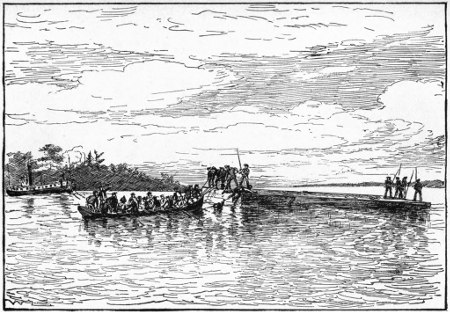
The two four-oar boats and the quarter-boats of the steamer were
manned, and were useful in carrying out the various guys and stays in
mooring the caisson. The posts were lowered into the water over one end
of the craft, the boom of the derrick being thirty feet long, so that
the equilibrium of the float could be better secured.
The Goldwing was appropriated to the use of the sub-marine diver and his
assistants. He was the novelty of the occasion, for not one of the
students, with the exception of the two from New York city, had ever
seen the working of the apparatus. It was hardly a full exhibition,
however, for the water was not over the diver's head in any part of the
bay where he was to make a descent.
The man dressed himself and put on his copper helmet in the
standing-room of the yacht; and the students gave him three cheers when
he was in full rig. The air-pump was placed on the forward deck, and the
hose through which the air was to be supplied to the diver was
conveniently arranged. A tub of stone chips of various size was ready to
be lowered down to him.
"I don't see how they are to sling the post so as to drop it down into
the water plumb," said Oscar Chester, in the pilot-house of the Sylph,
which was alongside the caisson.
"The quarrymen have drilled a hole in the top of each; the inside of
which is in the shape of the frustrum of a pyramid on two sides,"
replied Dory Dornwood. "They have an iron made in the same shape, but
considerably smaller, which they drop into the hole. On the two slanting
sides they insert pieces of iron of uniform thickness, which just fill
up the hole. When these are in place you cannot pull out the middle
iron, to which the hoisting apparatus is attached."
Oscar watched the process of making fast to the first post, and a sight
of the apparatus enabled him to comprehend its working. There were four
sheaves in the blocks used on the derrick; and the process of hoisting
and lowering, when the rope was wound up on a small cylinder, like that
on the machine, was very slow. But great power is obtained only at the
expense of speed. Bolly Millweed had been up to see the loading of the
posts on the caisson, and with two men at the winches it took hours to
put a single one on board.
On his return he had a talk with Mr. Jepson, and the result of it was
that a cylinder was rigged in the shop which could be worked with the
engine. The distance of the derrick from the cylinder made it necessary
to use a very strong rope, which Captain Gildrock selected for the
purpose. A gong bell was rigged in the shop, to be rung with a cord.
There was something for every student to do, and the work of each one
had been assigned to him. There were eight on the steamer, eight in the
boats, two on the Goldwing, four on the caisson, one of whom was to put
his whole mind upon the ringing of the gong bell, while Bolly Millweed,
who was regarded as the architect and engineer of the work, had three
assistants.
Bolly was a great man on this occasion, and his father and mother stood
on Chowder Point, observing him with admiration. Doubtless Bolly "felt
his oats," but anyone who had been with Captain Gildrock a while did not
put on airs, and the architect conducted himself with becoming modesty.
He was really entitled to a great deal of credit, for not only the
plans, but many of the contrivances for setting the posts and raising
the building had been originated by him.
Mr. Brookbine had insisted that it was next to impossible to set the
foundations properly in the water. Bolly thought there was no great
difficulty in doing this part of the work. He addressed himself to the
problem, and asked the master carpenter to select for him two straight
eight-inch timbers, thirty-two feet long. These were pinned together in
the form of a steel square, though with arms of equal length. Braces
were put on to keep the timbers exactly at right angles with each other.
At the heel and the ends of this floating square he set up three poles,
straight and plumb, which were painted red. In the apparatus of the
school there was a surveyor's compass, with sights upon it. With this
instrument, used on the shore, he got the square in position, so that
the heel was where the first post was to be set. His three assistants
were in a boat, and moved the square by the signals he made. It was then
moored to the bottom, so that it could not be readily moved.
The floating square was placed so that the outer corner would just touch
the inner corner of the post when it was set. At this point the
architect nailed a couple of laths so as to form two sides of a square
of the size of the foundation stones. In the middle and at each end of
the arms of the square, he also nailed laths, to mark the position of
four other posts, one of which formed the second corner of the end of
the building.
Mr. Brookbine commended the engineer, though he had some doubts about
the floating square. The swinging of the caisson, or a slight rap from
the stone in lowering it, would knock the square out of place. Bolly
could only reply that the caisson must not swing, and the post must not
touch the square.
At the order of the principal quarryman, Jim Alburgh rang the gong, the
long rope straightened, and the end of the post began to rise. The
square was three feet from one end of the caisson, which was moored at
the other end from the west side of the bay. Bolly was in one of the
boats with two of his assistants, the third being stationed on shore
with the compass, sighting along the red poles, to give notice of any
change in the position of the square.
When it was raised high enough, the post was lowered slowly into the
water, a foot from the guides on the square. Bolly was nervous, and kept
telling the quarrymen not to let the stone touch the guides or the
square. The diver dropped into the water, and waded to the stone. When
the end of it was nearly on the bottom, the post was swung into place
so carefully that the marks were not disturbed. The diver chinked up the
stone, and it was accurately plumbed.
When the first post was in place, the students gave three cheers. The
Sylph whistled lustily, and just at that moment the two Chesterfield
barges darted into Beech Hill Lake. They went over to the grove, where
they picked up a dozen of the Topovers. It did not look as though the
principal of the institute had much influence over them; for taking the
Topovers into their boats indicated that they were bent upon mischief.
Captain Gildrock said nothing about the barges and their occupants, and
did not seem to notice them. The work proceeded as though they had been
on the other side of the lake. The Sylph moved the caisson into position
for laying the second post, which was on the side, to avoid changing the
mooring-ropes as much as possible.
The Chesterfields rowed up to a point where they could see what was
going on, and watched the work for a while. It was no "circus" for them,
and they soon pulled to the shore on the west side of Hornet Bay. Dory
watched them from the pilot-house, and soon had occasion to report to
the principal that the Chesterfields and Topovers had hold of the
mooring-rope of the caisson. He had not finished what he was saying
before the stone boat suddenly moved towards the site of the building,
and then knocked Bolly's square out of place.
Captain Gildrock took command this time himself. The chief quarryman was
a constable. He asked all the rest of the men and boys to act as his
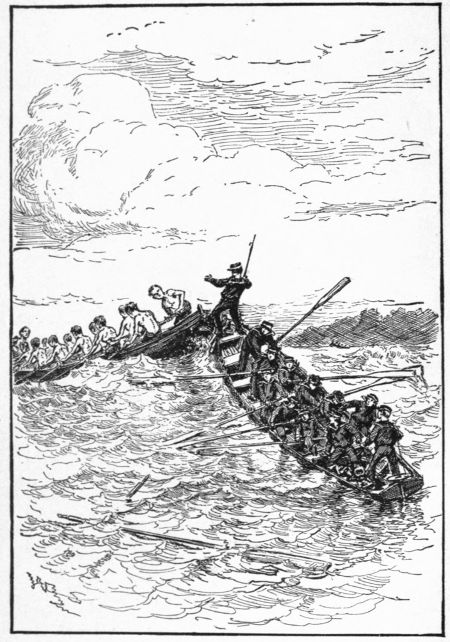
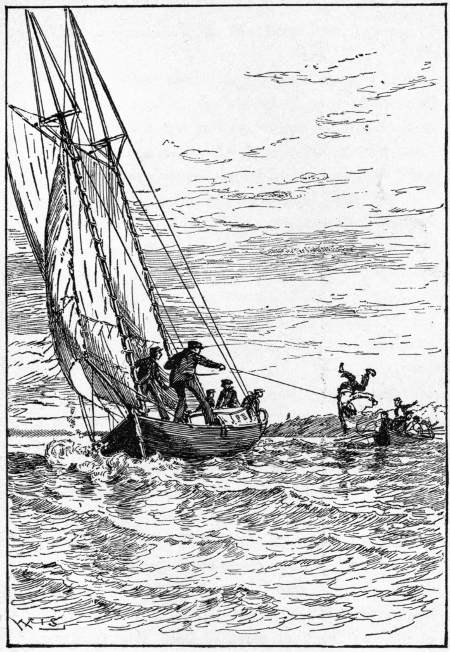
posse, and all hands were ordered into the steamer. The mischief-makers
had taken the mooring-rope into the Dasher, and had headed out into the
lake. The steamer darted after them. The boats let go the rope, and
attempted to escape by the way they had come. The Sylph was too much for
them, and both boats were captured. The principal directed the constable
to take the two coxswains and Tom Topover out of them, and they were
shut up in the ice-house on board of the steamer.
The others were permitted to depart, which they were glad to do when
they found that Captain Gildrock "meant business." The prisoners were
kept till noon in the ice-house, when they were taken before a
magistrate, and a complaint made for trespass and for stealing the boats
on a former occasion. They were sent to the lock-up, but Colonel
Buckmill came over before night and bailed out Commodore Twinker and
Jeff Monroe.
At the trial a case was made out, and all the defendants were subjected
to a fine, which Tom's father would not pay, and he was kept in jail for
two weeks. Colonel Buckmill paid those of his students. He had warned
them before of the peril of meddling with the Beech Hill students, and
probably he did it again on this occasion. What good it did we may learn
from another book of this series. At any rate the Chesterfields and the
Topovers did not go to Beech Hill Lake again that year.
Bolly arranged the square again, and the rest of the posts were set. The
sills were then loaded on the caisson, from which they were laid on the
posts. The rest of the lower timbers were put in place by the students,
with the help of the laborers only. The rafts of boards, which had been
secured to the shore until they were wanted, were towed to the frame,
and the racket of six-and-twenty hammers resounded through the grove for
the next two afternoons. The boys learned to drive nails, but there was
not so much fun in it, they found, when they came to make a business of
it. The sawing and fitting of the boards for the floor gave some
variety, and they were required to sharpen their judgment in the
prevention of waste.
While the students were at their studies, the laborers carried the
timbers of the frame to the platform, and the next job was to put them
together in sections. The caisson was securely moored off the east end
of the site by ropes leading to the shore. The boom of the derrick was
"topped up" until it was perpendicular to the deck of the craft. Slings
were rigged at the intersection of the three end posts with the plates,
from which three lines came together at the foot of the middle post.
"Now, boys, we want three sailors," said Captain Gildrock, who attended
personally to the rigging. "What they have to do may be considered
dangerous in the country, though not more so than going upon the
cross-trees of a ship, and I shall call for volunteers."
Every student raised his hand, for all of them wanted the difficult
positions. The principal selected three who had had some experience in
going aloft; and they were Dory Dornwood, Matt Randolph and Luke
Bennington.
"You will take your places at the top ends of the posts, and be hoisted
up with them. Hold on to the slings, and don't get your hands jammed in
them," continued the principal. "I shall want three more to go up on the
next section, and Glovering, Short, and Chester will be ready for this
duty. None of you will come down till the entire frame is raised."
The fall from the derrick had been brought over in a boat, and hooked on
to the loops from the slings. The order to ring was given, for the power
was supplied by the engine in the shops, as before, and the section
began to rise. Mr. Miker, the lessee of the quarry, and his men, had
volunteered to assist at the raising. The grounds contained a great many
people who had come as spectators, and there were more volunteers to
take part than could be employed.
Mr. Brookbine stood at one corner post, and Mr. Miker at the other, with
a stone-cutter at the middle one, all armed with iron bars. The
principal difficulty in raising the sections was in preventing the foot
of the post from moving from its place. A sling had been rigged three
feet from the tenon on each post, kept from slipping by a pin through
the hole in the brace mortise, to which a twofold purchase, made fast at
the other end to the sill, was attached. The purchase-tackle was hauled
taut, and a student was to slack it with a double turn around a timber,
as the post ascended. The iron bars were to be used in guiding the tenon
into the mortise.
Everything worked precisely as had been intended; for Captain Gildrock
took no chances and incurred no risks. The machinery and the ropes were
strong, and all sorts of possible accidents had been provided for. The
students on the top of the moving section waved their caps when they
were well up in the air, and those below cheered them; but the principal
would not allow any boys' play which might distract the attention of the
workers.
"Now man the check lines," called the principal, when the section
approached a perpendicular position.
These were ropes passing through a single block, leading down in the
rear from the plates. Without these the section might have fallen over
upon the derrick when it reached an upright position. The check lines
were hauled taut, and paid out as the derrick rope brought it to its
permanent place. The tenons were successfully directed into the
mortises, and the men with the iron bars were relieved from the duty of
using them. Each of them had a spirit level, which was also a plumb. As
the section approached its proper position, the men applied the plumb.
"Ring!" shouted the master carpenter; and the student on the caisson
pulled his rope. The section was not yet finally plumbed, but was
secured by ropes and board stays. The sailors on the plates cast off the
slings and the check lines, which were immediately attached to the
second section; and this one was raised in the same manner as the first
had been.
By the check lines the students on the frame hauled up five single
blocks, which were made fast at the head of the long posts. A single
whip was rigged at each, and with these the side plates and the girders
were hoisted to the places where they were required. The sailors
inserted the tenons in the mortises, as the timbers were elevated in a
horizontal position, and drove in the pins.
A great many contrivances unknown to carpenters were used, by the aid of
which many of the boys became men; but the reading about them will not
be half so exciting as was the actual use of them. When the timbers had
all been put in place, including the studs in the sides, but not the
floor joists, the two sections were plumbed.
The rest of the raising was done in the same manner. At noon all the
volunteers dined with the students, and a grand dinner was given in
honor of the occasion. Before night the raising was finished.
A great collation was served on the lawn at sundown, and the Genverres
band played all the evening. The grounds were thronged with people, and
an impromptu dance, in which most of the students took part, closed the
festivities of the day.
The rest of the Building of the House was a matter of detail, and the
work was done in shop time. By the first of November the boat-house was
shingled and clapboarded, the windows were put in, and a few temporary
doors were hung. During the winter the students got out the finish, and
the building was entirely completed on the first day of June of the
following year.
The wharf had been finished according to Bolly Millweed's plan by the
middle of May. The parts of the truss bridge had been made in the shop
in the winter. The sides of the caisson were built up of the timbers
which had remained inside of it from the beginning. The architect fixed
its position with the compass from the shore. The Sylph towed rafts of
refuse stone to the enlarged caisson, and it was sunk into position. A
plank floor was laid on the top of it, and Bolly's dream became a
reality.
Of course such an event as the completion of the great boat-house and
the wharf could not be passed by without a suitable celebration. This
included a magnificent collation, music on the lawn, and a big social
dance in the hall. Many people from Burlington attended it, and even Lew
Shoreham was willing to admit that the uniform of the Beech Hill
Industrial School was a big thing, inasmuch as no young lady would look
at a young man on that day who did not wear it. In fact it had come to
be regarded as an honorable distinction, and the students were proud to
wear it.
The Building of the House by the students had given the school no little
reputation, and the "Tinkers" were lions in many places where they went.
Captain Gildrock had applications enough to quadruple the number of his
pupils, and he was considering the question of enlarging the sphere of
its usefulness from the beginning of the next year.
Among those present at the celebration of the completion of the
boat-house were Mr. Plint the architect, and the fat civil engineer,
Mr. Bridges. The former was so pleased with Bolly's work and his ideas,
that he offered him a place in his office at Albany, with a salary of
fifty dollars a month, as a draughtsman. Bolly did not want to leave the
school, but his father's circumstances made it his duty to accept the
offer.
The civil engineer wanted a young man, and Lew Shoreham found a place
with him, for he had to earn his own living. Corny Minkfield and John
Brattle had places offered to them to run stationary engines in a marble
quarry; but as they were still young, the principal advised them to
remain another year at the school. A dozen of the students could have
obtained fair wages as carpenters, but they were counselled to continue
their studies.
The thoughts of the boys at Beech Hill had a nautical tendency, and
Captain Gildrock was now ready to carry out his second great idea, which
was to build a sailing craft somewhat larger than the Goldwing; and the
next volume will explain how, in the midst of many adventures with the
Chesterfields and the Topovers, the students did all the work, from
"Stem to Stern," in the practical work of "Building the Boat."