“Strowe me the ground with daffodoundilles
And cowslips and king-cups, and loved lillies,
The pretie pawnce,
And the cheveraunce
Shall match with the fayre flowre Delice.”
Spenser, Shepherd’s Calendar.
A soft sweet day. A gentle rain had fallen all through
the night, and the sense of spring was everywhere.
Soft mellow sunshine flooded into the house. How the
chestnut buds glistened in the sunlight, all damp, and
sticky, and a few even had begun to uncurl.
The almonds were out in sheets of rosy pink blossom.
Bees were humming everywhere, and thrushes were
piping their jubilant strains on every gnarled apple tree.
I asked at breakfast for my little maid, but I was
told that she was not yet down, and even our irreproachable
butler Fremantle seemed almost inclined to
laugh, if such a sedate and irreproachable person can
descend to such levity, as he told me that Miss Bess,
he feared, would be a little late that morning.
I had, as it happened, many letters to answer, and so
forgot to trouble about Bess, for I had heard her chirp
like a bird between six and seven in the morning, and
therefore was not anxious. I remembered now that Bess
had been often up to tea at the Red House of late, and
that when Constance and she had met, they had
whispered much, and that Bess had often caught her
hand and held it tightly before parting, and then bubbled
over with happy laughter. Once, when I asked Bess
the cause of all this mystery, she replied, “Only white
secrets, mum,” and Constance had laughed too, and
repeated the child’s words, “Only white secrets.”
Whilst I stuck down my letters, I recalled these
little half-forgotten episodes, when suddenly the door
was flung open with a bang, and Bess stood before me;
but not my every-day little Bess in short petticoats, and
white pinafore, and her locks hanging round her, with a
mane like a Church Stretton pony’s, but my little Bess
clothed in a fancy-ball costume, in that of a diminutive
jester of the fourteenth century, with cap and bells, in
little yellow and pink tights with satin embroidered vest,
and her luxuriant locks confined in a cap.
She entered shaking her bells merrily, and as I
started up in surprise, she exclaimed, “Don’t say anything,
mamsie, please don’t. Wait till you have heard
my verse, or you will spoil everything. Constance has
learnt it me, and I have said it over and over again. You
see it is All Fools’ Day, and I must give you a surprise,
for Nana says, a surprise is next best to a birthday.”
And then my little girl faced me, in the middle of
the old chamber, with the great stone altar as a background,
and piped aloud in her gay childish way. The
old rhyme somewhat altered—
“When April her Folly’s throne exalts,
While Dob calls Nell, and laughs because she halts,
While Nell meets Tom, and says he too must play,
Then laughs in turn, and laughing runs away,
Let us my muse thro’ Folly’s harvest range
And glean some moral into Wisdom’s grange.”
AN APRIL FOOL
It is an old rhyme, and I am told that Constance
had taught it to my little maid. I stood looking at my
dear little fool, all blushes and sweet smiles. “Constance,”
continued Bess, “was sure it would make you
laugh.” And then, after a pause, she added, “I have
not done yet. Listen; I know all the funny things,
pit-pat. Miss Weldon may not find me clever, but Constance
says I learnt at once what she taught me. You
see, mum, it is all fun, and fun with Constance is
better than boxes of sugar-plums;” and here my little
lass began to cut a hundred capers, to jingle her bells,
and to dance gaily, calling out, “There are heaps of
funny things to do. I must send Burbidge on a
sleeveless errand, tell Absalom to go for the map of the
Undiscovered Islands, and send Célestine for pigeons’
milk, and won’t she be cross! Crabs won’t be in it, no,
not if they were steeped in vinegar for a month, Nana
says.” And away danced my little lass into the brilliant
April sunshine.
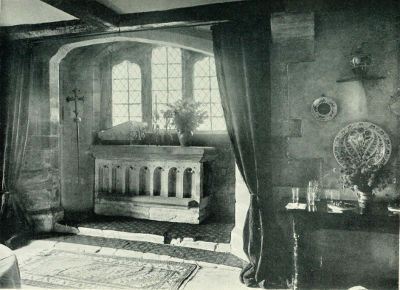
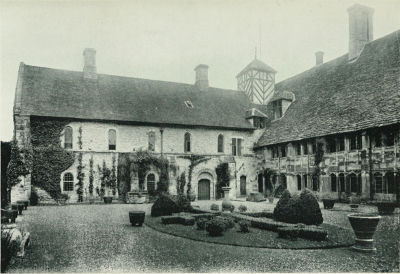
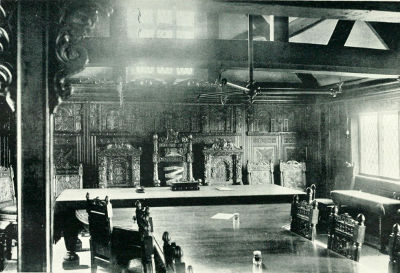
THE CHAPEL HALL.
Photo by Miss K. Wintour.
I did not catch what she said to the old gardener
outside, but I heard a deep roar of laughter from
Burbidge, and a bass duet of guffaws, from Absalom and
Roderick; and a minute later Burbidge entered from the
garden and told me, his face beaming with honest
pleasure, that “Miss Bess was the gayest little Folly
that had ever come to Wenlock, and would surely make
folks laugh like an ecall come what might.”
A few minutes later, and Bess flew off to her old
nurse and to Auguste, and both I heard, by their shrill
exclamations, affected to be overcome with laughter at
her approach. Inside and outside, on this first of April,
I heard sounds of merriment, as if a return to old customs
had come back, and as if loud and jocund mirth had not
died out of simple hearts. I thought of all the old games,
plays, quips, and pranks, that the old walls of the Abbey
Farmery must have heard and seen in the Middle Ages,
for even the monks allowed times of folly and revelry,
at Yule-tide and Candlemas, I have read; and on the
first of April, All Fools’ Day, many must have been
the hearty laugh, and simple joke, that folks made and
passed on each other in Wenlock town, and all over
old England.
I popped my letters into the box for post, and
stepped out, as my task for the day was accomplished.
The morning was enchantingly beautiful. “Old Adam”
glistened beneath the sundial like a wondrous jewel,
the eyes in his tail seemed of a hundred tints. He
appeared, as Buffon said, “to combine all that delights
the eye in the soft, and delicate tints of the finest
flowers, all that dazzles it in the sparkling lustre of
gems, and all that astonishes it, in the grand display of
the rainbow.” His tail appeared of a hundred tints,
and the red gold of the featherlets round the eyes
flashed as if illuminated by fire. His grey, subdued
wives, walked meekly beside him, and cast upon him
humble glances of admiration, while he strutted before
them with the pride of a Scotch piper, and expanded
his tail with a strange mechanical whirr, that recalled
the winding-up of some rich, elaborate, modern toy.
Down by the Abbey pond I saw the two swans
swimming, but, every now and then, the male bird
seemed almost to leap out of the water in the delight
of spring, and beat the water with his great snowy
wings as he drove across the glass-like expanse at a
furious rate, making the little wavelets rise and fall
and dance, in a crystal shimmer over reeds and grass.
Suddenly a little moor-hen dipped and bobbed out of
the reeds. With an angry cry, one of the swans went
for her, and I thought, for a moment, the poor little
bird must have fallen a victim to his murderous beak;
but the little black bird, as Burbidge would have said,
“was nimble as ninepence,” and doubled, and dived,
before her enemy could reach her. It was very good to
be out. Life seemed enough. The island in the centre
of the Abbot’s pond had become a sheet of primroses,
and looked as if it had been sown with stars; and as I
stood in the garden, the scent of the crimson ribes
reached me. What a rich perfume it was! and what a
distance it carried. In the full sunshine it was almost
like incense, swung before the high altar of some old-world
cathedral. I wandered away into the red-walled
garden. How busy Burbidge was! The fir branches
and matting were to be taken down off the tea-roses,
and away from the beautiful purple and lavender
clematises, my autumn splendours.
WINTER COVERINGS REMOVED
Beautiful Mrs. George Jackman, that shone like a
great full moon in the dusk on clear summer nights,
was now to be allowed “to open out,” as gardeners say,
and the sun and soft winds were once more to play
with her tender leaves, and delicate tendrils.
Then the exquisite tea hybrid roses, such as Augustine
Guinoiseau la France, and that richest of all the noisettes,
William Allen Richardson, were to dispense with their
protecting fir branches. The time had come for them to
feel the joy of full sunlight again, and the tree peonies
were no longer to be enveloped in tawny fern branches,
or to lie smothered in litter.
As I stood in the pathway, I heard Burbidge walking
up and down the paths, giving orders in the Shropshire
tongue that I love so well.
A mantle of spring splendour had fallen upon all.
Lines of yellow crocuses shone like threads of gold.
Crown Imperials were opening their rich brown, metallic-looking
blossoms. Pink and white daphne bushes perfumed
the air, and I noted that a host of hungry bees
were humming greedily round them. Chionodoxas of
all shades, were looking enchantingly fair. The blue
Sardensis was opening its petals, of the same wonderful
sapphire-blue shade as the Alpine gentian. Then in
blossom also I noted Chionodoxa Luciliæ, that had the
delicacy and daintiness of a piece of china, and lovely
Alleni, that recalled the beauty of a sunset sky when the
gold is dying, and when celestial amber is dissolving
and melting into exquisite tones of mauve and lavender.
A little later, I found Burbidge hard at work pruning
my great bed of hybrid teas, and hybrid perpetual
roses, that I have planted with alternate rows of old Dutch
and Darwin tulips, with English and Spanish irises,
and with lines of grape and Botryoides hyacinths. “Us
must get a bit of the bush off,” said my old gardener,
as he plied his pruning scissors. I begged him, however,
not to cut my hybrid teas too hard, as now so
many gardeners are inclined to do, for roses in Shropshire,
it seemed to me, did not like too much of the
knife, or of the French drastic treatment. “Let it be
a rose bush in England,” I pleaded.
“Right you are, ma’am,” replied Burbidge, “for
there’s many as uses the knife as a child the whip.
Most of the roses here be on their own roots, and so,
healthy and abiding. Manetti stuff have blooms big as
saucers the first year, but go out the next year like
candles as the wind’s overmastered. They be like most
fandangles—no stay in them.”
THE VERMILLION ROSE
So saying, my old friend plied his scissors vigorously,
and the click, click, resounded all through the garden.
Before I left the red-walled garden, I had a word with
my old gardener about my hedge of Austrian briars.
What a wonderful single rose it is, and the variety is
very ancient. Parkinson mentions it in his “Theatre
of Plants,” and calls it “the vermilion rose of Austria.”
If we prune it this year, we shall get no flowers, I
lamented, and I am always very loth to let the pruning
shears work their will with my pet rose. Then I turned
to my moss roses: pink, white, purple, and the most
beautiful variety of all, the old crested. They were all
big bushes and must be kept in shape, but should not
be pruned in the ordinary sense.
Besides these sorts already named, I grow in my
garden the beautiful roses of Japan—the purple and
white, and the semi-duplex kinds, all of which bear such
superb hips in the autumn. I told Burbidge that we must
net some of the bushes in autumn, and that I would try
later and get some German recipes for making them into
preserves. In Elizabethan days, I have read, “Cooks
and their ladies did know how to prepare from hips
many fine dishes for their tables.” Burbidge scoffed at
this notion. “Let the wild things be, marm,” he said
to me; and added, “I never heard of much that was
good wild, but nuts.” At this I laughed and replied,
“Wait and see—and taste.”
Burbidge told me, that he proposed to carry out
the bees in their little wooden houses next week. “Come
next Thursday, bee operations should begin,” my old
friend assured me. Nine was the hour chosen, and, if
fine, “us will have the masks, so that come a breakage
the little brown folk can’t come to us—and the
vermin make sore flesh of us.” To-day, as I went into
the tool-house I heard the bees buzzing angrily, as if
they could not keep quiet for anger.
“To-morrow,” Burbidge then informed me, he and
the boys would paint all the “bees’ homes over,
save the lips, in different colours.” These must, in his
language, remain “simple;” but “come Thursday, us
will take off the zinc stopper on each, and then the little
brown uns can roam as they list.”
All last winter, since November, the bees had lived
in the tool-house, and had been artificially fed for the last
fortnight, so that, to use my old friend’s words, “they be
fair nasty with temper, and buzzin’ like an organ on fire.”
And now nothing remained but for Auguste, as he always
did, to make them one last meal of burnt sugar, and
solemnly to “inviter ces messieurs à faire leur miel.”
Their appointed time of liberty was at hand, and in a
few days the little brown folk would fly into the sunshine
with pæans of joy.
I went into the tool-house with Burbidge. Burbidge
is a man of order. Every night he makes “his
boys” hang up the tools, after cleaning them with care.
Those not in use shine brightly against the wall. Every
night they are rubbed clean with a rag steeped in oil.
Great strings of onions hung from the massive oak beams.
During bad days in winter, when the snow lay on the
ground, Burbidge and his men mended the fruit nets,
painted the water-cans a brilliant red, or green, made
wooden labels, and got ready, as they called it, “for the
comin’ of summer.”
There, along one side, were the beehives, some eight
in all—all to be painted in different colours. Burbidge
holds the view that no two should be painted the
same colour, so that each hive, as he calls it, “should
drop on their own colour sharp.” What truth there
may be in this idea I cannot say, but I was delighted
to oblige my old friend in this respect, for I, too, like
bright colours in a garden.
Burbidge took out of an oak locker his colour board
for the year. “I know, marm, as yer be tasty with a
needle,” he said, “and I’ll leave it to you to say what
pleases you and the brown folk most.” I suggested
shades of blue, and told him of the Scotch belief that
bees of all colours love blue best. But Burbidge would
not admit this. “I never heard that in Shropshire,” he
said stoutly. “Don’t believe it, nor a letter of it. Orange
or purple, I believe, be every bit as good as blue.” Then
I asked Burbidge about the old Shropshire bees that
learned folks in bee-lore have told me were descended
from the old wild bees that the British had, and of which
there are still swarms in straw skeps in far-away farmhouses
nestling against the Clee. But about these wild
bees Burbidge knew nothing, but only felt certain that
anything “as be Shropshire born be bound to be
good.”
Then I chose the colours—red, flame, crimson,
salmon, mauve, pink, the delicate shade of the autumn
crocus, jonquil yellow, and one or two shades of blue—and
particularly the dear old-fashioned bleu de Marie
that one meets in an Italian sky, as beautiful in its way
as the breast of “old Adam” (the peacock) against a
yew hedge on a fine March morning in full sunlight.
It was a lovely spring morning on that Thursday, the
appointed day for the removal of the bees to summer
quarters.
MOONLIGHTERS AT WORK
Bess and I had a cup of milk and a slice of bread
and butter, the best of all morning breakfasts, and ran
out to see the sport. Burbidge was there with his boys,
looking all of them like marauders, or moonlighters, for
their faces were clothed with masks and their hands
were covered with thick gloves.
Bess grasped tight hold of my hand. “Mamsie,
how wicked they look, as if they meant to kill some
one,” she whispered.
As to Mouse, she could not contain her displeasure.
She gave a series of low growls, and, for all she knew
them, did not like their coming too near us.
Burbidge propped back the garden gate with a stout
staff. Then they carried the little wooden houses out.
What an angry sound of buzzing went on inside, as
the men bore them along. “Steady, steady!” cried
Burbidge, in a tone of command, “or the little brown
people will burst themselves with rage, and then, boys,
it will be run for it who can.”
After this note of warning, “the two boys” advanced
very gently and placed the beehives in turn along the
side of a path under the shade of an apple grove, and
stood them facing south and east. “That be your
home,” said Burbidge, and then gravely proceeded to
whisper “a charm.” What that was I have never been
able to discover, for Burbidge declared it to be a secret
between him and the little brown ’uns, and if it was
known the good would go with “gossamer wings.”
There is something about spring and blossom, and sun,
and gentle rain, an old woman once told me, but the
exact words old Nelly Fetch wouldn’t tell me, and
declared, like Burbidge, “that charms and rhymes were
best kept between bees and bee-keepers, same as words
to the bees when death had visited a family.” It is
believed in Shropshire that bees are canny, touchy folk,
and that those who wish to keep them must be civil and
knowledgeable, and, “plaize ’em as little sweethearts,” as
an old cottager once said to me, “or the bees wud mak’
yer rue it.”
“Whispering a death” is still a common custom.
I remember once asking a farmer’s wife, who used to be
noted for her bees, if she had any honey to sell, and
being gravely told that she was out of bees, for that
they had forgotten when the master died to whisper his
death to them, and in consequence the bees had taken
to the woods in displeasure.
“PAINTS NEXT BEST TO WATER”
Bess and I watched the proceedings, and when all
the hives were fixed in their places, we put on old aprons
and helped to daub on the paint. Burbidge had mixed
little cans of each colour, pink, yellow scarlet, and
flame, crimson, jonquil, and blue. Bess was delighted
with the little pots and the brushes. “Mamsie, I am
certain of one thing,” she said, “paints are next best to
water.” And in a few moments the little face, hands,
and pinafore, reflected all the colours of the rainbow.
In ten minutes or so, we had given each hive one
coat of colour, and we never give more. Then we all
went and stood at the other end of the garden to see
the effect of our handiwork.
“Fine, very fine,” exclaimed Burbidge, admiringly.
“A horse in bells couldn’t look smarter.” And Bess added,
“Mamsie, it’s like a bunch of flowers, only there are no
leaves.” As we remained there, Auguste came on the
scene. He appeared with a pail of syrup to feed the bees,
for bees will always feed with avidity when put out first
into the air, however dainty or reluctant they have been
to eat when kept in confinement. A large bottle with a
broad opening, full of thick syrup, was filled, and fixed
upside down on the top of each hive. We heard behind
the perforated zinc a mighty din. “Messieurs les
abeilles crient pour leur dîner,” said Auguste.
Overhead was the sunshine, and the bees scented
the breeze. Burbidge filled each bottle, and then replaced
the wooden lid of each hive. “Stand back,
marm!” he cried, “and you, too, Monsieur.” Then
Burbidge called his “boys,” and they removed the little
pieces of zinc that had kept the bees so long prisoners.
Out they flew with exultant hums and buzzes.
“They wud have liked to cut their way through,”
cried Absalom, “but zinc, for all their cunning, be the
masters of they.”
“They’ll be contented now,” laughed Burbidge.
“Sugar and sunshine, what more can a bee desire?”
There is a great art in making bee syrup, like there
is in doing most country things. Syrup should be clear
and of the right thickness, and not too liquid; above
all, it should not be too thin, so as to pass too quickly
through the muslin, or, in Burbidge’s words, “it would
drown the bees like flies in a jar of cream.”
After watching the bees come out and fly round in
exultant joy, Bess and I returned to the house, for, as
Bess said, the “bee play” was over for to-day. How
busy the little brown people will be gathering fresh
honey, flying amongst the arabis and searching for
celandines and primroses.
We went in, and Bess ran up to her lessons. Alas!
study to my little maid is always a period of sadness.
“Real children never like lessons,” is my little girl’s
dictum. They don’t like useless things; and to Bess,
French, geography, history, and music are all useless
and worthless acquisitions. As I sat and embroidered
in the Chapel Hall, I was suddenly told that a boy outside
wished to speak to me. I left a carnation spray, a
copy of a design of one of Mary Queen of Scots’, and
looked up to welcome Thady Malone, a little Irish lad,
who, with his father and mother, had lately come into the
parish.
Thady is the terror of the locality, and the hero of
all the naughty-boy stories of the neighbourhood.
“MORE DEVIL THAN BOY”
According to my old gardener, who looks at him with
an evil eye, “Thady be more devil than boy.” Burbidge
declares that Thady is a plague, and a sore to the town,
and “wull be the death of some ’un, unless he kills
hisself first.” The fact is, Thady has done every naughty
thing conceivable. He has fired woods, put strings
across roads, I have been told, to try and trip up his
natural enemy, James Grogan, the reigning policeman,
and even put logs across the little local line, I have been
assured; but this he stoutly denies himself. He has
been thrashed by indignant farmers for running their
sheep, and yet, as Bess says, always turns up “naughty
and nice,” with the politest of manners, which he gets
from “auld Oireland,” and the sweetest and most innocent
of baby faces out of which natural wickedness ever
peeped.
A minute later and Thady stood before me, bare-legged
and bonny, with an expectant smile in his eyes.
I opened the conversation by asking him from where
he came? “Right from Mrs. Harley.” And he added,
with a catch in his throat, “The poor lady is like to die
entirely, judging by what Mrs. Betty said, and so I have
come to you to see what your leddyship can do to stop
the disease.”
Thady spoke in the most engaging brogue, and he
had the sunniest, pleasantest smile in the world. He
stood before me, with his little bare feet shyly touching
the fringe of the carpet.
No other child in the old town goes barefoot. He is
known at Wenlock by the nickname of “Naughty Bare-legs,”
and has a shock of curly hair and dancing grey-blue
eyes.
“I’ll come at once,” I said. “But why, Thady,
have they sent you?”
Thady scratched his head and looked puzzled, declared
he didn’t know, but protested there was nothing
he wouldn’t do to oblige Mrs. Harley, for all, he averred,
“she’s a hathan, and never says a prayer to the blessed
Virgin.”
It appeared that once some naughty boys at Homer
nearly succeeded in drowning Mrs. Harley’s tortoiseshell
kitten, but that Thady, hearing the poor little beast
mew, fearlessly came to its rescue, fought his way
through the thick of the band of miscreants, and told
them they were nothing but base robbers, that they
should be the death of something bigger; and before
they had recovered from their surprise, had dashed
through the ring, plunged out of the brook, and carried
off poor pussie victoriously. After this, Mrs. Harley
had always been a friend of his, filled his pockets with
damsons in autumn, and apples, and when the world
turned a cold shoulder on him, never failed to hold out
to him the hand of friendship.
“For all I’m bad,” Thady would say, with a twinkle
in his eye, “Mrs. Harley never believes the worst of me,
and says (God bless her!) the day will come when the
country will be proud of me.”
There was no time to be lost, so I followed the little
bare-legged messenger out of the room, ran upstairs, put
on my hat and cape, and whistled my great dog to heel.
I said before starting, “Is there nothing I ought to take
to her?”
Whereupon Thady answered impetuously, with the
romance of his people, “There’s just nothing at all.
It’s just your face, my leddy, which the poor body wants
to get a sight of, considerin’ it’s never the shadow of the
blessed Virgin that she can bless her eyes with.”
So without another word, Thady and I passed out of
the Abbey, hurried across the emerald velvet of the
Cloister lawn, and let ourselves out by the little side
wicket, and so up the meadow past the station and away
to the top of the hill. “I cannot run any more,” at last
I cried to Thady, who had set the pace. “We must
walk. See, even Mouse is panting.” Thady stopped,
and then we settled down into a walk, and began after
a few minutes to chat.
Thady looked at Mouse. “Proud I’d be, my leddy,”
he said, “if I owned such a dog. The constable, I’m
thinking, would look a small man beside me then.”
At this sally I had the ill-nature to suggest the
constable could shoot Mouse. Whereupon Thady, with
Hibernian readiness, replied, “Now I’m thinking the
dog would bite first.”
“A KITTY WREN, BEGORRA!”
A little later a bird flew across the path, upon which
Thady cried out, “A Kitty wren, begorra!” and before
I could stop him, had picked up a pebble to throw at a
little golden-crested wren that I saw running up a spray
of yew.
“Stop, stop,” I cried; “don’t throw it.”
“Why not?” said Thady. “There’s no law in England
or Oireland against killin’ a wren, beside”—and he what
the Shropshire folks call “rippled over” with laughter—“’twould
be a pretty shot.”
But I begged him to desist, and Thady, who is civility
itself, or, as he quaintly expresses it, “born dutiful
entirely to a leddy,” dropped his stone and we walked
on. After a few minutes’ conversation, I discovered that
Thady Malone was a naturalist of no mean repute, that
he could imitate the call and various notes of most of
the wild birds, and that he knew where to find their
nests. “And if it’s after such,” he added gallantly,
“that yer fancy takes yer, I’ll lead yer and show yer the
rarest birds that fly. Only wait another fortnight,
pheasants, hawks, magpies, jays, blackcaps, blue-bonnets,
Nanny washtails, heather lenties, red-poles, cutty
wrens, corbie crows, Harry redcaps, and scores of
others.” Many of Thady’s names I did not know, but
Thady was graciously inclined, and assured me that he
would “learn my leddyship the true names.” “I don’t
call them after the books whatever,” he asserted, “but
same as the gipsy folks, and by the names known by the
people that lived in London, and elsewhere, before us
settled in Wenlock.”
So it was agreed that Thady and I were to spend a
day in the woods.
“Let it be Saturday,” said Thady, authoritatively,
“for then there’s no school to plague the life out of a
fellow. I can climb and you can cap,” by which Thady
meant that I was to carry the eggs.
“Thady,” I said, as we parted at Mrs. Harley’s
wicket, “you must come for me some Saturday. We
will go into the woods, and I will bring out luncheon,
and you shall climb the trees, whilst I and Bess will
search the ground; but we will take no nests, only look
at them and see the eggs.”
“Leave the eggs, and what for will her leddyship do
that?” asked Thady, surprised. “That wud be like
catching a hare and not finding it in the pot the night
after.”
“Well,” I remonstrated, “when you come with me,
you must play my game of bird-nesting. Anyway, I can
promise there will be nothing sick, or sorry, where we
have gone.”
Thady at this laughed a little contemptuously, and a
second later vanished behind a hedgerow, and I entered
Mrs. Harley’s cottage.
It was a lovely morning, bright and joyous. The air
was full of spring odours, and in the song of the birds I
only heard the echo of universal joy. Yet I knew, the
moment I entered the cottage, that the hand of Death
was about to beckon my old friend away from the good
and useful life, that she had led so well and bravely, to
the other side of the bourn from which no man returns.
Old Bessie met me. “Her’s goin’ fast,” she whispered,
and stood a moment in the sunlight, hot tears
almost blinding her poor old eyes. Then, as I hesitated,
she touched me gently on the arm and murmured,
“Come up, come up. Glad her’ll be to see you, for all
her’s done with Homer, and this world too.” So I
mounted the stairs and again found myself in Mrs.
Harley’s presence.
Outside beyond the Severn and the Wrekin, the sun
was shining gaily. Inside the little chamber, all was
spotlessly clean, I noted, as I entered the bed-chamber.
I saw the dying woman wanted something, from the way
in which her face moved.
“A FAIR DAY TO GO HOME”
“Light, light,” she murmured as I touched her
hand; and then, very low, “A fair day to go Home.”
“Her’s been talking of nothing but goin’ home,”
said Betsy, reverently; “and her’s goin’ sure, same as
gospel truth.”
“All’s at peace,” whispered my old friend, and took
a long, far look of the great hill of which all Shropshire
men are so proud. So, smiling tenderly and loving the
distant scene, her head sank back, and she seemed
gently to fall asleep.
“How peaceful!” I said, awestruck.
“The Lord have a-called her, and her work be done,”
said Betty solemnly, a little later. “’Tis a good thing,”
she added, “to have done good work, and I think the
Lord loved her for all she was lowly and never trod in
high places.”
Then I left Betty, and the triumphant serene face, in
the little whitewashed chamber. As I departed, I was
conscious of having touched the fringe of a very holy
garment.
I passed out. And as I met the gladness of the outside
world, I knew that some of my old friend’s radiance
was still lighting my path. After all, I know no better
or more blessed things than simple faith, and a noble
life, ended by His supreme grace.
Mouse followed at my heels, dutifully walking close
behind me. It is curious, the way in which a dog that
is often our companion, reflects our mood. The great
hound knew that I was absorbed, and gave way to no
frolic, chased no rabbit, but kept near, watching me out
of her topaz eyes solemnly and with marked concern.
A great stillness seemed to belong to the afternoon.
The sun was hidden beneath tender lavender clouds. I
crossed a stile and walked amongst the budding grass.
Suddenly out of a wood, for the first time in the year, I
heard the mystic voice of the cuckoo, calling, calling as
if out of a dream.
What a delightful eërie sound it is! Not like a real
bird, but like some voice from another world, with its
strange power of reiteration, a voice which we cannot
do otherwise than listen to; for, as Sir Philip Sidney
said, “The cuckoo cometh to you with a tale to hold
children from their play, and old men from the chimney
corner.” From all time men have loved his cry. In
the “Exeter Book” occurs the passage—
“Sweet was the song of birds,
The earth was covered with flowers,
Cuckoos announced the year.”
THE CRY OF THE CUCKOO
I did not see the bird, which lent enchantment to
his song. I listened, with budding daisies at my feet,
and over Wenlock spire a magic purple light. He
seemed to me no bird, but a spirit calling to the world
with a gladness that we cannot know. Death and winter
must come, but for all that, spring is here, he seemed
to say.
Death had come near me, even touched me half an
hour ago, but for all the solemn sadness I felt a brief
time ago, the joy of life seized me afresh.
As I wandered home across the peaceful fields, the
Cuckoo’s call seemed spoken and repeated from coppice
to hedgerow, and in every mossy dingle. The old
nursery rhyme I used to say in childhood came back
to me—
“In April
The Cuckoo shows his bill;
In May
He sings all day;
In June
He alters his tune;
In July
Away he’ll fly;
Come August
Fly he must.”
Yes, I say, fly he must, with summer which is “the
sovereign joy of all things,” as Piers Ploughman wrote
long years ago, and then autumn, and the long chill
nights of winter.
There is always a mystery about the cuckoo, as to
where he comes from, and where he goes. Far down in
the south of India, I have been told, is the only place
where the cuckoo is to be found summer and winter
alike, calling in the tropics his strange, mystic cry. Be
this as it may, he is never with us in Shropshire till the
second week in April, and vanishes like a ghost early in
August.
Some days later, and it was Palm Sunday, one of the
great festivals of old England during the Middle Ages.
There is but little sign left now of the blessing of
the boughs, as the rite was performed in mediæval
times, save that nearly all the boys present had cut
sprigs of the wild willow and placed them in their
button-holes, and my little maid, by her old Nana’s
wish, had a spray pinned in also, amongst the ribbons of
her hat. What a lovely blossom it is, that of the wild
willow. How delicate the soft grey, and how lovely the
brilliant shades of gold. How wonderful is the mixture
of both colours, and how exquisitely gold and grey melt
into each other.
As I sat in our pew on the northern side of the
church, I thought of the old Church Service that once
was held there. After the Mass, I have read, it was
usual that there should follow the hallowing of the
branches and flowers by the priest. I thought, as I sat
in church in Protestant England, of how the priest, up
to the first half of the sixteenth century, and for long
centuries before, stood forth in scarlet cope and blessed
the sweet branches and the first flowers of the year. I
liked to recall the old rite and custom of entreating the
Almighty to bless and sanctify “his creatures,” by
which was meant branch and blossom, which were laid
by lay brothers and novices at the foot of the altar, and
then it was nice to think how branch and blossom were
broken up and blest, and a spray given to all the devout
people assembled. It was a pretty and holy usage,
and I could not but feel regret, that so gracious a rite
was lost. It must have been a delightful service for
little children to witness, and a sweet memory for the
old who could remember the happy springs of years
gone by.
As we came out of church, I told Bess about the old
custom. And Bess said dryly, “Now we have to bless
our palm branches ourselves;” and added with the
strange intuition of a child, “I think it was better when
God did part of it, don’t you, mamsie?”
A STROLL IN THE CHURCHYARD
After the service, we took a stroll into the picturesque
old churchyard, surrounded by old black and white timber,
and Georgian houses of glowing red brick. There was
standing by the door by which we entered the church, the
remains of an old stone cross and several tombs, which,
I have been told, were brought from the ruined Abbey
Church. The grass was full of glittering daffodils, which
shone like stars, and the scent from the ribes and
Daphne bushes filled God’s acre with sweetness. Bess
and I walked round the churchyard.
I told her of the little room over the church-porch
with its little narrow window. Such a holy little room,
I said. In such a room, I think, holy Master George
Herbert must have written; and from that I went on to
tell my little girl about Sir Thomas Botelar, the first
priest who lived at Much Wenlock after the expulsion
of the monks.
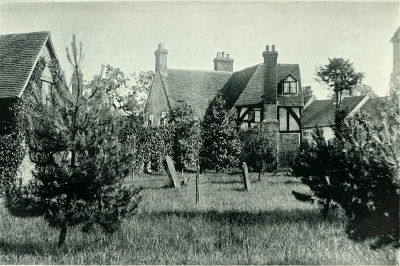
Photo by Mr. W. Golling.
SIR THOMAS BOTELAR’S HOUSE.
“Tell me about him,” said Bess, eagerly. “I like
to hear about good monks and priests from you, although
Nana says they were all wicked, and walled up poor girls.
But perhaps,” added Bess, thoughtfully, “they were not
all as wicked as she thinks; leastways, there may have
been a few good ones just sometimes.”
After luncheon I took down the printed sheets in
which are preserved Sir Thomas Botelar’s entries, for,
alas! his original manuscript perished in the great fire
at Wynnstay in 1859. And I read aloud such passages
as I thought my little girl would follow, at least in
places.
As I read aloud, Constance was ushered in. She did
not know Sir Thomas’s register and begged me to go on
reading, so I continued to read. The old papers, I told
her in a pause, embraced eight years of Henry VIII.’s
reign, went through that of Edward VI.’s, took in the
whole of Queen Mary’s, and gave the four opening years
of Queen Elizabeth’s reign. All Sir Thomas’s sympathies
were with the old order of things, I begged her to
remember, and then I went on reading.
“‘In February, 1546, on the 5th day of the month,
word and knowledge came to the borough of Much
Wenlock that our Sovereign Lord King Henry VIII.
was departed out of this transitory life, whose soul,’” Sir
Thomas added, “‘God Almighty pardon.’”
“Sir Thomas Botelar,” I told Constance, “was the last
Abbot of St. Peter and St. Paul’s Monastery at Shrewsbury.
After the Dissolution, the King turned away all
the monks, and Sir Thomas became, after a short time,
Vicar of Much Wenlock, but his heart remained in the
cloisters of his former abbey.”
Then I turned to a notice a little further down the
page—
“‘On the 13th April of the same year three convicts
were buried, and one was a child of eleven.’ Poor little
girl,” I said, “what a terrible bald statement of misery!
What could so young a child have done to merit
death?”
“I cannot think,” exclaimed Bess. “Perhaps cursed
and swore and scratched; but, even then, had she no
father or mother to forgive her?”
“Only God,” said Constance, softly.
And then I begged them to listen to an account of a
funeral of an excellent priest, and obviously a very learned
man.
THE OLD CHURCH REGISTERS
“‘Sir William Corvehill, priest,’” I read, “‘was laid
in a tomb of lime and stone, which he had caused to be
made for himself. Sir W. Corvehill was excellently and
singularly expert in divers of the VIJ liberal sciences,
especially in geometry. He was also skilled in the
making of organs and in the carving of masonry, in the
weaving of silk, and in printing. Besides he was,’” adds
Sir Thomas, “‘a very patient man and full honest in his
conversation and living.’” Then, after commending his
soul to the care of God, Sir Thomas wound up quaintly
by declaring that, “‘All this country hath a great loss
from the death of Sir William Corvehill, for he was a
good bell-founder and a maker and framer of bells.’”
Then I found a notice of a marriage. “‘Here was
married,’” ran the old register, “‘Thomas Munslow
Smith and Alice Nycols;’” and added, “‘The bride was
wedded in her smock, and barehead.’”
“When I’m married,” said Bess, loftily, “I’ll have
a veil and some flowers. Nana says it isn’t proper to
be married without a veil. ’Twould be as silly as papa
ploughing, or you, mama, plucking fowls.”
I didn’t enter into the question of parental ridicule,
but I looked down the vicar’s entries and read, “‘Poor
Sir John Baily Clerke, otherwise called John Cressage,
died. It was about 9 of the clock,’” wrote Sir Thomas,
“‘and at the manor place of Madeley.’”
Bess had often heard the story from me of the poor
old man who, after surrendering his monastery, retired
broken-hearted to die at Madeley. When I came to this
part of the register, she broke out indignantly with—
“Why couldn’t they leave our abbot alone? I can’t
abear that old Henry VIII. He did nothing but wicked
things: cut off his wives’ heads and pulled down churches
and nice buildings. Yet Nan and Burbidge call him a
good man. I think people ought to be good in a different
way.”
Bess was quite excited, and Constance had to take
her on her knee to soothe her, and thus she sat on
listening, with a scarlet face.
Then I read how, after the death of King Edward,
Sir Thomas and all the people made great joy over the
proclaiming of the Lady Mary Queen of England. I
read also how the people of Bridgnorth “fair cast up
their caps and hats, lauding, thanking, and praising
God Almighty, with ringing of bells and making of
bonfires in the streets,” and how the same joy was
evinced at Shrewsbury, and at Much Wenlock.
In the first year of Mary’s reign on June 16th, I
read that the altar of our blessed Lady within this
church (of the Holy Trinity) was again built up and
consecrated afresh, and evidently Sir Thomas rejoiced.
A month later, the Bishop of Worcester, the Lord
President of the Marches, coming with Justice Townesynde,
stopped on their road to Bridgnorth at Much Wenlock,
and were entertained by Richard Lawley at the
Ash, the fine old timber house in Spital Street, where,
at a later date, Charles I. and Prince Rupert both slept
on different occasions.
Then followed a description of the fête held in their
honour. We learnt how the house was gaily decked
with cloths of Arras, with the covering of beds, bancards,
carpets and cushions, and how the table was laden with
pears and dishes of apples of the previous year. We
wondered how they could have been kept. Also with
cakes, fine wafers, claret, sack and white wine, and after
much pleasant feasting and pleasant intercourse, how
“Mr. Justice rose and gave the Burgesses great and
gentle thanks for their cost and cheer.”
“I wish that I, too, mamsie, had been there, for I,
too, would like to have eaten pears in summer, and have
seen all their gay carpets,” exclaimed Bess.
A little later on in the pamphlet I found the announcement
of Queen Elizabeth’s being proclaimed Queen after
the death of her sister. Sir Thomas made this entry
evidently with rather a heavy heart.
As I closed the little book, Constance took it in her
hand and looked over the pages.
“How many were hanged in those days!” she said
sadly. “There are mentions of executions for sheep
stealing, for murder, for robbery; and what a number
of convicts, even children of quite tender years.”
Then she alluded to the immense age of many of the
parishioners named. Agnes Pyner was said to be seven
score years when she received the blessed sacrament just
before death. John Trussingham declared that he was
seven score years, and that at the age of four-score years
he had witnessed the battle of Blore Heath; whilst John
Francis, chief farmer at Callaughton, Sir Thomas
declared, was aged 107 years when he was buried.
JOAN OF POSENHALL
Then Constance’s fingers flitted back to a past page,
and she read aloud a touching little entry about Joan
of Posenhall, a fair maiden of twenty-two years, who, it
was believed, “died of a canker in the mouth, which
disease her father ascribed to the smelling of rose
flowers.”
“Could it have been a poisoned rose?” I asked, for
in those days many and subtle were the poisons used to
get rid of a fair rival.
But Bess could not understand how a rose by its
scent could injure any one. “In my true fairy-stories,”
she said, “roses can only do good. They are only good
fairies’ gifts, and I know they can only come out of the
mouths of good girls—real good girls,” Bess repeated,
“so I don’t see how a rose could have hurt poor Joan.”
Whereupon I explained matters to my little maid.
After a pause Bess exclaimed—
“Well, I think ’tis best to live now, for anyhow
we’ve only doctors to kill us.”
“To save us,” laughed Constance.
But Bess would not allow this. “To kill us is what
Mrs. Burbidge says; and Nana says she won’t have a
doctor in at no price for herself.”
Then Bess jumped up from her chair, and declared
inconsequently that it was time to feed her puppy, and
darted out of the room, and Constance and I were left
alone. Upon which we fell to chatting about the great
quilt. “I have chosen the flowers, as you know,” she
said. And she enumerated one after another their
old-world musical names. “And now I want charming
words about sleep,” she added.
I suggested from Sir Thomas Browne’s “Religio
Medici”: “Make my sleep a holy trance,” or “On my
temples sentry keep,” again from the same author
“Come as thou wilt, or what thou wilt bequeath,” from
Drummond of Hawthornden, or again, “Men like
visions are, Time all doth claim,” or “He lives who
dies to win a lasting fame.”
“You must not also,” I said, “forget a beautiful
line from Mrs. Barrett Browning: ‘He giveth His
beloved sleep.’”
Before leaving me, Constance told me that she and
Bess had a little game in hand—a real May frolic—“but
you must not know yet, it must be a surprise.”
THE QUEEN OF THE MAY
To this I at once gave my maternal sanction, and
then the nature of the “secret” was revealed to me.
Constance told me that she proposed to have a little
May dance for some eight of the little school maidens,
and that she would like Bess to take a part in the
festivities. Eight little maidens are to dance round the
maypole, which is to be decked with ribbons and many
flowers, and are to sing some old songs; and she added,
“If you have no objection, Bess is to say us a verse or
two from some old poets in honour of May morning.”
I fell in readily with Constance’s little plans for a
village fête, and offered the old bowling green as a site
for it to take place. “The bowling green,” I said, “is
very sheltered; it is surrounded on three sides with yew
hedges, and I am delighted at the idea of Bess appearing
as the queen of the revels.”
Bess is to be attired all in white with a crown of
flaming marsh marigolds on her head, and to bear in
her hand a staff decorated with primroses, cowslips, and
sprays of beech and willow.
Just as Constance was leaving, Bess rushed in and
seized my friend’s hand, and called out impetuously,
“Have you told mamsie? May I? May I?”
I nodded “yes,” and told my little maid that she
was to have a white muslin, a white wand of office,
posies of primroses and shining shoe buckles. Bess
was delighted, she hugged me and Constance rapturously
in turns, and said “it will be the best day of my life.”
“All we must hope will be a success,” laughed
Constance, as she departed up the pathway to the
old gate-house; “and we must pray for sunshine for
the sake of the little expectant maidens and anxious
mothers.”
Next morning I confided to Burbidge the plan of our
proposed revels, and informed him that I should like to
ask in the villagers. Burbidge remarked in a lofty way
that he had no objection—a Yorkshire expression which
he acquired when a lad from a Yorkshire gardener; but
added severely, that they that come must keep to the
paths, not spoil his lawns, and scatter no lollipop papers,
or such-like dirt.
But Burbidge’s old wife, Hester, showed a less conciliatory
spirit. In a foolish moment, as I happened to
meet her carrying Burbidge’s dinner to the tool-house,
I confided our secret. Upon which she told me sourly
that she was sorry to think “as there is to be play-acting,
and even dancing on the property—the monks,” she
declared, “were bad enough, but this would beat all.”
Hester is descended from old Puritan stock, and
disapproves of all laughter and merriment. Burbidge,
who overheard her last words of censure, exclaimed—
“Tut, tut, my dear, you was young once. I can mind
thee fine as a horse in bells, for all thee’s old now and
that the rheumatics lay hold on thee, sharp as scissor
points. But the young uns they want their games and
their plays, for all as us is getting miller’s bags on our
pates.”
“Speak for yourself,” replied Hester, with acidity,
puckering up her withered visage. And then she
added with severity, “I never knew yet any good come
out, or wisdom, of play-acting. They be devil’s works,
and take my word for it,” and there she held up a
bony emphatic finger, “that the devil will claim toll,
for all as they seem mild and innocent.”
With which ominous remark Hester made over to
Burbidge his dinner, and hobbled up the back drive
homeward.
“’Tis a pity,” said Burbidge, looking after his old
wife, “as good wine can turn to vinegay like that. The
Lord made her, but the old ’un” (the devil) “guides her
eyesight sure enough, and most times directs her tongue.
The fact is,” and the old man drew himself up straight,
“when yer think too much about hell, yer can never see
heaven. My mother used to say that, and for all she
was a Methody body, it be gospel truth.”
EASTER SUNDAY
A few days later it was Easter Sunday. The bells
rang merrily, but we hurried off to church almost late;
for, according to Shropshire fashion, Bess had got a
new frock on for the occasion.
It consisted of a pale mauve serge of the colour of
the autumn crocus blossoms which flower in the aftermath
in this neighbourhood.
For the last fortnight dear old Nanny had been too
busy “to draw a breath,” to use her favourite expression,
and had sewn morning, afternoon, and evening, to get
my little maid’s frock completed by Easter Sunday.
For it is held in Shropshire to be most unlucky not to
be clad in fresh attire on that feast day of the Church.
Wherefore, whatever else was left undone, Bess’s frock
had to be finished for the festival.
“The rooks,” murmured Bess, as we entered the
churchyard, “cannot say nothing, for all I have is
new—shoes, stockings, drawers, chemise, and frock.
And them,” alluding to the rooks, “them only spoils
old things, does them, mamsie?”
“Oh, you’re safe,” I laughed, and we passed up the
aisle.
A peal of bells was ringing gaily. “How gay and
good it sounds,” whispered Bess, dreamily, “as if all
the world was good and playing.” Then we walked up
to our pew, and the mild delicate scent of primroses
greeted us everywhere. “I wish we had flowers every
Sunday,” said Bess, as she flumped down in her seat.
“It seems to make God’s house like a posy. I think
it must be nicer for Him so.” The old columns were
festooned with garlands of flowers, and round the ancient
font were placed bunches of flashing marsh marigolds
and great branches of tender half-uncurled beech leaves.
Bess looked round her, and said gravely in an undertone,
“I think the blessing will come this Sunday, for
I feel sure that God cannot see so many flowers about
without being pleased.” Then I said, “Hush!” for I
feared my little maid was talking over-much.
Immediately after, the morning service began. At
the close, as the last hymn died away, Nana took my
little maiden off, whilst I remained on for the most
beautiful, and the most solemn, of all our Church
services.
The sound of retreating footsteps was at last hushed.
The children had all left, and many of the people.
Then there was a pause, and then the opening prayers,
and I saw, in the dim light of the chancel window, the
vicar breaking the bread and preparing the wine, and
we were invited to the Lord’s Table.
“The Blood of our Lord Jesus Christ, which was
shed for thee, preserve thy body and soul unto everlasting
life.” I seemed to hear the solemn words as in a trance.
Outside, through the old perpendicular window, the sun
was shining faintly, and from the glad world without
I heard the birds singing in a joyous chorus. Inside,
the great and solemn rite of Christianity was being
administered, and faith and love of Him who died for
the sins of men was visiting each faithful heart in a
rapture of holy delight. A few minutes afterwards and
I regained my seat. The spirit of the old world was
with me. How many pious hearts have offered up
prayer and thanksgiving before those altar rails! How
often has the blessed Sacrament come to faithful hearts,
as an elixir of the soul!
THE HOLY SACRAMENT
Owing, perhaps, to the joy of the world outside,
there was a great sense of triumph in such an Easter
Sunday. “Christ is risen!” seemed to be shouted
everywhere; His body had suffered pain and death,
but now the heavens were opening for the glory in
which death and pain could have no place. The glory
of His life was everywhere. For “with angels, and
archangels, and with all the company of heaven,” could
“we laud and magnify our Lord and praise the Most
High.”
I came out of the church, and some of its mystic
radiance seems to cling like a cloud of splendour around
me. As I walked along, I thought of the founder of
the town church, Roger de Montgomery, the great Earl
of Shrewsbury, who founded also that of the Abbey close
by. The former, dedicated to the Holy Trinity, still
has its roof, and pious services are still performed
there every Sunday; whereas the Abbey church of the
Clugniac monks is deserted alike by prior and pilgrim.
Alone, my pigeons and the jackdaws fly amidst its aisles,
and only across grass and thyme can the outlines of the
high altar be discerned.
I lingered at the church wicket. A soft shower had
just fallen, and dew-drops glistened on the grass like
pearls. A great white cross shone in splendour, still
wet, but of dazzling whiteness, almost like a pillar of
light in the morning sunshine. The birds on every bush
and wall were chanting anthems of delight.
A minute later I passed out of God’s acre, and Bess
met me in the avenue. My little maid rushed up with
a bound of excitement.
“Thady is ill, mum,” she cried. “I heard Burbidge
tell Nana so. He said ‘The little varmint be down
with a bad leg, and he hoped that would settle him for
a bit.’ And Nana said ‘she hoped it would, too, for
when boys were wicked they was best in bed.’ But I’m
sorry, sorry, for all Thady’s naughty, he’s never nasty.”
I sympathized with Bess, and promised that we would
visit Thady during the afternoon.
After luncheon, we cut Thady a slice of plum-pudding,
and Bess put aside for him an Easter-egg.
“I had three,” she said, “and this one is sky blue,
and Auguste says that is the best colour of all and
sure to bring good luck. So you’ll see, mum,” she
added, “Thady will be right again and able to climb
the trees in no time after he has eaten my egg.”
We prepared to start out, and took Thady the gifts
contained in the basket; but Bess declared that first
we must go into the ruins and pick her little friend a
bunch of daffydowndillies.
“‘A bunch of daffs on Easter Day
Brings luck to the house, and peace in May.’
“Nan says so, and I believe it,” cried Bess. “Anyway,
Thady will like to look at ’em while he eats my
egg.” So we wandered into the rough grass inside the
ruined church to pluck a handful.
How beautiful are spring flowers. All round it was
a blaze of brilliant blossoms. There were early Van
Thol tulips, like flames of fire, large rings of golden
daffodils, some of them with almost orange faces moving
in the soft winds, and then there were patches of
beautiful blue scilla sibirica, and in the distance the
star-like forms of the narcissi Stella, and Cynosure.
A MEAD OF BLOSSOMS
For several autumns Burbidge and “his boys”
had planted for me great numbers of bulbs, and the
result was, as Burbidge said, better “than a carpet of
delight.” These bulbs are now grown largely in
Lincolnshire, and in parts of Ireland. When they
arrived they looked small and meagre. They were not
at all the splendid, sleek, fat bulbs, that come from
Holland; but, to quote Burbidge, looked “poor little
shy customers;” but they were glad enough to find a
home in the Abbey turf. Before putting them in, we
skinned back the grass, dug up the soil to about six
inches, added a little leaf mould, took out any stones,
and popped in tulips, daffodils, snowdrops, crocuses,
and, for a later radiance when the hawthorn would be
out in snow, the rich double white narcissus, that
gardeners call, on account of its perfume and appearance,
the gardenia narcissus.
We put in three to five bulbs in each little space.
After which we carefully replaced the grass, and beat
it well down, so that, after the first shower, no one could
have known that we had even moved the turf. Just
then much of the grass of the ruins was a sheet of
glory, reminding me in its parterre-like beauty of the
foreground of some early Italian painter.
Every autumn Burbidge and his workers bring wheelbarrow
loads of leaf mould and decayed lawn grass,
and spread them over my “bulb forest;” and the result
is that every year the flower roots strengthen, and the
blossoms multiply.
Bess ran from group to group, until her hands were
full of different daffodils. “There’s luck here,” she
cried, “and see, they glitter like gold money, mamsie—that
must mean something good.”
We walked, laden with our gifts, till we reached
the Bull Ring. We paused at the door of an old
black and white house, with a broad pebble causeway
before it. On entering the cottage we found Thady
in bed.
“Well, Thady, how did it happen?” I said.
“I was after a rook’s nest,” replied Thady, “and
the twig gave way entirely, and so I came down dang-swang,
as the folks say here.”
“Indade,” said his mother, Mrs. Malone, “it’s
afflicted I am in Thady. When he’s good he’s ill,
and when he’s well he keeps company entirely with the
Devil.”
“Never fear, mother, whativer. ’Tis a bad boy as
can’t get good some day,” and Thady, for all his face
looked white and worn from pain, he burst into an irresistible
fit of laughter.
Upon this Bess showered upon him yellow daffodils,
and I opened my basket containing the plum-pudding,
and Bess’s sky-blue egg, and an orange or two.
“Sure and God bless you,” said the good dame, his
mother, with enthusiasm. “They will please him finely,
for Wenlock is as dull as ditch water, for all they boast
that in days gone by once there was gay goings on here.
Bull and dog baitings, according to our old neighbour
Timothy Theobalds’ tales, and behind the Vicarage, cock
matches fit for a king, and pretty fights between the
young men behind the church. But, whatever there
was then, ’tis still now, and sleepy as Time.”
MASTER THEOBALDS ON POLITICS
As we left the cottage I met the neighbour of the
Malones, old Timothy Theobalds. He was a shrivelled
little old man, had been ount, or mole-catcher, for many
years, had driven cattle to market, and I have also
heard, was once earth-stopper to the Hunt. If what
his neighbours say is true, old Timothy is not now far off
a hundred. He receives annually a small pension collected
from three county families, has, I am told, cakes
and beer at Yule-tide from his neighbours, and in his
own words, “a snap of somethin’ tasty, when he has a
mind, wherever he goes.” The old man is excellent company
for all his years, and has many a good story to
tell, of folks long since dead, and of the wild ways
and curious customs of old Shropshire, before the
days of railroads, when folks still believed in witches,
and in the power of divining rods, and danced, and
made merry at wakes and fairs. Like many other old
men, “Daddy” Theobalds is not exempt from grumbling,
and can use language, I fear, “fit to blow your
head off” if provoked. According to him, “Life’s a
poor thing now. No fun nor luck left. Yer mayn’t even
get a shillin’ nowadays for a vote if so be as yer has
one; though what good a vote can do a poor man if he
can’t sell it, I don’t know. They Radicals,” he told me
once, “were grand at givin’; but their gifts were
nought but mugs wi’out beer, or dishes wi’out beef;
they brought nought when yer speered in, but fandangles,
flummery and folly.”
Old Timothy I met leaning on his stick before his
door, clad in a long embroidered smock. He pushed
open the door. “Come in, marm,” he says, “and sit
yer down before the fire.”
I entered his house whilst Bess dashed off to fetch
the pug-pup, exclaiming, “We must remember it is his
Easter Sunday,” and I and old Timothy were left alone.
I made a remark upon the fine day, and told old
Timothy about the morning service and the lovely
flowers. Old Timothy did not respond. He holds to
church on Sunday, but rather as a preparation to a
Sunday dinner, than anything else, I fear; but as to
flowers, he “doesn’t think much of they, leastways not
in churches.”
“When I war a lad,” he said, “folks kept they for
May Day, and the lads and lasses then went out and
pulled blossoms and danced, for the fun of the land
wasn’t all dead then, as it is now. That be the proper
use of blows.” Then, after a pause, in a weary voice
old Timothy went on to say, “’Tis a deal decenter
now, no doubt, more paint about and print readen’, but
the fun and jollity be clean dead. When I war young,
folks often had a tidy bit saved, and when they had ‘a
do’ they spent it at home. The missus would bake
Yule-tide cakes or all souls, or snap-jacks, accordin’ to
the season, and the maister brewed a barrel of ale, and
then the couple wud call in the neighbours. Now ’tis
hoard up, and go away, as if yer could only laugh in
London or Birmingham, and never a cake or a sup for
friends or neighbours.
“Folks could play well enough when I war a boy,”
and then old Timothy began to tell me of the old
“plays” as he called them. “This place, ‘Old Wenlock,’
as us used to call it, war cheery, and jolly, in
grandam’s days,” he told me. “Every spring there wud
come a man with a bull. Many is the one, I have heard
her say, was baited in this spot, just outside the doors.
The farmers and colliers from Ironbridge would bring
their dogs, and have three days’ drinking and amusement.
And,” continued old Timothy, “he war a mighty
fine man as cud count as his the best bull dog about.
Now folks be proud of their cricket, and of their football
matches, but the games can’t touch the old sports.”
Then after a pause, old Timothy said solemnly, “It
war a terrible undoing of England puttin’ down the old
plays. I mind,” the old man added, “how mad dad
war when they put down the bull-baiting at Ellesmere.
There used, in the old times, to be grand goings on there.
Well, one Wake Monday, Mr. Clarke, ‘the captain’ as
they called him, put that down. Tom Byollin, I’ve
heard dad say, war leaden’ the bull round pretty nigh
smothered in ribbons, as war the good old custom, when
the captain ’e comes up and ’e said, ‘What be goin’ to
do with that there bull?’ ‘Bait ’im,’ said Tom, ‘we
allus bait a bull at Wake’s. ’Tis our Christian custom.’
But the captain he wudn’t have it. He war allus a
meally souled ’un, ’cording to dad, and one that left
a good custom, to take up with a new one, and so he
offered five pounds to Tom, and got round him by
biddin’ too a new pair of breeks—and so there war no
bull-baiten. Tom was mortal hard up, I’ve heard, but
to his dyin’ day he regretted the job, and used to cry
over his cups, because he had helped to ruin the land
by doin’ away with a good old practice.”
“Did you ever see a bull baited?” I asked old
Timothy.
“A ROYAL DO”
“Yes, mam,” answered my old friend with pride,
“when I war at Loppington, I have myself seen the
sport, as quite a lad,” and as he spoke old Timothy’s
eyes lighted up with excitement. “It war a royal do.
For they had not only bulls, but bears. I mind me,”
he continued after a minute’s hesitation, “as it war
in 1825. There war great rejoicin’s. Folks druv and
came in from all parts, and it war a grand celebration,
and all given because the parson’s daughter war
marryin’ a squire. They said as the parson paid the
costs hisself bang off, he was that pleased at his daughter’s
grand marriage. But then parsons were parsons
in those days. They rode, shot, and wrestled, besides
preachin’. ’Tis true as there war a few what objected.
Now at Madeley Wakes they had grand games on too.
All the colliers, I’ve heard grandam say, used to come
down and bet free and easy, like gentlemen born. Many
was the time, I’ve heard ’em say, folks used to see the
collier folks ranged down to make a lane like for the
bull or bear to pass along. My word! as old Matt Dykes
used to say. It war a mighty question which looked
best, beast or dog, for when ’twas a bull, they only slipt
one to a time. ‘One dog one bull,’ that war what they
used to say to Madeley.
“Oaken-Gates, I’ve heard say, war the last place
where they baited the bull in Shropshire. And I allus
say,” said old Timothy, with a spark of enthusiasm,
“that ’tis a mighty fine feather in the cap of that
place, as it war the last as kept up the good old English
sport.”
Then old Timothy went on to tell me “how the bull
in 1833 at Madeley war a mighty game ’un, and tugged
that ferocious at the stake, that he broke abroad stake
and all, and with the chain charged down madly, and
hurted several what war standing by.”
After a pause, old Timothy went on to tell me, “how
for all the Vicar of Loppington war reasonable and right
minded about the old sports, there war some even then,
as had ‘cakey’ and queasy stomachs about such enjoyments.”
And he went on to say how Mr. Anstice of
Madeley, and one Mortimer, as was vicar then, spoilt, in
his own language, sport cruel. “It war in this way,”
continued the old man, “the bull, a proper beast, war
baited three times; first, at the Horse Inn, then at
Lincoln Hill, and lastly, on Madeley Wood Green. At
the last bout, Squire Anstice and Parson Mortimer they
comed up with a handful of constables, but there war
hundreds of colliers and decent folks looking on, and
I war told that they could have chawed up constables,
squire, and vicar, if they had a mind.”
“And what saved ’em?” I asked eagerly.
“Well,” answered Maister Theobalds, “for all the
vicar war a little ’un deformed, and some called him as
dry as a chip, he had a mighty fine tongue, and though
he’d hadn’t grit enough to thresh a hen, he’d hadn’t
no mortal fear, and he stood up and pleaded and spoke
same as if the bull had been his brother. And the bull
war sent away.”
“LAMB-LIKE TO PUPS”
Then after a little while Timothy added reflectively,
“There be mountains in a tongue. Grandam used to
say as Parson Mortimer seemed to hold God Almighty
inside him when he war angry, so terrible war he, not
that he ever war angry unless he waxed white hot about
sin, or cruelty, as he called it. He war a little ’un to
look at, but he had a mighty spirit, though lamb-like
to pups, childers, and wild wounded things. The biggest
fellows quailed before him when he took on in a
rampage, and none of them dared sin when he war by.”
At that moment I heard my Bess tapping at the
door. “Lor, bless her,” said Timothy, “’tis the little
’un; how them does grow, the childers,” and he got up
and hobbled to the door. Then Bess ran in and bubbled
over with excitement about her May fête, for she had
met Constance on the road. She told old Master Theobalds
that he must come down and see her May dance.
“Sure I will, my pretty,” he said; “I’d like to see a
May-stang again, and a mass of lads and lasses dancing
round, as I have heard grandam talk about when she
war a likely wench.”
Then the old man began to tell us of the old May
Days, and of the long-handed-down traditions of the
Shropshire May festival.
“It war the fashion,” he said, “in the old time for
all the lads and lasses to wend their way to the Stanhill
Coppice or down to the great Edge Wood, and a merry
time they had. Old Gregson Child as war shepherd
to Farmer Dawson, that lived once at the Marsh Farm,
used to go with the lads, and they used to blow horns,
and one or two, if they had a mind, would tootle on the
flute, and others scrape on fiddles, till wood and field
fair swarmed with music, and so, they say, they got
them to the woods an hour or so after dawn. And
after a while, the lads and lasses would twine garlands,
and the lads would buss the lasses. And the lasses
would cry out, but let ’em do it again, and when they
had romped and sang, the boys and maids, fair smothered
in May branches, mead marigolds, posies of
primroses, and laxter shoots of beech and hazel, would
get them to their homes and hang up garlands and
posies to their lintels over their dad’s door, and take
to laughter and bussing again.
“Ay, grandam used to talk of those times—merry
times for all they hung for sheep stealing, sure enough,
but the lads laughed ’twixt times gay as ecalls,” and
the old man bent before the dying fire, and seemed in
thought to plunge back to the days of the past, which
even he could hardly have seen.
Then Bess and I got up, and Mouse gave a deep
bark, and as I said good-bye, I repeated my invitation
for the First of May.
“Lor’, mam,” replied old Timothy, sadly, as he
opened the door, “it isn’t likely as I shall forget it,
for a piece of jollity don’t often come my way. ’Tis
dull and parson-like as they’ve made the world now.
Well, it is for the young ’uns to call for the tune
now.”
We passed into the sunlight, and saw the lads and
lasses hastening to school, and away up the streets I
saw older lads and lasses in Sunday trim, dressed for
courting, and the Sunday walk.
OLD MAY DAYS
Is the world less merry, I asked myself, since old
Timothy’s grandam danced beneath the May-pole?
Have we forgotten how to laugh and sing in village and
hamlet, and is merry England steeped in grey mists?
I thought of what I had heard, as I walked along, and
tried to picture to myself that merry England of whom
a stranger wrote, “A merrier, gayer people breathe not
on God’s earth.” I thought of the time when the May
Festival was observed by nobles, and even by kings and
queens. I remembered how Chaucer, in his “Court of
Love,” tells us that early on May Day “went forth all
the Court, both most and least, to fetch fresh flowers,
and so bring back branch and bloom.”
“O Maye with all thy flowers, and thy green,
Bright welcome, be thou faire, freshe May,”
exclaims the courtly knight Arcite. I recalled a passage
in Malory where the great prose poet makes
beautiful Queen Guinevere go a-maying with her lords
and ladies. In Henry VIII.’s reign the Court still went
a-maying, for Hall tells us how Henry, in his youth,
accompanied by his stately Spanish queen, “rose up
early with all their courtiers” to enjoy the old English
custom, and of how the Court went forth with bows
and arrows, shooting through the green spring woods,
and brought back “flowers and branches.” Shakespeare,
in his “Midsummer Night’s Dream,” alluded
to the old English holiday, and declares, through the
mouth of one of his characters, that folks would not
lie abed the last day of April, but rose up early to
observe this rite of May, so eager were they for its
fun. So keenly did Queen Bess enjoy these revels
that she always longed, it is said, to lay aside the state
of royalty on these occasions, and live the life of a
milkmaid during the month of May.
Towards the close of the Elizabethan era, Stubbs
wrote, sourly attacking all such practices. In an old
brown, mouldy book by him, that I once came across
in an old country house library, entitled “Anatomie of
Abuses,” I read a jaundiced account of a May festival.
“The Chiefest Jewel that they bring from the woods,”
he wrote, “is their May-poole, which they bring home
in great veneration in this wise.” And then the old
Puritan went on to recount how “tweentie to fourtie
yoke of oxen were harnessed together, and how a sweet
posie of flowers was tied to the typee of their horns,
and so the oxen drew home the May-poole.”
Thinking over old-fashioned customs, it was impossible
not to lament there is now left, to quote an
old chronicler’s quaint expression, “so little worshipful
mirth” in England, and that villages no longer have
their dances and May Day rejoicings, as in years gone
by. It cannot be other than a matter of regret to all
reflective minds, that the one notion of pleasure
amongst our working classes, is to sit long hours in
an excursion train, and, be it said, invariably to leave
their own homes.
Hospitality amongst the poor, save for a wedding
or a christening, has become a thing of the past. Love-spinning,
soul-caking, and well-dancing are all gone
by. And England is a poorer country, I think, in that
it is no longer Merrie England, as it was in the days
of the Tudors and the Stuarts, but the England of
many chimneys—in others words, the Workshop of the
World.
SUMMER SOUNDS
Soft days followed Easter Sunday. The weather
was exquisite sunshine and shower making a perfect
combination. Burbidge was always busy. There was
continually the summer sound of mowing. No longer,
alas! the rhythmic swish of the scythe, but the
twinkling click of the machine. Yet even this was
delightful, for in the sound came the cry of summer.
Everywhere the heads of the herbaceous plants in
the border grew bolder and stronger. The beautiful
burning bush, as my old gardener calls the Dictamnus
Fraxinella, was then a foot high; and my white
Martagon lilies and Lilium Auratum were all springing
up gaily from their mother earth strong and vigorous;
whilst my Oriental poppies, of various colours, were
rearing themselves up for a June glory. Then my
pansies (the seed of which I had brought from Paris a
year ago) were full of promise. How rich they will be, I
said, blotched and mottled in different shades of purple,
lavender, and chocolate brown, and each flower later
will have a face of its own, with an almost human
expression. Besides these, there were Hen and Chicken
daisies, or red and pink Bachelor’s Buttons, as they call
them in Shropshire, and opening sprays of Bouncing
Bess (which is our local name for the gay Valerian),
wherever it could push its way between the old stone
walls.
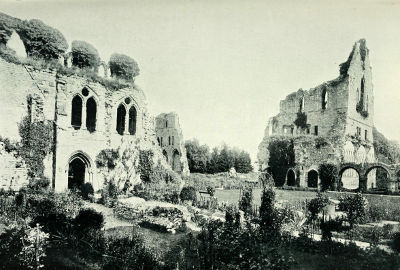
Photo by Frith
The ABBEY RUINS.
I wandered round the garden in the Cloisters, with
its lavabo and wrought-iron gates. On the lancet
windows of the Leper’s Chamber, white pigeons were
cooing and disporting themselves, and running up and
down along the level turf. Jackdaws amidst the ruins
were hurrying to and fro on the wing, with grub or
insect in their beaks. Above the chamber, where men
said the service was heard by the sick, there was a
mass of gold which shone like beaten metal against the
cloudless sky. It was the wild wallflower in a sea of
blossom. How busy all nature was—building, growing,
blossoming, and budding. Certainly a fair spring
morning is one of the undying joys of the world.
Later on I found myself in the little kitchen garden.
The later pears were then sheets of snow, and I noticed
that an apple flower was beginning to turn pink on an
espalier.
Burbidge I found busily occupied in dividing the
roots of the violets.
All through the winter, when frosts bound the ground,
he sent me in fragrant bunches of the double Neapolitan
violet, varied by bouquets of the Czar, the Princess of
Wales, and the red purple of Admiral Avalon.
Now all the roots were being lifted from the frames,
and little runners with minute fibrous roots planted,
some eight inches apart, in shady corners.
During the summer, Burbidge and his boys will cut
off every runner or blossom that may appear on these
plants, and keep them, to use his expression, “round
as a nest.” “I likes,” he said, “to give ’em hearts like
cabbages.” The first week in September, the violet
roots will be replaced in the frames “for winter blowing.”
In the mean time the frames are to be cleared, the
soil renewed, and then sown with asters, zinnias, and
my beautiful golden lettuces, that come over every year
from the Austrian seedsman.
Next to the frames, in little narrow beds, were lines
of choice daffodils, and I stopped to look at them.
They were of the largest and most effective kinds.
There was Emperor, and Empress, Horsfieldi, Sir Watkin
Wynn, Golden Spur, Mrs. Langtry, and beautiful
Madame de Graaf, and the brilliant sunset glory of
Orange Phœnix.
They made a brave show and found great favour in
my old gardener’s eyes. “Nothing mean about they,”
he said, only the day before, complacently to me.
“Look to the size. They be near the girth of roses,
and fit for any nobleman’s garden.” The old man
seemed to swell with pride as we looked at them
together. I had not the heart to be disagreeable and
to suggest that any should be plucked for vases, or to
deck the altar bowls, and I saw that my old friend was
relieved.
A little later I walked up the trim path empty-handed
and peeped into the gooseberry and currant
cages. The cages are made of fine wire netting, fixed
on poles, about twenty feet square, in which were
planted currants and gooseberries, to save their fruit
from the wild birds. Burbidge joined me. “So,” he
said, “they has nothing inside to rob them, not a
‘nope’” (as he calls the bullfinch), “nor them mischievous
‘poke-puddings’” (by which name some folks
here call the tomtits) “can interfere.”
A BULLFINCH CAN DO NO WRONG
Hearing my favourites, the bullfinches, attacked, I
could not help saying something in their defence.
“The cock ‘nope,’ as you call him, is so beautiful,” I
urged, “that surely he may have a few buds in spring,
and later on get a little fruit? Besides,” I added
warmly, “many people now say that he does no
damage, and that the buds, that he attacks, are already
diseased, and, anyway, would bear no fruit.”
But at this Burbidge waxed wroth. “The nope,”
he retorted angrily, “be pure varmint for gardens,
same as stoats be for poultry, and squirrels for trees;
and as to his colour, ’tis like looks in lasses, it hath
nought to do with character. I don’t see things, marm,
as you does. When yer sweats for a thing, there be no
halves in the matter. What’s a friend to my garden, I
be a lover to; but what’s foreign, I be a foreigner to,”
and the old man walked away in a huff.
After “our bullfinch war,” as Bess called it when I
recounted to her later the little episode, I walked up the
path that is edged by rows of double primroses. How
lovely they were in the neatest of little clumps, white,
yellow, and mauve, with here and there tufts of hen and
chicken daisies, roots of the single blue primroses,
brilliant polyanthuses, and the curious hose-in-hose
variety, which an old South Country nurse of ours used
to call “Jack-a-Greeners.” A little further on, I saw
some plants of the soft Primula Cashmeriana, which bore
leaves which looked as if they had been powdered with
milk of sulphur, and carried umbrella-like mauve heads
of blossom.
A little higher up the path I saw some fine plants of
Primula Japonica with its red whorls of blossom; and
at the top of the garden I came across a line of beautiful
auriculas. The most beautiful of all the primulas, I think,
is “Les Oreilles d’Ours,” as the French call these flowers,
with their sweet distant smell, like downs covered with
cowslips on dewy mornings, or golden apricots ripening
on southern walls. As I passed back to the Abbey, I
plucked a shoot off a black-currant bush. How fragrant
the budding shoots were. They recalled the perfume of
the bog myrtle on Scottish moors, only that the scent
had something homely and useful, but none the less
delicious.
Ten minutes later, and I was seated before my embroidery.
To-day I had a blue dragon to work. I tried
to see and to reproduce in my mind’s eye Burne Jones’
wonderful tints of blue with brown shades and silver
lights, and so the hours passed.
“A PATIENT HAS VIRTUES”
In the afternoon Bess visited Thady. “Mama,” she
cried, “I think Thady will soon be well, for all he was
so lame on Sunday. You see he wants to get well so
badly, and what people want badly they generally get.
I took him some pudding and some cake, and Nana
gave him some ointment. Nana,” said Bess, presently,
“seems quite kind now. Do you know, mamsie, since
Thady has taken her medicine, and rubbed on her lily
stuff, she seems quite to like Thady.”
“Ah, my little girl,” I laughed, “you are discovering
a very old truth. Nana has found a patient, and a
patient always has virtues.”
Bess did not quite understand, but declared it was a
good job that Nana had given up disliking Thady, for in
Thady, Bess found a most delightful and useful friend.
He had already made my little maid a whistle, and was
then engaged in making her a crossbow, and he is a
wonderful hand in whittling an ash or hazel stick in
elaborate designs, all of which are delightful and rare
accomplishments in Bess’s eyes.
All the week Bess ran up and down to the Red
House. Bess repeated her verses for the fête to Miss
Weldon, and gained what her governess called “word
accuracy,” but all gestures and action Constance taught
her, I heard. Besides this, I was told about the dance
which was being practised for the great day by eight
little town maidens in the disused room over the
stables of the Red House, and of the music which
Constance’s nice parlourmaid played. Constance endeavoured
to get eight little boys to dance also; but the
little lads were too shy, what an old woman, speaking of
her grandson, calls “too daffish and keck-handed to
learn such aunty-praunty antics,” and all that Constance
could get in the way of male support was to
induce eight little lads to look on, bend their knees,
and bow at intervals, whilst the maidens sang and
danced.
Bess was full of her verses and of her white costume,
and old Nana, for all that she grumbled much at first,
got stage-fever at last in her veins, and told me “that
none would look as well as her blessed lamb, and seeing
what the play was, and who made the dresses, and where
the flowers grew, she held it to be all foolish, overgrown,
mealy-mouthed righteousness on old Hester’s
part to stick out so obstinate and audacious again’ a
harmless bit of childer’s play.”
When I asked Burbidge if he and his men would get
me some primroses and bunches of marsh marigolds,
he was at first very wroth.
“Do yer take me for a loseller, marm?” he said,
using the old country word for an idler. “Do yer think
that I have nought to do, but to stump through wood
and field, pulling blows for a May folly?”
But since the first outbreak he softened, and now
he has begun to speak in a more kindly spirit, about
fine primroses as grow above Homer steps, marsh
marigolds as can be got near the Marsh Farm pool, and
about cuckoo pint and bits of green fern, and I have
little doubt that on May morning it will be found that
my request has been granted.
Burbidge and Nana will always do what we want
them, only give them time, as Bess says, for my little
minx, young as she is, has long discovered that with old
friends, and particularly old servants, there is often a
great deal of bark, but happily not much bite.
One day it had been raining all the morning. Everything
seemed growing. I could almost, as I looked out
of the window, see the chestnut buds swelling, and the
points of the yews were turning a reddish gold. Through
a window I could hear the canaries singing, singing and
filling the garden with melodious sounds. The sun had
gently pierced the clouds at last, and here and there
faint shades of delicate blue were to be seen.
Suddenly, as I sat by the window plying my needle
and admiring the rain drops glistening like crystals in
the grass, I saw my little friend, Thady, below on the
gravel walk. “What, Thady, you here!” I cried; for
Thady, to use his mother’s expression, was all himself
again, bare-legged and as merry as a grig.
“BEGORRA, IT’S ME”
“Begorra, it’s me,” replied Thady, “me myself, and
I’ve come to ask if yer will come a bird-nesting with
me, some day?” And he added, with the courtesy that
only can be found in an Irish imp, “’Twill be an honour
and a pleasure to guide yer leddyship to the rarest nests
in the country, and yer remember our talk some weeks
ago?”
So, after a little parley, it was agreed that the following
day, a Saturday, if fine, we would take our luncheon
into the woods, and that Thady should climb the trees,
as we had previously proposed.
We settled thus, the main point, for Thady, in his
own language, “was the best man whatever at that
sport.” “Whilst you are climbing,” I said, “we can
look for rare flowers and ferns, and find what nests we
can upon the ground.”
I asked Thady a minute later what nests he knew of.
“Galore,” he answered, grinning. And then proceeded
to enumerate them: “A lintie (a linnet), a green
grosbeak (greenfinch), a Harry redcap (goldfinch), a
yellow yeorling by the roadside, a scobby (chaffinch), a
lavrock (skylark), a cushie-doo (a wood pigeon), a cutty
wren (common wren), a nanny washtail (pied wagtail)
in the rocks, and two tom-titers of sorts. Then there be
hawks,” he called through the window, “and one by
Ippekin’s Cave as I don’t rightly know, bluish and
bigger than the wind-hover (kestrel) or the pigeon-hawk,
not to make mention of throstles and black ouzels
(blackbirds), which just jostle same as hips and haws in
October, but they’re hardly worth the point of raising
of a foot to see.”
So our plans were made, and I looked forward to
spending the morrow in the budding woods. Thady
was to be our guide, but no eggs were to be taken. This
was a matter of mortification to Thady. “Sure,” he
said, on another occasion, “I thought I would have
made the little lady, this year, the prettiest necklace
that ever was strung, fine and rare, for the May dance;
and,” he added, “yer leddyship must not forget that I
have eaten of Miss Bess’s blue egg, and so glad I would
be to show her a bit of favour.”
However, I succeeded in making Thady give up the
project of robbing the nests, by begging him to make
me a whistle, which, as my little daughter declares, is a
thing that might be useful to everybody—“to a lady,
to a bishop, or even to a Member of Parliament.”
The next day was a day of glorious sunshine—gay
and pure—one of those rare sweet days in spring, when
it does not seem possible for “rain, or hail, or any evil
thing to fall.” Little Hals, to our joy, came over without
governess or maid, only what Bess calls “under his
own care,” which she declared was best, because there
was then no need to be naughty; and Miss Weldon, to
the joy of all, vanished for the day to Shrewsbury; so,
to quote my little girl, “all seemed happy, and everything
just pure fun.”
As the old church clock struck eleven we started.
The groom boy, Fred, led Jill, the Stretton pony, bearing
a basket strapped on a saddle, which contained a simple
luncheon, and off we went into the woods.
AWAY TO THE EDGE WOOD
We started gaily; there were no trains to catch—always
a subject of congratulation—and we only left
word that we should be back for tea.
It was true that old Nana had black prognostications
about what “that villain Thady would do” (for since
Thady was cured, her kindly interest in him had ceased).
But I laughed at her fears. “Nan,” I cried out as we
left, “we will all take care of ourselves, and even Jill
shall come back safe and sound.”
We walked along the town, Bess and Hals running
in front, hand-in-hand, and Thady and I following
leisurely behind. In a few minutes we had left the
town behind us and were wandering up a lane, cut in
the lime rock, bordered with yews in places, and between
high hedgerows.
Hals begged that we might begin to bird-nest
at once; but Thady, who was master of the ceremonies,
shook his head. “Best wait, begorra, for the Edge
Wood, sir,” he exclaimed; “that’s the mightiest place in
the county for all that wears feathers.”
So we marched on steadily to the great strip of wood
which is known in Shropshire as the Edge Wood. This
strip runs for many miles, is very precipitous in places,
and consists of groves of oaks, patches of yews here and
there, hollies—the haunts of woodcocks—and in many
parts a rough tangle of hazel is to be found. It is a
sweet wild place, little visited save by bird and beast.
In one place the woodcutters had cut for some hundred
yards, and in the cleared spaces the ground was covered
with primroses, ground ivy, and the uncurled fronds of the
lady fern—still brown and crinkly. Groups of lords and
ladies reared themselves up amongst their sombre leaves,
and patches of dog’s mercury nodded and whispered
with their cords of green grain. Overhead, the larch in
a few branches was breaking into emerald splendour,
whilst pink tassels at the extremities trembled here and
there. Squirrels leapt into the trees and vanished at our
approach, and once or twice we heard, like a distant
curse, the rancorous guttural cry of the jay, and saw
one disappear into the undergrowth, a jewelled flash of
turquoise splendour.
In a ride below, I saw a magpie hopping about, its
long green-black tail bobbing up and down on the grass.
At this sight Thady gravely took off his cap and saluted
him, saying aloud—
“One for sorrow,
Two for mirth,
Three for a wedding,
Four for a birth.”
And then cried out in a tone of excitement, “Look out,
yer leddyship, begorra, look out for another; for it is
mirth to-day and no sorrow whatever that we must
have.”
Then we plunged into the heart of the wood. Fred
and Jill alone kept to the path. How lush it was, that
soft moist turf in April, all teeming with moisture
and freshness—not even the driest summer sun can
parch or dry the soil of the Edge Wood. Here and there
I saw little plantations of self-sown ash amidst beds of
downy moss, and everywhere hundreds and thousands
of little infinitesimal plants, struggling for existence. As
I walked along I noted open glades, which later would
be rosy with pink campion, or purple with the stately
splendour of the foxglove. Now and then a bird flew
away, and I saw at intervals the white scut of a
frightened rabbit.
BIRD-NESTING WE GO
Suddenly Thady stopped before a yew tree. Hals
and Bess followed, panting and crying out eagerly,
“Where, where?” for Thady had discarded his jacket,
and in a twinkling had thrown his arms round the tree.
In a second he was aloft. “A lintie’s nest,” he whispered,
and then peered in. A minute later he called out,
“Two eggs.”
“Will you bring one down?” we said in chorus.
For all answer, Thady nodded, slipped an egg into his
mouth, and then proceeded to descend. We looked at
the little egg that Thady held out on the palm of his
hand. It was of a pale bluish white, speckled and
streaked with lines of purplish brown.
After we had all peered over it, the egg was put back
solemnly by Thady.
A little further on, and Thady again halted. “Here
it be, yer leddyship,” he cried, in a high treble; and
there, sure enough, looking upward, we discerned a nest
of twigs and roots. It was quite low down, and I was able
easily to lift up the children to get a peep themselves.
The little nest was lined with hair and wool stolen from
the neighbouring fields, but as yet there were no eggs.
“A nope’s (bullfinch’s) sure enough,” said Thady, dogmatically.
Then on we wandered until we paused below
a fir tree. Below the bole of the tree there was no
herbage, for the fir leaves had fallen like needles and
had pierced and stabbed the grass to death—so it was
quite bare now, not a leaf, or even a patch of moss; as
bare, in fact, as a village playground.
Suddenly we heard overhead a loud, ringing clap of
wings, and as we looked up, we saw an ill-made nest of
sticks, and two eggs, which last we could see glistening
inside, like two button mushrooms. For a minute I had
a vision of a big departing bird of a soft lavender grey,
and as I looked, Thady called out, “Quice,” which is the
Shropshire name for the wood-pigeon. Thady was
anxious to mount the tree and bring me down an egg
for closer inspection; but I begged him not to do so,
for the Cushat-Doos, as he tells me he has heard them
called in the North Country, are very shy birds in a wild
state, and I have been told will never return to a nest
where the hand of man has trifled with eggs or nest.
I lingered, looking up at the shining round pink eggs
with the light glimmering through the twigs; and then
I mounted up the hill, which was very hard work, for both
children were a little weary and hot, and I went up the
incline, pulling both up as best I could. Mouse kept close
to my heels. She had had dark suspicions ever since
we entered the wood, and was convinced of the existence,
I felt sure, of robbers, footpads, wolves, and also of
innumerable vague dangers, and alarms.
We passed a blackbird’s nest, but Thady waved his
hand in lofty disdain, and refused to pull back the bough
so that we might look at the eggs. “’Tisn’t for dirt like
that that I’ll trouble yer leddyship and the young squire
to spier round,” he exclaimed. “The black ouzel is
just a conny among feathered folk, or what blackberries
be ’mongst the fruit.”
Thady seemed to know every inch of the ground.
“It isn’t in woods or field that I forget myself,” he remarked
to me, when I commended him for his knowledge
of the Edge. “Devil a bit,” he said, “if I have
ever lost my way along, or missed a mark or forgotten
the bend of a stick; but,” he added, in a tone of contrition,
“’tis in the book larning and figures that Thady
Malone cannot always discern rightly.”
At last, after much puffing and panting, we reached
the top of the hill.
THE SCOBBY’S NEST
“Like enough we’ll find a scobby’s nest in the
hedge,” said Thady. Then he went on to say, “They
be wonderful builders be scobbys; ‘tight and nanty,’ as
folks say here.” And sure enough, a little further on,
fixed in a branch of blackthorn, we saw a little nest of
exquisite beauty. Outside it appeared to be built almost
entirely of lichen, pulled off the bark of trees; whilst
inside it was lined with hair and feathers, woven together
with marvellous dexterity. There were three eggs,
all of a reddish pale grey, blotched here and there with
vinous patches.
As we stood watching the nest, the handsome little
cock chaffinch eyed us anxiously. With a quick movement
he turned round, and we caught the flash of his
white wings. “A bobsome, joyous little gent,” said
Thady; “a scobby, I have heard folks say, is the last
bird to give over singing in summer.”
Then we sat down to luncheon. “We must eat,”
Bess cried with conviction; “seeing so many nests has
made me feel eggy with hunger.” All round us the
birds filled the thicket with the joy of their carols.
“The place fair swarms with them,” observed Thady,
“but come a week or two, we shall have all the foreigners
over.” By which he, doubtless, meant the arrival of all
the delicious warblers that come from the South in
spring, not to mention many of the cock chaffinches,
most of the pipits, the yellow water-wagtails, the
gorgeous redstarts, and the beautiful turtle, or Wrekin
doves.
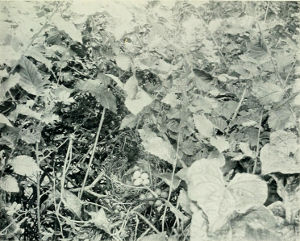
NEST OF GREENFINCH.
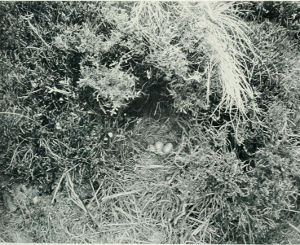
NEST OF RING-OUZEL.
Photos by Mrs. New.
Listening to the different notes, we sat down and
got our luncheon, which Bess and Hal, who had
acquired the appetite of hunters, declared was fit for
any king, and believed that even Nan, if she had been
there, wouldn’t grumble.
“When I’m at home,” said Bess, after a pause, “I
eat mutton, but here I call it the flesh of sheep,” and as
she spoke she put upon Hal’s knees another slice. Hal
looked at her and retorted gravely, “Mutton isn’t good,
but the flesh of sheep is fit for a general.”
Thady, overhearing these remarks, exclaimed, “Begorra,
it is a poor place where Thady Malone cannot
eat to your leddyship’s health.” And added, “Deed,
I’m like Mrs. Langdale’s chickens, I could peck a bit
wherever it was.” So saying, he fell heartily to work
on some huge beef sandwiches which had been prepared
for him and Fred, by Auguste. A few minutes later, the
girths of the saddle were loosened and Jill was allowed
to graze at her own free will, nipping and cropping the
tender grass with avidity.
“Mamsie,” said Bess, after the last scrap of chocolate
had been eaten, and the last Blenheim orange apple
munched, “have you no fairy-story to tell us, for you
know, this is a real place for fairy-tales.” Then the
children crept under my cloak, and I rambled on aloud
about princes and princesses, giants and dragons, enchanted
castles, good and evil fairies, and knights and
ladies.
Thady approached our group and listened also.
“’Tis better nor a theatre,” he was kind enough to say,
as I came to an end at last, with the happy marriage of
the prince and princess, and a description of the royal
festivities on that occasion. “Begorra,” he exclaimed,
“I’d like to be a man, and fight dragons and giants.
Fightin’ is the life for me.”
Then we got up, packed the basket, and prepared to
return homeward across the fields. Jill was caught,
but could with difficulty be girthed, so enlarged had she
become by several hours of happy browsing; but after a
struggle the saddle and basket are put on, and we turned
our heads homewards. Hals had been silent for the
last few moments.
“Well,” I said, “what is it?”
“I too should like to fight,” he answered, “but it
must be on a horse and in armour.”
THE GLORY OF AULD OIRELAND
“’Tis all one, sir,” replied Thady, cheerily, “so long
as yer get a stomach full of blows and can give good
knocks back. Fighting,” he explained, “is what makes
the difference between boys and girls, and it is the glory
of auld Oireland.”
We talked away and walked homeward. There was
a nest of a cutty wren in a juniper bush, which Thady
knew of, and a tomtit’s in a hollow tree, beautifully
made of a mass of feathers, and in it were many tiny
eggs, almost too small to touch without breaking, and
Fred lifted both children up to see. A little further on,
Thady pointed away to a distant orchard that encircled
two lonely cottages nestling against the opposite hill.
“There,” he said, “be the nest of a Harry red-cap.”
But our energy had died away for bird-nesting. “It
shall be for another day,” said Bess. And then added
dreamily, “I didn’t think I ever could have seen bird-nests
enough, but I think some other play now would be
nice.”
So we walked on, Hals leading the way, and Thady
bringing up the rear and whistling, as he went along, the
Shan Van Vocht. Thus we returned home, Bess and
Hals riding on Jill in turns. The cry of the cuckoo
pursued us like a voice out of dreamland, while the
scents of the sweet spring day were wafted to us on a
hundred eddying breezes.
In the evening I found a note from Constance at the
Abbey. She sent me a full list of the flowers she
proposed working on the quilts, and added, “What do
you think of these words about sleep?—
“‘Sweet sleep fell upon his eyelids.’—The Odyssey.
“‘Sleep and death.’—The Iliad.
“‘Death and his brother sleep.’—Shelley.
“‘Sleep thy fill, and take thy soft repose.’—Quarles.
“‘Sleep in peace and wake in joy.’—Scott, Lord of the Isles.
“‘Never sleep the sun up.
Rise to prevent the sun.’—Vaughan.”
When I had written to Constance, I thought of bed
in a happy sleepy state of mind. As I brushed out my
hair, I went over our pleasant long day in the woods,
away from men, and noise, and even home. A day spent
amidst birds and beasts, looking at nests, resting on
mossy banks, and seeing only the sweet, sprouting
things of field and lane, is a delightful thing.
Is there anything better than a day out in the heart
of the country? As I slipped into bed, Bess’s last words
came back to me as she went off to her cot. “Is it
really very wicked, mamsie, to take nests and eggs?—for
Fred says he has done it scores and scores of times,
and he doesn’t see no use in such things if they can’t
make sport for young ladies and gentlemen.”
“Some day you will understand,” I had replied.
“One cannot know some things when one is very
young.” And I have often noticed with children, that,
up to a certain age, the uneducated view of everything
is the sympathetic and natural one; later, to a few, the
light does come.