Having still a few days to spare, I decided
to try for a Rocky Mountain goat on the Mainland.
Lansdown had lived for some years at the
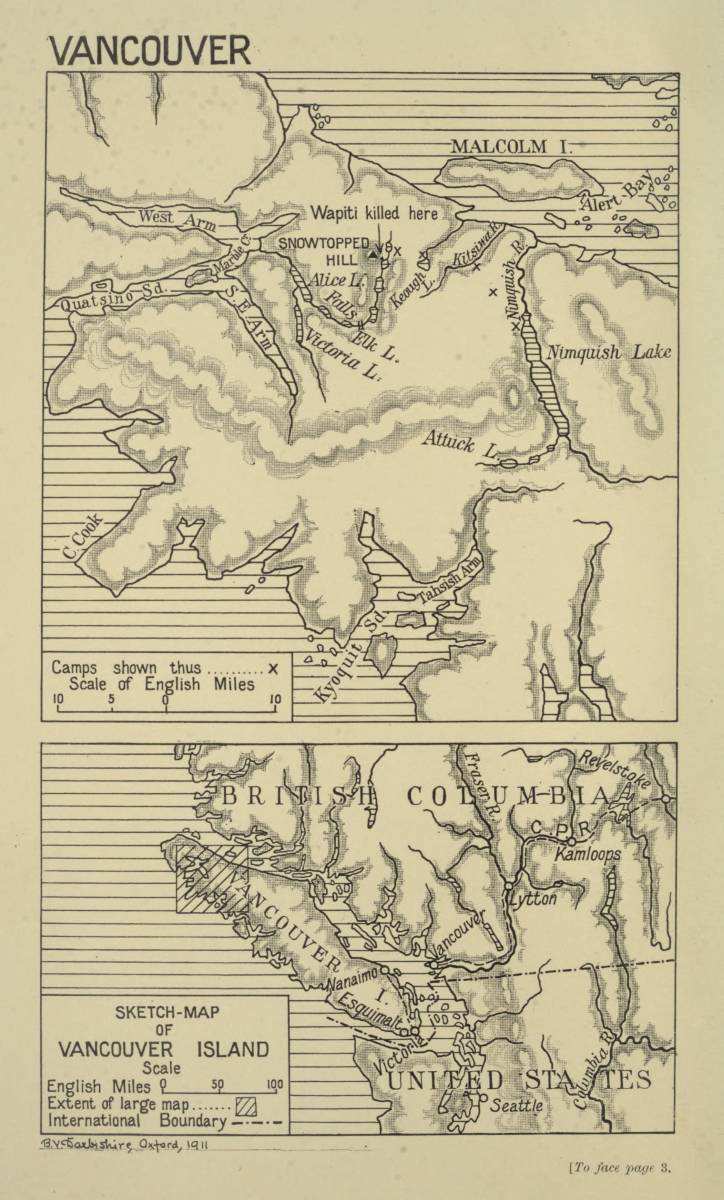
head of Kingcome Inlet, one of the great inlets
running in to the Mainland, just behind the
island on which the town of Alert Bay is
situated.
He stated that goats were plentiful but that
one would have to climb up to the tops of the
mountains at this season of the year. He also
pretended to an intimate knowledge of every
turn and bend of the inlet, and the best campgrounds.
I accordingly engaged him and his
sixteen-feet rowing and sailing boat for the
trip.
September 17th. We started early for Alert
Bay and were fortunate in getting a tow across
from the timber company's steam launch, and
arrived at Alert Bay in the early forenoon.
We laid in ample supplies of provisions at
Mr. Chambers' store and with some difficulty I
got the men to start at 3 p.m.
My two bottles of rum had long since been
exhausted though only taken in homoeopathic
doses. The difficulty was to get more. No
spirits were allowed to be sold in Alert Bay, a
passing steamer was the only chance, and fortunately
one was due before we started.
My friend Mr. Halliday saved the situation.
He as a magistrate gave me a certificate that
the rum was required on medical grounds,
without which the Captain of the steamer
would have refused to part with any. I was
the envy of the entire Indian population as I
left the steamer's side with a bottle of rum
sticking out of each of my coat pockets.
It was a lovely evening and though Mr.
Chambers had offered us a tow with his steam
launch, which runs to the head of the inlet
once a fortnight, if we would wait two days,
I preferred to get away rather than kick my
heels about Alert Bay.
Rowing up to the mouth of the inlet with a
flowing tide we made about seven miles, and
camped at 6 o'clock on a rocky islet where we
found an ideal camping ground, near which
some Siwash Indians had settled for the summer
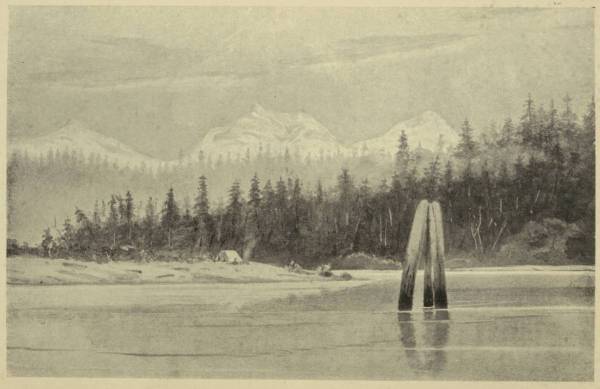
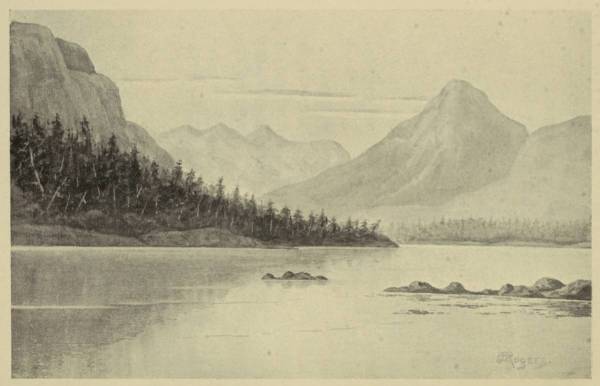
fishing. The scenery was superb. A background
of the snow-covered mountains of the
Mainland, in the middle distance many islands
clad with wood down to the foreshore, a sea
like glass in which mountains, islands and
forests were reflected and the surface only
broken by the eddies of the flowing tide.
The sunset was glorious and the colouring
indescribable.
That evening, we saw a remarkable sight.
Pilot whales in schools were common at the
Campbell River, but here came a great whale
all alone ploughing his way up the inlet and
coming up every few minutes to blow—once
he threw his entire body many feet out of the
water and came down with a crash which
echoed through the surrounding islands.
September 18th. After a hearty breakfast
we got away about 9 a.m., but by 12.45 the
appetites of the men called for a halt. Noon
never passed without a spell for food being
proposed.
Trolling with a spoon and a hand line, for
I had left my rod at Alert Bay, I got a nice
cohoe of about ten pounds, and strange to say
quite good eating.
At 4 o'clock a halt for the night was
suggested, but I would not have it, and as
Lansdown said there was a good camping
ground some four miles away, we pushed
on.
The sides of the inlet were so steep that it
was only in certain places that ground where
a tent could be pitched was to be found.
Lansdown had lived twelve years on the
inlet, but his bump of locality was sadly deficient,
for it took us three and a half hours to
cover that four miles which must have been
nearer nine, and I had to take the oar for the
last two hours.
At last we reached the cove with a shelving
sandy beach, but it was pitch dark and the rain
was coming down, so I fear I was rather short
with poor Lansdown, who had kept promising
the camping ground a few yards round every
point we passed.
September 19th. The camping ground as
seen in the daylight was an ideal one. There
was no undergrowth, and a grassy glade in the
shelter of the great trees was a perfect site for
the tents. A head wind had got up and the
rain was still pouring down, so the prospects
were not very encouraging, but still by tacking
and rowing we made about seven miles when
we were picked up by Mr. Chambers' launch
and taken on to the head of the inlet where the
Kingcome River falls into the sea. The
scenery all up the inlet was very fine. The hills
got more and more perpendicular as the head
of the inlet was approached, and were clothed
with dense forest down to the water's edge.
Down the ravines from the hill-tops 3,000
feet high poured great waterfalls, and rain-clouds
and mist swept over the tops of the hills,
giving from time to time a glimpse of distant
snow-covered peaks some 6,000 feet high.
The evening was fine and by 6 o'clock we
were anchored in the river opposite a few
settlers' houses.
We found Lansdown's old house, somewhat
dilapidated but habitable. There was abundance
of sweet hay and it was a luxury to spread
my blanket on a hay-strewn dry wooden floor
with a rainproof roof over my head.
Most of the settlers, including Lansdown's
strapping brother, came round to have a chat and
to hear the news from the outside world. They
seem to have a fairly easy time chiefly raising
cattle, for the delta formed by the washed-down
detritus from the hills was a rich white soil on
which a fine crop of grass was raised. There
were a good number of wild duck about, and
the settlers were a sporting lot, so they amused
themselves with the evening flighting and with
occasional trips up Mount Kingcome, which
overshadowed the valley, after goat, deer and
bear.
September 20th. It was a fine morning and
the snow-covered peaks of Mount Kingcome
about 6,000 feet above us, where we hoped to
find our goats, were glistening in the morning
sun.
Smith was hors de combat—I had offered to
send him home from Alert Bay, but he said he
was quite fit to go on. I think he was a bit
nervous when he saw the climb before him, for
carrying a pack up the steep mountain was no
joke.
I was fortunate enough to secure the services
of Harry Kirby, one of the settlers who knew
the country well and he was willing to take
Smith's place; a better man after goat I could
not wish to have. He was very deaf and
somewhat outspoken. Looking me over he
said, "You are too stout for goat," which I
rather felt to be true, though the trip after
wapiti had fined me down considerably. I
was, however, in hard condition by this time,
and half-way up when we stopped for a midday
meal, he quietly remarked, "I think after
all you will do," and so my character as a
prospective goat-hunter was restored.
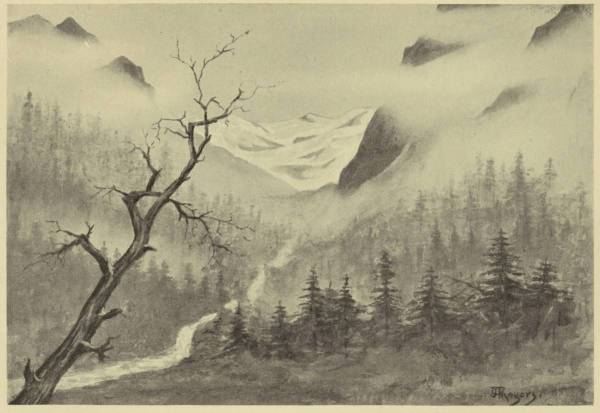
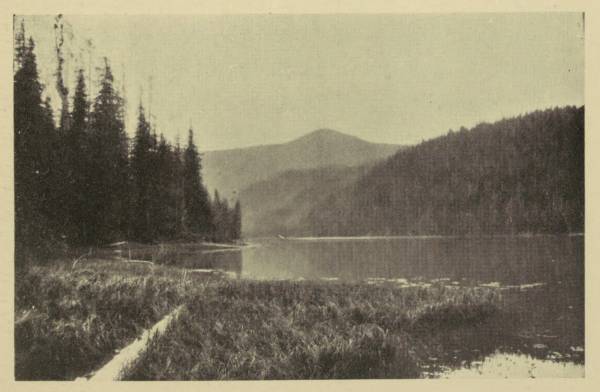
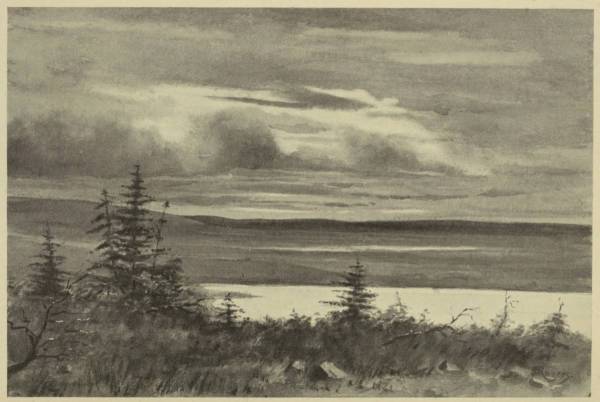
MORNING MISTS ON MOUNT KINGCOME
[To face page 138.
Quite a good track was blazed and cleared
for about half-way up the hill, and the path
though very steep was not bad, only hard on
the men carrying the packs, so spells for rest
were fairly frequent. The last half where the
track had not been cleared was real bad going.
A great torrent swept down the bottom of the
steep ravine we were ascending, and it had to
be crossed many times, which meant a wetting.
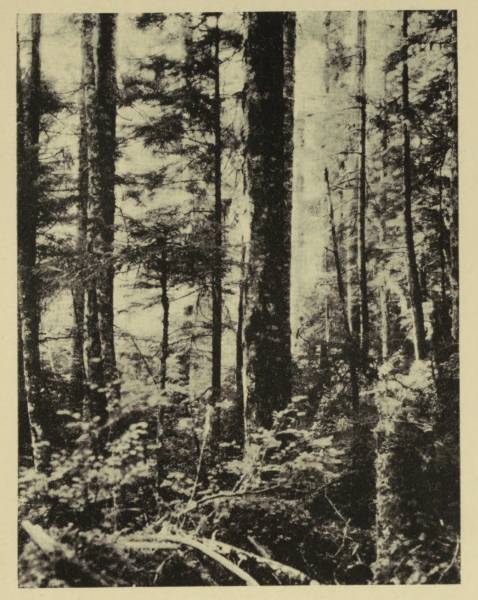
The undergrowth was a dense tangle, fallen
trees blocked the path and never had we met
the accursed devil-club in such abundance.
All things must come to an end, and by 5
o'clock we were clear of the forest and entered
a fairly open valley, shut in on all sides by
steep cliffs. At the end of the valley rose the
snow-covered summit of Mount Kingcome
about three miles away.
We had been marching since 9.30 and had
ascended about 4,000 feet. We pitched camp
in the last clump of wood in the valley, and on
the side of the hill.
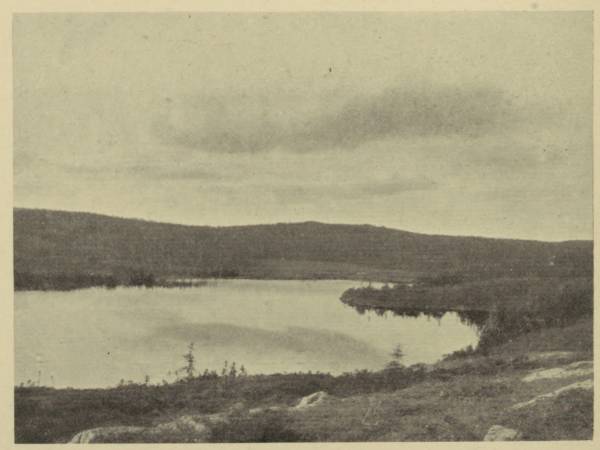
Though the forest ceased, there were dense
masses of impenetrable cover, consisting of
salmon-berry, wine-berry and devil-club, for
about a mile up the valley, after which the
ground was quite open.
Large patches of snow were lying on the bare
hills just above the cover—and while selecting
our camping ground, I suddenly saw a black
object moving across a snow patch about half-a-mile
across the valley.
Leaving Kirby and Lansdown to pitch the
camp I took Thomson with me, and getting
within about 500 yards of the snow patch, saw
what looked like a small bear, but as Thomson
said, "I never saw a bear with a long tail."
The animal was moving quickly over the snow
and getting closer every minute to a patch of
dense cover. No doubt it was a wolverine. I
had a long shot at about 400 yards and knocked
up the snow under his belly. In a moment
he was in the cover and we never saw him
again.
Further up towards the head of the valley
we saw a bear moving across a patch of snow,
but he, too, disappeared in the cover. Evening
was now closing in, so we turned towards camp.
About a mile away, just opposite the camp and
on some almost precipitous rocks a goat suddenly
came into view round a corner of the
rock. He must have been lying down all the
time out of sight, and it was bad luck not having
seen him before, for though to climb the face
of the cliff was impossible, we might have got
a long shot from below; as it was, by the time
we had got up to the foot of the cliff, it was too
dark to shoot, so we decide to leave him till
next day.
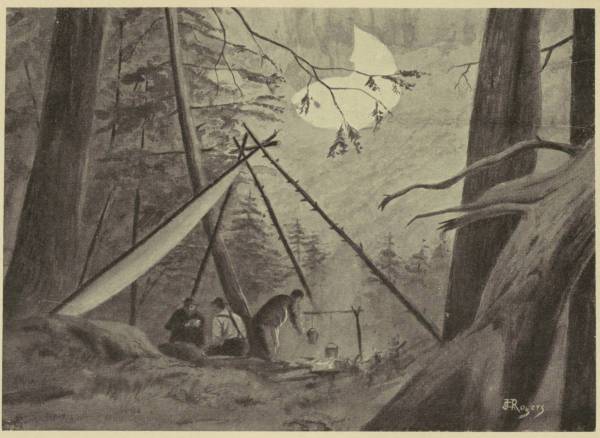
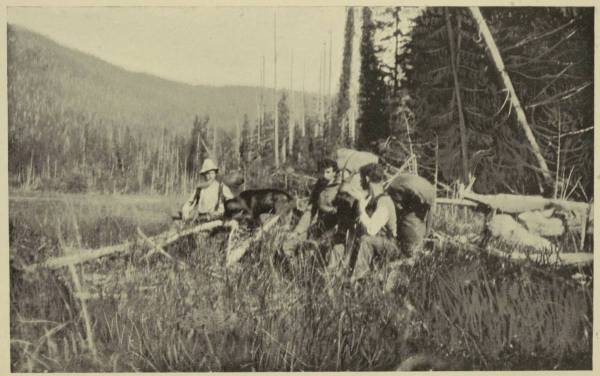
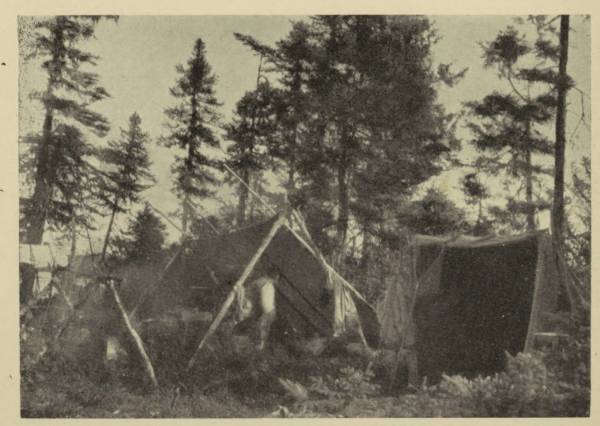
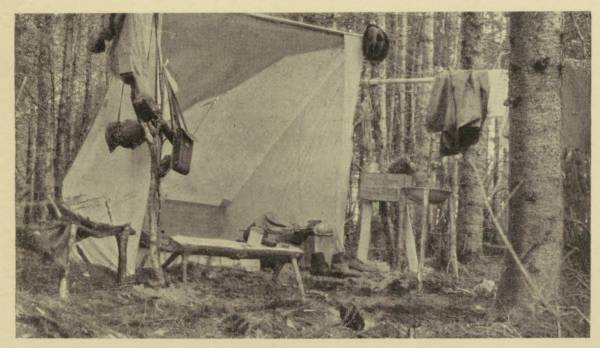
CAMP ON MOUNT KINGCOME.
[To face page 140.
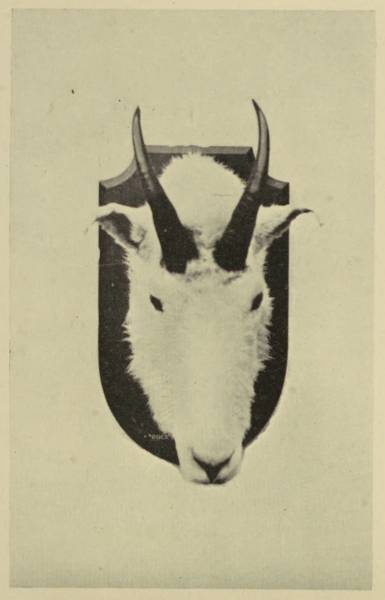
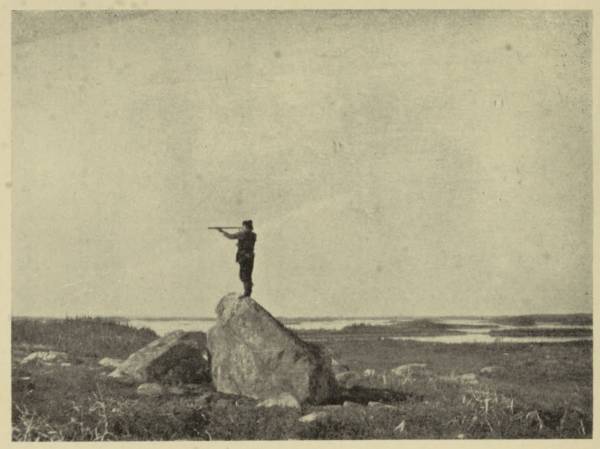
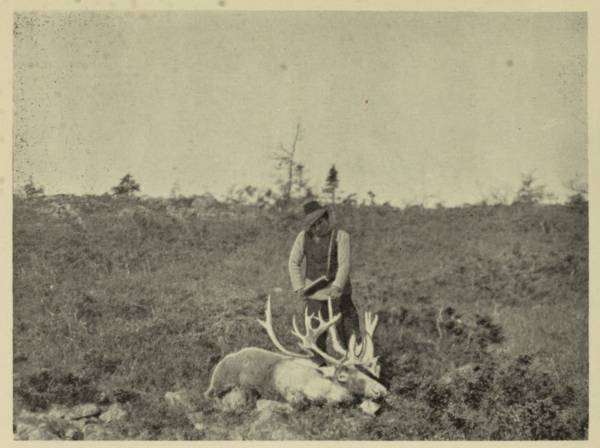
A ROCKY MOUNTAIN GOAT
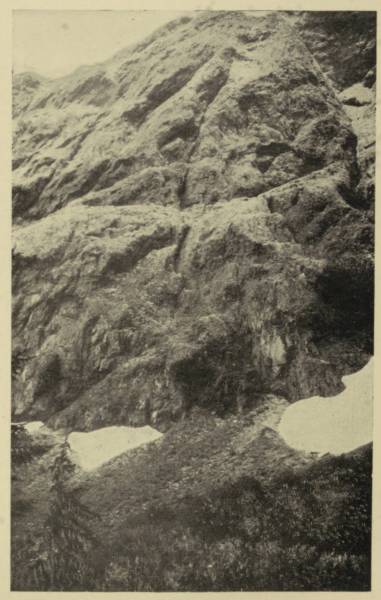
THE GOAT COUNTRY
[To face page 141.
At last I had reached a game country, having
seen a wolverine, a bear and goat in one afternoon.
September 21st. It had rained all night
but cleared up in the morning. Before I had
turned out, Kirby reported the wolverine
crossing the same patch of snow opposite the
camp about half-a-mile away. Slipping on a
pair of boots, I rushed out in my sleeping
clothes. Getting the glass on to the beast, I
found that this time it was a bear making
tracks for the valley we had come up, and no
doubt after the salmon which were rotting in
thousands on the bank of the river below.
He was into the cover before anything could
be done in the way of a stalk, and did not appear
again.
Examining the ground, I found the valley
extended up to the base of Mount Kingcome
for about one and a half miles. The sides were
precipitous cliffs quite impossible to climb.
The slope up to their base was clothed with
dense undergrowth, while a creek fed by the
melting snow and the rain from the surrounding
hills was tumbling noisily down below our
camp.
The head of the valley narrowed rapidly
until completely shut in by the mountains, the
tops of which were covered with snow. Large
patches of snow lay in the hollows of the hills
all round, never melting even in the summer
months.
The air was cold, but bracing, just the day
for a stalk. Spying the valley carefully, I soon
found a goat high up on the cliff to the right.
I think it must have been our friend of last
evening, who had fed along the side of the hill
to his present position up in the valley. The
ground did not look impossible, but Kirby pronounced
against it as too dangerous.
Higher up on a hill-top at the far end and
just on the edge of the snow, I picked up with
the glass two more goats and we decided to go
for them. It was easy going to the foot of the
hill where the valley ended, but a really stiff
climb of about one and a half hours to get up
to the patch of snow close to which we had seen
them, above the line of cover; the hill-side was
covered with a sort of heather growing between
the rocks and it was very slippery going.
As we arrived at the spot and were looking
everywhere for the goats, I saw two goats, a
nanny and a kid, moving away about 400 yards
off and climbing steadily up the face of the
cliff. We both thought they were the two we
were after, who had seen us or got our wind.
We were now 6,000 feet up and it was quite
cold enough without a blizzard which suddenly
set in with a bitter wind, which drove the snow
and sleet almost through one.
We were huddled under a sloping rock,
trying to get a little shelter, when it struck me
to send Kirby up and see if by any chance the
goats were still where we had seen them first,
as possibly the two we saw moving away were
another lot. It was lucky I did so, for he was
back in a few minutes with the good news that
our goats were feeding quietly in a hollow behind
a ridge not a hundred yards above us.
I never was so cold in my life, but leaving
Kirby behind, I crawled up to the top of the
ridge, and looking over saw to my delight a good
billy and two nannies feeding a hundred yards
away.
Getting into position for a careful shot, I
proceeded to remove the caps of my telescope
sight, which I had kept on up to the last moment
on account of the rain and the snow.
At the critical moment the front cap jammed,
and with my half-frozen hands it took me a
couple of minutes, which seemed hours, to get
it off. Peering over I saw the goats moving
off, they may have got our wind, for heavy
gales were eddying round the top of the hill.
The two nannies fortunately went first, the
billy was moving on pretty quickly behind. I
had just time to get a shot, another moment
and he would have disappeared behind some
rocks, and I heard the welcome thud of the
bullet; he stood for a moment, and as the extraordinary
vitality of the mountain goat had
been impressed on me by Kirby, I gave him a
second shot, and he came rolling down the hill
like a rabbit, stone dead.
Had it not been for the jamming of the cap
I would certainly have got one of the nannies as
well. He was a fine beast, much heavier and
bigger than I had expected.
The snow was still falling and we were both
shivering with cold. While still undecided
what to do a momentary break showed us two
more goats, one a fine billy right across the
valley and a little higher up, and as the day
was young we decided to have a try for them.
Climbing about 500 feet up, we arrived practically
at the summit and were spying as to the
best way to try a stalk, for the valley was now
disturbed and the goats were on the alert and
looking about in every direction.
Unfortunately, the snow set in worse than
ever and blotted out any view of the hill. To
attempt a stalk on such dangerous ground
would have been madness, so we turned back
and went down to where we had left the dead
goat. The cold was now so intense we could
not remain to skin the goat, so made straight
for camp. The going on the way down was as
bad as it could be. The newly-fallen snow
lying on the heather had made it very slippery
and almost dangerous. I had many a slip
but generally landed sitting down, and arrived
at the foot of the hill bruised but thankful,
for after all I had got my goat. This was real
sport: to find your game, mark him down and
then an honest stalk, ending in a kill; but it
was stiff work and a little too much for a
man of my age.
We had come down about 2,000 feet,
and the snow had turned into rain, which
felt quite warm and comforting after the
blizzard on the hill-top. Kirby was so cold, he
asked leave to go ahead, and I soon saw him
running down the valley and skipping like a
goat from rock to rock. Taking it easier, I
got to camp about 5 o'clock, fairly tired out.
September 22nd. It rained and snowed all
night, and for the first time the little tent was
not waterproof. The weather cleared about
8 a.m., and the morning sun broke through
the rain clouds and mists which were sweeping
away from the hill-tops; the effect was most
beautiful.
The hills where we had been stalking yesterday
were entirely covered with snow, and
patches were lying far down in the valley. I
sent Kirby and Lansdown up to skin the goat
and bring in the head and skin, while I made
preparations for striking the camp and going
down the mountain on their return.
They returned about noon, and we were just
preparing to start when I saw a bear—probably
the same one we had seen before, moving
rapidly up the valley at the foot of the cliff
and across one of the numerous patches of
snow. Seizing the rifle I dashed down, followed
by Thomson, to try and get a shot. I
left my coat, in which I always carried spare
cartridges, behind.
By the time I had crossed the creek, the
bear was well ahead and looked about 300 yards
away. Putting up the 300 yards sight, I knelt
down, rather breathless and shaky from my run,
and fired. The bullet knocked up the snow in
a good line but short. This started him off at
a run and he was getting farther and farther
away as I fired two more shots, which also
struck low. My last chance was another shot
before he reached the thick cover, and, aiming
right over his back, I hit him, where I could not
say. He must have been 400 yards away
when I fired. On being hit, he stumbled forward
and turned right down hill into some
dense undergrowth which extended right down
to the creek.
Having only one cartridge left, I sent
Thomson back to camp for cartridges, and sat
down behind the rock from which I had fired
to await events. My impression was that he
was badly hit and that we would have to follow
him up in the cover. To my surprise, I suddenly
saw him come out of the cover and come
down to the creek. He was not more than
150 yards away and passing between a lot
of big boulders, and it looked as if he were
heading up the valley.
Thinking it was my last chance, I fired and
saw the bullet hit a rock just over his back.
To my horror, I then realized I had left the
telescope sight screwed up to 300 yards. Worse
luck was to follow, for the shot turned him
and he came down the creek towards me,
very slowly and looking very sick. There
was I without a cartridge and a wounded
bear apparently walking on top of me. I lay
quite quietly behind my rock, and had the
pleasure of seeing him come within thirty yards,
when he turned slowly and, crossing the creek,
entered the dense undergrowth on the other
side just as Thomson came up with the cartridges.
It was as bad a moment as I have ever
experienced in my sporting life. At first we
could trace his movements by the shaking of
the bushes, and at one time, this ceasing, he
apparently lay down.
I knew it was hopeless following him in such
undergrowth, for not only was there the danger
of being charged, but if even I could have made
my way through the tangle, it would have been
impossible to put the rifle to my shoulder.
Thomson would not give him up, but begged
I would lend him my rifle and he would follow
him up.
I returned to camp utterly disgusted, and in
about one hour Thomson returned, saying he
had crawled through the cover, found lots of
blood, saw the bear once in the distance, but
could not get a shot. The worst of it was, it
was now too late to start, and to make matters
more depressing, rain and sleet fell all the
afternoon and night.
September 23rd. The rain had now turned
to snow, which was lying as low down as the
level of the camp. Everything was sodden,
and a wet march was before us.
We got away by 9 o'clock, and had a
hard march as the creek was now a roaring
torrent, which we had to cross and recross
several times. Going on the rough boulders,
over and round which the flood was pouring,
was as bad as it well could be, and we were all
wet through by the time we reached the cleared
track. Our last view of the valley, before we
entered the forest, was superb. The rain had
cleared away, a bright sun was breaking
through the heavy clouds, which were being
swept away from the summits of the snow-clad
hills and from the slopes of the valley, now
dazzling white in the morning sun, while looking
back through the forest we were just entering
the trees stood out in black silhouette against
a background of snow. It was with deep
regret I turned my back on the Goat Valley,
where I had seen more game in two days than
in all the rest of my trip.
By 3 o'clock we reached the Kingcome
River, but it was too late to make a start that
night.
September 24th. We got away at 8.15.
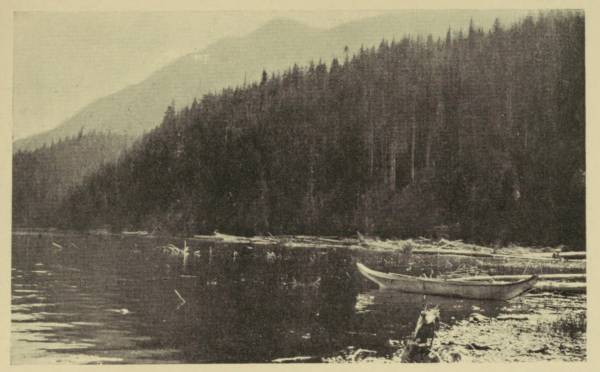
The morning was fine, and the inlet and snow-covered
peaks behind looked very beautiful.
The current always runs down this inlet irrespective
of the tide, though it is, of course,
stronger with the ebb. We made only one
halt for lunch, and by 7.15 p.m. reached
Quiesden—a deserted Indian village thirty
miles from the head of the inlet; not a bad
performance, as we had to row the whole
way.
Here we found an empty mission house, and
Lansdown somewhat burglariously effected an
entrance through a window and opened the
door from inside. We soon had a fire going in
the dilapidated stove, and settled down comfortably
for the night on the bare boards.
They were at least dry and we had a roof over
our heads. The walls of the sitting-room were
mostly decorated with texts, but a coloured
illustration representing a young naval officer
making violent love to an extremely pretty
girl showed that even missionaries have a
human side to their nature.
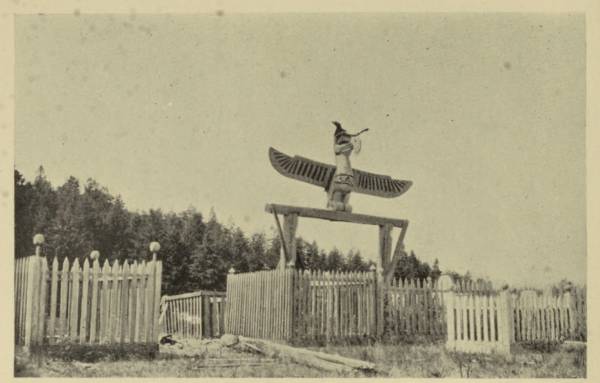
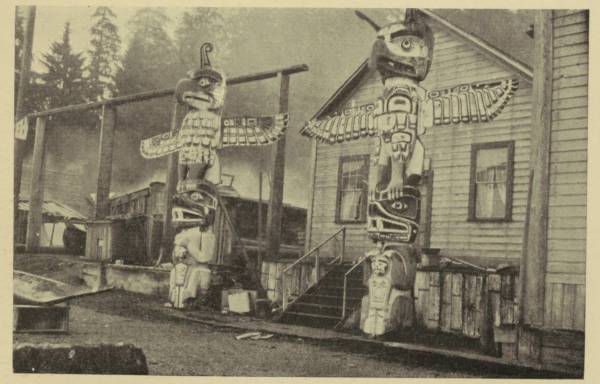
The village was entirely deserted, all the
inhabitants being away fishing. There were
some fine totem poles, and the woods all round
were the cemetery of the neighbourhood—the
bodies of many departed Siwashes, packed in
boxes or bundles, being slung up in the forks
of the trees—the Siwash method of burial.
September 25th. Leaving Quiesden at 8.15,
we had a fine sailing breeze which before night
had increased to half a gale, and on arrival at
Alert Bay, about 3 o'clock in the afternoon,
Mr. Chambers most hospitably put me up till
my old friend the Queen City, due at 1 a.m.,
should arrive.
September 26th. The Queen City did not
arrive till noon, and bidding good-bye to my
kind friends at Alert Bay and to Lansdown,
who was returning to his farm on the Nimquish,
we were soon on our way to Vancouver.
Accounts had to be made up and good-bye
said to Smith and Thomson and my dear
friends "Dick" and "Nigger," for they were
all to be landed at some unearthly hour in the
morning at Quatiaski Cove. All the roughing
was over, and the comforts of civilization were
before me, yet it was with sincere regret that
I saw the last of my friends and companions.
The discomforts were forgotten, the sodden
forest, the rain, the indifferent food, and the
poor sport, but the impressive scenery of the
vast Vancouver forest, the still lakes and
rushing creeks, and the beauty of the Kingcome
inlet, with its setting of snow-covered mountains,
will remain indelibly impressed on my
memory, and as the prospect of future trips
becomes more remote, the recollections of those
days will always be with me. The call of the
wild may be as strong as ever, but the capacity
to respond to it must diminish as years roll on.
The man who has not a love for the solitudes
of nature and the simple life in camp, misses
experiences which to me at least have been
amongst the keenest enjoyments of my life.
September 27th. We arrived at Vancouver
about 5 p.m. That day I saw Mr. Williams,
just returned from inspection and sport in the
Kootenay district. He reported game plentiful
and brought back two fine sheep heads which
he had secured after hard work and stiff
climbing.
I left Vancouver on the 29th and, changing
trains at Winnipeg, arrived at Toronto on
October 3rd—four hours late from Winnipeg.
Leaving Toronto the next morning, I spent
that evening and the following day at Niagara
Falls, arriving in New York in the early morning
of the 6th. Through the kindness of Mr.
Griswold, I had been made an honorary member
of the Knickerbocker and Union Clubs. More
luxurious and better-managed clubs could not
be found in any capital of Europe.
At 10 a.m. I was once more steaming out
of New York on the Blücher, one of the slower
steamers of the Hamburg-Amerika Line, and
after a most comfortable voyage, with charming
fellow-passengers, I disembarked at Southampton
on the 17th—just three months and seven
days from leaving England.