New original cover art included with this eBook is granted to the public domain.
SPORT AND SCIENCE ON THE
SINO-MONGOLIAN FRONTIER
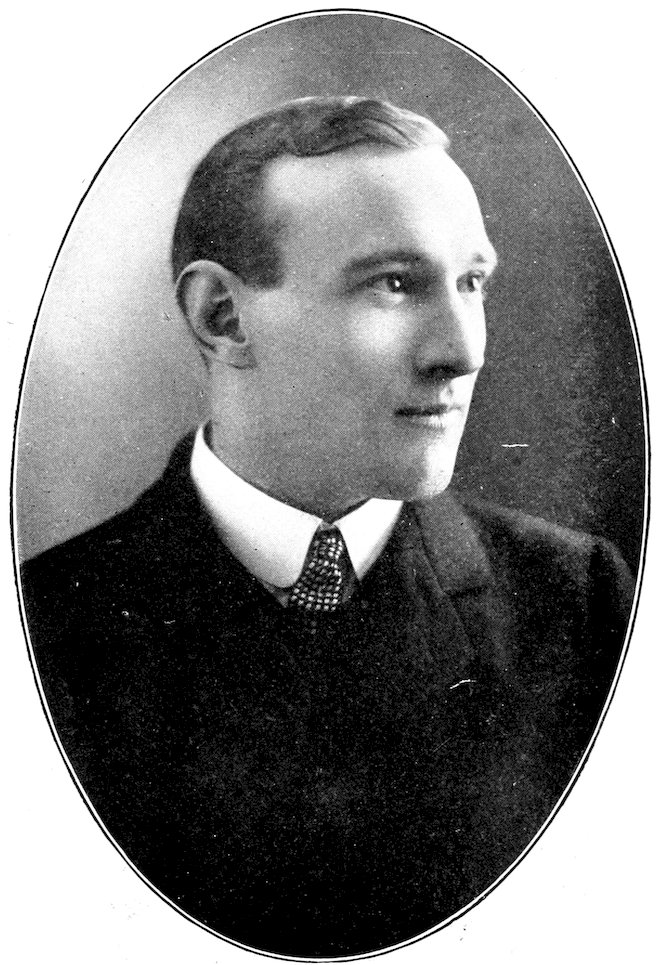
The Author.
Frontispiece.
By
ARTHUR DE CARLE SOWERBY, F.Z.S., F.R.G.S.
Joint Author with Robert S. Clark of “Through Shên-Kan,” and Author of “Fur and Feather in North China” and “A Sportsman’s Miscellany”
“Till a voice, as bad as Conscience, rang interminable changes
On one everlasting Whisper day and night repeated—so:
‘Something hidden. Go and find it. Go and look behind the Ranges—
Something lost behind the Ranges. Lost and waiting for you. Go!’”
Kipling.
LONDON: ANDREW MELROSE, LTD.
3 YORK STREET, COVENT GARDEN, W.C.
1918
To
MAJOR ROBERT STERLING CLARK,
In memory of many happy days’ hunting on the Sino-Mongolian Frontier.
Introduction — NOTE
v
Ever since the Original Hundred Families
wandered eastward from Central Asia into
the land now known as China, and settled in the
broad and fertile valley of the Wei River in the
present province of Shensi, forming the nucleus
of the Flowery Kingdom, its people have been
harassed continually by the ravaging hordes of
Tartary.
The frontiers between the two races, one peaceful
and addicted to the practice of the Arts, the
other warlike, and caring only for plunder,
rapine and conquest, have always been marked
by scenes of bloody conflicts, ruthless raids and
brutal massacres; yet, strange though it may seem,
it has been the peaceful nation which has won in
the end, and continually the Sino-Mongolian
boundary has been pushed further to the north.
The Chinese have repeatedly been conquered
by the Tartars, and subjected to a rule of tyranny
and oppression; but it has always ended in the
same way—either the absorption or the ejection of
the Tartar conquerors, and a further advance
of the Chinese upon the acknowledged territories
of these predatory Nomads.
viFrom the Wei valley, occupied twenty centuries
before the Christian era, the Chinese, themselves
an invading race, driving out or exterminating
the aborigines, spread steadily eastward and
northward, till, in the reign of the illustrious Shih
Huang-ti, the boundaries of the Empire were
marked by the Great Wall. This for many
centuries divided the actual territories of the
Chinese from those of the Mongols, in spite of
further invasions and conquests on the part of the
latter; that is to say, the dwellers on the south
side of the Wall remained Chinese and those on
the north Mongol, regardless of the nationality
of the ruling Emperor.
This state of affairs was maintained up to the
middle of the nineteenth century, when as the
Tartar Power, both Manchu and Mongol, Eastern
and Western, gradually declined, the Chinese
pushed beyond the Wall, settling further and
further out on the Mongolian Plateau. This
was not done by force of arms, but by intrigue
and purchase, and it has led to much bitterness
and ill-feeling on the part of the Mongols.
To-day, we again have before us the old drama,
being played in much the same old way. The
Chinese have risen, have shaken off the enfeebled
Tartar yoke, and are endeavouring to add yet
another portion of Mongolia to the ever-increasing
domains of the Middle Kingdom.
The aggression of the New Republic, whose
viirights over Mongolia are only such as she may
maintain by force—Mongolia having been tributary
to the Manchu and never to the Chinese—is
naturally resented by the Mongolians. Thus
we see armed bands of both nations lining the
present frontier, in many places far beyond the
Great Wall, while we hear of depredations and
incursions made by wild undisciplined horsemen,
who swoop down from the grassy plain or sandy
desert to burn, plunder and kill, returning
whence they came before the slow-moving Chinese
troops can offer resistance, or strike an effective
blow in return.
The most recent political boundary between
Mongolia and China, that is the one extant before
the declaration of Mongolian Independence in
September 1911 and the present ensuing complications,
extended from the border of Manchuria
near Liao-chou in the province of Fêng-t’ien in a
west-south-westerly direction north of Lama Miao
(Dolon Nor) to the north-eastern corner of Shansi
province. Thence bearing more to the south,
it kept north and west of K’uei-hua-ch’êng, till
it reached the Yellow River near He-k’ou. From
here it followed the course of that river, running
due south as far as the north-eastern corner of
Shensi province. From this point on it coincided
with the course of the Great Wall, extending into
the heart of Asia, and terminating only with the
western boundary of Chinese Turkestan.
viiiWestward from the point where it strikes the
Yellow River near He-k’ou this boundary is the
natural one, being marked, first by a section of
the river, then by the sandy edges of the Ordos
Desert, next by a second stretch of the Yellow
River, and finally by the southern border of the
Gobi Desert.
Eastward from He-k’ou it is more difficult to
trace a natural boundary, as the whole country is
broken up by irregular ranges of hills and mountains
interspersed with wide river valleys, which
in some instances assume the dimensions of plains.
On the whole the course of the outer loop of the
Great Wall may be said to define most satisfactorily
the natural boundary. Especially is this
the case immediately north and north-west of
Kalgan, where a line of high cliffs of volcanic
origin marks the edge of what is generally known
as the Mongolian Plateau.
From Kalgan the Wall runs first east and then,
after making a big loop to enclose the valley of
Pei Ho, turns south-east, following the crests of
the mountain ranges, finally ending abruptly on
the sea coast at Shan-hai-kuan (lit. Mountain-sea
pass).
The line of demarcation between the land
actually occupied by the Mongols on the one hand
and the Chinese on the other follows the political
boundary, but, so far as the writer has been able
to observe, the floral and faunistic, as well as the
ixgeologic boundaries coincide with the natural one,
excepting only that part extending from Kalgan
to Shan-hai-kuan. Here the faunistic and floral
boundaries undoubtedly lie far more to the north,
coinciding rather with the political boundary.
In the present volume the term “Sino-Mongolian
Frontier” indicates not so much the political
boundary as here set forth, but rather the boundary
marked out by Shih Huang-ti when he built
the Great Wall, which as already stated defines
to a great extent the natural boundary.
The subject of this book is a series of explorations,
carried out by the author accompanied in
each case by at least one other European, through
districts, which, lying in close proximity to the
Great Wall, may be included in the title as already
defined.
The work carried out on these explorations was
in the nature of scientific and geographical research,
including the collection of biological specimens,
the making of geological notes, the carrying
out of compass traverses, and the general investigation
into the lives, customs and conditions of
the natives.
These explorations were as follows:—
1.
A journey through North Shensi, the Ordos Desert and Western Shansi, by Malcolm P.
Anderson and the author in connexion with the Duke of Bedford’s Exploration xof
Eastern Asia; Spring and Summer 1908.
2.
An expedition through the upper basin of the Fên River in Western Shansi, by the author
and his wife; Winter, 1909–10.
3.
Short collecting trips round T’ai-yüan Fu, Shansi; Autumn 1911.
4.
A shooting trip in the mountains north-east of Kalgan; February 1912.
5.
A journey from Kalgan to K’uei-hua-ch’êng in North Shansi; Spring, 1912.
6.
A journey in Inner Mongolia; Summer, 1912.
It may be noted that the Clark Expedition,
which forms the subject of Through Shên-Kan,
took place between the first and second of the
explorations enumerated above, and the present
book may be considered supplementary to that
work.
Chapters dealing with the scientific aspects of
the work of the several expeditions are given at
the end of this book. An itinerary, which, it
is hoped, will be found useful by future travellers
in these parts is also given.
The results of the compass traverses have been
carefully reduced to a convenient scale (1/1,000,000),
and maps will be found in the cover-pocket at the
end of the book.
I am indebted to Mr. Malcolm P. Anderson for
photographs illustrating the first of the series of
explorations, to Mr. Robert S. Clark for others
xiof North Shensi, and to Dr. P. H. Atwood, who is
the best big game shot in North China, for those
of the wild boar and the leopard.
My best thanks and appreciation are due to Mr.
Frederick W. Warrington, who at his own expense
accompanied me on the last two expeditions,
rendering the ablest assistance.
ARTHUR DE C. SOWERBY.
This book was written in 1913, but on account of conditions
brought about by the European War, which broke
out on the eve of publication, it was thought advisable
not to issue it till now.
On the whole conditions in China and Mongolia are
much the same to-day as they were in 1913, with the
exception, perhaps, that the suzerainty of China over
Mongolia has been re-established, while the threat of
annexation by Russia has, for the time at least, been
removed. Intermittent fighting still takes place between
the Mongols and Chinese, but this partakes more of the
nature of raids by lawless bands than direct military
conflict between the two countries.
The railway from Kalgan westward has been completed
as far as Fên-chêng (see page 105) on its way to K’uei-hua-ch’êng,
thus reducing the journey a day’s march.
The effect of the recent outbreak of pneumonic plague
in this region has not yet been made known, but since
the whole of the area from Fên-chêng westward was
affected, it is certain that the population, already sparse
enough, has been further reduced. It has been reported
that whole villages have been wiped out by this terrible
disease.
Very early in life my travels began. I was
only four years old when my parents took
me from an interior town of China to the coast,
and thence to Europe. Vaguely I remember
the mule train “coughing in the dust” of a
Shansi road, and the house-boat journey down a
Chihli river, with my mother lying at death’s
door in the cramped and tiny cabin, overcome
by that cruel journey. Then came the strange
sights and scenes of the sea journey to England,
followed by the even stranger (to me) life of my
native land. Three years later we were back
again in the interior town, and from that time
on I have scarcely lived in one place longer than
a year or two at a time.
All this doubtless accounts for my love of
travel, which has led to my kicking the traces and
becoming a wanderer. What more natural than
that the wandering should have for its scene the
land of my nativity, where I know the people and
their language, where I can live, if necessary,
4upon the land, without the help of stores from
Europe or American canned goods? What more
natural than that the unknown places in this
land of mystery should beckon to me, and that I
should hear that voice ringing its “interminable
changes ... something hidden. Go and find
it....”?
I cannot claim with Kipling’s Explorer to have
found country unknown to man; but I can say
that I have been the first white man to tread
many a forest and wild mountain, many a sandy
waste and boulder-strewn wilderness, many a rich
pasture and fertile valley. I, too, have seen the
promise of future prosperity in “the big fat
marshes that the virgin ore-bed stains,” in the
“nameless timber,” and “illimitable plains.”
Will others go up and occupy? Will my countrymen
aid in developing that potential wealth?
I hope so.
Strange though it may seem it has not been
the solemn grandeur of the great back ranges,
nor the mysterious silence and gloom of the virgin
forests, nor yet the smiling fatness of the valleys
and plains that have appealed to me most. It
is the sun-baked, barren ridges, the shifting,
windswept sand-dunes and the saline, brackish
swamps of the Ordos Desert that have cast upon
me the strongest spell.
Even as a boy I had been fascinated by what
I had heard of that howling wilderness, that
5waste of sand, that “Never-never country.” The
romance of those wild Tartars, living their lives
of untrammelled freedom always appealed to my
imagination and I longed to go and see it all.
At last the chance came, and never shall I
regret the step that once and for all settled my
destiny, when I exchanged a town life of comparative
ease for that of the explorer and collector.
It was in Tientsin in the summer of 1907 that
I first met Mr. Malcolm P. Anderson, who was
out in the East collecting mammals and specimens
of zoological interest generally for the British
Museum at South Kensington, in connexion
with the Duke of Bedford’s Exploration of Eastern
Asia.
At the time I was engaged in mounting the
fruits of a hunting and collecting trip in Western
Shansi for a local museum.
With common interests a friendship sprang up
between us, which culminated a month or so later
in a decision to join forces in carrying out an
expedition into the hitherto practically unknown
Ordos Desert.
As I would not be free till the end of the year
Anderson went to T’ai-yüan Fu in Shansi, where
he continued to collect, till, everything having
been arranged satisfactorily, I joined him towards
the end of January 1908.
The proximity of the Chinese New Year prevented
6our starting for another fortnight, but at
last on February 10, we set out from T’ai-yüan Fu
with a somewhat meagre equipment of four mules
and one pony, together with three natives.
A glance at the map of China will suffice to show
the reader the position of the Ordos Desert. It is
situated within a mighty loop of the Yellow River
immediately north of Shensi, from which province
it is divided by the Great Wall. The Ordos is
known to the Chinese as Ts’ao-ti (grass land), and
the only information we could glean concerning
it was that it was an immense wilderness of sand
and coarse scrub, in which wild Tartars lived,
and where hardy races of small ponies and cattle
were bred.
This sounded interesting, though hardly favourable
to our purpose of making a large collection.
Nevertheless our instructions were definite on the
subject, so we set about attaining the end in view
as best we could.
We found that by travelling due west we could
have reached Yü-lin Fu on the border of the desert
in fourteen days, but this would have brought
us to the country at a time of year when the
weather would have been most unsuitable for the
collecting of small mammals, and much valuable
time would have been wasted.
We therefore decided to travel south-west to
Yen-an Fu in North Central Shensi, and from
there work north-west, to the southernmost point
7of the Ordos. By stopping and collecting at a
few places along this route, we would gauge our
arrival on the frontiers of the desert to sometime
in spring, the best season for our work.
After leaving T’ai-yüan Fu, and crossing the
low mud-flats of the Fên River, our road lay in a
south-westerly direction through well cultivated
country. Round the villages we noticed innumerable
jujube trees (Zizyphus sativa), which grow
extensively in all the low lying valleys and plains
of Shansi, Chihli and Shensi. The fruit of these
trees resembles nothing so much as a date, and
when treated with honey makes an excellent
preserve. It is largely used in the manufacture
of sweetmeats, especially of the cheaper qualities,
while bread-steamers[1] use it instead of currants
in the manufacture of a kind of bun loaf.
Our first stopping place was the small town of
Chin-ssŭ, famous for its temple and spring. The
latter gushes out of the base of the hill upon which
the temple is built, and irrigates the surrounding
fields, making the cultivation of rice on a large
scale possible.
It also forms the motive power of a number of
paper mills, a coarse straw-paper being manufactured
in the district.
The temple of Chin-ssŭ is a very beautiful
edifice, composed as it is of magnificent buildings
8standing upon a series of stone terraces running
up the steep hillside. A long flight of stairs extends
from the base to the topmost shrine, while
in the extensive grounds are artificial lakes, filled
with carp. Old and stately trees stand here and
there, the most interesting of which are two huge
Maidenhair trees (Gingko biloba).
We reached Fên-chow Fu two days later,
passing on our way the important towns of Chiao-ch’êng
Hsien and Wên-sui Hsien. The country
between these two places is noted as being the
finest grape producing district in China. The
grapes grown are mostly purple, but some white
varieties occur. In the season these fruits sell at
less than one halfpenny per pound.
Fên-chou Fu itself is a large business town with
an extensive floating population. It has nothing
of particular interest to recommend it to the
traveller, who is only too anxious to get away
from its dirt and smells.
On leaving this town we took a westerly course,
and following a deep and narrow gorge in the
limestone formation, crossed a high divide at its
head.
We spent the night at a large village named
Wu-ch’êng. From here we turned southward, and
after travelling fifteen miles, stopped at a place
named Shi-shi-ling, situated in a mountainous and
well-wooded district. Here we remained for some
days hunting and collecting.
9Wild boars, leopards and roe-deer were seen,
but we were too busy trapping for small mammals
to pay much attention to large game.
Pheasants, partridges and hares were abundant,
and kept our pot well filled. The weather was
too severe for good work, and beyond a few squirrels,
field-mice, small hamster rats and three or four
species of birds we secured very little.
The country was typical of Shansi, consisting
of rugged shale and limestone mountains, overgrown
with scrub oak, hazel, birch, wild
peach, conifers and thorny shrubs of various
kinds.
From Shi-shi-ling, we travelled westward towards
the Yellow River, putting up at Ning-hsiang
Hsien, and Liu-lin-chên on February 24
and 25 respectively. The former of these two
places is a town of no importance and less interest.
At Liu-lin-chên some fine springs, open all the
year round, form a winter resort for countless
wildfowl, including teal, mallards, sheld-ducks,
golden eyes and mergansers.
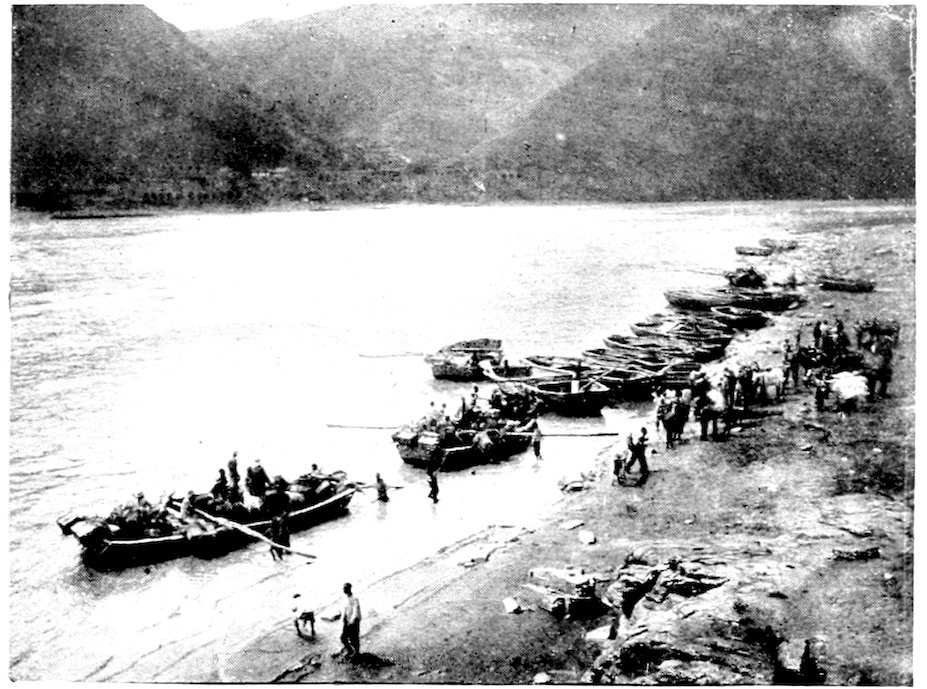
On February 26 we crossed the Yellow River
and put up at a small village on its right bank.
The crossing was effected by means of large ferry
boats, into which mules and baggage were ignominiously
bundled, when, with long, roughly made
oars, the ferrymen kept the boats at angles such
that the swift current forced them along in the
desired direction. In consequence, the landing
10was effected some considerable distance down
stream.
Continuing westward over barren windswept
loess ridges for two days, we reached a busy little
town named Sui-tê Chou. Thence we travelled
southward for four days along a splendid road,
which had recently been cut by the Yü-lin Fu
garrison. This country was very desolate, consisting
as it did at that season of bare loess hills
inhabited only by occasional coveys of partridges
and a few foxes and eagles.
At a place called Yen-ch’uan Hsien, not far
from some recently opened oil wells, we turned
westward, and after crossing a steep loess pass,
entered the valley of the Yen-shui, the river on
whose banks is situated the old town of Yen-an
Fu. All the towns and villages we passed were
in a sad state of ruin, while the inhabitants were
terribly poverty-stricken. The country has not
yet recovered from the devastating effects of the
great Mohammedan rebellion of the sixties, followed
in 1887 by a protracted famine. It is true
that the greater part of the loess hills is under
cultivation, but years must elapse before the
country regains its former prosperity.[2]
11Near Yen-an Fu we noticed that there were
many dense thickets, consisting chiefly of the
thorny wild jujube (Zizyplus sativa spinosa)
along the Yen-shui valley, so we decided to stop
and spend a few days in collecting. Our efforts
met with immediate success, so that we prolonged
our stay in the vicinity. We secured one new
species and three new subspecies of rodents,
besides several already well-known forms.
Each morning ere it was light we would sally
forth with satchel and shot-gun to inspect our
traps, set the night before. Bringing in the
specimens secured, we would spend the rest of the
day till mid-afternoon in skinning and preparing
our day’s haul, after which we would once more
go out to look over the traps, or set new ones.
The new species referred to above was a pika
(Ochoton abedfordi), a small rabbit-like rodent,
12while the new subspecies were a sulphur-bellied
rat (Epymys confucianus luticolor), a large hamster
rat (Cricetulus triton incanus) and a hare (Lepus
swinhoei subluteus). The kindred forms of the
last three species are found in the Shantung
Peninsula and in Chihli.
The abundance of game and small mammals
round Yen-an-Fu is undoubtedly due to the
extensive thickets of wild jujube in the vicinity.
This plant, wherever it occurs, forms excellent
cover for pheasants, hares, small mammals and
birds. It grows usually in the form of low shrubs,
and is thickly covered with strong sharp thorns,
some of which are straight, and others hooked.
The result is that large animals and human beings
experience great difficulty and inconvenience in
traversing thickets of this growth. The fruit,
which has a pleasant sour taste, together with
the hard stony kernels, forms a regular part of
the autumn and winter diet of the smaller mammals
and birds. One of the characteristics of this
peculiar plant is that it never grows at an altitude
exceeding 3,000 ft. above sea level, and another
is that it comes into leaf long after all other plants
in the same districts in which it grows.
We were told by the natives that there were
some very good collecting grounds about ten miles
south-west of Yen-an Fu. Accordingly we packed
our traps and visited the spot. We were rewarded
by finding excellent country, both for shooting
13and trapping, so that our collection began to
reach pleasing proportions.
This country we found to consist of the usual
loess hills, but they were thickly covered with
scrub and rapidly extending woods of birch, hazel
and poplar.
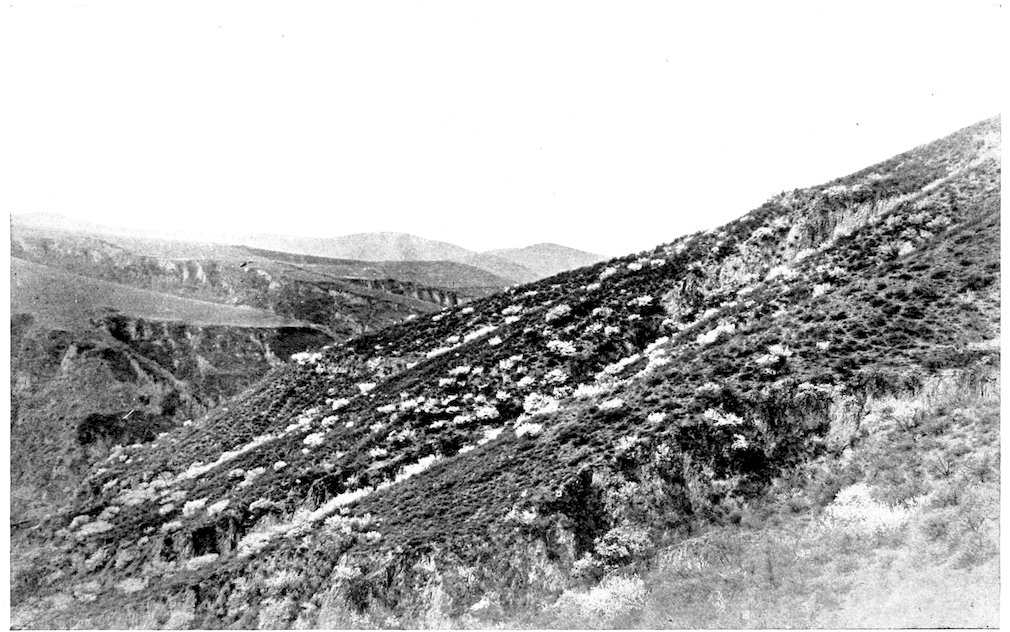
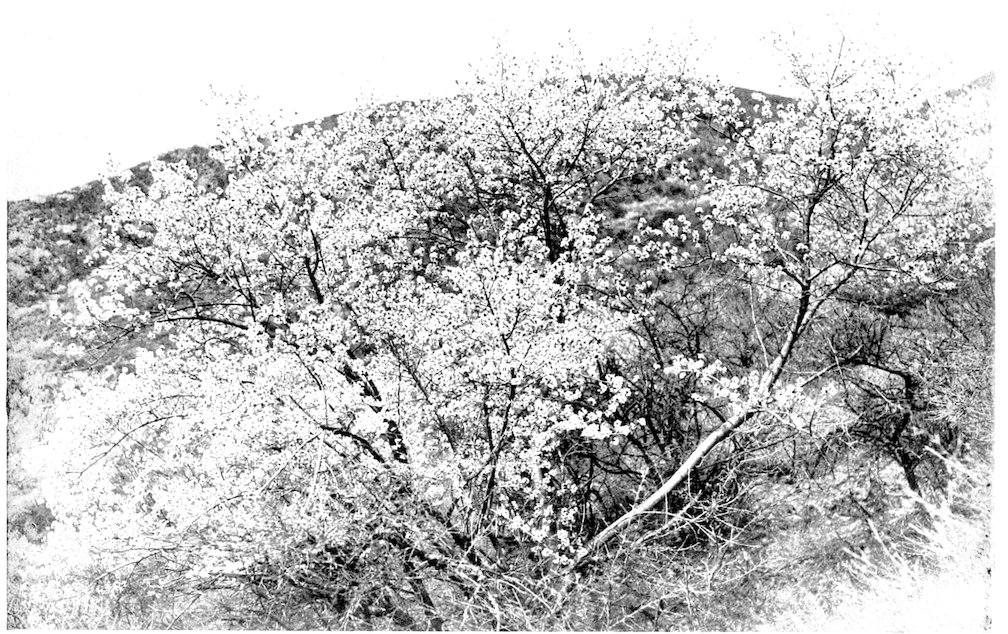
In some places the hillsides were covered with
wild peach (Amygdalus davidiana), which was
now in full bloom, and presented a wonderful
sight. This peach is supposed to be the original
stock from which all our many varieties have been
derived. This however is not at all certain, as
wild peaches have been found in other parts of
Asia. It is very hardy, withstanding extremely
low temperatures. The fruit is small and worthless
as a table delicacy, though it is greatly
appreciated by squirrels and other rodents.
The tracks of wild boars, roe-deer, leopards
and wolves were frequently seen, while pheasants
were particularly plentiful.
Some interesting birds were secured, amongst
which were a large and handsome blue magpie
(Urocissa sinensis), and the sweet-voiced timeline
(Pomatorhinus gravivox). A single specimen of
the grey-headed plover (Microsarcops cinereus),
a large and elegant member of the family, was
shot in one of the stream beds.
The weather was now wonderfully mild, so that
our thoughts began to turn towards the sandy
stretches of the Ordos, and finally on April 6,
14after once more reaching Yen-an Fu, we set out
in a north-westerly direction along the Yen-shui
valley.
We were somewhat reassured as to the prospects
of securing food for ourselves and our animals
in the Ordos, the natives of Yen-an Fu having
informed us that there were plenty of Mongols,
who were well off and hospitable, scattered in
little encampments at easy stages in every direction.
The journey up the Yen-shui proved uneventful
except that as we neared the end of the valley on
the third day, we had to cross the river no less
than sixty-eight times. Towards the end of the
afternoon, however, it began to dwindle down
till it was no longer of formidable dimensions and
crossings were easily effected.
As the day wore on we noticed that the loess hills
were growing higher and higher, while the substratum
of rock changed from grey to red sandstone.
Through this the stream cut deeply,
forming sheer and lofty cliffs on either side.
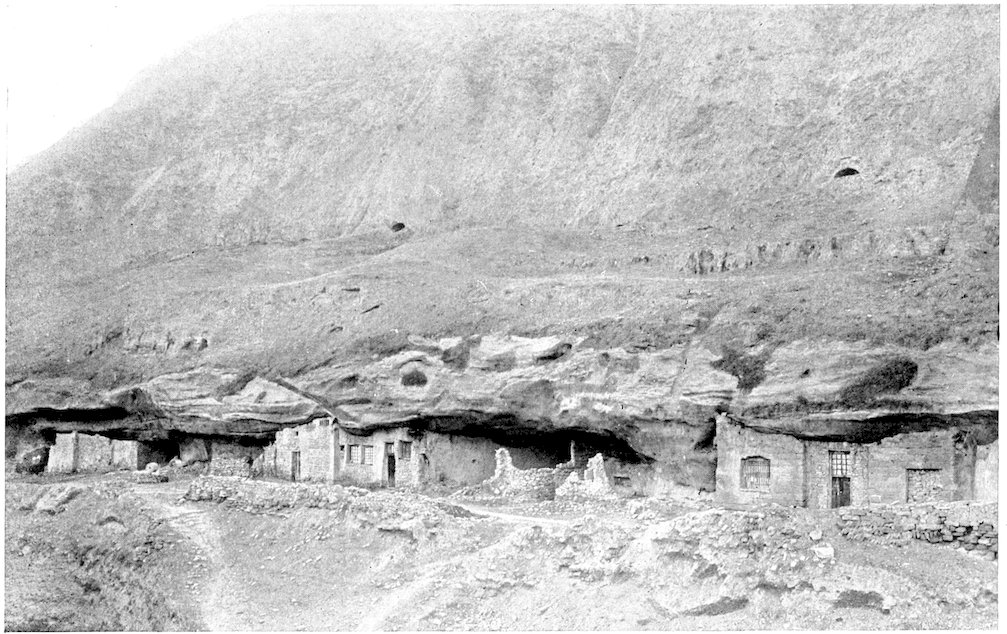
In one place we noticed, high up on the face
of the cliff, some cave dwellings, which were
reached by a series of stakes driven into the face
of the rock. Many of these were missing, from
which we concluded that the caves had long
remained untenanted.
The natives of our last stopping place told us
that here we would find a good-sized village with
15plenty of accommodation. This turned out to
be a purely malicious and unprovoked falsehood,
for when night began to descend our little party
found itself in a desolate and seemingly uninhabited
wilderness.
Following the only bridle path we began a long
and difficult ascent till we reached an altitude of
6,000 feet, having climbed over 3,000 feet since
leaving Yen-an Fu. The path now led along
the top of a rugged ridge and became momentarily
more difficult, till, darkness overtaking us, we
realized that we were hopelessly lost. To make
matters worse, a cold north wind sprang up,
cutting us to the bone.
We wandered aimlessly along for two hours,
discussing the advantages or otherwise of making
a tentless camp where we were, without fuel for
a fire, food for ourselves, fodder for the mules,
or even a drop of water.
Just as we were about to unload the mules
a voice hailed us from the darkness, and the welcome
barking of dogs told us that we were near
some human habitation. To our joy we found
not fifty yards from us a cluster of huts, including
an inn, surrounded by a high mud wall. The
latter had effectually hidden the lights of the huts,
and but for the vigilance of the innkeeper we
should have been condemned to spend the night
exposed to hunger, thirst and a bitter north wind.
The following day we pursued our course over
16steep mountain peaks, down frightful chasms and
treacherous cliffs, and over wastes of sinking
sand, but at last we reached Ching-pien Hsien,
a small garrison town within a mile of the Great
Wall, and the longed for Ordos Desert.
However pleased we might be at having reached
our goal we were nevertheless far from comfortable.
The weather had turned very cold again; nothing
but the very poorest food was obtainable. The
air was filled with fine sand, which got into our
eyes, scrunched between our teeth, and stung our
faces as it was driven by the cruel north wind.
“... I think never saw
Such starved ignoble nature; nothing throve:
For flowers—as well expect a cedar grove!
But cockle, spurge, according to their law
Might propagate their kind, with none to awe,
You’d think; a burr had been a treasure-trove.
· · · · ·
As for the grass, it grew as scant as hair
In leprosy; thin dry blades pricked the mud
Which underneath looked kneaded up with blood.”
The utter dreariness and desolation of the surrounding
country, together with the poverty and
wretchedness of the inhabitants, combined to depress
and harass our spirits, which were only
restored to their normal condition by the assurance
that the country beyond the Wall was much
better. We made a short excursion as far as
the Wall, and climbing one of the isolated towers,
obtained our first view of the Ordos.
17A wide expanse of sand, thickly studded with
trees gave promise of better things in store.
On the following day, April 11, we lost no time
in leaving behind us the miserable town of Ching-pien,
and for some miles travelled northward
through a country that grew more promising with
each succeeding step. Flocks of stately cranes
fed on the stretches of reddish sand, while innumerable
trees, chiefly willows, arranged in long
rows, relieved our eyes, after the days of barren
wastes we had endured.
In crossing a deep ravine, just after leaving
Ching-pien, we nearly lost one of our mules with
its precious burden, comprising our only stores,
in some deadly quicksands. It was only a miracle
that saved the animal. As it was much of our
food got wet, and some of it was rendered useless.
That evening we reached the end of the broad
belt of trees, and put up at a small farmstead
named Ning-t’ieh-liao, which we were surprised
to find was owned by Chinese.
We learnt that the Chinese here, and elsewhere
along the Ordos border, are gradually pushing
further and further into the Mongol territory.
By planting rows of trees they prevent the
drifting and piling up into dunes of the loose
shifting sand. They manage thus to grow crops
of millet, such areas as they do not cultivate
producing a coarse grass. This with the leaves
18of the willows forms the chief food for their
flocks of sheep and goats.
We spent April 12 at this farmstead, drying
out our stores and exploring the immediate
vicinity. We found that the river that flows past
Ching-pien continues northward into the desert,
subsequently turning eastward and flowing back
into Chinese territory.
Being anxious to see something of the Mongols
themselves we left Ning-t’ieh-liao the following
day, taking a northerly direction.
We were told that the Tartars lived some twelve
miles away, and that it would be necessary to hire
a guide to lead us across a difficult stretch of
sandhills. We therefore engaged the services of
a stupid yokel, who had accompanied us from
Ching-pien, and who claimed to know some of
the Mongol families.
We soon left behind us the belt of willows, and
passing a small lagoon, from which Anderson
secured a fine grey-lag goose, we entered the
dunes. Considerable difficulty was experienced
with the mules, whose small hoofs sank deep into
the sand. Spills were frequent. Once all four
mules were down together, piling one atop of the
other as they rolled down a more than usually
steep slope. Great confusion followed, and it
was only with the greatest care that animals
and loads were extricated without serious
damage.
19We also found going very difficult and tiresome,
owing to the looseness of the sand.
At last after we had passed through a belt of
tall scrub, there opened out before us a long and
broad stretch of grass land dotted over with
lagoons and marshes. As we approached these
we noted vast numbers of waterfowl of every
description. Grey-lag geese and sheld-ducks wandered
in pairs between the tussocks of coarse grass
in search of food. Flocks of stately cranes and
lordly bustards waded knee deep in the marshes,
or fed upon the grassy meadows. Teal and
ducks of every variety blackened the surface of
the lagoons, while plovers flapped heavily overhead
uttering their plaintive calls.
Scattered far and wide over the plain were
innumerable herds of ponies and cattle, the
property of the Mongols whose huts and tents
we could see on the opposite edge of the grassland.
We made our way across to one of these huts,
where we interrogated the goodwife, who was
brought to the door by the barking of some savage
and wolfish looking dogs. She refused us shelter
on the ground that she could not supply our mules
with the necessary fodder.
We passed on to the next hut and met with
a similar reception. At last after trying several
farmsteads we reached a newly built, two-roomed
hut, enclosed in a neat willow fence, and, unloading
20our mules we refused to proceed any further.
Finding that these border Mongols could speak
Chinese fluently, I went into the hut to discuss
with the owners of the place, a newly married
couple, the much vexed question of quarters for
ourselves and fodder for our mules.
The Mongols were polite, and offered us shelter
for one night only, this being the custom. More
they dared not do, or they would be held responsible
for our actions. It was plain that they
were suspicious of us, and my explanation that
we were collecting small animals only seemed
to deepen their suspicions. Evidently they had
not yet experienced the eccentricities of white
men.
At last we decided to take what we could get,
and as we could not bring ourselves to sleep in the
hut with the natives, we put up our beds inside
the willow fence.
We were next invited to take some salted tea,
in which parched millet was steeped. This was
not very palatable, but was better than nothing.
The hut was built after the manner of those
occupied by the poorer Chinese, and, as already
stated, was enclosed by a high willow fence. There
were also stables and storehouses built of willow
stems plastered over with mud. The confines
of our hosts’ property were marked by a low
mud wall, about two feet high, outside which
was a ditch of corresponding depth.
21A well, some six feet in depth, supplied the
residents and their cattle with water, that of the
lagoons in the district being too brackish for
either man or beast. Even the wells were far
from sweet.
Outside and opposite the gate of the enclosure
was a long pole stuck into an immense wicker
basket filled with sand. From a crosspiece near
the top of the pole depended several pieces of
white and red calico, while the end of the pole
was adorned with a tuft of dry grass. The whole
contrivance formed a sort of totem pole, having
something to do with the religious ceremonies
of the owners. We noticed one of these poles
outside every Mongol hut or tent.
The tents of these Mongols were of the usual
pattern—wooden framework covered with coarse
felt, usually of a black colour.
We soon found that these people were intensely
superstitious, practising a sort of demon worship.
Everywhere, they said, were malign spirits,
which must not be offended. Thus I was called
sharply to book, when I inadvertently sat upon
the coping of the mud fireplace. It was insulting
the “fire demon.” Again, as we approached one
of the huts, the muleteers led their animals across
the low boundary wall, when an old woman rushed
out and cursed us roundly, while her daughter
tore the bells off the mules. Completely discomfited
by the vigorous onslaught we retired
22in disorder, afterwards learning that some religious
function in connexion with the birth of a child
was in progress, and the ringing of the bells
within the confines of the farmstead would attract
evil spirits.
At one place we were refused admission on the
ground that they were having a spring cleaning of
devils, and if we entered we would assuredly bring
some with us. Even at the place where we did
secure quarters our baggage was left outside
the enclosure long enough for the demons it
contained to escape.
Our hostess on finding a snake inside the mud
wall very carefully carried it outside, and refused
to let us have it for a specimen, saying that it
would not do to offend the snake spirit.
For the rest these people are Buddhists, one
or more of the sons in each family becoming lamas.
In physique the Ordos Mongols are superior to
the Chinese. They are a tall well built race, admirably
fitted to wrest a living from the cruel
desert in which they live. The women are good
looking, some even beautiful, while their lives
in the open give them a grace of carriage together
with a strength and freedom of movement never
seen inside the Wall. They can ride barebacked,
and with the ease and grace of a cowboy, the shaggy
and wicked little ponies that they rear upon the
surrounding grasslands.
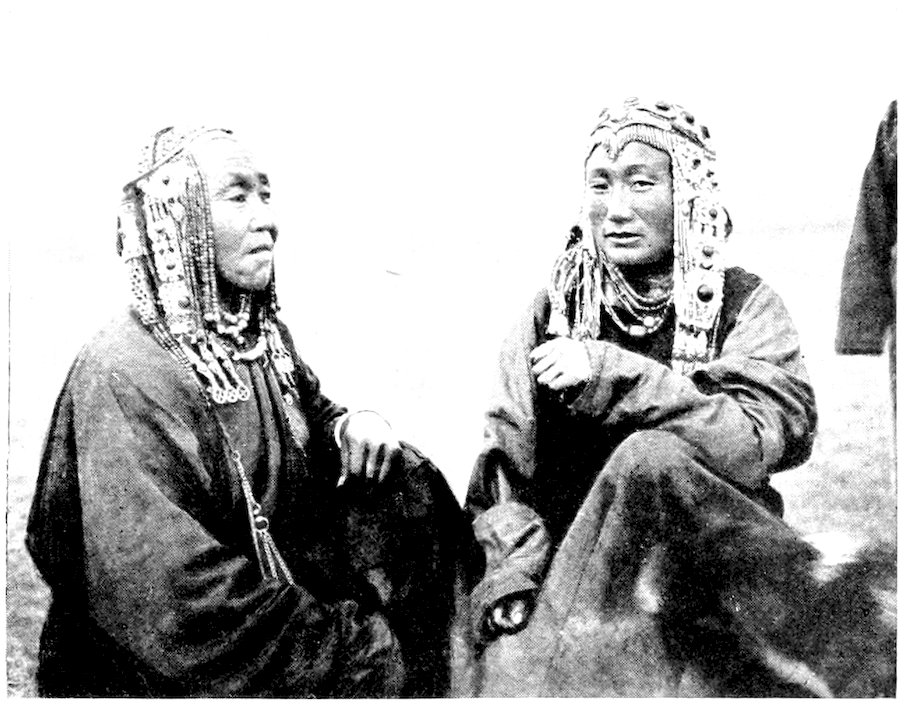
They wear a peculiar headdress of silver-mounted
23coral and turquoise beads, surmounted by a gold
embroidered cap, while their hair falls over their
shoulders in two thick strands. The rest of their
ordinary attire is similar to that of the men,
which is the usual Manchu dress—baggy trousers
and long coat or gown of blue surmounted by a
large sleeveless waistcoat of some bright colour.
Only in the absence of buskins does the women’s
dress differ from that of the men.
On gala days, which the women celebrate
equally freely with the men, the former sport
silk robes of the most gorgeous and vivid colours,
and even the latter manage to don clothes of
gayer hues.
They are a light-hearted, cheery people, always
on the look-out for fun, and always playing jokes
upon one another.
As already stated a large proportion of the men
are lamas, who have their heads shaved and wear
long robes of red or yellow, with sashes of the
same colours. These priests are supposed to be
celibate, but we saw several with large and flourishing
families.
The food of these Mongols consists in winter of
mutton and beef, but in summer they live almost
entirely upon parched millet, which to render
palatable they steep in salted tea. The millet,
a poor and coarse variety, they grow themselves.
For fuel they depend almost entirely upon the
droppings of their cattle, which when dried they
24call “argol.” Camel “argols” are undoubtedly
the best fuel of this nature.
While setting some traps in the willow scrub that
fringed the grasslands, dividing them from the
wastes of sand beyond, we noticed great numbers
of hares, which, as dusk came on, left the sheltering
bushes, and frolicked or fed upon the meadow land.
We also saw a few pheasants and partridges.
Next day, having brought in our traps and
packed our baggage we loaded the mules, and were
about to start, when up rode a well dressed old
man, wearing a mandarin’s hat and blue button,
and accompanied by two attendants. Jumping
from his pony he saluted us, producing a crucifix
to show that he belonged to the true faith. After
exchanging civilities we told him of our difficulty
in finding quarters. He at once gave us permission
to stay where we pleased as long as we chose.
Our erstwhile hosts promptly offered us further
hospitality, but with such a charter as we now
had we preferred to go further in search of better
collecting grounds and more commodious quarters.
The old chief offered us rooms in his own home,
which he said was at a place named Borrobalgosun
some twenty miles westward. Accordingly we
set out together in that direction and soon were
engaged in friendly conversation.
We found that our new friend thought that we
were Catholic priests, of which religion he was a
convert. On finding that we were not even
25missionaries of any other sect, he changed his
attitude towards us. He was still polite, but less
bonhomme and presently he withdrew his invitation
to stay at his home.
However he promised to find us quarters elsewhere,
and excusing himself on the plea that he
had some business to attend to, set his pony at a
gallop and was soon out of sight, leaving us to
follow as best we could.
At last after passing several more farmsteads,
we came to a cluster of huts, outside which our
friend awaited us. We were well received, being
at once shown into a spare room, and offered
salted tea and millet.
Mr. Bluebutton introduced us to our host, and
all arrangements were made for a stay of some
days, after which, said he, we would be welcome
to Borrobalgosun. Things having thus been
arranged to his entire satisfaction, the chief bade
us a hearty farewell, and with his minions rode
away into the west.
We at once set about making ourselves as comfortable
as possible. We got out our traps, but
met with little success. The only things caught
were specimens of ground squirrels (Citellus mongolicus)
and two varieties of gerbils (Meriones
unguiculatus and M. auceps), together with the hare.
An attempt to secure some antelopes failed,
though quite a number were seen. Specimens of
a snake (Coluber dione) and two lizards (Phrynocephalus
26frontalis and Eremias argus) were added
to the collection. Besides the waterfowl and
game birds already mentioned, wheatears and
larks seemed to be the only feathered denizens
of these sandy wastes.
The scarcity of animal life was a great disappointment
to us, and we decided to waste no more
time in this locality. The muleteers came to us
complaining that they could get no grain for their
mules, while very little fodder was to be had.
The obstinate animals refused the coarse alkali-impregnated
herbage that grew around. Our own
stores also were sadly diminished, and we were
told that we would not fare better by going to
Borrobalgosun, where nothing but parched millet
was to be had.
Under these circumstances we decided to head
for Yü-lin Fu, where we could replenish our stock
of provisions, and properly equipped could once
more attempt to penetrate the desert.
Five days we travelled in a north-easterly
direction across heartbreaking sand dunes. By the
end of the first day we had left behind us the
Tartar encampments, and found ourselves once
more in country occupied by Chinese.
The villages we passed were few and far between
and we suffered considerably from thirst and heat.
The white sand reflected the blinding rays of the
sun, which shone ever more fiercely, till our eyes
ached and our faces scorched and peeled.
27From time to time we crossed shallow rivers,
all of which flowed in a south-easterly direction.
They had cut down through the fifty feet or so of
sand to bedrock, which consisted of the same red
sandstone that we had noticed at the sources of
the Yen-shui. At one place there was a wonderful
natural arch spanning the river, over which the
road lay.
On the third day, April 18, we reached a place
named Hai-liu-t’u-ho, where we secured the first
specimen of the Ordos jerboa (Dipus sowerbyi).
Herbage of any sort was very scarce, dwarf
willows, a coarse grass and a sort of sage brush
composing the sparsely distributed thickets.
In one or two places we came across a species
of conifer, which grew in thick clusters amongst
the sand hills, and which we found to be very
resinous, burning furiously even when quite fresh
and green.
April 19 we spent at Hai-liu-t’u-ho in the hope
of securing some more jerboas. Two more were
brought in by the natives. That day a terrible
sandstorm sprang up, so that when we set out
the following day there was no sign of a road.
We could not hire a guide as the people refused
to have anything further to do with us. A baby
and a cow had died in the village during our stay,
and the superstitious natives looked upon us as
the cause of these disasters.
The consequence was that we soon went astray.
28Another sandstorm commenced, and before long
we were hopelessly lost. For hours we wandered
over the dunes with blinded eyes and sand-choked
lungs, but at last we found a desolate looking farm,
the owner of which we induced by promise of reward
to set us on the right road once more.
This he did, and we were able to keep to it by
following some newly made tracks.
The following day we reached Yü-lin Fu, a
large border town, situated on the bank of the
Yü-lin Ho, some three miles south of the Great
Wall. Here we found comfortable quarters, and
thankful we were to escape for a time the all-pervading
sand.
We at once set about making plans for another
trip into the Ordos, but first we decided to offer
money for specimens. A notice to the effect that
the foreigners were willing to buy wild animals
was put up at the South Gate, where all the country
people and market gardeners would see it.
Within a few days we reaped a rich reward,
so much so that we abandoned any idea of making
another journey into the desert. Jerboas, hedgehogs,
hamster rats, molerats, chipmunks and
ground squirrels were brought in in great numbers.
Of these the jerboa (Dipus sowerbyi), the
hedgehog (Erinaceus miodon) and the sand hamster
(Phodopus bedfordiæ) proved to be new species,
while the chipmunk (Eutamias asiaticus ordinalis)
was a new subspecies. Besides these a fine
29badger (Meles leptorhynchus) and a wild cat’s skin
were purchased.
One day we visited a peculiar fort guarding a
gate in the Great Wall, through which once passed
the high road between Yü-lin Fu and Pao-t’ou,
a large town on the northern border of the Ordos,
The fort consists of three massive blocks of masonry
built one upon the other. The largest at the
base measures ninety feet square, while the whole
edifice is about ninety feet high.
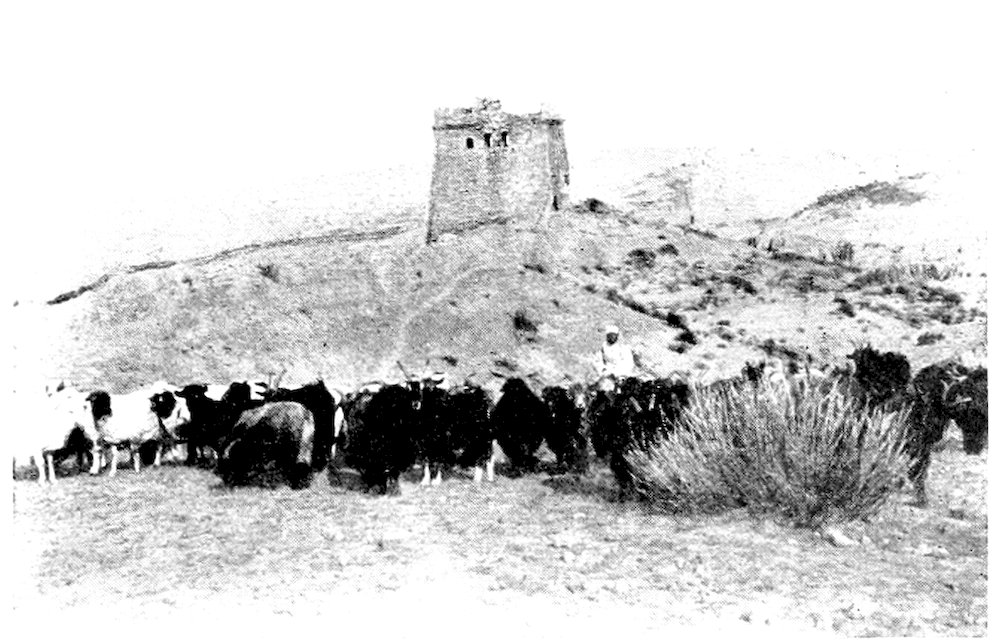
The Wall all along the Ordos border has crumbled
away, leaving little more than a slight ridge.
The watch towers which are situated at intervals
of about three hundred yards, are, however, intact
and serve still to mark the boundary line. It is
obvious that the Wall in these parts was not faced
with brick.
Yü-lin Fu is a prosperous military town with
some seven thousand inhabitants. It is supposed
to maintain a garrison of one thousand men to
overawe the Mongols. Its walls are in good
repair, and enclose many elegant temples. Like
all the other border towns that we passed Yü-lin
Fu is for ever threatened with inundation by the
vast sea of sand that rolls in from the north and
west. But for the river that flows past its western
wall the city would long ago have been submerged,
and even now the officials are continually perplexed
with the problem, as sand, sweeping round from
the north, banks itself against the eastern wall in
30many places right up to the battlements, forming
an easy entrance for the belated traveller. We
explored all the temples inside the city, but found
nothing of extraordinary interest.
At length having made a sufficiently large
collection, we decided to make a move, and on
May 14 left the city by the East-Gate, heading
in a north-easterly direction. Gradually we
approached the Wall, and did not lose sight of
its grey towers till we were within a day’s journey
of the Yellow River and Shansi.
At intervals of about twelve miles we passed
the dilapidated remains of small garrison towns
now inhabited by a few poverty-stricken families.
The country as we journeyed became more broken,
and the mules had considerable difficulty in
negotiating the steep slopes covered with drifts
of sand. Towards the end of the first day we
found ourselves on somewhat more elevated land,
cut up in every direction by frightful chasms,
which descended abruptly for hundreds of feet.
Here our mules were momentarily threatened with
destruction, as the path frequently led along the
very edges of these precipices, and the loose soil
continually broke away under their feet.
These chasms have certainly formed since the
building of the Wall, for they frequently cut
right across its length. To circumvent an unusually
long one, we had to cross the Wall and
make a long detour into the desert.
31That night we put up at an isolated inn called
Tuan-ch’iang, situated beneath the shelter of the
Wall, and on the edge of a chasm some five hundred
feet deep.
The following day another long detour into the
desert was made, and we stopped for our midday
meal at a little village situated at the end of a
ravine in the sand. A clear stream, springing
from beneath the wall of sand at the end of the
ravine flowed along its bottom irrigating some
small fields of black clayey soil, which supported
good crops.
We followed down the stream till we reached
a river, along whose banks we travelled till we
came to a fair-sized town named Kao-chia-pu,
where we put up for the night.
A guide, whom we engaged, here told me that
forty years ago, when he was a boy, the Mohammedan
rebels crossed the Ordos from Ning-hsia
in the west, and devastated the whole region.
He distinctly remembered their entry into Kao-chia-pu
when they massacred all who did not
escape into the surrounding hills.
The following day after a long hard march of
some thirty miles we reached a large town named
Shên-mu Hsien. We had now left behind us
sand and loess, and were in hilly country composed
mainly of sandstone.
On May 19 we descended from the high ground,
and travelled down a long valley, making our
32midday halt at a small place named Ku-shan-pu.
My companion and I were some distance ahead
of our mules when we entered the village, where
a fair was in progress. Finding an inn we sought
our usual rest from the noonday heat, but were
soon disturbed by the crowd which became very
aggressive.
I went out to pacify them and before I was aware
of what was going on, found myself the centre of
an angry mob. Cries of “Sa! Sa!” (kill, kill)
assailed my ears, and the excited natives began
to stone me. Convinced that my end had come,
I resolved to sell my life dearly, but had no
weapon save my bare fists with which to defend
myself. I struck out right and left with all the
force of desperation, feeling a grim pleasure as
each successive blow laid one of my assailants
low. At last my chance came. I was fighting
towards a wall so as to gain protection for my back,
which was being badly bruised, when the ringleader
of the gang of desperadoes came for a moment
between me and my goal. With all the force I
could muster I let fly at his head, driving it with
a thud against the wall. Down he went like a
pole-axed ox and lay stunned. At this the mob
broke up and fled. By now my temper was
thoroughly roused and I resolved to teach those
cowardly outlaws a lesson. Chasing the flying
mob, I jerked two or three over onto their backs
by sharp tugs at their outstretched queues. One
33man in his haste to get away tumbled head foremost
into a large earthen jar of water. The mob
made a rush for the gate of the inn yard, where
they were met by Anderson, who was returning,
all aboil, from a sharp fight in the street. There
in the gate we caught the twenty odd, now cringing,
Chinese, and hammered them, till, in sheer desperation,
they pushed past Anderson and fled up the
street. We next cleared the street and then bruised,
with bleeding knuckles, and torn clothes, but
triumphant, we returned to the inn to secure our
interrupted rest.
The end of the day found us at Fu-ku Hsien,
on the banks of the Yellow River, and crossing
in a ferry we put up at an inn in the suburb of
Pao-tê Chow.
These two towns are situated on high loess hills
facing one another on either side of the Yellow
River, the passage of which they are supposed to
hold against invading Mongols.
Neither of the towns is populous, but large
suburbs have sprung up on the banks of the river
below them.
At Pao-tê Chow we stayed for a few days
collecting, but meeting with little success, we
left the place and headed for a wooded area
in the mountains some two days’ journey to the
south-east. Here we secured quarters at a farmstead
situated at the top of a high loess ridge.
The surrounding country was well wooded and
34we made excellent collections of voles, mice and
hamsters. Two new voles (Microtus johannes and
M. Inez) were secured in this district. Some
vipers (Ancistrodon intermedius) were also caught.
The forest and woods, which were rapidly being
cut down, consisted mainly of spruce, larch and
pine. The open hillsides at the time of our visit
were ablaze with the rich yellow blossoms of the
wild rose and the delicate mauve of the lilac.
Some varieties of hawthorn and blackthorn were
also noticed, while a species of wild pear (Pyrus
sp.) was found growing on the hilltops. In places
the ground was thickly covered with Solomon’s
seal, lilies and other flowering herbs.
The mountains themselves were composed of
limestone, of the usual grey colour, covered in
most places with thick deposits of loess and a
very fertile soil. In spite of the abundant vegetation
the district was very dry and drinking-water
scarce. Daily our mules and those of our host
had to make a six mile journey to secure water
at a spring which was rapidly drying up, owing to
drought, and the number of farms it supplied.
After a stay of ten days we moved on to K’o-lan
Chou, a dilapidated town some three days’ journey
north-west of T’ai-yüan Fu. From here we
travelled northward to Ning-wu Fu, passing Wu-tsai
Hsien and Ch’ên-ch’êh Hsien on our way, both
of which towns are situated on a wide plain stretching
away to the Yellow River and Ordos Desert.
35Neither of these towns is of much importance.
Ning-wu Fu is a poor looking city of no great
importance. Its walls, temples and gate towers
are in a sad state of disrepair. It is situated on
the Hui Ho, a tributary of the San-kan Ho, near
the source of the Fên Ho. The inner loop of the
Great Wall passes from east to west about five
miles to the north, and its towers may be seen
from the city wall.
On a hill behind the city lie two very large
tower-forts, long abandoned and allowed to crumble
and decay.
The business quarter of the city is small and
unimportant, showing how poor the inhabitants
are. There is no special produce or manufacture,
and but for the fact that the surrounding districts
are governed from this city, it would doubtless
cease to exist as such.
At Tung-tsai near Ning-wu Fu we collected a
good series of molerats (Myospalax fontanus),
chipmunks (Eutamias asiaticus intercessor) and
pikas (Ochotona bedfordi). Of these the molerat,
which was first identified as Myospalax fontanieri
was new to science, while the chipmunk proving
to be an intermediate form between the Chihli
species (E. a. senescens) and that from the Ordos
(E. a. ordinalis) was described as a new subspecies.
Single specimens of the little wood pika (Ochotona
sorella) and the allactaga (Allactaga mongolica)
36were secured. The former of these turned out
to be a new species, and it is very rare.
On June 26 we left Ning-wu Fu, travelling in an
easterly direction as far as a small town named
T’ai-niu-tien, after spending the night at which
place we continued as far as Hsin Chow in a
south-easterly direction. From here two easy
stages brought us to T’ai-yüan Fu on June 30.
We had been away for five months, during
which time we had not set eyes on a European
other than ourselves, had completed a circuit of
considerably over one thousand miles, and had
made a collection of three hundred and fifty
mammals including thirty-three species, twelve
of which were subsequently described as new.
Some dozen species of reptiles and batrachians
were also secured, besides a small collection of
birds.
CHAPTER II THE FORESTS AND LAKES OF THE FÊN HO BASIN
39
After the Clark Expedition, described in
Through Shên-Kan, had been brought to
a close in T’ai-yüan Fu, I decided to continue the
work of scientific exploration provided that funds
were forthcoming and that I could find a suitable
companion. Both conditions were soon fulfilled.
My wife would make a more than suitable companion,
while financial arrangements were made
whereby I could carry on my work, sending the
results to the Smithsonian Institution.
Returning to T’ai-yüan Fu from the coast, my
wife and I at once set about preparations for an
extended journey up the valley of the Fên Ho, a
large tributary of the Yellow River which flows
from north to south down two-thirds of the
western portion of Shansi province.
Before starting, however, we decided to do a
little work in the immediate vicinity.
Accordingly we hired a cart and took our outfit
on to the plain, pitching our tents about five
40miles south of the city on the bank of the Fên
Ho. Here we stayed for ten days, during which
time I initiated my wife into the delights of camp
life.
We spent the whole time trapping, shooting
and riding. Geese, ducks, quail and hares were
plentiful, and many were brought to bag. One
day a bustard weighing about 16 lb. was brought
down after a long and careful stalk through the
underbrush.
Our traps yielded well, so that we made a very
respectable little collection of mammals. It included
specimens of the mink, the shrew, the vole,
the giant hamster, Anderson’s hamster, the gerbil
and the common mouse.
We next moved up into the mountains east of
T’ai-yüan Fu, called Lung-wang Shan, where we
put up at a fine old temple. This place constitutes
one of the summer resorts of the T’ai-yüan
community, and is distant from that city about
twenty miles.
The district is well wooded and is noted for its
beautiful scenery, especially during the summer.
The deep ravines are filled with cypress, firs and
willows, while in places the rare white-barked
pine (Pinus bungeana) grows in a wild state.
The rocky watercourses at the ravine bottoms
are filled with ferns, mosses and other cryptogams.
Where these ravines widen out there are rich
grass-plots, on which grow the orchis, the buttercup,
41the daisy, the forget-me-not and many other
beautiful flowers.
The tops of the shale slopes are studded with
bushes of the wild peach, the lilac and the yellow
rose, all of which blooming in spring clothe the
mountains with rich masses of blossom, and lade
the air with delicate perfume. In autumn the
rose bushes, which in themselves are more than
usually ornate, with their red stems and spines,
and minute pinnate leaves, are loaded with large
sweet hips of a deep crimson colour.
Throughout the warmer months flowers of
one sort or another lend their beauty to the
scene, but it is in the autumn that the richest
variety is seen. Then it is that the deep rich
blue of the gentian, mingling with the delicate
mauve of the scabious, the warmer tints of the
vetches and trefoils, the golden yellow of the
toadflax, the pink of the daisy, and the brilliant
scarlet and orange of the lilies, presents a wealth
of colour hard to surpass even in the tropics.
At the time of our visit all these floral glories
were over, and the first nip of winter was making
itself felt.
We collected here a few specimens of well known
species of mammals, such as the sulphur-bellied
rat (Epimys confucianus luticolor), the wood mouse
(Apodemus speciosus) and the hamsters (Cricetulus
triton incanus and C. andersoni).
On November 9 we returned to T’ai-yüan Fu
42prepared to face all the rigors of winter travel
through a practically unknown country.
This was no light undertaking for a woman
used to all the comforts and luxuries of the European
settlements in the East. We would be entirely
dependent upon Chinese inns, often mere hovels,
for shelter from the bitter cold, while, even allowing
for a good supply of stores, the food must
often be of the roughest. Nevertheless, my wife
refused to be dissuaded by sympathetic but
sceptical friends from her purpose of accompanying
me.
We hired seven mules to carry our outfit, and
engaged a groom, a cook and two boys to act as
servants. We ourselves would travel on horseback,
for which purpose I secured three good
Mongol ponies.
Our outfit was as good as could be secured for
the work in hand, and everything promised a successful
trip.
On November 25 our little caravan left T’ai-yüan
Fu by the west gate, and crossing the Fên
valley, we entered the mountains due west of the
city.
Travelling very slowly, we followed the same
route as that taken by the Clark Expedition as
far as Ku-chao, thirty miles west of T’ai-yüan Fu.
At this point we turned northward up the Fên
Ho.
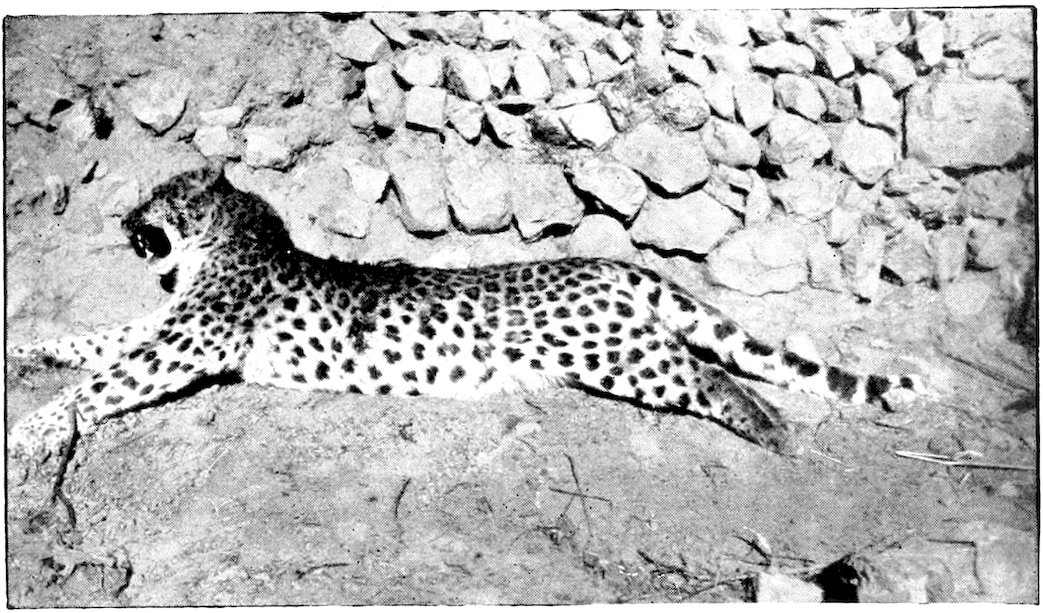
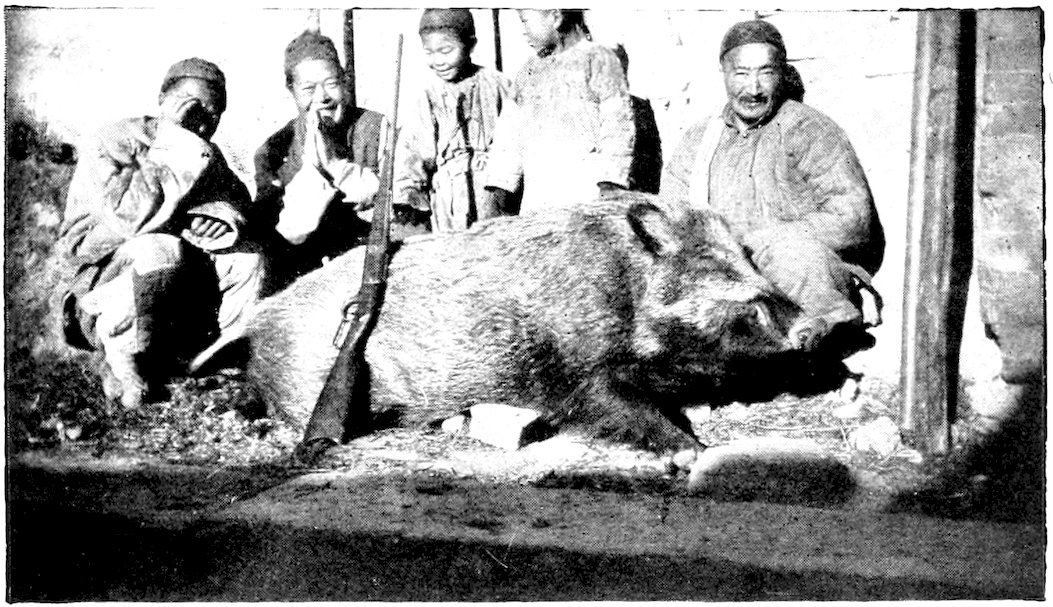
PLATE IV.
[Photo by P. H. Atwood.
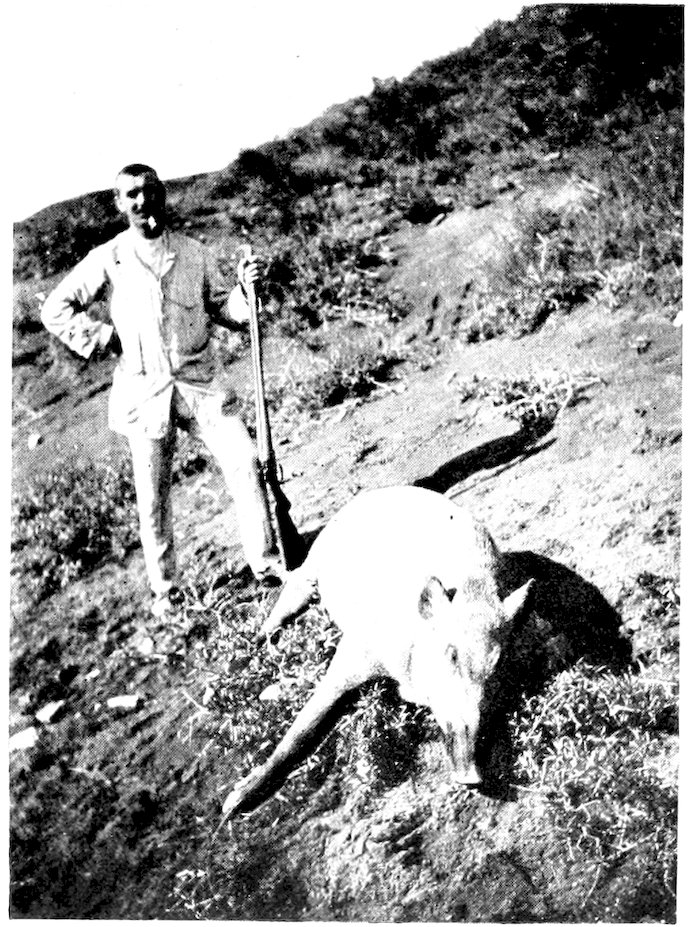
Leopard (Felis fontanieri) shot by Dr. P. H. Atwood in Shansi.
[Photo by P. H. Atwood
Wild Boar (Sus sp.) shot by Dr. P. H. Atwood in Shansi. Weight, 330 lbs.
Journeying up the course of the river at this
43season was no light task. The precipitous sides
forced us to keep to the bed, and the wide stream,
flowing from side to side of the valley, necessitated
frequent crossings. As it was in a semi-frozen
condition, this was dangerous work. Once my
wife narrowly escaped the horrible fate of being
swept under the ice. It was only the agility of
her pony in bounding clear of the breaking ice
and rushing torrent that saved her.
More than once it was necessary personally to
wade through the icy water in order to find a firm
bottom for the passage of the mules and ponies.
The natives neither dared nor could be trusted
to do this, preferring always to allow the mules
to take their chance of crossing with dry loads,
while they themselves found safe passage where
the ice would stand their weight.
On December 8, after one or two short halts
en route to try and pick up a few specimens,
or to check up the compass traverse, we reached
Tsing-lo Hsien.
Here we stayed till December 14, while I tried
to trap some pikas and wolves. I secured two
of the former, but was unsuccessful with the latter.
Leaving Tsing-lo Hsien, we continued up the
valley of the Fên Ho for another ten miles, when,
after spending the night at Yung-an-chêng, we
turned westward up a side valley, reaching a place
named Wu-chia-kou at the edge of some magnificent
forested country. Here we decided to
44spend Christmas, as the surrounding country
offered prospects of good hunting and trapping.
In this we were not disappointed. During
our stay here we had a long line of traps out, which
yielded well, while in pig-hunting we were very
successful.
The first pig that was bagged was an enormous
animal measuring six feet two inches from tip
to tip, with a height of thirty-two inches at the
shoulder and a weight of 310 lb.
For several days reports came in of a sounder of
fifteen swine, led by an enormous white pig, the
size of a cow. I made up my mind to get this
fellow if possible. Several days were spent in
fruitless search. Always on returning to camp I
was told that the sounder had been seen in some
valley other than the one I had been searching.
At last one evening, as I was returning from a tiring
day in the highest portion of the range, the villagers
told me that not half an hour before, the sounder
I had been hunting for had passed the village and
had climbed the opposite ridge.
Tired as I was, I at once set off in the direction
indicated, and there sure enough were the tracks
I had grown so familiar with during the past
few days. Following these up, I climbed the long
ridge, and was just beginning to think that once
more the pigs had eluded me, when one of the
villagers who had accompanied me pointed across
the ravine on my right. There, in a small field,
45about a dozen pigs were feeding, but nowhere
could I see the great white leader.
Thinking that I had better make sure of at least
one pig, I began to cross the ravine, keeping under
cover as much as possible. Just as I was near
enough, and was about to aim, the great white
leader came treading majestically round a small
shoulder of rock. What a pig! He seemed to
my excited imagination to be more the size of an
elephant than a cow. On he came with nose up,
scenting round for danger, while behind came
several other pigs looking very small beside their
magnificent leader.
Raising my rifle, I fired. The huge brute
whirled round, stood for a second, and then broke
madly up and across the ravine. Reaching the
head he vanished from view. I hurried up the
steep ravine, and reached the top of the ridge just
in time to see my quarry rounding the head of a
second ravine. Without waiting to regain my
breath, I raised my rifle and fired. The pig
continued his course for a few yards, and then
suddenly plunged down the hill side. He struggled
madly to keep his footing, but presently
staggered and went head over heels, finally fetching
up at the bottom of a small cutting, stone dead.
The following day I went in search of an old
tusker, that had been wounded the day before
by a Chinese hunter, and had subsequently met
and knocked down one of my men, who was out
46setting traps. We found the trail easily enough,
but did not follow it up far, as it lost itself in a
stony ravine bottom.
While trying to pick it up on the wooded slope,
we ran across a very fresh trail and decided to
follow it up at once. It led us across the top of
the ridge, and a few yards down the next slope,
which was covered with dense hazel scrub. As
we entered the latter, there was the sound of some
large body moving through the brush. Breathlessly
we waited, soon being rewarded by the sight
of a good-sized pig, rapidly climbing the opposite
slope. I fired a couple of quick shots, but the
pig gained and crossed the top of the ridge and
vanished. We dashed down through the hazel
scrub and up the steep slope. On reaching the
top a spot of blood told us that our pig was hit.
Continuing on the run we tracked him round the
head of the next ravine, over the divide at the
top, and once more drove him from the dense
brush in which he was lying up. This time as he
climbed the slope opposite us, I managed to get
in a shot that bowled him over, but again he
struggled to his feet and vanished over the crest
of the ridge. Another arduous climb brought
us into a small wood of scrub oak, where we found
great difficulty in singling out the trail of our
quarry from a dozen others that ran in all directions.
Sending the hunter along one of the
freshest, I followed another, which led along the
47side of the ridge. Presently there was a splotch
of blood in one of the footprints, and I knew that
I was on the right scent. As I hurried along
through the pines and larches, I presently became
aware of my quarry standing amongst the trees
some twenty yards above me. With gleaming
eyes he stood looking down at me, but before he
could make up his mind to charge, I dropped
him with a bullet through the neck, just behind
the ear.
The following afternoon we climbed a high
range of jagged peaks that lies to the south of the
village, our object being to catch the pigs as they
left the cover of the forests for their feeding-grounds
as dusk came on. Two hours’ steady
climbing through the most enchanting woodland
scenery brought us to the crest of a knife-like
ridge between two pointed peaks some 2,000 feet
above the level of the valley bottom. Below us
on the one hand lay the dark woods of pine and
spruce, through which we had just climbed, on
the other tier upon tier of the purple ridges of
the foothills stretching away to the pink horizon.
Away across the valley to our north rugged
ranges rose higher and higher, culminating in the
massive granite peak of Lo-yah Shan, whose
castellated summit caught the last pink rays of
the setting sun, while its base lay shrouded in
rapidly gathering mists and ever deepening
shadows.
48Nothing could surpass the beauty of the scene
which we beheld that evening as we cautiously
worked along the ridge, keeping a sharp look-out
upon the cultivated fields a thousand feet below
us, whereon we hoped to catch some early pig
setting forth upon his night’s depredations. We
were disappointed, however, in not sighting any
game, but the wonderful scenery more than compensated
us for the arduous climb.
The next successful pig hunt, which was two
days later, might well have proved disastrous
for me. In climbing round some steep rocks,
from the crevices of which sprouted some young
spruce trees, affording me the necessary foothold,
I surprised a sounder of eight pigs, which were
lying sunning themselves at the base of the cliff.
They escaped up through the woods and over
the ridge, my hurried shot failing to find a
mark. Having reached the top of the ridge
ourselves after a hard climb, we were just in time
to see the sounder enter a dense patch of thorn-scrub
away down in the valley. Sending the
two natives to drive them out, I hurried down the
ravine and took up a convenient position below
the patch of thorn-scrub. Suddenly the whole
sounder broke cover, and to my horror came
thundering down upon me like a troop of cavalry.
Luckily the pigs were bent more on escape than
attack, so when I clubbed my rifle and swung it
to beat off, if possible, the mad rush of the foremost
49pig, he swerved to one side. The others
followed suit, but before the last one had passed
I managed to reverse my rifle once more, and,
firing from the hip, hit him in the jaw. The
wounded animal broke away from the rest of the
sounder, and, trying to cross a deep watercourse,
fell an easy mark to my second shot.
Besides the pigs we secured some roe-deer and
eared pheasants, this being the first occasion on
which I had actually seen the latter, though I had
often heard them without knowing what they
were.
Two of the roe-deer were bagged on the last day
of the year, while I was out hunting for something
with which to furnish our New Year’s dinner.
Accompanied by my trapper, who carried my
shot-gun, I was making my way up a broad
ravine the sides of which were heavily timbered.
There was a large open space near the head of the
ravine, and a woodman’s path led up through the
woods to this spot, enabling us to get quietly
through the woods to the edge of the glade. Some
five hundred yards up the slope were three fine
bucks quietly grazing. Leaving the trapper in
the shelter of the woods, I dropped upon my
hands and knees and wormed my way over the
ground. Taking care not to break any dry twigs
or to disturb any leaves, I made my way slowly up
towards the unsuspecting deer. By making the
best use of a slight dip in the ground and a few
50small trees, I succeeded in gaining a point within
a hundred and fifty yards of my quarry. Luck
was with me, for I was able to rise to my feet
behind a small pine without being observed. The
distance was nicely judged, and my first shot
caused one of the bucks to spring into the air,
make a few convulsive bounds towards the shelter
of the woods, and then stagger and come rolling
down the slope, almost to my feet. The other
two deer reached the cover of the woods, where
they stood watching their wounded companion.
I hurried up the slope and entered the wood
where they had vanished. Scarcely had I gone
ten paces, before I saw them bounding through
the trees, and taking a rapid aim, was fortunate
enough to bring one down. They were two nice
bucks, weighing 60 lb. and 65 lb. respectively.
The eared pheasants (Crossoptilon manchuricum)
gave us a new kind of sport. It was on Christmas
Day that we first encountered them. We were
sauntering up a wooded ravine when we suddenly
caught sight of them running up the steep, wooded
slopes. As they were out of shot-gun range I
tried a revolver shot at one. At the first report
there was a great beating of wings and every
bird left the cover of the pines and commenced
to sail gracefully across and down the ravine.
Needless to say, several passed within easy range
of us and were bowled over. The frightened
birds would light at the bottom of the ravine and
51at once scurry up the opposite side, when a report
from one of our guns would startle them into
repeating the silly manœuvre, which had already
proved fatal to several of their number. In this
way we made the very respectable bag of six large
birds, averaging 5 lbs. apiece. On four different
occasions I encountered flocks of these birds, all
of which acted in the same way.
Leopards were numerous in the districts, but I
never succeeded in actually encountering one.
We tried trapping for these dangerous but handsome
pests, without success. They could be
enticed to the traps, but always managed to avoid
being caught. A live sheep was cleverly extracted
from the midst of several traps, which were subsequently
overturned and sprung as if to express
the contempt of the great feline marauder.
Tracks in the ploughed field showed how he had
walked round and round the group of traps,
planning a way to reach the bait without getting
caught.
While up hunting in the highest parts of the
range, I came across tiger tracks in the snow.
The Chinese in the district said that there were
tigers, but refused absolutely to lead me to their
haunts, so greatly did they fear this animal.
Several wolves were seen, and one was shot,
but it escaped into a wood, where it was subsequently
picked up by a shepherd. This was one
of a pack of six, which, late one afternoon, after
52I had returned from a long and tiring hunt, passed
within a few yards of the house in which we were
quartered. I hurried out in my slippers and fired
at the last wolf as it crossed a low ridge. Thinking
that I had missed him, I returned to camp. That
night the five remaining wolves attacked a sheepfold
further up the valley, killing eight sheep.
My traps were fairly successful, some seven
species of rodents being secured.
The heavy timber in this district consists chiefly
of spruce and larch, with a sprinkling of pines.
The forests are even more extensive than those
of the Chiao-ch’êng Shan further south, which were
explored on the Clark Expedition. Owing to
greater facilities in transporting the logs, this
district is being more rapidly deforested.
Besides the conifers already mentioned, extensive
patches of scrub-oak, hazel and birch exist,
the last being a free peeling variety, from the bark
of which the natives manufacture household
utensils and mats.
It being winter, we were unable to gather much
idea of the rest of the flora of this district, but on
a subsequent visit in the autumn of 1911 I was
able to observe much more in this line. I then
discovered many interesting wild berries, which
are dealt with in the botanical notes at the end
of this volume.
The mountains here are very high and are
mainly of archaic formations. The highest peak,
53the altitude of which I estimated by means of
boiling point, aneroid barometer, and Abney
level, to be some 10,000 feet, is a stupendous mass
of granite known as Lo-yah Shan.
The inhabitants of the district we found to be
of the usual type of Shansi mountaineers. Those
who had not recently migrated thither from other
parts of the province were tall and well built,
with healthy, rosy complexions.
The chief occupation of these mountaineers is
the cutting and hauling of timber. This is
stacked on the banks of the Fên Ho, awaiting the
spring and autumn freshets, when it is taken
down in long rafts and sold at various places on
the T’ai-yüan Fu plain. A vast amount of timber
is thus taken out annually, while nothing is being
done to replenish the denuded areas.
On January 12 (1910) we once more took to
the road, and returning to the Fên Ho, followed it
up to its source. A few fruitless days were spent
en route at Tung-tsai, a large village engaged
in the timber trade, situated about ten miles from
the head waters of the river.
On January 17 we discovered a series of mountain
lakes, which constitute one of the sources
of the Fên Ho. These interesting lakes, which I
have already described in my geological notes in
Through Shên-Kan, are five in number, the
largest being known as Mu Hai-tzŭ, and the
second as Kung Hai-tzŭ. These names mean
54the Female Sea and the Male Sea respectively.
The lakes are situated at an altitude of from 7,000
to 7,500 feet, and lie in deep rock basins.
There are many legends connected with them.
One of these states that Mu Hai-tzŭ occupies
the site of an ancient town, and it is said
that on clear days in summer the ruins can be
seen at the bottom of the lake. At the time of our
visit the lakes were frozen over to a depth of
several feet. The ice, however, was very clear,
and near the edges weeds could easily be discerned
in the dark green depths.
January 18 found us at Ning-wu Fu, which
town has already been described in the foregoing
chapter. We made a short stay here to check up
and plot the compass traverse.
On January 24 we left this city, and crossing
a pass to the west descended on to an extensive
plain, which stretches away, unbroken by any
hills, as far as the Yellow River.
Traversing this plain for about twenty miles, we
reached a small town named Wu-tsai Hsien,
where we settled down once more to continue our
collecting work.
This time we were very successful, for besides
trapping, we induced the natives to bring in
specimens. To the number of different species
already collected, eight others were added, including
the wolf, the fox, the polecat, the mole, a
vole, the desert hamster, the striped hamster, and
55a new subspecies of hare, which was subsequently
named Lepus swinhoei sowerbyæ, after my wife.
There was no lack of sport, either, in this district,
for large flocks of bustards were continually seen,
and many fine birds were bagged. Three of these
averaged 18 lbs. in weight apiece. As they were
very shy, we had to resort to various expedients
to come within range. One method was to ride
round a flock, gradually drawing nearer. When
within range, I would drop off my pony and lie
flat, while my wife would gradually edge away,
leading my pony and keeping at an even pace. In
this way I would be able to take a comfortable
shot without startling the birds, whose attention
would be centred upon the ponies.
The method we enjoyed most, however, was
plain stalking, when by keeping flat upon the
ground and utilizing every little ridge or hummock
of earth, we could often crawl to within easy
range.
One day, to my own surprise and the delight
of my wife and the natives, I brought down a
large bird, which was flying past me at about
seventy yards range. My bullet took it fairly
in the side, and the great bird slowly came to
earth, a quarter of a mile away. It was stone
dead when we picked it up.
Foxes and hares also were plentiful on the
plain, but as I seldom went out with anything
but my rifle, these escaped attention.
56The Wu-tsai plain is in parts very fertile, but,
generally speaking, lacks a good water supply.
The district is not notable for anything.
Not more than a couple of miles to the south
of the town the plain comes to an abrupt end,
and the foothills of the great mountain range
we had already visited commence.
By February 15 we had completed our work on
the plain, and decided to return to T’ai-yüan Fu.
Accordingly we left Wu-tsai and struck out due
south, and, entering the mountains, followed a
deep valley as far as Tien-p’ing, a small mountain
village.
The mountain path which we followed was, in
places, extremely dangerous, so that we experienced
great difficulty in getting the heavily laden
mules along in safety. Often a mere parapet,
made of saw-logs and supported by stakes driven
into the rock surface, formed the only means of
negotiating the steep-sided gorges. More than
once the mules, edging up too close to the side,
sent their burdens crashing down into the rocky
ravine bottoms below, causing considerable
damage to our equipment.
At Tien-p’ing the heavily forested mountains
looked so favourable, that we decided to stay a
day or two to hunt. It was well that we did so,
for specimens of a rare flying squirrel were secured.
It has not yet been definitely ascertained to what
species this squirrel belongs. Having secured four
57specimens, I offered the natives 400 cash (about
1s.) for each additional specimen they could
secure for me. They discovered a nest of the
coveted animals in a hollow tree, when, rather
than risk losing one, they plugged up the hole,
cut down the tree and carried it bodily to the
village over a distance of about three miles. Six
squirrels were found inside, five of which I skinned,
reserving one alive. This one lived till well into
the summer, when doubtless the heat of the
plains was too much for it.
During the few days we spent in this vicinity
I hunted the sika deer assiduously. This is
a beautiful spotted animal about the size of the
British red deer. Though I followed their tracks
for miles each day, I never succeeded in sighting
one, owing to the denseness of the forests in which
they lived.
Judging from tracks I saw in the snow, musk
deer also were common, but, being much hunted
by the natives, they were very shy and always
managed to remain out of sight.
On February 23 we once more started for home.
Our path now lay over the most difficult country
imaginable. The steep slopes were covered with
ice, so that our animals had the greatest difficulty
in ascending them. Spills were frequent, and
more than once the loads were thrown off and
boxes smashed.
As we neared the pass, we entered a deep
58forest of very heavy timber, through which we
travelled for upwards of two hours. Here the
snow was above our knees, while in long chains
over its surface were innumerable tracks of deer,
wolves, leopards, pigs, foxes, cats, martins and
minks. Unfortunately we could not camp in this
district, the weather being much too cold, even
had we had our tents with us.
The divide, which was marked by a small shrine,
I estimated at 8,000 feet. To our left the massive
height of Lo-yah Shan towered above the timber
line, while to our right the heavily-wooded slopes rose
gently to some bare snow-clad uplands. Below
and in front of us lay a frozen tributary of the
Fên Ho, beyond which a magnificent panorama
of blue hills and purple mountains, jagged peaks
and winding valleys, spread itself as far as the
eye could reach. Behind us were the rugged
forest-clad ridges of the Tien-p’ing district.
Reluctantly we descended the southern side
of the divide, for we realized that nowhere in all
North China could such scenes as we had just
gazed upon be rivalled.
That night we reached Wu-chia-kou once more,
and being anxious for a little more shooting, we
decided to spend two days here.
Our decision was fortunate, as a pig was bagged
each day, bringing our total up to five; while a
single specimen of the rarest of all Shansi mammals,
the little wood-pika (Ochotona sorella), was secured.
With this we were content and continued our
homeward journey.
PLATE V.
[Photo by K. T. McCoy.
Mr. and Mrs. A. de C. Sowerby with Bag of Wild Pigs, Bustards and Small Game.
59Once more reaching Tsing-lo Hsien, we decided
to take a different course from that followed on
our outward journey, so turned eastward up a
large tributary of the Fên Ho.
Following this up to its source we crossed two
high passes in a granite dyke, which here protrudes
through the grey limestone. The last day
into T’ai-yüan Fu, we travelled for about ten
miles along a deep and narrow gorge in the same
formation, finally issuing out upon the plain at its
northernmost point.
The last fifteen miles were quickly traversed,
and we found ourselves home once more after a
most enjoyable and successful trip.
We had explored and mapped the greater
portion of the upper reaches of the Fên Ho, had
discovered some hitherto unknown lakes and
extensive forests, and had brought out a good
collection of mammals, amongst which one at
least was new to science, while six were new to
the Institution we represented.
We had enjoyed as good sport as any one
could wish for, so that we felt well satisfied with
our winter’s work.
After our return to T’ai-yüan Fu, our work was
discontinued for over a year while we paid a visit
to Europe.
CHAPTER III SPORT ROUND T’AI-YÜAN FU
63
In the summer of 1911 we returned to China,
with the idea of carrying out extensive
explorations in Mongolia and Manchuria.
We reached T’ai-yüan Fu in July, when, the
rainy season being at its height, it was impossible
to start our contemplated journey for some time.
I tried one short trip into the mountains of the
Ning-wu district, but it ended in disaster, my head
servant being accidentally shot by one of his
companions.
Subsequently disquieting rumours anent the
impending outbreak began to circulate, so that
I decided to wait a while to see how things were
going, before starting on a long journey northwards.
In view of the general unrest in the country,
we had decided that my wife should not accompany
me on this journey, but I soon found a
pleasant and able companion and assistant in
Mr. F. W. Warrington, son of Professor A. W.
Warrington of the Shansi University.
64For the time being we contented ourselves
with short excursions round the city and into the
adjoining country, and were very successful.
September, in China the best month of the year,
arrived, and with it the thought of the pheasants
and other game, only waiting for the sportsman’s
gun. We decided therefore to try our luck in the
mountains west of T’ai-yüan Fu.
Elsewhere I have described hunting in this
particular bit of country, but as I have not done
so in the present volume, and as our experiences
were typical of what a hunter in these parts
usually goes through, a brief description will
perhaps not tire the reader.
Hiring mules to carry our stores, and accompanied
by one of the railway officials, a Frenchman
and a very good fellow, we left the city in
high spirits. It was just the right sort of day for
travel, and our ponies, fresh from a good summer’s
rest, curvetted and careered in their anxiety
for a gallop across the flats.
After seeing our mules across the swollen river
in safety, and traversing the low-lying loess
terraces on the western side of the valley, we entered
a deep gorge in the limestone formation. Being
well mounted, we had long since outstripped the
mules, so when we found a clear stream a couple
of miles up the gorge we dismounted to have
lunch and await the slow-moving train.
We finished our lunch and then put in time
65searching for fossils. The hours slipped by, but
brought no sign of the mules, so that we began
to wonder what had become of them. Finally
we rode back to the nearest village, some three
miles along the road, and made inquiries of the
natives. No, the mules had not passed through
the village: no one had seen them. This was
awkward. What had become of those mules, or
where to go in search of them, we were entirely at a
loss to know. We did not want to return to T’ai-yüan
and spoil our trip, and yet to go on into the
mountains without any prospect of food or shelter
did not commend itself as a much better alternative.
Finally, by much questioning, we learned
that there was another path up to the spot where
we wished to camp. Putting everything on one
cast of the dice, we decided to make for our
original goal on the chance that our outfit and
servants had already arrived there by this other
path.
As night was fast coming on, we borrowed a
lantern and set out to make the twelve miles of
mountain path as fast as possible. Daylight
lasted another half-hour or so, allowing us to get
well into the gorge. Our plucky little ponies
kept up a sharp trot, even in the darkness, till we
reached the end of the boulder-strewn gorge. We
then began a steep and, under the circumstances,
somewhat dangerous ascent. For upwards
of two hours we climbed, sometimes zigzagging
66up the steep face of a mountain, at other
times winding along the edge of a precipice. Once
we missed the path and found ourselves at the
end of a narrow ledge, looking down into the
inky depths of a yawning chasm. Carefully
retracing our steps we regained the path, which,
owing to numerous landslides, caused by recent
rains, was obliterated in many places for yards
at a stretch. It was with the utmost difficulty
that our sure-footed ponies picked their way over
these masses of jagged rock.
At last, however, we reached the village of
Shêng-yeh, and to our great relief found that our
mules had arrived in safety, and had put up at a
little temple. We soon forgot our trying experiences
in anticipation of a good week’s sport
amongst the pheasants.
We got a camp fire going, and were soon comfortably
enjoying a good dinner, followed by a
smoke, a chat and bed.
Early the next morning we were astir, and after
a hasty breakfast we set out over the brush-covered
hills. It was not long before we began to flush
pheasants, and had excellent shooting. As we
traversed the ridges and intervening ravines, bouquet
after bouquet of fine young birds, led by
magnificent old cocks, rose in front of us, and our
guns rang out incessantly. Now and then a
hare, breaking cover, would form a little diversion;
while once or twice great excitement reigned as a
67fat woodcock burst out of some thick coppice
of young pines and went rocketing away, sometimes
falling to one or other of the guns.
Presently, as we worked down a long ridge, the
unearthly and awe-inspiring cry of the eared
pheasant (Crossoptilon manchuricum) rang out
from a clump of pines on the opposite slope, to be
taken up and thrown back from several other
points in the underbrush. To my companions
the peculiar noise was new, but to me it was a
familiar sound, though I was surprised to hear it
in this locality.
How well I remember my first experience of
that fearsome call, or rather series of calls. I was
at the time away in the high mountains of Western
Shansi, and was stalking a deer through a dense
forest, when the noise rang out within a few yards
of me, echoing through the dark arches of the
pines and sending cold shivers down my back. I
did not then discover the perpetrator of the discordant
cries. Later when I was out in Kansu,
and was traversing some dark and wooded gorges
high up in the Lu-p’an mountains, I was again
startled by the same indescribable sound, which
seemed to issue from the throat of some fearsome
beast of prey lurking in the gloomy depths of those
mountain gorges. It was not till the winter of
1909, while on the expedition dealt with in the
foregoing chapter, that I discovered it was the
eared-pheasant’s challenge which had so startled
68me. Thus the sound which now caused my
companions to look round in something approaching
trepidation, was to me the sweetest of music,
as I remembered the fine sport I had already had
with these birds.
We hurried round the top of the ridge, and
having arrived at a point above the spinny whence
the calls had issued, we worked slowly down
through the young pines. We had not gone far
when three fine birds broke cover and went gliding
across the valley. The trees prevented anybody
shooting, but we carefully noted where the birds
settled. One lighted in a pine tree near the bottom
of the ravine, while the other two settled higher
up the slope, and in their usual manner began to
run upwards at top speed. Hurrying down we
approached the tree in which the bird had settled,
but nothing could be seen of it. Suddenly it
broke cover once more and I managed to get in a
shot that made the feathers fly. The bird continued,
however, and reached the opposite slope.
Again we hurried across to the spot where it stopped,
but could find no trace of it. Jimmy, our pointer,
soon picked up the warm scent, however, and
there ensued a long and exciting chase through the
underbrush. None of us could see the quarry,
which was running with wonderful speed through
the dense hazel-scrub. At last Jimmy caught
it and held it till we came up. It turned out to
be a magnificent cock, which must have weighed
69six or seven pounds. The other two made good
their escape.
It was indeed a surprise to me to find this bird,
which usually inhabits the highest and wildest
regions of the country in such close proximity to
the thickly populated country round T’ai-yüan Fu.
On our way back to camp a few more common
pheasants were bagged. With this we were satisfied
for the time being, and decided to devote the
next day or two to hunting pigs.
Accordingly on the following day we shouldered
our rifles, and set off towards country, where
previous experience had taught me we might
reasonably expect to find pigs.
We soon came upon fresh trails, and choosing
one, we followed it for many miles through the
most picturesque country. At first the trail led
along the bottom of a deep ravine, down which
flowed a gurgling brook, and the sides of which,
stratified and steep, presented a veritable fairyland
of ferny grottoes and spongy mossbanks,
half hidden by twining creepers, hanging in
enchanting festoons. Soon our way was barred
by a sill of rock, harder than the rest, over which
fell a sparkling cascade of crystal water. Still
following the path marked by the deep spore of
our quarry, we climbed up the slippery slopes, to
be drenched by showers of dew from the autumn-tinted
leaves, which soon would go to increase the
richness of the soft mould under our feet. Scrambling
70upward through rending thorn-scrub, close
matted bryony and fast searing hazel, we next
came out upon terraces of long, waving grass,
which in turn gave place to gentle shale slopes,
dotted over with sapling pines and dense bushes,
on which the golden berries hung in rich and
tempting clusters. Through all this the spore
we followed was plain, but presently, as it emerged
upon the rocky bluffs of sandstone, it became more
difficult to follow, till it was lost in an extensive
patch of hazel-scrub, through which only a pig
could force its way, and where, in all probability,
our quarry was lying up for the day.
Thus we spent two fruitless but interesting
days—interesting because of the wonders of nature
presented at every step.
Here, in loose coils, lies a viper, his lithe form
flattened to catch the full benefit of the sun’s rays,
while an ugly swelling in the region of his stomach
shows that he has recently dined. On an overhead
bough is perched an angry chipmunk, screaming
at the cold-eyed monster, thus giving vent
to his feelings for the loss of his luckless mate.
There, in a damp hollow, sits a great toad, his fat
sides and throat throbbing and his golden eye
ever watchful for some hovering fly or careless,
crawling beetle. Soon there passes through the
woods a troop of lively, chattering tomtits, each
tiny bird examining the under surfaces of the leaves,
searching amongst the scales of the pine-cones,
71prying into every crack and cranny of the bark,
or exploring the hollows under the gnarled and
twisted roots, in its everlasting hunt for ants,
spiders and grubs. Swish! Down from the blue
vault of heaven swoops a fierce hawk. There is
a flutter, a tiny cry of distress, and away goes
the cruel marauder, bearing in his talons the
mangled and lifeless form of one of the lively little
tits. The others, momentarily awed by the
tragedy, vanish from sight. Presently, as the
exuberant and irrepressible energy of each tiny
songster once more predominates, first one, and
then another, makes a quick dart through the
bushes, till the whole troop is once more flitting
from tree to tree and bush to bush, chirping and
singing as though nothing had happened. Next,
the angry scolding of a pair of magpies announces
to all the world that they can see a fox sneaking
through the scrub upon a covey of unsuspecting
partridges. Poor Reynard! his crafty designs
thus revealed to his quarry, who hasten to place
themselves out of danger, and fearing that he may
bring the hunters down upon himself, he creeps
away to his lair, there to nurse his hate against
those spoil-sports, who, if the truth were known,
are guilty of crimes every whit as bad as his own.
Absorbing though all this might be, it was
somewhat disheartening not to sight a pig. It
became evident that the valleys we were working
afforded too much cover for them, so we
72decided to try the slopes on the other side of the
ridge.
Once more, as rosy-fingered dawn drew aside
the purple veil of night, we shouldered our rifles
and made for the sparsely wooded slopes, where
we had discovered the eared pheasants. Before
long we came upon the fresh tracks of two good-sized
pigs. We followed these up all the morning
without sighting anything larger than hares,
pheasants and woodcocks, though there were
not wanting signs that the pigs were but a
little distance ahead. At noon we rested in a
beautiful ravine, where we made a hearty meal of
cold pheasant and bannock, washed down with
long draughts of water from the cool stream
which gurgled at our feet.
PLATE VI.
Front View of North China Wild Pig, Shot at Shêng-yieh, near Tâi-yüan Fu.
Hunting Party on Summit of High Peak, near Tâi-yüan Fu.
The best part of the afternoon was behind us
when signs in the trail, which we had taken up
again after lunch, convinced me that we were
close up to the pigs. Warrington and I were
down at the bottom of a ravine, while our French
friend was sauntering along the top of the ridge,
looking very bored with the proceedings, and
audibly wishing that we would confine our attentions
to easier game. Suddenly his voice, choking
with suppressed excitement, rang out. “Peeg!
Peeg!” Looking up we saw our companion, his
face ablaze, beckoning to us with one hand and
pointing to a magnificent boar with his gun held
in the other. His weapon was a treble-barrelled
73shot-gun and rifle combined. As soon as he was
sure we had seen the pig, he turned and let drive
at him with both barrels of bird shot, following
this up with the rifle. At the same moment our
own pieces rang out, but the pig, stung into madness,
tore up the hill and across the ridge. Down
the other side he went, regardless of every impediment,
leaving a trail of scattered rocks and uprooted
bushes. He had gained the bottom of the
ravine and was well up the opposite slope before
we reached the top of ours. Here in a dense
pine spinney we lost sight of him and were too
exhausted to trail him further, so he escaped with
a dose of No. 4 shot in his hind quarters.
Our time, regulated by the duration of our
friend’s leave, was almost at an end, so we decided
to finish up with a grand drive, in which we hoped
to settle the vexed question as to who should claim
the honours of the chase.
Unfortunately for me, it proved to be my off
day, so that but for a nice right and left at the
commencement of the drive, and a bird here and
there throughout the day, I missed everything.
Warrington on the other hand did particularly
well, and the Frenchman increased his total bag
by several brace of pheasants. The result of the
day’s shooting was a win for Warrington. This
finished our little trip, and we returned without
adventure to T’ai-yüan Fu.
We found that the Revolution had just broken
74out in Hankow, and that the general unrest and
excitement was increasing. Being loth to risk
my outfit, and knowing that if the North joined
in the rebellion against the Manchu power, it
would be impossible to travel with any safety, I
decided further to postpone our intended journey
into Mongolia, spending the time instead in a short
camping trip down the river.
Thus it was that on October 12 we found ourselves
comfortably settled under canvas upon the
bank of the Fên River, about five miles south of
T’ai-yüan Fu.
Round us the farmers were busy harvesting
rich crops of beans and sorghum. The weather
was superb, with just sufficient nip in it to make
a stove at night pleasant, and to send the blood
coursing through one’s veins as one tramped along
in the early mornings, watching the sky for the
long lines of migrating geese, or beating the scrub
and underbrush for hares and quails.
All night long we had heard the honking of wild
geese as they passed southward, fleeing from the
northern cold, which was steadily advancing to
lay its grip upon the land, and now as the grey
dawn spread its light over field and flood,
we crept out towards one of the numerous dykes
which intersect these flatlands, and crouched
behind it in hopes that the oncoming geese, flying
low as is their wont when there is frost in the air,
would afford us a few shots.
75We were not disappointed, for presently the
familiar cry was heard, and barely above the
horizon we could see a long V-shaped line, which
steadily drew nearer. Then we saw another,
and another, till it seemed as though from the
north advanced a conquering army, the many
battalions of which were bearing down upon us.
On they came, till the first row was almost within
range of our guns, when, suddenly, at a warning
cry from the leader, who formed the apex of the
V, and had evidently caught sight of something
that raised his suspicions, the whole flock rose
high into the air, passing safely over us.
The next line delayed this manœuvre till too
late. As our guns rang out, two birds dropped
back from the advancing line. One came hurtling
down and struck the bank like a cannon ball;
the other, struggling desperately to keep its
balance, swerved to the left, and with a mighty
rush plunged into the swirling waters behind us,
where presently it could be seen floating rapidly
down stream. It reached some mudbanks in
the centre, and leaving the water lay down to rest.
It did not take long to secure this bird, though a
wetting was naturally the price.
After this incident, no more geese appeared,
so setting up my little accordion boat, we crossed
the river to where some thick grass spread over
a large area of ground. This we beat through
and were rewarded with a couple of hares and a
brace or two of quail.
76That evening we set out a line of traps, which we
visited thereafter at dusk and dawn, and from
which we drew a supply of specimens, including
gerbils (Meriones psammophilus), hamsters (Cricetulus
triton incanus and C. andersoni), and other
rodents. We skinned these in the mornings,
while we spent the afternoons making excursions
down the river or hunting for game. We soon
located some bustards, but as yet they were too
shy to allow of our near approach, having just
run the gauntlet of feather hunters from Mongolia
southward.
These birds we hunted with rifles and on horseback,
and at length managed to get a flock close
up to an irrigation canal. Stalking along this,
we came within a hundred yards of the bustards,
then cautiously peeping over the bank, each of us
selected his bird and at a whispered signal fired.
Warrington’s bird dropped dead, but mine escaped,
leaving behind a few feathers shaved off its back
by the bullet.
We discovered some badger holes and set traps
for them, but succeeded only in catching a mink,
which however escaped, leaving a claw behind
in token of its carelessness.
As the days grew colder, more birds came down
from the north, and soon we noted large flocks
of mallard and teal out on the muddy stretches.
We organized several shooting parties, made
up of friends from the T’ai-yüan community, and
77so would ride long distances over the plain, taking
everything as it came. In this way we secured
many good bags of ducks, geese and hare. Once
as we were returning to camp a bustard, flying
overhead, was brought down by Warrington, who
let drive from horseback with No. 2 shot.
On more than one occasion during these excursions,
Warrington, who as yet was not familiar
with the treacherous mud-flats, nearly came to
grief in the quicksands.
One day, having been tempted out upon the
mud-flats by a large flock of waterfowl, we succeeded
in securing a goose and two mallards. I
went after the former, and my companion after
the latter. After securing my goose, I turned to
see where Warrington was, and was horrified to
see him struggling almost up to his waist in sinking
sands. Hurrying to his rescue, I arrived just as
he had succeeded in extricating himself. He
had lost his gun, however, the butt of which could
be seen protruding just above the surface of the
mud. I went to try to secure it, but soon found
myself in difficulties, from which I had considerable
trouble in extricating myself. We then went
inland and cut some sorghum stalks, with which
to make a safe path over the quicksands. Some
Chinese helped us carry these down to the river’s
edge. One of them asked me what we were
trying to do, as I carefully laid the sorghum stalks
out over the treacherous surface. I pointed to
78the gunstock, and told him I wanted to recover
it, whereupon he walked into the quicksands,
secured the gun and returned without the least
apparent effort. He explained the ease with which
he managed to do what we had found impossible
by the fact that his legs were bare, whereas
we had boots and putties on.
On another occasion the pony which Warrington
was riding bogged down in a place that looked
perfectly safe. The poor animal’s desperate struggles
only caused the sandy mud to engulf him
further. But for the timely assistance of some
natives engaged in building a temporary trestle
bridge, who came running to our aid with ropes
and poles, the animal would certainly have been
lost.
Thus we continued day after day, hunting,
riding and trapping. Still the province remained
quiet, till at last we began to think that after all
we might venture upon our proposed expedition,
and we were just finishing up at camp on the river
when an urgent letter reached us from T’ai-yüan
Fu, advising us to come in at once, as an outbreak
was about to occur.
A few days later the Shansi soldiers revolted,
and raising the Revolutionary flag, declared in
favour of a Republic.
This effectually interrupted our work for many
months to come. Advice, which amounted to
orders, from the Legations in Peking, resulted in
79all Europeans in Shansi taking their wives and
children to the coast.
Subsequently news of the murder of some
missionaries and children and the rumoured peril
of the remaining Europeans in the adjoining province
of Shensi, led to the formation of the Shensi
Relief Expedition, which was placed under my
leadership, and which kept Warrington and myself
very busy throughout the winter.
Accounts of the journey to and from Si-an Fu,
the capital of Shensi, have appeared elsewhere,
so they need take up no space in this book. Suffice
it to say, we had an exciting and interesting
journey which ended in our safe arrival in Peking
in January, 1912.
CHAPTER IV TRIP TO HSI-WAN-TZŬ
83
On our return from the Shensi Relief Expedition,
Warrington and I spent a month in
Tientsin, after which, things having apparently
settled down, I decided to make a trip to Kalgan,
a town situated on the southern border of Inner
Mongolia. My object was to discover suitable
hunting grounds for our spring and summer
work.
Thus on February 17, having spent the night
at Peking, I boarded the Peking-Kalgan train, and
before long found myself being whirled along
at a good speed over the great alluvial plain of
North Chihli towards the famous Nan-k’ou pass.
After stopping about half an hour at Nan-k’ou
station, where there is an hotel, and where an
extra engine is usually added, the train entered a
deep and narrow valley. The grade being very
heavy, we ascended this valley but slowly.
As usual the engines pushed from behind, and
the passengers were able to obtain an excellent
view, by standing on the end platform of the
84guard’s van. As the train neared the head of the
valley we caught glimpses of the towers and
battlements of the Great Wall, winding snake-like
over the tops of the hills. At Ch’ing-lung-ch’iao
(clear dragon bridge) station, those who wish
to view the ancient relic of bygone struggles
between the Chinese and Tartars leave the train
and climb the steep and rocky slopes to various
points of vantage. They will see a fine old wall
in an excellent state of preservation, marked at
intervals with square towers. If, however, they
imagine that what they see represents the whole
of the Great Wall as it is to-day, they are greatly
mistaken. This is only one of a few sections that are
in good repair, doubtless due to its proximity to the
capital of the Empire. But a few miles westward
from this point the Wall becomes a mere ridge of
earth, while the watch towers have fallen into
disrepair. These conditions prevail all the way
to the end of the Wall in Chinese Turkestan.
From Ch’ing-lung-ch’iao the train continued its
upward climb for another four hundred feet, when
it passed through a long tunnel, and began to
descend on to a wide plain. Crossing the plain,
which looked very bleak and barren, we passed
Huai-lai Hsien, a small town situated upon a
rocky prominence on the south side of the railway.
Later we entered a narrow, winding valley, at
the mouth of which we noticed some coal mines.
The Ta-yang Ho makes passage of a chain of
85mountains by this valley. The line follows the
northern side, passing a small town named Hsiah-hua-yuan.
Presently the valley widens out once
more into a small plain, on which is situated the
important city of Hsuan-hua Fu. Here our train
stopped for a few minutes.
After leaving this place the line bends northward,
leaving the main valley, and, following the
course of a smaller one, finally reaches Kalgan.
We arrived at about seven o’clock, after an
eleven hours’ journey. Putting up at a Chinese
hotel, I went in search of the British American
Tobacco Company’s headquarters. Here I found
my friends G. W. Brodie and F. M. Schröder,
whose acquaintance I had recently made in
Tientsin, and received a kind invitation to have
my meals with them while in Kalgan.
They told me they were expecting two friends
from Tientsin, R. K. Douglas and R. G. Buchan,
who were on their way up for a shooting trip.
Next morning my friends took me for a ride
round Kalgan. The town in some ways is typical
of those along the border, though it presents many
peculiar features of its own. The name Kalgan
by which it is known to Europeans, is the Mongol
one, and is never used by Chinese. Instead they
call it Chang-chia-k’ou, which means “the mouth,
or opening of the Chang family,” and signifies that
originally the place must have consisted of a few
buildings situated at the mouth of the valley,
86and occupied by a family named Chang. A
great many Chinese place-names originated after
this manner. The actual town, or that part
enclosed by a town wall, is very small, but the
suburbs are very extensive, spreading over the
whole of the valley and reaching right up along
the deep and narrow gorge leading up to the
Han-nor-pa pass. This last section, which is
mainly composed of camel inns and business
establishments dealing directly with the Mongols,
and which lies outside the Great Wall (northern
loop), is known as K’ou-wai (outside the mouth).
The next section, which consists of cart inns for
Chinese, artisans’ workshops and private Chinese
houses, is known as Shang-pu (upper town).
The lowest section, known as Hsia-pu (lower
town), is much the largest and includes the walled
town and a large area of godowns, hotels, inns
and business establishments, all of which have
sprung into existence since the opening of the
railway.
It is this new factor that makes Kalgan unique
amongst the border towns. On one side of the
river, which is spanned by a strong stone bridge,
we have a busy centre, presenting many of the
features of a treaty port, with corrugated iron
sheds, Europeanized shop-fronts, one or two
foreign-built bungalows, railway sidings and so on.
On the other side we have a centre, just as busy,
but typically Oriental. Here are bazaars, where
87the crafty Celestial temptingly displays, upon
the usual small stalls, a gaudy array of trinkets,
cloth, ornaments and toys, for the benefit of the
innocent Mongol, whose mount, a soft-eyed camel,
stands patiently behind, his great jaws for ever
working from side to side as he chews the cud,
while his master pits his own simple nature against
that of the wily stall-keeper in a futile attempt
to drive a bargain. A little further up the valley
is a wide, open space, used as a horse and cattle
market. Here, when a fair is in progress, occur
scenes of unusual interest. The Mongols, who
bring down their herds, bivouac in the open,
making picturesque little groups. The women
accompany their husbands and take equal part
in the work of selling off their stock. When sales
are brisk one witnesses the wildest scenes, as
reckless riders tear up and down, regardless of life
and limb, in an effort to show their mounts off
to the best advantage. The air is filled with the
choking dust of a thousand hoofs, while the noise
and din are terrific. All this we saw and more, as
we rode up the valley in the warm winter sun, and
a very enjoyable day we spent.
The evening train brought Douglas and Buchan,
with their outfit of tents and greyhounds. They
very kindly asked me to join their party. This
I was glad to do, as it would take me into new
country, besides offering the chance of some sport.
Carts were hired, and on February 20 we left
88Kalgan. It had been decided that the nearest
point where we could hope to get any shooting was
Hsi-wan-tzŭ, where, we were told, a certain amount
of small timber, growing on the steep mountains,
gave shelter to a few roe-deer and some small
game. Our road lay up the main valley northward
from Kalgan, and soon we were up to our
necks in trouble. The whole valley was one mass
of ice, accumulated during the winter by the daily
overflowing of the permanent stream and the
nightly freezing of the surface water. Now, the
weather becoming daily more mild, this ice had
weakened considerably, so that the wheels of
our heavily laden carts went through, while
the teams slipped and floundered about in their
desperate struggles to disengage the unwieldy
vehicles. No sooner was one cart free than the
next would fall into the same difficulty. By
dint of much exertion, the breaking of ice, and the
concentration of horse power upon the cart in
difficulties, our carters finally succeeded in getting
them across the half-mile or so of ice on to dry
ground. So long did this take, however, that we
could not accomplish more than fifteen miles
the first day, and were obliged to put up at a
small village named Hsin-yin-tzŭ, where we obtained
comfortable quarters.
The following day we continued up the valley,
now running in an easterly direction. We were
hampered by more ice in a very rotten condition.
89Hearing that there was some good pheasant
shooting to be had up a valley on the south side
of the road, we thought we would try our luck.
After a ride of about four miles we reached the
head of this side valley and, leaving our ponies at
a farm, climbed up towards some scanty scrub-oak
and hazel. Three pheasants and a covey of
partridges were the only game flushed. Disappointed
and hungry, we returned to our ponies,
and after a hearty meal, hurried back to overtake
the carts. This we did by riding hard, finally
reaching Hsi-wan-tzŭ just as it was getting dark.
That night we put up at a small inn, but next
morning, on paying a visit to the Catholic missionaries,
received a pressing invitation to stay
with them. Father R——, the head of this
Mission, very kindly placed three bedrooms, a
dining-room and a kitchen at our disposal, and
begged us to make ourselves at home. He also
told us where we might find game, and appointed
two of the natives of the village to act as guides.
Needless to say, these hospitable arrangements met
with great appreciation on our part. Throughout
our stay we were as comfortable as we could have
been in our own homes.
We found that we would have to ride five or six
miles to reach the hunting grounds, but we
scarcely minded this as we were well mounted.
It was decided to commence operations at once,
so off we rode, following our guides, who were also
90mounted. They led us up a long, winding valley,
the slopes of which grew more wooded as we
ascended. At last, having arrived at a farm near
the head, we left our ponies and began to climb
up through the heavy snowdrifts. We saw
plenty of deer tracks, but no deer. The snow was
very deep, and the uphill climbing was the severest
I had ever experienced. In places we had to force
our way through waist-deep drifts, getting ourselves
soaked to the skin. The first day’s hunt
proved a failure, but we decided we would change
our tactics, and go in for drives, thus saving
ourselves the fatigue and discomfort of working
through the snow. This method proved far more
successful, and it was only the somewhat wild
shooting of some of us that prevented our securing
a really good bag.
Following is an example of the way in which
these drives were carried out. The natives having
decided on a likely wood, away up towards the
end of a long valley, stationed us in various positions
of vantage. I was placed opposite the wood
on a sunny slope. Buchan was placed at the
mouth of a side ravine near the end of the wood.
Douglas and Schröder were placed at intervals
further up the same ravine. The beaters then
made a long detour, and reaching the other end
of the wood, commenced to work through it,
shouting and yelling as they came. Suddenly
their cries redoubled, and, looking carefully, I
91could make out the forms of several deer breaking
through the small timber. The herd, which contained
five deer, came bounding diagonally down
the slope. At the edge of the wood one of them
broke back up the hill again, while the other
four made straight across the valley towards me.
Something turned them, however, and I lost my
chance of a good shot, as they disappeared into a
side ravine. The lone deer continued along the
wooded slope, and I turned my attention to him.
He was a little too far for me and going at a great
speed in spite of the deep snow. At last he cleared
the wood and started up the ravine in which my
companions were stationed. He escaped a bullet
from Buchan’s rifle by a miracle, only to fall at a
shot from Douglas. This was our first blood,
and we returned to Hsi-wan-tzŭ very pleased with
the day’s sport.
On another occasion we were similarly placed
along a narrow ravine, which skirted a wooded
slope. Again a small herd of roe-deer were
started up by the beaters, and again they ran
the gauntlet of our fire. Having successfully
evaded Schröder, Buchan and myself, they rounded
the shoulder of a hill and ran right into Douglas,
who was equal to the occasion and bagged two.
One of these was wounded only in the hind leg,
and gave the party a long chase through the deep
snowdrifts, before he finally succumbed to a
long shot from Schröder’s rifle.
92In this way four very pleasant though strenuous
days were spent. Daily we rode out, first up the
main valley, and then up one of the side ravines,
to the spot, from which we meant to commence
operations. Daily a small band of beaters gathered
behind us, as we rode through the scattered
villages along our path; and daily we tramped
miles through the deep snow or sat impatiently on
some sunny slope while the beaters did their work.
By noon we were usually in such a ravenous state of
hunger, that no matter what kind of luck we were
having, we would one and all find our way back to
the shack where we had left our ponies, in search of
something wherewith to replenish our exhausted
vitality. The first man back was expected to
prepare food for all. We could usually secure
potatoes and eggs, which with the bacon and
cold meat brought in our saddle-bags, formed the
basis of many a rare culinary masterpiece.
Each night on returning to the Mission, a well
cooked dinner awaited us, while usually Father
R—— joined us at coffee time and sat smoking
and chatting till late in the evening. The amusing
thing about these social evenings was the fact
that conversation was carried on in no fewer
than five different languages. The Father could
speak French, Chinese and a little German and
Spanish, but no English, so that Douglas conversed
with him in French, Schröder plied his
German and Spanish, while I soon fell back on
93Chinese, as being the language which came to
me most readily.
We learned that all the natives of Hsi-wan-tzŭ
were Catholics, as also were many of the natives
of the surrounding villages. The magnificent
building in which we now rested was built after
the Boxer outbreak. The fathers and brothers of
the Mission grow their own crops, make their
own wine, and brew their own beer. They also
own small herds of cattle and sheep, so that the
Mission is practically self-supporting. Father
R—— gave us some of the wine and we found it
excellent, especially some that had lain in their
vaults since 1901.
At last our Tientsin friends announced their
intention of returning to civilization, as their
time was up. We left Hsi-wan-tzŭ on February
26. The roads were in even worse condition than
when we came out, so that it was not till the afternoon
of February 28 that we arrived back in
Kalgan.
The whole country through which we passed,
including that round Hsi-wan-tzŭ, was very rough,
and consisted chiefly of igneous and metamorphic
formations, though in parts plutonic rocks predominated.
These mountains, which form the
ragged edge of the Mongolian Plateau, have been
deeply eroded. They are bare of vegetation, not
because they lack fertility, but because the
natives denude them, year by year, of their entire
94herbage. This is due to the absence of coal in
the district, which, being transported from long
distances, is very expensive. There seemed to be
very little room, except along the valley bottoms,
for cultivation, but the natives looked prosperous
enough.
Leaving Kalgan we returned to Tientsin, and
were just in time to witness the looting and burning
of the Chinese portion of that treaty port by the
native troops and police. The same thing having
happened in Pekin but two nights before, things
were getting pretty lively once more. The soldiers
who had indulged in the looting of these
places decamped in hundreds, and scattering
through the country made travelling somewhat
hazardous. Pao-ting Fu, and other large towns
along the Pe-Han Railway, were next cleaned out
by disaffected troops, and we were hourly expecting
news that the Sixth Division troops stationed
at T’ai-yüan Fu had revolted. All my collecting
and camping outfit, to say nothing of my surveying
instruments, my wife’s and my entire wardrobe,
and all our household gods, were stored in
this town.
As I could not hope to do any useful work
in Mongolia without these things, and as they
could not be replaced in China, I decided to
make an effort to recover them. Thus, accompanied
by Warrington and a friend named Donald
R. Woods, I proceeded to T’ai-yüan Fu. On
95arrival we found all our property exactly as we
had left it, and were also successful in recovering a
substantial sum of money from the agents of one
of the banks destroyed by fire at the outbreak
of the Revolution.
The city was in the hands of the Sixth Division
troops, who kept the inhabitants in a perpetual
state of terror. Although they had received
orders to return to Peking, they were demanding
the sum of taels 50,000 before they would leave.
But for the fact that the city had already been
looted, they would certainly have mutinied and
fallen on the luckless townsfolk. Finally they
were content with a payment of taels 25,000
and left the province quietly.
While in T’ai-yüan Fu we were fortunate in
getting some really good sport in the way of wild-fowling.
It happens that along the whole of the
western wall inside the city there are marshes
and ponds, which have always formed good feeding
grounds for snipe and wild ducks. Visiting these
ponds early one morning, we soon discovered
some large flocks of ducks. A shot or two set
them flying, when, by crouching behind some
mud dykes, we enjoyed for a few minutes some
splendid flight shooting, as the disconcerted birds
repeatedly flew back and forth over our heads.
Our fun, however, was soon stopped, for the
guard at the West Gate came hurrying up and
begged us to leave off firing. It turned out that
96the rapid discharging of our fowling pieces had
alarmed the inhabitants of the suburbs, who,
thinking that a fresh outbreak had occurred,
came hurrying up armed ready for war. Needless
to say, we decided to forego our sport and returned
to our quarters.
Next day, however, we took train to a small
village named Pei-ho-liu, where we could indulge
without fear of interruption. Here a beautiful
stream bubbles up from the base of a low sandstone
outcrop, and is used to irrigate a large area
of rice-fields, where, in the season, snipe are very
plentiful. Scarcely had we formed up in line
with intervals of thirty or forty yards between
each of us, than the snipe commenced to rise, and
for several hours the sport was fast and furious.
Of course many birds escaped, but plenty were
added to the bag, which increased steadily.
By lunch time we each had several couple of snipe,
so we all repaired to a small shrine at the source
of the spring, where we made a hearty meal.
After lunch, as there were still several hours
before the return train was due, we set out once
more for the paddy fields. The snipe had collected
again while we were at lunch, so that we
had some more good shooting. The usual rivalry
existed and each man anxiously sought out the
most likely spots, in the hopes of securing a bird or
two more than the others. Some quails were
flushed and potted, though a trio of pheasants,
97rising on thundering wings from some long grass,
managed to elude the scattering of small shot
that followed them, as they whirled away towards
the hills.
At last we decided that we had had enough,
so returned to the station, where we counted our
bag. It consisted of twenty-five couple of snipe,
three quail and a brace of plovers.
A few days later we had packed all our effects,
and, having secured a goods wagon, stowed them
away, leaving sufficient space for ourselves. We
had decided to travel down by goods train, so as
to guard our stuff from any would-be looters.
This was an excellent arrangement, for with camp
beds, tables and chairs we made ourselves very
comfortable, and, by keeping the big doors of
the car open, enjoyed an uninterrupted view of
the beautiful Shansi scenery, throughout the whole
day’s journey.
We arrived back in Tientsin without any untoward
incident, and, having arranged everything
to our satisfaction, left for Kalgan on April 23,
on our way to the wild sheep country in the
K’uei-hua-ch’êng district of North Shansi.
CHAPTER V JOURNEY TO K’UEI-HUA-CH’ÊNG: THE T’AI HAI
101
Arrived at Kalgan, we were delayed some
days, owing to the usual bother in hiring
carts. It happened that Brodie and Schröder
had been ordered to proceed to K’uei-hua-ch’êng
on business, so we decided to travel together.
Carts were finally secured and sent on to Yang-kao,
the present terminus of the Chang-sui Extension
of the Peking-Kalgan Railway.
On April 29 we took train at Kalgan, and,
after about six hours’ journey, reached Yang-kao,
where we found our carts awaiting us. The
Chang-sui Extension line runs in a general south-westerly
direction from Kalgan, and is intended
ultimately to extend as far as K’uei-hua-ch’êng,
and the Yellow River, probably at He-k’ou.
From here it is intended to have a steamboat
service to Lan-chou Fu. Already a light-draught,
stern-wheel steamer has been built and launched
upon this section of the river. If this enterprise
succeeds, as it should do, the long journey from
102Peking to Lan-chou Fu will be reduced from thirty
odd to seven days. This will open up the vast
areas of Western Kansu, the New Dominion and
Eastern Thibet to trade with the coast, and the
results must be very far reaching. Hitherto the
barges which have brought commerce down the
river have been unable to return; but, with
steamers passing up and down, this difficulty
will be solved. Better and stronger barges will
be built to be towed to and fro, carrying commerce
up as well as down the river. But all
this is indefinitely postponed owing to the disturbed
state of the country and the lack of funds
at the Capital.
Yang-kao, the present terminus of the railway,
is about ninety miles from Kalgan, and lies on
the edge of the Ta-t’ung Fu plain, just south of
the outer loop of the Great Wall, and within the
eastern border of Shansi.
The railway, after going south from Kalgan
for about four miles, turns abruptly to the west,
skirting the end of a ridge of high hills. It next
takes a diagonal course across the wide valley of
the Ta-yang Ho, which splits up into three rivers,
called Tung-yang Ho, Hsi-yang Ho and Nan-yang
Ho respectively, just before Tsai-kou-pu,
a town thirty miles from Kalgan, is reached. The
line crosses the first two of these rivers before
reaching the station of Tsai-kou-pu. It subsequently
follows the course of the last, which is
103narrow and tortuous. It continues winding up
this valley, which gradually widens and finally
opens out into a small plain adjacent to that of
Ta-t’ung Fu, from which it is separated only by
a very slight rise.
The scenery along the line is picturesque only
round Tsai-kou-pu, though the high mountains
north of Yang-kao have a rough beauty of their
own. Along the base of this range the Great
Wall, which has been lost sight of since leaving
Kalgan, can be seen running parallel with the
railway line. In places the country passed through
appeared to be extremely fertile, though there
are great stretches of land composed of rubble
and rocky debris, brought down from the granite
mountains, upon which nothing but a few straggling
willows and poplars grow.
As a severe sandstorm was raging when we
arrived at Yang-kao, we decided to spend the
night there and continue our journey next day.
The town itself presented nothing of interest. It
was, at the time of our first visit, of the usual type
of small border town. A few months later,
however, when I had occasion to visit it once more,
the change was remarkable. In one summer an
extensive trade in grain sprang into existence in
the district, and Yang-kao being the centre of this
district, and the terminus of the railway, by
which the grain was shipped out of the country,
assumed for the time being a commercial
104importance superior to any other town in North
Shansi. Godowns, inns, hotels and even private
houses sprang up like mushrooms round the
station, while there poured in from all parts of the
northern section of the province strings of carts
laden with sorghum, millet and linseed. Large
firms in Tientsin, which had never heard of the
town before, found it worth their while to send
European agents to buy up grain for them.
This prosperity did not last, however, for the
moment the line was carried on to Ta-t’ung Fu
and towns beyond, a great bulk of the grain
shipped at Yang-kao was shipped at these
towns instead. The line itself, however, will
remain of the greatest importance, as tapping
a very extensive agricultural area. A few more
such railways, carefully run, would go far towards
bringing in a steady revenue to the Chinese
Government, besides developing the hitherto
poverty-stricken districts along the Chinese frontiers
of Mongolia.
The morning of April 30 broke fine and clear,
so that we made an early start. Travelling northward,
we soon reached the mouth of a deep valley
in the mountains, entering which we turned westward
up a side gorge. By noon we had reached
the end of the latter, and crossing a low, almost
imperceptible ridge, marked by the crumbling
towers of the Great Wall as it passes from north
to south across the road, entered a rather wide
105valley. We made a large village named Kuan-t’ung-pu
by dusk, and put up for the night.
Next day, shortly after leaving this village, we
climbed a short ascent, and found ourselves upon
a low, rolling tableland, which on examination
proved to be formed by an extensive lava flow.
In places where the rock was bare of soil it presented
the appearance of a causeway paved with
hexagonal flagstones, indicating columnar structure
beneath. We put up several hares, which
were bagged. A large flock of cranes was also
seen, but they were too wary to allow of a near
approach. Further on a goose was shot, but after
flying a long way, it dropped upon a boulder-strewn
ridge, and could not be found. After about two
hours’ journey we came to the western edge of
the lava flow, from which we looked down upon
a wide valley and winding river. The steep and
rocky descent was negotiated by means of a
zig-zag road without mishap. Some more hares
and two partridges were put up and shot.
Out on the river bank some large flocks of geese
could be seen. In trying to get at these Schröder
surprised and shot a bustard, while Warrington
and Brodie got some good shots at a flight of
ducks.
Travelling up the valley we halted for lunch at
Fên-chêng, a large and important town, with the
rank of T’ing. After leaving this place we found
ourselves on a flat, grassy plain. In places this
106was inclined to be marshy, where amongst the
tussocks of “nigger-head” grass, we put up a
great many hares, several of which were secured.
Two Swinhoe’s ducks, rising from a small stream,
were knocked over with a nice right and left, while
a late snipe was also added to the day’s bag,
which had now reached the respectable tally of
six hares, four ducks, two partridges, one bustard
and a snipe. Four of the hares, two ducks, one of
the partridges and the snipe fell to my gun;
Brodie claimed two hares and a duck; Schröder,
who was using a ·22 Winchester, the bustard;
while to Warrington, who, having a tiresome pony
to manage, had left his gun in the cart after
lunch, belonged the remaining duck and partridge.
We found comfortable quarters that
night at a small village named Ma-ch’ang-ling.
Next day the sport was as good as that already
enjoyed, though the honours were more evenly
divided, the day’s bag being four hares, two ducks,
two plovers and a goose. It is this abundance
of mixed small game which lends the chief charm
to travel in the interior of China. One may always
expect to find something to shoot. There are
districts, of course, where no game is met with
at all, but fortunately these are not many, usually
occurring along much frequented highways in
thickly populated areas.
The country passed through this day was similar
107to that already traversed. By noon we reached
the T’ai Hai (Great Sea), a large lake, which lies in
the hollow of a great basin-like plain. To the
north lies a chain of high and pointed mountains
of granite. Eastward the plain is bounded by
low hills of volcanic origin. The same may be
said of the southern rim, while the western boundary
is formed by a low spur from the high mountains
to the north. There is no outlet. The
lake is said to be very deep, especially on the
eastern side. The water is very brackish. We
were told that there were no fish in it, though
there seems to be some doubt upon this point.
In length the lake is about fifteen miles, and
seven or eight in breadth. Its greatest length is
from east to west. From the inn, where we had
lunch, we could see, with the aid of field-glasses,
that the edge of the lake was swarming with wild
fowl. Notwithstanding this fact, we found time
to demolish the bustard, which the cook had
prepared for us the night before. It was a ten-pound
bird, so the healthy state of our appetites
may be guessed.
After lunch, having given directions to the
carters where to halt for the night, we hurried
down to the lake, expecting to enjoy some good
shooting. We were disappointed, however, for at
our approach the birds, amongst which were several
large swans, rose thundering from the margin, and,
skimming over the surface of the lake, settled safely
108out of range. Nothing we could do would induce
them to rise and circle.
While waiting for the ducks to come within
range, we witnessed a peculiar sight. Heavy
yellow clouds began to bank up to the north of
the lake. Soon we could make out that an unusually
severe sandstorm was approaching. The
solid looking clouds towered high above the mountains,
and as they came on with incredible speed,
blotted out the scenery as though some ruthless
hand had wiped a picture off the canvas with a
sponge. Thinking that this would probably
bring the ducks in to shore, we waited. At last
the storm, sweeping over the lake and churning
the surface into foam, struck us. Suddenly the
temperature dropped from that of a sweltering
hot day to below 40° Fahrenheit, chilling us to the
bone. At the same time the driving rain, thick
with the dust it had absorbed, whipped our faces
and literally plastered us with mud. No ducks
came to shore, so at last we mounted our ponies
in disgust and hurried after the carts. We caught
them up at a village named Ma-hu-t’ung, and, as
the wind and rain continued with unabated fury,
we decided to stop here for the night.
We were skirting the eastern shore of the lake,
intending to take a newly opened route through
the high mountains to the north of the lake, instead
of the usual southerly route.
The two days following were uneventful, except
109that the temperature remained very low,
so that we were forced to go back into winter
clothes once more. Our road lay along deep
mountain valleys, the sides of which were chiefly
of granite, very bare and rugged, and we crossed
two steep passes. By the end of the second
day we had reached the edge of the K’uei-hua-ch’êng
plain, crossing which we reached that town
at noon next day.
We spent one day looking round the town
and lazing about, while a coolie was sent in
search of an old Mongol hunter. Our friends of
course had their business to attend to, which
would keep them in town a few days. K’uei-hua-ch’êng,
though in no way like the usual cities of
North China, is, nevertheless, a place of great
importance and no mean dimensions. It consists
of two sections, one Chinese and the other Manchu.
The latter, known as Sui-yüan-ch’êng, lies a mile or
so to the north-east of the former, is enclosed
by a strong wall and is the seat of Government.
Here lives a large community of Manchus, numbering
some ten thousand, the adult males of which
are, or were up till recently, conscript government
troops.
The Chinese portion, which is K’uei-hua-ch’êng
itself, consists of a small walled town surrounded
by extensive suburbs. The population of this
section, which, to a large extent, is floating,
has been estimated at 40,000, which, however, is
110probably excessive. All the commerce and trade
is centred in the Chinese quarter. The principal
items of commerce are wool, skins, hides, cereals
and livestock, besides numerous articles required
by the Mongols, which they cannot make themselves.
A great portion of the trade between
the New Dominion (Chinese Turkestan) and the
coast passes through K’uei-hua-ch’êng, as transport
by camels along the desert route is very much
cheaper than by carts or mules along the high
road through Shensi and Kansu, via Si-an Fu and
Lan-chou Fu. The camel caravan route keeps
north of the Yellow River, and owes its cheapness
to the fact that the camels can fend for themselves,
not requiring to be fed. Its chief drawback is
the length of time required, seventy days being
the number usually given in road contracts.
There are some interesting temples at K’uei-hua-ch’êng,
harbouring large numbers of Lamas.
Both the Protestant and Catholic Missions have
opened stations here, while there are postal and
telegraphic communications with the coast.
Both K’uei-hua-ch’êng and Sui-yüan-ch’êng have
the rank of T’ing.
CHAPTER VI AFTER ARGALI AND WAPITI — Wapiti
113
Early next morning, the Mongol hunter
having been found, and his services secured,
Warrington and I set out for the mountains.
Crossing the five miles of plain, we reached the
mouth of a deep valley, where, in a small village,
we found our guide waiting for us.
Here we left our ponies, and, crossing the
boulder-strewn valley bottom, began a stiff
climb, which finally brought us to the top of a high
ridge. From this point our view extended over a
wide panorama of rugged mountains and deep and
precipitous valleys and ravines. These we scanned
carefully with field-glasses, but finding nothing,
descended into one of the valleys, and began to
work up it.
Almost at once we found ourselves in game
country, for we had not gone far before we spied
a sheep watching us from the crest of a side ridge.
He did not seem to mind our presence, so that we
were able to get a shot at him. Unfortunately
the size of the animal misled us in estimating the
114distance, so that our bullets fell short. With a
few bounds he was up the side of the hill and away.
Further up the valley three magnificent rams, which
had been disturbed by some woodcutters, came
bounding down a small ravine, but, catching sight
of us, they turned abruptly, and with incredible
speed tore diagonally across the steep mountain
side. Gaining the valley bottom, they broke
away in the direction we had just come, and were
soon out of sight round a bend. A shot or two
at these also failed to find a mark.
Somewhat discouraged by our poor shooting,
we turned up a side ravine, and after a long,
gradual ascent, came out upon some grassy uplands.
As we skirted the edge of these, the quick
eye of the Mongol detected three rams grazing
upon a patch of green grass at the bottom of
a valley. This was what we wanted, so ducking
down to keep out of sight, we crept away from the
crest of the ridge, and made a long detour. On
our way we put up a herd of six or eight ewes,
which scampered off, stopping every now and
then to gaze back at us. At last we reached a
clump of rocks, which I had marked as being
directly above the grazing rams. Cautiously
peeping over, I was disappointed to find the latter
had gone, but, on looking up, I saw all three
grazing on the opposite slope, about four hundred
yards away, as I estimated. I beckoned to
Warrington to creep up beside me: we both
took careful aim and fired. To our chagrin the
bullets again fell far short of the sheep, which at
once made off with long bounds. Again and
again we fired, but missed hopelessly every time.
They crossed a low ridge into a second ravine,
presently appearing again, slowly climbing a
distant slope. Three other rams emerged from
the same ravine, and broke westward for the
highest ground.
PLATE VIII.
The Author and his Big Ram, photographed where it fell.
115This was indeed disappointing. So clear was
the atmosphere that we could see every detail
of those rams as they had stood there on the
hillside, in spite of the fact that they must have
been from six to eight hundred yards distant.
Besides, not having seen an argali at close quarters,
we did not realize their immense size, and so judged
them to be much nearer than they were. We saw
no more sheep that day, though we both had a
shot at a large wolf.
On our way back down the crest of a long ridge
we suddenly came upon two roe-deer, both of which
I bagged. At last, tired and hungry, but full of
enthusiasm, we returned to our quarters in K’uei-hua-ch’êng,
where we recounted our adventures
to our companions.
The heavy day’s climbing on top of our long
journey so tired us that we did not feel inclined
to go after sheep next day, but spent the time
overhauling tents and other gear, with a view
to making a camp right in the mountains, so
116saving the daily ride from town to the hunting
grounds and back.
The following morning saw us once more
heading for the mountains, this time with two
tents, stores, collecting outfit, beds and bedding,
together with other camping requisites, loaded
upon five camels. The latter, being unable
to climb the first ridge, were obliged to make
a considerable detour, and follow up from the
plain the course of the valley, in which we intended
to camp. We left them to take this route,
while we crossed the ridge in order to get in a bit
of shooting.
This time, as there were four of us, we split
up into two parties, one following up the valley,
the other climbing the side and working along
the top of the ridge. After having gone about
half a mile those on the ridge put up a small herd
of sheep, which broke back towards the mouth
of the valley. They crossed it about five hundred
yards below me. With the sun full in my eyes, I
had difficulty in making them out, but let fly with
my rifle, apparently doing no damage. Turning
to follow them, I arrived at the spot where the
herd had crossed the valley, and hunted about
to pick up the trail. To my surprise I found
a spot of blood. At this moment Schröder appeared
at the end of the spur above me, so waving
to him to come down, I began following up the
tracks of the wounded sheep.
117Presently he joined me, and together we
spent an hour or more working out the somewhat
difficult trail. It led us up a steep and
rugged mountain side, across the divide and down
the face of a precipice. Sometimes we actually
could not climb down the places taken by the
wounded sheep at a bound, and were forced to
find easier paths. At last the blood in the trail
increased. There were several big splotches,
showing where the animal had stood to rest, or
look back along the trail. Presently, as we
rounded a bend, a large ewe sprang up from a
sheltered nook, and with only three sound legs
began to climb upwards with wonderful agility.
Our rifles rang out, and the sheep came rolling
down the precipitous slope, fetching up at the
bottom of a ravine a hundred feet below us.
Naturally, I was greatly disappointed at its being
a ewe. Owing to the distance, and the fact that
I had the afternoon sun full in my eyes when I
fired, I could not make out clearly of what
the herd had consisted. However, for my collection
this ewe was more valuable than a ram,
owing to the females of the genus Ovis showing
more plainly the cranial characteristics of the
species, so I could not complain. It was more
than either Schröder or I could do to carry the
sheep, but after gutting it we tied the carcase
upon the native hunter’s back, who being more
accustomed to the heavy gradients, managed to
118pack it to camp. We estimated the weight of the
ewe at about 200 lb.
By the time we reached the site chosen for
camp the tents were up and a delicious cup of tea
awaited us. Dinner followed very shortly, and
after setting a line of traps for small quadrupeds
we turned in.
The following day we continued to hunt, but
saw only two old rams all day. Two young
sheep (two-year-olds), a ram and an ewe were shot
by two of the party. These also came in handy
for specimens, though their coats were in very
poor condition. I bagged another roe-deer late in
the afternoon.
The third day was more propitious, at least
for one member of the party, who was fortunate
enough to secure a ram with a fine pair of horns.
The lucky man was Brodie, who, with Warrington,
was working the ridges to the south of our camp,
while Schröder and I tried the higher country
further west. They had sighted and followed
for a considerable distance two old rams, but had
at last given up the chase as hopeless, and were
sitting on a ridge watching their quarry away
across a wide valley. Suddenly the rams turned
back and came full speed towards the ridge upon
which sat the hunters. There was a small ravine
on either side of this ridge. The rams entered the
one on the right, and, having arrived opposite
the two crouching men, stopped and stared back
119along the path they had come. Both sportsmen
fired, but the rams crossed the next ridge, seemingly
unhurt. Following them up, however, Warrington,
being younger, lighter and more agile
than his companion, outstripped him, and came
upon one of the rams lying in the ravine bottom.
He hurried up to the prostrate animal, which
suddenly jumped up, and, realizing that he was
cornered, lowered his ponderous head and charged.
Visions of being crushed between that mass of
horn and the solid rock behind him crossed the
lad’s mind, but he had the sense to fire low at the
oncoming and infuriated ram. His bullet
struck the brute in the chest and dropped him
dead.
We now had one more day to spare, and I had
not yet secured my head. I had picked up two
skulls with fine pairs of horns, one of which,
measuring 19½ inches in circumference at the base,
constitutes a record.
I badly wanted a head for myself, however,
and determined that I would get one somehow that
day. I was convinced that the grassy upland
was the most likely spot for me to get my sheep,
so, accompanied by Schröder, I proceeded up
the valley from our camp. Brodie and Warrington
were also heading for the same district, but
by a different route. Arriving upon the grassy
heights we sat down to rest and look round.
Presently Schröder spotted three rams on an
120adjacent ridge. I got out my glasses and made
out that the leader had a fine pair of horns. The
rams, which had not seen us, moved slowly over
the ridge. After a hurried consultation, it was
decided that I should go down the valley, skirt
the end of the ridge over which the rams had
disappeared, and work up the next ravine or
valley. Meanwhile Schröder and the other two,
whom we could see approaching over the rolling
uplands, would station themselves in suitable
positions to intercept the flight of the rams when
I had disturbed them. I was soon at the bottom
of the valley, and having reached the end of the
ridge in question, decided to climb up it, as in this
way I could keep more ground in view. At last
as I neared the top I came upon a wide ravine, or
“draw,” shaped like an amphitheatre, and communicating
with the main valley by means of a
narrow outlet. It was this draw which the three
rams must have entered on crossing the ridge. I
stopped to get my breath, at the same time carefully
scanning the slopes for any signs of the sheep.
Not seeing any, I was about to continue up the
ridge, when, glancing at the narrow opening, I
was surprised to see the three rams come quietly
sauntering up a grasscutter’s path. There was
the leader with the fine pair of horns, followed
closely by a young ram, whose horns had only
attained a semicircle. The third ram, which in
size was not far short of the leader, showed more
121independence and lagged in the rear, nibbling at
tufts of grass along the path.
All these details I took in as I slowly raised my
rifle. The leader must have caught the sun-flash
on my rifle-barrel, for he suddenly looked straight
up at me. It was now or never, so keeping the
sights low I pressed the trigger. The leader
collapsed, kicked once or twice and lay still. I
tried a second hurried shot at the third ram, as he
turned and dashed out of the ravine, but failed
to hit him. Scarcely believing my eyes, I carefully
descended towards the ram, keeping a sharp
look-out, with my rifle ready in case he should
get up and start off, as so often happens with big
game. My precautions were unnecessary, however,
as he was stone dead. My bullet had taken him
in the spine, just above the shoulder, where it
had lodged. A hot wave passed down my back
as I realized how nearly I had missed him. After
taking some photographs, the hunter and I skinned
the ram, which, on measurements being taken,
was found to be 45¾ inches at the shoulder, and
55½ inches round the chest. The horns at their
base had a circumference of 18½ inches, and were
43 inches in length, having one complete turn.
The following day, after a fruitless chase after
a couple of gorals, we struck camp and returned
to K’uei-hua-ch’êng. My traps yielded nothing
whatsoever during our stay in the sheep country,
from which it may be inferred that that country is
122very poor in mammals. Indeed, besides the sheep,
the roe-deer, a few gorals and the wolf, the only
mammals we saw were one or two chipmunks.
Birds also were very scarce; eagles, kites, crows,
larks and a few partridges and chukars were all we
saw. The scarcity of animal life in this district is
doubtless due to the corresponding lack of vegetation,
there being only very little scrub and no
timber, either large or small.
Our next objective was a point some thirty miles
west of the sheep country, where, the natives
said, there were plenty of wapiti, and even tigers.
Thus, after a day or two spent in K’uei-hua-ch’êng
we once more left that town, taking a westerly
direction. We had the five camels again, this time
augmented by a cart, as we had further to go and
were taking more stuff.
We followed the main road for seventy li (about
20 miles), passing many farms and one or two
small villages on the way, and finally arrived at
Pi-ch’ien-ch’i, a large market village. There we
put up for the night in a fairly good inn.
Next day it was raining when we rose, and we
were delayed till noon, when we once more set
out, this time in a more northerly direction. The
poor camels had a terrible time, as they slipped
and floundered about in the mud. They cried
piteously whenever they came to a bad part, and
123it was only with the greatest difficulty that they
were induced to proceed at all. Presently we
reached the mountains, and entering a deep and
winding valley followed it up for about ten miles,
when, as darkness was descending, we were obliged
to put up for the night at a small village named
Wu-lan-pan.
Continuing up the valley the following day, we
crossed the divide at its head, and entered a second,
much larger valley, up which we travelled as far
as a tiny hamlet called Ssŭ-he-tien, where we had
lunch. Leaving this place, we entered a deep side
ravine, the winding boulder-strewn course of which
we followed as far as the cart could go. At this
point we stopped and pitched camp.
We were now in the very heart of a region of
high, rugged and precipitous mountains, the deep
gorges and ravines of which were filled with small
timber. This extended up the steep slopes in
many places, while away down in the shadowy
ravine bottoms sparkling brooks, now only partially
ice-bound, gurgled and plashed over the rounded
pebbles and polished boulders. Here and there
deep pools temptingly invited a plunge, but the
little fringe of ice acted as a gentle reminder of
the still frigid temperature. In these pools shoals
of small fish might be seen darting in and out of
the dark caves beneath the overhanging rocks.
On the mountain sides the tender green of the
sprouting poplars and hazels contrasted strangely
124with the deep colour of a few scattered pines, while
the mountain peach and wild apricot blossomed
pink and white, lending a soft beauty to the landscape.
Above all the jagged needle-like peaks of
granite towered away into the azure blue of the
cloudless sky, like the enchanted castles of our
childhood’s fairy-tales.
Having arranged camp to our satisfaction, we
immediately set out in search of game wherewith
to fill our larder, as we had brought no meat with
us. We had climbed the opposite slope but
halfway, when three roe-deer were put up. Our
rifles rang out, but the deer continued bounding
through the bushes. One, however, broke away
from the others and came towards us. Schröder
and I fired simultaneously and the deer rolled
over. He turned out to be a young buck, and
there were two wounds in the hindquarters. We
returned to camp feeling that there were several
days’ good sport ahead of us.
That night as we lay in bed we heard many
strange noises. The far-away hoot of the great
eagle owl was wafted to us on the night air; the
night jar uttered his peculiar knocking call, which
seemed to come from everywhere and yet from
nowhere in particular; down by the stream the
resonant croak of the mountain frog rose from the
water’s edge; but pleasantest of all to our ears
was the barking of a roe-deer close on the slope
behind our tent.
125We were up before daybreak the following morning,
and after a hasty breakfast started up the
valley in search of wapiti. A long and strenuous
climb brought us to the top of a high ridge between
two peaks. Here the winter snows still lay deep
on the shady side, and we could see the large fresh
tracks of our quarry, and mark the spots where
they had bedded down the day before. We climbed
almost to the summit of one of the peaks, but
finding no further tracks descended into a valley,
along which we worked. Here I picked up a good
fresh trail, and with Warrington keeping close
behind me, followed it along the steep slopes. It
led us across small ravines, round the shoulders
of sharp ridges, over rocky screes, and through
dense patches of hazel-scrub, but the trail grew ever
fresher. At last as we topped one of the knife-like
ridges, the graceful form of a large deer sprang
from the scrub below us, and with long, easy
bounds went sailing like thistledown across a wide
ravine. Vainly we discharged our rifles again
and again. Once the deer staggered, but recovering
continued, till just as he reached and began
to climb the opposite ridge, a shot from
Warrington’s rifle brought him to his knees. For
a bit he struggled madly to continue, but presently
lay quiet in some tall grass. Sending Warrington
across to knife, if necessary, the wounded animal,
I took up a commanding position upon the ridge,
and prepared to intercept the deer if he attempted
126to escape. Just as my companion reached the
spot where our quarry lay, the latter sprang up
and began to scramble down the hill. Not
realizing the size of the animal, I called to Warrington
to grab him. He managed to secure one
hind leg, and for some minutes those of us who
were watching, witnessed a desperate struggle between
a not over big lad and a young wapiti stag
the size of a mule. Hanging on like grim death,
Warrington was battered about, and jerked backwards
and forwards as the struggling deer kicked
madly to free himself. He dragged his captor up
and down the slope. Away above me I could
hear Schröder’s voice, “Stay with it, Freddie!
Stay with it.” Stay with it he did, and when
the deer’s struggles ceased for a moment, he
let go the leg hold and planted himself firmly
upon the animal’s head. Scarcely was he seated,
however, when the stag with a terrific heave
sent him rolling head over heels down the slope.
At this moment two beaters arrived on the scene.
One of these incautiously tried to grasp the deer’s
hind leg, and received a kick in the pit of the
stomach that ripped open his wadded clothes and
sent him rolling to join Warrington at the bottom
of the ravine. At last, however, the plucky creature
was overcome by numbers and received the coup de
grâce. On examination, we found that there were
two wounds in the animal, so divided the honours,
though Warrington’s last shot brought it down.
127The two beaters carried the carcase back to
camp, while we made the circuit of one of the high
peaks in search of more game. Nothing more
was seen, however, except a few roe-deer, one
of which I shot.
Schröder and Brodie, after witnessing the finishing
of our wapiti, continued up over the top of the
peak, and descended the other side into some
favourable looking country. Here they caught
sight of five wapiti feeding away down in a valley,
and by dint of careful stalking managed to bag
two. These were larger and older than the one
we had already secured, but in no way remarkable.
Unfortunately it was the wrong season for horns,
in spite of the fact that the Chinese had told us
that we might expect to find good heads. This
being the case we decided to hunt no more wapiti,
hoping some day to revisit the same country at a
more propitious season.[3]
128We now turned our attention to the gorals,
which from time to time had been seen. Schröder
especially wanted to get one, and spent all his
remaining time climbing difficult peaks in search
of these elusive, chamois-like animals.
On the third day of our visit to this district
Warrington and I determined to work a section
of precipitous country, hitherto unexplored by
any of the party. We climbed up a long, rocky
ridge—one of a series which radiated from a massive
peak to the north of our camp. As we neared
this peak, Warrington caught sight of a good-sized
goral, which almost immediately vanished
in a labyrinth of rocks. A difficult climb up the
face of a perpendicular cliff brought us to a point
above the rocks, amongst which we supposed
the goat to be hiding. By throwing rocks and
shouting we managed to drive out a fine roebuck,
but there were no signs of the animal we were
after. I gradually reached a point at the base
of the peak, which rose above me in a precipitous
wall of granite for six or seven hundred feet.
Suddenly a shower of rocks scattering round me
told us that the goral was somewhere on that
rugged cliff, but Warrington, who was a hundred
yards or so out from the base, could not make
129out where he was. We determined therefore to
work round the back of the peak in the hope of
coming upon our quarry somewhere near the
summit.
A long stiff climb brought us out upon the crest
of the peak whence we could command a good
view of the draws and ravines below us.
Again we began hurling rocks and shouting,
working gradually away from the peak down a
high ridge to the east. Suddenly the goral darted
out from the base of a cliff below us, and crossing
the draw, hid up under a second low cliff on
the opposite side. He was much too far away
for a shot, so we decided to get nearer. Accordingly
Warrington climbed down to a position
exactly opposite the hiding goral, while I made a
big detour and came up from behind to the top of
the cliff above the animal. Just as I reached this
point Warrington’s rifle rang out, I could hear
something moving in the bushes below me, but
could see nothing. My companion tried to direct
my gaze to the right spot, but the hazel-scrub
was too thick for either of us to see our quarry.
Presently with a rush the goral broke cover and
went scurrying down the ravine. We both fired,
but missed. Hurrying down the mountain side,
I succeeded in heading him off, as he was
trying to get back to the high ground. Again
and again he doubled in an attempt to get past
me, while every time I got a chance I fired. The
130game was too strenuous, and at last I sat down on
a spur of rock to recover my breath, with the
goral somewhere in a ravine below me. The
wily animal stole up from the ravine under cover
of rocks and bushes, and actually passed within
a few feet of me. As soon as he was past me he
must have started running, for I heard a slight
noise, and looking round, saw him scampering
off up the ridge. Using a rock on which to rest
my rifle, I tried several shots, but it was no use.
The terrible strain I had undergone, tearing back
and forth over the rough mountain side to keep
the active animal from getting back amongst the
peaks, had used me up and I could not steady my
aim, and to my unspeakable chagrin and disappointment
the goral escaped over the crest of the
ridge. He passed Warrington and the beaters
unobserved, and was well on his way to some
high peaks behind the one where we had first
surprised him, when he nearly fell foul of Schröder
and Brodie. These two, with a couple of beaters,
had been gradually working round towards us,
when, hearing our shots, they sat down to see if any
game would be driven their way. Presently they
saw our goral come trotting along, heading straight
for them. Just as he was within easy range one
of the beaters coughed. Like a flash the active
animal, rendered doubly so by his recent experiences
with us, dodged behind some rocks. When next they
saw him he was out of range climbing a distant ridge.
131The following day I bagged a roe-deer with a
very fine pair of horns. This set the others
trying to secure good roe-deer heads. Brodie
next bagged a large buck, whose horns, however,
were in no way exceptional. The last day of our
stay in this region Warrington succeeded in getting
a pair of horns, which rivalled mine in length,
but were not so well shaped. No one saw another
goral, and finally we were forced to return to
K’uei-hua-ch’êng without having secured one.
During our stay in these mountains I had my
traps out, and secured a vole or two, together with
some mice and rats. Nothing new was caught.
Though there was no large timber in this district,
there was no lack of vegetation. Amongst other
things we found a very delicious wild leek, which
served well as a table dish. Wild rhubarb was
also very plentiful, both here and in the mountains
nearer K’uei-hua-ch’êng. We found this very
palatable, and it served to eke out our fast diminishing
store of canned fruit.
On June 1 we commenced our return journey to
Kalgan. As our two companions, Schröder and
Brodie, were not quite ready to leave, Warrington
and I travelled alone. I decided to take the
southern route (i.e. the route which passes south
of the T’ai Hai).
Leaving K’uei-hua-ch’êng we travelled first due
south and then south-west for seventy li, putting
up at a village named Hsia-pu-na on the plain.
132Here, we were surprised to learn, there were antelopes
in the vicinity. We decided to stay for a
day and try our luck with them.
Early the following morning we rode out, accompanied
by a guide. We had not gone far when
we suddenly came upon an antelope, which stood
watching us at no great distance. Before we could
get our rifles ready, however, he was off. A rapid
shot only sent him flying like the wind. He seemed
to stretch out along the ground, as he sped like
an arrow over the sandy soil, and was soon out
of sight.
Continuing, we put up a second antelope, which
we followed up carefully. Finally I got a shot
at him, and bowled him over. He seemed to
rebound from the earth, however, and was off
like a streak across a low ridge. Following him
up, we soon found his trail marked with splotches
of blood. For two hours we followed this, at last
coming upon our antelope lying out on a sandy
stretch. He sprang to his feet on seeing us, and
once more started off at a good pace. Mounting
our ponies, we foolishly gave chase. We could
not overtake the wounded animal. With my
glasses I had made out a big red patch on his
side, showing where he had been hit. In
spite of this wound he led us for a ten-mile run,
finally eluding us in some broken country, where
his trail got mixed up with a lot of others equally
fresh, and the blood having long since ceased to
133flow, we were unable to track him further. We
saw several other antelopes, but were unable to
get within range, so finally returned to Hsia-pu-na
without having secured one.
It was still early in the day, so we decided to
continue our journey for another half stage.
Twenty li more of the plain, and we reached a deep
and winding gorge in the mountains, up which we
travelled till we reached a small village named
Yang-p’o-yao-tzŭ. Here we put up for the night.
Up to this point the sides of the ravine were of
basalt, showing the characteristic columnar cleavage,
but from Yang-p’o-yao-tzŭ westward we
travelled, next day, through a deep and narrow
ravine in rugged mountains of granite. At noon,
after crossing a high pass, we stopped at a large
village named Ning-yüan, which contains about
one thousand inhabitants, and is the seat of a
small country official.
After leaving Ning-yüan and following the
valley to its head, we crossed a second rather low
pass and once more descended into the T’ai Hai
basin, putting up for the night at a Catholic village
named Hsiang-ho-ti, on the western shore of the
lake. Here we met several of the Catholic priests,
who, as usual, were very kind and courteous,
giving us all the information we required about
the district.
The following day, June 4, we skirted the southern
shore of the lake, which extends in this direction
134about forty li, finally reaching a large village
named T’ien-ch’êng-ts’un, where we put up at a
comfortable inn.
From this point westward to Yang-kao we
traversed the same road as on our outward journey.
At Fên-chêng we received word that Yang-kao
had just been looted by mutinous troops. This
made us somewhat anxious, but two days later,
when we reached that town, we found that order
had been restored, though all the tradespeople
had been cleaned out, several streets burnt, and
$12,000[4] looted from the grain merchants.
As I wished to examine more carefully the geology
of the country along the Chang-sui Extension
line, I sent Warrington on by rail with our outfit,
while I took the three ponies and traversed the
distance between Yang-kao and Kalgan by road.
During this journey, which took three days, we
experienced very bad weather indeed. Several
severe hailstorms, followed by heavy rain, caused
the Nan-yang Ho to swell, flooding the valley so
that we could only proceed along the railway
embankment. In one place where we were taking
shelter under a railway arch, the hailstones,
ranging in size from marbles to pigeons’ eggs, lay
from three to six inches deep, giving the effect of a
heavy fall of snow.
135The grandeur of that storm as it rolled down
from the north was superb. Heavy black clouds,
lit up in places by the westering sun, whose bright
rays they were about to cut off, came sweeping
over the granite peaks and down the steep slopes,
pouring out a white wall of hail, which seemed to
pass like a scythe over the waving fields of early
wheat. As the hurricane, driving before it the
yellow dust from the road, and swirling mists of
wind-sprayed rain, struck the tall poplars, they
groaned, bent and cracked. The stout trunks of
some snapped like matchwood; others were uprooted
and hurled to the ground, where their leaves were
soon stripped off and beaten into the soil. Telegraph
poles went down in rows before the fury
of that blast. As the heavy clouds came overhead
the light grew dim; the rain and hail fairly shrieked
as it thrashed upon the unyielding rocks, or churned
the soft earth of the fields into frothy mud;
jagged forks of lightning ripped through the inky
pall, followed by the crash of thunder, which
echoing and re-echoing through the ravines and
gorges sounded like the roll of cannon in battle.
Presently a dull persistent roar could be heard,
which steadily increased in volume till it drowned
all other sounds, and looking across the valley
we saw a mighty rushing torrent sweeping all
before it, and bearing upon its foaming surface
trees, bushes and debris of all kinds. The terrified
ponies whinnied and capered in their fear, but
136finding that they could not break loose stood
trembling under the shelter of the arch. So
severe was this particular storm that the train,
which had passed but a few minutes before, was
held up at the next station, as the engineer feared
that it would be derailed if it caught the full force
of the gale when crossing the high bridges of the
Tung and Hsi-yang Ho. At last the storm passed,
and the sun, before it dipped behind the western
peaks, shone through the mists, and bathed everything
in gold. The purple shadows lengthened
and the chill of night descended, as we sought
shelter at the nearest station inn.
Next day, as the river was still in flood, we
continued along the embankment, noting the
devastation wrought by yesterday’s storms. For
miles the telegraph poles were down, while hundreds
of fine trees had been laid low and already
were being stripped of their branches and sawn
up into logs. In one place a landslide, bringing
down with it three mighty elms, effectually barred
our path, necessitating a perilous detour into the
swirling waters and sinking sands of the river bed.
At last we reached Kalgan, having accomplished
our task, and I at once proceeded to
Tientsin with my specimens. These I shipped to
America before the end of the month, and having
worked up the results of our observations, returned
to Kalgan on July 10 ready to start a journey
into Mongolia.
CHAPTER VII THE MONGOLIAN PLATEAU
139
July 15 saw us once more on the march. In
Kalgan we had met Mr. F. A. Larson of the
British and Foreign Bible Society, and he had
very kindly lent us a cart and four ponies, together
with the services of one of his Mongol
servants, whom we called Wu Lama. This man
spoke Chinese and was to act as guide to our party
as far as Lama Miao, our objective. As our outfit
was rather heavy, we had to hire another cart for
the journey.
We started rather late in the day, so that we
could only make T’u-ching-tzŭ that night. Our
road lay north by north-west from Kalgan up a
narrow valley, winding through the steep and rocky
hills, which form a fringe to the great Mongolian
Plateau.
Next day, after continuing up the valley ten li
(3 miles) to its source, we began the difficult
climb up the famous Han-nor-pa pass, which
is one of the most rugged and hardest to
negotiate in all North China. It took us five
140hours to do the four miles to the top of the pass,
by which time the animals needed a good rest,
so once more we put up with a short day’s run
and decided to spend the night at a farm-inn
named Huang-hua-p’ing.
On July 17 we made an early start, but heavy
rains during the night had rendered the roads
well nigh impassable, so that progress was very
slow. We now headed in a northerly direction for
a few miles, traversing low, rolling grasslands,
cultivated here and there by Chinese settlers,
whose farms could be seen dotted over the landscape.
Several small lagoons were passed, whereon
sheld-ducks and other waterfowl were plentiful.
By nightfall we had done sixty li (about 25 miles),
and put up at a small inn named Ts’a-han-k’u-luan.
It must be stated that the li of the Mongolian
Plateau are very much longer than those within
the Great Wall. Sixty Mongolian li might
be taken as the equivalent of eighty or ninety
Chinese li. As far as we could make out the
Mongolians themselves have no such standard
of measurement, but measure distance by the
time it takes a pony to do it, and reduce that to
li. Thus in spring when the grass-fed ponies
are lean and exhausted after the long winter, the
distance in li between two places will be considered
double or treble what it would be in the autumn
when the ponies are fat and vigorous after a
summer’s rich feeding. It was some time before
141we realized this, and as a result we were often
very much confused at the answers we received
when asking the distance to places.
Leaving Ts’a-han-k’u-luan on July 18, we continued
over slightly undulating country till we
reached a temple called Borrosun, where we stopped
and had a cup of tea with a fat lama. Here we
came upon the first Mongol encampments, for round
the temple there were numerous tents, some of
which were very fine indeed, denoting the presence
of some petty chiefs. The lamas in the temple
were very hospitable, serving us with their best
and refusing with indignation our offer to pay
for what we had received.
After leaving Borrosun we once more encountered
cultivated fields and Chinese farms. Here
wheat and mustard were being grown on a large
scale. Sometimes a single field would stretch
for a mile or more without a break. The Chinese
settlers were all new in the country and many
were still building shacks and huts to live in. We
lunched at one of these farms, after which we
continued in a north-north-easterly direction
towards some low hills. As we crossed the first
ridge of these we could see storm clouds gathering
in the west, so that, when we reached a Mongol
camp beside a small lake called Dahmun Nor, we
hastened to pitch our tents. We were too late,
however, and the storm struck us just as we had
the first tent in position, but before it was pegged
142down. Everybody and everything was drenched,
and momentarily the wind threatened to carry
away the tent, on to which we were all hanging
for dear life. The storm did not last long, however,
so that when we got the stove going we
were able to get our clothes and belongings dry
before nightfall.
PLATE IX.
Mongol Women Wearing Full Dress Head-Gear of Silver-Mounted Coral and Turquoise.
We were now well into Mongol territory and
could no longer expect to find inns or any shelter
except that of our own tents. The Mongols
along this route, owing to their continual intercourse
with travelling Chinese, who are ever on
the alert to cheat them, were inclined to be inhospitable
even to us. They generally refused
to sell us even the commonest commodities, such
as milk and argol, except at extortionate prices,
preferring to lose the sale rather than reduce the
price quoted by a single cash. This attitude is
scarcely to be wondered at, for it is the last resource
of the poor Mongol against the cunning
and avarice of the Chinese, who above all other
peoples are skilled in the art of cheating and
swindling. Even as it is, the Mongols for decades
past have been cheated out of land and cattle
till many of them are reduced to abject poverty.
The Chinese trader or dealer makes his appearance
amongst the Mongols bringing with him all sorts
of articles that he knows will appeal to their
simple minds. These he sells at excessive rates,
and refuses to accept immediate payment. He
143waits till he fancies his victims are not in a position
to produce the necessary silver and then comes
down upon them demanding payment. The unsophisticated
Mongols, being unable to meet their
creditor’s demands, allow him to pick from their
herds. Needless to say, the trader takes the
fullest advantage of this offer, and gets away with
the pick of the herds at far below their worth,
and the poor Mongols find themselves left without
their best breeding stock, which they are
unable to replace.
The same thing happens, only on a much larger
scale, with regard to the land. In this case it is
the princes and chieftains who sell their heritage
for a mess of pottage. Thus there has sprung
up between the Mongols and the Chinese a bitter
hatred, which can only be wiped out with blood.
On the one hand the Mongols preserve a sullen
demeanour towards the Chinese, refusing them
even the commonest civilities, treating them with
overbearing hauteur and disdaining to hold any
but the most necessary intercourse with them.
The Chinese retaliate by driving harder bargains
and getting the Mongols deeper into the toils of
their usurious schemes, while amongst themselves
they save face by heaping opprobrious epithets
and vile names upon their victims.
The following day our road bore still more to
the east. Shortly after leaving Dahmun Nor
we saw some antelopes and at once set about
144stalking them. By keeping behind a low hill,
we got close to them, but failed to bring one
down. Further on we saw a few more, but
could not get a shot at them, as they were out
on the flat plain. The country through which
we were now passing consisted of wide, perfectly
flat plains bounded by low, grass-covered hills.
Here and there were the usual lagoons so typical
of this country. The water in these is often brackish
and always muddy, owing to the fact that
the camels, horses and cows wade into it during
the noonday heat to escape the cruel flies with
which the country swarms.
Indeed, so numerous and annoying were the
flies, that our ponies were driven to the verge of
madness. These winged pests ranged from the
size of midges to that of large wasps, and all bit
and stung. There was one kind with a long hooked
tail that had a predilection for settling upon the
noses of our ponies. So much did the poor animals
dread this variety (doubtless a species of Warble
fly), that they would go frantic if one were hovering
round, flinging themselves upon their knees
and rubbing their noses in the sand or grass. At
nights, when the ponies were turned loose to graze,
the smaller varieties of flies would settle in swarms
upon them, so that one could sweep them up in
handfuls of juicy pulp. At nights, too, the flies
were replaced by cruel stabbing mosquitoes,
especially if we camped near marshy ground.
145So tormented were our ponies that they could not
find time to eat, while they tore the skin of their
heads and necks into ribbons rubbing against the
carts in frantic endeavours to find relief.
We stopped for lunch and midday rest at a
large Mongol encampment named Oochinobar,
where lived a local chief. This dignitary resided
in a commodious brick building, though the rest
of his people lived in the usual round felt tents.
The chief sent us a present of cheese and sour
cream. The latter went well enough on our bread,
but the former was too full of hairs to recommend
itself to us. However, at our request some bowls
of fresh milk were brought, to which we did full
justice. Night found us at another large temple
named Marlagaisun, where we camped beside a
fine well. Here we had some difficulty in obtaining
fuel, but Wu Lama, by riding off to some
Mongol camps, managed to secure a bagful of the
precious commodity.
As is well known, the Mongols burn various
kinds of cattle droppings, dried in the sun and
called “argol.” As they use only open stoves, it
can readily be understood how important it is to
get the stuff to burn with as little smoke as possible.
To do this great care must be exercised in gathering,
drying and stacking the droppings. Beside
every camp one may see huge piles of argol as
large, if not larger, than the tents themselves.
These consist mainly of cow droppings, which form
146an excellent and comparatively smokeless fuel,
if treated in the right way. We found it burned
well in our stove, giving out much heat.
The temple at Marlagaisun is typical of those
prevalent in Mongolia. We were told that it
harboured about seven hundred lamas, but this
statement is hard to believe, though in any case
the number was very large. On our journey
in this region we passed no less than seven such
temples, not including the two big ones at Lama
Miao, and as each temple had hundreds of lamas,
drawn from the surrounding encampments, it
can be imagined why the Mongols are dying out.
These lamas are entirely supported by contributions
from the lay Mongols, and being a lazy,
good-for-nothing lot, act as parasites, sucking the
very life-blood out of the nation. The rule of
the leading lamas is absolute over the people. It
is kept up by skilful play upon the intense superstition
and religious fanaticism of the Mongol
nature, and it is probable that in no country in
the world are the people so bound by priestcraft
as in Mongolia. In addition to their despotic and
parasitical rule, they have, by their vile and filthy
lives, introduced amongst their people the scourge
of terrible diseases, against which they have no
remedy.
Can anything be more pitiful than the picture
of this wretched people, by nature open-hearted,
frank and intensely religious, degraded by a
147religion, itself sunk from lofty heights of philosophy
into something little better than demon and lust
worship, burdened with a host of sensuous priests,
who spend their time between debauch and futile
prayer, scourged by loathsome diseases, cheated
and robbed by the emissaries and traders of a
grasping neighbour on the south, and threatened,
though they know it not, by a slavery worse
than that of the Israelites in Egypt by an equally
greedy neighbour on the north?[5] And yet it
was this same people that under the famous Genghis
Khan swept Asia and Eastern Europe in a stupendous
conquest such as the world has never
seen before or since. One may safely say that
under a morally and socially sound government,
freed from their superstitions and the burden of
priestcraft, the Mongols would once more rise to
be a great nation, filling a special place—the
conquerors of the deserts—in the world’s economy.
One cannot help wondering whether they are
destined to fill that place, or, like their blood
relations on the American Continent, are doomed
to be exterminated by the onward march of
civilization.
A call comes ringing over the deserts of Central
Asia from the dwellers in the tents of Mongolia
to the enlightened and humanitarian Powers of
the West to help them in this their hour of need.
Will those Powers answer the call and see that
148the Mongols are allowed that independence for
which they are fighting? Will they keep within
their borders those wolfish neighbours, either of
whom, if they could embrace Mongolia in their
cruel grasp, would assuredly crush the life out of
her people? Will they send men to teach them the
laws of hygiene and clean living; men to fight
the ravages of disease, and men to give them a
pure and uplifting religion? Or will they leave
them to become a prey to intrigue, treachery and
their own degrading worship?
Such thoughts as these crossed my mind, as
I sat in the cool evening at the tent door, gazing
upon the lofty pinnacles and quaint roofs of the
great temple, silhouetted against the glowing
western sky, and heard the dull roar of the great
trumpets and the dismal wail of the priests at
their vespers. The afterglow faded into night and
the doleful dirge of the priests died away, and all
was peace and calm, as the myriad stars peeped
forth, and we turned in to enjoy a good night’s rest.
From Marlagaisun we travelled still north-eastward,
reaching by noon a Chinese farm named
Kao-chi-ke-san. Here for a distance of a few
miles the country was under cultivation. We saw
some more antelopes, but again failed to secure
one. In the afternoon, after leaving the cultivated
area behind, we encountered more hilly country,
where some more antelopes were seen, one of
which Warrington succeeded in bringing down. I
149wounded another, but the best efforts of our
ponies failed to run him down. He led us into
the hills, where we saw several small herds, which,
however, we were unable to approach. We decided
to camp in the vicinity, so pitched our tents
beside a small encampment named Borlien, and
spent the next two days hunting antelopes.
We met with only moderate success, Warrington
securing two antelopes. On one of our rambles,
while we were sitting on the hillside, two wolves
sprang up from the long grass below us. We tried
several shots, but failed to bring one down. As
in the mountains west of K’uei-hua-ch’êng, we
found the distances very deceptive, objects always
appearing much nearer than they really were.
We might have secured some more good heads in
this district if we had known more about the habits
of our quarry. As it was, during the two days we
spent here we saw numerous small herds, which,
however, we found the greatest difficulty in approaching.
Leaving Borlien on July 23 we continued in
a north-easterly direction up a long, narrow
valley, in which were large herds of camels, fattening
up on the luxurious grass for their winter’s
work. The bellies of some of these were enormously
distended, and the humps of all of them
were erect and full, showing a good store of nutriment
already laid by. By noon we reached a
small river, crossing which, we soon came upon
150a vast herd of antelopes, numbering several
hundreds. We could not get nearer than about
four hundred yards, so we tried several long
shots. In this way I succeeded in securing one
antelope—my first. Warrington shot another a
little later. It was a wonderful sight to see so
many antelopes, all tearing across the rolling
prairies. Our firing made them split up into small
herds, usually led by large does, and soon they
were scattered for miles in every direction.
That night we reached Chinese settled country
once more, putting up at an inn named Ha-pa-ch’iao.
Here our road joined the main Kalgan-Lama
Miao road, which we had left soon after
leaving Huang-hua-p’ing, at the edge of the Mongolian
Plateau. We had followed what is commonly
known as the Mongol road, which lies to
the north and west of the other, and has for its
chief attraction the fact that there are fewer
Chinese settlers, so that one can see more of the
Mongols in their native haunts.
From Ha-pa-ch’iao to Pei-sui Nor, our next
day’s journey, the road lay all the way through
Chinese farms.
On July 25 we reached Lama Miao, after a short
run from Pei-sui Nor of not more than twenty-five
li. We pitched our tents on an open grassy
stretch between the town and the two great
temples, from which the place gets its name.
Lama Miao Ting, or Dolon Nor, is an extensive
151Chinese settlement composed mainly of squalid
mud buildings, divided by filthy, slushy streets.
Here and there are a few more pretentious houses
of brick, though even these are badly built.
There are a great many shops, which cater for
the growing needs of the Mongols. The inhabitants
are chiefly engaged in trading with the latter,
exchanging grain and manufactured articles for
such raw material as wool, skins, hides, and also
horses and cattle. On the whole the town is very
uninteresting.
On the other hand, the temples situated about
a mile from the town are well worth a visit. They
differ but little from the Lama Temple in Peking,
with their extensive courtyards and wide and
lofty halls, decorated with rich tapestries and
gaudily painted idols, and hung with drums,
trumpets, cymbals and gongs. There in a corner
stands the great prayer wheel, which reels off a
hundred or more prayers a minute, according to
the energy of him who adopts this method of
supplication. At the doors of the courts sit blind
lamas, who, for a small consideration of a cash
or two, will save him even that trouble, by revolving
at a great speed miniature models of the
great prayer wheel.
We arrived in Lama Miao just in time to witness
the annual devil-dance, a most important function
of a religious nature, which draws crowds of
Mongols from all the surrounding districts. It
152began on July 26 and lasted three days. At
about ten o’clock in the morning we went to
one of the temples to watch the proceedings.
Since dawn great crowds of Chinese had streamed
past our tents towards the temples, while we
could see caravans of Mongols flocking in from
every direction. These now mingled in one great
concourse in and round the temple precincts. The
Mongols were dressed in flowing robes of brilliantly
coloured silks, especially the girls and young
women. These, resplendent in their beautiful
dresses, heavily decorated and braided with gold
and silver, moved about in little bevies, laughing,
chatting and exchanging greetings with their
friends and acquaintances. From their heads,
which were adorned with beautifully worked caps
and hats, hung the most gorgeous head-dresses
of delicate silver tracery, holding together great
strings of coral, turquoise and amber beads.
Sometimes they hid these glories under bright
scarlet, green or yellow kerchiefs, from which
their pretty, mischievous, smiling faces peeped
out, and if they did not cause an extra flutter in
the hearts of the young bucks standing round, it
says much for the stolidity of the Mongol.
When two parties met, an elaborate business
of exchanging snuff bottles by way of greeting
took place; nor was the ceremony complete till
every member of one party had exchanged snuff
bottles with every member of the other.
153The Mongols seemed to appreciate the religious
significance of the function, and one and all went
into the temples to perform little acts of worship,
such as the tolling of a bell, the lighting of a candle,
which they bought from the priest at an exorbitant
price, or the prostrating of themselves before the
great Buddha, which sat, sublimely indifferent, at
the head of the hall. The Chinese on the other
hand were little more than sight-seers, only a very
few performing any acts of worship.
Outside the temple there were peep-shows,
conjurers and quack medicine sellers, one of
whom advertised the efficacy of his wares by
cutting himself with a knife and stopping the flow
of blood by the application of a white powder.
This he subsequently sold at the rate of three
packets for four cents. He netted about twenty
cents, after having talked for an hour, and made
an incision in his thigh half an inch deep and three
inches long. How often he repeated this performance
during the day it would be interesting
to know. There were, besides, the usual medley
of food-stalls and tea-booths.
On entering the temple a brilliant scene unfolded
itself before us. Hundreds of brightly
clad Mongols swarmed across the courts, up the
great flight of stone steps and into the lofty
prayer hall. Following the crowd, we entered the
hall. Here all was confusion, as the lamas were
busily engaged in shifting great pieces of furniture
154into position for the coming ceremony. Presently
some little boys, dressed up as living skeletons and
ferocious demons, appeared upon the scene, and
with long canes began to drive out the Chinese
and lay Mongols.
Leaving the hall, we took up our stand upon a
side verandah, and prepared to take snapshots
of the proceedings. Presently the great twenty-foot
trumpets began to blare out their mournful
dirges, to the accompanying boom of colossal
drums. A long, low wail rose from the lamas,
sitting upon little mats in long rows between the
great red pillars of the prayer hall. Every now
and then the wail would rise into a mighty
volume of sound, while trumpets, smaller than the
great roaring instruments on the balcony above,
would add their clarion notes to the swelling chorus
of wild music. Then again all sound would gradually
die away to a dull drone, like that of a hive
of bees on a summer’s day, only to rise once more
till the great hall would ring again. All this
while the little skeletons and demons were flitting
about amongst the gay crowds, striving vainly
to keep order, while ever and anon a fat priest
would sally forth and take a look at the rapidly-darkening
sky.
PLATE X.
Procession Leaving Prayer Hall, Lama Miao, Mongolia.
Soon the rain began to fall, at first a gentle
sprinkle, then a steady shower, which finally
developed into a tropical deluge. As if by magic
the great courts were cleared of the yellow and
155red lamas, the laughing bevies of Mongol damsels
and the blue-gowned Chinese, while the little
devils were jostled about, much to their annoyance
and disgust, as the crowds, regardless of blows and
curses, sought shelter upon the extensive verandahs
of the prayer hall. It rained for an hour, during
which time the mournful dirges continued unabated.
At the end of that time the clouds dispersed
and the lamas, dressed in long, yellow robes
and high, helmet-like caps, issued from the hall
in a double line. Two, bearing a tall, pyramid-shaped
object, surmounted with a grinning human
skull, preceded the rest. They walked side by side
bearing aloft the object of veneration, in such
fashion that it passed over the heads of a long line
of kneeling Mongols.
Having arrived at the outermost court, the
long procession of monks found to its dismay
that it was flooded a foot deep with water. This
brought the proceedings to a close, so we returned
to camp, without being able to watch the actual
devil dance. From what I could gather the devil
dance itself would have been a sight well worth
seeing. It is performed by lamas and acolytes
dressed up as skeletons, demons and mythical
beasts such as dragons, unicorns and horned lions.
The dancers draw up and execute figures not unlike
those in some of our dances, to the accompaniment
of cymbals, gongs, drums and trumpets.
The following day it rained incessantly, but
156on the 28th it cleared up long enough for the
annual races to be held. We witnessed these,
and were much amused to see Chinese grooms
from Shanghai dressed in all the splendour of
their European masters’ cast-off riding clothes,
racing neck and neck with gaudily dressed Mongols.
A good turf track had been marked out,
supposedly the size of the Shanghai course, and
the races were conducted as nearly as possible
on the same lines as those at the Treaty Port
meetings.
These races are not to be compared with the
long twenty, forty or sixty li races indulged in by
the Mongols, in which the jockeys are young boys
and girls, who ride barebacked. Unfortunately we
just missed seeing one of these proper races, which
took place at a neighbouring chief’s encampment
a few days later. Regarding one of these races
we were told an amusing story. A certain Mongol
chief offered a prize of one hundred taels (about
£15) to the winner of a fifty li race (about fifteen
miles). He also offered a second prize of twenty
taels. The race was to be between two camps
along a certain route not yet specified. It so
happened that in the district there was a pony
which hitherto had remained unbeaten. On the
day of the race the owner of this pony was purposely
given wrong instructions as to the route
to be taken, being directed to take a rough and
roundabout way to the winning post. All the
157other competitors, including the jockeys of the
chief’s own race ponies, were of course directed
along the correct route. At the given signal the
ponies dashed off on their long cross country race,
the champion well in the lead. To the surprise
of every one this pony, after taking the long route,
arrived at the winning post before any of the others
were in sight. The owner naturally claimed the
first prize, but the wily chief got out of the difficulty
by disqualifying the pony for the first prize,
because it had taken the wrong course; but he
very graciously awarded it the second prize. The
first prize went to the owner of the second pony
reaching the winning post, which in this case
happened to belong to the chief himself.
The night after the races was spent by us in great
anxiety, as the rain fell in torrents hour after hour,
and we were momentarily threatened with inundation.
A small, dry, stream bed, which looked
harmless enough when we camped upon its bank,
now assumed the proportions of a river, the edge
of which crept slowly to within a foot of our tent.
Every moment I expected the banks of the main
stream above us to give way and flood the plain.
At about ten o’clock we heard a cry, and rushing
out were just in time to rescue a luckless carter
and his oxen from drowning in the torrent that
rushed past our tent. The wheels of the carts
were washed away, but the bullocks, aided by us,
were able to drag the empty wagons to the shore.
158The carter afterwards told us, as he sat drying
himself over the stove, that he had driven carts
to and fro across this creek bed all his life and
had never known it like this before.
We struck camp next day with a view to finding
safer camping ground, but in crossing the main
stream experienced the misfortune of having our
cart capsize. Everything was soaked, and it was
with difficulty that we saved several articles,
which were being swept away on the flood. This
catastrophe necessitated our returning to Lama
Miao, where we put up at an inn and managed to
get our things dry. Unfortunately a whole set of
photographs of the races and scenes at the devil
dance was ruined.
Next day, July 30, we left the vicinity, striking
due west towards some unusually high hills. The
heavy rains, as usual, had damaged the roads,
so that we experienced great difficulty in climbing
the slopes of the hills. Finally we pitched camp
in a green pasture near the top of the divide. Here
there was an unusual amount of vegetation, and
we were surprised to find roe-deer in the district.
A badger was also seen, besides some partridges.
This was the highest point we reached on the whole
journey, the top of the divide being about 5,000
feet above sea level and 1,000 feet above Lama
Miao.
The following day we descended once more on
to rolling grasslands, reaching by mid-afternoon
159a rather large river called Chanding Gol, which we
afterwards found out was the continuation of the
river we crossed two days before reaching Lama
Miao. We had great difficulty in crossing it,
in its present swollen state, but finally succeeded
without mishap, and, traversing some ugly swamps,
pitched camp within the ruins of an ancient town
called Sui-lang-ch’êng. The walls of this place
were now only grass-covered mounds, while a
grassy hummock in the centre marked the site
of the central tower. Otherwise there was not
a sign of former buildings. These ruins it is
believed date from the time of the Grand Khan
Kublai.
From Sui-lang-ch’êng we continued our journey
a little south of west, crossing low divides and
wide valleys, and camping at suitable watering-places.
Nothing of peculiar interest occurred.
The long grass round the wells and Mongol camps
was found to give shelter to numbers of hares,
while now and then we would get a shot at an
antelope. Warrington succeeded in getting a nice
head one day with a good pair of horns. Crossing
a low divide we saw a fine buck silhouetted against
the evening sky. It was Warrington’s turn to
have a shot, I having wounded and lost a nice
animal the day before. Accordingly he left his
pony with me and climbed to the point where the
antelope had disappeared. He was lucky enough
to find on the other side a herd of ten or a dozen
160bucks, two of which he bowled over. He emptied
his magazine trying to get a third, but failed to do
so. Without re-charging his rifle he went to examine
the two antelopes he had dropped. One
of these jumped up and bounded off after the rest
of the herd as though unhurt. When I arrived
on the scene it was too late to do anything, especially
as there was no blood trail to follow.
Between Sui-lang-ch’êng and Tabool, which
place we reached on August 7, our stopping-places
were Harborrogar, Tavunghaila, Nartainchao, Oola
Hutaga and Hoborrow, all of which, except the
last, were small Mongol camps. Hoborrow is
the seat of a petty chieftain. We stayed one day
at Oola Hutaga on account of rain. Here the
hills are high and inclined to be rugged.
Tabool or Tabo Ola (meaning Five Hills) is the
summer home of our friend, Mr. F. A. Larson,[6]
whose work is amongst the Mongols. On our
arrival we received a very warm welcome from this
kindly missionary family. It had been my purpose
to make a collection of mammals in this district,
so we gladly accepted a kind invitation to
stay as long as we could. A fine large Mongol tent
was placed at our disposal, and throughout our
stay we were very comfortable.
We at once set out a lot of traps, and were rewarded
161with a good collection of small mammals,
including about ten different species, namely,
the hare (Lepus tolai), the pika (Ochotona dauurica),
the allactaga (Allactaga mongolica), the gerbil
(Meriones unguiculatus), the suslik (Citellus mongolicus
umbratus), the striped hamster (Cricetulus
griseus obscurus), Campbell’s hamster (Phodopus
campbelli), two voles (Microtus angustus and
Microtus warringtoni) and the common mouse (Mus
wagneri mongolium).
Mr. Larson very kindly placed his ponies at
our disposal, our own being rather worn out with
the long journey, and he arranged for several
very successful antelope hunts, so that we secured
eight good skins for our collection. Altogether
we shot eleven antelopes.
The method adopted by our Mongol guides in
hunting these antelopes gave us excellent sport
and required good horsemanship, a quick eye and
rapid and accurate shooting. Following is a
typical example of a day’s hunting in these parts.
Starting early in the morning we rode westward
for a mile or so till we reached Mr. Larson’s herd
of ponies, where we changed our mounts. For a
few minutes there was a scene of confusion as the
herders chased the chosen ponies, but at last they
were caught and saddled, and away we rode
toward some low, rocky hills. How those ponies
flew! regardless of holes, rocks, tufts of “nigger
head” or swamps! They took everything in
162their stride, while to right and left as we passed
through clumps of sage brush or sedge grass, the
startled hares skipped out of our way, or the
ground squirrels dived into their holes, giving
shrill little shrieks of indignation and kicking up
spirts of sand behind them. In an amazingly
short time we had covered the five or six miles
to the hills, climbing which, we obtained an extended
view of the valleys and plains. Soon we
spotted a herd of antelopes. These caught sight
of us almost as soon as we saw them, and splitting
up they made off at top speed. Warrington,
Larson and one of the Mongols went off after the
main herd, while I, with the other Mongol, followed
two fine-looking bucks, that had broken away in
another direction. It must be understood that
the plains are gently undulating, so that hollows
and low eminences alternate like the great rollers
of the gently heaving ocean. Presently our two
antelopes disappeared into one of these hollows.
At once we urged our ponies to their utmost, and
by so doing gained considerably upon our quarry
without alarming them further. When next we
caught sight of them, they were not more than
eight hundred yards distant.
They now cut a semicircle round us and once
more started off, soon being lost to view in another
hollow, along which they travelled at an easy
trot. Taking a parallel hollow, we again pressed
our ponies, gaining another two hundred yards
163upon the antelopes, before we saw them again
crossing the low rise between the two hollows. By
remaining perfectly still we escaped observation.
The moment the antelopes were out of sight, we
again set spurs to our ponies. After a short
sharp gallop I dismounted and crept up to the
top of the rise, but did not fire as my quarry were
still rather far, and were trotting gently along the
next rise. By galloping, hiding and scouting in
turn we arrived at last within easy range and
I took a shot. I hit the antelope, but did not
drop him. Just at this moment a large herd swept
by, from which I bagged a second antelope. My
Mongol went after the first animal, which at once
set off towards the hills, and, easily out-distancing
his pursuer, hid amongst some rocks and sage
brush. An hour or more we spent in searching
for the wounded animal. The Mongol climbed
to the top of the highest peak in the little range,
from which point of vantage he made out the
tiniest movement in some sage brush fully a mile
distant. Returning to where I was waiting he
directed me to the right spot, and before long I
had the satisfaction of bowling over my buck, as
he sprang up from the brush and made for the
adjacent ridge. My companions also succeeded
in wounding an antelope, which, however, escaped
and was not secured till next day.
One day while out with us, Mr. Larson surprised
and shot a badger, which he presented to our
164collection. This with the antelopes brought our
collection of mammals up to twelve species.
On finding that my traps were being robbed of
their catches, I baited one with the remains of a
pika, and next day had the satisfaction of putting
my hands on the robber, a beautiful, white-headed
falcon. I tried to tame this bird, as I had done a
young golden eagle we had picked up one day. My
efforts proved a failure, so at last I gave the bird
his liberty once more. On another occasion we
found a sheld-duck in a hole in some rocks. It
was long past the breeding season, but from
the down and grass in the hole, we came to the
conclusion that this was her nest. Subsequently
we verified the facts that the ruddy sheld-duck
nests in holes in rocks at no small distance from
water, while the common sheld-duck nests in
long burrows in the banks of the lagoons so common
throughout this country.
A few birds were added to our collection which,
however, were in very poor feather. There were
also some nice butterflies to be seen, amongst
which was a rather fine swallow-tail.
While staying with Mr. Larson we had several
opportunities of watching the Mongol cowboys
at their work in sorting, catching, branding and
breaking the wild little ponies in their herds.
Instead of a lariat or lassoo, the Mongol uses a
long twenty-foot rod, little thicker than a fishing
rod, at the end of which is a looped thong of raw-hide.
165With this he is very dexterous and can
soon catch the wildest pony. Slipping the loop
over the pony’s head while going at top speed,
the rider gives it a twist to prevent it slipping.
Then he jumps on to his own pony’s crupper, bracing
his thighs against the back of the saddle. His
mount at once slows down, and it is a strong
animal, that being thus caught, can continue to
drag his captors about or break the raw-hide
thong. Some of these cowboys are so dexterous
that they can put a complete halter upon the pony
they are after, by a double turn of the wrist as
they slip the loop over the animal’s head.
Branding and saddling are simple processes
and are done without throwing the pony. Often
a pony shows great fight when being broken, and
being small, with a very short neck, is very hard
to manage. Still the Mongols are superb horsemen
and seldom let an animal get the better of
them.
Mr. Larson, who for fifteen years has travelled
about amongst the Mongols, and who is greatly
respected and looked up to by them, introduced us
to some of his neighbours and friends. These
simple, kindly people treated us with great hospitality
whenever we had occasion to drop into
one of their tents for a drink of milk. Always
the best they had was produced. Cheese and
cakes would be spread before us, and though it
was only with the greatest difficulty that we could
166bring ourselves to partake of these unwholesome
looking delicacies, we always did our best for fear
of offending our hosts. The one thing that I could
not accustom myself to was mare’s milk, though
Warrington always managed a good big bowl of it;
while Larson thought as much of it as the Mongols
themselves did. Mare’s milk is thicker than
cow’s milk and has a sour taste even when quite
fresh. It is just as though some citric acid were
put into ordinary milk. This milk is very much
more sustaining than cow’s milk, it being possible
for a man to subsist on it entirely, at the same
time doing a strenuous day’s work. We were told
that the Mongol cavalrymen, when on service,
used mares and could live entirely upon their
milk. If this be true one can readily see how useful
they could become in military operations in
such a country as Mongolia.
All the Mongols in this district live in tents,
which they move from time to time within a
prescribed area. They often stay two, three or
even eight years in the same spot. Their tents
consist of wooden skeletons, the sides of which
take the form of circular trellis work fences capable
of being extended or drawn in, and the roofs
of which resemble nothing so much as the framework
and ribs of an immense umbrella. Over the
whole sheets of wool felt are laid and tied in place
by horse-hair ropes. These tents are capable of
resisting very severe weather and extremely low
167temperatures. Indeed they must needs be so,
for the plains are swept in summer by terrible
storms, such as that described in the preceding
chapter, while in winter the temperature falls
below zero. A single low door in each tent affords
ingress. The floors are of beaten cowdung, and
are usually raised slightly in the centre, where an
open iron stove holds the smouldering argols.
In the tents of the wealthier Mongols there is a
raised dais on the side away from the door, upon
which the lord himself sleeps or the honoured
guest is seated on elegant woollen rugs, while he
sips salted and buttered tea. Round the sides
of the tent are neatly placed small cupboards
and red lacquer boxes, in which the household
belongings are kept, while on the walls hang small
mirrors, guns and powder-horns, whips, hobbles
and other articles of daily use. The walls and
roofs are always jet black from the smoke, which
on fine days is allowed exit through holes in the
roof. The inmates sleep round the fireplace on
skins and felts.
For a living these Mongols raise horses and
cattle almost exclusively, never cultivating the
soil like those we saw in the Southern Ordos.
The district round Tabool is known as the Imperial
Pastures, and is well suited to stock-raising.
Though included on the map in the province of
Chihli this district comes under the Banner of the
Chagars.
168The whole country from Lama Miao to Tabool
reminded me of the North West Territories of
Canada, with its stretches of rich and rolling grasslands,
its numerous small lagoons and swamps
and its herds of grazing stock, or, where the Chinese
had settled, its wide expanses of wheat and mustard,
growing luxuriantly upon the easily turned
black mould.
The outcome of the present struggle for the
ownership of this land cannot be foretold, but
whoever gets it will be in possession of a fine
territory, only waiting to be developed, by the
sinking of deep and permanent wells and a
system of irrigation, into the richest pastures, or
the most fertile arable land. From the point of
view of the agricultural development of this land,
it would undoubtedly be best for the Chinese to
secure it; but one would hate to bid farewell to
the picturesque Mongols, and to see these wild,
though simple, horsemen driven from this their
heritage by the materialistic, sordid race whose
proper home is south of the Wall.
We spent a very busy, but pleasant, fortnight
at Tabool, after which we packed our things and
began our return journey to Kalgan. Travelling
in a southerly direction, we soon encountered
Chinese settlements once more, and perforce bade
farewell to the free grassy plains of Mongolia.
From sixty li south of Tabool to the edge of the
Plateau the land is all under cultivation. We
169spent the first night at a wayside inn called
Ma-ni-t’u.
The following night we put up at a large village
called Miao-t’an, after an uneventful journey.
Next day we passed the ruins of an ancient
town called Hsin-hua-ch’êng. Here in a temple
yard we saw two large automobiles and a wagon.
One of the former was painted a bright yellow and
had a figure of the Imperial Dragon on its sides.
The others were painted grey. On inquiry we
were told that they had been placed there in
October, 1911, in readiness to carry the Manchu
Imperial Family to Urga, in case the Revolutionaries
ever succeeded in driving the Manchus
from Peking. These fine vehicles now lay unsheltered
and uncared for, rapidly falling into
decay, sad emblems of the fallen Manchu dynasty.
August 21 found us once more in Kalgan, and
two days later we reached Tientsin and the end
of another year’s travel, sport and adventure on
the Sino-Mongolian Frontier.
CHAPTER VIII BIOLOGICAL WORK
173
The biological work done on the journey made
by Mr. Anderson and myself through Shensi,
along the Ordos border and back into Shansi,
resulted in some very interesting discoveries. No
fewer than eight new species and five new subspecies
were described by Mr. Oldfield Thomas
of the British Museum from our collection of
mammals. The descriptions of these, together
with the names of and notes on the other twenty
species represented, were published in the Proceedings
of the Zoological Society of London,
1908, pages 963 to 983. A detailed list would
therefore be superfluous here, though the following
general remarks may be of interest to the reader.
As Mr. Thomas pointed out, the most striking
feature of the mammalia of the districts adjoining
the Ordos is a general paling of colour, as compared
with the nearly related species of the non-desert
regions further south and east. This is especially
noticeable in the Ordos chipmunk (Eutamias
174asiaticus ordinalis), the hare (Lepus swinhoei subluteus),
and the North Shensi sulphur-bellied rat
(Epimys confucianus luticolor), and is undoubtedly
due to the general pale buff colour of their sandy
or loess surroundings.
Amongst the most interesting species in the
collection were the three-toed jerboa (Dipus sowerbyi),
and the little sand hamster (Phodopus bedfordiæ),
both of which inhabit exclusively the sands
of the Ordos, and both of which show to a marked
degree the light sandy colouring. On the other
hand species such as David’s squirrel (Sciurotamias
davidianus), the three voles (Microtus johannes,
M. (Caryomys) inez and Craseomys shanseius),
the little wood pika (Ochotona sorella), the wood
mouse (Apodemus speciosus peninsulæ), and Anderson’s
hamster (Cricetulus andersoni), all of which
inhabit the forested and mountainous districts
of Western Shansi, show none of this paling of
colour.
Another interesting feature in the mammalia
of these regions is the extreme scarcity of Insectivores.
The only member of this group secured
on this journey was the hedgehog (Erinaceus
miodon), while the only other Insectivores hitherto
secured in or near the desert regions are the mole
(Scaptochirus gillesei) and a shrew (Crocidura sp.),
from the T’ai-yüan Fu plain in Shansi. It is
interesting to compare the paucity of this class
of mammals on the north-western border of China,
175with their comparative abundance in the not very
distant districts of South-western Kansu, Ssŭ-chuan,
Corea, and the Japanese Islands. Recently
Mr. Anderson has collected no fewer than
nine species of shrews, and two moles, besides
the remarkable Neotetracus sinensis from the
province of Ssŭ-chuan and the neighbouring districts
of South-western Kansu. Previous to this
he collected three species of shrews and two moles
in Corea, and no less than eight species and subspecies
of moles, and eleven species and subspecies
of shrews in Japan and the neighbouring islands.
Judging from what we know of the climatic
conditions of these several districts, one is naturally
led to suppose that Insectivores require a
country with a humid atmosphere, and damp, well
vegetated soil wherein to thrive.
This is not so much the case with rodents, so
that we find this class of mammals greatly predominating
throughout the whole region along
the Sino-Mongolian borderland. Of the thirty-one
species secured on our journey, twenty-five
were rodents, represented by three hundred and
twenty-four specimens, while the seven remaining
species, including a bat (Myotis sp.), the hedgehog
(Erinaceus miodon), a cat (Felis catus), a wolf
(Canis lupus tschiliensis), a fox (Vulpes vulpes), a
marten (Martes flavigula borealis), and a badger
(Meles leptorhynchus), were represented by only
seventeen specimens. One mammal seen, but
176not secured, was the antelope (probably Gazella
subgutturosa).
The Ordos hedgehog (Erinaceus miodon), which
was one of the new discoveries of this expedition,
is a light-coloured species, closely related to the
Chihli and Shantung form, E. dealbatus. Its chief
characteristic is that it has “no wholly white
spines intermixed with the brown-ringed ones.”
This hedgehog seems to belong exclusively to
Mongolia, as we never heard of it south of the
Wall. The nearest locality in Shensi at which
hedgehogs have been secured is Pao-chi in the Wei
River basin, where Father Hugh discovered a new
species (E. hughi), named after him by Mr. Thomas.
The food of the Ordos hedgehog seems to consist
of beetles, numerous varieties of which swarm over
the sandhills.
The badger from this district is identical with
Meles leptorhynchus described from Peking. This
animal exists all over North China and is very
common in certain places. The Chinese value
dressed badger skins, which make excellent damp-resisting
rugs. The Manchurian hunter wears
a badger skin hanging from his waist at the back,
thus ensuring a dry seat when out in the snows
and rains. The badger is a great robber of melon
patches and maize fields, in search of which he
will travel long distances during the night.
Amongst the chipmunks obtained by us two
new subspecies were discovered, namely, Eutamias
177asiaticus intercessor and E. a. ordinalis. Of these
the latter is a pale desert form found on the borders
of the Ordos, the former being intermediate in
colour between E. a. ordinalis and E. a. senescens
from Chihli. The chipmunks are beautiful little
creatures, making lively and entertaining pets.
They are to be found all over the hilly and mountainous
districts of North China, in some places
being extremely abundant.
The sulphur-bellied rat (Epimys confucianus
luticolor), secured near Yen-an Fu in Shensi,
turned out to be a new subspecies. These rats
are inhabitants of the rocky valley sides and ravines
in the loess country. They are characterized
by the pale sulphur yellow colour of their belly
fur, their long white-tipped hairy tails and large
ears. The chief subspecific characteristics of the
Shensi form are its pale colour and delicate build,
differing from true confucianus in the first respect
and from the Shantung from E. c. sacer in the
second.
The next new subspecies is the giant hamster
(Cricetulus triton incanus), which differs from the
Chihli and Shantung species in being of a paler
colour and of a less heavy build. This rodent
is very common in certain districts. It lives in
burrows, which go down into the earth in a straight,
perpendicular, smooth, round shaft. Like all hamsters,
this animal has a predilection for storing
grain, which it steals from the farmers’ fields.
178Another hamster which was a new discovery
has already been mentioned. The little sand
hamster (Phodopus bedfordiæ), whose home is in
the sand of the Ordos, is one of the most beautiful
little creatures imaginable. It makes an excellent
pet, being absolutely fearless of man, even when
just caught. Amongst themselves these little
creatures are terrible fighters. Originally placed
in the genus Cricetulus, it was subsequently placed
by Mr. Miller in a new genus of its own, called
Phodopus, owing to the coalescence of the lobes on
the sole of the foot into one ball.
Microtus johannes, a hill inhabiting vole from
Western Shansi, was another new species, as also
was Microtus (Caryomys) inez, another small vole
from the same locality.
Of the two species of molerat (Myospalax
cansus and M. fontanus), the latter from Ning-wu
Fu was first identified as M. fontanieri, but has
since been described as a new species. The other
species found in Shensi and the Ordos seems to be
identical with Lyon’s Kansu variety.
The Ordos jerboa (Dipus sowerbyi) was also a
new discovery on the expedition, it being entirely
different from anything of the kind hitherto
found in Eastern Asia. Its nearest ally in these
parts is the allactaga (Allactaga mongolica), a
single specimen of which was secured at Ning-wu
Fu.
The Shensi and Ordos hare (Lepus swinhoei
179subluteus) was described as a new subspecies, its
distinguishing feature being a general paling of
colour.
The two remaining species in the collection,
which were new to science, are two pikas, Ochotona
bedfordi and O. sorella, both described from the
Ning-wu Fu district in Shansi. The first is a large
pika allied to O. dauurica from the Mongolian
Plateau, but with larger bullæ and slightly larger
in size. In colour it is slightly paler than the
Mongolian form. In habits the two animals are
very similar. Some pikas caught at Yen-an Fu
in Shansi were also referred to this species, but a
specimen in its winter coat secured by me near
Yen-an Fu, on the Clark Expedition, was distinctly
paler and less yellow than a specimen
from Ning-wu Fu district taken by me on our
expedition up the Fên Ho in the winter of
1909–10.
The other pika (O. sorella) was trapped by me
in a wood. It is a very small, dark-coloured species,
nearly related to O. cansa from Kansu.
The next collection from North China was that
made on the Clark Expedition from September,
1908, to the same month in 1909. The details
of this collection were published in Through Shên-Kan,
and may be found in the appendix attached
to that book.
Owing to unavoidable delay, the description
of the new roe-deer, Capreolus melanotis, secured
180in Kansu on this expedition was not published
in time to be embodied in the volume
already mentioned. This roe-deer was described
in the Proceedings of the Biological Society of
Washington, Vol. XXIV, pp. 231–232, by Mr.
Gerrit S. Miller, Jr., who says: “Resembling
Capreolus bedfordi in essential characters, including
the hypsodent form of the teeth, but colour of
summer pelage more reddish, and outer surface
of ear mostly clear black, in striking contrast with
surrounding parts.” The type specimen was an
immature female collected thirty miles east of
Ching-yang Fu, Kansu, China.
After the Clark Expedition, my wife and I made
collections in the T’ai-yüan Fu district, during
the months of October and November, 1909. Details
of these collections appear hereafter in this
chapter.
Subsequently in the course of the journey made
by us up the Fên Ho, a most interesting collection
was made. This journey intersected that made
by Anderson and myself at Wu-tsai Hsien and
Ning-wu Fu, but it so happened that while my
wife and I made a large collection at Wu-tsai
Hsien, and secured nothing at Ning-wu Fu, the
very reverse was the case with Anderson and
myself. On the Wu-tsai plain the species collected,
with but few exceptions, were identical
with many of those already secured in and round
the Ordos.
181The biological work of the year ending in
August, 1912, as might be expected, was very
much hampered by the unsettled state of the
country. From October 27, 1911, to May 10, 1912,
more than half the year, not a single specimen was
added to my collection, except three antelope
skulls, which I purchased in the Tientsin game
market. Subsequently we tried to make up for
lost time, making collections during the summer
in North Shansi and on the Mongolian Plateau.
Altogether from October, 1909, to August, 1912,
about two hundred and seventy specimens of
mammals were collected, including forty-five species
and subspecies.
Very little was done in the way of collecting
birds or cold-blooded vertebrates, while invertebrates
were left entirely alone. It was unfortunate
that I could not do more in these branches
of zoology, but reptiles and amphibians were
almost non-existent in most of the localities
visited. It was only in Mongolia that insects
were at all plentiful, and while travelling in that
country I had my time occupied with other
important work.
Following is a list of the different species and
subspecies of mammals obtained on the various
expeditions subsequent to the Clark Expedition.
For the sake of the general reader I have given
popular names of my own to distinguish the
different forms.
Following are details concerning the specimens
of the above listed species and subspecies collected
since October, 1909, and sent to the Smithsonian
Institution, Washington.
1.Erinaceus dealbatus, Swinhoe.
One specimen, ♂︎. Tientsin, Chihli. Almost sea level.
This hedgehog was first described by Swinhoe from Peking. It is comparatively common
round Tientsin, where it is revered by the natives as a “Great Spirit.” Owing to this
fact it enjoys immunity from molestation. The Chinese name is “T’si wei,” meaning “thorny
animal” (T’si = thorn, wei = animal).
2.Scaptochirus gillesei, Thos.
Four specimens, 2 ♂︎♂︎, 1 ♀︎, 1 skeleton only. Wu-tsai, 20 miles W. of Ning-wu Fu, Shansi. 6,000 ft.[7]
Moles seemed to be rather abundant on this plain. The specimens secured were
185brought in by the natives. This mole has also been recorded from Yü-lin Fu, on the
border of the Ordos, from T’ai-yüan Fu, in Shansi, and from South Shansi. It was
originally described from the last mentioned place.
Its Chinese name is “Ti chu,” meaning “ground hog” (Ti = earth, ground; chu = pig, or
hog).
3.Crocidura sp.
Three specimens, 2♂︎♂︎, 1 ♀︎ (immature). 5 miles S. of T’ai-yüan Fu, Shansi. 2,600 ft.
Owing to the immaturity of these specimens it has been impossible to identify them with
any hitherto known species. They appear to be most like Crocidura coreæ, which
species is found in the neighbouring province of Chihli. Shrews are evidently very scarce
in Shansi, no other specimens having yet been recorded.
4.Felis fontanieri, M.-Edw.
One specimen from near T’ai-yüan Fu, Shansi.
The skin and skull were purchased from a native, so that no flesh measurements could be
taken. The leopard is comparatively common in the mountains of Shansi, being
186much hunted for its fine coat in winter. It is also found in Shensi, Kansu,
Ssŭ-chuan, Chihli and Honan.
Chinese name = Pao-tzŭ.
5.Martes flavigula borealis, Radde.
One specimen. No measurements. T’ai-yüan Fu, Shansi.
This specimen also was secured by a native hunter. The marten is a handsome animal, with
dark grey-brown upper parts, bright yellow throat and black legs and tail, the latter
being long and bushy. About the size of a large cat, this animal is very savage, and
commits serious depredations upon the chicken roosts of the villages. The marten inhabits
almost exclusively the loess hills. The Chinese always refer to it as the animal that
“eats cats.”
Its Chinese name is Huang yao, (Huang = yellow, yao = marten).
6.Mustela sibirica, Pallas.
Two specimens, ♀︎♀︎. 5 miles S. of T’ai-yüan Fu, Shansi. 2,600 ft.
One specimen, ♂︎. Tientsin, Chihli. Sea
level.
This mink is found all over North China, but is especially common round towns in
low-lying, swampy districts. It frequents 187human habitations, where it preys
upon rats, mice and the occupants of the poultry yard. This mink has nothing to boast of
in the way of fur, but skins are shipped in great numbers from North China to Europe
under the name of weasel.
The Chinese name, “Huang hsu lang,” means “Yellow rat wolf.”
7.Mustela sp.
One skin from the Ning-wu district in West Shansi.
A small musteline, closely resembling in colour the foregoing species, but having a much
shorter tail. As yet this specimen cannot be identified.
8.Mustela larvata, Hodgson.
Three incomplete specimens (two skins and one skull). Wu-tsai, 20 miles W. of Ning-wu Fu, Shansi. 6,000 ft.(?)
These specimens were indistinguishable from those secured in Kansu on the Clark
Expedition, though the winter fur showed a distinct lightening in colour, one skin being
almost white. So far, this species has not been discovered east of the Wu-tsai plain,
though the natives of K’uei-hua-ch’êng, North Shansi, described an animal very similar to
this polecat.
188Chinese name in Kansu, “Sao-hu-tzŭ,” meaning “Ermine fox”; in Shansi, Ngai ho (ho =
ape or monkey).
9.Meles leptorhynchus, M.-Edw.
One specimen, ♂︎. Tabool, 100 miles N. of Kalgan, Mongolia. 4,000 ft.
The single specimen of the badger was shot and presented to my collection by Mr. F. A.
Larson. While in the Tabool district we saw several badgers, but they always succeeded in
escaping into their holes before we could capture them. We also failed to secure any with
traps.
The Chinese name is “Huan-tzŭ.”
10.Canis lupus tschiliensis, Matsch.
Two specimens, ♀︎♀︎. Wu-tsai, 20 miles W. of Ning-wu Fu, Shansi. 6,000 ft. (?)
Wolves in this district were very common, and stories of their depredations came to our
ears continually. Fourteen were seen on the journey, but they were nearly always out of
range of my rifle. The Chinese distinguish two varieties, named respectively “ts’ai” and
“lang.” The former refers to the smaller and more yellow-coloured wolves; the latter to
the large grey animals, which do so much damage to the village livestock, and frequently
attack human beings. 189The wolves seen in the extreme north of Shansi were
large and of a very pale colour, with long hair. Two seen on the Mongolian Plateau near
Lama Miao were, on the other hand, rather dark, though in size they surpassed the Shansi
variety. The winter skins from K’ou-wai, that is beyond the northern passes of China,
meaning Mongolia generally, command a much better price in the fur market than do the
skins from China proper. They are of a far better quality, the hair being longer, thicker
and softer, and usually of a much lighter colour. These skins also are generally larger
than those from further south.
11.Vulpes vulpes subsp.
Three specimens. One skull, 20 miles S.W. of Ning-wu Fu, Shansi. 5,700 ft.
One skull, and one complete specimen, ♂︎.
Wu-tsai, 20 miles W. of Ning-wu Fu,
Shansi.
The fox, like the wolf, has a very wide distribution in North China. Annually great
numbers of skins are exported from Tientsin.
Its Chinese name is “Hu li” or “Hu-tzŭ.”
12.Sciuropterus sp.
Nine specimens, 4 ♂︎♂︎, 5 ♀︎♀︎. Mountains 10 miles S. of Wu-tsai, Shansi. Altitude, 8,000 ft.
190One skin and skull, without measurements, was received from a native hunter who said
it came from about 70 miles N.N.W. of T’ai-yüan Fu—this would be about the same locality
as the above. It was at first thought that this was a new form, but Büchner’s description
of a species from Kansu so exactly agrees with it, though from so widely distant a
locality, that our species cannot be separated, at least, till specimens from both places
have been compared. A somewhat rare animal, it is found only in the largest forests of
the high mountain ranges, where it hides in holes in trees, coming out only in the
evening. These squirrels are difficult to trap and are not easily kept alive in
captivity. The latter fact is due doubtless to the difficulty in supplying their natural
diet.
The Chinese name “Fei-hsu” means “Flying rat.” (Fei = to fly; hsu = rat.)
13.Sciurotamias davidianus, M.-Edw.
Five specimens, ♀︎♀︎. 50 miles N.W. of T’ai-yüan Fu, Shansi. 5,500 ft. and 6,000 ft.
Four specimens, 2 ♂︎♂︎, 2 ♀︎♀︎. Mountains
70 miles N.N.W. of T’ai-yüan Fu, Shansi.
7,000 ft.
The first specimens of this very widely distributed squirrel were obtained by myself; the
other four by a native hunter. All came 191from the same general district, where
they are very common.
14.Eutamias asiaticus intercessor, Thos.
Four specimens, 2 ♂︎♂︎, 2 ♀︎♀︎. Mountains 50 miles N.N.W. of T’ai-yüan Fu, Shansi. 6,000 ft.
One specimen, ♀︎. Mountains 70 miles
N.N.W. of T’ai-yüan Fu, Shansi.
7,000 ft.
One specimen, ♀︎. Mountains 30 miles W.
of K’uei-hua-ch’êng. North Shansi. 7,000
ft.
As already stated, the chipmunk is an intermediate form between that of the Ordos
(Eutamias asiaticus ordinalis) and that from the mountains west of Peking (E.
a. senescens).
Its Chinese name is “Ke li.”
15.Citellus mongolicus umbratus, Thos.
Four specimens, ♀︎♀︎. 20 miles W. of Lama Miao, Mongolia. 4,000 ft.
Two specimens, ♀︎♀︎. 50 miles W. of Lama
Miao, Mongolia. 4,000 ft.
Six specimens, ♂︎♂︎. Tabool, 100 miles N.
of Kalgan, Mongolia. 4,000 ft.
This ground squirrel, which closely resembles the species from China proper and the
Ordos, is extremely common throughout the region we traversed. The six specimens
192from Tabool are topotypes, the subspecies having been described by Mr. Thomas from
specimens taken by Anderson in this district.
One of the four specimens taken 20 miles west of Lama Miao, inside the ruins of
Sui-lang-ch’êng, is remarkable in having a much greyer and softer pelt than any of the
others. At first sight I took it to be a totally different animal, but from an
examination of its skull and its other characteristics it seems to belong to the same
species.
The Chinese name is “Sha hsu,” meaning “Sand rat” (Sha = sand; hsu = rat).
16.Meriones auceps, Thos.
Five specimens, 1 ♂︎, 4 ♀︎♀︎. Wu-tsai, 20 miles W. of Ning-wu Fu, Shansi. 6,000 ft. (?)
Originally described from the T’ai-yüan Fu district, Mr. Thomas says of it: “Of the other
Chinese Meriones described, this very pretty species may be distinguished from
M. unguiculatus by its whitish claws, buffy ears, whiter bullæ, and less blackened
tail; from M. psammophilus by its larger size and buffy ears; and from both by its
enormously large bullæ, which indicate that it is not really closely allied to either of
them.”
This species is purely nocturnal in its habits, which may account for the
“enormously 193larger bullæ,” than in the other two species, of which M.
unguiculatus is entirely diurnal and M. psammophilus partly so.
M. auceps has also been recorded from North Shensi, as well as from the Ordos
Desert itself.
Chinese name “Huang hsu,” meaning “Yellow rat.”
17.Meriones psammophilus, M.-Edw.
Eight specimens, 6 ♂︎♂︎, 2 ♀︎♀︎. 5 miles S. of T’ai-yüan Fu, Shansi. 2,600 ft.
Two specimens, ♂︎♂︎. 20 miles N.W. of T’ai-yüan
Fu. Shansi. 3,950 ft.
A very common species in these districts. It inhabits sandy places, from which fact it
derives its name. It is smaller than either of the other two gerbils already mentioned,
though in colour it more closely resembles M. auceps.
Chinese name as in M. auceps.
18.Meriones unguiculatus, M.-Edw.
Two specimens, ♂︎, ♀︎. Tabool, 100 miles N. of Kalgan, Mongolia. 4,000 ft.
This gerbil differs from the first named species in being of a more sandy colour, in the
absence of the white underparts, and in the smaller bullæ. It is found in the Ordos
Desert and in Northern Shansi, as well as in 194the present district. In the
first named country it is very common, often living in large colonies. It is diurnal in
its habits.
19.Mus wagneri mongolium, Thos.
Three specimens, 2 ♂︎♂︎, 1 ♀︎. 5 miles S. of T’ai-yüan Fu, Shansi. 2,600 ft.
Six specimens, 2 ♂︎♂︎, 4 ♀︎♀︎. Tabool, 100 miles
N. of Kalgan, Mongolia. 4,000 ft.
The second series of mice is topotypical, the subspecies having been described from this
locality by Mr. Thomas, from six specimens taken by Mr. Anderson in 1907. As Mr. Thomas
points out, it is darker than M. wagneri from Central Asia. M. wagneri
mongolium occurs all over North China, and is very common.
20.Epimys confucianus luticolor, Thos.
Five specimens, 1 ♂︎, 4 ♀︎♀︎. Lung-wang Shan, 20 miles E. of T’ai-yüan Fu, Shansi. 4,000 ft.
Three specimens, 1 ♂︎, 2 ♀︎♀︎. Mountains,
50 miles N.W. of T’ai-yüan Fu, Shansi.
5,500 ft.
One skull, ♀︎, one complete specimen, ♂︎.
Mountains 30 miles W. of K’uei-hua-ch’êng,
N. Shansi. 7,000 ft.
Usually common in rocky ravines in mountainous country, this rat enjoys a wide
distribution. 195It is a very voracious animal, and readily eats its companions
when trapped. In certain parts where the natives lay their dead in holes along the rocky
valley sides these rats live upon the corpses. While in North Shansi we heard a gruesome
tale, how a lonely mountaineer fell ill and before help came was horribly gnawed by these
rats. The subspecies was originally described from Yen-an Fu.
21.Apodemus speciosus peninsulæ, Thos.
Thirteen specimens, 5 ♂︎♂︎, 8 ♀︎♀︎. Lung-wang Shan, 20 miles E. of T’ai-yüan Fu, Shansi. 4,000 ft.
Four specimens, 2 ♂︎♂︎, 2 ♀︎♀︎. 50 miles N.W.
of T’ai-yüan Fu, Shansi. 5,500 ft.
Five specimens, 2 ♂︎♂︎, 3 ♀︎♀︎. Mountains
30 miles W. of K’uei-hua-ch’êng, N.
Shansi. 7,000 ft.
The last five specimens all agree with the others taken further south in Shansi and those
recorded from Shensi, which have been referred to this subspecies. So far this is the
most northerly point from which this species has been recorded. It is one of the
commonest inhabitants of the mountainous and wooded areas, and is found at altitudes
varying from 3,000 ft. to 8,000 ft. It was first described from Corea.
196
22.Cricetulus triton incanus, Thos.
Eleven specimens, 5 ♂︎♂︎, 6 ♀︎♀︎. 5 miles S. of T’ai-yüan Fu, Shansi. 2,600 ft.
Three specimens, 2 ♂︎♂︎, 1 ♀︎. Lung-wang
Shan, 20 miles E. of T’ai-yüan Fu,
Shansi. 4,000 ft.
One specimen, ♀︎. Mountains 50 miles N.W.
of T’ai-yüan Fu, Shansi. 5,500 ft.
A very common species upon the T’ai-yüan Fu plain, where it does much damage to crops.
It was originally described from Shansi.
Chinese name, “Pan ts’ang êrh (Ts’ang = store).”
23.Cricetulus andersoni, Thos.
Seven specimens, 3 ♂︎♂︎, 4 ♀︎♀︎. 5 miles S. of T’ai-yüan Fu, Shansi. 2,600 ft.
Three specimens, 2 ♂︎♂︎, 1 ♀︎. Lung-wang
Shan, 20 miles E. of T’ai-yüan Fu,
Shansi. 4,000 ft.
Seven specimens, 3 ♂︎♂︎, 4 ♀︎♀︎. 50 miles
N.W. of T’ai-yüan Fu, Shansi. 5,500 ft.
This hamster is very common throughout Shansi and Shensi. Recorded also from Kansu.
24.Cricetulus griseus, M.-Edw.
Seven specimens, 6 ♂︎♂︎, 1 ♀︎. Wu-tsai, 20 miles W. of Ning-wu Fu, Shansi. 6,000 ft.
197This species seems to replace C. andersoni on the Wu-tsai plain, and other
non-mountainous districts of North China. In habits the two closely resemble each other.
Griseus has a shorter tail and is characterized by a dark median dorsal line,
otherwise closely resembling andersoni.
25.Cricetulus griseus obscurus, M.-Edw.
Two specimens, ♂︎, ♀︎. Tabool, 100 miles N. of Kalgan, Mongolia. 4,000 ft.
Milne-Edwards described a hamster from Sartchy (or Saratsi or Sa-la-ch’i), 40 miles west
of K’uei-hua-ch’êng, giving it the name of Cricetulus obscurus. Some specimens of
hamsters taken by Mr. Anderson at Tabool were referred to Milne-Edwards’ C.
obscurus by Mr. Thomas, who considered that this species should be considered as a
subspecies of C. griseus, under the name of Cricetulus griseus obscurus.
This being the case, it is possible that the specimens from Wu-tsai, identified as C.
griseus, should really be C. g. obscurus. These specimens were in their winter
coat, which being very grey seemed to agree more with C. griseus from Shantung and
Chihli.
Mr. Anderson, when collecting in the present district, found this hamster very common. We
found it rather rare, but this may be due 198to the fact that our visit was
during a very good year, when, owing to a greater abundance of food, they may have been
less tempted to enter our traps. We failed to find their burrows.
26.Phodopus campbelli, Thos.
Two specimens, ♂︎, ♀︎. Tabool, 100 miles N. of Kalgan, Mongolia. 4,000 ft.
From its general appearance, and the coalescence of the lobes of the foot into one ball,
this species certainly ought to be referred to Mr. Miller’s new genus Phodopus.
This interesting little hamster was originally described by Mr. Thomas from almost the
same district, so that these specimens are practically topotypes. Mr. Anderson found this
species also very common, which again was contrary to our experience.
27.Phodopus bedfordiæ, Thos.
One specimen, ♀︎. Wu-tsai, 20 miles W. of Ning-wu Fu, Shansi. 6,000 ft. (?)
Judging from the tracks in the sand this little hamster is evidently fairly common in
this locality.
Its Chinese name is “Mi-ts’ang”—means “Storer of millet.”
28.Microtus angustus, Thos.
199Four specimens, 2 ♂︎♂︎, 2 ♀︎♀︎. Tabool, 100 miles N. of Kalgan, Mongolia.
This interesting vole, belonging to the “Stenocranius” group, was described by Mr.
Thomas from a single specimen taken by Mr. Anderson in this district in 1907. This vole
differs from the following species in the extreme narrowness of its skull.
I found them comparatively common, but so voracious that many trapped specimens were
completely destroyed by their companions before I could secure them. They seemed to be
nocturnal in their habits. Their burrows usually ran just under the earth’s surface for a
considerable distance, the broken up earth marking their course as in the case of the
excavations of moles and mole rats. They appear to live in colonies much as do the
gerbils.
29.Microtus mandarinus, M.-Edw.
One specimen, ♂︎. 5 miles S. of T’ai-yüan Fu, Shansi. 2,600 ft.
It has been found impossible to separate this single specimen from M. mandarinus,
though their localities are so far apart. This is evidently a somewhat rare species in
Shansi. It is readily distinguishable from any of the following species by its powerfully
built skull. In colour it resembles M. johannes.
200
30.Microtus johannes, Thos.
Five specimens, 4 ♂︎♂︎, 1 ♀︎. Wu-tsai, 20 miles W. of Ning-wu Fu, Shansi. 6,000 ft. (?)
The type of this species was described from the mountainous district west of K’o-lan
Chow, about 20 miles south-east of the present locality. Owing to their close similarity
it was found impossible to separate the specimens from the two different localities, in
spite of the fact that one series was taken on a plain and the other on the tops of high
mountains.
31.Microtus pullus, Miller.
Two specimens, 1 ♂︎, 1 ♀︎. Mountains 50 miles N.W. of T’ai-yüan Fu, Shansi. 5,500 ft.
Though in dimensions of body and skull, and in general shape, this vole closely resembles
the preceding species, M. johannes, its very much darker colour at once renders it
distinct. It was described by Mr. Miller as new from specimens taken in the Chiao-ch’êng
Shan, some 50 miles south of the present locality. It frequents the open glades in the
highest mountain regions.
32.Microtus warringtoni, Miller.
Six specimens, 1 ♂︎, 5 ♀︎♀︎. Tabool, 100 miles N. of Kalgan, Mongolia. 4,000 ft.
This is a pale-coloured vole, about the same 201size as M. mandarinus,
but with a very much smaller skull. The skull is narrower than in either M.
johannes or M. pullus, but not nearly so narrow as in M. angustus. Of a
lighter colour than M. angustus, it has a larger hind foot, though in other body
measurements the two are very similar.
While M. angustus seems to keep away from camps and buildings, our present species
is essentially a camp follower, as we were unable to trap them anywhere except
immediately round the house and tents. Unlike M. angustus this vole is nocturnal
in its habits, usually being trapped during the night.
This interesting species was found to be new and was named by Miller after Mr.
Warrington, who first discovered it.[8]
33.Craseomys shanseius, Thos.
Seven specimens, 3 ♂︎♂︎, 4 ♀︎♀︎. Mountains 50 miles N.W. of T’ai-yüan Fu, Shansi. 5,500 ft.
Three specimens. 1 ♂︎, 2 ♀︎♀︎. Mountains 30
miles W. of K’uei-hua-ch’êng, N. Shansi.
7,000 ft.
This vole, which usually occurs in the forested areas of the Shansi mountains, was first
described by Mr. Thomas from specimens taken in the Chiao-ch’êng Shan, west of
202T’ai-yüan Fu. Here and further north in the K’o-lan and Ning-wu mountains they are
very abundant, especially where there is plenty of moss.
The three specimens from the K’uei-hua-ch’êng district were also found in wooded and
mossy localities, though here the timber is less heavy.
This vole is at once distinguishable from any of the foregoing species by its reddish
colour.
34.Myospalax fontanus, Thos.
Two specimens, 1 ♂︎, 1 ♀︎. Mountains 50 miles N.W. of T’ai-yüan Fu, Shansi. 6,000 ft.
Eleven specimens, 2 ♂︎♂︎, 9 ♀︎♀︎. Wu-tsai, 20
miles W. of Ning-wu Fu, Shansi. 6,000
ft. (?)
One specimen, ♂︎. Mountains 10 miles S.
of Wu-tsai, Shansi. 7,000 ft.
Originally identified as M. fontanieri, Mr. Thomas subsequently described it as a
new species (Ann. Mag. Nat. Hist., January, 1912, p. 93). This species differs
from M. cansus in the very much more rugged nature of the skull, its greater size,
and persistent white spot on the forehead.
It is very common in certain parts of Shansi.
Its Chinese names, “Ha lao,” “Hsia lao” and “Ha huei” all refer to its supposed
blindness, “Ha” and “Hsia” meaning blind.
203
35.Allactaga mongolica, Radde.
One specimen, ♀︎. 100 miles W. of Lama Miao, Mongolia. 4,000 ft.
One specimen, ♀︎. Tabool, 100 miles N. of
Kalgan, Mongolia. 4,000 ft.
In both specimens the comparative shortness of the ear and hind foot confirm Mr. Miller’s
distinction between this species and the Kansu allactaga, which he named A. mongolica
longior. Though common enough in some districts, the Mongolian allactaga is very
difficult to secure. The two specimens were caught by us in broad daylight, by riding
them down on horseback. The first sought refuge in a short burrow and was easily dug up;
the second was chased into a shallow lagoon, which it very nearly succeeded in crossing
by repeated jumps. The Mongol name is “Allactahai”; the Chinese name is T’iao-t’u-tzŭ
(meaning “jumping hare”). The Mongols have a superstition that the allactaga sucks the
milk of cows, and it is one of the few animals that they will kill on sight.
It is semi-diurnal in its habits, and may be seen skipping about in the twilight or early
morning. It refuses to enter a trap or to take any bait.
36.Lepus swinhoei sowerbyæ, Hollister.
Two specimens, ♂︎♂︎. Wu-tsai, 20 miles W. of Ning-wu Fu, Shansi. 6,000 ft. (?)
204This new subspecies was named after Mrs. Sowerby by Mr. N. Hollister in the Proc.
of the Biological Society of Washington, Vol. XXV, pp. 182–183.
This hare differs from Lepus swinhoei subluteus of the Ordos in having a “greyer
rump, lighter pinkish-buff chest-band, and more white on undersides of fore legs,” and
also in having a larger and heavier skull—with larger audital bullæ. Lepus swinhoei
subluteus was distinguished from Lepus swinhoei on account of its paler colour.
These hares were very abundant on the Wu-tsai plain and elsewhere on our line of march.
Its Chinese name is “T’u êrh” or “T’u tzŭ.”
37.Lepus tolai, Pallas.
One specimen, ♂︎. Tabool, 100 miles N. of Kalgan, Mongolia. 4,000 ft.
In colour this hare seems to be darker than the foregoing species. In North Shansi we
sometimes saw extremely light-coloured hares, but were never fortunate enough to secure
one, the specimens we shot all being of the usual colouring. These hares are very common,
being especially abundant in the long grass round lagoons. As Mongol camps are usually
situated in the same localities, it gives one the impression that these much
205harassed animals seek the protection of human habitations. This may be the case, as
the Mongol watch dogs, while keeping away wolves and foxes, are much too slow to catch a
hare. The long grass shelters the latter from their worst enemies, hawks and eagles,
which abound in Mongolia.
38.Ochotona bedfordi, Thos.
Two specimens, ♂︎, ♀︎. Tsing-lo Hsien, 30 miles N.W. of T’ai-yüan Fu, Shansi. 4,600 ft.
One specimen, ♀︎. 50 miles N.W. of T’ai-yüan
Fu, Shansi. 6,500 ft.
Three specimens, 2 ♂︎♂︎, 1 ♀︎. Wu-tsai, 20
miles W. of Ning-wu Fu, Shansi. 6,000
ft. (?)
All these specimens were taken from within easy distance of Ning-wu Fu, the type
locality. This species has also been recorded from North Shensi, but as already stated
the Shensi specimens in their winter coats show a paler and less yellow colouring.
Its Chinese name is “Hao-t’u-tzŭ,” meaning rat hare, or “Ti-t’u-tzŭ,” meaning ground hare
(Hao = a rat, Ti = ground; T’u-tzŭ = a hare).
39.Ochotona dauurica, Pallas.
Eight specimens, 5 ♂︎♂︎, 3 ♀︎♀︎. Tabool, 100206 miles N. of Kalgan, Mongolia. 4,000 ft.
All eight specimens were caught in certain small ravines in the “five hills” from which
Tabool gets its name. They seemed to frequent disused badger holes, adding extensive
excavations of their own. They are easy to trap with small “gins” placed in the runways;
but will not take bait. This is the common Mongolian and Siberian form.
40.Ochotona sorella, Thos.
One specimen, ♀︎. Mountains 50 miles N.W. of T’ai-yüan Fu, Shansi. 5,500 ft.
This is the second specimen recorded of this very rare pika, the type, the only other
specimen, having been secured by me from the forests twenty miles north of this locality.
It is related to O. cansa from Kansu, but is smaller, and darker in colour.
41.Sus sp.
Three specimens, 1 ♂︎, 2 ♀︎♀︎. Mountains 50 miles N.W. of T’ai-yüan Fu, Shansi. 5,500 ft.
One specimen, ♂︎ (immature). Wu-tsai, 20
miles W. of Ning-wu Fu, Shansi. 6,000 ft.(?)
The last specimen was brought down to the plain from the mountains south-east of Wu-tsai
by native hunters.
The species of the Shansi pig has not yet 207been determined. Much material from
all parts of North China will be needed before the status of the North Chinese
Suidæ can be satisfactorily determined. This seems to be a halfway species between
Sus amurensis and Sus moupinensis.
As detailed accounts of the hunting of these pigs appear in Chapter II, further remarks
here are not needed. Sufficient to say that recently some very large pigs have been shot
in Shansi, where they are on the increase. Districts where pigs were unknown twenty years
ago are overrun now. About ten years ago there was an epidemic amongst the wild pigs in
Shansi, when hundreds were found dead by the natives.[9]
Its Chinese name is “Yeh chu,” meaning “Wild pig,” or “Shan chu,” meaning “Mountain pig.”
42.Cervus canadensis subs.
Two specimens, 1 ♂︎, 1 ♀︎. Mountains 30 miles W. of K’uei-hua-ch’êng, N. Shansi. 7,000 ft.
At present it is impossible to identify the subspecies to which this deer belongs. From
its habitat it would appear to be related to Cervus canadensis asiaticus of
Siberia, or to C. canadensis songaricus of the Thian 208Shan. It seems
smaller than the Manchurian wapiti, C. canadensis xanthopygus, a specimen of which
I had the opportunity of examining. The habitat of this deer, according to the Chinese,
extends right into Turkestan, whence comes the Bactrian wapiti (C. canadensis
bactrianus). Having examined horns of this species, and also of C. canadensis
asiaticus, in comparison with some horns picked up in the same locality as that from
which our specimens came, I should not hesitate to pronounce our specimens distinct from
either of the others.
Its Chinese name, “Ma lu,” means “Horse deer” (Ma = horse, lu = deer).
43.Capreolus bedfordi, Thos.
Two skulls, ♂︎, ♀︎. Mountains 30 miles W. of K’uei-hua-ch’êng, N. Shansi. 7,000 ft.
Two skins, Lama Miao, Mongolia. 4,000 ft.
The two skins purchased in Lama Miao were said to have been brought from Northern
Mongolia. They are very pale indeed, being winter specimens, and are somewhat larger than
the usual run of Shansi skins.
The horns of the roe-deer in North Shansi seem to run to an unusually large size. A pair
that were secured by a European sportsman were nearly eighteen inches in length and of
great thickness.
209Some roe-deer shot in North Chihli, east of Kalgan, during a late winter shooting
trip in 1912, showed a very pale colour, as compared with Capreolus bedfordi from
West Shansi.
The Chinese name is P’ao-tzŭ.
44.Ovis jubata, Peters.
Two complete specimens, ♀︎♀︎. Four skulls, ♂︎♂︎. Mountains 5 miles W. of K’uei-hua-chêng, N. Shansi. 7,000 ft.
First described in 1876 from the mountains north of Peking, this sheep has since been
pretty much lost sight of. It is probable that it has been steadily killed off, till now
it is found in China proper only, in North Shansi, where a few isolated herds still find
shelter in the high, barren and precipitous mountains. The most marked characteristic is
the increased thickness of the horns in proportion to their length. In this they differ
from the other members of the genus Ovis in Asia.
These sheep are difficult to hunt, being extremely shy, besides having wonderful eyesight
and sense of smell. Their hearing is also extremely good.
The horns, as already indicated, attain a great thickness. Specimens measured by me
ranged from 16 inches to 19½ inches in 210circumference at the base. The longest
horn measured by me was 50 inches.
In winter this sheep has a fine thick coat of a dark grey slate colour, with a brown mane
and cream legs. It is very agile and climbs with ease the rocky precipices which occur
throughout its haunts.
The mating season is in October and November, the young being born in April, at which
time the old rams do not associate with the ewes.
The Chinese name is “P’an-yang” (P’an = a circle, doubtless referring to the shape of the
horn; yang = a sheep).
The Mongol name is “Argali.”
45.Gazella subgutturosa.
Three skulls, ♂︎♂︎. Mongolian Plateau, N. of Kalgan.
Three specimens, ♀︎♀︎. Mongolia, 70 miles
N.N.E. of Kalgan. 4,000 ft.
One specimen, ♀︎. Mongolia, 80 miles N.N.E.
of Kalgan. 4,000 ft.
Four specimens, 1 ♂︎, 3 ♀︎♀︎. Tabool, 100
miles N. of Kalgan, Mongolia. 4,000 ft.
The three skulls were purchased in the game market in Tientsin, and were said to come
from somewhere north of Kalgan.
The other eight specimens were all shot by us during our journey through Inner
Mongolia, 211when we saw large herds, sometimes numbering many hundreds of individuals.
The antelopes are very wary, and difficult to approach. Their hearing is good, but is far
surpassed by their sight and sense of smell.
The females are hornless, while the horns of the males are not very large, but well
shaped and graceful.
This antelope is called the goitred antelope, on account of the enormously distended
larynx. The reason for this is not very clear, as the antelope does not seem to possess a
voice.
The speed of these antelopes is very great, far exceeding that of the best greyhounds.
The Chinese name is “Huang yang,” meaning “Yellow sheep.” The Mongol name is “Gurrusu.”
213FRONTIER
CHAPTER IX THE FLORA OF THE SINO-MONGOLIAN FRONTIER — i. TREES — ( a ) Gymnosperms — ( b ) Angiosperms — ii. FRUITS — iii. FLOWERS — iv. CRYPTOGAMS
215
In this chapter, which cannot be considered
as more than a very superficial account of
the flora of the country along the Chinese frontiers
of Mongolia, an attempt is made to give the general
reader some idea of the subject.
Notwithstanding the ever-increasing deforestation
of the wooded areas, the yearly close cropping of
the smaller herbage by the natives and their half-starved
flocks in less favoured districts, the general
dryness of the climate over vast stretches of
country, and the recurring droughts, sometimes
extending over periods of two or three years,
there exists a wealth and variety of vegetable
forms, the proper identification of which would
take a lifetime.
Hitherto only the fringes of the subject have
been touched by specialists, and there is very little
in the way of works of reference to aid the would-be
explorer in this vast field of research.
The following notes may therefore be of interest
216to the general reader, at the same time serving
as a help to the future botanists of this country,
in directing them to the districts, where they may
most readily find fruitful fields for their labours.
I have arranged the subject under four headings,
Trees, Fruits, Flowers and Cryptogams, discussing
under the first, wood-producing, arborial forms;
under the second, plants bearing edible fruit;
under the third, conspicuous flowering plants,
and under the fourth, the flowerless plants such
as ferns, mosses and fungi.
North China is on the whole very poorly supplied
with good wood-producing trees. The Chinese
have no forestry laws, and though they know
good wood when they see it, they do very little
in the way of tree culture. Along the main roads
saplings are planted from time to time, but the
first passer-by, who feels in a destructive mood,
or is in need of a stout pole, or even a bit of firewood,
cuts down the young tree with impunity.
Still many remain and develop into fine trees,
but even these are cut down for their wood long
before they should be.
The owners of woods round temples in the foothills
are very jealous of their preservation, and
woe betide the wood stealer who gets caught.
This desire to preserve the woods, however, does
not prevent the owners from selling every foot of
217timber, large or small, if they can get a good price,
and as young pines are in continual demand for
rafters and small beams in building operations,
the young trees are ruthlessly cut down, leaving
the once-smiling hillside denuded of spinneys and
copses—weary wastes of trampled underbrush,
dotted over with stumps, and littered with lopped
off branches and bark slivers.
Once while spending a week in the wooded
area of Shêng-yeh in the hills west of T’ai-yüan
Fu, I made a rough estimate of the number of
young pines that were daily being taken out to be
sold in T’ai-yüan Fu for rafters. Two hundred
donkeys and mules, carrying on an average
thirty sapling pines apiece, passed our camp each
day. This had been going on for a month, and
would go on for another, so that about three
hundred and sixty thousand young trees were
cut down in that district alone that summer.
There is no reason why the rafters should not
have been cut from stout planks of large timber,
leaving the young pines to attain a reasonable size
before being cut down. This instance serves to
show the utter thriftlessness and waste of Nature’s
resources indulged in by the Chinese in regard to
their timber supplies. It is strange that such
should be the case with the Chinese, who in other
respects get the very most out of the soil they
cultivate; but this sad state of affairs must be
attributed to bad government, rather than to
218the peasant, whose one concern is to lay by sufficient
food and money for the years when his crops
fail and starvation threatens him.
The owners of the great forests in the high
mountain ranges are even more prodigal in their
ravages amongst the trees than the wood-owners
of the foothills. With utter disregard for the
future, large areas of timber are cut out, and
though the planting of new trees would be but a
simple matter, nothing is done to replenish the
stock. Immense areas of what was, but a few
years ago, extensive forest land, now lie bare
and brown, with scarcely a vestige of vegetation
left. Here again a sad lack of discrimination in
the size of the trees cut down is evident. Everything
that comes into the way of the woodcutter
is hacked down, and if it is too small to be of
value is left where it falls.
If North China is poor in trees, Southern Mongolia
is absolutely destitute. Only in the Ordos
did we see any trees at all, and then they were
but stunted willows. The rich grasslands of the
Mongolian Plateau we were told were too exposed
to the cold blasts from the north for the cultivation
of trees, but there must be some varieties
which would stand the exposure.
The bulk of the heavy timber in the forests of
Western Shansi is composed of conifers, chiefly
219Spruce (Picea sp.) and Larch (Laryx sp.). These
trees occur at altitudes of from 5,000 feet upwards,
usually growing on slopes exposed to the north,
which, remaining snow-covered all the winter
and late into spring, are always more moist than
those facing south, where the snow usually melts
a few hours after it has fallen. Though these
forests are often very extensive, the trees seldom
attain a growth of more than two feet in diameter.
Large areas of forest, consisting of one or other
of these species, is the rule, but not infrequently
mixed forests occur.
The lower slopes in these forest areas are often
clothed with the Common Pine (Pinus sylvestris),
while it is nearly always this tree that goes to
make up the woods round temples in the foothills.
This tree is prized above either of the foregoing
species as a wood producer. The woodcutters
strip the saplings of their lower branches, which
causes them to grow very tall and straight.
In Shansi one also comes across the peculiar
White-barked Pine (Pinus bungeana). It is characterized
by having a three-needled leaf, and by
its smooth silvery-white bark. This tree is very
rare indeed.
In Shensi I came across a small member of the
genus Pinus, which grows on rocky cliff surfaces,
and is characterized by having five or seven needles.
This also seems to be a rare species.
In the foothills and on the plains of Shansi and
220Chihli the Cypress (Cupressus sp.) is very common,
being used chiefly to adorn temples and cemeteries.
In the wild state it does not attain any great size;
but in old temples and official buildings very large
specimens may often be seen. The wood of this
tree is used in the manufacture of the more expensive
coffins, as it is worm-proof and withstands
the action of moisture longer than any other kinds.
Mention must be made of the peculiar little
conifer which we found growing in small dense
patches at long intervals in the Ordos Desert.
This resembles the Juniper more than anything
else, and as already stated is very resinous.
The Yew (Taxus sp.) occurs very rarely in North
China; the vicinity of Shi-t’ieh near T’ai-yüan Fu
in Shansi being the only place known to me where
it grows. In South Shensi I found it quite abundant
in the Tsing-ling Mountains.
Though scarcely a gymnosperm, the peculiar
Maidenhair-tree (Ginkgo biloba) should be mentioned
next. This, the only living member of a
very ancient family, has been preserved in the
Buddhist Temples of China and Japan. Though
it is thought that wild trees may exist in Western
China, none have been discovered so far. There
are two very fine specimens in the grounds of
the famous old Temple at Chin-ssŭ near T’ai-yüan
Fu in Shansi. The Chinese consider the nuts of
this tree a delicacy.
221
Turning from the gymnosperms we find a great
number of trees, comparatively few of which,
however, are good wood-producers. In the mountainous
regions of Shansi and Kansu, and over
the loess hills of Shensi, where uncultivated areas
occur, we find such small trees as the Hazel, the
Birch, a small variety of Poplar and a stunted
Oak growing in great profusion, and forming
dense coverts for various kinds of game.
There are several species of Hazel (Corylus),
one of which (Corylus heterophylla) is a tall, spare
tree, scarcely more than a shrub, with small leaves
and a very meagre crop of small nuts. This
plant grows as a small tree in sheltered spaces in
the heavy timber of Larch and Spruce, or as a thick
shrub in dense patches on the more exposed slopes.
Another species (C. mandshurica) is a large-leafed
shrub, which produces a large nut, sometimes in
great profusion. This variety is far less common
than the other.
The Birch (Betula sp.), usually occurring at
fairly high altitudes, reaches a greater size than
the largest Hazel. Its bark readily peels, and is
used by the natives in the manufacture of utensils
and mats. In the high mountains of Shansi it is
particularly abundant. In North Chihli and
North Shansi it is often the only tree growing in
sparse woods on the northern slopes of the mountains.
The trunk seldom reaches a greater diameter
222than six or eight inches. Whether this is
due to the trees belonging to a small species, or to
the fact that the natives are for ever cutting
them down for firewood it is impossible to say.
The Poplar (Populus sp.), though very similar
to that met with on the plains, never reaches any
great size in these mountainous districts. It
occurs chiefly in North Shansi, in Shensi and in
Kansu, forming the chief growth of any size over
large areas of uncultivated land. Except as
firewood and in charcoal burning, this tree has
very little economic value.
The Stunted, or Scrub-Oak (Quercus sp.) usually
occurs on the sunny slopes in the more mountainous
regions, showing that it is the severe
climate which prevents this tree from developing.
It produces a very small acorn, while the stem
seldom grows thicker than a man’s arm. In the
lower hills of Chihli, north, east and west of Peking,
the Oak occurs as a fine tall tree.
Besides these trees, which after all are scarcely
deserving of the name tree, there are some rarer
species, such as the Maple (Acer sp.), the Ash
(Fraxinus sp.) and the Aspen (Populus tremula).
On the plains the commonest trees are the
Poplar, the Elm and the Willow.
Of these the Poplar (Populus sp.) is most cared
for, as it grows very fast, producing a soft wood.
It forms an invaluable supply to the Chinese,
who use it for all purposes. It is particularly
223important to the natives of the country districts
and out-of-the-way small towns, where a supply
of good wood is wanting. When treated in the
same way as the young Pine, this tree grows tall
and fairly straight. It is then used for beams
and uprights in building operations.
The Elm (Ulmus sp.) is valued for its wood,
usually being allowed to grow to a great size before
it is cut down. It is grown extensively along
the main roads on the plains of Shansi, Chihli
and in the valleys of Kansu. The wood being
very tough, is used in the manufacture of carts
and wheelbarrows, and the better class of furniture.
The Common Willow (Salix sp.) is found all
over North China. It was the only tree we saw
in the Ordos Desert. All along the banks of the
Yellow River and throughout Northern Shensi
this tree forms almost the only wood supply,
and is usually used in a very unseasoned state.
All the barges and ferries on the upper reaches
of the Yellow River are made from willow boards,
which usually being narrow and crooked, require
great ingenuity in being fitted together.
The Weeping Willow (Salyx babylonica) is a tree
that pertains more to the towns and well populated
districts of North China.
In and round the towns also occur such trees
as the Acacia (Robinia sp.) and what the Chinese
call Ch’un Hsu. The former is particularly abundant
in the cities of Shansi, where it attains an
224enormous size. Old trees of this species are
greatly venerated by the natives, and frequently
little shrines are built into the hollow trunks,
while testimonials, written on red calico, are nailed
up all over the trees by suppliants, who have received
benefit. This tree casts a delightful shade,
and makes a very handsome addition to pleasure
grounds. The Chinese also used the wood, though
it is soft and not very good.
The Ch’un Hsu, of which the Chinese distinguish
two varieties, are soft-wooded, rapid-growing
trees. The Ch’ow Ch’un (stinking ch’un), known to
science as Aliantus glandulosa, is the smaller
variety, and is characterized by a very disagreeable
odour, while the Hsiang ch’un (sweet-scented
ch’un), known as Cedrela odorata, grows to a large
size. The Chinese esteem the tender shoots of
the Hsiang ch’un, which they pickle in various
ways. These trees seem to be the northern representatives
of the Varnish-trees of the south. In
South Shensi a variety grows which, if rubbed
against, poisons the skin, producing a running
eczema that is very hard to cure.
The Sycamore (Acer sp.) is another tree which
grows on the plains, and is valued for its wood,
which being free from knots is largely used in the
manufacture of furniture.
The walnut (Juglans regia sinensis) is also a
tree that thrives upon the plains; but it is also
cultivated in some of the mountain valleys,
225notably in Western Chihli and Eastern Shansi.
The nuts produced by some of these are of excellent
quality. Needless to say the wood of the
Walnut is greatly valued, and is the most expensive
to be had in the country. The Walnut
occurs throughout all North China, but is very
rare in North Shensi.
The Wild Walnut occurs, though rarely, in North
China, the mountains round Peking being almost
the only place where it is known.
Another nut-bearing tree that should be mentioned
is the Chestnut (Castanea sp.) This tree
grows wild in the mountainous regions of North-western
Chihli, occurring only very rarely elsewhere.
The chestnut is one of the favourite
nuts of the Chinese and it may be seen on every
fruit or sweet stall in both town and country.
In the dry and alkali impregnated parts of the
Chihli plain and the wide valleys of Shansi the
Tamarisk (Tamarix sp.) is to be found. There
are two varieties, one a tree with a thick knotty
trunk, light feathery foliage and clusters of minute,
pink flowers. The whole plant is very graceful
and ornamental. It is evidently capable of
withstanding considerable drought. The other
variety is a small shrub, with a red stem and long,
trailing roots. It grows on the mud-flats of the
large rivers in Shansi.
226
North China is well favoured in the quality and
variety of her fruit-bearing plants. The Chinese
are essentially fruit lovers, and will consume enormous
quantities when the chance offers.
Though thriftless or ignorant in the matter of
tree-culture for wood, they are skilled in the art
of fruit culture, being well acquainted with the
various methods of grafting, and judicious in selection.
In this way some of their favourite
fruits, such as peaches and persimmons, have been
brought to a high state of perfection.
On the whole the fruit of this country resembles
that of Europe; but there are some very characteristic
kinds.
The commonest, and perhaps most characteristic
of the fruit-bearing trees of the country on the
south side of the Great Wall is the Jujube (Zizyphus
sativa) or “Tsao.” In and round every village
and town on the plains and in the lower foothills
of Chihli, Shansi and Shensi numbers of these
trees may be seen. They are especially abundant
in Western Chihli, on the plains of T’ai-yüan Fu
and Hsin-Chou in Shansi, along the banks of
the Yellow River from He-K’ou to T’ung-kuan,
and up all the tributaries of that river in Shensi
and Shansi. In Shantung also the Jujube is extensively
cultivated, many specialized varieties
being grown there; but this province scarcely
comes under our title.
227The cultivated Jujube tree produces a great
abundance of fruit, which when green resembles
in appearance nothing so much as the olive.
When ripe the fruit is very palatable and is of a
rich red-brown colour. It does not decay, but
dries easily, and so can be conveniently kept for
long periods, or transported over great distances.
The fruit is greatly esteemed by the Chinese,
who use it extensively in their confectionery,
and by soaking it in honey, make an excellent
preserve. These honey dates are shipped to
Southern China in great quantities.
There are several varieties of Jujube, the differences
lying in the shape, size, substance and sweetness
of the fruit. A stoneless variety is grown in
the Wu-hu Magistracy of Shantung, near Laoling.
Of a sweet taste and good flavour this Jujube
is greatly esteemed, and was annually sent to the
Manchu Court at Peking.
The wood of the Jujube is excessively hard.
In colour it is red alternating with light yellow,
so that it is very ornamental. In certain parts
of the country the natives make rolling pins, toys,
and other articles of domestic use.
The tree itself is tall and straggling, with long,
usually twisted and bent bole. The leaves are
pinnate, of a light-green colour and glossy surface.
The flowers are small and green.
Long after all other trees are in leaf the Jujube
remains naked and brown. The first shoots do
228not appear till towards the end of May. The
fruit does not ripen till the end of September.
The Wild Jujube (Zizyphus sativa spinosa),
as it grows exposed to continual cropping and
burning by the farmers, is nothing more than a
shrub, but when left alone it attains the size of a
small tree. The fruit of the wild plant is very
small, with a large stone, and has a pleasant sour
taste. The country people grind it up and make
it into a sort of cake, very dry and powdery. The
stem and branches of this plant are covered
with long spines, some of which are straight and
others hooked like an animal’s claw. It is thus
extremely useful in hedge-making. Usually the
Wild Jujube grows in dense thickets over grave
patches, and as already stated, forms fine cover for
pheasants and other small game. Like the cultivated
variety, it comes into leaf very late in the
season.
Neither the Wild nor Cultivated Jujubes will
grow at altitudes over 3,000 feet above sea level.
There is a second subspecies of this plant recognized,
which, owing to its gnarled and twisted
branches and hooked spines, has been called the
Dragon’s-claw Jujube (Z. s. tortuosa). This plant
is used as an ornamental shrub.
Another fruit-bearing tree, characteristic of the
country, is the Persimmon (Diospyros). Though
the majority of species or varieties belonging to
this genus belong to Central China, yet a few
229occur as far north as Peking, and so may be
mentioned here.
In the wild state the Persimmon is rather rare,
occurring in Chihli round Ch’ang-li-Hsien on the
Peking-Moukden Railway, not far from the sea
coast, and also in the mountains west of Pao-ting
Fu. This plant, known as Diospyros lotus, produces
a small yellow fruit, which nevertheless has
a good flavour. This wild form is used as a stock,
upon which the cultivated varieties are grafted.
Another wild form, which occurs in Shansi
and Shensi, produces a very small black fruit with
large stones or pips. This is called by the Chinese
“He tsao,” meaning “black jujube.”
Of the cultivated varieties the largest and most
prized is known as the “Ta mo pan” Persimmon.
This is a fine golden-orange coloured fruit, practically
seedless, and of a sweet flavour. It is nonastringent,
a much to be desired quality in Persimmons.
There are numerous other smaller varieties,
of which one occurs in the mountains along
the border line between Shansi and Chihli. A
very sweet red Persimmon grows in Honan and
South Shensi.
The Chinese dry the fruit of the Persimmon,
which is then very pleasant and wholesome to eat.
The best dried fruit comes from Pei-t’ung-kuan,
just north of the Wei Valley in Shensi.
Throughout the mountainous regions of all
the northern provinces the Wild Peach (Amygdalus
230davidiana) grows, often in great profusion. In
Shensi I have seen it growing so thickly that when
in bloom it gave the impression of snow on the
distant hillside.
As already stated, this is believed by some to
be the original Wild Peach, from which all our
numerous varieties have been developed. As Wild
Peaches also occur in India and Persia, it cannot
be taken for granted that the Chinese form is the
original stock.
It is a very hardy plant, and makes a good stock,
upon which to graft the cultivated varieties. The
fruit is small and sour, with hard leathery flesh.
The blossom, which varies from pink to white, is
very fine, so that as an ornamental shrub this
plant is greatly valued. When cultivated there
is an even greater variation in the colouring of
the blossom, while the plant will attain a considerable
growth, developing into a tree. The kernels,
as well as the fruit, form one of the staple diets of
the squirrels and chipmunks in the districts where
the Wild Peach grows. The stones, being round
and ornamental, are often used by priests as rosary
beads or by children in a game resembling our
“knuckle bones.”
There are several varieties of the Cultivated
Peach (Amygdalus persica), in the development
of which the Chinese have been most successful.
The fruit of some varieties attain an enormous
size, being said to weigh as much as one catty
231(1⅓ lb.) apiece. In Shansi some small green
peaches of an exquisite flavour are cultivated.
There is another variety with deep crimson-coloured
flesh.
Recent experiments carried out in America show
that the Peaches introduced from China do far
better than those from Europe. This fact is
believed to be due to the greater drought-resisting
qualities of the Chinese plants.
The Wild Apricot (Prunus armeniaca) also flourishes
in the mountains of North China. Unlike
that of the Wild Peach, the fruit is soft, sweet and
juicy. It grows into a good-sized tree, in which
characteristic it again differs from the Wild Peach.
The Apricot is extensively cultivated by the
Chinese, and many large and delicious varieties
are grown. The fruit is dried for winter use,
while the kernels are exported under the name of
Almonds. In the mountains of Shansi the natives
extract oil from the kernels, which they use in
their lamps.
The Wild Plum (Prunus sp.), already referred
to in an earlier chapter as the blackthorn, occurs,
though somewhat rarely, in the mountains of
Shansi. It sometimes attains the size of a large
shrub. The fruit is small, black and very sour.
There are several varieties of cultivated Plums, a
small purple one being the most common. Large
yellow plums may also be bought occasionally.
In North China only two varieties of Cherries
232occur, both of which are wild. One, the Bush
Cherry (Prunus tomentosa), produces a small red
fruit, obtainable only during a very short period
in the month of June. The fruit is scarcely worth
the trouble of stoning. The Cherry grows in the
form of a dense shrub in dry rocky ravines.
In the coastal regions of North-eastern Chihli
a very small bush grows, which bears a large and
delicious cherry. When fully ripe this fruit is of
a deep crimson colour, and is equal in flavour to
any of our home varieties. The bush seldom
reaches a height of even one foot, being found
low down in the thick grass on the hillsides.
The stem is short, twisted and woody; the leaves
are large. Each plant produces two or three
clusters of fruit, which, unlike those of the Bush
Cherry, grows on a long peduncle. I have been
unable to find any reference to this very remarkable
Cherry.
The Pear (Pyrus) is represented in North China
by several wild species, as well as by a number of
cultivated varieties.
The commonest wild form, and the one from
which the Chinese cultivated varieties have been
developed, is Pyrus chinensis. This tree grows
in the valleys of the mountainous districts. It is
a tall tree, not very common, with a very small
fruit. I have found this species growing on the
tops of the loess ridges both in Shansi and Shensi.
A second species grows upon the plains, producing
233a small soft fruit, while a third grows in the foothills
and on the plains.
There are a number of cultivated Pears in China,
belonging to three pronounced types. The commonest
of these is characterized by very yellow
skin, hard, white, somewhat granular flesh, with
no very special flavour. It is juicy and refreshing,
but very few Europeans like it. The finest variety,
known as Ya-li, comes from Kuo-Hsien in North
Shansi, in which district several other well known
varieties are cultivated.
Another type of Pear is the Pai li, which is
small with a pale yellow skin and a soft white
flesh of a distinct though delicate flavour. This
variety is grown round Peking, and is often called
the Peking Pear.
The third type has a dark yellow-brown skin,
with very soft, granular, juicy flesh. In flavour
this Pear resembles more closely the European
varieties, though it is much inferior to them.
It is supposed to have been developed from the
second mentioned species of Wild Pear.
A Crab-apple (Malus baccata) is to be found
in the northern provinces of China, though it is
by no means common. The fruit is very small,
though of a good flavour.
China is very poor in cultivated Apples, only
very inferior varieties being grown. Of these
the P’ing-kuo is most esteemed by the Chinese.
This is a large Apple with a pale green skin and
234white pithy flesh. The flavour is very delicate,
without the least acidity. A cultivated Crab-apple
also exists, which in flavour far surpasses
the P’ing-kuo. A third variety of Apple also
occurs, the fruit of which is of a medium size with
dark red skin, mealy flesh, and sour taste.
A fruit that is much valued by the Chinese is
the Edible Haw (Crataegus pinnatifida). In a
wild state the fruit is small and very sour, but
when cultivated it reaches the size of a small
medlar, and though sour is very palatable. It
makes up into a fine jelly.
Already I have mentioned the Grape as being
extensively cultivated in the Chiao-chêng and
Wên-sui districts of Shansi. Though this is undoubtedly
the finest grape-producing area, this
fruit is also cultivated all over North China, right
up to Kalgan in North Chihli. At Hsüan-hua Fu,
near Kalgan, a very fine quality of White Grape
is grown.
Though the Wild Grape (Vitis amurensis) occurs
in North China, it is by no means common.
Pomegranates and Figs are cultivated in gardens
in North China, but are not indigenous and do not
grow wild.
In the mountains of Shansi several kinds of
edible berries are to be found. The most abundant
of these is the Gooseberry (Ribes sp.), thick
bushes of which grow in the Ning-wu districts in
every valley and ravine. Both the fruit, which
235attains the size of a marble and is very luscious
and sweet when ripe, and the stems are thickly
covered with sharp spines. Sometimes bushes of
spineless fruit may be found, and they are very
nice. Even the spiny fruit can be eaten if a
little care be exercised. It is strange that the
Chinese have never thought of cultivating this
excellent berry.
In the higher parts of the mountains two varieties
of Red-currants occur. One of these is a tall
thickly leaved and close-growing shrub, the
berries, sharp and astringent, growing in a thick
cluster on an upright stalk. The other resembles
exactly the Red-currant of British gardens, both
in appearance and flavour.
A very superior Wild Raspberry (Rubus idaeus)
also occurs in these mountains. It, too, resembles
the British cultivated variety, and grows chiefly
in the valley bottoms, where one may sometimes
find extensive patches of it. The fruit is fully
as large as our garden variety and is very sweet
and well flavoured.
Another berry belonging to the genus Rubus
grows on the mountain sides. This resembles
the Dewberry, in leaf and blossom, and in its
straggling growth. The fruit, however, remains of
a bright red colour when ripe, one or two only
of the drupels remaining, which attain a comparatively
large size.
In the long grass and open glades of the forests
236the Wild Strawberry (Fragaria sp.) thrives, producing
two or three large berries upon each stalk.
The latter are unusually long, which is doubtless
due to the length of the grass in which the plant
grows. The flavour of this fruit is excellent. I
found it growing at altitudes exceeding 8,000 feet.
There are at least two species or varieties of
Mulberry (Morus). One of these (Morus alba)
bears a white fruit of a very fine flavour and large
size. It grows in the province of Chihli. I have
not seen it in Shansi or Shensi, but it doubtless
occurs there. The other variety produces a fine
purple fruit, which is perhaps of a stronger flavour
than the white. This plant sometimes attains
the size of a large tree, and on account of its large
leaves gives good shade. This Mulberry is extensively
cultivated in both Shansi and Shensi,
chiefly for the sake of its leaves, upon which silkworms
are fed.
In the mountains of North China there grows
in great profusion a very thorny shrub, with pale
blue-green leaves. It produces great quantities
of a very sour, orange berry, which, however, has
an exquisite flavour. The berries grow in close
masses upon the stem. They are no larger than
small peas, have several small hard pips, are very
soft and juicy, and grow upon short petioles. They
form one of the staple winter diets of the pheasants,
these birds always being found in coverts of this
shrub.
237The Chinese, like the Negroes of America, are
exceedingly fond of Melons, of which they have
a number of cultivated varieties. First and foremost
comes the Water-melon. These are grown
very extensively, where the soil and climate are
favourable, and in summer the Chinese consume
enormous quantities of this harmless fruit. A
European, who attempted to start a mineral water
factory in T’ai-yüan Fu, found in the Water-melon
an unconquerable competitor, and finally was
forced to abandon the enterprise.
Besides the Water-melon there is a long soft
White Melon, with a delicate flavour known as
“Ts’ai kua” (Vegetable Melon), also small orange
and green Melons, known respectively as T’ien
kua (Sweet Melon) and Hsiang kua (Scented Melon).
Pumpkins of various kinds also occur, chief
amongst which are Cucurbita maxima, C. moschata
and C. pepo. The Cucumber, though scarcely a
fruit, is also extensively grown. None of these
Melons or Pumpkins are found in a wild state.
Under this heading comes so vast an array of
plants, that it is impossible to do them even the
barest justice in a portion of a chapter. I must
be content with a mere skimming of the surface,
mentioning a few of the more important Orders,
and the chief representatives of each.
In many places the mountains of Shansi and
238Shensi, and even those of districts originally included
in Mongolia, are clothed with bushes of a
Wild Rose. In spring these are thickly covered
with fine yellow blossoms, making a wonderful
display of colour. The red stem of this Rose is
thickly covered with sharp spines. The leaves
are very small and pinnate. In autumn the
bushes are thickly laden with round hips of a
dark crimson colour and sweet pleasant taste.
Altogether this is one of the most beautiful wild
flowering plants of North China, and should be
introduced into European gardens. I found this
plant growing on the very border of the Ordos
Desert on dry and exposed mountain sides.
Another Wild Rose of a straggling growth and
with a large pink blossom occurs in the mountains
of Shansi, usually being found in the sheltered
ravines, while a third species of stunted growth
and with a small pink blossom occurs in the
mountains of North Chihli and North Shansi,
and even in the hills of the Mongolian Plateau.
A fine flowering shrub which is found in the
mountainous regions is the Lilac (Syringa sp.). It
grows to a height of from three to eight feet, and
is thickly covered with fragrant blossoms. The
Chinese have fine cultivated varieties of this species.
The Privet (Ligustrum sp.) is another flowering
shrub, which occurs in these mountains, though
it is less common.
PLATE XVI.
[Photo by M. P. Anderson.
Wild Peach Blossom (Amygdalus davidiana) near Yen-an Fu. Late March.
The Order Compositæ is well represented in
239North China, and also in the more fertile parts of
Inner Mongolia. Daisies and Marguerites of all
kinds occur, besides the Dandelion, Thistles of
various kinds, the Burdock, the Sawwort, the
Starwort, the Nipplewort, the Yarrow, Marigolds,
Wild Chrysanthemums, and a number of species
with inconspicuous flowers and strong scented
leaves, which evidently belong to the same family
as the Cudweed (Gnapholium) of our English
marshes and fens. In the mountains of Shansi
a large pink Daisy, which flowers in autumn, is
very common, while the Michaelmas Daisy is also
abundant.
The Leguminosæ are also well represented,
Trefoils, Vetches and Clovers occurring in great
variety in Mongolia, as well as in China proper.
The Sanfoin also occurs, besides some varieties of
leguminous shrub with fine pink blossoms. In
the Chiao-ch’êng Shan of Western Shansi we
encountered large patches of a small leguminous
shrub with yellow blossoms and very formidable
spines. Along the edges of the Ordos another
spiny shrub belonging to this order forms almost
the only herbage.
Labiates are less common, though in this connexion
it is interesting to note that, just as in
Great Britain the Stinging Nettle (Urtica) is
imitated in appearance by the Dead Nettle
(Lamium), so in China the Stinging Nettle, which
has a deeply lobed palmate leaf, is imitated by a
240Dead Nettle. The two plants grow in the same
localities and by the careless observer might
easily be taken for the same thing. This Dead
Nettle has a large pink flower. Both plants are
common on the Mongolian grasslands north of
Kalgan, as well as all over North China.
Several other Labiates are to be met with,
one variety of which, bearing a fine purple-blue
flower, is very conspicuous. Wild Thyme is very
abundant in North Shansi.
In the mountains of Shansi, Shensi and North
Chihli a species of Japanese Anemone (Anemone
sp.) is very common. White, pink and even
mauve blooms are met with, though the last are
not common. There are several other species of
Anemones, notably a fine blue variety, a pink one
and a small white one resembling the British
Wood Anemone.
Buttercups and Celandines are also common.
A fine variety of Marsh Marigold was noticed in
some of the swampy valleys near Lama Miao
in Mongolia, while in the permanent streams
of North China I have frequently found the
Bulbous Crowfoot and the Water Ranunculus.
In Kansu a fine Wild Peony grows, sometimes
in great profusion. This is not the shrub or tree
variety, which as far as I know has not yet been
discovered in a wild state, though Shensi is supposed
to be its original home.
On the plains and in the lower hills there are
241several species of Clematis, none of which, however,
have very conspicuous blooms. One, found in
Shansi, has clusters of small, white, bell-shaped
flowers. Another has a yellow blossom, while
white and purple varieties occur.
Primulas are very few in North China. There
is one species, which grows along the dusty roadsides
in Shansi. This resembles the Cowslip,
but is larger and of a deep crimson-brown
colour.
In the mountains west of K’uei-hua-ch’êng in
North Shansi I found a single specimen of a light
mauve-coloured Primula growing in the shade
of some small timber. These are the only two
members of this Order which have come to my
notice.
The Forget-me-not and Scorpion-grass (Myotis)
are fairly common in Shansi, though members
of this Order are not numerous.
The White, the Scented and the Common
Violet all occur, in some places in great abundance.
In North Shansi, pink blossoms are also not uncommon.
In the woods a small Pansy may
sometimes be found, though it is rather rare.
The Order Campanulaceæ is represented by
the Harebell, the Canterbury-bell and the Bellflower,
all of which are very common in the mountains
of Shansi, where also and in Mongolia the
Scabeus (Knautia sp.) is very abundant.
The Honeysuckle (Lonicera sp.) and the Elder
242(Sambucus sp.) represent the Order Caprifoliaceæ.
These plants are not very common, however.
Caryophyllaceæ is represented by several varieties
of Campion, the commonest of which is the Ragged
Robin.
The Field Convolvulus (Convolvulus sp.) occurs
in great abundance, though a large white member
of the same family is less common.
A Stonecrop and a small narrow-leaved House-leek
seem to be the only representatives of the
Crassulaceæ.
In members of the Order Scrophulariaceæ,
North China seems to be rather poor, and South
Mongolia entirely wanting. The Toadflax and
a species of Foxglove are the only common varieties.
The Sesamon is extensively cultivated in certain
parts, the seed being exported in great quantities.
Wild members of the Poppy family are very
rare, a variety of Horned Poppy and a small red
Poppy being the only ones I have hitherto come
across. The Cultivated Poppy, from which opium
is obtained, was up till recently grown all over
North China, wherever the soil was suitable.
The Geraniaceæ are represented by several
small varieties of the Crane’s-bill type.
The Broad-leaved Plantain is very common,
especially in damp localities.
One of the most striking flowers of the Shansi
mountains is the Gentian, which blooms all
through the summer. The blue colour of this
243beautiful plant surpasses in intensity that of
any other blue flower of these parts. This plant
usually grows on dry, bare spaces, seeming to thrive
better when absolutely free from other plants.
The Rock Rose (Helianthemum) is another of the
mountain flowers.
Several varieties of Dock occur, in which connexion
one must mention the Wild Rhubarb.
This grows very extensively in the mountains
of North Shansi and Chihli, and is also abundant
in the low hills of Inner Mongolia. It is of an
excellent flavour. The natives have discovered
the medicinal properties of its roots.
In all the northern provinces the Mistletoe is
found, growing chiefly on the Elm and the Poplar.
The peculiarity of the Chinese Mistletoe is that
the berries, instead of being white, are a brilliant
red or yellow, which make it very ornamental.
In Monocotyledonous plants North China is
not over abundant.
Several varieties of Iris occur, the commonest
of which is the Flag. This plant grows in tufts
all over North China and is one of the commonest
plants in the grasslands of Inner Mongolia. A
small but strikingly beautiful Iris occurs in North
Shansi in the mountains round K’uei-hua-ch’êng.
This flower ranges from deep purple to pink in
colour and is beautifully marked. A tall, thin-stemmed,
narrow-leaved, small-blossomed variety
occurs, though somewhat sparsely, from the sea
244coast in North-eastern Chihli to the western
border of Kansu.
There are two or three Wild Lilies in North
China, though the Chinese have a great variety of
cultivated forms. In the mountains of Shansi,
Shensi and Kansu and in North Chihli a beautiful
Scarlet Lily is very abundant, a tall Yellow Lily
being met with on the plains and lower mountain
sides. The latter also occurs in Mongolia. In
the Ning-wu and K’o-lan Chow districts of Shansi,
and even as far north as K’uei-hua-ch’êng, I have
seen the Solomon’s Seal growing plentifully.
Three varieties of Orchis occur in North China
though they are far from common. One, which
closely resembles the Spotted Orchis, is found
in the marshes near the sea coast of North-east
Chihli. The other two occur in the lower mountains
of Shansi. One of these has a small green
flower growing on a spike, and resembling that
of the Tway-blade: the other has a small pink
and white flower. Both plants are very small,
and, growing in the deep grass, are not easily
found.
There seems to be no Wild Daffodil or Narcissus,
though the well known Chinese Sacred Lily is
cultivated everywhere.
Several varieties of Wild Garlic occur, and I
have also found a Wild Leek, and a Wild Onion.
Every variety of grass is to be found. In
certain places the tall Reed, from which the Chinese
245make mats, grows in dense jungle-like patches,
while in the river valleys and streams Sedges and
Bulrushes form cover for wildfowl. The furthest
north that the Bamboo grows wild is in the Tsing-ling
mountains of South Shensi, but in gardens
it is found as far north as Tientsin.
The Chinese cultivate a number of cereals, the
chief of which are, Millet, Sorghum, Rice, Wheat,
Maize and Oats. The last being able to withstand
severe weather, is grown high up in the mountain
ranges of Shansi, and, with the Potato, forms the
staple diet of the mountaineers. This cereal
and also Wheat, with a little Millet, is now being
grown by Chinese on the Mongolian Plateau with
great success.
Under this our last heading we have to consider
but few plants.
North China is extremely poor in ferns, only
six species having come under my notice, in spite
of my continual searching for these types of plants.
This scarcity is doubtless due to the dryness of
the climate.
One of the commonest ferns is a small plant
with a frond, shaped like a deeply lobed vine or
maple leaf, and a thin black stalk. The spores
grow along the margins of the frond on the under
surface. This fern grows in the lower mountains
246of Shansi, in the crevices of old temples and walls,
and in well shaded ravine bottoms.
Two other small ferns may also be met with
in the same spots. One resembles the Hart’s
Tongue, though it is of a very minute size. The
frond is more tapering, ending in a long threadlike
point, at the very tip of which the spores
occur. When this tip touches the ground, the
spores develop and a new plant grows. In this
way this little fern propagates itself. The other
variety more resembles our Spleenwort, though
it also is very small, and not over abundant.
In the crevices of some rocks in the highest
mountains of Western Shansi I found a delicate
fern, also resembling the Hart’s Tongue in shape,
though without the long point of the species
already described, nor the auriculate base of either.
In the mountains of North Shansi and Chihli
yet another fern with a lanceolate frond occurs.
This variety is more common than any of those
already mentioned, and usually grows upon rock
surfaces, even in exposed positions. The under
surface of the frond is thickly covered with spores.
In the dry season the frond curls up, exposing the
spore-covered under surface, so that they are
readily scattered by the wind.
The remaining species of fern is the Bracken,
which grows extensively on some of the warmer
slopes of the mountains of Northern and Western
Shansi and in Kansu. Except in its smaller size
247this fern exactly resembles the European species.
Other Cryptogams prevalent in North China
are the Horsetail (Equisetum), the Liverwort
(Pellia) and the Selaginella (Selaginella sp.).
Of the last named there are two species. One,
resembling the Common British species (S. spinosa),
grows in damp ravines in the mountains of Shansi.
The other, a drought-resisting form, grows on
exposed rock surfaces in the barren Limestone
mountains bordering the Chihli plain.
Numerous mosses and lichens grow in the forests
and mountainous areas.
In conclusion I would mention the fungi, many
edible species of which exist. The Mushroom is
very common, especially upon the Mongolian
Plateau. It is surprising how many species
belonging to this genus are eaten by the
Chinese, who dry them for winter use, and serve
them up at feasts in a great many ways. The
poor people in the mountains of Shansi yearly
make quite a good income by drying and selling
the various kinds of edible fungi, some of the
choicer varieties fetching as much as 500 cash
(over 1s.) per pound.
CHAPTER X GEOLOGICAL NOTES — PART I The Geology of the Country traversed by the Chen-T’ai Railway: Western Chihli and Eastern Shansi — PART 2 The Geology of the Country traversed by Anderson and the Author in 1908: Northern Shensi, the Ordos and Western Shansi — PART 3 The Geology of the Upper Fên Ho Basin, Western Shansi — PART 4 The Geology of the Country traversed by the Peking-kalgan Railway — PART 5 The Geology of the Ch’ing Ho and Hsi-wan-tzŭ District, Northern Chihli — PART 6 The Geology of the Country traversed by the Chang-sui Extension Line, North-western Chihli and North-eastern Shansi — PART 7 The Geology of the Country from Yang-kao to K’uei-hua-ch’êng, North Shansi — PART 8 The Sedimentary Rocks North-west of Pi-ch’ien-ch’i, North-western Shansi — PART 9 The Geology of the Mongolian Plateau, Inner Mongolia
251
Geologically the country traversed on
the various journeys described in this book
may be divided into two sections, separated
roughly one from the other by the outer loop of
the Great Wall.
South of this line, in Chihli and Shansi, the
outcrops are chiefly of sedimentary rocks, with here
and there masses of the underlying plutonic and
metamorphic rocks showing through. Thanks
to Baron von Richthofen and Bailey Willis these
rocks are pretty well understood, and there remains
only the work of recording their occurrence
in different localities, and any other geological
phenomena hitherto unobserved. These stratified
rocks extend westward and northward across the
Ordos, North Shensi and well into Kansu, and
also up to the extreme north-west of Shansi.
North of the outer loop of the Wall the outcrops
are entirely igneous and metamorphic, granite,
trachyte, basalt, porphyry, gneiss and schist
occurring in great confusion, so that considerable
252time, much close study and hard work will be
required to reduce them to a system. There is
evidence of great volcanic disturbance all along,
and northward of this border line.
Nowhere are the sedimentary rocks visible,
except well to the east of the eastern extremity
of the loop, and far to the north-west of its western
extremity.
This chapter is divided into nine parts, each
dealing with a different section of country. The
first four include the sedimentary formations
which lie south of the outer loop of the Wall;
while of the others, four consist of notes upon the
igneous and metamorphic rocks just mentioned,
and one (Part 8) deals with the recurrence of the
sedimentary rocks in and west of North-western
Shansi.
The parts are as follows:—
Part 1.
The geology of the country traversed by the Chên-T’ai Railway: Western Chihli and Eastern
Shansi.
Part 2.
The geology of the country traversed by Anderson and the author in 1908: Northern Shensi,
the Ordos, and Western Shansi.
Part 3.
The geology of the Upper Fên Ho basin Western Shansi.
Part 4.
The geology of the country traversed by the Peking-Kalgan Railway, North Chihli.
253
Part 5.
The geology of the Ch’ing Ho and Hsi-wan-tzŭ district, North Chihli.
Part 6.
The geology of the country traversed by the Chang-sui Extension Line: North-western
Chihli and North-eastern Shansi.
Part 7.
The geology of the country from Yang-kao to K’uei-hua-ch’êng, North Shansi.
Part 8.
The sedimentary rocks, north-west of Pi-ch’ien-ch’i, North-western Shansi.
Part 9.
The geology of the Mongolian Plateau, Inner Mongolia.
This section of country contains one of the
most extensive and important coalfields in China,
and therefore deserves closer attention than the
writer has been able to give it. The following
notes have been gathered during several journeys
by rail between Shih-chia-chuang and T’ai-yüan
Fu, so that the conclusions drawn therefrom can
only be considered as tentative and not final. It
is hoped, however, that they will be of value, as
this district has not been too thoroughly explored
or described.
Richthofen traversed this area before any railway
254was even contemplated, and described the coalfields
and iron-mines in glowing terms. Subsequently
his descriptions were revised and annotated
by the late Rev. Herbert Dixon, of Shansi,
for the Pekin Syndicate. Further investigations
and reports were made for the Syndicate by their
engineer, Mr. J. G. H. Glass. Nevertheless there
yet remains much to be done in the geology of
the district, as the last two explorers confined
their attentions chiefly to its mineral resources.
The journey should be very instructive to any
one wishing to study the geology of Shansi, for,
owing to the general westerly dip of the strata,
one passes through the whole series of the sedimentary
rocks, from the Hu-t’o series (pre-Cambrian
limestones, etc.), through the Sinian system (Cambro-Ordovician
limestones, etc.), through the entire
Shansi formation (shale and sandstone coal
measures and overlying red sandstones of the
Red Beds) to the Huang-t’u formation (loess
and other quaternary deposits).
On leaving Shih-chiah-chuang, the junction
of the Chên-T’ai and Pe-Han Railways, one soon
passes from the great alluvial plains of Chihli into
rugged mountains, which are composed of the
dark massive siliceous limestone belonging to the
Hu-t’o or Nan-k’ou series.[10]
255The slopes facing the plain (i.e. eastward) are
in the form of a steep and rugged escarpment,
formed, possibly, by extensive erosions, but more
probably by a fault running roughly north and
south, with the downthrow on the east. This
theory may be supported by the fact that the
strata, which are very marked, dip to the west at
varying angles. Slight folding is also noticeable.
After passing westward through the Hu-t’o
series for a short distance, one encounters typical
Sinian limestones, which are next replaced by
sandstones of the Shansi coal measures. Here,
at a point just before Ching-hsing Hsien is reached,
a good quality of bituminous coal is extensively
mined by the Ching Hsing Mining Company.
Immediately west of Ching-hsing Hsien, massive
limestone mountains are again encountered,
suggesting the existence of another fault, especially
as the eastern slopes again present rugged escarpments,
and the strata still dip to the west. As far
as could be judged from the train, this limestone
extends all the way to the P’ing-ting Chou district.
This does not agree exactly with Richthofen’s
map, which gives alternating outcrops of limestone
and coal measures, but it must be remembered
that the railway line follows the valley bottoms,
256deep down in the strata, so that one cannot observe
from it the outcrops at higher altitudes in the
mountains, while Richthofen, travelling by road,
actually crossed several high ridges, and therefore
was able to observe the topmost outcrops.
Just before reaching Yang-ts’uen, the station
for P’ing-ting Chou, one comes to the end of the
limestone, and encounters once more the famous
Shansi formation, with its extensive beds of coal
and iron.
My friend, Professor E. T. Nyström, formerly of
the Shansi Imperial University, has dealt very fully
and ably in his book, The Coal and Mineral Resources
of Shansi Province, China, with the coal of this
district, besides that of nearly all the other known
sources in the province. I might just mention
that the coal is of a very good quality, and that
iron ore is very abundant and easily worked,
though at present little is being done to develop
any industries connected with these valuable
mineral resources.
Professor Nyström in his book gives amongst
others the following analysis of the anthracite coal
of this district:—
Moisture
0·46
per cent.
Volatile Hydrocarbons
6·12
„
Fixed Carbon
85·80
„
Ash
7·62
„
Sulphur
0·89
„
257Referring to his various analyses he says: “All
these analysis of coal from P.T.C. (P’ing-ting Chou)
show a coal of high quality. Richthofen calls it
equal to the best Pennsylvanian anthracite.”
As one travels up the valley from Yang-ts’uen
one passes places where the Pao Ching Mining
Company[11] has sunk shafts, and is mining comparatively
small quantities of coal. Along the
line where cuttings have been made one can see
thick seams of coal actually exposed.
Continuing in a direction a little south of west, it
is noticed that the strata, now comprised of alternate
beds of sandstone and shale, and varying in
colour from a dark purplish brown to olive green
and yellow ochre, still dip to the west. Steadily
ascending, the railway line next passes through
the Red Beds, which are red shales and sandstones
forming the upper layers of the Shansi formation.
Finally come the thick loess deposits of the Shou-yang
Hsien district, just before reaching which town,
the highest point on the line, marking the divide
between the Fên-Ho and the P’u-t’o Ho, is crossed
(about 3,000 ft. altitude). From here a descent
258is made through thick beds of red sandstone (Red
Beds), the strata of which dip still to the west.
Just before Pei-ho-liu is reached, the red sandstone
gives place to grey sandstone of a similar nature.
Passing through this, the line comes out upon the
alluvial plain of T’ai-yüan at Yü-tzŭ Hsien, and
turning northward, terminates twenty miles further
at T’ai-yüan Fu itself. From the train as it
makes this last stretch can be seen the Lung-wang
Shan, lying to the east. These mountains are
composed of a massive outcrop of the Shansi coal-bearing
series, and though I have not actually
determined such to be the case, are doubtless
formed by a large anticlinal fold, as they rise
to a greater altitude than the Red Beds at Shou-yang
Hsien. Anthracite coal is mined here at an
altitude of fully 3,000 feet. This seems to mark
the western boundary of the anthracite beds, for
in the mountains immediately west of the plain
bituminous coal only is mined.
On my journey with Anderson through North
Shensi, along the Ordos border and into Western
Shansi, I kept some note of the geological
formations.
259As the Clark Expedition subsequently traversed
a good portion of our route, and as I have already
published notes on the geological formations along
that portion, there is no need to go over it again
here.
From Yen-an Fu to Ching-pien Hsien we
travelled up the valley of the Yen-shui, and noted
that the sandstone strata, usual in North Shensi,
occurred all the way, without fault and practically
horizontal. As far as I can make out this sandstone
belongs, or at least corresponds, to the Red
Beds, which form the upper strata of the Shansi
formation. What corroborates this supposition
is the fact that no coal seams appear along the
ravines, as is the case in the coal-producing districts
of Shansi, yet coal is extensively mined throughout
North Shensi, vertical shafts being sunk to
reach the seams. As the average altitude of the
upper surface of the sandstone strata does not
exceed 3,000 feet, it follows that the Shansi coal
measures are very much higher than those of
Shensi. Further, there seems to be no reason to
suppose that they are two distinct systems, so
that one can only suppose that the strata of North
Shensi must lie in an extensive and shallow synclinal
fold, or that they have become depressed below
those of Shansi owing to faults somewhere along
the course of the Yellow River. We know that
there is a series of faults with downthrow on the
west, running roughly parallel with the Yellow
260River, marking out the course of the Fên Ho in
Shansi. There seems to be no special reason
why there should not be a second series of faults
down the course of the Yellow River. As a
matter of fact, wherever I have crossed the latter
from Shansi into Shensi, I have noticed that the
mountains on the Shansi side are higher and more
precipitous than those on the Shensi side, while
the strata on either side do not correspond at all
well.
Near the head of the Yen-shui valley red sandstone
replaces the grey or yellow. Here the loess
mantle is very much thicker than elsewhere. At
Ching-pien Hsien no outcrop of sandstone is
visible, as the course of the stream cuts deeply
through hardened sand and dark sun-baked mudstone.
Continuing into the desert we encountered
nothing but sand, alternating with stretches of
pale blue-grey clay, in which were lagoons and
small lakes. As we travelled north-eastward
from here, along the border, we again encountered
the red sandstone lying beneath the enormous
deposits of sand, or in places sand and clay mixed.
Near Yü-lin Fu this gave place to yellow-grey
sandstone once more, which continued till we
again neared the Shansi border, when the shales,
typical of the Shansi series, once more presented
themselves, underlying the sandstone. Again at
Pao-tê Chou the difference in levels of the strata
261was very noticeable. Working south-east from
Pao-tê Chou, we shortly encountered limestone,
belonging to the Ki-ch’ou formation, the strata of
which dipped gently to the west. Rising steadily
up through this, we reached a high ridge of limestone,
descending from which we again reached
the sandstone of the Shansi formation, in which
the town of K’o-lan Chou is situated, and which
extends eastward from here to the Fên Ho. Though
we had crossed the great ridge dividing the basin
of the Fên Ho from the Yellow River, we did not
encounter any of the usual archaic formations.
This then forms one of the few breaks in the continuity
of the archaic ridge, which runs from Ning-wu
Fu to Yung-ning Chow in Western Shansi.
From K’o-lan Chou we journeyed northward
to Wu-tsai Hsien, crossing a low ridge in the
Shansi formation, and from Wu-tsai eastward to
Ning-wu Fu, crossing a somewhat higher ridge
in the same formation. Here we noticed bituminous
coal being mined close to the city. Northward
from Ning-wu Fu I noticed the Shansi
formation extending for some distance, but I
did not pursue my investigation very far in this
direction.
Leaving Ning-wu Fu we journeyed eastward,
soon encountering the Sinian limestone, followed by
limestone of the Hu-t’o series, originally described
from close to this very region by Bailey Willis.
A little to the west of T’ai-niu-tien, the limestone
262is cut through by a dyke of granite, probably
belonging to the T’ai-shan complex, which forms
the basal complex of the formations of the Wu-t’ai
Hsien district.
We crossed the alluvial plain and reached Hsin-chou,
at which point we joined the route taken
by Bailey Willis’ party on its way from Wu-t’ai
Hsien to T’ai-yüan Fu.
Striking south from Hsin-chou, we crossed
the south-western terminus of the Ki-ch’ou Shan,
where occur the typical Sinian limestones, which
Bailey Willis has called the Ki-ch’ou formation, and
which are of the Cambro-Ordovician period.
The Ki-ch’ou Shan run from north-east to south-west
along the south-eastern margin of the Hsin-chou
plain. The range consists of a massive scarp
on the north-west and a dip slope on the south-east,
as a result of an extensive fault, running in
the same direction as the range. This fault is one
of a series, which, as already stated, extend down
through Shansi. The next in the series occurs, in
the opinion of the author, along the north-western
margin of the T’ai-yüan Fu plain, where again the
limestone rises in a massive and precipitous scarp;
only in this case the downthrow is on the south-eastern
side. Considering the general westerly dip of
the strata from the Chihli plain to well west of T’ai-yüan
Fu, and the merging of the upper rocks of the
Shansi formation into the T’ai-yüan plain on its eastern
margin, the sudden recurrence of the limestone
263on the western margin of the same plain can only
be explained by the existence of a fault, such as I
have just described. Indeed there is no reason
why a fault should not occur here, for further
south and in an almost direct line with it a similar
fault occurs, running in a direction slightly west
of south, along the eastern side of the O Shan.
In this also the downthrow is on the east. Richthofen,
also, came to the conclusion that there was a
fault along the north-western margin of this plain.
We put up at Huang-t’u-tsai, the place which
gives its name to the Huang-t’u formation, a name
given by Bailey Willis to the loess and various
other Quaternary deposits of North China.
The following day we continued down a dry
stream bed and finally came out upon the T’ai-yüan
Fu plain once more.
The geology of the country lying north-west
of the T’ai-yüan Fu plain, owing to the extensive
fault running down its north-western margin, is
in many ways a repetition of that of the country
traversed by the Chên-T’ai Railway. A new
feature, however, is presented in the form of
extensive outcrops of plutonic and metamorphic
rocks.
264Hitherto this country has scarcely been touched
by any geologist; so that the following notes,
though far from complete, may be considered as
breaking new ground. They were gathered on
the trip described in the second chapter of this
book.
Let us take a line running north-west from
T’ai-yüan Fu, through Tsing-lo Hsien, Wu-chia-kou,
Tien-p’ing to Wu-tsai Hsien, and consider
in section the different formations.
First after crossing ten or twelve miles of alluvial
plain, loess and stony river bed, we encounter
the extensive escarpment of Ki-ch’ou limestone,
caused by the fault running north-east to south-west.
Entering a deep gorge at Kuan-k’ou,
we note that the strata at first are horizontal,
though slightly folded; but that further on they
dip slightly in a general north-westerly direction.
Continuing along the bottom of the ravine, which
rises steadily through the limestone, Pei-hsiao-tien,
ten miles from Kuan-k’ou, is reached. This
is a small town situated at an altitude of 4,570
feet in an open valley in the Shansi coal measures,
where bituminous coal of the usual quality is
mined. We have thus ascended roughly 2,000
feet, through the Sinian limestone to the Shansi
formation.
On leaving Pei-hsiao-tien the road continues
north-westward, ascending a narrow valley.
Here metamorphic rocks, consisting chiefly of
265schist, with veins of quartz running through it,
abruptly replace the sedimentary rocks. Ascending
the steep pass, first a broad vein of dark
basalt containing a high percentage of iron is
encountered: subsequently two high ridges
formed by a massive dyke of granite are crossed.
The metamorphic rocks, which are not very
extensive, may owe their existence to the granite,
as, judging from the stratigraphy of the district,
it seems probable that the granite is an intrusion
of later date than the limestone and coal
measures.
On the western descent the outcrops show the
same rocks as on the east (i.e. granite and schist).
These, however, are soon replaced by Ki-ch’ou
limestone of an equal height with that east of
the passes, with a slight north-westerly dip.
As may be expected, this gradually gives place
to the carboniferous series (Shansi formation)
once more. Soon the Fên Ho is reached (at
Tsing-lo Hsien), crossing the valley of which,
we still find the sandstone and shales of the
Shansi formation. The strata here, however,
are now horizontal for a short distance, subsequently
dipping more and more sharply to
the south-east, till they are almost perpendicular.
They are suddenly replaced by almost perpendicular
strata of limestone (Ki-ch’ou). These
form a high ridge, with a dip slope on the south-south-east
of at least 80°, and a very steep escarpment
266on the north. This clearly indicates the
existence of a great synclinal fold in the sedimentary
rocks, extending from the north-west
of the granite dyke, near Pei-hsiao-tien to this
point.
Wu-chia-kou lies in the valley to the north of
this ridge of limestone. It must be noted that
our section crosses this ridge somewhat obliquely.
The northern slope of this valley is of red sandstone
belonging to the Man-t’o Shales, the strata
of which lie unconformably against schists
of the Wu-t’ai series, and also dip sharply to the
south-east. The rocks of the Wu-T’ai series are
soon replaced by a great mass of basal complex,
probably equivalent to the T’ai-shan complex.
The outcrops of granite here are very extensive,
and form the mass of the mountain chain, which
rises to a great height (10,000 feet), and is about
five miles wide.
On the north-western slope of this massive
range of archaic rock, limestone, similar to
that on the east, lies unconformably against the
older systems; but, dipping sharply to the north-west,
it is soon replaced by sandstone of the Shansi
formation, also dipping sharply to the north-west
and merging into the Wu-tsai plain.
The occurrence and dip of the sedimentary
rocks on this side of the range, suggest that
the strata lie in the form of an immense anticline,
the apex of which has been denuded,
267exposing the archaic formations beneath. On
the north-western side of the range the strata
flatten out and probably continue horizontally
up to and beyond the Yellow River. I did not
notice any sign of the Hu-t’o series, but doubtless
they exist.
North-east from Wu-chia-kou the geology of
the country immediately adjoining the Ning-wu
Fu district, as already stated in my geological
notes in Through Shên-Kan, shows a series of
shale and sandstone ridges (Shansi formation),
the strata of which dip to the east at angles
varying from 30° to 80°. The ridges are formed
by escarpments on the west and dip slopes on
the east. It is in some of the higher and more
gentle hollows, caused by this configuration,
that lie the fresh-water lakes, mentioned in
Chapter II of this book as having been newly
discovered in January of 1910.
Here again the Shansi formation is replaced
westward by the Ki-ch’ou formation (limestone),
the strata of which dip to the east at very sharp
angles. The outcrop of archaic rock, which has
extended unbroken north-east from the Wu-chia-kou
district, has tapered down, disappearing
altogether before Ning-wu Fu is reached.
268
From Peking to Nan-k’ou the railway traverses
part of the Chihli plain. As one approaches
Nan-k’ou, low limestone hills, outliers from the
main range, can be seen. In these the very
marked strata dip at an angle of about 45°
to the south-east. The same thing may be
seen in the lower slopes of the main range. The
strata of the higher levels, however, are horizontal,
and, though the actual contact cannot be
clearly made out from the train, suggest the
existence of two unconformable formations of
limestone. This is the case, the sharply dipping
strata of the lower slopes and outliers having
been identified as belonging to an older formation
called the Nankou series, which finds its
equivalent in Shansi in the Hu-t’o series already
mentioned.
Ascending the valley, at the mouth of which
Nan-k’ou is situated, one soon reaches a level
above the Nankou limestone, and finds the Ta-yang
limestone (Sinian), the equivalent of the
Ki-ch’ou limestone in Shansi, lying in horizontal
strata. Further on up the valley these commence
to dip to the north-west, and are interbedded
with blue clays and shales. Finally the strata
become contorted, and are replaced by plutonic
269rocks, consisting chiefly of light buff-coloured
granite. This formation continues to well beyond
the crest of the ridge, till the mountains give
place to a wide plain—the valley of the Ta-sha
Ho, which joins the Ta-yang Ho a little to the
south.
Crossing this plain in a north-westerly direction,
a second range is encountered, which runs
from east-north-east to west-south-west, and
consists, as far as can be judged from the train,
of limestone formation (probably Ta-yang limestone).
Near Hsia-hua-yüan, where the Ta-yang Ho
cuts through this range in a narrow and deep
valley, the sedimentary rocks become rather
complicated. Coal-bearing sandstone and shale
strata lie underneath the limestone, an unconformity
between the two formations being distinctly
discernible. This can only be explained
by the existence of an overfold or overthrust.
The coal-bearing strata are more or less horizontal
and somewhat folded, while the limestone shows
perpendicular or very sharply dipping strata.
North-west of Hsia-hua-yüan, for a considerable
distance, horizontal strata of purple shale and
sandstone occur. These next give place to limestone,
which extends to within six miles of Kalgan,
when it is replaced by the volcanic rocks of the
Kalgan district. In our rambles through the
hills round this town we found porphyry, chiefly
270of a brown or brick-red colour, and other volcanic
rock in great confusion. Specimens of serpentine
and metamorphosed felspathic rocks were also
obtained. To the north-west, basalt is exposed
in the deep cutting of the stream bed, which ends
in the Han-nor-pa pass. Further up this valley
extensive beds of volcanic ash occur, which at
first sight might be mistaken for the sedimentary
rocks of the Shansi formations. The deposits
are of a bright red colour, and in places assume
the form of conglomerates, with large well-rounded
boulders. This suggests that these beds
were laid under water. Nearer the pass, these
deposits are much lighter in colour, being pink
or buff and light blue-grey. In places the original
substance has degenerated into soft clay, while,
wherever the strata assume the form of conglomerate,
the fragments of harder rock are rough-edged
and not rounded as they are nearer Kalgan.
Beyond these beds basalt occurs right up to and
beyond the Han-nor-pa pass.
Leaving Kalgan we travelled northward up the
valley of the P’an-chang Ho for about six miles.
The sides of this valley are steep and composed
entirely of outcrops of trachyte of a mauve grey
271colour. This colour on the exposed surface is
changed, through weathering, to a dark brown.
Typical crystals of felspar occur throughout the
mass. In the specimens gathered the crystals
had undergone considerable decomposition.
At a place called Hsi-tien-tzŭ the valley takes
a bend eastward, at right angles to its original
course, while a wide but waterless valley enters
it from the north. This is called Ching-kou,
while the main valley, which has a good permanent
stream, is now called Ch’ing Ho.
The trachyte continues all the way to Kao-chia-yin-tzŭ,
just beyond which place it ends.
Here it is of a lighter colour, the weathered surface
being of a bright brick red, while the new
fracture shows the rock itself to be of a light
mauve-grey. The white crystals of felspar are
also much larger and more noticeable than in the
outcrops nearer Kalgan. Where they are exposed
at the surface, these crystals rapidly disintegrate
and are washed away, leaving the surface rock full
of holes, which gives it something the appearance of
a rock charged with air-bubbles.
Beyond Kao-chia-yin-tzŭ, still working eastward,
we found metamorphic (chiefly gneiss)
rocks, alternating with plutonic (granite), the
former predominating.
Both the metamorphic and plutonic rocks are
seamed with stringers, leads and ledges of quartz
(probably auriferous).
272At Hsin-yin-tzŭ the valley bends northward
again, and subsequently continues winding in a
general north-easterly direction to its source.
From this village the outcrops are entirely of granite,
felsite and serpentine, no metamorphic rocks
occurring, till, just before Hsi-wan-tzŭ is reached,
an extensive outcrop of gneiss is encountered.
Beyond Hsi-wan-tzŭ (i.e. to the east) we found
the mountains to be composed entirely of a dark
grey-brown or purple-grey trachyte containing the
characteristic white crystals of felspar.
From near Kalgan to Tsai-kou-pu this railway
line traverses obliquely the wide valley of the
Yang Ho, crossing a great mass of detritus brought
down from the north. After leaving Tsai-kou-pu
it follows a tributary of the Yang Ho, called
the Nan-yang Ho, and soon passes through a
range of mountains composed entirely of metamorphic
rocks, soft mica schists greatly predominating.
In places the schists show very
marked stratification.
Beyond this the valley widens out and the line
no longer hugs the mountain side. Immense
273masses of detritus, brought down from the mountains
to the north, are crossed by the track, and
they testify to the enormous amount of denudation
that is taking place here. An examination
of the rocks shows that the mountains to the north
are composed mainly of granite and gneiss. These
conditions prevail as far as Yang-kao, the present
terminus of the line.
No sedimentary rocks of any kind were noticed
on this journey, except the massive limestone
forming a tall range on the south side of the
Yang Ho valley. Elsewhere on the lower slopes
a considerable amount of loess was noticed.
The schists noticed near Tsai-kou-pu probably
belong to the same formation as the Wu-tai series,
or are equivalent to it, while the granite and
gneiss beyond are doubtless equivalent to the
T’ai-shan Complex.
As already stated, Yang-kao is situated on the
eastern edge of the Ta-t’ung Fu plain. To the
north lies a great chain of tall rugged mountains.
These seem to be composed mainly of metamorphic
rock, gneiss being the only rock we encountered
on entering these mountains on our way
to K’uei-hua-ch’êng.
274The gneiss continued as far as Kuan-t’ung-pu
(about 20 miles N.N.W.). West of this place
igneous rock prevails, an immense lava flow
forming a plateau some ten miles wide (length not
ascertained, but considerable). The basalt, which
marks the eastern limit of the North Shansi basalt,
is typical of the same, being of a dark blue-grey
colour, with air holes, usually lined with spar and
containing crystals of hornblende. In places
where the surface of the plateau is bare of soil
the basalt shows distinct hexagonal cleavage,
indicating columnar structure beneath. This lava
flow, judging from the general contour of the
country, is roughly from north to south. The
plateau ends abruptly on its western side in a
deep river valley, running from north to south.
Westward other lesser plateaux occur, however,
and travelling along the river valley, which now
runs east and west, fine examples of columnar
structure are to be seen, notably near Fên-chêng.
At this place good clay occurs, enabling extensive
pottery work to be carried on.
The volcanic formations continue from here
all the way to the T’ai Hai. North of this lake
the mountains are entirely of granite as far as
Mei-tê-êrh (Mei-teul), at the edge of the K’uei-hua-ch’êng
plain.
Some of this granite, notably that occurring
up the valley east of Mei-tê-êrh, contains large
quantities of garnets, some of which are as large
275as marbles. All the granite up this way is of a
pale buff colour.
The hills south of the lake are of basalt, as also
are those on the west as far as the pass beyond
Ning-yüan. Here an extensive outcrop of granite,
a continuation of that occurring north of the lake,
extends as far as Yang-p’o-yao-tzŭ. From this
point to the edge of the K’uei-hua-ch’êng plain
basalt occurs, showing fine columnar structure.
The basalt and granite are frequently superimposed
by loess, but not to any very great depth or
extent.
No outcrops of any kind occur on the plain,
which is mainly alluvial, with patches of wind-deposited
sand.
The T’ai Hai (lake) lies in an immense basin some
twenty miles long and ten miles wide. This basin
is bounded on three sides by low hills of volcanic
formation, and on the fourth (the north) by high
mountains of granite. It is difficult to explain
the existence of this hollow in which the lake lies.
The latter is said to be very deep in the centre.
At first one might suppose that it occupies the
crater of an extinct volcano, but this is by no
means certain. Further investigation is needed
before such a theory can be confidently advanced.
It would, however, be interesting to know the
origin of all the basalt, so prevalent in this
country.
Referring to the mountains north-west of K’ueihua-ch’êng,
276where we hunted wild sheep, I find
the following notes in my diary:—
“These mountains are entirely plutonic, volcanic,
and metamorphic. The low foothills, which
run in a series of low parallel ridges, are composed
of lava (porphyry). Next (working westward)
comes some white and greenish stone,
which I take to be a metamorphosed felspar.
Beyond this and rising to a great height, with deep
cut ravines and valleys, come gneissic and schistose
rock, with intrusions of granite. Working still
west an extensive outcrop of white marble is
crossed. Beyond this again the rock seems to be
granitic, gneissic and schistose. The schists, I
believe, are chloritic, while the granites certainly
have a large proportion of felspar. A certain
amount of iron-stone, but no coal, was noticed.”
Probably the mountains north and north-east
of K’uei-hua-ch’êng are similar in formation to
those north-west.
From K’uei-hua-ch’êng to Pi-ch’ien-ch’i we traversed
low-lying country at the foot of mountains
and hills of the usual archaic formations.
North-west of Pi-ch’ien-ch’i, where we entered
the mountains, we encountered extensive beds of
277sedimentary rocks, doubtless belonging to the
Shansi formation. First we came to some very
massive conglomerate. This is composed of large
cobbles and small boulders, held together by a very
hard matrix containing sand and small pebbles.
The strata of this conglomerate, which are very
marked, and often over ten feet in thickness, dip
to the north-west at angles varying from 45° to
80°.
They are interstratified with small, pinched-out
seams of coal and soft shale. In places the conglomerate
is much contorted.
At Wu-lan-pan, a village six miles north-west
from Pi-ch’ien-ch’i, the conglomerate gives place
to pink and yellow sandstone, with a much gentler
dip (about 20° N.W.).
Beyond Wu-lan-pan the conglomerate again
appeared, underlying a dark brown shale, this
time at a dip equal to that of the sandstone.
After this we came to high mountains, composed
chiefly of metamorphic rocks, through which great
masses of granite protrude, forming a system of
high peaks. No volcanic rock was noticed in this
district.
My friend Mr. Nyström, already mentioned
in Part I of this chapter, tells me that, when in
the mountains north of Sa-la-ch’i (or Saratsi), one
day’s journey west of this point, he encountered
outcrops of sedimentary rocks exactly similar
to those described above, and, like me, he arrived
278at the conclusion that they belonged to the
Shansi formation.
Throughout the whole of this journey nothing
but igneous and metamorphic rocks were encountered.
In general it may be stated that this
portion of the Mongolian Plateau is formed by
an extensive lava-flow (or flows), traversed by
dykes of granite and quartz, the last occurring
with less frequency than the others. Whether
these dykes are of an older date than the basalt it
is not easy to say.
Topographically the area beyond the steep
ascent of the Han-nor-pa pass consists of very
slightly undulating plains of a uniform altitude
(about 4,000 feet), bounded or traversed by small
ranges of low, rocky, partially grass-covered hills.
The extremities of these are frequently joined
by almost imperceptible ridges. Sometimes they
end in abrupt cliffs, but most often they slope
gently into the plain. In the valleys there are
usually shallow lagoons of varying sizes; while
occasionally permanent streams of clear, sweet
water wind through very clayey soil. The soil
round the lagoons is also very argillaceous.
The ascent of the Han-nor-pa pass is through
279basalt of a dark grey colour, not unlike that encountered
in Shansi, while in the valley leading
up to it various kinds of rock, all igneous, were
noticed. Amongst others, we gathered specimens
of a red-brown porphyry containing numerous
elongated air-holes, besides distinct crystals of
felspar and quartz. Specimens of metamorphosed
felspar, of light grey basalt, and of a peculiar
yellow sandstone, were also gathered. The predominating
rock throughout, however, was found
to be basalt, and, nearer to Kalgan, trachyte.
Except in the hills and on the ridges of the
Plateau, the thick grass-covered surface soil prevented
our noting the nature of the sublying
rock, but an examination of the outcrops in the
hills showed that basalt greatly predominated,
while dykes of granite occurred here and there.
As we approached Lama Miao the granite increased
in proportion till it seemed, sometimes,
as if dykes of basalt crossed the general mass of
granite. Usually, however, the higher ridges
were found to be of granite, while wherever the
sublying rock in the lower slopes and valleys was
visible it usually turned out to be basalt. At a
place named Oola Hutaga some gneiss was noticed,
but here also the hills were chiefly of granite and
volcanic rock.
At Tabool we noticed some wide veins of quartz
running north and south through metamorphic
and granitic rocks. This quartz was not noticed
280elsewhere. Here also some outcrops of muscovitic
schist occurred.
It was stated by one of the missionaries that
twenty li (about 6 miles) south-west of Hallo
Ossa (near Tabool), the Chinese were excavating
for coal. This would suggest an outcrop of
the coal-bearing sedimentary rocks noticed west
of K’uei-hua-ch’êng.
From Tabool south to Kalgan the outcrops
showed almost entirely volcanic, with a little
granite.
T’ai-yuan Fu to Sui-tê Chou (via Fên-chou Fu).
Distance, 180 miles; 9 stages.
There is a cart road as far as Fên-chou Fu, which is
good in winter but sometimes impassable in the rainy
season. From Fên-chou Fu, only mule traffic is possible.
Stage 1.
Chin-esŭ (15 miles). General direction: S.W. Traverse level plain, crossing Fên Ho (by
bridge in winter, ford or ferry in summer) two miles S.W. of T’ai-yüan Fu. Pass through
low-lying fields to base of hills, where the road becomes rocky. Good inn at Chin-ssŭ,
and fine old temple.
284
Stage 2.
K’ai-shi (27 miles). General direction: S.W. Road good all the way. Pass important town
of Chiao-ch’êng Hsien (20 miles), where there are inns. Inns at K’ai-shi very bad.
Stage 3.
Fên-chou Fu (24 miles). General direction: S.W. Pass important town of Wên-sui Hsien (10
miles). Good inns at Fên-chou Fu. Latitude (East Gate) 37° 15′ 42″ N., Longitude 111° 48′
2″. Altitude 2,600 ft.
Stage 4.
Wu-ch’eng (24 miles). General direction: West. Travel up loess valley and crossing a pass
descend into limestone canyon at Hsiang-yang (10 miles). Follow up canyon and cross high
pass descending rough stony valley to Wu-ch’êng. Several inns at Wu-ch’êng.
Stage 5.
Yung-ning Chou (15 miles). General direction: West. Follow river valley along a good
road. Good inns at Yung-ning Chou.
Stage 6.
Liu-lin-chên (15 miles). General direction: S.W. Road follows down valley, first south 5
miles and then west. Good inns at Liu-lin-chên, which is a prosperous place.
Stage 7.
K’ang-chia-t’a (20 miles). General direction: N.W. Continuing down the valley for about 8
miles the road hugs the side, finally turning abruptly up a side ravine. A very steep
ascent to high loess pass, and winding descent to bed of Yellow River. This is crossed by
ferry. Road follows along the right bank in a westerly direction for 5 miles to
K’ang-chia-t’a, where there is a good inn.
Stage 8.
Yi-ho-ch’êng (20 Miles). General Direction: N.W. A stiff climb on leaving K’ang-chia-t’a,
followed by some miles over loess tops, and 285then descent along winding ravine
to Yi-ho-ch’êng. Good mule track. Several good inns at Yi-ho-ch’êng.
Stage 9.
Sui-tê Chou (20 miles). General direction: West. N.W. up deep loess ravine, over loess
pass and S.W. down second ravine to valley of Wu-ting-Ho, up course of which 8 miles to
Sui-tê Chou, situated on the right bank. Good mule track. Good inns in south suburb.
Latitude (South Gate) 37° 29′ 51″ N., Longitude 110° 13′ 49″ E. Altitude 2,300 ft.
For Itinerary of the journey from Sui-tê Chou to
Yen-an Fu, vide “Through Shên-Kan,” Appendix I (a),
pp. 159–161.
Yen-an Fu to Yü-lin Fu (via Ching-pien Hsien).
Distance, 211 miles; 10 stages.
Mule track all the way, though big wheeled carts could
be used in the Ordos.
Stage 1.
Chou-tung (20 miles). General direction: N.W. Good mule track following valley all the
way. Pass An-sai Hsien (15 miles), where there are inns. Cross river once or twice
without difficulty. Good inn at Chou-tung (a small village).
Stage 2.
Hua-tzŭ-p’ing (23 miles). General direction: N.W. Road same as stage 1; passing a few
small villages. Cross river several times. Good inn at Hua-tzŭ-p’ing.
Stage 3.
Ma-tzŭ-wan (30 miles). General direction: N.W. This journey is made arduous by numerous
fordings of the river, 68 in number, but not 286hard, especially toward the end.
Near head of valley a steep and difficult ascent leads to small farm and inn called
Ma-tzŭ-wan. No other stopping place. Poor inn.
Stage 4.
Ching-pien Hsien (18 miles). General direction: N.W. A mere bridle-path descending into a
deep valley. Ascending other side and crossing sandy flats reaches Ching-pien Hsien,
where there are several inns.
Stage 5.
Ning-t’iao-liang (10 miles). General direction: North. Immediately on leaving Ching-pien,
a treacherous stream in a deep ravine must be crossed. Ascending on to flat plain the
road leads straight north over sand to scattered farms (Chinese) called Ning-t’iao-liang.
No inns.
Stage 6.
Hung-tu-er Chieh (20 miles). General direction: N.E. Road lies over sand hills crossing
here and there low ridges of harder ground. Sand very hard to walk in. Road not always
easy to discern, especially after sandstorm. Very bad inns.
Stage 7.
Ma-ni Ho (20 miles). General direction: N.E. Road same as stage 6. Cross a river named
Chang-feng-pan Ho (15 miles). Ma-ni Ho on a small river of same name. Poor inn.
Stage 8.
Hai-lin-t’u Ho (20 miles). General direction: N.E. Road same as stage 6, but more sand
hills. Hai-lin-t’u Ho also on small river of same name. Poor inn.
Stage 9.
Hung-t’u-er (25 miles). General direction: N.E. Road even more sandy than stage 8; the
soft sand making very hard going. Rather good inn.
287
Stage 10.
Yü-lin Fu (25 miles). General direction: N.E. Road very sandy and going very hard,
otherwise same as preceding stages. Just before reaching Yü-lin Fu strike river bed and
turn S. 4 miles to the city.
Yü-lin Fu, Latitude (South Gate) 38° 16′ 54″. Longitude 109° 44′ 59″ (Clark).
Yü-lin Fu to Pao-tê Chou.
Distance, 136 miles; 5 stages.
Between these two places there is only a mule track.
In places where this skirts deep ravines in the loess it
is rather dangerous. The country is very barren and
food and fodder are scarce.
Stage 1.
Tuan-ch’iang (20 miles). General direction: N. Sandy road all day. Hard going. Midday
halt at Chang-lo-pu. Deep loess gullies make road rather dangerous towards end of day’s
journey. Tuan-ch’iang is an inn; there are no others.
Stage 2.
Kao-chia-pu (23 miles). General direction: N.E. First part of road dangerous owing to
treacherous path along deep loess ravines. The road crosses the Wall and makes detour
into sandy desert. Midday halt at T’uoh-nieh-tzŭ-kou. Road follows stream from here
eastward to Kao-chia-pu, inside the Wall. Good inns.
Stage 3.
Shên-mu Hsien (33 miles). General direction: N.E. Road less dangerous, though still sandy
and tedious. It follows stream bed, ascending hill to Pei-li-pu, descending other
288side, it next turns N.N.W. up a large valley to Shên-mu Hsien. Good inns.
Stage 4.
Chêng-hsiang-pu (27 miles). General direction: N.E. Road follows up river bed to
Yung-shing-pu, where midday halt is made. Climb hills to Chêng-hsiang-pu. Good inns.
Stage 5.
Pao-tê Chou (23 miles). General direction: East. Descend stream bed all the way. Stop for
midday at Ku-shan-pu. Road fairly good. Reaching Yellow River at Fu-liu Hsien, the
crossing is effected by means of ferries. Pao-tê Chou on left bank. Good inns in suburb.
Pao-tê Chou to Ning-wu Fu.
Distance, 121 miles; 6 stages.
This is a rough journey, in which two ranges of hills
are crossed. There is only a mule track.
Stage 1.
Ta-t’a-pu (15 miles). General direction: E.S.E. Crossing the ridge on which Pao-tê Chou
stands, the road descends into a deep ravine up which it follows all the way. Midday halt
at Ch’iao-tóu. Good inn at Ta-t’a-pu.
Stage 2.
Shih-tzŭ-yieh (27 miles). General direction: E.S.E. The road continues up the same
ravine. Midday halt at Sui-yü-kuan. At the end of ravine a steep ascent brings one to the
crest of a high ridge, where Shih-tzü-yieh (a farm) is situated. Lack of water in this
country.
Stage 3.
K’o-lan Chou (10 miles). General direction: S.E. This stage is a short one, the road
following 289down a deep and stony ravine to K’o-lan Chou. Good inns.
Stage 4.
Wu-tsai Hsien (24 miles). General direction: N.E. Cart road ascends dry stream bed to its
source. A low ridge is crossed, and the road enters Wu-tsai plain. Road rather stony.
Good inns at Wu-tsai.
Stage 5.
Ch’ên-ch’eh Hsien (24 miles). General direction: N.E. Road less stony; good for carts.
Very low ridge is crossed not far from Wu-tsai. Inn accommodation poor at Ch’êng-ch’eh.
Stage 6.
Ning-wu Fu (10 miles). General direction: S.E. The road, a mere mule track, leads over a
high ridge. Both ascent and descent are very steep. Good inns at Ning-wu Fu.
Ning-wu Fu to T’ai-yuan Fu (via Hsin Chou).
Distance, 101 miles: 4 stages.
An easy journey. The last three stages are good
for cart traffic, though rather bad in very wet weather.
Stage 1.
Tai-niu-tien (27 miles). General direction: S.E. Road, a mule track, follows up canyon,
crossing pass at top. Then descent is made into a long valley, which narrows down into a
deep gorge just before it comes out on to the Hsin Chou plain. No inn at Tai-niu-tien.
Stage 2.
Hsin Chou (35 miles). General direction: S.S.E. This is not the usual stage, but it can
be made in summer by making an early start. Several small villages passed. The whole
journey is along a cart road over the plain.
290
Stage 3.
Huang-t’u-tsai (24 miles), General direction: South. After traversing plain for three
miles (cross muddy river bed), an ascent is made and a low pass crossed. Subsequently
road follows through Loess country sunken roads to Huang-t’u-tsai. Heavy cart traffic and
many inns along the road.
Stage 4.
T’ai-yuan Fu (15 miles), General direction: S. The cart road continues down the dry
stream bed, finally reaching the T’ai-yuan Fu plain. Road good except in rainy season.
T’ai-yuan Fu to Ning-wu Fu (via Tsing-lo Hsien).
Distance, 106 miles; 6 stages.
Stage 1.
Pei-pan (12 miles). General direction: N.W. Cart road lies over the plain to this
village. Good all the year except in the rainy season. Two or three inns at this village.
Stage 2.
Pei-hsiao-tein-tzŭ (20 miles). General direction: N.W. Road follows up stony river bed to
Kuan-k’ou (3 miles), then enters deep gorge in mountain. There is a path up side and
along the top of the gorge. This is easier going than the gorge bottom. 10 miles further
to Ling-ching, the midday halt. Still continue up gorge, now more open, to
Pei-hsiao-tien. Good inns.
Stage 3.
Tsing-lo Hsien (27 miles). General direction: N.W. Shortly after leaving Pei-hsiao-tein
two high passes must be crossed. The road then descends down stony river bed to
291K’ang-chia-hui (12 miles). Continue westward down valley all the way to Tsing-lo
Hsien on the Fên Ho.
Stage 4.
Niu-hua-ch’êng (20 miles). General direction: N.N.E. Follow up Fên Ho valley all the way.
Going good. No cart road. Midday halt at Yuang-an-chêng (9 miles). Poor inn.
Stage 5.
Tung-tsai (12 miles). General direction: N.N.E. Still continue up Fên Ho valley. Road
same as day before. Hua-pei-t’ung (5 miles). No inn at Tung-tsai.
Stage 6.
Ning-wu Fu (15 miles). General direction: N.N.E. Cart road (very rough) follows stony
valley up to its head. A very rough but not steep pass is crossed at Fên-sui-ling (5
miles). Descent into Hua Ho valley. Stony road all the way to Ning-wu Fu.
Kalgan to Hsi-wan-tzŭ.
Distance, 33½ miles; 2 stages.
A very short, but at times difficult journey. The
road prepared for cart traffic is very rough and in
spring when the ice is melting, or in the rainy season
it is very difficult. It could be done in one day, but
is a bit long for that.
Stage 1.
Hsin-yin-tzŭ (13½ miles). General direction: W.N.W. Road as stated above. First 4 miles
northward, then due west to Hsin-yin-tzŭ. Halfway halt at Kao-chia-yin-tzŭ. Suitable inns
at both places.
Stage 2.
Hsi-wan-tzŭ (20 miles). General direction: N.W. Road as above; follows stony
valley 292all the way. Poor inns at Hsi-wan-tzŭ. Catholic Mission has a large establishment.
This journey is a comparatively easy one. There
is a cart road all the way. From T’ien-ch’êng-ts’uen there
are two routes; one south and one north of the Tai Hai.
The northern is perhaps the easiest.
Stage 1.
Kuan-t’ung-pu (20 miles). General direction: West. The road first crosses three miles of
plain (northward). It then enters a winding stony gorge going westward, and crossing low
ridge at its head follows a wide valley. Crossing a low loess plateau in N.W. direction
it finally reaches Kuang-t’ung-pu. Good inn.
Stage 2.
Fên-chêng (12 miles). General direction: W.N.W. Leaving Kuan-t’ung-pu the road climbs on
to a broad plateau, which it traverses for 8 miles, passing some scattered villages the
largest of which is called He-ke-ta-wan-tzŭ. The western descent from the plateau is very
steep and rough. 4 miles up the valley to Fên-chêng, which is an important place with
good inns.
Stage 3.
T’ien-ch’êng-ts’uen (18 miles). General direction: W.N.W. The road first crosses a small
flat plain, somewhat swampy, for 3 miles. It then crosses a ridge and reaches
Ma-ts’ang-liang (5 miles). Following a valley up its 293course it finally
reaches T’ien-ch’êng-ts’uen, passing Ma-wang-miao (5 miles). Good inns.
Stage 4.
Hsiang-huo-ti (21 miles). General direction: West. Leaving T’ien-ch’êng-ts’uen the road
takes a westerly course for 5 miles, when it reaches the T’ai Hai plain at
Fang-huo-chêng. It then crosses plain, keeping south of the lake, and reaches
Hsiang-hua-ti, a catholic village with a church and mission buildings. Poor inns.
Stage 5.
Yang-p’o-yao-tzŭ (24 miles). General direction: West. Road goes westward, and, crossing a
low pass into valley, reaches Ning-yuan-ting, passing several small villages on the way.
Next it follows up a stony valley at whose head a steep pass is crossed. Descent down
through stony valley, which gets very narrow and rough near Yang-p’o-yao-tzŭ. Two good
inns.
Stage 6.
K’uei-hua-ch’êng (32 miles). General direction: N.W. This is a long stage, and if
necessary can be divided into two, a halt being made at Yang-ke-pa-er (8 miles from
K’uei-hua-ch’êng). The first 6 miles down stony valley, at whose mouth Hsi-k’ou-men is
situated. Subsequently the road crosses the plain, the first 5 miles to Sha-pu-na (or
Nor) being very sandy is hard going. Other villages from here on are He-t’an-wan (1½
miles), Pi-chien-fang (1½ miles), Yang-ke-pa-er (3 miles), Ta-pu-na (or Nor) (5 miles),
and Ta-he-he (5 miles).
Stage 4.
Su-chi (20 miles). General direction 294North. On leaving T’ien-ch’êng-ts’uen
the road bends to the north-west up a gradual ascent to a pass in a bluff on the edge of
the T’ai Hai basin, then descends to Pa-ti-hsiah (inns) (5 miles), subsequently turning
northward, skirting the eastern shore of the lake. It passes Ma-liu-t’ung (inns) (6
miles), Sha-tai-kou (6 miles), when it enters mountain valley and reaches Su-chi, which
place is composed of one large inn.
Stage 5.
Sui-mo-chien (25 miles). General direction: W.N.W. The road turns westward up a side
valley and crosses a steep pass (6 miles), descends into another valley passing
Hao-ch’ien-shan (4 miles), and Wu-li-pa (2 miles; several inns). It then crosses another
low pass and descends valley to Sui-mo-chien, passing Ta-la-pu-la (2 miles, pop. 1,000;
several inns), Hung-sha-pa (3 miles), Ta-yu-ssŭ (3 miles, pop. 500; several inns).
Stage 6.
Mei-tê-erh (18 miles). General direction: W.N.W. Road follows down valley and is easy
going. It passes Ming-k’ou-mên (3 miles), Lang-tiao-tze (1½ miles), Ku-li-shih (1½
miles), Ku-chia-wan-tzŭ (3 miles), Shih-jên-wan (3 miles; good inn). Mei-tê-erh is just
outside the mouth of the valley.
Stage 7.
K’uei-hua-ch’êng (20 miles). General direction: W.N.W. The road crosses the plain and is
easy going. It passes Wu-lu (5 miles), Pa-tzŭ (4 miles), Tao-ho-lung (2 miles),
Chia-hsiang-yin-tzŭ (3 miles) and Tai-sung (3 miles). K’uei-hua-ch’êng: pop. 50,000; good
inns. Important commercial centre.
295I refrain from giving itineraries of our journey in Inner
Mongolia, as unless the main high roads are followed there
can be no certainty about the stages and halting places.
The Mongols shift their camps, as it suits them, and the
traveller perforce pitches his own camp at the end of a
day’s run, wherever he can find a supply of water. We
did not follow the main high road to Lama-Miao, so
cannot give the stages.
Printed in Great Britain by Butler & Tanner, Frome and London.
1. In north China, excepting in Kansu, the best bread is
steamed, and goes by the name of “Chêng mo.”
2. In the winter of 1911, the writer again visited this
district, as leader of the Shensi Relief Expedition.
The effects of the Revolution, which has been described
as being “synonymous with anarchy in Shensi,” were only
too painfully evident. The year’s crops were still standing.
Many villages along the high road were deserted, such of the
inhabitants as had escaped death having betaken themselves
to hastily built stockades in the highest loess hills, while
the towns were continually menaced by robber hordes and
lawless bands of the dreaded Ko Lao Hui (Elder Brother
Society).
Since that date no word of the prevailing conditions in
North Shensi has reached the outside world, but it is highly
probable that the already scanty population has been still
further reduced by sword and famine, and that large stretches
of country under cultivation at the time of the writer’s
first visit to this district, now lie a wilderness—a refuge for
the increasing coveys of game, and a hiding place for robber
bands.—A. de C. S.
3. In November, 1913, the author, accompanied by Captain
T. Holcomb of the U.S. Marines, visited some mountains in
the Kuci-hua-Ch’êng district, said to contain wapiti. This
information turned out to be correct, and they had splendid
sport, securing five wapiti bucks, and several gorals.
One of the wapiti, shot by the Captain, had a really magnificent
pair of horns, with twelve points, six and six, and measuring:—length
along curve, right 41 inches, left 39½ inches;
length, tip to base, right 34 inches, left 31½ inches; widest
spread 29½ inches; basal circumference, right 9½ inches,
left 9 inches.
As is usually the case the deer were confined to a comparatively
small area and frequented certain ravines and
valleys almost exclusively. To exactly what species this
deer belongs, it is impossible to say. It may turn out to be
an intermediate form between the Manchurian wapiti (Cervus
xanthopygus) and the Kansu wapiti (Cervus kansuensis).—A.
de C. S.
4. Owing to this town being the temporary terminus of the
newly-opened Chang-sui Extension Line, an extensive trade
in grain had sprung up, to carry on which the merchants had
large sums of ready money in hand.—A. de C. S.
6. Mr. Larson subsequently held for a time the position of
adviser on Mongolian Affairs to the Chinese Government on
account of his intimate knowledge of the country and its people.
He now holds rank in Mongolia equivalent to that of a Prince.
9. A similar epidemic has taken place this winter (1913–14),
so that the pigs have decreased again.—A. de C. S.
10. This limestone occurs also in the Wu-t’ai Hsien district
of Shansi, besides forming a large mass of the mountains at
the famous Nan-k’ou pass north of Peking, at which point
it was described and named “Untersinisch” by Richthofen.
This was subsequently divided from the Sinian system by
the members of the Carnegie Expedition, 1904, who discovered
the unconformity between the two systems.
11. This company was formed by the gentry of the province
to exploit the mineral resources (chiefly coal and iron) after
the redemption of the mining rights from the Pekin Syndicate,
by the payment, it is said, of Tls. 2,250,000. The concession was
first obtained by the Pekin Syndicate in 1898, and was finally
relinquished in 1907. Since that time the Chinese have
really done very little to develop these vast mineral resources.
TRANSCRIBER’S NOTES
Fixed typos; non-standard spelling and dialect retained.
Renumbered footnotes and moved them all to the end of the final chapter.