Obvious typographical errors have been silently corrected. Variations
in hyphenation have been standardised but all other spelling and
punctuation remains unchanged.
The table of contents was added by the transcriber.
The cover was prepared by the transcriber and is placed in the public
domain.
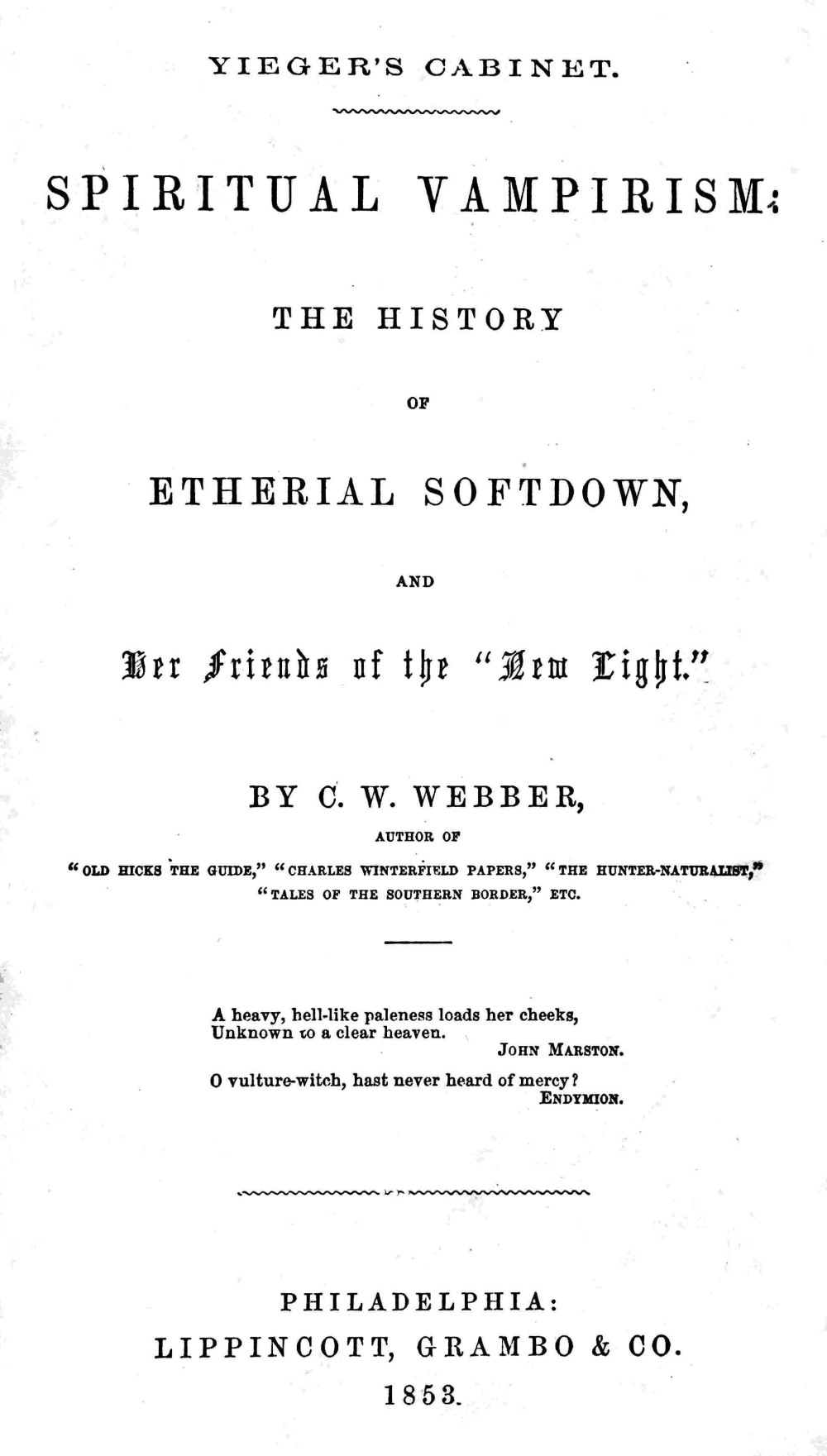
YIEGER’S CABINET.
THE HISTORY
OF
ETHERIAL SOFTDOWN,
AND
Her Friends of the “New Light.”
BY C. W. WEBBER, AUTHOR OF
“OLD HICKS THE GUIDE,” “CHARLES WINTERFIELD PAPERS,” “THE HUNTER-NATURALIST,”
“TALES OF THE SOUTHERN BORDER,” ETC.
A heavy, hell-like paleness loads her cheeks,
Unknown to a clear heaven.
John Marston.
O vulture-witch, hast never heard of mercy?
Endymion.
PHILADELPHIA:
LIPPINCOTT, GRAMBO & CO.
1853.
Entered, according to Act of Congress, in the year 1853, by
LIPPINCOTT, GRAMBO & CO.,
in the Clerk’s Office of the District Court of the United States, in and for
the Eastern District of Pennsylvania.
STEREOTYPED BY J. FAGAN. T. K. AND P. G. COLLINS, PRINTERS.
INTRODUCTION. — THE PHILOSOPHY OF MESMERIC IMPOSITION.
On page 392 of the concluding sketch of a late series, the
“Tales of the Southern Border,” occurs the following passage:—
“THE ESCRITOIRE.
“The author, being a resident of New York during the period
of the leading incidents narrated as occurring in that city, had
formed the acquaintance of the principal personage. Himself
a Southerner, he had, from the natural affinities of origin, inevitably
been attracted toward Carter. The intercourse between
them, at first reserved, had imperceptibly warmed into a degree
of intimacy, which, however, had by no means been such as to
render him at all cognisant, beyond the merest generalities, of
the progress of his private affairs. He was not a little surprised,
therefore, at finding, one day, an elegant escritoire or cabinet,
of dark, rich wood, heavily banded in the old-fashioned style
with silver, which had been placed, in his absence, on the table
of his sanctum. A note, in a sealed envelope, lay upon it. He
instantly recognised the handwriting of the address as that of
Mr. Carter, and broke the seal.
“It was evidently written in great haste, but without any sign
of trepidation. It ran thus:—
“My dear Friend:
“I have no time for explanations, as I am in the midst of
hurried preparations for an unexpected yacht-voyage—upon
which I set sail in a few minutes. I send you an escritoire,
which was left in my charge by a highly valued friend. He
was an extraordinary man; and its contents will be, I doubt
not, of great value to the world.
“It was given me, with the injunction that it should not be
opened until six months after his death. The six months were
up some weeks since, but I have lately been too much otherwise
absorbed to think of making use of the privilege of the key.
I now therefore transfer to you this bequest in full, with the
proviso that you will not open it for six months. If at the end
of that time I have not been heard from, please open, and without
reserve make what use of it your excellent sense may justify.
Please take charge of whatever correspondence may arrive to
my address for the same length of time, at the expiration of
which you will also please to consider yourself as my executor—open
my correspondence and proceed as you may
think best. Pardon this unceremonious intrusion of responsibilities
upon an intimacy, the terms of which I hardly feel would
strictly justify me; but the plea that I know no one else whom
I can trust, and have no time for further explanation, will I am
sure justify me in the eyes of a brother Southron.
“Yours truly,
“Frank Carter.
“Six months having elapsed, and still no news of my singular
friend Carter, the fulfilment of the important duties of executor,
thus unexpectedly devolved upon him, were deferred by the
narrator as long as his sense of duty would possibly admit. At
last, when longer delay would have seemed to assume almost
the aspect of criminality, the duty of opening the cabinet was
unwillingly entered upon.”
On my next meeting with my friend Carter, who proved still
to be in the land of the living, I spoke to him of the cabinet
and its remarkable contents, which had so unexpectedly been
left in my charge; offering to resign to him my trusteeship.
To this, however, he would by no means consent, but continued
to insist, as in his original letter, that I should without reserve
make what use of it my sense of propriety might dictate. I
was finally overruled into undertaking the mere arrangement
and editorship of its contents—for the revelations there made are
in many respects so strangely horrifying and unusual, that I fear
the world will be little disposed to pardon my agency in giving
them publicity. However, as I believe them to be, in every
respect, genuine life-experiences, I have determined to make
the venture, come what will of it. We shall therefore give, as
proper introduction to the singular narrative which we have
selected from beneath the blood-stained seals of the cabinet it
has been our fate to open, the following singular paper, which
we found lying separately above the folds of the MS. which
constitutes the History of Etherial Softdown.
The existence of what may be called the nervous or Odic
fluid—the sympathetic element—has been partially known to all
ages. The knowledge of this powerful secret, in moving and
controlling mankind, has been professionally and almost exclusively
confined to the adepts of all sects, religions, and periods;
though it has occasionally, in various ways, leaked out of the
penetralia, principally through its forms, accompanied with
little or no apprehension of their vital meaning. It is in
this way that a series of scientific phenomena, the discovery
of which probably originated with a remote priestcraft, and
had been made to subserve exclusive ends, has gradually been
fragmented among the people, and in many imperfect, ignorant,
and vitiated forms has now become the common property of
science.
When it is understood that this nervous fluid is nothing more
nor less than that force—whether electrical, magnetic, odic, or
otherwise named—which, lubricating the nervous system in
man, produces all vital phenomena—is, in a word, the vital
force—the active principle of life—it will not be difficult to
comprehend how important a knowledge of its laws may be
rendered to even those relations of life not exclusively physical.
Mesmer promulgated, under his own name, as a new and
astounding discovery in science, something of the sympathetic
laws to which this nervous or Odic fluid is subject, and by
which the vital and spiritual relations of man to the external
universe are in a great measure modified, and even controlled.
This was no discovery of his, but had been the mainly
exclusive secret of the ancient priesthood; employed alike in
the ceremonies of the novitiate in the Thibetian temples of
Buddha, in the Egyptian Initiation, and in Grecian Pythism.
But the particular reason why his announcements caused such
prodigious excitement, in 1784, as to run all Paris mad, even
including the court of the wary Louis XVI., and still continue
to excite and madden mankind, is, that, as the sympathetic
ecstacies and furors, superinduced by the mummeries of his
famous “vat,” were called by a new name, the people failed to
recognise them, although they had been familiarised with, and
even acting habitually under their influence, while surrounded
by accessories of a more sacred character. The immediate
success of Mesmer’s experiments amazed men. He, in fact,
little knew what he was doing himself; the effects he understood
how to produce, because accident had furnished him with
the formulas. Having gone through these, which, though most
grotesque and preposterous, later experience has shown, really
included all the “passes” and other conditions necessary to
establish sympathy through the nervous fluid with the victims
of his delusion, he proceeded to produce exhibitions the most
extraordinary the world ever saw, except in the hideous and
frantic orgies of some wild, barbaric creed, and the parallels to
which, in this country, are to be found in the shrieks and bellowings
of a fanatic camp-meeting, Miller ascension-tent, Mormon
rite, or hard-cider political mass-meeting.
Beginning with the postulate that “Nature abhors a vacuum,”
it does not seem difficult to understand something, at least, of
the rationale of this sympathetic influence of one man over
another. The laws of the distribution of this Odic force seem
to bear a somewhat general affinity to those of electricity. The
surcharged cloud discharges its superfluous fluid into the cloud
more negatively charged. The man holding a superfluous
amount of vital or Odic force, can dismiss a portion of this—along
the course of its proper lightning-rods, or conveyers, the
nerves—into the organisation of a being more negatively
charged, or, in other words, of a weaker man. As electricity
can only act upon inert matter through its proper media, the
elements, so the Odic fluid can only act upon organised matter
normally through its proper medium, the nerves of vitality.
This communication of the Odic fluid, by which sympathy between
the two beings has been established, can be, to a certain
degree, regulated and controlled by manipulations which bring
the thumbs and fingers of the hand, which are properly Odic
poles, in contact with certain great nerves, or centres of nerves,
along which the influence can be readily communicated. These
manipulations, the vital and original meanings of which these
Mesmer agitators have betrayed, may be traced very clearly
through the most important ceremonies of religion, and the
secret orders of fraternisation in the world. From this point of
view, how significant the “laying-on of hands” in ordination,
the “joining of hands” in the marriage ceremony, &c.
Here let us remark, that we would no more be understood
as accusing a Christian Priesthood, in modern times, of having
made an improper use, either inside or out of their profession,
of the manipulations mentioned above, than we would think of
accusing them of having, as a class, any special knowledge of
their significance beyond that of ceremonial forms, set down in
the discipline. It has been to the Heathen Priesthood that we
have consistently attributed a knowledge of the psychological
meaning of these ceremonials, which have descended through
the Hebrew and Christian churches as avowedly divested of vital
significance, and intended, in their arbitrary exaction, as, to a
certain degree, ordained tests of Christian faith and obedience.
But it is by no means indispensable to the exhibition of the
Odic phenomena, that the processes of manipulation should
have been literally gone through with in all cases—nor, indeed,
in the majority even—for some of the most apparently inexplicable
and extraordinary of them all are brought about without
such intervention. Take, as comparatively “modern instances,”
such effects as those produced by the preaching of Peter the
Hermit, when not only vast armies of men were moved like
flights of locusts toward the Desert, on the breeze of his fiery
breath, to disappear, too, as they, within its bosom, and never
be heard from again, but even great armies of children rushed
in migratory hordes to the sea-ports, to ship for the Holy Land!—and
those produced by the crusade of Father Mathew against
intemperance, in our time, when all Ireland lay wailing at his
feet. These great furors were precisely identical with those
already enumerated, so far as the sympathetic or motive power
went. So with the story of the rise of Mahomet, Joe Smith,
Miller, and all such agitators. They are usually men of prodigious
vital power, and of course surcharged with the Odic
fluid, who begin these great movements; and they possess, beside,
vast patience and endurance. They begin by filling the
individuals in immediate contact with them, as Mahomet did
his own family, with the superfluity of the Odic force in themselves,
and having thus obtained a single medium by this immediate
contact—which, although it may not imply the formal
manipulations with preconceived design, implies the accidental
equivalents—the circle gradually enlarges through each fresh
accession, in much the same way that it began, until, after a few
patient years of unshaken endurance, the apostle finds himself
surrounded by thousands and thousands of human beings,
whose volition is swayed through this Odic force—this sympathetic
medium—by his own central, resolute, and self-poised
will, as if they were but one man. His moveless volition has
been, from the beginning, the base and axis of the vast sympathetic
movement going on around him, and upon the single
strength of the Odic force within him, all depends, until,
through a thorough organisation of ceremonial laws and observances,
the system of which he was the vital centre assumes a
corporate existence, and can stand alone.
This is about the method in which all such organisations,
radiating from the one man power or centre, widen their circles
to an extreme circumference, until the force of the pebble thrown
into the great lake is exhausted. So it is with all sympathetic
excitements—from the Dancing Dervishes, the Shaking Quakers,
or the Barking Brothers, to the vast Empire of France, led frenzied
over the world in the will-o’-the-wisp chase of universal
sovereignty, by the fantastic will of a Napoleon. These
are some of the general phenomena of sympathy, and there are
many quite as extraordinary, if not as broad in what are called
atmospheric or epidemic conditions, which go to prove the universality
of this sympathetic law.
The distinctions between Od and Heat, Od and Electricity,
as well as Od and Magnetism, have been so clearly demonstrated
by the investigations of Baron Reichenbach as to leave
at present no choice between the terms. Od expresses that
force which, differing in many essential properties from the other
two, can alone through its phenomena be reconciled with what
we know of the Sympathetic or Nervous Fluid. It is therefore
used as a synonym of this mysterious agency, and as conveying
a far higher definition and significance than either the term
Electricity or Mesmerism.
The worst and the best that the agitation begun by Mesmer
has accomplished, is, to have stripped old Necromancy of its
mysterious spells, by revealing something of the rationale of
them, while at the same time, in unveiling its processes to the
sharp eyes of modern knaves, they have been enabled to appropriate
and practise them again with even more than the old
success, under the new christening of “scientific experiment.”
It is, I think, easily enough shown, by a minute and circumstantial
comparison of the cotemporary history of the dark age
of black art ascendancy in Europe, which was literally the dark
age of chivalry, with that of Cotton Mather witch-burning enlightenment
in New England, that the arts practised by the
accused in both these countries, and at all other such periods
in all other countries, were nearly identical with each
other; and those familiarised to us through the doings of mesmeric
manipulation, revelation, clairvoyance, spiritual knockings,
&c., &c., are generally the very same, though assuming slight
shades of difference, indicating some progressive development.
A partial knowledge of psychological laws, which was formerly,
and with great plausibility, considered altogether too dangerous
pabulum for the vulgar mind, has been sown broadcast by the
empiricism of this mesmeric movement, the principal oracles
and expounders of which have been clearly as ignorant of the
causes with which they agitated, as ever wrinkled crone of peat-smoked
hovel was of the true laws of that occult palmistry,
through the practice, or vague traditions of which, she finally
prophesied herself into the martyrdom of the “red-hot ploughshares,”
or the warm resting-place of the pot of boiling pitch.
They only know that certain formulas produce certain results,
and as they are blundering entirely in the dark, they mix those
which have a basis in science with the crude and meaningless
forms which ignorance, with its abject cunning, easily supplies.
From such amalgamations have arisen the mummeries of conjuration
in whatever form, and by the imprudent use of which,
the credulous, simple and superstitious, are so easily “frightened
from their propriety,” and thus made easy victims of more
dangerous arts.
But it is a study of the fearful uses which have been made by
the evil-disposed, of this partial knowledge of the laws of relation
of soul to the body, that is more interesting now than these
olden disguises of the same evil in more helpless forms; as now,
through the mesmeric agitation, it has really attained to some
gleam of causes—has now something of scientific illumination
to steady and give direction to its reckless and deadly aim. In
the radius of its hurtful circumference, the vicious power of the
witch, fortune-teller or conjuror, was as much more circumscribed
than that of the semi-scientific charlatan of clairvoyance,
as the vision of the mole is less than that of the viper, which,
at least, looks out into the sunshine though every cloud may
impede its malignant gaze.
The relative degrees in which the Odic or sympathetic fluid
may be found exhibited in the different individuals of our race,
have been previously remarked in general terms. In the sexes,
we most usually find the positive pole in man, who gives out,
and the negative in woman, who receives and absorbs from him,
the dispenser. Though this be the general rule so far as the
sexes are concerned, it is by no means the universal rule for the
race—since there are among men but few positive poles, or fixed
centres of Odic radiation; and where such are found, they are
observed to possess much of what we commonly call “influence”
with or upon others. All the parties, therefore, within
the circle of this sympathetic radiation, or “magnetic attraction,”
as it is popularly termed, must necessarily be, relatively to this
positive pole, negative poles, without regard to sex—while each of
these comparatively negative poles may in turn be a positive pole,
or Odic centre, to those below or of weaker nature than himself.
Those men who have been known to all humanity as prophets,
poets, law-givers, discoverers, reformers, &c., are, and have
been, what we mean by positive Odic poles; for while they
have seemed to stand in immediate and direct communion with
the spiritual source of all wisdom, they have at the same time
given out the impulse thus granted, to the people by whom they
are surrounded, thus acting as the chosen media of divine revelation,
and from the cloudy summits of Sinais handing down
the tables of the law to all the tribes.
Now there is a mighty radiation of the Odic force from these
men, through which the love, wisdom, or rather will in them—or
sent through them—is made operative upon the great masses
of mankind; and this same radiation, in the greater or less degrees,
is found emanating from a thousand different sources at
the same time, affecting man for evil as well as for good; for,
when we comprehend that this Odic or sympathetic force is the
sole medium of communication with the spiritual and invisible
world, as well as with the visible and material world, it
can then be easily understood how what are called “evil”
and “good spirits” should through it affect mankind. This
will be fully illustrated when we observe the common conditions
of health and disease. Health is good and disease is
evil; and these are the two eternally antagonistic chemical forces
in the universe. Health is that normal condition of the body
which enables it to resist evil and maintain the proper balance
of the spiritual and material elements. Disease is that abnormal
condition of the body in which the integrity of the spiritual
and organic functions has been destroyed through the sympathetic
media by evil, and good overcome.
In either case, the balance is destroyed, and the immediate
consequence may be, in the one, sudden paroxysms of fearful
insanity, or in the other, sudden death, as in common apoplexy.
Thus the popular fallacy, that all things having a source in
the spiritual, or rather the invisible, must of necessity be good,
is in a very simple way exposed. We see there may be what
are called evil, as well as good spirits, which hold communion
with us; and the safest and only true general rule with regard to
such matters is, that, while the good spirits are those propitious
chemical forces which make themselves known to us in love, and
joy, and peace, through the unbounded happiness of the normal
conditions of health, the evil spirits are those vicious chemical
forces, morbid delusions, and malign revelations, which are
made known to us through all other diseased conditions as well
as that of Clairvoyance. Remember that no such being has yet
been known throughout the whole range of Mesmeric experiment
as a healthy Clairvoyant, or a “subject” who has attained to the
super-eminence of Clairvoyance, who was not what they fancifully
term “delicate”—that is, liable to those diseases which
are well known to supervene upon nervous weakness, exhaustion,
or emasculation. This condition of nervous exhaustion
renders them, of course, the very negation of the negative pole
of sympathy, and the first person approaching them, who possesses
the ordinary Odic conditions of health, is clutched hold of
by their famine-struck vitality, in the agonised plea for life! life!
“Give! give!” is still the insatiable cry. They must have
the Odic fluid restored, and that, in taking from your “enough,”
they exhaust and undermine the holy purposes of your life to
make up that deficit in their own—which loathsome vice has
brought about—the “hideous selfishness of weakness” rather
rejoices. The sympathetic rapporte being once established,
they can at least, through this dangerous medium, live in the
integrities of your life, and enjoy, both physically and spiritually,
a surreptitious vitality, which, while it reflects the prevailing
phenomena of your own mind and spiritual being, has,
in addition, some approximation even to the physical exaltation
of your higher health.
These human vampires or sponges may be, therefore, as well
absorbents of the spiritual as animal vitality. Their parasitical
roots may strike into the very centres of life, and their hungry
suckers remorselessly draw away the virility of manhood, or the
spiritual strength.
They seem to be mainly divided into two classes, one of
which, born, seemingly, with but a rudimentary soul, attains to
its apparent spiritual though merely mental development, by
absorption of the spiritual life in others, through the Odic
medium. Another class, born with a predominating spirituality
based upon a feeble physique, is ravenous of animal
strength, and can only live by its sympathetic absorption of the
same from others, through the same pervading medium. Of
the two, the first is the evil type; for, born in the gross sphere
of the passions, with a vigorous organisation, but faintly illuminated
at the beginning with that golden light of love which
is spiritual life, the fierce half-monkey being is propelled onwards,
and even upwards, by the basest of the purely animal
instincts, appetites, and lusts. If such beings strive towards
the light of the harmonious and the beautiful, it is not because
they yearn for either the holy or the good, but because it lends
a lurid charm to appetite and glorifies a lust.
The other character, in whom the spiritual predominates,
whether from a natal inequality, as is very frequently the case,
or from the sheer exhaustion of the physical powers, through
emasculating vices, is yet, in itself, good, so far as its morbid
conditions leave it an unaccountable being; but, as its revelations
and utterings depend entirely upon the Odic characters
and will of those from whom its strength may be derived, it can
only be regarded, whether used for evil or good, as a medium.
This character is the common Clairvoyant, to whom we are
indebted for those strangely-mingled gleams of remote truth,
with errors the most grave and injurious, which have so tended
to confuse the judgment of mankind in regard to the phenomena
of Clairvoyance. Such persons can be made as readily
the medium of any falsehood which the knavish passions of
their “Mesmerisers” may dictate, as they can be caused to
announce, by a will as strong, but soul more pure, the disconnected
myths of science and of history, which have so surprised
the world in what are called the “Revelations” of
Andrew Jackson Davis. This man belongs to our second
class, and is purely “a medium” of the sympathetic fluid.
His organisation is most sensibly sympathetic and delicately
responsive, but is too feeble to balance his spiritual development.
His case stands, therefore, as the most remarkable
modern instance of what the ancients termed “vaticination;”
but, as has been the case with other false prophets, his “gifts”
have proved of no value, except to knaves. He was undoubtedly
practised upon by a choice set of such characters; and,
now that he has found in marriage a sympathetic restoration,
through the physical, of its needed balance with the spiritual,
he has lost his “lying gift” of prophecy.
We have examined this man carefully, and are convinced
that the whole mystery of his revelations and character may be
contained in a nut-shell. He is to the sphere of intellectual
and spiritual sympathy, and in a lower sense, precisely an
analogous case with that of Mozart in the sphere of the musical
and spiritual. When the great soul of humanity has been long—say
one generation—in travail with a great thought in art,
science, music, or mechanics, there is sure to be somebody born
in the succeeding generation who is physically, mentally, and
spiritually, the impersonation and embodiment of this thought,
of which the age is in labor, and who must of necessity become,
solely and singly, the expression and embodiment thereof.
Thus Mozart, the infant prodigy in music, who at five years old
was the pet of monarchs and the miracle of his age, continued,
with no signs of precociousness, a steady and consistent development,
which showed him to be indeed the embodiment of the
musical inspirations of his age. His revelations in music were
just as prodigious as even the rabid worshippers of the Davis
revelations would imagine those to be; yet there are some most
essential differences between the results of the two.
Davis, born amidst the travail of this new Mesmeric agitation,
became the most sensitive organ of the sympathetic fluid
in intellect, as the other had been in music; but as, in the case
of Mozart, the exciting cause came from Nature, and constituted
her purest and most sacred inspirations, so the inspiration
of Davis came from man, with all his imperfections
and subjective tendencies. The sequel has been, the
inspirations of Mozart are considered now by mankind as only
second to the Divine, while those of Davis are justly regarded
as morbid, fragmentary, incomplete, and worthless.
The organisation of Mozart was equally sympathetic with
that of Davis; but it was of that healthy tone which could only
respond to nature and the natural; while the organisation of
Davis belongs to that much inferior type, which, from its morbid
and unbalanced conditions, can respond only to the human
as the representative of nature. Such persons receive nothing
direct from nature, but only through its representative, man.
It would seem as if the world were absolutely divided into
two classes—the radiating and the absorbing; the first receiving
from nature, and the second from man. In the first, are the
holy brotherhood of prophets and the poets, and in the second,
the poor slaves of sympathy—the knaves and fools—the impostors
who play upon its well-known laws, and, deceiving themselves
as well as others, may well be said to “know not what
they do.”
We are convinced that no man, who has kept himself informed
of the psychological history and progress of his race,
can by any means fail to recognise at once, in the pretended
“Revelations” of Davis, the mere disjecta membra of the systems
so extensively promulgated by Fourier and Swedenborg.
When you come to compare this fact with the additional one,
that Davis, during the whole period of his “utterings,” was
surrounded by groups, consisting of the disciples of Fourier
and Swedenborg; as, for instance, the leading Fourierite of
America was, for a time, a constant attendant upon those mysterious
meetings, at which the myths of innocent Davis were
formally announced from the condition of Clairvoyance, and
transcribed by his keeper for the press, while the chief exponent
and minister of Swedenborgianism in New York was often
seated side by side with him.
Can it be possible that these men failed to comprehend, as
thought after thought, principle after principle, was enunciated
in their presence, which they had previously supposed to belong
exclusively to their own schools, that the “revelation” was
merely a sympathetic reflex of their own derived systems? It
was no accident; for, as often as Fourierism predominated in
“the evening lecture,” it was sure that the prime representative
of Fourier was present; and when the peculiar views of Swedenborg
prevailed, it was equally certain that he was forcibly
represented in the conclave. Sometimes both schools were
present; and on that identical occasion we have a composite
metaphysics promulgated, which exhibited, most consistently,
doctrines of Swedenborg and Fourier, jumbled in liberal
and extraordinary confusion. This is, in epitome, about the
whole history of such agitations. The weak Clairvoyant falls
naturally into the hands of knaves who are superior to him in
physical vitality. He becomes, first, the medium of their
vague and feeble intellection; and then, as attention is attracted
by the notoriety they know well how to produce, the
“medium” becomes gradually surrounded by the enthusiasts
of every school; and as he is brought into their various Odic
spheres, he pronounces the creed of each in his morbidly illuminated
language, and it sounds to the mob like inspiration.
There is no greater nonsense; men are inspired through
natural laws. But this comparatively innocuous character,
which we have thus far stepped aside to indicate, is nothing
compared to the first specimen of this Clairvoyant type which
we have classified. This, it will be remembered, is the animal
born with feeble spirituality, but vigorous physique, which is,
at the same time, intensely sympathetic. These, as we have
said, are the infernal natures; for, possessing no life outside the
lower animal passions, self is to them the close centre of all
being, and their Odic sensitiveness a vampire-absorption, the
horrible craving of which, not content with the mere exhaustion
of the animal life of the victim, by wanton provocations, drinks
up soul and mind to fill the beastly void of their own. These
worse than ghouls, that live upon the dying rather than the
dead, possess some fearfully dangerous and extraordinary
powers.
Vampirism, as a superstition, prevailed, not many years ago,
like a general pestilence, throughout the countries of Servia and
Wallachia. Whole districts, infected by this horrible disease,
were desolated; people grew wild with terror, and, in their
savage ignorance, committed monstrous sacrilege upon the
sanctities of burial. Bodies that had rested quietly in their
graves for ten, twenty, and even eighty days, were dragged
forth, to have stakes driven through their chests; and if any
blood was found, they were burned to ashes.
The belief was, that the deceased, when living, had been
bitten by a human vampire, which, coming forth from its grave
by night, had sunk its white teeth in his throat, and drunk his
blood, thereby causing a lingering death; in which he was also
doomed to the hideous fate of becoming a vampire, after his
burial.
The bodies of vampires, when dug up, presented a perfectly
natural appearance; and, even in those cases where the scarfskin
peeled off, a new skin was found underneath, and new
nails formed on the fingers. The vital blood was found in the
heart, lungs, and viscera, exhibiting the conditions of perfect
health. How the vampire got out of his grave, without
scratching a hole, does not appear.
Thus we find, in modern vampirism, a strange compound of
ancient superstition with well-known scientific truths. The
vampire is the counterpart of the ancient ghoul, with the simple
transfer of the habits of the vampire-bat to its identity. These
are then connected with the fact, well known to the medical
profession, that persons have been buried, supposed to be dead,
who, in reality, had only fallen into what is called the death-trance;
and who, had they been left above ground for a sufficient
period, would have probably resuscitated of themselves.
That they have done so after burial, is a familiar fact; since
bodies exhumed, long after, have been found to have changed
their position in the coffin. How long bodies, thus inconsiderately
buried, retain a resemblance to the normal conditions of
life, has not been fully ascertained.
We have here the historical origin of what is called vampirism;
but there are certain phenomena of this fearful infection,
closely resembling those which we have attributed to the
Spiritual Vampire.
Vampirism is clearly a disease of the nervous system; it
being first excited through the imagination of ignorance and
superstition. The nerves, then affected through the odic medium,
lose their balance, and the mind constantly playing
within the circle of the one thought of horror, a rapid and premature
decline is the immediate consequence.
The infection of which the victim died remaining still within
the odic medium of the sphere it occupied, passes into the
nerves of others, who die also; and thus the disease spreads like
any other epidemic. But mark—whence the true origin of this
superstition of the ghoul and the vampire, so universal in the
world? Is it not that mankind, everywhere, has felt, with an
unconscious shuddering, the presence of the spiritual vampire?
The instincts of the masses have, in their superstitions, foreshadowed
all the great discoveries of science. Has it not been,
that they have felt the hideous incubus always; but not being
able, through any connected series of observations, to discover
the real cause of their dread and suffering, have given its
nearly identical attributes a “local habitation and a name”
among their superstitions?
What we have termed the Spiritual Vampire, is a scientific
fact—we believe as much so as the bat-vampire; and that it
feeds, not alone upon the living, but upon the spiritually dead;
that originally, so far as its spiritual entity is concerned, it too
comes forth from its sensual charnal to feed upon the soul-blood
of mankind. This may seem a horrible picture, but we
cannot consent to withdraw it. These records were made under
a sense of duty to mankind; and if they should ever see the
light, it must be as they have been written. We dare not reveal
all that we know of this thing—we can only venture to say
enough to arouse men in amazement, at the realisation of what
they have always known and felt to exist, without having expressed
it. No mortal mind could have conceived such possibilities,
even in hell, much less in actual life.
Amidst the profound securities of the best-ordered households
in the world, unless a strict eye be had to such facts and
phenomena as we have adverted to and shall describe, the most
insidious and fatal corruptions of the bodies and souls of your
children, your wives, and your sisters, may creep in, while
there is no dream of wrong or danger. If we shock you, it is
to put you somewhat upon your guard against the many evils,
concealed under the apparent harmless approaches of the
viciously-purposed manipulator, or the covert practiser upon
the odic or sympathetic vitality of the pure and unsuspecting.—We
will abide the issue.
Milton clearly had vampirism in his thought when he wrote—
“Clotted by contagion,
Imbodied and imbruited, till quite lost
The divine property of their first being—
Such are those thick and gloomy shadows damp,
Oft seen, in charnal-vaults and sepulchres,
Lingering and sitting by a new-made grave.”
SPIRITUAL VAMPIRISM;
OR,
THE HISTORY OF ETHERIAL SOFTDOWN.
CHAPTER I. THE GIRLHOOD OF ETHERIAL.
“Be thou a spirit of health, or goblin damned?”
In a mean and sterile district of Vermont, which shall be
nameless, but which exhibits on every side stretches of bare
land, with here and there the variety of clumps of gnarled and
stunted oaks, Etherial Softdown was born. If mountains give
birth to heroes, what ought to have been the product of a low-lying
land like this, on whose dreary basins the summer’s sun
wilted the feeble vegetation, and the bleak winds of winter
wrestled fiercely with the scrubby oaks, whose crooked and
claw-like limbs seemed talons of some hideous, gaunt and
reptile growth?
On the edge of one of the most desolate of these stretches,
and beneath the shelter of the most ugly of these demonised
oaks, were scattered the storm-blackened sheds of a miserable
hamlet, in one of which, for there were no degrees in their
comfortless dilapidation, the family of our heroine, the Softdowns,
resided, and another yet smaller and at some distance apart from
the rest, was occupied by her father, who was a shoemaker, as
a workshop. This was one of those strange, out-of-the-way,
starved and dismal looking places that you sometimes stumble
upon in our prosperous land—which ought long since to have
been deserted with the vanished cause of the temporary prosperity
which had given it birth—but in which the people seem
to be petrified into a morbid serenity of endurance, and look as
if under the spell of some great Enchanter they awaited his
awakening touch.
The child, which was the birth of a coarsely organised
mother, was as drolly deformed with its squint eye and stooping
shoulders as fancy could depict the elfin genius of such
a scene. Dirty, bedraggled and neglected, with unkempt locks
tangled and writhing like snakes about her face, and sharp, gray
animal eyes gleaming from beneath, the ill-conditioned creature
darted impishly hither and yon amidst the hamlet hovels, or
peering from some thicket of weird oaks, started the stolid
neighbors with the dread that apparitions bring.
Indeed, so wilful, unexpected and eccentric were her movements,
that the people, in addition to regarding the oaf-like child
with a half feeling of dread, gave her the credit of being half-witted
as well. There was a hungry sharpness in her eye that
made them shrink; a furious, raging, craving lust for something,
they could not understand what, which startled them beyond
measure; for, as in their stagnant lives, they had never been
much troubled with souls themselves, they could not understand
this soul-famine that so whetted those fierce eager eyes.
The father, Softdown, who appears to have been something
more developed than the mother, and to have possessed a grotesque
and rugged wit, more remarkable for its directness than
its delicacy, became the sole instructor and companion of the
distraught child, who readily acquired from him an uncouth
method of enouncing trite truisms unexpectedly, which was to
constitute in after life one of her chief, because most successful
weapons.
Etherial early displayed a passion for acquiring not knowledge,
but a facility of gibberish, which proved exhausting
enough to the shallow receptacles around her, especially as her
mode of getting at the names and properties of things so closely
resembled the monkey’s method of studying physical laws.
She had first to burn her fingers before she could be made to
comprehend that fire was hot, but that was enough about fire
for this wise child; she remembered it ever after as a physical
sensation, and therefore it had ever after a name for her; and so
with all other experiences, they were to her sensational, not spiritual
or intellectual. The name of a truth could come to her
with great vividness through a blow or pain of whatever character
that might be purely physical, but through no higher
senses, for these she did not yet possess. Of a moral sense she
seemed now to develop no more consciousness than any other
wild animal, but in her the memory of sensation took the place
of mind and soul.
Thus passed the girlhood of our slattern oaf—shy and sullen—avoiding
others herself, and gladly avoided by them, with
the single exception of her father, from whom her strong imitative
or sympathetic faculty was daily acquiring a rough, keen
readiness of repartee, in the use of which she found abundant
home-practice in defending herself against the smarting malignity
of the matron Softdown, who charmingly combined in her
person and habits all and singly the cleanly graces of the fishwife.
At sixteen, with no advance in personal loveliness, with passions
fiercely developed, a mind nearly utterly blank, a taste for
tawdry finery quite as drolly crude as that displayed by the
plantation negresses of the South, and manners so fantastically
awkward and eccentric as to leave the general impression that
she was underwitted, Etherial suddenly married a lusty and
good-looking young Quaker, threw off her bedraggled plumes,
and became a member of that prim order.
Now her career commences in earnest, for this was the first
great step in her life in which she seems to have attained to
some gleams of the knowledge of that extraordinary power of
Odic irradiation and absorption which was afterwards to be exercised
with such remarkable results.
She did not make her great discovery without comprehending
its meaning quickly. She first perceived that, day by day, she
grew more comely to look upon—that her figure was becoming
erect, and losing its harsh angularities—the pitiless obliquity
of her features growing more reconciled to harmonious lines—and
last, and most astounding, that the immediate result of the
contact of marriage had been a rapid increase of her own spiritual
and mental illumination, accompanied as well by a corresponding
decline on the part of the husband in both these
respects.
Here was a secret for you with a vengeance! Like an
electric flash, a new light burst upon Etherial; and, as there
was only one feeling of which her being was capable towards
man, she chuckled over the delicious secret which now opened
out before her with a terrible gloating.
Glorious discovery! Hah! the spiritual vampire might feed
on his strength—might grow strong on this cannibalism of the
soul! and what of him if she dragged him down into idiocy?
Served him right! Did Etherial care that his spiritual death
must be her life? She laughed and screamed with the joy of
unutterable ferocity! Eureka! Eureka! They shall all be my
slaves! They taunt me with being born without a soul, with
being underwitted! I shall devour souls hereafter by the hundreds!
I shall grow fat upon them! We shall see who has
the wit! Their thoughts shall be my thoughts, their brains shall
work for me, their spirits shall inform my frame! Ah, glorious!
glorious! I shall live on souls hereafter! I shall go up and
down in the land, seeking whom I may devour! Delicious!
Delectable Etherial!
CHAPTER II. SCENES IN THE GOTHAM CARAVANSARIE.
And all around her, shapes, wizard and brute,
Laughing and wailing, grovelling, serpentine,
Showing tooth, tusk, and venom-bag, and sting!
O, such deformities!
Endymion.
In Barclay Street, New York, years ago, flourished, at No. 63,
that famous caravansarie of all the most rabid wild animals on
the Continent, who styled themselves Reformers and New-light
People, Come-outers, Vegetarians, Abolitionists, Amalgamationists,
&c. &c., well known to fame as the “Graham House.”
Here, any fine morning, at the breakfast-table, you might meet
a dozen or so of the most boisterous of the then existing or
embryo Reform notorieties of the day. Mark, we say notorieties,
for that is the word.
From the Meglatherium Oracle, whose monstrous head, covered
with a mouldy excrescence, answering for hair, which
gave it most the seeming of a huge swamp-born fungus of a
night—who sat bolting his hard-boiled eggs by the dozen, with
bran-bread in proportion, washing them down with pints of
diluted parched-corn coffee—even to the most meagre, hungry-eyed,
and talon-fingered of the soul-starved World-Reformers,
that stooped forward amidst the babble, and, between huge
gulps of hot meal mush, croaked forth his orphic words—they
were all one and alike—the mutterers of myths made yet more
misty by their parrot-mouthings of them!
Here every crude, ungainly crotchet that ever possessed ignorant
and presumptuous brains; here every wild and unbroken
hobby that ever driveller or madman rode, was urged together,
pell-mell, in a loud-voiced gabbling chaos. Here the negro
squared his uncouth and musky-ebon personalities beside the
fair, frail form of some lean, rectangular-figured spinster-devotee
of amalgamation from New England.
Here the hollow-eyed bony spectre of an old bran-bread disciple
stared, in the grim ecstacy of anticipation, at the ruddy
cheeks of the new convert opposite, whose lymphatic, well-conditioned
corporation shivered with affright, as he met those
ravin-lit eyes, and a vague sense of their awful meaning first
possessed him, as his furtive glance took in the sterile “spread”
upon the table, to which he had been ostentatiously summoned
for “a feast.”
Here some Come-outer Quaker, with what had been, at best,
cropped hair, might be seen with the crop now shaven yet more
close to his bullet-head, in sign of his greater accession in spiritual
strength beyond the heathen he had left behind, sitting
side by side with some New-light or Phalanxterian apostle, with
his long, sandy, carroty, or rather golden locks, as he chooses to
style them, cultivated down his back in a ludicrously impious
emulation of the revered “Christ Head” of the old Italian
painters.
Here the blustering peace-man and professed non-resistant,
railed with a noisy insolence, rendered more insufferably insulting
in the precise ratio of exemption from personal accountability
claimed by his pusillanimous doctrines. Here too, a notorious
Abolitionist, with his tallow-skinned and generally-disgusting
face, roared through gross lips his vulgar anathemas against the
South, which had foolishly canonised this soulless and meddlesome
non-resistant ruffian, in expressing their readiness to hang
him, should he be caught within their territory.
Here the weak and puling sectary of some milk-and-water
creed rolled up his rheumy eyes amidst the din, and sighed for
horror of a “sad, wicked world.” Here the sharp animal eyes,
the cool effrontery and hard-faced impudence of ignoramus Professors
of all sorts of occult sciences, ologies, and isms, met
you, with hungry glances that seemed searching for “the green”
in your eye; and mingled with the whole, a sufficiently spicy
sprinkle of feminine “Professors,” of the same class, whose bold
looks and sensual faces were quite sufficient offsets to the extreme
etherialisation of their spiritualized doctrines.
Here, in a word, the blank and ever-shocking glare of harmless
and positive idiocy absolutely would escape notice at all, or
be mistaken for the solid repose of common sense, in contrast
with the unnatural sultry wildness of the prevailing and predominating
expression!
But this menagerie of mad people held caged, in one of its
upper rooms, the object of immediate interest. On entering
the apartment, which was an ordinary boarding-house bedchamber,
a scene at once shocking and startling was presented.
A female, seemingly about thirty-three, was stretched upon a
low cot-bed, near the middle of the floor, while on the bed and
upon the floor were scattered napkins, which appeared deeply
saturated with blood, with which the pillow-case and sheet were
also stained. A napkin was pressed with a convulsive clutch
of the hands to her mouth, into which, with a low, suffocating
cough, which now and then broke the silence, she seemed to be
throwing up quantities of blood from what appeared an alarming
hemorrhage.
A gentleman, whose neat apparel and fresh benevolent face
somehow spoke “physician!” leaned over the woman, with an
expression of anxiety, which appeared to be subdued by great
effort of a trained will. He bent lower, and in an almost whispered
voice, said:
“My dear madam, you must restrain yourself. This hemorrhage
continues beyond the reach of any remedies, so long as
you permit this violent excitement of your maternal feelings to
continue. Let me exhort you to patience—to bear the necessary
evils of your unfortunate condition with more patience!”
The only answer was a slow despairing shake of the head,
accompanied by a deep hysterical groan, which seemed to flood
the napkin at her mouth with a fresh effusion of blood, which
now trickled between her fingers and down upon her breast.
The humane physician turned, with an uncontrollable expression
of horrified sympathy and alarm upon his face, and snatching a
clean napkin from the table, gently removed the saturated cloth
from the clutching pressure of her fingers, and tenderly wiping
the blood from her mouth and person, left the clean one in her
grasp.
“Be calm! be calm—I pray you! you must some day
escape his persecutions. You have friends; they will assist
you to obtain a divorce yet, and rescue your child from his
clutches. Do, pray now, be calm!” The voice of the good
man trembled with emotion while he spoke, and the perspiration
started from his forehead.
At this instant the door was suddenly thrown open, and a tall,
gaunt man, with a very small round head, leaden eyes, and a
wide ungainly mouth, with a projecting under jaw, singularly
expressive of animal stolidity, paused on the threshold and
coolly looked around the room. The woman sprang forward
at the sight, as if to rise, while a fresh gush of blood poured
from her mouth, bedabbling her fingers and the sheet. The
physician instinctively seized her to prevent her rising, but, resisting
the pressure by which he gently strove to restore her
head to the pillow, she retained her half-erect position, and with
eyes that had suddenly become strangely distorted, or awry in
their sockets, she glared towards the intruder for an instant, and
then slowly raising her flickering hand, which dripped with her
own blood, she pointed at him, and muttered, in a sepulchral
voice, that, besides, seemed choking:
“That is he! see him! see him! There stands the monster
who would rob me of my babe, as he daily robs me of money.”
Here the blood gushed up again, and she was for a moment
suffocated into silence, as the object of her denunciation
stood perfectly unmoved, while a cold smile half lit his leaden
eyes. This seemed to fill the apparently dying woman with
renewed and hysterical life. She raised herself yet more erect,
and still pointing with her bloody, quivering finger, while her
head tossed to and fro, and the distorted eyes glared staringly
out before her, she spoke in a gasping, uncertain way, as if
communing with herself. “The wretch taunts me! my murderer
dares to sneer! O God! must this always continue?
must that brute always follow me up and down in the land, to
rob me of the money that I earn—to be my tyrant, my jailor!
He will not give me money to pay postage even, out of that I
earn abundantly, while he is earning nothing. He will not give
me clothes to keep me decent, while I earn enough. He will
not give my child shoes to wear, though he is trying to take her
from me!”
“That is a lie, Etherial! you know I gave the child a new
pair yesterday!” gruffly interposed the man at this stage of the
deeply tragic soliloquy, while he stepped forward towards the
bed. A choking scream followed, and the blood was spattered
over the spread as she fell back screaming—
“Take him away! take him away! He is killing me with
his brutality!” and then her head sank in sudden collapse upon
the pillow, and the face, which had heretofore looked singularly
natural in color, for one in such a dreadful strait from hemorrhage,
turned livid pale, while the blood continued to pour upon
the pillow from the corners of the relaxed mouth.
The poor physician, whose frame had been shivering with
intense excitement during this interview, sprang erect, as the
form of what he supposed to be a corpse fell heavily from his
arms, and with the natural indignation of a feeling man, fully
roused at what he considered the murderous brutality of the husband,
rushed forward, and seizing him furiously by the collar,
shook and choked him in a perfect ecstacy of rage, shouting, at
the same time—
“Unnatural beast! monster! You have killed that poor
child at last! murdered your own wife, whom you swore to
nourish and protect! Infernal villain! you ought to be drawn
and quartered—hanging is too good for you! You saw the
terrible condition of the poor victim of your brutalities when
you came, yet you persisted! In the name of humanity, I send
you hence! Death is too light punishment for you!” and he
hurled the unresisting wretch—who, by this time, had grown
perfectly black in the face under the rough handling of this
roused and indeed infuriate humanity—staggering out of the
door—and closing it upon him, he proceeded to apply such
restoratives as on an examination the real condition of the
patient suggested.
A short and anxious investigation proved it to be rather a
state of syncope than actual death; and, with a full return of
all his professional caution, skill and coolness, he applied himself
to the restoration of his patient, with a heart greatly relieved
by the discovery that the result he so much dreaded was
not yet, and hugging to his kindly breast the consolation
“while there is life there is hope!” He paid no attention to
clamorous knocks for admission and loud-talking excitement,
which the violence of the preceding scene had no doubt caused
in alarming the house. In a short time the good doctor cautiously
unbolted the door and came forth from the room, treading
as though on egg-shells. After leaving careful instructions
with the landlady that his patient, who now slept, should under
no pretence be disturbed, most especially by the husband, until
his return, as her present repose might prove a matter of life
and death, he left the house, promising to call again in two
hours.
For one hour the woman lay calm and motionless on her gory
bed, as if in catalepsy, when to a low, peculiar knock at the
door, she sprang up, wide awake, and in the apparent full possession
of her faculties.
“Who?” she asked, in a quick, firm tone, as she threw the
hair back from her eyes.
To the low response, “I, love!” she stepped quickly from the
bed and snatched a shawl from the back of a chair, and by
several rapid sideway movements of her feet at the same time,
thrust the bloody napkins which strewed the floor beneath the
bed, where they would be out of sight, and by a movement
almost as swift, threw a clean “spread” over the blood-stained
pillows and sheet, then drawing her large shawl closely over
the stained dressing-gown in which she had risen, she rushed
first to the glass, and smoothed her hair with an activity that
was positively amazing, and then to the door, which she unbolted
on the inside—showing that she must have risen to bolt
it immediately as the doctor passed out—and admitted a man
who was in waiting.
“Ah, my soul’s sister! my Heaven-bride! how is thy
spiritual strength this evening?” and at the same time, as her
yielding form sank into his outspread arms, he pressed her lips
with his, adding, “I salute thy chaste spirit!”
“Brother of my soul, I was weary, but now I am at rest. I
was wounded and fainting by the way, but the good Samaritan
has come!” and she turned her eyes upward to his with a
melting expression of confiding abandon.
“Angel!” accompanied by a closer and convulsive clasp,
was the response.
“What do they say of poor me again, to-day, those cruel
wicked people outside?” she asked, with eyes still reverentially
upraised to his, as they moved slowly with clasped arms towards
the cot, on the side of which they sat, she still leaning against
his bosom.
“My good sister, they say what evil spirits always prompt
men to say of the good, who, like the Prophets, are sent to be
stoned and persecuted on earth. You should not regard such.
There are those who know you in the spirit, to whom it has
been revealed through the spiritual sense, that you are good and
true, as well as in the right, and through such, you will find
strength of the Father.”
“Oh, you are so strong in spiritual mightiness that you do not
sympathise with the weaknesses of we humbler mortals! I
wonder, indeed, how you can forgive them?” and her downcast
eyes were furtively raised to his. The man wore his hair thrown
back over his head and behind his ears. He drew himself up
slightly at this, and stroked back his locks, then placing his
hand with patriarchal solemnity upon her bowed head, proceeded
in a somewhat louder tone. “My simple child—my soul-sister,
I should say, you are hardly upon the threshold of the true wisdom.
Your knowledge of the law of spiritual correspondence
is yet too incomplete for you to understand how entirely good
has been mistaken for evil, and evil confounded with good in
the world. For instance—it is called evil by the ignorant
world, for a brother man to caress thee in the spirit as I have
caressed thee but now. The imaginations of a world that lieth
in evil are impure. ‘Evil to him who evil thinks!’ The great
doctrine of correspondence teaches that there are two lives—the
spiritual and the animal. The passions of the animal are in the
fleshly lusts; those of the spiritual are in no wise such, they
are in the Heavenly sphere, they are of love and wisdom.
Thus, my caress in this Heavenly sphere is of no sin to thee,
for by and through it I convey to you, my spiritual sister, the
strength of love and wisdom for which your heart yearns.
Thus—”
As he stooped his head to renew the unresisted caress, the
door flew open again, and the man with the wide mouth, the
hideous chin and the leaden eye, stood again upon the threshold,
and as the affrighted pair looked up they saw he was backed by
the curious faces of half-a-dozen chambermaids, jealous of the
honor of the house, flanked by the indignant landlady and a
score of prying, curious, sharp-eyed faces, which might be
recognised at a glance as belonging to those pickled seraphs of
reform, known as “free-spoken” spinsters in New England.
“There, they are at it!” shouted the man with the gaping
mouth. “I told you so! I told you that Professor was always
kissing her!”
“Yes!”
“There they are, sure enough!”
“I always thought so!”
“The honor of my house!” bristled the landlady, striding
forward. “I did not expect this of you, Professor!”
“Madam!” said the gentleman with his hair behind his ears,
striding forward as he released the suddenly collapsed and
seemingly lifeless form he had just held within his embrace, and
which fell back now heavily upon the pillow-spread, which was
instantly discolored by a new gush of blood from the mouth.
“I was administering, with all my zeal, spiritual comfort to this
poor, sick and dying sister, when you burst in! See her condition
now!”
He waved his hand towards the tragic figure. “The Professor”
occupied a parlor on the first floor, beside two bed-rooms
adjoining this, and being on the palmy heights of his renown
and plenitude of purse, it was not convenient for the landlady
to quarrel with him at present. “Ah, if that is the case, Professor,
I beg you to pardon us. The husband of this woman
has misrepresented you and your beneficent motives, and
accuses you of all sorts of improprieties. We came up, at his
urgency, to see for ourselves, and the shocking condition in
which we find her now, proves that the ravings of the husband
are, as she has always represented them, insane.”
“I’ve seen you kissing her before!” roared the husband,
advancing threateningly upon the Professor, who, however
spiritual in creed, did not now appear particularly spirited, as
he turned very pale, retreated backwards, and holding up his
two trembling hands imploringly, exclaimed—“Hold! hold!
my dear brother! It was a spiritual kiss! I meant you no
harm, nor that angel who lies there dying! Our kiss was pure
and holy as the new snow. Hold him! hold him! Don’t let
him hurt me! I am a non-resistant! I am for peace!”
“Your holy kisses! I don’t believe in your holy kisses!”
gnashed the enraged husband, still following him up with warlike
demonstrations; but here the easily appeased landlady
interposed once more, to save the honor of her house in preventing
a fight.
“No blows in my house!” she shrieked, as she threw herself
between the parties. “The Professor is a man of God,
and shall not be abused here; shame on you, Aminadab, with
your poor, persecuted wife there, dying before your face! Everybody
will believe what she says about your persecutions now!”
“Bah, you don’t know that woman! she’s no more dying
than you are!” grunted the fellow, whose wrath fortunately
seemed to be of that kind that a straw might turn it aside. All
the women rolled up their eyes and lifted their two hands at this
speech.
“What a brute!”
“The horrid, murdering wretch! and she bleeding at the
mouth, and from the lungs, too!”
“Lord save the poor woman’s soul, with a husband like
that!”
And other speeches of like character were ejaculated by all
the women present.
At this moment a fresh effusion of blood, accompanied by a
low groan, from the mouth of the suffering patient, flooded the
clean spread with its purple current, and the horrified females
rushed from the room, screaming—
“He’s killed her at last, poor thing!”
“Where’s the doctor?”
“She’s dying of his brutality—run for the doctor!” At this
moment, with a hasty and heavy step, that gentleman was heard
advancing along the passage, followed by a crowd of pale,
frightened-looking women. He strode into the room.
“What now?—what’s to pay?” and his eye fell on the trembling
form of the brutal husband, who had by no means forgotten
the rough handling he had received, and now skulked
and quailed like a whipped cur, as his eye saw the instant
thunder darken on the brow of the doughty doctor.
“You here again—you brutal fellow? I shall instantly bind
you over to keep the peace toward this unfortunate woman,
whose life you are daily endangering by your brutalities. Take
yourself off, sir!” Aminadab waited for no second invitation,
but availed himself of the open doorway.
Without noticing the spiritual professor, who had drawn himself
into as small space as possible in one corner, the good man
advanced to the side of his patient with an anxious, flurried
manner.
“What can that besotted wretch have been doing to her
again?” and he gently placed his fingers upon her pulse, and
shook his head gravely as he did so.
“Very low! very low, indeed!—nearly absolute syncope
again! This is horrible! How sorry I am that I was compelled
to leave her for a moment.”
“Is she really in danger, doctor?” asked the spiritual professor,
advancing with recovered assurance.
“Who are you, sir?” he said, looking up sharply. “One
of these officious fools, I suppose?” Then glancing his eye
around at the crowded doorway, he straightened himself hastily,
and exclaimed—
“Leave the room, all of you—she must be quiet—I wish to
be alone with my patient! Leave the room, sir, I say!” in a
sterner voice, as the spiritual professor hesitated on his backward
retreat.
“I—I—I p-pro-test against the impropriety!” he stammered
forth, looking back at the women, with a very pale face, as he
accelerated his backward movement before the steady stride of
the resolute doctor.
“Out with you, sir—I will answer for the proprieties in this
case!”
The door was slammed in the ashy face of the spiritual professor,
and securely doubled-locked before the doctor returned
to the bedside of his patient.
The bleeding from the mouth had now ceased. All the
usual remedies in such cases having so far entirely failed, the
puzzled doctor had come to the final conclusion that the hemorrhage—be
its seat where it might—was only to be subdued by
a restoration of the patient to the most perfect repose. Sleep,
calm, unbroken sleep, to his sagacious judgment and sensibilities,
seemed to offer the sole alternative to death. He had
been impressed by his patient that her constitutional tendencies
were, by a sad inheritance, towards consumption, and the loss
from the lungs, of such quantities of blood as he had witnessed,
was well calculated to fill his professional mind with horror and
dread. The case had thus appeared to him a fearfully uncertain
and delicate one, and this sense may fully account for the stern
and unusual procedure of turning even the husband out of the
room on the two occasions we have mentioned.
As her physician, he felt himself bound to protect his helpless
patient against those moral causes of irritation which he had
been led to believe existed, not only from her reluctant disclosures,
but from what he had himself witnessed. Believing that
her beastly husband was the chief and immediate cause of this
fatal irritation, he had felt himself justified in his rough course
towards him, and was now fully and resolutely determined to
protect what he considered a death-bed—providentially thrown
into his charge—inviolate from farther annoyance, from whatever
quarter, at least so long as he held the professional responsibility.
In this resolute feeling, and as the day was warm, he
threw off his coat, raised all the windows, and sat himself quietly
down beside his patient to watch for results.
The eyes of the kind man very naturally rested upon the
object of his solicitude, and after the first excitement of anxiety
was over, and he had settled calmly into a contemplative
mood, he first became conscious that there was something
strangely fascinating in the position of the nearly inanimate
figure. He had never before thought of the being before him
as other than a very plain, but much-afflicted woman, by whose
evident physical calamities, no less than her private sufferings,
he had been strongly interested.
She had told him her own story, and he had believed her,
thinking he saw confirmation enough in the conduct of those
she accused of ill-treatment; but the idea of regarding her as
attractive in any material sense, had never for an instant crossed
his pure soul. Now there was an indescribable something in
her attitude, so expressive of passion, that, in the pulseless
silence, he felt himself blush to have recognised it.
Her arms, which he now remembered to have been bare in
all his late interviews with her, were exquisitely rounded and
beautifully white, and he could not but wonder that he had not
before observed the strange contrast between them and the plain
weather-beaten face. They looked startlingly voluptuous now,
contrasted with the pallid cheek which rested on them, and the
glossy folds of dark hair in which they were entangled. So
strikingly indeed was this expression conveyed, that even the
purple stains of blood upon the spread beneath would not
divest him of the dangerous illusion. The good doctor felt the
blood mount to his forehead in the shame of deep humiliation
as he recognised in himself this wandering of thought.
What! could it be that one so habitually pure in feeling as he,
could permit the intrusion at such an hour of impure associations?
Such things were unknown to his life, so disinterested,
so spotless, so humane. What could it be that had caused
such feelings to possess him thus unusually? It could not be
possible she was conscious of the position in which her body
was thrown. Was there some strange spell about this woman—some
mysterious power of sphere emanating from that still
form, that crept into his blood and brain with the evil glow of
these unnatural fires?
The poor doctor shuddered as he turned aside from the bed,
and, with a soft step, glided to the window, and there seating
himself, strove to recover the command of his thoughts by distracting
them with other objects in the busy street.
The good man was on grievous terms with himself, as he
continued to beat the devil’s tattoo on the window-sill with his
heavy fingers. He felt alarmed, nay, even guilty. He knew
not why. We shall see!
CHAPTER III. THE SYREN AND THE MOB.
And after all the raskal many ran,
Heaped together in rude rabblement.
Spenser.
What intricate impeach is this?—
I think you all have drunk of Circe’s cup!
Shakspeare.
The woman continued, with calm, regular breathings, to
sleep for several hours. The dusk of evening had now closed
in, and yet her patient guardian sat silently watching her motionless
figure. A long and serene self-communion had gradually
restored the excellent doctor to his ordinary equanimity, and he
now, with untiring vigilance, awaited the changes that might
supervene in the condition of the patient.
After all his thinking on the subject, he found himself now
no nearer comprehending the cause of the late unwonted disturbance
of his habitual serenity than at the beginning. He
had dealt harshly with himself, in endeavoring to account for it,
and never dreamed of reproaching the feeble and wretched
being before him, as in any degree the conscious agent of what
he considered a weakness unpardonable in himself.
With the natural proclivity of generous souls towards the extremes,
he had, in the plenitude of his self-reproach, proceeded
to exalt the sleeping woman into an earth-visiting angel with
wounded wings, the spotless purity of which the breath of his
darkened thought had soiled. The poor, good-hearted doctor!
The silence of the room was now broken by a low exclamation
of fright, accompanied by a slight movement of the patient.
The doctor sprang forward softly to the bedside.
“Who?—what?—where am I? What has been happening?”
asked the woman, with an expression of bewilderment and
alarm.
“Nothing! nothing, my dear madam! I am here—you are
safe—but you must not talk.”
“Where is he? is he gone?” she persisted in a wild, terrified
manner.
“Yes, he is gone. He shall not come back to disturb you
again. You must be quiet now, and get well. Please be calm,
and trust in me.”
“Trust in thee?” said the patient, in a voice which had instantly
lost its vague tone. “Trust in thee, thou minister of
light, who hast come to my darkened pillow, to my bloody
death-bed, to console me!” and here she clutched his hand.
“Trust thee—I would trust thee as I trust God!” and she
pressed his hand to her heart.
“You must be silent, madam,” urged the physician, endeavoring
to extricate his imprisoned hand, for he felt strange tinglings
along his veins, which alarmed his now penitent and
vigilant spirit. She only shook her head, and clung with yet
greater tenacity to his hand, and then, first raising it to her lips
with a reverential kiss, she placed it upon the top of her head,
with the palm outstretched, and signified her desire that he
should keep it there, with a smile of entire beatitude. The
doctor barely knew enough of mesmeric manipulations, to understand
that this laying-on of hands was commonly resorted to
among the believers in the science, as a remedy for nervous
headache. He could see no harm in the innocent formula, if it
assisted the imagination in throwing off pain, and he very
willingly humored his poor patient, in permitting his hand to
remain there.
In a moment or two a singular change came over the face and
general physical expression of the woman, and the doctor, who
had witnessed something of mesmeric phenomena, instantly recognised
this as clearly presenting all the symptoms of such a
case. He had mesmerised her by a touch, and it was not without
a thrill of vague wonder that he awaited further developments.
There was a perfect silence of ten minutes’ duration, when
the mesmerised patient began moving her lips as if in the effort
to articulate. The curiosity of the doctor was now fully
aroused—his will became concentrated—he desired to hear her
speak; in his unconscious eagerness, he willed that she should
do so with all the energy of his firm nature; and speak she did.
“Happy! happy! Ah, I am content in this pure sphere!
My soul can rest here!” a long pause, then suddenly a shudder
vibrated through her frame, and she shrank back as one appalled
by some spectral horror.
“Ha! it is all dark now! I see! I see! his hand is red!
red! red! red! There is murder on this soul!”
The doctor sprang up and back as if he had been shot. His
face grew livid pale, and he trembled in every joint, while with
chattering teeth he stammered—
“Woman! Woman, how know you this?”
“I see it there—that huge red hand! Now all is red!
There! there! I felt it must be so! The pale and golden light
breaks through! It spreads! It fills and covers everything!
His heart did no murder—it was his hand! He can be redeemed!
This soul is pure!”
The poor doctor sank upon his chair and groaned heavily,
while he covered his face with his hands. He spoke, in a few
moments, in an almost inaudible tone, to himself, while the woman,
who had suddenly opened her eyes, turned her head
slightly, and watched him with a sharp attention.
“Alas! alas! how came this strange being in possession of
the fatal secret of my life? I believed it buried in the oblivion
of thirty years. My life of dedication to humanity, since, I
thought might have atoned for that quick sad deed! Yes! I
struck him! O, my God—I struck him! but the provocation
was most fearful! Woman, who and what are you, that you
should know this thing?” and with a vehement gesture he jerked
his hands from before his eyes, and turning swiftly upon her, he
met the keen, still glance of those watchful eyes, which shone
through the subdued light of the room, steadily upon him.
The doctor was astounded! He sprang to his feet again, exclaiming
angrily—
“What shallow trick is this? You seemed but now in the
mesmeric sleep, and mouthed to me concerning my past life,
and here you are, wide awake! How came you with the secrets
of my life?”
The woman answered feebly, and with a sob that at once
touched the gentle-hearted doctor, and turned aside his wrath—
“You took your hand away—you would not let me speak.
Place your hand upon my head again, and I will tell you all.”
The troubled doctor re-seated himself with a shuddering
reluctance, and renewed the manipulation.
In a few moments she appeared again to have sank into the
sleep, and commenced in that slow, fragmentary manner supposed
to be peculiar to such conditions:
“I see! The dark shadow is on this soul again! It is of
anger and suspicion—they are both evil spirits! They strive to
make it wrong the innocent! It is too holy and pure to yield!
I see the golden light fill all again! The bloody hand is gone.
No stain of crime remains upon this soul. It will be pardoned
of God. This soul needs only human love. Through love it
can be made free before God! All the past will be forgiven
then—the red stains will fade! A sudden anger made it sin.
Love can only intercede for this sin. Love will intercede! It
will be saved!”
Here her voice became subdued into indistinct mutterings,
and the doctor drew a long breath as he withdrew his hand—
“Singular woman! How could all this have been revealed
to her? She must commune with spirits in this state. My story
is not known to any here. I never saw or heard of her, until sent
for as a physician, to visit her in this house. Strange that this
fearfully passionate and repented deed should thus rise up in my
path, thousands of miles away, amidst strangers, who can know
nothing of me! Oh, my God! my God! Thou art indeed
vengeful and just!” and the miserable man clasped his hands
before his eyes and moaned. “It was my first draught of love
and life. He dashed it! I was delirious in my joy, while the
beams rained from her eyes into my hungry soul—hungry of
beauty and of bliss. He dashed it all, and in the hot blood of
my darkened madness I slew him! Oh, I slew him! His
shadow, that can never be appeased, though I have given body,
and soul, and substance, to relieving the sufferings of my race
since that unhappy hour—it rises here again! It haunts me!
Yes! yes! I feel that love alone can make me strong once more, to
bear such tortures! But have I not denied myself such dreams?
Have I not with dedicated heart walked humbly since in self-denying
ways? Have I not clothed the orphan, fed the poor
and nursed the sick? Have I not ministered amidst pestilence,
and held my life as of none account that I might bring good to
others? Can I be forgiven? No! no! The Pharisee recounts
his holy deeds and thanks God that his life is not sinful as another
man! I am not to be forgiven! I shall never know those
dreams of love!”
The strong man bowed his frame and shook with agony.
Could he but have looked up, a keen, quick gleam from the eyes
which had been so steadily fixed upon him during this painful
soliloquy, would have struck him as conveying the ecstacy of a
sainted spirit over a soul repentant—or of some other feeling
quite as exultant.
This curious scene was, however, most unexpectedly interrupted
at this moment, by a loud yelling from the street below.
The clamor was so sudden, and yet so angrily harsh, that both
parties sprang forward in the alarm it caused—the woman,
springing up into a sitting posture on the bed, and the doctor to
go to the window.
“What is it?” she exclaimed wildly, as she tossed back her
hair. “What do these cruel people want to do to me now?”
The doctor, who saw at a glance the meaning of what was
going on below, and the necessity of keeping his patient cool,
turned to her, with a very quiet expression—
“Do not be alarmed, madam. It is merely some disorderly
gathering of rowdies, in the street below. There is no danger
to you—only do not get excited, or you will bleed again. I am
here to protect you.”
“Then I am safe!” was the fervid response, which, however,
was followed by a roar so sullen and portentous, from the infuriated
mob underneath, as to leave some doubt of its truth even
upon the mind of the doctor.
“Down with the amalgamation den!”
“Down with the saw-dust palace!”
“Tear it down!”
“Let’s lynch the wretches!”
The response to speeches of this sort, from single voices,
would be a simultaneous burst of approbation from the great
crowd, and a trampling and rush to get nearer the building. It
seemed a formidable sight, indeed, to the doctor, as he looked
down upon this living mass of men, surging like huge waves
tossed against some cliff, while the torches, that many of them
bore, glared fitfully upon the upturned, angry faces.
A powerful voice, which rose above all the tumult, exclaimed
with a hoarse oath, as the speaker turned for an instant towards
the crowd, from the top of the front steps—
“Let us burst open the door and lynch every white person
found with a negro. Here goes for the door!” and he threw
himself furiously against it, while a perfect thunder-crash of
roars attested the approbation of the dangerous mob. The door
resisted for a moment, when there was a sudden yell from the
outside of the mob, nearly a square distant—
“Here! here’s what’ll do it! pass ’em on!” and the alarmed
doctor saw immediately the portentous gleam of fire-axes, which
were being passed over the heads of the crowd towards the
door, and in another instant the crash of the cutting would
commence. The doctor, as we have seen, was a very prompt
man. He thrust his head out of the window, and in a loud,
commanding voice, shouted—
“Stop!”
The man at the door, who had just received the axe, and was
in the act of wielding it, paused for an instant, to look up, while
the whole sea of faces was raised toward the window, amidst a
moment’s silence, of which the doctor instantly availed himself—
“Gentlemen, do you war upon women? I have a female
patient here, in this room, at the point of death! If you proceed,
you will kill her!”
“Who is she?” shouted some one, while another voice, in a
derisive tone, yelled out amidst screams of laughter—
“Is she Rose? Rose? de coal-brack Rose? I wish I may be
shot if I don’t lub Rose!”
Amidst the thunders which followed, some one shouted from
a distant part of the mob, to the man with the axe—
“Go on, Jim! It’s all pretence with their sick women!”
“Down with the door—they don’t escape us that way! Look
out for your bones, old covey, when we catch you!”
The axe was again swung back, but the doughty doctor still
persisted—
“Stop!” he shouted again, in a tone so startling for energy
of command, that the axe was again lowered.
“Are you Americans? Have you mothers and sisters?”
“Yes, but they ain’t black gals!” gibed one of the mob, and
set the rest into a roar once again.
“I appeal to you as men—as brothers and fathers, do not
murder my poor patient!”
“Who is that noisy fellow?” bellowed a brutal voice below.
“I am a physician! I have nothing to do with this house
or its principles; I only beg to be permitted to save my patient!”
“What is your name, I say?” bellowed the hoarse man again.
“Out with it! We’ll know you—some of us!”
The name was mentioned. There was a momentary pause,
and a low murmur ran through the crowd; then shout after shout
of applauding huzzas.
“We know you!”
“Just like him!”
“Noble fellow!”
“The good doctor! Huzza! huzza!”
And so the cry went up on all sides, for the doctor’s reputation
for benevolence was as wide as that of John Jacob Astor
for the opposite trait.
There seemed to be a vehement consultation among what
appeared the leaders of the mob, which lasted but for a moment
or two, when one who stood upon the top step looked up, and
in a firm, respectful voice, said to the doctor—
“It’s all right, sir, about you! We shall let the women pass
out! But you must clear the house of them!”
“But it is dangerous to move my patient.”
“We cannot help that, doctor; we do this for your sake, not
theirs, for they ought every one of them to be burned, and we
are determined to abate the nuisance of this house. So hurry
them along here quick, for the boys will not keep quiet long.”
“Yes, hurry them women along; we’ll let them go this
time.”
“All but that lecturing lady (?), who says that she would as
soon marry a negro as a white man!”
“Yes, all but her; we want to be rid of such creatures; let’s
duck her in the Hudson.”
“No, boys, we will make no distinction. We have promised—let
the woman go.”
“Down with the lecturing women and their black lovers!”
“Duck the hag! we’ll wash off the scent for her!”
Cries such as these convinced the doctor that indeed no time
was to be lost, particularly as the sound of the axe was now
heard below in good earnest. Approaching the bed hastily,
he took the shivering form of the panic-stricken woman, who
had heard distinctly these last ominous cries, into his arms.
She clutched him with a desperate grip, while he hurried down
the stairs.
On the way, he met the Spiritual Professor in the passage,
surrounded by the women of the house, who were clustered
about him, in the seemingly vain hope of obtaining from him
something of that ethereal consolation and strength, of which
he was the so much vaunted Professor. Indeed, he himself
now seemed the most woful, of all the whimpering, terrified
group, in want of any kind of strength, whether spiritual or
otherwise; and his teeth literally chattered, as he clutched at
the doctor’s passing arm.
“Wh—wh—what shall we do? They mean to burn the
house, don’t they?”
“Do?” said the doctor, sternly, shaking off his grasp.
“Try and be a man, if you’ve got it in you! Get these
women out of the house, and take yourself off on your spiritual
legs as fast as you can, or you may make some ugly acquaintances.”
The Professor still clung to his skirts.
“Oh Lord! the doctrine of correspondences does not sanction—”
“Go to the devil, with your correspondence, or I shall kick
you out of my path!” roared the angry doctor, while the snivelling
Professor, more alarmed than ever, slunk aside to let him
pass. The crash and clatter from below now announced that
the mob had effected an entrance from the street, and leaving
the women, all screaming at the top of their lungs, around their
doughty spiritual guide, he rushed on with his burden towards
the front entrance, which had thus been taken by storm, and
was now rapidly filling with excited men. Some were seizing
the furniture, which they began to demolish, while others hurried
forward to intercept him.
“It is the sick woman. Remember your promise; let me
pass.”
“Yes, that’s the good doctor; let him pass, boys.”
“No, not yet!” roared a burly-looking ruffian, pressing
through the throng. “We must see who it is he has got there.
Who is she?” and he roughly dragged aside the shawl that partially
covered her face.
“Monster!” shouted the excited doctor, “the woman is
dying! Make way! Let me pass!”
“Not so fast!” said the ruffian, resisting his forward rush.
“I shall see! I shall see! Boys, here she is! By G—d, this
is she, that lecture-woman; she wants to marry a nigger, hah!
We won’t let her go.”
“But you will!” said the doctor, releasing one arm, with
which he struck the ruffian directly in the mouth, and with a
force that sent him reeling backwards.
“Good! good!” shouted twenty voices; “served him right,
doctor.”
The fellow had rallied instantly, and was rushing, like a wild
bull, headlong upon the doctor, when several powerful men
threw themselves between the two, seizing the ruffian at the
same time.
“No, Jim, you stand back!” said one of them, brandishing
a heavy axe before his eyes. “You touch that gentleman again,
and I’ll brain you!”
“It’s a shame!” interposed others. “It’s the good doctor
who nurses the poor for nothing. Doubt if he gets a cent for
that creature.”
“Yes, if she was the devil’s dam herself, we promised the
good man to let her go. Stand back, boys, and let the doctor
pass.”
An opening was accordingly formed, through which the
doctor hastened to make his way. When he made his appearance
at the door, he was greeted with three wild, hearty cheers
for himself, and as many groans and hisses for the character of
the woman whom he bore, the news of the identification of
whom had instantly found its way to the outside.
Regardless of all this, and only congratulating himself upon
the prospect of getting his patient off alive, he pressed rapidly
through the crowd, with the purpose of bearing her to the
shelter of his own bachelor home.
The mob now instantly occupied the building, which was
gutted by them, and the shattered contents, along with its occupants,
men and women, roughly hurled into the street. Some
of the former were very severely handled, and among the rest,
the Spiritual Professor had his share of material chastening.
The mob found him under a cot-bed, with three or four feminine
disciples of his spiritual correspondences piled over him,
or clinging distractedly to his nerveless limbs.
They dragged him out by the heels, with his squalling cortege
trailing after him, and finding that the occult professor of
spiritualities had gone into a state of obliviousness, or rather
fainted, they proceeded, in their solicitude for his recovery, to
deluge his person with sundry convenient slops, which shall be
nameless, and afterwards kicked him headlong into the street
below, where the screaming boys pelted him with gutter-mud
and rotten eggs, until, finding his spiritual legs, as he had been
advised—it is to be supposed—of a sudden, he made himself
scarce, down Barclay Street, in an inappreciable twinkle.
In a word, the people, in this instance, as in many others,
when they have found it necessary to take the laws of decency
and common sense into their own sovereign hands, did the work
of ridding themselves of this most detestable nuisance effectually.
The Graham House was broken up, and although the
pestilent nest of knaves and fools who most delighted there to
congregate, have endeavored, in subsequent years, to reassemble,
and renew the ancient character of the place as their
head-quarters, yet the attempt has only been attended with partial
success.
The blow was too decisive on this night; for, although the
walls were left standing, the proprietor was given clearly to
understand, that the unnatural orgies of amalgamation would
not be tolerated again by the community, under the decisive
penalty of no one stone left standing upon the other, of the
building.
He took the hint, and it was about time! It has been fairly
conjectured by this time, from the glimpses we have taken of
the interior, that the house was the scene of other vices than
those implied in amalgamation merely. It will be seen in yet
other words and years how much there was of real danger to the
well-being of society, in the doctrines taught and practised within
its unhallowed walls. No one lesson could ever prove sufficient
for these people; they enjoy a fatal impunity even now,
and we shall endeavor that men shall know them as they are!
CHAPTER IV. BOANERGES PHOSPHER, THE SPIRITUAL PROFESSOR.
He strikes no coin, ’tis true, but coins new phrases,
And vends them forth as knaves vend gilded counters,
Which wise men scorn, and fools accept in payment.
SHAKESPEARE.
None of these rogues and cowards, but Ajax is their fool!
Idem.
That the world has dealt hardly by its heroes, is a truism we
need not insist upon at this late day. But whether the world
knows who its heroes are, is another question, and one more
open to controversy. Now I insist that the world does not
know, or else Boanerges Phospher, the Spiritual Professor,
would long since have been stoned and persecuted into one of
the holy company of saints and martyrs!
There are several kinds of heroism heretofore known among
men. There is the fierce, aggressive heroism of the soldier and
conqueror—there is the “glib and oily” heroism of the politician—the
calm, enduring heroism of the saint—the lofty, death-defying
heroism of the patriot; but it remains for modern times
to record the brazen heroism of impudence. Impudence, too,
has its grades and degrees—its ancient types and its more modern
ones—but as they all veil their brassy splendors, merging
their separate rays in the central effulgence of our spiritual Colossus,
we shall waive their particular enumeration in favor of
the individualised impersonation of them all.
Ah, verily—and this is he!—our Spiritual Professor! Born
in Yankee-land, of course, the earliest feat of Boanerges Phospher—literally,
according to his own account of it—was to pry
up a huge stone upon one of the sterile paternal acres: for what
purpose, would you suppose? To place his feet upon the soil
beneath, because the foot of no other man could have pressed it!
A laudable ambition, truly, but one which, somehow, unluckily,
suggests that
“Fools may walk where angels fear to tread!”
It was a necessary sequence to the career of this modern Columbus
of untrodden discovery, that we find his “first appearance
upon any stage” to have been, while so pitiably ignorant
as to be barely able to read his own language by spelling the
words, and write his own name execrably, as Professor of
Elocution!
Admirable! admirable! Why make two bites of a cherry?
Why not step at once where no foot of such man ever trod
before?
Shade of Blair! Look ye not askance at this daring intruder
upon your classic company! He intends you no harm; he only
means to re-fuse his brass back into copper s!
In lecturing on Elocution, our Professor, of necessity, gradually
learned to read—with fluency, we mean—that is, he could
“talk right eout,” like the head boy in a class, though it was
in a nasal sing-song, more remarkable for its pietistic intonation
than its rhythm. This was, no doubt, in a great measure owing
to the facility of whining he had acquired, in his more juvenile
experience, as a preacher of some three or four different liberal
sects. We class these as mere experiments, as purely preliminary
trials of strength, before he entered the true arena of his
professorship.
The professorship, to be sure, was self-instituted—self-ordained—and
why not self-asserted? There were professors
of hair-invigorating oils, professors of dancing, professors of rat-catching,
professors of hair-eradication, professors of cough-candy,
professors of commercial book-keeping and running-hand
writing, professors of flea-powder and bug-extermination—and
why not a professor of elocution? The very gutter-mud
germinates professors in this free country! They grow like
fungi out of wallowing reptiles’ heads; and who need be surprised,
in America, at receiving the card of his boot-black,
inscribed Professor Brush; his chimney-sweep, Professor Soot;
or be appalled by the bloody apparition of a missive from his
butcher, emblazoned, “Professor Keyser, Killer!”
No disrespect, mark you, is intended to be either understood
or implied, for the gentlemen of the various professions above
enumerated, for they are all respectable in their way, and to be
respected, outside of their professorships. But that is rather a
serious name, as we understand it—one that the world has been
accustomed to look up to with veneration—proportioned, until
these “modern instances,” to the vast and profound learning
which had made it, in the old world, the synonyme of almost
patriarchal inspiration—the grand, firm, and stable bulwark of
human progress, and its lofty future; of infinite science, and its
clear, glorious myths!
This thing of learning seems so easy, that your starveling
Yankee perceives no difficulties in the way, and glides into its
penetralia “like a book,”—only that he never reads it! He is
at once at home in all topography, as much as if he were in
Kamtschatka, or the “Tropic Isles.” Furred cloaks or breadfruit
leaves are all the same to him; he was born knowing, and
of course could not do less than know a great deal more about
Kamtschatka and the “Tropic Isles” than their furred and fig-leaved
denizens. Brass is the Yankee’s capital, and no wonder
they made the great discoveries of copper on Lake Superior, so
extensively patronised by New-light sages. It is the offset to
California gold; for, while one promises an infinite supply of
the substantial basis of commerce and all trade, the other promises
to furnish, in perpetuity, the crude material of impudence.
We mean no insinuation in regard to the Spiritual Professor,
however much he may have had to do, by “spherical influence,”
in precipitating the discovery of this great mine of the
metal so much in favor with the sages above mentioned—and the
remainder of the sect to which the Professor belonged—the
motto of which is, that, “Out of the mouths of babes and sucklings
shall ye be confounded.” Yet we can freely venture to
assert, that he had no connection whatever with those unfortunate
commercial results, which, in the first place, nearly,
if not entirely, swamped the great Patron of the enterprise.
The mind of our Professor was necessarily not of that vast reach
and generalising comprehension, which could lead to the Behemoth
stride and wizard calculation of results, which had enabled
his master thus confidently to speculate in so subtle a material.
The operations of our Professor were essentially minified;
that is, their sphere and scope had been particularly narrow.
He was heroic enough, Heaven knows; but then his heroism
was of that dashing character which only required a patron to
illustrate and make it known.
Having published a book upon this occult (in his hands)
science of elocution, which was, of course, written for him by
another party, he suddenly felt himself inspired with a new
inspiration.
He had already taught men how to talk, and it now became
necessary, and indeed spiritually incumbent upon him, to teach
them how to live. He accordingly announced himself, forthwith,
as Revelator-in-Chief of the spiritual mysteries of the universe.
Every reader will probably remember those flaming programmes
of lectures which appeared, by the half column, in a
New York paper, for a long period, daily, between ’43 and
’45. Mendacious impudence never vaulted higher! Our Spiritual
Professor was in his glory now.
An illustrious man lived once in Sweden. He was humble,
pure and firm. His astonishing works on scientific subjects left
the mind of his period far behind him, utterly confounded by
his direct and stringent elucidation of the most subtle of the
purely physical laws. It seemed a miracle to them; they found
their professional accuracy so far surpassed, that they durst not
do more than wonder. Work after work of this amazing intellect
came forth, dressed in a language, while handling such
themes, common to the world of science.
Then came a sudden change, and this vast mind, which heretofore
had dealt in simple demonstration with mankind, threw
down its compass and its squares, and, in the language of humility,
proclaimed itself a Medium. The God of Jacob and
humanity had revealed himself to him, not in the burning bush
of mystery, but in the lustrous quiet of a calm repose. He had
talked scientific truth before, but now he spoke of spiritual
things—a chosen Medium between God and man! His theme
was far beyond all science. We have nothing to do with his
wide postulate; his name was too sublime and venerable among
the patriarchs of mankind, for me to speak of it otherwise in
this connection, than in disgust and loathing of the profanation
to which it has been subjected, in our country, by monkeyish
and parrot-tongued ignoramuses.
Our learned and sagacious Professor of Elocution, happening
to stumble upon some of the earlier translations of the works of
Swedenborg, seized upon them with great avidity, and, as he
had now learned to read without spelling the words out loud, he
managed to get them by heart with most surprising facility, and,
to the astonishment of Jew and Gentile, suddenly proclaimed
himself an apostle of the new church.
To be sure, when one considers this undertaking in the abstract,
it was rather a serious one; one indeed that would have
appalled most men, as the works of Swedenborg really consisted
of some forty-odd huge volumes, written in Latin, not a
line of which the Professor could translate; and the hand-books
he had fallen upon were merely translations of introductory
compends. What though the field was one of the most prodigious
in human learning—what though the themes were the
highest that could occupy mortal contemplation—what though
the patient diligence of an ordinary lifetime would scarce suffice
intelligent persons for the studious comprehension of the truths
taught by this wonderful man? it was all the same to the Professor;
and, indeed, instead of being discouraged, he was
rather encouraged, by the magnitude of the undertaking! An
exponent of Swedenborg! Well, why not? He could spell
words in three syllables!
Big with the prodigious discovery of his own capabilities and
the new mine of doctrinal science, the learned Professor rushed
precipitately into the ever-extended arms of his Patron saint,
the nourisher and cherisher of empirics and empiricism. And
why should he not be so, forsooth? It was cheap, not “too
much learning,” that had made him “mad” as well! He too
had found it to his account to scorn the decencies of a thorough
education, and from a printer’s devil, with a mind that had fed
upon scraps and paragraphs, had doggedly risen, through the
help of the familiar demon of labor, which possessed him, into
this position of Patron to all new-comers—provided they bore
“new-lights” and coppers!
It mattered little to this self-constituted and unscrupulous dignitary
whether the theme was new to the world, or only to himself;
the latter was most likely to be the case with one who
had probably never read a dozen books consecutively through
in his life, and who, from gross physique, dress, habits, and
mental idiosyncrasies, was necessarily incapacitated for comprehending
the fine and subtle relations of truth; who, even with
the sovereign aid of the new-light Panacea, bran-bread, had
seemed to be capable of digesting but a fragment of truth at a
time, and that fragment, too, gobbled without the slightest regard
for its relations to other truths.
Here was a happy appreciation with a vengeance!—was it
knave of fool, or fool of knave—which? The question is interesting!
At all events, the results were the same, so far as the
public were concerned. It was forthwith announced that the
Patron Saint, like some patient and watchful astronomer, sweeping
the blue abyss of heaven with ever-constant glass, had suddenly
discovered a new luminary—it certainly had a fiery tail,
but whether it was going to prove a genuine comet or not, let
the following announcement bear witness:
“Professor Boanerges Phospher lectures to-night in the Tabernacle,
which it is thought may possibly contain some small portion,
at least, of the enormous crowd which will of course assemble
to hear his profound and luminous exposition of the mysteries
of the universe. The doctrine of correspondences, as propounded
by the learned Professor, reveals the true solution of
all problems which affect the relations of mankind to the spiritual
world. Indeed, his enormous research and unappreciable
profundity have at length enabled him to solve the problem of
the universe, which he, with the most luminous demonstration,
will educate even the infant mind to comprehend with sufficient
clearness, in five easy lessons, or lectures on every other night,
at one dollar each. The whole subject of man, in his eternal
relations to God, to the spiritual world, and to the earth, will
be mathematically expounded to the full comprehension of all.”
Here follows the programme:
“Professor Boanerges Phospher undertakes to show in the
lecture of to-night, That in the universe there are these three
things: end, cause, and effect; that infinite things in the infinite
are one; that they constitute a triune existence—they are three
in one; that the universe is a work cohering from firsts to lasts.
“That Good is from a twofold origin, and thence adscititious.
That celestial good is good in essence, and spiritual good is
good in form. That the good of the inmost Heaven is called
celestial; of the middle Heaven, spiritual; and of the ultimate
Heaven, spiritual, natural. That good is called lord, and truth
servant, before they are conjoined, but afterwards they are called
brethren. That he who is good is in the faculty of seeing truth,
which flows from general truths, and this in a continual series.
That good is actually spiritual fire, from which spiritual heat,
which makes alone, is derived.
“That all Evil has its rise from the sensual principle, and also
from the scientific. There is an evil derived from the false, and
a false from evil.
“That gold sig. the good of love. When twice mentioned,
sig. the good of love, and the good of faith originating in love.
“That influx from the Lord is through the internal into the
external. Spiritual influx is founded on the nature of things,
which is spirit acting on matter.
“That physical influx, or natural, originates from the fallacy
of the senses that the body acts on spirit.
“That harmonious influx is founded on a false conclusion,
viz.: that the soul acts jointly and at the same instant with the
body. That there is a common influx; and this influx passes
into the life of animals, and also into the subjects of the vegetable
kingdom. That influx passes from the Lord to man
through the forehead—for the forehead corresponds to love, and
the face to the interior of the mind.”
To be followed by questions in the correspondences by any
of the audience who may choose to ask them, such as, To what
does “horse” correspond?—To what does “table,” “chair,” or
“soap-stone” correspond?—To what does “hog,” “goose,”
“butter-milk,” or “jackass” correspond? &c., &c. To all of
which questions the learned lecturer will give edifying answers
from the stand. Admittance, one dollar—Children, half-price.
This is a long programme, to be sure, and somewhat overwhelming
to we common people, who have been in the habit
of regarding certain subjects with the profoundest veneration,
and our modest and capable teachers with reverence. But the
very length of this programme, and the enormous stretch of the
themes, only go, I suppose, to illustrate the hardihood of our
“admirable Crichton,” the professor of the occult—and the
genial and the generous—to call it by its lightest name—gullibility,
of his gaping audience.
Forth went these flaming announcements day by day, on
thousand hot-pressed sheets, until New York became all agog,
and the great mass conceived that they had found a new prophet.
All its spectacled and thin-bearded women forthwith were in
arms; the Professor wore his hair behind his ears, and, of
course, was the soft and honey-sucking seraph of their dreams.
He could be indeed nothing short of seraphim-revealed, for
he discoursed with them in winning tones of mists and mysteries.
He told them bald tales of angels with whom he had been on
terms of intimacy; for he sagaciously kept his master, Swedenborg,
mainly in the background throughout.
Representing himself as the individual recipient of these
revelations, from the spherical ladies who wear wings, and who
are habitually designated as angels by both the sexes, on our
little clod of earth, our champion became, of course, the hero
of all such semi-whiskered maidens or matrons, who, though
essentially “pard-like spirits,” were yet, to reverse the words
of Shelley, more “swift,” alias “fast,” than “beautiful!” It
is, of course, to be comprehended that beauty is comparative as
well as wit, and we would no more be understood as insinuating
that these thinly-hirsute virgins and dames, who at once constituted
the principal audience of the mighty Professor, were
themselves in any degree deficient in sympathy either with the
man and his profound doctrines, or the man per se, than that
we would assert they understood one word of what he mouthed
to them, with his hair behind his ears.
Boanerges Phospher, the Spiritual Professor, was successful,
and never was there anything so professionally brilliant as the
crowded houses that he nightly drew. The immense Tabernacle
seemed a mere nut-shell; he could have filled half-a-dozen such
houses nightly. The mob had grown excited by the novelty.
The paper of the Patron Saint, at so many pennies a line, day
by day, continued to prostitute its columns to this vulgar trap
of silly servant-maids and profound clerks.
The Professor’s lectures were attended by countless swarms
of inquirers after truth, who, as they were willing to accept a
spoken for a written language of which they knew nothing, permitted
him to stumble through propositions, which, in themselves,
were so ridiculously absurd as even to disarm contempt
in the wise, and make denunciation harmless as superfluous.
CHAPTER V. BOANERGES AND THE YOUNG MATHEMATICIAN.
Famine is in thy cheeks,
Need and oppression stareth in thy eyes,
Upon thy back hangs ragged misery.
Shakspeare.
There’s no more
Mercy in him than there’s milk in the male tiger.
Idem.
The bowels of Boanerges Phospher, the Spiritual Professor,
were possessed of such extraordinary capacity for yearning over
the fallen and lost condition of his brothers of mankind, that,
not content with saving them by wholesale, and nightly, in those
marvellously spiritualized lectures, his indomitable energies took
up the trade of “saving” men individually and by detail.
This, let it be understood, was done between times, by way
of recreation, just to keep his hand in. Let us follow him on
one of these errands of mercy.
In a poor garret of Ann Street, New York, might have been
seen, about these days, a young man, seated in a rickety chair,
beside a dirty pine table, which was plentifully strewn with
manuscripts covered with many a tedious column of figures and
mysterious-looking diagrams.
You saw at once, from the disproportionate size of the broad,
white, bulging brow, which brooded heavily over large mournful
eyes, and thin, emaciated features, that he was a mathematician;
possessing one of those precocious and enormous developments
of the organs of calculation, which are so apt, when
not diverted by other occupations and excitements, to consume
rapidly the feeble fuel of life in their consecrated fires.
A wretched cot-bed occupied one corner of the room, which
was likewise strewn with papers and books on mathematical
subjects, while on the mantel lay scattered little heaps of dried
cheese and crusts, which seemed so hardened, that no tooth of
predatory mouse had left its mark thereon.
The young man was dressed in entire conformity with the
miserable appearance of the room. His thin and silky hair
hung in lank, clammy locks about his shockingly pallid features,
as he leaned forward on his elbow, his forehead resting heavily
on his thin hand, as he pored over the papers before him.
“Ah me,” muttered he, “this horrid poverty!” and he threw
down his pen and sank back with a faint, despairing movement.
“My brain is giddy with this dizzy round of figures, figures.
My weary calculation is nearly done, but my over-tasked brain
sickens. Ah, but for just one good meal, to strengthen me for
a few hours, and I could finish it—finish my glorious work!”
At this moment a rapid step was heard ascending the creaking
stairs; the door flew open rudely, and, without any announcement,
the Spiritual Professor, with his hair all nice
behind his ears, came bustling forward toward the table, beside
the fainting young student. Rubbing his hands at the same
time in prodigious glee of anticipation, he exclaimed—
“Ha! my son! my spiritual child! how is it with you?
Have you finished? Is it done?”
The poor student shook his head slightly, and muttered
feebly—
“No, no; I cannot finish it.”
The eager face of the Professor turned suddenly very blank
and very white at the same time, as, straightening himself, he
stammered out—
“Wh-what! c-cannot finish it! You must finish it! you shall
finish it!” and then continuing with greater vehemence, without
apparently noticing that the weary head of the poor being before
him was slowly drooping yet lower—
“Here’s a pretty business, to be sure! This is the reward I
am to get for all I have done for you—for all my efforts to advance
you in the world—for all the heavy expenses I have
incurred in bringing you on from Cincinnati, and supporting
you here! The evil spirits must have re-entered the boy!
Have I not striven for these six months faithfully, with all my
spiritual strength, to drive them forth, that I might save him?
The boy must be born again—he must be regenerated once
more. Cannot finish it! He must be chastened, to rebuke
this evil spirit in him; he must be reduced to bread and water.
I must recall my liberal allowance for his food; he has been
living too high. The evil demon has probably entered him
through a meal of fat pork!” and the spiritually outraged Professor
sniffed with an indignant and eager sniffle, that he might
detect the presence of the forbidden food.
The poor youth, in the mean time, had been slowly sliding
from his chair, and, as the Professor turned aside with the air
of an injured cherub, the body lost its balance, and the fainting
youth fell to the floor.
“Ha! what now?” shouted our cherub with the hair behind
his ears, springing into the air with a nervous agility, as if he in
reality wore wings. He placed himself on the opposite side of
the room in a twinkling, and then turning his face, ghastly with
fright, exclaimed, “I thought the house was coming down!”
and seeing the prostrate body, he walked around it as cautiously
as a cat crouches, and, with a stealthy inspection, peered into the
half-open eyelids, at the upturned eyes, but without touching
the body.
“Wh-why, the fellow’s gone and died! There goes my
great speculation!” and springing back suddenly, he rushed
towards the table, and seizing convulsively the papers, ran his
eye eagerly over them, while his hands trembled violently; and
his lips turned as ashy blue as those of the poor victim at his
feet, while, with an expression of despair, too unutterable for
words to paint, he groaned out in frantic exclamations—“No,
no, no, it is not finished; nobody else can do it but him! I’m
ruined! I’m ruined! Oh, my money’s gone—my money’s
gone! To think that he should die, after all I’ve done for him—after
all my liberality! O! O! O! booh! booh! hoo!”
At this melting crisis, a slight noise caused him to turn his
head; the apparent corpse was drawing up one foot, and making
some other feeble movements, which showed that life was
not entirely extinct.
At this sight the eyes of Boanerges flew open as wide, in a
stare of ecstacy, as they had before been stretched in horror,
until their suffusion “with the briny,” as Mr. Richard Swiveller
would say, had caused them to momentarily wink.
“Why, he ain’t dead yet! my speculation is safe. Some
water! Where’s some water? Get some water!” and he ran
peering and dodging around the room with an uncertain air, as
if the new influx of joy had bewildered his seraphic mind.
After some little delay he found the pitcher, which had been
standing all the time in full view, within three feet of him; he
wildly dashed more than half the contents into the face of the
victim, who instantly drew a long sobbing breath, and in a moment
or two opened his eyes.
This so increased the ecstacy of the Professor, that he now
ventured to kneel beside him, and, in his eagerness, forgetting
to use the tumbler that was standing near, he nearly crushed the
poor student’s teeth down his throat, in his awkward endeavors
to administer drink to him from the heavy pitcher—exclaiming,
during the process, “Drink! drink! my son. Don’t die, for
Heaven’s sake! Remember my liberality—my generous sacrifices
to advance you in the world. Remember our almanac—your
great work, that is to make your fortune. Remember how
you have been saved!”
“Starved, you mean,” feebly whispered the young man,
whom a few draughts of the precious fluid had rapidly revived.
“St-a-a-r-r-ved! does he say?” yelled Boanerges, shrinking
back as if horrified, and nearly dropping the body he was supporting
from his arms. Then, suddenly releasing one arm, he
smoothed back his hair gently; that radiant, angelic expression
of sweet humility, for which it was so famous among the female
part of his select and nightly audiences, overcame his face as
with a halo, and leaning down, so as to look into the eyes of
his victim, he asked, in a liquid voice, “My son, have I—have
I—thy spiritual father, starved thee?” and then tenderly he
gazed into his eyes. With a look of assured self-satisfaction
that those siren tones had done the business, he silently awaited
the answer to the gentle and rebukeful question. But no answer
came to the sweet, lingering look; the young man only
closed his eyes heavily, and shuddered.
“My son, my son!” continued the Professor, in yet more
grieved and meek, and dulcet tones. “My spiritual son, have I
starved thee? have I not been generous to a fault, and even to
wronging the beloved child of my own loins? This room,
these writing materials, this tumbler, this pitcher, that delightful
bed, are they not all my free-will gifts to thee for thy own advancement,
to enable thee to glorify God in thy works? Have
I not rather saved thee from starving? You had nothing when
I took you up, to patronise your genius, and bring you before
the world; and now you have plenty! See, see, your mantel
is even now crowded with bread and cheese, that you are
wasting here in the midst of such superlative abundance.”
The young man, at the mention of the bread and cheese,
turned his head aside with an expression of bitter loathing and
disgust.
“Pah!” he muttered; “the very name of it makes me sick;
I have tasted nothing else for the last six months. That is
what is killing me; my stomach can retain it no longer! Who
can keep body and soul together on thirty cents a week?”
“Horror!” exclaimed the Professor, rolling up his eyes
meekly. “To think of such frantic extravagance! And besides,
my son, your spiritual strength should have sustained
you—the success of your great work, the prospect of future
glory! A man starve on bread and cheese! Why, who ever
heard of such a thing? Why, when I was a boy of ten years
of age, I started alone, on foot, to cross the Alleghanies, to
make my way to the North to school. My father had moved
West when I was very young. I started with only one loaf of
white bread in my bundle, when the whole country was wild
and full of bears and wolves. The wolves chased me, and I
climbed a tree; they surrounded it, barking and gnashing their
teeth, to get at me; there were five hundred wolves at least,
but I in my faith kept my strength, and remained cool as Daniel
in the lion’s den, until at last they kept me there so long, I fell
asleep, when the limb broke, and I fell down into the midst of
them; the wolves were so frightened, that they all took to their
heels and ran away, leaving me safe. There is a specimen of
the spiritual strength that faith gives, and should encourage you
never to give up and faint by the way. Had you possessed
more of such faith, my son, you would never have been
stretched here, upon this floor, in such a condition, and talking
about starving on bread and cheese. It is the soul, my son, the
regenerate soul, that sustains the heroic man on earth, as I have
so often endeavored to teach you.”
“Yes,” groaned the poor youth, with a gesture of impatience.
“The body must live too, and life cannot be sustained so long
upon unvaried food.”
“Listen, my son!” said the patient saint at his head—“listen,
and you shall hear what I accomplished on that single
loaf of bread. I travelled on with my little bundle on my
shoulder, containing the home-spun suit I was to wear when I
arrived at school, and my loaf of bread. I travelled on till my
clothes were all worn out, and my shoes full of holes, and my
feet were so sore and swollen that I was afraid to pull off my
shoes, for fear I should not be able to get them on again. So I
waded across all the brooks and mountain streams with my
clothes on, until, at last, one afternoon, when high up in the
mountains, my strength gave out, and I laid me down in the
howling wilderness, thinking I must die. The weather was
very cold, and my clothes, all wet from crossing the streams,
were freezing, and the dreaded sleepiness was coming over me,
when a good widow woman, who lived with her children on the
mountains, and was out gathering wood, accidentally found me.
She took me up in her arms, and carried me to her hut, and
laid me on her bed, where I slept all night. In the morning,
when I opened my eyes, I saw her breaking the hot Indian-corn
bread, and giving it to her children. I told her if she would
give me some of her corn bread, I would divide my loaf of
white bread with her and her children. She eagerly accepted
the offer, for such a luxury as white bread had been
long unknown to them, and that was my first speculation!
While they ravenously devoured my loaf, I feasted upon her
rich hot bread. My soul overflowed with delight as I witnessed
their intense enjoyment of the meal I had been thus instrumental
in bringing them, and I felt as if the Lord had thus
enabled me to fully repay them for their kindness. I rose to
depart, and the good woman, filling my bundle with a large
piece of her hot bread, sent me, with her blessing, on my way
rejoicing. Thus, you see, my dear son, how, through the spiritual
strength which faith imparts, and which you so much need,
I was enabled to cross the Alleghany mountains alone, at ten
years of age, with nothing but my loaf of white bread, and without
so much as a bit of cheese, or a cent in my pocket, and
attained to the great goal of my ambition, the school; and from
whence, by the aid of selling an occasional button from my
jacket, I have been able to rise to my present position as professor
and patron of struggling genius.”[2]
[2] Incredible as it may seem, we pledge our personal veracity that this
bald and silly narration, which appears to be merely a foolish burlesque,
is a bona fide, et literatim, et punctuatim, transcript, as close as
it is possible for memory to furnish, of stories that were, at least as
often as five days out of the seven, related at the dinner-table at which
Boanerges presided, to long double lines of gaping women, who, obedient
to the irresistible spell he bore, had followed up this maudlin
Proteus of Professors, as disciples of water-cure, through his latest metamorphoses,
into physician of such an establishment in Boston. It was
thus he exhorted them to faith, and encouraged his backsliders.
“Ah!” said the young man, “words, words! Give me to
eat—I am starving!” and his head sank back once more.
The Professor again deluged him with water, and, profoundly
surprised and alarmed that the honeyed eloquence of his sagacious
narrative had proved unavailing in convincing his victim
that he could and ought to live upon faith, came to the desperate
resolution of being guilty of the extravagance, for once, of a
small bowl of soup to resuscitate his victim, and depositing his
head upon some books, though the pillow was equally convenient,
he hurried off to the nearest eating-house, with his hands
upon his pockets, which were overflowing with gold, as he was
then in the meridian height of his prosperity.
The sequel to this particular story is a short one. The young
man revived with the change of a single nutritious meal, and
with it returned the courage of even the trodden worm; for he
now stoutly told the Spiritual Professor that, unless he furnished
him with ample means to support life, he would not touch an
another figure of the immense and complicated calculations on
which he had been so long engaged.
The Professor, of course, resisted to the last, and quoted the
correspondences upon him, with desperate fluency. But when
the young man coolly seized the manuscript on the table before
him, and held it over the flickering flame of the miserable dip
candle, which had now been of necessity lighted, the Professor
sprang forward to arrest his hand, shrieking—
“I will! I will! for God’s sake, stop!—how much do you
want?”
“Five dollars a week!” was the cold response, as the flame
caught the edges of the paper.
“I’ll give it! I’ll give it! What fearful extravagance! My
God! put it out!”
“Pay me five dollars at once,” said the other.
“Here it is—here it is!” and he jerked, in his excitement,
from his pocket, a dozen gold-pieces of that value, and dashed
them upon the table.
“Take your five dollars! put it out!”
The young man quietly swept the pieces within his reach into
a drawer, which he at the same moment opened; and, extinguishing
the margin of the manuscript, which had burned slowly
from its thickness, he replied deliberately to the Professor, who
had shrieked out—
“Do you mean to rob me?”
“No, sir! but I mean to keep this money, and if you approach
me, I shall destroy this manuscript if it cost me my life.
You have starved and outraged me long enough; you expect
to make a fortune off my labors, and kill me with famine just
as my work is done. But with all my humility, abstraction and
patience, this is too much! I am roused at last, in self-defence,
and you shall find it so!”
The Professor sank into a chair as if fainting, and for some
moments continued to mutter, with more than the magnanimity
of a sick kitten—
“To think! Robbed! All my generosity! The ruffian!
Here, to my very face! What have I gained by saving
him?”
This last expression was gasped out, as if the vital breath of
the speaker was passing in the final spasm.
The scene need not be prolonged. The valorous Professor
crept away, cowed beneath the cold, firm, lustrous eye of the
now aggressive victim, whose enthusiasm for science and earnest
self-dedication, had heretofore kept him blinded to a full realisation
of all the monstrous iniquity which had so long been
practised upon his abstracted, meek, and uncomplaining nature.
He now determined to take his life into his own hands, and saw
clearly through all the shallow and ridiculous pretence of patronage
and “saving,” by which his single-hearted fervor had been
beguiled.
In a few days it was announced to the Professor, whose faith
and spiritual strength—the same that had scared off the wolves
when he fell among them—had in the interval been restored to
their equilibrium, that the great work was now completed, and
the announcement was accompanied by a proposition on the
part of the young mathematician to sell out to him entire his
copyright share in the whole enterprise, at a price so comparatively
insignificant, when the Professor’s own florid anticipations
of future results were considered, that he sprang at the offer
eagerly, and thus possessed himself at once of the “golden
goose.”
The young mathematician disappeared, and the Professor was
left exulting in the sole possession of what seemed to him, in
vision, the nearest representative of the gold of Ophir, not to
speak of California.
The idea of the young mathematician was, in itself, a practical
one, and seemed rationally conceived.
We have used the word almanac, by which it was designated,
but in reality it very poorly conveys the subtle and singular
combinations which were here brought to bear upon a circular,
rotary surface, the aim of which was, to so far simplify the calculations
of interest, wages, discounts, and a hundred other
tedious and difficult problems occurring in complicated business
affairs, that the merchant or banker had only to glance his eye
down a line of figures, to ascertain in a moment results which
would take him, by all the ordinary aids and processes, a long
calculation to arrive at.
It was a brilliant conception, which must prove ultimately a
most successful discovery of the young mathematician, and one
which had cost him many years of careful analysis and profound
observation. But as he handed over the perfected copyright to
our astute Professor, who had just enough of button-trading cunning
to perceive the immense practical results of the enterprise,
without the slightest knowledge of the processes by which it had
been perfected, there might have been noticed upon the face
of his former victim, as he pocketed his paltry bonus, a slight
sneer, which would have alarmed any one less gifted with occasional
short-sightedness than our Professor has shown himself
to be.
He made off with the documents in an ecstacy of triumph,
and forthwith began making round purchases of paper, pasteboard,
and other mechanical appliances necessary to his success,
to the amount of thousands of his easily-got gains; and then as
heavy sums were as rapidly expended upon the costly and difficult
copper-plate engraving, which was to set forth in full the
triumph, the undivided honors of which he now claimed, to the
world.
There are few of the main printing-offices in the country
that had not, or have not, that famous circular almanac hanging
upon their walls. Unfortunately the Professor had been too
eager to promulgate his triumph, and powerfully illustrated in
this experiment the truth of the old aphorism, “The greater
haste the less speed;” for it turned out, upon a close examination
of the long and intricate series of calculations, by scientific
men, that the fatal error of a single numeral ran throughout its
complex demonstration, and rendered its whole results utterly
futile, without the enormous expense of cancelling the costly
copper-plate, and the tremendous edition which had been
already issued. The incorrigible ignorance of the Spiritual
Professor had rendered him incapable of detecting the error
himself, and he had thereby swamped effectually not only his
magnanimous speculation in this particular case, but thoroughly
dissipated the abundant proceeds of his more successful speculation
in the spiritual correspondences.
This little accident threw him upon his shifts, but we shall
surely find him upon his feet again hereafter.
Had not his starving victim subtly worked out a sublime
revenge, in spite of the fact that he had been over and over
again so thoroughly saved? So much for Boanerges and the
young mathematician.
CHAPTER VI. THE NEW “SAVING GRACE.”
Thou hast thews
Immortal, for thou art of heavenly race;
But such a love is mine, that here I chase
Eternally away from thee all bloom
Of youth, and destine thee towards a tomb.
Endymion.
Fierce, wan,
And tyrranizing was the lady’s look.
Idem.
A year, in the life of man, is a long time. Alas! what
changes may it not bring about to any, the strongest of us, the
most secure—those weary, dragging twelve months! Such a
period has elapsed in the chronology of our narrative, since the
scenes described as occurring at the Graham House.
It is late, on a dark stormy evening, and we will look into
the well-stocked half library and half office of a handsome private
residence in Beekman Street, New York.
The cushioned appliances of the most fastidious luxury of
repose were strewed about the room in the strangest disorder of
heaped cushions, fallen chairs, and out-of-place lounges; while
books, surgical instruments, vials, dusty, crusty, broken, and
corkless, all mingled in the desolate confusion which seemed to
have usurped the place.
A shaded lamp stood upon the table in the centre of this
chaos, and threw its light upon a large decanter of brandy and
a glass beneath. A deep-drawn moaning sigh disturbs the
deathlike silence of the room; and a broad, stout figure, which
had leaned back within the shadow of a huge cushioned chair
beside the table, reached suddenly forward and clutched the
brandy-bottle convulsively. He dashed a great gulp into the
glass, and then, with trembling hand, attempted to carry it to
his lips. After two or three efforts, which proved unavailing
from his excessive nervousness, he replaced the glass, muttering,
“Curse this nervousness! It will not even let me drink my
poison any more!” He shuddered as he turned his head away.
“No wonder! how horribly the hell-broth smells!” He fell back
into the deep chair again and was silent for some time, when,
uttering from the depths of his chest that strange moan, he
sprang to his feet.
“I must drink!” he gnashed, as, seizing the decanter again,
he filled the tumbler to overflowing, splashing the dark fluid
over everything on the table. “I shall die if I do not drink!
I shall go crazy! I will not be baffled!”
Without attempting to raise it again to his lips, he bowed
them to the brimming glass, and as the beast drinks, so drank
he. Oh, fearful degradation! Where now is the strong man?
that powerful frame would speak. After leaning the tumbler
with his lips and trembling hands in a long, deep draught, he
straightened himself with an expression of loathing that distorted
his face hideously.
“Paugh! Hell should mix more nectar with its chiefest
physic! This stuff is loathsome, and my revolting nerves seem
with a separate life to shudder as the new babe does to hear the
asp hiss amidst the flowers where it sports! Paugh! infernal!
that it should come to me in this short time, even as a second
nature, to learn to feed on poisons! It was not so once; nature
was sufficient, aye, sufficient, when the skies rained glory out
of day, and the stars came down in beamy strength through
night! But then! but then! Ah, yes! it had not become necessary
then, that I should be s-a-v-e-d by human love!” and
his features writhed as he prolonged the word.—“S-a-v-e-d!
no! no! no heavenly guise of horrid lust to s-a-v-e me! The
chaste and blushing spring came to the early winter of my sterile
life that bloomed beneath its radiant warmth, and gladdened
to grow green and odor-breathed and soft, and then! oh, horror!
horror! I am strong enough to drink again. My nerves are
numbed now; they dare not tremble.”
He seized the decanter once more, and then, with unshaking
hand, conveyed the brimming glass to his lips, and after a deep
draught threw himself upon the chair again, and drawing at the
same time a glittering object from his breast, he leaned forward
within the circle of the lamp-light to regard it as it lay open upon
the table before him. This is the first time we have seen that
face clearly—that haggard, pallid face. Ha! can it be? Those
sunken, bloated cheeks! Those dimmed, hollow eyes, with
leaden, drooping lids! O, can it be? Have we known that
face before? God help us! The good Doctor! and only one
year!
But see the change! His eye has rested upon that face before
him. A miniature, beautifully executed. In it a charmed art
has presided at a miracle! an arch seraphic brow all “sunnied
o’er” by the golden reflex from its tangled curls, broken in beam
and shadow, gracefully glanced a gay defiance in his eyes, from
eyes—so lustrous innocent! You dare not say they could be
less than all divine, but that the sweet mouth spoke of earth, and
every weakness of it, “earthy.”
See how the face of that sad and broken man is changing!
those shrunk and heavy features are re-lit with life, as some dead
waste with sunshine, suddenly. The bright, the tender past;
the mellowed, mournful past, have mounted to the eyes and
flushed those massive features once again. He seems as one
transfigured for a moment, while he gazes. The glory of old
innocence has compassed him about, alas! but for a moment!
The tears pour flooding from his eyes, and blot the face whereon
he gazes. A sob—that wild and piteous moan again—and the
palsied wreck of the strong man falls back once more into his
cushioned chair. A horrid, stertorous breathing, most like that
of a dying man, fills the gloomy air of that dim room, and with
ashy lips and fallen jaw, he sleeps! Ah, that seems a fearful
sleep, with the tears, warm tears, still pouring, pouring down
the rigid cheek!
The shaded lamp burns on, and fitfully the chaos of that
room, here and there, is touched by its faint light. A slight
sound, a rustling tread is heard, and in a moment, a woman,
dressed in black, with a black veil about her face, and the umbrella
which had protected her from the storm in her hand, stood
beside the sleeper. She evidently had a pass-key, for she
walked forward as one accustomed to use it at all hours and
confidently.
“The beast! Drunk, dead drunk again!” she muttered.
“I shan’t get the money I wanted to-night, that is plain! Curse
his obstinacy! After all my trouble to save him, this is my
reward! Worse and worse!”
She sprang forward eagerly as her eye fell upon the jewelled
miniature that lay before him on the table, and snatched it up.
“Ha! this will save me some trouble!” She turned it eagerly
over in her hands, throwing back her veil at the same time, to
examine the valuable case with vivid glistening eyes, that did
not seem to notice in the least degree the exquisite painting
within.
“Ah, yes, this is great! Wonder the fool never let me know
of it before! I should have had it in Chatham Street before
this! Never mind, ‘never too late,’ I see! It saves me the
trouble of exploring his pockets and table-drawers to-night, for
what is getting to be a scarce commodity. Bah! what silly
school-girl face is this? He is falling back to whine about the
past. O, that’s all right. I’ll fill his decanter for him! He has
done enough. He has fed me for a year. I’ll let the poor
wretch off! Yes, I’ve saved him! I have feasted on him!”
And she drew herself erect with a triumphant swelling of the
whole frame, which seemed to emit, for the moment, from its
outline, a keen quick exhalation most like the heat-lightning of
a sultry summer sky.
She fills the decanter rapidly from a demijohn she drags from
a closet in the room, and places it by his side. She pushes the
water-pitcher far beyond his reach, and then steps forward for a
moment into the light.
Have we ever seen that face before? No! no! It might
have been—there is some resemblance—but this form and face
are too full of arrogant abounding strength to be the same faint
bleeding victim of ruthless persecution that we saw at first!
No! no! It cannot be she! Ha! as she thrusts that jewelled
miniature into her bosom and turns to glide away, I can detect
that infernal obliquity of the left eye! O, dainty Etherial!
CHAPTER VII. THE CONVENTICLE OF THE STRONG-MINDED.
Her strong toils of grace.
Shakspeare.
Take we a glimpse now of another interior scene in the
strange, mingled life of the great metropolis. In a bare and
meanly-furnished but roomy parlor of a house in Tenth Street,
near Tompkins Square, we find assembled, on one summer’s
afternoon, a group of females. There are perhaps ten of them
in all. The characteristic which first strikes the eye, on glancing
around this group, is the strange angularity of lines presented
everywhere, in faces, figures, and attitudes, except when contrasted
with an uncouth and squabby embonpoint, which seemed
equally at variance with the physical harmonies, supposed to be
characteristic of the sex. What all this meant, you could
not comprehend at first glance; but the impression was, of
something “out of joint.” Where, or what, it was impossible
to conjecture. Some sat with their bonnets on, which had a
Quakerish cut about them, though not strictly orthodox. Some,
conscious of fine hair, had tossed their bonnets on the floor or
chairs, as the case might be. There was, in a word, a prevailing
atmosphere of steadfast and devil-may-care belligerence—a
seeming, on brow, in hand, and foot, that, demurely restrained,
as it certainly was, unconsciously led you to feel that a slow
and simultaneous unbuttoning of the cuffs of sleeves, a deliberate
rolling up of the same, and a dazzling development of
lean, taut tendons, corrugated muscles, and swollen veins,
would be the most natural movement conceivable. Not that
this bellicose sentiment, by any means, seemed to have found
its proper antagonism in the forms and personalities then and
there presented; but that you felt, in the vacant reach and persistent
abstraction of the expression, that the foe, at whom they
gazed through the infinite of space, was not an Individuality,
but an Essence,—a world-devouring element of Evil, with
which they warred.
And warriors indeed they seemed—we should say Amazons—wielding,
not the weapons of carnal strife, but those mightier
arms with which the Spirit doth, at times, endow our race. As
for the war they waged, whatever might be the power with
whom they were engaged, it seemed to have been a protracted
and a desperate one; for, verily, judging from the harsh lines
that seamed the faces of those present, one would imagine them
to be “rich only in large hurts!”
There were young women present who were clearly under
twenty; whose foreheads, when they elevated their eyebrows,
were wrinkled and parchment-like as any
“Painful warrior famoused for fight.”
Why this unnatural wilting? would be the certain question
of the cool observer. What fearful wrongs have these women
suffered? What “contagious blastments?” Is the wicked
world arraigned against them for no just cause? Has it combined
its respiring masses into one large, simultaneous breath
of volcanic cursings, to be wreaked upon their unoffending
heads alone? To be sure,
“Some innocents ’scape not the thunderbolt;”
and can it be that these, too, are “innocents?” It is true, physiology
teaches that, when women wither prematurely, acquire
an unnatural sharpness of feature, become
“Beated and chapped with tanned antiquity,”
before they have seen years enough for the bloom of the life of
true maturity to have freshened on their cheeks and foreheads,
there must be some cause for it. Common sense teaches, too,
that that cause is most likely to be, originally, rather a physical
than a spiritual one—that mental aberration, dogged and sullen
moods, one-ideaed abstractions, a general peevishness and fretful
discontent, a suspicious unbelief in the warm-blooded genialities,
and much enduring sympathies of those around them,
whose lives are intact—or, in other words, who have held themselves,
in health, through nature, near to God—must have its
source in some evil not entirely foreign to themselves.
Ask the wise physician why are these things so? He will
answer, God has so ordered this material universe, that, while
we live in it, we must conform to its laws; that, however powerful
our spiritual entity, our relations to this life must, to be
happy, be normal.
But this is prosing. It may, or it may not, account, in part,
for the combative and generally corrugated aspect of this conventicle
of the “strong-minded,” to which we have been introduced.
Now let us listen!
She to whom the place of presiding Pythoness seemed to
have been, by general understanding, assigned, now solemnly
arose, amidst a sudden pause of shrill-tongued clatter. She
was very tall—nearly six feet. Her straight figure would have
seemed voluptuously rounded, but that the loose-folded and
wilted oval of her face suggested that the plump bust, with its
close, manly jacket of black velvet, buttoned down in front,
might owe something of its elastic seeming roundness to those
conventionalities, à la modiste, and otherwise, against which
her principles most vehemently protested. Her flaxen hair
emulated the classic tie of any Venus of them all, on the back
part of the head; while the effulgence of sunny curls flooded
the very crow’s-feet in the corners of her great, cold, dead,
grey eyes.
She shook her curls slightly, and spoke:—
“My sisters, we have come together this afternoon, not to talk
about abstractions of right and wrong to our sex; for, upon all
these elementary subjects, our minds are fully made up—all
those inductive processes of which the human intellect is capable,
our minds have already passed through. Our opinions are irrevocably
formed, our conclusions absolute! Woman is oppressed
by man. She is denied her just rights. She is taxed, yet denied
the privilege of representation. She is a slave, without
the privileges of slavery! for, in the old slave-states, the possession
of twenty, or thirty, or forty slaves gives to their master
the faintly-representative privilege of an additional vote, while,
to our tyrants, though each may hold, in reality, a dozen wives,
the law grants nothing! Leaving us, in fact, not even the
‘shadow of a shade’ of a social or civil existence! We are
thus reduced to a condition of insignificance, in relation to the
active affairs of life and the world, that we have determined to
be, both incongruous and insufferable.
“Man, our time-out-of-mind despot, has determined to
reduce us to, and hold us within, the sphere of mere wet-nurses
to his insolent and bifurcate progeny;—we must, forsooth,
spawn for him, and then dedicate our lives to educating his procreative
vices into what he calls manhood! We are wearied
with the dull, stale, commonplace of nursery-slops, and of the
fractious squallings of our embryo tyrants! Man must learn to
nurse his own monsters, and we will nurse ours! We have declared
our independence of his tyranny; our great object is to
displace him from his seat of power! For six thousand years
he has been our despot—our ruthless and unscrupulous tyrant!
We have therefore a settlement to make with him—a long
arrearage of accounts to be rendered.
“But we are weak, while he is strong! He possesses the
physical force, and all the guarantees of precedence since time
began, while we have only our own weaknesses to fall back
upon—what they, in their surfeited rhythm, style ‘witching
graces,’ and ‘nameless charms!’
“Well, we must use these against our obese foe as best we
may. We must clip the claws and teeth of the lion, at any
rate; and, in consideration that the whole World of Past and
Present is arraigned against us, we must accept as our motto,
that of the only man who ever deserved to be a woman, Loyola,
the founder of the Jesuits,
“‘The end justifies the means.’”
A small noise—a scarcely sensible “teetering” of pedal extremities
upon the thin carpet, followed this “stern demonstration”
of “woman’s rights,” from the accepted Priestess of the
conventicle; when various exclamations arose from different
parts of the room, such as—
“Right! right! End justifies the means, in dealing with the
brutes!”
“They give us no quarter, and we will give them none!”
“Nurse their brats, forsooth!”
“We must circumvent them as we can, to obtain our
‘rights!’”
“Yes! yes! All stratagems are fair in love and war!”
Suddenly sprang to her feet a very emphatic, stout woman,
straight and thick-set, with soiled cap, coarse, stubby, grayish
hair, sparse, silvery bristles on her chin, gray, savage eyes, and
large fists, which she brought down with a crash upon the frail
chair-back which constituted the bulwark of her position. In
a voice of creaking bass, she exclaimed—
“The sister is right—they are our oppressors; but it is because
we have been cowards enough to yield them the supremacy;
it is nothing but our own cowardice that is to blame.
Man knows, as well as any other animal, on which side his bread
is buttered; we have only got to learn him what and where his
place is, and he will keep it. When I first married, I had some
trouble with my Jonas; but I soon taught him that he had better
be back again in the whale’s belly, than employed in trenching
upon my ‘woman’s rights!’ (A general disposition to laugh,
which was, however, frowned down by the dignified Priestess.)
“It is true, my sisters; we have only to assert our rights,
and take them! Man will never dare to rebel, if we are resolute.
Overwhelm him with our strength—make him feel his
littleness beside us, and he will slink into any hole to hide. I
am myself in creed a non-resistant—(suppressed laughter.)
I do not believe in pummelling truth into man; forced conversions
do not last, and should not. But I will tell you what
sort of conversions I do believe in; they are spiritual. Bow,
bend, aye, break his spirit to your will, and then he is yours;
instead of being slave to him, he is your slave. This is what
we want. When he can be reduced to obedience, then he will
be happy; for when he has accepted us as his spiritual guides,
and no longer dreams of lifting his thoughts in rebellion, then
will he always go right. They themselves are for ever confessing,
that without us, as mothers, they would never—the greatest
of them—arrive at any thing; that they owe it all to us—all
their greatness, all their goodness. Let us take the hint, and
hold the spiritual birch over them always, and they will ever
remain obedient, for their own good.”
This speech was received with very general approbation;
though, that all did not recognise it as orthodox, became immediately
apparent. A tall, thin, cadaverous-looking lady, with
excessively black hair, and eyes that literally glistered as she
rose—the huge ear-rings and multifarious trinkets about her
person quivering with excitement—exclaimed, in a shrill
voice—
“It is false! it is not true that we desire to make slaves of
man. We are opposed to slavery—to slavery of all sorts; and,
although man deserves, on account of his oppressions of the
poor negro, to be made a slave of, if human slavery were to be
tolerated, yet we desire rather to return good for evil; and all
we ask is equality in the Senate, in the Presidential chair, on the
bench of justice, in the counting-house and workshop. We
want our rights; our right to marriage as a mere civil contract—our
right to choose with whom we shall enter into that contract,
whether colored or white man, and our right to annul that
contract when it pleases us. What kind of freedom is it, when,
if I choose to marry a man of color, no matter how noble he
may be, I am to be mobbed and driven out of the society of my
race; while, if I am so unfortunate as to marry a white man,
who turns out to be a brute and tyrant, as he is most like to do,
and attempt to rid myself of the horrid incubus, by leaving him,
or by suing him for a divorce, I am equally mobbed by the
hue-and-cry, and banished from society as an outlaw? We
want our rights in marriage—we want equality. I can—”
Here the speaker was interrupted by a voice marvellously
flute-like and lingering in its intonations:
“‘At which, like unbacked colts, they pricked their ears,
Advanced their eyelids, lifted up their noses,
As they smelt music.’”
And cold shoulders were simultaneously turned upon the dark-haired
and be-jewelled orator of amalgamation.
The dulcet-toned interrogator, who, to the surprise of all
eyes, appeared a squabby, cottony, pale-eyed, thick-lipped,
lymphatic-looking personage, who wore a wig clumsily, and had
no vestige of hair upon brow or violet eyelids, proceeded, in
mellifluous phrase—
“We did not come here to talk about private grievances.
The sister who speaks so fiercely of our rights, in regard to
marriage, had better have had a little experience on the subject.
She is, I should judge, considerably the rise of forty, and has
never yet been married; not even to one of the dark-browed
children of Ham, towards whom she exhibits so decided a leaning.
Now, I have been married six times already—(great sensation,)—and
to white men, and gentlemen, at that; and consider
myself, therefore, qualified to speak of marriage. Marriage
is a great blessing; let her try it when she gets a chance,
and she will find it so! (much bristling and fidgeting, the dark-haired
woman looking daggers.) It isn’t marriage that is the
great evil, against which we have to fight—nor it isn’t the
slavery of the colored race, either. It is the slavery of our own
race, of our own kith and kin, of our own blood and complexion.
It is the emancipation of our own fathers, sons, and brothers,
from the barbarous penalties of the penal code. Our
erring fathers, sons, and brothers; it is their cause, my sisters,
it is their cause we are called upon to vindicate. According to
our brutal laws, one little frailty, to which we all may be subject,—one
little slip, which any, the purest of us may make—subjects
man to solitary incarceration for life, in which he is cut
off from all loving communion with our sex; or to the horrible
penalty of death by the rope! This, my beloved sisters, is the
crying evil of the day; and man, cruel man, is in favor of such
inflictions. We must soften his flinty heart, through our charms.
It is our duty, it is our mission, to effect amelioration in favor
of the erring classes. We are all erring; and in how much are
we better than they?—except, that through our cunning, and
in our cowardice, we have as yet escaped penalties which, under
the same measure of justice, might as well have been visited
upon us. I have visited the penitentiaries and prisons of many
States, that I might carry consolation to the shorn and manacled
children of oppression. I tell you that I have seen among them
gods, whose shattered armor gleamed in light! I have seen
Apollo, with his winged heel chained to a round-shot! I have
witnessed more glorious effulg—”
“Hiss-s-s-s!” “Nonsense!”
“It was Mercury, the god of thieves, you saw with the
round-shot at his heels!” said an oily voice; and, as all eyes
turned in that direction, the forehead of the speaker flushed
crimson while she proceeded—
“It is not man at all; it is we who shut ourselves up in tight
frocks, who make hooks-and-eyes our jailors, and ribs of whalebone
our strait-jackets! Let us first free ourselves physically,
give our lungs and hearts room to play, and then we may talk
about open battle with man for our rights. But, as it is, to speak
thus, is nonsense. We are weak, while man is strong; we must
fight him with other weapons than open force. While he laughs
at our pretensions, let us, too, laugh at his foibles, and govern
him through them. It was to consult, as to some consistent and
uniform system, by which we should be enabled to accomplish
this result, that we came together this afternoon. It has been
well said, that our motto should be, ‘The end justifies the
means.’ To the weak and the determined, this is a sacred
creed, and we should go forth with it in our hearts, and act
upon it in all our relations towards men. It should be our
business to get possession of them, body and soul. We need
their influence, to advance our views, to obtain our rights. We
should be all things to all men; should believe in the Bible, in
Fourier, in Swedenborg, in Joe Smith, or Mahomet, if necessary,
so that the influence be gained. We must seek out everywhere
men who hold places of power and public influence, and
win them—not to our cause, for that would be hopeless—but
to ourselves; and through ourselves to our cause. We must
not scruple as to the means; for ‘the end justifies the means.’
We must find, by whatever stratagem, art, or intrigue, that
may be available, the assailable points in the characters of those
who may be of use to us, and secure them, at whatever risk of
reputation; for, as we will secretly sustain each other, we will
at once dignify ourselves and our cause into the position of
martyrdom, and be able to take shelter behind the omnipotent
cry of persecution. There we are safe.”
“Good!” “Good!” “Right!” “Right!” “Just the
thing!” burst from all sides of the room; while the weather-beaten
face,—that is, the forehead,—of the lithe, glib speaker
flushed with momentary exultation, while she continued, with
still greater emphasis—
“Thus banded, my sisters, if we are firm, faithful, and enduring,
we may conquer the world. There is never a period
when there is more than a dozen men who wield its destinies.
There are nearly a dozen of us here present, and there are other
spirits that I know, resolute and strong enough, to be our associates;
let us resolve, then, to govern those who govern; and
the romantic fragments of the life of a Lola Montes will have been
firmly conjoined in the fact of a governing dynasty, the sceptre
of which shall be upheld by woman.”
Storms of applause, during which the plain, Quakerish-looking
speaker subsided into her seat. As she did so, there might
have been observed, under the flush of exultation which mantled
her brow, a singular obliquity of the left eye! Ha!
Etherial!
CHAPTER VIII. INTRUSION.
’Tis he! I ken the manner of his gait—
He rises on the toe; that spirit of his
In aspiration lifts him from the earth.
Shakspeare.
A barren-spirited fellow! one that feeds
On objects, arts, and imitations.
Idem.
This is a slight, unmeritable man,
Meet to be sent on errands.
Idem.
We will now enter one of the upper rooms of the notorious
Graham House, with the interior of which we have before been
familiarised, and which had been reopened, on a modified
basis. A single glance at the confused piles of manuscripts,
books, and papers, scattered about the room and on the table,
mingled with stumps of pens and cigars, and a long-tubed
meerschaum, showed that it could be no other than the characteristic
den of a literary bachelor, who, with chair and table
drawn close to the stove, sat there to show for himself, earnestly
engaged in what seemed to be the business of his life—writing.
You saw in a moment that this was not a Northern man, for
in addition to the long, black, and wavy hair, the dark, bronzed,
and vaulting features indicated clearly a Southern origin. He
was evidently young—certainly not more than twenty-seven,
judging, as one instinctively does, by contour of person and
features, and not by the expression of the face. But that expression,
when you saw it, as he lifted his head, at once left you
in doubt whether it could possibly belong to so immature a
period of life. Although the brow was broad, and mild as that
of a child, yet there was a solemn and unnatural fixedness in
the whole face, which, united with the cold stillness of the great,
gray, hollow eyes, told at once a dreary tale of suffering, which
sent an involuntary shudder through your soul. Where the expression
rested most, it was impossible for you to tell; but the
feeling it conveyed was one of absolute horror. That a face,
which seemed so young, should be one that never smiled!—And
could the story that it told be true? Could it be that for
years that face had never smiled?
A light tap was heard at the door, and, with a momentary
frown of vexation at the interruption, he turned his head, and
a young man entered the room, with somewhat hesitating step,
which showed that he was by no means certain of his ground.
He was slight and thin, something below the average height,
with even a darker complexion than that of the face we have
just described; his black hair, and preternaturally black and
vivid eyes, glittered beneath straight, heavy brows, which nearly
met. His nose was prominent and partly arched; and there
was, in the whole bowed bearing and cat-like gait of this person,
an inexplicably strange and foreign look, which, alike in
all countries, characterises that fated race which is yet an outcast
among the nations.
His greeting was singularly expressive of eager appreciation,
while that of his host to him was cold, distant, and merely
polite. Pushing aside his writing materials, as he handed him
a chair, Manton—for such was the name of our young writer—turned
upon his visitor a frigid look of inquiry, and said, with
a formality almost drawling—
“Doctor E. Willamot Weasel, I hope it is well with you this
evening?”
His visitor, in rather a confused manner, commenced—“Ye-es,
yes—I—I fear I am intruding on your seclusion; but
p-pardon me, I cannot bear any longer to see you thus seclude
yourself from all the amenities of social life. You need relaxation;
your stern isolation here with the pen, and pen alone, is
playing wild work with your fine faculties. Pardon me, if I
insist upon it, that you must and should accept the sympathies
of the men and women around you. In the doctrine of unity
in diversity, Fourier demonstrates that there is nothing more
fatal to consistent development of both body and mind, than
entire pre-occupation in a single object or pursuit.”
Detecting a shade of vexation, at this juncture, crossing the
open brow of Manton, Doctor Ebenezer Willamot Weasel hastily
reiterated his apologies.
“I beg of you not to mistake my zeal for impertinence. I
have already received much good and many valuable truths
from conversation with you, and I conceive myself under strong
personal obligations of gratitude to you, that I hope may plead
for me in extenuation of what you, no doubt, consider an impertinent
intrusion. I would, as some measure of acknowledgment
for such obligations, beg to be permitted to protest with
you against this dangerous and obstinate isolation from all
human sympathies, in which your life, dedicated to literary
ambition, seems to be here fixed.”
“My good friend, Doctor Weasel, my life is my own, and
my purposes are fixed. I need no sympathisers, since I am
sufficient unto myself. They would only distract and minify
the higher aims of my life. You may call it literary ambition,
but I call it a settled and sacred purpose to achieve good in my
day and generation. I am content, sir! Do not attempt to
disturb that contentment!”
This reply was somewhat curtly delivered, and seemed to discompose
the Doctor, who, however, hesitatingly persisted—
“Ah! ah! ah! yes! I expected to hear something of the sort
from you, of course, but I beg you to consider that, under the
harmonic law of reciprocation or mutual support and benefits,
discovered by Fourier, and which lies at the base of all true organisation,
you have no more right, as an individual, to hold
yourself aloof, intellectually and socially, from the great body
of mankind who are working for your benefit as well as for their
own, than a rich man has to lock up his hoards of gold, and
bury it where future generations may not reach it! The social
state can only exist by individual concessions in favour of the
whole.”
“Your argument,” was the cold response, “like all generalising
postulates aimed at particular cases, overleaps its mark.
I consider that I shall effect more earnest good by persisting in
this isolation against which you protest. For as I do not ask or
require the individual sympathies of my race, but rather choose
the still-life of undisturbed sympathy and communion with
nature, I feel that I shall accomplish more, far more, for
humanity, in thus dedicating myself to her interpretation.
Through me, as a medium, my fellow men may thus learn far
loftier truths than they themselves might ever impart reciprocally
amidst the babble of what you call social intercourse.”
“But you do not exclude women, surely? That would be
unnatural; for you know that the life of man cannot be completely
balanced, without the ameliorating presence and subduing
contact of woman. He becomes a savage without her;
his passions are brutalised, and the man is spiritually and socially
degraded.”
“An admirable truism, Doctor! I honor and revere woman;
in her high place she is to us, emphatically—angel! But this
very reverence in which I hold her, prompts me to avoid contacts
that may despoil me of my ideal. I am prepared to worship
her, but not to degrade or look upon her degraded. There
is nothing, in the range of human possibilities, so hideous to me
as such contact—for I would hold my mother’s image always
uncontaminated. I am a stranger, sir. I make no female acquaintances
at present here.”
“Sorry,” said the Doctor, “very sorry, sir; for my special
mission in this case was to persuade you to give up your isolation,
in favor of an acquaintance with a most noble and charming
woman, a friend of mine, who, having met with your papers
in the journal you are now editing, is exceedingly anxious for
an introduction, which I, in plain terms, have come to request.
She is a woman of masculine and daring mind, and is taking
the initial in most of the reform movements of the day, and
particularly the most important of them all, the science of physiology
as applicable to her own sex. She has taken the lead
as the first lecturer on such subjects, and is accomplishing a vast
amount of good. I am sure you will be much struck with her,
and I never met two people whom I was more anxious to see
brought together. You will appreciate each other, as physiology
is one of your favorite subjects.”
“Bah! a lecture-woman! But I don’t mean to be disrespectful,
Doctor. You could have told me nothing that would
have more firmly fixed my resolution neither to be introduced
to or know the person of whom you speak, on any terms whatever!
Your manly-minded women are both my disgust and
abhorrence!—as what they choose to call manliness is most
usually a coarse and sensual impudence, based on inherent
immodesty, which renders them incapable of recognising the
delicate unities of propriety, either in thought or deed. I fully
concede a woman’s capacity for displaying the great and even
loftier processes of intellection; but the moment she unsexes
herself, she and her thoughts become vulgarised. Such people
are universally adventuresses, and of the most unscrupulous
sort. I, as a stranger here, wish to run no risk of becoming
entangled in their plausibilities. I am working for a full, free
and frank recognition, by the social world, of my right to choose
the place, the social circle rather, that I shall enter and become
a part of. I do not wish to be dragged into such contacts, but
to command them at my will!”
“But, sir,” persisted the Doctor, “she admires your papers
so fervently, and pities the cruel and self-inflicted isolation in
which you live, with such ardent, disinterested and motherly
warmth, that you can scarcely, in your heart, be so obdurate as
to reject her genial overture—the sole object of which is, to
draw you forth into some participation with the milder humanities—to
make you feel that New York is not really the savage,
base and flowerless waste which we are led to presume you
consider it, from the attitude you have assumed toward its
social conditions. You are killing yourself here with tobacco,
wine and labour, while she would show that even self-immolated
genius may find a warm place to nestle, in distant lands,
and near the matronly bosom, in spite of cold and sullen self-reliance!”
“The fact of her being a matron,” frigidly responded Manton,
“considerably modifies the general character of the proposition
which she has done me the honor, through you, to communicate.
But, Doctor, I must finally and definitively state to you that I
do not, at present, wish to cultivate any female acquaintance
whatever in the city of New York. I propose to wait until I
can select instead of being selected.” And rising at the same
time with an impatient movement, which might or might not,
be mistaken for a desire to be left alone, Mr. Manton politely
showed Doctor E. Willamot Weasel, who had now taken the
hint, to the door.
Almost the same moment after his discomfited visitor left,
Manton hastily gathered up the scattered leaves of manuscript
on his table, and muttering, as he thrust the roll into his pocket,
“Curse the intrusion! this ought to have been in the printers’
hands an hour ago, and yet it is not finished!” and snatching
up his cap, he passed from the room, and left the house.
Not long after, there came a sharp ring at the door of the
Graham House, and the female servant, who hurriedly hastened
to open it, was quite as sharply interrogated by a woman on the
outside, who was closely veiled, and wore a sort of Quaker
garb—
“Is Mr. Manton in?”
“No, ma’am, he has just gone out.”
“Where is his room? I have a letter for him, which I wish
to deposit in a safe place with my own hands. What is the
number of his room?” she asked, in an imperative manner.
“Ma’am, the gentleman is out. Can’t you leave the letter
with me or the mistress? We will give it to him when he
comes.”
“No, I choose to place it myself. What is his number?”
And as she spoke, she slightly unveiled herself. The servant
seemed to recognise her face even through the dusk, and said,
though rather sullenly, as she gave way for her to pass—
“Yes, ma’am, walk in. His room is No. 26, on the third
floor.” The female glided rapidly past, and as the servant attempted
to follow her, exclaiming, “Ma’am, I will show you
the number,” she answered hastily, “Never mind, I know where
the room is now!” and darted up the stairs.
The servant muttered some droll commentaries on this procedure,
which it is not necessary to repeat, and seeming to be
afraid to complain to her superiors, dragged herself surlily back
towards her subterranean home.
In the meantime our light-footed and unceremonious caller
had reached the third floor, and walked straight forward to the
door of the room just left by Manton. She troubled herself
with no idle ceremony of knocking, but walked confidently in.
CHAPTER IX. BESIEGED.
Such forces met not, nor so wide a camp,
When Agrican, with all his northern powers,
Besieged Albracca, as romances tell.
Paradise Regained.
An hour after the last scene, Manton returned to his room,
and, seeming greatly hurried, lit his lamp, and throwing himself
into a chair, seized his pen, muttering between his teeth,
“It must be finished to-night! a man has no right to be tired!”
He was drawing his writing materials towards him, to proceed
with his work, when a something of strange disorder among his
papers caught his quick eye.
“Ah! who has been disturbing my papers?” and as a flash of
suspicion shot through him, he sprang to his feet, exclaiming,
“my trunks, no doubt, have shared the inquisition!” and stepping
quickly to them, he threw up the lids.
“By Heaven, it is so! what accursed carelessness this is of
mine, leaving everything unlocked in this fashion!”
His first glance had shown him that the trunks had been disturbed,
and a cautious effort been made to replace the contents
as they were before. Uttering some energetic expletives of
wrath, he knelt beside one to ascertain how far the examination
had been carried, when, reaching the packages of letters and
papers at the bottom, he saw there, too, unmistakable evidence
of a pretty thorough examination having been held of their
contents.
If he had been enraged before, this filled him with uncontrollable
fury. He stamped his foot heavily upon the floor, and
his whole frame shook violently, while with gnashing teeth he
called down a fearful imprecation upon the head of this wretched
violator, whoever it might be, of the sad and mournful secrets
of his past life, which he had held sealed in his own bosom, so
sternly, so long, and, alas! so vainly. Those letters revealed
all. Some prying reptile had thus slimed the holy penetralia
of his proud life!
The very thought was horror—loathing! A shudder of unutterable
disgust crept through him; an uncontrollable fury
blazed through his soul; his eyes glittered with almost demoniac
fire; his face turned deathly white, and his teeth ground and
clattered like the clamp of a wild boar’s tusks, and yet he
made no tragic start; he stood still, with his arms clutching
each other across his breast, and his eyes looking out into the
blank distance, through which their concentrated light seemed
to pierce to some far object. He at length pronounced slowly—
“Yes, my curse shall follow you; be you man or woman, it
shall overtake you in terror! I feel the prophecy in me! The
wretch who has thus contaminated those chaste and loved mementoes,
shall yet feel my curse! My consciousness is filled
with it! I know not how, or when, or where! my curse shall
reach and blast the author of this sacrilege!—bah!” and his
face writhed into the devilish mockery of a smile; “it is
almost sufficient vengeance, one would think, that the wretch
found no money!”
Starting suddenly forward, he commenced pacing to and fro
with long strides, with knitted brows, compressed lips, and
eyes bent upon the floor.—For more than an hour he thus
silently communed with himself, without the change of a muscle
in expression, when drawing a long sigh, he threw off this
frigid look in a degree, merely saying in a low voice, “My
curse is good!” and returned to the table to resume his seat and
his labors.
As he did so, his eye fell upon a note directed to himself,
which, as it had been placed in no very conspicuous position
among the objects on the table, had, till now, escaped his attention.
He reached it, and the dainty crow-quilled hand of the
superscription, the snowy envelope, and the pure white seal,
disclosed at once the woman.—He regarded it for a moment,
coldly, and without any expression of interest or surprise, and
with a slight sneer upon his face, broke the seal, when out
slipped a gilt-edged note, which he opened and read aloud with
a jeering tone:
Friend—May I not claim to be thy friend in common with
the whole world, who have learned to love thee, through thy
beautiful thoughts? Stricken, sad, and suicidal child of genius,
may I not steal into the tiger’s lair of thy savage isolation, to
bring one single ray of blessing, to tell thee how, at least, one
human soul has throbbed to the seraphic eloquence of powers,
that, alas!—I appeal to your inmost consciousness!—are being
rapidly destroyed by your obstinate seclusion in labor, and by
the vices of wine and tobacco, which are its necessary attendants.
You have it in you to be saved; your soul is tall and
strong as an archangel; your vices are the withes of grass
that bind you; and love, social love, the calm and genial reciprocation
of domestic sympathies, can alone redeem you.
You are proud—I know it! but pride will yield to gentleness,
and in a distant land among strangers, the tearless, motherless
boy, will not reject a mother’s proffer of a mother’s yearnings.
You naughty, haughty child, we must save you from yourself,
in spite of yourself!
Yours spiritually, Marie.
Manton, whose face had, during this reading, writhed with
almost every conceivable expression, tossed the letter from him
as he finished it, with the exclamation—“Pah! this must be
Doctor E. Willamot Weasel’s lecture-woman! Impudent adventuress
in every line, as I expected!” And he resumed his
pen and his labors, continuing in a low voice as he commenced
his writing—“Unfortunate allusion, by the way, to the withes
of grass—we cannot help being reminded of a certain Mr. Samson,
and a Miss or Mrs. Delilah. Curse her! how came
she to speak of my mother?” and grinding his teeth heavily, he
proceeded with the work before him, without paying any further
attention to the circumstance.
The greater portion of the night was spent in intense labor;
but, when, after a very late bath and breakfast, the next morning,
Manton went out to the office of the Journal for an hour,
and returned, he was not a little surprised to find another missive,
as neat and snowy as the first, awaiting him, on the table.
He thought it must surely be the first, that he had, in some
unconscious mood, re-enclosed in the envelope; but, glancing
around, he saw it lying open, where he had tossed it.
“Gramercy! but she fires fast!” he said, with a droll look
passing across his features, as he stooped down, his hands cautiously
clasped behind his back, to survey more closely the delicate
superscription—Mr. Stewart Manton, Graham House,
Present.
“Present! present! but this sounds rather ominous! Can it
be that my spiritual correspondent of last night is an inmate
too? My correspondent is evidently both in earnest and in a
hurry! What shall I do? By my faith, I have a great mind
to throw it upon the centre-table of the common parlor below,
and let this benevolent lady reclaim her own, or else leave it to
the irresistible access of curiosity, common to the sex, and peculiar
to this queer house, to explore its unclaimed sweets.
The first taste has quite sickened me. I have something other
to do than listen to such inane twattle.”
He continued for some moments to gaze upon the letter,
while a half-sneering smile played upon his grave and melancholy
features. “Well, but this must be a quaint specimen of
a feminine, to say the least of it! I have heard of these spiritual
ladies before! The character must be worth studying,
though it seems to be transparent enough, too. Well! we’ll
see what she has to say this time, at any rate! It can hardly
be richer than the first! Here it is!”
Friend—I know your heart. That proud heart of yours is
at this moment filled with scorn for my poor words and humble
proffers. But it does not affect me much, for well I know that
this pride is the evil which ever strives in the unregenerate soul,
to fence against the approaches of good. As yet this demon
possesses thee, and, until conquered and humbled by love, you
can never be saved. Thy physical life is poisoned—is poisoned
with tobacco—and it is through such poisons that this
evil spirit of pride enters into thy soul. Thy spiritual vision is
thus obscured, that you may not perceive the truth. I shall
pray for you. My spirit shall wrestle with thine when you
know it not, and God will help his humble instrument. May
He soon move that obdurate heart of thine, proud boy!
Marie
“Well! but this is cool! decidedly refreshing! This pertinacious
creature is surely some mad woman confessed, as she
certainly is a most raging and impertinent fanatic! Boy, forsooth!
patronising. I should almost be provoked, were not
the thing so egregiously ludicrous! Well, well! it is consoling,
at least, that I have found my good Samaritan at last. I shall
preserve these precious epistles, as decidedly curious memoranda
of this original type of the Yankee adventuress, for Yankee she
must be, who has set out thus boldly on a speculation in the
spiritualities. I think I have had enough of this trash now, as I
intend to take no notice either of it or of the writer. I should
suppose she might get discouraged.”
The letters were thrown carelessly into a drawer, and Manton
sat down to his work.
The next morning, when Manton returned from the office, at
the usual hour, what should meet his eye, the first thing on entering
the room, but a third snowy missive, placed now more
conspicuously, on the very centre of the table. The poor man
stopped, frowned, then gradually his eyes distended into a wild
stare, and lifting his hands at the same moment, he shouted
out—
“Good God! What, another?” and then, with a sudden
revulsion of feeling, he burst into a loud, unnatural laugh.
“This is patience for you! By heaven! she dies game to the
last! Well! let’s see what now, for I am beginning to be
charmed with the progress of this thing. There’s an absolute
fascination in such daring.”
He snatched up the note, and opening it, read it sotto voce,
with an indescribable intonation of contempt:—
Friend—Ah, glorious soul, that I might call thee so indeed!
I have just read your poem in the Journal. Read it, did I say?
My soul has devoured it! Again and again have I returned to
the feast unsated. Ah me, that mighty rhythm! It has filled me
with new strength and light! On its harmonious flow the universe
of beauty, love and life has been brought closer to me—has
been revealed in splendor and unutterable music, until I
have sobbed for joy thereof, and prayed and wrestled for thee,
with my Father above, that thou mightest be saved. It is terrible
to think that a soul so god-like as thine should be unregenerate.
I bless thee! I bless thee, my son! I pray for thee!
I am praying for thee! I shall pray for thee always, until thou
art saved!
Marie.
“Good! I am in a fair way for salvation now, one would
think! This seems a strange character—such a mixture of
fanaticism, cant, and, withal, appreciation! That poem of mine
was certainly an extraordinary one. I hardly expected to find
any one that would appreciate it at first. But see! she has
already caught its subtle reach and meaning. Pooh! what a
fool I am! This is perfectly on a par with all the other hysterical
cant which I have received from this person. The probability
is, if the lines had been written by Mr. Julian Augustus
Maximilian Dieaway, upon whose soft sconce she desired to
make an impression (in the way of speculation), the same extravagant
tropes and metaphors would have found their way to
the snowy surface of this gilt-edged paper, through the delicately-handled
crow-quill! Curse it! I shall order the chambermaid
to stop the nuisance of these missives!”
This letter was impatiently tossed into the drawer with the
others, and Manton threw himself into his chair; when, after
sitting with his head leaning on his hands, moody and motionless,
for some time, he suddenly straightened himself, and drew
from the heap of magazines and books before him a fresh-looking
copy of the —— Journal. Turning over its leaves eagerly
to that which contained his new poem, he perused it and re-perused
it over and over again, with an expression of restlessness
and intense inquiry in his manner during the time.
At last he drew a long breath, and threw the book back upon
the table, exclaiming in a firm voice, “No! I am satisfied.
This is no namby-pamby die-away rhyming—there is genuine
stuff there; that is true poetry, or I have it not in my nature to
produce it. That cursed meddlesome woman has made me
distrust myself for the moment; by her extravagant praises, has
made me doubt the genuineness of my own inspiration. Her
letter is so evidently disjointed ranting, that it has shaken my
self-reliance to have even read it. Curse her silly and impertinent
legends, I shall read no more of them!”
Poor Manton was evidently troubled now, at length; and can
the reader conjecture why this last letter had so excited him?
Had a subtle arrow found its mark? Was there any thing in
the poem really to justify the high-flown and ecstatic panegyrics
of missive No. 3, in the snow-white envelope? You shall see—you
shall judge. Here is a true copy of the poem:—
Poor Manton was not permitted to remain in peace at his
labors long. On the afternoon of the same day, Doctor E.
Willamot Weasel, scarcely taking time to announce himself by
a sharp knock, bolted into the room, exclaiming—
“Ah! my dear friend, pardon me; but the lady concerning
whom I spoke to you, is now in the parlor below, and requests
the pleasure of an interview.”
A frown instantly darkened the brow of Manton, and he answered
angrily—
“Sir! you will remember that I expressed to you, most distinctly,
a disinclination for such an introduction. I told you I
did not wish to know this woman, then, and I feel still less
inclination to know her now.”
“But, a-ah! my dear sir, you would not surely be unkind
enough to refuse to see the lady now, when she waits in the
parlor, in momentary expectation of seeing you—for the servant
told her you were in? It certainly can do you no harm to
be courteous.”
“That’s a strong appeal to make to a Southerner, Doctor
Weasel, it must be confessed.”
“Yes,” said he, rubbing his hands, “I thought you could
not disregard it. I am so anxious to bring you together! Do
come. I shall be delighted. Come! pray come! she is
waiting.”
“Doctor Weasel, I do this thing with great reluctance,” said
Manton, rising. “I suppose I must go; but rest assured, I do
not feel particularly obliged to you for forcing me into this position.”
This was said in a very cold, measured tone; but the Doctor’s
delight at the prospect of accomplishing his favorite and benevolent
scheme, was so great, that his excitement prevented him
from observing it.
“Never mind, come along; you will thank me for it, on the
contrary, as long as you live.”
Manton left the room with him, and when they reached the
parlor, he was rapidly introduced to Mrs. Orne and her daughter,
who sat upon a lounge awaiting him. The Doctor instantly
darted out of the room; and Manton was left vis-a-vis with his
ecstatic correspondent.
As the woman rose to meet him, the blood mounted to her
very plain face, and square, compact, masculine forehead. The
child, which was an ugly, impish-looking girl, with a mean forehead,
wide mouth and projecting chin, nevertheless arrested the
eye of Manton, as he sat down, by a mournful expression of
suffering in her light gray eye.
The woman was evidently embarrassed for a moment, by the
studied coldness of Manton’s manner, whose eye continued to
dwell upon the half-quaker, and half-tawdry dress, rather than
upon the face that had at the first glance impressed him so
disagreeably.
“I have found you out, at last!” said the lady visitor, in a
low, pleasing voice. “Now I have ventured into the tiger’s
den, I hope he will not eat me!”
“You are perfectly safe, madam!” was the stiff response to
this sally. “But to what may I owe the honor of this visit?
Is there anything I can do for you?”
The blood mounted quickly to the woman’s forehead as she
answered hastily, “Yes, I wanted to know if you can furnish
me with a copy of all your works! I have admired with so
much intensity what I have seen—but I am afraid you are very
much of a naughty boy—you look so cold and cross! I am
almost afraid to ask you!”
“I am very sorry, madam, I have written no works, as you
are pleased to call them. What I have done is entirely fragmentary,
and I have not collected those fragments even for myself,”
was the unbending reply.
“Oh, yes, you have! I have seen many of them, and you
need not be ashamed to own them, for there is nothing of the
kind in literature to surpass them. Why, there’s ——,” and
she ran on with a ready list of what she termed works, not a
little to the surprise of Manton, who only listened with a cold
stare, and bowed profoundly, as she concluded with a high-wrought
panegyric.
“I am sorry I have no such works in my possession, nor can
I tell you where they can be obtained!”
The woman grew very red in the face again, and bit her lips
in vexation, while Manton remained silent. She soon rallied,
however, and commenced a conversation upon the general literature
of the day, in which Manton, in spite of himself, was
gradually interested, by a certain sharp epigrammatic method
of uttering heresies, and bold paradoxes, which seemed to be
peculiar to her mind, and which could not but prove refreshing
to one, who, like Manton, most heartily detested commonplace.
He, however, did not unbend in the slightest, and the woman,
who finally, in despair of “getting at him,” rose to depart, said,
yet perseveringly, with winning badinage—
“I find you in a naughty humor to-day. You are as cold as
an iceberg and sharp as a nor’wester. When you get to be a
good boy, you may come and see me!”
“When I do, madam, I shall surely come!” was the response,
accompanied by a very low bow, and delivered in a tone that
would have frost-bitten the ear of a polar bear.
The discomfited woman hurried from the parlor with the
blood almost bursting from her face, while Manton, turning on
his heel, muttered—
“Well! if that does not freeze her off, she ought to be
canonised!”
CHAPTER XI. CARRIED BY STORM.
You call it an ill angel—it may be so;
But sure am I, among the ranks that fell
’Tis the first fiend e’er counselled man to rise!
Anon.
Manton had reckoned without his host, in supposing that his
self-constituted patroness had any idea whatever of being frozen
off: on the contrary, her benevolent ardor had been only warmed
still more, as he had abundant evidence, when, on returning
from his office next morning, he found yet another snowy missive
crowning the centre of his table.
“Monsieur Tonson, come again!” he exclaimed, as he seized
the note, and opened it this time without hesitation, “what can
the incredible woman have to say now? Well, here it is!”
My Friend—You heaped ice upon my heart yesterday.
To-day, I feel chilled and stiffened, as if my very soul-wings
had been frosted through your lips! Why did you do so? It
was not magnanimous in you. You are proud, and beautiful,
and strong, while I am plain, and weak, and lowly. Was it
worthy of a noble soul to treat with such harsh and cutting coldness
a poor, feeble, and wayworn daughter of sorrow like myself,
who had come merely in the meek and matronly overflow
of tenderness and appreciation for a poisoned, sick and erring
child of genius, to offer him her sympathy in his dreary and
unrelieved immolation of glorious powers at the unholy altar of
ambition? Was it not unkind of you? Can you suppose that
had you not been poisoned, body and soul, the demon pride
would have thus overruled your better and your angel nature to
such harsh rejection of the comforter, the Father had sent you
in his mercy? What have I asked of you, but that you should
unbend this fatal pride, and accept of mortal genialities? That
you should spare yourself from yourself, and give something to
others. Ah! you will not always thus repulse the sympathies
of your race—naughty, naughty boy! hasten to be good and
come to see me!
Marie.
“Well! well! by heaven, the audacity of this thing soars to
the sublime! and yet there is some truth as well as pathos in it,
too! Now, I come to think of it, it was unmanly of me to treat
the poor woman so, just as if I expected she carried stilettoes or
revolvers under her petticoats, or wore aromatic poison in her
bosom, with a foul and treacherous design upon my life! The
fact is, I have made a bugbear of this creature in my imagination,
when she is nothing, in fact, but fool and fanatic combined,
with a little disjointed mother-wit. Curse the whole affair!
I wish she and her endless letters were in the bottom of the sea!
By these persistent impertinences she disturbs me in my work;
these distractions are unendurable! I wish she were only safe
in heaven.
It is useless to give all the letters which poor Manton received
within the next four or five days, but it is sufficient to say that
at last, in a fit of veritable desperation, spleen and humor, he
answered one of the last in a tone of hyperbolical exaggeration
that would have put to shame, not Mercutio only, but the veritable
Bombastes Furioso himself. The effect was coldly studied,
and behold the result.
The next morning a servant informed him that a lady desired
to see him in the parlor.
Terror-stricken by the announcement, he nevertheless knew,
in his conscience, that he had brought down the judgment upon
his own head. He therefore felt it to be his duty to abide the
consequences of his own imprudence, and went down to wait
upon his caller, who, of course, was no other than his correspondent.
She received him with a flushing face, as seemed to be usual
to her shrinking nature. She was this time without her
daughter. There were other persons in the parlor, and this
seemed to disconcert her somewhat, for she had evidently come
full of some important disclosure. Although it was the latter
part of winter, and a heavy snow had just commenced breaking
up, which rendered the streets of New York almost impassable,
she nevertheless proposed that they should go out for a long
walk. Manton looked through the window into the sloppy
street, opened his eyes a little, and assented.
There was something wonderfully rare in the idea of a woman’s
proposing a long walk on such a day, and Manton
relished the hardiness and originality of the thing.
“Well!” said he to himself, “I like her spunk, anyhow!
She has shown herself in every way to be in earnest in what she
undertakes. Phew! I shall enjoy it! a woman in long petticoats,
wading a mile or two through a cold slush such as this!
After this, what is it that Madame won’t do? I’ll lead her
something of a round, at any rate, before she gets back.”
These thoughts passed through his mind as he ran up-stairs
for his cap. She met him as he came down, in the passage-way,
and they passed out at the front door.
“You are a droll person,” said Manton, as they reached the
street.
“Why?” asked she, with a covert gleam in her eye.
“Why? Because few women would have thought of choosing
such a day as this for a walk.”
“I care nothing for trifles! Misfortune has taught me to disregard
them. Suffering makes us hardy.”
Manton looked down at her with surprise; for, of all things
on earth, the most disagreeable to him, was that commonplace
timidity, and shrinking from trifles, which is so ludicrously characteristic
of American women. He did not wish to see woman
unsexed, but contemned her puerile and unnecessary cowardice.
His companion now proceeded with great animation to follow
up the favorable opening thus effected, with a rapid and pathetic
sketch, in outline, of her sad and suffering life.
She had been married by her parents to a sordid lout of a
Quaker, in New England, whose horrid barbarities and persecutions
had finally compelled the weak and hitherto unresisting
woman to seek a separation, the scandal of which had roused
against her the relentless animosity of the whole body of New
England Quakers, who finally carried their brutal persecution to
the extreme of assisting her yet more brutal husband, in robbing
her of her dear and only child, under the plea that she was
neither a suitable nor capable person to have charge of it. That,
after a long period, spent by the distracted mother in roaming
up and down the land, in search of aid and comfort, she had at
length succeeded in enlisting some noble and benevolent souls
in her cause, who finally rescued the child, by strategy or force,
and restored it to its weeping mother’s arms.
In addition to this sad tale of suffering connected with her
private history, which was most skilfully and artistically worked
up, she had another, of public martyrdom, which was, to Manton,
far more impressive.
Through obscurity and poverty, this resolute and daring woman
had dedicated herself to the amelioration of the physical
evils of her helpless sex. She had, with unflagging ardor, studied
the books of anatomical science, the diseases of her sex,
and the wisest means of cure. And thus, in addition to having
been the first woman in New England to publicly assert that
there is no true marriage but in love, she had also led the way
in announcing to women their sanitary duties to themselves;
that they must learn to heal their bodies, and leave the other sex
to take care of their own diseases; that delicacy as well as
utility prompted this course.
This idea at once met the approbation of Manton, to whom
its assertion was comparatively novel, but who had always
deeply felt the lamentable helplessness of woman, and the unnatural
relation of the male members of the profession to them.
The brave and hearty manner in which this singular woman
had evidently breasted alone the popular prejudice, in a cause
which he saw, at a glance, to be so just and nobly utilitarian,
for the first time moved his sympathies somewhat in her
favor, in spite of his contempt and disgust for women who ventured
beyond their sphere.
The vocation of a learned nurse to diseased persons of her
own sex, was clearly to him not beyond the proper sphere of
woman, but a most important, legitimate, and—however little
recognised, conventionally—the most honorable and useful.
He could not but respect the woman, whatever her eccentricities
might be, who could be brave and true enough to assert effectively
to her sex, the natural and inevitable mandate, “Know
thyself!”
There was something chivalrous in the thought—a generous
daring, a martyr spirit, that could not fail to arrest a nature in
itself, rashly scornful of all that was merely conventional, and
whose untamed, half-savage soul rejoiced in all novelties that
expressed to him a higher utility than mere forms conveyed.
The walk was continued for hours; and still further to try her
nerves, during this long conversation, Manton turned through
many intricacies into the most darkened labyrinths of the vice-profaned
metropolis.
The woman never flinched; nothing seemed to appal her,
and, as they threaded rapidly the dingy alleys of the “Five
Points,” she had an acute theory or a daring speculation for
each evil, the external form of which they successively encountered.
There was a vigor and originality in all this, as coming from
a woman, that interested Manton in spite of himself. Plain,
uncouth, and eccentric as was this scorned “lecture-woman,”
he could not but confess to himself, as they returned mud-bedraggled
and tired enough from that long walk, that his respect
for her had very much increased.
CHAPTER XII. SPIRITUAL CONFIDENCES.
And under fair pretence of friendly ends,
And well-placed words of glozing courtesy,
Baited with reasons not unplausible,
Wind me into easy-hearted man,
And hug him into snares.
Mask of Comus.
We shall follow the bedraggled heroine of the last chapter,
begging leave of the reader to “see her home.”
Mark with what an elate and vigorous step she trips it up
Barclay Street into Broadway, after taking leave of Manton at
the door of the Graham House. One would think that she
should surely be tired, after that tremendous morning’s work,
trudging and splashing through the dirtiest mire of three-fourths
of the great city. But no—she springs in her gait, and her
strange, animal eye, glitters fairly with a devilish obliquity,
which has for the moment usurped its expression. She does
not mind that people turn and stare after her dragging and bespattered
skirts—not she!—her very soul is possessed with the
pre-occupation of an ecstatic gloating over some great conquest
achieved, or closely perceived already in the prospective future
into which she glares.
We shall see what we shall see—only follow, still follow.
She has turned up Broadway, and threads the great throng there
with rapid glide, as street after street is passed. Ah, now we
have it! She crosses—this is Eighth Street! There, in Broadway,
near the corner, stands a great house, with wide-open
door; the smeared and dirty lintels, the greasy latch, the wide,
uncarpeted hall of which, at once reveals it to be one of those
miscellaneous and incomprehensible edifices, which are not
unfrequently met with on the great thoroughfare, and the uses
of which are not generally more specifically known, than that
they are fashionable boarding-houses.
Into this ever-gaping entrance she wheeled, and darted up
the broad, uncarpeted stairway, which she continued to ascend
with almost incredible ease and swiftness to the fifth story. When
near the end of a long and narrow passage, she paused before
one of the doors, and tapping it slightly, entered without farther
ceremony.
A handsome and well-dressed woman, who was engaged in
writing at a small escritoire, looked up indifferently as she
entered, but the moment she caught the expression of the newcomer’s
face, she sprang to her feet, throwing down the pen,
and with a strangely shrill and unmusical laugh, screamed out
in a most inconceivably voluble style—
“Why, I declare! Marie, what’s the matter? Your eyes
are almost bursting out of your head! You look as if you had
found a bag of gold, and meant to give me half! Why, bless
the woman, how she looks! Have you caught him at last?
Well, we’re in luck! I’ve caught my man for sure! He’s been
here all the morning, he’s just left! Why, how the woman
looks! She keeps staring so! You haven’t gone crazy for joy,
have you? Now, do tell! how have you managed to catch
that insolent baby, you seemed to have set your heart on so?
Why, how muddy the woman is!” she shrieked, looking down
at the condition of her dress. “Ha! ha! ha! ha! Do tell,
what sort of a game have you been playing? Did you have to
hunt him through a pig-sty?”
The woman had been standing motionless, in the meantime,
with distended eyes and compressed mouth, stretched in a rigid
smile of supernaturally savage exultation. She gazed towards
the face of the speaker, but did not seem to listen to her, or see
her features. She looked the abstracted embodiment of
triumphing evil. Very soon her stiffened lips quivered slightly,
while the voluble lady stepping forward, shook her sharply by
the shoulder, shrilling out again—
“Do look at the woman! Why, what can be the matter?
Can’t you talk? The cat’s got the woman’s tongue surely! I
did not think you were so much in earnest about that green boy!
Why, I could twist him about my finger like a tow-string! I
have achieved something in conquering my man!”
“Y-your man!” said the woman slowly, interrupting her.
But these words were accompanied by a look of such strange
and taunting significance, that the other turned instantly pale and
sprang back, as if she had received an electric shock from those
singular eyes, that fell upon her for a moment with their evil
obliquity, and then returned instantly to their natural expression.
“Wh-why, what do you mean?” stammered the other angrily.
The woman only answered with a pleasant smile—“Now
don’t be a jealous fool, Jeannette Shrewell—I shall never interfere
with your schemes if you don’t with mine.”
“Yes! but because you knew Edmond long ago,” continued
the other in a fierce and shrewish voice, “you dare to insinuate
to me that he too has passed through your hands!”
The woman broke out into a loud laugh—“Why, what a
child you are! You know what my relations to Edmond are,
perfectly. Spiritual—purely and spotlessly spiritual. I should
no more think of him than of my grandfather.”
“Spiritual!” shrieked the other, springing forward; “do
you dare to use that stupid cant to me? Keep it for the sap-headed
boys and senile drivellers that you decoy with such bait,
to plunder. You shan’t insult me to my teeth with it.”
The speaker, whose physical energies were far more vehement
and overbearing than the other, seemed to have entirely awed
her. She sank meekly into a chair, turned very pale, and lifting
her eyes with an humble look, she said, in a low imploring
voice, “Now, Jeannette, please don’t be so violent. I did not
mean to taunt or insult you. You have altogether mistaken me,
dear friend. Now, please be calm.”
But the other, whose long black curls still writhed and quivered,
like the snakes of the Gorgon head, with rage, stood
towering before the suppliant, as if she meant to crush her; and
as she thus stood, she really looked superb.
Her profile was delicately chiselled and Roman, with large,
dark gray eyes, thin lips, and fine chin; and now that every
feature was inspired with anger, the eye ceased to be offended
by their habitual expression of selfish, cold, and sharp intellection.
She continued, quite as vehemently—
“You have sown the wind, and you must reap. I have
heard this vile insinuation before of something between you and
Edmond at B.”
“Jeannette! Jeannette! it is false! every word of it. It is
a vile slander of my enemies. Ask Edmond himself—he will
tell you it is so.”
“Yes! yes! I know it is false. But who gave circulation to
these reports? Hey? Your enemies, were they? Your enemies
must have a great deal to do, that they keep themselves
busy with these manifold stories of your adventures. Who was
it aspired to the eclat of any affair with the rich, generous,
learned, and travelled Edmond? Who was it dragged him,
through his unsuspecting recklessness of conventional usages,
into conditions which rendered him liable to such an imputation?
Who boasted of it, and attempted to place him in the
same category with the dupes and gulls and fools she had
already ruined and plundered? Hey? Who was it? Marie ——,
I know you,” and she stretched herself to her full height;
but, had her vision not been blinded by passion, she might have
perceived a cold and scarcely perceptible smile of scornful incredulity
pass over the face at which she pointed her sharp
finger. “I know you, woman! Beware! beware how you
cross my track with Edmond! You had better rouse the sleeping
tigress with her young in your arms. He shall be mine! I
have sworn it! One year ago, when I heard of his return from
Europe, and left everything, mother, sisters, friends, and came
on to this city, a thousand miles, alone and unprotected, that I
might throw myself in his way, I swore that he should be mine.
I had watched his career for years, from a distance, and he had
grown to be my ideal. When he became, first the pupil and
then the expounder of the new philosophy in France, I too became
its student; with unwearied labor I mastered its prodigious
science, for I divined the purpose of the man. I knew
he must return to his own country, and become its exponent
here, and that then my time would come.
“I studied the German, the French, and the Italian; with all
which languages I knew him to be familiar. I acquainted myself
with the literature of each, that I might be able always to
speak with him in the tongues and of the themes of which his
long residence in Europe had made the associations most
pleasant. Armed thus, cap-a-pie, I have met him at last, as I
felt it was my destiny to do.
“I have attracted him; I have all but conquered him. That
man shall be my lover! Ay, woman, he shall be my lawful
husband! Cross my track in any way, if you d-a-a-r-e! I know
your arts; I will render them for ever unavailing to you; I will
explain them, and expose them. Cross my track, then, if you
d-a-a-r-e!” and, as she hissed out the words between her teeth,
she stooped forward and shook her finger in the face of the now
actually trembling woman. “Remember! our compact is, you
let me alone, and I will let you alone; you help me, I’ll help
you; cross me, I destroy you!”
“Is that all?” murmured the woman, in a soft voice, opening
her eyes, which had been closed during the greater part of
this tirade, while, at the same time, the old obliquity became
for a moment apparent.
“Why, Jeannette, I never dreamed of any thing else. I
would sooner cut off my right hand than interfere with you, in
any respect. Our two courses are entirely different. You have
one object and one species of game to hunt down, while I have
another. We shall not clash!” and seeing the features of the
other relax from exhausted passion, she leaned forward with a
pleasing smile.
“Just to think, you stormy child! I had hastened home to
tell you of my good fortune, and you so overpower me as to
make me forget all I had to tell. You have frightened me
sadly, Jeannette, and all about nothing. But I’ve got him—I
think he’s booked at last!”
“Pooh!” said the other, sinking into a chair. “Well, I
asked you ever so long ago; how did you manage it? You
seem to have had a great deal more trouble this time than usual.
He does not seem to have been very civil to you heretofore, I
should think.”
“No!” said the other, in a low, hoarsened tone, while the
blood mounted in crimson flush to her forehead, not to her
cheeks. This nice discrimination is very necessary to a true
apprehension of such a character. “No, he has acted like a
sullen cub, heretofore, a perfect young white bear, with his insolent
pride, and clumsy haughtiness! He is the most insulting
and impracticable boor I ever took hold of!”
“Ah! I perceive you are splenetic!”
“No! It is simply annoying, that the insufferable fellow
should give me so much trouble. Why, only think, he positively
refused to be introduced to me—said I was a shallow adventuress,
and that he did not wish to know me—even when
our Doctor Weasel went to him, with a special request on my
part for such an introduction!”
“Oh, yes! but our Doctor is proverbially awkward in such
matters. No doubt he spoiled it all in the manner of the
request.”
“Well, but you know, if the Doctor is awkward, he’s got
money, and as long as he believes in Fourier and Swedenborg
as devotedly as he does now, we can use his purse. But to
proceed: That sullen Southerner not only refused to be introduced
to me, in the most insulting terms, but when I wrote him
three or four of my most irresistible billet-doux, that never
failed before, he treated them with what I suppose he meant to
be silent contempt, for he did not answer one of them, though
I had taken the pains to place them all upon his table with my
own hands, during his absence, and find out all I could concerning
him at the same time.
“I found the key-note, however; the boy loved his mother,
and has been playing hyæna with the rest of the world ever
since she died, and been endeavoring to imagine himself a misanthrope,
with a life dedicated since solely to the ambition of
achieving, in her name, good for mankind. This discovery,
privately made, put me fully in possession of all I wanted to
know of his weakness. I saw he was earnest and chivalrous, as
his origin implies, and proudly secretive, so far as the privacies
of his life were concerned. So I at once felt that this incrustation
of reserve with which he had fenced about his life, could
only be broken down by a coup de main.
“I determined to come down upon him, by surprise, in spite
of everything. I called on him, and sent our trusty Doctor up
to bring him to the parlor per force. The ruse succeeded so
far as to effect an introduction; but, to tell you the truth,” and
her forehead fairly blazed while she spoke, “I never was treated
with such insolent and frozen hauteur in my life before! I went
away with my ears tingling and blood on fire, but I cursed him
in my very heart, and swore to have a woman’s vengeance!
You remember how sick I was that night. Oh, God! such
furies as tortured me! I scarcely slept; but a happy thought
came to me just about morning.
“He was a poet—his brow revealed that—but with characteristic
sternness he had yet published nothing which could be
accounted the highest expression of his inmost life. He had
made his way in literature rapidly and brilliantly through a novel
combination of style, in which the essential elements of prose
and poetry were combined; but had never yet ventured to associate
his proper name with anything bearing the forms of poetry.
“Now, the Doctor had told me that the poem, under the
soubriquet of ‘De Noto,’ in the last number of the Journal,
was his, and it at once flashed across me—appreciation! appreciation!
The young poet has stolen timidly forth, under
disguise, with this myth clear from his soul! He does not
expect to be understood at once, and any prompt appreciation
will overwhelm him from the very suddenness of the thing; and
in his delighted surprise he would yearn towards the acknowledged
devil himself.
“I sent him another note expressing that intense appreciation
for which I knew he was craving. He treated it with the neglect
that he had the others; but I somehow felt that I had made my
mark. I called this morning, and as I knew his contempt for
mere conventional forms, I ventured upon a dashing ruse de
guerre.
“I challenged him, for I knew his own personal hardiness, to
take a long walk through all the slop of the thaw. With a stare
of surprise he accepted it. I felt even then that my point was
half gained. There were people in the parlor, and my object
was to get him alone with myself. I felt that I had already
touched one weakness, and my object now was to arrest his
chivalrous sympathies in behalf of my forlorn and unprotected
martyrdom to the cause of woman in her resistance to the
brutalities of the marital law, and her right of proclaiming to
her sisterhood the sanitary laws of health, in which they have
been kept in profound ignorance by the ‘profession.’
“At first, I arrested his attention by the daring of the position
which I had assumed, and then aroused his sympathies by a
fervent relation of the wrongs inflicted on me by my brutal
husband. The story was old, but I managed to throw into it a
great deal of feeling, for there is nothing like a tale of persecution
to arrest chivalrous minds all over the world. We understand
all these propositions as scientific! When I parted with
him he smiled upon me, for the first time, genially. I am sure
of him now!”
“I should think you might be!”
CHAPTER XIII. CLAIRVOYANT REVELATIONS.
What see you there,
That has so cowarded and chased your blood
Out of appearance?
Shakspeare.
In a good-sized, neatly-furnished apartment, of a large house
in Bond Street, about two weeks after the incidents which were
related in the last chapters, a group was assembled, about nine
o’clock in the evening, which consisted of Manton, the woman
Marie Orne, her daughter, and Dr. E. Willamot Weasel, of
whom we have before spoken.
The dark eye of Doctor Weasel glistened with benevolent
delight as he gazed upon the group, from which he sat somewhat
apart. Manton was seated on a chair near the glowing
fire, with the mother on a low stool on one side of him, and the
daughter kneeling on the other, while both with upturned reverential
eyes drank in eagerly each word that fell from his lips.
They seemed to be enchained, enchanted, while he spoke; and
the mother, in the almost total speechlessness of her rapt appreciation,
could only venture to trust her trembling voice in low,
whispered exclamations; while the sad eyes of the impish-looking
daughter imitatively stared unutterable things.
The woman’s subtle suggestiveness had roused the brain of
Manton, and fully drawn him out on his favorite themes; whatever
of natural eloquence he possessed, and he possessed much,
flowed smoothly now, for, in spite of himself, his frozen heart
had been warmed by the unwearying deference which he met
with from these people.
The lamps burned brightly, the hearth glowed, and the eyes
of all were bent upon him with genial warmth and admiring
earnestness. The north wind howled cold without, to remind
him of the long, harsh “winter of his discontent,” which had
for ten weary years been unrelieved by any approximation to a
scene thus flushed with the sanctities of domestic quiet. Manton
always idealised woman—he idealised everything. He was a
poet. The very presence of woman was hallowed to his imagination.
There was a thrill of sweet fancies and gentle memories
conveyed to him, in the very rustle of a silken gown. He
adored, he worshipped woman, as she lived in his memory—the
holy attributes with which he invested her, penetrated and
held him enchained in peaceful awe. He could not, he dare
not believe evil of her, if she bore the semblance of good, in
thought, or deed, or life.
He had shrunk thus long from contact with her, not because
this interval of self-inflicted separation had been other than
a weary penance of yearning, but that his fastidious nature
dreaded the common contact, which might degrade or mar that
ideal of love, which woman personated to him, and in the worship
of which he had found the strength for brave deeds.
It was the weakness, the petty flippancy, the commonplaceisms
of woman, from which he shrank. He believed that her
spiritual strength should equalise her with man’s physical strength
in disregarding common fears, paltry conventionalities, and contemptible
topics. The miserable skeleton of soul and body,
which the world calls “woman of society,” was more horrible
to him, by far, than the actual contact with her dry bones in a
prepared skeleton would have been—for where one was a comparatively
pleasing object to his eye as a philosopher, the other
was but the painted, dim-eyed, ghastly spectre of a living death.
There was in this woman, at least so far as he could judge,
a total abandon to her natural impulses, which seemed to utterly
repudiate those restrictions which are merely commonplace. This
was refreshing to him, from its novelty, at any rate, in contrast
with the insipidities he so much dreaded, although his taste had
from the first been constantly offended.
Yet she seemed so utterly lawless and quietly defiant of what
the world, that works in harness, might say, he could not help
respecting her for it. It was a new thing in his life, to meet
with a woman, sufficiently heroic, to face the martyrdom that
she was daring, for so elevated and noble an aim as the emancipation
of her own sex from the conditions of utter helplessness,
into which their ignorance of the laws of life had sunk them.
Besides, she had shown so much earnest patience with his
rude pride, had followed up its aberrations with such a matronly
tenderness, exhorting him only, and unceasingly, to be at rest—a
rest, the need of which his proud and fainting soul had confessed
so often to his inward consciousness. And then this fine
appreciation—ah, where is the young poet who can withstand
appreciation? And then such delicate deference in trifles!
He had spoken incidentally of his taste in dress; and now
the mother and daughter were dressed in the most graceful and
faultless simplicity! The heart of Manton was touched. He
felt grateful and pleased with these strange Samaritans to him
in a strange land.
On a slight pause in the conversation, the woman, still gazing
up timidly into the face of Manton, changed the theme suddenly,
by asking him,
“What do you think of Clairvoyance?”
“The world is not old enough yet, by twenty years, I think,
to answer that question.”
“My reason for asking the question, was, that I have some
strange premonitions myself, which I cannot explain. You will,
no doubt, be able to explain the mystery at once—”
“Yes!” interrupted Doctor Weasel, eagerly, “do let us have
you examine the matter! Facts have come within my own
knowledge, concerning revelations which have been made by
her, that are the most extraordinary I ever knew. For instance,
when she has been brought into clairvoyant rapport with individuals
whom she has never seen or heard of before, she has
revealed to them the whole history of their lives.”
“This unexpected enunciation of their life-secrets to men,
must of course be productive of strange scenes occasionally,”
said Manton, in a tone which had suddenly become cold.
“Oh, very curious and interesting! very curious!” exclaimed
the Doctor, quickly. “Marie, do relate to him that incident
of the bloody hand, that you have so often told me.”
“Well,” said she, “it has been some years since that a
number of my friends, who knew of this gift of mine, were in
the habit of inviting me to their respective houses, to meet
friends of distinction, who were curious to observe the experiments,
either upon themselves or upon others.
“On one occasion I was invited to meet a celebrated physician
of this city, whose reputation for purity of character and
life was very high. There were no parties present but my
friend, this physician, and myself. Such an arrangement, I
afterwards understood, had been made at the particular request
of the physician himself, who desired that there should be no
other person present but his host at the interview.
“When the physician placed his hand upon my head, as is
the necessary formula to bring me into spiritual communion
with my interrogator, I relapsed almost immediately into the
syncope of the clairvoyant state, and of course became entirely
unconscious of what I uttered in that condition. But our host,
who was his most intimate friend, has given me many times the
following explanation of the scene:—
“He says that when the physician placed his hand upon my
head, I first said from the sleep, ‘I am content! All is pure
here—this is a holy soul—one that is regenerate and will be
saved!’ and then that while I was recounting his many deeds
of kindness to the poor and friendless, and the rich, I suddenly
shrank back, exclaiming, ‘Blood! blood! blood! There is blood
upon this hand! This soul is darkened now with blood! Here
is some fearful crime! Murder has been committed by this
hand; everything seems red beneath it!’ My friend says the
doctor staggered back as if he had been shot, on hearing this,
turned pale as death, and swooned on the floor; and after he
recovered, acknowledged that he had committed murder and fled
from the consequences; the name by which he was now known
was an assumed one, and he implored his host not to expose
him to the penalty of the gallows by revealing these terrible
facts.
“My friend, of course, did everything he could to relieve
him on that point, and assured him that he would never breathe
the fact where it could injure him; that the purity of his life
for so many years had cancelled the enormity of the crime, so
far as society was concerned.
“But in spite of all this, the wretched and guilty man left
the house in overwhelming despair, and the last I have heard of
him was that he had locked himself in his own house, and was
killing himself with the most unheard-of excesses in drinking
brandy, to which vice he never before had been addicted.
“When I realised the tragic results of this fearful insight,
with which I seem to have been mysteriously endowed, my very
soul was shaken with sorrow; and since that time my spirit has
wrestled in agonies of prayer with God, that this poor child of
crime and headlong vices might be ‘saved!’”
As the woman uttered these last words, Manton recognised,
for the first time, and with a shudder, a peculiar obliquity of
the left eye. His soul was chilled within him; and for the moment,
the light of the glowing room was darkened as if the
shadow of drear winter had passed over and through it.
Doctor Weasel exclaimed gaily, “Is not that extraordinary?
I assure you, I have myself witnessed things in connection with
this power of hers, quite as inexplicable, though happily not so
tragic.”
“It sounds strangely enough,” said Manton, shortly.
“I assure you I have no means of accounting for these
things,” said the woman in a meek, deprecatory tone.
“Suppose you demonstrate it, madam, in my case;” and a
slight sneer, which crossed the face of Manton, whose manner
had entirely changed, did not escape the hawk-like quickness
of the woman’s eye. “My life, I am willing to submit to the
scrutiny of your inscrutable sense.”
“Oh, by all means!” exclaimed Doctor Weasel, springing to
his feet in a paroxysm of delight. “Let us have the experiment,
by all means! Do please place your hand on the top of
her head!”
Manton turned, and with a bow most studiously deferential,
seemed to ask of the lady her permission to do so.
“Oh, yes, yes,” and her head was bowed forward to meet
his upraised hand; while the daughter, who seemed to understand
the thing, either from previous experience, or from some
private signal, rose from her clinging position about his knee,
and stepped back, leaving the two alone, without other contact.
In a few moments after the hand of Manton had rested upon
the meek, submissive head of the woman before him, she commenced
exhibiting the common and preliminary attitudes,
muscular retchings of the throat, nervous twitchings of the lips
and limbs, accompanied by the apparently palpable, organic
changes, which are recognised to be symptomatic with well-known
conditions of the mesmeric sleep.
Manton watched all these phenomena with the sharpest attention,
and then, as the lips began to move as if in inarticulate
enunciation, he leant forward over her, and asked—
“What can you tell us of the soul, with which you are now
in communication?”
After several preluding and spasmodic efforts to articulate
sounds, the Clairvoyant at length said, in a voice only distinct
above a whisper—
“I see light! all light!—pure, holy light. It fills the universe
with a mild radiance! I can see no blurs, no clouds in the foreground.
I can see only angels, seraphs, and seraphim, and all
forms of light revolving in the sphere of this mighty soul!”
“Is there no evil there?” said Manton.
“No, I see none; I see only white light.”
“But look close—perhaps you might find something dark.
Look long and steadily into the world you visit—see if there
be not clouds there.”
There was a pause. The lips moved without articulation
again; and again Manton asked—“What do you see now?”
“I see, I see, the light is parting on either side; out in the
far distance, between those walls of light, a giant form uprears
itself in shadow. Down the long vista stands this darkened
giant. He is fierce and stern, and wears a cold, hard front, with
flaming eyes, that scare the ministering angels all away. He
strikes around him with the imperious sway of his huge, knotted
club, and all the bright forms flee. He seems the savage Hercules
of pride!”
There is a pause; and after a stillness of some moments,
Manton asked again—
“What now is the vision, to your sense?—is the giant gone?”
“No, he is humbled but not subdued; and from afar behind
him, down this darkened vista, a light has grown up, like a
rising star. It advances slowly, rising over his head. The
splendor increases as it comes. Now, the dark and wrathful
giant has fallen on his knees—the flood of glory overcomes
him. His club is dropped. His eyes, upturned in awe, seem
dimmed by the sudden glory of an angel’s presence. Ha! I
see! the features of that angel are like his whose soul I see!
The giant is subdued! His pride has bowed its forehead in the
dust, before the angel radiance of a visiting mother!”
Manton felt his flesh creep as this was spoken, and as the
Clairvoyant paused for some moments, he asked: “What does
this spirit of the mother say?”
The slow answer was—
“She seems to rebuke this pride even more with her effulgence,
and to say, My son, I am with thee in the spirit, but I
cannot be with thee through the medium of the flesh which thou
hast so poisoned and corrupted, since I passed from thee into
this higher sphere. Make thy body clean and purify thy life,
and I shall be always with thee present, in the spirit. It is
necessary for your usefulness in your present life that you should
accept of human sympathies. It is only through such that you
can establish a true community with the material world of which
you form a part. Accept human love—accept a moral representative
of myself—believe in the possibility of its chasteness
as well as utility, and you will yet be strong, powerful of good,
and happy.”
Here Manton, who had become intensely excited during the
progress of this scene, removed his hand with a vehement gesture
from the head of the woman, and springing to his feet,
seized his cap, and with scarce the ordinary adieus, hastily left
the room. He rushed hurriedly through the dark storm, which
careered along the street, muttering as he went:—
“Eternal curses on this infernal woman! What can it mean?
She dares to speak of my mother again. Hah! does not this
account for the inexplicable disturbance of my papers in my
trunk? Is it possible that this can be the accursed and despicable
wretch who has stolen into the privacies of my life? But
think, think! I may have been hasty. This whole subject of
Clairvoyance is an impenetrable mystery. That strange story
of the bloody hand has impressed me. For all we know, as
yet, such things may be within the possibilities of Clairvoyance.
That myth she uttered as if she were in a dream, was strangely
significant to me—supposing her to be ignorant of all my past
life; and then she seemed so patient, so disinterested, so gentle
and so kind, so matronly, so tender, and so heroic, too. I cannot
altogether distrust her, nor can I believe; I can only wait.
I must see more; I must know more; I must comprehend
the whole. There is a something here I cannot understand—a
something betwixt heaven and hell, which I must bide my time
to fathom. Curses on all mysteries!” and, rushing onward
through the storm, like one hag-ridden, or pursued by stern,
accusing ghosts, the bewildered Manton soon reached his cheerless
room, all storm-drenched and depressed.
CHAPTER XIV. THE PROUD MAN BOWED.
Dim burns the once bright star of Avenel;
There is an influence sorrowful and fearful,
That dogs its downward course.
Scott.
Transparent as is the meaning of the foregoing scene, it
conveyed to Manton, who knew none of these things which
have been revealed to the reader, a tremendous shock. Mind
and soul were thrown into chaotic convulsions; he knew not
what to think, or which way to turn for truth.
Had the incident occurred but a short time previous, before
his nature had begun to be moved by generous sympathy and
honest respect for this loyal, persecuted, and indomitable woman;
had it occurred before that eventful walk through the
slush of New York, he would have at once turned upon her in
freezing wrath, with the deliberate accusation of having entered
his room in his absence, and searched his private papers, or else
have merely sneered at it, as the accidental hit of a reckless
adventuress.
But he had admitted her to his respect as a noble and unprotected
devotee. In a word, he had, as was usual with him
wherever women were concerned, idealised her into a heroine.
Could he suspect her after this? He rejected the weakness of
such suspicion almost with terror.
Had he known any thing of New York life; had he formed
any relations except those of a strictly business character; had
he cultivated acquaintances at all, who belonged to the city, and
knew it, a few inquiries might have settled all his doubts. But,
alas! pride, pride, that fatal pride! He knew nobody, he cared
not for what any one said of another.
He had heard this woman violently abused at the dinner-table
below, to be sure; but then the character of the persons
who had joined in this cowardly vituperation was, to his mind,
evidently such as to prejudice him in her favor; for he had a
proud way with him, which never permitted him to judge of the
absent by what was said of them, but by who said it. Taking
these things together, he would have felt ashamed to have asked
any questions concerning the woman, of those whose opinion
and opportunities of knowledge he respected.
If she had thrown herself upon him, it had been with perfect
frankness, and without any attempt at concealments. She had
told him how she was persecuted and slandered by ignorant
women, because she had been bold enough to tell them the truth
about themselves. He had already heard something of this, and
the stories told were of precisely such character as envious, vulgar,
and malignant gossip circulates about females who make
themselves conspicuous by their virtues or their talents. Besides,
had he not, before he knew more of her, been violently
prejudiced, too? What more natural than that others should be
so, including these ignorant women?
And then this wonderful Clairvoyance! Who can dare to say
that he believes nothing of its claims? He held its marvels and
miracles in great contempt, and firmly believed, that whatever
of truth there was would soon be unveiled of its apparent mystery
by the close analysis of science, and shown to proceed from
purely natural laws, the exact relations of which had not been
heretofore understood.
And then it might have been accident. Ah! and then it
might have been—what his thought had long struggled with, as
the solution of all such phenomena—it might have been sympathetic!
a mere result of the unconscious projection of his
stronger vitality through a magnetic or odic medium of sympathy,
which had been instantly established through the contact
of his hand with the thin and sensitive region on the top of her
head.
She might thus have been made to feel him intellectually, if
not spiritually; to see, through this sympathetic sense, those
images with which his brain was most full, and thus express
this startling outline of his life.
Be those things as they may, he was restless and excited; his
imagination was aroused, his memory profoundly stirred. He
was thus fast hurried past the point where a cool analysis could
well avail to rescue him. Tossed to and fro by doubts and
dark suspicions, which a generous confidence strove hard to
banish with its magnanimous suggestions, backed by self-reliant
pride; confounded with the fear of acting with injustice towards
a helpless female; with the fear, too, of the soft pluckings at his
heart, from those tender memories which she had thus aroused by
her offers of maternal sympathy—together with the penetrating
light and warmth of that genial and unlucky evening spent with
her, amidst the quiet of domestic surroundings—he could form no
conclusions, discriminate no clearly definite purpose—could
only wander to and fro, restless, in troubled, sad irresolution.
A vague dread of evil in advance afforded apprehension of
he knew not what, that always, when the gloaming darkened
most, seemed parted to a tremulous, dim light, like summer
coming through the morn, and made his pulse go quicker, while
those yearning memories faintly glimmered, as if within a shaded
reflex of the glowing day.
He kept himself strictly secluded; yet, day by day, those
dainty missives crept in upon him by some mysterious agency.
At first they were read mechanically, and, amidst his troubled
doubts, produced no apparent effect; but, by and by, they grew
more chaste, more delicately worded, and more sweetly toned.
Was it that they were really advanced upon the blundering
specimens we have seen? or could it be that his fancy had become
excited with regard to them—that he was merely idealising
unconsciously? or was it that those awkward first attempts at
producing imitations of the rhapsodical style peculiar to himself,
which had so excited his contempt, as obviously taken from the
study of his writings, had now been cunningly improved upon,
since personal intercourse had afforded his correspondent a
closer insight of his purer and more simple forms of expression?
Had his haughty egotism been touched at last, by a skilful
reflex of himself, thrown shrewdly into his eyes, from the dazzling
surface of this snowy crow-quilled page?
We shall see, perhaps. Here is the last that he received
from her:—
“My poor Friend—My heart yearns over you; I am oppressed
with your suffering, for I feel how you suffer yet—how
you are struggling, by day and by night, with those twin fiends
of Doubt and Pride. I know my letters soothe you, though
they cannot heal. Had you not informed me so, in your note,
I should yet have been conscious of it. Had you never written
to me again, I should yet have known that the great deep of
your soul had been stirred at last, and that, though pride had
triumphed in the struggle, love, genial, human love, had yet
found, beneath the dark shadow of his wing, a warm resting-place
once more beside thy heart.
No human aid can save thee now—that stiff neck must be
bowed—you must be humbled! Then will come the full influx
of the light from heaven. Then you will know joy and peace
again—the pure raptures of a holy rest will calm this dark, bewildering
struggle. I pray for you without ceasing—weary the
throne with supplication that you may be humbled! Your little
sister sends you her tearful greetings—she weeps for you with
me always—for she dearly loves her tiger-brother. She says
that, like all terrible creatures, he is so beautiful—oh, that he
were only good!
Marie.”
This letter strangely thrilled upon the already over-wrought
sensibilities of Manton, whose nervous organisation had been
rendered intensely susceptible by the protracted excitement
under which he had been laboring. He read it over and over
again, with increasing agitation, until it seemed, while his eyes
suffused, as if the accusing angel of his own conscience spoke
to him in mild rebuke.
Long he moaned and tossed—the dim moisture struggling
all the while to brim over those parched lids, that for years before
had never known a freshening. Those tearless lids—how rigid
they had been! how bleak! Like some oasis fountain where
the hot simoon had drank!—Dry! dry!
Suddenly, with a deep groan, the young man bowed his head
upon his hands, while the tears gushed between his fingers in a
flood, that seemed the more violent from its long restraint. His
body shook and rocked, while he gasped aloud—
“It is true! It is true! This woman tells what is true! This
sullen pride has been the cause of all—I feel its crushing judgment
on my shoulders now! Great God! deliver us from this
thraldom! Let me but know my race once more! let me but
weep when others weep, and smile when others smile, and it
will be to me for a sign that thou hast received the outcast into
the family of thy love, once more! Forgive, oh, forgive me,
that have so long held thy goodly gifts of earthly consolation in
despite! The worm’s presumptuous arrogance has but moved
thy pity, oh, thou Infinite One! Forgive! forgive! oh, let me
feel that countenance reconciled once more! Give back to my
weary soul the holy communion of thy creatures! Pity! Pity!
Pity! Ah, there is a paradise somewhere on the earth, for the
most wayworn of her darkened children—a rift in the sunless sky,
a glittering point above the darkened waters! Men are not all
and totally accursed by their defiant passions. Pity sends star-beams
through the port-holes of the dungeon. Mercy comes
down on holy light of visions, where stars cannot get in. Oh,
love, Infinite Love! Thou art so powerful of penetration—come
to me now!”
For a long time he sat thus, while his frame shivered in
voiceless throes; when suddenly straightening himself, with a
powerful effort, and while the tears yet rained like an April
shower, he drew towards him his paper, and wrote—
Woman—I know not what to call you—you have strangely
moved me! In my most desperate and sullen pride have I not
struggled long with this great blessing, which thou hast brought
me! I would have driven the good angel from me in wrath
and scorn—but it would not be offended. In patience and long
suffering it has abided near, hovering on white wings, until now,
at last, the fountain has been troubled. Ah! woman, its depths
have been broken up, indeed—and the dark, long, unnatural
winter of my life, has felt the glowing breath of spring; and in
one mighty crash, the hideous ice-crusts that had gathered,
heaping over it, have burst away before the flashing leap of unchained
waters. Once more my soul is free—once more I
smile back love for love into the sunlight, and weep for joy—that
God is good. Once more I feel as if the earth were a holy
earth, and its flowers, too, might grow for me. Thou hast conquered!
Thou hast conquered, woman! Thy pure and chastened
sympathies, thy gentle and unwearied pleadings, thy meek
compassion for the harsh and wayward boy, have conquered.
The stiff neck is bowed even now before God, and thee, his
minister of good. Ah! forgive and pity me! My eyes are
raining so, I can scarcely see to write. I am shaken as in a
great tempest, body and soul. I could weep at your feet in
penitence, and pray to be forgiven and for pity! Ah, that, I
know you have! I am blinded with these tears—I know not
what I say! Oh, be to me what I have lost! I faint by the
wayside; my soul dies within me for that holy rest that I have
lost—for the sweet, calm and tender peace, all the holy memories
your loving gentleness has thus recalled. Ah, be to me all
that you have thus filled me with, anew! Receive me as your
adopted child, that I may rest my throbbing head once more in
peace and joy, upon a sacred bosom. Be to me, forever,
“Marie, mother!”
Manton.
CHAPTER XV. DELECTABLE GLIMPSES BEHIND THE CURTAIN.
Now, with a bitter smile, whose light did shine
Like a fiend’s hope upon her lips and eyne.
Shelley
Turn we now to that large and mysterious house, to which
we have before referred, near the corner of Broadway and
Eighth Street. We will pass the greasy lintels, into the wide and
dirty entry, climb those five flights of stairs, turn down the long,
dark passage, and pause before a door, just one beyond that
which we have had occasion to remember in the course of this
narrative.
We will take the liberty to enter. The scene presents the
woman, Marie, reclining on a lounge, holding a note in her
hand, which she seems to have read and re-read with a peculiar
look of puzzled inquiry.
The impish-looking daughter, to whom we have before referred,
was seated in a chair, behind the woman’s head, and out
of her sight. The creature seemed to have much ado to keep
from laughing outright, for her face was screwed into all sorts
of contortions in the effort to subdue it, as she peeped over her
mother’s shoulder, and watched her puzzled looks and bewildered
gestures.
“Well!” said the mother, as if speaking to herself, “if one
could only comprehend how he came to write this to me—it
seems to contain a great deal. Upon my word, it appears a
beautiful snatch of rhyme, and to convey quite a confession—only
I don’t understand—it reads as if it were an answer to
something that had gone before.” She reads—
Angels a subtler name may know,
But not a subtler thought of joy
Could thrilling through a seraph go,
Than that your presence brought to cloy
And weigh my life down into calm,
With an unutterable sense—
Like music perfumed with the balm
Of dews star-shed—all too intense!
“Most too high-strung for my purposes, it must be confessed!
He never expresses any flesh and blood in his correspondence.
Ah, well, I’ll soon bring him out of that! But this really does
puzzle me! This is all the note contains.” She turns the note
to examine it. “It is certainly in his hand, yet he makes no
explanation.”
Here the child, whose blood seemed ready to burst through
her face in the continued effort to restrain her laughter, tittered
aloud. The mother sprang erect, and, turning upon her with
an expression of rage and surprise upon her face—
“What! Why, what are you laughing about? What business
is this of yours, pray?”
The child, although evidently a little frightened, had so entirely
lost her self-control as to be unable to restrain the bursts
of laughter which now followed each other, peal upon peal, as
she danced about the room in a perfect ecstacy of glee.
The mother’s face turned first pale and then red, as she followed
the motions of the child with her eye, until at last, with
the expression of an infuriate tigress, she sprang to seize her.
The child was too quick for her, and with the agility of a monkey,
darted from beneath her grasp; and still shrieking with
laughter, was pursued around the room—leaping the furniture
with an airiness that defied pursuit—which her strange, wild
laugh yet taunted.
The woman, after exhausting herself in vain attempts at catching
her, sank upon the lounge—and at once, in a whining, fretful
voice, commenced to pour upon the head of the child, the
most inconceivable and galling epithets. So long as this tone
was held, the child held out in defiant spirit, either of sulking
obstinacy, or of harsh and irritating laughter, and to every reiterated
question from the angry mother—“What are you laughing
at? What do you mean?”—she only clapped her hands
and danced more wildly to her elfin mirth.
The mother now changed her tone of a sudden, in seeming
hopelessness of carrying her point by storm. She began to sob
violently, and turning with streaming eyes towards the child—
“You—you tre-treat your poor mother very cruelly to-day;
I am dying to know what it is you mean; but you will not tell
me! Please, dear, come and tell poor mother why you laugh,
what it is you mean, and what you know about this letter?—for
I am sure you know something—do tell poor mother, and
she will forgive you all! Come, dear child!” and she reached
out her hand as if to clasp her to her bosom.
The child, who seemed to have no intellectual comprehension
of the meaning of all this, but to have taken a purely impish
delight in watching the confusion and puzzle of her mother, in
regard to the letter at first, and then instantly, when she flew
into a rage, to have answered in a monkeyish and hysterical
rage, on her own part; now at once, with equal promptness, and
with the common instinct of young animals, responded to the
tender inflections of the maternal voice.
Dropping her whole previous manner, she instantly sprang
forward and knelt at her mother’s side. The mother did not
speak for some moments, but silently caressed her, placing her
hand frequently on her head, the top of which she fondly stroked
with a tenderness that seemed to linger there. She drew the
child’s face to hers too; and although she seemed to kiss it frequently,
it might have been observed that she breathed deep
and heavy exhalations upon different portions of it, which she
only touched with her lips.
The effect was magical beyond any power of expression.
The hard, ugly, animal lines of that child’s face, which had
been writhed and curled but a few moments before, in every
conceivable expression of most ignoble passions, at once subsided
into the meek and suppliant confiding of that inexplicable
and most tender of all the relations known to the animal
world, mother and child!
“Dear, why did you not tell me what you knew about this
letter before?” said the mother, in a tone as musically reproachful
as if she dallied with her suckling babe. The child buried
her head in her mother’s bosom, and after a silence of some
time, during which her mother industriously stroked the top of
her head, she looked up, and in a sly, bashful tone exclaimed—
“I did it just for fun, to try how writing love-letters went—I
copied the verses from a book, in your hand, and sent them
to him as yours!”
Scarcely were these words uttered, than the languishing and
tender-seeming mother hurled the child from her, backwards,
upon the floor, with a violence that left her stunned and
prostrate, and springing to her feet, raged round and round the
room, as only a feminine demon infuriate could be imagined to
do, spurning now and then with her foot, as she passed, the
still senseless form of her own child!
Hell might find an equal to this whole scene, but hell has
always been too civil! It is enough! This is jealousy! That
woman is jealous of her own child! and she only thirteen years
old!
How long she might have raged and raved, and to what consequences
it might have led, heaven can only judge. Providentially,
perhaps, a knock at her door announced the postman.
She clutched the letter she received convulsively, and tearing it
open, the instant he closed the door, read—what? The letter
of Manton, which we saw in the last chapter!
She read it through, standing where she had received it—her
eyes dilating, and her whole form changing. She literally
screamed with joy as she finished the letter, and clapped her
hands like one bewildered with a sudden triumph.
“Ah, ha! I have him! I have him! He is mine henceforth!
He cannot escape me now!” and her oblique eyes fell
upon the motionless child upon the floor. “The little fool!—she
catches my arts too soon—she is not hurt—but I must help
her.” She moved towards the child, but the demoniac triumph
which possessed her seemed irrepressible. She bounded suddenly
into the air, and almost shrieking aloud as she did so—
“I have conquered—I have conquered him at last!” came
down like a statuesque Apollyon transfixed in exultation. It
was a horrible glimpse of unnatural triumph! It lasted but for
a moment; for, with a sudden drooping of the usually stooped
shoulders, as she turned towards the letter again, she said,
thoughtfully,
“This will not do—he perseveres even here in talking about
mother! mother! and chaste! and holy! and all that sort of
thing. The foolish boy is too much in earnest. I have used
this stuff about long enough. I must find the means of bringing
him gradually around. Such a relation as the silly fellow
desires won’t do between us—we are both too full of life! Oh,
I’ll write him a note at once that will prepare the way—will
break up the ice, as he calls it, still more about his life!”
She raised the child, which had been stunned by the fall, and
sprinkling some water upon her face, which caused the first long
breathing of recovery, she laid her upon the lounge, muttering,
as she did so, “The meddlesome little fool! She must do
everything she sees me do! She must imagine herself in love
with every one whom she sees me pretend to love. She must
write love-letters when she sees me write them, and heaven only
knows what she won’t do next with her monkeyish imitation!
But I can’t be crossed by a child so, if she is my own. Lie
there until you get over the sulks—you are not much hurt!”
She turned away from the child and seated herself at the
table, exclaiming, as she seized her pen, “Ah! this letter! I
feel that I shall need all my skill and wit to word this properly,
so as not to alarm him. In his present excited and hysterical
mood, the veriest trifle would have the effect of driving him off,
at a tangent, forever beyond my reach. And yet it will not do
to let things go on in this way; for I see that that idea of the
motherly relation, if once permitted to become settled in his
mind now, will remain a fixed barrier, which I shall never be
able to pass on earth. I must see him to-night, and take advantage
of his present over-wrought, ecstatic, and bewildered
condition, to break down this boyish dream of his! Bah! to
think that he should have taken me to be so much in earnest in all
that first twattle about motherly relations, which I found necessary
to use in order to get at him at all! Pity my correspondence
hasn’t warmed him up a little by this time! I’ve tried
hard enough, to be sure, but the queer fellow will persist in
etherealising everything!”
During this soliloquy, the child, who had entirely recovered,
lay perfectly still, with sharpened attention, catching every
word that was spoken. There was an eagerness in her eye
which showed her to be, if not an apt scholar of such teachings,
at least a very attentive one. The woman wrote:—
“’Our Father who art in Heaven, hallowed be thy name!
thy kingdom come, thy will be done on earth as it is in
Heaven!’ My soul is deeply moved for thee in this thy time
of trial. The good God chasteneth thee now—now is the hour
of thy great tribulation come; now thy life-demons wrestle
in thee, with the love, the good the Father has sent to
redeem thee. Be strong! Ah, be strong even now, thou
child of many sorrows, and thou shalt yet find grace and peace
in acceptance with Him. Meanwhile I can but pray for thee
and with thee. I weary Heaven with supplications, that out of
this travail a great and glorious soul may be born in the humility
of love, for light, eternal light.
“Come to me this evening, that I may take that throbbing
heart upon my bosom. I may soothe and calm you, but I cannot
give you rest—rest comes only from the Father! You ask me
to be for you, forever, ‘Marie, mother!’ I can be to you,
forever, your friend
Marie.”
“Ah! ha! that will do it!” she said in a low chuckling tone,
as she rapidly folded and directed the letter; “though he might
take the alarm at this if he were cool, yet there’s no danger
now! It will no doubt shock him a little, but he has learned to
believe in me, and in his present excited state he has deified me
almost into an object of worship; and any suspicion he might
feel he would only blame himself for. Ah! this will do! it
shall go instantly! Here!” she said, turning sharply to the
child, “Here! get up there, put on your bonnet, and take this
letter! You know how to deliver it, and where! Come, up
with you!”
“But, mother,” said the child, as she slowly lifted herself
half-erect, “I don’t feel like it—I’m not well! You hurt me!”
“Nonsense!” said the mother, harshly; “go take a bath, and
do it quickly too! You’ll feel well enough! This letter must
go, and shall go! Get along, I say, and do what I tell you!”
The child dragged herself slowly out of the room.
“That little wretch will torment me to death!”
The letter was despatched and reached its destination.
Manton, whose excitement had continued, without the
slightest diminution, to return upon him, in paroxysm after
paroxysm, seized upon this last letter with the famishing eagerness
of a man who looks for strength—for spiritual consoling.
He read it with suffused and swollen eyes; he scarcely saw
what he read, so much had his vision been dizzied and obscured
by weeping. But those last words did indeed shock and thrill
him. He was strangely startled, and for a moment they seemed
to open to him an appalling and terrific gulf of falsehood, more
hideous than yawning hell.
We say, it was but for a moment; but in that little space the
blackness of darkness overcame his soul. A shuddering of
dread, of doubt, of fear, and all that horrid brood, the birth of
rayless and unutterable gloom, passed over him convulsively, and
then the whole was gone. He had been too intensely wrought
upon by the ecstacies of Faith. He shook off, by one great
throe, the giant shadow of its natural enemy, this Doubt, which
he now conceived had so long made his life accursed; and the
rebound, by a necessary law, carried him to a yet greater and
more unreasoning extreme of trust, and unquestioning confidence
in this woman, as under God the instrument and medium
for restoring him once more to life and the world.
He at once determined to visit her, and prove to his own soul
the falsehood of these dark suspicions of the being who had
thus moved and spoken his inmost life for good.
CHAPTER XVI. REMORSE.
The evening was closing in when Manton made his way
through a heavy, drifting snow-storm, to the number of the new
address, near the corner of Broadway and Eighth Street, which
had appeared upon the last notes of his correspondent. He was
only made aware, thereby, that she had changed her residence
from the rooms where he had visited her in Bond Street, and had
thought no more about the matter; for it would have somewhat
damped his enthusiasm, or rather have made him furiously indignant,
to have been told that the woman he was visiting, with
such sublimated sentiment, usually found means to adapt her
rooms to the purpose and business in hand.
He was too much excited and pre-occupied to notice the significant
appearance of the entry, further than to feel its dreariness,
as he rang the bell and waited an unreasonable time for
admission. The door was wide enough open to be sure, but he
was not sufficiently initiated into the mystery of such places to
understand the meaning of this exactly, even if it had been
possible for it to have excited his attention, in the then absorbed
and abstracted condition of his whole faculties.
A negro servant at length made his appearance, and approaching
him closely, answered his inquiries in a tone so insolently
confidential that under other circumstances he would surely have
been in danger of a flooring at the hands of Manton, who, however,
only passed on up the stairs with a feeling of annoyance, the
cause of which he made no attempt at apprehending. He ascended
three steps at a bound, and in a moment tapped lightly
at the door.
A soft voice, “Come!” was the response. The door flew
open.
“Yes! yes! I come! Ah, Marie, mother, it must be so!”
And dropping his cloak and hat upon the floor, he sprang forward
to the woman, who, with her pale face beaming with unnatural
light, was seated upon a lounge, where she seemed to
have been awaiting him.
“My poor friend!” and she stretched forth her arms towards
him. He laid his head upon her bosom, while his whole frame
shivered violently, and he sobbed forth—
“Ah, blessed mother, let me rest here! My brain is bursting!
I am become as a little child again! Ah, I am so weak! A
wisp of straw would bind me! My own vaunted strength is
gone—all gone! I have no pride, no scorn, no defiance now!
My lips are in the dust! Ah, I am humble, humble, humble,
now! Do thou, incarnation of that angel mother who has passed
from earth, adopt me for thine own! Thine own, poor, lost,
bewildered, panting child!”
“My poor friend, be calm!” and she caressed his wet cheek
lightly with her fingers. “Only be calm, and God will give
you strength to pass through this valley and shadow of trial.”
“God gave me strength!” said he, with a sharp and sudden
change of tone, raising his head slightly to look in her face.
“Woman, he gave me strength when he gave me life! I have
strength enough, as men call it, to move the world, aye, to wield
Fate itself. It was not for such strength I came to you. It
was not for such strength I would condescend to plead to mortal.
It is for that soft and beautiful presence that liveth in immortal
freshness, the spring-flower of the heart, beneath the moveless
outstretched wing of Faith. Faith in our own kind. Faith in
what is true and chaste in the purposes and charities, which,
widely separate from the sensuous and the passionate, constitute
all the blest amenities of intercourse between the sexes. ’Tis
not that I would ask you to be all my mother, for that could not
be; but that you should impersonate to me that calm joy, that
serenity of repose in which I lived so long, upon a troubled
earth, through her. It was she to whom I turned when the
world buffeted and baffled me, to renew upon her bosom my
faith in my fellows, and it was upon that sacred resting-place
that I alone found soothing. She reconciled me to endure.
She subdued my rebellious heart. She saved me from actual
madness; aye, from the strait-waistcoat and the chain, when
my brain was like to burst from throbbings that sounded like a
thousand wild steeds thundering frantic over echoing plains; for
the conflict was most fearful, when my young soul first arose to
grapple with the world and its huge evils. In my impotent
wrath I should have dashed myself to atoms against its moveless
battlements of wrong, but that a low, sweet voice would quell
and hold me back.
“I was the child of much travail, and years of weary and
desponding watchfulness. I alone, of all her children, bore her
features—she loved me unutterably, and shielded me always;
it was not like the common love of mother for her child. In
all things concerning me she seemed to be filled with a strange
prescience—she read my inmost thought as if it were her own—as
if it were a scroll made legible by illuminated letters. She
seldom asked me questions, but simply told me what had happened.
It was useless to attempt disguises with her; ministering
in the flesh, she was my present angel, reconciling me to
life; and when she passed from me and the world, I first realised
what darkness, death, and separation meant.
I was delirious I know not how long—for they seemed slowly
tearing my heart out by the roots, chord by chord, with a heavy
drag, until the last one snapped, and then I went into deep
oblivion, from which I awoke a man of stone, so far as sensation
went; and if stone could walk, with no more heart than it—or
rather if you can imagine this walking statue moulded of the
red lava, and only cooled upon the surface, you can better conceive
the smouldering, heart-devouring chaos in which my life
now moved among my fellows. I did not stop to curse and
battle with my old foes, I only hated them with a liquid flame
of scorn that found its level in me and was still. I would not
harm them—no, not I—I wanted them to live for companionship
in suffering. I gloried in their perversions—they filled me
with ecstasy. I could not but add to them, and in ferocious
delight threw myself into all the excesses and extremes that demonise
the world.
“But ambition came to rescue my dignity at last, and of its
iron despotism you have seen the worst. From its hard and
meagre thraldom you have released me for the time, but it remains
with you to hold me free. The wings that have borne
me thus far on this bold upward flight must feel the soft freshening
of the breeze and the glad welcoming of sunlight, to the
purer realm they try, or flagging soon of the unwonted effort,
they will sink again to seek the old accustomed sullen perch.
The strength I need now is a subtler thing than any power of
will within myself—purer than the breath of angels, it is chaste
and mild as star-beams.
“It is you who have filled me with these yearnings—’tis to
you that I look for their realisation, and yet you have not accepted
that pure and holy relation conveyed in the ‘Marie,
mother,’ I have named you, and plead with you to recognise.”
During all this time the face of the woman had been bowed
so close to that of Manton that she seemed almost to touch with
her lips, first his temples and then his cheek. A close observer
would have perceived, in her long and deep inspirations, her
slightly parted lips and the slow creeping movement of the head,
that she was steadily breathing upon certain well-known and
highly sensitive nerves. The brain of Manton was too full to
notice this strange manœuvre; but while he talked, that hot
breath had been sending soft thrillings through his frame, which,
at first unobserved, had gradually grown more palpably delicious,
until, as he ceased to speak, he found his whole frame
literally quivering with passion.
He was silent for a moment, that he might fully realise the
sensation, and then, with a shudder of horror, sprang away
from contact with the woman, exclaiming—
“My God! what is this? What an unnatural monster am
I! or”—as a sudden gleam of suspicion shot through his brain—“Woman,
is it you who have done this?” His face darkened
in an expression of rage and ferocity which was absolutely
hideous, as his eye glanced coldly on her.
“I ask you, woman, was it some infernal art of yours?
Answer me!—for, by the Eternal God, you shall never thus
tamper with the sacrednesses of a true man’s heart again!”
and, grinding his teeth, he approached her menacingly, as if, in
his blind rage, he would rend her to atoms.
The woman had taken but one glimpse of the terrible face
before her, and then shrunk bowed and crouching into the
corner of the lounge. Her neck and forehead flushed crimson,
spasmodic retchings of the throat commenced, and when Manton
stretched forth his hands, as if to clutch her, there was a deep
suffocating cough, and the red, warm blood gushed in an appalling
current from her mouth, bedabbling his fingers and her
clothing.
The man was startled from his rage into immeasurable terror,
as he shrank back with upraised hands—
“My God! I have killed—I have killed her by my brutal
violence! I am accursed! I am accursed for ever! I have
slain the white dove of peace they sent to me from Heaven!”
Snatching a towel, he was on his knees by her side in an instant;
and placing it within her bloody hands, which were
clutched upon her mouth, as if to stay the fatal tide, he burst
into an agony of tears, praying in frantic accents to be forgiven;
for he could see nothing but immediate death in a hemorrhage
so violent as this seemed, and he remembered now, but too
vividly, how often she had told him of her melancholy predisposition
to such attacks from the lungs, by which she was kept
constantly in expectation of being carried off.
Ah, with what fierce remorse, what agonised penitence, all
these things came up to him now, as gush after gush of crimson
saturated the towel! In answer to his prayers for forgiveness,
she at last reached one cold, bloody hand to his, pressing it
gently.
And now his self-possession was immediately restored. His
only thought, at first, had been forgiveness before she died;
now he thought alone how to save her. Strange, he did not once
think of giving the alarm, and sending for medical aid; for he
instantly felt the case was one beyond the reach of ordinary
remedies, and one in which the most perfect restoration of both
the moral and physical natures to absolute repose could alone
avail.
He reached another towel from the toilet-table, on which he
found, by the way, abundant supply, which, innocently enough,
seemed to him remarkably apropos; then, seating himself by
her side, he endeavored, by the use of all tender epithets which
could be applied, to soothe and calm her. She suddenly seized
his right hand and placed it upon the top of her head, and from
that moment he thought he could faintly perceive an increase
of his control over the more violent symptoms of the case.
More than half an hour of harrowing suspense had passed,
before the paroxysm of bleeding had so far subsided as to enable
him to breathe more freely; but even when the bleeding had at
length entirely ceased, a long period of coma, or deathlike sleep,
induced by exhaustion, and suspended sensation, supervened,
during which he continued to watch her with the most painful
anxiety, still holding his right hand upon her head, while, with
the other, he clasped the fingers of her left hand as she had
requested. As she immediately showed signs of restlessness on
his attempting to remove either hand, he felt himself compelled
to sit thus, without change of position, for several hours, awaiting
whatever might occur.
And, finally, after a slight stirring of the limbs, she suddenly
opened her eyes upon his, and smiled with a clear, sweet smile,
rather of pity and affection than of forgiveness or reproach. He
felt his heart bound within him, and he could only utter, in a
low tone, “The good God be blessed! I have not killed you!
Oh, I will never be ugly and cruel again! I will be your good
boy now, always!”
“Yes, yes,” she said in a clear, firm voice, “you were very
naughty; but I am strong again now. You will never speak
harshly to me again, will you? Lean here, my beautiful tiger;
let me feel that fierce cheek upon my bosom once more. You
have suffered, too; I must soothe you.”
Manton, who, by this time, had become thoroughly exhausted,
bowed his head lightly towards her, in obedience; but he leaned
it rather upon the cushion than her person.
It was now near twelve o’clock, and the man was literally
worn out by the long and violent excitements which we
have traced. Body, soul, and sense, utterly collapsed, the moment
his head found a resting-place, into a deep sleep.
The lamp burnt low; there was not another sound to disturb
the dimmed silence of that room, but the heavy breathings of
Manton. But even that murky light was sufficient to disclose
the figure of the woman stooping, as before, close to the face
of the sleeper. Slowly her lips crept over, without touching
it, lingering here and there, while her chest heaved with deep
inspirations. You could not see, had you been a looker-on,
the slight parting of the lips, nor could you have felt the heated
furnace of her breath play along the helpless surface of those
prostrate nerves; but you might have seen an eager, oblique
glitter in her eye, that grew the stronger while the darkness
thickened, as ghouls look sharper out of graves they have uncovered.
But then, had you been patient, you would have
seen, as the hours went by, a gradual twitching of the nerves
possess that deathlike frame—a restless motion, a moan, an all-unconscious
smile of ecstatic delight; and then, if your sense
was not frightened and appalled by the fierce, swift blaze from
those still eyes above, a fiend’s triumph would be all familiar to
you.
Alas! alas! will that young man wake sane? The owner of
those glittering eyes seems to know; for hark! in her exceeding
joy she whispers aloud, “He is mine now! See how his
nerves vibrate. I was right in choosing this time of great prostration.
I am scudding along those nerves like a sea-bird on
currents of the sea; all that is animal in him is mine now. He
is mine at last—the insolent tyro! I shall drag him down from
his vaulting self-esteem; I shall humble him; I shall degrade
him. Ah, ha! I shall feed upon him!”
There may be retribution on earth or in heaven. We will let
that dark night’s history rest!
CHAPTER XVII. “TO-MORROW.”
It would be well for sinners were there no to-morrow. At
least it would be well for them so far as impunity in the enjoyment
of sin was concerned. But it may not be; the inevitable
time of reaction must follow that of excess, the wages of which
are remorse.
The effect of that to-morrow upon poor Manton was fearfully
crushing. At first he dared not think—the horrid realisation
would have slain him. He dared not look up, lest he should
see the great height from which he had fallen. He dared not
hear the voices within him, or above him, lest they should blast
his sense. He shrank from the sunlight, as though each ray
were a fiery arrow, to cleave hissing through his brain. He
dared not look his fellow-man in the face, lest he should see the
mark upon his brow, call him accursed, and spit upon him.
The innocent eye of childhood was the most dreaded basilisk
to him; and the face of a pure woman made him shrink and
shudder in affrighted awe. His shadow seemed a spectral
mockery to him, for it no longer glided with him, straight and
firm, but was bowed, and crept sneaking after.
The burden of a hundred years had fallen upon the young
man’s shoulders in one fatal night—a ghastly, loathsome burthen
of self-contempt—his face had grown old; his eyes lost their
proud fire; his lips, their firm expression; there was no longer
any “aspiration in his heel.” The haughty, bounding self-reliance,
the unflinching, upward look, were gone! gone! Manton
had lost his self-respect.
Ah, fearful, fearful loss, that it is! There was a leaden desperation
in the man’s whole air that was shocking, even to those
who had never seen him before. There was no bravado in it—it
was sultry, slow and self-consuming—shrank from observation,
and burned inward.
He neither sought nor found any palliation for himself. He
blamed no one else; his pride would not permit him to confess
to himself that he had been unduly influenced, or that any unfair
advantage had or could have been taken of him. No, it
was his own fall. His own grossness had profaned those associations
which he had stupidly deluded himself, for years, into
supposing to be really sacred things in his life. He had rendered
himself, thereby, unfit for Heaven, unworthy Earth, too
base for even Hell.
His first sullen recourse was to the wine-cup, that he might
numb the unendurable agonies. He drank to monstrous excess;
but, no, it would not do; that cold burning, as of an ice-bolt
through his heart and brain, lay there still, in the two centres.
He sought and found men like himself, with great thoughts
and stricken hearts; like himself, brain-workers; and in the
fiercest orgies of desperation, hours and hours were spent without
attaining to one moment of the coveted oblivion.
The evening had long set in among such scenes, when a note
was suddenly thrust into his hand from behind, and as he turned
his head, he saw a boy hastily making his way through the
thronged room. This movement had not been observed by
his noisy companions—he hastily concealed the note.
He had recognised the superscription with a feeling of deathly
sickness, for which he could not clearly account. It was as if
the fresh wounds were all to be torn open again.
He soon after found an opportunity to withdraw beyond
observation, and opened the note, which contained only these
words:—
My Friend:—why have you left me all day? come to me—I
am dying.
Marie.
The sheet was bespattered with blood. Manton nearly
fainted. Recovering himself in a moment, he muttered, “Infernal
brute that I am! to have neglected the poor, frail creature
thus—after last night, too! May God forgive me, for I shall
never forgive myself!” He hurried from the room.
The scene, on reaching her apartment, was, as may by this
time be expected, ghastly enough. But as we have seen a
little more of these horrid bleeding scenes than Manton has, we
will refrain from another description of one, since we have
found that they only differed in the intensity of effect and degree
in the precise ratio of the results to be attained. In this
instance she had not reckoned without her host.
Manton, who never dreamed of suspecting her, and had been
fully impressed with the belief that these attacks were fearfully
dangerous, and that the magnetism of his touch, whether imaginary
or otherwise, could alone suffice to restore her to the
calmness necessary for the arrest of the hemorrhage, felt as if an
awful responsibility had been suddenly devolved upon him, as
he thus apparently held the very life of this singular woman in
his own hands.
This impression had been consummately fixed upon the mind
of Manton by her obstinate refusal to permit the presence, at their
interviews, of any third person, not even that of her own child.
She could thus, through his generous humanity, most effectually
draw him to her side; and, when once in her reach, he was
again in the power of those fearful arts, of which we have seen
something.
The life of Manton became now a succession of the “to-morrows”
of remorse. Each new sun arose upon its succeeding
scene of wilful, self-degrading excess, such as we have witnessed.
He never permitted himself to grow fully sober, but
drank incessantly—morning, noon and night. But that the
wines he chose were comparatively light, and less rapidly fatal
than the heavier and more dangerous drinks of our country, he
must have, undoubtedly, destroyed his life, as he did his business
reputation.
He still wrote brilliantly—nay, even with a fierce and poetic
dazzle of style that surprised men greatly, and added much to
the notoriety, if not to the solidity of his reputation. But everything
went wrong with him. His purse was regularly drained
by a remorseless hand; his wardrobe fell into neglect, and the
marks of excess upon his fine, proud features, were at once
rendered conspicuous by their association with almost seedy habiliments.
Before one year had passed he had begun to exhibit himself
before men, in the pitiable light of one who had more pride left
than self-respect. In a word, he had fallen fully into the toils
of the hellish Jezabel.
Remember, in judging of poor Manton, that while he is hoodwinked,
through much that is most noble in him, we see this
woman through the strong light of day. He looks upon her as
a devotee of science, in the holy cause of human progress and
social amelioration. A poet and enthusiast, his life is dedicate to
both. He regards her as a frail being, whose life hangs by a
thread, and that thread held in his own hand—degraded into
a false relation to himself—a relation which he loathes, to be
sure, and which he feels to be heavily and swiftly dragging him
downward, every instant, while it lasts, but which he dare not
utterly break, for the fear that that frail thread of life, of which
he has so strangely become the holder, should be snapped. He
has only seen her, through her representations of herself; and
therefore, all that is chivalrous and tender in him has been
aroused in her defence, as the white roe, hunted into his strong
protection for defence against the demon hounds of New England
bigotry, jealousy, and fear. Apart from all other considerations,
these were sufficient to compel an utter negation of
self, in all that related to her, as well as a hasty dismissal of
those suspicions that might thrust themselves upon him.
A house, in the meantime, had been taken for her in Tenth
Street, for the rent of which Manton and the benevolent Doctor
Weasel were to become jointly responsible. But the woman
was far too astute to permit any such entanglements as might
lead, prospectively, to mutual explanations between her victims.
The Doctor alone ultimately became her endorser for the rent.
She had other designs upon the less plethoric purse of Manton.
In entering upon this arrangement, Manton had been induced
to believe, by her own representations, that for ten years before
the name of Preissnitz had been heard of on this continent, this
woman had been practising water-cure among her women patients.
Manton had been sufficiently educated in the profession,
to understand that its general pretensions were essentially empirical.
He was too much an Indian, indeed, and had lived too
much among Indians, to regard anything beyond the simplest
natural agents as efficiently curative. He therefore recognized
what Preissnitz had discovered, as simply confirmatory of his
experience of the usages of savage life, and his own observation
so far as it went. It contained not to him any more than any
other pathy, the essential vis medicatrix of nature; but it seemed
good to him, because it was new to the popular sense, and was
well worthy to be urged upon its recognition, and thus to find
its proper place among the other systems.
He entered upon the project with the fullest enthusiasm, for
this woman seemed to him, from her personal habits and untiring
energy, to be specially set apart to preach the crusade of
physical cleanliness to her sex. The house was therefore occupied
by her as proprietress and female physician, while Manton,
Doctor Weasel, the fiery Jeannette, and victimised Edmond, of
a former scene, occupied respective chambers as boarders, and
patrons of the new enterprise.
CHAPTER XVIII. A DIVERSION. — THE LEGEND OF THE MOCKING-BIRD.
Never did moon so ebb, or seas so wane,
But they left Hope-seed to fill up again.
Herrick.
But even in the black abysses of the hell down which he had
fallen, a flower could grow to the eye of Manton. It was the
strange birth of a wizard evil place; yet, as it spread beneath
his nourishing eye and hand, it daily grew more beautiful to him.
It may have been the unconscious contrast of a something young,
living, and blooming in an unnatural sphere like this, where he,
with the sudden weight of centuries upon him, breathed with
such heavy gasping. He could not tell what it was that thickened
this drear air; he only felt the oppression on his lungs,
and shuddered when sleep had partly sobered him, and he could
realise it for the hour. His sympathies had been first touched
for that ugly, impish, persecuted child, to which we have frequently
referred, because he saw, at once, that the mother’s
querulous jealousy was forever subjecting it to a species of covert
torture, which kept it always haggard and wretched. Had it
been a sick and neglected kitten on the hearth, he would have
felt for it the same kind of sympathy. He accordingly noticed
and caressed the child, and endeavoured to rouse its low, ignoble
frontal region into activity. The response of a hungry and
vivid animality, surprised him with its aptitude of apparent intelligence.
He did not understand that marvellous faculty of
imitation which, in all the animal tribes approximating man, or
which, in other words, are born with embryo souls, assumes the
external semblances of intelligent expression. The faculty
of music is below man, and common both to bird and beast; and
he had yet to learn, to his heavy cost, how a perception and detection
of the physical harmonies of sound may be utterly distinct
from the spiritual comprehension of their meaning. He had yet to
fearfully realise how this insensate aptitude of harmony, which
enables the monkey of the organ-grinder to dance in perfect
time the most wild and rapid strathspey that ever Highland pibroch
rung, or a stupid parrot to whistle the divinest strains of
Mozart, could yet bestow upon the combined parrot and monkey
of our own race that semblant mockery of the “gift of tongues,”
the use of the soul’s higher language. In a word, he would
have been greatly shocked to hear the affiliated Poll and Jocko
talk down Shelley in his own etherealisms, and appal Byron with
the mad bravado of forgotten lines from his own reckless and
besotted misanthropy.
Poll and Jocko are easy enough to detect through all the human
disguises of their combined powers, if the man of common
sense and society meets the impersonation for the first time,
when developed, or in most of the latter stages of development.
But it was a very different thing with poor Manton, who only
saw an undeveloped, abject animal, from which he expected
little but the gratitude of the brute for protection, and from which
anything like a vivid response was as surprising as it was unconsciously
gratifying to his egotism, for the reason that all that
was really pleasurable in it was owing to the fact of its constituting
a close reflection of his own mind.
Gradually the feeling took possession of him, as he observed
in her an excessive sensibility, that could weep at a moment’s
warning, and laugh like April through the glistening storm in
the next instant, that he would make amends for the great sin
of his life, in working upon this sensitive organisation for good.
The fine delicate chords of this frail instrument might be made
to respond to the divinest notes; and this creature, with developed
brain and expanding soul, become a medium of the loftiest
intelligence—aye, be even to him the consoler of after years.
The idea was a strange one, but it suited the intellectual audacity
of Manton for that very reason.
It seemed to his darkened hopelessness, that here, through the
innocence of childhood, he might renew that broken chain of
living light which held him in communion with the upper world,
until its blackened, severed links, falling about him, had left his
manacled soul in hopeless bondage. He dreamed that if he
guarded it with holy zeal, his prayers might rise upon the first
odors that went up from this strange young flower to Heaven,
and bring its light down too, in forgiveness, to him.
He did not know—for he had fed on poisons until it had become
a kind of second nature to him, as to that old Pontiac king—that
the pure light of spheres could never reach him through this
lurid glare, which he had now come to think the natural day—that
the odor of no flower could rise through its thickened air
to meet the keen, grey stars. The man became bewildered with
the gorgeous dream he nourished; and, day by day, without
knowing why, he threw himself between the child and the baleful
shadow of its mother. He spread his hands above her in
blessing; he watched that he might shield her.
From the moment when his attention had been first attracted
to her, she seemed to become illuminated; her ungainly body
appeared assuming the lines of beauty; her mean, harsh features,
softened, as the gnarled shrub assumes, in slow unfolding, the
graceful mellowed drapery of spring. The coarse, elfin locks,
grew tamed and smooth; a dark blue, in soft and gradual displacement,
entered the sharp, greenish, animal eyes. The low,
ape-like forehead, swelled above meekly-curved brows that had
lost their hirsute squareness. Indeed, so rapid was the expansion
of the frontal region, that it absolutely startled and affrighted
the devout experimenter, when he placed his hand upon it,
and felt it almost lifted by the wild throbbings beneath. The
work was progressing too fast; he feared that the general health
of the subject might fail; but how to check and remedy this
powerful reaction, so as to control it from fatal results, now so
fully occupied the spiritual subtilty of the man, as to leave him
little time to think of himself.
The loathsome contact of the reptile mother daily grew more
abhorrent to him; and her characteristic cunning soon discovered
that she had no real hold upon him herself, and at once
encouraged this growing interest in the daughter, with the same
assiduous art that she had before displayed in tormenting her
with jealous gibes. Through this help she hoped he might be
held within her reach. She had already, by her malapert, silly,
malignant interference, so far completed his ruin as to have
brought about a desperate, and finally fatal collision, between
himself and his business associate in the Journal, which his
genius had built up; and now he was thrown again to struggle
hap-hazard with the world, he had become more reckless and
desperate than before, so that she feared he might, at any time,
break away from his bondage, and that, too, while he was still
of use to her, and before she had gloated fully upon his ruin.
She had studiously taught the child the process of those infernal
arts, of which we have seen something; and, although the creature
understood nothing of the rationale involved, yet her imitative
cunning made her a most sharp pupil and practitioner.
By saying that the child did not understand, we mean to convey,
that she could not have explained to herself, or to others,
what effect certain manipulations would produce specifically;
yet she had a feeling of them, a vicious intuition, that answered
with her all the purposes of intellection. To look at her
through the eyes of Manton, the uncouth and grotesque girl
had become a fond and graceful plaything, that clung about him
in soft caresses, that kept his heart warmed towards her, and
caused him to regard the mother even with a modified sense of
the growing disgust which was possessing him, and of which
her shrewd insight made her fully aware.
Her child had become necessary as a bait—and her child let
it be—for, in her hideous creed, nothing was sacred. She was
filled towards her victim with fierce yearnings, and, had she
possessed the actual entity of soul, would have loved him
madly—but no, she hated him, as the slave hates the despotic
master to whom he hourly cringes for each favor. In a word,
she hated him as a man—or in his double capacity of a spiritual
being, rather; and, as even her hate was secondary, her appetites
towards him were those of the weir-wolf for mankind.
She would devour him body and soul, but she meant to feast
alone.
Fearing lest the tenderness of his nature might be too
strongly moved towards the child, if not diverted in other directions,
she at once set her subtle wits to work to furnish her
“Tiger,” as she called him, with sufficient toys of the same
kind to keep him quiet, and avert the chances of his leaning
more towards one than another. Some letters were hastily
despatched to New England, and the result was the appearance
of a fair and gentle child, about the age of her own.
Elna and the stranger, Moione, sprang into each other’s arms
when they met, as if their very heart were one. They were fast
friends, it seemed, and a thousand times had Elna said how
dearly she loved the gentle Moione; and so jealous were the
children of their first meeting, that Manton saw little of either
for several days. A glance at the broad, serene brow, great,
clear eyes, and delicate mouth of the new-comer, filled him
with a strange, inexplicable sense of confidence, and even
relief; which he could not well explain, to be sure, because it
was too undefined to himself. He could only wonder how that
white-browed creature came in such a place. It seemed as
though it were a promise, answering to his prayer for the elfish
Elna, that this calm spirit should have descended in their midst.
The vehement and headstrong petulance of her nature promised
to find here a balance that would sober it within the
bounds of reason; and strangely, although he saw hope for her,
and for his own yet undefined purpose in her development, he
saw nothing definitely in the stranger, but a good angel sent to aid
him. His soul went out to greet her, but was it yet his heart?
These children were both dedicate to art; and Manton found
it now by far the most pleasing occupation, to watch and give
direction to the rapid unfolding of this instinct for the creative.
The newly-aroused intellect of Elna here displayed many impish
and brilliant characteristics of the imitative faculty, that might
easily have been mistaken, by a less partial observer than Manton,
for genius. These peculiarities were strikingly contrasted
with the placid, but vigorous style of Moione, to a degree that
one formed the exact offset to the other, not alone in art, but
in all physical and mental, as well as spiritual idiosyncrasies.
As these children grew upon him, there seemed something
strangely familiar in them to Manton. He often tried to account
for this to himself. Had he seen them before in dreams?
Had he known them in some different world, and in a previous
stage of being? Why was it that the vehement eccentricities
of temper, the elfin wildness of motion, and light, mocking
spirit of this child Elna, all seemed to him so familiar? Why
was it that the coming of the fair-browed Moione had surprised
him so little? There was that in her pure, calm face to startle
most observers; yet, from the first, he had looked upon it as a
matter of course, and as if he had unconsciously waited for her
to arrive. Why was it that he had felt comforted since she
came? What was it, in that name of hers, that sounded to
him so much like a half-forgotten music-note?
So he had questioned himself a thousand times, becoming
each day more puzzled than the last, until accident furnished
him with the curious solution of this mystery. One day, in
looking over a pile of old manuscripts, he found one, upon
which he seized, with an unaccountable thrill. In an instant
the whole thing flashed upon him—
“I have it! I have it! Here the mystery is solved at last!
Strange, that I should so utterly have forgotten this manuscript!
Two years ago, before I ever saw these people, this strange
foreshadowing of what seems now a reality in my life, came to
me in a summer’s day-dream; and I wrote it off, to be thrown
aside and forgotten until this moment. It seems the most wonderful
coincidence. I am no believer in miracles, but this appears
a marvellous reach of the soul into the future; I was conscious
of nothing when I wrote, but the pleasure of embodying
in words what seemed to me a beautiful thought; strange, it
should have been thus thrown aside and so utterly forgotten,
until the increasing coincidences of my present relation have
gradually forced me back to find it! What blind instinct,
struggling in me, sent me here to look through these old manuscripts,
with no definite purpose? What vague struggle of
consciousness and memory is this, that has been moving me for
weeks to understand why it is those children seem so familiar to
me? Strange! strange! strange!”
Manton now proceeded to read this curious manuscript, the
contents of which we shall also place before you:—
Friend, do you know the Mocking-Bird? I warrant, if he is
a familiar of your childhood, you have a thousand times wondered
at the strange malignant intelligence which characterises
his tyrannical supremacy over all the feathered singers. Not
only is he “accepted king of song,” but he is the pest and
terror of the groves and meadows. Spiteful and subtle, he
conquers in battle, or by manœuvre, all in reach of him; and
you may easily detect his favourite haunts, by the incessant din
and clatter of wrath and fear he keeps up by his malicious
mockery among his neighbors. From my earliest childhood, I
can remember having been singularly impressed by the weird
and curious humors of this creature. Since those times of innocent
wonder, I have been a wide wanderer. The prepossessions
of my fancy were irresistibly attracted by the wild legend
I give below. It was told me by an old Wako warrior.
On a hill-side, above an ancient village of his tribe, while we
were stretched upon the grass beneath a moss-hung live-oak, he
related it. The moon was out, gilding with silver alchemy the
shrub-crowned crests of prairie undulations—piled, as we may
conceive the waves of the ocean would be—stayed by a word
from heaven, while on the leap before a tempest. It was a
fitting scene for such a story. Out from the dark gorges on
every side ascended the night-song of the mocking-bird. The
old man had listened to the rapid gushing symphonies for some
time in silence, then drawing a long breath he remarked—“That
is an evil bird!” I begged him for an explanation, and he proceeded.
Those peculiarities, indeed, of the Indian’s phraseology—those
broken-pointed expressions, so condensed and meaning,
and eked out continually by significant gestures, I could hardly
hope to convey, were I fully able to remember them. The
wild and fanciful methods of the Indian mind, believing what
it dwells upon, yet half conscious that it is dreaming, are difficult
to remember or repeat. We can only do the best we may
to preserve the idiosyncracies.
“Yahshan, the Sun,” said the old chief, pausing reverently
as he uttered the name, “in his great wigwam beyond the big
waters, made the first Wako! He laid him in his fire-canoe
and oared his way up through the thick mists that hung everywhere.
When his arm tired of pulling, he took him out and
stretched him upon his back on a wide dark bank, and then
rowed on his path and left him. The Wako lay like the stem
of an oak, still and cold. Before Yahshan entered his night-lodge
in the west, a dim hazy light had hung over the figure,
but this only made its broad couch look blacker—for nothing
that had form could be seen. Yahshau, the Moon—the pale
bride of Yahshan—came forth when he had gone in, and rowed
her silver bark through the ugly shadows above the Wako, to
watch lest the spirits that hated Yahshan should do harm to his
work, which it had taken him many long ages to finish. He
was very proud of it, and the evil spirits hated him that he had
made a thing so goodly to look upon; and they drifted hideous
phantom shapes across the way of Yahshau, and tried to overwhelm
her light canoe, but its keen shining prow cut through
them all, and left them torn and ragged behind her. At last
they fled, for when her eye was on the mute form of the Wako,
they feared to do it any harm. When all were gone, and
nothing that looked like mischief was to be seen, she too went
in. And then they flocked out from the deep places where
they had been hid, and gathered with hot fingers and red eyes
about the quiet Wako. He did not stir, for his senses had not
yet been waked. Quick they pried open his clenched teeth, and
poured a green smoking fluid down his throat. Just then the
prow of the fire-canoe appeared parting the eastern mists, and
they all fled.
“Yahshan came on. He looked upon his work and smiled—for
he did not know that evil had been wrought—and came
now in glory, riding on golden billows, scattering the chill mists
that clung around the icy form, for it was time to waken it up
with life. He rolled the yellow flood upon it, and the figure
shivered; again the glowing waves pass over it—the figure was
convulsed—tossed its limbs about, and rocked to and fro. Its
eyes were open, but it saw not; its ears were open, but it heard
not; it was tasteless and dumb; it smelt not, nor did it feel.
Life had gone into it, and the heart beat, the pulses throbbed,
the blood coursed fast, and it was monstrous strong. But what
was this? Being, self-fed and self-consumed, hung upon the
void of midnight, hurried and driven from its own still gathering
impulse through a chaos of crude matter. That green
liquid of the evil one now rushed in burning currents through
the veins, and it dashed away, crawling, leaping, tumbling, like
a mad torrent, over piled-up rocks across the dark plains,
striking against hard, formless things, and rebounding to rush
on more swiftly, till it had left the fire-canoe and Yahshan all
astounded, far behind, and the terror of darkness was beneath
and above it. But what was this to it? On! on! the green
fire still burned within, and it must go—chasms and cliffs, with
jagged rocks—into them, over them all. What were rough
points and bruises, and crashing down steeps, and midnight to
it? There was no feeling, yet the heart leaped, the blood
careered, the limbs must follow. Motion, blind motion—no
control, no guide—but through and over everything, move it
must.
“The bad spirits thronged after it, grating and clanging their
scaly pinions against each other, and creaking their pleasant
gibes, when suddenly there was no footing, and the headlong
form pitched down, downward, whirling through the empty
gloom, while all the herd of ill things laughed and flapped themselves
in the prone wake behind it.
“At once, with a sigh of wings, like a sharp moan of tree-harps,
a shape of light shot arrowy down amidst them. They
scattered, howling with affright. It bore up the falling Wako
on strong, shining vans an instant, then stretching them out,
subsided slowly, and laid it on a soft, dark couch again. This
was Ah-i-wee-o, the soul of harmonies, the good spirit of sweet
sounds. She is the great queen of spirit-land. Yahshan and
Yahshau are her slaves; and all the lesser fire-canoes that skim
in Yahshau’s train obey her. She gives all life its outer being;
to know and feel beyond itself—without her, life is only motion.
There is no form, no law, no existence beside, for she holds
and grants them each sense, and in them reveals all these.
Yahshan could give life—but not content with this, he was ambitious.
The formless chaos his fire-canoe sailed over must be
a world of beauty! A soul dwelt in it, but that world was passionless
and barren. Yahshan had given life to many shapes,
but the cold spirit had scorned them all; and yet she must be
wooed to wed herself to life, that, out of the glow of that embrace,
might spring the eternal round of thoughts made vital,
clothed out of shapeless matter with symmetry. He planned
an impious scheme. He would not pray the good Ah-i-wee-o
for aid, but would act alone, and be the great Medicine Spirit.
He would frame a creature from out the subtlest elements within
this chaos, so exquisite that, when it came to live, confusion
would be harmonised in it, and the order of its being go forth
the law of beauty and of form to all. Then that coy spirit of
desolation would be won at last, and passing into its life, a royal
lineage would spring forth, and procreation wake insensate
matter in myriad living things, gorgeous ideals, harmoniously
wrought, and self-producing forever. All these would be his
subjects, and he would rule, with Yahshau, this most excellent
show himself! So he labored on, in the deep chambers of his
night-lodge, through many cycles. The work was finished. It
lay in state, within his golden wigwam at the east, that Yahshau
and her glittering train might look upon it and wonder. Then
he carried it forth; but evil spirits are wise, and, though it was
a mighty work, they knew that it was too daring, and that Ah-i-wee-o
would punish its presumption, and would not let the
senses wake with life; so they poured that fearful fluid in,
that fires the blood, and makes life slay itself. They say the
white man has dealt with them, has learned from them the spell
of that bad magic, and makes his “fire-water” by it. So when
Yahshan waked up life, its power waked too; for he knew not
of the craft, and it tore the glorious work from out his hands,
while they flew behind and mocked him.
“Ah-i-wee-o bent over the swooning Wako; for the life that
had been so tumultuous scarcely now stirred his pulse. She
was a thing of beams, silvery and clear; a warm, lustrous light
clung around her limbs and showed their delicate outline. She
floated on the air, her wings and figure waving with its eddies,
like the shadows of a Lee-ka-loo bird upon the sea. Her eyes,
deep as the fathomless blue heaven, looked down on him with
pity and unutterable gentleness. It was a marvellous work the
overdaring Yahshan had accomplished. Beautiful, exceedingly,
was that mute form, and rarely exquisite its finish. Must that
glorious mechanism be destroyed, and all the noble purpose of
its framing be lost? No! She moves her tiny, flower-like
hand above it, and every blotch and all the bruises disappear,
and it was fair to view, and perfect as when Yahshan had given
it the last touch. Now she stooped beside and touched him,
white sparks flew up, and she sang a low song. At the first
note, the dark, formless masses round them quivered and rocked:
the Wako smiled; for feeling now first thrilled along his nerves.
The song rose; the dumb things shook and stirred the more.
She touched his nostrils and his lips; the sparks played between
her small fingers and danced up. Yet a louder note swelled
out, and the thick mists swayed and curled, and a cool wind
rushed through them, and dashed a stream of odor on his face.
He drew long breaths, and sighed with the burden of delight,
and moved his lips to inarticulate joy; and now that wondrous
song pealed out clear, ringing bursts that shook the blue arch
and swung the fire-boats, cadent with its gushes; and through
the dim mists great shapes, like rocks and trees, leaped to the
measure, marshalling in lines and order. Now she pressed his
eyelids with her fingers; the silver sparks sprung in exulting
showers, snapping and bursting with sweet smells. Once more,
pealing triumphant, a keen, shining flood, that symphony poured
wilder forth; his eyes fly open, and that heavy mist, like a great
curtain, slowly rises. First the green grass and the flowers,
bending beneath the gentle breeze, turn their deep eyes and
spotted cups towards him in salutation, and all the creeping
things and birds, that love the low herbs, dew-besprent, are
there: and as the mist goes up, majestically slow, other forms
of bird and beast are seen, and dark trunks of trees, and great
stems beside them, looking like trees, until his eyes have traced
them up to the great moose, the big-horned stag, the grizzly
bear, and the vast-moving mammoth. But then it has drunk
the harmony of grades; for all are there. And, side by side,
he marks how, from the crawler, every step ascends, in beautiful
gradation; the last linked to the first in one all-perfect chain.
Then came the knotted limbs, with all their burden of green
leaves; and, underneath, the round, yellow fruits, or purple
flushing of rich clusters and gay forms, that flutter through them
on wings of amethyst, or flame, or gold, their every movement
a music-note, although all was dumb to him as yet. Still
higher the mist-curtain goes; and the grey cliffs, with shining
peaks, and a proud, fierce-eyed bird perched on them, meet his
gaze; and then the mists float far away, and scatter into clouds,
and all the splendor and the pomp of the thronged earth is
spread, a gorgeous, but voiceless, revelation to his new being.
With every touch of the enchantress, Ah-i-wee-o, the soul of
chaos had passed into a sense; and all the pleasant harmonies
the Wako felt, and all the scented harmonies the Wako tasted
and inhaled—all the thoughts of harmony in grand or graceful
forms the Wako saw—that blissful interpenetration gave conception
to, and the magic of that powerful song brought forth.
One more act, and his high marriage to eternity is consummated:
ecstacy has found a voice, and all these harmonies articulation,
yet his ears were sealed; and though music flowed
in through every other sense, his dumb lips strove in vain to
wake its language.
“But this was the supremest gift of all. This was the charm
that had drawn beauty out of chaos—the magic by which Ah-i-wee-o
ruled in spirit-land, and chained the powers of evil. It
were death to spirits less than she, to hear the fierce crashing of
those awful symphonies she knew. His nature could not bear
the revelation. Besides, what had he to do with that celestial
minstrelsy which led the heaven-fires on their rounds? There
was ambition, full enough, up there; and Yahshan had been
playing far too rashly on those burning keys. She would not
curse this perfect being with a gift too high, and add another
daring rebel to her realm! No! he must be ruler here, as she
ruled everything. From all those harmonies he must extract
the tone, and on it weave his song of power to lead them captive.
This divine music is the voice of all the beautiful, the
higher language of every sense; and not until the soul is
brimmed to overflowing with sparkling thoughts of it, drank in
through each of them, will the beamy current run, as streams do
in the skies. He must lead the choir of all this being—yet, this
infinite sense would overbear his nature, if suddenly revealed;
it can only wake in other creatures, as its birth matures in him—and
he shall go forth into silence—every living thing shall be
mute—and from the low preluding of the waters and the winds
the first notes of his exulting powers shall be learned, and they
shall learn of him—until all the air is one harmony—all breath
takes music on, and echoes bear the twice-told glee—until fainter,
more faint, it is gone!
“She touched his ears—the sparks leaped up—she pressed his
lips with one entrancing kiss and sprang away. The quick
moan of her pinions cleaving the air is the first sound that steals
on the new sense, and stirs the dead vast of silence that weighs
upon his being. And now myriad soft wavelets of the infinite
ocean follow—breaking gently over him—the whisper of quivering
leaves to the caressing zephyr, the low tremble of the forest-chords,
and the deep booming of great waves afar off; the ring
and dash of cascades nearer, the tinkling of clear drops in caves,
the gush and ripple of cold springs, the beat of pulses, the purr
of breathings, and the hum of wings, in gentlest ravishment possess
his soul—for now is the bridal of his immortality consummate
in a delirium of bliss, and lulled upon his couch he sweetly
sinks into the first sleep.
“The Wako is roused next morning by a warm flood from the
fire-canoe—for Yahshan had come forth right royally, and though
Ah-i-wee-o had humbled his presumption and would not permit
him to be sole lord as he had hoped, yet all he had dared attempt
had been accomplished, and he believed it to be in full
his own work, and thus wore all his panoply of splendor in honor
of his glorious creation. The Wako rose, and lo! around him
as far as the eye could reach, a mighty multitude of all the animals
of the earth were rising too. They waited for their king,
and it was he. They came flocking around him to caress him
in obeisance—a gentle, eager throng!
“The panther stroked his sleek glossy fur against his legs and
rolled and gambolled like a kitten at his feet. The great bear
of the north rubbed his jaws against his hand and begged to be
caressed. Big mountain (the mammoth) thrust his huge tusks
in for a touch; and the white-horned moose bowed his smooth-bristled
neck and plead with meek black eyes for notice. All
the huge grotesque things pressed around, and the smaller
creatures, pied, flecked, and dotted, crowded beneath their
heavy limbs, unhurt—all, full of confidence and love, gracefully
sporting to win one glance.
“Above him the air was thick with wings, and the whirr and
winnowing of soft plumes made pleasant music, and the play
of brilliant hues was like a thousand rainbows arched and waving
over him; and the little flame-like things would flutter near
his face, and gleam their sharp brown eyes into his, and strive,
in vain, to warble out their joy, for their sweet pipes were not
yet tuned.
“All were there, great and small; and the wide-winged eagle
came from its high perch and circled round his head, and
brushed its strong plumes with light caressing, through his hair.
He went with them into the forest burdened with rich fruits, and
ate, then shook the heavy clusters down for them. Then he
passed forth to look upon the land, the first shepherd, with that
countless flock thronging about his steps.
“It was, indeed, a lovely land! Here a rolling meadow, there
a heavy wood; the trees all bearing fruits, or hung with vines
and bloom. A still, deep river, doubled sky and trees in its
clear mirror, and he gazed, in a half-waking wonder, when the
ripples the swan-trains made, shivered it to glancing fragments.
“But wander which way he might, he came to tall gray cliffs,
with small streams, that pitched from their cloudy summits, and
bounding off from the rough crags below, filled all the valley
with cool spray.
“He found his lovely world was fenced about with square
towering rocks, that nothing without wings could scale. But
there was room enough for all, and profuse plenty the fruitful
earth supplied.
“At noon, he went beneath a grove of sycamores, where a
great stream gushed out, and laid him down beside its brink,
while his subjects stretched and perched around him, in the
shade, to rest. His sleep was broken by strange new melodies
that crept in. He opened his eyes; near him were two maidens,
and all the birds and beasts were gathered around them, and
they were singing gay, delicious airs, teaching the birds to
warble.
“One of them was fair—white as the milk-white fawn that
licked her hand and gazed up at her musical lips; but her hair
was dark and a strong light gleamed in her small black eye.
This was Ki-ke-wee. She sung and laughed and kissed the
song-bird that perched upon her finger, and when it tried to
follow her wild carol, she mocked its blunders and stamped her
tiny foot, and frowned and laughed and warbled yet a wilder
symphony to puzzle it the more.
“The other was a darker maiden with large, gentle eyes.
This was Mnemoia; her voice was soft and low—and she sang
sweet songs and looked full of love and patience. The Wako
half rose in joy and wonder. They bounded towards him—sang
a rapturous roundelay to a giddy, whirling dance, then
threw their arms about his neck and kissed him. They became
his squaws, and Yahshau smiled upon them as she sailed by that
night.
“The Wako was very happy and Ki-ke-wee was his favorite.
She grew very lovely and full of curious whims that each day
became more odd. She loved the blue jay most among the
birds, and taught him all his antics; and the magpie was a pet;
and the passionate, bright hummer lived about her lips.
“As yet nothing but sounds and scenes of love were in that
little world; and the strong, terrible brutes knew not that they
had fierce passions or the taste for blood; but Ki-ke-wee would
stand before the grizzly bear and pluck his jaws and switch his
fierce eyeballs until he learned to growl with pain, and then
she would mock him; and when he growled louder she would
mock him still, until at last he roared with rage and sprang upon
the panther—for he feared Ki-ke-wee’s eye!—and the panther
tasted blood and sprang to the battle fiercely. And now the
tempest broke, and everything with claws and fangs howled in
the savage discord. Ki-ke-wee clapped her hands and laughed.
Mnemoia raised the enchantment of her song above it all, and
it was stilled. Then Ki-ke-wee would tease the eagle and mock
him till he screamed and dashed at the great vulture in his rage;
and she would dance and shout for joy; and Mnemoia would
quell it, then go aside and weep.
“The Wako loved the beautiful witch, and when he plead
with her she would mock even him, and every day and every
hour this mocking elf stirred some new passion, until at last
even Mnemoia’s song had lost its charm, and the bear skulked
in the deep thickets and shook them with his growl, and the
panther moaned from out the forest, and the gaunt wolves
snapped their white teeth and howled, and all the timid things
fled away from these fierce voices; and battle, and blood, and
death, were rife where love and peace had been. The birds
scattered in affright and sung their new songs in snatches only;
and hateful sounds of deadly passions, and the screams and
wails of fear, resounded everywhere.
“Ki-ke-wee made a bow and poisoned the barbed arrow, and
mocked the death-bleat of the milk-white fawn when the Wako
shot it at her tempting. This was too much! Ah-i-wee-o
cursed her and she fell. The Wako knelt over her and wept;
and when the dissolving spasm seemed upon her, he covered his
face with his hands and wailed aloud. A voice just above him
wailed too! He looked up surprised; a strange bird with
graceful form and sharp black spiteful eyes was mocking him!
He looked down—Ki-ke-wee was gone; and the strange bird
gaped its long bill hissing at him; and when it spread its wings
to bound up from the twig in an ecstacy of passion, he knew by
the broad white stripes across them that it was Ki-ke-wee!
“He found the neglected Mnemoia weeping in the forest; and
soon after they scaled the cliffs and fled from that fair land to
hide from Ki-ke-wee. But she has followed them and mocks
their children yet, and we dare not slay her, for the wise men
think she was the daughter of the Evil Spirit that poured the
green fluid down the Wako’s throat, and that the same bad fire
burns yet in our veins. Our hunters chasing the mountain-goat
sometimes look from the bluffs into that lovely vale that lies
in the bosom of the Rocky Mountain chain, but they never
venture to go down!”
CHAPTER XIX. SOME SELECT SCENES.
Some short glimpses of daily scenes may convey, perhaps, a
clearer idea of how life sped now with Manton, amidst the new
charms which it had gained. The whole man was rapidly
changed; his habits of excess in wine-drinking were, in a great
measure, thrown aside, and the hours he had thus wasted
in stupifying madness, were given to the society and development
of these fair children, that had thus come to him in blessing.
He now knew no difference in his thought of them; they
had grown to be twin-flowers to him, transfused with a most
tender light of spring-dawn in his darkened heart. Yes, there
it was—that little spot of light—he felt it warm, and slowly
spread and waken in soft beams, tremulous and faint, along the
ice-bound chaos where the life-floods met within him.
His brow would grow serene and lose its painful tension, as,
hour by hour, he watched beside them, guiding their wayward
pencils with his sure eye, to teach their yet irresolute wills and
unaccustomed fingers to act together with that consciousness
that always triumphs; and then, with the long evenings, came
lessons in botany, or the eloquent discourse, half poetical,
half rhapsodical, and all inspired, which led their young spirits
forth, amidst the mysteries and beauties of the other kingdoms
of the natural world. Or, when the stars came out, and their
calm inspiration slid into his soul, he communed with them
of higher themes—of aspirations holy, wise, and pure—of the
heroic souls of art—of their pale, unmoved dedication, through
dark, saddened years of neglect, obloquy, and want—of their
glorious triumphs, their immortal bays, that time can never
wither—until, with trembling lips and glistening eyes, they hung
upon his words.
It was wonderful to see how quickly Elna wept, like an April
shower, at any tender word or thought; but the great eyes
of Moione only trembled like dark violets brimming with heavy
dew. All the truth, the religion of Manton’s soul, was poured
out at such times.
The door would sharply open—“Elna! Moione! go to
bed!” This would be spoken in a low tone, evidently half-choked
with rage, by the woman. Her bent form looming
within the shadow of the entry, looks ghastly enough in her
white gown, loose dark hair, and the greenish glitter of her
oblique eye. The poor children rise, with a deep sigh from
Moione over her broken dream, and a quick exclamation of
petulant wrath from Elna—while Manton mutters an involuntary
curse on the unwelcome intruder; and, as the light forms
of the children recede before his vision and disappear in the
dark passage, he shudders, unconsciously, as if a ghoul had
disturbed him at a feast with angels.
Now, again, had he fallen back to hell. With a fierce outbreak
of jealous fury, she would spring into the room, as
if literally to devour him with talons and teeth; and, when
but a few paces off, catching his cold, concentrated eye,
she would stagger backwards, as if shot through the heart, toss
her white arms wildly into the air, and, with head thrown back,
utter, in a strange, choking, guttural screech—
“Auh! auh! auh!—yaugh!—you kill!—you kill me!” and
pitch forward convulsively, with the blood bursting in torrents
from her mouth. Then came the long, harrowing, and oft-described
scene of terror, remorse, pity, on the part of Manton,
and the plea for forgiveness, the slow recovery, and—and
so on.
Or else, with some modification of tactics, the lioness changed
to the lamb, the Gorgon-head to that of Circe, she would throw
herself upon him, with tender expostulations, call him “cherubim,”
and stroke his “hyacinthian curls;” and, when that
failed, cling about his knees, and weep and pray, and then, as
the desperate resort, suddenly swoon, with a tremendous crash,
upon the floor, and lie there for an hour, if need be, in a condition
of syncope, so absolute, that Manton—who had now witnessed
this comparatively harmless phenomenon so many times,
as to be relieved from any apprehensions of immediate results—had
lately felt the curiosity of the philosopher irresistibly aroused
in him, and would frequently leave her for a considerable length
of time, in order to watch the symptoms, before he proceeded
to apply the very simple remedy for recalling her to consciousness,
with which, by the way, she had furnished him long ago,
in advance, through certain adroit hints and indirections. When
he had satisfied his more analytical moods, in this way, he would
proceed with the restorative process, as per prescription.
This mysterious operation consisted in placing the pillows of
the sofa, or the rounds of a chair, under her feet, so as to elevate
them at a slight angle higher than the head. As he was
led to understand the result, the blood, by the laws of capillary
attraction, was instantly carried up, from her head to her feet,
thereby relieving the oppression of the brain; when lo! to this
new “open sesame,” the rigid lids flew wide apart, disclosing
eyes as vivid with life as ever.
The strangest part of this scene consisted in the fact, that
while the fit lasted, it was impossible to perceive the slightest
symptoms of breathing or pulsation, any more than in the most
broadly-defined case of catalepsy, or of absolute death itself.
It was, therefore, clear enough to his mind, that such conditions
could not be entirely counterfeit; though the suggestion had
now become frequent, that they might, after long training, become,
in a great measure, voluntary.
Another scene. The mother reclines upon her bed, and the
child Elna by her side, with arms around her neck and face
against her bosom. Moione stands leaning over the foot-board,
with folded arms, her pale face expressing mingled grief, anger,
and pain, while she looks with a cold, steadfast glance into the
oblique eye of the woman, who addresses her rapidly, in bitter
tones—
“You love that bad man, Moione?”
“Yes, I do!” said the young girl, curtly and coldly.
“Ha! you acknowledge it, do you, ungrateful girl? Acknowledge
that, at your age, you love a profligate wretch like
this? a man utterly without principle, where our sex is concerned.
A villain, who has already attempted the ruin of my
own daughter, under my very eyes!”
Moione turned paler still at this, and looked inquiringly towards
her friend Elna, who, however, gave no sign, either by
word or movement, of dissent to this vile insinuation. Instantly
the blood mounted to Moione’s brow, and her gentle eye
shot fire, her thin lips curled with scorn—
“It is false! It is false! You know it to be so! He has
taught us nothing but what is pure and high! He never
breathed a thought of evil to either of us, and Elna dares not
say so! I love him as our lofty, noble brother, and shall continue
to do so so long as he shows himself only to me, and to
her, as he has done! Pray, madam, why do you permit him to
remain in the house, if he be so wicked? You tell me you
have the power to turn him out at any minute. Why not do it?
Why do you trust your child with him, at all hours, and under
all circumstances? Why do you so constantly seek his society
yourself? If he were the fiend you represented, one would
think you would have reason to fear for yourself, if not for Elna.
What he has done once he will do again! How do you reconcile
all this?”
The flashing look and withering tone in which this unexpected
outburst of indignation, on the part of the usually quiet
Moione, had been delivered, cowed the craven nature to which
it was addressed. It was but for an instant, though; her subtle
cunning returned to the charge, in a lower tone, and on another
tack. She reached out her hand, affectionately, towards her—
“Come, Moione, dear! come, kiss me!”
The child did not move, but merely answered in a low, contemptuous
“No!”
The woman continued, in a wheedling tone, “Hear! my
naughty Moione! She will not come to kiss me, when I love
her so! Moione does not understand everything she sees, or
she would not have spoken thus sharply to her friend. She does
not understand that I am striving to save this poor youth from
his frightful vices! his wine-drinking, his tobacco, his meat-eating,
and all those ugly sins which so deface, what I hope one
day to see a beautiful spirit! She does not know I must endure
this evil that good may come! She does not realise how much
pain it costs me to have the purity of my household thus desecrated
by his poisoned sphere! She does not remember that
God has placed us here, on this earth, to bear and forbear towards
his erring children; that they may, through us, become
regenerate and redeemed! I know his eloquence, I know his
subtlety, therefore I have warned you against him; he cannot
be dealt with as other men, for he is but a foolish, headstrong
boy, with a great soul, if he were only free; but while his vices
hold him in bondage, he is not to be trusted. Though I have
lifted him out of the very gutters of debasement—given him a
home in my house—I have no confidence, at this moment, that
he would not deliberately ruin either you or Elna to-morrow, if
he could! You should, therefore, rather pity me than be angry
with me, dearest Moione!”
“So I perceive!” said the young girl, with a cold sneer, as
she turned and walked haughtily from the room, slamming the
door emphatically behind her. The woman sprang to her feet,
with an expression of ungovernable fury in her face. “The
insolent, ungrateful wretch! This is what I get for all my
trouble to make something out of her—to render her of some
value to me! To sa-a-ve her!” and she hissed out the words
with a horrible writhing of her features, while the pupil of her
oblique eye was wrung aside, until nothing but the white,
ghastly blank of the ball was to be seen.
“Yes, I’ll save you! I’ll use you, you insolent beggar! I
have not brought you here, alone, as the ant carries off the
aphide, to give spiritual milk to my own offspring! I brought
you to use, too, and use you I will! I will coin you into profit!
I’ll humble your insolent airs! I’ve got a market for you
already, and a bidder! Dare to cross my path, ha?—with
your supercilious insolence? I’ll bow that white forehead! I’ll
fill those blue eyes with ashes! until, bleared and rheumy with
premature decay, you crawl to kiss my foot for favors!”
During this horrid apostrophe, the woman had stood stiffened
where she had first planted her feet upon the carpet, staring
blankly at the door through which the young girl had passed,
and throwing her arms out in wild gesticulations after her.
The girl Elna lay, in the meantime, with her face half concealed
in the pillow, closely watching, with one sharp eye
uncovered, the whole scene. The woman, who had forgotten
herself in her fury, turned suddenly and saw her. Her manner
instantly changed. She threw herself by her side, took her
caressingly into her arms, drew her face close to hers, breathed
upon it long and steadily, and then commenced in low, confidential
tones, a conversation between them, the purport of
which we must leave to conjecture.
Another scene. About this time, Manton had effected the
advantageous sale of a new work, which placed him suddenly
in the possession of a larger sum of money than he had been
able to command, at one time, for a long period. His first
thought was for his young proteges, and, although his own wardrobe
was sufficiently dilapidated, he expended a portion of the
sum for their comfort and gratification before he thought at all
of his own necessities. Unluckily for him, however, it was
evening when the money was received, and the purchases intended
to surprise them were the only ones made on the way to
the house.
In almost boyish eagerness, and all breathless with the delight
of giving joy to these gentle ones he loved so much, he
hastened home and threw his presents down before them, to be
greeted with rapturous expressions and gleeful merriment, the
silvery and most musical clamoring of which, soon brought the
woman, Marie, to the scene. Her eyes danced and glistened
as she saw them; her infallible instinct scented the money in an
instant.
“Beautiful! beautiful!” she exclaimed, clapping her hands
with childlike artlessness. “How lovely! How sweet! How
noble! How generous of you to think of these dear girls first,
when you need so much yourself!” and she looked up with bewitching
candor into the face of Manton, though it might have
been noticed by more careful observers that one eye turned obliquely
towards his pockets. She sprang suddenly to his side,
and leant affectionately against his arm, which she clasped with
both her hands.
“Ah, my gentle Tiger! How shall I ever thank you for your
unwearying kindness to these my tender blossoms? My precious
‘Monies!’ You are too good! We shall never know how to
thank you enough!”
And leaning still closer and in a more confidential manner
towards his ear, while her forehead flushed and her voice sank,
“You sold the book, did you?”
“Yes.”
“For how much?”
“The receipts in my pocket will show!”
“Ah, let us see them then!” said she playfully, as she thrust
her hand into his pocket. “I want to see if those evil and
stupid publishers have understood the value of the precious
genius they were purchasing! Oh, dear, why what a treasure!
Here are fifties, twenties, ever so many!” while she, with eager
and trembling hands, fumbled the notes that she had snatched
from the vest-pocket where he had, with his characteristic carelessness
of money, thrust them loosely. “Ah, I must take time
to count all this treasure for you, for I don’t believe you know
how much you’ve got, you careless boy!” And as she said
this she hastily deposited the money in the bottom of her pocket.
Manton looked at her a moment with a very hard, cold
glance, while a flush of indignation gleamed across his brow;
for he had a sure presentiment that he should never see this
money again. The great misfortune of his organisation was his
recklessness in regard to money, and the absolute inability of his
nature to comprehend the sterile meannesses of its abject worshippers.
For the first time the impulse to strike this woman
to the earth came across him, but in an instant this angry feeling
was dissipated amidst the gay and laughing caresses of his petted
favorites.
When, on the next day, Manton demanded of the woman an
account of the money, she turned pale and red, looked upwards
and downwards, and finally askance, while she faintly told him
that she had spent the whole; but, for his good, as well as that
of the dear girls and herself, “for,” she said, “you know you
are so careless about money, so generous, so liberal, that you
would have thrown it all away without accomplishing any of the
good you so much desire. Pray, forgive me, for my anxiety to
do the best for us all!” and as she saw the brow of Manton,
who had not uttered a word, settling darker and darker above
his cold dilated eyes, she sank upon her knees at his feet, and
clasping his in her arms, she plaintively plead—
“Ah, forgive me! forgive me! I acted for the best! For
God’s sake do not look so, you will kill me!”
He spurned her contemptuously from him with his foot, and
retreating, as she crawled abjectly back again, he said in a
measured, deliberate tone—
“Keep away from me, woman! You may retain your ill-gotten
plunder once more, but, mark you, if ever you dare to
put your hands into my pockets again I will strike you to the
earth, woman as you are, and trample you beneath my feet, as
I would another reptile! I have had enough of this remorseless
fleecing!” And spurning yet more contemptuously her persistent
attempts to clutch his knees again, he left her swooning upon
the floor. He went forth with the scales falling from his eyes
regarding this woman, in some particulars at least.
The sequel to the last scene is too rich to be passed over.
Since that wholesale and impudent robbery, Manton had maintained
his ground firmly, in regard to money. All her arts were
brought to bear, in vain; he steadily and sternly refused to be
plundered any farther; until finally, his feminine “saviour”
being driven to the extreme verge of desperation, tried a new
and dashing game.
She had just been reading Zschokke’s charming tale, “Illumination,
or the Sleep-Walker.” The reader will remember how
the Sleep-Walker, the heroine of the tale, instructs Emanuel,
while in the clairvoyant state, as to how he should proceed in
her own case, which he had been elected to restore to health
again, through the nervous, or sympathetic medium, by re-establishing
the balance of the lost physical with the spiritual life.
That, in addition, the Sleep-Walker revealed to him the
thoughts of his own soul, and counselled him as an angel would
have done, against the evil she saw in him—tells him too, that
he must not regard her weakness, or the petulance of her words
towards him in her waking state.
Well, our clairvoyant, after reading this book herself, exhibited
an unusual degree of restlessness to have it read by Manton,
too; nothing would content her until he had fairly commenced
it, when she knew there was no probability of his
pausing until he got through. She watched him during the
reading, with great curiosity, frequently interrupting him to draw
out his opinion as he progressed.
Everybody knows the fascination of the tale, and confesses
the fine skill with which its wonderful details are wrought up.
Manton could do no less; he was charmed, of course, as millions
of other readers have been. A few hours after finishing
the book, while sitting at his table, engaged in writing, the door,
which was unbolted, flew open wide, and there stood Madame,
dressed in pure white—the eyes nearly closed, and features pale
and rigid, the outstretched hands reaching vaguely forward, after
the manner of the somnambulist.
She paused for a moment thus—while the whole meaning of
the scene flashed through the mind of Manton in an instant; and,
although he felt a very great inclination to laugh, he restrained
himself, and determined to encourage the thing, and see how
far it would go. The new Sleep-Walker now advanced slowly
towards him; and as she crossed the room, a slight movement
of her fingers beat the air before her, as if through the guidance
of these magnetic poles her soul sought its centre of attraction;
with a slow, gliding movement she thus approached, until within
a few inches of him, when her hand leaped, as the magnet does
to the stone, to meet his, and then a certain painful rigidity that
had marked her brow at first, was displaced and gave way to
a serene expression of content, as if she had now found rest.
That peculiar action of the muscles of the throat, as if in the
effort to swallow, now followed immediately, and was sufficient
intimation to Manton that she desired to speak. He accordingly
asked her, solemnly—
“Why are you here?”
But there was evidently something of mockery in the tone in
which this question was asked, for the Sleep-Walker only
frowned and shook her head impatiently. Manton now changed
his voice, and with real curiosity, proceeded.
“Speak: why have you come to me thus? What would you
say to me?”
After some four or five efforts to produce sound, she articulated—
“For your good.”
“Tell me then, what is for my good?”
She again frowned and shook her head and muttered—
“You are naughty.”
“Why?”
“You have no faith.”
“Faith in what?”
“Faith in me—in my mission—in my truth.”
“I have faith in you—tell me what is for my good.”
“You must be more humble; your pride and your suspicion
will never let you be saved. You must have some hard lessons
yet to bring you down—to humiliate you—to purify.”
Here there was a long pause, when Manton, growing impatient,
finally asked—
“Is this all you have to say to me? Is this all you see now?”
“No.”
“Well, what is it?”
After considerable hesitation, she at length said—
“You do not treat me right!—you hold my life in your
hands—yet you are cold—you do not come near me—you are
leaving me to die!”
Here then was another long pause.
“What more is there?” at length asked Manton; “this is
not all.”
This time the choking and hesitation, before pronouncing the
words, seemed greater than ever. At length, however, out
they came.
“They complain of you in Heaven, that you let me suffer—that
you do not care for my necessities—that—that you do not—not—give
me money now.”
This was too much—Manton literally roared with scornful
laughter, as he spurned her from him—
“Ha! ha! ha! here is illumination for you with a vengeance!
Alas! poor Zschokke! ‘to what base uses do we come!’ The
divine inspiration of the Sleep-Walker raising the wind! Vive
la bagatelle! Hurrah! hurrah!” He fairly danced about the
floor, in an ecstacy of enjoyment—the scene seemed to him so
irresistibly ludicrous.
During this time, the woman, who had staggered towards the
bed, and fallen across it, lay perfectly immovable and white,
without the change of a muscle, or the quiver of a nerve.
Manton, however, paid no attention to her, and half an hour
afterwards, taking his hat, left the room, without again approaching
her. But what was his astonishment on returning, two
hours afterwards, to meet the sobbing Elna, and the pale,
troubled face of Moione, in the passage. Elna, at the sight of
him, seemed wild with grief, and sprang, with her arms about
his neck, screaming—
“Oh, mother is dead! mother is dead! My dear mother is
dead!”
“Why, Moione,” said Manton quickly, taking her hand,
as he shook Elna off, “what is the matter? what is all this?”
“She seems to be in a fit of some sort. We missed her, and
after looking all over the house, found her lying on the bed in
your room, without motion or breath. We have not been able
to wake her since, and did not know what to do until you came.”
“Oh, come! do come!” screamed the horrified Elna. “Save
my poor mother! save her! save her! You must save her! I
shall die!”
Manton, who immediately felt his conscience sting him,
assured the girls that it was merely a mesmeric sleep, from which
he would relieve her in a few minutes. He then rushed up-stairs,
accompanied by them, and found her, indeed, in precisely
the same attitude and apparent condition in which he had
left her. After a few of the usual reverse passes for removing
the magnetic influence, she slowly opened her eyes, while the
blood returned to her face. Starting up and staring about with
a bewildered look, she uttered merely an exclamation of surprise,
and then, after rubbing her eyes, quickly asked the poor child,
Elna, who had thrown herself sobbing wildly on her breast—
“Why, you foolish girl, what’s the matter now?”
“Mother, dear mother, we thought you were dead!”
And now came an explanation, so far as the thoroughly repentant
Manton was disposed to make it, of the scene we have
just described; the amount of which was, that she had come
into his room in a clairvoyant state, and, being called out suddenly,
he had left it for an hour or two, forgetting to make any
explanation to the family, and without having relieved her, as
he should have done, before going, by using the necessary
reverse passes.
The incredulity of Manton had never before received so
severe a shock; and it was a long time before his conscience
would forgive him, for what now seemed his brutal suspicion.
Alas, poor Manton! had he only possessed, for a little while
after he left that room, the invisible cap of the “Devil on two
sticks,” he would have been most essentially enlightened as to
something of the art and mystery of Clairvoyance.
As soon as the front-door had slammed behind him, he would
have seen that woman spring to her feet, and, with lips and
whole frame quivering with rage, glide from the room, muttering
to herself; and when she entered her own room, which
could be reached through an empty bath-room, he would have
heard several low, peculiar raps upon the partition-wall which
separated her own from the room of her daughter. These raps
were repeated, at intervals, until a single tap at her door responded,
and in another moment the girl Elna glided in on tiptoe.
The conference between them was carried on in a low,
rapid, business-like tone, while every half-minute the girl thrust
her head from the window, to watch as for some one coming.
After a few moments thus spent, the child left the room, with
an intelligent nod, in answer to the repeated injunction not to
leave the window of her own room until she saw him coming,
far up the street—and then—!
After this, he would have seen the woman quietly seat herself
at the table, after locking her door, and write a long letter;
when, on hearing three low taps in succession, she sprang to
her feet, rushed through the bath-room into the room of Manton,
and threw herself across the bed, in the precise position in
which he left her, and, after three or four violent retchings of the
whole muscular system, her face collapsed—grew ashen-white—her
lids drooped—her muscles became rigid, and she exhibited
all the outward resemblances of suspended vitality. Then the
wild Elna rushed in, accompanied by the deluded Moione, and,
the moment she looked at the condition of the mother, burst
into the most extravagant demonstrations of helpless grief;
while Moione, with perfect presence of mind, sprinkled water
upon the face and endeavored to restore animation. Soon the
street door-bell rings with a peculiar energetic pull, and the
frantic Elna at once exclaims, “Manton! dear Manton! he can
save my mother; let us run for him.” She seizes the hand of
Moione, and—we know the rest!
Shocking, ludicrous, and monstrous as all this may appear to
the reader, from his point of view, its only effect upon Manton
was necessarily to rebuke the feeling of harsh incredulity which
was beginning to become so strong in him, with regard to this
inexplicable woman. He was now more troubled and confounded
than he had ever been; for it was impossible that a
nature like his could ever have voluntarily suspected the unimaginable
trickery and collusion which we have traced in this
scene; while his common sense was too strong to be in any
degree shaken by what was simply unexplained. His magnanimity
would not permit him to suspect the full degree of
knavery, or his conscientiousness to run such risks, again, of
doing grievous injustice, as it now seemed to him he had clearly
done in this case. He felt it utterly impossible to treat these phenomena
with entire disrespect hereafter, however little influence
he might permit them to exert upon his fixed purposes and will.
CHAPTER XX. SELECT SCENES CONTINUED.
We have lost sight of the other characters in our narrative,
and it is now time that we return to them. The reader will remember,
in the dark-eyed, sharp-tongued Jeannette of a past
scene, the contrasted type of another class of adventuress,
whose schemes seemed to have been rapidly culminating. Her
success, indeed, seemed now to be absolutely assured; the
coveted conquest had been achieved—Edmond was daily at
her feet. They were, as it was understood, soon to be publicly
married. In the meanwhile, she occupied the best room in the
house, and became daily more and more imperious and overbearing
towards the woman Marie, as she believed the time to
be approaching when she would no longer need her services.
In common with her type the world over, she was incredibly
selfish and ungrateful, where she had once fawned and cringed.
This little weakness of arrogance she had begun to make some
slight exhibitions of, even towards Edmond himself; while, as
for the woman Marie, she hectored her on all occasions with the
pitiless volubility of a most caustic wit. In this, however, she
made a most fatal mistake; she little dreamed of the dark and
terrible subtlety of the reptile she thus hourly trampled with her
ruthless scorn. She, too, was doomed to feel the fearful poison
of the hidden sting she carried, and writhe beneath its hideous
tortures.
There had been a more than usually bitter scene between
them, in which Jeannette had loftily taunted her with the abjectness
of the game she was now playing, in putting forward
her own daughter, as the attraction, by which to hold Manton
any longer near her. It was not that Madame Jeannette was so
much shocked at any villany in the act itself, but that her lofty
pride was revolted at the inconceivable meanness it displayed;
for, as among thieves and robbers, there is among adventuresses
a certain esprit du corps,—and the haughty Jeannette aspired to
be a sort of banditti chieftainess in sentiment, and was really a
person of refined cultivation, so far as mere intellect was concerned,—it
is little wonder, that at such a time of unbounded
confidence in the security of her own position, and independence,
as she supposed, of any farther aid from the woman, that
she should have given way to a natural feeling of disgust and
abhorrence, in a moment of irritation. But that taunt proved
to her the most deadly error of her life.
The woman, who feared her presence mortally, left the room
hurriedly and in silence, shivering in an ague-fit of rage. In
another moment she left the house, without speaking a word to
any one. Indeed, she seemed incapable of speaking. Her eyes
looked bloodshot and hideously awry; the veins of her face
swollen as if to bursting, and the skin absolutely livid.
It was a long walk she had set out upon, and gradually the
headlong rapidity of her gait subsided into a more measured
tread. Her face became pale, as it had before suffused, and a
sort of ghastly calmness succeeded. At length, in White Street,
she rang the bell of an old-fashioned, but respectable-looking
mansion, and shot past the servant in the passage, when, instead
of turning into the parlor, she hurried up-stairs to the chamber
of the lady.
A somewhat masculine voice answered her tap, and she passed
in. A woman of stout symmetrical figure, imperious bearing,
whose somewhat coarse features were relieved by the animal
splendor of her large black eyes, the luxuriance of her jetty hair,
and voluptuous embonpoint of person, greeted her in a short,
abrupt style, as she looked up with a cold glance from some lacework
over which she was bending.
“What is it, Marie? You look flurried.”
“No, no,” said she, throwing off her bonnet and sinking into
a chair. “I’m only tired! It’s a long walk from my place
here; and then it is very hot to-day. But, Eugenie,” she said
abruptly, changing her tone, “I came this morning to tell you
about Edmond.”
“What of him?” said the other sharply, turning full upon
her.
“Dear Eugenie, the fact is, I could not restrain myself
longer—I should not be acting truly by you or him, if I did so.
You know you love him still.”
The face of the French-woman flushed slightly; her head was
thrown back with a haughty curve of the neck.
“Ah, no,” said the woman, interrupting her quickly as she
was about to speak.
“No nonsense, Eugenie; you remember that proud as you
are, you loved him well enough to risk the loss of your social
position for him. You never loved any one as well since, and
never will again; and I know that he loves you, and you only,
to this hour. It was your pride caused the separation, it is your
pride that has reduced him so low as to become, in sheer despair,
the victim of such a sapless, bodiless, dry and sharp-set
speculator, as this Jeannette! Why, would you believe
it, she has tormented him at last into a promise to marry her!”
“What!” said the other, springing to her feet; “what! marry
that starvling! Edmond marry that pauper adventuress, after
having loved me! Pshaw! Marie, you are mistaken. He only
tells her this to get rid of her importunities. He’s trifling with
her: he’s not in earnest—he can’t be—he’s too proud: and besides,
his father would disinherit him!”
“Sit down and keep cool, Eugenie. I am not mistaken; so
far from it, that every day he comes to me, grievously bewailing
his hard fate, in having so far committed himself to Jeannette,
whom he curses, while he mourns over this obdurate pride of
yours, in refusing to see him again. He says if he could only
see you once more he would be strong enough to break with
Jeannette forever. I’ve shown him how he could easily buy her
off, in case of reconciliation with you—that her object, from the
first, had been simply money, and the eclat of the position it
would give her abroad—and that when she had become convinced
that a separation must take place, she would soon be
brought to compromise her claims. Beside, the marriage is impossible;
I have seen his father and his brother, and have given
them some seasonable hints in regard to her; and the testy old
man now swears that he will disinherit him, if he dares to marry
what he considers to be little better than a common adventuress.
And the brother, whom you know is the most influential
of the two with the old man, is equally violent about it.
So you see, my dear Eugenie, I have been working for you
faithfully all the while, while you considered me as co-operating
with Jeannette.”
“Yes,” said the other, who had resumed her seat quite
calmly, “I dare say I did you injustice, for I had conceived all
the time, that it was through you that this affair, between Jeannette
and Edmond, had been brought about; that you had had
some interest in it you have not thought proper to explain to
me; and an explanation of which I have not chosen to ask of
you. It is quite sufficient for me to know that you now desire
to supplant Jeannette, and thereby undo your own work. Now,
if you choose to explain to me what the object you wish to accomplish
is, so that I can understand your motive, then, perhaps,
we may come together in this matter—for I know you,
Marie, that you never do things without a motive for yourself.
Come, out with it! Has Jeannette crossed your track in any way?
Has she foiled you? In a word, do you hate her now?”
“Of course I hate her now,” said the woman, “or why this
visit? Why the deliberate care I have taken to prepare the way
to foil her dearest schemes? She has outraged me beyond endurance
by her insolent superiority. She frightens, bullies and
taunts me. She has insulted me beyond the possibility of woman’s
forgiveness to another! I hate her as deeply as I love
revenge!”
“All this may be very true, Marie,” said the other, with a
cool smile, “but knowing you as I do, I should prefer to be informed
specifically in what this insult consisted. Tell me what
she said and did, give me all the circumstances in detail, and
then I shall understand your motive and know how far we can
act together!”
The woman paused an instant as if in hesitation, her eye grew
hideously askance once more, her forehead blazed, and her lips
quivered, as glancing furtively around the room, with a stealthy
movement, she glided closely to the side of the French-woman,
and whispered in her ear, with purple lips, a rapid, eager communication
for a few moments, and then sank back into her
chair again, pale as death and seemingly exhausted.
The French-woman bent her ear to listen, with her needle
suspended in her hand, and as the other finished, a fierce,
electric gleam darted from her eye, and with untrembling fingers
she finished her stitch, while she said in a low tone—
“That will do, Marie; that’s enough to secure your faith.
We will punish her. Edmond shall come back to my feet!”
The results of the last scene may be rapidly traced. Very
soon there commenced a series of mysterious calls by a dark-veiled
lady, whom Manton was induced to suppose was a patient
who was desirous to retain her incognito. She came and went
always at unusual hours, and though a vague suspicion once or
twice forced itself upon his mind that there was something unusual
going on, yet in his pre-occupation it created but little
attention. But we, who have undertaken from the first to be
somewhat closer and more widely-awakened observers than he,
can see something more significant than met his eye in all this.
An accidental meeting in one of the rooms of the house soon
occurred between Edmond and Eugenie, upon the privacy of
which we are not disposed to intrude. Let the consequences
suffice.
In a few weeks the imperious tone of Jeannette, who, too,
had been kept entirely ignorant of what was going on, was
lowered, though the covert and sardonic vindictiveness of her
wit had clearly lost nothing of its directness and ferocity even;
because, as she daily became less exultant, the moroseness of
her temper increased.
It would be anything but a pleasant picture to unveil the harrowing
struggles of such a woman to regain an ascendency,
which she felt was daily driven by some malign and invisible
power beyond the breath of her heretofore ascendant will. She
only felt its devastation amidst her towering hopes, and the
moon-stone battlements of regal schemes that she had nourished
in daring fancies. She only felt the shadow of desolation on
her soul, but her vision was not strong enough to see the demon
wing that threw it.
She was passing through the valley and the shadow, yet knew
not where to aim the lightning of her curse. She sank at last,
bewildered, stunned, and utterly humiliated; for she had crawled
upon her very knees to Edmond to plead for mercy, but he was
inexorable. The old passion had been restored to his life, and
her proud, voluptuous rival held the sensual philosopher a
prisoner, “rescue or no rescue,” once more.
For days and days after the tremendous realisation of her loss
had been forced upon her, she lay upon her bed, tossing in dumb
and tearless torture: then her concentrated madness took a new
and sudden turn; she shrieked and wailed, she cursed heaven,
and earth, and men, and even Edmond, with the lurid curses
of madness, while she kissed the hand and blessed the ministerings
of the soft-gliding genius of her ruin, who hung with a
cunning science about her suffering bed.
But Jeannette was clearly not the stuff to die of any one passion
less intense than her love of self. She came through at last,
haggard and broken, and humble enough, but she received her
pension nevertheless, and soon after sailed for England, leaving
the field to her stronger rival, to whom Edmond was soon afterwards
married.
CHAPTER XXI. SELECT SCENES CONTINUED.
We have frequently mentioned the eccentric Dr. Weasel in
the course of this narrative. Another scene will enlighten the
reader somewhat in regard to the yet undefined character of his
relations towards the woman Marie. He had just entered her
room; and approaching with a quick, nervous step, he said to
her in an irritated and squeaking voice—
“Marie Orne, I tell you I must have my money back again!
I did not give it to you, when I advanced it to get you started
in business. You were to have returned it to me, long since!
You have been doing well now for two years and more, and yet
instead of returning the money I first advanced to you, you have
been borrowing more than double as much! At this moment
you have more than five hundred dollars belonging to me, of
which you have never returned me a cent! Yet I have been
suffering for money, for months, and you know it! You know
I cannot receive remittances now, since the death of my grandmother,
till the settlement of our estate! I am tired of this treatment,
Madam! I will have my money!”
The Doctor, who had been walking hurriedly up and down
the room during this speech, now paused abruptly before the
woman, who had quietly continued her writing—
“Do you hear me?” he said angrily, in a loud, sharp tone.
“Where is the money you have plundered me of?”
The woman now looked up, staring at him with wide-open
eyes, that expressed the most unutterable astonishment, while,
at the same moment, a bland smile broke across her face, while
she exclaimed in a low, sweet, reproachful voice—
“Why, Doctor E. Willamot Weasel! What can you mean?
My dear friend—I plunder you? You forget yourself! Remember
what a feeble child you were—how sad, how sick, how
despairing, when I took hold of you, as the tender nurse does
the dying foundling at her door—”
“I believe you had no door, till I gave you one!” interrupted
the Doctor, while his sharp little eyes shot fire.
“This were all very fine, if it were only true: I advanced
you my money, not to pay you for curing me, which you have
never accomplished, but that you might do good with it; because
I believed in your mission to your sex! But I am not
pleased with the use you—”
“Does not that mission exist still?” said the woman, with
flushing brow, quickly interrupting him. “Has not the number
of my patients increased daily?—including the first ladies of the
land? Have not my lecture-classes become more full and
widely-attended every season? Have you not a thousand evidences,
in the extent of my correspondence, that women are
becoming awakened throughout the country? What more do
you ask? Do you expect me to perform miracles?”
“No! unless the expectation that you will deal honestly with
those who have befriended you, be what you call a miracle.
Come, I know what all this amounts to, perfectly! I gave you
my money, as you know I dedicate all that I have, in trust, for
humanity! You seemed to be laboring in common cause with
myself, for the restoration of the Passional Harmonies; and as
you appeared to me capable of accomplishing much for the
great cause, I felt that I had no right to withhold my aid from
you when you needed it. I gave you my gold as freely as I
would have given you a drink of water, when athirst. But you
have not been just and true—you have used it selfishly—you
have surrendered yourself exclusively to the cabalistic sphere;
your life is wasted in a series of ignoble plottings; sensual intrigues
merely, in utter disregard of the harmonic relations. Do
not interrupt me! I have watched you closely; I know this to
be true! Instead of elevating that noble soul, Manton, whom I
thought, through you, to rescue from the dominion of his appetites,
and see set apart, with all his glorious powers, to the exalted
priesthood of the Harmonies, you have steadily dragged
him down from the beginning until now, when he is further
removed than ever beyond our reach, and regards with contempt
and disgust the very name of the system with which I had
yearned to see him identified. You have done this, and all for
your own individual and unworthy ends, and have defeated one
of my most treasured purposes!”
“This is false!” shrieked the woman, as, with flushed face,
and with the aspect of a roused tigress, she sprang to her feet,
and placed herself directly across the track of the excited
Doctor.
“You lie in your teeth, you ingrate! It is not so! His
own beastly passions have degraded him, in spite of me! Just
as I have failed to make a man out of you, through your own
weakness! For years I have patiently wrestled with your downward
tendencies, in the hope you, too, might be redeemed—might
be sa-a-ved from yourself! The money that you have
given me, I have earned twice over again, in these vain and
exhausting struggles to bring you back to the true health of
unity with God through nature! Your childish aberrations and
eccentricities have baffled all my spiritual strength! The proof
of it is, that you dare to taunt me in this way! I see that you
are incorrigible! You may go! Go from me forever! I am
hopeless! I will no longer expend myself upon you! Your
money I shall keep until it is my convenience to restore it, if
ever! It is my due, and you may recover it if you can; I
own nothing here. The furniture of this house has all been
loaned me. Seize it, if you dare! Go, I say! Go! Leave
my house instantly!”
And she stamped her foot, and, waving her hand in melodramatic
fashion towards the door, repeated the imperative
order to “begone!”
We have mentioned, that the Doctor was a small man, and
the woman was, no doubt, fully conscious of her physical superiority
over him, before her coward and reptile nature could
have dared to have assumed such a tone. But she had mistaken
the metal with which she had to deal.
The Doctor had listened to this tirade with a cold, sardonic
smile upon his face, while his keen little eyes fairly snapped
with scintillating fury.
“You are a fool!” said he, in a low, smooth tone, “as well
as a thief and an impostor! I’ll put you in the Tombs to-morrow,
if you do not at once lower your tone! And what is
more, I will expose your practices, fully and publicly. I will
swear to the false pretences by which you have swindled me
out of my money. I will swear that you have made overtures
to me, time after time, as an equivalent for the money you are
dragging from me, to sell to me the chaste and gentle Moione,
whose unprotected poverty you have dared to think you could
traffic in! I will swear, too, that at one time you did not
scruple to suggest, by indirection, one much nearer to you; the
true scope of which suggestion, however artfully disguised, the
world will readily comprehend. Furthermore, I can now understand,
perfectly, the secret of all those physiological phenomena,
by which you have managed to delude and degrade
Manton, not forgetting the disgusting fact, which has become
too apparent to me, that you are endeavoring to play off Elna
upon him, and, through his generous susceptibilities, to retain
him within the reach of your damnable arts! You are becoming
aware that he, too, is beginning to see through them, and
through you. I have never spoken a word, for I wished him to
work out the problem himself! I will secure even him from
your clutches!”
The woman made no attempt to reply. Her face became, of
a sudden, as white and rigid as death, and, muttering a few
choked and guttural sounds, she pitched forward suddenly, like
a falling statue, against the bosom of the irritated Doctor Weasel;
who, not a little shocked by the unexpected concussion,
staggered backwards, for an instant, in the utmost confusion,
while her form fell upon the shaken floor. He recovered his
coolness, however, in another moment, and merely muttered, as
he left the room—
“Pah! nonsense! The old trick—she’s purely in the subversive
sphere—and I can make nothing of her in the Passional
Harmonies! We require purity and singleness of purpose. She
may go to the dogs, hereafter, for me.”
CHAPTER XXII. FURTHER REVELATIONS.
Another year had now passed, which, although it found
Manton not entirely released from his thrall, had yet left him a
calmer and a stronger man. One by one the manacles had fallen
off, unconsciously to himself. Hope was slowly filling his darkened
life once more with visions of an emancipated future, and
he now even dared to smile in dreams.
Whence came these fairy visitors? Ah, he did not understand
yet, clearly, in his own heart. He only felt and welcomed them,
fresh-comers from he knew not what far Eden of God’s ministers
of grace. He did not question them—it was joy enough
to have had them come down to him in his hell. Perhaps they
were but airy counterparts of those sweet children he had watched
over with such fostering tenderness.
But now at once a shadow fell upon his dream. Moione, the
wise, the resolute, and the gentle, seemed all at once to droop,
to become wavering and shy, while Elna grew more conscious
in her impish grace, and more exultant, more capriciously tender,
more caressingly electrical. Manton could not but observe
that although Moione shrank from him now, she held her pencil
with a heavy hand, and worked with a hopeless carelessness,
while her lids drooped low and trembled often with a furtive
moisture.
Another might have observed what he could not see, how at
such times the eyes of Elna lit with glistening joy, and how her
spirit mounted in rollicking ecstacies; how she danced and sang
like some mad elf; or else her drawing-sheet was spoiled while
her pencil went riot over it, in all fantastic drolleries of form,
mocking characters, of every sentiment, and worst of all that
she mocked Moione, too, and made him see her heavy brow,
and covertly suggested painful questions.
Manton would sometimes see enough of this to startle him
gravely, and make him question his own heart, long and painfully.
Elna seemed to watch these moods and dread them, and
would break in upon them with some wild antic or pouting
caress.
Suddenly Moione went away, without any other explanation
than that she should return to her mother in New England. The
thing was done in a cold and resolute way that left no room for
explanation. She had been here—she was gone; and strangely
enough it was not until now that Manton realised how much of
light there had been from her presence. Deep shade filled the
places which had known her once, and it seemed as if his vision
had been filmed—as if the shadow of that shade filled Heaven
and darkened earth before him. He could not have explained
why this was so. It was a voiceless consciousness, through
which he felt a sense most indescribable, that made him first
aware of a great want. It seemed as if the moon and stars
were gone, with their calm inspirations of repose, their pure and
holy beamings, and that their place about him had been usurped
by a red and sultry light, more garish than perpetual day, and
clouded in brazen unnatural splendors, too thick for those star-pencillings
to break through, or that chaste moon to overcome.
As the weeping Elna clung about him now, he shuddered
while he felt that strange, new thrillings crept along his veins.
Why had he not felt this before, when Moione was beside
them? Was he again given over to the evil one? and had the
white dove again been banished from his bosom? These vague
forebodings could never be entirely banished from the heart of
Manton, although the lavish tenderness of Elna, who, by some
strange instinct, seemed aware of the struggle, the shadow and
the cause, and wrought eagerly to dispel them.
Elna was no longer a child, if, in reality, she ever had
been since Manton had known her. She became daily more
and more lovely in his eyes, which soon grew again accustomed
to the unnatural atmosphere surrounding him, though he yearned
often for the calmer and the clearer sky he had lost; yet she
gave him little time to think of the past. The preternatural
activity into which her brain had been roused gave him full employment
in guiding its eccentric energies. And then the bud
had begun to unfold its petals, as well as give out its aroma.
Her sick and wilted frame seemed to have become suddenly
inspired with a tender and voluptuous sensuousness, which filled
out her graceful limbs in rounded, bounding vigor, and swelled
her fine bust with its elastic tension, and lit and deepened her
keen eyes with most lustrous and magnetic fires.
He could not dream long among such conditions. One
morning, as he sat beside her at her drawing, she looked up
suddenly into his face, and with bewitching naivete remarked—
“This is my birthday—do you know how old I am?”
“No, I never thought.”
“Well, I am seventeen to-day.”
“Seventeen! Great God! is it possible?” And Manton
bowed his face, covering it with his hands, and for a long time
spoke not a word, though his frame trembled. That magical
word, “seventeen,” had revealed every thing to himself. He
had as yet always called her by the affectionate baby-name of
“Sis.” He had thought of her only as a child; for through these
four weary years he had kept no note of time. He supposed, up
to this moment, that he had been feeling towards her, too, as towards
a child—the same saddened, persecuted child which had
first attracted his sympathies by her mournful expression of constant
suffering. He had never once thought before that any
change had taken place in their relations; he had still fondled
her as a spoiled and petted playmate; he still attributed the
strange thrills her touch had lately produced in him to a thousand
other and innocent causes beside the real. He had not
dreamed of passion; he had only learned to dearly love her, as
he thought, because she had been developed beneath his hand,
and seemed, in some senses, almost a creation of his own—a
sort of feminine elaboration of the thought of Frankenstein
within him—the creature of his own daring mind and indomitable
will. Seventeen! seventeen! Now the whole truth was
flooded into his consciousness. She was no longer a child—she
was a woman. And he felt that he had indeed loved her
as a woman, while recognising her as a gay pet, a plaything.
He now understood how deep, how pure, was the unutterable
fondness that had grown thus unconsciously into his
life, for her, and how monstrous had been the relations into
which the mother strove to drag and hold him.
With the first flash of this conviction of his real feeling towards
Elna, came the purpose, as stern as it was irrevocable.
He lifted his head and turned towards the young girl, with
moistened eyelids, and said to her solemnly, and with trembling
lips—
“Sis!—Elna, do you know that you are no longer a child?
that you are now a woman?”
The blood sprang to her forehead, and, with downcast eyes,
she said, in a faint voice—
“I know I’m seventeen to-day.”
“Do you know, too, Elna, that we cannot continue to be to
each other that we have been?”
“Why, can’t you be my brother still?” said she, looking up
quickly, as if astonished.
“Because you are a woman, dear; and I realise now, for the
first time, that I love you as a woman.”
Her dilated eyes glistened, for a moment, with a strange expression
of exultation, and, in another instant, she threw her
arms about the neck of Manton, and burst into the wildest
expressions of mingled ecstacy and grief, in the midst of which
she sobbed out frequently.
“My mother! my poor mother! what will she do? She will
never consent to this—it will kill her.”
“Elna,” said Manton, calmly, disengaging her clasped hands
from about his neck, “your mother is an evil woman; I know,
and you know, something of her terrible passions. But she
shall submit to this; my will is her fate—she cannot escape me,
now that it is thoroughly aroused. She must bear it—she shall
bear it, if it kills her. I shall hold no middle ground; and she
dare not stand before me, or openly cross my track. This expiation
is due from her to me. She has striven to hideously
wrong me, and wrong you, and she shall now reap the consequences.
I shall hold no terms with her; and you must make
your choice now, calmly, between us, for ever! I have not
guarded you thus for years, with sleepless vigilance, against
her demonising influence, to have you fall back at once into her
talons. I know it is a fearful thing to ask a child to do—to
sunder all instinctive ties, and go apart into the house of
strangers; but where implacable evil dwells, purity must look
to be grieved in every contact, and there are no human ties sufficiently
sacred to justify pollution of soul and body in continuing
such contacts. I love you, Elna—I feel it now—I have
loved you long, unconsciously; I would make you my true and
honored wife, within another year—say the birthnight eve of
eighteen. But mark me, you must be separate from this horrid
mother. Elna, which do you choose?”
She threw herself hysterically upon his breast, sobbing—
“You!—you! Ah, my poor mother! I see it all! there is
no choice! Yours! I am yours!—for ever yours! She is good
to me sometimes; but I know she is bad—you must shield
me from her. But we will not go away at once—it would kill
her. Oh, my poor mother! my dear mother! this is hard!”
and she shuddered, as she clasped him more closely in her
arms, and sobbed yet more wildly still.
Manton spoke in tender soothing to the gentle trembler, who
continued, amidst bursts of hysteric laughter, and smiles of
stormy joy, to moan—“Poor mother! how will she bear it?”
Manton, at length, gently released himself from her caress,
and placing her head upon the cushion of the sofa, whispered,
“Be calm, Elna! She must bear it—she will bear it; it is a
righteous retribution, that has overtaken her at last. I go now
to tell her every thing. Promise me to be quiet, and wait till I
return. She shall know her doom, in this same sacred hour in
which I have learned to know myself and you.”
She buried her face in her hands and shivered as he turned
away.
He mounted the stairs with calm, unhurried step, and, tapping
at the door of the woman’s room, it was opened instantly,
and she met him on the threshold. Her eyes sought his as he
entered, with a strange and troubled glare of inquiry. His
brow was fixed, and all his features seemed just cast in iron.
She reached out her hand to him, with a vague, quick gesture;
but he did not accept it. He stood up before her, erect, rigid,
and impassive. Her eye grew wilder, and a yet more furtive
and startled expression glanced across her face, as she gasped
out feebly—
“What now! has it come?”
“Yes!” answered Manton, with a cold, ringing, and metallic
tone; “it has come, woman! The same curse that your devilish
arts brought upon poor Jeannette, has now come home to
roost. We are for ever severed, and, on no pretence or artifice,
shall you ever again come near me. Know you, woman, that
I love your child with an honest love—have come to a realisation
of the fact, and told her so.”
She reeled and staggered backwards, shrieking—
“Ah! ah! it has come at last! I felt it would be so!”
There was something in her gait and manner so like stunned
madness, that Manton involuntarily sprang forward, to catch her
wavering form in his arms. She thrust aside his clasp, and,
staggering towards the bed, fell across it—not in a swoon, not
in a bleeding-fit, but in a paroxysm of weeping; in which the
flood-gates of long years seemed suddenly opened. There was
no word, no sob, no gesture of impatience, but her eyes ran
always a clear flood of silent tears.
Ha! ha! Etherial! has it come to thee at last? Is it thou that
must in turn be s-a-v-e-d? Where now thy disguises? Where
thy unnatural triumphs? O, woman! art thou woman, Etherial?
To Manton, the phenomenon seemed more moving and inexplicable
than any we have yet described. She did not sleep,
but always the tears poured forth; and for twenty-four hours she
did not change her posture, or utter any word, but these, which
sent a chill shiver through the frame of Manton, as he heard
them—
“She will serve you so, too!”
Those words he could never forget. It was a weary
watching beside that bed, that Manton had to pass through
before the incessant flow of tears began to be checked, and
the woman to recover something of her power of speech, at
intervals.
The first thing now spoken was, “I must be content. It cannot
be escaped! She must be yours, if you can hold her!”
A fearful “if” was that suggested to Manton; but he was
too happy after all this solemn travail, to notice its significance—
“I shall try to reconcile myself to see you both made happy;
while I shall walk aside in the cold isolation of my duties to my
mission among women.”
Manton, who had expected a much more sultry and formidable
climax to this critical scene, felt his heart bound with the
sense of relief, as, when after all this exhausting watch over that
dumb and sleepless flow of tears, the calm and unexpected
philosophy of this conclusion came to his consolation. He had
anticipated a frantic, obstinate collision; perhaps as savage as
it might prove tragical. And his grateful surprise may be conceived
at the result.
So soon as this result had been attained, he hastened to impart
the news to Elna, whose approach to her mother, while in
this condition, had been studiously guarded against by Manton.
When he saw her, now, in her own room, to which he eagerly
hastened, she sprang about his neck, exclaiming—
“Will she bear it? Can she live?”
“My darling, she has passed through a terrible struggle, but
she has now awakened to a recognition of what is, and has
been, and must continue to be, the falsehood of her purposed
relation to me.”
“Ah!” exclaimed the young girl rapturously, clasping his
neck still closer—“Now I may dare to love you as much as I
please!”
CHAPTER XXIII. ANOTHER INTRIGUE.
With all the apparent amount of suffering which we have
attempted to describe above, Manton was no little astonished,
not only at the promptness and completeness of the recovery of
the woman Marie, but at the shortness of the time which she
permitted to elapse before he found her again engaged deep in
a bold and characteristic intrigue.
He had immediately determined that Elna should be separated
from him until the time of the proposed marriage had approached.
While she was to be sent to New England to prosecute
her studies under the charge of an artist friend, he himself
proposed to spend the greater part of the year in the northern
mountains, hunting, fishing and exploring.
But before this prudent and proper step could be taken, a
week or so of preparation became necessary. It was only a
week since the woman had risen from her bed, a showery
Niobe, as we have seen, when Manton entered the house one
morning at an hour when he was not expected, he met the woman
gliding hastily through a passage, with one of the sleeves
of her dress gone. The meaning of this sign at once flashed
across him, for he remembered to have seen that fair and beautiful
arm, by skilful accident, exposed to his own gaze during
her first attempts at diverting and exciting his passions, and he
shrewdly conceived that there must be some new victim on
hand, even already.
“Ha!” said he maliciously, as she was hurrying past.
“Why, what’s become of your sleeve this morning?”
The woman flushed very red, and her eye turned obliquely
upon him as she muttered confusedly—
“I—I’ve lost it!”
“Ah, well, come! Let us look for it! Let us find it! The
morning is too cold! I will help you! I fear you will suffer!”
“No, no, never mind! I will find it myself!”
“But I insist! We must find it at once, before you take
cold! Come, we will look in the parlor!” And he made a
movement of his outstretched hand as if to open the door.
She clutched him nervously, saying in a low whisper—
“Don’t go in there, I have a visitor!”
But as Manton only smiled at this and showed no disposition
to desist, she continued in an imploring voice—
“Don’t go in! Mr. Narcissus, the editor, is there! I will
get the sleeve and put it on immediately! Don’t disturb us
now; I am just reading to him the MS. of my new novel, which
I hope he will undertake to publish in his paper!”
“Well,” said Manton, quietly stepping back, “it must be
confessed you are prompt in finding alternatives! I wish you
success in your new publishing enterprise! And I suppose this
bare arm is to have nothing to do with his anticipated commentary
upon your text!”
Manton turned away with a light laugh, but the look which
was sent after him would have chilled his very soul could he
have met it. His sneering conjecture was only too true. She
had already fastened upon a new victim. But for once it
turned out that it was “file cut file.” She had at last met her
equal in all that was detestable—her peer in baseness, and only
an under-graduate to her in cunning.
She had selected him as she did all her victims, with reference
to social and pecuniary position. He was at the time a co-editor
and ostensible part-owner of one of the most brilliant and
successful weekly papers of New York. She had always aspired
to command an “organ.” And anything in that line, from a
review down to a thumb-paper, to her restless ambition, was
better than nothing. For by a process more hideous to the
world than anomalous in fact, she had come to reconcile any
degree of private intrigue, by balancing it with the value of abstract
teachings for the public good, under that liberal postulate
of the school to which she belonged, that the end justifies the
means.
In setting herself down for a regular siege before this newspaper
establishment, she had first in her eye, all three of the
associate owners. It was a matter of entire indifference to her,
through which she succeeded in obtaining an entrance to its
columns, which might lead to her control of the future tone of
the paper. She opened the investment in the usual form; first,
by visiting them alone, in their offices; then by bombarding
them, from the distance of her own writing-table, with a constant
hail of those snow-white missives, with the sugared contents
of which we have before been made acquainted.
They were each privately and successively pronounced in
their own ears, and under seal of those crow-quilled envelopes,
to be “naughty boys,” whose proud and wilful natures were
driving them headlong to ruin—to be sons of genius, who only
required to be saved from themselves and their own vices, by
her, to become the illustrious reformers of the age! One of
them smoked too much—was making a “chimney of his nose,”
through which he was exhaling spiritual mightiness, that might
equalise him with the cherubim, if only free! But this unhappily
did not tell; the shrewd and wary business-man, who knew
more about coppers than cherubim, and was by no means conscious
of the spiritual prowess she so pathetically attributed to
him, “smoked” her, or her motive at least, and threw the dainty
correspondence aside, with a jeering laugh.
The other, who was really chief editor, and a handsome and
talented fellow, might not have got off so well, had he not been
pre-occupied, and predisposed to bestow the exalted attributes
which she had discovered in him, in another direction.
He was duly grateful to her, however, for the discovery that he
was a child of genius; and, though a little disposed to be suspicious,
could not, for some time, restrain the expression of his
delight at having met with a lady possessing such unquestionable
and extraordinary discrimination.
He was a jovial and generous fellow, though very shrewd and
suspicious withal. She was not quite aware of the last two
attributes, and therefore expected a great deal from him, as he
proverbially drank too much. She therefore opened her batteries
mercilessly upon this weakness, which, as she affirmed,
combined with the horrible practice of chewing to excess, was
demonising an “Archangel! Dragging down the loftiest spirit
of his age! A spirit that might guide the destinies of the
human race, and rule it, whether for evil or for good.” She
particularly desired his salvation. She prayed for it, day
and night! She had a spiritual monition that he could
be saved; and the fact was, he would be saved, if he would
only listen to her counsel! Indeed, she might guarantee he
should be saved, if he would only give up his poisons, and
dedicate the columns of his paper to the great cause of progressive
hygiene and popular physiology. In a word, the fact
was, he must be saved, whether he wanted to be or not!
But the trouble was, our editor was a person who would do
nothing on compulsion. And when he found that such a powerful
edict had gone forth, that he must be saved, he swore, in
his benighted obstinacy, that he would be —— if he would!
This led, through his spleen, to an explanation between himself
and the business-man of the firm, and what was their mutual
astonishment, on privately comparing “notes,” to find that
one was absolutely a “Cherubim,” and the other an “Archangel!”
They looked at each other with a blank stare of surprise.
The tawney, lean, angular, iron-jawed face of the business-man
suggested anything but the plump and dimpled outlines
of that prolific progeny of winged infants, which Raphael
has rendered so illustrious. While, in contrast, the features of
the young editor were remarkable for their plump and childlike
freshness.
“Why!” shouted the business-man, with a tremendous
guffaw, “there’s a great mistake here—she has clearly misdirected
the notes. You should be the cherub!”
The breath of a simultaneous roar of laughter dissipated all
her fine-spun web, in these two directions at least. She was
more successful, however, with the third party.
Manton had been deceived, egregiously, in regard to this
man’s past history, or he would never have permitted him to
pass the threshold of the house where he lived. He had
known him only as ostensibly associate editor of a highly-respectable
paper, and therefore had not felt himself called upon
to interfere in any way. Although he had, as we have perceived,
early indications of his having become a frequent visitor
at the house.
To have gone any higher in her classification of him than she
had already gone in that of his associates, would have puzzled
any less versatile genius than hers. But as cherubim and archangel
had already been used up, she placed him among the
“principalities and powers in heavenly places,” and there he
decided to stick. It was certainly time for him to be pleased
with elevation of some sort, for, as it turned out afterwards,
when his history became better understood by Manton, he was
one of those slugs, or barnacles of the press, that cling about
and slime the keels of every noble and thought-freighted bark.
From the precarious and eminently honourable occupation of
writing obscene books for private circulation, “getting up”
quack advertisements, interpolating the pages of Paul De Kock
with smearings of darker filth than ever his mousing vision had
yet discovered in the sinks and gutters of Paris, he had gradually
risen, through his facile availability, to the sub rosa
respectability of a well-paid “sub” in a respectable office—I
say sub rosa, for it seems to have been well understood, in New
York, that the appearance of his name, at the head of the
columns of any paper, would be sufficient to damn it, outright,
so linked had it become with sneaking infamy of every sort.
However, this “child of genius” and Madame progressed
bravely towards a mutual understanding; and billets-doux flew
between them thick as snow-flakes. As for their contents, the
reader is, by this time, pretty well prepared to conjecture. Interviews,
from weekly to semi-weekly, crowded fast upon each
other’s heels; until, at last, Manton began to perceive that, not
only was the sleeve lost every day, but that the new novel, like
the pious labor of the needle of Penelope, “grew with its
growth.”
About this time, however, it came to his knowledge, that this
highly respectable literary personage, Mr. Narcissus, had been
as notoriously abject in his private relations as he had been in
those to the press. However, as he had determined to drag
Elna from beneath the clutches of her mother, and to sever all
remote, or even possible connection between them, he did not
feel himself called upon to do more than announce the fact to
Madame that the fellow was even now an infamous stipendiary
to a party no less infamous than himself, who had privately furnished
him, out of her ill-gotten gains, the money to buy his
share in the weekly paper she was so ambitious of controlling,
through him. As he had now to expect, she received the news
with the most refreshing coolness, and merely remarked, that it
was no fault of hers that this bad woman had loved Mr. Narcissus;
that he possessed great talent in affairs; could be made
of much use in the cause of human progress and advancement—in
a word, deserved to be saved, and to save him she meant.
She should rescue him from such gross and debasing associations,
and give to his astonishing energies a nobler bent; that
his future life, under her inspiration and guidance, should be
made to atone for the past.
This logic seemed so very conclusive and characteristic, that
Manton made no reply, but a shudder, at the thought of that
saving process, to which, despicable as he was, a new victim
was to be subjected. But it was no part of his plan to divert
her from her purpose; for he wished, by all means, to see her
active and dangerous energies employed in any direction, save
that of the subversion and counteraction of his own design in
regard to her daughter.
Elna, in a few days after, was sent to New England, with the
understanding between Manton and herself, that she would by
no means consent to return to her mother, until he himself
should come back from his tour, and should send for her. He
did not dare to trust her for an hour beneath the accursed
shadow of this domestic Upas, that had given her birth; and
more particularly did he dread the hideous combination of influences
which were likely now to be brought to bear upon her,
as Madam had openly announced her intention, since she
had obtained a divorce from her former husband, to marry the
delectable Narcissus.
We may as well dispose of this affair at once, by remarking,
that in a few months afterward she did marry him; that the unfortunate
woman, who had heretofore so long lived with and
loved Narcissus, instantly withdrew the support which her ill-gotten
gains furnished; and that, asserting her right to the share
which he had pretended to own in the property of the paper,
and disclosing the whole of his infamy to his former partners,
the cherubim and archangel indignantly kicked him out of
doors, and at once toppled about the astonished ears of Madame
all her castles in the air reared, with regard to “controlling a
powerful organ.”
But Madame, as we have perceived, was possessed of one
of those elastic natures which always rebound from collisions,
or which, in a word, “never say die;” so that, instead of being
discouraged by this untoward conclusion of her ambitious
schemes, she set herself to work forthwith to make the best of a
bad bargain; and, as she had already exhibited her passion for
professional spouses, in immediately converting her first and
dear Ebenezer, into an M. D., she could not do less than make
a Doctor out of her beloved Narcissus.
It did not matter to her that both of them were ludicrously
ignorant—that neither of them had probably ever read a book
clear through in their lives; parchments were dog-cheap in New
York, and could be had any day for an equivalent in hard coin.
She accordingly “put him through;” and in something less
than three months, one more legalised murderer was turned
loose upon society, under the cabalistic ægis of M. D.
CHAPTER XXIV. REANIMATION.
Amidst the green and savage solitude of pine-haired hills,
wild-bounding streams, and islet-fretted lakes, asleep, ’twixt
gleam and shadow, where the bellowing moose still roused the
echoes, and the light deer whistled to the brown bear’s growl,
and the trout leaped, flashing from its clear, still home, Manton
renewed his life once more, in refreshing communion with
nature.
It was not till now that he realised how terribly he had
suffered during his long and hideous bondage. His physical
health had been shockingly impaired; the elasticity of his constitution
seemed to be gone forever; but it was only in the presence
of Nature, with whom there are no disguises, that he could
first comprehend, in all its ghastliness, the mental and spiritual
deterioration that had gradually supervened. He scarcely knew
himself, now that he had found his way back to the only standard
of comparison. He was profoundly humiliated, but not
utterly despairing.
He felt his chest already beginning to play more freely, and
a deadly sense, as if a thousand years of suffocating oppression
had lain upon his lungs, was beginning to be dissipated before the
pure air of the mountains, and the exciting pre-occupations of
angling and the chase, in the rough wilderness-life he now led;
and beside, there was the image of that wizard child, that had
so grown in beauty beneath his hand, that sat forever in his
heart, glowing and fair, to warm it with a new life of hope.
How studiously his fancy exalted her. Each fortnight brought
him a package of her daily letters; and though in spite of his
isolation, and his idealising enthusiasm, as he eagerly read and
re-read them all a thousand times, and carried them near his
heart, to keep the glow there all alive, he could not help
realising at times, with mournful presentiment, their hollowness,
the entire absence of ingenuousness and natural dignity which
mostly characterised them. He would feel his flesh creep
strangely too, as he recognised their close resemblance in artificiality
of sentiment and tone, to those first letters he had received
from her mother.
But he earnestly strove to banish all such impressions; he felt
as if they were profane, as if they were a monstrous wrong to
her, as well as to himself. That she was too young as yet to
have developed into the full faculty of expression; that she was
timid, and dared not trust herself to speak freely out; that she
feared his sharp criticism, and did not say everything that her
soul moved her to speak; that she dreaded his analysis; and, in
a word, had not quite overcome, in her feelings towards him,
the instinctive apprehension of the master, the preceptor, which
so long lingers in a youthful mind; and this very timidity, of
all things, he was desirous of removing, as he felt that, so long
as it remained in her mind, the full and entire reciprocation of
confidence, which the jealous exclusiveness of passion demands,
could not take place. He felt that it was a most
hazardous experiment he had been unconsciously making, in
thus attempting to develope and educate a wife, especially under
circumstances so unusual and ill-omened. He therefore fatally
persisted in blaming himself for the self-evident shallowness of
Elna’s letters; and would not hear to the whispers of his common
sense, that the child was a mere chip of the old block.
So that still, in spite of his determined idealisation of her,
while these evidences stared him in the face with each new,
yearned-for, and eagerly-welcomed budget of letters from her,
they only served to fill him, to a more sensitive degree, with the
dangers of this excessive timidity, and the necessity of greater
spiritual activity and tenderness of treatment on his part, that
might arouse her to a more full realisation of the sacred confidences
which love implies. His letters to her overflowed with
natural eloquence; and all that was chastening, ennobling, fair
and pure, in the inspirations surrounding him, were lavished in
the prodigality of an absorbing and overflowing affection upon
this fair, hollow idol, that his passion alone had rendered all
divine.
This brooding, constantly and long, upon a single image,
amidst the solemn privacies, the wild and drear solemnities of
primeval nature, was quite sufficient to give, in time, to any nature
possessing the intensity of that of Manton, a sultry tinge
of monomania in reference to it. This was clearly the case
with him now. Her image, glorified through his imagination,
now filled all his life; he saw her everywhere—where the beautiful
might be, it took some shade of semblance to her—where
the wild-flowers gave out their odors to the breeze, it was to him
the aroma of her presence; when the wild berry tingled his
palate in a nameless ecstacy of flavor, the taste was of his sense
of her, when, in their last kiss, her lips were touched to his.
But it is a strange thing that, with all the fervor of this passional
attraction, he never dreamed of her at all; she never
came to his soul when his senses were asleep. This single fact
might have warned a man of imagination less excited than
Manton. This happy delusion had at least one good effect, as
it enabled him, by a single effort, to throw off all his dangerous
habits, and return from his tour, to New York, with a freshened
and invigorated frame, and a soul chastened indeed, but filled
with wild and eager hopes of the golden-hued Utopia he had
framed out in the wilderness.
Elna had returned and met him. Alas! how his heart sank
as, on the meeting, he felt the rainbow-hues all melting from
out the visionary sky, and he took into his arms a cold, overacting,
artificial semblance of his passionate ideal! He felt as if
the sky had turned to lead, and fallen on him; and the first
image recalled to his mind, was of the sick and monkey-imp,
soulless and animal-eyed, that he had years ago rescued, in
compassion, from the demon-talons of the mother. He clutched
her desperately to his heart, endeavoring to recall the soul he
missed, and that she had lost, while he had been away. He
felt as if there were fire enough in his own veins to make a soul—to
fill that delicate and graceful organisation with a subtler
element, that might answer to the ravin of his sympathies.
No such response as he yearned for came; but he felt instantly,
from the contact of her hand, that fierce and sultry
thrill, the memory of which had lingered so long with him,
tinging his imagination with a lurid light amidst the white clear
calm of nature’s inspirations. He would not give up now; he
had loved too long already—or, rather, the habit of confounding
passion with love, had become too confirmed with him, for it to
be readily possible that he should make the clear distinction between
images nurtured in his own mind and the objective reality.
It was his own mistake; he had expected too much of the
child—he must give her time to gain confidence and speak out
herself.
Infatuated man! She only wanted a few hours’ contact to
speak out himself to himself, through the Odic medium!
And so it proved. Her organisation soon took the key-note
from his, and, in a few hours, responded as rapturously as he
could desire, to the most vehement expressions of his enthusiasm.
First and foremost, she showed to him the drawings that she
had made during their long probation. Among them were
some, so characterised by a firm, exquisite delicacy of handling,
that Manton regarded them with delighted wonder,—more
especially as the defect in Elna’s pencilling, which he had always
noticed and lamented, had been precisely contrasted with the
excellences here displayed. Elna’s had, with all its gay and
mocking eccentricity, always been trembling and uncertain.
The want of smooth and poised directness in her harsh, rude
handling, had often been contrasted by him in his lessons to her,
upon art, with the clear, firm, and mathematical precision of the
lines of Moione. He could not but exclaim impulsively, on
examining them curiously—
“Why, dearest, you have equalled the brightest excellence of
the style of Moione in these. Ah, how I love you for this! you
are deserving of all that I have dreamed and thought and felt
of you, since I have been away.”
The blushing girl slid into his embrace; and that moment was
to Manton a sufficient compensation for all the self-degradation
and the humiliating conditions through which he had passed.
He was now to attain the coveted crown and glory of his life,
as he conceived. An artist-wife! Capable, inspired, true, and
a “help-mate” indeed, through whose assistance and tutored
skill he might embody in realisation those fleeting and majestic
creations which visited him, not alone in dreams, but in the real
impersonations of his habitual thought. It had been a dream
of such chaste beauty, that all these visionary forms might be
transfigured to him in the alembic of art, through love, and become,
in form and color, fireside realities of the canvass.
We shall see how vague and empty was this fanciful dream,
as yet.
CHAPTER XXV. THE SEPARATION.
Had it ever occurred to Manton to reason at all upon the
subject of his passion for this girl Elna, or had it been possible
for him, under the circumstances which had lately surrounded
his life, to reason concerning her, in any sense, he must and
would have felt how ominous such a passion in reality was. To
be sure, he did not feel that the relations into which it had been
attempted to drag him by the mother, had ever been voluntary
or accepted on his part; he had loathed and rebelled against
them from the first.
But this did not, in reality, make the fact of his having continued
near her—to occupy the same house—any the less offensive
to the moral sense; for, taking the best aspects of the case,
the durance had not been a physical one, and he might, if he
had so willed, have walked himself bodily off, and thus escaped
this horrible entanglement; but he had not done so. Although
we have endeavored, as some extenuation, to trace the reasons
why he had not thus acted, yet we have found no excuse sufficient,
in all this, for the new sin he has committed, in daring to
love, and contemplating honorable marriage, even, with the
daughter of such a mother. But we have naught to extenuate,
naught to set down in malice, in this too fatally true narrative;
we have related it because it is true, and because we felt it to
be our duty to do so, that others might be warned of these
things, which may, perhaps, enlighten the reader somewhat, as
to the character of the new thraldom to which Manton has been
subjected.
It must always be borne in mind, in speaking of Manton and
measuring his actions, that although the nervous sanguine temperament
predominated to an extraordinary degree in this man’s
organisation, the tendencies of his mind were, nevertheless, unusually
conservative. This rendered him, necessarily, a man
of habits; and therefore, more than usually liable to suffer from
gradual and constant encroachment: for, if his quick sense has
not instantly detected the danger on its first presentation—if his
ear has not recognised the serpent’s hiss at once among the
flowers, his fearless hand would soon be caressing the shining
reptile, and bear it, it might be, even to his own bosom. It
was this tenacity of habits which had rendered him so easy to
be imposed upon. Nothing was so difficult for him to throw
off as a habit; for, from the intensity of his nature, it always
cost him the suffering of a strong excitement before its chains
could be broken.
Manton found, very soon after his return, that what he most
dreaded now, was to be at once precipitated, which was a separation
between himself and Elna. Not that he did not fully
concede to the general propriety and prudence of such a step;
for he remembered that he had at once proposed the previous
separation, when he came to understand the nature of his feelings
towards her; but that had been when she was to be placed
beyond the reach of her mother, and they could be both out of
town at the same time; but now that his business made it imperative
for him to remain in New York, if he dreaded before
lest she be left with the mother one day even, were not the same
causes operating still, and with redoubled force, when, in addition
to her baleful contact, he had to contemplate that of the
creature she had married?
The moral and spiritual grime of such a contact was enough
to blast an angel’s bloom—to sully the purest wing that ever
winnowed dream. He must be there to shield his fair treasure
always, till the time had come when he could snatch her for
ever beyond their reach. But the war had now fairly opened.
On the very day of his return, Manton had been not a little
astonished to find the heretofore abject and cringing mother turn
upon him, suddenly, with a lofty insolence, that seemed at first
incredible; but his surprise and anger rapidly gave way to
wonder and stunned amaze, at finding her exhibiting the most
unparalleled phenomena of brazen, grave, deliberate falsehood
that ever still imagination, in bottomless conceit, had conjured
as the thought of demons in dark hell. This was yet, strange
as it may seem, a most terrible realisation to have come upon
his life; though he had, up to this time, known that she was
unscrupulous, as far as the attainment of influential connexions,
for the dissemination of her theoretical views, was concerned—that
she was, in this respect, a dangerous and an evil woman—that
her influence would make her presence deadly to purity, in
her own or the other sex; yet, he had not learned to regard her
as utterly God-forsaken. The veil was now lifted. The scales
that had remained fell forever from his eyes. She now stood
revealed, not as he had heretofore striven to palliate his convictions
concerning her—the ferocious fanatic of one idea—the
cunning and detestable Jesuit of a “A cause”—but as the
incarnation of unnatural passions and a demonised selfishness.
He trembled to his heart’s core at the thought of that fair young
girl, whom he had learned to love, being left to the tender mercies
of a monster such as this. He saw at once the whole nefarious
scheme that had been concocted between herself and her
worthy coadjutor.
This was but the initial step. This precipitation of a quarrel
with himself, which would bring about at least a partial
separation with Elna, and then their subsequent game would
slowly and surely accomplish the rest. Was it likely that a
wretch like this pink of delicacy, Narcissus, who had before,
for years, been steeped to the lips in that monstrous traffic,
the sale of bodies as well as souls, would quietly permit to slip
through his fingers a lovely and fascinating girl as Elna had now
grown to be, over who’s value, in dollars and cents, he had
gloated from the first? or was it likely that his worthy consort,
who had clearly learned to appreciate the convenience of such
speculations, would not fully coincide with him in his view of
the policy of defeating Manton, who, in the event of success,
would be sure to separate her from them as far as the poles are
sundered?
We shall now see how far the young lady herself was likely
to, or had already, become a party to such utilitarian views.
Manton had left the house, and taken board elsewhere. The
same evening, he visited Elna, who received him alone, in the
warm, well-lighted, and neatly-arranged parlor. Manton had
come in the most hopeless mood, for all the results of this separation
had been most fully and painfully impressed upon him
since the first indication of the rupture that had led to his quitting
the house.
The young girl sprang eagerly to meet him, and with a
bounding caress clasped his neck, exclaiming—
“Dearest one, you must not look so sad! We are to have
the parlor thus every evening, when you shall come to see me;
when we shall be very stately and proper folk. I shall play the
dignified matron in anticipation, and you shall be my very wise
and solemn lord and master. Mother is not to permit any
interruption, and we shall have such nice and easy times.
Come, sit down here by my side, and let us begin to play
stately. And clear up that gloomy brow of yours, for I am determined
that we shall be happy!”
Manton could only smile faintly, as he seated himself.
“Ah, heedless child, you do not see in all this gay vision, the
black and deadly realities that couch within its shadows! I
understand your mother’s game fully. This will not last long;
and you are about to be sorely tried, my little love!”
His head fell back heavily, and his eyelids drooped with an
expression of unutterable despondency. Elna, who had been
watching him eagerly, now flew to his side, and taking his
head gently on her shoulder, commenced caressing his face
in a peculiar manner. She did not absolutely touch it, but
her lips crept over certain portions with a slow snake-like motion,
while the deep heavings of her chest, disclosed that she
was breathing heavily upon them, and a certain greenish dilation
of the pupil of her eyes revealed—what? Ah, horror! and she
so young! What? what! is that the mother’s art? Let us see.
The lines of the man’s face are sunken in the expression of
hopeless prostration. Soon a slight twitching of the nerves becomes
evident, then a faint smile breaks across its pallor; the
inspirations become deeper, and she breathes with almost convulsive
energy. The glowing air lingers and burns along the
sensitive temple, and now it pauses on the cheek, close beside
the ear—ha! her arm is about his neck; is it a wonder that the
blood mounts flushing to that man’s cheek and forehead, that
his eyes fly open filled with wild and vivid fires, that a shuddering
thrill is running through his frame, as he stretches forth his
arms to her, with a low, ecstatic laugh, of passionate yearning,
while she clings about him, and their lips meet, in a burning,
lingering kiss, and then, with a light laugh, she springs beyond
his reach, and dances in tantalising mockery about him, permitting
him but to touch her for a moment, eluding his grasp,
with yet more subtle sleight, until exhausted by morbid excitement
the unfortunate man sinks upon the sofa?
This picture is only but too real. But why should Manton
have endured the repetition of a scene like this? He was a man
of habits, and for years, before a thought of passion had for
once intruded upon him, this young girl, under the sacred shield
of childhood, had been taught to approach him with fondling
caresses. There seemed no danger then, but when the real
time for danger came, he felt a vague and general monition of
it, yet failed to locate it where it really rested. These caresses
had become so dear and natural to him; they seemed so
harmless.
He blamed only himself, cursed only the unetherialised grossness
of his own nature. There was to him far too much of
affection and accustomed tenderness in all this to arouse his suspicions
for a moment. He hated only himself, and strove on
each of these now frequent occasions, to chasten, by the severest
self-inflicted penance, his own soul.
In the meanwhile, this modern Tantalus grew thinner and
more pale each day; was wasting rapidly to a shadow, beneath
such scenes as we have witnessed.
The girl, Elna, grew fairer and more strong each day—seeming
to have fed upon his slow consumption.
We will not dwell upon such pictures farther. It was enough
that all the consequences dreaded by Manton followed, in slow,
but sure progression, and that the last blow the subtle couple
struck at him was fully characteristic and consummated the
separation.
Elna had seen little, as yet, of public amusements, and her
strong imitative faculty had led her to express a passion for the
stage, which Manton greatly dreaded, and had particularly
wished to guard her against, until her mind should become more
fully developed, and until he, himself, should possess the legal
right to attend her, upon all such occasions. He had, therefore,
at all times resolutely opposed her going to any public place
of amusement, unless he could accompany her. But now
it happened that, being engaged in bringing out a new work,
with the press only twenty-four hours behind him, urging him
inexorably for a certain amount of daily matter, which left him no
leisure whatever, except a few moments, which he wrested from
the vortex, for the short evening re-union with her he so loved,
he had, therefore, no time left to accompany her to such places.
Here the enterprising couple saw at once their advantage;
the mother understood what Manton did not, the extreme shallowness
of the character he had thus perseveringly idealised.
She at once laid siege to her passion for dress and display, as
well as novelty. They bought her fine and showy clothes, and
urged her first to accompany them to concerts, then to theatres,
and then to public balls.
When the young girl first came to Manton, all flushed with
eagerness, to show him her finery, and ask him if she might not
go with her dear mother and her new “papa,” he felt his heart
sink unutterably within him. He reasoned with her long and
earnestly, endeavoring to make her understand how impossible
it was for a woman, who was to become his wife, to appear at
any public assembly in the city of New York, with a person so
notorious as this, whom she had thus, suddenly, learned to style
“papa.”
But he soon found it to be all in vain; for, when he told her
if she would only be content to wait a few weeks until his book
had been published, that he would himself dedicate any amount
of time she might require to visiting such places with her, she
still urged that she did not see why it was improper for her to
accompany the man whom her mother had married, to any
public place—that her new dresses were so beautiful—that she
wished to attend this magnificent concert.
Manton sighed heavily and only answered in a mournful
voice to her repeated entreaties—
“Alas! poor child, my dream is nearly over! I see they
have bought you with the tinsel of a fine dress and new ribbons!”
The child wept and fondled and caressed; but all her arts
failed this time. His heart felt like lead within him; and he no
longer had nerves with life enough to be played upon. But she
went that night, nevertheless, and the great gulf had sunk impassably
between them.
Manton was now again a madman. In the pride of his hopeful
love he had built magnificent schemes, which his singular
energies had rapidly placed upon the firm basis of realisation;
it only required the calm exercise of his own will to consummate
all and make his name illustrious. But he had not labored
for himself—and she, for whom all had been achieved, was no
longer his—she was gone—utterly gone! She had sold her
birthright, and was no longer his. The world became dark, its
honors and its ambitions as nothing. To recount the wild and
desperate extravagance by which he dashed to earth all that he
had achieved, as the heartless and hideous shallowness of the
phantom soul he had been worshipping, became, with each day,
more apparent, would be only painful to the reader, who can
well understand what to expect from the recklessness of such a
madman. Suffice it that the separation was complete. He last
saw her, but for an instant, on her eighteenth birthnight, to
commemorate which, the mother, in pursuance of her schemes,
had assembled a large party at her house. This was to have
been their wedding-night; and Manton, though long since
hopelessly separated from her, could not resist the passionate
desire to see once more, upon this night, to which he had so long
looked forward with holy raptures, that face and form.
He rang the bell, and, by a curious instinct, she recognised
the characteristic pull, and met him alone at the door. She was
lovely, radiant even, as she had sometimes come to him in his
wild imaginings. Dressed in pure white, with a wreath of
flowering myrtle resting lightly on her brow. There was a look
of exultation on her face which she had not been able to throw
off, as she came forth from the admiration of the crowded room.
Manton took her hand—
“Ah, child, you are very lovely now—you look just as I
dreamed you would look on this night, when you were to have
been my bride. My eyes are filled with blood, now! I cannot
see you any more! Farewell! farewell!” and he rushed from the
door into the dark street, while she, who had spoken no word,
made no attempt to detain him, turned coldly back, and entered,
with a beaming face, the scene of her new triumph.
CHAPTER XXVI. DESPAIR.
“The white feet of angels yet upon the hills.”
Months and months had passed, and yet this wretched man
was staggering on, not this time drunk, literally, but, as though
blinded by red blood oozing from his brain, which had been
crushed by the weight of this blow. He was wandering vaguely
hither and yon, distracting his brain in ineffectual chimeras, the
very impossibilities of their success affording to him their greatest
attraction. But gradually all this maddened struggle had been
settling down into one sultry, close, inevitable conclusion of
sullen self-destruction, which must result from the continued
precipitation, upon conditions that promised death in one form
or other. He went to Boston while the cholera was raging
there at its worst. The pretence of the visit was some wild, distracting
scheme that he had seized upon, and in which he was
endeavoring to secure co-operation there.
But unfortunately for his mad purpose, since that very separation
from daily contact with the girl Elna, which was working
so sadly upon his imagination now, his attenuated and exhausted
physique had rapidly recovered all its inherent vigor, and in
animal health and strength he had suddenly become, by an inexplicable
reaction, more prodigally abounding than ever for many
years. So that fate seemed to have closed up to him any ordinary
means of getting rid of himself, except the pistol and the
dagger, from the use of which his manliness unconquerably
revolted.
But by a strange process of self-delusion, he had managed to
confound himself into the idea that the abject cowardice of the
act of suicide might be avoided by a species of half unconscious
indirection. For instance, cholera was rife in the city, and he
well knew that long warm baths, by relaxing the system, would
lay it more open to the attacks of any epidemical tendencies that
might be prevalent; and accordingly, without ever venturing to
explain to himself why, he continued, day after day, to take these
long hot baths, and then to eat and drink, in the quietest possible
way, everything that was specially to be avoided at such a
time.
While this novel process was thus coolly progressing, he one
morning met, by the merest accident, on State Street, a person
whom he knew to have been long and intimately the friend of
the lost Moione and her family. Manton eagerly asked him
if he knew where she could now be found; for, strange enough,
her calm image had lately intruded often into the darkened
vistas of his thought, from whence he had supposed her banished
long ago.
Her address was promptly given: it was in a remote and
humble district of the city; and, although Manton already felt
the seeds of the disease, which he had thus pertinaciously invited,
rioting within him, yet he vowed to himself that he would
at once seek her. His first visit failed; but the second found
her, thin and wan, stretched on a lounge, awaiting she knew
not whom.
With a short cry of sudden joy, as she recognised his features,
she sprang to meet him, as of old, with a childish caress.
Ah, why was it that he felt such sullen cold, and yet saw light,
falling like star-beams upon the midnight of his soul, as his
arms met this fond and childish clasp? He did not understand
it—but we shall see!
The physical results, which he had so assiduously courted,
could not be avoided. As he had walked about among his
friends already for several days, with the premonitory symptoms
of the fatal epidemic fully developed in his system, and as fully
understood by himself, yet without the adoption, on his own
part, of one single precautionary step, it was now sure to wreak
its worst. Some, who could not help observing his ghastly appearance,
thought him monstrously reckless, and others, hopelessly
insane.
Regardless of every remonstrance, he still kept his feet, until,
at length, the third evening found him leaving his hotel, in a
hack, which he ordered to be driven to the home of Moione;
and from which he had to be carried, by the driver, into the
parlor, where he sank upon what he supposed to be the last
couch upon which he should recline in life. A strange, indestructible
feeling, that he must die beneath her eye, had urged
him to this last and desperate exertion of the feeble vitality remaining
in him. He had lain himself there to die; but why
the strange purpose that she should minister to his passing
breath? Was it only here that peace could be found for him?
Moione was alone, with a timid, young, and undeveloped
sister. Their mother was accidentally away that night; having
been detained by the illness of a friend, joined with the inclemency
of the night, which set in in darkness and storm, in
terror, in thunder, and in blaze. In the meantime, the paroxysms
of cholera had commenced upon the enfeebled frame of
Manton; and the black fear of the night outside only corresponded
to the convulsed and writhing agonies which now
tossed him to and fro, in helpless, but most mortal agonies.
The thunder crashed, and the frail house shook, and the fierce
pangs shot along his quivering nerves, as vividly as any blinding
burst of lightning from without. The darkness which surrounded
him had been penetrated by a calm, pure light, that
dimmed not nor trembled before the blinding blast. A voice,
the soft, clear, cheerful tones of which vibrated not to the
quick rattling of thunder-crashes from without, told him of
strength and hope, of peace and a calm future, in the life yet
beyond him on the earth—that he could not die now, and should
not!—until his will became electrified with a new impulsion, and
was roused to cope with the fell demon that had thus, of his
own invitation, possessed him; and, illuminated with a sudden
and rapid intellection, he directed her how to baffle every
paroxysm of cramp as it rose.
It is sufficient, he was thus sustained by light applications of
cold-water, until the passing of the storm enabled her to summon
to his aid a physician, whose skilful application of the
same powerful remedy, even in the “blue-stage” of collapse
into which Manton had now fallen, sufficed to relieve him from
the disease, with the vital principle yet striving in his frame;
though many days must elapse before those starry eyes, that held
sleepless watch above him, could impart to his dimmed and incredulous
consciousness sufficient strength to enable him to lift
his hand, in vague and mournful wonder that he still possessed
a being.
Ah, what an awakening was this! Deep, deep, beneath the
realms of shadow—dark and deep—he had lain in long and
dumb oblivion of consciousness. He knew not that he lived;
it was a blank of rayless rest—a peace without sunshine. How
profound! how unutterably still! What a contrast with the
ceaseless, dreadful tension of the moiling chaos of past years,
during which the passions had never slept, but, through his very
dreams, had moaned in the weariness of strife. Alas! the rebellious
heart, which struggleth in unyielding pride with life,
refusing to concede to its conditions, how it must suffer? The
world know little of the life-long horrors of that fight—the unidealizing
world, the conservative, the compromising world. It
little dreams what this self-immolating madman must endure—to
what nights of sleepless thought, to what days of bleak and
sullen isolation—walking apart from sympathies that are distrusted
and scorned, yet yearned for—hating nothing, yet loving
nothing which is warmed in the embrace of earth, because that
earth may be accursed in his sight: its barren bosom has not
yielded to his exacting soul the flowers and streams and echoing
groves of the Utopia it has framed within him.
This is the unpardonable sin of pride! He dares to treat
with contempt a world that will not turn to his inspired voice,
and live as he has dreamed it might live. It is not to be wondered
at, that the bolts fall thick and fast about him; but when
we see his pale brow scathed and seamed with many a stunning
stroke, while his hollow eyes yet glitter with a deathless and
defiant fire—when we think of the mortal tension of his unsympathised
life—oh, should we not remember, that this painful
warrior has been battling, not for base lucre, not for selfish ends,
but for the beautiful, as it has been revealed to him—the true,
as he has felt it—for the ideal in him; and that, though
wretched and suffering and wan, it is, after all,
“Of such stuff as he,
The gods are made.”
It is of his suffering that his prowess comes—of his experiences,
his themes—of his solitude, his reach and radiance of thought—of
his strong will, his conquering flight at last. Do not think to
pity him; may-be he is pitying you. Do not attempt to “save”
him; it may be, it is you who will be damned in the effort.
Only let him alone—do not persecute him. Let his pride pass—that
is what sustains him; but for that, he would be like you, a
mere “compromise.” Give him the same chance that you
give to others around you, and, although you may not understand
him now, only give him time, he will make you understand
him; it may be, in wonder and in joy.
But this waking—but this waking of the weary man! Was
it a new birth—a new resurrection—or, a mere waking from
a light sleep, without a dream? The world upon which his
shrinking vision now opened was filled with sunshine—he was
blinded with the glory thereof. He closed his thin eyelids, and
the splendor came through them, all rosy-hued and dimmed,
that he could bear it; but there was a starlight for him too,
and he could bear its calm effulgence better.
Yes, there were two stars, and they were tempered, that they
might neither freeze nor slay his feeble life. When they came
over him, as he lay in a half-trance of weakness, he could feel
them through his eyelids and upon his heart; and they were
warm, and he felt his heart warm, as buds to the unfolding
spring. A dim-remembered music flowed into his soul, faint
and dim, but oh, sweetly mellowed, that he might not die!
There was a rustling, too,—it was as of a tempered wind,—and
a soft touch; it sent no thrill, but it was of healing—it sunk
into his life in strength. A strange, balsamic tenderness, like a
new sense of peace and joy, pervaded all his being—and a new
growth set in apace, and a dim remembrance of ancient strength
flitted into his thought.
Ah, ha! this wondrous presence, what was it? Moione, the
ministering Moione! It was she! Ever there, sleeping and
awake, she leaned over him. When he dreamed, he dreamed
of a fair spirit, that hung upon the air above him, on viewless
wings, and ever, with still eyes looking upon his, shedding their
soft radiance deep into his soul. No wonder that life, in swift,
light waves, came flooding in again; no wonder that the crushed
and much-enduring man became as a child once more, and
laughed out in the sunshine with a simple joy. The Present
was sufficient unto him; he remembered not the Past now—the
hideous, the spectre-haunted Past. What was it to him, when
serene hope thus smiled? Ah, it was a happy time, that period
of rapid convalescence. Yes, rapid, for his heart beat freely
again. The natural sun could reach him; no lurid delusion, like
miasmatic fog, hung over to intercept the rays.
They talked of the future, and peopled it with wild dreams,
like children, until it all became as real to them as their own
being.
There was a strange and mournful romance, connected with
the origin of Moione’s family, that pointed at possible realizations
in another country, through inheritance, that would be as
gorgeous as the creations of Aladdin’s lamp. They talked of
these prospects as of facts assumed, and of all the high-thoughted
enterprises of the day which promised to be of true
benefit to mankind, as already achieved, through their aid; and,
with magnanimous simplicity, were already distributing hoarded
and rusting millions to bless the world withal. These were
gay day-dreams; but they were innocent, and, although they
may never be realized, they gave them joy—inspired the yet
feeble Manton with a future.
There could be but one result to all this. His health was
rapidly restored; and when Manton married Moione, which he
soon did, his soul now first found rest. The last that was
spoken between them concerning Elna was in a conversation
soon after, when she casually asked him—
“Did Elna show you my drawings, when you came back
from the North?”
“Your drawings? your drawings? She showed me some,
the delicacy and calm precision of which, I remember, vainly
intoxicated me with delight. But why do you ask, dear?”
“Why, she carried off from me, about that time, certain
studies of human anatomy, which I had elaborated much, and
which I valued. As I have never been able to recover them,
after repeatedly requesting their return, I thought, perhaps, she
might have shown them to you, and then thrown them aside,
through forgetfulness.”
“Ah! ha!” said Manton, “I remember now. They were
assiduously paraded before me by her as her own. In spite
of my recognition of the fact, that she did not possess originally,
and must have very suddenly acquired, the constitutional steadiness
and delicacy of touch necessary to accomplish drawings so
fine and exquisitely accurate, I never dreamed of imposition, of
course; and thus, with fatal credulity, set down to her credit,
from what she had stolen of you, a new and infinitely significant
attribute, which I had heretofore, specially and hopelessly,
in spite of my passion, denied to her.”
“Let us forget it now,” was the quiet response. “She is
only harmful to either of us, as you may remember morbidly
the relations which have existed between you; the delusion is
over.”
Such was the fact, indeed. Manton had at last found his
artist-wife, and a true and wondrous artist did she prove indeed,
realising his fond, high dream. Under this blessed and holy
guardianship, he had returned fully to the realities of a true
existence. He now saw, felt, and understood all that had occurred
in that long shuddering dream; and this reality he had
attained seemed only the more unutterably precious.
When the calm Moione revealed to him all the secret of the
bleak and poverty-stricken desolation, in which he found her
living, he was not at all astonished to find that her mother, who
was a generous, trusting, noble-hearted zealot of Water-cure,
had been another of the many victims of Boanerges Phospher,
the “Spiritual Professor.” He had not only stripped her widowed
isolation of all the appliances of household comfort, which
years of devoted and self-sacrificing labor had enabled her to
collect and throw together, in respectable defence between her
helpless children and common want, but had absolutely turned
her out of doors, without even spoon, or knife, or fork left her,
of all this little property which she had thrown in rashly, perhaps,
but earnestly, and with a noble dedication of her widow’s
mite, towards furnishing a Water-cure establishment.
The cause was one that she revered for the good that she
knew, practically, it might accomplish; and Boanerges, who
was in this case, as usual, profoundly ignorant of what he had
undertaken to do, had availed himself of her well-known experience
and knowledge of Water-cure, just so long as sufficed to
collect around him again a hirsute confederacy of faithful Amazons;
the strength of which he thought would be sufficient to
over-ride all opposition, and sustain him in the valorous assault
upon helpless widowhood intended. He then openly claimed
her property as his own, and the proud, uncomplaining mother
of Moione was, of course, plundered of her all—victimised!
The sainted Boanerges soon met with a just retribution. The
partner, to whom he had assigned, in trust, to stave off his creditors,
all his claims upon this illustrious institution, and who,
from the late chrysalis of a vulgar tailor, had suddenly been
emancipated into an M. D. of Water-cure, at once sprung upon
him his legal rights, under the transfer, and he was reduced
again to beggary.
Some method wrested from his puerile studies of Swedenborg,
has no doubt, by this time, and upon some other tack,
suggested to the “Spiritual Professor” just enough of wisdom
to enable him to persevere in “saving” the elderly New-Lights
of the land.
We wish Boanerges happiness in his new enterprises; for,
certainly, his versatility at least commands respect.
CHAPTER XXVII. THE “SECRET CONCLAVE.”
The Editor finds that here the connected narrative of Etherial
Softdown breaks off. Though there are many fragmentary
notes, which he found in Yieger’s Cabinet, which bear a clear,
yet somewhat disconnected relation, to the past and future of
the scenes and actors already described; these he has thought
proper to collate, and throw together into something as nearly
approaching order as their desultory character will permit.
This man Yieger seems to have been an enthusiast of a very
unusual stamp. He has, however, left so little concerning himself,
that we can only say, he appears to have made it his
business to follow up, in a quiet and unsuspected way, a certain
series of investigations, the purport and tendency of which was
to unveil a class of crimes, which, from being secret, were enabled
to work and worm their way nearest to the core of the
social state.
Thus, in addition to the monstrous and unimagined vices described
by him in the preceding chapters, he seems to have discovered
secret combinations, the possibilities of which have
probably never entered before into human brains, but the results
of which were as prodigious as the causes were unsuspected.
These were composed of no mystic demagogues of humanitarianism,
who sheltered mere partisan and personal designs,
under the broad curtain of secret rituals symbolising philanthropic
aims; no bald enthusiasts, who softly sunk their individualities
in an Order, and sold their god-like birthrights of
universal benevolence, of world-wide charity, for the golden
shackles of a pretentious benevolence, the selfish code of which
was, mutual protection first, and—nobody else afterwards!
These were wise, bold, hardened men—hardened in the
rough contests by the highways of life—who had seen all, felt
all, and known all, that life could give or take. They were prepared
for any of its extremes, but had outlived its sympathies.
They were incarnations of pure intellection; the accomplishment
of the object was their conscience—they despised allegories,
and they trampled upon symbols. Nothing was mysterious
to them, but an undigested purpose. For them there was
no law but that might be eluded—no sanctities, but as they
might be used—no religion but necessity, which was, to them,
achievement!
When such men organised, they merely came together,—ten
or a dozen of them,—they required no oaths, no pledges—they
knew each other! “We hold such and such opinions upon
one point only; and that one point is, mutual interest, and under
that, 1st, that we can govern this nation; 2d, that to govern it,
we must subvert its institutions; and, 3d, subvert them we will!
It is our interest; this is our only bond. Capital must have expansion.
This hybrid republicanism saps the power of our great
agent by its obstinate competition. We must demoralise the
republic. We must make public virtue a by-word and a mockery,
and private infamy to be honor. Beginning with the people,
through our agents, we shall corrupt the State.
“We must pamper superstition, and pension energetic fanaticism—as
on ‘Change we degrade commercial honor, and make
‘success’ the idol. We may fairly and reasonably calculate,
that within a succeeding generation, even our theoretical schemes
of republican subversion may be accomplished, and upon its ruins
be erected that noble Oligarchy of caste and wealth for which
we all conspire, as affording the only true protection to capital.
“Beside these general views, we may in a thousand other ways
apply our combined capital to immediate advantage. We may
buy up, through our agents, claims upon litigated estates, upon
confiscated bonds, mortgages upon embarrassed property,
land-claims, Government contracts, that have fallen into weak
hands, and all those floating operations, constantly within hail,
in which ready-money is eagerly grasped as the equivalent for
enormous prospective gains.
“In addition, through our monopoly of the manufacturing interest,
by a rigorous and impartial system of discipline, we shall
soon be able to fill the masses of operators and producers with
such distrust of each other, and fear of us, as to disintegrate
their radical combinations, and bring them to our feet. Governing
on ‘Change, we rule in politics; governing in politics, we
are the despots in trade; ruling in trade, we subjugate production;
production conquered, we domineer over labor. This is
the common-sense view of our interests—of the interests of
capital, which we represent. In the promotion of this object,
we appoint and pension our secret agents, who are everywhere
on the lookout for our interests. We arrange correspondence,
in cipher, throughout the civilized world; we pension our
editors and our reporters; we bribe our legislators, and, last of
all, we establish and pay our secret police, local, and travelling,
whose business it is, not alone to report to us the conduct of
agents already employed, but to find and report to us others,
who may be useful in such capacity.
“We punish treachery by death!”
Such is a partial schedule of the terms of one of these terrible
confederacies, as furnished in a detached note by Yieger,
which held its secret sessions in New York city. He seems to
have obtained a sight of some of their records, but by what
means, the most daring could only conjecture. He appears to
have regarded this particular organisation as the most formidable
of all, and to have traced many of its ramifications, in their
covert results, with a singularly dogged tenacity.
Among the extraordinary papers contained in the Cabinet
he has left, are to be found short notes, containing what are
clearly reports and proceedings of this formidable conclave.
Its mysterious signature, Regulus, seems to have been known
throughout the world; and even he, though clearly a fierce and
relentless foe, never writes it, but with the involuntary concession
of respect, which large, clear letters, underscored, would
seem to convey.
Having now presented such an outline of the character and
designs of this secret conclave, as the means of information furnished
him have enabled him to do, the Editor will proceed
with the promised extracts from its proceedings, such as relate
to those in regard to whom the reader may be supposed to have
some curiosity.
First, we have here
“A NOTE CONCERNING ETHERIAL SOFTDOWN.
“This woman, whose patronymic was Softdown, first married
a Quaker, named Orne; which name, after her separation,
and until after her divorce, she continued to bear, with the alias
of Marie. She began her public career, soon after her marriage,
as a Quaker preacher; but the straitness of this sect not conforming
at all to her latitudinarian principles, she recanted in disgust,
and left the society. She now plunged at once into Physiology,
and, after a miraculously short gestation, produced a few lectures,
with which she went the rounds of two or three New England
States, accompanied by her husband, whom she, sans ceremonie,
dubbed M. D., without putting him to the trouble of reading,
or ever having read, a book on any subject. He officiated as
her doorkeeper, and received the ‘shillings;’ but, refusing to
render any account of the proceeds, a furious feud grew up
between them, and soon the war waxed hot and fierce.
“Finding this to be poor business on the whole, she deserted
him, taking her child with her. The next occupation in which
we find her versatile genius engaged, was that of teaching
French; a more humble employment, surely, but one for
which she was equally well fitted. This, however, soon disgusted
her, as her unreasonable patrons would insist upon
the vulgar necessity of her being able to speak French, as
well as teach it. It was at best but a tame avocation, and one
entirely unsuited to her ambitious temper.
“Having now fairly assayed her wings for flight, she soared
aloft at once, in full career, through mid-air. She became first
a preacher of Universalism; but meeting, about this time, with
the celebrated Boanerges Phospher, she, in a few weeks, turned
out full-plumed, as a lecturer on Elocution. To this she soon
added a knowledge of Phrenology, which, in her active zeal,
she took care to impart to the world, as fast as acquired, and in
the same public manner.
“Then, as a natural consequence, came Mesmerism; then
Neurology. Of all these sciences she became the prompt expounder,
after a few days’ investigation.
“From this point she immediately ascended a step higher, and
announced herself as a revelator in Clairvoyance; and, by an
inevitable progression, she at once found admission, along with
Andrew Jackson Davis and a host of other seers, into the Swedenborgian
Arcana, and held herself on terms of frequent intercourse
and positive intimacy with the angel Gabriel, and, indeed,
the whole heavenly host.
“They revealed to her that the great and unpardonable sins
of humanity were, first, eating pork; second, using tobacco,
whether snuffing, smoking, or chewing; and, third, wine-drinking
in all its forms. They accordingly commissioned her, formally,
to go forth into the world as a missionary, to warn mankind
against the fearful consequences of these vices, and to ‘save’
them therefrom.
“The exposition of Grahamism and Bran-bread was now
added to the enlarged circle of her enlightened Professorships;
and, by this aid, and that of her spiritual commission, she
wrought wonders, in assailing the camps of the great foes of
humanity—Pork, Tobacco, and Wine!
“Many were the brands plucked by her from the burning, or
rather ‘saved’—preachers, lawyers, editors, artists, and watery-eyed
young gentlemen, in particular. It was on this grand
tour that she first assumed her most distinguished attribute, the
Patroness of Art—particularly of the Artists.
“Returning to civilization once more, she again assumed her
cast-off Professorship of Physiology, and began lecturing to
classes of her own sex. Now, with the first gleam of light
from Græfenberg, she pronounced herself as having been, for
many years before, a practitioner of the system; and at once
proceeded to combine Grahamism, Mesmerism, Water-cure,
and Physiology.
“While in the vein of Physiology, she also lectured on the
benefits of Amalgamation, Abolitionism, and Non-resistance.
About this time, having met with one of the chief expounders of
Fourierism, whom she also undertook to ‘save,’ she turned out in
a few weeks a Phalanxsterian lecturer. That bubble had barely
exploded, when she came forth a Communist. Shortly afterwards,
having one or two editors separately undergoing the
process of being ‘saved,’ she became authoress! She produced
several physiological novels, a number of essays, poems,
volumes of lectures, &c., &c.
“The police which obey the mandates of the formidable
Regulus, have kept the changes of this feminine Proteus for
now upward of forty years, steadily in view; and the Council
of Disorganisation report, through their committee, that they
have ample reason to be pleased with this Etherial Softdown, as
the most indefatigable, active, unscrupulous, and energetic of
the agents of Demoralisation in the employment of the Secret
Conclave.
“They congratulate themselves in the belief that, with an hundred
such employées devoted to their service, they could corrupt
the private faith and public virtue of the whole Union so
effectually, in a single generation, as to enable them to utterly
destroy its social organisation and subvert its Constitution.
“This would, of course, secure the desired Oligarchy of caste
and wealth, and reduce the nation to serfdom.
“She is to be encouraged, and placed upon the pension-list
of the ‘Secret Conclave.’
“Since this report, the latest transformations of Etherial Softdown
have been, first, into rabid Bloomerism; in the height of
which madness, she possessed a sufficiency of the martyr-spirit
to parade herself, on all public occasions, though nearly fifty
years of age, in full costume.
“By a necessary transition, the next step was into an apostleship
of the new school of ‘Woman’s Rights’ and Abolitionism;
which openly rejoices in the repudiation of the Bible from
among the sacred books of the world—accepting it merely as
the text-book of popular cant, to be used in working upon the
passions and superstitions of the mob.
“This last metamorphosis of Etherial Softdown seems to be
the most promising of all those through which the police of the
‘Conclave’ have, thus far, been able to trace her.”[4]
[4] The following note was received, in answer to one addressed to
a distinguished surgeon of Philadelphia, in relation to the phenomenon
of voluntary bleeding, so frequently illustrated in the History of
Etherial Softdown.—Editor.
“Dear Sir:
“The case which you presented to me, for an explanation of the causes
which may have produced voluntary discharges of blood from the mouth,
is certainly a very remarkable one, though by no means without parallel
in the records of feigned diseases. The power of the will, in persons of
peculiar formation or constitution, is seen, occasionally, to be extended
to various organs designed by nature to act without awakening consciousness
and in a manner altogether beyond the control of the individual.
To say nothing of many muscles of the scalp, the ears, the skin
of the neck, &c., which are used to great purpose by the inferior animals,
but are totally inactive in man, except in a few rare instances, it
is well known that many persons possess the power of voluntary vomiting.
About forty years ago, a man presented himself before a celebrated
surgeon of London, and proved that he possessed the ability to
check completely the flow of blood through the artery at the wrist, by
violently contracting a muscle of the arm above the elbow, which, in
his case, happened to overlap and press upon the main trunk of the
vessel. I am acquainted with a gentleman in this country, who can
perform the same feat. There is on record a well-authenticated history
of a man who could completely control, by will, the motions of his
heart; and who, eventually, committed accidental suicide, by arresting
the circulation so long that the heart never reacted. I am acquainted
with a gentleman who can voluntarily contract and dilate the pupil of
the eye to a certain extent; and have seen the same effect repeatedly,
and in a far greater degree, among the Hindoo jugglers. This action
is natural in the owl, but probably requires a peculiar nervous structure
in man. Some persons have a power of so completely simulating death,
that neither by respiration, the motion of the eye under light, nor the
pulse, could any unprofessional observer, or even an experienced physician,
detect the counterfeit. One of my servants in India, struck
another Hindoo with his open hand, for some impertinence. The man
instantly fell, apparently dead; and I happened to arrive just as the
friends were about to remove the body, no doubt for the purpose of extorting
money by concealment and false pretences. I could perceive no
respiration (the glass-test was not applied), no pulse at the wrist; the
pupil of the eye was fixed in all lights. There was, however, a slight
thrilling in the carotid artery, and I judged the case to be one of admirable
feigning. Severe pinching was borne without change of expression,
as was also the deep prick of a pin. For amusement, I
pronounced him dead, but assured the ignorant natives that I would
bring him to life. On my calling for a little pan of coals,—always ready
in a bachelor drawing-room in the East, for lighting cigars,—there came
over the countenance the slightest possible shade of anxiety. I ordered
the patient’s abdomen laid bare, and gently toppled a bright coal from
the pan upon it. The effect was magical. Instantly, the fellow gave
the most lively evidences of vitality; and, as he crossed the Compound
and darted through the gateway, he seemed solely bent upon rivalling
the mysterious industry of the ‘man with the cork-leg.’
“By strong contraction of all the muscles of the chest, while those
of the neck are rigid and the lungs fully inflated, the vessels of the head
and neck can be distended almost to bursting. Actors sometimes use
this power to produce voluntary blushing, or the suffusion of anger,
though the practice endangers apoplexy. I take this to be the secret
of the voluntary bleeding, in the case described by you.
“The tonsils, and the membrane of the throat behind the nose and
mouth, are full of innumerable blood-vessels, forming a net-work; and
very slight causes often produce great enlargement of these vessels.
By frequent temporary distension, they are not only permanently enlarged,
but made more susceptible of additional expansion from trivial
accidents. In this condition, they may be brought to resemble, in some
degree, what is termed, by anatomists, the erectile tissue, which structure
has sufficient contractility to prevent the admission of more than
an ordinary amount of blood on common occasions, but when excited
in any way, it yields with great ease, and admits of enormous dilatation.
Erectile tumors are dangerous, from their tendency, ultimately,
to bleed spontaneously. They are sometimes formed in the throat. The
party referred to may have one, or she may have simply enlarged the
vessels by habitual mechanical distension, by compressing the chest in the
manner just described. There is such a natural tendency, in all parts
about the throat and nose, to bleed from slight causes, particularly
after repeated inflammation, that it strikes me as by no means wonderful,
that a designing person should, by long-practised mechanical efforts,
aided, perhaps, by the consequences of former colds, reduce these parts
to a condition such that they would bleed from voluntary distension.
The only wonder in the case is the quantity discharged, while this person
does not appear to be subject to involuntary hemorrhage also. This
result will probably occur hereafter, and the impostor may share the
fate of the man who arrested the motion of his heart.
“These cases of feigned diseases give great vexation to army surgeons
and almshouse physicians; and, in private life, are often resorted
to by the cunning and unprincipled, for the purpose of harrowing the
feelings of relatives, from some sinister intention. It might well be
wished, that the case you describe were one of the most difficult of detection,
but it is far from being so.
“Believe me, my dear sir,
“Very truly, yours,” &c.
CHAPTER XXVIII. REPORTS OF THE “SECRET CONCLAVE.”
We continue our reports of the police of the “Conclave,”
so far as we find them relating to Etherial Softdown and her
friends.
This report says of Eusedora Polypheme:—“This woman
is between thirty and thirty-five years of age. She is of New
England birth, and commenced her education at what we consider
the female high-schools of demoralisation on the Continent—’the
factories.’
“These establishments are especially patronised by the
‘Council of Disorganisation,’ who consider them of vast efficiency,
on account of the well-understood certainty with which
the results we aim at are achieved, under this system. So great
is this certainty, indeed, that we may always safely calculate
that eight-tenths of the females who seek employment in them
come forth, if they ever do alive, inoculated with just such
principles and habits as we desire to have spread among the
rural population to which the majority of them return. Corrupted
themselves, they act as admirable mediums and conductors
of corruption to the class from whom they went forth
innocent, and which receives them again without suspicion.
“Besides the spinal diseases, affections of the lungs, twisted
bodies, and deformed limbs, which the greater number of these
girls take home with them, all the foolish romanticism of girlhood
has been thoroughly crushed out of them, by the morale
which we have promoted in these institutions, and their minds
and tastes have become even more vitiated than their bodies.
“It will thus be seen that this factory system is our chef-d’œuvre
of demoralisation of the simple agricultural classes.
“But in yet another aspect the results, it will be perceived,
are still more brilliant. We soon found the necessity of creating
a public sentiment in favor of our system, which would put
a stop to officious investigation and interference with our plans.
We accordingly established a defensive literature, in the shape
of dainty serials, announced as being edited by the factory-girls
themselves. These were filled with sentimental effusions, written
principally to order, outside the factories, the general burden of
which consisted in poetico-rural pictures of the joys brought
home by the patient and industrious factory-girl, to some hipshotten
father or bedridden grand-papa. These little incidents
were studiously invested with all that charming unexpectedness
and die-away bathos, which is so attractive to girlish imaginations,
and so satisfactory to elder philanthropists. Then there
was still another class of romances, cultivated with yet more
fervid unction. These consisted in stories of a lovely young
girl, who, all for ‘love of independence,’ gave up a home of
luxury, to come to the factories and make a living for herself,
independent of her natural guardians. How this stout-hearted
young lady one day attracted, by her beauty, the attention of a
handsome young gentleman of romantic appearance, who visited
the mills along with a party of other strangers. How the romantic
young gentleman was very much struck, while the
strong-minded Angelina was rendered nervous; how the
heart-stricken, after many trials, succeeded in moving upon
the heart of the ‘sleepless gryphon’ of morality with whom
Angelina boarded, to permit him to have an interview—at
least in said gryphon’s presence; how that then and there the
young gentleman, in the most ‘proper’ way declared himself,
sought Angelina’s hand, and was accepted; and how he turned
out to be the son of a Southern nabob, and Angelina, from a
poor factory-girl, became one of the foremost ladies of the land;
and how, though, she never forgot her dear and happy companions
of the factory. This same susceptible young Southerner
is the standing hero of four-fifths of these girls, and, as
he does not come every year to make them all rich, we may
congratulate ourselves upon the general morals consequent upon
such reasonable expectations.
“Out of one or two thousand girls, there are usually a few
who exhibit some sprightliness. In the ratio of the ductility
of their characters, are they sure to be selected, and brought
forward by our managers; and in proportion as they exhibit
their availability, are they readily promoted to editorships.
They receive private salaries, and are released from any other
than nominal participation in the routine of factory labor.
From this distinguished caste of young ladies of the factory,
Eusedora Polypheme originated.
“We expect gratitude from all such favored parties; and
Eusedora proved the most grateful of the grateful. She as
readily took to the shallow limpidity of Mr. Little, alias Tommy
Moore, as ever did callow cygnet to the drains of a Holland flat.
“She possessed, indeed, a marvellous gift of sentiment—a sacchariferous
faculty, that would have caused Cerberus himself to
have licked his jagged lips. She was accordingly encouraged
to cultivate transcendental tendencies, exchanged with the Dial,
and, after a few months’ exercise, she spoke like a veritable
Pythoness.
“Considering that she had now made herself sufficiently
familiar with
‘The celestial syren’s harmony,’
to make her of value to us abroad, we placed her on our pension-list,
and turned her loose upon society.
“This step the Committee have never had cause to regret.
She leaped upon the social stage, a specimen of what the factory
system could produce—achieved the lioness at once, and had
the honour of being hailed in all circles, a phenomenon, a lusus
naturæ—the world was undecided which, considering she was
nothing but a factory-girl. They must be eminent institutions
surely, since they could turn out young ladies who talked so
‘divinely,’ possessed ‘such’ command of language, and were
such favorites with the gentlemen!
“There was a society, too, not very far off from this, into
which she had forced her way, and which haughtily called itself
‘the best,’ that held its court in houses with dingy outsides, that
lined the back-alleys; but, amidst garish and sickening splendors
within, the ‘highly intellectual’ character of the hollow-eyed
and painted queens who presided there, was equally owing
to the educations they had received at the same ‘eminent’ institutions—only
they had had more soul and less cunning than
Eusedora Polypheme, and would not, therefore, have been so
available to the Committee.
“When a class is already sunk as low as it can sink, it is not
our policy to go aside to interfere with them, for they are sure
to fecundate in degradation fast enough; our sole aim is to drag
the grades above down to their level, which we consider a safe
one.
“There is nothing so dangerous to the designs of the Committee
of Disorganisation, as soul—what the world calls heart.
To an executive power, these are always considered intrusive
and distasteful superfluities; and it was because Eusedora has
managed, by some surprisingly efficient process, to rid herself
of both, that she is to be so trusted.
“Besides parading her accomplishments everywhere, as
merely a fair average of the education of a factory-girl, she
very soon mapped out for herself a very peculiar field for operations.
She became the leader of a new school of Platonic
Sentimentalism, in New England. This was an achievement—a
decided triumph. She soon gathered around her a host of
feminine disciples—principally young and unmarried, with premature
wrinkles on their brows.
“After years of close observation of the operations of this
sect, its police would beg to express to the Committee their
unqualified admiration of the results obtained. The increase
of the number of suicides has been gratifying. The number
of young men and girls rendered worthless for life; the number
of elderly men plundered and cajoled out of their means and
driven into dotage, is only equalled by the surprising rapidity
with which the fanaticism has spread; indeed, it would seem as
if the first step towards all the popular forms of fanaticism, is
through Platonic Sentimentalism.
“It seems, that it is through the teachings of this school, of
which Eusedora Polypheme is now the acknowledged priestess,
that the hollowness and unsatisfactory character of all our natural
sentiments and passions is first perceived. This illumination
achieved, it becomes necessary that their place be supplied by
what the world would call morbid sentimentality and unnatural
passions, but which Eusedora Polypheme aptly terms, ‘spherical
illuminations’ and ‘divine ecstacies.’ But since we know, as
well as Eusedora, that flesh is flesh, and blood is blood, we can
therefore calculate, with great precision, whither such mystifications
must lead.
“Hardened and sharpened in mind and temper, by a graduation
in this school, its disciples pass, not from it, but through it,
into other, and, to us, not less important fields of activity. Hence
come the fiercest and most unscrupulous partisans of Infidelity,
Abolitionism, and Woman’s Rights. Having learned both theoretically
and practically to disbelieve in themselves, by the most
natural transition in the world, they become infidel of all other
truths, and scorn all other sacrednesses alike. They are then
prepared to be of use to us in a variety of ways. The spirit of
antagonism, the love of strife and notoriety, have assumed in
them the sense of duty, justice, and modesty; a spiritual diablerie
has possessed itself of the emasculated remains of womanhood
left in them. Only give them a chance for martyrdom—only
give them an excuse for the cry of persecution, and upon whatever
theme or theory, ology or ism, that may promise to afford
them such healthful and natural excitements, they will at once
seize, and, hugging the dear abstraction to their bosoms, do
battle for the same, with a cunning and unscrupulous ferocity
that has no parallel.
“But for their thorough training under the teaching of Eusedora
Polypheme, they might, perhaps, be sometimes disposed
to pause, and inquire if there might not be two sides to every
question; whether they might not have made some slight mistake
in crying out ‘Eureka’ so soon. But, fortunately, they
are never troubled with this weakness; and, as their capacity
for mischief is not, therefore, liable to be impaired by any maudlin
conscientiousness, or feeble questioning of their own infallibility,
or that of their teachers, they are from the beginning as
valuable as trained veterans.
“The jargon of the sect, which they acquire with wonderful
facility, constitutes their logic; and their efficiency in the use
of this weapon, consists in the savage, waspish, and persevering
iteration of its phrases, at all times and on all occasions.
“It is astonishing, the ease with which the majority of mankind
can be bullied, especially from within the bulwark of petticoats.
But when at once the terrible aspect is hid behind the
mask of Circe, as the followers of Polypheme know so well to
accomplish, the power becomes resistless indeed.
“The principal weapons of offence used by the followers of
Polypheme, in all their subsequent metamorphoses, are, first and
foremost, what is technically termed the ‘electrical eye.’ This
is the most brilliant and effective of their weapons. It is not
by any means necessary that the spiritual Amazon should have
been gifted by Nature, in this respect; for the arts of Polypheme
were clearly inspired from
‘Some other deity than Nature,
That shapes man better.’
“After long practice, the power is acquired of dilating or
straining the eyes wide open, and suffusing them at the same
time. The moisture gives them a marvellous effect of electrical
splendor. As this habitual tension can only be sustained for a
few seconds at a time, Polypheme happily offsets it by the
modest habit of dropping her eyes towards the floor, or a
flower or book in her hand; then up go the
‘Downy windows close,’
and out leaps another humid flash, to electrify her audience.
“Great energy and activity of gesticulation is recommended,
in order to distract attention, as much as possible, from the fact,
that these cruelly-worked eyes sometimes run over with the
‘salt-rheum’—of any thing but ‘grief.’ A loud voice, too, is
especially recommended—as, without it, somebody else might
be heard in the room.
“Secondly, a thorough knowledge of the minor dramatics of
emphasis is also suggested. Sneers should be thoroughly practised
before the glass, as well as interjections, exclamations, shrieks of
wonder and surprise. The grimaces of rage, worked up with great
ferocity, without the slightest regard to the poor victim. Scorn
should be lofty and incredibly superb; archness, irresistible,
taking care not to pucker the wrinkles in the brow too much;
sentiment, nothing short of the white rolling-up of two huge
spheres in spasm. Childlike simplicity requires great practice
in the dancing-room; it is very effective, when artistically done.
Favorite poets—Petrarch, Shelley, Mrs. Elizabeth Brownson,
and her husband, ‘poor Keats.’ Gods—Tom Moore, Byron,
and Author of Festus. High-priest of the Arcana—Emerson.
Priestess—Margaret Fuller Ossoli. Apocalypse—The Dial,
&c., &c.
“Travelling should be studied as an art. The many correspondences
held in different portions of the country should be
made the dutiful occasion of sentimental visits, which, as they
may be protracted for a month or two, will, no doubt, result in
the effectual ‘saving’ of some half-dozen, at the very least, of
both sexes. Neither scrip nor money need be provided for the
journey; for is not the laborer worthy of his hire? Besides, who
ever heard of a lioness carrying a purse? The world owes all
its benefactors a living.
“It is necessary to be an authoress—abundantly prolific and
intensely literary: to write dashing, slashing, graceful letters,
in which your own superb horsewomanship shall always figure
most prominently; next, your own disinterestedness; next,
your own amiability, and dangerous powers of attraction; and,
last, the dashing, slashing, graceful character of your own wit;
your romantic love-affairs, by brook and meadow, on highway
and in byway, by ocean-side or in greenwood.
“These, with a lofty scorn of the commonplace, a darling
love of the arts—that is, you must know the names of the pictures,
and what they are all about, but most particularly the
names of the painters. And if somebody says the picture is a
good one, be on terms of intimacy with the painter, or at least
in close correspondence with him; and be sure he is a ‘noble
spirit,’ a ‘divine creature,’ one of the ‘elect of genius,’ whose
‘eyes have been unsealed to the touch of the Promethean fire.’
“Must know French, Italian, German, and Spanish phrases,
out of the Pronouncing Dictionary. Quote these occasionally,
but very guardedly, when you are certain there are no apeish
foreigners or troublesome old fogy scholars present.
“Thus panoplied, the novitiate will be, in every sense, the
equal of Eusedora Polypheme herself, and entitled to go upon
the pension-list of the Committee. Indeed, we are booking
them rapidly, and sending out missionaries in every direction.
“The disciples of this school are among the chief favorites
of the ‘Committee of Disorganisation.’”
We have already obtained a glimpse of Regina Straightback,
in character. Her tall Indian-like figure, with her picturesque
and semi-manly costume, will not be readily forgotten.
The faithful police of the ‘Committee of Disorganisation,’
in course of a detailed report concerning this woman, says:
“Regina Straightback is nearly as unbending in temper as in
figure, which peculiarity renders her of somewhat less avail to
us than such more ductile natures as her fast friend, Etherial
Softdown, and her soul’s sister, Eusedora Polypheme.
“However, she possesses an availability of her own, which is
invaluable in its way. She is incontrovertibly the Amazonian
queen of the ‘New-Lights.’ Her commanding figure and her
dramatic carriage, together with her unanswerably positive and
imperious manner, have, as implying a natural gift of command,
won for her the universal suffrage of her sisters militant. So it
never fails that, by a species of spontaneous acclaim, she is
selected to preside over all convocations of the ‘faithful,’
whether held in public or in private.
“By tacit consent, she has, therefore, come to be regarded
as the actual figure-head of the bark of Progress; and, hence,
there is no movement, on the part of feminine schismatics,
worthy of attention, to which she has chosen to deny her presiding
countenance.
“This renders her, of course, a very formidable and important
person, in all the ‘New-Light’ agitations of the day. Conscious
of supremacy, she exercises it without hesitation; and,
with a boldness that is startling to all parties, dares to assert
outright those opinions which, in reality, lie at the bottom of the
whole agitation in which they are engaged.
“Indeed, not only does she defiantly assert them openly on
all occasions, but openly lives up to them in the face of society.
While her followers modestly say, they want woman’s civil
rights in marriage, she courageously asserts, that there is no marriage
except in love, and that the civil contract is like any other
partnership in which equivalents are exchanged; and, by way
of proof of her sincerity, she boasts, publicly and privately, of
the terms on which she married her present husband; who, by
the way, possessed considerable property. ‘I do not love you,
sir,’ said she; ‘I love another man, whom you know. If you
choose to take me on these conditions, I am ready to marry
you.’
“The charming candor of this proposal won the day; and
the superannuated ‘New-Light’ was fain content to exchange
his hand and fortune for her hand, and to leave her heart to
settle its affairs in some other direction.
“This is the sort of frankness in which the ‘Committee of
Disorganisation’ do most rejoice. They regard it as a highly
favourable omen, when a ‘distinguished female’ can take such
grounds as this, and be publicly sustained by thousands of her
sex; for with whatever gravity they may pretend to repudiate
the doings of Regina Straightback, in this one particular, it is
very certain, that they must regard it with secret favor, and that
this is the principal cause of her universal and overwhelming
popularity.
“They regard her with a species of covert adoration—as a
heroine, who has first, since Fanny Wright, dared, in living up
to principle, to do that which they are all, in reality, yearning
for courage to do themselves.
“The chaos of social licentiousness, to which the general
acceptation of such doctrine as this must lead, may be regarded,
to say the least of it, as pleasantly melodramatic. When one
woman may go to the house of another, and say, ‘Though thou
hast been bound to this man, in the holy bonds of matrimony, yet
these bonds are of no moral force; though thou hast borne to this
man children from his loins, yet the fact that thou hast suffered
gives thee no claim upon him, for it is the penalty of thy sex;
and that they are bone of thy bone, and flesh of his flesh, gives
thee no just hold upon him, but rather upon the State. And if
thou hast nursed him in sickness, he has fed thee and clothed
thee, in ample equivalent; if thou hast loved him, he has loved
thee; if thou lovest him still, it is thy weakness. Get thee
gone! This man no longer loveth thee; he is mine. Thou
shalt surrender to me thy nuptial couch; there is no true marriage
but in love!’
“Nor does the candor of Regina Straightback rest with
practical declarations such as these; she goes quite as far
in other directions. She does not hesitate to denounce the
Bible, as sanctioning all the oppressions of woman—as the mere
tool of the priesthood, the orthodox of whom are banded, to a
man, in mortal opposition to their rights. She recommends the
use of it, as a means—to those who are more disposed than she
is to Jesuitism—of conquering by indirections. They may
influence and control the masses, by invoking its sanction, to be
sure; but she, for her own part, will have nothing to do with
subterfuges; she rejects the Bible system in toto, as false—false
in fact and tendency. God has made woman sufficient unto
herself in the universe. She can and ought to protect herself;
and if she does not, it’s her own fault.
“The Bible might do for men; but women possess a higher
spirituality, and stronger intuitions; they do not need it. Man,
with his heavy logic, never gets beyond a truism or a self-evident
fact, of the mere physical world; while woman, with her
electrical inspiration, leaps the ‘large lengths’ of universal law,
and, like a conquering presence, glides within the spiritual,
supreme. It is thus that, scorning all bonds of sense, she
knoweth that she doth know!
“The announcement of these tremendous propositions would,
of course, be calculated to have an overwhelming effect upon
the tender adolescence of thousands of bright spirits—to electrify
their hearts and souls with the novel consciousness of
claims and attributes, of which they had never dreamed themselves
or their sex to be possessors.
“The result has been, of necessity, the institution of a feminine
order of ‘knight-errantry,’ of which the Quixote has yet to
be sung.
“The Committee do not generally employ such agents as
Regina Straightback; but as the time seems to have practically
arrived, owing to the preparatory labors of Etherial Softdown
and Eusedora Polypheme, they seem to have conceded that
such pretensions may be safely risked, though, it is well known,
they usually do far more harm than good to any cause.
“The fact that such a step may be safely ventured upon,
seems to be the most encouraging token of the progress already
achieved, and of the ultimate and triumphant success of the
exertions of the ‘Committee of Disorganisation.’”
CHAPTER XXX. HUMILITY BAREBONES STOUT.
The report goes on to say—
“But what the circumscribed wits of Etherial Softdown, the
divine languishments of Eusedora Polypheme, the defiant unscrupulousness
of Regina Straightback, failed to accomplish,
namely, the convulsing of all Christendom, by one dexterous
jugglery of cant, was left to be achieved by our at present
most honored agent, Humility Barebones Stout.
“It will be seen, by her genealogical tree, as indicated in
her middle name, that she came, as it were, prepared,
through a long table of evangelical descent, for the work
before her. Nothing could be conceived more apropos: the
blood of the Covenanters in the veins of the modern ‘New-Light.’
Sharpened in its passage through New England Puritanism,
it has now become as professionally capable of splitting
hairs, as it formerly was of splitting heads. And then there was
a time-honored nasal, in which it
‘Poured its dolors forth;’
the preservation of the exact intonations of which does marvellous
credit to the antiquarian proclivities of this distinguished
line. Then there is a characteristic command of doggerel
snatches, confessedly without rhythm, because they were inspired,—for
which the Fathers Barebones and Poundtext were
peculiarly noted in their day,—which seems to have been transmitted,
without the slightest deterioration of manner or emphasis.
And, in addition, there was an ecstaticism of textology,
to which these revered fathers uniformly resigned themselves,
about the time they had reached their ‘sixteenthlies,’
the facilities of which seem to have been more than improved
upon by their modern representative. In a word, no reach of
nasal effect,
‘From coughing trombone down to hoarsened pipe’—
no fecundant sprightliness of doggerel—no illuminated aptitude
of text, betwixt Daniel in the lion’s den, and Death on the pale
horse—no syllogistic or aphoristic touch of bedridden theology
that has been in vogue since the time of Luther, but is at the
tongue’s end of this Cyclopean daughter of the ‘Fathers of the
Covenant.’
“Admirable! admirable! What was to prevent Humility
Barebones Stout from using these rightfully-derived and extraordinary
gifts for the good of humanity? Not that she had
thought anything more philosophically about it, than that the
good of humanity ought to consist with the claims of her inherited
renown, her caste, and her prescriptive rights. Not that
she cared particularly who suffered; but being of a hysterical
and exacting temperament, she had come to the conclusion that
her own, the white race, had conspired against her—that they
were jealous of her—would never yield to her ancestral claims
a fair precedence.
“Her pride would not permit her to cry persecution for herself
and in her own name; for she had been, lo! these many
days! a tireless scribbler and notoriety-seeker, in appeals to
her own race, through the legitimate channels of current literature,
on the simple basis of her own individual experiences and
the inspirations proper to her sex and grade. These having
failed to attract any attention beyond the day’s notoriety, and
from the additional fact of the most labored of them having
been consigned to oblivion through the pages of silly annuals,
she turned herself about in wrath, to avenge her wrongs. Her
heart was filled with bitterness.
“She had known Etherial Softdown, with jealous unction;
she had communed with Eusedora Polypheme, in hopeless
emulation of spirit; she had shrunk before the lioness moods
of the triumphing Regina Straightback. She felt that she was
displaced—that she had been left behind. She saw that they
were all too proud, or too far advanced, to condescend to use the
rusty weapons which had fallen to her by inheritance; that they
had set their feet above her, on the platform of progress; that
they at least called the semblances of science and philosophy,
through their terminalogies, to aid them, while they left cant to
their menials.
“She felt that she was as bold as they. In what, then,
consisted her weakness? Could the fault be in her ‘stars,’ that
she was still an ‘underling’? ‘Ha! ha! ha! Cant! cant!
cant!’ and she laughed out, with the exultation of Softdown’s
first ‘Eureka!’ ’Cant! cant! I have it! It descended
to me from Barebones, my illustrious ancestor. Insolent beldames!
I will show them! They affect to quote the pure
strains of philosophy—
“To imitate the graces of the gods.”
We shall see! we shall see! I hate my own race; it has not
appreciated me. What care I for white-slavery and its abuses—for
fairness, for truth? Cant! cant! By its magic, I shall
“Show as a snowy dove trooping with crows.”
Eureka! Eureka!’
Etherial! ah, Etherial! the race hath not been to the swift,
nor the battle to the strong—thou hast been overshadowed!
THE END.
LIPPINCOTT, GRAMBO & CO.’S PUBLICATIONS.
THE YOUNG DOMINICAN;
OR, THE MYSTERIES OF THE INQUISITION,
AND OTHER SECRET SOCIETIES OF SPAIN.
BY M. V. DE FEREAL.
WITH HISTORICAL NOTES, BY M. MANUEL DE CUENDIAS
TRANSLATED FROM THE FRENCH.
ILLUSTRATED WITH TWENTY SPLENDID ENGRAVINGS BY FRENCH ARTISTS
One volume, octavo.
SAY’S POLITICAL ECONOMY.
A TREATISE ON POLITICAL ECONOMY;
Or, The Production, Distribution and Consumption of Wealth.
BY JEAN BAPTISTE SAY.
FIFTH AMERICAN EDITION, WITH ADDITIONAL NOTES,
BY C. C. BIDDLE, Esq.
In one volume, octavo.
It would be beneficial to our country if all those who are aspiring to office, were required by their
constituents to be familiar with the pages of Say.
The distinguished biographer of the author, in noticing this work, observes: “Happily for science
he commenced that study which forms the basis of his admirable Treatise on Political Economy; a
work which not only improved under his hand with every successive edition, but has been translated
into most of the European languages.”
The Editor of the North American Review, speaking of Say, observes, that “he is the most
popular, and perhaps the most able writer on Political Economy, since the time of Smith.”
“
LAURENCE STERNE’S WORKS,
WITH A LIFE OF THE AUTHOR:
WRITTEN BY HIMSELF.
WITH SEVEN BEAUTIFUL ILLUSTRATIONS, ENGRAVED BY GILBERT AND GIHON,
FROM DESIGNS BY DARLEY.
One volume, octavo; cloth, gilt.
To commend or to criticise Sterne’s Works, in this age of the world, would be all “wasteful and
extravagant excess.” Uncle Toby—Corporal Trim—the Widow—Le Fevre—Poor Maria—the
Captive—even the Dead Ass,—this is all we have to say of Sterne; and in the memory of these
characters, histories, and sketches, a thousand follies and worse than follies are forgotten. The
volume is a very handsome one.
THE MEXICAN WAR AND ITS HEROES,
BEING
A COMPLETE HISTORY OF THE MEXICAN WAR,
EMBRACING ALL THE OPERATIONS UNDER GENERALS TAYLOR AND SCOTT.
WITH A BIOGRAPHY OF THE OFFICERS.
ALSO,
AN ACCOUNT OF THE CONQUEST OF CALIFORNIA AND NEW MEXICO,
Under Gen. Kearny, Cols. Doniphan and Fremont. Together with Numerous Anecdotes of the
War, and Personal Adventures of the Officers. Illustrated with Accurate
Portraits, and other Beautiful Engravings.
In one volume, 12mo.
NEW AND COMPLETE COOK-BOOK.
THE PRACTICAL COOK-BOOK,
CONTAINING UPWARDS OF
ONE THOUSAND RECEIPTS,
Consisting of Directions for Selecting, Preparing, and Cooking all kinds of Meats, Fish, Poultry, and
Game; Soups, Broths, Vegetables, and Salads. Also, for making all kinds of Plain and
Fancy Breads, Pastes, Puddings, Cakes, Creams, Ices, Jellies, Preserves, Marmalades,
&c. &c. &c. Together with various Miscellaneous Recipes,
and numerous Preparations for Invalids.
BY MRS. BLISS.
In one volume, 12mo.
The City Merchant; or, The Mysterious Failure.
BY J. B. JONES,
AUTHOR OF “WILD WESTERN SCENES,” “THE WESTERN MERCHANT,” &c.
ILLUSTRATED WITH TEN ENGRAVINGS.
In one volume, 12mo.
CALIFORNIA AND OREGON;
OR, SIGHTS IN THE GOLD REGION, AND SCENES BY THE WAY,
BY THEODORE T. JOHNSON.
WITH NOTES, BY HON. SAMUEL R. THURSTON,
Delegate to Congress from that Territory.
With numerous Plates and Maps.
AUNT PHILLIS’S CABIN;
OR, SOUTHERN LIFE AS IT IS.
BY MRS. MARY H. EASTMAN.
PRICE, 50 AND 75 CENTS.
This volume presents a picture of Southern Life, taken at different points of view from the one
occupied by the authoress of “Uncle Tom’s Cabin.” The writer, being a native of the South, is familiar
with the many varied aspects assumed by domestic servitude in that sunny region, and therefore
feels competent to give pictures of “Southern Life, as it is.”
Pledged to no clique or party, and free from the pressure of any and all extraneous influences,
she has written her book with a view to its truthfulness; and the public at the North, as well as
at the South, will find in “Aunt Phillis’s Cabin” not the distorted picture of an interested painter,
but the faithful transcript of a Daguerreotypist.
WHAT IS CHURCH HISTORY?
A VINDICATION OF THE IDEA OF HISTORICAL DEVELOPMENTS
BY PHILIP SCHAF.
TRANSLATED FROM THE GERMAN.
In one volume, 12mo.
DODD’S LECTURES.
DISCOURSES TO YOUNG MEN.
ILLUSTRATED BY NUMEROUS HIGHLY INTERESTING ANECDOTES.
BY WILLIAM DODD, LL. D.,
CHAPLAIN IN ORDINARY TO HIS MAJESTY GEORGE THE THIRD.
FIRST AMERICAN EDITION, WITH ENGRAVINGS.
One volume, 18mo.
THE IRIS:
AN ORIGINAL SOUVENIR.
With Contributions from the First Writers in the Country.
EDITED BY PROF. JOHN S. HART.
With Splendid Illuminations and Steel Engravings. Bound in Turkey Morocco and rich Papier
Mache Binding.
IN ONE VOLUME, OCTAVO.
Its contents are entirely original. Among the contributors are names well known in the republic
of letters; such as Mr. Boker, Mr. Stoddard, Prof. Moffat, Edith May, Mrs. Sigourney, Caroline May,
Mrs. Kinney, Mrs. Butler, Mrs. Pease, Mrs. Swift, Mr. Van Bibber, Rev. Charles T. Brooks, Mrs.
Dorr, Erastus W. Ellsworth, Miss E. W. Barnes, Mrs. Williams, Mary Young, Dr. Gardette, Alice
Carey, Phebe Carey, Augusta Browne, Hamilton Browne, Caroline Eustis, Margaret Junkin, Maria
J. B. Browne, Miss Starr, Mrs. Brotherson, Kate Campbell, &c.
Gems from the Sacred Mine;
OR, HOLY THOUGHTS UPON SACRED SUBJECTS.
BY CLERGYMEN OF THE EPISCOPAL CHURCH.
EDITED BY THOMAS WYATT, A. M.
in one volume, 12mo.
WITH SEVEN BEAUTIFUL STEEL ENGRAVINGS.
The contents of this work are chiefly by clergymen of the Episcopal Church. Among the contributors
will be found the names of the Right Rev. Bishop Potter, Bishop Hopkins, Bishop Smith,
Bishop Johns, and Bishop Doane; and the Rev. Drs. H. V. D. Johns, Coleman, and Butler; Rev. G.
T. Bedell, M’Cabe, Ogilsby, &c. The illustrations are rich and exquisitely wrought engravings upon
the following subjects:—“Samuel before Eli,” “Peter and John healing the Lame Man,” “The
Resurrection of Christ,” “Joseph sold by his Brethren,” “The Tables of the Law,” “Christ’s
Agony in the Garden,” and “The Flight into Egypt.” These subjects, with many others in prose
and verse, are ably treated throughout the work.
ANCIENT CHRISTIANITY EXEMPLIFIED,
In the Private, Domestic, Social, and Civil Life of the Primitive
Christians, and in the Original Institutions, Offices,
Ordinances, and Rites of the Church.
BY REV. LYMAN COLEMAN, D.D.
In one volume 8vo. Price $2.50.
LONZ POWERS; Or, The Regulators.
A ROMANCE OF KENTUCKY.
FOUNDED ON FACTS.
BY JAMES WEIR, ESQ.
IN TWO VOLUMES.
The scenes, characters, and incidents in these volumes have been copied from nature, and from
real life. They are represented as taking place at that period in the history of Kentucky, when
the Indian, driven, after many a hard-fought field, from his favourite hunting-ground, was succeeded
by a rude and unlettered population, interspersed with organized bands of desperadoes, scarcely
less savage than the red men they had displaced. The author possesses a vigorous and graphic
pen, and has produced a very interesting romance, which gives us a striking portrait of the times
he describes.
A PRACTICAL TREATISE ON BUSINESS;
OR, HOW TO GET, SAVE, SPEND, GIVE, LEND, AND BEQUEATH MONEY;
WITH AN INQUIRY INTO THE CHANCES OF SUCCESS AND CAUSES
OF FAILURE IN BUSINESS.
BY EDWIN T. FREEDLY.
Also, Prize Essays, Statistics, Miscellanies, and numerous private letters from successful and
distinguished business men.
12mo., cloth. Price One Dollar.
The object of this treatise is fourfold. First, the elevation of the business character, and to define
clearly the limits within which it is not only proper but obligatory to get money. Secondly, to lay
down the principles which must be observed to insure success, and what must be avoided to escape
failure. Thirdly, to give the mode of management in certain prominent pursuits adopted by the
most successful, from which men in all kinds of business may derive profitable hints. Fourthly, to
afford a work of solid interest to those who read without expectation of pecuniary benefit.
A MANUAL OF POLITENESS,
COMPRISING THE
PRINCIPLES OF ETIQUETTE AND RULES OF BEHAVIOUR
IN GENTEEL SOCIETY, FOR PERSONS OF BOTH SEXES.
18mo., with Plates.
Book of Politeness.
THE GENTLEMAN AND LADY’S
BOOK OF POLITENESS AND PROPRIETY OF DEPORTMENT
DEDICATED TO THE YOUTH OF BOTH SEXES.
BY MADAME CELNART.
Translated from the Sixth Paris Edition, Enlarged and Improved.