“I do not understand, Pat, what made Pearson
confess so meekly. He could at least have
pleaded innocent until his trial. You know
sometimes things look dark, and then a criminal
can get out of it.”
“Perhaps he thinks he can get out of here.”
“Well, we will not have his trial here and
now, without judge or jury; so, Pat, you may
go and see if all is right among your fellow-men.”
“I wonder if he understood what I meant
to tell him all the time—what I was going to
do—when he said he could forgive once and
twice, and the old adage. I just as good as
told him it would be twice, two of us, and the
third time not here, and that was the daughter;
she is not here to help get away, so there is the
whole thing in a nut-shell. And the blockhead
did not get it.”
“I think Pat thinks he will make his get-away
with his prisoner, and be a gentleman.
I’m sorry for Pat. Now I have a problem to
solve within myself. Shall I let him go ahead
and make his plans, or shall I stop him before
he gets started, and save the poor Irishman
from occupying cell No. 76? I believe I can
gain some knowledge by being deaf to it all.
He is surely a clever Irishman, and I will see
what plans he will make to escape with his
prisoner, and I may be gaining knowledge, but
I could not do so by sitting on Pat’s seat of
knowledge, so I think I will not leave this
office.”
“I hope that I shall receive a reply in regard
to the real murderer, and that he will be brought
here. That will help to open the way to a
clear discovery of all this plot.
“What! A knock? I do hope that I shall
not find a lady there.”
“Good morning, officer.”
“Good morning, Mr. McHenry.” The visitor
was Mr. McHenry, junior. “What can I
do for you?”
“I should like to talk with you in regard to
your new prisoner, Mr. Pearson. My father
brought me the news, and I am not doubting
him, but I truly would be better satisfied if I
heard it through someone else also. Father was
in such a rage that I could not calm him enough
to understand the circumstances. I should appreciate
your explaining it all to me.”
“My boy, I am very sorry to say that I
have to do my duty and the rules here we must
comply with. We are not allowed to give out
any information in regard to our prisoners, except
to the officials.”
“I ask for only enough to understand. Do
you not see that I am in trouble? Can not you
help me? Do tell me that he is innocent. It
means so much to me.”
“My young friend, I understand the circumstances.
I learned them through your father.
I am sorry for you and for the daughter of this
man, but I am powerless to do anything.”
“Could I talk with him?”
“No; I am not allowed to permit any information
to be obtained inside of these prison
walls.”
“I am sure that it would never be known.
I would never divulge the secret.”
“I have confidence in you, but I should not
be obeying rules here, and I could not allow
you the privilege under any circumstances.”
“I shall have to go, as I am unable to learn
anything. Oh! could I not see him, just for
one short conversation?”
“I am sorry. I must repeat that I can not
allow you your wish, so please do not insist.
It makes me feel bad to know, as I do, your
predicament, and to hear you plead. I can
not help you. There, I would not do that!
The guard is coming. It is not necessary to
let him see you shedding tears, and I would
rather you would go before he comes in.”
“I will go. I thank you for your sympathy,
and I am certain you would have granted my
request if it had been in your power to do so.”
“I would, certainly. Good-bye.”
“Good day, sir.”
“Well, now I am getting in deeper. Even
the poor young man’s heart is broken. Engaged
to the belle of the city, and not allowed
to marry on account of the misdeeds of her father.
Poor boy! My heart did ache for him
when he broke down and cried.”
“Well, I am after coming back. Do you
need me?”
“I don’t think I do, Pat. I am looking for
some very important news. Outside of that,
I would let you take charge of the office and I
would take a stroll through the prison. I get
very tired, sitting here from morning until night,
and I like to take a walk around the inside walls,
now and then, for exercise.”
“You may do so. I will watch the place.
I will see that no one comes in.”
“Will you see that no one goes out, Pat?
That is what I am here for. Very few want
to break in and many would like to break out.”
“You are not thinking of any one in particular,
are you?”
“Oh, no! Almost any one of the prisoners
would walk out if he had the chance.”
“If they did, I surely would walk out with
them.”
“We are not looking for trouble, Pat. It
probably will come soon enough. Open the
door. I thought I heard a rap.”
“So you did, and so did I.”
It was a messenger-boy. The communication
read:
“We have a prisoner here, a confessed murderer.
Will leave for your place in the morning.”
“All right, no answer,” the superintendent
called to the waiting messenger.
“I am so glad to receive this.”
“Is that the looked-for message?”
“It is, and the self-confessed murderer will
be here to-morrow evening. With him they
will bring the papers releasing No. 78, Clarence
Pearson, an innocent man. Do you know anything
about this, Pat? You sit there and do
not look alarmed or excited over anything I am
telling you. I usually act so when I understand
it all.”
“Well, I have nothing to say. If I did, I
would say it without you asking me to. If I
am not wanted, I’ll stroll around; or do you
want me to keep house and you stroll around?
It is nearly bed-time.”
“No; I think I shall retire, as I have been
somewhat worried to-day. I shall lock up at
once, and try to get around early in the morning,
Pat. We shall have a new man to take
care of to-morrow.”
“I’ll do that, sir.”
“Now Pat is gone, and he will no doubt go
at once to 77 cell and tell Pearson all he has
learned. I wanted him to know that the man
is coming and the brother would be a free man.
I think I had best get some more information,
so I’ll just drop around and rest a while
in 76 cell and see what the plot will be, as
Pearson must know that he will have his trial
soon. I feel certain that the officials have been
prolonging matters through pity for the family.
Mr. McHenry was probably slow to take
action because his son was engaged to Pearson’s
daughter. Of course he would try to avoid
scandal as much as possible. I’ll probably find
Pat busy with his prisoner, fixing up their plot,
so I’ll lock up here and step around. What?
I see Pat’s going in now. I must hurry to get
the first of the plot.”
“I’m here, me friend.”
“I’m glad to see you, Pat. We must decide
to-night upon some way to make our get-away
from here.”
“Yes, and if we are not careful, the brother
will bate us out.”
“Have you heard anything?”
“Have I? Well, I heard it all. The real
murderer will be here to-morrow, and then what
will they hold him for?”
“My brother?”
“Yes, your brother.”
“We must be out of here before to-morrow
comes. What can we do? Now, Pat, make
your wits work fast.”
“I am thinking, and the main thing I’m
thinking about is the money to make the gentleman
out of me. Where is the money?”
“Don’t let that worry you, Pat. I have
plenty.”
“Well, if you have plenty, if you give your
brother back his money, you would be out of
here as soon as he would, and save all scandal,
and he a poor man freed from here, wouldn’t
he keep his mouth shut if he could be made a
gentleman out of?”
“Pat, you do not understand.”
“Well, then, explain it to me so I can understand.
Can you do it?”
“I have told you that you would never have
to work any more and you could be wearing
fine clothes all the rest of your life, have I not?”
“That you have, but does that make it so?
I’d like to see a pile of greenbacks in front of
me before I explain anny further.”
“You see I am here tied up and can not get
away. How can I show you the money?”
“Well, me friend, what is better than a clear
conscience? Do you think money and a gentleman
could show you a better time?”
“Oh, yes! I would not let a conscientious
mind prevent me from having a good time the
rest of my life.”
“Me friend, your money is not showing you
a good time, and the rest of your life your conscience
will hurt you, and the pity and shame
you have brought on your family—and those
beautiful daughters—their lives are ruined, all
by yourself, your greediness for money. No,
me friend, I think I would rather be a hard-working
Irishman all the rest of me life and
have a clear conscience.
“Pat, you are a coward. I thought you
would help me out of here.”
“I did not help you in here, and why should
I help you out?”
“Do you mean to go back on all the arrangements
we have talked over?”
“That is what I do. Now I’ll be telling
you.”
“Tell me what made you change your mind
and talk this way?”
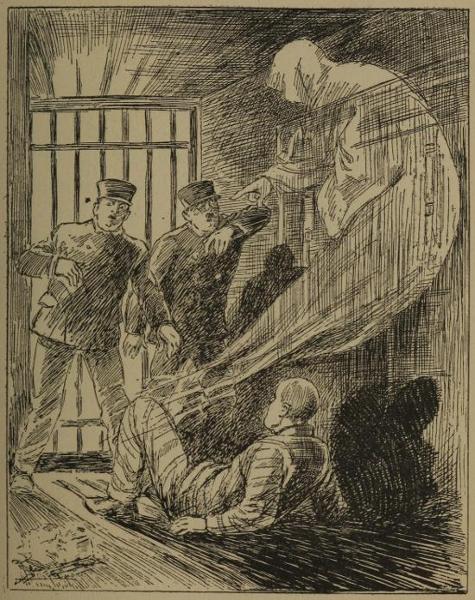
“Because I heard someone talk the other
way.”
“You heard someone talk the other way?”
“Yes, I fully intended to be a gentleman
and help you out of this prison, and I thought
I would walk around and think it over and see
how bad I wanted to be a gentleman, and I
got tired and sit meself down in the comfortable
chair in the hospital, and there I was thinking it
over and I was trying to think if I wanted to
be a gentleman all the rest of me life, and when
I asked meself the question I heard the answer,
and, faith, I never had me mind made up yet—I
was going to think about it a while—and I
listened, as if I was hearing someone talking,
and behold! I did, and I looked around, and
not a soul was in sight, and I asked another
question, and I got the answer again, and I
thought: ‘If you know so much and can answer
all of my questions, I’ll be giving you a
job.’ And I had a regular conversation with
them, and in the conversation I asked them
how much money you had, and they told me
not enough to get out of the trouble you was in,
so I think you will need it all, and I had better
not try to handle anny of it for you.”
“Who was this you were talking with that
gave you all of this information?”
“Well, me friend, I don’t know. I did not
see annyone, but I surely did hear someone.”
“What are you going to do—let me stay
here and serve whatever time is given me?”
“Well, what have I got to do with getting
you out?”
“Look here! I’ve got you now where you
will have to get me out, or I will get you in
here to occupy the next cell, 76.”
“I hardly think! That is taken. The murderer
that is coming to-morrow will have that.”
“Well, I am going to get away from here
before to-morrow. I shall report to the office,
if you do not help me out, of your accepting a
bribe, as you agreed to do, to assist me in getting
away. And they will look at it this way: If
you can be bought off, you would not be a
competent man to have in here. And that
means you would lose your job, and you would
find it hard to get employment elsewhere, for
your dishonesty would follow you wherever you
went.”
“Just as yours have done. And, me friend
Pearson, I have not committed the crime yet,
and now I know, I never shall, so you just as
well keep your head shut, for I am now in a
position where I might show you some favors
that I will do; but I will never show you the
way out of this place.”
“I am doomed to die here! It will kill me
to have sentence passed on me in court, and I
am guilty, and it will be proved. Pat, won’t
you please help me out? I will do anything
for you. I will give you my beautiful daughter
Gertie, whom you so much admire.”
“You are very kind. I am after seeing one
young man in trouble because he is in love with
one of your beautiful daughters, and I’ll be
after loving a girl whose dad is out. I won’t
have to come to the penitentiary to ask for
his girl.”
“Then you have decided to allow me to remain
here, have you, Pat?”
“I’m not the court.”
“You are not going to help me out?”
“I am not.”
“You shall rue this day. I shall explain
everything to the office to-morrow.”
“I’ll go, then, and let you think about it,
so you will have a good story to tell. Good
night, Pearson.”
“So Pat has weakened! I’ll see how he
talks in the morning. I feel certain that to-morrow
the officials will take steps to bring
Pearson to trial, and I know that with what
proof we have—and he has also pleaded guilty
in the presence of the officials themselves—he
will be sentenced for a number of years. I
must now return to the office. I think Pat is
out of sight. The crisis will come to-morrow.”
“Well, me friend is mad because I do not
help him out of his trouble and help meself into
trouble. I wonder where I heard that voice.
I’m glad I heard it when I did, and not after
I did the dirty work.”
“My boy, I was following you all the time,
and would not have allowed you to commit the
crime.”
“What do I hear? Another voice, or is it
the same? Well, me friend, I am a brave Irishman,
and just as long as you want to talk to
me you may do so. I’ll sit here the rest of
the night, and I won’t have long to wait. It’s
nearly morning now. But I would of lost manny
a night’s sleep, perhaps, if you had not of told
me. Whoever you are—I don’t know.”
“And I am not going to tell you, now.”
“I heard the words: ‘I am not going to
tell you, now.’ I must be after getting out of
this, for I’m hearing things, I am. I wonder
if that strange voice has returned. I thought
they—whoever it was, or whatever it was—had
gone, never to return, but I do belave they
have come back.”
“I think Pat will be around soon, and I will
pretend that I have had a restless night, and
that I will not go to bed at this late hour,”
thought the superintendent. “He will be thinking
this over and will not get it off from his
mind. I shall be anxious, for I have been worried
very much in the last few weeks. Yes,
here he comes.
“Good morning, Pat.”
“I’m not feeling anny too good, officer.”
“What is wrong, Pat?”
“Well, I’m after telling you at once. I’ve
got meself in the penitentiary.”
“Of course; we’re all in here, but not from
force.”
“And I never would be here by choice, but
I’m deserving of punishment, and I wish you
would give it to me unbeknown to annyone of
the higher officials, and I would plead guilty.”
“Pat, what is wrong? I never heard you
talk so before.”
“And I never did do so before.”
“Have you committed a murder?”
“No, your honor. But I come near liberating
a convict. You have not the confidence
in me anny more you once had, or never—”
“Well, I am sorry, for I had a friend in you—or,
at least, I felt so.”
“And now I’m friendless, a lone Irishman,
and I will soon be a convict.”
“You don’t seem to want to tell me what
is wrong, and I want to talk with Pearson to-day.
The telephone always rings when I am
talking.
“Hello! Yes. You want me to bring Pearson
to the office and read to him the warrant
which I shall receive this morning? In the mail?
His day for trial is set? All right, sir; I will
obey orders. Good-bye.
“Pat, you may bring Pearson in. I see the
mail is here, or soon will be.”
“May I ask of you one favor?”
“Yes. What is it, Pat?”
“If a fellow—scoundrel, I think, is the best
name for me—should repent of a crime before
it is committed and never was committed, would
you or could you forgive him? Could they send
one of them things you are looking for when
the postman comes in? Could they send one
of them after me to—”
“Yes, Pat, if you are self-confessed criminal
of some deed you have committed, you surely
would receive one of those warrants.”
“Why didn’t I die when I was a babe, instead
of me poor mother, and she here in me
shoes and I in hers?”
“You must bring Pearson in here. Here is
the postman.”
“I will, your honor.
“And now for the dirty work of me poor
self to be found out. I could see the wrong
in others, and could not see when I was tempted
the wrong I was doing, and I, like those here
who committed crimes, will have to pay the
penalty for it. I do not like to see this man
Pearson go to the office this morning, but that
is the orders, and I must bring him in. Here
I’ve been wandering along and thinking of me
own case, so I ’most forgot what I was sent for.
This is his cell, and he is fast asleep, but I must
awake him and take him to the office at once.
“Say! you! here! wake up! I want to take
you for a walk.”
“I am not asleep. I was just resting.”
“Very well; come along. Your presence is
wanted.”
“And your presence will be wanted too, some
day, if you don’t change your mind before we
get to the office.”
“I shall never change my mind, not after I
was told as I was and given such good advice
from some unseen force.”
“I’ve been thinking how to tell the whole
story, and you will regret the day you changed
your mind.”
“I may do so. Here we are. The office is
waiting for us, so come along.”
“I say, Pat, are you going to change your
mind before we enter the office?”
“Well, Pat, what are you debating about?
Come along here. Time is flying,” said the
superintendent.
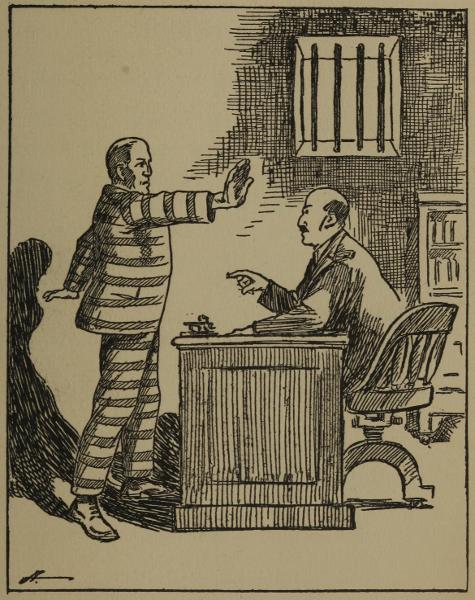
To the prisoner he said: “You are under
arrest. You have been here accused of obtaining
money under false affidavit, and I shall have
to say—Pearson, I regret very much to have to
read this to you, but I am sworn to do my
duty, and I have done so in this case, as I
would do in all others. Your trial is set for
one week from to-day.
“You may take him back, Pat.”
“Your honor, I have something to say.”
“What have you to say, Pearson?”
“I will ask you if you have ever noticed Pat
acting strangely, as if he was in a deep study?”
“I don’t know as I have noticed it. I have
had so many things to think of in the last three
or four months. I do not really know if I have
been noticing Pat very much, as he is one of
the guards whom I can trust among all of the
prisoners. I think Pat is very reliable—a very
reliable man to have here.”
“If I ever get out of this. I will never do
anny more dishonest work, or even talk or think
about it. I pray me poor mother may help me.
Now, you never did annything for me here on
earth, mother, come down from Heaven, if you
are there, and help me, plase do help me keep
me reputation up in this Pearson case, in the
eyes of the whole world. I now realize what
it means for a boy to make his first mistake.
He is ruined for life, and if all of the young
men knew what I do now, they would never
start to commit anny crime.”
“What are you doing, Pat? Mumbling to
yourself? No one can understand those sounds.”
“I understand what he is doing. He has
himself just where I will be soon, locked up in
this place.”
“Oh, Mr. Pearson! you always had a grievance
against Pat. I have never seen any cause
for it—none at all, I say.”
“You will have, after I have explained all.”
“You may take him back, Pat. It will soon
be time for the Southwest Limited to arrive.
Due in a half-hour. Make haste.”
He mused: “Pearson is one of those men
who, after he has been caught, wants to catch
everyone else, and he will tell all on poor old
Pat. I am so sorry for him. His first mistake,
and a bad one at that, but I hope Pearson will
be enough of a gentleman not to make him
suffer for it. His conscience will hurt him enough
for his part. I always placed so much confidence
in Pat. I am heartily sick of the whole
affair. One man can commit a crime and drag
others down with him. Here comes Pat. He
looks tired and worried.”
“Well, your honor, I am back after a hard
time I had getting the officer into his cell.”
“Pat, why should he say what he did? Have
you had some trouble with him, that you did
not tell me about?”
“Your question shall be answered, but not
to-day, not to-day.”