SPIRIT SLATE WRITING
AND
KINDRED PHENOMENA.
There has probably been nothing that has made
more converts to spiritualism than the much talked
of “Slate Writing Test,” and if we are to believe
some of the stories told of the writings mysteriously
obtained on slates, under what is known as “severe
test conditions,” that preclude, beyond any possible
doubt, any form of deception or trickery, one would
think that the day of miracles had certainly returned;
but we must not believe half we hear nor all that we
see, for the chances are that just as you are about to
attribute some unaccountable spirit phenomena to
an unseen power, something turns up to show that
you have been tricked by a clever device which is
absurd in its simplicity.
There are a large number of methods of producing
slate writing, but the writer will describe a few
which will be sufficient to give an idea of the working
of slate tests in general. First we have the
ordinary one in which the writing is placed on the
slate beforehand, and then hidden from view by a
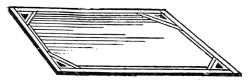
flap or loose piece of slate. (Fig. 1.) After both
sides of the slate have been cleaned, the false flap is
dropped on the table, the side which is then uppermost
being covered with cloth similar to the table
top, where it will remain unnoticed, or the flap is
allowed to fall into a second slate with which the
first is covered. In the latter case no cloth is pasted
on the flap. Sometimes the flap is covered with
a piece of newspaper and is allowed to drop into a
newspaper lying on the table, then the newspaper
containing the flap is carelessly removed, thus doing
away with any trace of trickery.
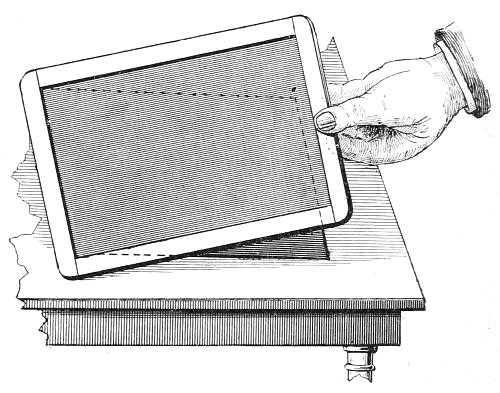
Fig. 1.—Ordinary Slate with Flap.
Another way of utilizing the false flap is as follows:
The writing is not placed beforehand on the
slate, but on the flap, which, as before, is covered
with the same material as the table top. This is
lying on the table writing downward. The slate is
handed around for inspection, and, on being returned
to the performer, he stands at the table and
cleans the slate on one side, then turns it over and
cleans the other. As he does so he lifts the flap into
the slate. The flap is held in firmly by an edging of
thin pure sheet rubber cemented on the flap between
the slate and the cloth covering of the slate. This
grips the wooden sides of the frame hard enough
to prevent the false piece from tumbling out accidentally.
We now come to another style, wherein a slate is
cleaned on both sides, and, while held in the hand
facing the audience, becomes suddenly covered with
writing, and the slate is immediately given for inspection.
The writing is on the slate previous to
the cleaning, and is hidden from view by a flap of
slate colored silk, held firmly in place by a pellet of
wax in each of the corners of the silk. Attached to
this silk flap or covering (at the end that is nearest
to the performer’s sleeve) is a stout cord or string,
which is also made fast to a strap around the wrist
of the hand opposite to that holding the slate. If
the arms are now extended their full length, the
piece of silk covering will leave the slate and pass
rapidly up the sleeve out of the way, and thus leave
the writing exposed to view. (Fig. 2.) The slate is
found to be still a little damp from the cleaning with
the sponge and water it had been given previously.
This is easily accounted for. The water from the
sponge penetrates just enough through the cloth to
dampen the slate.
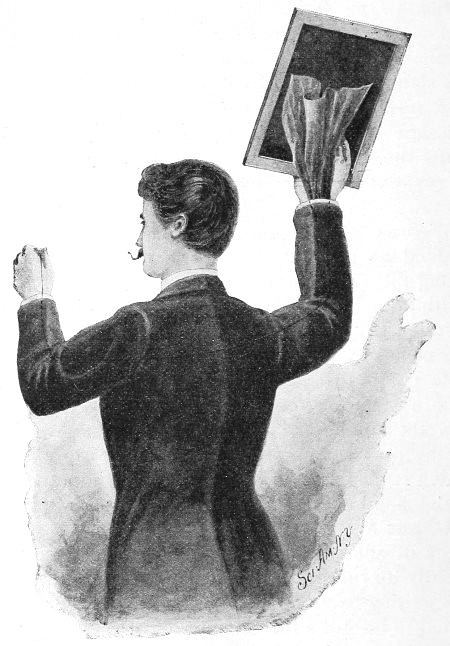
Fig. 2.—Removing the Silk from the Face of the Slate.
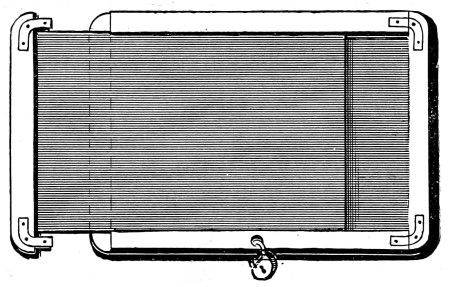
There is still another slate on which we can make
the writing appear suddenly. It is composed of a
wooden frame, such as all wooden-edged slates have,
but the slate itself is a sham. It is a piece of cloth
painted with a kind of paint known as liquid, or silicate
slating, which, when dry and hard, is similar to
the real article. This cloth is twice the length of
the slate and just the exact width. The two ends of
the cloth are united with cement, so as to make an
endless piece or loop. There is a small rod or roller
in both the top and bottom pieces of the frame, the
ends being made hollow to receive them. Over
these rollers runs the cloth, stretched firmly and
tightly. Just where the cloth is joined or cemented
is a little black button, or stud of hard rubber or
leather. This allows the cloth to be pushed up and
down, bringing the back to the front; and by doing
so quickly, the writing which is written on the cloth
at the rear of the frame is made to come to the front
in plain view. (Fig. 3.)
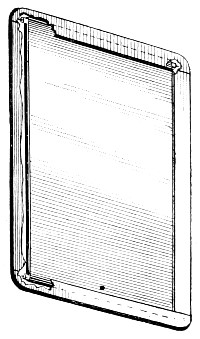
Fig. 3.—The Endless Band
Silicate Trick Slate.
Still another idea in a
single slate is as follows:
An ordinary looking slate
is given out for examination,
and, on its being returned
to the medium, he
takes his handkerchief and
cleans or brushes both sides
of the slate with it; and,
upon again showing that
side of the slate first cleaned,
it is found covered with
writing apparently done
with chalk. The following
is the simple explanation
of it: Take a small camel’s
hair brush and dip it in
urine or onion juice, and with it write or trace on
the slate whatever you desire, and when it becomes
dry, or nearly so, the slate can be given for examination
without fear of detection. The handkerchief
the performer uses to clean the slate with is lightly
sprinkled with powdered chalk. He makes believe to
clean the one side devoid of preparation, but the side
containing the invisible writing is gently rubbed
with the handkerchief, not too hard just enough to
let the powdered chalk fall on the urine or onion
juice, where it leaves a mark not unlike a chalk mark.
It will not be out of place to describe a trick by
which writing is produced upon an ordinary china
plate by a somewhat similar means. The plate is
examined and cleaned with a borrowed handkerchief,
and then the performer requests the loan of a
pinch of snuff, or uses a little sand or dust, which he
places on the plate. He now commences to move
the plate around in circles, and while doing so the
snuff or sand is seen to gradually form itself into
writing. The explanation is simple—whatever writing
you desire to appear on the plate is placed beforehand
on it. It is done with a camel’s hair brush
dipped in the white of an egg and allowed to become
dry before being handed around for inspection. As
the performer cleans the plate he breathes on both
sides of it, as if to give it moisture enough to help
take off any dirt that might be thereon when rubbed
with the handkerchief. In breathing on the front of
the plate containing the writing done with the white
of the egg, he moistens the writing enough to make
the snuff or sand, as the case may be, adhere to it.
Of course, in cleaning the front of the plate, care
must be taken not to brush or disturb the invisible
writing.
It may not be amiss to also mention another method
of producing writing, employed by mediums to obtain
a message on a blank piece of paper which has
been placed between two slates, which are held by
the medium in his hand, high above his head, and, on
afterwards taking the slate apart, the paper is covered
with writing. This again calls into use the
extra or false flap. (Fig. 1.) A piece of paper
with writing on it is placed face downward on one
of the slates and covered with the false flap. It
then looks like an ordinary slate. On this is placed
the plain piece of paper, and over this is laid the
second slate. The slates are now held up in plain
view of the audience, and on being lowered to the
table they are turned over, thus bringing the blank
piece of paper under the false flap and the one with
the writing on it on the top of the flap, which has
fallen from the slate, which is now the top, but originally
the bottom one, on or into the under one, and,
of course, on the removal of the present top slate,
the writing is found on what is supposed to be the
original blank paper.
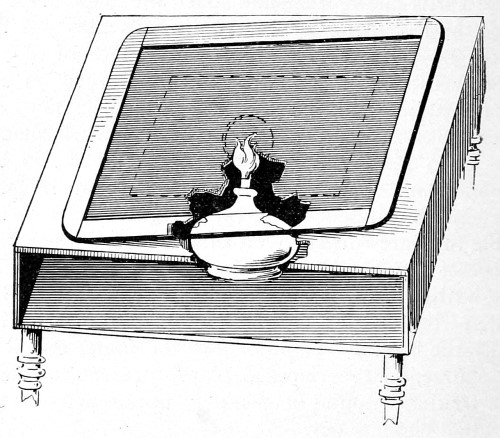
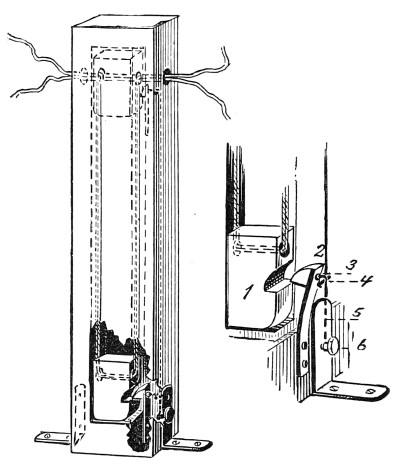
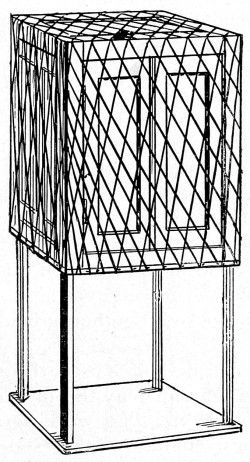
Fig. 4.—False Table for Developing Communications
Written with Sympathetic Ink.
If the paper is to have a private mark put on it by
an observer, so as to prove the writing really does
appear on that identical piece of paper, the operation
is varied as follows: The false flap is done away
with, and the paper, which is furnished by the
medium, has written on it the desired communication
with ink, which is made visible and brought out
black by means of heat. For the invisible ink you
can use sulphuric acid, very much diluted, so as not
to destroy the paper. The necessary heat is obtained
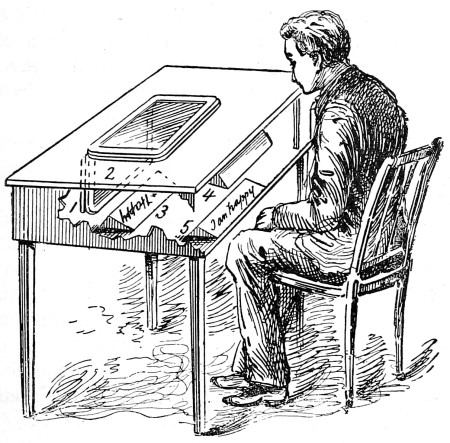
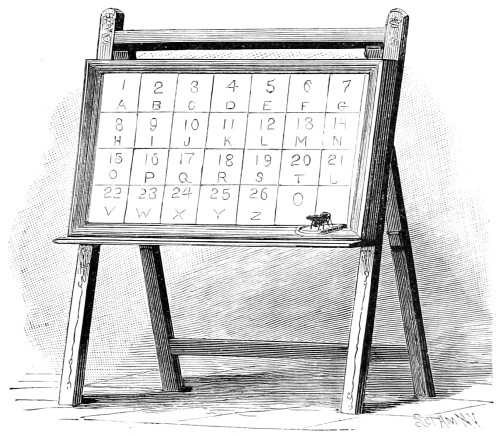
in the following manner: The table (Fig. 4) on which
the slates are resting is hollow, and has concealed in
it a spirit lamp filled with alcohol. This lamp sits
directly under a trap in the table top, which is covered
underneath for safety with sheet iron, so it will
not catch fire. When the slates are placed on the
table they are laid over the little trap door, which,
in conjuring parlance, is known as a “trap.” This is
now opened, and the slates allowed to become well
heated and the trap then closed, and the prepared
paper, upon coming in contact with the hot slate, is
thus covered with writing.
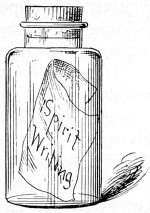
Fig. 5.—The Development
of Spirit Writing.
Another medium employed a somewhat similar
method, only the paper in this case was placed in a
glass vial (Fig. 5) which had been lying on the iron
trap door. The medium’s hand covered the vial,
which was corked and sealed, while the writing was
making its appearance. You can also produce writing
on the paper in the vial without resorting to the
use of heat by using a vial that has
been washed out with ammonia
and kept well corked, and writing
on the paper with a weak solution
of copper sulphate, which is invisible
until the paper is placed
in the vial, when the two chemicals
produce writing in blue. Still
another message is produced as
follows: The writing is done with
iron sulphate on blank cards. Of
course this is invisible. These
cards are placed in envelopes and
sealed up. Upon opening the
envelopes shortly afterward the cards are covered
with the writing which was before invisible,
but is brought out by a solution of nut galls with
which the inside of the envelopes had been slightly
moistened.
The subject of sympathetic inks is such an interesting
one that we give thirty-seven formulas,
which include all those which are liable to be used
by the medium.
The solutions used should be so nearly colorless
that the writing cannot be seen till the agent is applied
to render it visible. Sympathetic inks are of
three general classes.
1. Write with a concentrated solution of caustic
potash. The writing will appear when the paper
is submitted to strong heat.
2. Write with a solution of ammonium hydrochlorate,
in the proportion of 15 parts to 100. The
writing will appear when the paper is heated by
holding it over a stove or by passing a hot smoothing
iron over it.
3. A weak solution of copper nitrate gives an invisible
writing, which becomes red through heat.
4. A very dilute solution of copper perchloride
gives invisible characters that become yellow
through heat.
5. A slightly alcoholic solution of copper bromide
gives perfectly invisible characters which are made
apparent by a gentle heat, and which disappear
again through cold.
6. Write upon rose colored paper with a solution
of cobalt chloride. The invisible writing will become
blue through heat, and will disappear on cooling.
7. Write with a solution of sulphuric acid. The
characters will appear in black through heat. This
ink has the disadvantage of destroying the paper.
(See the caution given on page 9.)
8. Write with lemon, onion, leek, cabbage or artichoke
juice. Characters written with these juices
become very visible when the paper is heated.
9. Digest 1 oz. of zaffre, or cobalt oxide, at a
gentle heat, with 4 oz. of nitro-muriatic acid till no
more is dissolved, then add 1 oz. common salt and
16 oz. of water. If this be written with and the
paper held to the fire, the writing becomes green,
unless the cobalt should be quite pure, in which
case it will be blue. The addition of a little iron
nitrate will then impart the property of becoming
green. It is used in chemical landscapes for the
foliage.
10. Put in a vial ½ oz. of distilled water, 1 drm.
of potassium bromide and 1 drm. of pure copper
sulphate. The solution is nearly colorless, but becomes
brown when heated.
11. Nickel nitrate and nickel chloride in weak
solution form an invisible ink, which becomes green
by heating when the salt contains traces of cobalt,
which usually is the case; when pure, it becomes
yellow.
12. When the solution of acetate of protoxide of
cobalt contains nickel or iron, the writing made by
it will become green when heated; when it is pure
and free from these metals, it becomes blue.
13. Milk makes a good invisible ink, and buttermilk
answers the purpose better. It will not show if
written with a clean new pen, and ironing with a hot
flat iron is the best way of showing it up. All invisible
inks will show on glazed paper; therefore
unglazed paper should be used.
14. Burn flax so that it may be rather smoldered
than burned to ashes, then grind it with a muller on
a stone, putting a little alcohol to it, then mix it with
a little gum water, and what you write, though it
seem clear, may be rubbed or washed out.
15. Boil cobalt oxide in acetic acid. If a little
common salt be added, the writing becomes green
when heated, but with potassium nitrate it becomes
a pale rose color.
16. A weak solution of mercury nitrate becomes
black by heat.
17. Gold chloride serves for forming characters
that appear only as long as the paper is exposed to
daylight, say for an hour at least.
18. Write with a solution made by dissolving one
part of silver nitrate in 1,000 parts of distilled
water. When submitted to daylight, the writing
appears of a slate color or tawny brown.
19. If writing be done with a solution of lead
acetate in distilled water, the characters will appear
in black upon passing a solution of an alkaline sulphide
over the paper.
20. Characters written with a very weak solution
of gold chloride will become dark brown upon passing
a solution of tin perchloride over them.
21. Characters written with a solution of gallic
acid in water will become black through a solution
of iron sulphate and brown through the alkalies.
22. Upon writing on paper that contains but little
sizing with a very clear solution of starch, and submitting
the dry characters to the vapor of iodine,
or passing over them a weak solution of potassium
iodide, the writing becomes blue, and disappears
under the action of a solution of sodium hyposulphite
in the proportions of 1 to 1,000.
23. Characters written with a 10 per cent. solution
of nitrate of protoxide of mercury become black
when the paper is moistened with liquid ammonia,
and gray through heat.
24. Characters written with a weak solution of the
soluble platinum or iridium chloride become black
when the paper is submitted to mercurial vapor.
This ink may be used for marking linen. It is indelible.
25. C. Widemann communicates a new method of
making an invisible ink to Die Natur. To make the
writing or the drawing appear which has been made
upon paper with the ink, it is sufficient to dip it
into water. On drying, the traces disappear again,
and reappear by each succeeding immersion. The
ink is made by intimately mixing linseed oil, 1 part;
water of ammonia, 20 parts; water, 100 parts. The
mixture must be agitated each time before the pen is
dipped into it, as a little of the oil may separate and
float on top, which would, of course, leave an oily
stain upon the paper.
26. Write with a solution of potassium ferro-cyanide,
develop by pressing over the dry, invisible
characters a piece of blotting paper moistened
with a solution of copper sulphate or of iron
sulphate.
27. Write with pure dilute tincture of iron; develop
with a blotter moistened with strong tea.
28. Writing with potassium iodide and starch becomes
blue by the least trace of acid vapors in the
atmosphere or by the presence of ozone. To make
it, boil starch, and add a small quantity of potassium
iodide in solution.
29. Copper sulphate in very dilute solution will
produce an invisible writing, which will turn light
blue by vapors of ammonia.
30. Soluble compounds of antimony will become
red by hydrogen sulphide vapor.
31. Soluble compounds of arsenic and of tin peroxide
will become yellow by the same vapor.
32. An acid solution of iron chloride is diluted
till the writing is invisible when dry. This writing
has the remarkable property of becoming red by
sulphocyanide vapors (arising from the action of
sulphuric acid on potassium sulphocyanide in a long
necked flask), and it disappears by ammonia, and
may alternately be made to appear and disappear by
these two vapors.
33. Writing executed with rice water is visible
when dry, but the characters become blue by the
application of iodine. This ink was much employed
during the Indian mutiny.
34. Write with a solution of paraffin in benzol.
When the solvent has evaporated, the paraffin is invisible,
but becomes visible on being dusted with
lampblack or powdered graphite, or smoking over a
candle flame.
35. To Write Black Characters with Water.—Mix
10 parts nutgalls, 2½ parts calcined iron sulphate.
Dry thoroughly, and reduce to fine powder.
Rub this powder over the surface of the paper,
and force into the pores by powerful pressure, brush
off the loose powder. A pen dipped in water will
write black on paper thus treated.
36. To Write Blue Characters with Water.—Mix
iron sesquisulphate and potassium ferrocyanide.
Prepare the paper in the same manner as for writing
black characters with water. Write with water,
and the characters will appear blue.
37. To Produce Brown Writing with Water.—Mix
copper sulphate and potassium ferrocyanide.
Prepare the paper in the same manner as before.
The characters written with water will be reddish
brown.
Here is another trick calling for the use of sympathetic
ink. A medium suggests a number of questions
to write on a paper, one of which you select and
write on a slip of paper furnished by the medium.
Writing is done with pen and ink. You are requested
to dry it with a blotter, and not to remove the
blotter for a time, the medium says, so as to keep the
paper in the dark, thus giving the “spirits” better
conditions under which to work. After a while the
blotter is removed, and an answer to the question is
found on the same paper. The questions suggested
were all of such a character that one answer would
nearly do for any one. The paper the question was
written on had this answer written with invisible
ink brought out by a reagent on the blotter, with
which it was saturated, and thus another mystery is
easily dispelled.
We will now take up a few slate tests, in which
the slates are brought or furnished by the spectator
or investigator. The tests in which the slates are
brought by skeptics and tied and sealed by them,
and still writing is obtained upon them, are the ones
that are the most convincing and most talked about,
and they are offered to the unbeliever as proof absolute
of spirit power.
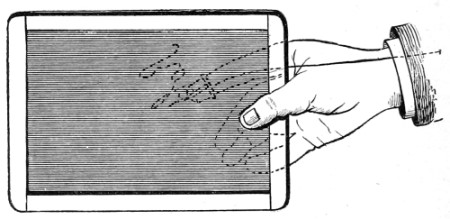
Fig. 6.—Writing on the Slate with the Pencil
Thimble.
First we will begin with the single slate which
has just been handed to the medium, after being
thoroughly cleaned by the person bringing it. The
skeptic holds one end of the slate in one hand and
the medium the opposite end in one of his hands, and
both persons clasp their disengaged hands. In a
short time the slate is turned over and a few words
written in a scrawling style are found. I must
acknowledge that when I first witnessed this test it
somewhat staggered me, but afterward, on seeing it
the second time, I was enabled to fathom its mystery.
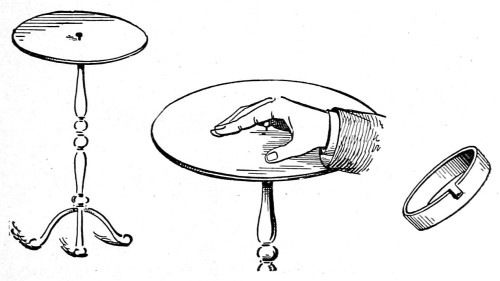
It is patterned somewhat after the style claimed
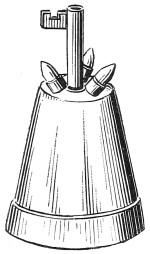
to have been used by Slade, wherein he used a piece
of slate pencil fastened to a thimble, and with apparatus
attached to his forefinger of the same hand
holding the slate he did the writing. The thimble
(Fig. 6) was fastened to an elastic which pulled
the thimble out of sight up the sleeve or under the
coat when it was done with. But it always required
a little scheming and maneuvering both to use and
conceal the device and get rid of it, and there was
always the fear of being detected with this bit of
machinery about the person; so someone of an ingenious
turn of mind hit upon another method.
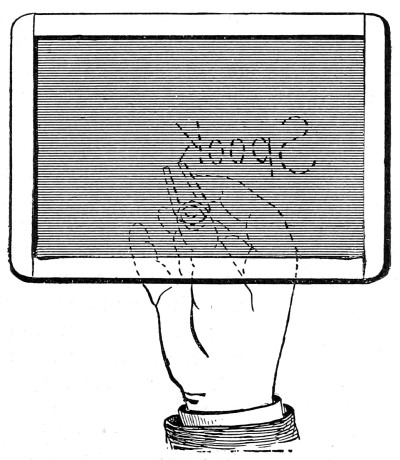
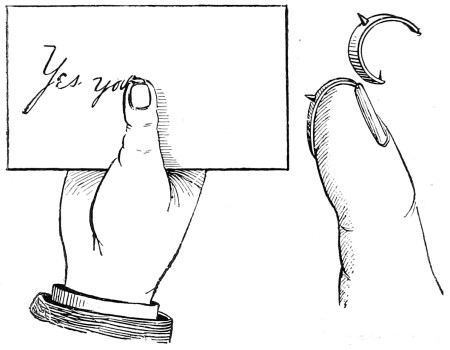
There are some slate pencils made the same as lead
pencils, that is, a very small piece of slate pencil,
about the size of a match, is enclosed in the wood
after the manner of lead pencils. A tiny piece of
this pencil is placed at the tip of the forefinger and
over it is placed a piece of flesh-colored court plaster
well fastened to the finger (Fig. 7) and well
blended in with aniline dye with the finger, so both are
exactly the same color. After everything becomes
dry and hard a little hole is made in the court plaster,
so as to allow the point of the piece of pencil to
come through enough to mark on the slate. The
finger thus prepared is what does the writing. The
message or name must be written backward, so that
when the slate is reversed it will appear in its correct
position. To learn to do this quickly, stand in
front of a looking-glass with the slate in your hand
and watch your writing in the glass as you go along.
You do not need to hold the slate underneath the
table in this test; hold it in the air with a handkerchief
over it, so as to disguise the movement of the
finger. The message must necessarily be short, on
account of the radius through which the medium’s
finger can travel.
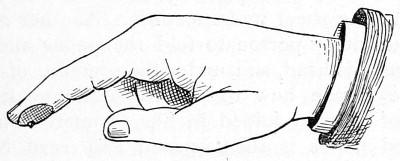
Fig. 7.—The Prepared Finger.
We now come to another method of using the
single slate. The medium takes the slate and places
it on the table and requests the spectator to write a
question on a piece of paper. He, the medium,
gains knowledge of the contents of the paper in
various ways; one is by using a pad of paper which
contains underneath the second or third layer of
paper a carbon sheet made of wax and lampblack.
Whatever is written on the first sheet of paper will
be transferred or copied by means of the carbon
paper to the sheet underneath it. Another way is
by requesting a person to fold the paper and hold
it against his head, and, under the pretense of showing
the person how to hold it, exchange it for a
paper of his own folded in like manner. This exchanged
paper is then opened and read by the
medium while his hand is below the level of the
table top, and while he is holding a conversation
with the auditor. After it is read, the paper is again
folded and kept in the performer’s lap until needed.
As he now knows the contents of the paper, he
can frame in his mind a suitable answer. He remarks:
“I will ask the spirits first to give you
a decided answer, through me as an independent
trance slate writing medium, whether they will
answer your question during this sitting.” So
the medium takes a pencil in hand and writes on
one side of the slate, apparently under spirit control,
and then on the other side. The message
is read, and it says the conditions are very favorable,
and no doubt, if the skeptic will place the
utmost confidence in the medium, there will be satisfactory
results. After the slate has been shown
with both sides covered with writing, it is thoroughly
cleaned and placed on the table. The medium
now picks up the original paper from his lap and
asks the person to give him the paper he is holding.
This the medium apparently places under the slate;
however, he really holds this one back and introduces
the one he has had in his hand, which is the
one originally written upon. He has now his own
paper in his hand, and the one with the question is
under the slate. On the slate being turned over in
a short time, it is covered with writing, forming a
sensible reply to the question on the paper, which is
now opened and read to compare it with the answer.
All that remains to be explained is how the writing
on the slate appeared there. The false flap is again
used, but in a directly opposite manner to which it
has been employed heretofore. One side of this flap
is covered with a portion of the writing that the
medium first wrote under spirit control. Let us say
the first half supposed to have been written on the
one side of the slate, and which he afterward reads
off in connection with that written on the last or
second side of the slate. What he really wrote on
the first half of the slate was a correct answer to the
question, and after he turns the slate over to write
on the opposite side he slips the false flap over the
answer on the slate. Of course it is what is on this
false flap and on the other side of the slate that the
spectator really reads, and when the slate is cleaned
it is this flap and the opposite side of the slate. The
writing, covered by the flap, which is the answer to
the question, is never seen or touched until after
the flap is allowed to drop into the medium’s lap. The
slate can be examined; and, of course, no trickery
can be found in connection with it. The method
described above, in the hands of a calm and cool person,
is a convincing one, and never fails to satisfy the
most exacting of skeptics.
I wish to remark that, if any person tells you
he took two slates of his own to a medium, thoroughly
well tied or sealed, and that the slates never
left his (the skeptic’s) hands, and that there was writing
obtained upon the interior surface of the slates
under those conditions, he was sadly mistaken,
and has failed to keep track of everything that
actually took place at the time of the sitting. Suppose
two slates tied together are brought to the
medium. Both he and the stranger sit at a table.
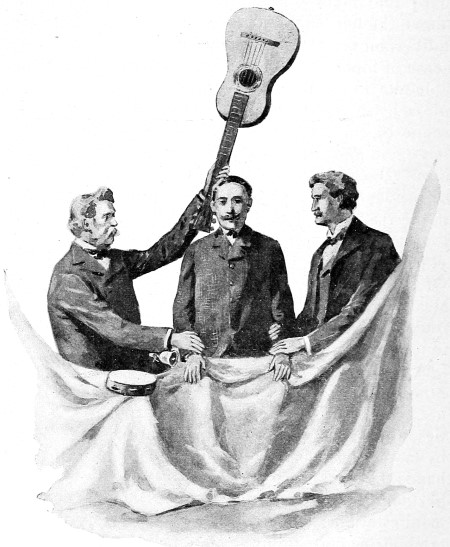
The slates are held under the table, the medium
grasping one corner and the skeptic the opposite
corner, each with one hand, and the disengaged
hands clasped together above the table. After a
while the slates are laid upon the table, the string
untied, the slates taken apart, but no writing is found.
The medium states it must have been because there
was no slate pencil between them. So a small piece
of pencil is placed between the slates, and again they
are tied with the cord by the medium, and he again
passes them under the table, both persons holding
the slates as before. Presently writing is heard, and,
upon the skeptic bringing the slates from under the
table and untying the cord himself, he finds one of
the slates covered with writing, although but shortly
before they were devoid of even a scratch. Here is
the explanation: The medium does not pass the slates
under the table the first time, but drops them in his lap,
with the side on which the string is tied or knotted
downward, and really passes a set of his own for the
skeptic to hold; he (the medium) supporting his end by
pressing against the table with his knee, which leaves
his hand disengaged. There is a slate pencil, called the
soapstone pencil, which is softer than the ordinary.
This is the one used by the medium. He now covers
the face of the slate which is uppermost in his lap
with writing, doing so very quietly and without any
noise. Now, as he brings the slates above the table,
he leaves his own in his lap and brings up the skeptic’s
with the writing side down. The slates are
untied and taken apart and shown, devoid of writing
upon the inside, which he claims was caused by not
having any slate pencil inside. The medium now
places the pencil upon the slate which was originally
the upper one, and covers this with what was the
bottom slate, which is covered with the writing inside
on the back or bottom of slate. This maneuver
or action brings the slate on top with the writing
upon its inside. Nothing could be more simple
and natural. The slates are again tied together, and
in doing so the slates are turned over, bringing the
slate containing the writing, still upon the inside, at
the bottom instead of the top, and the string tied or
knotted above the top slate. Of course, when again
separated, the writing is found upon the inside of the
lower slate. When the slates are passed under the
table the second time, the spectator himself is allowed
to do this, and the medium, with one of his finger
nails, while holding his end of the slate, produces a
scratching noise on the slate closely resembling the
tracing of a pencil. It is not really necessary to
pass the slates under the table the second time, but
they can be held above it if preferred.
Now, suppose two slates are brought that are riveted
or screwed or sealed at the four corners. How
can writing be obtained upon them without disturbing
any of the above arrangements? The slates are held
under the table in the same manner as in previous
tests. To produce the writing upon the slates the
medium is provided with a few simple, though effective
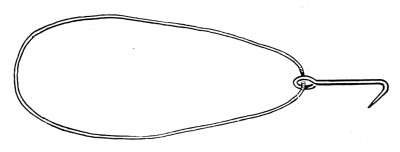
devices, one of which is a little hard wood tapering
wedge, and a piece of thin steel wire, to one
end of which is fastened a tiny piece of slate pencil.
An old umbrella rib will be found to work admirably,
because there is a small clasp at one end and
at its other end a small eye. The pencil is made to
fit into the end with the clasp. Now take the
wooden wedge and push it between the wooden
frames of the slates at the sides. The frames and
slates will give enough to allow the wire and pencil
to be inserted and the writing be accomplished with
it, after which the wire is withdrawn, and then also
the wooden wedge, and all is done without leaving
any trace or mark behind as to how it is all performed.
(Fig. 8.)
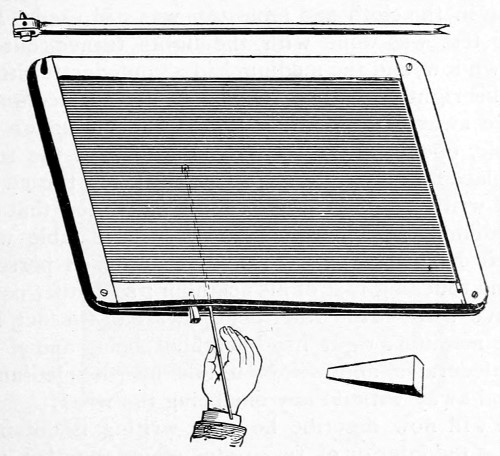
Fig. 8.—Wedging Apart the Slates.
A well known conjuror at one time made a remark
that he could duplicate any slate writing test he
ever witnessed, he having publicly declared, time
and time again, the slate writing test to be a fraud.
He gave a test in private at his own home and hit
upon a rather unique idea. A slate would be cleaned
on both sides and a private mark placed on it, and
the slate allowed to lie flat on the table, and the magician
and the committee sat around it and placed
their hands upon the slate. Presently writing was
heard, and upon lifting the slate the side underneath
was found covered with writing. The table was a
kitchen table with the ordinary hanging cloth cover,
or table cloth. The table had a double top with
room enough between the two to conceal a small
boy. There was a neatly made trap in both the
table cloth and the top of the table; the cloth being
glued around the opening to keep it in place. The
trap door opened downwards. The boy concealed
in the table opened the trap door and did the necessary
writing on the slate, and closed the opening.
The idea of having the committee hold their hands
on the slate was to prevent the slate from being accidentally
moved by the boy when writing. The above
idea was improved upon by doing away with the
use of the boy and the double top of the table. The
trap in the cloth and table top was still used. But
the test was done with the lights turned out or
down low, and the medium had a confederate sitting
at his right hand side. This allowed the medium to
take away his right hand, introduce it under the
table, open the trap, do the writing, shut the trap,
replace his hand, and on the lights being turned up
the writing is found. It should be stated that the
medium and committee sat around the table with
their hands resting on the slate, and each person’s
hand touching that of his neighbor; so neither could
move without the other being aware of the fact, but
the medium’s right hand neighbor, being one of his
confederates, allows him to take his (the medium’s)
hand away without any one being the wiser.
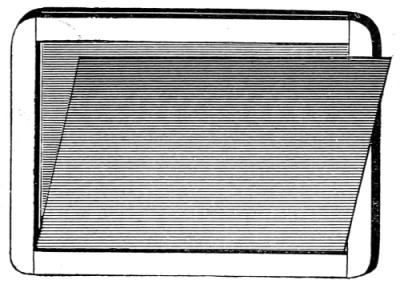
Fig. 9.—The Trick Slate.
I will now describe how the writing is obtained
upon the interior of two slates sealed together, and
all hands placed on them, and without the assistance
of a confederate. The table is the same as previously
described, that is, it contains the trap. The
slates are two single ones hinged together and sealed
around the edges in any manner the committee may
see fit. One of the slates is a trick slate made in this
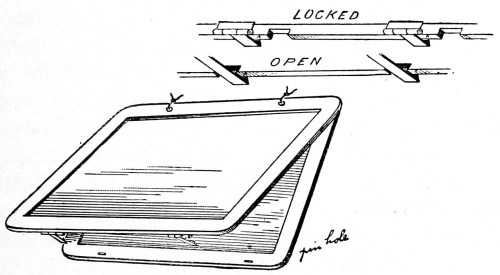
fashion: The slate part itself is made to work on
a pivot or hinge along one of its sides. (Fig. 9.)
The side opposite to where both slates are hinged
together, by touching a portion of the hinges that
hold the two slates together, a catch concealed in
the wooden framework is released, which allows the
slate part itself to drop down on its own hinge or
pivot. So when the slates are placed on the table
they are put directly over the trap in the table, and
with the hinges of the two slates toward the medium.
The medium, as he places the slates over the trap in
the table, pushes the hinge releasing the catch, which
allows the underneath slate to drop as far as the
table. Now, when the trap in the table is opened,
the slate opens or drops far enough for the medium
to write on that part, also on the slate above it. He
closes both the slate and the table, and the slates,
upon being unsealed, are found covered with writing.
The only thing that remains to be explained is
how the medium gets his hand free to do the writing
without being detected. The lamp or gas jet is
close to the medium’s right hand, where he can
reach it. Now, all the persons are seated around
the table with their hands on the slates, and each
other’s hands or fingers touching one another. The
medium takes his right hand away to turn down the
light, and his next door neighbor, as soon as the
light goes out, feels his (the medium’s) hand or
finger replaced. At least, so he thinks. What
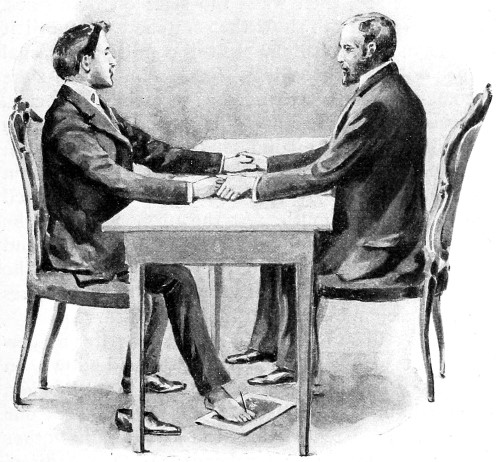
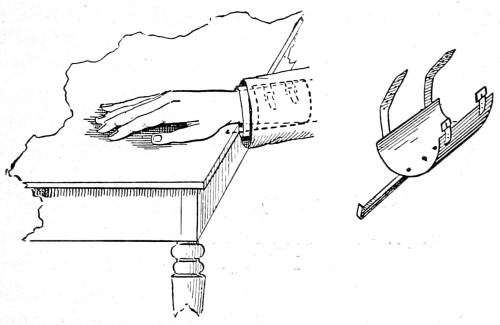
really happens is this: The thumb of the medium’s
left hand is stretched far enough over to
touch the hand or finger of the person sitting on
the performer’s right hand side. (Fig. 10.) The
medium immediately goes to work and produces
the writing, and when finished, just as he goes to relight
the gas or lamp, he removes the left thumb to
create the impression that he has just taken his right
hand away again for the light.
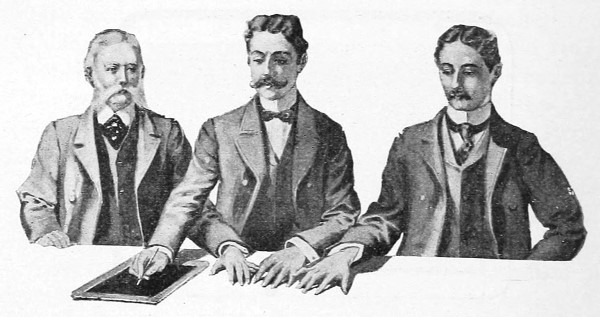
Fig. 10.—The Medium Holding the Two Skeptics’ Hands.
Here is a trick I once saw a medium do. He
had a number of slates piled on top of the table;
he would clean these, one at a time, showing each,
and after they had been thoroughly examined, he
placed them on the floor. He would then pick them
all up together and replace them on the table, and
select two of them, put them together, holding them
in his hand above his head, would shortly separate
them and show one covered with writing. The
slates were devoid of all trickery, as was easily proved
in allowing them to be thoroughly examined.
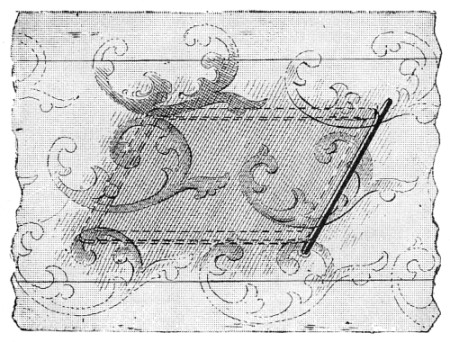
Fig. 11.—The Slate under the Carpet.
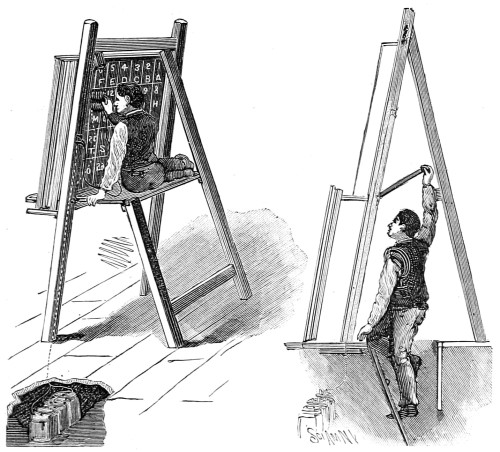
The explanation is as follows: The floor was covered
with carpet. In this there was a slit or cut just
large enough to pass or draw a slate through. A
slate with writing on one side is previously placed
under the carpet, with that side down. (Fig. 11.)
The slates, as they are cleaned, are laid on the carpet
immediately over or near this concealed one,
and, on lifting the slates from the floor, this one is
also carried with them, and all placed on the table.
Of course, it is this slate and one of the prepared
ones that are afterward used. There is little likelihood
of any one taking notice of there being one
more slate in the pile.
Some mediums use two single slates, and, after
cleaning them on both sides, hold one in each hand.
They sit a little way from the table and place the
right hand, with the slate, under the chair, as if to
draw the chair closer to the table. What the medium
really accomplishes is an exchange of slates.
There is a little shelf, or drawer, under the seat of
the chair. On this lies a slate, one side of which is
prepared with writing. The medium picks up the
slate and leaves behind in its place the one held in
his right hand as he moves the chair. This is
a method used to a considerable extent and always
successfully.
The following is a clever ruse, ofttimes used by
mediums to destroy all traces of the use of the false
flap when it is employed. It is the test where the
flap is used to cover the writing on one slate, and
then that slate is covered with another. Now, if
the slates are turned over or reversed, the writing
is uncovered and the flap remains in the opposite or
underneath slate. Now, to get rid of that flap, the
medium deliberately presses his knee against that
slate, breaking not only the slate, but also the flap
contained in it. The broken flap mingles in with
the broken slate, and nobody is any the wiser. Nobody
for a moment thinks of picking up the pieces
to see if there are one or more slates. Of course,
when the slates are broken, it is done secretly under
the table, and the medium remarks: “The spirit
force is so strong it has smashed the slate.” A
test with a single slate that I once saw done was
rather neat in its way, and I think it worth describing.
The slate was examined and cleaned on both
sides, and placed on a small table covered with a
little fancy cloth. On lifting the slate afterward,
its underneath side was found with writing on it.
The top of the table was no larger than the slate.
When the slate was laid on the table, the medium
remarked: “To convince you there is no trickery
about the table, I will remove the cloth;” which he
did, with the slate still on or in it, and then replaced
the slate and cloth. Now, on this table top was
resting another slate covered with writing on one
side, and that side upward, and this covered with
the table cloth. When the medium picked up the
cloth and the slate, which had just been cleaned,
he also carried along the second slate with it, which
was under the cloth, and in replacing the cloth he
simply reversed the sides, laying the first slate on
the table, where it was covered by the cloth, and
the second one was thus brought to view. It is
astonishing how such barefaced and simple devices
will deceive the spectator. It is the boldness and
air of conviction of his assertions that carry a medium’s
test successfully through.