The so-called mystery of the notorious Chevalier
d'Eon has long since been proved to have been
no mystery at all. The question of his sex was,
during his whole life, a matter of fierce dispute
and much speculation in many countries. At
his death in London, in the year 1810, an English
doctor, Courthorpe by name, gave full attestation
to the fact that the deceased Chevalier was neither
a female nor an hermaphrodite, but a complete
man. D'Eon, it is hardly to be disputed, must
rank among the great diplomatic spies whom the
world has produced and even in his own age,
when the mystery attaching to his person made
him an object of extraordinary social interest,
all men were willing to bear testimony to his
courage, physical energy, industry, audacity and
wit. In all probability no one was ever made
the confidant of his reasons for adopting female
dress, but in every likelihood there was nothing
more romantic in his peculiarity than the mania
for being conspicuous and attracting attention,
unless indeed, as has been suggested, he chose to
wear woman's dress for the reason that it was
more comfortable than that of man and had the
advantage of making him appear taller than he
really was. About the Chevalier it is known
for a certainty that one Douglas, a Scottish
diplomatic agent, when proceeding to Russia
in 1755, on a mission to the Empress Elizabeth,
in the interests of Louis XV., took the clever youth
with him—at the suggestion of d'Eon himself—dressed
him as a female and introduced him to the
Court of Russia, where his knowledge of languages
soon obtained for him a post as reader
to the Empress, over whom for a short season he
obtained an ascendancy which enabled him to
turn her sympathies towards an alliance with
France. Louis XV., as we remember, had never
possessed any real political or diplomatic power
within his own realm, and in order to offset his
official impotence, thought out his famous private
organisation of court and political intrigue-mongers,
which eventually became known as
"The King's Secret." Douglas was among the
men employed in this body, the Prince de Conti,
Duc de Broglie and many other nobles, both
French and foreign, also assisting the King in the
conduct of a conspiracy the real object of which is
not very apparent, if it was not for the pure love
of the mystery and intrigue surrounding the whole
business.
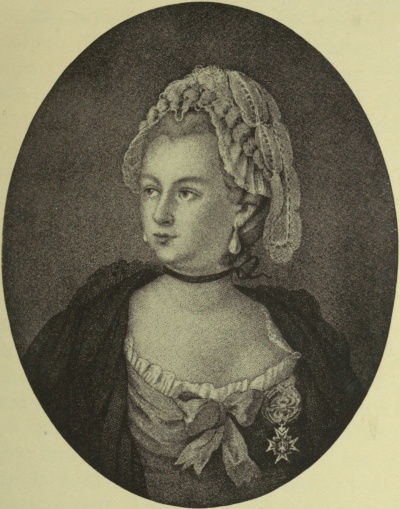
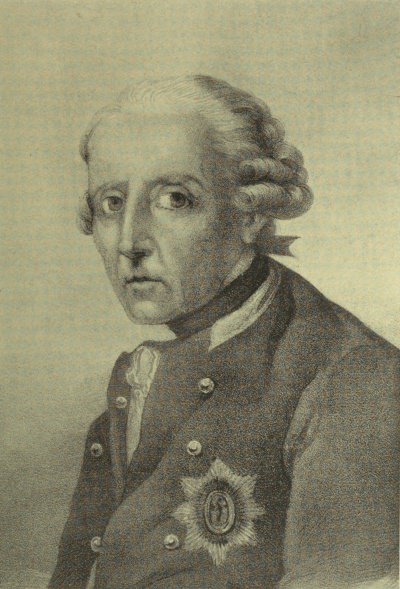
The Chevalier d'Eon
After a painting by Angelica Kauffmann
Practical results were, however, achieved in
the case of d'Eon. According to the Duc de
Broglie, Douglas had proved himself an unacceptable
person at the Russian Court and it
was only through the employment of the services
of the youthful Chevalier, then about eight and
twenty years old, that he was enabled to attain
his mission's object. Far from resenting the
trick, when d'Eon, on asking to be released from
his position in order to return to France, at the
same time revealing the real nature of his sex,
the Empress Elizabeth was delighted at the
manœuvre and made her reader a handsome
present on his departure. He was described
about this time as highly educated and capable
of writing with distinction on literary subjects;
very much devoted to the study of law and philosophy,
but, one is somewhat uneasy to hear, as
indifferent to female beauty as was Frederick
the Great. It is in 1759 that he is to be found
working for Louis as a spy upon the official
French envoys. In that year the Duc de Choiseul
was sent to Russia with the object of inducing the
Empress Elizabeth to mediate for peace in the
Seven Years' War. The Chevalier was at the same
time deputed to go to Russia, where his earlier
exploits had given him favourable notice, and
bring about the failure of Choiseul's mission.
Accordingly d'Eon became possessed of an important
French secret which Louis was not disposed
to have revealed to his contemporaries;
he was given at the successful issue of his mission,
a sum equal to £1200 yearly of our money and
was sent to the army of the Upper Rhine as aide-de-camp
to Marshal de Broglie, where the King
hoped a bullet might remove him. The Chevalier
appears, however, to have exhibited prowess as a
soldier, and in 1762 we find him secretary to the
French Embassy in London, where he was instrumental
in rifling the portfolio of an important
English Foreign Office attaché by resorting to the
somewhat vulgar expedient of giving the diplomat
too much to drink, the inference being that the
wine was drugged. His success must have been
important, for in 1763 he was resident Minister
in London. In this capacity he began to organise
a scheme on behalf of Louis for the invasion of
England, and as Horace Walpole states, the
importance both of his rôle and position began
to prove too great for his usually cool intelligence.
As a result of a few sharp repartees to French
visitors of rank whom he suspected of spying
upon him, as in truth they were, the Chevalier
soon found himself reduced to the rank of Secretary,
the King, indeed, ordering his man to return to
France, but not to present himself at Court.
In what followed the intelligent observer begins
to discern glimpses of that so-called "artistic
temperament" with which we have become so
familiar in these later days. D'Eon declared
that Louis, far from wishing for his removal
in an official capacity, had instructed him to
resume female attire and keep up the game of
espionage in England. The late Mr Andrew
Lang declares his belief in the probability that
Louis, realising that the little Chevalier's possession
of so many important secrets made him a dangerous
enemy, actually wrote the letter in question,
fully aware how far the "artistic temperament"
was likely to carry the disappointed minister.
D'Eon indeed threatened to reveal so much to
English statesmen that Louis deemed it better to
compound with a pension equal to several thousands
yearly and permission to correspond with
himself. Up till the death of the King in 1774
the Chevalier indulged his old taste for espionage
in the intrigues which sought to restore the
Stuarts to the English throne. The new Government,
probably with the prescience of unrest
to come which should require the financial aid
of England, sought to buy the Chevalier off,
offering him a large sum in return for the documents
regarding the projected invasion of England,
an alleged condition of the contract being the
extraordinary clause that d'Eon should return to
France and continue during the rest of his life
to wear woman's clothes. It was hoped by this
means to deceive the public with the story that
d'Eon was a lunatic woman if he ever should
give way to his well-known petulance. At all
events the Chevalier returned to France where,
to the disgust of the connoisseurs, the lady
showed signs too evident of the use of the razor,
was as muscular as an athlete, wore high heels,
but spoke like a musketeer, had her hair cut to
the scalp and used to do the hall-room staircase
at the unladylike rate of four steps to the jump.
D'Eon soon lost his popularity in Paris and even
his public offer "to become a nun" failed to
tickle the quidnuncs. He returned to London,
where he died, a faded old dowager-looking scarecrow
with a very red nose, in 1810.
And, of course, there was another very clever
diplomatic spy who flourished in the same age,
a member of the famous de Launay family, who
was known all over Europe as the Comte
d'Antraigues. He was a singular example of the
man who was determined at all costs to play a
part in the tortuous diplomacies of his time and,
paradoxically speaking, it must be said that
although his life proved a failure he achieved an
historical success which has endured. We confess
to a liking for a phrase which his biographer
Pingaud has written in his regard: "His life is
interesting like that of all men who have kept up
the fight, have always been beaten, but have never
admitted their defeat." A man whom Napoleon
condescended to notice must have been not only
interesting but important. The Emperor characterised
him as a "blackguard" and "a walking
impertinence"—the French word insolent meaning
here perhaps our term an officious busybody,
which the Count undoubtedly was. Louis XVIII.
called him "the fine flower of sharpers"; for
Spain he was a "charlatan"; Austria christened
him "a downright rascal," and Russia characterised
him as one of the vilest men in the
universe. Nevertheless, Napoleon tried once to
buy his services, the Bourbon emigrés paid him
to keep their cause before the eyes of reactionary
Europe, while Austria, Russia and the Court of
Naples always listened to his advice and suggestions.
We have shown in another chapter that
Antraigues was mentioned as the person who had
procured first-hand information of the secret
clauses of the Treaty of Tilsit, and it is certain
that French and Russian writers for the greater
part declare the Count to have been the betrayer
of both France and Russia. There can be no
question that he became known to Canning, the
Foreign Minister of the day, as a man whose
"inside information," to use the American phrase,
made him a magnificent ally; but it is also
certain that by the year 1807 Antraigues had
become discredited both in Russian and French
diplomatic circles and, in any case, was hardly
in a position to exercise much personal or practical
influence in so momentous a conference as
that which took place upon the historic Raft.
The accepted English view is that the secret
clauses came to the knowledge of Canning through
an oversight on the part of Alexander who had
allowed the Russian Minister in London to learn
more than was expedient.
There is no better exemplar among all the
exponents of espionage in its higher phases than
the Comte d'Antraigues in so far as he provides
us with positive proof that there comes a point
at which a spy, already too dangerous by reason
of his private knowledge, must be placed beyond
all possibility of indiscretions. The Count was
murdered in 1812 by an Italian valet who was
afterwards declared by enemies of d'Antraigues
to have been in the employ of the foreign secret
service, a somewhat easy ex-post-facto explanation
on the part of individuals who had long wished
the Count on the safer side of Styx. The fact
that his wife was murdered at the same time lends,
however, some colour to the statement that the
murder had been "fixed" as they say in the
vernacular of the Black Hand. She had been in
her time a famous opera singer who had tried to
found a political salon on the basis of the private
information which her husband possessed, and
altogether seems to have been one of those
terrible but inept females who wander through
the world for the unrest of souls, not only knowing,
but knowing that they know. We make
no apology for insisting that the fact that
d'Antraigues was of Gascon birth is a point in
favour of our idea that megalomania is in a large
measure the motive-power which turns men and
women to the business of espionage. The native
of Gascony is by every tradition, both home and
foreign, said to represent Pretence made flesh.
It is very certain that the number of secrets
which pass out of the cabinets of diplomacy into
the possession of non-diplomatic persons must be infinitesimal,
and it is also certain that the Machiavellian
waiters on whose long ears depend the
fate of thrones; or the inspired courtesans who
wheedle men like Bismarck out of information
the divulging of which is sufficient to shake the
hemispheres; or the journalistic sleuth who
divines a cabinet débâcle from the way the Foreign
Secretary gives an expression of opinion to the
War Minister about the fineness of the night as
both leave Downing Street; or the mysterious
Ambassador to Everywhere who visits Constantinople
and "draws up a treaty" which he submits
to an uncle of the Sultan's head doorkeeper as a
modus vivendi for the Balkans—all of them are
the fictitious creations of very "yellow" writers.
These beings really count for less in the processes
of diplomacy than the proverbial row of pins, and
only the most credulous of souls can accept such
a story as that which professes to show how so
important a personage as a Russian Ambassador
was once taken off his guard to the extent of giving
away a secret the publication of which to the world
led to an estrangement between France and
his own country, the medium of his lapse being
a Polish Countess with a form like Juno Victrix,
eyes as big as billiard-balls, the soul of one of
those awful Ouida heroines who felt it in her to
"dominate the world with the man I love," and
the manners and attitudes of a vaudeville high-kicker.
Important information which has ever
"transpired" from an embassy or a ministry for
foreign affairs has done so in ninety-nine cases out
of one hundred by sheer accident; in the unique
case has it been given by agents from within and
then most certainly not to a courtesan, but to a
practical man of business by an equally practical
man of business, money being in each case the
first consideration. The diplomatic espionage of
reality is quite a different matter from that of
fiction and in all probability Napoleon was its
best exponent, with his cabinet noir for the supervision
of suspect letters; his couriers who were
always on the road, ostensibly carrying dispatches,
but in reality in quest of special information;
his sisters who through their ladies of honour spied
upon each other's movements; and his secretaries
who controlled the organisation of private spies
who spied upon the spies set by Talleyrand and
his department.
Prussia, as everywhere else, leads the way in
internal diplomatic espionage and there is not a
court of kingly or princely rank in the German
Confederation which can boast that its most
intimate actions, scandals, expressions of opinion
and intentions are safe from the scrutiny of the
authorities at Potsdam. Indeed, it is safe to say
that Potsdam has long had its especial agents
watching and reporting in every Court of Europe,
and the comparatively recent "Posen" case shows
to what length the vile system of Prussian
espionage is prepared to go in order that Potsdam
shall be kept informed. Some years ago the Berlin
authorities were anxious to know what was the
real state of feeling towards Germany in Prussian
Poland, and accordingly a well-known Prussian
Guardsman was sent to Posen with instructions
to seduce the somewhat flighty and "modern"
daughter of a Polish notable who was said to
stand high in the Polish liberation movement.
It was not quite certain, however; but as Berlin
saw the approach of the war of 1914, it was necessary
to know soon how the exact situation lay.
The young Guardsman effected all that was required
of him, also discovered how matters stood
in regard to the Polish movement and then returned
to Berlin. This fact was one of the many
which came to light in the course of the Harden
trial of 1907, when it was clearly proved that the
Emperor William had his own private corps
d'espionnage, even as Napoleon and Louis XV.
had had theirs. This body attended to diplomatic
as well as social matters, and in her Memoirs
the Princess Louise of Saxony shows that no
society is too exalted nor any too low for the
operations of its sleuths who, as in Stieber's
hey-day, have driven men from public life to
satisfy the private hates of persons only too
willing to purchase their services.
Social espionage is too well known the world
over, to call for very much attention. It is one
big trade in information of one kind or another,
in return for which the giver expects to receive
special consideration, or achieve some end. The
anonymous letter fiend who transmits real or
pretended information about another person to
a third party, the lady's maid who is in the
service of other women besides her mistress, the
private secretary to a politician, or banker, or commercial
man, who accepts "presents" from his
master's rival, the tattling flunkey, the money-lender's
tout, the race-course and training-stable
"lumberer," the copper's "nark," the parish
gossip who "tells things" to the Vicar, the little
'tweeny maid "wot's got eyes in her 'ead" and
all these—there is no nation on earth, nor any
little hamlet that does not know them, and it
would be idle to speculate as to whether they are
less known in England or America than in any
other country. It is sufficient to know that they
exist and that they carry on a trade in special
information either for money or its equivalent.
In Paris they are more numerous than in London,
while in Berlin, at the great houses in the official
quarter, it is a certainty that nearly all the men
and women employees are paid to spy upon their
employers by outside influences of various kinds—official,
military, social, commercial and clerical, and
when the people of Berlin are not spying on those
above or below their own classes, they fall back
upon spying among themselves, as a writer named
von der Goltz remarked more than fifty years ago.
The famous Tausch bureau of private espionage,
of which we heard so much during the Harden
trial in 1907, and which was founded by Baron
Tausch for the purposes of spying, just as a private
individual in Britain, or America, or France, might
found a news agency—this bureau had its analogy
once in London on a minor scale, and was conducted,
very privately to be sure, by a deceased
peer bearing a title of ancient degree which is
now owned by a youth whose relationship to
"Old Inquisition" (as he was once called by a
society paper) must necessarily have been very
remote. Nevertheless, and for fear of hurting
anyone's susceptibilities, we propose to speak of
the defunct noble as Lord Pinkerton. It was not
necessary to be in Society to recognise this peer
whose business was as well known to London
residents as his face—aquiline as to the nose and
eye, somewhat furtive in his movements, generally
silent, but always observant and mysterious. He
flourished in the late mid-Victorian days when
nearly every man and woman in important Society
was able to show as many quarterings of nobility
as are required for membership among the Knights
of Malta, or as formerly were essential to every
candidate for inclusion in White's Club. Accordingly,
he was an elderly man in the eighties and
early nineties when golden keys began to open the
doors of the most sacrosanct circles. One does
not require to be very old to remember the great
social transition that took place between, say,
1887 and 1902, when the first-fruits of the Education
Act of 1870, together with the results of
Colonial enterprise had combined to create a
new class of social climber, which altogether upset
previously existing conditions and, indeed, finally
ended by flooding them out. In former generations
wealth had, of course, always found a way
in; but it was wealth with some added virtue and
by no means that which expressed itself in mere
display and extravagance such as arrived in the
mid-eighties with adventurers of all types and
kinds in the hunt for social distinctions and
honours. By the nature of things, the exclusive
peer found he was fighting elemental forces, and
as a consequence he was far from proving the
regenerator of Society that he hoped to be. It is
certain, however, that his private correspondents
kept him well informed, for it was well known that
by 1890 he had been successful in hunting down
many individuals, mostly foreigners, whose claim
to social recognition had not only not even the
merit of being backed by great wealth or good
birth, but whose early careers had been stained
by crimes of the darkest kind and who had made
their appearance in London society under assumed
titles and names which were either fictitious, or
to the ownership of which they had no claim whatever.
Some of these men had made their early
debut by successful operations on that dead-leveller
the Turf, had been elected to fashionable
racing-clubs and had passed by an easy transition
into important social cliques which were patronised
by the first leaders of English society. Nor was
there any doubt about it that the detective-peer
had the courage of his chosen mission, for once
in possession of facts sufficient to provide him
with a sure case, it was his practice to call immediately
upon the social masquerader offering him
the choice of either retiring from Society quietly
and unobtrusively, or else of running the gauntlet
of a campaign of ostracism which should
effectually force his disappearance both from the
Turf and English Society. The victim invariably
made a brave show of indignation and outraged
innocence, only, however, to submit when unequivocal
evidence of his past was presented to
him in full.
Pinkerton was instrumental in removing from
both Turf and Society a foreigner of Teutonic
origin who was known in his meteoric career as
"the Prince." He had, it was found out after
his demise, begun life as a waiter in Vienna, and
possessing a famous gift of tongues as well as an
unusual talent for self-education, passed successively
to Berlin, Paris and London; here as a
private secretary he entered the employment of
a wealthy Englishman of profuse and eccentric
habits. It was related of our "Prince," as
middle-aged racing-men can tell to-day, that he
obtained his first start in life by backing the Derby
winner Sainfoin in 1890. To effect this coup he
had extracted from his employer's private desk
eight bank-notes each of the value of £1000.
Arriving somewhat late at Epsom, he handed the
whole amount over to the bookmaker so well
known in those days as "Chippie" Norton, who
laid the market odds—at least 5 to 1 against.
Sainfoin won the race, beating both Le Nord and
Surefoot and "the Prince" requested Norton, as
a favour, to let him have his bank-notes back,
the balance, some £32,000, to be paid in the
ordinary way. On the same evening the lucky
winner replaced the notes, and on the following
Monday received his bookmaker's cheque, told
his employer the story of his good fortune, receiving
from his patron introductions which gave
him at once a social footing among racing men.
The man's personality was admittedly a fascinating
one and he quickly made his way among
some of the best-known coteries in London. It
may be remembered of him that, being Austrian,
not long from Vienna, he professed as an eye-witness
to have the true story of the tragedy of
Meyerling which closed the lives of the Archduke
Rudolf and Marie Vetsera. In a day when
all London had the "correct version," with its
attendant mysteries and political intrigues, the
story of our "Prince" differed from others by
reason of its simplicity. The Archduke (he used
to tell), when deeply flown with wine, insulted the
Baroness in presence of other guests. The lady
left the room, returned with a revolver and shot
her lover dead, turning the weapon on herself in
a frenzy of remorse.
The adventurer's season of prosperity was not
long and by the end of 1890 he had lost the bigger
portion of what the late Mr Dick Dunn used to
call his "Sanfoinery." He recovered, however,
over the Lincoln which was won by a horse called
Lord George and also followed Colonel North's
famous luck with much advantage to himself.
At the close of 1891 it was rumoured that "the
Prince" was about to marry into a family whose
standing was high in Scotland. It was about this
time, however, that Pinkerton began to make
inquiries and the result was in every way detrimental
to the "Prince's" plans for domestication.
He was soon on the run and in 1893 was
found trying to beat the Pari Mutuel at Longchamps,
when the exclusion of bookmakers from
the enclosures put a term to his turf activities.
This man was by no means the most important
of Lord Pinkerton's victims, for the vigilant
peer's system of espionage was influential enough
to close the doors of society to men whose wealth
and influence in Africa was second only to that of
Rhodes himself, but who failed to come up to our
peer's ideas of what was morally fitting for the
great London world of those days. Pinkerton's
self-appointed rôle was not looked upon at all
times with favour by the more liberal-minded
members of what Thackeray calls the Best English
People and, indeed, when one considers the
origin of some of the so-called noble families of
England, Ireland and Scotland, we think the social
purist carried his apostolate just a little too far.
Suicide was, in at least one case, the end of
a victim whose social ostracism Pinkerton had
brought about, and when several of his victims
conspired to bring about a situation that
publicly showed up the noble regenerator in a
character which was at the very least embarrassing,
and as a result of which much mud continued
to adhere after the disposal of the case in a
magistrate's court, very few people were found to
sympathise with the only social spy whom our
peerage has probably ever produced.
We have elsewhere touched upon ecclesiastical
espionage which, we may presume, is not confined
to any particular Church. Its operations in
certain bodies may be said from earliest times to
have assumed the importance of an institutional
principle. In view of our expression of opinion
that espionage is a necessary condition of any
essentially autocratic polity, we are only consistent
in supposing that any Church which requires
from its adherents a total submission of the
Will to its arbitrary authority can only maintain
its semblance of doctrinal and disciplinary freedom
by the most guileful arts and methods; and it
is not necessary to enunciate the doctrine of
Private Judgment to show that intellectual or
political liberty can flourish only where its principles
fully prevail. It is easy, but altogether
supererogatory, for the once great religious congregations
to disclaim—now that they are shorn
of the secular and political influence which was
undoubtedly theirs in the darker ages—all possession
of secret systems by which they once so
effectively kept men's minds under their sway.
It is only necessary to read the story of the Inquisition
in Venice, in Spain, in Portugal, to learn
how these Church-ruled communities fared under
the iron tutelage of their congregational overlords.
There is to be found, indeed, a strong
analogy between the demoralised soul of modern
spy-ridden Prussia and that of Spain in the days
of the Inquisition, when, under the pretence of
winning men to salvation, crimes were committed
in the name of the Cross beside which the
short but horrific annals of modern Hunnism
stand spectral and anæmic in their comparative
bloodlessness. Napoleon was, as usual, correct
in his view that men who sought the refuge of
the cloister were of a kind who neither wanted
the world, nor were wanted by the world; it was
unfortunate, however, that the wish and will to
segregate oneself from secular activities, far from
killing those characteristics of intrigue which we
associate with the business of worldly life, had the
effect merely of emphasising them in the chosen
narrower sphere and, by a natural reaction, of
turning their currents to baser uses and abuses
than would have been possible in the larger freedom
of the world. We speak, of course, of the
Dark Ages.
It is not our intention to go into the question
of ecclesiastical espionage; but inasmuch as the
Inquisition's operations in Europe were based
mainly, in respect of its bloody triumphs, on the
work of a vast network of espionage which assured
to the Inquisitors their periodical supply of victims
it is only fair, without taking sides, that the story
should be told. Our authority for the following
account of espionage as it was used by the Inquisition—the
name itself suggests its spying character—is
Joseph Lavallée, a French Catholic, who
has dealt authoritatively with the whole subject
of the Inquisition. Lavallée writes in effect:
The Inquisition was at Rome known as the
Holy Office, all the members of which were nominated
by the Pope. They were bound to do his
bidding without question; they were removable
at his pleasure and he could recall them
without any formality, or even without letting
them know the cause of their disgrace. We
need no longer wonder, therefore, at the intrigues
and crimes to which these men had recourse in
order to preserve their places. The business of
the Roman Inquisition was to examine the books,
the opinions, the doctrines, the public and
private conduct of those who were brought before
its tribunals; in virtue of their office they were
bound to make a report of all their proceedings,
and it was almost always upon their statements
that the cardinals formed their judgments and
decrees. The number of subordinate officers
was immense and these mainly constituted the
corps d'espionnage proper, forming the Hermandad,
or Brotherhood, and the Cruciata, or Crusade.
When any particular crime was necessary in order
to "establish" a case, no matter how revolting
or iniquitous or sacrilegious, the Office could
always find among its spies men and women
both competent and willing to execute its orders.
Whatever crime they might commit, the secular
power had no authority over them; they were
amenable only to the Inquisition, and it is not
to be wondered at if the very dross and scum
of human kind eagerly sought out the work of
espionage as being most congenial. In Spain
and Portugal, the Holy Office was known as the
Inquisition. Its bands of informers were mostly
drawn from the most unmanageable pupils of
the schools; they were sent into the world at
maturity, ostensibly to earn a living, but in
reality to carry out the work of the Inquisition
in the capacity of spies, as the historian Infessura
tells us. The supreme council of the Inquisition
was composed of the Grand Inquisitor and five
members, one of them a Dominican necessarily.
The number of "familiars," or spies, surpasses
belief and was in the proportion of one to every
family in Madrid and Valladolid of that period.
As in Italy, they were placed above the ordinary
civil courts and were amenable only to the
Inquisition.
In order to qualify as an Inquisitor, or to
hold any office in the Inquisition, it was necessary
for the candidate to be descended, and to be able
to prove his descent, from a line of "perfect
Christians." Having given this proof, he was
obliged to take an oath of secrecy and fidelity
to the Inquisition, the violation of which was
punishable with death. The body of informers
were bound by the same oaths, and if it was
necessary to procure the "removal" of any person
or persons, these men were employed as agents
provocateurs, death being the alternative if ever
they disclosed the methods of their Christlike
patrons and employers. As we have seen, both
the Hermandad and the Cruciata were the Inquisition's
agents throughout the Peninsula, and
were employed mostly for the purposes of watching
and seizing victims. The smallest hamlets
swarmed with these vermin and they were mainly
drawn by the Inquisitors from the worst characters
in the country. They themselves were
often victims of the Inquisition, whose influence
had destroyed all kinds of secular industry in order
that the Church should profit by it, and members
of both brotherhoods served for the lowest wage
the system which had robbed them of all chance
of procuring an honourable livelihood. In order
to possess the better claim upon their patrons,
they had devoted all the faculties of mind and
heart to perfecting the arts of espionage, and
no system has ever produced more crafty, more
ruthless, more persevering servants. When once
their attention was fixed upon a victim, it was
but of small importance that he was innocent,
for his doom was settled from that moment. If
his reputation, his rank, his riches did not allow
of his immediate seizure, then recourse was had
to stratagem. All means, however vile or base,
were allowed; they employed all arts, they
assumed all characters, they made use of every
dress, they adopted every possible method of
circumventing and capturing their prey. Caresses,
flattery, entertainments, gold, were all employed
in forwarding their designs; months and years
often passed before a victim was entrapped, but
the Hermandad never lost a victim once it had
fixed its eyes upon his belongings. The Cruciata
was formed with the object of watching over
members of the Catholic body and seeing that
its members performed their religious duties. It
is not difficult to conceive to what a degree
of hypocrisy such an establishment must have
brought a nation, and if "most Catholic Spain"
were Catholic at all in those days, it was rather
from fear of the Cruciata than from love of God.
So then the Inquisition had two first-class corps
d'espionnage which formed two active armies,
always on the alert and always moving among
the masses, through which both their political and
their spiritual ascendancy remained assured.
That few could escape the attentions of these
spies must be evident when we consider that the
Inquisition characterised as Heretics all who
taught, wrote, or spoke against the Church, its
teachings, its hierarchy and priesthood, or even
those who wrote in favour of methods or teachings
belonging to non-Catholic bodies, or who simply
criticised the Church. To be a suspect was
practically to be a man who was already dead.
To have spoken irreverently of holy things, or to
have failed to inform of those who had so spoken,
to have read forbidden books, or to have lodged
or entertained an heretical friend—these were
sufficient to condemn a man, and according to the
principles of the Inquisition, a man was obliged
to inform against his father, his brother, his wife,
his children, under pain of himself being brought
within the notice of the Inquisitors. As it
happened, the larger percentage of men and
women who became its victims were such as
possessed large means which the ecclesiastical
powers desired to possess. Jews, Moslems, non-Catholics
of all sorts were, equally with Catholics,
amenable to the Inquisition for specified "crimes,"
all of which were punishable by death if the
accused were unable to justify themselves.
Public report, secret information, discovery by
means of spies and voluntary accusation were the
four ways employed by the Inquisition, in order
to bring matters under its jurisdiction. Flight
was impossible in view of the ubiquitous Hermandad,
and the summary seizure of an accused
person and his immediate incarceration constituted
the usual procedure, once the spies
had reported to headquarters. These spies, or
"familiars," as they were called, were invariably
supported by the Inquisitors, even if evidence had
to be fabricated in order to make up a plausible
case. What was the quality of the Justice
dispensed may be gathered from the following
facts: first, the names of witnesses deposing
against the accused were never given to these
last; secondly, witnesses were not obliged to
prove their depositions; thirdly, all and sundry
who cared to volunteer testimony were accepted,
so that men who were notorious for infamy, for
perjury and for the most scandalous vices were
welcomed to bear witness to the "truth"; fourthly,
two hearsay witnesses were equivalent to one ear-witness;
fifthly, the spies were always accounted
the most reliable witnesses, notwithstanding that
they were in the pay of the Inquisition. Finally,
a son might be witness against his father, a
father against his son, a wife against her husband,
a husband against his wife, a domestic against
his master, or a master against his servant—an
inexhaustible source of treachery, revenge and
the worst qualities of the human heart. The
tortures to which the accused were subjected
in order to make them confess to the commission
of crimes of which they were guiltless were
of three kinds. In the first place the victim
was taken to a vault which lay sometimes as
many as one hundred feet below the surface
of the highway. According to the nature of the
charge, he was put through the torture of dislocation
by being fastened as to his extremities,
with cords, then raised by means of a pulley,
kept some time in suspension and suddenly let
fall to within a foot of the ground. If on repetition
this means was found insufficient to make the
"subject" confess, his Christian tormentors resorted
to the water-trough, laying him on his
back, binding him as to the legs, and having
stopped his nostrils, poured water from a considerable
height in such a way that its weight
fell upon the throat. Occasionally the master
of ceremonies turned off the flow, not, however,
to give the victim relief, but to prevent his death
by suffocation. Perhaps, even then, he refused to
surrender, and in order to cure his obstinacy a
couple of religious smeared his feet with lard or
oil, stretched him on the ground with the soles
exposed to a terrific fire, and after half-an-hour's
subjection to this ordeal invited him to speak.
If he refused, he was put through the torture
once more and then removed to a dungeon where
he invariably found some others in apparently as
bad a plight as his own, who, as soon as he was
brought in, began to curse the Inquisition and all
connected with it. These were nearly always
spies whose evidence constituted subsequently
that on which the unfortunate man was eventually
condemned to death. The executioners of
the torture-room were as a rule monks clothed in
cassocks of black buckram, with the head and face
concealed under a cowl of the same colour, with
holes for the eyes, nose and mouth. A Prior
was accustomed to supervise the torture, assisted
by a clerk who referred to his spy agents as
occasion required, or summoned them from an
adjoining hall, where most of them wiled the time
away at dice, in order to fortify all accusations
against the victim. Sometimes an innocent man,
in the vain hope of saving his life, confessed his
guilt. He was then accounted a happy repentant
and, by a special favour, was permitted to be
strangled before being cast into the flames.
Those who persisted in their obstinacy were
summarily burned to death.
In modern foreign congregational colleges the
divisions of the school take the form of junior
boys, middle grade and seniors, and as communication
of the youths of one grade with those
of any other grade are most strictly forbidden,
mainly on the ground of morality, a considerable
system of espionage is from the outset part of
the institution's plans. In foreign schools the
spies of any particular grade are officially known
by the other boys, just as monitors are known
in ordinary schools. The functions of the foreign
school-spy go, however, very much farther than
those of the monitor, and so busy is he in the
performance of his duties, that espionage enters
into the minds and habits of foreign youths from
their earliest years. When the late Cardinal
Vaughan—a typical Englishman if membership of
a territorial family of half-a-score of generations
counts for anything—was laying plans for the
founding of a Catholic school in England, he
visited many of the principal colleges in France
with the object of obtaining ideas for his proposed
foundation. Everywhere he was depressed
at the absence of individual liberty and the ever-present
prevalence of espionage. Nor was he
consoled very much, on once asking the distinguished
head of such an establishment what
provision was made for training youths in the
proper use of individual freedom, to hear that
the school authorities saw to it that no freedom
whatever was allowed except under the eyes of
the official supervisors. Neither does the system
fail in its application among the members of any
governing confraternity itself in which the lay-brothers
are spied upon by the functionaries in
minor orders, and these in their turn by clerics
in higher orders, the superior exercising espionage
upon the entire community while the sport begins
again in inverse order, and the chief finds out that
his reports dealing with the subordinate end of
the line are fully supplemented by spies who
report with equal completeness on his own end
of the game. Contemplative Orders, as they are
called, are not, it may be said, confined to the
Roman Catholic Church, and we presume monastic
espionage is as prevalent among the non-Catholic
monks as among the Catholic.