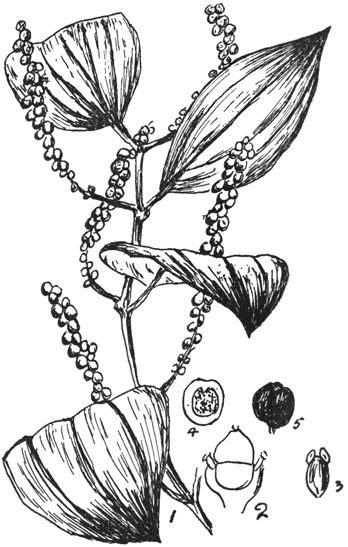
The aromatic fruit or seed of a plant of the genus
Umbellefera. It is referred to in Scripture (Matt.
xxxiii:23). As salt was a symbol of friendship,
“shearers of salt and cummin” meant intimate
friends. The seeds are linear and flat on
one side and convex or striated on the other.
Their odor and properties resemble the caraway, or
anise seeds, and they are often called bastard anise.
They are used in Germany in bread, in Holland they
are frequently put into cheese. Norwegian anchovies
in kegs are frequently flavored with them, and they
are also used in making curry powder, as a carminative
flavoring, and in veterinary medicines, etc.
The caraway plant has a branching stem 2 or 3 ft.
high, with finely divided leaves and dense umbels
of white or pinkish white flowers. The leaves are
frequently used to flavor soup and the roots, which
taper like a parsnip, and when young are boiled and
eaten as a vegetable. The seeds are oblong, pointed at
both ends, thickest in the middle, striated on the
surface and of a crescent shape, they have an aromatic
smell and warm, pungent taste. From the
seeds is obtained a volatile oil called oil of caraway,
of a pale yellow color which turns dark with age;
it is frequently adulterated with oil of cumin. After
the oil has been extracted the seeds are called
“drawn caraways,” and by way of deception are often
mixed with good caraway seeds. They can be told
by their shrunken, dark appearance. The color of the
English caraway seeds is a deep brown, those of
Germany and Holland are larger and of a light blue-brown
color, while those from Russia, Poland and
Bohemia are small, of a blackish brown color, and
mixed with a good deal of dirt. There is a variety
of a light brown color, about twice the size of the
English caraways, imported from Mogador.
Caraway seeds and oil are used medicinally, as a
flavoring by bakers and confectioners, in compounding
various liquors, particularly that known as Kummel,
and in making Scotch cavie, or caraway, comfits;
for this purpose the seeds are coated with sugar
and colored red, pink, blue, yellow, etc.
The word “coriander” is derived from the Greek
word Koriannon, a bed-bug, referring to the disagreeable
smell of the whole plant when fresh, but
the ripe and perfectly dried fruit has an agreeable
smell and a sweetish, aromatic taste. Its an annual
or bi-annual plant, of the genus Umbelliferce, native
of South Europe, with a branching stem 1 or 2 ft.
high. The lower leaves bipennate, the upper ones
being more compounded and divided into very narrow
divisions. The fruit is globose, containing round
slightly ribbed or ridged seeds, about as large as
black pepper, very light, of a yellowish brown or
straw color externally; inside the husk of each seed
are two closely fitting hemispherical mericarps.
The seeds are used in medicine as a carminative.
They cover the taste of senna leaves better than
any other substance; are occasionally mixed with
curry powder; in domestic economy they are used
by confectioners and bakers as flavorings, being
often mixed with bread in the north of Europe. A
cordial is made from them, and they are used for
flavoring spirituous liquors, particularly gin.
Cardamons consist of the seeds of two species of
plants, the Elettaria of Malabar and the Amomon of
China, Guinea and other parts of the East Indies. As
the seeds of the two species differ in some respects
we will describe the Ellettaria kind. The plant, which
grows 5 to 10 ft. high, has a reed-like habit and bear
long, loose racemes of flowers, succeeded by triangular
capsules, of a dirty white color, containing a
number of dark brown, angular seeds about the size
of mustard seeds. The capsules or fruits, which
vary from ½ in. to 2 in. in length, are collected from
wild plants and also from plantations, the latter being
generally laid out in partially cleared forests
in which the wild plants are known to occur. When
about 3 years old the plants begin to bear. The
capsules do not all ripen at the same time, and the
harvest lasts for nearly two months. The capsules
are gathered before they are ripe and then cured in
the sun, after which the stalks and remains of flowers
are carefully removed by means of scissors.
They are then graded into “shorts,” “short-longs,”
and “long-longs,” according to their length; sometimes
they are mixed and classed as lesser or greater
cardamons. Cardamon seeds are exported in the
capsules in order to prevent adulteration. The
seeds have a very delicate aroma and are slightly
pungent. They were well known to the ancients,
and are used at present in medicine, particularly in
veterinary practice, also in flavoring culinary sauces,
soups, curries, cordials, pastry, and for imparting a
factitious strength to vinegar, beer, wines and
spirits, especially gin; their use creates a thirst.
The seeds depend for their quality on a pungent essential
oil, of which they contain about 3 per cent,
called oil of cardamons; they also contain about 10
per cent of a fixed oil. The seeds of the “Amomum”
species of cardamons are bright black in color outside,
white inside and small and angular in shape;
they are slightly aromatic, very hot and pungent.
Cardamons are known as grains of Paradise,
Melegueta pepper, Guinea grains and Guinea pepper.
Poppy seeds are not unlike fine gunpowder in general
appearance, being very small, dark blue—nearly
black in color; they are obtained from the same
plant that yields opium (Papavar somnniferium, or
white poppy.) The seeds are not narcotic, and have
a sweet taste, are oleaginous and nutritious. They
are largely used in some parts of Europe in pastry,
confectionery and as a substitute for almonds. Under
the name of “Maw seeds,” they are sold as food for
birds during moulting season. Poppy seed oil is
sometimes used as an adulterant in olive oil; it is
also used as an illuminant and for painting.
Fennel is a tall, stout, aromatic herb of the parsley
family, with finely dissected leaves, which are
boiled and served with salmon, mackerel, etc., as a
seasoning; the flowers are yellow. A species—F.
dulce—is cultivated in Italy as celery is with us;
and its blanched stems are said to be more tender
and delicate than celery, with a slight flavor of
fennel. The seeds of another species—F. panmorium—grown
in Bengal, have a warmish, very sweet
taste and aromatic smell, and are used in making
betel, in curries, and also used as a carminative.
Fennel seeds resemble aniseeds in appearance and
taste, and are often sold for such; they are a little
longer and of a light brown color. The Indian seeds
are the largest, the Italian and Japanese the smallest.
They are used in confectionery, cookery and are
sometimes chewed by the people of France and Germany.
Fennel water is made from the oil obtained
from the seeds.
And he who battled and subdued
A wreath of fennel wore.—Longfellow.
Aniseed is an annual plant of the order of Umbelliferae
of the parsley family, a native of Egypt,
but also extensively cultivated in Russia, Germany,
Malta and Spain. Aniseed is very similar in appearance
to the poisonous hemlock seed, for which it has
sometimes been mistaken. The seed, which is a little
larger than a pin’s head, is of a greyish-green
color. They have an aromatic smell, and warm,
sweetish taste, and are used in condiments, in cookery
and in the preparation of liquors, also in medicine
as a stimulative stomachic to relieve flatulence,
etc., particularly in infants. The properties of aniseed
are due to a nearly colorless or sometimes blue
volatile oil. Aniseed oil with water and sugar is
much used in Italy as a cooling drink. The leaves of
the plant are sometimes used as a seasoning and for
garnishing.
Star aniseed, or China aniseed, is the fruit of a
small evergreen tree of the order Magnoliacae, somewhat
resembling a laurel. It receives its name from
the star-like form of the fruit or capsule, which consists
of a number (6 to 12) of hard, woody, one-sided
follicies or carpels ending in a point, each containing
a single brown, shiny seed. Star aniseed is held in
high esteem by the Japanese and is planted near their
temples, the seeds being burned as incense in the
temples and over the graves of relatives. The whole
plant is carminative, and is used by the Chinese as
a stomachic and as a spice in their cookery. The
qualities of the seed and oil closely resemble those
of the common aniseed and the oil is exported to
Europe for the same purpose—flavoring liquors.
Consists of the dried stigmas of the autumn or fall
crocus plant (crocus sativus), which should not be
confounded with the spring crocus (crocus vernus),
to which it is nearly allied. The crocus derives its
name from Crogeus—which is from the Greek word
Krokus, yellow—the modern Korghy in Cilicune,
where it was grown in ancient times. The word
“crocodile” is derived from the Greek words Krokos,
yellow, and deilos, fearful, on the ancient supposition
the animal avoided the place where saffron grows
and only sheds real tears when in the vicinity of
a crocus field, hence Fuller says: “The crocodile
tears are never true, save he is forced where saffron
groweth.” The phrase, “crocodile tears,” arose from
the idea that the crocodile pretended to cry over the
victims it had devoured. Saffron was of great importance
ages ago. It is mentioned in the third chapter
of Solomon’s Songs; it was in favor among the
ancient Greeks as a dye, and with both them and the
Romans as a perfume. The streets of Rome were
sprinkled with saffron when Nero made his entry
into that city. In the middle ages it was employed
in cookery and as a drug, and it is on record that
as late as the fifteenth century persons were burned
alive in Muremburg for adulterating saffron. It was
introduced to England in 1339 from Tripoli by a
pilgrim who had a stolen bulb in the hollow of his
staff. Its main use was to color pastry and confectionery,
hence: “I must have saffron to color the
warden pies” (Shakespeare’s Winter’s Tale, act 4,
scene 1). The town of Saffron Waldron in Essex,
derives its name from the fact of its being cultivated
in that neighborhood until 1768. The cultivation of
the crocus for saffron in England has entirely died
out; altho the people of Cornwall at the present day
use more saffron than all the rest of Great Britain.
It is cultivated in China, Cashmere, Persia, Asia
Minor, Egypt, Austria, Hungary, Russia, Italy, France,
but the chief source of supply is Spain.
A saffron field is not in full bearing until the end
of the second year, at the end of the third year it is
exhausted, and it is said that the soil is so poisoned
that it cannot be used for any other crops for several
years. Each acre produces from 600,000 to 700,000
bulbs and each bulb 2 or 3 flowers. About 150,000
flowers are required to produce 2 lbs. of fresh pistils,
which when dried are reduced to one-fifth of that
weight.
The small yield, the labor required, the care in
culture and the difficulty of preserving the product in
a good state renders saffron an expensive article—about
80c an ounce. On the seed-bearer of the flower
there is a thread-like hook or fork, which at its upper
head terminates in three thick, dark, orange-colored
nerves or tissues; to save and collect these tissues
the flowers are gathered in the fall, just as they are
breaking, or a little before; they are plucked early
in the morning, and these little masses are then
pulled out with a considerable portion—about 1¼ in.
of thread-like stem, to which they adhere. They are
then dried over little charcoal fires or in the sun.
It is this dried stigma, the trifid orange-colored tops
of the central organ of the flower, that is the saffron
of commerce. The remainder of the flower is useless.
Saffron as it generaly comes to the trade consists
of a large number of crooked and mixed-up threads,
of an orange-red color; it has a peculiar, sharp, rooty
and pungent smell, and a bitter balsam-like taste;
that of a whitish yellow or blackish color is old and
inferior. The great solubility of saffron prevents its
use as a dye for fabrics, its place being taken by
aniline dyes. Its coloring power is remarkable, a
single grain rubbed to a fine powder with a little
sugar will impart a distinct tint of yellow to 10 gals,
of water; soaked in spirits or warm water it will
yield three-fourths of its weight of a deep orange
yellow coloring matter, which is perfectly wholesome,
and if kept tightly corked will keep for some time.
The chief uses of saffron are for flavoring and coloring
confectionery and culinary articles; it is also
used as a perfume and is given to birds during the
moulting season. Spanish saffron is divided into five
grades, according to the district in which it is cultivated.
It is generally wrapped in tinfoil and then
in white tissue paper and packed in tin boxes or
strong cartons.
On account of its high price saffron is often counterfeited
or adulterated with the petals of safflowers,
African saffron, Meadow or wild saffron, marigold,
arnica, etc. It is also loaded with glycerine, glucose,
dyed vegetable filamenta, honey, sulphate of soda,
barium sulphate, etc., and exhausted saffron is sometimes
re-colored with aniline dye. The stigma of
genuine saffron immediately expands on being moistened
with warm water, and its form is so characteristic
that it cannot be mistaken for the flowerets of
any of its adulterates.
Cake saffron is generally made from the dried flowers
of the safflowers—a thistle-like plant of the aster
family—or the florets of the saffron plants made into
a paste with gum-water; it is used for dying and making
rouge.
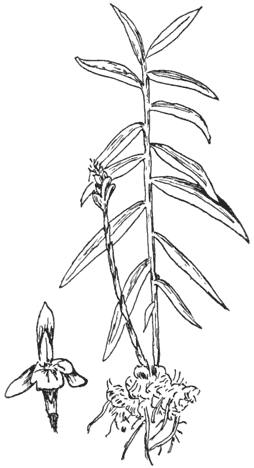
Turmeric is an East Indian plant (curcuma longa)
of the ginger family, with the same properties as
ginger, only not so powerful. It is also grown in
Zanzibar, China and the Malayan archipelago. It
is a stemless plant with dark green leaves varying
from 6 in. to 24 in. long and 3 in. to 6 in. wide,
flowers of a dull yellow color and a tuberous root
varying in thickness from that of a quill to ½ in.
in diameter and often a foot long, with joints or ring-like
swellings at short intervals; of, a yellowish to
orange color outside and sometimes white and sometimes
orange color inside. They are classed as long
or round tubes according to their shape. From the
root is made a kind of arrowroot much relished by
the natives of India to color their faces. In medicine
it is used as a cordial or stomachic; as an anti-scorbutic,
and for stimulating the digestive organs. In a
fresh state it is given to expel intestinal worms and
in diarrhoea. It is used in varnishes and ointments
and as a dye for silks and woolens, but it is now
chiefly employed in making Indian curries or pickles,
mustard, compounds, pudding spices, chow-chow pickles.
A kind growing in Bengal, called “Mango ginger,”
from its resemblance to the mango, is used for
the same purpose as ginger.
Turmeric paper is a bibulous paper, yellow from
saturation with the extract of turmeric, used as a test
for alkalies, by which it is turned brown or red. Turmeric
is also made from the roots of the canna, a
member of the same family of plants cultivated at
Sierra Leone.
Turmeric is adulterated with yellow ocher and carbonate
of soda. Turmeric is insoluble in cold water,
only partly soluble in boiling water, but is quite
soluble in alcohol, forming beautiful yellow crystals.
The flower buds and fruits of the common garden
nasturtium are often used as a spice after being
ground and dried; they are also pickled like capers
and used on fish, meats, etc. The name is derived
from nausa, nose, and tortus, twist, from the effects
of its pungent smell or taste.