It may be thought a strange propensity to grapple with difficulties,
that leads me to select Lepidoptera as a class, by which to exemplify,
in detail, the septenary and circular arrangement. There is no class
so puzzling to systematists, or for which science has done so
little—no class is at present so badly arranged, and in none are
barbarous combinations so much in vogue. Linnæus founded divisions at
the outset, on characters, "loose, vague, and insufficient:"[32] modern
genera have a little improved minor details, and but little, for their
places appear to have been assigned them by lot, and without the
slightest regard to similarity or approach: in a word, the arrangement
of Lepidoptera appears to have been conducted by collectors, who aimed
rather at a pretty picture than a related series; and all our writers
have rushed headlong by the same path, without staying an instant to
consider whether they were right or wrong, like boys playing at
follow-the-leader,[33] each occasionally leaping some wider gap, or
descending some more dangerous precipice than his predecessor, as
though for the very love of frolic and bravado. One, a talented
writer, an assiduous collector, a most accurate observer, hesitated
awhile, it is true, and it was thought he would have broken the line,
but no,—he kept precisely to the track of Linnæus and the rest of
them, through Papilio, Sphinx, Bombyx, Noctua, Geometra, Pyralis,
Tortrix, and Tinea; but, as he stood pledged to traverse no more than
five fields, he hit on the ingenious expedient of asserting roundly,
that the four last named were but one. In fact, the whole of this
immense class presents, at this hour, nothing but a vast chaos, which
seems to await the operation of some predicted spell to call it into
order.
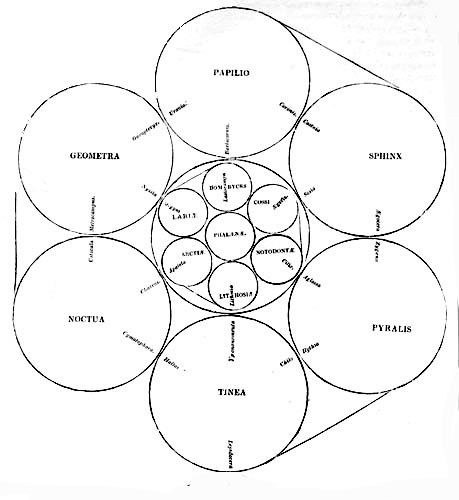
SUB-CLASSES OF LEPIDOPTERA.
These were apparent difficulties only; for, as no system existed to
direct, so none existed to encumber or perplex. Too much is known now
of Linnæan combinations, to assert, that he always thought correctly;
and since his day no one has thought at all. Now, if you cannot obtain
a nicely drawn plan, you prefer having a blank sheet of paper to one
covered all over with scorings and markings, and then you may set to
work and make your plan yourself. So, in natural history, contrariety
of opinion perplexes, while the absence of opinion leaves the
systematist perfectly unbiassed in the formation of his own. Again,
copious and well-named[34] collections of this favourite class are by
no means uncommon;[35] and through, the liberality of my friends, I had
often been permitted to inspect them, and had gained a sufficient
superficial knowledge of their contents, to be enabled, with the
assistance of my own specimens, to cluster them pretty well into seven
great families or sub-classes; and although, as I have noticed,
nothing available existed on the subject of arrangement of
Lepidoptera, either in essay, or treatise, or catalogue, or cabinet,
yet there was to be found, up and down, much valuable matter, in the
shape of what might be termed natural history of Lepidoptera. Finally,
I knew, that could I master this class, I could stand my ground,
because I had previously tried the experiment on the classes
Hymenoptera and Coleoptera, and had found that, at the word seven,
they fell into instant order, as at the touch of a magician's wand;
and, as for the other classes, we are in such innocent and blissful
ignorance of their contents, that were a scheme ever so futile, a
century at least must elapse before its futility could be proved by
Orthoptera, Hemiptera, or Diptera.
Whoever will give himself the trouble to examine thoroughly a
collection of British Lepidoptera, will find a very great majority of
them evincing very evident symptoms of relation to one or other of the
following species:—Papilio Machaon, Sphinx Ligustri, Pyralis
verticalis, Tinea pellionella, Noctua pronuba, and Geometra roboraria;
and should any form widely different from either of these occur, it
may, if the larva be known, be placed in the centre of a ring formed
by the groups, which we will suppose surrounding their six respective
types; or, if its larva be unknown, it must await the discovery of
that most unerring stage of its existence. I am persuaded, did
entomologists know how much depends on the form, habit, food, and
clothing of larvæ, they would not be so neglected as they are at
present. I have much to regret my own remissness in this respect, for
it has seldom happened that I have found the larva of any insect which
had not been previously well known, but it has tended to point out
some approaches that had never before been thought of,—approaches,
even when thus pointed out, totally irreconcilable with existing ideas
of arrangement and combination of groups, but which now open to my
view the most beautiful chains of affinities; and wonderfully but
indubitably prove, that a single individual may be related to three,
four, or even more apparently disconnected groups.
Perhaps no better genus was ever formed than Papilio of Linnæus; its
diurnal flight, its erect wings, and its clavated antennæ, at first
bid defiance to the systematist who attempts to bring any other group
into contact with it; indeed, in Britain we have nothing at all that
will avail us in this respect, which compels me to have recourse to
exotics, an assistance which I shall only avail myself of when I find
it quite impracticable to furnish the approaches from indigenous
species, the reference to which is attainable by every entomologist.
Among foreign Papiliones, especially among those groups which approach
our genera, Hesperia, Lycæna, Polyommatus, and Thecla, there appears
to be an almost infinite variety of form. Now it is but reasonable to
seize on any variations observable in genera or species from the
prominent or typical genus or order from which they may be supposed to
derive their more conspicuous character, and to employ such variations
in arrangement as connecting links between the group to which they
more decidedly belong, and the group to which, by such variation, they
evince an approach: a precisely intermediate species or genus between
two classes or sub-classes, or even orders, I have never met with,
notwithstanding the renowned Linnæan maxim, that Natura
saltus non facit; for did nature make no leaps, surely the
question were immediately at rest as to the existence of any other
division than species among created beings, a conclusion which even
the most strenuous supporters of the Linnæan dogma decidedly resist.
Among the Papiliones, this departure from the type may be looked for
either in the form of the antennæ, the position of the wings, or the
time of flight. The first is obviously the most tangible should it
occur, and it does occur. In Urania, the antennæ have become
setaceous; the club has entirely disappeared, yet the other
peculiarities remain much as in Papilio. This single deviation may be
assumed as pointing out a relation to Geometra, which the reader will
perceive is supposed to meet the sub-class Papilio at this point. A
second peculiarity is to be found in an insect figured by Godart, a
Polyommatus in shape, but with pertinated antennæ;[36] the genus he
has very suitably named Barbicornis. This deviation, it must be
observed, is in favour of the Bombyces, which we therefore suppose
touching the sub-class at this point. A third deviation, of a very
different kind, is observable in an insect which Latreille has figured
in the Règne Animal, and placed among the Sphinges: he calls it
Coronis D'Urvillii. The antennæ in this genus, as in Castnia, are
gradually incrassated, and they may probably be eventually both
considered as Papiliones: of Coronis D'Urvillii, I cannot entertain a
doubt, as the wings are too expansive, the antennæ too long, the
abdomen too short for it ever to retain its station among the
Sphinges; the inferior wings are also very decidedly caudate, a common
formation among Papiliones, but unknown among Sphinges; but, let this
question be eventually decided pro or con, the approach
between Hesperiæ and Sphinges is not likely to be disputed, nor the
fact that it takes place somewhere in the neighbourhood of the genus
Castnia.
The next type is Sphinx Ligustri; and here again our British
collections are obliged to plead poverty; few, however, as they are at
present, I am compelled, if I purpose consulting nature, to reduce
them about half: the Ægeriæ and Zygænæ must be moved elsewhere; they
look like Sphinges, but are none. I will begin then with Castnia, of
which no more need be said. The next striking departure from the type
occurs in having the abdomen furnished with tufts or brushes, which
the insect spreads as it hovers over flowers, somewhat in the manner
of a bird's tail. The long porrected antlia also has a resemblance,
perhaps rather fancied than real, to the slender bill of a
humming-bird, whence the tribe has received with us the name of
English humming-birds. The genus Sesia I will place on the
circumference of the circle, not doubting but nearer approaches to the
Cossi may be discovered, or are even now known, but no better exists
among our own Sphinges. The next point of contact will be with
Pyralis; and here the genus Œgocera, figured in the Règne Animal,
seems to claim its station: it is a decided Sphinx, with the palpi of
Hypena proboscidalis, and Latreille has placed it between Sesia and
Zygæna, from which it will be seen that I differ only in making Zygæna
pass over the boundary line and into the next section.
We enter the third sub-class then at Pyralis, and find ourselves among
some of the most beautiful little creatures in existence—sylph-like
beings, which spend their lives in the brightest sunshine and among
the sweetest flowers. Linnæus considered them Sphinges, from what
character is not very apparent: the sub-character, applicable only to
this section, is certainly correct; they are truly "larva
diversæ." As for the antennæ being "medio crassiores," it
is not the case, unless the increase and decrease of pectination can
be considered as making them so. Of this particular tribe Latreille
observes, "Les autres lepidoptères de cette division ont
dans les deux sexes, des antennes garnies d'un double rang de dents
alongées ou bipectinées. Ceux qui out une trompe distincte forment le
genre Glaucopis; ceux où cette organe manque ou n'est pas distinct
celui d'Aglaope—ces crepusculaires semblent se lier avec les
Callimorphes." The approach of the genus Aglaope to Aglossa,
rather than to Callimorpha, seems to be presumable from the
circumstance of its not possessing a tongue, the genus Glaucopis
having more similarity to our genus Pyrausta, while some of its
species, which appear to call for further generic division of the
order, are closely allied to our Botys literalis, &c. The only British
genera of this order are Zygæna and Ino; the latter, however, appears
to be merely a species of some extra-European genus, as I have
remarked several exotics of precisely similar form. The insects of
this order have a stout and rather hairy larva, much like those of the
generality of the sub-class, and in no respect allied to that of the
Sphinges. Early in the summer they spin a glossy silken cocoon,
generally attached to blades of grass, and remain but a few days in
the pupa state. A great proportion of the perfect insects have hyaline
spots and patches in their wings, and nearly all of them are
brilliantly coloured. It is known that Linnæus occasionally, as in
Tenebrio and the present instance, made his genera recipients of
species, which he found a difficulty in locating properly; but it is
really astonishing to find a naturalist like Latreille abiding by so
absurd a combination as the contents of the Linnæan genus Sphinx, and,
in servile imitation, calling creatures which nothing but an unclouded
sun ever tempts abroad—Crepuscularia.[37] It is no part of my present
plan to assign names to orders, or to describe their contents, except
in those particular instances in which the more immediate object of
this Essay may render it imperative. I will, however, just observe,
that I by no means consider Zygæna the type of the order, but merely
the nearest point of contact with Sphinx, and an evident departure
from its true type, which perhaps may be found in that ill-divided
genus Glaucopis, the form and appearance of which is altogether more
Pyralis-like than Zygæna. I am well aware that Œgocera and Zygæna
do not harmonize so beautifully as many other approaches, and fully
expect to see the connexion between these sub-classes much improved;
but I have seized on these genera as demonstrating a tendency in each
individual towards the sub-class to which it does not belong. The
circumstance of Zygæna having been so long considered a Sphinx will
warrant its situation on the very circumference of the circle which
contains its order, until a more appropriate occupant of that
situation can be found. At the central point of contact, the genus
Aglossa presents a very Bombyx-like appearance; its shape, its want of
the antlia, &c. indicate approach; and from the sub-class Tinea, the
division of Pyralis is at present an imaginary one: at this point,
after making what little comparison I am able, I am induced to place
Galleria, Melia, and Ilithya, in Pyralis; and Chilo, and Crambus in
Tinea.
The fourth sub-class, Tinea, far exceeds in numbers either of the
others, and probably all of them together; and where such a multitude
of species exists, great diversity in form and habit may be expected:
the Pterophori are a most singular tribe, and greatly resemble the
Tipulæ in many respects. I feel by no means certain that their
situation would not be better between the lepidopterous sub-class,
Tinea, and the dipterous sub-class, Tipulæ, thus throwing them
completely out of the lepidopterous circle; but this I leave. I am now
only sketching a rough and hasty outline from nature. If I attempt to
finish my drawing as I proceed, I shall find occupation sufficient for
a lifetime. I have observed that I considered the chain of relation
entering from the last sub-class at Chilo, or about that genus; the
same order must of course include Crambus, and its congeners; the next
order will contain Yponomeuta, which I will place at the point of
contact; and the next point being among the true Tortrices will drive
Halias fagana as a decided departure from their typical form to the
very circumference of the circle where it touches Noctua.
The fifth sub-class, Noctua, seems to be but one mighty genus: we will
enter it from Halias fagana, an insect so nearly allied to Noctua in
its larva, its pupa, and its imago, that for a long time I hesitated
to which sub-class it belonged; again, in Cymatophora,[38] subtusa and
retusa, I was fearful that by considering them Noctuæ, I might deprive
the order Tortrices of a genus on which perhaps many curious
combinations might depend, and I now only place them in Noctuæ until I
may have an opportunity of examining their larvæ, which I have not yet
been fortunate enough to meet with. Towards the central sub-class
there appear to be many genera which approach the line of contact;
Agrotis and Chareas for instance:[39] I prefer taking the latter, and
must mention the species Graminis, as I am fearful of encumbering my
system with species to which I not only never intended to refer, but
should probably place in some distant order, or perhaps sub-class. At
the approach to Geometra, the genus Catocala, from its looping larva,
seems to have a right to be placed: this I, however, look on with
suspicion, as the larva appears to me any thing but a guide in the
connexion of sub-classes; but I here succumb to customary usage in
making this genus the approach to the real loopers, objecting,
however, to the intervention of Phytometra, Euclidia, and Brepha.
The sixth and last of the exterior sub-classes is Geometra, and we
shall find one insect which is completely a Geometra, and yet in the
larva has two additional feet, and the abdominal fringe of Catocala:
this is Metrocampus margaritaria,[40] an insect, without which the
connexion of these sub-classes would have been difficult to establish.
The next species I am acquainted with seems to be Rumia cratægaria,
and after it the Thorn moths, as they are termed (Crocallis?): these
lead to Geometra[41] in the centre, which may be considered the
farthest removed from any of the surrounding sub-classes; from the
genus Geometra a line may be drawn through Biston, Nyssia, and
Hybernia, to the point of contact with Phalæna in the centre, and
another through Boarmia, Abraxas, and Ourapteryx to Urania, from which
genus of Papiliones perhaps the reader will recollect we set out.
The seventh and central sub-class, Phalæna, now claims our attention.
The mere circumstance of having taken a little tour round it gives but
a very poor idea of its contents, and although my reader may assure me
he knows them sufficiently well already, that assurance will by no
means satisfy me that he and I are at all agreed either as to what
those contents may be, or as to their relative situations. Before,
however, I again set in earnest to the task of pointing out relations
and approaches, I feel that some apology is due for attempting the
restoration of a beautiful and euphonious name to that grand group of
Lepidoptera, to which it was originally assigned by the eminent
naturalist who was the first to define and name such groups.[42] I am
fully aware this is an attempt at innovation for which I can never be
forgiven by the scientific; for the merit of the present day seems to
consist in the total neglect of grouping and classifying, and in
making a host of imaginary genera and species, for the mere pleasure
of overwhelming us with a "farrago" of barbarous and unutterable
names,—a practice which my unsophisticated and old-fashioned notions
will never dwell on with that deferential awe which such profound
science has an undoubted right to expect.
Again, on the subjects of orders, a term I have already been
induced to use now and then, I am quite aware that I here am guilty of
another misdemeanour, and more especially as I call them natural
orders, meaning thereby orders among the contents of which nature has
established the similarity; and to the formation of which "the
cunningly devised fables" of man have contributed but very little; and
meaning also that nature has implanted in us all, more or less, the
power of distinguishing such orders by a mere glance, and without any
reference to our books.
Furthermore, the naming of orders which I have been obliged to mention
by name, in the unscientific way which I have adopted, merely making
them plurals of established names, of large and overgrown genera, I
acknowledge to be a confession of ignorance not usual in this our day,
especially as these old genera have almost in every instance the
disadvantage of being euphonious, easily pronounced, expressive, and
universally understood; and an opportunity once missed of coining
names for three hundred new orders, (and each might have been a
combination of consonants which no one could spell, or speak, or read,
or understand,) alas! alas! may never occur again.
To return; I suppose the sub-class Phalæna to contain seven natural
orders, a number precisely similar to that discovered from
observations made on the larva by that most accurate and indefatigable
naturalist, Dr. Horsfield;[43] and I may add, my own divisions are
derived from the same source, together with the pupa and whole habit:
the perfect insect has no characters, hitherto discovered, by which we
can ascertain either sub-class or order, and from this circumstance I
am compelled to omit those genera of whose larvæ I am ignorant,[44] and
even to leave those as doubtful, of which I possess but a partial
knowledge of that state.
Natural Order—Bombyces. Has an elongate cylindrical downy
larva, which rolls itself into a ring when touched; the pupa changes
in a close gummy oval cocoon, remarkably small for the size of the
imago. Among the exotic species of Lasciocampa, we find in the males
particularly slender bodies, expansive wings, the inferior grooved to
receive the abdomen, and diurnal flight, all of them characters so
indicative of an approach to Papilio, that we scarcely hesitate a
moment in assigning it the approaching station, not but I expect fully
that time will eventually furnish us with a connexion on each side yet
more conclusive.[45] The second genus of Bombyces is probably
Odenestis, and the third Gastropacha, whose prominent and elongated
palpi appear to point out an approach toward a tribe of insects with
the same peculiarity, of which there are several to be found in the
following order:
Natural Order—Cossi. The larva is depressed; naked, except a
very few scattered hairs; has sixteen feet; lives through one or more
winters; never rolls itself in a ring when touched; feeds on the solid
interior woody parts of vegetables. The pupa generally changes in a
tough oval cocoon, interwoven with particles of its food. It has a
double ring of raised denticulations of each segment of the abdomen,
by means of which it is endowed with a considerable power of
locomotion. The genus Zeuzera is very near the point of contact with
the Bombyces. In Zeuzera there is much resemblance to the antennæ of
Gastropacha. One genus, or group of genera, I expect will prove to be
Stygia, a native of New-Holland. A second, at the point of contact
with Sesia in Sphinx, must be Ægeria; thus retaining its place among
British insects, immediately between Sesia and Cossus.[46] This is the
first of a series of the most beautiful instances of approach, or
rather, of what ought to be termed relations of analogy, that
any system has ever previously disclosed. As a few words will again be
necessary on this subject, I refrain from any further observation
here, than merely requesting the reader to examine how minutely the
Sphinx characters are appropriated by a true lignivorous Phalæna,
which cannot be said, in any of its prior and principal states, to
have the most distant approach to Sphinx. A third genus is, probably,
the strange and paradoxical exotic Oiketicos, which has been minutely
described in the Linnæan Transactions; and a fourth is
Hepialus.[47] This genus has some slight points in which it differs
from the others of the order already known, the larva being
radicivorous only, seldom or never ascending internally the stems of
plants: it changes in the earth.
Natural Order—Notodontæ. The larva is naked, has sixteen feet,
and is, in different genera, furnished with excrescences, and apparent
distortions in various parts of the body. The eighth or last pair of
feet, and three last segments of the abdomen, are elevated; when the
insect is at rest, the head and first segment are raised in a similar
manner. In one genus (containing Camelina) the head and extremity of
the abdomen nearly meet over the back, when raised in this singular
manner. The posterior feet are frequently useless in walking; in some
genera, entirely obsolete. The pupa is smooth, in a cocoon, mostly
among dead leaves on the surface of the ground: sometimes it is
glutinous, and interspersed with fragments of wood, like the last. I
confess I am exceedingly puzzled both with the contents and extent of
this order; but this arises from my having seen so few of the species
in the larva state. Ptilophora plumigera, figured by Mr. Curtis,[48] I
had always considered a Notodonta; but the larva evidently excludes it
from the order, and, I should imagine, places it among the Noctuæ;
where among them I know not, for I have not the slightest idea of any
congeners, either of the larva or imago. The larva from which a
collector of Lepidoptera could expect to obtain such an imago would be
unicolourous, stouter in the middle, elevated in the penultimate
segment, and more attenuated towards the head.[49] Pygæra appears
doubtful at first, but when observed quite at rest, and in a perfectly
natural position, elevates the head and tail, though in a much less
degree than the typical genus. Mr. Curtis's genus Notodonta contains
several good species, which may be considered as typing the order, as
Ziczac, Tremula, and Dictæoides. The first species, Trepida (the
Peridea serrata of Mr. Stephens,) seems more nearly related to
Endromis. Both these may, however, probably belong to the order
Notodontæ, and be situate near the approach to the central order
Phalænæ. Petasia cassinea and Episema cærleocephala appear to be
genuine Noctuæ, and very near Chareas graminis, and Rusina ferruginea,
as far as my very imperfect knowledge of these four species will allow
me to judge. Clostera is another departure from the type; but this may
be accounted for, in some degree, by its close proximity to Hepialus,
from which genus it borrows its remarkably short antennæ, and other
peculiarities. It seems a strange perversion of judgment to place
Platypteryx at the end of or among the Geometræ; but Linnæus did so,
and that is enough. Hubner, Haworth, and a few others, positively
ventured, in this glaring instance, to refer this genus to the
Bombyces; but their ideas were thought to be wrong, and their judgment
was, nem. con. reversed. I have elsewhere expressed a wish that
my readers should convince themselves, and the frequent occurrence of
the larvæ of Platypteryx and Cerura would afford any naturalist
abundant opportunity of ascertaining, that they can be referred to but
one order. The approach of Platypteryx and Cilix to the Pyralides, in
assuming so much of their characters, is very interesting, and is a
most striking departure from the typical form. These genera also
approach the Lithosiæ, but not so nearly as some exotics.
Natural Order—Lithosiæ. The difference between Lithosiæ and
Arctiæ is rather difficult to point out; yet a difference exists,
which it is perfectly impossible not to detect. The larva of Lithosiæ
has sixteen feet, is very active, is moderately hairy, does not
readily roll itself in ring, but occasionally assumes that attitude.
The pupa is smooth, changes in a slight web, in which the hairs are
intermixed. The approach of Lithosia[50] to the genus Yponomeuta, in
Tinea, scarcely need be pointed out. It will be observed, that Mr.
Samouelle[51] was aware of this approach, and placed the genera
Lithosia and Yponomeuta following each other. The splendid Callimorpha
dominula, although, to all appearance, a real Arctia, must be included
in this order, and placed in contact with the following one.
Natural Order—Arctiæ. Larva, with sixteen feet, generally very
hairy, bear-like; rolls itself in a ring when touched; pupa smooth, in
a slight web. Whether the whole of Mr. Curtis's genus Acronycta must
be included in this order, I am not able positively to say: the genus
Apatela of Mr. Stephens certainly must, and until I have obtained
sufficient information to decide on Acronycta, we must bring Mr.
Stephens's genus only into the order, leaving the remainder of the
species undisposed of. The development of the antlia in Acronycta
discovers as near an approach to Noctua, as Lithosia does to Tinea;
but the bear-like, cocoon-spinning larva place these insects in close
alliance with the true Arctiæ.
Natural Order—Lariæ. Larva, with sixteen feet, and furnished
with various brushes, or fascicles of hair, on different parts of the
body, but mostly on the anterior dorsal segments; it rolls itself in a
ring when touched. The genus Porthesia of Mr. Stephens may be
considered a near approach to Eriogaster, in the following order,
Bombyces, in many of its peculiarities, as the abdominal hair with
which it covers its eggs, in its antennæ, &c. Orgyia antiqua, on the
other hand, is in habit, expansion of wing, slender body, and apterous
female, a close approach to the Geometræ, near the genera Hybernia and
Nyssia; in fact, were it not for the larva, that is, were the larva
unknown, we should have no hesitation about placing this insect with
the Geometræ.
Natural Order—Phalænæ. Larva, with sixteen feet; it has a
circle of wart-like protuberances on each segment, from each of which
spring a few strong bristles; pupa, smooth, with a few bristles at the
tail; changes in a cocoon, which is singularly left partly open at one
end. We have but one species of this order in Britain, Saturnia
carpini;[52] but among exotics there is a great variety, some
remarkable for the immense expanse of their wings.[53] Probably Phalæna
Atlas of Linnæus is the centre of the group, and, if so, the centre
and type of the class Lepidoptera.
I have previously given, in a note, a list of the genera which are
usually considered as Bombyces, and ought, therefore, if properly
placed, to be included in the sub-class Phalæna; five of those genera
yet remain, and at present must be excluded from the sub-class:
Penthophera, Heterogena, and Limacodes, because I know nothing of
their history; Nudaria and Psyche, because, in the larva, pupa, and
imago states, they have the habit and appearance of another class
(Neuroptera). The time of their dwelling with Lepidoptera is over and
gone; they have already occupied too long a position to which they
were not entitled. The difficulty of assigning a situation to
Limacodes I hope to see removed, as the larva is occasionally to be
met with. I must also remark, that although I have proposed a
situation for Endromis, I feel very doubtful as to its being the
correct one. These doubts and difficulties will probably gain me much
censure; but I must endeavour to shelter myself in some degree, by
observing, that I am the first who has ever deviated from the original
Linnæan arrangement of Lepidoptera, the first who has ever thought of
appealing to nature in support of theory, or rather has waited for
nature to supply him with theory; and surely some allowance is to be
made for a first attempt of any kind. I would also plead the poverty
of our British Fauna in the sub-class, and my almost entire ignorance
of exotic Phalænæ. Even supposing myself acquainted with all our
indigenous species, they will barely furnish a systematist with a clew
to the truth: you may pick up a single link of a chain, yet fail to
discover the length of that chain, or the situation in that chain
which the link originally possessed.
Having, then, pointed out, as clearly as my limited knowledge of the
subject will permit, not only the principal contents of the class
Lepidoptera, but endeavoured to establish them in appointed and fixed
stations, and to show their mutual approaches, at least those of the
most striking kind and essential to my purpose, I must now proceed to
make a few remarks on the nature of these approaches. It will be
observed, that they are, almost without an exception, what Mr. MacLeay
considers relations of affinity, that is, the relation is between
species which, in their imago state, have a real and positive
similarity to each other; so much so, that entomologists, unacquainted
with the prior states, and frequently even in direct defiance of their
own knowledge of those states, place them in orders, and even
sub-classes to which they do not belong; to which fact all our systems
and catalogues bear most ample testimony. This similarity is by no
means confined to a cursory glance at the insects, but bears the test
of a minute anatomical investigation, the antlia, palpi and antennæ
demonstrating the approach quite as forcibly as the form and
appearance of the whole insect. Where a tribe has short biarticulate
palpi, a genus departing from the type will assume elongated and
triarticulate palpi, should another tribe with those characters
approach it: again, should a tribe with long antlia approach a tribe
whose character it is to have none, we shall be sure to find a genus
without antlia at the point of approach. On the other hand, the very
egg, the larva, the pupa, the mode of feeding and description of food,
the mode of metamorphosis, and, in fact, every prior quality, or
state, from which distinctions could be obtained, differ so decidedly,
that the characters of these often bear as near an approach to those
of Hymenoptera, Neuroptera, and even Coleoptera, as to those of their
own kindred, into immediate contact with which these approaches will
be found inevitably to bring them. What term can then be applied to
designate the real value of this species of approach? Supposing the
terms analogy and affinity to have had good, sound, and distinct
meanings, as originally employed and explained by great naturalists,
they have now been so confused, confounded, and utterly misunderstood
by ignorant persons, that either of these terms is entirely out of the
question:[54] in fact, a suitable term by which to designate this
peculiar species of relation or approach, I neither know where to
find, or how to invent; and, therefore, I shall purpose simply to call
it relation of larva, relation of pupa, or relation of imago, as the
case may be.
In one instance, the relation of imago is, from several combining
causes, which it will be unavailing to recapitulate, uncertain
enough—that of Barbicornis and Lasiocampa; but I would ask the
impartial reader, is it half so far-fetched and untenable as those in
common use? Can human sagacity, in sheer wantonness, invent
combinations more unnatural than ——, twenty or thirty of which we
could all point to in our own cabinets? For the value of the other
relations (eleven others) I appeal to the judgment of the assiduous
collector, the experienced observer, the real nature-loving
naturalist,—to him who has spent days in the woods, and not only
captured but observed these delightful beings,—to him who never
invented or supported a theory,—to him who is pledged to no system,
to no party,—I ask him, nothing doubting of his concurrence, whether
these relations do not too plainly bear the impression of nature's
seal, to allow him to doubt one instant of their reality.
In the next place a question occurs, how is the relative position of
the sub-classes proved to be correct, seeing it is so totally at
variance with what we have from our childhood been perfectly satisfied
with?[55] It is proved correct, simply and solely by the harmony with
which each flows into each,—with which neighbour meets
neighbour,—comparable somewhat to that exquisite feeling which
induces a man to bend to the peculiarities, and perhaps even little
failings of a friend, until he makes them almost his own. It can
hardly be supposed that the sub-classes naturally fell into the
positions which I have assigned to them, without some little
endeavour, on my part, to produce this harmony. This was far from the
case. The discovery, if it be one, was the result of serious and
deliberate study. Even after arriving at their present state, I have
twice endeavoured to alter these positions, once in hopes of making
some of the Tortrices meet the Papilionidæ, as I had an idea that that
very assiduous and ingenious naturalist, Dr. Horsfield, had mentioned
the discovery of such an approach.[56] In vain, however, did I
strive to discover such an approach, in either larva, pupa, or imago,
while these points of resemblance were most abundant between the
Geometræ and Papiliones; the pupa, as though in sport, being now
suspended by the tail, now girted round the waist, now enveloped in a
silken web; sometimes round-headed, sometimes pointed, sometimes
eared; now smooth, anon angulated, black, brown, yellow, pure green,
clouded, or spotted: of these, and a thousand other peculiarities,
which tended to corroborate my ideas of arrangement, I refused
invariably to avail myself, trusting to one guide only, which seems as
steadfast as a rock: that relation of imago constitutes approach of
divisions; relation of larva is the tie which holds divisions
together. The second alteration I endeavoured to make, was to
place the Papiliones in the centre, a situation to which their
splendour and magnitude would really appear to give them a title. This
idea seems every way so plausible, and so likely to be proposed by
entomologists, should any such see merit enough in this system to give
their attention to its minutiæ, that I am compelled to consider it
more at large.
To a sub-class selected for a centre, two qualities are indispensably
requisite. They have been previously given from Mr. MacLeay, who, it
will be remembered, discovered that one of each of his five groups
contained types of the other four, besides a type peculiar to itself.
This quality must hold good in any group thus selected for a centre;
it must contain types of the six surrounding groups in the first
place. Now, is this applicable to Papilio? Have we not already
experienced the greatest difficulty in finding three good approaches,
the smallest number which a sub-class can possess? How then can we
hope, by any good fortune in discovery, to make ourselves masters of
three other entirely new ones, and these to sub-classes to which it is
confessedly the most unlike? Phalæna, on the contrary, presents us
with Lasiocampa, Ægeria, Cilix, Lithosia, Apatela and Orgyia, five of
which genera beautifully typify the approximating sub-classes. The
preference on this score then is decidedly with Phalæna.
The second position, that it should contain a type peculiar to itself,
is almost a matter of course; but my own idea is, that the very centre
should not only be a type of the genus, or order, or sub-class, but of
the class itself of which it is the centre. From this position, then,
a further and still more important question arises,—What is the type
of Lepidoptera? The parts which afford the generic characters of
Lepidoptera, and, I believe, generic characters in the perfect state
are the only ones of any value, are these—the mouth, palpi, antennæ
and wings; and, as no medium can constitute a type, the excess of
these characters, whether superlatively or diminutively considered,
must be resorted to as the most probable means we possess of
discovering what this type may really be. First, then, the mouth. In
Lepidoptera, we find two distinct characters in this;—first, its
entire absence; secondly, its being furnished with prodigiously long
antlia. The first character is that of Phalæna, the second that of
Sphinx. Next, the palpi are either entirely obsolete or exceedingly
prominent, the first in Phalæna, the second in Pyralis. Thirdly, the
antennæ are remarkably pectinated, or clavated, or setaceous: the
first character is that of Phalæna, the second that of Papilio, the
third that of Noctua. Fourthly, the wings are enormously expansive in
proportion to the body, or remarkably small,—the first is the
character of Phalæna, the second that of Sphinx. It need scarcely be
added, that all these characters are to be met with in every
intermediate degree of intensity. Now, it appears, that Phalæna
possesses an extreme of each of the four principal characters, Sphinx
of two, Noctua of one, and Papilio of one; therefore Phalæna is the
typical genus, Phalænæ the typical order, and Phalæna the typical
sub-class of Lepidoptera: and a necessary conclusion from this fact
is, the type of Lepidoptera is an insect without antlia or palpi, with
very pectinated antennæ and enormously expansive wings, and we may add
nocturnal flight: so that such peculiar characters as the thick full
body and prodigiously long antlia of Sphinx, the clavate antennæ,
erect wings, and diurnal flight of Papilio, argue a departure from,
and not an approach to, the type.
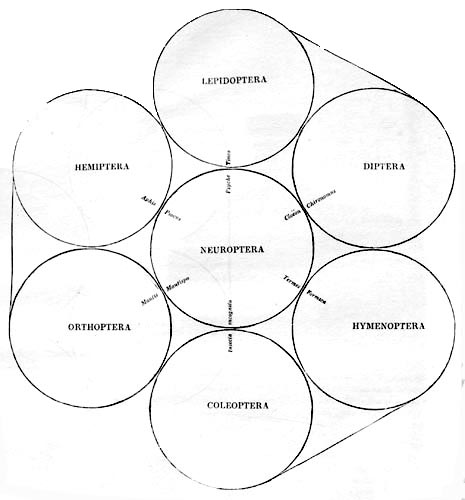
By a reference to the Diagrams exhibiting the classes of Insecta, and
the sub-classes of Lepidoptera, it will at once be observed, that the
central group in each case contains types of the surrounding groups.
Now after a central group has thrown off a set of six forms, each
representing, in general appearance, some group equally extensive with
such central group, the faculty or power of throwing off such forms
becomes, in a good degree, extinct, or, at any rate, very much
debilitated. This can be no unforeseen, but a perfectly natural, and
absolutely necessary consequence; for taking either of the two classes
which are at present sought after, Lepidoptera and Coleoptera, we must
observe, that did either of them possess as varied forms and
characters as are to be found in Neuroptera, the essential and
distinguishing character of that class, viz. variety, and the
harmonious arrangement of the whole sub-kingdom, would both be
entirely lost; and it would remain for human ingenuity to locate
either of the classes centrally or externally, as caprice, or the love
of differing from others, might dictate. I wish it to be observed,
that Neuroptera, in the genera Psyche, Cloëon, Termes, Psocus and
Mantispa, does not merely assume the form of the genera, Tinea,
Chironomus, Formica, Aphis and Mantis, but actually possesses the
characters and appearance of the classes Lepidoptera, Diptera,
Hymenoptera, Hemiptera and Orthoptera. The obviously homogeneous
character of Lepidoptera and Coleoptera, although, probably,
containing in every sub-class more species than the whole of
Neuroptera, clearly disproves the existence of variety amongst their
contents, equal to that amongst the contents of Neuroptera. Yet the
power, although weakened, is by no means extinct; for, amongst the
central group, Phalæna, we find the sub-classes, Papilio, Sphinx,
Pyralis, Tinea, Noctua and Geometra, most faithfully pourtrayed in
Lasiocampa, Ægeria, Cilix, Lithosia, Apatela and Orgyia, and not
merely the individual genera which may happen to approach. As far as I
can discover, after this second series of types the faculty becomes
much weaker, and, after a third, ceases entirely. A decided difference
existing between the first and second series of types, must on no
account be lost sight of, because it so decidedly proclaims the
superiority of the first: in the first instance, the whole character
of the central type, Libellula, is completely lost in each of the
varying types; whereas, in the second instance, the characters of
Phalæna are preserved most decidedly to the remotest ramifications of
the class, subject, however, to the variations already pointed out.
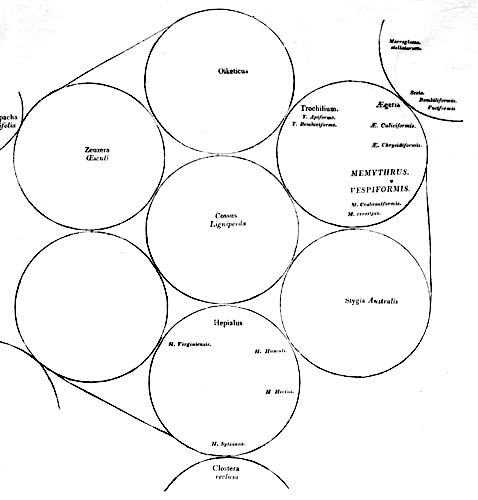
The natural order, Cossi, of which the larva and pupa have been
already described, contains but ten genera, even including those whose
claim to a place in the order is somewhat doubtful; and these ten are
readily referable to six families. The genus, Stygia, of New Holland,
seems from Latreille's description, decidedly to belong to this order.
Speaking of Stygia Australis, he says, "M. Villiers la
considère comme intermediare entre les Sesies et les Zygènes; mais
elle n'a point de trompe; ses palpes sont ceux de Cossus; ses antennes
sont courtes, et nullement en fuse, et plus analogues a celles de
certains Bombyx qu'a celles des Sesies et des Zygènes."[57] Now the
fact, as M. Latreille supposes, of having no antlia, argues most
forcibly the impossibility of uniting this genus either with Sphinx or
Zygæna; for the sub-class Sphinx not only possesses the most elongate
and conspicuous antlia of any sub-class, but retains this character to
its very circumference, and imparts it to approaching groups, whose
types will be found entirely aglossate: its similarity therefore in
shape to the Sesiæ, which tribe is generally understood to include the
Ægeriæ, is merely that relation of imago which I have before so
repeatedly pointed out. The situation, which without this genus must
have been vacant, thus filled, gives us a most perfect chain of
families throughout the order, except at the point of connexion with
Phalæna, a point of no consequence, because it too much favours old
theories to be contested.
It is rather remarkable, that in this order no instance should occur
of more than three genera belonging to any one family, a number which
I should hardly suppose complete, because a difficulty must always
occur in placing, as in discovering the typical genus or species,
where the number is confined to three.
The introduction of a new generic name, after what has been said on
that subject, may appear rather an inconsistency, but I found it
indispensable, as the species in question would not bend to either of
the established genera, Trochilium or Ægeria; it will, moreover,
afford those whose labours in this way I have somewhat deprecated, a
fair opportunity for retaliation. The families and their relative
situations, as far as my immature and hastily-formed judgment will
allow me to decide, I have shown in the annexed diagram: but it is now
time for me to describe the species whose situation I am endeavouring
to point out.
Sub-kingdom, Insecta.
Characters from the imago.
The body is divided into three parts, head, thorax, and abdomen; the
head has two fixed compound eyes, and two moveable antennæ. Insects
have six jointed legs in pairs; they breathe by lateral spiracles.
Class, Lepidoptera.
Characters from larva, pupa, and imago.
Larva polypod, bears no resemblance to the imago; pupa quiescent,
bears no resemblance to the imago. Imago has four scaly wings, and the
mouth aglossate or antliate.
Sub-class, Phalænæ (central).
Characters from larva, pupa, and imago.
All varying (the universal character of such central groups).
GENERA OF THE NATURAL ORDER COSSI.
Natural order, Cossi.
Characters from the larva and pupa.
Larva depressed, kaned; has sixteen feet, lives through one or more
winters, never rolls itself in a ring when touched, feeds on the solid
interior woody parts of vegetables; pupa changes in a tough cocoon, in
which are interwoven particles of the larva's food; it has a double
row of small raised denticulations on each segment of the abdomen,
which give it partially the power of locomotion.
Family Ægeriidæ, Stephens.
Characters from the Imago.
Palpi triarticulate, incrassated at the base, acuminate at the apex,
prominent, enclosing the antlia; antennæ, sub-cylindric, gradually
incrassated from the base nearly to the apex, the apex itself
acuminate and terminated with a fascicle of hairs; ocelli, two. Flight
diurnal in the hottest sunshine.
Genus Memythrus.—Sphinx, Linn.; Sesia,
Laspeyres; Ægeria, Fab.
Characters from the imago.
Palpi very prominent, and densely clothed with scales at the base, in
appearance angulated; antlia fine, not so long as the antennæ; antennæ
the length of the thorax, in the male much pectinated, in the female
simple; superior wings clothed with scales, inferior hyaline.
Sp. 1. Memythrus Vespiformis.—Sphinx Vespiformis,
Linn. Syst. Nat. II. p. 804, n. 31. Ægeria Asiliformis of
Fabricius, and other authors.
Characters from the imago.
Palpi black, yellow at the apex; antennæ black, beneath testaceous;
fulvous at the base; head black, excepting a white mark before each
eye; a yellow ring round the neck; thorax black, with a yellow spot at
the base of each superior wing; abdomen black, slightly barbate, with
three equidistant yellow belts; superior wings deep fuscous, inferior
hyaline; femora and anterior tibiæ black, posterior tibiæ and all the
tarsi yellow.
Inhabits England, but is very rare.
Sp. 2. Memythrus crabroniformis.—Sesia
crabroniformis, Lasp.
Inhabits Italy.
Sp. 3. Memythrus crassipes.—Sphinx crassipes, Drury.
Inhabits Africa.
Sp. 4. Memythrus tibialis.—Ægeria tibialis, Fab.
Sp. 5. Memythrus ——?—Unnamed in the Linnæan cabinet.
Several other species probably exist, with which I have not happened
to meet.
The principal distinctions between Memythrus and Ægeria are, that the
antennæ in the former are not longer than the thorax; in the latter
they are much longer; in the males of the former genus they are
decidedly pectinated, in those of the latter but obscurely ciliated;
in the former the anterior wings are always opaque, in the latter
always hyaline.
| First Primary Group |
|
ANIMALIA. |
| First Kingdom |
|
ANNULOSA. |
| Central Sub-kingdom |
|
INSECTA. |
| First Class |
|
LEPIDOPTERA. |
| Central Sub-class |
|
PHALÆNA. |
| Second Natural Order |
|
COSSI. |
| Second Family |
|
ÆGERIIDÆ. |
| Second Genus |
|
MEMYTHRUS. |
| First Species |
|
VESPIFORMIS. |
FINIS.
R. CLAY, PRINTER, BREAD-STREET-HILL.
DIRECTIONS FOR PLACING THE DIAGRAMS.
1. The Classes of Insecta to face page 21.
2. The Sub-classes of Lepidoptera to face page 31.
3. The Natural Order of Cossi to face page 52.