It is a curious fact that, in this age of scientific research, the
absurd follies of spiritualism should find an increase of supporters;
but mental epidemics seem at certain seasons to affect our minds, and
one of the oldest of these moral afflictions—witchcraft—is once more
prevalent in this nineteenth century, under the contemptible forms of
spirit-rapping and table-turning. The modern professor of these
impostures, like his predecessors in all such disreputable arts, is bent
only on raising the contents of the pockets of the most gullible portion
of humanity, and not the spirits of the departed, over which, as he well
knows, notwithstanding his profane assumption, he can have no power.
One thing we hope in some measure to further in the following pages, is
the extinction of the superstitious belief that apparitions are actual
spirits, by showing some of the many ways in which our senses may be
deceived, and that, in fact, no so-called ghost has ever appeared,
without its being referable either to mental or physiological deception,
or, in those instances where several persons have seen a spectre at the
same time, to natural objects, as in the case mentioned by Dr.
Abercrombie, in his work on “The Intellectual Powers:”—“A whole ship’s
company were thrown into the utmost consternation, by the apparition of
a cook who had died a few days before. He was distinctly seen walking
ahead of the ship, with a peculiar gait, by which he was distinguished
when alive, from having one of his legs shorter than the other. On
steering the ship toward the object, it was found to be a piece of
floating wreck.”
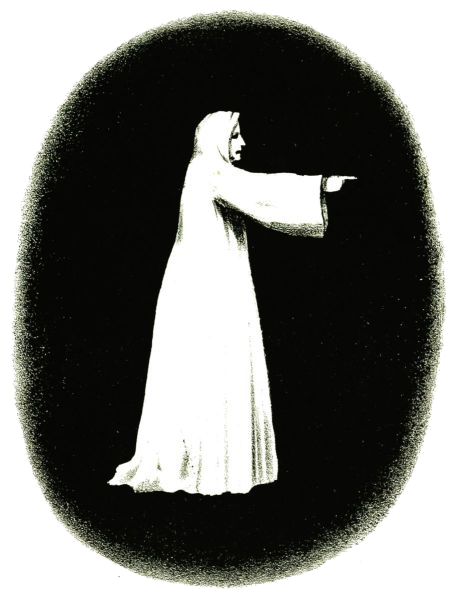
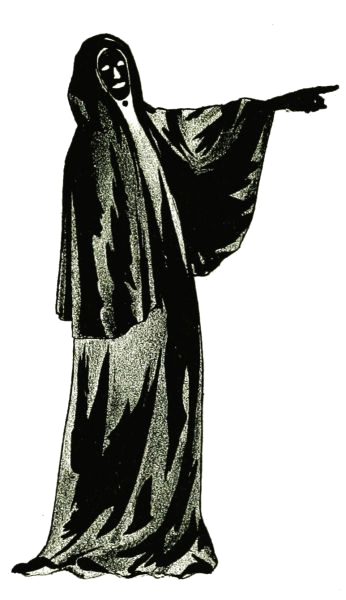
A ghost, according to the general descriptions of those who fancy they
have been favoured with a sight of one, appears to be of a pale
phosphorescent white, or bluish white colour; usually indistinct, and so
transparent that objects are easily seen through it. When moving, it
glides in a peculiar manner, the legs not being necessary to its
locomotion.
All the senses are more or less subject to deception, but the eye is
pre-eminently so; especially in the case of individuals who are in ill
health, because the sensibility of the retina is then generally much
exalted, as is also the imagination.
We may divide the illusions to which the sense of sight is liable into
four kinds. First, mental, or those arising in the brain itself, and
only referred to the eye. Second, those produced by the structure of the
eye. Third, those arising from the impressions of outward objects on the
retina. Fourth, those produced by various combinations of the foregoing.
It is only the second and third we shall have occasion to touch upon.
But before we can well understand their nature, it will be necessary to
get a slight knowledge of the structure of the eye, and some idea
respecting the nature of light.
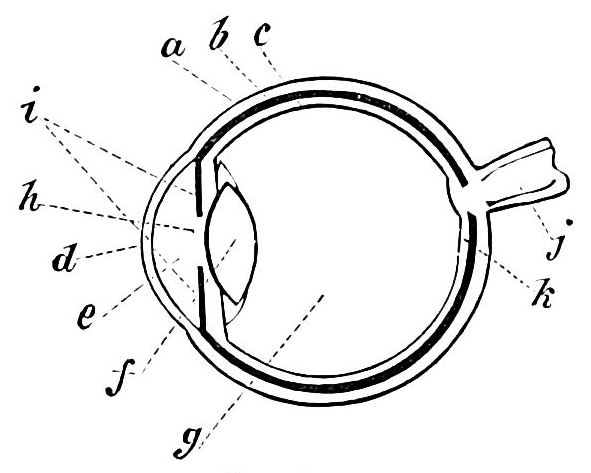
With perhaps the exception of the ear, the eye is the most wonderful
example of the infinite skill of the Creator. A more exquisite piece of
mechanism it is impossible for the human mind to conceive. The annexed
diagram (Fig. 1) of a horizontal section of this organ will give a
better idea of its general structure than whole pages of letter-press.
It will be seen to consist of a globe of three envelopes or coats, which
are kept distended by three transparent humours or lenses: the aqueous
(e), the crystalline (f), and the vitreous (g). The outer coat
(a) is dense, white, and fibrous. In front of the eye it gives place
to a perfectly transparent one, called the cornea (d). The next coat,
the choroid (b), is vascular, very black on its internal surface, in
order that light falling on it through the pupil (h) may not be
reflected. The pupil is an opening through a diaphragm which is called
the iris (i), from its colour varying in different individuals. It has
the power of expanding and contracting the pupil, for the purpose of
regulating the supply of light to the retina (c), or third and last
coat which lies immediately on the choroid. It is transparent, very
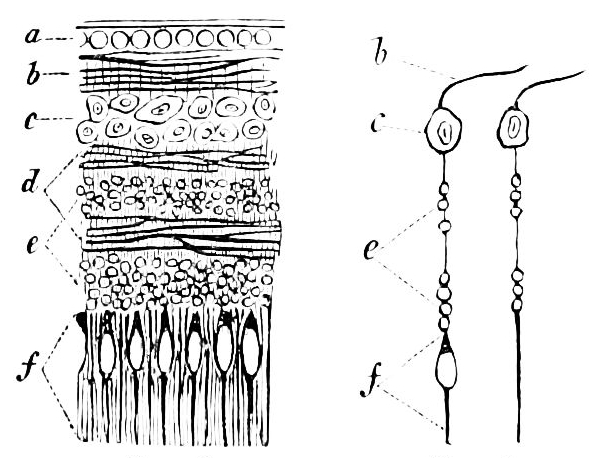
complex, and the only part of the eye we shall carefully consider. The
following diagram (Fig. 2) represents a section of it magnified 250
diameters, a is called the limitary membrane, and forms its innermost
surface, or that which is next the vitreous humour; b consists of the
layer of optic nerve fibers; c is a layer of grey nerve cells; d,
two layers in which the principal retinal blood-vessels are spread out;
e, two layers of granular matter; f, Jacob’s membrane, or layer of
rods and cones. Fig. 3 will give some idea of the supposed connexion
between these various parts, the same letters referring to the same
parts as in Fig. 2.
When a ray of light enters the eye, it passes through the humours or
lenses, and is formed by them into an image, on the choroid, of the
object looked at. The extremities of the rods and cones have the power
of appreciating the image there formed, and convey it up through the
ultimate parts of the retina (Fig. 2), thence along the optic nerve
fibres to the brain. We are inclined to regard the extremities of the
rods and cones as the true seat of perception, in consequence of
observing a considerable distance between the retinal blood-vessels and
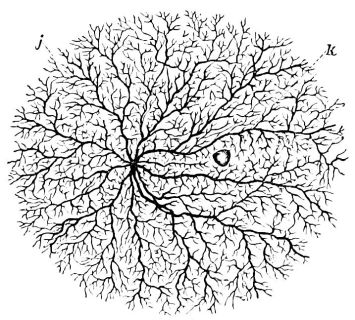
the choroid, when performing Purkinje’s experiment.[A] This experiment
consists in passing a lighted candle slowly to and fro before the eyes,
at about two or three inches from the nose, when the retinal vessels
will exhibit themselves before the observer not unlike branching trees.
They may be seen by daylight, by passing the large teeth of an ordinary
comb slowly backwards and forwards before the eye, whilst looking on a
smooth sheet of paper, or upon the sky. Fig. 4 represents those of the
left eye, as seen by candlelight. The spot marked k is the exact
centre of the retina. (The same letter marks the same spot in Fig. 1.)
It is the seat of most distinct vision. j is the entrance of the optic
nerve (Figs. 4 and 1), from the centre of which the retinal artery will
be seen emerging and spreading over the entire retina; but in the
diagram that part only is represented which could be seen tolerably
distinct. The background to the artery appears of a pale red, except at
the part occupied by the optic nerve, where it is white.
After this rapid glance at so complicated a structure, and bearing in
mind that some persons can see its several parts with vastly greater
facility than others, it cannot be a matter of surprise that individuals
not aware of these facts are, now and then—especially at night, and
when carrying a light about—startled by what they fancy an apparition,
but which is in reality nothing more than some part of the structures
above considered. A lady assures us that she saw the ghost of her
husband as she was going downstairs with a lighted candle in her hand.
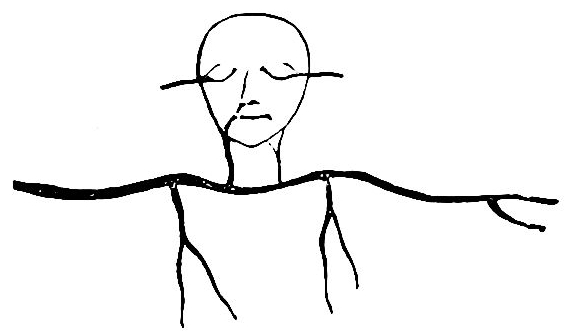
The spot k, Fig. 4, when seen against a wall a few feet distant,
appears about the size of a human head, and wants very little to furnish
it with features. Figured paper on the wall, and a host of other things,
may supply them, or even the retinal artery, which often lends body and
limbs. (Fig. 5.)
Besides the above-mentioned structures, there are others which may play
an important part in these illusions, especially the common muscæ
volantes, so called from their resemblance to flying flies. They
consist of cells and filaments, the débris of the structures of the
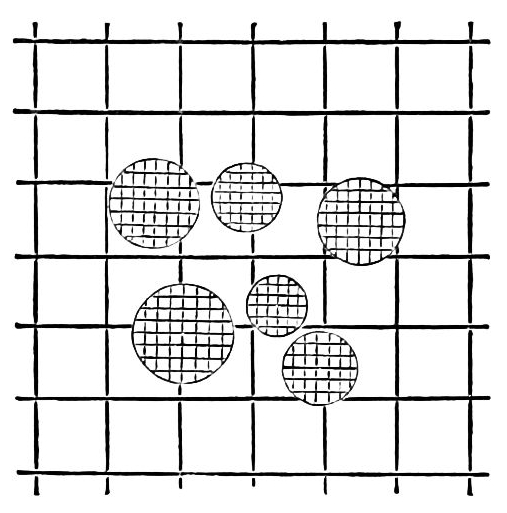
eye, and float about in its humours. That some of them exist very near
the retina appears evident from the fact that, on placing the eyes close
to a gauze wire blind, distinct miniature images of parts of the gauze
will be seen in them. (Fig. 6.)
We now pass on to consider some of the leading properties of Light.
There have been many theories propounded from time to time in order to
explain the various phenomena connected with this subject, but only one
accords well with all, and that is called the undulatory or vibratory
theory, which, from its numerous complications, will compel us to
confine ourselves to a consideration of that part only which is
necessary to our present use. This theory regards light as the
vibrations of an imponderable ether pervading all space, the number of
these vibrations varying in a given time for each of the three primary
colours—blue, yellow, and red—the greatest number producing blue, the
least red, and an intermediate number yellow, all other colours being
produced by the combination of these in various proportions. Any two of
the three primary colours mixed together makes the complementary colour
to the third, and the third is also complementary to it. Thus, blue and
yellow make green, which is the complementary colour to red; red and
blue make purple, complementary to yellow; yellow and red make orange,
complementary to blue. When the three primary colours are mixed
together, white is the result: so that when a ray of white light falls
upon a piece of paper, and all the vibrations are equally reflected, the
paper will appear white, and if they are all absorbed, it will appear
black; but, if the paper absorbs some and reflects others, it will
appear coloured. Thus, if it absorbs those producing red, it will appear
green, from the mixture of the vibrations producing blue and yellow; and
if it absorbs blue and yellow, and reflects red, then it will appear
red. In this manner any object we look at will appear of any particular
colour, according to which vibrations it absorbs and which it reflects.
The retina is so admirably constructed that it is susceptible of
different impressions of colour by these different vibrations, except in
the case of a few individuals, who are either blind to all colour, and
therefore see everything black or white, and their intermediate shades,
or who are blind to only one or two colours.
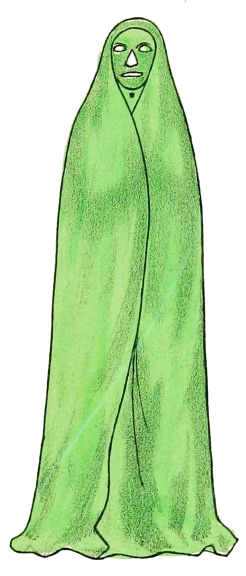
When we look steadily at a red object for a few seconds, that part of
the retina on which the image impinges begins to get less sensitive to
vibrations producing red, but more sensitive to those producing blue
and yellow; so that on turning the eye away from the red object, and
permitting a little white light to enter it, that part of the retina
which received the red image will, in consequence of its diminished
sensibility to that colour, and its exalted sensibility to blue and
yellow, be able to perceive the two latter colours best, and by their
mixture will give rise to a green image of the red object. The same
thing will be observed with all the other colours; the secondary image
or spectre always appearing of the complementary colour to the object
from which the impression is obtained.
The duration and vividness of these impressions on the retina vary
greatly in different individuals, and can be procured from almost any
object. A person may, after looking steadily, and as often happens,
unconsciously, for a short time at printed or painted figures, on paper,
porcelain, &c., see, on turning the head in some other direction, a
life-sized or colossal spectre (the spectre appears larger the greater
the distance of the surface against which it is seen), and there can be
little doubt but that many of the reputed ghosts originate in this
manner.
II
Designed by J. H. Brown, and Published Decʳ. 19ᵗʰ. 1863, by Griffith &
Farran, Sᵗ. Paul’s Church Yard, London.
IV
Designed by J. H. Brown, and Published Decʳ. 19ᵗʰ. 1863, by Griffith &
Farran, Sᵗ. Paul’s Church Yard, London.
V
Designed by J. H. Brown, and Published Decʳ. 19ᵗʰ. 1863, by Griffith &
Farran, Sᵗ. Paul’s Church Yard, London.
VI
Designed by J. H. Brown, and Published Decʳ. 19ᵗʰ. 1863, by Griffith &
Farran, Sᵗ. Paul’s Church Yard, London.
VII
Designed by J. H. Brown, and Published Decʳ. 19ᵗʰ. 1863, by Griffith &
Farran, Sᵗ. Paul’s Church Yard, London.
VIII
Designed by J. H. Brown, and Published Decʳ. 19ᵗʰ. 1863, by Griffith &
Farran, Sᵗ. Paul’s Church Yard, London.
IX
Designed by J. H. Brown, and Published Decʳ. 19ᵗʰ. 1863, by Griffith &
Farran, Sᵗ. Paul’s Church Yard, London.
X
Designed by J. H. Brown, and Published Decʳ. 19ᵗʰ. 1863, by Griffith &
Farran, Sᵗ. Paul’s Church Yard, London.
XI
Designed by J. H. Brown, and Published Decʳ. 19ᵗʰ. 1863, by Griffith &
Farran, Sᵗ. Paul’s Church Yard, London.
XII
Designed by J. H. Brown, and Published Decʳ. 19ᵗʰ. 1863, by Griffith &
Farran, Sᵗ. Paul’s Church Yard, London.
XIII
Designed by J. H. Brown, and Published Decʳ. 19ᵗʰ. 1863, by Griffith &
Farran, Sᵗ. Paul’s Church Yard, London.
XIV
Designed by J. H. Brown, and Published Decʳ. 19ᵗʰ. 1863, by Griffith &
Farran, Sᵗ. Paul’s Church Yard, London.
XV
Designed by J. H. Brown, Published Decʳ. 19ᵗʰ. 1863, by Griffith &
Farran, Sᵗ. Paul’s Church Yard, London.
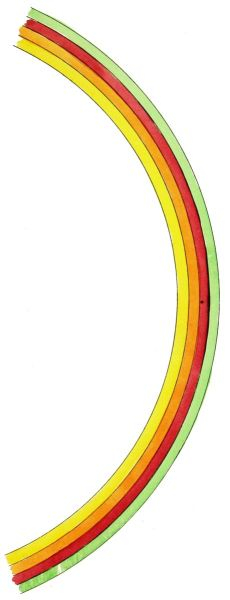
XVI
Designed by J. H. Brown, and Published Decʳ. 19ᵗʰ. 1863, by Griffith &
Farran, Sᵗ. Paul’s Church Yard, London.