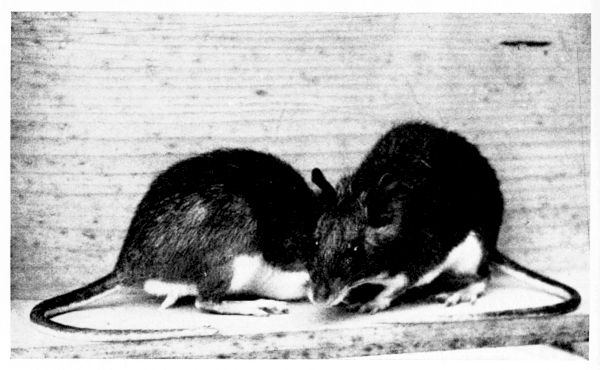
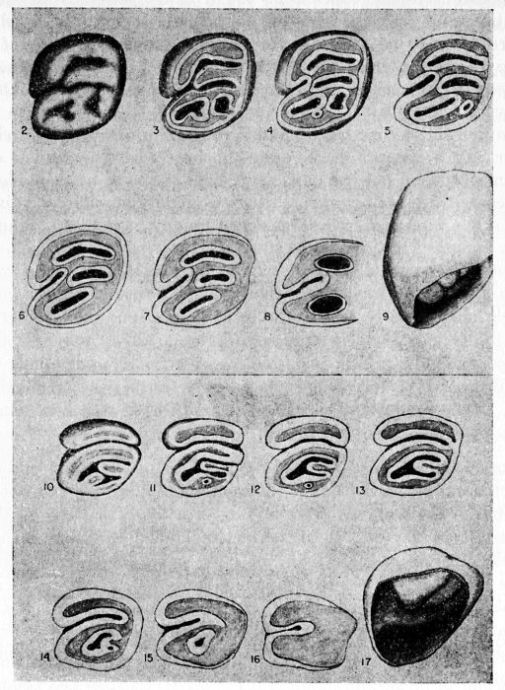
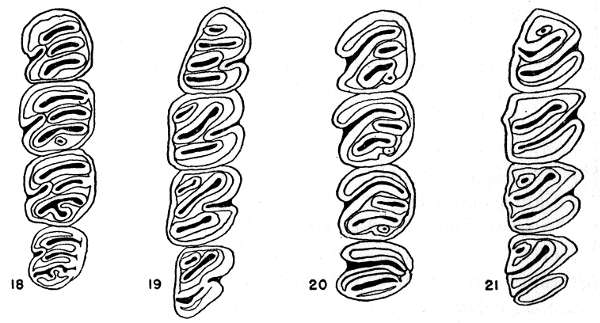
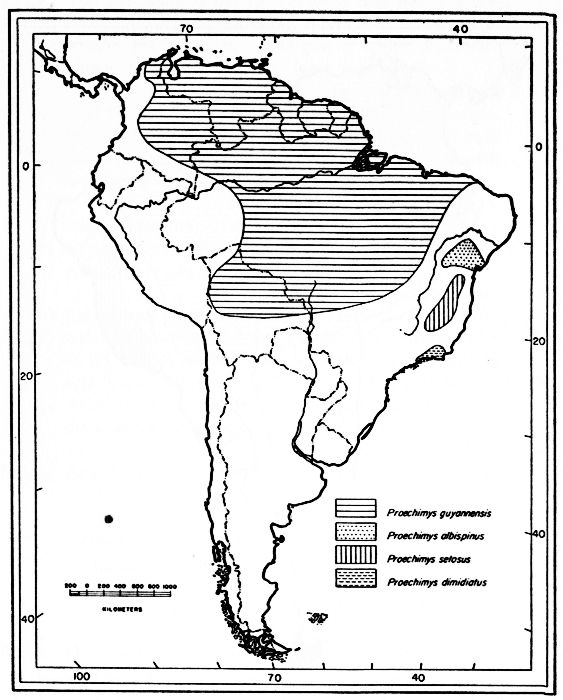
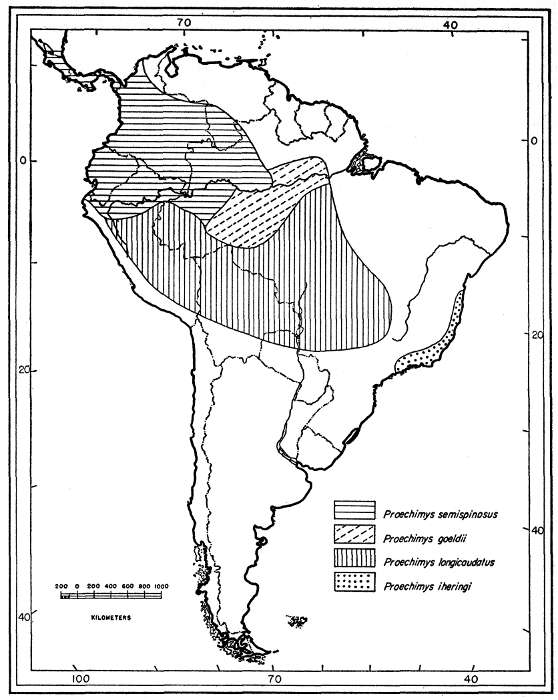
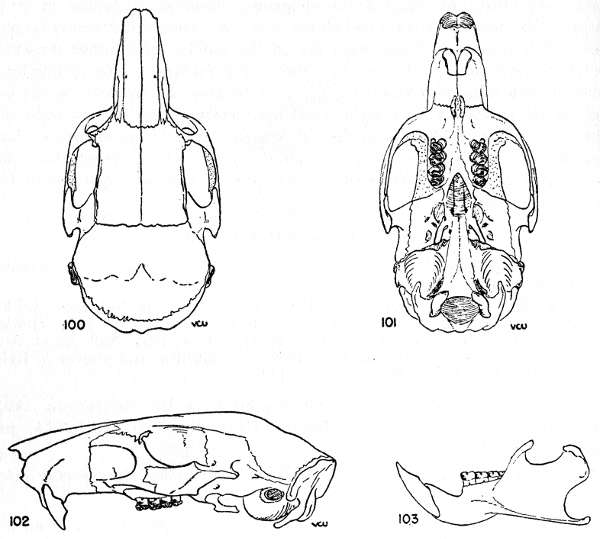
General characters.—Pelage with lanceolate aristiforms limited to an area
on the dorsal surface between the shoulders and the hips; length of tail less
than 90 per cent of length of head and body; skull with conspicuous ridges;
extension of supraorbital ridges always evident on parietals; infraorbital foramen
usually with separate groove for transmission of nerve; palate usually
extended posteriorly as far as third molars; incisors opisthodont; molariform
teeth with a small main fold, never extended transversely to opposite wall in
occlusal surface of tooth; usually one counterfold anterior to main fold in
upper molariform teeth and posterior to main fold in lower molariform teeth;
premolars usually smaller than first molars, first molars smaller than second
molars but second molars larger than third molars.
General characters.—Size large; tail short; aristiforms narrow and soft,
usually concealed in pelage by setiforms; general color of upper parts some
tint of orange, gradually becoming lighter on sides with no conspicuous, dark
longitudinal band on back; feet dark; ventral surface of body and inner side
of legs white but sometimes with some buff locally; skull broad and strongly
built but not conspicuously ridged; zygomatic expanse great and rostrum not
elongate; incisive foramen narrow; bullae large and inflated; upper molariform
teeth with three to four counterfolds, M3 ordinarily with four; lower
premolars with four, and molars with three, counterfolds.
Proechimys steerei Goldman, Proc. Biol. Soc. Washington, 24:238, 28
November 1911 (original description); Goldman, 1912, Proc. Biol. Soc.
Washington, 25:186; Tate, 1935, Bull. Amer. Mus. Nat. Hist., 68(5):400;
Ellerman, 1940, The families and genera of living rodents, Brit. Mus.
(Nat. Hist.), 1:119; Osgood, 1944, Zool. Ser. Field Mus. Nat. Hist.,
29(13):204.
Type locality.—Hyutanaham, Upper Purus, Lábrea, Amazonas, Brazil.
Type: United States National Museum, no. 105535, adult male; collected in
1901 by Prof. J. B. Steere.
Range.—Known only from the type locality and Porto Velho.
Diagnosis.—Upper parts Mars Orange on back, grading to Ochraceous-Tawny
on sides; zygomatic breadth narrow; nasals short; incisive foramen
narrow and short; vomerine sheath complete and thick; upper molars usually
with four counterfolds.
Pelage.—Aristiforms on middorsal region: Grayish basally, gradually
blackening toward tip; total length, 16 to 19 mm; maximum width, 0.5 mm.
Setiforms on middorsal region: Grayish on basal third, gradually blackening
toward tip but interrupted by a Mars Orange, subapical zone 1.5 mm long;
total length, 16 to 19 mm; maximum width, 0.06 mm. Setiforms on outer
thighs: Whitish basally, gradually blackening toward tip but interrupted by
Orange Rufous or Ochraceous-Tawny, subapical zone; total length, 14 to 16
mm; maximum width, 0.05 mm.
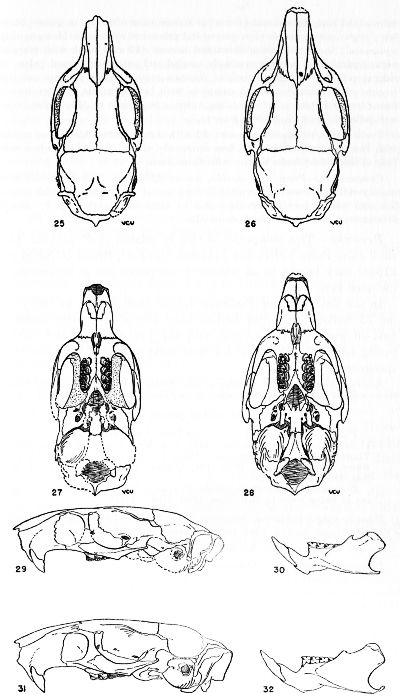
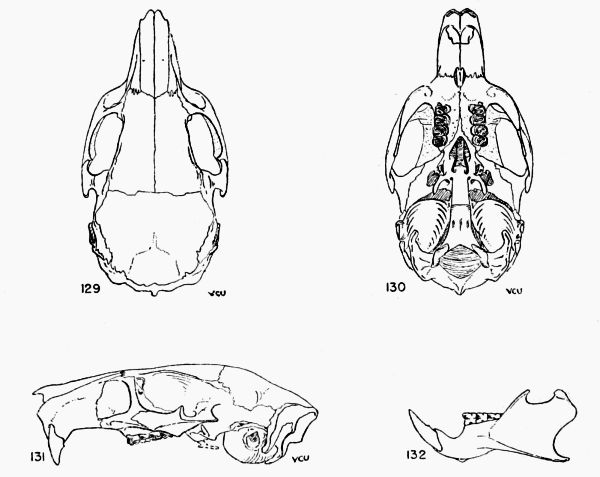
Figs. 25, 27. Proechimys goeldii steerei, sex ?, "Hyutanaham," USNM no. 105537. × 1.
Figs. 26, 28. Proechimys goeldii goeldii, female, AMNH no. 37488. × 1.
Figs. 29, 30. Proechimys goeldii steerei, sex ?, USNM no. 105537, "Hyutanaham." × 1.
Figs. 31, 32. Proechimys goeldii goeldii, female, AMNH no. 37488, Fazenda Paraiso. × 1.
Skull.—Large and strong; rostrum rather pointed posteriorly; supraorbital
ridges not much expanded and extending across anterior half of parietals;
infraorbital foramen without groove for transmission of nerve, or groove obsolete;
zygomatic arches slender; postorbital process of zygoma involving mostly
squamosal; incisive foramen short and narrow (4.5 × 2.5 mm) with margins
almost parallel or tapering gradually caudad and extending toward palate as
ridges; posterior margin of incisive foramen approximately 2.5 mm anterior
to premolars; vomerine sheath complete, with both elements well-developed;
mesopterygoid fossa never extending anterior to middle of M3; bullae large,
well inflated and with shallow grooves.
Teeth.—Upper molariform teeth: P4 with three counterfolds; upper molars
with four counterfolds each or, less commonly, three. Lower premolars with
four counterfolds; lower molars with three each.
Comparisons.—From P. g. goeldii, steerei differs in: Back and sides with
more reddish; narrower interorbitally and across zygomata; palatilar length
less and nasals shorter; maxillary part of vomerine sheath thicker; usually
four instead of three counterfolds in M3.
Remarks.—This subspecies is clearly related to P. goeldii. One
skull from Porto Velho, Rio Madeira, Guaporé, Brazil (CNHM no.
21558) may belong to an unnamed subspecies but is provisionally
included here.
In the field notes of Professor Joseph Beal Steere, an entry for
no. 72 reads: "Big white bellied wood rats x two young found in
nest of grass on the ground with the two young—much darker
young female." No. 77 in his field notes corresponds to the type
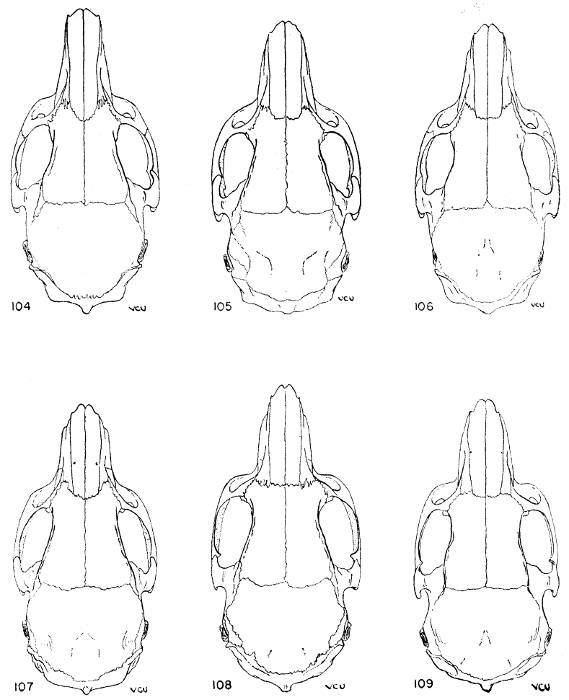
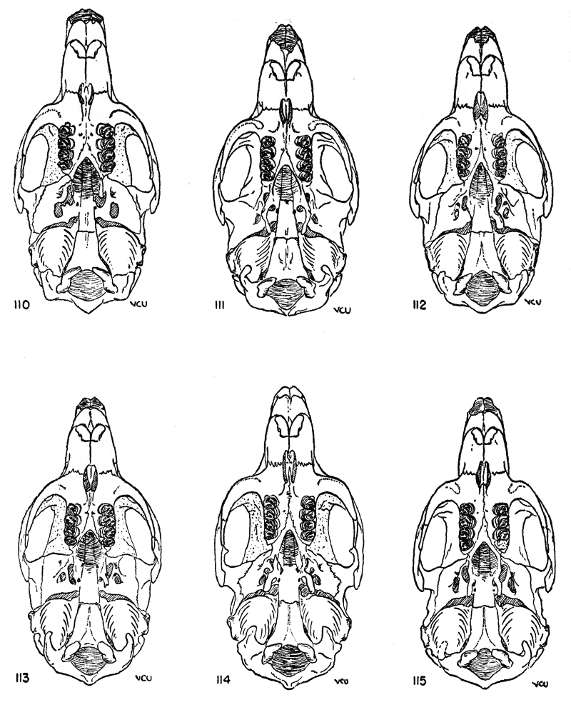
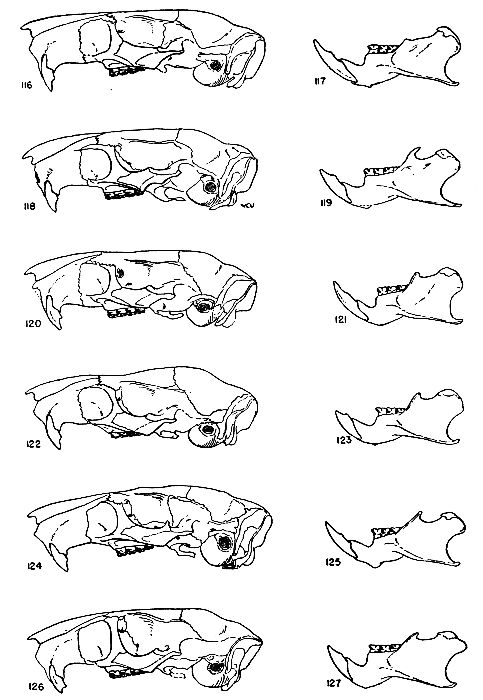
specimen.
Specimens examined.—Total number, 4, from Brazil, as follows: Amazonas. Lábrea,
Hyutanaham, 3 (USNM); Territ. Guaporé, Porto Velho, 1 (CNHM).
Proechimys goeldii Thomas, June 1905, Ann. Mag. Nat. Hist., 15 (ser.
7):587, (orig. descr.); Thomas, 1912, Ann. Mag. Nat. Hist., 9 (ser. 8):89;
Thomas, 1920, Ann. Mag. Nat. Hist., 6 (ser. 9):277, Tate, 1935, Bull.
Amer. Mus. Nat. Hist., 68(5):400; Osgood, 1944, Zool. Ser. Field Mus.
Nat. Hist., 29(13):199.
Proechimys cayennensis goeldii, Ellerman, 1940, The families and genera
of living rodents, Brit. Mus. (Nat. Hist.), 1:121.
Type locality.—Santarem, Santarem, Pará, Brazil. Type: British Museum
(Nat. Hist.), no. 5.1.25.6, adult female; presented by Dr. E. A. Goeldi.
Range.—Margins of the Amazon, between Jamundá and Tapajoz rivers.
Diagnosis.—Upper parts Ochraceous-Tawny; wide across zygomata; nasals
of moderate length; incisive foramen long and narrow; vomerine sheath complete
but maxillary part slender; first and second upper molars with four
counterfolds.
Pelage.—Aristiforms on middorsal region: Whitish basally and gradually
blackening toward tip which is extended as long, thin filament; total length,
22 to 24 mm; maximum width, 0.5 mm. Setiforms on middorsal region:
Gray basally, gradually blackening toward tip but interrupted by Ochraceous-Tawny,
subapical zone 3.3 mm long; total length, 19 to 21 mm; maximum
width, 0.06 mm. Setiforms on outer thighs: Whitish basally, gradually blackening
toward tip but interrupted by Ochraceous-Tawny, subapical zone 3 mm
long; total length 14 to 16 mm; maximum width, 0.04 mm.
Skull.—Large and strong; nasals pointed posteriorly; supraorbital ridges
moderately developed and extended caudad across anterior third of parietals;
zygomatic arches strong; postorbital process of zygoma involving mostly
squamosal; incisive foramen elongate and narrow (5 to 6.5 × 2.3 mm) with
margins more or less parallel and raised to form ridges which extend posteriorly
to within 3 mm of plane of premolars; vomerine sheath complete, with
maxillary part thin and extended caudad as medial crest; mesopterygoid fossa
extending forward as far as posterior faces of second molars or slightly short
thereof; bullae large and inflated.
Teeth.—Molariform teeth large, P4-M3 averaging more than 9 mm in
length. Upper molariform teeth: P4 and M3 with three counterfolds; M1
and M2 with four counterfolds each. In lower teeth, p4 with four counterfolds
and each molar with three counterfolds.
Comparisons.—Differences from P. g. steerei are given in the account of that
subspecies.
Remarks.—Specimens from the type locality were not available.
Specimens from Fazenda Paraiso, Faro, were relied upon as representative
of the subspecies. These agree with the type according to
Thomas (1912:89). However, the skin of the type was changed in
color by preservative (Thomas, 1905:587) and the best skin he
saw was from Faro (1912:89).
Thomas (1920:277) applied the name goeldii also to specimens
from Manacaparú, a place a short distance above Manaus on the
Solimões (Amazon) River and from Acajutuba, near Manaus, on
the Negro River. In referring to these specimens (2 from Manacaparú
and 2 from Acajutuba) Thomas (loc. cit.) said "Five molar
laminae are frequently, if not invariably, present among these
specimens." He did not, however, mention whether or not the
number of laminae was constant in both M2 and M3. One specimen
from Acajutuba, in the collection of Museu Nacional (MN
no. 1973 [M]), actually has five laminae in M3, but the specimens in
the American Museum from Faro agree absolutely with Thomas'
original description of goeldii.
Osgood (1944:199) doubted that goeldii was a valid species.
Evidence that Osgood's doubt was unjustified is furnished by the
fact that Thomas (1912:89) pointed out that his specimen from
Faro agrees with the type. Likewise, my two specimens from Faro
agree with the type insofar as it has been described. Thomas
(1912:89) mentioned two additional skulls from the type locality
which, he stated, agree with the type which was received from the
Museu Goeldi, Pará.
Specimens examined.—Total number, 4, from Brazil as follows: Pará, Faro, Faro, Fazenda
Paraiso, 2 (AMNH); Amazonas, Manaus, Manaus, 1 skull (AMNH); Amazonas, Manaus,
Acajutuba, 1 (MN).
Additional records.—Total number, 7 (British Museum), from Brazil, as follows: Pará,
Santarem, Santarem (Thomas, 1912:89; 1920:277), 3; Amazonas, Manaus, Acajutuba
(Thomas, 1920:277), 2; Manacaparú, Manacaparú (Thomas, 1920:277), 2.
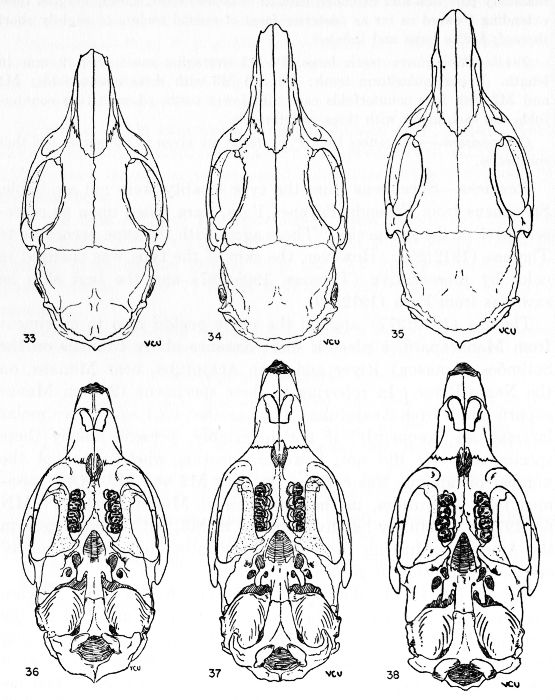
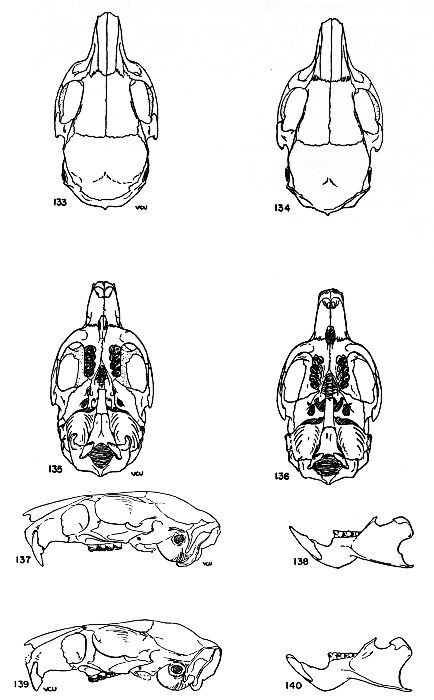
Figs. 33, 36. Proechimys semispinosus liminalis, female, MN no. 6253, Rio Quichito.
Type. × 1.
Figs. 34, 37. Proechimys semispinosus amphichoricus, male, AMNH no. 77020, Mount
Duida. Type. × 1.
Figs. 35, 38. Proechimys semispinosus kermiti, female, AMNH no. 37124, Lower Rio
Solimões. Type. × 1.2 (from photograph).
General characters.—Size large; tail short and hairy; aristiforms wide and
stiff, especially well-developed on back; general color on upper parts some
shade of ochraceous, usually much darker on back and forming a conspicuous
dorsal band; feet dark; ventral surfaces and inner sides of legs white; skull
elongate and strong with ridges well developed; incisive foramen long and
narrow; bullae large; usually four counterfolds in M3 and M2; usually three
but sometimes four counterfolds in M1 and even P4; lower premolar with
four and lower molars with three counterfolds.
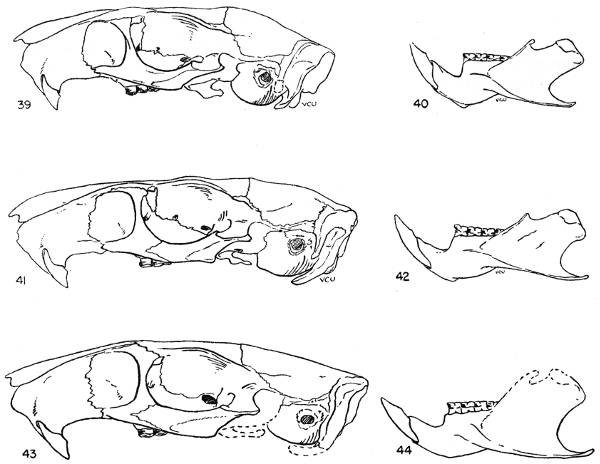
Figs. 39, 40. Proechimys semispinosus liminalis, female, MN no. 6253, Rio Quichito.
Type. × 1.
Figs. 41, 42. Proechimys semispinosus amphichoricus, male, AMNH no. 77020, Mount
Duida. Type. × 1.
Figs. 43, 44. Proechimys semispinosus kermiti, female, AMNH no. 37124, Lower Rio
Solimões. Type. × 1.2 (from photograph).
Type locality.—Rio Quichito, affluent from the south of the Javarí River,
near Benjamin Constant, Benjamin Constant, Amazonas, Brazil. Type:
Museu Nacional, no. 6253, adult female, collected in August, 1942, by E.
Parko.
Range.—Known only from the type locality.
Diagnosis.—Color uniformly dark, setiforms marked with Ochraceous-Tawny;
skull wide across zygomata; nasals short; prepalatilar part of skull
long; incisive foramen long and narrow; vomerine sheath incomplete or complete;
M2 and M3 almost always with four counterfolds; M1 more rarely
with four counterfolds.
Pelage.—Aristiforms on middorsal region: Gray basally, gradually blackening
toward tip which is generally extended as a filament; total length, 21 to
23 mm; maximum width, 0.9 to 1 mm. Setiforms on middorsal region: Gray
basally, gradually blackening toward tip but interrupted by Ochraceous-subapical
Tawny,
zone 3 mm long; total length, 22 to 24 mm; maximum
width, 0.06 mm. Setiforms on outer thighs: Whitish basally, gradually
blackening toward tip but interrupted by Ochraceous-Buff, subapical zone
2.5 mm long; total length, 13 to 15 mm; maximum width, 0.08 mm; some
with gray base, blackening gradually toward tip, without any subapical zone;
some with Light Ochraceous-Tawny, subapical zone.
Skull.—Large and strongly built throughout; supraorbital ridges expanded
and thick, extending, in old specimens, across parietals to anterior angles of
interparietals; interparietal ridges always conspicuous; rostrum elongated;
nasals blunt posteriorly; zygomatic arches strong; infraorbital foramen with
weakly-developed groove for transmission of nerve; postorbital process of
zygoma involving mostly squamosal; incisive foramen averaging 6 x 2.7 mm,
widest in middle part and posteriorly constricted, with raised margins which
do not extend across maxillae as ridges; posterior margin of incisive foramen
approximately 1.5 mm anterior to plane of premolars; vomerine sheath incomplete
or, sometimes, complete but always with maxillary part slender;
mesopterygoid fossa not extending forward past centers of third molars;
bullae moderately developed.
Teeth.—Upper molariform teeth: P4 always with three counterfolds; M1
with three counterfolds in 9 of 10 specimens and four counterfolds in remainder;
M2 with four counterfolds in 7 specimens, three counterfolds in
remainder; M3 with four counterfolds in 6 specimens, three counterfolds in
remainder. Lower premolar always with four, and molars with three, counterfolds.
Comparisons.—From P. s. semispinosus, liminalis differs in: darker color;
wider aristiforms; greater percentage of upper molars with four counterfolds.
From P. s. amphichoricus, liminalis differs in: lighter upper parts of almost
uniform color instead of with conspicuous, blackish, middorsal, longitudinal
band; more strongly built skull; longer incisive foramen; vomerine sheath
usually incomplete instead of always complete.
Specimens examined.—Total number, 10 (MN) from the type locality.
Type locality.—Mount Duida, Esmeralda, Amazonas, Venezuela; altitude
325 m. Type: American Museum of Natural History, no. 77020, adult male;
collected 16 October 1920 by Olalla Bros.
Range.—Headwaters of Negro and Orinoco rivers, along boundary of Brazil
and Venezuela.
Diagnosis.—Color dark, blackish on middorsal area; subapical zone of setiforms
on back Buckthorn Brown, but many with distal parts black; skull
broad across zygomata; nasals long; prepalatilar area of skull long; incisive
foramen long and narrow; vomerine sheath complete; upper molars usually
with four counterfolds but P4 usually with only three.
Pelage.—Aristiforms on middorsal region: Grayish basally, gradually blackening
toward tip; total length, 18 to 20 mm; maximum width, 0.8 to 1.0 mm.
Setiforms on middorsal region: Gray basally, gradually blackening toward tip
but interrupted by a light (16 i), Buckthorn Brown, subapical zone 2 mm
long; total length, 18 to 22 mm; maximum width, 0.03 mm. Most of them,
however, whitish basally, gradually blackening toward tip without any distinctively-colored,
subapical zone; total length, 24 to 26 mm; maximum width,
0.5 mm. Setiforms on outer thighs: Whitish basally, gradually blackening
toward tip but interrupted by an Ochraceous-Buff, subapical zone 3.5 mm
long; black tip short; total length, 17 to 19 mm; maximum width, 0.05 mm.
Skull.—Large and slender; rostrum elongate; nasals bluntly pointed posteriorly;
supraorbital ridges thick (but not expanded) and extending across
parietals but almost obsolete in middle part of parietals; infraorbital foramen
with weakly-developed groove for transmission of nerve; postorbital
process of zygoma involving mostly squamosal; incisive foramen 5.5 x 2.8 mm
wide in anterior third, with margins constricted posteriorly and extending as
ridges approximately 2 mm beyond posterior margin of incisive foramen;
posterior margin of incisive foramen approximately 2.5 mm anterior to premolars;
vomerine sheath complete with maxillary part weak and premaxillary
part extending posteriorly beyond middle of incisive foramen; mesopterygoid
fossa extending forward as far as middle of M3; bullae well inflated and
elongated.
Teeth.—P4 with four counterfolds in one of five specimens and with three
in remainder; M1 with four counterfolds in three of five specimens and with
three in remainder; M2 with three counterfolds in one specimen and with
four in all four remaining specimens; M3 always with four counterfolds.
Lower premolars with four counterfolds and lower molars with only three.
Comparisons.—The subspecies is easily distinguishable from P. s. angularis
by: larger number of black setiforms on back, forming an almost black longitudinal
band; more elongate skull; larger and longer bulla; longer incisive
foramen which is more constricted posteriorly.
Specimens examined.—Total number, 6 (AMNH), as follows: Venezuela, territ. Amazonas,
Esmeralda, Mt. Duida, altitude 325 m., 4; Venezuela, territ. Amazonas, Rio Cassiquiare,
Quemapuré, 1; Brazil, Amazonas, São Gabriel, Rio Uaupés or Caiari, Tatú, 1.
Proechimys kermiti Allen, 30 December 1915, Bull. Amer. Mus. Nat.
Hist., 34(22):629 (orig. descr.); Allen, 1916, Bull. Amer. Mus. Nat. Hist.,
35(30):569; Tate, 1935, Bull. Amer. Mus. Nat. Hist., 68(5):400; Ellerman,
1940, The families and genera of living rodents, Brit. Mus. (Nat.
Hist.), 1:119.
Type locality.—Lower Rio Solimões (up the Solimões 50 to 60 miles on the
north bank of the river), Manacaparú, Amazonas, Brazil. Type: American
Museum of Natural History, no. 37124, adult female; collected 20 April, 1914,
by Leo E. Miller (Roosevelt Brazilian Expedition).
Range.—Known only from type locality.
Diagnosis.—Upper parts Tawny, with darker longitudinal band on back,
gradually becoming Ochraceous-Buff on sides; zygomata widely spread; nasals
long; incisive foramen long; vomerine sheath incomplete; only M3 with four
counterfolds.
Pelage.—Aristiforms on middorsal region: Grayish basally, gradually blackening
toward tip; total length, 18 to 20 mm; maximum width, 0.8 mm. Setiforms
on middorsal region: Grayish basally, gradually blackening toward tip
but interrupted by Tawny, subapical zone 2 mm long; total length, 18 to 20
mm; maximum width, 0.06 mm; some blackened toward tip without subapical
zone. Setiforms on outer thighs: Whitish basally, gradually blackening
toward tip but interrupted by Ochraceous-Buff, subapical zone 2.5 mm long;
total length, 18 to 20 mm; maximum width, 0.05 mm.
Skull.—Large, elongate, and strongly built; rostrum not conspicuously
elongated; nasals bluntly pointed posteriorly; supraorbital ridges wide and
extending posteriorly across parietals almost to level of interparietal; infraorbital
foramen with moderate development of groove for transmission of
nerve; zygomatic arches slender; postorbital process of zygoma involving
mostly squamosal; incisive foramen 6.5 mm long and 2.7 mm wide, wider in
anterior third and gradually constricted posteriorly, with margins extended
toward palate as ridges; vomerine sheath incomplete, maxillary part threadlike;
mesopterygoid fossa extending forward as far as anterior third of m3;
bullae large and well inflated.
Teeth.—P4 with three counterfolds; M3 with four counterfolds; M1 and
M2 with three counterfolds. Lower premolars with four counterfolds; lower
molars with three counterfolds.
Comparisons.—From P. s. amphichoricus, kermiti differs in: upper parts
Tawny instead of Buckthorn Brown; incisive foramen longer and wider;
vomerine sheath incomplete; only M3 instead of usually all molars, with
four counterfolds. From P. s. liminalis, kermiti differs in: upper parts Tawny
instead of Ochraceous-Tawny; aristiforms narrower; M3 only, instead of
usually M2 and M3, with four counterfolds.
Specimens examined.—Only the type.
General characters.—Size medium to large; tail short; aristiforms long and
narrow; general color on upper parts Ochraceous-Buff to Ochraceous-Orange,
finely and uniformly lined with blackish and not forming evident dark band
on back; feet dorsally white or gray; underparts of body and inner sides of
legs white; skull elongate and slender with moderate ridges; incisive foramen
of medium size; vomerine sheath complete or incomplete; bullae large and
elongate; upper molariform teeth with three counterfolds; lower molariform
teeth with three counterfolds but commonly one or two molars have only two
although premolar may have four.
Remarks.—The identity of "Echimys longicaudatus Rengger"
can be ascertained only after samples have been collected in the
area indicated by Rengger: "unter dem ein und zwansigsten Breitengrade"
in Paraguay. Of the samples available to me, those from
Urucum, in western Brazil, are geographically nearest the type locality.
North of Urucum, both in Brazil and Bolivia, two species
of Proechimys live together and one of them is the same species as
that at Urucum. Of the two species found to the northward in
Brazil and Bolivia, the one that ranges farther south probably will
occur at the locality indicated by Rengger. Provisionally, therefore,
the name longicaudatus is allocated to the Urucum sample (see
Osgood, 1944:198). In fact, the lack of a type specimen and the
general nature of Rengger's description make "Echimys longicaudatus"
a nomen vanum. If two species are found living together
in the region of northern Paraguay indicated by Rengger it probably
will be impossible to be sure to which one his vague description
applies.
The form from Urucum, to which the name Proechimys longicaudatus
is here applied, is undoubtedly closely related to Proechimys
leucomystax Ribeiro, from Utiarití, on the Rio Papagaio
and also to P. roberti and P. boimensis, all from Brazil. P. longicaudatus
is used as the name of the species because it is the oldest
of the four names.
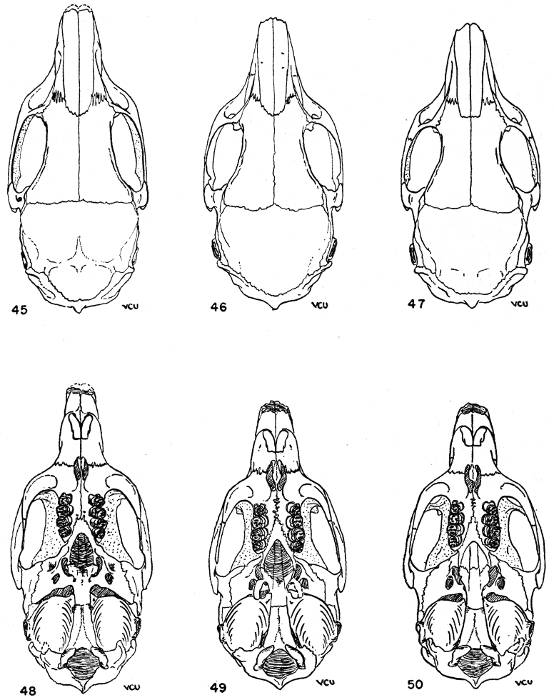
Figs. 45, 48. Proechimys longicaudatus boimensis, male, MCZ no. 30881, Boim. × 1.
Figs. 41, 42. Proechimys longicaudatus longicaudatus, male, AMNH no. 37085, Urucum.
× 1.
Figs. 43, 44. Proechimys longicaudatus leucomystax, male, AMNH no. 37509, Tapirapoa.
× 1.
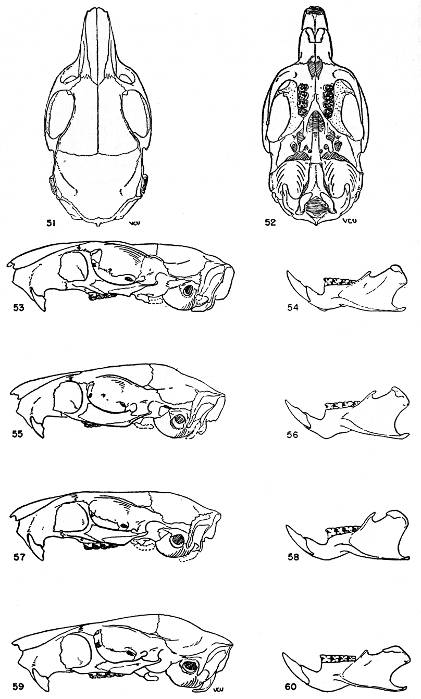
Figs. 51, 52. Proechimys longicaudatus roberti, male, MN no. 6233, Pouso Alto, Goiaz.
× 1.
Figs. 53, 54. Proechimys longicaudatus boimensis, male, MCZ no. 30881, Boim. × 1.
Figs. 55, 56. Proechimys longicaudatus longicaudatus, male, AMNH no. 37085, Urucum.
× 1.
Figs. 57, 58. Proechimys longicaudatus leucomystax, male, AMNH no. 37509, Tapirapoa.
× 1.
Figs. 59, 60. Proechimys longicaudatus roberti, male, MN no. 6233, Pouso Alto, Goiaz.
× 1.
Echimys brevicauda Günther, 1 April 1877, Proc. Zool. Soc. London for
1876, (49):748, fig. 9.
Proechimys brevicauda Ihering, 1904, Rev. Mus. Paulista, S. Paulo,
6:422; Osgood, 1914, Zool. Ser. Field Mus. Nat. Hist., 10(12):168;
Thomas, 1924, Ann. Mag. Nat. Hist., 13 (ser. 9):534; Thomas, 1927, Ann.
Mag. Nat. Hist., 19 (ser. 9):553; Thomas, 1927, Ann. Mag. Nat. Hist.,
20 (ser. 9):604; Thomas, 1928, Ann. Mag. Nat. Hist., 2 (ser. 10):262;
Thomas, 1928, Ann. Mag. Nat. Hist., 2 (ser. 10):292; Tate, 1935, Bull.
Amer. Mus. Nat. Hist., 68 (5):399; Osgood, 1944, Zool. Ser. Field Mus.
Nat. Hist., 29 (13):201.
Proechimys cayennensis brevicauda Ellerman, 1940, The families and
genera of living rodents, Brit. Mus. (Nat. Hist.), 1:120.
Type locality.—Chamicuros, Rio Huallaga, Peru. Type: British Museum
(Nat. Hist.), no. 69.3.31.7,[F]; Lectoparatype: British Museum (Nat. Hist.),
no. 66.1.29.8, from Upper Amazons (E. Barttet), selected by Thomas (1900:301).
Range.—Region of the headwaters and upper courses of the Juruá and
Ucaiali rivers, eastern Peru and northwestern Brazil.
Diagnosis.—Upper parts Tawny and blackish without marked longitudinal
band on back; underparts buffy or white; aristiforms narrow; skull slender;
incisive foramen wide; vomerine sheath complete; molariform teeth with
three counterfolds, except p4 with four and m3 with only two.
Pelage.—Aristiforms on middorsal region: Blackish basally, gradually
blackening toward tip which is extended as a long filament; total length, 18
to 20 mm; maximum width, 0.65 mm. Setiforms on middorsal region: Gray
basally, gradually blackening toward tip but interrupted by Tawny, subapical
zone 1.2 mm long; total length, 19 to 21 mm; maximum width, 0.1 mm. Setiforms
on outer thighs: Whitish basally, gradually blackening toward tip but
interrupted by Ochraceous-Tawny, subapical zone 3 mm long.
Skull.—Slender but not elongated; nasals tapering posteriorly; interparietals
wide; supraorbital ridges not much extended and faintly shown across parietals;
jugals dorso-ventrally "wide" (3.5 mm); postorbital process of zygoma
weakly developed; incisive foramen 5.5 x 3 mm, oval, with posterior borders
raised to form ridges which extend toward premolars; vomerine sheath complete,
with maxillary part laterally compressed and extended toward palate
as ridge; mesopterygoid fossa extending forward as far as third molars; bullae
large and well inflated.
Teeth.—Molariform teeth with three counterfolds, except p4 which has four
and m3 which has only two counterfolds.
Comparisons.—From P. l. longicaudatus, brevicauda differs in: upper parts
Tawny instead of Ochraceous-Buff; lower premolar with four instead of three
counterfolds; m3 only, instead of both m1 and m3, with two counterfolds.
From P. l. boimensis, brevicauda differs in: upper parts Tawny instead of
Ochraceous-Orange; aristiforms wider; m3 with two instead of three counterfolds.
Specimens examined.—Total number, 3 (DZ), from Brazil, Amazonas, João Pessoa, Rio
Juruá.
Proechimys boimensis Allen, 24 July, 1916, Bull. Amer. Mus. Nat. Hist.,
35(27):523; Tate, 1935, Bull. Amer. Mus. Nat. Hist., 68(5):400; Ellerman,
1940, The families and genera of living rodents, Brit. Mus. (Nat. Hist.),
1:119.
Proechimys cayennensis Osgood, 1944, Zool. Ser. Field Mus. Nat. Hist.,
29(13):199.
Type locality.—Boim, Rio Tapajoz, Santarem, Pará, Brazil. Type: American
Museum of Natural History, no. 37486, adult male; "October 10, 1911 (ex
Museu Goeldi)."
Range.—Along lower course of Tapajoz River.
Diagnosis.—Upper parts Ochraceous-Orange; incisive foramen posteriorly
constricted; mesopterygoid fossa sharply pointed anteriorly; p4 with four
counterfolds, remaining molariform teeth with three counterfolds.
Pelage.—Aristiforms on middorsal region: Gray basally, gradually blackening
toward tip which is extended as a long filament; total length, 16 to 18
mm; maximum width, 0.5 mm. Setiforms on middorsal region: Gray basally,
gradually blackening toward tip, but interrupted by short (1.5 mm), Ochraceous-Orange,
subapical zone; total length 18 to 20 mm; maximum width 0.09
mm. Setiforms on outer thighs: White basally, gradually blackening toward
tip but interrupted by Ochraceous-Orange, or Ochraceous-Buff, subapical zone
3.5 mm long; total length 15 to 17 mm; maximum width, 0.06 mm.
Skull.—Elongate and slender; rostrum slender and long; nasals evenly
pointed posteriorly; supraorbital ridges weak and barely reaching anteriormost
part of parietals; zygomatic arches slender; infraorbital foramen with
groove for nerve-transmission obsolete; postorbital process of zygoma weak
and involving mostly squamosal; incisive foramen 5 mm long and 2.5 to 3
mm wide, oval, with margins not much extended caudad as ridges; posterior
margin of incisive foramen approximately 2 mm anterior to premolars; vomerine
sheath complete with maxillary part slender; mesopterygoid fossa sharply
pointed anteriorly and extending forward as far as anterior part of third molar;
bullae of medium size, smooth and more or less triangular in contour.
Teeth.—Crown length of upper molariform teeth 7 to 7.5 mm; all upper
molariform teeth with three counterfolds; lower premolar with four counterfolds;
lower molars with three counterfolds each.
Comparisons.—From three of the other four subspecies found in Brazil,
boimensis differs in having four, instead of three, counterfolds in the lower
premolars. Differences from P. l. brevicauda are indicated in the account of
that subspecies.
Remarks.—The material available from Boim, Tapajoz, is rather
poor and of no great significance. The Museu Nacional has one
specimen from Boim which agrees with the type in the American
Museum of Natural History. The Museum of Comparative Zoölogy
at Harvard College, however, has one specimen in its collection
(MCZ no. 30888 [M]), adult, also from Boim, in which the color
pattern is different although agreement with the type specimen is
shown in cranial characters and width and length of hairs. This
specimen is much darker than the other specimens (of orange-tint)
assigned to this subspecies. However, in other samples of this
species, similarly dark animals have been noted. It seems that the
orange tint is gained only in old age. Another specimen (MCZ no.
30878 [F]) agrees in all respects with the type of the subspecies but
the locality recorded on the label is Cametá, on the Tocantins River.
Possibly the subspecies has a range so wide as to include Cametá
but I suspect that the data on the label is incorrect as to locality.
The collector marked [M] on the label although the specimen is a [F].
The mistake might have occurred through labeling of specimens at
a time later than that at which they were collected. The collector
was in both localities on more than one occasion.
Specimens examined.—Total number, 5, from Brazil, Pará, as follows: Santarem, Rio
Tapajoz, Boim, 3 (AMNH type, MCZ 1, MN 1); Porto de Moz, Tauarí, 1 (MCZ); Cametá
(?) 1 (MCZ).
Echimys longicaudatus Rengger, 1830, Naturgeschichte der Saeugethiere
von Paraguay, p. 236.
Loncheres myosuros Lichtenstein, 1832, Darstellung neuer oder wenig
bekannter Säugethiere, pl. 36 and text.
Echimys myosuros Is. Geoffroy Saint-Hilaire, 1840, Mag. Zool., Ann. 2
(ser. 2):15, 17; Allen, 1899, Bull. Amer. Mus. Nat. Hist., 12(20):261.
Echimys cayennensis Pictet, 1841, Mém. Soc. Phys. Hist. Nat., Genève,
9:145; Waterhouse, 1848, Nat. Hist. Mammalia, 2:334.
Proechimys longicaudatus Thomas, 1901, Ann. Mag. Nat. Hist., 8 (ser.
7):532; Thomas, 1904, Proc. Zool. Soc. London, p. 240; Allen, 1916, Bull.
Amer. Mus. Nat. Hist., 35(30):569; Tate, 1935, Bull. Amer. Mus. Nat.
Hist., 68(5):400.
Proechimys cayennensis longicaudatus Ellerman, 1940, The families
and genera of living rodents, Brit. Mus. (Nat. Hist.), 1:121; Osgood,
1944, Zool. Ser. Field Mus. Nat. Hist, 29(13):198.
Type locality.—Northern Paraguay ("unter dem ein und zwansigsten Breitengrade").
Type: Apparently no type specimen was preserved.
Range.—Western Mato Grosso, Brazil, and northern Paraguay.
Diagnosis.—Upper parts almost uniformly Ochraceous-Buff; incisive foramen
widest posteriorly; vomerine sheath complete; p4 and m2 with three
counterfolds; m1 and m3 usually with two counterfolds.
Pelage.—Aristiforms on middorsal region: Dark gray, gradually blackening
toward tip that has long filament; total length 20 to 22 mm; maximum width
0.6 mm. Setiforms on middorsal region: Whitish basally, gradually blackening
toward tip but interrupted by Ochraceous-Buff, subapical zone; blackish tip
extended (3.5 mm) and thin; total length 19 to 20 mm; maximum width 0.06
mm. Setiforms on outer thighs: Whitish basally, progressively grayish or
blackish toward tip but interrupted by Light Ochraceous-Buff or Ochraceous-Buff,
subapical zone; total length 18 to 20 mm; maximum width 0.06 mm.
Skull.—Slender; supraorbital ridge notably raised; bullae large, elongate,
smooth and inflated; jugals narrow; postorbital process of zygoma of medium
size and constructed entirely of jugal; incisive foramen wide and large (5.5 x
3 mm), being wider posteriorly than anteriorly and with posterior margins
raised; vomerine sheath complete, maxillary part slender and laterally flattened;
mesopterygoid fossa extending forward as far as centers, or anterior
margins, of third molars; posterior palatine foramina on plane with posterior
faces, or centers, of second molars.
Teeth.—Upper molariform teeth always with three counterfolds. Lower
molariform teeth: p4 and m2 always with three counterfolds, sometimes the
two anterior ones coalesced in m2; m1 with three counterfolds in one specimen
(33 per cent); m3 with only two counterfolds in all specimens.
Comparisons.—Differences from P. l. leucomystax and P. l. roberti are given
in the accounts of those subspecies.
Specimens examined.—Total number, 3 (2 AMNH, 1 CNHM), from Brazil, Mato Grosso,
Corumbá, Urucum.
Proechimys leucomystax Ribeiro, May, 1914, Commissão de linhas
telegraphicas estrategicas de Matto Grosso ao Amazonas, Annexo no. 5.
Hit. Nat., Zool., Mammiferos, p. 42, pl. 24 (orig. descr.); Tate, 1935,
Bull. Amer. Mus. Nat. Hist., 68(5):400; Ellerman, 1940, The families and
genera of living rodents, Brit. Mus. (Nat. Hist.), 1:119.
Type locality.—Utiarití, Rio Papagaio, Diamantion, Mato Grosso, Brazil.
Type: Museu Nacional, no. 2212, adult, skull only, collected on 5 May 1909,
by Prof. A. Miaranda Ribeiro, is here designated lectotype. See remarks.
Range.—Serra dos Parecís, Mato Grosso, Brazil.
Diagnosis.—Ochraceous-Buff, richly lined with blackish, on upper parts; some
setiforms completely blackened distally; incisive foramen regularly ovoid;
vomerine sheath incomplete; upper molariform teeth and lower premolar with
three counterfolds; m2 with three counterfolds but m1 and m3 usually with two
counterfolds.
Pelage.—Aristiforms on middorsal region: Grayish basally, gradually blackening
toward tip which is extended as a long filament; total length 21 to 22
mm; maximum width 0.65 mm. Setiforms on middorsal region: Whitish
basally, gradually blackening toward tip but interrupted by Ochraceous-Buff,
subapical zone; some setiforms grayish basally and gradually blackening toward
distal portion without any colored, subapical zone; total length 20 to
22 mm, maximum width 0.06 mm. Setiforms on outer thigh: White basally,
gradually becoming gray toward tip but interrupted by Light Ochraceous-Buff,
subapical zone; some setiforms gray basally and blackening toward tip, but
interrupted by Ochraceous-Buff, subapical zone; total length 15 to 18 mm;
maximum width 0.08 mm.
Skull.—Slender; supraorbital ridges conspicuous; bullae large, smooth and
inflated, with slight, transverse groove; jugals narrow; postorbital processes of
zygomata small and involving only squamosal; incisive foramen of medium
size but narrow (5 x 2.5 mm), regularly oval and with margins uplifted posteriorly;
vomerine sheath incomplete but maxillary part projecting forward and
sometimes almost reaching premaxillary part; mesopterygoid fossa reaching
forward as far as centers of third molars; posterior palatine foramina at plane
of posterior faces of second molars or slightly anterior thereto.
Teeth.—Upper molariform teeth with three counterfolds. Lower molariform
teeth: p4 and m2 always with 3 counterfolds; m1 and m3 with 2 counterfolds.
Comparisons.—From P. l. longicaudatus, leucomystax differs in: upper parts
richly lined, instead of scarcely lined, with blackish; incisive foramen narrower,
and regularly oval instead of widest anteriorly.
Remarks.—Proechimys leucomystax was described mainly on the basis of the
Utiarití specimen, here designated lectotype of the species. The specimen from
the Juina River is younger, as stated by Ribeiro in his description. Ribeiro
mentions the skin of the specimen from Utiarití as "em muito mao estado" and
I presume it was discarded as it has not been found in the collection of the
Museu Nacional, Brazil.
Specimens examined.—Total number, 6, from Brazil, Mato Grosso: Cáceres, Salto
Sepotube, 2 (MN); Cáceres, Tapirapoã, Rio Sepotuba, 2 (AMNH); Diamantino, Utiarití,
Rio Papagaio, 1 skull (MN); Diamantino, Rio Juina, 1 (MN).
Proechimys roberti Thomas, December, 1901, Ann. Mag. Nat. Hist.,
8 (ser. 7):531 (orig. descr.); Thomas, 1904, Ann. Mag. Nat. Hist., 14 (ser.
7):195; Thomas, 1921, Ann. Mag. Nat. Hist., 8 (ser. 9):140; Tate, 1935,
Bull. Amer. Mus. Nat. Hist., 68(5):400.
Proechimys cayennensis roberti Ellerman, 1940, The families and genera
of living rodents, Brit. Mus. (Nat. Hist.), 1:121.
Type locality.—Rio Jordão, Araguarí, Minas Gerais, Brazil; 960 meters alt.
Type: British Museum (Nat. Hist.), no. 1.11.3.62, old male, collected
8 August, 1902, by A. Robert; original number, 705.
Range.—Western Minas Gerais and southern Goiaz.
Diagnosis.—Color almost uniformly Ochraceous-Orange on upper parts;
setiforms long and narrow; incisive foramen long and wide; vomerine sheath
usually complete; upper molariform teeth and lower premolar with three
counterfolds; m3 with two, and m1 and m2 with two or three, counterfolds.
Pelage.—Aristiforms on middorsal region: Whitish basally, gradually blackening
toward tip; total length, 21 to 23 mm; maximum width, 0.6 mm. Setiforms
on middorsal region: Whitish on basal half, gradually blackening toward
tip but interrupted by an Ochraceous-Orange, subapical zone 6 to 7 mm
long; total length 25 to 30 mm; maximum width, 0.05 mm. Setiforms on
outer thighs: Whitish on basal half, gradually becoming gray and then blackish
toward tip but interrupted by wide, Ochraceous-Buff, subapical zone, the
tip being brownish or blackish; total length, 22 to 23 mm; maximum width,
0.04 mm.
Skull.—Slender; supraorbital ridges bent outward and making sharp angle
at point of frontosquamosal suture, then continuing backward parallel to each
other and extending across parietals; squamosal taking small part in supraorbital
ridges; bullae large (11 x 8 mm), inflated, with shallow depressions;
incisive foramen not especially long but wide (5 x 3 to 3.5 mm), widest in
anterior third and constricted posteriorly; vomerine sheath usually complete,
with maxillary part reduced to slender threadlike process or, less commonly,
missing; mesopterygoid fossa extending forward as far as centers of third
molars; zygomatic arches strong with jugals of medium dorsoventral width
(approximately 3.5 mm); postorbital process of zygoma weakly developed
and involving only squamosal; posterior palatine foramina on plane of posterior
margins of first molars or slightly anterior thereto.
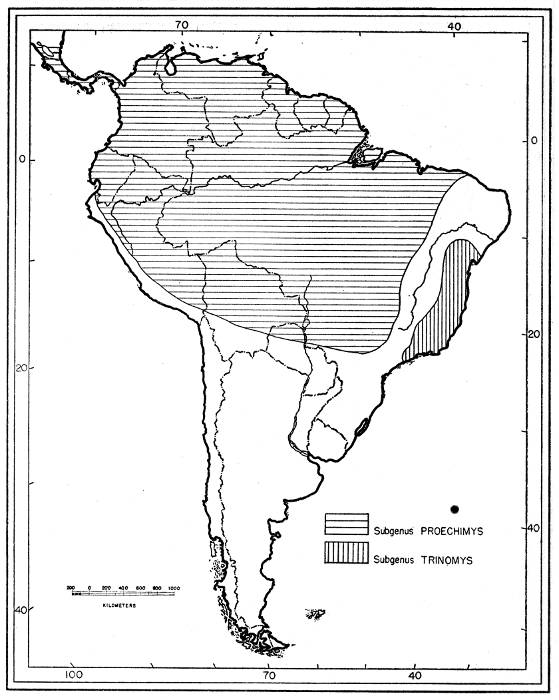
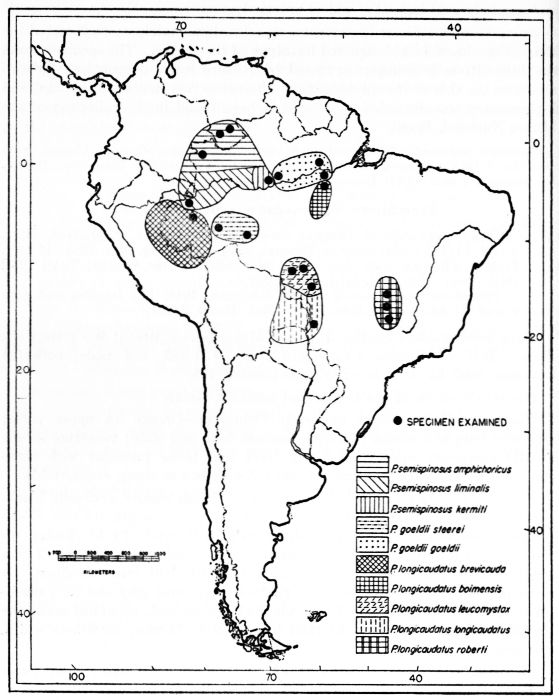 Fig. 61. Map showing the geographic ranges of the subspecies of three species of the
subgenus Proechimys in Brazil.
Fig. 61. Map showing the geographic ranges of the subspecies of three species of the
subgenus Proechimys in Brazil.
Teeth.—Upper molariform teeth usually with three counterfolds (92.5 per
cent of 42 specimens); M2 with four counterfolds in 5 per cent of specimens;
M3 with two counterfolds in 2.5 per cent of specimens. Lower molariform
teeth: p4 usually with three counterfolds (97.5 per cent of 39 specimens);
rarely with four (2.5 per cent); m1 with three counterfolds in 58 per cent and
two counterfolds in 42 per cent of specimens; m2 with three counterfolds in
61 per cent and two counterfolds in 39 per cent of specimens; m3 always with
only two counterfolds.
Comparisons.—From P. l. boimensis, roberti differs in: wider incisive foramen;
lower premolar with three, and one or two lower molars with only two,
counterfolds, instead of lower premolar with four and all lower molars with
three counterfolds. From P. longicaudatus, roberti differs in: upper parts
Ochraceous-Orange instead of Ochraceous-Buff; incisive foramen wider in
posterior third than in anterior third.
Remarks.—This subspecies seems to be adapted to forests of post-climactic
conditions which is probably typical of most valleys and
margins of the rivers in southern Goiaz and western Minas Gerais.
It was found in Goiaz usually in riparian forests with climactic associations
or in some advanced stage of the sere. The animals also
make incursions into nearby open areas or crops of corn.
Specimens examined.—Total number, 52, from Brazil, as follows: Minas Gerais, Araguarí,
Rio Jordão (effluent of Parnaiba), 960 meters alt., 2 (1 CNHM, 1 DZ); Goiaz, Anapolis,
1010 meters alt., 38 (MN); Goiaz, Pouso Alto, 768 meters alt., 11 (MN); Goiaz, Tio São
Miguel, 2 (MN).
Mus guyannensis E. Geoffroy Saint-Hilaire, 1803, Catalogue des mammifères
du Museum d'Histoire Naturelle, Paris, p. 194.
Echimys cayennensis Desmarest, 1817, Nouv. Dict. Hist. Nat., Paris,
nouv. ed., 10:59.
Proechimys cayennensis Allen, 1899, Bull. Amer. Mus. Nat. Hist.,
12(20):261, 264; Tate, 1935, Bull. Amer. Mus. Nat. Hist., 68(5):399; Ellerman,
1940, The families and genera of living rodents, Brit. Mus. (Nat.
Hist.), 1:120.
General characters.—Size medium to large; tail usually short; aristiforms
narrow to wide; general color of setiforms on back ranging from Tawny to
Ochraceous-Buff and becoming gradually lighter on sides; no conspicuous dark
longitudinal band on back; upper parts of hands and feet white to light
brown; underparts white, including inner sides of legs; skull elongate and not
conspicuously ridged; vomerine sheath complete or incomplete; upper premolar
with three counterfolds and molars with two or three; lower premolar
with three or four counterfolds, and lower molars with two or three.
Type locality.—Tapirapoã, Rio Sepotuba, Cáceres, Mato Grosso, Brazil.
Type: Museu Nacional, no. 1932, adult male (color faded); collected on 2
February, 1909, by Prof. A. Miranda Ribeiro; original number, 788 A.
Range.—Serra dos Parecís, headwaters of Paraguai and Tapajoz rivers.
Diagnosis.—Aristiforms wide and stiff; general color on upper parts Ochraceous-Orange;
incisive foramen long; vomerine sheath incomplete or complete;
lower premolar with four counterfolds, remaining molariform teeth with three
counterfolds.
Pelage.—Aristiforms on middorsal region: Whitish basally, gradually becoming
gray toward tip, with distal fourth blackish and ending as a long filament;
total length, 22 to 23 mm; maximum width, 1 mm. Setiforms on middorsal
region: Whitish on basal half, gradually blackening toward tip but interrupted
by Ochraceous-Orange, subapical zone 5 mm long; total length, 26 to 30
mm; width, 0.04 to 0.12 mm. Setiforms on outer thighs: Whitish on basal half,
gradually blackening toward tip but interrupted by Ochraceous-Buff to Ochraceous-Orange
subapical zone; total length 20 to 23 mm; width, 0.03 to 0.18 mm.
Skull.—Strong; supraorbital ridges raised and extending across anterior fourth
of parietals; nasals elongate; bullae rounded, inflated, with shallow grooves;
postorbital process of zygoma weakly developed and constructed entirely of
jugal; incisive foramen elongate and narrow (5.5 x 2.5 mm), posteriorly constricted
with posterior margins elevated above surface of bones; vomerine
sheath incomplete or complete but, when complete, with maxillary part filiform
and delicate; mesopterygoid fossa extending forward as far as middle, or even
anterior, parts of third molars; posterior palatine foramina on plane of centers,
or even anterior faces, of second molars.
Teeth.—Upper molariform teeth with three counterfolds. Lower molariform
teeth: premolar with four counterfolds, molars with three counterfolds, sometimes
with two folds coalesced in center of tooth.
Comparison.—From P. g. ribeiroi, and P. g. bolivianus, villicauda differs in
wider aristiforms. From P. g. ribeiroi, villicauda further differs in: larger and
wider incisive foramen; vomerine sheath incomplete or complete instead of
always complete and thick. From P. g. bolivianus, villicauda differs in: lower
premolars always, instead of rarely, with four counterfolds, and m3 always with
three counterfolds instead of usually with only two counterfolds.
Specimens examined.—Total number, 4, from Brazil, Mato Grosso, as follows: Cáceres,
Tapirapoã, 3 (MN); Diamantino, Rio Papagaio, Utiarití, 1 (AMNH).
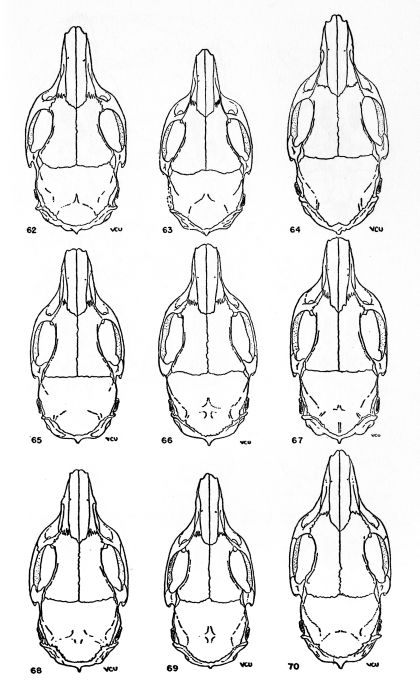
Fig. 62. Proechimys guyannensis villicauda, male, MN no. 1932, Tapirapoã. Type. × 1.
× 1.
Fig. 63. Proechimys guyannensis ribeiroi, male, MN no. 1935, Rio Doze de Outubro.
Type. × 1.
Fig. 64. Proechimys guyannensis hyleae, male, MCZ no. 30887, Tauarí. Type. × 1.
Fig. 65. Proechimys guyannensis nesiotes, male, CNHM no. 19496, Ilha de Manapirí.
Type. × 1.
Fig. 66. Proechimys guyannensis leioprimna, female, CNHM no. 19503, Cametá. Type.
× 1.
Fig. 67. Proechimys guyannensis oris, male, CNHM no. 19495, Providencia. × 1.
Fig. 68. Proechimys guyannensis arescens, male, CNHM no. 26440, Fazenda Inhuma.
Paratype. × 1.
Fig. 69. Proechimys guyannensis riparum, female, AMNH no. 143018, Manaus. Type.
× 1.
Fig. 70. Proechimys guyannensis arabupu, male, AMNH no. 75816, Arabupu. Type. × 1.
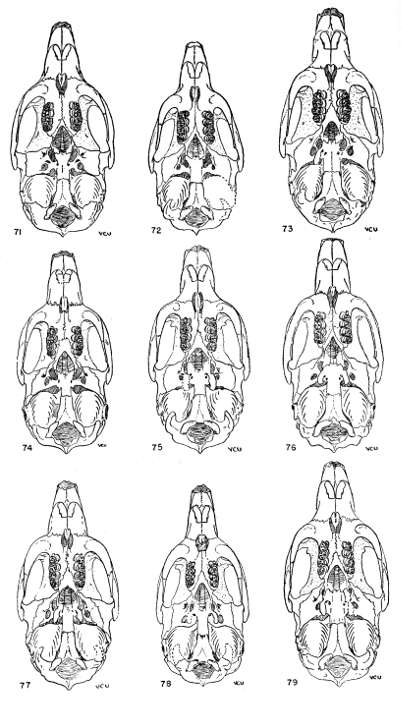
Fig. 71. Proechimys guyannensis villicauda, male, MN no. 1932, Tapirapoã. Type. × 1.
Fig. 72. Proechimys guyannensis ribeiroi, male, MN no. 1935, Rio Doze de Outubro.
Type. × 1.
Fig. 73. Proechimys guyannensis hyleae, male, MCZ no. 30887, Tauarí. Type. × 1.
Fig. 74. Proechimys guyannensis nesiotes, male, CNHM no. 19496, Ilha de Manapirí.
Type. × 1.
Fig. 75. Proechimys guyannensis leioprimna, female, CNHM no. 19503, Cametá. Type.
× 1.
Fig. 76. Proechimys guyannensis oris, male, CNHM no. 19495, Providencia. × 1.
Fig. 77. Proechimys guyannensis arescens, male, CNHM no. 26440, Fazenda Inhuma.
Paratype. × 1.
Fig. 78. Proechimys guyannensis riparum, female, AMNH no. 143018, Manaus. Type.
× 1.
Fig. 79. Proechimys guyannensis arabupu, male, AMNH no. 75816, Arabupu. Type. × 1.
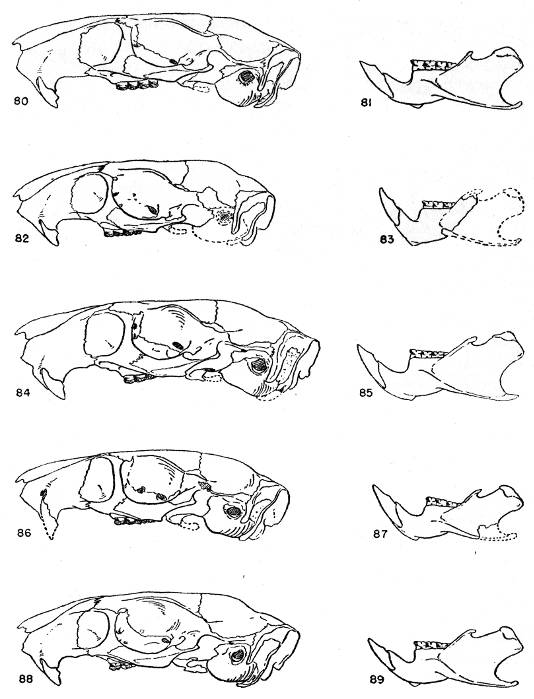
Figs. 80, 81. Proechimys guyannensis villicauda, male, MN no. 1932, Tapirapoã. Type.
× 1.
Figs. 82, 83. Proechimys guyannensis ribeiroi, male, MN no. 1935, Rio Doze de Outubro.
Type. × 1.
Figs. 84, 85. Proechimys guyannensis hyleae, male, MCZ no. 30887, Tauarí. Type. × 1.
Figs. 86, 87. Proechimys guyannensis nesiotes, male, CNHM no. 19496, Ilha de Manapirí.
Type. × 1.
Figs. 88, 89. Proechimys guyannensis leioprimna, female, CNHM no. 19503. Type. × 1.
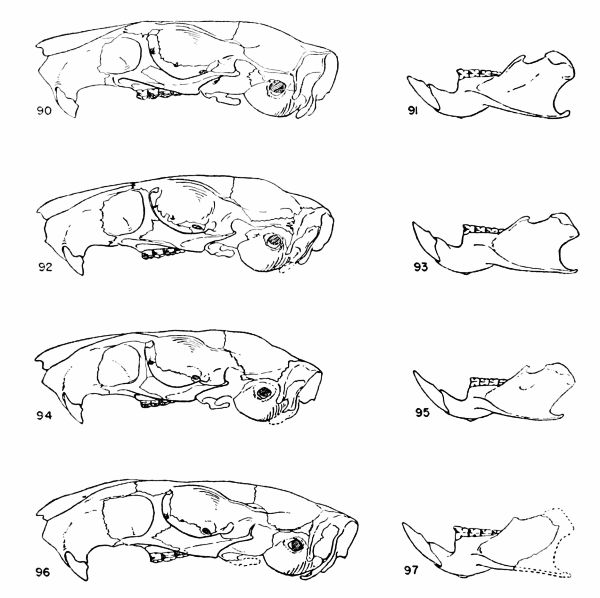
Figs. 90, 91. Proechimys guyannensis oris, male, CNHM no. 19495, Providencia. × 1.
Figs. 92, 93. Proechimys guyannensis arescens, male, CNHM no. 26440, Fazenda Inhuma.
Paratype. × 1.
Figs. 94, 95. Proechimys guyannensis riparum, female, AMNH no. 143018, Manaus.
Type. × 1.
Figs. 96, 97. Proechimys guyannensis arabupu, male, AMNH no. 75816, Arabupu. Type.
× 1.
Type locality.—Rio 12 de Outubro, affluent of the Camararé, Mato Grosso,
Mato Grosso, Brazil; about 190 kilometers west of Utiarití; altitude 414 meters.
Type: Museu Nacional, no. 1935, adult male (colors faded); collected on 20
June, 1909, by Prof. A. Miranda Ribeiro; original number G.
Range.—Known only from the type locality.
Diagnosis.—Aristiforms wide and stiff; incisive foramen small and narrow;
vomerine sheath complete and thick; p4 with four counterfolds; remaining
molariform teeth with three counterfolds.
Pelage.—Aristiforms on middorsal region: Whitish basally, gradually blackening
toward tip; total length, 19 to 22 mm; maximum width, 0.8 mm. Setiforms
on middorsal region: Whitish on basal half, gradually blackening toward
tip but interrupted by subapical zone probably of some tint of ochraceous; total
length, 22 to 24 mm; maximum width, 0.06 mm. Setiforms on outer thighs:
Whitish basally, gradually blackening toward tip but interrupted by probably
light ochraceous, subapical zone; total length 14 to 16 mm; maximum width,
0.03 mm.
Skull.—Slender; supraorbital ridges low; bullae ovate with shallow grooves;
postorbital process of zygoma almost obsolete and involving mostly jugal; incisive
foramen short and narrow (4 × 2 mm), constricted posteriorly and with
posterior margins raised; vomerine sheath complete and thick; mesopterygoid
fossa extending forward as far as posterior faces of second molars; posterior
palatine foramina on plane with centers of second molars.
Teeth.—Upper molariform teeth with three counterfolds. Lower molariform
teeth: p4 with four counterfolds; molars with three counterfolds which sometimes
are fused.
Comparisons.—From P. g. bolivianus, ribeiroi differs in: aristiforms wider;
incisive foramen shorter and narrower; vomerine sheath complete and thick,
instead of complete or incomplete and not thick; p4 always with four, instead
of usually only three, counterfolds and lower molars always with three, instead
of sometimes with only two, counterfolds in m3. Differences from P. g. villicauda
are given in the account of that subspecies.
Remarks.—The name ribeiroi is given in honor of the late Professor
Alipio Miranda Ribeiro, in recognition of his important work
in Brazilian vertebrate zoology.
Specimens examined.—Total number, 2 (MN), from Brazil, Mato Grosso, Mato Grosso,
Rio 12 de Outubro; altitude, 414 meters.
Type locality.—Tauarí, Rio Tapajoz, Porto de Moz, Pará, Brazil; approximately
87 kilometers south of Santarem. Type: Museum of Comparative
Zoology at Harvard College, no. 30887, adult male; collected on 19 January,
1934, by A. M. Olalla; original number 7288.
Range.—Region of lower Tapajoz River and banks of Amazon up to the
Jamundá River.
Diagnosis.—Aristiforms conspicuously wide and stiff; general color on upper
parts Tawny; incisive foramen long and oval; vomerine sheath complete
but with maxillary part slender or, sometimes, incomplete; p4 with four
counterfolds, rarely three; remaining molariform teeth with three counterfolds.
Pelage.—Aristiforms on middorsal region: Whitish basally, gradually becoming
blackish toward tip; total length, 19 to 21 mm; maximum width, 1.1
mm. Setiforms on middorsal region: a. Gray basally, gradually blackening
toward tip but interrupted by wide (5 to 6 mm) Tawny, subapical zone; some
are whitish basally and gradually become sooty brown toward tip except for
same type of subapical zone (tip only slightly darker than subapical zone);
b. With the same type described above and some completely blackish, with
the base gray; total length 22 to 25 mm; maximum width, 0.1 mm. Setiforms
on outer thighs: Whitish basally, gradually becoming gray and then blackish
toward tip but interrupted by long, Ochraceous-Tawny, subapical zone; tip,
itself, blackish brown; sometimes this type appears with some lighter ones
and sometimes with completely blackish setiforms; total length 16 to 18 mm;
maximum width 0.3 mm.
Skull.—Medium in size and slender; cranium narrow and not increasing
much in breadth posteriorly; rostrum stout, laterally thick, with masseteric
crest well-developed; nasals pointed posteriorly; supraorbital ridges broad
but barely extended across parietals; zygomatic arches strong; postorbital
process of zygoma involving mostly squamosal; incisive foramen long and
narrow (5.5 to 6 × 2.5 mm), oval and extending posteriorly to point only 2 mm
anterior to premolars; vomerine sheath complete with maxillary part usually
slender; mesopterygoid fossa extending forward as far as centers of third
molars; bulla of medium size, well inflated and with shallow grooves on surface.
Teeth.—Upper molariform teeth with three counterfolds. Lower premolar
with four counterfolds or, sometimes (20 per cent of 15 specimens), with only
three; lower molars with three counterfolds.
Comparisons.—From P. g. oris and P. g. nesiotes, hyleae differs in: wider
aristiforms; general color on upper parts Tawny, instead of Ochraceous-Orange;
vomerine sheath not always complete, instead of always complete. From P. g.
oris, hyleae differs in: p4 usually with four, instead of only three counterfolds
and all molars with three, instead of only lower molars with three counterfolds.
From P. g. nesiotes, hyleae differs in: p4 usually, instead of always,
with four counterfolds; color on back Tawny instead of Ochraceous-Orange;
aristiforms wider.
Remarks.—This subspecies shows greater variability than any
other in this species. There are two types of coloration. The most
common type of coloration is dark, with Tawny, subapical zones in
the setiforms of the middorsal region and many completely black
setiforms; in the other type the subapical zone is still Tawny but
there are no black setiforms. One specimen from Obidos, on the
north bank of the Amazon, completely agrees in the characteristics
of color and skull with the reddish type and suggests either that
there is an extension of the range of the subspecies along the lower
course of the Tapajoz or that there are two subspecies, in which
event the animals from Tauarí are intergrades between hyleae and
an unnamed, tawny-colored subspecies occurring to the southward.
Between 13 and 23 January, 1934, A. M. Olalla collected 10 adult
females, 6 of which contained embryos. Three of the females had
2 embryos each, two had 3 embryos each and one had only 1 embryo.
At this same time and place only ten per cent of specimens
obtained were not fully adult.
Specimens examined.—Total number, 21, from Brazil, Pará, as follows: Porto de Moz,
Tauarí, right bank of Tapajoz, approximately 85 kilometers south of Santarem, 20 (19 MCZ,
1 CNHM); Obidos, Obidos, 1 (MCZ).
Type locality.—Ilha de Manapirí, Rio Tocantins, Pará, Brazil. Type: Chicago
Natural History Museum, no. 19496, adult male; collected on 9 December,
1910, by Dr. Emilia Snethlage; original number, 12.
Range.—Known only from the type locality.
Diagnosis.—Aristiforms wide and stiff; general color on upper parts Ochraceous-Orange;
incisive foramen long, with parallel borders; vomerine sheath
complete and thick; p4 with four counterfolds, remaining molariform teeth with
three counterfolds.
Pelage.—Aristiforms on middorsal region: Gray basally, gradually blackening
toward tip; total length, 18 to 19 mm; maximum width, 0.9 mm. Setiforms on
middorsal region: Gray basally, gradually blackening toward tip but interrupted
by Ochraceous-Orange, subapical zone 4 mm long; total length 16 to 19
mm; maximum width, 0.06 mm. Setiforms on outer thighs: Whitish basally,
gradually becoming gray and blackish toward tip but interrupted by Ochraceous-Buff,
subapical zone 3 mm long; total length, 13 to 15 mm; maximum
width, 0.03 mm.
Skull.—Of medium size; rostrum short; nasals pointed posteriorly; postorbital
ridges extending caudad across anterior fifth of parietals; zygomatic
arches strong; jugal with process in posterior part of masseteric fossa; postorbital
process of zygoma involving mostly squamosal; incisive foramen elongate,
narrow (5 x 2.3 mm), and parallel sided; posterior margin of incisive foramen
approximately 3 mm anterior to premolars; margins of foramen raised to form
ridges; vomerine sheath complete, of almost uniform width and set deeply in
foramen; mesopterygoid fossa extending forward as far as centers of third
molars; bullae of medium size and inflated.
Teeth.—Upper molariform teeth with three counterfolds; p4 with four
counterfolds; m1-3 with three counterfolds.
Comparison.—From P. g. oris, nesiotes differs in: Aristiforms conspicuously
wider; incisive foramen shorter and narrower, with borders parallel instead of
posteriorly constricted; posterior margin of incisive foramen farther from premolars;
p4 with four, instead of three, counterfolds; lower molars with three
instead of two counterfolds. From P. g. leioprimna, nesiotes differs in: Incisive
foramen with parallel borders instead of oval; p4 with four instead of three
counterfolds; m3 always with three instead of two counterfolds.
Remarks.—Dr. E. Snethlage mentions the type as having been collected at
night in the forest.
Specimens examined.—Total number, 8 (MCZ, CNHM, MN), from Brazil, Pará, Tocantins
River, Ilha de Manapirí.
Type locality.—Cametá, left bank of Tocantins River, near its mouth,
Cametá, Pará, Brazil. Type: Chicago Natural History Museum, no. 19503,
adult female; collected on 21 January, 1911, by Dr. Emilia Snethlage; original
number, 35.
Range.—Known only from type locality but probably extending westward
toward Xingú River.
Diagnosis.—Aristiforms wide and stiff; general color on upper parts Ochraceous-Orange,
incisive foramen moderately long; oval; vomerine sheath complete;
all molariform teeth with three counterfolds, except lower, third molar
which has only two.
Pelage.—Aristiforms on middorsal region: Gray basally, gradually blackening
toward tip which is extended as a short filament; total length, 19 to 21 mm;
maximum width, 0.8 to 1 mm. Setiforms on middorsal region: Whitish basally,
gradually blackening toward tip but interrupted by Ochraceous-Orange, subapical
zone 2 to 3 mm long; total length, 17 to 20 mm; maximum width 0.1
mm. Setiforms on outer thighs: Whitish basally, becoming gradually gray and
then blackish toward tip but interrupted by Ochraceous-Buff, subapical zone;
blackish tip short; total length 13 to 15 mm; maximum width 0.06 mm.
Skull.—Of medium size; rostrum relatively short; nasals with posterior
borders rounded; postorbital ridges extending across anterior fourth of parietals;
zygomatic arches moderately strong; postorbital process of zygoma involving
both jugal and squamosal; incisive foramen of medium length (4 to 5 mm)
and narrow (about 2.5 mm), oval and extending caudad to a plane approximately
2 mm anterior to premolars; vomerine sheath complete, with premaxillae
forming approximately anterior 3/4 of sheath; maxillary part of sheath short
but well-developed; mesopterygoid fossa extending forward as far as centers of
third molars; bullae of medium size but well-inflated.
Teeth.—Upper molariform teeth with three counterfolds. Lower molariform
teeth with three counterfolds, except third molar which has only two.
Comparison.—From P. g. oris, leioprimna differs in: conspicuously wider
aristiforms; shorter and narrower incisive foramen; lower molariform teeth
with three counterfolds (except m3 with only two), instead of lower molars
with only two counterfolds. Differences from P. g. nesiotes are given in the
account of that subspecies.
Remarks.—The paratype was collected in an "igarapé," depression
usually invaded by the river waters; the paratype, collected on
18 January, 1911, had two large embryos.
Specimens examined.—Total number, 4 (2 CNHM, 2 AMNH), from Brazil, Pará, Cametá.
Proechimys oris Thomas, September, 1904, Ann. Mag. Nat. Hist., 14
(ser. 7): 195; Thomas, 1905, Ann. Mag. Nat. Hist., 15 (ser. 7):587;
Thomas, 1912, Ann. Mag. Nat. Hist., 9 (ser. 8):89; Tate, 1935, Bull.
Amer. Mus. Nat. Hist., 68:400; Osgood, 1944, Zool. Ser. Field Mus. Nat.
Hist., 29:199.
Proechimys cayennensis oris Ellerman, 1940, The families and genera
of living rodents, Brit. Mus. (Nat. Hist.), 1:121.
Type locality.—Igarapé-assú, E. F. B., near Belem, Igarapé-assú, Pará,
Brazil. Type: British Museum (Nat. Hist.), no. 4.7.4.78, old male; collected
on 6 March, 1904, by Alphonse Robert; original number, 1818.
Range.—Probably most of the region on south bank of Amazon River, between
Tocantins (west) and Gurupí River (south).
Diagnosis.—Aristiforms narrow but somewhat stiff; color on upper parts
Ochraceous-Orange; incisive foramen long and wide, conspicuously constricted
posteriorly; posterior margin of incisive foramen close to plane of premolars;
vomerine sheath complete but maxillary part threadlike; upper molariform
teeth and lower premolar with three counterfolds; lower molars with only
two counterfolds.
Pelage.—Aristiforms on middorsal region: Gray basally, gradually blackening
toward tip, which is extended as a filament; total length, 16 to 17 mm;
maximum width, 0.6 to 0.7 mm. Setiforms on middorsal region: Gray basally,
gradually becoming blackish toward tip but interrupted by Ochraceous-Orange,
subapical zone 2 to 4 mm long; total length, 18 to 20 mm; maximum width
0.06 mm. Setiforms on outer thighs: Whitish basally, gradually becoming
blackish toward tip but interrupted by Ochraceous-Buff, subapical zone; total
length, 15 to 16 mm; maximum width, 0.04 mm.
Skull.—Of medium size; supraorbital ridges well developed and extending
across anterior fifth of parietals; zygomatic arches strong; jugal with masseteric
fossa deep and with well-developed posterior process; postorbital zygomatic
process involving mostly squamosal; incisive foramen long (6 to 7 mm),
widest anteriorly (2.5 to 3.2 mm); but narrowing posteriorly to less than 1 mm
and extending caudad almost to plane of premolars; vomerine sheath complete
but maxillary part delicate and threadlike; mesopterygoid fossa extending
forward as far as third molars or posterior parts of second molars; bullae
large and inflated.
Teeth.—Each upper molariform tooth with three counterfolds. In lower
jaw, premolar with three, and molars with only two, counterfolds.
Comparisons.—Differences from the subspecies with adjoining ranges are
given in the accounts of those subspecies.
Remarks.—Thomas (1912:89) extended the known range of the
subspecies to Faro, on the Jamundá River, on the left bank of the
Amazon, and to Boim, on the Tapajoz River, as well as to Benevides,
E. F. Braganca, near Belem. It seems to me that the specimens
from Faro should be referred provisionally to Proechimys
guyannensis hyleae; the specimens from Boim are "more brightly
rufous" (Thomas, loc. cit.) and could be referred to Allen's P.
boimensis, described in 1914, but P. guyannensis hyleae probably
lives in the same place and only an examination of the specimens,
which I have not seen, would permit of certainly allocating the
specimens to their correct species. The specimens from Benevides
are more certainly P. g. oris.
E. Snethlage collected one specimen in a garden (Providencia,
E. F. B.). However, according to the personnel of the Brazilian
Health Service, the animals are strictly forest dwellers although
they do make excursions into more open places.
Specimens examined.—Total number, 3, from Brazil, Pará, as follows: Providencia, E. F.
B., approximately 15 kilometers east from Belem, 1 (CNHM); Tanaquará, near Belem, 1
(MN); Rio Guamá, near Belem, 1 (AMNH).
Additional record.—Brazil, Pará, Benevides, E. F. B.,
approximately 100 kilometers north-east of Belem (Thomas, 1912:89).
Proechimys cayennensis arescens Osgood, 12 July 1944, Zool. Ser. Field
Mus. Nat. Hist., 29(13): 198.
Type locality.—Fazenda Inhuma, below Santa Filomena, upper Rio Parnaiba,
Vitoria do Alto Parnaiba, Maranhão, Brazil. Type: Chicago Natural
History Museum, no. 26441, adult male; collected on 5 August, 1925, by
Heinrich E. Snethlage.
Range.—Region including the valleys of the Turí-assú and Parnaiba rivers,
Maranhão, Brazil.
Diagnosis.—Aristiforms moderately wide and not conspicuously stiff; general
color of upper parts near (15'a) Ochraceous-Orange; incisive foramen
long and wide; vomerine sheath complete or incomplete; upper molariform
teeth and lower premolar with three counterfolds; lower molars with only two.
Pelage.—Aristiforms on middorsal region: Whitish basally, gradually
blackening toward tip; total length, 19 to 21 mm; maximum width, 0.7 mm.
Setiforms on middorsal region: Whitish basally or on basal half, gradually
becoming gray and then blackish toward tip, but interrupted by long (5 to
6 mm) subapical zone near (15'a) Ochraceous-Orange; total length, 15 to
16 mm; maximum width 0.05 mm. Setiforms on outer thighs: Whitish on
basal half, gradually becoming gray and then blackish toward tip but interrupted
by Ochraceous-Buff, subapical zone; tip sometimes not conspicuously
darker than subapical zone; total length 18 to 25 mm; maximum width,
0.03 mm.
Skull.—Medium in size, not elongated; nasals pointed posteriorly; supraorbital
ridges strong and thick, extending caudad across anterior third of
parietals; zygomatic arches strong; postorbital process of zygoma involving
only squamosal; incisive foramen 5 by 2.7 mm, oval and extending caudad
to plane approximately 2 mm anterior to premolars; posterior margins of incisive
foramen not forming a ridge; vomerine sheath complete and with maxillary
part slender and threadlike, or incomplete, in which event, maxillary
part not extended enough to join premaxillary process; mesopterygoid fossa
extending forward as far as centers of third molars; bulla large and more or
less triangular in its peripheral outline.
Teeth.—Upper molariform teeth with three counterfolds each. Lower premolar
with three counterfolds; lower molars with two counterfolds.
Comparisons.—From P. g. oris, arescens differs in: Color of upper parts
lighter and more uniform; incisive foramen oval instead of conspicuously constricted
posteriorly; posterior margin of incisive foramen farther from premolars.
Remarks.—One specimen from Turí-assú (MN) has been identified
by O. Thomas as "P. oris" (his own handwriting is on the
label) and the subspecies is really closely related to oris.
Specimens examined.—Total number, 3, from Brazil, Maranhão, as follows: Vitoria do
Alto Parnaiba, Fazenda Inhuma (below Santa Filomena), 2 (CNHM); Alto da Alegria, Turí-assú,
1 (MN).
Type locality.—Manaus, Manaus, Amazonas, Brazil. Type: American Museum
of Natural History, no. 143018, adult female; collected 6 March, 1943.
Range.—Known only from type locality but probably extending northward
and eastward.
Diagnosis.—Aristiforms wide and stiff; upper parts Ochraceous-Tawny; incisive
foramen short, wide, and oval; vomerine sheath incomplete; upper
molariform teeth and lower premolar with three counterfolds; lower molars
with only two counterfolds.
Pelage.—Aristiforms on middorsal region: Gray basally gradually blackening
toward tip; total length, 18 to 20 mm; maximum width, 0.9 mm. Setiforms
on middorsal region: Whitish basally, gradually blackening toward tip
but interrupted by 2 mm long, Ochraceous-Tawny, subapical zone; total
length 20 to 22 mm; maximum width, 0.04 mm. Some are whitish basally
and gradually become black toward tip with no subapical zone. Setiforms on
outer thighs: Whitish basally, gradually becoming gray and then blackish
toward tip but interrupted by Ochraceous-Buff, subapical zone 3 to 4 mm
long; tip not conspicuously dark; total length, 17 to 19 mm; maximum width,
0.03 mm.
Skull.—Of medium size and slender; rostrum slender; nasals rounded posteriorly;
supraorbital ridges well developed and barely extended onto anteriormost
part of parietals; zygomatic arches slender; infraorbital foramen
with well-developed groove for nerve transmission; postorbital process of
zygoma almost obsolete and involving mostly squamosal; incisive foramen
short and wide (4.5 × 3.3 mm), oval and with posterior margins raised to form
ridges which extend toward premolars; posterior margin of incisive foramen
approximately 2.5 mm anterior to premolars; vomerine sheath incomplete,
with only short, premaxillary part; mesopterygoid fossa extending forward as
far as anterior parts of third molars; bullae large and inflated, with more or
less triangular outline.
Teeth.—Crown length of well worn P4-M3, 6.8 mm; upper molariform
teeth with three counterfolds each. Lower premolar with three counterfolds;
lower molars with two counterfolds.
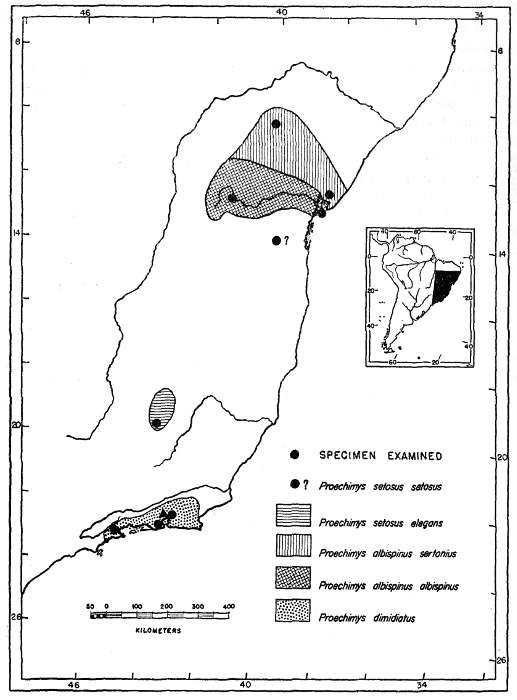
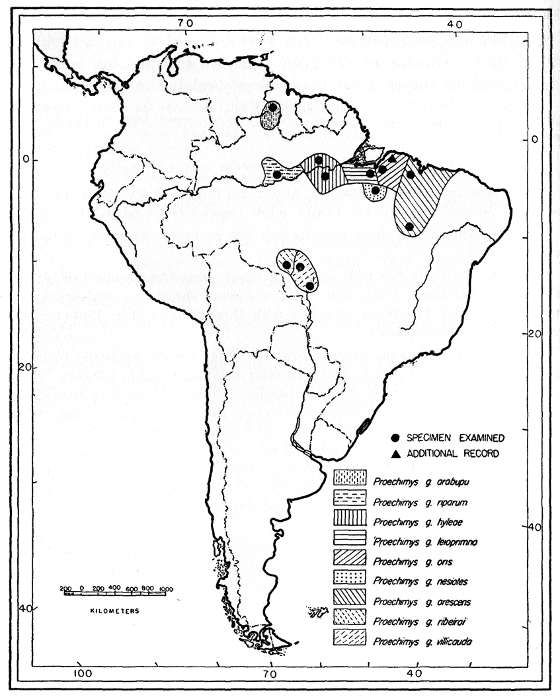 Fig. 98. Map showing the geographic ranges of the subspecies of Proechimys guyannensis in
Brazil.
Fig. 98. Map showing the geographic ranges of the subspecies of Proechimys guyannensis in
Brazil.
Comparisons.—From P. g. oris and P. g. hyleae, riparum differs in: Shorter
and wider incisive foramen; vomerine sheath incomplete, instead of sometimes
incomplete. From P. g. oris, riparum differs in: Upper parts Ochraceous-Tawny
instead of Ochraceous-Orange; aristiforms conspicuously wider.
From P. g. hyleae, riparum differs in: Aristiforms narrower; upper parts
Ochraceous-Tawny instead of Tawny; lower premolars with three, instead of
four, counterfolds; lower molars with two, instead of three, counterfolds.
Specimens examined.—Type only.
Type locality.—Arabupu, Mount Roraima, Boa Vista, Territ. Rio Branco;
about 1540 meters altitude. Type: American Museum of Natural History,
no. 75816, adult male; collected by Dr. G. H. H. Tate on 30 December, 1927;
original number, 4716.
Range.—Known only from the type locality.
Diagnosis.—Aristiforms conspicuously wide and stiff; color on upper parts
dark, near (15'j) Ochraceous-Tawny; incisive foramen widest in anterior
third; vomerine sheath complete, sometimes incomplete; upper molariform
teeth and lower premolar with three counterfolds; lower molars with two
counterfolds.
Pelage.—Aristiforms on middorsal region: Whitish basally, gradually
blackening toward tip; total length, 19 to 22 mm; maximum width, 1.1 mm.
Setiforms on middorsal region: Gray basally, gradually blackening toward tip
but interrupted by dark (15'j) Ochraceous-Tawny, subapical zone 3 mm
long; some completely blackish on distal parts; total length, 20 to 23 mm;
maximum width, 0.07. Setiforms on outer thighs: Whitish basally, gradually
blackening toward tip but interrupted by Ochraceous-Buff or Light Ochraceous-Buff,
subapical zone; total length, 20 to 23 mm; maximum width,
0.07 mm.
Skull.—Size medium; nasals pointed posteriorly; supraorbital ridges prominent
and slightly extended caudad onto anterior half of parietals; groove for
transmission of nerve in infraorbital foramen weakly developed; zygomatic
arches strong; postorbital process of zygoma involving mostly squamosal;
incisive foramen approximately 5.5 × 2.7 mm, widest in anterior third and
constricted posteriorly, with posterior margin about 1 mm anterior to plane
of premolars; vomerine sheath complete, with premaxillary part expanded
and maxillary part notably slender and sometimes lacking; mesopterygoid
fossa in some specimens extending forward as far as middle parts of second
molars; bullae large and inflated.
Teeth.—Upper molariform teeth with three counterfolds each. Lower premolar
with three counterfolds; molars with only two.
Comparisons.—From P. g. warreni, arabupu differs in: Narrower aristiforms;
narrower incisive foramen; lower premolar with three instead of four
counterfolds; lower molars with two, instead of three, counterfolds. From
P. g. oris, arabupu differs in: Aristiforms wider; posterior margin of incisive
foramen farther from plane of premolars; upper parts dark (15'j) Ochraceous-Tawny,
instead of Ochraceous-Orange.
Remarks.—The sample is fairly uniform.
Specimens examined.—Total number, 6 (AMNH), from Brazil, Territorio do Rio Branco,
Boa Vista, Mount Roraima, Arabupu; approximately 1540 m. altitude.