SPECIAL TALENTS AND DEFECTS Their Significance for Education
Transcriber’s Note:
New original cover art included with this eBook is granted to the public domain.
Experimental Education Series
Edited by M. V. O’SHEA
SPECIAL TALENTS AND DEFECTS
THE MACMILLAN COMPANY
NEW YORK · BOSTON · CHICAGO · DALLAS
ATLANTA · SAN FRANCISCO
MACMILLAN & CO., Limited
LONDON · BOMBAY · CALCUTTA
MELBOURNE
THE MACMILLAN CO. OF CANADA, Ltd.
TORONTO
BY
LETA S. HOLLINGWORTH, Ph.D.
Associate Professor of Education
Teachers College, Columbia University
New York
THE MACMILLAN COMPANY
1923
All rights reserved
PRINTED IN THE UNITED STATES OF AMERICA
Copyright, 1923
By THE MACMILLAN COMPANY
Set up and electrotyped. Published August, 1923.
Norwood Press
J. S. Cushing Co.—Berwick & Smith Co.
Norwood, Mass., U.S.A.
TO
THE MEMORY OF
RUTH ELINOR STETTER
A GOOD TEACHER
PREFACE
vii
This book has proceeded haltingly, as must be evident
in many places, for it attempts to explore and describe a field
that is not well illuminated. The actual examination of
those mental functions which are relatively dissociated from
general intelligence has not been carried far by experimentalists.
However, the problems have been sufficiently formulated,
and enough evidence has been secured, to warrant
attempts at gleaning implications for education, even now.
Mine is the comparatively humble task of bringing together
in an ordered presentation the works of original investigators,
in such a way that they will be available for
application. The appeal of the data is above all to educators,
but also, of course, to those who deal in any office with human
beings.
The chief difficulty in organizing the subject has been to
delimit it, as regards the psychology of the elementary school
subjects on the one hand, and mental measurement on the
other. It is not the purpose to cover either of these fields
in the present volume. Yet so closely are they related to the
study of special aptitudes in school children that it will be
scarcely possible to obtain the very clearest view of what is
here written without additional knowledge of these matters.
It will be observed, also, that there has been no attempt here
to teach introductory psychology. It is assumed that readers
of this volume will be acquainted with the vocabulary of
elementary psychology. The time has definitely passed when
it was either feasible or desirable to present all topics in a
single volume. Those who would learn what modern educational
viiipsychology has to teach now expect, first of all, to equip
themselves by study of a general introductory text.
The lists of references are selected, not complete. To
present complete bibliographies of all works bearing immediately
or remotely upon every topic treated would cumber the
volume inexcusably. References have been selected for these
lists because they are historically indispensable, because they
contain information of fundamental importance, or because
they summarize much previous work. I believe that the
selection is such that from the books and articles listed it will
be possible for the student who wishes to do so, to construct
the complete bibliography and history of each topic, up to
the present time.
The hundreds of teachers who have sat in the lecture room
of Professor E. L. Thorndike will see how many guiding
suggestions for this volume have come from that source.
Professor W. A. McCall has given counsel on certain chapters.
Many investigators and publishers have extended courtesies,
which are acknowledged through the references, and to which
attention is here gratefully directed. I am indebted to
Dr. John S. Richards, Medical Superintendent of The Children’s
Hospital, Randall’s Island, New York, and to
Mr. L. L. Kolburne, student at Teachers College, for assistance
in securing illustrative material for Chapter VII.
Finally, I have enjoyed the advantage of editorial supervision
by Professor M. V. O’Shea.
My chief hope for the volume is that it may contribute
toward the welfare of school children compelled to attend
upon prescribed education, without due regard for their idiosyncrasies
of original endowment.
The Coefficient of Correlation. General Intelligence vs. Special Aptitudes. Correlation of Abilities in Various Groups. Studies of Disorganizing Minds. Is Intellect Inherited as a Unit? Can an Intellect Be Trained as a Unit? The Hierarchy of Abilities. Present Status of the Problem. Measurement of General Intelligence: The IQ. Measurement of Special Ability. The Psychographic Picture of Individuality. At What Age Is Mental Endowment Evident? The Frequency of Marked Special Talents and Defects. Possible Origin of the Dissociation of Certain Capacities.
The Physiological Mechanism of Mental Life. Attempted Localization of Mental Functions. Theory of Congenital Lesion or Atrophy Criticized. Regeneration of Function without Regeneration of Structure in Injured Brains. Attempts to Establish a Neural Basis for the “Two Factor Theory” and the “Two Level Theory.” Present Status of the Problem.
Relation between IQ and Capacity for Reading. The Mechanics of Reading. Comprehension in Reading. Word Blindness. Psychological Studies of Special Defect in Reading. Nervous Instability and Special Defect in Reading. A Four-Year Study of a Non-Reader. Summary of Studies of Non-Readers. Cases of Special Ability in Reading. The Significance of Literacy.
Coherence among Linguistic Functions. Analysis of Learning to Spell. Psychological Examination of Poor Spellers. Can Special Defect in Spelling Be Overcome? Does Reading Teach Spelling? Illustrative Cases.
Relation between IQ and Capacity for Arithmetic. Distinction between Arithmetic and Mathematics. The Psychology of Arithmetical Calculation. The Organization of Arithmetical Abilities. Psychological Studies of Special Deficiency in Arithmetic. Methods of Detecting Wrong or Incomplete Habits. Nervous Instability and Special Deficiency in Arithmetic. Arithmetical Prodigies. Arithmetical Ability of Two Children of IQ 184 and IQ 187 (Stanford-Binet). The Inheritance of Arithmetical Abilities. Implications for Education.
The Various Kinds of Drawing. Ramifications of Drawing through the Curriculum. Psychological Analysis of Talent in Drawing. Relation between Aptitude in Drawing and General Intelligence. The Color-Blind. Illustrative Cases. Inheritance of Talent in Drawing. General Summary.
What Is Music? The Various Kinds of Music. The Analysis of Musical Talent. Relation among Various Elements of Musical Talent. Relation between Musical Talent and General Intelligence. Absolute Pitch. Tone Deafness. Range of Individual Differences. Can Musical Capacity Be Increased by Education? The Inheritance of Musical Talent. Psychographic Study of Individuals. Capacity to Appreciate Music.
The Values of Individuality. Compulsory Education. The Importance of General Intelligence for School Progress. Special Abilities and Disabilities as Determinants of School Progress. Experimental Attempts to Individualize Education. The Cost of Fostering Individuality. The Probable Rewards of Individualizing Education.
TABLE OF FIGURES
xiii
FIGURE
PAGE
1.
Distribution of ability to discriminate among intervals of time, the subjects being adults. (From Seashore’s The Psychology of Musical Talent. Reproduced by courtesy of Silver, Burdett and Company, and of the Columbia Graphophone Company.)
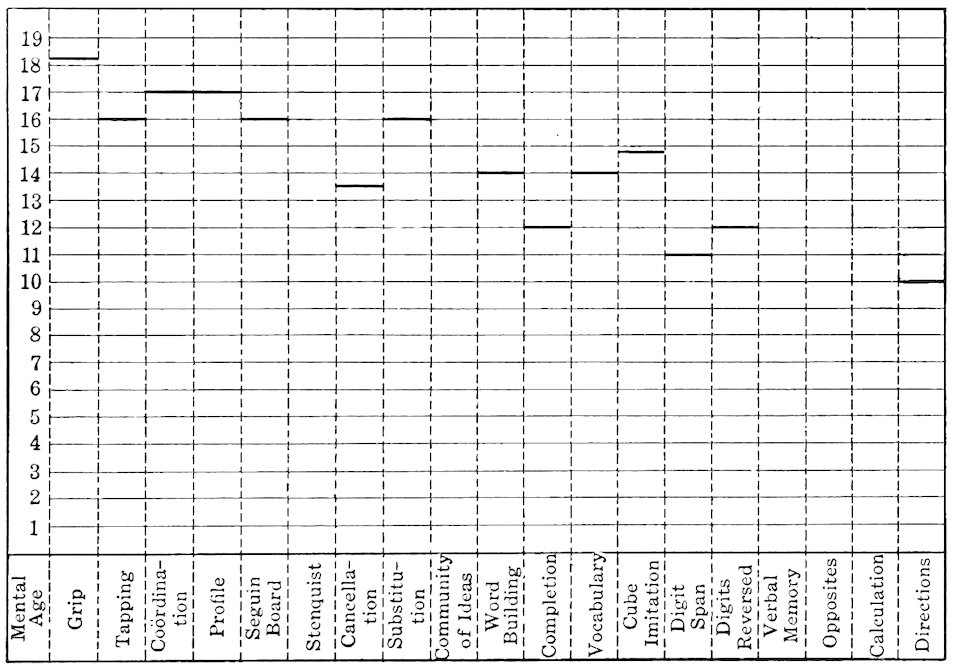
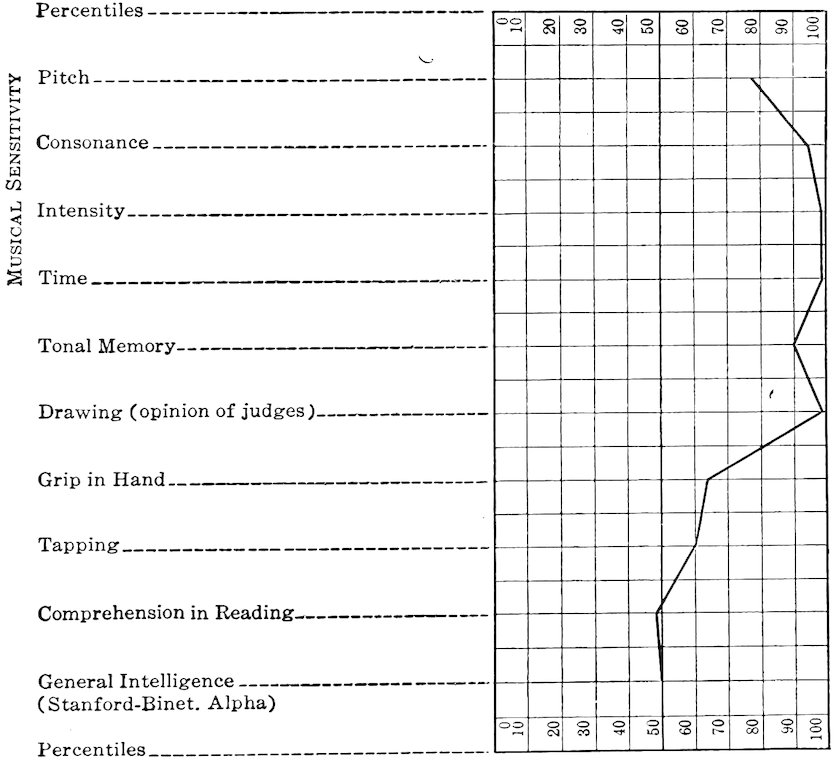
The psychograph of a schoolboy, showing his standing in various mental functions; illustrating use of the horizontal line to denote typical performance. (From Hollingworth’s Judging Human Character. Reproduced by courtesy of D. Appleton and Company.)
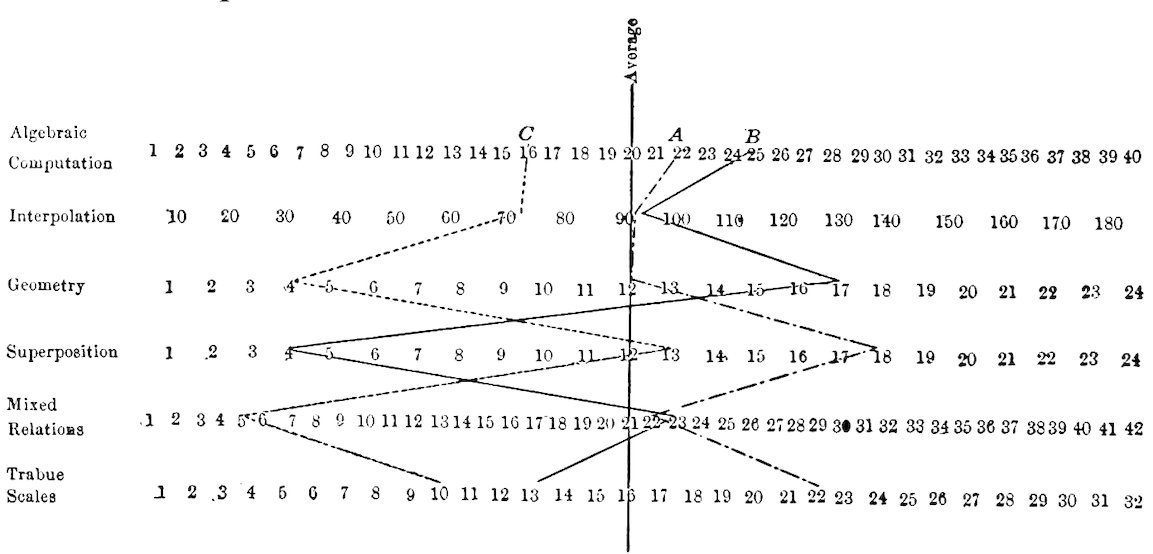
The psychographs of three schoolgirls, showing their standings in various mental functions, measured to determine mathematical ability; illustrating use of the vertical line to denote typical performance. (From Tests of Mathematical Ability and Their Prognostic Value. Reproduced by courtesy of Agnes L. Rogers.)
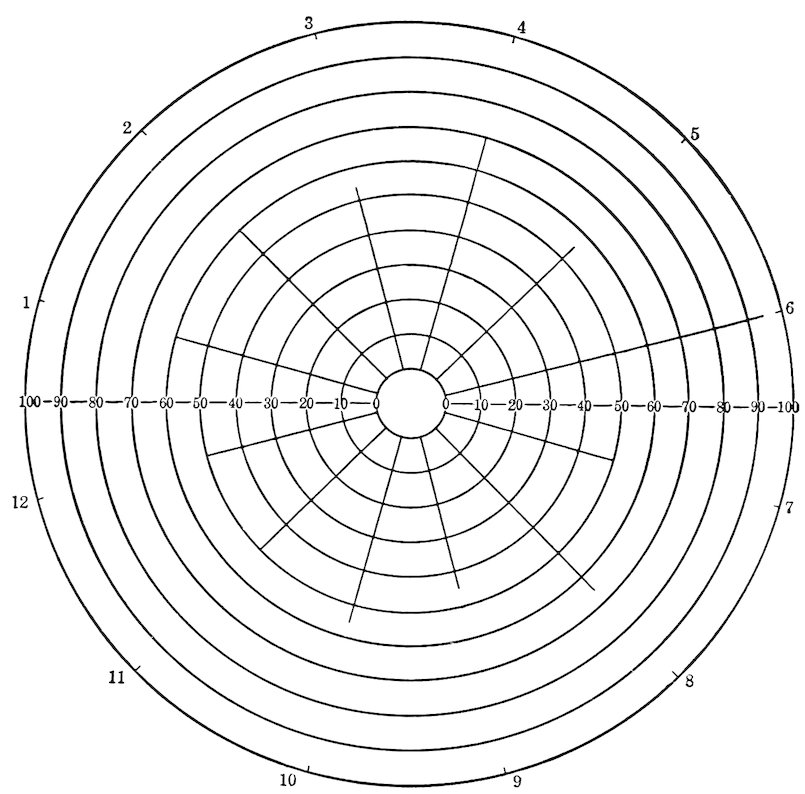
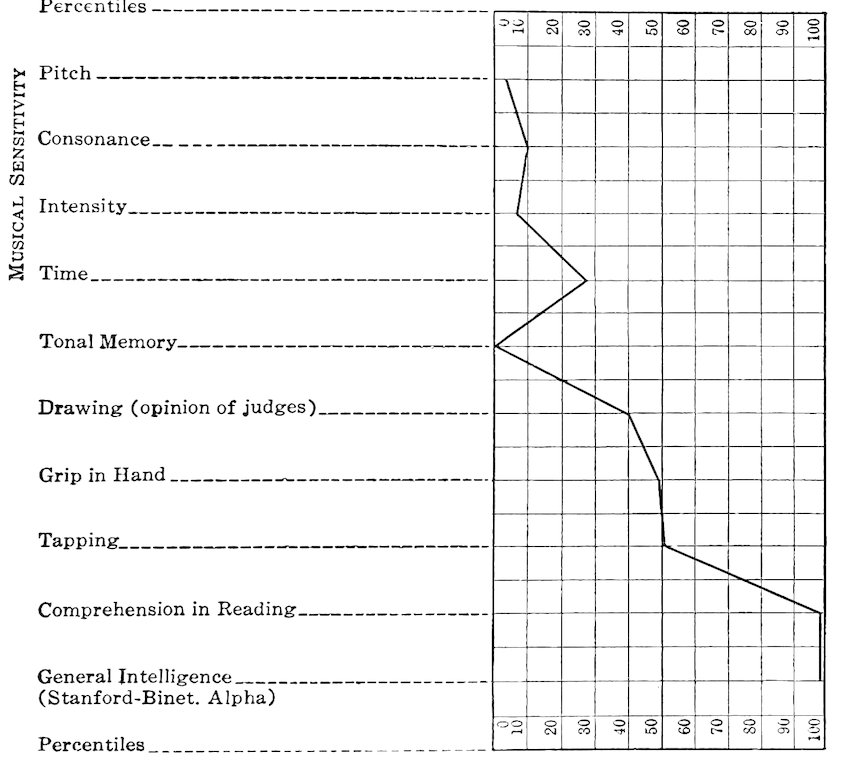
The psychograph of a schoolboy, showing his standing in various mental functions; illustrating use of the circle as a diagram, the median circumference denoting the typical performance of his age
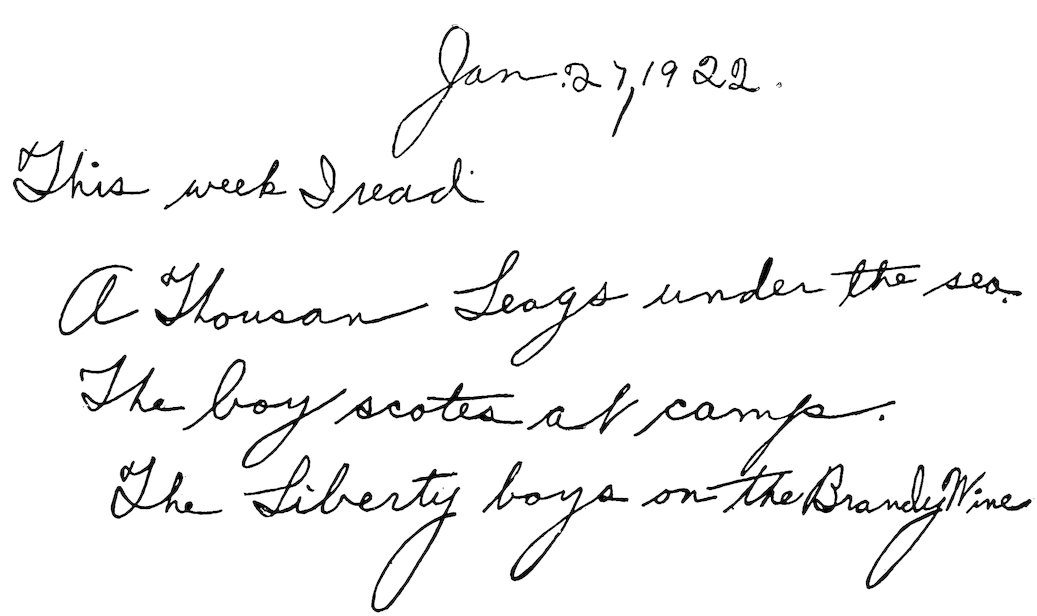
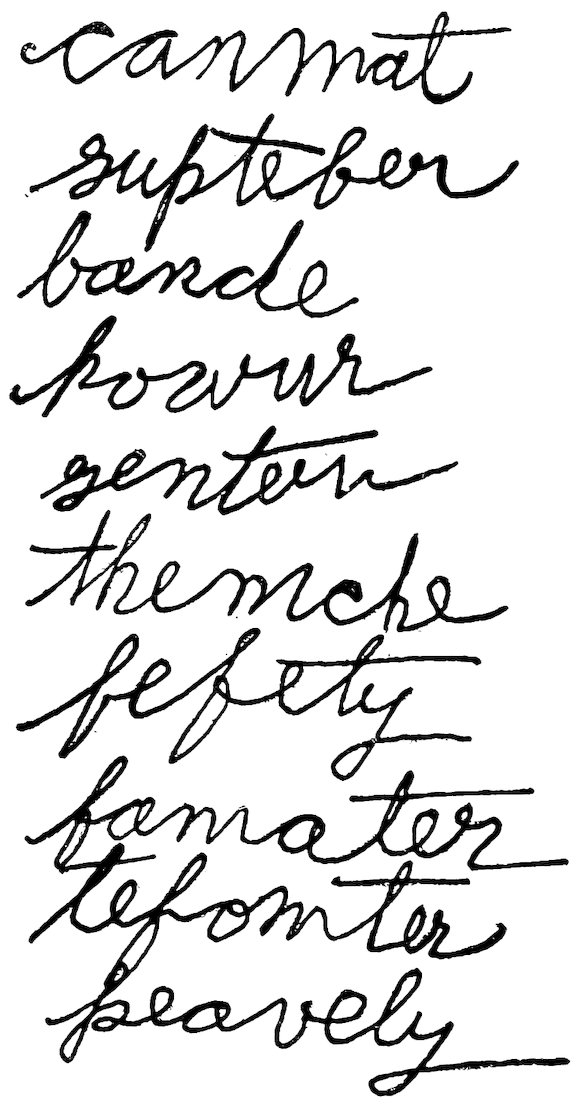
Showing efforts to spell of a 14-year-old schoolboy, of IQ 93, after eight years of school instruction. Illustrating extreme dissociation of spelling ability from general intelligence
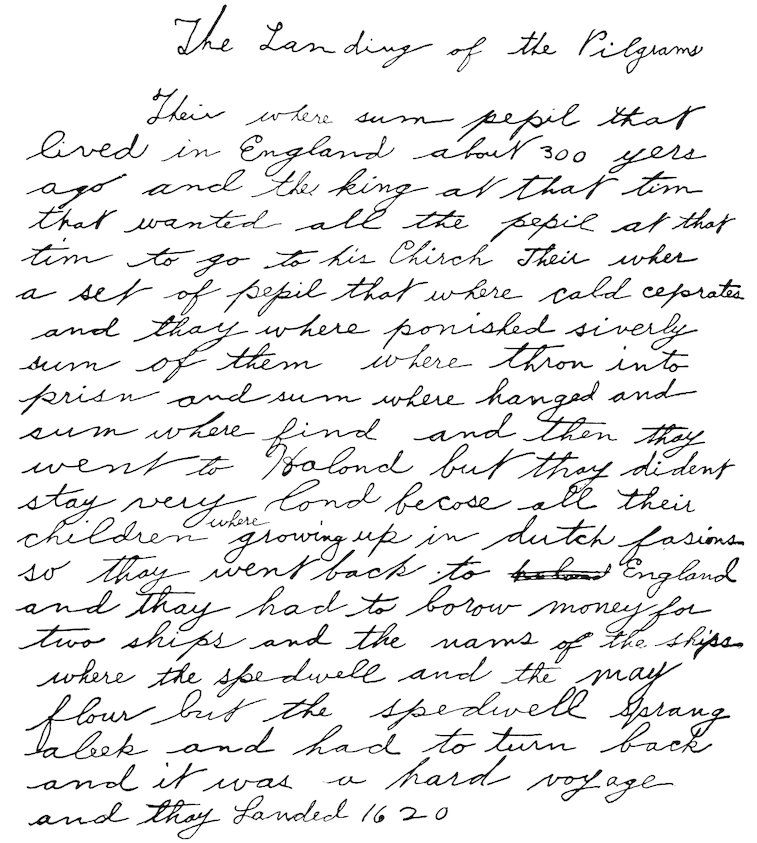
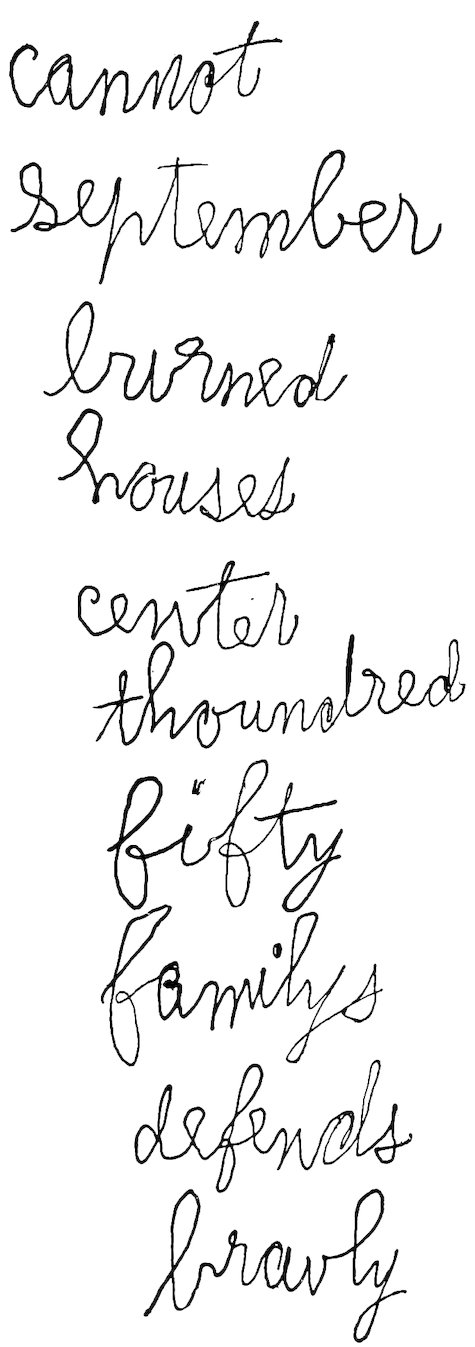
Showing spelling of a 12-year-old girl, of IQ 59, after six years of instruction. Illustrating extreme dissociation of spelling ability from general intelligence
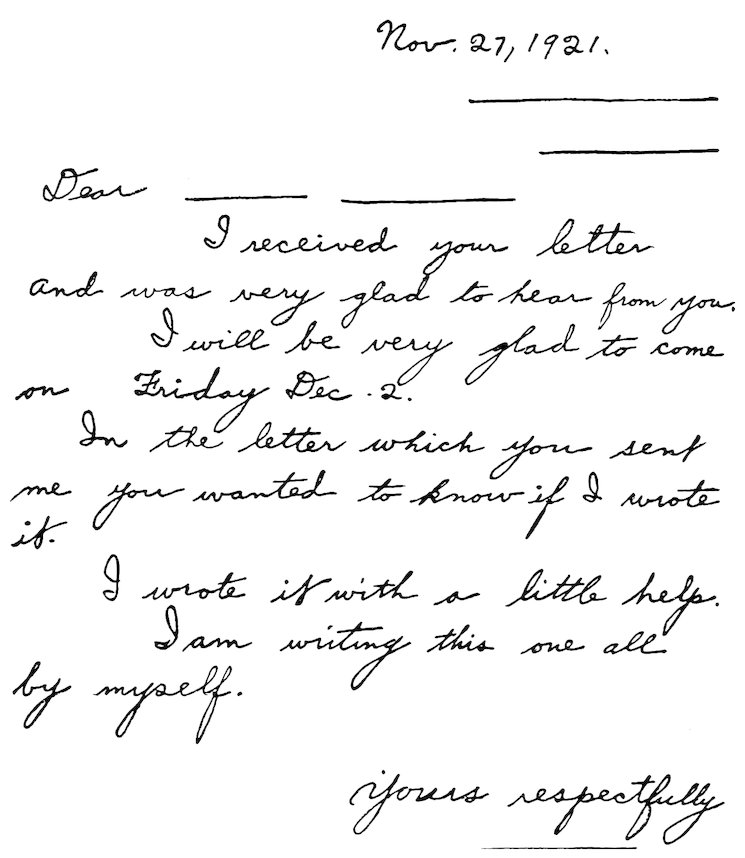
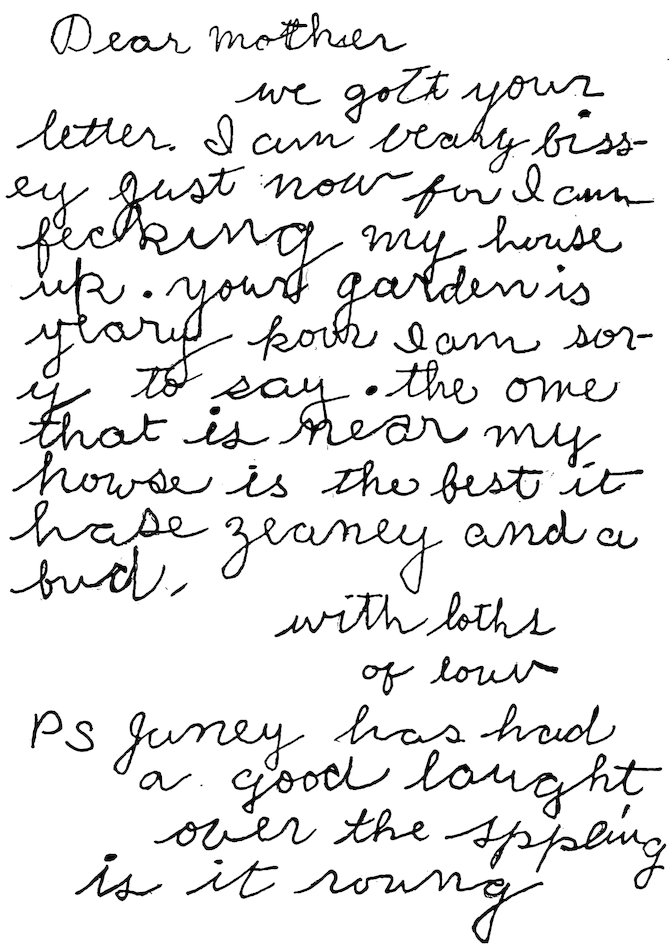
Showing spelling of a child 9 years 10 months old, with IQ 143, after three years of instruction. Illustrating dissociation of spelling ability from general intelligence
Showing the psychograph of a stupid child, who has a special ability in representative drawing. (From Manuel’s A Study of Talent in Drawing. Reproduced by courtesy of The Public School Publishing Company.)
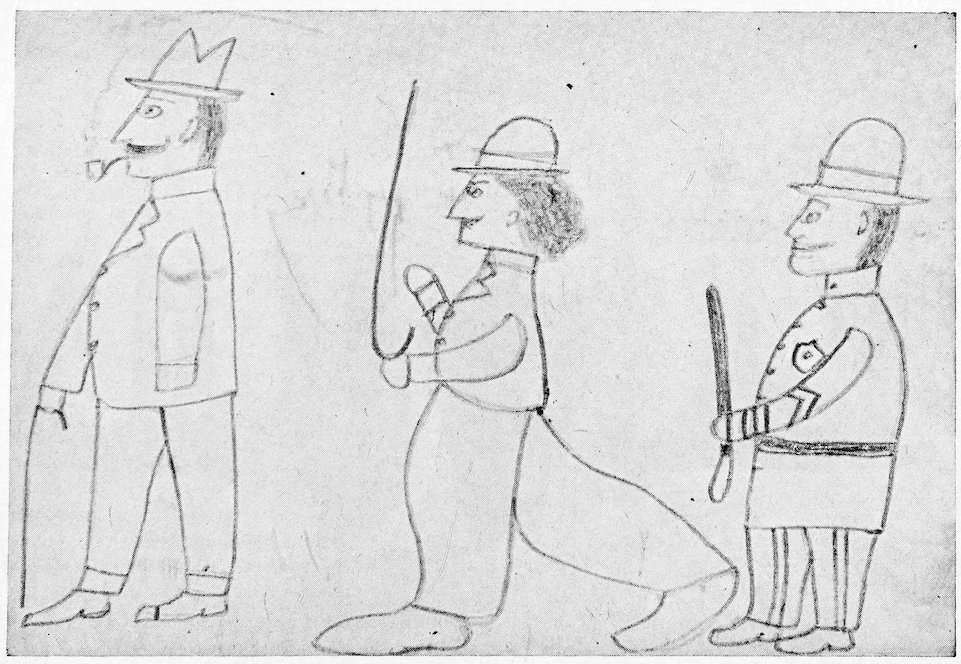
Charlie Chaplin pursuing a gentleman, and pursued by a policeman. Showing the special ability to draw, of a feeble-minded man, in an institution for mental defectives
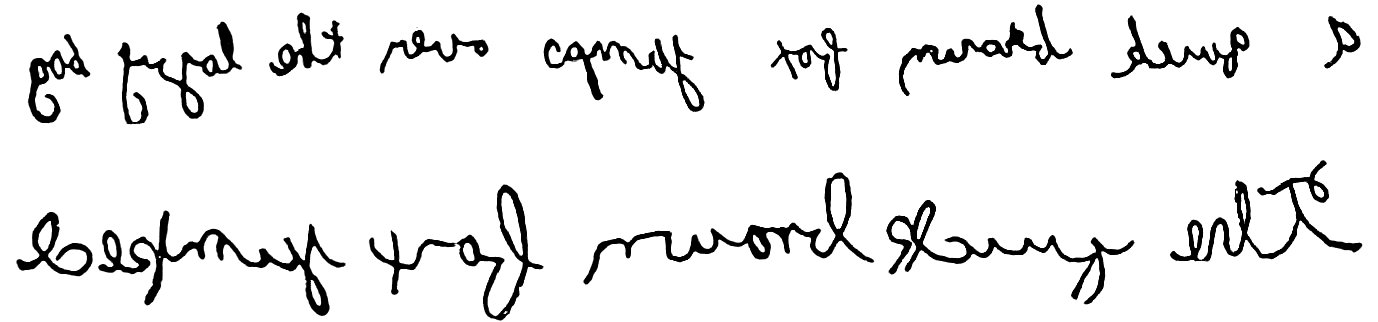
Showing mirror writing by public school pupils. (From Beeley’s An Experimental Study of Left-Handedness. Reproduced by courtesy of the University of Chicago Press.)
EDITOR’S INTRODUCTION — CHAPTER I Preliminary Discussion — I. SPECULATION CONCERNING THE NATURE OF ABILITY — II. RESULTS OF QUANTITATIVE INVESTIGATION — REFERENCES
xvii
When the writer of this introductory note began teaching,
it was popularly believed that a pupil who showed special
excellence in intellectual work or in some particular study
owed his superiority to a faithful and energetic will which
held him to his tasks until he had mastered them thoroughly.
It was generally believed, also, that marked deficiency in
school work as a whole or in a special subject was due principally
to a lethargic or indifferent will which could not resist
distractions and temptations to self-indulgence. In those
days, pupils were upbraided and even physically chastised if
they failed to prepare the lessons which were prescribed for
them in any study. The writer has often seen pupils whipped
because they failed in their spelling, arithmetic, reading,
history, or grammar. When punishment was administered
in the school it was frequently repeated in the home, since
parents quite generally entertained the view that failure to
perform intellectual tasks satisfactorily was due to negligence
or laziness, and it was thought that the best way to correct
such delinquency was to arouse the will, usually by means of
dermal stimulation. In his early experience as a teacher,
the writer never heard, either in training classes or in teachers’
institutes, that pupils possessed special talents or defects which
were certain to be manifested in their school work because
they were established by native endowment which could not
be modified to any large extent by rewards or penalties.
But we are gradually abandoning the view that either
brightness or dullness in general or in special directions is due
primarily to volitional control or the absence of it. During
xviiithe last few years, experimental studies have impressed the
principle that individuals differ in their inheritance of special
capacities. Dr. Hollingworth shows in this volume how far
we have gone in the detection of special talents and defects,
with particular regard to the work of the school. She shows
in preliminary discussion what notions people have entertained
regarding the nature of ability, and then she discusses methods
of measuring ability, alike of a general and of a special sort.
She discusses the bases for differences among individuals in
ability in respect to various intellectual traits or functions.
Then she presents in detail what is known to-day regarding
special talents and defects as revealed in the more important
subjects taught in the schools.
We believe in these times that the school should to the fullest
extent provide opportunities for each pupil to develop his
talents as completely and as rapidly as possible. It is still
required in most public schools, though, that pupils in any
group should be kept quite close together in their educational
progress, even when they show marked differences in ability
in particular subjects or in the entire work of the school.
But the pressure is becoming constantly greater to arrange
school programs so that pupils may go forward as rapidly as
their abilities, either general or special, will enable them to do,
while those who are deficient may receive help according to
their needs. There are already a number of experimental
schools and school systems in which the principle of individual
differences in ability is recognized and applied to a greater
or less extent. One may safely predict that we shall find a way
in time so that the principle may be recognized and applied in
all public schools.
Dr. Hollingworth’s book lays a sound foundation for the
differentiation of pupils in a school or classroom according to
special abilities or deficiencies. It can be read by teachers
xixwho have not had extensive study of educational psychology
or statistical methods of investigating such problems as are
treated in this volume. The book is written in a graceful
style, and technical matters are discussed in an unusually
clear, simple, and attractive way. It may be confidently
asserted that any teacher who has charge of thirty or forty
pupils—or a smaller or larger number—will be helped to
understand individual traits of excellence or deficiency if she
will read what Dr. Hollingworth has presented in this volume.
It may be safely stated, also, that a teacher will be more
sympathetic toward pupils who experience difficulty in mastering
special subjects of study if she will become familiar with
the facts and conclusions which this book contains.
M. V. O’Shea
The University of Wisconsin
May, 1923
SPECIAL TALENTS AND DEFECTS
1
Since reflective men began to record their speculations,
theories have been expressed concerning the nature and relationships
of mental functions. Plato in The Republic contemplated
the importance of knowledge in this field. “Come
now and we will ask you a question: when you spoke of a
nature gifted or not gifted in any respect, did you mean to
say that one man will acquire a thing easily, another with
difficulty; a little learning will lead the one to discover a
great deal; whereas the other, after much study and application,
no sooner learns than he forgets; or, again, did you
mean that the one has a body which is a good servant to his
mind, while the body of the other is a hindrance to him?
Would not these be the sort of differences which would distinguish
the man gifted by nature from the one who is ungifted?”
In The Republic the use of mental tests to discover the
caliber of the mind is foretold. “We must watch them
from their youth upwards, and make them perform actions
in which they are most likely to forget or to be deceived,
and he who remembers and is not deceived is to be selected,
and he who fails in the trial is to be rejected. That will be
the way?”
2Aside from the speculations of scholars, folk notions as
expressed in proverbs are interesting, especially as showing
what men wish were true concerning human talents and
defects. Many of these proverbs embody the idea of a compensatory
distribution of abilities: if I am weak in one respect,
I am sure to be strong in another; if I am a failure now,
I shall probably be a success later on. “Every dog has his
day.” “Homely in the cradle, handsome at the table.”
“Slow but sure.” “Easy come, easy go.” This doctrine
of compensation satisfies certain cravings of human nature,
and is therefore likely to be held wherever people have not
given impartial attention to the results of experimental investigation.
Folk-wisdom has also seen men under mental types. According
to the theory of types, the human species is divided
into separate categories, with respect to mental constitution.
There would thus be the musical and the unmusical, the quick
and the slow, the imaginative and the unimaginative, the
eye-minded and the ear-minded, and so forth. The observable
complexities of behavior have further led to the description
of a given person by a combination of type-terms, as,
for example, “quick-musical-imaginative,” or “mathematical-accurate-unimaginative.”
Persons thus classified by types,
are thought to be of “different kinds,” “equal” but “unlike.”
Two persons are thus compared as an apple is compared to
an orange. Both fruits are “equal,” but of “different types.”
People, according to this conception of human nature, are
not thought of as differing from each other simply in
amount, as an apple is compared with a larger, a smaller,
or a sweeter apple. Comparison in terms of amount is
disagreeable in some respects, so that uncontrolled speculation
would surely tend to favor the theory of distinct
types.
3Type-terms have also been invented for temperament,—sanguine,
choleric, melancholic, phlegmatic. The idea underlying
this classification is that everyone belongs to one or
another of these distinct temperamental types, and, furthermore,
that there is a relationship among types which warrants
fixed hyphenated categories.
The mental traits or “faculties” thus classified and hyphenated
are conceived as entities, having each its distinct
existence in the individual mind, and being susceptible to
general training and strengthening, by prescribed exercises.
Thus it has been believed that “the observation” may be
developed by exercises with particular materials, so that all
materials whatsoever will be observed equally or approximately
as well.
Speculation has been much occupied, as the history of
human thought shows, with the problem of the origin of individual
endowment. Many different possible explanations
were proposed, before the day of quantitative measurement
in psychology. It has been surmised that mental endowment
is the result of prenatal influences, the wishes and environment
of the mother, during the period of gestation;
or that it is the result of education; or that it arises from
the physical accidents met with by the organism; or that it
may be inherited from ancestors, as physical traits rather
obviously are. On the whole, speculation has favored the
notion that mental endowment originates in the environment.
The idea that ability is hereditary, determined for
each by the conditions of ancestry, is repugnant. Man prefers
to consider that he can himself determine what he will do
and be. This doctrine will not be tenable if it is admitted that
talents and deficiencies are determined in the germ-plasm,
from which the organism springs; that man can only use,
not choose, his mental endowment.
4
Many of the cherished hopes and desires of mankind concerning
itself are in some part violated by the teachings of
scientific psychology. Experimental psychology is not yet
half a century old, dating its beginning as a technical science
from the founding of Wundt’s laboratory at Leipzig, in 1879.
Therefore, it is clear that the study of these problems by quantitative
methods brings us very close to the present day.
When the problem of measuring mental capacity was first
taken into the laboratory, the modern definition of a mental function
began to be formulated. It became apparent that a mind
must be judged by its product. The measurement of performance
is the only approach there is, or probably ever will
be, to the measurement of mind. On this basis it was found
impossible to identify or measure any such function as “the
reason,” “the memory,” “the observation,” “the imagination,”
“the will,” and similar supposed entities. A mental
function came to be defined as “an actually or possibly observable
event in behavior.” Thus, memorizing digits, detecting
absurdities, and reading English print are examples of mental
functions, in the sense in which the term is used throughout
the chapters of this discussion.
Other terms which are used to refer to performances or
“events in behavior,” are abilities and capacities. A prolonged
discussion might be conducted, in an attempt to assign
different technical meanings to these words, and to bring out
fine shades of distinction among them. For instance, it might
be claimed that “ability” should be reserved to signify capacity
plus the skill acquired by practice, if any; while
“capacity” should mean the innate aptitude, apart from all
training. However, since capacity in this sense can never be
known, but can only be inferred from the degree of actual
5performance, under controlled conditions, it hardly seems
necessary to maintain such distinctions for our purpose.
Refinements of nomenclature will, therefore, be avoided, and
the terms mental function, capacity, and ability will be used
interchangeably, to denote performance which depends on the
inborn integrity and sensitivity of the individual.
By way of clarifying the definition of a mental function as
“an actually or possibly observable event in behavior,” we
may quote from Spearman’s presentation of the distinction
between “observation” as a mental function, and “observation
of birds’ nests.” Spearman says: “Suppose, for instance,
that a school boy has surpassed his fellows in the observation
of birds’ nests. His victory has, no doubt, depended in part
on his capacity for the general form of activity known as
‘observation.’ But it has also depended on his being able
to apply this form of activity to the matter of birds’ nests;
had the question been of tarts in the pastry cook’s window,
the laurels might well have fallen to another boy. A further
influence must have been exercised by the accompanying circumstances;
to spy out nests as they lie concealed in the
foliage is not the same thing as to make observations concerning
them in the open light of a natural history museum.
Again, to discover nests at leisure is different from doing so
under the severe speed limits prescribed by the risk of an interrupting
gamekeeper. The boy’s rank may even depend
largely on the manner of estimating merit. Marks may be
given either for the gross number or for the rarity of the nests
observed; and he who most infallibly notes the obvious construction
of the house-sparrow may not be the best at
detecting the elusive hole of the kingfisher.” One cannot,
therefore, identify and measure “observation.” One can
only measure “observing birds’ nests, of all kinds, at leisure,”
or “observing rare birds’ nests, under stress of pursuit,”
6and so forth, which are “actual or possible events in
behavior.”
As one may glean further from Spearman’s discourse, it
has been shown that most of the mental functions performed
by men are not elementary, but consist of the coördination
of complex factors, capable of analysis. Reading the English
word “cat” from a printed page is, for instance, a very complex
function.
The application of quantitative methods to the study of
mental functions as thus defined, quickly revealed the fact
that human beings, sampled at random, in large numbers,
do not fall into distinct types. On the contrary, they yield
one unbroken curve of distribution in the function measured,
clustering around a single type (or mode). In all mental
functions which have been measured, there has been found
but one type—the average human type—from which the
individual members of the species deviate in degree (though
not in kind). The majority of individuals deviate but slightly
from this biologically established type or mode. “The typical”
in ability is, indeed, by definition, what the greatest
number of people can do. From this performance of the
average or typical person, a few individuals deviate widely
in the direction of superiority, while a corresponding few
deviate widely in the direction of inferiority. No doubt the
conspicuousness, because of their infrequency, of extreme
deviates in respect to any given function (or capacity) has
led to the notion of separate types of mankind. Mental
measurement shows clearly that men cluster closely around
one type in mental traits, just as they do in such physical
traits as height and weight. All men can be no more divided
into the dull and the bright, than they can be divided
into the tall and the short. The eye can see that most
persons are best described as medium, in height.
7This principle of one type, with deviations in both directions
from it, in a measured trait, holds throughout organic
nature. The study of it in all its bearings is called the study
of individual differences. When the traits involved are mental,
we speak of the psychology of individual differences. It
is one of the marvelous facts about human beings that of all
the millions born, no two are just equal in possession of a
given trait, except by chance; and no two are identical in
their combinations of traits, for the infinite possibilities of
permutation practically exclude identity by chance. These
combinations, which go to make up personality, are combinations
of amounts of the same traits. This must be clearly
understood. The mental classification of men under different
“kinds” is a myth. All show the same kinds of functions;
but they show all degrees of performance in these functions,
within limits which are extremely wide, with multitudinous
possibilities of combinations of functions, in different amounts
of each.
There are, therefore, not types. There is one type—the
typical or most frequently occurring amount of performance
in a function—from which there is divergence among the
individuals born, in various degrees. Is it possible to construct
a picture of this fact, so that it may become concrete
through visual representation? Psychologists have given us
many such pictures, in the forms of curves platted from their
measurements. We may cite as an example, Seashore’s curve
of distribution for the ability to discriminate among intervals
of time, which is one element in musical sensitivity.
Seashore measured a large number of adults in this respect,
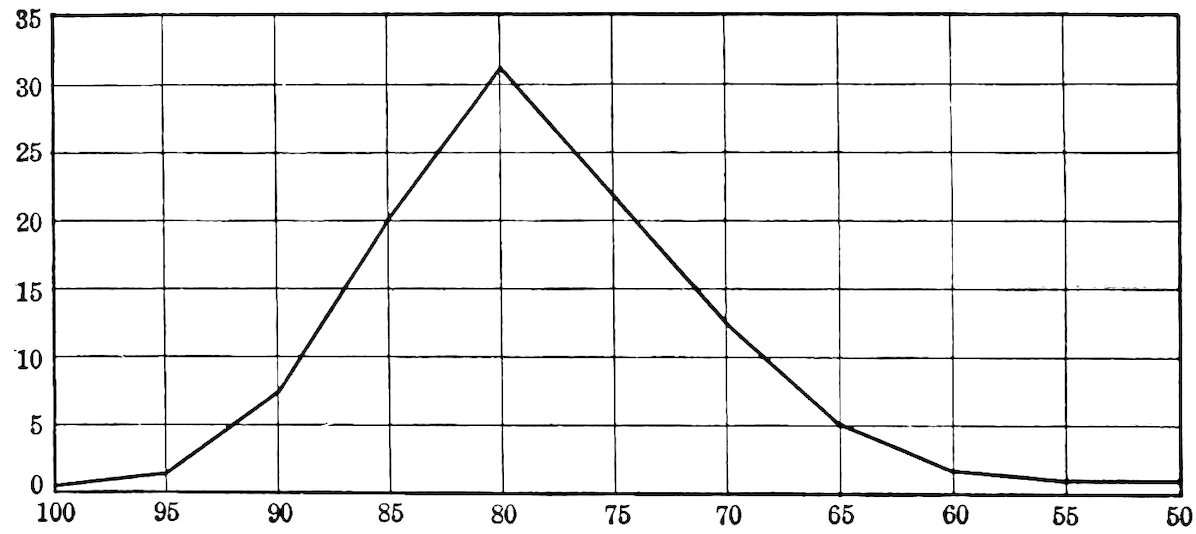
with the result that is pictured in Figure 1.
Where the curve rises to its greatest height, at its peak,
there the greatest number of those measured fall in respect
to this function. That is, therefore, the human type, in
8sense of time. The typical individual has that amount of
this trait. On each side of the type fall deviating persons,
their frequency decreasing rapidly as the amount of deviation
becomes greater. Very few persons in ten thousand have
that amount of sensitivity to time represented by 95–100;
and, on the other hand, very few are so inferior as to fall at
the lowest point measurable on this scale. The typical person
has that amount of the trait represented by 85–75,
approximately. Distinct types, such as “sensitive” and
“insensitive,” do not appear, as a result of mathematical
distribution. But a few extreme deviates from the typical
appear,—the superior in sensitivity and the inferior in
sensitivity.
Fig. 1.—Distribution of ability to discriminate among intervals of time, the subjects being adults. (From Seashore’s The Psychology of Musical Talent. Reproduced by courtesy of Silver, Burdett and Company, and of The Columbia Graphophone Company.)
Occasionally it is possible to illustrate in nature, to the eye
of the man untutored in the derivation of scientific laws, the
form of this distribution. This happens, for example, when
a very large flock of birds rises and passes overhead, during
migration. Being tested in flight, the birds will be seen distributed
somewhat as suggested in Figure 2. Not all are
equally swift and enduring, but they deviate from a single
9type or mode—the great median mass of birds, which are
typical of this species, in respect to the function of flight.
The same phenomena of distribution appear if a thousand
wild horses run a race, or if a hundred unselected swimmers
swim in competition. They appear whenever non-select organisms
of a single species are submitted to an adequate test
or measure of any function of endowment. The curve approximates
that form which mathematicians tell us results
when an infinite number of factors act together in an infinite
number of ways.
We have spoken thus far of the distribution of individuals
in a single kind of performance. What does quantitative
psychology teach with respect to the combination of performances
in a given personality? Is it true, as folk-wishes
would have it, that abilities are distributed among us by a
law of compensation? Is the slow man’s slowness offset
by accuracy? Does the quick learner lose his learning more
readily than the slow learner? Is he who excels in arithmetic
likely to be surpassed at spelling? The general consideration
of these questions, which form the topics of this
volume, will be found in the chapter which follows. It will
be seen that there is no law of compensation in human
ability, however much we may long to find it there.
Fig. 2.—Flight of birds, illustrating distribution in ability to fly. (Schematic.)
As for the origin of talents and defects, psychology teaches
that mental endowment in human beings is conditioned by
ancestry, just as other traits of organisms are. Mental capacities
are inherited through the germ-plasm. A child is
10gifted (if he is so) for the same reason that he is an Eskimo
(if he is one)—because some or all of his ancestors carried
those traits in their germ-plasm, and the combination of
them in just that way was possible.
Meumann, E.—Vorlesungen zur Einführung in die experimentelle
Pädagogik; Engelmann, Leipzig, 1914.
Seashore, C.—Measures of Musical Talent; Columbia Graphophone
Company, New York, 1919.
Thorndike, E. L.—Educational Psychology; 3 vols. Teachers
College, Columbia University, 1913.
CHAPTER II The Relationships among Capacities — I. THE COEFFICIENT OF CORRELATION — II. GENERAL INTELLIGENCE vs. SPECIAL APTITUDES — III. CORRELATION OF ABILITIES IN VARIOUS GROUPS — IV. STUDIES OF DISORGANIZING MINDS — V. IS INTELLECT INHERITED AS A UNIT? — VI. CAN AN INTELLECT BE TRAINED AS A UNIT? — VII. THE HIERARCHY OF ABILITIES — VIII. PRESENT STATUS OF THE PROBLEM — IX. MEASUREMENT OF GENERAL INTELLIGENCE: THE IQ — X. THE MEASUREMENT OF SPECIAL ABILITY — XI. THE PSYCHOGRAPHIC PICTURE OF INDIVIDUALITY — XII. AT WHAT AGE IS MENTAL ENDOWMENT EVIDENT? — XIII. THE FREQUENCY OF MARKED SPECIAL TALENTS AND DEFECTS — XIV. POSSIBLE ORIGIN OF THE DISSOCIATION OF CERTAIN CAPACITIES — REFERENCES
11
The question is: How are mental capacities mutually related,
with regard to amounts of each found in given individuals?
Before verifiable facts can be established in a field of knowledge,
it is necessary to introduce therein methods of enumeration
and measurement. The question above propounded
has waited long for answer, because of the great difficulty of
applying mathematics to mental phenomena. The answer
required first that single functions be accurately scored, and
then that a measurement be obtained of the relationship
between and among the single functions.
It seems well agreed that the quantitative determination
of the relationship between and among mental characteristics
began with Galton, about 1885. Various scholars have presented
discussions of the subject since then, notably Baerwald
in 1896, Spearman in 1904, Stern in 1911, Meumann in
1913, and Thorndike in 1913, each of whom summarized the
findings up to the time of writing, with original interpretations.
The methods of quantitative measurement used to study
the constitution of mental abilities, or functions, as related
to each other, are chiefly those of correlation—simple correlation,
multiple correlation, and partial correlation.
12It is not within the scope of the present volume to give
consideration to these methods as such. Highly technical
instruction in the theory and practice of measurement is
necessary for complete understanding of them. The results
may be comprehended for our purposes, without complete
knowledge of the methods. Much of the evidence we now
have in the matter of relationships among mental functions
has been obtained by the method of simple correlation. A
brief exposition of how a relationship is established between
two variable functions within a group, by simple correlation,
will suffice to give a general understanding of the term coefficient
of correlation, which is used here, and which frequently
appears in modern texts of educational psychology.
The interpretation of coefficients of correlation should not,
however, be undertaken independently without full knowledge,
as competent interpretation for practical purposes must
take into account all the conditions under which they have
been derived.
Below are listed fourteen school children, each of whom
has been measured in each of two mental functions: (1) mental
age, determined by a standard scale for measuring general
intelligence (Stanford-Binet), and (2) spelling ability,
as measured by a standard spelling scale (Ayres’ scale).
These children were selected for study, because they appeared
to be characterized by special discrepancy between the two
functions.
We wish now to know whether and to what extent the child
who falls high in the distribution of mental ages also falls
high in the distribution of spelling ability. According to
the formula which is most useful in this case,[1] we arrange
these pupils in their order of merit for one of the functions
13measured, e.g. for mental age. We then find the rank for
each, within the group, in the second function, which is here
spelling ability. The difference in rank between the paired
functions is then found for each pupil, and the correlation
formula is applied.[2]
Table from Hollingworth
Showing rank in each of two mental functions, within a group of fifth grade children, selected for special disability in spelling. The coefficient of correlation obtained is .081.
Name
Mental Age
Spelling Ability
Yrs.
Mos.
Per Cent Correct
(Stanford-Binet)
Lists Q and R (Ayres)
RL
13
7
90.1
JP
12
5
95.2
HA
12
2
81.7
MG
11
6
31.7
LK
10
10
80.2
SSh
10
10
77.9
SSc
10
9
81.8
MS
10
9
34.1
PJ
10
4
32.6
HL
10
1
58.9
RH
9
8
93.1
MU
9
8
57.0
BN
9
6
92.1
HR
8
3
81.8
If there is in fact perfect correspondence, so that each
pupil holds the same rank on the distribution in both functions,
a perfect positive correlation is obtained, the coefficient
of correlation being expressed as 1.00. If no relationship
at all exists between the two functions measured, so that
nothing whatever can be predicted of either from knowing
about the other, the coefficient of correlation will be 0.00[3]14If there exists a perfect negative relationship, so that the
person who stands highest in one stands lowest in the other,
and so forth through the series, in a perfect inverse standing
of all members, then a coefficient of correlation expressed by
−1.00 is obtained.
In the sample given, the coefficient of correlation obtained
is .081, which not being reliably greater than zero (because
of possible error due to the smallness of the group and other
conditions) tells us that the two functions are in this case related
to each other only very slightly, if at all. The child
who stands above the average of the group in mental age, may
or may not stand above the group average in spelling. With
a relationship so far from unity as is expressed by a coefficient
of .081, we may expect to find in this group comparatively
intelligent children who are very poor spellers, and
good spellers who stand low in mental age. Among children
taken at random, however, a different relationship exists
between spelling ability and general intelligence, as represented
by mental age. The positive correlation is much
higher among children not selected, as these were, for an observed
discrepancy.
At the present time the more elaborate methods of partial
correlation and multiple correlation are being applied to the
study of relationships, where more than two functions are involved.
Into the intricacies of these we shall not enter, except
as concerns their results.
The original attempts to apply mathematical formulæ to
the study of relationship among mental traits eventuated in
divergent hypotheses. In England, Spearman, with his students
and collaborators, interpreted his researches to mean that
15there is in mental constitution a “general factor,” which shows
itself in all the performances of a given individual. This
would render relatively predictable the quality of performance
in all functions, from knowledge of performance in one
function. “All branches of intellectual activity have in common
one fundamental function (or group of functions), whereas
the remaining or specific elements of the activity seem in
every case to be wholly different from that in all others....
The function almost entirely controls the relative position
of children at school (after making due allowance for differences
of age), and is nine parts out of ten responsible for success
in such a simple act as Discrimination of Pitch.... Its
relation to the intellectual activity does not appear to be of
any loosely connected or auxiliary character (such as willingness
to make an effort, readiness in adaption to unfamiliar
tests, or dexterity in the fashion of executing them), but rather
to be intimately bound up in the very essence of the process.”
Spearman noted that, though all functions seemed related
to this “common factor,” they were not all equally related
in his results; wherefore he formulated the concept of a hierarchy
of relatedness. Discussion as to the essential nature
of the fundamental factor was reserved, but it was predicted
from the correlations made that “general intelligence” could
and would be measured for practical purposes. This interpretation
was based upon the fact that among abilities which
yielded to his measurement, Spearman could find only positive
coefficients of correlation, when the groups were large
and the human beings non-select.
In the United States, Thorndike and his collaborators
were most struck by the fact that the coefficients obtained fell
short, in many cases far short, of unity. They laid stress upon
the imperfection of the relations revealed, and were able to
show that between some functions, such as discriminating
16among the lengths of lines, and others, such as naming the
opposites of words, the correlation dropped in groups investigated
to approximately zero.
As a result of interpretation from their point of view, they
wrote as follows: “One is almost tempted to replace Spearman’s
statement by the equally extravagant one that there
is nothing whatever common to all mental functions, or to
any half of them.” They maintained that mental functions
are specialized, and that when excellence in one is correlated
with excellence in another, “this is due chiefly to the fact
that the two involve identical elements in their execution.
It is not due to one and the same ‘faculty,’ which presides
over their activities.”
These two divergent interpretations of the same array of
data have been cited, because the controversy involved is
of first rate importance for mental measurement, for the
understanding of individuals, and for education. The
controversy now appears to have been one of emphasis. To
recapitulate, Spearman stressed the positive aspect of the
coefficients found, and declared mental traits to be distributed
so that status in one is predictable from status in another.
Thorndike emphasized the reduction from unity of the coefficients,
and formulated the hypothesis that there is no absolutely
predictable coherence among mental functions, that
each is special to itself within an individual. No laboratory
scientist has ever found reason for adding a third side to the
controversy, by advocating seriously that mental traits are
compensatory in relation to each other. Negative coefficients
of correlation have never been found, except occasionally by
chance or selection.[4] All know that the correlations among
amounts of traits are positive. It is the reduction from unity
which has caused the disagreements of interpretation.
17During the twenty years which have elapsed since the first
interpretations were set forth there have been modifications
of each hypothesis, in the direction of mutual reconciliation.
This has come about through extended researches by many
inquirers, furnishing additional data.
Some of the significant studies of correlation made since
Spearman and Thorndike proposed their conflicting interpretations,
have been cited in the appended list of references.
Two samples of the results of these studies are herewith presented.
The first is from Simpson’s study of mental tests
given to two groups of adults, chosen respectively from the
opposite extremes of competency, as shown by social-economic
success. One group was composed of successful professional
educators. The other was composed of unskilled laborers
and unemployed men. The table on page 18 shows how
the traits measured cohere among these individuals. The
coefficients are positive, in the majority of cases highly so.
The second sample is from Weglein’s study of standing in
school subjects, among high school pupils.
Bearing in mind that, if no mutual relationship exists
among the abilities considered, coefficients of correlation will
approach zero, it is clear that there is decided positive, but
not perfect, correspondence. The wider the range of competence
tested, the greater the correspondence found. High
school pupils (from among whom those having very little
ability for the subject matter taught have already been eliminated)
show smaller coefficients than do the persons measured
by Simpson. If all adolescents in existence were
obliged to study the subjects listed by Weglein, and if the
resulting grades were then correlated, the coefficients would
be notably higher than those recorded.
18
Table from Simpson
Pearson Coefficients of Correlation (Corrected for Attenuation)
Correlations of abilities in two selected groups, and in the two treated as one group. In the case of each test the heavy-face figure given first is for the Good and Poor together, divergences being measured from the median of the 37 individuals. The second figure is for the Good group, divergences being measured from its median. The third figure is for the Poor group.
Ebbinghaus Test
Hard Opposites
Memory of Words
Easy Opposites
A Test
Memory of Passages
Adding
Geometrical Forms
Learning Pairs
Completing Words
Drawing Lengths
Estimating Lengths
92
92
75
68
91
71
54
72
50
26
52
Ebbinghaus test
66
67
48
03
42
55
00
22
67
−17
28
90
78
90
76
61
63
36
73
71
27
01
92
92
81
76
86
74
64
72
70
25
55
Hard Opposites
66
75
93
15
45
79
07
14
100
10
−08
90
77
78
65
64
51
33
66
49
13
−02
92
92
68
70
89
56
67
82
51
06
59
Memory of Words
67
75
52
−13
41
20
06
53
100
−23
44
78
77
70
88
100
23
56
44
43
−09
16
75
81
68
71
69
70
54
43
50
53
56
Easy Opposites
48
93
52
05
05
45
38
−04
100
00
−02
90
78
70
51
58
50
34
64
49
43
16
68
76
70
71
60
67
94
44
84
27
57
A Test
03
15
−13
05
14
59
68
−16
04
−10
−11
76
65
88
51
48
39
91
72
88
08
13
91
86
89
69
60
66
60
63
38
12
58
Memory of Passages
42
45
41
05
14
20
−30
−26
35
−24
−36
61
64
100
58
48
15
41
22
13
09
35
71
74
56
70
67
66
44
46
77
27
17
Adding
55
79
20
45
59
20
13
12
86
−49
04
63
51
23
50
39
15
19
51
70
05
−40
54
64
67
54
94
60
44
40
61
30
35
Geometrical Forms
00
07
06
38
68
−30
13
−23
00
40
−14
36
33
56
34
91
41
19
39
32
14
07
72
72
82
43
44
63
46
40
34
04
54
Learning Pairs
22
14
53
−04
−16
−26
12
−23
74
−38
61
73
66
44
64
72
22
51
39
34
20
36
50
70
51
50
84
38
77
61
34
17
22
Completing Words
67
100
100
100
04
35
86
00
74
−04
06
71
49
43
49
88
13
70
32
34
00
−28
26
25
06
53
27
12
27
30
04
17
55
Drawing Lengths
−17
10
−23
00
−10
−24
−49
40
−38
−04
−41
27
13
−09
43
08
09
05
14
20
00
34
52
55
59
56
57
58
17
35
54
22
55
Estimating Lengths
28
−08
44
−02
−11
−36
04
−14
61
06
−41
01
−02
16
16
13
35
−40
07
36
−28
34
19
Table from Weglein
Coefficients of correlation between school subjects (teachers’ marks) in
the case of 59 high school pupils.
ACADEMIC GROUP
Eng. I
Alg. I
Hist. I
Latin I
Drawing
English I
.22
.20
.19
.37
Algebra I
.22
.42
.65
.09
History I
.20
.42
.57
.13
Latin I
.19
.65
.57
−.22
Drawing
.37
.09
.13
−.22
COMMERCIAL GROUP
Eng. I
Bkk.
Com. Arith.
Stenog.
Typewr.
Drawing
English I
.69
.52
.54
.50
.15
Bookkeeping
.69
.66
.48
.50
.50
Com. Arithmetic
.52
.66
.38
.52
.53
Stenography
.54
.48
.38
.51
.21
Typewriting
.50
.50
.52
.51
.31
Drawing
.15
.50
.53
.21
.31
These are fair samples of the results of studies in correlation,
among mental functions, in groups of individuals more
or less select. Even physical traits, like height and longevity,
have been found to give slight positive correlation with
mental traits. Evidently there is a general organic quality,
which shows itself to some extent wherever the individual
is fairly tested or “sampled.”
Another series of attempts at the solution of this problem
has been made through observations upon deteriorating
minds. The question is, Do mental functions deteriorate
20together or separately in dements? When a person is “losing
his mind,” is the impairment general or selective in its
progress?
The study of demented persons had been carried on by a
few investigators in the hope that the decay of capacities
might throw light upon their relationships. The chief obstacle
to study from this approach has been that the investigators
have never been able to know the original mentality
of their subjects. They have always been obliged to make
assumptions. It is difficult to see how this factor may be
controlled, short of filing careful mental analyses of great sections
of the population in youth. The chief conditions in
which decay of ability is most probably present, as distinguished
from decay of effort and attitude, are senile dementia,
dementia paralytica, and alcoholic psychosis; and
it cannot be known beforehand which persons are destined
to represent these conditions. It cannot be predicted who
will live long enough to become senile, who will contract syphilis,
eventuating in general paresis, or who will be a chronic
alcoholic. It is true that original mental status may be inferred
with a moderate amount of accuracy from school status
attained. If the dements studied had all been high school
graduates, for instance, then we could be certain that the
performances shown in the recorded studies really represent
deterioration.
Unfortunately, the subjects of study have been, with rare
exceptions, persons of elementary education and humble social
status. They come from those sections of the education-occupation
distributions, where very limited capacity is found.
Therefore, we are rather uncertain as to how much deterioration
from original status has really taken place. So far
as actual figures go, it is not shown that there has been decay
of intellect.
21However, assuming that these segregated persons had actually
deteriorated in their ability to perform tasks, let us inquire
what the researches show. Binet and Simon worked
with forty adults, classified as senile dements or as victims
of dementia paralytica. They conclude that “Every dement
has an intellectual level below normal,” as measured by tests
of general intelligence. The limitations of dements are, nevertheless,
qualitatively different from those of other incompetents
(children and the feeble-minded); and the reactions of the
senile differ from those with dementia paralytica. Of the
victim of dementia paralytica they say, “He has not tumbled
down the ladder of development, rung by rung. His is a
difficulty of functioning.” “It is characteristic in these losses
of functioning that the subject knows how to meet the problem
submitted to him; he has the knowledge, but from time
to time the power fails him.” This inertia of comprehension
is general, and has the effect of lowering the total level of performance,
though the particular items of failure and success
may vary markedly from occasion to occasion. It is hardly
the same thing as actual decay of a structure. Thus one
cannot predict the responses of these dements, as one can those
of other incompetents, like children and imbeciles, because
their errors and failures have a remarkable degree of inconsistency.
“In a general way, one can hardly foresee how
such a one is going to conduct himself, for special failures and
successes are at such variance with the general level.” “General
paralytics are hardly able to perform the hundredth
part of what they know.”
Senile dements are different, in that they actually no
longer know. The structure itself has been demolished, not
merely has it been paralyzed as to function. According to
the observations of Binet and Simon the abilities of senile
dements as a group are by no means equally impaired. They
22cannot remember events nor learn new things, yet they retain
the power of auto-criticism, many complaining that they no
longer “know anything.” They may be degraded to the
level of early childhood in ability to repeat digits, yet retain
use of the vocabulary of a superior adult.
These observations are extremely suggestive, but they lack
statistical validity, being limited to narrative descriptions.
It is true that one who has worked much among dements
in a practical way, recognizes the pictures drawn by Binet,
of persons decayed in some functions, yet “surprisingly preserved”
in others. Proof of the extent to which this characteristically
happens would necessarily be derived from tests
of large numbers of cases, treated mathematically, and not
by the method of narrative.
Hart and Spearman more recently presented a study of
sixty-one insane persons,[5] asking the question, “Does an insane
person present, as a rule, much greater inequality of
performance than a sane one?” Recognizing the error from
not knowing the original status of the presumably deteriorated
minds, in all the various functions to be tested, the
attempt was made to allow for this by testing in the same
way thirty-three sane persons, selected presumably to represent
what the insane were like before they became alienated.
Nineteen mental functions were thus tested, and the results
were then treated by the method of correlation, the assumption
being that if there were greater inequality among mental functions
in the insane (that is to say, among deteriorated minds)
than among the sane, this would show itself in diminished
coefficients of correlation.
It is interesting to consult the original tables of data, which,
however, will not be presented here. The conclusion reached
23is that “The inequality between the powers of the same person
for different kinds of performances does not appear to be
appreciably greater in insanity than in health, nor in one of
the forms of insanity tested than in another. Thus, in the
main, the mental injury appears to be of a perfectly diffuse
character, or to constitute a lowering of the whole intellectual
level.... Over and above this general impairment, elaborate
methods can also detect certain damages characteristic of
particular maladies. These are very narrow and specific
in kind, but probably may be correspondingly grave in
intensity.”
Spearman thus again maintains his “two factor” theory
of endowment—the “general factor” conditioning performance
as a whole, and “specific factors” conditioning certain
mental functions to a much greater extent than others. To
determine what these special mental functions are, Spearman
leaves to further research.
This careful investigation is nevertheless imperfect for the
purpose, which is to learn whether there is selective enfeeblement
of abilities. It is really impossible to know that deterioration
has occurred, unless there have been measurements
made beforehand. Sane persons, selected from the same
social stratum, are not entirely reliable as a control, because
those who are of the psychic constitution destined for insanity
undoubtedly differ originally from those who remain sane,
and this difference may involve a difference in mental abilities,
either of amount or of relationship. The degree of deterioration
calculated by Hart and Spearman may be merely
a matter of original differences in central tendency between
the two groups.
Here, too, it should be noted that Hart and Spearman mixed
a variety of psychoses (even including an imbecile not deteriorated
so far as known), both those that do involve actual
24decay of ability, and those that involve only disturbances of
general auxiliary functions, like attitude and effort. Just
what would be the effect of this mixing upon the correlations
could be told only if we knew how each form of disorder characteristically
affects the relationship among mental functions,
which is unknown. If mental functions are differently
selected for impairment in the different forms of psychosis,
then we should expect diminished coefficients of correlation
among the insane, because mixing the psychoses would produce
inconsistency of rank within the group. If, however,
certain functions were deteriorated in all or nearly all of the
insane, others remaining intact, or relatively so, this selective
enfeeblement would not appear in correlation coefficients.
Facts like those observed by Binet and Simon might be obscured
by the methods of Hart and Spearman.
Moore, working subsequent to Hart and Spearman, limited
his investigation to those cases believed by psychiatrists to
be characterized by real loss of abilities, the dementias: dementia
paralytica, senile dementia, and alcoholic dementia.
He tested thirty dements, laborers and tradesmen, and, as
controls, six young men from the same occupational group,
in the following mental functions: (1) perceiving eight each
(in a series) of real objects, pictures of objects, printed words,
and spoken words, referring to real objects of ordinary everyday
experience; (2) repeating after one exposure of the
series as much of it as could be remembered without regard
to sequence; (3) after a minute of mental work at calculation,
repeating again what could then be remembered of
the series. Moore then correlated performance within the
group in each of these functions with that in each of the
others. The coefficients thus resulting are interpreted as
follows: “The average of all correlations of perception with
the various memories is .538.... That the average correlation
25for memory and perception is as high as .538 shows that
there must be a common factor present. But its presence does
not exclude the existence of special forms of mental ability.”
Moore also correlated perceiving with remembering in the
functions separately, and remembering immediately with
remembering after a minute of distraction. These coefficients
are positive, and mostly high, but not perfect.
The work of Moore does not seem to go beyond knowledge
already obtained from study of sane persons. The coefficients
do not prove that the amounts of deterioration in the
functions had been equal; or even that deterioration had
taken place. Moore’s six sane subjects were too few to constitute
a control, and are not referred to as such in treating
results. Instead, Moore refers the reader to the records of
subjects in preceding monographs to show that “the low values
of these subjects (the insane) are distinctly pathological.”
This comparison is seen to be invalid, for the subjects referred
to as establishing the criterion of intactness are professors
and university students, almost certainly much higher in
ability by original nature than the insane group.
Assuming, nevertheless, here also that the subjects really
had deteriorated, the method of correlation must again be
brought under criticism as ill adapted to answer questions
concerning selective enfeeblement. A group of senile dements,
all high school graduates, might, for instance, be not at all
deteriorated from their original status in the mechanics of
reading, but greatly deteriorated in the ability to tell what
has been read. Yet correlation might result in a positive
coefficient as high as that found among typical high school
graduates, if the decay in repeating matter took place in proportion
to the degree of ability originally present in each
individual. There might be marked selective impairment,
which would be hidden in coefficients of correlation.
26The problem of selective enfeeblement must be investigated
by computing deviation in various functions from a
known norm or standard in each; and the person’s original
status in that function must be known. For such investigation
senile dements would seem to be the best subjects, since
in them there is natural decay of functions. It is, however,
difficult to find very aged deteriorated persons, whose original
status is known (known, at least, to have been generally high),
and who have not some sensory or motor handicap to complicate
performance, such as deafness, failing vision, or
palsy.
The net result, for our purposes, of studies so far made of
mental decay is not very helpful, because (1) the original
status of the subjects is never known, (2) the psychoses have
been mixed in experiment, without preliminary test-knowledge
of the characteristics of each, if any, and (3) the method of
correlation, which has been used, is not suited to show selective
enfeeblement of mental functions. Every study made
has suffered from one or more of these hindrances to interpretation.
The information gleaned from them is much the
same as that already gleaned from studies of the undeteriorated,
namely, that among people (whether sane or insane)
those who hold a certain rank within a group in one function
tend also to hold a similar rank within that group in other
functions. The question of selective enfeeblement of a function
within a group of the insane remains unanswered. The
investigators of the demented have, however, made a particular
contribution in pointing the way to a new source of
light. For the study of mental decay, when carried on by
adequate methods, extremely difficult of attainment, is
sure to throw light on the relationships among mental
functions. From it we shall learn whether some functions
remain intact, with impairment of other functions.
27
There are still other approaches to the study of the constitution
of intellect. One is through the investigation of
heredity. The question is whether intellect is inherited as
a unit, or whether some different formula is indicated. If
intellect is a unit character, subject to but one determiner
in the germ-plasm, then it should act as an “all or none” capacity
in its appearance among offspring of given matings.
Children should be separable into distinct groups, each having
a different median with respect to intellect, i.e. those who
have intellect and those who lack it.
The methods of mental measurement teach us plainly that
intellect is not inherited in this way. Instead of a broken
curve, indicating a division of children into those who inherit
and those who fail to inherit a unit character, we obtain
the curve already demonstrated, which is continuous and symmetrical.
There is but one diversified group of children,
with respect to intellect—not distinct groups.
The inheritance of intellect does not, therefore, follow the
simple formula of unit characters, as does the shape of peas,
the color of rabbits’ coats, or eye-color in man. The trait
we measure and name as general intelligence is a complex,
resulting from the incidence of a great number of functions,
acting together in a great number of ways, yet cohering in
respect to amounts found in given individuals.
Possibly each of the indefinitely numerous functions, which
thus appear to act together as man’s intellect, may be a unit
character, inherited according to Mendel’s formula. Such
a possibility is at present purely speculative.
The puzzle is that a given individual should “hit,” as it
were, at approximately the same point in the distribution of
nearly every function.
28
Studies of the learning process also give light upon the
organization of capacities. The question here is as to whether
training in one function spreads equally to all other functions.
Is it possible to “train the mind” as a whole? Will it raise
the proficiency of all performances fifty per cent, if a fifty
per cent gain is achieved in Latin composition?
Numerous attempts have been made to determine the extent
to which skill acquired in one performance increases skill
in other performances. The conclusion which emerges from
these studies is that intellect cannot be trained as a unit. Transfer
of training from one function to other functions is far
from complete. Apparently, there is spread of improvement
from practice in a function only to such other functions as
have elements in common with it. If two performances differ
in any way, there is something in the second that remains
untrained by the practice given to the first. If two performances
differ in all respects, the second seems not to derive
any benefit at all from training in the first.
To a very highly intelligent individual, nearly all situations
and performances tend to have some identical elements,
no doubt. To a very dull person, relatively few situations
or demands present identical elements, for the dull perceive
only gross similarities and differences. Thus, spread of improvement
is without doubt greatest for the innately gifted,
and least for the innately inferior minds. In connection
with the present discussion, however, the chief point of interest
is that no mind, of whatever degree of innate integrity
and sensitivity, can be trained as a unit. Each function
has elements special to itself, and some functions are very
highly specialized, as regards the amount of transfer of training
from them to others, or from others to them.
29The evidence from learning, therefore, substantiates the
evidence from heredity, indicating that intellect is not a unit,
but a complex of many capacities, coinciding mysteriously
in amount to a very marked extent in an individual.
It has been stated that though all, or nearly all, mental
functions so far measured and correlated, yield positive coefficients,
all do not show an equal amount of positive correlation.
Certain mental functions, for example, are shown to
yield coefficients of as much as .80, for a total correlation with
others of a series; while some yield coefficients as low as .10,
approaching absence of relationship. To explain these facts,
Spearman formulated the concept of a hierarchy of relatedness
to a “general factor.” Those abilities showing slight correlation
with others in series of tests, were thought of as but
loosely related to “general intelligence,” and as constituting
“special abilities.” They might be displayed by persons
inferior in general, or might be lacking in persons otherwise
superior.
Here again, the facts are not in question. It is admitted
by all that functions show different amounts of positive
correlation with one another, and of total correlation with
members of a series. Not all experts agree, however, with
Spearman’s theoretical explanation of the phenomena. Thomson
has recently shown, by tossing dice of various colors, that
in this game of chance (in which there is no “general factor,”
but only many independent factors), hierarchical order of
correlation coefficients is almost sure to be obtained, for combinations
resulting from throws. Thomson, therefore, holds
that the theory of a “general factor,” participating in all the
separate performances of an individual, is not proved from
30the facts about correlation coefficients. He proposes the
following, regarded by him as an alternative: “The mind,
in carrying out any activity such as a mental test, has two
levels at which it can operate. The elements of activity at
the lower level are entirely specific, but those at the higher
level are such that they may come into play in different activities.
Any activity is a sample of these elements. The
elements are assumed to be additive like dice, and each to
act on the ‘all or none’ principle, not being in fact further
divisible.”
It is not quite easy to see that this theory, finally proposed
by Thomson, which might be termed the “two level” theory,
is very different from Spearman’s “two factor” theory, nor
why the terms “higher” and “lower” should be introduced.
But demonstration of the probability of obtaining a hierarchy
of correlations simply from the tossing together by chance
of independent factors, as with dice, adds new data for consideration.
It might be that non-biological principles of
probability are sufficient to explain the hierarchical order of
correlations, among many tests administered to a given group,
just as they are apparently sufficient to account for the particular
form in which ability in any single test is distributed
through the human species.
But if this is so, how account for the consistency with which
certain abilities, like ability to draw, are repeatedly shown to
correlate but slightly, while others, like completing sentences,
repeatedly yield high total correlation? How account for
the fact that there is marked coherence among certain groups
of tests, such as “tests dealing with words only,” and “tests
dealing with numbers only,” as contrasted with the relative
lack of coherence among “tests, some dealing with number,
and some with words”? It would seem that these phenomena
must be at bottom biological. It cannot, for instance,
31be demonstrated that yellow dice and red dice thrown, wherever
and by whomever cast, tend always to correlate high,
while green and maroon dice tend always to correlate low
with each other, and with yellow and red dice. Nor can it be
demonstrated that dice colored, let us say, from one end of
the spectrum tend always to correlate high among themselves,
but much lower with the dice colored from the other end of
the spectrum, wherever and by whomever cast.
Furthermore, die-casting will not give a relationship in
which throws resulting in low scores are paired with low scores,
and so on, from low through high, high scores being also paired
with high scores, as when organisms are tried. The correlation
among throws of dice arises from a different form of relationship,
in which the improbable throws, resulting in either
very high or very low scores, are paired indifferently,[6] this
indifference not being able, however, to produce zero correlation,
because of the infrequency of extreme scores. The
frequently occurring, mediocre scores in both series are, however,
very similar, the most frequently occurring score for both
being, indeed, the same. Since the mediocre scores tend to
occur both frequently and together, because of the laws of chance,
they produce positive correlations, differing in amount from
series to series (also because of the laws of chance). But
when organisms are tested, as has been repeatedly demonstrated,
the serial relationship between two functions holds
through high and low, and this, also, must be biological, and
not explainable by laws of chance.
The demonstrations from die-casting are extremely significant,
as warning us not to depend wholly for our inferences
upon the amount of positive coefficients of correlation,
32nor the possibility of arranging them in hierarchical order.
Both of these features of apparent relationship may come of
chance, within a single series. Other features of relationship
must be examined in the attempt to infer biological law,
especially the consistency with which given traits correlate to
a given degree with others, when investigated by different
examiners, in various groups; and the form of the relationship,
whether all the way from highest to lowest, or only in
central tendency.
Whatever may be the ultimate cause of the manifestations,
educators are practically concerned with the facts. The
practical implications for education of knowledge gleaned
up to the present time, concerning the coherence among mental
functions, have been well stated by Burt, in his recent discussion
of Mental and Scholastic Tests: “The examiner
should always discriminate between children who are backward
in most subjects, and children who are backward in one
subject, or limited group of subjects, alone. A child, for
example, who suffers merely from a specialized disability in
reading and spelling, such as so-called ‘word blindness,’ is
to be carefully distinguished from one who is in every respect
mentally defective.
“As I have shown in memoranda previously published,
educational attainments depend largely upon capacities of
two kinds: first, a common or general capacity, entering
into every subject in different degrees, but best exhibited in
those that need thought-processes of a higher order, such as
the comprehension of reading matter among young children,
and, among older children, problem arithmetic and literary
(or rather logical) composition; secondly, specific capabilities—such
33as arithmetical ability, linguistic ability, manual
ability, and musical ability—entering into a small group
of subjects. A child who is deficient in the former will be
backward in all subjects—most backward in those subjects
most dependent on this central capacity (such as the
subjects first named), least backward in those subjects least
dependent on it (such as manual and musical subjects). A
child who is deficient in one of the specific capacities alone
will be backward in the limited group of implicated subjects,
and in none but these.”
McCall writes as follows: “There is an objectively and
practically measurable something, which constitutes the core
of most aptitudes. It is overlaid with various incidental
abilities, and furthered or retarded by emotional or physical
characteristics of the individual. This something is general
intelligence. If an individual’s intelligence is all that is
known, some mistakes will be made in attempting vocational
guidance, but if only one thing can be known, general intelligence
is perhaps most important.... A pupil’s intelligence
score is an approximate measure of the diameter of an
approximate general ability circle, and is hence an approximate
basis for vocational guidance.
“But any individual who assumes that all the spokes in
an ability-wheel are of exactly equal length, or that instances
of marked special aptitudes do not exist, or even that most
individuals do not possess some tendency toward a special
aptitude, would make as egregious an error as one who assumed
that all individuals are markedly lopsided.”
These two summaries of the present status of this problem
from the practical point of view, coming as they do, the one
from a student of the British school, the other from a student
of Thorndike, show how the two originally conflicting interpretations
have been approaching middle ground. There is
34found to be a quality of the individual, which results in generally
superior, mediocre, or inferior performances in his case—a
positive coherence in the amounts of all traits possessed,
extending even to appreciable coherence between mental
and physical. General intelligence is now measured, for
practical purposes, as Spearman long ago predicted. Nevertheless,
there are, as Thorndike maintained and maintains,
mental functions, standing in which is hardly predictable from
knowledge of other capacities. In rare cases there may be
complete discrepancy in rank between performance in one
task and performance in other tasks, with equal training.
These are the cases of special talents and defects, to which
this volume is devoted.
We now see that the “general” factor in intelligence may
be defined simply as the positive coherence which exists
among the multitudinous abilities of an individual, as respects
their amounts. The first to obtain a quantitative measure
of general intelligence, for the practical purpose of classifying
school children, was Binet. Binet concluded from reflection
on the research done, that failure or success in one mental
function may be of slight significance for the classification of
an individual, because correlation is imperfect; but that failure
or success in a score of different functions must be of very
great significance, because correlation among mental functions
tends strongly to be highly positive. Working on this
basis, he devised a large number of mental tests, intended
to sample the individual’s performance in many different
functions.
A mental test may be defined as a standard stimulus, which
provokes a response capable of quantitative interpretation.
35Binet devised numerous standard stimuli, and a method of
interpreting the responses elicited, in terms of a context of
scores made by children of various ages, throughout the
period of immaturity. His measurements were thus in
terms of “mental age,” a phrase now somewhat familiar in
education.
The science of mental measurement is rapidly progressing
to more exact usage. The concept of “mental age” when
applied to persons who vary in birthday age is in some respects
misleading, and in other respects quite inapplicable
(as with superior adults). General intelligence is at present
usually scored in terms of points achieved, percentile attained
in total distribution, or of mental ratio. The most
reliable scales now available for the measurement of general
intelligence in school children, score in terms of mental age
and intelligence quotient (IQ). This measure (IQ) signifies
the ratio borne by the intellectual level attained by a given
child in tests, to the level attained by the typical child of his
birthday age. For instance, a child 9 years 6 months old has
an IQ of 100, if his score in tests equals that made by the average
child of 9 years 6 months. If he is inferior to the average
child of his age, the amount of such inferiority will be expressed
by a ratio less than 100. Thus, if his performance
equals only that of the average child of 5 years 2 months, his
IQ will be 62 months ÷ 114 months, or 54 (dropping fractions
less than .5). On the other hand, if he is superior to the
average, attaining, let us say, the performance of the average
child of 14 years 0 months, his IQ will be 168 months ÷ 114
months, or 147. An IQ of 100 may thus be thought of as
“par” in general intelligence for a school child, while anything
less may be thought of as “below par” to the extent indicated;
and anything greater than 100 may be thought of as “above
par.” The IQ shows the point of focus, for amounts of performance
36in a variety of mental functions. It derives its
value for educational procedure from the positive correlation,
which has been demonstrated to exist among performances
in mental operations.
Scales at present available will measure general intelligence,
in terms of IQ, about as low as IQ 10, and about as high as IQ
190, at certain periods of development. No doubt human
intelligence ranges somewhat below and above these limits,
but adequate methods of establishing the two extremes have
not yet been devised. It is by no means usually realized
that the range of individual differences in general ability is
so wide that it is extremely difficult to invent methods of
discovering its full extent. However, for practical purposes,
available scales are adequate to cover the range for young
school children, because intelligences that fall below IQ 25
or above IQ 175 are so rare as to be dealt with very seldom.
Within the limitations named, the general intelligence of
school children can now be determined by a competent examiner,
with a very small margin of error. The average
error made by such an examiner will not exceed ± 5 IQ.
Not all scales for the measurement of general intelligence
are scorable in terms of IQ. Some have been standardized
in terms of “raw” points achieved, and some in terms of percentile
status. There is at present much variety of usage
in scoring, the ideal being to find units of measurement. It
does not lie within the scope of this volume to treat the problem
of establishing units for the measurement of mental
traits. The general intelligence of the children to be discussed
here has usually been determined in terms of IQ, which will be
comprehended from the brief description given.
An ideal of students of mental measurement is to devise
a scale which will measure any intelligence, from the lowest
to the highest existing, after maturity, in units every one
37of which is equal to every other; and to devise a scale fulfilling
the same requirements for each 12-months interval of
the period of immaturity. This ideal is far from being realized
at the present time, but the future will see it achieved.
In the meantime scales for the measurement of special talents,
which are not measured by the scales for measuring
general ability, are being worked out. What these special
talents are we shall now consider.
Although much further research is required before we can
identify all the mental functions which are incoherent with
general intelligence, we already have some knowledge of the
matter, useful for the welfare of school children. Certain
abilities are shown repeatedly by different investigators to be
relatively independent. Success in music and in representative
drawing is very slightly correlated with success in other
school subjects. Spelling is far from perfectly predictable
from grades in schooling generally. Mechanics is relatively
independent. Whereas ability in reading and in arithmetic
is highly, but not perfectly, correlated with general competence.
These facts mean that from knowledge of a pupil’s general
intelligence we can make very reliable predictions as to his
capacity for reading and for arithmetic, somewhat less reliable
predictions as to his aptitude for spelling or mechanics,
and that our predictions concerning his ability to draw, sing,
or play musical instruments should be given without confidence
in their reliability, if given at all.
Other kinds of performances, like the management of
people, appreciation of a joke, dancing, the management of
wild or domestic animals, have not been thoroughly studied
38in their relation to general intelligence, though these and scores
of others which will occur to the reader, might be of great
significance for practical psychology, if shown to be somewhat
independent talents.
As we have already said, most of the functions performed
by human beings are very complex, and capable of analysis.
To read, understand, and execute a page of any musical composition
is a very complicated performance. The attempt to
measure special ability has been the attempt first to scale
total performance in the function, and second to scale performance
in the various coördinating functions contributing
to total result. Thus in the case of musical talent, Seashore
has found by analysis a large number of contributing factors,
and has actually devised scales of measurement for five of
these subsidiary functions.
Measurement more or less adequate can now be made of
ability to read, spell, draw, write, put mechanical contrivances
together, and calculate. This list does not by any
means exhaust the possibilities of measurement in particular
functions at present, but exemplifies them. Slowly we
are approaching the point of being in position to tell not only
how a child stands in general intelligence, but also to indicate
his status in regard to special abilities. The “picture” of
the total relationship among a person’s abilities is called a
psychograph.
A psychograph may consist merely of numerical statements
of the individual’s standing in various mental capacities respectively;
or it may be presented in the form of a graph
drawn from the figures. No standard graph has been agreed
upon. Sometimes the method is to present points of deviation
from a horizontal line representing the typical performance;
39sometimes to present the deviations from a vertical line, representing
the typical; sometimes to present deviations along
the spokes of a “wheel,” the typical being taken as a circumference
drawn midway between the center and the perimeter
of the circle.
Fig. 3.—The psychograph of a school boy, showing his standing in various mental functions; illustrating use of the horizontal line to denote typical performance. The scores are in terms of mental age. (From Hollingworth’s Judging Human Character. Reproduced by courtesy of D. Appleton and Company.)
Figure 3 is an illustration of the first mentioned mode of
presentation. It shows the status of a school boy in various
mental functions measured. This boy is 18 years old. In
interpreting the psychograph, which is platted in terms of
mental age, it must be borne in mind that many of the capacities
here included are matured by the age of 16 years. The
individual is not, therefore, subnormal with regard to them.
This case illustrates some of the difficulties of treating adolescents
and adults in terms of mental age.
40
Fig. 4.—The psychographs of three school girls, showing their standings in various mental functions, measured to determine mathematical ability; illustrating use of the vertical line to denote typical performance. The scores are in terms of weighted deviations. Scores to the right are above, and scores to the left are below, average. (From Tests of Mathematical Ability and Their Prognostic Value. Reproduced by courtesy of Agnes L. Rogers.)
Figure 4 shows the use of the vertical line as the “type”
or “norm,” picturing the extent to which the individual measured
departs from or corresponds to the typical, in the functions
tested.
Figure 5 illustrates the use of the circle, with radii to show
standing in the various mental functions. The adolescent
presented is near the typical (the 50 percentile) in nearly all
functions measured.
Which of these forms of graph is best adapted to its purpose
has not been determined. All are simply different methods
of picturing the same facts.
The chief obstacle to the platting of psychographs, for such
capacities as are now measurable, is that scales for measurement
have been standardized in different terms. To plat
a lucid psychograph, some traits on which have been measured
in P.E., some in IQ, some in percentiles, some in “raw” points,
some in values of a T Scale, some in terms of school grade
achieved[7] is now impossible, because of the difficulties of
equating all these “steps” of difference. The psychographs
here presented will, therefore, be understood to be crude,
merely approximating the lucidity of those which will be
made in future, when the science of mental measurement has
made greater progress. Each of the methods of standardization
has some advantages and some disadvantages, as
compared with the others. Only experience and discussion can
finally determine which is best. It is desirable to achieve
uniformity as soon as possible, in order that the psychographic
study of individuals may be facilitated.
41
1. General Intelligence (Stanford-Binet) 2. Completion Test (Trabue) 3. Cancellation (Pinter) 4. Digit Symbol (Pinter) 5. Opposites (Pinter) 6. Mechanical Ability (Stenquist) 7. Tonal Memory (Seashore) 8. Pitch (Seashore) 9. Time (Seashore) 10. Intensity (Seashore) 11. Pictoral Completion (Healy) 12. Grip in Hand (Smedley)
Fig. 5.—The psychograph of a school boy, showing his standing in various mental functions; illustrating use of the circle as a diagram, the median circumference denoting the performance of typical persons of his age. The scores are in terms of percentiles.
42
The question arises as to when special talents and deficiencies
become evident in growing individuals. We know
almost beyond any doubt that the degree of general intelligence
is manifested from the beginning of life, and could be
measured then if our instruments of precision were fine enough.
With present methods we cannot undertake with confidence
the measurement of general intelligence much before school
age. Extreme deviations may be reliably identified as early
as 3 years of age, or earlier, but slight amounts of deviation
cannot be reliably determined by available methods before
the age of 5 or 6. The inadequacy of method with very
young children arises, partly because it is so difficult to obtain
non-select children under school age for purposes of standardization,
partly because of the coarseness of the “steps”
at present used to measure. The most refined and reliable
scales we have are cast in terms of “mental age,” and some
do not allow for any difference of less than “2 months of mental
age.” An error of only two misscorings in the same direction
would therefore result in a considerable error in the IQ of a
child 3 years old; since 4 months is a large percentage of 36
months.
As early as 6 years, however, even by present methods,
we can determine objectively the individual’s status in general
43intelligence. The indications are that when the measurement
of special talents has made similar progress, we shall
find that these become evident just as early as general ability
does. These special talents are gifts, innate in the organism,
and manifested no doubt from the beginning of life, just as
general intelligence is.
In the discussion of special gifts for music, drawing, and
calculation we shall see that investigators have been particularly
struck by the very early age at which these were manifested
in the persons studied. It is common for those who
later became historical prodigies in these performances to
have shown symptoms of their ability as early as 3 or 4 years
of age.
On the other hand, special deficiencies in these functions
are not commonly noted until after school has been entered,
usually long after. This is inevitable, because no one is likely
to suspect a child of tone deafness, for instance, until his
music teacher has worked with him for some time. But
conspicuous aptitude for melody and rhythm is likely to be
noticed.
The question arises: Can these special talents be acquired,
or the special deficiencies be overcome, by any course of training?
Scientific psychology tends more and more strongly
to the conclusion that psychology and education can do
nothing to alter the amounts or relationships of innate mental
endowment. They can but measure endowment and give
it training suited to its requirements. The history of Seguin’s
form-board seems to illustrate the evolution of the
point of view on this question. About sixty years ago this
form-board was hopefully used as a supposed means of altering
original endowment. Feeble-minded children were given
exercises in placing and replacing the blocks in it, in order
that they might become more intelligent. To-day this form-board
44is used as a means of gauging original endowment. Psychology
cannot create endowment; it can merely measure
and describe it. Education cannot bestow mental gifts;
it can only utilize such as are innately present within the organism.
Talent and genius can be created in children only
by the procreation of parents, who are the biological carriers
of extraordinary endowment.
No census of special talents or defects of given degree has
ever been taken. Surveys have been made showing the distribution
of musical sensitivity, of ability in drawing, spelling,
calculation, and so forth. These distributions tell us the
frequency of extreme deviations in these functions, but they
do not tell us to what extent the deviations are special. From
them we cannot learn whether or not the extremely fortunate
deviations are identified with great general superiority, and
whether the unfortunate deviations represent the work of
generally stupid children. What we require is a survey of
children of uniform age, educational opportunity, and IQ, in
respect to music, drawing, spelling, and so forth.
Although we cannot state with precision the frequency with
which marked special gifts occur among the stupid, or marked
special deficiencies occur among the highly intelligent, we
know that such cases are quite rare. It is necessary to remind
ourselves constantly of this fact, because it would gratify
the demand for justice and fair play to find that special
gifts are freely distributed among the generally inferior, and
special defects frequently found among the superior. The
truth which satisfies our desires need be stated but once, to
be apprehended and remembered. The truth which offends
45kindliness, self-interest, or cherished beliefs, and is hence
unsatisfying, requires emphasis. Therefore we must take particular
care to bear in mind throughout the whole of our discussion
of special talents and defects, that we are dealing with
comparatively rare phenomena. The distribution of abilities,
as determined by biological law, does not correspond
to our concept of fair play. Nearly all stupid persons are
inferior in all capacities. The great majority of gifted persons
are superior in nearly all their abilities. The majority
of human beings are neither markedly inferior nor markedly
superior, but are “typical” (not far from the median or
average) in all respects.
Why should certain capacities, like musical sensitivity and
ability in representative drawing, be so loosely correlated
with general ability, throughout the species? Why should
other capacities, like ability to name opposites and to complete
sentences, give such high and positive total correlation?
We do not know with assurance the answers to these questions.
Perhaps the evolutionary explanation is adequate.
Those variants lived to transmit their hereditary constitution,
whose functions were so correlated that life was well
sustained. Perhaps functions are, therefore, loosely correlated,
where nothing would be added to the probability of
survival by high correlation.
It makes little difference in a world like ours whether an
intelligent man can or cannot sing. It is of small moment
whether one who can easily detect absurdities of statement
can also produce fine representative drawings. It is very
important for survival, on the other hand, whether one who
46can detect similarities can also detect differences, in the objects
which surround him, and whether he can at the same
time anticipate incomplete meanings in the sentences and
gestures of those whom he meets.
The suggestion also arises as to whether those performances
which do not cohere closely with performances in general
are such as involve the sensori-motor apparatus to a
special degree, as distinguished from the central nervous system.
Those functions which depend relatively little upon
equipment of eye, ear, or hand, but essentially upon the sensitivity
and integrity of the cortical neurones, might be expected
to cohere closely, constituting what we should properly
call intelligence. Where performance depends largely
on sense organs and muscles, the correlation with functions
largely independent of sensori-motor apparatus might be expected
to be only as great as the tendency to general organic
quality would bring about. Certainly drawing, music, and
mechanical ability, for example, involve eye, ear, and muscle
to a much greater extent than does the detection of absurdities
in life situations, or the learning of symbolic significances. The
mechanical technique of reading clearly involves the sensori-motor
apparatus to a much greater extent than does the comprehension
of what is read.
It would be valuable to determine to what extent a hierarchy
of correlations would be consistently maintained in the
use of tests, selected for graduated degrees of involvement of
equipment accessory to the central nervous system.[8]
Baerwald, R.—Theorie der Begabung; Reisland, Leipzig, 1896.
Binet, A., and Simon, Th.—“Théorie nouvelle de la démence”;
L’année psychologique, 1909.
47Brown, Wm.—“Some Experimental Results in the Correlation of
Mental Abilities”; British Journal of Psychology, 1909–10.
Burt, C.—“Experimental Tests of General Intelligence”; British
Journal of Psychology, 1909–10.
Burt, C.—Mental and Scholastic Tests; London County Council, 1921.
Hart, B., and Spearman, C.—“General Ability, Its Existence and Nature”;
British Journal of Psychology, 1912.
Hart, B., and Spearman, C.—“Mental Tests of Dementia”;
Journal of Abnormal Psychology, 1915.
Hollingworth, H. L.—Judging Human Character; D. Appleton
and Co., New York, 1922.
McCall, W. A.—Correlation of Some Psychological and Educational
Measurements; Teachers College, Columbia University, 1916.
McCall, W. A.—How to Measure in Education; The Macmillan
Company, New York, 1922.
Moore, T. V.—“The Correlation between Memory and Perception
in the Presence of Diffuse Cortical Degeneration”; Psychological
Monographs, 1919.
Révész, G.—“Ueber das frühzeitige Auftreten der Begabung”;
Zeitschrift für angewandte Psychologie, 1919.
Rugg, H. O.—Statistical Methods Applied to Education;
Houghton Mifflin Co., Boston, 1917.
Simpson, B. R.—Correlations of Mental Abilities;
Columbia University, 1912.
Spearman, C.—“The Proof and Measurement of Association between
Two Things”; American Journal of Psychology, 1904.
Spearman, C.—“General Intelligence Objectively Determined and
Measured”; American Journal of Psychology, 1904.
Spearman, C., and Krueger, F.—“Die Korrelation zwischen
verschiedenen geistigen Leistungsfähigkeiten”; Zeitschrift für
Psychologie, 1906.
Terman, L. M.—The Measurement of Intelligence; Houghton Mifflin
Co., Boston, 1916.
Thompson, J. R.—“The Rôle of Interference Factors in Producing Correlation”;
British Journal of Psychology, 1919.
Thomson, G.—“The Proof or Disproof of the Existence of General
Ability”; British Journal of Psychology, 1919.
Thomson, G.—“The Hierarchy of Abilities”; British Journal of Psychology,
1919.
48Thorndike, E. L., and Aikens, H. A.—“Correlation among Perceptive
and Associative Processes”; Psychological Review, 1902.
Thorndike, E. L.—Heredity, Correlation, and Sex Differences in
School Abilities; Columbia University, 1903.
Thorndike, E. L.—“On the Organization of Intellect”; Psychological
Review, 1921.
Weglein, D. E.—The Correlation of Abilities of High School Pupils;
Johns Hopkins University, 1917.
CHAPTER III Consideration of the Neural Basis — I. THE PHYSIOLOGICAL MECHANISM OF MENTAL LIFE — II. ATTEMPTED LOCALIZATION OF MENTAL FUNCTIONS — III. THEORY OF CONGENITAL LESION OR ATROPHY CRITICIZED — IV. RESTITUTION OF FUNCTION WITHOUT REGENERATION OF STRUCTURE IN INJURED BRAINS — V. ATTEMPTS TO ESTABLISH A NEURAL BASIS FOR THE “TWO FACTOR THEORY” AND “THE TWO LEVEL THEORY” — VI. PRESENT STATUS OF THE PROBLEM — REFERENCES
49
Psychologists no longer question that the product of mind,
which we call behavior, by which mind is judged, is in some
way intimately connected with the sensitivity and integrity
of the nervous system. The proof of this has often been set
forth, and will merely be taken for granted here. Any organ
or substance which reacts upon this sensitivity or integrity
may then indirectly influence mental life in certain respects.
For instance, the glandular system of the body, especially
that part of it which comprises the glands of internal secretion,
may affect behavior by affecting the growth or function
of the nervous system. Drugs may influence mental
processes, because they act upon the neurones. However, all
present knowledge points to the conclusion that if the nervous
tissue could be isolated from such influences, mental life
would be immune from their effects. Mental life is but indirectly
subject to such influences, in so far as nervous tissue
is affected in a particular manner by them.
When it was thought that such supposed entities as “the
reason,” “the will,” “the memory,” and “the imagination”
would be identified as mental functions, it was also supposed
that a definite location for each might be found in the brain.
As investigators were compelled to change their concept of a
50mental function, and to define mental functions in terms of
observable performance, they still sought to discover whether
or not each performance might be referred to a definite set
of neurones. This question of brain localization constitutes
a current topic of research. So little information can be given
as yet upon the subject that it is, perhaps, unwarranted to
consider it at all in this volume, where the chief interest does
not center in the controverted theories of neurology.
Much of the proof for the statement first made in this chapter,
that the nervous system is the physiological mechanism
of mental life, has been adduced through study of neuropathology.
Persons impaired in a given manner in their
nervous tissue, show behavior characteristically altered.
Moreover, given alterations in behavior can be produced experimentally
in animals, by altering the connections in the
nervous system, and by no other means. Through these observations
it has been possible to assign certain functions to
parts of the physiological mechanism.
In the case of man, both by observation and experiment,
“the nervous structure below the hemispheres of the cerebrum
has been excluded from the possibility of acting as the immediate
physical basis of mental states.”[9] The higher mental
processes, which involve the possibility of speaking, calculating,
and responding by learned reactions to complex situations,
have their correlate in the cortex (the agglomeration
of neurones in the cerebral hemispheres). Physiological psychologists
therefore investigate the cortex, in their search for
the particular neurone-patterns or areas involved in particular
intellectual performances.
The problems of brain localization have, therefore, been
approached through the study of the alterations in performance,
which accompany alterations in given areas of the cortex.
51Alterations in restricted areas of brain tissue, in human
beings, are brought about chiefly by obstruction of a blood
vessel, hemorrhage, tumor, and laceration or depression
through injury to the skull.
One of the early observations, bearing upon topics considered
in the subsequent chapters of this volume, was that
by Broca. Broca described two cases of pathological impairment
in a limited convolutional region of the left cerebral
hemisphere, in which the use of words was lost, without loss
of intelligence as expressed in other ways. Broca therefore
suggested “articulate language” to be a function connected
with the part of the brain to which the impairment had been
restricted.
A large number of similar observations have been reported
since Broca’s publication, describing cases of selective loss of
some linguistic function, especially in connection with paralysis
of limbs. The localization of articulate language, as
a special ability, in Broca’s area, is still, however, debated
by those most competent to discuss the matter, and no positive
statement is at present warranted. Head, one of the
foremost among modern students of neurology, has recently
advanced the theory that special disturbances of articulate
language (aphasia, alexia, agraphia, aphemia) are due to disturbances
of those psychic processes whereby symbolic association
is accomplished,—whereby men learn to imbue symbols
with meaning. Von Monakow interpreted the array of
data existing in 1914 to show that all gnostic functions (intellectual
performances) pertain to the cortex as a whole, and
not to any center or centers in the brain. He held that no
case of aphasia permanently remains, unless there is at the
same time diffuse cortical degeneration. Ladd and Woodworth,
writing in 1911, concluded that “there is good evidence
that the Broca region is the most vulnerable part of
52the cortex, as regards the motor coördination of speech,”
but that “the entire cerebrum would seem to be, of necessity,
involved in man’s linguistic attainments and uses.”
Reasoning from analogy with cases where a function of
language is lost selectively, through organic disease or impairment
of brain structure, it was thought by those who first
described innate special disabilities, as in reading or spelling,
that such defects must be due to congenital brain lesions or
atrophies. Neurological research has never verified this supposition.
No cases showing innate disability to be correlated
with any peculiarities of restricted areas in the cortex have
ever been recorded. Tilney and Riley, summarizing critically
the data of neurology in 1921, cite no cases considered
to afford authentic evidence of localized lesions or defects,
as the basis of congenital difficulty in reading, spelling,
music, or other functions with which the present treatise
is concerned.
The theory of innate lesion or atrophy of a cortical area, to
account for disability in a special mental function, seems unscientific
for other reasons, aside from the fact that it has
never been objectively verified by actual observation of a
structural defect. One of these reasons is that a theory, formulated
to take care of the neural basis of specialized disabilities,
must take care of specialized gifts, as well. Cases where
a generally stupid child is innately gifted with special ability
to master the mechanics of reading, for example, are no doubt
as frequent as cases where a generally capable child learns
them with difficulty. The theory of specialized lesions or
other faults of structure might cover disabilities, but would
it cover special talents as well?
53Still another consideration prevents us from regarding the
theory of localized brain defects as masterly. This is the
fact referred to in our preliminary discussion, that every single
mental function, which yields to measurement, is found to be
distributed among human beings according to a probability
curve. (See Figure 1, page 8.) The functions which we
herein consider are not exceptions to this principle. Performance
in reading, spelling, arithmetic, drawing, music, and
so forth, shows children or adults, chosen at random, to be
distributed in the given form. Those who have exceptional
talents or defects in the function fall within the symmetrical
surface of this curve, at its opposite extremes. Nowhere is
there a point of demarkation, denoting absolute lack of the
trait in a group falling below that point, as there would be if
a number of individuals suffering from lesions were introduced
into the distribution. We may fairly demand of a theory
which undertakes the explanation of the most extreme deviations,
the explanation of the deviations of lesser magnitude, as
well. The curve obtained by test approximates that form
which mathematicians tell us appears when an infinite number
of factors act together in an infinite number of ways, the extreme
deviations occurring inevitably, by chance. A theory
introducing the adventitious circumstance of lesion or atrophy
is thus superfluous to the explanation of the extreme unfortunate
deviations. To admit it would violate the rule of scientific
method known as the law of parsimony, for we do not
need it in order to explain the facts.
Fully as important as any of the facts mentioned above,
for criticism of the theory that special deficiencies are due to
localized defects in brain structure, are the experiments with
54reëducation of those who have suffered loss of an ability. Persons
who have lost the power to read, or write, or speak after
destruction of brain tissue, may learn to perform these functions
again, without regeneration of the area impaired.
If the neurones destroyed, and no others, were the special
mechanisms rendering possible the functions lost, how would
restitution of function be possible, without repair of the destroyed
tissues?
In prosecuting their researches from the psychological point
of view, by the method of testing performance, Spearman,
Moore, Thomson, and other investigators referred to in the
preceding chapter, did not neglect the attempt to reconcile
their findings with a possible neural basis.
Spearman wrote: “The theory of ‘two factors’ just delineated,
though primarily of psychological origin, has shown
itself capable of translation into terms of cerebral physiology.”
The “specific factors” Spearman would identify with some
“particular cortical region, or other neural characteristic,
coördinated to the particular performance in question.” The
“general factor” is derived from the fact that all neurones
of the cortex arise from the same heredity, and must resemble
each other, as “the hair in one region of a person’s scalp normally
resembles that on the other regions” (a somewhat precarious
analogy); also, from the fact that all parts of the brain
are nourished by the same blood supply; and from the supposition
that “each momentary focus of cortical activity
receives continual support from energy liberated by the entire
cortex (or some still wider neural area).”
Thomson said: “Let us suppose that the mind, in carrying
out any activity such as a mental test, has two levels at which
55it can operate. The elements of activity at the lower level
are entirely specific; but those at the higher level are such that
they may come into play in more than one kind of activity,
in more than one mental test.... The difference between the
levels may be physiological, as between cortex and spinal
cord, or it may be the difference between conscious and non-conscious,
or what not. The theory may later be reduced to
a less harsh dichotomy and there may be gradations from the
one level to the other.”
These attempts to find a neural basis for the “Two Factor
Theory” and the “Two Level Theory” are obviously not
very complete.
The conclusion is that at present experimental neurology
has nothing secure to offer by way of establishing the neural
basis of the special talents and defects, which we wish to consider.
We must suppose that in some way unknown they
are connected with neural activity, but localization of each
function in a restricted area of the brain structure has never
been established.
The deviations in performance are almost certainly biological,
and not pathological. Each mental function is by
original nature possible in some degree to every person, the
degrees of potentiality being of enormous range, and distributed
among members of the species according to a frequency
curve. The form of this curve indicates that the
determinants of aptitude are approximately infinite in possibility
of combination. The extremes of deviation from the
typical result of these determinants acting together, are, as
stated, very widely separated, as in any game of chance
combining many factors, but they nevertheless have limits,
which are knowable. The determinants exist chiefly (perhaps
56exclusively) in the germ-plasm, from which human organisms
spring, and which carries inheritance from countless
combinations of ancestry for persons now alive. It is neither
necessary nor plausible to introduce a theory of brain lesion
or atrophy to explain the extreme minus deviations, leaving
the equally extreme plus deviations thus unexplained.
The sum total of a child’s standings on these curves,
in the multitude of mental functions which are possible to
human beings, constitutes his psychograph or mentality. The
physiological aspects of this inheritance may ultimately be
found in brain chemistry, or in the discovery of some principle
of physics at present unknown. It may be an inheritance
of function, rather than of structure. We do not know.
The present status of the problems indicated in this chapter
may be recapitulated in the words of Ladd and Woodworth:
“The analysis of mental functions into their elements, in a manner
suitable for physiological use, has scarcely been begun.”
Broca, P. P.—Sur le siège de la faculté du langage articulé, avec deux
observations d’aphémie; V. Masson et Fils, Paris, 1861.
Franz, S. I.—“Cerebral-Mental Relations”; Psychological Review, 1921.
Head, H.—“Aphasia and Kindred Disorders of Speech”; Brain, 1920.
Head, H.—“Release of Function in the Nervous System”; Proceedings
of the Royal Society, Series B, 1921.
Head, H.—“Disorders of Symbolic Thinking Due to Local Lesions of
the Brain”; British Journal of Psychology, 1921.
Ladd, G., and Woodworth, R. S.—Physiological Psychology; Charles
Scribner’s Sons, New York, 1911.
Lashley, K. S.—“Studies of Cerebral Functions in Learning”; Psycho-Biology,
1920.
Monakow, C. von—Die Lokalisation im Grosshirn; Bergmann, Wiesbaden,
1914.
Tilney, F., and Riley, H. A.—The Form and Functions of the Central
Nervous System; Hoeber, New York, 1921.
CHAPTER IV Reading — I. RELATION BETWEEN IQ AND CAPACITY FOR READING — II. THE MECHANICS OF READING — III. COMPREHENSION IN READING — IV. WORD BLINDNESS — V. PSYCHOLOGICAL STUDIES OF SPECIAL DEFECT IN READING — VI. NERVOUS INSTABILITY AND SPECIAL DEFECT IN READING — VII. A FOUR-YEAR STUDY OF A NON-READER — VIII. SUMMARY OF STUDIES OF NON-READERS — IX. CASES OF SPECIAL ABILITY IN READING — X. THE SIGNIFICANCE OF LITERACY — REFERENCES
57
It has been stated that most of the mental functions, which
human beings perform, are not elementary, but are capable
of analysis into many contributing factors. Reading has been
shown by such analysis to be a very complex function, interference
in any part of which may result in disability. The
causes of failure to learn to read under instruction, therefore,
differ from child to child. Huey, who spent years studying
the psychology of reading, finally became so imbued with the
wonder of the process, that he felt that to know it in all its
aspects and ramifications would be to know all psychology.
Correlations between IQ and reading ability, among children
of the same age, in both silent and oral reading, are
positive and very high. This is especially true of reading for
the understanding of sentences. Correlation between general
intelligence, as measured by a scale like Stanford-Binet,
and reading ability, as measured by a scale like Trabue’s
Language Completion, or Thorndike-McCall’s scale for understanding
of sentences, reaches as high as .90, and hardly ever
in any group falls below .60.
These correlations indicate that general mental maturity
is very closely related to learning to read. The very intelligent
children are the best readers in by far the majority
of cases, while school children who do not learn to read under
ordinary instruction, are usually feeble-minded. On the basis
58of experimentation in this field, Ranschburg suggests that
even so mechanical an aspect of reading as ability to call
correctly words exposed in a tachistoscope, may serve as a
rough means of separating feeble-minded school children from
the others. Nevertheless, even with correlation coefficients
reaching as high as .90, there may occur occasional cases of
very marked discrepancy between general intelligence and
ability to read.
Very early reading, with little or no formal instruction, is
often found among children of very high IQ. Of four children
measuring over 180 IQ (Stanford-Binet), found by the
present writer in New York City, every one learned to read
simple matter fluently during or before the third year of life.
Their early mastery of reading was but a symptom of their
great general capacity.
Just what degree of intellectual development is typically
reached before children can be taught to read is not known,
but it is probably not far from a 6-year level. That is, children
of ordinary intelligence can learn to read after they have
passed their sixth birthday. A child who can read fluently
at a mental age much below this must be considered to show
a special ability; while one who cannot begin to learn at or
above this general level[10] is afflicted with a special defect,
in some of the functions which enter into the reading process.
These functions may be classified as those which enter into
mechanics, and those which enter into comprehension, of reading.
Under the mechanics of the process fall the sensory, motor,
and to a great extent the perceptual, elements in reading.
The sensory elements include the participation of eye, ear,
59and muscles as sense organs, furnishing respectively the visual,
auditory, and kinæsthetic contributions to the total function.
In the case of the blind, tactual sensations replace the
visual, and in the deaf, the visual replace the auditory. Sensory
impairment, that is, impairment of eye, ear, or muscle
as an organ, may prevent an intelligent child from learning
to read. Examination of the special senses is the first step
dictated by common sense and scientific procedure, when an
intelligent child does not learn to read. In this way it has
happened historically that the first cases of special disability
in reading and spelling among school children have been reported
by ophthalmologists, to whom they were taken for examination
of the eyes. Parents naturally sought the expert
who knows eyes in such cases, for to one who has not studied
the psychology of reading, it appears that a person “reads
with his eyes” only.
The visual defects which may most commonly interfere
with the mastery of the mechanics of reading are myopia,
hyperopia, astigmatism, cataract, muscle-weakness, diplopia,
and anomalies of the retina. Surveys of school children
by competent oculists have shown that considerable
numbers suffer from eye-defects sufficient to cause difficulty.
Deafness obviously may constitute an interference, since
the correct sound of the word is essential to reading. Not
so obvious is the rôle of the kinæsthetic sensations, but we
are led to believe that their part is important through the
studies of Fernald, later to be reported here.
Under the motor elements involved, we have to consider
articulation, pronunciation, eye-movements, and the coördination
of arm, hand, and fingers in writing words. It is hard
for an expert reader, like an educated adult, to realize without
first-hand study of the facts, to what extent these elements
originally entered into his learning. The inexpert
60reader tends to retain lip-movements, and, indeed, movements
of the whole apparatus of articulation, in silent reading.
Perception of a stimulus may be defined for our purposes
as seeing, hearing, or otherwise interpreting it in a certain
way. Perception is habit, learned just as other habits are
learned. We perceive the spoken words “home again” as
such, because we learned to do so. One who has not learned,
will not perceive two words, but only a jumble of articulate
sound. In reading, the perceptual elements include the formulation
of habits of responding to parts, and to groups of
words, as such. Many investigations have been made of the
perceptual elements in the mechanics of reading within the
past twenty years.
It has been discovered that the word may be learned without
first learning the separate letters which compose it.
Spelling and reading are thus psychologically far from identical.
In perceiving a word, all parts are not equally stressed.
The first half and the upper half of the word have a great
advantage over the last and lower halves. In fluent reading,
the eye moves by jerks across the line, making three to five
pauses in crossing an ordinary page of printed matter. Oral
reading requires about 1.6 more pauses per line than silent
reading, and the average duration of these pauses is longer.
Thus oral reading requires 44 to 64 per cent more perception
time than does silent reading. The unit of perception in
reading may be the letter, the word, the phrase, the sentence,
or even the paragraph, according to the training of the pupil,
the degree of skill attained, and the extent to which he “skims.”
The letter or the word as the unit of perception results in
halting and expressionless oral reading, and in retarded silent
reading.
These are some of the results of fundamental studies in the
psychology of reading, which help us to understand cases of
61individual difficulty. Recently Gates has made intensive
study of reading and spelling by the methods of correlation,
with special reference to disability. He finds that partial
and multiple correlations reveal an ability or abilities common
to all perceptual tests involving words as materials,
sufficient to cause fairly high correlations between them, as
compared with the correlations between these tests and tests
not involving words. By hypothesis, this common factor is
defined as an ability to perceive clearly the significant details
of words. The multiple correlations of these tests with spelling
are higher than with reading, and it is suggested that those
who have a very favorable form of word-perception are to
some extent learning (or relearning) to spell during the course
of ordinary reading. Gates also points out that poor reading
is not caused by bad habits of eye-movement, but on the contrary,
faulty eye-movements are merely symptomatic of the
fact that the child cannot read well. Not having mastered
the mechanics of reading, his eyes move hither and yon at
random, seeking, by trial and error methods, to get at the
matter before him. Wrong eye-movements can be cured by
teaching the child how to read. The child cannot be taught
to read by correcting his eye-movements.
It should be added, finally, that all the functions referred
to above, and possibly others that analysis has not yet made
evident, must be synthesized in an automatic set of habits
before the child becomes proficient in the mechanics of reading.
The elements of reading thus far considered are those that
contribute to mechanics. Reading to recognize forms and
to pronounce words is to be distinguished psychologically
and pedagogically from reading for the understanding of sentences.
62Every teacher of much experience in the elementary
school will be able to recall children who could read fluently
from the printed page, but could not tell what they had read,
nor answer questions about the context. In reading to grasp
meaning, additional processes, more difficult to perform, are
involved, beyond those required to “see and say” the
words.
As would be expected, the ability to master the mechanics
of reading is more loosely correlated with general intelligence
than is ability to comprehend the matter read. The comprehension
of meaning is a very large factor in intelligence.
It might almost be maintained that intelligence is grasp of
meaning. A child who has perfected the mechanics of reading,
understands what is read in accordance with his general intelligence,
as correlations prove.
Gates has shown that even in the case of children who are
quite deficient in oral reading, the correspondence between
general intelligence and comprehension of the context in silent
reading, as revealed in answers to questions about the material
read, is very much higher than would be believed probable.
Such a child, using his lame mechanics, draws meaning from
fragments, in accordance with his general intelligence.
On the other hand, young children are sometimes found,
who have become very fluent in mechanical reading, who can
thus read very abstruse matter, without getting any meaning
from what they read, because of the limitations of general intellectual
development.
As a result of his studies of “Reading as Reasoning,” Thorndike
observes: “Reading may be wrong or inadequate
(1) because of wrong connection with words singly, (2) because
of over-potency or under-potency of elements, (3) because of
failure to treat the ideas produced by the reading as provisional
and to inspect, and welcome or reject them.”
63This third cause of inferior reading is found invariably in
children of low IQ, for to read in this way, understandingly,
involves the weighing of many elements in a sentence, their
organization in the proper relations to one another, and the
selection and rejection of connotations—all functions of
general intelligence. It is by tests of such functions that IQ
is determined. Therefore, it is not surprising that comprehension
in reading is so highly correlated with IQ, among
school children of the same age. It is between IQ and mechanical
ability to read words, that marked discrepancies
may occasionally exist, as illustrative cases show.
As has been stated, the first cases of inferiority in reading
were reported by ophthalmologists, who, upon discovering
nothing wrong with the visual apparatus of the child brought
for examination, pronounced the difficulty to be word blindness
or “congenital alexia.” In using these terms, they
reasoned from analogy with pathological cases of selective
loss of function in adults, referred to by us in Chapter III.
The first cases reported from this point of view were, so
far as the present writer can determine, those of Kerr and
those of Morgan, both reporting in 1896. After these, a
number of individual cases were reported in France, England,
Germany, and the United States. In 1915, Schröck and
Clemesha respectively summarized all literature to that date,
the former presenting a bibliography of thirty-two titles.
The great drawback to clear interpretation of these cases is
that general intelligence was not measured. Some, at least,
of the children were feeble-minded, for we find cited as evidence
of good general endowment, performances which we now
know to be typical of children much younger than those being
described.
64Hinshelwood, an ophthalmologist, published in 1917 a general
discussion of non-readers, from the medical standpoint.
According to his treatment of the subject, non-readers constitute
a group apart, defined by some congenital, pathological
defect in brain structure, but for which they would have read
normally. This concept is directly derived from analogy with
cases of lost function in diseased persons.
“By the term congenital word blindness, we mean a congenital
defect occurring in children with otherwise normal
and undamaged brains characterized by a difficulty in learning
to read so great that it is manifestly due to a pathological
condition, and where the attempts to teach the child by the
ordinary methods have completely failed.... The recognition
of this condition was the direct outcome and result of the previously
acquired knowledge of those symptoms of cerebral
disease, which we have been studying.... No doubt it is a
comparatively common thing to find some who lag considerably
behind their fellows, because of their slowness and difficulty
in acquiring their visual word memories, but I regard
these slight defects as only physiological variations, and not
to be regarded as pathological conditions. It becomes a
source of confusion to apply to such cases, as has been done
of late, the term congenital word blindness, which should be
reserved for the really grave degrees of this defect, which manifestly
are the result of a pathological condition of the visual
memory center, and which have proved refractory to all the
ordinary methods of school instruction.”
This is the supposition which was critically considered in
Chapter III, and shown to be irreconcilable with facts known
to psychology. Hinshelwood did not make mental examinations
of the cases which he describes, by standard psychological
methods. He did, however, work out by experience
a method of teaching, whereby all the non-reading children
65described learned to read. This consists simply in returning
to the primitive method of instruction, beginning with the
letters of the alphabet as units of perception, and proceeding
by teaching the spelling of words. The necessity of individual
teaching is insisted upon.
Aside from the improbabilities of neurological theory, this
work is a valuable contribution to the study of children who
have special difficulty in reading. It calls attention to the
needs of such children, and shows that they can be taught.
In 1917 Bronner published several interesting cases of special
backwardness in reading, studied by the methods of psychological
analysis. Bronner states that deficiency in reading,
in children of normal sensory capacity and intelligence, sometimes
is related to special deficiencies in making visual associations
or auditory associations. In the former case the
visual details of the word would be elusive. In the latter case,
the phonetic elements would be inadequately heeded. Since
ordinary success in reading arises through both these avenues
of approach, deficiency in either might result in poor reading.
Bronner suggests that the avenue which is most approachable
in these cases be specially utilized. All children cannot easily
learn to read by the method which serves the majority. Bronner
does not give results of experimental teaching in the cases
analyzed.
In 1918 Schmitt reported thirteen cases from the Chicago
Schools, with many details of mental and physical examination.
Unfortunately, systematic standard tests of general
intelligence were not given, which must be considered a defect
in the study, since exact comparisons of reading deficiency
66and mental age, or IQ, cannot be made. We have the investigator’s
assurance that “sufficient tests were given to
establish normal intelligence.”
The conclusion that special deficiency in reading ability
was present, was made upon the following criteria: (1) regular
school attendance; (2) reasonably good health and physical
condition; (3) no sign of visual defect; (4) persisting
slowness in learning to read, or total inability manifested
over one or more years of school life; (5) general mental
ability good or average; (6) no other interfering factor, such
as foreign language in the home, dislike of school, abnormal
unresponsiveness to school, or other social situations. Where
all these conditions were satisfactorily met, central deficiency
in capacity for learning to read was assumed to characterize
the child.
It was then found that many of the thirteen thus selected
had particular difficulty with phonetics—could not readily
connect the sounds of letters with the visual symbol. They
could all match words. All could point out the difference
in two words differing in one letter. Those who were old
enough to have learned to write could transpose a page of
print into script. These facts are taken as evidence that the
difficulty must be central and not sensory.
Four of the children were followed up with teaching in a
special class. Phonics were taught. The easiest letters—those
that can be prolonged—were taught first (r, f, l, m, s).
In the effort to make the work interesting, the phonics were
presented in a story, associating each sound with parts of the
story. As many associations as possible were established to
fix the sound of the letter.
All who received this special training are reported to have
improved greatly, in a short time. Schmitt concludes that
there are a few children who are so constituted that they cannot
67learn readily by the word and sentence method. “Every
teacher uses this (the phonic method) to some extent, but to
a very slight extent. The average child quickly learns to
associate the printed letters and words with their vocal prototypes,
without special emphasis on phonics, or special attention
to associations.
“Whatever may be said for the word and sentence methods,
it is really by the phonic method that the child becomes independent
of the teacher.”
In 1920 and 1921 Freeman and Gray respectively presented
well-studied cases of individual pupils. Freeman’s case was
that of a girl 9 years and 6 months old, in the fourth grade
of the University Elementary School, at Chicago. General
intelligence was “better than average,” the exact IQ not
being stated. The child’s father and paternal aunt had also
had marked difficulty in reading. Both parents were above
average in social-economic status, and hence probably also in
intelligence. An oculist had made a diagnosis of word blindness,
with a very discouraging prognosis for learning to read.
As a result of careful psychological analysis, it was decided
that there was no deficiency of general intelligence, and no
disorder of vision or of visual perception. There was no
motor deficiency or general language disturbance. “The
defect, therefore, must be a highly specialized one,” apparently
consisting in lack of aptitude for associating visual
symbols with prescribed sounds.
Phonetic drill had already been carried to excess in efforts
to teach this child. She centered all her attention upon
“sounding” the words as units, with no grasp of thought
units. Devices to extend recognition were instituted. Passages
were broken up into sentences, the individual sentences
being typed separately on slips of paper. A card was placed
upon the page and moved forward as fast as the child could
68read. Flash-card work was undertaken. Printed directions
were given, which the child followed out by appropriate
action. Practice in reading arithmetical problems was prescribed,
where it was necessary to read exactly every item.
Parallel with instruction in reading there was instruction in
spelling and writing. Deficiency in spelling was extreme.
From early in October to late in December, these drills were
given. The improvement shown on tests of reading ability
was very marked after this brief interval. There was no
doubt that the child could learn to read, and the prospect of
return to the grade normal for her age seemed very good.
Gray’s case was that of a fourth grade boy, aged 10 years
and 4 months when the study began. This boy had been
obliged to discontinue some of his school work, because of
inability to read fluently and effectively. His parents were
unusually intelligent, and his sister read well and much.
The boy was normal physically, active and robust. At
the age of 4 years, he began to wear glasses to correct astigmatism
and myopia, and was constantly under the advice of
an expert oculist.
There was a very irregular school history, with “skipping”
in grades 1, 2, and 3. General intelligence was slightly better
than average, as taken by the Stanford-Binet. Ability was
rated good in all phases of school work not requiring reading.
On all tests of reading ability he made very low scores. Comprehension
was good for material read to him.
It was seen that he recognized words individually, that his
eye-movements were faulty, and that the mechanics of reading
had not been rendered automatic. Special practice exercises
were prescribed in recognition of words, in control of
eye-movement, and in grouping words in thought units.
Very marked improvement followed upon this individual
instruction, for one hour a day, over a period of two months.
69A careful analysis, followed up by experimental teaching,
has been published by Fernald and Keller. Seven non-readers
of normal vision, and of IQ’s ranging from 94 to 130, were
studied. All learned to read, under special instruction.
The method of teaching stressed tracing, writing, and pronouncing
the words. That is, the kinæsthetic elements in
reading were emphasized.
Fernald and Keller believe that these children had not
learned reading, because ordinary methods of teaching neglect
the “kinæsthetic links.” Strong motor tendencies were
seen in the children, even after they had learned to read
fluently. It must be said that this study is one of the most
satisfactory so far presented, because it gives precise quantitative
measurements, and because the psychological analyses
were so well checked up by experimental teaching.
Gates followed up the poorest readers, all of average or
superior general intelligence, in the Scarborough School, with
special training in the visual perception of words, with good
results in every case but one.
Comment upon the implication of these studies will be
postponed until we have considered certain further contributions
to the subject, for example Burt’s observations on
neurotics.
Burt has pointed out what every psychologist who examines
school children can confirm, that neurotic children are often
deficient in reading, though they may be intelligent. This
follows from the psychology of the mechanics of reading.
Mastery of these mechanics calls for an ordinary degree of
coöperation, adherence to definite directions, power of sustained
effort, and fidelity to bare facts. Neurotics are those
who are characteristically inferior in these essential qualities,
70among others. Where impulsive response, negativistic
attitude, flightiness, and illusion cause failure, neurotic children
fail. Hence many of them never learn to read, except by
individual teaching.
Under this category, we may consider, also, speech defectives,
for speech defects are often symptomatic of nervous
instability. Children who stammer or lisp may “turn against”
reading, because of the ignominy they fear, in oral reading
before their mates. A child who displays a speech defect in
oral reading should, for humane reasons, be excused from such
reading before the class.
General nervous instability naturally tends to failure in
any school subject, which demands the qualities of character
mentioned above as essential to the mastery of reading. Thus
nervous, but intelligent, children may be deficient in reading,
spelling, and arithmetic, “the tool subjects,” while making
satisfactory progress in “the subject matter courses,” such as
history, nature study, or geography, where precise connections
in prescribed sequences of relationships need not be
formed, in order to succeed.
Nervous instability may be found in combination with any
degree of IQ, apparently, from dullest to brightest. The
relation between them is not certainly known, though there
is now considerable indication that the correlation between
stability and intellect will be found to be positive and high
(but not perfect). This would mean that there are very
probably more ill-balanced children among the stupid than
elsewhere in the distribution of IQ. That organic quality,
which shows itself in superior intelligence, robustness, and
longevity, also shows itself in nervous stability, more likely
than not.
A nervous child, who is also very stupid, will, of course,
learn under individual instruction only what his limited intelligence
71will permit. The methods of mental measurement
enable us to differentiate between the nervous child who can
learn much, and the nervous child who can learn very little,
under individual training.
From February, 1918, to May, 1922, the present writer
studied and taught a non-reader, a schoolboy.
X was brought to the Psychological Laboratory at Teachers
College, in February, 1918, by his mother. The complaint
was that the child could not learn to read, and on this account
he had been suggested by his teachers for the ungraded class,
in which feeble-minded children are taught. His mother,
an intelligent woman, could scarcely believe X to be feeble-minded,
because he “is very quick about things around home,
is keen and capable about doing errands for money, and
though he cannot read, gets around the city by himself.”
She felt, however, that a boy who after over six years of instruction
still remained totally illiterate must require special
advice of some kind.
Accordingly, when the suggestion in reference to the ungraded
class was made, the mother took X to the Neurological
Institute, where an examination was made, in the Psychological
Laboratory. The report was then given that the child
was not a proper pupil for such a class, and the matter was
referred to Teachers College.
X was born on September 23, 1906. He was therefore 11
years and 5 months old when he was first seen by the present
writer. His school history showed that he started to school
in kindergarten at the age of 5 years, and went into the first
grade at 6 years. He had been “left back” in nearly every
class, after the study of reading began. He spent three terms
72in 1A; one term in 1B; two terms in 2A; two terms in 2B;
two terms in 3A; and was, when first examined, repeating
3B. In 3B he was reported as “deficient in everything except
conduct.” In conduct he was rated always as B+ or
A. The teachers said they could not teach him.
When X was about 7 years old, the matter of his difficulties
was first taken up, with the family physician, who said he
would “grow out of it and be all right.” As years passed,
and the child continued to be untaught, the physician finally
advised the visit to the Neurological Institute.
The teacher’s opinion was that the boy must be feeble-minded,
since five different teachers had tried to instruct
him in reading and spelling, yet he had failed to read or spell
any word, except his name. He could recognize his name
among other words, and could draw it fairly well, much as he
would draw a house or tree. He could not spell his name.
Vision and audition had been tested at the Manhattan Eye
and Ear Infirmary, and the report was that no significant defect
of eye or ear existed. Motor tests showed the boy to be
right-handed, so that interference in word-management, possibly
due to change in “handedness,” was eliminated.
The developmental history of X as an organism reveals
nothing atypical, except defects of speech and difficulty in
reading. He was born normally, walked and talked before
he was two years old, and was normal in dentition. But he
did not talk plainly till he was about 6 years old. He had a
speech defect, stuttered, and could not say “l”.
His medical history shows that he had whooping cough
as a baby; that tonsils and adenoids were removed at the
age of 5 years; that he had an abscess in the left ear at the
age of 4 years, which lasted about two weeks, but did not
impair hearing; that he had diphtheria at the age of 11 years,
a bad case, followed by temporary paralysis of the soft palate;
73that he had never had any convulsion or loss of consciousness;
that he had never had chorea, or other disease of the nervous
system. Physically he was well developed, measurements
on February 14, 1918, being as follows: Standing height,
59.8 inches; sitting height, 29.6 inches; weight (with ordinary
clothing on), 86¼ pounds; cranial circumference, 21.2
inches; right grip (Smedley), 20 Kg.; left grip, 18 Kg.; lung
capacity (wet spirometer), 130 cubic inches.
As for family history, X is the youngest of four siblings,
all others of whom learned without difficulty to read and spell.
His sister graduated from high school with a state scholarship,
went through college, and is now a teacher in a high
school. An older brother graduated from the elementary
school at 14 years, in spite of the fact that he missed two semesters
through illness. He also had a speech defect “about
the same as X,” but outgrew it. Another brother had reached
8B by the time he was 13 years old. Of thirteen cousins attending
school, only one had ever been “left back.”
The mother had graduated at the usual age from common
school. The father had been troubled in boyhood by a
speech defect, which disappeared. “He could not say certain
words and letters.” On this account he did not like
school. As an adult he reads the newspapers, and “can write
a straight letter.”
X had never known any language other than English, so
that interference of habit from other languages was ruled
out. No attempt had been made to teach him reading at
home, until after the reports of his disability began to be
made from the school.
General intelligence was measured by the Stanford-Binet
Scale, with a resulting score of 9 years 9 months mental age,
and IQ 85. It was thus seen that general intelligence was
quite sufficient for learning to read. From general intelligence
74of this degree, in a child under ordinary instruction for
six years, one would usually be justified in predicting close
to a fourth grade score on tests of reading.
In this case, however, scores of zero were yielded on all
tests of ability to read. No word or letter on any scale could
be read. There was, therefore, no question of making an
analysis of the child’s difficulty through the use of such tests,
since all scores were uniformly zero.
X was anxious to learn, and was becoming self-conscious
because of his failure to go ahead. At this time no speech
defect was noted by the examiner, and it was supposed to have
been “outgrown.” He could copy writing, with some errors,
and, as seemed strange, could transpose print into writing,
though slowly and with errors.
Since sensory capacity was normal, general intelligence
was developed well beyond the minimum at which reading can
be taught, and character traits, such as promptness, reliability,
and fidelity to duty, were reported to be better than
average, it was decided to undertake to teach the child to
read. Upon being asked whether he could travel alone from
his school in Brooklyn to the office at Teachers College, both
he and his mother replied without hesitation in the affirmative,
“for he has ways of finding out where he is, without
reading.”
Accordingly, from February to June, 1918, X came three
times a week to Teachers College, and received special instruction
in reading and spelling from Miss Sara Fisk, at that
time a graduate student in the Department of Educational
Psychology. After some experimentation with the attempt
to teach by the word and sentence as units, Miss Fisk decided
to begin by teaching first the alphabet, and to proceed with
the letter as the unit. X thus learned to read, by spelling
out the letters, and “sounding” them as he went. In this
75way, by the first of June, 1918, he knew and could sound and
could write every letter of the alphabet, but could not write
the capitals; and he had a reading vocabulary of eighty simple
monosyllables. He was advised to study through the summer
vacation, if he could.
In October, 1918, X returned to the College, seeking instruction,
but Miss Fisk had discontinued her studies, and
no teacher was available at the moment. In March, 1919,
X’s mother reported that he had “done nothing” in reading
and spelling at school, though he was not deficient in
geography or arithmetic, and asked for assistance. Upon this
report, X was invited to come for further instruction, which
was given thereafter by the present writer.
The method previously undertaken was continued. The
Riverside Primer was mastered, between March and June
of 1919. Each new word was learned by spelling aloud and
sounding. After several repetitions of this process, a new
word would be assimilated into the vocabulary which could be
read at sight, with the word as the unit of perception. In
June of 1919, X could read any word in the Riverside Primer,
either at sight or by spelling, and could write without error
every letter of the alphabet, both small letters and capitals.
He could also read simple matter which interested him in
daily life, such as the weather reports, from newspapers.
From October, 1919, to June, 1920, X came for one hour
each week, to be instructed. The Riverside First Reader
was studied through. He made steady progress, as may best
be seen from the repeated measurements on Trabue’s “Language
Scale A,” which are illustrated in Figure 6 (page 77).
In September, 1920, X entered grade 5B, being 14 years
of age, three years retarded in school status, by the New York
City age-grade norms. His speech defect was again noticeable.
All through this year, till June, 1921, he came for one
76hour each week to take instruction in reading and spelling.
The series of Riverside readers was now abandoned, in favor
of the history and other books used regularly in grade 5B.
Toward the end of that school year, some reading was also
done from boys’ stories, in which X had spontaneously become
interested during the summer of 1920.
From October, 1921, to May, 1922, stories written for boys
were used as material for the reading lesson. X brought with
him whatever book he happened to be reading at the moment,
and the lesson was taken from it. By this time X had become
so fond of silent reading as a pastime that several difficulties
in oral reading, not previously present, developed. One
of these was the tendency to guess at new words, without
waiting to perceive them accurately, in order to get on with
the story. Another was the tendency to leave out all well
known and unimportant monosyllables, such as “and,” “the,”
“but,” “of,” “who,” and so forth. These words he knew
unerringly when he could be induced to look at them, but in
silent reading he had evidently formed the habit of neglecting
them altogether. These faults were corrected by practice
in reading backwards, which offers no incentive to skip
words.
Samples of X’s tests in reading are reproduced in Figures
6, 7, and 8, in order that an accurate idea may be conveyed
of his growth in power to gain meaning from the printed page.
X’s account of a week’s reading, reproduced in Figure 9
(page 86), gives an idea of the amount of outside reading regularly
done, and at the same time an idea of proficiency in
writing and spelling words, attained in January, 1922.
A partial list of books read for pleasure, on his own initiative
by X, between December, 1921, and May, 1922, gives an
idea of the practice he had in silent reading outside of formal
instruction. This is presented on page 85, as follows.
77
Fig. 6—Part 1.
The five parts of Figure 6 show how X improved as measured by Trabue’s “Language Scale A,” from Feb., 1918, to Dec., 1921.
78
Fig. 6—Part 2.
79
Fig. 6—Part 3.
80
Fig. 6—Part 4.
81
Fig. 6—Part 5.
82
Fig. 7—Part 1.
The two parts of Figure 7 show X’s improvement in silent reading, from April 15, 1921, to Dec. 2, 1921, as measured by Thorndike-McCall “Reading Scale,” Form 1. (On the latter date, X answered 23 questions correctly, scoring 52 points, which is the norm for the end of grade 6B.)
83
Fig. 7—Part 2.
84
Fig. 8.—Showing X’s ability to get meaning from printed words, in May, 1922, as tested by Haggerty’s “Sigma 1,” for grades 1 to 3. This does not represent X’s maximum ability, but is presented as a sample of his work on this scale.
Stenquist “Mechanical Tests,” Series I. Feb. 3, 1922.
Raw Score, 54 points. T score, 61.
It is of interest to note that a scale like Stanford-Binet,
against which has been repeatedly brought the a priori objection
that it depends on verbal acquirement, is capable of
differentiating a non-reader from the feeble-minded. It is
also interesting that the Pintner “Scale of Performance Tests,”
which does not include ability to read at all, gives almost exactly
the same result as the Stanford-Binet, in this case.
86
Fig. 9.—Showing an account written by X of his week’s reading.
87X is a boy of superior character. He never missed an appointment
with his instructor, and was never tardy except
once, unavoidably. He gave up pleasures, such as trying
out for baseball, in order to learn reading. When asked why
he did so, he replied that “You most probably can’t get a living
playing baseball, but you can get a better living if you can
read.” These qualities of perseverance and fidelity to duty
were undoubtedly very important factors in such success as
was achieved.
Why did X not learn to read as children of his general character
and endowment usually do, in the ordinary course of
schooling? After four years of studying and teaching him,
the present writer cannot give a definite answer to this question.
He was finally taught to read by a method in which
the letter is the unit of perception, and in which words are
read in the first place by spelling them aloud. This is not the
method used in the schools where X attended, nor in any
modern school.
Still, the possibility of teaching him by some method other
than that which succeeded, has not been excluded. It is even
possible that he might have learned to read by the very method
used in the schools, under individual instruction, where
each habit can be scrutinized as it is being formed. In a
class of forty or fifty children, each demanding attention,
a teacher cannot succeed with an individual pupil, by any
method, as well as with that pupil alone, by that same method.
It was observed throughout the teaching of X that he constantly
made appeal to his ear. He could always grasp a
difficult word more easily by hearing it spelled aloud, than he
could by seeing it. In order to obtain some quantitative
statement of the extent to which auditory perception showed
an advantage over visual perception in his case, the following
experiment was tried.
In the spring of 1922, on four successive weekly appointments,
27 paragraphs, comprising 4131 words, were read by
88X, both (1) through the ear, the teacher spelling the words,
and X pronouncing them without seeing them, and
(2) through the eye, X seeing and saying the words, in the usual
way. The order of these procedures was reversed for alternating
paragraphs, so that no advantage to either method of
perception would accrue from practice.
Errors are of two kinds—misreadings and omissions.
Omissions in sight reading were not counted, since, according
to the method whereby the teacher spelled successive words to
X, no omissions were possible. Misreadings only were counted.
In reading these paragraphs, X made 162 errors through
the eye, and but 57 errors through the ear, in perceiving the
same words.
This great reduction in error through auditory channels
might, however, be due to the fact that by that method only
one word was presented at a time, whereas in the ordinary
visual reading the whole page of words was presented, acting
as a distraction. In order to check this possible error in
interpretation, one hundred isolated words were presented
to the eye and to the ear, reversing the procedure alternately
for every ten words. The ratio of error was nearly the same
as in the first experiment. X can now, in fact, pronounce
almost any puzzling word in ordinary reading matter, such
as is found in newspapers, by spelling it aloud.
It seems reasonable, therefore, to infer that there are certain
specific attributes of the auditory elements in reading, which
were especially important for education, in this boy’s case,
and which were not much utilized by the method of teaching
employed. By teaching him the letter, with its various possible
sounds, as the unit of perception, we supplied him with
a tool which enables him to construct words for himself,
through the channels which are easiest for him. This has
not rendered him fluent, but it has rendered him literate.
89Altogether, he had from us about a hundred and fifty hours
of special instruction. The present writer believes that with
several times as much practice as X has had, he will become
a reasonably fluent sight reader, dropping out the spelling
almost entirely.
This case is very much like those referred to by Hinshelwood,
and it is interesting that the teachers adopted, after
trial and error, the same method adopted by Hinshelwood,
without being familiar at that time with Hinshelwood’s contribution.
Inasmuch as a certain practical interest attaches to the final
outcome of educational adjustment in such cases, it may be
stated that X at the age of sixteen years will leave the elementary
school, having completed grade 6B. He will then
seek admission to a trade school, maintained by one of the
great industries.
We see, therefore, that non-readers, of general intelligence
much above the minimum level required for reading,
do learn to read when special training is given. This training
may stress phonics (Schmitt), it may stress the motor and
kinæsthetic avenues of approach (Fernald and Keller), or it
may stress visual perception (Gates). It may or may not
proceed by use of the old “alphabet” method (Hinshelwood).
What is the interpretation of the facts reported? Does
it not seem certain that general intelligence is, as indicated by
the high coefficients of correlation obtained between reading
and intelligence, the chief consideration, in predicting
whether or not a child will learn to read? Would it not appear
that children of adequate general intelligence, and of normal
sensory capacity, learn to read when given intensive training,
whatever avenue of approach may be particularly stressed?
90It is not credible that all the non-readers found by Schmitt
in Chicago, chanced to have a kind of disability approachable
by phonics, and in no other way; that those discovered by
Fernald and Keller in California were so constituted that they
could be approached through motor exercises, and not otherwise;
that Gates’ cases in the Scarborough School all happened
to be susceptible to training through visual methods,
and through no others. In fact, no investigator has established
his or her method as the only method of successful
approach to particular cases, by excluding other methods
through experimental teaching.
For non-readers such as have been described under the
criteria laid down by the investigators quoted, it seems highly
probable that the best method would be that wherein all the
avenues of approach are fully utilized. Such a method would
combine all the special exercises devised by the various investigators,
in a proportion and sequence, which should be
determined upon as optimum by experimental teaching.
Such a method, when experimentally established, would
be most suitable for all children—not for the extreme of the
distribution exclusively. Here, as in so many questions of
pedagogy, all children might profit from our study of the extreme
cases, who differ from the typical in degree only.
Children of normal sensory capacity, and of IQ average
or superior, typically learn to read passably well, without
approach through all the possible avenues, and without special
attention on the part of the teacher to all the elements involved.
A few such children require intensive teaching in
order “to pass” in reading, because of specific idiosyncrasies.
If the methods that succeed with the extreme cases were applied
to the typical class, perhaps the children might learn
to read, not “passably,” but very well. There might be a
rise of ten points in norms for reading ability throughout the
91grades. Such perfection of method might or might not eliminate
entirely the necessity for individual teaching of special
cases. Probably it would not, in classes as large as those
seen in most of our public schools to-day.
It is characteristic throughout of educational psychology,
that much more is known concerning the unable than is known
concerning the able. The welfare of the strong is neglected
by science and by education. It follows that the bibliographies
dealing with the deficient, the sick, and the erring
are very long, while those dealing with the gifted, the extremely
healthy, and the unusually upright are very brief.
Modern society gives a very disproportionate amount of
time, money, and sympathy to its least profitable members.
The few cases of extreme special forwardness in reading,
which are available for reference, are of children who were
probably of very high IQ. Most of them were avowedly so.
Terman has supplied numerous instances of children who
learned to read in the third or fourth year of life, all of them
of more than 130 IQ. Francis Galton, who could read fluently
when he was 4 years old, was probably of IQ near 200,
as has been gleaned from other biographical evidence.
Ability to read is in such cases not special.
In 1910, the case of Otto Pöhler was reported. He was a
child in Braunschweig, who could read German and Latin
at the age of 1 year and 9 months, and also could read German
numerals. The subsequent history of this infant shows that
at the age of 15 years, he was an Obersekunder in the gymnasium,
and that at 17, he was within one and a half years of
the University. It is certain, therefore, that general intelligence
was superior, but the degree of superiority cannot be
guessed, except within wide limits.
92It seems probable that the ability to read was somewhat
special, in the sense that it exceeded the expectations from IQ.
In order to read fluently before the second birthday, a child’s
IQ would have to approach 300, to coincide with expectations.
From what we know at present of the limits of IQ, it would be
impossible for any child to stand at 300 IQ. The case of
Otto Pöhler is, therefore, probably one of especially great
ability to read, in a child of generally superior endowment.
A similar case is that of Martha, communicated anonymously
by her father, through Terman. Martha was seen by
Terman at the age of 2 years, when she read fluently from an
ordinary primer. The method and amount of instruction
which led to this astonishing result, are set forth in the account.
Expectation from reading ability alone would place Martha’s
IQ at something near 300, for she read what a typical child of 6
years can read. Later Terman tested the general intelligence
of this child, and obtained a rating of 150 IQ.
Thus Martha’s phenomenal ability to read must be considered
special, in the sense that IQ fell far short of expectation
therefrom.
A year ago a child was brought to the present writer for
mental examination, because he could read newspapers fluently
at the age of 4 years. Upon being measured for speed
and accuracy in oral reading, he fell at the 10-year norms
(fifth grade). An IQ of over 200 would be inferred from this,
assuming the ability in mechanics of reading to be in no way
special. As a matter of fact, IQ fell at 142. Scores for comprehension
of reading fell at 7 years (second grade norms), corresponding
with general intelligence.
Upon retests this year, the scores were as follows: mechanics
of reading English (speed and accuracy), fifth grade norm;
comprehension in reading, high third grade norm; mental age,
8 years 6 months; IQ 147. This child’s ability to read is
93special, though general ability in mental work is very superior,
too.
These are all cases of generally gifted children, where mastery
in the mechanics of reading is, however, in each case
much beyond performance in other respects. Cases where
test scores have been presented to show special discrepancies
in reading, in children of very inferior IQ, have been reported
by White, in collaboration with Poull, from the psychological
laboratory of the institution for feeble-minded children, in
New York City. The children in the school who could read
were canvassed, and those who could not read were similarly
canvassed, until two groups of five each were selected, all
members being above six years mental age, where reading can
typically be learned. The two groups compared as follows
in age, general ability, and schooling.
M. A.
IQ
Age
Years at School
Reading Group
6—8
69
9—8
2.2
Non-reading „
7—10
68
11—8
4.8
It is thus seen that the non-readers have every advantage,
being one year higher in mental level, having had a double
amount of schooling, and being of the same IQ[12] as the readers.
The investigators then had before them two groups of generally
inferior children, of which the members of one had
ability to learn reading, not possessed by members of the
other.
Tests based on investigations of the psychology of reading
were then given. These were for auditory and visual acuity,
ability to perceive and reproduce articulate sounds, ability
to cross out A’s and to check numbers, to attend to several
impressions instantly, and to associate numbers and other
symbols through the eye and through the ear. No significant
94differences in group scores were found, except in the last tests
mentioned—those of forming associations between symbols.
Here the readers made reliably higher scores than did the non-readers.
The investigators did not measure the reading ability of
their subjects, but selected the children from the school reports,
as to “reading” and “not reading.” The precise extent
of specialized discrepancy between general intelligence
and reading ability among the children cannot, therefore, be
calculated. However, it may be inferred that two of these
children had some degree of special ability. One of these,
IQ 67, mental age, 6 years 7 months, is described as the best
reader in the group, and it is said of her that she “reads well.”
Another, IQ 79, mental age, 6 years 7 months, is said to “read
very well,” being then in the second year of attendance on
school.
A few cases of superior ability to read, occurring in combination
with low IQ, have also been reported by Bronner.
Reflection will show at once the great importance of reading
for school progress, since our schools are virtually reading
schools. Almost no subjects included in the curriculum can
be learned without mastery of reading. Also the importance
of literacy for life in modern times can scarcely be overstated.
Those who learn to read easily at an early age thus have a natural
advantage; while those of good intelligence, who have
difficulty, should be assisted in every way to learn.
There are certainly very few children of IQ over 100, with
normal eyes and ears, who do not learn with ease to read. A
census would doubtless show that most cases of special disability
in this respect lie between 50 and 100 IQ, that is, in the
95lower half of the distribution for general intelligence. Fildes,
who measured the general intelligence of twenty-six non-readers,
whom she studied, found them distributed as follows,
with respect to IQ (Stanford-Binet):
IQ 111
1
child
IQ 82–88
4
children
IQ 70–79
8
children
IQ 50–69
13
children
It may be argued that children who cannot read necessarily
tend to fall low on Stanford-Binet, because the tests composing
the scale are weighted against non-readers. The validity of
this argument is doubtful, in view of the fact that but four
out of seventy-four tests (not including alternates, of which
none require reading) directly involve ability to read or spell.
As a matter of fact, Fildes found no correlation among her
twenty-six subjects, between IQ and ability to read, as measured
by reading tests. “Two of the worst readers were the
least intelligent and most intelligent boys. The three worst
cases examined, i.e., cases with no reading power at all, had
intelligence quotients of 61, 79, and 78 respectively. Many
defective boys with such high intelligence quotients read
quite well.”[13]
Non-readers who fall between 80 and 100 IQ are especially
worthy of attention, since they have sufficient general intelligence
to make considerable use of reading, and to suffer a
special handicap from illiteracy.
It may be confidently stated, as a result of the research of
the past five years, that all children of average or better than
average general intelligence are capable of literacy; and that
very early use of and interest in reading are strongly symptomatic
of general superiority in selective thinking. From these
96facts we may hark back to the conclusion of the physiological
psychologists, Ladd and Woodworth: “Indeed, the entire
cerebrum would seem to be, of necessity, involved in man’s
linguistic attainments and uses.” Mastery of language is, as
Binet concluded, one of the most reliable indications of competence
in general.
Anderson, C. I., and Merton, E.—“Remedial Work in Silent Reading”;
Elementary School Journal, 1920.
Anderson, C. I., and Merton, E.—“Remedial Work in Reading”;
Elementary School Journal, 1920.
Berkau, O.—“Otto Pöhler, das frühlesende Braunschweiger Kind”;
Zeitschrift für Kinderforschung, 1910.
Berkowitz, I. H.—The Eyesight of School Children; U. S. Bureau of
Education Bulletin, 1919, No. 65.
Bronner, A. F.—The Psychology of Special Abilities and Disabilities;
The Bobbs-Merrill Co., Boston, 1917.
Burt, C.—“Unstable Children”; Child Study, 1917.
Buswell, G. T.—“An Experimental Study of the Eye-Voice Span
in Reading”; Supplementary Educational Monographs, University
of Chicago, 1920.
Clemesha, I. C.—“Congenital Word Blindness”; Journal of Ophthalmology
and Otolaryngology, 1915.
Fernald, G. M., and Keller, H.—“The Effect of Kinæsthetic Factors
in the Development of Word Recognition in the Case of Non-Readers”;
Journal of Educational Research, 1921.
Fildes, L. G.—“A Psychological Inquiry into the Nature of the Condition
Known as Congenital Word Blindness”; Brain, 1921.
Freeman, F. N.—“Clinical Study as a Method in Experimental Education”;
Journal of Applied Psychology, 1920.
Gates, A. I.—The Psychology of Reading and Spelling, with Special Reference
to Disability; Teachers College, Columbia University, 1922.
Gray, W. S.—“The Diagnostic Study of an Individual Case in Reading”;
Elementary School Journal, 1921.
Gray, W. S.—“Remedial Cases in Reading: Their Diagnosis and
Treatment”; Supplementary Educational Monographs, University of
Chicago, 1922.
97Hinshelwood, J.—Congenital Word Blindness; Lewis and Co., London,
1917.
King, I.—“A Comparison of Slow and Rapid Readers”; School and
Society, 1916.
Morgan, W. P.—“Congenital Word Blindness”; British Medical
Journal, 1896.
O’Brien, J. A.—Silent Reading. The Macmillan Company, New York,
1921.
Ranschburg, P.—Die Leseschwäche (Legasthenie) der Schulkinder im
Lichte des Experiments; Julius Springer, Berlin, 1916.
Schmitt, C.—“Developmental Alexia” and “Congenital Word Blindness
or Inability to Learn to Read”; Elementary School Journal,
1918.
Schröck, G.—“Über kongenitale Wortblindheit”; Klinische Monatsblätter
für Augenheilkunde, 1915.
Terman, L. M.—“An Experiment in Infant Education”; Journal of
Applied Psychology, 1919.
Thorndike, E. L.—“The Understanding of Sentences: A Study of
Errors in Reading”; Elementary School Journal, 1917.
Uhl, W. L.—“The Use of the Results of Reading Tests as Bases for
Planning Remedial Work”; Elementary School Journal, 1916.
White, A., and Poull, L. E.—Reading Ability and Disability of Subnormal
Children; Department of Public Welfare, New York, 1921.
CHAPTER V Spelling — I. COHERENCE AMONG LINGUISTIC FUNCTIONS — II. ANALYSIS OF LEARNING TO SPELL — III. PSYCHOLOGICAL EXAMINATION OF POOR SPELLERS [14] — IV. CAN SPECIAL DEFECT IN SPELLING BE OVERCOME? — V. DOES READING TEACH SPELLING? — VI. ILLUSTRATIVE CASES — REFERENCES
98
According to Meumann, the whole field of language is a
unit, psychologically considered. Reading, spelling, composition,
the learning of foreign languages should thus be intimately
interconnected for a given individual. He who learns
one readily, should also readily learn the others, without notable
exception.
This view of the close coherence among linguistic functions
is borne out, also, by the work of Gates, already cited, in which
he found high positive correlations among perceptual tests
which use words as materials.
We must notice, nevertheless, that the correlations fall
considerably short of unity. Illustrative cases show that
occasionally children are found who can read well, but cannot
spell legibly, though the present writer has not seen cases of
the opposite condition, and has not found them reported in
the literature.
Special defect in spelling will, therefore, be given separate
consideration, though it must be recognized that abilities
in spelling and reading are usually closely associated.
It is virtually impossible for an educated adult, whose spelling
habits have long ago become automatic, to reconstruct
from introspection the long, difficult, and complex processes
99through which he passed in learning to communicate by means
of correctly spelled words. Such an adult may gain some
idea of what is involved in the spelling process by confronting
himself with the task of learning to spell and write words
upside down and backwards, but even so the experience of the
child is not duplicated.
Analysis teaches us that this aspect of linguistic attainment
ordinarily involves the formation of a series of connections
approximately as follows:
(1) An object, act, quality, or relation is “bound” to a
certain sound, which has often been repeated while the object
is pointed at, the act performed, and so forth. In order that
the connection may become definitely established, it is necessary
(a) that the individual should be able to identify for
himself the object, act, quality, or relation, and (b) that he
should be able to recollect the particular vocal sounds which
have been associated therewith. When this is accomplished,
the sound has become a word.
(2) The sound (word) becomes “bound” with performance
of the very complex muscular act necessary for articulating
it.
(3) When school age is reached, certain printed and written
symbols, arbitrarily chosen, visually representing sounds, become
“bound” (a) with the recognized objects, acts, and so
forth, and (b) with their vocal representatives, so that when
the symbols are presented to sight, the word can be uttered
by the perceiving individual. This is what we should call
ability “to read” the word.
(4) The separate elements of the symbols (letters) become
associated with each other in the proper sequence, and have
the effect of calling each other up to consciousness in the prescribed
order. When this has taken place we say that the
individual can spell orally.
100(5) The child by a slow, voluntary process “binds” the
visual perception of the separate letters with the muscular
movements of arm, hand, and fingers necessary to copy the
word.
(6) The child “binds” the representatives in consciousness
of the visual symbols with the motor responses necessary to
produce the written word spontaneously, at pleasure.
This analysis is probably not exhaustive, but it provides
a foundation on which to construct an understanding of poor
spellers. Obviously, poor spelling may be due to one or another
of quite different defects, or to a combination of several
defects. In an ability so complex there is opportunity for
the occurrence of a great variety of deficiencies. In any particular
case the underlying cause can be discovered only by
means of a psychological examination covering the various
processes involved.
Poor spelling, like poor reading, may be due to sensory defects,
either of the ear or of the eye. If sounds are indistinct,
or if visual stimuli are vague or distorted, the prescribed
connections involving these elements will be difficult to form.
Thus tests of auditory and visual acuity must be given. If
any sensory defect is revealed, it should be corrected, if it is
corrigible.
The degree of general intelligence must be determined. Failure
to learn to spell is frequently symptomatic of general
incompetence, though not so frequently as in the case of reading.
The correlation coefficients cluster around .50 only, in
the case of spelling and general intelligence. Quite a number
of children will be found, whose achievement in spelling shows
101marked discrepancy with general capacity. Spelling is more
mechanical than reading, so that the stupid may more easily
master it by tireless drill, while the intelligent are not likely
to derive so much pleasure from it or to practice it so much.
The connections which are described in our analysis under
(2) may be inadequately or incorrectly developed. This
would be faulty pronunciation. This is undoubtedly a very
prolific cause of poor spelling. Such errors as “a-f-t-e-r-w-o-o-d-s”
for “afterwards,” “w-h-e-n-t” for “went,”
“p-r-e-h-a-p-s” for “perhaps,” will serve to illustrate this
point. In observations on poor spellers, such errors are found
by the score, and it is discovered that the words are pronounced
as spelled. Thus the poor speller should be tested for the
pronunciation of the words which he misspells. It may be that
drill in correct pronunciation is what is needed, in order to
improve his spelling.
Faulty pronunciation may itself be due to various causes.
In the majority of cases it doubtless arises from false auditory
perception, as in such misspellings as “hares breath” for
“hair’s breadth,” and “Mail Brothers” for “Mayo Brothers.”
In other cases it arises from inability to articulate properly, as
with children who stammer or lisp, or have nasal obstructions.
It may be that a pupil’s weakness lies in the formation of
connections, which we have noted in our analysis under (3).
The formation of these connections involves visual perception,
habits of interpretation through the eye, which have been
found to be of first rate importance in spelling. We may
refer back to the discussion of the perceptual factors in reading.
In spelling, also, it has been discovered that error is not
distributed at random, but follows certain laws. For instance,
there is a constant tendency to shorten, rather than to
lengthen words in misspelling them. The influence of any
letter over error varies greatly with the position of the letter
102in the word. The last halves of misspelled words show many
more errors than are found in first halves. From these and
other facts it is apparent that failures in visual perception contribute
to the difficulties of poor spellers. In order to determine
whether such is the case with any particular child, it
will be necessary to make an analysis of his work, to see whether
the distribution of his errors reveals such perceptual weakness.
If a child can spell the first halves of words correctly, but does
not spell the last halves, or if he learns to spell the upper halves
of words correctly, but cannot spell the lower halves of them, the
remedy is to bring about readjustments of attention, whereby
he will look at those portions of words, which formerly he failed,
unconsciously, to see.
Poor spelling may be due to sheer failure to remember—failure
to retain impressions which were originally clearly and
correctly perceived. This may mean simply that the child
requires unusually numerous repetitions before he can form
the connections described under (4) in our analysis; or it
may be that his memory span is abnormally brief, and that
he cannot easily associate more than three or four elements
together as a unitary sequence. Tests of memory span for
various kinds of materials should be instituted, in order to
gain light on this point. If it appears that his performance is
decidedly below the normal for his age, especially when the
material is letters, it may be concluded that too brief memory
span is probably playing a part in his difficulties. This could
be checked up further by an analysis of his spellings, to see
to what extent he spells short words correctly, but misspells
longer words. Emphasis upon syllabication, prefixes, suffixes,
and other short units should be helpful. The child might be
able to remember three syllables of three letters each, but unable
to retain, with the same amount of practice, one word
of nine letters. Psychologically, these two tasks are different.
103Smedley suggested years ago that there might be a “rational
element” in spelling, whereby knowledge of the meaning
of words would contribute to the correct spelling of them, in
and of itself. Connections involving meaning are considered
in our analysis under (1). Children produce an especially
great proportion of error in spelling words which have no meaning
for them. Hence it is of interest to test the child for
knowledge of the meaning of words which he misspells. It
is necessary to find out whether the words which confuse him
are in his vocabulary.
Motor awkwardness and incoördination may contribute to
poor spelling. Here are involved the connections discussed
by us under (5) and (6). In written spelling (with which
education is chiefly concerned), it is necessary not only to know
what symbols are required, but to execute them successfully
with arm, hand, and fingers. Here we must have recourse to
motor tests, for steadiness, coördination, and speed of voluntary
movement. Occasionally one finds a child who does
much better at oral spelling than he does at written spelling.
In such cases, improvement in handwriting is what is needed,
either in respect to rate or quality. A slow writer may misspell
many words if he attempts to hurry.
Many of the mistakes of poor spellers are merely lapses.
These are errors committed by children who “know better,”
who can correct the mistake spontaneously as soon as attention
is called to it. There are wide individual differences in
the liability to lapse. It is difficult to see what remedial measures
may be taken to improve those whose disability is due
largely to lapsing, since lapses are not only involuntary, but
for the most part unconscious; there is no awareness of them
until one perceives them anew. Examples of lapsing may be
seen in “Complicated musich which he heard played,” and “It
mak make an impression,” for “It may make an impression.”
104One might suggest that children who show this tendency in
marked degree should be trained to lay aside for a few minutes
all written communications; then to take up their work and
look anew at each word, in order to correct all lapses. It is not
known experimentally how long an interval must elapse in order
that writing may “get cold,” so that lapses may be detected by
the author of them. A few minutes will probably suffice.
Transfer of habits previously acquired is occasionally the
cause of misspelling. Children who have learned to read and
spell a phonetic language, like German, or a language that
proceeds from right to left in spelling, are prone to difficulty
with English spelling. The possible existence of such an influence
is to be determined by taking the school history.
Sometimes it happens that the errors of the child are of one
particular kind. Such idiosyncrasies may be exemplified by
the case of a child who had a strong tendency to add final “e”
to all words; and by the case of another, who was addicted
to intrusive consonants, especially “m” and “n.” These
idiosyncrasies may doubtless be traced to their source in every
case by a patient analysis of the child’s mental contents. The
child who added final “e” may, for instance, have been told
by a careless teacher “Don’t leave off your ‘e’s’.” The cause
of error will be different in every case. It is impossible to
generalize about idiosyncrasies.
After all of the foregoing factors have been considered,
there still remains the possibility that the failure to learn is
due wholly or partially to temperamental traits—instability,
indifference, lack of incentive, distaste for intellectual drudgery.
English spelling calls largely for rote learning. It can
be acquired only by the formation of thousands of specific
bonds, arbitrarily prescribed. Its pursuit is almost inevitably
tedious. Thus many children will be temperamentally ill
adapted to become good spellers.
105Failure in spelling, in an intelligent child, may thus result
from various kinds of interference with prescribed habit formation.
It is apparent that the psychological examination of
a poor speller is neither a brief nor a simple task.
The direct examination of the individual should be supplemented
by a family history, a development history, and a
school history. In some cases special deficiency in spelling
seems to be hereditary. Earle has made a study of the inheritance
of capacity for spelling, from which he concludes that
there is distinct fraternal resemblance in spelling. Stephenson
has reported six cases of special inability to read and spell,
which occurred in three generations of one family.
Spelling has received relatively little study as a process,
in comparison with the attention which has been given to
reading and arithmetic. We have no variety of experiments
carried out to improve poor spellers, as we have in the case
of poor readers. In 1918 the present writer reported, with
Miss Winford, the results of studying and teaching a group
of poor spellers, from the fifth grade. The experiment extended
over two periods of ten weeks each, but the time was
largely devoted to observations of the errors made, measurements
of intelligence, and inventions of incentives for arousing
interest in spelling as a group project. No child was taken
individually, and given intensive instruction, as with the boy,
X, in reading, reported in Chapter IV.
During the period of class teaching, all the poor spellers
improved, as measured by the Ayres scale, but the three very
poorest still remained at the bottom of the class. By intensive
individual instruction any one of these three might have
made much greater improvement.
106We are, therefore, now in need of experiments carried out
to improve poor spellers. Such experiments must include
precise measurements of intelligence, ability to spell, ability
to read, and amount of time expended. They must include
a description of the sensory equipment of the spellers, and
information on all points listed under the suggested outline
for the examination of poor spellers. There must be an adequate
account of method used, and objective measurements of
improvement must be presented.
From knowledge of spelling as a process of habit formation,
it would be predicted that any child of average intelligence,
and normal sensory capacity, can learn to spell, if sufficient
drill be undergone. English spelling is, however, relatively
resistant to learning, because of the specific character of the
connections to be made. Very few generalizations are possible,
each word being to so great an extent a special matter.
For this reason it is very important to teach first the words
most commonly used. These have been ascertained by research
in the Russell Sage Foundation.
In the Atlantic Monthly of October, 1921, an enemy of simplified
spelling writes as follows: “Spelling is not a craft by
itself: it is a part of writing and reading, training of eye and
hand. When a boy writes ‘starboard martyr’ for ‘Stabat
Mater,’ or ‘forehead’ for ‘forward,’ he writes what he
hears; the fault is not with his ear but with his visual image
of the words. It means that he is not a reader, and is not accustomed
to the appearance of the words. To try to teach
him the distinctions by lists of letters alone would be about as
useless as to try to teach him to distinguish people he never
saw by means of verbal descriptions.”[15]
107
Fig. 10.—Composition written at school by X in December, 1920. X was then in grade 5B. The facts are correctly understood, but the spelling does not show great profit from previous reading of the text in history.
Have psychologists produced any evidence to show whether
the view is correct, that reading will teach spelling? The
positive correlation between ability to read and ability to
spell does not, of course, give light on this question. Neither
does correlation between amount of reading done and ability
108to spell, for the positive correlation, which would undoubtedly
appear, might mean only that general intelligence determines
both the amount of reading and accuracy of spelling, to the
extent of positive correlation found.
Fig. 11.—Letter written by X showing how he could spell by use of dictionary.
The case of X, described in Chapter IV, is somewhat instructive
in this connection. The necessity to learn reading
was so urgent that it was soon decided to give no time to
109spelling as such. The special teaching did not, therefore, include
formal instruction in written spelling. The regular
spelling lessons at school were, of course, taken by X, as well
as might be.
After X had learned the letters thoroughly, so that he never
erred in writing one, he made great improvement in his grades
on the regular spelling lessons given at school, in which assigned
words were learned by rote.
Words not thus specifically learned were spelled “by ear,”
with the general result which is exemplified in Figure 10.
X was taught the use of the dictionary, and by its aid he
could spell as shown in Figure 11.
In German or Italian, the mutual helpfulness of reading
and spelling would probably be much greater, for words in
these languages are not nearly so specific in character as
English words are.
Two cases are herewith given, to illustrate the marked
discrepancies which may rarely be found between general intelligence
and ability to spell. The first is that of a schoolboy of
average intelligence, whose spelling is illegible. The second
is that of a feeble-minded schoolgirl, whose spelling is very
much above what would be predicted from mental age and IQ.
Fig. 12.—Showing efforts to spell, of a 14-year-old schoolboy, of IQ 93, after eight years of school instruction. Illustrating extreme dissociation of spelling ability from general intelligence. Compare with Fig. 13.
This boy was 14 years 2 months of age, and had been in
school since the age of 6 years. His IQ was 93 (Stanford-Binet).
He was referred for mental examination, because
of failure to learn to read and spell. Figure 12 shows his attempts
to spell the following words: cannot, September, burned,
houses, center, thousand, fifty, families, defends, bravely.
Fig. 13.—Showing spelling of a 12-year-old girl, of IQ 59, after six years of instruction. Illustrating extreme dissociation of spelling ability from general intelligence. Compare with Fig. 12.
The girl, who shows the opposite discrepancy, was in a
school for the feeble-minded, at the time of examination.
Her age was 12 years 6 months, her mental age 7 years 4
110months, with an IQ of 59 (Stanford-Binet). She had attended
school for 6 years. Figure 13 shows her ability to
spell the same words attempted
by the boy referred
to above.
On Ayres’ scale, this
feeble-minded girl scored
at fifth grade ability, at
least three years beyond
expectation from general
intelligence. The boy, of
average intelligence,
scored on the Ayres scale
below first grade ability—at
least seven years
below expectation from
general intelligence.
The girl could not learn
subject matter, or manage
her affairs any better than
a 7-year-old child. The
boy could work for
money, was reliable and
efficient in ordinary affairs,
could master subject matter
read to him, was expert
in bird lore, and showed the
general competence of a
typical 14-year-old, except
in reading and spelling.
One judging these individuals for practical purposes,
on the basis of a test in spelling, would be profoundly
deceived.
111Figure 14 also exemplifies
the spelling of a child whose
general intelligence cannot
be correctly inferred from
performance in spelling.
This child was 9 years 10
months old at the time this
letter was written, her mental
age being 14 years 1 month.
The child had been three
years in school. She learned
reading very easily, reading
at this time with fluency and
grace of inflection. Her case,
therefore, illustrates discrepancy
between reading and
spelling, as well as between
spelling and general intelligence.
The inadequacies noted
here were probably due to
distaste for the drill which is
required for mastery of spelling
and punctuation. For
bright children, reading is
motivated by the fact that
from it they gain ideas.
In presenting ideas, it is
not necessary to spell exactly,
but only approximately.
Hence very young,
bright children may read
accurately, but spell poorly.
112
Fig. 14.—Showing spelling of a child 9 years 10 months old, with IQ 143, after three years of instruction. Illustrating dissociation of spelling ability from general intelligence.
113
Carman, E. K.—“The Cause of Chronic Bad Spelling”; Journal of
Psychology, 1900.
Charters, W. W.—“A Spelling ‘Hospital’ in the High School”;
School Review, 1910.
Earle, E. L.—The Inheritance of the Ability to Learn to Spell; Columbia
University, New York, 1903.
Hollingworth, L. S.—The Psychology of Special Disability in
Spelling; Teachers College, Columbia University, 1918.
Hollingworth, L. S.—“The Psychological Examination of Poor
Spellers”; Teachers College Record, 1919.
Kallom, A. W.—“Some Causes of Misspellings”; Journal of Educational
Psychology, 1917.
Pryor, H. C., and Pittman, M. S.—A Guide to the Teaching of
Spelling; The Macmillan Company, New York, 1921.
Weseen, M. H.—“Can Spelling be Taught?” American Education,
1921.
Witmer, L.—“A Case of Chronic Bad Spelling”; Psychological Clinic,
1907.
CHAPTER VI Arithmetic — I. RELATION BETWEEN IQ AND CAPACITY FOR ARITHMETIC — II. DISTINCTION BETWEEN ARITHMETIC AND MATHEMATICS — III. MENTAL FUNCTIONS IN ARITHMETICAL CALCULATION — IV. THE ORGANIZATION OF ARITHMETICAL ABILITIES — V. PSYCHOLOGICAL STUDIES OF SPECIAL DEFICIENCY IN ARITHMETIC — VI. METHODS OF DETECTING WRONG OR INCOMPLETE HABITS — VII. NERVOUS INSTABILITY AND SPECIAL DEFICIENCY IN ARITHMETIC — VIII. ARITHMETICAL PRODIGIES — IX. ARITHMETICAL ABILITY OF TWO CHILDREN OF IQ 184 AND IQ 187 (STANFORD-BINET) — X. THE INHERITANCE OF ARITHMETICAL ABILITIES — XI. IMPLICATIONS FOR EDUCATION — REFERENCES
114
Arithmetic as a psychological process has been studied
analytically by psychologists more assiduously than any other
of the school subjects, except reading. The psychology of
arithmetic began to be investigated more than thirty years
ago by laboratory workers, but so complex are the functions
involved that there still remains much to be known.
Correlations show that capacity for arithmetic is closely
connected with general intelligence. Most of the children
who fail in the subject do so as a symptom of a general
lack of competence in thinking. The great majority of those
who are notably excellent arithmeticians are also superior in
other performances.
The four children of more than 180 IQ, mentioned in Chapter
IV as having learned to read before or during the third
year of life, are also fine mathematicians, excelling at lightning
calculation and at thinking in terms of numerical relations.
Here, again, their marvelous skill at numbers is but
symptomatic of their rare general superiority. Although the
correlation between general competence and capacity for
arithmetic is high and positive, it is reduced from perfection
by the occurrence of discrepancies. Occasionally a very intelligent
child is found, who does not readily learn arithmetic,
and on the other hand there exist children whose ability at
calculation far exceeds expectation from other performances.
115
Psychologically as well as logically, there is a distinction
between arithmetic and mathematics. In both respects the
former is but one phase or branch of the latter. By arithmetic
is meant those functions of mathematicians which
involve numerical calculation. This includes the four fundamental
processes, with whole numbers and fractions, enumeration,
and the solution of problems requiring choice of process
to be employed.
Mathematics includes arithmetic, and also the relationships
of space, time, proportion, and probability, as subsumed in
algebra, geometry, trigonometry, and calculus. Psychologists
find a positive intercorrelation among abilities in these various
branches of mathematics, which is, however, not
sufficiently close to unity so that the possibility of marked
specialization in some cases is excluded. Judd has concluded
that the abilities demanded by algebra, geometry, and
arithmetic represent, respectively, elements not included in
the others. Lightning calculators have been recorded, who
could accomplish nothing, apparently, in the derivation of
formulæ, or abstraction of principles.
Rogers decided as a result of experimental tests of mathematical
ability, that “a marked degree of the power to analyze
a complex and abstract situation, and to seize upon its
implications, is the most indispensable element in mathematical
proficiency.” This is the power that makes for proficiency
in all life’s difficulties, and he who has it has unusual
general intelligence—not mathematical proficiency only.
There is certainly slight possibility that a generally stupid
individual can ever deal with “higher mathematics.”
Since the processes other than the arithmetical have been
116very little studied, the discussion of special aptitude in mathematics
will here be restricted largely to aptitude for arithmetic.
In his recent presentation of the psychology of arithmetic,
Thorndike writes as follows:
“Achievement in arithmetic depends upon a number of
different abilities. For example, accuracy in copying numbers
depends upon eyesight, ability to perceive visual details,
and short-term memory for these. Long column addition
depends chiefly upon great strength of the addition combinations,
especially in higher decades, ‘carrying,’ and keeping
one’s place in the column. The solution of problems framed
in words requires understanding of language, the analysis of
the situation described into its elements, the selection of the
right elements for use at each step, and their use in the right
relations.”
A great number of habits, more or less specific, must be
automatized. There are all the combinations used in addition
and subtraction, the multiplication tables, the reading of large
numbers, the manipulation of fractions, the placing of the
decimal point, and many others. These habits are of very
unequal difficulty. Ranschburg has shown, for instance, that
5 + 2 is a much easier operation than is 2 + 5, and that 5 + 5 is
easier than either. The difficulty of a combination is augmented
by increase in the second member. The difficulty
increases, also, as either or both of the members increase in
value. The addition of two identical numbers, of whatever
value, seems always to follow a different course from that of
two unlike numbers, resembling multiplication in the time
taken.
117These are a few illustrations of the subtleties of habit formation
in arithmetic, which are revealed only by laboratory
methods. They suggest, also, the complexity and multiplicity
of connections, which enter into ordinary achievement in
arithmetic. Since the functions are thus highly complex and
specialized, what are their interrelations? How are they organized,
as regards the amounts of each found in given
individuals?
Thorndike and his students have shown that in general the
correlation between ability in any one important feature of
computation and ability in any other important feature of
computation is positive and high. Thorndike holds that if
enough tests were made to measure each individual fully in
subtraction, multiplication with integers and decimals, division
with integers and decimals, multiplication and division
with common fractions, and computing with per cents, there
would probably appear intercorrelations for a thousand 14-year-olds
of near .90. Correlation between problem-solving
and computation would doubtless be much less, probably not
over .60.
Thorndike expresses the following inferences, based on
interpretation of existing data.
“It should be noted that even when the correlation is as
high as .90, there will be some individuals very high in one
ability and very low in the other. Such disparities are to some
extent, as Courtis and Cobb have argued, due to inborn characteristics
of the individual in question, which predispose
him to very special sorts of strength and weakness. They
are often due, however, to defects in his learning, whereby he
has acquired more ability than he needs in one line of work, or
118has failed to acquire some needed ability, which was well
within his capacity.
“In general, all correlations between an individual’s divergence
from the common type or average of his age for one
arithmetical function, and his divergence from the average
for any other arithmetical function, are positive. The correlation
due to original capacity more than counterbalances the
effects that robbing Peter to pay Paul may have.”
In 1910, Brown undertook to determine whether there is a
special capacity for mathematics, and concluded from his correlations
that there is an especially close relationship among
tests involving mathematical performance. Ten years later,
Collar made an effort to secure further data as to whether
arithmetical ability, as a unitary combination of capacities,
exists. Two hundred schoolboys were tested in the investigation.
Results led to the conclusion that arithmetical
ability tends to be represented in two main divisions: (1) the
power to compute with ease and readiness, and (2) the
power to solve problems by arithmetic, which involves the
application of a higher degree of ability than is required in
computation.
Arithmetical tests of various kinds correlate more closely
than do arithmetical tests with non-arithmetical tests. “Hence
we are compelled to interpret this relationship as evidence
distinctly in favor of Burt’s suggestion, that there is an essential
unity in arithmetical ability.”
All investigators have agreed in finding the correspondence
between computation and problem-solving much less than
that found among the various processes of computation alone.
The facts are here analogous to certain facts noted in the study
of reading, in Chapter IV. There it was seen that between
proficiency in the mechanics of reading and comprehension
in reading there may occur marked disparity; and that it is
119in mechanics that special discrepancies may be found between
reading ability and general intelligence.
In arithmetic the same observation may be made. Marked
special defects and talents are found in the mechanics of
arithmetic, that is, in computation. But problem-solving in
arithmetic is closely correlated with general intelligence, for
it involves the capacities required for problem-solving anywhere,—response
to many subtle elements, the weighing of
these one against another, and choice of the procedure that
will yield solution. These are the same capacities that underlie
comprehension in reading, or grasp of any other situation
offered by life. They are all functions measured in tests of
general intelligence.
In school, arithmetical problems are usually presented as
reading matter, so that reading for the comprehension of sentences
is in itself of first rate importance for achievement in
problem-solving.
Studies of children especially backward in arithmetic, with
the accounts of the results of experimental teaching, have been
contributed by Uhl, Smith, Schmitt, and others. Bronner has
also contributed accounts of the psychological examination of
such children.
Schmitt studied thirty-four pupils in the schools of Chicago,
who were not feeble-minded, but were extremely retarded
in arithmetic. The investigator states that tests of general
intelligence were given, but does not share with the reader
the exact results of such tests, saying only that the children
“were not mentally defective.” The result of tabulation of
circumstances involved showed that ill-health and absence
120were closely related to special disability in arithmetic. The
inference is drawn that achievement in arithmetic calls for a
hierarchy of habits, which depend on each other in a sequence.
If a hiatus occurs at any essential point, as through absence,
inattention, or inadequate teaching, confusion follows. (This
inference seems very well justified, also, from the psychological
analysis of the mental functions involved in arithmetic.)
The problem of individual examination is to find out what
habits have not been formed. The problem of pedagogy is
to teach those habits, and to motivate the child.
Bronner’s conclusion that some children of good intelligence
lack the power to form number concepts is criticized
by Schmitt. When the gaps in habit formation have been
located, and the child has been motivated to form the missing
habits, special deficiency in arithmetic disappears.
This is, on the whole, the conclusion to be drawn from the
few studies which have included experimental teaching. Uhl
studied a boy who could not subtract, according to standard
tests. Analysis showed that he could subtract only by multiplying.
For example, to subtract 9 from 46, he first set
aside 1, to get a multiple of 9. Then he disintegrated
45 into 9’s and dropped one of them. After disposing
of the 9 in this devious fashion, he picked up his 1 again, and
finally arrived at a correct result. It was thus found why he
was so slow, and where instruction must be applied, in order
to remedy the special deficiency which he showed in arithmetical
calculation.
In difficult combinations, pupils invent interesting evasions.
“Breaking up” larger numbers is common, so that 9 + 7 + 5
becomes 9 + 2 + 2 + 2 + 1 + 2 + 2 + 1, for instance.
Failure to form correct habits of interpreting symbols,
or relations between symbols, often explains deficiency. This
may be illustrated by the case of a girl who always read
12140 ) 1728
as “40 divided by 1728.” Her results were thus
fantastic. This error is analogous to that of writing “three
dollars” as 3$.
The remedy for these conditions is to show the child what
he is doing, and to give drill until the correct and rapid method
is thoroughly mastered. Special deficiency in the mechanics of
arithmetic is to be improved by drill, after it has been found
out where the drill is needed.
Without systematic methods of testing, it would be a very
difficult task to discover just what connections might be
wrongly or inadequately formed, in the case of a given child.
The standardized measuring scales and practice exercises, devised
during the past fifteen years, furnish a systematic means
of exploration. These are constantly being extended and improved,
to cover each and every kind of habit that a child must
acquire, for achievement in arithmetic.
The principle of these scales and tests is to establish by experiment
the speed and accuracy of typical school children,
grade after grade, in the performance of the various functions
separately. It thus becomes possible to discover in the case
of a deficient pupil whether he needs correction and drill in
every function, or in only one function. By means of the
Courtis tests, for example, it may be discovered whether a
child’s difficulty is in addition, multiplication, division, in
speed or accuracy, or both speed and accuracy, and so forth.
The use of existing scales and tests for diagnostic purposes
has been described by Courtis, Uhl, Anderson, and others.
We may expect great improvement in these methods in the
future. At present the standardizations are in terms of
school grade norms. A better plan for diagnostic purposes
122would be to standardize in age norms, giving a percentile distribution
for each twelve-month interval of the period of
immaturity.
Nervously unstable children are, as Burt has pointed out,
often deficient in arithmetic, even when in general intelligence
they are not deficient. This follows from the same causes of
failure as were set forth under discussion of nervous instability
and special difficulty in reading. To build up little by
little the intricate hierarchy of arithmetical habits, each habit
in its essential sequence, is a task uncongenial to the flighty,
uncontrolled, or negativistic neurotic.
Individual instruction is here, again, the solution of the
problem. The neurotic can learn arithmetic within the
limits of his intelligence, by means of patient individual instruction,
given preferably at rather brief sittings.
Extremely great ability to perform feats of mental arithmetic
excites popular wonder and admiration to a degree far
beyond that excited by most other manifestations of mental
gifts. This may be due to the fact that in calculation each
individual has a rather definite standard of performance,
namely his own ability to calculate. When another goes far
beyond him and his friends, in so definite a performance, he
can see for himself that the typical has been phenomenally
exceeded. The gifted person who exceeds the typical to an
equal extent in perception of the fine shades of meaning in
words, or in the detection of absurdities and contradictions in
demagogy, creates no sensation among his fellow townsmen; for
123there is no way whereby the average man can “check up” in
the performances, to show himself how phenomenally he has
been exceeded in capacity for them.
Bidder, the famous English calculator, is recorded in history
because he could perform mental arithmetic perhaps fifty times
as well as typical persons. The facts that he also became one of
the most successful civil engineers of his time, and made a large
fortune, are noted as of merely incidental interest, and would
not have given him a place in the history of unusual persons.
A man may make fifty times as much money as the average
man does, by meeting with fifty times as much acumen and
energy the intricate, subtle, and difficult situations offered by
modern economic life. Yet he is not so very likely to be regarded
as prodigiously gifted. His fellowmen can and will
explain the difference between him and themselves as due to
luck or circumstance. But a gift for “lightning calculation”
is obviously peculiar to the person, and makes of him an object
of wonder.
The same general considerations hold in the case of children.
Many children of extraordinary intelligence are found,
because they have attracted attention to themselves by excellence
in arithmetic; and upon examination show themselves
to be equally excellent at those tests which measure IQ,
excellence in which is not necessarily conspicuous except to
the trained psychologist.
Accounts of prodigious calculators go back to ancient Greece,
in Lucian’s reference to Nikomachos of Gerase. The word
“calculation” means literally “pebbling,” coming from the
Latin calculi, pebbles. Records of lightning calculators have
been collected by Scripture and by Mitchell.
Jedediah Buxton (b. 1702) appears to be the first calculator
on record in modern accounts. He lived at Elmton, England.
“He labored hard with a spade to support a family, but seems
124not to have shown even usual intelligence in regard to ordinary
matters of life.... In regard to matters outside of
arithmetic he appeared stupid.” In 1754, when he was taken
to London to be tested by the Royal Society, he went to see
King Richard III performed. “During the dance he fixed
his attention upon the number of steps; he attended to Mr.
Garrick only to count the words he uttered. At the conclusion
of the play, they asked him how he liked it.... He replied
that such and such an actor went in and out so many times,
and spoke so many words; another so many.... He returned
to his village, and died poor and ignored.” It is said
that he could give an itemized account of all the free beer he
had had from the age of 12 years.
Tom Fuller, “The Virginia Calculator” (b. 1710), seems to
be another case of highly specialized ability. He came from
Africa as a slave when about 14 years old. He is first heard
of as a calculator at the age of 70 years, when it is stated that
he reduced a year and a half to seconds in about two minutes,
and 70 years, 17 days, 12 hours to seconds in about a minute
and a half, correcting the result of his examiner, who had not
taken leap years into the reckoning. He also calculated mentally
the sum of a simple geometric progression, and multiplied
mentally two numbers of nine figures each. He was
totally illiterate.
Other prodigious calculators, who are not known to have
had superior general ability, are Zerah Colburn (b. 1804),
Henri Mondeux (b. 1826), Jacques Inaudi (b. 1867), and Ugo
Zaneboni (b. 1867). None of these individuals achieved eminence
in any other respect, but this does not necessarily prove
that they were not of superior intelligence. It would have
been impossible, for instance, for the slave, Tom Fuller, to
achieve intellectual eminence in a profession.
None of them was studied psychologically except Inaudi,
125who was examined by Binet. Inaudi was an Italian by birth.
In childhood he tended sheep, as did Mondeux. His passion
for numbers began at the age of about 6 years. At 7 years
of age he could multiply five-place numbers by five-place
numbers, “in his head.” His memory span for digits given
orally was 42. He must hear them, the span being considerably
reduced if he only saw them. He had little education,
and did not learn to read and write until he was 20 years old.
He lived by public exhibitions of his power to calculate.
Binet concluded that he had no particular ability except the
gift for calculation, and was not generally superior.
None of these calculators showed any gift for mathematics
beyond arithmetic. Many others are on record who are
known to have had great all-round superiority, and mathematical
genius of the highest order, as is proven by their
achievements. Bidder (b. 1806), Bidder, Jr. (b. 1837), Safford
(b. 1836), Gauss (b. 1777), Ampère (b. 1775), Hamilton
(b. 1788), and Whatley (b. 1787), all were lightning calculators.
George Parker Bidder was the son of a stonemason, of Devonshire.
His family history is on record, and is quite interesting
in connection with his gifts. His eldest brother, a Unitarian
minister, had an extraordinary memory for Bible texts, but
took no special interest in arithmetic. Another brother was
an excellent mathematician and insurance actuary. Still
other members of the family were distinguished in non-mathematical
pursuits. Bidder’s ability was first noticed when
he was 6 years old. In 1822, at the age of 16 years, he took
a prize in mathematics at the University of Edinburgh. He
became a distinguished engineer, and accumulated wealth, as
before stated. His son, the younger Bidder, was wrangler
at Cambridge, and became barrister and Queen’s counsel.
He could multiply fifteen-place numbers by fifteen-place
numbers, and could play two games of chess simultaneously,
126blindfolded. Two of his daughters “showed more than
average ability in mental arithmetic.”
Truman Henry Safford was the son of a Vermont farmer,
both parents having been school teachers. His power in calculation
was noticed when he was 3 years old. At about 7
years of age, he began to study algebra and geometry, and
soon thereafter, astronomy. In his tenth year he published
an almanac, computed entirely by himself. His interests included
chemistry, botany, philosophy, geography, and history
in addition to astronomy and mathematics. He took
his degree at Harvard in 1854, at the age of 18 years, and
became an astronomer. He was professor of astronomy in
Williams College for many years, until his death, and made
many important astronomical calculations and discoveries.
Carl Frederick Gauss, the great mathematician, was a lightning
calculator, the marvels of his performance exceeding
those of nearly all others. Gauss entered the gymnasium
when he was 11 years old, and in mathematics soon surpassed
his teachers. He began the study of higher analysis at 10,
and at 14 could read Newton with understanding. At 24 he
published Disquisitiones Arithmeticæ, which is a fundamental
contribution to mathematics. He himself has related that
he remembers having followed by mental arithmetic a calculation
concerning the wages of his father’s workmen, and of
having thus detected an error in the reckoning, at the age of
3 years. He could use from memory the first decimals of
logarithms, and was especially ingenious at discovering new
methods. Gauss was unquestionably a person of very extraordinary
general intelligence. As a child he mastered not
only mathematics, but also the classical languages with wonderful
ease. It is quite possible, however, that his gift for
mathematics exceeded his general capacity in other respects.
The renown of André Ampère’s achievements in science is
127commemorated in the ampère. As a child, he showed all-round
ability, and encyclopedic interests. He learned counting
at 3 or 4 years of age, by means of pebbles, “and was so
fond of this diversion that he used for purposes of calculation
pieces of a biscuit, given him after three days’ strict diet.”
There is no question that Ampère was a child of extremely
high IQ, the ability at calculation being but one manifestation
of his great genius. He was a chemist, a metaphysician,
and a mathematician. He became professor of mathematics,
and wrote on probabilities, the unity of structure in organisms,
and electrodynamics. In this last field he discovered fundamental
truths, and immortalized his name. He was elected
to the Academy of Sciences in Paris, and is recognized as one
of the world’s great thinkers, not as a calculator merely.
Richard Whatley, Archbishop of Dublin, was a prodigious
calculator as a child. From 5 to 9 years of age he astonished
onlookers by his feats. He afterwards ceased to interest himself
in calculation, but used his intellectual capacity for
achievement in other fields.
The greatest calculator on record, according to the researches
of Scripture, is Johann Dase, born in Hamburg, in
1824. He could count objects with extreme rapidity. “With
a single glance he could give the number, up to 30 and thereabouts,
of peas in a handful, scattered on the table”; could
give the number of sheep in a herd, or books in a case so quickly
that his record remains unequaled. He could carry on enormous
and protracted calculations, without recording figures,
but seemed not to comprehend mathematical principles. He
attended school when 2 to 3 years old, and began public exhibitions
at 15 years of age. From the records it is not possible
to prove or disprove superior general intelligence.
There are on record but three calculators, who were personally
examined by psychologists, so far as the present writer
128can learn. Inaudi, already mentioned, and Pericles Diamandi,
a Greek grain merchant, born in 1868, were examined
by Binet. Arthur Griffith, son of a stonemason, born in
1880, was examined by Lindley and Bryan, in the laboratory
at the University of Indiana, in 1899.
Binet concluded that Inaudi had no unusual ability except
for mental calculation, and that his auditory memory for digits
was a special gift. Diamandi, on the other hand, in addition
to his ability in calculation, knew five languages, was an incessant
reader, and wrote both novels and poetry. He entered
school at 7, and remained until he was 16, always heading his
class in mathematics. His methods in calculation were visual.
“He has a number-form of a common variety, running zigzag
from left to right, and giving most space to the smaller
numbers. This number-form he sees as localized within a
peculiar grayish figure, which also serves as a framework for
any particular number or other object, which he visualizes.”
Griffith had, from the age of 3, a passion for counting and
made fair records in all studies. He entered school at 10,
and attended school seven years. In scope and tenacity of
memory, and in rapidity at calculation, he ranked with the
best recorded cases, according to the investigators who examined
him. Memory was described as very systematic;
and rapidity was seen to depend on the great number of numerical
relations committed to memory, and upon reduction
in number of operations through short-cut methods.
These three examinations were all conducted more than
twenty years ago, before standardized methods of measurement
had been developed. It is difficult to glean from them,
and from the biographical material compiled by Scripture
and by Mitchell, what the truth is, as regards the extent to
which this gift for calculation was special in these persons.
Many of them, as we have seen, were certainly men of genius,
129with general capacity for selective thinking. Several others
probably were not of superior general intelligence, but in no
case can we be certain, on the basis of anecdotal evidence alone.
Some of them were peasants or slaves, born to manual toil,
in the absence of free schools, and in the presence of rigid
class distinctions. It is not inconceivable that a child of IQ
over 170, condemned by unavoidable environment to herd
sheep or pick cotton through his youth, might find relief from
the monotony of his work by calculating. As Mitchell, himself
a lightning calculator, says, “Given a knowledge of how
to count, and later a few definitions, and any child of average
ability can go on, once his interest is accidentally aroused,
and construct, unaided, practically the whole science of arithmetic,
no matter how much or how little he knows of other
things.” This statement is probably true, if we change one
word, and substitute for “child of average ability,” “child of
great ability.”
All who have examined lightning calculators, or searched
their biographical records, are agreed that the secret of their
power lies in highly developed mechanics. Special habits of
combining and recognizing numbers are formed, which differ
from ordinary calculation comparatively in somewhat the same
way as the method of the child who added 7 + 5 by adding
7 + 2 + 2 + 1, the latter being analogous to the usual method.
The lightning calculator memorizes combinations far beyond
those ordinarily memorized, so that he is, for instance,
able to add 2581 + 1763 as quickly as an ordinary person can
add 15 + 8. He learns multiplication tables up to 100 × 100,
whereas we learn only through 12 × 12. He devises and uses
many “short cuts,” e.g. multiplying by two easy numbers and
taking the difference, instead of multiplying by an awkward
number. Multiplication is probably used as the fundamental
operation.
130This specialization in and perfection of arithmetical connections,
by a person of original aptitude for and interest in
numbers, results in the prodigious calculator. As Scripture
concludes, “These persons had enormous ability to learn
calculation, not to calculate without learning.” The rôle
played by practice is seen in the fact that if interest in counting
wanes, and practice at calculation ceases, the skill acquired
deteriorates through disuse. Whatley, and others,
who became distracted from calculation by other interests as
they grew up, lost the power they had possessed. However,
by resuming practice, the skill can be regained by those who
have acquired it, as is the case with skills in general.
Satisfaction in mental activity for its own sake is expressed
by those calculators who have given introspections. After
Safford had lost the power of lightning calculation through
disuse, he continued to take pleasure in factoring large numbers,
or in satisfying himself that they were prime. The
younger Bidder said, “With my father, as with myself, the
handling of numbers or playing with figures afforded a positive
pleasure, and constant occupation of leisure moments.
Even up to the last year of his life,[16] my father took delight in
working out long and difficult arithmetical and geometrical
problems.”
All who have studied material relating to prodigious calculators
have especially stressed the very early age at which
the gift has shown itself. This is especially true of those
who achieved greatness in science, as adults. Gauss, Whatley,
and Ampère were all first noted at the age of 3 years, and
Safford and Bidder at the age of 6 years. It appears to the
present writer to be probable that any child of IQ over 180
could be taught to be a lightning calculator. This inference
comes from observing such children, as they master numbers.
131
To illustrate mathematical aptitude in children of high IQ,
a brief account is herewith given of two boys, both known
professionally to the present writer since early childhood.
These children are both of a degree of general intelligence so
rare as to be scarcely ever found, and both are especially
interested in mathematics.
The boy D, of IQ 184, was described first by Terman, in
The Intelligence of School Children. His achievements are
most remarkable in every kind of intellectual activity, including
music and drawing. Among his favorite pastimes
since infancy has been the manipulation of numbers. His
calculations, dating from the time his hand could wield a
pencil, have covered hundreds of pages. As a child of 7, 8,
and 9 years, D found the keenest satisfaction in deriving formulæ
to render himself unbeatable at family games based on
number. At the age of 12 years he has completed the mathematical
curriculum of the elementary and secondary schools,
through arithmetic, algebra, geometry, and trigonometry.
(It should be added that he has also completed the curriculum
of the elementary and secondary schools in all other respects,
and is ready at 12 years to enter college.)
Figure 15 shows D’s calculations on Test 2, of Army Alpha,
Form 5, five minutes being allowed for the performance.
Figure 16 shows his calculations on Test 6, of the same form
of Alpha, three minutes being allowed. D was 10 years 11
months old on the date of these calculations. He had never
previously seen either of these tests.
132
Fig. 15.—Showing D’s calculations on Test 2, Army Alpha, Form 5, at the age of 10 years 11 months, five minutes being allowed for the performance. The only figuring done on paper appears in the margin.
133
Fig. 16.—Showing D’s calculations on Test 6, Army Alpha, Form 5, at the age of 10 years 11 months, three minutes being allowed for the performance.
134The second child to whom we wish to refer briefly is R, of
IQ 187. He, too, has delighted in number from about the
third year of life. When first seen by the present writer, at
the age of 6 years 6 months, R’s memory span for digits was
at least eight (beyond this he was not tested), and he could
easily reverse seven digits at least (beyond this the test did not
go). He has been taught short cuts and other mechanics of
lightning calculation till now, at the age of 8, he can with great
speed calculate the answer to such a series as “2 × 2 × 2 × 2
multiplied by twice the square of 2; square it,” or
“22552 − 22452.”
In Figure 17 is shown R’s calculation on Test 2, Army
Alpha, Form 5, and in Figure 18, his performance in Test 6,
the time limits being the same as indicated for D. R was
7 years 6 months old on the date of these performances.
The ordinary child of that age can, of course, make no score
whatever. R had never previously seen either of the tests.
R’s teacher[17] writes of him, “His ability in academic work
seems well distributed, though strongest in mathematics. For
this grade he is remarkably low in art and industrial work,
but he would be average in the second grade, where his age
would usually place him. His artistic feeling is all for music
and literature.... I think he is rather clumsy with his hands
even for his age, though not much below the average child.
With his mental ability he can learn to do anything in which
his interest is aroused.... As he goes on, I hope that we can
arrange for him to work with more advanced groups in mathematics
and science, though remaining in the present group
for most of the day.... In mathematics it is noticeable that
although he can use short cuts which are Greek to the class,
he is quite as apt to make an error in concrete problems as
the other bright children. This is not lack of attention or
interest, for he is always keenly alive in any lesson in mathematics.
For example, in shop where he was making a table
with a top 24 inches square, he was shown the lumber (12
inches wide) and asked how many pieces he must prepare for
the table. He replied ‘three,’ and it was some time before
he was led to recognize his mistake.”
135
Fig. 17.—Showing R’s calculation on Test 2, Army Alpha, Form 5, at the age of 7 years 6 months, five minutes being allowed for the performance. Note immature formation of the numerals. The only part of the figuring done on paper appears in the margin.
136
Fig. 18.—Showing R’s calculation on Test 6, Army Alpha, Form 5, at the age of 7 years 6 months, three minutes being allowed for the performance. Note immature formation of the numerals.
137With his love of mathematics, R combines a passion for
classifying. As early as his first year of life, he would classify
his playing blocks according to the shape of the letters on
them,—O, Q, P, and the like together, and A, V, W, N, M,
and the like in another group, and so forth. This delight in
classifying is also one of D’s most conspicuous characteristics.
From his search through the literature pertaining to arithmetical
prodigies, Mitchell concluded that he could not find
sufficient data from which to generalize concerning heredity.
This conclusion is no doubt justified. We must wait upon
modern studies, in order to gain knowledge of the extent
to which such tendencies may be inherited. We may note,
however, that many relatives, gifted in some way, are reported
among the lightning calculators of history. Diamandi’s
mother “had an excellent memory for all sorts of
things,” and a brother and a sister out of a family of fourteen
siblings shared his aptitude for mental arithmetic; the family
history of the Bidders has been referred to already; Safford’s
father and mother were both teachers; Gauss had a maternal
uncle of known mechanical and mathematical talent;
Mitchell’s younger brother could play chess blindfolded. Of
the two children, D and R, herein described, both have many
adult relatives who are or were writers, money makers, inventors,
or organizers. Of this generation, D is an only child,
but he has several cousins. Of these, three who have been
measured show IQ’s of 150, 156, and 157, respectively. R’s
138only brother has an IQ of 150, and of his two cousins, both
girls, the only one yet measured has an IQ of 170. These
are suggestive fragments of facts concerning family resemblances.
Cobb has made a quantitative study of resemblance between
parents and children, in the various fundamental processes,
using five of Courtis’ standard tests. She finds that
the coefficient of correlation between child and like parent is
.60, between child and unlike parent, .01, between child
and mid-parent, .49. By “mid-parent” is meant the ability
that falls midway between the abilities of the two parents.
Twenty persons were studied in eight families. No sex differences
were noted. A child of either sex may resemble
either parent, and not all children of the same family do resemble
the same parent. Cobb concludes that the likeness
found is due to heredity.
In the matter of sex differences, it is notable that of all the
lightning calculators recorded only one, and she of minor
importance, was of the female sex. It is possible that this
difference may be due to native sex differences in the inheritance
of endowment. It is much more probably due, however,
to those differential pressures—social, educational, and economic—which
cast up to public notice more deviates of all
kinds among the male sex. During the periods from which
the records of lightning calculators have been gathered, this
differential pressure was much more forceful than it is now.
Because of the differential action upon the sexes of social
pressures, it is never possible to make valid comparisons of the
sexes in respect to mental deviation, unless the sampling has
been rigidly made in some manner absolutely indifferent to
selection, and unless the measurements have been objectively
taken.
139
Studies thus far made would convince us that arithmetical
skill consists in the automatization and integration of a hierarchy
of habits, which can be acquired to a passable degree
by all children of average intelligence. Lightning calculation
results from building up and rendering automatic still further
habits, and can be achieved by persons of great general intelligence.
It remains an open question whether a generally
stupid person can ever become a prodigious calculator, but it
seems certain that interest in and aptitude for arithmetic
may be especially marked in generally superior children.
Arithmetical ability may develop, without simultaneous
development of ability in other branches of mathematics. One
may calculate prodigiously, without comprehending algebraic
and geometric principles, or being interested in them.
Also one may be more or less adept, either by nature or by
training, in one kind of arithmetical function than in others.
Drill is the means for improving arithmetical ability, so far
as speed and accuracy of calculation are concerned. Ability
in problem solving can probably not be much affected by drill,
since “a problem” is, by definition, something that requires
independent adjustment, and not the response of automatic
habit. It therefore calls on general intelligence, and cannot be
improved after the mechanics of reading and calculating have
been mastered up to the limits of capacity.
Anderson, C. I.—“The Use of the Woody Scale for Diagnostic Purposes”;
Elementary School Journal, 1918.
Binet, A.—Psychologie des grands calculateurs et joueurs d’échecs;
Paris, 1894.
140Brown, W.—“An Objective Study of Mathematical Intelligence”;
Biometrika, 1910.
Cobb, M.—“The Inheritance of Arithmetical Abilities”; Journal of
Educational Psychology, 1917.
Collar, D. J.—“A Statistical Survey of Arithmetical Ability”; British
Journal of Psychology, 1920.
Gillingham, A.—One Child’s Struggle in the Preparation for Life;
Pedagogical Seminary, 1913.
Lanterne, S.—Psychologie du nombre et des opérations élémentaires
de l’arithmétique; Paris, 1907.
Lazar, E., and Peters, W.—“Rechenbegabung und Rechendefekte
bei abnormen Kindern”; Fortschritte der Psychologie, 1915.
Lindley, E. H., and Bryan, W. L.—“An Arithmetical Prodigy”;
Psychological Review, 1900.
Máday, H. V.—“Die Fähigkeit des Rechnens beim Menschen und
beim Tiere”; Zeitschrift für angewandte Psychologie, 1913.
Miller, G. A.—“Mathematical Prodigies”; Science, 1907.
Mitchell, F. B.—“Mathematical Prodigies”; American Journal of
Psychology, 1907.
Möbius, P. J.—Ueber die Anlage zu Mathematik, 2nd edition; Barth,
Leipzig, 1907.
Ranschburg, P.—Die Rechenschwäche (Arithmasthenie) der Schulkinder
im Lichte des Experiments; J. Springer, Berlin, 1916.
Rogers, A. L.—Experimental Tests of Mathematical Ability and
Their Prognostic Value; Teachers College, Columbia University, 1918.
Scripture, E. W.—“Arithmetical Prodigies”; American Journal of
Psychology, 1891.
Schmitt, C.—“Extreme Retardation in Arithmetic”; Elementary
School Journal, 1921.
Smith, J. H.—“Individual Variations in Arithmetic”; Elementary
School Journal, 1916.
Terry, P. W.—“The Reading Problem in Arithmetic”; Journal of
Educational Psychology, 1921.
Thorndike, E. L.—The Psychology of Arithmetic; The Macmillan
Co., New York, 1921.
Uhl, W. L.—“The Use of Standardized Material in Arithmetic for
Diagnosing Pupils’ Methods of Work”; Elementary School Journal,
1917.
CHAPTER VII Drawing — I. THE VARIOUS KINDS OF DRAWING — II. RAMIFICATIONS OF DRAWING THROUGH THE CURRICULUM — III. PSYCHOLOGICAL ANALYSIS OF TALENT IN DRAWING — IV. RELATIONS BETWEEN APTITUDE IN DRAWING AND GENERAL INTELLIGENCE — V. THE COLOR-BLIND — VI. ILLUSTRATIVE CASES — VII. INHERITANCE OF TALENT IN DRAWING — VIII. GENERAL SUMMARY — REFERENCES
141
Manuel, who has made a careful psychological study of
talent in drawing, defines drawing as follows: “The term
drawing designates a process of causing, by means of pencil,
pen, brush, or other instrument, certain lines or areas, or both,
to appear on a given surface.” This definition we may accept,
if we add that the lines and areas are intended or can be
interpreted to signify something. We should not agree, for
instance, that the lines and areas which are caused to appear
on the ground by the scratching of a fowl should be included
within the definition.
Having been thus defined, drawings may be classified into
many kinds, in accordance with the technique employed and
the meaning conveyed. These kinds are (1) copying, (2) representative
drawing, (3) analytical or diagrammatic drawing,
(4) impressionistic drawing, (5) symbolic drawing, and
(6) caricature. This classification is exclusive of other forms
of graphic or representative expression, such as painting,
sculpture, and paper-cutting (used in the art of cutting
silhouettes).
These various kinds of presentations differ as to the psychophysical
equipment constituting talent for them. It is therefore
impossible, as psychological study has proved, to discuss
talent for drawing, without specifying what kind of drawing
is under consideration. Talent for painting, sculpture, and
142cutting silhouettes has been little studied, so that we are not
in position to discuss these at the present time, either as
processes in themselves or as related to drawing.
The term copying is self-explanatory. By representative
drawing is meant a drawing having visual realism, which
“looks like” that from which it is drawn. Analytical (diagrammatic)
drawing is logical. It may violate features essential
to visual realism, stressing only aspects from certain points
of view, or abstracting a general principle. For instance,
the plan for the ground-floor of a house, or a schema of arterial
circulation, would be analytical. Mechanical drawing comes
under this category, as does also, in a sense, conventionalized
drawing, for in conventionalized drawing some general principle
or pattern is abstracted from concrete instances, and is
made the basis of the design. A conventionalized bird does
not look like any particular bird ever seen by anyone, but,
on the other hand, it looks like all birds. It is a non-existent,
composite, typical bird. Impressionistic drawing conveys
an idea without much attention to visual realism. A curve
stands for a cloud, two vertical lines suggest trees, a few zigzag
marks indicate grass and flowers. In symbolic drawing one
thing is drawn to represent another thing, as a crown is
drawn to represent royalty. Symbolic drawing does not,
perhaps, deserve separate classification, in a study of abilities,
but for the present it seems best to differentiate it. To
originate symbolic drawings may call for capacities not included
in the other forms of graphic presentation. Finally,
caricature is drawing that catches and exaggerates individual
peculiarities, most often with a result which is humorous or
satirical. The art of cartooning depends very largely on caricature
and symbolism for its effect. Cartoons interpret life.
The successful cartoonist, therefore, combines talent for
drawing with a high degree of general intelligence.
143
When we speak of drawing in the schools, there is a tendency
to think only of those performances which are taught
and executed during the time set aside for instruction by the
teacher of drawing. But a little reflection will show us to
what an extent drawing ramifies through the curriculum,
and forms an element in achievement.
In geography map-drawing is required. In nature study,
notebooks with drawings of natural objects seen are frequently
kept. In sciences taught by the laboratory method
drawing is an important element in success. Zoölogy, physiology,
and botany are especially taught through drawing.
In mechanics, and in engineering, drawing plays a prominent
part. Thus it comes about that school marks in all
these subjects depend to some extent on drawing of some kind.
If psychological study shows capacity for drawing to be largely
or utterly dissociated from general intelligence, the use of
drawing to so great an extent, as a method of recitation in
the sciences especially, may be undesirable. The belief that
drawing used in this way fails to meet the need of many pupils,
otherwise apt in science, led Ayer to undertake the interesting
investigation to which it will be necessary to give our attention
in detail, throughout this chapter.
It is quite interesting to notice that the analysis of ability
in reading, spelling, and arithmetic has been approached
largely through studies of the particularly deficient, while in
the case of drawing and music the approach has been through
study of the gifted, to a greater extent.
The psychographic study of individual talent in drawing
144was preceded by many investigations of what children draw,
at what ages various details appear in drawings, how the drawings
of one group compare with those of another, and what
people say about the drawings they make. These studies,
up to 1915, have been brought together by Ayer, and are so
well summarized by him in relation to the study of aptitude,
that there is no need to summarize them again. Those who
desire to become familiar with the whole literature of the psychology
of drawing will do well to consult Ayer’s work.
Several analyses of ability to draw have been undertaken,
some through study of the particularly deficient, some through
study of the conspicuously talented. Meumann thus states
the causes of inefficiency in drawing:
(1) The will to analyze and to notice forms and colors has not been
stimulated.
(2) The intention to analyze may be aroused, and yet the individual
may find the analysis too difficult. This is a matter of innate talent.
(3) The memory of that to be represented may be deficient. It
may be incomplete or vague in form or in color. The memory of spatial
relations may be inadequate. This, too, is a matter of innate talent.
(4) There may be lack of ability to hold the image during the act
of drawing. This capacity is innate.
(5) The memory image and the perceptual image may not be coördinated
with the movements in drawing. This capacity is innate.
(6) The sight of the drawing in its imperfection as compared with
the memory image may disturb the image.
(7) The drawer may lack schemata on which to found his drawing.
(8) There may be failure to comprehend how one may project
space in three dimensions upon a plane.
(9) Manual skill may fail.
(10) There may be no artistic sense.
(11) Inability to draw may arise from a combination of various of
these deficiencies.
Manuel has offered the following analysis, after study of
persons especially talented:
145The following characteristics, each an independent or partially independent
variable, seem closely related to ability in drawing:
(1) The ability mentally to note a visual form, and, by certain lines
and areas, to reproduce it or significant features of it.
(2) Ability to observe.
(3) Ability to select from a complex visual situation the most representative
and the most beautiful aspects.
(4) Memory for visual forms.
(5) Ability mentally to manipulate visual forms.
(6) Ability to control hand movements in accordance with visual
percept or image.
(7) Ability to invent, to bring together into new artistic combinations
the elements of different visual experiences.
(8) Ability to judge the beautiful in line, form, color, and composition.
(9) Ability to discriminate differences in color.
(10) Ability to discriminate differences in visual magnitude.
(11) Acuity of vision.
(12) Interest in the act and products of drawing.
(13) General intelligence.
These two analyses may serve as samples, since they include
practically all the elements suggested by any other investigators.
Jones has recently furnished us with additional
evidence that memory of objects visually perceived and
perception of perspective are probably important contributors
to drawing ability. Among 264 school children in the
seventh and eighth grades of the Evanston public schools, a
correlation was found of .83 between visual memory and
ability to draw. Perception of perspective and visual memory
yielded a coefficient of .85.
As a result of administering more than twenty tests to 19
individuals gifted in drawing, Manuel concludes that, “Persons
talented in drawing exhibit great individual differences
in their psychophysical characteristics.” Nevertheless, tests
devised to measure status in the traits listed in the analyses
146which have been made, would be expected to yield, finally, a
psychograph of talent in each of the various kinds of drawing.
Persons approximating these psychographs could then
be identified as talented in drawing, and those deviating
widely from them could be classified as deficient in ability to
draw. The invention and standardization of such tests is a
matter for further research. At present we have no means of
gauging talent in drawing except by grading a finished product
on a scale of drawings, like Thorndike’s “Scale for Measuring
Achievement in Drawing.” Such a means does not always
adequately separate talent from training.
The hope that psychographs of ability to draw may be platted
in future does not mean that psychologists expect to find complete
similarity among those talented in drawing. Individuality
is as intrinsic in drawing as it is in handwriting. As a signature
can be used for identification in the hands of experts, so a
picture bears the mark of the particular psychophysical constitution
that produced it. The ordinary reader of current
fiction knows, by inspection, whether a given illustration has
been made by May Wilson Preston or by Tony Sarg, without
seeing the signature. The drawings of Clarence Day are
inimitable.
As long ago as 1903, Fischlovitz studied 350 high school
freshmen, to obtain the correlation between ability to draw
and ability in other high school studies. Correlations were
computed between grades in drawing and in other subjects.
The conclusion was that, “Ability in drawing is correlated to
a greater degree with some of the subjects than with others,
but in no case is the correlation very strong, and that ability
in drawing is more of a special ability.”
147Some years later, Elderton obtained a correlation of .416
between grades in drawing and grades in classics, for one
class, and of −.313 between the grades in the same studies,
in another class. The subjects were here 19 boys in each of
two classes in an English public school. Ivanof found among
Swiss children a tendency for the able in drawing to include
somewhat more good all-round pupils than were included
among the pupils at large, and an opposite tendency among
those poor in drawing. The figures show, however, many
pupils strong in general work listed among those poor in
drawing. Ayer obtained a correlation of .66 between
grades in drawing and other subjects, for 141 normal school
students.
As Ayer points out, these methods are very crude as means of
determining to what extent drawing is a special ability. In
the first place, since drawing is used as a form of recitation
in various school subjects, we are obtaining to some extent a
self-correlation in subjects like science and geography. In
the second place, grades in drawing do not specify what kind
of drawing is graded. In the case of Ayer’s normal school
students, special inquiry showed that the grades in drawing
were computed from heterogeneous factors, including
(a) ability in representative drawing, (b) ability in designing,
(c) ability in artistic discrimination, (d) ability with color,
washes, shading, etc., (e) attendance, (f) discipline, (g) vocational
interest. School marks do not, therefore, isolate
ability in any one kind of drawing, from a medley of other relevant
and irrelevant factors, the mark being bestowed upon
the total composite of factors.
Much more reliable as a method of research is the method
of tests. In Simpson’s data, already quoted, it is seen that
drawing lengths shows very slight coherence with other
abilities. Other similar fragmentary suggestive facts may be
148found, scattered through the literature. In 1916 Ayer undertook
a well-planned investigation to determine how two kinds
of drawing, (1) representative drawing and (2) analytical
drawing, are related to (a) ability in verbal description and
(b) achievement in school subjects on the whole.
A turkey feather was drawn representatively, drawn analytically,
and described verbally by 51 high school pupils.
Twenty-four hours after the analytical drawing, the pupils
were again required to make a diagram of the feather and to
answer questions about its parts. The results of these various
efforts were then scored by ten competent judges independently,
to obtain a final score for each pupil in each
test.
The table, from Ayer, on page 149, shows the rank
obtained by each pupil in each kind of performance. The
pupil who stands first in memory stands thirty-eighth in
representative drawing, and so forth down the series, for each
pupil.
In the following table, from Ayer, we see the coefficients of
correlation found between the various functions tested, as
computed from the ranks listed in the table on page 149.
Table from Ayer
Showing correlations in case of representative drawing, retention, diagramming (analytical drawing), and description.
Abilities Correlated
Coefficient of Correlation (Pearson)
Representative drawing and description
.023
Diagramming and representative drawing
−.052
Diagramming and description
.231
Representative drawing and retention
−.022
Description and retention
.234
Analytical drawing and retention
.433
149
Table from Ayer
Rank in retention, representative drawing, description, and analytical drawing, as tested in the case of 51 students in a first year high school class in general science.
Rank in Memory
Rank in Drawing
Rank in Description
Rank in Diagram
1
38
2
1
2
41
14
5
3
37
1
14
4
22
30
41
5
7
46
4
6
17
20
10
7
48
22
43
8
27
19
6
9
42
6
27
10
39
9
31
11
31
44
19
12
36
10
9
13
18
41
26
14
21
29
12
15
9
38
23
16
35
13
35
17
51
37
24
18
25
35
39
19
10
24
34
20
26
5
25
21
12
17
30
22
28
49
51
23
34
25
13
24
3
12
15
25
45
45
3
26
24
7
2
27
6
32
47
28
16
34
18
29
20
31
8
30
4
50
22
31
44
18
40
32
19
4
17
33
13
48
45
34
33
16
33
35
11
8
44
36
23
47
36
37
1
43
38
38
43
33
29
39
8
36
11
40
29
42
21
41
30
3
46
42
2
26
42
43
47
28
28
44
32
21
7
45
15
27
20
46
46
39
47
47
49
11
16
48
50
40
50
49
5
45
30
50
40
23
48
51
14
51
49
The correlation between representative drawing and verbal
description is practically zero. From knowledge of ability
in one of these functions, among high school students, no
inference can be made concerning the other. Ability in diagramming
(a kind of analytical drawing) is also not correlated
with representative drawing. On the other hand, the
150processes of diagramming and description exhibit a slight
tendency to positive coherence, as do description and retention.
Analytical drawing and retention have a decided tendency
to cohere, with a coefficient of .433.
In order to check his finding that school marks in drawing
correlate well with school marks in other subjects, Ayer correlated
the scores of these 51 high school pupils in representative
drawing, with their school marks and found an absence
of relationship. “Ability in representative drawing is not
correlated with achievement in school subjects, when it is isolated
from the other factors of school drawing.”
Ayer concludes that different kinds of drawing are differently
correlated with general intelligence, and that it is necessary
to isolate the various kinds in determining the
relationship. Analytical drawing is a better indication of
a pupil’s general grasp of subject matter than is representative
drawing. He recommends “that the device of representative
drawing shall be supplanted in laboratory teaching,”
since it appears to be a highly specialized function.
The question of the relationship between general intelligence
and ability to draw has also been investigated by Manuel,
who took the IQ of each of his talented subjects by means
of Stanford-Binet. These were pupils in elementary school,
high school, and college. This means of measuring general
intelligence was ill adapted to its purpose in the case of the
college students and, also, probably in the case of many of the
high school students among his subjects, as the scale will not
measure the intelligence of very superior adolescents and
adults. Because of its limitations, the most intelligent adult in
the world cannot show an IQ of more than about 120 on it.
Therefore some of Manuel’s older subjects may have been
much more intelligent than appears on the record. The range
of intelligence among those talented in drawing may be even
151greater than the record shows. The tests as they stand show
that superior ability in drawing may accompany any degree
of general intelligence from very superior to very inferior.
“We conclude therefore that a certain elementary ability
in graphic representation, such as is required for success in
elementary school drawing, is independent, or partially independent,
of general intelligence.”
It should be stated that presence of talent in drawing in
the case of these individuals was determined in part by testimony
of teachers of art, and in part by two tests, (1) the drawing
of a house from memory, and (2) the drawing of a wooden
cart from the object. Both of these would be classified as
representative drawings.
Where representative drawing has been isolated for study
in relation to general intelligence, no results contradictory to
the conclusions stated above have been reported. Earlier
investigators had declared that great talent for graphic expression
is closely connected with good intellectual endowment
in children, but that “the reverse of this does not hold
true.” This conclusion will probably be shown to be well
founded in future researches carried out by modern test
methods. “Great talent” includes much more than mere ability
to “see and make” an object. As Manuel says, “Before
one gets very far in art expression, a great number of supplementary
factors must be brought to the support of the ability
to represent graphically simple objects. Even the technique
itself becomes progressively more difficult.... General intelligence
conditions the ability of drawers (a) to acquire the
advanced technique into which conceptual factors enter, and
(b) to create original drawings of merit.”
Manuel also gave tests of linguistic ability in the course of
his study and found no essential relationship between ability
to draw and ability to manage words. “Linguistic ability is
152no index of ability or lack of ability in graphic representation,”
but linguistic ability correlates well with general intelligence
(as has been previously emphasized in this volume).
For purposes of educational and vocational guidance we
now need especially studies of the relationship between general
intelligence and kinds of drawing other than the
representative. We require studies of the extent to which
copying, analytical drawing, symbolic drawing, and caricature
are correlated with general mental capacity. It may be predicted
with some confidence that research in unselected groups
will finally show copying and representative drawing to be
slightly correlated with general intelligence. Analytical and
symbolic drawing are probably significantly correlated with
general intelligence, while caricature is doubtless very closely
correlated with intellectual capacity.
We need also researches bearing upon the relationship between
ability in painting, sculpture, and pattern-cutting, and
general intelligence. To what extent are painters and sculptors
of high repute also gifted with superior intellectual acumen?
Popular opinion would have it that the “artistic mind” is
antagonistic in its organization to the “scientific mind.”
Probably here as elsewhere uncontrolled speculation leads to
false conclusions. Probably those who achieve eminence in
the arts are, on the whole, as highly endowed with general intelligence
as are those who win eminence in other kinds of
careers. Greatness in graphic portrayal almost certainly
results only when there is a rare combination of highly
specialized capacity for representative drawing, and very
high IQ, in the same individual.
Fortunately for all, modern life calls for all forms of talent
in drawing, in all degrees of combination with general intelligence.
Sign painters, copyists, designers, draughtsmen, architects,
illustrators, and creative interpreters of human faces
153and of human life are all needed. Persons skilled in drawing
are essential to mechanical and industrial development in
society, for everything made must first be drawn, from the
motor of an airplane to the fancy buttons on a child’s coat.
Between 3 and 5 per cent of boys, and apparently fewer
girls, inherit a special defect of vision, called “color blindness.”
A color-blind child may be gifted in drawing, except in color
drawing, but he will be incompetent as a painter.
There are several forms of this special defect. Very rarely
it may happen that no discrimination among colors is possible,
the world appearing, as in a photograph, to consist only
of light and shade. In the late evening, or in any sufficient
dimness, color is not perceived by ordinary eyes. Those who
are blind to all colors do not see color with the brightening of
the light, as ordinarily happens.
The most common form of color blindness is, however, that
in which only red-green sensations are absent, other colors
being distinguishable. There is no disease present in such
cases. The defect is hereditary, and consists in deviation from
the typical in structure of the retina. The eyes of color-blind
persons are as healthy and normal as those of others, in
respect to functions other than acting as receptors for certain
waves of light.
A few cases of blue-yellow color blindness have been reported,
these resulting from pathological causes.
A color-blind child does not, of course, know from his own
experience that he is so. He supposes that everyone sees what
he sees, until informed by test or disaster of his deviation from
the usual.
Color blindness seems to bear no relation to intelligence, so
154that in drawing where color is used teachers will find a certain
percentage of generally very able children producing absurd
results. A color-blind child with a great gift for drawing, may
succeed in etching or in black and white work of various kinds,
as has been shown by the actual rise to eminence of etchers
who are color-blind.
The facts which have been set forth in regard to ability in
drawing will be further illuminated by concrete cases. In
Figure 19 we have reproduced the psychograph of a child in
the elementary school, E 1, showing talent in representative
drawing combined with very inferior intelligence.
E 1 was a pupil in the sixth grade, at the time when this
psychograph was made. She was nearly 14 years old, and
therefore distinctly retarded in school status. In spite of her
general incompetence, her drawing teacher placed her near
the top of her grade in native ability to draw. The child is
described as not original. “She can follow better than she
can originate.” “Apparently her talent for drawing is inherited.
Her father is a tailor. He enjoys drawing and lettering.
Her mother takes great interest in the children’s
drawings, and an aunt has made paintings of some interest.
An older brother of E 1 is reported as very good (original and
true) in drawing. She has also two younger sisters and a
younger brother who are good in drawing.”
Figure 20 shows a copy of a man’s portrait, done by a 14-year-old
boy, of IQ near 70. This boy was incapable of normal
progress through the school curriculum. Being “left
back” repeatedly, he became a truant and otherwise delinquent.
His ability for and interest in drawing are highly
specialized. Figure 21 shows drawings of movement (not
copied) by the same boy.
155
Fig. 19.—Showing the psychograph of a stupid child, who has a special ability in representative drawing. (From Manuel’s A Study of Talent in Drawing. Reproduced by courtesy of The Public School Publishing Company.)
The special ability in paper-cutting of a feeble-minded
man, “Dick,” is illustrated in Figure 22. At the time these
silhouettes were cut, this man was 28 years old, strong and
healthy, with a mental level of 6 years 4 months, and IQ 39
(Stanford-Binet). He has been an inmate of an institution
for mental defectives for seventeen years, as his general intelligence
is insufficient for any kind of unsupervised career.
He has never been able to learn to read or write.
156
Fig. 20.—Showing special ability in drawing, of a 14-year-old boy, of IQ near 70. The portrait is a copy.
157
Fig. 21.—Showing special ability in drawing of a 14-year-old boy, of IQ near 70.
158This man is greatly interested in animals, and after being
taken to the circus sometime ago, became a nuisance in his
preoccupation with what he had seen there. In cutting the
silhouettes, he merely takes a sheet of paper in one hand, a
pair of scissors in the other, and cuts absolutely “free-hand,”
without reference to any preliminary patterning or draughting,
either from memory or from a model. The performance
is accompanied by many naïvely vain remarks, calling attention
to his skill and the quality of the product. He can also
draw, as is shown in Figure 23. He has never had any special
training so far as known.
For the sake of contrast, we have presented, in Figure 24,
the attempts of two university professors to cut an elephant
from paper, as did “Dick” in Figure 22. These two professors
are both doctors of philosophy, distinguished in their
respective fields for research. Yet they are greatly surpassed
by “Dick” in ability to cut silhouettes.
A comprehensive study of the inheritance of talent in drawing
is yet to be made. Manuel took the family history of the
pupils studied by him, and found artistic ability of some kind
among close relatives in almost all cases. The gift showed
itself in early childhood in these talented persons, and there
is every reason to believe that it was bestowed by the conditions
of near ancestry.
It is clear that talent for representative drawing arises
from a happy combination of a great many variable functions;
and that this combination may occur in persons of superior,
average, or inferior intelligence. Likewise, conspicuous lack
of this talent is compatible with intelligence of almost any
degree. Therefore, many children considered by their teachers
of drawing to be pupils of ability, will be rated as but
mediocre, or as inferior, by other teachers. This will be true
especially to the extent that drawing as a subject of instruction
is limited to representative drawing.
159
Fig. 22.—Showing the special ability to cut silhouettes, of a feeble-minded man, inmate of an institution for mental defectives. See also Figure 23.
160
Fig. 23.—Charlie Chaplin pursuing a gentleman, and pursued by a policeman. Showing the special ability to draw, of a feeble-minded man, in an institution for mental defectives. See also Figure 22.
161
Fig. 24.—Showing attempts by two distinguished university professors to cut silhouettes of an elephant. Compare with Figure 22.
162Since superior students of science may or may not have
ability to draw, it is probably undesirable that success in elementary
courses should be made to depend largely on drawing.
Distinguished achievement in analytical, symbolic, and
interpretative art is probably as incompatible with native
stupidity as is distinguished achievement in any other field
of technical endeavor. Persons who can draw, but are nevertheless
generally dull, should probably not be guided toward
the career of designer, architect, cartoonist, or portrait painter.
All persons possess in some amount each and every one of
the capacities, which in rare and happy combinations constitute
talent in drawing. The typical child possesses them in
typical degrees, so that the majority can draw moderately well.
Since in after life most children will enjoy the drawings of
others more frequently than they will themselves draw, probably
it would be of value to devote a relatively greater part of
the curriculum in drawing to forming acquaintanceship with
pictures. Interest in drawing, painting, or sculpture may be
present without talent, but probably keen interest and talent
are most often combined.
At present educational psychologists have before them the
task of extending research, so that the word “probably,” so
often used in this discussion, may be replaced by “certainly.”
The accomplishment of this task will call for the coöperation
of artists, in particular.
163
Ayer, F. C.—The Psychology of Drawing; Warwick and York, Baltimore,
1916.
Binet, A.—“La psychologie artistique de Tade Styka”; L’année
psychologique, 1908.
Childs, H. G.—“Measurement of the Drawing Ability of Two Thousand
One Hundred and Seventy-seven Children in Indiana School
Systems by a Supplemented Thorndike Scale”; Journal of Educational
Psychology, 1915.
Elderton, E.—“On the Association of Drawing with Other Capacities
in School Children”; Biometrika, 1910.
Fischlovitz, A.—An Inductive Study of the Abilities Involved in Drawing;
Columbia University, 1903.
Jones, E. E.—“The Correlation of Visual Memory and Perception
of Perspective with Drawing Ability”; School and Society, 1922.
Ivanof, E.—“Corrélation entre l’aptitude au dessin et les autres aptitudes”;
Archives de psychologie, 1908.
Kerschensteiner, G.—Die Entwicklung der zeichnerischen Begabung;
Gruber, Munich, 1905.
Kik, C.—“Die übernormale Zeichenbegabung bei Kindern”; Zeitschrift
für angewandte Psychologie, 1908.
Manuel, H. T.—A Study of Talent in Drawing; Public School Publishing
Company, Bloomington, Ill, 1919.
Meumann, E.—“Ein Programm zur psychologischen Untersuchung
des Zeichnens”; Zeitschrift für pädagogische Psychologie, 1912.
Pannenberg, H. J., and W. A.—“Die Psychologie der Zeichners und
Malers”; Zeitschrift für angewandte Psychologie, 1919.
Peter, R.—“Beitrage zur Analyse der zeichnerischen Begabung”;
Zeitschrift für pädagogische Psychologie, 1914.
Thorndike, E. L.—“The Measurement of Achievement in Drawing”;
Teachers College Record, 1913.
Tildesley, M. L.—“Preliminary Note on the Association of Steadiness
and Rapidity of Hand with Artistic Capacity”; Biometrika,
1918.
Whitford, W. G.—“Empirical Study of Pupil Ability in Public School
Art Courses”; Elementary School Journal, 1919.
Whitford, W. G.—“Curriculum Building in Art”; Elementary School
Journal, 1920.
CHAPTER VIII Music — I. WHAT IS MUSIC? — II. THE VARIOUS KINDS OF MUSIC — III. THE ANALYSIS OF MUSICAL TALENT — IV. RELATION AMONG VARIOUS ELEMENTS OF MUSICAL TALENT — V. RELATION BETWEEN MUSICAL TALENT AND GENERAL INTELLIGENCE — VI. ABSOLUTE PITCH — VII. TONE DEAFNESS — VIII. RANGE OF INDIVIDUAL DIFFERENCES — IX. CAN MUSICAL CAPACITY BE INCREASED BY EDUCATION? — X. THE INHERITANCE OF MUSICAL TALENT — XI. PSYCHOGRAPHIC STUDY OF INDIVIDUALS — XII. CAPACITY TO APPRECIATE MUSIC — REFERENCES
164
Among animals, only birds and men can produce music.
Possibly, of these, men only can appreciate it. It is not
agreed as to whether birds can appreciate music. They respond
to it, and even imitate it, as in the case of the mocking
bird, but we cannot be sure that their singing is for “pure
joy,” or for the love of the melody rendered. With the majority
of men we know that musical tones arranged in melody
or harmony act as original satisfiers, by and in themselves.
“Music hath power to soothe the savage breast.”
The analysis of capacity for musical performance, and
the study of individual differences in this respect, were preceded
by monumental studies of tone-psychology, rhythm,
pitch-discrimination, and acoustics. In these researches psychologists,
physiologists, and physicists have joined efforts.
As Mead says in discussing Meyer’s theory of melody, “The
search for the basis of music is centuries old; it antedates
the search for the philosopher’s stone, the Holy Grail, and
the North Pole.”
Nevertheless, in spite of all their searching, scientific men
have not discovered the basic psychology of harmony and
melody. Meyer, a lifelong student of the problem, concludes
that, “Where we hear a succession of different pitches, we
are affected in a certain way which cannot be described, but
has to be regarded as an elementary psychological fact.”
The satisfaction experienced by the typical person upon
165hearing a harmony, and the annoyance experienced by him
upon hearing a discord, remain among the mysteries, perhaps
unfathomable, of human psychology.
There are many different kinds of music, requiring certain
differences in psychophysical equipment for their execution,
severally. For instance, singing requires certain equipment
which may be lacking in a highly gifted organist. An organist
must have characteristics which are possibly dispensable
to the harpist.
To sing, to play the piano, to play the violin, to play the
trombone, to compose a symphony, to write musical criticism—these
are by no means all necessarily possible to the
same person. A complete inventory of musical talent will
rest upon knowledge of how all the various kinds of music
are related as regards the capacities required in each, and of
how the violinist may differ from the singer, and the drummer
from the conductor of an orchestra.
Since about the year 1915, psychologists have turned
somewhat from the study of the nature of music to the investigation
of the musical person. They have raised the
questions: In what way does the musician differ from others
in his psychophysical equipment? Why are some persons
unable to produce or appreciate music?
The pursuit of these questions led immediately to an analysis
of musical talent, for it was evident at once that a great
variety of subsidiary functions contribute to any kind of
musical performance. These may first of all be classified
under three general categories: (1) the acoustic functions,
the abilities involved in perceiving musical sounds, (2) the
166motor functions, the abilities involved in executing musical
sounds, and (3) the intellectual functions, ability to interpret
musical compositions, and to originate new ideas.
It is in the United States and in Germany that the significant
studies of musical and unmusical persons have been
made. Rupp, Bernfield, the Pannenbergs, Révész, Schussler,
and Seashore and his students have all made contributions
to the subject.
Révész studied children who were extremely gifted in music,
and proposed that in analysing musical talent the following
abilities must be considered: (1) to compose, (2) to reproduce,
(3) to hear, (4) to remember musical elements, (5) to
transpose, (6) to improvise, (7) to modulate, (8) to play at
sight. In addition Révész stipulated that observations must
be made with regard to intelligence, interest, and the “artistic
nature” of the child. Later, in 1920, Révész proposed eight
tests devised for the identification of the musical. These
were for (1) the sense of rhythm, (2) absolute pitch,
(3) octave recognition and transposition, (4) relative pitch,
(5) harmony, (6) memory of a melody, and (7) playing by ear.
The most complete inventory of musical talent that has
been proposed is that of Seashore, who, with his numerous
students, has made the most important contributions in this
field. Seashore would include tests of all the following functions
in the complete musical psychograph:
I. Musical Sensitivity
A. Basic Capacities
1. Sense of pitch 2. Sense of intensity 3. Sense of time 4. Sense of
extensity
B. Complex Capacities
1. Sense of timbre 2. Sense of rhythm 167 3. Sense of consonance 4.
Sense of volume
II. Musical Action Natural capacity for skill in accurate and musically expressive
production of tones (vocal or instrumental or both) in
1. Control of pitch 2. Control of intensity 3. Control of time 4. Control
of timbre 5. Control of rhythm 6. Control of volume
III. Musical Memory and Imagination
1. Auditory imagery 2. Motor imagery 3. Creative imagination 4. Memory
span 5. Learning power
IV. Musical Intellect
1. Musical free association 2. Musical power of reflection 3. General
intelligence
V. Musical Feeling
1. Musical taste: likes and dislikes 2. Emotional reaction to music 3.
Emotional self-expression in music
Seashore has succeeded in devising, standardizing, and
making available for practical purposes scales of measurement
for five of the basic capacities of musical sensitivity.
These are for pitch, intensity, time, consonance, and tonal
memory. Research is under way to bring the other elements
of musical talent similarly within the province of mental
measurement.
Attempts to study movement as an element in musical
talent are exemplified by the recent investigations of Gatewood
and of Hansen. Gatewood studied finger-movement
168in a number of persons, and found that there exist those who,
even with great amounts of practice, do not approximate
the speed and accuracy which others show on the first trial.
However, the investigation of the motor elements in musical
talent has not progressed as yet to a point that would enable
us to make positive statements useful to educators; but it
is obvious that for guidance they are fully as important as the
acoustic elements are.
Correlation has proved that sense of pitch and sense of
time are largely independent of each other. Persons may
stand high in one and low in the other. We know even now,
therefore, that the elements of talent are independent or
partially independent variables, and that excellence in one
may be accompanied by inferiority in another. The successful
musician is he who combines the necessary elements
in high degree. Most children combine the elements in
moderate or typical degrees of each, and are able to learn
music and enjoy it in the ordinary manner. Only a few are
capable of becoming professional performers. Schussler concluded
that 5 to 10 per cent of the pupils examined by him
might be justly classified as unmusical. A similar percentage
would doubtless be classified as very musical, of whom a
small proportion would be capable of outstanding musical
achievement.
It is somewhat difficult to compare musical talent with
general intelligence, within a group of individuals, by test,
because the tests which have been devised are to an extent
dependent on intelligence for their execution. In order to
169perform them, it is necessary to follow somewhat complicated
directions, and to do this requires the exercise of intelligence.
Seashore’s tests cannot be reliably carried out with
persons whose general intelligence level falls below about
nine years.
Within the range of intellect which is sufficient for understanding
and carrying out the directions, musical sensitivity
as regards pitch, intensity, time, and consonance shows no
reliable correlation with general intelligence. This is what
we should expect from test results, on the basis of the relationships
shown previously between ability in music and ability
in school work on the whole. For instance, Schussler
found that of pupils classified by his criterion (grades received
in singing) as “unmusical,” 41 per cent reached the
grade norms in school work. Of those classified as “semi-musical,”
57 per cent reached the norms. Of the “musical,”
79 per cent reached the normal status. The average standing
in marks of the “musical” fell 15 per cent above that of
the “unmusical,” while the “semi-musical” showed an average
rating 6.6 per cent higher than the “unmusical.”
When we consider that school marks in singing, as in drawing,
are given not only for musical capacity, but for a heterogeneity
of factors, including effort, attendance, ability to
comprehend directions, and so forth, we should at once expect
from these figures that by actual test, musical ability
would be likely to show marked independence of general
intelligence. Nearly half of the distinctly “unmusical”
children reached or exceeded the grade norms, in general
school work. This is not far from what is true of children
taken at random, regardless of musical talent. That a disproportionately
large number of pupils who did very good
work in music reached or exceeded the typical performance
in school work on the whole, might be expected from the extent
170to which school marks in music are probably given for
general superiority of the organism, as suggested above.
The present findings from actual tests of sensitivity, above
the minimum of intellect required for carrying out test directions,
are that correlations closely approach zero as regards
musical sensitivity and general intelligence. Therefore,
educators may expect to find a number of pupils, who fail
in nothing but music, and others who succeed in nothing but
music. As Witmer has said, in discussing the specialization
of musical gifts, “Were society so organized that success in
life in every sphere of activity were dependent upon a good
enough ear to turn a tune, many persons who are now doing
useful work in the world, would have to be relegated to the
class of imbeciles.”
In view of the facts, the wisdom seems doubtful of requiring
all teachers in the elementary schools to qualify in
singing before being certified, as is now done in some places.
There will be a goodly number of students, in the normal
schools, who are fitted by original endowment to become
excellent teachers, except that they will never be able to sing.
In the case of a gift so specialized, it seems advisable to have
a special teacher wherever possible, rather than to disqualify
from teaching persons who cannot sing, but are otherwise
well fitted to educate the young.
Tests show that musical talent is specialized, but this is
not to say that eminence in music can be attained by the
stupid. The achievement of eminence in any endeavor calls
for a grasp of life situations and a farsighted fidelity to sustained
effort, which are functions of general intelligence. Also,
for eminence in a musical career the intellectual functions
which have to do with composition and interpretation are
doubtless indispensable. A survey of the general intelligence
of eminent musicians would probably reveal a median well
171above the average; and this would probably hold true even
for singers.
By absolute pitch is usually meant the power to recognize
a single musical note when heard, without comparison
with any other tone, either objective or subjective. It seems
to be an hereditary gift, and probably cannot be acquired by
training. (Some doubt has, however, been recently cast
upon the latter conclusion by the researches of Gough, who
was apparently able to educate persons in this respect to a
limited extent.)
Statements regarding the frequency of those who possess
this idiosyncrasy vary, from that of Boggs, who says that
only a few persons have the gift, to that of Seashore, who declares
that “the ability to name notes of a familiar keyed
instrument on hearing a single tone is rather common among
trained musicians, and may show itself very early in childhood.”
Perhaps the discrepancies of statement arise through
lack of complete agreement as to what should be meant by
“absolute pitch.” If the definition is insistently limited to
that often given, namely, “the power to name a single musical
note when heard, without comparison with any other tone,”
then no doubt the gift belongs to very few people, even those
otherwise musically well endowed.
Seashore holds that in these cases, it is probably not pitch
as such which is recognized, but rather the timbre of the
note. “The timbre of the low notes is entirely different from
that of the higher notes, and the evidence seems to show that
it is easier to remember a characteristic timbre than pure
pitch in itself.”
The gift of absolute pitch is a great advantage to a musician.
It is included as a valuable asset in the talent-inventory
of Révész.
172
Certain anomalies of structure in the ear give rise to tonal
“gaps” and “islands.” The ear does not discriminate
among pitches, in certain segments of the scale for pitch.
Such a condition may occur in but one ear of a given individual,
the other ear then hiding the defect.
The child who is extensively deaf to tones has, of course,
no means, save the testimony of others, of knowing whether
he is or is not singing properly (unless he sees his singing on
a tonoscope). He cannot be taught to sing in key, because
the receptors which would enable him to profit by training
are absent from the structure of the ear. Many a tone-deaf
child has doubtless suffered much from persistent, conscientious
efforts to make him sing.
In a previous chapter it has been pointed out that quantitative
psychology is still struggling toward the invention
of scales which shall measure mental traits in terms of units,
every one of which shall be equal to every other, as every
inch is equal to every other inch. Until this is achieved, we
cannot use “times as” comparisons in speaking of the relation
of one individual to another, in respect to a function.
We can now say that one person is three times as heavy as
another person, because we can measure them in pounds,
each one of which is equal to every other. But we cannot
yet say that one person is three times as intelligent as another,
because we have not captured the unit which would enable
us to do so.
In some of the traits which go to make up musical talent,
it is possible to use the “times as” comparison, because we
have physical units whereby the differences may be gauged.
173Pitch, for instance, may be measured thus. It depends physically
upon the frequency of vibrations, proceeding from a
sounding stimulus, and is measurable in terms of the constant
number of double vibrations per second. Seashore has found
variations in power of discrimination from one-fourth of a
double vibration to fifty double vibrations per second. This
means that there exist individuals who are at least two
hundred times as sensitive as others to pitch, in terms of the
physical unit.
Other elements in musical sensitivity cannot be so readily
measured in stimulus units, so that the “times as” comparison
cannot be made. The great diversity of sensitivity
to pitch may, perhaps, be regarded as a token of the range of
individual differences in musical sensitivity, especially since
pitch is a fundamental capacity. It is probably no exaggeration
to say that, in an ordinary class in the elementary school,
children are being taught together, some of whom are at
least a hundred times as musical as others. If children of
the same age differed as much from each other in height as
they do in sense of pitch, it would be impossible to teach
them in unassorted groups, for some would be two hundred
times as tall as others. The diversity in mental traits, so
much greater than in physical traits, leaves us complacent,
for the eye cannot behold the incongruities, as it can in physical
matters. The eye cannot see the waste of time, effort,
and joy which follows from the attempt to train, equally
and together, children of such widely differing capacities for
learning.
Musical sensitivity is inborn, and probably cannot be increased
in any respect by training. If the various elements
are not present in amount and combination suitable for a
174given degree of achievement in music, no course of training
will supply the lack. This is not to say that ultimate achievement,
for those who do possess capacity, does not depend on
training. Achievement depends upon both training and
capacity, but the latter cannot be supplied except by hereditary
endowment.
The question of improvement through education becomes
especially important in a case where the psychograph is excellent,
but for one element. Much depends, of course, upon
what the inferior element is, and the degree of the inferiority,
as to whether the person will be able to succeed in a given
musical career.
Inferiorities that appear in capacity for musical action
are possibly much more susceptible to improvement by
training than are inferiorities of sensitivity.
For example, there are persons whose psychographs show
excellent musical talent, except that they falter from the
pitch in singing. The voice may be excellent in range, quality,
and volume, yet with a falter in control which leads to
“flatting” or “sharping.” This is a defect in musical action,
an inaccuracy of movement.
It has long been known that the control of movement is
brought about not only through the kinæsthetic sensations,
but through aid from the other special senses as well. Vision
is a first rate aid to the acquisition of motor control. It is
a more efficient aid than hearing, because much finer differences
can be detected by vision. The problem, then, in an
endeavor to improve by training those who “flat” or “sharp,”
is to devise some method whereby visual aid may be administered
to control.
Such a method has been found in the tonoscope, an instrument
which registers visually every pitch movement of vocal
chords, or other sounding body. Practicing with the tonoscope,
175the musician can see what his errors are, and learn
what motor reaction will bring correction. The control of
the eye is thus introduced into practice, as it is in tennis,
writing, or other form of precise motor learning. Singers of
all degrees of talent show improvement in pitch after practice
with this instrument, and the improvement continues after
the instrument has been laid aside. The gain made with
the help of the eye remains in motor control, just as once
having learned to write by aid of the eye, we can easily write
in the dark or with eyes closed.
The susceptibility to improvement in other forms of musical
action has not been shown experimentally, this whole field
being practically unstudied as yet by experimental method.
The inheritance of musical talent has been investigated
by Copp and by Stanton. The latter has made measurements
of specific musical capacities in relatives of musicians,
using Seashore’s tests. This is the beginning of adequate
study of the inheritance of musical talent, as the method,
though laborious, is correct.
Four of the Seashore measures of musical talent were given
to eighty-five members of six unrelated family groups, starting
in each group with a person conspicuously known as a
musician. These measurements were supplemented by a set
questionnaire, covering musical endowment, musical education
and training, musical activity, musical appreciation, musical
memory and imagination, the questionnaire including a
larger number of relatives.
From these data, a study was made of the tendency of
offspring to be musical or unmusical, in accordance with
parentage and more remote ancestry. The results show
that musical talent is inherited, and the investigator believes
176it not improbable that the formula of inheritance may be
Mendelian. Much wider research would, however, be avowedly
necessary, in order to establish the formula. It may or
may not be Mendelian.
The offspring of a mating of musical with unmusical, of
musical with musical, or of unmusical with unmusical, may
thus inherit from either parent or from both parents, and
apparently without regard to sex. Sex differences do not
appear, either, in any of the tests of musical sensitivity,
which have been standardized.
In order to illustrate concretely the way in which musical
talent may or may not accompany other mental capacities,
a few psychographic studies of individuals are presented, as
follows.
The first is the psychograph of a girl, whom we may call
G, aged 14 years. It shows her status in percentile ratings,
on various mental and motor tests. G is of average, or
typical, general intelligence, with superior rating in musical
capacity, and in drawing.
G was brought for mental tests because she did poorly
in the school where she was attending, receiving good marks
in music and drawing only. The difficulty in keeping up
to grade in general was readily explained, when the facts of
school history were elicited. G was in a very exclusive
private school, where the median IQ of the pupils is about 120,
instead of 100 as among unselected pupils. This child, on
account of the social status and educational traditions of
her father’s family, had been competing all her school life
in a highly selected group of children, and was now considered
dull by teachers, by parents, and by herself. All were
astounded to learn of G’s average intellectual capacity.
177
Fig. 25.—Psychograph of G, showing special ability in music and drawing. (Percentile values for speed in tapping, and strength of grip have been approximated by estimate.)
It may be remarked in passing that this is the school history
of many an average child, born into a group where the family
median is above the average. The problems of the son of an
eminent man, who fails to inherit superior endowment and is
but average in capacity, are especially acute, for he is usually
expected to undertake tasks for which he is unqualified by
original nature. The miseries of a boy of average ability,
expected from babyhood to pass through Harvard or Yale,
the distresses of a girl of ordinary intelligence, destined openly
from childhood for a college of very high standards, are
peculiarly poignant to the person who sees human nature
178in the light of all the facts which we have been recounting.
The case of G, and scores of others like it in this respect,
should lead parents to a policy of reticence concerning their
expectations of their children, until it is certain that these expectations
have a chance of being realized. Fortunately, the
great majority of children of very successful parents never
have a problem of this kind, because of the tendency to selective
mating and the laws of heredity. Most of the children
of gifted parents are themselves sufficiently gifted to
perform the expected tasks as a matter of course. Not all
children of gifted fathers are, however, gifted, because other
ancestors, some of whom may be but average persons, are
likely to contribute to the mental status of the child. Yet
according to the customs of our country, it is usually the ability
of the father that determines the social milieu and the
educational tradition to which the children are subject. Thus,
the son of a corporation lawyer, who has inherited the intelligence
of a stupid but handsome grandmother and the educational
traditions of a brilliant father, is in a sorry plight,
unless the facts of human nature are expertly and sympathetically
understood in his family.
In the case of G, the special talents in drawing and music,
combined with average intellectual ability, made it possible
to suggest very satisfactory adjustments. The idea of college
was abandoned, and plans were made to pursue education
in art and music, which had already been undertaken in
a limited way, with excellent success. From the point of
view of heredity, it is interesting to know that one of G’s
grandfathers, a chemist by profession, played a church organ
every Sabbath as a recreation, and spent leisure hours making
drawings, many of which are still kept as ornaments.
The psychograph of M shows special defect in musical
capacity, combined with very superior general intelligence.
179M, a schoolboy, was recently brought for mental tests at the
age of 10 years, because of disagreement among his teachers
as to his mental ability. The regular classroom teacher believed
M should be given a double promotion because of his
brilliant work in reading, arithmetic, and elementary science.
The teacher of music held that he should repeat the work of
the grade in which he then was, as an utter failure from her
point of view. The shop teacher took a midway position,
saying that his work seemed fair, and warranted promotion,
but no more, to the grade above, in due order.
Fig. 26.—Psychograph of M, showing special defect in music, combined with very superior general intelligence.
M’s psychograph explains the differences of opinion thus
expressed by teachers. It is seen that in intellect he ranks
180well up in the top percentile of all children born, while in
musical capacities he ranks in the lower percentiles. The
difficulties in shop work arose from the fact that M is left-handed,
and was at that time being trained into right-handedness
by the teachers. This made him awkward in shop
work, which he cordially detested.
M’s IQ is 151, which accounts for his superiority in reading,
science, and arithmetic. He will not be able to learn music,
or to appreciate it, and to deprive him of his double promotion
on this account seems contrary to his best interests.
Though it is probably true that those who can produce
good music usually appreciate music also, the reverse need
not be true. There are many who are sensitive to music
and are greatly satisfied by it, who have not the ability to
become musicians.
Music as taught in the schools is concerned chiefly with
learning to sing. It would seem that some time might profitably
be devoted to hearing good music, and learning to
form preferences.
The keen satisfaction which comes to the extremely sensitive
has been expressed by some of them in words. Schumann
said of another musician, “He who has once heard
Henselt can never forget his playing; these pieces still haunt
my memory like the recollection of a parterre of flowers.”
And again, “The veiled enjoyment of music which one does
not hear, has something magical in it.” Berlioz has given
us this glimpse of his delight: “Last night I dreamt of music,
this morning I recalled it all and fell into one of those supernal
ecstasies.... Believe me, dear friend, the being who could
write such miracles of transcendant melody would be more
than mortal.”
181Stanton questioned the talented and untalented relatives
of musicians as to the rôle played by music in their daily
lives. Many showing superior talent reported that music
in some form seemed vital to their program of living. It
was referred to by them as “a daily relaxation from business,”
“a great source of courage, a spiritual tonic,” and as “absolutely
paramount.” One person used the word “hunger,”
in describing the longing which ensued upon being deprived
of music. There may be people capable of such satisfaction
in music, that they would choose between bread and music,
if hard put to it, not without a struggle.
Agnew, M.—“The Auditory Imagery of Great Composers”; University
of Iowa Studies, 8. Psychological Monographs, 1922.
Bernfield, S.—“Zur Psychologie der Unmusikalischen”; Archives
für das gesammte Psychologie, 1915.
Boggs, L.—“Studies in Absolute Pitch”; American Journal of Psychology,
1907.
Copp, E. F.—“Musical Ability”; Journal of Heredity, 1916.
Edgren, J. G.—“Amusie (Musikalische Aphasie)”; Deutsche Zeitschrift
für Nervenheilkunde, 1894.
Gatewood, E. L.—“Individual Differences in Finger Reaction”;
Psychological Monographs, 1920.
Gaw, E. A.—“A Survey of Musical Talent in a Music School”; University
of Iowa Studies, 8. Psychological Monographs, 1922.
Gaw, E. A.—“Some Individual Difficulties in the Study of Music”;
Journal of Educational Research, 1922.
Hansen, C. F.—“Serial Action as a Basic Measure of Motor Capacity”;
University of Iowa Studies, 8. Psychological Monographs,
1922.
Knock, C. J.—“Visual Training of the Pitch of the Voice”; University
of Iowa Studies, 8. Psychological Monographs, 1922.
Kries, J. Von—“Ueber das absolut Gehör”; Zeitschrift für Psychologie,
1907.
182Lee, V.—“Varieties of Musical Experience”; North American Review,
1918.
Pannenberg, H. J., and W. A.—“Die Psychologie des Musikers”;
Zeitschrift für Psychologie, 1915.
Platt, W.—Child Music; Simpkins, London, 1905.
Révész, G.—“Prüfung der Musikalität”; Zeitschrift für Psychologie,
1920.
Révész, G.—“Das musikalische Wunderkind”; Zeitschrift für pädagogische
Psychologie, 1918.
Révész, G.—Nyviegyhazi: Psychologische Analyse eines musikalisch
hervorragenden Kindes; Veit u. Co., Leipzig, 1916.
Richet, C.—“Note sur un remarquable précocité musicale”; Congrès
Internationale de Psychologie, 1901.
Rupp, H.—“Ueber die Prüfung musikalischer Fähigkeiten”; Zeitschrift
für angewandte Psychologie, 1914.
Schussler, H.—“Das unmusikalische Kind”; Zeitschrift für angewandte
Psychologie, 1916.
Seashore, C. E.—The Psychology of Musical Talent; Silver, Burdett
and Co., New York, 1919.
Stanton, H. M.—“The Inheritance of Special Musical Capacities”;
University of Iowa Studies, 8. Psychological Monographs, 1922.
CHAPTER IX Miscellaneous — I. SPECIAL FUNCTIONS WHICH HAVE NOT BEEN LONG STUDIED — II. LEFT-HANDEDNESS — III. MIRROR WRITING — IV. MECHANICAL ABILITY — V. ABILITY TO LEAD AND HANDLE PEOPLE — REFERENCES
183
There are various mental functions which are now thought
to be largely special, which have not yet been studied sufficiently
to warrant extended discussion of each, yet which
merit notice as such if for no other reason than that attention
should be directed to the desirability of studying their place
in intellectual organization. Some of these, like chess-playing,
will not be discussed here, as they are at present but
remotely connected with prescribed education. We shall,
therefore, comment upon but some of these, giving such
facts and theories as are available in the case of each.
The hand is rated by students of the history of civilization
as one of the most important determinants of man’s rise
from savagery. The loss of even a finger is a handicap recognized
in such times of stress, as when men are drafted
for war. With the great majority of people, the two hands
are unequal in strength and accuracy, the right being the
major member. With a small minority of children there is,
however, a predisposition to use the left hand, instead of the
right hand, as the major member. This is a special condition
which must be taken into account by educators.
According to different investigators, the proportion of
left-handed children ranges from 2 to 6 per cent. The disagreements
184arise from the variety of criteria used and of
populations sampled. The median figure of 4 per cent
seems, for several reasons most probable, as the general
proportion of left-handedness.
Many theories as to the origin of handedness have been
formulated. It has been argued that handedness is not innate,
but acquired from the mother’s habitual method of
carrying the infant on one arm rather than on the other, so
that one of its arms is pinioned against the mother habitually,
and gets comparatively little exercise. The theory has been
advanced that since the heart is the most vital organ of the
body, and is located on the left side, the shield to protect it
was held by the left hand, permitting the right hand to attain
greater dexterity with the spear, the advantage thus acquired
being transmitted to offspring. Also, it has been
proposed that the center of gravity of the viscera, the position
of the subclavian arteries, cerebral asymmetry, and
greater blood supply to one cerebral hemisphere may be,
respectively, the origin of handedness. All of these theories
are unsatisfactory, for reasons which have been well stated
by the original investigators. There remains to be considered
the proposal that handedness is determined by ocular
dominance. The right eye is the better seeing eye in about
96 per cent of people. As vision develops long before muscular
coördination in the infant, the proposal is that the hand is
brought to coöperate with the dominant eye. The disproof
of this theory is that among the congenitally blind the proportion
of right-handed to left-handed is not materially different
from that among seeing persons.
The origin of handedness is, therefore, not understood,
and it is not known why about 4 per cent of the population
should show dominance of the left hand. It must be considered
that handedness is of many degrees, from extreme
185right-handedness, through ambidexterity, to extreme left-handedness.
All right-handed persons are not equally
right-handed, and all left-handed persons are not equally
left-handed.
Trustworthy studies of the heredity of handedness indicate
that it is inherited. Ramaley studied 610 parents and
1130 children, and arrived at the conclusion that left-handedness
is inherited (as a Mendelian recessive), and is potential
in about one-sixth of the population.
It is obvious that modern appliances are adapted to the
right-handed, and that right-handedness is regarded generally
as “the way to be.” Teachers and parents feel it their duty
to compel the child to use the right hand.
Studies of left-handed children who have been “changed
over” through education or accident to the right hand, and
of right-handed children changed over through accident to
the left hand, lead to the conclusion that among them there
is more nervousness and a greater number of speech defects
than would be allowed by the usual course of events. Stammering
is evidently a complication in some cases of modified
handedness. The physiology of this connection is obscure.
In view of the fact that speech defects occur to so great an
extent in “changing over,” and that we do not know the physiology
of handedness, it seems by all means wisest not to
try to modify handedness where it is very pronounced. A
very right-handed person, fortunate in being with the majority,
may, by using for a week his left hand instead of his
right, get an idea of what is suffered by a very left-handed
child being compelled to use the right hand.
It has been reported that there is an undue proportion of
left-handed persons among criminals, mental defectives, and
the insane. These reports require careful verification. Criminals,
mental defectives, and the insane have been much
186more carefully scrutinized than have the superior in intellect
and character, or even than the average population. The
present writer has, during recent surveys, noticed left-handed
performance repeatedly in very gifted children, but has not
computed the proportion. Until further scrutinies have been
made, it cannot be said positively that left-handedness is
correlated with organic inferiority.
Perfectly satisfactory tests of handedness have not yet
been agreed upon. Jones proposed some years ago to measure
congenital handedness by means of a brachiometer. This
is an instrument for measuring the bones of the forearm,
and by its use Jones hoped to detect handedness “at the moment
of birth” as well as on any subsequent day of life. These
hopes have not been realized in the findings of others who have
given the method fair trial, as Beeley did. Tapping, with
the wrist movement, tapping with fingers, tracing, spontaneous
rubbing, throwing and picking up, winding, and cutting
with scissors are the most promising among tests so far tried
out, to discover whether a child is congenitally left-handed.
Gripping, as with the dynamometer, does not seem to correlate
so well with known facts, as do the other tests of
movement.
Left-handedness as an element in individuality becomes
conspicuous in school procedure especially in writing, drawing,
shop work, or any work where the hand is an important
factor in the performance. It may become conspicuous in
vocational endeavor, either as an asset or a handicap. In
a few kinds of performance, such as baseball or tennis, left-handedness
gives an advantage, all other things being equal.
In most professional pursuits (with the possible exception
of dentistry and surgery because of manufactured appliances)
left-handedness is a matter of indifference. In work with
machines left-handedness is likely to be a handicap, because
187machines are “right-handed.” Even scissors, eggbeaters,
typewriters, and other common appliances of office and home
are “right-handed.”
Left-handedness as a handicap in the absence of rational
consideration of it, is illustrated in an extreme fashion by
the case of a young pickpocket, remanded for mental examination
upon second offense. This boy was of average general
intelligence, extremely left-handed, and a stammerer. He
had left school as soon as the law allowed, with a record of
chronic truancy behind him. He explained that he had
always “hated school,” because the teachers tried to make
him right-handed, and because he was so ashamed of his
stammering. Obtaining his working papers, he had first
tried factory work, but the machines were all right-handed.
He had then taken “a job” as an office boy, but he had to
abandon that because he could not adequately answer the
telephone, or converse with those who questioned him. Being
“fired,” he found a place as packer of china in a department
store, but had a fight with a fellow worker, who mimicked
him, and was dismissed. Soon thereafter, needing money, he
saw an opportunity to abstract a purse from a convenient
pocket, and did so. The success of this venture led to others
like it, until he was apprehended and sent to the reformatory.
Having served his time, he came out with this record added
to his original difficulties, and drifted again into picking
pockets.
The history of this boy shows the adaptation to social environment
of an organism struggling by trial and error methods,
without rational guidance. A left-handed man can pick
pockets as well as anyone else (perhaps better), and speech
defect is here no hindrance, since perfect silence is observed
in such pursuits.
This boy might have had a very different career if school
188and society had given a different kind of consideration to
his individuality.
A certain number of children, variously estimated, write
backwards, beginning at the right of the page. This is called
“mirror writing,” and is apparently a function of left-handedness.
Baldwin’s description is succinct.
“Mirror writing is the form of inscription which arises from
tracing words with the left hand by an exact reduplication
of the movements of the right hand, in a symmetrical way from
the central point in front of the body, out toward the left.
It produces a form of reversed writing which cannot be read
until it is seen in a mirror. Many left-handed children tend
to write in this way. Some adults, on taking a pen to write
with the left hand, find they can write only in this way.
Even those, like myself, to whom the movements seem, when
thought of in visual terms, quite confusing and impossible,
yet find when they try to write with both hands together,
in the air, from a central point right and left, that the left
hand mirror writing movements are very natural and easy.”
Beeley conducted a survey, by questionnaire addressed
to teachers, of the prevalence of mirror writers in the elementary
schools of Chicago. He thus found one mirror writer
to every 2500 children. Gordon by actual tests of writing
found a larger proportion of mirror writers, about one-half
of one per cent. Among feeble-minded children in special
schools the percentage appears to be much greater, in fact,
about seventeen times as great, according to Gordon’s findings.
All investigators agree that mirror writers are almost always
left-handed by test, though the writing may be done
with the left hand, or with the right. As to the hand used
in producing the writing there is disagreement among investigators.
189Gordon found that “the mirror writers were nearly
always left-handed children who wrote with the right hand.”
Beeley says: “All of the mirror writers write mirror-wise
with the left hand. The only instances of right-hand mirror
writing found were a few upper-grade pupils who having
seen this kind of writing naturally executed by mirror writers,
attempted to imitate the same.”
The origin of mirror writing is not fully explained as yet.
It is probably the natural mode for left-handed persons,
as attempts to write with both hands indicate. Yet not
all left-handed persons acquire this habit. Obviously the
mirror writer is not corrected in his fault by notice of the
discrepancies between the visual and the motor. It may be
that those left-handed children who become mirror writers
are usually deficient in visual perception of letters or words,
or generally deficient. That there are, however, bright children
who form this habit is shown by the surveys made.
Samples of mirror writing by school children are shown in
Figure 27. In order to correct the difficulty, visual control
of movement must be cultivated. Attempts to correct by
changing over to the right hand are injudicious, for the reasons
cited under the discussion of left-handedness.
Fig. 27.—Showing mirror writing by public school pupils. (From Beeley’s An Experimental Study of Left-Handedness. Reproduced by courtesy of the University of Chicago Press.)
In securing the control of visual perception and imagery,
it is well to have the child write slowly and carefully from
a copy, not being allowed for some time to write spontaneously.
190At first, particularly, the teacher may guide the child’s hands
and urge him to notice in detail how another writes. Of
course, the best educational treatment is that which never
permits the development of the habit in the first place. This
could be accomplished by careful watching of all left-handed
children, at the very beginning of their attempts to learn to
write. As each letter and figure is taught for the first time,
the child whose natural impulse is to reverse it could be made
conscious of his error, and could be drilled in the coördinations
of hand and eye which produce the correct response.
In the very large beginners’ classes which are customary in
the public schools, such careful attention to the needs of individuals
is here, as in other respects, difficult to give.
In 1915 Stenquist, Thorndike, and Trabue, working with
dependent children in a county of New York State, used
tests of various mental functions, including a test of ability
to put simple mechanisms together. These correlations
showed that whereas tests of ability to handle language and
tests of general intelligence (Binet-Simon) gave positive coefficients
as high as .90, the test of mechanical ability yielded
a coefficient much lower, when correlated with these. They
therefore suggested that mechanical ingenuity might be a
relatively specialized form of capacity, not reliably predictable
from knowledge of general intelligence.
Subsequently, one of these investigators, Stenquist, made
extended tests, and standardized a measuring scale to gauge
mechanical ability. Measuring individuals for general intelligence
and for mechanical ability, a positive coefficient
of correlation amounting to about .40 is ordinarily obtained.
This relationship is obviously not close. Ability to put
mechanisms together is not reliably predictable from status
191in general intelligence. The chances are, however, that a
pupil who is superior in general intelligence will score
higher in mechanical ability, than a generally stupid
pupil will score. There is no negative or compensatory relation
between the two functions, as is sometimes assumed.
Wider studies, including tests of learning mechanical processes,
will give further light upon the extent to which ability
to deal with concrete mechanisms coheres with general intelligence,
and to what extent comprehension of mechanical
principles is so correlated. It may be that the correlation
between performances in Stenquist’s tests and in tests like
those used to measure general intelligence is reduced through
factors like selective attention operating over a period of
years. It may be that the relatively unintelligent become
relatively more proficient in concrete acts, like assembling
a bicycle bell or putting a lock together, because they have
not the degree of intelligence that would enable them to
prefer reading as an activity. Thus when 40 fifteen-year-old
boys, 20 of whom have IQ’s (Stanford-Binet) from
150 to 170, and 20 of whom have IQ’s from 90 to 100,
are faced with a series of tasks similar to those mentioned
above, those of lower IQ might conceivably produce a record
equal to or surpassing that of the first group, because their
ability had enabled them to practice only tasks at a comparatively
low level of general capacity. With an equal
amount of attention to these matters, not previously of much
interest to them, the boys of 150 to 170 IQ might surpass
their competitors greatly. In a test of cake-baking, a hundred
housewives, selected at random on a given date, will
surpass the hundred most eminent men of science; but not
after both groups have attended to the matter for an equal
length of time.
The tests of mechanical ability do not as yet eliminate the
192influence of mechanical interest upon the outcome of the test.
Extremely high intelligence may well be relatively little
interested in concrete materials and processes, preferring
to manipulate ideas. Thus on a given date lower intelligence,
long acting on that level, may surpass. Yet the higher
IQ may really be capable under incentive, of surpassing in
work with things as well as in work with ideas. Tests of
learning mechanical processes would, therefore, be a most valuable
supplement to what has already been done in this field.
Great inventors of mechanical devices are probably, as a
group, very far above the average in general intelligence.
This statement cannot be made with positive certainty, as
the general intelligence of a large number of inventors has
never been measured. It rests only on deduction from the
fact that invention evidently calls for a high degree of selective
thinking, and of interest in problem situations. Even
“invention by accident” which may occasionally occur, calls
for a high degree of ability to “notice” a new element in the
familiar situation, in relation to other elements.
It has been suggested that executive ability, in the sense
of ability to deal effectively with human relationships, is
specialized; that it is not closely correlated with IQ. Very
few quantitative studies of the matter have been undertaken,
largely because of the lack of means to gauge objectively
“ability to handle people.” It is true that there exist persons
whose ability to deal effectively with human relationships
has stood the test of life—executives in professional bodies,
in business, and in government. These persons have not,
however, been subjected to mental examination. Their time
is so valuable that investigators perhaps hesitate to encroach
upon it. Even if this could be done, we should nevertheless
193lack proper data for correlational study. We should also
need to know how many persons of an equal degree of intelligence
had failed to succeed as executives. This would be
difficult to discover.
Terman has given us a few facts, from his studies of superior
children, which tend to indicate the relation between
leadership and intelligence, in childhood. According to
teachers’ judgments of leadership, children of over 120 IQ
are much oftener leaders than children of less intelligence
are, and they are usually well liked by other children, even
when not designated as leaders. Very few children over 120
IQ are judged by teachers to be “unpopular.”
From observations of the frequency with which children
of high IQ are leaders of other children, the present writer
suspects that there is an optimum range of IQ, within which
popular leadership is extremely frequent, but above which
it is very improbable. The optimum range for leadership
appears to fall between 110 and 130, when the total group
has a median IQ of 100. Children of IQ over 160 seem to
have little chance of leading their fellow children, when the
median IQ of the group is 100. Children of IQ over 180 have
almost no chance, in the observations of the present writer,
to be popular leaders. Of the four New York children, previously
mentioned in other chapters, measuring over 180 IQ
(Stanford-Binet), only one is an organizer of fellow children,
being designated by her teachers as “the most popular child
in the school.” This child functions as leader of a group of
highly selected children, with a median IQ of near 120. In a
group of unselected children she probably could not achieve
leadership, although highly endowed with physical and temperamental
traits which favor leadership.
Why should too much intelligence militate against the
achievement of popular leadership? It is clear that in order
194to organize and lead others, the individual must comprehend
and share the interests of those led, and must in turn be understood
by them. He must not consider their pursuits to be
fatuous and without substance. They must not regard his
interests as eccentric and unfathomable. Also, he must not
experience too keenly the impact of the conflicting conations
of those about him. To perceive and to experience too sharply
the disappointments, misdeeds, punishments, and aspirations
of others tend to disqualify for executive leadership.
The child of IQ over 160 tends to fall above the optimum
range for leadership, for all of these reasons, in groups of unselected
children. He is not interested in mumble-the-peg.
They are not interested in the solar system. His interests
are those of persons far beyond his age and size. But they
will not accept his leadership because he does not “look like”
a fitting captain for them. Thus only in very highly selected
groups can such a child achieve leadership, that is, in groups
which approximate his own IQ.
Too much intelligence thus tends to disqualify for executive
leadership. The most intelligent persons born will
usually be found leading only highly selected groups. Too
little intelligence also undoubtedly tends to disqualify. It
will be a nice problem to determine experimentally just what
may be the optimum range of IQ for leadership of typical
persons. Correlation is, of course, reduced by the various
influences which we have been discussing. “Social intelligence”
is in all probability not a specialized capacity, but
merely an optimum section of the general intelligence curve
(determined by ratio to the median intelligence of the led),
combined with certain amounts of physical and temperamental
traits.
These temperamental and physical traits are extremely
important. The flighty, the unenthusiastic, the shy, the
195overbearing, the ungenerous, the irritable are not well fitted
to organize and lead, even when their intelligence is optimum.
Likewise, the small, the commonplace in coloring, the undistinguished
in features, the ill-kempt, the shrill of voice,
are handicapped by their physical characteristics. The executive
leader is he who combines optimum intelligence with
enthusiasm, generosity, cheerfulness, and other favorable
temperamental traits in the optimum degree, and who is
large, forceful in manner and voice, and distinguished in contour
and coloring. Facility in handling people and getting
their allegiance, is due, therefore, to total personality, mental
and physical, of which intellect is but one determinant. Correlations
between executive ability and general intelligence will
thus be greatly reduced from unity, because temperament
and physique are far from perfectly correlated with general
intelligence.
Beeley, A. L.—An Experimental Study of Left-Handedness; University
of Chicago Press, 1918.
Downey, J. E.—“On the Reading and Writing of Mirror Script”;
Psychological Review, 1914.
Gordon, H.—“Left-Handedness and Mirror Writing, Especially
among Defective Children”; Brain, 1921.
Gowin, E. B.—The Executive and His Control of Men; The Macmillan
Co., New York, 1915.
Stenquist, J. L.—Stenquist Assembling Tests of General Mechanical
Ability; Board of Education, New York, 1921.
Taussig, F. W.—Inventors and Money Makers; The Macmillan
Co., New York, 1895.
Thorndike, E. L.—“Intelligence and Its Uses”; Harper’s Magazine,
1920.
CHAPTER X Individuality and Education — I. THE VALUES OF INDIVIDUALITY — II. COMPULSORY EDUCATION — III. THE IMPORTANCE OF GENERAL INTELLIGENCE FOR SCHOOL PROGRESS — IV. SPECIAL ABILITIES AND DISABILITIES AS DETERMINANTS OF SCHOOL PROGRESS — V. EXPERIMENTAL ATTEMPTS TO INDIVIDUALIZE EDUCATION — VI. THE COST OF FOSTERING INDIVIDUALITY — VII. THE PROBABLE REWARDS OF INDIVIDUALIZING EDUCATION — REFERENCES
196
If we try to imagine what the world would be like if there
were absolute uniformity among human beings, we realize
anew the precious worth of individuality. It is marvelous
that each one of us is unique. In all the generations there
has never been another just like anyone, and there will
never be exactly his like again. Each is, strictly speaking,
irreplaceable.
By this inexhaustible diversity of mind and body life is
faceted, and gives off sparkle instead of dullness. So far
from being irritated by the idiosyncracies of our fellows, we
ought to cherish their variety as a thing that makes life worth
living. Instead of striving to force all children to learn the
same things, at the same time, in the same way, because that
would be cheap and convenient, we ought to foster individuality
in its socially valuable aspects, so that the charm of human
contact may be increased. To the connoisseur of human
nature, the suggestion that all children be reduced to similarity
is as dreadful as the suggestion to the connoisseur of art
that all pictures and intaglios be turned out identical, by
a uniform factory process.
Nor is the value of individuality limited to the æsthetics of
personality, and to social intercourse. The economic peculiarities
of the world, as we have it, permit the exercise of
abilities in great variety. Organized society needs and will
use capacity of all degrees, from that of a man who can load
197sand on a carrier, and be satisfied thereby, to that of the man
who can with satisfaction work out a new theory of inflammation,
or construct a drama to interpret existence anew.
Failure to know the facts concerning the distribution of
mental traits, the organization of intellect, and the laws of
heredity and variation, leads to much wasted effort on the
part of all who deal by profession with people. The most
frequent error is that of demanding that others adopt one’s
own religious beliefs, standard of living, reaction time, or
politics—usually with the idea that they will be greatly
benefited thereby. Another common error of theory is that
general happiness would be increased if some force could be
established great enough to hold all down to the same plane of
work, leisure, and reward. In education it has been assumed
that justice would be well served by prescribing the same
curriculum, at the same rate, at the same time, for every child.
If the uniformity of thought and action, to which these
theories and practices tend, could be secured, the result
would be deadening. Such uniformity cannot, however, be
achieved, because of the biological forces of heredity and
variation. The formulæ governing the interplay of these
forces are little known, and they therefore lie outside of
human control.
Many thinkers believe that nothing would be lost and
much be gained for human welfare, by cutting off the variants
who fall low in intellect and stability, and by increasing the
number of those who fall highest, on the curve of distribution.
However, it is possible to take, and perhaps to defend, the
view that this would be meddlesome rather than helpful.
Civilization becomes complex through the discoveries and
inventions of superior deviates. It was they who invented
wheel and lever, clock and calendar, court and statute book.
They discovered the use of electricity, gravity, and steam.
198When moral life and industrial life become very complicated,
great numbers of men are unable to meet the situations devised,
and perish mentally, morally, and physically. Law
may become so intricate that only the steadiest can suffer
its restrictions. Mechanical and chemical contrivances may
grow so numerous and complex that typical human nature
cannot cope with them. Would it be better, then, to end
invention at its source, by eliminating superior deviates?
Or would mankind thereby lose other gifts, wholly benign
for all, which only the superior deviate can bestow? In the
absence of the highly endowed, would there not be a return
to barbarism? And, if so, would the greatest good of the
greatest number be thus promoted? Or should the welfare
of the majority give way as a social ideal to the welfare of
the best—the most capable, the most upright, the most
enduring? Is it possible to evolve a social order in which
the greatest good of all can be well served, since biological
inequalities are so very great? These are questions for
social and educational philosophy.
Men of science labor to acquire the knowledge that would
give power to alter, at will, the shape of the curve of distribution
for mental capacities. Such knowledge might work
more changes in the world than have been wrought by knowledge
of chemical formulæ or of electricity, but its right use
would call for a wisdom and philosophical foresight which
men at present probably do not have. The conditions and
the theories that confront us in education call on us at present,
as a matter of fact, to provide for the whole enormous range
of capacities, general and special.
It is useful to recall that for centuries after mankind reached
a point where prolonged formal education was available,
199attendance upon instruction was voluntary. Those who
wished to learn what could be taught of the arts and sciences,
hired tutors. It is true that the public ceremonies may, perhaps,
be considered to have represented compulsory education,
even in primitive times. However, education in the
sense of several years of devotion to learning what men have
previously done, thought, and devised, was formerly a private
matter. The educated, who could communicate by
writing, calculate in large numbers, see the present to some
extent in the light of the past, and engage in even more complicated
intellectual work, formed a small and highly selected
group. They were individuals who loved learning, and
their median IQ was doubtless far above 100.
As the white peoples of the earth, in parts of Europe and
America, accumulated wealth, and more and more of those
who cared to do so could buy education, political power began
to be decentralized. Generous men of high intelligence
conceived the idea that government should be representative.
Political democracy with manhood suffrage was established
in the United States. It was then seen that political democracy
cannot be sustained on the basis of private education,
and public money was appropriated to establish
public schools.
Merely to establish free schools did not, however, solve
the problem of education for a democracy. The leaders of
thought and action found that not only must opportunity be
provided, but many must be forced to take advantage of it.
Compulsory education laws were therefore passed in many of
our states, and they stand upon their statute books to-day.
Truant officers became a part of the regular school staff,
their duty being to apprehend all children between statutory
ages, and bring them forcibly to school. The City of
New York, for instance, now supports 308 truant officers,
200who are constantly kept busy by future citizens who wish
to avoid education.
Why do they wish to avoid education? The reasons are
various. Some of them avoid school because they have not
enough clothing to wear; some because their parents need
their earnings; some because they are ill; some because
they are temperamentally unsuited to school discipline. The
most important single cause of truancy is, however, that the
curriculum does not provide for individual differences.
The curriculum upon which all children are now required
by law to attend, is that which was formulated when only
a few selected children were educated. Our schools are
reading schools, and they teach abstract subject matter to
a very great extent, much of which has no tangible relation
to the life of many children. Children of IQ over 120 take
pleasure in the abstract subject matter of grammar, mathematics,
geography, and history. Children of IQ under 80
are made miserable thereby.
Not only is the curriculum not adapted to individual differences
in general intelligence, but it is far less adapted to individual
differences in special defects and aptitudes. The child
who can never learn to sing is compelled nevertheless to pursue
singing, even after school hours. The child who cannot learn
reading by the method generally used is still treated by that
method and no other. The schools were established with an
undifferentiated curriculum, which they have tried to force upon
intellects of an enormous range of diversity. Their purpose,
so benign, has resulted in extraordinary cruelties and wastes.
If we examine mentally the large numbers of retardates
in any public school where attendance is compulsory, we find
201that by far the majority of them are inferior in general intelligence.
A child of superior general intelligence (IQ) is
seldom found among retardates. Of children of 120 IQ and
over, Terman reports that they are almost invariably at
least up to grade. Whatever the vicissitudes of fate—illness,
absence, special disability—a child of superior general
capacity manages to hold his own, at least.
It is not true, however, that the superior child is allowed,
under the undifferentiated curriculum, to make full use of
his power. He is compelled to slow down to the typical progress
of his group, and to use only a portion of his capacity
for learning. It is rare to find a superior child who is doing
“a full day’s work” in school, because the tasks assigned do
not call for maximum effort. Superior children could easily
do much more than is allowed.
General intelligence is, then, the single most important
factor for school progress. The same may be said of progress
in vocational careers. The life success of a human being
may be said to depend upon general intelligence, character,
health, and opportunity (including the factor of sex). If
any of these factors is reduced to zero, so that the individual
is totally lacking in intelligence, character, health, or opportunity
there can be no achievement. The order of importance
of the various factors is probably that in which they have
been mentioned, with general intelligence certainly at the top
of the list. Intelligence may create character, opportunity,
and even health, but none of these can create intelligence.
As before stated in these pages, no census has ever been
taken of special aptitudes and defects, in the functions which
we have been discussing, and which are important for progress
202through the elementary school. No one can tell whether
any have been advanced on the basis of a special gift. No
one can say how many children are retarded, because of a
specialized disability, though we know from reports rendered,
that some pupils become retarded in school status through
special failure in one or two respects.
The children described under the topics of special retardation
in reading and in arithmetic, in this volume, are illustrative
of the way in which specialized defect contributes to
retardation in school status. Without passable mastery of
these “tool” subjects a child cannot proceed through the
elementary school. His progress is halted, much as it would
be if he were deficient in general intelligence.
It is quite possible, on the other hand, that children may
be occasionally overrated as to intellect by teachers, who are
deceived by conspicuous talent in a special function. Coy,
who studied for two years a class of highly intelligent children
in Columbus, has given an account of a boy who was thus
overrated. When the children were being selected for the
special class described, this boy was sent by his teacher to
join the group. She considered that he must be “very
bright,” “since he could draw cartoons, play the ukelele, and
sing.” He was said by the art teacher to have more ability
than any other child in the building. He was retained in
the special class by the investigator, but he was not able to
do good work there. His IQ on three annual testings stood
as 114, 119, and 120. (The other children in the group possessed
general intelligence clustering about an IQ of approximately
135.) This boy surpassed the others in music, acting,
and drawing, but “his ability to reason was far below the
class level,” and he could not compete successfully in general
intellectual work. His teachers had been misled by his special
gifts to recommend him as a child of surpassing intellect.
203
Official administrative recognition of individual differences
among public school pupils began with the extremely stupid,
whom we call feeble-minded. This was natural, because
the feeble-minded are incapable of even approximately normal
progress, and this, added to their tendency to become
disciplinary problems, renders them an intolerable burden
to teachers in the regular grades.
As long ago as 1872 we find that attention was called to
the “pedagogical misfits,” in proceedings at professional
teachers’ meetings in the United States. By 1890 the city
of Cleveland had established two special classes for children
presenting particular difficulties of discipline. Special classes
for extremely dull children (the feeble-minded) have passed
the stage of experiment. They are now an accepted part of
the school system of many cities in this country, and a few
state departments of education have undertaken to establish
such special classes for districts not so favorably situated as
cities are. The relative money cost of thus educating the
most stupid children produced in our population is great, and
the returns upon the investment are uncertain. We need
careful studies of the cost of educating the dull, as compared
with the cost of educating the superior, in the light of the
returns from education, both to the public and to the individuals
taught. The complexity of such study calls for much
patience and ingenuity.
Special classes for children of very superior general intelligence,
who are as far above the average as the feeble-minded
are below, are at present much discussed by American educators.
Such classes have actually been established in a few
school systems. These are still considered to be experimental,
but it surely will not be very long before official administrative
204recognition will be widely given to the needs of pupils
whose natural rate of progress is over twice as rapid as that
of the average child. Abroad, Germany has already undertaken
education for gifted children as a special project of the
public schools, in recognition, no doubt, of the extent to which
national rehabilitation will be dependent on the training of
the able. Contrary to pre-war policy, German educators
are now seeking, by the method of mental tests, for superior
mental endowment regardless of social-economic status, and
even to some extent regardless of sex.
In general it is true that the provisions in the United States
are for deviates so extreme in all capacities that their maladjustment
to typical procedure creates a troublesome school
problem on the one hand, and on the other a burden to the
conscience of those who administer education. Classroom
teachers demand that special attention be given to those
who are chronically unpromotable and out of order, while
educational psychologists insist upon the waste of ability
that ensues from allowing gifted children to idle through the
curriculum. For deviates of less degree there is not much
provision. A few cities, of which Oakland, California, may
be mentioned as an outstanding example, have adopted a
three-rates-of-progress system, in which the children of typical
ability (the great majority) proceed at a median rate, the
lowest quartile (exclusive of the very lowest percentile) proceeding
more slowly, and the highest quartile more rapidly.
The system provides a flexibility far in advance of the ordinary
one-rate-of-progress system, allowing for individual differences
in general intelligence.
Little attention has been given as yet to the matter of individualizing
public education for children who show special
talents or defects. Some years ago the superintendent of
schools in Munich requested the teachers of certain grades
205throughout the city, to ask each child to draw two sketches:
one from a model, and the other a free sketch. These were
sorted for the purpose of finding exceptional talent in drawing.
A certain per cent of the children showing this special gift
were sought out and encouraged. Particular attention was
given to the development of their talents.
Similar instances of official attempts to gauge and foster
special talents are extremely rare. The experiment at Winnetka,
Illinois, is of this order. In Winnetka there is a flexible
promotion system, wherein pupils “pass” in a subject
whenever they have completed the work therein. A pupil
may be in different grades in different subjects. His whole
school career need not be jeopardized by a single weakness,
and if he has a special strength he is permitted to develop
it as original nature would dictate.
At first thought it might seem that a public school system
would be thrown into confusion by such a scheme. In
Winnetka there are thirty to thirty-five pupils in a classroom.
How can programs be arranged to suit the needs of deviating
children, without much extra equipment?
Here it is necessary to recall that the majority of these
children are typical. The middle 50 per cent of all children
born deviate but slightly from the type of the race, in all
their mental functions. They do not call for special adjustments.
On either side of these, deviating more widely toward
less and greater, run the remainder of the children, in very
rapidly decreasing frequencies. Those who need a very
wide latitude in school organization constitute possibly 20
per cent of all, the highest 10 per cent, and the lowest 10 per
cent, in general or special capacity. The problem does not
seem so vast, when we recall the shape of the curve of distribution;
and the comparative infrequency of extremely
unusual children.
206
The cost of individualizing education acts as a deterrent,
even when the desirability is fully recognized. Compulsory
education for all the children of all the people is expensive.
A nation must be wealthy in order to carry it through. To
maintain every child born into the social order for fourteen
to sixteen years without earnings, and to pay from public
taxation for his education for eight to ten or more of those
years, is an enterprise upon which few societies of any time
have ventured. Nevertheless, if democracy is to survive,
and especially if it is to improve, as a form of government,
universal education on a large scale is basic. Self-government,
in the highly complicated environment which has been evolved,
depends on literacy and other knowledge, requiring long instruction,
even for youth of average ability.
What then of the great numbers of those who deviate in
various degrees below the average in capacity for learning?
The social order needs and will utilize their services. The
economics of their presence in the republic is not a much
more difficult problem than under other forms of government.
It is the politics of their presence that causes concern under
a democracy; for they are enfranchised, yet without learning
they are political dependents. They stand at the mercy of
any catch word tossed at them, with results which have raised
on every hand an earnest searching of democracy.
For example, this question has been raised: Is it possible
for education to prepare the lower half of the distribution
curve for self-government? Considering recent discoveries
as to the mental capacity which characterizes the lower half
of the population when adult, is it possible that education
will ever be able to nullify the charlatan influence of demagogues,
whose appeal is to prejudice and cupidity? These
questions remain unanswered. In the meantime the great
207experiment of compulsory education is under way. The expense
of it is kept down by teaching the children in large
groups of thirty to fifty or over, the same lessons, in the same
way, at the same time.
What would be the actual money cost of providing for individual
differences in capacities, general and special? Few
data to answer this question have been furnished. In Winnetka
the cost of education is reported as not increased.
This condition is doubtless exceptional. As previously stated,
the money cost of individualizing education for the feeble-minded
has been considerable. We have the figures from
Cincinnati, and we derive from them that the cost of educating
a feeble-minded child (one falling into the lowest one or two
per cent in the distribution of general intelligence) in a special
class, is over twice as great per annum as is the cost
of educating an average child in the regular grades. For
a feeble-minded child in a special class in Cincinnati, during
the year 1917 to 1918, the money cost per annum was $83,
while for a typical child in the regular grades it was $35.
The increased cost results from the fact that when education
is individualized, the number of pupils occupying a room
and taught by a teacher is about fifteen, instead of the regular
number of thirty to fifty. If, roughly, 20 per cent of all
pupils deviate from the typical so extremely as to require a
considerable amount of individual instruction for their welfare,
it is difficult to see how they may be well served without
a considerable increase in the money cost of education.
Can the public afford to pay more than it now does? Investigations
to answer this question are under way on a large
scale. We need to know what our country can now pay, in
order that we as educators may not commit the folly on the
one hand of urging unwarrantable expenditure, nor on the
other hand of failing to ask the appropriation of all that can
208be spared for the development of individual capacity in the
nation’s children.
Even the money returns from scientifically differentiated
education would probably be great, aside from the increase
in children’s happiness, in teachers’ enjoyment, and in adults’
satisfaction. The tangible values of individualized training
might be nearly as great as its intangible values.
When we reflect closely upon the source of wealth, we see
that it comes from the attack of intellect upon the environment.
Apes have no wealth. Man has wealth only in so
far as he acts upon selective thinking in regard to his environment.
A society gains wealth only in so far as it permits
and encourages the use of innate capacities for attack upon
the environment, which lie unequally distributed throughout
the juvenile population. Any theory of wealth that fails to
ground itself upon this fact will but destroy those who seek
to practice it.
No nation has ever yet shown what the full reward might
be of adapting education to individual differences. Such a
demonstration has been impossible hitherto, if for no other
reason than that there was no known method of gauging
children’s abilities scientifically.
In the older social orders, where education was or is caste-bound,
it is highly probable that on the whole education was
and is more fairly adapted to individual differences than it is
with us. Those barbarians who had much capacity for abstract
thinking achieved by trial and success high-caste status,
of which they ultimately became conscious. The aristocracy
of older countries was not established by forces outside of
human nature. The nobles were in the first place those
who rose to power because they were stronger, more enduring,
209and more capable of thinking than average men. Caste
grew out of human nature itself. The majority of the nobles’
children were capable by heredity of abstract thinking, and
of acquiring the education, which came finally through centuries
to be provided for them. The majority of those who
failed to achieve high-caste status before it became recognized
as such were doubtless chiefly individuals who produced descendants,
on the average ill adapted to profit from the kind
of education established for the children of the higher castes.
In Great Britain, for example, where social organization
was and is frankly based in theory and practice on caste
(upper-caste status being, however, constantly kept open
to adults of unusual achievement), Burt found that boys of
upper-caste family, attending an exclusive high-class school,
surpassed in all respects, in mental tests, sons of middle-class
parents, of equal age, attending common schools. It is
necessary, though outrageous to our prejudices, to face the
fact that, in our own country (where caste is despised in
theory and to some extent in practice), the median capacity
of pupils in expensive private schools is well above the average
of the juvenile population at large.
Caste-bound education in older civilizations recognizes
innate individual differences to a considerable extent. Its
injustice is that it does not recognize them completely. Caste
takes account of individual differences due to heredity, but
it does not regard those due to variation. Caste neglects
to provide for the overlapping which occurs among the children
of parents of different achievement levels. In a society
founded formally on caste, there is no way provided for the
appropriate education of gifted variants who occur in the
lower castes, and for those of inferior ability born into the
higher castes. Artificial barriers to natural achievement have
arisen, because the consciousness of superior status was accompanied
210by jealousy of it as well. Revolt against this
injustice to the minority (not recognized, however, as minority
by the rebels) led to the opposite injustice, which we see
practiced in the schools of our own democracy.
In the United States the theory was adopted that all men
are created equal. All children must, therefore, be required
to take the same education. Such a system violates individuality
even more painfully and wastefully than the despised
caste system of the older countries does.
As scientific psychology improves the methods of testing
for individual differences in children, it will become possible
to educate each one according to his capacity for learning.
It will be possible to conserve and develop the special aptitudes
of every child, regardless of race, sex, or circumstance.
The humiliation and despair of chronic failure at prescribed
tasks unsuited to capacity may be spared every child.
Thus we come again to consider tests of innate educability
in The Republic: “We must watch them from their youth
upwards, and make them perform actions in which they are
most likely to forget or to be deceived, and he who remembers
and is not deceived is to be selected.” That will be the
way.
Cameron, E. H.—Psychology and the School; The Century Co.,
New York, 1921.
Clark, E.—“The Growth of Cities and Their Indebtedness for
Schools”; Elementary School Journal, 1918.
Elliott, C. H.—Variations in Achievements of Pupils; Teachers College,
Columbia University, 1915.
Franzen, R.—The Accomplishment Ratio; Teachers College, Columbia
University, 1922.
Judd, C. H.—“Analysis of Learning Processes and Specific Teaching”;
Elementary School Journal, 1921.
211Mayberry, L. W.—“Individualizing Problems for Pupils”; Elementary
School Journal, 1917.
Rugg, H. O.—“School Costs and Business Management”; Elementary
School Journal, 1917.
Spaulding. F. E.—“A Million a Year”; Monograph No. 1, Board
of Education, Minneapolis, 1916–17.
Spaulding, F. E.—“Financing the Minneapolis Schools”; Monograph
No. 2; Board of Education, Minneapolis, 1916–17.
Terman, L. M.—The Intelligence of School Children; Houghton Mifflin
Co., 1919.
Thorndike, E. L.—“Education for Initiative and Originality”;
Teachers College Record, 1916.
Washburn, C.—“The Individual System in Winnetka”; Elementary
School Journal, 1920.
Woolley, H. T.—Feeble-minded Ex-School Children; Helen S. Trounstine
Foundation, Cincinnati, 1921.
Zirbes, L.—“Diagnostic Measurement as a Basis for Procedure”;
Elementary School Journal, 1918.
Resemblance equals one minus six times the sum of the differences (in
rank) squared, over the number (of cases) times the number (of
cases) squared, minus one.
3. Thompson has recently shown that a coefficient of zero does not necessarily mean
absence of relationship between two factors. There might be a strong influence making for negative
correlation, and at the same time an equally strong influence making for positive correlation,
which might, by just counterbalancing each other, produce a spurious effect of no connection
at all, namely, a coefficient of 0.00.
4. A curious case of negative correlation between cancellation and other tests has been
reported by McCall (see references).
5. “Insanity” and “dementia” seem to be synonymous, as used by Hart and Spearman. But
in American texts “dementia” is limited to mean intellectual deterioration.
6. Because of the probabilities in die-casting, every single value for red would have the
same median value among the throws of yellow, which turn up in connection with it, if enough
throws are made. This is not what happens in measuring mental traits. For any single value,
high or low, in one function, the median of repeated measures in the other function is very different,
for most traits, from the median for other values.
7. For explanation of technical terms see McCall’s How to Measure in Education.
8. This suggestion originated with a colleague of the present writer, who is working upon
allied problems.
10. It must be remembered that children and adults of almost any birthday age may be at this
general intelligence level.
11. If alternates are counted instead of the four tests which directly involve reading or spelling,
these IQ’s become 88, 85, 87, respectively.
12. For all practical purposes, IQ’s differing from each other by not more than 5 points are
equal.
13. Fildes’ subjects ranged in birthday age from 9 to 16 years. In criticism it should be stated
that correlation between IQ and ability to read cannot be clearly interpreted unless an array of
birthday ages is given in conjunction. Fildes does not give such an array.
14. The substance of discussion under this topic is reprinted by courtesy of the Teachers College
Record, from the issue of that journal for March, 1919.
15. Quoted by permission of the Atlantic Monthly Press.