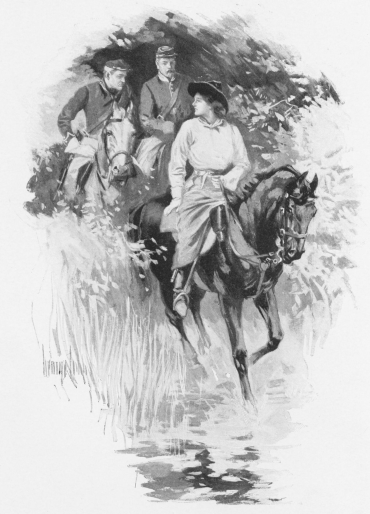
—And they married, and had many children, and lived happy ever after. Old Tales
For two days the signal flags had been talking to each other; for two
nights the fiery torches had been conversing about that beleaguered city
in the South.
Division after division, corps after corps, were moving forward; miles
of wagons, miles of cavalry in sinuous columns unending, blackened every
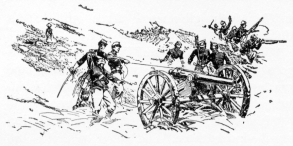
valley road. Later, the heavy Parrots and big Dahlgrens of the siege
train stirred in their parked lethargy, and, enormous muzzles tilted,
began to roll out through the valley in heavy majesty, shaking the
ground as they passed, guarded by masses of red artillerymen.
Day after day crossed cannon flapped on red and white guidons; day after
day the teams of powerful horses, harnessed in twenties, trampled
through the valley, headed south.
Off the sandy headland a Federal gunboat lay at anchor, steam up—a
blackened, chunky, grimy thing of timber and iron plates, streaked with
rust, smoke blowing horizontally from her funnels. And day after day she
consulted hill and headland with her kaleidoscopic strings of flags; and
headland and hill talked back with fluttering bunting by day and with
torches of fire by night.
From her window in the emergency hospital the Special Messenger could
see those flags as she sat pensively sewing. Sometimes she mended the
remnants of her silken stockings and the last relics of the fine under
linen left her; sometimes she scraped lint or sewed poultice bandages,
or fashioned havelocks for regiments southward bound.
She had grown slimmer, paler, of late; her beautiful hair had been
sheared close; her head, covered with thick, clustering curls, was like
the shapely head of a boy. Limbs and throat were still smooth and round,
but had become delicate almost to leanness.
The furlough she had applied for had not yet arrived; she seemed to
remain as hopelessly entangled in the web of war as ever, watching,
without emotion, the old spider. Death, busy all around her, tireless,
sinister, absorbed in his own occult affairs.
The routine varied but little: at dawn surgeons’ call chorused by the
bugles; files of haggard, limping, clay-faced men, headed by sergeants,
all converging toward the hospital; later, in every camp, drums awaking;
distant strains of regimental bands at parade; and all day and all night
the far rumble of railroad trains, the whistle of locomotives, and, if
the wind veered, the faint, melancholy cadence of the bells swinging for
a clear track and right of way.
Sometimes, sewing by the open window, she thought of her brother, now
almost thirteen—thought, trembling, of his restless letters from his
Northern school, demanding of her that he be permitted to take his part
in war for the Union, begging to be enlisted at least as drummer in a
nine-months’ regiment which was recruiting within sight of the dormitory
where he fretted over Cæsar and the happy warriors of the Tenth Legion.
Sometimes, mending the last shreds of her cambric finery, she thought of
her girlhood, of the white porches at Sandy River; and always, always,
the current of her waking dream swung imperceptibly back to that swift
crisis in her life—a flash of love—love at the first glance—a word!
and his regiment, sabres glittering, galloping pell-mell into the
thundering inferno between the hills.... And sunset; and the wounded
passing by wagon loads, piled in the blood-soaked hay; and the glimpse
of his limp gold-and-yellow sleeve—and her own white bed, and her lover
of a day lying there—dead——
At this point in the dream-tale her eyes usually became too dim to see
the stitches, and there was nothing to do except to wait until the tired
eyes were dry again.
The sentry on duty knocked, opened the door, and admitted a
weather-stained aide-de-camp, warning her respectfully:
“Orders for you, ma’am.”
The Special Messenger cleared her eyes, breathing unevenly, and unsealed
the dispatch which the officer handed her.
When she read it she opened a door and called sharply to a hospital
orderly, who came running:
“Fit me with a rebel cavalry uniform—you’ve got that pile of
disinfected clothing in the basement. I also want one of our own cavalry
uniforms to wear over it—anything that has been cleaned. Quick,
Williams; I’ve only a few minutes to saddle! And bring me that bundle of
commissions taken from the rebel horsemen that were brought in
yesterday.”
And to the mud-splashed aide-de-camp who stood waiting, looking out of
the window at the gunboat which was now churning in toward the wharf,
billows of inky smoke pouring from the discolored stacks:
“Please tell the general that I go aboard in half an hour. Tell him I’ll
do my best.” In a lower voice: “Ask him not to forget my brother—if
matters go wrong with me. He has given me his word.... And I think that
is all, thank you.”
The A.-D.-C. said, standing straight, hollow-backed, spurred heels
together:
“Orders are verbally modified, madam.”
“What?”
“If you do not care to go—it is not an order—merely a matter of
volunteering.... The general makes no question of your courage if you
choose to decline.”
She said, looking at the officer a little wearily:
“Thank the general. It will give me much pleasure to fulfill his
request. Ask him to bear my brother in mind; that is all.”
The A.-D.-C. bowed to her, cap in hand, then went out, making
considerable racket with sabre and boots.
Half an hour later a long, deep, warning blast from the gunboat’s
whistle set the echoes flying through the hills.
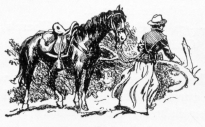
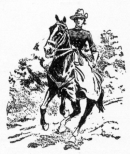
Aboard, leading her horse, the Special Messenger, booted and spurred, in
a hybrid uniform of a subaltern of regulars, handed the bridle to a
sailor and turned to salute the quarterdeck.
The United States gunboat, Kiowa, dropped anchor at the railroad wharf
two days later, and ran out a blackened gangplank. Over it the Special
Messenger, wrapped in her rubber cloak, led her horse to shore, mounted,
and galloped toward the hill where the flag of corps headquarters was
flapping in the wet wind.
The rain ended as she rode inland; ahead of her a double rainbow glowed
and slowly faded to a rosy nimbus.
Corps headquarters was heavily impressive and paternally polite,
referring her to headquarters of the unattached cavalry division.
She remounted, setting her horse at an easy canter for the intervening
two miles, riding through acres of tents and vistas of loaded wagon
trains; and at last an exceedingly ornamental staff officer directed her
to her destination, and a few moments later she dismounted and handed
her bridle to an orderly, whose curiously fashioned forage cap seemed
strangely familiar.
As the Special Messenger entered his tent and saluted, the colonel of
the Fourth Missouri Cavalry rose from a camp chair, standing over six
feet in his boots. He was magnificently built; his closely clipped hair
was dark and curly, his skin smoothly bronzed and flushed at the cheek
bones; his allure that of a very splendid and grave and youthful god,
save for the gayly impudent uptwist of his short mustache and the
stilled humor in his steady eyes.
His uniform was entirely different from the regulation—he wore a blue
forage cap with short, heavy visor of unpolished leather shadowing the
bridge of his nose; his dark blue jacket was shell-cut; over it he wore
a slashed dolman trimmed at throat, wrists and edges with fur; his
breeches were buff; his boots finished at the top with a yellow cord
forming a heart-shaped knot in front; at his heels trailed the most
dainty and rakish of sabres, light, graceful, curved almost like a
scimiter.
All this is what the Special Messenger saw as she entered, instantly
recognizing a regimental uniform which she had never seen but once
before in her brief life. And straight through her heart struck a pain
swift as a dagger thrust, and her hand in its buckskin gauntlet fell
limply from the peak of her visor, and the color died in her cheeks.
What the colonel of the Fourth Missouri saw before him was a lad, slim,
rather pale, dark-eyed, swathed to the chin in the folds of a wet
poncho; and he said, examining her musingly and stroking the ends of his
curt mustache upward:
“I understood from General Sheridan that the Special Messenger was to
report to me. Where is she?”
The lightning pain of the shock when she recognized the uniform
interfered with breath and speech; confused, she raised her gloved hand
and laid it unconsciously over her heart; and the colonel of the Fourth
Missouri waited.
“I am the Special Messenger,” she said faintly.
For a moment he scarcely understood that this slender young fellow, with
dark hair as closely clipped and as curly as his own, could be a woman.
Stern surprise hardened his narrowing gaze; he stood silent, handsome
head high, looking down at her; then slowly the latent humor flickered
along the edges of lip and lid, curbed instantly as he bowed, faultless,
handsome—only the persistently upturned mustache impairing the
perfectly detached and impersonal decorum with a warning of the beau
sabreur behind it all.
“Will you be seated, madam?”
“Thank you.”
She sat down; the wet poncho was hot and she shifted it, throwing one
end across her shoulder. In her uniform she appeared willowy and slim,
built like a boy, and with nothing of that graceful awkwardness which
almost inevitably betrays such masqueraders. For her limbs were straight
at the knees and faultlessly coupled, and there seemed to be the
adolescent’s smooth lack of development in the scarcely accented
hips—only a straightly flowing harmony of proportion—a lad’s grace
muscularly undeveloped.
Two leather straps crossed her breast, one weighted with field glasses,
the other with a pouch. From the latter she drew her credentials and
would have risen to present them, but the colonel of the Fourth Missouri
detained her with a gesture, himself rose, and took the papers from her
hand.
While he sat reading, she, hands clasped in her lap, gazed at his
well-remembered uniform, busy with her memories once more, and the
sweetness of them—and the pain.
They were three years old, these memories, now glimmering alive again
amid the whitening ashes of the past; only three years—and centuries
seemed to dim the landmarks and bar the backward path that she was
following to her girlhood!
She thought of the white-pillared house as it stood at the beginning of
the war; the severing of old ties, the averted faces of old friends and
neighbors; the mortal apprehension, endless suspense; the insurgent
flags fluttering from porch and portico along the still, tree-shaded
street; her own heart-breaking isolation in the community when Sumter
fell—she an orphan, alone there with her brother and bedridden
grandfather.
And she remembered the agony that followed the news from Bull Run, the
stupor that fell upon her; the awful heat of that battle summer; her
evening prayers, kneeling there beside her brother; the red moons that
rose, enormous, menacing, behind the trees; and the widow bird calling,
calling to the dead that never answer more.
Her dead? Why hers? A chance regiment passing—cavalry wearing the
uniform and number of the Fourth Missouri. Ah! she could see them again,
sun-scorched, dusty, fours crowding on fours, trampling past. She could
see a young girl in white, fastening the long-hidden flag to its
halyards as the evening light faded on the treetops!... And then—and
then—he came—into her life, into her house, into her heart,
alas!—tall, lean, calm-eyed, yellow-haired, wrapped in the folds of his
long, blue mantle!... And she saw him again—a few moments before his
regiment charged into that growling thunder beyond the hills somewhere.
And a third time, and the last, she saw him, deathly still, lying on her
own bed, and a medical officer pulling the sheet up over his bony face.
The colonel of the Fourth Missouri was looking curiously at her; she
started, cleared the dimness from her eyes, and steadied the trembling
underlip.
After a moment’s silence the colonel said: “You undertake this duty
willingly?”
She nodded, quietly touching her eyes with her handkerchief.
“There is scarcely a chance for you,” he observed with affected
carelessness.
She lifted her shoulders in weary disdain of that persistent shadow
called danger, which had long since become too familiar to count very
heavily.
“I am not afraid—if that is what you mean. Do you think you can get me
through?”
The colonel said coolly: “I expect to do my part. Have you a rebel
uniform?”
She nodded.
“Where is it?”
“On me—under this.”
The colonel looked at her; a slight shudder passed over him.
“These orders suggest that I start before sunset,” he said. “Meanwhile
this tent is yours. My orderly will serve you. The regiment will move
out about sunset with some six hundred sabres and Gray’s Rhode Island
flying battery.”
He walked to the tent door; she followed.
“Is that your horse?” he asked.
“Yes, Colonel.”
“Fit for the work?” turning to look at her.
“Yes, sir.”
“And you?”
She smiled; through the open tent a misty bar of sunshine fell across
her face, turning the smooth skin golden. Outside a dismounted trooper
on guard presented his carbine as the tall, young colonel strode out. An
orderly joined him; they stood a moment consulting in whispers, then the
orderly ran for his saddled horse, mounted, and rode off through the
lanes of the cavalry camp.
From the tent door the Special Messenger looked out into the camp. Under
the base of a grassy hill hundreds of horses were being watered at a
brook now discolored by the recent rains; beyond, on a second knoll, the
guns of a flying battery stood parked. She could see the red trimmings
on the gunners’ jackets as they were lounging about in the grass.
The view from the tent door was extensive; a division, at least, lay
encamped within range of the eye; two roads across the hills were full
of wagons moving south and east; along another road, stretching far into
the valley, masses of cavalry were riding—apparently an entire
brigade—but too far away for her to hear the trample of the horses.
From where she stood, however, she could make out the course of a fourth
road by the noise of an endless, moving column of horses. At times,
above the hillside, she could see their heads, and the enormous
canvas-covered muzzles of siege guns; and the racket of hoofs, the
powerful crunching and grinding of wheels, the cries of teamsters united
in a dull, steady uproar that never ceased.
From their camp, troopers of the Fourth Missouri were idly watching the
artillery passing—hundreds of sunburned cavalrymen seated along the
hillside, feet dangling, exchanging gibes and jests with the drivers of
the siege train below. But from where she stood she could see nothing
except horses’ heads tossing, blue caps of mounted men, a crimson guidon
flapping, or the sun glittering on the slender, curved blade of some
officer’s sabre as he signaled.
North, east, west, south—the whole land seemed to be covered with
moving men and beasts and wagons; flags fluttered on every eminence;
tents covered plowed fields, pastures, meadows; smoke hung over all,
crowning the green woods with haze, veiling hollows, rolling along the
railway in endless, yellow billows.
The rain had washed the sky clean, but again this vast, advancing host
was soiling heaven and blighting earth as it passed over the land
toward that beleaguered city in the South.
War! Everywhere the monotony of this awful panorama, covering her
country day after day, month after month, year after year—war, always
and everywhere and in every stage—hordes of horses, hordes of men,
endless columns of deadly engines! Everywhere, always, death, or the
preparation for death—every road and footpath crammed with it, every
field trampled by it, every woodland shattered by it, every stream
running thick with its pollution. The sour smell of marching men, the
stale taint of unclean fires, the stench of beasts—the acrid,
indescribable odor that hangs on the sweating flanks of armies seemed to
infect sky and earth.
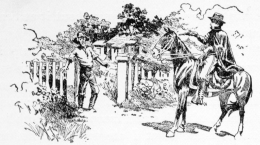
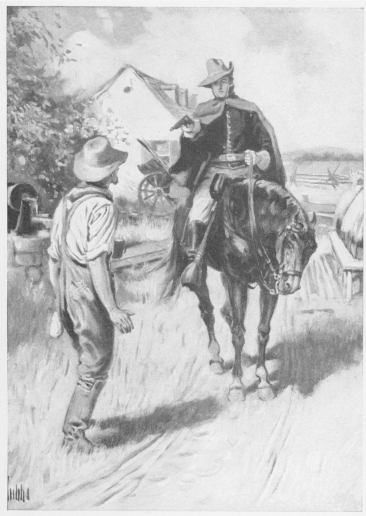
A trooper, munching an apple and carrying a truss of hay, passed, cap
cocked rakishly, sabre banging at his heels; and she called to him and
he came up, easily respectful under the grin of bodily well being.
“How long have you served in this regiment?” she asked.
He swallowed the bite of apple which crowded out his freckled cheeks:
“Three years, sir.”
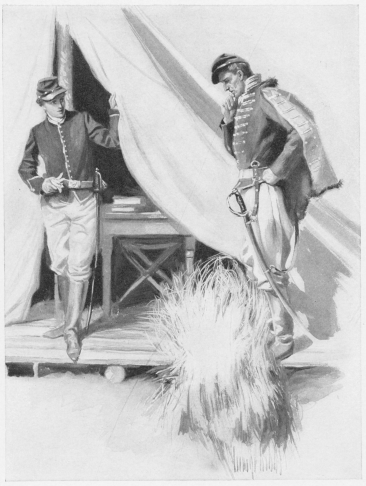 “‘We was there—I know that, yes, an’ we had a fight.’”
She drew involuntarily nearer the tent door.
“Then—you were at Sandy River—three years ago?”
“Yes, sir.”
“Do you remember the battle there?”
The soldier looked doubtful. “We was there—I know that; yes, an’ we had
a fight——”
“Yes—near a big white house.”
The soldier nodded. “I guess so; I don’t seem to place no big white
house——”
She asked calmly: “Your regiment had a mounted band once?”
He brightened.
“Yes, sir-ee! They played us in at Sandy River—and they got into it,
too, and was cut all to pieces!”
She motioned assent wearily; then, with an effort: “You don’t know,
perhaps, where he—where their bandmaster was buried?”
“Sir?”
“The bandmaster of the Fourth Missouri? You remember him—that tall,
thin young officer who led them with his sabre—who sat his horse like a
colonel of regulars—and wore a cap of fur like—like a hussar of some
militia State guard——”
“Well, you must mean Captain Stanley, who was at that time bandmaster of
our regiment. He went in that day at Sandy River when our mounted band
was cut to pieces. Orders was to play us in, an’ he done it.”
There was a silence.
“Where is he—buried?” she asked calmly.
“Buried? Why, he ain’t dead, is he?”
“He died at Sandy River—that day,” she said gently. “Don’t you
remember?”
“No, sir; our bandmaster wasn’t killed at Sandy River.”
She looked at him amazed, almost frightened.
“What do you mean? He is dead. I—saw him die.”
“It must have been some other bandmaster—not Captain Stanley.”
“I saw the bandmaster of your regiment, the Fourth Missouri Cavalry,
brought into that big white house and laid on my—on a bed——” She
stared at the boy, caught him by the sleeve: “He is dead, isn’t he? Do
you know what you are telling me? Do you understand what I am saying?”
“Yes, sir. Captain Stanley was our bandmaster—he wasn’t captain then,
of course. He played us in at Sandy River—by God! I oughter know,
because I got some cut up m’self.”
“You—you tell me that he wasn’t killed?” she repeated, steadying
herself against the canvas flap.
“No, sir. I heard tell he was badly hurt—seems like I kinder
remember—oh, yes!” The man’s face lighted up. “Yes, sir; Captain
Stanley, he had a close shave! It sorter comes back to me now, how the
burial detail fetched him back saying they wasn’t going to bury no man
that twitched when they shut his coffin. Yes, sir—but it’s three years
and a man forgets, and I’ve seen—things—lots of such things in three
years with Baring’s dragoons. Yes, sir.”
She closed her eyes; a dizziness swept over her and she swayed where she
stood.
“Is he here?”
“Who? Captain Stanley? Yes, sir. Why, he’s captain of the Black Horse
troop—F, third squadron.... They’re down that lane near the trees.
Shall I take you there?”
She shook her head, holding tightly to the canvas flap; and the trooper,
saluting easily, resumed his truss of hay, hitched his belt, cocked his
forage cap, and went off whistling.
All that sunny afternoon she lay on the colonel’s camp bed, hands
tightly clenched on her breast, eyes closed sometimes, sometimes wide
open, gazing at the sun spots crawling on the tent wall.
To her ears came bugle calls from distant hills; drums of marching
columns. Sounds of the stirring of thousands made tremulous the dim
silence of the tent.
Dreams long dead arose and possessed her—the confused dreams of a
woman, still young, awakened from the passionless lethargy of the past.
Vaguely she felt around her the presence of an earth new born, of a new
heaven created. She realized her own awakening; she strove to comprehend
his resurrection, and it frightened her; she could not understand that
what was dead through all these years was now alive, that the ideal she
had clung to, evoking it until it had become part of her, was real—an
actual and splendid living power. In this vivid resurgence she seemed to
lose her precise recollections of him now that he was alive.
While she had believed him dead, everything concerning his memory had
been painfully real—his personal appearance, the way he moved, turned,
the sound of his voice, the touch of his hand as it tightened in hers
when he lay there at sunset, while she and Death watched the color
fading from his face.
But now—now that he was living—here in this same world with her
again—strive as she would she could neither fix either his features nor
the sound of his voice upon her memory. Only the stupefying wonder of it
possessed her, dulling her senses so that even the happiness of it
seemed unreal.
How would they meet?—they two, who had never met but thrice? How would
they seem, each to the other, when first their eyes encountered?
In all their lives they had exchanged so little speech! Yet from the
first—from the first moment, when she had raised her gaze to him as he
entered in his long, blue cloak, her silence had held a deeper meaning
than her speech. And on that blessed night instinct broke the silence;
yet, with every formal word exchanged, consciousness of the occult bond
between them grew.
But it was not until she thought him dead that she understood that it
had been love—love unheralded, unexpected, incredible—love at the
first confronting, the first encountering glance. And to the memory of
that mystery she had been faithful from the night on which she believed
he died.
How had it been with him throughout these years? How had it been with
him?
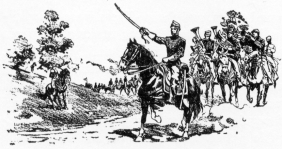
The silvery trumpets of the cavalry were still sounding as she mounted
her horse before the colonel’s tent and rode out into the splendour of
the setting sun.
On every side cavalrymen were setting toe to stirrup; troop after troop,
forming by fours, trotted out to the crest of the hill where the Western
light lay red across the furrowed grass.
A blaze of brilliant color filled the road where an incoming Zouave
regiment had halted, unslinging knapsacks, preparing to encamp, and the
setting sun played over them in waves of fire, striking fiercely across
their crimson fezzes and trousers.
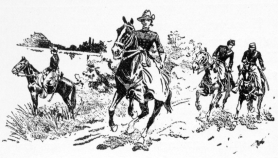
Through their gorgeous lines the cavalry rode, colonel and staff
leading; and with them rode the Special Messenger, knee to knee with the
chief trumpeter, who made his horse dance when he passed the gorgeous
Zouave color guard, to show off the gridiron of yellow slashings across
his corded and tasseled breast.
And now another infantry regiment blocked the way—a heavy, blue column
tramping in with its field music playing and both flags flying in the
sunset radiance—the Stars and Stripes, with the number of the regiment
printed in gold across crimson; and the State flag—white, an Indian and
an uplifted sword on the snowy field: Massachusetts infantry.
On they came, fifes skirling, drums crashing; the colonel of the Fourth
Missouri gave them right of way, saluting their colors; the Special
Messenger backed her horse and turned down along the column.
Under the shadow of her visor her dark eyes widened with excitement as
she skirted the halted cavalry, searching the intervals where the troop
captains sat their horses, naked sabres curving up over their shoulder
straps.
“Not this one! Not this one,” her little heart beat hurriedly; and
then, without warning, panic came, and she spurred up to the major of
the first squadron.
“Where is Captain Stanley?” Her voice almost broke.
“With his troop, I suppose—‘F,’” replied that officer calmly; and her
heart leaped and the color flooded her face as she saluted, wheeled, and
rode on in heavenly certainty.
A New York regiment, fresh from the North, was passing now, its
magnificent band playing “Twinkling Stars”; and the horses of the
cavalry began to dance and paw and toss their heads.
One splendid black animal reared suddenly and shook its mane out; and at
the same moment she saw him—knew him—drew bridle, her heart in her
mouth, her body all a-tremble.
He was mastering the black horse that had reared, sitting his saddle
easily, almost carelessly, his long, yellow-striped legs loosely
graceful, his straight, slim figure perfect in poise and balance.
And now the trumpets were sounding; captain after captain turned in his
saddle, swung his sabre forward, repeating the order: “Forward—march!
Forward—march!”
The Special Messenger whirled her horse and sped to the head of the
column.
“I was just beginning to wonder—” began the colonel, when she broke in,
breathless:
“May I ride with Captain Stanley of F, sir?”
“Certainly,” he replied, surprised and a trifle amused. She hesitated,
nervously picking at her bridle, then said: “When you once get me
through their lines—I mean, after I am safely through and you are ready
to turn around and leave me—I—I would like—to—to——”
“Yes?” inquired the colonel, gently, divining some “last message” to
deliver. For they were desperate chances that she was taking, and those
in the beleaguered city would show her no mercy if they ever caught her
within its battered bastions.
But the Special Messenger only said: “Before your regiment goes back,
may I tell Captain Stanley who I am?”
The colonel’s face fell.
“Nobody is supposed to have any idea who you are——”
“I know it. But is there any harm if I only tell it to—to just this
one, single man?” she asked, earnestly, not aware that her eyes as well
as her voice were pleading—that her whole body, bent forward in the
saddle, had become eloquent with a confession as winning as it was
innocent.
The colonel looked curiously into the eager, flushed face, framed in its
setting of dark, curly hair, then he lifted a gauntleted hand from his
bridle and slowly stroked his crisp mustache upward to hide the smile he
could not control.
“I did not know,” he said gravely, “that Captain Stanley was
the—ah—‘one’ and ‘only’ man.”
She blushed furiously, the vivid color ran from throat to temple,
burning her ears till they looked like rose petals caught in her dark
hair.
“You may tell Captain Stanley—if you must,” observed the colonel of the
Fourth Missouri. He was gazing absently straight between his horse’s
ears when he spoke. After a few moments he looked at the sky where,
overhead, the afterglow pulsated in bands of fire.
“I always thought,” he murmured to himself, “that old Stanley was in
love with that Southern girl he saw at Sandy River.... I had no idea he
knew the Special Messenger. It appears that I am slightly in error.”
And, very thoughtfully, he continued to twist his mustache skyward as he
rode on.
When he ventured to glance around again the Special Messenger had
disappeared.
“Fancy!” he muttered; “fancy old Stanley knowing the mystery of the
three armies! And, by gad, gentlemen!” addressing, sotto voce, the
entire regiment, as he turned in his stirrups and looked back at the
darkening column behind him—“by gad! gentlemen of the Fourth Dragoons,
no prettier woman ever sat a saddle than is riding this moment with the
captain of Troop F!”
What Captain Stanley saw riding up to him through the dull afterglow was
a slightly built youth in the uniform of the regular cavalry, yellow
trimming on collar, yellow welts about the seams of the jacket, yellow
stripes on the breeches; and, as the youth drew bridle, saluted, and
turned to ride forward beside him, he caught sight of a lieutenant’s
shoulder straps on the sergeant’s shell jacket.
“Well, youngster,” he said, smiling, “don’t they clothe you in the
regulars? You’re as eccentric as our butternut friends yonder.”
“I couldn’t buy a full uniform,” she said truthfully. She did not add
that she had left at a minute’s notice for the most dangerous
undertaking ever asked of her, borrowing discarded makeshifts anywhere
at hazard.
“Are you a West Pointer?”
“No.”
“Oh! You’ve their seat—and their shapely leanness. Are you going with
us?”
“Where are you going?”
Stanley laughed. “I’m sure I don’t know. It looks to me as though we
were riding straight into rebeldom.”
“Don’t you know why?” she asked, looking at him from under the shadow of
her visor.
“No. Do you?”
“Yes.”
After a pause: “Well,” he said, laughing, “are you going to tell me?”
“Yes—later.”
Neck and neck, knee and knee they rode forward at the head of the Black
Horse troop, along a road which became dusky beyond the first patch of
woods.
After the inner camp lines had been passed the regiment halted while a
troop was detailed as flankers and an advanced guard galloped off ahead.
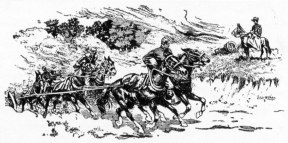
Along the road behind, the guns of the Rhode Island Battery came
thudding and bumping up, halting with a dull clash of chains.
Stanley said: “This is one of Baring’s pet raids; we’ve done it dozens
of times. Once our entire division rode around Beauregard; but I didn’t
see the old, blue star division flag this time, so I guess we’re going
it alone. Hello! There’s infantry! We must be close to the extreme
outposts.”
In the dusk they were passing a pasture where, guarded by sentinels, lay
piled, in endless, straight rows, knapsacks, blankets, shelter tents,
and long lines of stacked Springfield rifles. Soldiers with the white
strings of canteens crossing their breasts were journeying to and from a
stream that ran, darkling, out of the tangled woodland on their right.
On the opposite side of the road were the lines of the Seventieth
Indiana, their colors, furled in oilcloth, lying horizontally across the
forks of two stacks of rifles. Under them lay the color guard; the
scabbarded swords of the colonel and his staff were stuck upright in
the ground, and the blanket-swathed figures of the officers in poncho
and havelock reposed close by.
The other regiment was the Eleventh Maine. Their colonel, strapped with
his silver eagles, was watching the disposal of the colors by a sergeant
wearing the broad stripe, blue diamond and triple underscoring on each
sleeve. With the sergeant marched eight corporals, long-limbed, rugged
giants of the color company, decorated with the narrow stripe and double
chevron.
A few minutes later the cavalry moved out past the pickets, then swung
due south.
Night had fallen—a clear, starlit, blossom-scented dimness freshening
the air.
The Special Messenger, head bent, was still riding with Captain Stanley,
evidently preferring his company so openly, so persistently, that the
other officers, a little amused, looked sideways at the youngster from
time to time.
After a while Stanley said pleasantly: “We haven’t exchanged names yet,
and you haven’t told me why a regular is riding with us to-night.”
“On special service,” she said in a low voice.
“And your name and regiment?”
She did not appear to hear him; he glanced at her askance.
“You seem to be very young,” he said.
“The colonel of the Ninetieth Rhode Island fell at twenty-two.”
He nodded gravely. “It is a war of young men. I think Baring himself is
only twenty-five. He’s breveted brigadier, too.”
“And you?” she asked timidly.
He laughed. “Thirty; and a thousand in experience.”
“I, too,” she said softly.
“You? Thirty?”
“No, only twenty-four; but your peer in experience.”
“Your voice sounds Southern,” he said in his pleasant voice, inviting
confidence.
“Yes; my home was at Sandy River.”
Out of the corners of her eyes she saw him start and look around at
her—felt his stern gaze questioning her; and rode straight on before
her without response or apparent consciousness.
“Sandy River?” he repeated in a strained voice. “Did you say you lived
there?”
“Yes,” indifferently.
The captain rode for a while in silence, then, carelessly: “There was, I
believe, a family living there before the war—the Westcotes.”
“Yes.” She could scarcely utter a word for the suffocating throb of her
heart.
“You knew them?”
“Yes.”
“Do—do they still live at Sandy River?”
“The house still stands. Major Westcote is dead.”
“Her—I mean their grandfather?”
She nodded, incapable of speech.
“And”—he hesitated—“and the boy? He used to ride a pony—the most
fascinating little fellow——”
“He is at school in the North.”
There was a silence, then the captain turned in his saddle and looked
straight at her.
“Does Miss Westcote live there still?”
“Do you mean Celia Westcote?” asked the Messenger calmly.
“Yes—Celia—” His voice fell softly, making of her name a caressing
cadence. The Special Messenger bent her head lower over her bridle.
“Why do you ask? Did you know her?”
“Yes.”
“Well?”
The captain lifted his grave eyes, but the Messenger was not looking at
him.
“I knew her—in a way—better than I ever knew any woman, and I saw her
only three times in all my life. That is your answer—and my excuse for
asking. Does she still live at Sandy River?”
“No.”
“Do you know where she has gone?”
“She is somewhere in the South.”
“Is she—married?” he asked under his breath.
The Special Messenger looked up at him, smiling in the darkness.
“No,” she said. “I heard that she lost her—heart—to a bandmaster of
some cavalry regiment who was killed in action at Sandy River—three
years ago.”
The captain straightened in his saddle as though he had been shot; in
the dim light his lean face turned darkly scarlet.
“I see her occasionally,” continued the Messenger faintly; “have you any
message—perhaps——”
The captain turned slowly toward her. “Do you know where she is?”
“I expect that she will be within riding distance of me—very soon.”
“Is your mission a secret one?”
“Yes.”
“And you may see her—before very long?”
“Yes.”
“Then tell her,” said the captain, “that the bandmaster of the Fourth
Missouri—” He strove to continue; his voice died in his throat.
“Yes—yes—say it,” whispered the Special Messenger. “I will tell her;
she will understand—truly she will—whatever you say.”
“Tell her—that the bandmaster has—has never forgotten——”
“Yes—yes——”
“Never forgotten her!”
“Yes—oh, yes!”
“That he—he——”
“Yes! Oh, please—please say it—don’t be afraid to say—what you wish!”
The captain’s voice was not under perfect control.
“Say that he—thinks of her.... Say that—that he—he thought of her
when he was falling—there, in the charge at Sandy River——”
“But he once told her that himself!” she cried. “Has he no more to tell
her?”
And Captain Stanley, aghast, fairly leaped in his stirrups.
“Who are you?” he gasped. “What do you know of——”
His voice was smothered in the sudden out-crash of rifles, through which
startled trumpets sounded, followed by the running explosions of cavalry
carbines.
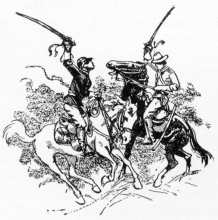
“Attention! Draw sabres!” rang out a far voice in the increasing uproar.
The night air thrilled with the rushing swish of steel drawn swiftly
across steel.
“Forward!” and “Forward! Forward!” echoed the officers, one after
another.
“Steady—right dress!”—taken up by the troop officers: “Steady—right
dress! By fours—right wheel—march!”
Pell-mell the flanking parties came crashing back out of the dusky
undergrowth, and:
“Steady—trot! Steady—right dress—gallop!” came the orders.
“Gallop!” repeated her captain, blandly; and, under his breath: “We are
going to charge. Quick, tell me who you are!”
“Steady—steady—charge!” came the clear shout from the front.
“Charge! Charge! Charge!” echoed the ringing orders from troop to troop.
In the darkness of the thickets she rode knee to knee with her captain.
The grand stride of her horse thundering along beside his through
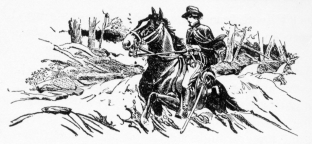
obscurity filled her with wild exultation; she loosened curb and snaffle
and spurred forward amid hundreds of plunging horses, now goaded frantic
by the battle clangor of the trumpets.
Everywhere, right and left, the red flash of Confederate rifles ran
along their flanks; here and there a stricken horse reared or stumbled,
rolling over and over; or some bullet-struck rider swayed wide from the
saddle and went down to annihilation.
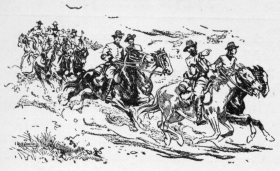
Fringed with darting flames the cavalry drove on headlong into the
unseen; behind clanked the flying battery, mounted gunners sabering the
dark forms that leaped out of the underbrush; on—on—rushed horses and
guns, riders and cannoneers—a furious, irresistible, chaotic torrent,
thundering through the night.
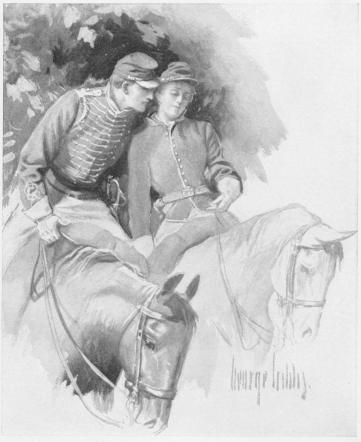 “‘Yes,’ she gasped, ‘The Special Messenger—noncombatant!’”
Far
behind them now danced and flickered the rifle flames; fainter,
fainter grew the shots; and at last, galloping steadily and, by degrees,
reforming as they rode, the column swung out toward the bushy hills in
the west, slowed to a canter, to a trot, to a walk.
“We are through!” said the Special Messenger, brokenly, breathing fast
as she pulled in her mount and turned in the starlight toward the man
she rode beside.
At the same moment the column halted; and he drew bridle and looked
steadily at her.
All around them was the confusion and turmoil of stamping, panting
horses, the clank of metal, the heavy breathing of men.
“Look at me!” she whispered, baring her head in the starlight. “Quick!
Look at me! Do you know me now? Look at me—if you—love me!”
A low cry broke from him; she held out both arms to him in the dim
light, forcing her horse up against his stirrup.
“If you love me,” she breathed, “say so now!”
Leaning free from his saddle he caught her in his arms, held her, looked
into her eyes.
“You?”
“Yes,” she gasped, “the Special Messenger—noncombatant!”
“The Special Messenger? You? Good God!”
A dull tattoo of hoofs along the halted column, nearer, nearer,
clattering toward them from the front, and:
“Good-by!” she sobbed; “they’re coming for me! Oh—do you love me? Do
you? Life was so dark and dreadful without you! I—I never
forgot—never, never! I——”
Her gloved hands crept higher around the neck of the man who held her
crushed in his arms.
“If I return,” she sighed, “will you love me? Don’t—don’t look at me
that way. I will return—I promise. I love you so! I love you!”
Their lips clung for a second in the darkness, then she swung her horse,
tearing herself free of his arms; and, bared head lifted to the skies,
she turned south, riding all alone out into the starlit waste.
THE END
OTHER BOOKS
BY
ROBERT W. CHAMBERS
Mr. Chambers is unquestionably the most popular of American novelists
to-day. He is the author of some thirty books of extraordinary variety
in fiction. He was born in New York, and studied in the studios of Paris
to become an artist. While working at painting he took up writing as a
pastime, and had such immediate success that he soon gave up art and
turned to literature as his life work. Always, as a part of this
interest, he has studied and worked in the field of natural history, so
that to-day he is something of an authority on birds and butterflies, a
confirmed fisherman, and a good shot. All these qualities—the study of
art, the experience with nature, both in the line of sport and as an
entomologist—have put their stamp upon his work, as will be seen by a
glance at his books, for only a few of which there is space here
available.
THE FIRING LINE
The most recent of his works is the third in a group of studies in
American society life. It is full of the swing of good romance, behind
which lies the bright philosophy that the saving quality in our American
families is to come with the injection of fresh blood into each new
generation. The story itself deals with the adopted daughter of a
multimillionaire, who does not even know her own parentage—a girl from
nowhere, with all the charm and beauty which a bringing up in the midst
of wealth can give her. The hero is a young American of good family who
first meets her at Palm Beach, Florida. Here is a background that Mr.
Chambers loves—the outdoor life of exotic Florida, the everglades, the
hunting, the shooting, and the sea—all in the midst of that other
exotic life which goes with a winter resort and a large group of the
idle rich. The story—already in its 150th thousand—is, perhaps, the
author’s favorite piece of work.
THE YOUNGER SET
is also of the social comédie humaine of America, with its scenes laid
in New York and on Long Island. Here again, behind a romance of love and
of society complications, Mr. Chambers conceals his philosophic
suggestions that may be gathered from the title. The younger set comes
into our society fresh and unspoiled with each generation, and in its
way contributes something of freshness, something of vigor to keep the
social world from going down hill on a grade of decadence. The story
deals with a man who, although still young, feels that his life is
practically over because his marriage, through no fault of his own, has
proved a failure and ended in divorce. He meets a young girl just
introduced into society, whose wholesome youth charms him and leads him
back to optimism and life. The character of Eileen is perhaps one of
Mr. Chambers’s most real and most successful creations. The fact that
this novel, after one year, is in its 200th thousand is sufficient
proof of its popularity. In
THE FIGHTING CHANCE
the author still deals with American society, but here his background is
the consideration of the evil influences of inheritance in old families.
The scene is still New York and Long Island, full of the charm of
outdoor life and hunting episodes. The principal male character Siward
is cursed with the inheritance of drink. Siward’s struggles to conquer
his Enemy, and the fighting chance he sees at last in the affection of a
girl, carry on the story to a hopeful finish. The novel has been
published two years and a few months and more than 250,000 copies have
been sold, so that its claims to success are undeniable.
THE RECKONING
The varied interests of the author which have been suggested above are
sustained in this novel. It is a story of a side light of the American
Revolution, and it makes the fourth novel in a series of books telling
in fiction of the scenes and invoking the characters in the Mohawk
Valley during the war for American Independence. The first novel of the
series was “Cardigan”; the second, “The Maid-at-Arms”; the third is
still to be written, when the distinguished author can find time; while
“The Reckoning” is the last.
IOLE
Another splendid example of the author’s versatility is this farcical,
humorous satire on the art nouveau of to-day. Mr. Chambers, with all
his knowledge of the artistic jargon, has in this little novel created a
pious fraud of a father, who brings up his eight lovely daughters in the
Adirondacks, where they wear pink pajamas and eat nuts and fruit, and
listen to him while he lectures them and everybody else on art. It is
easy to imagine what happens when several rich and practical young New
Yorkers stumble upon this group. Everybody is happy in the end.
THE TRACER OF LOST PERSONS
Here again is a totally different vein of half humor and half
seriousness. Mr. Chambers selects a firm of detectives (based, by the
way, on fact) who guarantee to find lost persons, missing heirs, etc. In
this case the author’s fancy and humor suggest to a young bachelor, who
has always had an ideal girl in mind, that he go and describe her as a
real person to Mr. Keen, the Tracer of Lost Persons. He gives his
description, and, as may be supposed, Mr. Keen finds the girl, but
after such a series of episodes, escapes, discoveries and dénouements
that it takes a full-grown novel to accomplish the task.
THE TREE OF HEAVEN
Half in fancy, half in fact, the thread of an occult idea runs through
this weird theme. You cannot, even at the end, be quite sure whether the
author has been making fun of you or not. Perhaps, if the truth were
told, he could not quite tell you himself. The tale all hangs about one
of a group of friends who lives for years in the Far East and gathers
some of the occult knowledge of that far-off land. Into the woof of an
Eastern rug is woven the soul of a woman. Into the glisten of a scarab
is polished the prophecy of a life. Into the whole charming romance of
the book is woven the thread of an intangible, “creepy,” mysterious
force. What is it? Is it a joke? Who knows?
SOME LADIES IN HASTE
This novel is as widely different from all the others as if another hand
had written it and another mind conceived it. This time, too, it is
impossible to say whether the author is quizzing our new thought
transference and telepathic friends, or whether he is half inclined to
suggest that “there may be something in it.” Here is a character who
suddenly discovers that by concentrating his mind on certain ideas he
can inject or project them into others. And forthwith he sets half a
dozen couples making love to each other in most grotesque surroundings.
They climb trees and become engaged. They put on strange Panlike
costumes and prance about the woods—always charming, always well bred,
always with a touch of romance that makes the reader read on to the end
and finally lay the book down with a smile of pleasure and a little sigh
that it is over so soon.
One might run on for twenty books more, but there is not space enough
even to mention Mr. Chambers’s delightful nature books for children,
telling how Geraldine and Peter go wandering through “Outdoor-land,”
“Mountain-Land,” “Orchard-Land,” “River-Land,” “Forest-Land,” and
“Garden-Land.” They, in turn, are as different from his novels in fancy
and conception as each of his novels from the other. No living writer
has given to the public so varied a list of books with such
extraordinary popularity in all of them as Mr. Robert W. Chambers.