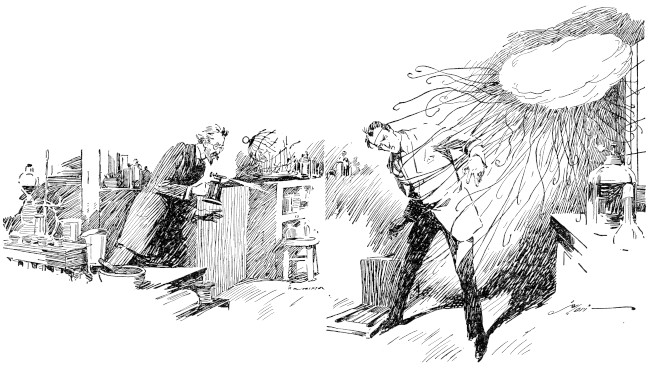
When I came to my senses once more I was lying on a davenport in
the drawing-room. The professor was holding a phial of some pungent
aromatic beneath my nostrils, while Sue and Mrs. Davis chafed my hands.
I blinked, sat up, and tried to remember what had happened. Then it
all came back to me—the grip of wiry tentacles, the roaring sound,
the numbing shocks, the sickening stench, and that horrible shriek. I
remembered it as sounding something between the wail of a steam siren
and the scream of a woman.
"Better lie down for a while, Dick," cautioned the professor. "You've
had a narrow escape. If that animated galvanic battery had been just a
little more powerful you could never have recovered from those shocks."
I leaned back on the cushions, for it made me giddy to sit up.
"I passed out when the thing screamed, or at least I thought it
screamed," I said. "What followed?"
"When you thought it screamed," said the professor, "you were right. It
screamed not once, but again and again. It roared before it screamed.
Didn't you hear it roar?"
"I heard a roaring sound," I replied. "I didn't know whether it was
made by the torch or the creature."
"Possibly it was both," said the professor. "The roaring of the monster
sounded very like the roaring of the torch, except that it was louder.
It began to roar as soon as its tentacles touched you. I could tell by
the spasmodic jerking of your muscles that it was sending an electric
current through your body, and quite a powerful one.
"There are a few animals already known to science which have this
power. Some of them are deep sea creatures, but the electric eel of
Brazil is the most striking example. This eel, when its electrical
organs are fully charged, is said to be capable of rendering a man or a
large animal unconscious from electric shock. So it is not surprising
that this creature, so many times larger than the largest electric eel,
was able to do the same for you with a number of shocks.
"My torch began to function just as the creature attacked you, and I
first tried to rescue you by burning off the wiry tentacles. But it had
so many of these in reserve that the task seemed endless. I, too, was
attacked, and had the creature's store of electrical energy not been
depleted by the shocks it had sent through your body, it is probable
that both of us would have been rendered unconscious and ultimately
devoured. As it was, I was rapidly becoming helplessly entangled in the
tentacles, so I turned the torch on the monster's body. It was then
that it shrieked—not once, but many times. The volume of its terrible
voice was astounding; its weird tones were horrible to bear!
"But the torch finally won. All the tentacles let go except those which
had been burned off, and the thing, after bumping around on the walls
for a time, flew against the window screen with such force that it was
ripped from the frame. Then it disappeared, still screaming weirdly,
into the night.
"I made a very weak solution of prussic acid and painted the remaining
tentacles with this. There were quite a few around your arms, legs
and body. One, also, was tightly bound around your forehead. All
relaxed instantly when the solution was applied. I then used it on the
tentacles which still clung to me, after which Wong and I carried you
here."
"Was it prussic acid solution you used on my finger this morning?" I
asked. "That stuff that had a bitter almond odor?"
"That was it," replied the professor. "Prussic acid has a paralyzing
effect on the nervous system. It is a good thing that I learned, this
morning, that it will cause the tentacles of these creatures to relax.
It would have been dangerous to have had to experiment with the longer
tentacles in the position they had gripped you this evening."
"I have always thought," I said, "that the touch of prussic acid to the
human skin was poisonous, particularly to a cut surface, and that one
whiff of the fumes was usually deadly."
"So it is," replied the professor. "In a sufficiently strong solution
it would be deadly to apply it to an abraded skin, and one whiff of
prussic or hydrocyanic acid gas is usually lethal. But the solution I
used was diluted sufficiently to make it safe for application to the
human skin, or even to an open wound. I purposely made a weak solution
this morning, intending to make it a little stronger if necessary, but
as you saw, it worked."
At this moment, Wong entered with a tea tray and a steaming pot of
fragrant Darjeeling.
I sat up for my cup of tea, and we discussed the strange incidents of
the day. Then Mrs. Davis ordered us all to bed with a firmness that
would not be gainsaid.
Early the next morning Wong awakened me with a gentle knock at my
door, and upon my bidding him enter, brought me a demi-tasse and
cigarettes.
"Plofessey Davis like see you along lab'toly plenty quick," he said.
"Tell him I'll be right down," I replied.
I dressed and hurried downstairs. The professor was waiting in his
laboratory.
"Dick," he said, "something has happened since last evening that has,
it seems to me, a rather sinister significance. I haven't told my wife
or Sue, as I don't wish to alarm them."
"What has happened?" I asked.
"Come with me," he replied. "I told my wife you and I were going for a
walk, so we can go out without arousing her suspicion. Sue, I believe,
is still sleeping. The poor child is exhausted after the ordeal of
yesterday."
After threading our way among the various outbuildings, we entered
the lane between a corn and wheat field which led to the pasture.
Traversing the lane, we came to the pasture itself. Sue and I had
crossed it only the day before, and it had revealed at that time, only
the undulating, blue grass.
But overnight there had sprouted, near its center, a colony of
gray-white growths, varying in height from three to nearly twelve feet.
They were roughly cylindrical in shape, and their tops were fringed
with squirming, wiry tentacles, some of which reached nearly to the
ground, while others stood at various angles at or near the horizontal,
and still others reached skyward.
That the movements of the tentacles were not due to the morning breeze
was quite evident from the fact that they moved in all directions. The
cylindrical stalks, also, bent in various directions from time to time,
almost as if they were bowing to each other, and those that bent toward
us revealed cavernous openings at their tops, greatly resembling the
mouths of anemones.
The wind, blowing from them to us, carried the revolting charnel smell
that had now become so familiar to us.
"What are they?" I asked.
"You know as much as I," replied the professor. "They may be one of
the life phases of the cloud-medusæ. From the similarity of their
tentacles, and the analogy we have in our sub-marine medusæ, as well as
the similar, I might say identical, stench that emanates from them, I
am inclined to think that this is the case. Yet they might be a totally
different race of creatures, which have traveled to us simultaneously
with the medusæ, from the space wanderer which we believe is
responsible for this unprecedented invasion. Only a careful observation
of them will tell."
While we were talking, Jake Smith, the professor's farm hand,
approached, driving a herd of cattle before him with the assistance of
a young collie. The racket they made—the clatter of hoofs, the bawling
of cattle and calves, the barking of the dog, and the shouts of the
man—seemed to have a magnetic effect on the strange growths before us,
for instantly all bent toward the herd, mouths gaping and tentacles
wriggling menacingly.
With the herd were three calves which showed a tendency to wander.
While the collie was bringing in one of these strays another got away
and scampered straight toward the mysterious growths. As it drew near
them, all bent toward it, and when it would have run between two of
the tallest, the nearer, arching its cylindrical stem like a striking
serpent, suddenly pounced upon it, and bore it, struggling and bawling,
aloft, hopelessly entangled in the myriad tentacles.
Then the mother cow, evidently attracted by the cries of distress of
her doomed offspring, dashed after it. By the time she reached the
thing that held her calf aloft, the little creature's cries had ceased.
She ran helplessly around the stem for a moment, then backed up as
if about to charge it head down. But she backed within range of the
tentacles of three more of the horrible monstrosities, which instantly
bent over and seized her, holding her helpless.
The farm hand and dog rushed after her, but the man was warned off by
the professor, and he succeeded in calling off his dog before it was
too late.
"Go back to the house, Dick," said the professor. "Bring my blowtorch
as quickly as you can. Also my twelve-gauge pump gun and twelve-gauge
double barrel, with as many shells as you can carry. I'll stay here and
watch. Hurry!"
As fast as my legs would carry me, I dashed toward the house. I found
the professor's blowtorch in the laboratory where he had left it the
night before; and having gone shooting with him many times, I knew
where to find the weapons and ammunition.
Slipping into a hunting coat, I loaded the game pockets with the torch
and all the ammunition they would safely bear. Then, taking the two
guns, I hurried back to the pasture.
The professor had approached to within fifty feet of the outer line of
monsters. One of these, the one which had captured the calf, had grown
considerably taller. Whereas it had been about twelve feet in height
before, it was now nearer eighteen, and still growing. The remains of
the calf, still clutched to the mouth-like opening at the top, were
barely visible as a rounded, dark mass showing here and there in the
wilderness of tentacles which surrounded it.
The three creatures that had captured the cow had also increased
in size, and what we could see of the helpless bovine had dwindled
tremendously. They continued their arched position over the carcass,
feeding noiselessly, and apparently without any competition among
themselves, unless it was one of speed.
"Quick!" said the professor. "Give me the torch. I can be generating it
while you load the guns."
I handed him the torch and proceeded to load the two shotguns.
"What can we do with shotguns against these monsters?" I asked.
"Nothing, at present," he replied, lighting the generator of the torch
and working the pressure pump, "but if a certain theory of mine is
correct we will soon have considerable use for them."
"Which gun do you want?" I asked.
"The double barrel," he replied. "When you start you will probably have
to shoot straight and often. I only want the double barrel in case of
an emergency, as I plan to use the torch. Give me about a dozen extra
shells."
I handed him the shells, and he put them in his pockets after looking
at the wadded ends.
"Number fours," he said. "About as good as any, I guess. Did you bring
nothing but fours?"
"I also brought a dozen loads of buckshot," I replied, "and one box of
number twos."
"We'll try the fours first, at any rate," he said. "Now I want you to
watch the creature that captured the calf."
I looked, and saw that it had now reached a height of about twenty
feet. Its victim seemed entirely consumed. But the most startling
thing I noticed was the strange metamorphosis that was taking place in
the shape of the creature itself. The cylindrical body seemed to be
separating into a number of disc-shaped segments, piled one on top of
the other like stacked dishes. Tentacles were beginning to branch from
the top of each segment.
"If I am not mistaken," said the professor, "the top segment will
presently arise and sail away, or rather attempt to sail away, for as
soon as it flies clear of the others I want you to shoot it down. If it
is far enough from them to make it safe for me to approach it, I can
then destroy it with the torch."
It was not long before a dense cloud of vapor formed around the top
segment. Suddenly it rose and turned over, dropping the whitened bones
of the calf. Then it sailed slowly away over the heads of its fellows,
its wiry tentacles trailing below. As soon as it was beyond range of
their tentacles, I fired into the most dense part of the cloud. It
dipped slightly. Again I fired, and it slowly sank to the ground.
"Watch the next one," shouted the professor, running to the one I had
brought down, torch in one hand and shotgun in the other. "Don't let
any of them get away."
As he turned his torch on the writhing, squirming mass that lay on the
ground, it gave vent to a shriek similar to the one which had rung
in my ears the night before. Again and again it shrieked under the
relentless flame. The noise distracted my attention for a moment, and I
looked back at the monster I was supposed to be watching, just in time
to see a second cloud-covered medusa sail away. Two shots brought this
one to the ground as they had the former. Meanwhile the shrieks of the
first creature ceased and the professor moved on to the second to start
another pandemonium with his searing torch.
Pushing four more shells into the magazine, I waited for the next
medusa to arise. The farm hand had, meanwhile, come up with another
blowtorch and a double barreled shotgun.
"The professor told me to pen up the cows and bring these," he said.
"Light your torch," I told him. "As soon as you get it going you can
help the professor."
"What in tarnation's he burnin'" asked Smith, priming his torch.
"Smells like feathers or old shoes, or somethin'."
"It's worse than either." I replied. "When you get your torch going
I'll show you what to do."
Before the farm hand succeeded in getting his torch to roaring two more
medusæ arose, and I brought them down. But, unfortunately, I fired
at one too soon, and it fell among its tree-like fellows where the
professor did not dare to approach it.
The professor was searing his fourth medusa when I shot down the sixth,
telling Smith to watch the professor, then imitate him.
Before the seventh arose the fifth, which I had shot down among the
others, got up once more, thus affording me a demonstration of the
marvelous recuperative powers of these creatures. Although I must
have riddled and emptied practically every helium-filled cell in its
body, it had closed the rents and refilled them in this marvelously
short space of time. This time I was careful not to shoot until it had
cleared its tree-like fellows.
Twenty flying medusæ in all arose from the stalk that had devoured the
calf. When I had shot down the last one, I saw that the three creatures
that had seized the cow had relinquished her dry bones, and were also
forming into segments. It was evident that I would have to do some fast
shooting when these segments started to fly.
Before the first one arose, Sue came cantering up on Blue Streak, her
favorite saddle horse. It was her custom to ride each morning before
breakfast, and hearing the shooting, she had ridden out to investigate.
"What are these things, and what in the world are you doing?" she asked.
"They are medusæ passing through one of their life stages," I replied,
"and I'm shooting them down as fast as they start to fly while your
father and the hired man kill them with the torches."
"Can't I help you?" she asked. "Please let me do something."
"My supply of shells is running low," I said. "You might dash back to
the house and get me as many as you can carry—fours, twos, and threes."
"Splendid!" she replied, wheeling her mount. "I'll bring my gun, too,
and help you."
I had thought to keep her out of danger for the time being by sending
her back to the house, but to my horror, the first three discs from the
three monsters that had devoured the cow, rose, turned over, and sailed
after her, evidently attracted by the rapid movement of her mount.
I brought down the foremost with two quick shots, but in my haste and
anxiety I missed the second, so I was forced to waste two more charges
on it. I fired my last shot at the third, causing it to sag slightly,
then pushed another shell into the magazine and quickly pumped it into
the chamber. But to my horror I saw that I dared not fire again. The
medusa was now so close to Sue that to fire would mean that she and her
mount must surely be struck.
Shouting to the others to attract their attention, I started after Sue
on the run. But before I had taken a dozen steps I groaned in anguish
as I saw the monster dart downward, its tentacles encircling horse and
rider. The roaring sound which it made as it attacked was punctuated
by screams of pain and terror from girl and horse as the electrically
charged tentacles seized them.
"Turn your horse, Sue!" I shouted. "Ride this way!"
But Sue was by this time enveloped in the dense cloud which surrounded
the monster's disc-like body.